


Abstract
Schedule risks are the main threat for high efficiency of schedule management in power grid engineering projects (PGEP). This paper aims to build a systematical framework for schedule risk management, which consists of three dimensions, including the personnel dimension, method dimension and time dimension, namely supervisory personnel, management methods and the construction process, respectively. Responsibilities of staff with varied functions are discussed in the supervisory personnel part, and six stages and their corresponding 40 key works are ensured as the time dimension. Risk identification, analysis, evaluation and prevention together formed the method dimension. Based on this framework, 222 schedule risks occur in the whole process of PGEPs are identified via questionnaires and expert interviews. Then, the relationship among each risk is figured out based on the Interpretative Structure Model (ISM) method and the impact of each risk is quantitatively assessed by establishing evaluation system. The actual practice of the proposed framework is verified through the analysis of the first stage of a PGEP. Finally, the results show that this framework of schedule risk management is meaningful for improving the efficiency of project management. It provides managers with a clearer procedure with which to conduct risk management, helps them to timely detect risks and prevent risks from occurring. It is also easy for managers to judge the influence level of each risk, so they can take actions based on the level of each risk’s severity. Overall, it is beneficial for power grid enterprises to achieve a sustainable management.
1. Introduction
1.1. Research Background
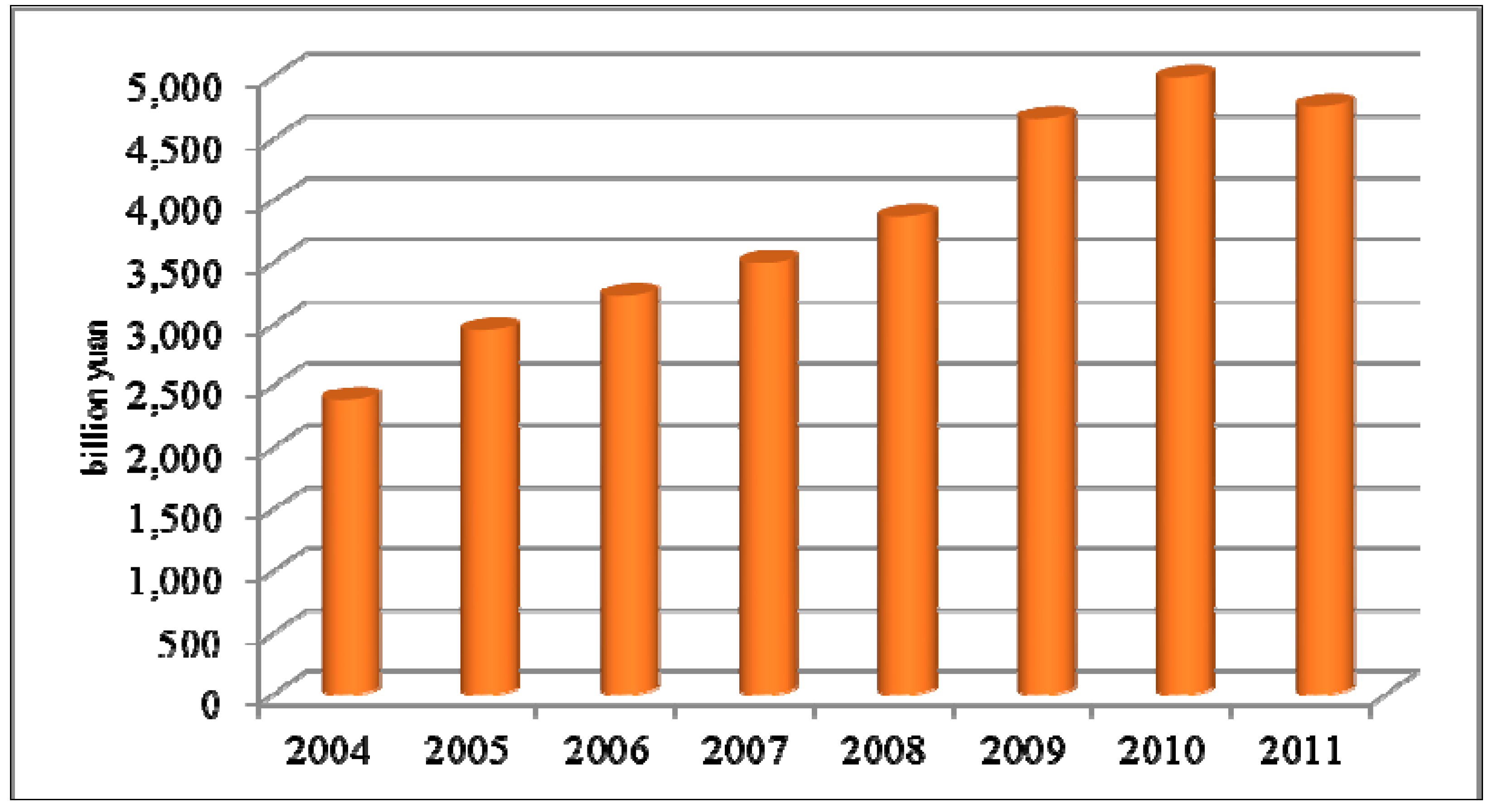
As a result of macro-economic controls, the growth rate of national power demand keeps growing in China [1]. From Figure 1, the annual production capacity of electricity went up to over 45,000 kWh in 2011, nearly three times of that in 2002. The growth rate of electricity production in each year kept positive as well. It is forecasted that the total electricity consumption will grow at an annual growth rate of 7.8% during the “12th Five-Year Plan” period (2011–2015), which will be more than 6 × 10¹² kWh in 2015. In addition, the annual growing rate will be 6.1% during the “13th Five-Year Plan” period, and the total figure will reach nearly 8.2 × 10¹² kWh in 2020 [2]. From Figure 2, the amount of fixed asset investment in electricity and heat production and supply industry achieved RMB 4762 billion Yuan in 2011, at an annual average growth rate of 14.2% in the past 7 years.
Figure 1.
Annual electricity production in China. Source: National Bureau of Statistics.
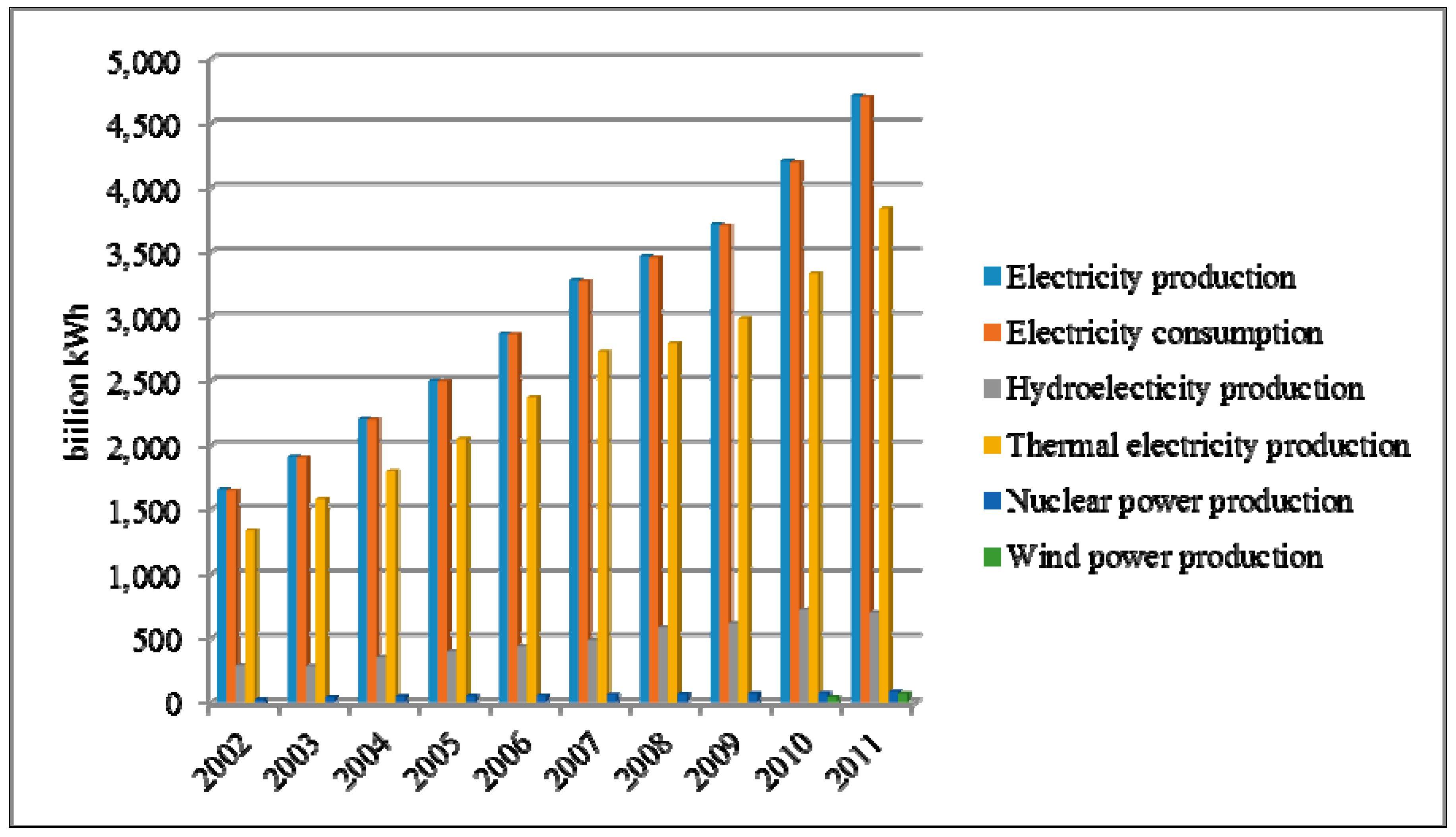
Figure 2.
Annual fixed asset investment in electricity and heat production and supply industry. Source: National Bureau of Statistics.
Accordingly, the amounts of power grid engineering projects (PGEPs) will be expanded. Different from general projects, PGEPs are endowed with many characteristics, such as high cost, complex technology, masses of departments involved, tight schedule requirements, long construction cycle, complex construction environment and other factors. All these determine that the construction process of a PGEP is subject to a number of unstable factors, which leads to easy occurring of risks. Schedule risks are identified as risks whose appearance would lead to the extension of project’s lifecycle. Except for project duration’s expanding, this kind of risk also causes a substantial increase of project costs, plan changes, reduction of the effectiveness and efficiency of corporate management and so on.
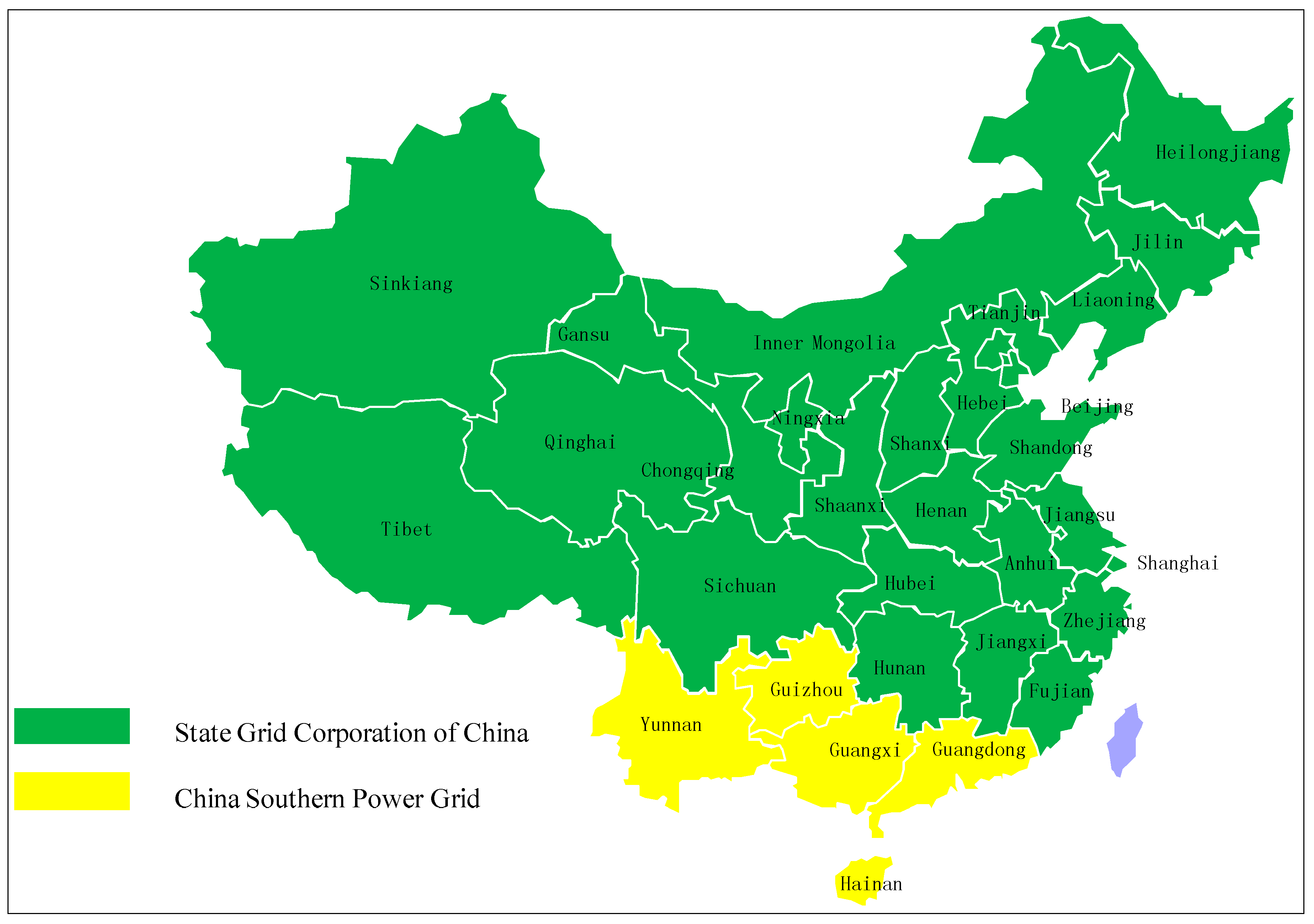
Nowadays, the electricity grid market is mainly occupied by two companies in China, namely the State Grid Corporation and China Southern Power Grid Corporation. The provinces and regions supervised by these two enterprises are shown in Figure 3. Though the Enterprise Resource Planning (ERP) system, a highly integrated system, covering business, projects and plans, is comprehensively applied in these two power grid companies, information related to schedule risk management is not covered. Therefore, if there were no systematical schedule risk management framework considering organizational structure, construction phase and workflow for these two companies, they would easily suffer losses caused by schedule risks. As a result, it is essential to concentrate on a variety of schedule risks during a PGEP’s construction process.
This paper aims to build a systematic schedule risk management framework for PGEPs’ sustainability. A literature review is conducted in the latter part of Section 1. The framework is put forward and discussed in Section 2, which is a three-dimensional framework based on three aspects, including management personnel, construction process and management practices. Further, the paper shows the operation process of the proposed framework and deeply analyzes the schedule risk throughout the construction process in Section 3. With specific case study in feasibility study stage, the first stage of PGEP construction, the paper verifies the feasibility of the established framework. Ultimately, Section 4 concludes this paper.
Figure 3.
Provinces and regions covered by two power enterprises in China.
1.2. Literature Review
Project Risk Management (RM) was not an essential component of project management until the end of the 1970s [3]. For risk management process, a large number of researchers have proposed various views. Chapman [4] presented Project Risk Analysis and Management (PRAM) model, which covered the key elements of project management and established procedures and methods of analysis for the project’s risks in a progressive way. The Institute of Risk Management [5] defined the Risk Management System (RMS), and described the formation of risks and risk levels and divided risk management system into five parts, including risk source, risk factors, risk assessment, risk control and post-evaluation. The Project Management Institute [6] proposed the Project Management Body of Knowledge (PMBoK), which summarized the process of risk management as containing six steps, namely risk management plan, risk identification, qualitative risk assessment, quantitative risk estimate, risk response plans and risk control. In general, effective risk management involves a four-phase process, constituting risk identification, risk analysis, risk evaluation and risk response.
The number of risks inherent in the power grid project is extremely large, so risk identification needs risk classification first. Some methods for classification have been suggested in previous studies. For examples, some researchers focused on the risk origin [7,8] and some concentrated on the hierarchical relationship among risks [9,10].
For risk analysis, different scholars have focused on diverse analytical goals. Liu [11] analyzed non-additive effects under the influence of multiple risks and put attention to the correlation between various risks [12]. In addition, some other researchers focused on the link relationship between risks [13,14,15]. Moreover, a wide range of methods could be used to effectively carry out risk analysis, such as Fault Tree Analysis, Sensitivity Analysis, Estimation of System Reliability and Effect Analysis [16], Fuzzy Set [13,17], Bayesian networks [18,19] and others.
Various approaches have been adopted for assessing project risks. At first, many scholars carried out statistical methods to deal with the schedule risk and gradually, many concluded that human factors, professional experience and personal judgment were essential for risk evaluation [20]. Moreover, the indicators used to evaluate the risks can be summarized as predictability, exposure, manageability and controllability in the previous literature [21,22,23,24], and risk cost has been used as an important risk impact measurement as well [25,26,27]. In addition, diversified models could be utilized for risk assessment. It is evident that AHP, developed by Thomas Saaty [28], has received a worldwide recognition. It is an effective and systematical method for assessing impact of risks and allocating impact weight and many researchers have verified it [29,30,31]. Besides, Monte Carlo simulation [32], Entropy Weight, TOPSIS model [33,34] and other methods have been widespread employed as well.
Amongst the exiting research, some focus on project schedule management, and some put emphasis on risk management [20,35,36,37,38]. However, researchers seldom concentrate on PGEPs, schedule management and risk management together. In addition, the current risk management of engineering projects presents scattered feature in China, which means managers seldom consider risk control from an integrated view. For example, managers always concentrate on the significant risks, while leave out those which own low frequency or little impact; it is common to trace the risk responsibility after accident occurring instead of beforehand. Under these circumstances, managerial deviations and omits easily happen, which contribute to extraordinary losses. Therefore, it is indispensable to carry out comprehensive identification, adequate analysis and thorough prevention of schedule risks.
2. The Framework of Schedule Risk Management
In order to make schedule risk management more comprehensive, a three-dimensional framework is established. This framework considers three important factors in PGEPs, namely people, time and management methods, which are supervisory personnel, construction stages and risk managing methods respectively (Figure 4).
Figure 4.
Schedule risk management framework.
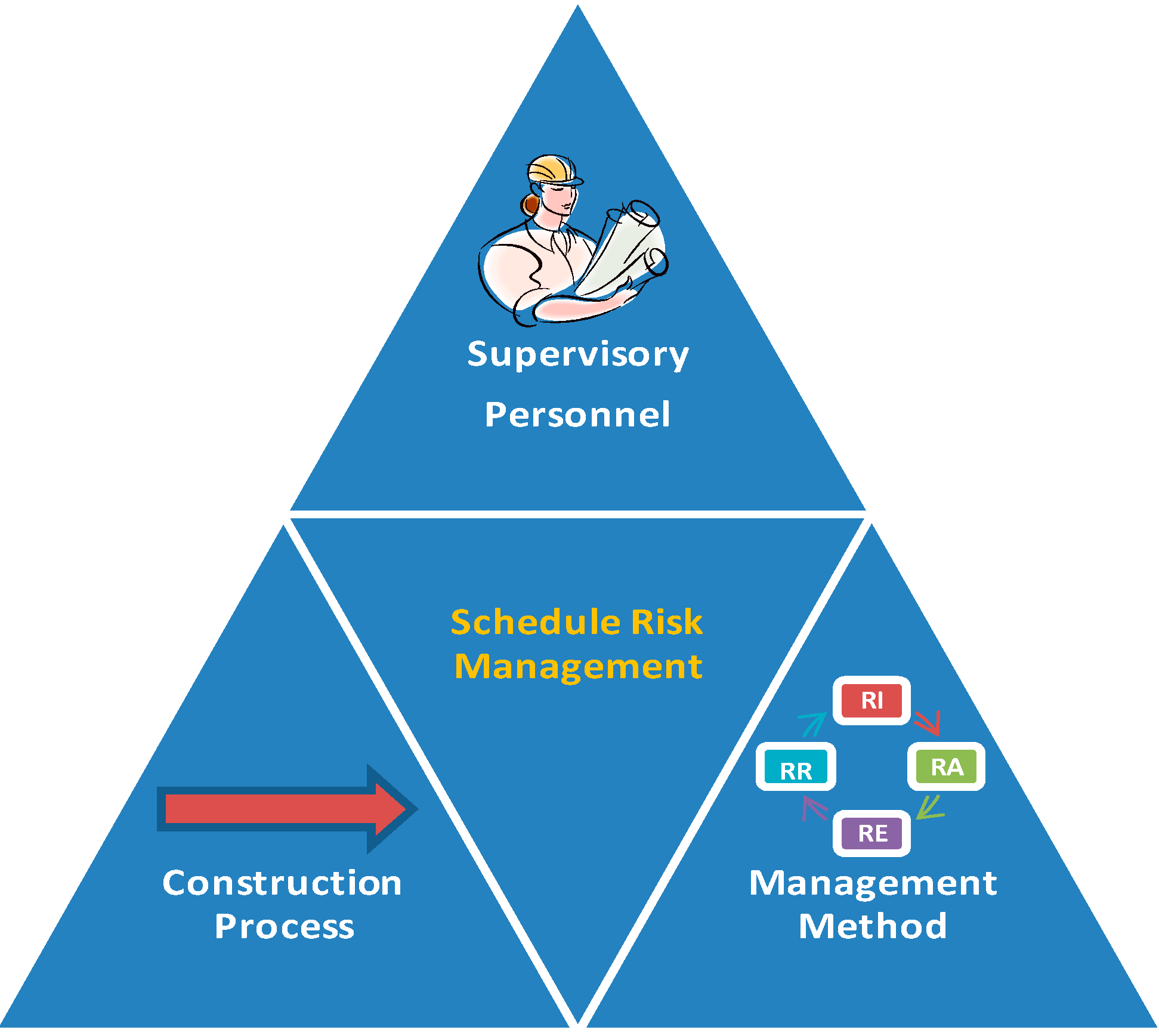
In the State Grid Corporation and China Southern Power Grid Corporation, the organizational structure is composed of headquarter, the provincial and the city level subsidiary companies. The PGEPs have to be centralized and approved by the headquarters every year, then decentralized to the provincial companies. Eventually the city level subsidiaries are responsible for implementation. Personnel in these two companies work as proprietors, besides, designers, contractors and supervisors are very important in PEGPs as well. More details are discussed in Section 2.1.
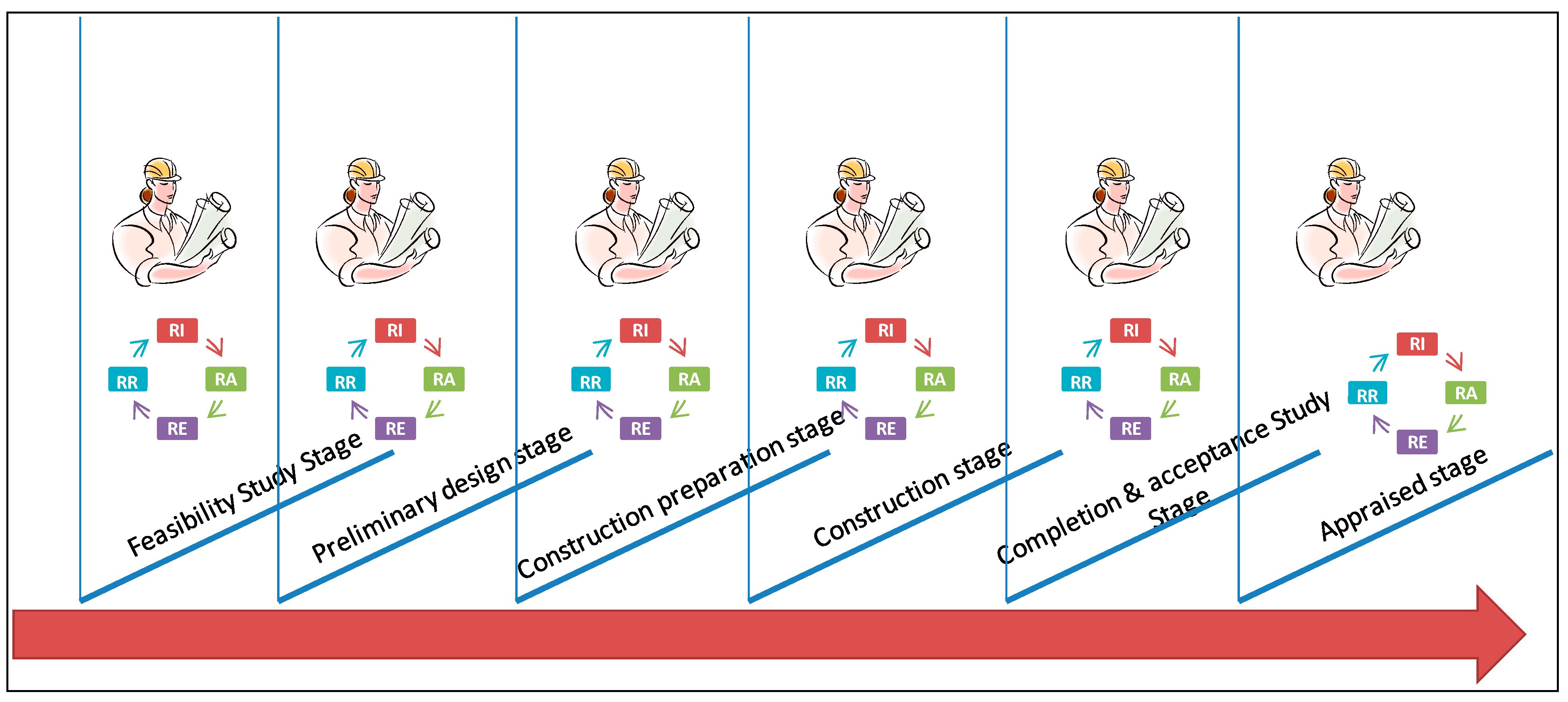
In accordance with the general way of division in project management, the construction process contains six stages, namely Feasibility study stage, Preliminary design stage, Construction preparation stage, Construction stage, Completion and acceptance stage and Appraised stage. Further, every stage comprises several key works, which are fully discussed in Section 2.2.
A risk management cycle is normally divided into four parts, namely risk identification (RI), risk analysis (RA), risk evaluation (RE) and risk response (RR). Relevant details are discussed in Section 2.3.
As shown in Figure 5, every manager needs to carefully identify, analyze and prevent the potential risks at every stage and every work during the construction process. The content of the risks in this framework keeps updating after every PGEP, and this frame works as a guide book for every manager, which helps them to judge the impact of every risk, prevent risks and control risks. Therefore, a coherent risk managing framework has been formed.
Figure 5.
Practical application of schedule risk management framework.
2.1. Supervisory Personnel
Generally, the participants of a PGEP conclude proprietors, designers, contractors and supervisors. The power companies play the role of proprietors, whose risk responsibility covers the whole process from project approval to post-project evaluation. The designer’s responsibility mainly manifests in understanding the use of new materials and new techniques, providing reasonable technical solutions and complete design documents, and being ability to fulfill contractual obligations. The main shows of contractors’ responsibility are providing rational preparation of production plans and construction programs, being suitable project managers and technical experts, being well aware of safety awareness, and successfully following construction specification requirements. Main shows of supervisors include providing well reports about contractor’s illegal activities, having qualified ability and a good control of practical experience and providing sufficient professional support.
2.2. Construction Process
This paper divides construction process of PGEPs into 6 stages as stated above. Further, every stage is comprised of several key works, which are the milestones in the schedule management. The delay of these works will bring negative impacts on follow-up works and eventually expand the total time limit of the project. 40 key works are determined through visiting 12 experts of project management and are shown in Table 1.
Table 1.
Grid project construction phase and the corresponding working nodes.
2.3. Management Method
2.3.1. Risk Identification
Schedule risk identification is to identify and categorize various risks that would affect the schedule plan of projects and then document these risks. Generally, the outcome of risk identification is a list of risks (Appendix Table A1). Risk source identification is an important part of risk identification, which includes risk property identification and risk responsibility identification.
2.3.1.1. Risk Property Identification
In this paper, risk property can be roughly divided into eight kinds, including natural risk (NR), economic risk (ER), financial risk (FR), social risk (SR), management risk (MR), technical risk (TR), policy-legal risk (PLR) and environmental risk (EnR).
Natural risks are those caused by change of climate, geology, environment and other factors. It mainly includes earthquakes, typhoons, geological disasters and other force majeure as well as storms, floods, snow and other severe weather conditions.
Economic risks are those arise from project external economic environmental changes or internal economic relation changes, such as market forecast errors, changes in state investment, changes in debit and credit policies, financing difficulties, cash flow difficulties, interest rate fluctuations, currency fluctuations, inflation, an unreasonable economic structure and others.
Social risks are those caused by the social instability or differences of social culture and habits, such as risks of theft and people’s conflict.
Financial risks are those caused by the deficiency of fund or the excessiveness of financing cost, which will lead to the financing delay and project interrupt.
Management risks are those arise from failures of planning, organization, coordination, control or other management works, such as personnel risks, sub-contracting risks, data transfer risks and contract risks.
Technical risks are those generated by changes due to technology’s advancement, reliability, applicability and availability, which may lead to a lower utilization of production capacity, an increased operational cost and a failure of the quality expectations, such as geological exploration risks, design risks and construction technology risks.
Policy-legal risks are those caused by major changes in political and economic conditions or in government policies, which will lead to a failure of achieving project’s target.
Environmental risks are those brought by changes in social conditions and environmental factors surrounding the project, which will lead to a project’s delay or stop.
2.3.1.2. Risk Responsibility Identification
Risk responsibility identification is mainly used to identify the personnel who should bear the risk if an accident occurred. Generally, there are four responsible parties sharing losses from risks, including proprietors, designers, contractors and supervisors as stated above.
2.3.2. Risk Analysis
Risk analysis is a part of the risk management process for each project, which further identifies potential issues and negative impacts based on the data of risk identification. In a PGEP, it is obvious that the appearance of one kind of risk will often change the occurrence probability of other one or more risks. From this angle, risk analysis aims to analyze the relationship of schedule risks in PGEPs and establish a schedule risk hierarchy diagram based on ISM (Interpretative Structure Modeling) Method. ISM method is an analytical method widely used in the modern system engineering, which could decompose a complex system into several subsystem elements and ultimately form a multi-level hierarchical structure based on practical experience and computers. It is especially suitable for analyzing numerous variables and a complex relationship. Detailed process is discussed in Section 3.2.
2.3.3. Risk Evaluation
Risk evaluation is concerned with assessing the risk impact quantitatively according to the consequences of risk occurrence. It comprehensively considers the probability of occurrence and extent of losses of every risk based on the risk identification and risk analysis. To conduct a risk evaluation always need to build an evaluation index system and apply scientific methods, ultimately obtain the evaluation results. The detailed evaluation process is shown in Section 3.3.
2.3.4. Risk Prevention
Risk identification, risk analysis and risk assessment are important transitions to carry out more appropriate risk prevention measures. Risk prevention is an extremely significant aspect of risk management, and also a crucial part of achieving the full control of the progress. To effectively conduct a risk prevention, one always has to form a list of prevention measures, which helps managers to prevent risks in advance and control negative impacts when risks occur in time.
3. Actual Practice of Schedule Risk Management Framework
The framework of schedule risk management is composed of 3 parts, namely supervisory personnel, construction process and management method. This section shows the relationship among these three parts and gives an instruction for managers about how to operate according to the framework. To be more clear and logical, this section will conduct the analysis following the order of risk management process.
3.1. Risk Identification
By questionnaires and interviews, whose respondents include project managers, supervisors, designers and construction personnel, we have identified a total of 222 risks, which occur in the whole process of PGEPs. These risks are also sourced from a wide range of literatures including journal articles and books [39,40,41,42]. The quantity of risks in each stage and each work are counted (Figure 6) and the specific content of every risk is displayed in the Appendix Table A1.
Based on Section 2.3.1, 222 risks and their corresponding attributes are confirmed (Table 2, an example of Feasibility Study Stage).
3.2. Risk Analysis
3.2.1. Classification of Risk Category
R is a PGEP schedule risk set. Ri is the type of a risk, R = (R1, R2,…, R8), R1 is nature risk, R2 is economic risk, R3 is social risk, R4 is financial risk, R5 is policy-legal risk, R6 is technical risk, R7 is management risk, R8 is environment risk.
Based on the relevant experts’ views within the industry, the mutual influence among risks is analyzed and the relationship matrix is obtained. In this paper, there is only negative influence of a risk occurring. When a risk happens, it will only increase the probability of subsequent risks, instead of preventing them.
Figure 6.
The number of risks of every key work node in each stage.
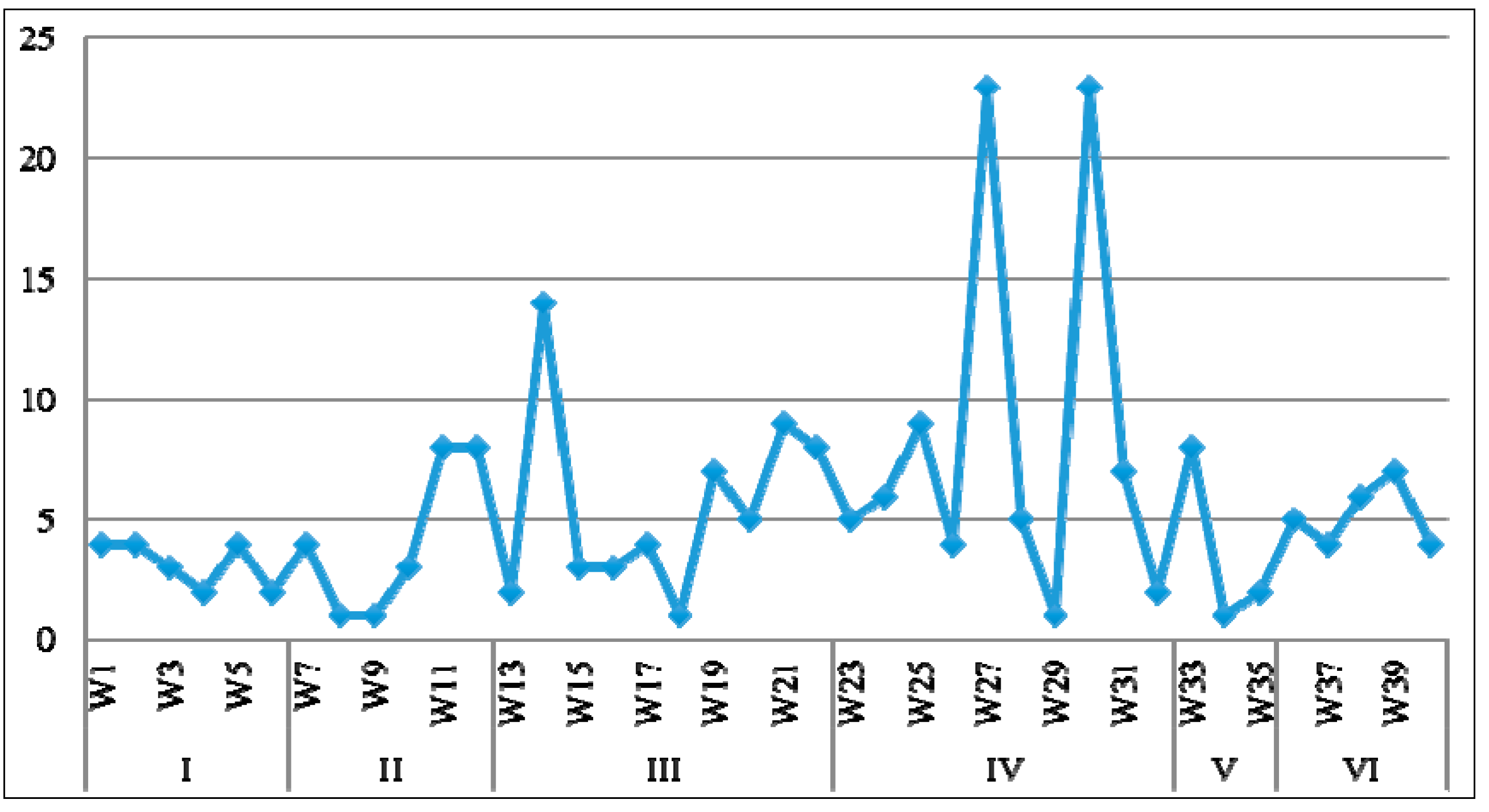
Table 2.
Identification of risks and risk sources in Feasibility Study Stage.
3.2.2. Judgment of Risk Relevance
In the relationship matrix, relationship value is in accordance with
Then the Boolean matrix of the various risk factors Ri is confirmed (Table 3).
Table 3.
Grid project schedule risk relationship matrix.
3.2.3. Establishment of Reachability Matrix
Reachability matrix
Then the reachability matrix is obtained as
3.2.4. Domain Decomposition
In the reachability matrix, reachability set Equation (1) can be divided according to different locations of each element in the system.
where, is the reachability set, which means all the element sets that can be reached from the element Ri; D(Ri) is the forward set, which means all the element sets that can arrive at element Ri; T(Ri) is the common set, which meets the requirements of formula (2).
Then, the domain decomposition can be conducted according to formula (2) (Table 4).
Table 4.
Results of domain decomposition.
Therefore, R1 and R5 are in the same domain. Then all the elements can be deduced in the same domain similarly.
3.2.5. Classification of Elements in the Same Domain
When the intersection of reachability set and forward set is equal to reachability set; the most superior unit can be obtained. That is to say; the elements which could not reach other elements in the system are called as the first-level elements.
where, is the number of levels, is the complete set.
According to the decomposition results, schedule risks can be divided into four levels. From the top to the bottom in turn is
- ;
- ;
- ;
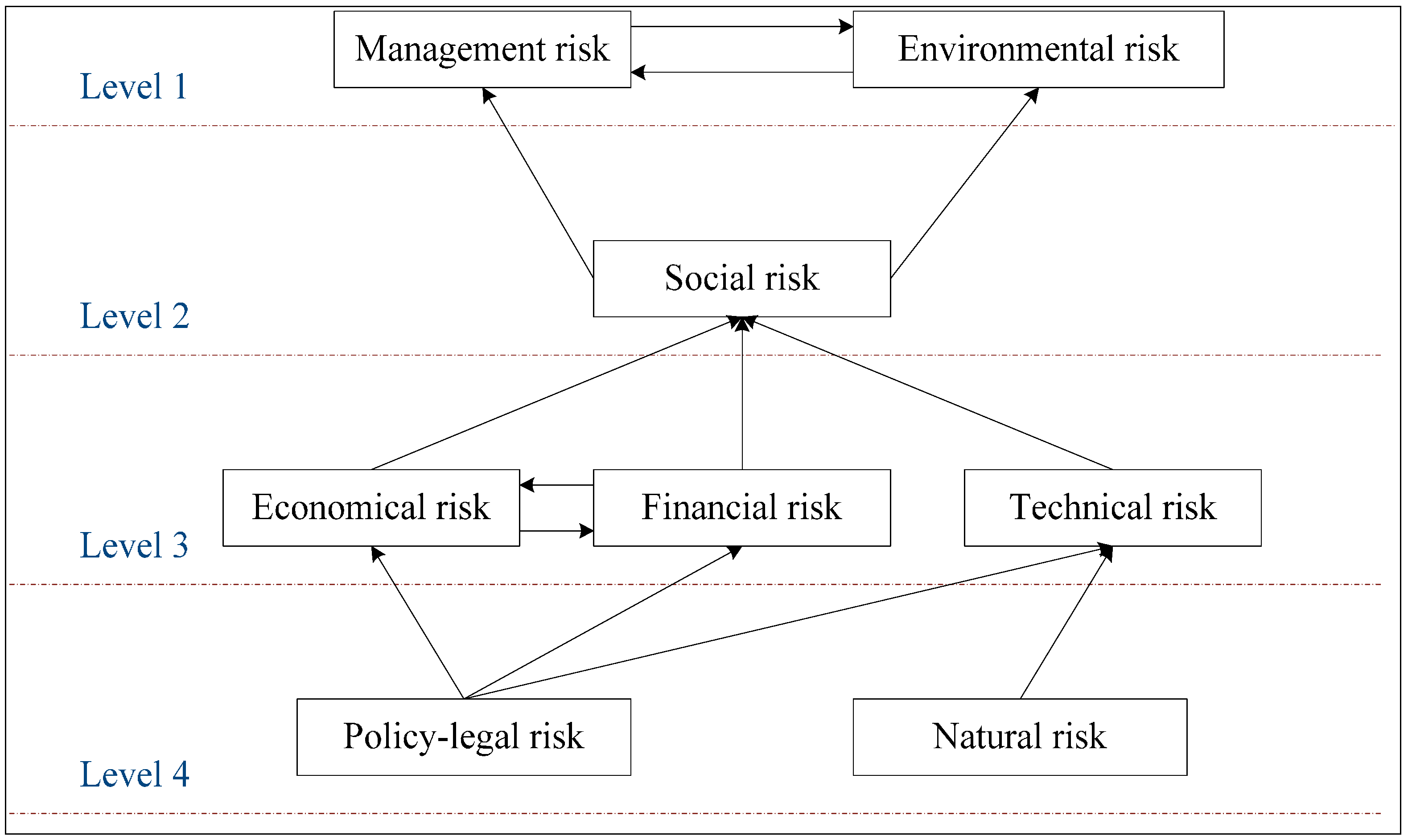
As a result, the multilevel structure of PGEP schedule risks is established (Figure 7).
From Figure 6, both policy-legal risk and natural risk are at the bottom place, whose occurrence would produce a domino effect and be the potential driving force for other risks. It is not difficult to understand that these kinds of risks are always external, and are not controlled by project managers. For example, the government issues a new national policy, by which it may change the external financing conditions, material prices, technology used in the project and other conditions. Via theses occurrences, economic risk, financial risk and technical risk would take place. Besides, sometimes a region may be devastated by an earthquake or other natural disasters. In this case, all the manpower, materials and other resources must have to be put into the reconstruction and PGEP construction would naturally be terminated. On the other hand, management risk and environment risk are at the top of the structure, which means they are vulnerable to the impact of other risks. These two risks are closely related to a project itself, one that is caused by non-standard behaviors of project managers and the other generally occurs in the complex environment of the construction site. Moreover, there is an interaction between economic risk and financing risk, which directly results from the natural properties of the two risks. In addition, attention must be paid to that technical risk has implied effect on the social risk, which is also impacted directly by economic and financial risks. Due to the discrepancy of levels of economy and education among districts, the technical risk, which exits throughout the period of engineering survey, design, construction, equipment manufacturing and production, may leads to conflicts in multi-regional and multi-party projects. Therefore, because of the potential domino effect among risks, it is sensible for project managers to strengthen the earlier prediction of risks and cope with them in time once they occurred.
Figure 7.
Grid project schedule risk multilevel structure based on ISM.
3.3. Risk Evaluation
3.3.1. Establishment of the Evaluation Index System
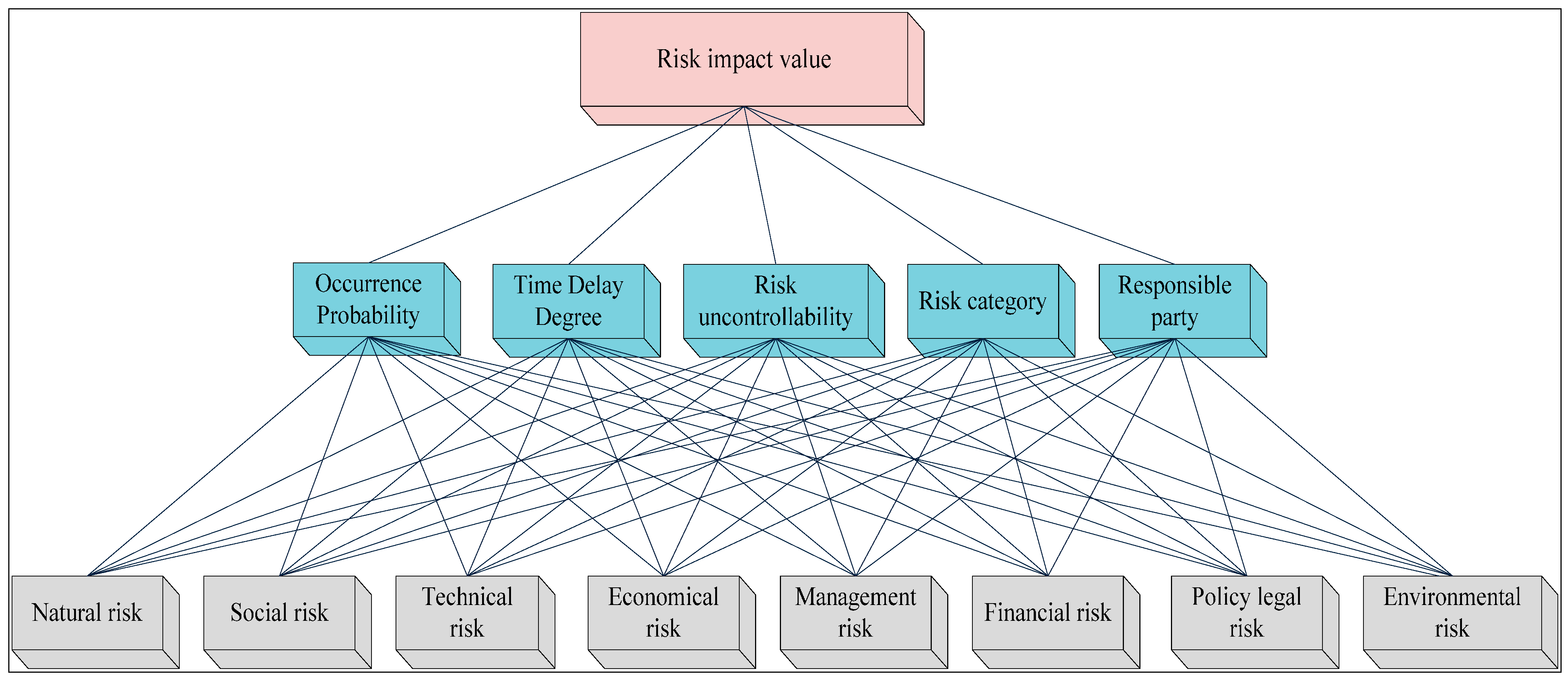
An evaluation index system is established based on Analytic Hierarchy Process (AHP), in which there are 5 indicators being used to examine the impact of the risks, including traditional indicators as risk probability, risk uncontrollability and duration extension size [22,23,24,25] as well as innovative indicators like risk category and risk responsibility party (Figure 8). In the course of establishing the index system, the authors considered that impact of risks would partly depend on the inherent attributes of risks as the result of risk analysis based on ISM, thus risk category is added as an important indicator. Moreover, it is essential to take responsibility partly into account, since it is obvious that the power company would bear a greater risk if the responsibility party were proprietor, while less risk in other situation.
Based on AHP, the evaluation index system consists of three layers. The top is the goal of this risk assessment, which is the risk impact value. The second layer is the evaluation criterion, which involves risk probability, risk uncontrollability, duration extension size, risk category and risk responsibility party. The bottom layer is the evaluation objects, including natural risk, economic risk, finance risk, social risk, management risk, technical risk, policy-legal risk and environmental risk.
Figure 8.
Risk evaluation index system.
3.3.2. Determination of Risk Impact Value Model
The risk impact value model is:
where, is the impact value of risk ; is the number of survey object ; is the risk probability value; is the length of delayed construction period; is the risk uncontrollability value; represents the risk responsibility party; represents the risk category. represents the weight of risk probability, construction period delay and risk uncontrollability, risk category and risk responsibility party in overall impact value respectively.
3.3.3. Determination of Indicator Scoring Criteria
The rating criteria of the 5 indicators are shown in Table 5.
Table 5.
Risk evaluation rating rules. (a) Rating rules for occurrence probability, time delay degree and risk uncontrollability; (b) Rating rules for risk category and risk responsibility party.

(a)
(b)
3.3.4. Determination of index weights
Based on Satty’s 1–9 scale method, the weight judgment matrix is established (Table 6).
Table 6.
Weight judgment matrix.
Then, the weights of the 5 indicators are obtained.
Correspondingly,
the consistency index ;
the average random consistency index ;
the test coefficient , approved.
Therefore, the weights of different indicators shown in formula (5) are reasonably practicable.
3.3.5. Original Data of the Value of Each Index
Through questionnaires, 91 respondents have expressed their views based on their professional knowledge and work experience. These respondents include project managers, supervisors, designers and workers on site. The data in Table 7 is the average value of each indicator’s scores.
Table 7.
Scoring value of risks in feasibility study stage.
3.3.6. Results of the Impact Value of Each Risk
Based on Equation (4), the impact value of all the risks identified could be calculated. For example, the corresponding answers in the project feasibility study stage are shown in Figure 9.
Figure 9.
Impact value of risks in feasibility study stage of PGEPs.
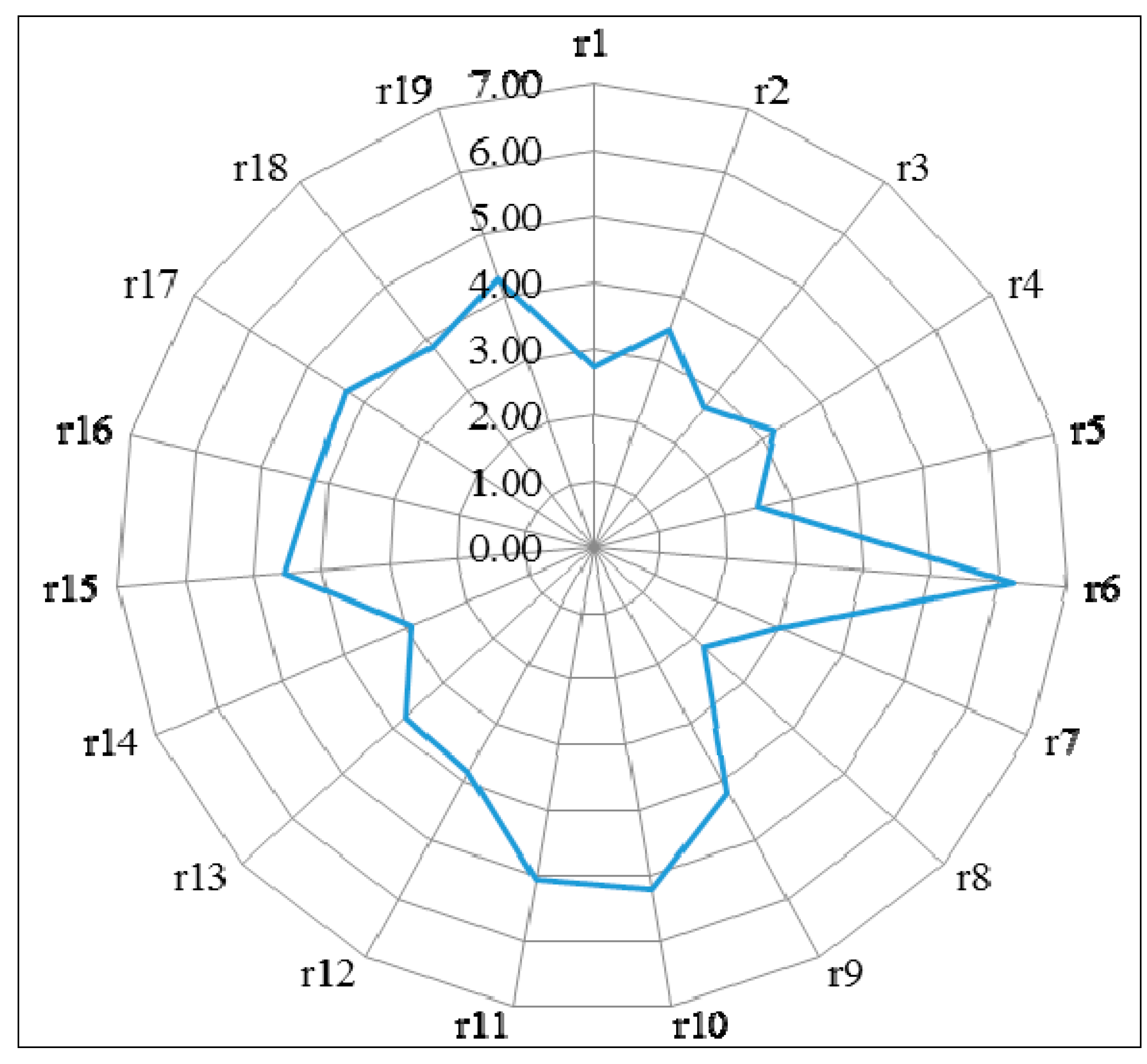
From the results, it shows that R6 (the deficiency or delay in obtain relevant departments’ professional assessment report, reviewing comments and relevant agreements) owns maximum potential hazards in feasibility study stage. Followed by two risks whose score is between 5 and 6, they are unclear infrastructure sites and the path information, a wrong project siting as well as power planning changes.
From the perspective of risk properties, we could classify and count the number of risks in different group (Table 8). Though the policy-legal risk is the one with the most serious consequences and would lead to other risks’ appearance based on ISM analysis, it has a relatively low-level risk impact value in the feasibility study stage. The reason may lie in the low probability of occurrence of this kind of risks, such as the risk of changes of national policy, company operating conditions and other conditions. Such risk always occurs following a certain rule or is able to provide a buffer period for managers to get well prepared. Moreover, management risks have a relatively high risk value in this stage and mainly manifest in the deficiency of documents or mistakes in work procedure, as well as unqualified personnel. In addition, technology risks also occupy a significant proportion of all the risks in this stage, and its impact value keeps at a moderate level, which mainly results from the process of investigation, design work in the feasibility study stage.
Table 8.
The number of risks with different properties in different value group.
3.4. Risk Prevention
For each risk, specific risk-preventing measures have been ensured through interviews with 12 engineers who have years of experience of engaging in PGEPs. For example, the appropriate risk prevention measures in the feasibility study stage are shown in Table 9.
Table 9.
Risk prevention measures in the feasibility study stage.
4. Conclusions
In order to make the schedule risk management of PGEPs more systematic and more comprehensive, maintain the sustainable management of PGEPs and promote the sustainable development of these two grid corporations, this paper establishes a three-dimensional risk management system, including management personnel, management periods and management methods. Through questionnaires and expert interviews, the paper identifies 40 key works in the PGEPs and 222 risks throughout the whole construction process. Further, the risk category and the responsible party of each risk are determined. Based on ISM model method, a structural analysis of risks is implemented. Results show that policy-legal risks and natural risks are located at the bottom of the structure, whose occurring will increase the probabilities of other risks’ happening. In contrast, management risks and environmental risks are located on the top, which are the most vulnerable and easily affected by other risks. Social risks are located on the third floor, which can be induced by the economic, financial and technical risks, and financing and economic risks have an interaction on each other. In the risk assessment phase, based on the AHP theory, a three-tier evaluation system is established, where indexes contain risk probability, risk uncontrollability, duration extension size, risk category and risk responsibility party. Based on the survey results, risks of a deficiency or a delay in obtaining relevant departments’ professional assessment report and relevant agreements are the greatest risks during the feasibility study period in a PGEP, followed by the risks of unclear infrastructure information as well as power planning changes. Meanwhile, managing and technical risks have accounted for the largest proportion at this stage and their value of impact is relatively high. In contrast, the impact value of political-legal risks, which locate in the basic position in the ISM analysis, is low at this stage, due to the lower probability of their occurrence. Finally, pre-control measures are suggested and formulated for all the risks.
Based on the proposed framework of schedule risk management for PGEPs, managers can easily find the severity of each risk, be aware of their responsibilities, take actions in advance and keep updating the list. The schedule risk management within the company and throughout the entire construction process can improve the efficiency of risk management of PGEPs and optimize their sustainability, and this framework may obtain some inspiration and reference value for the participants of PGEPs.
Acknowledgments
The authors would like to thank the anonymous referees and the editor of this journal and gratefully acknowledge equally to the experts and staffs involved in the survey and interviews. The authors gratefully acknowledge the financial support by the National Natural Science Foundation of China (Grant No. 71173075 and 71373077), Beijing Natural Science Foundation of China (Grant No. 9142016), Beijing Planning Project of Philosophy and Social Science (Grant No. 13JGB054), Ministry of Education Doctoral Foundation of China (Grant No. 20110036120013), Program for New Century Excellent Talents in University (NCET-12-0850), and the Fundamental Research Funds of the Central Universities of China (Grant No. 2014XS61).
Author Contributions
In this paper, Rao Rao committed to accomplish risk identification, complete questionnaire research and establish the framework of schedule risk management; Xingping Zhang and Zhongfu Tan developed the research ideas and implemented research programs; Zhiping Shi organized and conducted the expert interviews and obtained the corresponding results; Kaiyan Luo carried out the work of risk evaluation and Yifan Feng was responsible for implementing risk analysis based on ISM model.
Appendix
Table A1.
The content of risks in every work node.
Conflicts of Interest
The authors declare no conflict of interest.
References
- Gu, Y.G.; Luo, Z.; Shan, B.G. Outlook 2013 of Power Supply and Demand in China and Related Suggestions. Electr. Power 2013, 46, 7–10. [Google Scholar]
- Lin, W.B.; Chen, B.; Yu, Y.S. Research on Rorecasting Electricity Demand oR the12th Rive-year and 2020. China Popul. Resour. Environ. 2011, 21, 1–6. [Google Scholar]
- Merna, T.; Al-Thani, F.F. Corporate Risk Management; John Wiley & Sons Inc.: Hoboken, NJ, USA, 2008. [Google Scholar]
- Chapman, C. Project risk analysis and management-the PRAM generic process. Int. J. Proj. Manag. 1997, 15, 273–281. [Google Scholar]
- Institute of Risk Management. A Risk Management; Standard Institute of Risk Management: London, UK, 2002. [Google Scholar]
- Project Management Institute. A Guide to the Project Management Body of Knowledge; Project Management Institute Standards Committee: Philadelphia, PA, USA, 2008. [Google Scholar]
- Edwards, P.J.; Bowen, P.A. Risk and risk management in construction: A review and future directions for research. Eng. Constr. Archit. Manag. 1998, 5, 339–349. [Google Scholar] [CrossRef]
- Zhou, L.; Vasconcelos, A.; Numes, M. Supporting decision making in risk management through an evidence-based information systems project risk checklist. Inf. Manag. Comput. Secur. 2008, 16, 166–186. [Google Scholar]
- Tah, J.H.M.; Thorpe, A.; McCaffer, R. Contactor project risks contingency allocation using linguistic approximation. Comput. Syst. Eng. 1993, 4, 281–293. [Google Scholar] [CrossRef]
- Wirba, E.N.; Tah, J.H.M.; Howes, R. Risk interdependencies and natural language computations. J. Eng. Constr. Archit. Manag. 1996, 3, 251–269. [Google Scholar] [CrossRef]
- Liu, J.Y.; Wang, Z.F. Non-additivity analysis on scheduling risks based on Bayesain networks. Syst. Eng.-Theory Pract. 2011, 31, 1517–1523. [Google Scholar]
- Liu, J.Y. Correlation analysis of scheduling risks based on BN-CPM. J. Hydroelectr. Eng. 2011, 30, 199–203. [Google Scholar]
- Li, C.B.; Lu, G.S.; Li, P.; Zhang, C.S. Grid Construction Project Schedule Risk Analysis Based on Rough Set Theory. East China Electr. Power 2012, 40, 1325–1327. [Google Scholar]
- Jiang, Z.L.; Wang, D.Y.; Liu, X.J. Study on the risk analysis and benefit sharing in BT construction project. J. Hunan Univ. (Nat. Sci.) 2012, 39, 89–92. [Google Scholar]
- Wang, Z.Q.; Liu, Y.J.; Yu, J.R. Applying research of SCERT on risk analysis and management of large project. China Soft Sci. 2002, 7, 105–108. [Google Scholar]
- Ahmed, A.; Kayis, B.; Amornsawadwatana, S. A review of techniques for risk management in projects. Benchmarking 2007, 14, 22–36. [Google Scholar] [CrossRef]
- Nieto-Morote, A.; Ruz-Vila, F. A fuzzy approach to construction project risk assessment. Int. J. Project Manag. 2011, 29, 220–231. [Google Scholar] [CrossRef]
- Zhao, H.; Li, Y.J.; Song, T. Study on engineering project risk management based on Bayesian network. J. Shenyang Univ. Technol.: Soc. Sci. Ed. 2008, 1, 239–244. [Google Scholar]
- Liu, J.Y. Bayesian network inference on risks of construction schedule cost[C]. In Proceedings of the 2010 International Conference of Information Science and Management Engineering, Xi’an, China, 7–8 August 2010; Volume 2, pp. 15–18.
- Taroun, A. Towards a better modeling and assessment of construction risk: Insights from a literature review. Int. J. Project Manag. 2014, 32, 101–115. [Google Scholar] [CrossRef]
- Williams, T. The two-dimensionality of project risk. Int. J. Proj. Manag. 1996, 14, 185–186. [Google Scholar]
- Jannadi, O.A.; Almishari, S. Risk assessment in construction. J. Constr. Eng. Manag. 2003, 129, 492. [Google Scholar]
- Aven, T.; Vinnem, J.; Wiencke, H. A decision framework for risk management, with application to the offshore oil and gas industry. Reliab. Eng. Syst. Saf. 2007, 92, 433–448. [Google Scholar] [CrossRef]
- Cagno, E.; Caron, F.; Mancini, M. A multi-dimensional analysis of major risks in complex projects. Risk Manag. 2007, 9, 1–18. [Google Scholar] [CrossRef]
- Cioffi, D.F.; Khamooshi, H. A practical method of determining project risk contingency budgets. J. Oper. Res. Soc. 2009, 60, 565–571. [Google Scholar] [CrossRef]
- Fan, C.F.; Yu, Y.C. BBN-based software project risk management. J. Syst. Softw. 2004, 73, 193–203. [Google Scholar]
- Molenaar, K.R. Programmatic cost risk analysis for highway megaprojects. J. Constr. Eng. Manag. 2005, 131, 343. [Google Scholar] [CrossRef]
- Saaty, T.L. Analytic hierarchy process. In Encyclopedia of Biostatistics; John Wiley & Sons Inc.: Hoboken, NJ, USA, 1980. [Google Scholar]
- Tah, J.; Carr, V. A proposal for construction project risk assessment using fuzzy logic. Constr. Manag. Econ. 2000, 18, 491–500. [Google Scholar] [CrossRef]
- Duan, B.Q. Comprehensive risk assessment model of complex product systems innovation based on Fuzzy AHP. J. Tongji Univ. (Nat. Sci.) 2008, 36, 23–26. [Google Scholar]
- Xiao, L.; Qi, Y.; Li, Q.M. Information security risk assessment based on AHP and fuzzy comprehensive evaluation. Comput. Eng. Appl. 2009, 45, 89–91. [Google Scholar]
- Zhang, X.S.; Wang, S.F.; Guo, X.L. Research on evaluation risk of power market based on Monte Carlo simulation. Relay 2007, 35, 66–73. [Google Scholar]
- Wang, T.H.; Song, Y.X.; Song, CH.Q. Risk evaluation of wartime equipment supply chain based on TOPSIS method with fuzzy ameliorated Entropy Weight. Comput. Digit. Eng. 2012, 40, 101–106. [Google Scholar]
- Guan, S.X.; Zhang, Y. Credit risk evaluation in commercial bands using TOPSIS model based on Entropy Weights. J. Inf. 2008, 27, 59–65. [Google Scholar]
- Liu, H.L.; Zhou, Y.N.; Zheng, L. The process variance analysis model distinguishing the critical and non-critical path. Constr. Manag. Modern. 2009, 23, 502–504. [Google Scholar]
- Tian, Z.X.; Ye, J.; Zhang, X. Project object cost and time control research. J. Beijing Univ. Aeronaut. 2001, 14, 37–41. [Google Scholar]
- Zou, P.X.W.; Zhang, G.M.; Wang, J.Y. Understanding the key risks in construction projects in China. Int. J. Proj. Manag. 2007, 25, 601–614. [Google Scholar] [CrossRef]
- Sara, M.S.; Amaya, P.E.; Angel, M.E.L.; Pedro, V. Project risk management methodology for small firms. Int. J. Proj. Manag. 2013, 32, 327–340. [Google Scholar]
- Flanagan, R.; Norman, G. Risk Management and Construction; Blackwell Science Pty Ltd.: Victoria, Australia, 1993. [Google Scholar]
- Wang, S.Q.; Tiong, R.L.K.; Ting, S.K.; Ashley, D. Evaluation and management of foreign exchange andrevenue risks in China’s BOT projects. Constr. Manag. Econ. 2008, 18, 197–207. [Google Scholar]
- Baker, W.; Reid, H. Identifying and Managing Risk; Pearson Education: French Forest, Australia, 2005. [Google Scholar]
- Shen, L.Y.; Wu, G.W.C.; Ng, C.S.K. Risk assessment for construction joint ventures in China. J. Constr. Eng. Manag. 2001, 127, 76–81. [Google Scholar] [CrossRef]
© 2014 by the authors; licensee MDPI, Basel, Switzerland. This article is an open access article distributed under the terms and conditions of the Creative Commons Attribution license (http://creativecommons.org/licenses/by/4.0/).