<?xml version="1.0" encoding="UTF-8"?>
<!DOCTYPE article PUBLIC "-//NLM//DTD Journal Publishing DTD v2.3 20070202//EN" "journalpublishing.dtd">
<article xmlns:mml="http://www.w3.org/1998/Math/MathML" xmlns:xlink="http://www.w3.org/1999/xlink" xml:lang="en" article-type="research-article">
  <front>
    <journal-meta>
      <journal-id journal-id-type="publisher-id">sustainability</journal-id>
      <journal-title>Sustainability</journal-title>
      <abbrev-journal-title abbrev-type="publisher">Sustainability</abbrev-journal-title>
      <abbrev-journal-title abbrev-type="pubmed">Sustainability</abbrev-journal-title>
      <issn pub-type="epub">2071-1050</issn>
      <publisher>
        <publisher-name>MDPI</publisher-name>
      </publisher>
    </journal-meta>
    <article-meta>
      <article-id pub-id-type="doi">10.3390/su5031141</article-id>
      <article-id pub-id-type="publisher-id">sustainability-05-01141</article-id>
      <article-categories>
        <subj-group>
          <subject>Article</subject>
        </subj-group>
      </article-categories>
      <title-group>
        <article-title>Microfoundations for Sustainable Growth with Eco-Intelligent Product Service-Arrangements</article-title>
      </title-group>
      <contrib-group>
        <contrib contrib-type="author">
          <name>
            <surname>Liedtke</surname>
            <given-names>Christa</given-names>
          </name>
          <xref rid="c1-sustainability-05-01141" ref-type="corresp">*</xref>
        </contrib>
        <contrib contrib-type="author">
          <name>
            <surname>Buhl</surname>
            <given-names>Johannes</given-names>
          </name>
          <xref rid="c1-sustainability-05-01141" ref-type="corresp">*</xref>
        </contrib>
        <contrib contrib-type="author">
          <name>
            <surname>Ameli</surname>
            <given-names>Najine</given-names>
          </name>
        </contrib>
      </contrib-group>
      <aff id="af1-sustainability-05-01141">Wuppertal Institute for Climate, Environment and Energy, Research Group Sustainable Production and Consumption, Doeppersberg 19, Wuppertal 42013, Germany; E-Mail: <email>najine.ameli@wupperinst.org</email></aff>
      <author-notes>
        <corresp id="c1-sustainability-05-01141"><label>*</label> Authors  to whom correspondence should be addressed: E-Mails: <email>christa.liedtke@wupperinst.org</email> (C.L.); <email>johannes.buhl@wupperinst.org</email> (J.B.); Tel.: +49-202-2492-156; Fax: +49-202-2492-156. </corresp>
      </author-notes>
      <pub-date pub-type="epub">
        <day>19</day>
        <month>03</month>
        <year>2013</year>
      </pub-date>
      <pub-date pub-type="collection"><month>03</month>
        <year>2013</year>
      </pub-date>
      <volume>5</volume>
      <issue>3</issue>
      <fpage>1141</fpage>
      <lpage>1160</lpage>
      <history>
        <date date-type="received">
          <day>08</day>
          <month>12</month>
          <year>2012</year>
        </date>
        <date date-type="rev-recd">
          <day>20</day>
          <month>02</month>
          <year>2013</year>
        </date>
        <date date-type="accepted">
          <day>08</day>
          <month>03</month>
          <year>2013</year>
        </date>
      </history>
      <permissions>
        <copyright-statement>© 2013 by the authors; licensee MDPI, Basel, Switzerland.</copyright-statement>
        <copyright-year>2013</copyright-year>
        <license xmlns:xlink="http://www.w3.org/1999/xlink" license-type="open-access" xlink:href="http://creativecommons.org/licenses/by/3.0/">
          <p>This article is an open access article distributed under the terms and conditions of the Creative Commons Attribution license (http://creativecommons.org/licenses/by/3.0/).</p>
        </license>
      </permissions>
      <abstract>
        <p>This paper argues that the contemporary growth paradigm needs to be reconsidered on a micro level of consumption and product service-systems. This becomes necessary since a dynamic link between macro strategies and micro implementation of sustainable growth is missing up to date. Therefore, mainstream sustainability strategies of efficiency and consistency are extended by sufficiency in order to integrate strategies for individual welfare within their social environment. Limits to and drivers for growth are revised and updated socially in terms of qualitative values, diminishing marginal utility or symbolic social distinction. We elaborate a definition of sustainable growth that fosters individual welfare by enhancing social enactment within the boundaries of environmental space. Shifting focus on social aspects in design fosters more sustainable production and consumption patterns while sustaining individual welfare. We derive latent indications for eco-intelligent product service-arrangements and evaluate to concepts by referring to introduced definitions and according indications. With doing so, we illustrate new pathways for the translation of sustainable growth and strategies into product service-systems.</p>
      </abstract>
      <kwd-group>
        <kwd>Material Footprint</kwd>
        <kwd>sustainability strategies</kwd>
        <kwd>social limits to growth</kwd>
        <kwd>individual welfare</kwd>
        <kwd>sustainable design</kwd>
        <kwd>product service-systems</kwd>
      </kwd-group>
    </article-meta>
  </front>
  <body>
    <sec sec-type="intro">
      <title>1. Introduction</title>
      <p>As the world population and economies grow, resources for production and consumption are in rising demand. Projections of current global trends display a raise in consumption of raw materials by 50% until 2050 (for most parts in developed countries) ([<xref ref-type="bibr" rid="B1-sustainability-05-01141">1</xref>], p. 26). Other estimates predict a two- to threefold increase of extraction of raw materials, if western consumption patterns are adopted worldwide ([<xref ref-type="bibr" rid="B2-sustainability-05-01141">2</xref>], p. 71). In economic terms, projections show that by 2030 the world gross domestic product (GDP) will have grown by 130%. This growth will indeed use more resources, driving raw material extraction to double within 20 years ([<xref ref-type="bibr" rid="B1-sustainability-05-01141">1</xref>], p. 1). The production and consumption system of the industrialized world is about to hit the ceiling of finite resources with detrimental effects for the market and world economies (e.g., [<xref ref-type="bibr" rid="B3-sustainability-05-01141">3</xref>,<xref ref-type="bibr" rid="B4-sustainability-05-01141">4</xref>]). The use of resources is not only worrisome due to their depletion and scarcity but also due to the degradation caused to the environment. The biological cycles in eco-systems are altered and affected by the material flows of the world economy. Every input into these material flows eventually becomes an output in form of waste or emissions. By dematerializing input processes, the overall environmental burden can be more effectively reduced compared to measures on the output side (filtering emissions, reducing toxic substances <italic>etc.</italic>) [<xref ref-type="bibr" rid="B5-sustainability-05-01141">5</xref>]. </p>
      <p>In principle, the need for dematerialization results from the perception of a limited available “environmental space” [<xref ref-type="bibr" rid="B6-sustainability-05-01141">6</xref>] on our “spaceship earth” [<xref ref-type="bibr" rid="B7-sustainability-05-01141">7</xref>]. Environmental space is the amount of resources we can use without comprising future generations’ access. By now, western lifestyles generate wealth for less than 20% of the world population, but consume 80% of all resources globally. Therefore, ways to generate wealth with 10% of resources (or by a factor of 10 less) need to be invented in order to let the people who use less, claim their fair share of resources [<xref ref-type="bibr" rid="B8-sustainability-05-01141">8</xref>]. This is why the concept of “environmental space” claims a reduction of resource use in high intensity areas of the industrialized world. </p>
      <p>Empirically this is possible, as a comparison between households in Finland has shown. According to the concept of factor 10, there is a need to create a sustainable way of living, a sustainable consumption of household goods, food and beverages, everyday mobility and tourism, electricity, heating and housing that does not exceed 8 tons <italic>per capita</italic> of resource use by 2050. The difference between the highest and lowest backpacks is more than tenfold, households with similar income and education level show a fourfold difference [<xref ref-type="bibr" rid="B9-sustainability-05-01141">9</xref>]. For instance, modern western lifestyles in Germany or the US carry all in all 70–90 tons <italic>per capita</italic> and year ([<xref ref-type="bibr" rid="B2-sustainability-05-01141">2</xref>], p. 61). </p>
      <p>This article addresses the never-ending story of why people <italic>want</italic> to accumulate, <italic>i.e.</italic>, to grow materially. Therefore, this article reconsiders growth on a micro level. This means that the paradigm of growth is downscaled onto the level of consumers and products as well as producers. What are sustainable products or services supposed to look like? And how is their design and production linked to an appropriate social perception of growth? Therefore, we introduce strategies that try to cope with sustainable development, namely efficiency, consistency and sufficiency. In the following, we will not refer to sustainability from a triple bottom line, but introduce a cultural sphere which is derived from Scerri and James and implemented in Circles for Sustainability on the community level [<xref ref-type="bibr" rid="B10-sustainability-05-01141">10</xref>]. </p>
      <p>We do not strive to recapitulate the debate on post-growth as a whole, which addresses merely topics from a macroeconomic perspective, but give references when required [<xref ref-type="bibr" rid="B11-sustainability-05-01141">11</xref>]. This enables us to focus on a micro perspective on sustainability by introducing socio-cultural aspects of identity, engagement or well-being.</p>
      <p>Therefore, we look at growth from a constructivist perspective recognizing desires, values, norms and social practices as a starting point for societal, followed by an economic transformation towards sustainability. </p>
      <p>The task is to translate and synthesize strategies and growth paradigms on a micro level. As Schroeder points out, research on sustainability is missing the dynamic links between micro level changes, macro level affections and <italic>vice versa</italic> [<xref ref-type="bibr" rid="B12-sustainability-05-01141">12</xref>]. We conclude by giving advice to focus the growth debate and sustainable strategies on individuals in order to enable them to implement transitional ideas into their everyday life via a new understanding and design of goods for the sake of well-being.</p>
    </sec>
    <sec>
      <title>2. Integrative Approach to Sustainability Strategies on the Micro Level</title>
      <p>The strategy of dematerialization compliments a paradigm shift in the long run and has thus been propagated since the 1990s [<xref ref-type="bibr" rid="B13-sustainability-05-01141">13</xref>]. Technological innovations tend to make product life cycles shorter. At the same time, production processes remain wasteful in terms of resource efficiency. Today, less than 10% of raw material extracted for making an industrial product appears in the finished product. The Material Footprint [<xref ref-type="bibr" rid="B14-sustainability-05-01141">14</xref>] of every kilogram of industrial product is approximately thirty kilograms ([<xref ref-type="bibr" rid="B5-sustainability-05-01141">5</xref>], p. 13ff). </p>
      <p>Humans tend to approach environmental problems caused by drastic material flow with short term, localized measures that solve problems “end of pipe” instead of addressing the source. Eventually, the world prosperity benefits and increases in terms of world gross national product. And still, environmental production costs are treated as externalities by economic logic (e.g., [<xref ref-type="bibr" rid="B3-sustainability-05-01141">3</xref>,<xref ref-type="bibr" rid="B15-sustainability-05-01141">15</xref>]). The world’s growing prosperity in terms of income is vastly based on exploitation of natural resources [<xref ref-type="bibr" rid="B16-sustainability-05-01141">16</xref>,<xref ref-type="bibr" rid="B17-sustainability-05-01141">17</xref>]. </p>
      <p>In the following, we develop an integration of sustainability strategies referring to the growth paradigm. With presenting logics of efficiency, consistency and sufficiency, we do not seek to separate them conceptually, but carve out limitations of efficiency and consistency as well as linkages and alignments between them. Doing so, we strive to synthesize strategies for products and services from macroeconomic to micro level within sufficiency. </p>
      <sec>
        <title>2.1. Efficiency</title>
        <p>Beginning from a wider, macroeconomic angle, the most important idea in the common mind is efficiency. Producing more productively promises to decouple resource use from economic growth [<xref ref-type="bibr" rid="B18-sustainability-05-01141">18</xref>]. Empirical evidence shows that relative decoupling is on the rise. This means that in industrial countries, the economy is growing disproportionally faster than resource use [<xref ref-type="bibr" rid="B19-sustainability-05-01141">19</xref>]. Theoretically, technological know-how does not know any limits. From an economic point of view, growth paradigm advocating unlimited growth backs on the power of technological progress (or knowledge) that does not know any diminishing marginal returns. At this point, theoretical limitations have to be introduced. Technological innovation-driven growth is not exogenous as the classic growth theory suggests [<xref ref-type="bibr" rid="B20-sustainability-05-01141">20</xref>]. </p>
        <p>Weizsäcker <italic>et al.</italic> [<xref ref-type="bibr" rid="B18-sustainability-05-01141">18</xref>] describe possibilities and cases in which a decoupling by a factor five may be possible with <italic>existing</italic> technological know-how. These suggestions are principally derived from their prequel “Factor 4” [<xref ref-type="bibr" rid="B21-sustainability-05-01141">21</xref>]. Theoretically such progress is possible, however empirically, such decoupling developments are unlikely. Current valid projections and observations of capacities in ecological sinks (see [<xref ref-type="bibr" rid="B4-sustainability-05-01141">4</xref>]) doubt that technological progress may solve and free capacities in a range and in the time necessary. Sufficient trends in absolute decoupling do not exist and seem most unlikely, since sufficient decoupling suggests a dematerialization by a factor of 10 or a rate of 90% by 2050 [<xref ref-type="bibr" rid="B8-sustainability-05-01141">8</xref>,<xref ref-type="bibr" rid="B13-sustainability-05-01141">13</xref>,<xref ref-type="bibr" rid="B19-sustainability-05-01141">19</xref>]. In the end, the necessary reduction in resource extraction is not achievable on the basis of the efficiency paradigm alone. Efficiency is necessary, but not sufficient.</p>
        <p>Recent studies suggest that this is due to economy-wide rebound effects, which compensate gains in productivity in most parts [<xref ref-type="bibr" rid="B22-sustainability-05-01141">22</xref>]. From an economist’s perspective it is necessary that gains in efficiency are used or reinvested in order to yield additional benefits. </p>
        <p>Macroeconomic modeling that projects potential decoupling still neglects potential rebound effects due to econometric uncertainties when it comes to the estimation of total effects. Apart from that, from a microeconomic perspective, gains in efficiency are translated into competitive advantages by offering more competitive market prices. On the consumption side, welfare gains are expected by monetary savings due to lower prices.</p>
        <p>According to Slutsky’s equation, income and substitution effect lead to a rising demand either of the same products (direct effects) from which the gains stem or other products for which the marginal increase in income may be spent (indirect effects). Theoretically, this logic is most likely since efficiency gains are economically equal to free lunches. Under the assumption of rational actors and the axiom of individual insatiateness, these will be eaten. We will refer to these presumptions later on in Paragraph 2.3.</p>
      </sec>
      <sec>
        <title>2.2. Consistency</title>
        <p>First, another important strategy needs to be integrated, which copes with sustainable production and consumption during economic growth—the strategy of consistency, eco-effectiveness or the principle of Cradle-to-Cradle [<xref ref-type="bibr" rid="B13-sustainability-05-01141">13</xref>,<xref ref-type="bibr" rid="B23-sustainability-05-01141">23</xref>].</p>
        <p>In contrast to efficiency, which strives to produce better, <italic>i.e.</italic>, to design the input of resources more efficiently, a consistent production strives to change the composition or quality of the input of resources—to produce differently. It is about a closing loop economy in which loops of materials are completely reused along its value chain such that no waste or other degenerating output is produced. The quantity of input does not matter anymore since all output resembles the input for the new production process. The problem is that only one third reaches the economy, whereas two thirds remain unobserved as unused resource extraction. Only a system in which the hidden material flows are incorporated consistently may become sustainable. However, these resources may never potentially enter a consistently closed economic loop. Moreover, within the economically used material flows, only 3% are recycled at present ([<xref ref-type="bibr" rid="B5-sustainability-05-01141">5</xref>], p. 13). This is the amount to which the principle of consistency may be applied. The majority of material flows is assembled in infrastructure such as energy, transportation or communication systems that in turn demand ever more resources in order to sustain, expand and improve. For instance, the seat of a plane may be produced by fully degradable materials, but what about the plane itself, the airports and its respective upstream chains and life cycles? </p>
        <p>For instance, when it comes to environmental technologies in Germany that as a country is supposed to be advanced when it comes to ecological transitions, the added value of green growth only made 8% of the whole GDP in Germany in 2007, its share in the industrial goods was only 5.7% in 2009 [<xref ref-type="bibr" rid="B24-sustainability-05-01141">24</xref>].</p>
        <p>The world energy demand will rapidly rise since developing countries industrialize. Until 2050 the demand will triple compared to 2000. Energy efficiency will compensate only 20% of the growing demand [<xref ref-type="bibr" rid="B25-sustainability-05-01141">25</xref>]. Renewable energies will not be able to consider the deficit, since technologies and markets will not be established in time (see above). </p>
        <p>Nevertheless, efficiency and consistency are important strategies and compulsory when it comes to sustainability. More efficient or other products or services are necessary but only sufficient if accompanied by sustainable lifestyles and habits.</p>
      </sec>
      <sec>
        <title>2.3. Sufficiency and the Integration of Efficiency and Consistency within</title>
        <p>Rationality in monetary and material terms proclaimed by economists is valid on the business level as well as on the individual level. At the same time, economic rationality may be bounded by institutional factors that foster social learning such that rationality becomes defined in terms of quality of life or happiness for which the new economic thinking is striving (see [<xref ref-type="bibr" rid="B26-sustainability-05-01141">26</xref>] for an introduction). </p>
        <p>On the macro level, respective efforts concentrate on revising the measurement for economic progress as commissions in France and Germany show. The so-called Stiglitz-Sen-Commission developed new measurements of economic performance and social progress in terms of quality of life [<xref ref-type="bibr" rid="B27-sustainability-05-01141">27</xref>]. So does the commission on growth, welfare and quality of life of the German Federal Parliament [<xref ref-type="bibr" rid="B28-sustainability-05-01141">28</xref>]. We downscale these macroeconomic and ecological findings to a micro level of consumers and products or services. In this regard, we restart at the point where we stopped in the paragraph about efficiency. Sufficiency is a necessary strategy that completes a main set of strategies that is capable of dealing with the idea of sustainable growth—a term we want to elaborate further on the micro level. </p>
        <p>The next paragraph is about sufficiency as a mediating strategy that links the mainstream strategies in order to reach growth individually without further environmental degradation. In this sense, sufficiency is not only about finding the optimal scale of an ever expanding economy [<xref ref-type="bibr" rid="B11-sustainability-05-01141">11</xref>], but also about redefining growth on a micro level that affects growth in conventional material terms. From a sociological point of view, sustainability strategies need to be observed as dynamic links between macro and micro levels as sociological institutionalism suggests [<xref ref-type="bibr" rid="B29-sustainability-05-01141">29</xref>]. Then, innovative capacities in societies should not concentrate on technological innovations but shift towards social innovations in order to yield the innovative potential. This requires social learning processes. Sufficiency is less about losses and restraints, but more about a concept that strives to maintain or even increase individual welfare. From welfare economics, benefits are straightforward. When consumption is reduced, for instance, when lights or heaters are switched off more often, monetary savings are the result. In aggregation, prices may decrease due to lower demand. In the short run, rebound effects are likely. However, in contrast to efficiency or consistency strategies, sufficiency leads to sustainable economies when gains or free lunches are not reinvested in more consumption in resource intensive products or services. Eventually, the economy as a whole is affected by individual downshifting in the long run. As post growth literature suggests, sufficiency is inevitable, so is a residual of goods that is dependent on material flows in global value chains. As soon as sufficiency is no longer applicable, more efficient and eco-effective production processes need to reduce material demands optimally by reusing, redesigning and recycling [<xref ref-type="bibr" rid="B30-sustainability-05-01141">30</xref>,<xref ref-type="bibr" rid="B31-sustainability-05-01141">31</xref>]. In order to integrate sufficiency, efficiency and consistency in production and consumption, we should not solely think of products, but of Product Service-Systems (PSS) that encompass the use phase, where the consumer is affected and for most products the most demand in resources (due to energy demands) along the life cycle is generated. </p>
        <p>For instance, when considering car sharing as a classic example, it is not about losing mobility, but about considering foregoing the product that delivers its service. Moreover, deliberate obsolescence in production is to dismiss in favor of extended life cycles of products. In rapidly developing branches (such as information and communication technology), parts or modules of products (e.g., smartphones) inherit technological obsolescence. Then, a modular composition of the product eases the replacement of parts (such as memory) and life cycle management. An eco-effective design of these parts, at least a high share of secondary material, is the objective of future production processes.</p>
        <p>In the first place, sufficiency is use management in order to enhance welfare without consuming more resources. Second, it is about asking whether products or goods deliver an additional benefit, what increases utility and what does not. In this regard, individual welfare should not be considered in terms of utility, its proxy money, income and standard of life, respectively, but in terms of welfare, quality of life or well-being that encompasses immaterial goods and values. In aggregation, this is supposed to lead to a new definition of growth and is supposed to be reflected within a new measurement of growth in qualitative terms. In this case, growth is rather an issue of social life of individuals than abstract concepts, strategies and measures anchored on a macro level. </p>
        <p>Altogether, we want to refer to sustainable growth as a concept that fosters individual welfare by enhancing social enactment within the boundaries of individual environmental space. Sustainable growth in this sense strives to reconcile individual welfare and environmental constraints, but is not to be misunderstood as often propagated sustainable growth in technologically greened economies. On the contrary, we do not define sustainable growth by a decrease of GDP as the de-growth literature would suggest. Sustainable growth is rather seen as a process and as the notion of sustainable development inheritance [<xref ref-type="bibr" rid="B32-sustainability-05-01141">32</xref>] by providing qualitative ends without defining them in order to avoid path-dependencies into which the mainstream growth paradigm has led [<xref ref-type="bibr" rid="B33-sustainability-05-01141">33</xref>,<xref ref-type="bibr" rid="B34-sustainability-05-01141">34</xref>]. As the research and de-growth association denote, “the objectives […] are to meet human needs and ensure a high quality of life, while reducing the ecological impact of the global economy to a sustainable level, equitably distributed between nations” [<xref ref-type="bibr" rid="B35-sustainability-05-01141">35</xref>]. This occurs without defining a growth path whatsoever on the macro level, but by shifting the term’s reception onto a micro level in order to provide possibilities to anchor growth in a less abstract way. As van den Bergh concludes, an ideal indication of social welfare requires its reference to research on happiness and social determinants [<xref ref-type="bibr" rid="B36-sustainability-05-01141">36</xref>].</p>
        <p>Therefore, it is important to highlight that a combination of sustainability strategies is necessary. In turn, it is not argued that an efficient production as well as renewable energies are not compulsory for sustainable development. Likewise, efficiency and consistency are insufficient when not combined with absolute caps of consumption, as sufficiency would suggest. Truly sustainable products are distinguished not only by efficient or consistent use of resources, but also by the integration of sufficiency, resulting in the consumer consuming less (e.g., by introducing transformative products, see [<xref ref-type="bibr" rid="B37-sustainability-05-01141">37</xref>]), without forfeiting quality of life.</p>
        <p>The next paragraph helps to understand why sufficiency and sustainable growth on the micro level cover niches, while mainstream growth is still driven economically in material terms. Hence, we reconsider growth socially in order to better understand the social consciousness, its drivers and the limits of growth from a micro perspective. </p>
      </sec>
    </sec>
    <sec>
      <title>3. Updating Social Limits to Growth</title>
      <p>A historical insight suggests that 99% of human history is a non-growing history [<xref ref-type="bibr" rid="B38-sustainability-05-01141">38</xref>]. Economic growth between 1995 and 1998 was stronger than the total growth 10,000 years before 1900 [<xref ref-type="bibr" rid="B39-sustainability-05-01141">39</xref>]. </p>
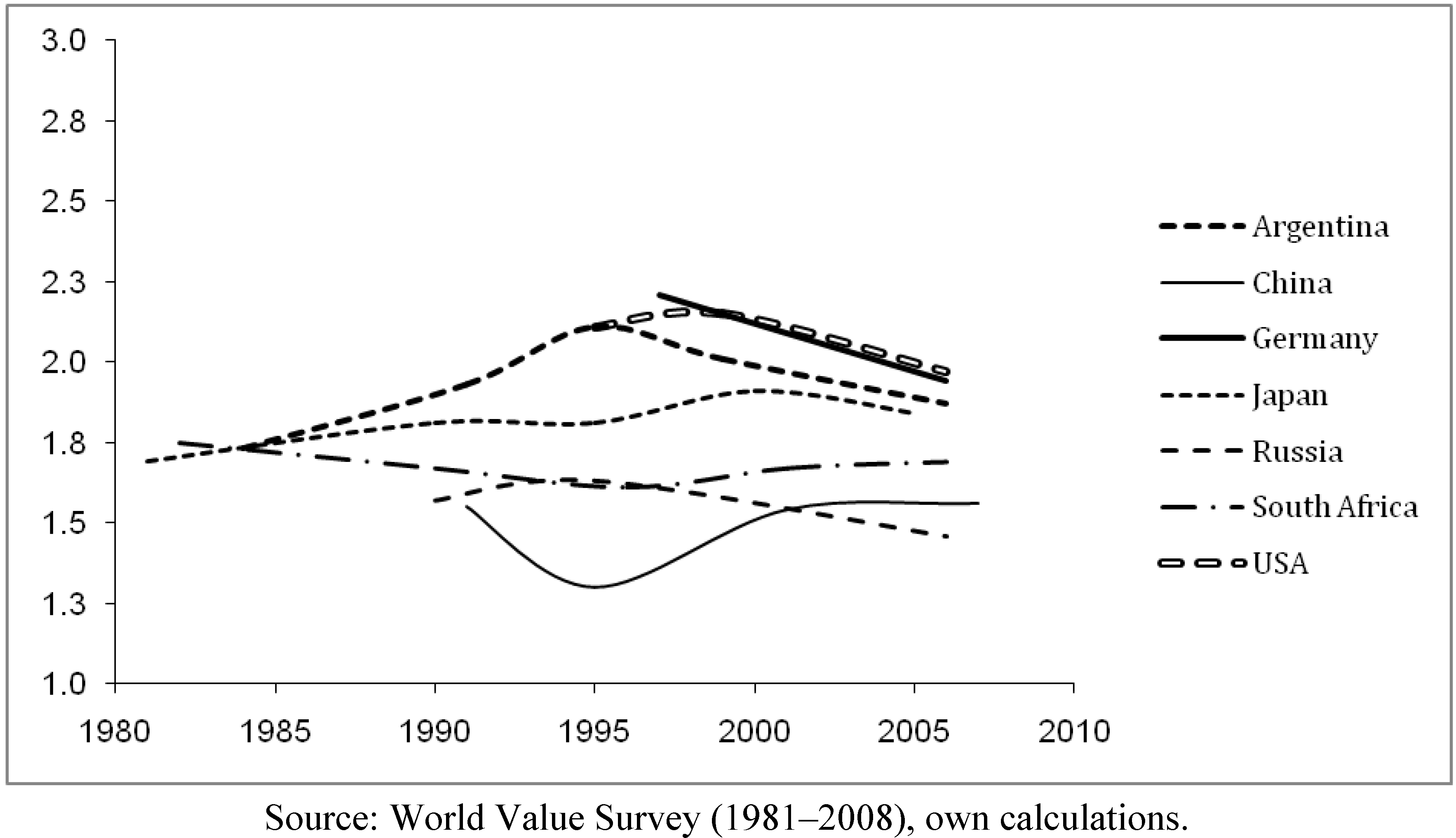
      <p>At the same time, one has to face the fact that materialist attitudes have prevailed in the last decades. In <xref ref-type="fig" rid="sustainability-05-01141-f001">Figure 1</xref>, we see interpolated trends of various observations between 1981 to 2008 from integrated waves from the World Value Survey [<xref ref-type="bibr" rid="B40-sustainability-05-01141">40</xref>]. The four-item post-materialist index tries to roughly display value changes. Here, materialists are coded by one; a mixed type, which is likely to switch between materialist and post-materialist attitudes, is coded by two and post-materialists are coded by three. The mean of the observed years roughly shows that materialists and mixed types prevail across cultures within a selection from the G20 over the last two to three decades. So far, one may observe shifts in favor of post-materialist values in younger cohorts, but no majority occupies post-materialist values ([<xref ref-type="bibr" rid="B41-sustainability-05-01141">41</xref>], <xref ref-type="fig" rid="sustainability-05-01141-f001">Figure 1</xref>). In terms of qualitative values, a post-materialist movement administers its niche. No fundamental change or “silent revolution” is observed in the distribution of post-materialist preferences since Inglehart [<xref ref-type="bibr" rid="B42-sustainability-05-01141">42</xref>] (on the contrary, see <xref ref-type="fig" rid="sustainability-05-01141-f001">Figure 1</xref>). Once established, a shift and the institutionalization of new paradigms is hardly predictable <italic>within</italic> generations [<xref ref-type="bibr" rid="B43-sustainability-05-01141">43</xref>]. Moreover, it is not clear how far macroeconomic growth increases [<xref ref-type="bibr" rid="B44-sustainability-05-01141">44</xref>] or decreases [<xref ref-type="bibr" rid="B45-sustainability-05-01141">45</xref>] the likelihood to switch to post-materialist values. Due to the fact that changes on the macro level cannot fully explain the dynamics in the institutionalization of paradigm shifts, we are going to update and concentrate on neglected social considerations of growth on the micro level. </p>
      <fig id="sustainability-05-01141-f001" position="float">
        <label>Figure 1</label>
        <caption>
          <p>Development of post-materialism across cultures from 1981 to 2008. </p>
        </caption>
        <graphic xmlns:xlink="http://www.w3.org/1999/xlink" xlink:href="sustainability-05-01141-g001.tif"/>
      </fig>
      <p>We start by giving an explanation why materialist growth prevails on the micro level, and make a link to the last paragraph by giving arguments on how to foster sustainable growth on the micro level of product service-arrangements.</p>
      <p>The social construction of growth may be empirically observed by the hypothesis of relative utility. Hirsch [<xref ref-type="bibr" rid="B46-sustainability-05-01141">46</xref>] already described these linkages in his “Social limits to growth”. Principally, there are two social components that limit growth socially. At a certain point, the relative utility decreases with increasing wealth. This was already described by Simmel [<xref ref-type="bibr" rid="B47-sustainability-05-01141">47</xref>] as a trickle down effect. Symbolically, the position in society decreases with the increasing distribution of goods. The worth of social distinction devalues. Second, in absolute terms, utility decreases directly with distribution of goods, when for instance too many cars cause traffic jams or higher education tightens competition on labor markets. On the one hand, utility diminishes socially or positionally, on the other hand, it is a problem of sums that comes with increasing distribution and wealth.</p>
      <p>In consequence, there is not more equality on markets, but increased competition that asks for more efforts to sustain social distinctions. The net total of losers and winners remains the same. In economic terms, there is no optimal equilibrium but decreasing satisfaction when wealth increases in rich societies.</p>
      <p>More recent evidence has introduced the relative income hypothesis that shows that people prefer a relative increase in income to absolute increases (e.g., [<xref ref-type="bibr" rid="B48-sustainability-05-01141">48</xref>]). For example, people would prefer a 5% increase in income when all others´ income decreases by 10%, to an increase of everybody’s income by 10%. This effect is called Joneses effect since it is about keeping up with your neighbors.</p>
      <p>Having as much or more than others becomes more important than having in absolute terms. Kahneman and Deaton [<xref ref-type="bibr" rid="B49-sustainability-05-01141">49</xref>] show that money cannot buy happiness. Well-being increases with income up to a certain threshold (75,000 US-Dollar <italic>per capita</italic> and year), above which no further progress is observed.</p>
      <p>The social logic in growth is driven by social distinction. Psychologically, it is consumerism that extends ourselves by our relationships to cars, clothes and respective collections. Put negatively, it is a fear of an empty self that leads us to the consumption of novelty as Veblen [<xref ref-type="bibr" rid="B50-sustainability-05-01141">50</xref>] first pointed out as conspicuous consumption [<xref ref-type="bibr" rid="B51-sustainability-05-01141">51</xref>]. This leads to social distinction in the sense of Simmel or Bourdieu. The premium of novelty is reserved to the wealthy until it trickles down through the social stratum. These social dynamics represent—as Jackson puts it—“the iron cage of consumerism” ([<xref ref-type="bibr" rid="B16-sustainability-05-01141">16</xref>], p. 102) that drives growth culturally.</p>
      <p>A quantitative or material growth perception remains not only for methodological reasons (for the sake of clear measurement and comparison) but also for reasons of determined perceptions of growth in people’s consciousness. Non-goal orientated growth institutionalized and stabilized historically. </p>
      <p>Keynes noted: 
      <disp-quote><p>“When the accumulation of wealth is no longer of high social importance, there will be great changes in the code of morals. [...] All kinds of social customs and economic practices, affecting the distribution of wealth and of economic rewards and penalties, which we now maintain at all costs, however distasteful and unjust they may be in themselves, because they are tremendously useful in promoting the accumulation of capital, we shall then be free, at last, to discard”. </p> <attrib>([<xref ref-type="bibr" rid="B52-sustainability-05-01141">52</xref>], p. 369f)</attrib></disp-quote></p>
      <p>As soon as enough means are allocated, concentration may be pointed towards goals. The ultimate paradigm of the contemporary growth paradigm still is the optimal allocation of means. Growth in numbers (in other words GDP) suggests a perception of growth as uni-dimensional; overall it is about money. </p>
      <p>A multidimensional concept, such as the one suggested by Stiglitz <italic>et al.</italic> [<xref ref-type="bibr" rid="B27-sustainability-05-01141">27</xref>], opens possibilities to perceive growth differentiated on the micro level. A determining definition is abandoned in favor of a diverse universe of definitions by individual utility functions. As long as strategies and sets of indicators do not entail a positive experience by its addressors, a top-down regulatory intervention in favor of a sustainable development will not become successful. On the contrary, social conflict is likely [<xref ref-type="bibr" rid="B12-sustainability-05-01141">12</xref>]. </p>
      <p>Limits to growth of contemporary societies may not exclusively be defined in natural terms, but more than ever by diminishing returns to individual welfare by material growth. The relative notion of social considerations on growth suggest a race to the top, a leveling that does not promise gains in welfare, but an ever-increasing social pressure to keep up and guarantee social inclusion by accumulating material means.</p>
      <p>The struggle for distinction is led by exclusivity, which is achieved by accumulating and investing capital. Forms of capital encompass economic capital, as well as social and cultural capital according to the classic categories suggested by Bourdieu [<xref ref-type="bibr" rid="B53-sustainability-05-01141">53</xref>]. The struggle for its symbolic valuation in society is fought by groups and milieus, which try to support the certain form of capital they rely on. A shift towards a common sense of symbolic capital in favor of less economically driven and materialized accumulations of wealth, is then in need of powerful changing agents. Up to now, the powerful stratum relies on the economic capital from which it obtains a social distinction. This paper argues for a different conception of distinction in which a sustainable accumulation of capital and wealth is symbolically preferred. </p>
      <p>Social considerations on growth open windows of opportunity to reconsider growth paradigms socially. Social learning has to reflect social limits to growth in order to set free new options and possibilities for welfare that escape socially driven constraints to grow materially, which threatens social coherence in the long run.</p>
      <p>On the one hand, material growth is bound to social limits that reveal ceilings to material growth for individuals. From a social scientist’s point of view, there is no point in infinite economic growth in absolute terms. On the other hand, its constructivist notion offers pathways to maintain social distinction and growth in sustainable ways. Social dynamics and social change inherit the potential for social innovations. In this sense, we refer to the institutionalizing dynamics or duality of structure and social practice introduced by Giddens [<xref ref-type="bibr" rid="B54-sustainability-05-01141">54</xref>,<xref ref-type="bibr" rid="B55-sustainability-05-01141">55</xref>].</p>
      <p>To conclude, sustainable production and consumption need to cope with threats to social coherence and focus more on social innovation and sufficiency in order to deal with rebound effects. A downshift in working time for instance does not have to lead to social conflict due to less purchasing power, but maintain individual welfare by enabling social engagement and participation as well as maintaining social distinction. We argue that it is not about the products to address, but about shifting attention to arrangements, which address aspects of engagement or meaning [<xref ref-type="bibr" rid="B56-sustainability-05-01141">56</xref>] which enable resource efficient production and social consumption systems while ‘growing’ individually. </p>
      <p>The questions arise, who is capable of introducing opportunities, which support sustainable growth individually, and what these social innovations may look like. This is a promising focus on the beginning of production and consumption, the beginning of value chains and the lever of added value. Therefore, we concentrate on new sustainable designs and analyze eco-intelligent product service-systems regarding how far they meet definitions of sustainable growth.</p>
    </sec>
    <sec>
      <title>4. Eco-Intelligent Product Service-Arrangements</title>
      <p>It is to be remembered that sustainable production and consumption suits individual environmental space, which suggests roughly a dematerialization by factor 10 in industrialized countries. Variance in resource consumption by private households shows according potentials when addressing consumption patterns properly [<xref ref-type="bibr" rid="B57-sustainability-05-01141">57</xref>]. This is our ecological baseline throughout the article. </p>
      <p>According to Schmidt-Bleek ([<xref ref-type="bibr" rid="B8-sustainability-05-01141">8</xref>], p. 4), eco-intelligent goods are objects, devices, machines, buildings and infrastructures that provide <italic>as many</italic> <italic>benefits as possible</italic> (differing, measured according to the needs of the individual) at competitive prices. Moreover, a minimization of materials, energy, land use, waste, transport, packaging and dangerous materials along the whole lifecycle, from the excavation of the raw materials to the recycling process, takes place. </p>
      <p>This refers to the concepts of sustainable design or eco-design [<xref ref-type="bibr" rid="B58-sustainability-05-01141">58</xref>,<xref ref-type="bibr" rid="B59-sustainability-05-01141">59</xref>,<xref ref-type="bibr" rid="B60-sustainability-05-01141">60</xref>], but enhances concepts by referring to microeconomic and sociological considerations above those that are able to bridge the gap between macro strategies on sustainability and micro implementation in everyday life. We then open up for eco-innovation, which basically means the creation of novel and competitively priced goods, processes, systems, services, and procedures that can satisfy human needs and bring quality of life to all people with a lifecycle-wide minimal use of natural resources and a minimal release of toxic substances [<xref ref-type="bibr" rid="B61-sustainability-05-01141">61</xref>].</p>
      <p>A good is usually differentiated by products and services, whereas every product provides a service unit. We switch views from the product (e.g., a cup of coffee) to services (e.g., providing tasty coffee). The bundle of service defines the utility expected by the user of the product [<xref ref-type="bibr" rid="B13-sustainability-05-01141">13</xref>]. </p>
      <p>Thinking in terms of using not owning, thinking about clean laundry rather than about the washing machine leads to creative and innovative product service-systems. Furthermore, the aim is to create system-wide low resource product service-systems with a higher service delivery while maintaining the quality or even improving it [<xref ref-type="bibr" rid="B5-sustainability-05-01141">5</xref>]. In this case, product service-arrangements play a crucial role for creating pathways towards “design for change” [<xref ref-type="bibr" rid="B56-sustainability-05-01141">56</xref>].</p>
      <p>The next step is about rearranging product service-systems that try to implement a new connotation of growth on the micro level as defined above. Only when abstract sustainability strategies are positively experienced, is a shift towards sustainable lifestyles possible. The aspect of market demand is a key challenge, since without the acceptance of the consumer, even the most sustainable product will fail [<xref ref-type="bibr" rid="B62-sustainability-05-01141">62</xref>]. Our concept of sustainable growth integrates the challenges of weighing between individual and social welfare while saving the services of nature, instantly shifting the weight of analysis onto the micro level. This is what is meant by eco-intelligence.</p>
      <p>The following table introduces some important, but certainly not all, aspects of eco-intelligent product service-arrangements, which relieve the production and consumption system from ecological pressure. </p>
      <p>We set our indicators within the universe of Armatya Sen’s capability approach [<xref ref-type="bibr" rid="B63-sustainability-05-01141">63</xref>]. Here, it is about functionings, which determine what individuals are capable of. Functionings may reach from elementary things like being healthy to more socially complex functionings like feeling safe or participating in social life. We do not concentrate on basic needs, but on social indicators that seem more adequate to measure welfare than the uni-dimensional measure of economic utility.</p>
      <p>The indicators (see <xref ref-type="table" rid="sustainability-05-01141-t001">Table 1</xref>) are in loose and latent hierarchical order from social to individual. Whereas categories of resilience, innovation and rebound encompass societal welfare, downshifting, participation, identity and security highlight individual welfare. The latter were recently introduced by Hassenzahl and Diefenbacher in the context of well-being and “experience design” [<xref ref-type="bibr" rid="B64-sustainability-05-01141">64</xref>].</p>
      <table-wrap id="sustainability-05-01141-t001" position="float">
        <object-id pub-id-type="pii">sustainability-05-01141-t001_Table 1</object-id>
        <label>Table 1</label>
        <caption>
          <p>Sustainable growth, latent indicators and environmental space.</p>
        </caption>
        <table>
          <thead>
            <tr>
              <th colspan="2" align="left" valign="middle">Sustainable growth strives for…</th>
            </tr>
          </thead>
          <tbody>
            <tr style="border-top:solid thin">
              <td align="left" valign="middle"><bold>Social…</bold></td>
              <td align="left" valign="middle"><bold>… saving environmental space</bold></td>
            </tr>
            <tr style="border-top:solid thin">
              <td align="left" valign="middle">Resilience</td>
              <td align="left" valign="middle">Service orientated production and consumption copes with supply shocks in critical zones</td>
            </tr>
            <tr>
              <td align="left" valign="middle">Innovation (socio-technical)</td>
              <td align="left" valign="middle">Technological know-how enables social innovation, social innovation flanks efficiency and consistency</td>
            </tr>
            <tr>
              <td align="left" valign="middle">Downshifting</td>
              <td align="left" valign="middle">Less working time in sufficient societies sets free capacity for informal work (care) and peer grouping </td>
            </tr>
            <tr>
              <td align="left" valign="middle">Sufficiency</td>
              <td align="left" valign="middle">Sufficiency reduces rebound effects in the long run</td>
            </tr>
            <tr>
              <td align="left" valign="middle">
                <bold>Individual…</bold>
              </td>
              <td align="left" valign="middle">
                <bold>… saving environmental space</bold>
              </td>
            </tr>
            <tr>
              <td align="left" valign="middle">Participation</td>
              <td align="left" valign="middle">Sharing and using engages and relates people in less consumptive cooperation</td>
            </tr>
            <tr>
              <td align="left" valign="middle">Diversity/Identity</td>
              <td align="left" valign="middle">Sustainable lifestyles maintain social forces of social distinction</td>
            </tr>
            <tr>
              <td align="left" valign="middle">Competence/Security</td>
              <td align="left" valign="middle">Knowledge and competence of products and services enable consumers to buy and behave ecologically responsible</td>
            </tr>
          </tbody>
        </table>
      <table-wrap-foot><fn><p>Source: own description, orientating on [<xref ref-type="bibr" rid="B63-sustainability-05-01141">63</xref>] and [<xref ref-type="bibr" rid="B64-sustainability-05-01141">64</xref>].</p></fn></table-wrap-foot>
      </table-wrap>
      <p>The concepts below analyze to which extent these arrangements fit introduced concepts of eco-intelligent products or services and sustainable growth by considering their terms and definitions above. We choose well-known and intuitively approachable business cases. The first introduces a concept for a fashion service-system (tailoring), the second elaborates a personal mobility service-system (carpooling). The concepts were designed alternatively in favor of sustainable product service-systems. Eventually, the analysis helps to illustrate our theoretical considerations above and stimulates the elaboration of sustainable design concepts. </p>
      <p>The presented concepts are adapted from the Sustainable Summer Schools (SSS). The SSS is an innovation campus consisting of workshops in which students, teachers, companies, and experts in the field develop sustainable and resource efficient product service-systems in an interdisciplinary and, if possible, transdisciplinary fashion [<xref ref-type="bibr" rid="B65-sustainability-05-01141">65</xref>]. </p>
      <p>The concepts are developed according to the Design Guide [<xref ref-type="bibr" rid="B66-sustainability-05-01141">66</xref>] that provides background information, an assessment catalogue and a toolset for the integration of sustainability aspects into the design process. The presented methodology is derived from the concept of material input per service unit (MIPS) [<xref ref-type="bibr" rid="B31-sustainability-05-01141">31</xref>] and the Hot Spot Analysis [<xref ref-type="bibr" rid="B67-sustainability-05-01141">67</xref>].</p>
      <sec>
        <title>4.1. Slow Shopping</title>
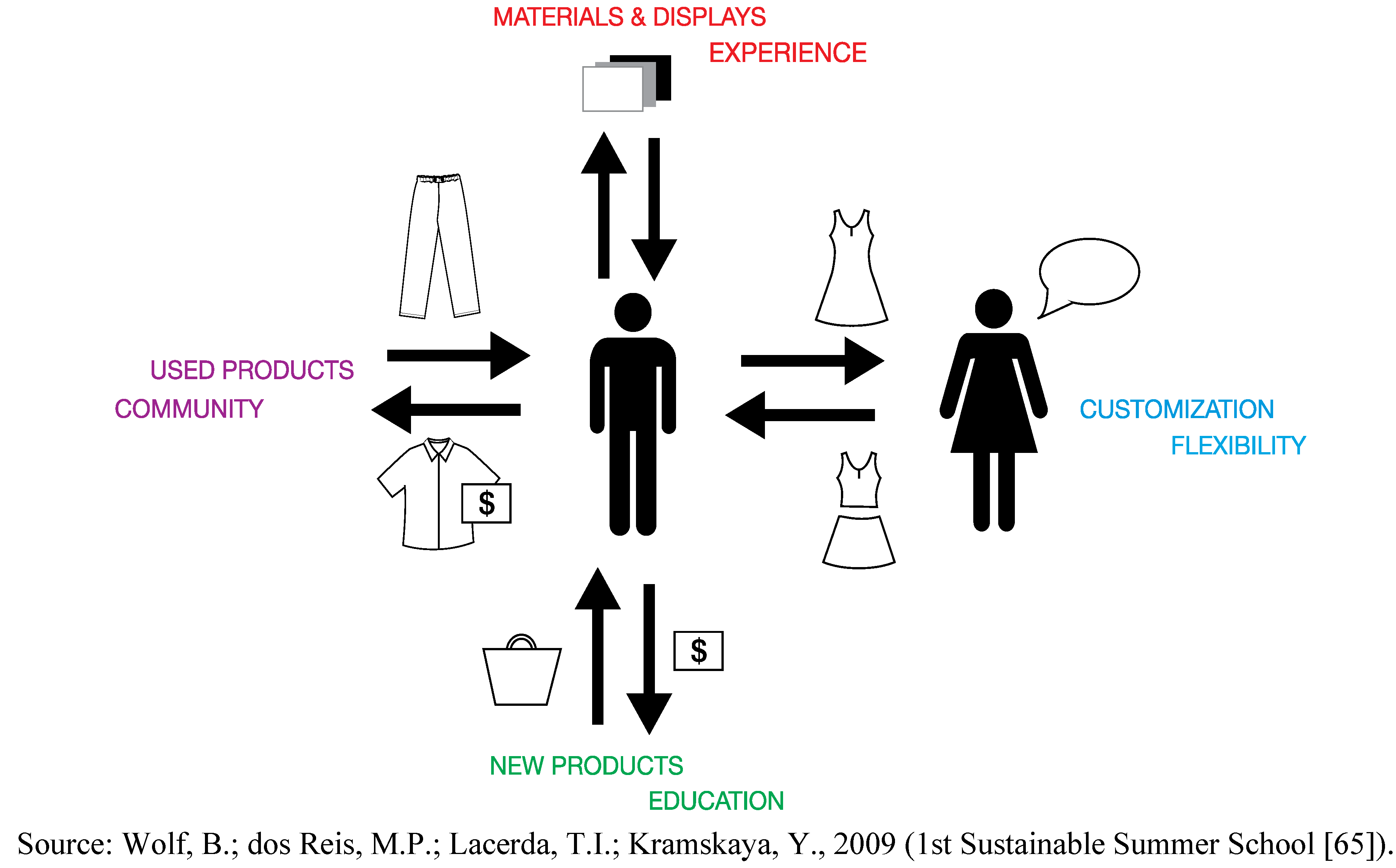
        <p>The following arrangement follows the slow movement. According to that, it rediscovers aspects of community, flexibility, experience and education. A system of shopping that shifts focus from objects to shopping as a holistic experience, where re-design, re-use and the customization of materials play a major role. The concept does not describe specific product service-systems, but a universal setting within a consumptive environment that nudges people to communicate and develop social relations with manufacturers, traders and retailers. It highlights social aspects of production and consumption systems. It well suited to illustrate eco-intelligent systems from a wider angle (see <xref ref-type="fig" rid="sustainability-05-01141-f002">Figure 2</xref>).</p>
        <fig id="sustainability-05-01141-f002" position="float">
          <label>Figure 2</label>
          <caption>
            <p>Scheme of a slow shopping business case (tailoring). </p>
          </caption>
          <graphic xmlns:xlink="http://www.w3.org/1999/xlink" xlink:href="sustainability-05-01141-g002.tif"/>
        </fig>
        <p>As the program “slow shopping” implicates, it is about investing time in consumption. Resulting patterns raise eco-awareness for products and services by committing time to the selection of materials. Advisory services by manufactures and traders raise emotional commitment to the quality of products. Moreover, the process of customization is thought to strengthen emotional binding in order to increase the time the product is kept. Life cycles are prolonged (or multiplied) not only due to increased quality but also by emotional ties. The concept is driven by social learning through the slow shopping experience. </p>
        <p>It exploits the learning potential from producer, consumer or user participation. Customized manufacturing plays with social distinction and lifestyles of sustainability that make slow shopping socially attractive. Reused, redesigned and recycled materials are at the core of its ecology. More resilient production and consumption through high shares of secondary materials is likely. Professional and committed support by retailers and manufacturers and the integration of consumers in manufacturing processes enables consumers to choose and use materials more responsibly. </p>
        <p>Such an abstract kind of PSS is not easy to categorize, since it is about offering intangibles and comes close to experience design. At the same time, this more radical form of PSS offers the most potential for saving environmental space and innovation [<xref ref-type="bibr" rid="B67-sustainability-05-01141">67</xref>]. In core, the concept addresses aspects of more qualitative and consumer orientated business cases. We do not know how this affects working time and intensities, nor do we know anything about potential rebound effects since the aspect of sufficiency is not addressed explicitly. None of the two concepts addresses the idea of a shift from objects or products to service units. In this sense, it is still shopping in conventional material terms, but slow and socially engaging. Individual welfare is achieved not only from qualitative products, but also from the personal investments or participation in the production and shopping process.</p>
      </sec>
      <sec>
        <title>4.2. Smoot</title>
        <p>Another introductory example of how to apply the concept of eco-intelligent product service-arrangements is “Smoot”, developed in the workshop “Design for a post-growth economy” during the third SSS. In contrast to “slow shopping”, “Smoot” is less abstract, but orientates towards the service unit of the respective product. The uniqueness of ‘Smoot’ addresses a target group, which is not affected by sustainability issues up to now: status seekers.</p>
        <fig id="sustainability-05-01141-f003" position="float">
          <label>Figure 3</label>
          <caption>
            <p>Scheme of a carpooling system for commuters. </p>
          </caption>
          <graphic xmlns:xlink="http://www.w3.org/1999/xlink" xlink:href="sustainability-05-01141-g003.tif"/>
        </fig>
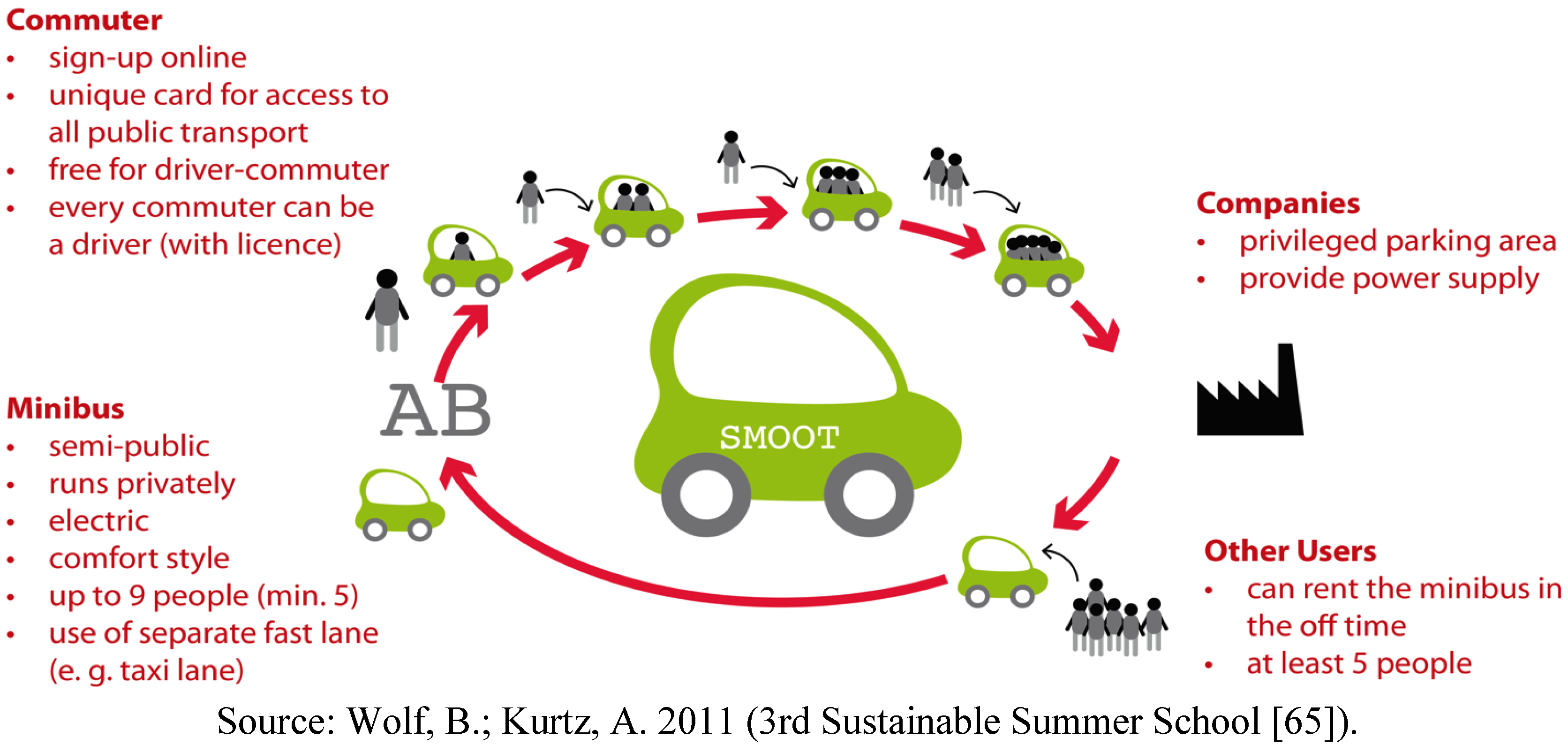
        <p>When commuting by car every day, people waste time and energy. The logical solution for most people would be to switch to public transport, which would also have an ecological advantage. For instance, commuters often live off the main rail and bus routes. Independent mobility is important for them. ‘Smoot’ aims to encourage people to use transport options more efficiently and move from individual to shared transport. The “Smoot” system is based on three elements: (a) a regional transport website, where people can register, (b) a transport card that provides access to public transport (with additional discounts to cultural institutions), (c) privately operated semi-public minibuses with an electric engine and comfortable interiors (which makes the whole system special and attractive to the target group) (see <xref ref-type="fig" rid="sustainability-05-01141-f003">Figure 3</xref>). Corresponding fast lanes are established much like a taxi lane. </p>
        <p>Eventually, it is a more sophisticated and efficiently coordinated concept of carpooling in social networks. The idea is simply to concentrate on the service unit mobility, rather than to advertise the car as the product. Thus it is adjusted to a more sophisticated lifestyle, for those who normally would not by exposed to sustainable behavior.</p>
        <p>Again the consumption of the service mobility is less dependent on resource intensive car industries. First evaluations of car sharing systems show absolute reduction of car ownership [<xref ref-type="bibr" rid="B69-sustainability-05-01141">69</xref>,<xref ref-type="bibr" rid="B70-sustainability-05-01141">70</xref>]. It may relieve respective industries from resource competitive futures and makes the economy more resilient as a whole. </p>
        <p>“Smoot” resembles a social innovation that uses resources embodied by cars and fuels more efficiently. At the same time, it requires prevalence of sufficiency. It is not necessary to own cars as long as the service is provided (<italic>i.e.</italic>, commuting to work). </p>
        <p>And again, it says nothing about why people need to commute, about working times or demands on mobility in contemporary the working world. Rebound effects are likely to occur in the short run since sharing saves money that may be spent directly for more mobility (e.g., longer distances). Sharing systems in general may not stop consumers from consuming more [<xref ref-type="bibr" rid="B68-sustainability-05-01141">68</xref>], and car sharing systems in particular may eventually not save environmental space [<xref ref-type="bibr" rid="B70-sustainability-05-01141">70</xref>]. If public transport systems and carpooling provide opportunities to attract new patterns, social distinction is at stake. At the same time, it is to doubt, whether a personal mobility service such as ‘Smoot’ sufficiently informs about the product and services regarding e.g., type, fuel and added value. And if so, this enables the consumer to deliberately choose what service to demand. </p>
      </sec>
      <sec>
        <title>4.3. Evaluation</title>
        <p>The introduced concepts were not supposed to fully fit our understanding of sustainable growth on the micro level, nor do we state that these concepts should fit our specific indications. Sustainable design may regard the elaborated aspects as kind of ideal type, which one may strive for, but eventually never achieve.</p>
        <p>In this respect, the evaluation in <xref ref-type="table" rid="sustainability-05-01141-t002">Table 2</xref> gives an orientation as to which aspects are addressed more specifically between the illustrated concepts in relation to each other. </p>
        <p>On the one hand, slow shopping is a more universal concept; it addresses the aspects of sustainable growth more fundamentally than “Smoot” does. On the other hand, “Smoot” reminds us of already implemented business cases in the real world, which makes it less fundamentally shifting but more likely to become accepted by consumers and implemented in the short run.</p>
        <table-wrap id="sustainability-05-01141-t002" position="float">
          <object-id pub-id-type="pii">sustainability-05-01141-t002_Table 2</object-id>
          <label>Table 2</label>
          <caption>
            <p>Evaluation of product service-arrangements according to latent indicators.</p>
          </caption>
          <table>
            <thead>
              <tr>
                <th colspan="3" align="center" valign="middle">Sustainable Growth strives for…</th>
              </tr>
            </thead>
            <tbody>
              <tr>
                <td align="left" valign="middle">
                  <bold>Social… </bold>
                </td>
                <td align="center" valign="middle">Slow Shopping</td>
                <td align="center" valign="middle">Smoot</td>
              </tr>
              <tr>
                <td align="left" valign="middle">Resilience</td>
                <td align="center" valign="middle">++</td>
                <td align="center" valign="middle">+</td>
              </tr>
              <tr>
                <td align="left" valign="middle">Innovation (socio-technical)</td>
                <td align="center" valign="middle">++</td>
                <td align="center" valign="middle">++</td>
              </tr>
              <tr>
                <td align="left" valign="middle">Downshifting</td>
                <td align="center" valign="middle">++</td>
                <td align="center" valign="middle">+</td>
              </tr>
              <tr>
                <td align="left" valign="middle">Sufficiency</td>
                <td align="center" valign="middle">+</td>
                <td align="center" valign="middle">+</td>
              </tr>
              <tr>
                <td align="left" valign="middle">
                  <bold>Individual…</bold>
                </td>
                <td align="center" valign="middle"> </td>
                <td align="center" valign="middle"> </td>
              </tr>
              <tr>
                <td align="left" valign="middle">Participation</td>
                <td align="center" valign="middle">+++</td>
                <td align="center" valign="middle">++</td>
              </tr>
              <tr>
                <td align="left" valign="middle">Diversity/Identity </td>
                <td align="center" valign="middle">+++</td>
                <td align="center" valign="middle">+</td>
              </tr>
              <tr>
                <td align="left" valign="middle">Competence/Security</td>
                <td align="center" valign="middle">+++</td>
                <td align="center" valign="middle">+</td>
              </tr>
            </tbody>
  </table>
        <table-wrap-foot><fn><p>Source: own description; +++ stronger fitness, ++ medium fitness, + weaker fitness.</p></fn></table-wrap-foot>
        </table-wrap>
        <p>This paper revised and enhanced the conception of product service-arrangements basically by offering three aspects derived from sociology and microeconomics in the context of the sustainable growth debate, which have been termed as eco-intelligent: 
        <list list-type="bullet">
          <list-item>
            <p>First, by concentrating on the service unit, the specific material based product is no longer at the heart of sustainable design.</p>
          </list-item>
          <list-item>
            <p>Second, product service-arrangements highlight the social component of individual welfare and quality of life, respectively.</p>
          </list-item>
          <list-item>
            <p>Third, new arrangements of service design combine sustainability strategies rather than play strategies against each other.</p>
          </list-item>
        </list></p>
        <p>In consequence, the arrangements resemble new efforts to approach growth qualitatively by integrating individual needs and wishes with respect to individual environmental space.</p>
      </sec>
    </sec>
    <sec sec-type="conclusions">
      <title>5. Conclusions</title>
      <p>This paper showed that growth might be revised on the micro level rather than focusing exclusively on considerations on the macro level. Within the concepts of mainstream sustainability strategies, an adequate reflection of limits to growth needs to consider limits to sustainability strategies as well. It was concluded that strategies should not be conceptualized separately but integratively. Moreover, with respect to that, a macro-micro link is missing when discussing the implementation potential of strategies. Mainstream strategies of efficiency and consistency have to be integrated within sufficiency in order to set up a sufficient approach to sustainability [<xref ref-type="bibr" rid="B25-sustainability-05-01141">25</xref>,<xref ref-type="bibr" rid="B71-sustainability-05-01141">71</xref>]. Sufficiency is able to link macro sustainability strategies and social and individual welfare, respectively. </p>
      <p>In order to specify, growth was reconsidered within the sociological argumentation. The goal was to revise individual welfare within environmental space. Social limits to growth have been updated by new insights regarding values, diminishing marginal utility or symbolic social distinction. Growth is highly determined by institutionalized perceptions and social status rather than by absolute, uni-dimensional indications. Limits to growth need to be perceived in a way that social innovations pave new opportunities to grow qualitatively without depending on materialization. Sustainable growth on the micro level was defined as a concept that fosters individual welfare by enhancing social enactment within the boundaries of individual environmental space.</p>
      <p>In this sense we refer to eco-intelligent product service-arrangements in the context of sustainable production and consumption. A systemic view on production and consumption allows for concepts of sustainable design, which concentrates on service units rather than products. It is about mobility rather than cars. In order to translate definitions of sustainable growth within eco-intelligent product service-arrangements, we offer latent indications on the social and individual level to which design concepts may refer. Then, a sustainable design fits the notion of limited environmental space while addressing social and individual welfare. Social and individual welfare benefit from products or service systems that incorporate preferences for social downshift, sufficiency, equity, the participation, distinction or competence of the people. </p>
      <p>Further research needs to address behavior and habits in order to successfully intervene in the socially driven materialized race to the top. Experimental research design and Co-Creation processes need to be elaborated (see [<xref ref-type="bibr" rid="B57-sustainability-05-01141">57</xref>]). It is about new user integrated production and consumption or the design of social innovations that foster and exploit the dynamics of social distinction. Eco-intelligent solutions for service systems are needed that reconsider natural and social limits to growth in order to foster a new understanding of ecologically and individually reconcilable growth paradigms.</p>
    </sec>
  </body>
  <back>
    <notes>
      <title>Conflict of Interest</title>
      <p>The authors declare no conflict of interest. </p>
    </notes>
    <ref-list>
      <title>References and Notes</title>
      <ref id="B1-sustainability-05-01141">
        <label>1.</label>
        <citation citation-type="book">
          <person-group person-group-type="author">
            <name>
              <surname>Meyer</surname>
              <given-names>B.</given-names>
            </name>
          </person-group>
          <source>Costing the Earth? Perspectives on Sustainable Development</source>
          <publisher-name>Haus</publisher-name>
          <publisher-loc>London, UK</publisher-loc>
          <year>2009</year>
        </citation>
      </ref>
      <ref id="B2-sustainability-05-01141">
        <label>2.</label>
        <citation citation-type="book">
          <person-group person-group-type="author">
            <name>
              <surname>Bringezu</surname>
              <given-names>S.</given-names>
            </name>
            <name>
              <surname>Bleischwitz</surname>
              <given-names>R.</given-names>
            </name>
          </person-group>
          <source>Sustainable Resource Management: Global Trends, Visions and Policies</source>
          <publisher-name>Greenleaf</publisher-name>
          <publisher-loc>Sheffield, UK</publisher-loc>
          <year>2009</year>
        </citation>
      </ref>
      <ref id="B3-sustainability-05-01141">
        <label>3.</label>
        <citation citation-type="journal">
          <person-group person-group-type="author">
            <name>
              <surname>Stern</surname>
              <given-names>N.</given-names>
            </name>
          </person-group>
          <article-title>The economics of climate change</article-title>
          <source>Am. Econ. Rev.</source>
          <year>2008</year>
          <volume>92</volume>
          <fpage>1</fpage>
          <lpage>17</lpage>
          <pub-id pub-id-type="doi">10.1257/aer.98.2.1</pub-id>
        </citation>
      </ref>
      <ref id="B4-sustainability-05-01141">
        <label>4.</label>
        <citation citation-type="journal">
          <person-group person-group-type="author">
            <name>
              <surname>Rockström</surname>
              <given-names>J.</given-names>
            </name>
            <name>
              <surname>Steffen</surname>
              <given-names>W.</given-names>
            </name>
            <name>
              <surname>Noone</surname>
              <given-names>K.</given-names>
            </name>
            <name>
              <surname>Persson</surname>
              <given-names>Å.</given-names>
            </name>
            <name>
              <surname>Chapin</surname>
              <given-names>F.S.</given-names>
            </name>
            <name>
              <surname>Lambin</surname>
              <given-names>E.</given-names>
            </name>
            <name>
              <surname>Lenton</surname>
              <given-names>T.M.</given-names>
            </name>
            <name>
              <surname>Scheffer</surname>
              <given-names>M.</given-names>
            </name>
            <name>
              <surname>Folke</surname>
              <given-names>C.</given-names>
            </name>
            <name>
              <surname>Schellnhuber</surname>
              <given-names>H.</given-names>
            </name>
            <etal/>
          </person-group>
          <article-title>Planetary boundaries: Exploring the safe operating space for humanity</article-title>
          <source>Ecol. Soc.</source>
          <year>2009</year>
          <volume>14</volume>
          <fpage>32</fpage>
        </citation>
      </ref>
      <ref id="B5-sustainability-05-01141">
        <label>5.</label>
        <citation citation-type="book">
          <person-group person-group-type="author">
            <name>
              <surname>Schmidt-Bleek</surname>
              <given-names>F.</given-names>
            </name>
          </person-group>
          <source>The Earth: Natural Resources and Human Intervention</source>
          <publisher-name>Haus</publisher-name>
          <publisher-loc>London, UK</publisher-loc>
          <year>2009</year>
        </citation>
      </ref>
      <ref id="B6-sustainability-05-01141">
        <label>6.</label>
        <citation citation-type="book">
          <person-group person-group-type="author">
            <name>
              <surname>Opschoor</surname>
              <given-names>J.B.</given-names>
            </name>
            <name>
              <surname>Costanza</surname>
              <given-names>R.</given-names>
            </name>
          </person-group>
          <article-title>Environmental Performance Indicators, Environmental Space and the Preservation of Ecosystem Health</article-title>
          <source>Global Environmental Change and Sustainable Development</source>
          <person-group person-group-type="editor">
            <name>
              <surname>Jaeger</surname>
              <given-names>J.</given-names>
            </name>
			<name>
              <surname>Liberatore</surname>
              <given-names>A.</given-names>
            </name>
            <name>
              <surname>Grundlach</surname>
              <given-names>K.</given-names>
            </name>
          </person-group>
          <publisher-name>Office for Publication of EC.</publisher-name>
          <publisher-loc>L-2920, Luxembourg</publisher-loc>
          <year>1995</year>
        </citation>
      </ref>
      <ref id="B7-sustainability-05-01141">
        <label>7.</label>
        <citation citation-type="book">
          <person-group person-group-type="author">
            <name>
              <surname>Boulding</surname>
              <given-names>K.</given-names>
            </name>
          </person-group>
          <article-title>The Economics of the Coming Spaceship Earth</article-title>
          <source>Environmental Quality in a Growing Economy</source>
          <person-group person-group-type="editor">
            <name>
              <surname>Jarrett</surname>
              <given-names>H.</given-names>
            </name>
          </person-group>
          <publisher-name>John Hopkins University Press</publisher-name>
          <publisher-loc>Baltimore, MD, USA</publisher-loc>
          <year>1996</year>
          <fpage>3</fpage>
          <lpage>14</lpage>
        </citation>
      </ref>
      <ref id="B8-sustainability-05-01141">
        <label>8.</label>
        <citation citation-type="web">
          <person-group person-group-type="author">
            <name>
              <surname>Schmidt-Bleek</surname>
              <given-names>F.</given-names>
            </name>
          </person-group>
          <source>The Factor 10/MIPS-Concept. Bridging Ecological, Economic, and Social Dimensions with Sustainability Indicators</source>
          <year>1993</year>
          <comment>Available online:<ext-link xmlns:xlink="http://www.w3.org/1999/xlink" xlink:href="http://www.factor10-institute.org/files/MIPS.pdf" ext-link-type="uri">http://www.factor10-institute.org/files/MIPS.pdf</ext-link></comment>
          <access-date>(accessed on 29 November 2012)</access-date>
        </citation>
      </ref>
      <ref id="B9-sustainability-05-01141">
        <label>9.</label>
        <citation citation-type="journal">
          <person-group person-group-type="author">
            <name>
              <surname>Lettenmeier</surname>
              <given-names>M.</given-names>
            </name>
            <name>
              <surname>Hirvilammi</surname>
              <given-names>T.</given-names>
            </name>
            <name>
              <surname>Laakso</surname>
              <given-names>S.</given-names>
            </name>
            <name>
              <surname>Lähteenoja</surname>
              <given-names>S.</given-names>
            </name>
            <name>
              <surname>Aalto</surname>
              <given-names>K.</given-names>
            </name>
          </person-group>
          <article-title>Material Footprint of Low-Income Households in Finland—Consequences for the Sustainability Debate</article-title>
          <source>Sustainability</source>
          <year>2012</year>
          <volume>4</volume>
          <fpage>1426</fpage>
          <lpage>1447</lpage>
          <pub-id pub-id-type="doi">10.3390/su4071426</pub-id>
        </citation>
      </ref>
      <ref id="B10-sustainability-05-01141">
        <label>10.</label>
        <citation citation-type="journal">
          <person-group person-group-type="author">
            <name>
              <surname>Scerri</surname>
              <given-names>A.</given-names>
            </name>
            <name>
              <surname>James</surname>
              <given-names>P.</given-names>
            </name>
          </person-group>
          <article-title>Communities of Citizens and “Indicators” of Sustainability’</article-title>
          <source>Community Dev. J.</source>
          <year>2010</year>
          <volume>45</volume>
          <fpage>219</fpage>
          <lpage>236</lpage>
          <pub-id pub-id-type="doi">10.1093/cdj/bsp013</pub-id>
        </citation>
      </ref>
      <ref id="B11-sustainability-05-01141">
        <label>11.</label>
		<note>	
		<p>For issues of a post growth economy concerning income, competitiveness, social security and topics alike we refer to Jackson [<xref ref-type="bibr" rid="B16-sustainability-05-01141">16</xref>] or Heinberg [<xref ref-type="bibr" rid="B72-sustainability-05-01141">72</xref>].</p>
        </note>
      </ref>
      <ref id="B12-sustainability-05-01141">
        <label>12.</label>
        <citation citation-type="journal">
          <person-group person-group-type="author">
            <name>
              <surname>Schroeder</surname>
              <given-names>R.</given-names>
            </name>
          </person-group>
          <article-title>The limits to transforming the environment and the limits to sociological knowledge</article-title>
          <source>Sustainability</source>
          <year>2010</year>
          <volume>2</volume>
          <fpage>2485</fpage>
          <pub-id pub-id-type="doi">10.3390/su2082483</pub-id>
        </citation>
      </ref>
      <ref id="B13-sustainability-05-01141">
        <label>13.</label>
        <citation citation-type="web">
          <person-group person-group-type="author">
            <name>
              <surname>Schmidt-Bleek</surname>
              <given-names>F.</given-names>
            </name>
          </person-group>
          <source>The Fossil Makers. Translation of the book “Faktor 10-das Maß für ökologisches Wirtschaften”; Deumling, R. 1993</source>
          <comment>Available online:<ext-link xmlns:xlink="http://www.w3.org/1999/xlink" xlink:href="http://www.factor10institute.org/files/the_fossil_makers/FossilMakers_Intro.pdf" ext-link-type="uri">http://www.factor10institute.org/files/the_fossil_makers/FossilMakers_Intro.pdf</ext-link></comment>
          <access-date>(accessed on 29 November 2012)</access-date>
        </citation>
      </ref>
      <ref id="B14-sustainability-05-01141">
        <label>14.</label>
        <note>
          <p>Material Footprint denotes the invisible material burden (the subsidy by nature), or the total input of natural resources required by any product from the cradle to the point of sale. In a sense, the Material Footprint parallels the monetary price of products in physical terms. It is an important measure for comparing functionally equivalent goods from different competitors at the point of sale (e.g., tools or cars).</p>
        </note>
      </ref>
      <ref id="B15-sustainability-05-01141">
        <label>15.</label>
        <citation citation-type="gov">
          <collab>International Panel on Climate Change (IPCC)</collab>
		  <article-title>AR4; Climate Change 2007: Synthesis Report. Contribution of Working Groups I, II and III to the Fourth Assessment Report of the Intergovernmental Panel on Climate Change</article-title>
          <person-group person-group-type="editor">
            <name>
              <surname>Pachauri</surname>
              <given-names>R.K.</given-names>
            </name>
            <name>
              <surname>Reisinger</surname>
              <given-names>A.</given-names>
            </name>
          </person-group>
          <publisher-name>Core Writing Team</publisher-name>
          <publisher-loc>Geneva, Switzerland</publisher-loc>
          <year>2007</year>
        </citation>
      </ref>
      <ref id="B16-sustainability-05-01141">
        <label>16.</label>
        <citation citation-type="book">
          <person-group person-group-type="author">
            <name>
              <surname>Jackson</surname>
              <given-names>T.</given-names>
            </name>
          </person-group>
          <article-title>Prosperity Without Growth: Economics for a Finite Planet</article-title>
          <publisher-name>Earthscan</publisher-name>
          <publisher-loc>London, UK</publisher-loc>
          <year>2009</year>
        </citation>
      </ref>
      <ref id="B17-sustainability-05-01141">
        <label>17.</label>
        <citation citation-type="book">
          <person-group person-group-type="author">
            <name>
              <surname>Patel</surname>
              <given-names>R.</given-names>
            </name>
          </person-group>
          <article-title>The Value of Nothing: How to Reshape Market Society and Redefine Democracy</article-title>
          <source>The Value of Nothing: How to Reshape Market Society and Redefine Democracy</source>
          <publisher-name>Picador</publisher-name>
          <publisher-loc>New York, NY, USA</publisher-loc>
          <year>2009</year>
        </citation>
      </ref>
      <ref id="B18-sustainability-05-01141">
        <label>18.</label>
        <citation citation-type="book">
          <person-group person-group-type="author">
            <name>
              <surname>von Weizsäcker</surname>
              <given-names>E.U.</given-names>
            </name>
          </person-group>
          <source>Factor five: Transforming the Global Economy through 80% Improvements in Resource Productivity</source>
          <publisher-name>Earthscan</publisher-name>
          <publisher-loc>London, UK</publisher-loc>
          <year>2009</year>
        </citation>
      </ref>
      <ref id="B19-sustainability-05-01141">
        <label>19.</label>
        <citation citation-type="book">
              <collab>United Nations Environment Programme (UNEP)</collab>
          <source>Decoupling Natural Resource use and Environmental Impacts from Economic Growth</source>
          <publisher-name>A Report of the Working Group on Decoupling to the International Resource Panel</publisher-name>
          <publisher-loc>Paris, France</publisher-loc>
          <year>2011</year>
        </citation>
      </ref>
      <ref id="B20-sustainability-05-01141">
        <label>20.</label>
        <citation citation-type="journal">
          <person-group person-group-type="author">
            <name>
              <surname>Romer</surname>
              <given-names>P.M.</given-names>
            </name>
          </person-group>
          <article-title>The origins of endogenous growth</article-title>
          <source>J. Econ. Perspect.</source>
          <year>1994</year>
          <volume>8</volume>
          <fpage>3</fpage>
          <lpage>22</lpage>
          <pub-id pub-id-type="doi">10.1257/jep.8.1.3</pub-id>
        </citation>
      </ref>
      <ref id="B21-sustainability-05-01141">
        <label>21.</label>
        <citation citation-type="book">
          <person-group person-group-type="author">
            <name>
              <surname>Weizsäcker</surname>
              <given-names>E.V.</given-names>
            </name>
            <name>
              <surname>Lovins</surname>
              <given-names>A.B.</given-names>
            </name>
            <name>
              <surname>Lovins</surname>
              <given-names>L.H.</given-names>
            </name>
          </person-group>
          <article-title>Factor Four: Doubling Wealth, Halving Resource Use: The New Report to the Club of Rome</article-title>
          <publisher-name>Earthscan</publisher-name>
          <publisher-loc>London, UK</publisher-loc>
          <year>1997</year>
        </citation>
      </ref>
      <ref id="B22-sustainability-05-01141">
        <label>22.</label>
        <citation citation-type="journal">
          <person-group person-group-type="author">
            <name>
              <surname>Sorrell</surname>
              <given-names>S.</given-names>
            </name>
          </person-group>
          <article-title>Energy, economic growth and environmental sustainability: Five propositions</article-title>
          <source>Sustainability</source>
          <year>2010</year>
          <volume>2</volume>
          <fpage>1784</fpage>
          <lpage>1809</lpage>
          <pub-id pub-id-type="doi">10.3390/su2061784</pub-id>
        </citation>
      </ref>
      <ref id="B23-sustainability-05-01141">
        <label>23.</label>
        <citation citation-type="book">
          <person-group person-group-type="author">
            <name>
              <surname>McDonough</surname>
              <given-names>W.</given-names>
            </name>
            <name>
              <surname>Braungart</surname>
              <given-names>M.</given-names>
            </name>
          </person-group>
          <source>Cradle to Cradle: Remaking the Way We Make Things</source>
          <publisher-name>North Point Press</publisher-name>
          <publisher-loc>New York, NY, USA</publisher-loc>
          <year>2002</year>
        </citation>
      </ref>
      <ref id="B24-sustainability-05-01141">
        <label>24.</label>
        <citation citation-type="gov">
		<collab>Federal ministry for Environment</collab>
          <article-title>Report on the Environment and Economy 2009: Fact &amp; Figures for Germany</article-title>
          <year>2011</year>
          <fpage>11</fpage>
          <comment>Available online:<ext-link xmlns:xlink="http://www.w3.org/1999/xlink" xlink:href="http://www.bmu.de/files/english/pdf/application/pdf/umweltwirtschaftsbericht_2009_en.pdf" ext-link-type="uri">http://www.bmu.de/files/english/pdf/application/pdf/umweltwirtschaftsbericht_2009_en.pdf</ext-link></comment>
          <access-date>(accessed on 29 November 2012)</access-date>
        </citation>
      </ref>
      <ref id="B25-sustainability-05-01141">
        <label>25.</label>
        <citation citation-type="web">
		<collab>Shell International BV</collab>
          <article-title>Signals and Signpost. Shell energy scenarios 2050</article-title>
          <year>2011</year>
          <comment>Available online:<ext-link xmlns:xlink="http://www.w3.org/1999/xlink" xlink:href="http://www-static.shell.com/static/aboutshell/downloads/aboutshell/signals_signposts.pdf" ext-link-type="uri">http://www-static.shell.com/static/aboutshell/downloads/aboutshell/signals_signposts.pdf</ext-link></comment>
          <access-date>(accessed on 29 November 2012)</access-date>
        </citation>
      </ref>
      <ref id="B26-sustainability-05-01141">
        <label>26.</label>
        <citation citation-type="book">
          <person-group person-group-type="author">
            <name>
              <surname>Ahuvia</surname>
              <given-names>A.</given-names>
            </name>
          </person-group>
          <article-title>Wealth, Consumption and Happiness</article-title>
          <source>The Cambridge Handbook on Psychology and Economic Behaviour</source>
          <person-group person-group-type="editor">
            <name>
              <surname>Lewis</surname>
              <given-names>A.</given-names>
            </name>
          </person-group>
          <publisher-name>Cambridge University Press</publisher-name>
          <publisher-loc>Cambridge, UK</publisher-loc>
          <year>2008</year>
          <fpage>199</fpage>
          <lpage>226</lpage>
        </citation>
      </ref>
      <ref id="B27-sustainability-05-01141">
        <label>27.</label>
        <citation citation-type="web">
          <person-group person-group-type="author">
            <name>
              <surname>Stiglitz</surname>
              <given-names>P.</given-names>
            </name>
            <name>
              <surname>Sen</surname>
              <given-names>A.</given-names>
            </name>
            <name>
              <surname>Fitoussi</surname>
              <given-names>J.-P.</given-names>
            </name>
          </person-group>
          <article-title>Report of the Commission on the Measurement of Economic Performance et Social Progress</article-title>
          <year>2009</year>
          <comment>Available online:<ext-link xmlns:xlink="http://www.w3.org/1999/xlink" xlink:href="http://www.stiglitz-sen-fitoussi.fr/documents/rapport_anglais.pdf" ext-link-type="uri">http://www.stiglitz-sen-fitoussi.fr/documents/rapport_anglais.pdf</ext-link></comment>
          <access-date>(accessed on 29 November 2012)</access-date>
        </citation>
      </ref>
      <ref id="B28-sustainability-05-01141">
        <label>28.</label>
        <citation citation-type="web">
          <collab>Enquete-Kommission Wachstum, Wohlstand, Lebensqualität</collab>
		  <article-title>Berichtsentwurf Projektgruppe 3: Wachstum, Ressourcenverbrauch und technischer Fortschritt—Möglichkeiten und Grenzen der Entkopplung. Kapitel 1–6 September 2012</article-title>
          <comment>Available online:<ext-link xmlns:xlink="http://www.w3.org/1999/xlink" xlink:href="http://www.bundestag.de/bundestag/gremien/enquete/wachstum/Kommissionsdrucksachen/82_PG3_Berichtsentwurf.pdf" ext-link-type="uri">http://www.bundestag.de/bundestag/gremien/enquete/wachstum/Kommissionsdrucksachen/82_PG3_Berichtsentwurf.pdf</ext-link></comment>
          <access-date>(accessed on 29 November 2012)</access-date>
        </citation>
      </ref>
      <ref id="B29-sustainability-05-01141">
        <label>29.</label>
        <citation citation-type="book">
          <person-group person-group-type="author">
            <name>
              <surname>Nee</surname>
              <given-names>V.</given-names>
            </name>
          </person-group>
          <article-title>The New Institutionalisms in Economics and Sociology</article-title>
          <source>Handbook for Economic Sociology</source>
          <person-group person-group-type="editor">
            <name>
              <surname>Smelser</surname>
              <given-names>N.J.</given-names>
            </name>
            <name>
              <surname>Swedberg</surname>
              <given-names>R.</given-names>
            </name>
          </person-group>
          <publisher-name>Princeton University Press</publisher-name>
          <publisher-loc>Princeton, NJ, USA</publisher-loc>
          <year>2005</year>
          <fpage>49</fpage>
          <lpage>74</lpage>
        </citation>
      </ref>
      <ref id="B30-sustainability-05-01141">
        <label>30.</label>
        <citation citation-type="journal">
          <person-group person-group-type="author">
            <name>
              <surname>Paech</surname>
              <given-names>N.</given-names>
            </name>
          </person-group>
          <article-title>Die Postwachstumsökonomie—ein Vademecum</article-title>
          <source>Zeitschrift für Sozialökonomie</source>
          <year>2009</year>
          <volume>46</volume>
          <fpage>28</fpage>
          <lpage>31</lpage>
        </citation>
      </ref>
      <ref id="B31-sustainability-05-01141">
        <label>31.</label>
        <citation citation-type="web">
          <person-group person-group-type="author">
            <name>
              <surname>Schmidt-Bleek</surname>
              <given-names>F.</given-names>
            </name>
          </person-group>
          <article-title>The Fossil Makers</article-title>
          <source>Faktor 10-das Maß für ökologisches Wirtschaften</source>
		  <person-group person-group-type="translator">
		  <name>
		<surname>Deumling</surname>
		<given-names>R.</given-names>
		</name>
		</person-group>
          <publisher-name>Birkhäuser</publisher-name>
          <publisher-loc>Berlin, Germany</publisher-loc>
          <year>1993</year>
          <comment>Available online:<ext-link xmlns:xlink="http://www.w3.org/1999/xlink" xlink:href="http://www.factor-10institute.org/files/the_fossil_makers/FossilMakers_Intro.pdf" ext-link-type="uri">http://www.factor-10institute.org/files/the_fossil_makers/FossilMakers_Intro.pdf</ext-link></comment>
          <access-date>(accessed on 25 January 2013)</access-date>
        </citation>
      </ref>
      <ref id="B32-sustainability-05-01141">
        <label>32.</label>
        <citation citation-type="journal">
          <person-group person-group-type="author">
            <name>
              <surname>Daly</surname>
              <given-names>H.E.</given-names>
            </name>
          </person-group>
          <article-title>Toward some operational principles of sustainable development</article-title>
          <source>Ecol. Econ.</source>
          <year>1990</year>
          <volume>2</volume>
          <fpage>1</fpage>
          <lpage>6</lpage>
          <pub-id pub-id-type="doi">10.1016/0921-8009(90)90010-R</pub-id>
        </citation>
      </ref>
      <ref id="B33-sustainability-05-01141">
        <label>33.</label>
        <citation citation-type="journal">
          <person-group person-group-type="author">
            <name>
              <surname>Van den Bergh</surname>
              <given-names>J.C.J.M.</given-names>
            </name>
          </person-group>
          <article-title>Environment <italic>versus</italic> growth—A criticism of “degrowth” and a plea for “a-growth”</article-title>
          <source>Ecol. Econ.</source>
          <year>2011</year>
          <volume>70</volume>
          <fpage>881</fpage>
          <lpage>890</lpage>
          <pub-id pub-id-type="doi">10.1016/j.ecolecon.2010.09.035</pub-id>
        </citation>
      </ref>
      <ref id="B34-sustainability-05-01141">
        <label>34.</label>
        <citation citation-type="journal">
          <person-group person-group-type="author">
            <name>
              <surname>Martínez-Alier</surname>
              <given-names>J.</given-names>
            </name>
            <name>
              <surname>Pascual</surname>
              <given-names>U.</given-names>
            </name>
            <name>
              <surname>Vivien</surname>
              <given-names>F.-D.</given-names>
            </name>
            <name>
              <surname>Zaccai</surname>
              <given-names>E.</given-names>
            </name>
          </person-group>
          <article-title>Sustainable De-growth: Mapping the context, criticisms and future prospects of an emergent paradigm</article-title>
          <source>Ecol. Econ.</source>
          <year>2010</year>
          <volume>69</volume>
          <fpage>1746</fpage>
        </citation>
      </ref>
      <ref id="B35-sustainability-05-01141">
        <label>35.</label>
        <citation citation-type="journal">
              <collab>Research &amp; Degrowth</collab>
          <article-title>Degrowth Declaration of the Paris 2008 conference</article-title>
          <source>J. Clean. Prod.</source>
          <year>2010</year>
          <volume>18</volume>
          <fpage>524</fpage>
        </citation>
      </ref>
      <ref id="B36-sustainability-05-01141">
        <label>36.</label>
        <citation citation-type="journal">
          <person-group person-group-type="author">
            <name>
              <surname>Van der Bergh</surname>
              <given-names>J.C.J.M.</given-names>
            </name>
          </person-group>
          <article-title>The GDP Paradox</article-title>
          <source>J. Econ. Psychol.</source>
          <year>2009</year>
          <volume>30</volume>
          <fpage>125</fpage>
          <lpage>135</lpage>
        </citation>
      </ref>
      <ref id="B37-sustainability-05-01141">
        <label>37.</label>
        <citation citation-type="web">
          <person-group person-group-type="author">
            <name>
              <surname>Laschke</surname>
              <given-names>M.</given-names>
            </name>
            <name>
              <surname>Hassenzahl</surname>
              <given-names>M.</given-names>
            </name>
          </person-group>
          <source>Things with Attitude: Transformational Products. Create11 Conference</source>
          <conf-loc>London, UK</conf-loc>
		  <conf-date>23 June 2011</conf-date>
          <comment>Available online:<ext-link xmlns:xlink="http://www.w3.org/1999/xlink" xlink:href="http://www.create-conference.org/ storage/create11papersposters/Things with attitude.pdf" ext-link-type="uri">http://www.create-conference.org/ storage/create11papersposters/Things with attitude.pdf</ext-link></comment>
          <access-date>(accessed on 29 November 2012)</access-date>
        </citation>
      </ref>
      <ref id="B38-sustainability-05-01141">
        <label>38.</label>
        <citation citation-type="web">
          <person-group person-group-type="author">
            <name>
              <surname>Rees</surname>
              <given-names>W.E.</given-names>
            </name>
          </person-group>
          <article-title>What’s blocking sustainability? Human nature, cognition, and denial</article-title>
          <source>Sustain. Sci. Pract. Pol.</source>
          <year>2010</year>
          <volume>6</volume>
          <access-date>(accessed on 05 March 2013)</access-date>
          <comment>Available online:<ext-link xmlns:xlink="http://www.w3.org/1999/xlink" xlink:href="http://sspp.proquest.com/static_content/vol6iss2/SSPP-v6.2.pdf" ext-link-type="uri">http://sspp.proquest.com/static_content/vol6iss2/SSPP-v6.2.pdf</ext-link></comment>
        </citation>
      </ref>
      <ref id="B39-sustainability-05-01141">
        <label>39.</label>
        <citation citation-type="book">
          <person-group person-group-type="author">
            <name>
              <surname>Christian</surname>
              <given-names>D.</given-names>
            </name>
          </person-group>
          <source>Maps of Time: An Introduction to Big History</source>
          <publisher-name>University of California Press</publisher-name>
          <publisher-loc>Berkeley, CA, USA</publisher-loc>
          <year>2011</year>
        </citation>
      </ref>
      <ref id="B40-sustainability-05-01141">
        <label>40.</label>
        <citation citation-type="web">
          <collab>World Values Survey Association</collab>
		  <article-title>World Values Survey 1981–2008. Official Aggregate v.20090901, 2009</article-title>
		  <publisher-name>Aggregate File Producer</publisher-name>
		  <publisher-loc>ASEP/JDS, Madrid</publisher-loc>
          <comment>Available online:<ext-link xmlns:xlink="http://www.w3.org/1999/xlink" xlink:href="http://www.worldvaluessurvey.org/" ext-link-type="uri">http://www.worldvaluessurvey.org/</ext-link></comment>
          <access-date>(accessed 25 January 2013)</access-date>
        </citation>
      </ref>
      <ref id="B41-sustainability-05-01141">
        <label>41.</label>
        <citation citation-type="thesis">
          <person-group person-group-type="author">
            <name>
              <surname>Abramson</surname>
              <given-names>P.R.</given-names>
            </name>
          </person-group>
          <article-title>Critiques and Counter-Critiques of the Postmaterialism Thesis: Thirty-four Years of Debate. CSD Working Papers</article-title>
          <publisher-name>UC Irvine</publisher-name>
          <publisher-loc>Center for the Study of Democracy, CA, USA</publisher-loc>
          <year>2011</year>
        </citation>
      </ref>
      <ref id="B42-sustainability-05-01141">
        <label>42.</label>
        <citation citation-type="journal">
          <person-group person-group-type="author">
            <name>
              <surname>Inglehart</surname>
              <given-names>R.</given-names>
            </name>
          </person-group>
          <article-title>The silent revolution in post-industrial societies</article-title>
          <source>Am. Polit. Sci. Rev.</source>
          <year>1971</year>
          <volume>65</volume>
          <fpage>991</fpage>
          <lpage>1017</lpage>
          <pub-id pub-id-type="doi">10.2307/1953494</pub-id>
        </citation>
      </ref>
      <ref id="B43-sustainability-05-01141">
        <label>43.</label>
        <citation citation-type="book">
          <person-group person-group-type="author">
            <name>
              <surname>Kuhn</surname>
              <given-names>T.S.</given-names>
            </name>
          </person-group>
          <source>The Structure of Scientific Revolutions</source>
          <publisher-name>The University of Chicago Press</publisher-name>
          <publisher-loc>Chicago, IL, USA</publisher-loc>
          <year>1961</year>
        </citation>
      </ref>
      <ref id="B44-sustainability-05-01141">
        <label>44.</label>
        <citation citation-type="book">
          <person-group person-group-type="author">
            <name>
              <surname>Inglehart</surname>
              <given-names>R.</given-names>
            </name>
          </person-group>
          <article-title>Modernization and Postmodernization: Cultural, Economic, and Political Change in 43 Societies</article-title>
          <publisher-name>Princeton University Press</publisher-name>
          <publisher-loc>Princeton, NJ, USA</publisher-loc>
          <year>1997</year>
        </citation>
      </ref>
      <ref id="B45-sustainability-05-01141">
        <label>45.</label>
        <citation citation-type="journal">
          <person-group person-group-type="author">
            <name>
              <surname>Hansen</surname>
              <given-names>O.</given-names>
            </name>
            <name>
              <surname>Tol</surname>
              <given-names>R.S.J.</given-names>
            </name>
          </person-group>
          <article-title>A refined Inglehart index of materialism and postmaterialism</article-title>
          <source>Am. Polit. Sci. Rev.</source>
          <year>2003</year>
          <volume>73</volume>
          <fpage>155</fpage>
          <lpage>169</lpage>
        </citation>
      </ref>
      <ref id="B46-sustainability-05-01141">
        <label>46.</label>
        <citation citation-type="book">
          <person-group person-group-type="author">
            <name>
              <surname>Hirsch</surname>
              <given-names>F.</given-names>
            </name>
          </person-group>
          <source>The Social Limits to Growth</source>
          <publisher-name>Routledge &amp; Kegan Paul</publisher-name>
          <publisher-loc>London, UK</publisher-loc>
          <year>1977</year>
        </citation>
      </ref>
      <ref id="B47-sustainability-05-01141">
        <label>47.</label>
        <citation citation-type="book">
          <person-group person-group-type="author">
            <name>
              <surname>Simmel</surname>
              <given-names>G.</given-names>
            </name>
          </person-group>
          <source>Philosophie der Mode</source>
          <publisher-name>Pan Verlag</publisher-name>
          <publisher-loc>Berlin, Germany</publisher-loc>
          <year>1905</year>
        </citation>
      </ref>
      <ref id="B48-sustainability-05-01141">
        <label>48.</label>
        <citation citation-type="journal">
          <person-group person-group-type="author">
            <name>
              <surname>Solnick</surname>
              <given-names>S.J.</given-names>
            </name>
            <name>
              <surname>Hemenway</surname>
              <given-names>D.</given-names>
            </name>
          </person-group>
          <article-title>Is more always better? A survey on positional concerns</article-title>
          <source>J. Econ. Behav. Organ.</source>
          <year>1998</year>
          <volume>37</volume>
          <fpage>373</fpage>
          <lpage>383</lpage>
          <pub-id pub-id-type="doi">10.1016/S0167-2681(98)00089-4</pub-id>
        </citation>
      </ref>
      <ref id="B49-sustainability-05-01141">
        <label>49.</label>
        <citation citation-type="journal">
          <person-group person-group-type="author">
            <name>
              <surname>Kahneman</surname>
              <given-names>D.</given-names>
            </name>
            <name>
              <surname>Deaton</surname>
              <given-names>A.</given-names>
            </name>
          </person-group>
          <article-title>High income improves evaluation of life but not emotional well-being</article-title>
          <source>P. Natl. Acad. Sci. USA</source>
          <year>2010</year>
          <volume>107</volume>
          <fpage>16489</fpage>
          <lpage>16493</lpage>
          <pub-id pub-id-type="doi">10.1073/pnas.1011492107</pub-id>
        </citation>
      </ref>
      <ref id="B50-sustainability-05-01141">
        <label>50.</label>
        <citation citation-type="book">
          <person-group person-group-type="author">
            <name>
              <surname>Veblen</surname>
              <given-names>T.</given-names>
            </name>
          </person-group>
          <source>The Theory of the Leisure Class</source>
          <publisher-name>Penguin Books</publisher-name>
          <publisher-loc>New York, NY, USA</publisher-loc>
          <year>1994</year>
        </citation>
      </ref>
      <ref id="B51-sustainability-05-01141">
        <label>51.</label>
        <citation citation-type="journal">
          <person-group person-group-type="author">
            <name>
              <surname>Trigg</surname>
              <given-names>A.</given-names>
            </name>
          </person-group>
          <article-title>Veblen, Bourdieu, and conspicuous consumption</article-title>
          <source>J. Econ. Issues</source>
          <year>2001</year>
          <volume>35</volume>
          <fpage>99</fpage>
          <lpage>115</lpage>
        </citation>
      </ref>
      <ref id="B52-sustainability-05-01141">
        <label>52.</label>
        <citation citation-type="book">
          <person-group person-group-type="author">
            <name>
              <surname>Keynes</surname>
              <given-names>J.M.</given-names>
            </name>
          </person-group>
          <article-title>Economic Possibilities for Our Grandchildren</article-title>
          <source>Essays in Persuasion</source>
          <person-group person-group-type="editor">
            <name>
              <surname>Keynes</surname>
              <given-names>J.M.</given-names>
            </name>
          </person-group>
          <publisher-name>W.W. Norton &amp; Co.</publisher-name>
          <publisher-loc>New York, NY, USA</publisher-loc>
          <year>1963</year>
          <fpage>358</fpage>
          <lpage>372</lpage>
        </citation>
      </ref>
      <ref id="B53-sustainability-05-01141">
        <label>53.</label>
        <citation citation-type="book">
          <person-group person-group-type="author">
            <name>
              <surname>Bourdieu</surname>
              <given-names>P.</given-names>
            </name>
          </person-group>
          <source>Distinction: A Social Critique of the Judgement of Taste</source>
          <publisher-name>Harvard University Press</publisher-name>
          <publisher-loc>Cambridge, MA, USA</publisher-loc>
          <year>1982</year>
        </citation>
      </ref>
      <ref id="B54-sustainability-05-01141">
        <label>54.</label>
        <citation citation-type="book">
          <person-group person-group-type="author">
            <name>
              <surname>Giddens</surname>
              <given-names>A.</given-names>
            </name>
          </person-group>
          <source>The Constitution of Society: Outline of Structuration</source>
          <publisher-name>Polity Press</publisher-name>
          <publisher-loc>Cambridge, UK</publisher-loc>
          <year>1985</year>
        </citation>
      </ref>
      <ref id="B55-sustainability-05-01141">
        <label>55.</label>
        <citation citation-type="journal">
          <person-group person-group-type="author">
            <name>
              <surname>Spaargaren</surname>
              <given-names>G.</given-names>
            </name>
          </person-group>
          <article-title>Theories of practice: Agency, technology, and culture: Exploring the relevance of practice theories for the governance of sustainable consumption practices in the new world-order</article-title>
          <source>Global Environ. Chang.</source>
          <year>2011</year>
          <volume>21</volume>
          <fpage>813</fpage>
          <lpage>822</lpage>
          <pub-id pub-id-type="doi">10.1016/j.gloenvcha.2011.03.010</pub-id>
        </citation>
      </ref>
      <ref id="B56-sustainability-05-01141">
        <label>56.</label>
        <citation citation-type="journal">
          <person-group person-group-type="author">
            <name>
              <surname>Walker</surname>
              <given-names>S.</given-names>
            </name>
          </person-group>
          <article-title>Temporal Objects—Design, Change and Sustainability</article-title>
          <source>Sustainability</source>
          <year>2010</year>
          <volume>2</volume>
          <fpage>812</fpage>
          <lpage>832</lpage>
          <pub-id pub-id-type="doi">10.3390/su2030812</pub-id>
        </citation>
      </ref>
      <ref id="B57-sustainability-05-01141">
        <label>57.</label>
        <citation citation-type="journal">
          <person-group person-group-type="author">
            <name>
              <surname>Liedtke</surname>
              <given-names>C.</given-names>
            </name>
            <name>
              <surname>Welfens</surname>
              <given-names>M.J.</given-names>
            </name>
            <name>
              <surname>Rohn</surname>
              <given-names>H.</given-names>
            </name>
            <name>
              <surname>Nordmann</surname>
              <given-names>J.</given-names>
            </name>
          </person-group>
          <article-title>Living Lab: User-Driven Innovation for Sustainability</article-title>
          <source>Int. J. Sustain. High Edu.</source>
          <year>2012</year>
          <volume>13</volume>
          <fpage>106</fpage>
          <lpage>118</lpage>
          <pub-id pub-id-type="doi">10.1108/14676371211211809</pub-id>
        </citation>
      </ref>
      <ref id="B58-sustainability-05-01141">
        <label>58.</label>
        <citation citation-type="journal">
          <person-group person-group-type="author">
            <name>
              <surname>Schmidt-Bleek</surname>
              <given-names>F.</given-names>
            </name>
            <name>
              <surname>Tischner</surname>
              <given-names>U.</given-names>
            </name>
          </person-group>
          <article-title>Designing Goods with MIPS</article-title>
          <source>Fresen. Environ. Bull.</source>
          <year>1993</year>
          <volume>2</volume>
          <fpage>479</fpage>
          <lpage>484</lpage>
        </citation>
      </ref>
      <ref id="B59-sustainability-05-01141">
        <label>59.</label>
        <citation citation-type="book">
          <person-group person-group-type="author">
            <name>
              <surname>Charter</surname>
              <given-names>M.</given-names>
            </name>
            <name>
              <surname>Tischner</surname>
              <given-names>U.</given-names>
            </name>
          </person-group>
          <source>Sustainable Solutions: Developing Products and Services for the Future</source>
          <publisher-name>Greenleaf Pub</publisher-name>
          <publisher-loc>Sheffield, UK</publisher-loc>
          <year>2001</year>
        </citation>
      </ref>
      <ref id="B60-sustainability-05-01141">
        <label>60.</label>
        <citation citation-type="journal">
          <person-group person-group-type="author">
            <name>
              <surname>Karlsson</surname>
              <given-names>R.</given-names>
            </name>
            <name>
              <surname>Luttropp</surname>
              <given-names>C.</given-names>
            </name>
          </person-group>
          <article-title>EcoDesign: What’s happening? An overview of the subject area of EcoDesign and of the papers in this special issue</article-title>
          <source>J. Clean. Prod.</source>
          <year>2006</year>
          <volume>14</volume>
          <fpage>1291</fpage>
          <lpage>1298</lpage>
          <pub-id pub-id-type="doi">10.1016/j.jclepro.2005.11.010</pub-id>
        </citation>
      </ref>
      <ref id="B61-sustainability-05-01141">
        <label>61.</label>
        <citation citation-type="book">
          <person-group person-group-type="author">
            <name>
              <surname>Reid</surname>
              <given-names>A.</given-names>
            </name>
            <name>
              <surname>Miedzinski</surname>
              <given-names>M.</given-names>
            </name>
          </person-group>
          <source>Sectoral Innocation Watch in Europe—Eco-Innovation.</source>
          <publisher-name>Final Report for the EU Sectoral Innovation Watch Panel on Eco-Innovation, Europe Innova</publisher-name>
          <publisher-loc>Brussels, Belgium</publisher-loc>
          <year>2008</year>
        </citation>
      </ref>
      <ref id="B62-sustainability-05-01141">
        <label>62.</label>
        <citation citation-type="journal">
          <person-group person-group-type="author">
            <name>
              <surname>Clark</surname>
              <given-names>G.</given-names>
            </name>
            <name>
              <surname>Kosoris</surname>
              <given-names>J.</given-names>
            </name>
            <name>
              <surname>Hong</surname>
              <given-names>L.N.</given-names>
            </name>
            <name>
              <surname>Crul</surname>
              <given-names>M.</given-names>
            </name>
          </person-group>
          <article-title>Design for sustainability: Current trends in sustainable product design and development</article-title>
          <source>Sustainability</source>
          <year>2009</year>
          <volume>1</volume>
          <fpage>409</fpage>
          <lpage>424</lpage>
          <pub-id pub-id-type="doi">10.3390/su1030409</pub-id>
        </citation>
      </ref>
      <ref id="B63-sustainability-05-01141">
        <label>63.</label>
        <citation citation-type="book">
          <person-group person-group-type="author">
            <name>
              <surname>Sen</surname>
              <given-names>A.</given-names>
            </name>
          </person-group>
          <article-title>Capability and Well-Being</article-title>
          <source>The quality of Life</source>
          <person-group person-group-type="editor">
            <name>
              <surname>Nussbaum</surname>
              <given-names>M.C.</given-names>
            </name>
          </person-group>
          <publisher-name>Clarendon Press</publisher-name>
          <publisher-loc>Oxford, UK</publisher-loc>
          <year>1993</year>
          <fpage>30</fpage>
          <lpage>53</lpage>
        </citation>
      </ref>
      <ref id="B64-sustainability-05-01141">
        <label>64.</label>
        <citation citation-type="confproc">
          <person-group person-group-type="author">
            <name>
              <surname>Hassenzahl</surname>
              <given-names>M.</given-names>
            </name>
            <name>
              <surname>Diefenbacher</surname>
              <given-names>S.</given-names>
            </name>
          </person-group>
          <source>Well-being, Need Fulfillment, and Experience Design; DIS 2012; Workshop Designing Wellbeing</source>
          <conf-loc>Newcastle, UK</conf-loc>
          <conf-date>11–12 June 2012</conf-date>
        </citation>
      </ref>
      <ref id="B65-sustainability-05-01141">
        <label>65.</label>
        <note><p>For more detailed information see documentation: Wolf, B.; Liedtke, C.; Befort, M.; Bernotat, A.; Brocci, D.; Draser, B.; Gellersen, N.; Lettenmeier, M.; Schnellmann, L. 3rd Sustainable Summer School: Managing Sustainable Design. Available online: <uri>http://sustainable-summer-school.org/fileadmin/designwalks/3rd_documents/3rdSSS.pdf</uri> (accessed on 5 March 2013).</p>
		</note>
      </ref>
      <ref id="B66-sustainability-05-01141">
        <label>66.</label>
        <citation citation-type="journal">
          <person-group person-group-type="author">
            <name>
              <surname>Liedtke</surname>
              <given-names>C.</given-names>
            </name>
            <name>
              <surname>Buhl</surname>
              <given-names>J.</given-names>
            </name>
            <name>
              <surname>Ameli</surname>
              <given-names>N.</given-names>
            </name>
            <name>
              <surname>Oettershagen</surname>
              <given-names>P.</given-names>
            </name>
            <name>
              <surname>Pears</surname>
              <given-names>T.</given-names>
            </name>
          </person-group>
          <article-title>Designguide. Wuppertal Institute for Climate, Environment and Energy</article-title>
          <source>Wuppertal Spezial</source>
          <year>2013</year>
          <volume>45</volume>
          <comment>in press</comment>
        </citation>
      </ref>
      <ref id="B67-sustainability-05-01141">
        <label>67.</label>
        <citation citation-type="journal">
          <person-group person-group-type="author">
            <name>
              <surname>Liedtke</surname>
              <given-names>C.</given-names>
            </name>
            <name>
              <surname>Baedeker</surname>
              <given-names>C.</given-names>
            </name>
            <name>
              <surname>Kolberg</surname>
              <given-names>S.</given-names>
            </name>
            <name>
              <surname>Lettenmeier</surname>
              <given-names>M.</given-names>
            </name>
          </person-group>
          <article-title>Resource intensity in global food chains: The hot spot analysis</article-title>
          <source>Br. Food J.</source>
          <year>2010</year>
          <volume>112</volume>
          <fpage>1138</fpage>
          <lpage>1159</lpage>
          <pub-id pub-id-type="doi">10.1108/00070701011080267</pub-id>
        </citation>
      </ref>
      <ref id="B68-sustainability-05-01141">
        <label>68.</label>
        <citation citation-type="journal">
          <person-group person-group-type="author">
            <name>
              <surname>Tukker</surname>
              <given-names>A.</given-names>
            </name>
          </person-group>
          <article-title>Eight types of product-service-systems: Eight ways to sustainability? Experiences from suspronet</article-title>
          <source>Bus. Strat. Environ.</source>
          <year>2004</year>
          <volume>13</volume>
          <fpage>246</fpage>
          <lpage>260</lpage>
          <pub-id pub-id-type="doi">10.1002/bse.414</pub-id>
        </citation>
      </ref>
      <ref id="B69-sustainability-05-01141">
        <label>69.</label>
        <citation citation-type="journal">
          <person-group person-group-type="author">
            <name>
              <surname>Firnkorn</surname>
              <given-names>J.</given-names>
            </name>
            <name>
              <surname>Müller</surname>
              <given-names>M.</given-names>
            </name>
          </person-group>
          <article-title>What will be the environmental effects of new free-floating car-sharing systems? The case of car2go in Ulm</article-title>
          <source>Ecol. Econ.</source>
          <year>2011</year>
          <volume>70</volume>
          <fpage>1519</fpage>
          <lpage>1528</lpage>
          <pub-id pub-id-type="doi">10.1016/j.ecolecon.2011.03.014</pub-id>
        </citation>
      </ref>
      <ref id="B70-sustainability-05-01141">
        <label>70.</label>
        <citation citation-type="journal">
          <person-group person-group-type="author">
            <name>
              <surname>Reichel</surname>
              <given-names>A.</given-names>
            </name>
            <name>
              <surname>Seeberg</surname>
              <given-names>B.</given-names>
            </name>
          </person-group>
          <article-title>The Ecological allowance of enterprise: An absolute measure of corporate environmental performance, its implications for strategy, and a small case</article-title>
          <source>J. Environ. Sustain.</source>
          <year>2012</year>
          <volume>1</volume>
          <fpage>81</fpage>
          <lpage>93</lpage>
        </citation>
      </ref>
      <ref id="B71-sustainability-05-01141">
        <label>71.</label>
        <citation citation-type="book">
          <person-group person-group-type="author">
            <name>
              <surname>MacKay</surname>
              <given-names>D.J.C.</given-names>
            </name>
          </person-group>
          <source>Sustainable Energy-Without the Hot Air</source>
          <publisher-name>UIT</publisher-name>
          <publisher-loc>Cambridge, UK</publisher-loc>
          <year>2009</year>
          <fpage>103</fpage>
        </citation>
      </ref>
      <ref id="B72-sustainability-05-01141">
        <label>72.</label>
        <citation citation-type="book">
          <person-group person-group-type="author">
            <name>
              <surname>Heinberg</surname>
              <given-names>R.</given-names>
            </name>
          </person-group>
          <source>The End of Growth Adapting to Our New Economic Reality</source>
          <publisher-name>New Society Publishers</publisher-name>
          <publisher-loc>Gabriola Island, Canada</publisher-loc>
          <year>2011</year>
        </citation>
      </ref>
    </ref-list>
  </back>
</article>