
<?xml version="1.0" encoding="UTF-8"?>
<!DOCTYPE article PUBLIC "-//NLM//DTD Journal Publishing DTD v2.3 20070202//EN" "journalpublishing.dtd">
<article xmlns:mml="http://www.w3.org/1998/Math/MathML" xmlns:xlink="http://www.w3.org/1999/xlink" xml:lang="en" article-type="research-article">
  <front>
    <journal-meta>
      <journal-id journal-id-type="publisher-id">sustainability</journal-id>
      <journal-title>Sustainability</journal-title>
      <abbrev-journal-title abbrev-type="publisher">Sustainability</abbrev-journal-title>
      <abbrev-journal-title abbrev-type="pubmed">Sustainability</abbrev-journal-title>
      <issn pub-type="epub">2071-1050</issn>
      <publisher>
        <publisher-name>MDPI</publisher-name>
      </publisher>
    </journal-meta>
    <article-meta>
      <article-id pub-id-type="doi">10.3390/su4123377</article-id>
      <article-id pub-id-type="publisher-id">sustainability-04-03377</article-id>
      <article-categories>
        <subj-group>
          <subject>Article</subject>
        </subj-group>
      </article-categories>
      <title-group>
        <article-title>The Genes of Tulou: A Study on the Preservation and Sustainable Development of Tulou</article-title>
      </title-group>
	  <contrib-group>
        <contrib contrib-type="author">
          <name>
            <surname>Wang</surname>
            <given-names>Shao-Sen</given-names>
          </name>
          <xref rid="c1-sustainability-04-03377" ref-type="corresp">*</xref>
        </contrib>
        <contrib contrib-type="author">
          <name>
            <surname>Li</surname>
            <given-names>Su-Yu</given-names>
          </name>
        </contrib>
        <contrib contrib-type="author">
          <name>
            <surname>Liao</surname>
            <given-names>Shi-Jie</given-names>
          </name>
        </contrib>
      </contrib-group>
      
      <aff id="af1-sustainability-04-03377">School of Architecture and Civil Engineering, Xiamen University, Xiamen 361005, China; E-Mails: <email>njfishli@qq.com</email> (S.-Y.L.); <email>309725690@qq.com</email> (S.-J.L.)</aff>
      <author-notes>
        <corresp id="c1-sustainability-04-03377"><label>*</label> Author to whom correspondence should be addressed; E-Mail: <email>w3m@vip.sina.com</email>.</corresp>
      </author-notes>
      <pub-date pub-type="epub">
        <day>18</day>
        <month>12</month>
        <year>2012</year>
      </pub-date>
      <pub-date pub-type="collection">
	  <month>12</month>
        <year>2012</year>
      </pub-date>
      <volume>4</volume>
      <issue>12</issue>
      <fpage>3377</fpage>
      <lpage>3386</lpage>
      <history>
        <date date-type="received">
          <day>19</day>
          <month>10</month>
          <year>2012</year>
        </date>
        <date date-type="rev-recd">
          <day>28</day>
          <month>11</month>
          <year>2012</year>
        </date>
        <date date-type="accepted">
          <day>11</day>
          <month>12</month>
          <year>2012</year>
        </date>
      </history>
      <permissions>
        <copyright-statement>© 2012 by the authors; licensee MDPI, Basel, Switzerland.</copyright-statement>
        <copyright-year>2012</copyright-year>
        <license xmlns:xlink="http://www.w3.org/1999/xlink" license-type="open-access" xlink:href="http://creativecommons.org/licenses/by/3.0/">
          <p>This article is an open-access article distributed under the terms and conditions of the Creative Commons Attribution license (<uri>http://creativecommons.org/licenses/by/3.0/</uri>).</p>
        </license>
      </permissions>
      <abstract>
        <p>This paper analyzes the formation of Tulou villages and the characteristics of Tulou buildings. The genes of the Tulou are examined within the unique physical forms and the significant social culture background. The paper is concerned with how to apply the valuable genes in the preservation and sustainable development of Tulou with a special case analysis.</p>
      </abstract>
      <kwd-group>
        <kwd>Tulou</kwd>
        <kwd>genes</kwd>
        <kwd>preservation</kwd>
        <kwd>sustainable development</kwd>
        <kwd>Hakka culture</kwd>
        <kwd>earthen buildings</kwd>
        <kwd>round houses</kwd>
        <kwd>sustainability</kwd>
      </kwd-group>
    </article-meta>
  </front>
  <body>
    <sec sec-type="intro">
      <title>1. Introduction</title>
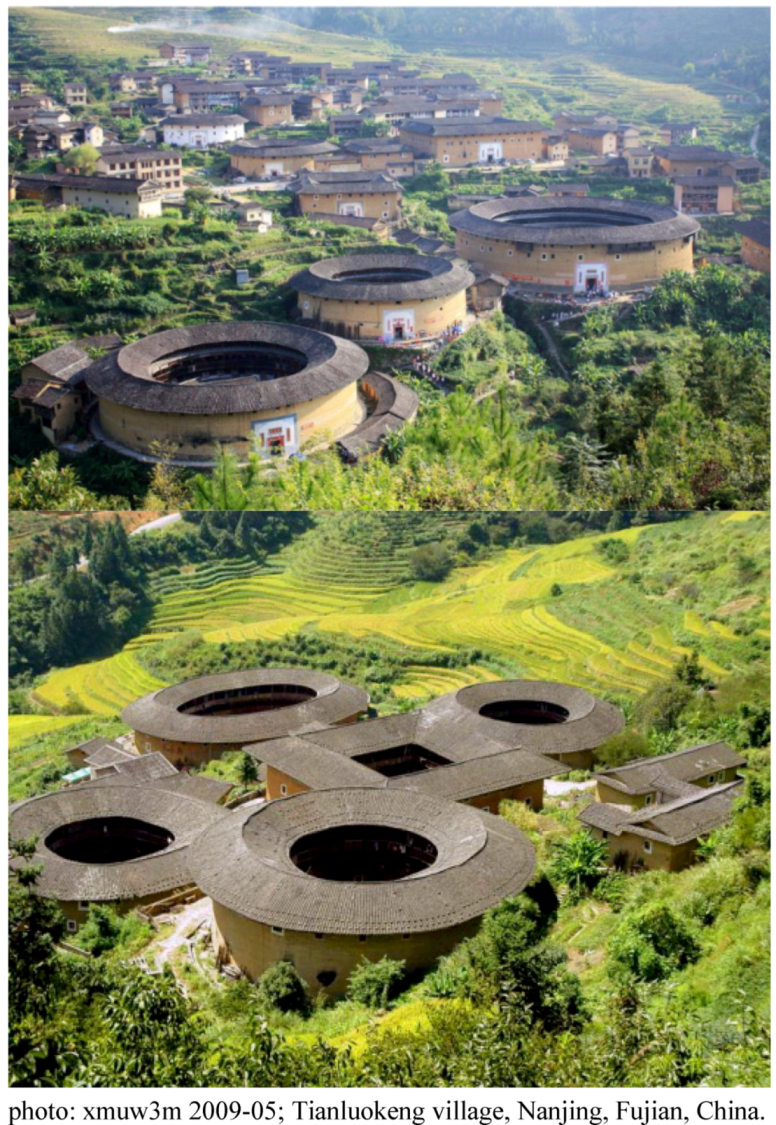
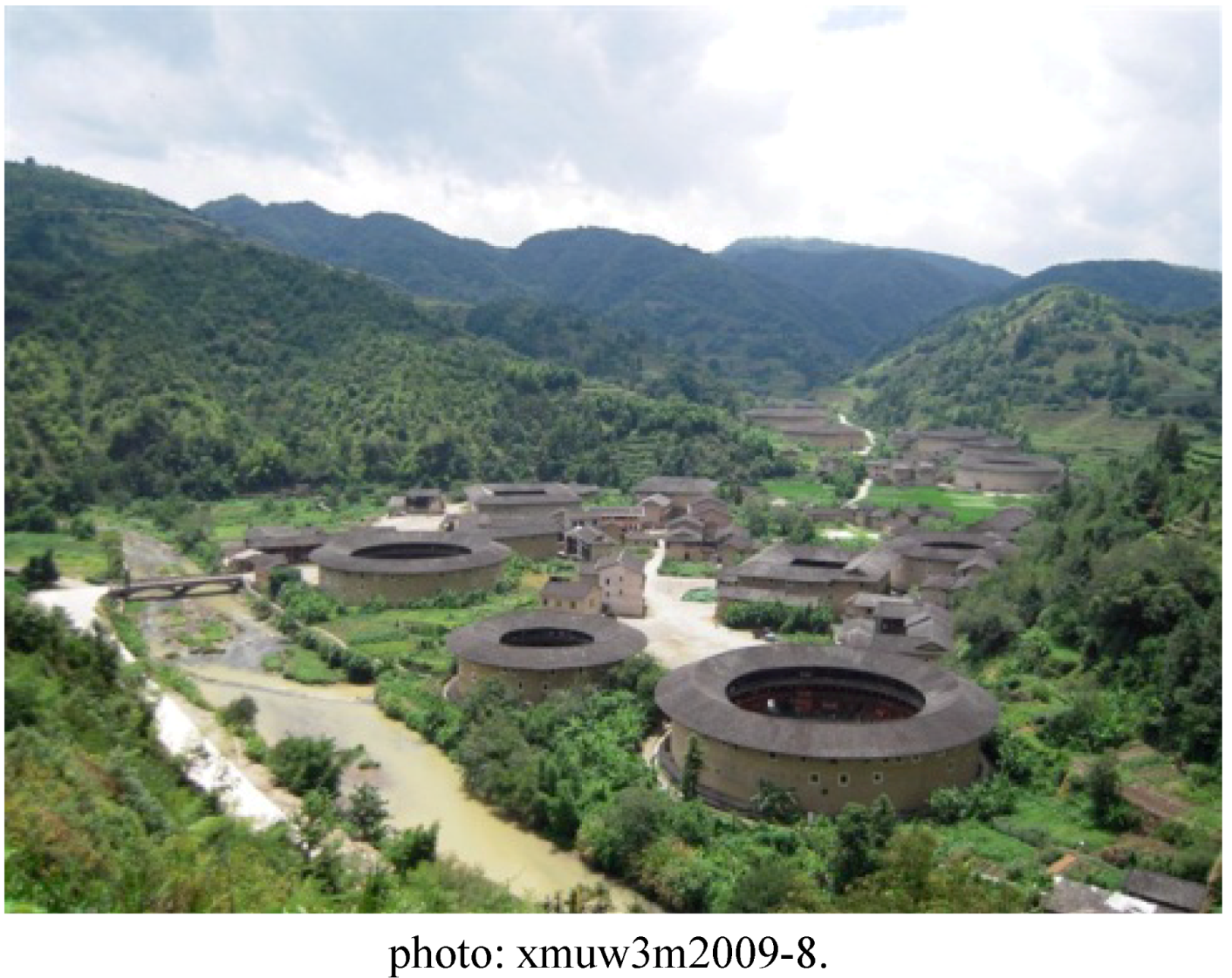
      <p>Tulou is a unique type of rural dwelling in China which carries with it its social background, history, and local culture [<xref ref-type="bibr" rid="B1-sustainability-04-03377">1</xref>,<xref ref-type="bibr" rid="B2-sustainability-04-03377">2</xref>,<xref ref-type="bibr" rid="B3-sustainability-04-03377">3</xref>,<xref ref-type="bibr" rid="B4-sustainability-04-03377">4</xref>]. The Tulou provides an important architectural gene pool, in which many valuable genes can be abstracted for contemporary architectural design [<xref ref-type="bibr" rid="B5-sustainability-04-03377">5</xref>,<xref ref-type="bibr" rid="B6-sustainability-04-03377">6</xref>]. The gene of Tulou refers to a combination of factors which affected the formation and development of Tulou, as well as its morphological characteristics. It includes both recessive genes of social culture, and dominant genes of physical characteristics. There are two groups of genes in Tulou. One group includes genes of social culture, which note the history of society and culture. Each Tulou village reflects the order of consanguinity habitation, environmental concern, respect for nature, a concept of fully using local resources, <italic>etc</italic> (<xref ref-type="fig" rid="sustainability-04-03377-f001">Figure 1</xref>). The other group is comprised of genes of physical morphology, such as varied building styles, a self-contained system, use of natural colors, cohesive space, feasible techniques, among others. All these genes deserve in-depth understanding for suitable preservation and sustainable development of Tulou. </p>
      <fig id="sustainability-04-03377-f001" position="float">
        <label>Figure 1</label>
        <caption>
          <p>The relationship between Tulou and nature is that it expresses the Chinese ancient philosophy of harmony between man and nature. </p>
        </caption>
        <graphic xmlns:xlink="http://www.w3.org/1999/xlink" xlink:href="sustainability-04-03377-g001.tif"/>
      </fig>
    </sec>
    <sec>
      <title>2. The Genes of Social Culture</title>
      <p>Since the beginning, Tulou has been recording the society, the history and the culture of the time [<xref ref-type="bibr" rid="B3-sustainability-04-03377">3</xref>]. It is a good interpretation of the relationship between the Chinese people and nature. It also embodies the typical oriental philosophy.</p>
      <sec>
        <title>2.1. Record of Society, History and Culture</title>
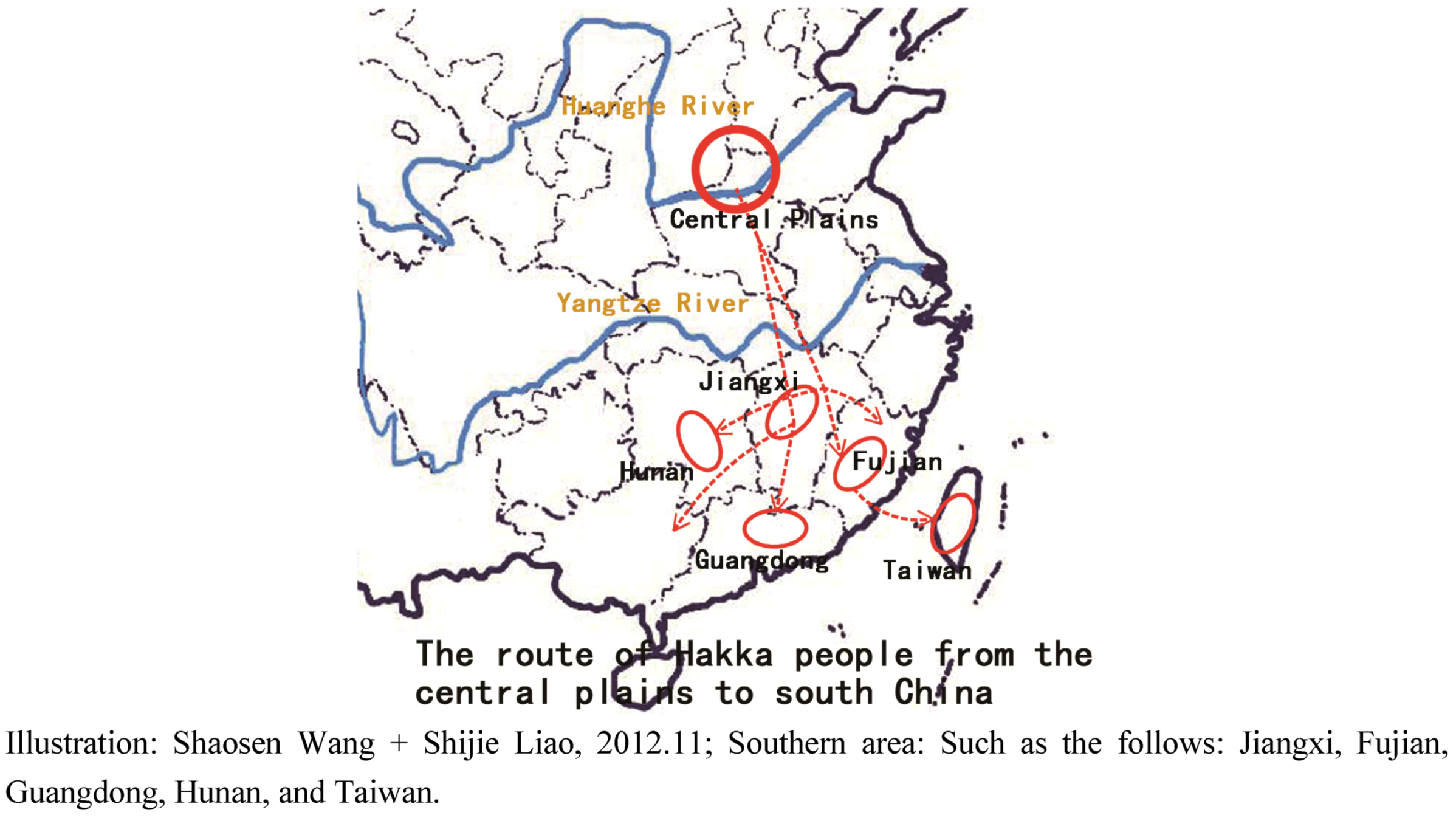
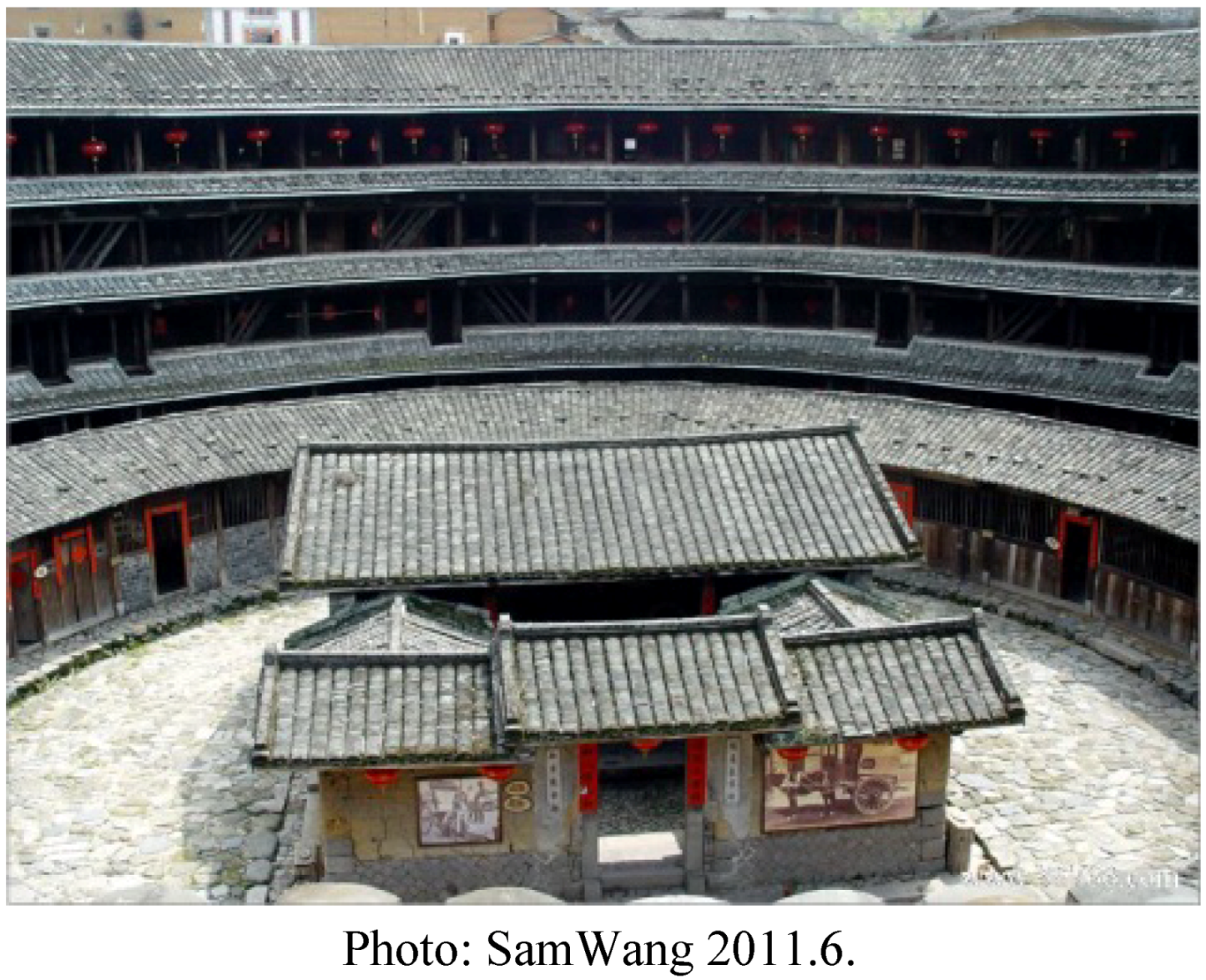
        <p>Tulou evolves with the development of society. It is evidence of the migration from the central plains to refuge in southern area of China (<xref ref-type="fig" rid="sustainability-04-03377-f002">Figure 2</xref>). As the footprint of the history, Tulou is of great significance to anthro-sociological study. From the aspect of sociology, a Tulou is usually occupied by one large family clan of several generations. The family clan unites together to face risk and defend each others, the Tulou house in which people are living together is the effective stronghold space. It exhibits its unique characteristic as a model of the community housing of equals. Moreover, one vertical set of Tulou section from ground floor to “penthouse” floor serves as a living unite. Each family does not only maintain its privacy, but also enjoys social communication with others. Nowadays, the community dependence is weakening while emphasis on private property is strengthening. Both communal living and privacy should be fully satisfied. The many inscribed tablets, the couplets on pillars and in the ancestral hall, are the location of cultural life in Tulou. In the active scenes of life in the Tulou, one finds the concept of “Fengshui”, a farming-learning culture, as well as the Confucian ideology of order. The overall harmony is the essence of traditional culture and it should be actively promoted (<xref ref-type="fig" rid="sustainability-04-03377-f003">Figure 3</xref>).</p>
        <fig id="sustainability-04-03377-f002" position="float">
          <label>Figure 2</label>
          <caption>
            <p>The route of the Hakka people from the central plains to southern area. </p>
          </caption>
          <graphic xmlns:xlink="http://www.w3.org/1999/xlink" xlink:href="sustainability-04-03377-g002.tif"/>
        </fig>
        <fig id="sustainability-04-03377-f003" position="float">
          <label>Figure 3</label>
          <caption>
            <p>The overall harmony of the Hakka culture: Center and inside relation.</p>
          </caption>
          <graphic xmlns:xlink="http://www.w3.org/1999/xlink" xlink:href="sustainability-04-03377-g003.tif"/>
        </fig>
      </sec>
      <sec>
        <title>2.2. Adaptable to Conditions, Respect of Nature</title>
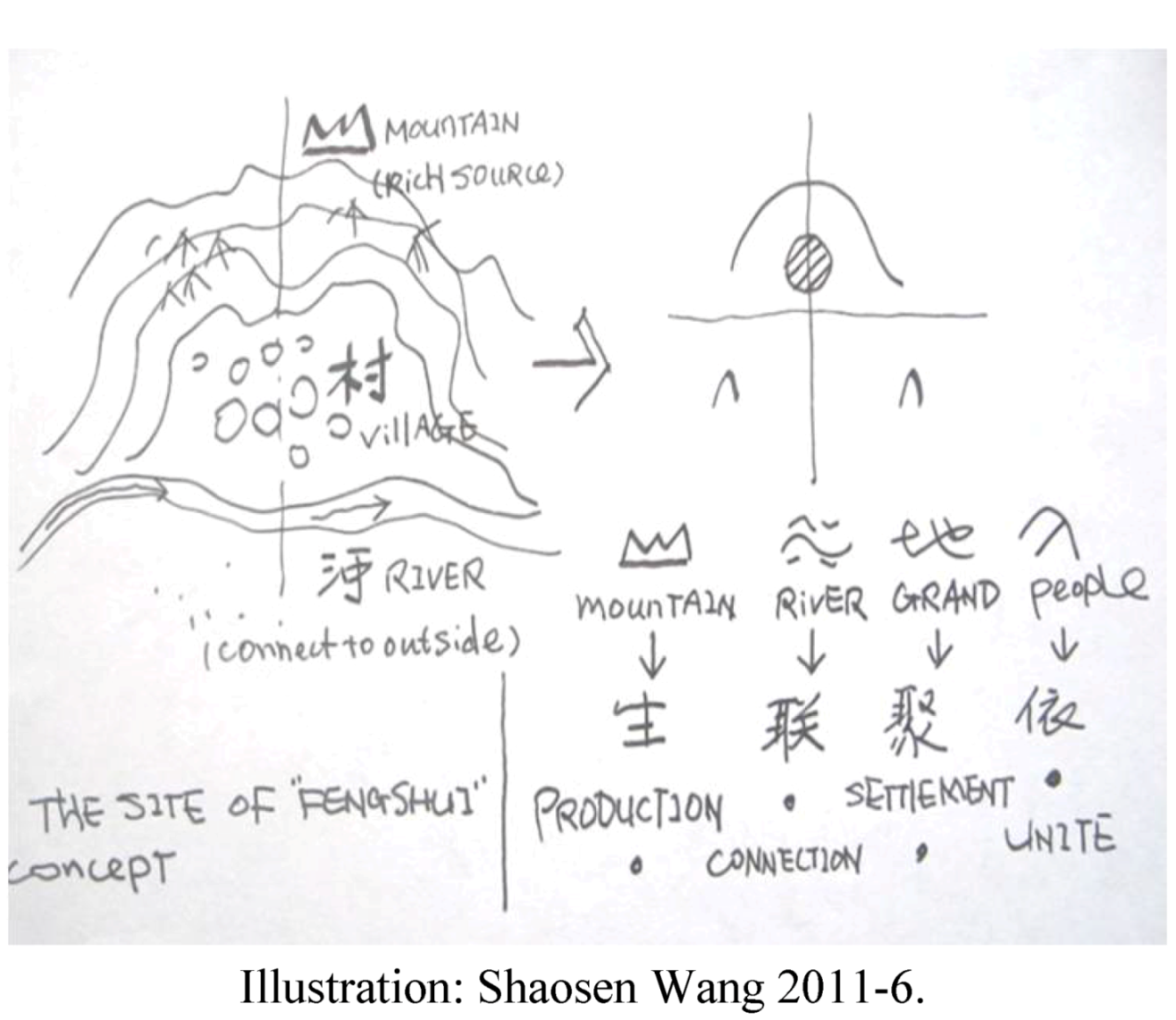
        <p>In China, the classical philosophy insists on the harmony between the building and the surrounding nature. When selecting the site of settlement, the natural environment is deeply considered and respected, such as choosing a site with water in front and a hill at the back. This is what is called “Feng-Shui” (Chinese traditional concept for the relations between human being and nature), in Chinese history, it has become a pattern language (<xref ref-type="fig" rid="sustainability-04-03377-f004">Figure 4</xref>). There is a kind of interdependent relation between the Tulou village and the natural environment. The mountains provide rich sources for living and production. The rivers give the convenience of come-and-go. Tulou forms the ecological connection with the nature over a long period of time (<xref ref-type="fig" rid="sustainability-04-03377-f005">Figure 5</xref>). On the contrary, with the expansion cities today, people are the first priority, and natural ecology is ignored to some extent. It is becoming more and more difficult for the city to deal with disaster under extreme weather conditions. We should learn from Tulou to improve the relationship between the nature and urbanity.</p>
        <fig id="sustainability-04-03377-f004" position="float">
          <label>Figure 4</label>
          <caption>
            <p>Feng-Shui pattern language of Tulou site. </p>
          </caption>
          <graphic xmlns:xlink="http://www.w3.org/1999/xlink" xlink:href="sustainability-04-03377-g004.tif"/>
        </fig>
        <fig id="sustainability-04-03377-f005" position="float">
          <label>Figure 5</label>
          <caption>
            <p>Tulou forming an ecological connection with nature.</p>
          </caption>
          <graphic xmlns:xlink="http://www.w3.org/1999/xlink" xlink:href="sustainability-04-03377-g005.tif"/>
        </fig>
      </sec>
      <sec>
        <title>2.3. Local Material, Adaptable Technology</title>
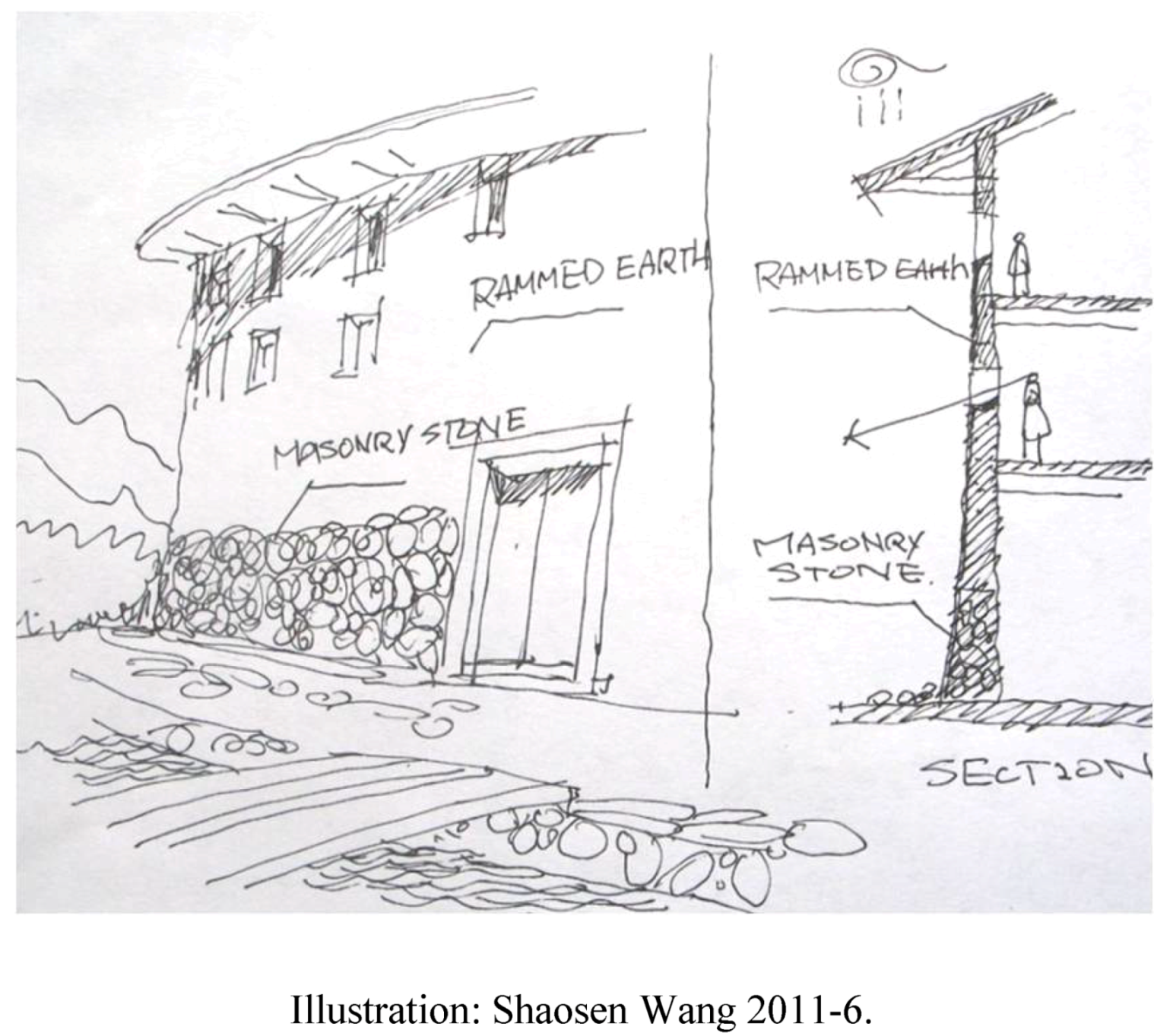
        <p>The construction of Tulou is conditioned by the level of technology, economy <italic>etc</italic>. The Hakka made the most use of local resources. They chose adaptable technology to build houses comfortable to live in (<xref ref-type="fig" rid="sustainability-04-03377-f006">Figure 6</xref>). The rammed earth wall building technology is efficient. It saves labor and is easy to get all the necessary local materials (<xref ref-type="fig" rid="sustainability-04-03377-f007">Figure 7</xref>). The adaptable technology applied in Tulou provides many significant examples of energy conservation. Tulou has many artistic, technical and ecological values for architecture.</p>
        <fig id="sustainability-04-03377-f006" position="float">
          <label>Figure 6</label>
          <caption>
            <p>The adaptable technology for the construction of Tulou.</p>
          </caption>
          <graphic xmlns:xlink="http://www.w3.org/1999/xlink" xlink:href="sustainability-04-03377-g006.tif"/>
        </fig>
        <fig id="sustainability-04-03377-f007" position="float">
          <label>Figure 7</label>
          <caption>
            <p>Rammed earth and local materials.</p>
          </caption>
          <graphic xmlns:xlink="http://www.w3.org/1999/xlink" xlink:href="sustainability-04-03377-g007.tif"/>
        </fig>
      </sec>
    </sec>
    <sec>
      <title>3. The Genes of Physical Morphology</title>
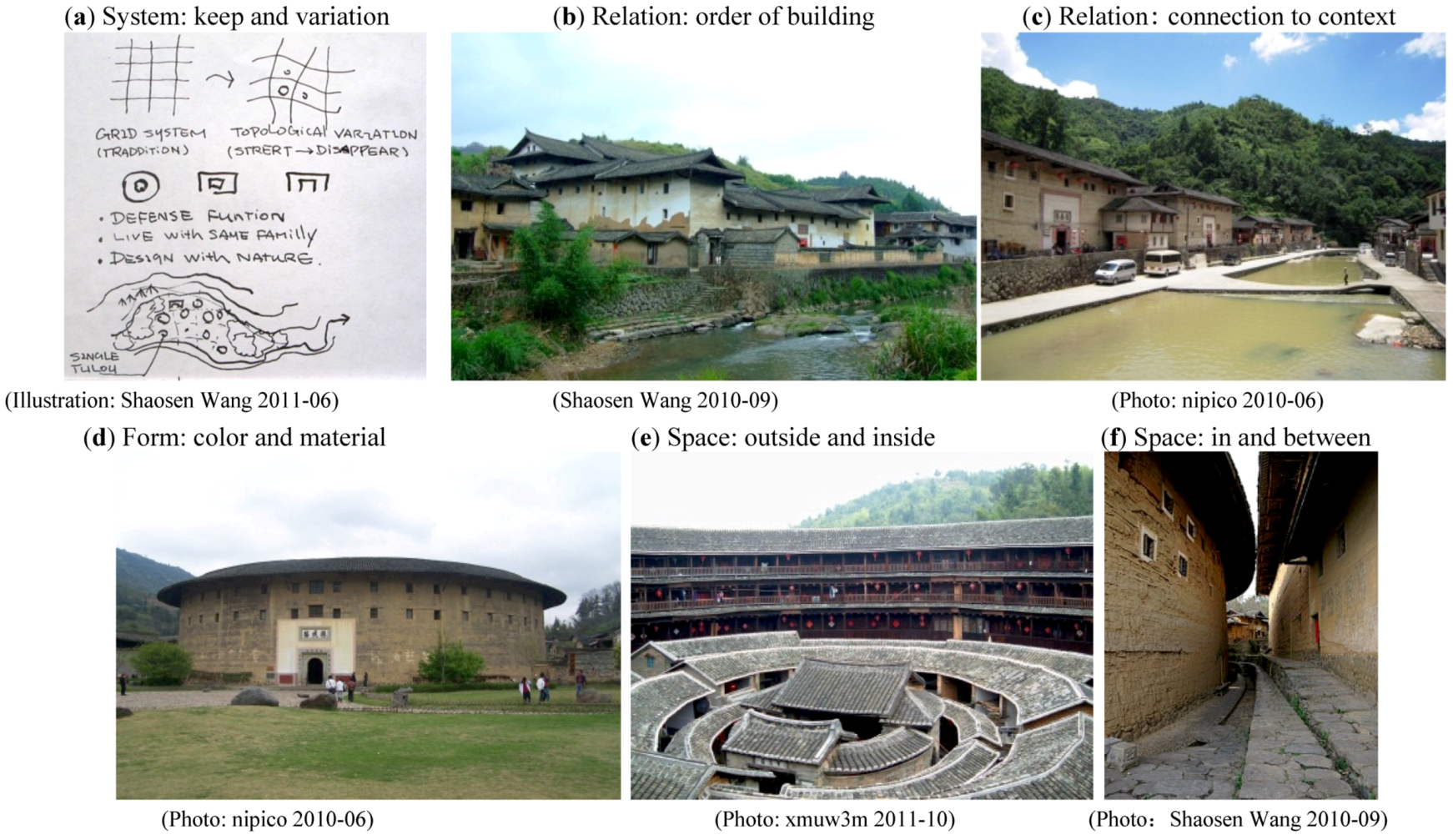
      <p>Genes of physical morphology can be absorbed and applied in an effective way for architecture preservation. These include the free styles of overall layout of Tulou villages, and the strict round or square shape planned for an individual Tulou house. Characteristic expression in form, space, construction and material, <italic>etc</italic>.—all of these have been inherited into a vital gene pool of Tulou, from which we can learn a lot for the regional architectural design of today (<xref ref-type="fig" rid="sustainability-04-03377-f008">Figure 8</xref>).</p>
      <sec>
        <title>3.1. The Genes of Tulou: The Overall System</title>
        <p>Tulou entirely follows the architectural tradition of China: Overall balance and order of building groups. The axis hold in a Tulou cluster is based on physical geography, instead of on social hierarchy. The layout of the building group adjusts the relation between nature and society in a topological method depending on who is living in the Tulou and using the Chinese special pattern language of architecture, such as Feng-Shui, Confucian philosophy, or Taoism and Buddhism (without professional architects). Collective consciousness and public participation promote the adjustment. Paying close attention to the overall environment is vital in the preservation and sustainable development of Tulou.</p>
      </sec>
      <sec>
        <title>3.2. The Genes of Individual Tulou Houses</title>
        <p>The plan prototype of Tulou includes circles, squares, rectangles, or a combination. It follows the precise composing principles, this morphology is very interesting and forms a lot of special space spirits. The fine order of Tulou is worth inheriting in order to improve today’s architectural design language. The overall appearance of color of Tulou matches the earth around it, and obtains the organic connection with the earth, yet still bears some vivid colors in the window frames, door heads, spring festival scrolls, <italic>etc</italic>.</p>
        <p>The two-storey bottom of a Tulou is solid, with no windows, for the purpose of defense. Windows are open only from the third to fifth storeys, with varying sizes. Extended eaves are used to prevent rain from dampening the rammed earth walls. The shine shadow of the windows and eaves makes rich layers and gives a stereoscopic feeling; Tulou presents a unique beauty.</p>
        <p>The concept that “the form follows the function” is well embodied in the Tulou house, which is full of vitality even today. Poetic architectural space is made by adaptable techniques, such as regional construction methods and use of local materials. The earth-wood-structured Tulou focuses on the ecological factures of material, which mirrors some sustainable design concepts.</p>
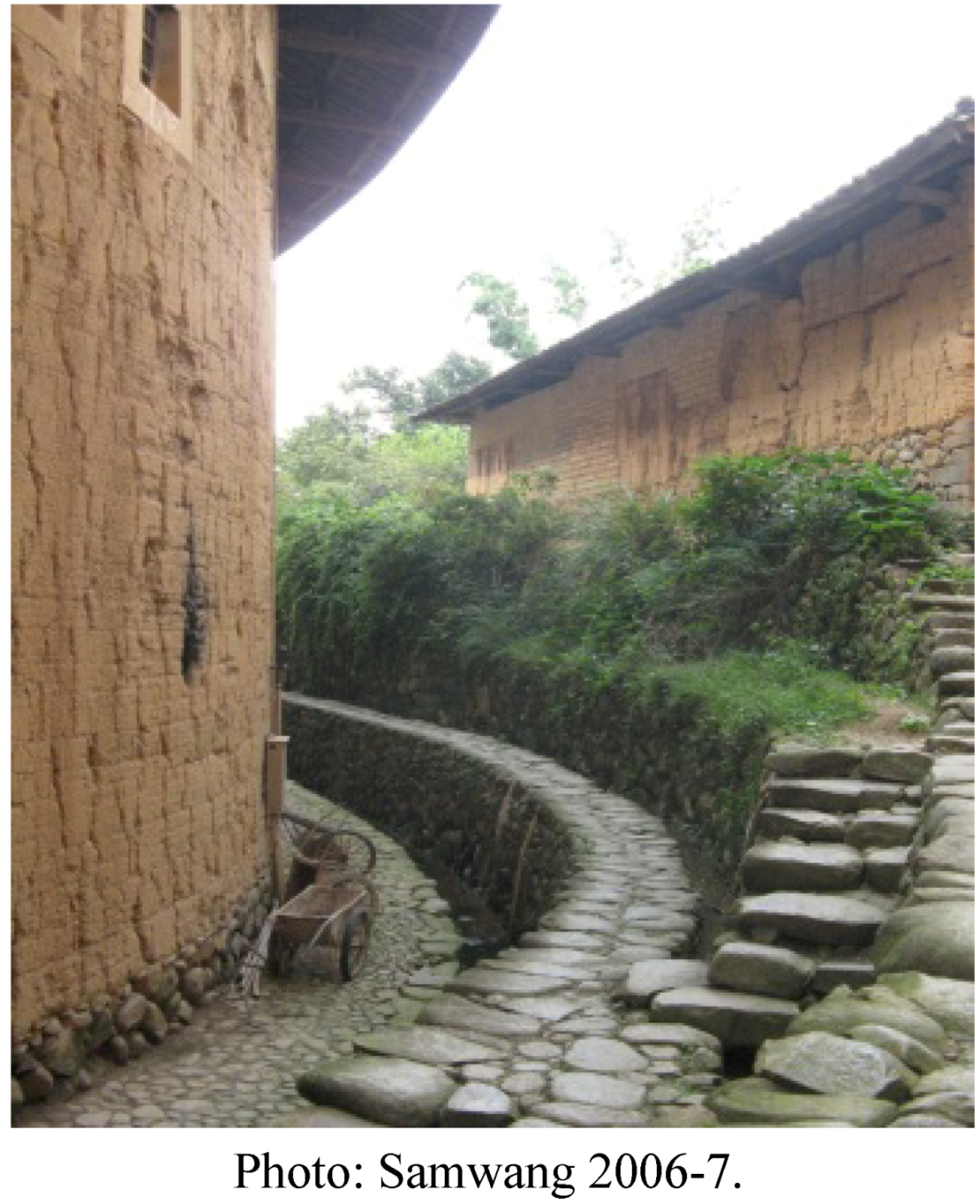
        <p>The inside and outside spatial patterns in Tulou are differentiated. The layout of Tulou followed the “closed outside, open inside” concept: An enclosure wall with living quarters around the periphery and a common courtyard at the center. The interstitial space between one Tulou house and another is very special, as people can get a feeling of being “in between” when in it, and the space of “in between (gap)” of the Tulous provides a variety of living scenes and is the spirit of the space of Tulou. Nowadays, some new elements intervene in the self-enclosed Tulou that will help to adapt it to a new situation. The mix may bring the genetical modification in its form, space, material and concept. The in-between space does have potential value for the preservation and sustainable development of Tulou.</p>
		<fig id="sustainability-04-03377-f008" position="float">
        <label>Figure 8</label>
        <caption>
          <p>Tulou Genbank for the regional architectural design of today.</p>
        </caption>
        <graphic xmlns:xlink="http://www.w3.org/1999/xlink" xlink:href="sustainability-04-03377-g008.tif"/>
      </fig>
      
      </sec>
    </sec>
    <sec>
      <title>4. Thinking about Protection and the Sustainable Development of Tulou</title>
      <sec>
        <title>4.1. Protection and the Sustainable Development of Tulou</title>
        <p>As another type of architecture, Tulou has the following properties: Time and space, technology, artistry, ethnicity and regionalism, history and age. The Tulou gene is an important part of the protection development of Tulou. The socio-cultural gene and physical gene of Tulou should be used in different types of approaches and concern in its protection and development. Tulou protection is focused on the protection of traditional culture and history of the nation, the inheritance of the harmonious spirit, and the concept of natural ecosystems. The key to all the elements above is a holistic and systemic protection, such as treating a Tulou village as a complete system and thus protecting a whole village and its surrounding environment. Tulou sustainable development lies in learning and development of Tulou genes for today’s design. We engage our Tulou regionalism design with modernism. The following features are, indeed, feasible: A natural experience, climate conscientiousness, cultural heritage, form abstraction, space creation, materials and tectonics—all these should be combined with modern life and aesthetics to create sustainability development out of the Tulou gene. Abstractly, Tulou protection and sustainable development thinking can be summarized in the following <xref ref-type="table" rid="sustainability-04-03377-t001">Table 1</xref>.</p>
        <table-wrap id="sustainability-04-03377-t001" position="float">
          <object-id pub-id-type="pii">sustainability-04-03377-t001_Table 1</object-id>
          <label>Table 1</label>
          <caption>
            <p>Tulou gene protection and development abstract.</p>
          </caption>
          <table>
<thead>
              <tr>
                <th align="center" valign="middle" style="border-bottom:solid thin">Type </th>
                <th align="center" valign="middle" style="border-bottom:solid thin">Keywords</th>
                <th align="center" valign="middle" style="border-bottom:solid thin">Approaching </th>
                <th align="center" valign="middle" style="border-bottom:solid thin">Function </th>
              </tr>
            </thead>
            <tbody>
              <tr>
                <td rowspan="2" align="center" valign="top" style="border-bottom:solid thin">1.Tulou gene protection </td>
                <td align="center" valign="top">entirety</td>
                <td align="center" valign="top">whole village protection</td>
                <td align="center" valign="top">Protecting culture and history</td>
              </tr>
              <tr>
                <td align="center" valign="top" style="border-bottom:solid thin">system</td>
                <td align="center" valign="top" style="border-bottom:solid thin">Nature–village–house–site–place</td>
                <td align="center" valign="top" style="border-bottom:solid thin">nature harmony </td>
              </tr>
              <tr>
                <td rowspan="2" align="center" valign="top" style="border-bottom:solid thin">2.Tulou gene sustainable development </td>
                <td align="center" valign="top">times</td>
                <td align="center" valign="top">Combining modern tech with traditional skill </td>
                <td align="center" valign="top">modern life adaptation—aim</td>
              </tr>
              <tr>
                <td align="center" valign="top" style="border-bottom:solid thin">culture</td>
                <td align="center" valign="top" style="border-bottom:solid thin">culture heritage, space creation,</td>
                <td align="center" valign="top" style="border-bottom:solid thin">the soul of cultural gene—duty</td>
              </tr>
              <tr>
                <td align="center" valign="top" style="border-bottom:solid thin"> </td>
                <td align="center" valign="top" style="border-bottom:solid thin">regionalism</td>
                <td align="center" valign="top" style="border-bottom:solid thin">natural experience, climate conscientiousness, using local materials</td>
                <td align="center" valign="top" style="border-bottom:solid thin">the essence of regional gene—essence</td>
              </tr>
            </tbody>
          </table>
		  <table-wrap-foot><fn><p>Shaosen Wang 2012-11.</p></fn></table-wrap-foot>
        </table-wrap>
      </sec>
      <sec>
        <title>4.2. Tulou Regionalism Design Project—Case Analysis</title>
        <p>This project is a hotel with Tulou style, located in the Tulou region near a river in Ruijin Hakka region. The basic information of the project is listed in <xref ref-type="table" rid="sustainability-04-03377-t002">Table 2</xref>. </p>
        <table-wrap id="sustainability-04-03377-t002" position="float">
          <object-id pub-id-type="pii">sustainability-04-03377-t002_Table 2</object-id>
          <label>Table 2</label>
          <caption>
            <p>The basic information of Tolou hotel</p>
          </caption>
          <table>
<thead>
              <tr>
                <th align="center" valign="middle">Category</th>
                <th align="center" valign="middle">Content</th>
              </tr>
            </thead>
            <tbody>
              <tr>
                <td align="center" valign="middle">Site area</td>
                <td align="center" valign="middle">2.77 ha</td>
              </tr>
              <tr>
                <td align="center" valign="middle">Total area</td>
                <td align="center" valign="middle">41000 m<sup>2</sup></td>
              </tr>
              <tr>
                <td align="center" valign="middle">Building</td>
                <td align="center" valign="middle">hotel and resort</td>
              </tr>
              <tr>
                <td align="center" valign="middle">Location</td>
                <td align="center" valign="middle">Jiangxi Ruijin (Hakka region) China</td>
              </tr>
              <tr>
                <td align="center" valign="middle">Designer</td>
                <td align="center" valign="middle">Shaosen Wang, Guangming Gao</td>
              </tr>
              <tr>
                <td align="center" valign="middle">Design time</td>
                <td align="center" valign="middle">2011-7</td>
              </tr>
            </tbody>
          </table>
		  <table-wrap-foot><fn><p>Shaosen Wang 2012-11.</p></fn></table-wrap-foot>
        </table-wrap>
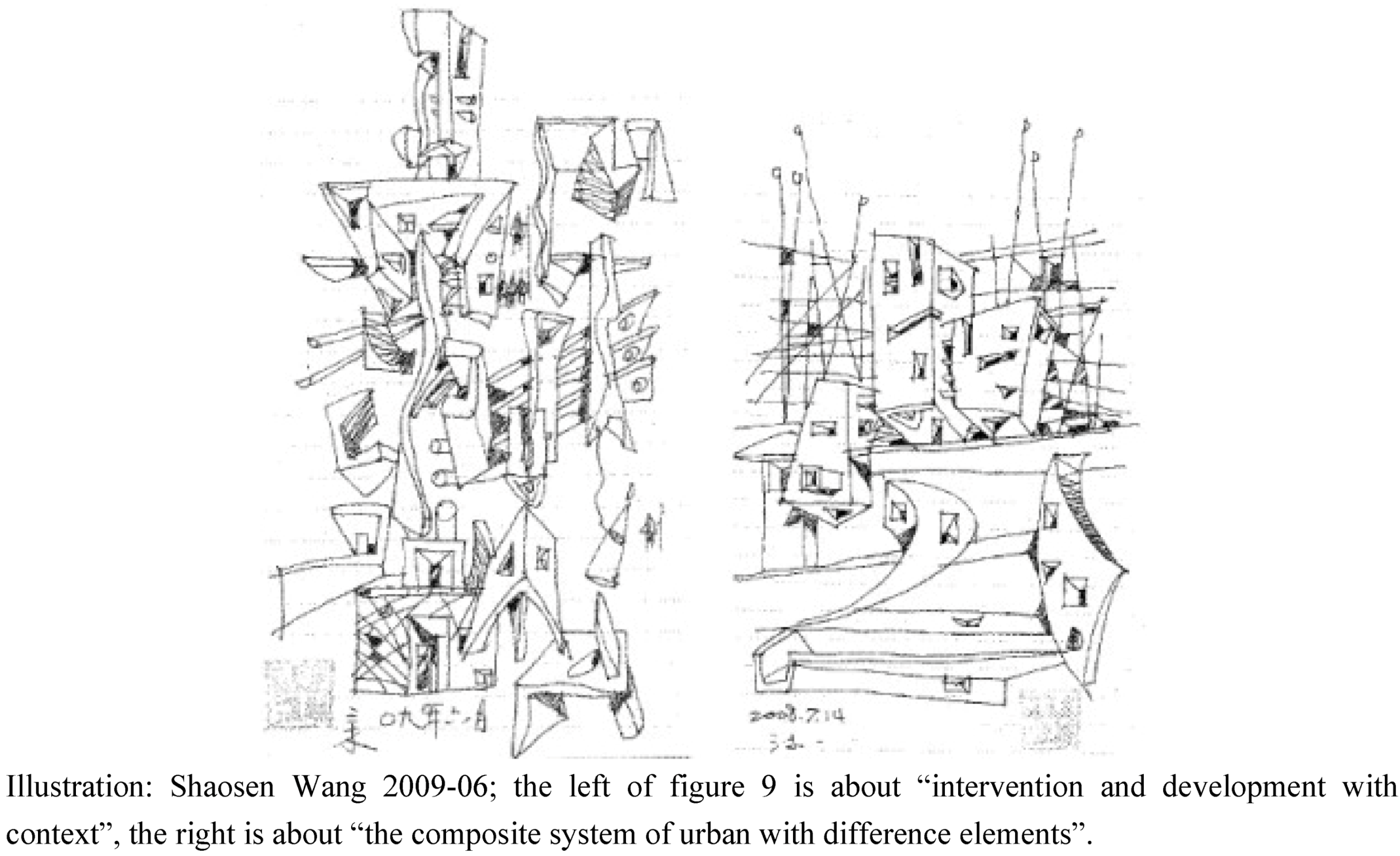
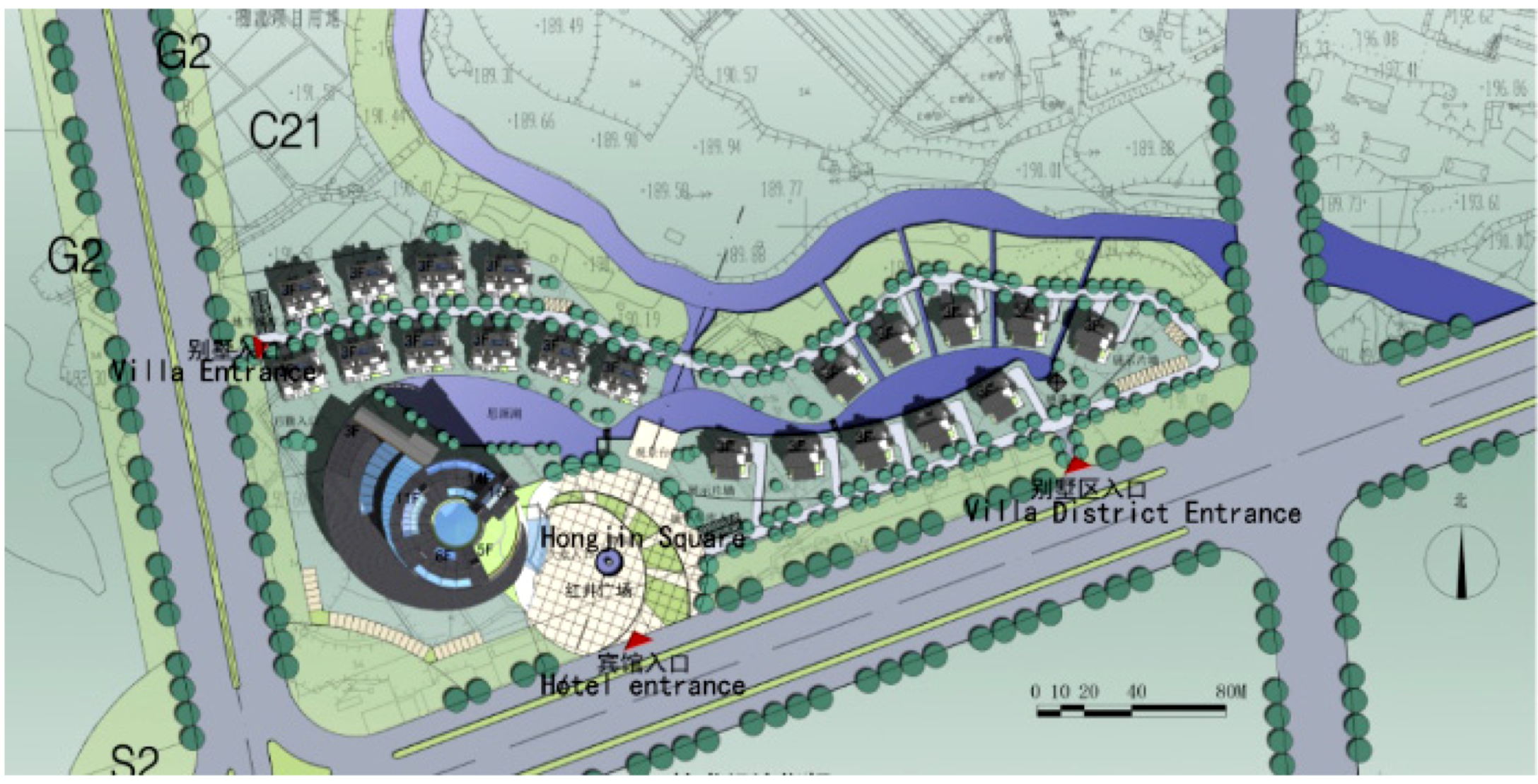
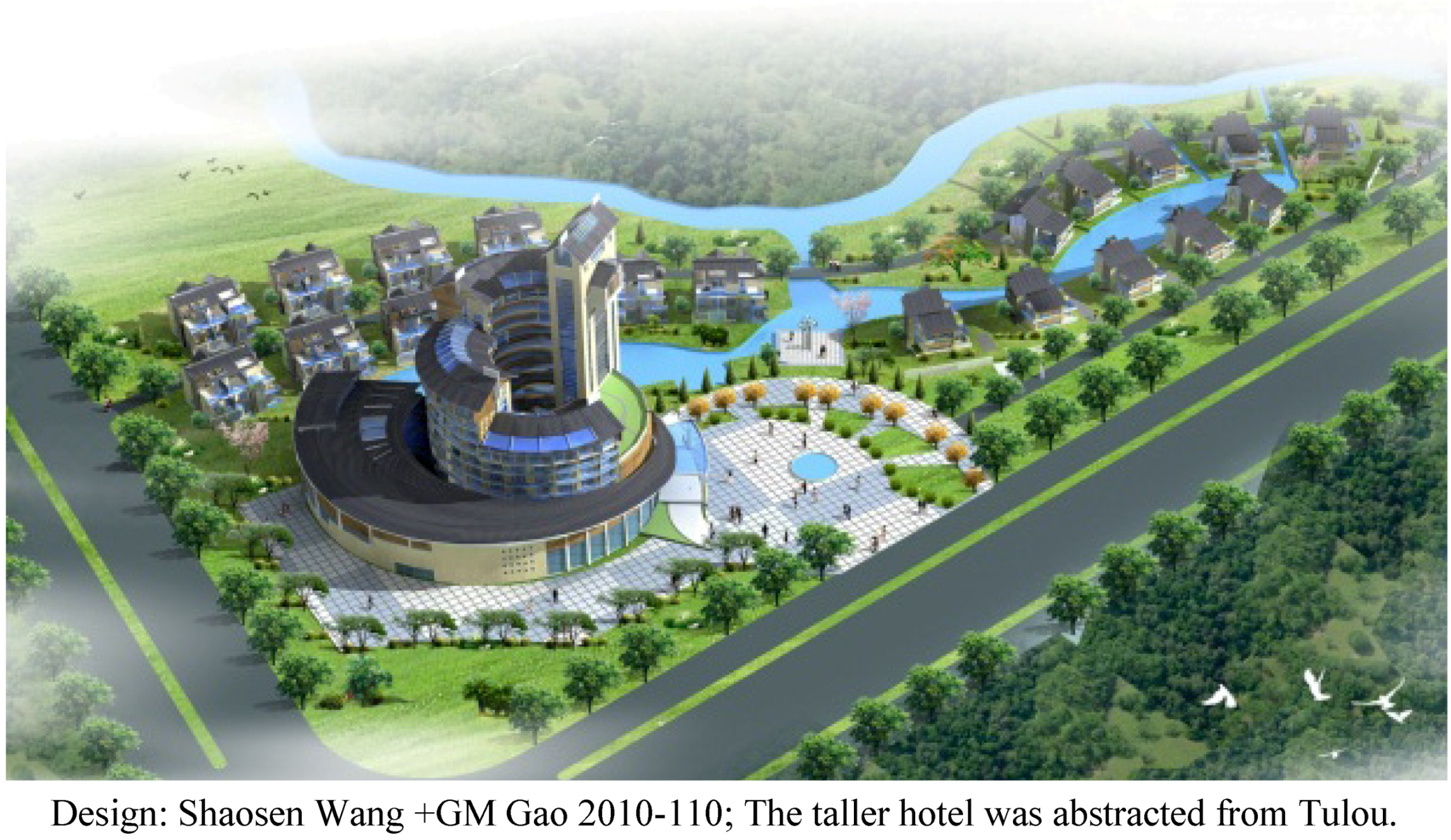
        <p>The designer excavated the river into the site, designed a water garden between the hotels and resorts, and made the master plan close to nature with some other differently sized gardens. The design obtained an organic connection with nature that is the Tulou gene essence; the hotel was designed with circular morphology to match the crossroads corner, as well as with a connection to the Tulou prototype. The architectural form, color, and space were abstracted from Tulou with professor Shaosen Wang’s pan-architecture diagram method, which uses a diagram to study urban architecture and landscape abstractly (<xref ref-type="fig" rid="sustainability-04-03377-f009">Figure 9</xref>). This design attempted to analyze Tulou gene application and embody the combination between Tulou regionalism and modernity (<xref ref-type="fig" rid="sustainability-04-03377-f010">Figure 10</xref> and <xref ref-type="fig" rid="sustainability-04-03377-f011">Figure 11</xref>).</p>
        <fig id="sustainability-04-03377-f009" position="float">
          <label>Figure 9</label>
          <caption>
            <p>Abstract methods from the genes of Tulou. </p>
          </caption>
          <graphic xmlns:xlink="http://www.w3.org/1999/xlink" xlink:href="sustainability-04-03377-g009.tif"/>
        </fig>
        <fig id="sustainability-04-03377-f010" position="float">
          <label>Figure 10</label>
          <caption>
            <p>Design with Tulou regionalism (the site plan was designed with a natural hill and river). </p>
          </caption>
          <graphic xmlns:xlink="http://www.w3.org/1999/xlink" xlink:href="sustainability-04-03377-g010.tif"/>
        </fig>
        <fig id="sustainability-04-03377-f011" position="float">
          <label>Figure 11</label>
          <caption>
            <p>A hotel design with Tulou regionalism. </p>
          </caption>
          <graphic xmlns:xlink="http://www.w3.org/1999/xlink" xlink:href="sustainability-04-03377-g011.tif"/>
        </fig>
      </sec>
    </sec>
    <sec sec-type="conclusions">
      <title>5. Conclusions</title>
      <p>The study on the genes of Tulou is an essential part of preservation and renovation of Tulou. The two gene groups have different applying methods, and different functions in the preservation and development of Tulou. Genes of social culture value the preservation of the harmonious spirit of Tulou. Genes of physical morphology value both the overall system and the genetic modification by new intervention in Tulou building. Through this genetic modification, Tulou will maintain its sustainable development in the new era. </p>
    </sec>
    
  </body>
  <back><notes>
      <title>Conflict of Interest</title>
      <p>The author declares no conflict of interest.</p>
    </notes>
    <ref-list>
      <title>References</title>
      <ref id="B1-sustainability-04-03377">
        <label>1.</label>
        <citation citation-type="book">
          <person-group person-group-type="author">
            <name>
              <surname>Shi</surname>
              <given-names>Y.</given-names>
            </name>
          </person-group>
          <source>Tu Wei Lou</source>
          <publisher-name>China Travel and Tourism Press</publisher-name>
          <publisher-loc>Beijing, China</publisher-loc>
          <year>2005</year>
          <fpage>6</fpage>
          <lpage>8</lpage>
        </citation>
      </ref>
      <ref id="B2-sustainability-04-03377">
        <label>2.</label>
        <citation citation-type="book">
          <person-group person-group-type="author">
            <name>
              <surname>Shi</surname>
              <given-names>Y.</given-names>
            </name>
          </person-group>
          <source>Applied Anthropology</source>
          <publisher-name>Xiamen University Press</publisher-name>
          <publisher-loc>Xiamen, China</publisher-loc>
          <year>1996</year>
          <fpage>18</fpage>
          <lpage>24</lpage>
        </citation>
      </ref>
      <ref id="B3-sustainability-04-03377">
        <label>3.</label>
        <citation citation-type="journal">
          <person-group person-group-type="author">
            <name>
              <surname>Lowe</surname>
              <given-names>K.D.</given-names>
            </name>
          </person-group>
          <article-title>Heaven and Earth—Sustaining Elements in Hakka Tulou</article-title>
          <source>Sustainability</source>
          <year>2012</year>
          <volume>4</volume>
          <fpage>2795</fpage>
          <lpage>2802</lpage>
          <pub-id pub-id-type="doi">10.3390/su4112795</pub-id>
        </citation>
      </ref>
      <ref id="B4-sustainability-04-03377">
        <label>4.</label>
        <citation citation-type="journal">
          <person-group person-group-type="author">
            <name>
              <surname>Ueda</surname>
              <given-names>M.</given-names>
            </name>
          </person-group>
          <article-title>A preliminary environmental assessment for the preservation and restoration of Fujian Hakka Tulou Complexes</article-title>
          <source>Sustainability</source>
          <year>2012</year>
          <volume>4</volume>
          <fpage>2803</fpage>
          <lpage>2817</lpage>
          <pub-id pub-id-type="doi">10.3390/su4112803</pub-id>
        </citation>
      </ref>
      <ref id="B5-sustainability-04-03377">
        <label>5.</label>
        <citation citation-type="book">
          <person-group person-group-type="author">
            <name>
              <surname>Wang</surname>
              <given-names>S.</given-names>
            </name>
          </person-group>
          <source>Introduction to Architecture</source>
          <publisher-name>Science Press</publisher-name>
          <publisher-loc>Beijing, China</publisher-loc>
          <year>2000</year>
          <fpage>12</fpage>
          <lpage>15</lpage>
        </citation>
      </ref>
      <ref id="B6-sustainability-04-03377">
        <label>6.</label>
        <citation citation-type="book">
          <person-group person-group-type="author">
            <name>
              <surname>Wang</surname>
              <given-names>Z.</given-names>
            </name>
          </person-group>
          <source>Introduction to Architecture Design</source>
          <publisher-name>Southeast University Press</publisher-name>
          <publisher-loc>Nanjing, China</publisher-loc>
          <year>2010</year>
          <fpage>20</fpage>
          <lpage>22</lpage>
        </citation>
      </ref>
    </ref-list>
  </back>
</article>