
<?xml version="1.0" encoding="UTF-8"?>
<!DOCTYPE article PUBLIC "-//NLM//DTD Journal Publishing DTD v2.3 20070202//EN" "journalpublishing.dtd">
<article xmlns:mml="http://www.w3.org/1998/Math/MathML" xmlns:xlink="http://www.w3.org/1999/xlink" xml:lang="en" article-type="research-article">
  <front>
    <journal-meta>
      <journal-id journal-id-type="publisher-id">sustainability</journal-id>
      <journal-title>Sustainability</journal-title>
      <abbrev-journal-title abbrev-type="publisher">Sustainability</abbrev-journal-title>
      <abbrev-journal-title abbrev-type="pubmed">Sustainability</abbrev-journal-title>
      <issn pub-type="epub">2071-1050</issn>
      <publisher>
        <publisher-name>MDPI</publisher-name>
      </publisher>
    </journal-meta>
    <article-meta>
      <article-id pub-id-type="doi">10.3390/su4102611</article-id>
      <article-id pub-id-type="publisher-id">sustainability-04-02611</article-id>
      <article-categories>
        <subj-group>
          <subject>Article</subject>
        </subj-group>
      </article-categories>
      <title-group>
        <article-title>An Exergy-Based Model for Population Dynamics: Adaptation, Mutualism, Commensalism and Selective Extinction </article-title>
      </title-group>
      
      <contrib-group>
        <contrib contrib-type="author">
          <name>
            <surname>Sciubba</surname>
            <given-names>Enrico</given-names>
          </name>
          <xref rid="af1-sustainability-04-02611" ref-type="aff">1</xref>
          <xref rid="c1-sustainability-04-02611" ref-type="corresp">*</xref>
        </contrib>
        <contrib contrib-type="author">
          <name>
            <surname>Zullo</surname>
            <given-names>Federico</given-names>
          </name>
          <xref rid="af2-sustainability-04-02611" ref-type="aff">2</xref>
        </contrib>
      </contrib-group>
      <aff id="af1-sustainability-04-02611"><label>1 </label>Department of Mechanical &amp; Aerospace Engineering, University of Roma La Sapienza, Via Eudossiana 18, 00184 Roma, Italy</aff>
      <aff id="af2-sustainability-04-02611"><label>2 </label>School of Mathematics, Statistics &amp; Actuarial Science, University of Kent, Canterbury, CT2 7NF, UK; Email: <email>f.zullo@kent.ac.uk</email> </aff>
	  <author-notes>
        <corresp id="c1-sustainability-04-02611"><label>*</label> Author to whom correspondence should be addressed; Email: <email>enrico.sciubba@uniroma1.it</email>; Tel.: +39-06-44585244; Fax +39-06-44585249.</corresp>
      </author-notes>
      <pub-date pub-type="epub">
        <day>15</day>
        <month>10</month>
        <year>2012</year>
      </pub-date>
      <pub-date pub-type="collection"> <month>10</month>
        <year>2012</year>
      </pub-date>
      <volume>4</volume>
      <issue>10</issue>
      <fpage>2611</fpage>
      <lpage>2629</lpage>
      <history>
        <date date-type="received">
          <day>03</day>
          <month>08</month>
          <year>2012</year>
        </date>
        <date date-type="rev-recd">
          <day>23</day>
          <month>09</month>
          <year>2012</year>
        </date>
        <date date-type="accepted">
          <day>02</day>
          <month>10</month>
          <year>2012</year>
        </date>
      </history>
      <permissions>
        <copyright-statement>© 2012 by the authors; licensee MDPI, Basel, Switzerland.</copyright-statement>
        <copyright-year>2012</copyright-year>
        <license xmlns:xlink="http://www.w3.org/1999/xlink" license-type="open-access" xlink:href="http://creativecommons.org/licenses/by/3.0/">
          <p>This article is an open-access article distributed under the terms and conditions of the Creative Commons Attribution license (http://creativecommons.org/licenses/by/3.0/).</p>
        </license>
      </permissions>
      <abstract>
        <p>Following the critical analysis of the concept of “sustainability”, developed on the basis of exergy considerations in previous works, an analysis of possible species “behavior” is presented and discussed in this paper. Once more, we make use of one single axiom: <italic>that resource consumption (material and immaterial) can be quantified solely in terms of exergy flows</italic>. This assumption leads to a model of population dynamics that is applied here to describe the general behavior of interacting populations. The resulting equations are similar to the Lotka-Volterra ones, but more strongly coupled and intrinsically non-linear: as such, their solution space is topologically richer than those of classical prey-predator models. In this paper, we address an interesting specific problem in population dynamics: if a species assumes a commensalistic behavior, does it gain an evolutionary advantage? And, what is the difference, in terms of the access to the available exergy resources, between mutualism and commensalism? The model equations can be easily rearranged to accommodate both types of behavior, and thus only a brief discussion is devoted to this facet of the problem. The solution space is explored in the simplest case of two interacting populations: the model results in population curves in phase space that can satisfactorily explain the evolutionistic advantages and drawbacks of either behavior and, more importantly, identify the presence or absence of a “sustainable” solution in which both species survive.</p>
      </abstract>
      <kwd-group>
        <kwd>exergy</kwd>
        <kwd>population dynamics</kwd>
        <kwd>species interaction</kwd>
        <kwd>sustainability</kwd>
      </kwd-group>
    </article-meta>
  </front>
  <body>
    <sec>
      <title>List of Symbols</title>
      <def-list>
	  
	  <def-item>
      <term><italic>a<sub>ji</sub></italic></term> 
	  <def><p>Discharge from “<italic>j</italic>” used by “<italic>i</italic>”</p></def></def-item>
      
	  <def-item>
      <term><italic>c<sub>i</sub></italic></term> 
	  <def><p>Minimum consumption for survival of “<italic>i</italic>”, W</p></def></def-item>
      
	  <def-item>
      <term><italic>Ė</italic></term> 
	  <def><p>Exergy flow rate, W</p></def></def-item>
      
	  <def-item>
      <term><italic>Ė<sub>w<sub>i</sub></sub></italic></term> 
	  <def><p>Exergy flow rate discharged by “<italic>i</italic>”, W</p></def></def-item>
      
	  <def-item>
      <term><italic>Ė<sub>δ<sub>i</sub></sub></italic></term> 
	  <def><p>Exergy flow rate destroyed by “<italic>i</italic>”, W</p></def></def-item>
      
	  <def-item>
      <term><italic>N</italic></term> 
	  <def><p>Population numerosity</p></def></def-item>
      
	  <def-item>
      <term><italic>p<sub>i</sub></italic></term> 
	  <def><p>Global discharge coefficient of “<italic>i</italic>”</p></def></def-item>
      
	  <def-item>
      <term><italic>r<sub>i</sub></italic></term> 
	  <def><p>Limit growth rate (births-deaths) of “<italic>i</italic>”, 1/y</p></def></def-item>
      
	  <def-item>
      <term><italic>w<sub>i</sub></italic></term> 
	  <def><p>Exergy discharge coefficient of “<italic>i</italic>”</p></def></def-item>
      
	  </def-list>
	  
	  <sec>
	  <title>Greek symbols</title>
      <def-list>
	  <def-item>
      <term><italic>β<sub>i</sub></italic></term> 
	  <def><p>Dimensionless exergy capture coefficient of “<italic>i</italic>”</p></def></def-item>
      
	  <def-item>
      <term><italic>γ<sub>i</sub></italic></term> 
	  <def><p>Inflow capture coefficient, W/person of “<italic>i</italic>”</p></def></def-item>
      
	  <def-item>
      <term><italic>δ<sub>i</sub></italic></term> 
	  <def><p>Exergy destruction coefficient of “<italic>i</italic>”</p></def></def-item>
      
	  <def-item>
      <term><inline-graphic xmlns:xlink="http://www.w3.org/1999/xlink" xlink:href="sustainability-04-02611-i064.tif"/><italic><sub>i</sub></italic></term> 
	  <def><p>Coupling terms in Equation (7), W/person</p></def></def-item>
      
	  <def-item>
      <term><italic>θ</italic></term> 
	  <def><p>Parameter in Equation (15)</p></def></def-item>
      
	  <def-item>
      <term><italic>λ<sub>i</sub></italic></term> 
	  <def><p>Lyapunov exponents, 1/y</p></def></def-item>
      
	  <def-item>
      <term><italic>μ<sub>i</sub></italic></term> 
	  <def><p>Intrinsic mortality rate of “<italic>i</italic>”, 1/y</p></def></def-item>
      </def-list>
	  </sec>
    </sec>
    <sec sec-type="intro">
      <title>1. Introduction</title>
      <p>The concept of sustainability is based on the qualitative or quantitative assessment of environmental interactions between a system and its environment at large, and implies the identification of a certain number of natural—and possibly finite—resources so that the dynamic interplay among species in a given ecological niche can be modeled to study the time evolution of the system. A first problem is thus that of “measuring” the resources, <italic>i.e.</italic>, of finding a quantifier that is at the same time useful, convenient and general enough to represent material and immaterial fluxes. A second problem is posed by the empirical observation that most existing species display a multitude of “modes” of natural interrelation, like <italic>indifference, competition</italic>, <italic>cooperation</italic>, <italic>antagonism</italic>, <italic>adaptation, etc.</italic> A third problem is the “flexible attitude” exhibited by most species towards the <italic>substitutability</italic> of certain resources [<xref ref-type="bibr" rid="B1-sustainability-04-02611">1</xref>,<xref ref-type="bibr" rid="B2-sustainability-04-02611">2</xref>,<xref ref-type="bibr" rid="B3-sustainability-04-02611">3</xref>].</p>
      <p>Since the very first attempts to construct behavioral and evolutionary models of living organisms, two substantially different approaches have been taken: </p>
      <list list-type="simple">
        <list-item>
          <p>a) An <italic>ad hoc</italic> approach that focuses on the particular dynamics of a single species or of a particular, generally small, ecological niche: models of such kind strongly depend on a set of very stringent initial assumptions, but thanks to their “specificity” have enjoyed a remarkable degree of success in reproducing experimental field data and—to a lesser extent—to predict future trends;</p>
        </list-item>
        <list-item>
          <p>b) The opposite approach is also possible: one tries to understand the population dynamics in a global sense, emphasizing and exploiting similarities in the behavior of different species in different environmental conditions and within different trophic chains. An original model of this second type has been proposed in previous papers by the present authors [<xref ref-type="bibr" rid="B4-sustainability-04-02611">4</xref>,<xref ref-type="bibr" rid="B5-sustainability-04-02611">5</xref>], and is based on the generally accepted principle that population dynamics depend substantially on the availability of primary resource and on the axiom that the consumption of such resources can be measured by an environmental indicator called <italic>extended exergy</italic>, EE in the following [<xref ref-type="bibr" rid="B6-sustainability-04-02611">6</xref>]. Extended Exergy is a physical quantity (measured in J, its fluxes in W) that explicitly measures the different forms in which natural resources are “available”, has the logical attributes of a “cost”, and thus is amenable to a resource accounting procedure -the method in fact goes under the name of Extended Exergy Accounting, EEA. Extended exergy is additive, explicitly includes irreversible losses, and its formulation covers the so-called “externalities”: using a somewhat anthropological expression, it can be rightly said that the EE of a commodity is a measure of the biosphere “effort” to convert low-entropy into high-entropy resources while generating that commodity. (Note: The conceptual novelty of Extended Exergy is its inclusion of the equivalent Capital, Labor and Environmental Remediation costs into the exergy “embodied” in a product of whatever material- or energy conversion chain. In the context of this paper, Capital and Labor are of course absent, and the difference between the use of exergy and extended exergy consists in the inclusion in the latter of the <underline>amount of natural exergy resources required of the environment to “biodegrade” the environmental damage produced by a species</underline>. To provide a simple example, the restoration of the trees destroyed by the Southern Pine Beetle [<xref ref-type="bibr" rid="B3-sustainability-04-02611">3</xref>] requires a certain amount of cumulative exergy, in the form of solar irradiation and nutrients, that represents the “cost” for the biosphere to recover its previous state. Similarly, the oxidation of pollutants in a water basin requires solar irradiation, microbic action, <italic>etc</italic>., all of which can be expressed in terms of “exergy inflow”).</p>
        </list-item>
      </list>
      <p>Nature’s intertwined trophic chains are far too complex a system to be amenable to a tractable comprehensive mathematical approach: for example, it is impossible to classify within general schemes voluntary or instinctive behaviors that, especially in superior species, can be treated only by recurring to species-specific, and therefore non-general, assumptions. Reasoning in an ethologic sense, though, it is legitimate to posit [<xref ref-type="bibr" rid="B7-sustainability-04-02611">7</xref>] the dependence of the dynamics of a certain species on the available resources (measured by extended exergy), formulate a proper mathematical model on its basis, and apply the model to predict the dynamics of a single species (local level) or of an entire ecological niche (global level): since a large amount of experimental data are available on the dynamics of certain populations, the results can subsequently be validated and verified. It was shown in two previous papers [<xref ref-type="bibr" rid="B4-sustainability-04-02611">4</xref>,<xref ref-type="bibr" rid="B5-sustainability-04-02611">5</xref>] that such an analysis of the sustainability concept leads to credible results. In the model adopted in those papers, “competition” was <italic>among</italic> the species and <italic>for</italic> the available resources. The underlying assumptions are quite simple:</p>
      <list list-type="simple">
        <list-item>
          <p>1) The number <italic>N</italic> of individuals in a species at a given time depends on the global exergy resources a population can avail itself of.</p>
        </list-item>
        <list-item>
          <p>2) These resources may be quantified in terms of Extended Exergy (<italic>i.e</italic>., by their primary resource equivalent), and expressed as a flux of exergy that each species may tap.</p>
        </list-item>
      </list>
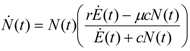
      <p>The resulting equation for a single population (for the complete derivation, see [<xref ref-type="bibr" rid="B4-sustainability-04-02611">4</xref>,<xref ref-type="bibr" rid="B5-sustainability-04-02611">5</xref>]) couples the population size (its numerosity <italic>N</italic>) with the exergy rate <italic>Ė</italic>(<italic>t</italic>) of the global exergy resources exploited by <italic>the</italic> population in its ecological niche:</p>
      <disp-formula id="sustainability-04-02611-i001">	<inline-graphic xmlns:xlink="http://www.w3.org/1999/xlink" xlink:href="sustainability-04-02611-i001.tif"/>		 
	  <label>(1)</label>
	  </disp-formula>
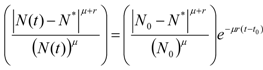
      <p>where the dot denotes the time derivative, the constant <italic>r</italic> is the limit growth rate of the population (in the case of infinitely abundant flow of resources) and <italic>μ</italic> is the intrinsic mortality rate of the species (calculated in the case in which the availability of resources drops to zero). It is useful to briefly discuss the behavior of the solutions of this equation in a very simple but realistic situation. Suppose that the incoming exergy rate is constant in time: this means the population <italic>N</italic>(<italic>t</italic>) can avail itself of the same exergy inflow at every instant of time. What one expects is then a “logistic” behavior, in the sense that, after an initial transient, the solution <italic>N</italic>(<italic>t</italic>) approaches a limit depending on the parameters of the model and on the available exergy flow. Indeed in this simple case the equation possesses an implicit solution given by:</p>
      <disp-formula id="sustainability-04-02611-i002">	<inline-graphic xmlns:xlink="http://www.w3.org/1999/xlink" xlink:href="sustainability-04-02611-i002.tif"/>		 
	  <label>(2)</label>
	  </disp-formula>
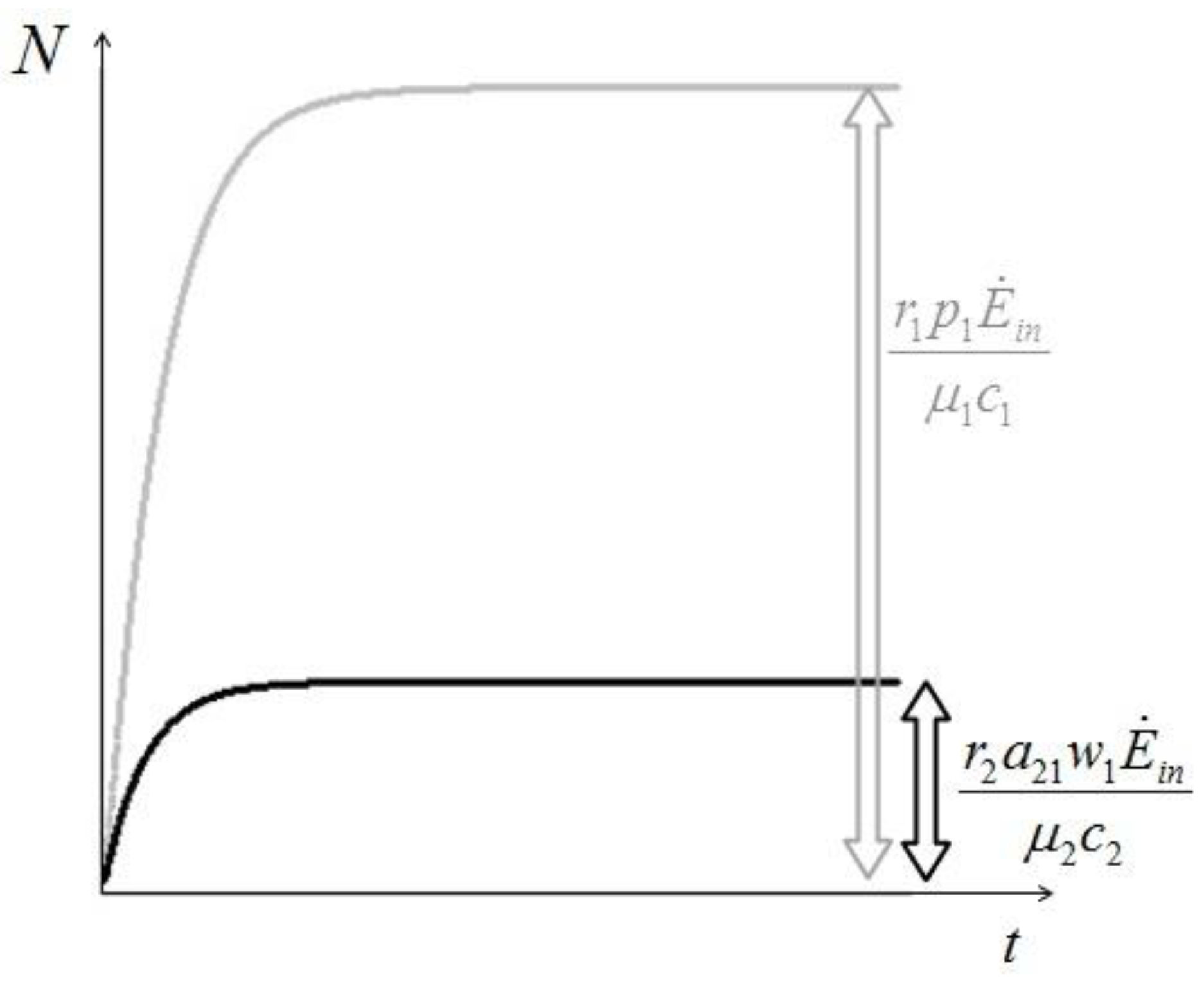
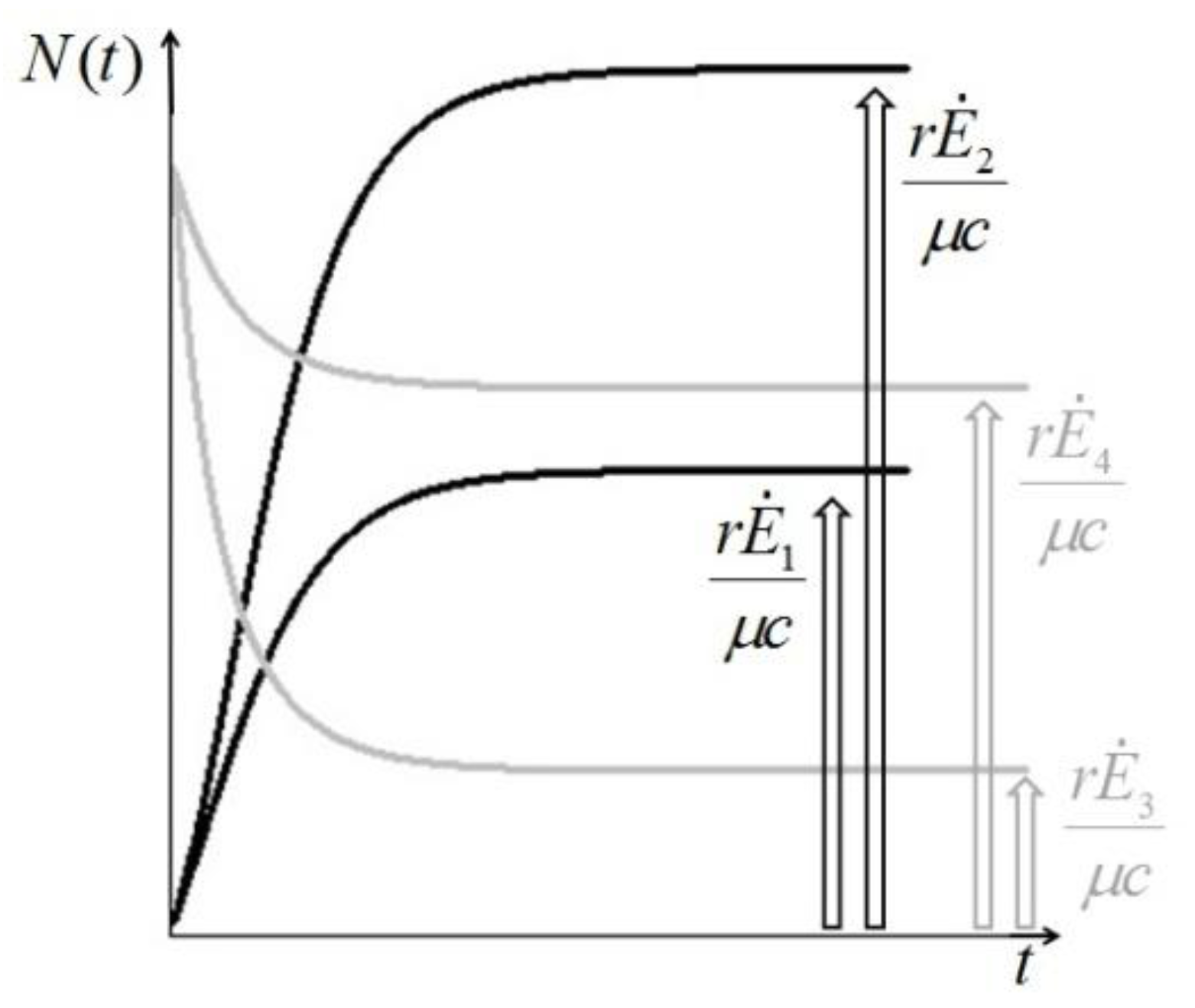
      <p>where <italic>N</italic><sub>0</sub> = <italic>N</italic>(<italic>t = t</italic><sub>0</sub>) and <inline-graphic xmlns:xlink="http://www.w3.org/1999/xlink" xlink:href="sustainability-04-02611-i027.tif"/>	. It is clear that as <italic>t → ∞</italic>, <italic>N</italic>(<italic>t</italic>) → <italic>N</italic><sup>*</sup>. The behavior is indeed similar to that of a logistic-type equation under a carrying capacity constraint: here however the specific exergy consumption rate and the parameters of the model exactly define the carrying capacity. Note that in this case, under a constant influx condition (and therefore an infinite amount of cumulative exergy) at its disposal, the numerosity can sustain itself to the value <italic>N</italic><sup>*</sup> for an infinite time. Obviously this is no longer true when <inline-graphic xmlns:xlink="http://www.w3.org/1999/xlink" xlink:href="sustainability-04-02611-i028.tif"/> describes a finite amount of cumulative exergy (see [<xref ref-type="bibr" rid="B4-sustainability-04-02611">4</xref>,<xref ref-type="bibr" rid="B5-sustainability-04-02611">5</xref>]). Notice also that the carrying capacity <italic>N</italic><sup>*</sup> is proportional to <italic>Ė</italic> but also inversely proportional to <italic>c</italic>, a model constant representing the specific exergy consumption rate corresponding to“minimum survival” of the population; indeed if in a given interval of time the total energy consumption rate <italic>Ė</italic>(<italic>t</italic>) of the population is much higher than <italic>cN</italic>(<italic>t</italic>) then the population increases in that interval, while in the opposite situation the population would decrease: this means that the curve <italic>N</italic>(<italic>t</italic>) “follows” in some sense the curve <italic>Ė</italic>(<italic>t</italic>). A last remark: in the previous simple situation when <italic>Ė</italic>(<italic>t</italic>) is constant we can have two qualitative different behavior of the solution <italic>N</italic>(<italic>t</italic>) (see e.g. [<xref ref-type="bibr" rid="B4-sustainability-04-02611">4</xref>]): if at <italic>t = t</italic><sub>0</sub> the initial population size is larger than <italic>N</italic><sup>*</sup>, then the population will monotonically (and exponentially) decrease to the value <italic>N</italic><sup>*</sup>, while if the population size at <italic>t = t</italic><sub>0</sub> is smaller than <italic>N</italic><sup>*</sup>, then the population will increase to the value <italic>N</italic><sup>*</sup>. Some plots of the transient <italic>N</italic>(<italic>t</italic>) are provided in <xref ref-type="fig" rid="sustainability-04-02611-f001">Figure 1</xref>: the gray curves represent the first case, the black ones the latter.</p>
      <fig id="sustainability-04-02611-f001" position="anchor">
        <label>Figure 1</label>
        <caption>
          <p>Qualitative transient behavior or the solutions of Equation (3).</p>
        </caption>
        <graphic xmlns:xlink="http://www.w3.org/1999/xlink" xlink:href="sustainability-04-02611-g001.tif"/>
      </fig>
      <p>In the case of <italic>Z</italic> populations the previous equation generalizes to:</p>
      <disp-formula id="sustainability-04-02611-i003">	<inline-graphic xmlns:xlink="http://www.w3.org/1999/xlink" xlink:href="sustainability-04-02611-i003.tif"/>		 
	  <label>(3)</label>
	  </disp-formula>
      <p>where again the <italic>r</italic><sub>j</sub><italic>, j=1…Z</italic>, are the limit growth rates of each population and the μ<sub>j</sub> are the intrinsic mortality rate of each species. Now the “source term” <italic>Ė<sub>j</sub></italic>(<italic>t</italic>) represents the exergy rate allocated to population <italic>j</italic> and, as such, it will depend on the strength of the mutualism and competition between populations <italic>i</italic> and <italic>j</italic>. Once the characteristics of each species have been assigned (<italic>r<sub>j</sub></italic>, μ<sub>j</sub> and <italic>Ė<sub>j</sub></italic>(<italic>t</italic>) above), a “scenario” is completely identified by specifying the evolution of the incoming total exergy rate: for each scenario, equations (3) describe the evolution of the <italic>Z</italic> populations. For a detailed analysis on the dynamics of competing populations governed by Equation (3), we refer readers to [<xref ref-type="bibr" rid="B4-sustainability-04-02611">4</xref>]. The relative strength of the interactions between populations <italic>i</italic> and <italic>j</italic>, that we describe by means of a set of parameters characteristic of the species and of their ecological niche, determines the relative amount of the global incoming exergy allocated to each population.</p>
      <p>In this paper we show that the system (3) is comprehensive and general enough to encompass the three following experimentally observed modes of species interaction [<xref ref-type="bibr" rid="B8-sustainability-04-02611">8</xref>,<xref ref-type="bibr" rid="B9-sustainability-04-02611">9</xref>]: </p>
      <list list-type="simple">
        <list-item>
          <p>a) <italic>Indifference</italic>: two species in the same environmental niche share the available incoming exergy flux but do not feed on each other’s discharges;</p>
        </list-item>
        <list-item>
          <p>b) <italic>Commensalism</italic>: one of the species survives solely on the resources released by its “host”;</p>
        </list-item>
        <list-item>
          <p>c) <italic>Mutualism</italic>; the two species compete for the externally available resources, but feed on each other’s discharges.</p>
        </list-item>
      </list>
    </sec>
    <sec>
      <title>2. A Model of Two Interacting Populations Sharing a Common Renewable Resource</title>
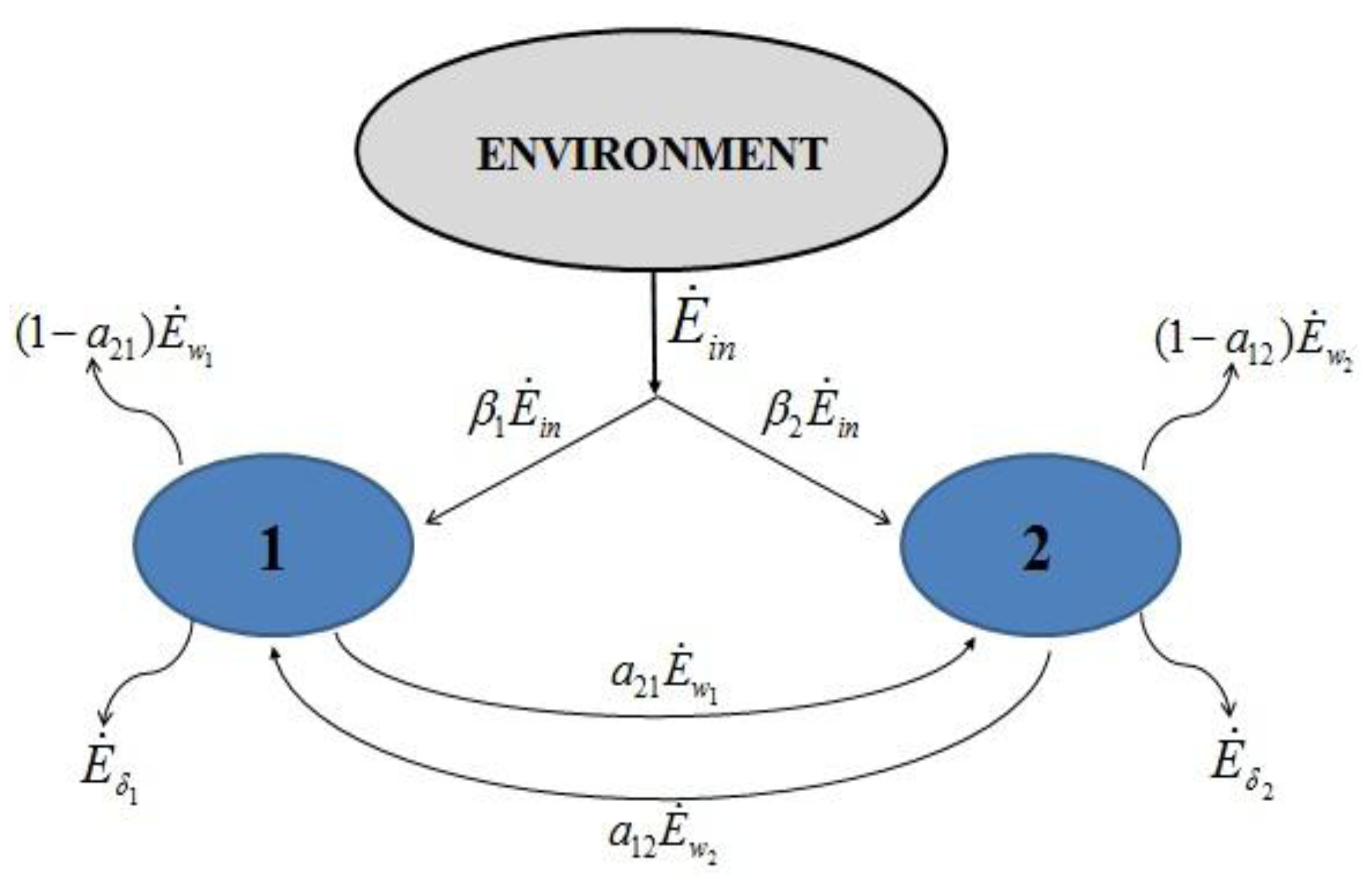
      <p>Consider two species that share a single renewable resource and who “feed” on their respective discharges (<xref ref-type="fig" rid="sustainability-04-02611-f002">Figure 2</xref>). Notice that the relative strength of the interactions between populations <italic>i</italic> and <italic>j</italic>, that we describe by means of a set of parameters characteristic of the species and of their ecological niche, determines the relative amount of the global incoming exergy allocated to each population. Our model assumes that, at each instant of time, the rate of exergy accumulation or depletion (<italic>Ė<sub>1</sub></italic> and <italic>Ė<sub>2</sub></italic> here) is the force that drives the increase (or decrease) in the respective numerosities: it will be therefore regarded as “useful input”.</p>
      <fig id="sustainability-04-02611-f002" position="anchor">
        <label>Figure 2</label>
        <caption>
          <p>Exergy “balance” for species 1 and 2.</p>
        </caption>
        <graphic xmlns:xlink="http://www.w3.org/1999/xlink" xlink:href="sustainability-04-02611-g002.tif"/>
      </fig>
      <p>The exergy “balances” read: </p>
      <disp-formula id="sustainability-04-02611-i004">	<inline-graphic xmlns:xlink="http://www.w3.org/1999/xlink" xlink:href="sustainability-04-02611-i004.tif"/>		 
	  <label>(4)</label>
	  </disp-formula>
      <disp-formula id="sustainability-04-02611-i005">	<inline-graphic xmlns:xlink="http://www.w3.org/1999/xlink" xlink:href="sustainability-04-02611-i005.tif"/>		 
	  <label>(5)</label>
	  </disp-formula>
      <p>Notice that, since exergy is not a conserved quantity, in this paper the expression “exergy balance” is adopted to denote the closure of the exergy equation obtained by introducing the exergy destruction E<sub>δ</sub>.</p>
      <p>We assume that the allocation of the exergy flows <italic>Ė</italic><sub>1</sub> and <italic>Ė</italic><sub>2</sub> increases with the numerosity of the respective population. So we set: <inline-graphic xmlns:xlink="http://www.w3.org/1999/xlink" xlink:href="sustainability-04-02611-i029.tif"/> and <inline-graphic xmlns:xlink="http://www.w3.org/1999/xlink" xlink:href="sustainability-04-02611-i030.tif"/>, γ<sub>1</sub> and γ<sub>2</sub> (both in J/individual/day) being the specific exergy consumptions of the two species (notice that β<sub>1</sub>+β<sub>2</sub>=1 and that <inline-graphic xmlns:xlink="http://www.w3.org/1999/xlink" xlink:href="sustainability-04-02611-i031.tif"/> as requested by the imposed boundary conditions). In most real situations, the parameters <italic>γ<sub>i</sub></italic> could depend also on time: in this paper, for simplicity, we posit that they are constant. Note that the parameter <italic>a<sub>nk</sub></italic> is the amount of the discharge of species <italic>k</italic> “recycled” by species <italic>n:</italic> if <italic>a<sub>nk</sub></italic><italic>=a<sub>kn</sub>=0,</italic> the two populations are <italic>indifferent</italic> to each other, <italic>i.e</italic>., neither one exploits the discharges of the other as its own exergy input). Since the instantaneous rate of discharge and destruction of the exergy flow can be only a fraction of the incoming one, we set <inline-graphic xmlns:xlink="http://www.w3.org/1999/xlink" xlink:href="sustainability-04-02611-i032.tif"/> and <inline-graphic xmlns:xlink="http://www.w3.org/1999/xlink" xlink:href="sustainability-04-02611-i033.tif"/> where <italic>w<sub>i</sub></italic> and <italic>δ<sub>i</sub></italic> are two dimensionless species-specific constants measuring the portion of incoming flow being discharged and destroyed by population <italic>N<sub>i</sub></italic>: In the model presented here, these “discharges” are NOT equivalent to the detritus (which is a pure material flow rate): they include also any form of exergy released by species j (thermal, chemical, <italic>etc</italic>.)</p>
      <p>It is clear that this interpretation for the constants <italic>w<sub>i</sub></italic> and <italic>δ<sub>i</sub></italic> implies the constraints <italic>w<sub>i</sub></italic> + <italic>δ<sub>i</sub></italic> ≤ 1. Equations (4) and (5) then result in:</p>
      <disp-formula id="sustainability-04-02611-i006">	<inline-graphic xmlns:xlink="http://www.w3.org/1999/xlink" xlink:href="sustainability-04-02611-i006.tif"/>		 
	  <label>(6)</label>
	  </disp-formula>
      <disp-formula id="sustainability-04-02611-i007">	<inline-graphic xmlns:xlink="http://www.w3.org/1999/xlink" xlink:href="sustainability-04-02611-i007.tif"/>		 
	  <label>(7)</label>
	  </disp-formula>
      <p>Due to the constraints <italic>w<sub>i</sub></italic> + <italic>δ<sub>i</sub></italic> ≤ 1 we see that the above expressions are indeed, at every instant, non-negative, as requested by their physical interpretation. It is convenient to set <italic>p<sub>i </sub></italic>= 1 − <italic>w<sub>i</sub></italic> − <italic>δ<sub>i</sub></italic>: by substituting (6) and (7) into (3), we obtain: </p>
      <disp-formula id="sustainability-04-02611-i008">	<inline-graphic xmlns:xlink="http://www.w3.org/1999/xlink" xlink:href="sustainability-04-02611-i008.tif"/>		 
	  <label>(8)</label>
	  </disp-formula>
	  <disp-formula id="sustainability-04-02611-i009">	<inline-graphic xmlns:xlink="http://www.w3.org/1999/xlink" xlink:href="sustainability-04-02611-i009.tif"/>		 
	  <label>(9)</label>
	  </disp-formula>
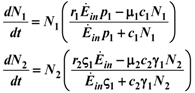
      <p>Where for simplicity we set <inline-graphic xmlns:xlink="http://www.w3.org/1999/xlink" xlink:href="sustainability-04-02611-i034.tif"/> and <inline-graphic xmlns:xlink="http://www.w3.org/1999/xlink" xlink:href="sustainability-04-02611-i035.tif"/>. The strong coupling between the numerosity of each species and the time evolution of ALL the participating species is apparent. Notice that in this case, Z = 2, but the formulae can be easily extended to account for whatever number Z of interacting populations, see [<xref ref-type="bibr" rid="B1-sustainability-04-02611">1</xref>]. We shall assume in the following that the exergy influx <italic>Ė<sub>in</sub></italic> is constant and that the model coefficients γ, w, δ, r, μ and c are known for all species considered. The type and degree of interaction between the two species is represented by the terms <inline-graphic xmlns:xlink="http://www.w3.org/1999/xlink" xlink:href="sustainability-04-02611-i064.tif"/><italic><sub>k</sub></italic> and <italic>γ<sub>k</sub></italic> that respectively contain the “β<sub>j</sub>” (that express the exergy voracity of species <italic>j)</italic> and the “α<sub>ij</sub>,” that quantify the degree of mutualism. Let us examine, on the same line as proposed in [<xref ref-type="bibr" rid="B8-sustainability-04-02611">8</xref>], the three possible general behaviors. Notice that Jørgensen [<xref ref-type="bibr" rid="B8-sustainability-04-02611">8</xref>] uses “cooperation” and “parasitism” to indicate “mutualism” and “commensalism” respectively.</p>
      <sec>
        <title>2.1. Indifference</title>
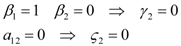
        <p>Species 1 and 2 display a disjointed behavior: in spite of sharing the same ecological niche, they do not interact, in the sense that neither species feeds, directly or indirectly, on the waste of the other one, which means that <italic>a</italic><sub>21</sub> = <italic>a</italic><sub>12</sub> = 0. Equations (8) and (9) simplify to:</p>
        <disp-formula id="sustainability-04-02611-i010">	<inline-graphic xmlns:xlink="http://www.w3.org/1999/xlink" xlink:href="sustainability-04-02611-i010.tif"/>		 
	  <label>(10)</label>
	  </disp-formula>
	  <disp-formula id="sustainability-04-02611-i011">	<inline-graphic xmlns:xlink="http://www.w3.org/1999/xlink" xlink:href="sustainability-04-02611-i011.tif"/>		 
	  <label>(11)</label>
	  </disp-formula>
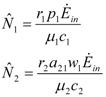
        <p>Even in this rather simple case, the strong non-linearity of the equations make them not amenable to an explicit solution. However the global behavior of the solutions, as we will see, strongly depends on the two quantities <inline-graphic xmlns:xlink="http://www.w3.org/1999/xlink" xlink:href="sustainability-04-02611-i036.tif"/> and <inline-graphic xmlns:xlink="http://www.w3.org/1999/xlink" xlink:href="sustainability-04-02611-i037.tif"/>. These two parameters contain the efficiency of each species to gain “net” exergy flows (<italic>γ<sub>k</sub>p<sub>k</sub></italic>), their “minimal survival” requests (<italic>c<sub>k</sub></italic>) and the ratio of the growth rate to the mortality rate <inline-graphic xmlns:xlink="http://www.w3.org/1999/xlink" xlink:href="sustainability-04-02611-i038.tif"/> in the respective limit cases of infinite and zero resources available. For simplicity let us consider that <inline-graphic xmlns:xlink="http://www.w3.org/1999/xlink" xlink:href="sustainability-04-02611-i036.tif"/> &gt; <inline-graphic xmlns:xlink="http://www.w3.org/1999/xlink" xlink:href="sustainability-04-02611-i037.tif"/>; the symmetric results for <inline-graphic xmlns:xlink="http://www.w3.org/1999/xlink" xlink:href="sustainability-04-02611-i037.tif"/> &gt; <inline-graphic xmlns:xlink="http://www.w3.org/1999/xlink" xlink:href="sustainability-04-02611-i036.tif"/> will simply follow by permutation of the indices 1 ↔ 2 , and the special case <inline-graphic xmlns:xlink="http://www.w3.org/1999/xlink" xlink:href="sustainability-04-02611-i037.tif"/> = <inline-graphic xmlns:xlink="http://www.w3.org/1999/xlink" xlink:href="sustainability-04-02611-i036.tif"/> will be discussed at the end of the section. In the state plane (<italic>N</italic><sub>1</sub>, <italic>N</italic><sub>2</sub>), the system of Equations 8 and 9 possesses three fixed points, listed in <xref ref-type="table" rid="sustainability-04-02611-t001">Table 1</xref>:</p>
        <table-wrap id="sustainability-04-02611-t001" position="float">
          <object-id pub-id-type="pii">sustainability-04-02611-t001_Table 1</object-id>
          <label>Table 1</label>
          <caption>
            <p>Fixed points of the system of Equations (10–11).</p>
          </caption>
          <table rules="rows" style="border:solid thin">
            <tbody>
              <tr>
                <td align="left" valign="middle"> </td>
                <td align="center" valign="middle">
                  <italic>N</italic>
                  <sub>1</sub>
                </td>
                <td align="center" valign="middle">
                  <italic>N</italic>
                  <sub>2</sub>
                </td>
              </tr>
              <tr>
                <td align="left" valign="middle">
                  <bold>a)</bold>
                </td>
                <td align="center" valign="middle">0</td>
                <td align="center" valign="middle">0</td>
              </tr>
              <tr>
                <td align="left" valign="middle">
                  <bold>b)</bold>
                </td>
                <td align="center" valign="middle">0</td>
                <td align="center" valign="middle"><inline-graphic xmlns:xlink="http://www.w3.org/1999/xlink" xlink:href="sustainability-04-02611-i039.tif"/></td>
              </tr>
              <tr>
                <td align="left" valign="middle">
                  <bold>c)</bold>
                </td>
                <td align="center" valign="middle"><inline-graphic xmlns:xlink="http://www.w3.org/1999/xlink" xlink:href="sustainability-04-02611-i040.tif"/></td>
                <td align="center" valign="middle">0</td>
              </tr>
            </tbody>
          </table>
		  </table-wrap>
        <p>The corresponding Lyapunov exponents are given by the following expressions: </p>
        <table-wrap id="sustainability-04-02611-t002" position="float">
          <object-id pub-id-type="pii">sustainability-04-02611-t002_Table 2</object-id>
          <label>Table 2</label>
          <caption>
            <p>Lyapunov exponents of the system of Equations (10–11) at points <bold>a</bold>, <bold>b</bold> and <bold>c</bold>.</p>
          </caption>
          <table rules="rows" style="border:solid thin">
            <tbody>
              <tr>
                <td align="left" valign="middle"> </td>
                <td align="center" valign="middle">
                  <italic>λ</italic>
                  <sub>1</sub>
                </td>
                <td align="center" valign="middle">
                  <italic>λ</italic>
                  <sub>2</sub>
                </td>
              </tr>
              <tr>
                <td align="left" valign="middle">
                  <bold>a)</bold>
                </td>
                <td align="center" valign="middle">
                  <italic>r</italic>
                  <sub>1</sub>
                </td>
                <td align="center" valign="middle">
                  <italic>r</italic>
                  <sub>2</sub>
                </td>
              </tr>
              <tr>
                <td align="left" valign="middle">
                  <bold>b)</bold>
                </td>
                <td align="center" valign="middle"><inline-graphic xmlns:xlink="http://www.w3.org/1999/xlink" xlink:href="sustainability-04-02611-i041.tif"/></td>
                <td align="center" valign="middle"><inline-graphic xmlns:xlink="http://www.w3.org/1999/xlink" xlink:href="sustainability-04-02611-i042.tif"/></td>
              </tr>
              <tr>
                <td align="left" valign="middle">
                  <bold>c)</bold>
                </td>
                <td align="center" valign="middle"><inline-graphic xmlns:xlink="http://www.w3.org/1999/xlink" xlink:href="sustainability-04-02611-i043.tif"/></td>
                <td align="center" valign="middle"><inline-graphic xmlns:xlink="http://www.w3.org/1999/xlink" xlink:href="sustainability-04-02611-i044.tif"/></td>
              </tr>
            </tbody>
          </table>
        </table-wrap>
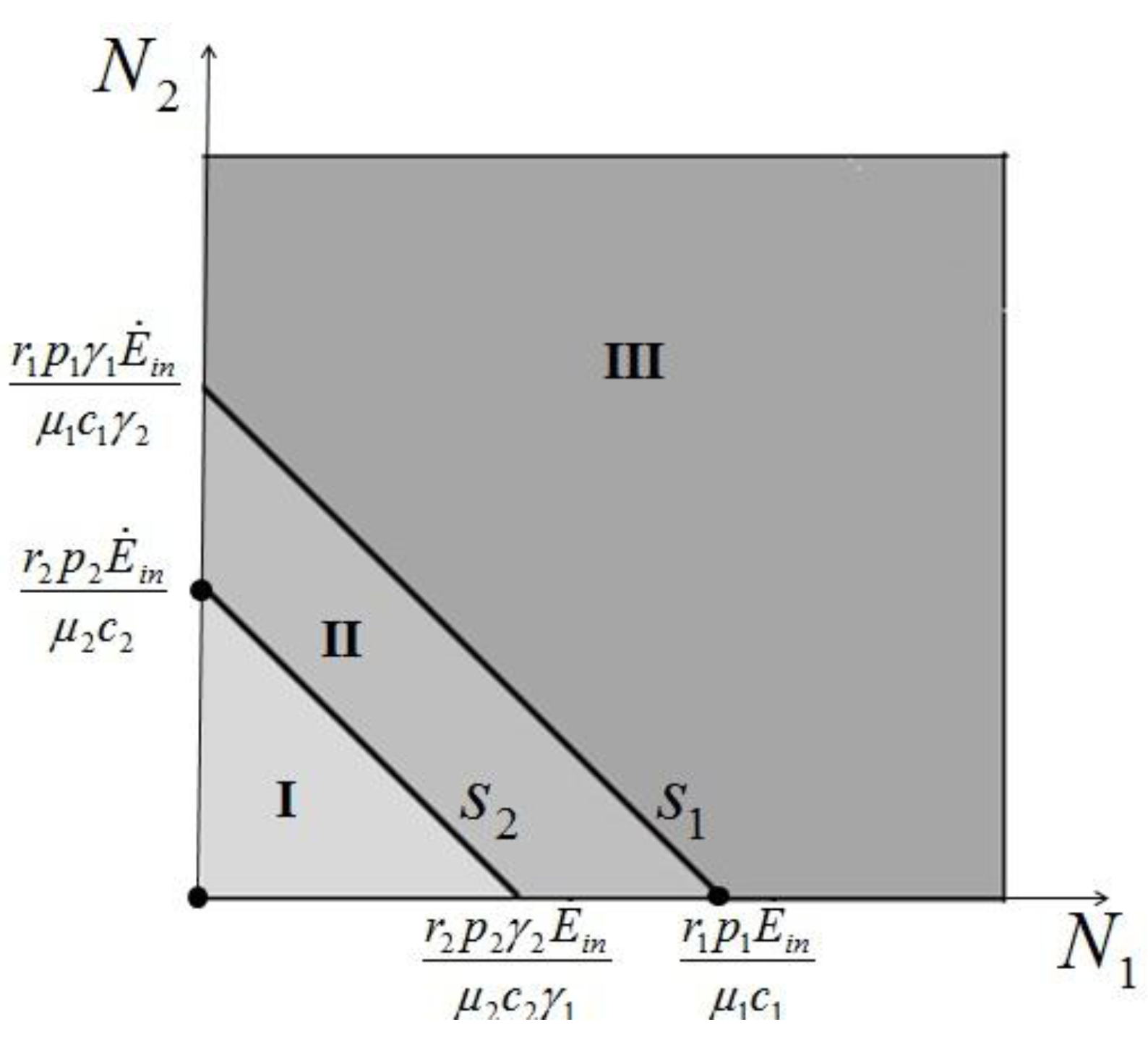
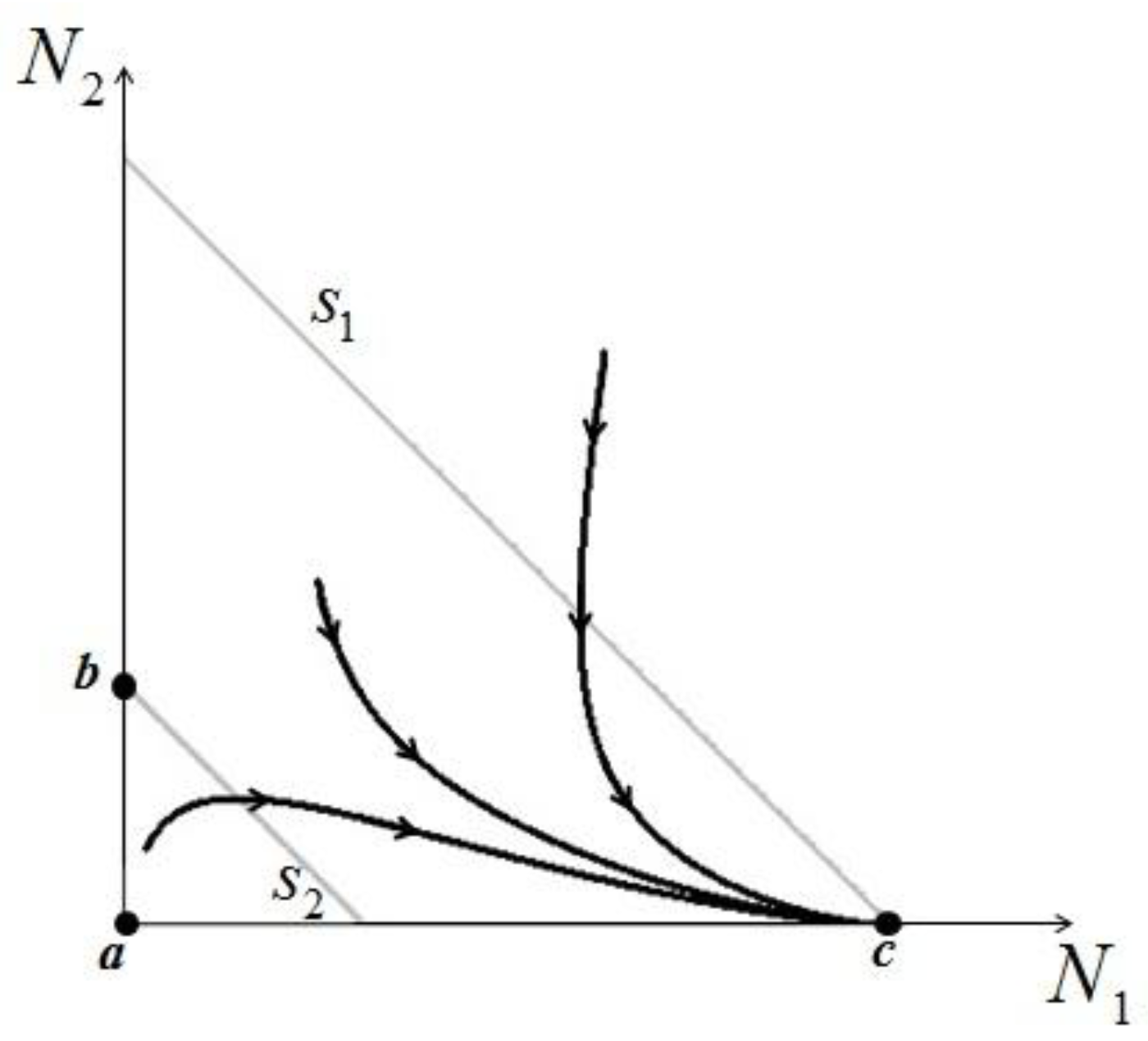
        <p>Point <bold><italic>a</italic></bold> is always unstable. The exponents <italic>λ</italic><sub>1</sub> and <italic>λ</italic><sub>2</sub> for points <bold><italic>b</italic></bold> and <bold><italic>c</italic></bold> are such that one point will be unstable and the other stable: the assumption <inline-graphic xmlns:xlink="http://www.w3.org/1999/xlink" xlink:href="sustainability-04-02611-i036.tif"/> &gt; <inline-graphic xmlns:xlink="http://www.w3.org/1999/xlink" xlink:href="sustainability-04-02611-i037.tif"/> results in point <italic>c</italic> being asymptotically stable and point <bold><italic>b</italic></bold> unstable. We can divide the plane (<italic>N</italic><sub>1</sub>, <italic>N</italic><sub>2</sub>) into three different regions (only the semi-plane defined by <italic>N</italic><sub>1</sub> ≥ 0 and <italic>N</italic><sub>2</sub> ≥ 0 are considered here because this semiplane is invariant under the flow). The three regions are divided by the so called isoclines <italic>s</italic><sub>1</sub> and <italic>s</italic><sub>2</sub>, defined as (see <xref ref-type="fig" rid="sustainability-04-02611-f003">Figure 3</xref>):</p>
        <disp-formula id="sustainability-04-02611-i012">	<inline-graphic xmlns:xlink="http://www.w3.org/1999/xlink" xlink:href="sustainability-04-02611-i012.tif"/>		 
	  <label>(12)</label>
	  </disp-formula>
        <p>On <italic>s</italic><sub>1</sub> we have <inline-graphic xmlns:xlink="http://www.w3.org/1999/xlink" xlink:href="sustainability-04-02611-i063.tif"/><sub>1</sub> = 0 and on <italic>s</italic><sub>2</sub>, <inline-graphic xmlns:xlink="http://www.w3.org/1999/xlink" xlink:href="sustainability-04-02611-i063.tif"/><sub>2</sub> = 0. Notice that the two lines have the same angular coefficient and, since here <inline-graphic xmlns:xlink="http://www.w3.org/1999/xlink" xlink:href="sustainability-04-02611-i036.tif"/> &gt; <inline-graphic xmlns:xlink="http://www.w3.org/1999/xlink" xlink:href="sustainability-04-02611-i037.tif"/>, line <italic>s</italic><sub>1</sub> is above <italic>s</italic><sub>2</sub>.</p>
		<fig id="sustainability-04-02611-f003" position="anchor">
          <label>Figure 3</label>
          <caption>
            <p>The three regions defined by the two isoclines. The fixed points are marked by a dot.</p>
          </caption>
          <graphic xmlns:xlink="http://www.w3.org/1999/xlink" xlink:href="sustainability-04-02611-g003.tif"/>
        </fig>
        
        <p>In region I <italic>N</italic><sub>1</sub> and <italic>N</italic><sub>2</sub> are both increasing functions of time, in region III they are both decreasing functions of time, while in region II <italic>N</italic><sub>1</sub> is increasing and <italic>N</italic><sub>2</sub> decreasing. The behavior of the solution is characterized as follows (see Appendix 1 for the proof): if at some time <italic>t</italic><sub>0</sub> the solution is in region I then there exists a finite time <italic>t</italic> &gt; <italic>t</italic><sub>0</sub> for which the solution will leave that region. If at some <italic>t</italic><sub>1</sub> the solution is in region II then it will remain in this region and asymptotically approach point <italic>c</italic> for t→∞. If at some time <italic>t</italic><sub>3</sub> the solution is in region III then it will either remain there for all subsequent times, asymptotically approaching <bold><italic>c</italic></bold>, or it will enter at some time <italic>t</italic>' &gt; <italic>t</italic><sub>3</sub> into region II to approach again point <bold><italic>c</italic></bold>. Thus in all cases for which <inline-graphic xmlns:xlink="http://www.w3.org/1999/xlink" xlink:href="sustainability-04-02611-i036.tif"/> &gt; <inline-graphic xmlns:xlink="http://www.w3.org/1999/xlink" xlink:href="sustainability-04-02611-i037.tif"/> is satisfied, population <italic>N</italic><sub>2</sub> will become extinct and population <italic>N</italic><sub>1</sub> will tend to the stable (sustainable) value <inline-graphic xmlns:xlink="http://www.w3.org/1999/xlink" xlink:href="sustainability-04-02611-i040.tif"/>. By the same arguments it can be shown that conversely, if <inline-graphic xmlns:xlink="http://www.w3.org/1999/xlink" xlink:href="sustainability-04-02611-i036.tif"/> &lt; <inline-graphic xmlns:xlink="http://www.w3.org/1999/xlink" xlink:href="sustainability-04-02611-i037.tif"/>, population <italic>N</italic><sub>1</sub> will die out and population <italic>N</italic><sub>2</sub> reaches a stable limit <inline-graphic xmlns:xlink="http://www.w3.org/1999/xlink" xlink:href="sustainability-04-02611-i039.tif"/>. An ensemble of plots for the case <inline-graphic xmlns:xlink="http://www.w3.org/1999/xlink" xlink:href="sustainability-04-02611-i036.tif"/> &gt; <inline-graphic xmlns:xlink="http://www.w3.org/1999/xlink" xlink:href="sustainability-04-02611-i037.tif"/>, corresponding to different initial conditions, is shown in <xref ref-type="fig" rid="sustainability-04-02611-f004">Figure 4</xref>. </p>
        <fig id="sustainability-04-02611-f004" position="anchor">
          <label>Figure 4</label>
          <caption>
            <p>Three different orbits for the system (10–11) in the case <inline-graphic xmlns:xlink="http://www.w3.org/1999/xlink" xlink:href="sustainability-04-02611-i036.tif"/> &gt; <inline-graphic xmlns:xlink="http://www.w3.org/1999/xlink" xlink:href="sustainability-04-02611-i037.tif"/>.</p>
          </caption>
          <graphic xmlns:xlink="http://www.w3.org/1999/xlink" xlink:href="sustainability-04-02611-g004.tif"/>
        </fig>
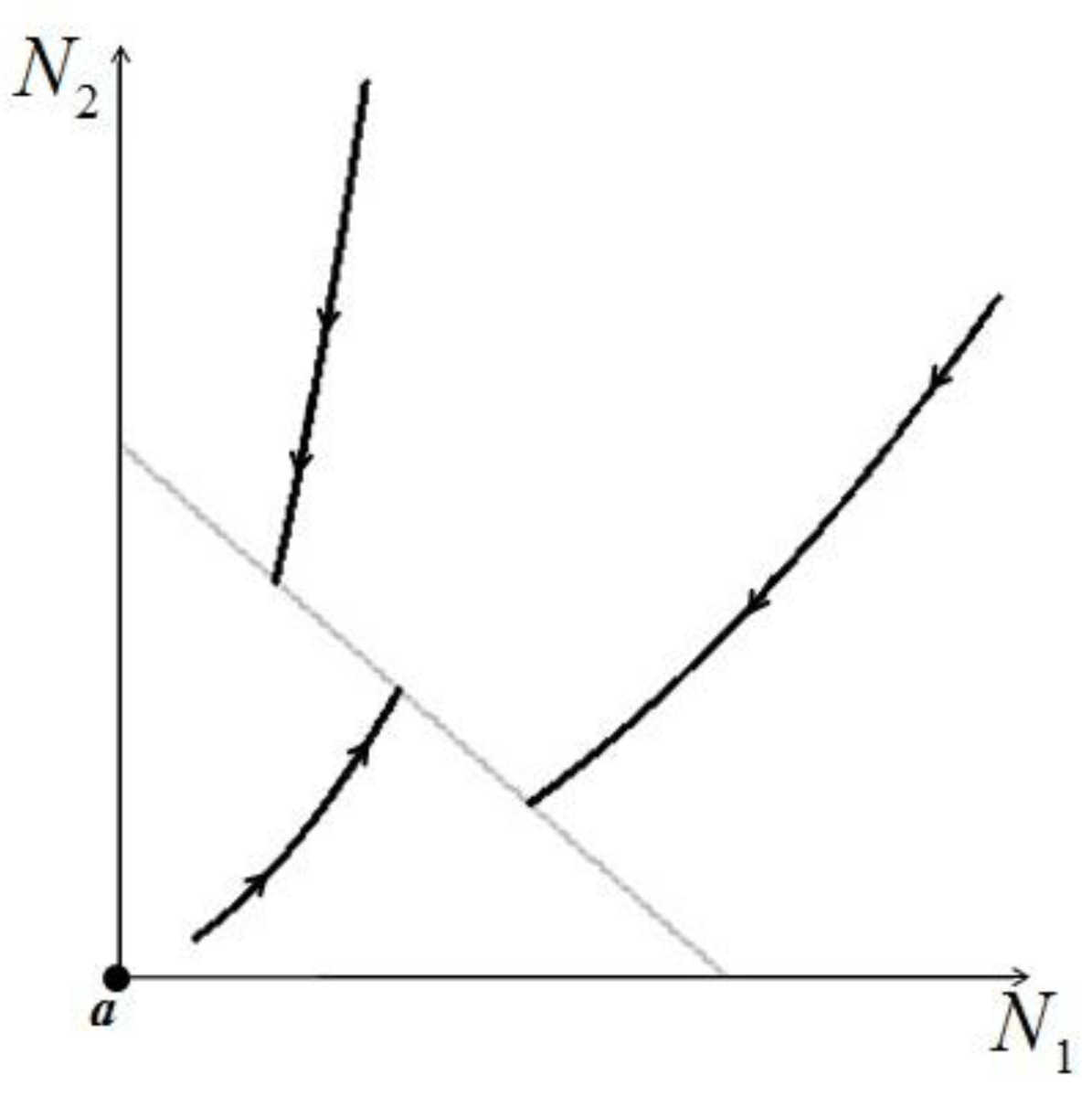
        <p>The special case <inline-graphic xmlns:xlink="http://www.w3.org/1999/xlink" xlink:href="sustainability-04-02611-i036.tif"/> = <inline-graphic xmlns:xlink="http://www.w3.org/1999/xlink" xlink:href="sustainability-04-02611-i037.tif"/> is very interesting. Point <bold><italic>a</italic></bold> is again unstable, but now the two isoclines <italic>s</italic><sub>1</sub> and <italic>s</italic><sub>2</sub> converge into a line that is itself an <italic>attractor</italic>. Both species survive and the weighted sum <italic>γ</italic><sub>1</sub><italic>N</italic><sub>1</sub> + <italic>γ</italic><sub>2</sub><italic>N</italic><sub>2</sub> reaches the carrying capacity limit for which <inline-graphic xmlns:xlink="http://www.w3.org/1999/xlink" xlink:href="sustainability-04-02611-i045.tif"/>. <xref ref-type="fig" rid="sustainability-04-02611-f005">Figure 5</xref> shows examples of possible behaviors in phase space. </p>

        <fig id="sustainability-04-02611-f005" position="anchor">
          <label>Figure 5</label>
          <caption>
            <p>The case <inline-graphic xmlns:xlink="http://www.w3.org/1999/xlink" xlink:href="sustainability-04-02611-i046.tif"/>: The arrows indicate the time direction of the evolution.</p>
          </caption>
          <graphic xmlns:xlink="http://www.w3.org/1999/xlink" xlink:href="sustainability-04-02611-g005.tif"/>
        </fig>
      </sec>
      <sec>
        <title>2.2. Commensalism</title>
        <p>One of the two species displays a commensalistic behavior with respect to the other one, in the sense that rather than extracting its exergy feed rate from <italic>Ė<sub>in</sub></italic>, it thrives solely on the “discharge flows” of the other species. Asymmetrically, the species “pestered” by the parasite does not feed on it—(in other words, any degree of mutualistic behavior is disregarded). Assuming species 2 to be the parasite, this implies:</p>
        <disp-formula id="sustainability-04-02611-i013">	<inline-graphic xmlns:xlink="http://www.w3.org/1999/xlink" xlink:href="sustainability-04-02611-i013.tif"/>		 
	  <label>(13)</label>
	  </disp-formula>
        <p>Under these circumstances, (10-11) become:</p>
        <disp-formula id="sustainability-04-02611-i014">	
		<inline-graphic xmlns:xlink="http://www.w3.org/1999/xlink" xlink:href="sustainability-04-02611-i014.tif"/>		 
	  <label>(14)</label>
	  </disp-formula>
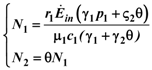
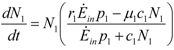
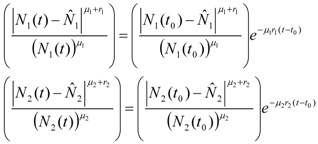
        <p>Note that now the coupling between the species (or better of species 2 with species 1) is described only in terms of the two constants <inline-graphic xmlns:xlink="http://www.w3.org/1999/xlink" xlink:href="sustainability-04-02611-i064.tif"/><sub>1</sub> and <italic>γ</italic><sub>1</sub>: thus, the system (14) can be formally integrated, even if the solutions can be only written out implicitly:</p>
        <disp-formula id="sustainability-04-02611-i015">	
		<inline-graphic xmlns:xlink="http://www.w3.org/1999/xlink" xlink:href="sustainability-04-02611-i015.tif"/>		 
	  <label>(15)</label>
	  </disp-formula>
        <p>where the two values <inline-graphic xmlns:xlink="http://www.w3.org/1999/xlink" xlink:href="sustainability-04-02611-i047.tif"/> and <inline-graphic xmlns:xlink="http://www.w3.org/1999/xlink" xlink:href="sustainability-04-02611-i048.tif"/> are given by: </p>
        <disp-formula id="sustainability-04-02611-i016">	
		<inline-graphic xmlns:xlink="http://www.w3.org/1999/xlink" xlink:href="sustainability-04-02611-i016.tif"/>		 
	  <label>(16)</label>
	  </disp-formula>
        <p>These are also the asymptotic values of <italic>N</italic><sub>1</sub>(<italic>t</italic>) and <italic>N</italic><sub>2</sub>(<italic>t</italic>) since clearly from (15) we have that <inline-graphic xmlns:xlink="http://www.w3.org/1999/xlink" xlink:href="sustainability-04-02611-i049.tif"/> and <inline-graphic xmlns:xlink="http://www.w3.org/1999/xlink" xlink:href="sustainability-04-02611-i050.tif"/>. Thus, both species reach their respective carrying capacity limit. Note that <inline-graphic xmlns:xlink="http://www.w3.org/1999/xlink" xlink:href="sustainability-04-02611-i051.tif"/> is proportional to <italic>p</italic><sub>1</sub>, <italic>i.e</italic>. to 1 − <italic>w</italic><sub>1 </sub>− <italic>δ</italic><sub>1</sub>: increasing the discharged and destroyed portion of the incoming exergy flows proportionally reduces the corresponding carrying capacity value for population 1. But population 2 <underline>feeds</underline> on this discharged flow: Equation 16 shows that indeed the carrying capacity limit for <italic>N</italic><sub>2</sub> is proportional to <italic>w</italic><sub>1</sub>. Note that, in contrast to the case of competing populations, and assuming <italic>w</italic><sub>1</sub> ≠ 0, the two populations will always both survive. In fact, species 1 meets no competition in tapping the exergy flow it needs and species 2 feeds on the “crumbs” of species 1. This result is quite obvious, but we stress that: </p>
        <list list-type="simple">
          <list-item>
            <p>a) it is derived on exact mathematical basis.</p>
          </list-item>
          <list-item>
            <p>b) the carrying capacity limits are directly linked to the parameters of the model.</p>
          </list-item>
          <list-item>
            <p>c) Equations 14 describe also how fast these limits are reached (<xref ref-type="fig" rid="sustainability-04-02611-f006">Figure 6</xref>).</p>
          </list-item>
        </list>
		<fig id="sustainability-04-02611-f006" position="anchor">
          <label>Figure 6</label>
          <caption>
            <p>An example of the evolution of the two populations in the commensalistic case.</p>
          </caption>
          <graphic xmlns:xlink="http://www.w3.org/1999/xlink" xlink:href="sustainability-04-02611-g006.tif"/>
        </fig>
        
      </sec>
      <sec>
        <title>2.3. Mutualism</title>
        <p>This is the most general case, in which both <italic>a</italic><sub>12</sub> and <italic>a</italic><sub>21</sub> are strictly positive (&gt;0). The model equations are 6 and 7. Again, it is convenient to examine the phase space (<italic>N</italic><sub>1</sub>, <italic>N</italic><sub>2</sub>), or better the invariant subspace given by {(<italic>N</italic><sub>1</sub>, <italic>N</italic><sub>2</sub>): <italic>N</italic><sub>1 </sub>≥ 0, <italic>N</italic><sub>2 </sub>≥ 0}. In this case, the Lyapunov coefficients assume the following values (the fixed points a, b and c are the same as in <xref ref-type="table" rid="sustainability-04-02611-t001">Table 1</xref>):</p> 
        <table-wrap id="sustainability-04-02611-t003" position="float">
          <object-id pub-id-type="pii">sustainability-04-02611-t003_Table 3</object-id>
          <label>Table 3</label>
          <caption>
            <p>Lyapunov exponents of the system of Equations (10-11) at points a, b and c.</p>
          </caption>
          <table rules="rows" style="border:solid thin">
            <tbody>
              <tr>
                <td align="left" valign="middle"> </td>
                <td align="center" valign="middle">
                  <italic>λ</italic>
                  <sub>1</sub>
                </td>
                <td align="center" valign="middle">
                  <italic>λ</italic>
                  <sub>2</sub>
                </td>
              </tr>
              <tr>
                <td align="left" valign="middle">
                  <bold>a)</bold>
                </td>
                <td align="center" valign="middle">
                  <italic>r</italic>
                  <sub>1</sub>
                </td>
                <td align="center" valign="middle">
                  <italic>r</italic>
                  <sub>2</sub>
                </td>
              </tr>
              <tr>
                <td align="left" valign="middle">
                  <bold>b)</bold>
                </td>
                <td align="center" valign="middle">
                  <italic>r</italic>
                  <sub>1</sub>
                </td>
                <td align="center" valign="middle"><inline-graphic xmlns:xlink="http://www.w3.org/1999/xlink" xlink:href="sustainability-04-02611-i042.tif"/></td>
              </tr>
              <tr>
                <td align="left" valign="middle">
                  <bold>c)</bold>
                </td>
                <td align="center" valign="middle"><inline-graphic xmlns:xlink="http://www.w3.org/1999/xlink" xlink:href="sustainability-04-02611-i043.tif"/></td>
                <td align="center" valign="middle">
                  <italic>r</italic>
                  <sub>2</sub>
                </td>
              </tr>
            </tbody>
          </table>
		  </table-wrap>
        <p>All three points are unstable. This means that the system tends to avoid situations in which one or both of the populations become extinct. This is an indication that <italic>in the present model, cooperation (mutualism) may lead to sustainable scenarios.</italic> Let us show the existence of another fixed point and look more closely at the dynamics.</p>
        <p>If we consider the numerators of (8-9), repeated here for clarity in Equations 16, it is possible to verify that, for whichever value of the model parameters, the two curves described by (16) always intersect in a point (the fixed point) on the semi-plane {(<italic>N</italic><sub>1</sub>, <italic>N</italic><sub>2</sub>): <italic>N</italic><sub>1 </sub>≥ 0, <italic>N</italic><sub>2 </sub>≥ 0}, which we shall denote as <bold>d</bold>. </p>
        <disp-formula id="sustainability-04-02611-i017">	<inline-graphic xmlns:xlink="http://www.w3.org/1999/xlink" xlink:href="sustainability-04-02611-i017.tif"/>		 
	  <label>(17)</label>
	  </disp-formula>
        <p>It is useful to write down the solution of this system in terms of the parameter q given by the ratio of <italic>N</italic><sub>2 </sub>/<italic>N</italic><sub>1</sub>:</p>
        <disp-formula id="sustainability-04-02611-i018">	
		<inline-graphic xmlns:xlink="http://www.w3.org/1999/xlink" xlink:href="sustainability-04-02611-i018.tif"/>		 
	  <label>(18)</label>
	  </disp-formula>
        <p>where the parameter q solves the following quadratic equation (<inline-graphic xmlns:xlink="http://www.w3.org/1999/xlink" xlink:href="sustainability-04-02611-i052.tif"/> and <inline-graphic xmlns:xlink="http://www.w3.org/1999/xlink" xlink:href="sustainability-04-02611-i053.tif"/>):</p>
        <disp-formula id="sustainability-04-02611-i019">	
		<inline-graphic xmlns:xlink="http://www.w3.org/1999/xlink" xlink:href="sustainability-04-02611-i019.tif"/>		 
	  <label>(19)</label>
	  </disp-formula>
        <p>the two solutions <bold>θ<sub>±</sub></bold> being:</p>
        <disp-formula id="sustainability-04-02611-i020">	
		<inline-graphic xmlns:xlink="http://www.w3.org/1999/xlink" xlink:href="sustainability-04-02611-i020.tif"/>		 
	  <label>(20)</label>
	  </disp-formula>
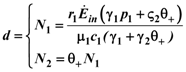
        <p>From (20) we note that <bold>θ<sub>+</sub></bold> is always positive and <bold>θ<sub>−</sub></bold> always negative. The negative solution must be discarded because <italic>N</italic><sub>1</sub> and <italic>N</italic><sub>2</sub> are both positive definite. So there exists another fixed point given by:</p>
        <disp-formula id="sustainability-04-02611-i021">	<inline-graphic xmlns:xlink="http://www.w3.org/1999/xlink" xlink:href="sustainability-04-02611-i021.tif"/>		 
	  <label>(21)</label>
	  </disp-formula>
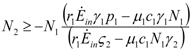
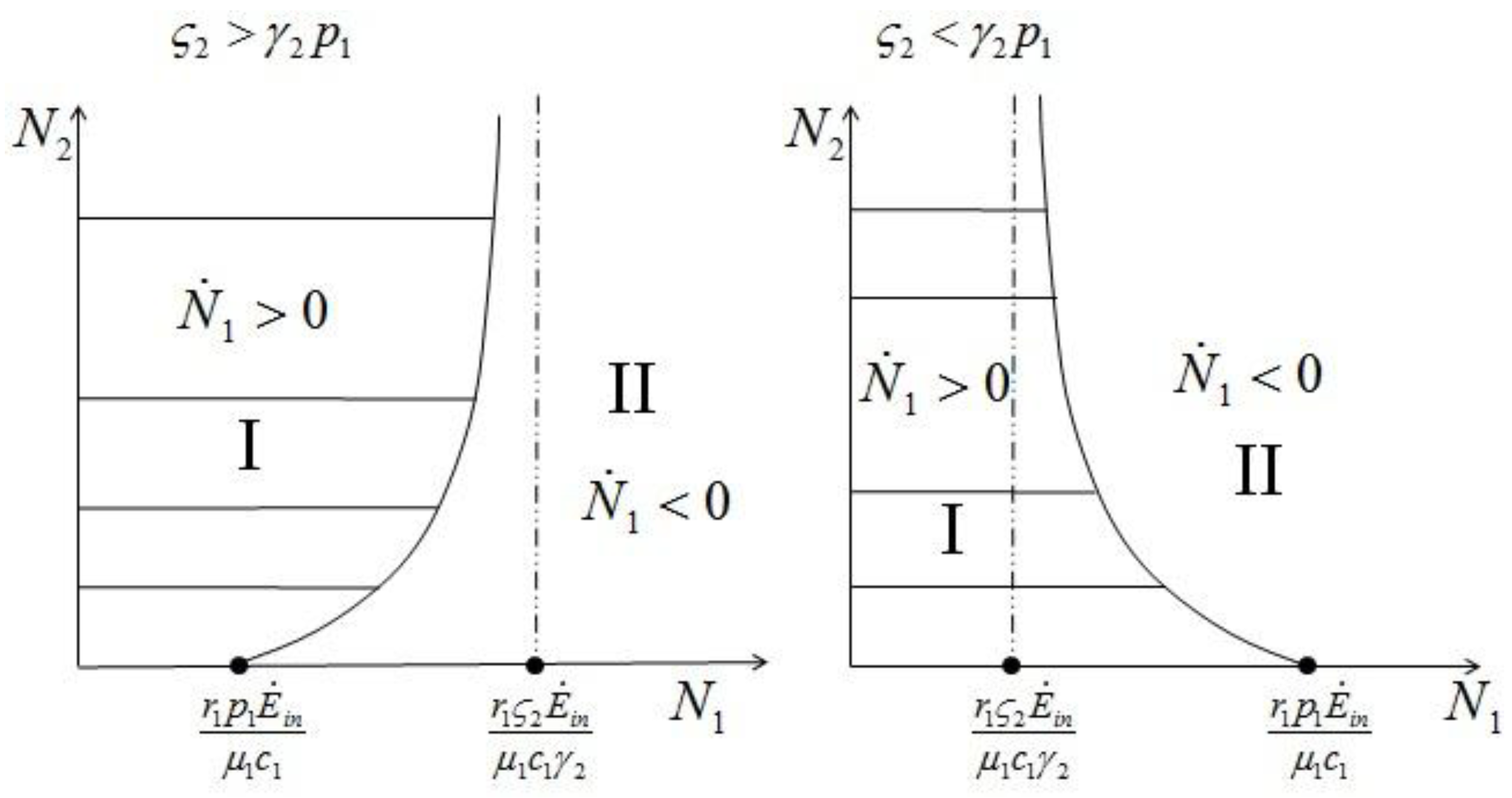
        <p>Furthermore this point is attractive. Indeed we can label different domains in the semi-plane {(<italic>N</italic><sub>1</sub>, <italic>N</italic><sub>2</sub>): <italic>N</italic><sub>1 </sub>≥ 0, <italic>N</italic><sub>2 </sub>≥ 0} according to the signs of <inline-graphic xmlns:xlink="http://www.w3.org/1999/xlink" xlink:href="sustainability-04-02611-i063.tif"/><sub>1</sub> and <inline-graphic xmlns:xlink="http://www.w3.org/1999/xlink" xlink:href="sustainability-04-02611-i063.tif"/><sub>2</sub>. Consider species 1 first. In order to have <inline-graphic xmlns:xlink="http://www.w3.org/1999/xlink" xlink:href="sustainability-04-02611-i063.tif"/><sub>1 </sub>≥ 0 we need: </p>
        <disp-formula id="sustainability-04-02611-i022">	
		<inline-graphic xmlns:xlink="http://www.w3.org/1999/xlink" xlink:href="sustainability-04-02611-i022.tif"/>		 
	  <label>(22)</label>
	  </disp-formula>
        <p>Equation 22 describes a curve dividing the semi-plane in two regions; region <bold>I</bold>, where <inline-graphic xmlns:xlink="http://www.w3.org/1999/xlink" xlink:href="sustainability-04-02611-i063.tif"/><sub>1</sub> &gt; 0, and region <bold>II</bold>, where <inline-graphic xmlns:xlink="http://www.w3.org/1999/xlink" xlink:href="sustainability-04-02611-i063.tif"/><sub>1</sub> &lt; 0. The two lines depicted in <xref ref-type="fig" rid="sustainability-04-02611-f007">Figure 7</xref> correspond to the two cases <inline-graphic xmlns:xlink="http://www.w3.org/1999/xlink" xlink:href="sustainability-04-02611-i054.tif"/> and <inline-graphic xmlns:xlink="http://www.w3.org/1999/xlink" xlink:href="sustainability-04-02611-i055.tif"/>: the special case <inline-graphic xmlns:xlink="http://www.w3.org/1999/xlink" xlink:href="sustainability-04-02611-i056.tif"/> (and the equivalent case for species 2 <inline-graphic xmlns:xlink="http://www.w3.org/1999/xlink" xlink:href="sustainability-04-02611-i057.tif"/>) will be discussed at the end of this section. </p>
        <fig id="sustainability-04-02611-f007" position="anchor">
          <label>Figure 7</label>
          <caption>
            <p>The two regions identified by the curve (22) for <inline-graphic xmlns:xlink="http://www.w3.org/1999/xlink" xlink:href="sustainability-04-02611-i054.tif"/> (left) and <inline-graphic xmlns:xlink="http://www.w3.org/1999/xlink" xlink:href="sustainability-04-02611-i055.tif"/> (right).</p>
          </caption>
          <graphic xmlns:xlink="http://www.w3.org/1999/xlink" xlink:href="sustainability-04-02611-g007.tif"/>
        </fig>
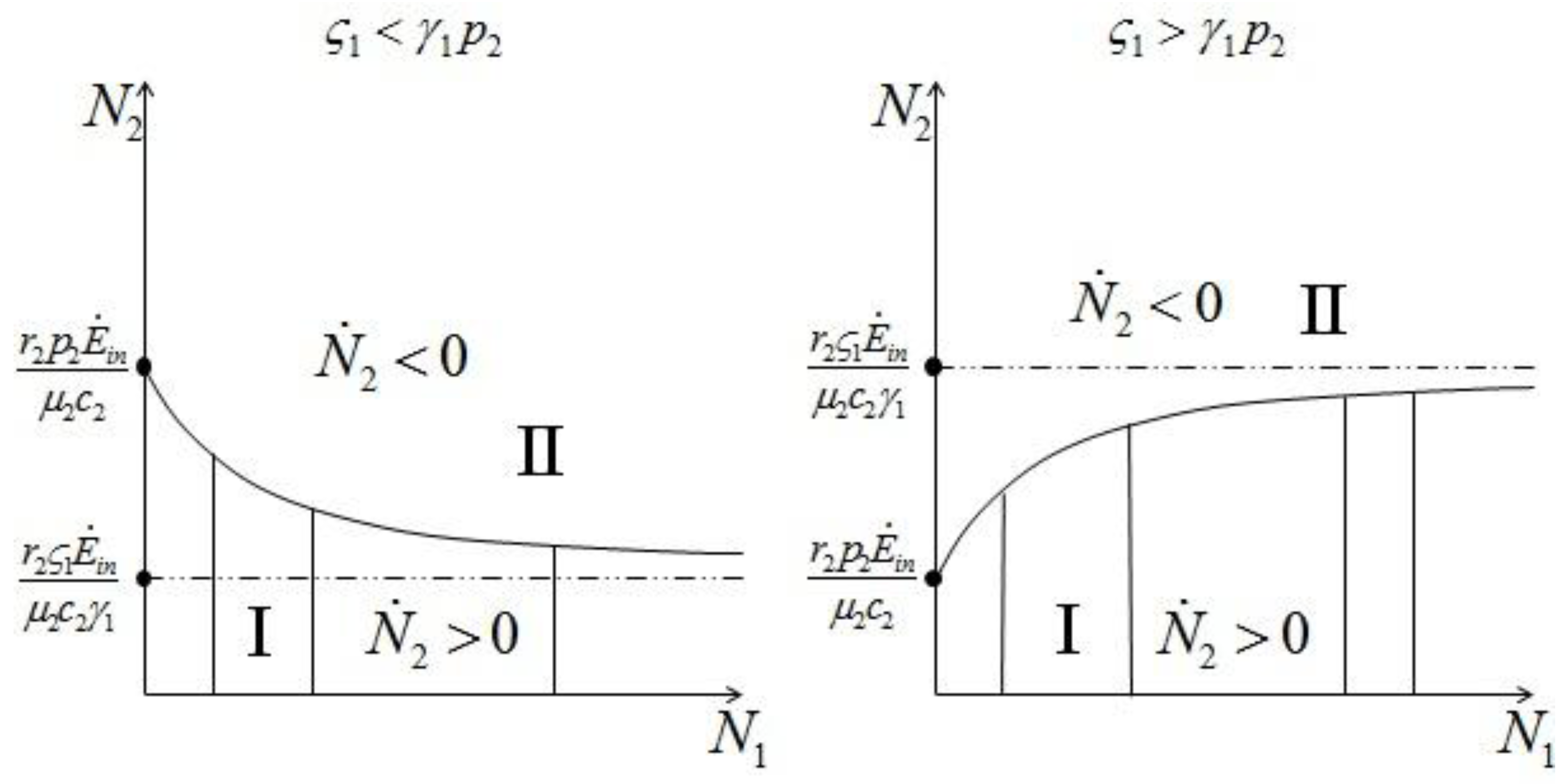
        <p>Repeating the same argument for species <bold>2</bold>, we find two more curves dividing the semi-plane as in <xref ref-type="fig" rid="sustainability-04-02611-f008">Figure 8</xref>, again corresponding to the two cases <inline-graphic xmlns:xlink="http://www.w3.org/1999/xlink" xlink:href="sustainability-04-02611-i058.tif"/> and <inline-graphic xmlns:xlink="http://www.w3.org/1999/xlink" xlink:href="sustainability-04-02611-i059.tif"/>:</p>
        <fig id="sustainability-04-02611-f008" position="anchor">
          <label>Figure 8</label>
          <caption>
            <p>The two regions symmetrically defined for <inline-graphic xmlns:xlink="http://www.w3.org/1999/xlink" xlink:href="sustainability-04-02611-i063.tif"/><sub>2</sub> for <inline-graphic xmlns:xlink="http://www.w3.org/1999/xlink" xlink:href="sustainability-04-02611-i058.tif"/> (left) and <inline-graphic xmlns:xlink="http://www.w3.org/1999/xlink" xlink:href="sustainability-04-02611-i059.tif"/>.</p>
          </caption>
          <graphic xmlns:xlink="http://www.w3.org/1999/xlink" xlink:href="sustainability-04-02611-g008.tif"/>
        </fig>
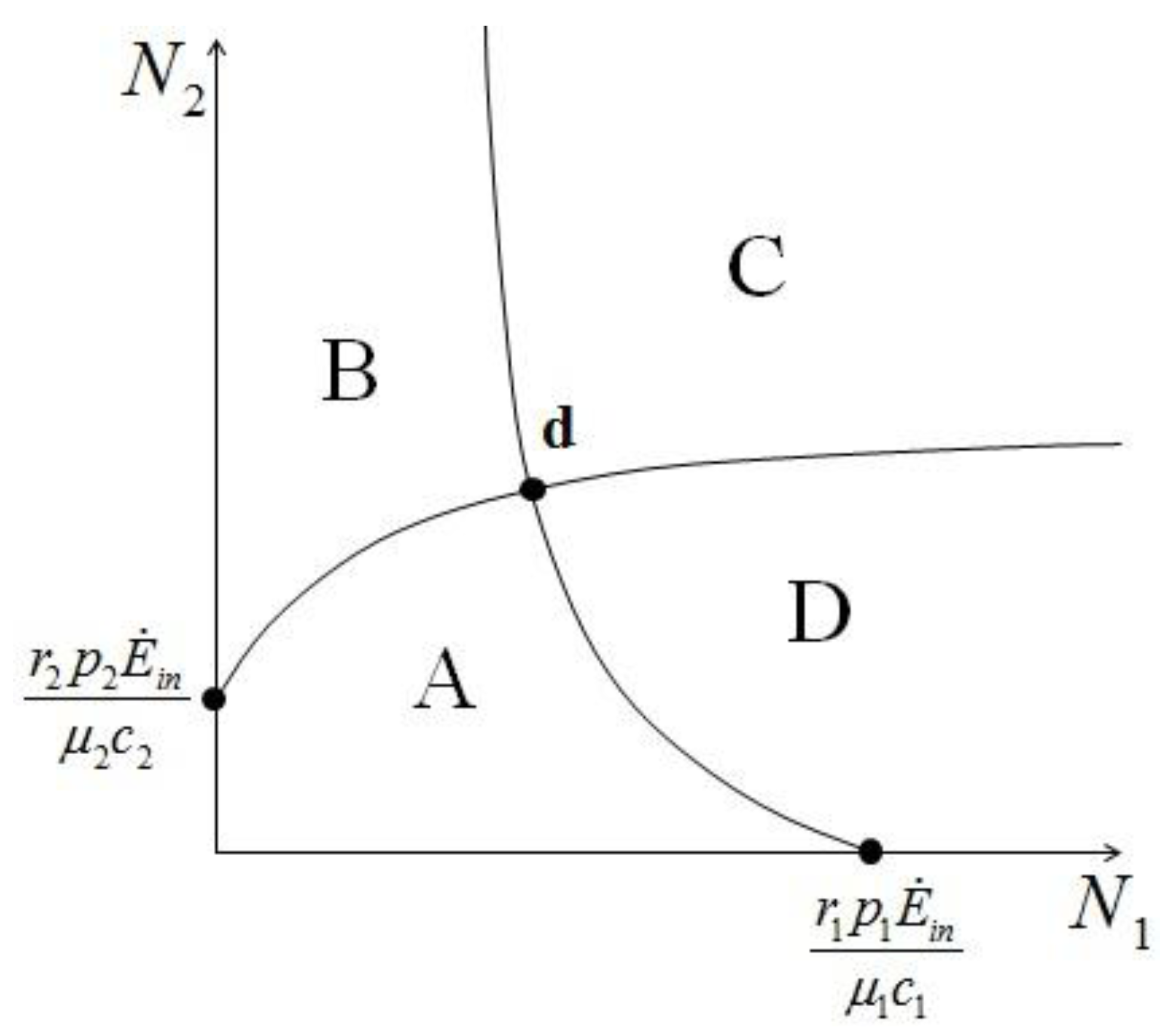
        <p>Note that the fixed point <bold>d</bold> is given by the intersection of a curve in <xref ref-type="fig" rid="sustainability-04-02611-f007">Figure 7</xref> with a curve in <xref ref-type="fig" rid="sustainability-04-02611-f008">Figure 8</xref>. For example if we have <inline-graphic xmlns:xlink="http://www.w3.org/1999/xlink" xlink:href="sustainability-04-02611-i054.tif"/> and <inline-graphic xmlns:xlink="http://www.w3.org/1999/xlink" xlink:href="sustainability-04-02611-i058.tif"/>, to find the fixed point <bold>d</bold> we can superimpose the two curves on the right in <xref ref-type="fig" rid="sustainability-04-02611-f007">Figure 7</xref> and <xref ref-type="fig" rid="sustainability-04-02611-f008">Figure 8</xref> to obtain the picture shown in <xref ref-type="fig" rid="sustainability-04-02611-f009">Figure 9</xref>.</p>
        <fig id="sustainability-04-02611-f009" position="anchor">
          <label>Figure 9</label>
          <caption>
            <p>The fixed point d as the intersection of the two curves in <xref ref-type="fig" rid="sustainability-04-02611-f007">Figure 7</xref>, <xref ref-type="fig" rid="sustainability-04-02611-f008">Figure 8</xref>. </p>
          </caption>
          <graphic xmlns:xlink="http://www.w3.org/1999/xlink" xlink:href="sustainability-04-02611-g009.tif"/>
        </fig>
        <p>It is also clear by geometrical considerations that the fixed point <bold>d</bold> will always lie on the positive quadrant. Note that the two curves divide this quadrant into four regions, marked with the letters <bold>A</bold>, <bold>B</bold>, <bold>C</bold>, and <bold>D</bold> in <xref ref-type="fig" rid="sustainability-04-02611-f009">Figure 9</xref>: each region is characterized by different signs of <inline-graphic xmlns:xlink="http://www.w3.org/1999/xlink" xlink:href="sustainability-04-02611-i063.tif"/><sub>1</sub> and <inline-graphic xmlns:xlink="http://www.w3.org/1999/xlink" xlink:href="sustainability-04-02611-i063.tif"/><sub>2</sub>. In region <bold>A</bold> both <inline-graphic xmlns:xlink="http://www.w3.org/1999/xlink" xlink:href="sustainability-04-02611-i063.tif"/><sub>1</sub> and <inline-graphic xmlns:xlink="http://www.w3.org/1999/xlink" xlink:href="sustainability-04-02611-i063.tif"/><sub>2</sub> are positive, so <italic>N</italic><sub>1</sub> and <italic>N</italic><sub>2</sub> are both increasing functions of time. In region <bold>B</bold> <italic>N</italic><sub>1</sub> is increasing and <italic>N</italic><sub>2</sub> is decreasing. In region <bold>C</bold> <italic>N</italic><sub>1</sub> is decreasing and <italic>N</italic><sub>2</sub> increasing and finally in region <bold>D</bold> both <italic>N</italic><sub>1</sub> and <italic>N</italic><sub>2</sub> are decreasing functions of time. Thus, point <bold>d</bold> is attractive. The same argument applies for the other three possible cases (<inline-graphic xmlns:xlink="http://www.w3.org/1999/xlink" xlink:href="sustainability-04-02611-i055.tif"/>, <inline-graphic xmlns:xlink="http://www.w3.org/1999/xlink" xlink:href="sustainability-04-02611-i058.tif"/>), (<inline-graphic xmlns:xlink="http://www.w3.org/1999/xlink" xlink:href="sustainability-04-02611-i054.tif"/>, <inline-graphic xmlns:xlink="http://www.w3.org/1999/xlink" xlink:href="sustainability-04-02611-i059.tif"/>) and (<inline-graphic xmlns:xlink="http://www.w3.org/1999/xlink" xlink:href="sustainability-04-02611-i055.tif"/>, <inline-graphic xmlns:xlink="http://www.w3.org/1999/xlink" xlink:href="sustainability-04-02611-i059.tif"/>). </p>
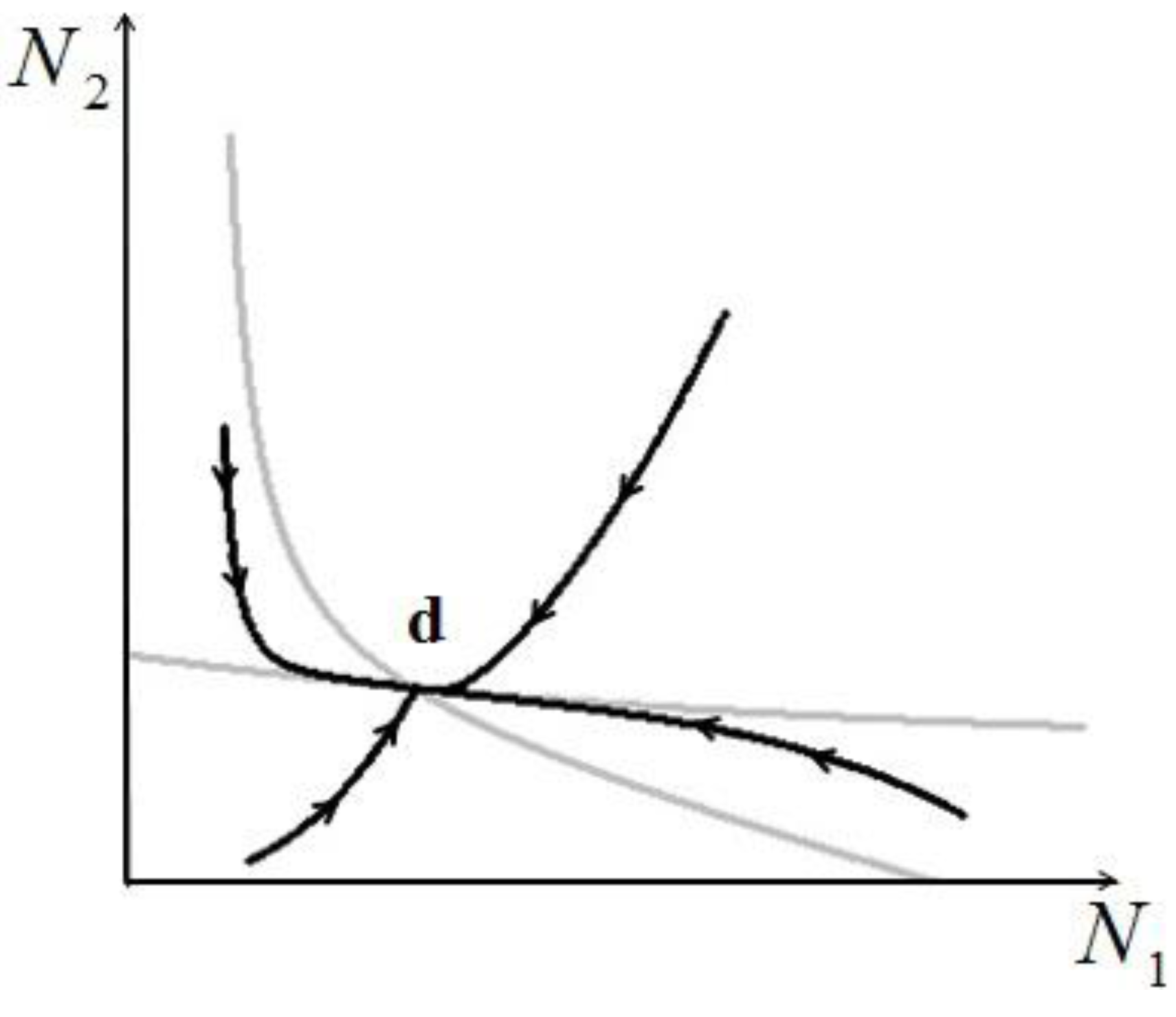
        <p>A plot of trajectories corresponding to initial values in the four different regions is given in <xref ref-type="fig" rid="sustainability-04-02611-f010">Figure 10</xref>. </p>
        <fig id="sustainability-04-02611-f010" position="anchor">
          <label>Figure 10</label>
          <caption>
            <p>Four different orbits for the general case.</p>
          </caption>
          <graphic xmlns:xlink="http://www.w3.org/1999/xlink" xlink:href="sustainability-04-02611-g010.tif"/>
        </fig>
        <p>It is apparent from Equation 20 that the value of <bold>θ<sub>+</sub></bold> is independent of <italic>Ė</italic><sub>in</sub>: this is a strong constraint on the system because it means that the asymptotic value of the ratio <inline-graphic xmlns:xlink="http://www.w3.org/1999/xlink" xlink:href="sustainability-04-02611-i060.tif"/> is also independent of <italic>Ė</italic><sub>in</sub> and depends only on the parameters characterizing the species and their interaction (competition-cooperation). From a mathematically point of view this property of the solution is tautologic, but the question of whether a real system actually possesses this attribute is indeed far from obvious: since the ratio <inline-graphic xmlns:xlink="http://www.w3.org/1999/xlink" xlink:href="sustainability-04-02611-i060.tif"/> and <italic>Ė</italic><sub>in</sub> are easily measurable in field experiments, the above constraint is suggesting a possible experimental “check” on the model. In a future paper we plan to examine some of the available experimental result in order to verify whether this statement is falsifiable.</p>
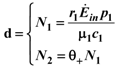
        <p>Let us now briefly discuss the case <inline-graphic xmlns:xlink="http://www.w3.org/1999/xlink" xlink:href="sustainability-04-02611-i056.tif"/>. Looking at <xref ref-type="fig" rid="sustainability-04-02611-f007">Figure 7</xref> now the two points marked with black dots on the <italic>N<sub>1</sub></italic> axis coincide, so that the curve dividing the semi-plane into two regions becomes a straight line, and the intersection point is now given by:</p>
        <disp-formula id="sustainability-04-02611-i023">	<inline-graphic xmlns:xlink="http://www.w3.org/1999/xlink" xlink:href="sustainability-04-02611-i023.tif"/>		 
	  <label>(23)</label>
	  </disp-formula>
        <p>where <bold>θ<sub>+</sub></bold> is given by Equation 20. In this case the equation for <italic>N</italic><sub>1</sub> decouples, since we have:</p>
        <disp-formula id="sustainability-04-02611-i024">	<inline-graphic xmlns:xlink="http://www.w3.org/1999/xlink" xlink:href="sustainability-04-02611-i024.tif"/>		 
	  <label>(24)</label>
	  </disp-formula>
        <p>This is the same equation as the first of (14). In that case species 1 (the host), having no competitors, fed on all of the available exergy flow, so that after discharges and destructions are taken into account, its net exergy income was <italic>Ė</italic><sub>1</sub> = <italic>Ė</italic><sub>in</sub><italic>p</italic><sub>1</sub> (see Equation 4). On the contrary, in this case, <italic>N</italic><sub>1</sub> captures only a fraction of the environmental exergy at its disposal, the complementary fraction being taken by species 2; but there is another “resource” flow coming from the fraction of the exergy of species 2 discharge “recycled” from species 1 and these two flows, because of <inline-graphic xmlns:xlink="http://www.w3.org/1999/xlink" xlink:href="sustainability-04-02611-i056.tif"/>, sum up just to <italic>Ė</italic><sub>in</sub><italic>p</italic><sub>1</sub>. This is a rather special situation but it is interesting to note how the equation for <italic>N</italic><sub>1</sub> decouples. In contrast to the second of (15), however, the equation for <inline-graphic xmlns:xlink="http://www.w3.org/1999/xlink" xlink:href="sustainability-04-02611-i063.tif"/><sub>2</sub> depends on both populations, so we cannot give analytical results as in that case. It is clear however that the qualitative dynamics cannot differ much from the general case. </p>
      </sec>
    </sec>
    <sec sec-type="conclusions">
      <title>3. Conclusions</title>
      <p>The first conclusion that can be derived from the arguments developed in this paper is that the axiom that is at the foundation of our reasoning, namely that resource consumption (material and immaterial) can be completely and unambiguously quantified in terms of exergy flows, is a convenient and fruitful working hypothesis. The model of population dynamics derived from such axiom results in strongly coupled and intrinsically non-linear evolution equations. In this paper, the time evolution patterns of two species sharing an ecological niche have been studied under three different scenarios: indifference, commensalism and mutualism. Our results indicate that:</p>
      <list list-type="simple">
	  <list-item>
	  <p>− if the two species just coexist in the same niche without cooperating or preying on each other, their competition invariably leads (Section 2a) to the extinction of one of them, unless their genetic (<italic>r</italic>, <italic>μ</italic>), consumption (<italic>c</italic>, <italic>γ</italic>) and efficiency (<italic>p</italic>) parameters are in a very precise and delicately tuned balance, in which case the two species may coexist sustainably;</p>
      </list-item>
	  <list-item>
	  <p>− if one of the two species assumes a commensalistic type of behaviour (it feeds on the other’s discharges, Section 2b), then both species reach their respective carrying capacity limits;</p>
      </list-item>
	  <list-item>
	  <p>− if the two species display a mutualistic type of behaviour (each one feeds partially on the other’s discharges, Section 2c), then there is always a stable sustainable point and both populations survive.</p>
      </list-item>
	  </list>
	  <p>In all cases, the sustainability of the point in state-space of the surviving population(s) prescribes a certain well-identified numerosity.</p>
      <p>In spite of the apparent success of our model, caution ought to be exercised in generalizing its results: nature is far more complex than any complicated and non-linear model makes it appear, and the results presented here are but a basis—and an incentive!—for further study. In particular, the following problems need to be carefully addressed if this type of approach is brought down from a descriptive to an applicative or predictive level:</p>
	  <list list-type="simple">
	  <list-item>
      <p>1) <underline>Substitutability of exergy resources</underline>: our model explicitly lumps all of the “available” material and energy fluxes into the extended exergy inflow <bold><italic>Ė</italic><sub>in</sub></bold>. This poses no problem for the energy flows, but contains the implicit assumption that ALL material flows are perfectly substitutable. In the simplest case, consider an animal species that has access to two or three different sources of vegetable food: obviously, each vegetable has a different nutritive value for the species, but also a different extended exergy content. Thus, our model would predict that the “optimal choice” for the animal would be to feed on the lower-embodied exergy food with the highest nutritive value. But this prediction disregards preferences, spatial distribution, physical accessibility, and similar factors. For more complex behaviours (for instance, related to the human species), the choice between, say, bronze and iron to build spears is even more multi-faceted than implicitly posited by the model.</p>
	  </list-item>
	  <list-item>
      <p>2) Actual possibility of species reaching a stable stationary state: this is of course an extremely important point, because if two species in a single ecological niche reach a stable state (point d in <xref ref-type="fig" rid="sustainability-04-02611-f010">Figure 10</xref>), this is by definition a sustainable situation. For larger number of species and realistic conditions, the problem of the stability of such stationary states is of paramount importance, and has not been addressed here.</p>
	  </list-item>
	  <list-item>
      <p>3) Metadynamics: the model presented in this paper is spatially lumped and the niche in which the species thrive has “impermeable boundaries”. Immigration and emigration are completely neglected, as well as spatially varying distributions of <bold><italic>Ė</italic><sub>in</sub></bold>. While the former could be modeled by inserting an “immigration term” in Equations (6) and (7), the spatially lumped nature of the model is difficult to modify. One solution might be that of “discretizing” the domain, and apply the equations separately to different areas, accounting for the variation of <bold><italic>Ė</italic><sub>in</sub></bold> in each subdomain. This would make our model somewhat comparable to the so-called “patch” [<xref ref-type="bibr" rid="B10-sustainability-04-02611">10</xref>] or “incidence function” models [<xref ref-type="bibr" rid="B11-sustainability-04-02611">11</xref>], but would also demand for very taxing numerical simulations, not considered here.</p>
      </list-item>
	  <list-item>
	  <p>4) <underline>Limiting factors (“exogenous factors” in [<xref ref-type="bibr" rid="B3-sustainability-04-02611">3</xref>])</underline>: while we maintain that (extended) exergy is a satisfactory indicator of species numerosity (in the sense that high exergy niches must logically and thermodynamically correspond to globally higher numerosities), it must be remarked that in real ecological niches there are phenomena occurring at some scales that affect the numerosity of species at a different scale [<xref ref-type="bibr" rid="B12-sustainability-04-02611">12</xref>]. Viral and fungal infections to which species <italic>N</italic> is insensitive may affect one or more of its food sources; growth of high-foliage trees with which a vegetable species does not compete for nutrients may reduce its share of solar irradiation, <italic>etc</italic>.: at the present state of development it is not clear whether and how our model may accommodate such effects (like in “tritrophic” or “multi-trophic” models [<xref ref-type="bibr" rid="B3-sustainability-04-02611">3</xref>]).</p>
      </list-item>
	  <list-item>
	  <p>5) Though not addressed in this paper, the application of our model raises a question that could be of paramount importance for practical applications: is the efficiency of one single species in the niche compatible with the overall energy-conversion efficiency of the same niche, considered as a lumped system? In other words, if two or more species reach a sustainable point (“d” in <xref ref-type="fig" rid="sustainability-04-02611-f010">Figure 10</xref>), do their respective numerosities satisfy both a local (for each species) and a global (for the entire niche) “optimal exergy use” criterion? This is a topic we have left for a future study.</p>
	  </list-item>
	  </list>
    </sec>
    
   
  </body>
  <back>
  

  <ack>
      <title>Acknowledgments</title>
      <p>One of the author (F.Z.) wishes to acknowledge the financial support received by the “Istituto Nazionale di Alta Matematica” (Italian National Institute for High Mathematics) under an INdAM-COFUND Marie Curie scholarship.</p>
    </ack>
    <notes>
      <title>Conflict of Interest</title>
      <p>The authors declare no conflict of interest. </p>
    </notes>
	 <app-group>
	<app>
	<title>Appendix 1</title>
      <p>Suppose indeed that the solution remains always in region I. Then both <italic>N</italic><sub>1</sub> and <italic>N</italic><sub>2</sub> are bounded functions, <inline-graphic xmlns:xlink="http://www.w3.org/1999/xlink" xlink:href="sustainability-04-02611-i061.tif"/> and <inline-graphic xmlns:xlink="http://www.w3.org/1999/xlink" xlink:href="sustainability-04-02611-i062.tif"/>. But in this region these functions are also increasing; they must approach asymptotically a limit, say the point (<italic>x</italic> = <inline-graphic xmlns:xlink="http://www.w3.org/1999/xlink" xlink:href="sustainability-04-02611-i047.tif"/>, <inline-graphic xmlns:xlink="http://www.w3.org/1999/xlink" xlink:href="sustainability-04-02611-i048.tif"/>). This means that <italic>x</italic> is an equilibrium point. But the only equilibrium points are given in <xref ref-type="table" rid="sustainability-04-02611-t001">Table 1</xref>, and <italic>x</italic> cannot be any of these points since <italic>N</italic><sub>1</sub> and <italic>N</italic><sub>2</sub> are increasing functions. So the solution will leave the region I at some time <italic>t</italic>. </p>
      <p>Now suppose that for some <italic>t</italic><sub>1</sub> the solution is in region II and that at some subsequent time it will leave this region. To do this, it has to cross either line <italic>s</italic><sub>1</sub> or line <italic>s</italic><sub>2</sub>. Suppose that it crosses <italic>s</italic><sub>1</sub> at <italic>t</italic> = <italic>t</italic><sup>*</sup>. Then <inline-graphic xmlns:xlink="http://www.w3.org/1999/xlink" xlink:href="sustainability-04-02611-i063.tif"/><sub>1</sub>(<italic>t</italic><sup>*</sup>) = 0. For the second derivative of <inline-graphic xmlns:xlink="http://www.w3.org/1999/xlink" xlink:href="sustainability-04-02611-i063.tif"/><sub>1</sub> at <italic>t</italic> = <italic>t</italic><sup>*</sup> we have (since <inline-graphic xmlns:xlink="http://www.w3.org/1999/xlink" xlink:href="sustainability-04-02611-i063.tif"/><sub>2</sub>(<italic>t</italic><sup>*</sup>) &lt; 0):</p>
       <p><inline-graphic xmlns:xlink="http://www.w3.org/1999/xlink" xlink:href="sustainability-04-02611-i025.tif"/></p>	
      <p>so that <italic>N</italic><sub>1</sub> has a minimum for <italic>t</italic> = <italic>t</italic><sup>*</sup>. However this cannot be true because <italic>N</italic><sub>1</sub> is an increasing function in region II. So the hypothesis that the solution crosses the line <italic>s</italic><sub>1</sub> must be false. Suppose instead that it crosses the line <italic>s</italic><sub>2</sub> at <italic>t</italic> = <italic>t</italic><sup>*</sup>. Then <inline-graphic xmlns:xlink="http://www.w3.org/1999/xlink" xlink:href="sustainability-04-02611-i063.tif"/><sub>2</sub>(<italic>t</italic><sup>*</sup>) = 0. The second derivative of <italic>N</italic><sub>2</sub> at <italic>t</italic> = <italic>t</italic><sup>*</sup> is given by:</p>
      <p><inline-graphic xmlns:xlink="http://www.w3.org/1999/xlink" xlink:href="sustainability-04-02611-i026.tif"/></p>	
      <p>and is negative because of <inline-graphic xmlns:xlink="http://www.w3.org/1999/xlink" xlink:href="sustainability-04-02611-i063.tif"/><sub>1</sub>(<italic>t</italic><sup>*</sup>) &gt; 0. So <italic>N</italic><sub>2</sub> has a maximum at <italic>t</italic> = <italic>t</italic><sup>*</sup>, but again this cannot be the case since <italic>N</italic><sub>2</sub> is a decreasing function in region II.</p>
	  </app>
	</app-group>
  
    <ref-list>
      <title>References</title>
      <ref id="B1-sustainability-04-02611">
        <label>1.</label>
        <citation citation-type="journal">
          <person-group person-group-type="author">
            <name>
              <surname>Benton</surname>
              <given-names>T.G.</given-names>
            </name>
            <name>
              <surname>Plaistow</surname>
              <given-names>S.J.</given-names>
            </name>
            <name>
              <surname>Coulson</surname>
              <given-names>T.N.</given-names>
            </name>
          </person-group>
          <article-title>Complex population dynamics and complex causation: Devils, details and demography</article-title>
          <source>Proc. R. Soc. B</source>
          <year>2006</year>
          <volume>273</volume>
          <fpage>1173</fpage>
          <lpage>1181</lpage>
          <pub-id pub-id-type="doi">10.1098/rspb.2006.3495</pub-id>
        </citation>
      </ref>
      <ref id="B2-sustainability-04-02611">
        <label>2.</label>
        <citation citation-type="book">
          <person-group person-group-type="author">
            <name>
              <surname>Hanski</surname>
              <given-names>I.</given-names>
            </name>
          </person-group>
          <source>Metapopulation Dynamics</source>
          <publisher-name>Oxford University Press</publisher-name>
          <publisher-loc>Oxford, UK</publisher-loc>
          <year>1999</year>
        </citation>
      </ref>
      <ref id="B3-sustainability-04-02611">
        <label>3.</label>
        <citation citation-type="book">
          <person-group person-group-type="author">
            <name>
              <surname>Turchin</surname>
              <given-names>P.</given-names>
            </name>
          </person-group>
          <source>Complex Population Dynamics: A Theoretical/Empirical Synthesis</source>
          <publisher-name>Cambridge University Press</publisher-name>
          <publisher-loc>Cambridge, UK</publisher-loc>
          <year>2003</year>
        </citation>
      </ref>
      <ref id="B4-sustainability-04-02611">
        <label>4.</label>
        <citation citation-type="journal">
          <person-group person-group-type="author">
            <name>
              <surname>Sciubba</surname>
              <given-names>E.</given-names>
            </name>
            <name>
              <surname>Zullo</surname>
              <given-names>F.</given-names>
            </name>
          </person-group>
          <article-title>Exergy-based population dynamics: A thermodynamic view of the “sustainability” concept</article-title>
          <source>J. Ind. Ecol.</source>
          <year>2011</year>
          <volume>15</volume>
          <fpage>172</fpage>
          <lpage>184</lpage>
          <pub-id pub-id-type="doi">10.1111/j.1530-9290.2010.00309.x</pub-id>
        </citation>
      </ref>
      <ref id="B5-sustainability-04-02611">
        <label>5.</label>
        <citation citation-type="journal">
          <person-group person-group-type="author">
            <name>
              <surname>Sciubba</surname>
              <given-names>E.</given-names>
            </name>
            <name>
              <surname>Zullo</surname>
              <given-names>F.</given-names>
            </name>
          </person-group>
          <article-title>Is sustainability a thermodynamic concept?</article-title>
          <source>IJEX</source>
          <year>2011</year>
          <volume>8</volume>
          <fpage>68</fpage>
          <lpage>85</lpage>
        <pub-id pub-id-type="doi">10.1504/IJEX.2011.037215</pub-id></citation>
      </ref>
      <ref id="B6-sustainability-04-02611">
        <label>6.</label>
        <citation citation-type="journal">
          <person-group person-group-type="author">
            <name>
              <surname>Sciubba</surname>
              <given-names>E.</given-names>
            </name>
          </person-group>
          <article-title>Beyond thermoeconomics? The concept of extended exergy accounting and its application to the analysis and design of thermal systems</article-title>
          <source>IJEX</source>
          <year>2001</year>
          <volume>1</volume>
          <fpage>68</fpage>
          <lpage>84</lpage>
        </citation>
      </ref>
      <ref id="B7-sustainability-04-02611">
        <label>7.</label>
        <citation citation-type="journal">
          <person-group person-group-type="author">
            <name>
              <surname>Sciubba</surname>
              <given-names>E.</given-names>
            </name>
          </person-group>
          <article-title>What did Lotka really say?</article-title>
          <source>Ecol. Modelling</source>
          <year>2009</year>
          <volume>222</volume>
          <fpage>1347</fpage>
          <lpage>1353</lpage>
          <pub-id pub-id-type="doi">10.1016/j.ecolmodel.2011.02.002</pub-id>
        </citation>
      </ref>
      <ref id="B8-sustainability-04-02611">
        <label>8.</label>
        <citation citation-type="book">
          <person-group person-group-type="author">
            <name>
              <surname>Jørgensen</surname>
              <given-names>S.E.</given-names>
            </name>
          </person-group>
          <source>Fundamentals of Ecological Modeling</source>
          <person-group person-group-type="editor">
            <name>
              <surname>Fath</surname>
              <given-names>B.</given-names>
            </name>
            <name>
              <surname>Jørgensen</surname>
              <given-names>S.E.</given-names>
            </name>
          </person-group>
          <publisher-name>Elsevier</publisher-name>
          <publisher-loc>Oxford, UK</publisher-loc>
          <year>2011</year>
        </citation>
      </ref>
      <ref id="B9-sustainability-04-02611">
        <label>9.</label>
        <citation citation-type="journal">
          <person-group person-group-type="author">
            <name>
              <surname>Kareiva</surname>
              <given-names>P.</given-names>
            </name>
            <name>
              <surname>Mullen</surname>
              <given-names>A.</given-names>
            </name>
            <name>
              <surname>Southwood</surname>
              <given-names>R.</given-names>
            </name>
          </person-group>
          <article-title>Population dynamics in spatially complex environments: Theory and data and discussion</article-title>
          <source>Phil. Trans. R. Soc. Lond.</source>
          <year>1990</year>
          <volume>330</volume>
          <fpage>175</fpage>
          <lpage>190</lpage>
        <pub-id pub-id-type="doi">10.1098/rstb.1990.0191</pub-id></citation>
      </ref>
      <ref id="B10-sustainability-04-02611">
        <label>10.</label>
        <citation citation-type="book">
          <person-group person-group-type="author">
            <name>
              <surname>Diamond</surname>
              <given-names>J.M.</given-names>
            </name>
            <name>
              <surname>May</surname>
              <given-names>R.M.</given-names>
            </name>
          </person-group>
          <article-title>Island Biogeography and the Design of Natural Reserves</article-title>
          <source>Theoretical Ecology</source>
          <person-group person-group-type="editor">
            <name>
              <surname>May</surname>
              <given-names>R.M</given-names>
            </name>
          </person-group>
          <publisher-name>Blackwell Pub.</publisher-name>
          <publisher-loc>Oxford, UK</publisher-loc>
          <year>1981</year>
          <fpage>228</fpage>
          <lpage>252</lpage>
        </citation>
      </ref>
      <ref id="B11-sustainability-04-02611">
        <label>11.</label>
        <citation citation-type="journal">
          <person-group person-group-type="author">
            <name>
              <surname>Durrett</surname>
              <given-names>R.</given-names>
            </name>
            <name>
              <surname>Levin</surname>
              <given-names>S.</given-names>
            </name>
          </person-group>
          <article-title>The importance of being discrete and spatial</article-title>
          <source>Theoretical Popul. Bio.</source>
          <year>1994</year>
          <volume>46</volume>
          <fpage>363</fpage>
          <lpage>394</lpage>
          <pub-id pub-id-type="doi">10.1006/tpbi.1994.1032</pub-id>
        </citation>
      </ref>
      <ref id="B12-sustainability-04-02611">
        <label>12.</label>
        <citation citation-type="book">
          <person-group person-group-type="author">
            <name>
              <surname>Williamson</surname>
              <given-names>M.</given-names>
            </name>
          </person-group>
          <source>The Analysis of Biological Populations</source>
          <publisher-name>Edward Arnold Pub.</publisher-name>
          <publisher-loc>London, UK</publisher-loc>
          <year>1971</year>
        </citation>
      </ref>
    </ref-list>
	</back>
</article>