
<?xml version="1.0" encoding="UTF-8"?>
<!DOCTYPE article PUBLIC "-//NLM//DTD Journal Publishing DTD v2.3 20070202//EN" "journalpublishing.dtd">
<article xmlns:xlink="http://www.w3.org/1999/xlink" xml:lang="en" article-type="research-article">
<front>
<journal-meta>
<journal-id journal-id-type="publisher-id">sustainability</journal-id>
<journal-title>sustainability</journal-title>
<issn pub-type="epub">2071-1050</issn>
<publisher>
<publisher-name>Molecular Diversity Preservation International (MDPI)</publisher-name></publisher></journal-meta>
<article-meta>
<article-id pub-id-type="doi">10.3390/su3122358</article-id>
<article-id pub-id-type="publisher-id">sustainability-03-02358</article-id>
<article-categories>
<subj-group>
<subject>Article</subject></subj-group></article-categories>
<title-group>
<article-title>An Edible Energy Return on Investment (EEROI) Analysis of Wheat and Rice in Pakistan</article-title></title-group>
<contrib-group>
<contrib contrib-type="author">
<name><surname>Pracha</surname><given-names>Ali S.</given-names></name><xref ref-type="aff" rid="af1-sustainability-03-02358"><sup>1</sup></xref><xref ref-type="corresp" rid="c1-sustainability-03-02358"><sup>*</sup></xref></contrib>
<contrib contrib-type="author">
<name><surname>Volk</surname><given-names>Timothy A.</given-names></name><xref ref-type="aff" rid="af2-sustainability-03-02358"><sup>2</sup></xref></contrib></contrib-group>
<aff id="af1-sustainability-03-02358">
<label>1</label> Centre for Policy and Environment (CPE), Lahore School of Economics (LSE), Main Campus, Intersection Main Boulevard Phase VI DHA and Burki Rd., Burki 53200, Lahore, Pakistan</aff>
<aff id="af2-sustainability-03-02358">
<label>2</label> Department of Forestry and Natural Resources Management, State University of New York, College of Environmental Science and Forestry (SUNY ESF), 1 Forestry Drive, Syracuse, NY 13210, USA; E-Mail: <email>tavolk@esf.edu</email></aff>
<author-notes>
<corresp id="c1-sustainability-03-02358">
<label>*</label>Author to whom correspondence should be addressed; E-Mail: <email>aspracha@lahoreschool.edu.pk</email>; Tel.: +92-300-517-6845; Fax: +92-42-3656-0905.</corresp></author-notes>
<pub-date pub-type="collection">
<year>2011</year></pub-date>
<pub-date pub-type="epub">
<day>08</day>
<month>12</month>
<year>2011</year></pub-date>
<volume>3</volume>
<issue>12</issue>
<fpage>2358</fpage>
<lpage>2391</lpage>
<history>
<date date-type="received">
<day>31</day>
<month>10</month>
<year>2011</year></date>
<date date-type="accepted">
<day>08</day>
<month>11</month>
<year>2011</year></date></history>
<permissions>
<copyright-statement>© 2011 by the authors; licensee MDPI, Basel, Switzerland.</copyright-statement>
<copyright-year>2011</copyright-year>
<license>
<p>This article is an open access article distributed under the terms and conditions of the Creative Commons Attribution license (http://creativecommons.org/licenses/by/3.0/).</p></license></permissions>
<abstract>
<p>Agriculture is the largest sector of Pakistan's economy, contributing almost 22% to the GDP and employing almost 45% of the total labor force. The two largest food crops, wheat and rice, contribute 3.1% and 1.4% to the GDP, respectively. The objective of this research was to calculate the energy return on investment (EROI) of these crops on a national scale from 1999 to 2009 to understand the size of various energy inputs and to discuss their contributions to the energy output. Energy inputs accounted for within the cropping systems included seed, fertilizer, pesticide, human labor, tractor diesel, irrigation pump electricity and diesel, the transport of fertilizer and pesticide, and the embodied energy of tractors and irrigation pumps. The largest per-hectare energy inputs to wheat were nitrogen fertilizer (52.6%), seed (17.9%), and tractor diesel (9.1%). For rice, the largest per-hectare energy inputs were nitrogen fertilizer (32%), tube well diesel (19.8%), and pesticide (17.6%). The EROI of wheat showed a gradual downward trend between 2000 and 2006 of 21.3%. The trend was erratic thereafter. Overall, it ranged from 2.7 to 3.4 with an average of 2.9 over the 11-year study period. The overall trend was fairly consistent compared to that of rice which ranged between 3.1 and 4.9, and averaged 3.9. Rice's EROI dipped sharply in 2002, was erratic, and remained below four until 2007. It rose sharply after that. As energy inputs increased, wheat outputs increased, but rice outputs decreased slightly. Rice responded to inputs with greater output and an increase in EROI. The same was not true for wheat, which showed little change in EROI in the face of increasing inputs. This suggests that additional investments of energy in rice production are not improving yields but for wheat, these investments are still generating benefits. The analysis shows quantitatively how fossil energy is a key driver of the Pakistani agricultural system as it traces direct and indirect energy inputs to two major food crops.</p></abstract>
<kwd-group>
<kwd>energy return on investment</kwd>
<kwd>per-hectare energy usage</kwd>
<kwd>wheat/rice output energy</kwd>
<kwd>wheat/rice input energy</kwd></kwd-group></article-meta></front>
<body>
<sec sec-type="intro">
<label>1.</label>
<title>Introduction</title>
<p>Traditional economic analyses make use of commodity market prices, buyer preferences, and energy prices (which themselves are influenced by multiple factors). “Energy” is a significant driver of economic growth and therefore key to understanding how agricultural systems function. This analysis aims to trace direct and indirect energy inputs into two major food crops in Pakistan. It also shows the energy return on investment (EROI) over time to explain the relationship between energy inputs and final output. It is different from conventional economic analysis because it utilizes real energy units rather than manmade prices. It accounts for human labor energy inputs and recognizes the energy input behind fertilizer and pesticide inputs. It incorporates the unique “embodied energy” concept where the energy used to manufacture inputs is accounted for. Furthermore, it accounts for the inefficiencies in the production of electricity. These are all elements that conventional economic analyses are unable to incorporate.</p>
<p>Pakistan is located in South Asia and borders the Arabian Sea to the south, India to the east, Iran and Afghanistan to the west, and China to the northeast. The total land area is 79.6 million hectares (ha), slightly less than twice the size of the state of California in the US. The country's climate is mostly hot in the flat Indus plains, temperate in the northwest, and “arctic” in the north [<xref ref-type="bibr" rid="b1-sustainability-03-02358">1</xref>]. Mineral resources include iron ore, copper, salt, gold, limestone, poor quality coal, extensive natural gas reserves and limited amounts of petroleum [<xref ref-type="bibr" rid="b1-sustainability-03-02358">1</xref>].</p>
<p>With a population of approximately 166 million [<xref ref-type="bibr" rid="b2-sustainability-03-02358">2</xref>], Pakistan's per-capita gross domestic product (GDP) in 2009 was USD 2,500 [<xref ref-type="bibr" rid="b1-sustainability-03-02358">1</xref>]. Its Gini index ranking in 2008 stood at 109 (Sweden's topped the list at 30.6) [<xref ref-type="bibr" rid="b3-sustainability-03-02358">3</xref>].</p>
<p>Pakistan's important export partners are the US, the UAE, Afghanistan, the UK, and China. Exports totaled approximately USD 14.4 billion in 2009 and included items such as “textiles (garments, bed linen, cotton cloth, yarn), rice, leather goods, sports goods, chemicals, manufactures, carpets and rugs” [<xref ref-type="bibr" rid="b1-sustainability-03-02358">1</xref>]. Major import partners are China, Saudi Arabia, the UAE, the US, Kuwait, Malaysia, and India. Import items totaled approximately USD 28.5 billion in 2009 and included “petroleum, petroleum products, machinery, plastics, transportation equipment, edible oils, paper and paperboard, iron and steel, tea.” [<xref ref-type="bibr" rid="b1-sustainability-03-02358">1</xref>].</p>
<p>Agriculture has always been the largest sector of Pakistan's economy, contributing approximately 22% to the GDP and employing almost 45% of the total labor force ([<xref ref-type="bibr" rid="b4-sustainability-03-02358">4</xref>] p. 13). However, growth in the sector has been falling for the last 30 years; investments in important agricultural technologies such as water infrastructure and seed are low ([<xref ref-type="bibr" rid="b4-sustainability-03-02358">4</xref>] p. 13).</p>
<p>Value-added growth (post-harvest processing to add value) in the sector is erratic, due mainly to “major crops” such as wheat and rice (<xref ref-type="table" rid="t1-sustainability-03-02358">Table 1</xref>). Agricultural growth figures are often “rescued” by the relative successes of livestock, fisheries, and higher-value minor crops. The fluctuation in these figures is not necessarily a good indicator of crop performance because of the multiple forces that influence prices and markets of commodities. Utilizing EROI analysis helps provide insights that conventional economic analyses do not.</p>
<p>Wheat and rice enjoy an important status among food crops in Pakistan. Wheat is the staple food crop of the country, while Pakistani <italic>basmati</italic> rice is known for its long-grained appearance and distinguished by its aroma [<xref ref-type="bibr" rid="b7-sustainability-03-02358">7</xref>]. Pakistan ranked sixth in the world in wheat production in 2009 [<xref ref-type="bibr" rid="b8-sustainability-03-02358">8</xref>]. However, the country still requires wheat imports to fulfill demand most years; Pakistan imported wheat seven times between 1999 and 2009 ([<xref ref-type="bibr" rid="b9-sustainability-03-02358">9</xref>], p. 205). Domestic wheat production has risen over time, but per capita availability has fluctuated considerably. Wheat and rice contribute 3.1% and 1.4% to the GDP, respectively ([<xref ref-type="bibr" rid="b4-sustainability-03-02358">4</xref>], p. 19). Pakistan's total cultivated area was 23.8 million ha in 2009, of which wheat and rice occupied approximately 38.0% and 12.5% respectively (calculated from [<xref ref-type="bibr" rid="b9-sustainability-03-02358">9</xref>], pp. 3, 13, 108–110).</p>
<p>Wheat (<italic>Triticum aestivum L.</italic>) yields averaged 2.4 tonnes per hectare (t ha<sup>−1</sup>) between 1999 and 2009 (calculated from [<xref ref-type="bibr" rid="b9-sustainability-03-02358">9</xref>], pp. 3–4). Wheat is a <italic>rabi</italic> or winter crop, <italic>i.e.</italic>, it is sown between October and December, and harvested between April and May ([<xref ref-type="bibr" rid="b4-sustainability-03-02358">4</xref>], p. 15), and often grows in rotation with rice, cotton, maize, sugarcane, pulses, and fallow land [<xref ref-type="bibr" rid="b10-sustainability-03-02358">10</xref>]. Like most agriculture in Pakistan, wheat production is highly dependent on irrigation ([<xref ref-type="bibr" rid="b4-sustainability-03-02358">4</xref>], p. 14). On average, <italic>barani</italic> or rain-fed wheat accounts for only 6.5% of total wheat production (calculated from [<xref ref-type="bibr" rid="b9-sustainability-03-02358">9</xref>], p. 10–11).</p>
<p>Domestic rice (<italic>Oryza sativa L.</italic>) yields averaged 2.1 t ha<sup>−1</sup> between 1999 and 2009 (calculated from [<xref ref-type="bibr" rid="b9-sustainability-03-02358">9</xref>], p. 14). It is a major cash crop and both consumed locally and exported. Rice is a <italic>kharif</italic> or summer crop sown between April and June, and harvested between October and December ([<xref ref-type="bibr" rid="b4-sustainability-03-02358">4</xref>], p. 15). Like wheat, rice in Pakistan is heavily dependent on irrigation. The entire crop (with the exception of a very small area in the mountainous region) is usually grown in irrigated or partially irrigated systems [<xref ref-type="bibr" rid="b11-sustainability-03-02358">11</xref>].</p>
<p>Rainfall patterns are erratic, so the country's agriculture depends heavily on irrigation water. The monsoon rains of July–September are essential for recharging reservoirs and lakes that feed into rivers, and subsequently the canal irrigation system. Global El Niño weather systems generally weaken the monsoon rains in South Asia [<xref ref-type="bibr" rid="b12-sustainability-03-02358">12</xref>] and can adversely influence agriculture. For example, in 1997 during an El Niño event, there was insufficient moisture until August (rice is sown between April and June), followed by severe floods and landslides [<xref ref-type="bibr" rid="b13-sustainability-03-02358">13</xref>].</p>
<sec>
<label>1.1.</label>
<title>Agricultural Inputs in Pakistan</title>
<p>Fertilizer is used extensively in Pakistan, and the amount used has risen from 2.6 million nutrient tonnes in 1999 to 3.7 million nutrient tonnes in 2009. The ratio between nitrogen, phosphorus, and potassium-based fertilizers (N:P:K ratio) averaged 1:0.28:0.01 from 1998 to 2007 (calculated from [<xref ref-type="bibr" rid="b14-sustainability-03-02358">14</xref>], p. 61). This is also supported by the Food and Agriculture Organization (FAO) [<xref ref-type="bibr" rid="b15-sustainability-03-02358">15</xref>]. Potash application has been low historically, and only two percent of farmers countrywide actually apply it [<xref ref-type="bibr" rid="b15-sustainability-03-02358">15</xref>]. This is further supported by scattered wheat and rice-specific figures supplied by FAO and International Fertilizer Industry Association (IFA) sources that show exceptionally low figures ranging from 0.7–3.5 kg ha<sup>−1</sup> on wheat and 0.2–1.0 kg ha<sup>−1</sup> on rice in various years since 1989 (with the exception of 1992–1993 where potash application was high at 11.3 kg ha<sup>−1</sup>) [<xref ref-type="bibr" rid="b16-sustainability-03-02358">16</xref>-<xref ref-type="bibr" rid="b20-sustainability-03-02358">20</xref>].</p>
<p>Pesticide application on crops in Pakistan began to expand in the early 1980s, increasing from 3,500 tonnes in 1981 [<xref ref-type="bibr" rid="b21-sustainability-03-02358">21</xref>] and growing by a factor of 27 to 94,265 tonnes in 2007 ([<xref ref-type="bibr" rid="b9-sustainability-03-02358">9</xref>], p. 150). Much of Pakistan's pesticide was imported until the late 1990s, but now domestic production exceeds 60% of the amount used annually [<xref ref-type="bibr" rid="b21-sustainability-03-02358">21</xref>]. In Pakistan, most “pesticide” is insecticide applied largely to cotton and rice [<xref ref-type="bibr" rid="b22-sustainability-03-02358">22</xref>]. Wheat is the largest user of herbicide against grasses such as little seed canary grass (<italic>Phalaris minor</italic>) which, in Pakistan, is said to reduce wheat yields by 15–20% in the absence of herbicides [<xref ref-type="bibr" rid="b22-sustainability-03-02358">22</xref>]. Forty-eight percent of farmers believe that pesticide is a necessary input to increase crop yield [<xref ref-type="bibr" rid="b22-sustainability-03-02358">22</xref>]. However, the same survey shows that 97% of farmers believe pesticides are adulterated [<xref ref-type="bibr" rid="b22-sustainability-03-02358">22</xref>].</p>
<p>Tractors have become the dominant mode of traction power in agriculture and bullock-operated farms are on the decline [<xref ref-type="bibr" rid="b23-sustainability-03-02358">23</xref>]. The number of tractors being used in Pakistan increased by a factor of 85 between 1961 and 2007 [<xref ref-type="bibr" rid="b24-sustainability-03-02358">24</xref>]. Most of the country's wheat crop is threshed with machines and mechanical rice husking is also on the rise [<xref ref-type="bibr" rid="b23-sustainability-03-02358">23</xref>]. Farmers who do not either own or rent tractors are few and far between [<xref ref-type="bibr" rid="b25-sustainability-03-02358">25</xref>]. In addition, recent data shows that 90% of farms use tractors in contrast to only 17% in 1972 [<xref ref-type="bibr" rid="b21-sustainability-03-02358">21</xref>]. This figure climbs to 96% in The Punjab and Sindh regions of Pakistan [<xref ref-type="bibr" rid="b21-sustainability-03-02358">21</xref>].</p>
<p>Given Pakistan's dry climate and low average rainfall, irrigation has been a major part of agriculture in the region since 3,000 BC. Canal irrigation sources include glaciers in the north, snowmelt, and rainfall outside the Indus Plains [<xref ref-type="bibr" rid="b21-sustainability-03-02358">21</xref>]. Groundwater is an integral part of irrigation; the canal system is becoming more of a groundwater recharge mechanism than a water delivery system [<xref ref-type="bibr" rid="b21-sustainability-03-02358">21</xref>]. This is especially true of The Punjab province where recharge from canals is responsible for 80% of pumped groundwater [<xref ref-type="bibr" rid="b26-sustainability-03-02358">26</xref>]. On average, groundwater accounted for 36.7% of available irrigation water between 1999 and 2010 (calculated from [<xref ref-type="bibr" rid="b9-sustainability-03-02358">9</xref>], p. 138-139).</p></sec>
<sec sec-type="methods">
<label>1.2.</label>
<title>Study Background and Basis</title>
<p>Energy analysis is not new to agriculture. The literature shows a vast quantity of research on the issue, especially for energy crops (ethanol) such as sugarcane and corn. Various writers including Shapouri and Salassi (2006) have performed energy analyses on agricultural systems [<xref ref-type="bibr" rid="b27-sustainability-03-02358">27</xref>]. The basic methodology is the same in most cases. What differs is the definition of “appropriate” input to the systems. Studies show EROI ratios for US corn-based ethanol both above and below one [<xref ref-type="bibr" rid="b28-sustainability-03-02358">28</xref>]. The reasons for these differences include the accounting of co-products, the exclusion of the embodied energy of equipment, and the use of internally-derived energy sources [<xref ref-type="bibr" rid="b28-sustainability-03-02358">28</xref>]. Defining study boundaries clearly is important and we define them for this study in Section 2.1.</p>
<p>Pakistan's agricultural sector shows an increasing dependence on fossil fuel inputs in the form of fertilizer, pesticide, and mechanization, a common trend worldwide. The 1960s and 1970s were characterized by massive yield increases [<xref ref-type="bibr" rid="b29-sustainability-03-02358">29</xref>] due to improved varieties, petroleum-based fertilizers and pesticides, irrigation, and diesel-driven tractors [<xref ref-type="bibr" rid="b30-sustainability-03-02358">30</xref>-<xref ref-type="bibr" rid="b32-sustainability-03-02358">32</xref>]. For example, nitrogen (N) fertilizer usage in Pakistan increased from an average of 36,000 tonnes in 1960–1963 to 326,000 tonnes in 1970–1973, to 876,000 tonnes in 1980–1983 [<xref ref-type="bibr" rid="b21-sustainability-03-02358">21</xref>]. The new crop varieties that were developed relied upon increasing amounts of fossil fuel inputs. Crosson and Brubaker (1982) stated with reference to new agricultural technologies that “Not only is the technology itself keyed to energy from fossil fuels, but the research establishment that developed the technology also is oriented to exploitation of this resource” [<xref ref-type="bibr" rid="b33-sustainability-03-02358">33</xref>]. The direct link between increased energy usage and increased agricultural output has been researched widely [<xref ref-type="bibr" rid="b34-sustainability-03-02358">34</xref>-<xref ref-type="bibr" rid="b37-sustainability-03-02358">37</xref>]. This notion has sparked debate on long-term yield viability and environmental degradation [<xref ref-type="bibr" rid="b38-sustainability-03-02358">38</xref>-<xref ref-type="bibr" rid="b40-sustainability-03-02358">40</xref>].</p>
<p>The relatively few studies on energy use in agriculture in Pakistan cover small districts using site-specific data. However, Jameel's (1982) study provides a detailed analysis of energy use in Pakistani agriculture. He found that fertilizer production accounted for 45% of all commercial energy supplied to the agricultural sector. Another 40% was used for irrigation and drainage [<xref ref-type="bibr" rid="b41-sustainability-03-02358">41</xref>].</p>
<p>A more recent Pakistani study examined energy use on sugar cane crops in Dera Ismail Khan District. It compared energy inputs to sugarcane yields and discovered that fertilizer and irrigation were the largest energy inputs. The results showed that energy consumption was higher on tractor-operated farms than bullock-operated farms by a factor of 1.2. The energy output-input ratios were marginally higher for bullock-operated farms [<xref ref-type="bibr" rid="b42-sustainability-03-02358">42</xref>]. Similarly, Khan and Singh (1996 and 1997) studied energy use on sugar cane and wheat in the same district [<xref ref-type="bibr" rid="b43-sustainability-03-02358">43</xref>,<xref ref-type="bibr" rid="b44-sustainability-03-02358">44</xref>]. However, all three analyses restricted the usage of “energy analysis” to direct use: human labor, animal power, diesel and electrical irrigation motors, and tractors. Furthermore, the premise of such studies was to compare energy usage and energy outputs between different categories of farms such as tractor-operated farms and bullock-operated farms. They found that per-hectare energy usage was the highest on farms using electrical or diesel-powered pumps for groundwater pumping. The output-input analysis showed that while crop yields were higher on irrigated farms, yield increases were <italic>not</italic> proportional to increases in energy input. This implies that farmers were investing large quantities of energy, but not harvesting proportional crop output. The reasons ranged from overwatering to excessive energy inputs to the point where they do not contribute positively to output. This is addressed in greater detail in section 4. Other studies in neighboring countries such as India [<xref ref-type="bibr" rid="b45-sustainability-03-02358">45</xref>-<xref ref-type="bibr" rid="b47-sustainability-03-02358">47</xref>] also quantified inputs (seed, fertilizer, pesticide) in energy terms. The purpose of such studies were generally the same, citing, for example, the need for an understanding of the fact that fertilizer and chemical pesticides are produced through fossil energy-intensive processes, and that perhaps yields could be increased or at least maintained through the judicious use of such inputs and the supplementation of inputs with farmyard manure [<xref ref-type="bibr" rid="b45-sustainability-03-02358">45</xref>].</p>
<p>To our knowledge, an energy analysis of the entire crop production system for the main crops grown in Pakistan has not been completed to date. The objective of this study therefore, is to perform an EROI analysis of the country's entire wheat and rice crops from 1999 to 2009 using extant secondary data, and to examine the size of the contribution of different inputs in relation to the output in total, and on a per-hectare basis. The purpose of this is to provide some insight on the trends in energy use and identify the main energy inputs. In addition, labor is represented unevenly in economic analyses because it is comparatively cheap in Asia and Pakistan. Considering it from an energy point of view removes this discrepancy. Furthermore, this analysis draws attention to the fact that fertilizer and pesticide are produced using highly energy intensive industrial processes. Price may not always reflect this adequately. This data can then be used to guide decisions about investments in the management of these cropping systems in a possibly energy-constrained future.</p></sec>
<sec>
<label>1.3.</label>
<title>Energy Return on Investment Review</title>
<p>The concept of quantifying energy inputs and comparing them to energy outputs is rooted in an energy accounting method called “net energy analysis” (NEA). The central idea of NEA is that net energy is the gross energy output resulting from a given process minus the energy required to obtain it [the gross energy] [<xref ref-type="bibr" rid="b48-sustainability-03-02358">48</xref>]. The output must be greater than the input (sometimes termed “feedback”) in order to be energetically feasible. Energy return on investment, on the other hand, studies the energy output and inputs by means of a ratio. It is generally applied to the mine-mouth, wellhead, or farm-gate [<xref ref-type="bibr" rid="b49-sustainability-03-02358">49</xref>]. Thus, an EROI ratio of 100:1 means that 100 units of energy are produced for every one unit of energy invested to locate, extract, produce, and upgrade the energy source or product being studied. By the strict logic of a 1:1 EROI, foods such as beef, chicken, eggs, cauliflower, winter tomatoes, lettuce, and various seafoods could be considered unfeasible as they commonly require more energy to grow, harvest, or catch, and deliver to consumers than their own energy content [<xref ref-type="bibr" rid="b38-sustainability-03-02358">38</xref>]. Thus, it should be understood that everything cannot be evaluated simply in reference to a greater-than-one EROI without considering the importance of the quality of the output. Human beings make specific choices where affluence often allows nutrition and palatability to overshadow simple energy return. Understanding and being aware of the implications of these choices in terms of energy is important in understanding how resources are allocated and used.</p>
<p>The NEA concept has existed in the US since the 1950s [<xref ref-type="bibr" rid="b50-sustainability-03-02358">50</xref>]. Conducting NEAs is required by the Federal Nonnuclear Energy Research and Development Act of 1977 and The Energy Security Act of 1980 [<xref ref-type="bibr" rid="b51-sustainability-03-02358">51</xref>,<xref ref-type="bibr" rid="b52-sustainability-03-02358">52</xref>]. Net energy analysis is commonly used to evaluate the feasibility of energy projects such as electricity generation plants and various renewable energy technologies. This method of energy analysis is well-defined, and NEA offers a basis for reducing and conserving input energies, guarantees the chance to evaluate net energy yields independent of economic risk questions, and allows comparisons between the net energy yields of specific industrial plants and processes [<xref ref-type="bibr" rid="b53-sustainability-03-02358">53</xref>].</p>
<p>The value of NEA as a tool for resource-use analysis is derived chiefly from the fact that it assesses <italic>physical</italic> resources and is therefore resistant to market imperfections that may distort monetary data [<xref ref-type="bibr" rid="b54-sustainability-03-02358">54</xref>]. However, historical energy data is not always available, and in some situations, monetary data must be used to infer energy values. It is believed that NEAs reflect real value more accurately than monetary metrics because they use specific energy units rather than dollars which are affected by such variables as time, markets, changing tastes, living standards, and public policies [<xref ref-type="bibr" rid="b52-sustainability-03-02358">52</xref>]. The US Comptroller General acknowledged that economic analyses were required to evaluate energy projects, but that “Dollar measurements do not substitute for NEA because they are not based on explicit physical energy requirements and because of imperfections in the energy marketplace” [<xref ref-type="bibr" rid="b53-sustainability-03-02358">53</xref>]. In addition, NEAs can often be used to point out where improvements can be made in system operations [<xref ref-type="bibr" rid="b52-sustainability-03-02358">52</xref>].</p>
<p>Many neoclassical economists dispute the value of NEA, arguing that they do not contribute much more additional useful information than does a thorough economic analysis [<xref ref-type="bibr" rid="b54-sustainability-03-02358">54</xref>]. Most analyses of agricultural output are indeed done in monetary terms. The question then is, why use energy terms instead, when a wealth of economic tools already exist for studying the feasibility and profitability of an economic activity?</p>
<p>Our justification for performing an EROI analysis is two-fold. First, as Hall <italic>et al.</italic> (1986) point out, “energy is the ultimate limiting resource” [<xref ref-type="bibr" rid="b38-sustainability-03-02358">38</xref>]. While it is incorrect to say that everything can be reduced to energy, it is important to understand that all material and most nonmaterial resources have an associated energy cost. Second, energy flows are governed by the irrefutable laws of thermodynamics formulated by Joule, Clausius, and Thomson. This implies that the flows of energy through an agricultural system are subject to energy “losses” which must be accounted for. Monetary measures are not subject to these natural laws, and money, unlike energy, can be generated indefinitely. As mentioned earlier, they are influenced by social forces related to the economy such as inflation, public policy, and markets [<xref ref-type="bibr" rid="b52-sustainability-03-02358">52</xref>].</p></sec></sec>
<sec>
<label>2.</label>
<title>Methodology</title>
<sec>
<label>2.1.</label>
<title>System Boundaries</title>
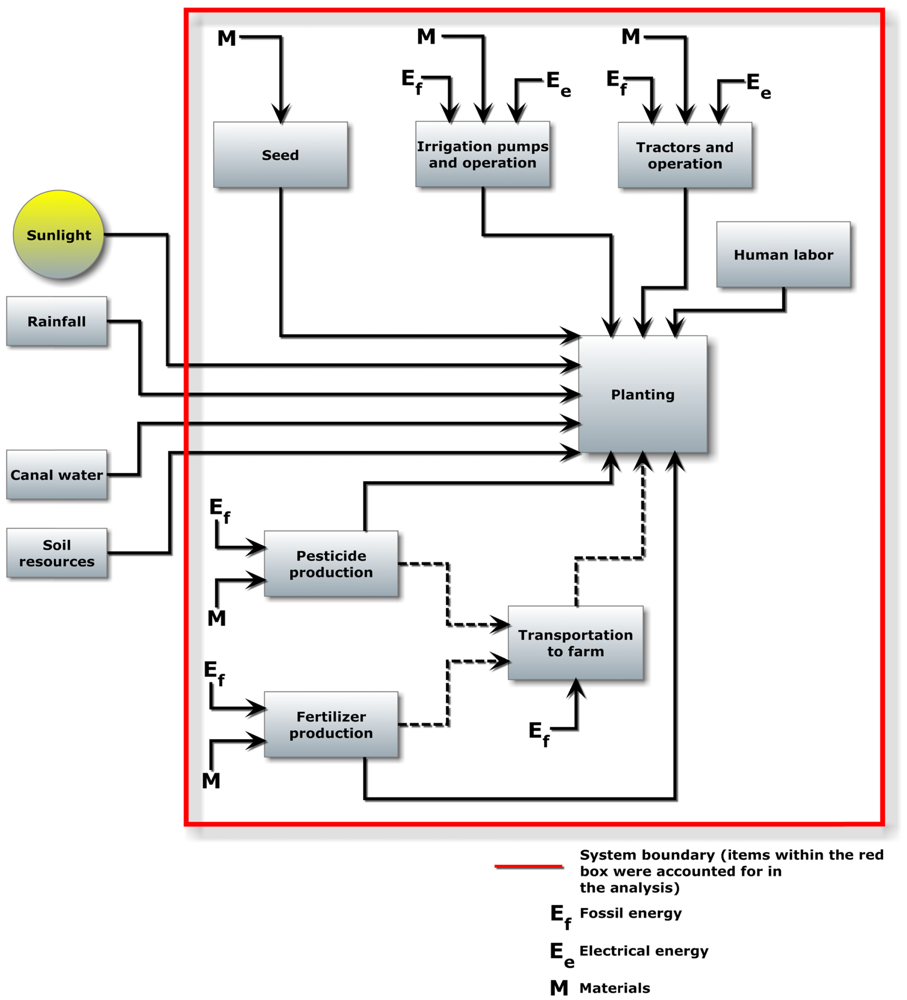
<p>Conducting an EROI analysis requires a clear definition of the system being studied, in this case the agricultural systems of wheat and rice in Pakistan, and the energy flows that are being measured. The energy inputs considered are the fossil fuel inputs needed to produce wheat and rice and the output is the energy stored in the harvested crops at the farm-gate. Crop residues have varied uses as well—such as fodder and fuel—and it is possible that accounting for them would increase EROI figures. However, this analysis is concerned only with the edible (human) energy produced in these systems. It is noteworthy that crop residues such as wheat straw, cotton stems, sugar cane trash/tops and rice husks are <italic>not</italic> recycled in the soil in Pakistan where they could add to soil fertility [<xref ref-type="bibr" rid="b15-sustainability-03-02358">15</xref>]. However, we have not accounted for this as relevant secondary data is not available. The energy inputs quantified in this system are seed, fertilizer, pesticide, the energy to operate tractors and tube wells and their embodied energy, the energy used to transport fertilizer and pesticide locally, and energy invested in the form of human labor (<xref ref-type="fig" rid="f1-sustainability-03-02358">Figure 1</xref>).</p>
<p>Inputs such as sunlight and rainfall are considered as natural inputs with no energy investment required by humans. Furthermore, as this is an energy analysis, there is the concern of resource depletion. The sun is considered an unlimited stock of energy whereas fossil fuels on earth are non-renewable, and therefore limited [<xref ref-type="bibr" rid="b55-sustainability-03-02358">55</xref>,<xref ref-type="bibr" rid="b56-sustainability-03-02358">56</xref>]. We excluded the sun for this reason. The output from the system is at the farm-gate, so post-harvest energy costs such as crop transport, storage, and processing were not included in this analysis [<xref ref-type="bibr" rid="b49-sustainability-03-02358">49</xref>]. Finally, environmental energy costs such as lost environmental services due to ecosystem degradation are beyond the ambit of this study, and while they are important for the long-term sustainability of these production systems, they were not included in this analysis.</p></sec>
<sec>
<label>2.2.</label>
<title>Determining Energy Values</title>
<p>Data on the energy inputs into the system are all expressed in terms of energy in joules (J). However, since input data for agriculture is seldom collected in terms of energy, we converted available data to energy units using established conversion factors, which are outlined below.</p>
<sec>
<label>2.2.1.</label>
<title>Seed Input</title>
<p>We used an energy content of 14.2 MJ kg<sup>−1</sup> for wheat seed [<xref ref-type="bibr" rid="b57-sustainability-03-02358">57</xref>]. Wheat seeding rates vary across the country depending on farmer awareness and access to technology—such as seed drills—and there is a lack of information on the extent of the different rates. We used a seeding rate of 150 kg ha<sup>−1</sup> that is cited as being widely used [<xref ref-type="bibr" rid="b58-sustainability-03-02358">58</xref>].</p>
<p>Categories of rice varieties in Pakistan are shown in available statistics as <italic>“basmati”</italic>, “Irri”, and “other” [<xref ref-type="bibr" rid="b9-sustainability-03-02358">9</xref>]. Again, as further information is not available, we selected an energy value of 14.2 MJ kg<sup>−1</sup> for <italic>basmati</italic> which is a mean value of the energy content of several popular brands of <italic>basmati</italic> rice available in Pakistan including “Aziz rice”, and two different packages each of “Guard rice” and “Reem rice” (energy values on branded rice packaging 2010). The Irri variety refers to various coarse-grained rice varieties which generally have slightly higher energy contents than <italic>basmati</italic> rice. We used a value of 15.3 MJ kg<sup>−1</sup> for coarse varieties [<xref ref-type="bibr" rid="b57-sustainability-03-02358">57</xref>]. The category “other” is planted in only 9.3% of total rice cropped area between 1999 and 2009 (calculated from [<xref ref-type="bibr" rid="b9-sustainability-03-02358">9</xref>], pp. 16-17). The fact that it occupies such a small percentage of the total cropped area, while <italic>basmati</italic> occupied almost 60% in most years, could mean that it refers to higher-energy rice varieties. <italic>Basmati's</italic> energy value is lower, but it is considered a cash crop and is exported worldwide for its palatability. The “other” category was therefore assigned the same energy value assigned to Irri varieties. The recommended seeding rates of 13.8 kg ha<sup>−1</sup> for <italic>basmati</italic> varieties and 22.2 kg ha<sup>−1</sup> for coarse varieties were used [<xref ref-type="bibr" rid="b59-sustainability-03-02358">59</xref>]. As there is no such information on “other”, we applied the higher seeding. We used static seeding rates across the country, therefore the amount of seed (and thus “seed energy”) varies annually depending on the amount of land cultivated for each crop or variety (<xref ref-type="table" rid="t2-sustainability-03-02358">Table 2</xref>). The calculation involved was <italic>“seeding rate (kg ha</italic><sup>−</sup><italic><sup>1</sup>)</italic> × <italic>land area (ha)</italic> × <italic>energy content of seed (MJ kg</italic><sup>−</sup><italic><sup>1</sup>).”</italic></p></sec>
<sec>
<label>2.2.2.</label>
<title>Fertilizer Input</title>
<p>The fertilizer usage rates used in this study are taken from government estimates, <italic>i.e.</italic>, wheat used 45.4%, and rice used 5.4% of all fertilizer applied in the country from 1997 to 2004. The government raised these estimates for subsequent years until 2008 to 50% for wheat and six percent for rice ([<xref ref-type="bibr" rid="b60-sustainability-03-02358">60</xref>], p. 62). We assumed that the same set of percentages that were applied from 2005 to 2008, apply to 2009 as well. Furthermore, government data assumes that these percentages for the amounts of total fertilizer extend to the amounts of nitrogen (N), phosphorus (P), and potassium (K) (cross-referenced between [<xref ref-type="bibr" rid="b9-sustainability-03-02358">9</xref>], p. 127 and [<xref ref-type="bibr" rid="b60-sustainability-03-02358">60</xref>], p. 62). We used these percentages to calculate crop-specific N, P, and K usage figures ([<xref ref-type="bibr" rid="b14-sustainability-03-02358">14</xref>], p. 62).</p>
<p>The embodied energy of fertilizer reported in different studies varies depending on the manufacturing process and type of fertilizer [<xref ref-type="bibr" rid="b61-sustainability-03-02358">61</xref>-<xref ref-type="bibr" rid="b63-sustainability-03-02358">63</xref>]. We erred on the side of caution by using Shapouri <italic>et al.</italic>'s (2002) figures as they are closest to other published figures without being excessively high [<xref ref-type="bibr" rid="b61-sustainability-03-02358">61</xref>,<xref ref-type="bibr" rid="b64-sustainability-03-02358">64</xref>]. These values are 43.0 GJ t<sup>−1</sup> for N fertilizer, 4.8 GJ t<sup>−1</sup> for P fertilizer, and 8.7 GJ t<sup>−1</sup> for K fertilizer [<xref ref-type="bibr" rid="b61-sustainability-03-02358">61</xref>,<xref ref-type="bibr" rid="b64-sustainability-03-02358">64</xref>]. The calculation of this energy input is <italic>“fertilizer applied (t)</italic> × <italic>embodied energy of fertilizer (GJ t</italic><sup>−</sup><italic><sup>1</sup>).”</italic></p></sec>
<sec>
<label>2.2.3.</label>
<title>Pesticide Input</title>
<p>Crop-specific pesticide usage is not available. We therefore used a 2002 government calculation that was based on extensive field surveys in all four provinces, for the entire period under investigation. Results from this survey indicate that approximately nine percent of all pesticide in Pakistan is applied to wheat and 23% to rice. The remaining pesticides are used on cotton (54%), fruits and vegetables (8%), sugarcane (5%), and maize (1%; [<xref ref-type="bibr" rid="b22-sustainability-03-02358">22</xref>], p. 13). From this survey, it was possible to estimate percentages of the amount of herbicide, pesticide, and fungicide used on each crop ([<xref ref-type="bibr" rid="b22-sustainability-03-02358">22</xref>], pp. 13 and 15). For wheat, 80.6% of the pesticide used is herbicide, 19.2% is insecticide, and 0.2% is fungicide. For rice, 1.3% is herbicide, 98.7% is insecticide, and under 0.1% is fungicide (calculated from [<xref ref-type="bibr" rid="b22-sustainability-03-02358">22</xref>], pp. 13 and 15). Since data is not available on which specific herbicides were used on the crops, we used an average embodied energy value of 264 MJ kg<sup>−1</sup> for 24 different herbicides that might be used ([<xref ref-type="bibr" rid="b65-sustainability-03-02358">65</xref>] based on [<xref ref-type="bibr" rid="b66-sustainability-03-02358">66</xref>]). The corresponding conversion factors for insecticide (a mean value for 11 different insecticides) and fungicide (a mean value for four different fungicides) were 214 MJ kg<sup>−1</sup> and 168 MJ kg<sup>−1</sup>, respectively [<xref ref-type="bibr" rid="b65-sustainability-03-02358">65</xref>,<xref ref-type="bibr" rid="b66-sustainability-03-02358">66</xref>]. The calculation involved is simply <italic>“herbicide or insecticide or fungicide used (tonnes)</italic> × <italic>pesticide embodied energy (MJ t</italic><sup>−</sup><italic><sup>1</sup>).”</italic></p></sec>
<sec>
<label>2.2.4.</label>
<title>Labor Input</title>
<p>Human labor input was calculated as energy expended by farmhands per hour per hectare per year. The number of person-days of labor expended on Pakistan's wheat crop was assumed to be 10.8 days ha<sup>−1</sup> year<sup>−1</sup> and 22.7 days ha<sup>−1</sup> year<sup>−1</sup> for rice from Ahmad and Martini's (2000) field estimates in The Punjab [<xref ref-type="bibr" rid="b67-sustainability-03-02358">67</xref>]. Assuming that the average farmhand workday is ten hours [<xref ref-type="bibr" rid="b68-sustainability-03-02358">68</xref>], then 108.2 person-hours ha<sup>−1</sup> year<sup>−1</sup> are required for wheat, and 227.1 person-hours ha<sup>−1</sup> year<sup>−1</sup> for rice. The formula to calculate the amount of energy expended is <italic>“person-hours (hours ha-<sup>1</sup>)</italic> × <italic>cropped area (ha)</italic> × <italic>60 (minutes)</italic> × <italic>60 (seconds)</italic> × <italic>671.1 (J second</italic><sup>−</sup><italic><sup>1</sup>).”</italic> The figure 671.1 J second<sup>−1</sup> is the assumed power rating of human beings (0.7 kW) [<xref ref-type="bibr" rid="b69-sustainability-03-02358">69</xref>].</p></sec>
<sec>
<label>2.2.5.</label>
<title>Tractor Diesel Input</title>
<p>The energy required to operate tractors was calculated using the formula <italic>“rated power (kW)</italic> × <italic>time consumed (hrs ha</italic><sup>−</sup><italic><sup>1</sup></italic> × <italic>cropped area [ha])</italic> × <italic>load factor.”</italic> The rated power used was 46 horsepower (HP), which was the median value for the range of tractor engine sizes being used [<xref ref-type="bibr" rid="b70-sustainability-03-02358">70</xref>, Table 32] since hours of operation figures are not available for specific categories of engine size. Khan and Singh (1996) used a mean value of 50 HP in their smaller-area analysis [<xref ref-type="bibr" rid="b43-sustainability-03-02358">43</xref>]. Tractor operation time was 17.5 hours ha<sup>-1</sup> for wheat and 4.2 hours ha<sup>−1</sup> for rice from Ahmad and Martini's (2002) field estimates from The Punjab [<xref ref-type="bibr" rid="b67-sustainability-03-02358">67</xref>]. The load factor (a dimensionless ratio), which is calculated as actual diesel consumed divided by diesel consumed at rated power, was taken as 0.5 for tractor engines [<xref ref-type="bibr" rid="b44-sustainability-03-02358">44</xref>].</p></sec>
<sec>
<label>2.2.6.</label>
<title>Tractors Embodied Energy Input</title>
<p>The embodied energy in megajoules of <italic>one</italic> tractor for <italic>one</italic> year was calculated as <italic>“(46 HP/1.2)</italic> × <italic>(31.9 kg (PTO HP)</italic><sup>−</sup><italic><sup>1</sup>)</italic> × <italic>(143.2 MJ kg</italic><sup>−</sup><italic><sup>1</sup>)/(18.8 years)</italic> = <italic>9,309.4 MJ year</italic><sup>−</sup><italic><sup>1</sup></italic>.<italic>”</italic></p>
<p>The median tractor engine size of 46 HP was used. Dividing by 1.2 converts HP to power take-off (PTO) HP [<xref ref-type="bibr" rid="b71-sustainability-03-02358">71</xref>]. The tractor-to-power ratio is 31.9 kg PTO HP<sup>−1</sup> [<xref ref-type="bibr" rid="b72-sustainability-03-02358">72</xref>], the energy-equivalent-of-machinery-weight is 143.2 MJ kg<sup>−1</sup> [<xref ref-type="bibr" rid="b73-sustainability-03-02358">73</xref>], and the lifespan of an average Pakistani tractor is 18.8 years, which was calculated assuming that the average tractor in Pakistan runs for 973.1 hours a year (calculated from [<xref ref-type="bibr" rid="b70-sustainability-03-02358">70</xref>, Table 32]). It was assumed that tractors should be replaced after 18,316 hours, assuming nominal maintenance over time [<xref ref-type="bibr" rid="b74-sustainability-03-02358">74</xref>]. This is consistent with Smil's (1991) suggestion of prorating tractor life over 10-20 years [<xref ref-type="bibr" rid="b75-sustainability-03-02358">75</xref>].</p>
<p>The “tractor-hours per hectare” figures of 17.5 hours ha<sup>-1</sup> for wheat and 4.2 hours ha<sup>-1</sup> for rice were used to apportion the embodied energy between the two crops. If 17.5 tractor-hours are required for one hectare of wheat per year, then 973.1 tractor-hours are required for 55.6 ha of wheat per year. The same calculation for rice is 321.7 ha year<sup>−1</sup>. Finally, 9,309.4 MJ year<sup>−1</sup> divided by 55.6 ha year<sup>−1</sup> = 167.4 MJ ha<sup>−1</sup> of wheat per year, and 40.2 MJ ha<sup>−1</sup> of rice per year. Multiplying 167.4 MJ year<sup>−1</sup> and 40.2 MJ year<sup>−1</sup> by the number of hectares of wheat and rice fields respectively, yields crop-specific tractor embodied energy figures.</p></sec>
<sec>
<label>2.2.7.</label>
<title>Tube Well Diesel and Electricity Input</title>
<p>We calculated the amount of groundwater pumped per motor (<xref ref-type="table" rid="t3-sustainability-03-02358">Table 3</xref>, Column 6), knowing the number of diesel and electric pumps (<xref ref-type="table" rid="t3-sustainability-03-02358">Table 3</xref>, columns 2–4; [<xref ref-type="bibr" rid="b9-sustainability-03-02358">9</xref>], pp. 171 and 172) in the country and the amount of groundwater available in the <italic>rabi</italic> season (<xref ref-type="table" rid="t3-sustainability-03-02358">Table 3</xref>, column 5; [<xref ref-type="bibr" rid="b9-sustainability-03-02358">9</xref>], pp. 138–139). We then calculated wheat's total water requirement using the formula <italic>“water requirement (meters)</italic> × <italic>irrigated wheat area (m<sup>2</sup>),”</italic> where the water requirement is 0.4 m per cropping season [<xref ref-type="bibr" rid="b76-sustainability-03-02358">76</xref>] and the irrigated wheat area ranges 69.0-78.2 billion m<sup>2</sup> (<xref ref-type="table" rid="t3-sustainability-03-02358">Table 3</xref>, Column 7; [<xref ref-type="bibr" rid="b9-sustainability-03-02358">9</xref>], pp. 8-9). Since groundwater accounts for 43.0-46.2% of available irrigation water in the <italic>rabi</italic> season (calculated from [<xref ref-type="bibr" rid="b9-sustainability-03-02358">9</xref>], p. 138–139), we assumed that all <italic>rabi</italic> crops receive the same proportion of groundwater (<xref ref-type="table" rid="t5-sustainability-03-02358">Table 5</xref>). We calculated the amount of wheat's total water requirement that comes from groundwater resources (<xref ref-type="table" rid="t3-sustainability-03-02358">Table 3</xref>, Columns 8-9) and the number of motors that would be needed to pump this amount of water (<xref ref-type="table" rid="t3-sustainability-03-02358">Table 3</xref>, Column 10). These motors were apportioned into diesel and electric pumps based on the percentage (<xref ref-type="table" rid="t6-sustainability-03-02358">Table 6</xref>, calculated from [<xref ref-type="bibr" rid="b9-sustainability-03-02358">9</xref>], pp. 171–172) of each type in the country (<xref ref-type="table" rid="t3-sustainability-03-02358">Table 3</xref>, Columns 11–12). The same calculations were performed for rice (<xref ref-type="table" rid="t4-sustainability-03-02358">Table 4</xref>).</p>
<p>Knowing the number of motors of each type required to pump wheat's required groundwater, we calculated the energy they would use with the formula <italic>“rated power (kW)</italic> × <italic>time consumed (days year</italic><sup>−</sup><italic><sup>1</sup></italic> × <italic>hours day</italic><sup>−</sup><italic><sup>1</sup></italic> × <italic>number of motors)</italic> × <italic>load factor”</italic> [<xref ref-type="bibr" rid="b44-sustainability-03-02358">44</xref>]. Rated power refers to a mean power rating of 10.17 kW (13.5 HP). Mean operating times of 184 days year<sup>−1</sup> for six hours day<sup>−1</sup> for electric pumps, and 125 days year<sup>−1</sup> for five hours day<sup>−1</sup> for diesel pumps were assumed from 2004 agricultural census data ([<xref ref-type="bibr" rid="b9-sustainability-03-02358">9</xref>], p. 176). The load factor is actual diesel/electricity consumed divided by diesel/electricity consumed at rated power, taken as 1.0 for electric motors, and 0.6 for diesel-powered ones [<xref ref-type="bibr" rid="b44-sustainability-03-02358">44</xref>]. <xref ref-type="table" rid="t7-sustainability-03-02358">Table 7</xref> is a calculation example for both diesel and electrical motors pumping water for wheat.</p>
<p>To account for the primary energy used to produce the electricity that runs irrigation pumps in Pakistan, we assumed a general conversion of 1,000 tonnes of oil equivalent (toe) to 11.63 GWh, and calculated efficiency figures for coal, oil, and natural gas using figures for amounts of fossil fuel used and the resultant electrical energy produced ([<xref ref-type="bibr" rid="b77-sustainability-03-02358">77</xref>], pp. 67, 70, 79, 89; [<xref ref-type="bibr" rid="b78-sustainability-03-02358">78</xref>], p. 67; [<xref ref-type="bibr" rid="b79-sustainability-03-02358">79</xref>], p. 70; [<xref ref-type="bibr" rid="b80-sustainability-03-02358">80</xref>], p. 73; [<xref ref-type="bibr" rid="b81-sustainability-03-02358">81</xref>] p. 81). Hydropower efficiency can be anywhere between 80% and 95% [<xref ref-type="bibr" rid="b82-sustainability-03-02358">82</xref>]. Nuclear power efficiency ranges between 33% and 37% [<xref ref-type="bibr" rid="b83-sustainability-03-02358">83</xref>]. We selected the more conservative 80% and 33%, respectively. Knowing what percentage of total electricity generation each technology is responsible for (calculated from [<xref ref-type="bibr" rid="b77-sustainability-03-02358">77</xref>], p. 89; [<xref ref-type="bibr" rid="b79-sustainability-03-02358">79</xref>], p. 70; [<xref ref-type="bibr" rid="b80-sustainability-03-02358">80</xref>], p. 73; [<xref ref-type="bibr" rid="b81-sustainability-03-02358">81</xref>], p. 81), we used weighted averages to calculate a “loss factor.” The input electrical power to the irrigation pumps was divided by this factor (which averaged 0.5 over the study period) to account for the primary energy used to generate that electricity.</p>
<p>The final diesel and adjusted electricity figures are shown in <xref ref-type="table" rid="t10-sustainability-03-02358">Table 10</xref>. These calculations assumed that government-owned tube wells operate roughly the same number of hours as privately-owned tube wells, as operating time data was available only for privately-owned tube wells.</p></sec>
<sec>
<label>2.2.8.</label>
<title>Tube Well Embodied Energy Input</title>
<p>The embodied energy of tube wells was calculated using the formula “average tube well pump weight (kg) × annual fixed energy cost (AFEC) to manufacture one pump (MJ kg<sup>−1</sup> year<sup>−1</sup>) × number of pumps in Pakistan.” The AFEC accounts for raw material, recycled material, an expected product life of 12 years for both types of motors, and assumes three motor replacements over a 40-year system life [<xref ref-type="bibr" rid="b84-sustainability-03-02358">84</xref>]. Average pump weight was assumed as 275 kg [<xref ref-type="bibr" rid="b85-sustainability-03-02358">85</xref>], manufacturing energy cost of diesel pumps as 4.5 MJ kg<sup>−1</sup> year, and of electric pumps as 6.8 MJ kg<sup>−1</sup> year [<xref ref-type="bibr" rid="b84-sustainability-03-02358">84</xref>]. This resulted in the total annual embodied energy for such pumps in MJ year<sup>−1</sup>. <xref ref-type="table" rid="t8-sustainability-03-02358">Table 8</xref> is a calculation example of the embodied energy of diesel and electrical pumps watering wheat.</p></sec>
<sec>
<label>2.2.9.</label>
<title>Transport</title>
<p>We accounted for the energy used in the domestic transportation of fertilizer and pesticide inputs by assuming that the average distance these (locally produced) materials were moved was 200 km (estimated from the distance between input production points and major cropped areas). For imported fertilizer and pesticide, we assumed the average transportation distance as 300 km (estimated from the distance between the country's main seaport, Karachi, and major cropped areas). We did not account for international shipping as data on where various products are imported from is unavailable. We assumed that wheat and rice receive the same percentage of imported and domestically produced fertilizer and pesticide as the percentages of total national imported and domestically produced fertilizer and pesticide (<xref ref-type="table" rid="t9-sustainability-03-02358">Table 9</xref>). Finally, we assumed the energy value of transporting one kilogram of material as 6.4 megajoules per tonne-kilometer (MJ t-km<sup>−1</sup>) [<xref ref-type="bibr" rid="b49-sustainability-03-02358">49</xref>]. Combining this information with distance-travelled figures, the energy to transport one tonne of imported material is 1,920 MJ, and the energy to transport one tonne of domestically produced material is 1,280 MJ.</p></sec></sec>
<sec>
<label>2.3.</label>
<title>Consolidated Energy Inputs</title>
<p><xref ref-type="table" rid="t10-sustainability-03-02358">Tables 10</xref> and <xref ref-type="table" rid="t11-sustainability-03-02358">11</xref> show all inputs to wheat and rice quantified in energy terms.</p></sec>
<sec>
<label>2.4.</label>
<title>Quantifying the Energy Output (Crop Production)</title>
<p>The energy content of seed for planting and as the product of the cropping system were taken to be the same, and used official production figures from [<xref ref-type="bibr" rid="b9-sustainability-03-02358">9</xref>] (pp. 6–7, pp. 16–17) to calculate the energy output of the crops.</p></sec>
<sec sec-type="results">
<label>2.5.</label>
<title>Energy Return on Investment Calculations</title>
<p>All of the energy inputs were added up and compared against crop production or energy output to calculate the EROI using the formula <italic>“EROI</italic> = <italic>energy output/energy inputs.”</italic> [<xref ref-type="bibr" rid="b49-sustainability-03-02358">49</xref>].</p></sec>
<sec sec-type="methods">
<label>2.6.</label>
<title>Regression Analysis</title>
<p>Linear, quadratic, cubic, and quartic regressions were conducted for wheat and rice EROI over time (<italic>x</italic> = fiscal year, <italic>y</italic> = EROI) and for wheat and rice inputs per hectare against wheat and rice energy output per hectare (<italic>x</italic> = energy inputs per ha, <italic>y</italic> = energy output per hectare) using Analyze-it ® version 2.22 for Microsoft Excel ® [<xref ref-type="bibr" rid="b86-sustainability-03-02358">86</xref>].</p>
<p>The size of the energy input contribution of fertilizer and pesticide to both crops is noteworthy.</p></sec></sec>
<sec sec-type="results">
<label>3.</label>
<title>Results</title>
<sec>
<label>3.1.</label>
<title>Energy Return on Investment</title>
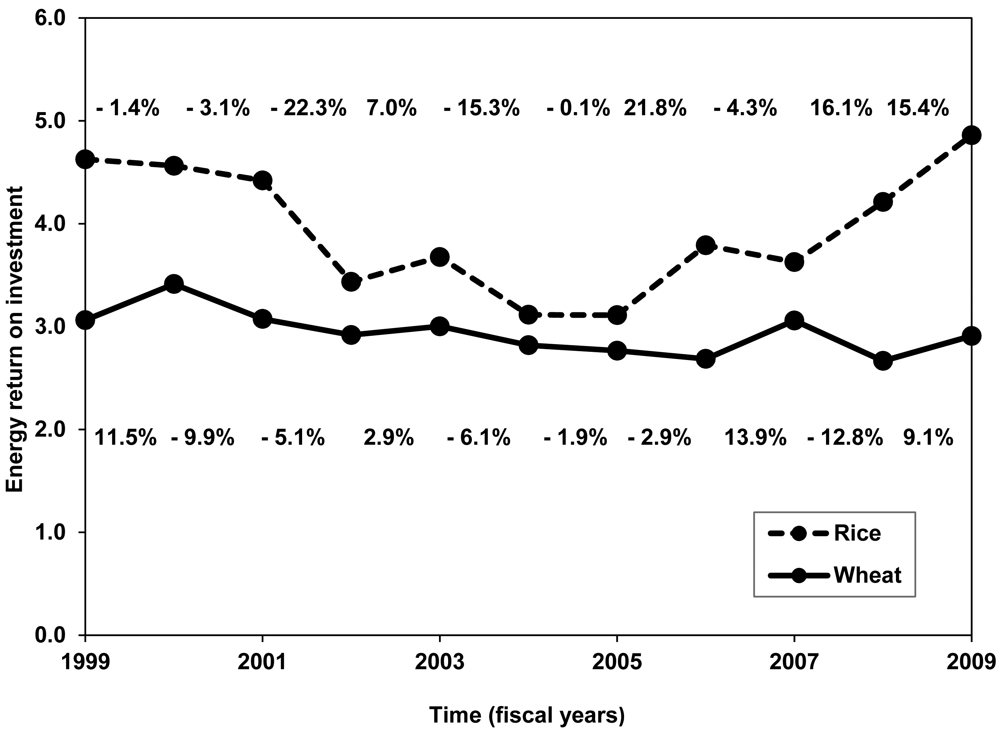
<p>The EROI of wheat shows a gradual downward trend from 2000 to 2006.There was an overall decrease of 21.3% during that time period. After that, the trend is erratic registering alternative increases and decreases. The EROI of rice shows a decreasing trend until 2005 (with variability within that trend). Thereafter, it rises fairly rapidly, an increase of 56.2% between 2005 and 2009. Rice's EROI was consistently higher than wheat's in the same year. Wheat's EROI trend is fairly constant in that it hovers above or below the 3.0 mark throughout. Rice's performance is variable, but the general trend appears to be a decrease that lasts halfway through the study period, followed by a steady increase (<xref ref-type="fig" rid="f2-sustainability-03-02358">Figure 2</xref>).</p>
<p>The linear and quadratic regressions for wheat EROI were significant. Cubic and quartic regressions were not (<xref ref-type="table" rid="t12-sustainability-03-02358">Table 12</xref>). For rice EROI, the quadratic, cubic, and quartic regressions were significant</p>
<p>(<xref ref-type="table" rid="t13-sustainability-03-02358">Table 13</xref>). However, the residual sum of squares values indicates that the quartic regression equation is the best fit for both wheat and rice EROI.</p></sec>
<sec>
<label>3.2.</label>
<title>Crop Output</title>
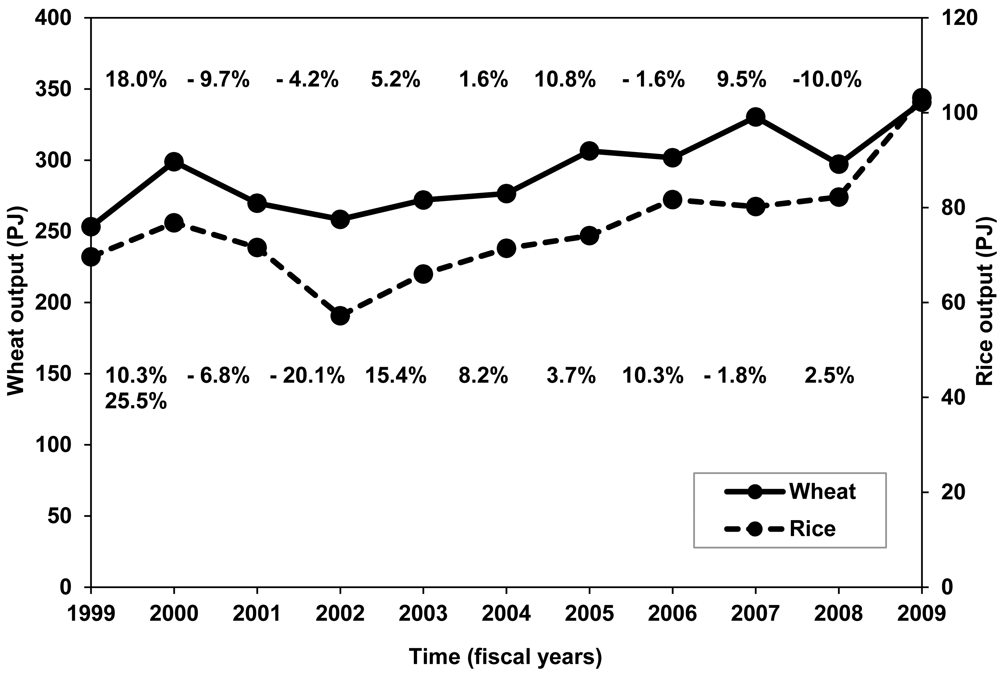
<p>Both the rice and wheat crops follow a similar pattern of decreasing output at the beginning of the study period followed by a steady increase during the rest of the study period. Over the course of the study period, wheat output increased by 34.6% (31.9% if measured from 2002), and rice by 48.2% (80.3% if measured from 2002) (<xref ref-type="fig" rid="f3-sustainability-03-02358">Figure 3</xref>).</p></sec>
<sec>
<label>3.3.</label>
<title>Crop Input</title>
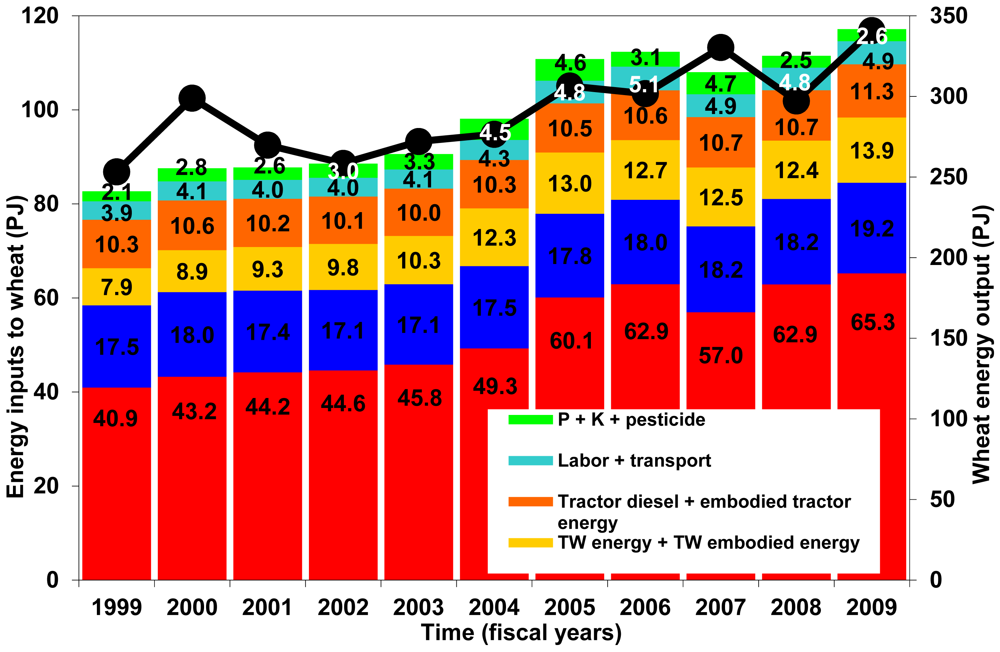
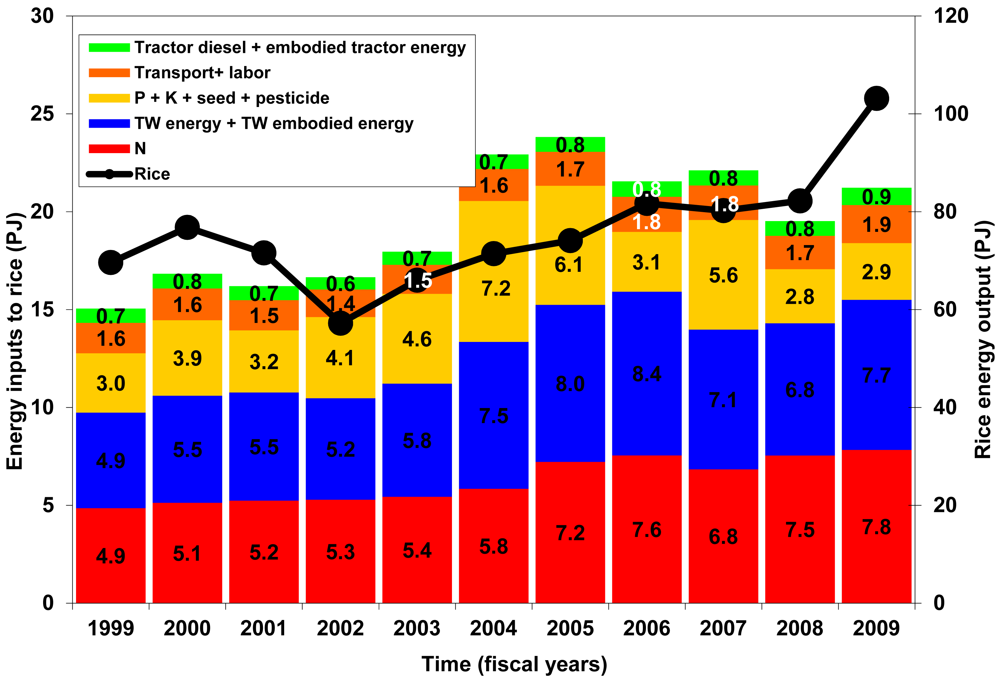
<p>The energy input trend to both crops follows a similar pattern. The inputs to both crops increased from 1999 to 2005 at different rates over the length of the study period. Inputs to wheat increased by 41.7% and by 41.0% for rice between 1999 and 2009. The sharpest increases in inputs to wheat occurred in 2005 and in 2004 to rice. It is noteworthy that after 2005, the inputs to wheat increased gradually, but for rice, decreased overall.</p>
<sec>
<label>3.3.1.</label>
<title>Individual Inputs</title>
<p>Nitrogen fertilizer is the largest input to wheat, on average accounting for almost 53% of total inputs. Combined, P and K account for just 1.7% of total inputs. Nitrogen fertilizer is also the largest input to rice, on average accounting for 32.2% of total inputs. A major difference between the two crops is in their usage of insecticide, which, on rice accounts for an average 17.1% of all inputs. The corresponding figure for wheat is just 0.3%.</p>
<p>On wheat, seed is the second largest input at 17.9%, followed by tractor diesel at 9.1%, and tube well diesel at 6.6%. In the case of rice, the second largest input is tube well diesel at 20%, followed by insecticide at 17.1%, tube well electricity at 12.5%, and labor at seven percent (<xref ref-type="fig" rid="f4-sustainability-03-02358">Figures 4</xref> and <xref ref-type="fig" rid="f5-sustainability-03-02358">5</xref>).</p></sec></sec>
<sec sec-type="results">
<label>3.4.</label>
<title>Per-Hectare Results</title>
<p>Presenting energy inputs and outputs on a per-hectare basis allows a direct comparison between wheat and rice. Wheat's per-hectare energy output was consistently greater than that of rice, on average by a factor of 1.1. Many of its inputs are also greater, including N fertilizer by an average factor of 2.5, seed by an average factor of 2.8, and tractor diesel by an average factor of 4.2. Conversely, rice had several inputs that were greater than corresponding ones on wheat. Rice is more insecticide intensive by an average factor of 44.6. It is also more labor intensive by an average factor of 2.1. Finally, as rice is more water-intensive than wheat, its tube well diesel figure was greater by an average factor of two.</p>
<p>Examining percentage changes in major inputs in relation to percentage changes in outputs on a per-hectare basis reveals some interesting patterns. It appears that increases in some major inputs do not necessarily translate into increased output. There are numerous instances where a sizable increase in N fertilizer had little, or a negative impact on wheat output. While this is not suggesting a correlation (or the lack thereof) between N fertilizer and output, it certainly merits discussion. Similar observations are made for rice. Large increases in insecticide (specifically 2002, 2004, and 2007) had little impact on output. Often times, large decreases in insecticide appeared to result in better output (2005, 2006, 2008, and 2009; <xref ref-type="table" rid="t14-sustainability-03-02358">Table 14</xref>).</p>
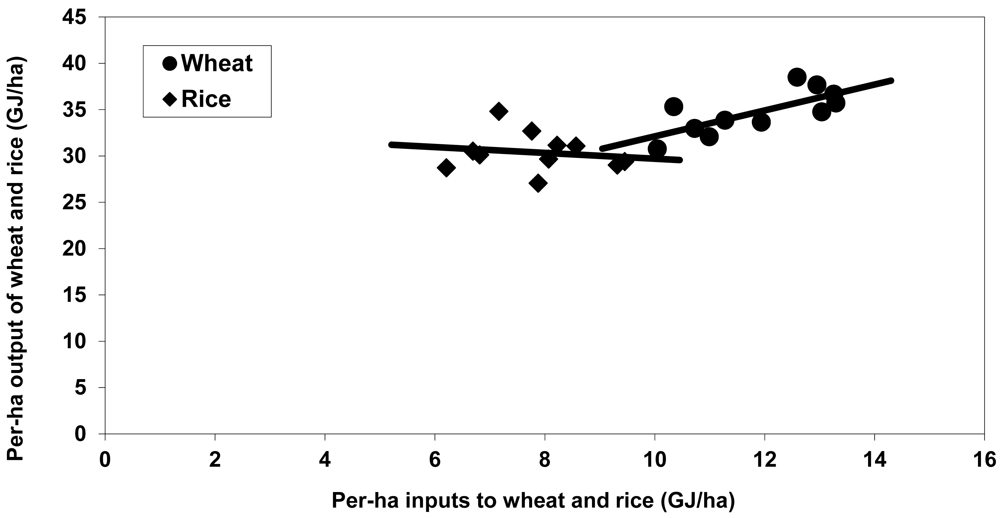
<p>The relationship between all per-hectare inputs and per-hectare output also shows some interesting patterns. The 11-year dataset shows that wheat yield is still increasing with rising inputs. Rice, however, shows a gradually declining trend (<xref ref-type="fig" rid="f6-sustainability-03-02358">Figure 6</xref>).</p>
<p>For wheat per-hectare input against per-hectare output, the linear, quadratic, and quartic regressions were significant (<xref ref-type="table" rid="t15-sustainability-03-02358">Table 15</xref>). None of the regressions were significant in the case of rice (<xref ref-type="table" rid="t16-sustainability-03-02358">Table 16</xref>).</p></sec></sec>
<sec sec-type="discussion">
<label>4.</label>
<title>Discussion</title>
<p>The EROI concept applied to food crops elucidates the relation between inputs to crops and the crops' response in terms of yield, which provides more information than just looking at total production. Large production figures are better understood when compared with their corresponding input figures. Rice's EROI was consistently greater than wheat's over the timeframe studied. Wheat achieved its highest EROI in 2000, although production and yield were far higher in 2007 and 2009. Production in 2007 was considered a bumper crop. Inputs that year had actually decreased by 3.9%, causing the EROI to increase by almost 14%. Inputs increased steadily throughout the study period (except for 2007's minor decline). Production reached an all-time high in 2009, but so did inputs, resulting in the same EROI as 2002. The trend for output is erratic, but inputs continued to increase, and the EROI showed minor fluctuation around the 1:3 mark. This suggests that external factors such as rainfall and time of planting may have played a role. Indeed, comments on the 2009 figures by Pakistan's Ministry of Food and Agriculture (MINFAL) cited “adequate soil moisture” and “favorable weather conditions (sic)” [<xref ref-type="bibr" rid="b9-sustainability-03-02358">9</xref>, p. 4]. Similarly, comments on 2007's bumper wheat crop cited “sufficient rains”, proper fertilizer use, and weed control [<xref ref-type="bibr" rid="b9-sustainability-03-02358">9</xref>, p. 4].</p>
<p>These annual comments on production usually speak of increases and decreases in total cropped area and what motivates farmers to increase or decrease their cropped area. A decrease in wheat area is often attributed to delay in sugar cane crushing (thereby delaying the sowing of wheat) and delays in rice harvests due to rains. Increases in wheat area are often attributed to better support prices guaranteed by the government (a minimum price that farmers must receive per unit weight of wheat). It is possible that such incentives may drive farmers to make efforts to increase their per-hectare yields as well. The largest increase in the wheat support price (a 52% increase) occurred in 2009 [<xref ref-type="bibr" rid="b9-sustainability-03-02358">9</xref>. p. 208].</p>
<p>Inputs to rice production showed a steady increase from 1999 to 2005. During this period, output fluctuated between 27.1 GJ ha<sup>−1</sup> and 30.1 GJ ha<sup>−1</sup>. After that, inputs fluctuated, but output continued to increase. As expected, the EROI showed an overall decline between 1999 and 2005, then a sharp rise between 2005 and 2009.</p>
<p>Rice's inputs have always been lower than that of wheat by virtue of both crops' unique requirements and properties. For example, wheat is known to be more tractor intensive than rice. Rice is more labor intensive, which is obviously not associated with as high an energy use value as tractor diesel. Similarly, wheat sowing requires approximately seven times the seed per-hectare than rice does. Rice is also known to be more pesticide intensive than wheat. By government estimates, 23% of all pesticide is used on rice, compared with nine percent on wheat ([<xref ref-type="bibr" rid="b22-sustainability-03-02358">22</xref>], p. 13). Nitrogen fertilizer is generally among the larger inputs in most agricultural systems and it is true for wheat and rice production in Pakistan and other agricultural systems in this region [<xref ref-type="bibr" rid="b46-sustainability-03-02358">46</xref>,<xref ref-type="bibr" rid="b69-sustainability-03-02358">69</xref>].</p>
<p>In explaining the behavior of the two crops, it is appropriate to consider the classical production function which is characterized initially by increasing yields at an increasing rate (stage 1). This stage is followed by decreasing returns per incremental unit of input. The function assumes that a maximum yield is reached during this stage (stage 2). The law of diminishing returns (or the law of variable proportions) prevails in the third stage, which means that increases in inputs result in a leveling-off or even diminishing output increase [<xref ref-type="bibr" rid="b87-sustainability-03-02358">87</xref>]. By this theory, one may postulate that rice's trend would indicate that little or none of the output is adequately explained by the inputs, and it has already reached a saturation point or asymptote, and is now on the decline (stage 3). Thus, for the sake of argument, it could be stated that if increasing inputs (such as N fertilizer) do not have a noticeable effect on yields, this could mean that land degradation over time requires increasing amounts of chemical fertilizer just to maintain a certain level of output. Of wheat, one may hypothesize that wheat's positive trend means increasing inputs will continue to affect yield positively.</p>
<p>In examining the individual inputs to the two crops, it is clear that wheat (averaging 11.9 GJ ha<sup>−1</sup>) requires greater energy inputs per hectare than rice (averaging 7.8 GJ ha<sup>−1</sup>) by an average factor of 1.5. Wheat's yields are also consistently higher than rice's, but by just an average factor of 1.1, but its inputs are also always higher thus resulting in a lower EROI than rice's. It should be noted that rice responded to a relatively small range of input change with greater output and an increase in EROI. Conversely, wheat, which displayed a large range in input change (increase) showed little change in EROI.</p>
<p>Wheat's output-input relation is a positive one, <italic>i.e.</italic>, as inputs increase, so does output. Statistical analysis showed the linear, quadratic, and quartic regressions to be significant. Singh and Singh (1992) observed a linear relationship between wheat yield and its inputs [<xref ref-type="bibr" rid="b88-sustainability-03-02358">88</xref>]. However, Sidhu <italic>et al.</italic> (2004) found both linear and quadratic fits to be significant [<xref ref-type="bibr" rid="b89-sustainability-03-02358">89</xref>]. For wheat, N fertilizer exhibited the largest changes over time. It is also the largest input, on average, accounting for 52.6% of inputs. The year 2005 had N fertilizer increasing by almost 20%. Total per-hectare inputs that year increased by 11%, while per-hectare yield increased by 9%. However, in 2007 (the wheat bumper crop year), N fertilizer applied per hectare decreased by 10.8%, total inputs by 5.3%, but yield increased by 7.8%. There is also a strong relationship between wheat yield and per-hectare fertilizer input.</p>
<p>For rice, the situation is different. Overall, increasing per-hectare inputs does not appear to increase yield. The relation is a negative one overall, and also when examined against individual inputs (N fertilizer, tube well irrigation diesel, and insecticide). In fact, in many instances of large insecticide increases per hectare, rice yield actually suffered. In 2002, insecticide application increased by 65%, but yield decreased by 10.2%. In 2004, application increased by 50%, but yield decreased by 2.2%. Conversely, when insecticide application decreased by 20.8% and 60.2% in 2005 and 2006 respectively, yield increased slightly (1.3% in 2005 and six percent in 2006). Similarly, large decreases in 2008 and 2009 resulted in yield increases. These increases did not translate into the higher production that one might expect from increased fertilizer or from a reduction in pest attacks (which such a large increase in pesticide implies). It should be noted, however, that both fertilizer and pesticide usage on wheat and rice were calculated from crude government percentages of total fertilizer and pesticide usage which are the only data available on these inputs.</p>
<p>There was no significant relation between rice's per-hectare inputs and yield indicating that as more energy is invested in the production of rice in Pakistan, the amount of energy produced per hectare in the crop does not change. The years 2004 and 2005 had the largest per-hectare inputs over the study period (9.3 GJ ha<sup>−1</sup> and 9.5 GJ ha<sup>−1</sup>, respectively), but these were not the years with the highest yields. The input of insecticide was the highest in both these years (2.6 GJ ha<sup>−1</sup> and 2.0 GJ ha<sup>−1</sup>, respectively). Average insecticide usage of 1.4 GJ ha<sup>−1</sup> falls to 1.2 GJ ha<sup>−1</sup> if these two years are excluded. Nitrogen fertilizer input for rice also increased in 2005 from 2.4 GJ ha<sup>−1</sup> to 2.9 GJ ha<sup>−1</sup> and maintained the latter figure until 2006. Overall, insecticide had a negative relation with rice yield, whereas N fertilizer had a positive one. It is therefore possible that insecticide application to rice is at least partly responsible for the overall decreasing output-input trend.</p></sec>
<sec>
<label>5.</label>
<title>Conclusion</title>
<p>This analysis adds several missing links that economic analyses tend to ignore. It utilizes real energy units which are not dependent on manmade constructs such as prices and markets. It accounts for elements such as labor energy, embodied energy, and energy utilized in electricity generation. These elements add rigor to the analysis.</p>
<p>Wheat's EROI continued to decline over the entire study period except in 2003 and 2007 where input increases from the previous years were low, but yields were anomalously high. Rice's EROI changes constantly, reflecting widespread differences in input usage styles across the country.</p>
<p>Wheat and rice's output-input trends are considerably different from one another. Little or none of rice's output is adequately explained by its inputs indicating that output may have reached a saturation point. For example, large increases in insecticide in certain years did not appear to have an impact on production. Wheat's response, however, shows that increasing inputs still affect output positively.</p>
<p>Resource scarcity and use are very real concerns for Pakistan. This analysis shows how and where energy is used in Pakistan's wheat and rice production. In some instances, increasing energy inputs did not translate into an equivalent increase in yields, such as in the case of rice. Wheat, on the other hand, continues to respond to increasing inputs. However, further studies may be able to identify and state more clearly what inputs are providing the greatest benefits and those that are not. Energy inefficiencies should be considered to ensure that energy is not wasted in these systems as the demand for these resources increases and they become more scarce.</p></sec></body>
<back>
<sec sec-type="display-objects">
<title>Figures and Tables</title>
<fig id="f1-sustainability-03-02358" position="float">
<label>Figure 1.</label>
<caption>
<p>System boundaries for an EROI analysis of wheat and rice production in Pakistan.</p></caption>
<graphic xlink:href="sustainability-03-02358f1.gif"/></fig>
<fig id="f2-sustainability-03-02358" position="float">
<label>Figure 2.</label>
<caption>
<p>Energy return on investment of wheat and rice produced in Pakistan and the percentage change in the EROI from the previous year (1999–2009). Percentage change figures at the top of the figure are for rice and in the middle of the figure for wheat.</p></caption>
<graphic xlink:href="sustainability-03-02358f2.gif"/></fig>
<fig id="f3-sustainability-03-02358" position="float">
<label>Figure 3.</label>
<caption>
<p>Energy output from wheat and rice produced in Pakistan and the percentage change in the output from the previous year (1999–2009). Percentage change figures at the top of the figure are for wheat and in the middle of the figure for rice.</p></caption>
<graphic xlink:href="sustainability-03-02358f3.gif"/></fig>
<fig id="f4-sustainability-03-02358" position="float">
<label>Figure 4.</label>
<caption>
<p>Energy inputs to wheat (PJ on primary y-axis) and wheat output (PJ on secondary y-axis) from 1999 to 2009. The figures on the bars are the energy inputs in PJ. “TW” is tube well.</p></caption>
<graphic xlink:href="sustainability-03-02358f4.gif"/></fig>
<fig id="f5-sustainability-03-02358" position="float">
<label>Figure 5.</label>
<caption>
<p>Energy inputs to rice (PJ on primary y-axis) and rice output (PJ on secondary y-axis) from 1999 to 2009. The figures on the bars are the energy inputs in PJ. “TW” is tube well.</p></caption>
<graphic xlink:href="sustainability-03-02358f5.gif"/></fig>
<fig id="f6-sustainability-03-02358" position="float">
<label>Figure 6.</label>
<caption>
<p>Relation between energy inputs and output for wheat and rice crops in Pakistan from 1999 to 2009.</p></caption>
<graphic xlink:href="sustainability-03-02358f6.gif"/></fig>
<table-wrap id="t1-sustainability-03-02358" position="float">
<label>Table 1.</label>
<caption>
<p>Percentage change in value-added growth in the agricultural sector in Pakistan, 2001 to 2010.</p></caption>
<table frame="hsides" rules="groups">
<thead>
<tr>
<th align="left" valign="top"><bold>Year</bold></th>
<th align="center" valign="top"><bold>Agricultural growth (</bold>%<bold>)</bold></th>
<th align="center" valign="top"><bold>Major crops (</bold>%<bold>)</bold> <xref ref-type="table-fn" rid="tfn1-sustainability-03-02358">*</xref></th>
<th align="center" valign="top"><bold>Minor crops (</bold>%<bold>)</bold> <xref ref-type="table-fn" rid="tfn2-sustainability-03-02358">**</xref></th></tr></thead>
<tbody>
<tr>
<td align="left" valign="top">2001</td>
<td align="right" valign="top">−2.2</td>
<td align="right" valign="top">−9.9</td>
<td align="right" valign="top">−3.2</td></tr>
<tr>
<td align="left" valign="top">2002</td>
<td align="right" valign="top">−0.1</td>
<td align="right" valign="top">−2.5</td>
<td align="right" valign="top">−3.7</td></tr>
<tr>
<td align="left" valign="top">2003</td>
<td align="right" valign="top">4.1</td>
<td align="right" valign="top">6.8</td>
<td align="right" valign="top">1.9</td></tr>
<tr>
<td align="left" valign="top">2004</td>
<td align="right" valign="top">2.4</td>
<td align="right" valign="top">1.7</td>
<td align="right" valign="top">3.9</td></tr>
<tr>
<td align="left" valign="top">2005</td>
<td align="right" valign="top">6.5</td>
<td align="right" valign="top">17.1</td>
<td align="right" valign="top">1.5</td></tr>
<tr>
<td align="left" valign="top">2006</td>
<td align="right" valign="top">6.3</td>
<td align="right" valign="top">−3.9</td>
<td align="right" valign="top">0.4</td></tr>
<tr>
<td align="left" valign="top">2007</td>
<td align="right" valign="top">4.1</td>
<td align="right" valign="top">7.7</td>
<td align="right" valign="top">−1.0</td></tr>
<tr>
<td align="left" valign="top">2008</td>
<td align="right" valign="top">1.0</td>
<td align="right" valign="top">−6.4</td>
<td align="right" valign="top">10.9</td></tr>
<tr>
<td align="left" valign="top">2009</td>
<td align="right" valign="top">4.0</td>
<td align="right" valign="top">7.3</td>
<td align="right" valign="top">−1.7</td></tr>
<tr>
<td align="left" valign="top">2010 (provisional)</td>
<td align="right" valign="top">2.0</td>
<td align="right" valign="top">−0.2</td>
<td align="right" valign="top">−1.2</td></tr></tbody></table>
<table-wrap-foot><fn id="tfn1-sustainability-03-02358">
<label>*</label>
<p>Cotton, sugarcane, rice, wheat, pearl millet, rapeseed, mustard, maize, barley, gram;</p></fn><fn id="tfn2-sustainability-03-02358">
<label>**</label>
<p>Oilseeds, pulses, potato, onion, chilies; Source: [<xref ref-type="bibr" rid="b4-sustainability-03-02358">4</xref>], p. 14; [<xref ref-type="bibr" rid="b5-sustainability-03-02358">5</xref>], p. 17; [<xref ref-type="bibr" rid="b6-sustainability-03-02358">6</xref>], p. 15.</p></fn></table-wrap-foot></table-wrap>
<table-wrap id="t2-sustainability-03-02358" position="float">
<label>Table 2.</label>
<caption>
<p>Cultivated area of wheat and rice varieties in Pakistan (million ha) from 1999–2009.</p></caption>
<table frame="hsides" rules="groups">
<thead>
<tr>
<th align="left" valign="middle" rowspan="3">FY <xref ref-type="table-fn" rid="tfn3-sustainability-03-02358">*</xref></th>
<th colspan="3" align="center" valign="top"><bold>Wheat area (million ha)</bold></th>
<th colspan="4" align="center" valign="top"><bold>Rice area (million ha)</bold></th></tr>
<tr>
<th valign="bottom" colspan="7">
<hr/></th></tr>
<tr>
<th align="center" valign="top">HYV</th>
<th align="center" valign="top">Others</th>
<th align="center" valign="top">Total</th>
<th align="center" valign="top">Basmati</th>
<th align="center" valign="top">Irri</th>
<th align="center" valign="top">Others</th>
<th align="center" valign="top">Total</th></tr></thead>
<tbody>
<tr>
<td align="left" valign="top">1999</td>
<td align="center" valign="top">7.7</td>
<td align="center" valign="top">0.5</td>
<td align="center" valign="top">8.2</td>
<td align="center" valign="top">1.2</td>
<td align="center" valign="top">1.0</td>
<td align="center" valign="top">0.2</td>
<td align="center" valign="top">2.4</td></tr>
<tr>
<td align="left" valign="top">2000</td>
<td align="center" valign="top">8.1</td>
<td align="center" valign="top">0.3</td>
<td align="center" valign="top">8.5</td>
<td align="center" valign="top">1.3</td>
<td align="center" valign="top">1.0</td>
<td align="center" valign="top">0.2</td>
<td align="center" valign="top">2.5</td></tr>
<tr>
<td align="left" valign="top">2001</td>
<td align="center" valign="top">7.9</td>
<td align="center" valign="top">0.3</td>
<td align="center" valign="top">8.2</td>
<td align="center" valign="top">1.2</td>
<td align="center" valign="top">0.9</td>
<td align="center" valign="top">0.3</td>
<td align="center" valign="top">2.4</td></tr>
<tr>
<td align="left" valign="top">2002</td>
<td align="center" valign="top">7.8</td>
<td align="center" valign="top">0.3</td>
<td align="center" valign="top">8.1</td>
<td align="center" valign="top">1.3</td>
<td align="center" valign="top">0.7</td>
<td align="center" valign="top">0.1</td>
<td align="center" valign="top">2.1</td></tr>
<tr>
<td align="left" valign="top">2003</td>
<td align="center" valign="top">7.8</td>
<td align="center" valign="top">0.2</td>
<td align="center" valign="top">8.0</td>
<td align="center" valign="top">1.4</td>
<td align="center" valign="top">0.7</td>
<td align="center" valign="top">0.1</td>
<td align="center" valign="top">2.2</td></tr>
<tr>
<td align="left" valign="top">2004</td>
<td align="center" valign="top">8.0</td>
<td align="center" valign="top">0.2</td>
<td align="center" valign="top">8.2</td>
<td align="center" valign="top">1.5</td>
<td align="center" valign="top">0.7</td>
<td align="center" valign="top">0.2</td>
<td align="center" valign="top">2.5</td></tr>
<tr>
<td align="left" valign="top">2005</td>
<td align="center" valign="top">8.2</td>
<td align="center" valign="top">0.2</td>
<td align="center" valign="top">8.4</td>
<td align="center" valign="top">1.6</td>
<td align="center" valign="top">0.7</td>
<td align="center" valign="top">0.3</td>
<td align="center" valign="top">2.5</td></tr>
<tr>
<td align="left" valign="top">2006</td>
<td align="center" valign="top">8.2</td>
<td align="center" valign="top">0.2</td>
<td align="center" valign="top">8.4</td>
<td align="center" valign="top">1.7</td>
<td align="center" valign="top">0.8</td>
<td align="center" valign="top">0.2</td>
<td align="center" valign="top">2.6</td></tr>
<tr>
<td align="left" valign="top">2007</td>
<td align="center" valign="top">8.3</td>
<td align="center" valign="top">0.3</td>
<td align="center" valign="top">8.6</td>
<td align="center" valign="top">1.6</td>
<td align="center" valign="top">0.8</td>
<td align="center" valign="top">0.2</td>
<td align="center" valign="top">2.6</td></tr>
<tr>
<td align="left" valign="top">2008</td>
<td align="center" valign="top">8.3</td>
<td align="center" valign="top">0.3</td>
<td align="center" valign="top">8.5</td>
<td align="center" valign="top">1.5</td>
<td align="center" valign="top">0.7</td>
<td align="center" valign="top">0.3</td>
<td align="center" valign="top">2.5</td></tr>
<tr>
<td align="left" valign="top">2009</td>
<td align="center" valign="top">8.8</td>
<td align="center" valign="top">0.3</td>
<td align="center" valign="top">9.0</td>
<td align="center" valign="top">1.7</td>
<td align="center" valign="top">0.9</td>
<td align="center" valign="top">0.4</td>
<td align="center" valign="top">3.0</td></tr></tbody></table>
<table-wrap-foot><fn id="tfn3-sustainability-03-02358">
<label>*</label>
<p>FY = fiscal year; HYV = high yielding variety; Source: [<xref ref-type="bibr" rid="b9-sustainability-03-02358">9</xref>], pp. 6-7, 16-17.</p></fn></table-wrap-foot></table-wrap>
<table-wrap id="t3-sustainability-03-02358" position="float">
<label>Table 3.</label>
<caption>
<p>Number of diesel and electric motors required to pump groundwater for wheat grown in Pakistan.</p></caption>
<table frame="hsides" rules="none">
<thead>
<tr>
<th align="center" valign="top"><bold>1</bold></th>
<th align="center" valign="top"><bold>2</bold></th>
<th align="center" valign="top"><bold>3</bold></th>
<th align="center" valign="top"><bold>4</bold></th>
<th align="center" valign="top"><bold>5</bold></th>
<th align="center" valign="top"><bold>6</bold></th>
<th align="center" valign="top"><bold>7</bold></th>
<th align="center" valign="top"/>
<th align="center" valign="top"><bold>8</bold></th>
<th align="center" valign="top"><bold>9</bold></th>
<th align="center" valign="top"><bold>10</bold></th>
<th align="center" valign="top"/>
<th align="center" valign="top"><bold>11</bold></th>
<th align="center" valign="top"><bold>12</bold></th></tr>
<tr>
<th valign="bottom" colspan="7">
<hr/></th>
<th align="center" valign="middle"/>
<th valign="bottom" colspan="3">
<hr/></th>
<th align="center" valign="middle"/>
<th valign="bottom" colspan="2">
<hr/></th></tr>
<tr>
<th align="center" valign="middle">FY</th>
<th align="center" valign="middle">Electric.pumps (000)</th>
<th align="center" valign="middle">Diesel pumps (000)</th>
<th align="center" valign="middle">Total pumps (000)</th>
<th align="center" valign="middle">Total rabi GW (MAF)</th>
<th align="center" valign="middle">GW per pump (MAF)</th>
<th align="center" valign="middle">Wheat's total water req. (MAF)</th>
<th align="center" valign="middle"/>
<th align="center" valign="middle">% that is from GW sources</th>
<th align="center" valign="middle">Wheat req. fulfilled from GW sources (MAF)</th>
<th align="center" valign="middle">No. of pumps req. to pump this (C9) (000)</th>
<th align="center" valign="middle"/>
<th align="center" valign="middle">Electric pumps (000)</th>
<th align="center" valign="middle">Diesel pumps (000)</th></tr>
<tr>
<th valign="bottom" colspan="7">
<hr/></th>
<th align="center" valign="middle"/>
<th valign="bottom" colspan="3">
<hr/></th>
<th align="center" valign="middle"/>
<th valign="bottom" colspan="2">
<hr/></th></tr></thead>
<tbody>
<tr>
<td align="center" valign="top">1999</td>
<td align="center" valign="top">117.4</td>
<td align="center" valign="top">445.8</td>
<td align="center" valign="top">563.2</td>
<td align="center" valign="top">25.6</td>
<td align="center" valign="top">&lt;0.1</td>
<td align="center" valign="top">22.4</td>
<td abbr="center" valign="middle" rowspan="11">of which</td>
<td align="center" valign="top">45.3</td>
<td align="center" valign="top">10.1</td>
<td align="center" valign="top">222.6</td>
<td abbr="center" valign="middle" rowspan="11">of which</td>
<td align="center" valign="top">46.4</td>
<td align="center" valign="top">176.2</td></tr>
<tr>
<td align="center" valign="top">2000</td>
<td align="center" valign="top">112.4</td>
<td align="center" valign="top">497.4</td>
<td align="center" valign="top">609.8</td>
<td align="center" valign="top">25.0</td>
<td align="center" valign="top">&lt;0.1</td>
<td align="center" valign="top">23.4</td>
<td align="center" valign="top">44.3</td>
<td align="center" valign="top">10.4</td>
<td align="center" valign="top">252.8</td>
<td align="center" valign="top">46.6</td>
<td align="center" valign="top">206.2</td></tr>
<tr>
<td align="center" valign="top">2001</td>
<td align="center" valign="top">113.7</td>
<td align="center" valign="top">545.5</td>
<td align="center" valign="top">659.3</td>
<td align="center" valign="top">25.4</td>
<td align="center" valign="top">&lt;0.1</td>
<td align="center" valign="top">22.8</td>
<td align="center" valign="top">44.6</td>
<td align="center" valign="top">10.2</td>
<td align="center" valign="top">263.7</td>
<td align="center" valign="top">45.5</td>
<td align="center" valign="top">218.2</td></tr>
<tr>
<td align="center" valign="top">2002</td>
<td align="center" valign="top">116.8</td>
<td align="center" valign="top">590.4</td>
<td align="center" valign="top">707.3</td>
<td align="center" valign="top">25.3</td>
<td align="center" valign="top">&lt;0.1</td>
<td align="center" valign="top">22.8</td>
<td align="center" valign="top">44.4</td>
<td align="center" valign="top">10.1</td>
<td align="center" valign="top">282.7</td>
<td align="center" valign="top">46.7</td>
<td align="center" valign="top">236.0</td></tr>
<tr>
<td align="center" valign="top">2003</td>
<td align="center" valign="top">120.6</td>
<td align="center" valign="top">648.4</td>
<td align="center" valign="top">769.0</td>
<td align="center" valign="top">25.3</td>
<td align="center" valign="top">&lt;0.1</td>
<td align="center" valign="top">22.7</td>
<td align="center" valign="top">44.3</td>
<td align="center" valign="top">10.1</td>
<td align="center" valign="top">306.1</td>
<td align="center" valign="top">48.0</td>
<td align="center" valign="top">258.1</td></tr>
<tr>
<td align="center" valign="top">2004</td>
<td align="center" valign="top">132.0</td>
<td align="center" valign="top">818.2</td>
<td align="center" valign="top">950.1</td>
<td align="center" valign="top">25.3</td>
<td align="center" valign="top">&lt;0.1</td>
<td align="center" valign="top">23.1</td>
<td align="center" valign="top">44.2</td>
<td align="center" valign="top">10.2</td>
<td align="center" valign="top">384.3</td>
<td align="center" valign="top">53.4</td>
<td align="center" valign="top">330.9</td></tr>
<tr>
<td align="center" valign="top">2005</td>
<td align="center" valign="top">137.0</td>
<td align="center" valign="top">847.3</td>
<td align="center" valign="top">984.3</td>
<td align="center" valign="top">25.3</td>
<td align="center" valign="top">&lt;0.1</td>
<td align="center" valign="top">23.4</td>
<td align="center" valign="top">43.9</td>
<td align="center" valign="top">10.3</td>
<td align="center" valign="top">400.9</td>
<td align="center" valign="top">55.8</td>
<td align="center" valign="top">345.1</td></tr>
<tr>
<td align="center" valign="top">2006</td>
<td align="center" valign="top">143.7</td>
<td align="center" valign="top">855.9</td>
<td align="center" valign="top">999.6</td>
<td align="center" valign="top">25.7</td>
<td align="center" valign="top">&lt;0.1</td>
<td align="center" valign="top">23.8</td>
<td align="center" valign="top">43.0</td>
<td align="center" valign="top">10.2</td>
<td align="center" valign="top">398.2</td>
<td align="center" valign="top">57.2</td>
<td align="center" valign="top">341.0</td></tr>
<tr>
<td align="center" valign="top">2007</td>
<td align="center" valign="top">116.7</td>
<td align="center" valign="top">814.6</td>
<td align="center" valign="top">931.3</td>
<td align="center" valign="top">25.7</td>
<td align="center" valign="top">&lt;0.1</td>
<td align="center" valign="top">23.8</td>
<td align="center" valign="top">46.2</td>
<td align="center" valign="top">11.0</td>
<td align="center" valign="top">398.8</td>
<td align="center" valign="top">50.0</td>
<td align="center" valign="top">348.9</td></tr>
<tr>
<td align="center" valign="top">2008</td>
<td align="center" valign="top">120.8</td>
<td align="center" valign="top">800.3</td>
<td align="center" valign="top">921.1</td>
<td align="center" valign="top">25.5</td>
<td align="center" valign="top">&lt;0.1</td>
<td align="center" valign="top">23.9</td>
<td align="center" valign="top">44.8</td>
<td align="center" valign="top">10.7</td>
<td align="center" valign="top">387.2</td>
<td align="center" valign="top">50.8</td>
<td align="center" valign="top">336.4</td></tr>
<tr>
<td align="center" valign="top">2009</td>
<td align="center" valign="top">120.8</td>
<td align="center" valign="top">800.4</td>
<td align="center" valign="top">921.2</td>
<td align="center" valign="top">24.8</td>
<td align="center" valign="top">&lt;0.1</td>
<td align="center" valign="top">25.4</td>
<td align="center" valign="top">45.9</td>
<td align="center" valign="top">11.6</td>
<td align="center" valign="top">432.7</td>
<td align="center" valign="top">56.7</td>
<td align="center" valign="top">375.9</td></tr></tbody></table>
<table-wrap-foot><fn id="tfn4-sustainability-03-02358">
<p>“GW” = groundwater; “MAF” = million acre-feet; “C9” = figures in column nine.</p></fn></table-wrap-foot></table-wrap>
<table-wrap id="t4-sustainability-03-02358" position="float">
<label>Table 4.</label>
<caption>
<p>Number of diesel and electric motors required to pump groundwater for rice grown in Pakistan.</p></caption>
<table frame="hsides" rules="none">
<thead>
<tr>
<th align="center" valign="top"><bold>1</bold></th>
<th align="center" valign="top"><bold>2</bold></th>
<th align="center" valign="top"><bold>3</bold></th>
<th align="center" valign="top"><bold>4</bold></th>
<th align="center" valign="top"><bold>5</bold></th>
<th align="center" valign="top"><bold>6</bold></th>
<th align="center" valign="top"><bold>7</bold></th>
<th align="center" valign="top"/>
<th align="center" valign="top"><bold>8</bold></th>
<th align="center" valign="top"><bold>9</bold></th>
<th align="center" valign="top"><bold>10</bold></th>
<th align="center" valign="top"/>
<th align="center" valign="top"><bold>11</bold></th>
<th align="center" valign="top"><bold>12</bold></th></tr>
<tr>
<th valign="bottom" colspan="14">
<hr/></th></tr>
<tr>
<th align="left" valign="middle">FY</th>
<th align="center" valign="middle">Elect.pumps (000)</th>
<th align="center" valign="middle">Diesel pumps (000)</th>
<th align="center" valign="middle">Total pumps (000)</th>
<th align="center" valign="middle">Total kharif GW (MAF)</th>
<th align="center" valign="middle">GW per pump (MAF)</th>
<th align="center" valign="middle">Rice's total water req. (MAF)</th>
<th align="center" valign="middle"/>
<th align="center" valign="middle">% that is from GW sources</th>
<th align="center" valign="middle">Rice req. fulfilled from GW sources (MAF)</th>
<th align="center" valign="middle">No. of pumps req. to pump this (C9) (000)</th>
<th align="center" valign="middle"/>
<th align="center" valign="middle">Electric. pumps (000)</th>
<th align="center" valign="middle">Diesel pumps (000)</th></tr>
<tr>
<th valign="bottom" colspan="7">
<hr/></th>
<th align="center" valign="middle"/>
<th valign="bottom" colspan="3">
<hr/></th>
<th align="center" valign="middle"/>
<th valign="bottom" colspan="2">
<hr/></th></tr></thead>
<tbody>
<tr>
<td align="center" valign="top">1999</td>
<td align="center" valign="top">117.4</td>
<td align="center" valign="top">445.8</td>
<td align="center" valign="top">563.2</td>
<td align="center" valign="top">25.5</td>
<td align="center" valign="top">&lt;0.1</td>
<td align="center" valign="top">18.9</td>
<td align="center" valign="middle" rowspan="11">of which</td>
<td align="center" valign="top">33.0</td>
<td align="center" valign="top">6.2</td>
<td align="center" valign="top">137.6</td>
<td align="center" valign="middle" rowspan="11">of which</td>
<td align="center" valign="top">28.7</td>
<td align="center" valign="top">108.9</td></tr>
<tr>
<td align="center" valign="top">2000</td>
<td align="center" valign="top">112.4</td>
<td align="center" valign="top">497.4</td>
<td align="center" valign="top">609.8</td>
<td align="center" valign="top">24.9</td>
<td align="center" valign="top">&lt;0.1</td>
<td align="center" valign="top">19.6</td>
<td align="center" valign="top">32.4</td>
<td align="center" valign="top">6.3</td>
<td align="center" valign="top">155.2</td>
<td align="center" valign="top">28.6</td>
<td align="center" valign="top">126.6</td></tr>
<tr>
<td align="center" valign="top">2001</td>
<td align="center" valign="top">113.7</td>
<td align="center" valign="top">545.5</td>
<td align="center" valign="top">659.3</td>
<td align="center" valign="top">25.1</td>
<td align="center" valign="top">&lt;0.1</td>
<td align="center" valign="top">18.5</td>
<td align="center" valign="top">32.3</td>
<td align="center" valign="top">6.0</td>
<td align="center" valign="top">157.0</td>
<td align="center" valign="top">27.1</td>
<td align="center" valign="top">129.9</td></tr>
<tr>
<td align="center" valign="top">2002</td>
<td align="center" valign="top">116.8</td>
<td align="center" valign="top">590.4</td>
<td align="center" valign="top">707.3</td>
<td align="center" valign="top">25.0</td>
<td align="center" valign="top">&lt;0.1</td>
<td align="center" valign="top">16.5</td>
<td align="center" valign="top">32.2</td>
<td align="center" valign="top">5.3</td>
<td align="center" valign="top">150.0</td>
<td align="center" valign="top">24.8</td>
<td align="center" valign="top">125.2</td></tr>
<tr>
<td align="center" valign="top">2003</td>
<td align="center" valign="top">120.6</td>
<td align="center" valign="top">648.4</td>
<td align="center" valign="top">769.0</td>
<td align="center" valign="top">24.8</td>
<td align="center" valign="top">&lt;0.1</td>
<td align="center" valign="top">17.3</td>
<td align="center" valign="top">32.0</td>
<td align="center" valign="top">5.5</td>
<td align="center" valign="top">171.9</td>
<td align="center" valign="top">27.0</td>
<td align="center" valign="top">145.0</td></tr>
<tr>
<td align="center" valign="top">2004</td>
<td align="center" valign="top">132.0</td>
<td align="center" valign="top">818.2</td>
<td align="center" valign="top">950.1</td>
<td align="center" valign="top">24.8</td>
<td align="center" valign="top">&lt;0.1</td>
<td align="center" valign="top">19.2</td>
<td align="center" valign="top">31.9</td>
<td align="center" valign="top">6.1</td>
<td align="center" valign="top">234.4</td>
<td align="center" valign="top">32.6</td>
<td align="center" valign="top">201.8</td></tr>
<tr>
<td align="center" valign="top">2005</td>
<td align="center" valign="top">137.0</td>
<td align="center" valign="top">847.3</td>
<td align="center" valign="top">984.3</td>
<td align="center" valign="top">24.8</td>
<td align="center" valign="top">&lt;0.1</td>
<td align="center" valign="top">19.6</td>
<td align="center" valign="top">31.7</td>
<td align="center" valign="top">6.2</td>
<td align="center" valign="top">246.9</td>
<td align="center" valign="top">34.4</td>
<td align="center" valign="top">212.5</td></tr>
<tr>
<td align="center" valign="top">2006</td>
<td align="center" valign="top">143.7</td>
<td align="center" valign="top">855.9</td>
<td align="center" valign="top">999.6</td>
<td align="center" valign="top">24.7</td>
<td align="center" valign="top">&lt;0.1</td>
<td align="center" valign="top">20.4</td>
<td align="center" valign="top">31.8</td>
<td align="center" valign="top">6.5</td>
<td align="center" valign="top">262.7</td>
<td align="center" valign="top">37.8</td>
<td align="center" valign="top">224.9</td></tr>
<tr>
<td align="center" valign="top">2007</td>
<td align="center" valign="top">116.7</td>
<td align="center" valign="top">814.6</td>
<td align="center" valign="top">931.3</td>
<td align="center" valign="top">24.7</td>
<td align="center" valign="top">&lt;0.1</td>
<td align="center" valign="top">20.1</td>
<td align="center" valign="top">30.0</td>
<td align="center" valign="top">6.0</td>
<td align="center" valign="top">227.4</td>
<td align="center" valign="top">28.5</td>
<td align="center" valign="top">198.9</td></tr>
<tr>
<td align="center" valign="top">2008</td>
<td align="center" valign="top">120.8</td>
<td align="center" valign="top">800.3</td>
<td align="center" valign="top">921.1</td>
<td align="center" valign="top">24.5</td>
<td align="center" valign="top">&lt;0.1</td>
<td align="center" valign="top">19.6</td>
<td align="center" valign="top">28.6</td>
<td align="center" valign="top">5.6</td>
<td align="center" valign="top">210.7</td>
<td align="center" valign="top">27.6</td>
<td align="center" valign="top">183.1</td></tr>
<tr>
<td align="center" valign="top">2009</td>
<td align="center" valign="top">120.8</td>
<td align="center" valign="top">800.4</td>
<td align="center" valign="top">921.2</td>
<td align="center" valign="top">23.9</td>
<td align="center" valign="top">&lt;0.1</td>
<td align="center" valign="top">23.1</td>
<td align="center" valign="top">26.9</td>
<td align="center" valign="top">6.2</td>
<td align="center" valign="top">239.0</td>
<td align="center" valign="top">31.3</td>
<td align="center" valign="top">207.7</td></tr></tbody></table>
<table-wrap-foot><fn id="tfn6-sustainability-03-02358">
<p>“GW” = groundwater; “MAF” = million acre-feet; “C9” = figures in column nine.</p></fn></table-wrap-foot></table-wrap>
<table-wrap id="t5-sustainability-03-02358" position="float">
<label>Table 5.</label>
<caption>
<p>Seasonal groundwater expressed as a percentage of total available irrigation water in Pakistan.</p></caption>
<table frame="hsides" rules="groups">
<thead>
<tr>
<th align="center" valign="middle" rowspan="3">FY</th>
<th colspan="3" align="center" valign="top"><bold>Kharif season</bold></th>
<th colspan="3" align="center" valign="top"><bold>Rabi season</bold></th></tr>
<tr>
<th valign="bottom" colspan="6">
<hr/></th></tr>
<tr>
<th align="center" valign="middle">GW (MAF)</th>
<th align="center" valign="middle">SW + GW (MAF)</th>
<th align="center" valign="middle">GW % of (SW + GW) (MAF)</th>
<th align="center" valign="middle">GW (MAF)</th>
<th align="center" valign="middle">SW + GW (MAF)</th>
<th align="center" valign="middle">GW % of (SW + GW) (MAF)</th></tr></thead>
<tbody>
<tr>
<td align="center" valign="top">1999</td>
<td align="center" valign="top">25.5</td>
<td align="center" valign="top">77.2</td>
<td align="center" valign="top">33.0</td>
<td align="center" valign="top">25.6</td>
<td align="center" valign="top">56.6</td>
<td align="center" valign="top">45.3</td></tr>
<tr>
<td align="center" valign="top">2000</td>
<td align="center" valign="top">24.9</td>
<td align="center" valign="top">76.9</td>
<td align="center" valign="top">32.4</td>
<td align="center" valign="top">25.0</td>
<td align="center" valign="top">56.4</td>
<td align="center" valign="top">44.3</td></tr>
<tr>
<td align="center" valign="top">2001</td>
<td align="center" valign="top">25.1</td>
<td align="center" valign="top">77.7</td>
<td align="center" valign="top">32.3</td>
<td align="center" valign="top">25.4</td>
<td align="center" valign="top">57.1</td>
<td align="center" valign="top">44.6</td></tr>
<tr>
<td align="center" valign="top">2002</td>
<td align="center" valign="top">25.0</td>
<td align="center" valign="top">77.6</td>
<td align="center" valign="top">32.2</td>
<td align="center" valign="top">25.3</td>
<td align="center" valign="top">57.1</td>
<td align="center" valign="top">44.4</td></tr>
<tr>
<td align="center" valign="top">2003</td>
<td align="center" valign="top">24.8</td>
<td align="center" valign="top">77.5</td>
<td align="center" valign="top">32.0</td>
<td align="center" valign="top">25.3</td>
<td align="center" valign="top">57.0</td>
<td align="center" valign="top">44.3</td></tr>
<tr>
<td align="center" valign="top">2004</td>
<td align="center" valign="top">24.8</td>
<td align="center" valign="top">77.6</td>
<td align="center" valign="top">31.9</td>
<td align="center" valign="top">25.3</td>
<td align="center" valign="top">57.2</td>
<td align="center" valign="top">44.2</td></tr>
<tr>
<td align="center" valign="top">2005</td>
<td align="center" valign="top">24.8</td>
<td align="center" valign="top">78.2</td>
<td align="center" valign="top">31.7</td>
<td align="center" valign="top">25.3</td>
<td align="center" valign="top">57.5</td>
<td align="center" valign="top">43.9</td></tr>
<tr>
<td align="center" valign="top">2006</td>
<td align="center" valign="top">24.7</td>
<td align="center" valign="top">77.6</td>
<td align="center" valign="top">31.8</td>
<td align="center" valign="top">25.7</td>
<td align="center" valign="top">59.7</td>
<td align="center" valign="top">43.0</td></tr>
<tr>
<td align="center" valign="top">2007</td>
<td align="center" valign="top">24.7</td>
<td align="center" valign="top">82.3</td>
<td align="center" valign="top">30.0</td>
<td align="center" valign="top">25.7</td>
<td align="center" valign="top">55.5</td>
<td align="center" valign="top">46.2</td></tr>
<tr>
<td align="center" valign="top">2008</td>
<td align="center" valign="top">24.5</td>
<td align="center" valign="top">85.6</td>
<td align="center" valign="top">28.6</td>
<td align="center" valign="top">25.5</td>
<td align="center" valign="top">56.9</td>
<td align="center" valign="top">44.8</td></tr>
<tr>
<td align="center" valign="top">2009</td>
<td align="center" valign="top">23.9</td>
<td align="center" valign="top">88.9</td>
<td align="center" valign="top">26.9</td>
<td align="center" valign="top">24.8</td>
<td align="center" valign="top">54.0</td>
<td align="center" valign="top">45.9</td></tr></tbody></table>
<table-wrap-foot><fn id="tfn5-sustainability-03-02358">
<p>“GW” = groundwater; “SW” = surface water.</p></fn></table-wrap-foot></table-wrap>
<table-wrap id="t6-sustainability-03-02358" position="float">
<label>Table 6.</label>
<caption>
<p>Electric and diesel pumps expressed as a percentage of total pumps.</p></caption>
<table frame="hsides" rules="groups">
<thead>
<tr>
<th align="center" valign="middle" rowspan="3"><bold>FY</bold></th>
<th align="center" valign="top"><bold>Total pumps</bold></th>
<th align="center" valign="top"><bold>Electric pumps</bold></th>
<th align="center" valign="top"><bold>Diesel pumps</bold></th>
<th align="center" valign="middle" rowspan="3"><bold>Electric pumps</bold> % <bold>of total</bold></th>
<th align="center" valign="middle" rowspan="3"><bold>Diesel pumps</bold> % <bold>of total</bold></th></tr>
<tr>
<th valign="bottom" colspan="3">
<hr/></th></tr>
<tr>
<th colspan="3" align="center" valign="top">(millions)</th></tr></thead>
<tbody>
<tr>
<td align="center" valign="top">1999</td>
<td align="center" valign="top">0.6</td>
<td align="center" valign="top">0.1</td>
<td align="center" valign="top">0.4</td>
<td align="center" valign="top">20.8</td>
<td align="center" valign="top">79.2</td></tr>
<tr>
<td align="center" valign="top">2000</td>
<td align="center" valign="top">0.6</td>
<td align="center" valign="top">0.1</td>
<td align="center" valign="top">0.5</td>
<td align="center" valign="top">18.4</td>
<td align="center" valign="top">81.6</td></tr>
<tr>
<td align="center" valign="top">2001</td>
<td align="center" valign="top">0.7</td>
<td align="center" valign="top">0.1</td>
<td align="center" valign="top">0.5</td>
<td align="center" valign="top">17.3</td>
<td align="center" valign="top">82.7</td></tr>
<tr>
<td align="center" valign="top">2002</td>
<td align="center" valign="top">0.7</td>
<td align="center" valign="top">0.1</td>
<td align="center" valign="top">0.6</td>
<td align="center" valign="top">16.5</td>
<td align="center" valign="top">83.5</td></tr>
<tr>
<td align="center" valign="top">2003</td>
<td align="center" valign="top">0.8</td>
<td align="center" valign="top">0.1</td>
<td align="center" valign="top">0.6</td>
<td align="center" valign="top">15.7</td>
<td align="center" valign="top">84.3</td></tr>
<tr>
<td align="center" valign="top">2004</td>
<td align="center" valign="top">1.0</td>
<td align="center" valign="top">0.1</td>
<td align="center" valign="top">0.8</td>
<td align="center" valign="top">13.9</td>
<td align="center" valign="top">86.1</td></tr>
<tr>
<td align="center" valign="top">2005</td>
<td align="center" valign="top">1.0</td>
<td align="center" valign="top">0.1</td>
<td align="center" valign="top">0.8</td>
<td align="center" valign="top">13.9</td>
<td align="center" valign="top">86.1</td></tr>
<tr>
<td align="center" valign="top">2006</td>
<td align="center" valign="top">1.0</td>
<td align="center" valign="top">0.1</td>
<td align="center" valign="top">0.9</td>
<td align="center" valign="top">14.4</td>
<td align="center" valign="top">85.6</td></tr>
<tr>
<td align="center" valign="top">2007</td>
<td align="center" valign="top">0.9</td>
<td align="center" valign="top">0.1</td>
<td align="center" valign="top">0.8</td>
<td align="center" valign="top">12.5</td>
<td align="center" valign="top">87.5</td></tr>
<tr>
<td align="center" valign="top">2008</td>
<td align="center" valign="top">0.9</td>
<td align="center" valign="top">0.1</td>
<td align="center" valign="top">0.8</td>
<td align="center" valign="top">13.1</td>
<td align="center" valign="top">86.9</td></tr>
<tr>
<td align="center" valign="top">2009</td>
<td align="center" valign="top">0.9</td>
<td align="center" valign="top">0.1</td>
<td align="center" valign="top">0.8</td>
<td align="center" valign="top">13.1</td>
<td align="center" valign="top">86.9</td></tr></tbody></table></table-wrap>
<table-wrap id="t7-sustainability-03-02358" position="float">
<label>Table 7.</label>
<caption>
<p>Energy share of diesel and electric motors required to pump groundwater to wheat in Pakistan (calculation example).</p></caption>
<table frame="hsides" rules="groups">
<thead>
<tr>
<th align="left" valign="middle"><bold>FY</bold></th>
<th align="center" valign="middle"><bold>Pumps (millions)</bold></th>
<th align="center" valign="middle"><bold>Days per year</bold></th>
<th align="center" valign="middle"><bold>Hours per day</bold></th>
<th align="center" valign="middle"><bold>Total hours per pump</bold></th>
<th align="center" valign="middle"><bold>Total hours for all pumps (millions)</bold></th>
<th align="center" valign="middle"><bold>Diesel/electricity (unadjusted) on wheat (PJ)</bold></th></tr></thead>
<tbody>
<tr>
<td align="left" valign="top">2009 (diesel)</td>
<td align="right" valign="top">0.4</td>
<td align="left" valign="top">125</td>
<td align="center" valign="top">5</td>
<td align="center" valign="top">635</td>
<td align="right" valign="top">235.0</td>
<td align="center" valign="top">8.6</td></tr>
<tr>
<td align="left" valign="top">2009 (electric)</td>
<td align="right" valign="top">&lt;0.1</td>
<td align="left" valign="top">184</td>
<td align="center" valign="top">6</td>
<td align="center" valign="top">1,104</td>
<td align="right" valign="top">62.6</td>
<td align="center" valign="top">2.3</td></tr></tbody></table></table-wrap>
<table-wrap id="t8-sustainability-03-02358" position="float">
<label>Table 8.</label>
<caption>
<p>Embodied energy of diesel and electric pumps watering wheat in Pakistan (calculation example).</p></caption>
<table frame="hsides" rules="groups">
<thead>
<tr>
<th align="left" valign="middle"><bold>FY</bold></th>
<th align="center" valign="middle"><bold>No. of diesel/electric pumps watering wheat (000)</bold></th>
<th align="center" valign="middle"><bold>AFEC (MJ kg<sup>−1</sup>-year)</bold></th>
<th align="center" valign="middle"><bold>Weight (kg; one pump)</bold></th>
<th align="center" valign="middle"><bold>Total embodied energy of one pump (MJ)</bold></th>
<th align="center" valign="middle"><bold>Total embodied energy of all pumps (PJ)</bold></th></tr></thead>
<tbody>
<tr>
<td align="left" valign="top">2009 (diesel)</td>
<td align="right" valign="top">375.9</td>
<td align="center" valign="top">4.5</td>
<td align="center" valign="top">275</td>
<td align="center" valign="top">1,237.5</td>
<td align="center" valign="top">0.5</td></tr>
<tr>
<td align="left" valign="top">2009 (electric)</td>
<td align="right" valign="top">56.7</td>
<td align="center" valign="top">6.8</td>
<td align="center" valign="top">275</td>
<td align="center" valign="top">1,870.0</td>
<td align="center" valign="top">0.1</td></tr></tbody></table></table-wrap>
<table-wrap id="t9-sustainability-03-02358" position="float">
<label>Table 9.</label>
<caption>
<p>Imported fertilizer and pesticide percentages of totals used.</p></caption>
<table frame="hsides" rules="groups">
<thead>
<tr>
<th align="center" valign="middle"><bold>FY</bold></th>
<th align="center" valign="middle"><bold>Imported fertilizer (% of total used)</bold></th>
<th align="center" valign="middle"><bold>Imported pesticide (% of total used)</bold></th></tr></thead>
<tbody>
<tr>
<td align="center" valign="top">1999</td>
<td align="center" valign="top">34.2</td>
<td align="center" valign="top">59.6</td></tr>
<tr>
<td align="center" valign="top">2000</td>
<td align="center" valign="top">23.4</td>
<td align="center" valign="top">32.2</td></tr>
<tr>
<td align="center" valign="top">2001</td>
<td align="center" valign="top">19.6</td>
<td align="center" valign="top">43.4</td></tr>
<tr>
<td valign="bottom" colspan="3">
<hr/></td></tr>
<tr>
<td align="center" valign="top">2002</td>
<td align="center" valign="top">21.4</td>
<td align="center" valign="top">38.8</td></tr>
<tr>
<td align="center" valign="top">2003</td>
<td align="center" valign="top">25.4</td>
<td align="center" valign="top">30.8</td></tr>
<tr>
<td align="center" valign="top">2004</td>
<td align="center" valign="top">23.7</td>
<td align="center" valign="top">31.2</td></tr>
<tr>
<td align="center" valign="top">2005</td>
<td align="center" valign="top">21.2</td>
<td align="center" valign="top">27.0</td></tr>
<tr>
<td align="center" valign="top">2006</td>
<td align="center" valign="top">33.3</td>
<td align="center" valign="top">29.2</td></tr>
<tr>
<td align="center" valign="top">2007</td>
<td align="center" valign="top">21.7</td>
<td align="center" valign="top">19.0</td></tr>
<tr>
<td align="center" valign="top">2008</td>
<td align="center" valign="top">24.5</td>
<td align="center" valign="top">23.7</td></tr>
<tr>
<td align="center" valign="top">2009</td>
<td align="center" valign="top">15.3</td>
<td align="center" valign="top">23.7</td></tr></tbody></table>
<table-wrap-foot><fn id="tfn7-sustainability-03-02358">
<p>Source: Calculated from [<xref ref-type="bibr" rid="b9-sustainability-03-02358">9</xref>], pp. 127, 133, 150.</p></fn></table-wrap-foot></table-wrap>
<table-wrap id="t10-sustainability-03-02358" position="float">
<label>Table 10.</label>
<caption>
<p>Total inputs to wheat from 1999 to 2009 (PJ).</p></caption>
<table frame="hsides" rules="groups">
<thead>
<tr>
<th align="left" valign="middle"><bold>FY</bold></th>
<th align="center" valign="middle">'<bold>99</bold></th>
<th align="center" valign="middle">'<bold>00</bold></th>
<th align="center" valign="middle">'<bold>01</bold></th>
<th align="center" valign="middle">'<bold>02</bold></th>
<th align="center" valign="middle">'<bold>03</bold></th>
<th align="center" valign="middle">'<bold>04</bold></th>
<th align="center" valign="middle">'<bold>05</bold></th>
<th align="center" valign="middle">'<bold>06</bold></th>
<th align="center" valign="middle">'<bold>07</bold></th>
<th align="center" valign="middle">'<bold>08</bold></th>
<th align="center" valign="middle">'<bold>09</bold></th>
<th align="center" valign="middle"><bold>Avg. input</bold></th></tr></thead>
<tbody>
<tr>
<td align="left" valign="top">Seed</td>
<td align="right" valign="top">17.5</td>
<td align="right" valign="top">18.0</td>
<td align="right" valign="top">17.4</td>
<td align="right" valign="top">17.1</td>
<td align="right" valign="top">17.5</td>
<td align="right" valign="top">17.8</td>
<td align="right" valign="top">18.0</td>
<td align="right" valign="top">18.2</td>
<td align="right" valign="top">19.2</td>
<td align="right" valign="top">17.8</td></tr>
<tr>
<td align="left" valign="top"> N</td>
<td align="right" valign="top">40.9</td>
<td align="right" valign="top">43.2</td>
<td align="right" valign="top">44.2</td>
<td align="right" valign="top">44.6</td>
<td align="right" valign="top">45.8</td>
<td align="right" valign="top">49.3</td>
<td align="right" valign="top">60.1</td>
<td align="right" valign="top">62.9</td>
<td align="right" valign="top">57.0</td>
<td align="right" valign="top">62.9</td>
<td align="right" valign="top">65.3</td>
<td align="right" valign="top">52.4</td></tr>
<tr>
<td align="left" valign="top">Fertilizer P</td>
<td align="right" valign="top">1.0</td>
<td align="right" valign="top">1.3</td>
<td align="right" valign="top">1.5</td>
<td align="right" valign="top">1.3</td>
<td align="right" valign="top">1.4</td>
<td align="right" valign="top">1.5</td>
<td align="right" valign="top">2.1</td>
<td align="right" valign="top">2.0</td>
<td align="right" valign="top">2.3</td>
<td align="right" valign="top">1.5</td>
<td align="right" valign="top">1.6</td></tr>
<tr>
<td align="left" valign="top"> K</td>
<td align="right" valign="top">0.1</td>
<td align="right" valign="top">0.2</td>
<td align="right" valign="top">0.1</td>
<td align="right" valign="top">0.1</td></tr>
<tr>
<td align="left" valign="top"> Herbicide</td>
<td align="right" valign="top">0.9</td>
<td align="right" valign="top">1.2</td>
<td align="right" valign="top">0.9</td>
<td align="right" valign="top">1.3</td>
<td align="right" valign="top">1.5</td>
<td align="right" valign="top">2.5</td>
<td align="right" valign="top">2.0</td>
<td align="right" valign="top">0.8</td>
<td align="right" valign="top">1.8</td>
<td align="right" valign="top">0.8</td>
<td align="right" valign="top">1.3</td></tr>
<tr>
<td align="left" valign="top">Pesticide Insecticide</td>
<td align="right" valign="top">0.2</td>
<td align="right" valign="top">0.3</td>
<td align="right" valign="top">0.5</td>
<td align="right" valign="top">0.4</td>
<td align="right" valign="top">0.2</td>
<td align="right" valign="top">0.3</td>
<td align="right" valign="top">0.1</td>
<td align="right" valign="top">0.3</td></tr>
<tr>
<td align="left" valign="top"> Fungicide</td>
<td align="right" valign="top">0.0</td>
<td align="right" valign="top">0.0</td></tr>
<tr>
<td align="left" valign="top">Labor</td>
<td align="right" valign="top">2.2</td>
<td align="right" valign="top">2.1</td>
<td align="right" valign="top">2.2</td>
<td align="right" valign="top">2.4</td>
<td align="right" valign="top">2.2</td></tr>
<tr>
<td align="left" valign="top">Tractor diesel</td>
<td align="right" valign="top">8.9</td>
<td align="right" valign="top">9.2</td>
<td align="right" valign="top">8.9</td>
<td align="right" valign="top">8.7</td>
<td align="right" valign="top">8.9</td>
<td align="right" valign="top">9.1</td>
<td align="right" valign="top">9.2</td>
<td align="right" valign="top">9.3</td>
<td align="right" valign="top">9.8</td>
<td align="right" valign="top">9.1</td></tr>
<tr>
<td align="left" valign="middle">Tractor embodied energy</td>
<td align="right" valign="middle">1.4</td>
<td align="right" valign="middle">1.3</td>
<td align="right" valign="middle">1.4</td>
<td align="right" valign="middle">1.5</td>
<td align="right" valign="middle">1.4</td></tr>
<tr>
<td align="left" valign="top">Tube well diesel</td>
<td align="right" valign="top">4.0</td>
<td align="right" valign="top">4.7</td>
<td align="right" valign="top">5.0</td>
<td align="right" valign="top">5.4</td>
<td align="right" valign="top">5.9</td>
<td align="right" valign="top">7.6</td>
<td align="right" valign="top">7.9</td>
<td align="right" valign="top">7.8</td>
<td align="right" valign="top">8.0</td>
<td align="right" valign="top">7.7</td>
<td align="right" valign="top">8.6</td>
<td align="right" valign="top">6.6</td></tr>
<tr>
<td align="left" valign="middle">Tube well electricity (adjusted)</td>
<td align="right" valign="middle">3.6</td>
<td align="right" valign="middle">3.9</td>
<td align="right" valign="middle">4.0</td>
<td align="right" valign="middle">4.2</td>
<td align="right" valign="middle">4.6</td>
<td align="right" valign="middle">4.3</td>
<td align="right" valign="middle">4.0</td>
<td align="right" valign="middle">4.2</td>
<td align="right" valign="middle">4.7</td>
<td align="right" valign="middle">4.1</td></tr>
<tr>
<td align="left" valign="middle">Diesel tube well embodied energy</td>
<td align="right" valign="middle">0.2</td>
<td align="right" valign="middle">0.3</td>
<td align="right" valign="middle">0.4</td>
<td align="right" valign="middle">0.5</td>
<td align="right" valign="middle">0.4</td></tr>
<tr>
<td align="left" valign="middle">Electric tube well embodied energy</td>
<td align="right" valign="middle">0.1</td>
<td align="right" valign="middle">0.1</td></tr>
<tr>
<td align="left" valign="middle">Transportation of fertilizer and pesticide</td>
<td align="right" valign="middle">1.8</td>
<td align="right" valign="middle">1.9</td>
<td align="right" valign="middle">2.0</td>
<td align="right" valign="middle">2.1</td>
<td align="right" valign="middle">2.6</td>
<td align="right" valign="middle">2.8</td>
<td align="right" valign="middle">2.6</td>
<td align="right" valign="middle">2.2</td></tr>
<tr>
<td align="left" valign="top">Total</td>
<td align="right" valign="top">82.7</td>
<td align="right" valign="top">87.6</td>
<td align="right" valign="top">87.8</td>
<td align="right" valign="top">88.6</td>
<td align="right" valign="top">90.6</td>
<td align="right" valign="top">98.1</td>
<td align="right" valign="top">110.8</td>
<td align="right" valign="top">112.3</td>
<td align="right" valign="top">108.0</td>
<td align="right" valign="top">111.5</td>
<td align="right" valign="top">117.2</td>
<td align="right" valign="top">99.6</td></tr></tbody></table></table-wrap>
<table-wrap id="t11-sustainability-03-02358" position="float">
<label>Table 11.</label>
<caption>
<p>Total inputs to rice from 1999 to 2009 (PJ).</p></caption>
<table frame="hsides" rules="groups">
<thead>
<tr>
<th align="left" valign="middle"><bold>FY</bold></th>
<th align="center" valign="middle">'<bold>99</bold></th>
<th align="center" valign="middle">'<bold>00</bold></th>
<th align="center" valign="middle">'<bold>01</bold></th>
<th align="center" valign="middle">'<bold>02</bold></th>
<th align="center" valign="middle">'<bold>03</bold></th>
<th align="center" valign="middle">'<bold>04</bold></th>
<th align="center" valign="middle">'<bold>05</bold></th>
<th align="center" valign="middle">'<bold>06</bold></th>
<th align="center" valign="middle">'<bold>07</bold></th>
<th align="center" valign="middle">'<bold>08</bold></th>
<th align="center" valign="middle">'<bold>09</bold></th>
<th align="center" valign="middle"><bold>Average input</bold></th></tr></thead>
<tbody>
<tr>
<td align="left" valign="top">Seed</td>
<td align="right" valign="top">0.6</td>
<td align="right" valign="top">0.7</td>
<td align="right" valign="top">0.6</td>
<td align="right" valign="top">0.5</td>
<td align="right" valign="top">0.6</td>
<td align="right" valign="top">0.7</td>
<td align="right" valign="top">0.6</td>
<td align="right" valign="top">0.8</td>
<td align="right" valign="top">0.6</td></tr>
<tr>
<td align="left" valign="top"> N</td>
<td align="right" valign="top">4.9</td>
<td align="right" valign="top">5.1</td>
<td align="right" valign="top">5.2</td>
<td align="right" valign="top">5.3</td>
<td align="right" valign="top">5.4</td>
<td align="right" valign="top">5.8</td>
<td align="right" valign="top">7.2</td>
<td align="right" valign="top">7.6</td>
<td align="right" valign="top">6.8</td>
<td align="right" valign="top">7.5</td>
<td align="right" valign="top">7.8</td>
<td align="right" valign="top">6.3</td></tr>
<tr>
<td align="left" valign="top">Fertilizer P</td>
<td align="right" valign="top">0.1</td>
<td align="right" valign="top">0.2</td>
<td align="right" valign="top">0.3</td>
<td align="right" valign="top">0.2</td>
<td align="right" valign="top">0.2</td></tr>
<tr>
<td align="left" valign="top"> K</td>
<td align="right" valign="top">0.0</td>
<td align="right" valign="top">0.0</td></tr>
<tr>
<td align="left" valign="top"> Herbicide</td>
<td align="right" valign="top">0.0</td>
<td align="right" valign="top">0.1</td>
<td align="right" valign="top">0.0</td>
<td align="right" valign="top">0.1</td>
<td align="right" valign="top">0.0</td>
<td align="right" valign="top">0.1</td></tr>
<tr>
<td align="left" valign="top">Pesticide Insecticide</td>
<td align="right" valign="top">2.2</td>
<td align="right" valign="top">3.0</td>
<td align="right" valign="top">2.3</td>
<td align="right" valign="top">3.4</td>
<td align="right" valign="top">3.8</td>
<td align="right" valign="top">6.3</td>
<td align="right" valign="top">5.1</td>
<td align="right" valign="top">2.1</td>
<td align="right" valign="top">4.6</td>
<td align="right" valign="top">1.9</td>
<td align="right" valign="top">3.3</td></tr>
<tr>
<td align="left" valign="top"> Fungicide</td>
<td align="right" valign="top">0.0</td>
<td align="right" valign="top">0.0</td></tr>
<tr>
<td align="left" valign="top">Labor</td>
<td align="right" valign="top">1.3</td>
<td align="right" valign="top">1.4</td>
<td align="right" valign="top">1.3</td>
<td align="right" valign="top">1.2</td>
<td align="right" valign="top">1.4</td>
<td align="right" valign="top">1.6</td>
<td align="right" valign="top">1.4</td></tr>
<tr>
<td align="left" valign="top">Tractor diesel</td>
<td align="right" valign="top">0.6</td>
<td align="right" valign="top">0.7</td>
<td align="right" valign="top">0.6</td>
<td align="right" valign="top">0.5</td>
<td align="right" valign="top">0.6</td>
<td align="right" valign="top">0.7</td>
<td align="right" valign="top">0.8</td>
<td align="right" valign="top">0.6</td></tr>
<tr>
<td align="left" valign="top">Tractor embodied energy</td>
<td align="right" valign="top">0.1</td>
<td align="right" valign="top">0.1</td></tr>
<tr>
<td align="left" valign="top">Tube well diesel</td>
<td align="right" valign="top">2.5</td>
<td align="right" valign="top">2.9</td>
<td align="right" valign="top">3.0</td>
<td align="right" valign="top">2.9</td>
<td align="right" valign="top">3.3</td>
<td align="right" valign="top">4.6</td>
<td align="right" valign="top">4.9</td>
<td align="right" valign="top">5.1</td>
<td align="right" valign="top">4.6</td>
<td align="right" valign="top">4.2</td>
<td align="right" valign="top">4.8</td>
<td align="right" valign="top">3.9</td></tr>
<tr>
<td align="left" valign="middle">Tube well electricity (adjusted)</td>
<td align="right" valign="middle">2.2</td>
<td align="right" valign="middle">2.4</td>
<td align="right" valign="middle">2.3</td>
<td align="right" valign="middle">2.1</td>
<td align="right" valign="middle">2.2</td>
<td align="right" valign="middle">2.6</td>
<td align="right" valign="middle">2.8</td>
<td align="right" valign="middle">2.9</td>
<td align="right" valign="middle">2.3</td>
<td align="right" valign="middle">2.6</td>
<td align="right" valign="middle">2.4</td></tr>
<tr>
<td align="left" valign="middle">Diesel tube well embodied energy</td>
<td align="right" valign="middle">0.1</td>
<td align="right" valign="middle">0.2</td>
<td align="right" valign="middle">0.3</td>
<td align="right" valign="middle">0.2</td>
<td align="right" valign="middle">0.3</td>
<td align="right" valign="middle">0.2</td></tr>
<tr>
<td align="left" valign="middle">Electric tube well embodied energy</td>
<td align="right" valign="middle">0.1</td>
<td align="right" valign="middle">0.0</td>
<td align="right" valign="middle">0.1</td>
<td align="right" valign="middle">0.1</td></tr>
<tr>
<td align="left" valign="middle">Transportation of fertilizer and pesticide</td>
<td align="right" valign="middle">0.2</td>
<td align="right" valign="middle">0.3</td>
<td align="right" valign="middle">0.4</td>
<td align="right" valign="middle">0.3</td>
<td align="right" valign="middle">0.3</td></tr>
<tr>
<td align="left" valign="top">Total</td>
<td align="right" valign="top">15.1</td>
<td align="right" valign="top">16.8</td>
<td align="right" valign="top">16.2</td>
<td align="right" valign="top">16.7</td>
<td align="right" valign="top">18.0</td>
<td align="right" valign="top">22.9</td>
<td align="right" valign="top">23.8</td>
<td align="right" valign="top">21.6</td>
<td align="right" valign="top">22.1</td>
<td align="right" valign="top">19.5</td>
<td align="right" valign="top">21.2</td>
<td align="right" valign="top">19.4</td></tr></tbody></table></table-wrap>
<table-wrap id="t12-sustainability-03-02358" position="float">
<label>Table 12.</label>
<caption>
<p>Regressions-fiscal year <italic>vs.</italic> wheat EROI.</p></caption>
<table frame="hsides" rules="groups">
<thead>
<tr>
<th align="left" valign="middle"><bold>Regression</bold></th>
<th align="center" valign="middle"><bold>r<sup>2</sup> value</bold></th>
<th align="center" valign="middle"><bold>Adjusted r<sup>2</sup> value</bold></th>
<th align="center" valign="middle"><bold>p-value</bold></th>
<th align="center" valign="middle"><bold>Residual sum of squares</bold></th>
<th align="center" valign="middle"><bold>Equation</bold></th></tr></thead>
<tbody>
<tr>
<td align="left" valign="top">Linear</td>
<td align="center" valign="top">0.40</td>
<td align="center" valign="top">0.33</td>
<td align="center" valign="top">0.0367</td>
<td align="center" valign="top">0.28</td>
<td align="left" valign="top"><italic>y</italic> = <italic>85.07</italic> − <italic>0.04098x</italic></td></tr>
<tr>
<td align="left" valign="middle">Quadratic</td>
<td align="center" valign="middle">0.50</td>
<td align="center" valign="middle">0.37</td>
<td align="center" valign="middle">0.0639</td>
<td align="center" valign="middle">0.23</td>
<td align="left" valign="middle"><italic>y</italic> = <italic>29,061</italic> − <italic>28.96x</italic> + <italic>0.007215x<sup>2</sup></italic></td></tr>
<tr>
<td align="left" valign="middle">Cubic</td>
<td align="center" valign="middle">0.54</td>
<td align="center" valign="middle">0.34</td>
<td align="center" valign="middle">0.1257</td>
<td align="center" valign="middle">0.21</td>
<td align="left" valign="middle"><italic>y</italic> = −<italic>13,814,792</italic> + <italic>20,695x</italic> − <italic>10.33x<sup>2</sup></italic> + <italic>0.00172x<sup>3</sup></italic></td></tr>
<tr>
<td align="left" valign="middle">Quartic</td>
<td align="center" valign="middle">0.61</td>
<td align="center" valign="middle">0.35</td>
<td align="center" valign="middle">0.1702</td>
<td align="center" valign="middle">0.18</td>
<td align="left" valign="middle"><italic>y</italic> = − <italic>14,407,445,048</italic> + <italic>28,750,586x</italic> − <italic>21,515x<sup>2</sup></italic> + <italic>7.156x<sup>3</sup></italic> − <italic>0.0008924x<sup>4</sup></italic></td></tr></tbody></table></table-wrap>
<table-wrap id="t13-sustainability-03-02358" position="float">
<label>Table 13.</label>
<caption>
<p>Regressions-fiscal year <italic>vs.</italic> rice EROI.</p></caption>
<table frame="hsides" rules="groups">
<thead>
<tr>
<th align="left" valign="middle"><bold>Regression</bold></th>
<th align="center" valign="middle"><bold>r<sup>2</sup> value</bold></th>
<th align="center" valign="middle"><bold>Adjusted r<sup>2</sup> value</bold></th>
<th align="center" valign="middle"><bold>p-value</bold></th>
<th align="center" valign="middle"><bold>Residual sum of squares</bold></th>
<th align="center" valign="middle"><bold>Equation</bold></th></tr></thead>
<tbody>
<tr>
<td align="left" valign="top">Linear</td>
<td align="center" valign="top">0.01</td>
<td align="center" valign="top">- 0.10</td>
<td align="center" valign="top">0.7245</td>
<td align="center" valign="top">3.77</td>
<td align="left" valign="top"><italic>y</italic> = <italic>48.9 - 0.02243x</italic></td></tr>
<tr>
<td align="left" valign="top">Quadratic</td>
<td align="center" valign="top">0.82</td>
<td align="center" valign="top">0.77</td>
<td align="center" valign="top">0.0011</td>
<td align="center" valign="top">0.70</td>
<td align="left" valign="top"><italic>y</italic> = <italic>240,191</italic> − <italic>239.7x</italic> + <italic>0.0598x<sup>2</sup></italic></td></tr>
<tr>
<td align="left" valign="middle">Cubic</td>
<td align="center" valign="middle">0.86</td>
<td align="center" valign="middle">0.80</td>
<td align="center" valign="middle">0.0023</td>
<td align="center" valign="middle">0.54</td>
<td align="left" valign="middle"><italic>y</italic> = −<italic>40,899,374</italic> + <italic>61,347x</italic> − <italic>30.67x<sup>2</sup></italic> + <italic>0.005112x<sup>3</sup></italic></td></tr>
<tr>
<td align="left" valign="middle">Quartic</td>
<td align="center" valign="middle">0.89</td>
<td align="center" valign="middle">0.81</td>
<td align="center" valign="middle">0.0054</td>
<td align="center" valign="middle">0.43</td>
<td align="left" valign="middle"><italic>y</italic> = − <italic>25,390,309,936</italic> + <italic>50,659,130x</italic> − <italic>37,903x<sup>2</sup></italic> + <italic>12.6x<sup>3</sup></italic> − <italic>0.001572x<sup>4</sup></italic></td></tr></tbody></table></table-wrap>
<table-wrap id="t14-sustainability-03-02358" position="float">
<label>Table 14.</label>
<caption>
<p>Percentage changes in the largest inputs per hectare to wheat and rice, 1999 to 2009.</p></caption>
<table frame="hsides" rules="groups">
<thead>
<tr>
<th align="left" valign="middle" rowspan="3"><bold>FY</bold></th>
<th colspan="2" align="center" valign="top"><bold>Wheat</bold></th>
<th colspan="4" align="center" valign="top"><bold>Rice</bold></th></tr>
<tr>
<th valign="bottom" colspan="2">
<hr/></th>
<th valign="bottom" colspan="4">
<hr/></th></tr>
<tr>
<th align="center" valign="top"><bold>N fertilizer</bold></th>
<th align="center" valign="top"><bold>Output</bold></th>
<th align="center" valign="top"><bold>N fertilizer</bold></th>
<th align="center" valign="top"><bold>TW diesel</bold></th>
<th align="center" valign="top"><bold>Insecticide</bold></th>
<th align="center" valign="top"><bold>Output</bold></th></tr></thead>
<tbody>
<tr>
<td align="left" valign="top">1999</td>
<td align="right" valign="top"/>
<td align="right" valign="top"/></tr>
<tr>
<td align="left" valign="top">2000</td>
<td align="right" valign="top">2.7</td>
<td align="right" valign="top">14.8</td>
<td align="right" valign="top">1.8</td>
<td align="right" valign="top">12.0</td>
<td align="right" valign="top">29.3</td>
<td align="right" valign="top">6.3</td></tr>
<tr>
<td align="left" valign="top">2001</td>
<td align="right" valign="top">5.7</td>
<td align="right" valign="top">−6.6</td>
<td align="right" valign="top">8.1</td>
<td align="right" valign="top">8.6</td>
<td align="right" valign="top">−17.8</td>
<td align="right" valign="top">−1.3</td></tr>
<tr>
<td align="left" valign="top">2002</td>
<td align="right" valign="top">2.5</td>
<td align="right" valign="top">−2.7</td>
<td align="right" valign="top">13.4</td>
<td align="right" valign="top">8.4</td>
<td align="right" valign="top">65.1</td>
<td align="right" valign="top">−10.2</td></tr>
<tr>
<td align="left" valign="top">2003</td>
<td align="right" valign="top">3.1</td>
<td align="right" valign="top">5.6</td>
<td align="right" valign="top">−2.3</td>
<td align="right" valign="top">10.0</td>
<td align="right" valign="top">6.2</td>
<td align="right" valign="top">9.6</td></tr>
<tr>
<td align="left" valign="top">2004</td>
<td align="right" valign="top">5.2</td>
<td align="right" valign="top">−0.6</td>
<td align="right" valign="top">−2.7</td>
<td align="right" valign="top">25.9</td>
<td align="right" valign="top">50.0</td>
<td align="right" valign="top">−2.2</td></tr>
<tr>
<td align="left" valign="top">2005</td>
<td align="right" valign="top">19.9</td>
<td align="right" valign="top">9.0</td>
<td align="right" valign="top">20.5</td>
<td align="right" valign="top">2.8</td>
<td align="right" valign="top">−20.8</td>
<td align="right" valign="top">1.3</td></tr>
<tr>
<td align="left" valign="top">2006</td>
<td align="right" valign="top">3.5</td>
<td align="right" valign="top">−2.6</td>
<td align="right" valign="top">0.6</td>
<td align="right" valign="top">1.7</td>
<td align="right" valign="top">−60.2</td>
<td align="right" valign="top">6.0</td></tr>
<tr>
<td align="left" valign="top">2007</td>
<td align="right" valign="top">−10.8</td>
<td align="right" valign="top">7.8</td>
<td align="right" valign="top">−8.1</td>
<td align="right" valign="top">−10.2</td>
<td align="right" valign="top">119.7</td>
<td align="right" valign="top">−0.3</td></tr>
<tr>
<td align="left" valign="top">2008</td>
<td align="right" valign="top">10.7</td>
<td align="right" valign="top">−9.7</td>
<td align="right" valign="top">13.3</td>
<td align="right" valign="top">−5.6</td>
<td align="right" valign="top">−57.3</td>
<td align="right" valign="top">5.2</td></tr>
<tr>
<td align="left" valign="top">2009</td>
<td align="right" valign="top">−1.9</td>
<td align="right" valign="top">8.4</td>
<td align="right" valign="top">−11.9</td>
<td align="right" valign="top">−3.7</td>
<td align="right" valign="top">−15.1</td>
<td align="right" valign="top">6.5</td></tr></tbody></table></table-wrap>
<table-wrap id="t15-sustainability-03-02358" position="float">
<label>Table 15.</label>
<caption>
<p>Regressions-wheat inputs per hectare <italic>vs.</italic> wheat output per hectare.</p></caption>
<table frame="hsides" rules="groups">
<thead>
<tr>
<th align="left" valign="middle"><bold>Regression</bold></th>
<th align="center" valign="middle"><bold>r<sup>2</sup> value</bold></th>
<th align="center" valign="middle"><bold>Adjusted r<sup>2</sup> value</bold></th>
<th align="center" valign="middle"><bold>p-value</bold></th>
<th align="center" valign="middle"><bold>Residual sum of squares</bold></th>
<th align="center" valign="middle"><bold>Equation</bold></th></tr></thead>
<tbody>
<tr>
<td align="left" valign="top">Linear</td>
<td align="center" valign="top">0.53</td>
<td align="center" valign="top">0.48</td>
<td align="center" valign="top">0.0110</td>
<td align="center" valign="top">26.14</td>
<td align="left" valign="top"><italic>y</italic> = <italic>18.12</italic> + <italic>1.4x</italic></td></tr>
<tr>
<td align="left" valign="top">Quadratic</td>
<td align="center" valign="top">0.53</td>
<td align="center" valign="top">0.42</td>
<td align="center" valign="top">0.0476</td>
<td align="center" valign="top">26.03</td>
<td align="left" valign="top"><italic>y</italic> = <italic>3.171</italic> + <italic>3.966x</italic> − <italic>0.109x<sup>2</sup></italic></td></tr>
<tr>
<td align="left" valign="middle">Cubic</td>
<td align="center" valign="middle">0.56</td>
<td align="center" valign="middle">0.37</td>
<td align="center" valign="middle">0.1078</td>
<td align="center" valign="middle">24.61</td>
<td align="left" valign="middle"><italic>y</italic> = <italic>706.6</italic> − <italic>178.8x</italic> + <italic>15.64x<sup>2</sup></italic> − <italic>0.4504x<sup>3</sup></italic></td></tr>
<tr>
<td align="left" valign="middle">Quartic</td>
<td align="center" valign="middle">0.70</td>
<td align="center" valign="middle">0.51</td>
<td align="center" valign="middle">0.0814</td>
<td align="center" valign="middle">16.55</td>
<td align="left" valign="middle"><italic>y</italic> = −<italic>23,612</italic> + <italic>8,228x</italic> − <italic>1,070x<sup>2</sup></italic> + <italic>61.69x<sup>3</sup></italic> − <italic>1.329x<sup>4</sup></italic></td></tr></tbody></table></table-wrap>
<table-wrap id="t16-sustainability-03-02358" position="float">
<label>Table 16.</label>
<caption>
<p>Regressions-rice input per hectare against rice output per hectare.</p></caption>
<table frame="hsides" rules="groups">
<thead>
<tr>
<th align="left" valign="middle"><bold>Regression</bold></th>
<th align="center" valign="middle"><bold>r<sup>2</sup> value</bold></th>
<th align="center" valign="middle"><bold>Adjusted r<sup>2</sup> value</bold></th>
<th align="center" valign="middle"><bold>p-value</bold></th>
<th align="center" valign="middle"><bold>Residual sum of squares</bold></th>
<th align="center" valign="middle"><bold>Equation</bold></th></tr></thead>
<tbody>
<tr>
<td align="left" valign="top">Linear</td>
<td align="center" valign="top">0.03</td>
<td align="center" valign="top">−0.08</td>
<td align="center" valign="top">0.6423</td>
<td align="center" valign="top">42.20</td>
<td align="left" valign="top"><italic>y</italic> = <italic>32.84</italic> − <italic>0.3137x</italic></td></tr>
<tr>
<td align="left" valign="top">Quadratic</td>
<td align="center" valign="top">0.14</td>
<td align="center" valign="top">−0.08</td>
<td align="center" valign="top">0.5481</td>
<td align="center" valign="top">37.24</td>
<td align="left" valign="top"><italic>y</italic> = − <italic>8.318</italic> + <italic>10.31x</italic> − <italic>0.675x<sup>2</sup></italic></td></tr>
<tr>
<td align="left" valign="middle">Cubic</td>
<td align="center" valign="middle">0.25</td>
<td align="center" valign="middle">−0.08</td>
<td align="center" valign="middle">0.5525</td>
<td align="center" valign="middle">32.67</td>
<td align="left" valign="middle"><italic>y</italic> = −<italic>406.4</italic> + <italic>165.2x</italic> − <italic>20.55x<sup>2</sup></italic> + <italic>0.8407x<sup>3</sup></italic></td></tr>
<tr>
<td align="left" valign="middle">Quartic</td>
<td align="center" valign="middle">0.26</td>
<td align="center" valign="middle">−0.23</td>
<td align="center" valign="middle">0.7162</td>
<td align="center" valign="middle">31.90</td>
<td align="left" valign="middle"><italic>y</italic> = − <italic>2,023</italic> + <italic>1,019x</italic> − <italic>188.2x<sup>2</sup></italic> + <italic>15.37x<sup>3</sup></italic> − <italic>0.4688x<sup>4</sup></italic></td></tr></tbody></table></table-wrap></sec>
<ref-list>
<title>References and Notes</title>
<ref id="b1-sustainability-03-02358"><label>1.</label><citation citation-type="web"><person-group person-group-type="author"><collab>The World Factbook</collab></person-group><source>South Asia: Pakistan</source><publisher-name>Central Intelligence Agency</publisher-name><publisher-loc>Washington, DC, USA</publisher-loc><year>2010a</year><comment>Available online: <ext-link xlink:href="https://www.cia.gov/library/publications/the-world-factbook/geos/pk.html" ext-link-type="uri">https://www.cia.gov/library/publications/the-world-factbook/geos/pk.html</ext-link> (accessed on 22 September 2010)</comment></citation></ref>
<ref id="b2-sustainability-03-02358"><label>2.</label><citation citation-type="web"><person-group person-group-type="author"><collab>World Bank</collab></person-group><source>Population, Total</source><year>2010</year><comment>Available online: <ext-link xlink:href="http://data.worldbank.org/indicator/SP.POP.TOTL?cid=GPD_1" ext-link-type="uri">http://data.worldbank.org/indicator/SP.POP.TOTL?cid=GPD_1</ext-link> (accessed on 9 August 2010)</comment></citation></ref>
<ref id="b3-sustainability-03-02358"><label>3.</label><citation citation-type="web"><person-group person-group-type="author"><collab>The World Factbook</collab></person-group><source>Country Comparison: Distribution of Family Income - Gini Index</source><publisher-name>Central Intelligence Agency</publisher-name><publisher-loc>Washington, DC, USA</publisher-loc><year>2010b</year><comment>Available online: <ext-link xlink:href="https://www.cia.gov/library/publications/the-world-factbook/rankorder/2172rank.html?countryName=Pakistan&amp;countryCode=pk&amp;regionCode=sas&amp;rank=109#pk" ext-link-type="uri">https://www.cia.gov/library/publications/the-world-factbook/rankorder/2172rank.html?countryName=Pakistan&amp;countryCode=pk&amp;regionCode=sas&amp;rank=109#pk</ext-link> (accessed on 22 September 2010)</comment></citation></ref>
<ref id="b4-sustainability-03-02358"><label>4.</label><citation citation-type="book"><person-group person-group-type="author"><collab>Government of Pakistan</collab></person-group><source>Pakistan Economic Survey 2009–2010</source><publisher-name>Finance Division, Economic Advisor's Wing</publisher-name><publisher-loc>Islamabad, Pakistan</publisher-loc><year>2010a</year></citation></ref>
<ref id="b5-sustainability-03-02358"><label>5.</label><citation citation-type="book"><person-group person-group-type="author"><collab>Government of Pakistan</collab></person-group><source>Pakistan Economic Survey 2008–2009</source><publisher-name>Finance Division, Economic Advisor's Wing</publisher-name><publisher-loc>Islamabad, Pakistan</publisher-loc><year>2009a</year></citation></ref>
<ref id="b6-sustainability-03-02358"><label>6.</label><citation citation-type="book"><person-group person-group-type="author"><collab>Government of Pakistan</collab></person-group><source>Pakistan Economic Survey 2006–2007</source><publisher-name>Finance Division, Economic Advisor's Wing</publisher-name><publisher-loc>Islamabad, Pakistan</publisher-loc><year>2007</year></citation></ref>
<ref id="b7-sustainability-03-02358"><label>7.</label><citation citation-type="web"><person-group person-group-type="author"><collab>International Rice Research Institute (IRRI)</collab></person-group><source>Frequently Asked Questions</source><year>2007</year><comment>Available online: <ext-link xlink:href="http://www.irri.org/about/faq1.asp" ext-link-type="uri">http://www.irri.org/about/faq1.asp</ext-link> (accessed on 3 October 2010)</comment></citation></ref>
<ref id="b8-sustainability-03-02358"><label>8.</label><citation citation-type="web"><person-group person-group-type="author"><collab>Indexmundi</collab></person-group><source>Wheat Production by Country in 1000 MT</source><year>2009</year><comment>Available online: <ext-link xlink:href="http://www.indexmundi.com/agriculture/?commodity=wheat&amp;graph=production" ext-link-type="uri">http://www.indexmundi.com/agriculture/?commodity=wheat&amp;graph=production</ext-link> (Accessed on 25 September 2010)</comment></citation></ref>
<ref id="b9-sustainability-03-02358"><label>9.</label><citation citation-type="book"><person-group person-group-type="author"><collab>Government of Pakistan</collab></person-group><source>Agricultural Statistics of Pakistan 2008–2009</source><publisher-name>Ministry of Food, Agriculture, and Livestock: Economic, Trade, and Investment Wing</publisher-name><publisher-loc>Islamabad, Pakistan</publisher-loc><year>2010b</year></citation></ref>
<ref id="b10-sustainability-03-02358"><label>10.</label><citation citation-type="book"><person-group person-group-type="author"><name><surname>Dowswell</surname><given-names>C.R.</given-names></name></person-group><source>Wheat Research and Development in Pakistan</source><publisher-name>Pakistan Agricultural Research Council/CIMMYT Collaborative Program</publisher-name><publisher-loc>Islamabad, Pakistan/Mexico DF, Mexico</publisher-loc><year>1989</year></citation></ref>
<ref id="b11-sustainability-03-02358"><label>11.</label><citation citation-type="book"><person-group person-group-type="editor"><name><surname>MacLean</surname><given-names>J.L.</given-names></name><name><surname>Dawe</surname><given-names>D.C.</given-names></name><name><surname>Hardy</surname><given-names>B.</given-names></name><name><surname>Hettel</surname><given-names>G.P.</given-names></name></person-group><source>Rice Almanac</source><publisher-name>International Rice Research Institute (IRRI)</publisher-name><publisher-loc>Manila, Philippines</publisher-loc><year>2002</year></citation></ref>
<ref id="b12-sustainability-03-02358"><label>12.</label><citation citation-type="web"><person-group person-group-type="author"><collab>World Health Organization</collab></person-group><source>El Niño and its Health Impact – Fact Sheet No. 192</source><year>2000</year><comment>Available online: <ext-link xlink:href="http://www.who.int/mediacentre/factsheets/fs192/en/" ext-link-type="uri">http://www.who.int/mediacentre/factsheets/fs192/en/</ext-link> (accessed on 7 December 2009)</comment></citation></ref>
<ref id="b13-sustainability-03-02358"><label>13.</label><citation citation-type="web"><person-group person-group-type="author"><collab>Food and Agriculture Organization</collab></person-group><source>The Impact of El Niño and Other Weather Anomalies on Crop Production in Asia</source><year>1997</year><comment>Available online: <ext-link xlink:href="http://www.fao.org/docrep/004/w6413e/w6413e00.HTM" ext-link-type="uri">http://www.fao.org/docrep/004/w6413e/w6413e00.HTM</ext-link> (accessed on 7 December 2009)</comment></citation></ref>
<ref id="b14-sustainability-03-02358"><label>14.</label><citation citation-type="book"><person-group person-group-type="author"><collab>Government of Pakistan</collab></person-group><source>Pakistan Statistical Yearbook 2008</source><publisher-name>Federal Bureau of Statistics</publisher-name><publisher-loc>Islamabad, Pakistan</publisher-loc><year>2008</year></citation></ref>
<ref id="b15-sustainability-03-02358"><label>15.</label><citation citation-type="book"><person-group person-group-type="author"><collab>Food and Agriculture Organization of the United Nations</collab></person-group><source>Fertilizer Use by Crop in Pakistan</source><publisher-name>FAO</publisher-name><publisher-loc>Rome, Italy</publisher-loc><year>2004</year></citation></ref>
<ref id="b16-sustainability-03-02358"><label>16.</label><citation citation-type="book"><person-group person-group-type="author"><collab>International Fertilizer Industry Association, International Fertilizer Development Center, and Food and Agriculture Organization of the United Nations</collab></person-group><source>Fertilizer Use by Crop = Utilisation des Engrais par Culture = Utilización de Fertilizantes por Cultivo</source><publisher-name>Food and Agriculture Organization of the United Nations</publisher-name><publisher-loc>Rome, Italy</publisher-loc><year>1992</year></citation></ref>
<ref id="b17-sustainability-03-02358"><label>17.</label><citation citation-type="book"><person-group person-group-type="author"><collab>Food and Agriculture Organization of the United Nations, International Fertilizer Development Center, and International Fertilizer Industry Association</collab></person-group><source>Fertilizer Use by Crop = Utilisation des Engrais par Culture = Utilización de Fertilizantes por Cultivo</source><publisher-name>Food and Agriculture Organization of the United Nations</publisher-name><publisher-loc>Rome, Italy</publisher-loc><year>1994</year></citation></ref>
<ref id="b18-sustainability-03-02358"><label>18.</label><citation citation-type="book"><person-group person-group-type="author"><collab>Food and Agriculture Organization of the United Nations, International Fertilizer Development Center, and International Fertilizer Industry Association</collab></person-group><source>Fertilizer Use by Crop = Utilisation des Engrais par Culture = Utilización de Fertilizantes por Cultivo</source><publisher-name>Food and Agriculture Organization of the United Nations</publisher-name><publisher-loc>Rome, Italy</publisher-loc><year>1996</year></citation></ref>
<ref id="b19-sustainability-03-02358"><label>19.</label><citation citation-type="book"><person-group person-group-type="author"><collab>Food and Agriculture Organization of the United Nations, International Fertilizer Development Center, and International Fertilizer Industry Association</collab></person-group><source>Fertilizer Use by Crop = Utilisation des Engrais par Culture = Utilización de Fertilizantes por Cultivo</source><publisher-name>Food and Agriculture Organization of the United Nations</publisher-name><publisher-loc>Rome, Italy</publisher-loc><year>1999</year></citation></ref>
<ref id="b20-sustainability-03-02358"><label>20.</label><citation citation-type="book"><person-group person-group-type="author"><collab>Food and Agriculture Organization of the United Nations, International Fertilizer Development Center, and International Fertilizer Industry Association</collab></person-group><source>Fertilizer Use by Crop = Utilisation des Engrais par Culture = Utilización de Fertilizantes por Cultivo</source><publisher-name>Food and Agriculture Organization of the United Nations</publisher-name><publisher-loc>Rome, Italy</publisher-loc><year>2002</year></citation></ref>
<ref id="b21-sustainability-03-02358"><label>21.</label><citation citation-type="book"><person-group person-group-type="author"><name><surname>Khan</surname><given-names>M.H.</given-names></name></person-group><source>Agriculture in Pakistan: Change and Progress 1947–2005</source><publisher-name>Vanguard</publisher-name><publisher-loc>Lahore, Pakistan</publisher-loc><year>2006</year></citation></ref>
<ref id="b22-sustainability-03-02358"><label>22.</label><citation citation-type="book"><person-group person-group-type="author"><collab>National Fertilizer Development Centre (NFDC)</collab></person-group><source>Survey on Pesticides Use and its Impact</source><comment>Survey Report, NFDC Publication No. 2/2002</comment><publisher-name>Planning and Development Division, National Fertilizer Development Centre</publisher-name><publisher-loc>Islamabad, Pakistan</publisher-loc><year>2002</year></citation></ref>
<ref id="b23-sustainability-03-02358"><label>23.</label><citation citation-type="thesis"><person-group person-group-type="author"><name><surname>Khan</surname><given-names>D.</given-names></name></person-group><article-title>An Investigation into the Level of Underemployment in [the] Agricultural Sector of [the] Peshawar Valley</article-title><source>PhD dissertation</source><publisher-name>Department of Agricultural Economics, NWFP Agricultural University</publisher-name><publisher-loc>Peshawar, Pakistan</publisher-loc><year>2007</year></citation></ref>
<ref id="b24-sustainability-03-02358"><label>24.</label><citation citation-type="web"><person-group person-group-type="author"><collab>FAOSTAT</collab></person-group><source>ResourceSTAT - Machinery</source><comment>Country: Pakistan; Year 1961–2007; Item: Agricultural tractors; Element: in use</comment><year>2009</year><comment>Available online: <ext-link xlink:href="http://faostat.fao.org/site/576/DesktopDefault.aspx?PageID=576#ancor" ext-link-type="uri">http://faostat.fao.org/site/576/DesktopDefault.aspx?PageID=576#ancor</ext-link> (accessed on 27 November 2010)</comment></citation></ref>
<ref id="b25-sustainability-03-02358"><label>25.</label><citation citation-type="book"><person-group person-group-type="author"><name><surname>Lal</surname><given-names>R.</given-names></name><name><surname>Hobbs</surname><given-names>P.R.</given-names></name><name><surname>Uphoff</surname><given-names>N.</given-names></name><name><surname>Hansen</surname><given-names>D.O.</given-names></name></person-group><source>Sustainable Agriculture and the International Rice-wheat System</source><publisher-name>Marcel Dekker, Inc</publisher-name><publisher-loc>New York, NY, USA</publisher-loc><year>2004</year></citation></ref>
<ref id="b26-sustainability-03-02358"><label>26.</label><citation citation-type="book"><person-group person-group-type="author"><collab>World Bank</collab></person-group><source>Pakistan - Country Water Resources Assistance Strategy: Water Economy Running Dry, Report Number 34081</source><publisher-name>World Bank</publisher-name><publisher-loc>Islamabad, Pakistan</publisher-loc><year>2005</year></citation></ref>
<ref id="b27-sustainability-03-02358"><label>27.</label><citation citation-type="book"><person-group person-group-type="author"><name><surname>Shapouri</surname><given-names>H.</given-names></name><name><surname>Salassi</surname><given-names>M.</given-names></name></person-group><source>The Economic Feasibility of Ethanol Production from Sugar in the United States</source><publisher-name>United States Department of Agriculture</publisher-name><publisher-loc>Washington, DC, USA</publisher-loc><year>2006</year></citation></ref>
<ref id="b28-sustainability-03-02358"><label>28.</label><citation citation-type="journal"><person-group person-group-type="author"><name><surname>Murphy</surname><given-names>D.</given-names></name><name><surname>Hall</surname><given-names>C.A.S.</given-names></name><name><surname>Powers</surname><given-names>B.</given-names></name></person-group><article-title>New perspective on the energy return on (energy) investment of corn ethanol</article-title><source>Environ. Dev. Sustain.</source><year>2010</year><pub-id pub-id-type="doi">10.1007/s10668-010-9255-7</pub-id></citation></ref>
<ref id="b29-sustainability-03-02358"><label>29.</label><citation citation-type="journal"><person-group person-group-type="author"><name><surname>Evenson</surname><given-names>R.E.</given-names></name></person-group><article-title>The green revolution and the gene revolution in Pakistan: Policy implications</article-title><source>Pak. Dev. Rev.</source><year>2005</year><volume>44</volume><fpage>359</fpage><lpage>386</lpage></citation></ref>
<ref id="b30-sustainability-03-02358"><label>30.</label><citation citation-type="journal"><person-group person-group-type="author"><name><surname>Ahmad</surname><given-names>I.</given-names></name><name><surname>Hussain</surname><given-names>S.A</given-names></name><name><surname>Zahid</surname><given-names>M.S.</given-names></name></person-group><article-title>Why the green revolution was [a] short run phenomena in the development process of Pakistan: A lesson for [the] future</article-title><source>J. Rural Dev. Adm.</source><year>2004</year><volume>XXXV</volume><fpage>89</fpage><lpage>108</lpage></citation></ref>
<ref id="b31-sustainability-03-02358"><label>31.</label><citation citation-type="book"><person-group person-group-type="author"><name><surname>Borlaug</surname><given-names>N.</given-names></name></person-group><article-title>The green revolution, peace, and humanity</article-title><source>Nobel Lectures, Peace 1951–1970</source><person-group person-group-type="editor"><name><surname>Haberman</surname><given-names>F.W.</given-names></name></person-group><publisher-name>Elsevier Publishing Company</publisher-name><publisher-loc>Amsterdam, The Netherlands</publisher-loc><year>1972</year></citation></ref>
<ref id="b32-sustainability-03-02358"><label>32.</label><citation citation-type="web"><person-group person-group-type="author"><name><surname>Wheeler</surname><given-names>C.W.</given-names></name></person-group><source>Pakistan's Green Revolution</source><comment>DACNews</comment><year>2007</year><comment>Available online: <ext-link xlink:href="http://www.oecd.org/document/57/0,3343,en_2649_33721_39575353_1_1_1_1,00.html" ext-link-type="uri">http://www.oecd.org/document/57/0,3343,en_2649_33721_39575353_1_1_1_1,00.html</ext-link> (accessed on 20 May 2009)</comment></citation></ref>
<ref id="b33-sustainability-03-02358"><label>33.</label><citation citation-type="book"><person-group person-group-type="author"><name><surname>Crosson</surname><given-names>P.R.</given-names></name><name><surname>Brubaker</surname><given-names>S.</given-names></name></person-group><source>Resource and Environmental Effects of U.S. Agriculture</source><publisher-name>Resources for the Future</publisher-name><publisher-loc>Washington, DC, USA</publisher-loc><year>1982</year></citation></ref>
<ref id="b34-sustainability-03-02358"><label>34.</label><citation citation-type="book"><person-group person-group-type="author"><name><surname>Stanhill</surname><given-names>G.</given-names></name></person-group><source>Energy and Agriculture</source><series>Advanced Series in Agricultural Sciences, 14</series><publisher-name>Springer</publisher-name><publisher-loc>Berlin, Germany</publisher-loc><year>1984</year></citation></ref>
<ref id="b35-sustainability-03-02358"><label>35.</label><citation citation-type="book"><person-group person-group-type="author"><name><surname>Leach</surname><given-names>G.</given-names></name><name><surname>Jarass</surname><given-names>L.</given-names></name><name><surname>Obermair</surname><given-names>G.</given-names></name><name><surname>Hoffman</surname><given-names>L.</given-names></name></person-group><source>Energy and Growth: A Comparison of 13 Industrial and Developing Countries</source><publisher-name>Butterworths</publisher-name><publisher-loc>London, UK</publisher-loc><year>1986</year></citation></ref>
<ref id="b36-sustainability-03-02358"><label>36.</label><citation citation-type="book"><person-group person-group-type="author"><name><surname>Pimentel</surname><given-names>D.</given-names></name><name><surname>Dazhong</surname><given-names>W.</given-names></name><name><surname>Giampietro</surname><given-names>M.</given-names></name></person-group><article-title>Technological Changes in Energy Use in U.S. Agricultural Production</article-title><source>Agroecology</source><person-group person-group-type="editor"><name><surname>Gliessman</surname><given-names>S.R.</given-names></name></person-group><publisher-name>Springer</publisher-name><publisher-loc>New York, NY, USA</publisher-loc><year>1990</year></citation></ref>
<ref id="b37-sustainability-03-02358"><label>37.</label><citation citation-type="journal"><person-group person-group-type="author"><name><surname>Conforti</surname><given-names>P.</given-names></name><name><surname>Giampietro</surname><given-names>M.</given-names></name></person-group><article-title>Fossil energy use in agriculture: an international comparison</article-title><source>Agric. Ecosyst. Environ</source><year>1997</year><volume>65</volume><fpage>231</fpage><lpage>243</lpage><pub-id pub-id-type="doi">10.1016/S0167-8809(97)00048-0</pub-id></citation></ref>
<ref id="b38-sustainability-03-02358"><label>38.</label><citation citation-type="book"><person-group person-group-type="author"><name><surname>Hall</surname><given-names>C.A.S.</given-names></name><name><surname>Cleveland</surname><given-names>C.J.</given-names></name><name><surname>Kaufmann</surname><given-names>R.</given-names></name></person-group><source>Energy and Resource Quality: The Ecology of the Economic Process</source><publisher-name>Wiley</publisher-name><publisher-loc>New York, NY, USA</publisher-loc><year>1986</year></citation></ref>
<ref id="b39-sustainability-03-02358"><label>39.</label><citation citation-type="journal"><person-group person-group-type="author"><name><surname>Ehrlich</surname><given-names>P.R.</given-names></name><name><surname>Ehrlich</surname><given-names>A.H.</given-names></name><name><surname>Daily</surname><given-names>G.C.</given-names></name></person-group><article-title>Food security, population, and environment</article-title><source>Popul. Dev. Rev.</source><year>1993</year><volume>19</volume><fpage>1</fpage><lpage>32</lpage><pub-id pub-id-type="doi">10.2307/2938383</pub-id></citation></ref>
<ref id="b40-sustainability-03-02358"><label>40.</label><citation citation-type="journal"><person-group person-group-type="author"><name><surname>Giampietro</surname><given-names>M.</given-names></name></person-group><article-title>Socioeconomic constraints to farming with biodiversity</article-title><source>Agric. Ecosyst. Environ.</source><year>1997</year><volume>62</volume><fpage>145</fpage><lpage>67</lpage><pub-id pub-id-type="doi">10.1016/S0167-8809(96)01137-1</pub-id></citation></ref>
<ref id="b41-sustainability-03-02358"><label>41.</label><citation citation-type="book"><person-group person-group-type="author"><name><surname>Jameel</surname><given-names>M.</given-names></name></person-group><source>Energy for Agriculture in Pakistan</source><publisher-name>International Institute for Applied Systems Analysis</publisher-name><publisher-loc>Laxenburg, Austria</publisher-loc><year>1982</year></citation></ref>
<ref id="b42-sustainability-03-02358"><label>42.</label><citation citation-type="journal"><person-group person-group-type="author"><name><surname>Khan</surname><given-names>M.A.</given-names></name><name><surname>Zafar</surname><given-names>J.</given-names></name><name><surname>Bakhash</surname><given-names>A.</given-names></name></person-group><article-title>Energy requirement and economic analysis of sugarcane production in Dera Ismail Khan district of Pakistan</article-title><source>Gomal Univ. J. Res.</source><year>2008</year><volume>24</volume><fpage>72</fpage><lpage>82</lpage></citation></ref>
<ref id="b43-sustainability-03-02358"><label>43.</label><citation citation-type="journal"><person-group person-group-type="author"><name><surname>Khan</surname><given-names>M.A.</given-names></name><name><surname>Singh</surname><given-names>G.</given-names></name></person-group><article-title>Energy inputs and crop production in Western Pakistan</article-title><source>Energy</source><year>1996</year><volume>21</volume><fpage>45</fpage><lpage>53</lpage><pub-id pub-id-type="doi">10.1016/0360-5442(95)00077-1</pub-id></citation></ref>
<ref id="b44-sustainability-03-02358"><label>44.</label><citation citation-type="journal"><person-group person-group-type="author"><name><surname>Khan</surname><given-names>M.A.</given-names></name><name><surname>Singh</surname><given-names>G.</given-names></name></person-group><article-title>Energy inputs and potential for agricultural production in Western Pakistan</article-title><source>Agric. Syst.</source><year>1997</year><volume>54</volume><fpage>341</fpage><lpage>56</lpage><pub-id pub-id-type="doi">10.1016/S0308-521X(96)00067-4</pub-id></citation></ref>
<ref id="b45-sustainability-03-02358"><label>45.</label><citation citation-type="journal"><person-group person-group-type="author"><name><surname>Mandal</surname><given-names>K.G.</given-names></name><name><surname>Saha</surname><given-names>K.P.</given-names></name><name><surname>Ghosh</surname><given-names>P.K.</given-names></name><name><surname>Hati</surname><given-names>K.M.</given-names></name><name><surname>Bandyopadhyay</surname><given-names>K.K.</given-names></name></person-group><article-title>Bioenergy economic analysis of soybean-based crop production systems in central India</article-title><source>Biomass Bioenergy</source><year>2002</year><volume>23</volume><fpage>337</fpage><lpage>345</lpage><pub-id pub-id-type="doi">10.1016/S0961-9534(02)00058-2</pub-id></citation></ref>
<ref id="b46-sustainability-03-02358"><label>46.</label><citation citation-type="journal"><person-group person-group-type="author"><name><surname>Singh</surname><given-names>H</given-names></name><name><surname>Singh</surname><given-names>A.K.</given-names></name><name><surname>Kushwaha</surname><given-names>H.L.</given-names></name><name><surname>Singh</surname><given-names>A.</given-names></name></person-group><article-title>Energy consumption pattern of wheat production in India</article-title><source>Energy</source><year>2007</year><volume>32</volume><fpage>1848</fpage><lpage>1854</lpage><pub-id pub-id-type="doi">10.1016/j.energy.2007.03.001</pub-id></citation></ref>
<ref id="b47-sustainability-03-02358"><label>47.</label><citation citation-type="journal"><person-group person-group-type="author"><name><surname>Nassiri</surname><given-names>S.M.</given-names></name><name><surname>Singh</surname><given-names>S.</given-names></name></person-group><article-title>Study on energy use efficiency for paddy crop using data envelopment</article-title><source>Appl. Energy</source><year>2009</year><volume>86</volume><fpage>1320</fpage><lpage>1325</lpage><pub-id pub-id-type="doi">10.1016/j.apenergy.2008.10.007</pub-id></citation></ref>
<ref id="b48-sustainability-03-02358"><label>48.</label><citation citation-type="book"><person-group person-group-type="author"><name><surname>Fluck</surname><given-names>R.C.</given-names></name><name><surname>Baird</surname><given-names>C.D.</given-names></name></person-group><source>Agricultural Energetics</source><publisher-name>AVI Pub. Co.</publisher-name><publisher-loc>Westport, CT, USA</publisher-loc><year>1980</year></citation></ref>
<ref id="b49-sustainability-03-02358"><label>49.</label><citation citation-type="journal"><person-group person-group-type="author"><name><surname>Hall</surname><given-names>C.A.S.</given-names></name><name><surname>Balogh</surname><given-names>S.</given-names></name><name><surname>Murphy</surname><given-names>D.J.</given-names></name></person-group><article-title>What is the minimum EROI that a sustainable society must have?</article-title><source>Energies</source><year>2009</year><volume>2</volume><fpage>25</fpage><lpage>47</lpage><pub-id pub-id-type="doi">10.3390/en20100025</pub-id></citation></ref>
<ref id="b50-sustainability-03-02358"><label>50.</label><citation citation-type="book"><person-group person-group-type="author"><collab>Government Accountability Office</collab></person-group><source>Net Energy Analysis: Little Progress and Many Problems</source><comment>EMD-77-57, Report to the Energy Research and Development Administration</comment><publisher-name>Government Accountability Office</publisher-name><publisher-loc>Washington, DC, USA</publisher-loc><year>1977</year></citation></ref>
<ref id="b51-sustainability-03-02358"><label>51.</label><citation citation-type="book"><person-group person-group-type="author"><name><surname>McKetta</surname><given-names>J.J.</given-names></name></person-group><source>Encyclopedia of Chemical Processing and Design 19 - Energy, Costing Thermal Electric Power Plants to Ethanol</source><publisher-name>Dekker</publisher-name><publisher-loc>New York, NY, USA</publisher-loc><year>1983</year></citation></ref>
<ref id="b52-sustainability-03-02358"><label>52.</label><citation citation-type="book"><person-group person-group-type="author"><name><surname>Klass</surname><given-names>D.L.</given-names></name></person-group><source>Biomass for Renewable Energy, Fuels, and Chemicals</source><publisher-name>Academic Press</publisher-name><publisher-loc>San Diego, CA, USA</publisher-loc><year>1998</year></citation></ref>
<ref id="b53-sustainability-03-02358"><label>53.</label><citation citation-type="book"><person-group person-group-type="author"><collab>Government Accountability Office</collab></person-group><source>DOE Funds New Energy Technologies Without Estimating Potential Net Energy Yields</source><comment>GAO/IPE-82-1, Report to the President of the Senate and the Speaker of the House of Representatives</comment><publisher-name>Government Accountability Office</publisher-name><publisher-loc>Washington, DC, USA</publisher-loc><year>1982</year></citation></ref>
<ref id="b54-sustainability-03-02358"><label>54.</label><citation citation-type="web"><person-group person-group-type="author"><name><surname>Cleveland</surname><given-names>C.</given-names></name></person-group><source>Net Energy Analysis</source><year>2008</year><comment>Available online: <ext-link xlink:href="http://www.eoearth.org/article/Net_energy_analysis" ext-link-type="uri">http://www.eoearth.org/article/Net_energy_analysis</ext-link> (accessed on 19 March 2009)</comment></citation></ref>
<ref id="b55-sustainability-03-02358"><label>55.</label><citation citation-type="book"><person-group person-group-type="author"><name><surname>Leach</surname><given-names>G.</given-names></name></person-group><source>Energy and Food Production</source><publisher-name>IPC Science and Technology Press</publisher-name><publisher-loc>Guildford, UK</publisher-loc><year>1976</year></citation></ref>
<ref id="b56-sustainability-03-02358"><label>56.</label><citation citation-type="journal"><person-group person-group-type="author"><name><surname>Refsgaard</surname><given-names>K.</given-names></name><name><surname>Halberg</surname><given-names>N.</given-names></name><name><surname>Kristensen</surname><given-names>E.S.</given-names></name></person-group><article-title>Energy utilization in crop and dairy production in organic and conventional livestock production systems</article-title><source>Agric. Syst.</source><year>1998</year><volume>57</volume><fpage>599</fpage><lpage>630</lpage><pub-id pub-id-type="doi">10.1016/S0308-521X(98)00004-3</pub-id></citation></ref>
<ref id="b57-sustainability-03-02358"><label>57.</label><citation citation-type="web"><person-group person-group-type="author"><collab>United States Department of Agriculture</collab></person-group><source>USDA National Nutrient Database for Standard Reference</source><year>2009</year><comment>Available online: <ext-link xlink:href="http://www.nal.usda.gov/fnic/foodcomp/search/" ext-link-type="uri">http://www.nal.usda.gov/fnic/foodcomp/search/</ext-link> (accessed on 25 November 2009)</comment></citation></ref>
<ref id="b58-sustainability-03-02358"><label>58.</label><citation citation-type="web"><person-group person-group-type="author"><name><surname>Cheema</surname><given-names>M.S.</given-names></name><name><surname>Ali</surname><given-names>L.</given-names></name><name><surname>Akhtar</surname><given-names>M.</given-names></name></person-group><source>Wheat Following the Cotton and Rice-based Cropping System in Pakistan</source><comment>USDA Annual Wheat Newsletter, Items from Pakistan</comment><year>2002</year><comment>Available online: <ext-link xlink:href="http://wheat.pw.usda.gov/ggpages/awn/48/Textfiles/PAKISTAN.html" ext-link-type="uri">http://wheat.pw.usda.gov/ggpages/awn/48/Textfiles/PAKISTAN.html</ext-link> (accessed on 12 November 2009)</comment></citation></ref>
<ref id="b59-sustainability-03-02358"><label>59.</label><citation citation-type="web"><person-group person-group-type="author"><name><surname>Akhter</surname><given-names>M.</given-names></name><name><surname>Ramzan</surname><given-names>M.</given-names></name><name><surname>Ahmad</surname><given-names>M.</given-names></name></person-group><source>News Channel: Maximizing Rice Yield</source><year>2007</year><comment>Available online: <ext-link xlink:href="http://www.pakissan.com/english/news/newsDetail.php?newsid=14589" ext-link-type="uri">http://www.pakissan.com/english/news/newsDetail.php?newsid=14589</ext-link> (accessed on 22 June 2009)</comment></citation></ref>
<ref id="b60-sustainability-03-02358"><label>60.</label><citation citation-type="book"><person-group person-group-type="author"><collab>Government of Pakistan</collab></person-group><source>Pakistan Statistical Yearbook 2009</source><publisher-name>Federal Bureau of Statistics</publisher-name><publisher-loc>Islamabad, Pakistan</publisher-loc><year>2009b</year></citation></ref>
<ref id="b61-sustainability-03-02358"><label>61.</label><citation citation-type="web"><person-group person-group-type="author"><name><surname>Patzek</surname><given-names>T.W.</given-names></name></person-group><article-title>Thermodynamics of the corn-ethanol biofuel cycle, web version: updated July 22, 2006</article-title><source>Critical Reviews in Plant Sciences</source><year>2004</year><volume>23</volume><fpage>519</fpage><lpage>567</lpage><comment>Available online: <ext-link xlink:href="http://petroleum.berkeley.edu/papers/patzek/CRPS416-Patzek-Web.pdf" ext-link-type="uri">http://petroleum.berkeley.edu/papers/patzek/CRPS416-Patzek-Web.pdf</ext-link> (accessed on 4 August 2008)</comment></citation></ref>
<ref id="b62-sustainability-03-02358"><label>62.</label><citation citation-type="journal"><person-group person-group-type="author"><name><surname>Pimentel</surname><given-names>D.</given-names></name></person-group><article-title>Ethanol fuels: Energy balance, economics, and environmental impacts are negative</article-title><source>Nat. Resour. Res.</source><year>2003</year><volume>12</volume><fpage>127</fpage><lpage>134</lpage><pub-id pub-id-type="doi">10.1023/A:1024214812527</pub-id></citation></ref>
<ref id="b63-sustainability-03-02358"><label>63.</label><citation citation-type="book"><person-group person-group-type="author"><name><surname>Wang</surname><given-names>M.</given-names></name><name><surname>Saricks</surname><given-names>C.</given-names></name><name><surname>Wu</surname><given-names>M.</given-names></name></person-group><source>Fuel-cycle Fossil Energy Use and Greenhouse Gas Emissions of Fuel Ethanol Produced from U.S. Midwest Corn</source><comment>Report sponsored by the Illinois Department of Commerce and Community Affairs</comment><publisher-name>Argonne National Laboratory, Center for Transportation Research</publisher-name><publisher-loc>Argonne, IL, USA</publisher-loc><year>1997</year></citation></ref>
<ref id="b64-sustainability-03-02358"><label>64.</label><citation citation-type="book"><person-group person-group-type="author"><name><surname>Shapouri</surname><given-names>H.</given-names></name><name><surname>Duffield</surname><given-names>J.A.</given-names></name><name><surname>Wang</surname><given-names>M.</given-names></name></person-group><source>The Energy Balance of Corn Ethanol: An Update</source><comment>Agricultural Economic Report, No. 814</comment><publisher-name>Department of Agriculture, Office of the Chief Economist</publisher-name><publisher-loc>Washington, DC, USA</publisher-loc><year>2002</year></citation></ref>
<ref id="b65-sustainability-03-02358"><label>65.</label><citation citation-type="journal"><person-group person-group-type="author"><name><surname>Tzilivakis</surname><given-names>J.</given-names></name><name><surname>Warner</surname><given-names>D.J.</given-names></name><name><surname>May</surname><given-names>M.</given-names></name><name><surname>Lewis</surname><given-names>K.A.</given-names></name><name><surname>Jaggard</surname><given-names>K.</given-names></name></person-group><article-title>An assessment of the energy inputs and greenhouse gas emissions in sugar beet (<italic>Beta vulgaris</italic>) production in the UK</article-title><source>Agric. Syst.</source><year>2005</year><volume>85</volume><fpage>101</fpage><lpage>119</lpage><pub-id pub-id-type="doi">10.1016/j.agsy.2004.07.015</pub-id></citation></ref>
<ref id="b66-sustainability-03-02358"><label>66.</label><citation citation-type="book"><person-group person-group-type="author"><name><surname>Green</surname><given-names>M.</given-names></name></person-group><article-title>Energy in Pesticide Manufacture, Distribution, and Use</article-title><source>Energy in Plant Nutrition and Pest Control</source><person-group person-group-type="editor"><name><surname>Helsel</surname><given-names>Z.R.</given-names></name></person-group><publisher-name>Elselvier</publisher-name><publisher-loc>Amsterdam, The Netherlands</publisher-loc><year>1987</year><volume>7</volume></citation></ref>
<ref id="b67-sustainability-03-02358"><label>67.</label><citation citation-type="book"><person-group person-group-type="author"><name><surname>Ahmad</surname><given-names>S.</given-names></name><name><surname>Martini</surname><given-names>R.P.</given-names></name></person-group><source>Agricultural Policy Analysis in Pakistan: Illustrations in the Use of the Policy Analysis Matrix</source><publisher-name>Lahore University of Management Sciences (LUMS), Centre for Management and Economic Research (CMER)</publisher-name><publisher-loc>Lahore Cantt, Pakistan</publisher-loc><year>2000</year><comment>Working Paper No. 00-27</comment></citation></ref>
<ref id="b68-sustainability-03-02358"><label>68.</label><citation citation-type="book"><person-group person-group-type="author"><name><surname>Ajmal</surname><given-names>M.</given-names></name></person-group><source>Personal Communication</source><publisher-name>The Network for Consumer Protection</publisher-name><publisher-loc>Islamabad, Pakistan</publisher-loc><year>2009</year></citation></ref>
<ref id="b69-sustainability-03-02358"><label>69.</label><citation citation-type="journal"><person-group person-group-type="author"><name><surname>Ozkan</surname><given-names>B.</given-names></name><name><surname>Akcaoz</surname><given-names>H.</given-names></name><name><surname>Fert</surname><given-names>C.</given-names></name></person-group><article-title>Energy input–output analysis in Turkish agriculture</article-title><source>Renew. Energy</source><year>2004</year><volume>29</volume><fpage>39</fpage><lpage>51</lpage><pub-id pub-id-type="doi">10.1016/S0960-1481(03)00135-6</pub-id></citation></ref>
<ref id="b70-sustainability-03-02358"><label>70.</label><citation citation-type="book"><person-group person-group-type="author"><collab>Government of Pakistan</collab></person-group><source>Pakistan Agricultural Machinery Census 2004</source><publisher-name>Agricultural Census Organization, Statistics Division</publisher-name><publisher-loc>Lahore, Pakistan</publisher-loc><year>2004</year></citation></ref>
<ref id="b71-sustainability-03-02358"><label>71.</label><citation citation-type="web"><person-group person-group-type="author"><collab>Hoye Tractor Parts</collab></person-group><source>Additional Help</source><year>2006</year><comment>Available online: <ext-link xlink:href="http://www.hoyetractor.com/whomakes.htm" ext-link-type="uri">http://www.hoyetractor.com/whomakes.htm</ext-link> (accessed on 28 June 2009)</comment></citation></ref>
<ref id="b72-sustainability-03-02358"><label>72.</label><citation citation-type="book"><person-group person-group-type="author"><name><surname>Quick</surname><given-names>G.R.</given-names></name></person-group><source>The Compact Tractor Bible</source><publisher-name>Voyageur Press</publisher-name><publisher-loc>St. Paul, MN, USA</publisher-loc><year>2006</year></citation></ref>
<ref id="b73-sustainability-03-02358"><label>73.</label><citation citation-type="book"><person-group person-group-type="author"><name><surname>Stout</surname><given-names>B.A.</given-names></name></person-group><source>Handbook of Energy for World Agriculture</source><publisher-name>Elsevier</publisher-name><publisher-loc>New York, NY, USA</publisher-loc><year>1991</year></citation></ref>
<ref id="b74-sustainability-03-02358"><label>74.</label><citation citation-type="journal"><person-group person-group-type="author"><name><surname>Bakht</surname><given-names>G.K.</given-names></name><name><surname>Ahmadi</surname><given-names>H.</given-names></name><name><surname>Akram</surname><given-names>A.</given-names></name><name><surname>Karimi</surname><given-names>M.</given-names></name></person-group><article-title>Determination of optimum life (economic life) for Mf285 tractor: A case study in center region of Iran</article-title><source>American-Eurasian J. Agric. Environ. Sci.</source><year>2008</year><volume>4</volume><fpage>81</fpage><lpage>85</lpage></citation></ref>
<ref id="b75-sustainability-03-02358"><label>75.</label><citation citation-type="book"><person-group person-group-type="author"><name><surname>Smil</surname><given-names>V.</given-names></name></person-group><source>General Energetics: Energy in the Biosphere and Civilization</source><publisher-name>Wiley</publisher-name><publisher-loc>New York, NY, USA</publisher-loc><year>1991</year></citation></ref>
<ref id="b76-sustainability-03-02358"><label>76.</label><citation citation-type="book"><person-group person-group-type="author"><name><surname>Nazir</surname><given-names>M.S.</given-names></name></person-group><source>Crop Production</source><publisher-name>National Book Foundation</publisher-name><publisher-loc>Islamabad, Pakistan</publisher-loc><year>1994</year></citation></ref>
<ref id="b77-sustainability-03-02358"><label>77.</label><citation citation-type="book"><person-group person-group-type="author"><collab>Hydrocarbon Development Institute of Pakistan</collab></person-group><source>Pakistan Energy Yearbook 2009</source><publisher-name>Ministry of Petroleum and Natural Resources</publisher-name><publisher-loc>Islamabad, Pakistan</publisher-loc><year>2010</year></citation></ref>
<ref id="b78-sustainability-03-02358"><label>78.</label><citation citation-type="book"><person-group person-group-type="author"><collab>Hydrocarbon Development Institute of Pakistan</collab></person-group><source>Pakistan Energy Yearbook 2004</source><publisher-name>Ministry of Petroleum and Natural Resources</publisher-name><publisher-loc>Islamabad, Pakistan</publisher-loc><year>2004</year></citation></ref>
<ref id="b79-sustainability-03-02358"><label>79.</label><citation citation-type="book"><person-group person-group-type="author"><collab>Hydrocarbon Development Institute of Pakistan</collab></person-group><source>Pakistan Energy Yearbook 2005</source><publisher-name>Ministry of Petroleum and Natural Resources</publisher-name><publisher-loc>Islamabad, Pakistan</publisher-loc><year>2005</year></citation></ref>
<ref id="b80-sustainability-03-02358"><label>80.</label><citation citation-type="book"><person-group person-group-type="author"><collab>Hydrocarbon Development Institute of Pakistan</collab></person-group><source>Pakistan Energy Yearbook 2006</source><publisher-name>Ministry of Petroleum and Natural Resources</publisher-name><publisher-loc>Islamabad, Pakistan</publisher-loc><year>2006</year></citation></ref>
<ref id="b81-sustainability-03-02358"><label>81.</label><citation citation-type="book"><person-group person-group-type="author"><collab>Hydrocarbon Development Institute of Pakistan</collab></person-group><source>Pakistan Energy Yearbook 2008</source><publisher-name>Ministry of Petroleum and Natural Resources</publisher-name><publisher-loc>Islamabad, Pakistan</publisher-loc><year>2009</year></citation></ref>
<ref id="b82-sustainability-03-02358"><label>82.</label><citation citation-type="web"><person-group person-group-type="author"><collab>Woodbank Communications Ltd.</collab></person-group><source>Hydroelectric Power</source><year>2005</year><comment>Available online: <ext-link xlink:href="http://www.mpoweruk.com/hydro_power.htm" ext-link-type="uri">http://www.mpoweruk.com/hydro_power.htm</ext-link> (accessed on 3 October 2010)</comment></citation></ref>
<ref id="b83-sustainability-03-02358"><label>83.</label><citation citation-type="web"><person-group person-group-type="author"><collab>World Nuclear Association</collab></person-group><source>Nuclear Power Reactors - The Power Rating of a Nuclear Power Reactor</source><year>2011</year><comment>Available online: <ext-link xlink:href="http://www.world-nuclear.org/info/inf32.html" ext-link-type="uri">http://www.world-nuclear.org/info/inf32.html</ext-link> (accessed on 6 June 2011)</comment></citation></ref>
<ref id="b84-sustainability-03-02358"><label>84.</label><citation citation-type="book"><person-group person-group-type="author"><name><surname>Batty</surname><given-names>J.C.</given-names></name><name><surname>Keller</surname><given-names>J.</given-names></name></person-group><article-title>Energy Requirements for Irrigation</article-title><source>Handbook of Energy Utilization in Agriculture</source><person-group person-group-type="editor"><name><surname>Pimentel</surname><given-names>D.</given-names></name></person-group><publisher-name>CRC Press</publisher-name><publisher-loc>Boca Raton, FL, USA</publisher-loc><year>1980</year></citation></ref>
<ref id="b85-sustainability-03-02358"><label>85.</label><citation citation-type="web"><person-group person-group-type="author"><collab>Basant Products</collab></person-group><source>Centrifugal Water Pumpset</source><year>2006</year><comment>Available online: <ext-link xlink:href="http://www.vidhataindia.com/pump.htm" ext-link-type="uri">http://www.vidhataindia.com/pump.htm</ext-link> (accessed on 31 July 2009)</comment></citation></ref>
<ref id="b86-sustainability-03-02358"><label>86.</label><citation citation-type="web"><article-title>Analyze-it®, version 2.22</article-title><comment><ext-link xlink:href="http://www.analyse-it.com/" ext-link-type="uri">http://www.analyse-it.com/</ext-link>; add-in software for statistical analysis in Microsoft Excel®</comment><publisher-name>Analyze-it Software, Ltd.</publisher-name><publisher-loc>Leeds, UK</publisher-loc><year>2010</year></citation></ref>
<ref id="b87-sustainability-03-02358"><label>87.</label><citation citation-type="web"><person-group person-group-type="author"><name><surname>McConnell</surname><given-names>D.J.</given-names></name><name><surname>Dillon</surname><given-names>J.L.</given-names></name></person-group><source>Farm Management for Asia: A Systems Approach; FAO Farm Systems Management</source><series>Series - 13</series><publisher-name>Food and Agriculture Organization of the United Nations</publisher-name><publisher-loc>Rome, Italy</publisher-loc><year>1997</year><comment>Available online: <ext-link xlink:href="http://www.fao.org/docrep/w7365e/w7365e00.htm#Contents" ext-link-type="uri">http://www.fao.org/docrep/w7365e/w7365e00.htm#Contents</ext-link> (accessed on 9 August 2009)</comment></citation></ref>
<ref id="b88-sustainability-03-02358"><label>88.</label><citation citation-type="journal"><person-group person-group-type="author"><name><surname>Singh</surname><given-names>S.</given-names></name><name><surname>Singh</surname><given-names>G.</given-names></name></person-group><article-title>Energy input and crop yield relationship to four major crops of northern India</article-title><source>Agricultural Mechanization in Asia, Africa, and Latin America (AMA)</source><year>1992</year><volume>23</volume><fpage>57</fpage></citation></ref>
<ref id="b89-sustainability-03-02358"><label>89.</label><citation citation-type="journal"><person-group person-group-type="author"><name><surname>Sidhu</surname><given-names>H.S.</given-names></name><name><surname>Singh</surname><given-names>S.</given-names></name><name><surname>Singh</surname><given-names>T.</given-names></name><name><surname>Ahuja</surname><given-names>S.S.</given-names></name></person-group><article-title>Optimization of energy usage in different crop production systems</article-title><source>Agric. Eng.</source><year>2004</year><volume>85</volume><comment>paper 01</comment></citation></ref></ref-list>
<glossary>
<title>List of Acronyms and Abbreviations</title>
<def-list>
<def-item>
<term>EROI</term>
<def>
<p>Energy return on investment</p></def></def-item>
<def-item>
<term>FAO</term>
<def>
<p>Food and Agriculture Organization (United Nations)</p></def></def-item>
<def-item>
<term>FY</term>
<def>
<p>Fiscal year (Pakistani fiscal year is July 1 June 30)</p></def></def-item>
<def-item>
<term>GAO</term>
<def>
<p>Government Accountability Office (USA)</p></def></def-item>
<def-item>
<term>GDP</term>
<def>
<p>Gross domestic product</p></def></def-item>
<def-item>
<term>GoP</term>
<def>
<p>Government of Pakistan</p></def></def-item>
<def-item>
<term>HDIP</term>
<def>
<p>Hydrocarbon Development Institute of Pakistan</p></def></def-item>
<def-item>
<term>HYV</term>
<def>
<p>High-yielding variety</p></def></def-item>
<def-item>
<term>IFA</term>
<def>
<p>International Fertilizer Industry Association (France)</p></def></def-item>
<def-item>
<term>IRRI</term>
<def>
<p>International Rice Research Institute</p></def></def-item>
<def-item>
<term>K</term>
<def>
<p>Potassium (fertilizer input)</p></def></def-item>
<def-item>
<term>N</term>
<def>
<p>Nitrogen (fertilizer input)</p></def></def-item>
<def-item>
<term>NEA</term>
<def>
<p>Net energy analysis</p></def></def-item>
<def-item>
<term>NFDC</term>
<def>
<p>National Fertilizer Development Centre (Pakistan)</p></def></def-item>
<def-item>
<term>P</term>
<def>
<p>Phosphorus (fertilizer input)</p></def></def-item>
<def-item>
<term>USD</term>
<def>
<p>United States dollars</p></def></def-item>
<def-item>
<term>USDA</term>
<def>
<p>United States Department of Agriculture (USA)</p></def></def-item></def-list></glossary>
<glossary>
<title>List of Units of Measurement</title>
<def-list>
<def-item>
<term>GJ</term>
<def>
<p>Gigajoule</p></def></def-item>
<def-item>
<term>GWh</term>
<def>
<p>Gigawatt-hour</p></def></def-item>
<def-item>
<term>ha</term>
<def>
<p>Hectare</p></def></def-item>
<def-item>
<term>HP</term>
<def>
<p>Horsepower</p></def></def-item>
<def-item>
<term>J</term>
<def>
<p>Joule</p></def></def-item>
<def-item>
<term>kg</term>
<def>
<p>Kilogram</p></def></def-item>
<def-item>
<term>kW</term>
<def>
<p>Kilowatt</p></def></def-item>
<def-item>
<term>MAF</term>
<def>
<p>Million acre-feet</p></def></def-item>
<def-item>
<term>MJ</term>
<def>
<p>Megajoule</p></def></def-item>
<def-item>
<term>m<sup>2</sup></term>
<def>
<p>Square meter</p></def></def-item>
<def-item>
<term>Mt</term>
<def>
<p>Megatonne (million tonnes)</p></def></def-item>
<def-item>
<term>t</term>
<def>
<p>Tonne/metric ton</p></def></def-item>
<def-item>
<term>toe</term>
<def>
<p>Tonnes of oil equivalent</p></def></def-item>
<def-item>
<term>PJ</term>
<def>
<p>Petajoule</p></def></def-item>
<def-item>
<term>PTO</term>
<def>
<p>HP Power take-off horsepower</p></def></def-item></def-list></glossary></back></article>