
Uncertainty Regarding Waste Handling in Everyday Life

1
Department of Urban Planning and Environment, KTH Royal Institute of Technology, Drottning Kristinas väg 30, SE-100 44 Stockholm, Sweden
2
Department of Cultural Sciences, Lund University, P.O. Box 117, SE-221 00 Lund, Sweden
*
Author to whom correspondence should be addressed.
Sustainability 2010, 2(9), 2799-2813; https://doi.org/10.3390/su2092799
Submission received: 15 July 2010
/
Revised: 15 August 2010
/
Accepted: 25 August 2010
/
Published: 3 September 2010
(This article belongs to the Special Issue Waste, Garbage and Filth: Social and Cultural Perspectives on Recycling)
Abstract
:According to our study, based on interviews with households in a residential area in Sweden, uncertainty is a cultural barrier to improved recycling. Four causes of uncertainty are identified. Firstly, professional categories not matching cultural categories—people easily discriminate between certain categories (e.g., materials such as plastic and paper) but not between others (e.g., packaging and “non-packaging”). Thus a frequent cause of uncertainty is that the basic categories of the waste recycling system do not coincide with the basic categories used in everyday life. Challenged habits—source separation in everyday life is habitual, but when a habit is challenged, by a particular element or feature of the waste system, uncertainty can arise. Lacking fractions—some kinds of items cannot be left for recycling and this makes waste collection incomplete from the user’s point of view and in turn lowers the credibility of the system. Missing or contradictory rules of thumb—the above causes seem to be particularly relevant if no motivating principle or rule of thumb (within the context of use) is successfully conveyed to the user. This paper discusses how reducing uncertainty can improve recycling.
1. Introduction
In Sweden, public awareness concerning environmental issues related to waste is quite high and most people seem motivated to help the environment through source separation and recycling of waste [1]. Political goals concerning levels of around 70% recycling of packaging have actually been reached for paper, glass and metal packaging collected from households [2]. Printed paper and large electric appliances (e.g., refrigerators and cookers) are other examples of fractions that are collected to a substantial degree. However, a number of environmental problems and other shortcomings are still officially recognized relating to the production and handling of waste. In the following brief overview of practical and legal conditions concerning the Swedish waste system, we come back on some of these problems.
In the 1970s, the Swedish authorities tried to implement recycling of waste through mechanical separation of municipal solid waste, but the outcome was not satisfactory. In the 1980s, bans on hazardous substances (heavy metals and other toxic pollutants) were implemented and, in the early 1990s, the focus turned once again to recycling but linked to the producer pays’ principle, which was implemented in 1994 for packaging, waste paper and tires. Later, this principle was also implemented for electrical goods, electronic equipment and cars [3].
The producer pays system has increased the recycling of municipal waste. In 1994 the amount of municipal solid waste in Sweden was 3.2 million tons, of which 16% was recycled [4]. In 2008 the amount of waste was 4.7 million tons, of which 35% was recycled, and about 90% of the recycling was covered by the producer pays system [3]. In order to compare figures with other countries note that the Swedish population was 8.8 million in 1994 and 9.3 million in 2008.
Incineration is another characteristic of Swedish waste management. It has developed without direction from any specific policy instrument, ever since the first oil crises in 1973. The expansion of waste incineration has occurred in parallel with the widespread development of district heating in Swedish cities [3]. In 2008 the incineration volume was 48.5% (or 4.7 million tons), and 12.2 TWh heat and 1.5 TWh electricity were generated [5].
The Swedish national environmental objectives were adopted by the Swedish Parliament in 1999 and 2005, and describe the quality and state of the environment that are sustainable in the long term. They include several interim objectives that concern waste management [6], e.g., “by 2010 at least 50% of all household waste will be recycled, including biological treatment … and at least 35% of food waste from households, restaurants, caterers and retail premises will be recovered by means of biological treatment.”
No specific actor has been given responsibility for the biological treatment objective, but the municipal authorities have taken some degree of responsibility. In 2008 biological treatment (in principle, composting) accounted for approximately 20% of the available food waste [5]. Since several municipal authorities are currently introducing collection and treatment of food waste, the interim objective of 35% may be reached in 2012. The overall recycling target is almost reached, since in 2008 recycling and biological treatment recycled 48% of household waste [5].
When assessing Swedish household waste management from the perspective of waste management policy (the waste hierarchy, as also adopted on EU level), regulations (e.g., the producer pays requirement) and environmental objectives, the following conclusions can be drawn [3]:
- Biological treatment of food waste has to increase to comply with the environmental objectives.
- Material recycling is high but should increase further to reach the 50% overall rate according to the environmental objectives.
- The 70% goal for plastic packaging should be fulfilled; the potential to collect some household waste useful for the plastics industry, e.g., large plastic items such as garden furniture should also be utilized.
- Incineration should be decreased in favor of material recycling according to the waste hierarchy.
- Collection of hazardous waste from households should be more effective. Hazardous waste from households is collected separately but there are still hazardous substances found in general household waste. An analysis of municipal household waste has shown that it contains 0.6% electronic scrap (batteries, bulbs, smaller domestic devices) and 0.2% of conventional hazardous waste (oil, paint, solvents). There is also (rare but sometimes severe) illegal and grey zone waste handling such as burning/flushing down the toilet/dumping in the woods that sometimes creates very toxic emissions [7,8]. Within the grey zone there is also an accumulation of stores of products with hazardous content in homes, cellars, workplaces, etc., e.g., small electric appliances (from which only a small proportion of what is discarded is collected).
- Finally, the amount of waste is increasing. There is a need for effective waste minimization measures to achieve a decoupling between the economic development and waste generation.
For households, the improvements in the Swedish waste system in the last few decades have lead to there now being facilities in most neighborhoods for recycling newsprint and packaging (of glass, metal, plastic and cardboard). However, Swedish regulations do not permit items other than packaging in such collection. For example, it is not permitted to dispose of old drinking glasses in the glass recycling bins. In addition, envelopes may not be recycled with newspapers and printed matter.
In multi-resident housing blocks (at least outside the major city centers), most of the bins for recycling packaging and newspapers are usually in the utility room connected to the building. In city centers there are public recycling stations (which are run by the actors in the producer pays system). These are normally within a few hundred meters walking distance of most households. For households in suburban detached houses, the distance to the recycling centre is normally a few kilometers, which means that many people use their cars.
The municipal household waste is collected in a curbside collection system, which differs from the (producer pays) recycling system in legal terms. Municipal authorities have the responsibility for household waste and contractors do the curbside collection of it.
Swedish households therefore have good scope for source separation of packaging made from all materials. However, in the case of used household goods (apart from those covered by the producer pays principle) the scope is not as good. Households are primarily referred to recycling centers run by municipal authorities. There are usually one or two such centers in each municipality, which usually require car transportation (the 290 Swedish municipalities have a total of about 650 recycling centers, the median area of municipalities is 735 square kilometers). However multi-family blocks have varying degrees of scope to recycle some types of bulky waste in bins set aside for this purpose in the communal utility room. The landlord bears the cost of emptying the bins in such cases.
We carried out our most important case study in the residential area of Augustenborg, Malmö, which is unique in that the municipal landlord, in partnership with other actors in the region’s waste management system, has selected it as a test area. Tenants in the area have the option of source-separating practically every type of household waste and recycling it in one of thirteen eco-houses (utility rooms) within the area, which are strategically positioned in relation to residences. In 2008, when we carried out our interviews and observations, source separation of organic waste, hazardous waste and electrical waste was introduced. In addition to these newly introduced categories of waste, bins for metal containers, plastic containers, colored and clear glass containers, paper packaging, newsprint and other waste (household waste) were already in place. On some occasions tenants were also able to deposit bulky waste in a specific bin. There was also a “swap shop”, which allowed items to find new owners rather than being dumped. Taken together this means that access to source separation in the Augustenborg study area is very good by Swedish standards.
Bearing in mind the specific traits of the Swedish (and local Augustenborg) waste system, the opinions and reported actions of our interviewees in relation to household waste could be generalized to apply to how people elsewhere relate to waste in their everyday lives, at least in countries with similar consumption patterns and standards of waste collection. And to us it seems important to establish in what ways people deal with environmental problems and solutions related to waste in their everyday lives.
In previous studies it has been shown how source separation and recycling of waste seem to be motivated by willingness and a feeling of duty to help the environment in this particular way [1]. Barriers to increased and improved source separation in households have also been identified. Examples of such barriers are impractical or inaccessible sorting facilities and lacking or conflicting economic incentives [1]. In the present study we focus on a certain cultural aspect that according to our results frequently seems to constitute a barrier to improved recycling. This aspect is called uncertainty. In other kinds of environmental studies the concept uncertainty is used e.g., as related to risk or technological development; as opposed to determinism; as motivating the need for different kinds of scenarios in future studies etc. [9]. It is also used in relation to knowledge about environmental problems, especially in studies about policies and their relation to scientific knowledge [10,11]. In our use uncertainty is partly related to knowledge, but we use it as a concept that has been empirically generated from interviews and observations, which differs from the above examples of other uses.
Since many people are highly motivated to separate waste and want to do it for the sake of the environment, they often feel contentment when they are successful. However, when they are not content or satisfied, this often seems to reflect genuine uncertainty—concerning for example, whether a particular item of waste was put in the correct bin or whether the waste recycling system works so that the item will actually be recycled and produce an environmental gain.
Focusing on causes and consequences—and on uncertainty versus contentment—meant that we devoted less attention to other barriers and drivers in this study. However, we have good reason to believe that the chosen focus provides some new knowledge and perspectives on source separation in households and that it will prove valuable in relation to research using other concepts of explanation or interpretation. The aim of the study was thus to analyze and discuss causes and consequences of uncertainty in everyday handling of waste.
Methodology
Earlier studies have shown that the ways in which people create and handle waste in their everyday lives is related to perceptions of order, value, usefulness, etc. These perceptions rely heavily on general and culturally grounded values and habits of daily life [12,13,14]. It is important to underline that our study concerns both how people think (in terms) of concepts and categories and what they actually do. Attitudes versus behavior have been studied in the field of “garbageology” [15,16]. Our study also drew benefit from previous studies on source separation [1,17,18] and from ethnological studies on cultural attrition [19] and habits [20].
During fieldwork, interviews and analysis, our aim was to describe and assess the importance of users’ culturally determined concepts of waste. Therefore interview questions concerned for example whether and why some waste was regarded as being difficult to separate out, why some waste was not separated out even when the individual knew what to do, and the ways in which waste collection was regarded as functional or dysfunctional. The households were selected for their capacity to illustrate themes related to such qualitative questions and their capacity to be culturally generalized [21].
We used waste diaries followed up by face-to-face interviews [22] and observations [23] as well-tried and suitable qualitative methods for studying daily practices in detail. This meant that our observations included items that were separated out for recycling by interviewees. We asked them questions about the different steps in the disposal process in relation to such items. Interviewees described their separation system and where they recycled used or waste items. In terms of waste fractions, the focus was on plastic, metal, paper, clothing and food.
Particular questions were also asked about how recycling routines could be made more comfortable and convenient from the users’ point of view.
The study primarily encompassed interviews and observations of 20 subjects living in Augustenborg in Malmö. The area has around 3,000 residents living in 1,800 apartments that are relatively small, i.e., almost exclusively one-, two- or three-room apartments. This is reflected in the age structure in that young adults aged 18 to around 40 years are overrepresented. Almost half, 48%, of residents were born abroad. The five largest groups originate from Bosnian-Herzegovina, the former Yugoslavia, Iraq, Romania and Poland.
The interviewees in Augustenborg were randomly selected from a list of tenants on the basis that half were from an immigrant background and that different age groups were represented.
For purposes of comparison, an additional approx. 20 interviews were carried out with the following categories of subjects: residents of terraced houses, student residential halls and service houses for the elderly, all in Lund (population 107,000, 20 km from Malmö); residents of rural and urban households in other parts of Sweden, local environmental information officers and employees of the most important actors in the waste management business in the Malmö region (Skåne). The interviews generally lasted one to one and a half hours. Around half of the interviews were carried out by telephone and the other half in people’s homes (or workplaces in the case of employees). The interviews were recorded and transcribed.
Also, underpinning our general conclusions is a mail survey that was sent to 1,000 randomly selected respondents living in Sweden. The focus in the survey was mainly on the respondents’ knowledge about waste separation, and on their motives for, or impediments against, recycling [24].
On the basis of the interview material and field notes, we analyzed and assessed the importance of the users’ culturally determined concepts of waste. Several themes evolved in this analysis, and these are presented in our extensive report [25]. Since we found the theme of uncertainty particularly interesting and focus on it in this paper, the interview excerpts cited below have been chosen to illustrate this theme. However, this selection was underpinned by our overall interpretation and analysis of the interviews, which allowed us to identify the theme of uncertainty as an important feature of problems the interviewees’ experienced in their everyday waste handling and source separation.
In terms of theory, we use the anthropological concept of cultural categories, presented above. We also rely on sociological theory concerning habits [26,27] coupled with actor-network-theory (ANT) [28,29], and have found these three theoretical tracks compatible [30]. To combine and apply them to the field of everyday waste practice is a form of method development. In the case of sociological theory of habits, for which there is no coherent theoretical tradition, we contribute by bringing together relevant points of view. Combining these points with ANT has not been done before, at least not in the waste area, which also involves some method development.
In preparing this article, we have realized that the areas of communication theory, respectively perception of knowledge and information, also seem to offer relevant analytical tools. However, not having space to develop these perspectives here, we refer to our colleagues in the research program, studying information behavior from an environmental psychology perspective [24].
2. Results—Uncertainties Detected from Interviews
A problem in source-separation that emerged from interviews and observations concerns the term “packaging”. Interviewees rarely used this term when talking about sorting items into different containers:
“There is one for household waste, one for plastic and one for metal. And then one for waste paper and cardboard and I have a basket on the floor where I throw newspapers”.
Although this statement relates primarily to packaging collected locally in the area, it shows that everyday language normally names the materials rather than the packaging. The plastic packaging fraction is perceived by many as being particularly complex.
“No, plastics are a bit difficult ... Because there are many different plastic objects in the household. It can be bowls and pots, and toys—everything. And when one thinks that it is plastic it is down in the plastic recycling. But it’s not, I know. But I think one is constantly faced with: What is this? Should it go into the plastic recycling? And then you wonder: Why should this plastic toy not be recycled? ... I think that’s weird”.
In relation to this statement, it is also significant that an interviewed local waste informer in Augustenborg (a student at Lund University) reported he sometimes find plastic toys standing on the lids of the containers in the sheds for waste sorting in the area.
One of the informants said that he put an old washing-up brush in the “non-recyclable waste” but when asked why he became unsure, noting that “the straws of the brush are of course also of plastic”. Since the entire brush had now been classified as plastic, the informant went on to reason that it may have something to do “with bacteria ... bacilli”. In other words, the idea that household waste separation is mostly concerned with packaging seems far from this informant’s views and habits. The way he disposed of the brush seem to be related to the item itself rather than to knowledge that the brush is not packaging. Because the informant did not know where to place the brush, it ended up in the mixed household waste, which happens to be correct from a legal point of view. When another interviewee was observed recycling some waste she pointed to the hard plastic recycling container and named it, but then she put a little soft plastic bag into that container. Thus, the habitual act can be viewed as both problematic and unfailing. The habit is no guarantee that a waste item is recycled in the right fraction, and it can also be an explanation for doing it wrong despite the certainty that one is right. A different kind of attitude is that of being a little bit too relaxed, demonstrated by yet another informant as: “If you are unsure of where e.g., a light bulb should be put ... you guess a bit”. To sum up, these quotes and examples show that for some products uncertainty arises about which is the right fraction for recycling them.
Certain feelings about what a product is made of seem important, but the decision can also be determined by the habitual act of always disposing of a particular kind of item in a particular fraction, as in the case of the washing-up brush above. Uncertainty arises when this habitual act for any reason is questioned, and the layman is looking for a principle that could determine the decision but cannot find one.
Moreover, the regulations can sometimes be poorly motivated or justified, as demonstrated by the following quotations from two different interviews:
“Colored glass and clear glass, what is the difference? One is glass and the other is glass. As I see it—they’re glass!”
“I’ve been thinking about what would happen if you put colored glass in the clear glass container. What exactly would happen? We do not really know how important it is.”
This last person felt there was too little information about what happens to the waste left for recycling and also wondered whether there is someone who sorts all it in the end. “Printed paper” might seem easy to sort, but it is a category where the ban on including envelopes seemed illogical to some:
“This thing about newspapers, that you shouldn’t put envelopes and stuff among them, it happens easily that you put it there anyway. I mean, it’s paper, isn’t it?”
Yet another informant had similar thoughts and usually let one or two envelopes go in the newspaper recycling:
“Because otherwise you should put it into the rubbish bin. And then I think it would be really wrong.”
The rule about separating colored and clear glass seems well-known and the regulation prohibiting envelopes from being sorted with printed paper somewhat less so. But when such rules are not associated with comprehensible reasons uncertainty arises, at least among people who are motivated to observe the rules. For them, it is far from obvious that a clear glass bottle is a problem among the green and brown glass, or that an envelope made of paper could be a problem in the recycling of paper. From this point of view, envelopes could also be compared to plastic products that are not packaging. The cause of uncertainty is that they are not collected for recycling but there are no well-known or widely accepted reasons for this. For the glass of different colors, uncertainty borders on questioning and skepticism, as the distinction between colored or not is felt to be a bit too detailed and pedantic.
3. Analysis—Causes of Uncertainty
The problems reported by the interviewees suggest that uncertainty about how to act, rather than straightforward practical circumstances or social norms, constitutes a barrier to improved recycling. Uncertainty, in turn, seems to have a number of different causes or origins, as discussed below:
Everyday language, planning and conduct operate with relatively little effort in creating and managing categories in terms of constituent matter, while categorizing them in terms of packaging or non-packaging seems more challenging. However, the recycling system is built around distinctions between packaging and other. A source of uncertainty is thus the structural mismatch between the basic categories among laymen on the one hand, and among professionals on the other. The professional system is based on the principle that plastic packaging is recycled, but not other plastic items. However, for the layman there is no good justification for plastic objects in general not to be recycled: If it’s good for the environment to recycle some kinds of plastic items, why shouldn’t all kinds be recycled? In this example, as in some of those cited above, it is the structural mismatch between the layman logic and the logic of the waste system that causes uncertainty.
Professional waste sorting principles are in some cases counterintuitive to people, who have other categorizations and principles closer at hand. Uncertainty can also be caused by the professional system offering no opportunity to leave some kinds of waste items for recycling. In addition, it can arise from the lack of principles in line with, or even clearly contradicting, popular views such as “it is good for the environment to recycle plastic”. Such principles, which people appear to be following, are often not quite in line with the actual rules and regulations stemming from authorities and waste operators.
Rules such as separating according to constituent materials (glass, plastic, etc.) are consistent with how users think and act. However, our examples above suggest that other rules and regulations are not intuitive or quite in line with everyday logic and therefore create uncertainty or skepticism. As von Borgstede and Andersson point out in this issue of Sustainability, people have relevant knowledge of at least two different kinds. The first type concerns the waste system, its facilities and how recycling is meant to be carried out and the second attitudes towards the waste system, i.e., what the system is good for and how well it works [24].
If users are given and embrace knowledge of the first kind concerning an aspect of the system about which they are uncertain, e.g., why envelopes should not be sorted with other printable paper, the uncertainty would be countered (and the users’ sorting of envelopes might eventually improve from the system’s point of view). Thus specific information (conveyed to the user in the appropriate context) might remedy this kind of problem. However, such information might be less successful when it is contradicted to some extent by everyday logic and understanding. The information could also be incompatible with the second kind of knowledge mentioned above regarding what the system is good for, e.g., to recycle materials for environmental reasons. In the case of envelopes, it is not so easy to explain why these should not be recycled: “I mean, it’s paper, isn’t it?” (quote above). Previous studies suggest that to become effective, information messages should take account “motivational factors as well as potential barriers” [24].Therefore an important question concerns the circumstances in which rules that raise uncertainty or skepticism should be explicitly justified, or indeed whether they should be maintained at all. In some cases it might be better to change the waste system, e.g., so that the envelopes can be sorted and recycled with printed paper, than to justify the rules, e.g., through information measures.
The methods for collecting waste differ somewhat between municipalities as well as between landlords. The combination of what is to be turned in at different places or in different ways varies, and in many places some of the fractions are not possible to recycle. Furthermore, there are variations in the occurrence of intermediaries. Some households (in detached houses) turn it directly over to the waste contractors, whereas other households have the landlord or the housing cooperative as an intermediary, responsible for the waste transfer (recycling room) and the transaction with the waste contractor. This means that people are sometimes confused when moving between different contexts, which seem to add to uncertainty.
Cultural Categories and Automaticity
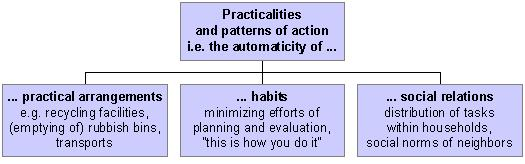
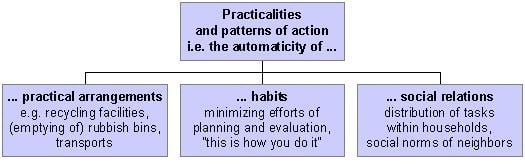
In the following, we relate our results on various kinds of uncertainty more deeply to the cultural contexts revealed in interviews and field studies. People act and create their perceptions of waste in a cultural context where the waste system is only one among many components [13]. From what they think and say about waste, cultural categories can be discerned (see Figure 1 below). Examples of such categories are usability, value, constituents, purity, disgust, satisfaction, to show/to hide, shame/pride, status, etc. Anthropological studies have shown how these cultural categories are usually associated with waste, even in different societies and at different times [19,31]. For our purposes we therefore chose to summarize them with the concept of universal categories. For this concept to be meaningful, it should also be possible to detect categories that are particular rather than universal, and it seems we have identified particular categories mainly in the views of waste and the environment. Thinking about and handling waste from beliefs about what is good for the environment is a time-bound, and to some extent, place-bound, phenomenon. We also noted that there is another particulate category related to environmental thinking, namely perceptions of how the waste system actually works. This includes beliefs about how the system ought to work, as well as levels of confidence in the system and the actors (that are perceived to stand) behind it. Regarding the latter point, we have noticed that interviewees often perceive society, i.e., authorities at different levels, as those responsible for the entire waste system. This idea also applies to the system for the recycling of packaging. It is true that the system is created by legislation, but in practice it is run entirely by private organizations, companies and associations.
Figure 1.
Cultural categories of waste in everyday life.

Considering, as an example, the disposition (shown by interviewees) to sort in terms of constituent matter rather than in terms of packaging versus non-packaging, the concept of universal categories seems applicable. Distinguishing between metal, glass, paper, metal etc. is easy in everyday language, experiences and ideas. Materials are considered to be universal categories, but packaging versus non-packaging does not seem to work either as a universal or a particulate category. In this case comparisons can be made between “environmentally friendly” and “environmentally hazardous”, which are accepted and viable particulate categories. This means that cultural contexts in most cases support the constituent matter distinctions of the waste collection system [8]. However, the packaging or not distinction seems to contradict, rather than complement, the constituent matter distinction.
In our view cultural categories stand for everyday, mental and social structuring, i.e., how people think about garbage. What they do (their waste acts) is of course strongly related to how they think. The actual management of waste from households can be seen as consisting of two parts, the lay part and the professional part or, put another way, people in their everyday lives and the socio-technical waste disposal system [32,33]. These two main types of players meet in some parts of the waste handling, and in the administration of the same. They then develop their practices and their strategies (in relation to each other). An appropriate theoretical perspective for studying this is the actor-network-theory (ANT), which highlights the materiality of events and power relationships by looking at both human actors as actants, which create opportunities and constraints [34]. The waste systems, seen as an actor-networks, produces artifacts (e.g., recycling facilities), services (e.g., waste transport), categories (e.g., packaging versus non-packaging) and changes (e.g., the 2008 regulation that soft plastic can be sorted with hard plastic) that confront the layman, and are appropriated and domesticated by him or her. More precisely expressed each of the producer pays-based recycling system and the municipal waste collection system appear to constitute an actor-networks, i.e., a specific but changing constellation of actors and objects [28]. The systems are political projects that cut across people’s everyday lives. Scientific knowledge and political intentions, including environmental quality objectives, producer pays’ principle and the waste hierarchy, are key elements in these actor-networks.
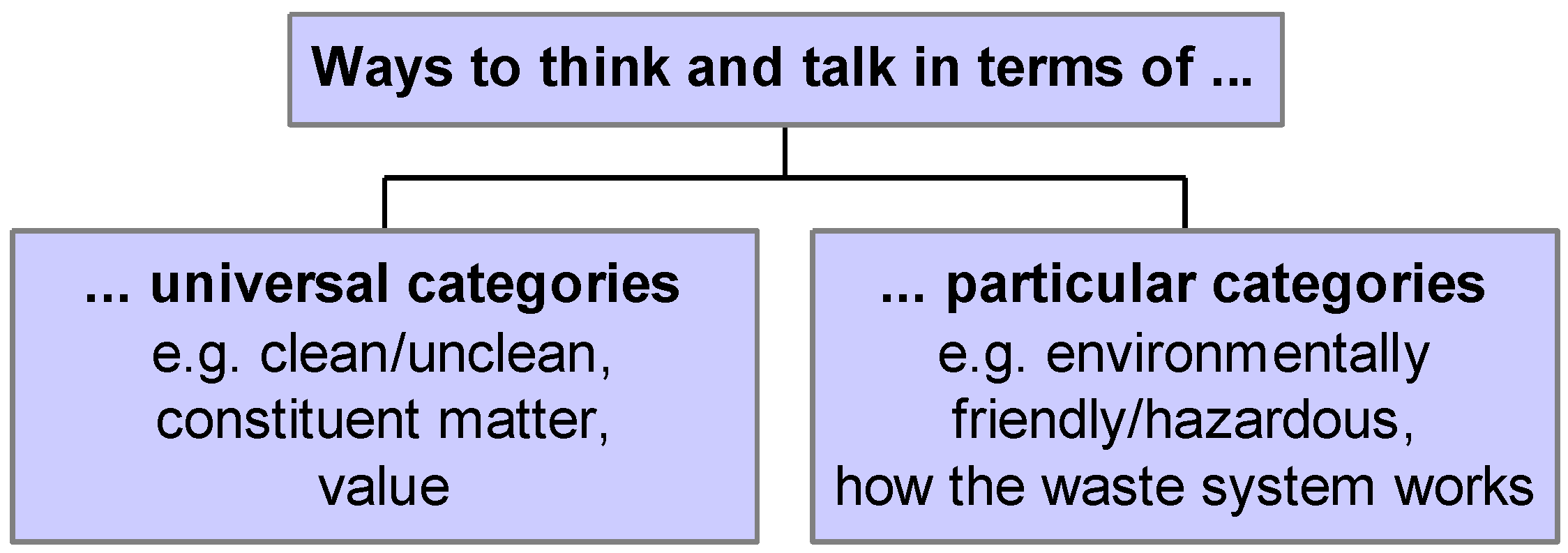
The ANT perspective helps to show how practical reality is being arranged to suit certain waste acts but not others, for example how it is often easier for the individual to throw away a piece of waste in its right (legally prescribed and socially acceptable) place than not. Bins are usually in their appropriate places: in the kitchen cupboard, at the supermarket entrance, in the residential bulk waste room and at the public recycling facility. According to ANT the waste-related artifacts hold waste practices in place and make them stable. From our fieldwork we found that this stability often borders to automaticity. The concept automaticity comprises different aspects (see Figure 2 below), a physical (that can be understood e.g., through ANT) a social and a habitual, for which also other strands of theory seem relevant.
At its simplest level, the habitual aspect is the periodic repetition of acts that have been learned [26,35]. If for instance a person has learned to sort waste into certain fractions, it is often easier to continue with this than to stop sorting and throw everything in the rubbish bin, even though the latter could involve less time and effort. An explanation for this is that waste acts are habitual in the sense that they are started without planning, conducted with little attention paid to them and completed without any need to evaluate them afterwards [26].
Figure 2.
The cultural automaticity of waste in everyday life.
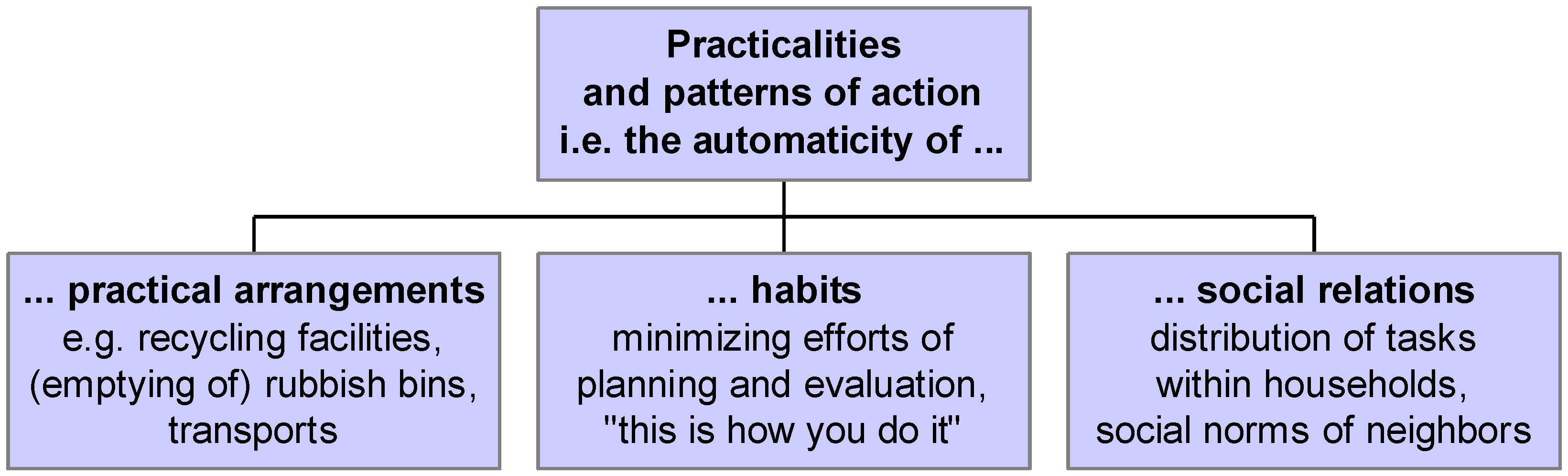
This means that it may require less (conscious) effort to continue with a habit than to change it in a seemingly more comfortable direction. In the results section above, there is an example of a washing-up brush. The interviewee seemed to habitually, and correctly from a legal point of view, dispose of his old washing-up brushes in the mixed waste. One possible explanation for doing the right thing in this specific case is that habits are often imitated, and thereby socially established and justified [20]. If many people put their washing-up brushes, or other specific types of items, in the mixed household waste far from all of them have to be (constantly) consciously aware of the reasons for this. Habits of sorting certain kinds of common items may seem increasingly obvious, which gives them self-perpetuating features [36]. In this way everyday practice is socially economized through the creation of habits. However, the interviewee seemed quite uncertain about the reasons for putting the washing-up brush in mixed waste fraction. This indicates a tension between habit and justification in terms of cultural categories (universal category: made of plastic—particular category: good for the environment to recycle). Uncertainties concerning waste sorting can therefore be seen as indicators of underlying tension or dissonance, between different culturally grounded values and habits. Theoretically such values and habits can be understood and divided into, for example practical arrangements, habits, and the social construction of them, using the theoretical tools presented above. This also implies that the cultural automaticity of waste acts in daily life may be more or less stable for different kinds of items and acts.
4. Conclusions
Our field studies and interviews confirm earlier findings of positive attitudes to waste sorting among Swedish people in general. Many of the interviewees in our study saw waste sorting as an attempt to contribute towards a good environment. Overall, the attitudes towards waste sorting can be described along a scale with satisfied at one end and unsure at the other. Satisfaction is primarily associated with waste sorting as a meaningful action that is good for the environment. Uncertainty, on the other hand, appears to be connected to a handful of factors that we attempted to classify into different types.
The causes of uncertainty identified from our interview material can be summarized as follows:
- Only packaging made of a certain material (e.g., plastic, metal or glass) is officially collected and not all discarded products of a certain material. Many people are not comfortable with this. They readily and willingly discriminate between different materials but not between packaging and other items (i.e., non-packaging) made of the same material.
- The sorting of particular waste items into particular fractions is often automatic rather than consciously considered on each occasion. When something disrupts this automaticity, e.g., a new rule or regulation, a sign or how the bins for different fractions are designed or placed, uncertainty can arise.
- There are rules requiring certain items to be put in the rubbish bin rather than being recycled in a certain fraction with which they could be expected to fit, e.g., envelopes should not be recycled with other printed paper/newspapers.
- Users in general do not seem to have come across, noticed or embraced principles, or rules of thumb, motivating exceptions such as that for envelopes. Such rules clearly contradict popular perceptions of the kind that “it is good for the environment to recycle paper”.
The general causes of the behaviors observed in these examples can be summarized as:
- Professional categories not matching cultural categories. Everyday action, language and reasoning motivate people to discriminate between certain categories, but not between others. Thus a frequent cause of uncertainty is that the basic categories of the waste system are not in line with basic categories constructed in everyday life.
- Challenged habits. Source separation in everyday life is habitual. When a habit is challenged, by a particular element or feature of the waste system, uncertainty can arise.
- Lacking fractions. Some kinds of items cannot be left for recycling and this makes waste collection incomplete from the users’ point of view. This in turn lowers the credibility of the system.
- Missing rules of thumb. All the above causes seem to be particularly relevant if no motivating principle or rule of thumb (within the context of use) is successfully conveyed to the user.
5. Recommendations
In the following, we suggest and discuss how authorities and other players in the waste sector could reduce uncertainties regarding waste handling in everyday life and thus improve the sustainability of the waste recycling system.
Our comprehensive recommendation is to adjust specific elements and aspects of the system so that they fit better with the cultural categories and automaticity (material and habitual) that already make it work well in many respects. In line with our reasoning, parts or aspects of the system that the user encounters either fit well or do not fit with the users’ waste acts and perception of the system and what it is good for. In addition we would argue that the waste system, in its cultural context, constitutes strong “information” in itself. Therefore we generally do not recommend information as a measure on its own to overcome uncertainty and other barriers to reach goals concerning recycling levels, waste quantities and the environment.
In our view the concepts proposed above provide clues on how to deal with particular problems, for example that not enough cans and other discarded items of metal are recycled. Allowing most of the everyday metal waste from households to be sorted and recycled together with packaging could bring the professional category (i.e., the fraction) closer into line with the universal cultural category of constituent matter. Also value can be seen as an important universal category in relation to metal waste [19]. In many cultural contexts putting a (relatively high) value on metal is obvious for people. Concerning cultural automaticity, there is currently a well-established system for paying a deposit on beverage cans. This system works well for several reasons, e.g., the empty cans can be returned to where they were bought. The returned deposit then acts as a financial incentive [7], as well as providing proof that the discarded items have been recycled in the correct place [7], reducing uncertainty. The long-lasting system of deposits, which has gradually been extended to new types of beverage containers, means that the habit of returning “bottles” has a strong cultural, definitely habitual and probably even institutional foundation. Returning beer, water and soft drinks containers to the shop is something people have become used to doing over several decades. This could mean that the potential exists to expand the collection of packaging in supermarkets, e.g., to all cans of sheet metal (for canned vegetables etc.).
It should be noted that specific measures of the kind we propose are an outcome of the analytical process of describing what people say and do today, given the conditions at hand. Our point is that the culture-analytical description gives ideas on to how to deal with these issues in the near future. The concepts we have proposed are tools for thinking about ways to solve environmental problems related to waste handling in everyday life.
We would also like to stress that individuals and groups who try to act in accordance with ideas about what is necessary or good for the environment can be assisted by measures that make it more obvious and certain that waste fractions and processes of the greatest importance to the environment are dealt with in the best way. According to our results, this could make people feel more satisfied with their efforts. Since people like to think that it is society—rather than waste contractors and others—that is responsible for waste being collected and dealt with correctly, we suggest that the waste system should work in accordance with this belief. For example, state and municipal legislation and supervision ensuring that a certain group of materials is sent for a particular type of recycling can be more effective when it comes to maintaining confidence and motivation than for example financial control measures and market mechanisms that lead to the groups of materials being dealt with differently on different occasions (e.g., recycled in some cases and used for energy recovery in others). This is not to say that predictability and consistency are always better than flexibility when it comes to how waste is dealt with. However, for people in general, the environmental consequences seem to be the most important aspect of waste recycling. People generally want to contribute through their own waste sorting in order for the outcome to be as good as possible for the environment. Thus, people need to know that it is the environmental aspects that take priority when waste is ultimately dealt with, used and returned to nature or society. Through meeting this need, we believe that confidence in the waste system and the motivation to contribute can be more successfully maintained.
References and Notes
- Sörbom, A. Den som kan—sorterar mer! Några slutsatser baserade på tidigare forskning kring källsortering i hushållen; FOI Memo d.nr. 01-1526:6, Fms-rapport 180; Totalförsvarets forskningsinstitut (FOI): Stockholm, Sweden, 2003. (in Swedish) [Google Scholar]
- Förpacknings- och tidningsinsamlingen (FTI). Riksnivå—återvinningsstatistik, återvinnings-resultat. Available online: http://www.ftiab.se/hushall/atervinningen/statistik/riksniva.4.405877db1168b3d892a800093.html (accessed on 2 May 2010). (in Swedish).
- Eriksson, O.; Sundqvist, J.O. Challenges in Swedish waste management with emphasis on waste prevention and source separation. Sustainability 2010. submitted. [Google Scholar]
- Aktionsplan Avfall (Action Plan—Waste); Environmental Protection Agency Report 4601; Swedish Environmental Protection Agency: Stockholm, Sweden, 1996. (in Swedish)
- Swedish Waste Management: Svensk Avfallshantering. Available online: http://www.avfallsverige.se (accessed on 11 June 2010). (in Swedish).
- Miljömålsportalen. Available online: http://www.miljomal.nu/Environmental-Objectives-Portal/15-A-Good-Built-Environment/Interim-targets/Waste/ (accessed on 11 June 2010).
- Bisaillon, M.; Finnveden, G.; Noring, M.; Stenmarck, Å.; Sundberg, J.; Sundqvist, J.O.; Tyskeng, S. Nya styrmedel inom avfallsområdet; Miljöstrategisk analys—fms, KTH: Stockholm, Sweden, 2009. [Google Scholar]
- Åkesson, L. Det värdelösas värde och sopornas ordning. In Hållbara värden; Cronqvist, M., Ed.; Makadam: Göteborg, Sweden, 2008. (in Swedish) [Google Scholar]
- Dreborg, K.H. Scenarios and Structural Uncertainty—Explorations in the Field of Sustainable Transport; Royal Institute of Technology: Stockholm, Sweden, 2004. [Google Scholar]
- Brugnach, M.; Dewulf, A.; Pahl-Wostl, C.; Taillieu, T. Toward a relational concept of uncertainty: About knowing too little, knowing too differently, and accepting not to know. Ecol. Soc. 2008, 13. Article 30. [Google Scholar]
- Walker, W.E.; Harremoës, P.; Rothman, J.; Sluijs, J.P.V.d.; Asselt, M.B.A.V.; Janssen, P.; Krauss, M.P.K.V. Defining uncertainty—A conceptual basis for uncertainty management in model-based decision support. Integr. Assess. 2003, 4, 5–17. [Google Scholar] [CrossRef]
- Douglas, M. Purity and Danger—An Analysis of the Concept of Pollution and Taboo; Routledge & Kegan Paul: London, UK, 1966. [Google Scholar]
- Hawkins, G.; Muecke, S. Culture and Waste: The Creation and Destruction of Value; Rowman & Littlefield Publishers: Lanham, Australia, 2003. [Google Scholar]
- Thompson, M. Rubbish Theory: The Creation and Destruction of Value; Oxford University Press: Oxford, UK, 1979. [Google Scholar]
- Mayne, A.; Murray, T. The Archaeology of Urban Landscapes—Explorations in Slumland; Cambridge University Press: Cambridge, UK, 2001. [Google Scholar]
- Rathje, W.; Murphy, C. Rubbish! The Archaeology of Garbage; The University of Arizona Press: Tucson, AZ, USA, 2001. [Google Scholar]
- Brower, M.; Leon, W. The Consumer’s Guide to Effective Environmental Choices; Three Rivers Press: New York, NY, USA, 1999. [Google Scholar]
- Dahlén, L. To Evaluate Source Sorting Programs in Household Waste Collection Systems; Ph.D. Thesis, Luleå University of Technology, Luleå, Sweden, 2005.
- Åkesson, L. Wasting. Ethnologia Europea. J. Euro. Ethnol. 2005, 35, 39–46. [Google Scholar]
- Henriksson, G. Stockholmarnas resvanor—mellan trängselskatt och klimatdebatt. Ph.D. Thesis, Royal Institute of Technology (KTH), Stockholm, Sweden, 2008. [Google Scholar]
- Ehn, B.; Löfgren, O. Kulturanalyser, 2nd revised ed.; Gleerup: Malmö, Sweden, 2001. (in Swedish) [Google Scholar]
- Godskesen, M. Rutiner og brud i hverdagens transport; Institute for Produktion og ledelse, Danmarks tekniske universitet: Köpenhamn, Demark, 2002. [Google Scholar]
- Öhlander, M. Deltagande Observation. In Etnologiskt fältarbete; Kaijser, L., Öhlander, M., Eds.; Studentlitteratur: Lund, Sweden, 1999; pp. 73–88. (in Swedish) [Google Scholar]
- Borgstede, C.V.; Andersson, K. Environmental information to whom? Explanatory factors for information behavior. Sustainability 2010, in press. [Google Scholar]
- Ewert, S.; Henriksson, G.; Åkesson, L. Osäker eller nöjd—kulturella aspekter på vardagens avfallspraktik; Miljöstrategisk analys—fms, KTH: Stockholm, Sweden, 2009. [Google Scholar]
- Campbell, C. Detraditionalization, Character and the Limits to Agency. In Detraditionalization. Critical Reflection on Authority and Identity; Heelas, P., Lash, S., Morris, P., Eds.; Blackwell: Cambridge, MA, USA, 1996. [Google Scholar]
- Shove, E. Converging conventions of comfort, cleanliness and convenience. J. Consum. Policy 2003, 26, 395–418. [Google Scholar] [CrossRef]
- Brembeck, H.; Ekström, K.M.; Mörck, M. Shopping with Humans and Non-humans. In Little Monsters: (De)coupling Assemblages of Consumption; Brembeck, H., Ekström, K.M., Mörck, M., Eds.; Lit Verlag: Berlin, Germany, 2007. [Google Scholar]
- Latour, B. Reassembling the Social: An Introduction to Actor-Network-Theory; Oxford University Press: Oxford, UK, 2005. [Google Scholar]
- Czarniawska, B. En teori om organisering; Studentlitteratur: Lund, Sweden, 2005. (in Swedish) [Google Scholar]
- Scanlan, J. On Garbage; Reaktion Books: London, UK, 2005. [Google Scholar]
- Gregson, N.; Crewe, L. Second-hand Cultures; Berg: Oxford, UK, 2003. [Google Scholar]
- Hetherington, K. Secondhandedness: Consumption, disposal, and absent presence. Environ. Plan. D-Soc. Space. 2004, 22, 157–173. [Google Scholar] [CrossRef]
- Latour, B. Artefaktens återkomst. Ett möte mellan organisationsteori och tingens sociologi; Nerenius & Santérus förlag: Stockholm, Switzerland, 1998; (in Swedish, also available in French and English). [Google Scholar]
- Ehn, B.; Löfgren, O. När ingenting särskilt händer. Nya kulturanalyser; Brutus Östlings bokförlag Symposion: Stockholm, Sweden, 2007. (in Swedish) [Google Scholar]
- Berger, P.; Luckman, T. The Social Construction of Reality: A Treatise in the Sociology of Knowledge; Penguin: London, UK, 1991. [Google Scholar]
© 2010 by the authors; licensee MDPI, Basel, Switzerland. This article is an open access article distributed under the terms and conditions of the Creative Commons Attribution license (http://creativecommons.org/licenses/by/3.0/).
Share and Cite
MDPI and ACS Style
Henriksson, G.; Åkesson, L.; Ewert, S. Uncertainty Regarding Waste Handling in Everyday Life. Sustainability 2010, 2, 2799-2813. https://doi.org/10.3390/su2092799
AMA Style
Henriksson G, Åkesson L, Ewert S. Uncertainty Regarding Waste Handling in Everyday Life. Sustainability. 2010; 2(9):2799-2813. https://doi.org/10.3390/su2092799
Chicago/Turabian StyleHenriksson, Greger, Lynn Åkesson, and Susanne Ewert. 2010. "Uncertainty Regarding Waste Handling in Everyday Life" Sustainability 2, no. 9: 2799-2813. https://doi.org/10.3390/su2092799