
Post-Materialist Values of Smart City Societies: International Comparison of Public Values for Good Enough Governance



Abstract
1. Introduction and Background
2. Methodology
3. Results
3.1. Important Values in Life
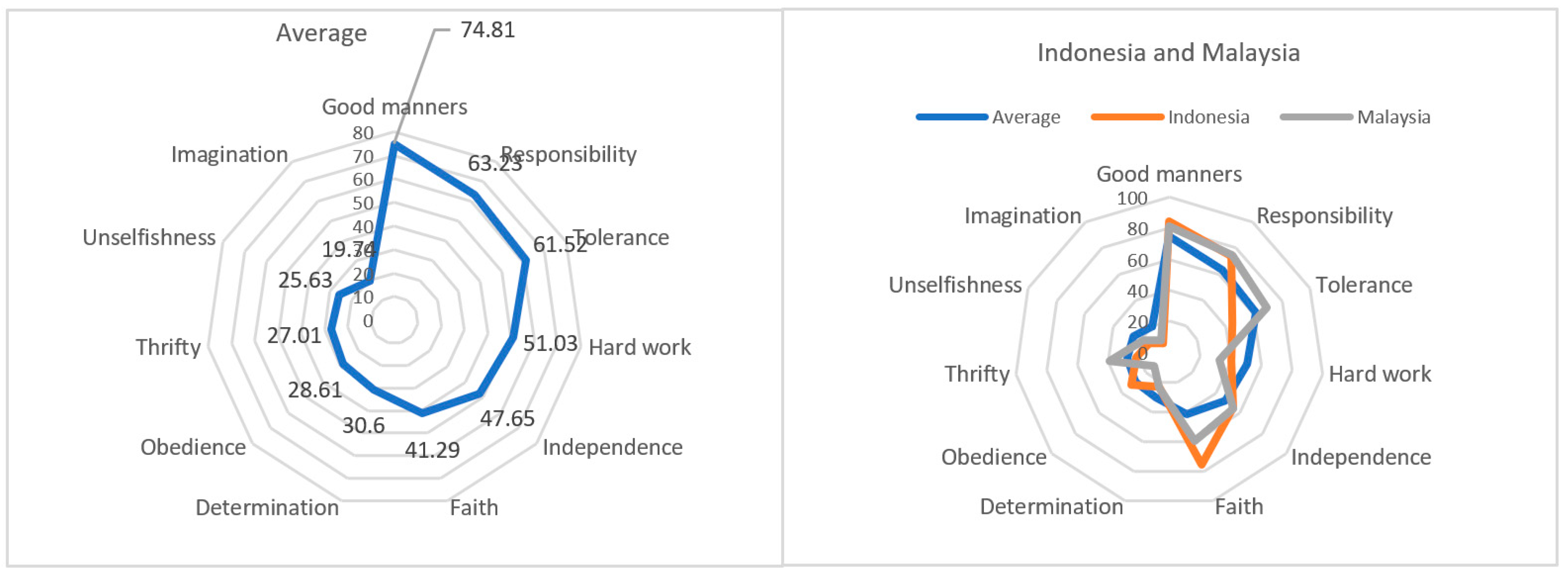
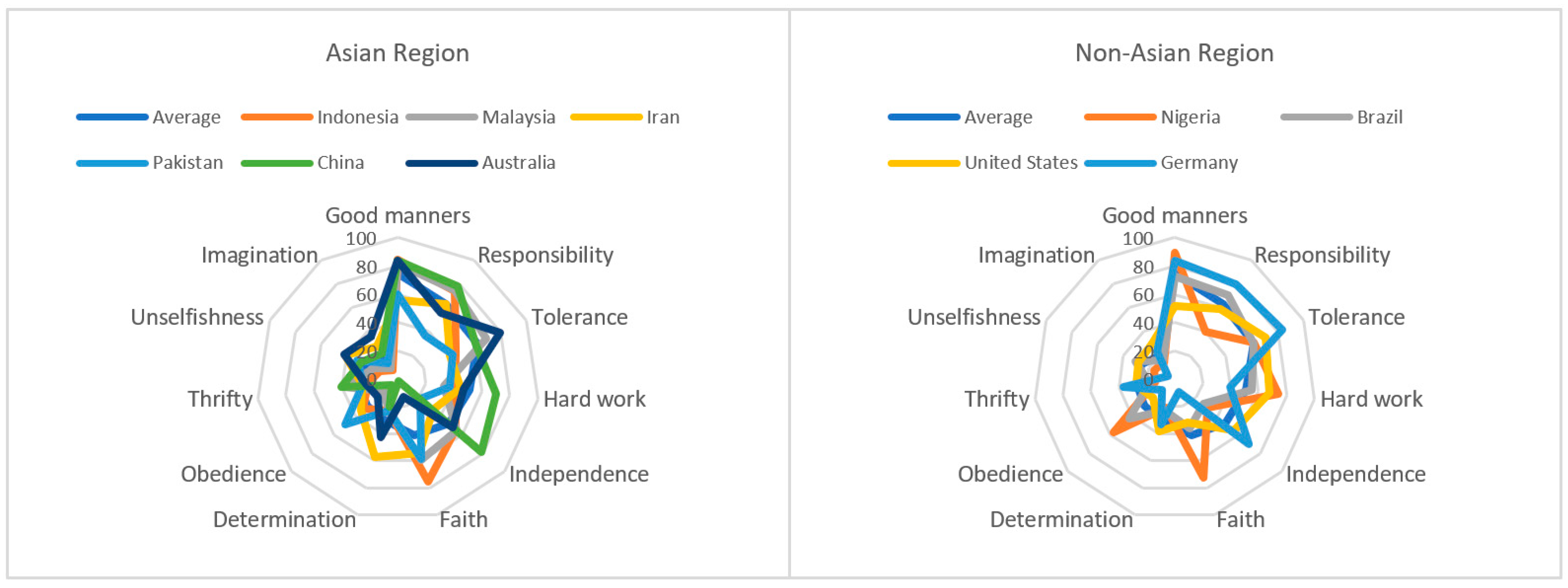
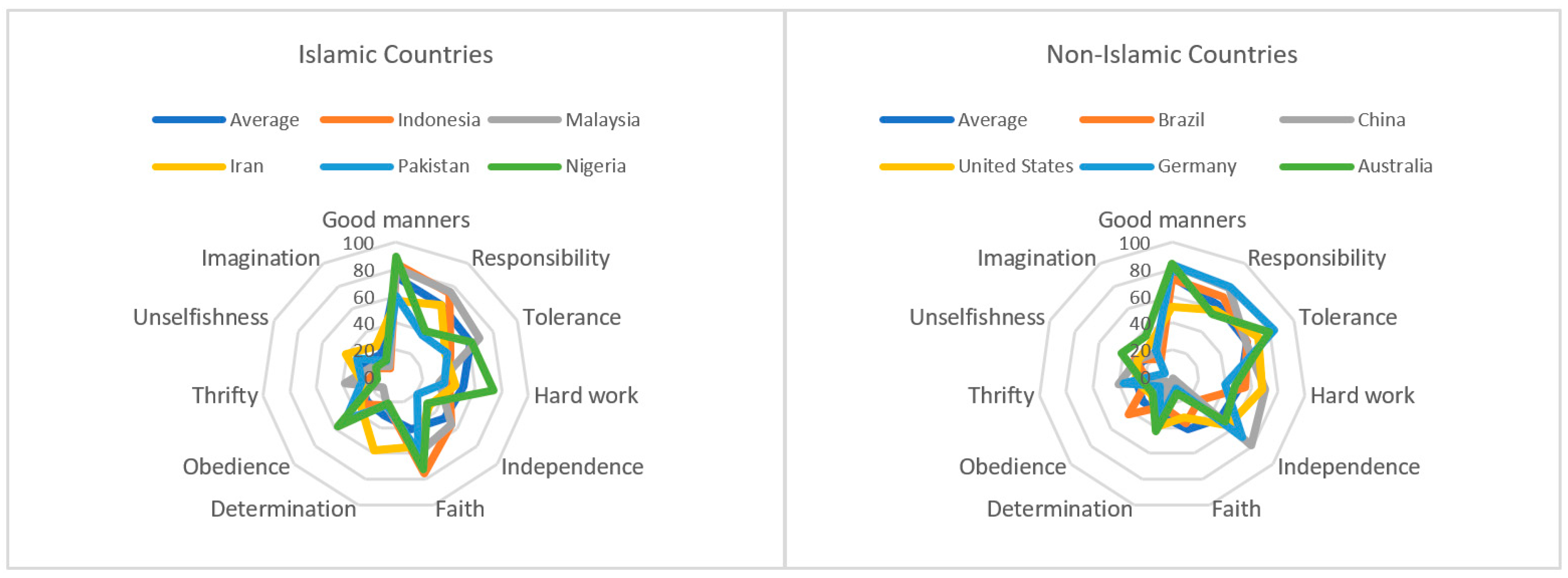
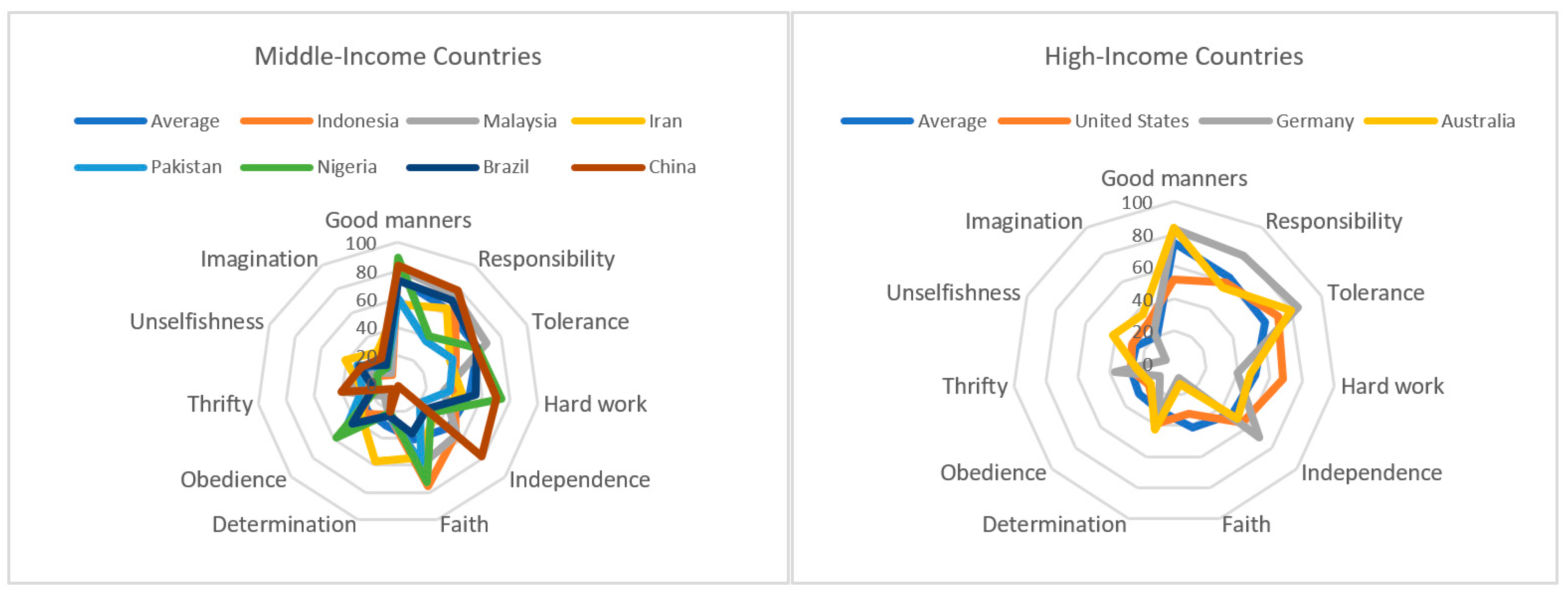
3.2. Qualities to Develop
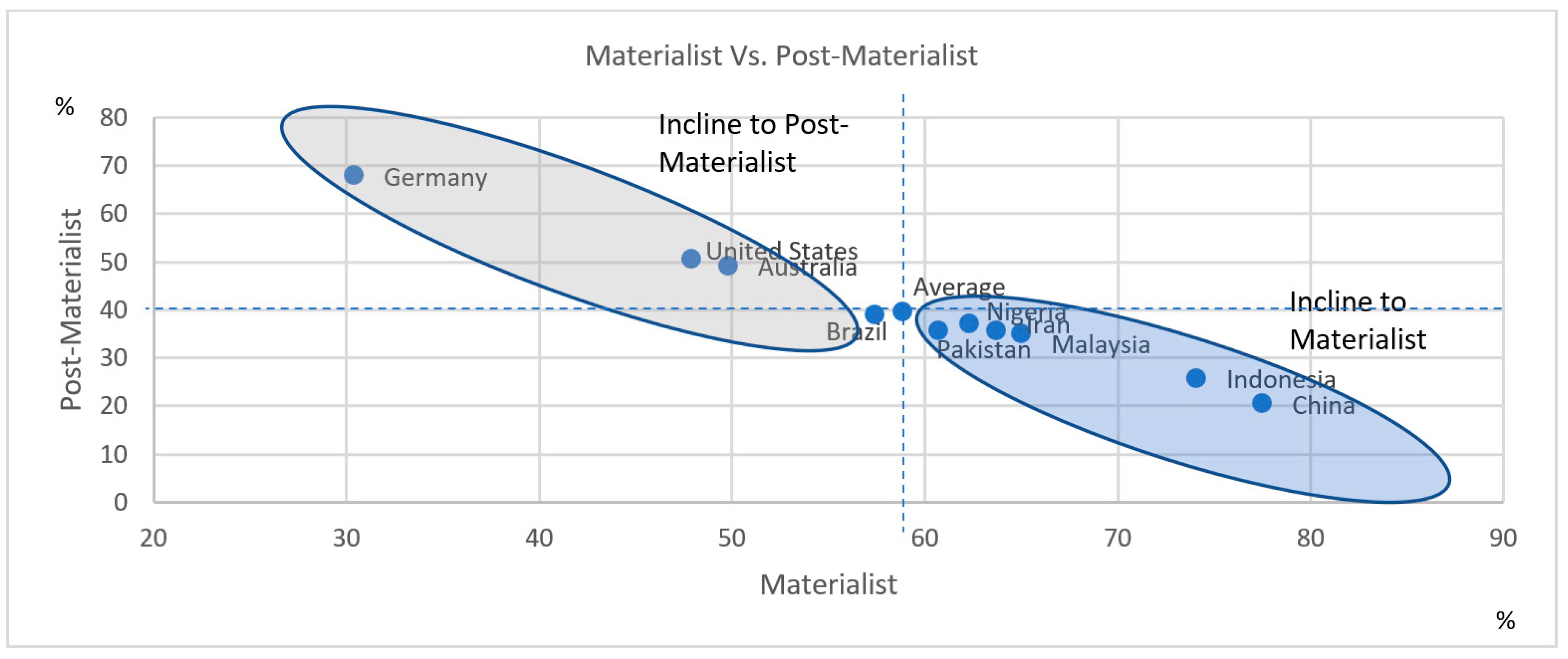
3.3. Materialist vs. Post-Materialist Values
4. Discussion
4.1. Political Participation Values to Prioritize under the Principle of Long-Term Good Enough Governance to Realize the Smart City Society
4.2. Dichotomous Challenges in Building Qualities of Future Smart Citizen and Society
4.3. Possibilities for Building the Post-Materialist Smart City Society
5. Conclusions
Author Contributions
Funding
Data Availability Statement
Acknowledgments
Conflicts of Interest
References
- Yigitcanlar, T.; Han, H.; Kamruzzaman, M.; Ioppolo, G.; Sabatini-Marques, J. The making of smart cities: Are Songdo, Masdar, Amsterdam, San Francisco and Brisbane the best we could build? Land Use Policy 2019, 88, 104187. [Google Scholar] [CrossRef] [Scilit]
- Komninos, N.; Panori, A.; Kakderi, C. Smart cities beyond algorithmic logic: Digital platforms, user engagement and data science. In Smart Cities in the Post-Algorithmic Era: Integrating Technologies, Platforms and Governance; Komninos, N., Kakderi, C., Eds.; Edward Elgar: Northampton, MA, USA, 2019; pp. 1–15. [Google Scholar]
- Zheng, C.; Yuan, J.; Zhu, L.; Zhang, Y.; Shao, Q. From digital to sustainable: A scientometric review of smart city literature between 1990 and 2019. J. Clean. Prod. 2020, 258, 120689. [Google Scholar] [CrossRef] [Scilit]
- Kummitha, R.K.R.; Crutzen, N. How do we understand smart cities? An evolutionary perspective. Cities 2017, 67, 43–52. [Google Scholar] [CrossRef] [Scilit]
- Kitchin, R.; Lauriault, T.P.; Mcardle, G. Smart cities and the politics of urban data. In Smart Urbanism: Utopian Vision or False Dawn? Marvin, S., Luque-Ayala, A., McFarlane, C., Eds.; Routledge: London, UK, 2016; pp. 16–33. [Google Scholar]
- Yigitcanlar, T.; Corchado, J.M.; Mehmood, R.; Li, R.Y.M.; Mossberger, K.; Desouza, K. Responsible urban innovation with local government artificial intelligence (AI): A conceptual framework and research agenda. J. Open Innov. Technol. Mark. Complex 2021, 7, 71. [Google Scholar] [CrossRef] [Scilit]
- Hartswood, M.; Grimpe, B.; Jirotka, M.; Anderson, S. Towards the ethical governance of smart society. In Social Collective Intelligence; Miorandi, D., Maltese, V., Rovastos, M., Nijholt, A., Stewart, J., Eds.; Springer: Cham, Switzerland, 2014; pp. 3–30. [Google Scholar]
- Staletić, N.; Labus, A.; Bogdanović, Z.; Despotović-Zrakić, M. Citizens’ readiness to crowdsource smart city services: A developing country perspective. Cities 2020, 107. [Google Scholar] [CrossRef] [Scilit]
- Mckinsey Global Institute. Smart cities: Digital Solutions for a More Livable Future; Mckinsey & Company: New York, NY, USA, 2018. [Google Scholar]
- Rotta, M.J.R.; Sell, D.; dos Santos Pacheco, R.C.; Yigitcanlar, T. Digital commons and citizen coproduction in smart cities: Assessment of Brazilian municipal e-government platforms. Energies 2019, 12, 2813. [Google Scholar] [CrossRef] [Scilit]
- Meijer, A.; Bolívar, M.P.R. Governing the smart city: Scaling-up the search for socio-techno synergy. In Proceedings of the European Group for Public Administration (EGPA), Edinburgh, UK, 11–13 September 2013; pp. 100–113. [Google Scholar]
- World Bank. Good Governance and its Benefits on Economic Development: An Overview of Current Trends. Available online: https://pdf4pro.com/cdn/good-governance-and-its-benefits-on-economic-development-442998.pdf (accessed on 20 April 2021).
- Grindle, M.S. Good enough governance: Poverty reduction and reform in developing countries. Gov. An. Int. J. Policy, Adm. Inst. 2004, 17, 525–548. [Google Scholar] [CrossRef] [Scilit]
- Grindle, M.S. Good enough governance revisited. Dev. Policy Rev. 2007, 25, 553–574. [Google Scholar] [CrossRef] [Scilit]
- Premat, C. Smart cities in a digital nation: Are Swedish cities enough innovative? In Smarter as the New Urban. Agenda a Comprehensive View of the 21st Century City; Gil-Garcia, J.R., Nam, T., Pardo, T.A., Eds.; Springer: Cham, Switzerland, 2016; pp. 207–224. [Google Scholar]
- Cheng, K.H.; Cheah, T.C. A study of Malaysia’s smart cities initiative progress in comparison of neighbouring countries (Singapore & Indonesia). J. Crit. Rev. 2020, 7, 47–54. [Google Scholar] [CrossRef] [Scilit]
- Yau, K.L.A.; Lau, S.L.; Chua, H.N.; Ling, M.H.; Iranmanesh, V.; Kwan, S.C.C. Greater Kuala Lumpur as a smart city: A case study on technology opportunities. In Proceedings of the 8th International Conference on Knowledge and Smart Technology (KST), Chiangmai, Thailand, 3–6 February 2016; pp. 96–101. [Google Scholar] [CrossRef] [Scilit]
- Bokolo, A.J.; Majid, M.A.; Romli, A. A trivial approach for achieving smart city: A way forward towards a sustainable society. In Proceedings of the 21st Saudi Computer Society National Computer Conference (NCC), Riyadh, Saudi Arabia, 25–26 April 2018; pp. 1–6. [Google Scholar] [CrossRef] [Scilit]
- Malek, J.A.; Lim, S.B.; Yigitcanlar, T. Social inclusion indicators for building citizen-centric smart cities: A systematic literature review. Sustainability 2021, 13, 376. [Google Scholar] [CrossRef] [Scilit]
- Lim, S.B.; Malek, J.A.; Hussain, M.Y.; Tahir, Z. Citizen participation in building citizen-centric smart cities. Geografia Malays. J. Soc. 2018, 14, 42–53. [Google Scholar] [CrossRef] [Scilit]
- Lim, S.B.; Malek, J.A.; Hussain, M.Y.; Tahir, Z. The behaviours and job positions of citizens in smart cities’ development. Plan. Malays. 2019, 17, 133–145. [Google Scholar] [CrossRef] [Scilit]
- Lim, S.B.; Malek, J.A.; Hussain, M.Y.; Tahir, Z. Participation in e-government services and smart city programs: A case study of Malaysian local authority. Plan. Malays. 2020, 18, 300–312. [Google Scholar] [CrossRef] [Scilit]
- Lim, S.B.; Malek, J.A.; Hussain, M.Y.; Tahir, Z. Malaysia smart CITY framework: A trusted framework for shaping smart Malaysian citizenship? In Handbook of Smart Cities; Augusto, J.C., Ed.; Springer International Publishing: Cham, Switzerland, 2020; pp. 1–24. [Google Scholar]
- Wok, S.; Mohamed, S. Internet and social media in Malaysia: Development, challenges and potentials. In The Evolution of Media Communication; Acuña, B.P., Ed.; Intechopen: London, UK, 2017; pp. 45–64. [Google Scholar]
- Lim, S.B.; Malek, J.A.; Hussain, M.Y.; Tahir, Z.; Saman, N.H.M. SDGs, smart urbanisation, and politics: Stakeholder partnerships and environmental cases in Malaysia. J. Sustain. Sci. Manag. 2021, 16, 190–219. [Google Scholar] [CrossRef] [Scilit]
- World Bank. World Bank Country and Lending Groups. Available online: https://datahelpdesk.worldbank.org/knowledgebase/articles/906519 (accessed on 1 May 2021).
- Serajuddin, U.; Hamadeh, N. New World Bank Country Classifications by Income Level: 2020–2021. Available online: https://blogs.worldbank.org/opendata/new-world-bank-country-classifications-income-level-2020–2021 (accessed on 1 May 2021).
- Noack, R. World’s Least Religious Countries. Available online: https://www.washingtonpost.com/news/worldviews/wp/2015/04/14/map-these-are-the-worlds%02least-religious-countries/ (accessed on 1 May 2021).
- Worldometer. Countries in the World by Population. 2021. Available online: https://www.worldometers.info/world-population/population-by-country/ (accessed on 1 May 2021).
- Feng, B. Chinese Respondents Top Materialism Poll. Available online: https://sinosphere.blogs.nytimes.com/2013/12/20/chinese-respondents-top-materialism-poll/?mtrref=undefined&assetType=PAYWALL (accessed on 1 May 2021).
- Haerpfer, C.; Inglehart, R.; Moreno, A.; Welzel, C.; Kizilova, K.; Diez-Medrano, J.; Lagos, M.; Norris, P.; Ponarin, E.; Puranen, B.; et al. World Values Survey: Round Seve—Country-Pooled Datafile; JD Systems Institute & WVSA Secretariat: Madrid, Spain; Vienna, Austria, 2020. [Google Scholar]
- Cohen, J. Statistical Power Analysis for the Behavioral Sciences, 2nd ed.; Lawrence Erlbaum Associates: Hillsdale, NJ, USA, 1988. [Google Scholar]
- Alemán, J.; Woods, D. Value orientations from the World Values Survey: How comparable are they cross-nationally? Comp. Polit. Stud. 2016, 49, 1039–1067. [Google Scholar] [CrossRef] [Scilit]
- Inglehart, R.F. After postmaterialism: An essay on China, Russia and the United States: A comment. Can. J. Sociol. 2016, 41, 213–222. [Google Scholar] [CrossRef] [Scilit]
- Uhlaner, L.M.; Thurik, R.; Hutjes, J. Post-Materialism as a Cultural Factor Influencing Entrepreneurial Activity across Nations; Erasmus University Rotterdam: Rotterdam, The Netherlands, 2002. [Google Scholar]
- Economist Intelligence Unit (EIU). Democracy Index 2020: In sickness and in health? Economist Intelligence Unit: London, UK, 2020. [Google Scholar]
- Inglehart, R.F. Religion’s Sudden Decline: What’s Causing It, and What Comes Next? Oxford University Press: Oxford, UK, 2021. [Google Scholar]
- Banerjee, R. On the interpretation of World Values Survey Trust Question—Global Expectations vs. Local Beliefs; Discussion Paper No. 9872; Institute for the Study of Labor, University of Bonn: Bonn, Germany, 2016. [Google Scholar]
- Curini, L.; Jou, W.; Memoli, V. How moderates and extremists find happiness: Ideological orientation, citizen-government proximity, and life satisfaction. Int. Polit. Sci. Rev. 2013, 2, 129–152. [Google Scholar] [CrossRef] [Scilit]
- Inglehart, R. The silent revolution in Europe: Intergenerational change in post-industrial societies. Am. Polit. Sci. Rev. 1971, 65, 991–1017. [Google Scholar] [CrossRef] [Scilit]
- Inglehart, R. Modernization, existential security and cultural change: Reshaping human motivations and society. In Advances in Culture and Psychology; Gelfand, M., Chiu, C.Y., Hong, Y.-Y., Eds.; Oxford University Press: Oxford, UK, 2018. [Google Scholar]
- Roser, M. Materialism and Post-Materialism. Available online: https://ourworldindata.org/materialism-and-post-materialism (accessed on 5 May 2021).
- Cardullo, P.; Kitchin, R. Being a ‘citizen’ in the smart city: Up and down the scaffold of smart citizen participation in Dublin, Ireland. GeoJournal 2019, 84, 1–13. [Google Scholar] [CrossRef] [Scilit]
- Metaxiotis, K.; Carrillo, F.J.; Yigitcanlar, T. Knowledge-Based Development for Cities and Societies: Integrated Multi-Level Approaches; IGI Global: Hershey, PA, USA, 2010. [Google Scholar]
- Green, B. The Smart Enough City: Putting Technology in its Place to Reclaim Our Urban Future; MIT Press: Cambridge, MA, USA, 2019. [Google Scholar]
- Yigitcanlar, T.; Kamruzzaman, M. Smart cities and mobility: Does the smartness of Australian cities lead to sustainable commuting patterns? J. Urban. Technol. 2019, 26, 21–46. [Google Scholar] [CrossRef] [Scilit]
- Giffinger, R.; Fertner, C.; Kramar, H.; Kalasek, R.; Pichler, N.; Meijers, E. Smart Cities: Ranking of European Medium-Sized Cities; Centre of Regional Science, TU Vienna: Vienna, Austria, 2007. [Google Scholar]
- Preston, S.; Mazhar, M.U.; Bull, R. Citizen engagement for co-creating low carbon smart cities: Practical lessons from Nottingham City Council in the UK. Energies 2020, 13, 6615. [Google Scholar] [CrossRef] [Scilit]
- United Cities and Local Governments (UCLG). Co-Creating the Urban Future: The Agenda of Metropolises, Cities and Territories; The Executive Summary; UCLG: Barcelona, Spain, 2016. [Google Scholar]
- Yigitcanlar, T.; Desouza, K.; Butler, L.; Roozkhosh, F. Contributions and risks of artificial intelligence (AI) in building smarter cities: Insights from a systematic review of the literature. Energies 2020, 3, 1473. [Google Scholar] [CrossRef] [Scilit]
- Yigitcanlar, T.; Kankanamge, N.; Vella, K. How are smart city concepts and technologies perceived and utilized? A systematic geo-Twitter analysis of smart cities in Australia. J. Urban. Technol. 2021, 28, 135–154. [Google Scholar] [CrossRef] [Scilit]



| Country | Geographical Location | Majority Religion | Economic Status |
|---|---|---|---|
| Indonesia | South-East Asia | Islam | Upper-middle income |
| Malaysia | South-East Asia | Islam | Upper-middle income |
| Iran | Middle East | Islam | Upper-middle income |
| Pakistan | South Asia | Islam | Lower-middle income |
| Nigeria | Africa | Islam | Lower-middle income |
| Brazil | Latin America | Christians (Catholics and Protestants) | Upper-middle income |
| China | East Asia | Chinese Buddhism and Folk Religions | Upper-middle income |
| United States | North America | Christians (Protestants and Catholics) | High-income |
| Germany | Europe | Christians (Protestants and Catholics) | High-income |
| Australia | Asia Pacific | Christians (Catholic and others) | High-income |
| Country | Population 2020 (Mil.) | Density (ppl/km2) | Urban Population (%) | Survey Sample Size | Year of Survey | Mode of Data Collection | Mode of Survey Length (Min.) | Urban Sampling (%) |
|---|---|---|---|---|---|---|---|---|
| Indonesia | 274 | 151 | 56 | 3200 | June–Aug 2018 | CAPI | - | 29.5 |
| Malaysia | 32 | 99 | 78 | 1313 | Apr–May 2018 | CAWI | - | 63.0 |
| Iran | 84 | 52 | 76 | 1499 | Mac–Apr 2020 | PAPI | 86 to 120 | 74.0 |
| Pakistan | 221 | 587 | 35 | 1995 | Nov–Dec 2018 | CAPI | 46 to 65 | 33.3 |
| Nigeria | 206 | 226 | 52 | 1237 | Dec–Jan 2017 | CAPI | 66 to 85 | 49.0 |
| Brazil | 212 | 25 | 88 | 1762 | 2018 | CAPI | - | |
| China | 1439 | 153 | 61 | 3036 | Jul–Oct 2018 | PAPI | 46 to 65 | 61.1 |
| United States | 331 | 36 | 83 | 2596 | Apr–May 2017 | CAWI | Up to 45 | 88.4 |
| Germany | 84 | 240 | 76 | 1528 | Oct 2017–Mac 2018 | CAPI | 46 to 65 | 89.9 |
| Australia | 25 | 3 | 86 | 1813 | Apr–Aug 2018 | Mail/Post | Up to 45 | 78.5 |
| Total | - | - | - | 19,979 | - | - | - | - |
| Research Question | Item | Scale |
|---|---|---|
| RQ 1 | Q1–6 Important in Life: Family, Friend, Leisure Time, Politics, Work, and Religion | Question: For each of the following aspects, indicate how important it is in your life. Scale: Very Important, Rather Important, Not Very Important, Not at all |
| RQ 2 | Q7–17 Qualities to develop: Good manners, Tolerance and respect for other people, Feeling of responsibility, Independence, Religious and faith, Hard work, Obedience, Determination, Unselfishness, Thrift saving money and things, and Imagination | Question: Here is a list of qualities that children can be encouraged to learn at home. Which, if any, do you consider to be especially important? Please choose up to five. Scale: Important, Not mentioned. |
| RQ 3 | Q154-Materialist vs. Post-Materialist values | Question: If you had to choose, which one of the things on this card would you say is most important? Scale: Maintaining order in the nation; Giving people more say in important government decisions; Fighting rising prices; and Protecting freedom of speech |
Publisher’s Note: MDPI stays neutral with regard to jurisdictional claims in published maps and institutional affiliations. |
© 2021 by the authors. Licensee MDPI, Basel, Switzerland. This article is an open access article distributed under the terms and conditions of the Creative Commons Attribution (CC BY) license (https://creativecommons.org/licenses/by/4.0/).
Share and Cite
Lim, S.B.; Malek, J.A.; Yigitcanlar, T. Post-Materialist Values of Smart City Societies: International Comparison of Public Values for Good Enough Governance. Future Internet 2021, 13, 201. https://doi.org/10.3390/fi13080201
Lim SB, Malek JA, Yigitcanlar T. Post-Materialist Values of Smart City Societies: International Comparison of Public Values for Good Enough Governance. Future Internet. 2021; 13(8):201. https://doi.org/10.3390/fi13080201
Chicago/Turabian StyleLim, Seng Boon, Jalaluddin Abdul Malek, and Tan Yigitcanlar. 2021. "Post-Materialist Values of Smart City Societies: International Comparison of Public Values for Good Enough Governance" Future Internet 13, no. 8: 201. https://doi.org/10.3390/fi13080201
APA StyleLim, S. B., Malek, J. A., & Yigitcanlar, T. (2021). Post-Materialist Values of Smart City Societies: International Comparison of Public Values for Good Enough Governance. Future Internet, 13(8), 201. https://doi.org/10.3390/fi13080201