


Abstract
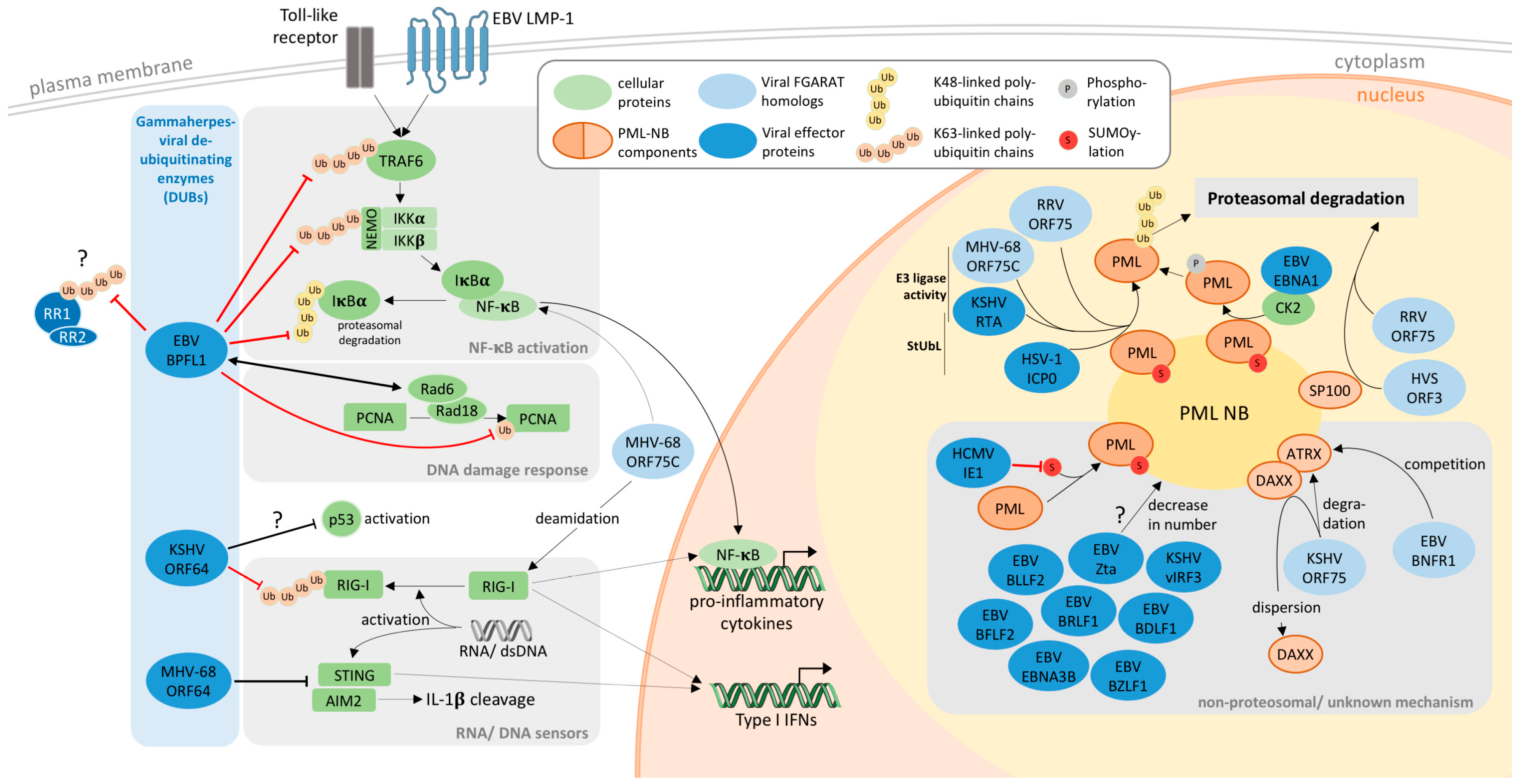
Gammaherpesviruses like Epstein-Barr virus (EBV) and Kaposi’s sarcoma-associated herpesvirus (KSHV) subvert the ubiquitin proteasome system for their own benefit in order to facilitate viral gene expression and replication. In particular, viral tegument proteins that share sequence homology to the formylglycineamide ribonucleotide amidotransferase (FGARAT, or PFAS), an enzyme in the cellular purine biosynthesis, are important for disrupting the intrinsic antiviral response associated with Promyelocytic Leukemia (PML) protein-associated nuclear bodies (PML-NBs) by proteasome-dependent and independent mechanisms. In addition, all herpesviruses encode for a potent ubiquitin protease that can efficiently remove ubiquitin chains from proteins and thereby interfere with several different cellular pathways. In this review, we discuss mechanisms and functional consequences of virus-induced ubiquitination and deubiquitination for early events in gammaherpesviral infection.
1. Gammaherpesviruses
Gammaherpesvirinae (gammaherpesviruses) is a subfamily of viruses in the family of Herpesviridae (herpesviruses) that includes a number of important human and veterinary pathogens. Gammaherpesviruses can be subdivided into the following four genera, with some exemplary viruses from each genus listed: (i) the lymphocryptoviruses (gamma-1) with the human pathogen Epstein-Barr virus (EBV) and related primate viruses; (ii) the rhadinoviruses (gamma-2) with the human pathogen Kaposi’s sarcoma-associated herpesvirus (KSHV); the prototypic rhadinovirus Herpesvirus saimiri (HVS); the Rhesus monkey rhadinovirus (RRV); and the murid herpesvirus 4 (MuHV4, MHV-68). A reappraisal of taxonomy based on their biology led to a reclassification of several former gamma-2 herpesviruses into the (iii) percaviruses with Equid herpesvirus 2 (EHV-2) and the (iv) macaviruses with Alcelaphine gammaherpesvirus 1 (AlHV-1).
KSHV (Human Herpesvirus-8, HHV-8), and Epstein-Barr Virus (Human Herpesvirus-4, HHV-4) are the only gammaherpesviruses known to cause human disease. Above all, EBV and KSHV are unique among human herpesviruses in their ability to cause cancer in humans. EBV is associated with multiple forms of human cancer, including Burkitt’s lymphoma, nasopharyngeal carcinoma, some forms of Hodgkin’s lymphoma, and lymphoproliferative disease in immunocompromised patients, including those with AIDS [1]. KSHV is the etiologic agent of three human tumor-diseases: Kaposi’s sarcoma (KS), a skin tumor of endothelial origin, and two lymphoproliferative B-cell malignancies, the Primary Effusion Lymphoma and a plasmablastic variant of Multicentric Castleman’s Disease [2]. KS exists in three forms, classical KS, which is endemic in the Mediterranean and Middle East [3], iatrogenic KS and AIDS-associated KS, which ranks among the leading causes of death in AIDS patients [4]. Whereas the incidences of tumors caused by KSHV and EBV are moderate in western countries, both viruses are major causes of cancer and subsequent morbidity and mortality in sub-Saharan Africa [5]. In this region, KS ranks as the fourth most common cancer in the general population. Especially the interplay of KSHV with HIV, and of EBV with Malaria and HIV, contributes to cancer in sub Saharan Africa. To this end, a better understanding of gammaherpesviral carcinogenesis is important to identify new targets for antiviral therapy.
2. The Ubiquitin-Proteasome System
Ubiquitination is a posttranslational protein modification that is involved in multiple cellular processes in eukaryotes. Ubiquitin is a small protein of 76 amino acids that is attached to lysine residues of proteins by a cascade of enzymes. Ubiquitin first needs to be activated by E1 enzymes, is then conjugated by E2 enzymes and finally ligated by E3 ligases [6]. The specificity for the substrate protein is determined by the E3 ligase whereas the primary function of the E2 enzymes is to determine which types of polyubiquitin chains are catalyzed by the E3. In addition, ubiquitin can also be removed from proteins by a group of deubiquitinating enzymes (DUBs). Ubiquitination may result in mono- or polyubiquitylated proteins. For polyubiquitination, either the aminoterminal methionine or one of the seven internal lysine residues of ubiquitin can be modified in consecutive conjugation cycles, leading to long ubiquitin chains. The resulting ubiquitin chains can either be linear, if connected by the same type of linkage, or branched, if different types of linkages are used within one chain [7]. The different types of ubiquitin linkage determine the fate of the modified protein. Whereas K48-linked polyubiquitin chains are recognized by the proteasome and result in degradation of the substrate, K63-linked ubiquitination does not usually trigger proteasomal degradation, but plays crucial roles in signal transduction pathways [7].
The cellular ubiquitin-proteasome system represents a unique opportunity for viruses to eliminate unwanted cellular proteins. As a pre-existing fast-track system for protein degradation, it obviates the need for the virus to encode its own enzymatic activity. Only the targeting part of the system, the E3 ligase needs to be subverted. The enzymatic nature of the ubiquitin-proteasome system allows for very efficient degradation of large amounts of host proteins requiring only small amounts of viral protein, when compared to the stoichiometric amounts required for sequestration of cellular targets. Given these highly attractive features of the ubiquitin-proteasome system, it is no surprise that viruses have evolved multiple ways to make use of this system, in particular for the degradation of cellular restriction factors.
3. PML Nuclear Bodies
In the herpesviral virion, the viral tegument is the matrix of proteins that fills the space between the nucleocapsid and the viral envelope. It is composed of structural proteins necessary for the formation of the viral particle and of viral effector proteins. During infection, viral tegument proteins are released into the cytoplasm and also transported to the nucleus of the host cell. They facilitate viral infection and viral gene expression by subverting the host innate immune response and enhancing viral transcription and translation. Upon release of the viral genome from the capsid into the nucleus, the incoming viral genomes have been shown to associate with subnuclear structures called PML-nuclear bodies (PML-NBs, also designated Nuclear Domain 10 (ND10)). PML-NBs are named after their key structural component, the promyelocytic leukemia protein (PML or TRIM19). PML-NBs have been implicated in various biochemical nuclear functions, for example they have been described as sites of active gene expression, epicenters of posttranscriptional modification of proteins, in particular SUMOylation, and as storage centers for nuclear proteins [8]. In addition, it became evident in recent years that PML-NBs also contribute substantially to the intrinsic immunity to viral infection, in particular to infection by DNA viruses [9]. PML-NB components PML, SP100, DAXX and ATRX are bona fide restriction factors for viral infection and members of different virus families have evolved sophisticated mechanisms to bypass PML-NB-mediated immunity. Numerous reports that were published over the past 10–15 years identify PML-NBs as part of the first line of cellular defense against DNA virus infection. Notably, the expressions of PML-NB components such as PML and SP100 themselves are also induced by the interferon pathway, corroborating their crucial role in the intrinsic immunity to viral infection [10].
Acknowledgments
This study was supported by a grant from the German Research Foundation CRC 796, TP B1 (to Armin Ensser), and by grants from the Interdisciplinary Center for Clinical Research Erlangen (IZKF), projects J44 (Alexander S. Hahn), J57 (Florian Full), and A66 (Armin Ensser). Florian Full was further supported by a Marie Skłodowska-Curie Individual Fellowship from the European Union’s Framework Program for Research and Innovation Horizon 2020 (2014–2020) under the Grant Agreement No. 703896. Alexander S. Hahn and Anna K. Großkopf were further supported by intramural funding of the German Primate Center.
Author Contributions
Florian Full, Alexander S. Hahn, Anna K. Großkopf and Armin Ensser wrote the paper.
Conflicts of Interest
The authors declare no conflict of interest. The founding sponsors had no role in the design of the study; in the writing of the manuscript, and in the decision to publish the manuscript.
References
- Gandhi, M.K. Epstein-Barr virus-associated lymphomas. Expert Rev. Anti. Infect. Ther. 2014. [Google Scholar] [CrossRef] [Scilit] [PubMed]
- Mariggio, G.; Koch, S.; Schulz, T.F. Kaposi sarcoma herpesvirus pathogenesis. Philos. Trans. R. Soc. Lond. B Biol. Sci. 2017, 372. [Google Scholar] [CrossRef] [Scilit] [PubMed]
- Dupin, N.; Grandadam, M.; Calvez, V.; Gorin, I.; Aubin, J.T.; Havard, S.; Lamy, F.; Leibowitch, M.; Huraux, J.M.; Escande, J.P.; et al. Herpesvirus-like DNA sequences in patients with mediterranean kaposi’s sarcoma. Lancet 1995, 345, 761–762. [Google Scholar] [CrossRef] [Scilit]
- Ganem, D. KSHV and the pathogenesis of kaposi sarcoma: Listening to human biology and medicine. J. Clin. Investig. 2010, 120, 939–949. [Google Scholar] [CrossRef] [Scilit] [PubMed]
- Gopal, S.; Wood, W.A.; Lee, S.J.; Shea, T.C.; Naresh, K.N.; Kazembe, P.N.; Casper, C.; Hesseling, P.B.; Mitsuyasu, R.T. Meeting the challenge of hematologic malignancies in sub-Saharan Africa. Blood 2012, 119, 5078–5087. [Google Scholar] [CrossRef] [Scilit] [PubMed]
- Komander, D.; Rape, M. The ubiquitin code. Annu. Rev. Biochem. 2012, 81, 203–229. [Google Scholar] [CrossRef] [Scilit] [PubMed]
- Yau, R.; Rape, M. The increasing complexity of the ubiquitin code. Nat. Cell Biol. 2016, 18, 579–586. [Google Scholar] [CrossRef] [Scilit] [PubMed]
- Bernardi, R.; Pandolfi, P.P. Structure, dynamics and functions of promyelocytic leukaemia nuclear bodies. Nat. Rev. Mol. Cell Biol. 2007, 8, 1006–1016. [Google Scholar] [CrossRef] [Scilit] [PubMed]
- Tavalai, N.; Stamminger, T. New insights into the role of the subnuclear structure ND10 for viral infection. Biochim. Biophys. Acta 2008, 1783, 2207–2221. [Google Scholar] [CrossRef] [Scilit] [PubMed]
- Scherer, M.; Stamminger, T. Emerging role of PML nuclear bodies in innate immune signaling. J. Virol. 2016, 90, 5850–5854. [Google Scholar] [CrossRef] [Scilit] [PubMed]
- Korioth, F.; Maul, G.G.; Plachter, B.; Stamminger, T.; Frey, J. The nuclear domain 10 (ND10) is disrupted by the human cytomegalovirus gene product IE1. Exp. Cell Res. 1996, 229, 155–158. [Google Scholar] [CrossRef] [Scilit] [PubMed]
- Maul, G.G.; Everett, R.D. The nuclear location of PML, a cellular member of the C3HC4 zinc-binding domain protein family, is rearranged during herpes simplex virus infection by the C3HC4 viral protein ICP0. J. Gen. Virol. 1994, 75, 1223–1233. [Google Scholar] [CrossRef] [Scilit] [PubMed]
- Boutell, C.; Cuchet-Lourenco, D.; Vanni, E.; Orr, A.; Glass, M.; McFarlane, S.; Everett, R.D. A viral ubiquitin ligase has substrate preferential sumo targeted ubiquitin ligase activity that counteracts intrinsic antiviral defence. PLoS Pathog. 2011, 7, e1002245. [Google Scholar] [CrossRef] [Scilit] [PubMed]
- Cuchet-Lourenco, D.; Vanni, E.; Glass, M.; Orr, A.; Everett, R.D. Herpes simplex virus 1 ubiquitin ligase ICP0 interacts with pml isoform I and induces its sumo-independent degradation. J. Virol. 2012, 86, 11209–11222. [Google Scholar] [CrossRef] [Scilit] [PubMed]
- Schilling, E.M.; Scherer, M.; Reuter, N.; Schweininger, J.; Muller, Y.A.; Stamminger, T. The human cytomegalovirus IE1 protein antagonizes PML nuclear body-mediated intrinsic immunity via the inhibition of PML de novo SUMOylation. J. Virol. 2017, 91, e02049-16. [Google Scholar] [CrossRef] [Scilit] [PubMed]
- Adamson, A.L.; Kenney, S. Epstein-barr virus immediate-early protein BZLF1 is SUMO-1 modified and disrupts promyelocytic leukemia bodies. J. Virol. 2001, 75, 2388–2399. [Google Scholar] [CrossRef] [Scilit] [PubMed]
- Bowling, B.L.; Adamson, A.L. Functional interactions between the Epstein-Barr virus BZLF1 protein and the promyelocytic leukemia protein. Virus Res. 2006, 117, 244–253. [Google Scholar] [CrossRef] [Scilit] [PubMed]
- Salsman, J.; Zimmerman, N.; Chen, T.; Domagala, M.; Frappier, L. Genome-wide screen of three herpesviruses for protein subcellular localization and alteration of PML nuclear bodies. PLoS Pathog. 2008, 4, e1000100. [Google Scholar] [CrossRef] [Scilit] [PubMed]
- Scaglioni, P.P.; Yung, T.M.; Cai, L.F.; Erdjument-Bromage, H.; Kaufman, A.J.; Singh, B.; Teruya-Feldstein, J.; Tempst, P.; Pandolfi, P.P. A CK2-dependent mechanism for degradation of the pml tumor suppressor. Cell 2006, 126, 269–283. [Google Scholar] [CrossRef] [Scilit] [PubMed]
- Sivachandran, N.; Cao, J.Y.; Frappier, L. Epstein-Barr virus nuclear antigen 1 Hijacks the host kinase CK2 to disrupt PML nuclear bodies. J. Virol. 2010, 84, 11113–11123. [Google Scholar] [CrossRef] [Scilit] [PubMed]
- Ling, P.D.; Tan, J.; Sewatanon, J.; Peng, R. Murine gammaherpesvirus 68 open reading frame 75c tegument protein induces the degradation of PML and is essential for production of infectious virus. J. Virol. 2008, 82, 8000–8012. [Google Scholar] [CrossRef] [Scilit] [PubMed]
- Gaspar, M.; Gill, M.B.; Losing, J.B.; May, J.S.; Stevenson, P.G. Multiple functions for ORF75c in murid herpesvirus-4 infection. PLoS ONE 2008, 3, e2781. [Google Scholar] [CrossRef] [Scilit] [PubMed]
- Sewatanon, J.; Ling, P.D. Murine gammaherpesvirus 68 ORF75c contains ubiquitin E3 ligase activity and requires PML SUMOylation but not other known cellular PML regulators, CK2 and E6AP, to mediate pml degradation. Virology 2013, 440, 140–149. [Google Scholar] [CrossRef] [Scilit] [PubMed]
- Ensser, A.; Pflanz, R.; Fleckenstein, B. Primary structure of the alcelaphine herpesvirus 1 genome. J. Virol. 1997, 71, 6517–6525. [Google Scholar] [PubMed]
- Full, F.; Reuter, N.; Zielke, K.; Stamminger, T.; Ensser, A. Herpesvirus saimiri antagonizes nuclear domain 10-instituted intrinsic immunity via an ORF3-mediated selective degradation of cellular protein Sp100. J. Virol. 2012, 86, 3541–3553. [Google Scholar] [CrossRef] [Scilit] [PubMed]
- Tsai, K.; Messick, T.E.; Lieberman, P.M. Disruption of host antiviral resistances by gammaherpesvirus tegument proteins with homology to the fgarat purine biosynthesis enzyme. Curr. Opin. Virol. 2015, 14, 30–40. [Google Scholar] [CrossRef] [Scilit] [PubMed]
- Tsai, K.; Thikmyanova, N.; Wojcechowskyj, J.A.; Delecluse, H.J.; Lieberman, P.M. EBV tegument protein BNRF1 disrupts DAXX-ATRX to activate viral early gene transcription. PLoS Pathog. 2011, 7, e1002376. [Google Scholar] [CrossRef] [Scilit] [PubMed]
- Tsai, K.; Chan, L.; Gibeault, R.; Conn, K.; Dheekollu, J.; Domsic, J.; Marmorstein, R.; Schang, L.M.; Lieberman, P.M. Viral reprogramming of the Daxx histone H3.3 chaperone during early Epstein-Barr virus infection. J. Virol. 2014, 88, 14350–14363. [Google Scholar] [CrossRef] [Scilit] [PubMed]
- Full, F.; Jungnickl, D.; Reuter, N.; Bogner, E.; Brulois, K.; Scholz, B.; Sturzl, M.; Myoung, J.; Jung, J.U.; Stamminger, T.; et al. Kaposi’s sarcoma associated herpesvirus tegument protein orf75 is essential for viral lytic replication and plays a critical role in the antagonization of ND10-instituted intrinsic immunity. PLoS Pathog. 2014, 10, e1003863. [Google Scholar] [CrossRef] [Scilit] [PubMed]
- Marcos-Villar, L.; Campagna, M.; Lopitz-Otsoa, F.; Gallego, P.; Gonzalez-Santamaria, J.; Gonzalez, D.; Rodriguez, M.S.; Rivas, C. Covalent modification by SUMO is required for efficient disruption of PML oncogenic domains by kaposi’s sarcoma-associated herpesvirus latent protein LANA2. J. Gen. Virol. 2011, 92, 188–194. [Google Scholar] [CrossRef] [Scilit] [PubMed]
- Marcos-Villar, L.; Lopitz-Otsoa, F.; Gallego, P.; Munoz-Fontela, C.; Gonzalez-Santamaria, J.; Campagna, M.; Shou-Jiang, G.; Rodriguez, M.S.; Rivas, C. Kaposi’s sarcoma-associated herpesvirus protein LANA2 disrupts PML oncogenic domains and inhibits pml-mediated transcriptional repression of the survivin gene. J. Virol. 2009, 83, 8849–8858. [Google Scholar] [CrossRef] [Scilit] [PubMed]
- Izumiya, Y.; Kobayashi, K.; Kim, K.Y.; Pochampalli, M.; Izumiya, C.; Shevchenko, B.; Wang, D.H.; Huerta, S.B.; Martinez, A.; Campbell, M.; et al. Kaposi’s sarcoma-associated herpesvirus k-Rta exhibits SUMO-targeting ubiquitin ligase (STUBL) like activity and is essential for viral reactivation. PLoS Pathog. 2013, 9, e1003506. [Google Scholar] [CrossRef] [Scilit] [PubMed]
- Hahn, A.S.; Grosskopf, A.K.; Jungnickl, D.; Scholz, B.; Ensser, A. Viral FGARAT homolog ORF75 of rhesus monkey rhadinovirus effects proteasomal degradation of the ND10 components SP100 and PML. J. Virol. 2016, 90, 8013–8028. [Google Scholar] [CrossRef] [Scilit] [PubMed]
- Huang, H.; Deng, Z.; Vladimirova, O.; Wiedmer, A.; Lu, F.; Lieberman, P.M.; Patel, D.J. Structural basis underlying viral hijacking of a histone chaperone complex. Nat. Commun. 2016, 7, 12707. [Google Scholar] [CrossRef] [Scilit] [PubMed]
- Feederle, R.; Neuhierl, B.; Baldwin, G.; Bannert, H.; Hub, B.; Mautner, J.; Behrends, U.; Delecluse, H.J. Epstein-Barr virus bnrf1 protein allows efficient transfer from the endosomal compartment to the nucleus of primary b lymphocytes. J. Virol. 2006, 80, 9435–9443. [Google Scholar] [CrossRef] [Scilit] [PubMed]
- Shumilov, A.; Tsai, M.H.; Schlosser, Y.T.; Kratz, A.S.; Bernhardt, K.; Fink, S.; Mizani, T.; Lin, X.; Jauch, A.; Mautner, J.; et al. Epstein-Barr virus particles induce centrosome amplification and chromosomal instability. Nat. Commun. 2017, 8, 14257. [Google Scholar] [CrossRef] [Scilit] [PubMed]
- Fukasawa, K. Oncogenes and tumour suppressors take on centrosomes. Nat Rev Cancer 2007, 7, 911–924. [Google Scholar] [CrossRef] [Scilit] [PubMed]
- Godinho, S.A.; Pellman, D. Causes and consequences of centrosome abnormalities in cancer. Philos. Trans. R. Soc. Lond. B Biol. Sci. 2014, 369. [Google Scholar] [CrossRef] [Scilit] [PubMed]
- Wu, F.Y.; Ahn, J.H.; Alcendor, D.J.; Jang, W.J.; Xiao, J.; Hayward, S.D.; Hayward, G.S. Origin-independent assembly of kaposi’s sarcoma-associated herpesvirus DNA replication compartments in transient cotransfection assays and association with the ORF-k8 protein and cellular pml. J. Virol. 2001, 75, 1487–1506. [Google Scholar] [CrossRef] [Scilit] [PubMed]
- Wang, J.; Guo, Y.; Wang, X.; Zhao, R.; Wang, Y. Modulation of global sumoylation by kaposi’s sarcoma-associated herpesvirus and its effects on viral gene expression. J. Med. Virol. 2017, 89, 2011–2019. [Google Scholar] [CrossRef] [Scilit] [PubMed]
- Rozen, R.; Sathish, N.; Li, Y.; Yuan, Y. Virion-wide protein interactions of kaposi’s sarcoma-associated herpesvirus. J. Virol. 2008, 82, 4742–4750. [Google Scholar] [CrossRef] [Scilit] [PubMed]
- Sommer, M.H.; Zagha, E.; Serrano, O.K.; Ku, C.C.; Zerboni, L.; Baiker, A.; Santos, R.; Spengler, M.; Lynch, J.; Grose, C.; et al. Mutational analysis of the repeated open reading frames, ORFS 63 and 70 and ORFS 64 and 69, of varicella-zoster virus. J. Virol. 2001, 75, 8224–8239. [Google Scholar] [CrossRef] [Scilit] [PubMed]
- Gredmark-Russ, S.; Isaacson, M.K.; Kattenhorn, L.; Cheung, E.J.; Watson, N.; Ploegh, H.L. A gammaherpesvirus ubiquitin-specific protease is involved in the establishment of murine gammaherpesvirus 68 infection. J. Virol. 2009, 83, 10644–10652. [Google Scholar] [CrossRef] [Scilit] [PubMed]
- Gonzalez, C.M.; Wang, L.; Damania, B. Kaposi’s sarcoma-associated herpesvirus encodes a viral deubiquitinase. J. Virol. 2009, 83, 10224–10233. [Google Scholar] [CrossRef] [Scilit] [PubMed]
- Gredmark, S.; Schlieker, C.; Quesada, V.; Spooner, E.; Ploegh, H.L. A functional ubiquitin-specific protease embedded in the large tegument protein (ORF64) of murine gammaherpesvirus 68 is active during the course of infection. J. Virol. 2007, 81, 10300–10309. [Google Scholar] [CrossRef] [Scilit] [PubMed]
- Kattenhorn, L.M.; Korbel, G.A.; Kessler, B.M.; Spooner, E.; Ploegh, H.L. A deubiquitinating enzyme encoded by HSV-1 belongs to a family of cysteine proteases that is conserved across the family herpesviridae. Mol. Cell 2005, 19, 547–557. [Google Scholar] [CrossRef] [Scilit] [PubMed]
- Kim, E.T.; Oh, S.E.; Lee, Y.O.; Gibson, W.; Ahn, J.H. Cleavage specificity of the UL48 deubiquitinating protease activity of human cytomegalovirus and the growth of an active-site mutant virus in cultured cells. J. Virol. 2009, 83, 12046–12056. [Google Scholar] [CrossRef] [Scilit] [PubMed]
- Van Gent, M.; Braem, S.G.; de Jong, A.; Delagic, N.; Peeters, J.G.; Boer, I.G.; Moynagh, P.N.; Kremmer, E.; Wiertz, E.J.; Ovaa, H.; et al. Epstein-barr virus large tegument protein BPLF1 contributes to innate immune evasion through interference with toll-like receptor signaling. PLoS Pathog. 2014, 10, e1003960. [Google Scholar] [CrossRef] [Scilit] [PubMed]
- Gastaldello, S.; Chen, X.; Callegari, S.; Masucci, M.G. Caspase-1 promotes epstein-barr virus replication by targeting the large tegument protein deneddylase to the nucleus of productively infected cells. PLoS Pathog. 2013, 9, e1003664. [Google Scholar] [CrossRef] [Scilit] [PubMed]
- Schlieker, C.; Korbel, G.A.; Kattenhorn, L.M.; Ploegh, H.L. A deubiquitinating activity is conserved in the large tegument protein of the herpesviridae. J. Virol. 2005, 79, 15582–15585. [Google Scholar] [CrossRef] [Scilit] [PubMed]
- Wang, J.; Loveland, A.N.; Kattenhorn, L.M.; Ploegh, H.L.; Gibson, W. High-molecular-weight protein (PUL48) of human cytomegalovirus is a competent deubiquitinating protease: Mutant viruses altered in its active-site cysteine or histidine are viable. J. Virol. 2006, 80, 6003–6012. [Google Scholar] [CrossRef] [Scilit] [PubMed]
- Liu, J.; Qian, C.; Cao, X. Post-translational modification control of innate immunity. Immunity 2016, 45, 15–30. [Google Scholar] [CrossRef] [Scilit] [PubMed]
- Inn, K.S.; Lee, S.H.; Rathbun, J.Y.; Wong, L.Y.; Toth, Z.; Machida, K.; Ou, J.H.; Jung, J.U. Inhibition of RIG-I-mediated signaling by Kaposi’s sarcoma-associated herpesvirus-encoded deubiquitinase ORF64. J. Virol. 2011, 85, 10899–10904. [Google Scholar] [CrossRef] [Scilit] [PubMed]
- He, S.; Zhao, J.; Song, S.; He, X.; Minassian, A.; Zhou, Y.; Zhang, J.; Brulois, K.; Wang, Y.; Cabo, J.; et al. Viral pseudo-enzymes activate RIG-I via deamidation to evade cytokine production. Mol. Cell 2015, 58, 134–146. [Google Scholar] [CrossRef] [Scilit] [PubMed]
- Sun, C.; Schattgen, S.A.; Pisitkun, P.; Jorgensen, J.P.; Hilterbrand, A.T.; Wang, L.J.; West, J.A.; Hansen, K.; Horan, K.A.; Jakobsen, M.R.; et al. Evasion of innate cytosolic DNA sensing by a gammaherpesvirus facilitates establishment of latent infection. J. Immunol. 2015, 194, 1819–1831. [Google Scholar] [CrossRef] [Scilit] [PubMed]
- Saito, S.; Murata, T.; Kanda, T.; Isomura, H.; Narita, Y.; Sugimoto, A.; Kawashima, D.; Tsurumi, T. Epstein-Barr virus deubiquitinase downregulates TRAF6-mediated NF-κB signaling during productive replication. J. Virol. 2013, 87, 4060–4070. [Google Scholar] [CrossRef] [Scilit] [PubMed]
- Whitehurst, C.B.; Ning, S.; Bentz, G.L.; Dufour, F.; Gershburg, E.; Shackelford, J.; Langelier, Y.; Pagano, J.S. The Epstein-Barr virus (EBV) deubiquitinating enzyme bplf1 reduces EBV ribonucleotide reductase activity. J. Virol. 2009, 83, 4345–4353. [Google Scholar] [CrossRef] [Scilit] [PubMed]
- Sewatanon, J.; Ling, P.D. Murine gammaherpesvirus 68 encodes a second PML-modifying protein. J. Virol. 2014, 88, 3591–3597. [Google Scholar] [CrossRef] [Scilit] [PubMed]
- Kumar, R.; Whitehurst, C.B.; Pagano, J.S. The rad6/18 ubiquitin complex interacts with the Epstein-Barr virus deubiquitinating enzyme, BPLF1, and contributes to virus infectivity. J. Virol. 2014, 88, 6411–6422. [Google Scholar] [CrossRef] [Scilit] [PubMed]
- Whitehurst, C.B.; Vaziri, C.; Shackelford, J.; Pagano, J.S. Epstein-Barr virus BPLF1 deubiquitinates PCNA and attenuates polymerase η recruitment to DNA damage sites. J. Virol. 2012, 86, 8097–8106. [Google Scholar] [CrossRef] [Scilit] [PubMed]
- Dyson, O.F.; Pagano, J.S.; Whitehurst, C.B. The translesion polymerase pol η is required for efficient Epstein-Barr virus infectivity and is regulated by the viral deubiquitinating enzyme BPLF1. J. Virol. 2017, 91. [Google Scholar] [CrossRef] [Scilit] [PubMed]
- Chudasama, P.; Konrad, A.; Jochmann, R.; Lausen, B.; Holz, P.; Naschberger, E.; Neipel, F.; Britzen-Laurent, N.; Sturzl, M. Structural proteins of kaposi’s sarcoma-associated herpesvirus antagonize p53-mediated apoptosis. Oncogene 2015, 34, 639–649. [Google Scholar] [CrossRef] [Scilit] [PubMed]
- Gastaldello, S.; Hildebrand, S.; Faridani, O.; Callegari, S.; Palmkvist, M.; Di Guglielmo, C.; Masucci, M.G. A deneddylase encoded by Epstein-Barr virus promotes viral DNA replication by regulating the activity of cullin-ring ligases. Nat. Cell Biol. 2010, 12, 351–361. [Google Scholar] [CrossRef] [Scilit] [PubMed]

© 2017 by the authors. Licensee MDPI, Basel, Switzerland. This article is an open access article distributed under the terms and conditions of the Creative Commons Attribution (CC BY) license (http://creativecommons.org/licenses/by/4.0/).