
<?xml version="1.0" encoding="UTF-8"?>
<!DOCTYPE article PUBLIC "-//NLM//DTD Journal Publishing DTD v2.3 20070202//EN" "journalpublishing.dtd">
<article xmlns:mml="http://www.w3.org/1998/Math/MathML" xmlns:xlink="http://www.w3.org/1999/xlink" xml:lang="en" article-type="review-article">
  <front>
    <journal-meta>
      <journal-id journal-id-type="publisher-id">viruses</journal-id>
      <journal-title>Viruses</journal-title>
      <abbrev-journal-title abbrev-type="publisher">Viruses</abbrev-journal-title>
      <abbrev-journal-title abbrev-type="pubmed">Viruses</abbrev-journal-title>
      <issn pub-type="epub">1999-4915</issn>
      <publisher>
        <publisher-name>MDPI</publisher-name>
      </publisher>
    </journal-meta>
    <article-meta>
      <article-id pub-id-type="doi">10.3390/v4040488</article-id>
      <article-id pub-id-type="publisher-id">viruses-04-00488</article-id>
      <article-categories>
        <subj-group>
          <subject>Review</subject>
        </subj-group>
      </article-categories>
      <title-group>
        <article-title>Nanotechnology and the Treatment of HIV Infection</article-title>
      </title-group>
      <contrib-group>
        <contrib contrib-type="author">
          <name>
            <surname>Parboosing</surname>
            <given-names>Raveen</given-names>
          </name>
          <xref rid="af1-viruses-04-00488" ref-type="aff">1</xref>
          <xref rid="c1-viruses-04-00488" ref-type="corresp">*</xref>
        </contrib>
        <contrib contrib-type="author">
          <name>
            <surname>Maguire</surname>
            <given-names>Glenn E. M.</given-names>
          </name>
          <xref rid="af2-viruses-04-00488" ref-type="aff">2</xref>
        </contrib>
        <contrib contrib-type="author">
          <name>
            <surname>Govender</surname>
            <given-names>Patrick</given-names>
          </name>
          <xref rid="af3-viruses-04-00488" ref-type="aff">3</xref>
        </contrib>
        <contrib contrib-type="author">
          <name>
            <surname>Kruger</surname>
            <given-names>Hendrik G.</given-names>
          </name>
          <xref rid="af2-viruses-04-00488" ref-type="aff">2</xref>
        </contrib>
      </contrib-group>
      <aff id="af1-viruses-04-00488"><label>1 </label>Department of Virology, National Health Laboratory Service/University of KwaZulu-Natal, c/o Inkosi Albert Luthuli Central Hospital, 5th Floor Laboratory Building, 800 Bellair Road, Mayville, Durban 4091, South Africa</aff>
      <aff id="af2-viruses-04-00488"><label>2 </label>School of Chemistry, University of KwaZulu-Natal, Varsity Drive, Durban 4001, South Africa; Email: <email>Maguireg@ukzn.ac.za</email> (G.E.M. M.); <email>Kruger@ukzn.ac.za</email> (H.G.K.)</aff>
      <aff id="af3-viruses-04-00488"><label>3 </label>School of Biochemistry, Genetics and Microbiology, University of KwaZulu-Natal, Durban 4001, South Africa; Email: <email>Govenderpt@ukzn.ac.za</email> (P.G.)</aff>
      <author-notes>
        <corresp id="c1-viruses-04-00488"><label>*</label> Author to whom correspondence should be addressed; Email: <email>parboosingr@ukzn.ac.za</email>; Tel.: +27-31-240-2816; Fax: +27-31-240-2797.</corresp>
      </author-notes>
      <pub-date pub-type="epub">
        <day>10</day>
        <month>04</month>
        <year>2012</year>
      </pub-date>
      <pub-date pub-type="collection">
        <month>04</month>
        <year>2012</year>
      </pub-date>
      <volume>4</volume>
      <issue>4</issue>
      <fpage>488</fpage>
      <lpage>520</lpage>
      <history>
        <date date-type="received">
          <day>23</day>
          <month>02</month>
          <year>2012</year>
        </date>
        <date date-type="rev-recd">
          <day>15</day>
          <month>03</month>
          <year>2012</year>
        </date>
        <date date-type="accepted">
          <day>27</day>
          <month>03</month>
          <year>2012</year>
        </date>
      </history>
      <permissions>
        <copyright-statement>© 2012 by the authors; licensee MDPI, Basel, Switzerland.</copyright-statement>
        <copyright-year>2012</copyright-year>
        <license xmlns:xlink="http://www.w3.org/1999/xlink" license-type="open-access" xlink:href="http://creativecommons.org/licenses/by/3.0/">
          <p>This article is an open-access article distributed under the terms and conditions of the Creative Commons Attribution license (http://creativecommons.org/licenses/by/3.0/).</p>
        </license>
      </permissions>
      <abstract>
        <p>Suboptimal adherence, toxicity, drug resistance and viral reservoirs make the lifelong treatment of HIV infection challenging. The emerging field of nanotechnology may play an important role in addressing these challenges by creating drugs that possess pharmacological advantages arising out of unique phenomena that occur at the “nano” scale. At these dimensions, particles have physicochemical properties that are distinct from those of bulk materials or single molecules or atoms. In this review, basic concepts and terms in nanotechnology are defined, and examples are provided of how nanopharmaceuticals such as nanocrystals, nanocapsules, nanoparticles, solid lipid nanoparticles, nanocarriers, micelles, liposomes and dendrimers have been investigated as potential anti-HIV therapies. Such drugs may, for example, be used to optimize the pharmacological characteristics of known antiretrovirals, deliver anti-HIV nucleic acids into infected cells or achieve targeted delivery of antivirals to the immune system, brain or latent reservoirs. Also, nanopharmaceuticals themselves may possess anti-HIV activity. However several hurdles remain, including toxicity, unwanted biological interactions and the difficulty and cost of large-scale synthesis of nanopharmaceuticals.</p>
      </abstract>
      <kwd-group>
        <kwd>Nanotechnology</kwd>
        <kwd>HIV</kwd>
        <kwd>antiretroviral agents</kwd>
        <kwd>nanomedicine</kwd>
        <kwd>nanoparticles</kwd>
      </kwd-group>
    </article-meta>
  </front>
  <body>
    <sec sec-type="intro">
      <title>1. Introduction</title>
      <p>Nanotechnology entails the synthesis and manipulation of materials or systems where at least one dimension is in the nanometer range <italic>i.e.</italic>, in the order of billionths (10<sup>−9</sup>) of a meter [<xref ref-type="bibr" rid="B1-viruses-04-00488">1</xref>,<xref ref-type="bibr" rid="B2-viruses-04-00488">2</xref>,<xref ref-type="bibr" rid="B3-viruses-04-00488">3</xref>,<xref ref-type="bibr" rid="B4-viruses-04-00488">4</xref>,<xref ref-type="bibr" rid="B5-viruses-04-00488">5</xref>,<xref ref-type="bibr" rid="B6-viruses-04-00488">6</xref>,<xref ref-type="bibr" rid="B7-viruses-04-00488">7</xref>]. Particles in this size range have unique physicochemical properties, which are distinct from those of bulk materials (the macroscopic or microscopic scale) or single atoms or molecules (the atomic scale) [<xref ref-type="bibr" rid="B2-viruses-04-00488">2</xref>,<xref ref-type="bibr" rid="B4-viruses-04-00488">4</xref>,<xref ref-type="bibr" rid="B5-viruses-04-00488">5</xref>,<xref ref-type="bibr" rid="B7-viruses-04-00488">7</xref>,<xref ref-type="bibr" rid="B8-viruses-04-00488">8</xref>]. When nanosized particles come into contact with biological systems, the nature of the interaction is critically influenced by these physicochemical properties. Furthermore, many biological phenomena, such as immune recognition and passage across biological barriers, are governed by size considerations. Drugs fabricated at the appropriate nanoscale dimensions may therefore have certain physicochemical and biological properties that in turn confer pharmacological advantages when compared to conventional agents. Research in nanotechnology may translate into benefits for HIV infected patients (<xref ref-type="table" rid="viruses-04-00488-t001">Table 1</xref>), particularly if the challenges associated with HIV and its treatment are addressed.</p>
    </sec>
    <sec>
      <title>2. HIV Pathogenesis and Treatment: Challenges and Opportunities</title>
      <sec>
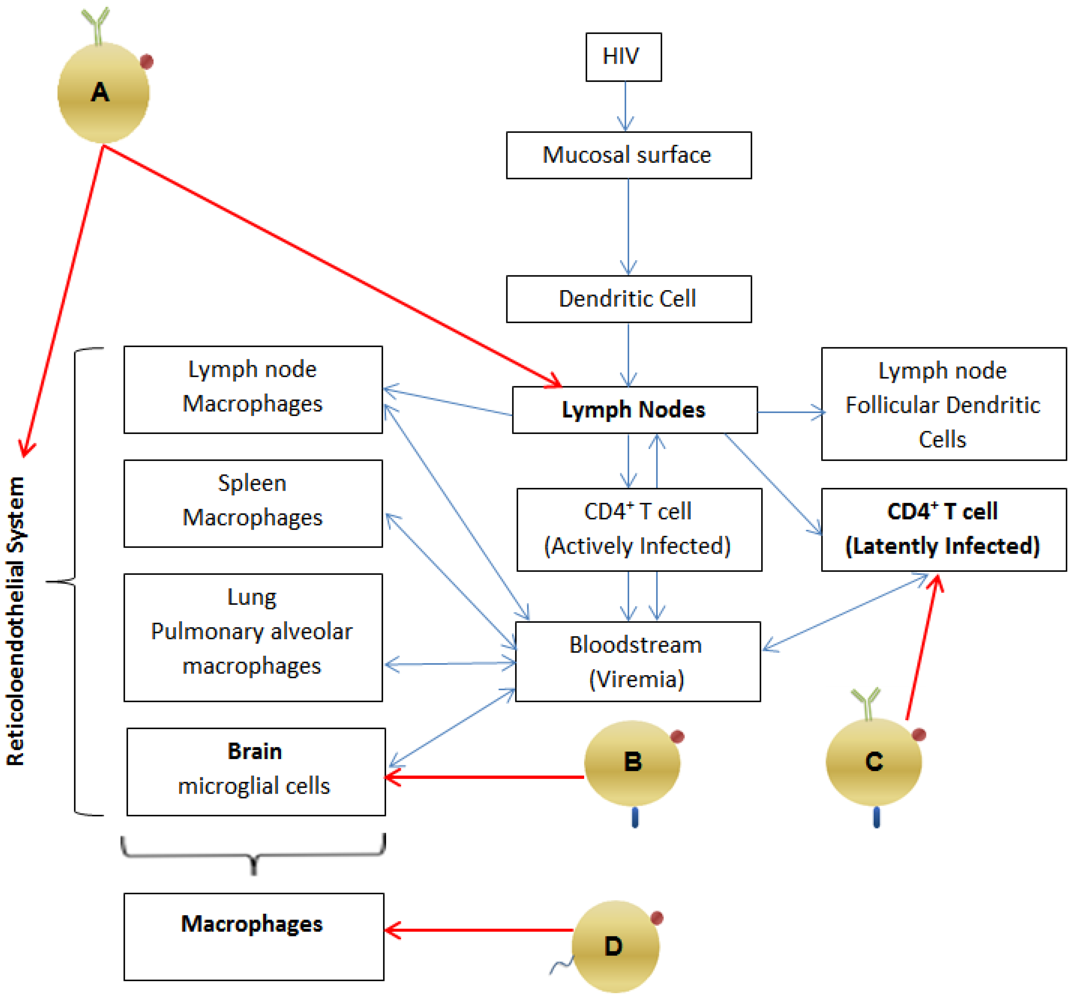
        <title>2.1. Pathogenesis: Viral Reservoirs (See <xref ref-type="fig" rid="viruses-04-00488-f001">Figure 1</xref>)</title>
        <p>HIV most often enters the body via mucosal surfaces and is transported by dendritic cells to lymphoid organs, where it is then delivered to activated CD4<sup>+</sup> T cells [<xref ref-type="bibr" rid="B9-viruses-04-00488">9</xref>,<xref ref-type="bibr" rid="B10-viruses-04-00488">10</xref>]. Productive infection of CD4<sup>+</sup>T cells leads to viremia and dissemination of the virus to other sites in the body. Untreated HIV infection is usually associated with high plasma viral loads and progressive decline in CD4<sup>+ </sup>T cells. Antiretroviral drugs inhibit HIV replication, and treatment with Highly Active Antiretroviral Therapy (HAART), with a regimen consisting of at least three drugs, from at least two classes of antiretroviral agents, will suppress plasma viral load to undetectable levels, and lead to recovery of CD4+ T cell counts [<xref ref-type="bibr" rid="B10-viruses-04-00488">10</xref>,<xref ref-type="bibr" rid="B11-viruses-04-00488">11</xref>]. However, even optimal treatment with HAART is not able to eradicate HIV. Following acute infection, HIV is able to establish reservoirs within tissues that are inaccessible to optimal levels of antiviral drugs (anatomical reservoirs), or within cells where HIV lies latent, thus escaping the action of antivirals (cellular reservoirs) [<xref ref-type="bibr" rid="B12-viruses-04-00488">12</xref>]. The reservoir consists of:</p>
		<list list-type="bullet">
		<list-item>
        <p>A large number of extracellular virions, trapped on the surface of follicular dendritic cells within lymphoid tissue [<xref ref-type="bibr" rid="B9-viruses-04-00488">9</xref>,<xref ref-type="bibr" rid="B10-viruses-04-00488">10</xref>,<xref ref-type="bibr" rid="B12-viruses-04-00488">12</xref>], and thus protected from antiretroviral drugs [<xref ref-type="bibr" rid="B12-viruses-04-00488">12</xref>].</p>
		</list-item>
		<list-item>
        <p>A pool of latently infected, resting CD4<sup>+</sup> T cells [<xref ref-type="bibr" rid="B12-viruses-04-00488">12</xref>]. HIV persists even in the presence of HAART because it is not replicating; virus can nevertheless be rescued upon activation of the cell [<xref ref-type="bibr" rid="B13-viruses-04-00488">13</xref>].</p>
		</list-item>
		<list-item>
        <p>Cells of the monocyte-macrophage lineage [<xref ref-type="bibr" rid="B12-viruses-04-00488">12</xref>,<xref ref-type="bibr" rid="B13-viruses-04-00488">13</xref>] (which constitute the reticulo-endothelial system) and which includes the microglial cells of the brain, pulmonary alveolar macrophages of the lung [<xref ref-type="bibr" rid="B12-viruses-04-00488">12</xref>] and macrophages within the spleen and lymph nodes [<xref ref-type="bibr" rid="B10-viruses-04-00488">10</xref>,<xref ref-type="bibr" rid="B12-viruses-04-00488">12</xref>], Antiretrovirals have poor activity in chronically infected macrophages, requiring much higher intracellular concentrations to achieve inhibition [<xref ref-type="bibr" rid="B14-viruses-04-00488">14</xref>]. Macrophages are relatively long-lived cells, and HIV has minimal cytopathic effects on them [<xref ref-type="bibr" rid="B12-viruses-04-00488">12</xref>,<xref ref-type="bibr" rid="B14-viruses-04-00488">14</xref>,<xref ref-type="bibr" rid="B15-viruses-04-00488">15</xref>]. Therefore, macrophages are a persistent reservoir of HIV, even in the presence of HAART.</p>
		</list-item>
		<list-item>
        <p>Tissues, such as the brain [<xref ref-type="bibr" rid="B12-viruses-04-00488">12</xref>], where penetration of antiretroviral drugs is suboptimal, thus allowing continuous, low level replication within cells of the macrophage lineage found at these sites [<xref ref-type="bibr" rid="B15-viruses-04-00488">15</xref>].</p>
		</list-item>
		</list>
        <fig id="viruses-04-00488-f001" position="anchor">
          <label>Figure 1</label>
          <caption>
            <p>Possible reservoirs of HIV and the potential role of nanotechnology. HIV establishes <italic>anatomical</italic> reservoirs in lymphoid tissue, the reticuloendothelial system and other sites not shown here. Antiretroviral drugs do not penetrate these sites adequately. Macrophages and latently infected CD4<sup>+</sup> T cells constitute <italic>cellular</italic> reservoirs, because antiretroviral drugs do not achieve satisfactory intracellular concentration within macrophages and antiretrovirals are ineffective against latent virus, respectively [<xref ref-type="bibr" rid="B13-viruses-04-00488">13</xref>,<xref ref-type="bibr" rid="B14-viruses-04-00488">14</xref>,<xref ref-type="bibr" rid="B16-viruses-04-00488">16</xref>,<xref ref-type="bibr" rid="B17-viruses-04-00488">17</xref>,<xref ref-type="bibr" rid="B18-viruses-04-00488">18</xref>]. Potential means of using nanotechnology to combat viral reservoirs are shown (the relevant sections in the text are indicated): (<bold>A</bold>) Targeted delivery of antiretroviral drugs to the reticuloendothelial system, including lymphatic tissues (<xref ref-type="sec" rid="sec8-viruses-04-00488">Section 8</xref>);(<bold>B</bold>) Targeting the brain (<xref ref-type="sec" rid="sec9-viruses-04-00488">Section 9</xref>); (<bold>C</bold>) Targeting latently infected CD4<sup>+</sup> T cells (<xref ref-type="sec" rid="sec10-viruses-04-00488">Section 10</xref>); (<bold>D</bold>) Achieving optimal intracellular concentration of antiretroviral drugs within macrophages (the work of Amiji and colleagues is described in the section on nanocarriers, <xref ref-type="sec" rid="sec7-viruses-04-00488">Section 7</xref>).</p>
          </caption>
          <graphic xmlns:xlink="http://www.w3.org/1999/xlink" xlink:href="viruses-04-00488-g001.tif"/>
        </fig>
      <table-wrap id="viruses-04-00488-t001" position="anchor">
        <object-id pub-id-type="pii">viruses-04-00488-t001_Table 1</object-id>
        <label>Table 1</label>
        <caption>
          <p>Examples of how the physical properties of nanoparticles have biological consequences that may benefit HIV therapy [<xref ref-type="bibr" rid="B1-viruses-04-00488">1</xref>,<xref ref-type="bibr" rid="B2-viruses-04-00488">2</xref>,<xref ref-type="bibr" rid="B19-viruses-04-00488">19</xref>,<xref ref-type="bibr" rid="B20-viruses-04-00488">20</xref>].</p>
        </caption>
        <table rules="all" style="border: solid thin">
          <thead>
            <tr>
              <th align="left" valign="top">Physical Property</th>
              <th align="left" valign="top">Biological Implications</th>
              <th align="left" valign="top">Potential Benefit for HIV Therapy</th>
            </tr>
          </thead>
          <tbody>
            <tr>
              <td rowspan="2" align="left" valign="top">Particle size</td>
              <td align="left" valign="top">Particle size affects bioavailability and circulation time [<xref ref-type="bibr" rid="B2-viruses-04-00488">2</xref>].<break/>Particles &lt;5–10 nm are removed by renal clearance [<xref ref-type="bibr" rid="B21-viruses-04-00488">21</xref>] while those &gt;200 nm are sequestered by the spleen[<xref ref-type="bibr" rid="B21-viruses-04-00488">21</xref>]. Particles up to 70 nm can penetrate capillaries [<xref ref-type="bibr" rid="B2-viruses-04-00488">2</xref>] while nanocomplexes between 35–120 nm localize in lymph nodes [<xref ref-type="bibr" rid="B22-viruses-04-00488">22</xref>,<xref ref-type="bibr" rid="B23-viruses-04-00488">23</xref>].</td>
              <td align="left" valign="top">Nanocomplexes containing indinavir were designed so that they were in the size range that allowed localization within lymphatic tissues. Following subcutaneous injection in macaques, the particles drain into the lymphatic system, and because of their size, remain trapped there, rather than entering the bloodstream—this strategy avoids undesirable, excessive peaks in plasma concentration [<xref ref-type="bibr" rid="B22-viruses-04-00488">22</xref>,<xref ref-type="bibr" rid="B23-viruses-04-00488">23</xref>,<xref ref-type="bibr" rid="B24-viruses-04-00488">24</xref>].</td>
            </tr>
            <tr>
              <td align="left" valign="top">Size determines mechanism of internalization (phagocytosis 
              <italic>versus</italic> endocytosis <italic>versus</italic> pinocytosis) and therefore subcellular localization [<xref ref-type="bibr" rid="B21-viruses-04-00488">21</xref>]; depending on their size, particles may be opsonized by plasma proteins, phagocytosed by macrophages and removed by the RES<sup>*</sup> [<xref ref-type="bibr" rid="B21-viruses-04-00488">21</xref>].</td>
              <td align="left" valign="top">Liposomes are phagocytosed by macrophages and deliver drugs such as AZT<sup>+</sup> [<xref ref-type="bibr" rid="B25-viruses-04-00488">25</xref>] and ddI<sup>#</sup> [<xref ref-type="bibr" rid="B26-viruses-04-00488">26</xref>,<xref ref-type="bibr" rid="B27-viruses-04-00488">27</xref>], which are carried in their aqueous core, to murine RES<sup>*</sup>.</td>
            </tr>
            <tr>
              <td align="left" valign="top">Large surface area to volume ratio [<xref ref-type="bibr" rid="B4-viruses-04-00488">4</xref>]</td>
              <td align="left" valign="top">Dissolution of poorly soluble drugs is greatly dependent on the surface area of the particle. Nanosized particles therefore display enhanced solubility compared to larger particles [<xref ref-type="bibr" rid="B2-viruses-04-00488">2</xref>,<xref ref-type="bibr" rid="B28-viruses-04-00488">28</xref>,<xref ref-type="bibr" rid="B29-viruses-04-00488">29</xref>,<xref ref-type="bibr" rid="B30-viruses-04-00488">30</xref>,<xref ref-type="bibr" rid="B31-viruses-04-00488">31</xref>]. </td>
              <td align="left" valign="top">Engineering drugs in the nanorange, in the form of nanocrystals or nanosuspensions [<xref ref-type="bibr" rid="B28-viruses-04-00488">28</xref>,<xref ref-type="bibr" rid="B29-viruses-04-00488">29</xref>,<xref ref-type="bibr" rid="B30-viruses-04-00488">30</xref>,<xref ref-type="bibr" rid="B31-viruses-04-00488">31</xref>,<xref ref-type="bibr" rid="B32-viruses-04-00488">32</xref>], for example, allow for clinical development of lead compounds that would not otherwise be considered viable due to poor solubility;<break/>Improved solubility enhances bioavailability and dosing of poorly water-soluble antiretroviral drugs, such as rilpivirine [<xref ref-type="bibr" rid="B33-viruses-04-00488">33</xref>,<xref ref-type="bibr" rid="B34-viruses-04-00488">34</xref>].</td>
            </tr>
            <tr>
              <td align="left" valign="top">Surface charge of particle [<xref ref-type="bibr" rid="B2-viruses-04-00488">2</xref>,<xref ref-type="bibr" rid="B21-viruses-04-00488">21</xref>]</td>
              <td align="left" valign="top">The cell membrane is negatively charged and repels like-charged molecules. Positively charged nanoparticles may shield such molecules, allowing them to enter the cell [<xref ref-type="bibr" rid="B35-viruses-04-00488">35</xref>].</td>
              <td align="left" valign="top">Allows cellular entry of antiretroviral agents, which are negatively charged, such as phosphorylated nucleotide analogues [<xref ref-type="bibr" rid="B35-viruses-04-00488">35</xref>] and nucleic acids (See <xref ref-type="table" rid="viruses-04-00488-t003">Table 3</xref>) [<xref ref-type="bibr" rid="B36-viruses-04-00488">36</xref>,<xref ref-type="bibr" rid="B37-viruses-04-00488">37</xref>,<xref ref-type="bibr" rid="B38-viruses-04-00488">38</xref>,<xref ref-type="bibr" rid="B39-viruses-04-00488">39</xref>,<xref ref-type="bibr" rid="B40-viruses-04-00488">40</xref>,<xref ref-type="bibr" rid="B41-viruses-04-00488">41</xref>,<xref ref-type="bibr" rid="B42-viruses-04-00488">42</xref>].</td>
            </tr>
            <tr>
              <td rowspan="2" align="left" valign="top">Formation of stable structures which are able to encapsulate drugs [<xref ref-type="bibr" rid="B2-viruses-04-00488">2</xref>]</td>
              <td rowspan="2" align="left" valign="top">Encapsulation improves solubility and protects against degradation (within the gastrointestinal tract, for example) [<xref ref-type="bibr" rid="B43-viruses-04-00488">43</xref>,<xref ref-type="bibr" rid="B44-viruses-04-00488">44</xref>].</td>
              <td align="left" valign="top">Polymeric micelles encapsulate efavirenz and improve its solubility [<xref ref-type="bibr" rid="B45-viruses-04-00488">45</xref>,<xref ref-type="bibr" rid="B46-viruses-04-00488">46</xref>,<xref ref-type="bibr" rid="B47-viruses-04-00488">47</xref>,<xref ref-type="bibr" rid="B48-viruses-04-00488">48</xref>,<xref ref-type="bibr" rid="B49-viruses-04-00488">49</xref>].</td>
            </tr>
            <tr>
              <td align="left" valign="top">In 
              <italic>in vitro</italic> experiments, a polymeric nanocapsule was used to deliver AZT in its triphosphorylated form directly into the cytoplasm [<xref ref-type="bibr" rid="B50-viruses-04-00488">50</xref>,<xref ref-type="bibr" rid="B51-viruses-04-00488">51</xref>].</td>
            </tr>
            <tr>
              <td rowspan="2" align="left" valign="top">Biofunctionalized nanoparticles, [<xref ref-type="bibr" rid="B2-viruses-04-00488">2</xref>,<xref ref-type="bibr" rid="B5-viruses-04-00488">5</xref>,<xref ref-type="bibr" rid="B52-viruses-04-00488">52</xref>] whereby particles may be functionalized by attachment of bioactive moieties</td>
              <td align="left" valign="top">Nanomedicines are easily tagged by coating them with moieties that bind to biomarkers, thus directing them to cells, tissues or even organelles that exhibit the biomarker [<xref ref-type="bibr" rid="B4-viruses-04-00488">4</xref>,<xref ref-type="bibr" rid="B21-viruses-04-00488">21</xref>,<xref ref-type="bibr" rid="B52-viruses-04-00488">52</xref>].</td>
              <td align="left" valign="top">In animal experiments, liposomes coated with galactose or lectin (“immunoliposomes”) target cells of the RES<sup>*</sup> that bear receptors for these moieties, and may thus be employed to deliver antiretroviral drugs specifically to these sites [<xref ref-type="bibr" rid="B53-viruses-04-00488">53</xref>,<xref ref-type="bibr" rid="B54-viruses-04-00488">54</xref>,<xref ref-type="bibr" rid="B55-viruses-04-00488">55</xref>,<xref ref-type="bibr" rid="B56-viruses-04-00488">56</xref>] (thus decreasing side-effects caused by distribution of drugs to non-specific sites [<xref ref-type="bibr" rid="B5-viruses-04-00488">5</xref>]).</td>
            </tr>
            <tr>
              <td align="left" valign="top">Conjugation to polyethylene glycol (PEGylation) improves solubility and reduces interaction with opsonizing proteins, thus modulating phagocytosis and bioavailability [<xref ref-type="bibr" rid="B4-viruses-04-00488">4</xref>].</td>
              <td align="left" valign="top">Sterically stabilized (PEGylated) liposomes and solid lipid nanoparticles, containing ddI<sup>#</sup> [<xref ref-type="bibr" rid="B57-viruses-04-00488">57</xref>] and AZT<sup>+</sup> [<xref ref-type="bibr" rid="B58-viruses-04-00488">58</xref>,<xref ref-type="bibr" rid="B59-viruses-04-00488">59</xref>] respectively, result in extended half-lives of these drugs in rodents.</td>
            </tr>
            <tr>
              <td rowspan="2" align="left" valign="top">Multifunctionality (combining several beneficial features in a stable construct) [<xref ref-type="bibr" rid="B4-viruses-04-00488">4</xref>,<xref ref-type="bibr" rid="B7-viruses-04-00488">7</xref>,<xref ref-type="bibr" rid="B52-viruses-04-00488">52</xref>]</td>
              <td align="left" valign="top">Currently available antiretrovirals have no effect on latent virus. Nanomedicines may be designed to simultaneously stimulate the replication of latent virus 
              <italic>and</italic> deliver an antiviral to the activated cell [<xref ref-type="bibr" rid="B60-viruses-04-00488">60</xref>].</td>
              <td align="left" valign="top">Lipid nanoparticles loaded with bryostatin-2 (which activates primary CD4<sup>+</sup> T cells) and nelfinavir may be capable of simultaneously activating latent virus and inhibiting viral spread [<xref ref-type="bibr" rid="B60-viruses-04-00488">60</xref>].</td>
            </tr>
            <tr>
              <td align="left" valign="top">The “stealth” properties of polyethylene glycol, which allow drugs to remain longer in the systemic circulation, may be combined with peptides that promote cellular uptake [<xref ref-type="bibr" rid="B61-viruses-04-00488">61</xref>].</td>
              <td align="left" valign="top">An HIV TAT**-based peptide (known to have cell penetrating properties), polyethylene glycol and the cell-uptake enhancer, biotin, were conjugated in various combinations and assessed as carriers of saquinavir. The multifunctional bioconjugates had significantly different 
              <italic>in vitro</italic> cellular uptake and anti-HIV potency compared to the prodrug alone [<xref ref-type="bibr" rid="B62-viruses-04-00488">62</xref>].</td>
            </tr>
            <tr>
              <td rowspan="2" align="left" valign="top">Biomimetic properties [<xref ref-type="bibr" rid="B7-viruses-04-00488">7</xref>]</td>
              <td align="left" valign="top">Nanomedicines may “mimic” the properties of biological entities, such as antibodies, receptors, nucleic acids or proteins, by binding to functional sites, such as the active site of an enzyme, thus exerting antiviral effects [<xref ref-type="bibr" rid="B7-viruses-04-00488">7</xref>].</td>
              <td align="left" valign="top">Several nanomedicines may have intrinsic antiviral properties (<xref ref-type="table" rid="viruses-04-00488-t004">Table 4</xref>).</td>
            </tr>
            <tr>
              <td align="left" valign="top">Synthetic, nanoparticle-based multivalent displays mimic the ubiquitous biological property of multivalency that enhances affinity between naturally occurring molecules (between receptors and ligands, for example) [<xref ref-type="bibr" rid="B63-viruses-04-00488">63</xref>].</td>
              <td align="left" valign="top">SDC-1721, a derivative of a known CCR5<sup>****</sup> antagonist, does not by itself inhibit viral replication. However, when conjugated to gold nanoparticles, at a ratio of 12 SDC-1721 molecules per gold nanoparticle, activity with an IC<sub>50</sub> of 10 nM was demonstrated in PBMCs <sup>***</sup> infected with the CCR5-tropic HIV-1 [<xref ref-type="bibr" rid="B63-viruses-04-00488">63</xref>]. Further results are eagerly awaited.</td>
            </tr>
          </tbody>
        </table>
		<table-wrap-foot>
		<fn>
        <p><bold><sup>*</sup></bold> RES reticuloendothelial system; <sup>#</sup> ddI 2', 3'-dideoxyinosine; <sup>+</sup> AZT azidothymidine; <sup>**</sup> TAT-trans-activator of transcription; <sup>***</sup> PBMCs: peripheral blood mononuclear cells; <sup>****</sup> CCR5: a chemokine co-receptor used by HIV to enter cells. </p></fn>
		</table-wrap-foot>
      </table-wrap>
        <p>Reservoirs are important because they are a source of drug resistant virus (due to ongoing, low level replication in the presence of HAART) and because they make HIV eradication and cure difficult (viral rebound inevitably occurs once HAART is stopped) [<xref ref-type="bibr" rid="B16-viruses-04-00488">16</xref>,<xref ref-type="bibr" rid="B17-viruses-04-00488">17</xref>,<xref ref-type="bibr" rid="B18-viruses-04-00488">18</xref>]. It is therefore essential to explore novel methods to eradicate viral reservoirs. Several sections in this review include synopses of research where the aim is to use nanotechnology to maximize delivery of antiretroviral agents to viral reservoirs: </p>
		<list list-type="bullet">
		<list-item>
        <p>Targeting anatomical reservoirs</p>
		<list list-type="simple">
		<list-item>
        <p>○ reticuloendothelial system (<xref ref-type="sec" rid="sec8-viruses-04-00488">Section 8</xref>);</p>
		</list-item>
		<list-item>
        <p>○ brain (<xref ref-type="sec" rid="sec9-viruses-04-00488">Section 9</xref>); </p>
		</list-item>
		</list>
		</list-item>
		<list-item>
        <p>Targeting cellular reservoirs</p>
		<list list-type="simple">
		<list-item>
        <p>○ by optimizing the intracellular concentration of antiretroviral drugs into macrophages (<xref ref-type="sec" rid="sec7-viruses-04-00488">Section 7</xref>);</p>
		</list-item>
		<list-item>
        <p>○ by activating latent HIV (<xref ref-type="sec" rid="sec10-viruses-04-00488">Section 10</xref>).</p>
		</list-item>
		</list>
		</list-item>
		</list>
      </sec>
      <sec>
        <title>2.2. Antiretroviral Therapy</title>
        <p>There are more than 25 anti-retroviral drugs approved for use in HIV-infected individuals [<xref ref-type="bibr" rid="B64-viruses-04-00488">64</xref>], from at least six mechanistic classes, which include the nucleoside/nucleotide reverse transcriptase inhibitors, non-nucleoside reverse transcriptase inhibitors, protease inhibitors, fusion inhibitors, CCR5 antagonists and integrase strand transfer inhibitors [<xref ref-type="bibr" rid="B11-viruses-04-00488">11</xref>]. However, because they are unable to eradicate viral reservoirs, none of these drugs are curative and lifelong treatment with durable viral suppression is currently the goal of therapy. There are, however, serious challenges to long term suppression of viral replication, which include non-adherence, drug toxicity, drug interactions and the inevitable appearance of drug resistant mutations [<xref ref-type="bibr" rid="B65-viruses-04-00488">65</xref>]. </p>
        <p>The convergence of pharmacology and nanotechnology seeks to address some of these issues by creating or enabling some of the following elements:</p>
		<list list-type="bullet">
		<list-item>
        <p>Delivery systems that optimize and regulate the tissue distribution and bioavailability of known antiretroviral drugs, thus restricting fluctuating drug levels and toxicity [<xref ref-type="bibr" rid="B5-viruses-04-00488">5</xref>]. </p>
		</list-item>
		<list-item>
        <p>Drugs with extended half-life, thus reducing dosing frequency and pill burden [<xref ref-type="bibr" rid="B21-viruses-04-00488">21</xref>].</p>
		</list-item>
		<list-item>
        <p>Targeted drug delivery with an improved side-effect profile [<xref ref-type="bibr" rid="B7-viruses-04-00488">7</xref>]. </p>
		</list-item>
		<list-item>
        <p>Delivery systems which reduce drug-drug interactions [<xref ref-type="bibr" rid="B66-viruses-04-00488">66</xref>].</p>
		</list-item>
		<list-item>
        <p>Methods for the delivery of known antivirals delivered by alternative routes (e.g., transdermal delivery) [<xref ref-type="bibr" rid="B44-viruses-04-00488">44</xref>].</p>
		</list-item>
		<list-item>
        <p>Co-delivery of antiretroviral agents, thus improving adherence [<xref ref-type="bibr" rid="B7-viruses-04-00488">7</xref>].</p>
		</list-item>
		<list-item>
        <p>New drugs for the treatment of HIV infection: Newly discovered antiretroviral agents which would otherwise not be of clinical benefit because of solubility issues, may be rendered water-soluble by nanotechnology techniques [<xref ref-type="bibr" rid="B7-viruses-04-00488">7</xref>,<xref ref-type="bibr" rid="B21-viruses-04-00488">21</xref>].</p>
		</list-item>
		<list-item>
        <p>Delivery of anti-HIV agents which are currently difficult to deliver e.g., nucleic acids such as siRNA or DNA therapeutics [<xref ref-type="bibr" rid="B2-viruses-04-00488">2</xref>]; the delivery vehicle protects the nucleic acid against degradation [<xref ref-type="bibr" rid="B5-viruses-04-00488">5</xref>] and reduces immunogenicity [<xref ref-type="bibr" rid="B21-viruses-04-00488">21</xref>].</p>
		</list-item>
		<list-item>
        <p>Drugs with novel mechanisms of action with no cross-resistance to known agents (See <xref ref-type="table" rid="viruses-04-00488-t004">Table 4</xref>).</p>
		</list-item>
		<list-item>
        <p>Drugs which target and eradicate viral reservoirs [<xref ref-type="bibr" rid="B67-viruses-04-00488">67</xref>].</p>
		</list-item>
		</list>
      </sec>
    </sec>
    <sec>
      <title>3. The “Nano” Landscape: From Nanomaterials to Nanopharmaceuticals</title>
      <p>Nanomaterials are materials engineered in nanometer dimensions to take advantage of novel properties (such as large surface area to volume ratio and quantum effects) that occur at this scale [<xref ref-type="bibr" rid="B68-viruses-04-00488">68</xref>]. Nanomaterials are synthesized in either a top-down approach (in which bulk materials or technologies are miniaturized) or a bottom-up approach (where assembly occurs atom by atom, from basic to larger, more complex materials) [<xref ref-type="bibr" rid="B1-viruses-04-00488">1</xref>]. Fabrication of materials in the nanoscale results in electronic, magnetic, mechanical and chemical effects that do not occur in bulk materials [<xref ref-type="bibr" rid="B1-viruses-04-00488">1</xref>]. These nanoscale effects have been exploited in virtually every field of technology, and include commercial applications in textiles, energy conversion, electronics, cosmetics, lubricants, water purification and computing [<xref ref-type="bibr" rid="B69-viruses-04-00488">69</xref>,<xref ref-type="bibr" rid="B70-viruses-04-00488">70</xref>]. The study of the interaction of nanomaterials with biological systems is encompassed in the field of “nanobiotechnology” [<xref ref-type="bibr" rid="B71-viruses-04-00488">71</xref>], and the related field of nanomedicine seeks to use nanostructured materials to diagnose, treat and prevent human disease [<xref ref-type="bibr" rid="B72-viruses-04-00488">72</xref>,<xref ref-type="bibr" rid="B73-viruses-04-00488">73</xref>]. </p>
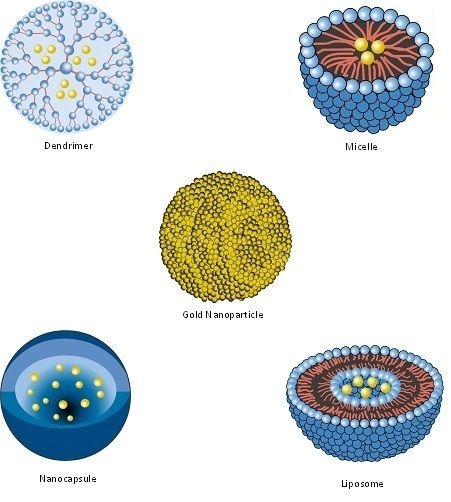
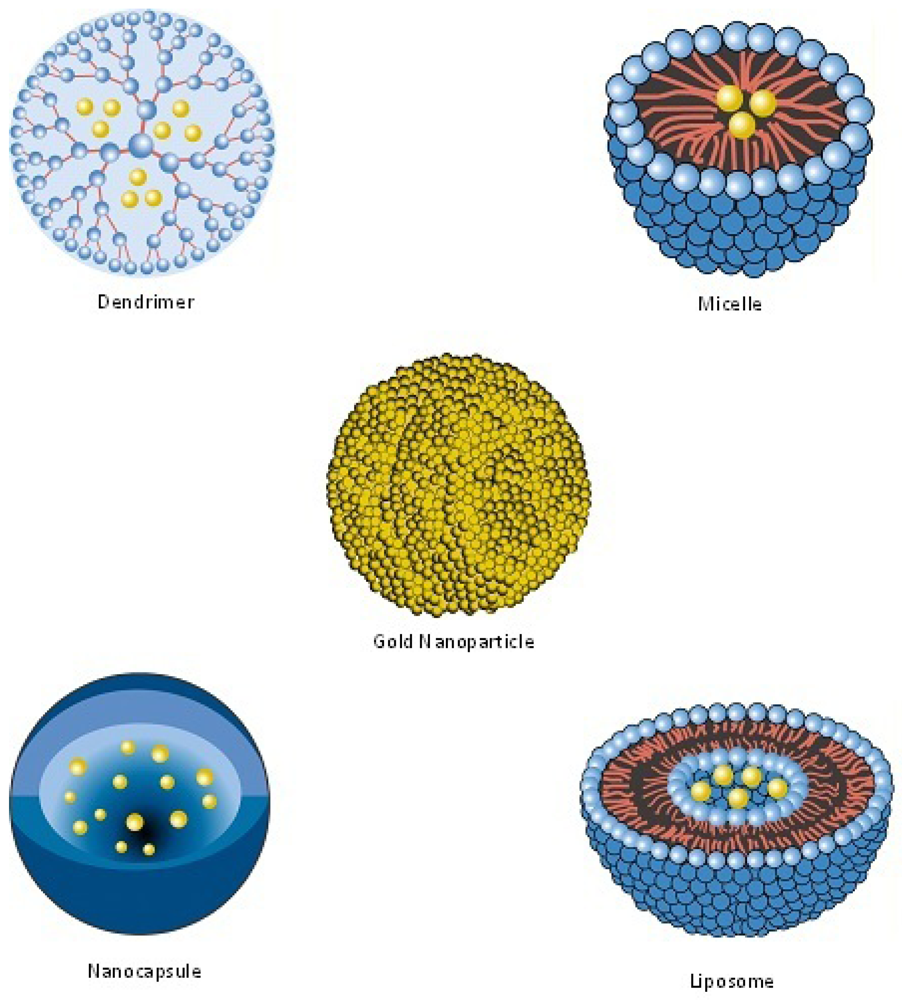
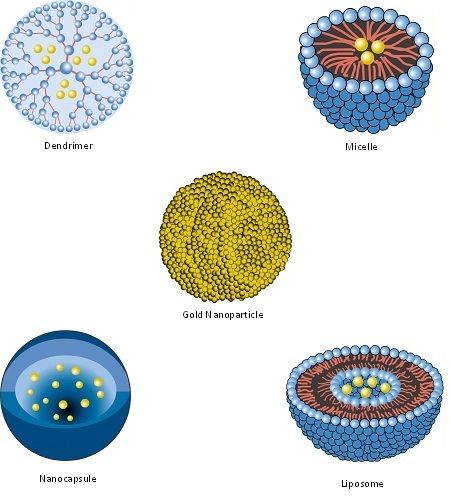
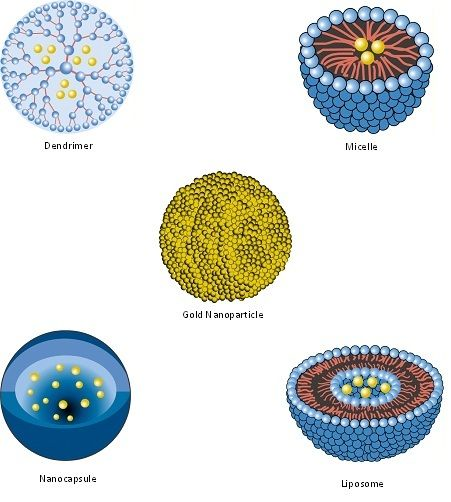
      <p>Numerous nanosized pharmaceuticals (“nanopharmaceuticals”) have been investigated for the treatment and prevention of human disease [<xref ref-type="bibr" rid="B74-viruses-04-00488">74</xref>] (<xref ref-type="table" rid="viruses-04-00488-t002">Table 2</xref> and <xref ref-type="fig" rid="viruses-04-00488-f002">Figure 2</xref>), including HIV. Several reviews have been published that focus on specific aspects or types of anti-HIV nanopharmaceuticals. These include reviews on nanocarriers [<xref ref-type="bibr" rid="B44-viruses-04-00488">44</xref>,<xref ref-type="bibr" rid="B75-viruses-04-00488">75</xref>], advances in antiretroviral drug delivery [<xref ref-type="bibr" rid="B76-viruses-04-00488">76</xref>,<xref ref-type="bibr" rid="B77-viruses-04-00488">77</xref>,<xref ref-type="bibr" rid="B78-viruses-04-00488">78</xref>,<xref ref-type="bibr" rid="B79-viruses-04-00488">79</xref>,<xref ref-type="bibr" rid="B80-viruses-04-00488">80</xref>], polymer based nanotechnologies [<xref ref-type="bibr" rid="B28-viruses-04-00488">28</xref>,<xref ref-type="bibr" rid="B81-viruses-04-00488">81</xref>] or HIV reservoirs [<xref ref-type="bibr" rid="B67-viruses-04-00488">67</xref>]. The intention of this review is to provide an overview of all studies in which we identified the application of nanotechnology to HIV treatment (including, <italic>inter alia</italic>, the nanopharmaceuticals listed in <xref ref-type="table" rid="viruses-04-00488-t002">Table 2</xref>). The reader is referred to several excellent reviews that broadly cover therapeutic as well as preventative facets [<xref ref-type="bibr" rid="B82-viruses-04-00488">82</xref>,<xref ref-type="bibr" rid="B83-viruses-04-00488">83</xref>,<xref ref-type="bibr" rid="B84-viruses-04-00488">84</xref>]. In subsequent sections (which are organized for convenience rather than by convention), we focus on nanopharmaceuticals for the therapy of HIV infection.</p>
    </sec>
    <sec>
      <title>4. Nanopharmaceuticals and Biological Barriers</title>
      <p>Nanopharmaceuticals may enter the body via several routes (intravenous, dermal, subcutaneous, inhalational, intraperitoneal or oral); absorption occurs when they first interact with biological components after which they distribute to various organs in the body. Thereafter, the nanopharmaceuticals may or may not be modified or metabolized and may or may not gain entry into cells, where they may remain indefinitely. During, and following the preceding stages, varying degrees of excretion may occur [<xref ref-type="bibr" rid="B85-viruses-04-00488">85</xref>]. The unique properties of each nanopharmaceutical may have beneficial or undesirable effects at each of these steps and furthermore may confer on it either pharmacological activity or the attributes of a suitable nanocarrier. </p>
      <p>During this journey, from the point of administration to the site of antiviral activity, the nanopharmaceutical may encounter numerous biological “barriers” [<xref ref-type="bibr" rid="B86-viruses-04-00488">86</xref>,<xref ref-type="bibr" rid="B87-viruses-04-00488">87</xref>,<xref ref-type="bibr" rid="B88-viruses-04-00488">88</xref>]. These include:</p>
	  <list list-type="bullet">
		<list-item>
      <p>Enzymatic degradation and poor stability: [<xref ref-type="bibr" rid="B87-viruses-04-00488">87</xref>] Nanopharmaceuticals which are stable in experimental or <italic>in vitro</italic> systems may not necessarily be stable when administered to patients.</p>
		</list-item>
		<list-item>
      <p>Epithelial/endothelial barriers: e.g., the blood-brain barrier [<xref ref-type="bibr" rid="B86-viruses-04-00488">86</xref>,<xref ref-type="bibr" rid="B88-viruses-04-00488">88</xref>].</p>
		</list-item>
		<list-item>
      <p>Immunological barriers—opsonization and uptake by the reticuloendothelial system [<xref ref-type="bibr" rid="B86-viruses-04-00488">86</xref>]. Opsonization leads to aggregation of nanoparticles and activation of defense mechanisms, including phagocytosis, which removes nanoparticles from the circulation and results in their accumulation in the reticuloendothelial system [<xref ref-type="bibr" rid="B89-viruses-04-00488">89</xref>,<xref ref-type="bibr" rid="B90-viruses-04-00488">90</xref>].</p>
		</list-item>
		<list-item>
      <p>Cellular barriers: Inability to traverse the cell membrane [<xref ref-type="bibr" rid="B87-viruses-04-00488">87</xref>].</p>
		</list-item>
		<list-item>
      <p>Extracellular barriers: e.g., inability to penetrate mucin and extracellular matrix [<xref ref-type="bibr" rid="B87-viruses-04-00488">87</xref>].</p>
		</list-item>
		<list-item>
      <p>Intracellular barriers: Entrapment within endosomes, ejection of nanopharaceuticals from the target cell by efflux pumps [<xref ref-type="bibr" rid="B88-viruses-04-00488">88</xref>].</p>
		</list-item>
	  </list>
      <p>Ensuring that a nanopharmaceutical reaches its target site(s) in its active form is a significant challenge in nanotechnology. This challenge may be addressed by optimizing the physicochemical properties of the nanopharmaceutical (charge and size) or by modifying its surface (e.g., biofunctionalization by attachment of ligands or agents that prevent opsonization, facilitate transport across membranes or enable targeting) [<xref ref-type="bibr" rid="B61-viruses-04-00488">61</xref>]. Some of the methods are listed below; further examples and details appear in the text and elsewhere [<xref ref-type="bibr" rid="B91-viruses-04-00488">91</xref>,<xref ref-type="bibr" rid="B92-viruses-04-00488">92</xref>].</p>
      <p><italic>Optimization of the physicochemical properties of a nanoparticle:</italic> Size and charge have an important influence on the stability, biodistribution and efficacy of a nanoparticle (See <xref ref-type="table" rid="viruses-04-00488-t001">Table 1</xref>) [<xref ref-type="bibr" rid="B2-viruses-04-00488">2</xref>,<xref ref-type="bibr" rid="B21-viruses-04-00488">21</xref>,<xref ref-type="bibr" rid="B61-viruses-04-00488">61</xref>,<xref ref-type="bibr" rid="B93-viruses-04-00488">93</xref>]. Depending on its size, a particle may or may not, for example, traverse the endothelial barrier or be sequestered by the spleen, trapped within lymphatic tissues or cleared by the kidney. The size of a nanoparticle also determines the mechanism by which it enters the cell, and where in the cell it localizes. The surface charge of a nanoparticle influences whether or not it traverses the negatively charged cell membrane [<xref ref-type="bibr" rid="B35-viruses-04-00488">35</xref>]. Size also significantly influences the opsonization of nanoparticles by plasma proteins [<xref ref-type="bibr" rid="B89-viruses-04-00488">89</xref>,<xref ref-type="bibr" rid="B90-viruses-04-00488">90</xref>]. </p>
      <p><italic>Pegylation</italic>: The plasma circulation of particles may be extended by coating them with polyethylene glycol, a process dubbed “pegylation”, which reduces opsonization, phagocytosis and uptake by the RES [<xref ref-type="bibr" rid="B90-viruses-04-00488">90</xref>]. Several examples of PEGylated particles, which are often referred to as “stealth” particles, are discussed in sections that follow.</p>
      <p><italic>Overcoming the blood brain barrier</italic>: Penetration of the blood-brain barrier may be achieved by attachment of agents to nanopharmaceuticals that inhibit efflux transporters. Efflux transporters are responsible for poor penetration of certain antivirals into the brain [<xref ref-type="bibr" rid="B94-viruses-04-00488">94</xref>,<xref ref-type="bibr" rid="B95-viruses-04-00488">95</xref>]. </p>
      <p><italic>Targeting</italic>: Nanopharmaceuticals may, through active or passive targeting, accumulate preferentially in specific tissues or cells. Passive targeting occurs when nanoparticles (or other therapeutic or diagnostic agents) leak into diseased tissue due to the enhanced permeability of the local vasculature. The increased leakiness of the vasculature may be due to malignancy or inflammation and the therapeutic agent therefore achieves its maximum concentration at the site of disease [<xref ref-type="bibr" rid="B96-viruses-04-00488">96</xref>]. In active targeting, ligands attached to a nanopharmaceutical bind specifically to receptors or epitopes that are overexpressed in diseased tissues or cells, thereby causing them to accumulate at the diseased site [<xref ref-type="bibr" rid="B96-viruses-04-00488">96</xref>]. </p>
      <p>Targeted delivery to HIV reservoir sites would be of significant benefit because many antiretroviral drugs do not penetrate these sites optimally [<xref ref-type="bibr" rid="B97-viruses-04-00488">97</xref>], which contributes not only to viral persistence, but also to the development of drug resistance. Several studies cited in this review employ targeted delivery of antiretroviral agents to reservoir sites such as the brain [<xref ref-type="bibr" rid="B98-viruses-04-00488">98</xref>] and reticuloendothelial system [<xref ref-type="bibr" rid="B53-viruses-04-00488">53</xref>,<xref ref-type="bibr" rid="B54-viruses-04-00488">54</xref>,<xref ref-type="bibr" rid="B55-viruses-04-00488">55</xref>,<xref ref-type="bibr" rid="B56-viruses-04-00488">56</xref>,<xref ref-type="bibr" rid="B99-viruses-04-00488">99</xref>]. Ligand-receptor binding is a method of targeting in which the nanopharmaceutical is tagged with a ligand (such as a peptide, carbohydrate, antibody or antibody fragment), which binds specifically to receptors found on target cells, into which they are internalized. Cells not bearing such receptors are bypassed [<xref ref-type="bibr" rid="B54-viruses-04-00488">54</xref>]. These receptors are expressed on the target cells either because the cells are HIV- infected or because such receptors are specifically associated with cell types that are found in reservoir sites. Cells of the reticuloendothelial system, for example, bear HLA-DR determinant of MHC-II [<xref ref-type="bibr" rid="B100-viruses-04-00488">100</xref>] and carbohydrate (lectin) receptors [<xref ref-type="bibr" rid="B53-viruses-04-00488">53</xref>,<xref ref-type="bibr" rid="B54-viruses-04-00488">54</xref>,<xref ref-type="bibr" rid="B55-viruses-04-00488">55</xref>,<xref ref-type="bibr" rid="B101-viruses-04-00488">101</xref>,<xref ref-type="bibr" rid="B102-viruses-04-00488">102</xref>], which may be targeted by anti–HLA-DR monoclonal antibodies and galactose and mannose, respectively. HIV-infected cells express gp120 on their surface, which may be targeted by soluble CD4 ligands [<xref ref-type="bibr" rid="B103-viruses-04-00488">103</xref>,<xref ref-type="bibr" rid="B104-viruses-04-00488">104</xref>] or fragments of an anti-gp120 monoclonal antibody [<xref ref-type="bibr" rid="B105-viruses-04-00488">105</xref>].</p>
      <p>The proviso is that targeted HIV therapy cannot be considered without some form of “systemic” (non-targeted) therapy, such as HAART. HIV, far from being a focal disease, is characterized by persistent viremia and affects multiple organs and tissues [<xref ref-type="bibr" rid="B12-viruses-04-00488">12</xref>]. Therefore system-wide therapy with HAART (which may not achieve optimal delivery in certain target sites [<xref ref-type="bibr" rid="B12-viruses-04-00488">12</xref>]) should be combined with targeted delivery (which may have limited systemic benefit).</p>
      <fig id="viruses-04-00488-f002" position="anchor">
        <label>Figure 2</label>
        <caption>
          <p>Examples of nanopharmaceuticals and their potential use in HIV infection. <bold>Gold Nanoparticle</bold>: Serves as a scaffold; increases the multivalent display and hence antiviral activity of a CCR5 antagonist [<xref ref-type="bibr" rid="B63-viruses-04-00488">63</xref>]. <bold>Nanocarriers</bold>, within which drug molecules, depicted as yellow spheres, are enclosed. <bold>Dendrimers</bold>: Increase the uptake of lamivudine and efavirenz into macrophages [<xref ref-type="bibr" rid="B102-viruses-04-00488">102</xref>,<xref ref-type="bibr" rid="B106-viruses-04-00488">106</xref>,<xref ref-type="bibr" rid="B107-viruses-04-00488">107</xref>]. <bold>Micelles</bold>: Improve the aqueous solubility, oral bioavailability and taste of efavirenz [<xref ref-type="bibr" rid="B45-viruses-04-00488">45</xref>,<xref ref-type="bibr" rid="B46-viruses-04-00488">46</xref>,<xref ref-type="bibr" rid="B47-viruses-04-00488">47</xref>,<xref ref-type="bibr" rid="B48-viruses-04-00488">48</xref>,<xref ref-type="bibr" rid="B49-viruses-04-00488">49</xref>]. <bold>Nanocapsules</bold>: Increase the uptake of indinavir into the brain [<xref ref-type="bibr" rid="B95-viruses-04-00488">95</xref>]. <bold>Liposomes</bold>: Deliver AZT and 2',3' dideoxyinosine preferentially to the RES [<xref ref-type="bibr" rid="B25-viruses-04-00488">25</xref>,<xref ref-type="bibr" rid="B27-viruses-04-00488">27</xref>,<xref ref-type="bibr" rid="B108-viruses-04-00488">108</xref>].</p>
        </caption>
        <graphic xmlns:xlink="http://www.w3.org/1999/xlink" xlink:href="viruses-04-00488-g002.tif"/>
      </fig>
      <table-wrap id="viruses-04-00488-t002" position="anchor">
        <object-id pub-id-type="pii">viruses-04-00488-t002_Table 2</object-id>
        <label>Table 2</label>
        <caption>
          <p>Nanopharmaceuticals defined.</p>
        </caption>
        <table rules="all" style="border: solid thin">
          <thead>
            <tr>
              <th align="left" valign="middle">Nanopharmaceutical</th>
              <th align="left" valign="middle">Definition</th>
            </tr>
          </thead>
          <tbody>
            <tr>
              <td align="left" valign="middle">Bucky Ball (Buckminsterfullerene)</td>
              <td align="left" valign="middle">A series of carbon atoms arranged in a closed cage structure that resembles a nanosized soccer ball [<xref ref-type="bibr" rid="B109-viruses-04-00488">109</xref>].</td>
            </tr>
            <tr>
              <td align="left" valign="middle">Dendrimer</td>
              <td align="left" valign="middle">Synthetic, nanosized structure made up of multiple branched monomeric units radiating from a central core [<xref ref-type="bibr" rid="B110-viruses-04-00488">110</xref>,<xref ref-type="bibr" rid="B111-viruses-04-00488">111</xref>].</td>
            </tr>
            <tr>
              <td align="left" valign="middle">Liposome</td>
              <td align="left" valign="middle">Vesicular nanosized structures made up of one or more phospholipid bilayer membranes surrounding an aqueous core [<xref ref-type="bibr" rid="B112-viruses-04-00488">112</xref>].</td>
            </tr>
            <tr>
              <td align="left" valign="middle">Micelle</td>
              <td align="left" valign="middle">Nanosized structure consisting of a shell and a core (made up of a water-soluble and hydrophobic polymer, respectively) [<xref ref-type="bibr" rid="B113-viruses-04-00488">113</xref>,<xref ref-type="bibr" rid="B114-viruses-04-00488">114</xref>].</td>
            </tr>
            <tr>
              <td align="left" valign="middle">Nanoassembly</td>
              <td align="left" valign="middle">Generally, any assembly of hydrophobic and hydrophilic groups that form nanosized aggregates [<xref ref-type="bibr" rid="B115-viruses-04-00488">115</xref>]; this article refers to such assemblies brought about by conjugation to squalene<sup>*</sup> [<xref ref-type="bibr" rid="B35-viruses-04-00488">35</xref>,<xref ref-type="bibr" rid="B116-viruses-04-00488">116</xref>,<xref ref-type="bibr" rid="B117-viruses-04-00488">117</xref>].</td>
            </tr>
            <tr>
              <td align="left" valign="middle">Nanoemulsion</td>
              <td align="left" valign="middle">Dispersion of immiscible droplets with sizes in the ‘nano’ range [<xref ref-type="bibr" rid="B118-viruses-04-00488">118</xref>]</td>
            </tr>
            <tr>
              <td align="left" valign="middle">Nanocapsule</td>
              <td align="left" valign="middle">A nanosized structure consisting of a shell surrounding a space within which drugs are placed [<xref ref-type="bibr" rid="B119-viruses-04-00488">119</xref>].</td>
            </tr>
            <tr>
              <td align="left" valign="middle">Nanocarrier</td>
              <td align="left" valign="middle">Any nanosized entity used for the controlled and targeted delivery of pharmaceutical agents [<xref ref-type="bibr" rid="B2-viruses-04-00488">2</xref>,<xref ref-type="bibr" rid="B120-viruses-04-00488">120</xref>]. This is a functional definition; many of the pharmaceuticals listed in this table (including nanoparticles, micelles, dendrimers, liposomes and solid lipid nanoparticles) are defined structurally (in terms of their composition) but may function as, and can be additionally defined as nanocarriers. Further details are provided in <xref ref-type="sec" rid="sec7-viruses-04-00488">Section 7</xref>.</td>
            </tr>
            <tr>
              <td align="left" valign="middle">Nanocrystal</td>
              <td align="left" valign="middle">Drug crystals with a size in the nanometer range [<xref ref-type="bibr" rid="B30-viruses-04-00488">30</xref>].</td>
            </tr>
            <tr>
              <td align="left" valign="middle">Nanoparticle </td>
              <td align="left" valign="middle">Structure with all three dimensions &lt;100 nm [<xref ref-type="bibr" rid="B121-viruses-04-00488">121</xref>]. Nanoparticles commonly consist of metals or polymers.</td>
            </tr>
            <tr>
              <td align="left" valign="middle">Nanopharmaceutical</td>
              <td align="left" valign="middle">Any nanomaterial with therapeutic potential [<xref ref-type="bibr" rid="B122-viruses-04-00488">122</xref>].</td>
            </tr>
            <tr>
              <td align="left" valign="middle">Quantum dots and rods</td>
              <td align="left" valign="middle">Semiconductor nanocrystals [<xref ref-type="bibr" rid="B123-viruses-04-00488">123</xref>] having the shape of dots or rods [<xref ref-type="bibr" rid="B124-viruses-04-00488">124</xref>].</td>
            </tr>
            <tr>
              <td align="left" valign="middle">Solid Lipid Nanoparticle</td>
              <td align="left" valign="middle">Particle with a solid lipid matrix and a diameter in the nanometer range [<xref ref-type="bibr" rid="B125-viruses-04-00488">125</xref>].</td>
            </tr>
          </tbody>
        </table>
		<table-wrap-foot>
		<fn>
        <p><sup>* </sup>squalene: A naturally occurring hydrocarbon.</p>
		</fn>
		</table-wrap-foot>
      </table-wrap>
    </sec>
    <sec>
      <title>5. Nanocrystals</title>
      <p>Approximately forty percent of drugs in the drug discovery pipeline that show promising activity are poorly soluble in water [<xref ref-type="bibr" rid="B29-viruses-04-00488">29</xref>,<xref ref-type="bibr" rid="B30-viruses-04-00488">30</xref>]. Poor solubility leads to erratic bioavailability and suboptimal dosing [<xref ref-type="bibr" rid="B29-viruses-04-00488">29</xref>,<xref ref-type="bibr" rid="B30-viruses-04-00488">30</xref>] which, in many cases, limits the clinical usefulness and further development of newly discovered agents. The solubility issue of such drugs may be addressed by nanosizing, whereby the drug is reformulated and maintained as nanometer sized crystals (known as nanocrystals), which are then suspended in a liquid (usually water) to form nanosuspensions [<xref ref-type="bibr" rid="B31-viruses-04-00488">31</xref>,<xref ref-type="bibr" rid="B32-viruses-04-00488">32</xref>]. A stabilizer (surfactant) is usually added to prevent aggregation of the crystals [<xref ref-type="bibr" rid="B29-viruses-04-00488">29</xref>,<xref ref-type="bibr" rid="B30-viruses-04-00488">30</xref>,<xref ref-type="bibr" rid="B31-viruses-04-00488">31</xref>,<xref ref-type="bibr" rid="B32-viruses-04-00488">32</xref>]. Since dissolution of poorly soluble drugs is largely dependent on the surface area of the drug particle, and nanoparticles have greater surface area to volume ratios than larger particles, formulating the drug as a nanocrystal may drastically enhance dissolution rates and hence bioavailability [<xref ref-type="bibr" rid="B28-viruses-04-00488">28</xref>,<xref ref-type="bibr" rid="B29-viruses-04-00488">29</xref>,<xref ref-type="bibr" rid="B30-viruses-04-00488">30</xref>,<xref ref-type="bibr" rid="B31-viruses-04-00488">31</xref>]. Nanocrystals also have higher drug per volume <italic>i.e.</italic>, higher drug loading, than other nanocarriers (which consist of active drug in addition to the carrier system) [<xref ref-type="bibr" rid="B28-viruses-04-00488">28</xref>,<xref ref-type="bibr" rid="B31-viruses-04-00488">31</xref>,<xref ref-type="bibr" rid="B32-viruses-04-00488">32</xref>]. </p>
      <p>Nanocrystal technology was used to formulate a long-acting, parenteral form of the poorly water–soluble antiretroviral rilpivirine, a next-generation human immunodeficiency virus type 1 (HIV–1) nonnucleoside reverse transcriptase inhibitor [<xref ref-type="bibr" rid="B126-viruses-04-00488">126</xref>,<xref ref-type="bibr" rid="B127-viruses-04-00488">127</xref>]. The half-life of conventional rilpivirine is 38 hours [<xref ref-type="bibr" rid="B128-viruses-04-00488">128</xref>]; in contrast, when rilpivirine nanocrystals (comprising rilpivirine as the free base or its corresponding HCl salt, an aqueous carrier and a hydrophilic surfactant) were injected subcutaneously in dogs, plasma concentrations were sustained for 3–6 months [<xref ref-type="bibr" rid="B33-viruses-04-00488">33</xref>,<xref ref-type="bibr" rid="B34-viruses-04-00488">34</xref>], providing proof of concept that a nanosuspension of rilpivirine may serve as a long-acting injectable. The benefits of such a formulation in humans would be decreased dosing frequency, improved adherence, reduced impact of food on bioavailability and fewer toxicities (a lower dose of rilpivirine can be administered since first-pass metabolism is bypassed) [<xref ref-type="bibr" rid="B33-viruses-04-00488">33</xref>,<xref ref-type="bibr" rid="B34-viruses-04-00488">34</xref>]. The feasibility of subcutaneous delivery of antiretroviral agents has been demonstrated in clinical trials with enfuvirtide, an approved antiretroviral agent in current use [<xref ref-type="bibr" rid="B129-viruses-04-00488">129</xref>].</p>
      <p>Nanocrystals injected into the venous circulation are opsonized by plasma proteins and are phagocytosed rapidly and predominantly by the Kuppfer cells of the liver, which serves as a depot for the accumulation and slow release of the drug. This phenomenon may be an advantage (if reticuloendothelial accumulation and slow release is desired) or a disadvantage (if the drug is toxic to liver cells, and if high plasma levels are required). Depending on the application, nanocrystals may be fabricated to be &lt;100 nm. These so called “smartCrystals” avoid phagocytosis and furthermore, due to their large surface area to volume ratio, undergo rapid dissolution in the bloodstream, resulting in a “bolus” effect post-injection. Alternatively, a “stealth” particle may be formulated, which is a nanocrystal coated with polyethyleneglycol, which prevents opsonization, thus promoting prolonged circulation. A “homing” molecule (which mediates its attachment to the target cell) may additionally be used for targeted delivery of the nanocrystal, which may be preferred to non-specific accumulation in the reticulendothelial system or rapid dissolution in plasma [<xref ref-type="bibr" rid="B31-viruses-04-00488">31</xref>]. An example is the targeted delivery of nevirapine nanocrystals to the brain, facilitated by surface modification with albumin [<xref ref-type="bibr" rid="B98-viruses-04-00488">98</xref>]. However, the mechanism by which albumin facilitates delivery of nanocrystals through the blood–brain barrier is not clear. Further details of this experiment appear in <xref ref-type="sec" rid="sec9-viruses-04-00488">Section 9</xref>, Targeting the Brain.</p>
    </sec>
    <sec>
      <title>6. Nanoassemblies</title>
      <p>Squalene, a steroid precursor, is a biocompatible hydrocarbon that is widely distributed in nature and is commonly used as an excipient in the pharmaceutical industry [<xref ref-type="bibr" rid="B130-viruses-04-00488">130</xref>]. When squalene is covalently conjugated to nucleoside analogues, they self-organize in aqueous media to form nanosized structures called “nanoassemblies” [<xref ref-type="bibr" rid="B35-viruses-04-00488">35</xref>,<xref ref-type="bibr" rid="B116-viruses-04-00488">116</xref>,<xref ref-type="bibr" rid="B117-viruses-04-00488">117</xref>]. Nanoassemblies have enhanced pharmacological properties compared to the underivatized parent drug [<xref ref-type="bibr" rid="B130-viruses-04-00488">130</xref>]. Nanoassemblies may be created, for example, to allow nucleosides to enter the cell in their prodrug, monophosphorylated form. Nucleoside analogues do not usually enter the cell in this form, due to repulsion between their phosphate group and the cell membrane, both of which are negatively charged. Nucleosides therefore depend on cellular kinases for phosphorylation, which is a rate-limiting step in their activation [<xref ref-type="bibr" rid="B35-viruses-04-00488">35</xref>]. Conjugation to squalene facilitates direct entry of monophosphorylated nucleosides into the cytoplasm, because the nanoassemblies shield the negative charge of the phosphate group from the cell membrane [<xref ref-type="bibr" rid="B35-viruses-04-00488">35</xref>]. In an example of this novel prodrug delivery strategy, nanoassemblies of squalenoyl dideoxycytidine monophosphate tested in HIV-1 infected peripheral blood mononuclear cells displayed twice the <italic>in vitro</italic> anti-HIV potency of the parent molecule, suggesting that the negatively charged nucleotide analogues efficiently penetrated the cell membrane [<xref ref-type="bibr" rid="B35-viruses-04-00488">35</xref>].</p>
      <p>In a further application, polyethylene glycol-coated, or “stealth” nanoassemblies, may be used to encapsulate nucleoside analogues and protect them against degradation and rapid elimination from plasma [<xref ref-type="bibr" rid="B116-viruses-04-00488">116</xref>].</p>
    </sec>
    <sec id="sec7-viruses-04-00488">
      <title>7. Nanocarriers</title>
      <p>Nanocarriers are submicron entities (with a diameter typically between 10 and 1,000 nm) used for the controlled delivery of pharmaceutical agents that are encapsulated within, or adsorbed or conjugated onto their surface [<xref ref-type="bibr" rid="B2-viruses-04-00488">2</xref>,<xref ref-type="bibr" rid="B120-viruses-04-00488">120</xref>]. The therapeutic agent gains pharmacological advantages brought about by the nanometer size range of the complex (which influences passage across cell membranes, uptake by the reticuloendothelial system, dissolution rates, solubility and bioavailability), while its own activity, ideally, remains unaffected [<xref ref-type="bibr" rid="B2-viruses-04-00488">2</xref>]. Various polymeric and non-polymeric materials may be used as nanocarriers; these include nanoparticles, micelles, dendrimers, liposomes and solid lipid nanoparticles [<xref ref-type="bibr" rid="B2-viruses-04-00488">2</xref>,<xref ref-type="bibr" rid="B44-viruses-04-00488">44</xref>,<xref ref-type="bibr" rid="B77-viruses-04-00488">77</xref>,<xref ref-type="bibr" rid="B78-viruses-04-00488">78</xref>]. </p>
      <p><italic>Polymeric nanoparticles.</italic> <italic>Polymeric nanoparticles</italic> consist of a polymeric matrix with a therapeutic agent attached onto its surface or encapsulated within its interior [<xref ref-type="bibr" rid="B2-viruses-04-00488">2</xref>]. Amiji and colleagues used a nanoparticle carrier system to increase the cellular uptake of the antiretroviral agent, saquinavir into a monocyte/macrophage cell line. In this system, saquinavir was loaded into a poly(ethylene oxide)-modified poly(epsilon-caprolactone) (PEO-PCL) nanoparticulate system. PCL is a synthetic, biocompatible polymer that is highly permeable to many drugs, which makes it suitable as a carrier system, while PEO was used to prevent chain aggregation. Saquinavir uptake by THP-1 cells was significantly higher with saquinavir in the nanoparticle formulation compared to aqueous solution [<xref ref-type="bibr" rid="B131-viruses-04-00488">131</xref>].</p>
      <p><italic>Micelles.</italic> Nanocarrier encapsulation may also be exploited to improve solubility and increase oral bioavailability of poorly water-soluble drugs. Polymeric micelles, nanosized structures consisting of a water-soluble polymer that forms the “shell” and a hydrophobic polymer that forms the drug-encapsulating core [<xref ref-type="bibr" rid="B113-viruses-04-00488">113</xref>,<xref ref-type="bibr" rid="B114-viruses-04-00488">114</xref>], may be used for this purpose. In a series of studies by Sosnik and colleagues, efavirenz was incorporated into the core of amphiphilic linear and branched poly(ethylene oxide)-poly(propylene oxide) block copolymer micelles [<xref ref-type="bibr" rid="B45-viruses-04-00488">45</xref>,<xref ref-type="bibr" rid="B49-viruses-04-00488">49</xref>]. This significantly improved the aqueous solubility of efavirenz (by about 8400 times), which in turn improved the oral bioavailability of efavirenz in a liquid (pediatric) form, in rats [<xref ref-type="bibr" rid="B47-viruses-04-00488">47</xref>,<xref ref-type="bibr" rid="B48-viruses-04-00488">48</xref>]. Encapsulation also improves the taste of efavirenz [<xref ref-type="bibr" rid="B46-viruses-04-00488">46</xref>], a significant consideration in the pediatric population [<xref ref-type="bibr" rid="B45-viruses-04-00488">45</xref>,<xref ref-type="bibr" rid="B46-viruses-04-00488">46</xref>,<xref ref-type="bibr" rid="B47-viruses-04-00488">47</xref>,<xref ref-type="bibr" rid="B48-viruses-04-00488">48</xref>,<xref ref-type="bibr" rid="B49-viruses-04-00488">49</xref>]. In other studies, encapsulation with β-cyclodextrin, which has a hydrophobic center and hydrophilic outer surface, increased saquinavir’s solubility 27-fold, improved oral bioavailability in rats ninefold [<xref ref-type="bibr" rid="B132-viruses-04-00488">132</xref>] and significantly enhanced the dissolution rate of efavirenz [<xref ref-type="bibr" rid="B133-viruses-04-00488">133</xref>].</p>
      <p><italic>Nanocapsules.</italic> A nanocapsule consists of a nanosized shell surrounding a space within which drugs may be placed. A polymeric nanocapsule may be used to carry nucleoside reverse transcriptase inhibitors (NRTIs) in their triphosphorylated form directly into the cytoplasm. NRTIs are active only in this triphosphate form, but phosphate groups are too hydrophilic and do not usually traverse the cell membrane [<xref ref-type="bibr" rid="B134-viruses-04-00488">134</xref>]. NRTIs delivered in their conventional non-phosphorylated form therefore require obligatory intracellular phosphorylation by cellular kinases. The inefficiency of cellular kinases may limit the activity or use of some nucleoside analogues. A promising strategy to bypass this metabolic bottleneck involves the use of a nanocapsule to transport azidothymidine-triphosphate (AZT-TP) directly into the cytoplasm. This nanocapsule consists of a poly(<italic>iso</italic>-butylcyanoacrylate) aqueous core which entraps the AZT-TP, and polyethyleneimine which prevents “leakage” of AZT-TP [<xref ref-type="bibr" rid="B50-viruses-04-00488">50</xref>,<xref ref-type="bibr" rid="B51-viruses-04-00488">51</xref>]. </p>
      <p><italic>Others.</italic> Antiretrovirals may also be complexed with a variety of other nanocarriers such as dendrimers, liposomes, solid lipid nanoparticles, lipid-drug nanocomplexes, nanoemulsions of essential polyunsaturated fatty acids, cationic emulsomes and low-density lipoproteins. These function as nanocarrier systems, but have additional features, which are discussed in the relevant sections that follow.</p>
    </sec>
    <sec id="sec8-viruses-04-00488">
      <title>8. Targeting the Reticulo-Endothelial System (RES)</title>
      <p>Liposomes are nanosized vesicular structures made up of one or more phospholipid bilayer membranes surrounding an aqueous core [<xref ref-type="bibr" rid="B112-viruses-04-00488">112</xref>]. Liposomes and several other nanocarriers are readily opsonized by plasma proteins, phagocytosed by macrophages and localize to cells of the reticuloendothelial system (RES) [<xref ref-type="bibr" rid="B77-viruses-04-00488">77</xref>,<xref ref-type="bibr" rid="B135-viruses-04-00488">135</xref>,<xref ref-type="bibr" rid="B136-viruses-04-00488">136</xref>]. The RES is a significant reservoir of HIV replication [<xref ref-type="bibr" rid="B137-viruses-04-00488">137</xref>]. Hydrophilic drugs encapsulated in liposomes localize in organs rich in macrophages, such as liver, spleen and lungs. In a study using mice infected with the murine AIDS virus, liposomes were used to deliver AZT preferentially to the RES, sparing the bone marrow from AZT and thereby reducing bone marrow toxicity [<xref ref-type="bibr" rid="B25-viruses-04-00488">25</xref>]. Similarly, liposome-encapsulated 2',3' dideoxyinosine (ddI) was efficiently localized within the reticuloendothelial system following intravenous bolus injection in female Sprague-Dawley rats. This resulted in reduced systemic clearance and higher plasma drug levels of ddI [<xref ref-type="bibr" rid="B27-viruses-04-00488">27</xref>,<xref ref-type="bibr" rid="B108-viruses-04-00488">108</xref>]. </p>
      <p>The surface of liposomes may be modified to further increase their targeting specificity. Cells of the reticuloendothelial system bear galactose and lectin receptors; galactosylated [<xref ref-type="bibr" rid="B54-viruses-04-00488">54</xref>,<xref ref-type="bibr" rid="B55-viruses-04-00488">55</xref>,<xref ref-type="bibr" rid="B56-viruses-04-00488">56</xref>] and mannosylated [<xref ref-type="bibr" rid="B53-viruses-04-00488">53</xref>,<xref ref-type="bibr" rid="B99-viruses-04-00488">99</xref>] liposomes target these receptors, respectively, and have been used to direct AZT, ddI and stavudine to the reticoloendothelial system. Immunoliposomes have the targeting specificity of antibodies on their surface e.g., anti-HLA-DR monoclonal antibodies which target follicular dendritic cells, B cells and macrophages which express the HLA-DR determinant of MHC-II. Such immunoliposomes resulted in enhanced accumulation of indinivar in mice lymph nodes, with area-under-the-curve exceeding that of free drug 126-fold [<xref ref-type="bibr" rid="B100-viruses-04-00488">100</xref>]. Liposomes may also be decorated with recombinant soluble CD4 molecules [<xref ref-type="bibr" rid="B103-viruses-04-00488">103</xref>,<xref ref-type="bibr" rid="B104-viruses-04-00488">104</xref>], the Fab’ fragment of monoclonal antibody F105 [<xref ref-type="bibr" rid="B105-viruses-04-00488">105</xref>] or Fab’ fragments of anti-HLA-DR antibody [<xref ref-type="bibr" rid="B138-viruses-04-00488">138</xref>], all of which target gp120 on HIV infected cells [<xref ref-type="bibr" rid="B103-viruses-04-00488">103</xref>].</p>
      <p>Other lipid-containing nanocarriers also target lymphatic tissues. In macaque-based studies, nanocomplexes incorporating indinavir with phosphatidylcholine and cholesterol lipids achieve about 22 times higher concentration of indinavir in lymph nodes compared to plasma, and 10-fold reduction in peak plasma concentrations of indinavir [<xref ref-type="bibr" rid="B22-viruses-04-00488">22</xref>,<xref ref-type="bibr" rid="B24-viruses-04-00488">24</xref>]. In further studies, nanocarriers composed of disteroyl phosphatidylcholine and methyl polyethylene glycol disteroyl phosphatidylethanolamine achieved sixfold higher indinavir levels in lymph nodes of macaques than other lipid nanocarriers [<xref ref-type="bibr" rid="B23-viruses-04-00488">23</xref>]. Furthermore, complexes with surface polyethylene glycol exhibit the highest drug levels in lymph nodes [<xref ref-type="bibr" rid="B23-viruses-04-00488">23</xref>]. A possible explanation of the lymph node localization of these complexes is as follows: The diameter of the nanocarrier complex (35 to 120 nm) overlaps that of lymph node drainage (50 to 100 nm), but exceeds that of the endothelial pores (generally up to 12 nm in diameter) [<xref ref-type="bibr" rid="B139-viruses-04-00488">139</xref>]. After subcutaneous delivery, the nanocarrier complex therefore enters, distributes and accumulates within the lymphatic system but is not able to traverse the endothelial barrier, and will therefore not readily appear in the bloodstream. The release of indinavir from liposomes is pH-dependent since the lipophilicity of indinavir is pH-dependent. In plasma, at physiological pH, indinavir reduces water–solubility and associates with the lipids, whereas, at lower pH within the endosome, indinavir is water-soluble, dissociates from the lipid, and is released. Indinavir is acid-stable and retains its activity [<xref ref-type="bibr" rid="B23-viruses-04-00488">23</xref>].</p>
      <p>Several polymeric nanoparticles are also phagocytosed by cells of the reticuloendothelial system. For example, poly-(lactic-co-glycolic acid) nanoparticles containing ritonavir, lopinavir, and efavirenz resulted in intracellular peak levels in peripheral blood mononuclear cells that continued until day 28 compared to free drug, which was eliminated in two days [<xref ref-type="bibr" rid="B140-viruses-04-00488">140</xref>]. Similarly, in rats, AZT concentrations were 18 times higher in the reticuloendothelial system if AZT was bound to hexyl-cyanoacrylate nanoparticles compared to unbound AZT [<xref ref-type="bibr" rid="B141-viruses-04-00488">141</xref>,<xref ref-type="bibr" rid="B142-viruses-04-00488">142</xref>,<xref ref-type="bibr" rid="B143-viruses-04-00488">143</xref>]. </p>
      <p>Dendrimers, which are synthetic, polymeric, tree-like structures in which multiple highly-branched monomeric units radiate from a central core [<xref ref-type="bibr" rid="B110-viruses-04-00488">110</xref>,<xref ref-type="bibr" rid="B111-viruses-04-00488">111</xref>], may likewise be phagocytosed by macrophages when they are conjugated with molecules that are the ligands of receptors on the surface of macrophages. For example, mannosylated fifth-generation poly(propyleneimine) dendrimers may be used to increase the uptake of lamivudine [<xref ref-type="bibr" rid="B102-viruses-04-00488">102</xref>] and efavirenz [<xref ref-type="bibr" rid="B106-viruses-04-00488">106</xref>] by targeting them to lectin receptors on the surface of macrophages. Tuftsin, a natural macrophage activator tetrapeptide, when conjugated to poly(propyleneimine) dendrimers (TuPPI), increased the cellular uptake of efavirenz 34.5-fold [<xref ref-type="bibr" rid="B107-viruses-04-00488">107</xref>]. </p>
      <p>Liposomes coated with PEG (“sterically-stabilized liposomes”) are less readily opsonized, and therefore have longer plasma half-life, significantly improved bioavailability and greater accumulation in lymphatic tissues than non-PEGylated liposomes [<xref ref-type="bibr" rid="B144-viruses-04-00488">144</xref>]. In a study in rats, 2',3'-dideoxyinosine encapsulated in sterically stabilized liposomes had extended half-life in plasma compared to conventional liposomes (14.5 <italic>versus </italic>3.9 hours) [<xref ref-type="bibr" rid="B57-viruses-04-00488">57</xref>]. The bioavailability of AZT incorporated within solid lipid nanoparticles may also be enhanced by the use of PEG (creating so called “stealth solid lipid nanoparticles” that have modified circulation times) [<xref ref-type="bibr" rid="B58-viruses-04-00488">58</xref>,<xref ref-type="bibr" rid="B59-viruses-04-00488">59</xref>]. Similarly polymeric nanoparticles, e.g., poly(lactide acid), when coated with PEG, are less efficiently phagocytosed by macrophages. This may be used to modulate the delivery of AZT to the reticuloendothelial system [<xref ref-type="bibr" rid="B145-viruses-04-00488">145</xref>].</p>
    </sec>
    <sec id="sec9-viruses-04-00488">
      <title>9. Targeting the Brain</title>
      <p>Nanomaterials may also be used to achieve targeted delivery of antiretrovirals to the brain. Many antivirals have limited distribution in brain tissue due to the permeability glycoprotein (P-gp) efflux transporter. Certain agents, such as the polymer Pluronic P85 and the excipient Solutol® HS15, block P-gp and therefore improve delivery of antivirals through the blood-brain barrier. The Pluronic block copolymer P85, which probably works by reducing the availability of ATP to P-gp [<xref ref-type="bibr" rid="B146-viruses-04-00488">146</xref>], enhanced the <italic>in vivo </italic>efficacy of antiretroviral drugs zidovudine, lamivudine and nelfinavir in a severe combined immunodeficiency (SCID) mouse model of HIV-1 encephalitis (HIVE) [<xref ref-type="bibr" rid="B94-viruses-04-00488">94</xref>]. Similarly indinavir, when loaded into Solutol® HS15 nanocapsules, achieved significantly higher tissue <italic>versus </italic>plasma concentration in mice brains compared to administration as a solution (nanocapsule <italic>versus</italic> solution ratio of 1.9 in normal mice and 1.5 in P-gp-deficient mice) [<xref ref-type="bibr" rid="B95-viruses-04-00488">95</xref>].</p>
      <p>Several lipid containing nanosystems also limit binding to efflux transporters. The accumulation of atazanavir in a human brain microvessel endothelial cell line (hCMEC/D3) was significantly enhanced when encapsulated by solid lipid nanoparticles, suggesting that this is a promising method for delivery of atazanavir across the blood-brain barrier [<xref ref-type="bibr" rid="B147-viruses-04-00488">147</xref>]. The maximum concentration and the area-under-the curve values in the brain were respectively five- and threefold higher than the aqueous suspension when saquinavir was delivered by an oil-in-water nanoemulsions made with essential polyunsaturated fatty acid-rich oils [<xref ref-type="bibr" rid="B148-viruses-04-00488">148</xref>].</p>
      <p>Polybutylcyanoacrylate and methylmethacrylate-sulfopropylmethacrylate nananoparticles also increased the permeability of the blood-brain barrier to several antiretrovirals, but the exact mechanism of action of these polymers is unclear [<xref ref-type="bibr" rid="B149-viruses-04-00488">149</xref>,<xref ref-type="bibr" rid="B150-viruses-04-00488">150</xref>]. Interestingly, the permeability across endothelial cells in these systems is affected by exposure to electromagnetic interference, possibly because of the effect of the charge of the nanocarrier on permeability [<xref ref-type="bibr" rid="B151-viruses-04-00488">151</xref>]. </p>
      <p>Regions of the TAT peptide known as protein transduction domains are able to pass through biological membranes independent of transporters. TAT-conjugated poly(L-lactide) nanoparticles enhanced the uptake of ritonavir in mice brain 800-fold [<xref ref-type="bibr" rid="B152-viruses-04-00488">152</xref>].</p>
      <p>Finally, targeted delivery across the blood-brain barrier may also be achieved with the use of surface modified nanocrystals. In a study using rats, intravenously administered nevirapine nanocrystals that were surface-modified with serum albumin showed enhanced accumulation in the brain compared to nanocrystals modified with polysaccharide or polyethylene glycol; all forms of the nanocrystal, including the unmodified form, accumulated predominantly in the liver and the spleen [<xref ref-type="bibr" rid="B98-viruses-04-00488">98</xref>]. The mechanism of this effect is not clear; further research may reveal a possible method of targeting viral reservoirs in the brain.</p>
    </sec>
    <sec id="sec10-viruses-04-00488">
      <title>10. Targeting Latent HIV</title>
      <p>In a recent study using human T-cell lines and a humanized mouse model, lipid nanoparticles loaded with bryostatin-2, a protein kinase C activator, were able to activate primary CD4<sup>+</sup> T cells and stimulate HIV replication in latently infected cells. Furthermore, if the particles are additionally loaded with an antiretroviral such as nelfinavir, the multifunctional nanoparticle will be capable of simultaneously activating latent virus and inhibiting viral spread [<xref ref-type="bibr" rid="B60-viruses-04-00488">60</xref>]. This proof-of-concept study suggests the possibility that nanotechnology may provide the “holy grail” of HIV eradication research: A drug that will “flush out” and purge the latent viral reservoir.</p>
    </sec>
    <sec>
      <title>11. Bio-Functionalized Nanoparticles</title>
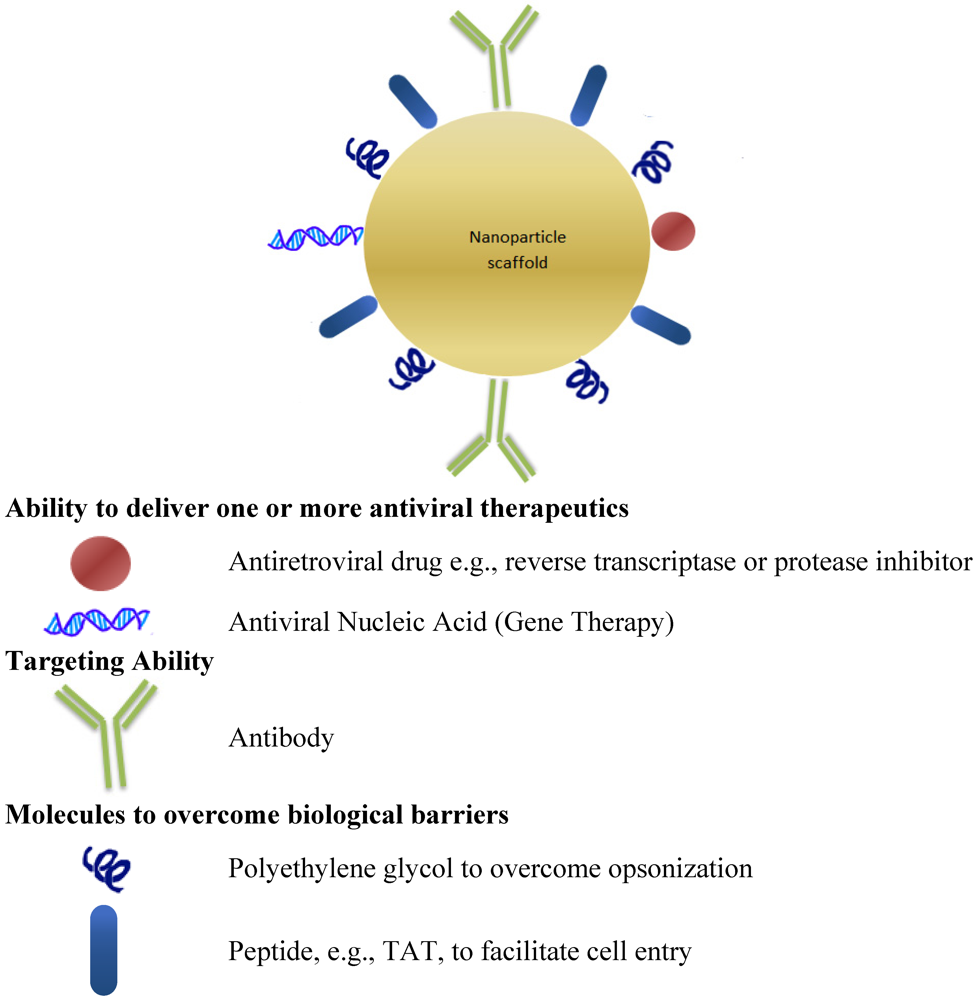
      <p>Nanopharmaceuticals may be created by conjugating a nanomaterial with a biologically derived or biologically based component such as a nucleic acid, protein, peptide or antibody (See <xref ref-type="fig" rid="viruses-04-00488-f003">Figure 3</xref>). A peptide based on the sequence of the HIV TAT (which is known to have cell-penetrating properties), the polymeric carrier polyethylene glycol and the cell uptake enhancer, biotin, were conjugated in various combinations and assessed as carriers of saquinavir. <italic>In vitro</italic> experiments demonstrated that the multifunctional bioconjugates had significantly different cellular uptake and anti-HIV potency compared to the prodrug alone [<xref ref-type="bibr" rid="B62-viruses-04-00488">62</xref>].</p>
      <fig id="viruses-04-00488-f003" position="anchor">
        <label>Figure 3</label>
        <caption>
          <p>Hypothetical biofunctionalized, multifunctional nanopharmaceutical with the following [<xref ref-type="bibr" rid="B52-viruses-04-00488">52</xref>,<xref ref-type="bibr" rid="B86-viruses-04-00488">86</xref>,<xref ref-type="bibr" rid="B153-viruses-04-00488">153</xref>,<xref ref-type="bibr" rid="B154-viruses-04-00488">154</xref>].</p>
        </caption>
        <graphic xmlns:xlink="http://www.w3.org/1999/xlink" xlink:href="viruses-04-00488-g003.tif"/>
      </fig>
      <p>Polyethylene glycol (PEG) may be biofunctionalized to improve its ability to carry antiretroviral and other drugs to cellular targets, including macrophages. PEG has useful “stealth” properties [<xref ref-type="bibr" rid="B61-viruses-04-00488">61</xref>]: It protects attached drugs from enzymatic degradation, prevents rapid renal clearance and inhibits interaction with cell-surface proteins. This allows PEGylated complexes to remain in the systemic circulation longer. However the restricted interaction of PEG with cell surfaces (the very property which makes it useful) also hinders its use as a drug carrier (since antiretrovirals need to reach their target cell to be effective) [<xref ref-type="bibr" rid="B155-viruses-04-00488">155</xref>]. Attachment of a cell-targeting peptide to PEG overcomes this limitation. An example of a cell targeting peptide is <italic>N</italic>-formyl-Met-Leu-Phe (fMLF). fMLF resembles a bacterial protein and is a known chemo-attractant for macrophages, to which it binds avidly; fMLF may be used to functionalizes PEG. Experiments in mice suggest that targeting macrophages using fMLF-modified PEG may be a feasible strategy [<xref ref-type="bibr" rid="B155-viruses-04-00488">155</xref>].</p>
    </sec>
    <sec>
      <title>12. Gene Therapy: Nanocarriers of RNA and DNA</title>
      <p>RNA-based therapies are an attractive prospect for the treatment, not only of HIV [<xref ref-type="bibr" rid="B83-viruses-04-00488">83</xref>,<xref ref-type="bibr" rid="B156-viruses-04-00488">156</xref>,<xref ref-type="bibr" rid="B157-viruses-04-00488">157</xref>], but of a wide variety of other infectious and non-infectious diseases [<xref ref-type="bibr" rid="B158-viruses-04-00488">158</xref>]. Strategies include ribozymes, antisense RNAs, RNA aptamers, RNA decoys, human ribonuclease P (RNase P), modified small nuclear RNA and small interfering RNAs [<xref ref-type="bibr" rid="B156-viruses-04-00488">156</xref>,<xref ref-type="bibr" rid="B157-viruses-04-00488">157</xref>]. However RNA delivery to target sites, by vector and non-vector methods, has been plagued by several challenges that restrict the clinical utility of RNA therapeutics. These issues include rapid degradation in physiological conditions, short half-life, poor cellular uptake, subcellular compartmentalization, unwanted interactions with plasma proteins and the immune system, low bioavailability and off-target side-effects [<xref ref-type="bibr" rid="B36-viruses-04-00488">36</xref>,<xref ref-type="bibr" rid="B37-viruses-04-00488">37</xref>,<xref ref-type="bibr" rid="B38-viruses-04-00488">38</xref>,<xref ref-type="bibr" rid="B159-viruses-04-00488">159</xref>,<xref ref-type="bibr" rid="B160-viruses-04-00488">160</xref>,<xref ref-type="bibr" rid="B161-viruses-04-00488">161</xref>,<xref ref-type="bibr" rid="B162-viruses-04-00488">162</xref>,<xref ref-type="bibr" rid="B163-viruses-04-00488">163</xref>,<xref ref-type="bibr" rid="B164-viruses-04-00488">164</xref>,<xref ref-type="bibr" rid="B165-viruses-04-00488">165</xref>]. Nucleic acid delivery by vector methods has also posed potential safety concerns due to their oncogenic, inflammatory and immunogenic effects [<xref ref-type="bibr" rid="B39-viruses-04-00488">39</xref>].</p>
      <p>Numerous methods for non-viral delivery of therapeutic DNA [<xref ref-type="bibr" rid="B161-viruses-04-00488">161</xref>] and RNA [<xref ref-type="bibr" rid="B40-viruses-04-00488">40</xref>,<xref ref-type="bibr" rid="B160-viruses-04-00488">160</xref>,<xref ref-type="bibr" rid="B166-viruses-04-00488">166</xref>] have been explored. In particular, nanosized drug carrier systems have been developed [<xref ref-type="bibr" rid="B38-viruses-04-00488">38</xref>,<xref ref-type="bibr" rid="B41-viruses-04-00488">41</xref>] that may address many of the issues related to nucleic acid delivery: Improved safety (due to biodegradability and rapid clearance by the reticuloendothelial system), targeted delivery and controlled release, improved uptake by overcoming electrostatic repulsion between negatively charged RNA or DNA and cell membranes, improved stability in physiological fluids and protection from degradation [<xref ref-type="bibr" rid="B36-viruses-04-00488">36</xref>,<xref ref-type="bibr" rid="B37-viruses-04-00488">37</xref>,<xref ref-type="bibr" rid="B167-viruses-04-00488">167</xref>]. Several of these approaches have been adopted for the delivery of anti-HIV RNA and DNA therapeutics (<xref ref-type="table" rid="viruses-04-00488-t003">Table 3</xref>). In general, the nucleic acid is condensed with a cationic reagent via electrostatic interactions. The cationic reagent (which may be a peptide, liposome or dendrimer) protects the nucleic acid against degradation and facilitates cellular uptake by endocytosis [<xref ref-type="bibr" rid="B42-viruses-04-00488">42</xref>].</p>
      <table-wrap id="viruses-04-00488-t003" position="anchor">
        <object-id pub-id-type="pii">viruses-04-00488-t003_Table 3</object-id>
        <label>Table 3</label>
        <caption>
          <p>Potential anti-HIV nucleic acids and their delivery by nanocarriers.</p>
        </caption>
        <table rules="all" style="border: solid thin">
          <tbody>
            <tr>
              <td align="left" valign="middle">Nanocarrier</td>
              <td align="left" valign="middle">Nucleic acid</td>
              <td align="left" valign="middle">Target</td>
              <td align="left" valign="middle">Effect</td>
            </tr>
            <tr>
              <td align="left" valign="middle">Poly(L-lysine), a cationic peptide </td>
              <td align="left" valign="middle">antisense oligonucleotide </td>
              <td align="left" valign="middle">primer binding site and U5 region of the viral genome</td>
              <td align="left" valign="middle">In cell culture, the antisense oligonucleotide covalently linked to poly(L-lysine) inhibited HIV-1 reverse transcriptase mediated elongation of cDNA, in a sequence and dose-dependent manner [<xref ref-type="bibr" rid="B168-viruses-04-00488">168</xref>].</td>
            </tr>
            <tr>
              <td align="left" valign="middle">Protamine, a cationic peptide</td>
              <td align="left" valign="middle">antisense oligonucleotides</td>
              <td align="left" valign="middle">tat<sup>***</sup> mRNA</td>
              <td align="left" valign="middle">Protamine bound to the antisense oligonucleotide led to specific inhibition of tat-mediated HIV-1 transactivation in lymphocytes [<xref ref-type="bibr" rid="B169-viruses-04-00488">169</xref>].</td>
            </tr>
            <tr>
              <td align="left" valign="middle">Quantum rod</td>
              <td align="left" valign="middle">siRNA<sup>#</sup></td>
              <td align="left" valign="middle">poly A/TAR (transactivator of the HIV-1 LTR<sup>**</sup>) site</td>
              <td align="left" valign="middle">The quantum rod-siRNA nanoplex suppressed HIV-1 viral replication in a THP-1 cell line [<xref ref-type="bibr" rid="B170-viruses-04-00488">170</xref>]. </td>
            </tr>
            <tr>
              <td align="left" valign="middle">Amino-terminated carbosilane dendrimers</td>
              <td align="left" valign="middle">siRNA<sup>#</sup></td>
              <td align="left" valign="middle">p24 region of gag or the nef sequence</td>
              <td align="left" valign="middle">Dendrimers formed dendriplexes with siRNA<sup>#</sup>, which were delivered to human astrocytes, where they reduced the replication of HIV-1 [<xref ref-type="bibr" rid="B171-viruses-04-00488">171</xref>].</td>
            </tr>
            <tr>
              <td align="left" valign="middle">Amino-terminated carbosilane dendrimers</td>
              <td align="left" valign="middle">siRNA<sup>#</sup></td>
              <td align="left" valign="middle">p24, gag and nef</td>
              <td align="left" valign="middle">Dendriplexes were able to transfect the lymphocytic cell line SupT1 and hard-to-transfect HIV-infected peripheral blood mononuclear cells (PBMCs), where they reduced HIV replication [<xref ref-type="bibr" rid="B172-viruses-04-00488">172</xref>].</td>
            </tr>
            <tr>
              <td align="left" valign="middle">pH-sensitive liposomes</td>
              <td align="left" valign="middle">Antisense oligodeoxynucleotide; ribozyme</td>
              <td align="left" valign="middle">Rev responsive element and 5'-LTR<sup>**</sup>, respectively</td>
              <td align="left" valign="middle">Inhibited virus replication in monocyte-derived macrophages [<xref ref-type="bibr" rid="B173-viruses-04-00488">173</xref>]. However, delivery of functional ribozymes by liposomes is relatively inefficient [<xref ref-type="bibr" rid="B174-viruses-04-00488">174</xref>].</td>
            </tr>
            <tr>
              <td align="left" valign="middle">LFA-1<sup>*</sup>- targeted and stabilized immunoliposome nanoparticles</td>
              <td align="left" valign="middle">siRNA<sup>#</sup></td>
              <td align="left" valign="middle">CCR5</td>
              <td align="left" valign="middle">siRNA<sup>#</sup> administered to humanized mice using immunoliposome nanoparticles resulted in selective uptake of siRNA<sup>#</sup> by T-cells and macrophages and reduction in HIV plasma viral load [<xref ref-type="bibr" rid="B175-viruses-04-00488">175</xref>].</td>
            </tr>
          </tbody>
        </table>
		<table-wrap-foot>
		<fn>
        <p><sup>* </sup>LFA-1: Lymphocyte function-associated antigen-1 integrin, expressed on all leukocytes; <sup>**</sup> LTR: Long terminal repeat; <sup>*** </sup>tat: Trans-activator of transcription; <sup># </sup>siRNAs: small interfering RNAs.</p>
		</fn>
		</table-wrap-foot>
      </table-wrap>
        <table-wrap id="viruses-04-00488-t004" position="anchor">
          <object-id pub-id-type="pii">viruses-04-00488-t004_Table 4</object-id>
          <label>Table 4</label>
          <caption>
            <p>Nanopharmaceuticals with potential anti-HIV activity.</p>
          </caption>
          <table rules="all" style="border: solid thin">
            <thead>
              <tr>
                <th align="left" valign="middle">Nanopharmaceuticals</th>
                <th align="left" valign="middle">Proposed Mechanism of Action</th>
                <th align="left" valign="middle">Activity</th>
              </tr>
            </thead>
            <tbody>
              <tr>
                <td align="left" valign="middle">Silver nanoparticles [<xref ref-type="bibr" rid="B176-viruses-04-00488">176</xref>]</td>
                <td align="left" valign="middle">The nanoparticles interact preferentially, and in a size-dependent manner [<xref ref-type="bibr" rid="B177-viruses-04-00488">177</xref>], with gp120 knobs and prevents CD4-dependent virion binding, fusion, and infectivity [<xref ref-type="bibr" rid="B178-viruses-04-00488">178</xref>]. </td>
                <td align="left" valign="middle">TI<sup>**</sup> = 8.9 [<xref ref-type="bibr" rid="B178-viruses-04-00488">178</xref>]</td>
              </tr>
              <tr>
                <td align="left" valign="middle">Phenyldicarboxylic acid and naphthyldisulfonic acid polyanionic dendrimers </td>
                <td align="left" valign="middle">Interacts with gp120 and interferes with virus-cell binding. </td>
                <td align="left" valign="middle">EC<sub>50</sub><sup>* </sup>of 0.1 and 0.3 µg/mL, respectively [<xref ref-type="bibr" rid="B179-viruses-04-00488">179</xref>]</td>
              </tr>
              <tr>
                <td align="left" valign="middle">One-tailed, long-chain, water-soluble, dendritic tricarboxylato amphiphiles</td>
                <td align="left" valign="middle">They most likely act by blocking viral fusion [<xref ref-type="bibr" rid="B77-viruses-04-00488">77</xref>].</td>
                <td align="left" valign="middle">TI<sup>**</sup> = 4 and EC<sub>50</sub><sup>*</sup> = 110–740 µM [<xref ref-type="bibr" rid="B180-viruses-04-00488">180</xref>] </td>
              </tr>
              <tr>
                <td align="left" valign="middle">Phosphorus-containing dendrimers bearing Galβ<sub>1</sub>cer<sup>*** </sup>analogues</td>
                <td align="left" valign="middle">Block HIV entry.</td>
                <td align="left" valign="middle">IC<sub>50</sub> values of 1.1 and 0.12 µM, respectively[<xref ref-type="bibr" rid="B181-viruses-04-00488">181</xref>]</td>
              </tr>
              <tr>
                <td align="left" valign="middle">Polylysine-sulfated cellobiose<sup>## </sup>glycodendrimer</td>
                <td align="left" valign="middle">Electrostatic interaction between negatively charged sulfated oligosaccharide and positively charged gp120 on the surface of HIV [<xref ref-type="bibr" rid="B182-viruses-04-00488">182</xref>].</td>
                <td align="left" valign="middle">EC<sub>50</sub><sup>*</sup> = 3.2 µg/mL [<xref ref-type="bibr" rid="B182-viruses-04-00488">182</xref>]</td>
              </tr>
              <tr>
                <td align="left" valign="middle">Mannose hyperbranched dendritic polymers</td>
                <td align="left" valign="middle">Inhibits binding of HIV gp120 to DC-SIGN<sup>### </sup>[<xref ref-type="bibr" rid="B183-viruses-04-00488">183</xref>].</td>
                <td align="left" valign="middle">IC<sub>50 </sub>= 50 µM [<xref ref-type="bibr" rid="B183-viruses-04-00488">183</xref>]</td>
              </tr>
              <tr>
                <td align="left" valign="middle">Polyamidoamine (PAMAM) dendrimers </td>
                <td align="left" valign="middle">Binds to TAR<sup>#</sup> RNA and prevents its interaction with Tat<sup>**** </sup>protein [<xref ref-type="bibr" rid="B184-viruses-04-00488">184</xref>].</td>
                <td align="left" valign="middle">not known</td>
              </tr>
              <tr>
                <td align="left" valign="middle">Multivalent glycosphingolipid-derived carbohydrate head groups covalently attached to a dendrimer core</td>
                <td align="left" valign="middle">Inhibits interaction between HIV gp120 and glycosphingolipids, which are alternate receptors for HIV-1 on the surface of immune cells [<xref ref-type="bibr" rid="B185-viruses-04-00488">185</xref>].</td>
                <td align="left" valign="middle">IC<sub>50</sub> between 0.1 and 7.4 μg/mL [<xref ref-type="bibr" rid="B185-viruses-04-00488">185</xref>]</td>
              </tr>
              <tr>
                <td align="left" valign="middle">Sialic Acid-Polyamidoamine (PAMAM) Glycodendrimers</td>
                <td align="left" valign="middle">Probably bind to and down-regulate CD4 antigen on surface of T-cells [<xref ref-type="bibr" rid="B186-viruses-04-00488">186</xref>]</td>
                <td align="left" valign="middle">IC<sub>50 </sub>between 1.6 and 5.1 μM [<xref ref-type="bibr" rid="B187-viruses-04-00488">187</xref>]</td>
              </tr>
              <tr>
                <td align="left" valign="middle">Water soluble dendrimic fullerene</td>
                <td align="left" valign="middle">Dendrimers seem to bind to HIV-1 protease.</td>
                <td align="left" valign="middle">EC<sub>50</sub><sup>*</sup> = 0.22 µM [<xref ref-type="bibr" rid="B188-viruses-04-00488">188</xref>]</td>
              </tr>
              <tr>
                <td align="left" valign="middle">“Bucky Ball” (C60 fullerene) structures</td>
                <td align="left" valign="middle">Computational docking models and kinetic analysis suggest binding of Bucky Ball derivatives to the active site of HIV-1 protease [<xref ref-type="bibr" rid="B189-viruses-04-00488">189</xref>].</td>
                <td align="left" valign="middle">not known</td>
              </tr>
            </tbody>
          </table>
		  <table-wrap-foot>
		  <fn>
          <p><sup>* </sup>EC<sub>50</sub>: Effective concentration 50%, the concentration of drug that achieves half the maximum protective effect; by comparison, the EC<sub>50 </sub>of AZT and lopinavir are 0.186 µM [<xref ref-type="bibr" rid="B190-viruses-04-00488">190</xref>] and 19 nM [<xref ref-type="bibr" rid="B191-viruses-04-00488">191</xref>] , respectively;<sup> **</sup> TI: Therapeutic index, a measure of effectiveness <italic>versus</italic> toxicity, the higher the index, the better the drug; expressed as the ratio of the concentration of the drug at which it is toxic to 50% of the cells <italic>versus</italic> the concentration at which it protects 50% of the cells; by comparison, the equivalent index for AZT is 1027 [<xref ref-type="bibr" rid="B191-viruses-04-00488">191</xref>] and that of lopinavir is &gt;1,000 [<xref ref-type="bibr" rid="B191-viruses-04-00488">191</xref>];<sup> ***</sup>Galβ<sub>1</sub>cer: Galactosylceramide; <sup>#</sup> TAR: Trans-activation response region; <sup>**** </sup>tat: Trans-activator of transcription; <sup>## </sup>cellobiose: An oligosaccharide; <sup>### </sup>DC-SIGN: Dendritic cell-specific intercellular adhesion molecule (ICAM)-3 grabbing non-integrin, a lectin expressed on the surface of dendritic cells, involved in early stages of HIV infection.</p>
		  </fn>
		  </table-wrap-foot>
        </table-wrap>
    </sec>
    <sec>
      <title>13. Nanopharmaceuticals with Potential Antiviral Activity</title>
      <p>Nanopharmaceuticals themselves may exert antiviral activity by targeting one or more steps in the replication cycle of HIV. Metal nanoparticles, dendrimers and “Bucky Balls”, for example, bind HIV enzymes or proteins thereby blocking the replication of HIV, possibly by steric hindrance (<xref ref-type="table" rid="viruses-04-00488-t004">Table 4</xref>). These mechanisms are size-dependent in that some inorganic metals (such as silver), for instance, possess antiviral effect when present in nanometer-sized macromolecules but have limited or no activity in bulk or atomic form [<xref ref-type="bibr" rid="B176-viruses-04-00488">176</xref>,<xref ref-type="bibr" rid="B177-viruses-04-00488">177</xref>,<xref ref-type="bibr" rid="B178-viruses-04-00488">178</xref>]. </p>
    </sec>
    <sec>
      <title>14. Limitations</title>
      <p>Several challenges in the field of HIV nanotherapeutics should be acknowledged and addressed. Firstly, there are biological challenges. Some nanoparticles are degraded in the gut following oral administration, or fail to penetrate the mucus barrier and are thus minimally absorbed [<xref ref-type="bibr" rid="B192-viruses-04-00488">192</xref>]. Others may have unwanted interactions with biological systems (e.g., plasma proteins), which leads to opsonization, uptake by macrophages and reduced plasma half-life [<xref ref-type="bibr" rid="B7-viruses-04-00488">7</xref>]. The default response to many nanomedicines may unfortunately be that the body is “programmed” to get rid of them, by phagocytosis and other mechanisms. </p>
      <p>Nanotherapeutics may have unacceptable toxicity. The very properties that make them useful may also lead to undesirable consequences. For example, the larger surface area to volume ratio of certain nanomaterials may exaggerate their toxic effects [<xref ref-type="bibr" rid="B5-viruses-04-00488">5</xref>]. Nanoparticles may be absorbed and distributed nonspecifically [<xref ref-type="bibr" rid="B7-viruses-04-00488">7</xref>], are usually endocytosed and may have unpredictable intracellular effects, may induce apoptosis and disrupt cell membrane [<xref ref-type="bibr" rid="B7-viruses-04-00488">7</xref>], and may generate adverse immunological responses [<xref ref-type="bibr" rid="B31-viruses-04-00488">31</xref>]. In addition, they may be too large for renal clearance and if they cannot be degraded within the body, they will accumulate, leading to toxicity [<xref ref-type="bibr" rid="B31-viruses-04-00488">31</xref>,<xref ref-type="bibr" rid="B193-viruses-04-00488">193</xref>]. Inorganic nanoparticles, in particular, may not be easily degraded or metabolized, and once absorbed will remain in the body for years [<xref ref-type="bibr" rid="B192-viruses-04-00488">192</xref>]. </p>
      <p>Traditional methods for assessing cytotoxicity and efficacy may be complicated by the unique features of nanomaterials [<xref ref-type="bibr" rid="B4-viruses-04-00488">4</xref>]. Data is lacking on how nanoparticles are metabolically processed [<xref ref-type="bibr" rid="B7-viruses-04-00488">7</xref>]. Much research is therefore required in the field of nanotoxicology [<xref ref-type="bibr" rid="B7-viruses-04-00488">7</xref>,<xref ref-type="bibr" rid="B31-viruses-04-00488">31</xref>].</p>
      <p>Secondly, there are technological hurdles. Scaling up is challenging and expensive. Optimization at a laboratory scale is much simpler than at an industrial or commercial level [<xref ref-type="bibr" rid="B193-viruses-04-00488">193</xref>]. </p>
    </sec>
    <sec>
      <title>15. Perspectives</title>
      <p>In this review, diverse applications of nanotechnology have been described: Some have the potential to improve the pharmacological profile of known antiretroviral agents: Nanocrystals to allow formulation of antiretroviral agents as long acting injectables; nanoassemblies and nanocapsules to allow nucleoside reverse transcriptase inhibitors to enter the cell in phosphorylated form; micelles to improve oral bioavailability and taste. Several methods to target viral reservoirs have also been explored: Polymeric nanoparticle to improve uptake of antiretrovirals in macrophages; liposomes, polymeric nanoparticles and dendrimers to target the reticuloendothelial system (with targeting ligands to improve specificity); nanocapsules, nanocrystals and other nanosystems to improve delivery across the blood-brain barrier; a multifunctional nanoparticle to target latent HIV. Several <italic>in vitro</italic> experiments suggest possible methods to facilitate the delivery of therapeutic nucleic acids into cells. Finally, metallic and dendrimer-based nanopharmaceuticals showed potential anti-HIV activity in cell culture. </p>
      <p>However, none of the research described here has proceeded beyond the pre-clinical stage. The success of any nanopharmaceutical depends on at least three criteria [<xref ref-type="bibr" rid="B77-viruses-04-00488">77</xref>,<xref ref-type="bibr" rid="B82-viruses-04-00488">82</xref>,<xref ref-type="bibr" rid="B83-viruses-04-00488">83</xref>], none of which can be satisfactorily or completely assessed without clinical data [<xref ref-type="bibr" rid="B28-viruses-04-00488">28</xref>,<xref ref-type="bibr" rid="B83-viruses-04-00488">83</xref>]: Firstly, the nanopharmaceutical should exert an antiviral effect, secondly, it should have an acceptable toxicity profile and thirdly, it should be stable and be able to overcome biological barriers. The challenge is that optimizing one criterion may be detrimental to the others, e.g., optimizing efficacy (by, for instance, including an additional therapeutic agent into a multifunctional nanoparticle) may exacerbate toxicity (because such an agent may be toxic) and decrease stability (because the more complex construct is likely to be less stable). Extensive <italic>in vitro</italic> optimization experiments may be necessary to achieve the ideal construct for <italic>in vivo</italic> evaluation. Further research is needed to enhance our understanding of how to design and interpret these <italic>in vitro</italic> experiments. Specific issues regarding the reproducibility of experiments and the interaction with biological systems (such as coating of the nanoparticles with proteins in the cell culture medium) need to be resolved [<xref ref-type="bibr" rid="B194-viruses-04-00488">194</xref>]. Assays to assess safety and efficacy need to be standardized and validated [<xref ref-type="bibr" rid="B88-viruses-04-00488">88</xref>,<xref ref-type="bibr" rid="B153-viruses-04-00488">153</xref>]. Computerized models, that predict or simulate nanopharmaceutical behaviour, need to be developed and optimized [<xref ref-type="bibr" rid="B88-viruses-04-00488">88</xref>]. Nevertheless, the eventual success of these efforts will be determined in the clinic rather than the laboratory.</p>
      <p>An additional issue that needs to be considered is whether the use of the nanopharmaceutical leads to HIV drug resistance. For example, targeted delivery of an antiretroviral drug, except when it is absolutely specific or accompanied by systemic HAART, will lead to suboptimal doses of the drug in non-targeted tissues, with the potential to select out drug resistant mutations there. Furthermore, most proof of concept studies involving nanocarriers use a single antiretroviral drug, which would effectively select out resistant virus in targeted tissues. It is more appropriate, as in conventional HAART, to combine at least three drugs for use with nanocarriers [<xref ref-type="bibr" rid="B28-viruses-04-00488">28</xref>,<xref ref-type="bibr" rid="B67-viruses-04-00488">67</xref>,<xref ref-type="bibr" rid="B77-viruses-04-00488">77</xref>].</p>
      <p>Multifunctionalization, which includes the concept of combining several antiretroviral drugs onto one carrier, is a promising avenue of research in nanotechnology [<xref ref-type="bibr" rid="B44-viruses-04-00488">44</xref>]. Further functionalization could involve targeted delivery to specific cells or tissues, improved cellular uptake or the avoidance of opsonization, <italic>etc.</italic> Multifunctionality may be the key property that establishes the superiority of nanopharmaceuticals over conventional agents.</p>
      <p>Research that addresses these challenges and opportunities may pave the way for nanotechnology to make a significant impact in the lives of those infected with HIV.</p>
    </sec>
  </body>
  <back>
    <ack>
      <title>Acknowledgments</title>
      <p>A Discovery Foundation Academic Fellowship Award to R. Parboosing made this work possible. We thank Asokaran Rajh for the illustrations in <xref ref-type="fig" rid="viruses-04-00488-f002">Figure 2</xref>. We acknowledge the support of the National Research Foundation (GUN 48505), Aspen Pharmacare, K-Rith, MRC (SA) and the University of KwaZulu-Natal.</p>
    </ack>
    <notes>
      <title>Conflict of Interest</title>
      <p>The authors declare no conflict of interest.</p>
    </notes>
    <ref-list>
      <title>References and Notes</title>
      <ref id="B1-viruses-04-00488">
        <label>1.</label>
        <citation citation-type="book">
          <person-group person-group-type="author">
            <name>
              <surname>Picraux</surname>
              <given-names>T.</given-names>
            </name>
          </person-group>
          <article-title>Nanotechnology</article-title>
          <source>Encyclopaedia Britannica Deluxe Edition</source>
          <publisher-name>Encyclopaedia Britannica</publisher-name>
          <publisher-loc>Chicago, IL, USA</publisher-loc>
          <year>2010</year>
        </citation>
      </ref>
      <ref id="B2-viruses-04-00488">
        <label>2.</label>
        <citation citation-type="journal">
          <person-group person-group-type="author">
            <name>
              <surname>Goldberg</surname>
              <given-names>M.</given-names>
            </name>
            <name>
              <surname>Langer</surname>
              <given-names>R.</given-names>
            </name>
            <name>
              <surname>Xinqiao</surname>
              <given-names>J.</given-names>
            </name>
          </person-group>
          <article-title>Nanostructured materials for applications in drug delivery and tissue engineering</article-title>
          <source>J. Biomat. Sci. Polym. E</source>
          <year>2007</year>
          <volume>18</volume>
          <fpage>241</fpage>
          <lpage>268</lpage>
        <pub-id pub-id-type="doi">10.1163/156856207779996931</pub-id></citation>
      </ref>
      <ref id="B3-viruses-04-00488">
        <label>3.</label>
        <citation citation-type="confproc">
          <person-group person-group-type="author">
            <name>
              <surname>Tegart</surname>
              <given-names>G.</given-names>
            </name>
          </person-group>
          <article-title>Nanotechnology: The technology for the 21st Century</article-title>
          <source>Proceedings of the Second International Conference on Technology Foresight</source>
          <conf-loc>APEC Center for Technology Foresight, Bangkok, Thailand</conf-loc>
          <conf-date>27–28 February 2001</conf-date>
        </citation>
      </ref>
      <ref id="B4-viruses-04-00488">
        <label>4.</label>
        <citation citation-type="journal">
          <person-group person-group-type="author">
            <name>
              <surname>McNeil</surname>
              <given-names>S.E.</given-names>
            </name>
          </person-group>
          <article-title>Unique benefits of nanotechnology to drug delivery and diagnostics</article-title>
          <source>Methods Mol. Biol.</source>
          <year>2011</year>
          <volume>697</volume>
          <fpage>3</fpage>
          <lpage>8</lpage>
        <pub-id pub-id-type="pmid">21116949</pub-id></citation>
      </ref>
      <ref id="B5-viruses-04-00488">
        <label>5.</label>
        <citation citation-type="journal">
          <person-group person-group-type="author">
            <name>
              <surname>Ochekpe</surname>
              <given-names>N.A.</given-names>
            </name>
            <name>
              <surname>Olorunfemi</surname>
              <given-names>P.O.</given-names>
            </name>
            <name>
              <surname>Ngwuluka</surname>
              <given-names>N.C.</given-names>
            </name>
          </person-group>
          <article-title>Nanotechnology and drug delivery part 1: Background and applications</article-title>
          <source>Trop. J. Pharm. Res.</source>
          <year>2009</year>
          <volume>8</volume>
          <fpage>265</fpage>
          <lpage>274</lpage>
        </citation>
      </ref>
      <ref id="B6-viruses-04-00488">
        <label>6.</label>
        <citation citation-type="journal">
          <person-group person-group-type="author">
            <name>
              <surname>Williams</surname>
              <given-names>D.</given-names>
            </name>
          </person-group>
          <article-title>The relationship between biomaterials and nanotechnology</article-title>
          <source>Biomaterials</source>
          <year>2008</year>
          <volume>29</volume>
          <fpage>1737</fpage>
          <lpage>1738</lpage>
        <pub-id pub-id-type="doi">10.1016/j.biomaterials.2008.01.003</pub-id><pub-id pub-id-type="pmid">18249439</pub-id></citation>
      </ref>
      <ref id="B7-viruses-04-00488">
        <label>7.</label>
        <citation citation-type="journal">
          <person-group person-group-type="author">
            <name>
              <surname>Sanvicens</surname>
              <given-names>N.</given-names>
            </name>
            <name>
              <surname>Marco</surname>
              <given-names>M.P.</given-names>
            </name>
          </person-group>
          <article-title>Multifunctional nanoparticles—Properties and prospects for their use in human medicine</article-title>
          <source>Trends Biotechnol.</source>
          <year>2008</year>
          <volume>26</volume>
          <fpage>425</fpage>
          <lpage>433</lpage>
        <pub-id pub-id-type="doi">10.1016/j.tibtech.2008.04.005</pub-id><pub-id pub-id-type="pmid">18514941</pub-id></citation>
      </ref>
      <ref id="B8-viruses-04-00488">
        <label>8.</label>
        <citation citation-type="web">
          <article-title>United States National Nanotechnology Initiative. Nanotechnology 101: What is it and how it works</article-title>
          <access-date>(accessed on 5 December 2011)</access-date>
          <comment>Available online:<ext-link xmlns:xlink="http://www.w3.org/1999/xlink" xlink:href="http://www.nano.gov/nanotech-101/what" ext-link-type="uri">http://www.nano.gov/nanotech-101/what</ext-link></comment>
        </citation>
      </ref>
      <ref id="B9-viruses-04-00488">
        <label>9.</label>
        <citation citation-type="book">
          <person-group person-group-type="author">
            <name>
              <surname>Fields</surname>
              <given-names>B.N.</given-names>
            </name>
            <name>
              <surname>Knipe</surname>
              <given-names>D.M.</given-names>
            </name>
            <name>
              <surname>Howley</surname>
              <given-names>P.M.</given-names>
            </name>
          </person-group>
          <source>Fields' Virology</source>
          <edition>5th</edition>
          <publisher-name>Lippincott Williams &amp; Wilkins</publisher-name>
          <publisher-loc>Philadelphia, PA, USA</publisher-loc>
          <year>2007</year>
        </citation>
      </ref>
      <ref id="B10-viruses-04-00488">
        <label>10.</label>
        <citation citation-type="book">
          <person-group person-group-type="author">
            <name>
              <surname>Braunwald</surname>
              <given-names>E.</given-names>
            </name>
            <name>
              <surname>Hauser</surname>
              <given-names>S.L.</given-names>
            </name>
            <name>
              <surname>Fauci</surname>
              <given-names>A.S.</given-names>
            </name>
            <name>
              <surname>Longo</surname>
              <given-names>D.L.</given-names>
            </name>
            <name>
              <surname>Kasper</surname>
              <given-names>D.L.</given-names>
            </name>
            <name>
              <surname>Jameson</surname>
              <given-names>J.L.</given-names>
            </name>
          </person-group>
          <source>Harrison's Principles of Internal Medicine</source>
          <edition>15th</edition>
          <publisher-name>McGraw-Hill</publisher-name>
          <publisher-loc>New York, NY, USA</publisher-loc>
          <year>2001</year>
        </citation>
      </ref>
      <ref id="B11-viruses-04-00488">
        <label>11.</label>
        <citation citation-type="web">
          <article-title>Panel on Antiretroviral Guidelines for Adults and Adolescents. United States Department of Health and Human Services Guidelines for the use of antiretroviral agents in HIV-1-infected adults and adolescents</article-title>
          <access-date>(accessed on 9 March 2012)</access-date>
          <comment>Available online:<ext-link xmlns:xlink="http://www.w3.org/1999/xlink" xlink:href="http://www.aidsinfo.nih.gov/ContentFiles/AdultandAdolescentGL.pdf" ext-link-type="uri">http://www.aidsinfo.nih.gov/ContentFiles/AdultandAdolescentGL.pdf</ext-link></comment>
        </citation>
      </ref>
      <ref id="B12-viruses-04-00488">
        <label>12.</label>
        <citation citation-type="journal">
          <person-group person-group-type="author">
            <name>
              <surname>Clarke</surname>
              <given-names>J.R.</given-names>
            </name>
            <name>
              <surname>White</surname>
              <given-names>N.C.</given-names>
            </name>
            <name>
              <surname>Weber</surname>
              <given-names>J.N.</given-names>
            </name>
          </person-group>
          <article-title>HIV compartmentalization: Pathogenesis and clinical implications</article-title>
          <source>AIDS Rev.</source>
          <year>2000</year>
          <volume>2</volume>
          <fpage>15</fpage>
          <lpage>22</lpage>
        </citation>
      </ref>
      <ref id="B13-viruses-04-00488">
        <label>13.</label>
        <citation citation-type="journal">
          <person-group person-group-type="author">
            <name>
              <surname>Stevenson</surname>
              <given-names>M.</given-names>
            </name>
          </person-group>
          <article-title>HIV-1 pathogenesis</article-title>
          <source>Nat. Med.</source>
          <year>2003</year>
          <volume>9</volume>
          <fpage>853</fpage>
          <lpage>860</lpage>
        <pub-id pub-id-type="doi">10.1038/nm0703-853</pub-id><pub-id pub-id-type="pmid">12835705</pub-id></citation>
      </ref>
      <ref id="B14-viruses-04-00488">
        <label>14.</label>
        <citation citation-type="journal">
          <person-group person-group-type="author">
            <name>
              <surname>Sonza</surname>
              <given-names>S.</given-names>
            </name>
            <name>
              <surname>Crowe</surname>
              <given-names>S.M.</given-names>
            </name>
          </person-group>
          <article-title>Reservoirs for HIV infection and their persistence in the face of undetectable viral load</article-title>
          <source>AIDS Patient Care STDS</source>
          <year>2001</year>
          <volume>15</volume>
          <fpage>511</fpage>
          <lpage>518</lpage>
        <pub-id pub-id-type="doi">10.1089/108729101753205676</pub-id><pub-id pub-id-type="pmid">11689138</pub-id></citation>
      </ref>
      <ref id="B15-viruses-04-00488">
        <label>15.</label>
        <citation citation-type="journal">
          <person-group person-group-type="author">
            <name>
              <surname>Crowe</surname>
              <given-names>S.M.</given-names>
            </name>
          </person-group>
          <article-title>Macrophages and residual HIV infection</article-title>
          <source>Curr. Opin. HIV AIDS</source>
          <year>2006</year>
          <volume>1</volume>
          <fpage>129</fpage>
        <pub-id pub-id-type="pmid">19372796</pub-id></citation>
      </ref>
      <ref id="B16-viruses-04-00488">
        <label>16.</label>
        <citation citation-type="journal">
          <person-group person-group-type="author">
            <name>
              <surname>Pomerantz</surname>
              <given-names>R.</given-names>
            </name>
          </person-group>
          <article-title>Reservoirs, sanctuaries, and residual disease: The hiding spots of HIV-1</article-title>
          <source>HIV Clin. Trials</source>
          <year>2003</year>
          <volume>4</volume>
          <fpage>137</fpage>
          <lpage>143</lpage>
          <pub-id pub-id-type="doi">10.1310/80JH-148K-NADQ-U927</pub-id>
        </citation>
      </ref>
      <ref id="B17-viruses-04-00488">
        <label>17.</label>
        <citation citation-type="journal">
          <person-group person-group-type="author">
            <name>
              <surname>Palmer</surname>
              <given-names>S.</given-names>
            </name>
            <name>
              <surname>Josefsson</surname>
              <given-names>L.</given-names>
            </name>
            <name>
              <surname>Coffin</surname>
              <given-names>J.M.</given-names>
            </name>
          </person-group>
          <article-title>HIV reservoirs and the possibility of a cure for HIV infection</article-title>
          <source>J. Intern. Med.</source>
          <year>2011</year>
          <volume>270</volume>
          <fpage>550</fpage>
          <lpage>560</lpage>
        <pub-id pub-id-type="doi">10.1111/j.1365-2796.2011.02457.x</pub-id><pub-id pub-id-type="pmid">21929712</pub-id></citation>
      </ref>
      <ref id="B18-viruses-04-00488">
        <label>18.</label>
        <citation citation-type="journal">
          <person-group person-group-type="author">
            <name>
              <surname>Dahl</surname>
              <given-names>V.</given-names>
            </name>
            <name>
              <surname>Josefsson</surname>
              <given-names>L.</given-names>
            </name>
            <name>
              <surname>Palmer</surname>
              <given-names>S.</given-names>
            </name>
          </person-group>
          <article-title>HIV reservoirs, latency, and reactivation: Prospects for eradication</article-title>
          <source>Antivir. Res.</source>
          <year>2010</year>
          <volume>85</volume>
          <fpage>286</fpage>
          <lpage>294</lpage>
          <pub-id pub-id-type="doi">10.1016/j.antiviral.2009.09.016</pub-id>
        </citation>
      </ref>
      <ref id="B19-viruses-04-00488">
        <label>19.</label>
        <citation citation-type="journal">
          <person-group person-group-type="author">
            <name>
              <surname>Farokhzad</surname>
              <given-names>O.C.</given-names>
            </name>
          </person-group>
          <article-title>Nanotechnology for drug delivery: The perfect partnership</article-title>
          <source>Expert Opin. Drug Del.</source>
          <year>2008</year>
          <volume>5</volume>
          <fpage>927</fpage>
          <lpage>929</lpage>
        <pub-id pub-id-type="doi">10.1517/17425247.5.9.927</pub-id></citation>
      </ref>
      <ref id="B20-viruses-04-00488">
        <label>20.</label>
        <citation citation-type="journal">
          <person-group person-group-type="author">
            <name>
              <surname>Farokhzad</surname>
              <given-names>O.C.</given-names>
            </name>
            <name>
              <surname>Langer</surname>
              <given-names>R.</given-names>
            </name>
          </person-group>
          <article-title>Impact of nanotechnology on drug delivery</article-title>
          <source>ACS Nano</source>
          <year>2009</year>
          <volume>3</volume>
          <fpage>16</fpage>
          <lpage>20</lpage>
        <pub-id pub-id-type="doi">10.1021/nn900002m</pub-id><pub-id pub-id-type="pmid">19206243</pub-id></citation>
      </ref>
      <ref id="B21-viruses-04-00488">
        <label>21.</label>
        <citation citation-type="journal">
          <person-group person-group-type="author">
            <name>
              <surname>Petros</surname>
              <given-names>R.A.</given-names>
            </name>
            <name>
              <surname>DeSimone</surname>
              <given-names>J.M.</given-names>
            </name>
          </person-group>
          <article-title>Strategies in the design of nanoparticles for therapeutic applications</article-title>
          <source>Nat. Rev. Drug Discov.</source>
          <year>2010</year>
          <volume>9</volume>
          <fpage>615</fpage>
          <lpage>627</lpage>
        <pub-id pub-id-type="doi">10.1038/nrd2591</pub-id><pub-id pub-id-type="pmid">20616808</pub-id></citation>
      </ref>
      <ref id="B22-viruses-04-00488">
        <label>22.</label>
        <citation citation-type="journal">
          <person-group person-group-type="author">
            <name>
              <surname>Kinman</surname>
              <given-names>L.</given-names>
            </name>
            <name>
              <surname>Brodie</surname>
              <given-names>S.J.</given-names>
            </name>
            <name>
              <surname>Tsai</surname>
              <given-names>C.C.</given-names>
            </name>
            <name>
              <surname>Bui</surname>
              <given-names>T.</given-names>
            </name>
            <name>
              <surname>Larsen</surname>
              <given-names>K.</given-names>
            </name>
            <name>
              <surname>Schmidt</surname>
              <given-names>A.</given-names>
            </name>
            <name>
              <surname>Anderson</surname>
              <given-names>D.</given-names>
            </name>
            <name>
              <surname>Morton</surname>
              <given-names>W.R.</given-names>
            </name>
            <name>
              <surname>Hu</surname>
              <given-names>S.L.</given-names>
            </name>
            <name>
              <surname>Ho</surname>
              <given-names>R.J.</given-names>
            </name>
          </person-group>
          <article-title>Lipid-drug association enhanced HIV-1 protease inhibitor indinavir localization in lymphoid tissues and viral load reduction: A proof of concept study in HIV-2287-infected macaques</article-title>
          <source>J. Acquir. Immune Defic. Syndr.</source>
          <year>2003</year>
          <volume>34</volume>
          <fpage>387</fpage>
          <lpage>397</lpage>
        <pub-id pub-id-type="doi">10.1097/00126334-200312010-00005</pub-id><pub-id pub-id-type="pmid">14615656</pub-id></citation>
      </ref>
      <ref id="B23-viruses-04-00488">
        <label>23.</label>
        <citation citation-type="journal">
          <person-group person-group-type="author">
            <name>
              <surname>Kinman</surname>
              <given-names>L.</given-names>
            </name>
            <name>
              <surname>Bui</surname>
              <given-names>T.</given-names>
            </name>
            <name>
              <surname>Larsen</surname>
              <given-names>K.</given-names>
            </name>
            <name>
              <surname>Tsai</surname>
              <given-names>C.C.</given-names>
            </name>
            <name>
              <surname>Anderson</surname>
              <given-names>D.</given-names>
            </name>
            <name>
              <surname>Morton</surname>
              <given-names>W.R.</given-names>
            </name>
            <name>
              <surname>Hu</surname>
              <given-names>S.L.</given-names>
            </name>
            <name>
              <surname>Ho</surname>
              <given-names>R.J.</given-names>
            </name>
          </person-group>
          <article-title>Optimization of lipid-indinavir complexes for localization in lymphoid tissues of HIV-infected macaques</article-title>
          <source>J. Acquir. Immune Defic. Syndr.</source>
          <year>2006</year>
          <volume>42</volume>
          <fpage>155</fpage>
          <lpage>161</lpage>
        <pub-id pub-id-type="doi">10.1097/01.qai.0000214822.33905.87</pub-id><pub-id pub-id-type="pmid">16760797</pub-id></citation>
      </ref>
      <ref id="B24-viruses-04-00488">
        <label>24.</label>
        <citation citation-type="journal">
          <person-group person-group-type="author">
            <name>
              <surname>Choi</surname>
              <given-names>S.U.</given-names>
            </name>
            <name>
              <surname>Bui</surname>
              <given-names>T.</given-names>
            </name>
            <name>
              <surname>Ho</surname>
              <given-names>R.J.</given-names>
            </name>
          </person-group>
          <article-title>pH-dependent interactions of indinavir and lipids in nanoparticles and their ability to entrap a solute</article-title>
          <source>J. Pharm. Sci.</source>
          <year>2008</year>
          <volume>97</volume>
          <fpage>931</fpage>
          <lpage>943</lpage>
        <pub-id pub-id-type="doi">10.1002/jps.21020</pub-id><pub-id pub-id-type="pmid">17546665</pub-id></citation>
      </ref>
      <ref id="B25-viruses-04-00488">
        <label>25.</label>
        <citation citation-type="journal">
          <person-group person-group-type="author">
            <name>
              <surname>Phillips</surname>
              <given-names>N.C.</given-names>
            </name>
            <name>
              <surname>Tsoukas</surname>
              <given-names>C.</given-names>
            </name>
          </person-group>
          <article-title>Liposomal encapsulation of azidothymidine results in decreased hematopoietic toxicity and enhanced activity against murine acquired immunodeficiency syndrome</article-title>
          <source>Blood</source>
          <year>1992</year>
          <volume>79</volume>
          <fpage>1137</fpage>
          <lpage>1143</lpage>
        <pub-id pub-id-type="pmid">1371411</pub-id></citation>
      </ref>
      <ref id="B26-viruses-04-00488">
        <label>26.</label>
        <citation citation-type="journal">
          <person-group person-group-type="author">
            <name>
              <surname>Harvie</surname>
              <given-names>P.</given-names>
            </name>
            <name>
              <surname>Desormeaux</surname>
              <given-names>A.</given-names>
            </name>
            <name>
              <surname>Gagne</surname>
              <given-names>N.</given-names>
            </name>
            <name>
              <surname>Tremblay</surname>
              <given-names>M.</given-names>
            </name>
            <name>
              <surname>Poulin</surname>
              <given-names>L.</given-names>
            </name>
            <name>
              <surname>Beauchamp</surname>
              <given-names>D.</given-names>
            </name>
            <name>
              <surname>Bergeron</surname>
              <given-names>M.G.</given-names>
            </name>
          </person-group>
          <article-title>Lymphoid tissues targeting of liposome-encapsulated 2',3'-dideoxyinosine</article-title>
          <source>AIDS</source>
          <year>1995</year>
          <volume>9</volume>
          <fpage>701</fpage>
          <lpage>707</lpage>
        <pub-id pub-id-type="doi">10.1097/00002030-199507000-00006</pub-id><pub-id pub-id-type="pmid">7546414</pub-id></citation>
      </ref>
      <ref id="B27-viruses-04-00488">
        <label>27.</label>
        <citation citation-type="journal">
          <person-group person-group-type="author">
            <name>
              <surname>Désormeaux</surname>
              <given-names>A.</given-names>
            </name>
            <name>
              <surname>Harvie</surname>
              <given-names>P.</given-names>
            </name>
            <name>
              <surname>Perron</surname>
              <given-names>S.</given-names>
            </name>
            <name>
              <surname>Makabi-Panzu</surname>
              <given-names>B.</given-names>
            </name>
            <name>
              <surname>Beauchamp</surname>
              <given-names>D.</given-names>
            </name>
            <name>
              <surname>Tremblay</surname>
              <given-names>M.</given-names>
            </name>
            <name>
              <surname>Poulin</surname>
              <given-names>L.</given-names>
            </name>
            <name>
              <surname>Bergeron</surname>
              <given-names>M.G.</given-names>
            </name>
          </person-group>
          <article-title>Antiviral efficacy, intracellular uptake and pharmacokinetics of free and liposome-encapsulated 2', 3'-dideoxyinosine</article-title>
          <source>AIDS</source>
          <year>1994</year>
          <volume>8</volume>
          <fpage>1545</fpage>
          <pub-id pub-id-type="doi">10.1097/00002030-199411000-00005</pub-id>
        </citation>
      </ref>
      <ref id="B28-viruses-04-00488">
        <label>28.</label>
        <citation citation-type="journal">
          <person-group person-group-type="author">
            <name>
              <surname>Sharma</surname>
              <given-names>P.</given-names>
            </name>
            <name>
              <surname>Garg</surname>
              <given-names>S.</given-names>
            </name>
          </person-group>
          <article-title>Pure drug and polymer based nanotechnologies for the improved solubility, stability, bioavailability and targeting of anti-HIV drugs</article-title>
          <source>Adv. Drug Deliv. Rev.</source>
          <year>2010</year>
          <volume>62</volume>
          <fpage>491</fpage>
          <lpage>502</lpage>
          <pub-id pub-id-type="doi">10.1016/j.addr.2009.11.019</pub-id>
        </citation>
      </ref>
      <ref id="B29-viruses-04-00488">
        <label>29.</label>
        <citation citation-type="journal">
          <person-group person-group-type="author">
            <name>
              <surname>Merisko-Liversidge</surname>
              <given-names>E.</given-names>
            </name>
            <name>
              <surname>Liversidge</surname>
              <given-names>G.G.</given-names>
            </name>
            <name>
              <surname>Cooper</surname>
              <given-names>E.R.</given-names>
            </name>
          </person-group>
          <article-title>Nanosizing: A formulation approach for poorly-water-soluble compounds</article-title>
          <source>Eur. J. Pharm. Sci.</source>
          <year>2003</year>
          <volume>18</volume>
          <fpage>113</fpage>
          <lpage>120</lpage>
        <pub-id pub-id-type="doi">10.1016/S0928-0987(02)00251-8</pub-id><pub-id pub-id-type="pmid">12594003</pub-id></citation>
      </ref>
      <ref id="B30-viruses-04-00488">
        <label>30.</label>
        <citation citation-type="journal">
          <person-group person-group-type="author">
            <name>
              <surname>Junghanns</surname>
              <given-names>J.U.A.H.</given-names>
            </name>
            <name>
              <surname>Müller</surname>
              <given-names>R.H.</given-names>
            </name>
          </person-group>
          <article-title>Nanocrystal technology, drug delivery and clinical applications</article-title>
          <source>Int. J. Nanomed.</source>
          <year>2008</year>
          <volume>3</volume>
          <fpage>295</fpage>
          <lpage>309</lpage>
        </citation>
      </ref>
      <ref id="B31-viruses-04-00488">
        <label>31.</label>
        <citation citation-type="journal">
          <person-group person-group-type="author">
            <name>
              <surname>Müller</surname>
              <given-names>R.H.</given-names>
            </name>
            <name>
              <surname>Gohla</surname>
              <given-names>S.</given-names>
            </name>
            <name>
              <surname>Keck</surname>
              <given-names>C.M.</given-names>
            </name>
          </person-group>
          <article-title>State of the art of nanocrystals - Special features, production, nanotoxicology aspects and intracellular delivery</article-title>
          <source>Eur. J. Pharm. Biopharm.</source>
          <year>2011</year>
          <volume>78</volume>
          <fpage>1</fpage>
          <lpage>9</lpage>
          <pub-id pub-id-type="doi">10.1016/j.ejpb.2011.01.007</pub-id>
        </citation>
      </ref>
      <ref id="B32-viruses-04-00488">
        <label>32.</label>
        <citation citation-type="journal">
          <person-group person-group-type="author">
            <name>
              <surname>Rabinow</surname>
              <given-names>B.E.</given-names>
            </name>
          </person-group>
          <article-title>Nanosuspensions in drug delivery</article-title>
          <source>Nat. Rev. Drug Discov.</source>
          <year>2004</year>
          <volume>3</volume>
          <fpage>785</fpage>
          <lpage>796</lpage>
        <pub-id pub-id-type="doi">10.1038/nrd1494</pub-id><pub-id pub-id-type="pmid">15340388</pub-id></citation>
      </ref>
      <ref id="B33-viruses-04-00488">
        <label>33.</label>
        <citation citation-type="journal">
          <person-group person-group-type="author">
            <name>
              <surname>Baert</surname>
              <given-names>L.</given-names>
            </name>
            <name>
              <surname>van 't Klooster</surname>
              <given-names>G.</given-names>
            </name>
            <name>
              <surname>Dries</surname>
              <given-names>W.</given-names>
            </name>
            <name>
              <surname>Francois</surname>
              <given-names>M.</given-names>
            </name>
            <name>
              <surname>Wouters</surname>
              <given-names>A.</given-names>
            </name>
            <name>
              <surname>Basstanie</surname>
              <given-names>E.</given-names>
            </name>
            <name>
              <surname>Iterbeke</surname>
              <given-names>K.</given-names>
            </name>
            <name>
              <surname>Stappers</surname>
              <given-names>F.</given-names>
            </name>
            <name>
              <surname>Stevens</surname>
              <given-names>P.</given-names>
            </name>
            <name>
              <surname>Schueller</surname>
              <given-names>L.</given-names>
            </name>
            <etal/>
          </person-group>
          <article-title>Development of a long-acting injectable formulation with nanoparticles of rilpivirine (TMC278) for HIV treatment</article-title>
          <source>Eur. J. Pharm. Biopharm.</source>
          <year>2009</year>
          <volume>72</volume>
          <fpage>502</fpage>
          <lpage>508</lpage>
          <pub-id pub-id-type="doi">10.1016/j.ejpb.2009.03.006</pub-id>
        </citation>
      </ref>
      <ref id="B34-viruses-04-00488">
        <label>34.</label>
        <citation citation-type="journal">
          <person-group person-group-type="author">
            <name>
              <surname>van 't Klooster</surname>
              <given-names>G.</given-names>
            </name>
            <name>
              <surname>Hoeben</surname>
              <given-names>E.</given-names>
            </name>
            <name>
              <surname>Borghys</surname>
              <given-names>H.</given-names>
            </name>
            <name>
              <surname>Looszova</surname>
              <given-names>A.</given-names>
            </name>
            <name>
              <surname>Bouche</surname>
              <given-names>M.P.</given-names>
            </name>
            <name>
              <surname>van Velsen</surname>
              <given-names>F.</given-names>
            </name>
            <name>
              <surname>Baert</surname>
              <given-names>L.</given-names>
            </name>
          </person-group>
          <article-title>Pharmacokinetics and disposition of rilpivirine (TMC278) nanosuspension as a long-acting injectable antiretroviral formulation</article-title>
          <source>Antimicrob. Agents Chemother.</source>
          <year>2010</year>
          <volume>54</volume>
          <fpage>2042</fpage>
          <lpage>2050</lpage>
        <pub-id pub-id-type="doi">10.1128/AAC.01529-09</pub-id><pub-id pub-id-type="pmid">20160045</pub-id></citation>
      </ref>
      <ref id="B35-viruses-04-00488">
        <label>35.</label>
        <citation citation-type="journal">
          <person-group person-group-type="author">
            <name>
              <surname>Caron</surname>
              <given-names>J.</given-names>
            </name>
            <name>
              <surname>Reddy</surname>
              <given-names>L.H.</given-names>
            </name>
            <name>
              <surname>Lepetre-Mouelhi</surname>
              <given-names>S.</given-names>
            </name>
            <name>
              <surname>Wack</surname>
              <given-names>S.</given-names>
            </name>
            <name>
              <surname>Clayette</surname>
              <given-names>P.</given-names>
            </name>
            <name>
              <surname>Rogez-Kreuz</surname>
              <given-names>C.</given-names>
            </name>
            <name>
              <surname>Yousfi</surname>
              <given-names>R.</given-names>
            </name>
            <name>
              <surname>Couvreur</surname>
              <given-names>P.</given-names>
            </name>
            <name>
              <surname>Desmaele</surname>
              <given-names>D.</given-names>
            </name>
          </person-group>
          <article-title>Squalenoyl nucleoside monophosphate nanoassemblies: New prodrug strategy for the delivery of nucleotide analogues</article-title>
          <source>Bioorg. Med. Chem. Lett.</source>
          <year>2010</year>
          <volume>20</volume>
          <fpage>2761</fpage>
          <lpage>2764</lpage>
        <pub-id pub-id-type="doi">10.1016/j.bmcl.2010.03.070</pub-id><pub-id pub-id-type="pmid">20363623</pub-id></citation>
      </ref>
      <ref id="B36-viruses-04-00488">
        <label>36.</label>
        <citation citation-type="journal">
          <person-group person-group-type="author">
            <name>
              <surname>Fattal</surname>
              <given-names>E.</given-names>
            </name>
            <name>
              <surname>Barratt</surname>
              <given-names>G.</given-names>
            </name>
          </person-group>
          <article-title>Nanotechnologies and controlled release systems for the delivery of antisense oligonucleotides and small interfering RNA</article-title>
          <source>Brit. J. Pharmacol.</source>
          <year>2009</year>
          <volume>157</volume>
          <fpage>179</fpage>
          <lpage>194</lpage>
        <pub-id pub-id-type="doi">10.1111/j.1476-5381.2009.00148.x</pub-id></citation>
      </ref>
      <ref id="B37-viruses-04-00488">
        <label>37.</label>
        <citation citation-type="journal">
          <person-group person-group-type="author">
            <name>
              <surname>Howard</surname>
              <given-names>K.A.</given-names>
            </name>
          </person-group>
          <article-title>Delivery of RNA interference therapeutics using polycation-based nanoparticles</article-title>
          <source>Adv. Drug Deliv. Rev.</source>
          <year>2009</year>
          <volume>61</volume>
          <fpage>710</fpage>
          <lpage>720</lpage>
        <pub-id pub-id-type="doi">10.1016/j.addr.2009.04.001</pub-id><pub-id pub-id-type="pmid">19356738</pub-id></citation>
      </ref>
      <ref id="B38-viruses-04-00488">
        <label>38.</label>
        <citation citation-type="journal">
          <person-group person-group-type="author">
            <name>
              <surname>Singha</surname>
              <given-names>K.</given-names>
            </name>
            <name>
              <surname>Namgung</surname>
              <given-names>R.</given-names>
            </name>
            <name>
              <surname>Kim</surname>
              <given-names>W.J.</given-names>
            </name>
          </person-group>
          <article-title>Polymers in small-interfering RNA delivery</article-title>
          <source>Nucleic Acid Ther.</source>
          <year>2011</year>
          <volume>21</volume>
          <fpage>133</fpage>
          <lpage>147</lpage>
        <pub-id pub-id-type="pmid">21749290</pub-id></citation>
      </ref>
      <ref id="B39-viruses-04-00488">
        <label>39.</label>
        <citation citation-type="journal">
          <person-group person-group-type="author">
            <name>
              <surname>Gao</surname>
              <given-names>K.</given-names>
            </name>
            <name>
              <surname>Huang</surname>
              <given-names>L.</given-names>
            </name>
          </person-group>
          <article-title>Nonviral methods for siRNA delivery</article-title>
          <source>Mol. Pharm.</source>
          <year>2009</year>
          <volume>6</volume>
          <fpage>651</fpage>
          <lpage>658</lpage>
        <pub-id pub-id-type="doi">10.1021/mp800134q</pub-id><pub-id pub-id-type="pmid">19115957</pub-id></citation>
      </ref>
      <ref id="B40-viruses-04-00488">
        <label>40.</label>
        <citation citation-type="journal">
          <person-group person-group-type="author">
            <name>
              <surname>Zhang</surname>
              <given-names>S.</given-names>
            </name>
            <name>
              <surname>Zhao</surname>
              <given-names>B.</given-names>
            </name>
            <name>
              <surname>Jiang</surname>
              <given-names>H.</given-names>
            </name>
            <name>
              <surname>Wang</surname>
              <given-names>B.</given-names>
            </name>
            <name>
              <surname>Ma</surname>
              <given-names>B.</given-names>
            </name>
          </person-group>
          <article-title>Cationic lipids and polymers mediated vectors for delivery of siRNA</article-title>
          <source>J. Control. Release</source>
          <year>2007</year>
          <volume>123</volume>
          <fpage>1</fpage>
          <lpage>10</lpage>
        <pub-id pub-id-type="doi">10.1016/j.jconrel.2007.07.016</pub-id><pub-id pub-id-type="pmid">17716771</pub-id></citation>
      </ref>
      <ref id="B41-viruses-04-00488">
        <label>41.</label>
        <citation citation-type="journal">
          <person-group person-group-type="author">
            <name>
              <surname>de Martimprey</surname>
              <given-names>H.</given-names>
            </name>
            <name>
              <surname>Vauthier</surname>
              <given-names>C.</given-names>
            </name>
            <name>
              <surname>Malvy</surname>
              <given-names>C.</given-names>
            </name>
            <name>
              <surname>Couvreur</surname>
              <given-names>P.</given-names>
            </name>
          </person-group>
          <article-title>Polymer nanocarriers for the delivery of small fragments of nucleic acids: Oligonucleotides and siRNA</article-title>
          <source>Eur. J. Pharm. Biopharm.</source>
          <year>2009</year>
          <volume>71</volume>
          <fpage>490</fpage>
          <lpage>504</lpage>
        <pub-id pub-id-type="doi">10.1016/j.ejpb.2008.09.024</pub-id><pub-id pub-id-type="pmid">18977435</pub-id></citation>
      </ref>
      <ref id="B42-viruses-04-00488">
        <label>42.</label>
        <citation citation-type="journal">
          <person-group person-group-type="author">
            <name>
              <surname>Luo</surname>
              <given-names>D.</given-names>
            </name>
            <name>
              <surname>Saltzman</surname>
              <given-names>W.M.</given-names>
            </name>
          </person-group>
          <article-title>Synthetic DNA delivery systems</article-title>
          <source>Nat. Biotech.</source>
          <year>2000</year>
          <volume>18</volume>
          <fpage>33</fpage>
          <lpage>37</lpage>
        <pub-id pub-id-type="doi">10.1038/71889</pub-id></citation>
      </ref>
      <ref id="B43-viruses-04-00488">
        <label>43.</label>
        <citation citation-type="journal">
          <person-group person-group-type="author">
            <name>
              <surname>Kayser</surname>
              <given-names>O.</given-names>
            </name>
            <name>
              <surname>Lemke</surname>
              <given-names>A.</given-names>
            </name>
            <name>
              <surname>Hernandez-Trejo</surname>
              <given-names>N.</given-names>
            </name>
          </person-group>
          <article-title>The impact of nanobiotechnology on the development of new drug delivery systems</article-title>
          <source>Curr. Pharm. Biotechno.</source>
          <year>2005</year>
          <volume>6</volume>
          <fpage>3</fpage>
          <lpage>5</lpage>
        </citation>
      </ref>
      <ref id="B44-viruses-04-00488">
        <label>44.</label>
        <citation citation-type="journal">
          <person-group person-group-type="author">
            <name>
              <surname>Gupta</surname>
              <given-names>U.</given-names>
            </name>
            <name>
              <surname>Jain</surname>
              <given-names>N.K.</given-names>
            </name>
          </person-group>
          <article-title>Non-polymeric nano-carriers in HIV/AIDS drug delivery and targeting</article-title>
          <source>Adv. Drug Deliv. Rev.</source>
          <year>2010</year>
          <volume>62</volume>
          <fpage>478</fpage>
          <lpage>490</lpage>
        <pub-id pub-id-type="doi">10.1016/j.addr.2009.11.018</pub-id><pub-id pub-id-type="pmid">19913579</pub-id></citation>
      </ref>
      <ref id="B45-viruses-04-00488">
        <label>45.</label>
        <citation citation-type="journal">
          <person-group person-group-type="author">
            <name>
              <surname>Chiappetta</surname>
              <given-names>D.A.</given-names>
            </name>
            <name>
              <surname>Facorro</surname>
              <given-names>G.</given-names>
            </name>
            <name>
              <surname>de Celis</surname>
              <given-names>E.R.</given-names>
            </name>
            <name>
              <surname>Sosnik</surname>
              <given-names>A.</given-names>
            </name>
          </person-group>
          <article-title>Synergistic encapsulation of the anti-HIV agent efavirenz within mixed poloxamine/poloxamer polymeric micelles</article-title>
          <source>Nanomedicine</source>
          <year>2011</year>
          <volume>7</volume>
          <fpage>624</fpage>
          <lpage>637</lpage>
        <pub-id pub-id-type="doi">10.1016/j.nano.2011.01.017</pub-id><pub-id pub-id-type="pmid">21371572</pub-id></citation>
      </ref>
      <ref id="B46-viruses-04-00488">
        <label>46.</label>
        <citation citation-type="journal">
          <person-group person-group-type="author">
            <name>
              <surname>Chiappetta</surname>
              <given-names>D.A.</given-names>
            </name>
            <name>
              <surname>Hocht</surname>
              <given-names>C.</given-names>
            </name>
            <name>
              <surname>Sosnik</surname>
              <given-names>A.</given-names>
            </name>
          </person-group>
          <article-title>A highly concentrated and taste-improved aqueous formulation of efavirenz for a more appropriate pediatric management of the anti-HIV therapy</article-title>
          <source>Curr. HIV Res.</source>
          <year>2010</year>
          <volume>8</volume>
          <fpage>223</fpage>
          <lpage>231</lpage>
        <pub-id pub-id-type="doi">10.2174/157016210791111142</pub-id><pub-id pub-id-type="pmid">20158456</pub-id></citation>
      </ref>
      <ref id="B47-viruses-04-00488">
        <label>47.</label>
        <citation citation-type="journal">
          <person-group person-group-type="author">
            <name>
              <surname>Chiappetta</surname>
              <given-names>D.A.</given-names>
            </name>
            <name>
              <surname>Hocht</surname>
              <given-names>C.</given-names>
            </name>
            <name>
              <surname>Taira</surname>
              <given-names>C.</given-names>
            </name>
            <name>
              <surname>Sosnik</surname>
              <given-names>A.</given-names>
            </name>
          </person-group>
          <article-title>Efavirenz-loaded polymeric micelles for pediatric anti-HIV pharmacotherapy with significantly higher oral bioavailability [corrected]</article-title>
          <source>Nanomedicine (Lond.)</source>
          <year>2010</year>
          <volume>5</volume>
          <fpage>11</fpage>
          <lpage>23</lpage>
          <pub-id pub-id-type="doi">10.2217/nnm.09.90</pub-id>
        </citation>
      </ref>
      <ref id="B48-viruses-04-00488">
        <label>48.</label>
        <citation citation-type="journal">
          <person-group person-group-type="author">
            <name>
              <surname>Chiappetta</surname>
              <given-names>D.A.</given-names>
            </name>
            <name>
              <surname>Hocht</surname>
              <given-names>C.</given-names>
            </name>
            <name>
              <surname>Taira</surname>
              <given-names>C.</given-names>
            </name>
            <name>
              <surname>Sosnik</surname>
              <given-names>A.</given-names>
            </name>
          </person-group>
          <article-title>Oral pharmacokinetics of the anti-HIV efavirenz encapsulated within polymeric micelles</article-title>
          <source>Biomaterials</source>
          <year>2011</year>
          <volume>32</volume>
          <fpage>2379</fpage>
          <lpage>2387</lpage>
        <pub-id pub-id-type="doi">10.1016/j.biomaterials.2010.11.082</pub-id><pub-id pub-id-type="pmid">21186055</pub-id></citation>
      </ref>
      <ref id="B49-viruses-04-00488">
        <label>49.</label>
        <citation citation-type="journal">
          <person-group person-group-type="author">
            <name>
              <surname>Chiappetta</surname>
              <given-names>D.A.</given-names>
            </name>
            <name>
              <surname>Sosnik</surname>
              <given-names>A.</given-names>
            </name>
          </person-group>
          <article-title>Poly (ethylene oxide)-poly (propylene oxide) block copolymer micelles as drug delivery agents: Improved hydrosolubility, stability and bioavailability of drugs</article-title>
          <source>Eur. J. Pharm. Biopharm.</source>
          <year>2007</year>
          <volume>66</volume>
          <fpage>303</fpage>
          <lpage>317</lpage>
        <pub-id pub-id-type="doi">10.1016/j.ejpb.2007.03.022</pub-id><pub-id pub-id-type="pmid">17481869</pub-id></citation>
      </ref>
      <ref id="B50-viruses-04-00488">
        <label>50.</label>
        <citation citation-type="journal">
          <person-group person-group-type="author">
            <name>
              <surname>Hillaireau</surname>
              <given-names>H.</given-names>
            </name>
            <name>
              <surname>Le Doan</surname>
              <given-names>T.</given-names>
            </name>
            <name>
              <surname>Appel</surname>
              <given-names>M.</given-names>
            </name>
            <name>
              <surname>Couvreur</surname>
              <given-names>P.</given-names>
            </name>
          </person-group>
          <article-title>Hybrid polymer nanocapsules enhance <italic>in vitro</italic> delivery of azidothymidine-triphosphate to macrophages</article-title>
          <source>J. Control. Release</source>
          <year>2006</year>
          <volume>116</volume>
          <fpage>346</fpage>
          <lpage>352</lpage>
        <pub-id pub-id-type="doi">10.1016/j.jconrel.2006.09.016</pub-id><pub-id pub-id-type="pmid">17113178</pub-id></citation>
      </ref>
      <ref id="B51-viruses-04-00488">
        <label>51.</label>
        <citation citation-type="journal">
          <person-group person-group-type="author">
            <name>
              <surname>Hillaireau</surname>
              <given-names>H.</given-names>
            </name>
            <name>
              <surname>Le Doan</surname>
              <given-names>T.</given-names>
            </name>
            <name>
              <surname>Besnard</surname>
              <given-names>M.</given-names>
            </name>
            <name>
              <surname>Chacun</surname>
              <given-names>H.</given-names>
            </name>
            <name>
              <surname>Janin</surname>
              <given-names>J.</given-names>
            </name>
            <name>
              <surname>Couvreur</surname>
              <given-names>P.</given-names>
            </name>
          </person-group>
          <article-title>Encapsulation of antiviral nucleotide analogues azidothymidine-triphosphate and cidofovir in poly(iso-butylcyanoacrylate) nanocapsules</article-title>
          <source>Int. J. Pharm.</source>
          <year>2006</year>
          <volume>324</volume>
          <fpage>37</fpage>
          <lpage>42</lpage>
        <pub-id pub-id-type="doi">10.1016/j.ijpharm.2006.07.006</pub-id><pub-id pub-id-type="pmid">16935444</pub-id></citation>
      </ref>
      <ref id="B52-viruses-04-00488">
        <label>52.</label>
        <citation citation-type="journal">
          <person-group person-group-type="author">
            <name>
              <surname>Muthu</surname>
              <given-names>M.S.</given-names>
            </name>
            <name>
              <surname>Singh</surname>
              <given-names>S.</given-names>
            </name>
          </person-group>
          <article-title>Targeted nanomedicines: Effective treatment modalities for cancer, AIDS and brain disorders</article-title>
          <source>Nanomedicine (Lond.)</source>
          <year>2009</year>
          <volume>4</volume>
          <fpage>105</fpage>
          <lpage>118</lpage>
          <pub-id pub-id-type="doi">10.2217/17435889.4.1.105</pub-id>
        </citation>
      </ref>
      <ref id="B53-viruses-04-00488">
        <label>53.</label>
        <citation citation-type="journal">
          <person-group person-group-type="author">
            <name>
              <surname>Garg</surname>
              <given-names>M.</given-names>
            </name>
            <name>
              <surname>Asthana</surname>
              <given-names>A.</given-names>
            </name>
            <name>
              <surname>Agashe</surname>
              <given-names>H.B.</given-names>
            </name>
            <name>
              <surname>Agrawal</surname>
              <given-names>G.P.</given-names>
            </name>
            <name>
              <surname>Jain</surname>
              <given-names>N.K.</given-names>
            </name>
          </person-group>
          <article-title>Stavudine loaded mannosylated liposomes: <italic>In vitro</italic> anti HIV I activity, tissue distribution and pharmacokinetics</article-title>
          <source>J. Pharm. Pharmacol.</source>
          <year>2006</year>
          <volume>58</volume>
          <fpage>605</fpage>
          <lpage>616</lpage>
        <pub-id pub-id-type="doi">10.1211/jpp.58.5.0005</pub-id><pub-id pub-id-type="pmid">16640829</pub-id></citation>
      </ref>
      <ref id="B54-viruses-04-00488">
        <label>54.</label>
        <citation citation-type="journal">
          <person-group person-group-type="author">
            <name>
              <surname>Garg</surname>
              <given-names>M.</given-names>
            </name>
            <name>
              <surname>Dutta</surname>
              <given-names>T.</given-names>
            </name>
            <name>
              <surname>Jain</surname>
              <given-names>N.K.</given-names>
            </name>
          </person-group>
          <article-title>Reduced hepatic toxicity, enhanced cellular uptake and altered pharmacokinetics of stavudine loaded galactosylated liposomes</article-title>
          <source>Eur. J. Pharm. Biopharm.</source>
          <year>2007</year>
          <volume>67</volume>
          <fpage>76</fpage>
          <lpage>85</lpage>
        <pub-id pub-id-type="doi">10.1016/j.ejpb.2006.12.019</pub-id><pub-id pub-id-type="pmid">17303396</pub-id></citation>
      </ref>
      <ref id="B55-viruses-04-00488">
        <label>55.</label>
        <citation citation-type="journal">
          <person-group person-group-type="author">
            <name>
              <surname>Garg</surname>
              <given-names>M.</given-names>
            </name>
            <name>
              <surname>Garg</surname>
              <given-names>B.R.</given-names>
            </name>
            <name>
              <surname>Jain</surname>
              <given-names>S.</given-names>
            </name>
            <name>
              <surname>Mishra</surname>
              <given-names>P.</given-names>
            </name>
            <name>
              <surname>Sharma</surname>
              <given-names>R.K.</given-names>
            </name>
            <name>
              <surname>Mishra</surname>
              <given-names>A.K.</given-names>
            </name>
            <name>
              <surname>Dutta</surname>
              <given-names>T.</given-names>
            </name>
            <name>
              <surname>Jain</surname>
              <given-names>N.K.</given-names>
            </name>
          </person-group>
          <article-title>Radiolabeling, pharmacoscintigraphic evaluation and antiretroviral efficacy of stavudine loaded 99mTc labeled galactosylated liposomes</article-title>
          <source>Eur. J. Pharm. Sci.</source>
          <year>2008</year>
          <volume>33</volume>
          <fpage>271</fpage>
          <lpage>281</lpage>
        <pub-id pub-id-type="doi">10.1016/j.ejps.2007.12.006</pub-id><pub-id pub-id-type="pmid">18249529</pub-id></citation>
      </ref>
      <ref id="B56-viruses-04-00488">
        <label>56.</label>
        <citation citation-type="journal">
          <person-group person-group-type="author">
            <name>
              <surname>Wu</surname>
              <given-names>H.B.</given-names>
            </name>
            <name>
              <surname>Deng</surname>
              <given-names>Y.H.</given-names>
            </name>
            <name>
              <surname>Wang</surname>
              <given-names>S.N.</given-names>
            </name>
            <name>
              <surname>Zhou</surname>
              <given-names>X.Y.</given-names>
            </name>
            <name>
              <surname>Wang</surname>
              <given-names>N.</given-names>
            </name>
            <name>
              <surname>Shi</surname>
              <given-names>L.</given-names>
            </name>
          </person-group>
          <article-title>The distribution of azidothymidine palmitate galactosylated liposomes in mice</article-title>
          <source>Yao Xue Xue Bao</source>
          <year>2007</year>
          <volume>42</volume>
          <fpage>538</fpage>
          <lpage>544</lpage>
        <pub-id pub-id-type="pmid">17703780</pub-id></citation>
      </ref>
      <ref id="B57-viruses-04-00488">
        <label>57.</label>
        <citation citation-type="journal">
          <person-group person-group-type="author">
            <name>
              <surname>Harvie</surname>
              <given-names>P.</given-names>
            </name>
            <name>
              <surname>Desormeaux</surname>
              <given-names>A.</given-names>
            </name>
            <name>
              <surname>Bergeron</surname>
              <given-names>M.C.</given-names>
            </name>
            <name>
              <surname>Tremblay</surname>
              <given-names>M.</given-names>
            </name>
            <name>
              <surname>Beauchamp</surname>
              <given-names>D.</given-names>
            </name>
            <name>
              <surname>Poulin</surname>
              <given-names>L.</given-names>
            </name>
            <name>
              <surname>Bergeron</surname>
              <given-names>M.G.</given-names>
            </name>
          </person-group>
          <article-title>Comparative pharmacokinetics, distributions in tissue, and interactions with blood proteins of conventional and sterically stabilized liposomes containing 2',3'-dideoxyinosine</article-title>
          <source>Antimicrob. Agents Ch.</source>
          <year>1996</year>
          <volume>40</volume>
          <fpage>225</fpage>
          <lpage>229</lpage>
        </citation>
      </ref>
      <ref id="B58-viruses-04-00488">
        <label>58.</label>
        <citation citation-type="journal">
          <person-group person-group-type="author">
            <name>
              <surname>Heiati</surname>
              <given-names>H.</given-names>
            </name>
            <name>
              <surname>Tawashi</surname>
              <given-names>R.</given-names>
            </name>
            <name>
              <surname>Phillips</surname>
              <given-names>N.C.</given-names>
            </name>
          </person-group>
          <article-title>Solid lipid nanoparticles as drug carriers: II. Plasma stability and biodistribution of solid lipid nanoparticles containing the lipophilic prodrug 3'-azido-3'-deoxythymidine palmitate in mice</article-title>
          <source>Int. J. Pharm.</source>
          <year>1998</year>
          <volume>174</volume>
          <fpage>71</fpage>
          <lpage>80</lpage>
          <pub-id pub-id-type="doi">10.1016/S0378-5173(98)00236-1</pub-id>
        </citation>
      </ref>
      <ref id="B59-viruses-04-00488">
        <label>59.</label>
        <citation citation-type="journal">
          <person-group person-group-type="author">
            <name>
              <surname>Heiati</surname>
              <given-names>H.</given-names>
            </name>
            <name>
              <surname>Tawashi</surname>
              <given-names>R.</given-names>
            </name>
            <name>
              <surname>Shivers</surname>
              <given-names>R.R.</given-names>
            </name>
            <name>
              <surname>Phillips</surname>
              <given-names>N.C. Solid lipid nanoparticles as drug carriers. I.</given-names>
            </name>
          </person-group>
          <article-title>Incorporation and retention of the lipophilic prodrug 3'-azido-3'-deoxythymidine palmitate</article-title>
          <source>Int. J. Pharm.</source>
          <year>1997</year>
          <volume>146</volume>
          <fpage>123</fpage>
          <lpage>131</lpage>
          <pub-id pub-id-type="doi">10.1016/S0378-5173(96)04782-5</pub-id>
        </citation>
      </ref>
      <ref id="B60-viruses-04-00488">
        <label>60.</label>
        <citation citation-type="journal">
          <person-group person-group-type="author">
            <name>
              <surname>Kovochich</surname>
              <given-names>M.</given-names>
            </name>
            <name>
              <surname>Marsden</surname>
              <given-names>M.D.</given-names>
            </name>
            <name>
              <surname>Zack</surname>
              <given-names>J.A.</given-names>
            </name>
          </person-group>
          <article-title>Activation of latent HIV using drug-loaded nanoparticles</article-title>
          <source>PLoS One</source>
          <year>2011</year>
          <volume>6</volume>
          <fpage>e18270</fpage>
        <pub-id pub-id-type="doi">10.1371/journal.pone.0018270</pub-id><pub-id pub-id-type="pmid">21483687</pub-id></citation>
      </ref>
      <ref id="B61-viruses-04-00488">
        <label>61.</label>
        <citation citation-type="journal">
          <person-group person-group-type="author">
            <name>
              <surname>Alexis</surname>
              <given-names>F.</given-names>
            </name>
            <name>
              <surname>Pridgen</surname>
              <given-names>E.</given-names>
            </name>
            <name>
              <surname>Molnar</surname>
              <given-names>L.K.</given-names>
            </name>
            <name>
              <surname>Farokhzad</surname>
              <given-names>O.C.</given-names>
            </name>
          </person-group>
          <article-title>Factors affecting the clearance and biodistribution of polymeric nanoparticles</article-title>
          <source>Mol. Pharm.</source>
          <year>2008</year>
          <volume>5</volume>
          <fpage>505</fpage>
          <lpage>515</lpage>
        <pub-id pub-id-type="doi">10.1021/mp800051m</pub-id><pub-id pub-id-type="pmid">18672949</pub-id></citation>
      </ref>
      <ref id="B62-viruses-04-00488">
        <label>62.</label>
        <citation citation-type="journal">
          <person-group person-group-type="author">
            <name>
              <surname>Wan</surname>
              <given-names>L.</given-names>
            </name>
            <name>
              <surname>Zhang</surname>
              <given-names>X.</given-names>
            </name>
            <name>
              <surname>Gunaseelan</surname>
              <given-names>S.</given-names>
            </name>
            <name>
              <surname>Pooyan</surname>
              <given-names>S.</given-names>
            </name>
            <name>
              <surname>Debrah</surname>
              <given-names>O.</given-names>
            </name>
            <name>
              <surname>Leibowitz</surname>
              <given-names>M.J.</given-names>
            </name>
            <name>
              <surname>Rabson</surname>
              <given-names>A.B.</given-names>
            </name>
            <name>
              <surname>Stein</surname>
              <given-names>S.</given-names>
            </name>
            <name>
              <surname>Sinko</surname>
              <given-names>P.J.</given-names>
            </name>
          </person-group>
          <article-title>Novel multi-component nanopharmaceuticals derived from poly(ethylene) glycol, retro-inverso-Tat nonapeptide and saquinavir demonstrate combined anti-HIV effects</article-title>
          <source>AIDS Res. Ther.</source>
          <year>2006</year>
          <volume>3</volume>
          <fpage>12</fpage>
        <pub-id pub-id-type="doi">10.1186/1742-6405-3-12</pub-id><pub-id pub-id-type="pmid">16635263</pub-id></citation>
      </ref>
      <ref id="B63-viruses-04-00488">
        <label>63.</label>
        <citation citation-type="journal">
          <person-group person-group-type="author">
            <name>
              <surname>Bowman</surname>
              <given-names>M.C.</given-names>
            </name>
            <name>
              <surname>Ballard</surname>
              <given-names>T.E.</given-names>
            </name>
            <name>
              <surname>Ackerson</surname>
              <given-names>C.J.</given-names>
            </name>
            <name>
              <surname>Feldheim</surname>
              <given-names>D.L.</given-names>
            </name>
            <name>
              <surname>Margolis</surname>
              <given-names>D.M.</given-names>
            </name>
            <name>
              <surname>Melander</surname>
              <given-names>C.</given-names>
            </name>
          </person-group>
          <article-title>Inhibition of HIV fusion with multivalent gold nanoparticles</article-title>
          <source>J. Am. Chem. Soc.</source>
          <year>2008</year>
          <volume>130</volume>
          <fpage>6896</fpage>
          <lpage>6897</lpage>
        <pub-id pub-id-type="doi">10.1021/ja710321g</pub-id><pub-id pub-id-type="pmid">18473457</pub-id></citation>
      </ref>
      <ref id="B64-viruses-04-00488">
        <label>64.</label>
        <citation citation-type="journal">
          <person-group person-group-type="author">
            <name>
              <surname>Esté</surname>
              <given-names>J.A.</given-names>
            </name>
            <name>
              <surname>Cihlar</surname>
              <given-names>T.</given-names>
            </name>
          </person-group>
          <article-title>Current status and challenges of antiretroviral research and therapy</article-title>
          <source>Antivir. Res.</source>
          <year>2010</year>
          <volume>85</volume>
          <fpage>25</fpage>
          <lpage>33</lpage>
        <pub-id pub-id-type="doi">10.1016/j.antiviral.2009.10.007</pub-id><pub-id pub-id-type="pmid">20018390</pub-id></citation>
      </ref>
      <ref id="B65-viruses-04-00488">
        <label>65.</label>
        <citation citation-type="journal">
          <person-group person-group-type="author">
            <name>
              <surname>Marsden</surname>
              <given-names>M.D.</given-names>
            </name>
            <name>
              <surname>Zack</surname>
              <given-names>J.A.</given-names>
            </name>
          </person-group>
          <article-title>Eradication of HIV: Current challenges and new directions</article-title>
          <source>J. Antimicrob. Chemother.</source>
          <year>2009</year>
          <volume>63</volume>
          <fpage>7</fpage>
          <lpage>10</lpage>
        <pub-id pub-id-type="pmid">18984648</pub-id></citation>
      </ref>
      <ref id="B66-viruses-04-00488">
        <label>66.</label>
        <citation citation-type="journal">
          <person-group person-group-type="author">
            <name>
              <surname>Ma</surname>
              <given-names>X.</given-names>
            </name>
            <name>
              <surname>Wang</surname>
              <given-names>D.</given-names>
            </name>
            <name>
              <surname>Wu</surname>
              <given-names>Y.</given-names>
            </name>
            <name>
              <surname>Ho</surname>
              <given-names>R.J.</given-names>
            </name>
            <name>
              <surname>Jia</surname>
              <given-names>L.</given-names>
            </name>
            <name>
              <surname>Guo</surname>
              <given-names>P.</given-names>
            </name>
            <name>
              <surname>Hu</surname>
              <given-names>L.</given-names>
            </name>
            <name>
              <surname>Xing</surname>
              <given-names>G.</given-names>
            </name>
            <name>
              <surname>Zeng</surname>
              <given-names>Y.</given-names>
            </name>
            <name>
              <surname>Liang</surname>
              <given-names>X.J.</given-names>
            </name>
          </person-group>
          <article-title>AIDS treatment with novel anti-HIV compounds improved by nanotechnology</article-title>
          <source>AAPS J.</source>
          <year>2010</year>
          <volume>12</volume>
          <fpage>272</fpage>
          <lpage>278</lpage>
        <pub-id pub-id-type="doi">10.1208/s12248-010-9187-z</pub-id><pub-id pub-id-type="pmid">20373061</pub-id></citation>
      </ref>
      <ref id="B67-viruses-04-00488">
        <label>67.</label>
        <citation citation-type="journal">
          <person-group person-group-type="author">
            <name>
              <surname>Amiji</surname>
              <given-names>M.</given-names>
            </name>
            <name>
              <surname>Vyas</surname>
              <given-names>T.</given-names>
            </name>
            <name>
              <surname>Shah</surname>
              <given-names>L.</given-names>
            </name>
          </person-group>
          <article-title>Role of nanotechnology in HIV/AIDS treatment: Potential to overcome the viral reservoir challenge</article-title>
          <source>Discov. Med.</source>
          <year>2006</year>
          <volume>6</volume>
          <fpage>157</fpage>
          <lpage>162</lpage>
        <pub-id pub-id-type="doi">10.1038/nrc1798</pub-id><pub-id pub-id-type="pmid">17234137</pub-id></citation>
      </ref>
      <ref id="B68-viruses-04-00488">
        <label>68.</label>
        <citation citation-type="web">
          <article-title>NICNAS NICNAS Information Sheet Nanomaterials</article-title>
          <access-date>(accessed on 1 December 2011)</access-date>
          <comment>Available online:<ext-link xmlns:xlink="http://www.w3.org/1999/xlink" xlink:href="http://www.nicnas.gov.au/publications/information_sheets/general_information_sheets/nis_nanomaterials_pdf.pdf" ext-link-type="uri">http://www.nicnas.gov.au/publications/information_sheets/general_information_sheets/nis_nanomaterials_pdf.pdf</ext-link></comment>
        </citation>
      </ref>
      <ref id="B69-viruses-04-00488">
        <label>69.</label>
        <citation citation-type="journal">
          <person-group person-group-type="author">
            <name>
              <surname>Lines</surname>
              <given-names>M.</given-names>
            </name>
          </person-group>
          <article-title>Nanomaterials for practical functional uses</article-title>
          <source>J. Alloy Compd.</source>
          <year>2008</year>
          <volume>449</volume>
          <fpage>242</fpage>
          <lpage>245</lpage>
        <pub-id pub-id-type="doi">10.1016/j.jallcom.2006.02.082</pub-id></citation>
      </ref>
      <ref id="B70-viruses-04-00488">
        <label>70.</label>
        <citation citation-type="journal">
          <person-group person-group-type="author">
            <name>
              <surname>Aitken</surname>
              <given-names>R.</given-names>
            </name>
            <name>
              <surname>Chaudhry</surname>
              <given-names>M.</given-names>
            </name>
            <name>
              <surname>Boxall</surname>
              <given-names>A.</given-names>
            </name>
            <name>
              <surname>Hull</surname>
              <given-names>M.</given-names>
            </name>
          </person-group>
          <article-title>Manufacture and use of nanomaterials: Current status in the UK and global trends</article-title>
          <source>Occup. Med.</source>
          <year>2006</year>
          <volume>56</volume>
          <fpage>300</fpage>
          <lpage>306</lpage>
        <pub-id pub-id-type="doi">10.1093/occmed/kql051</pub-id></citation>
      </ref>
      <ref id="B71-viruses-04-00488">
        <label>71.</label>
        <citation citation-type="book">
          <person-group person-group-type="author">
            <name>
              <surname>Niemeyer</surname>
              <given-names>C.</given-names>
            </name>
            <name>
              <surname>Mirkin</surname>
              <given-names>C.</given-names>
            </name>
          </person-group>
          <source>Nanobiotechnology: Concepts, Applications and Perspectives</source>
          <publisher-name>Wiley-VCH</publisher-name>
          <publisher-loc>Weinheim, Germany</publisher-loc>
          <year>2004</year>
        </citation>
      </ref>
      <ref id="B72-viruses-04-00488">
        <label>72.</label>
        <citation citation-type="book">
          <person-group person-group-type="author">
            <name>
              <surname>Medepalli</surname>
              <given-names>K.K.</given-names>
            </name>
          </person-group>
          <source>Advanced Nanomaterials for Biomedical Applications</source>
          <publisher-name>ProQuest</publisher-name>
          <publisher-loc>Cambridge, UK</publisher-loc>
          <year>2008</year>
        </citation>
      </ref>
      <ref id="B73-viruses-04-00488">
        <label>73.</label>
        <citation citation-type="book">
          <person-group person-group-type="author">
            <name>
              <surname>Schulz</surname>
              <given-names>M.J.</given-names>
            </name>
            <name>
              <surname>Shanov</surname>
              <given-names>V.N.</given-names>
            </name>
          </person-group>
          <source>Nanomedicine Design of Particles, Sensors, Motors, Implants, Robots, and Devices</source>
          <publisher-name>Artech House Publishers</publisher-name>
          <publisher-loc>Boston, MA, USA</publisher-loc>
          <year>2009</year>
        </citation>
      </ref>
      <ref id="B74-viruses-04-00488">
        <label>74.</label>
        <citation citation-type="journal">
          <person-group person-group-type="author">
            <name>
              <surname>Bawarski</surname>
              <given-names>W.E.</given-names>
            </name>
            <name>
              <surname>Chidlowsky</surname>
              <given-names>E.</given-names>
            </name>
            <name>
              <surname>Bharali</surname>
              <given-names>D.J.</given-names>
            </name>
            <name>
              <surname>Mousa</surname>
              <given-names>S.A.</given-names>
            </name>
          </person-group>
          <article-title>Emerging nanopharmaceuticals</article-title>
          <source>Nanomedicine</source>
          <year>2008</year>
          <volume>4</volume>
          <fpage>273</fpage>
          <lpage>282</lpage>
        <pub-id pub-id-type="doi">10.1016/j.nano.2008.06.002</pub-id><pub-id pub-id-type="pmid">18640076</pub-id></citation>
      </ref>
      <ref id="B75-viruses-04-00488">
        <label>75.</label>
        <citation citation-type="journal">
          <person-group person-group-type="author">
            <name>
              <surname>Gunaseelan</surname>
              <given-names>S.</given-names>
            </name>
            <name>
              <surname>Gunaseelan</surname>
              <given-names>K.</given-names>
            </name>
            <name>
              <surname>Deshmukh</surname>
              <given-names>M.</given-names>
            </name>
            <name>
              <surname>Zhang</surname>
              <given-names>X.</given-names>
            </name>
            <name>
              <surname>Sinko</surname>
              <given-names>P.J.</given-names>
            </name>
          </person-group>
          <article-title>Surface modifications of nanocarriers for effective intracellular delivery of anti-HIV drugs</article-title>
          <source>Adv. Drug Deliv. Rev.</source>
          <year>2010</year>
          <volume>62</volume>
          <fpage>518</fpage>
          <lpage>531</lpage>
        <pub-id pub-id-type="doi">10.1016/j.addr.2009.11.021</pub-id><pub-id pub-id-type="pmid">19941919</pub-id></citation>
      </ref>
      <ref id="B76-viruses-04-00488">
        <label>76.</label>
        <citation citation-type="journal">
          <person-group person-group-type="author">
            <name>
              <surname>Nowacek</surname>
              <given-names>A.</given-names>
            </name>
            <name>
              <surname>Gendelman</surname>
              <given-names>H.E.</given-names>
            </name>
          </person-group>
          <article-title>NanoART, neuroAIDS and CNS drug delivery</article-title>
          <source>Nanomedicine</source>
          <year>2009</year>
          <volume>4</volume>
          <fpage>557</fpage>
          <lpage>574</lpage>
        <pub-id pub-id-type="doi">10.2217/nnm.09.38</pub-id><pub-id pub-id-type="pmid">19572821</pub-id></citation>
      </ref>
      <ref id="B77-viruses-04-00488">
        <label>77.</label>
        <citation citation-type="journal">
          <person-group person-group-type="author">
            <name>
              <surname>Mallipeddi</surname>
              <given-names>R.</given-names>
            </name>
            <name>
              <surname>Rohan</surname>
              <given-names>L.C.</given-names>
            </name>
          </person-group>
          <article-title>Progress in antiretroviral drug delivery using nanotechnology</article-title>
          <source>Int. J. Nanomedicine</source>
          <year>2010</year>
          <volume>5</volume>
          <fpage>533</fpage>
          <lpage>547</lpage>
        <pub-id pub-id-type="doi">10.2217/nnm.10.25</pub-id><pub-id pub-id-type="pmid">20957115</pub-id></citation>
      </ref>
      <ref id="B78-viruses-04-00488">
        <label>78.</label>
        <citation citation-type="journal">
          <person-group person-group-type="author">
            <name>
              <surname>Ojewole</surname>
              <given-names>E.</given-names>
            </name>
            <name>
              <surname>Mackraj</surname>
              <given-names>I.</given-names>
            </name>
            <name>
              <surname>Naidoo</surname>
              <given-names>P.</given-names>
            </name>
            <name>
              <surname>Govender</surname>
              <given-names>T.</given-names>
            </name>
          </person-group>
          <article-title>Exploring the use of novel drug delivery systems for antiretroviral drugs</article-title>
          <source>Eur. J. Pharm. Biopharm.</source>
          <year>2008</year>
          <volume>70</volume>
          <fpage>697</fpage>
          <lpage>710</lpage>
        <pub-id pub-id-type="doi">10.1016/j.ejpb.2008.06.020</pub-id><pub-id pub-id-type="pmid">18655830</pub-id></citation>
      </ref>
      <ref id="B79-viruses-04-00488">
        <label>79.</label>
        <citation citation-type="journal">
          <person-group person-group-type="author">
            <name>
              <surname>Sosnik</surname>
              <given-names>A.</given-names>
            </name>
            <name>
              <surname>Chiappetta</surname>
              <given-names>D.A.</given-names>
            </name>
            <name>
              <surname>Carcaboso</surname>
              <given-names>Á.M.</given-names>
            </name>
          </person-group>
          <article-title>Drug delivery systems in HIV pharmacotherapy: What has been done and the challenges standing ahead</article-title>
          <source>J. Contr. Release</source>
          <year>2009</year>
          <volume>138</volume>
          <fpage>2</fpage>
          <lpage>15</lpage>
          <pub-id pub-id-type="doi">10.1016/j.jconrel.2009.05.007</pub-id>
        </citation>
      </ref>
      <ref id="B80-viruses-04-00488">
        <label>80.</label>
        <citation citation-type="journal">
          <person-group person-group-type="author">
            <name>
              <surname>Wong</surname>
              <given-names>H.L.</given-names>
            </name>
            <name>
              <surname>Chattopadhyay</surname>
              <given-names>N.</given-names>
            </name>
            <name>
              <surname>Wu</surname>
              <given-names>X.Y.</given-names>
            </name>
            <name>
              <surname>Bendayan</surname>
              <given-names>R.</given-names>
            </name>
          </person-group>
          <article-title>Nanotechnology applications for improved delivery of antiretroviral drugs to the brain</article-title>
          <source>Adv. Drug Deliver. Rev.</source>
          <year>2010</year>
          <volume>62</volume>
          <fpage>503</fpage>
          <lpage>517</lpage>
        <pub-id pub-id-type="doi">10.1016/j.addr.2009.11.020</pub-id></citation>
      </ref>
      <ref id="B81-viruses-04-00488">
        <label>81.</label>
        <citation citation-type="journal">
          <person-group person-group-type="author">
            <name>
              <surname>Govender</surname>
              <given-names>T.</given-names>
            </name>
            <name>
              <surname>Ojewole</surname>
              <given-names>E.</given-names>
            </name>
            <name>
              <surname>Naidoo</surname>
              <given-names>P.</given-names>
            </name>
            <name>
              <surname>Mackraj</surname>
              <given-names>I.</given-names>
            </name>
          </person-group>
          <article-title>Polymeric nanoparticles for enhancing antiretroviral drug therapy</article-title>
          <source>Drug. Deliv.</source>
          <year>2008</year>
          <volume>15</volume>
          <fpage>493</fpage>
          <lpage>501</lpage>
        <pub-id pub-id-type="doi">10.1080/10717540802321776</pub-id><pub-id pub-id-type="pmid">18720133</pub-id></citation>
      </ref>
      <ref id="B82-viruses-04-00488">
        <label>82.</label>
        <citation citation-type="journal">
          <person-group person-group-type="author">
            <name>
              <surname>Kim</surname>
              <given-names>P.S.</given-names>
            </name>
            <name>
              <surname>Read</surname>
              <given-names>S.W.</given-names>
            </name>
          </person-group>
          <article-title>Nanotechnology and HIV: Potential applications for treatment and prevention</article-title>
          <source>Wiley Interdiscip. Rev. Nanomed. Nanobiotechnol.</source>
          <year>2010</year>
          <volume>2</volume>
          <fpage>693</fpage>
          <lpage>702</lpage>
        <pub-id pub-id-type="doi">10.1002/wnan.118</pub-id><pub-id pub-id-type="pmid">20860050</pub-id></citation>
      </ref>
      <ref id="B83-viruses-04-00488">
        <label>83.</label>
        <citation citation-type="journal">
          <person-group person-group-type="author">
            <name>
              <surname>Mamo</surname>
              <given-names>T.</given-names>
            </name>
            <name>
              <surname>Moseman</surname>
              <given-names>E.A.</given-names>
            </name>
            <name>
              <surname>Kolishetti</surname>
              <given-names>N.</given-names>
            </name>
            <name>
              <surname>Salvador-Morales</surname>
              <given-names>C.</given-names>
            </name>
            <name>
              <surname>Shi</surname>
              <given-names>J.</given-names>
            </name>
            <name>
              <surname>Kuritzkes</surname>
              <given-names>D.R.</given-names>
            </name>
            <name>
              <surname>Langer</surname>
              <given-names>R.</given-names>
            </name>
            <name>
              <surname>von Andrian</surname>
              <given-names>U.</given-names>
            </name>
            <name>
              <surname>Farokhzad</surname>
              <given-names>O.C.</given-names>
            </name>
          </person-group>
          <article-title>Emerging nanotechnology approaches for HIV/AIDS treatment and prevention</article-title>
          <source>Nanomedicine</source>
          <year>2010</year>
          <volume>5</volume>
          <fpage>269</fpage>
          <lpage>285</lpage>
        <pub-id pub-id-type="doi">10.2217/nnm.10.1</pub-id><pub-id pub-id-type="pmid">20148638</pub-id></citation>
      </ref>
      <ref id="B84-viruses-04-00488">
        <label>84.</label>
        <citation citation-type="journal">
          <person-group person-group-type="author">
            <name>
              <surname>das Neves</surname>
              <given-names>J.</given-names>
            </name>
            <name>
              <surname>Amiji</surname>
              <given-names>M.M.</given-names>
            </name>
            <name>
              <surname>Bahia</surname>
              <given-names>M.F.</given-names>
            </name>
            <name>
              <surname>Sarmento</surname>
              <given-names>B.</given-names>
            </name>
          </person-group>
          <article-title>Nanotechnology-based systems for the treatment and prevention of HIV/AIDS</article-title>
          <source>Adv. Drug Deliv. Rev.</source>
          <year>2010</year>
          <volume>62</volume>
          <fpage>458</fpage>
          <lpage>477</lpage>
        <pub-id pub-id-type="doi">10.1016/j.addr.2009.11.017</pub-id><pub-id pub-id-type="pmid">19914314</pub-id></citation>
      </ref>
      <ref id="B85-viruses-04-00488">
        <label>85.</label>
        <citation citation-type="journal">
          <person-group person-group-type="author">
            <name>
              <surname>Fischer</surname>
              <given-names>H.C.</given-names>
            </name>
            <name>
              <surname>Chan</surname>
              <given-names>W.C.W.</given-names>
            </name>
          </person-group>
          <article-title>Nanotoxicity: The growing need for <italic>in vivo</italic> study</article-title>
          <source>Curr. Opin. Biotech.</source>
          <year>2007</year>
          <volume>18</volume>
          <fpage>565</fpage>
          <lpage>571</lpage>
          <pub-id pub-id-type="doi">10.1016/j.copbio.2007.11.008</pub-id>
        </citation>
      </ref>
      <ref id="B86-viruses-04-00488">
        <label>86.</label>
        <citation citation-type="journal">
          <person-group person-group-type="author">
            <name>
              <surname>Ferrari</surname>
              <given-names>M.</given-names>
            </name>
          </person-group>
          <article-title>Cancer nanotechnology: Opportunities and challenges</article-title>
          <source>Nat. Rev. Cancer</source>
          <year>2005</year>
          <volume>5</volume>
          <fpage>161</fpage>
          <lpage>171</lpage>
        <pub-id pub-id-type="doi">10.1038/nrc1566</pub-id><pub-id pub-id-type="pmid">15738981</pub-id></citation>
      </ref>
      <ref id="B87-viruses-04-00488">
        <label>87.</label>
        <citation citation-type="journal">
          <person-group person-group-type="author">
            <name>
              <surname>Duncan</surname>
              <given-names>R.</given-names>
            </name>
            <name>
              <surname>Gaspar</surname>
              <given-names>R.</given-names>
            </name>
          </person-group>
          <article-title>Nanomedicine(s) under the microscope</article-title>
          <source>Mol. Pharm.</source>
          <year>2011</year>
          <volume>8</volume>
          <fpage>2101</fpage>
          <lpage>2141</lpage>
        <pub-id pub-id-type="doi">10.1021/mp200394t</pub-id><pub-id pub-id-type="pmid">21974749</pub-id></citation>
      </ref>
      <ref id="B88-viruses-04-00488">
        <label>88.</label>
        <citation citation-type="journal">
          <person-group person-group-type="author">
            <name>
              <surname>Sanhai</surname>
              <given-names>W.R.</given-names>
            </name>
            <name>
              <surname>Sakamoto</surname>
              <given-names>J.H.</given-names>
            </name>
            <name>
              <surname>Canady</surname>
              <given-names>R.</given-names>
            </name>
            <name>
              <surname>Ferrari</surname>
              <given-names>M.</given-names>
            </name>
          </person-group>
          <article-title>Seven challenges for nanomedicine</article-title>
          <source>Nat. Nanotechnol.</source>
          <year>2008</year>
          <volume>3</volume>
          <fpage>242</fpage>
          <lpage>244</lpage>
        <pub-id pub-id-type="pmid">18654511</pub-id></citation>
      </ref>
      <ref id="B89-viruses-04-00488">
        <label>89.</label>
        <citation citation-type="journal">
          <person-group person-group-type="author">
            <name>
              <surname>Karmali</surname>
              <given-names>P.P.</given-names>
            </name>
            <name>
              <surname>Simberg</surname>
              <given-names>D.</given-names>
            </name>
          </person-group>
          <article-title>Interactions of nanoparticles with plasma proteins: Implication on clearance and toxicity of drug delivery systems</article-title>
          <source>Expert Opin. Drug Del.</source>
          <year>2011</year>
          <fpage>1</fpage>
          <lpage>15</lpage>
        </citation>
      </ref>
      <ref id="B90-viruses-04-00488">
        <label>90.</label>
        <citation citation-type="journal">
          <person-group person-group-type="author">
            <name>
              <surname>Aggarwal</surname>
              <given-names>P.</given-names>
            </name>
            <name>
              <surname>Hall</surname>
              <given-names>J.B.</given-names>
            </name>
            <name>
              <surname>McLeland</surname>
              <given-names>C.B.</given-names>
            </name>
            <name>
              <surname>Dobrovolskaia</surname>
              <given-names>M.A.</given-names>
            </name>
            <name>
              <surname>McNeil</surname>
              <given-names>S.E.</given-names>
            </name>
          </person-group>
          <article-title>Nanoparticle interaction with plasma proteins as it relates to particle biodistribution, biocompatibility and therapeutic efficacy</article-title>
          <source>Adv. Drug Deliv. Rev.</source>
          <year>2009</year>
          <volume>61</volume>
          <fpage>428</fpage>
          <lpage>437</lpage>
        <pub-id pub-id-type="doi">10.1016/j.addr.2009.03.009</pub-id><pub-id pub-id-type="pmid">19376175</pub-id></citation>
      </ref>
      <ref id="B91-viruses-04-00488">
        <label>91.</label>
        <citation citation-type="journal">
          <person-group person-group-type="author">
            <name>
              <surname>Nie</surname>
              <given-names>S.</given-names>
            </name>
          </person-group>
          <article-title>Understanding and overcoming major barriers in cancer nanomedicine</article-title>
          <source>Nanomedicine (Lond.)</source>
          <year>2010</year>
          <volume>5</volume>
          <fpage>523</fpage>
          <pub-id pub-id-type="doi">10.2217/nnm.10.23</pub-id>
        </citation>
      </ref>
      <ref id="B92-viruses-04-00488">
        <label>92.</label>
        <citation citation-type="journal">
          <person-group person-group-type="author">
            <name>
              <surname>Chrastina</surname>
              <given-names>A.</given-names>
            </name>
            <name>
              <surname>Massey</surname>
              <given-names>K.A.</given-names>
            </name>
            <name>
              <surname>Schnitzer</surname>
              <given-names>J.E.</given-names>
            </name>
          </person-group>
          <article-title>Overcoming <italic>in vivo</italic> barriers to targeted nanodelivery</article-title>
          <source>Wiley Interdiscip. Rev. Nanomed. Nanobiotechnol.</source>
          <year>2011</year>
          <volume>3</volume>
          <fpage>421</fpage>
          <lpage>437</lpage>
          <pub-id pub-id-type="doi">10.1002/wnan.143</pub-id>
        </citation>
      </ref>
      <ref id="B93-viruses-04-00488">
        <label>93.</label>
        <citation citation-type="journal">
          <person-group person-group-type="author">
            <name>
              <surname>He</surname>
              <given-names>C.</given-names>
            </name>
            <name>
              <surname>Hu</surname>
              <given-names>Y.</given-names>
            </name>
            <name>
              <surname>Yin</surname>
              <given-names>L.</given-names>
            </name>
            <name>
              <surname>Tang</surname>
              <given-names>C.</given-names>
            </name>
            <name>
              <surname>Yin</surname>
              <given-names>C.</given-names>
            </name>
          </person-group>
          <article-title>Effects of particle size and surface charge on cellular uptake and biodistribution of polymeric nanoparticles</article-title>
          <source>Biomaterials</source>
          <year>2010</year>
          <volume>31</volume>
          <fpage>3657</fpage>
          <lpage>3666</lpage>
        <pub-id pub-id-type="doi">10.1016/j.biomaterials.2010.01.065</pub-id><pub-id pub-id-type="pmid">20138662</pub-id></citation>
      </ref>
      <ref id="B94-viruses-04-00488">
        <label>94.</label>
        <citation citation-type="journal">
          <person-group person-group-type="author">
            <name>
              <surname>Spitzenberger</surname>
              <given-names>T.J.</given-names>
            </name>
            <name>
              <surname>Heilman</surname>
              <given-names>D.</given-names>
            </name>
            <name>
              <surname>Diekmann</surname>
              <given-names>C.</given-names>
            </name>
            <name>
              <surname>Batrakova</surname>
              <given-names>E.V.</given-names>
            </name>
            <name>
              <surname>Kabanov</surname>
              <given-names>A.V.</given-names>
            </name>
            <name>
              <surname>Gendelman</surname>
              <given-names>H.E.</given-names>
            </name>
            <name>
              <surname>Elmquist</surname>
              <given-names>W.F.</given-names>
            </name>
            <name>
              <surname>Persidsky</surname>
              <given-names>Y.</given-names>
            </name>
          </person-group>
          <article-title>Novel delivery system enhances efficacy of antiretroviral therapy in animal model for HIV-1 encephalitis</article-title>
          <source>J. Cereb. Blood Flow Metab.</source>
          <year>2007</year>
          <volume>27</volume>
          <fpage>1033</fpage>
          <lpage>1042</lpage>
        <pub-id pub-id-type="pmid">17063148</pub-id></citation>
      </ref>
      <ref id="B95-viruses-04-00488">
        <label>95.</label>
        <citation citation-type="journal">
          <person-group person-group-type="author">
            <name>
              <surname>Pereira de Oliveira</surname>
              <given-names>M.</given-names>
            </name>
            <name>
              <surname>Garcion</surname>
              <given-names>E.</given-names>
            </name>
            <name>
              <surname>Venisse</surname>
              <given-names>N.</given-names>
            </name>
            <name>
              <surname>Benoit</surname>
              <given-names>J.P.</given-names>
            </name>
            <name>
              <surname>Couet</surname>
              <given-names>W.</given-names>
            </name>
            <name>
              <surname>Olivier</surname>
              <given-names>J.C.</given-names>
            </name>
          </person-group>
          <article-title>Tissue distribution of indinavir administered as solid lipid nanocapsule formulation in mdr1a (+/+) and mdr1a (-/-) CF-1 mice</article-title>
          <source>Pharm. Res.</source>
          <year>2005</year>
          <volume>22</volume>
          <fpage>1898</fpage>
          <lpage>1905</lpage>
        <pub-id pub-id-type="doi">10.1007/s11095-005-7147-6</pub-id><pub-id pub-id-type="pmid">16132350</pub-id></citation>
      </ref>
      <ref id="B96-viruses-04-00488">
        <label>96.</label>
        <citation citation-type="journal">
          <person-group person-group-type="author">
            <name>
              <surname>Koo</surname>
              <given-names>O.M.</given-names>
            </name>
            <name>
              <surname>Rubinstein</surname>
              <given-names>I.</given-names>
            </name>
            <name>
              <surname>Onyuksel</surname>
              <given-names>H.</given-names>
            </name>
          </person-group>
          <article-title>Role of nanotechnology in targeted drug delivery and imaging: A concise review</article-title>
          <source>Nanomedicine</source>
          <year>2005</year>
          <volume>1</volume>
          <fpage>193</fpage>
          <lpage>212</lpage>
        <pub-id pub-id-type="doi">10.1016/j.nano.2005.06.004</pub-id><pub-id pub-id-type="pmid">17292079</pub-id></citation>
      </ref>
      <ref id="B97-viruses-04-00488">
        <label>97.</label>
        <citation citation-type="journal">
          <person-group person-group-type="author">
            <name>
              <surname>Vyas</surname>
              <given-names>T.K.</given-names>
            </name>
            <name>
              <surname>Shah</surname>
              <given-names>L.</given-names>
            </name>
            <name>
              <surname>Amiji</surname>
              <given-names>M.M.</given-names>
            </name>
          </person-group>
          <article-title>Nanoparticulate drug carriers for delivery of HIV/AIDS therapy to viral reservoir sites</article-title>
          <source>Expert Opin. Drug Deliv.</source>
          <year>2006</year>
          <volume>3</volume>
          <fpage>613</fpage>
          <lpage>628</lpage>
        <pub-id pub-id-type="doi">10.1517/17425247.3.5.613</pub-id><pub-id pub-id-type="pmid">16948557</pub-id></citation>
      </ref>
      <ref id="B98-viruses-04-00488">
        <label>98.</label>
        <citation citation-type="journal">
          <person-group person-group-type="author">
            <name>
              <surname>Shegokar</surname>
              <given-names>R.</given-names>
            </name>
            <name>
              <surname>Singh</surname>
              <given-names>K.K.</given-names>
            </name>
          </person-group>
          <article-title>Surface modified nevirapine nanosuspensions for viral reservoir targeting: <italic>In vitro</italic> and <italic>in vivo</italic> evaluation</article-title>
          <source>Int. J. Pharm.</source>
          <year>2011</year>
          <volume>421</volume>
          <fpage>341</fpage>
          <lpage>352</lpage>
          <pub-id pub-id-type="doi">10.1016/j.ijpharm.2011.09.041</pub-id>
        </citation>
      </ref>
      <ref id="B99-viruses-04-00488">
        <label>99.</label>
        <citation citation-type="journal">
          <person-group person-group-type="author">
            <name>
              <surname>Kaur</surname>
              <given-names>A.</given-names>
            </name>
            <name>
              <surname>Jain</surname>
              <given-names>S.</given-names>
            </name>
            <name>
              <surname>Tiwary</surname>
              <given-names>A.K.</given-names>
            </name>
          </person-group>
          <article-title>Mannan-coated gelatin nanoparticles for sustained and targeted delivery of didanosine: <italic>In vitro</italic> and <italic>in vivo</italic> evaluation</article-title>
          <source>Acta Pharm.</source>
          <year>2008</year>
          <volume>58</volume>
          <fpage>61</fpage>
          <lpage>74</lpage>
          <pub-id pub-id-type="doi">10.2478/v10007-007-0045-1</pub-id>
        </citation>
      </ref>
      <ref id="B100-viruses-04-00488">
        <label>100.</label>
        <citation citation-type="journal">
          <person-group person-group-type="author">
            <name>
              <surname>Gagné</surname>
              <given-names>J.F.</given-names>
            </name>
            <name>
              <surname>Désormeaux</surname>
              <given-names>A.</given-names>
            </name>
            <name>
              <surname>Perron</surname>
              <given-names>S.</given-names>
            </name>
            <name>
              <surname>Tremblay</surname>
              <given-names>M.J.</given-names>
            </name>
            <name>
              <surname>Bergeron</surname>
              <given-names>M.G.</given-names>
            </name>
          </person-group>
          <article-title>Targeted delivery of indinavir to HIV-1 primary reservoirs with immunoliposomes</article-title>
          <source>Biochim. Biophys. Acta</source>
          <year>2002</year>
          <volume>1558</volume>
          <fpage>198</fpage>
          <lpage>210</lpage>
          <pub-id pub-id-type="doi">10.1016/S0005-2736(01)00432-1</pub-id>
        </citation>
      </ref>
      <ref id="B101-viruses-04-00488">
        <label>101.</label>
        <citation citation-type="journal">
          <person-group person-group-type="author">
            <name>
              <surname>Garg</surname>
              <given-names>M.</given-names>
            </name>
            <name>
              <surname>Dutta</surname>
              <given-names>T.</given-names>
            </name>
            <name>
              <surname>Jain</surname>
              <given-names>N.K.</given-names>
            </name>
          </person-group>
          <article-title>Stability study of stavudine-loaded O-palmitoyl-anchored carbohydrate-coated liposomes</article-title>
          <source>AAPS PharmSciTech</source>
          <year>2007</year>
          <volume>8</volume>
          <fpage>86</fpage>
          <lpage>93</lpage>
        <pub-id pub-id-type="doi">10.1208/pt0802038</pub-id></citation>
      </ref>
      <ref id="B102-viruses-04-00488">
        <label>102.</label>
        <citation citation-type="journal">
          <person-group person-group-type="author">
            <name>
              <surname>Dutta</surname>
              <given-names>T.</given-names>
            </name>
            <name>
              <surname>Jain</surname>
              <given-names>N.K.</given-names>
            </name>
          </person-group>
          <article-title>Targeting potential and anti-HIV activity of lamivudine loaded mannosylated poly (propyleneimine) dendrimer</article-title>
          <source>BBA Gen. Subjects</source>
          <year>2007</year>
          <volume>1770</volume>
          <fpage>681</fpage>
          <lpage>686</lpage>
          <pub-id pub-id-type="doi">10.1016/j.bbagen.2006.12.007</pub-id>
        </citation>
      </ref>
      <ref id="B103-viruses-04-00488">
        <label>103.</label>
        <citation citation-type="journal">
          <person-group person-group-type="author">
            <name>
              <surname>Flasher</surname>
              <given-names>D.</given-names>
            </name>
            <name>
              <surname>Konopka</surname>
              <given-names>K.</given-names>
            </name>
            <name>
              <surname>Chamow</surname>
              <given-names>S.M.</given-names>
            </name>
            <name>
              <surname>Dazin</surname>
              <given-names>P.</given-names>
            </name>
            <name>
              <surname>Ashkenazi</surname>
              <given-names>A.</given-names>
            </name>
            <name>
              <surname>Pretzer</surname>
              <given-names>E.</given-names>
            </name>
            <name>
              <surname>Duzgunes</surname>
              <given-names>N.</given-names>
            </name>
          </person-group>
          <article-title>Liposome targeting to human immunodeficiency virus type 1-infected cells via recombinant soluble CD4 and CD4 immunoadhesin (CD4-IgG)</article-title>
          <source>Biochim. Biophys. Acta</source>
          <year>1994</year>
          <volume>1194</volume>
          <fpage>185</fpage>
          <lpage>196</lpage>
          <pub-id pub-id-type="doi">10.1016/0005-2736(94)90219-4</pub-id>
        </citation>
      </ref>
      <ref id="B104-viruses-04-00488">
        <label>104.</label>
        <citation citation-type="journal">
          <person-group person-group-type="author">
            <name>
              <surname>Pollock</surname>
              <given-names>S.</given-names>
            </name>
            <name>
              <surname>Dwek</surname>
              <given-names>R.A.</given-names>
            </name>
            <name>
              <surname>Burton</surname>
              <given-names>D.R.</given-names>
            </name>
            <name>
              <surname>Zitzmann</surname>
              <given-names>N.</given-names>
            </name>
          </person-group>
          <article-title>N-Butyldeoxynojirimycin is a broadly effective anti-HIV therapy significantly enhanced by targeted liposome delivery</article-title>
          <source>AIDS</source>
          <year>2008</year>
          <volume>22</volume>
          <fpage>1961</fpage>
          <lpage>1969</lpage>
        <pub-id pub-id-type="doi">10.1097/QAD.0b013e32830efd96</pub-id><pub-id pub-id-type="pmid">18753929</pub-id></citation>
      </ref>
      <ref id="B105-viruses-04-00488">
        <label>105.</label>
        <citation citation-type="journal">
          <person-group person-group-type="author">
            <name>
              <surname>Clayton</surname>
              <given-names>R.</given-names>
            </name>
            <name>
              <surname>Ohagen</surname>
              <given-names>A.</given-names>
            </name>
            <name>
              <surname>Nicol</surname>
              <given-names>F.</given-names>
            </name>
            <name>
              <surname>Del Vecchio</surname>
              <given-names>A.M.</given-names>
            </name>
            <name>
              <surname>Jonckers</surname>
              <given-names>T.H.</given-names>
            </name>
            <name>
              <surname>Goethals</surname>
              <given-names>O.</given-names>
            </name>
            <name>
              <surname>Van Loock</surname>
              <given-names>M.</given-names>
            </name>
            <name>
              <surname>Michiels</surname>
              <given-names>L.</given-names>
            </name>
            <name>
              <surname>Grigsby</surname>
              <given-names>J.</given-names>
            </name>
            <name>
              <surname>Xu</surname>
              <given-names>Z.</given-names>
            </name>
            <etal/>
          </person-group>
          <article-title>Sustained and specific <italic>in vitro</italic> inhibition of HIV-1 replication by a protease inhibitor encapsulated in gp120-targeted liposomes</article-title>
          <source>Antivir. Res.</source>
          <year>2009</year>
          <volume>84</volume>
          <fpage>142</fpage>
          <lpage>149</lpage>
        <pub-id pub-id-type="doi">10.1016/j.antiviral.2009.08.003</pub-id><pub-id pub-id-type="pmid">19699239</pub-id></citation>
      </ref>
      <ref id="B106-viruses-04-00488">
        <label>106.</label>
        <citation citation-type="journal">
          <person-group person-group-type="author">
            <name>
              <surname>Dutta</surname>
              <given-names>T.</given-names>
            </name>
            <name>
              <surname>Agashe</surname>
              <given-names>H.B.</given-names>
            </name>
            <name>
              <surname>Garg</surname>
              <given-names>M.</given-names>
            </name>
            <name>
              <surname>Balasubramanium</surname>
              <given-names>P.</given-names>
            </name>
            <name>
              <surname>Kabra</surname>
              <given-names>M.</given-names>
            </name>
            <name>
              <surname>Jain</surname>
              <given-names>N.K.</given-names>
            </name>
          </person-group>
          <article-title>Poly (propyleneimine) dendrimer based nanocontainers for targeting of efavirenz to human monocytes/macrophages <italic>in vitro</italic></article-title>
          <source>J. Drug Target.</source>
          <year>2007</year>
          <volume>15</volume>
          <fpage>89</fpage>
          <lpage>98</lpage>
          <pub-id pub-id-type="doi">10.1080/10611860600965914</pub-id>
        </citation>
      </ref>
      <ref id="B107-viruses-04-00488">
        <label>107.</label>
        <citation citation-type="journal">
          <person-group person-group-type="author">
            <name>
              <surname>Dutta</surname>
              <given-names>T.</given-names>
            </name>
            <name>
              <surname>Garg</surname>
              <given-names>M.</given-names>
            </name>
            <name>
              <surname>Jain</surname>
              <given-names>N.K.</given-names>
            </name>
          </person-group>
          <article-title>Targeting of efavirenz loaded tuftsin conjugated poly (propyleneimine) dendrimers to HIV infected macrophages <italic>in vitro</italic></article-title>
          <source>Eur. J. Pharm. Sci.</source>
          <year>2008</year>
          <volume>34</volume>
          <fpage>181</fpage>
          <lpage>189</lpage>
          <pub-id pub-id-type="doi">10.1016/j.ejps.2008.04.002</pub-id>
        </citation>
      </ref>
      <ref id="B108-viruses-04-00488">
        <label>108.</label>
        <citation citation-type="journal">
          <person-group person-group-type="author">
            <name>
              <surname>Harvie</surname>
              <given-names>P.</given-names>
            </name>
            <name>
              <surname>Désormeaux</surname>
              <given-names>A.</given-names>
            </name>
            <name>
              <surname>Gagné</surname>
              <given-names>N.</given-names>
            </name>
            <name>
              <surname>Tremblay</surname>
              <given-names>M.</given-names>
            </name>
            <name>
              <surname>Poulin</surname>
              <given-names>L.</given-names>
            </name>
            <name>
              <surname>Beauchamp</surname>
              <given-names>D.</given-names>
            </name>
            <name>
              <surname>Bergeron</surname>
              <given-names>M.G.</given-names>
            </name>
          </person-group>
          <article-title>Lymphoid tissues targeting of liposome-encapsulated 2',3'-dideoxyinosine</article-title>
          <source>AIDS</source>
          <year>1995</year>
          <volume>9</volume>
          <fpage>701</fpage>
          <lpage>707</lpage>
        <pub-id pub-id-type="doi">10.1097/00002030-199507000-00006</pub-id><pub-id pub-id-type="pmid">7546414</pub-id></citation>
      </ref>
      <ref id="B109-viruses-04-00488">
        <label>109.</label>
        <citation citation-type="book">
          <person-group person-group-type="author">
            <name>
              <surname>Kroto</surname>
              <given-names>H.W.</given-names>
            </name>
            <name>
              <surname>Walton</surname>
              <given-names>D.R.M.</given-names>
            </name>
          </person-group>
          <article-title>Fullerene</article-title>
          <source>Encyclopaedia Britannica Deluxe Edition</source>
          <publisher-name>Encyclopaedia Britannica</publisher-name>
          <publisher-loc>Chicago, IL, USA</publisher-loc>
          <year>2010</year>
        </citation>
      </ref>
      <ref id="B110-viruses-04-00488">
        <label>110.</label>
        <citation citation-type="journal">
          <person-group person-group-type="author">
            <name>
              <surname>Pedziwiatr-Werbicka</surname>
              <given-names>E.</given-names>
            </name>
            <name>
              <surname>Ferenc</surname>
              <given-names>M.</given-names>
            </name>
            <name>
              <surname>Zaborski</surname>
              <given-names>M.</given-names>
            </name>
            <name>
              <surname>Gabara</surname>
              <given-names>B.</given-names>
            </name>
            <name>
              <surname>Klajnert</surname>
              <given-names>B.</given-names>
            </name>
            <name>
              <surname>Bryszewska</surname>
              <given-names>M.</given-names>
            </name>
          </person-group>
          <article-title>Characterization of complexes formed by polypropylene imine dendrimers and anti-HIV oligonucleotides</article-title>
          <source>Colloid. Surface. B</source>
          <year>2011</year>
          <volume>83</volume>
          <fpage>360</fpage>
          <lpage>366</lpage>
        <pub-id pub-id-type="doi">10.1016/j.colsurfb.2010.12.008</pub-id></citation>
      </ref>
      <ref id="B111-viruses-04-00488">
        <label>111.</label>
        <citation citation-type="journal">
          <person-group person-group-type="author">
            <name>
              <surname>Lee</surname>
              <given-names>C.C.</given-names>
            </name>
            <name>
              <surname>MacKay</surname>
              <given-names>J.A.</given-names>
            </name>
            <name>
              <surname>Fréchet</surname>
              <given-names>J.M.J.</given-names>
            </name>
            <name>
              <surname>Szoka</surname>
              <given-names>F.C.</given-names>
            </name>
          </person-group>
          <article-title>Designing dendrimers for biological applications</article-title>
          <source>Nat. Biotechnol.</source>
          <year>2005</year>
          <volume>23</volume>
          <fpage>1517</fpage>
          <lpage>1526</lpage>
        <pub-id pub-id-type="doi">10.1038/nbt1171</pub-id><pub-id pub-id-type="pmid">16333296</pub-id></citation>
      </ref>
      <ref id="B112-viruses-04-00488">
        <label>112.</label>
        <citation citation-type="journal">
          <person-group person-group-type="author">
            <name>
              <surname>Chrai</surname>
              <given-names>S.S.</given-names>
            </name>
            <name>
              <surname>Murari</surname>
              <given-names>R.</given-names>
            </name>
            <name>
              <surname>Ahmad</surname>
              <given-names>I.</given-names>
            </name>
          </person-group>
          <article-title>Liposomes: A review</article-title>
          <source>Pharmaceut. Tech.</source>
          <year>2002</year>
          <volume>26</volume>
          <fpage>28</fpage>
          <lpage>34</lpage>
        </citation>
      </ref>
      <ref id="B113-viruses-04-00488">
        <label>113.</label>
        <citation citation-type="journal">
          <person-group person-group-type="author">
            <name>
              <surname>Kwon</surname>
              <given-names>G.S.</given-names>
            </name>
            <name>
              <surname>Forrest</surname>
              <given-names>M.L.</given-names>
            </name>
          </person-group>
          <article-title>Amphiphilic block copolymer micelles for nanoscale drug delivery</article-title>
          <source>Drug Develop. Res.</source>
          <year>2006</year>
          <volume>67</volume>
          <fpage>15</fpage>
          <lpage>22</lpage>
        <pub-id pub-id-type="doi">10.1002/ddr.20063</pub-id></citation>
      </ref>
      <ref id="B114-viruses-04-00488">
        <label>114.</label>
        <citation citation-type="journal">
          <person-group person-group-type="author">
            <name>
              <surname>Croy</surname>
              <given-names>S.</given-names>
            </name>
            <name>
              <surname>Kwon</surname>
              <given-names>G.</given-names>
            </name>
          </person-group>
          <article-title>Polymeric micelles for drug delivery</article-title>
          <source>Curr. Pharm. Design</source>
          <year>2006</year>
          <volume>12</volume>
          <fpage>4669</fpage>
          <lpage>4684</lpage>
        <pub-id pub-id-type="doi">10.2174/138161206779026245</pub-id></citation>
      </ref>
      <ref id="B115-viruses-04-00488">
        <label>115.</label>
        <citation citation-type="journal">
          <person-group person-group-type="author">
            <name>
              <surname>Zhang</surname>
              <given-names>J.</given-names>
            </name>
            <name>
              <surname>Li</surname>
              <given-names>S.</given-names>
            </name>
            <name>
              <surname>Li</surname>
              <given-names>X.</given-names>
            </name>
          </person-group>
          <article-title>Polymeric nano-assemblies as emerging delivery carriers for therapeutic applications: A review of recent patents</article-title>
          <source>Recent Pat. Nanotechnol.</source>
          <year>2009</year>
          <volume>3</volume>
          <fpage>225</fpage>
          <lpage>231</lpage>
        <pub-id pub-id-type="doi">10.2174/187221009789177803</pub-id><pub-id pub-id-type="pmid">19958285</pub-id></citation>
      </ref>
      <ref id="B116-viruses-04-00488">
        <label>116.</label>
        <citation citation-type="journal">
          <person-group person-group-type="author">
            <name>
              <surname>Bekkara-Aounallah</surname>
              <given-names>F.</given-names>
            </name>
            <name>
              <surname>Gref</surname>
              <given-names>R.</given-names>
            </name>
            <name>
              <surname>Othman</surname>
              <given-names>M.</given-names>
            </name>
            <name>
              <surname>Reddy</surname>
              <given-names>L.H.</given-names>
            </name>
            <name>
              <surname>Pili</surname>
              <given-names>B.</given-names>
            </name>
            <name>
              <surname>Allain</surname>
              <given-names>V.</given-names>
            </name>
            <name>
              <surname>Bourgaux</surname>
              <given-names>C.</given-names>
            </name>
            <name>
              <surname>Hillaireau</surname>
              <given-names>H.</given-names>
            </name>
            <name>
              <surname>Lepêtre-Mouelhi</surname>
              <given-names>S.</given-names>
            </name>
            <name>
              <surname>Desmaële</surname>
              <given-names>D.</given-names>
            </name>
            <etal/>
          </person-group>
          <article-title>Novel PEGylated Nanoassemblies Made of Self-Assembled Squalenoyl Nucleoside Analogues</article-title>
          <source>Adv. Funct. Mater.</source>
          <year>2008</year>
          <volume>18</volume>
          <fpage>3715</fpage>
          <lpage>3725</lpage>
        <pub-id pub-id-type="doi">10.1002/adfm.200800705</pub-id></citation>
      </ref>
      <ref id="B117-viruses-04-00488">
        <label>117.</label>
        <citation citation-type="journal">
          <person-group person-group-type="author">
            <name>
              <surname>Couvreur</surname>
              <given-names>P.</given-names>
            </name>
            <name>
              <surname>Stella</surname>
              <given-names>B.</given-names>
            </name>
            <name>
              <surname>Reddy</surname>
              <given-names>L.H.</given-names>
            </name>
            <name>
              <surname>Hillaireau</surname>
              <given-names>H.</given-names>
            </name>
            <name>
              <surname>Dubernet</surname>
              <given-names>C.</given-names>
            </name>
            <name>
              <surname>Desmaele</surname>
              <given-names>D.</given-names>
            </name>
            <name>
              <surname>Lepetre-Mouelhi</surname>
              <given-names>S.</given-names>
            </name>
            <name>
              <surname>Rocco</surname>
              <given-names>F.</given-names>
            </name>
            <name>
              <surname>Dereuddre-Bosquet</surname>
              <given-names>N.</given-names>
            </name>
            <name>
              <surname>Clayette</surname>
              <given-names>P.</given-names>
            </name>
            <etal/>
          </person-group>
          <article-title>Squalenoyl nanomedicines as potential therapeutics</article-title>
          <source>Nano Lett.</source>
          <year>2006</year>
          <volume>6</volume>
          <fpage>2544</fpage>
          <lpage>2548</lpage>
        <pub-id pub-id-type="doi">10.1021/nl061942q</pub-id><pub-id pub-id-type="pmid">17090088</pub-id></citation>
      </ref>
      <ref id="B118-viruses-04-00488">
        <label>118.</label>
        <citation citation-type="journal">
          <person-group person-group-type="author">
            <name>
              <surname>Mason</surname>
              <given-names>T.G.</given-names>
            </name>
            <name>
              <surname>Wilking</surname>
              <given-names>J.</given-names>
            </name>
            <name>
              <surname>Meleson</surname>
              <given-names>K.</given-names>
            </name>
            <name>
              <surname>Chang</surname>
              <given-names>C.</given-names>
            </name>
            <name>
              <surname>Graves</surname>
              <given-names>S.</given-names>
            </name>
          </person-group>
          <article-title>Nanoemulsions: Formation, structure, and physical propertie</article-title>
          <source>J. Phys. Condens. Mat.</source>
          <year>2006</year>
          <volume>18</volume>
          <fpage>R635</fpage>
          <lpage>R666</lpage>
        <pub-id pub-id-type="doi">10.1088/0953-8984/18/41/R01</pub-id></citation>
      </ref>
      <ref id="B119-viruses-04-00488">
        <label>119.</label>
        <citation citation-type="web">
          <collab>AZoNano</collab>
          <article-title>Nanocapsules and Dendrimers—Properties and Future Applications</article-title>
          <access-date>(accessed on 2 December 2011)</access-date>
          <comment>Available online:<ext-link xmlns:xlink="http://www.w3.org/1999/xlink" xlink:href="http://www.azonano.com/article.aspx?ArticleID=1649" ext-link-type="uri">http://www.azonano.com/article.aspx?ArticleID=1649</ext-link></comment>
        </citation>
      </ref>
      <ref id="B120-viruses-04-00488">
        <label>120.</label>
        <citation citation-type="book">
          <person-group person-group-type="author">
            <name>
              <surname>Torchilin</surname>
              <given-names>V.P.</given-names>
            </name>
          </person-group>
          <source>Nanoparticulates as Drug Carriers</source>
          <publisher-name>Imperial College Press; Distributed by World Scientific Pub.</publisher-name>
          <publisher-loc>London, UK/Hackensack, NJ, USA</publisher-loc>
          <year>2006</year>
          <fpage>xxix, 724</fpage>
        </citation>
      </ref>
      <ref id="B121-viruses-04-00488">
        <label>121.</label>
        <citation citation-type="web">
          <article-title>British Standards Institution Vocabulary: Nanoparticles</article-title>
          <access-date>(accessed on 6 December 2011)</access-date>
          <comment>Available online:<ext-link xmlns:xlink="http://www.w3.org/1999/xlink" xlink:href="http://www.bsigroup.com/sectorsandservices/Forms/PAS-712011-Download/" ext-link-type="uri">http://www.bsigroup.com/sectorsandservices/Forms/PAS-712011-Download/</ext-link></comment>
        </citation>
      </ref>
      <ref id="B122-viruses-04-00488">
        <label>122.</label>
        <citation citation-type="journal">
          <person-group person-group-type="author">
            <name>
              <surname>Bawa</surname>
              <given-names>R.</given-names>
            </name>
          </person-group>
          <article-title>Nanopharmaceuticals: Nanopharmaceuticals</article-title>
          <source>European Journal of Nanomedicine</source>
          <year>2010</year>
          <volume>3</volume>
          <fpage>34</fpage>
          <lpage>40</lpage>
        </citation>
      </ref>
      <ref id="B123-viruses-04-00488">
        <label>123.</label>
        <citation citation-type="journal">
          <person-group person-group-type="author">
            <name>
              <surname>Fu</surname>
              <given-names>A.</given-names>
            </name>
            <name>
              <surname>Gu</surname>
              <given-names>W.</given-names>
            </name>
            <name>
              <surname>Boussert</surname>
              <given-names>B.</given-names>
            </name>
            <name>
              <surname>Koski</surname>
              <given-names>K.</given-names>
            </name>
            <name>
              <surname>Gerion</surname>
              <given-names>D.</given-names>
            </name>
            <name>
              <surname>Manna</surname>
              <given-names>L.</given-names>
            </name>
            <name>
              <surname>Le Gros</surname>
              <given-names>M.</given-names>
            </name>
            <name>
              <surname>Larabell</surname>
              <given-names>C.A.</given-names>
            </name>
            <name>
              <surname>Alivisatos</surname>
              <given-names>A.P.</given-names>
            </name>
          </person-group>
          <article-title>Semiconductor quantum rods as single molecule fluorescent biological labels</article-title>
          <source>Nano Lett.</source>
          <year>2006</year>
          <volume>7</volume>
          <fpage>179</fpage>
          <lpage>182</lpage>
        </citation>
      </ref>
      <ref id="B124-viruses-04-00488">
        <label>124.</label>
        <citation citation-type="journal">
          <person-group person-group-type="author">
            <name>
              <surname>Buhro</surname>
              <given-names>W.E.</given-names>
            </name>
            <name>
              <surname>Colvin</surname>
              <given-names>V.L.</given-names>
            </name>
          </person-group>
          <article-title>Shape matters</article-title>
          <source>Nat. Mater.</source>
          <year>2003</year>
          <volume>2</volume>
          <fpage>138</fpage>
          <lpage>139</lpage>
        <pub-id pub-id-type="doi">10.1038/nmat844</pub-id><pub-id pub-id-type="pmid">12612665</pub-id></citation>
      </ref>
      <ref id="B125-viruses-04-00488">
        <label>125.</label>
        <citation citation-type="journal">
          <person-group person-group-type="author">
            <name>
              <surname>Wissing</surname>
              <given-names>S.</given-names>
            </name>
            <name>
              <surname>Kayser</surname>
              <given-names>O.</given-names>
            </name>
            <name>
              <surname>Muller</surname>
              <given-names>R.</given-names>
            </name>
          </person-group>
          <article-title>Solid lipid nanoparticles for parenteral drug delivery</article-title>
          <source>Adv. Drug Deliv. Rev.</source>
          <year>2004</year>
          <volume>56</volume>
          <fpage>1257</fpage>
          <lpage>1272</lpage>
        <pub-id pub-id-type="doi">10.1016/j.addr.2003.12.002</pub-id><pub-id pub-id-type="pmid">15109768</pub-id></citation>
      </ref>
      <ref id="B126-viruses-04-00488">
        <label>126.</label>
        <citation citation-type="journal">
          <person-group person-group-type="author">
            <name>
              <surname>Pozniak</surname>
              <given-names>A.L.</given-names>
            </name>
            <name>
              <surname>Morales-Ramirez</surname>
              <given-names>J.</given-names>
            </name>
            <name>
              <surname>Katabira</surname>
              <given-names>E.</given-names>
            </name>
            <name>
              <surname>Steyn</surname>
              <given-names>D.</given-names>
            </name>
            <name>
              <surname>Lupo</surname>
              <given-names>S.H.</given-names>
            </name>
            <name>
              <surname>Santoscoy</surname>
              <given-names>M.</given-names>
            </name>
            <name>
              <surname>Grinsztejn</surname>
              <given-names>B.</given-names>
            </name>
            <name>
              <surname>Ruxrungtham</surname>
              <given-names>K.</given-names>
            </name>
            <name>
              <surname>Rimsky</surname>
              <given-names>L.T.</given-names>
            </name>
            <name>
              <surname>Vanveggel</surname>
              <given-names>S.</given-names>
            </name>
            <etal/>
          </person-group>
          <article-title>Efficacy and safety of TMC278 in antiretroviral-naive HIV-1 patients: Week 96 results of a phase IIb randomized trial</article-title>
          <source>AIDS</source>
          <year>2010</year>
          <volume>24</volume>
          <fpage>55</fpage>
          <lpage>65</lpage>
        <pub-id pub-id-type="doi">10.1097/QAD.0b013e32833032ed</pub-id><pub-id pub-id-type="pmid">19926964</pub-id></citation>
      </ref>
      <ref id="B127-viruses-04-00488">
        <label>127.</label>
        <citation citation-type="journal">
          <person-group person-group-type="author">
            <name>
              <surname>Schrijvers</surname>
              <given-names>R.</given-names>
            </name>
            <name>
              <surname>Desimmie</surname>
              <given-names>B.A.</given-names>
            </name>
            <name>
              <surname>Debyser</surname>
              <given-names>Z.</given-names>
            </name>
          </person-group>
          <article-title>Rilpivirine: A step forward in tailored HIV treatment</article-title>
          <source>Lancet</source>
          <year>2011</year>
          <volume>378</volume>
          <fpage>201</fpage>
          <lpage>203</lpage>
        <pub-id pub-id-type="doi">10.1016/S0140-6736(11)60992-6</pub-id><pub-id pub-id-type="pmid">21763920</pub-id></citation>
      </ref>
      <ref id="B128-viruses-04-00488">
        <label>128.</label>
        <citation citation-type="journal">
          <person-group person-group-type="author">
            <name>
              <surname>Kiser</surname>
              <given-names>J.J.</given-names>
            </name>
          </person-group>
          <article-title>Pharmacologic characteristics of investigational and recently approved agents for the treatment of HIV</article-title>
          <source>Curr. Opin. HIV AIDS</source>
          <year>2008</year>
          <volume>3</volume>
          <fpage>330</fpage>
          <lpage>341</lpage>
        <pub-id pub-id-type="doi">10.1097/COH.0b013e3282fbaa6b</pub-id><pub-id pub-id-type="pmid">19372987</pub-id></citation>
      </ref>
      <ref id="B129-viruses-04-00488">
        <label>129.</label>
        <citation citation-type="journal">
          <person-group person-group-type="author">
            <name>
              <surname>Kilby</surname>
              <given-names>J.M.</given-names>
            </name>
            <name>
              <surname>Lalezari</surname>
              <given-names>J.P.</given-names>
            </name>
            <name>
              <surname>Eron</surname>
              <given-names>J.J.</given-names>
            </name>
            <name>
              <surname>Carlson</surname>
              <given-names>M.</given-names>
            </name>
            <name>
              <surname>Cohen</surname>
              <given-names>C.</given-names>
            </name>
            <name>
              <surname>Arduino</surname>
              <given-names>R.C.</given-names>
            </name>
            <name>
              <surname>Goodgame</surname>
              <given-names>J.C.</given-names>
            </name>
            <name>
              <surname>Gallant</surname>
              <given-names>J.E.</given-names>
            </name>
            <name>
              <surname>Volberding</surname>
              <given-names>P.</given-names>
            </name>
            <name>
              <surname>Murphy</surname>
              <given-names>R.L.</given-names>
            </name>
          </person-group>
          <article-title>The safety, plasma pharmacokinetics, and antiviral activity of subcutaneous enfuvirtide (T-20), a peptide inhibitor of gp41-mediated virus fusion, in HIV-infected adults</article-title>
          <source>AIDS Res. Hum. Retrovir.</source>
          <year>2002</year>
          <volume>18</volume>
          <fpage>685</fpage>
          <lpage>693</lpage>
          <pub-id pub-id-type="doi">10.1089/088922202760072294</pub-id>
        </citation>
      </ref>
      <ref id="B130-viruses-04-00488">
        <label>130.</label>
        <citation citation-type="journal">
          <person-group person-group-type="author">
            <name>
              <surname>Desmaële</surname>
              <given-names>D.</given-names>
            </name>
            <name>
              <surname>Gref</surname>
              <given-names>R.</given-names>
            </name>
            <name>
              <surname>Couvreur</surname>
              <given-names>P.</given-names>
            </name>
          </person-group>
          <article-title>Squalenoylation: A generic platform for nanoparticular drug delivery</article-title>
          <source>J. Contr. Release</source>
          <year>2012</year>
          <comment>in press</comment>
          <pub-id pub-id-type="doi">10.1016/j.jconrel.2011.1007.1038</pub-id>
        </citation>
      </ref>
      <ref id="B131-viruses-04-00488">
        <label>131.</label>
        <citation citation-type="journal">
          <person-group person-group-type="author">
            <name>
              <surname>Shah</surname>
              <given-names>L.K.</given-names>
            </name>
            <name>
              <surname>Amiji</surname>
              <given-names>M.M.</given-names>
            </name>
          </person-group>
          <article-title>Intracellular delivery of saquinavir in biodegradable polymeric nanoparticles for HIV/AIDS</article-title>
          <source>Pharm. Res.</source>
          <year>2006</year>
          <volume>23</volume>
          <fpage>2638</fpage>
          <lpage>2645</lpage>
        <pub-id pub-id-type="doi">10.1007/s11095-006-9101-7</pub-id><pub-id pub-id-type="pmid">16969696</pub-id></citation>
      </ref>
      <ref id="B132-viruses-04-00488">
        <label>132.</label>
        <citation citation-type="journal">
          <person-group person-group-type="author">
            <name>
              <surname>Buchanan</surname>
              <given-names>C.M.</given-names>
            </name>
            <name>
              <surname>Buchanan</surname>
              <given-names>N.L.</given-names>
            </name>
            <name>
              <surname>Edgar</surname>
              <given-names>K.J.</given-names>
            </name>
            <name>
              <surname>Little</surname>
              <given-names>J.L.</given-names>
            </name>
            <name>
              <surname>Ramsey</surname>
              <given-names>M.G.</given-names>
            </name>
            <name>
              <surname>Ruble</surname>
              <given-names>K.M.</given-names>
            </name>
            <name>
              <surname>Wacher</surname>
              <given-names>V.J.</given-names>
            </name>
            <name>
              <surname>Wempe</surname>
              <given-names>M.F.</given-names>
            </name>
          </person-group>
          <article-title>Pharmacokinetics of saquinavir after intravenous and oral dosing of saquinavir: Hydroxybutenyl-beta-cyclodextrin formulations</article-title>
          <source>Biomacromolecules</source>
          <year>2008</year>
          <volume>9</volume>
          <fpage>305</fpage>
          <lpage>313</lpage>
        <pub-id pub-id-type="doi">10.1021/bm700827h</pub-id><pub-id pub-id-type="pmid">18072746</pub-id></citation>
      </ref>
      <ref id="B133-viruses-04-00488">
        <label>133.</label>
        <citation citation-type="journal">
          <person-group person-group-type="author">
            <name>
              <surname>Sathigari</surname>
              <given-names>S.</given-names>
            </name>
            <name>
              <surname>Chadha</surname>
              <given-names>G.</given-names>
            </name>
            <name>
              <surname>Lee</surname>
              <given-names>Y.H.</given-names>
            </name>
            <name>
              <surname>Wright</surname>
              <given-names>N.</given-names>
            </name>
            <name>
              <surname>Parsons</surname>
              <given-names>D.L.</given-names>
            </name>
            <name>
              <surname>Rangari</surname>
              <given-names>V.K.</given-names>
            </name>
            <name>
              <surname>Fasina</surname>
              <given-names>O.</given-names>
            </name>
            <name>
              <surname>Babu</surname>
              <given-names>R.J.</given-names>
            </name>
          </person-group>
          <article-title>Physicochemical characterization of efavirenz-cyclodextrin inclusion complexes</article-title>
          <source>AAPS PharmSciTech</source>
          <year>2009</year>
          <volume>10</volume>
          <fpage>81</fpage>
          <lpage>87</lpage>
        <pub-id pub-id-type="doi">10.1208/s12249-008-9180-3</pub-id><pub-id pub-id-type="pmid">19148759</pub-id></citation>
      </ref>
      <ref id="B134-viruses-04-00488">
        <label>134.</label>
        <citation citation-type="journal">
          <person-group person-group-type="author">
            <name>
              <surname>Wagner</surname>
              <given-names>C.R.</given-names>
            </name>
            <name>
              <surname>Iyer</surname>
              <given-names>V.V.</given-names>
            </name>
            <name>
              <surname>McIntee</surname>
              <given-names>E.J.</given-names>
            </name>
          </person-group>
          <article-title>Pronucleotides: Toward the <italic>in vivo</italic> delivery of antiviral and anticancer nucleotides</article-title>
          <source>Med. Res. Rev.</source>
          <year>2000</year>
          <volume>20</volume>
          <fpage>417</fpage>
          <lpage>451</lpage>
        <pub-id pub-id-type="doi">10.1002/1098-1128(200011)20:6&lt;417::AID-MED1&gt;3.0.CO;2-Z</pub-id><pub-id pub-id-type="pmid">11058891</pub-id></citation>
      </ref>
      <ref id="B135-viruses-04-00488">
        <label>135.</label>
        <citation citation-type="journal">
          <person-group person-group-type="author">
            <name>
              <surname>Kreuter</surname>
              <given-names>J.R.</given-names>
            </name>
            <name>
              <surname>Täuber</surname>
              <given-names>U.</given-names>
            </name>
            <name>
              <surname>Illi</surname>
              <given-names>V.</given-names>
            </name>
          </person-group>
          <article-title>Distribution and elimination of poly (methyl 2 14C methacrylate) nanoparticle radioactivity after injection in rats and mice</article-title>
          <source>J. Pharm. Sci.</source>
          <year>1979</year>
          <volume>68</volume>
          <fpage>1443</fpage>
          <lpage>1447</lpage>
        <pub-id pub-id-type="doi">10.1002/jps.2600681129</pub-id><pub-id pub-id-type="pmid">512896</pub-id></citation>
      </ref>
      <ref id="B136-viruses-04-00488">
        <label>136.</label>
        <citation citation-type="journal">
          <person-group person-group-type="author">
            <name>
              <surname>Ahsan</surname>
              <given-names>F.</given-names>
            </name>
            <name>
              <surname>Rivas</surname>
              <given-names>I.P.</given-names>
            </name>
            <name>
              <surname>Khan</surname>
              <given-names>M.A.</given-names>
            </name>
            <name>
              <surname>Torres Suárez</surname>
              <given-names>A.I.</given-names>
            </name>
          </person-group>
          <article-title>Targeting to macrophages: Role of physicochemical properties of particulate carriers—liposomes and microspheres—on the phagocytosis by macrophages</article-title>
          <source>J. Contr. Release</source>
          <year>2002</year>
          <volume>79</volume>
          <fpage>29</fpage>
          <lpage>40</lpage>
        <pub-id pub-id-type="doi">10.1016/S0168-3659(01)00549-1</pub-id></citation>
      </ref>
      <ref id="B137-viruses-04-00488">
        <label>137.</label>
        <citation citation-type="journal">
          <person-group person-group-type="author">
            <name>
              <surname>Feinberg</surname>
              <given-names>M.B.</given-names>
            </name>
          </person-group>
          <article-title>Changing the natural history of HIV disease</article-title>
          <source>Lancet</source>
          <year>1996</year>
          <volume>348</volume>
          <fpage>239</fpage>
          <lpage>246</lpage>
        <pub-id pub-id-type="doi">10.1016/S0140-6736(96)06231-9</pub-id><pub-id pub-id-type="pmid">8684203</pub-id></citation>
      </ref>
      <ref id="B138-viruses-04-00488">
        <label>138.</label>
        <citation citation-type="journal">
          <person-group person-group-type="author">
            <name>
              <surname>Bestman-Smith</surname>
              <given-names>J.</given-names>
            </name>
            <name>
              <surname>Gourde</surname>
              <given-names>P.</given-names>
            </name>
            <name>
              <surname>Desormeaux</surname>
              <given-names>A.</given-names>
            </name>
            <name>
              <surname>Tremblay</surname>
              <given-names>M.J.</given-names>
            </name>
            <name>
              <surname>Bergeron</surname>
              <given-names>M.G.</given-names>
            </name>
          </person-group>
          <article-title>Sterically stabilized liposomes bearing anti-HLA-DR antibodies for targeting the primary cellular reservoirs of HIV-1</article-title>
          <source>Biochim. Biophys. Acta</source>
          <year>2000</year>
          <volume>1468</volume>
          <fpage>161</fpage>
          <lpage>174</lpage>
          <pub-id pub-id-type="doi">10.1016/S0005-2736(00)00254-6</pub-id>
        </citation>
      </ref>
      <ref id="B139-viruses-04-00488">
        <label>139.</label>
        <citation citation-type="journal">
          <person-group person-group-type="author">
            <name>
              <surname>Sarin</surname>
              <given-names>H.</given-names>
            </name>
          </person-group>
          <article-title>Physiologic upper limits of pore size of different blood capillary types and another perspective on the dual pore theory of microvascular permeability</article-title>
          <source>J. Angiogenes. Res.</source>
          <year>2010</year>
          <volume>2</volume>
          <fpage>1</fpage>
          <lpage>19</lpage>
        <pub-id pub-id-type="doi">10.1186/2040-2384-2-1</pub-id><pub-id pub-id-type="pmid">20150991</pub-id></citation>
      </ref>
      <ref id="B140-viruses-04-00488">
        <label>140.</label>
        <citation citation-type="journal">
          <person-group person-group-type="author">
            <name>
              <surname>Destache</surname>
              <given-names>C.J.</given-names>
            </name>
            <name>
              <surname>Belgum</surname>
              <given-names>T.</given-names>
            </name>
            <name>
              <surname>Christensen</surname>
              <given-names>K.</given-names>
            </name>
            <name>
              <surname>Shibata</surname>
              <given-names>A.</given-names>
            </name>
            <name>
              <surname>Sharma</surname>
              <given-names>A.</given-names>
            </name>
            <name>
              <surname>Dash</surname>
              <given-names>A.</given-names>
            </name>
          </person-group>
          <article-title>Combination antiretroviral drugs in PLGA nanoparticle for HIV-1</article-title>
          <source>BMC Infect. Dis.</source>
          <year>2009</year>
          <volume>9</volume>
          <fpage>198</fpage>
        <pub-id pub-id-type="doi">10.1186/1471-2334-9-198</pub-id><pub-id pub-id-type="pmid">20003214</pub-id></citation>
      </ref>
      <ref id="B141-viruses-04-00488">
        <label>141.</label>
        <citation citation-type="journal">
          <person-group person-group-type="author">
            <name>
              <surname>Lobenberg</surname>
              <given-names>R.</given-names>
            </name>
            <name>
              <surname>Araujo</surname>
              <given-names>L.</given-names>
            </name>
            <name>
              <surname>von Briesen</surname>
              <given-names>H.</given-names>
            </name>
            <name>
              <surname>Rodgers</surname>
              <given-names>E.</given-names>
            </name>
            <name>
              <surname>Kreuter</surname>
              <given-names>J.</given-names>
            </name>
          </person-group>
          <article-title>Body distribution of azidothymidine bound to hexyl-cyanoacrylate nanoparticles after i.v. injection to rats</article-title>
          <source>J. Contr. Release</source>
          <year>1998</year>
          <volume>50</volume>
          <fpage>21</fpage>
          <lpage>30</lpage>
          <pub-id pub-id-type="doi">10.1016/S0168-3659(97)00105-3</pub-id>
        </citation>
      </ref>
      <ref id="B142-viruses-04-00488">
        <label>142.</label>
        <citation citation-type="journal">
          <person-group person-group-type="author">
            <name>
              <surname>Lobenberg</surname>
              <given-names>R.</given-names>
            </name>
            <name>
              <surname>Kreuter</surname>
              <given-names>J.</given-names>
            </name>
          </person-group>
          <article-title>Macrophage targeting of azidothymidine: A promising strategy for AIDS therapy</article-title>
          <source>AIDS Res. Hum. Retroviruses</source>
          <year>1996</year>
          <volume>12</volume>
          <fpage>1709</fpage>
          <lpage>1715</lpage>
        <pub-id pub-id-type="doi">10.1089/aid.1996.12.1709</pub-id><pub-id pub-id-type="pmid">8959248</pub-id></citation>
      </ref>
      <ref id="B143-viruses-04-00488">
        <label>143.</label>
        <citation citation-type="journal">
          <person-group person-group-type="author">
            <name>
              <surname>Löbenberg</surname>
              <given-names>R.</given-names>
            </name>
            <name>
              <surname>Araujo</surname>
              <given-names>L.</given-names>
            </name>
            <name>
              <surname>Kreuter</surname>
              <given-names>J.</given-names>
            </name>
          </person-group>
          <article-title>Body distribution of azidothymidine bound to nanoparticles after oral administration</article-title>
          <source>Eur. J. Pharm. Biopharm.</source>
          <year>1997</year>
          <volume>44</volume>
          <fpage>127</fpage>
          <lpage>132</lpage>
        <pub-id pub-id-type="doi">10.1016/S0939-6411(97)00078-7</pub-id></citation>
      </ref>
      <ref id="B144-viruses-04-00488">
        <label>144.</label>
        <citation citation-type="journal">
          <person-group person-group-type="author">
            <name>
              <surname>Jain</surname>
              <given-names>S.</given-names>
            </name>
            <name>
              <surname>Tiwary</surname>
              <given-names>A.K.</given-names>
            </name>
            <name>
              <surname>Jain</surname>
              <given-names>N.K.</given-names>
            </name>
          </person-group>
          <article-title>PEGylated elastic liposomal formulation for lymphatic targeting of zidovudine</article-title>
          <source>Curr. Drug. Deliv.</source>
          <year>2008</year>
          <volume>5</volume>
          <fpage>275</fpage>
          <lpage>281</lpage>
        <pub-id pub-id-type="doi">10.2174/156720108785915078</pub-id><pub-id pub-id-type="pmid">18855596</pub-id></citation>
      </ref>
      <ref id="B145-viruses-04-00488">
        <label>145.</label>
        <citation citation-type="journal">
          <person-group person-group-type="author">
            <name>
              <surname>Mainardes</surname>
              <given-names>R.M.</given-names>
            </name>
            <name>
              <surname>Gremião</surname>
              <given-names>M.P.D.</given-names>
            </name>
            <name>
              <surname>Brunetti</surname>
              <given-names>I.L.</given-names>
            </name>
            <name>
              <surname>da Fonseca</surname>
              <given-names>L.M.</given-names>
            </name>
            <name>
              <surname>Khalil</surname>
              <given-names>N.M.</given-names>
            </name>
          </person-group>
          <article-title>Zidovudine loaded PLA and PLA–PEG blend nanoparticles: Influence of polymer type on phagocytic uptake by polymorphonuclear cells</article-title>
          <source>J. Pharm. Sci.</source>
          <year>2009</year>
          <volume>98</volume>
          <fpage>257</fpage>
          <lpage>267</lpage>
        <pub-id pub-id-type="doi">10.1002/jps.21406</pub-id><pub-id pub-id-type="pmid">18425813</pub-id></citation>
      </ref>
      <ref id="B146-viruses-04-00488">
        <label>146.</label>
        <citation citation-type="journal">
          <person-group person-group-type="author">
            <name>
              <surname>Batrakova</surname>
              <given-names>E.V.</given-names>
            </name>
            <name>
              <surname>Li</surname>
              <given-names>S.</given-names>
            </name>
            <name>
              <surname>Vinogradov</surname>
              <given-names>S.V.</given-names>
            </name>
            <name>
              <surname>Alakhov</surname>
              <given-names>V.Y.</given-names>
            </name>
            <name>
              <surname>Miller</surname>
              <given-names>D.W.</given-names>
            </name>
            <name>
              <surname>Kabanov</surname>
              <given-names>A.V.</given-names>
            </name>
          </person-group>
          <article-title>Mechanism of pluronic effect on P-glycoprotein efflux system in blood-brain barrier: Contributions of energy depletion and membrane fluidization</article-title>
          <source>J. Pharmacol. Exp. Ther.</source>
          <year>2001</year>
          <volume>299</volume>
          <fpage>483</fpage>
          <lpage>493</lpage>
        <pub-id pub-id-type="pmid">11602658</pub-id></citation>
      </ref>
      <ref id="B147-viruses-04-00488">
        <label>147.</label>
        <citation citation-type="journal">
          <person-group person-group-type="author">
            <name>
              <surname>Chattopadhyay</surname>
              <given-names>N.</given-names>
            </name>
            <name>
              <surname>Zastre</surname>
              <given-names>J.</given-names>
            </name>
            <name>
              <surname>Wong</surname>
              <given-names>H.L.</given-names>
            </name>
            <name>
              <surname>Wu</surname>
              <given-names>X.Y.</given-names>
            </name>
            <name>
              <surname>Bendayan</surname>
              <given-names>R.</given-names>
            </name>
          </person-group>
          <article-title>Solid lipid nanoparticles enhance the delivery of the HIV protease inhibitor, atazanavir, by a human brain endothelial cell line</article-title>
          <source>Pharm. Res.</source>
          <year>2008</year>
          <volume>25</volume>
          <fpage>2262</fpage>
          <lpage>2271</lpage>
          <pub-id pub-id-type="doi">10.1007/s11095-008-9615-2</pub-id>
        </citation>
      </ref>
      <ref id="B148-viruses-04-00488">
        <label>148.</label>
        <citation citation-type="journal">
          <person-group person-group-type="author">
            <name>
              <surname>Vyas</surname>
              <given-names>T.K.</given-names>
            </name>
            <name>
              <surname>Shahiwala</surname>
              <given-names>A.</given-names>
            </name>
            <name>
              <surname>Amiji</surname>
              <given-names>M.M.</given-names>
            </name>
          </person-group>
          <article-title>Improved oral bioavailability and brain transport of Saquinavir upon administration in novel nanoemulsion formulations</article-title>
          <source>Int. J. Pharm.</source>
          <year>2008</year>
          <volume>347</volume>
          <fpage>93</fpage>
          <lpage>101</lpage>
        <pub-id pub-id-type="doi">10.1016/j.ijpharm.2007.06.016</pub-id><pub-id pub-id-type="pmid">17651927</pub-id></citation>
      </ref>
      <ref id="B149-viruses-04-00488">
        <label>149.</label>
        <citation citation-type="journal">
          <person-group person-group-type="author">
            <name>
              <surname>Kuo</surname>
              <given-names>Y.C.</given-names>
            </name>
            <name>
              <surname>Chen</surname>
              <given-names>H.H.</given-names>
            </name>
          </person-group>
          <article-title>Effect of nanoparticulate polybutylcyanoacrylate and methylmethacrylate-sulfopropylmethacrylate on the permeability of zidovudine and lamivudine across the <italic>in vitro</italic> blood-brain barrier</article-title>
          <source>Int. J. Pharm.</source>
          <year>2006</year>
          <volume>327</volume>
          <fpage>160</fpage>
          <lpage>169</lpage>
          <pub-id pub-id-type="doi">10.1016/j.ijpharm.2006.07.044</pub-id>
        </citation>
      </ref>
      <ref id="B150-viruses-04-00488">
        <label>150.</label>
        <citation citation-type="journal">
          <person-group person-group-type="author">
            <name>
              <surname>Kuo</surname>
              <given-names>Y.C.</given-names>
            </name>
            <name>
              <surname>Su</surname>
              <given-names>F.L.</given-names>
            </name>
          </person-group>
          <article-title>Transport of stavudine, delavirdine, and saquinavir across the blood-brain barrier by polybutylcyanoacrylate, methylmethacrylate-sulfopropylmethacrylate, and solid lipid nanoparticles</article-title>
          <source>Int. J. Pharm.</source>
          <year>2007</year>
          <volume>340</volume>
          <fpage>143</fpage>
          <lpage>152</lpage>
          <pub-id pub-id-type="doi">10.1016/j.ijpharm.2007.03.012</pub-id>
        </citation>
      </ref>
      <ref id="B151-viruses-04-00488">
        <label>151.</label>
        <citation citation-type="journal">
          <person-group person-group-type="author">
            <name>
              <surname>Kuo</surname>
              <given-names>Y.C.</given-names>
            </name>
            <name>
              <surname>Kuo</surname>
              <given-names>C.Y.</given-names>
            </name>
          </person-group>
          <article-title>Electromagnetic interference in the permeability of saquinavir across the blood-brain barrier using nanoparticulate carriers</article-title>
          <source>Int. J. Pharm.</source>
          <year>2008</year>
          <volume>351</volume>
          <fpage>271</fpage>
          <lpage>281</lpage>
        <pub-id pub-id-type="doi">10.1016/j.ijpharm.2007.09.020</pub-id><pub-id pub-id-type="pmid">17976933</pub-id></citation>
      </ref>
      <ref id="B152-viruses-04-00488">
        <label>152.</label>
        <citation citation-type="journal">
          <person-group person-group-type="author">
            <name>
              <surname>Rao</surname>
              <given-names>K.S.</given-names>
            </name>
            <name>
              <surname>Reddy</surname>
              <given-names>M.K.</given-names>
            </name>
            <name>
              <surname>Horning</surname>
              <given-names>J.L.</given-names>
            </name>
            <name>
              <surname>Labhasetwar</surname>
              <given-names>V.</given-names>
            </name>
          </person-group>
          <article-title>TAT-conjugated nanoparticles for the CNS delivery of anti-HIV drugs</article-title>
          <source>Biomaterials</source>
          <year>2008</year>
          <volume>29</volume>
          <fpage>4429</fpage>
          <lpage>4438</lpage>
        <pub-id pub-id-type="doi">10.1016/j.biomaterials.2008.08.004</pub-id><pub-id pub-id-type="pmid">18760470</pub-id></citation>
      </ref>
      <ref id="B153-viruses-04-00488">
        <label>153.</label>
        <citation citation-type="journal">
          <person-group person-group-type="author">
            <name>
              <surname>McNeil</surname>
              <given-names>S.E.</given-names>
            </name>
          </person-group>
          <article-title>Nanotechnology for the biologist</article-title>
          <source>J. Leukoc. Biol.</source>
          <year>2005</year>
          <volume>78</volume>
          <fpage>585</fpage>
          <lpage>594</lpage>
        <pub-id pub-id-type="doi">10.1189/jlb.0205074</pub-id><pub-id pub-id-type="pmid">15923216</pub-id></citation>
      </ref>
      <ref id="B154-viruses-04-00488">
        <label>154.</label>
        <citation citation-type="journal">
          <person-group person-group-type="author">
            <name>
              <surname>Jabr-Milane</surname>
              <given-names>L.</given-names>
            </name>
            <name>
              <surname>Van Vlerken</surname>
              <given-names>L.</given-names>
            </name>
            <name>
              <surname>Devalapally</surname>
              <given-names>H.</given-names>
            </name>
            <name>
              <surname>Shenoy</surname>
              <given-names>D.</given-names>
            </name>
            <name>
              <surname>Komareddy</surname>
              <given-names>S.</given-names>
            </name>
            <name>
              <surname>Bhavsar</surname>
              <given-names>M.</given-names>
            </name>
            <name>
              <surname>Amiji</surname>
              <given-names>M.</given-names>
            </name>
          </person-group>
          <article-title>Multi-functional nanocarriers for targeted delivery of drugs and genes</article-title>
          <source>J. Contr. Release</source>
          <year>2008</year>
          <volume>130</volume>
          <fpage>121</fpage>
          <lpage>128</lpage>
        <pub-id pub-id-type="doi">10.1016/j.jconrel.2008.04.016</pub-id></citation>
      </ref>
      <ref id="B155-viruses-04-00488">
        <label>155.</label>
        <citation citation-type="journal">
          <person-group person-group-type="author">
            <name>
              <surname>Wan</surname>
              <given-names>L.</given-names>
            </name>
            <name>
              <surname>Zhang</surname>
              <given-names>X.</given-names>
            </name>
            <name>
              <surname>Pooyan</surname>
              <given-names>S.</given-names>
            </name>
            <name>
              <surname>Palombo</surname>
              <given-names>M.S.</given-names>
            </name>
            <name>
              <surname>Leibowitz</surname>
              <given-names>M.J.</given-names>
            </name>
            <name>
              <surname>Stein</surname>
              <given-names>S.</given-names>
            </name>
            <name>
              <surname>Sinko</surname>
              <given-names>P.J.</given-names>
            </name>
          </person-group>
          <article-title>Optimizing size and copy number for PEG-fMLF (<italic>N</italic>-formyl-methionyl-leucyl-phenylalanine) nanocarrier uptake by macrophages</article-title>
          <source>Bioconjug. Chem.</source>
          <year>2008</year>
          <volume>19</volume>
          <fpage>28</fpage>
          <lpage>38</lpage>
          <pub-id pub-id-type="doi">10.1021/bc070066k</pub-id>
        </citation>
      </ref>
      <ref id="B156-viruses-04-00488">
        <label>156.</label>
        <citation citation-type="journal">
          <person-group person-group-type="author">
            <name>
              <surname>Dorman</surname>
              <given-names>N.</given-names>
            </name>
            <name>
              <surname>Lever</surname>
              <given-names>A.M.</given-names>
            </name>
          </person-group>
          <article-title>RNA-based gene therapy for HIV infection</article-title>
          <source>HIV Med.</source>
          <year>2001</year>
          <volume>2</volume>
          <fpage>114</fpage>
          <lpage>122</lpage>
        <pub-id pub-id-type="doi">10.1046/j.1468-1293.2001.00052.x</pub-id><pub-id pub-id-type="pmid">11737388</pub-id></citation>
      </ref>
      <ref id="B157-viruses-04-00488">
        <label>157.</label>
        <citation citation-type="journal">
          <person-group person-group-type="author">
            <name>
              <surname>Reyes-Darias</surname>
              <given-names>J.A.</given-names>
            </name>
            <name>
              <surname>Sanchez-Luque</surname>
              <given-names>F.J.</given-names>
            </name>
            <name>
              <surname>Berzal-Herranz</surname>
              <given-names>A.</given-names>
            </name>
          </person-group>
          <article-title>Inhibition of HIV-1 replication by RNA-based strategies</article-title>
          <source>Curr. HIV Res.</source>
          <year>2008</year>
          <volume>6</volume>
          <fpage>500</fpage>
          <lpage>514</lpage>
        <pub-id pub-id-type="doi">10.2174/157016208786501454</pub-id><pub-id pub-id-type="pmid">18991615</pub-id></citation>
      </ref>
      <ref id="B158-viruses-04-00488">
        <label>158.</label>
        <citation citation-type="journal">
          <person-group person-group-type="author">
            <name>
              <surname>McManus</surname>
              <given-names>M.T.</given-names>
            </name>
            <name>
              <surname>Sharp</surname>
              <given-names>P.A.</given-names>
            </name>
          </person-group>
          <article-title>Gene silencing in mammals by small interfering RNAs</article-title>
          <source>Nat. Rev. Genet.</source>
          <year>2002</year>
          <volume>3</volume>
          <fpage>737</fpage>
          <lpage>747</lpage>
        <pub-id pub-id-type="doi">10.1038/nrg908</pub-id><pub-id pub-id-type="pmid">12360232</pub-id></citation>
      </ref>
      <ref id="B159-viruses-04-00488">
        <label>159.</label>
        <citation citation-type="journal">
          <person-group person-group-type="author">
            <name>
              <surname>Akhtar</surname>
              <given-names>S.</given-names>
            </name>
            <name>
              <surname>Hughes</surname>
              <given-names>M.D.</given-names>
            </name>
            <name>
              <surname>Khan</surname>
              <given-names>A.</given-names>
            </name>
            <name>
              <surname>Bibby</surname>
              <given-names>M.</given-names>
            </name>
            <name>
              <surname>Hussain</surname>
              <given-names>M.</given-names>
            </name>
            <name>
              <surname>Nawaz</surname>
              <given-names>Q.</given-names>
            </name>
            <name>
              <surname>Double</surname>
              <given-names>J.</given-names>
            </name>
            <name>
              <surname>Sayyed</surname>
              <given-names>P.</given-names>
            </name>
          </person-group>
          <article-title>The Delivery of Antisense Therapeutics</article-title>
          <source>Adv. Drug Deliv. Rev.</source>
          <year>2000</year>
          <volume>44</volume>
          <fpage>3</fpage>
          <lpage>21</lpage>
        <pub-id pub-id-type="doi">10.1016/S0169-409X(00)00080-6</pub-id><pub-id pub-id-type="pmid">11035194</pub-id></citation>
      </ref>
      <ref id="B160-viruses-04-00488">
        <label>160.</label>
        <citation citation-type="journal">
          <person-group person-group-type="author">
            <name>
              <surname>Akhtar</surname>
              <given-names>S.</given-names>
            </name>
            <name>
              <surname>Benter</surname>
              <given-names>I.</given-names>
            </name>
          </person-group>
          <article-title>Nonviral delivery of synthetic siRNAs <italic>in vivo</italic></article-title>
          <source>J. Clin. Invest.</source>
          <year>2007</year>
          <volume>117</volume>
          <fpage>3623</fpage>
          <lpage>3632</lpage>
          <pub-id pub-id-type="doi">10.1172/JCI33494</pub-id>
        </citation>
      </ref>
      <ref id="B161-viruses-04-00488">
        <label>161.</label>
        <citation citation-type="journal">
          <person-group person-group-type="author">
            <name>
              <surname>Brown</surname>
              <given-names>M.D.</given-names>
            </name>
            <name>
              <surname>Schatzlein</surname>
              <given-names>A.G.</given-names>
            </name>
            <name>
              <surname>Uchegbu</surname>
              <given-names>I.F.</given-names>
            </name>
          </person-group>
          <article-title>Gene delivery with synthetic (non viral) carriers</article-title>
          <source>Int. J. Pharm.</source>
          <year>2001</year>
          <volume>229</volume>
          <fpage>1</fpage>
          <lpage>21</lpage>
        <pub-id pub-id-type="doi">10.1016/S0378-5173(01)00861-4</pub-id><pub-id pub-id-type="pmid">11604253</pub-id></citation>
      </ref>
      <ref id="B162-viruses-04-00488">
        <label>162.</label>
        <citation citation-type="journal">
          <person-group person-group-type="author">
            <name>
              <surname>Fattal</surname>
              <given-names>E.</given-names>
            </name>
            <name>
              <surname>Bochot</surname>
              <given-names>A.</given-names>
            </name>
          </person-group>
          <article-title>State of the art and perspectives for the delivery of antisense oligonucleotides and siRNA by polymeric nanocarriers</article-title>
          <source>Int. J. Pharm.</source>
          <year>2008</year>
          <volume>364</volume>
          <fpage>237</fpage>
          <lpage>248</lpage>
        <pub-id pub-id-type="doi">10.1016/j.ijpharm.2008.06.011</pub-id><pub-id pub-id-type="pmid">18619528</pub-id></citation>
      </ref>
      <ref id="B163-viruses-04-00488">
        <label>163.</label>
        <citation citation-type="journal">
          <person-group person-group-type="author">
            <name>
              <surname>Hughes</surname>
              <given-names>M.D.</given-names>
            </name>
            <name>
              <surname>Hussain</surname>
              <given-names>M.</given-names>
            </name>
            <name>
              <surname>Nawaz</surname>
              <given-names>Q.</given-names>
            </name>
            <name>
              <surname>Sayyed</surname>
              <given-names>P.</given-names>
            </name>
            <name>
              <surname>Akhtar</surname>
              <given-names>S.</given-names>
            </name>
          </person-group>
          <article-title>The cellular delivery of antisense oligonucleotides and ribozymes</article-title>
          <source>Drug Discov. Today</source>
          <year>2001</year>
          <volume>6</volume>
          <fpage>303</fpage>
          <lpage>315</lpage>
        <pub-id pub-id-type="doi">10.1016/S1359-6446(00)00326-3</pub-id><pub-id pub-id-type="pmid">11257582</pub-id></citation>
      </ref>
      <ref id="B164-viruses-04-00488">
        <label>164.</label>
        <citation citation-type="journal">
          <person-group person-group-type="author">
            <name>
              <surname>Jaaskelainen</surname>
              <given-names>I.</given-names>
            </name>
            <name>
              <surname>Urtti</surname>
              <given-names>A.</given-names>
            </name>
          </person-group>
          <article-title>Cell membranes as barriers for the use of antisense therapeutic agents</article-title>
          <source>Mini-Rev. Med. Chem.</source>
          <year>2002</year>
          <volume>2</volume>
          <fpage>307</fpage>
          <lpage>318</lpage>
          <pub-id pub-id-type="doi">10.2174/1389557023405891</pub-id>
        </citation>
      </ref>
      <ref id="B165-viruses-04-00488">
        <label>165.</label>
        <citation citation-type="journal">
          <person-group person-group-type="author">
            <name>
              <surname>Juliano</surname>
              <given-names>R.</given-names>
            </name>
            <name>
              <surname>Bauman</surname>
              <given-names>J.</given-names>
            </name>
            <name>
              <surname>Kang</surname>
              <given-names>H.</given-names>
            </name>
            <name>
              <surname>Ming</surname>
              <given-names>X.</given-names>
            </name>
          </person-group>
          <article-title>Biological barriers to therapy with antisense and siRNA oligonucleotides</article-title>
          <source>Mol. Pharm.</source>
          <year>2009</year>
          <volume>6</volume>
          <fpage>686</fpage>
          <lpage>695</lpage>
        <pub-id pub-id-type="doi">10.1021/mp900093r</pub-id><pub-id pub-id-type="pmid">19397332</pub-id></citation>
      </ref>
      <ref id="B166-viruses-04-00488">
        <label>166.</label>
        <citation citation-type="journal">
          <person-group person-group-type="author">
            <name>
              <surname>Whitehead</surname>
              <given-names>K.</given-names>
            </name>
            <name>
              <surname>Langer</surname>
              <given-names>R.</given-names>
            </name>
            <name>
              <surname>Anderson</surname>
              <given-names>D.</given-names>
            </name>
          </person-group>
          <article-title>Knocking down barriers: Advances in siRNA delivery</article-title>
          <source>Nat. Rev. Drug Discov.</source>
          <year>2009</year>
          <volume>8</volume>
          <fpage>129</fpage>
          <lpage>138</lpage>
        <pub-id pub-id-type="doi">10.1038/nrd2742</pub-id><pub-id pub-id-type="pmid">19180106</pub-id></citation>
      </ref>
      <ref id="B167-viruses-04-00488">
        <label>167.</label>
        <citation citation-type="journal">
          <person-group person-group-type="author">
            <name>
              <surname>Ozpolat</surname>
              <given-names>B.</given-names>
            </name>
            <name>
              <surname>Sood</surname>
              <given-names>A.K.</given-names>
            </name>
            <name>
              <surname>Lopez-Berestein</surname>
              <given-names>G.</given-names>
            </name>
          </person-group>
          <article-title>Nanomedicine based approaches for the delivery of siRNA in cancer</article-title>
          <source>J. Intern. Med.</source>
          <year>2010</year>
          <volume>267</volume>
          <fpage>44</fpage>
          <lpage>53</lpage>
        <pub-id pub-id-type="doi">10.1111/j.1365-2796.2009.02191.x</pub-id><pub-id pub-id-type="pmid">20059643</pub-id></citation>
      </ref>
      <ref id="B168-viruses-04-00488">
        <label>168.</label>
        <citation citation-type="journal">
          <person-group person-group-type="author">
            <name>
              <surname>Bordier</surname>
              <given-names>B.</given-names>
            </name>
            <name>
              <surname>Perala-Heape</surname>
              <given-names>M.</given-names>
            </name>
            <name>
              <surname>Degols</surname>
              <given-names>G.</given-names>
            </name>
            <name>
              <surname>Lebleu</surname>
              <given-names>B.</given-names>
            </name>
            <name>
              <surname>Litvak</surname>
              <given-names>S.</given-names>
            </name>
            <name>
              <surname>Sarih-Cottin</surname>
              <given-names>L.</given-names>
            </name>
            <name>
              <surname>Hélène</surname>
              <given-names>C.</given-names>
            </name>
          </person-group>
          <article-title>Sequence-specific inhibition of human immunodeficiency virus (HIV) reverse transcription by antisense oligonucleotides: Comparative study in cell-free assays and in HIV-infected cells</article-title>
          <source>Proc. Natl. Acad. Sci. U. S. A.</source>
          <year>1995</year>
          <volume>92</volume>
          <fpage>9383</fpage>
          <lpage>9387</lpage>
        <pub-id pub-id-type="doi">10.1073/pnas.92.20.9383</pub-id><pub-id pub-id-type="pmid">7568137</pub-id></citation>
      </ref>
      <ref id="B169-viruses-04-00488">
        <label>169.</label>
        <citation citation-type="journal">
          <person-group person-group-type="author">
            <name>
              <surname>Dinauer</surname>
              <given-names>N.</given-names>
            </name>
            <name>
              <surname>Lochmann</surname>
              <given-names>D.</given-names>
            </name>
            <name>
              <surname>Demirhan</surname>
              <given-names>I.</given-names>
            </name>
            <name>
              <surname>Bouazzaoui</surname>
              <given-names>A.</given-names>
            </name>
            <name>
              <surname>Zimmer</surname>
              <given-names>A.</given-names>
            </name>
            <name>
              <surname>Chandra</surname>
              <given-names>A.</given-names>
            </name>
            <name>
              <surname>Kreuter</surname>
              <given-names>J.</given-names>
            </name>
            <name>
              <surname>von Briesen</surname>
              <given-names>H.</given-names>
            </name>
          </person-group>
          <article-title>Intracellular tracking of protamine/antisense oligonucleotide nanoparticles and their inhibitory effect on HIV-1 transactivation</article-title>
          <source>J. Contr. Release</source>
          <year>2004</year>
          <volume>96</volume>
          <fpage>497</fpage>
          <lpage>507</lpage>
        <pub-id pub-id-type="doi">10.1016/j.jconrel.2004.02.020</pub-id></citation>
      </ref>
      <ref id="B170-viruses-04-00488">
        <label>170.</label>
        <citation citation-type="journal">
          <person-group person-group-type="author">
            <name>
              <surname>Mahajan</surname>
              <given-names>S.D.</given-names>
            </name>
            <name>
              <surname>Aalinkeel</surname>
              <given-names>R.</given-names>
            </name>
            <name>
              <surname>Reynolds</surname>
              <given-names>J.L.</given-names>
            </name>
            <name>
              <surname>Nair</surname>
              <given-names>B.</given-names>
            </name>
            <name>
              <surname>Sykes</surname>
              <given-names>D.E.</given-names>
            </name>
            <name>
              <surname>Law</surname>
              <given-names>W.C.</given-names>
            </name>
            <name>
              <surname>Ding</surname>
              <given-names>H.</given-names>
            </name>
            <name>
              <surname>Bergey</surname>
              <given-names>E.J.</given-names>
            </name>
            <name>
              <surname>Prasad</surname>
              <given-names>P.N.</given-names>
            </name>
            <name>
              <surname>Schwartz</surname>
              <given-names>S.A.</given-names>
            </name>
          </person-group>
          <article-title>Nanotherapeutics using an HIV-1 Poly A and transactivator of the HIV-1 LTR-(TAR-) specific siRNA</article-title>
          <source>Patholog. Res. Int.</source>
          <year>2011</year>
          <volume>2011</volume>
          <fpage>719139</fpage>
        <pub-id pub-id-type="pmid">21660279</pub-id></citation>
      </ref>
      <ref id="B171-viruses-04-00488">
        <label>171.</label>
        <citation citation-type="journal">
          <person-group person-group-type="author">
            <name>
              <surname>Jimenez</surname>
              <given-names>J.</given-names>
            </name>
            <name>
              <surname>Clemente</surname>
              <given-names>M.</given-names>
            </name>
            <name>
              <surname>Weber</surname>
              <given-names>N.</given-names>
            </name>
            <name>
              <surname>Sanchez</surname>
              <given-names>J.</given-names>
            </name>
            <name>
              <surname>Ortega</surname>
              <given-names>P.</given-names>
            </name>
            <name>
              <surname>de la Mata</surname>
              <given-names>F.</given-names>
            </name>
            <name>
              <surname>Gomez</surname>
              <given-names>R.</given-names>
            </name>
            <name>
              <surname>Garcia</surname>
              <given-names>D.</given-names>
            </name>
            <name>
              <surname>Lopez-Fernandez</surname>
              <given-names>L.</given-names>
            </name>
            <name>
              <surname>Munoz-Fernandez</surname>
              <given-names>M.</given-names>
            </name>
          </person-group>
          <article-title>Carbosilane dendrimers to transfect human astrocytes with small interfering RNA targeting human immunodeficiency virus</article-title>
          <source>BioDrugs</source>
          <year>2010</year>
          <volume>24</volume>
          <fpage>331</fpage>
          <lpage>343</lpage>
        <pub-id pub-id-type="doi">10.2165/11538400-000000000-00000</pub-id><pub-id pub-id-type="pmid">20795754</pub-id></citation>
      </ref>
      <ref id="B172-viruses-04-00488">
        <label>172.</label>
        <citation citation-type="journal">
          <person-group person-group-type="author">
            <name>
              <surname>Weber</surname>
              <given-names>N.</given-names>
            </name>
            <name>
              <surname>Ortega</surname>
              <given-names>P.</given-names>
            </name>
            <name>
              <surname>Clemente</surname>
              <given-names>M.I.</given-names>
            </name>
            <name>
              <surname>Shcharbin</surname>
              <given-names>D.</given-names>
            </name>
            <name>
              <surname>Bryszewska</surname>
              <given-names>M.</given-names>
            </name>
            <name>
              <surname>de la Mata</surname>
              <given-names>F.J.</given-names>
            </name>
            <name>
              <surname>Gomez</surname>
              <given-names>R.</given-names>
            </name>
            <name>
              <surname>Munoz-Fernandez</surname>
              <given-names>M.A.</given-names>
            </name>
          </person-group>
          <article-title>Characterization of carbosilane dendrimers as effective carriers of siRNA to HIV-infected lymphocytes</article-title>
          <source>J. Contr. Release</source>
          <year>2008</year>
          <volume>132</volume>
          <fpage>55</fpage>
          <lpage>64</lpage>
        <pub-id pub-id-type="doi">10.1016/j.jconrel.2008.07.035</pub-id></citation>
      </ref>
      <ref id="B173-viruses-04-00488">
        <label>173.</label>
        <citation citation-type="journal">
          <person-group person-group-type="author">
            <name>
              <surname>Duzgunes</surname>
              <given-names>N.</given-names>
            </name>
            <name>
              <surname>Simoes</surname>
              <given-names>S.</given-names>
            </name>
            <name>
              <surname>Slepushkin</surname>
              <given-names>V.</given-names>
            </name>
            <name>
              <surname>Pretzer</surname>
              <given-names>E.</given-names>
            </name>
            <name>
              <surname>Rossi</surname>
              <given-names>J.J.</given-names>
            </name>
            <name>
              <surname>De Clercq</surname>
              <given-names>E.</given-names>
            </name>
            <name>
              <surname>Antao</surname>
              <given-names>V.P.</given-names>
            </name>
            <name>
              <surname>Collins</surname>
              <given-names>M.L.</given-names>
            </name>
            <name>
              <surname>de Lima</surname>
              <given-names>M.C.</given-names>
            </name>
          </person-group>
          <article-title>Enhanced inhibition of HIV-1 replication in macrophages by antisense oligonucleotides, ribozymes and acyclic nucleoside phosphonate analogs delivered in pH-sensitive liposomes</article-title>
          <source>Nucleos. Nucleot. Nucleic Acids</source>
          <year>2001</year>
          <volume>20</volume>
          <fpage>515</fpage>
          <lpage>523</lpage>
        <pub-id pub-id-type="doi">10.1081/NCN-100002327</pub-id></citation>
      </ref>
      <ref id="B174-viruses-04-00488">
        <label>174.</label>
        <citation citation-type="journal">
          <person-group person-group-type="author">
            <name>
              <surname>Konopka</surname>
              <given-names>K.</given-names>
            </name>
            <name>
              <surname>Rossi</surname>
              <given-names>J.J.</given-names>
            </name>
            <name>
              <surname>Swiderski</surname>
              <given-names>P.</given-names>
            </name>
            <name>
              <surname>Slepushkin</surname>
              <given-names>V.A.</given-names>
            </name>
            <name>
              <surname>Duzgunes</surname>
              <given-names>N.</given-names>
            </name>
          </person-group>
          <article-title>Delivery of an anti-HIV-1 ribozyme into HIV-infected cells via cationic liposomes</article-title>
          <source>Biochim. Biophys. Acta</source>
          <year>1998</year>
          <volume>1372</volume>
          <fpage>55</fpage>
          <lpage>68</lpage>
          <pub-id pub-id-type="doi">10.1016/S0005-2736(98)00046-7</pub-id>
        </citation>
      </ref>
      <ref id="B175-viruses-04-00488">
        <label>175.</label>
        <citation citation-type="journal">
          <person-group person-group-type="author">
            <name>
              <surname>Kim</surname>
              <given-names>S.S.</given-names>
            </name>
            <name>
              <surname>Peer</surname>
              <given-names>D.</given-names>
            </name>
            <name>
              <surname>Kumar</surname>
              <given-names>P.</given-names>
            </name>
            <name>
              <surname>Subramanya</surname>
              <given-names>S.</given-names>
            </name>
            <name>
              <surname>Wu</surname>
              <given-names>H.</given-names>
            </name>
            <name>
              <surname>Asthana</surname>
              <given-names>D.</given-names>
            </name>
            <name>
              <surname>Habiro</surname>
              <given-names>K.</given-names>
            </name>
            <name>
              <surname>Yang</surname>
              <given-names>Y.G.</given-names>
            </name>
            <name>
              <surname>Manjunath</surname>
              <given-names>N.</given-names>
            </name>
            <name>
              <surname>Shimaoka</surname>
              <given-names>M.</given-names>
            </name>
            <etal/>
          </person-group>
          <article-title>RNAi-mediated CCR5 silencing by LFA-1-targeted nanoparticles prevents HIV infection in BLT mice</article-title>
          <source>Mol. Ther.</source>
          <year>2010</year>
          <volume>18</volume>
          <fpage>370</fpage>
          <lpage>376</lpage>
          <pub-id pub-id-type="doi">10.1038/mt.2009.271</pub-id>
        </citation>
      </ref>
      <ref id="B176-viruses-04-00488">
        <label>176.</label>
        <citation citation-type="journal">
          <person-group person-group-type="author">
            <name>
              <surname>Sun</surname>
              <given-names>R.W.</given-names>
            </name>
            <name>
              <surname>Chen</surname>
              <given-names>R.</given-names>
            </name>
            <name>
              <surname>Chung</surname>
              <given-names>N.P.</given-names>
            </name>
            <name>
              <surname>Ho</surname>
              <given-names>C.M.</given-names>
            </name>
            <name>
              <surname>Lin</surname>
              <given-names>C.L.</given-names>
            </name>
            <name>
              <surname>Che</surname>
              <given-names>C.M.</given-names>
            </name>
          </person-group>
          <article-title>Silver nanoparticles fabricated in Hepes buffer exhibit cytoprotective activities toward HIV-1 infected cells</article-title>
          <source>Chem. Commun. (Camb.)</source>
          <year>2005</year>
          <fpage>5059</fpage>
          <lpage>5061</lpage>
        </citation>
      </ref>
      <ref id="B177-viruses-04-00488">
        <label>177.</label>
        <citation citation-type="journal">
          <person-group person-group-type="author">
            <name>
              <surname>Elechiguerra</surname>
              <given-names>J.L.</given-names>
            </name>
            <name>
              <surname>Burt</surname>
              <given-names>J.L.</given-names>
            </name>
            <name>
              <surname>Morones</surname>
              <given-names>J.R.</given-names>
            </name>
            <name>
              <surname>Camacho-Bragado</surname>
              <given-names>A.</given-names>
            </name>
            <name>
              <surname>Gao</surname>
              <given-names>X.</given-names>
            </name>
            <name>
              <surname>Lara</surname>
              <given-names>H.H.</given-names>
            </name>
            <name>
              <surname>Yacaman</surname>
              <given-names>M.J.</given-names>
            </name>
          </person-group>
          <article-title>Interaction of silver nanoparticles with HIV-1</article-title>
          <source>J. Nanobiotechnology</source>
          <year>2005</year>
          <volume>3</volume>
          <fpage>6</fpage>
        <pub-id pub-id-type="doi">10.1186/1477-3155-3-6</pub-id><pub-id pub-id-type="pmid">15987516</pub-id></citation>
      </ref>
      <ref id="B178-viruses-04-00488">
        <label>178.</label>
        <citation citation-type="journal">
          <person-group person-group-type="author">
            <name>
              <surname>Lara</surname>
              <given-names>H.H.</given-names>
            </name>
            <name>
              <surname>Ayala-Nunez</surname>
              <given-names>N.V.</given-names>
            </name>
            <name>
              <surname>Ixtepan-Turrent</surname>
              <given-names>L.</given-names>
            </name>
            <name>
              <surname>Rodriguez-Padilla</surname>
              <given-names>C.</given-names>
            </name>
          </person-group>
          <article-title>Mode of antiviral action of silver nanoparticles against HIV-1</article-title>
          <source>J. Nanobiotechnology</source>
          <year>2010</year>
          <volume>8</volume>
          <fpage>1</fpage>
        <pub-id pub-id-type="doi">10.1186/1477-3155-8-1</pub-id><pub-id pub-id-type="pmid">20145735</pub-id></citation>
      </ref>
      <ref id="B179-viruses-04-00488">
        <label>179.</label>
        <citation citation-type="journal">
          <person-group person-group-type="author">
            <name>
              <surname>Witvrouw</surname>
              <given-names>M.</given-names>
            </name>
            <name>
              <surname>Fikkert</surname>
              <given-names>V.</given-names>
            </name>
            <name>
              <surname>Pluymers</surname>
              <given-names>W.</given-names>
            </name>
            <name>
              <surname>Matthews</surname>
              <given-names>B.</given-names>
            </name>
            <name>
              <surname>Mardel</surname>
              <given-names>K.</given-names>
            </name>
            <name>
              <surname>Schols</surname>
              <given-names>D.</given-names>
            </name>
            <name>
              <surname>Raff</surname>
              <given-names>J.</given-names>
            </name>
            <name>
              <surname>Debyser</surname>
              <given-names>Z.</given-names>
            </name>
            <name>
              <surname>De Clercq</surname>
              <given-names>E.</given-names>
            </name>
            <name>
              <surname>Holan</surname>
              <given-names>G.</given-names>
            </name>
          </person-group>
          <article-title>Polyanionic (i.e., polysulfonate) dendrimers can inhibit the replication of human immunodeficiency virus by interfering with both virus adsorption and later steps (reverse transcriptase/integrase) in the virus replicative cycle</article-title>
          <source>Mol. Pharmacol.</source>
          <year>2000</year>
          <volume>58</volume>
          <fpage>1100</fpage>
          <lpage>1108</lpage>
        <pub-id pub-id-type="pmid">11040059</pub-id></citation>
      </ref>
      <ref id="B180-viruses-04-00488">
        <label>180.</label>
        <citation citation-type="journal">
          <person-group person-group-type="author">
            <name>
              <surname>Macri</surname>
              <given-names>R.V.</given-names>
            </name>
            <name>
              <surname>Karlovska</surname>
              <given-names>J.</given-names>
            </name>
            <name>
              <surname>Doncel</surname>
              <given-names>G.F.</given-names>
            </name>
            <name>
              <surname>Du</surname>
              <given-names>X.</given-names>
            </name>
            <name>
              <surname>Maisuria</surname>
              <given-names>B.B.</given-names>
            </name>
            <name>
              <surname>Williams</surname>
              <given-names>A.A.</given-names>
            </name>
            <name>
              <surname>Sugandhi</surname>
              <given-names>E.W.</given-names>
            </name>
            <name>
              <surname>Falkinham</surname>
              <given-names>J.O.</given-names>
              <suffix>3rd</suffix>
            </name>
            <name>
              <surname>Esker</surname>
              <given-names>A.R.</given-names>
            </name>
            <name>
              <surname>Gandour</surname>
              <given-names>R.D.</given-names>
            </name>
          </person-group>
          <article-title>Comparing anti-HIV, antibacterial, antifungal, micellar, and cytotoxic properties of tricarboxylato dendritic amphiphiles</article-title>
          <source>Bioorg. Med. Chem.</source>
          <year>2009</year>
          <volume>17</volume>
          <fpage>3162</fpage>
          <lpage>3168</lpage>
        <pub-id pub-id-type="doi">10.1016/j.bmc.2009.02.055</pub-id><pub-id pub-id-type="pmid">19307123</pub-id></citation>
      </ref>
      <ref id="B181-viruses-04-00488">
        <label>181.</label>
        <citation citation-type="journal">
          <person-group person-group-type="author">
            <name>
              <surname>Blanzat</surname>
              <given-names>M.</given-names>
            </name>
            <name>
              <surname>Turrin</surname>
              <given-names>C.O.</given-names>
            </name>
            <name>
              <surname>Aubertin</surname>
              <given-names>A.M.</given-names>
            </name>
            <name>
              <surname>Couturier-Vidal</surname>
              <given-names>C.</given-names>
            </name>
            <name>
              <surname>Caminade</surname>
              <given-names>A.M.</given-names>
            </name>
            <name>
              <surname>Majoral</surname>
              <given-names>J.P.</given-names>
            </name>
            <name>
              <surname>Rico-Lattes</surname>
              <given-names>I.</given-names>
            </name>
            <name>
              <surname>Lattes</surname>
              <given-names>A.</given-names>
            </name>
          </person-group>
          <article-title>Dendritic catanionic assemblies: <italic>In vitro</italic> anti-HIV activity of phosphorus-containing dendrimers bearing galbeta1cer analogues</article-title>
          <source>Chembiochem</source>
          <year>2005</year>
          <volume>6</volume>
          <fpage>2207</fpage>
          <lpage>2213</lpage>
          <pub-id pub-id-type="doi">10.1002/cbic.200500203</pub-id>
        </citation>
      </ref>
      <ref id="B182-viruses-04-00488">
        <label>182.</label>
        <citation citation-type="journal">
          <person-group person-group-type="author">
            <name>
              <surname>Han</surname>
              <given-names>S.</given-names>
            </name>
            <name>
              <surname>Yoshida</surname>
              <given-names>D.</given-names>
            </name>
            <name>
              <surname>Kanamoto</surname>
              <given-names>T.</given-names>
            </name>
            <name>
              <surname>Nakashima</surname>
              <given-names>H.</given-names>
            </name>
            <name>
              <surname>Uryu</surname>
              <given-names>T.</given-names>
            </name>
            <name>
              <surname>Yoshida</surname>
              <given-names>T.</given-names>
            </name>
          </person-group>
          <article-title>Sulfated oligosaccharide cluster with polylysine core scaffold as a new anti-HIV dendrimer</article-title>
          <source>Carbohyd. Polym.</source>
          <year>2010</year>
          <volume>80</volume>
          <fpage>1111</fpage>
          <lpage>1115</lpage>
        <pub-id pub-id-type="doi">10.1016/j.carbpol.2010.01.031</pub-id></citation>
      </ref>
      <ref id="B183-viruses-04-00488">
        <label>183.</label>
        <citation citation-type="journal">
          <person-group person-group-type="author">
            <name>
              <surname>Tabarani</surname>
              <given-names>G.</given-names>
            </name>
            <name>
              <surname>Reina</surname>
              <given-names>J.J.</given-names>
            </name>
            <name>
              <surname>Ebel</surname>
              <given-names>C.</given-names>
            </name>
            <name>
              <surname>Vives</surname>
              <given-names>C.</given-names>
            </name>
            <name>
              <surname>Lortat-Jacob</surname>
              <given-names>H.</given-names>
            </name>
            <name>
              <surname>Rojo</surname>
              <given-names>J.</given-names>
            </name>
            <name>
              <surname>Fieschi</surname>
              <given-names>F.</given-names>
            </name>
          </person-group>
          <article-title>Mannose hyperbranched dendritic polymers interact with clustered organization of DC-SIGN and inhibit gp120 binding</article-title>
          <source>FEBS Lett.</source>
          <year>2006</year>
          <volume>580</volume>
          <fpage>2402</fpage>
          <lpage>2408</lpage>
        <pub-id pub-id-type="doi">10.1016/j.febslet.2006.03.061</pub-id><pub-id pub-id-type="pmid">16616922</pub-id></citation>
      </ref>
      <ref id="B184-viruses-04-00488">
        <label>184.</label>
        <citation citation-type="journal">
          <person-group person-group-type="author">
            <name>
              <surname>Wang</surname>
              <given-names>W.</given-names>
            </name>
            <name>
              <surname>Guo</surname>
              <given-names>Z.</given-names>
            </name>
            <name>
              <surname>Chen</surname>
              <given-names>Y.</given-names>
            </name>
            <name>
              <surname>Liu</surname>
              <given-names>T.</given-names>
            </name>
            <name>
              <surname>Jiang</surname>
              <given-names>L.</given-names>
            </name>
          </person-group>
          <article-title>Influence of generation 2-5 of PAMAM dendrimer on the inhibition of Tat peptide/ TAR RNA binding in HIV-1 transcription</article-title>
          <source>Chem. Biol. Drug Des.</source>
          <year>2006</year>
          <volume>68</volume>
          <fpage>314</fpage>
          <lpage>318</lpage>
        <pub-id pub-id-type="doi">10.1111/j.1747-0285.2006.00454.x</pub-id><pub-id pub-id-type="pmid">17177893</pub-id></citation>
      </ref>
      <ref id="B185-viruses-04-00488">
        <label>185.</label>
        <citation citation-type="journal">
          <person-group person-group-type="author">
            <name>
              <surname>Rosa Borges</surname>
              <given-names>A.</given-names>
            </name>
            <name>
              <surname>Wieczorek</surname>
              <given-names>L.</given-names>
            </name>
            <name>
              <surname>Johnson</surname>
              <given-names>B.</given-names>
            </name>
            <name>
              <surname>Benesi</surname>
              <given-names>A.J.</given-names>
            </name>
            <name>
              <surname>Brown</surname>
              <given-names>B.K.</given-names>
            </name>
            <name>
              <surname>Kensinger</surname>
              <given-names>R.D.</given-names>
            </name>
            <name>
              <surname>Krebs</surname>
              <given-names>F.C.</given-names>
            </name>
            <name>
              <surname>Wigdahl</surname>
              <given-names>B.</given-names>
            </name>
            <name>
              <surname>Blumenthal</surname>
              <given-names>R.</given-names>
            </name>
            <name>
              <surname>Puri</surname>
              <given-names>A.</given-names>
            </name>
            <etal/>
          </person-group>
          <article-title>Multivalent dendrimeric compounds containing carbohydrates expressed on immune cells inhibit infection by primary isolates of HIV-1</article-title>
          <source>Virology</source>
          <year>2010</year>
          <volume>408</volume>
          <fpage>80</fpage>
          <lpage>88</lpage>
          <pub-id pub-id-type="doi">10.1016/j.virol.2010.09.004</pub-id>
        </citation>
      </ref>
      <ref id="B186-viruses-04-00488">
        <label>186.</label>
        <citation citation-type="journal">
          <person-group person-group-type="author">
            <name>
              <surname>Yang</surname>
              <given-names>D.W.</given-names>
            </name>
            <name>
              <surname>Ohta</surname>
              <given-names>Y.</given-names>
            </name>
            <name>
              <surname>Yamaguchi</surname>
              <given-names>S.</given-names>
            </name>
            <name>
              <surname>Tsukada</surname>
              <given-names>Y.</given-names>
            </name>
            <name>
              <surname>Haraguchi</surname>
              <given-names>Y.</given-names>
            </name>
            <name>
              <surname>Hoshino</surname>
              <given-names>H.</given-names>
            </name>
            <name>
              <surname>Amagai</surname>
              <given-names>H.</given-names>
            </name>
            <name>
              <surname>Kobayashi</surname>
              <given-names>I.</given-names>
            </name>
          </person-group>
          <article-title>Sulfated colominic acid: An antiviral agent that inhibits the human immunodeficiency virus type 1 <italic>in vitro</italic></article-title>
          <source>Antivir. Res.</source>
          <year>1996</year>
          <volume>31</volume>
          <fpage>95</fpage>
          <lpage>104</lpage>
        <pub-id pub-id-type="doi">10.1016/0166-3542(96)00957-6</pub-id><pub-id pub-id-type="pmid">8793013</pub-id></citation>
      </ref>
      <ref id="B187-viruses-04-00488">
        <label>187.</label>
        <citation citation-type="journal">
          <person-group person-group-type="author">
            <name>
              <surname>Clayton</surname>
              <given-names>R.</given-names>
            </name>
            <name>
              <surname>Hardman</surname>
              <given-names>J.</given-names>
            </name>
            <name>
              <surname>LaBranche</surname>
              <given-names>C.C.</given-names>
            </name>
            <name>
              <surname>McReynolds</surname>
              <given-names>K.D.</given-names>
            </name>
          </person-group>
          <article-title>Evaluation of the synthesis of sialic acid-PAMAM glycodendrimers without the use of sugar protecting groups, and the anti-HIV-1 properties of these compounds</article-title>
          <source>Bioconjug. Chem.</source>
          <year>2011</year>
          <volume>22</volume>
          <fpage>2186</fpage>
          <lpage>2197</lpage>
        <pub-id pub-id-type="doi">10.1021/bc200331v</pub-id><pub-id pub-id-type="pmid">21859137</pub-id></citation>
      </ref>
      <ref id="B188-viruses-04-00488">
        <label>188.</label>
        <citation citation-type="patent">
          <person-group person-group-type="author">
            <name>
              <surname>Schinazi</surname>
              <given-names>R.F.</given-names>
            </name>
            <name>
              <surname>Brettreich</surname>
              <given-names>M.</given-names>
            </name>
            <name>
              <surname>Hirsch</surname>
              <given-names>A.</given-names>
            </name>
          </person-group>
          <article-title>Water-soluble dendrimeric fullerene as anti-HIV therapeutic</article-title>
          <source>US Patent App</source>
          <patent>20,030/036,562</patent>
          <year>2001</year>
        </citation>
      </ref>
      <ref id="B189-viruses-04-00488">
        <label>189.</label>
        <citation citation-type="journal">
          <person-group person-group-type="author">
            <name>
              <surname>Friedman</surname>
              <given-names>S.H.</given-names>
            </name>
            <name>
              <surname>Decamp</surname>
              <given-names>D.L.</given-names>
            </name>
            <name>
              <surname>Sijbesma</surname>
              <given-names>R.P.</given-names>
            </name>
            <name>
              <surname>Srdanov</surname>
              <given-names>G.</given-names>
            </name>
            <name>
              <surname>Wudl</surname>
              <given-names>F.</given-names>
            </name>
            <name>
              <surname>Kenyon</surname>
              <given-names>G.L.</given-names>
            </name>
          </person-group>
          <article-title>Inhibition of the HIV-1 protease by fullerene derivatives—Model-building studies and experimental-verification</article-title>
          <source>J. Am. Chem. Soc.</source>
          <year>1993</year>
          <volume>115</volume>
          <fpage>6506</fpage>
          <lpage>6509</lpage>
        <pub-id pub-id-type="doi">10.1021/ja00068a005</pub-id></citation>
      </ref>
      <ref id="B190-viruses-04-00488">
        <label>190.</label>
        <citation citation-type="journal">
          <person-group person-group-type="author">
            <name>
              <surname>Weislow</surname>
              <given-names>O.S.</given-names>
            </name>
            <name>
              <surname>Kiser</surname>
              <given-names>R.</given-names>
            </name>
            <name>
              <surname>Fine</surname>
              <given-names>D.L.</given-names>
            </name>
            <name>
              <surname>Bader</surname>
              <given-names>J.</given-names>
            </name>
            <name>
              <surname>Shoemaker</surname>
              <given-names>R.H.</given-names>
            </name>
            <name>
              <surname>Boyd</surname>
              <given-names>M.R.</given-names>
            </name>
          </person-group>
          <article-title>New soluble-formazan assay for HIV-1 cytopathic effects: Application to high-flux screening of synthetic and natural products for AIDS-antiviral activity</article-title>
          <source>J. Natl. Cancer I.</source>
          <year>1989</year>
          <volume>81</volume>
          <fpage>577</fpage>
          <lpage>586</lpage>
        <pub-id pub-id-type="doi">10.1093/jnci/81.8.577</pub-id></citation>
      </ref>
      <ref id="B191-viruses-04-00488">
        <label>191.</label>
        <citation citation-type="web">
          <article-title>European Medicines Agency Scientific Discussion for the Approval of Kaletra</article-title>
          <access-date>(accessed on 31 October 2011)</access-date>
          <comment>Available online:<ext-link xmlns:xlink="http://www.w3.org/1999/xlink" xlink:href="http://www.ema.europa.eu" ext-link-type="uri">http://www.ema.europa.eu</ext-link></comment>
        </citation>
      </ref>
      <ref id="B192-viruses-04-00488">
        <label>192.</label>
        <citation citation-type="journal">
          <person-group person-group-type="author">
            <name>
              <surname>Li</surname>
              <given-names>M.</given-names>
            </name>
            <name>
              <surname>Al-Jamal</surname>
              <given-names>K.T.</given-names>
            </name>
            <name>
              <surname>Kostarelos</surname>
              <given-names>K.</given-names>
            </name>
            <name>
              <surname>Reineke</surname>
              <given-names>J.</given-names>
            </name>
          </person-group>
          <article-title>Physiologically based pharmacokinetic modeling of nanoparticles</article-title>
          <source>ACS Nano</source>
          <year>2010</year>
          <volume>4</volume>
          <fpage>6303</fpage>
          <lpage>6317</lpage>
        <pub-id pub-id-type="doi">10.1021/nn1018818</pub-id><pub-id pub-id-type="pmid">20945925</pub-id></citation>
      </ref>
      <ref id="B193-viruses-04-00488">
        <label>193.</label>
        <citation citation-type="journal">
          <person-group person-group-type="author">
            <name>
              <surname>Ochekpe</surname>
              <given-names>N.A.</given-names>
            </name>
            <name>
              <surname>Olorunfemi</surname>
              <given-names>P.O.</given-names>
            </name>
            <name>
              <surname>Ngwuluka</surname>
              <given-names>N.C.</given-names>
            </name>
          </person-group>
          <article-title>Nanotechnology and drug delivery part 2: Nanostructures for drug delivery</article-title>
          <source>Trop. J. Pharm. Res.</source>
          <year>2009</year>
          <volume>8</volume>
          <fpage>275</fpage>
          <lpage>287</lpage>
        </citation>
      </ref>
      <ref id="B194-viruses-04-00488">
        <label>194.</label>
        <citation citation-type="web">
          <article-title>European Medicines Agency 1st International Workshop on Nanomedicines 2010 Summary Report</article-title>
          <access-date>(accessed on 12 March 2012)</access-date>
          <comment>Available online:<ext-link xmlns:xlink="http://www.w3.org/1999/xlink" xlink:href="http://www.ema.europa.eu/ema/index.jsp?curl=pages/news_and_events/news/2010/09/news_detail_001108.jsp&amp;murl=menus/news_and_events/news_and_events.jsp&amp;mid=WC0b01ac058004d5c1" ext-link-type="uri">http://www.ema.europa.eu/ema/index.jsp?curl=pages/news_and_events/news/2010/09/news_detail_001108.jsp&amp;murl=menus/news_and_events/news_and_events.jsp&amp;mid=WC0b01ac058004d5c1</ext-link></comment>
        </citation>
      </ref>
    </ref-list>
  </back>
</article>