
<?xml version="1.0" encoding="UTF-8"?>
<!DOCTYPE article PUBLIC "-//NLM//DTD Journal Publishing DTD v2.3 20070202//EN" "journalpublishing.dtd">
<article xmlns:mml="http://www.w3.org/1998/Math/MathML" xmlns:xlink="http://www.w3.org/1999/xlink" xml:lang="en" article-type="review-article">
  <front>
    <journal-meta>
      <journal-id journal-id-type="publisher-id">viruses</journal-id>
      <journal-title>Viruses</journal-title>
      <abbrev-journal-title abbrev-type="publisher">Viruses</abbrev-journal-title>
      <abbrev-journal-title abbrev-type="pubmed">Viruses</abbrev-journal-title>
      <issn pub-type="epub">1999-4915</issn>
      <publisher>
        <publisher-name>MDPI</publisher-name>
      </publisher>
    </journal-meta>
    <article-meta>
      <article-id pub-id-type="doi">10.3390/v4030325</article-id>
      <article-id pub-id-type="publisher-id">viruses-04-00325</article-id>
      <article-categories>
        <subj-group>
          <subject>Review</subject>
        </subj-group>
      </article-categories>
      <title-group>
        <article-title>Nuclear Actin and Lamins in Viral Infections</article-title>
      </title-group>
      <contrib-group>
        <contrib contrib-type="author">
          <name>
            <surname>Cibulka</surname>
            <given-names>Jakub</given-names>
          </name>
        </contrib>
        <contrib contrib-type="author">
          <name>
            <surname>Fraiberk</surname>
            <given-names>Martin</given-names>
          </name>
        </contrib>
        <contrib contrib-type="author">
          <name>
            <surname>Forstova</surname>
            <given-names>Jitka</given-names>
          </name>
          <xref rid="c1-viruses-04-00325" ref-type="corresp">*</xref>
        </contrib>
      </contrib-group>
      <aff id="af1-viruses-04-00325">Charles University in Prague, Faculty of Science, Department of Genetics and Microbiology, Vinicna 5, 12844, Prague 2, Czech Republic; Email: <email>jakubcib@gmail.com</email> (J.C.); <email>martin.fraiberk@natur.cuni.cz</email> (M.F.)</aff>
      <author-notes>
        <corresp id="c1-viruses-04-00325"><label>*</label> Author to whom correspondence should be addressed; Email: <email>jitkaf@natur.cuni.cz</email>; Tel.: +420-221951730; Fax: +420-221951724.</corresp>
      </author-notes>
      <pub-date pub-type="epub">
        <day>28</day>
        <month>02</month>
        <year>2012</year>
      </pub-date>
      <pub-date pub-type="collection"><month>03</month>
        <year>2012</year>
      </pub-date>
      <volume>4</volume>
      <issue>3</issue>
      <fpage>325</fpage>
      <lpage>347</lpage>
      <history>
        <date date-type="received">
          <day>24</day>
          <month>01</month>
          <year>2012</year>
        </date>
        <date date-type="rev-recd">
          <day>20</day>
          <month>02</month>
          <year>2012</year>
        </date>
        <date date-type="accepted">
          <day>21</day>
          <month>02</month>
          <year>2012</year>
        </date>
      </history>
      <permissions>
        <copyright-statement>©  2012 by the authors; licensee MDPI, Basel, Switzerland.</copyright-statement>
        <copyright-year>2012</copyright-year>
        <license xmlns:xlink="http://www.w3.org/1999/xlink" license-type="open-access" xlink:href="http://creativecommons.org/licenses/by/3.0/">
          <p>This article is an open-access article distributed under the terms and conditions of the Creative Commons Attribution license (http://creativecommons.org/licenses/by/3.0/).</p>
        </license>
      </permissions>
      <abstract>
        <p> Lamins are the best characterized cytoskeletal components of the cell nucleus that help to maintain the nuclear shape and participate in diverse nuclear processes including replication or transcription. Nuclear actin is now widely accepted to be another cytoskeletal protein present in the nucleus that fulfills important functions in the gene expression. Some viruses replicating in the nucleus evolved the ability to interact with and probably utilize nuclear actin for their replication, e.g., for the assembly and transport of capsids or mRNA export. On the other hand, lamins play a role in the propagation of other viruses since nuclear lamina may represent a barrier for virions entering or escaping the nucleus. This review will summarize the current knowledge about the roles of nuclear actin and lamins in viral infections.</p>
      </abstract>
      <kwd-group>
        <kwd> viruses</kwd>
        <kwd>nuclear actin</kwd>
        <kwd>nuclear lamina</kwd>
        <kwd>lamin</kwd>
        <kwd>cytoskeleton</kwd>
        <kwd>nucleus</kwd>
      </kwd-group>
    </article-meta>
  </front>
  <body>
    <sec sec-type="intro">
      <title>1. Introduction</title>
      <p>Viruses are intracellular pathogens known to employ various host-cell mechanisms to facilitate their replication. The cell cytoskeleton is not an exception. To date, many interactions between viruses and cytoskeleton have been described including virus entry, transport of viral particles in the cytoplasm, and release of progeny virions [<xref ref-type="bibr" rid="B1-viruses-04-00325">1</xref>]. </p>
      <p>It would not be surprising if similar interactions between viruses and cytoskeletal proteins also occurred in the nucleus. In fact, there is growing evidence of interactions between certain viruses and two cytoskeletal constituents of the nucleus–nuclear actin and nuclear lamins. After brief characterization of nuclear actin and lamins, respectively, we discuss their role in the replication of viruses from individual families.</p>
    </sec>
    <sec>
      <title>2. Viruses and Nuclear Actin</title>
      <p>For a long time, the existence and function of actin in the nucleus had been rather controversial. Although seen as early as in the 1970s in amphibian oocytes [<xref ref-type="bibr" rid="B2-viruses-04-00325">2</xref>] and even described as necessary for transcription on salamander lampbrush chromosomes [<xref ref-type="bibr" rid="B3-viruses-04-00325">3</xref>], nuclear actin was long considered to be cytoplasmic contamination or experimental artifact. In the last decade, numerous reports not only confirmed the actin presence in the nucleus, but also showed actin involvement in several crucial nuclear processes. Nuclear actin plays an important role in transcription, transcription regulation, and chromatin remodeling [<xref ref-type="bibr" rid="B4-viruses-04-00325">4</xref>,<xref ref-type="bibr" rid="B5-viruses-04-00325">5</xref>,<xref ref-type="bibr" rid="B6-viruses-04-00325">6</xref>]. Actin is required for the function of all three RNA polymerases [<xref ref-type="bibr" rid="B7-viruses-04-00325">7</xref>,<xref ref-type="bibr" rid="B8-viruses-04-00325">8</xref>,<xref ref-type="bibr" rid="B9-viruses-04-00325">9</xref>]. Moreover, it was shown to bind some pre-mRNA-binding proteins on the nascent transcripts [<xref ref-type="bibr" rid="B10-viruses-04-00325">10</xref>,<xref ref-type="bibr" rid="B11-viruses-04-00325">11</xref>,<xref ref-type="bibr" rid="B12-viruses-04-00325">12</xref>], and even recruit histone acetyl transferases to actively transcribed areas [<xref ref-type="bibr" rid="B13-viruses-04-00325">13</xref>]. Nuclear actin is also believed to participate in chromatin remodeling complexes, e.g., SWI/SNF-like BAF complex [<xref ref-type="bibr" rid="B14-viruses-04-00325">14</xref>].</p>
      <p>Interestingly, myosin isoform I is also located in the nucleus [<xref ref-type="bibr" rid="B15-viruses-04-00325">15</xref>]. Nuclear myosin I is essential for RNA polymerase I [<xref ref-type="bibr" rid="B9-viruses-04-00325">9</xref>] and RNA polymerase II transcription [<xref ref-type="bibr" rid="B16-viruses-04-00325">16</xref>,<xref ref-type="bibr" rid="B17-viruses-04-00325">17</xref>], and interacts with the chromatin remodeling complex, WSTF-SNF2h, which participates in rRNA gene transcription [<xref ref-type="bibr" rid="B18-viruses-04-00325">18</xref>]. Other studies confirmed the roles of nuclear actin and myosin in the RNA polymerase I transcription, and even suggested mutual cooperation of these two proteins [<xref ref-type="bibr" rid="B19-viruses-04-00325">19</xref>,<xref ref-type="bibr" rid="B20-viruses-04-00325">20</xref>,<xref ref-type="bibr" rid="B21-viruses-04-00325">21</xref>]. </p>
      <p>Despite the evidence of nuclear actin function, its form remains enigmatic. In normal physiological conditions, actin cannot be detected in the nucleus in its polymeric form (e.g., by phalloidin staining) [<xref ref-type="bibr" rid="B22-viruses-04-00325">22</xref>,<xref ref-type="bibr" rid="B23-viruses-04-00325">23</xref>]. Actin could be present in the nucleus in its monomeric state, but it may also form some non-traditional oligomeric or polymeric conformations. Indeed, there is indirect evidence that nuclear actin can exist in conformations distinct from the cytoplasmic actin [<xref ref-type="bibr" rid="B24-viruses-04-00325">24</xref>,<xref ref-type="bibr" rid="B25-viruses-04-00325">25</xref>,<xref ref-type="bibr" rid="B26-viruses-04-00325">26</xref>]. Nuclear actin may also be involved in nucleoskeletal structures, where it could participate in nuclear transport or maintenance of nuclear shape [<xref ref-type="bibr" rid="B27-viruses-04-00325">27</xref>,<xref ref-type="bibr" rid="B28-viruses-04-00325">28</xref>,<xref ref-type="bibr" rid="B29-viruses-04-00325">29</xref>,<xref ref-type="bibr" rid="B30-viruses-04-00325">30</xref>]. Besides actin, many actin-binding proteins (ABPs) and actin-related proteins (ARPs) are also found in the nucleus, where they take part in nuclear processes [<xref ref-type="bibr" rid="B30-viruses-04-00325">30</xref>,<xref ref-type="bibr" rid="B31-viruses-04-00325">31</xref>]. Finally, it should be noted that nuclear accumulation of actin is also connected with cellular stresses such as heat shock or DMSO treatment [<xref ref-type="bibr" rid="B32-viruses-04-00325">32</xref>]. Viral infection naturally also represents a stressful situation, and this should be remembered when discussing subsequent findings regarding viruses and nuclear actin. </p>
      <sec>
        <title>2.1. Herpesviruses</title>
        <p>Herpesviruses are large enveloped double-stranded DNA viruses with complex structure. The linear dsDNA genomes are located in capsids with icosahedral symmetry. The entire virions are surrounded by a host-cell derived membrane envelope with a number of viral glycoproteins. The capsid and the envelope are divided by an asymmetrical amorphous proteinaceous layer called tegument [<xref ref-type="bibr" rid="B33-viruses-04-00325">33</xref>,<xref ref-type="bibr" rid="B34-viruses-04-00325">34</xref>].</p>
        <p>Herpesviruses replicate in the cell nucleus. Viral replication, late transcription, and formation of viral capsids take place in the ‘replication compartments’ (RCs) [<xref ref-type="bibr" rid="B35-viruses-04-00325">35</xref>,<xref ref-type="bibr" rid="B36-viruses-04-00325">36</xref>,<xref ref-type="bibr" rid="B37-viruses-04-00325">37</xref>,<xref ref-type="bibr" rid="B38-viruses-04-00325">38</xref>,<xref ref-type="bibr" rid="B39-viruses-04-00325">39</xref>,<xref ref-type="bibr" rid="B40-viruses-04-00325">40</xref>], intranuclear structures originally defined by the presence of viral single-strand DNA-binding protein ICP8, and other viral and host factors [<xref ref-type="bibr" rid="B39-viruses-04-00325">39</xref>,<xref ref-type="bibr" rid="B41-viruses-04-00325">41</xref>,<xref ref-type="bibr" rid="B42-viruses-04-00325">42</xref>]. RCs are formed by fusion of smaller pre-replication sites [<xref ref-type="bibr" rid="B43-viruses-04-00325">43</xref>] followed by dramatic changes in the nuclear morphology, host chromatin marginalization, and finally nuclear lamina disruption apparently required for virion egress [<xref ref-type="bibr" rid="B44-viruses-04-00325">44</xref>,<xref ref-type="bibr" rid="B45-viruses-04-00325">45</xref>,<xref ref-type="bibr" rid="B46-viruses-04-00325">46</xref>,<xref ref-type="bibr" rid="B47-viruses-04-00325">47</xref>]. </p>
        <sec>
          <title>2.1.1. Nuclear Actin in the Assembly and Transport of Viral Capsids</title>
          <p>Three members of the <italic>Alphaherpesvirinae</italic> subfamily–herpes simplex virus 1 (HSV-1), herpes simplex virus 2 (HSV-2), and pseudorabies virus (PRV) were shown to induce filament formation in the nuclei of infected cells [<xref ref-type="bibr" rid="B48-viruses-04-00325">48</xref>,<xref ref-type="bibr" rid="B49-viruses-04-00325">49</xref>]. In the case of PRV infection, the observed filaments had an average length of 3 µm and a diameter of 25–100 nm (rather suggesting bundles of filaments), and associated with the viral capsids, as shown by serial-section block-face scanning electron microscopy (SBFSEM) [<xref ref-type="bibr" rid="B48-viruses-04-00325">48</xref>]. Further examination revealed that these filaments consisted of F-actin and their polarity corresponded with the overall polarity of the cell–they formed predominantly on the side of the nucleus facing the Golgi apparatus [<xref ref-type="bibr" rid="B48-viruses-04-00325">48</xref>]. The nuclear actin filaments (stained with fluorescent phalloidin) colocalized with the GFP-labeled main capsid protein, VP26, and were required for the formation of GFP-VP26 foci (where the capsids are likely assembled) [<xref ref-type="bibr" rid="B48-viruses-04-00325">48</xref>]. The findings of another report suggest that the motion of HSV-1 capsids in the nucleus is active and dependent on actin and myosin [<xref ref-type="bibr" rid="B50-viruses-04-00325">50</xref>]. Indeed, nuclear myosin Va strongly colocalized with GFP-labeled capsids of PRV, mainly in the GFP-VP26 foci [<xref ref-type="bibr" rid="B48-viruses-04-00325">48</xref>]. Taken together, we can assume that nuclear actin filaments (possibly together with nuclear myosin Va) play a role in the assembly and/or transport of alphaherpesviral capsids.</p>
        </sec>
        <sec>
          <title>2.1.2. Nuclear Actin and Morphological Changes of Infected Nuclei</title>
          <p>The HSV-1 infection induces dramatic changes in the structure of infected nuclei. Along with the appearance of virus RCs, their growth and fusion, we can also observe marginalization and dispersion of host chromatin and substantial enlargement of infected nuclei (to twice the volume of uninfected nuclei) [<xref ref-type="bibr" rid="B44-viruses-04-00325">44</xref>]. Finally, the nuclear lamina is disrupted, and virions escape the nucleus (see later).</p>
          <p>In HSV-1-infected cells treated with latrunculin A, reductions in enlargement of nuclei, host chromatin dispersion, and RC maturation were observed in comparison with the untreated control cells. This suggests participation of nuclear actin in the maturation of RCs and accompanying processes. Interestingly, treatment of HSV-1-infected cells with cytochalasin D did not exhibit such reductions (discussed in next subsection) [<xref ref-type="bibr" rid="B46-viruses-04-00325">46</xref>]. Besides that, HSV-1 is also able to disrupt the nucleoskeletal structure visualized by GFP-Cdc14B fusion protein [<xref ref-type="bibr" rid="B46-viruses-04-00325">46</xref>]. Cdc14B is a phosphatase acting in the cell cycle regulations, which can localize to intranuclear filaments connecting nucleoli and nuclear periphery (and often ending in the vicinity of nuclear pores) [<xref ref-type="bibr" rid="B51-viruses-04-00325">51</xref>]. These filaments are about 7 nm in diameter, and their formation is actin dependent [<xref ref-type="bibr" rid="B51-viruses-04-00325">51</xref>]. In the course of HSV-1 infection, the filaments are disrupted, and GFP-Cdc14B forms point aggregates in the nuclei [<xref ref-type="bibr" rid="B46-viruses-04-00325">46</xref>].</p>
          <p>Finally, the sequestration of actin monomers by latrunculin A does not prevent the HSV-1-induced nuclear lamina disruption [<xref ref-type="bibr" rid="B46-viruses-04-00325">46</xref>], and this process is therefore probably actin independent.</p>
        </sec>
        <sec>
          <title>2.1.3. Monomeric <italic>versus</italic> Polymeric Nuclear Actin</title>
          <p>While it seems that the polymeric F-actin plays a certain role in the capsid assembly, it is not clear what form of nuclear actin is responsible for other mentioned phenomena. The morphological changes of HSV-1-infected nuclei are abolished in the presence of latrunculin A but not cytochalasin D [<xref ref-type="bibr" rid="B46-viruses-04-00325">46</xref>]. Similarly, latrunculin A but not cytochalasin D was shown to decrease the mobility of HSV-1 capsids in the nucleus [<xref ref-type="bibr" rid="B50-viruses-04-00325">50</xref>]. Considering that latrunculin A binds actin monomers (G-actin) and thus inhibits its potential functions, we can assume that the above-mentioned phenomena are G-actin dependent. The disassembly of F-actin by cytochalasin D (binding specifically to the growing end of actin filament) had little effect on the nuclear morphology and capsid mobility [<xref ref-type="bibr" rid="B46-viruses-04-00325">46</xref>,<xref ref-type="bibr" rid="B50-viruses-04-00325">50</xref>]. Unfortunately, data concerning the effects of actin inhibitors on alphaherpesvirus infectivity are rather inconsistent. Cytochalasin D was shown to reduce PRV infectivity [<xref ref-type="bibr" rid="B52-viruses-04-00325">52</xref>], but no reduction in replication after latrunculin A or cytochalasin D treatment was observed for HSV-1 (cytochalasin D in fact markedly increased the infectious titer of HSV-1) [<xref ref-type="bibr" rid="B46-viruses-04-00325">46</xref>]. We should also consider the possibility that nuclear actin is distinct in its conformation from the cytoplasmic F-actin, and therefore the effects of these inhibitors may differ. Whatever the functions of nuclear actin, they are rather auxiliary than essential for virus replication, since treatment with actin polymerization inhibitors does not affect replication of HSV-1 [<xref ref-type="bibr" rid="B46-viruses-04-00325">46</xref>].</p>
        </sec>
        <sec>
          <title>2.1.4. Actin as Part of Herpesviral Virions</title>
          <p>Actin can be incorporated into virions of PRV [<xref ref-type="bibr" rid="B52-viruses-04-00325">52</xref>,<xref ref-type="bibr" rid="B53-viruses-04-00325">53</xref>], human cytomegalovirus (HCMV) [<xref ref-type="bibr" rid="B54-viruses-04-00325">54</xref>], murine cytomegalovirus (MCMV) [<xref ref-type="bibr" rid="B55-viruses-04-00325">55</xref>], and Kaposi’s sarcoma-associated herpesvirus (KSHV) [<xref ref-type="bibr" rid="B56-viruses-04-00325">56</xref>,<xref ref-type="bibr" rid="B57-viruses-04-00325">57</xref>]. It is localized predominantly in the tegument [<xref ref-type="bibr" rid="B53-viruses-04-00325">53</xref>]. In the case of PRV, it was shown that actin can partly replace the main tegument protein, VP22 [<xref ref-type="bibr" rid="B53-viruses-04-00325">53</xref>]. Furthermore, filaments similar to F-actin were observed both in the perinuclear [<xref ref-type="bibr" rid="B58-viruses-04-00325">58</xref>] and extracellular virions [<xref ref-type="bibr" rid="B34-viruses-04-00325">34</xref>] of HSV-1. These filaments appeared to connect the nucleocapsid with the membrane envelope of the virion [<xref ref-type="bibr" rid="B34-viruses-04-00325">34</xref>,<xref ref-type="bibr" rid="B58-viruses-04-00325">58</xref>]. Despite many evidences of actin presence in the virions of herpesviruses, its function remains unknown.</p>
        </sec>
      </sec>
      <sec>
        <title>2.2. Baculoviruses</title>
        <p>Baculoviruses are dsDNA viruses infecting invertebrates, mainly insects from orders <italic>Lepidoptera</italic>, <italic>Hymenoptera</italic>, and <italic>Diptera</italic>. Baculoviruses are unique in producing two morphologically distinct infectious viral particles. Budded virions (BV), formed by budding of the nucleocapsid from the host cell cytoplasmic membrane, are responsible for viral spreading between the cells of one individual and inducing systemic infection. Occlusion-derived virus (ODV) gains its envelope in the nucleus of infected cells (most likely from the nuclear membrane invaginations). The virions of ODV are further incorporated into huge paracrystalline proteinaceous matrix formed by protein polyhedrin (nucleopolyhedroviruses) or granulin (granuloviruses). ODV can infect other individuals and is capable of long persistence outside the host cell.</p>
        <p>The polyhedral-shaped ODV particle of nucleopolyhedroviruses contains a number of enveloped virions connected by polyhedrin. According to the number of nucleocapsids in one envelope, the nucleopolyhedroviruses are further divided to single nucleopolyhedroviruses (SNPV; one capsid per envelope) and multiple nucleopolyhedroviruses (MNPV; more capsids per one envelope). The granuloviral ODV particle contains only one virion in the ovicylindrical granulin occlusion (baculovirus biology briefly reviewed at [<xref ref-type="bibr" rid="B59-viruses-04-00325">59</xref>]).</p>
        <p>Replication, transcription, and morphogenesis of baculoviral capsids take place in the cell nucleus. Viral DNA replication occurs in specific intranuclear domains that grow gradually to form the ‘virogenic stroma’. Virogenic stroma occupies most of the nucleus and marginalizes host chromatin [<xref ref-type="bibr" rid="B60-viruses-04-00325">60</xref>].</p>
        <sec>
          <title>2.2.1. Nuclear Actin Filaments and Nucleocapsid Morphogenesis</title>
          <p>More than twenty years ago, cytochalasin D was found to inhibit <italic>Autographa californica</italic> multiple nucleopolyhedrovirus (AcMNPV) replication by preventing proper nucleocapsid assembly in the infected nuclei [<xref ref-type="bibr" rid="B61-viruses-04-00325">61</xref>,<xref ref-type="bibr" rid="B62-viruses-04-00325">62</xref>,<xref ref-type="bibr" rid="B63-viruses-04-00325">63</xref>]. These results suggested that F-actin is somehow involved in this nuclear process, as it was in fact later confirmed [<xref ref-type="bibr" rid="B64-viruses-04-00325">64</xref>,<xref ref-type="bibr" rid="B65-viruses-04-00325">65</xref>,<xref ref-type="bibr" rid="B66-viruses-04-00325">66</xref>].</p>
          <p>Nuclear actin filaments form in the AcMNPV-infected cells in the late phase of infection (starting 12 hpi) and are located mainly in the area bordering the virogenic stroma, where they colocalize with the main capsid protein, p39 [<xref ref-type="bibr" rid="B64-viruses-04-00325">64</xref>,<xref ref-type="bibr" rid="B65-viruses-04-00325">65</xref>]. The experiments with mutated actin resistant to cytochalasin D definitely confirmed that inhibition of proper nucleocapsid morphogenesis induced by this inhibitor was caused by nuclear F-actin disassembly [<xref ref-type="bibr" rid="B66-viruses-04-00325">66</xref>].</p>
          <p>Other nucleopolyhedroviruses–<italic>Spodoptera frugiperda</italic> MNPV, <italic>Bombyx mori</italic> NPV, <italic>Orgyia pseudotsugata</italic> MNPV, <italic>Lymantria dispar</italic> MNPV, <italic>Anticarsia gemmatalis</italic> MNPV, and <italic>Helicoverpa zea</italic> SNPV–are not able to create infective progeny in the presence of either cytochalasin D or latrunculin A [<xref ref-type="bibr" rid="B67-viruses-04-00325">67</xref>]. These findings suggest a conserved mechanism of nuclear F-actin employment in the nucleocapsid morphogenesis of nucleopolyhedroviruses.</p>
        </sec>
        <sec>
          <title>2.2.2. Actin Relocalization to the Nucleus</title>
          <p>The prerequisite for nuclear actin polymerization in late infection is previous accumulation of sufficient amounts of actin monomers in the nucleus. As described for AcMNPV, this happens already in the early phase of infection with participation of products of six viral genes: ie-1, pe38, he65, Ac004, Ac102, and Ac152 [<xref ref-type="bibr" rid="B68-viruses-04-00325">68</xref>]. IE1 and PE38 proteins are immediate-early transcription activators, he65 encodes delayed-early protein, and the products of the remaining genes have not been characterized yet. The product of Ac152 is most likely transactivator of Ac102 and he65 genes. The expression of these six genes is sufficient for G-actin nuclear localization but not for its polymerization [<xref ref-type="bibr" rid="B68-viruses-04-00325">68</xref>].</p>
        </sec>
        <sec>
          <title>2.2.3. Mechanism of Nuclear Actin Polymerization</title>
          <p>The AcMNPV nucleocapsids are able to induce actin polymerization <italic>in vitro</italic> [<xref ref-type="bibr" rid="B69-viruses-04-00325">69</xref>] and <italic>in vivo</italic> in the early infection after their release from endosomes [<xref ref-type="bibr" rid="B70-viruses-04-00325">70</xref>]. Two actin-binding capsid proteins of AcMNPV were identified: p39 and p78/83 [<xref ref-type="bibr" rid="B69-viruses-04-00325">69</xref>].</p>
          <p>Study of actin polymerization kinetics using fluorescence recovery after photobleaching (FRAP) revealed the dynamic nature of nuclear F-actin in the AcMNPV-infected cells. Jasplakinolide (stabilizing actin filaments and inhibiting further polymerization) prevented fluorescence recovery in FRAP experiments and lowered the viral infectivity substantially [<xref ref-type="bibr" rid="B71-viruses-04-00325">71</xref>]. It means that not only F-actin formation but also its dynamic polymerization plays a key role in the AcMNPV life cycle. The Arp2/3 complex (common host cell actin nucleator) is responsible for nuclear actin nucleation in this step of infection. Arp2/3 is recruited to the nucleus and activated by viral capsid protein p78/83 [<xref ref-type="bibr" rid="B71-viruses-04-00325">71</xref>]. Protein p78/83 of nucleopolyhedroviruses contains several highly conserved sequences typical for the Wiskott-Aldrich syndrome protein (WASP) family: proline-rich region, G-actin binding WH2 (WASP-homology 2) domain, and Arp2/3 binding CA (connector and acidic) region [<xref ref-type="bibr" rid="B72-viruses-04-00325">72</xref>]. The purpose of WASP proteins and related activators of actin nucleation is activation of Arp2/3 and subsequent actin filament nucleation. Protein p78/83 is therefore probably able to mimic the action of cellular proteins from the WASP family [<xref ref-type="bibr" rid="B71-viruses-04-00325">71</xref>]. </p>
          <p>Another viral capsid protein, C42, is essential for nuclear F-actin formation and proper nucleocapsid assembly. This protein mediates translocation of p78/83 into the nucleus using its nuclear localization signal [<xref ref-type="bibr" rid="B73-viruses-04-00325">73</xref>]. Moreover, it participates directly in the nuclear actin polymerization, probably via its pocket protein binding sequence (PPBS) [<xref ref-type="bibr" rid="B74-viruses-04-00325">74</xref>]. The absence of C42 prevents the nuclear actin filament assembly and correct nucleocapsid morphogenesis even when the nuclear localization of p78/83 is provided artificially [<xref ref-type="bibr" rid="B74-viruses-04-00325">74</xref>]. Mutation of the PPBS of C42 does not impair the nuclear translocation of p78/83, Arp2/3, or G-actin, but it blocks the nuclear actin polymerization and reduces viral infectivity [<xref ref-type="bibr" rid="B74-viruses-04-00325">74</xref>].</p>
          <p>The above-mentioned findings apply to AcMNPV, but the same mechanism of nuclear actin polymerization was also described for <italic>Helicoverpa armigera</italic> MNPV [<xref ref-type="bibr" rid="B75-viruses-04-00325">75</xref>]. Taken together with the high level of similarity in WASP-related sequences among different nucleopolyhedroviruses [<xref ref-type="bibr" rid="B72-viruses-04-00325">72</xref>], we can assume a general mechanism of nuclear actin utilization valid for all nucleopolyhedroviruses.</p>
        </sec>
        <sec>
          <title>2.2.4. F-Actin and the Nuclear Egress of AcMNPV</title>
          <p>Recently, one more protein of AcMNPV, VP80, was found to interact with the host nuclear actin [<xref ref-type="bibr" rid="B76-viruses-04-00325">76</xref>]. VP80 associates both with nucleocapsids and nuclear actin filaments that connect virogenic stroma and nuclear periphery [<xref ref-type="bibr" rid="B76-viruses-04-00325">76</xref>]. VP80 is also indispensable for nuclear export of AcMNPV capsids [<xref ref-type="bibr" rid="B77-viruses-04-00325">77</xref>]. Interestingly, this export seems to be actin and myosin dependent. Supported by the fact that VP80 shares sequence homologies with the paramyosin protein family, this may point to nuclear export of nucleocapsids using the actin-myosin complex [<xref ref-type="bibr" rid="B76-viruses-04-00325">76</xref>].</p>
        </sec>
      </sec>
      <sec>
        <title>2.3. Retroviruses</title>
        <p>Besides herpesviruses and baculoviruses, two retroviruses have been shown to use nuclear actin in their life cycle. The first is human immunodeficiency virus type 1 (HIV-1) from the genus lentivirus, the second is Mason-Pzifer monkey virus (MPMV) from the genus betaretrovirus. Both viruses need nuclear actin to transport their unspliced mRNAs from the nucleus to the cytoplasm [<xref ref-type="bibr" rid="B28-viruses-04-00325">28</xref>,<xref ref-type="bibr" rid="B29-viruses-04-00325">29</xref>].</p>
        <p>HIV-1 Rev is a viral protein responsible for transport of unspliced and partially spliced viral mRNAs from the nucleus to the cytoplasm. In its amino-terminal region, Rev contains a sequence that serves as nuclear localization signal and also specifically recognizes the hairpin structure present on unspliced viral mRNAs called Rev response element (RRE). The carboxy-terminus of Rev includes the nuclear export signal that interacts with exportin 1 facilitating (together with Ran GTPase) translocation of Rev with bound mRNA to the cytoplasm through the nuclear pore complex. Another factor essential for Rev-dependent export of HIV-1 mRNAs to the cytoplasm of <italic>Xenopus laevis</italic> oocytes is translation initiation factor eIF-5A. eIF-5A interacts with exportin 1, Rev, various nucleoporins, and even actin [<xref ref-type="bibr" rid="B28-viruses-04-00325">28</xref>]. Mason-Pfizer monkey virus does not encode any protein similar to Rev, and transport of unspliced mRNAs depends on the host cell factors recognizing specific RNA structure, constitutive transport element (CTE) (mRNA export of HIV-1 and MPMV reviewed at [<xref ref-type="bibr" rid="B78-viruses-04-00325">78</xref>]). Export of mRNA using CTE is not dependent on eIF-5A [<xref ref-type="bibr" rid="B28-viruses-04-00325">28</xref>].</p>
        <p>Nuclear actin filament bundles were observed in the nuclei of transfected HeLa cells that expressed HIV-1 RNAs. These bundles, intersecting the nucleus and pointing to the nuclear envelope, colocalized with gag mRNA, Rev protein, exportin 1, and GTPase Ran. Disassembly of the actin bundles with latrunculin B inhibited nuclear export of gag mRNA, but not of completely spliced tat/rev mRNA or cellular mRNA for glyceraldehyde 3-phospahate dehydrogenase [<xref ref-type="bibr" rid="B29-viruses-04-00325">29</xref>]. The necessity of nuclear actin for Rev-dependent (HIV-1) as well as Rev-independent (MPMV) transport of unspliced retroviral mRNAs was further confirmed in microinjection experiments performed with <italic>X. laevis</italic> oocytes and Vero cells [<xref ref-type="bibr" rid="B28-viruses-04-00325">28</xref>]. Similar results were surprisingly obtained for the host protein kinase inhibitor (PKI) possessing its own nuclear export signal [<xref ref-type="bibr" rid="B28-viruses-04-00325">28</xref>]. The nuclear actin involved in this nuclear export could be in its polymeric, filamentous state [<xref ref-type="bibr" rid="B29-viruses-04-00325">29</xref>], but experiments with actin inhibitors point to actin monomers or short oligomers rather than to F-actin [<xref ref-type="bibr" rid="B28-viruses-04-00325">28</xref>]. This is also supported by labeling with 2G2 antibody [<xref ref-type="bibr" rid="B28-viruses-04-00325">28</xref>] that recognizes the actin conformation specific for the nucleus [<xref ref-type="bibr" rid="B24-viruses-04-00325">24</xref>]. Whatever is the case, the actual function and form of nuclear actin in retroviral infections will have to be clarified by further research.</p>
      </sec>
    </sec>
    <sec>
      <title>3. Viruses and Nuclear Lamins</title>
      <p>Lamins are the best known cytoskeletal constituents of the nucleus. They belong to the intermediate filament protein family (class V) and possess the typical structure of intermediate filaments. Mammalian cells produce four main types of lamins: lamin A and lamin C (called A-type lamins) are different splicing products of the same gene, lamin B1 and lamin B2 (B-type lamins) are encoded by two distinct genes. A-type and B-type lamins differ in several characteristics, e.g., isoelectric point and behavior during mitosis. Lamins represent the main components of the nuclear lamina, proteinaceous filamentous layer that is located between chromatin and inner nuclear membrane and contributes significantly to the structural integrity of the nuclear envelope. Nuclear lamina was traditionally described as a regular network of lamin filaments [<xref ref-type="bibr" rid="B79-viruses-04-00325">79</xref>], but recent reports revealed more complicated structure dependent on the lamina composition and cell type [<xref ref-type="bibr" rid="B80-viruses-04-00325">80</xref>]. Besides the nuclear lamina, lamins were also found as spots in the nucleus interior [<xref ref-type="bibr" rid="B81-viruses-04-00325">81</xref>,<xref ref-type="bibr" rid="B82-viruses-04-00325">82</xref>,<xref ref-type="bibr" rid="B83-viruses-04-00325">83</xref>] and in the case of lamin A even as a part of intranuclear filaments [<xref ref-type="bibr" rid="B84-viruses-04-00325">84</xref>,<xref ref-type="bibr" rid="B85-viruses-04-00325">85</xref>,<xref ref-type="bibr" rid="B86-viruses-04-00325">86</xref>,<xref ref-type="bibr" rid="B87-viruses-04-00325">87</xref>]. Today, lamins are recognized to play many roles in different nuclear processes including replication, transcription, chromatin organization, and others [<xref ref-type="bibr" rid="B88-viruses-04-00325">88</xref>]. Mutations in genes for nuclear lamina components (mainly lamin A gene) are associated with a variety of human diseases called laminopathies [<xref ref-type="bibr" rid="B89-viruses-04-00325">89</xref>].</p>
      <sec>
        <title>3.1. Herpesviruses</title>
        <p>Thanks to the size of nucleocapsids of herpesviruses (~125 nm in diameter for HSV-1), the nuclear envelope represents a significant barrier on their way out of the nucleus. Only particles up to 39 nm in diameter can be transported through the nuclear pore [<xref ref-type="bibr" rid="B90-viruses-04-00325">90</xref>], and the size of nuclear lamina fenestrations is approximately 15 nm [<xref ref-type="bibr" rid="B80-viruses-04-00325">80</xref>]. Thus, either enlargement of nuclear pores or changes in the lamina structure are necessary for successful release of herpesvirus nucleocapsids to the cytoplasm. According to the now widely accepted ‘envelopment-deenvelopment-reenvelopment’ hypothesis, the nucleocapsids bud through the inner nuclear membrane to perinuclear space. This primary envelope subsequently fuses with the outer nuclear membrane, and naked nucleocapsids escape to the cytoplasm, where they gain a new envelope derived from the endoplasmic reticulum (ER) or Golgi apparatus membranes [<xref ref-type="bibr" rid="B91-viruses-04-00325">91</xref>,<xref ref-type="bibr" rid="B92-viruses-04-00325">92</xref>]. This model assumes that herpesviruses are able to induce restructuring or disassembly of nuclear lamina that would normally prevent the direct contact of nucleocapsids with the inner nuclear membrane.</p>
        <p>Many studies confirmed the involvement of herpesviruses in the changes of nuclear lamina structure. HSV-1, HSV-2, MCMV, HCMV, and Epstein-Barr virus (EBV) use similar mechanisms to disrupt the nuclear lamina and release the virions from the nucleus [<xref ref-type="bibr" rid="B93-viruses-04-00325">93</xref>]. These mechanisms utilize viral as well as host factors and will be discussed in detail on the example of HSV-1, and briefly described for other herpesviruses.</p>
        <sec>
          <title>3.1.1. HSV-1</title>
          <p>Cells infected with HSV-1 exhibit different fluorescent profiles of nuclear lamins and lamin B receptor, suggesting thinning and partial disassembly of the nuclear lamina [<xref ref-type="bibr" rid="B45-viruses-04-00325">45</xref>]. These findings were obtained by observing living cells producing proteins lamin B receptor, lamin A, and lamin B2 fused with GFP and also by indirect immunofluorescence using antibodies against lamin A/C, lamin B1, and lamin B2. Furthermore, during infection, the rate of lamin B receptor diffusion in the inner nuclear membrane and solubility of lamin A are significantly increased [<xref ref-type="bibr" rid="B45-viruses-04-00325">45</xref>]. HSV-1 infection also induces an overall decrease in the amount of lamins in infected cells [<xref ref-type="bibr" rid="B45-viruses-04-00325">45</xref>]. </p>
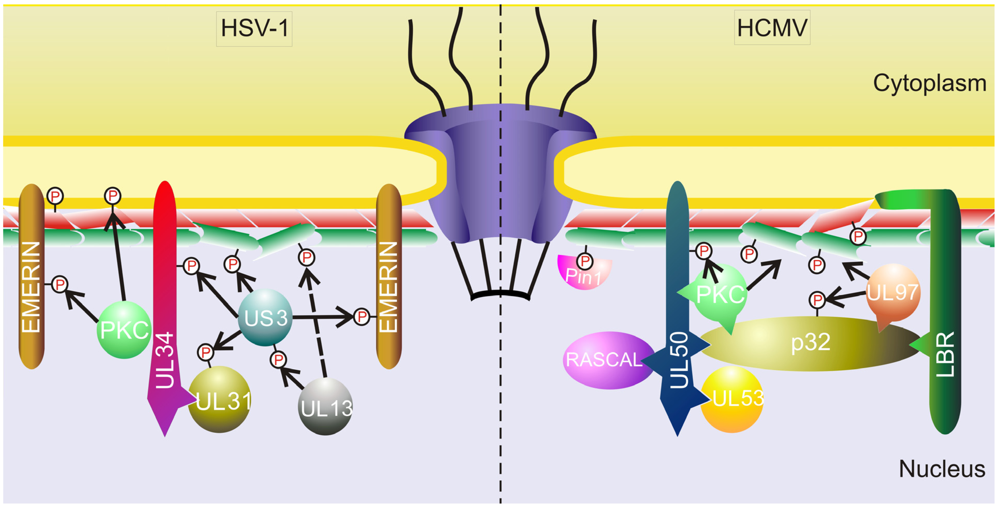
          <p>Disruption of nuclear lamina by HSV-1 is coupled with RC maturation [<xref ref-type="bibr" rid="B47-viruses-04-00325">47</xref>] and involves action of both viral and host proteins. These include viral proteins associated with the nuclear envelope together with viral as well as cellular kinases. All these proteins form the ‘nuclear egress complex’ (<xref ref-type="fig" rid="viruses-04-00325-f001">Figure 1</xref>, left) and work in concert to facilitate nuclear lamina breach and thus the egress of new virions from the nucleus.</p>
          <p>The viral transmembrane protein necessary for primary envelopment, pUL34 [<xref ref-type="bibr" rid="B94-viruses-04-00325">94</xref>], and the viral phosphoprotein found to be associated with the nuclear matrix, pUL31 [<xref ref-type="bibr" rid="B95-viruses-04-00325">95</xref>], form together a complex that associates with the inner nuclear membrane [<xref ref-type="bibr" rid="B96-viruses-04-00325">96</xref>,<xref ref-type="bibr" rid="B97-viruses-04-00325">97</xref>,<xref ref-type="bibr" rid="B98-viruses-04-00325">98</xref>]. This localization of pUL34 and pUL31 is observable only when expressed together (infection with viruses that had deleted either gene led to mislocalization of the remaining protein) [<xref ref-type="bibr" rid="B96-viruses-04-00325">96</xref>,<xref ref-type="bibr" rid="B97-viruses-04-00325">97</xref>]. Coexpression of UL34 and UL31 genes alone is sufficient for pUL34 and pUL31 localization to the nuclear envelope [<xref ref-type="bibr" rid="B96-viruses-04-00325">96</xref>]. However, for even distribution of the complex along the nuclear rim, viral kinase pUS3 is required. When pUS3 is absent, pUL34 and pUL31 are unevenly distributed throughout the nuclear rim and associate with the nuclear membrane invaginations containing clusters of primarily enveloped virions [<xref ref-type="bibr" rid="B96-viruses-04-00325">96</xref>,<xref ref-type="bibr" rid="B97-viruses-04-00325">97</xref>]. The correct localization of pUL34 also depends on the presence of the lamin A/C itself [<xref ref-type="bibr" rid="B99-viruses-04-00325">99</xref>].</p>
          <fig id="viruses-04-00325-f001" position="anchor">
            <label>Figure 1</label>
            <caption>
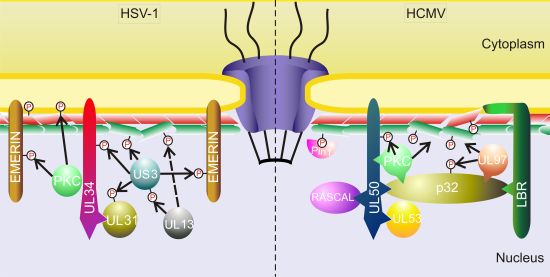
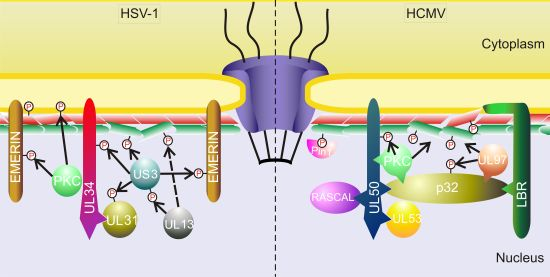
              <p>Nuclear egress complex of herpes simplex virus 1 (HSV-1) and human cytomegalovirus (HCMV). The lamin proteins are depicted as two layers beneath the nuclear membrane (lamin B in red, lamin A/C in green). The red “P” in circle marks phosphorylated proteins, actions of individual protein kinases are represented by black arrows. The dashed arrow suggests hypothetical phosphorylation of lamins by pUL13 kinase (proved for HSV-2). The lamin B receptor protein is abbreviated as “LBR”. Besides PKC, other cellular kinases may be involved in phosphorylation of nuclear lamina components. </p>
            </caption>
            <graphic xmlns:xlink="http://www.w3.org/1999/xlink" xlink:href="viruses-04-00325-g001.tif"/>
          </fig>
          <p>Besides the role in primary envelopment of virions [<xref ref-type="bibr" rid="B94-viruses-04-00325">94</xref>,<xref ref-type="bibr" rid="B96-viruses-04-00325">96</xref>,<xref ref-type="bibr" rid="B97-viruses-04-00325">97</xref>], the pUL34-pUL31 complex is responsible for nuclear lamina disruption. Viruses lacking UL34 or UL31 genes are not capable to induce changes in the immunoreactivity of lamin A/C and lamin-associated polypeptide 2, typical of cells infected with the wild-type virus [<xref ref-type="bibr" rid="B47-viruses-04-00325">47</xref>]. Additionally, the UL34 gene is also required for disruption of lamin B [<xref ref-type="bibr" rid="B100-viruses-04-00325">100</xref>]. The role of pUL31 and pUL34 in the nuclear lamina rearrangement is further supported by findings that both bind lamin A/C directly and that overexpression of either of them leads to partial lamin A/C relocalization [<xref ref-type="bibr" rid="B101-viruses-04-00325">101</xref>].</p>
          <p>Whether HSV-1 induces only conformational changes or even disruption of nuclear lamina was examined by different antibodies directed against lamin A/C. Staining with monoclonal antibody against the tail domain of lamin A/C exhibited significant reduction in the infected cells dependent on the pUL34 and pUL31 presence. Polyclonal antibody recognizing epitopes in the rod domain of lamin A/C showed decreased lamin staining even in the absence of pUL31 (but not pUL34). Surprisingly, labeling with the third polyclonal antibody did not exhibit any differences between infected and uninfected cells. Based on these experiments the authors suggested that the alterations in lamin staining during HSV-1 infection were caused by conformational changes in the nuclear lamina rather than its direct disintegration [<xref ref-type="bibr" rid="B101-viruses-04-00325">101</xref>]. However, observations in cells producing GFP-lamin A fusion protein showed that HSV-1 caused real perforation of nuclear lamina dependent on the presence of pUL34 and pUL31 [<xref ref-type="bibr" rid="B46-viruses-04-00325">46</xref>].</p>
          <p>Proteins pUL34 and pUL31 are indispensable not only for nuclear lamina disruption, but also for characteristic nuclei enlargement [<xref ref-type="bibr" rid="B46-viruses-04-00325">46</xref>]. </p>
          <p>In HSV-1-infected cells, viral serine/threonine kinase, pUS3, colocalizes with pUL34 and pUL31 on the nuclear envelope and also associates with perinuclear virions [<xref ref-type="bibr" rid="B97-viruses-04-00325">97</xref>]. pUS3 can phosphorylate pUL34 [<xref ref-type="bibr" rid="B102-viruses-04-00325">102</xref>] and pUL31 [<xref ref-type="bibr" rid="B103-viruses-04-00325">103</xref>] and its activity is needed for even distribution of the pUL34-pUL31 complex in the inner nuclear membrane [<xref ref-type="bibr" rid="B96-viruses-04-00325">96</xref>,<xref ref-type="bibr" rid="B97-viruses-04-00325">97</xref>]. If pUS3 is missing or catalytically inactive, primarily enveloped virions are concentrated in the invaginations of perinuclear space into the nucleoplasm. In these areas, pUL34 and pUL31 accumulation and large perforations of nuclear lamina can be detected [<xref ref-type="bibr" rid="B97-viruses-04-00325">97</xref>,<xref ref-type="bibr" rid="B100-viruses-04-00325">100</xref>,<xref ref-type="bibr" rid="B104-viruses-04-00325">104</xref>]. This effect is probably caused by prevention of pUS3-mediated phosphorylation of pUL31 [<xref ref-type="bibr" rid="B103-viruses-04-00325">103</xref>]. The damage to nuclear lamina is greater in the absence of pUS3, suggesting that some negative regulation between the action of pUS3 and pUL34-pUL31 complex exists. This would be in agreement with findings that coexpression of pUS3 (catalytically active) and pUL34 leads to less dramatic changes in the nuclear lamina than individual expression of either gene [<xref ref-type="bibr" rid="B100-viruses-04-00325">100</xref>]. Deletion of US3 gene decreases viral infectivity, although surprisingly not in all cell types [<xref ref-type="bibr" rid="B97-viruses-04-00325">97</xref>,<xref ref-type="bibr" rid="B102-viruses-04-00325">102</xref>].</p>
          <p>Apart from the indirect role in the nuclear lamina disruption via regulation of pUL34 and pUL31 activity, pUS3 was shown to directly phosphorylate lamin A/C on several sites <italic>in vitro</italic> and <italic>in vivo</italic> [<xref ref-type="bibr" rid="B104-viruses-04-00325">104</xref>]. Moreover, pUS3 alone can increase lamin A/C solubility and induce some defects in the nuclear lamina [<xref ref-type="bibr" rid="B100-viruses-04-00325">100</xref>,<xref ref-type="bibr" rid="B104-viruses-04-00325">104</xref>]. Interestingly, its kinase activity is not required to disrupt lamins in transfected cells [<xref ref-type="bibr" rid="B100-viruses-04-00325">100</xref>]. </p>
          <p>HSV-1 also causes structural changes of proteins of the inner nuclear membrane that are associated with nuclear lamina such as lamin B receptor [<xref ref-type="bibr" rid="B45-viruses-04-00325">45</xref>] and lamin-associated polypeptide 2 [<xref ref-type="bibr" rid="B47-viruses-04-00325">47</xref>]. Another inner nuclear membrane protein affected by HSV-1 infection is emerin. During infection, emerin is delocalized and exhibits increased mobility [<xref ref-type="bibr" rid="B105-viruses-04-00325">105</xref>,<xref ref-type="bibr" rid="B106-viruses-04-00325">106</xref>]. This is due to its phosphorylation by host protein kinases [<xref ref-type="bibr" rid="B105-viruses-04-00325">105</xref>,<xref ref-type="bibr" rid="B106-viruses-04-00325">106</xref>], including protein kinase C (PKC) δ [<xref ref-type="bibr" rid="B106-viruses-04-00325">106</xref>]. However, the involvement of PKCδ was later disputed [<xref ref-type="bibr" rid="B107-viruses-04-00325">107</xref>]. Virus pUS3 kinase participates in emerin phosphorylation too [<xref ref-type="bibr" rid="B105-viruses-04-00325">105</xref>,<xref ref-type="bibr" rid="B106-viruses-04-00325">106</xref>], although possibly indirectly by modulating cellular kinase(s) activities [<xref ref-type="bibr" rid="B105-viruses-04-00325">105</xref>]. Hyperphosphorylation of emerin is also partially dependent on the presence of pUL34, which is able to bind emerin and recruit cellular kinase(s) [<xref ref-type="bibr" rid="B106-viruses-04-00325">106</xref>].</p>
          <p>Another kinase participating in nuclear lamina disintegration is a product of the UL13 gene, highly conserved herpesviral serine/threonine kinase. pUL13 is capable to phosphorylate the pUS3 kinase and its deletion leads to a similar phenotype as deletion of US3, <italic>i.e.</italic>, changes in the localization of pUL34 and pUL31 in the inner nuclear membrane [<xref ref-type="bibr" rid="B108-viruses-04-00325">108</xref>]. Nevertheless, it is not clear whether pUL13 influences pUL34-pUL31 localization directly or via phosphorylation of pUS3 [<xref ref-type="bibr" rid="B108-viruses-04-00325">108</xref>]. It is also worth mentioning that pUL13 of HSV-2 directly phosphorylates nuclear lamins and causes their redistribution [<xref ref-type="bibr" rid="B109-viruses-04-00325">109</xref>].</p>
          <p>In the course of HSV-1 infection, PKC is concentrated in the vicinity of nuclear envelope [<xref ref-type="bibr" rid="B110-viruses-04-00325">110</xref>]. This relocalization occurs between 8 and 12 hours post infection and depends on the presence of the pUL34-pUL31 complex in the nuclear envelope [<xref ref-type="bibr" rid="B110-viruses-04-00325">110</xref>]. Viral kinase pUS3 is responsible for the even distribution of PKC along the nuclear rim because it influences the distribution of pUL34-pUL31 in the same way [<xref ref-type="bibr" rid="B110-viruses-04-00325">110</xref>]. Two isoforms of PKC–PKCα and PKCδ–are relocalized to the nuclear envelope coincidently with increased lamin B phosphorylation [<xref ref-type="bibr" rid="B110-viruses-04-00325">110</xref>]. Lamin B could be phosphorylated directly by PKC and/or other cellular or viral kinases [<xref ref-type="bibr" rid="B107-viruses-04-00325">107</xref>,<xref ref-type="bibr" rid="B110-viruses-04-00325">110</xref>]. The PKC activity is essential for HSV-1 infection since inhibition of all PKC isoforms causes substantial reduction of viral replication, accumulation of virus particles in the nuclei, and overall decrease in the amount of viral capsids in the infected cells. On the other hand, specific inhibition of conventional PKCs (including PKCα) or PKCδ does not inhibit viral replication [<xref ref-type="bibr" rid="B107-viruses-04-00325">107</xref>]. This indicates either functional redundancy of these isoforms or involvement of other PKC forms in the viral life cycle.</p>
        </sec>
        <sec>
          <title>3.1.2. Other Herpesviruses</title>
          <p>Individual members of the <italic>Herpesviridae</italic> family share substantial resemblance concerning the mechanisms of nuclear lamina disruption. Proteins homological to pUL34 and pUL31 were described for HSV-2 [<xref ref-type="bibr" rid="B111-viruses-04-00325">111</xref>,<xref ref-type="bibr" rid="B112-viruses-04-00325">112</xref>], PRV [<xref ref-type="bibr" rid="B113-viruses-04-00325">113</xref>,<xref ref-type="bibr" rid="B114-viruses-04-00325">114</xref>], HCMV [<xref ref-type="bibr" rid="B115-viruses-04-00325">115</xref>], MCMV [<xref ref-type="bibr" rid="B116-viruses-04-00325">116</xref>], and EBV [<xref ref-type="bibr" rid="B117-viruses-04-00325">117</xref>,<xref ref-type="bibr" rid="B118-viruses-04-00325">118</xref>,<xref ref-type="bibr" rid="B119-viruses-04-00325">119</xref>]. These proteins are, like in HSV-1, responsible for primary envelopment and release of virions from the nucleus. The direct role in the changes of nuclear lamina, including PKC relocalization, was proved for pUL50 and pUL53 of HCMV [<xref ref-type="bibr" rid="B115-viruses-04-00325">115</xref>,<xref ref-type="bibr" rid="B120-viruses-04-00325">120</xref>,<xref ref-type="bibr" rid="B121-viruses-04-00325">121</xref>], although, unlike HSV-1 pUL34, pUL50 alone is able to recruit PKC [<xref ref-type="bibr" rid="B121-viruses-04-00325">121</xref>] and even can be phosphorylated itself by this kinase [<xref ref-type="bibr" rid="B120-viruses-04-00325">120</xref>]. During MCMV infection, proteins M50/p35 and M53/p38 recruit PKC to the nuclear rim for lamin phosphorylation and lamina dissolution [<xref ref-type="bibr" rid="B116-viruses-04-00325">116</xref>]. BFLF2 and BFRF1 proteins of EBV were shown to interact with lamin B [<xref ref-type="bibr" rid="B119-viruses-04-00325">119</xref>].</p>
          <p>Homologs of HSV-1 pUL13 kinase (‘conserved herpesviral kinases’), pUL13 of HSV-2, pUL97 of HCMV, and BGLF4 of EBV, participate in direct phosphorylation of lamins and disruption of the nuclear lamina [<xref ref-type="bibr" rid="B109-viruses-04-00325">109</xref>,<xref ref-type="bibr" rid="B121-viruses-04-00325">121</xref>,<xref ref-type="bibr" rid="B122-viruses-04-00325">122</xref>,<xref ref-type="bibr" rid="B123-viruses-04-00325">123</xref>,<xref ref-type="bibr" rid="B124-viruses-04-00325">124</xref>,<xref ref-type="bibr" rid="B125-viruses-04-00325">125</xref>,<xref ref-type="bibr" rid="B126-viruses-04-00325">126</xref>]. Remarkably, pUL97 and BGLF4 apparently imitate the activity of cellular cyclin-dependent kinase 1, which is responsible for the nuclear lamina breakdown during mitosis [<xref ref-type="bibr" rid="B123-viruses-04-00325">123</xref>,<xref ref-type="bibr" rid="B126-viruses-04-00325">126</xref>]. Furthermore, the pUL97-mediated phosphorylation of lamin A/C at Ser22 creates a binding motif for the cellular peptidyl-prolyl cis/trans-isomerase Pin1 [<xref ref-type="bibr" rid="B125-viruses-04-00325">125</xref>]. During HCMV infection, Pin1 is concentrated by the nuclear lamina in a manner dependent on the protein kinase activity [<xref ref-type="bibr" rid="B125-viruses-04-00325">125</xref>]. Pin1 could contribute to nuclear lamina reorganization by inducing conformational changes of lamins [<xref ref-type="bibr" rid="B125-viruses-04-00325">125</xref>].</p>
          <p>Another cellular protein involved in the HCMV-induced nuclear lamina disruption is p32 protein. This protein recruits pUL97 kinase to the lamin B receptor and is itself phosphorylated by pUL97 [<xref ref-type="bibr" rid="B122-viruses-04-00325">122</xref>]. Moreover, p32 also directly interacts with pUL50 and PKC [<xref ref-type="bibr" rid="B120-viruses-04-00325">120</xref>,<xref ref-type="bibr" rid="B121-viruses-04-00325">121</xref>]. In addition, the recently characterized protein of HCMV, RASCAL (nuclear <underline>r</underline>im-<underline>as</underline>sociated <underline>c</underline>ytomegalovir<underline>al</underline> protein), was also identified to be involved in the nuclear egress complex, likely via its interaction with pUL50 [<xref ref-type="bibr" rid="B127-viruses-04-00325">127</xref>]. The nuclear egress complex of HCMV is depicted in <xref ref-type="fig" rid="viruses-04-00325-f001">figure 1</xref>, right.</p>
          <p>Alphaherpesviruses have homologs of HSV-1 pUS3 kinase as well, and they share some functional similarities – for example, pUS3 of PRV influences pUL34 localization in the same way as its HSV-1 counterpart [<xref ref-type="bibr" rid="B128-viruses-04-00325">128</xref>] and pUS3 of HSV-2 changes the pattern of emerin hyperphosphorylation [<xref ref-type="bibr" rid="B105-viruses-04-00325">105</xref>]. Interestingly, HSV-2 pUS3 exhibits marked differences from HSV-1 pUS3 in its catalytic functions, e.g., it does not control the localization of the nuclear egress complex [<xref ref-type="bibr" rid="B129-viruses-04-00325">129</xref>].</p>
          <p>Even though the ways of interactions of viral proteins with nuclear lamins slightly vary between individual herpesviruses, they all result in nuclear lamina disruption, thus confirming the role of nuclear lamina as a major obstacle to herpesviral replication.</p>
        </sec>
      </sec>
      <sec>
        <title>3.2. Other Viruses</title>
        <p>Although herpesviruses are by far the most extensively studied virus family regarding their interactions with nuclear lamins, studies describing the interplay between lamins and other viruses are slowly emerging. It seems that, similarly to herpesviruses, the nuclear lamina represents a barrier for all these viruses, and hence they evolved mechanisms to overcome it. However, we have to be more careful about making any definite conclusions since there is only one or a few reports concerning lamins for each below-mentioned virus family.</p>
        <sec>
          <title>3.2.1. Retroviruses</title>
          <p>HIV-1 requires nuclear actin for nuclear export of its unspliced mRNAs, but there are also evidences for HIV-1 interactions with nuclear lamina. Viral protein Vpr induces perforations in the nuclear envelope corresponding to the sites with defects in nuclear lamina [<xref ref-type="bibr" rid="B130-viruses-04-00325">130</xref>]. These perforations lead to mixing of cytoplasmic and nucleoplasmic content, including cell cycle regulators. The authors hence deduce that these defects consequently result in the cell cycle arrest in G2 phase, which is a known effect of the Vpr protein [<xref ref-type="bibr" rid="B130-viruses-04-00325">130</xref>]. Apart from that, this action of Vpr could facilitate the nuclear entry of HIV preintegration complex [<xref ref-type="bibr" rid="B130-viruses-04-00325">130</xref>,<xref ref-type="bibr" rid="B131-viruses-04-00325">131</xref>].</p>
        </sec>
        <sec>
          <title>3.2.2. Polyomaviruses</title>
          <p>Polyomaviruses are small non-enveloped tumorigenic viruses with circular double-stranded DNA genome. The best studied representatives of the <italic>Polyomaviridae</italic> family are simian virus 40 (SV40), mouse polyomavirus (MPyV), and human pathogens JC virus and BK virus. In the last several years, seven additional human polyomaviruses have been discovered, including Merkel cell polyomavirus associated with rare but aggressive cancer of Merkel cells.</p>
          <p>Upon cell entry, polyomaviruses are transported through the endosomal pathway to the ER [<xref ref-type="bibr" rid="B132-viruses-04-00325">132</xref>,<xref ref-type="bibr" rid="B133-viruses-04-00325">133</xref>,<xref ref-type="bibr" rid="B134-viruses-04-00325">134</xref>,<xref ref-type="bibr" rid="B135-viruses-04-00325">135</xref>,<xref ref-type="bibr" rid="B136-viruses-04-00325">136</xref>]. Infection of MPyV is dependent on acidic pH of the endosomes [<xref ref-type="bibr" rid="B137-viruses-04-00325">137</xref>]. Qian <italic>et al</italic>. proposed that MPyV is transported first to the endolysosome, and there the polyomavirus ganglioside receptor stimulates sorting of MPyV to the ER [<xref ref-type="bibr" rid="B138-viruses-04-00325">138</xref>]. The precise mechanism controlling the transport of MPyV from the plasma membrane to the ER remains to be clarified. Even less clear is the mechanism by which polyomaviruses deliver their genomes into the cell nucleus. Based on electron microscopy analyses, early papers suggested that SV40 [<xref ref-type="bibr" rid="B139-viruses-04-00325">139</xref>] and MPyV [<xref ref-type="bibr" rid="B140-viruses-04-00325">140</xref>] enter the cell nucleus bypassing nuclear pores by fusion of vesicles carrying virions directly with the nuclear envelope. At present, two models of polyomavirus trafficking from ER into the nucleus are discussed. The first model presumes that partially disassembled virions are translocated (by an as yet unknown mechanism) from ER to the cytosol and enter the nucleus via nuclear pores. Although it has never been proved, several findings support this hypothesis [<xref ref-type="bibr" rid="B141-viruses-04-00325">141</xref>,<xref ref-type="bibr" rid="B142-viruses-04-00325">142</xref>,<xref ref-type="bibr" rid="B143-viruses-04-00325">143</xref>,<xref ref-type="bibr" rid="B144-viruses-04-00325">144</xref>,<xref ref-type="bibr" rid="B145-viruses-04-00325">145</xref>]. </p>
          <p>Alternatively, a recent report on SV40 suggests a model, in which the genomes are delivered from the ER directly to the nucleus. During cell entry, SV40 induces transient changes in the structure of the nuclear envelope accompanied by fluctuations in the lamin A/C protein level, accumulation of lamin A/C in the cytoplasm, and dephosphorylation of a specific lamin A/C epitope [<xref ref-type="bibr" rid="B146-viruses-04-00325">146</xref>]. These changes culminate 6-8 hours post infection, just prior to and during nuclear entry of the viral genome, and seem to be caspase-6 dependent. Interestingly, these alterations in nuclear envelope structure occur exclusively during infection of non-proliferating cells, and the pentamers of the major capsid protein, VP1, are sufficient to induce them [<xref ref-type="bibr" rid="B146-viruses-04-00325">146</xref>]. Interaction of VP1 protein with nuclear lamina was also observed during the expression of MPyV VP1 in mouse fibroblast cells (our unpublished results). Along with the lamina, the nuclear membrane represents a natural barrier for polyomavirus infection. <italic>In vitro</italic> studies on the minor structural proteins, VP2 and VP3, of SV40 [<xref ref-type="bibr" rid="B147-viruses-04-00325">147</xref>] and of MPyV [<xref ref-type="bibr" rid="B148-viruses-04-00325">148</xref>,<xref ref-type="bibr" rid="B149-viruses-04-00325">149</xref>] showed that they are able to bind, insert into, perforate and even fuse cell membranes. Thus, in all the above-discussed models, the minor structural proteins might be key actors helping virions pass through ER and/or inner nuclear membrane.</p>
        </sec>
        <sec>
          <title>3.2.3. Parvoviruses</title>
          <p>The Minute virus of mice (MVM) is a small non-enveloped ssDNA virus that belongs to the <italic>Parvoviridae</italic> family and replicates in the cell nucleus. In the early phase of infection, prior to the nuclear entry, MVM induces transient breaks in the nuclear envelope accompanied by changes in the lamin A/C immunostaining [<xref ref-type="bibr" rid="B150-viruses-04-00325">150</xref>]. Moreover, the gaps in lamin staining are coincident with the antibody-labeled virus [<xref ref-type="bibr" rid="B150-viruses-04-00325">150</xref>]. Further examination revealed that host caspases are involved in MVM-induced nuclear envelope breakdown. In particular, basally active caspase 3 is relocalized to the nucleus, where it cleaves nuclear lamins (most likely lamin B2) [<xref ref-type="bibr" rid="B151-viruses-04-00325">151</xref>]. These findings suggest that parvoviruses, despite their small size (ca 26 nm in diameter), do not import their genome into the nucleus via the nuclear pore, and instead they cause partial breaks in the nuclear envelope to facilitate nuclear entry. Consistently with this unusual model, capsids of adeno-associated virus 2 (AAV2) were shown to enter purified nuclei independently of nuclear pore complexes [<xref ref-type="bibr" rid="B152-viruses-04-00325">152</xref>].</p>
        </sec>
      </sec>
    </sec>
    <sec sec-type="conclusions">
      <title>4. Conclusions</title>
      <p>In this review, we wanted to present the current knowledge on the significance of nuclear actin and lamins for various viruses. Despite the increasing number of reports dealing with this topic, many issues remain unresolved. First of all, we still know very little about the form of nuclear actin even in normal, uninfected cells, and that makes our understanding of its employment by viruses more difficult. Secondly, the most findings presented in this review refer to only two virus families–herpesviruses and baculoviruses. Data on other discussed viruses is based on a few studies only. It would be very surprising if these viruses were the only ones interacting with host nuclear actin or lamins. In fact, it is reasonable to expect that other viruses replicating in the nucleus will soon extend this list. To conclude, the participation of both lamins and nuclear actin in the viral life cycle represents a relatively unexplored but very promising area of research that can tell us much about the ability of viruses to deal with the host cell environment. </p>
    </sec>
    <sec>
      <title>Acknowledgments</title>
      <p>The work was generously supported by the grant SVV-2012-265202 (J.C.), by the grant of Ministry of Education, Youth and Sports of the Czech Republic, n. MSM0021620858 (J.F.), and by the Grant Agency of the Czech Republic, n. P304/10/1511 (M.F.). We are grateful to Sarka Takacova for her assistance in the preparation of this manuscript.</p>
    </sec>
    <sec>
      <title>Conflict of Interest</title>
      <p>The authors declare no conflict of interest. </p>
    </sec>
  </body>
  <back>
    <ref-list>
      <title>References</title>
      <ref id="B1-viruses-04-00325">
        <label>1.</label>
        <citation citation-type="journal">
          <person-group person-group-type="author">
            <name>
              <surname>Radtke</surname>
              <given-names>K.</given-names>
            </name>
            <name>
              <surname>Dohner</surname>
              <given-names>K.</given-names>
            </name>
            <name>
              <surname>Sodeik</surname>
              <given-names>B.</given-names>
            </name>
          </person-group>
          <article-title>Viral interactions with the cytoskeleton: A hitchhiker’s guide to the cell</article-title>
          <source>Cell. Microbiol.</source>
          <year>2006</year>
          <volume>8</volume>
          <fpage>387</fpage>
          <lpage>400</lpage>
        <pub-id pub-id-type="doi">10.1111/j.1462-5822.2005.00679.x</pub-id><pub-id pub-id-type="pmid">16469052</pub-id></citation>
      </ref>
      <ref id="B2-viruses-04-00325">
        <label>2.</label>
        <citation citation-type="journal">
          <person-group person-group-type="author">
            <name>
              <surname>Clark</surname>
              <given-names>T.G.</given-names>
            </name>
            <name>
              <surname>Rosenbaum</surname>
              <given-names>J.L.</given-names>
            </name>
          </person-group>
          <article-title>An actin filament matrix in hand-isolated nuclei of x. Laevis oocytes</article-title>
          <source>Cell</source>
          <year>1979</year>
          <volume>18</volume>
          <fpage>1101</fpage>
          <lpage>1108</lpage>
          <pub-id pub-id-type="doi">10.1016/0092-8674(79)90223-X</pub-id>
        </citation>
      </ref>
      <ref id="B3-viruses-04-00325">
        <label>3.</label>
        <citation citation-type="journal">
          <person-group person-group-type="author">
            <name>
              <surname>Scheer</surname>
              <given-names>U.</given-names>
            </name>
            <name>
              <surname>Hinssen</surname>
              <given-names>H.</given-names>
            </name>
            <name>
              <surname>Franke</surname>
              <given-names>W.W.</given-names>
            </name>
            <name>
              <surname>Jockusch</surname>
              <given-names>B.M.</given-names>
            </name>
          </person-group>
          <article-title>Microinjection of actin-binding proteins and actin antibodies demonstrates involvement of nuclear actin in transcription of lampbrush chromosomes</article-title>
          <source>Cell</source>
          <year>1984</year>
          <volume>39</volume>
          <fpage>111</fpage>
          <lpage>122</lpage>
        <pub-id pub-id-type="doi">10.1016/0092-8674(84)90196-X</pub-id><pub-id pub-id-type="pmid">6386181</pub-id></citation>
      </ref>
      <ref id="B4-viruses-04-00325">
        <label>4.</label>
        <citation citation-type="journal">
          <person-group person-group-type="author">
            <name>
              <surname>Miralles</surname>
              <given-names>F.</given-names>
            </name>
            <name>
              <surname>Visa</surname>
              <given-names>N.</given-names>
            </name>
          </person-group>
          <article-title>Actin in transcription and transcription regulation</article-title>
          <source>Curr. Opin. Cell Biol.</source>
          <year>2006</year>
          <volume>18</volume>
          <fpage>261</fpage>
          <lpage>266</lpage>
        <pub-id pub-id-type="doi">10.1016/j.ceb.2006.04.009</pub-id><pub-id pub-id-type="pmid">16687246</pub-id></citation>
      </ref>
      <ref id="B5-viruses-04-00325">
        <label>5.</label>
        <citation citation-type="journal">
          <person-group person-group-type="author">
            <name>
              <surname>Zheng</surname>
              <given-names>B.</given-names>
            </name>
            <name>
              <surname>Han</surname>
              <given-names>M.</given-names>
            </name>
            <name>
              <surname>Bernier</surname>
              <given-names>M.</given-names>
            </name>
            <name>
              <surname>Wen</surname>
              <given-names>J.K.</given-names>
            </name>
          </person-group>
          <article-title>Nuclear actin and actin-binding proteins in the regulation of transcription and gene expression</article-title>
          <source>FEBS J.</source>
          <year>2009</year>
          <volume>276</volume>
          <fpage>2669</fpage>
          <lpage>2685</lpage>
        <pub-id pub-id-type="doi">10.1111/j.1742-4658.2009.06986.x</pub-id><pub-id pub-id-type="pmid">19459931</pub-id></citation>
      </ref>
      <ref id="B6-viruses-04-00325">
        <label>6.</label>
        <citation citation-type="journal">
          <person-group person-group-type="author">
            <name>
              <surname>Olave</surname>
              <given-names>I.A.</given-names>
            </name>
            <name>
              <surname>Reck-Peterson</surname>
              <given-names>S.L.</given-names>
            </name>
            <name>
              <surname>Crabtree</surname>
              <given-names>G.R.</given-names>
            </name>
          </person-group>
          <article-title>Nuclear actin and actin-related proteins in chromatin remodeling</article-title>
          <source>Annu. Rev. Biochem.</source>
          <year>2002</year>
          <volume>71</volume>
          <fpage>755</fpage>
          <lpage>781</lpage>
        <pub-id pub-id-type="doi">10.1146/annurev.biochem.71.110601.135507</pub-id><pub-id pub-id-type="pmid">12045110</pub-id></citation>
      </ref>
      <ref id="B7-viruses-04-00325">
        <label>7.</label>
        <citation citation-type="journal">
          <person-group person-group-type="author">
            <name>
              <surname>Hofmann</surname>
              <given-names>W.A.</given-names>
            </name>
            <name>
              <surname>Stojiljkovic</surname>
              <given-names>L.</given-names>
            </name>
            <name>
              <surname>Fuchsova</surname>
              <given-names>B.</given-names>
            </name>
            <name>
              <surname>Vargas</surname>
              <given-names>G.M.</given-names>
            </name>
            <name>
              <surname>Mavrommatis</surname>
              <given-names>E.</given-names>
            </name>
            <name>
              <surname>Philimonenko</surname>
              <given-names>V.</given-names>
            </name>
            <name>
              <surname>Kysela</surname>
              <given-names>K.</given-names>
            </name>
            <name>
              <surname>Goodrich</surname>
              <given-names>J.A.</given-names>
            </name>
            <name>
              <surname>Lessard</surname>
              <given-names>J.L.</given-names>
            </name>
            <name>
              <surname>Hope</surname>
              <given-names>T.J.</given-names>
            </name>
            <etal/>
          </person-group>
          <article-title>Actin is part of pre-initiation complexes and is necessary for transcription by rna polymerase ii</article-title>
          <source>Nat. Cell Biol.</source>
          <year>2004</year>
          <volume>6</volume>
          <fpage>1094</fpage>
          <lpage>1101</lpage>
          <pub-id pub-id-type="doi">10.1038/ncb1182</pub-id>
        </citation>
      </ref>
      <ref id="B8-viruses-04-00325">
        <label>8.</label>
        <citation citation-type="journal">
          <person-group person-group-type="author">
            <name>
              <surname>Hu</surname>
              <given-names>P.</given-names>
            </name>
            <name>
              <surname>Wu</surname>
              <given-names>S.</given-names>
            </name>
            <name>
              <surname>Hernandez</surname>
              <given-names>N.</given-names>
            </name>
          </person-group>
          <article-title>A role for beta-actin in rna polymerase iii transcription</article-title>
          <source>Genes Dev.</source>
          <year>2004</year>
          <volume>18</volume>
          <fpage>3010</fpage>
          <lpage>3015</lpage>
        <pub-id pub-id-type="doi">10.1101/gad.1250804</pub-id><pub-id pub-id-type="pmid">15574586</pub-id></citation>
      </ref>
      <ref id="B9-viruses-04-00325">
        <label>9.</label>
        <citation citation-type="journal">
          <person-group person-group-type="author">
            <name>
              <surname>Philimonenko</surname>
              <given-names>V.V.</given-names>
            </name>
            <name>
              <surname>Zhao</surname>
              <given-names>J.</given-names>
            </name>
            <name>
              <surname>Iben</surname>
              <given-names>S.</given-names>
            </name>
            <name>
              <surname>Dingová</surname>
              <given-names>H.</given-names>
            </name>
            <name>
              <surname>Kyselá</surname>
              <given-names>K.</given-names>
            </name>
            <name>
              <surname>Kahle</surname>
              <given-names>M.</given-names>
            </name>
            <name>
              <surname>Zentgraf</surname>
              <given-names>H.</given-names>
            </name>
            <name>
              <surname>Hofmann</surname>
              <given-names>W.A.</given-names>
            </name>
            <name>
              <surname>de Lanerolle</surname>
              <given-names>P.</given-names>
            </name>
            <name>
              <surname>Hozák</surname>
              <given-names>P.</given-names>
            </name>
            <etal/>
          </person-group>
          <article-title>Nuclear actin and myosin i are required for rna polymerase i transcription</article-title>
          <source>Nat. Cell Biol.</source>
          <year>2004</year>
          <volume>6</volume>
          <fpage>1165</fpage>
          <lpage>1172</lpage>
          <pub-id pub-id-type="doi">10.1038/ncb1190</pub-id>
        </citation>
      </ref>
      <ref id="B10-viruses-04-00325">
        <label>10.</label>
        <citation citation-type="journal">
          <person-group person-group-type="author">
            <name>
              <surname>Percipalle</surname>
              <given-names>P.</given-names>
            </name>
            <name>
              <surname>Zhao</surname>
              <given-names>J.</given-names>
            </name>
            <name>
              <surname>Pope</surname>
              <given-names>B.</given-names>
            </name>
            <name>
              <surname>Weeds</surname>
              <given-names>A.</given-names>
            </name>
            <name>
              <surname>Lindberg</surname>
              <given-names>U.</given-names>
            </name>
            <name>
              <surname>Daneholt</surname>
              <given-names>B.</given-names>
            </name>
          </person-group>
          <article-title>Actin bound to the heterogeneous nuclear ribonucleoprotein hrp36 is associated with balbiani ring mrna from the gene to polysomes</article-title>
          <source>J. Cell Biol.</source>
          <year>2001</year>
          <volume>153</volume>
          <fpage>229</fpage>
          <lpage>236</lpage>
        <pub-id pub-id-type="doi">10.1083/jcb.153.1.229</pub-id><pub-id pub-id-type="pmid">11285288</pub-id></citation>
      </ref>
      <ref id="B11-viruses-04-00325">
        <label>11.</label>
        <citation citation-type="journal">
          <person-group person-group-type="author">
            <name>
              <surname>Percipalle</surname>
              <given-names>P.</given-names>
            </name>
            <name>
              <surname>Jonsson</surname>
              <given-names>A.</given-names>
            </name>
            <name>
              <surname>Nashchekin</surname>
              <given-names>D.</given-names>
            </name>
            <name>
              <surname>Karlsson</surname>
              <given-names>C.</given-names>
            </name>
            <name>
              <surname>Bergman</surname>
              <given-names>T.</given-names>
            </name>
            <name>
              <surname>Guialis</surname>
              <given-names>A.</given-names>
            </name>
            <name>
              <surname>Daneholt</surname>
              <given-names>B.</given-names>
            </name>
          </person-group>
          <article-title>Nuclear actin is associated with a specific subset of hnrnp a/b-type proteins</article-title>
          <source>Nucleic Acids Res.</source>
          <year>2002</year>
          <volume>30</volume>
          <fpage>1725</fpage>
          <lpage>1734</lpage>
        <pub-id pub-id-type="doi">10.1093/nar/30.8.1725</pub-id><pub-id pub-id-type="pmid">11937625</pub-id></citation>
      </ref>
      <ref id="B12-viruses-04-00325">
        <label>12.</label>
        <citation citation-type="journal">
          <person-group person-group-type="author">
            <name>
              <surname>Kukalev</surname>
              <given-names>A.</given-names>
            </name>
            <name>
              <surname>Nord</surname>
              <given-names>Y.</given-names>
            </name>
            <name>
              <surname>Palmberg</surname>
              <given-names>C.</given-names>
            </name>
            <name>
              <surname>Bergman</surname>
              <given-names>T.</given-names>
            </name>
            <name>
              <surname>Percipalle</surname>
              <given-names>P.</given-names>
            </name>
          </person-group>
          <article-title>Actin and hnrnp u cooperate for productive transcription by rna polymerase ii</article-title>
          <source>Nat. Struct. Mol. Biol.</source>
          <year>2005</year>
          <volume>12</volume>
          <fpage>238</fpage>
          <lpage>244</lpage>
        <pub-id pub-id-type="doi">10.1038/nsmb904</pub-id><pub-id pub-id-type="pmid">15711563</pub-id></citation>
      </ref>
      <ref id="B13-viruses-04-00325">
        <label>13.</label>
        <citation citation-type="journal">
          <person-group person-group-type="author">
            <name>
              <surname>Sjölinder</surname>
              <given-names>M.</given-names>
            </name>
            <name>
              <surname>Björk</surname>
              <given-names>P.</given-names>
            </name>
            <name>
              <surname>Söderberg</surname>
              <given-names>E.</given-names>
            </name>
            <name>
              <surname>Sabri</surname>
              <given-names>N.</given-names>
            </name>
            <name>
              <surname>Farrants</surname>
              <given-names>A.K.</given-names>
            </name>
            <name>
              <surname>Visa</surname>
              <given-names>N.</given-names>
            </name>
          </person-group>
          <article-title>The growing pre-mrna recruits actin and chromatin-modifying factors to transcriptionally active genes</article-title>
          <source>Genes Dev.</source>
          <year>2005</year>
          <volume>19</volume>
          <fpage>1871</fpage>
          <lpage>1884</lpage>
        <pub-id pub-id-type="doi">10.1101/gad.339405</pub-id><pub-id pub-id-type="pmid">16103215</pub-id></citation>
      </ref>
      <ref id="B14-viruses-04-00325">
        <label>14.</label>
        <citation citation-type="journal">
          <person-group person-group-type="author">
            <name>
              <surname>Zhao</surname>
              <given-names>K.</given-names>
            </name>
            <name>
              <surname>Wang</surname>
              <given-names>W.</given-names>
            </name>
            <name>
              <surname>Rando</surname>
              <given-names>O.J.</given-names>
            </name>
            <name>
              <surname>Xue</surname>
              <given-names>Y.</given-names>
            </name>
            <name>
              <surname>Swiderek</surname>
              <given-names>K.</given-names>
            </name>
            <name>
              <surname>Kuo</surname>
              <given-names>A.</given-names>
            </name>
            <name>
              <surname>Crabtree</surname>
              <given-names>G.R.</given-names>
            </name>
          </person-group>
          <article-title>Rapid and phosphoinositol-dependent binding of the swi/snf-like baf complex to chromatin after t lymphocyte receptor signaling</article-title>
          <source>Cell</source>
          <year>1998</year>
          <volume>95</volume>
          <fpage>625</fpage>
          <lpage>636</lpage>
        <pub-id pub-id-type="doi">10.1016/S0092-8674(00)81633-5</pub-id><pub-id pub-id-type="pmid">9845365</pub-id></citation>
      </ref>
      <ref id="B15-viruses-04-00325">
        <label>15.</label>
        <citation citation-type="journal">
          <person-group person-group-type="author">
            <name>
              <surname>Nowak</surname>
              <given-names>G.</given-names>
            </name>
            <name>
              <surname>Pestic-Dragovich</surname>
              <given-names>L.</given-names>
            </name>
            <name>
              <surname>Hozák</surname>
              <given-names>P.</given-names>
            </name>
            <name>
              <surname>Philimonenko</surname>
              <given-names>A.</given-names>
            </name>
            <name>
              <surname>Simerly</surname>
              <given-names>C.</given-names>
            </name>
            <name>
              <surname>Schatten</surname>
              <given-names>G.</given-names>
            </name>
            <name>
              <surname>de Lanerolle</surname>
              <given-names>P.</given-names>
            </name>
          </person-group>
          <article-title>Evidence for the presence of myosin i in the nucleus</article-title>
          <source>J. Biol. Chem.</source>
          <year>1997</year>
          <volume>272</volume>
          <fpage>17176</fpage>
          <lpage>17181</lpage>
        <pub-id pub-id-type="doi">10.1074/jbc.272.27.17176</pub-id><pub-id pub-id-type="pmid">9202039</pub-id></citation>
      </ref>
      <ref id="B16-viruses-04-00325">
        <label>16.</label>
        <citation citation-type="journal">
          <person-group person-group-type="author">
            <name>
              <surname>Pestic-Dragovich</surname>
              <given-names>L.</given-names>
            </name>
            <name>
              <surname>Stojiljkovic</surname>
              <given-names>L.</given-names>
            </name>
            <name>
              <surname>Philimonenko</surname>
              <given-names>A.A.</given-names>
            </name>
            <name>
              <surname>Nowak</surname>
              <given-names>G.</given-names>
            </name>
            <name>
              <surname>Ke</surname>
              <given-names>Y.</given-names>
            </name>
            <name>
              <surname>Settlage</surname>
              <given-names>R.E.</given-names>
            </name>
            <name>
              <surname>Shabanowitz</surname>
              <given-names>J.</given-names>
            </name>
            <name>
              <surname>Hunt</surname>
              <given-names>D.F.</given-names>
            </name>
            <name>
              <surname>Hozak</surname>
              <given-names>P.</given-names>
            </name>
            <name>
              <surname>de Lanerolle</surname>
              <given-names>P.</given-names>
            </name>
          </person-group>
          <article-title>A myosin i isoform in the nucleus</article-title>
          <source>Science</source>
          <year>2000</year>
          <volume>290</volume>
          <fpage>337</fpage>
          <lpage>341</lpage>
        <pub-id pub-id-type="doi">10.1126/science.290.5490.337</pub-id><pub-id pub-id-type="pmid">11030652</pub-id></citation>
      </ref>
      <ref id="B17-viruses-04-00325">
        <label>17.</label>
        <citation citation-type="journal">
          <person-group person-group-type="author">
            <name>
              <surname>Hofmann</surname>
              <given-names>W.A.</given-names>
            </name>
            <name>
              <surname>Vargas</surname>
              <given-names>G.M.</given-names>
            </name>
            <name>
              <surname>Ramchandran</surname>
              <given-names>R.</given-names>
            </name>
            <name>
              <surname>Stojiljkovic</surname>
              <given-names>L.</given-names>
            </name>
            <name>
              <surname>Goodrich</surname>
              <given-names>J.A.</given-names>
            </name>
            <name>
              <surname>de Lanerolle</surname>
              <given-names>P.</given-names>
            </name>
          </person-group>
          <article-title>Nuclear myosin i is necessary for the formation of the first phosphodiester bond during transcription initiation by rna polymerase ii</article-title>
          <source>J. Cell Biochem.</source>
          <year>2006</year>
          <volume>99</volume>
          <fpage>1001</fpage>
          <lpage>1009</lpage>
        <pub-id pub-id-type="doi">10.1002/jcb.21035</pub-id><pub-id pub-id-type="pmid">16960872</pub-id></citation>
      </ref>
      <ref id="B18-viruses-04-00325">
        <label>18.</label>
        <citation citation-type="journal">
          <person-group person-group-type="author">
            <name>
              <surname>Percipalle</surname>
              <given-names>P.</given-names>
            </name>
            <name>
              <surname>Fomproix</surname>
              <given-names>N.</given-names>
            </name>
            <name>
              <surname>Cavellán</surname>
              <given-names>E.</given-names>
            </name>
            <name>
              <surname>Voit</surname>
              <given-names>R.</given-names>
            </name>
            <name>
              <surname>Reimer</surname>
              <given-names>G.</given-names>
            </name>
            <name>
              <surname>Krüger</surname>
              <given-names>T.</given-names>
            </name>
            <name>
              <surname>Thyberg</surname>
              <given-names>J.</given-names>
            </name>
            <name>
              <surname>Scheer</surname>
              <given-names>U.</given-names>
            </name>
            <name>
              <surname>Grummt</surname>
              <given-names>I.</given-names>
            </name>
            <name>
              <surname>Farrants</surname>
              <given-names>A.K.</given-names>
            </name>
          </person-group>
          <article-title>The chromatin remodelling complex wstf-snf2h interacts with nuclear myosin 1 and has a role in rna polymerase i transcription</article-title>
          <source>EMBO Rep.</source>
          <year>2006</year>
          <volume>7</volume>
          <fpage>525</fpage>
          <lpage>530</lpage>
        <pub-id pub-id-type="pmid">16514417</pub-id></citation>
      </ref>
      <ref id="B19-viruses-04-00325">
        <label>19.</label>
        <citation citation-type="journal">
          <person-group person-group-type="author">
            <name>
              <surname>Philimonenko</surname>
              <given-names>V.V.</given-names>
            </name>
            <name>
              <surname>Janacek</surname>
              <given-names>J.</given-names>
            </name>
            <name>
              <surname>Harata</surname>
              <given-names>M.</given-names>
            </name>
            <name>
              <surname>Hozak</surname>
              <given-names>P.</given-names>
            </name>
          </person-group>
          <article-title>Transcription-dependent rearrangements of actin and nuclear myosin i in the nucleolus</article-title>
          <source>Histochem. Cell Biol.</source>
          <year>2010</year>
          <volume>134</volume>
          <fpage>243</fpage>
          <lpage>249</lpage>
        <pub-id pub-id-type="doi">10.1007/s00418-010-0732-8</pub-id><pub-id pub-id-type="pmid">20683608</pub-id></citation>
      </ref>
      <ref id="B20-viruses-04-00325">
        <label>20.</label>
        <citation citation-type="journal">
          <person-group person-group-type="author">
            <name>
              <surname>Fomproix</surname>
              <given-names>N.</given-names>
            </name>
            <name>
              <surname>Percipalle</surname>
              <given-names>P.</given-names>
            </name>
          </person-group>
          <article-title>An actin-myosin complex on actively transcribing genes</article-title>
          <source>Exp. Cell Res.</source>
          <year>2004</year>
          <volume>294</volume>
          <fpage>140</fpage>
          <lpage>148</lpage>
        <pub-id pub-id-type="doi">10.1016/j.yexcr.2003.10.028</pub-id><pub-id pub-id-type="pmid">14980509</pub-id></citation>
      </ref>
      <ref id="B21-viruses-04-00325">
        <label>21.</label>
        <citation citation-type="journal">
          <person-group person-group-type="author">
            <name>
              <surname>Kyselá</surname>
              <given-names>K.</given-names>
            </name>
            <name>
              <surname>Philimonenko</surname>
              <given-names>A.A.</given-names>
            </name>
            <name>
              <surname>Philimonenko</surname>
              <given-names>V.V.</given-names>
            </name>
            <name>
              <surname>Janácek</surname>
              <given-names>J.</given-names>
            </name>
            <name>
              <surname>Kahle</surname>
              <given-names>M.</given-names>
            </name>
            <name>
              <surname>Hozák</surname>
              <given-names>P.</given-names>
            </name>
          </person-group>
          <article-title>Nuclear distribution of actin and myosin i depends on transcriptional activity of the cell</article-title>
          <source>Histochem. Cell Biol.</source>
          <year>2005</year>
          <volume>124</volume>
          <fpage>347</fpage>
          <lpage>358</lpage>
        <pub-id pub-id-type="doi">10.1007/s00418-005-0042-8</pub-id><pub-id pub-id-type="pmid">16133118</pub-id></citation>
      </ref>
      <ref id="B22-viruses-04-00325">
        <label>22.</label>
        <citation citation-type="journal">
          <person-group person-group-type="author">
            <name>
              <surname>Pederson</surname>
              <given-names>T.</given-names>
            </name>
            <name>
              <surname>Aebi</surname>
              <given-names>U.</given-names>
            </name>
          </person-group>
          <article-title>Actin in the nucleus: What form and what for?</article-title>
          <source>J. Struct. Biol.</source>
          <year>2002</year>
          <volume>140</volume>
          <fpage>3</fpage>
          <lpage>9</lpage>
          <pub-id pub-id-type="doi">10.1016/S1047-8477(02)00528-2</pub-id>
        </citation>
      </ref>
      <ref id="B23-viruses-04-00325">
        <label>23.</label>
        <citation citation-type="journal">
          <person-group person-group-type="author">
            <name>
              <surname>Bettinger</surname>
              <given-names>B.T.</given-names>
            </name>
            <name>
              <surname>Gilbert</surname>
              <given-names>D.M.</given-names>
            </name>
            <name>
              <surname>Amberg</surname>
              <given-names>D.C.</given-names>
            </name>
          </person-group>
          <article-title>Actin up in the nucleus</article-title>
          <source>Nat. Rev. Mol. Cell Biol.</source>
          <year>2004</year>
          <volume>5</volume>
          <fpage>410</fpage>
          <lpage>415</lpage>
        <pub-id pub-id-type="pmid">15122354</pub-id></citation>
      </ref>
      <ref id="B24-viruses-04-00325">
        <label>24.</label>
        <citation citation-type="journal">
          <person-group person-group-type="author">
            <name>
              <surname>Gonsior</surname>
              <given-names>S.M.</given-names>
            </name>
            <name>
              <surname>Platz</surname>
              <given-names>S.</given-names>
            </name>
            <name>
              <surname>Buchmeier</surname>
              <given-names>S.</given-names>
            </name>
            <name>
              <surname>Scheer</surname>
              <given-names>U.</given-names>
            </name>
            <name>
              <surname>Jockusch</surname>
              <given-names>B.M.</given-names>
            </name>
            <name>
              <surname>Hinssen</surname>
              <given-names>H.</given-names>
            </name>
          </person-group>
          <article-title>Conformational difference between nuclear and cytoplasmic actin as detected by a monoclonal antibody</article-title>
          <source>J. Cell Sci.</source>
          <year>1999</year>
          <volume>112</volume>
          <fpage>797</fpage>
          <lpage>809</lpage>
        <pub-id pub-id-type="pmid">10036230</pub-id></citation>
      </ref>
      <ref id="B25-viruses-04-00325">
        <label>25.</label>
        <citation citation-type="journal">
          <person-group person-group-type="author">
            <name>
              <surname>Schoenenberger</surname>
              <given-names>C.A.</given-names>
            </name>
            <name>
              <surname>Buchmeier</surname>
              <given-names>S.</given-names>
            </name>
            <name>
              <surname>Boerries</surname>
              <given-names>M.</given-names>
            </name>
            <name>
              <surname>Sütterlin</surname>
              <given-names>R.</given-names>
            </name>
            <name>
              <surname>Aebi</surname>
              <given-names>U.</given-names>
            </name>
            <name>
              <surname>Jockusch</surname>
              <given-names>B.M.</given-names>
            </name>
          </person-group>
          <article-title>Conformation-specific antibodies reveal distinct actin structures in the nucleus and the cytoplasm</article-title>
          <source>J. Struct. Biol.</source>
          <year>2005</year>
          <volume>152</volume>
          <fpage>157</fpage>
          <lpage>168</lpage>
        <pub-id pub-id-type="doi">10.1016/j.jsb.2005.09.003</pub-id><pub-id pub-id-type="pmid">16297639</pub-id></citation>
      </ref>
      <ref id="B26-viruses-04-00325">
        <label>26.</label>
        <citation citation-type="journal">
          <person-group person-group-type="author">
            <name>
              <surname>McDonald</surname>
              <given-names>D.</given-names>
            </name>
            <name>
              <surname>Carrero</surname>
              <given-names>G.</given-names>
            </name>
            <name>
              <surname>Andrin</surname>
              <given-names>C.</given-names>
            </name>
            <name>
              <surname>de Vries</surname>
              <given-names>G.</given-names>
            </name>
            <name>
              <surname>Hendzel</surname>
              <given-names>M.J.</given-names>
            </name>
          </person-group>
          <article-title>Nucleoplasmic beta-actin exists in a dynamic equilibrium between low-mobility polymeric species and rapidly diffusing populations</article-title>
          <source>J. Cell Biol.</source>
          <year>2006</year>
          <volume>172</volume>
          <fpage>541</fpage>
          <lpage>552</lpage>
        <pub-id pub-id-type="doi">10.1083/jcb.200507101</pub-id><pub-id pub-id-type="pmid">16476775</pub-id></citation>
      </ref>
      <ref id="B27-viruses-04-00325">
        <label>27.</label>
        <citation citation-type="journal">
          <person-group person-group-type="author">
            <name>
              <surname>Kiseleva</surname>
              <given-names>E.</given-names>
            </name>
            <name>
              <surname>Drummond</surname>
              <given-names>S.P.</given-names>
            </name>
            <name>
              <surname>Goldberg</surname>
              <given-names>M.W.</given-names>
            </name>
            <name>
              <surname>Rutherford</surname>
              <given-names>S.A.</given-names>
            </name>
            <name>
              <surname>Allen</surname>
              <given-names>T.D.</given-names>
            </name>
            <name>
              <surname>Wilson</surname>
              <given-names>K.L. </given-names>
            </name>
          </person-group>
          <article-title>Actin- and protein-4.1-containing filaments link nuclear pore complexes to subnuclear organelles in xenopus oocyte nuclei</article-title>
          <source>J. Cell Sci.</source>
          <year>2004</year>
          <volume>117</volume>
          <fpage>2481</fpage>
          <lpage>2490</lpage>
          <pub-id pub-id-type="doi">10.1242/jcs.01098</pub-id>
        </citation>
      </ref>
      <ref id="B28-viruses-04-00325">
        <label>28.</label>
        <citation citation-type="journal">
          <person-group person-group-type="author">
            <name>
              <surname>Hofmann</surname>
              <given-names>W.</given-names>
            </name>
            <name>
              <surname>Reichart</surname>
              <given-names>B.</given-names>
            </name>
            <name>
              <surname>Ewald</surname>
              <given-names>A.</given-names>
            </name>
            <name>
              <surname>Müller</surname>
              <given-names>E.</given-names>
            </name>
            <name>
              <surname>Schmitt</surname>
              <given-names>I.</given-names>
            </name>
            <name>
              <surname>Stauber</surname>
              <given-names>R.H.</given-names>
            </name>
            <name>
              <surname>Lottspeich</surname>
              <given-names>F.</given-names>
            </name>
            <name>
              <surname>Jockusch</surname>
              <given-names>B.M.</given-names>
            </name>
            <name>
              <surname>Scheer</surname>
              <given-names>U.</given-names>
            </name>
            <name>
              <surname>Hauber</surname>
              <given-names>J.</given-names>
            </name>
            <etal/>
          </person-group>
          <article-title>Cofactor requirements for nuclear export of rev response element (rre)- and constitutive transport element (cte)-containing retroviral rnas. An unexpected role for actin</article-title>
          <source>J. Cell Biol.</source>
          <year>2001</year>
          <volume>152</volume>
          <fpage>895</fpage>
          <lpage>910</lpage>
          <pub-id pub-id-type="doi">10.1083/jcb.152.5.895</pub-id>
        </citation>
      </ref>
      <ref id="B29-viruses-04-00325">
        <label>29.</label>
        <citation citation-type="journal">
          <person-group person-group-type="author">
            <name>
              <surname>Kimura</surname>
              <given-names>T.</given-names>
            </name>
            <name>
              <surname>Hashimoto</surname>
              <given-names>I.</given-names>
            </name>
            <name>
              <surname>Yamamoto</surname>
              <given-names>A.</given-names>
            </name>
            <name>
              <surname>Nishikawa</surname>
              <given-names>M.</given-names>
            </name>
            <name>
              <surname>Fujisawa</surname>
              <given-names>J.I.</given-names>
            </name>
          </person-group>
          <article-title>Rev-dependent association of the intron-containing hiv-1 gag mrna with the nuclear actin bundles and the inhibition of its nucleocytoplasmic transport by latrunculin-b</article-title>
          <source>Genes Cells</source>
          <year>2000</year>
          <volume>5</volume>
          <fpage>289</fpage>
          <lpage>307</lpage>
        <pub-id pub-id-type="doi">10.1046/j.1365-2443.2000.00326.x</pub-id><pub-id pub-id-type="pmid">10792467</pub-id></citation>
      </ref>
      <ref id="B30-viruses-04-00325">
        <label>30.</label>
        <citation citation-type="journal">
          <person-group person-group-type="author">
            <name>
              <surname>Castano</surname>
              <given-names>E.</given-names>
            </name>
            <name>
              <surname>Philimonenko</surname>
              <given-names>V.V.</given-names>
            </name>
            <name>
              <surname>Kahle</surname>
              <given-names>M.</given-names>
            </name>
            <name>
              <surname>Fukalová</surname>
              <given-names>J.</given-names>
            </name>
            <name>
              <surname>Kalendová</surname>
              <given-names>A.</given-names>
            </name>
            <name>
              <surname>Yildirim</surname>
              <given-names>S.</given-names>
            </name>
            <name>
              <surname>Dzijak</surname>
              <given-names>R.</given-names>
            </name>
            <name>
              <surname>Dingová-Krásna</surname>
              <given-names>H.</given-names>
            </name>
            <name>
              <surname>Hozák</surname>
              <given-names>P.</given-names>
            </name>
          </person-group>
          <article-title>Actin complexes in the cell nucleus: New stones in an old field</article-title>
          <source>Histochem. Cell Biol.</source>
          <year>2010</year>
          <volume>133</volume>
          <fpage>607</fpage>
          <lpage>626</lpage>
        <pub-id pub-id-type="doi">10.1007/s00418-010-0701-2</pub-id><pub-id pub-id-type="pmid">20443021</pub-id></citation>
      </ref>
      <ref id="B31-viruses-04-00325">
        <label>31.</label>
        <citation citation-type="journal">
          <person-group person-group-type="author">
            <name>
              <surname>Chen</surname>
              <given-names>M.</given-names>
            </name>
            <name>
              <surname>Shen</surname>
              <given-names>X.</given-names>
            </name>
          </person-group>
          <article-title>Nuclear actin and actin-related proteins in chromatin dynamics</article-title>
          <source>Curr. Opin. Cell Biol.</source>
          <year>2007</year>
          <volume>19</volume>
          <fpage>326</fpage>
          <lpage>330</lpage>
        <pub-id pub-id-type="doi">10.1016/j.ceb.2007.04.009</pub-id><pub-id pub-id-type="pmid">17467255</pub-id></citation>
      </ref>
      <ref id="B32-viruses-04-00325">
        <label>32.</label>
        <citation citation-type="journal">
          <person-group person-group-type="author">
            <name>
              <surname>Yahara</surname>
              <given-names>I.</given-names>
            </name>
            <name>
              <surname>Aizawa</surname>
              <given-names>H.</given-names>
            </name>
            <name>
              <surname>Moriyama</surname>
              <given-names>K.</given-names>
            </name>
            <name>
              <surname>Iida</surname>
              <given-names>K.</given-names>
            </name>
            <name>
              <surname>Yonezawa</surname>
              <given-names>N.</given-names>
            </name>
            <name>
              <surname>Nishida</surname>
              <given-names>E.</given-names>
            </name>
            <name>
              <surname>Hatanaka</surname>
              <given-names>H.</given-names>
            </name>
            <name>
              <surname>Inagaki</surname>
              <given-names>F.</given-names>
            </name>
          </person-group>
          <article-title>A role of cofilin/destrin in reorganization of actin cytoskeleton in response to stresses and cell stimuli</article-title>
          <source>Cell Struct. Funct.</source>
          <year>1996</year>
          <volume>21</volume>
          <fpage>421</fpage>
          <lpage>424</lpage>
        <pub-id pub-id-type="doi">10.1247/csf.21.421</pub-id><pub-id pub-id-type="pmid">9118250</pub-id></citation>
      </ref>
      <ref id="B33-viruses-04-00325">
        <label>33.</label>
        <citation citation-type="book">
          <person-group person-group-type="author">
            <name>
              <surname>van Hal</surname>
              <given-names>S.J.</given-names>
            </name>
            <name>
              <surname>Dwyer</surname>
              <given-names>D.E.</given-names>
            </name>
          </person-group>
          <article-title>Herpes Simplex: Viruses and Infections</article-title>
          <source>Encyclopedia of Life Sciences</source>
          <publisher-name>John Wiley &amp; Sons, Ltd.</publisher-name>
          <publisher-loc>Hoboken, NJ, USA</publisher-loc>
          <year>2001</year>
        </citation>
      </ref>
      <ref id="B34-viruses-04-00325">
        <label>34.</label>
        <citation citation-type="journal">
          <person-group person-group-type="author">
            <name>
              <surname>Grünewald</surname>
              <given-names>K.</given-names>
            </name>
            <name>
              <surname>Desai</surname>
              <given-names>P.</given-names>
            </name>
            <name>
              <surname>Winkler</surname>
              <given-names>D.C.</given-names>
            </name>
            <name>
              <surname>Heymann</surname>
              <given-names>J.B.</given-names>
            </name>
            <name>
              <surname>Belnap</surname>
              <given-names>D.M.</given-names>
            </name>
            <name>
              <surname>Baumeister</surname>
              <given-names>W.</given-names>
            </name>
            <name>
              <surname>Steven</surname>
              <given-names>A.C.</given-names>
            </name>
          </person-group>
          <article-title>Three-dimensional structure of herpes simplex virus from cryo-electron tomography</article-title>
          <source>Science</source>
          <year>2003</year>
          <volume>302</volume>
          <fpage>1396</fpage>
          <lpage>1398</lpage>
        <pub-id pub-id-type="doi">10.1126/science.1090284</pub-id><pub-id pub-id-type="pmid">14631040</pub-id></citation>
      </ref>
      <ref id="B35-viruses-04-00325">
        <label>35.</label>
        <citation citation-type="journal">
          <person-group person-group-type="author">
            <name>
              <surname>Randall</surname>
              <given-names>R.E.</given-names>
            </name>
            <name>
              <surname>Dinwoodie</surname>
              <given-names>N.</given-names>
            </name>
          </person-group>
          <article-title>Intranuclear localization of herpes simplex virus immediate-early and delayed-early proteins: Evidence that icp 4 is associated with progeny virus DNA</article-title>
          <source>J. Gen. Virol.</source>
          <year>1986</year>
          <volume>67</volume>
          <fpage>2163</fpage>
          <lpage>2177</lpage>
        <pub-id pub-id-type="doi">10.1099/0022-1317-67-10-2163</pub-id><pub-id pub-id-type="pmid">3020158</pub-id></citation>
      </ref>
      <ref id="B36-viruses-04-00325">
        <label>36.</label>
        <citation citation-type="journal">
          <person-group person-group-type="author">
            <name>
              <surname>Knipe</surname>
              <given-names>D.M.</given-names>
            </name>
            <name>
              <surname>Senechek</surname>
              <given-names>D.</given-names>
            </name>
            <name>
              <surname>Rice</surname>
              <given-names>S.A.</given-names>
            </name>
            <name>
              <surname>Smith</surname>
              <given-names>J.L.</given-names>
            </name>
          </person-group>
          <article-title>Stages in the nuclear association of the herpes simplex virus transcriptional activator protein icp4</article-title>
          <source>J. Virol.</source>
          <year>1987</year>
          <volume>61</volume>
          <fpage>276</fpage>
          <lpage>284</lpage>
        <pub-id pub-id-type="pmid">3027360</pub-id></citation>
      </ref>
      <ref id="B37-viruses-04-00325">
        <label>37.</label>
        <citation citation-type="journal">
          <person-group person-group-type="author">
            <name>
              <surname>Phelan</surname>
              <given-names>A.</given-names>
            </name>
            <name>
              <surname>Dunlop</surname>
              <given-names>J.</given-names>
            </name>
            <name>
              <surname>Patel</surname>
              <given-names>A.H.</given-names>
            </name>
            <name>
              <surname>Stow</surname>
              <given-names>N.D.</given-names>
            </name>
            <name>
              <surname>Clements</surname>
              <given-names>J.B.</given-names>
            </name>
          </person-group>
          <article-title>Nuclear sites of herpes simplex virus type 1 DNA replication and transcription colocalize at early times postinfection and are largely distinct from rna processing factors</article-title>
          <source>J. Virol.</source>
          <year>1997</year>
          <volume>71</volume>
          <fpage>1124</fpage>
          <lpage>1132</lpage>
        <pub-id pub-id-type="pmid">8995633</pub-id></citation>
      </ref>
      <ref id="B38-viruses-04-00325">
        <label>38.</label>
        <citation citation-type="journal">
          <person-group person-group-type="author">
            <name>
              <surname>Ward</surname>
              <given-names>P.L.</given-names>
            </name>
            <name>
              <surname>Ogle</surname>
              <given-names>W.O.</given-names>
            </name>
            <name>
              <surname>Roizman</surname>
              <given-names>B.</given-names>
            </name>
          </person-group>
          <article-title>Assemblons: Nuclear structures defined by aggregation of immature capsids and some tegument proteins of herpes simplex virus 1</article-title>
          <source>J. Virol.</source>
          <year>1996</year>
          <volume>70</volume>
          <fpage>4623</fpage>
          <lpage>4631</lpage>
        <pub-id pub-id-type="pmid">8676489</pub-id></citation>
      </ref>
      <ref id="B39-viruses-04-00325">
        <label>39.</label>
        <citation citation-type="journal">
          <person-group person-group-type="author">
            <name>
              <surname>de Bruyn Kops</surname>
              <given-names>A.</given-names>
            </name>
            <name>
              <surname>Uprichard</surname>
              <given-names>S.L.</given-names>
            </name>
            <name>
              <surname>Chen</surname>
              <given-names>M.</given-names>
            </name>
            <name>
              <surname>Knipe</surname>
              <given-names>D.M.</given-names>
            </name>
          </person-group>
          <article-title>Comparison of the intranuclear distributions of herpes simplex virus proteins involved in various viral functions</article-title>
          <source>Virology</source>
          <year>1998</year>
          <volume>252</volume>
          <fpage>162</fpage>
          <lpage>178</lpage>
        <pub-id pub-id-type="doi">10.1006/viro.1998.9450</pub-id><pub-id pub-id-type="pmid">9875326</pub-id></citation>
      </ref>
      <ref id="B40-viruses-04-00325">
        <label>40.</label>
        <citation citation-type="journal">
          <person-group person-group-type="author">
            <name>
              <surname>Leopardi</surname>
              <given-names>R.</given-names>
            </name>
            <name>
              <surname>Ward</surname>
              <given-names>P.L.</given-names>
            </name>
            <name>
              <surname>Ogle</surname>
              <given-names>W.O.</given-names>
            </name>
            <name>
              <surname>Roizman</surname>
              <given-names>B.</given-names>
            </name>
          </person-group>
          <article-title>Association of herpes simplex virus regulatory protein icp22 with transcriptional complexes containing eap, icp4, rna polymerase ii, and viral DNA requires posttranslational modification by the u(l)13 proteinkinae</article-title>
          <source>J. Virol.</source>
          <year>1997</year>
          <volume>71</volume>
          <fpage>1133</fpage>
          <lpage>1139</lpage>
        <pub-id pub-id-type="pmid">8995634</pub-id></citation>
      </ref>
      <ref id="B41-viruses-04-00325">
        <label>41.</label>
        <citation citation-type="journal">
          <person-group person-group-type="author">
            <name>
              <surname>Quinlan</surname>
              <given-names>M.P.</given-names>
            </name>
            <name>
              <surname>Chen</surname>
              <given-names>L.B.</given-names>
            </name>
            <name>
              <surname>Knipe</surname>
              <given-names>D.M.</given-names>
            </name>
          </person-group>
          <article-title>The intranuclear location of a herpes simplex virus DNA-binding protein is determined by the status of viral DNA replication</article-title>
          <source>Cell</source>
          <year>1984</year>
          <volume>36</volume>
          <fpage>857</fpage>
          <lpage>868</lpage>
        <pub-id pub-id-type="doi">10.1016/0092-8674(84)90035-7</pub-id><pub-id pub-id-type="pmid">6323024</pub-id></citation>
      </ref>
      <ref id="B42-viruses-04-00325">
        <label>42.</label>
        <citation citation-type="journal">
          <person-group person-group-type="author">
            <name>
              <surname>de Bruyn Kops</surname>
              <given-names>A.</given-names>
            </name>
            <name>
              <surname>Knipe</surname>
              <given-names>D.M.</given-names>
            </name>
          </person-group>
          <article-title>Preexisting nuclear architecture defines the intranuclear location of herpesvirus DNA replication structures</article-title>
          <source>J. Virol.</source>
          <year>1994</year>
          <volume>68</volume>
          <fpage>3512</fpage>
          <lpage>3526</lpage>
        <pub-id pub-id-type="pmid">8189490</pub-id></citation>
      </ref>
      <ref id="B43-viruses-04-00325">
        <label>43.</label>
        <citation citation-type="journal">
          <person-group person-group-type="author">
            <name>
              <surname>Taylor</surname>
              <given-names>T.J.</given-names>
            </name>
            <name>
              <surname>McNamee</surname>
              <given-names>E.E.</given-names>
            </name>
            <name>
              <surname>Day</surname>
              <given-names>C.</given-names>
            </name>
            <name>
              <surname>Knipe</surname>
              <given-names>D.M.</given-names>
            </name>
          </person-group>
          <article-title>Herpes simplex virus replication compartments can form by coalescence of smaller compartments</article-title>
          <source>Virology</source>
          <year>2003</year>
          <volume>309</volume>
          <fpage>232</fpage>
          <lpage>247</lpage>
        <pub-id pub-id-type="doi">10.1016/S0042-6822(03)00107-7</pub-id><pub-id pub-id-type="pmid">12758171</pub-id></citation>
      </ref>
      <ref id="B44-viruses-04-00325">
        <label>44.</label>
        <citation citation-type="journal">
          <person-group person-group-type="author">
            <name>
              <surname>Monier</surname>
              <given-names>K.</given-names>
            </name>
            <name>
              <surname>Armas</surname>
              <given-names>J.C.</given-names>
            </name>
            <name>
              <surname>Etteldorf</surname>
              <given-names>S.</given-names>
            </name>
            <name>
              <surname>Ghazal</surname>
              <given-names>P.</given-names>
            </name>
            <name>
              <surname>Sullivan</surname>
              <given-names>K.F.</given-names>
            </name>
          </person-group>
          <article-title>Annexation of the interchromosomal space during viral infection</article-title>
          <source>Nat. Cell Biol.</source>
          <year>2000</year>
          <volume>2</volume>
          <fpage>661</fpage>
          <lpage>665</lpage>
        <pub-id pub-id-type="doi">10.1038/35023615</pub-id><pub-id pub-id-type="pmid">10980708</pub-id></citation>
      </ref>
      <ref id="B45-viruses-04-00325">
        <label>45.</label>
        <citation citation-type="journal">
          <person-group person-group-type="author">
            <name>
              <surname>Scott</surname>
              <given-names>E.S.</given-names>
            </name>
            <name>
              <surname>O’Hare</surname>
              <given-names>P.</given-names>
            </name>
          </person-group>
          <article-title>Fate of the inner nuclear membrane protein lamin b receptor and nuclear lamins in herpes simplex virus type 1 infection</article-title>
          <source>J. Virol.</source>
          <year>2001</year>
          <volume>75</volume>
          <fpage>8818</fpage>
          <lpage>8830</lpage>
        <pub-id pub-id-type="doi">10.1128/JVI.75.18.8818-8830.2001</pub-id><pub-id pub-id-type="pmid">11507226</pub-id></citation>
      </ref>
      <ref id="B46-viruses-04-00325">
        <label>46.</label>
        <citation citation-type="journal">
          <person-group person-group-type="author">
            <name>
              <surname>Simpson-Holley</surname>
              <given-names>M.</given-names>
            </name>
            <name>
              <surname>Colgrove</surname>
              <given-names>R.C.</given-names>
            </name>
            <name>
              <surname>Nalepa</surname>
              <given-names>G.</given-names>
            </name>
            <name>
              <surname>Harper</surname>
              <given-names>J.W.</given-names>
            </name>
            <name>
              <surname>Knipe</surname>
              <given-names>D.M.</given-names>
            </name>
          </person-group>
          <article-title>Identification and functional evaluation of cellular and viral factors involved in the alteration of nuclear architecture during herpes simplex virus 1 infection</article-title>
          <source>J. Virol.</source>
          <year>2005</year>
          <volume>79</volume>
          <fpage>12840</fpage>
          <lpage>12851</lpage>
        <pub-id pub-id-type="doi">10.1128/JVI.79.20.12840-12851.2005</pub-id><pub-id pub-id-type="pmid">16188986</pub-id></citation>
      </ref>
      <ref id="B47-viruses-04-00325">
        <label>47.</label>
        <citation citation-type="journal">
          <person-group person-group-type="author">
            <name>
              <surname>Simpson-Holley</surname>
              <given-names>M.</given-names>
            </name>
            <name>
              <surname>Baines</surname>
              <given-names>J.</given-names>
            </name>
            <name>
              <surname>Roller</surname>
              <given-names>R.</given-names>
            </name>
            <name>
              <surname>Knipe</surname>
              <given-names>D.M.</given-names>
            </name>
          </person-group>
          <article-title>Herpes simplex virus 1 u(l)31 and u(l)34 gene products promote the late maturation of viral replication compartments to the nuclear periphery</article-title>
          <source>J. Virol.</source>
          <year>2004</year>
          <volume>78</volume>
          <fpage>5591</fpage>
          <lpage>5600</lpage>
        <pub-id pub-id-type="doi">10.1128/JVI.78.11.5591-5600.2004</pub-id><pub-id pub-id-type="pmid">15140956</pub-id></citation>
      </ref>
      <ref id="B48-viruses-04-00325">
        <label>48.</label>
        <citation citation-type="journal">
          <person-group person-group-type="author">
            <name>
              <surname>Feierbach</surname>
              <given-names>B.</given-names>
            </name>
            <name>
              <surname>Piccinotti</surname>
              <given-names>S.</given-names>
            </name>
            <name>
              <surname>Bisher</surname>
              <given-names>M.</given-names>
            </name>
            <name>
              <surname>Denk</surname>
              <given-names>W.</given-names>
            </name>
            <name>
              <surname>Enquist</surname>
              <given-names>L.W.</given-names>
            </name>
          </person-group>
          <article-title>Alpha-herpesvirus infection induces the formation of nuclear actin filaments</article-title>
          <source>PLoS Pathog.</source>
          <year>2006</year>
          <volume>2</volume>
          <fpage>e85</fpage>
        <pub-id pub-id-type="doi">10.1371/journal.ppat.0020085</pub-id><pub-id pub-id-type="pmid">16933992</pub-id></citation>
      </ref>
      <ref id="B49-viruses-04-00325">
        <label>49.</label>
        <citation citation-type="journal">
          <person-group person-group-type="author">
            <name>
              <surname>Ecob-Johnston</surname>
              <given-names>M.S.</given-names>
            </name>
            <name>
              <surname>Whetsell</surname>
              <given-names>W.O.</given-names>
            </name>
          </person-group>
          <article-title>Host-cell response to herpes virus infection in central and peripheral nervous tissue in vitro</article-title>
          <source>J. Gen. Virol.</source>
          <year>1979</year>
          <volume>44</volume>
          <fpage>747</fpage>
          <lpage>757</lpage>
        <pub-id pub-id-type="doi">10.1099/0022-1317-44-3-747</pub-id><pub-id pub-id-type="pmid">231090</pub-id></citation>
      </ref>
      <ref id="B50-viruses-04-00325">
        <label>50.</label>
        <citation citation-type="journal">
          <person-group person-group-type="author">
            <name>
              <surname>Forest</surname>
              <given-names>T.</given-names>
            </name>
            <name>
              <surname>Barnard</surname>
              <given-names>S.</given-names>
            </name>
            <name>
              <surname>Baines</surname>
              <given-names>J.D.</given-names>
            </name>
          </person-group>
          <article-title>Active intranuclear movement of herpesvirus capsids</article-title>
          <source>Nat. Cell Biol.</source>
          <year>2005</year>
          <volume>7</volume>
          <fpage>429</fpage>
          <lpage>431</lpage>
        <pub-id pub-id-type="doi">10.1038/ncb1243</pub-id><pub-id pub-id-type="pmid">15803134</pub-id></citation>
      </ref>
      <ref id="B51-viruses-04-00325">
        <label>51.</label>
        <citation citation-type="journal">
          <person-group person-group-type="author">
            <name>
              <surname>Nalepa</surname>
              <given-names>G.</given-names>
            </name>
            <name>
              <surname>Harper</surname>
              <given-names>J.W.</given-names>
            </name>
          </person-group>
          <article-title>Visualization of a highly organized intranuclear network of filaments in living mammalian cells</article-title>
          <source>Cell Motil. Cytoskelet.</source>
          <year>2004</year>
          <volume>59</volume>
          <fpage>94</fpage>
          <lpage>108</lpage>
        <pub-id pub-id-type="doi">10.1002/cm.20023</pub-id></citation>
      </ref>
      <ref id="B52-viruses-04-00325">
        <label>52.</label>
        <citation citation-type="journal">
          <person-group person-group-type="author">
            <name>
              <surname>Wong</surname>
              <given-names>M.L.</given-names>
            </name>
            <name>
              <surname>Chen</surname>
              <given-names>C.H.</given-names>
            </name>
          </person-group>
          <article-title>Evidence for the internal location of actin in the pseudorabies virion</article-title>
          <source>Virus Res.</source>
          <year>1998</year>
          <volume>56</volume>
          <fpage>191</fpage>
          <lpage>197</lpage>
        <pub-id pub-id-type="doi">10.1016/S0168-1702(98)00072-0</pub-id><pub-id pub-id-type="pmid">9783468</pub-id></citation>
      </ref>
      <ref id="B53-viruses-04-00325">
        <label>53.</label>
        <citation citation-type="journal">
          <person-group person-group-type="author">
            <name>
              <surname>del Rio</surname>
              <given-names>T.</given-names>
            </name>
            <name>
              <surname>DeCoste</surname>
              <given-names>C.J.</given-names>
            </name>
            <name>
              <surname>Enquist</surname>
              <given-names>L.W.</given-names>
            </name>
          </person-group>
          <article-title>Actin is a component of the compensation mechanism in pseudorabies virus virions lacking the major tegument protein vp22</article-title>
          <source>J. Virol.</source>
          <year>2005</year>
          <volume>79</volume>
          <fpage>8614</fpage>
          <lpage>8619</lpage>
        <pub-id pub-id-type="doi">10.1128/JVI.79.13.8614-8619.2005</pub-id><pub-id pub-id-type="pmid">15956602</pub-id></citation>
      </ref>
      <ref id="B54-viruses-04-00325">
        <label>54.</label>
        <citation citation-type="journal">
          <person-group person-group-type="author">
            <name>
              <surname>Varnum</surname>
              <given-names>S.M.</given-names>
            </name>
            <name>
              <surname>Streblow</surname>
              <given-names>D.N.</given-names>
            </name>
            <name>
              <surname>Monroe</surname>
              <given-names>M.E.</given-names>
            </name>
            <name>
              <surname>Smith</surname>
              <given-names>P.</given-names>
            </name>
            <name>
              <surname>Auberry</surname>
              <given-names>K.J.</given-names>
            </name>
            <name>
              <surname>Pasa-Tolic</surname>
              <given-names>L.</given-names>
            </name>
            <name>
              <surname>Wang</surname>
              <given-names>D.</given-names>
            </name>
            <name>
              <surname>Camp</surname>
              <given-names>D.G.</given-names>
            </name>
            <name>
              <surname>Rodland</surname>
              <given-names>K.</given-names>
            </name>
            <name>
              <surname>Wiley</surname>
              <given-names>S.</given-names>
            </name>
            <etal/>
          </person-group>
          <article-title>Identification of proteins in human cytomegalovirus (hcmv) particles: The hcmv proteome</article-title>
          <source>J. Virol.</source>
          <year>2004</year>
          <volume>78</volume>
          <fpage>10960</fpage>
          <lpage>10966</lpage>
        <pub-id pub-id-type="doi">10.1128/JVI.78.20.10960-10966.2004</pub-id><pub-id pub-id-type="pmid">15452216</pub-id></citation>
      </ref>
      <ref id="B55-viruses-04-00325">
        <label>55.</label>
        <citation citation-type="journal">
          <person-group person-group-type="author">
            <name>
              <surname>Kattenhorn</surname>
              <given-names>L.M.</given-names>
            </name>
            <name>
              <surname>Mills</surname>
              <given-names>R.</given-names>
            </name>
            <name>
              <surname>Wagner</surname>
              <given-names>M.</given-names>
            </name>
            <name>
              <surname>Lomsadze</surname>
              <given-names>A.</given-names>
            </name>
            <name>
              <surname>Makeev</surname>
              <given-names>V.</given-names>
            </name>
            <name>
              <surname>Borodovsky</surname>
              <given-names>M.</given-names>
            </name>
            <name>
              <surname>Ploegh</surname>
              <given-names>H.L.</given-names>
            </name>
            <name>
              <surname>Kessler</surname>
              <given-names>B.M.</given-names>
            </name>
          </person-group>
          <article-title>Identification of proteins associated with murine cytomegalovirus virions</article-title>
          <source>J. Virol.</source>
          <year>2004</year>
          <volume>78</volume>
          <fpage>11187</fpage>
          <lpage>11197</lpage>
        <pub-id pub-id-type="doi">10.1128/JVI.78.20.11187-11197.2004</pub-id><pub-id pub-id-type="pmid">15452238</pub-id></citation>
      </ref>
      <ref id="B56-viruses-04-00325">
        <label>56.</label>
        <citation citation-type="journal">
          <person-group person-group-type="author">
            <name>
              <surname>Bechtel</surname>
              <given-names>J.T.</given-names>
            </name>
            <name>
              <surname>Winant</surname>
              <given-names>R.C.</given-names>
            </name>
            <name>
              <surname>Ganem</surname>
              <given-names>D.</given-names>
            </name>
          </person-group>
          <article-title>Host and viral proteins in the virion of kaposi’s sarcoma-associated herpesvirus</article-title>
          <source>J. Virol.</source>
          <year>2005</year>
          <volume>79</volume>
          <fpage>4952</fpage>
          <lpage>4964</lpage>
        <pub-id pub-id-type="doi">10.1128/JVI.79.8.4952-4964.2005</pub-id><pub-id pub-id-type="pmid">15795281</pub-id></citation>
      </ref>
      <ref id="B57-viruses-04-00325">
        <label>57.</label>
        <citation citation-type="journal">
          <person-group person-group-type="author">
            <name>
              <surname>Zhu</surname>
              <given-names>F.X.</given-names>
            </name>
            <name>
              <surname>Chong</surname>
              <given-names>J.M.</given-names>
            </name>
            <name>
              <surname>Wu</surname>
              <given-names>L.</given-names>
            </name>
            <name>
              <surname>Yuan</surname>
              <given-names>Y.</given-names>
            </name>
          </person-group>
          <article-title>Virion proteins of kaposi’s sarcoma-associated herpesvirus</article-title>
          <source>J. Virol.</source>
          <year>2005</year>
          <volume>79</volume>
          <fpage>800</fpage>
          <lpage>811</lpage>
        <pub-id pub-id-type="doi">10.1128/JVI.79.2.800-811.2005</pub-id><pub-id pub-id-type="pmid">15613308</pub-id></citation>
      </ref>
      <ref id="B58-viruses-04-00325">
        <label>58.</label>
        <citation citation-type="journal">
          <person-group person-group-type="author">
            <name>
              <surname>Baines</surname>
              <given-names>J.D.</given-names>
            </name>
            <name>
              <surname>Hsieh</surname>
              <given-names>C.E.</given-names>
            </name>
            <name>
              <surname>Wills</surname>
              <given-names>E.</given-names>
            </name>
            <name>
              <surname>Mannella</surname>
              <given-names>C.</given-names>
            </name>
            <name>
              <surname>Marko</surname>
              <given-names>M.</given-names>
            </name>
          </person-group>
          <article-title>Electron tomography of nascent herpes simplex virus virions</article-title>
          <source>J. Virol.</source>
          <year>2007</year>
          <volume>81</volume>
          <fpage>2726</fpage>
          <lpage>2735</lpage>
        <pub-id pub-id-type="doi">10.1128/JVI.02571-06</pub-id><pub-id pub-id-type="pmid">17215293</pub-id></citation>
      </ref>
      <ref id="B59-viruses-04-00325">
        <label>59.</label>
        <citation citation-type="book">
          <person-group person-group-type="author">
            <name>
              <surname>Guarino</surname>
              <given-names>L.</given-names>
            </name>
          </person-group>
          <article-title>Baculoviruses</article-title>
          <source>Encyclopedia of Life Sciences</source>
          <publisher-name>John Wiley &amp; Sons, Ltd.</publisher-name>
          <publisher-loc>Hoboken, NJ, USA</publisher-loc>
          <year>2001</year>
        </citation>
      </ref>
      <ref id="B60-viruses-04-00325">
        <label>60.</label>
        <citation citation-type="journal">
          <person-group person-group-type="author">
            <name>
              <surname>Nagamine</surname>
              <given-names>T.</given-names>
            </name>
            <name>
              <surname>Kawasaki</surname>
              <given-names>Y.</given-names>
            </name>
            <name>
              <surname>Abe</surname>
              <given-names>A.</given-names>
            </name>
            <name>
              <surname>Matsumoto</surname>
              <given-names>S.</given-names>
            </name>
          </person-group>
          <article-title>Nuclear marginalization of host cell chromatin associated with expansion of two discrete virus-induced subnuclear compartments during baculovirus infection</article-title>
          <source>J. Virol.</source>
          <year>2008</year>
          <volume>82</volume>
          <fpage>6409</fpage>
          <lpage>6418</lpage>
        <pub-id pub-id-type="doi">10.1128/JVI.00490-08</pub-id><pub-id pub-id-type="pmid">18434402</pub-id></citation>
      </ref>
      <ref id="B61-viruses-04-00325">
        <label>61.</label>
        <citation citation-type="journal">
          <person-group person-group-type="author">
            <name>
              <surname>Volkman</surname>
              <given-names>L.E.</given-names>
            </name>
            <name>
              <surname>Goldsmith</surname>
              <given-names>P.A.</given-names>
            </name>
            <name>
              <surname>Hess</surname>
              <given-names>R.T.</given-names>
            </name>
          </person-group>
          <article-title>Evidence for microfilament involvement in budded autographa californica nuclear polyhedrosis virus production</article-title>
          <source>Virology</source>
          <year>1987</year>
          <volume>156</volume>
          <fpage>32</fpage>
          <lpage>39</lpage>
        <pub-id pub-id-type="doi">10.1016/0042-6822(87)90433-8</pub-id><pub-id pub-id-type="pmid">18644552</pub-id></citation>
      </ref>
      <ref id="B62-viruses-04-00325">
        <label>62.</label>
        <citation citation-type="journal">
          <person-group person-group-type="author">
            <name>
              <surname>Volkman</surname>
              <given-names>L.E.</given-names>
            </name>
          </person-group>
          <article-title>Autographa californica mnpv nucleocapsid assembly: Inhibition by cytochalasin d</article-title>
          <source>Virology</source>
          <year>1988</year>
          <volume>163</volume>
          <fpage>547</fpage>
          <lpage>553</lpage>
        <pub-id pub-id-type="doi">10.1016/0042-6822(88)90295-4</pub-id><pub-id pub-id-type="pmid">3281373</pub-id></citation>
      </ref>
      <ref id="B63-viruses-04-00325">
        <label>63.</label>
        <citation citation-type="journal">
          <person-group person-group-type="author">
            <name>
              <surname>Hess</surname>
              <given-names>R.T.</given-names>
            </name>
            <name>
              <surname>Goldsmith</surname>
              <given-names>P.A.</given-names>
            </name>
            <name>
              <surname>Volkman</surname>
              <given-names>L.E.</given-names>
            </name>
          </person-group>
          <article-title>Effect of cytochalasin d on cell morphology and acmnpv replication in a spodoptera frugiperda cell line</article-title>
          <source>J. Invertebr. Pathol.</source>
          <year>1989</year>
          <volume>53</volume>
          <fpage>169</fpage>
          <lpage>182</lpage>
        <pub-id pub-id-type="doi">10.1016/0022-2011(89)90005-0</pub-id><pub-id pub-id-type="pmid">2656869</pub-id></citation>
      </ref>
      <ref id="B64-viruses-04-00325">
        <label>64.</label>
        <citation citation-type="journal">
          <person-group person-group-type="author">
            <name>
              <surname>Volkman</surname>
              <given-names>L.E.</given-names>
            </name>
            <name>
              <surname>Talhouk</surname>
              <given-names>S.N.</given-names>
            </name>
            <name>
              <surname>Oppenheimer</surname>
              <given-names>D.I.</given-names>
            </name>
            <name>
              <surname>Charlton</surname>
              <given-names>C.A.</given-names>
            </name>
          </person-group>
          <article-title>Nuclear f-actin - a functional component of baculovirus-infected lepidopteran cells</article-title>
          <source>J. Cell Sci.</source>
          <year>1992</year>
          <volume>103</volume>
          <fpage>15</fpage>
          <lpage>22</lpage>
        </citation>
      </ref>
      <ref id="B65-viruses-04-00325">
        <label>65.</label>
        <citation citation-type="journal">
          <person-group person-group-type="author">
            <name>
              <surname>Charlton</surname>
              <given-names>C.A.</given-names>
            </name>
            <name>
              <surname>Volkman</surname>
              <given-names>L.E.</given-names>
            </name>
          </person-group>
          <article-title>Sequential rearrangement and nuclear polymerization of actin in baculovirus-infected spodoptera frugiperda cells</article-title>
          <source>J. Virol.</source>
          <year>1991</year>
          <volume>65</volume>
          <fpage>1219</fpage>
          <lpage>1227</lpage>
        <pub-id pub-id-type="pmid">1995943</pub-id></citation>
      </ref>
      <ref id="B66-viruses-04-00325">
        <label>66.</label>
        <citation citation-type="journal">
          <person-group person-group-type="author">
            <name>
              <surname>Ohkawa</surname>
              <given-names>T.</given-names>
            </name>
            <name>
              <surname>Volkman</surname>
              <given-names>L.E.</given-names>
            </name>
          </person-group>
          <article-title>Nuclear f-actin is required for acmnpv nucleocapsid morphogenesis</article-title>
          <source>Virology</source>
          <year>1999</year>
          <volume>264</volume>
          <fpage>1</fpage>
          <lpage>4</lpage>
        <pub-id pub-id-type="doi">10.1006/viro.1999.0008</pub-id><pub-id pub-id-type="pmid">10544124</pub-id></citation>
      </ref>
      <ref id="B67-viruses-04-00325">
        <label>67.</label>
        <citation citation-type="journal">
          <person-group person-group-type="author">
            <name>
              <surname>Kasman</surname>
              <given-names>L.M.</given-names>
            </name>
            <name>
              <surname>Volkman</surname>
              <given-names>L.E.</given-names>
            </name>
          </person-group>
          <article-title>Filamentous actin is required for lepidopteran nucleopolyhedrovirus progeny production</article-title>
          <source>J. Gen. Virol.</source>
          <year>2000</year>
          <volume>81</volume>
          <fpage>1881</fpage>
          <lpage>1888</lpage>
        <pub-id pub-id-type="pmid">10859396</pub-id></citation>
      </ref>
      <ref id="B68-viruses-04-00325">
        <label>68.</label>
        <citation citation-type="journal">
          <person-group person-group-type="author">
            <name>
              <surname>Ohkawa</surname>
              <given-names>T.</given-names>
            </name>
            <name>
              <surname>Rowe</surname>
              <given-names>A.R.</given-names>
            </name>
            <name>
              <surname>Volkman</surname>
              <given-names>L.E.</given-names>
            </name>
          </person-group>
          <article-title>Identification of six autographa californica multicapsid nucleopolyhedrovirus early genes that mediate nuclear localization of g-actin</article-title>
          <source>J. Virol.</source>
          <year>2002</year>
          <volume>76</volume>
          <fpage>12281</fpage>
          <lpage>12289</lpage>
        <pub-id pub-id-type="doi">10.1128/JVI.76.23.12281-12289.2002</pub-id><pub-id pub-id-type="pmid">12414968</pub-id></citation>
      </ref>
      <ref id="B69-viruses-04-00325">
        <label>69.</label>
        <citation citation-type="journal">
          <person-group person-group-type="author">
            <name>
              <surname>Lanier</surname>
              <given-names>L.M.</given-names>
            </name>
            <name>
              <surname>Volkman</surname>
              <given-names>L.E.</given-names>
            </name>
          </person-group>
          <article-title>Actin binding and nucleation by autographa california m nucleopolyhedrovirus</article-title>
          <source>Virology</source>
          <year>1998</year>
          <volume>243</volume>
          <fpage>167</fpage>
          <lpage>177</lpage>
        <pub-id pub-id-type="doi">10.1006/viro.1998.9065</pub-id><pub-id pub-id-type="pmid">9527926</pub-id></citation>
      </ref>
      <ref id="B70-viruses-04-00325">
        <label>70.</label>
        <citation citation-type="journal">
          <person-group person-group-type="author">
            <name>
              <surname>Charlton</surname>
              <given-names>C.A.</given-names>
            </name>
            <name>
              <surname>Volkman</surname>
              <given-names>L.E.</given-names>
            </name>
          </person-group>
          <article-title>Penetration of autographa californica nuclear polyhedrosis virus nucleocapsids into iplb sf 21 cells induces actin cable formation</article-title>
          <source>Virology</source>
          <year>1993</year>
          <volume>197</volume>
          <fpage>245</fpage>
          <lpage>254</lpage>
        <pub-id pub-id-type="doi">10.1006/viro.1993.1585</pub-id><pub-id pub-id-type="pmid">8212560</pub-id></citation>
      </ref>
      <ref id="B71-viruses-04-00325">
        <label>71.</label>
        <citation citation-type="journal">
          <person-group person-group-type="author">
            <name>
              <surname>Goley</surname>
              <given-names>E.D.</given-names>
            </name>
            <name>
              <surname>Ohkawa</surname>
              <given-names>T.</given-names>
            </name>
            <name>
              <surname>Mancuso</surname>
              <given-names>J.</given-names>
            </name>
            <name>
              <surname>Woodruff</surname>
              <given-names>J.B.</given-names>
            </name>
            <name>
              <surname>D’Alessio</surname>
              <given-names>J.A.</given-names>
            </name>
            <name>
              <surname>Cande</surname>
              <given-names>W.Z.</given-names>
            </name>
            <name>
              <surname>Volkman</surname>
              <given-names>L.E.</given-names>
            </name>
            <name>
              <surname>Welch</surname>
              <given-names>M.D.</given-names>
            </name>
          </person-group>
          <article-title>Dynamic nuclear actin assembly by arp2/3 complex and a baculovirus wasp-like protein</article-title>
          <source>Science</source>
          <year>2006</year>
          <volume>314</volume>
          <fpage>464</fpage>
          <lpage>467</lpage>
        <pub-id pub-id-type="doi">10.1126/science.1133348</pub-id><pub-id pub-id-type="pmid">17053146</pub-id></citation>
      </ref>
      <ref id="B72-viruses-04-00325">
        <label>72.</label>
        <citation citation-type="journal">
          <person-group person-group-type="author">
            <name>
              <surname>Machesky</surname>
              <given-names>L.M.</given-names>
            </name>
            <name>
              <surname>Insall</surname>
              <given-names>R.H.</given-names>
            </name>
            <name>
              <surname>Volkman</surname>
              <given-names>L.E.</given-names>
            </name>
          </person-group>
          <article-title>Wasp homology sequences in baculoviruses</article-title>
          <source>Trends Cell Biol.</source>
          <year>2001</year>
          <volume>11</volume>
          <fpage>286</fpage>
          <lpage>287</lpage>
        <pub-id pub-id-type="doi">10.1016/S0962-8924(01)02009-8</pub-id><pub-id pub-id-type="pmid">11434350</pub-id></citation>
      </ref>
      <ref id="B73-viruses-04-00325">
        <label>73.</label>
        <citation citation-type="journal">
          <person-group person-group-type="author">
            <name>
              <surname>Wang</surname>
              <given-names>Y.</given-names>
            </name>
            <name>
              <surname>Wang</surname>
              <given-names>Q.</given-names>
            </name>
            <name>
              <surname>Liang</surname>
              <given-names>C.</given-names>
            </name>
            <name>
              <surname>Song</surname>
              <given-names>J.</given-names>
            </name>
            <name>
              <surname>Li</surname>
              <given-names>N.</given-names>
            </name>
            <name>
              <surname>Shi</surname>
              <given-names>H.</given-names>
            </name>
            <name>
              <surname>Chen</surname>
              <given-names>X.</given-names>
            </name>
          </person-group>
          <article-title>Autographa californica multiple nucleopolyhedrovirus nucleocapsid protein bv/odv-c42 mediates the nuclear entry of p78/83</article-title>
          <source>J. Virol.</source>
          <year>2008</year>
          <volume>82</volume>
          <fpage>4554</fpage>
          <lpage>4561</lpage>
        <pub-id pub-id-type="doi">10.1128/JVI.02510-07</pub-id><pub-id pub-id-type="pmid">18287235</pub-id></citation>
      </ref>
      <ref id="B74-viruses-04-00325">
        <label>74.</label>
        <citation citation-type="journal">
          <person-group person-group-type="author">
            <name>
              <surname>Li</surname>
              <given-names>K.</given-names>
            </name>
            <name>
              <surname>Wang</surname>
              <given-names>Y.</given-names>
            </name>
            <name>
              <surname>Bai</surname>
              <given-names>H.</given-names>
            </name>
            <name>
              <surname>Wang</surname>
              <given-names>Q.</given-names>
            </name>
            <name>
              <surname>Song</surname>
              <given-names>J.</given-names>
            </name>
            <name>
              <surname>Zhou</surname>
              <given-names>Y.</given-names>
            </name>
            <name>
              <surname>Wu</surname>
              <given-names>C.</given-names>
            </name>
            <name>
              <surname>Chen</surname>
              <given-names>X.</given-names>
            </name>
          </person-group>
          <article-title>The putative pocket protein binding site of autographa californica nucleopolyhedrovirus bv/odv-c42 is required for virus-induced nuclear actin polymerization</article-title>
          <source>J. Virol.</source>
          <year>2010</year>
          <volume>84</volume>
          <fpage>7857</fpage>
          <lpage>7868</lpage>
        <pub-id pub-id-type="doi">10.1128/JVI.00174-10</pub-id><pub-id pub-id-type="pmid">20484515</pub-id></citation>
      </ref>
      <ref id="B75-viruses-04-00325">
        <label>75.</label>
        <citation citation-type="journal">
          <person-group person-group-type="author">
            <name>
              <surname>Wang</surname>
              <given-names>Q.</given-names>
            </name>
            <name>
              <surname>Liang</surname>
              <given-names>C.</given-names>
            </name>
            <name>
              <surname>Song</surname>
              <given-names>J.</given-names>
            </name>
            <name>
              <surname>Chen</surname>
              <given-names>X.</given-names>
            </name>
          </person-group>
          <article-title>Ha2 from the helicoverpa armigera nucleopolyhedrovirus: A wasp-related protein that activates arp2/3-induced actin filament formation</article-title>
          <source>Virus Res.</source>
          <year>2007</year>
          <volume>127</volume>
          <fpage>81</fpage>
          <lpage>87</lpage>
        <pub-id pub-id-type="doi">10.1016/j.virusres.2007.03.021</pub-id><pub-id pub-id-type="pmid">17467839</pub-id></citation>
      </ref>
      <ref id="B76-viruses-04-00325">
        <label>76.</label>
        <citation citation-type="journal">
          <person-group person-group-type="author">
            <name>
              <surname>Marek</surname>
              <given-names>M.</given-names>
            </name>
            <name>
              <surname>Merten</surname>
              <given-names>O.W.</given-names>
            </name>
            <name>
              <surname>Galibert</surname>
              <given-names>L.</given-names>
            </name>
            <name>
              <surname>Vlak</surname>
              <given-names>J.M.</given-names>
            </name>
            <name>
              <surname>van Oers</surname>
              <given-names>M.M.</given-names>
            </name>
          </person-group>
          <article-title>Baculovirus vp80 protein and the f-actin cytoskeleton interact connecting the viral replication factory with the nuclear periphery</article-title>
          <source>J. Virol.</source>
          <year>2011</year>
          <volume>85</volume>
          <fpage>5350</fpage>
          <lpage>5362</lpage>
        <pub-id pub-id-type="doi">10.1128/JVI.00035-11</pub-id><pub-id pub-id-type="pmid">21450830</pub-id></citation>
      </ref>
      <ref id="B77-viruses-04-00325">
        <label>77.</label>
        <citation citation-type="journal">
          <person-group person-group-type="author">
            <name>
              <surname>Marek</surname>
              <given-names>M.</given-names>
            </name>
            <name>
              <surname>van Oers</surname>
              <given-names>M.M.</given-names>
            </name>
            <name>
              <surname>Devaraj</surname>
              <given-names>F.F.</given-names>
            </name>
            <name>
              <surname>Vlak</surname>
              <given-names>J.M.</given-names>
            </name>
            <name>
              <surname>Merten</surname>
              <given-names>O.W.</given-names>
            </name>
          </person-group>
          <article-title>Engineering of baculovirus vectors for the manufacture of virion-free biopharmaceuticals</article-title>
          <source>Biotechnol. Bioeng.</source>
          <year>2011</year>
          <volume>108</volume>
          <fpage>1056</fpage>
          <lpage>1067</lpage>
        <pub-id pub-id-type="doi">10.1002/bit.23028</pub-id><pub-id pub-id-type="pmid">21449023</pub-id></citation>
      </ref>
      <ref id="B78-viruses-04-00325">
        <label>78.</label>
        <citation citation-type="journal">
          <person-group person-group-type="author">
            <name>
              <surname>Cullen</surname>
              <given-names>B.R.</given-names>
            </name>
          </person-group>
          <article-title>Nuclear mrna export: Insights from virology</article-title>
          <source>Trends Biochem. Sci.</source>
          <year>2003</year>
          <volume>28</volume>
          <fpage>419</fpage>
          <lpage>424</lpage>
        <pub-id pub-id-type="doi">10.1016/S0968-0004(03)00142-7</pub-id><pub-id pub-id-type="pmid">12932730</pub-id></citation>
      </ref>
      <ref id="B79-viruses-04-00325">
        <label>79.</label>
        <citation citation-type="journal">
          <person-group person-group-type="author">
            <name>
              <surname>Aebi</surname>
              <given-names>U.</given-names>
            </name>
            <name>
              <surname>Cohn</surname>
              <given-names>J.</given-names>
            </name>
            <name>
              <surname>Buhle</surname>
              <given-names>L.</given-names>
            </name>
            <name>
              <surname>Gerace</surname>
              <given-names>L.</given-names>
            </name>
          </person-group>
          <article-title>The nuclear lamina is a meshwork of intermediate-type filaments</article-title>
          <source>Nature</source>
          <year>1986</year>
          <volume>323</volume>
          <fpage>560</fpage>
          <lpage>564</lpage>
        <pub-id pub-id-type="doi">10.1038/323560a0</pub-id><pub-id pub-id-type="pmid">3762708</pub-id></citation>
      </ref>
      <ref id="B80-viruses-04-00325">
        <label>80.</label>
        <citation citation-type="journal">
          <person-group person-group-type="author">
            <name>
              <surname>Goldberg</surname>
              <given-names>M.W.</given-names>
            </name>
            <name>
              <surname>Huttenlauch</surname>
              <given-names>I.</given-names>
            </name>
            <name>
              <surname>Hutchison</surname>
              <given-names>C.J.</given-names>
            </name>
            <name>
              <surname>Stick</surname>
              <given-names>R.</given-names>
            </name>
          </person-group>
          <article-title>Filaments made from a- and b-type lamins differ in structure and organization</article-title>
          <source>J. Cell Sci.</source>
          <year>2008</year>
          <volume>121</volume>
          <fpage>215</fpage>
          <lpage>225</lpage>
        <pub-id pub-id-type="doi">10.1242/jcs.022020</pub-id><pub-id pub-id-type="pmid">18187453</pub-id></citation>
      </ref>
      <ref id="B81-viruses-04-00325">
        <label>81.</label>
        <citation citation-type="journal">
          <person-group person-group-type="author">
            <name>
              <surname>Bridger</surname>
              <given-names>J.M.</given-names>
            </name>
            <name>
              <surname>Kill</surname>
              <given-names>I.R.</given-names>
            </name>
            <name>
              <surname>O’Farrell</surname>
              <given-names>M.</given-names>
            </name>
            <name>
              <surname>Hutchison</surname>
              <given-names>C.J.</given-names>
            </name>
          </person-group>
          <article-title>Internal lamin structures within g1 nuclei of human dermal fibroblasts</article-title>
          <source>J. Cell Sci.</source>
          <year>1993</year>
          <volume>104</volume>
          <fpage>297</fpage>
          <lpage>306</lpage>
        <pub-id pub-id-type="pmid">8505362</pub-id></citation>
      </ref>
      <ref id="B82-viruses-04-00325">
        <label>82.</label>
        <citation citation-type="journal">
          <person-group person-group-type="author">
            <name>
              <surname>Goldman</surname>
              <given-names>A.E.</given-names>
            </name>
            <name>
              <surname>Moir</surname>
              <given-names>R.D.</given-names>
            </name>
            <name>
              <surname>Montag-Lowy</surname>
              <given-names>M.</given-names>
            </name>
            <name>
              <surname>Stewart</surname>
              <given-names>M.</given-names>
            </name>
            <name>
              <surname>Goldman</surname>
              <given-names>R.D.</given-names>
            </name>
          </person-group>
          <article-title>Pathway of incorporation of microinjected lamin a into the nuclear envelope</article-title>
          <source>J. Cell Biol.</source>
          <year>1992</year>
          <volume>119</volume>
          <fpage>725</fpage>
          <lpage>735</lpage>
        <pub-id pub-id-type="doi">10.1083/jcb.119.4.725</pub-id><pub-id pub-id-type="pmid">1429833</pub-id></citation>
      </ref>
      <ref id="B83-viruses-04-00325">
        <label>83.</label>
        <citation citation-type="journal">
          <person-group person-group-type="author">
            <name>
              <surname>Moir</surname>
              <given-names>R.D.</given-names>
            </name>
            <name>
              <surname>Montag-Lowy</surname>
              <given-names>M.</given-names>
            </name>
            <name>
              <surname>Goldman</surname>
              <given-names>R.D.</given-names>
            </name>
          </person-group>
          <article-title>Dynamic properties of nuclear lamins: Lamin b is associated with sites of DNA replication</article-title>
          <source>J. Cell Biol.</source>
          <year>1994</year>
          <volume>125</volume>
          <fpage>1201</fpage>
          <lpage>1212</lpage>
        <pub-id pub-id-type="doi">10.1083/jcb.125.6.1201</pub-id><pub-id pub-id-type="pmid">7911470</pub-id></citation>
      </ref>
      <ref id="B84-viruses-04-00325">
        <label>84.</label>
        <citation citation-type="journal">
          <person-group person-group-type="author">
            <name>
              <surname>Hozák</surname>
              <given-names>P.</given-names>
            </name>
            <name>
              <surname>Sasseville</surname>
              <given-names>A.M.</given-names>
            </name>
            <name>
              <surname>Raymond</surname>
              <given-names>Y.</given-names>
            </name>
            <name>
              <surname>Cook</surname>
              <given-names>P.R.</given-names>
            </name>
          </person-group>
          <article-title>Lamin proteins form an internal nucleoskeleton as well as a peripheral lamina in human cells</article-title>
          <source>J. Cell Sci.</source>
          <year>1995</year>
          <volume>108</volume>
          <fpage>635</fpage>
          <lpage>644</lpage>
        <pub-id pub-id-type="pmid">7769007</pub-id></citation>
      </ref>
      <ref id="B85-viruses-04-00325">
        <label>85.</label>
        <citation citation-type="journal">
          <person-group person-group-type="author">
            <name>
              <surname>Barboro</surname>
              <given-names>P.</given-names>
            </name>
            <name>
              <surname>D’Arrigo</surname>
              <given-names>C.</given-names>
            </name>
            <name>
              <surname>Diaspro</surname>
              <given-names>A.</given-names>
            </name>
            <name>
              <surname>Mormino</surname>
              <given-names>M.</given-names>
            </name>
            <name>
              <surname>Alberti</surname>
              <given-names>I.</given-names>
            </name>
            <name>
              <surname>Parodi</surname>
              <given-names>S.</given-names>
            </name>
            <name>
              <surname>Patrone</surname>
              <given-names>E.</given-names>
            </name>
            <name>
              <surname>Balbi</surname>
              <given-names>C.</given-names>
            </name>
          </person-group>
          <article-title>Unraveling the organization of the internal nuclear matrix: Rna-dependent anchoring of numa to a lamin scaffold</article-title>
          <source>Exp. Cell Res.</source>
          <year>2002</year>
          <volume>279</volume>
          <fpage>202</fpage>
          <lpage>218</lpage>
        <pub-id pub-id-type="doi">10.1006/excr.2002.5605</pub-id><pub-id pub-id-type="pmid">12243746</pub-id></citation>
      </ref>
      <ref id="B86-viruses-04-00325">
        <label>86.</label>
        <citation citation-type="journal">
          <person-group person-group-type="author">
            <name>
              <surname>Barboro</surname>
              <given-names>P.</given-names>
            </name>
            <name>
              <surname>D’Arrigo</surname>
              <given-names>C.</given-names>
            </name>
            <name>
              <surname>Mormino</surname>
              <given-names>M.</given-names>
            </name>
            <name>
              <surname>Coradeghini</surname>
              <given-names>R.</given-names>
            </name>
            <name>
              <surname>Parodi</surname>
              <given-names>S.</given-names>
            </name>
            <name>
              <surname>Patrone</surname>
              <given-names>E.</given-names>
            </name>
            <name>
              <surname>Balbi</surname>
              <given-names>C.</given-names>
            </name>
          </person-group>
          <article-title>An intranuclear frame for chromatin compartmentalization and higher-order folding</article-title>
          <source>J. Cell. Biochem.</source>
          <year>2003</year>
          <volume>88</volume>
          <fpage>113</fpage>
          <lpage>120</lpage>
        <pub-id pub-id-type="doi">10.1002/jcb.10378</pub-id><pub-id pub-id-type="pmid">12461780</pub-id></citation>
      </ref>
      <ref id="B87-viruses-04-00325">
        <label>87.</label>
        <citation citation-type="journal">
          <person-group person-group-type="author">
            <name>
              <surname>Neri</surname>
              <given-names>L.M.</given-names>
            </name>
            <name>
              <surname>Raymond</surname>
              <given-names>Y.</given-names>
            </name>
            <name>
              <surname>Giordano</surname>
              <given-names>A.</given-names>
            </name>
            <name>
              <surname>Capitani</surname>
              <given-names>S.</given-names>
            </name>
            <name>
              <surname>Martelli</surname>
              <given-names>A.M.</given-names>
            </name>
          </person-group>
          <article-title>Lamin a is part of the internal nucleoskeleton of human erythroleukemia cells</article-title>
          <source>J. Cell. Physiol.</source>
          <year>1999</year>
          <volume>178</volume>
          <fpage>284</fpage>
          <lpage>295</lpage>
        <pub-id pub-id-type="doi">10.1002/(SICI)1097-4652(199903)178:3&lt;284::AID-JCP2&gt;3.0.CO;2-P</pub-id><pub-id pub-id-type="pmid">9989774</pub-id></citation>
      </ref>
      <ref id="B88-viruses-04-00325">
        <label>88.</label>
        <citation citation-type="journal">
          <person-group person-group-type="author">
            <name>
              <surname>Prokocimer</surname>
              <given-names>M.</given-names>
            </name>
            <name>
              <surname>Davidovich</surname>
              <given-names>M.</given-names>
            </name>
            <name>
              <surname>Nissim-Rafinia</surname>
              <given-names>M.</given-names>
            </name>
            <name>
              <surname>Wiesel-Motiuk</surname>
              <given-names>N.</given-names>
            </name>
            <name>
              <surname>Bar</surname>
              <given-names>D.Z.</given-names>
            </name>
            <name>
              <surname>Barkan</surname>
              <given-names>R.</given-names>
            </name>
            <name>
              <surname>Meshorer</surname>
              <given-names>E.</given-names>
            </name>
            <name>
              <surname>Gruenbaum</surname>
              <given-names>Y.</given-names>
            </name>
          </person-group>
          <article-title>Nuclear lamins: Key regulators of nuclear structure and activities</article-title>
          <source>J. Cell. Mol. Med.</source>
          <year>2009</year>
          <volume>13</volume>
          <fpage>1059</fpage>
          <lpage>1085</lpage>
        <pub-id pub-id-type="doi">10.1111/j.1582-4934.2008.00676.x</pub-id><pub-id pub-id-type="pmid">19210577</pub-id></citation>
      </ref>
      <ref id="B89-viruses-04-00325">
        <label>89.</label>
        <citation citation-type="journal">
          <person-group person-group-type="author">
            <name>
              <surname>Worman</surname>
              <given-names>H.J.</given-names>
            </name>
            <name>
              <surname>Bonne</surname>
              <given-names>G.</given-names>
            </name>
          </person-group>
          <article-title>Laminopathies”: A wide spectrum of human diseases</article-title>
          <source>Exp. Cell Res.</source>
          <year>2007</year>
          <volume>313</volume>
          <fpage>2121</fpage>
          <lpage>2133</lpage>
        <pub-id pub-id-type="doi">10.1016/j.yexcr.2007.03.028</pub-id><pub-id pub-id-type="pmid">17467691</pub-id></citation>
      </ref>
      <ref id="B90-viruses-04-00325">
        <label>90.</label>
        <citation citation-type="journal">
          <person-group person-group-type="author">
            <name>
              <surname>Panté</surname>
              <given-names>N.</given-names>
            </name>
            <name>
              <surname>Kann</surname>
              <given-names>M.</given-names>
            </name>
          </person-group>
          <article-title>Nuclear pore complex is able to transport macromolecules with diameters of about 39 nm</article-title>
          <source>Mol. Biol. Cell</source>
          <year>2002</year>
          <volume>13</volume>
          <fpage>425</fpage>
          <lpage>434</lpage>
        <pub-id pub-id-type="doi">10.1091/mbc.01-06-0308</pub-id><pub-id pub-id-type="pmid">11854401</pub-id></citation>
      </ref>
      <ref id="B91-viruses-04-00325">
        <label>91.</label>
        <citation citation-type="journal">
          <person-group person-group-type="author">
            <name>
              <surname>Skepper</surname>
              <given-names>J.N.</given-names>
            </name>
            <name>
              <surname>Whiteley</surname>
              <given-names>A.</given-names>
            </name>
            <name>
              <surname>Browne</surname>
              <given-names>H.</given-names>
            </name>
            <name>
              <surname>Minson</surname>
              <given-names>A.</given-names>
            </name>
          </person-group>
          <article-title>Herpes simplex virus nucleocapsids mature to progeny virions by an envelopment --&gt; deenvelopment --&gt; reenvelopment pathway</article-title>
          <source>J. Virol.</source>
          <year>2001</year>
          <volume>75</volume>
          <fpage>5697</fpage>
          <lpage>5702</lpage>
        <pub-id pub-id-type="doi">10.1128/JVI.75.12.5697-5702.2001</pub-id><pub-id pub-id-type="pmid">11356979</pub-id></citation>
      </ref>
      <ref id="B92-viruses-04-00325">
        <label>92.</label>
        <citation citation-type="journal">
          <person-group person-group-type="author">
            <name>
              <surname>Nagel</surname>
              <given-names>C.H.</given-names>
            </name>
            <name>
              <surname>Döhner</surname>
              <given-names>K.</given-names>
            </name>
            <name>
              <surname>Fathollahy</surname>
              <given-names>M.</given-names>
            </name>
            <name>
              <surname>Strive</surname>
              <given-names>T.</given-names>
            </name>
            <name>
              <surname>Borst</surname>
              <given-names>E.M.</given-names>
            </name>
            <name>
              <surname>Messerle</surname>
              <given-names>M.</given-names>
            </name>
            <name>
              <surname>Sodeik</surname>
              <given-names>B.</given-names>
            </name>
          </person-group>
          <article-title>Nuclear egress and envelopment of herpes simplex virus capsids analyzed with dual-color fluorescence hsv1(17+).</article-title>
          <source>J. Virol.</source>
          <year>2008</year>
          <volume>82</volume>
          <fpage>3109</fpage>
          <lpage>3124</lpage>
        <pub-id pub-id-type="doi">10.1128/JVI.02124-07</pub-id><pub-id pub-id-type="pmid">18160444</pub-id></citation>
      </ref>
      <ref id="B93-viruses-04-00325">
        <label>93.</label>
        <citation citation-type="journal">
          <person-group person-group-type="author">
            <name>
              <surname>Lee</surname>
              <given-names>C.P.</given-names>
            </name>
            <name>
              <surname>Chen</surname>
              <given-names>M.R.</given-names>
            </name>
          </person-group>
          <article-title>Escape of herpesviruses from the nucleus</article-title>
          <source>Rev. Med. Virol.</source>
          <year>2010</year>
          <volume>20</volume>
          <fpage>214</fpage>
          <lpage>230</lpage>
        <pub-id pub-id-type="doi">10.1002/rmv.643</pub-id><pub-id pub-id-type="pmid">20069615</pub-id></citation>
      </ref>
      <ref id="B94-viruses-04-00325">
        <label>94.</label>
        <citation citation-type="journal">
          <person-group person-group-type="author">
            <name>
              <surname>Roller</surname>
              <given-names>R.J.</given-names>
            </name>
            <name>
              <surname>Zhou</surname>
              <given-names>Y.</given-names>
            </name>
            <name>
              <surname>Schnetzer</surname>
              <given-names>R.</given-names>
            </name>
            <name>
              <surname>Ferguson</surname>
              <given-names>J.</given-names>
            </name>
            <name>
              <surname>DeSalvo</surname>
              <given-names>D.</given-names>
            </name>
          </person-group>
          <article-title>Herpes simplex virus type 1 u(l)34 gene product is required for viral envelopment</article-title>
          <source>J. Virol.</source>
          <year>2000</year>
          <volume>74</volume>
          <fpage>117</fpage>
          <lpage>129</lpage>
        <pub-id pub-id-type="doi">10.1128/JVI.74.1.117-129.2000</pub-id><pub-id pub-id-type="pmid">10590098</pub-id></citation>
      </ref>
      <ref id="B95-viruses-04-00325">
        <label>95.</label>
        <citation citation-type="journal">
          <person-group person-group-type="author">
            <name>
              <surname>Chang</surname>
              <given-names>Y.E.</given-names>
            </name>
            <name>
              <surname>Roizman</surname>
              <given-names>B.</given-names>
            </name>
          </person-group>
          <article-title>The product of the ul31 gene of herpes simplex virus 1 is a nuclear phosphoprotein which partitions with the nuclear matrix</article-title>
          <source>J. Virol.</source>
          <year>1993</year>
          <volume>67</volume>
          <fpage>6348</fpage>
          <lpage>6356</lpage>
        <pub-id pub-id-type="pmid">7692079</pub-id></citation>
      </ref>
      <ref id="B96-viruses-04-00325">
        <label>96.</label>
        <citation citation-type="journal">
          <person-group person-group-type="author">
            <name>
              <surname>Reynolds</surname>
              <given-names>A.E.</given-names>
            </name>
            <name>
              <surname>Ryckman</surname>
              <given-names>B.J.</given-names>
            </name>
            <name>
              <surname>Baines</surname>
              <given-names>J.D.</given-names>
            </name>
            <name>
              <surname>Zhou</surname>
              <given-names>Y.</given-names>
            </name>
            <name>
              <surname>Liang</surname>
              <given-names>L.</given-names>
            </name>
            <name>
              <surname>Roller</surname>
              <given-names>R.J.</given-names>
            </name>
          </person-group>
          <article-title>U(l)31 and u(l)34 proteins of herpes simplex virus type 1 form a complex that accumulates at the nuclear rim and is required for envelopment of nucleocapsids</article-title>
          <source>J. Virol.</source>
          <year>2001</year>
          <volume>75</volume>
          <fpage>8803</fpage>
          <lpage>8817</lpage>
        <pub-id pub-id-type="doi">10.1128/JVI.75.18.8803-8817.2001</pub-id><pub-id pub-id-type="pmid">11507225</pub-id></citation>
      </ref>
      <ref id="B97-viruses-04-00325">
        <label>97.</label>
        <citation citation-type="journal">
          <person-group person-group-type="author">
            <name>
              <surname>Reynolds</surname>
              <given-names>A.E.</given-names>
            </name>
            <name>
              <surname>Wills</surname>
              <given-names>E.G.</given-names>
            </name>
            <name>
              <surname>Roller</surname>
              <given-names>R.J.</given-names>
            </name>
            <name>
              <surname>Ryckman</surname>
              <given-names>B.J.</given-names>
            </name>
            <name>
              <surname>Baines</surname>
              <given-names>J.D.</given-names>
            </name>
          </person-group>
          <article-title>Ultrastructural localization of the herpes simplex virus type 1 ul31, ul34, and us3 proteins suggests specific roles in primary envelopment and egress of nucleocapsids</article-title>
          <source>J. Virol.</source>
          <year>2002</year>
          <volume>76</volume>
          <fpage>8939</fpage>
          <lpage>8952</lpage>
        <pub-id pub-id-type="doi">10.1128/JVI.76.17.8939-8952.2002</pub-id><pub-id pub-id-type="pmid">12163613</pub-id></citation>
      </ref>
      <ref id="B98-viruses-04-00325">
        <label>98.</label>
        <citation citation-type="journal">
          <person-group person-group-type="author">
            <name>
              <surname>Liang</surname>
              <given-names>L.</given-names>
            </name>
            <name>
              <surname>Baines</surname>
              <given-names>J.D.</given-names>
            </name>
          </person-group>
          <article-title>Identification of an essential domain in the herpes simplex virus 1 ul34 protein that is necessary and sufficient to interact with ul31 protein</article-title>
          <source>J. Virol.</source>
          <year>2005</year>
          <volume>79</volume>
          <fpage>3797</fpage>
          <lpage>3806</lpage>
        <pub-id pub-id-type="doi">10.1128/JVI.79.6.3797-3806.2005</pub-id><pub-id pub-id-type="pmid">15731273</pub-id></citation>
      </ref>
      <ref id="B99-viruses-04-00325">
        <label>99.</label>
        <citation citation-type="journal">
          <person-group person-group-type="author">
            <name>
              <surname>Mou</surname>
              <given-names>F.</given-names>
            </name>
            <name>
              <surname>Wills</surname>
              <given-names>E.G.</given-names>
            </name>
            <name>
              <surname>Park</surname>
              <given-names>R.</given-names>
            </name>
            <name>
              <surname>Baines</surname>
              <given-names>J.D.</given-names>
            </name>
          </person-group>
          <article-title>Effects of lamin a/c, lamin b1, and viral us3 kinase activity on viral infectivity, virion egress, and the targeting of herpes simplex virus u(l)34-encoded protein to the inner nuclear membrane</article-title>
          <source>J. Virol.</source>
          <year>2008</year>
          <volume>82</volume>
          <fpage>8094</fpage>
          <lpage>8104</lpage>
          <pub-id pub-id-type="doi">10.1128/JVI.00874-08</pub-id>
        </citation>
      </ref>
      <ref id="B100-viruses-04-00325">
        <label>100.</label>
        <citation citation-type="journal">
          <person-group person-group-type="author">
            <name>
              <surname>Bjerke</surname>
              <given-names>S.L.</given-names>
            </name>
            <name>
              <surname>Roller</surname>
              <given-names>R.J.</given-names>
            </name>
          </person-group>
          <article-title>Roles for herpes simplex virus type 1 ul34 and us3 proteins in disrupting the nuclear lamina during herpes simplex virus type 1 egress</article-title>
          <source>Virology</source>
          <year>2006</year>
          <volume>347</volume>
          <fpage>261</fpage>
          <lpage>276</lpage>
        <pub-id pub-id-type="doi">10.1016/j.virol.2005.11.053</pub-id><pub-id pub-id-type="pmid">16427676</pub-id></citation>
      </ref>
      <ref id="B101-viruses-04-00325">
        <label>101.</label>
        <citation citation-type="journal">
          <person-group person-group-type="author">
            <name>
              <surname>Reynolds</surname>
              <given-names>A.E.</given-names>
            </name>
            <name>
              <surname>Liang</surname>
              <given-names>L.</given-names>
            </name>
            <name>
              <surname>Baines</surname>
              <given-names>J.D.</given-names>
            </name>
          </person-group>
          <article-title>Conformational changes in the nuclear lamina induced by herpes simplex virus type 1 require genes u(l)31 and u(l)34</article-title>
          <source>J. Virol.</source>
          <year>2004</year>
          <volume>78</volume>
          <fpage>5564</fpage>
          <lpage>5575</lpage>
        <pub-id pub-id-type="doi">10.1128/JVI.78.11.5564-5575.2004</pub-id><pub-id pub-id-type="pmid">15140953</pub-id></citation>
      </ref>
      <ref id="B102-viruses-04-00325">
        <label>102.</label>
        <citation citation-type="journal">
          <person-group person-group-type="author">
            <name>
              <surname>Ryckman</surname>
              <given-names>B.J.</given-names>
            </name>
            <name>
              <surname>Roller</surname>
              <given-names>R.J.</given-names>
            </name>
          </person-group>
          <article-title>Herpes simplex virus type 1 primary envelopment: Ul34 protein modification and the us3-ul34 catalytic relationship</article-title>
          <source>J. Virol.</source>
          <year>2004</year>
          <volume>78</volume>
          <fpage>399</fpage>
          <lpage>412</lpage>
        <pub-id pub-id-type="doi">10.1128/JVI.78.1.399-412.2004</pub-id><pub-id pub-id-type="pmid">14671121</pub-id></citation>
      </ref>
      <ref id="B103-viruses-04-00325">
        <label>103.</label>
        <citation citation-type="journal">
          <person-group person-group-type="author">
            <name>
              <surname>Mou</surname>
              <given-names>F.</given-names>
            </name>
            <name>
              <surname>Wills</surname>
              <given-names>E.</given-names>
            </name>
            <name>
              <surname>Baines</surname>
              <given-names>J.D.</given-names>
            </name>
          </person-group>
          <article-title>Phosphorylation of the u(l)31 protein of herpes simplex virus 1 by the u(s)3-encoded kinase regulates localization of the nuclear envelopment complex and egress of nucleocapsids</article-title>
          <source>J. Virol.</source>
          <year>2009</year>
          <volume>83</volume>
          <fpage>5181</fpage>
          <lpage>5191</lpage>
        <pub-id pub-id-type="doi">10.1128/JVI.00090-09</pub-id><pub-id pub-id-type="pmid">19279109</pub-id></citation>
      </ref>
      <ref id="B104-viruses-04-00325">
        <label>104.</label>
        <citation citation-type="journal">
          <person-group person-group-type="author">
            <name>
              <surname>Mou</surname>
              <given-names>F.</given-names>
            </name>
            <name>
              <surname>Forest</surname>
              <given-names>T.</given-names>
            </name>
            <name>
              <surname>Baines</surname>
              <given-names>J.D.</given-names>
            </name>
          </person-group>
          <article-title>Us3 of herpes simplex virus type 1 encodes a promiscuous protein kinase that phosphorylates and alters localization of lamin a/c in infected cells</article-title>
          <source>J. Virol.</source>
          <year>2007</year>
          <volume>81</volume>
          <fpage>6459</fpage>
          <lpage>6470</lpage>
        <pub-id pub-id-type="doi">10.1128/JVI.00380-07</pub-id><pub-id pub-id-type="pmid">17428859</pub-id></citation>
      </ref>
      <ref id="B105-viruses-04-00325">
        <label>105.</label>
        <citation citation-type="journal">
          <person-group person-group-type="author">
            <name>
              <surname>Morris</surname>
              <given-names>J.B.</given-names>
            </name>
            <name>
              <surname>Hofemeister</surname>
              <given-names>H.</given-names>
            </name>
            <name>
              <surname>O’Hare</surname>
              <given-names>P.</given-names>
            </name>
          </person-group>
          <article-title>Herpes simplex virus infection induces phosphorylationand delocalization of emerin, a key inner nuclear membrane protein</article-title>
          <source>J. Virol.</source>
          <year>2007</year>
          <volume>81</volume>
          <fpage>4429</fpage>
          <lpage>4437</lpage>
        <pub-id pub-id-type="doi">10.1128/JVI.02354-06</pub-id><pub-id pub-id-type="pmid">17301149</pub-id></citation>
      </ref>
      <ref id="B106-viruses-04-00325">
        <label>106.</label>
        <citation citation-type="journal">
          <person-group person-group-type="author">
            <name>
              <surname>Leach</surname>
              <given-names>N.</given-names>
            </name>
            <name>
              <surname>Bjerke</surname>
              <given-names>S.L.</given-names>
            </name>
            <name>
              <surname>Christensen</surname>
              <given-names>D.K.</given-names>
            </name>
            <name>
              <surname>Bouchard</surname>
              <given-names>J.M.</given-names>
            </name>
            <name>
              <surname>Mou</surname>
              <given-names>F.</given-names>
            </name>
            <name>
              <surname>Park</surname>
              <given-names>R.</given-names>
            </name>
            <name>
              <surname>Baines</surname>
              <given-names>J.</given-names>
            </name>
            <name>
              <surname>Haraguchi</surname>
              <given-names>T.</given-names>
            </name>
            <name>
              <surname>Roller</surname>
              <given-names>R.J.</given-names>
            </name>
          </person-group>
          <article-title>Emerin is hyperphosphorylated and redistributed in herpes simplex virus type 1-infected cells in a manner dependent on both ul34 and us3</article-title>
          <source>J. Virol.</source>
          <year>2007</year>
          <volume>81</volume>
          <fpage>10792</fpage>
          <lpage>10803</lpage>
        <pub-id pub-id-type="doi">10.1128/JVI.00196-07</pub-id><pub-id pub-id-type="pmid">17652388</pub-id></citation>
      </ref>
      <ref id="B107-viruses-04-00325">
        <label>107.</label>
        <citation citation-type="journal">
          <person-group person-group-type="author">
            <name>
              <surname>Leach</surname>
              <given-names>N.R.</given-names>
            </name>
            <name>
              <surname>Roller</surname>
              <given-names>R.J.</given-names>
            </name>
          </person-group>
          <article-title>Significance of host cell kinases in herpes simplex virus type 1 egress and lamin-associated protein disassembly from the nuclear lamina</article-title>
          <source>Virology</source>
          <year>2010</year>
          <volume>406</volume>
          <fpage>127</fpage>
          <lpage>137</lpage>
        <pub-id pub-id-type="doi">10.1016/j.virol.2010.07.002</pub-id><pub-id pub-id-type="pmid">20674954</pub-id></citation>
      </ref>
      <ref id="B108-viruses-04-00325">
        <label>108.</label>
        <citation citation-type="journal">
          <person-group person-group-type="author">
            <name>
              <surname>Kato</surname>
              <given-names>A.</given-names>
            </name>
            <name>
              <surname>Yamamoto</surname>
              <given-names>M.</given-names>
            </name>
            <name>
              <surname>Ohno</surname>
              <given-names>T.</given-names>
            </name>
            <name>
              <surname>Tanaka</surname>
              <given-names>M.</given-names>
            </name>
            <name>
              <surname>Sata</surname>
              <given-names>T.</given-names>
            </name>
            <name>
              <surname>Nishiyama</surname>
              <given-names>Y.</given-names>
            </name>
            <name>
              <surname>Kawaguchi</surname>
              <given-names>Y.</given-names>
            </name>
          </person-group>
          <article-title>Herpes simplex virus 1-encoded protein kinase ul13 phosphorylates viral us3 protein kinase and regulates nuclear localization of viral envelopment factors ul34 and ul31</article-title>
          <source>J. Virol.</source>
          <year>2006</year>
          <volume>80</volume>
          <fpage>1476</fpage>
          <lpage>1486</lpage>
        <pub-id pub-id-type="doi">10.1128/JVI.80.3.1476-1486.2006</pub-id><pub-id pub-id-type="pmid">16415024</pub-id></citation>
      </ref>
      <ref id="B109-viruses-04-00325">
        <label>109.</label>
        <citation citation-type="journal">
          <person-group person-group-type="author">
            <name>
              <surname>Cano-Monreal</surname>
              <given-names>G.L.</given-names>
            </name>
            <name>
              <surname>Wylie</surname>
              <given-names>K.M.</given-names>
            </name>
            <name>
              <surname>Cao</surname>
              <given-names>F.</given-names>
            </name>
            <name>
              <surname>Tavis</surname>
              <given-names>J.E.</given-names>
            </name>
            <name>
              <surname>Morrison</surname>
              <given-names>L.A.</given-names>
            </name>
          </person-group>
          <article-title>Herpes simplex virus 2 ul13 protein kinase disrupts nuclear lamins</article-title>
          <source>Virology</source>
          <year>2009</year>
          <volume>392</volume>
          <fpage>137</fpage>
          <lpage>147</lpage>
        <pub-id pub-id-type="doi">10.1016/j.virol.2009.06.051</pub-id><pub-id pub-id-type="pmid">19640559</pub-id></citation>
      </ref>
      <ref id="B110-viruses-04-00325">
        <label>110.</label>
        <citation citation-type="journal">
          <person-group person-group-type="author">
            <name>
              <surname>Park</surname>
              <given-names>R.</given-names>
            </name>
            <name>
              <surname>Baines</surname>
              <given-names>J.D.</given-names>
            </name>
          </person-group>
          <article-title>Herpes simplex virus type 1 infection induces activation and recruitment of protein kinase c to the nuclear membrane and increased phosphorylation of lamin b</article-title>
          <source>J. Virol.</source>
          <year>2006</year>
          <volume>80</volume>
          <fpage>494</fpage>
          <lpage>504</lpage>
        <pub-id pub-id-type="doi">10.1128/JVI.80.1.494-504.2006</pub-id><pub-id pub-id-type="pmid">16352573</pub-id></citation>
      </ref>
      <ref id="B111-viruses-04-00325">
        <label>111.</label>
        <citation citation-type="journal">
          <person-group person-group-type="author">
            <name>
              <surname>Shiba</surname>
              <given-names>C.</given-names>
            </name>
            <name>
              <surname>Daikoku</surname>
              <given-names>T.</given-names>
            </name>
            <name>
              <surname>Goshima</surname>
              <given-names>F.</given-names>
            </name>
            <name>
              <surname>Takakuwa</surname>
              <given-names>H.</given-names>
            </name>
            <name>
              <surname>Yamauchi</surname>
              <given-names>Y.</given-names>
            </name>
            <name>
              <surname>Koiwai</surname>
              <given-names>O.</given-names>
            </name>
            <name>
              <surname>Nishiyama</surname>
              <given-names>Y.</given-names>
            </name>
          </person-group>
          <article-title>The ul34 gene product of herpes simplex virus type 2 is a tail-anchored type ii membrane protein that is significant for virus envelopment</article-title>
          <source>J. Gen. Virol.</source>
          <year>2000</year>
          <volume>81</volume>
          <fpage>2397</fpage>
          <lpage>2405</lpage>
        <pub-id pub-id-type="pmid">10993927</pub-id></citation>
      </ref>
      <ref id="B112-viruses-04-00325">
        <label>112.</label>
        <citation citation-type="journal">
          <person-group person-group-type="author">
            <name>
              <surname>Yamauchi</surname>
              <given-names>Y.</given-names>
            </name>
            <name>
              <surname>Shiba</surname>
              <given-names>C.</given-names>
            </name>
            <name>
              <surname>Goshima</surname>
              <given-names>F.</given-names>
            </name>
            <name>
              <surname>Nawa</surname>
              <given-names>A.</given-names>
            </name>
            <name>
              <surname>Murata</surname>
              <given-names>T.</given-names>
            </name>
            <name>
              <surname>Nishiyama</surname>
              <given-names>Y.</given-names>
            </name>
          </person-group>
          <article-title>Herpes simplex virus type 2 ul34 protein requires ul31 protein for its relocation to the internal nuclear membrane in transfected cells</article-title>
          <source>J. Gen. Virol.</source>
          <year>2001</year>
          <volume>82</volume>
          <fpage>1423</fpage>
          <lpage>1428</lpage>
        <pub-id pub-id-type="pmid">11369887</pub-id></citation>
      </ref>
      <ref id="B113-viruses-04-00325">
        <label>113.</label>
        <citation citation-type="journal">
          <person-group person-group-type="author">
            <name>
              <surname>Klupp</surname>
              <given-names>B.G.</given-names>
            </name>
            <name>
              <surname>Granzow</surname>
              <given-names>H.</given-names>
            </name>
            <name>
              <surname>Mettenleiter</surname>
              <given-names>T.C.</given-names>
            </name>
          </person-group>
          <article-title>Primary envelopment of pseudorabies virus at the nuclear membrane requires the ul34 gene product</article-title>
          <source>J. Virol.</source>
          <year>2000</year>
          <volume>74</volume>
          <fpage>10063</fpage>
          <lpage>10073</lpage>
        <pub-id pub-id-type="doi">10.1128/JVI.74.21.10063-10073.2000</pub-id><pub-id pub-id-type="pmid">11024135</pub-id></citation>
      </ref>
      <ref id="B114-viruses-04-00325">
        <label>114.</label>
        <citation citation-type="journal">
          <person-group person-group-type="author">
            <name>
              <surname>Fuchs</surname>
              <given-names>W.</given-names>
            </name>
            <name>
              <surname>Klupp</surname>
              <given-names>B.G.</given-names>
            </name>
            <name>
              <surname>Granzow</surname>
              <given-names>H.</given-names>
            </name>
            <name>
              <surname>Osterrieder</surname>
              <given-names>N.</given-names>
            </name>
            <name>
              <surname>Mettenleiter</surname>
              <given-names>T.C.</given-names>
            </name>
          </person-group>
          <article-title>The interacting ul31 and ul34 gene products of pseudorabies virus are involved in egress from the host-cell nucleus and represent components of primary enveloped but not mature virions</article-title>
          <source>J. Virol.</source>
          <year>2002</year>
          <volume>76</volume>
          <fpage>364</fpage>
          <lpage>378</lpage>
        <pub-id pub-id-type="doi">10.1128/JVI.76.1.364-378.2002</pub-id><pub-id pub-id-type="pmid">11739701</pub-id></citation>
      </ref>
      <ref id="B115-viruses-04-00325">
        <label>115.</label>
        <citation citation-type="journal">
          <person-group person-group-type="author">
            <name>
              <surname>Camozzi</surname>
              <given-names>D.</given-names>
            </name>
            <name>
              <surname>Pignatelli</surname>
              <given-names>S.</given-names>
            </name>
            <name>
              <surname>Valvo</surname>
              <given-names>C.</given-names>
            </name>
            <name>
              <surname>Lattanzi</surname>
              <given-names>G.</given-names>
            </name>
            <name>
              <surname>Capanni</surname>
              <given-names>C.</given-names>
            </name>
            <name>
              <surname>Dal Monte</surname>
              <given-names>P.</given-names>
            </name>
            <name>
              <surname>Landini</surname>
              <given-names>M.P.</given-names>
            </name>
          </person-group>
          <article-title>Remodelling of the nuclear lamina during human cytomegalovirus infection: Role of the viral proteins pul50 and pul53</article-title>
          <source>J. Gen. Virol.</source>
          <year>2008</year>
          <volume>89</volume>
          <fpage>731</fpage>
          <lpage>740</lpage>
        <pub-id pub-id-type="doi">10.1099/vir.0.83377-0</pub-id><pub-id pub-id-type="pmid">18272765</pub-id></citation>
      </ref>
      <ref id="B116-viruses-04-00325">
        <label>116.</label>
        <citation citation-type="journal">
          <person-group person-group-type="author">
            <name>
              <surname>Muranyi</surname>
              <given-names>W.</given-names>
            </name>
            <name>
              <surname>Haas</surname>
              <given-names>J.</given-names>
            </name>
            <name>
              <surname>Wagner</surname>
              <given-names>M.</given-names>
            </name>
            <name>
              <surname>Krohne</surname>
              <given-names>G.</given-names>
            </name>
            <name>
              <surname>Koszinowski</surname>
              <given-names>U.H.</given-names>
            </name>
          </person-group>
          <article-title>Cytomegalovirus recruitment of cellular kinases to dissolve the nuclear lamina</article-title>
          <source>Science</source>
          <year>2002</year>
          <volume>297</volume>
          <fpage>854</fpage>
          <lpage>857</lpage>
        <pub-id pub-id-type="doi">10.1126/science.1071506</pub-id><pub-id pub-id-type="pmid">12161659</pub-id></citation>
      </ref>
      <ref id="B117-viruses-04-00325">
        <label>117.</label>
        <citation citation-type="journal">
          <person-group person-group-type="author">
            <name>
              <surname>Lake</surname>
              <given-names>C.M.</given-names>
            </name>
            <name>
              <surname>Hutt-Fletcher</surname>
              <given-names>L.M.</given-names>
            </name>
          </person-group>
          <article-title>The epstein-barr virus bfrf1 and bflf2 proteins interact and coexpression alters their cellular localization</article-title>
          <source>Virology</source>
          <year>2004</year>
          <volume>320</volume>
          <fpage>99</fpage>
          <lpage>106</lpage>
        <pub-id pub-id-type="doi">10.1016/j.virol.2003.11.018</pub-id><pub-id pub-id-type="pmid">15003866</pub-id></citation>
      </ref>
      <ref id="B118-viruses-04-00325">
        <label>118.</label>
        <citation citation-type="journal">
          <person-group person-group-type="author">
            <name>
              <surname>Farina</surname>
              <given-names>A.</given-names>
            </name>
            <name>
              <surname>Feederle</surname>
              <given-names>R.</given-names>
            </name>
            <name>
              <surname>Raffa</surname>
              <given-names>S.</given-names>
            </name>
            <name>
              <surname>Gonnella</surname>
              <given-names>R.</given-names>
            </name>
            <name>
              <surname>Santarelli</surname>
              <given-names>R.</given-names>
            </name>
            <name>
              <surname>Frati</surname>
              <given-names>L.</given-names>
            </name>
            <name>
              <surname>Angeloni</surname>
              <given-names>A.</given-names>
            </name>
            <name>
              <surname>Torrisi</surname>
              <given-names>M.R.</given-names>
            </name>
            <name>
              <surname>Faggioni</surname>
              <given-names>A.</given-names>
            </name>
            <name>
              <surname>Delecluse</surname>
              <given-names>H.J.</given-names>
            </name>
          </person-group>
          <article-title>Bfrf1 of epstein-barr virus is essential for efficient primary viral envelopment and egress</article-title>
          <source>J. Virol.</source>
          <year>2005</year>
          <volume>79</volume>
          <fpage>3703</fpage>
          <lpage>3712</lpage>
        <pub-id pub-id-type="doi">10.1128/JVI.79.6.3703-3712.2005</pub-id><pub-id pub-id-type="pmid">15731264</pub-id></citation>
      </ref>
      <ref id="B119-viruses-04-00325">
        <label>119.</label>
        <citation citation-type="journal">
          <person-group person-group-type="author">
            <name>
              <surname>Gonnella</surname>
              <given-names>R.</given-names>
            </name>
            <name>
              <surname>Farina</surname>
              <given-names>A.</given-names>
            </name>
            <name>
              <surname>Santarelli</surname>
              <given-names>R.</given-names>
            </name>
            <name>
              <surname>Raffa</surname>
              <given-names>S.</given-names>
            </name>
            <name>
              <surname>Feederle</surname>
              <given-names>R.</given-names>
            </name>
            <name>
              <surname>Bei</surname>
              <given-names>R.</given-names>
            </name>
            <name>
              <surname>Granato</surname>
              <given-names>M.</given-names>
            </name>
            <name>
              <surname>Modesti</surname>
              <given-names>A.</given-names>
            </name>
            <name>
              <surname>Frati</surname>
              <given-names>L.</given-names>
            </name>
            <name>
              <surname>Delecluse</surname>
              <given-names>H.J.</given-names>
            </name>
            <etal/>
          </person-group>
          <article-title>Characterization and intracellular localization of the epstein-barr virus protein bflf2: Interactions with bfrf1 and with the nuclear lamina</article-title>
          <source>J. Virol.</source>
          <year>2005</year>
          <volume>79</volume>
          <fpage>3713</fpage>
          <lpage>3727</lpage>
        <pub-id pub-id-type="doi">10.1128/JVI.79.6.3713-3727.2005</pub-id><pub-id pub-id-type="pmid">15731265</pub-id></citation>
      </ref>
      <ref id="B120-viruses-04-00325">
        <label>120.</label>
        <citation citation-type="journal">
          <person-group person-group-type="author">
            <name>
              <surname>Milbradt</surname>
              <given-names>J.</given-names>
            </name>
            <name>
              <surname>Auerochs</surname>
              <given-names>S.</given-names>
            </name>
            <name>
              <surname>Marschall</surname>
              <given-names>M.</given-names>
            </name>
          </person-group>
          <article-title>Cytomegaloviral proteins pul50 and pul53 are associated with the nuclear lamina and interact with cellular protein kinase c</article-title>
          <source>J. Gen. Virol.</source>
          <year>2007</year>
          <volume>88</volume>
          <fpage>2642</fpage>
          <lpage>2650</lpage>
        <pub-id pub-id-type="doi">10.1099/vir.0.82924-0</pub-id><pub-id pub-id-type="pmid">17872514</pub-id></citation>
      </ref>
      <ref id="B121-viruses-04-00325">
        <label>121.</label>
        <citation citation-type="journal">
          <person-group person-group-type="author">
            <name>
              <surname>Milbradt</surname>
              <given-names>J.</given-names>
            </name>
            <name>
              <surname>Auerochs</surname>
              <given-names>S.</given-names>
            </name>
            <name>
              <surname>Sticht</surname>
              <given-names>H.</given-names>
            </name>
            <name>
              <surname>Marschall</surname>
              <given-names>M.</given-names>
            </name>
          </person-group>
          <article-title>Cytomegaloviral proteins that associate with the nuclear lamina: Components of a postulated nuclear egress complex</article-title>
          <source>J. Gen. Virol.</source>
          <year>2009</year>
          <volume>90</volume>
          <fpage>579</fpage>
          <lpage>590</lpage>
        <pub-id pub-id-type="doi">10.1099/vir.0.005231-0</pub-id><pub-id pub-id-type="pmid">19218202</pub-id></citation>
      </ref>
      <ref id="B122-viruses-04-00325">
        <label>122.</label>
        <citation citation-type="journal">
          <person-group person-group-type="author">
            <name>
              <surname>Marschall</surname>
              <given-names>M.</given-names>
            </name>
            <name>
              <surname>Marzi</surname>
              <given-names>A.</given-names>
            </name>
            <name>
              <surname>aus dem Siepen</surname>
              <given-names>P.</given-names>
            </name>
            <name>
              <surname>Jochmann</surname>
              <given-names>R.</given-names>
            </name>
            <name>
              <surname>Kalmer</surname>
              <given-names>M.</given-names>
            </name>
            <name>
              <surname>Auerochs</surname>
              <given-names>S.</given-names>
            </name>
            <name>
              <surname>Lischka</surname>
              <given-names>P.</given-names>
            </name>
            <name>
              <surname>Leis</surname>
              <given-names>M.</given-names>
            </name>
            <name>
              <surname>Stamminger</surname>
              <given-names>T.</given-names>
            </name>
          </person-group>
          <article-title>Cellular p32 recruits cytomegalovirus kinase pul97 to redistribute the nuclear lamina</article-title>
          <source>J. Biol. Chem.</source>
          <year>2005</year>
          <volume>280</volume>
          <fpage>33357</fpage>
          <lpage>33367</lpage>
        <pub-id pub-id-type="doi">10.1074/jbc.M502672200</pub-id><pub-id pub-id-type="pmid">15975922</pub-id></citation>
      </ref>
      <ref id="B123-viruses-04-00325">
        <label>123.</label>
        <citation citation-type="journal">
          <person-group person-group-type="author">
            <name>
              <surname>Hamirally</surname>
              <given-names>S.</given-names>
            </name>
            <name>
              <surname>Kamil</surname>
              <given-names>J.P.</given-names>
            </name>
            <name>
              <surname>Ndassa-Colday</surname>
              <given-names>Y.M.</given-names>
            </name>
            <name>
              <surname>Lin</surname>
              <given-names>A.J.</given-names>
            </name>
            <name>
              <surname>Jahng</surname>
              <given-names>W.J.</given-names>
            </name>
            <name>
              <surname>Baek</surname>
              <given-names>M.C.</given-names>
            </name>
            <name>
              <surname>Noton</surname>
              <given-names>S.</given-names>
            </name>
            <name>
              <surname>Silva</surname>
              <given-names>L.A.</given-names>
            </name>
            <name>
              <surname>Simpson-Holley</surname>
              <given-names>M.</given-names>
            </name>
            <name>
              <surname>Knipe</surname>
              <given-names>D.M.</given-names>
            </name>
            <etal/>
          </person-group>
          <article-title>Viral mimicry of cdc2/cyclin-dependent kinase 1 mediates disruption of nuclear lamina during human cytomegalovirus nuclear egress</article-title>
          <source>PLoS Pathog.</source>
          <year>2009</year>
          <volume>5</volume>
          <fpage>e1000275</fpage>
        <pub-id pub-id-type="doi">10.1371/journal.ppat.1000275</pub-id><pub-id pub-id-type="pmid">19165338</pub-id></citation>
      </ref>
      <ref id="B124-viruses-04-00325">
        <label>124.</label>
        <citation citation-type="journal">
          <person-group person-group-type="author">
            <name>
              <surname>Prichard</surname>
              <given-names>M.N.</given-names>
            </name>
          </person-group>
          <article-title>Function of human cytomegalovirus ul97 kinase in viral infection and its inhibition by maribavir</article-title>
          <source>Rev. Med. Virol.</source>
          <year>2009</year>
          <volume>19</volume>
          <fpage>215</fpage>
          <lpage>229</lpage>
        <pub-id pub-id-type="doi">10.1002/rmv.615</pub-id><pub-id pub-id-type="pmid">19434630</pub-id></citation>
      </ref>
      <ref id="B125-viruses-04-00325">
        <label>125.</label>
        <citation citation-type="journal">
          <person-group person-group-type="author">
            <name>
              <surname>Milbradt</surname>
              <given-names>J.</given-names>
            </name>
            <name>
              <surname>Webel</surname>
              <given-names>R.</given-names>
            </name>
            <name>
              <surname>Auerochs</surname>
              <given-names>S.</given-names>
            </name>
            <name>
              <surname>Sticht</surname>
              <given-names>H.</given-names>
            </name>
            <name>
              <surname>Marschall</surname>
              <given-names>M.</given-names>
            </name>
          </person-group>
          <article-title>Novel mode of phosphorylation-triggered reorganization of the nuclear lamina during nuclear egress of human cytomegalovirus</article-title>
          <source>J. Biol. Chem.</source>
          <year>2010</year>
          <volume>285</volume>
          <fpage>13979</fpage>
          <lpage>13989</lpage>
        <pub-id pub-id-type="doi">10.1074/jbc.M109.063628</pub-id><pub-id pub-id-type="pmid">20202933</pub-id></citation>
      </ref>
      <ref id="B126-viruses-04-00325">
        <label>126.</label>
        <citation citation-type="journal">
          <person-group person-group-type="author">
            <name>
              <surname>Lee</surname>
              <given-names>C.P.</given-names>
            </name>
            <name>
              <surname>Huang</surname>
              <given-names>Y.H.</given-names>
            </name>
            <name>
              <surname>Lin</surname>
              <given-names>S.F.</given-names>
            </name>
            <name>
              <surname>Chang</surname>
              <given-names>Y.</given-names>
            </name>
            <name>
              <surname>Chang</surname>
              <given-names>Y.H.</given-names>
            </name>
            <name>
              <surname>Takada</surname>
              <given-names>K.</given-names>
            </name>
            <name>
              <surname>Chen</surname>
              <given-names>M.R.</given-names>
            </name>
          </person-group>
          <article-title>Epstein-barr virus bglf4 kinase induces disassembly of the nuclear lamina to facilitate virion production</article-title>
          <source>J. Virol.</source>
          <year>2008</year>
          <volume>82</volume>
          <fpage>11913</fpage>
          <lpage>11926</lpage>
        <pub-id pub-id-type="doi">10.1128/JVI.01100-08</pub-id><pub-id pub-id-type="pmid">18815303</pub-id></citation>
      </ref>
      <ref id="B127-viruses-04-00325">
        <label>127.</label>
        <citation citation-type="journal">
          <person-group person-group-type="author">
            <name>
              <surname>Miller</surname>
              <given-names>M.S.</given-names>
            </name>
            <name>
              <surname>Furlong</surname>
              <given-names>W.E.</given-names>
            </name>
            <name>
              <surname>Pennell</surname>
              <given-names>L.</given-names>
            </name>
            <name>
              <surname>Geadah</surname>
              <given-names>M.</given-names>
            </name>
            <name>
              <surname>Hertel</surname>
              <given-names>L.</given-names>
            </name>
          </person-group>
          <article-title>Rascal is a new human cytomegalovirus-encoded protein that localizes to the nuclear lamina and in cytoplasmic vesicles at late times postinfection</article-title>
          <source>J. Virol.</source>
          <year>2010</year>
          <volume>84</volume>
          <fpage>6483</fpage>
          <lpage>6496</lpage>
        <pub-id pub-id-type="doi">10.1128/JVI.02462-09</pub-id><pub-id pub-id-type="pmid">20392852</pub-id></citation>
      </ref>
      <ref id="B128-viruses-04-00325">
        <label>128.</label>
        <citation citation-type="journal">
          <person-group person-group-type="author">
            <name>
              <surname>Klupp</surname>
              <given-names>B.G.</given-names>
            </name>
            <name>
              <surname>Granzow</surname>
              <given-names>H.</given-names>
            </name>
            <name>
              <surname>Mettenleiter</surname>
              <given-names>T.C.</given-names>
            </name>
          </person-group>
          <article-title>Effect of the pseudorabies virus us3 protein on nuclear membrane localization of the ul34 protein and virus egress from the nucleus</article-title>
          <source>J. Gen. Virol.</source>
          <year>2001</year>
          <volume>82</volume>
          <fpage>2363</fpage>
          <lpage>2371</lpage>
        <pub-id pub-id-type="pmid">11562530</pub-id></citation>
      </ref>
      <ref id="B129-viruses-04-00325">
        <label>129.</label>
        <citation citation-type="journal">
          <person-group person-group-type="author">
            <name>
              <surname>Morimoto</surname>
              <given-names>T.</given-names>
            </name>
            <name>
              <surname>Arii</surname>
              <given-names>J.</given-names>
            </name>
            <name>
              <surname>Tanaka</surname>
              <given-names>M.</given-names>
            </name>
            <name>
              <surname>Sata</surname>
              <given-names>T.</given-names>
            </name>
            <name>
              <surname>Akashi</surname>
              <given-names>H.</given-names>
            </name>
            <name>
              <surname>Yamada</surname>
              <given-names>M.</given-names>
            </name>
            <name>
              <surname>Nishiyama</surname>
              <given-names>Y.</given-names>
            </name>
            <name>
              <surname>Uema</surname>
              <given-names>M.</given-names>
            </name>
            <name>
              <surname>Kawaguchi</surname>
              <given-names>Y.</given-names>
            </name>
          </person-group>
          <article-title>Differences in the regulatory and functional effects of the us3 protein kinase activities of herpes simplex virus 1 and 2</article-title>
          <source>J. Virol.</source>
          <year>2009</year>
          <volume>83</volume>
          <fpage>11624</fpage>
          <lpage>11634</lpage>
        <pub-id pub-id-type="doi">10.1128/JVI.00993-09</pub-id><pub-id pub-id-type="pmid">19740999</pub-id></citation>
      </ref>
      <ref id="B130-viruses-04-00325">
        <label>130.</label>
        <citation citation-type="journal">
          <person-group person-group-type="author">
            <name>
              <surname>de Noronha</surname>
              <given-names>C.M.</given-names>
            </name>
            <name>
              <surname>Sherman</surname>
              <given-names>M.P.</given-names>
            </name>
            <name>
              <surname>Lin</surname>
              <given-names>H.W.</given-names>
            </name>
            <name>
              <surname>Cavrois</surname>
              <given-names>M.V.</given-names>
            </name>
            <name>
              <surname>Moir</surname>
              <given-names>R.D.</given-names>
            </name>
            <name>
              <surname>Goldman</surname>
              <given-names>R.D.</given-names>
            </name>
            <name>
              <surname>Greene</surname>
              <given-names>W.C.</given-names>
            </name>
          </person-group>
          <article-title>Dynamic disruptions in nuclear envelope architecture and integrity induced by hiv-1 vpr</article-title>
          <source>Science</source>
          <year>2001</year>
          <volume>294</volume>
          <fpage>1105</fpage>
          <lpage>1108</lpage>
        <pub-id pub-id-type="doi">10.1126/science.1063957</pub-id><pub-id pub-id-type="pmid">11691994</pub-id></citation>
      </ref>
      <ref id="B131-viruses-04-00325">
        <label>131.</label>
        <citation citation-type="journal">
          <person-group person-group-type="author">
            <name>
              <surname>Segura-Totten</surname>
              <given-names>M.</given-names>
            </name>
            <name>
              <surname>Wilson</surname>
              <given-names>K.L.</given-names>
            </name>
          </person-group>
          <article-title>Hiv--breaking the rules for nuclear entry</article-title>
          <source>Science</source>
          <year>2001</year>
          <volume>294</volume>
          <fpage>1016</fpage>
          <lpage>1017</lpage>
        <pub-id pub-id-type="doi">10.1126/science.1066729</pub-id><pub-id pub-id-type="pmid">11691977</pub-id></citation>
      </ref>
      <ref id="B132-viruses-04-00325">
        <label>132.</label>
        <citation citation-type="journal">
          <person-group person-group-type="author">
            <name>
              <surname>Pelkmans</surname>
              <given-names>L.</given-names>
            </name>
            <name>
              <surname>Kartenbeck</surname>
              <given-names>J.</given-names>
            </name>
            <name>
              <surname>Helenius</surname>
              <given-names>A.</given-names>
            </name>
          </person-group>
          <article-title>Caveolar endocytosis of simian virus 40 reveals a new two-step vesicular-transport pathway to the er</article-title>
          <source>Nat. Cell Biol.</source>
          <year>2001</year>
          <volume>3</volume>
          <fpage>473</fpage>
          <lpage>483</lpage>
        <pub-id pub-id-type="doi">10.1038/35074539</pub-id><pub-id pub-id-type="pmid">11331875</pub-id></citation>
      </ref>
      <ref id="B133-viruses-04-00325">
        <label>133.</label>
        <citation citation-type="journal">
          <person-group person-group-type="author">
            <name>
              <surname>Gilbert</surname>
              <given-names>J.M.</given-names>
            </name>
            <name>
              <surname>Benjamin</surname>
              <given-names>T.L.</given-names>
            </name>
          </person-group>
          <article-title>Early steps of polyomavirus entry into cells</article-title>
          <source>J. Virol.</source>
          <year>2000</year>
          <volume>74</volume>
          <fpage>8582</fpage>
          <lpage>8588</lpage>
        <pub-id pub-id-type="doi">10.1128/JVI.74.18.8582-8588.2000</pub-id><pub-id pub-id-type="pmid">10954560</pub-id></citation>
      </ref>
      <ref id="B134-viruses-04-00325">
        <label>134.</label>
        <citation citation-type="journal">
          <person-group person-group-type="author">
            <name>
              <surname>Gilbert</surname>
              <given-names>J.M.</given-names>
            </name>
            <name>
              <surname>Goldberg</surname>
              <given-names>I.G.</given-names>
            </name>
            <name>
              <surname>Benjamin</surname>
              <given-names>T.L.</given-names>
            </name>
          </person-group>
          <article-title>Cell penetration and trafficking of polyomavirus</article-title>
          <source>J. Virol.</source>
          <year>2003</year>
          <volume>77</volume>
          <fpage>2615</fpage>
          <lpage>2622</lpage>
        <pub-id pub-id-type="doi">10.1128/JVI.77.4.2615-2622.2003</pub-id><pub-id pub-id-type="pmid">12552000</pub-id></citation>
      </ref>
      <ref id="B135-viruses-04-00325">
        <label>135.</label>
        <citation citation-type="journal">
          <person-group person-group-type="author">
            <name>
              <surname>Richterova</surname>
              <given-names>Z.</given-names>
            </name>
            <name>
              <surname>Liebl</surname>
              <given-names>D.</given-names>
            </name>
            <name>
              <surname>Horak</surname>
              <given-names>M.</given-names>
            </name>
            <name>
              <surname>Palkova</surname>
              <given-names>Z.</given-names>
            </name>
            <name>
              <surname>Stokrova</surname>
              <given-names>J.</given-names>
            </name>
            <name>
              <surname>Hozak</surname>
              <given-names>P.</given-names>
            </name>
            <name>
              <surname>Korb</surname>
              <given-names>J.</given-names>
            </name>
            <name>
              <surname>Forstova</surname>
              <given-names>J.</given-names>
            </name>
          </person-group>
          <article-title>Caveolae are involved in the trafficking of mouse polyomavirus virions and artificial vp1 pseudocapsids toward cell nuclei</article-title>
          <source>J. Virol.</source>
          <year>2001</year>
          <volume>75</volume>
          <fpage>10880</fpage>
          <lpage>10891</lpage>
        <pub-id pub-id-type="doi">10.1128/JVI.75.22.10880-10891.2001</pub-id><pub-id pub-id-type="pmid">11602728</pub-id></citation>
      </ref>
      <ref id="B136-viruses-04-00325">
        <label>136.</label>
        <citation citation-type="journal">
          <person-group person-group-type="author">
            <name>
              <surname>Mannova</surname>
              <given-names>P.</given-names>
            </name>
            <name>
              <surname>Forstova</surname>
              <given-names>J.</given-names>
            </name>
          </person-group>
          <article-title>Mouse polyomavirus utilizes recycling endosomes for a traffic pathway independent of copi vesicle transport</article-title>
          <source>J. Virol.</source>
          <year>2003</year>
          <volume>77</volume>
          <fpage>1672</fpage>
          <lpage>1681</lpage>
        <pub-id pub-id-type="doi">10.1128/JVI.77.3.1672-1681.2003</pub-id><pub-id pub-id-type="pmid">12525601</pub-id></citation>
      </ref>
      <ref id="B137-viruses-04-00325">
        <label>137.</label>
        <citation citation-type="journal">
          <person-group person-group-type="author">
            <name>
              <surname>Liebl</surname>
              <given-names>D.</given-names>
            </name>
            <name>
              <surname>Difato</surname>
              <given-names>F.</given-names>
            </name>
            <name>
              <surname>Hornikova</surname>
              <given-names>L.</given-names>
            </name>
            <name>
              <surname>Mannova</surname>
              <given-names>P.</given-names>
            </name>
            <name>
              <surname>Stokrova</surname>
              <given-names>J.</given-names>
            </name>
            <name>
              <surname>Forstova</surname>
              <given-names>J.</given-names>
            </name>
          </person-group>
          <article-title>Mouse polyomavirus enters early endosomes, requires their acidic ph for productive infection, and meets transferrin cargo in rab11-positive endosomes</article-title>
          <source>J. Virol.</source>
          <year>2006</year>
          <volume>80</volume>
          <fpage>4610</fpage>
          <lpage>4622</lpage>
        <pub-id pub-id-type="doi">10.1128/JVI.80.9.4610-4622.2006</pub-id><pub-id pub-id-type="pmid">16611921</pub-id></citation>
      </ref>
      <ref id="B138-viruses-04-00325">
        <label>138.</label>
        <citation citation-type="journal">
          <person-group person-group-type="author">
            <name>
              <surname>Qian</surname>
              <given-names>M.</given-names>
            </name>
            <name>
              <surname>Cai</surname>
              <given-names>D.</given-names>
            </name>
            <name>
              <surname>Verhey</surname>
              <given-names>K.J.</given-names>
            </name>
            <name>
              <surname>Tsai</surname>
              <given-names>B.</given-names>
            </name>
          </person-group>
          <article-title>A lipid receptor sorts polyomavirus from the endolysosome to the endoplasmic reticulum to cause infection</article-title>
          <source>PLoS Pathog.</source>
          <year>2009</year>
          <volume>5</volume>
          <fpage>e1000465</fpage>
        <pub-id pub-id-type="doi">10.1371/journal.ppat.1000465</pub-id><pub-id pub-id-type="pmid">19503604</pub-id></citation>
      </ref>
      <ref id="B139-viruses-04-00325">
        <label>139.</label>
        <citation citation-type="journal">
          <person-group person-group-type="author">
            <name>
              <surname>Maul</surname>
              <given-names>G.G.</given-names>
            </name>
            <name>
              <surname>Rovera</surname>
              <given-names>G.</given-names>
            </name>
            <name>
              <surname>Vorbrodt</surname>
              <given-names>A.</given-names>
            </name>
            <name>
              <surname>Abramczuk</surname>
              <given-names>J.</given-names>
            </name>
          </person-group>
          <article-title>Membrane fusion as a mechanism of simian virus 40 entry into different cellular compartments</article-title>
          <source>J. Virol.</source>
          <year>1978</year>
          <volume>28</volume>
          <fpage>936</fpage>
          <lpage>944</lpage>
        <pub-id pub-id-type="pmid">215786</pub-id></citation>
      </ref>
      <ref id="B140-viruses-04-00325">
        <label>140.</label>
        <citation citation-type="journal">
          <person-group person-group-type="author">
            <name>
              <surname>Mackay</surname>
              <given-names>R.L.</given-names>
            </name>
            <name>
              <surname>Consigli</surname>
              <given-names>R.A.</given-names>
            </name>
          </person-group>
          <article-title>Early events in polyoma virus infection: Attachment, penetration, and nuclear entry</article-title>
          <source>J. Virol.</source>
          <year>1976</year>
          <volume>19</volume>
          <fpage>620</fpage>
          <lpage>636</lpage>
        <pub-id pub-id-type="pmid">183018</pub-id></citation>
      </ref>
      <ref id="B141-viruses-04-00325">
        <label>141.</label>
        <citation citation-type="journal">
          <person-group person-group-type="author">
            <name>
              <surname>Nakanishi</surname>
              <given-names>A.</given-names>
            </name>
            <name>
              <surname>Shum</surname>
              <given-names>D.</given-names>
            </name>
            <name>
              <surname>Morioka</surname>
              <given-names>H.</given-names>
            </name>
            <name>
              <surname>Otsuka</surname>
              <given-names>E.</given-names>
            </name>
            <name>
              <surname>Kasamatsu</surname>
              <given-names>H.</given-names>
            </name>
          </person-group>
          <article-title>Interaction of the vp3 nuclear localization signal with the importin alpha 2/beta heterodimer directs nuclear entry of infecting simian virus 40</article-title>
          <source>J. Virol.</source>
          <year>2002</year>
          <volume>76</volume>
          <fpage>9368</fpage>
          <lpage>9377</lpage>
        <pub-id pub-id-type="doi">10.1128/JVI.76.18.9368-9377.2002</pub-id><pub-id pub-id-type="pmid">12186919</pub-id></citation>
      </ref>
      <ref id="B142-viruses-04-00325">
        <label>142.</label>
        <citation citation-type="journal">
          <person-group person-group-type="author">
            <name>
              <surname>Gilbert</surname>
              <given-names>J.</given-names>
            </name>
            <name>
              <surname>Ou</surname>
              <given-names>W.</given-names>
            </name>
            <name>
              <surname>Silver</surname>
              <given-names>J.</given-names>
            </name>
            <name>
              <surname>Benjamin</surname>
              <given-names>T.</given-names>
            </name>
          </person-group>
          <article-title>Downregulation of protein disulfide isomerase inhibits infection by the mouse polyomavirus</article-title>
          <source>J. Virol.</source>
          <year>2006</year>
          <volume>80</volume>
          <fpage>10868</fpage>
          <lpage>10870</lpage>
        <pub-id pub-id-type="doi">10.1128/JVI.01117-06</pub-id><pub-id pub-id-type="pmid">16928750</pub-id></citation>
      </ref>
      <ref id="B143-viruses-04-00325">
        <label>143.</label>
        <citation citation-type="journal">
          <person-group person-group-type="author">
            <name>
              <surname>Lilley</surname>
              <given-names>B.N.</given-names>
            </name>
            <name>
              <surname>Gilbert</surname>
              <given-names>J.M.</given-names>
            </name>
            <name>
              <surname>Ploegh</surname>
              <given-names>H.L.</given-names>
            </name>
            <name>
              <surname>Benjamin</surname>
              <given-names>T.L.</given-names>
            </name>
          </person-group>
          <article-title>Murine polyomavirus requires the endoplasmic reticulum protein derlin-2 to initiate infection</article-title>
          <source>J. Virol.</source>
          <year>2006</year>
          <volume>80</volume>
          <fpage>8739</fpage>
          <lpage>8744</lpage>
        <pub-id pub-id-type="doi">10.1128/JVI.00791-06</pub-id><pub-id pub-id-type="pmid">16912321</pub-id></citation>
      </ref>
      <ref id="B144-viruses-04-00325">
        <label>144.</label>
        <citation citation-type="journal">
          <person-group person-group-type="author">
            <name>
              <surname>Schelhaas</surname>
              <given-names>M.</given-names>
            </name>
            <name>
              <surname>Malmstrom</surname>
              <given-names>J.</given-names>
            </name>
            <name>
              <surname>Pelkmans</surname>
              <given-names>L.</given-names>
            </name>
            <name>
              <surname>Haugstetter</surname>
              <given-names>J.</given-names>
            </name>
            <name>
              <surname>Ellgaard</surname>
              <given-names>L.</given-names>
            </name>
            <name>
              <surname>Grunewald</surname>
              <given-names>K.</given-names>
            </name>
            <name>
              <surname>Helenius</surname>
              <given-names>A.</given-names>
            </name>
          </person-group>
          <article-title>Simian virus 40 depends on er protein folding and quality control factors for entry into host cells</article-title>
          <source>Cell</source>
          <year>2007</year>
          <volume>131</volume>
          <fpage>516</fpage>
          <lpage>529</lpage>
        <pub-id pub-id-type="doi">10.1016/j.cell.2007.09.038</pub-id><pub-id pub-id-type="pmid">17981119</pub-id></citation>
      </ref>
      <ref id="B145-viruses-04-00325">
        <label>145.</label>
        <citation citation-type="journal">
          <person-group person-group-type="author">
            <name>
              <surname>Kuksin</surname>
              <given-names>D.</given-names>
            </name>
            <name>
              <surname>Norkin</surname>
              <given-names>L.C.</given-names>
            </name>
          </person-group>
          <article-title>Disassembly of simian virus 40 during passage through the endoplasmic reticulum and in the cytoplasm</article-title>
          <source>J. Virol.</source>
          <year>2012</year>
          <volume>86</volume>
          <fpage>1555</fpage>
          <lpage>1562</lpage>
        <pub-id pub-id-type="doi">10.1128/JVI.05753-11</pub-id><pub-id pub-id-type="pmid">22090139</pub-id></citation>
      </ref>
      <ref id="B146-viruses-04-00325">
        <label>146.</label>
        <citation citation-type="journal">
          <person-group person-group-type="author">
            <name>
              <surname>Butin-Israeli</surname>
              <given-names>V.</given-names>
            </name>
            <name>
              <surname>Ben-Nun-Shaul</surname>
              <given-names>O.</given-names>
            </name>
            <name>
              <surname>Kopatz</surname>
              <given-names>I.</given-names>
            </name>
            <name>
              <surname>Adam</surname>
              <given-names>S.A.</given-names>
            </name>
            <name>
              <surname>Shimi</surname>
              <given-names>T.</given-names>
            </name>
            <name>
              <surname>Goldman</surname>
              <given-names>R.D.</given-names>
            </name>
            <name>
              <surname>Oppenheim</surname>
              <given-names>A.</given-names>
            </name>
          </person-group>
          <article-title>Simian virus 40 induces lamin a/c fluctuations and nuclear envelope deformation during cell entry</article-title>
          <source>Nucleus</source>
          <year>2011</year>
          <volume>2</volume>
          <comment>[Epub ahead of print]</comment>
        </citation>
      </ref>
      <ref id="B147-viruses-04-00325">
        <label>147.</label>
        <citation citation-type="journal">
          <person-group person-group-type="author">
            <name>
              <surname>Daniels</surname>
              <given-names>R.</given-names>
            </name>
            <name>
              <surname>Rusan</surname>
              <given-names>N.M.</given-names>
            </name>
            <name>
              <surname>Wadsworth</surname>
              <given-names>P.</given-names>
            </name>
            <name>
              <surname>Hebert</surname>
              <given-names>D.N.</given-names>
            </name>
          </person-group>
          <article-title>Sv40 vp2 and vp3 insertion into er membranes is controlled by the capsid protein vp1: Implications for DNA translocation out of the er</article-title>
          <source>Mol. Cell</source>
          <year>2006</year>
          <volume>24</volume>
          <fpage>955</fpage>
          <lpage>966</lpage>
        <pub-id pub-id-type="doi">10.1016/j.molcel.2006.11.001</pub-id><pub-id pub-id-type="pmid">17189196</pub-id></citation>
      </ref>
      <ref id="B148-viruses-04-00325">
        <label>148.</label>
        <citation citation-type="journal">
          <person-group person-group-type="author">
            <name>
              <surname>Rainey-Barger</surname>
              <given-names>E.K.</given-names>
            </name>
            <name>
              <surname>Magnuson</surname>
              <given-names>B.</given-names>
            </name>
            <name>
              <surname>Tsai</surname>
              <given-names>B.</given-names>
            </name>
          </person-group>
          <article-title>A chaperone-activated nonenveloped virus perforates the physiologically relevant endoplasmic reticulum membrane</article-title>
          <source>J. Virol.</source>
          <year>2007</year>
          <volume>81</volume>
          <fpage>12996</fpage>
          <lpage>13004</lpage>
        <pub-id pub-id-type="doi">10.1128/JVI.01037-07</pub-id><pub-id pub-id-type="pmid">17881435</pub-id></citation>
      </ref>
      <ref id="B149-viruses-04-00325">
        <label>149.</label>
        <citation citation-type="journal">
          <person-group person-group-type="author">
            <name>
              <surname>Huerfano</surname>
              <given-names>S.</given-names>
            </name>
            <name>
              <surname>Zila</surname>
              <given-names>V.</given-names>
            </name>
            <name>
              <surname>Boura</surname>
              <given-names>E.</given-names>
            </name>
            <name>
              <surname>Spanielova</surname>
              <given-names>H.</given-names>
            </name>
            <name>
              <surname>Stokrova</surname>
              <given-names>J.</given-names>
            </name>
            <name>
              <surname>Forstova</surname>
              <given-names>J.</given-names>
            </name>
          </person-group>
          <article-title>Minor capsid proteins of mouse polyomavirus are inducers of apoptosis when produced individually but are only moderate contributors to cell death during the late phase of viral infection</article-title>
          <source>FEBS J.</source>
          <year>2010</year>
          <volume>277</volume>
          <fpage>1270</fpage>
          <lpage>1283</lpage>
        <pub-id pub-id-type="doi">10.1111/j.1742-4658.2010.07558.x</pub-id><pub-id pub-id-type="pmid">20121946</pub-id></citation>
      </ref>
      <ref id="B150-viruses-04-00325">
        <label>150.</label>
        <citation citation-type="journal">
          <person-group person-group-type="author">
            <name>
              <surname>Cohen</surname>
              <given-names>S.</given-names>
            </name>
            <name>
              <surname>Behzad</surname>
              <given-names>A.R.</given-names>
            </name>
            <name>
              <surname>Carroll</surname>
              <given-names>J.B.</given-names>
            </name>
            <name>
              <surname>Pante</surname>
              <given-names>N.</given-names>
            </name>
          </person-group>
          <article-title>Parvoviral nuclear import: Bypassing the host nuclear-transport machinery</article-title>
          <source>J. Gen. Virol.</source>
          <year>2006</year>
          <volume>87</volume>
          <fpage>3209</fpage>
          <lpage>3213</lpage>
        <pub-id pub-id-type="doi">10.1099/vir.0.82232-0</pub-id><pub-id pub-id-type="pmid">17030854</pub-id></citation>
      </ref>
      <ref id="B151-viruses-04-00325">
        <label>151.</label>
        <citation citation-type="journal">
          <person-group person-group-type="author">
            <name>
              <surname>Cohen</surname>
              <given-names>S.</given-names>
            </name>
            <name>
              <surname>Marr</surname>
              <given-names>A.K.</given-names>
            </name>
            <name>
              <surname>Garcin</surname>
              <given-names>P.</given-names>
            </name>
            <name>
              <surname>Pante</surname>
              <given-names>N.</given-names>
            </name>
          </person-group>
          <article-title>Nuclear envelope disruption involving host caspases plays a role in the parvovirus replication cycle</article-title>
          <source>J. Virol.</source>
          <year>2011</year>
          <volume>85</volume>
          <fpage>4863</fpage>
          <lpage>4874</lpage>
        <pub-id pub-id-type="doi">10.1128/JVI.01999-10</pub-id><pub-id pub-id-type="pmid">21367902</pub-id></citation>
      </ref>
      <ref id="B152-viruses-04-00325">
        <label>152.</label>
        <citation citation-type="journal">
          <person-group person-group-type="author">
            <name>
              <surname>Hansen</surname>
              <given-names>J.</given-names>
            </name>
            <name>
              <surname>Qing</surname>
              <given-names>K.</given-names>
            </name>
            <name>
              <surname>Srivastava</surname>
              <given-names>A.</given-names>
            </name>
          </person-group>
          <article-title>Infection of purified nuclei by adeno-associated virus 2</article-title>
          <source>Mol. Ther.</source>
          <year>2001</year>
          <volume>4</volume>
          <fpage>289</fpage>
          <lpage>296</lpage>
        <pub-id pub-id-type="doi">10.1006/mthe.2001.0457</pub-id><pub-id pub-id-type="pmid">11592830</pub-id></citation>
      </ref>
    </ref-list>
  </back>
</article>