
<?xml version="1.0" encoding="UTF-8"?>
<!DOCTYPE article PUBLIC "-//NLM//DTD Journal Publishing DTD v2.3 20070202//EN" "journalpublishing.dtd">
<article xmlns:mml="http://www.w3.org/1998/Math/MathML" xmlns:xlink="http://www.w3.org/1999/xlink" xml:lang="en" article-type="review-article">
  <front>
    <journal-meta>
      <journal-id journal-id-type="publisher-id">viruses</journal-id>
      <journal-title>Viruses</journal-title>
      <abbrev-journal-title abbrev-type="publisher">Viruses</abbrev-journal-title>
      <abbrev-journal-title abbrev-type="pubmed">Viruses</abbrev-journal-title>
      <issn pub-type="epub">1999-4915</issn>
      <publisher>
        <publisher-name>MDPI</publisher-name>
      </publisher>
    </journal-meta>
    <article-meta>
      <article-id pub-id-type="doi">10.3390/v4123851</article-id>
      <article-id pub-id-type="publisher-id">viruses-04-03851</article-id>
      <article-categories>
        <subj-group>
          <subject>Review</subject>
        </subj-group>
      </article-categories>
      <title-group>
        <article-title>The Role of Human Papillomavirus in Human Immunodeficiency Virus Acquisition in Men who have Sex with Men: A Review of the Literature</article-title>
      </title-group>
	  <contrib-group>
        <contrib contrib-type="author">
          <name>
            <surname>Brown</surname>
            <given-names>Brandon</given-names>
          </name>
          <xref rid="af1-viruses-04-03851" ref-type="aff">1</xref>
          <xref rid="c1-viruses-04-03851" ref-type="corresp">*</xref>
        </contrib>
        <contrib contrib-type="author">
          <name>
            <surname>Davtyan</surname>
            <given-names>Mariam</given-names>
          </name>
          <xref rid="af1-viruses-04-03851" ref-type="aff">1</xref>
        </contrib>
        <contrib contrib-type="author">
          <name>
            <surname>Galea</surname>
            <given-names>Jerome</given-names>
          </name>
          <xref rid="af2-viruses-04-03851" ref-type="aff">2</xref>
        </contrib>
        <contrib contrib-type="author">
          <name>
            <surname>Chow</surname>
            <given-names>Erica</given-names>
          </name>
          <xref rid="af1-viruses-04-03851" ref-type="aff">1</xref>
        </contrib>
        <contrib contrib-type="author">
          <name>
            <surname>Leon</surname>
            <given-names>Segundo</given-names>
          </name>
          <xref rid="af3-viruses-04-03851" ref-type="aff">3</xref>
        </contrib>
        <contrib contrib-type="author">
          <name>
            <surname>Klausner</surname>
            <given-names>Jeffrey D.</given-names>
          </name>
          <xref rid="af4-viruses-04-03851" ref-type="aff">4</xref>
        </contrib>
      </contrib-group>
      
      <aff id="af1-viruses-04-03851"><label>1 </label>University of California, 653 E. Peltason Road Suite 2024, Irvine 92697, CA, USA; E-Mails: <email>mdavtyan@uci.edu</email> (M.D.); <email>eechow@uci.edu</email> (E.C.)</aff>
      <aff id="af2-viruses-04-03851"><label>2 </label>Epicentro, Jr. Jaén 250 A, 4, Lima, Peru; E-Mail: <email>jgalea@epicentro.org.pe</email></aff>
      <aff id="af3-viruses-04-03851"><label>3 </label>Universidad Nacional Mayor de San Marcos Instituto de Medicina Tropical, Av. Germán Amézaga s/n. Ciudad Universitaria, 1, Lima, Peru; E-Mail: <email>srleons@yahoo.com</email></aff>
      <aff id="af4-viruses-04-03851"><label>4 </label>UCLA Program in Global Health, 9911 West Pico Blvd., Suite 955, Los Angeles 90035, CA, USA; E-Mail: <email>jdklausner@mednet.ucla.edu</email></aff>
      <author-notes>
        <corresp id="c1-viruses-04-03851"><label>*</label> Author to whom correspondence should be addressed; E-Mail: <email>brandon.brown@uci.edu</email>; Tel.: +1- 949-824-6996; Fax: +1-94- 824-0527.</corresp>
      </author-notes>
      <pub-date pub-type="epub">
        <day>18</day>
        <month>12</month>
        <year>2012</year>
      </pub-date>
      <pub-date pub-type="collection">
	  <month>12</month>
        <year>2012</year>
      </pub-date>
      <volume>4</volume>
      <issue>12</issue>
      <fpage>3851</fpage>
      <lpage>3858</lpage>
      <history>
        <date date-type="received">
          <day>22</day>
          <month>11</month>
          <year>2012</year>
        </date>
        <date date-type="rev-recd">
          <day>14</day>
          <month>12</month>
          <year>2012</year>
        </date>
        <date date-type="accepted">
          <day>17</day>
          <month>12</month>
          <year>2012</year>
        </date>
      </history>
      <permissions>
        <copyright-statement>© 2012 by the authors; licensee MDPI, Basel, Switzerland.</copyright-statement>
        <copyright-year>2012</copyright-year>
        <license xmlns:xlink="http://www.w3.org/1999/xlink" license-type="open-access" xlink:href="http://creativecommons.org/licenses/by/3.0/">
          <p>This article is an open-access article distributed under the terms and conditions of the Creative Commons Attribution license (<uri>http://creativecommons.org/licenses/by/3.0/</uri>).</p>
        </license>
      </permissions>
      <abstract>
        <p>Human Papillomavirus (HPV) infection is the most common sexually transmitted infection (STI) worldwide. Incidence rates of HPV infection among human immunodeficiency virus (HIV)-infected individuals are well documented and are several-fold higher than among HIV-uninfected individuals. Few studies have demonstrated an increased risk for acquiring HIV infection in those with HPV infection, and this risk seems to be higher when HPV strains are of high-risk oncogenic potential. The estimated prevalence of high-risk oncogenic HPV infection is highest in men who have sex with men (MSM), a particularly vulnerable group with high prevalence rates of HIV infection and other STIs. In this paper, we provide a comprehensive review of the available literature on the role of HPV infection in HIV acquisition. Our review includes data from cross-sectional and longitudinal studies.</p>
      </abstract>
      <kwd-group>
        <kwd>human papillomavirus</kwd>
        <kwd>human immunodeficiency virus</kwd>
        <kwd>men who have sex with men</kwd>
        <kwd>HIV incidence</kwd>
        <kwd>review</kwd>
        <kwd>HPV testing</kwd>
      </kwd-group>
    </article-meta>
  </front>
  <body>
    <sec sec-type="intro">
      <title>1. Introduction</title>
      <p>HPV is the most common STI [<xref ref-type="bibr" rid="B1-viruses-04-03851">1</xref>],that affects majority of sexually active persons at some point in their lifetime. While HPV is largely a transient infection with high rates of spontaneous clearance, persistent infection with low risk oncogenic and high risk oncogenic HPV genotypes can lead to extragenital warts and precancerous anogenital conditions [<xref ref-type="bibr" rid="B1-viruses-04-03851">1</xref>], such as low and high grade intraepithelial lesions [<xref ref-type="bibr" rid="B2-viruses-04-03851">2</xref>], and potentially life-threatening conditions such as cancers of the cervix [<xref ref-type="bibr" rid="B3-viruses-04-03851">3</xref>], anus [<xref ref-type="bibr" rid="B3-viruses-04-03851">3</xref>,<xref ref-type="bibr" rid="B4-viruses-04-03851">4</xref>,<xref ref-type="bibr" rid="B5-viruses-04-03851">5</xref>,<xref ref-type="bibr" rid="B6-viruses-04-03851">6</xref>] and throat [<xref ref-type="bibr" rid="B7-viruses-04-03851">7</xref>]. Between 22 and 34% of men who have sex with men (MSM) carry high-risk HPV genotypes which not only might increase rates of anogenital malignancies, but also HIV acquisition [<xref ref-type="bibr" rid="B1-viruses-04-03851">1</xref>,<xref ref-type="bibr" rid="B2-viruses-04-03851">2</xref>,<xref ref-type="bibr" rid="B3-viruses-04-03851">3</xref>,<xref ref-type="bibr" rid="B8-viruses-04-03851">8</xref>]. Furthermore, among MSM, there is a 37-fold increase in relative risk [<xref ref-type="bibr" rid="B8-viruses-04-03851">8</xref>] and 44 times higher probability [<xref ref-type="bibr" rid="B3-viruses-04-03851">3</xref>] of anal cancer compared to the general population. Current literature indicates that more than 80% of MSM who acquire HIV-infection have anal HPV infection [<xref ref-type="bibr" rid="B9-viruses-04-03851">9</xref>]. While HPV is highly prevalent in both HIV-uninfected and HIV-infected MSM, some studies suggest that acquisition of HIV by HIV-uninfected MSM may be facilitated by the presence of high-risk HPV genotypes [<xref ref-type="bibr" rid="B1-viruses-04-03851">1</xref>,<xref ref-type="bibr" rid="B3-viruses-04-03851">3</xref>,<xref ref-type="bibr" rid="B10-viruses-04-03851">10</xref>]. High-risk HPV includes genotypes 16, 18, 31, 33, 34, 35, 39, 45, 51, 52, 56, 58, 59, 66, 68, and 70 [<xref ref-type="bibr" rid="B7-viruses-04-03851">7</xref>]. Goldstone <italic>et al</italic> [<xref ref-type="bibr" rid="B11-viruses-04-03851">11</xref>], in their study of 602 MSM, reported a combined prevalence rate of 48.1% of DNA detection for any tested HPV type (HPV 6, 11, 16, 18, 31, 33, 35, 39, 45, 51, 52, 56, 58, and 59) at enrollment. Fifty-seven subjects (9.6%) were DNA positive to 4 or more of the 14 tested HPV types at enrollment in any of the external genital and/or anal swabs, and the majority of these cases were related to multiple infections in the anal canal (46 [7.8%]). HPV types 16, 6, and 56 were the most common anal infections detected, found in 13.7% (n = 81), 13.4% (n = 79), and 12.4% (n = 73) of subjects, respectively. Van Der Snoek <italic>et al</italic> [<xref ref-type="bibr" rid="B12-viruses-04-03851">12</xref>] found that in HIV-negative men, HPV-6 was the most frequently detected HPV subtype, and was detected 30 times (12.4%) in anal specimens and 12 times (5.0%) in coronal sulcus specimens.</p>
      <p>Studies estimate that around 40% of MSM carry more than one high-risk oncogenic HPV genotypes [<xref ref-type="bibr" rid="B13-viruses-04-03851">13</xref>] which further increases their likelihood of acquiring HIV infection [<xref ref-type="bibr" rid="B1-viruses-04-03851">1</xref>]. The proposed mechanisms are that HPV-related high-grade anal lesions resulting from HPV genotypes with oncogenic potential increase tissue microvasculature, friability, recruitment of CD4+ T cells and dendritic cells, and activate the cell mediated immune response leading to higher susceptibility to HIV infection [<xref ref-type="bibr" rid="B1-viruses-04-03851">1</xref>]. Additionally, it has been demonstrated that the E7 protein of HPV type-16 down-regulates the expression of a molecule called E-Cadherin, whose function is adhesion, potentially increasing susceptibility of the genital lining to HIV infection. The genital lining consists of specialized cells called Langerhans’ cells (LC), which can internalize HIV as a result of HPV-related morphological changes and reduced density [<xref ref-type="bibr" rid="B10-viruses-04-03851">10</xref>]. Other important risk factors for HPV infection in MSM include co-infection with other STIs such as syphilis and Herpes Simplex Virus type 2 (HSV-2) which produce lesions that may destroy the integrity of anogenital epithelial cells and facilitate HIV invasion [<xref ref-type="bibr" rid="B14-viruses-04-03851">14</xref>], engagement in strictly receptive anal intercourse <italic>vs.</italic> insertive [<xref ref-type="bibr" rid="B11-viruses-04-03851">11</xref>], seeking sex partners in gay venues [<xref ref-type="bibr" rid="B10-viruses-04-03851">10</xref>], methamphetamine use, having a sexual partner who injects drugs [<xref ref-type="bibr" rid="B5-viruses-04-03851">5</xref>], smoking, exchanging sex for money [<xref ref-type="bibr" rid="B15-viruses-04-03851">15</xref>], and HIV infection [<xref ref-type="bibr" rid="B16-viruses-04-03851">16</xref>].</p>
      <p>Studies also indicate that MSM infected with high risk HPV genotypes are more likely to be infected with other STIs such as rectal infection with either <italic>Chlamydia trachomatis or Neisseria gonorrhoeae</italic> [<xref ref-type="bibr" rid="B15-viruses-04-03851">15</xref>], as well as HSV-2 [<xref ref-type="bibr" rid="B10-viruses-04-03851">10</xref>], thereby increasing their vulnerability to HIV infection. While a substantial number of research protocols have examined the association between STIs and HIV infection among MSM, few have explored the role of HPV on HIV and the incidence of other STIs [<xref ref-type="bibr" rid="B6-viruses-04-03851">6</xref>]. For instance, MSM infected with high risk anal HPV are more likely to be co-infected with HSV -2, <italic>Gonorrhea</italic>, <italic>Chlamydia</italic> , and HIV [<xref ref-type="bibr" rid="B11-viruses-04-03851">11</xref>]. Similarly, MSM with high risk HPV are more likely to have participated in unprotected receptive anal intercourse leading to increased transmission and hence increased incidence rates of HPV, HIV and other STIs [<xref ref-type="bibr" rid="B11-viruses-04-03851">11</xref>]. Pando <italic>et al</italic> [<xref ref-type="bibr" rid="B6-viruses-04-03851">6</xref>] reported higher prevalence rates of HIV, Hepatitis B Virus (HBV), <italic>Treponema Pallidum</italic> (Syphilis), and HPV among MSM and these results were statistically significant. Quinn <italic>et al</italic> [<xref ref-type="bibr" rid="B15-viruses-04-03851">15</xref>] reported that rectal bacterial infection was significantly associated with high-risk HPV type infection suggesting that high-risk behaviors increase the risk for rectal infections and susceptibility to HPV with oncogenic potential. Zhang <italic>et al</italic> [<xref ref-type="bibr" rid="B14-viruses-04-03851">14</xref>], in their study of Chinese MSM reported 19.2% prevalence rate of syphilis and 71.4% prevalence rate of anal HPV indicating that unprotected sexual behaviors are common in MSM and substantially increase the potential for HIV transmission. The authors also observed significantly higher rates of HIV among those co-infected with syphilis and anal HPV. </p>
    </sec>
    <sec sec-type="results">
      <title>2. Results and Discussion</title>
      <sec>
        <title>2.1 Results</title>
        <p>We conducted a review of the literature by searching PubMed using the terms “human papillomavirus” or “HPV”, “HIV” or “human immunodeficiency virus”, and “MSM” or “men who have sex with men” to find articles published from September, 1998 to August, 2012. Studies were included irrespective of testing methods used for HIV and HPV diagnosis. We excluded studies without HPV data from both HIV-infected and HIV-uninfected individuals. We also excluded studies that were not written in English, or opinion papers, commentaries, case reports, and subsamples from original papers. Additionally, we identified significant references in review papers and subsequently excluded the review paper itself.</p>
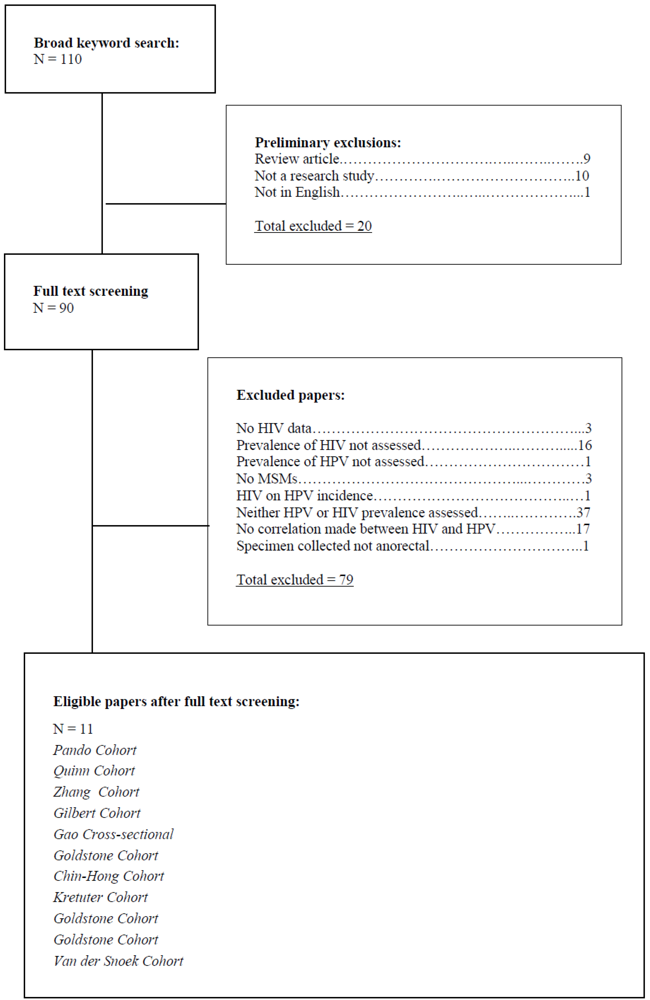
        <p>Our search criteria identified 110 articles of which 20 were eliminated because they were reviews of published research (n = 9), were not research studies (n = 10), and not written in English (n = 1). Of the 90 remaining articles we eliminated 79 because they had no data on HIV (n=3), HIV prevalence was not assessed (n = 16), HPV prevalence was not assessed (n = 1), MSM were not the target population (n = 3), the effect of HIV on HPV incidence was assessed (opposite direction; n = 1), neither HPV nor HIV were assessed (n = 37) nor a correlation was made between HIV and HPV (n = 17), specimen obtained for HPV testing was not anorectal (n = 1). The remaining 11 articles met the inclusion criteria and were selected for content analysis (<xref ref-type="fig" rid="viruses-04-03851-f001">Figure 1</xref>). Three of the 11 studies included in this review had a cohort study design and the remaining 8 were cross-sectional studies. Furthermore, our selected articles provided both cross-sectional [<xref ref-type="bibr" rid="B4-viruses-04-03851">4</xref>,<xref ref-type="bibr" rid="B8-viruses-04-03851">8</xref>,<xref ref-type="bibr" rid="B10-viruses-04-03851">10</xref>,<xref ref-type="bibr" rid="B11-viruses-04-03851">11</xref>,<xref ref-type="bibr" rid="B13-viruses-04-03851">13</xref>,<xref ref-type="bibr" rid="B15-viruses-04-03851">15</xref>,<xref ref-type="bibr" rid="B16-viruses-04-03851">16</xref>,<xref ref-type="bibr" rid="B17-viruses-04-03851">17</xref>] and longitudinal data [<xref ref-type="bibr" rid="B3-viruses-04-03851">3</xref>,<xref ref-type="bibr" rid="B9-viruses-04-03851">9</xref>,<xref ref-type="bibr" rid="B18-viruses-04-03851">18</xref>] comparing HPV and HIV. Four of the 11 studies were conducted in the US and the other 7 in Buenos Aires (n = 1), Lima Peru (n = 1), Vancouver, Canada (n = 1), China (n = 2), Germany (n = 1) and Netherlands (n = 1) (<xref ref-type="table" rid="viruses-04-03851-t001">Table 1</xref>). MSM were defined as individuals who were gay, bisexual, reported same sex encounters, and engaged in either insertive or receptive anal sex. The prevalence of HIV infection in MSM across all 11 studies ranged from 1.17% [<xref ref-type="bibr" rid="B1-viruses-04-03851">1</xref>], to 85% [<xref ref-type="bibr" rid="B5-viruses-04-03851">5</xref>]. HIV information was collected by self-report, ELISA with Western Blot confirmation, non-specified test on dried blood spot specimens, immunofluorescence and PCR confirmation, and non-specified HIV antibody detection test. Anal HPV prevalence among MSM across all 11 studies ranged between 13.7% [<xref ref-type="bibr" rid="B14-viruses-04-03851">14</xref>] and 98% [<xref ref-type="bibr" rid="B5-viruses-04-03851">5</xref>]. High risk oncogenic genotypes were assessed in all 11 research studies and testing methods for HPV included PCR + restriction fragment length polymorphism, line blot assay, Tellgenplex HPV DNA test, Linear Array line blot, linear array probe, suspension bead array method, hybrid capture II, cytology, dot blot hybridization, and SPF LIPA HPV PCR. Specimens for HPV testing were derived from perianal swabs, anal swabs, punch biopsies, digital rectal examination, anorectal swabs, and rectal swabs. With respect to the role of HPV in HIV acquisition, only one [<xref ref-type="bibr" rid="B1-viruses-04-03851">1</xref>] of the 11 selected studies assessed this relationship in HIV-uninfected MSM. Among MSM 57% were infected with HPV, 26% with high risk HPV and 26% with low risk HPV. Of 1409 participants who contributed 4375 person years of follow-up, 51 sero-converted, leading to an HIV acquisition rate of 1.17 per 100-person years. The authors reported an unadjusted hazard ratio (uHR) of 2.8 (95% Confidence Interval (CI) 1.04-7.4, <italic>p</italic> = 0.04) in the association between having one type of HPV and HIV sero-conversion. Similarly, an uHR of 3.6 (95% CI 1.5-8.4, <italic>p</italic> = 0.004) and adjusted hazard ratio (aHR) of 3.5 (95% CI 1.2-10.6, <italic>p</italic> = 0.02) were reported in the association between having 2 or more types of HPV and HIV sero-conversion. Other variables that showed a statistically significant relationship with HIV sero-conversion were unprotected receptive anal intercourse with HIV-unknown partners (adjusted HR of 7.1, 95% CI 2.8-18.2, <italic>p</italic> &lt; 0.0001) and methamphetamine use (adjusted HR of 4.6, 95% CI 1.7-12.0, <italic>p</italic> = 0.002). The same authors also found some evidence that abnormal anal cytology (Atypical Squamous Cells of Unidentified Significance (ASCUS)) was associated with HIV sero-conversion (HR 2.9, 95% CI 1.1-7.5, <italic>p</italic> = 0.03).</p>
		<fig id="viruses-04-03851-f001" position="float">
          <label>Figure 1</label>
          <caption>
            <p>Human Immunodeficiency Virus (HIV) Human Papillomavirus (HPV) flowchart of articles.</p>
          </caption>
          <graphic xmlns:xlink="http://www.w3.org/1999/xlink" xlink:href="viruses-04-03851-g001.tif"/>
        </fig>
      
        <table-wrap id="viruses-04-03851-t001" position="float">
          <object-id pub-id-type="pii">viruses-04-03851-t001_Table 1</object-id>
          <label>Table 1</label>
          <caption>
            <p>Select characteristics of studies identified in the literature review, 1998–2012. </p>
          </caption>
          <table rules="rows">
<thead>
              <tr>
                <th align="center" valign="middle">Author</th>
                <th align="center" valign="middle">Type of study</th>
                <th align="center" valign="middle">Country</th>
                <th align="center" valign="middle">(N)</th>
                <th align="center" valign="middle">HIV Prevalence</th>
                <th align="center" valign="middle">HPV Prevalence</th>
                <th align="center" valign="middle">HPV types tested</th>
              </tr>
            </thead>
            <tbody>
              <tr>
                <td align="center" valign="middle">Pando <italic>et al.</italic></td>
                <td align="center" valign="middle">x sectional</td>
                <td align="center" valign="middle">Argentina</td>
                <td align="center" valign="middle">496</td>
                <td align="center" valign="middle">17.30%</td>
                <td align="center" valign="middle">83.5%</td>
                <td align="center" valign="middle">36</td>
              </tr>
              <tr>
                <td align="center" valign="middle">Quinn, <italic>et al.</italic></td>
                <td align="center" valign="middle">x sectional</td>
                <td align="center" valign="middle">Peru</td>
                <td align="center" valign="middle">105</td>
                <td align="center" valign="middle">36.50%</td>
                <td align="center" valign="middle">77.1%</td>
                <td align="center" valign="middle">7</td>
              </tr>
              <tr>
                <td align="center" valign="middle">Zhang <italic>et al.</italic></td>
                <td align="center" valign="middle">x sectional</td>
                <td align="center" valign="middle">China</td>
                <td align="center" valign="middle">302</td>
                <td align="center" valign="middle">9.90%</td>
                <td align="center" valign="middle">13.7%</td>
                <td align="center" valign="middle">26</td>
              </tr>
              <tr>
                <td align="center" valign="middle">Gilbert <italic>et al.</italic></td>
                <td align="center" valign="middle">x sectional</td>
                <td align="center" valign="middle">Canada</td>
                <td align="center" valign="middle">268</td>
                <td align="center" valign="middle">24.10%</td>
                <td align="center" valign="middle">62.3%</td>
                <td align="center" valign="middle">4</td>
              </tr>
              <tr>
                <td align="center" valign="middle">Gao <italic>et al.</italic></td>
                <td align="center" valign="middle">x sectional</td>
                <td align="center" valign="middle">China</td>
                <td align="center" valign="middle">602</td>
                <td align="center" valign="middle">8.50%</td>
                <td align="center" valign="middle">62.1%</td>
                <td align="center" valign="middle">26</td>
              </tr>
              <tr>
                <td align="center" valign="middle">Goldstone <italic>et al.</italic></td>
                <td align="center" valign="middle">cohort</td>
                <td align="center" valign="middle">US</td>
                <td align="center" valign="middle">412</td>
                <td align="center" valign="middle">31%</td>
                <td align="center" valign="middle">Over 2 yrs: stayed HPV+ (38%); became HPV+ (13%); </td>
                <td align="center" valign="middle">13</td>
              </tr>
              <tr>
                <td align="center" valign="middle">Chin-Hong <italic>et al.</italic></td>
                <td align="center" valign="middle">cohort</td>
                <td align="center" valign="middle">US</td>
                <td align="center" valign="middle">1409</td>
                <td align="center" valign="middle">HIV acquisition <break/>1.17/100 person-yrs </td>
                <td align="center" valign="middle">56.8%</td>
                <td align="center" valign="middle">22</td>
              </tr>
              <tr>
                <td align="center" valign="middle">Kreuter, <italic>et al.</italic></td>
                <td align="center" valign="middle">x sectional</td>
                <td align="center" valign="middle">Germany</td>
                <td align="center" valign="middle">53</td>
                <td align="center" valign="middle">85%</td>
                <td align="center" valign="middle">98%</td>
                <td align="center" valign="middle">37</td>
              </tr>
              <tr>
                <td align="center" valign="middle">Goldstone <italic>et al.</italic></td>
                <td align="center" valign="middle">x sectional</td>
                <td align="center" valign="middle">US</td>
                <td align="center" valign="middle">597</td>
                <td align="center" valign="middle">27%</td>
                <td align="center" valign="middle">30% in HIV+ group, 14% in HIV- group</td>
                <td align="center" valign="middle">18</td>
              </tr>
              <tr>
                <td align="center" valign="middle">Goldstone, <italic>et al.</italic></td>
                <td align="center" valign="middle">x sectional</td>
                <td align="center" valign="middle">US</td>
                <td align="center" valign="middle">124</td>
                <td align="center" valign="middle">27.00%</td>
                <td align="center" valign="middle">48%</td>
                <td align="center" valign="middle">19</td>
              </tr>
              <tr>
                <td align="center" valign="middle">VanDer Snoek, <italic>et al.</italic></td>
                <td align="center" valign="middle">cohort</td>
                <td align="center" valign="middle">Nether-lands</td>
                <td align="center" valign="middle">258</td>
                <td align="center" valign="middle">6.60%</td>
                <td align="center" valign="middle">Group A <break/>3rd visit: 34.9% <break/>6th visit, 36.6%. <break/>Group B <break/>3rd visit 43.2% <break/>6th visit, 49.1%</td>
                <td align="center" valign="middle">26</td>
              </tr>
            </tbody>
          </table>
        </table-wrap>
        </sec>
      <sec>
        <title>2.2 Discussion</title>
        <p>We reviewed published research studies about the role of HPV in HIV-acquisition among MSM. Overall and across all relevant studies, the prevalence of HPV infection was significantly higher in MSM compared to demographically similar non-MSM. Moreover, the prevalence of HIV infection was higher in MSM compared to non-MSM and the prevalence of HPV infection was higher in HIV-infected MSM compared to HIV-uninfected MSM. These findings are consistent with a significant body of literature underscoring the vulnerability of MSM compared to the general population to disproportionately higher rates of STIs including HIV and HPV. Although the relationship between most common STIs and HIV infection is well established in the literature, few studies directly address the relationship between HPV infection and HIV incidence. In the published studies that addressed HIV incidence and HPV infection, there are limitations to the interpretation and generalizability of the findings due to potential confounders. One [<xref ref-type="bibr" rid="B1-viruses-04-03851">1</xref>] of the 11 selected articles for review examined the direct association between HPV and HIV-acquisition in MSM. The study reported a 3.62% HIV incidence rate of 1.17 per 100-person years. The study also found that HPV was independently associated with HIV sero-conversion. Additionally, infection with one or more genotypes of HPV significantly increased the risk of acquiring HIV infection. The biological plausibility of increased HIV acquisition due to HPV infection as discussed by the authors suggest that HPV-related lesions facilitate the aggregation of HIV-susceptible cells (T-cells and macrophages) at the site of the lesion making them more accessible to HIV. The authors also noted that HPV lesions cause disruptions in the normal anorectal anatomical barrier [<xref ref-type="bibr" rid="B1-viruses-04-03851">1</xref>]. </p>
      </sec>
    </sec>
    <sec sec-type="conclusions">
      <title>3. Conclusions</title>
      <p>We identified several manuscripts which provide data highlighting an association between HPV and HIV infection among MSM. However, only one study examined the direct relationship between HPV infection and HIV acquisition over time in MSM. Additional studies are needed to further examine this relationship, and one such study is being undertaken in Peru at this time. Additional clinical studies of HPV vaccines and other STI interventions would be worthwhile to assess the impact of the reduction of HPV infection on HIV incidence.</p>
    </sec>
    
  </body>
  <back><ack>
      <title>Acknowledgments</title>
      <p>The authors would like to thank University of California Irvine students Amy K. Kasahara, Anne Nguyen, and Yoshimi Yoshida for their contributions to the manuscript. We would also like to thank Ms. Sandra Perez for administrative support in the manuscript preparation. </p>
    </ack>
    <notes>
      <title>Conflict of Interest</title>
      <p>The authors declare no conflict of interest. </p>
    </notes>
    <ref-list>
      <title>References</title>
      <ref id="B1-viruses-04-03851">
        <label>1.</label>
        <citation citation-type="journal">
          <person-group person-group-type="author">
            <name>
              <surname>Chin-Hong</surname>
              <given-names>P.V.</given-names>
            </name>
          </person-group>
          <article-title>Anal human papillomavirus infection is associated with HIV acquisition in men who have sex with men</article-title>
          <source>AIDS</source>
          <year>2009</year>
          <volume>23</volume>
          <fpage>1135</fpage>
          <lpage>1142</lpage>
          <pub-id pub-id-type="doi">10.1097/QAD.0b013e32832b4449</pub-id>
        </citation>
      </ref>
      <ref id="B2-viruses-04-03851">
        <label>2.</label>
        <citation citation-type="journal">
          <person-group person-group-type="author">
            <name>
              <surname>Cranston</surname>
              <given-names>R.D.</given-names>
            </name>
          </person-group>
          <article-title>Anal human papillomavirus infection in a street-based sample of drug using HIV-positive men</article-title>
          <source>International Journal of STD &amp; AIDS</source>
          <year>2012</year>
          <volume>23</volume>
          <fpage>195</fpage>
          <lpage>200</lpage>
        <pub-id pub-id-type="doi">10.1258/ijsa.2011.011169</pub-id></citation>
      </ref>
      <ref id="B3-viruses-04-03851">
        <label>3.</label>
        <citation citation-type="journal">
          <person-group person-group-type="author">
            <name>
              <surname>Gao</surname>
              <given-names>L.</given-names>
            </name>
          </person-group>
          <article-title>Anal HPV infection in HIV-positive men who have sex with men from China</article-title>
          <source>PLos ONE</source>
          <year>2010</year>
          <volume>5</volume>
          <fpage>e15256</fpage>
          <pub-id pub-id-type="doi">10.1371/journal.pone.0015256</pub-id>
        </citation>
      </ref>
      <ref id="B4-viruses-04-03851">
        <label>4.</label>
        <citation citation-type="journal">
          <person-group person-group-type="author">
            <name>
              <surname>Anderson</surname>
              <given-names>J.S.</given-names>
            </name>
          </person-group>
          <article-title>A Randomized, placebo-controlled, dose-escalation study to determine the safety, tolerability, and immunogenicity of an HPV-16 therapeutic vaccine in HIV-positive participants with oncogenic HPV infection of the anus</article-title>
          <source>J. Acquir. Immune. Defic. Syndr.</source>
          <year>2009</year>
          <volume>52</volume>
          <fpage>371</fpage>
          <lpage>381</lpage>
          <pub-id pub-id-type="doi">10.1097/QAI.0b013e3181b7354c</pub-id>
        </citation>
      </ref>
      <ref id="B5-viruses-04-03851">
        <label>5.</label>
        <citation citation-type="journal">
          <person-group person-group-type="author">
            <name>
              <surname>Kreuter</surname>
              <given-names>A.</given-names>
            </name>
          </person-group>
          <article-title>Human papillomavirus-associated induction of human b-defensins in anal intraepithelial neoplasia</article-title>
          <source>Br. J. Dermatol.</source>
          <year>2009</year>
          <volume>160</volume>
          <fpage>1197</fpage>
          <lpage>1205</lpage>
          <pub-id pub-id-type="doi">10.1111/j.1365-2133.2009.09090.x</pub-id>
        </citation>
      </ref>
      <ref id="B6-viruses-04-03851">
        <label>6.</label>
        <citation citation-type="journal">
          <person-group person-group-type="author">
            <name>
              <surname>Pando</surname>
              <given-names>M.A.</given-names>
            </name>
          </person-group>
          <article-title>HIV and other sexually transmitted infections among men who have sex with men recruited by RDS in Buenos Aires, Argentina: High HIV and HPV infection</article-title>
          <source>PLoS ONE</source>
          <year>2012</year>
          <volume>7</volume>
          <fpage>e39834</fpage>
          <pub-id pub-id-type="doi">10.1371/journal.pone.0039834</pub-id>
        </citation>
      </ref>
      <ref id="B7-viruses-04-03851">
        <label>7.</label>
        <citation citation-type="journal">
          <person-group person-group-type="author">
            <name>
              <surname>Ghosh</surname>
              <given-names>I.</given-names>
            </name>
          </person-group>
          <article-title>Prevalence of human papillomavirus and co-existent sexually transmitted infections among female sex workers, men having sex with men and injectable drug abusers from eastern India</article-title>
          <source>Asian Pacific J. Cancer Prev.</source>
          <year>2012</year>
          <volume>13</volume>
          <fpage>799</fpage>
          <lpage>802</lpage>
          <pub-id pub-id-type="doi">10.7314/APJCP.2012.13.3.799</pub-id>
        </citation>
      </ref>
      <ref id="B8-viruses-04-03851">
        <label>8.</label>
        <citation citation-type="journal">
          <person-group person-group-type="author">
            <name>
              <surname>Gilbert</surname>
              <given-names>M.</given-names>
            </name>
          </person-group>
          <article-title>Feasibility of incorporating self-collected rectal swabs into a community venue-based survey to measure the prevalence of HPV infection in men who have sex with men</article-title>
          <source>Sex. Transm. Dis.</source>
          <year>2011</year>
          <volume>38</volume>
          <fpage>964</fpage>
          <lpage>969</lpage>
          <pub-id pub-id-type="doi">10.1097/OLQ.0b013e318222899d</pub-id>
        </citation>
      </ref>
      <ref id="B9-viruses-04-03851">
        <label>9.</label>
        <citation citation-type="journal">
          <person-group person-group-type="author">
            <name>
              <surname>Goldstone</surname>
              <given-names>S.E.</given-names>
            </name>
          </person-group>
          <article-title>Hybrid capture II detection of oncogenic human papillomavirus: A useful tool when evaluating men who have sex with men with atypical squamous cells of undetermined significance on anal cytology</article-title>
          <source>Dis. Colon. Rectum</source>
          <year>2008</year>
          <volume>51</volume>
          <fpage>1130</fpage>
          <lpage>1136</lpage>
          <pub-id pub-id-type="doi">10.1007/s10350-008-9306-4</pub-id>
        </citation>
      </ref>
      <ref id="B10-viruses-04-03851">
        <label>10.</label>
        <citation citation-type="journal">
          <person-group person-group-type="author">
            <name>
              <surname>Houlihan</surname>
              <given-names>C.F.</given-names>
            </name>
          </person-group>
          <article-title>HPV infection and increased risk of HIV acquisition. A systematic review and meta-analysis</article-title>
          <source>AIDS </source>
          <year>2012</year>
          <volume>26</volume>
          <fpage>2211</fpage>
          <lpage>2222</lpage>
          <pub-id pub-id-type="doi">10.1097/QAD.0b013e328358d908</pub-id>
        </citation>
      </ref>
      <ref id="B11-viruses-04-03851">
        <label>11.</label>
        <citation citation-type="journal">
          <person-group person-group-type="author">
            <name>
              <surname>Goldstone</surname>
              <given-names>S.</given-names>
            </name>
          </person-group>
          <article-title>Prevalence of and risk factors for human papillomavirus (HPV) infection among HIV-seronegative men who have sex with men</article-title>
          <source>J. Infect. Dis.</source>
          <year>2011</year>
          <volume>203</volume>
          <fpage>66</fpage>
          <lpage>74</lpage>
          <pub-id pub-id-type="doi">10.1093/infdis/jiq016</pub-id>
        </citation>
      </ref>
      <ref id="B12-viruses-04-03851">
        <label>12.</label>
        <citation citation-type="journal">
          <person-group person-group-type="author">
            <name>
              <surname>Van Der Snoek</surname>
              <given-names>E.M.</given-names>
            </name>
          </person-group>
          <article-title>Human Papillomavirus infection in men who have sex with men participating in a dutch gay-cohort study</article-title>
          <source>Sex. Transm. Dis.</source>
          <year>2003</year>
          <volume>30</volume>
          <fpage>639</fpage>
          <lpage>644</lpage>
          <pub-id pub-id-type="doi">10.1097/01.OLQ.0000079520.04451.59</pub-id>
        </citation>
      </ref>
      <ref id="B13-viruses-04-03851">
        <label>13.</label>
        <citation citation-type="journal">
          <person-group person-group-type="author">
            <name>
              <surname>Goldstone</surname>
              <given-names>S.E.</given-names>
            </name>
          </person-group>
          <article-title>Detection of oncogenic human papillomavirus and other predictors of anal high-grade dysplasia in men who have sex with men with abnormal cytology</article-title>
          <source>Dis. Colon. Rectum</source>
          <year>2009</year>
          <volume>52</volume>
          <fpage>31</fpage>
          <lpage>39</lpage>
          <pub-id pub-id-type="doi">10.1007/DCR.0b013e31819736aa</pub-id>
        </citation>
      </ref>
      <ref id="B14-viruses-04-03851">
        <label>14.</label>
        <citation citation-type="journal">
          <person-group person-group-type="author">
            <name>
              <surname>Zhang</surname>
              <given-names>X.</given-names>
            </name>
          </person-group>
          <article-title>Prevalence and related risk behaviors of HIV, syphilis, and anal HPV infection among Men who have sex with men from Beijing, China</article-title>
          <source>AIDS Behav</source>
          <year>2011</year>
          <pub-id pub-id-type="doi">10.1007/s10461-011-0085-x</pub-id>
        </citation>
      </ref>
      <ref id="B15-viruses-04-03851">
        <label>15.</label>
        <citation citation-type="journal">
          <person-group person-group-type="author">
            <name>
              <surname>Quinn</surname>
              <given-names>R.</given-names>
            </name>
          </person-group>
          <article-title>Human papillomavirus infection in men who have sex with wen in Lima, Peru</article-title>
          <source>AIDS Res. Hum. Retrovir.</source>
          <year>2012</year>
          <volume>28</volume>
          <fpage>1</fpage>
          <lpage>5</lpage>
          <pub-id pub-id-type="doi">10.1089/aid.2011.0053</pub-id>
        </citation>
      </ref>
      <ref id="B16-viruses-04-03851">
        <label>16.</label>
        <citation citation-type="journal">
          <person-group person-group-type="author">
            <name>
              <surname>Mateos</surname>
              <given-names>M.</given-names>
            </name>
          </person-group>
          <article-title>Prevalence of high risk genotypes of human papillomavirus in anal samples from men who have sex with men with abnormal cytology in Madrid</article-title>
          <source>Enferm. Infec. Microbiol. Clin.</source>
          <year>2011</year>
          <volume>29</volume>
          <fpage>778</fpage>
          <lpage>786</lpage>
          <pub-id pub-id-type="doi">10.1016/j.eimc.2011.05.011</pub-id>
        </citation>
      </ref>
      <ref id="B17-viruses-04-03851">
        <label>17.</label>
        <citation citation-type="journal">
          <person-group person-group-type="author">
            <name>
              <surname>Parisi</surname>
              <given-names>S.</given-names>
            </name>
          </person-group>
          <article-title>Anal and oral human papillomavirus (HPV) infection in HIV-infected subjects in northern Italy: A longitudinal cohort study among men who have sex with men</article-title>
          <source>BMC Infect. Dis.</source>
          <year>2011</year>
          <volume>11</volume>
          <fpage>1</fpage>
          <lpage>9</lpage>
        <pub-id pub-id-type="pmid">21199579</pub-id></citation>
      </ref>
      <ref id="B18-viruses-04-03851">
        <label>18.</label>
        <citation citation-type="journal">
          <person-group person-group-type="author">
            <name>
              <surname>Van Der Snoek</surname>
              <given-names>E.M.</given-names>
            </name>
          </person-group>
          <article-title>Acquisition and clearance of perianal human papillomavirus infection in relation to HIV-positivity in men who have sex with wen in the Netherlands</article-title>
          <source>Acta. Derm. Venereol.</source>
          <year>2005</year>
          <volume>85</volume>
          <fpage>437</fpage>
          <lpage>443</lpage>
          <pub-id pub-id-type="doi">10.1080/00015550510032850</pub-id>
        </citation>
      </ref>
    </ref-list>
  </back>
</article>