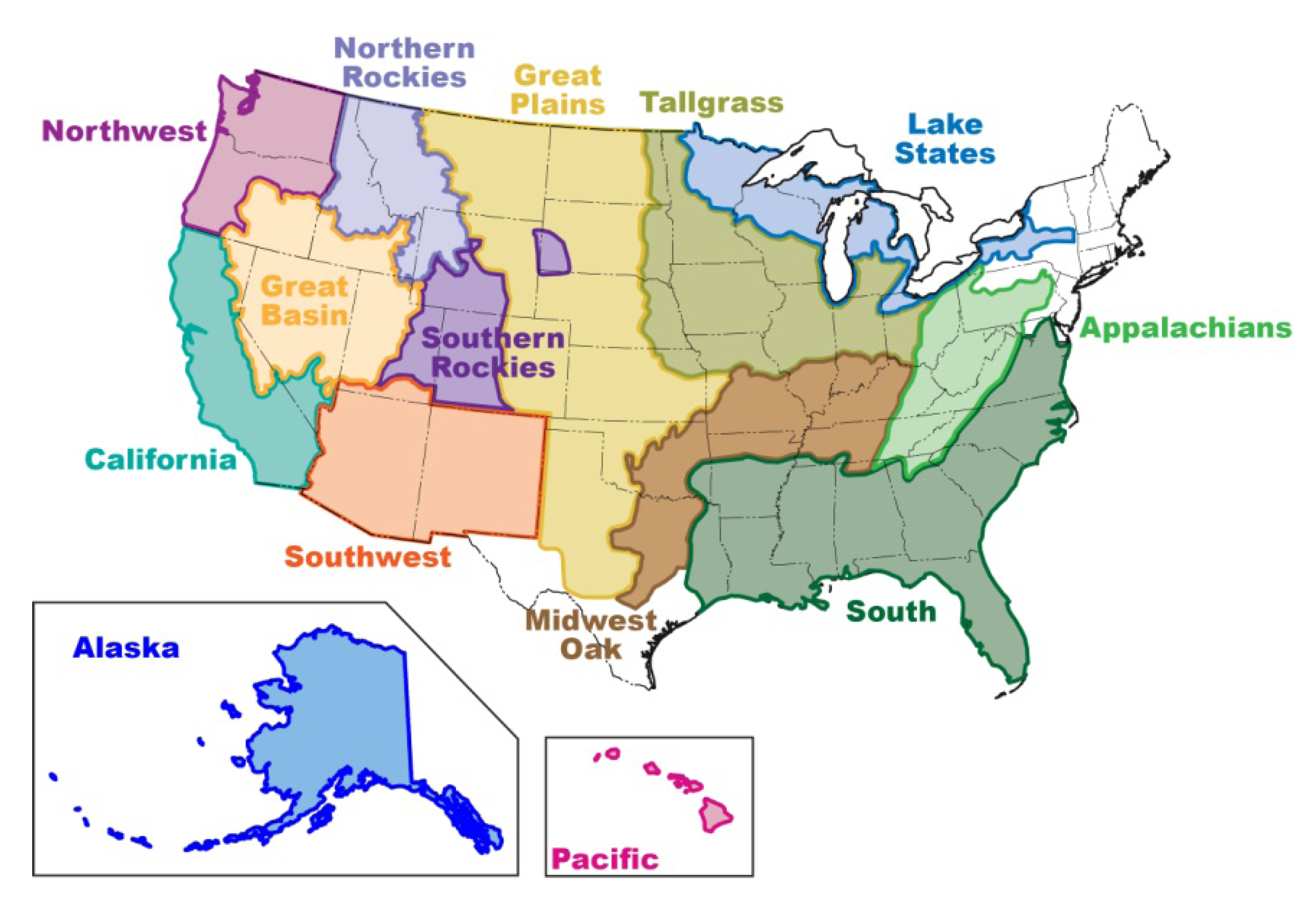
3.1. Existing Research
Publication dates of the 63 publications that met our criteria as described above spanned from 1959 to 2012. One study was published in the 1950s, two in the 1960s, 16 in the 1970s, nine in the 1980s, 12 in the 1990s, 16 in the 2000s, and seven studies were published between 2010 and 2012. Thirty-three (52%) of the publications focused on pine-dominated forests (
Table 2). Of these, 26 (41%) were conducted in jack pine forests or barrens, and five (8%) in mixed pine or red pine (
P. resinosa Ait.) forests, including one (2%) in a red pine plantation. A total of sixteen (25%) studies focused on deciduous forest types (
Table 2), and the majority (10 studies or 16%) of these were conducted in oak (
Quercus)-dominated ecosystems whereas three studies (5%) were conducted in northern hardwood ecosystems (one in mesic hardwoods, two in aspen (
Populus) woodland, and one in a recently clearcut and burned stand that represented an early successional stage along an eastern hemlock (
Tsuga Canadensis (L.) Carrière)-northern hardwood chronosequence). Fifteen studies (24%) were conducted in boreal forest types, which often include a mixture of coniferous and deciduous species (
Table 2). Half (32 studies, or 51%) of the publications focused exclusively on prescribed fire or prescribed fire following forest harvest, whereas 22 studies (35%) evaluated wildfire effects and eight studies (13%) used a combination of wildfire and prescribed fire locations (
Table 2).
The majority (44 studies, or 70%) of the publications reported studies conducted ≤10 y post-fire. Nineteen studies (30%) reported data from measurements taken >10 y after a fire event (
Table 2). The longest-term continuous study reported on soil temperatures over a 17 year period following wildfire [
52]. Most long-term studies reported data from older wildfires or harvested and burned locations. Several authors (ten studies or 16% of publications) assembled chronosequences to evaluate the effect of time since fire on soil properties (
Table 2).
Fifty-two percent of the publications (33 studies) reported information on both organic and mineral soil layers, whereas 29% (18 studies) focused on mineral soil only and 14% (nine studies) focused on organic soil only (
Table 2). The majority of studies (40 or 63%) reported fire effects on soil chemical characteristics such as soil pH, or nutrient pools (
Table 2-
Table 4). Twenty-six studies (41%) reported data on soil physical characteristics, including soil texture, moisture content, or temperature (
Table 2 and
Table 5). Thirty-one publications (49%) addressed fire effects on soil biological characteristics such as microbial activity, or rates of nutrient transformations, or microbial community diversity (
Table 2,
Table 6 and
Table 7).
On average, fire decreased total C in organic soil by 19%, whereas a 6% increase occurred in mineral soil (
Table 3). The decrease in total C in organic soil was attributed to large (29% to 49%) decreases observed in pine-dominated forests; fire decreased total C in mixed forests <5 years post-fire, although 100% increases relative to unburned areas were observed among studies conducted >10 years since fire. Fewer observations of organic C were reported than for total C, and 48% of observations occurred in boreal mixed forest types. All studies of fire effects on organic C were conducted <5 years or >10 years following fire, and the observations reported from >10 years post-fire suggest that major decreases in organic C persist through time (
Table 3).
The effect of fire on total soil N was more negative and showed a wider range of effects in organic soil than in mineral soil (
Table 3). Effects on organic soil in pine-dominated forests ranged from −89% to 67%, whereas effects on deciduous forest organic soil were consistently negative. All longer-term observations were limited to mineral soil in pine-dominated forests (
Table 3). Fire effects on soil inorganic N (pools and concentrations) were more strongly negative, and this was driven by effects reported in deciduous forests. Fire increased inorganic N in boreal mixedwood forests, and the range between the minimum and maximum effect was much smaller than in deciduous forests. The absence of data on fire effects on inorganic N pools in pine-dominated forests indicates a strong need for this information in the Lake States region. Similarly, no data on longer-term effects on inorganic N in deciduous forests were identified in this review (
Table 3). Reports of fire effects on organic N and soluble N exist for pine-dominated forests only, whereas data on total P exist for relatively short-term observations from organic soil in deciduous and boreal mixedwood forests only. The mean effect of fire on extractable P is positive for organic soil in conifer forests and in mineral soil in all forest types; no data exist on organic soil in deciduous or boreal mixedwood forests (
Table 3).
The overall mean responses of all soil C and N variables were negative, whereas the effects of fire on soil P were positive. Similarly, the overall mean responses of soil pH, Ca, K and Mg were positive (
Table 4). In general, mean fire effects on soil pH are minor (<41% increase), although K increased by 900% in deciduous forest mineral soil <5 years following fire (
Table 4). Data on intermediate- to long-term responses of cations to fire in deciduous forests are lacking (
Table 4).
Few observations of regional fire effects on soil physical properties exist, and nearly all occurred <5 years following fire or at an unspecified time since fire (
Table 5). Overall mean effects of fire on soil physical properties were minor (≤10% change relative to reference areas) for all variables except organic layer depth, mass and surface litter cover (effects ranged from 100% losses to increases of 38%) (
Table 5). No data exist that indicate whether or not these small changes in physical properties persist through time, and this gap in knowledge may be particularly important for monitoring ecosystem recovery following more severe fires—such as are common in jack pine-dominated forests in this region—that cause the greatest impact to forest soil [
1,
55].
In general, fire decreased soil biological processes (
Table 6). Fire decreased litter decomposition (mass loss) in deciduous and boreal mixedwood forests by <10%, and the positive effect in pine-dominated forests was minimal (
Table 6). Two observations of fire effects on N immobilization suggest relatively minor (−15% to 8%) effects in pine-dominated forests. A greater number of observations of N mineralization indicate a wider range of variability in the response of this variable (−95% to 326%); no data exist from boreal mixedwood forests, and data from deciduous forests are limited to the mineral soil layer (
Table 6). Nitrification was the only soil process that showed an overall increase following fire, and this was driven by major increases reported from mineral and combined organic + mineral soil in pine-dominated forests (
Table 6). The limited reported data suggest that nitrification in conifer forests increases with time since fire, whereas the opposite trend was evident in deciduous forests (
Table 6).
Fire had an overall negative effect (−9%) on soil exoenzyme activities, although arylsulfatase and proteolytic enzyme activities showed negative as well as positive responses (
Table 6). For arylsulfatase, a single observation of negative effects was reported from organic soil, and a single observation of positive effects was reported in mineral soil. The response of soil enzymes to fire in this region is a major gap in our current understanding of fire effects on ecosystem processes. The limited data that exist suggest that fire has overall negative effects on nutrient transformations and organic matter cycling in the Lake States region.
Fire decreased soil microbial biomass C and the density of vascular plant seeds in pine-dominated forests, and no information from deciduous or boreal mixedwood forests were located for either variable. Fire increased the overall abundance of actinomycetes, streptomycetes, bacteria, and fungi, with maximum increases observed for bacteria in the mineral layer of deciduous forests (1046%) (
Table 7). Our literature search did not locate any studies of bacterial abundance in mineral soil of pine-dominated forests, nor studies of microbial abundance in pine-dominated forests conducted ≥5 years following fire (
Table 7).
Fire increased carabid beetle diversity in pine-dominated forests <5 years following fire (
Table 7), whereas ectomycorrhizal diversity and overall microbial community diversity and evenness decreased following fire. No studies were located that reported fire effects on soil organism communities >10 years following fire, and the data that exist from shorter post-fire time periods are very limited (
Table 7).
3.2. Trends
The literature we reviewed showed that studies of fire effects on soil in the Lake States region are limited primarily to reports of chemical characteristics in organic and upper mineral soil horizons, and that most studies focus on a relatively short-term response to fire. There is a clear need for investigations of longer-term effects of fire on soil (
Table 2-
Table 7). No studies reported major or persistent effects on mineral soil physical properties (
Table 5). In general, fire increases soil cations, pools of extractable P, and nitrification rates, and decreases litter decomposition, N mineralization, and soil exoenzyme activities (
Table 3,
Table 4 and
Table 6). However, persistent increases in mineral soil N, P and K have been reported by repeated measurements over ten years following experimental burning in immature jack pine in the Lake States region [
57]. Fire-caused increases in soil nutrients (such as inorganic N forms) may increase nutrient losses due to leaching, although studies of wildfire effects in mixed-conifer forest in the Boundary Waters Canoe Area showed that these effects also decreased with time since fire and were not large enough to cause lake eutrophication [
77,
80]. However, our calculations of overall mean effect size showed that fire increases soil P (total and extractable) and cations (Ca, K and Mg) and decreases soil total, inorganic, organic, and soluble N forms.
The species composition of a regenerating forest may influence post-fire recovery of mineral soil C [
40], suggesting that the ecosystem response to fire may be affected by unique interactions between fire events and forest type. Mineral soil C pools recovered over time since fire in a northern hardwood forest [
89], whereas the opposite trend was reported for post-fire jack pine stands [
5]. In jack pine, an accumulation of C occurred in the organic soil (forest floor) layer [
5], and a study of multiple forest types in the Boundary Waters Canoe Area reported that forest floor C mass 23 years after wildfire exceeded pre-fire levels [
83]. Species composition also influences environmental conditions following fire and is likely to have an important influence on soil nutrient dynamics [
27]. For example, litter mass and chemistry as well as percent cover by surface vegetation and the soil surface temperature are likely to differ strikingly between regenerating stands dominated by hardwood species and those dominated by jack pine.
Fire frequency influences forest structure and composition and, in turn, soil characteristics. For example, shrub and tree density decreased with increasing fire frequency at Cedar Creek Natural History Area in northern Minnesota [
98]. Soil N and P availability and N mineralization rates were negatively related to fire frequency at this study site [
87,
90,
94]. Fire severity also affects properties of forest soils. Reports of high fire severity included fires that consumed the entire organic layer or left only a layer of ash [
73] as well as those that resulted in minimal impact to soil where the organic layer was not consumed [
55]. Within-fire severity level has a measureable influence on soil properties; for example, soil pH was greater in areas of high fire severity than in areas of lower severity in a boreal forest [
73]. The specific effects of fire as a function of severity level have not been well-investigated in the fire effects literature regardless of regional location.
Few studies addressed fire effects on soil organisms or ecosystem processes, and the existing data represent pine-dominated forests; little information exists from deciduous and boreal mixedwood forests (
Table 2,
Table 6 and
Table 7). An early study of soil microorganisms showed that burning reduced microbial numbers and activity up to three growing seasons following fire, however, these effects were minor and were reduced by precipitation events [
58]. Litter decomposition increased over the short term (two weeks) following the 1976 wildfire at Seney National Wildlife Refuge [
42], whereas no effects were reported following the 1971 Little Sioux Fire in the Boundary Waters Canoe Area [
78]. The effects of fire on soil microorganisms may differ among plant species. For example, colonization by ectomycorrhizae was positively correlated with fire intensity for eastern white pine (
P. strobus L.) seedlings but not for red pine seedlings planted in a burned jack pine clearcut [
56]. The existing data provide very limited insight into fire effects on soil ecosystem processes in the Lake States region, and the need to resolve these gaps is clear.
In general, the types of soil responses to fire reported in the regional literature are consistent with the types of effects reported for other eastern and western systems, which include positive and negative responses to fire [
1,
35,
37,
101]. The magnitude of fire effect may be largely driven by fire severity. For example, soil organic C in Virginia table mountain pine (
Pinus pungens Lamb.) stands was decreased more by high-severity fire than by low-severity fire [
102]. A meta-analysis of fire effects on soil C and N storage showed that wildfires cause greater losses in soil C and N pools than prescribed fires, and this was attributed to differences in fire severity [
35]. Recent meta-analyses of fire effects on soil properties in eastern (focused primarily on southeastern US forests) and western forests have shown that responses are highly variable, may be site-specific, and include increases as well as decreases in soil and forest floor C stocks [
36], although a multivariate analysis of overall soil properties indicated a clear separation between western and eastern sites [
101].
Although general effects of fire—such as increases or decreases in measured variables—may be similar across diverse regions, the magnitude and duration of effect is perhaps more ecologically important. An early study of fire in the Lake States region emphasized that “each combination of region, climate, forest tree association, soil type and plant species must be considered individually,” especially when other environmental factors that influence fire behavior (and consequently, fire effects)—such as forest composition, physiography, soil type and climate—may differ greatly between regions [
103]. This early warning emphasizes the importance of developing regionally-specific understanding of fire effects on ecosystem characteristics and processes—a task that remains important today for appropriately informing regional and local land management decisions.
3.3. Future Directions
The limited number of studies addressing fire effects on soils in Lake States forests creates difficulty in comparing effects among contrasting forest types within the region, especially in light of potential “mesophication” of these forests [
104]. Only three studies investigated fire effects in multiple forest types [
40,
59,
83] and a strategic approach is needed to be able to compare the magnitude and duration of fire effects on soils across forest types within the Lake States region. Our results indicate that several key areas of opportunity exist to expand our current knowledge of fire effects in the Lake States region. Few of the reviewed publications reported fire temperatures [
48,
50,
58,
96], and the level of detail provided for fire behavior information varied from qualitative statements that a fire was “severe” or “intense” to plot-specific measurements of fire intensity and forest floor reduction [
57] or field-based assessments of fire severity [
55]. Detailed measurements of fire temperature, behavior and severity or fuel consumption must be included in future studies to accurately interpret fire effects on soil or other ecosystem components (e.g., [
105]). Modeling fire behavior for specific fire locations and dates may help interpret fire effects at a coarse scale by using pre-fire estimates of forest structure and composition and known fire-weather information. Resources to support this general approach include LANDFIRE [
106] and the Fuel Characteristics Classification System [
107], among others, although the current level of specificity provided by these tools is limited. The Monitoring Trends in Burn Severity program [
108] is currently in progress and will provide fire perimeter and within-fire burn severity maps for fires that occurred from 1984 to 2010 across the entire United States. These maps will allow field sampling to be stratified by fire severity level, thereby increasing the understanding of fire effects by the level of impact on a forest stand.
Controlled and replicated studies are also essential for accurately interpreting fire effects, especially when no pre-fire data exist. Two of the publications we reviewed presented uncontrolled studies from an assemblage of jack pine stands that lacked a clear gradient of fire type and time since fire [
26,
27]; this approach limits the ability to make clear conclusions about fire effects. Actively managed research locations provide the greatest opportunity for multiple investigations; e.g., seven of the 63 studies we reviewed were conducted at the Cedar Creek Natural History Area in Minnesota, and four studies were conducted at the Petawawa National Forestry Institute near Chalk River, Ontario. Well-established wildfire study locations similarly support multiple investigations, such as the 1971 Little Sioux wildfire in the Boundary Waters Canoe Area of Minnesota which has been used in used in five studies.
Jack pine forests, historically characterized by relatively frequent, stand-replacing crown fires, were the most studied forest type in the region. More information is needed on fire effects on soils in forest types that represent a wider range of fire regimes, e.g., northern hardwood, mixed-pine and boreal forest types. Studies that investigated the effects of varying fire frequencies were limited to oak-dominated ecosystems and none were located for pine-dominated forest types. Although soil chemistry was the most well-studied topic area and many studies presented data on soil organic matter content, no studies examined fire effects on organic matter composition. For example, the influence of fire on pyrogenic C content in forest soils of the region has not yet been investigated. Most studies reported soil nutrient stocks rather than nutrient fluxes or estimations of recovery rates for nutrient pools; this latter data would be valuable for understanding impacts on ecosystem processes that contribute to long-term forest productivity. Nutrient flux data would also be complemented by data on microbial community composition to allow evaluation of relationships between soil ecosystem structure and function by forest type; however, only one study presented both types of information [
58]. Of the 63 publications reviewed, only one investigated fire effects on soil macrofauna [
53].
Re-measuring locations used in earlier studies can enhance the value of new research by linking new data with an existing body of knowledge, allowing physical, chemical or biological properties to be evaluated over a longer period of time than is possible within the duration of a single funding award, by contributing to the site-specific knowledge held by the local management agency personnel, or by reducing costs involved with locating new sites or implementing new experimental treatments. Several challenges also exist for efforts to establish new studies at previous research locations, such as locating study sites when detailed maps or spatial location have not been published. In the Lake States region, many of the locations used for studies presented in
Table 1 may have been impacted in ways that prohibit direct comparisons across time. For example, harvesting and site preparation would disrupt soil and confound long-term datasets. Differences in methods between early and late measurements also create challenges that may or may not allow comparisons across time. For example, the authors of one study [
40] constructed a long-term comparison by calculating soil organic matter content from two earlier studies at their site that reported organic matter concentrations. In this example, the analysis relied on original data from published appendices and from archived soil samples from two earlier and well-documented studies. Clear communication with previous or current researchers is essential to ensure that existing studies are not disrupted, and formal collaboration may be necessary for data-sharing. The potential synergy, however, will be valuable for developing long-term or interdisciplinary data that greatly increase our understanding of fire-mediated ecological processes.
One challenge facing fire researchers in the Lake States is the lack of a comprehensive database of wildfire locations. Individual researchers have identified wildfire locations that allow chronosequence studies of wildfire-regenerated jack pine sites in northern lower Michigan [
5,
66,
67,
68], or have used a time series of aerial imagery and photographs to map fire extent and pattern at known locations [
109]. A spatially explicit database of fires in the Lake States between 1985 and 1995 has been developed based on state (Minnesota, Wisconsin and Michigan Departments of Natural Resources) and federal (USDA Forest Service) agency records of fire origin [
15], although these authors did not use individual fire perimeters. Records of fires on land managed by the National Park Service and U.S. Fish and Wildlife Service as National Wildlife Refuges would further increase our knowledge of fire occurrence and ecological effects. Agency records of fire locations that are currently available commonly provide Public Land Survey System (PLSS) township, range and section, as digital fire perimeter maps are available only for the most recent fires. Maps for older fires may exist only as hard-copy maps in agency files, and digitization of these existing hard-copy information resources would increase research opportunities. Maps for many fires simply do not exist. Thus, a spatial database of known fire locations would have significant value as a resource when establishing future research projects to document long-term fire effects. Many of the studies located through this review included general fire location information only, which limits the ability to re-examine these locations in later years. We encourage investigators to make detailed site location, forest type, treatment, and methods information available after a study is completed, as no single entity currently supports an archive of study locations. Physical archival of field samples would also promote re-measurement and the development of more comprehensive databases for specific locations.