
Imaginary Cubes and Their Puzzles

Graduate School of Human and Environmental Studies, Kyoto University, Yoshida-Nihonmatsu, Sakyo-ku, 606-8501, Kyoto, Japan
Algorithms 2012, 5(2), 273-288; https://doi.org/10.3390/a5020273
Submission received: 16 November 2011
/
Revised: 15 April 2012
/
Accepted: 8 May 2012
/
Published: 9 May 2012
(This article belongs to the Special Issue Puzzle/Game Algorithms)
Abstract
:Imaginary cubes are three dimensional objects which have square silhouette
projections in three orthogonal ways just as a cube has. In this paper, we study imaginary
cubes and present assembly puzzles based on them. We show that there are 16 equivalence
classes of minimal convex imaginary cubes, among whose representatives are a hexagonal
bipyramid imaginary cube and a triangular antiprism imaginary cube. Our main puzzle is to
put three of the former and six of the latter pieces into a cube-box with an edge length of twice the size of the original cube. Solutions of this puzzle are based on remarkable properties of these two imaginary cubes, in particular, the possibility of tiling 3D Euclidean space.
1. Introduction
Imagine a three dimensional object which has square silhouette projections in three orthogonal directions.
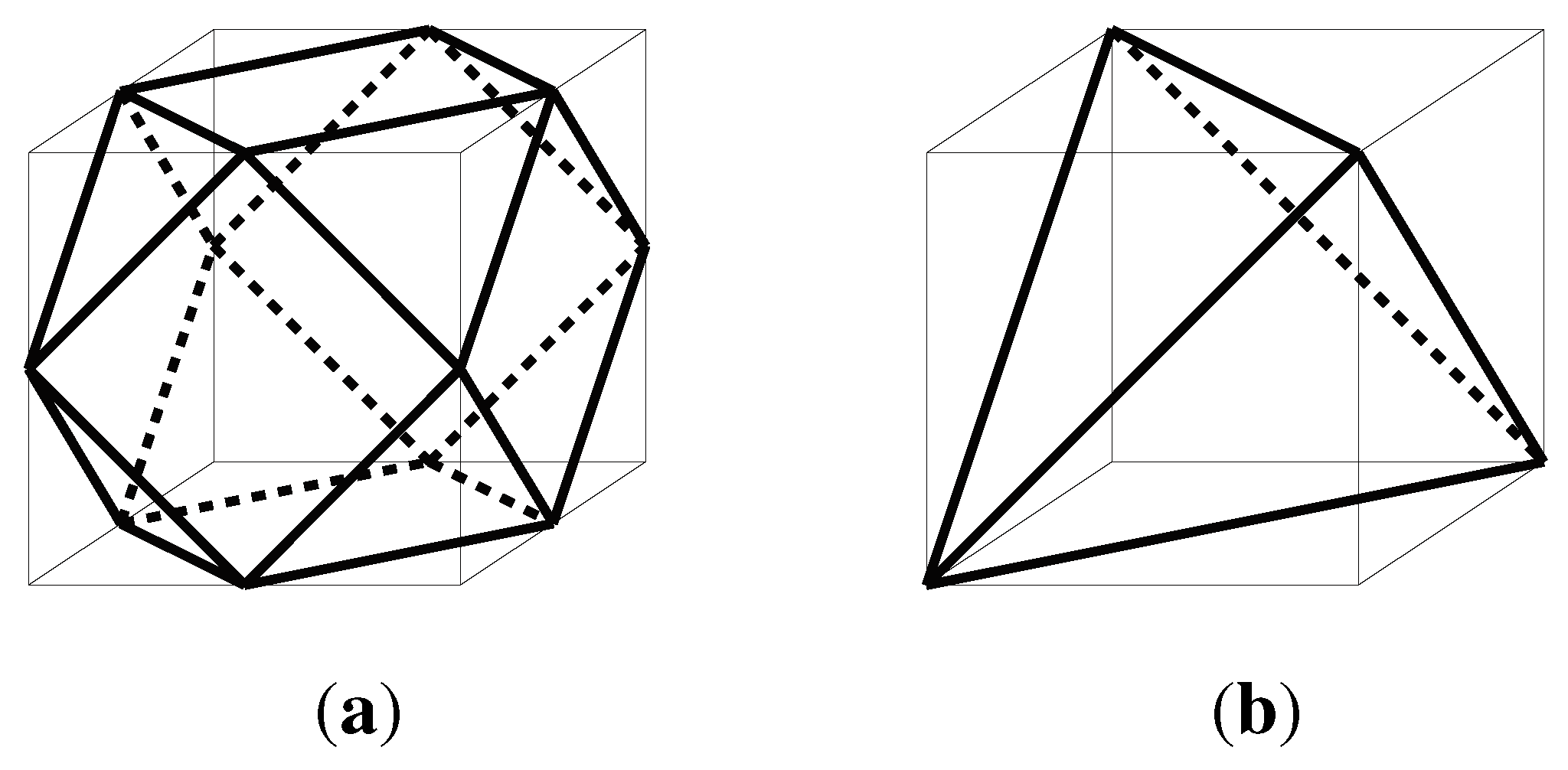
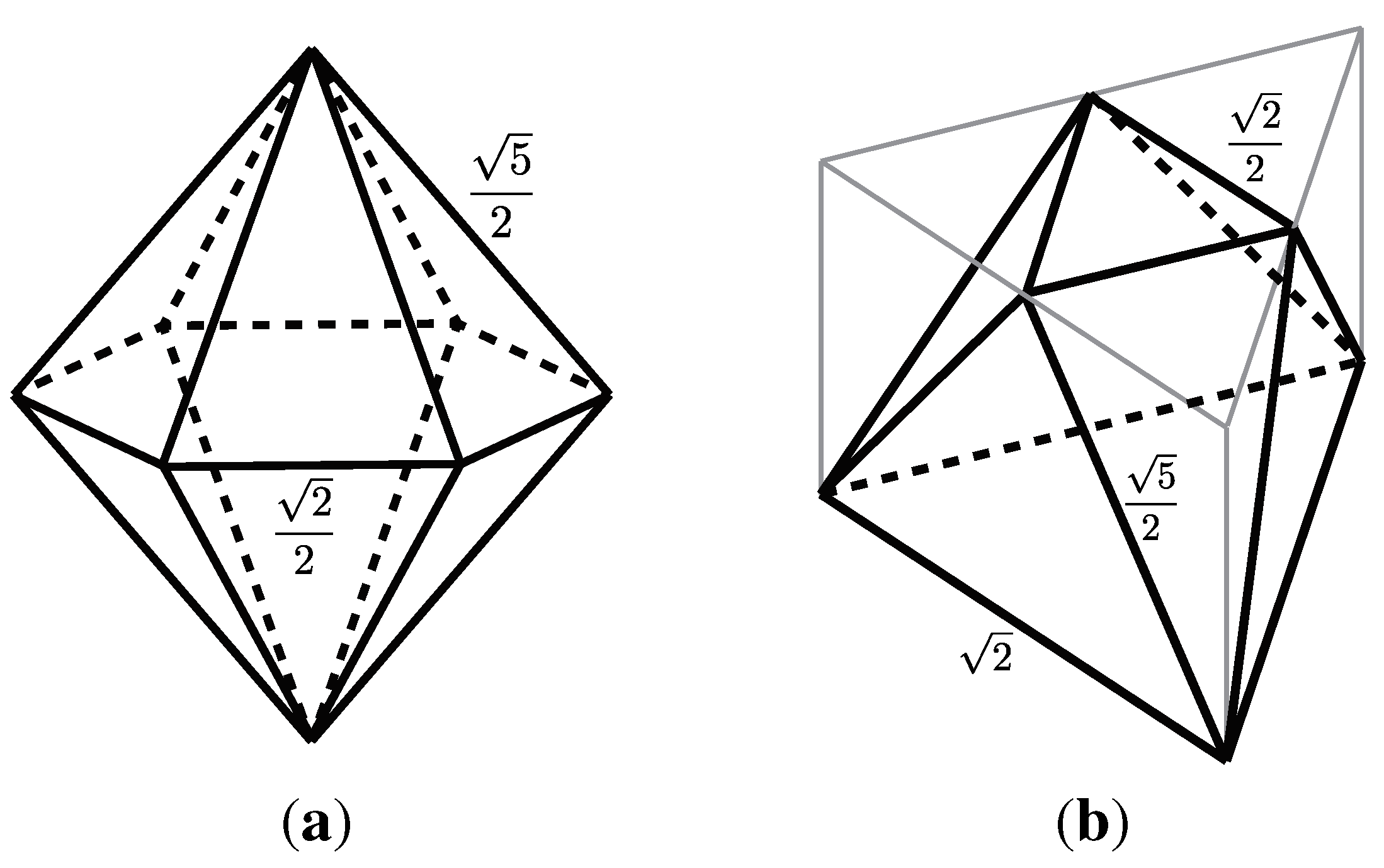
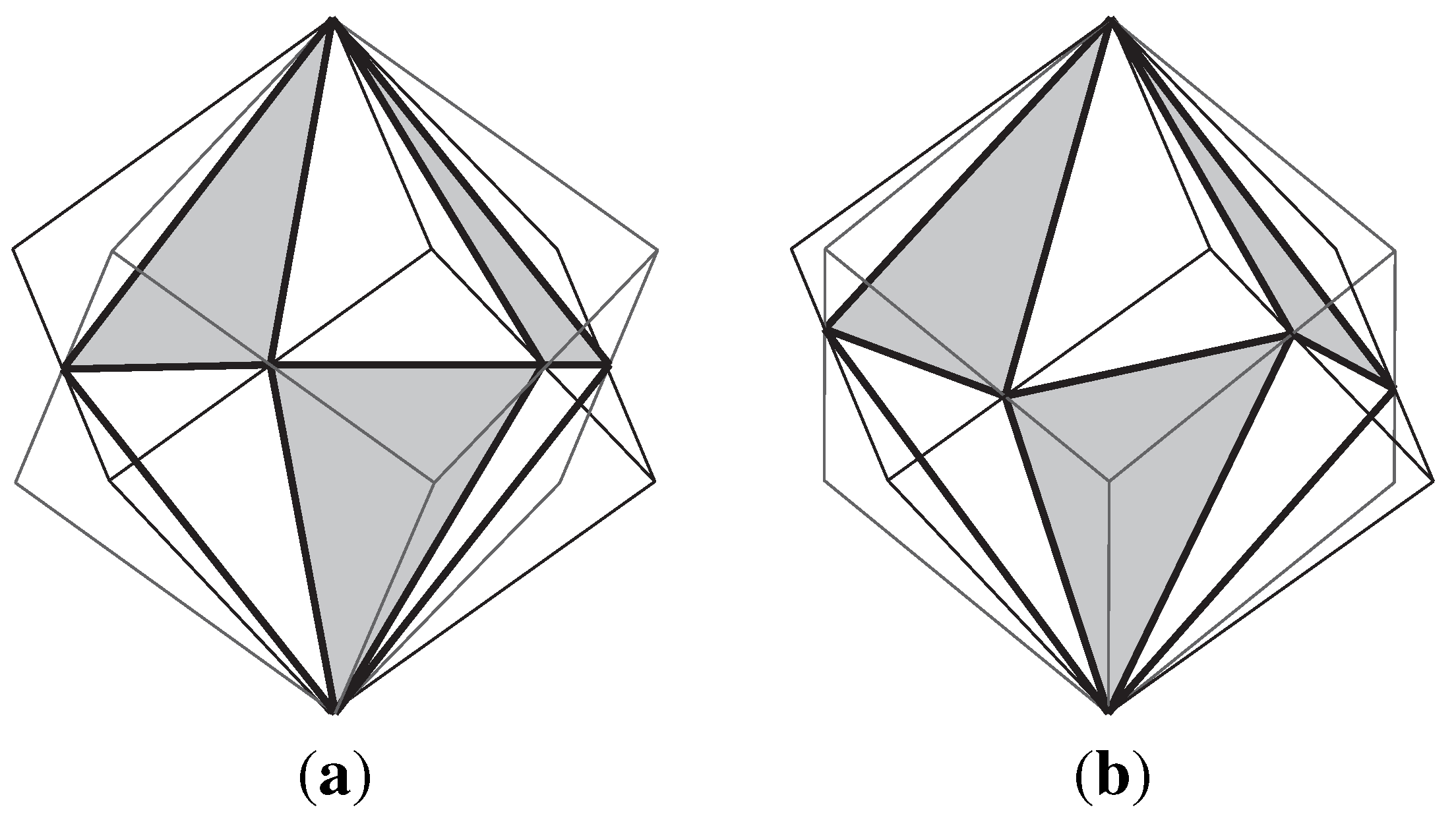
A cube has this property, but it is not the only object and there are plenty of examples like a cuboctahedron and a regular tetrahedron as Figure 1(a,b) shows. We call an object an imaginary cube if it has square projections in three orthogonal directions just as a cube has. Among imaginary cubes, there are two objects with some remarkable geometrical properties, which are a hexagonal bipyramid imaginary cube (Figure 2(a)) and a triangular antiprismoid imaginary cube (Figure 2(b)).
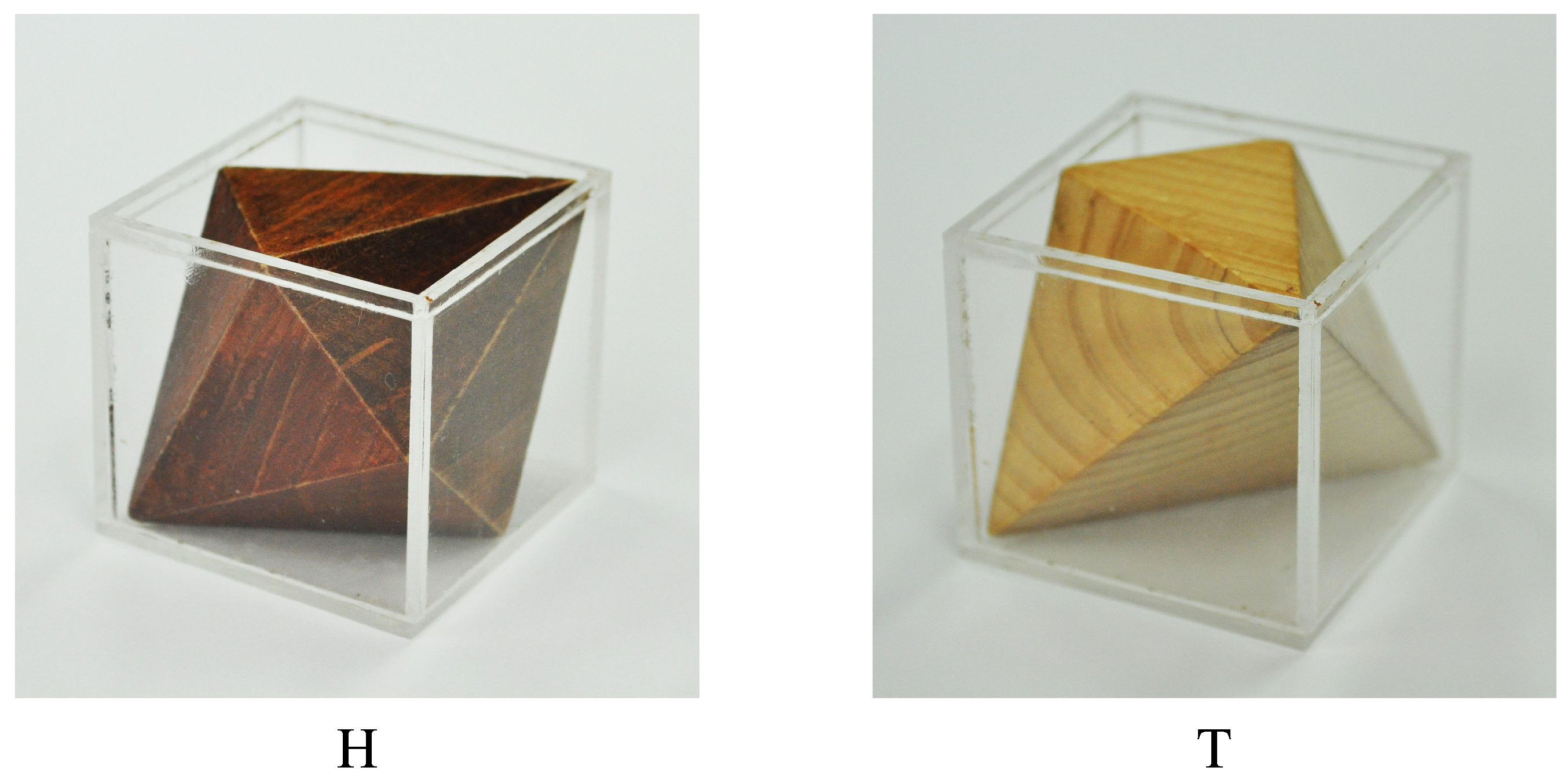
A hexagonal bipyramid imaginary cube, which we call H in this paper, is composed of two copies of a regular hexagonal pyramid whose side faces are isosceles triangles with the height of the base. A triangular antiprismoid imaginary cube, which we call T, is obtained by truncating the three vertices of one base of a regular triangular prism whose height is of an edge of a base, so that each truncated face passes through middle points of two edges of the base and a vertex of the opposite base. One can see that copies of these polyhedra scaled as in Figure 2 can be put into a cubic box with the side length 1 as Figure 3 shows, and they are imaginary cubes.
As these examples show, it is sometimes difficult to realize at a glance that a given polyhedron is an imaginary cube, but once it is in a box, it becomes obvious by looking at it through the faces of the box. The author has had exhibitions at Kyoto University Museum and at other places and has displayed models of imaginary cubes. He asked guests to put them in a clear cubic box, and realized that it forms a good mathematical puzzle. In particular, it is the case when the object is a minimal convex imaginary cube, which is a convex imaginary cube such that if it is further truncated then it no longer has the same three square projections. All the four polyhedra in Figure 1 and Figure 2 are minimal convex imaginary cubes. In the next section, we study minimal convex imaginary cubes and show that there are 16 (or 15 if we identify reflectively congruent ones) equivalence classes of minimal convex imaginary cubes with a natural representative in each class.
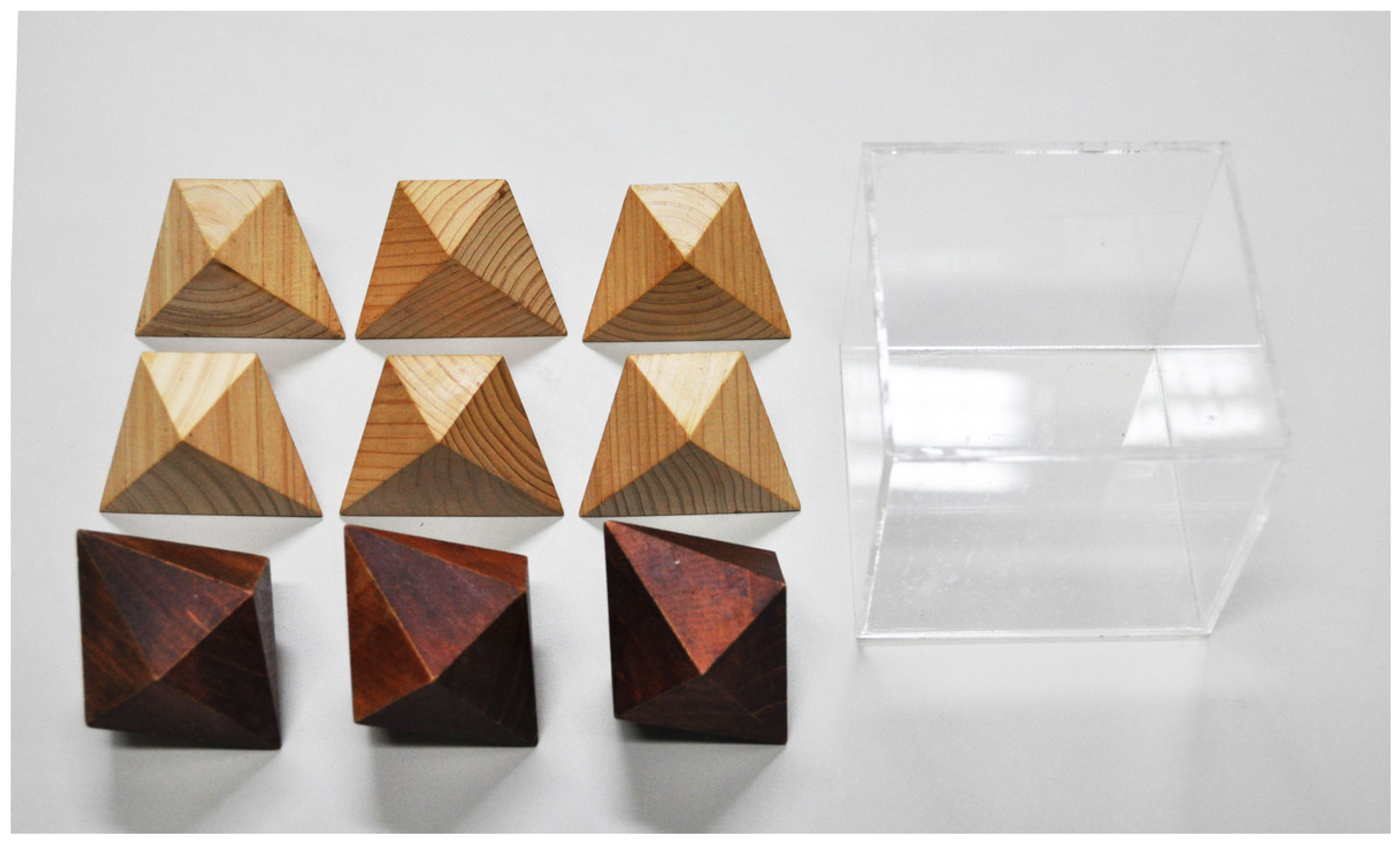
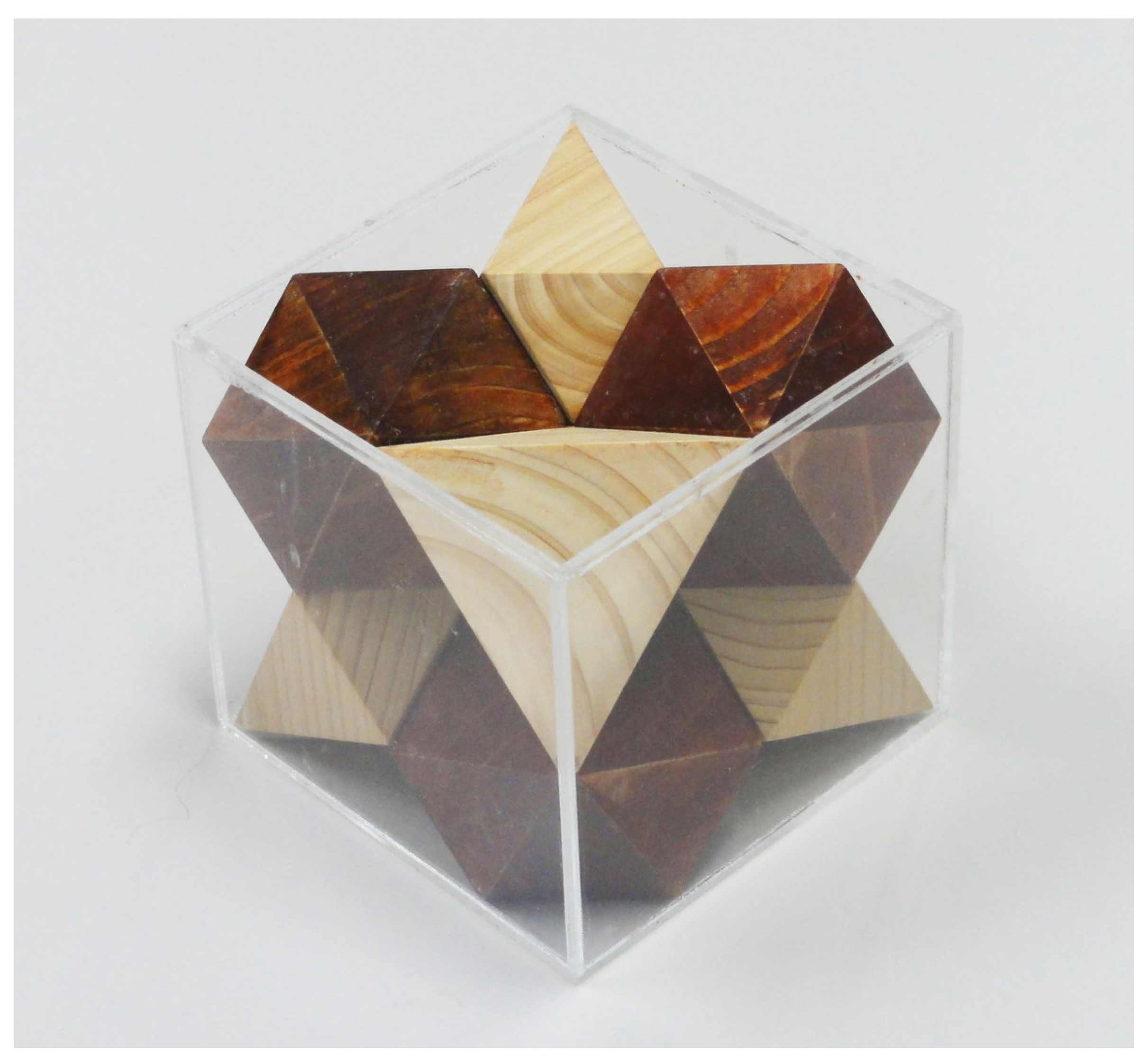
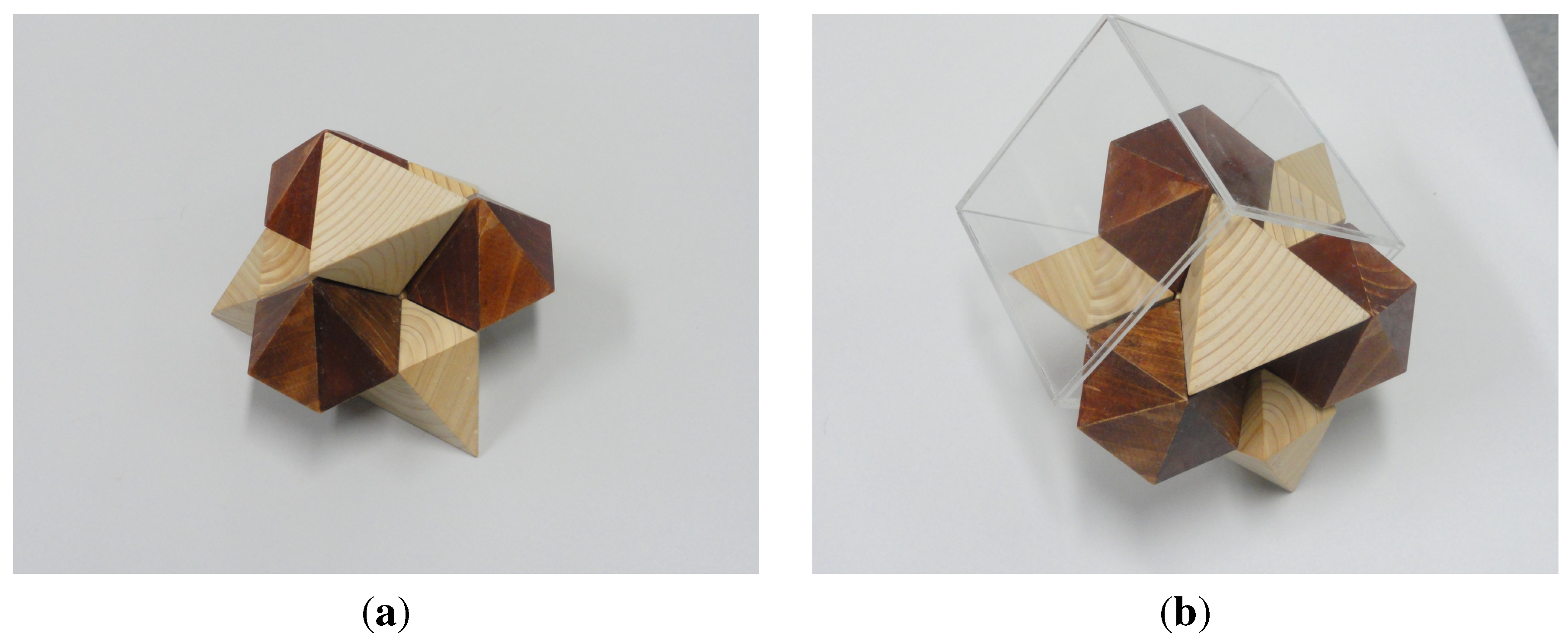
Among imaginary cubes, H and T have remarkable geometrical properties as we show in Section 3. The author designed an assembly puzzle based on them, which is called the imaginary cube puzzle 3H = 6T. The pieces of this puzzle are shown in Figure 4. We use three copies of H and six copies of T scaled as in Figure 2 and a cubic box with the side length 2. The objective of this puzzle is to put all the nine pieces into the box. Since H and T are imaginary cubes, it is immediate that one can put eight of them. Here, we have nine pieces and it forms a mathematical puzzle.
In this paper, we add constraints to the ways the pieces are put into the box so that it only has solutions with good geometrical properties. One is that if two pieces meet, then their intersection is a face or an edge or a vertex of both of the piece. It means that the collection of the pieces and their faces, edges, and vertices form a polytopal complex [1], and we call it the polytopal complex condition. Another one is that the union of the pieces forms a star-polyhedron with respect to the center point of the puzzle box. Here, a polyhedron Q is a star-polyhedron with respect to a point p if every line segment connecting p and a point of Q is contained in Q. We call it the star-polyhedron condition. Under these conditions, this puzzle has a unique solution up to the rotation of the cube. We analyze this solution based on geometrical properties of H and T in Section 4.
One of the remarkable properties of H and T is that they form a periodic tiling of 3D Euclidean space. In Section 5, we explain this tiling and show that our solution of the puzzle is a part of it. In Section 6, we also give variations of this puzzle which use other imaginary cubes presented in Section 2.
2. Minimal Convex Imaginary Cubes
We start with defining a (minimal convex) imaginary cube of a cube C.
Definition 1.
For a cube C, we say that an object is an imaginary cube of C if it has square projections in three orthogonal directions just as C has. We say that an object is a minimal convex imaginary cube of C if it is minimal among convex imaginary cubes of C with respect to the inclusion order. We say that an object is a (minimal convex) imaginary cube if it is a (minimal convex) imaginary cube of some cube.
Note that a minimal convex imaginary cube is not minimal among convex imaginary cubes with respect to the inclusion order because it contains an arbitrary small cube which is an imaginary cube. Therefore, we first fix a cube C and define a minimal convex imaginary cube of C in defining a minimal convex imaginary cube. Since an object is convex if it is the intersection of half-spaces where a half-space is one side of a plane, an object is a convex imaginary cube of C if it is obtained by cutting off C with planes so that it has the same square projection images as C. A convex imaginary cube of C is minimal if any more cut with a plane will destroy one of the three square projection images.
We fix a cube C and study the problem of characterizing minimal convex imaginary cubes of C. It is immediate that a convex object is an imaginary cube of C if and only if it is in C and has intersections with all the twelve C-edges. Therefore, a minimal convex imaginary cube of C is the convex hull of its intersection with the C-edges, which is a polyhedron. Thus, we have the observation that a minimal convex imaginary cube of C is a polyhedron such that all the vertices are on C-edges and each C-edge contains at least one vertex.
Since a minimal convex imaginary cube is a polyhedron, we only need to specify the set of vertices to identify it. Since each vertex is on a C-edge, vertices of a minimal convex imaginary cube of C are divided into two categories; v-vertices which are also vertices of C, and e-vertices which are not vertices of C. If an e-vertex and another vertex of a minimal convex imaginary cube are on the same C-edge, then we can remove the e-vertex to have a smaller convex imaginary cube of C and contradict to the minimality condition. Therefore, there is at most one e-vertex on each C-edge, and if there is a v-vertex on a C-edge, then there is no e-vertex on that edge.
In this way, each minimal convex imaginary cube P of C determines a subset S of vertices of C which is the set of v-vertices of P, and P has one e-vertex on each C-edge both of whose endpoints are not in S. Thus, we define equivalence of minimal convex imaginary cubes as follows.
Definition 2.
- (1)
- Two minimal convex imaginary cubes of C are equivalent if they have the same set of v-vertices.
- (2)
- Two minimal convex imaginary cubes of C are rotationally (or reflectively) equivalent if they are equivalent minimal convex imaginary cubes of C modulo rotations (or reflections) of C.
There are 256 subsets of the set of vertices of C and 23 subsets if we identify rotationally equivalent ones, and one can obtain a convex imaginary cube for each of them by selecting one e-vertex on each C-edge both of whose endpoints are not in S. However, not all the imaginary cubes obtained in this way are minimal. For a vertex a of C, we denote by the set of vertices which is composed of a and all the three adjacent C-vertices of a, and call it a star. If S contains a star , then an imaginary cube obtained in this way is not minimal because we have a smaller convex imaginary cube by removing a from the set of vertices. On the other hand, if S does not contain a star, then an imaginary cube obtained in this way is a minimal convex imaginary cube of C, because if we remove a vertex then there exists a C-edge without a vertex.
Theorem 3.
There is an one-to-one correspondence between equivalence classes of minimal convex imaginary cubes of C and subsets of C-vertices without a star.
Through the enumeration of such subsets, we have the following.
Corollary 4.
- (1)
- There are 183 equivalence classes of minimal convex imaginary cubes of a given cube C.
- (2)
- There are 16 equivalence classes modulo rotational equivalence.
- (3)
- There are 15 equivalence classes modulo reflective equivalence.
The cube-vertices column of Table 1 lists all the 16 subsets of C-vertices without stars modulo rotational equivalence. Note that No.10(L) and No.10(R) form a pair of mirror images and all the other ones have mirror symmetry.
Though some imaginary cubes are minimal convex imaginary cubes of two different cubes, such an imaginary cube is in the same equivalence class (No. 5) for both of the cubes, as we will explain in the next section. Therefore, we can say that there are 16 (or 15) equivalence classes of minimal convex imaginary cubes modulo rotational (or reflective) equivalence.
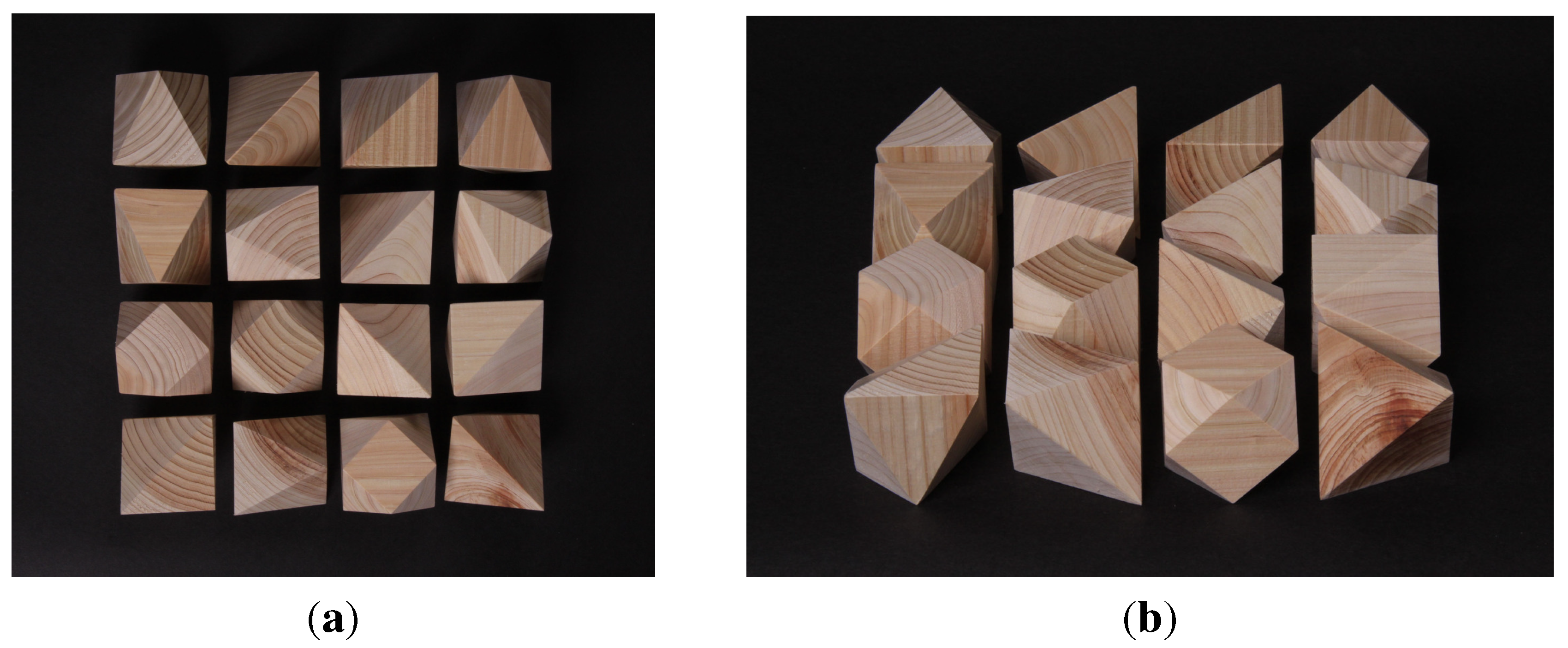
As in Table 1, we define a representative imaginary cube of each equivalence class by taking middle points of cube-edges as e-vertices. The two imaginary cubes H and T appear as the representative imaginary cube of No. 5 and No. 8, respectively. This choice of the representative is natural in that the rotation group (or the full symmetry group) of such an imaginary cube is bigger or equal to that of the corresponding cube with the v-vertices colored. Note that they are not equal for H as we will explain in the next section in detail. Note that No.10(L) and No.10(R) have rotational symmetry though they do not have mirror symmetry. The nets of the 16 representatives of minimal convex imaginary cubes are available from the author’s homepage [2]. Figure 5 shows wooden models of all the 16 representatives. A sculpture which uses all of these wooden pieces is presented in [3].
3. Properties of H and T
We show some geometrical properties of H and T.
As Figure 2(a) shows, the dodecahedron H has 6-fold symmetry around the line connecting the two v-vertices, whereas the surrounding cube has 3-fold symmetry around the same line. Consequently, this object can be put into the cube in two different ways modulo rotations of the cube and it has square projections not in three but in six ways. We call an imaginary cube a double imaginary cube if it is an imaginary cube of two differently oriented cubes. This dodecahedron is a double imaginary cube and the two cubes of which it is an imaginary cube share a pair of opposite vertices and one cube is obtained by rotating the other one by 60 degrees. Note that this double imaginary cube is the intersection of the two cubes. It means that it is a maximal double imaginary cube as well as a minimal one and therefore it is the only convex double imaginary cube of the two cubes. The rotation group of this imaginary cube is the dihedral group of order 12, which is not a subgroup of the rotation group of a cube; half of the rotations of this object map one cube to the other cube. Note that the same two vertices are cube-vertices in both of the ways of putting it into a cube and therefore the notion of a v-vertex is well-defined. A sculpture based on a pre-fractal of a fractal object based on H is presented in [4,5].
More generally, consider the intersection of two different cubes which share a pair of opposite vertices. We have a dodecahedron which is a convex double imaginary cube of the two cubes as Figure 6 shows. It belongs to the equivalence class No. 5 as minimal convex imaginary cubes of both of the cubes. In the next proposition, we show that all the convex double imaginary cubes have this form.
Proposition 5.
Every convex double imaginary cube is the intersection of two different cubes which share a pair of opposite vertices.
Proof.
Consider a maximal double imaginary cube A of two different cubes C and D. A is the intersection of C and D, and every edge of C intersects with D and vice versa. Suppose that no vertex of C is on one side of a plane F containing a face of D. Then, in order that the four edges of D on F intersect with C, a face of C is contained in F or an edge of C contains two opposite vertices of D on F, from both of which one can easily derive a contradiction. Therefore, each face of D truncates a vertex of C to form a triangular face of A. Since A is also obtained by truncating D with six faces of C, one can see that A is a dodecahedron with twelve triangular faces. Since a square face P of D is cut into a triangle Q so that all the four edges of P contain a vertex of Q, one vertex p of P is a vertex of Q. Since it holds on the other faces of D which share the vertex p, one can see that p is a common vertex of C and D. Through the same argument on other faces of D, we have another shared vertex. Therefore, C and D share a pair of opposite vertices. Since this double imaginary cube is minimal as well as maximal, all the double imaginary cubes have this form. □
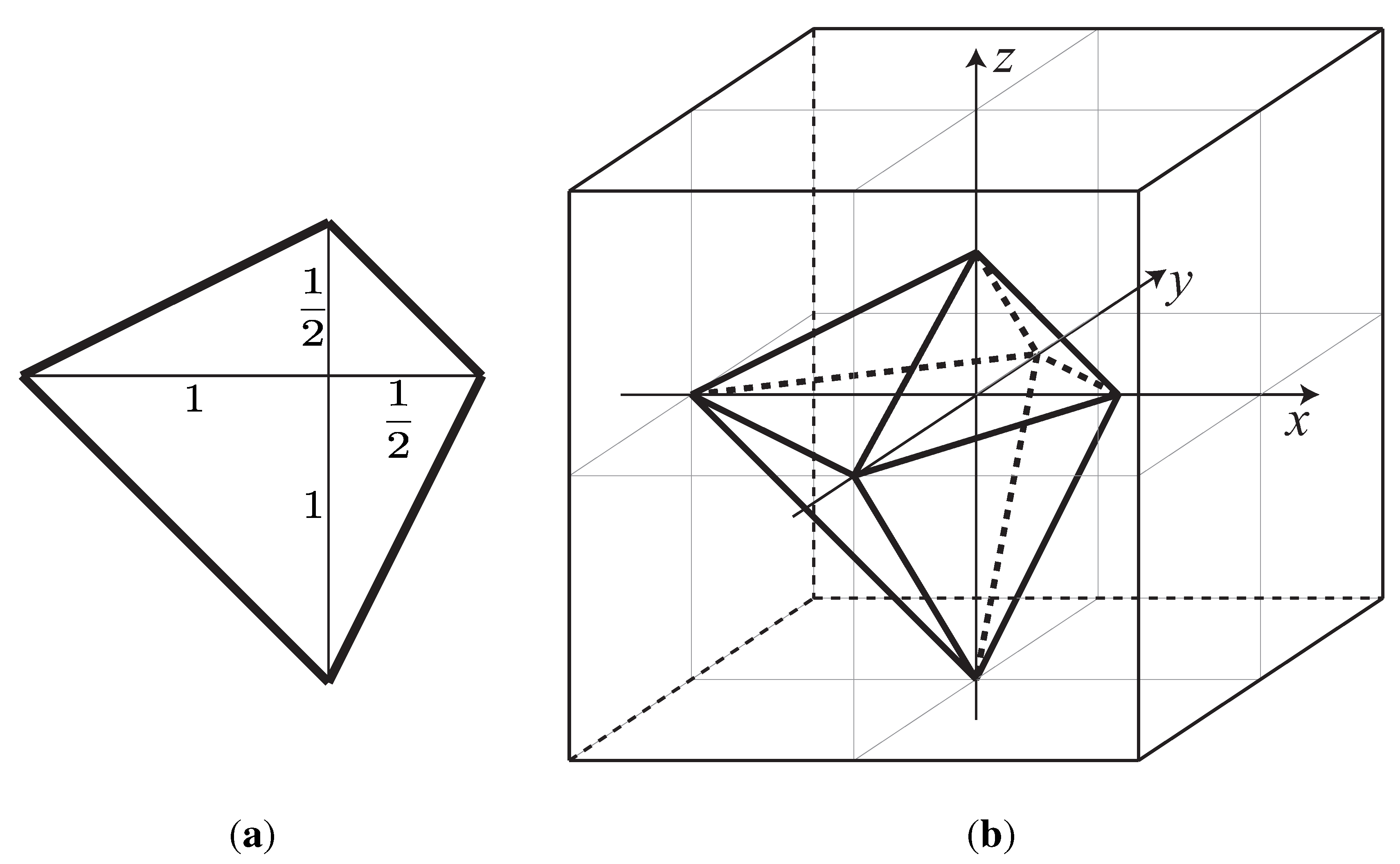
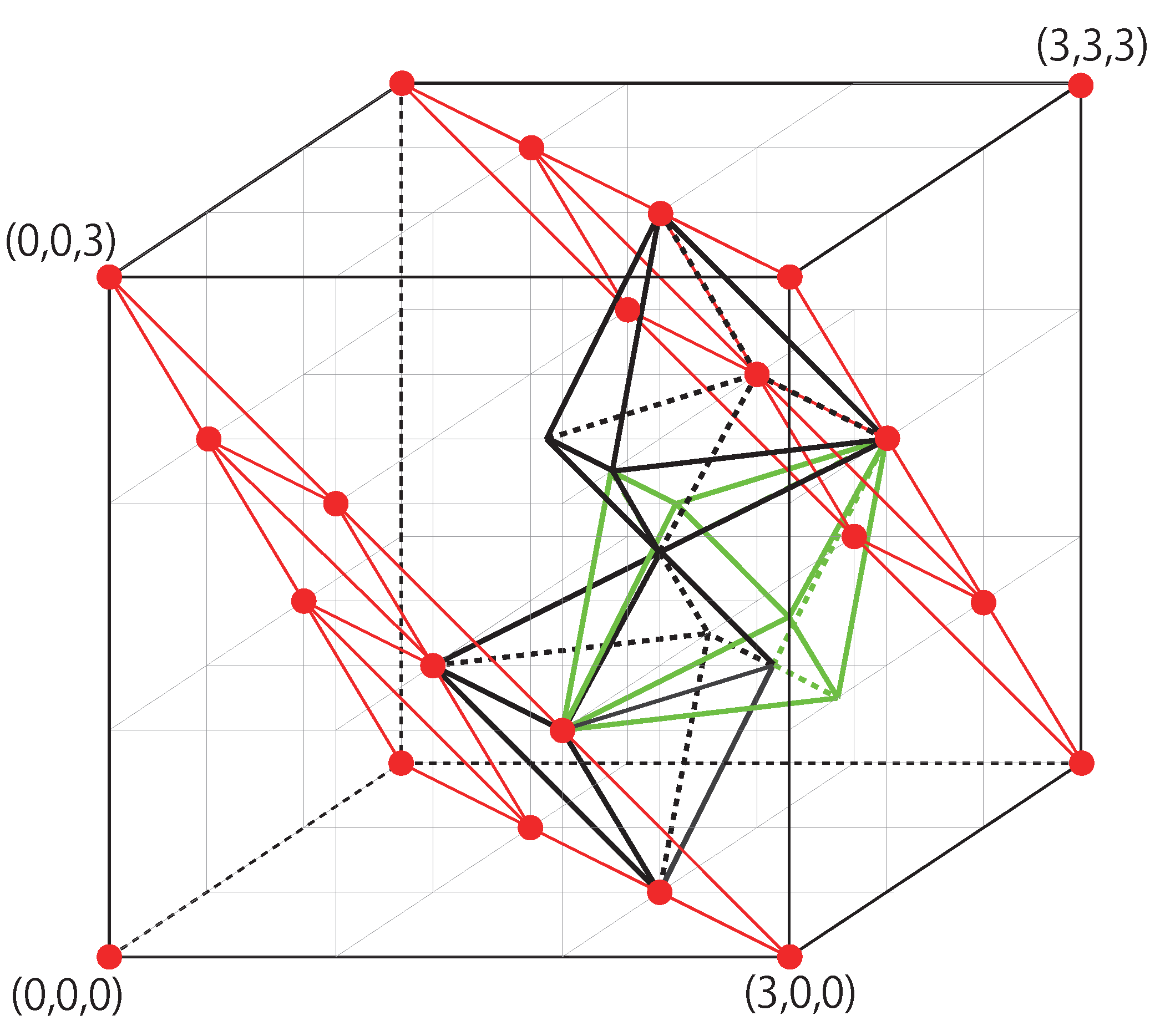
Next, we study the octahedron T. One can see through an easy calculation that the three diagonals connecting two opposite vertices intersect at one point and are orthogonal to each other. In addition, the intersection point divides each of the diagonals by the ratio of 1:2. Therefore, four vertices of T share one plane and we have the plane section in Figure 7(a). This means that one can place T at the origin of the orthogonal coordinate system so that the three v-vertices are on the negative sides of the three axes of coordinates and the three e-vertices are on the positive sides so that the distance from the origin to a v-vertex is twice of that from the origin to an e-vertex, as Figure 7(a) shows. Note that if all the six vertices had the same distance from the origin, then it would be a regular octahedron. Moreover, one can see that the distance from the origin to a v-vertex (i.e., the length 1 in Figure 7(a)) is equal to the length of an edge of the cube of which it is an imaginary cube. Therefore, a copy of T can be put into a cubic box as an imaginary cube and at the same time it also fits on a vertex of a cubic lattice (Figure 7(b)). This fact is the key to the solution of the puzzle.
As a final observation, we study shapes of the faces of H and T. All the faces of H and T are triangles. H has only one kind of faces with one v-vertex and two e-vertices, which we denote by (v, e, e) specifying the kinds of the three vertices. When it is put in a cube, six of the faces are parts of original cube faces and six of them are obtained through truncations of vertices. T has four kinds of faces, which can be denoted by (v,v,v), (v,v,e), (v,e,e), and (e,e,e). Note that they are all the four ways of truncating a vertex of a cube by planes which pass through adjacent vertices or middle points of edges. When a copy of T is put in a cube, faces of type (v,e,e) are cube faces and the others are truncations of vertices.
4. Solutions of the 3H = 6T Puzzle
Now, let us go back to the 3H = 6T puzzle. Recall that it is clear that one can place eight of the pieces into the box and our question is how can we put nine of them. We consider a coordinate system with the origin the center of the box. For , we denote by the unit cube which is the intersection of the box and the corresponding octant. As we have observed, a copy of T can be placed at the center of the box so that its v-vertices are on , and and e-vertices are on , and , as in Figure 7(b). We say that two congruent objects have the same direction if one is mapped to the other one by a translation. We denote by copies of T with the same direction as this central piece.
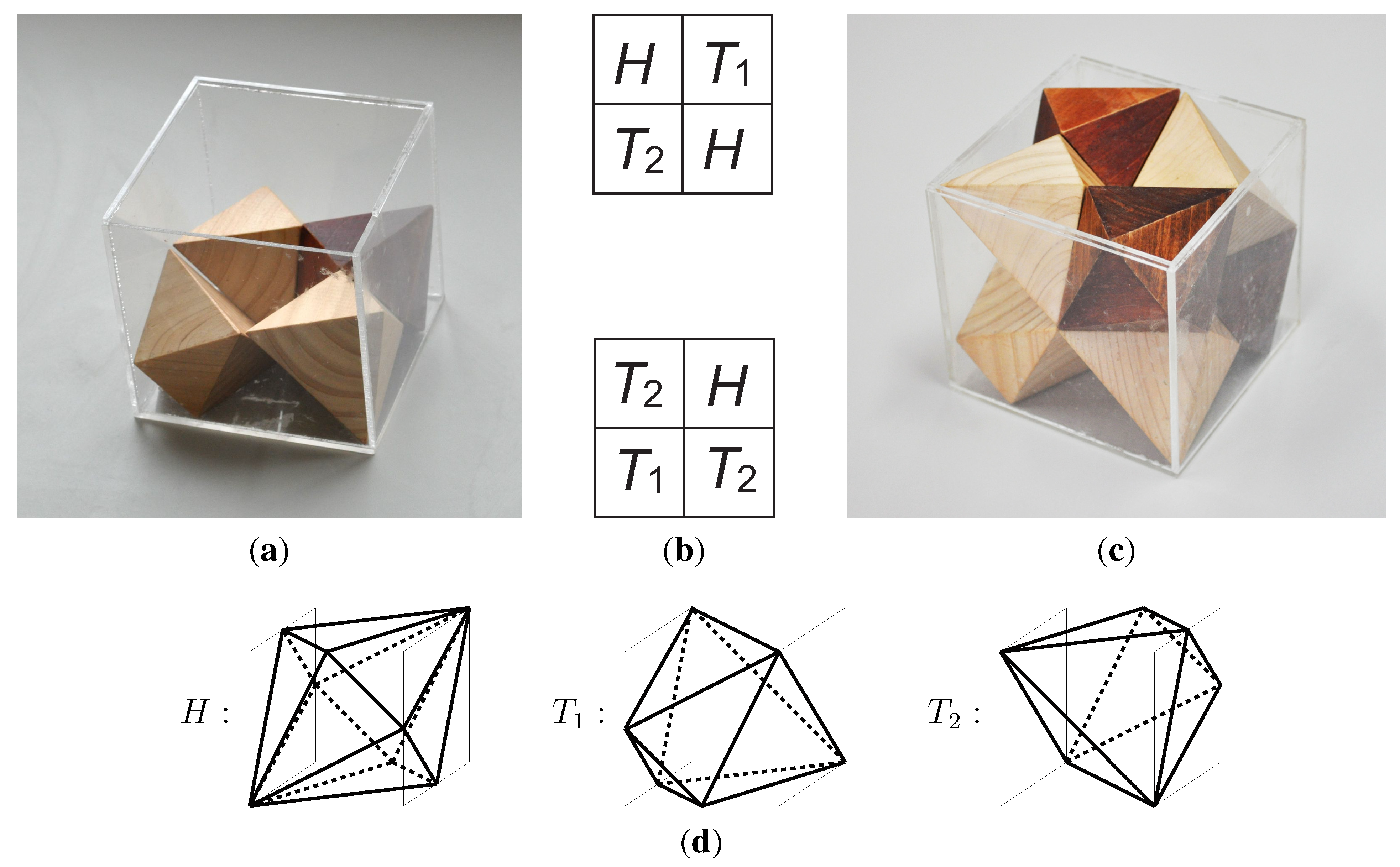
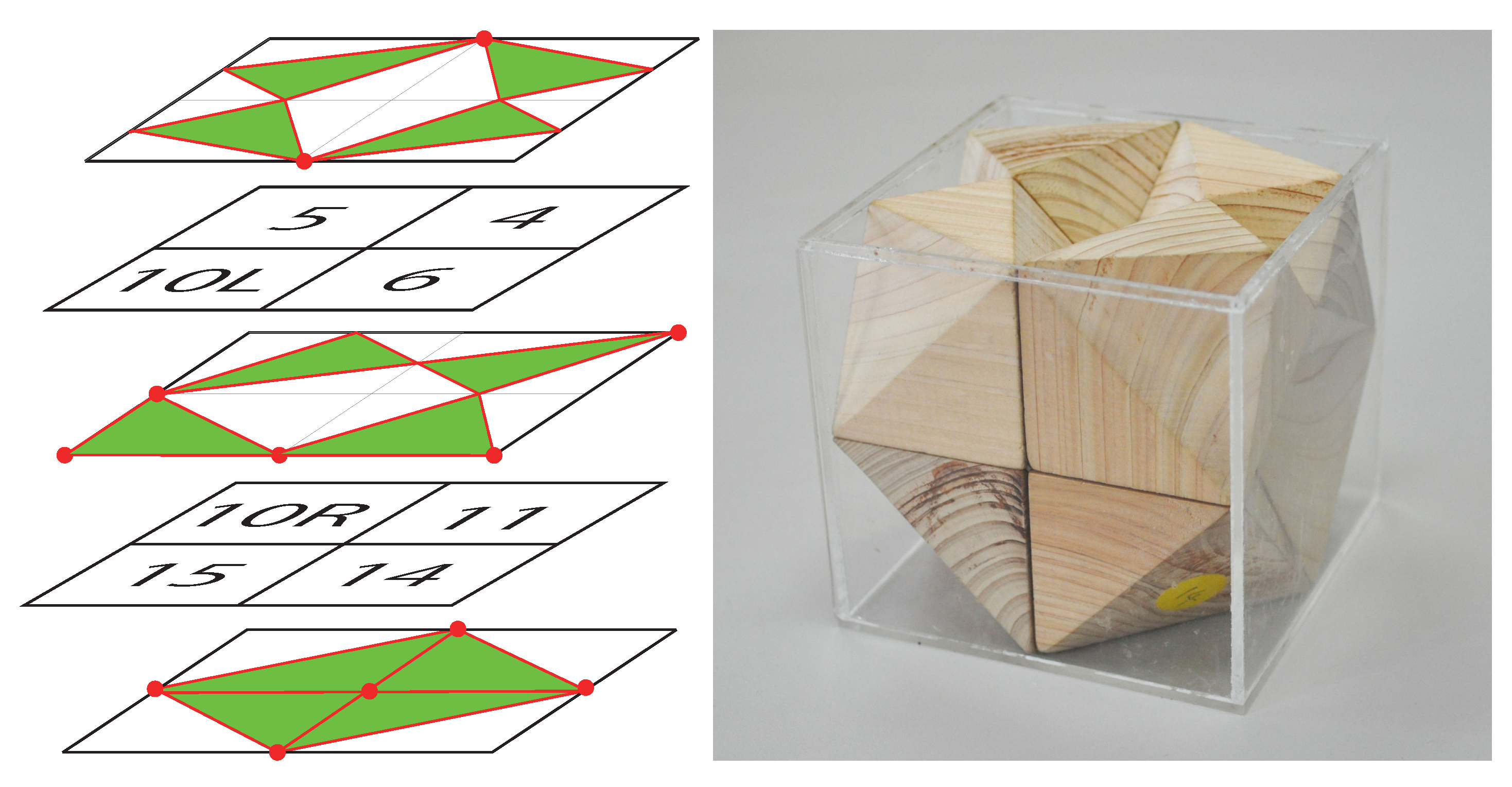
One can see that the eight faces of this copy of exist in all the eight unit cubes. Therefore, the eight cubes are truncated by this object. The cube is truncated by an (e, e, e) face, is truncated by a (v, v, v) face, , , and are truncated by (v, v, e) faces, and , , and are truncated by (v, e, e) faces. On the other hand, as we observed in the previous section, T is obtained by truncating a cube with faces of type (v, v, v), (e, e, e), and (v, v, e), and H is obtained by truncating a cube with faces of type (v, e, e). Therefore we can put five copies of T and three copies of H in the corresponding truncated cubes to form a solution (Figure 8(c)).
Copies of T in and have the same direction which is opposite to ( in Figure 8(d)). The three copies of T in , , and have the same direction which is obtained by rotating by 60 degrees around its 3-fold rotational axis ( in Figure 8(d)). The three copies of H have the same direction (H in Figure 8(d)). The directions of the eight pieces are shown in Figure 8(b).
This solution has the 3-fold symmetry as Figure 9 shows. It is immediate from this construction that it satisfies the star-polyhedron condition. One can also see that it has the polytopal complex condition. Note that this is the only solution extending the central piece under both of the conditions. Since we have eight ways of placing the central piece, we have eight rotationally equivalent solutions.
We prove the uniqueness of this solution under the two conditions. We start with the following observation.
Lemma 6.
- (1)
- If two copies of H are connected through a (v, e, e) face, then it is impossible to fill with puzzle pieces the grooves around the three shared edges.
- (2)
- If two copies of T are connected through a (v, e, e) face, then it is impossible to fill with puzzle pieces the grooves around the three shared edges so that they satisfy the polytopal complex condition.
Theorem 7.
Under the polytopal complex condition and the star-polyhedron condition, this is the only solution of the puzzle modulo rotations of the cube.
Proof.
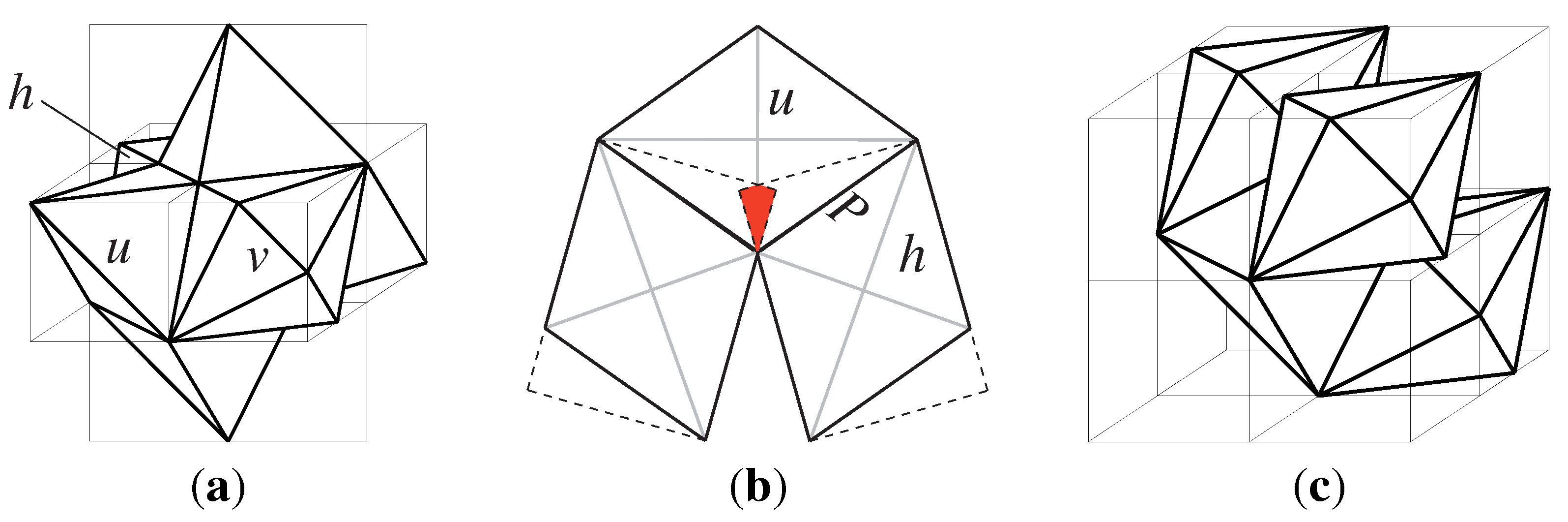
We denote by O the center of the box. It is immediate that O is not shared by all the three copies of H in a solution. Therefore, consider a copy h of H which does not contain O. Since the distance from the center of an H piece to each of its face is 1/2, the center of h is located in the unit cube with the center O, and the distance from O to the center of h is no more than . Let P be a face of h which the line segment between O and the center of h passes. By the star-polyhedron condition and the polytopal complex condition, there is a piece u which share the face P with h. We consider two cases. Case A: suppose that u is a copy of H. Then, by Lemma 6(1), it is impossible to fill the grooves around the three shared edges between u and h. Therefore, by the star-polyhedron condition, O needs to be in the tetrahedron which is truncated by P from a cube in which h is placed. In particular, O must be in the interior of u. Case B: suppose that u is a copy of T. Since the line segment between O and the center of h passes through P and its length is no more than , O must be in u or in a piece v which is connected with u through a (v, e, e) face. If O is in v and v is T, two T pieces are connected through a (v, e, e) face and we can easily derive contradiction by Lemma 6(2) and the star-polyhedron condition. If O is in v and v is H, by applying the star-polyhedron condition on line segments between O and points in h, it is determined how four copies of T and two copies of H are connected (Figure 10(a)). One can see that it is impossible to put this block of six pieces into the puzzle box. Therefore, O is contained in u. In this way, for both of the cases A and B, O is contained in u. Suppose again that u is a copy of H. Then, there is another copy of H which does not contain O because O is in the interior of u. By applying the same argument to , since O is in u which is not T, Case B does not happen, and we can conclude that the three H are connected and O is in the intersection of two tetrahedra and , each of which has a face of u as a base. Such an area exists only if the three H pieces share a common edge of length , and this area is depicted in Figure 10(b) with red color. Thus, by calculating the distance from O, it is impossible to put a copy of T on a face of h or , and therefore at least one copy of T must be connected with u. However, whichever set of faces of u we select as the faces through which copies of T are connected, the union of the pieces is not a star-polyhedron. Therefore, u is not a copy of H and u is a copy of T. Then, by applying the arguments of Case B to the other two copies of H, we can see that three copies of H are connected with u (Figure 10(c)). If we put the block of these four pieces into the box so that u contains O, then its position is uniquely determined up to the rotation of the box, and one can uniquely extend it to the solution of the puzzle.
□
The author conjectures that, with only one of the two conditions, this is the only solution of the puzzle. If we do not impose both of the conditions, then we have solutions by rotating copies of T in the cubes , , , . We also obtain a solution by swapping T in and one of the H pieces. It is also conjectured that they are all the solutions of this puzzle, and therefore in all the solutions, there is a central T piece located as in Figure 7(b) and the other eight pieces are located in the eight unit cubes.
5. Three-Dimensional Tiling with H and T
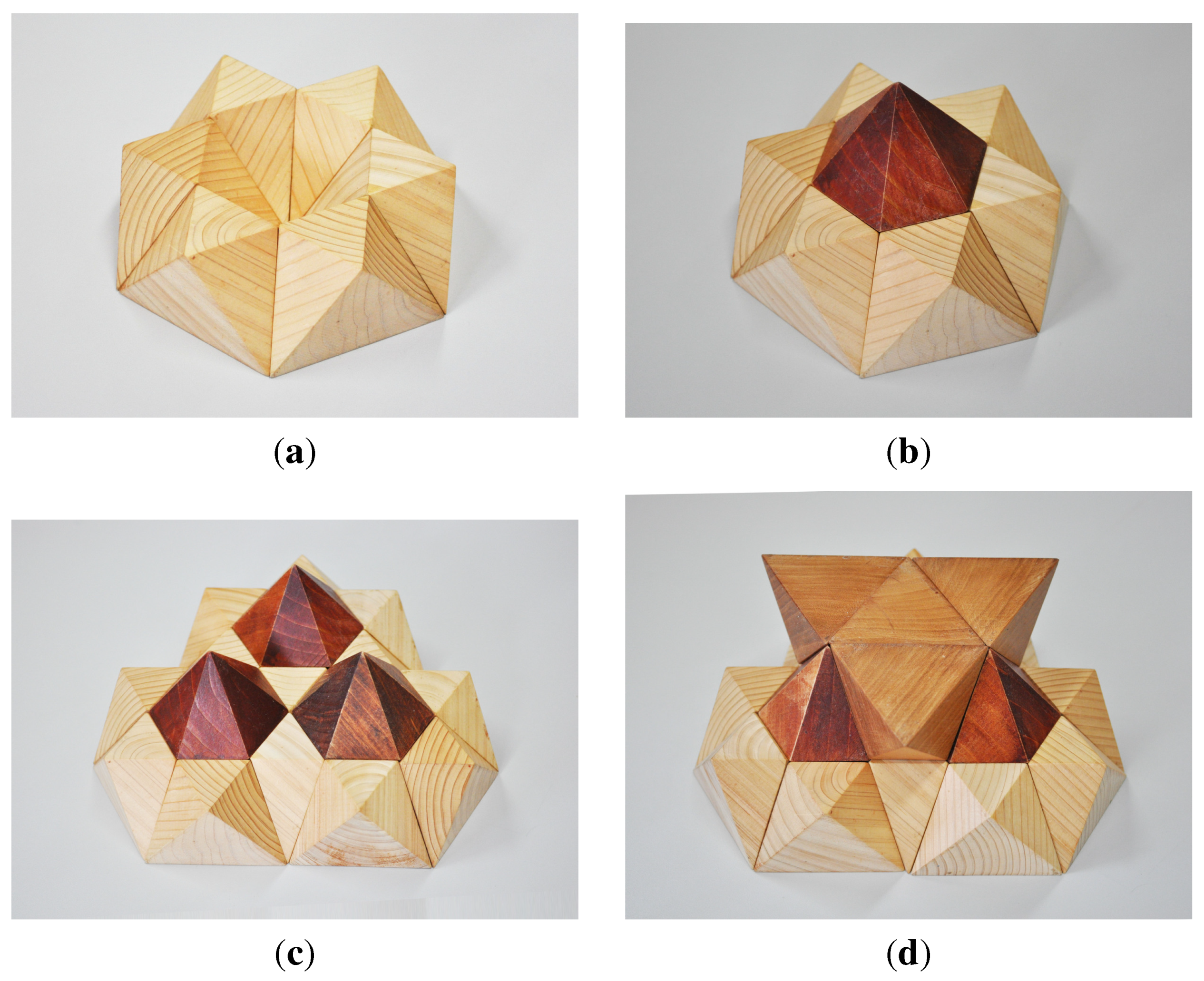
One can extend this solution of the puzzle to a tiling of 3D Euclidean space with H and T. First, we can arrange six copies of T so that they form a hexagonal pyramid hole to which H fits in as Figure 11(a,b) show. This configuration can be extended as Figure 11(c) shows, and we can form a trihexagonal tiling pattern if we continue it infinitely. By adding horizontally-flipped copies of T, we have a tiling of a region between two parallel planes. Thus, by repeating it infinitely, we can form a tiling of the three-dimensional space. As this construction shows, there are infinitely many ways of tiling the space with H and T by sliding each region between parallel planes arbitrary. Among them, we are only interested in the case where triangular tessellation patterns on the planes coincide.
Note that this three-dimensional tiling has a 6-fold symmetry around a line connecting the two v-vertices of a copy of H. The symmetry group of this tiling is the product of the infinite dihedral group and the symmetry group of the trihexagonal tiling. As Figure 12 shows, a block of pieces with three H and six T taken from this tiling forms the solution of our puzzle.
We view this tiling more directly as an extension of our solution of the puzzle. For integers , we denote by the unit cube with a pair of diagonal vertices and . We consider a cubic lattice each of whose unit cubes contains one copy of H, , and . Copies of H are put in such that for an integer k. Copies of and are assigned in such that and for an integer k, respectively. With this assignment, at each vertex of the lattice, eight v-vertices in the surrounding cubes meet or no v-vertices exist. V-vertices meet at those lattice vertices on planes for integers k, which are indicated in Figure 13 with red marks.
Since an e-vertex of a piece exists on a cube-edge both of whose endpoints are not v-vertices, for each cube-edge, all the four cubes surrounding it share an e-vertex on the middle point or there is no e-vertex on it. Therefore, at those lattice vertices without v-vertices, we have an octahedral open space, which has the form of T. There are two directions of them. We have holes of the direction at with , and of the direction which is the opposite of at with . Therefore, by filling the holes with copies of T, we have the tiling. A solution of the puzzle is obtained by selecting the pieces contained in the -box with a pair of diagonal vertices and .
Thus, we have two explanations for the same three-dimensional tiling. One important thing is that the tiling has a 6-fold symmetry whereas the cubic lattice has a 3-fold symmetry. The line is an axis of the 6-fold symmetry, and by the 60-degree rotation around this axis, a -piece is mapped to a piece, a piece is mapped to a piece, and a H piece is mapped to a H piece. We denote by the cubic lattice of the centers of the unit cubes. We call the center of the surrounding cube of a piece the center of the piece. In this tiling, centers of H, , and pieces form the lattice . If we rotate this lattice by 60-degrees around the axis , then we have a cubic lattice of centers of H, , and pieces which we denote by . Thus, the set of centers of pieces of this tiling is the union of the two lattices, and the set of centers of H pieces is the intersection of two lattices. On the other hand, for each face of both polyhedra, the distance from the center to the face is determined only by the shape of the face. Therefore, for each pair of pieces which share a face, the common face is the perpendicular bisector of the line segment connecting the centers of the pieces. It means that this tiling is the Voronoi tessellation of the union of the two cubic lattices. We set the origin of at the center of and state this result as follows.
Theorem 8.
Let be the cubic lattice and be the cubic lattice obtained by rotating it around the axis by 60 degrees. The Voronoi tessellation of is a periodic tiling of 3D Euclidean space with H and T, where Voronoi cells at are copies of H and others are copies of T.
6. Other Imaginary Cube Puzzles
We can consider a similar puzzle to put nine pieces of imaginary cubes into a cubic box for different sets of imaginary cube pieces which contains at least one T. As we have seen in Section 2, for each subset S of the eight vertices of a cube C, we can form a convex imaginary cube of C by adding to S middle points of those edges which do not contain a vertex in S and taking the convex hull. Since there are 23 subsets of cube-vertices modulo rotations of the cube, we can form 23 corresponding imaginary cubes and this set contains T. Therefore, we can consider a puzzle to select 9 pieces from the 23 imaginary cube pieces constructed in this way and fill them into the puzzle box.
The author conjectures that all the solutions of the puzzle satisfy the condition that eight pieces are located in the eight unit cubes. We add this condition in addition to the polytopal complex condition and the star-polyhedron condition, and consider the problem of enumerating the solutions. As for the previous puzzle, we consider a coordinate system with the origin the center of the box.
It is easy to show that there is an octahedron piece with six vertices on the middle points or the endpoints of the six outgoing edges from the origin. Since T is the only one satisfying this condition among the 23 pieces, T is located at the center of the box as for the 3H = 6T puzzle. For each of the 27 vertices in the box, it is a v-vertex of all the pieces in the surrounding unit cubes or it is not a vertex of any piece. Therefore, each solution is determined by the set of v-vertices selected from the 27 vertices. Since we have T at the center, three of the centers of the faces of the box are v-vertices and the other three and the center of the cube are not. We fix as v-vertices and as non-v-vertices. By selecting v-vertices from the other 20 so that we have different imaginary cubes other than T in the eight unit cubes, we obtain a solution. The author wrote a computer program which generates all the subsets and verifies this condition, and obtained the number . Therefore, there are solutions and, since there are six rotations and reflections of the cube which do not change the central T piece, we have solutions if we identify rotationally or reflectively equivalent ones.
We can also consider the set of 16 representative minimal convex imaginary cubes in Table 1 as the puzzle pieces. Since T is included in this set, we can enjoy the same puzzle with these 16 pieces. We find solutions in all, and 811 solutions modulo rotational and reflective equivalence. Figure 14 shows one of the solutions of this puzzle.
7. Concluding Remarks
One can also consider the same kind of question for a regular octahedron. That is, to characterize three dimensional objects which have square projections in three orthogonal directions just like a regular octahedron has. Every “imaginary regular octahedron” of a given regular octahedron must be in the intersection of the three right square prisms defined by the three square appearances, and this intersection is a rhombic dodecahedron. Therefore, a rhombic dodecahedron is the maximal imaginary regular octahedron. On the other hand, every imaginary regular octahedron of a given regular octahedron must contain the six vertices of the regular octahedron. Therefore, a regular octahedron is the only minimal convex imaginary regular octahedron.
We have had a lot of experiences with the 16 minimal convex imaginary cubes and the 3H = 6T puzzle through workshops and other occasions. We usually proceed as follows. First, we show that there are three H pieces and six T pieces and ask a guest to put each of them into the unit cube box to give the idea of imaginary cubes. Then, ask him/her to put all the pieces into the puzzle box, and if he/she succeeds, we add the condition that pieces touch face to face, which is an informal way of expressing the polytopal complex condition. If he/she does not succeed, we place the lower four pieces as a hint and ask the guest to place the central T piece. We also ask him/her to enjoy the 3D tiling with H and T and we explain properties of T to show how the central T piece is located.
The author supposes that it is a somewhat difficult puzzle without a hint and that the puzzles in Section 6 would be more difficult, even though there are more solutions possible, because one needs to find that T is a special piece among all the pieces. He thinks that 3H = 6T is an attractive puzzle though which one can study interesting geometrical properties of the two imaginary cubes H and T.
Acknowledgements
The author thanks Kei Terayama, who invented the name “Imaginary Cube” and constructed the PDF files of the nets of the 16 representatives. He thanks Hiroshi Nakagawa for his making the puzzle pieces by woodcraft and Megumi Itoh of Kyoto University Museum Shop Musep for producing [6]. He also thanks the referees for valuable comments and suggestions.
References
- Ziegler, G.M. Springer: Berlin, Heidelberg, Germany, 1995.
- Tsuiki, H. A webpage on Imaginary Cubes. Available online: http://www.i.h.kyoto-u.ac.jp/~tsuiki/index-e.html (accessed on 23 April 2012).
- Tsuiki, H. Imaginary Cubes—Objects with Three Square Projection Images. In Bridges Pecs: Mathematics, Music, Art, Architecture, Culture, Conference Proceedings; Hart, G., Sarhagi, R., Eds.; Tessellations Publishing: Phoenix, USA, 2010; pp. 159–166. [Google Scholar]
- Tsuiki, H. Does it Look Square?—Hexagonal Bipyramids, Triangular Antiprismoids, and their Fractals. In Proceedings of Conference Bridges Donostia—Mathematical Connections in Art, Music, and Science; Sarhagi, R., Barrallo, J., Eds.; Tarquin publications: Hertfordshire, UK, 2007; pp. 277–286. [Google Scholar]
- Tsuiki, H. SUDOKU Colorings of the Hexagonal Bipyramid Fractal. In Computational Geometry and Graph Theory, International Conference KyotoCGGT 2007 Revised Selected Papers; Ito, H., Kano, M., Katoh, N., Uno, Y., Eds.; Springer: Berlin, Heidelberg, Germany, 2008; Lecture Notes in Computer Science; Volume 4535, pp. 224–235. [Google Scholar]
- Tsuiki, H. Imaginary Cube Puzzle 3H = 6T. [A book with the 3H = 6T puzzle, in Japanese.]; Active Kei: Kyoto, Japan, 2012. [Google Scholar]
Figure 1.
(a) A cuboctahedron; (b) a regular tetrahedron—the best-known imaginary cubes.

Figure 2.
Two imaginary cubes; (a) H (hexagonal bipyramid); (b) T (triangular antiprismoid).

Figure 3.
The objects H and T can be put into a cubic box. See also No. 5 and No. 8 of Table 1.
Figure 3.
The objects H and T can be put into a cubic box. See also No. 5 and No. 8 of Table 1.

Figure 4.
The nine pieces and the box that make up the imaginary cube puzzle 3H = 6T.

Figure 5.
(a) Wooden imaginary cubes; (b) The same as (a) from a different inclination. Woodworks by Hiroshi Nakagawa.
Figure 5.
(a) Wooden imaginary cubes; (b) The same as (a) from a different inclination. Woodworks by Hiroshi Nakagawa.

Figure 6.
Double imaginary cubes obtained as the intersection of two cubes. One cube is obtained by rotating the other one by (a): 60 degrees, (b): 42 degrees.
Figure 6.
Double imaginary cubes obtained as the intersection of two cubes. One cube is obtained by rotating the other one by (a): 60 degrees, (b): 42 degrees.

Figure 7.
(a) A plane section of T; (b) The central piece of this puzzle.

Figure 8.
(a) The lower four pieces of the solution; (b) The locations of H, , and pieces with the lower (upper) square showing the lower (upper) four unit cubes, respectively; (c) The solution of this puzzle; (d) Copies of H and T with directions H, , and .
Figure 8.
(a) The lower four pieces of the solution; (b) The locations of H, , and pieces with the lower (upper) square showing the lower (upper) four unit cubes, respectively; (c) The solution of this puzzle; (d) Copies of H and T with directions H, , and .

Figure 9.
The solution looked at from a vertex.

Figure 10.
(a) A block of 6 pieces; (b) Three copies of H which share an edge projected along the common edge; (c) A block of 4 pieces.
Figure 10.
(a) A block of 6 pieces; (b) Three copies of H which share an edge projected along the common edge; (c) A block of 4 pieces.

Figure 11.
A tiling of the 3D Euclidean space with H and T.

Figure 12.
(a) Three H and five T pieces are in this picture. We consider a block obtained by adding one more copy of T at the bottom with the same direction as the copy on the top; (b) We can put this block into the puzzle box.
Figure 12.
(a) Three H and five T pieces are in this picture. We consider a block obtained by adding one more copy of T at the bottom with the same direction as the copy on the top; (b) We can put this block into the puzzle box.

Figure 13.
V-vertices of the three dimensional tiling with H and T with , , and H pieces.

Figure 14.
A solution of the puzzle of minimal convex imaginary cubes.


Table 1.
The 16 (or 15) representatives of minimal convex imaginary cubes.
 |
© 2012 by the author; licensee MDPI, Basel, Switzerland. This article is an open access article distributed under the terms and conditions of the Creative Commons Attribution license (http://creativecommons.org/licenses/by/3.0/.)
Share and Cite
MDPI and ACS Style
Tsuiki, H. Imaginary Cubes and Their Puzzles. Algorithms 2012, 5, 273-288. https://doi.org/10.3390/a5020273
AMA Style
Tsuiki H. Imaginary Cubes and Their Puzzles. Algorithms. 2012; 5(2):273-288. https://doi.org/10.3390/a5020273
Chicago/Turabian StyleTsuiki, Hideki. 2012. "Imaginary Cubes and Their Puzzles" Algorithms 5, no. 2: 273-288. https://doi.org/10.3390/a5020273
APA StyleTsuiki, H. (2012). Imaginary Cubes and Their Puzzles. Algorithms, 5(2), 273-288. https://doi.org/10.3390/a5020273