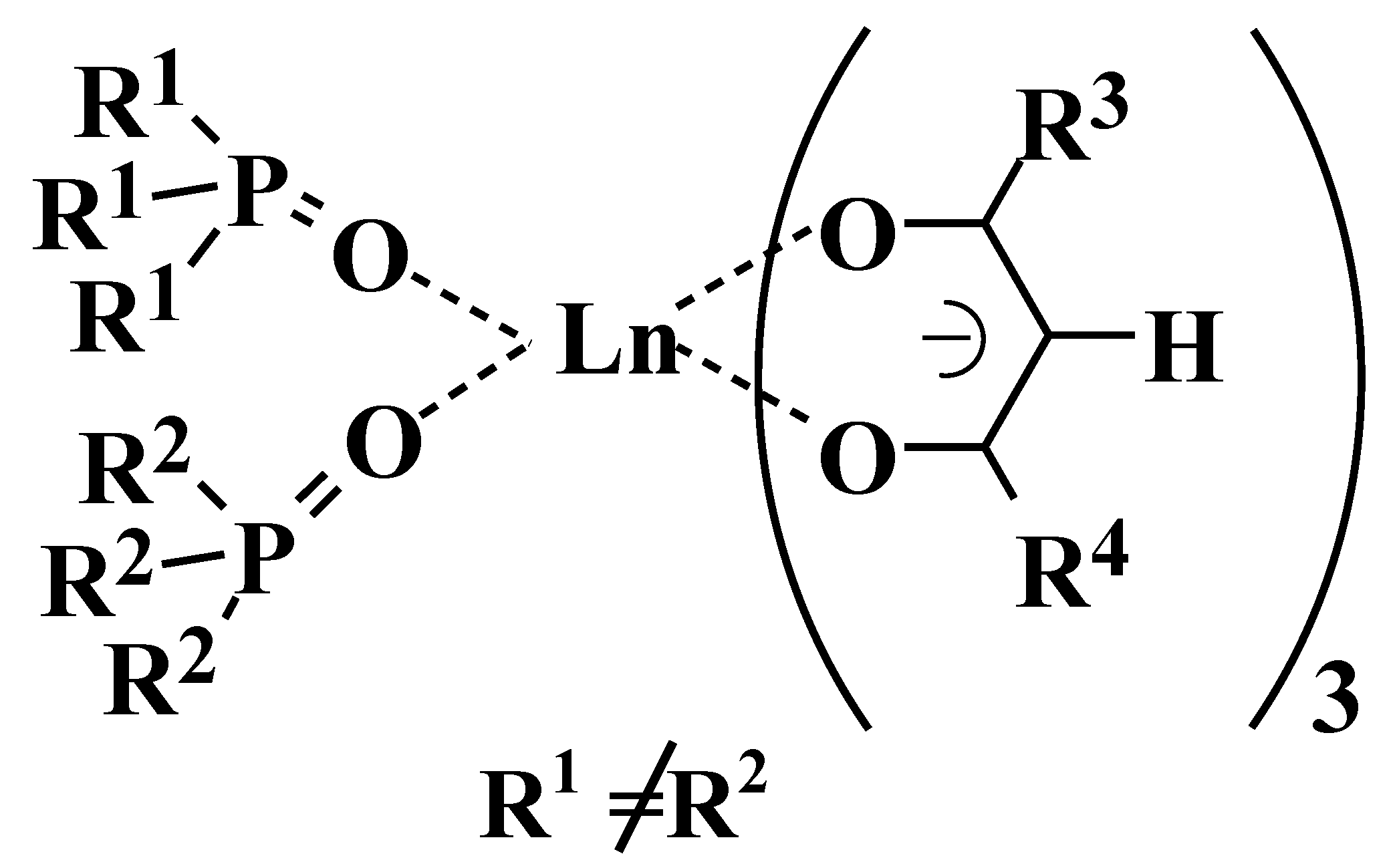
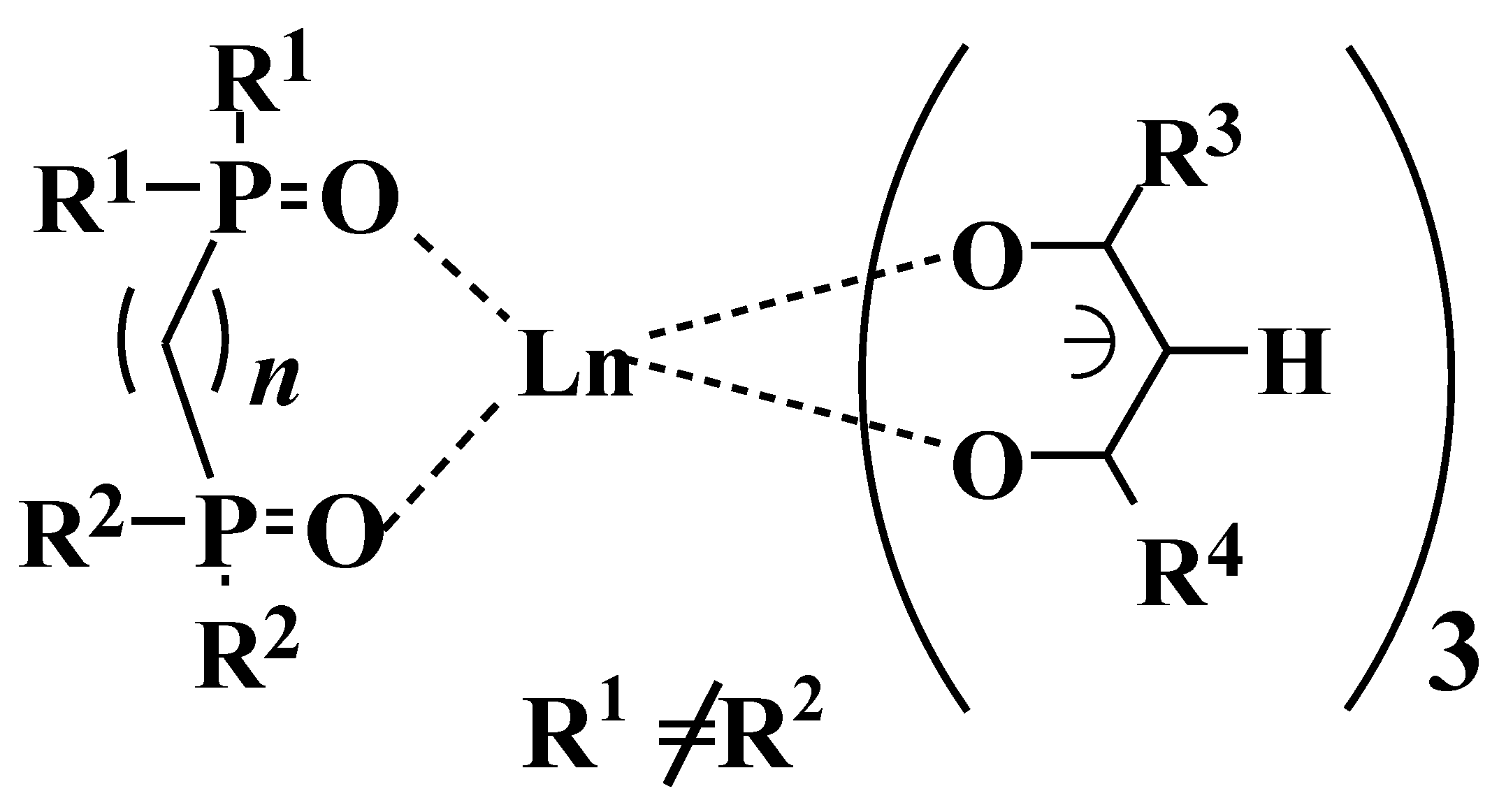
2.2. Emission intensity of Eu(III) complexes with two different phosphine oxides
Emission intensity is a property that is proportional with both the absorption coefficient and the quantum yield of luminescent materials. Emission intensity is the index of performance for luminescent materials when they are irradiated by a fixed energy of light, and is a practical number for evaluating the potential of the usability of a complex for emission devices. When the excitation wavelength is settled on the maximum wavelength of LED chips, the relative emission intensity implies the performances of the luminescent materials when they are applied to the LED devices.
Recently, LED devices with near-ultraviolet LED chips attracted much attention because they have a wide range of adjustment capacity for emission spectra due to the fact that near ultraviolet light is invisible. These chips can be applied to a variety of purposes. Because the maximum wavelength of the typical near-ultraviolet LED chips is around 395 nm, emission spectra were compared when they were excited by 395 nm light. Additionally, 395 nm is near the maximum absorption of the Eu(III) ion, indicating that there are two excitation processes for Eu(III) ions. Firstly, the ligands of Eu(III) complexes were excited by absorbing the light, and subsequently, energy transfer occurs from the ligand to the Eu(III) ion. The second process is that of direct absorption by the Eu(III) ion. Practical absorption consists of the above-stated two processes.
A dilute solution of Eu(III) complex
1 (2 × 10
−4 M) and mixtures of
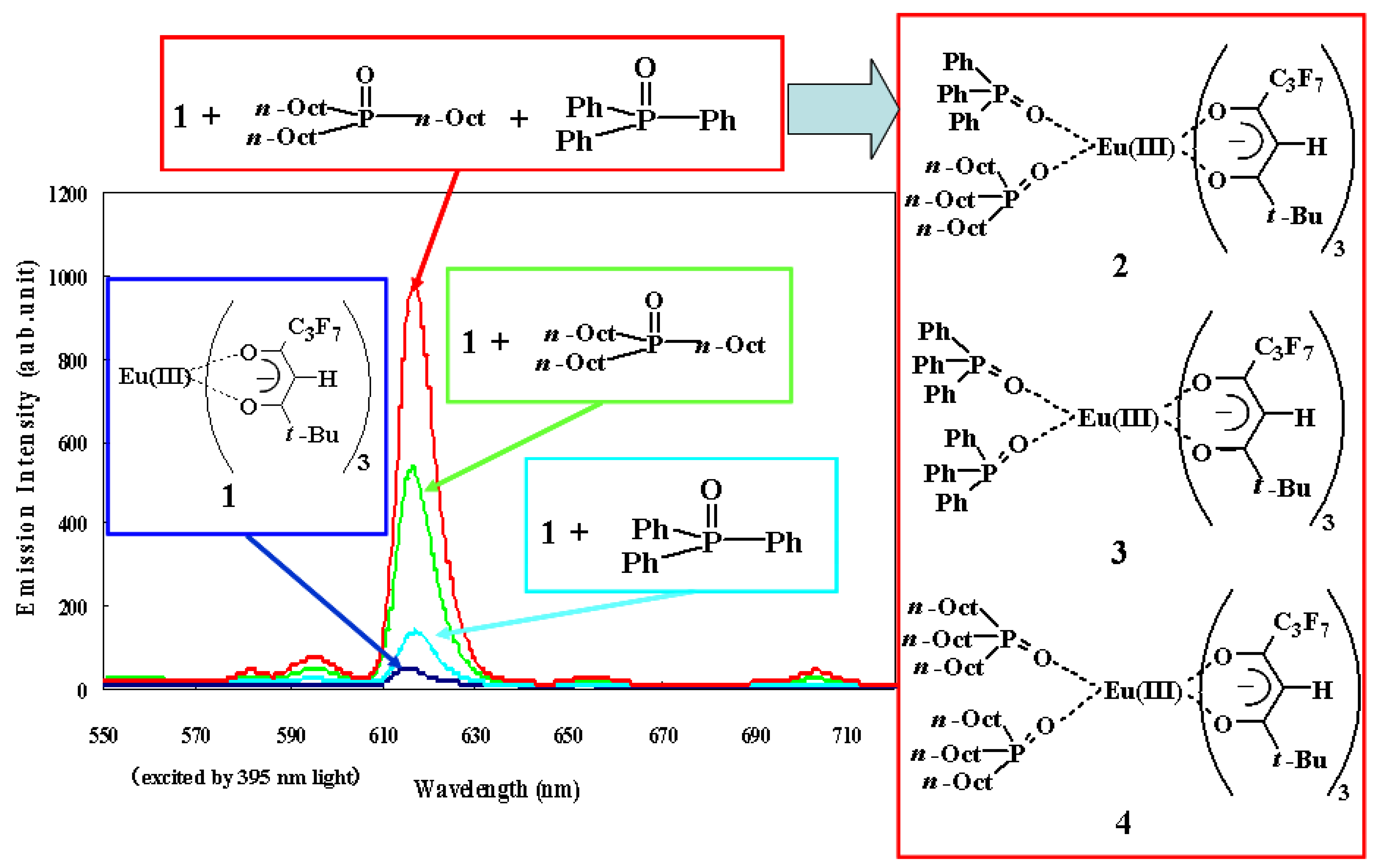
1 and triphenylphosphine oxide (TPPO) or trioctylphosphine oxide (TOPO), or both, in fluorinated solvent (2,3-dihydrodecafluoropentane) were prepared (
Figure 3) [
19], and their emission spectra, excited by 395 nm light, were compared.
In the case where an Eu(III) complex 1 was individually dissolved in fluorinated solvent, a very small emission intensity was observed. When the mixture of 1 and 2.0 molar equivalent of TPPO and/or TOPO was dissolved, the emission intensity was enlarged. Moreover, when the mixture of 1 and 1.0 molar equivalent of TPPO and TOPO was dissolved, the largest emission intensity was obtained. When the effects of introducing TPPO and TOPO are additive, the emission intensity of this mixture must be between those of the mixture of 1 and 2.0 molar equivalent of TPPO and the mixture of 1 and 2.0 molar equivalent of TOPO. Introducing two different phosphine oxides in one Eu(III) ion has special effects for improving emission intensity.
The quantum yield of the mixture of 1, TPPO, and TOPO in the fluorinated solvent was 0.3 (excited at the maximum wavelength of excited spectra (335 nm), 6 × 10⁻⁵ M). It was also confirmed that quantum yields change little over the range from 1 × 10⁻⁵ to 2 × 10⁻⁴ M. Perfluoropropyl (C3F7), t-butyl (t-Bu), and n-Octyl groups are bulky, and it is expected that concentration quenching is prevented by them.
One reason that the largest emission intensity occurs with the mixture of 1, TPPO, and TOPO is that the direct absorption of the Eu(III) ion is enhanced by asymmetric ligands field as a result of the introduction of two different phosphine oxides.
Figure 3.
Emission spectra of the mixtures of Eu(III) complexes and phosphine oxides in a fluorinated solvent (2, 3-dihydrodecafluoropentane).
Figure 3.
Emission spectra of the mixtures of Eu(III) complexes and phosphine oxides in a fluorinated solvent (2, 3-dihydrodecafluoropentane).
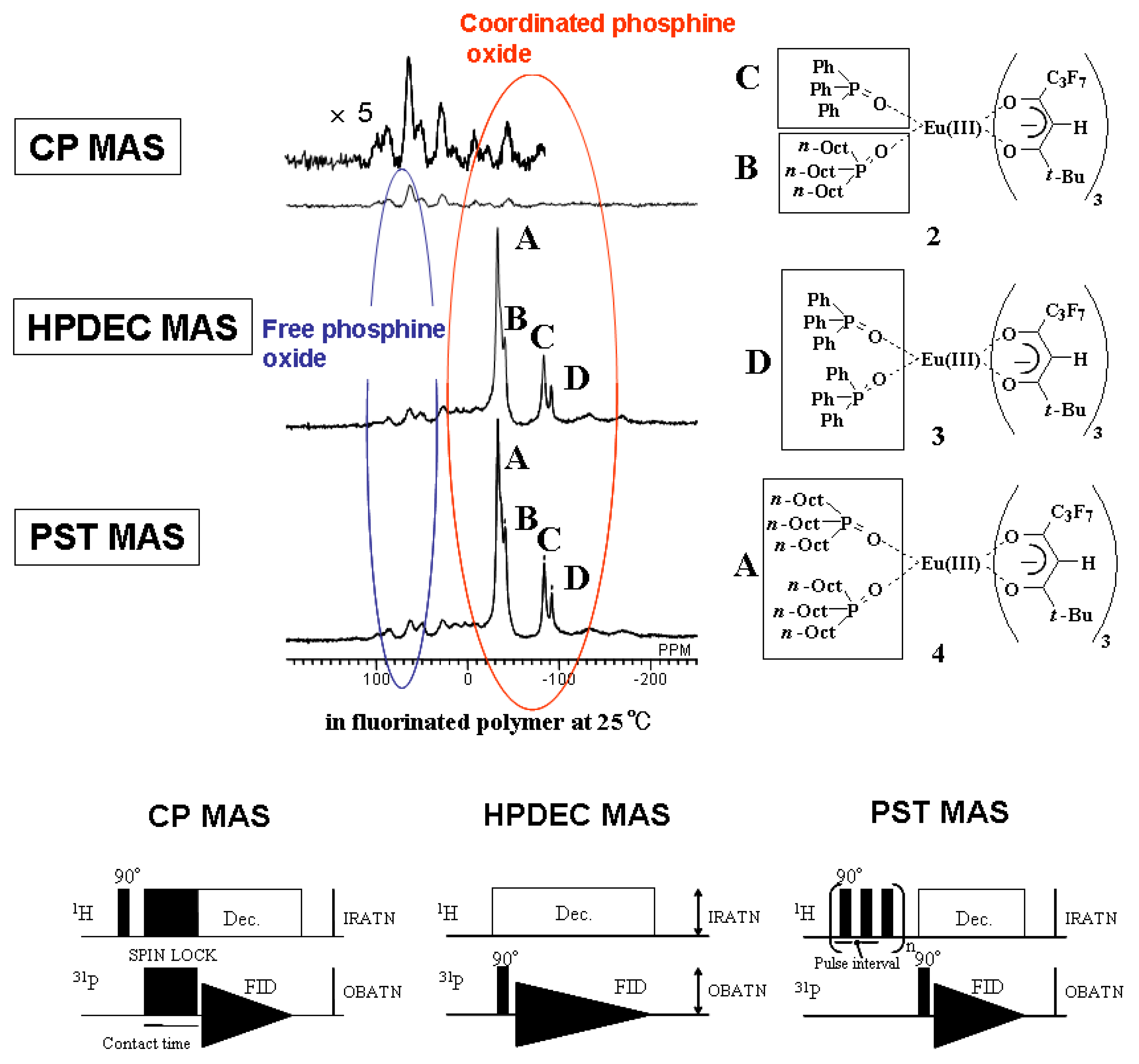
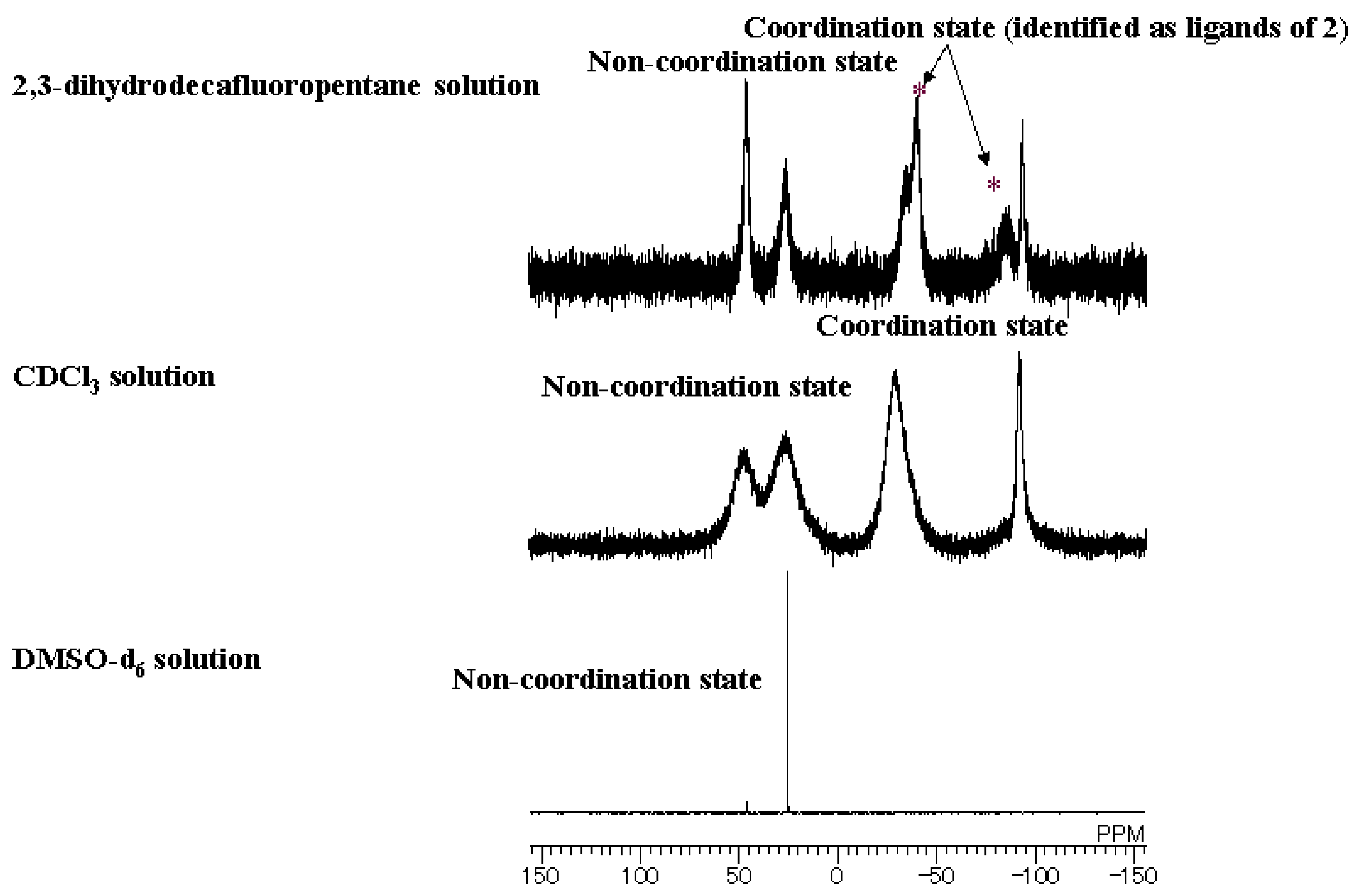
31P-NMR spectra of the mixture in 2,3-dihydrodecafluoropentane, CDCl
3, and DMSO-d
6 solutions at room temperature are shown in
Figure 4 [
20]. It was found that three Eu(III) complexes,
2~
4, are formed as a result of the mixing of the Eu(III) complex
1, TPPO, and TOPO in the fluorinated solvent.
The signals corresponding to Eu(III) complex 2 are definitely identified in the fluorinated solvent. On the other hand, the spectrum of the mixture in CDCl3 is broader than that of the fluorinated solvent, and signals corresponding to Eu(III) complex 2 are not identified. The broader spectrum of the mixture in CDCl3 implies that the ligand exchanges are faster in CDCl3 than in the fluorinated solution. The signals of phosphine oxides acting as ligands were not detected at all in DMSO-d6 solution, indicating that no phosphine oxide was coordinated with an Eu(III) ion. In general, the thermodynamic stabilities of ternary complexes are solvent-dependent. The more polar the solvent, the less stable the complex. DMSO is very polar. Moreover, DMSO strongly coordinates to rare-earth cations, which prevents phosphine oxides from coordinating.
When phosphine oxides exist as ligands, the signals have been reported to shift to upper magnetic fields [
22]. DMSO-d
6 is a strong Lewis base, and thus, DMSO-d
6 solution contains an excess of DMSO-d
6 molecules, which act as ligands, making it difficult for the phosphine oxide molecules to coordinate with Eu(III) ions. In DMSO solution, TPPO cannot coordinate with an Eu(III) ion. However, TOPO is stronger Lewis base than TPPO is, and part of the TOPO molecules are considered to coordinate with an Eu(III) ion. Because the bond length between an oxygen atom of a phosphine oxide and an Eu(III) ion is longer than that of other solvents (due to the effect of very polar and coordinative DMSO molecules), the signal of coordinated TOPO can be too broad to be clearly detected.
Figure 4.
31P-NMR spectra (298 K) of a mixture of Eu(III) complex 1, TOPO, and TPPO in fluorinated solvent, CDCl3, and DMSO-d6.
Figure 4.
31P-NMR spectra (298 K) of a mixture of Eu(III) complex 1, TOPO, and TPPO in fluorinated solvent, CDCl3, and DMSO-d6.
As shown in
Figure 5, the temperature dependence of
31P NMR spectra of the mixtures of Eu(III) complexes in CDCl
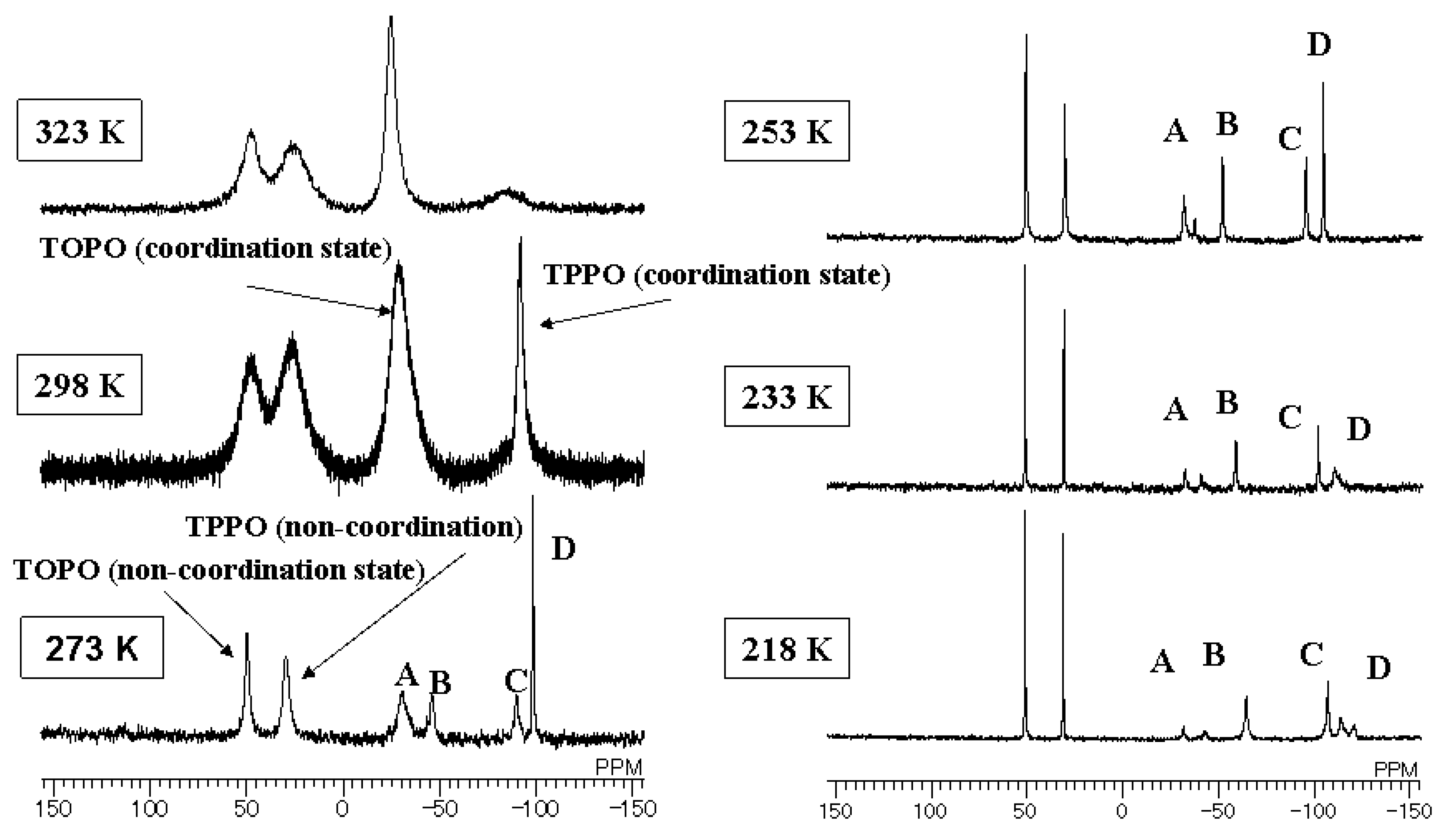
3 was investigated. The sharpness of the signals can be observed to increase as measurement temperature decreases. This is thought to be due to the slowing down of ligand exchanges at low temperatures. Below 273 K, signals corresponding to Eu(III) complex
2 (B and C in
Figure 5) were observed. The intensity of these signals compared to those of complexes
3 and
4 were evidently lower in the case of fluorinated solvent (even considering that the intensity of
31P NMR spectra are not quantitative). Moreover, in CDCl
3 solution, the strengths of signals B and C increased with the decrease in temperature.
The coordination ratio of TPPO and TOPO in the solution of Eu(III) complex 1 is considered to be influenced by the phosphine oxides’ solubilities. When phosphine oxides are highly soluble in a solvent, the equilibrium shifts from the coordination state toward the non-coordination state. When phosphine oxides are less soluble in a solvent, the equilibrium shifts to former. Generally, polar compounds, such as phosphine oxides, are highly soluble in polar solvents and less soluble in hydrophobic fluorinated solvents. This means that larger ratios of TPPO and TOPO are coordinated with an Eu(III) ion in a hydrophobic fluorinated solvent compared with that of a polar hydrophilic solvent.
On the other hand, ligand exchanges of phosphine oxides in Eu(III) complexes were observed by NMR analysis [
20] in the mixture of Eu(III) complexes
1, TPPO, and TOPO. These results indicate that the product ratios of Eu(III) complexes
2,
3, and
4 in the solutions are considered to be influenced by both the solvents and solubilities of produced complexes. In the fluorinated solvent, a larger majority of TPPO and TOPO tend to coordinate with an Eu(III) ion, and the highly soluble complexes are considered to be produced preferentially, so that the sum of the concentrations of Eu(III) complexes with two phosphine oxides,
2,
3, and
4, are maximized. The Eu(III) complex with two different phosphine oxides (complex
2) is highly soluble compared with complexes with two of the same phosphine oxides (complexes
3 and
4) and is produced preferentially in the fluorinated solvent. In the CDCl
3 solutions, TPPO and TOPO are more soluble compared with those in fluorinated solvent and their ratios of coordination state are small. Produced complexes
2,
3, and
4 are considered to be all highly soluble in CDCl
3 compared with their solubility in the fluorinated solvent.
Figure 5.
Temperature dependence of 31P NMR spectra of a mixture of Eu(III) complex 1 and two phosphine oxides in CDCl3 (A relates to TOPO in 4, D relates to TPPO in 3, B relates to TOPO in 2, and C relates to TPPO in 2).
Figure 5.
Temperature dependence of 31P NMR spectra of a mixture of Eu(III) complex 1 and two phosphine oxides in CDCl3 (A relates to TOPO in 4, D relates to TPPO in 3, B relates to TOPO in 2, and C relates to TPPO in 2).
Above all, the ratio of Eu(III) complex 2 to the sum of the produced Eu(III) complexes 2, 3, and 4 in the mixture of Eu(III) complex 1, TPPO, and TOPO in fluorinated solvents is larger than that of CDCl3. This prediction is confirmed by the observed greater intensity of the signals of Eu(III) complex 2 in the fluorinated solvent than in CDCl3. The largest emission intensity of the mixture of Eu(III) complex 1, TPPO, and TOPO in fluorinated solvent is due to the largest production ratio of complex 2.
TPPO and TOPO are highly soluble, even at low temperatures, in CDCl3. On the other hand, the solubilities of complexes 2~4 were decreased. As a result, equilibrium of TOPO and TPPO between coordination state and non-coordination state in complexes 3 and 4 shifts toward the latter state at low temperatures. This induces the smaller spectra intensities. The intensities of signals B and C decrease little even at low temperatures because temperature decrease has little effects on the solubility of Eu(III) complex 2 with two different phosphine oxides.
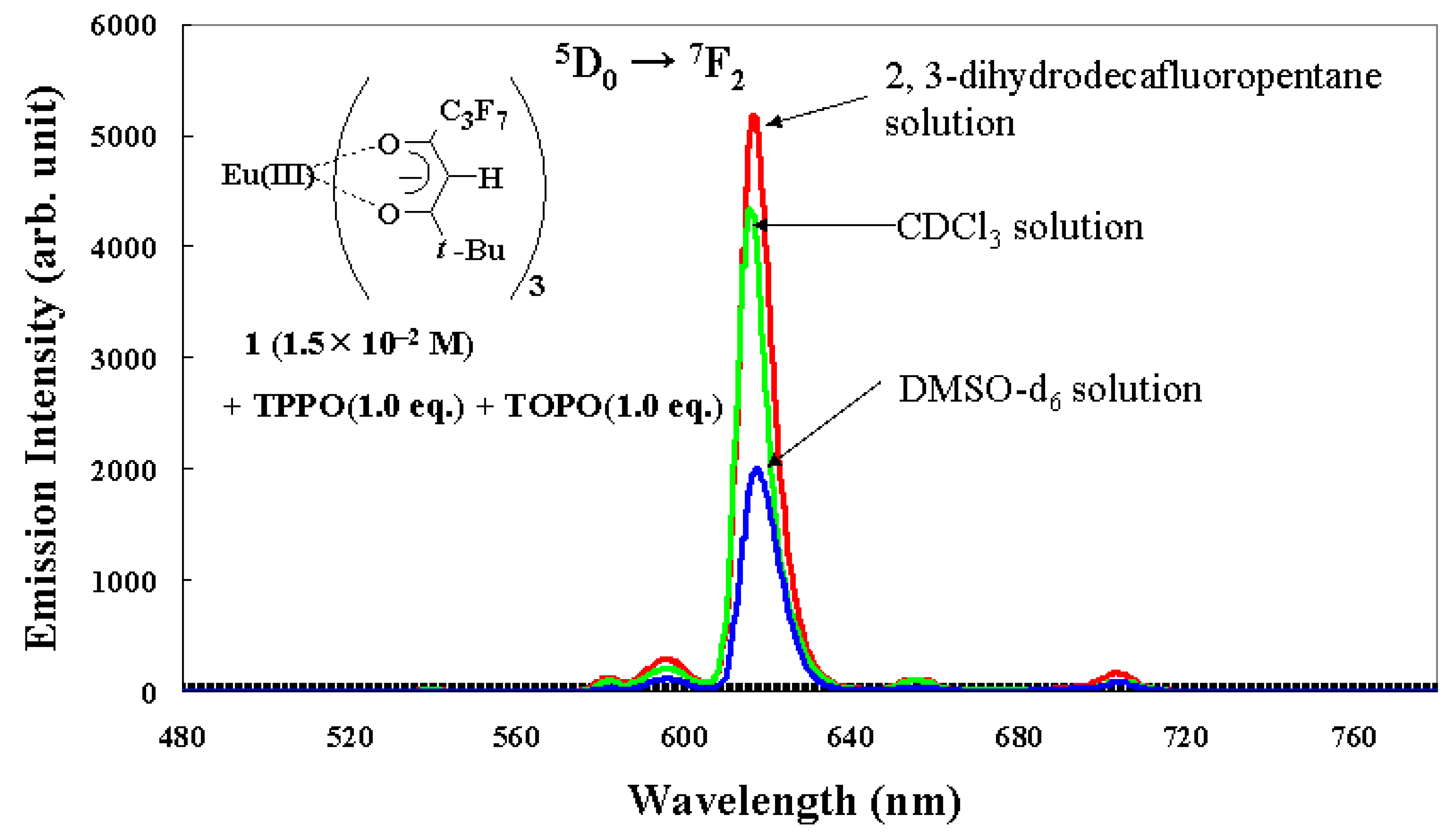
Figure 6 shows the relative emission intensities of the mixture of Eu(III) complex
1, TOPO, and TPPO, in fluorinated solvent, CDCl
3, and DMSO-d
6, excited at 395 nm, which is the maximum wavelength supported by our ultraviolet LED chip [
20]. The highest emission intensity was obtained in the fluorinated solvent. This is ascribed to the prediction that highly soluble Eu(III) complex
2 with two different phosphine oxides are predominantly formed and the ratio of complex
2 to sum of the produced Eu(III) complexes
2,
3, and
4 in the mixture of Eu(III) complex
1, TPPO, and TOPO becomes large. Slow ligand exchanges of phosphine oxides detected by NMR analysis contribute to improving emission intensity.
In CDCl3 solution, a relatively large emission intensity was obtained. On the other hand, only a low emission intensity was obtained in DMSO-d6 solution. The emission intensity of Eu(III) complex 1 in DMSO-d6 is not changed when one molar equivalent of TPPO and TOPO are added to the solution. Additionally, the emission lifetime of complex 1 is 7.9 × 10⁻⁴ s and is almost the same as that of the mixture of complex 1, TPPO, and TOPO in DMSO-d6 solution (7.6 × 10⁻⁴ s). These results indicate that a very small amount of phosphine oxides is coordinated with Eu(III) ions or that ligand exchanges of phosphine oxide are very fast, or both. The combination of Eu(III) complexes with two different phosphine oxides and the fluorinated solvent provides the highest emission intensity.
Figure 6.
The emission intensities of a mixture of Eu(III) complex 1 (1.5 × 10⁻² M), TOPO (1.0 equation), and TPPO (1.0 equation) in fluorinated solvent (2,3-dihydrodecafluoropentane), CDCl3, and DMSO-d6 excited at 395 nm at room temperature.
Figure 6.
The emission intensities of a mixture of Eu(III) complex 1 (1.5 × 10⁻² M), TOPO (1.0 equation), and TPPO (1.0 equation) in fluorinated solvent (2,3-dihydrodecafluoropentane), CDCl3, and DMSO-d6 excited at 395 nm at room temperature.
2.5. Eu(III) complexes with β-diketonates and a non-symmetric bis-phosphine oxide
Non-symmetric bis-phosphine oxide
11 was synthesized and mixed with 1.0 molar equivalent of Eu(III) complex
1 in fluorinated solvent, as shown in
Figure 9 [
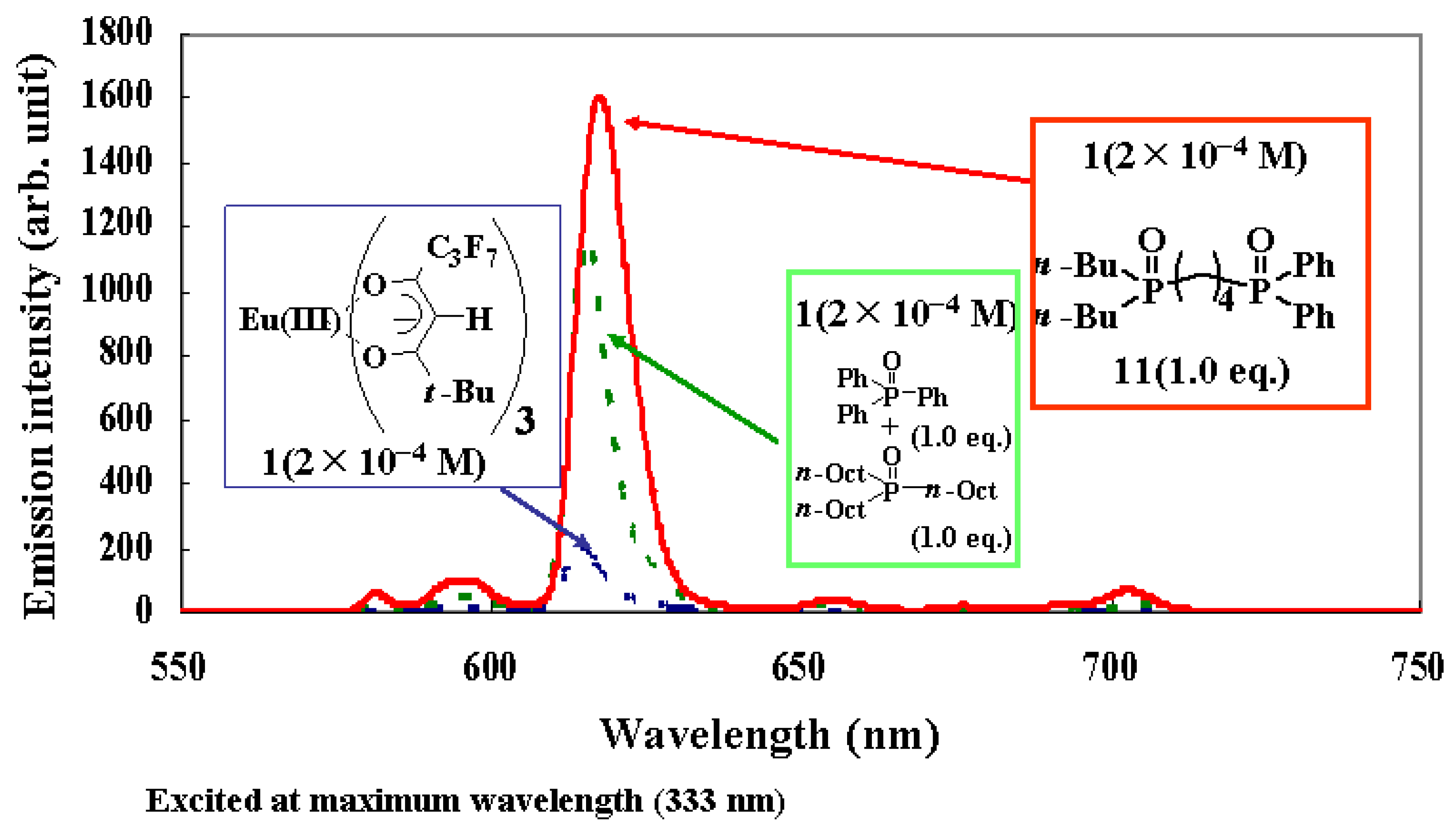
21]. The emission spectrum of the solution is shown in
Figure 9, together with that of a mixture of
1 and 1.0 molar equivalent of TPPO and TOPO. The emission intensity of the mixture of
1 and
11 is larger than that of the mixture of
1, TPPO, and TOPO.
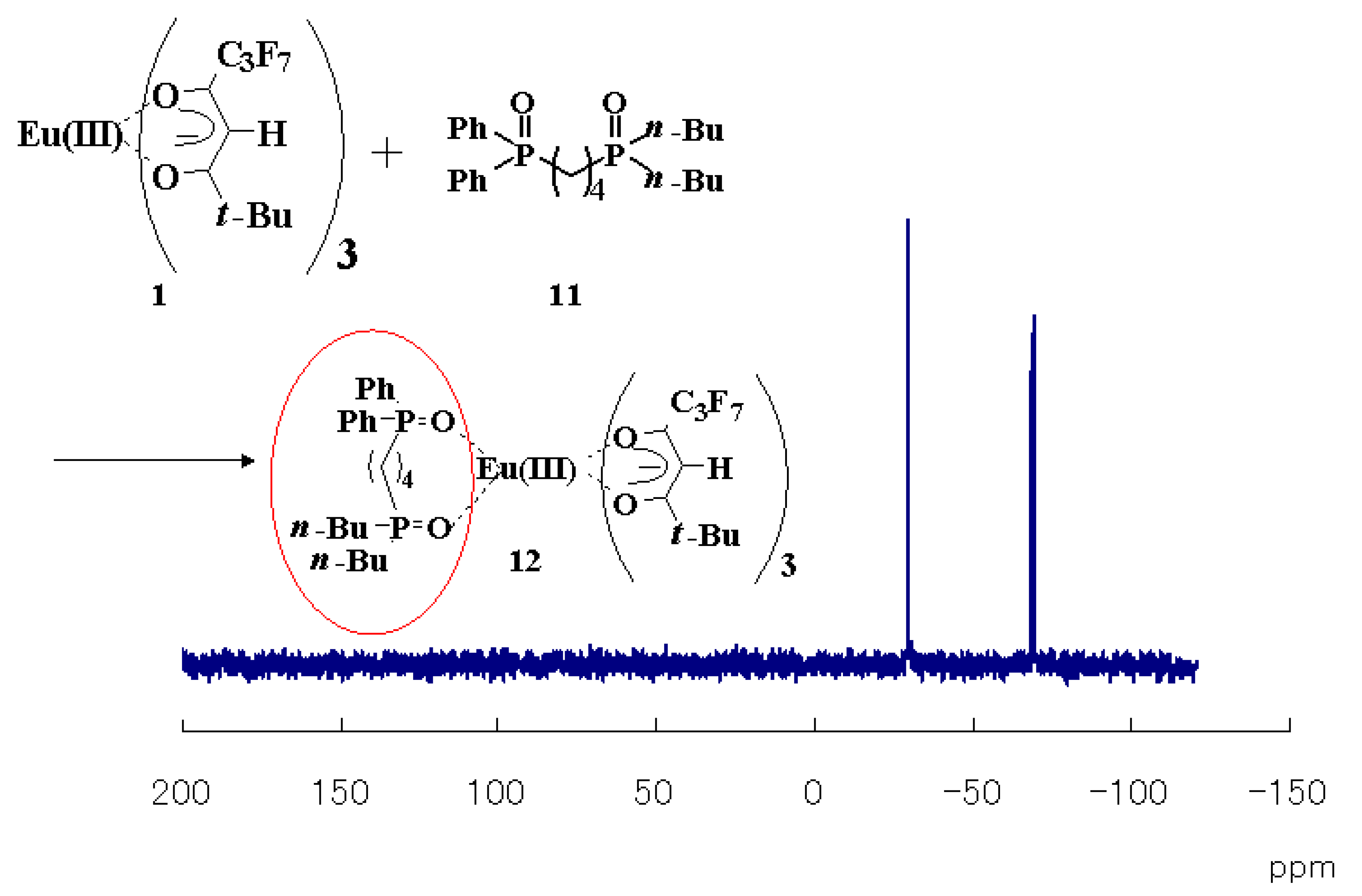
The signals of the
31P NMR spectrum for the mixture of Eu(III) complex
1 and non-symmetric bis-phosphine oxide
11 are very sharp and are shifted toward upper magnetic fields from the original ones of
11, suggesting that all the non-symmetric bis-phosphine oxide
11 coordinated with Eu(III) ion without ligand exchange, and that Eu(III) complex
12 was formed in the solution (
Figure 10) [
21]. The larger emission intensity of the mixture of
1 and
11 shown in
Figure 9 is due to the formation of Eu(III) complex
12, in which two different phosphine oxide structures are coordinated perfectly to one Eu(III) ion.
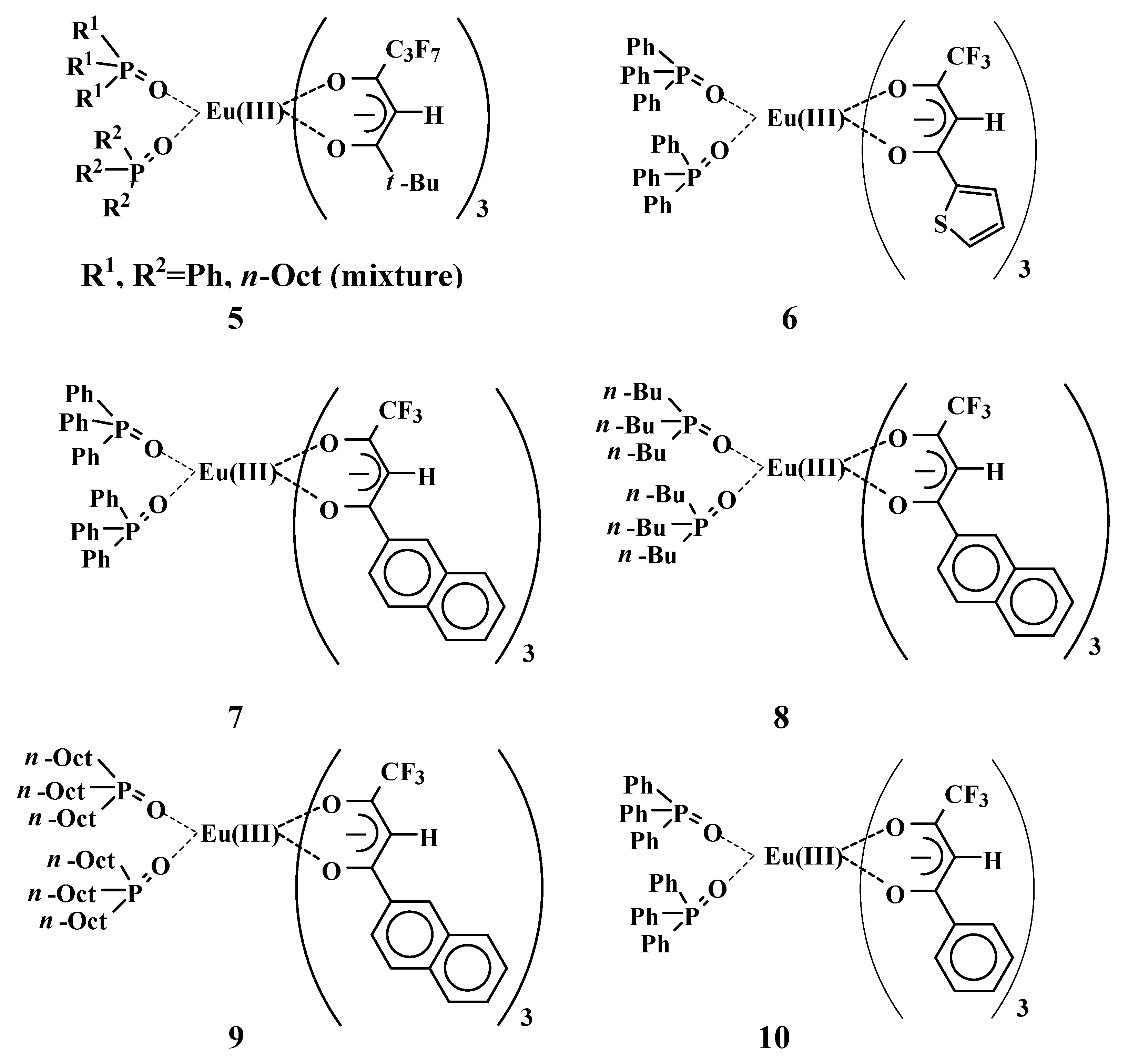
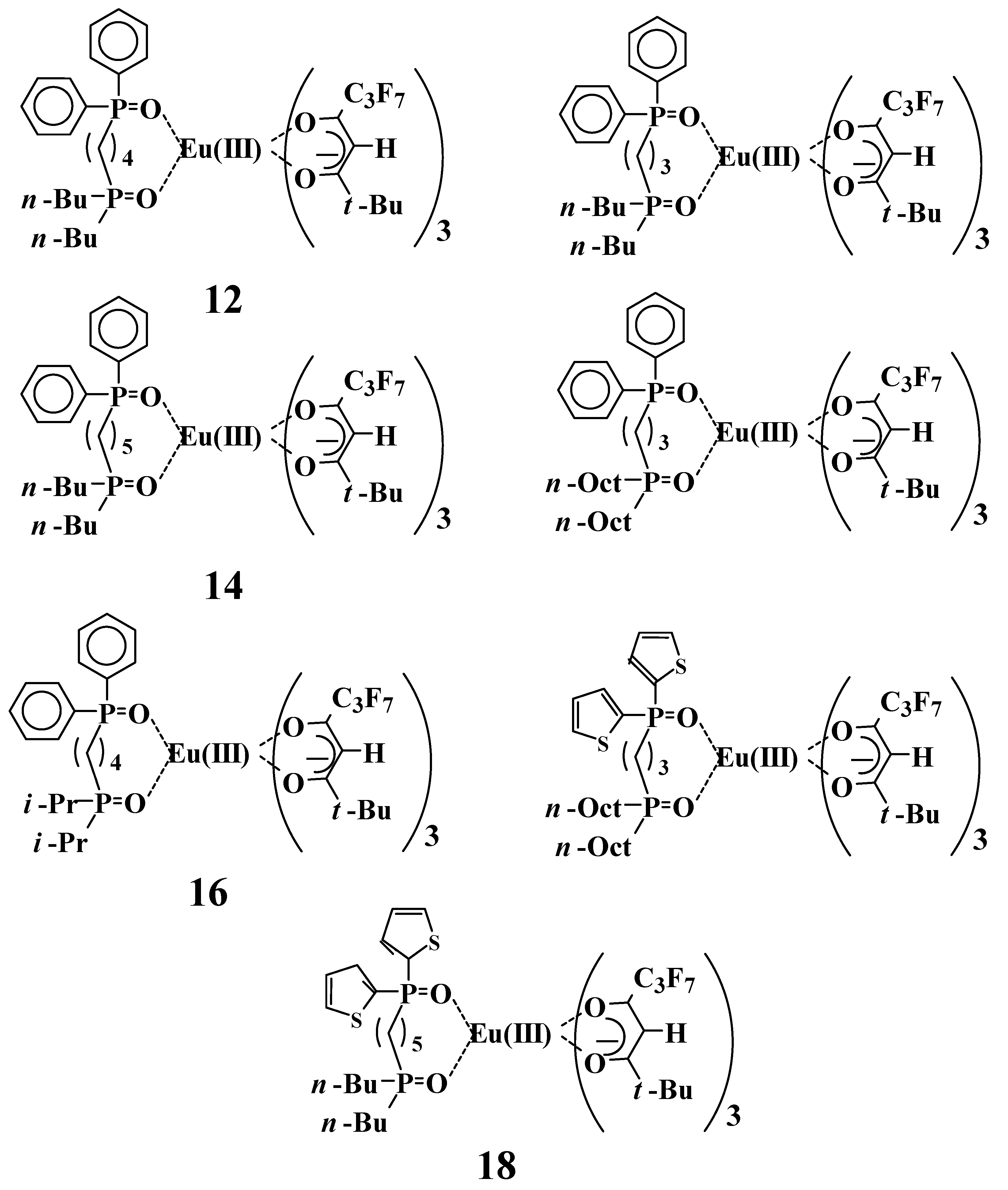
Several novel Eu(III) complexes with non-symmetric bis-phosphine oxides were synthesized (
Figure 11) and their melting points, thermodynamic properties, and solubilities in 2,3-dihydrodecafluoropentane were investigated (
Table 2) [
21]. The sum of the enthalpy of fusion and phase transition (Δ
H(SUM)) is the heat capacity that is required to change the definite amount of crystals of an Eu(III) complex located at room temperature into amorphous solid; this sum, from the results of dichroic dyes, is known to be correlated with the solubility [
25,
26].
Figure 9.
Emission spectra of the mixtures of Eu(III) complex 1 and phosphine oxides in the fluorinated solvent (2, 3-dihydrodecafluoropentane).
Figure 9.
Emission spectra of the mixtures of Eu(III) complex 1 and phosphine oxides in the fluorinated solvent (2, 3-dihydrodecafluoropentane).
Figure 10.
31P NMR spectrum of the mixture of Eu(III) complex 1 and non-symmetric bis-phosphine oxide 11.
Figure 10.
31P NMR spectrum of the mixture of Eu(III) complex 1 and non-symmetric bis-phosphine oxide 11.
Figure 11.
Molecular structures of Eu(III) complexes with non-symmetric bis-phosphine oxides.
Figure 11.
Molecular structures of Eu(III) complexes with non-symmetric bis-phosphine oxides.
Thermodynamic properties were correlated to the molecular structures and solubility of the solute. A small sum of the enthalpy of fusion and phase transition (ΔH(sum)) and a low melting point (Tm) are preferable for high solubility. Eu(III) complexes 12, 13, and 14 have two of the same substituents (Ph and n-Bu groups), and only “n” (the length of alkyl chain that binds two phosphine oxide parts) is different. Among these, the Tm of the complexes 13 (n = 3) and 14 (n = 5) were remarkably lower than that of complex 13 (n = 4), and the ΔH(sum) of 13 and 14 were smaller than that of 12. Additionally, the solubilities of 13 and 14 are much larger than that of 12 (correlated to the results of thermodynamic properties). Complexes 12 and 16 (n = 4) have a high Tm and a large ΔH(sum), and the solubilities are relatively small compared with those of other complexes. These results suggest that the steric effects of coordination structures are dependent on the “n” and have evident effects on thermodynamic properties and solubility. Complexes 17 and 18, by virtue of having thienyl groups, are relatively highly soluble when compared with the solubilities of other complexes.
Table 2.
The solubilities, melting points, and thermodynamic properties of Eu(III) complexes with β-diketonates and phosphine oxides.
Table 2.
The solubilities, melting points, and thermodynamic properties of Eu(III) complexes with β-diketonates and phosphine oxides.
| Complex | | Thermodynamic properties | Solubility 5 |
| | Tm 1 | ΔHf 2 | ΔHtr1 3 | ΔHtr2 3 | ΔH(SUM) 4 | |
| | (K) | kJ/kg(K) | Eu:μ mol/g |
| 12 | 507 | 44.0 | 3.09 (465) | 5.59 (490) | 52.68 | 0.02 |
| 13 | 443 | 37.5 | - | - | 37.5 | 0.72 |
| 14 | 462 | 27.0 | 90.49 (366) | 11.1 (392) | 38.59 | 0.55 |
| 15 | 389 | 1.27 | 21.3 (341) | 1.93 (381) | 24.5 | 1.2 |
| 16 | 453 | 34.5 | 2.97 (406) | - | 37.47 | 0.47 |
| 17 | 372 | 7.54 | 11.5 (350) | - | 19.04 | 2.2 |
| 18 | 419 | 14.0 | 4.83 (353) | 2.20 (364) | 21.03 | 2.5 |
The evident negative correlation between the solubilities of Eu(III) complexes and ΔH(SUM) are observed. Correlations among molecular structures, melting points, thermodynamic properties, and solubilities are explained below. Non-symmetric molecular structures induced by non-symmetric bis-phosphine oxide ligands prevent close packing, and reductions of melting points and the energies of molecular interaction (ΔH(SUM)) are followed by increases in solubilities.
2.6. Emission properties of Eu(III) complexes with a non-symmetric bis-phosphine oxide
The emission intensity of the mixture of Eu(III) complex
1, 1.0 equivalent of TPPO, and TOPO in 2,3-dihydrodecafluoropentane at the concentration of 2 × 10
−4 M is 1202 (arbitrary unit) (
Figure 9). On the other hand, the emission intensities of many Eu(III) complexes with non-symmetric bis-phosphine oxides in the same condition (
Table 3) are larger than the value of 1202. When comparing the emission intensities of complex
15 (1607, arb. unit) with that of the mixture of
1, TPPO, and TOPO, it was found that the intensity of complex
15 is 1.3-fold of that of the latter mixture.
The difference of molecular structures between complexes 15 and 5, which is the main component in the mixture, is whether phenyl phosphine oxide and octyl phosphine oxide ligands are together or not. These results indicate that the introduction of non-symmetric bis-phosphine in the Eu(III) complex is effective for improving emission intensity.
The emission intensity of complex 16 is relatively smaller than those of other complexes. Branched chain i-propyl groups prevent the complex from forming a steric coordination structure with a large emission intensity, due to the bulky structure near the P=O groups or the stronger electrodonating properties, or both.
On the other hand, complexes 17 and 18, which have thienyl groups instead of phenyl groups, have relatively smaller emission intensities. To clarify the reason for the smaller emission intensities of complexes 17 and 18, quantum yields of complexes 12~18 in CCl4 solution were investigated. Emission intensities are proportional to the products of absorption coefficients and quantum yields; intensities are reduced by vibration-inactivation. C-H bonds are known to act as effective vibration-inactivation bonds, and it is expected that 2,3-dihydrodecafluoropentane reduces the emission intensity. CCl4 was selected as a solvent in the measurements of quantum yields because there is no possibility of radiationless transition. The effect of vibration-inactivation can be ignored in the solvent.
Quantum yields of complexes 12~16 were satisfactory and with no great differences between them (0.45~0.52). On the other hand, the quantum yields of complexes 17 and 18 are relatively smaller (0.38 and 0.34, respectively) than those of complexes 12~16. Complexes 17 and 18 have thienyl groups in non-symmetric phosphine oxides instead of phenyl groups, and it is expected that this causes low quantum yields.
Table 3.
The emission intensity and quantum yields of Eu(III) complexes with β-diketonates and non-symmetric bis-phosphine oxides.
Table 3.
The emission intensity and quantum yields of Eu(III) complexes with β-diketonates and non-symmetric bis-phosphine oxides.
| Complex | Emission intensity (arb. unit) 1 | Quantum yields 2 |
| 12 | 1588 | 0.52 |
| 13 | 1676 | 0.47 |
| 14 | 1836 | 0.46 |
| 15 | 1607 | 0.49 |
| 16 | 1168 | 0.45 |
| 17 | 1467 | 0.38 |
| 18 | 1507 | 0.34 |
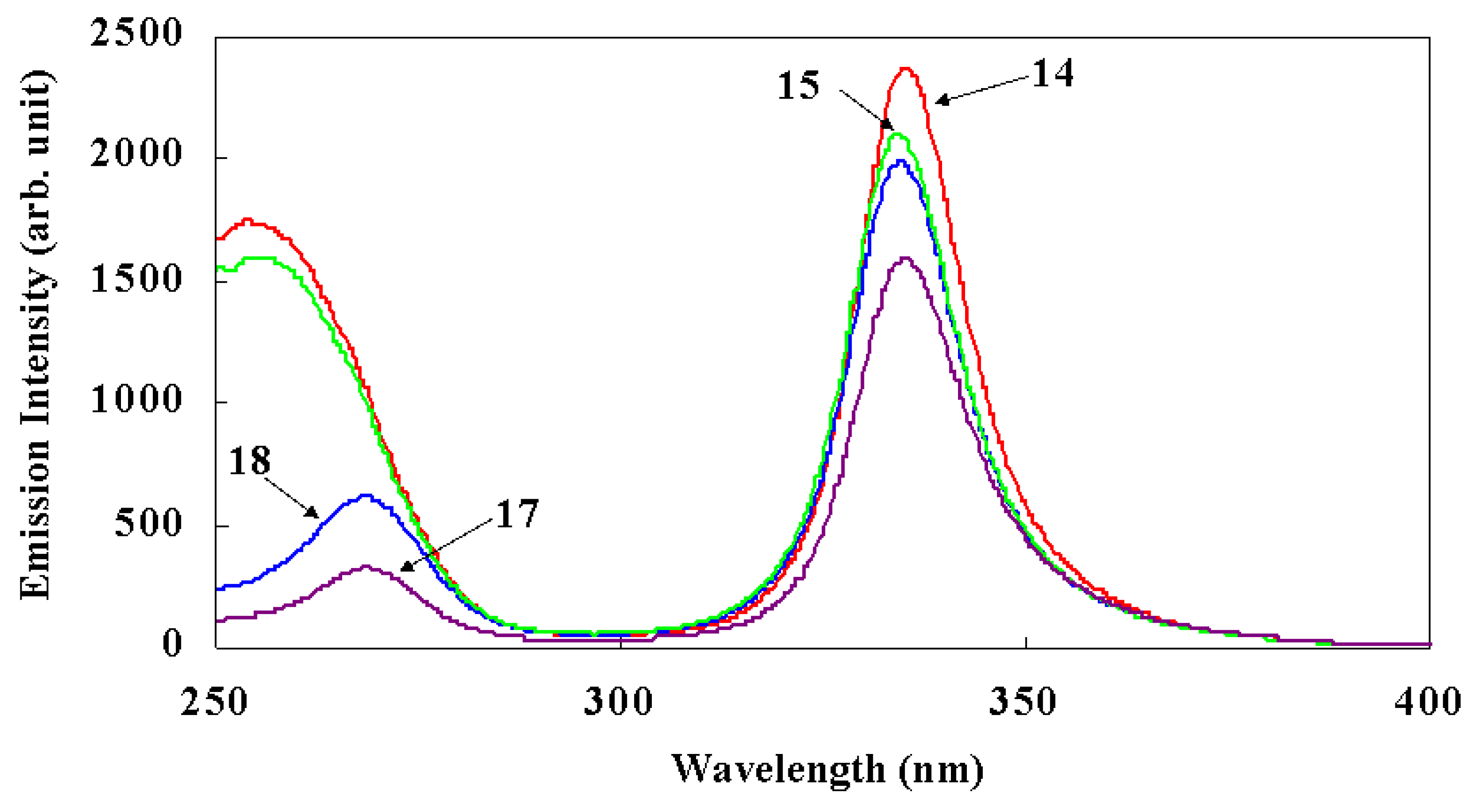
To clarify the introduction of thienyl groups in non-symmetric bis-phosphine oxides, excitation spectra of complexes
17 and
18 were compared with complexes
15 and
14, respectively (
Figure 12). The molecular structures of complexes
17 and
15 are the same, with the exception of thienyl groups (
17) and phenyl groups (
15). Similarly, the molecular structures of complexes
18 and
14 are the same, with the exception of thienyl groups (
18) and phenyl groups (
14).
Each emission spectrum has two peaks. With respect to the peaks of longer wavelengths, the emission intensities of Eu(III) complexes 15 and 14 with phenyl groups in non-symmetric phosphine oxides are found to be evidently larger than their respective counterparts, as measured from complexes 17 and 18, which possess thienyl groups. These results are consistent with the values of quantum yields measured at the maximum wavelength of longer wavelength peaks. On the other hand, the maximum wavelengths in the shorter wavelength region of complexes 17 and 18 are longer than those of complexes 14 and 15, and emission intensities are drastically reduced. This wavelength region corresponds to absorption by bis-phosphine oxides. The efficiency of energy transfer from the excited states of bis-phosphine oxides to the 5d orbital of Eu(III) is reduced by the thienyl group.
As a consequence, phenyl groups are more preferable than thienyl groups for improving large emission properties.
Figure 12.
Comparison of the excitation spectra of Eu(III) complexes 17 and 18, which have thienyl groups in non-symmetric phosphine oxides, with the spectra of complexes 14 and 15, which have phenyl groups (measured in CCl4, 2 × 10⁻⁴ M, room temperature, excited at 336 nm light).
Figure 12.
Comparison of the excitation spectra of Eu(III) complexes 17 and 18, which have thienyl groups in non-symmetric phosphine oxides, with the spectra of complexes 14 and 15, which have phenyl groups (measured in CCl4, 2 × 10⁻⁴ M, room temperature, excited at 336 nm light).
2.7. Tb(III) complexes with two different phosphine oxides and their properties [28]
Recently, Tb(III) complexes have emerged as promising candidates for a thermosensor because their emission intensities are drastically changed by temperature [
29,
30,
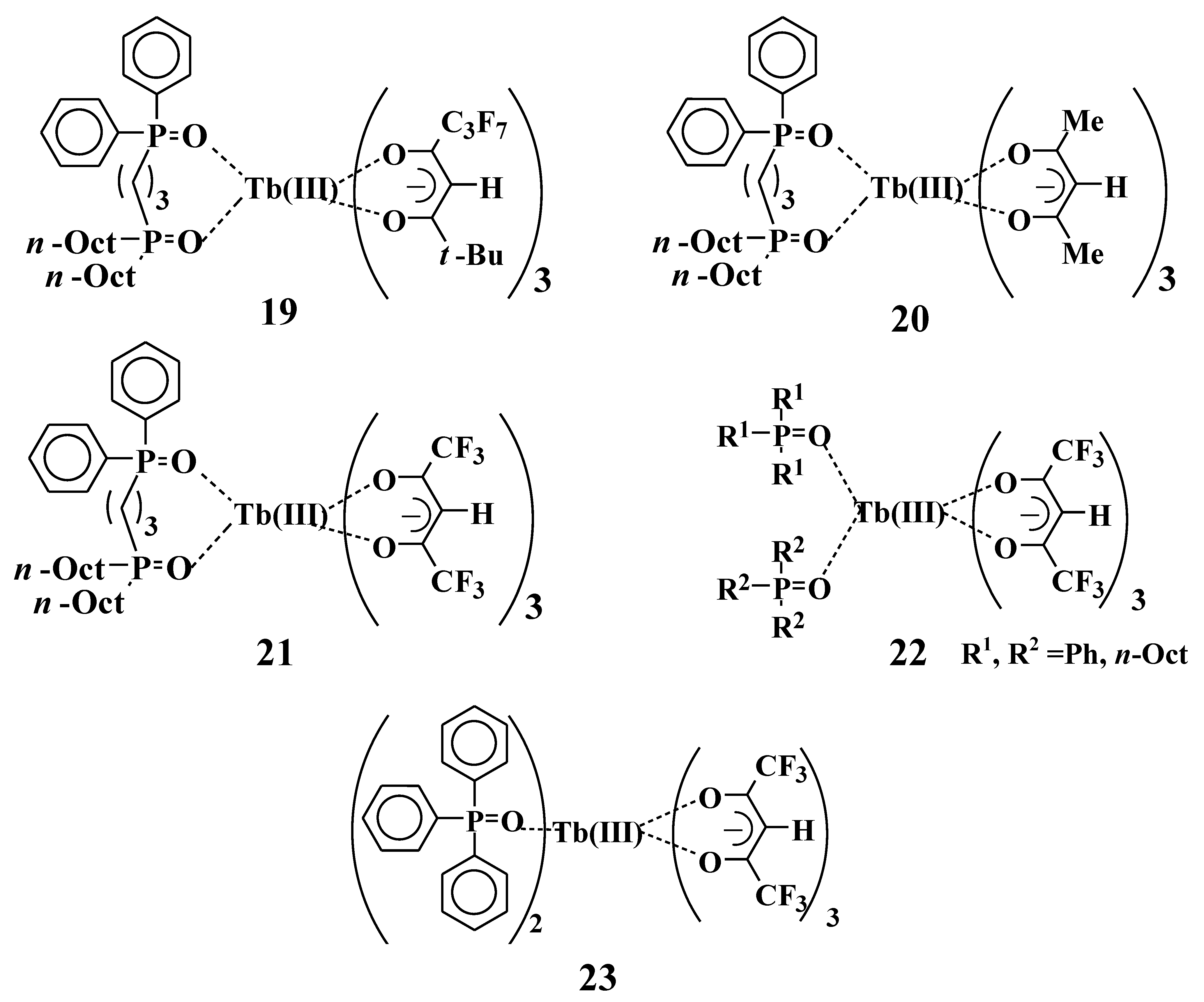
31]. However, the solubility and emission intensity of Tb(III) complexes are much smaller than those of Eu(III) complexes, and further improvement is required for many applications. The molecular structure of bis-phosphine oxide is designed to be non-symmetric in a way that is analogous with the Eu(III) complexes. The structures have two different phosphine oxides so as to attain large solubilities and emission intensities. Four Tb(III) complexes with one non-symmetric bis-phosphine oxide and three β-diketonates
19~
22 (
Figure 13) were synthesized [
28].
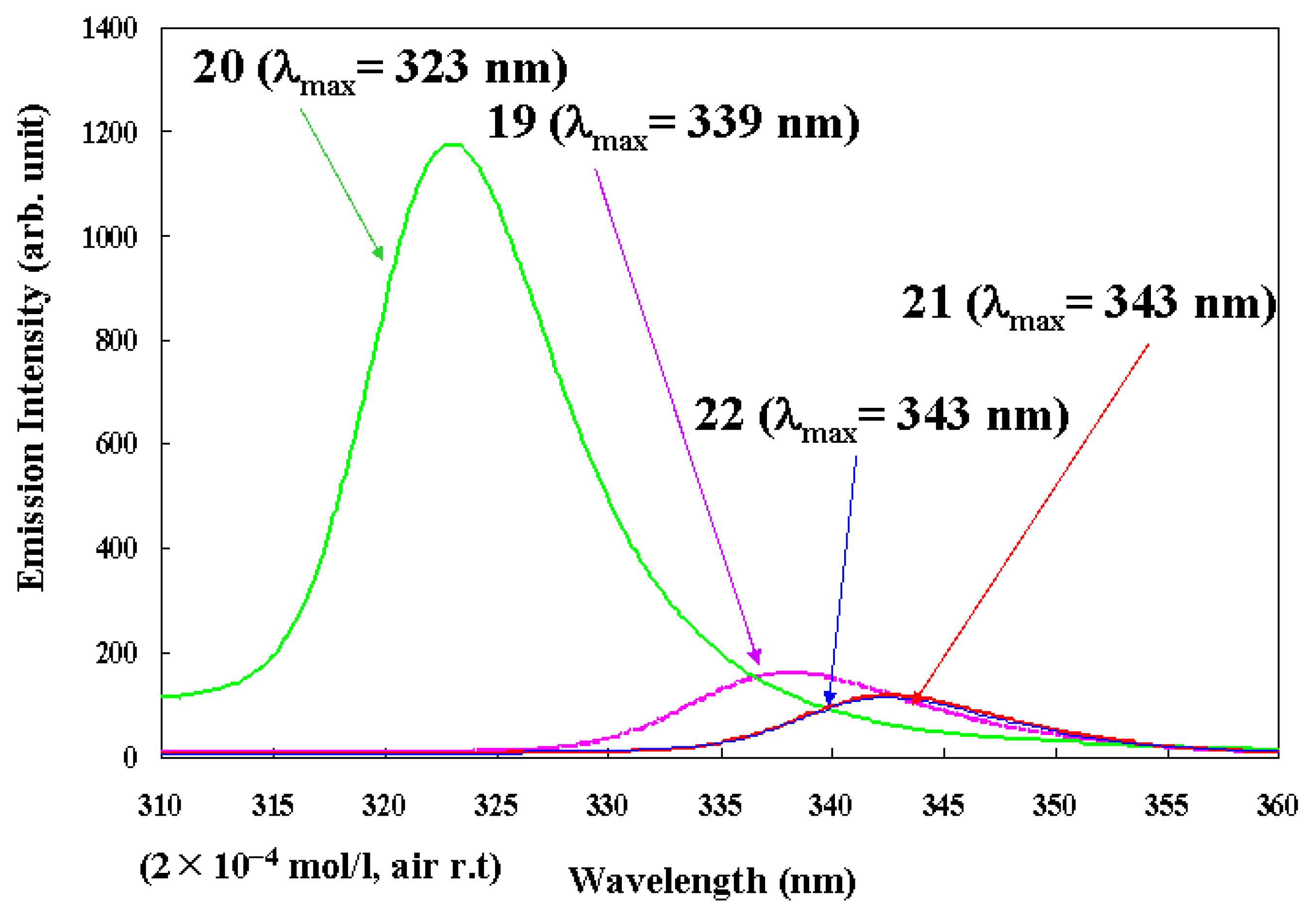
The excitation spectra of Tb(III) complexes
19~
22 (2 × 10
−4 M) are shown in
Figure 14. The measured maximum wavelengths (λ
exp) are clearly correlated to the substituents of the β-diketonate ligands. In the case that two substituents are electron-donating groups (e.g., methyl groups in complex
20), λ
exp is the shortest, and emission intensity at the λ
exp (
Iexp) is the largest. When the two substituents are electron-attractive groups (e.g., trifluoromethyl groups (CF
3) in complex
21), λ
exp is the longest and
Iexp is the smallest. In the case that β-diketonates have one electron-donating group and an electron-attractive group (e.g., C
3F
7 and
t-Bu groups in complex
19), both λ
exp and
Iexp are between those of complexes
20 and
21, respectively. On the other hand, when comparing the excitation spectra of complexes
21 and
22, the differences with respect to whether two phosphine oxide parts are tied together or not have little effect on λ
exp and
Iexp.
Figure 13.
The molecular structures of Tb(III) complexes with the phosphine oxides used in this study.
Figure 13.
The molecular structures of Tb(III) complexes with the phosphine oxides used in this study.
The calculated λ
cal, λ
exp, and Δ
Ecal of each ligand are summarized in
Table 4. It can be found that the λ
cal of three types of β-diketonates are in the same order as the λ
exp in 1 × 10
−3 M solution of ethyl acetate, and that differences between λ
cal and λ
exp are small.
The pronounced correlation between λ
exp and
Iexp shown in
Figure 14 is explained using both the calculated and the experimental results mentioned below. Shorter wavelength shifts of λ
exp in
Figure 14, when electron-donating groups are substituted in β-diketonates, lead to larger Δ
Ecal values. When Δ
Ecal values are larger, back energy transfers from excited Tb(III) ions to the ligand [
2,
12] are restrained; this effect enlarges the quantum yields, and consequently, there are larger
Iexp values (
Table 3).
The emission lifetime and emission quantum yield of Tb(III) complex
20, which has the largest
Iexp in
Figure 14, are
τobs = 0.89 ms (excited at 335 nm) and Φ = 0.15 (excited at 335 nm) in dilute solution (1 × 10
−3 M) of CCl
4 at room temperature, respectively. The calculated radiation rate (emission quantum yield / emission lifetime) of Tb(III) complex
20 is about 170. On the other hand, in the case of complex
19, which has a lower
Iexp, the emission lifetime and emission quantum yield are
τobs = 0.05 ms (excited at 365 nm) and Φ = 0.04 (excited at 355 nm). This marked difference between the properties of complexes
19 and
20 is considered to be correlated to the back energy transfer.
Figure 14.
Excitation spectra of Tb(III) complexes 19~22 (2 × 10⁻⁴ M) in ethyl acetate.
Figure 14.
Excitation spectra of Tb(III) complexes 19~22 (2 × 10⁻⁴ M) in ethyl acetate.
Table 4.
The calculated maximum wavelength (λ
cal), measured maximum wavelength in 1 × 10
−3 M solution of ethyl acetate (λ
exp), energy difference between the
5D
4 level of Tb(III) and the lowest triplet-state energy level of the ligand (Δ
Ecal (eV)), and intensity of excitation spectra at λ
exp in 1 × 10
−3 M solution of ethyl acetate (
Iexp).
![Materials 03 04080 i001]()
Table 4.
The calculated maximum wavelength (λcal), measured maximum wavelength in 1 × 10⁻³ M solution of ethyl acetate (λexp), energy difference between the 5D4 level of Tb(III) and the lowest triplet-state energy level of the ligand (ΔEcal (eV)), and intensity of excitation spectra at λexp in 1 × 10⁻³ M solution of ethyl acetate (Iexp). ![Materials 03 04080 i001]()
| R1 | R2 | As ligand | λcal (nm) | λexp (nm) | ΔEcal (eV) | Iexp |
|---|
| Me | Me | Ligand of complex 20 | 319 | 323 | 0.75 | 1200 |
| t-Bu | C3F7 | Ligand of complex 19 | 334 | 339 | 0.47 | 180 |
| CF3 | CF3 | Ligand of complex 21 and 22 | 337 | 343 | 0.31 | 120 |
2.8. Emission properties of Tb(III) complexes
The referential peaks chosen were “
5D
4 to
7F
5” (543 nm) and “
5D
4 to
7F
6” transitions (488 nm), which correspond with the magnetic-dipole transition “from
5D
4 to
7F
5” of Δ
J = 1, and the electric-dipole transition (from
5D
4 to
7F
6) of Δ
J = 2, respectively. Tb(III) complexes,
24 and
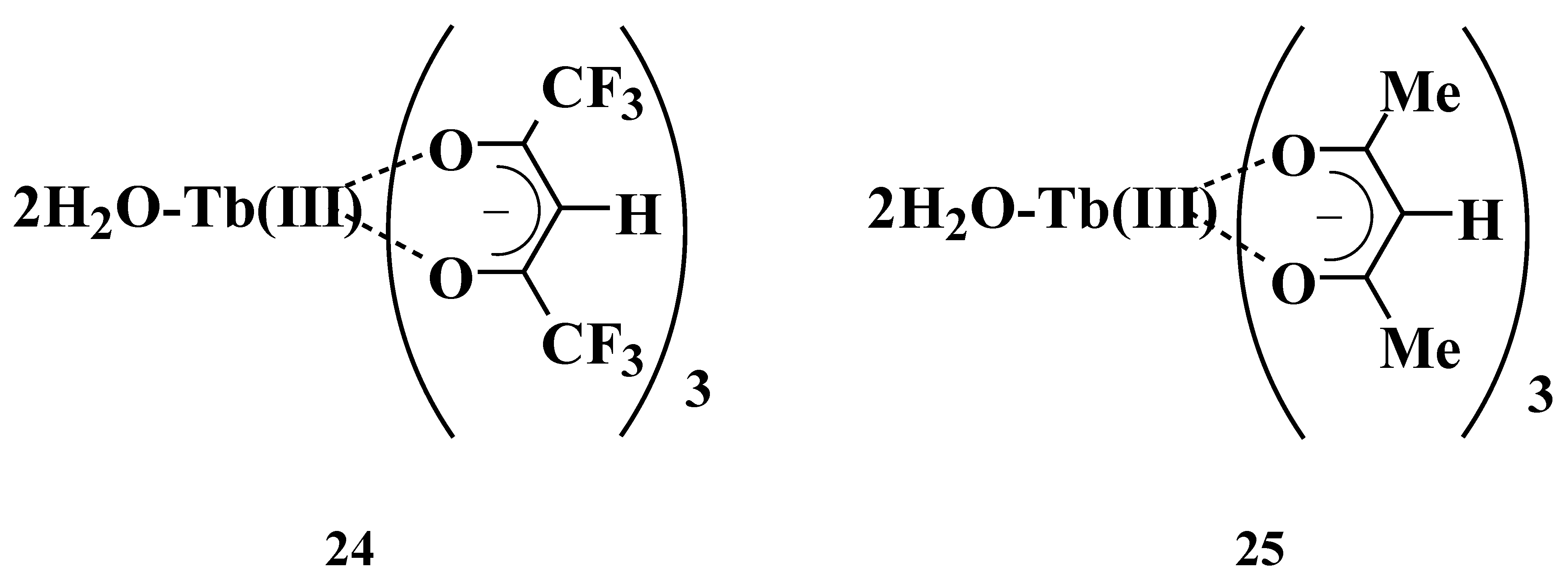
25, without phosphine oxide ligand (
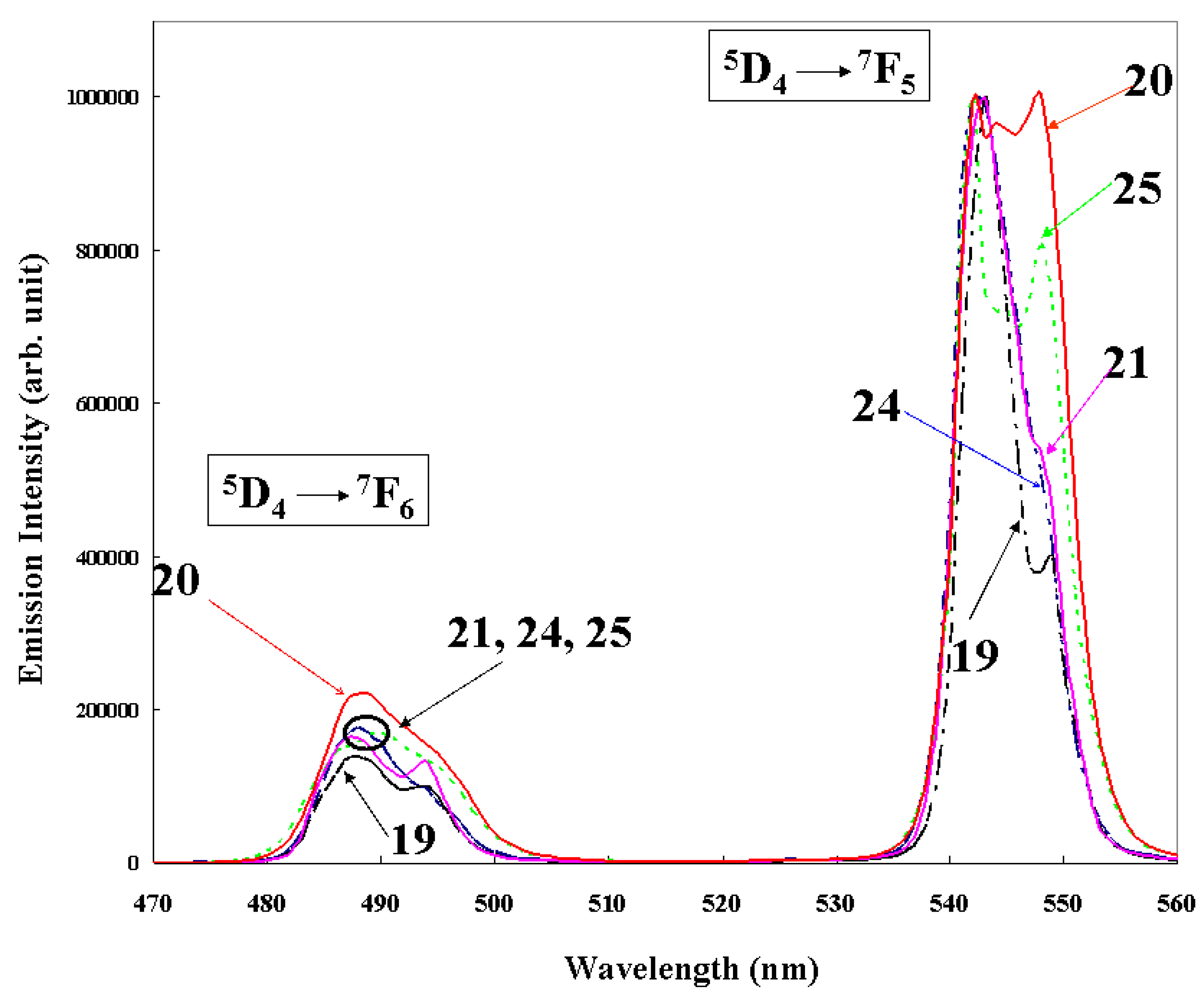
Figure 15), were prepared and their emission spectra were compared with those of Tb(III) complexes with two different phosphine oxides to explain the effects of their introduction. The emission intensities of Tb(III) complexes
19,
20,
21,
24, and
25 are shown in
Figure 16. The spectra were normalized with respect to the “from
5D
4 to
7F
5” transition, which corresponds to the magnetic-dipole transition, being independent of the ligands fields. The branching ratio is defined as that of the intensity of electric-dipole transition “from
5D
4 to
7F
6” to the magnetic-dipole transition “from
5D
4 to
7F
5” [
6]. Asymmetry of the ligand field is reflected as an increase in the branching ratio and is represented in
Figure 16 as the intensity of electric-dipole transition.
Figure 15.
Molecular structures of Tb(III) complexes without phosphine oxide.
Figure 15.
Molecular structures of Tb(III) complexes without phosphine oxide.
Figure 16.
The emission spectra of Tb(III) complexes 19, 20, 21, 24, and 25 in ethyl acetate (normalized with respect to the transition “from 5D4 to 7F5”, which corresponds to the magnetic-dipole transition).
Figure 16.
The emission spectra of Tb(III) complexes 19, 20, 21, 24, and 25 in ethyl acetate (normalized with respect to the transition “from 5D4 to 7F5”, which corresponds to the magnetic-dipole transition).
Tb(III) complex 20 has the largest emission intensity of electric-dipole transition, suggesting that complex 20 has the ligand field symmetry despite the fact that the two substituents of β-diketonates are the same (methyl(Me) groups). On the other hand, the intensity of electric-dipole transition of complex 19 with two different substituents (t-Bu and C3F7 groups) on β-diketonate is the smallest. The intensities of electric-dipole transitions in complexes 21, 24, and 25 are between those of complexes 19 and 20, and are almost the same. It is noted that introduction of two different substituents of β-diketonates has little effect on increasing the ligand field asymmetry. The steric effects of the substituents of β-diketonates are correlated with the ligands fields instead. Namely, complex 20 has two small methyl groups; the branching ratio of complex 20 is the largest. On the other hand, complex 19 has two different bulky substituents on β-diketonates; the branching ratio is the smallest. The substituent of β-diketonates in complexes 21 and 24 is the CF3 group, whose steric effects are between those of complexes 19 and 20, and their branching ratios are also between those of complexes 19 and 20. In the case of complex 20, the bond lengths of oxygen atoms in phosphine oxides or β-diketonates, or both, and a Tb(III) ion are considered to be smaller than those of complex 19 because of the weaker steric effects that induce the ligand field asymmetry.
If complexes 20 and 25 are compared, it is evident that the introduction of phosphine oxide ligands enlarges the branching ratio, indicating that the ligand field becomes less symmetric. On the other hand, if complexes 21 and 24 are compared, introduction of phosphine oxide ligands has little effect on branching ratio, which suggests that ligands field is not changed. Bulky substituents of β-diketonates are considered to interfere with the changing of the steric coordination structure.
2.9. Solubilities of Tb(III) complexes
The solubilities of Tb(III) complexes in 2,3-dihydrodecafluoropentane (fluorinated solvent) are shown in
Table 5. 2,3-dihydrodecafluoropentane was selected as a solvent for the measurements of solubilities because it is useful for predicting which rare-earth complexes are dissolvable in a fluorinated polymer at supersaturated high concentrations [
24].
Table 5.
The solubility of Tb(III) complexes used in this study.
Table 5.
The solubility of Tb(III) complexes used in this study.
| Complex | Solubility (μ mol/g) |
|---|
| 19 | 1.1 |
| 20 | 0.018 |
| 21 | 0.63 |
| 22 | 3.6 |
| 23 | 0.6 |
In general, although high-polar rare-earth complexes can be dissolved in a polar solvent, such as alcohol, they do not dissolve easily into many organic solvents, and this tendency is particularly marked in the case of strongly hydrophobic ones. Among hydrophobic solvents, compared with hexane, it was found to be very hard for 2,3-dihydrodecafluoropentane to dissolve Eu(III) complexes [
24]. However, among the solvents, emission intensity of Eu(III) complexes was the highest when dissolved in a 2,3-dihydrodecafluoropentane, indicating that a fluorinated polymer is suitable for obtaining high emission [
20]. Rare-earth complexes are dissolved into many kinds of solvents and polymers with high concentrations for use in various applications.
Solubility is clearly correlated with the substituents of β-diketonates when compared with Tb(III) complexes 19~21, which have the same structures, except for the said substituents. Complex 19 has bulky substituents, which are t-Bu and C3F7 groups; it is highly soluble when compared with other complexes. The solubility of complex 21, which has CF3 groups, is higher than that of complex 20. The steric effects of substituents for β-diketonates are effective for increasing solubility. Complex 22 was synthesized for comparison with 21 to clarify the chelating effect of phosphine oxide ligands. The difference in the molecular structures of complexes 21 and 22 is that an octylphosphine oxide part and a phenylphosphine oxide part are tied together in the case of complex 21, but they coordinate individually in the case of complex 22. The solubility of complex 22 is six-fold greater than that of complex 21, indicating that degree of freedom of steric coordination structure is important for improving solubility.
Tb(III) complex
23, with two TPPO, was prepared [
29] for comparison with complex
22 to clarify the effect of having two different phosphine oxides. Solubility of complex
22 is six-fold greater than that of complex
23. The introduction of two different phosphine oxides to one Tb(III) ion is found to be remarkably effective for increasing solubility in the same way as seen in Eu(III) complexes [
24].
The solubilities of rare-earth complexes in the liquid media shown in
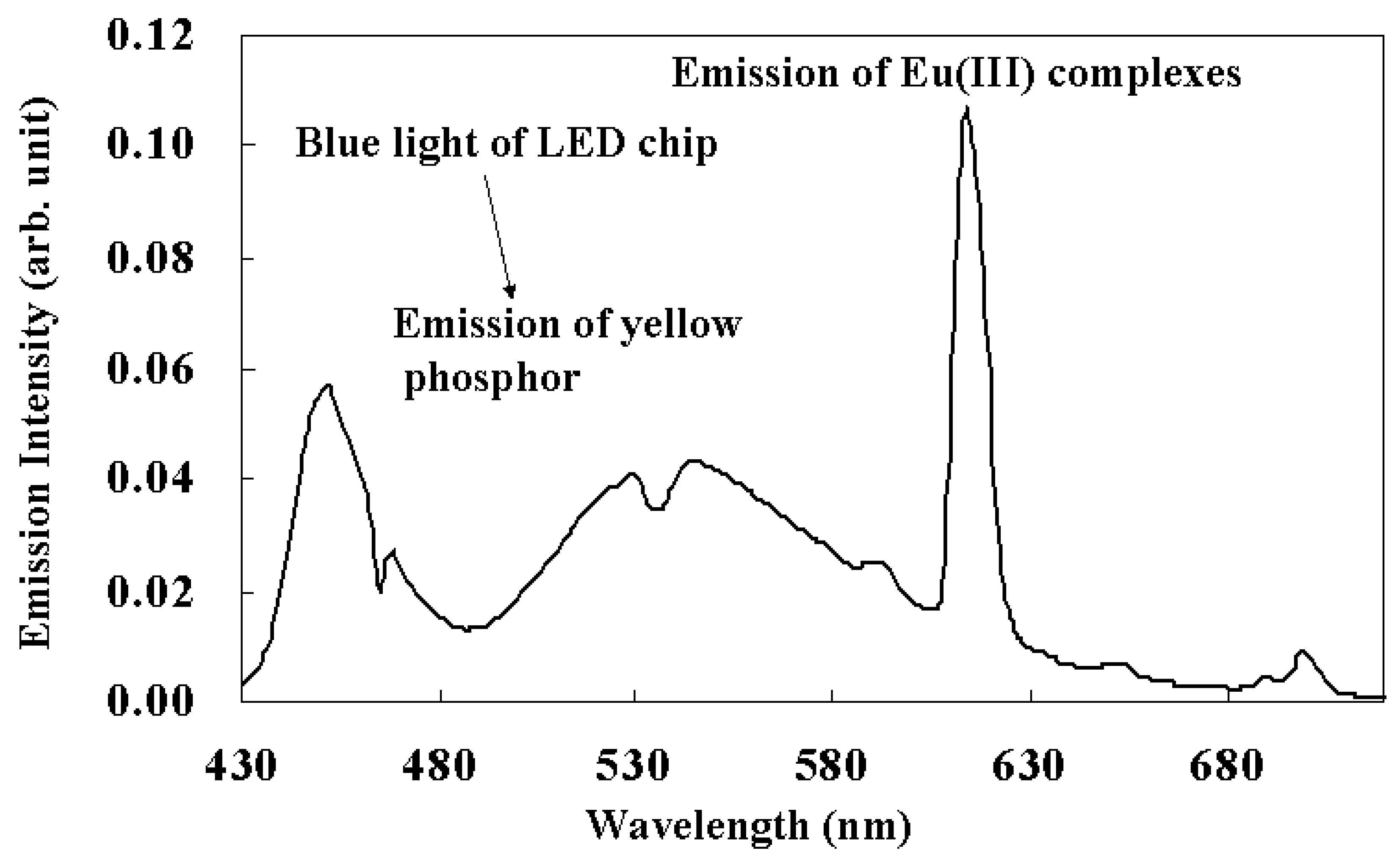
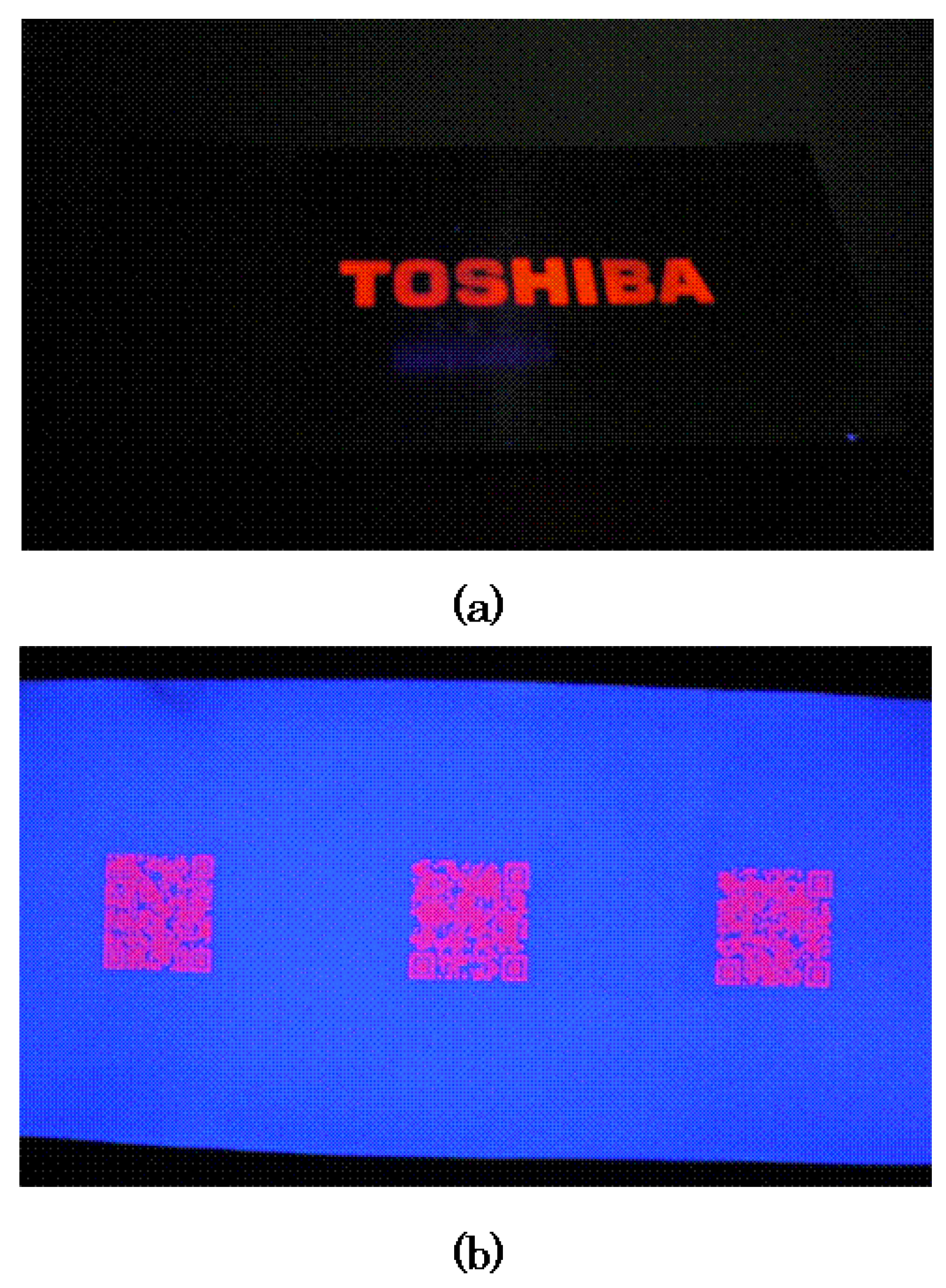
Table 5 are very small. In many application fields, rare-earth complexes are dissolved in polymers. In particular, when they are used as fluorescent compounds in LED devices, very large concentrations of complexes are required.
It is expected that some properties of rare-earth complexes in solid media are different from what is observed when the complexes are in liquid media. In solid media, the amorphousness of rare-earth complexes plays a very important role. Generally, highly soluble compounds are highly amorphous. Rare-earth complexes dissolved in a fluorinated polymer of LED devices [
19] exist in a state of supersaturation. The synergism of solubility effects and the complex’s amorphousness allows the complex to exist in a state such that large concentrations of rare-earth complexes are dissolved in a polymer. Emission lifetimes of rare-earth complexes are also influenced by the states of the solvents. The emission lifetimes of Tb(III) complex
22 are 0.75 ms (in ethyl acetate), 0.89 ms (in carbon tetrachloride), and 0.69 ms (in acrylic resin). The details of correlations among emission lifetimes, molecular structures, and solvents (liquid or solid state) are now under progress.
2.10. Density functional theory calculations of Eu(III) complexes with three β-diketonates and two phosphine oxides
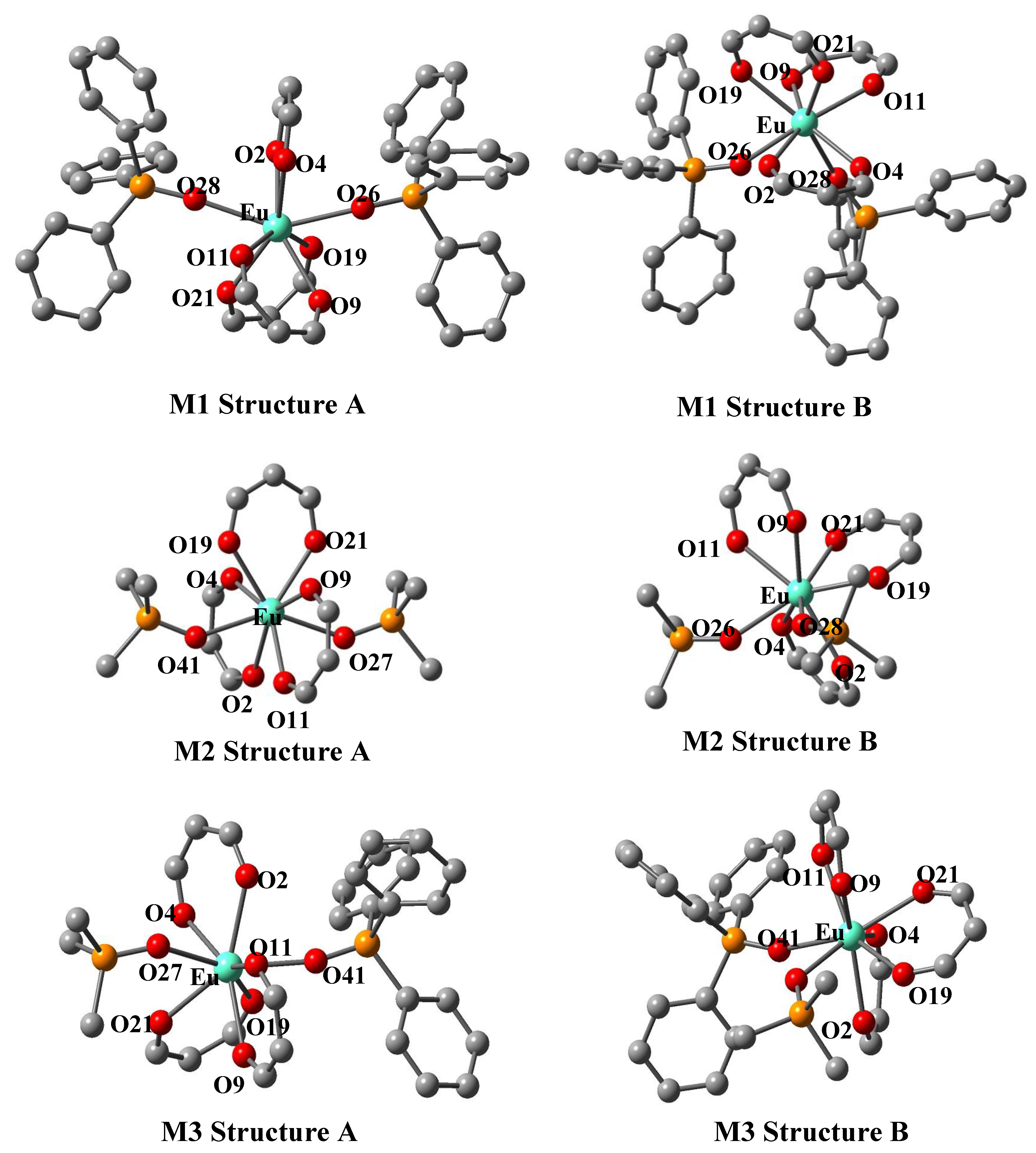
Eight-fold coordinated Eu(III) complexes were reported to have a square-antiprism structure [
32]. Two coordination geometries (structures A and B) are considered (
Figure 17). For structure A, each oxygen atom of a phosphine oxide coordinates in another square in the square-antiprism structure; for structure B, each oxygen atom of phosphine oxides coordinates at the adjacent point of a square in the square-antiprism structure. Structure A was determined by Hasegawa
et al. and Structure B was determined by Batista
et al. with single-crystal X-ray diffraction [
3,
6].
Figure 17.
Two optimized geometries for Eu(III) complexes (structures A and B) in the molecular structure shown in
Figure 1, M1: R
1=R
2=Ph, R
3=R
4=H; M2: R
1=R
2=Me, R
3=R
4=H; M3: R
1=Me, R
2=Ph, R
3=R
4=H.
Figure 17.
Two optimized geometries for Eu(III) complexes (structures A and B) in the molecular structure shown in
Figure 1, M1: R
1=R
2=Ph, R
3=R
4=H; M2: R
1=R
2=Me, R
3=R
4=H; M3: R
1=Me, R
2=Ph, R
3=R
4=H.
Density functional theory (DFT) calculation was carried out to theoretically investigate the coordination structures of Eu(III) complexes with three β-diketonates and phosphine oxides. Two minimum energy points corresponding to two different optimized geometries (structures A and B) have been found, and the difference between two minimum energy points is small (less than 1 kcal/mol). From these results, it is known that structures A and B can both exist in a solution or a polymer [
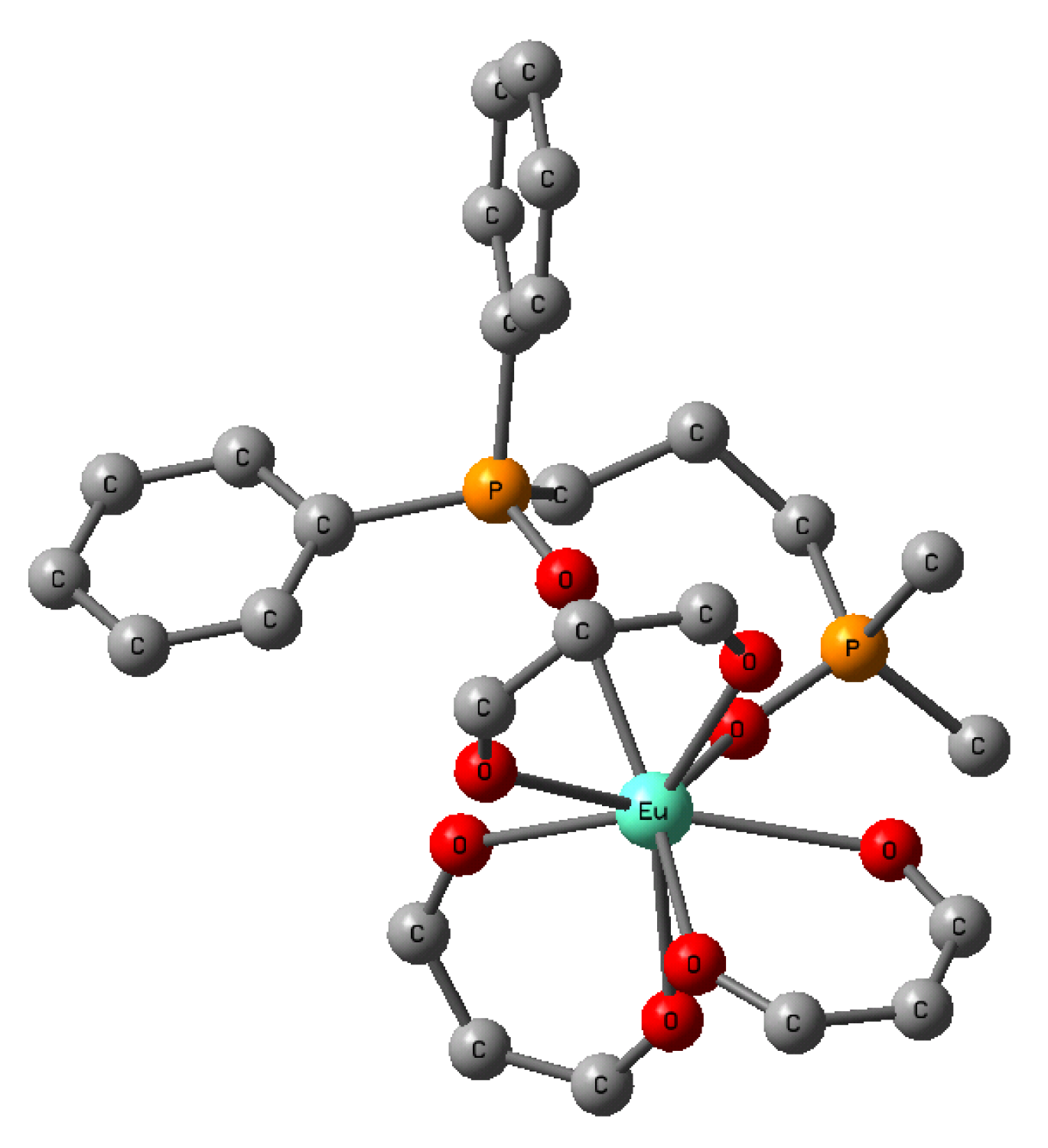
33]. Time-dependent density functional theory (TDDFT) calculations suggest that the absorption coefficient of structure A is larger than that of structure B, resulting in a larger emission intensity.
A model molecular structure for Eu(III) complexes with three β-diketonates and non-symmetric bis-phosphine oxides (Eu(III) complex
13 was simplified:
t-Bu groups and C
3F
7 groups in β-diketonates were replaced by H atoms and the
n-Bu groups in the bis-phosphine oxides were replaced by methyl groups) obtained by DFT calculation is shown in
Figure 18 [
34].
Figure 18.
The optimized geometry of simplified Eu(III) complexes with three β-diketonates and non-symmetric phosphine oxides (H atoms are excluded).
Figure 18.
The optimized geometry of simplified Eu(III) complexes with three β-diketonates and non-symmetric phosphine oxides (H atoms are excluded).
The calculated coordination energy and asymmetry of the ligands field in Eu(III) complexes that have non-symmetric bis-phosphine oxides are larger than those of Eu(III) complexes that have two different phosphine oxides. These results indicate that Eu(III) complexes with non-symmetric bis-phosphine oxides are more stable and have larger emission intensities. A comparison of spectra intensities for Eu(III) complexes with non-symmetric bis-phosphine oxide with that of with two different phosphine oxides is shown in
Table 6. The intensity of former complexes is much larger than that of the latter. Moreover, the half width of the former complex is larger than that of latter, thus indicating that the coordination fields of the former complex is more asymmetrical than that of latter. These experimental results correspond well with the calculated results. The λ
max in each solution are in the order (mixture of
1 (
Figure 3) and non-symmetric bisphosphine oxide
11), (
1, TOPO, and TPPO), (
1). Basically, the parity-forbidden f-f electronic transition of Eu(III) ion shifts little with ligands and solvent. The wavelength shifts shown in
Table 6 are due to the differences between steric coordination structures.
Sixteen isomers can be considered in Eu(III) complexes with three β-diketonates and one non-symmetric bis-phosphine oxide, but the ratio of existence for the most stable isomer (shown in
Figure 18) is found to be about 51%. The sum of the ratios of existence for the six most stable isomers is about 100%, assuming the Boltzmann distribution (
T = 300 K). The coordination structures of the six most stable isomers in the ground states are similar, and asymmetric ligands fields can be expected.
Table 6.
Comparison of the spectra intensities of Eu(III) complexes containing non-symmetric bis-phosphine oxide with that of Eu(II) containing two different phosphine oxides (measured in 2,3-dihydrodecafluoropentane at 2 × 10⁻⁴ M).
Table 6.
Comparison of the spectra intensities of Eu(III) complexes containing non-symmetric bis-phosphine oxide with that of Eu(II) containing two different phosphine oxides (measured in 2,3-dihydrodecafluoropentane at 2 × 10⁻⁴ M).
| Eu(III) complex | Emission intensity (arb. unit) | λ max |
|---|
| 1 | 209.7 | 615 |
| 1+TOPO(1 equation)+TPPO(1 equation) | 1159 | 616 |
| 1+11(1 equation)(non-symmetric bis-phosphine oxide) | 1602 | 618 |