Influence of Tension Stiffening on the Flexural Stiffness of Reinforced Concrete Circular Sections



Abstract
1. Introduction
- −
- Φs is the mean value of the reinforcing bars’ diameter;
- −
- K1 is a coefficient that takes into account the bond properties of bond reinforcement;
- −
- K2 is a coefficient that takes into account the distribution of strain (pure tension or bending); and
- −
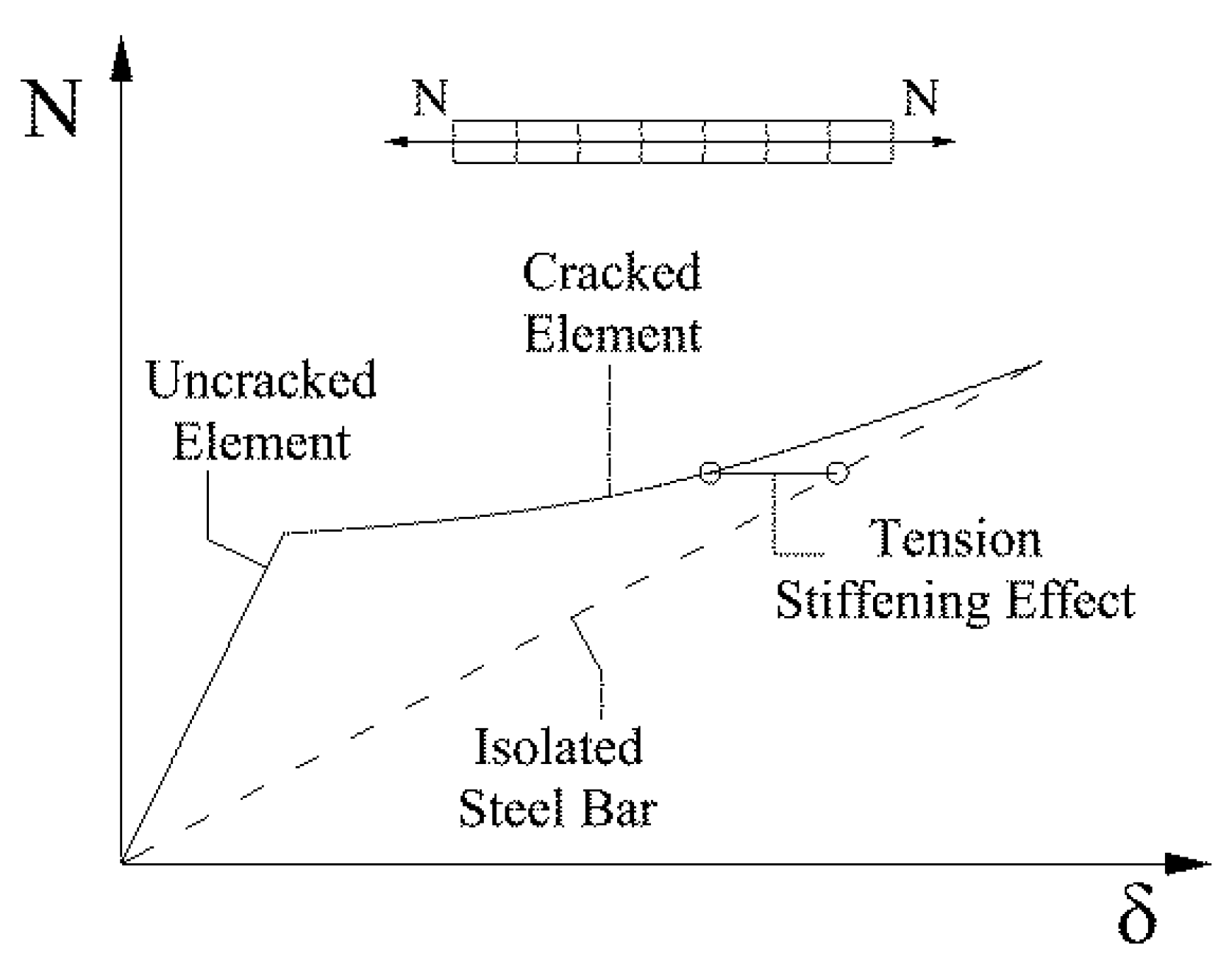
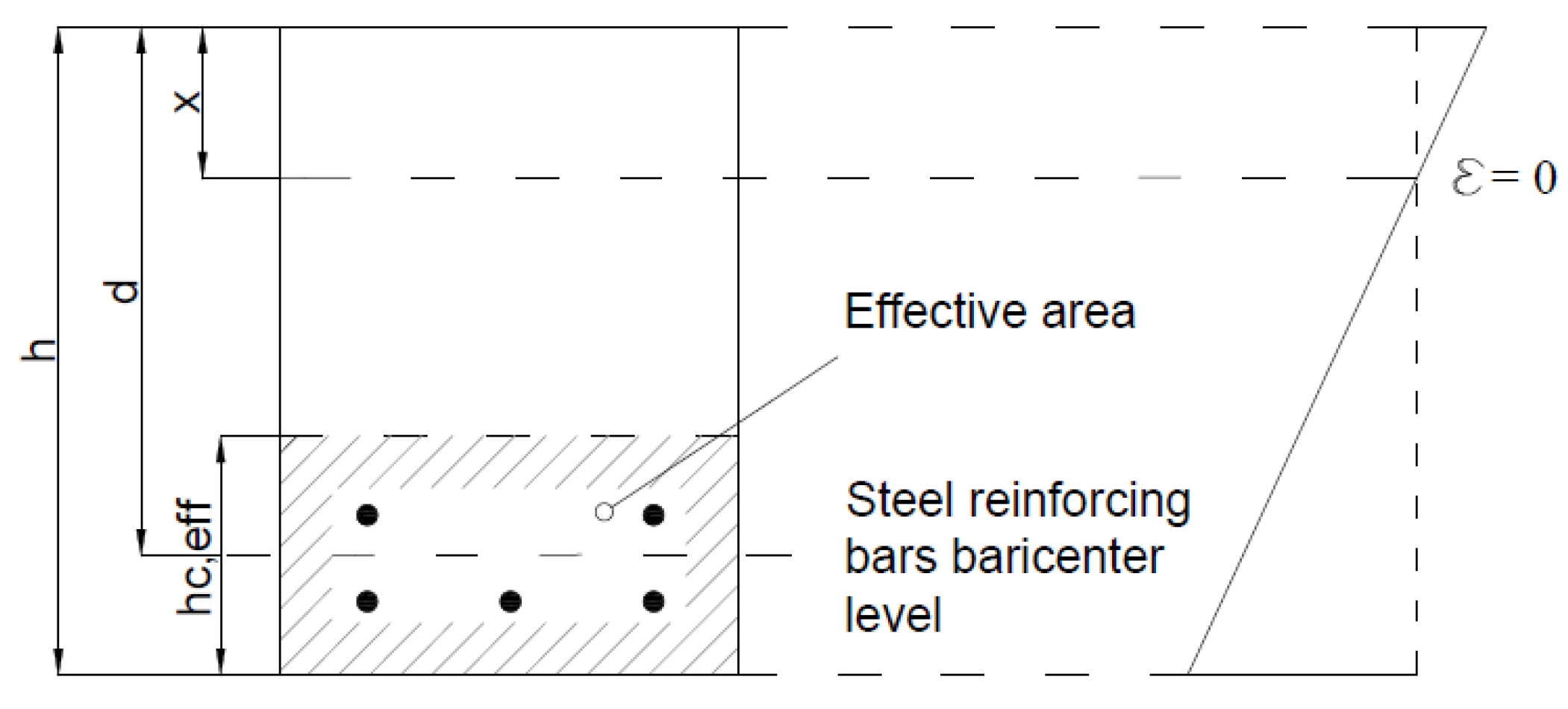
- ρp,eff = Ast/Act is the effective reinforcement ratio evaluated as the ratio between the area of the reinforcing bars, Ast, contained within the concrete cross section portion effectively influenced by the bars in the formation of cracks.
2. Modeling Tension Stiffening
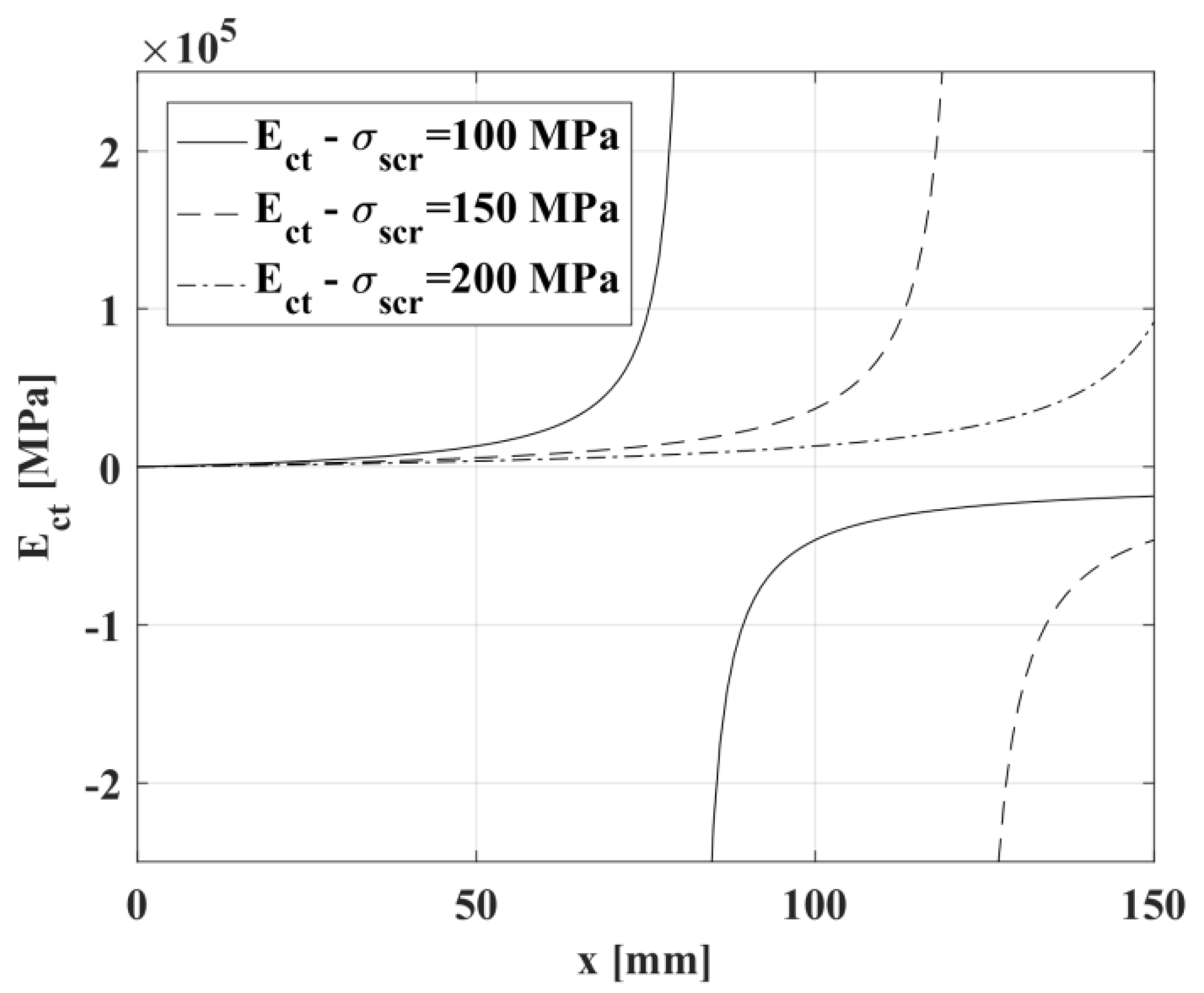
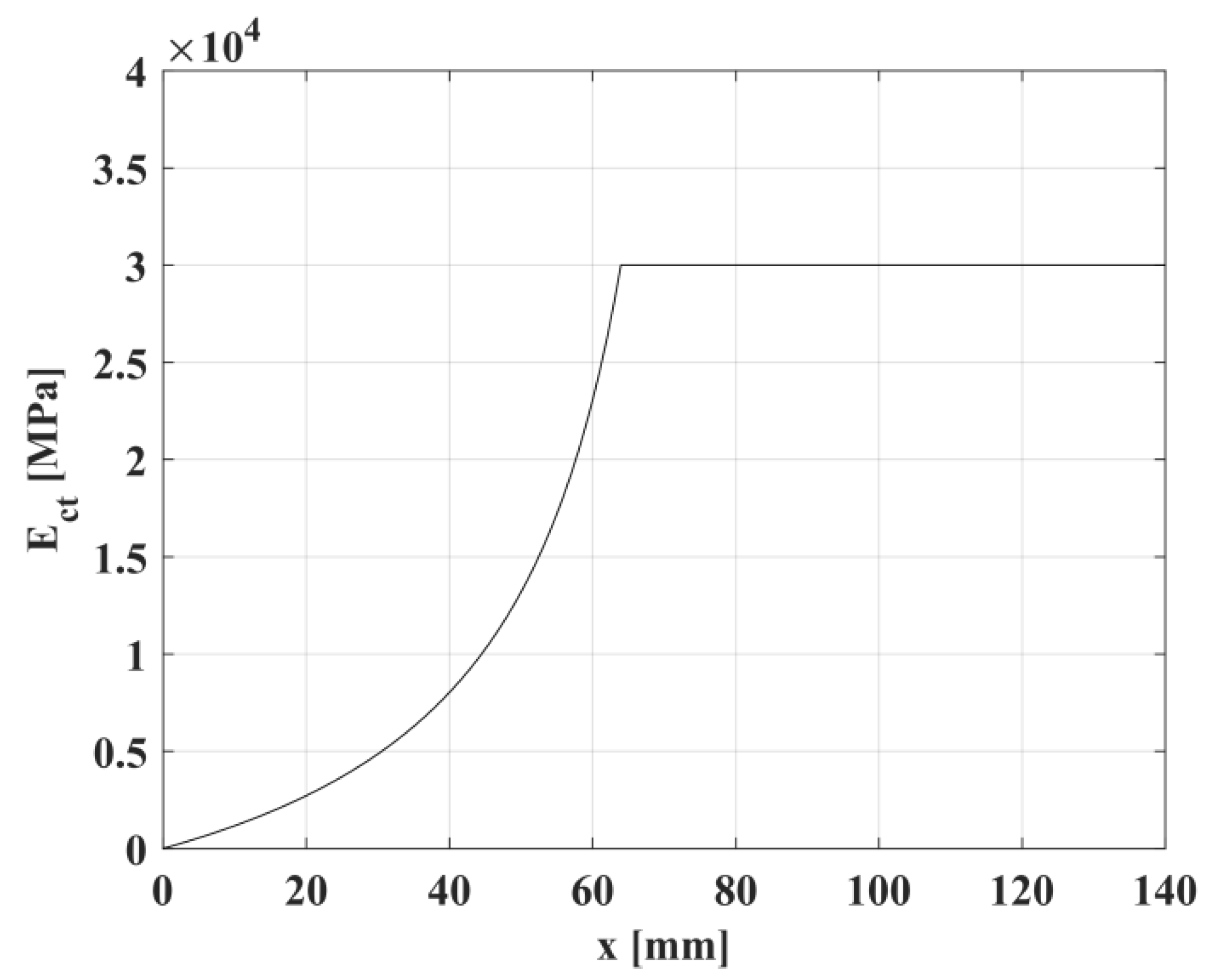
Observations
- −
- for , . This result is unrealistic given that the upper limit of Ect(x), Ect,lim should be at least equal to the elastic modulus of the concrete in compression, Ec.
- −
- for . This result has no physical meaning, too. The lower limit of Ect should be equal to zero (corresponding to the cracked section).
3. Flexural Behavior of a Circular Section Considering Tension Stiffening
4. Experimental Validation
4.1. Description of the Experimental Results
4.2. Comparison of Numerical and Experimental Results
- −
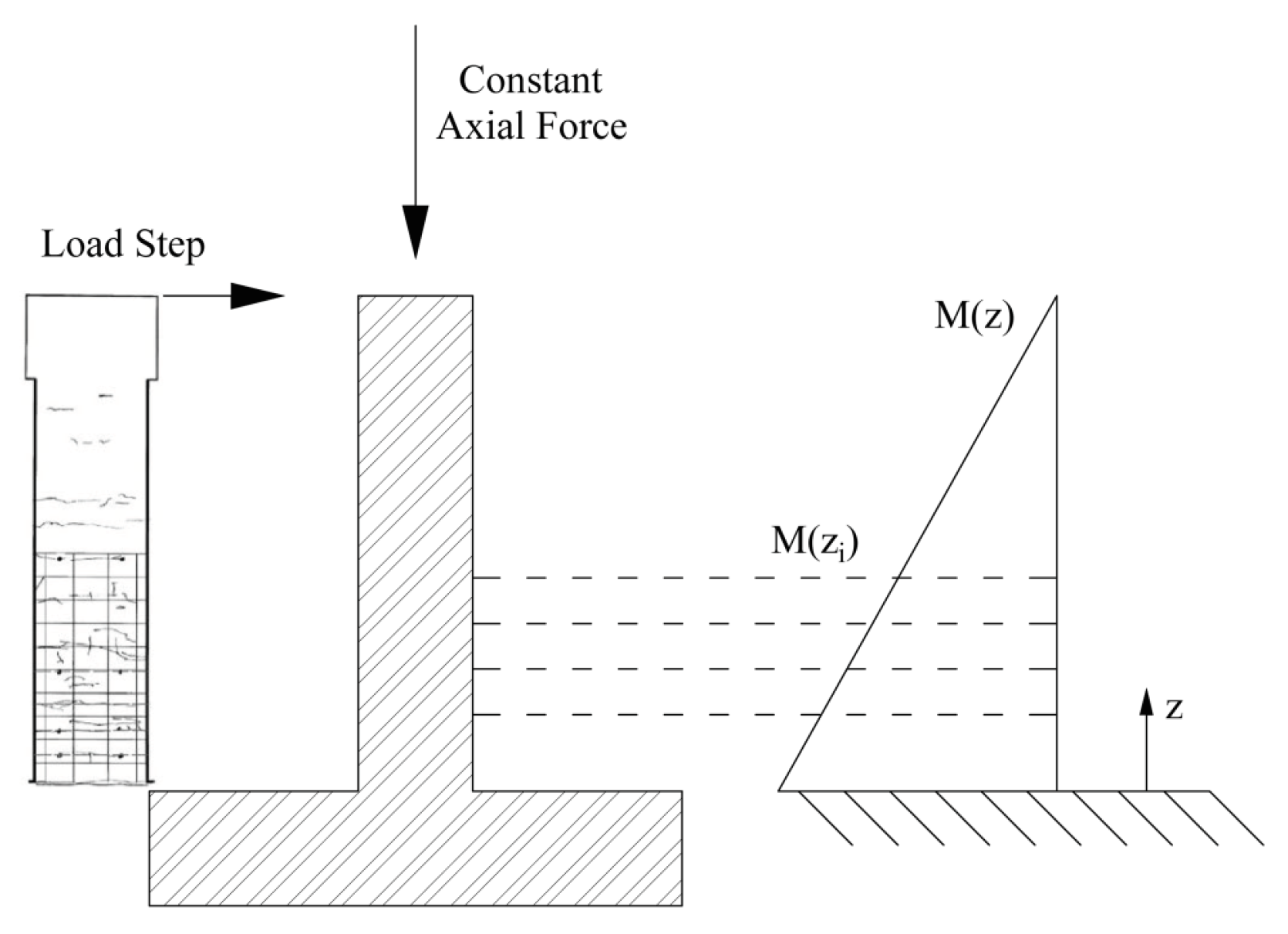
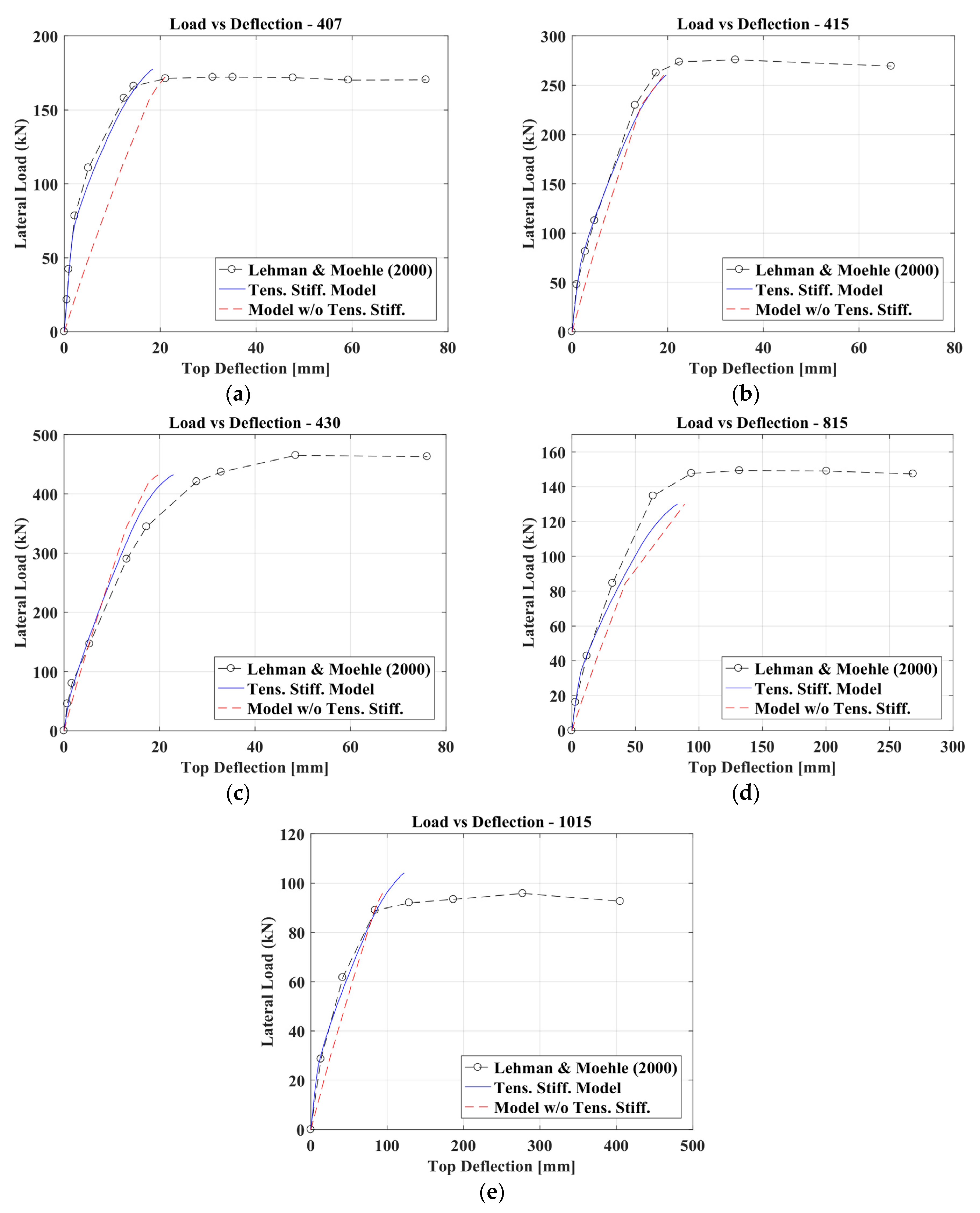
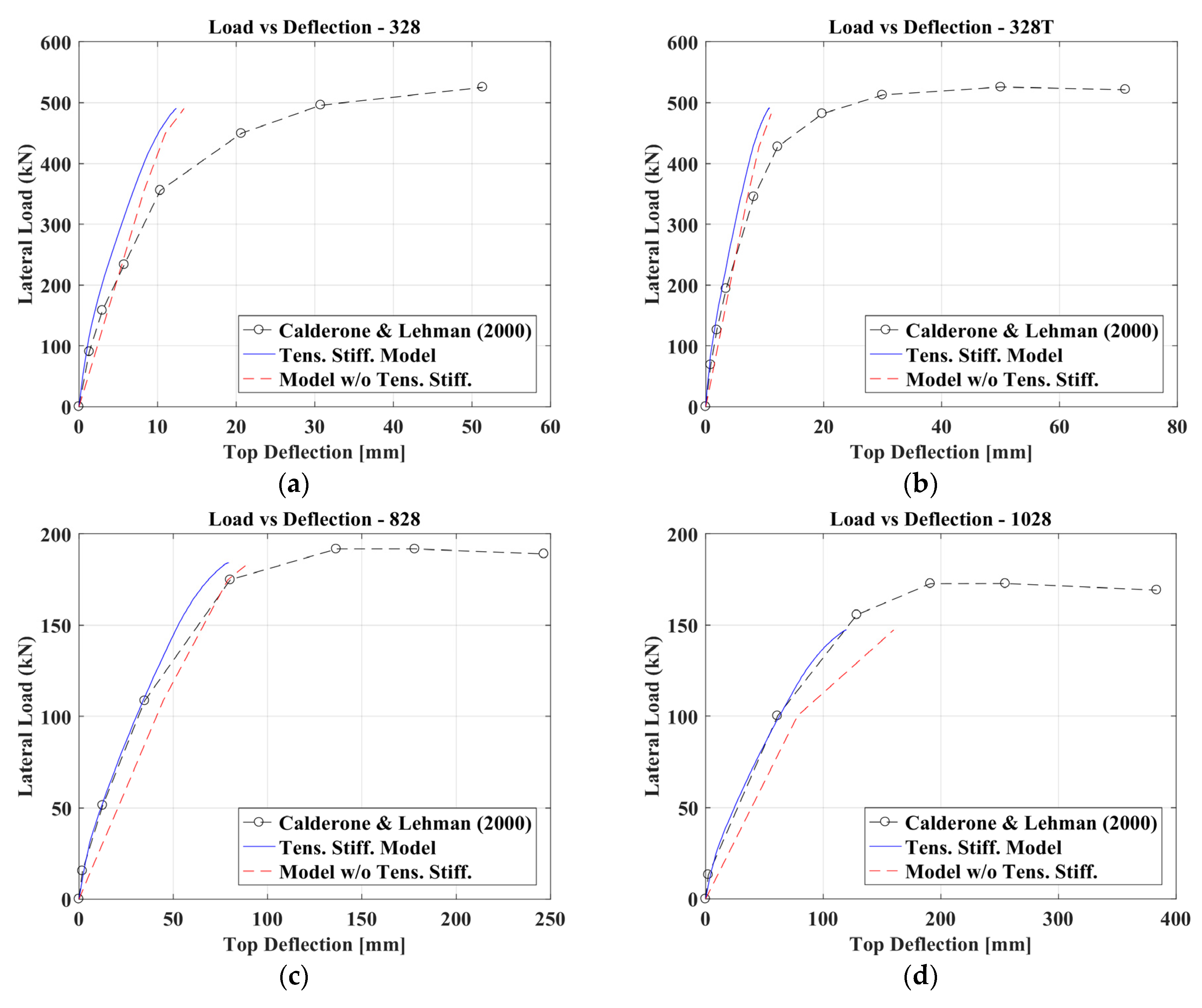
- for column 407, not considering tension stiffening can lead to a sensible error in evaluating the element’s stiffness;
- −
- for more slender columns (828 and 1028), tension stiffening effects are more evident than for shorter ones (328 and 328T).
5. Parametric Analysis
- −
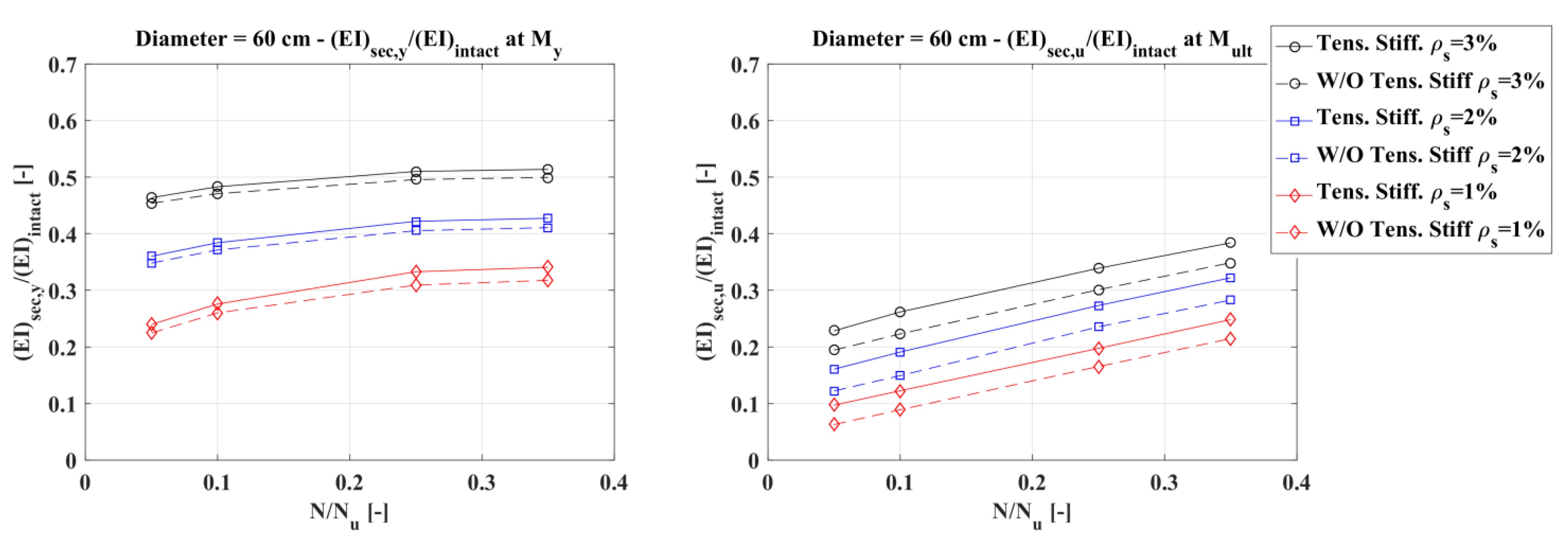
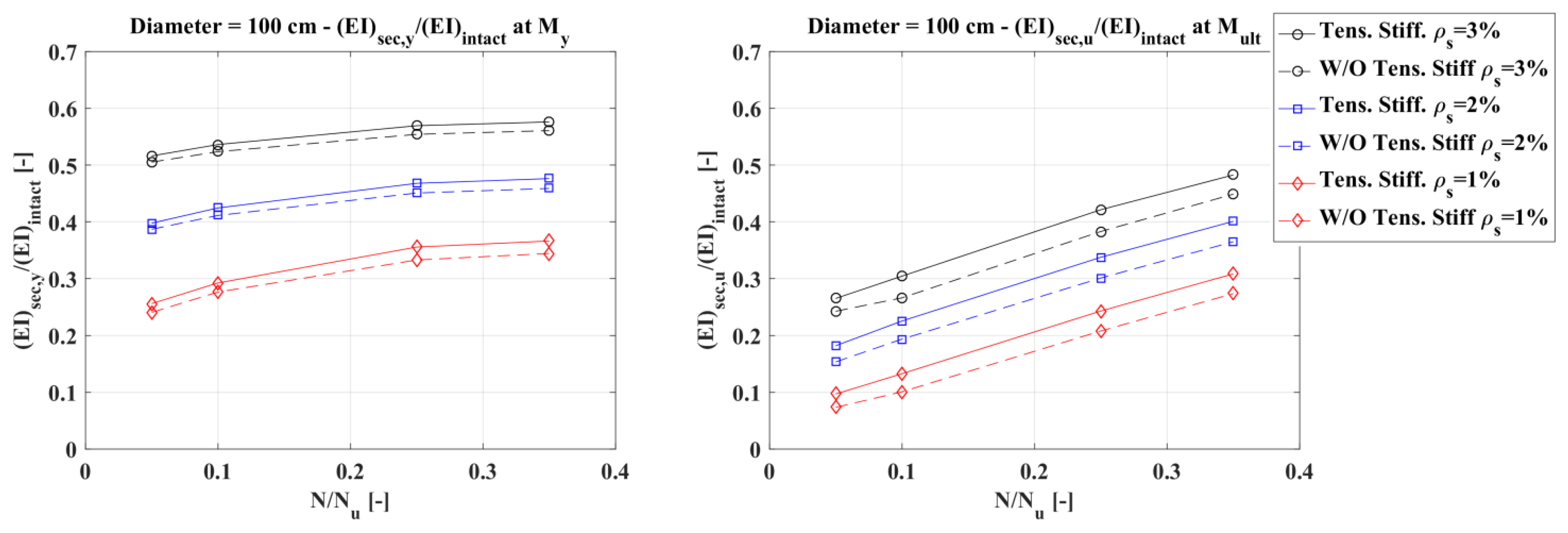
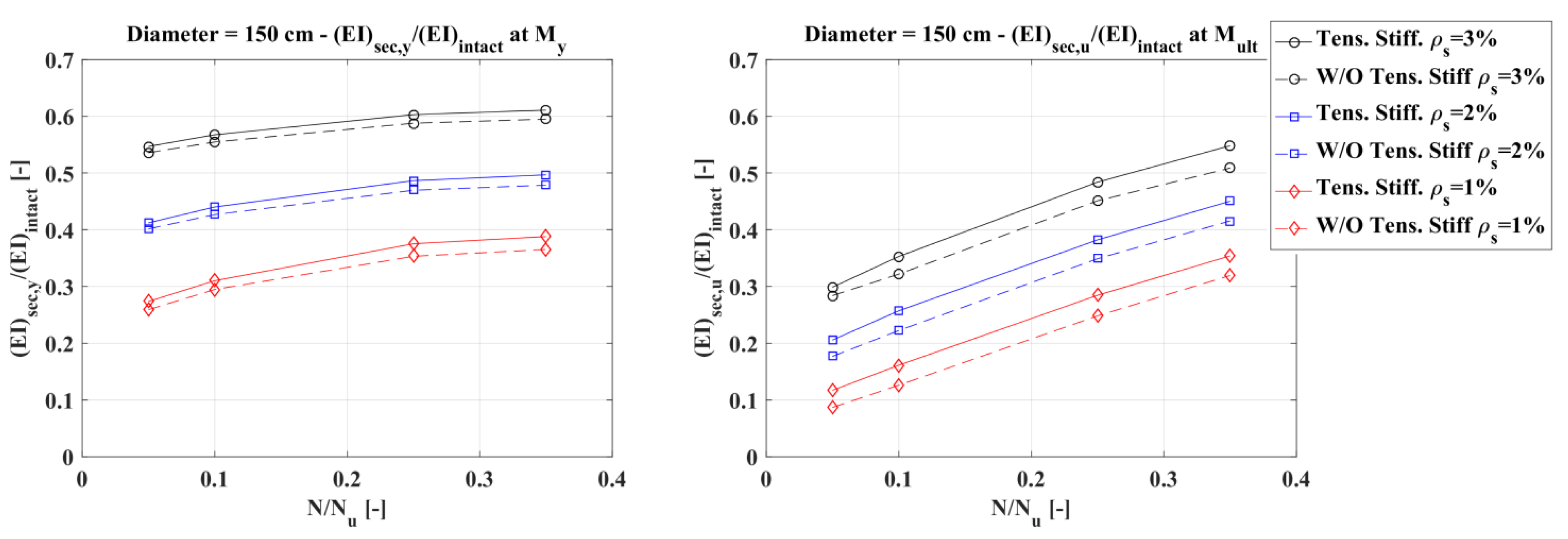
- less evident on the secant stiffness at the first bar yielding than on that evaluated at the maximum bending moment;
- −
- increasing as the reinforcement ratio decreases;
- −
- not so much influenced by the axial force, except for low values of the reinforcement ratio; and
- −
- higher for smaller diameters.
6. Conclusions
- −
- is less evident on the yield stiffness than that of the one evaluated at the moment corresponding to the reaching of peak stress in compression in concrete;
- −
- increases as the reinforcement ratio decreases;
- −
- is not so much influenced by the axial force, except for low values of the reinforcement ratio; and
- −
- is higher for smaller section diameters.
Author Contributions
Conflicts of Interest
References
- EN 1992. Eurocode 2: Design of Concrete Structures, Part 1–1: General Rules and Rules for Buildings; European Committee for Standardization (CEN): Brussels, Belgium, 2005. [Google Scholar]
- FIB-Special Activity Group 5. FIB Bulletin 65: Model Code 2010—Final Draft; International Federation for Structural Concrete (FIB): Lausanne, Switzerland, 2012. [Google Scholar]
- Vecchio, F.J.; Collins, M.P. Response of Reinforced Concrete to In-Plane Shear and Normal Stresses; University of Toronto: Toronto, ON, Canada, 1982. [Google Scholar]
- Collins, M.P.; Mitchell, D. Prestressed Concrete Basics; Canadian Prestressed Concrete Institute: Ottawa, ON, Canada, 1987. [Google Scholar]
- Belarbi, A.; Hsu, T.T. Constitutive Laws of Concrete in Tension and Reinforcing Bars Stiffened by Concrete. Struct. J. 1994, 91, 465–474. [Google Scholar]
- Belarbi, A.; Hsu, T.T. Constitutive Laws of Softened Concrete in Biaxial Tension-Compression. Struct. J. 1995, 92, 562–573. [Google Scholar]
- Bentz, E. Explaining the Riddle of Tension Stiffening Models for Shear Panel Experiments. J. Struct. Eng. 2005, 131, 1422–1425. [Google Scholar] [CrossRef] [Scilit]
- Salvatore, W.; Buratti, G.; Maffei, B.; Valentini, R. Dual-phase steel re-bars for high-ductile r.c. structures, Part 2: Rotational capacity of beams. Eng. Struct. 2007, 29, 3333–3341. [Google Scholar] [CrossRef] [Scilit]
- Maffei, B.; Salvatore, W.; Valentini, R. Dual-phase steel rebars for high-ductile r.c. structures, Part 1: Microstructural and mechanical characterization of steel rebars. Eng. Struct. 2007, 29, 3325–3332. [Google Scholar] [CrossRef] [Scilit]
- Shukri, A.A.; Darain, K.M.; Jumaat, M.Z. The Tension-Stiffening Contribution of NSM CFRP to the Behavior of Strengthened RC Beams. Materials 2015, 8, 4131–4146. [Google Scholar] [CrossRef] [Scilit]
- Shukri, A.A.; Visintin, P.; Oehlers, D.J.; Jumaat, M.Z. Mechanics Model for Simulating RC Hinges under Reversed Cyclic Loading. Materials 2016, 9, 305. [Google Scholar] [CrossRef] [Scilit]
- Sato, Y.; Vecchio, F.J. Tension Stiffening and Crack Formation in Reinforced Concrete Members with Fiber-Reinforced Polymer Sheets. J. Struct. Eng. 2003, 129, 717–724. [Google Scholar] [CrossRef] [Scilit]
- Stramandinoli, R.S.; La Rovere, H.L. An efficient tension-stiffening model for nonlinear analysis of reinforced concrete members. Eng. Struct. 2008, 30, 2069–2080. [Google Scholar] [CrossRef] [Scilit]
- Lee, S.C.; Cho, J.Y.; Vecchio, F.J. Model for post-yield tension stiffening and rebar rupture in concrete members. Eng. Struct. 2011, 33, 1723–1733. [Google Scholar] [CrossRef] [Scilit]
- Kaklauskas, G.; Gribniak, V.; Bacinskas, D.; Vainiunas, P. Shrinkage influence on tension stiffening in concrete members. Eng. Struct. 2009, 31, 1305–1312. [Google Scholar] [CrossRef] [Scilit]
- Soltani, M.; An, X.; Maekawa, K. Computational model for post cracking analysis of RC membrane elements based on local stress-strain characteristics. Eng. Struct. 2003, 25, 993–1007. [Google Scholar] [CrossRef] [Scilit]
- Manfredi, G.; Pecce, M. A refined RC beam element including bond–slip relationship for the analysis of continuous beams. Comput. Struct. 1998, 69, 53–62. [Google Scholar] [CrossRef] [Scilit]
- Braga, F.; Caprili, S.; Gigliotti, R.; Salvatore, W. Hardening slip model for reinforcing steel bars. Earthq. Struct. 2005, 9, 503–539. [Google Scholar] [CrossRef] [Scilit]
- Kwak, H.G.; Song, J.Y. Cracking analysis of RC members using polynomial strain distribution function. Eng. Struct. 2002, 24, 455–468. [Google Scholar] [CrossRef] [Scilit]
- Castel, A.; Vidal, T.; FranÇois, R. Effective Tension Active Cross-Section of Reinforced Concrete Beams After Cracking. Mater. Struct. 2007, 39, 115–126. [Google Scholar] [CrossRef] [Scilit]
- Carbonell-Màrquez, J.F.; Gil-Martìn, L.M.; Alejandro Fernàndez-Ruìz, M.; Hernàndez-Montes, E. Effective area in tension stiffening of reinforced concrete piles subjected to flexure according to Eurocode 2. Eng. Struct. 2014, 76, 62–74. [Google Scholar] [CrossRef] [Scilit]
- Mondal, T.G.; Prakash, S.S. Effect of tension stiffening on torsional behaviour of square RC columns. Adv. Struct. Eng. Mater. Vol. Three 2015, 92, 2131–2144. [Google Scholar] [CrossRef] [Scilit]
- CEB. Ductility of Reinforced Concrete Structures; Bulletin d’Information N°242; International Federation of Structural Concrete, FIB: Lausanne, Switzerland, 1998. [Google Scholar]
- Mander, J.B.; Priestley, M.J.; Park, R. Theoretical Stress-Strain Model for Confined Concrete. J. Struct. Eng. 1988, 114, 1804–1825. [Google Scholar] [CrossRef] [Scilit]
- Popovic, S. A numerical approach to the complete stress-strain curves for concrete. Cement Concrete Res. 1973, 3, 583–599. [Google Scholar] [CrossRef] [Scilit]
- Lehman, D.E.; Moehle, J.P. Seismic Performance of Well-Confined Concrete Bridge Columns. PEER Report 1998/01; College of Engineering, University of California: Berkeley, CA, USA, December 2000. [Google Scholar]
- Calderone, A.; Lehman, D.E.; Moehle, J.P. Behavior of Reinforced Concrete Bridge Piers Having Varying Aspect Ratios and Varying Lengths of Confinement. PEER Report 2000/08; College of Engineering, University of California: Berkeley, CA, USA, January 2001. [Google Scholar]






| Column ID | Height (mm) | Section Diameter (mm) | Concrete Cover (mm) | Long. Reinforcement [Number and Diameter (mm) of Bars] | Transverse Reinforcement [Diameter (mm)/Spacing (mm)] | Concrete f’c (MPa) | Long. Reinforcement fy (MPa) | Trans. Reinforcement fy (MPa) |
|---|---|---|---|---|---|---|---|---|
| 407 | 2438 | 609.6 | 33.4 | 11 Φ16 | Φ6/32 | 43.4 | 471.6 | 668.1 |
| 415 | 2438 | 609.6 | 33.4 | 22 Φ16 | Φ6/32 | 43.4 | 471.6 | 668.1 |
| 430 | 2438 | 609.6 | 33.4 | 44 Φ16 | Φ6/32 | 43.4 | 471.6 | 668.1 |
| 815 | 4877 | 609.6 | 33.4 | 22 Φ16 | Φ6/32 | 43.4 | 471.6 | 668.1 |
| 1015 | 6096 | 609.6 | 33.4 | 22 Φ16 | Φ6/32 | 43.4 | 471.6 | 668.1 |
| Column ID | Height (mm) | Section Diameter (mm) | Concrete Cover (mm) | Long. Reinforcement [Number and Diameter (mm) of Bars] | Transverse Reinforcement [Diameter (mm)/Spacing (mm)] | Concrete f’c (MPa) | Long. Reinforcement fy (MPa) | Trans. Reinforcement fy (MPa) |
|---|---|---|---|---|---|---|---|---|
| 328 | 1829 | 609.6 | 41.3 | 28 Φ19 | Φ6/25 | 27.6 | 483.0 | 483.0 |
| 328T | 1829 | 609.6 | 41.3 | 28 Φ19 | Φ6/76 | 27.6 | 483.0 | 483.0 |
| 828 | 4877 | 609.6 | 41.3 | 28 Φ19 | Φ6/76 | 27.6 | 483.0 | 483.0 |
| 1028 | 6096 | 609.6 | 41.3 | 28 Φ19 | Φ6/51 | 27.6 | 483.0 | 483.0 |
| Column ID | Experimental Mean Crack Distance * (mm) | Mean Cracks Distance Evaluated by Equation (12) (mm) | Column ID | Experimental Mean Crack Distance * (mm) | Mean Cracks Distance Evaluated by Equation (12) (mm) |
|---|---|---|---|---|---|
| 407 | 167 | 204 | 328 | 78 | 74 |
| 415 | 93 | 112 | 328T | 77 | 74 |
| 430 | 114 | 79 | 828 | 114 | 74 |
| 815 | 147 | 112 | 1028 | 84 | 74 |
| 1015 | 102 | 112 | - | - | - |
| Diameter (m) | Longitudinal Bars | As/Ac | N/Nu (1) | N/Nu (2) | N/Nu (3) | N/Nu (4) |
|---|---|---|---|---|---|---|
| 0.60 | 14 ϕ16 | 1% | 0.05 | 0.10 | 0.25 | 0.35 |
| 0.60 | 18 ϕ20 | 2% | 0.05 | 0.10 | 0.25 | 0.35 |
| 0.60 | 22 ϕ22 | 3% | 0.05 | 0.10 | 0.25 | 0.35 |
| 1.00 | 30 ϕ18 | 1% | 0.05 | 0.10 | 0.25 | 0.35 |
| 1.00 | 42 ϕ22 | 2% | 0.05 | 0.10 | 0.25 | 0.35 |
| 1.00 | 44 ϕ26 | 3% | 0.05 | 0.10 | 0.25 | 0.35 |
| 1.50 | 40 ϕ24 | 1% | 0.05 | 0.10 | 0.25 | 0.35 |
| 1.50 | 44 ϕ32 | 2% | 0.05 | 0.10 | 0.25 | 0.35 |
| 1.50 | 66 ϕ32 | 3% | 0.05 | 0.10 | 0.25 | 0.35 |
© 2017 by the authors. Licensee MDPI, Basel, Switzerland. This article is an open access article distributed under the terms and conditions of the Creative Commons Attribution (CC BY) license (http://creativecommons.org/licenses/by/4.0/).
Share and Cite
Morelli, F.; Amico, C.; Salvatore, W.; Squeglia, N.; Stacul, S. Influence of Tension Stiffening on the Flexural Stiffness of Reinforced Concrete Circular Sections. Materials 2017, 10, 669. https://doi.org/10.3390/ma10060669
Morelli F, Amico C, Salvatore W, Squeglia N, Stacul S. Influence of Tension Stiffening on the Flexural Stiffness of Reinforced Concrete Circular Sections. Materials. 2017; 10(6):669. https://doi.org/10.3390/ma10060669
Chicago/Turabian StyleMorelli, Francesco, Cosimo Amico, Walter Salvatore, Nunziante Squeglia, and Stefano Stacul. 2017. "Influence of Tension Stiffening on the Flexural Stiffness of Reinforced Concrete Circular Sections" Materials 10, no. 6: 669. https://doi.org/10.3390/ma10060669
APA StyleMorelli, F., Amico, C., Salvatore, W., Squeglia, N., & Stacul, S. (2017). Influence of Tension Stiffening on the Flexural Stiffness of Reinforced Concrete Circular Sections. Materials, 10(6), 669. https://doi.org/10.3390/ma10060669