1. Introduction
The increasing frequency of impacts related to climate change have urged detailed analysis of the subject, much like GHG emissions, preparing for changes, preventing adverse effects and minimizing damage even though the causality and possible countermeasures were uncertain in many areas. The precautionary principle advised preparation regardless. The Intergovernmental Panel on Climate Change (IPCC) has concluded that anthropogenic greenhouse gas emissions will continue to drive change in the future [
1,
2,
3,
4]. Hungary committed itself to maximizing greenhouse gas growth at 10% by 2020 compared to 2005 levels in the non-EU ETS (Emission Trade System) sectors [
5]. Several researches are dealing with energy and climate policy on a global level [
6,
7,
8,
9,
10,
11,
12,
13,
14,
15,
16,
17,
18,
19,
20,
21,
22,
23,
24,
25,
26,
27,
28,
29] but only limited research papers consider Eastern Europe predominantly focusing on special fields or sectors [
30,
31,
32,
33,
34,
35,
36,
37]. For instance, these limited analyses are centered on the water footprint of energy crops as a major environmental problem in Poland; carbon pricing and the diffusion of renewable power generation in Eastern Europe and the power utility re-regulation in East European and CIS transformation countries. Furthermore, these studies are also dealing with the interrelations between climate change and the energy consumption of Hungary in the road transport sector; wind energy utilization and sustainable agriculture in Hungary. The new Hungarian National Energy Strategy 2030 (2011) gives an exceptional opportunity to complement former examinations and also take into account sustainability.
The climate of Hungary has never been kind, partly because continental, Atlantic and Mediterranean effects have all been present with varying dominance, resulting in dry, hot droughts followed by floods and inland water [
38,
39]. Thus Hungarian people have the negative experience of the increased frequency of weather anomalies, with damages becoming increasingly evident, even quantifiable, using different damage calculation methods. From the viewpoint of both sustainability and climate change, a holistic approach is needed to be able to examine the interactions and to find the possible solutions [
40,
41]. According to the IPCC Reports, climate change can be one of the greatest threats to sustainable development. Furthermore, the third IPCC Report emphasized in relation to sustainability that it can be an advantage in the mitigation of climate change [
2,
3]. The National Strategy for Sustainable Development [
42] was adopted in 2007. It consists of eleven priority areas including climate change-related issues and focusing on both mitigation and adaptation efforts. Furthermore, the National Council for Sustainable Development was established in 2007. The Parliament can request the different predefined organizations, associations and bodies to send delegates into the Council.
It has become evident that the mean temperature is increasing, along with the frequency and duration of extreme weather events. Therefore, the Hungarian Academy of Sciences has joined forces with the government in 2003 to explore the possible tools, methods and institutional background of adaptation and mitigation, taking into account pre-existing studies and initiatives, enlisting the expertise of researchers, government and agricultural experts on a wide scale. Participating meteorologists, experts in agriculture, energy management and social sciences, doctors, architects, insurance experts,
etc. Have quickly come to the conclusion that the greatest threat posed by climate change manifests itself in food, energy and water supply security and health care [
38]. It has also become evident that energy production is the leading anthropogenic cause behind climate change and changes in local weather conditions, making it a logical focus for planned interventions.
Meeting energy needs is always a current issue in Hungary, irrespective of climate change because of the high dependency on oil and gas imports, limited opportunities to replace them with domestic production, and the pollution associated with using fossil energy sources (CO
2 as well as methane). Energy policy has special focus in the economic recovery plan of the Hungarian government. It plays an essential role in Hungary’s efforts to foster green growth and job creation [
38]. The way forward was easy to determine: fostering energy savings, efficiency, and the use of renewable resources (this did not stop the search for new fossil energy sources, reassessing old ones and working with nuclear power).
With all this in mind, between 2003 and 2006, the intensive scientific work, coupled with an offensive communication strategy and the inclusion of civil organizations managed to attract the attention of the scientific community, and, eventually, decision makers. The effects and impacts of climate change especially with respect to energy was debated on a variety of forums, eventually culminating in the concept for the National Climate Change Strategy [
39]. In 2008, the National Climate Change Strategy was adopted for the years 2008–2025 focusing on Hungarian climate policy. This strategy has to be reviewed by the Hungarian Government two years following adoption and every five years thereafter. Furthermore, the strategy is supported by a two-year National Climate Change Program focusing on the most significant impacts and possible responses [
43]. The adoption of the Framework Law for Climate Protection has been launched in Hungary. In February 2010, the draft version of the Framework Law for Climate Protection was submitted to the Hungarian Parliament. This framework law was supported by roughly 500, mainly environmental, social and rural NGOs. Finally, the Framework Law for Climate Protection was not approved by the Parliament mainly due to the lack of supporting solutions enhancing the possibility of sector-specific integration.
Meanwhile, the Secretariat for the Green Economy and Climate Policy has been created, and the assessment of the National Climate Change Strategy is underway. The development of a National Adaptation Strategy is being planned, based on regional climate vulnerability. Plans for a National Decarbonization Plan are also in the works, aiming to limit temperature increase to 2 °C in accordance with EU goals [
44,
45].
What has been achieved in the past few years in Hungary is well illustrated by the prison on the Great Plain where nearly 800 convicts work, farming 4000 hectares, producing bioproducts on 180 hectares, selling six million liters of milk and 17,000 tons of pork meat. A biogas plant is also in operation since 2008, based on 53,000 tons of organic waste. The work is done by 25 convicts, turning a profit on products, collected waste and electricity fed into the national network, meeting the needs of 2000 households. This also results in 45,000 tons of CO2 savings, the quotas being purchased by the Austrian government, while all activities provide meaningful tasks for the inmates.
2. A Succinct Review of the Hungarian Energy Sector
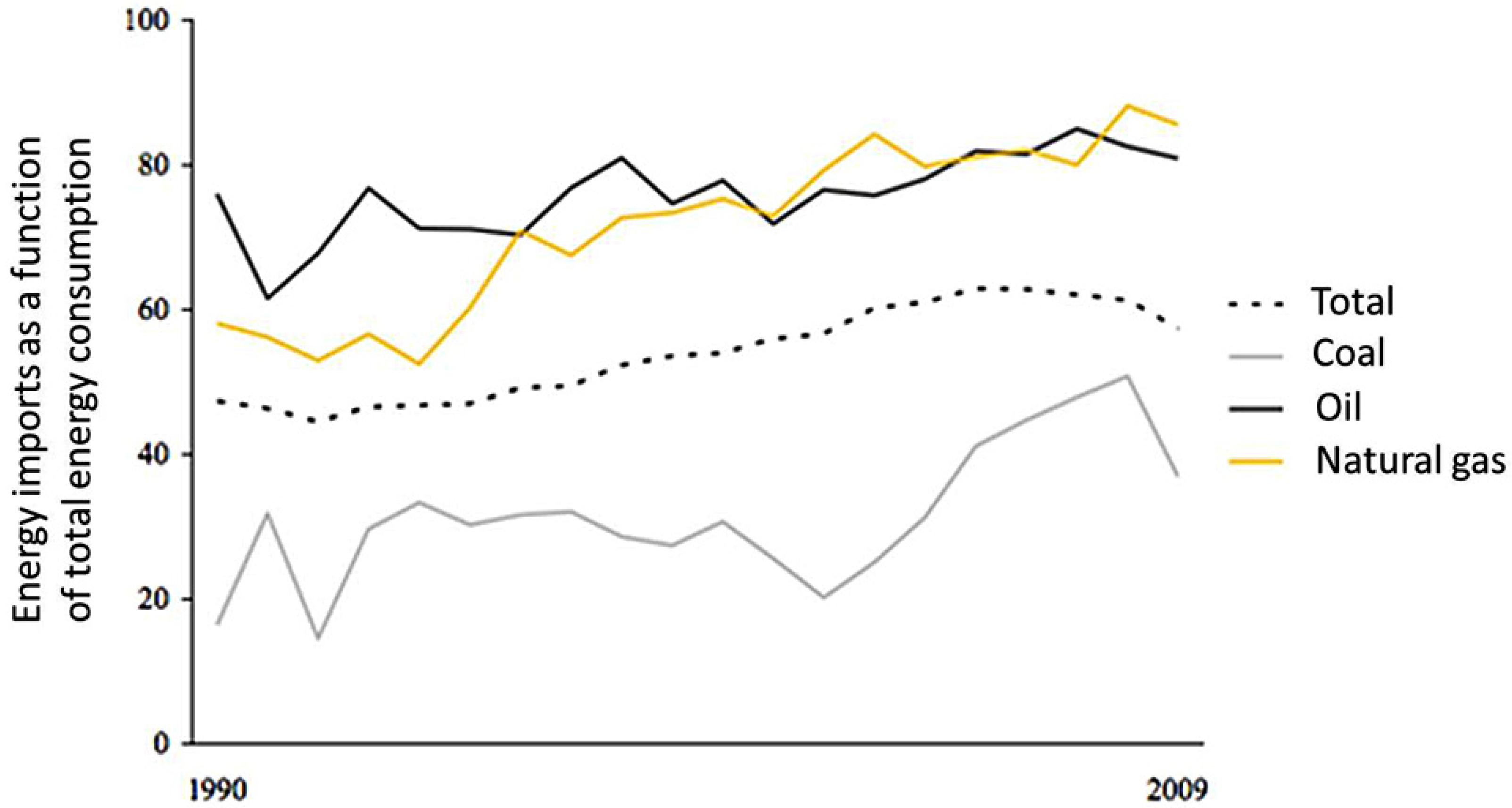
The energy problem has been redefined as one of the most important elements of sustainable development by climate change, adaptation and mitigation. In order to understand the current situation it is necessary to mention that after the regime change in 1989, the structure of the economy has changed, energy-intensive industries have deteriorated and energy use has decreased to 1970 levels amid considerable unemployment and other social stresses. Therefore, even as the services sector was developing, primary energy consumption decreased by 16% between 1990 and 1992 despite growing GDP, followed by a slow, 0.5% annual increase, decreasing again in the wake of the financial crisis in 2009, adding up to 1056 PJ (1 PJ = 10
15 J) in 2011. Hungary’s dependence on energy imports is illustrated on
Figure 1.
Figure 1.
Hungary’s dependence on energy imports [
46].
Figure 1.
Hungary’s dependence on energy imports [
46].
High energy intensity as a function of GDP is characteristic of Hungary. It is also clear that the net import of fossil energy sources has strongly increased between 1990 and 2005. 80% of the natural gas imports from Russia come through a single supply route. The structure of primary energy consumption in Hungary can be seen on
Figure 2. The share of renewable energy sources amounted to 7.3%, well below the 10.3% average of the EU.
Figure 2.
The structure of primary energy consumption in Hungary [
46].
Figure 2.
The structure of primary energy consumption in Hungary [
46].
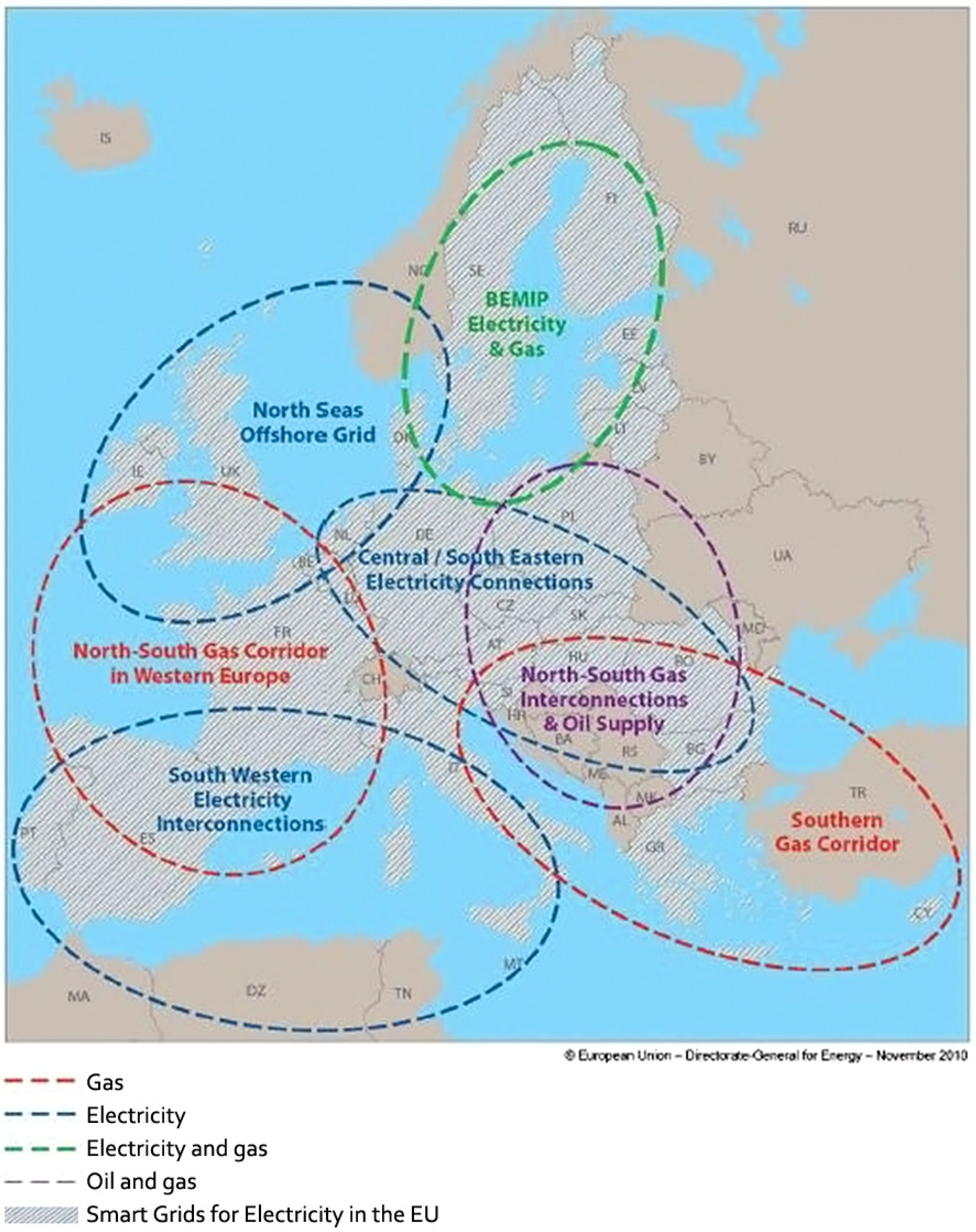
The Central European Region is key in the long-term infrastructure development plans of the EU, as illustrated by
Figure 3.
Figure 3.
EU priority corridors for electricity, gas and oil [
47].
Figure 3.
EU priority corridors for electricity, gas and oil [
47].
There are three development options to import natural gas to the region from sources other than the Brotherhood (Testvériség) pipeline:
The expansion of the Austrian-Hungarian interconnector (Baumgarten/Moson) and construction of the Slovakian-Hungarian interconnector. The capacity would be sufficient to cover nearly all imports and provide a connection to the Western European market;
The construction of the North-South Interconnections, incorporating the Slovakia-Hungary, Croatia-Hungary connections as well as the Adriatic oil pipeline, providing access to Polish, Croatian Slovenian and Italian LNG terminals, and eventually the Polish shale gas sites if production starts and related climate risks (e.g., methane leak) are managed;
The Southern Gas Corridor projects, making other natural gas sources accessible, primarily in Central Asia (Nabucco) and as well provide an alternative shipping route for Russian gas (South Stream, AGRI).
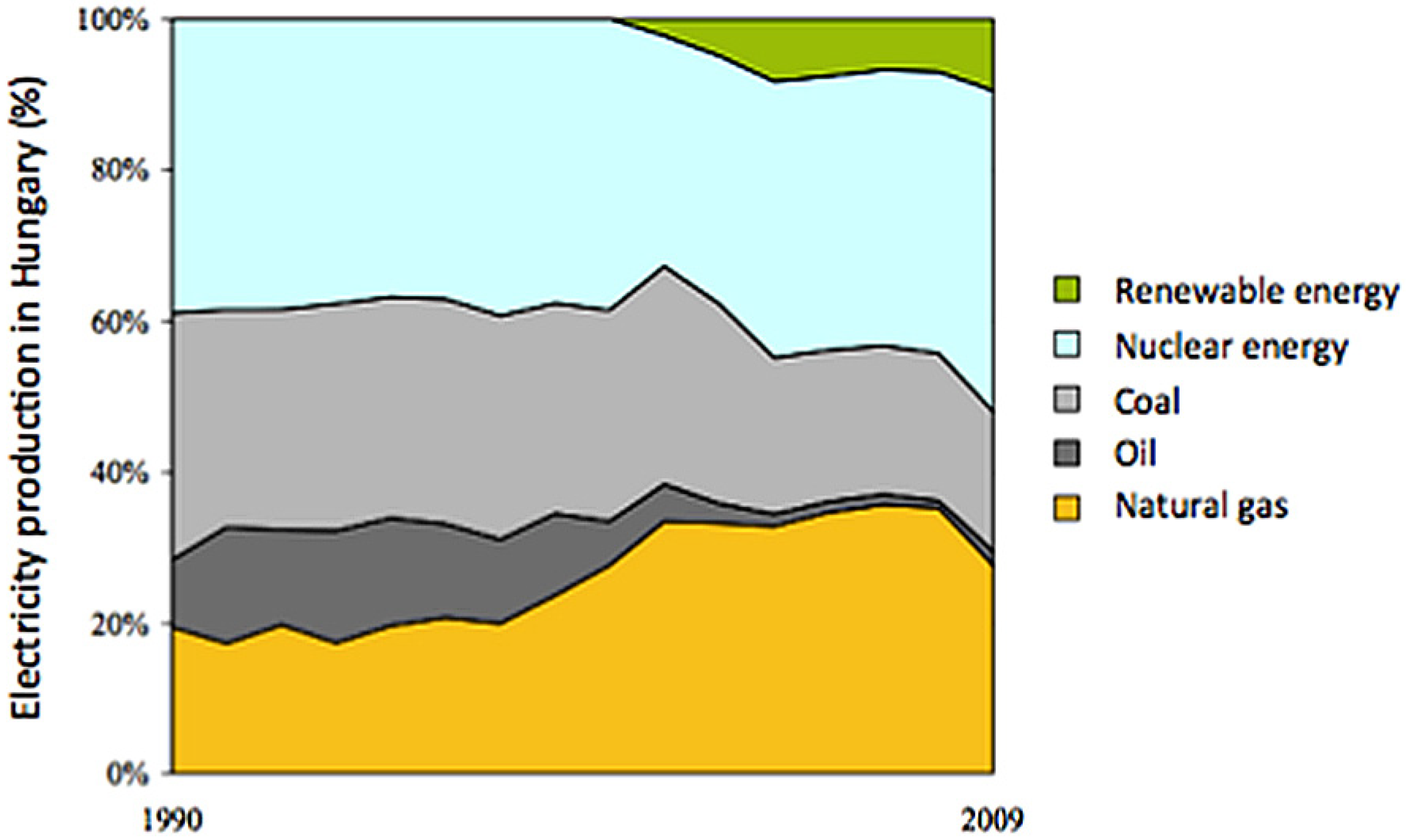
Former Eastern Bloc countries had to move forward with fundamentally different energy strategies. Hungary had to consider the purchase of nuclear reactors while expanding commitment to energy efficiency [
48]. The Paks Nuclear Power Plant (Paks NPP) plays important role in the electricity production. The nominal power of Paks NPP is 2000 MW. Therefore, Paks NPP has a leading role in Hungarian energetics: it takes part of more than 40% of national energy production [
46]. In 2010, the four units of the nuclear power plant produced 15,761 GWh electric energy. The electricity production in Hungary is shown on
Figure 4.
Figure 4.
The structure of electricity production in Hungary [
46].
Figure 4.
The structure of electricity production in Hungary [
46].
Mineral resources are the property of the state and are part of national wealth. Their administration belongs to the Hungarian Office for Mining and Geology. The mineral resources of Hungary can be seen in
Table 1.
Table 1.
Mineral resources in Hungary [
46].
Table 1.
Mineral resources in Hungary [46].
| Resources | Geological Asset (2010) | Production (2009) |
|---|
| Oil (million t) | 209.4 | 0,80 |
| Mineral coal (million t) | 1625.1 | - |
| Brown coal (million t) | 3198.0 | 0,95 |
| Lignite (million t) | 5761.0 | 8,03 |
| Uranium (million t) | 26.8 | - |
| Natural gas (billion m3) | 3563.0 | 3,12 |
Hungarian coal reserves are sufficient for the country’s needs for around 200 years, but the high costs of mining and the GHG emissions are a serious concern.
Biomass is a relatively abundant resource in Hungary. Even in 1985, reports on the agro-ecological potential concluded that the primary biomass production is 53.5 million tons from wheat (64%), forage crops (13%), industrial plants (5%), wood and forests (13%), and groceries and vegetables (5%). Secondary biomass (cattle slurry, litter,
etc.) production amounted to 7.1 million tons [
49]. From tertiary biomass (food production), 3.5 million tons vegetable and 870,000 tons of animal biomass was produced [
49]. Some of the byproducts of food production is used in agriculture, the pharmaceutical industry,
etc. Using waste is also gaining ground, especially with regards, to biogas production. Biomass was presented here because of its role among renewable resources and in absorbing CO
2.
Climate change, exhausting natural resources and other factors make it necessary to reassess the position of the energy sector. Based on our research, the following developments can be expected:
Energy security becomes a basic condition for everyday life. This is especially true of Hungary due to its energy dependence and resulting insecurity.
Energy prices and costs will increase, affecting livelihoods.
Offsetting the impacts of climate change, sustainability and the protection of the environment become inseparable from energy production and supply.
The economy of production, competitiveness and the costs of households increase social tensions, and disrupt fighting poverty, which is already one of the most complex challenges the EU has to face and is strongly correlated with employment and welfare.
3. Saving Energy, Increasing Effectiveness in Adaptation and Mitigation
Increasing effectiveness and saving energy can provide relatively short-term solutions with bearable costs and relatively quick return on investment. These solutions decrease fossil fuel use and thereby CO
2 emissions. We have discussed the abundance of biomass sources in Hungary, but it is important to note that burning biomass also produces CO
2. However, the source of this CO
2 is the atmosphere and therefore there is no net increase in atmospheric CO
2 as opposed to burning fossil fuels. Currently, climate policy is not the most significant issue on the national political agenda in Hungary. However, numerous different mitigation and adaptation programs and strategies have been initiated in recent years, even as the Fourth National Communication of Hungary to the UNFCCC stated that “very often climate change mitigation is not the primary objective for a policy or measure, but rather a secondary benefit, which is, nevertheless, expected and assessed” [
50].
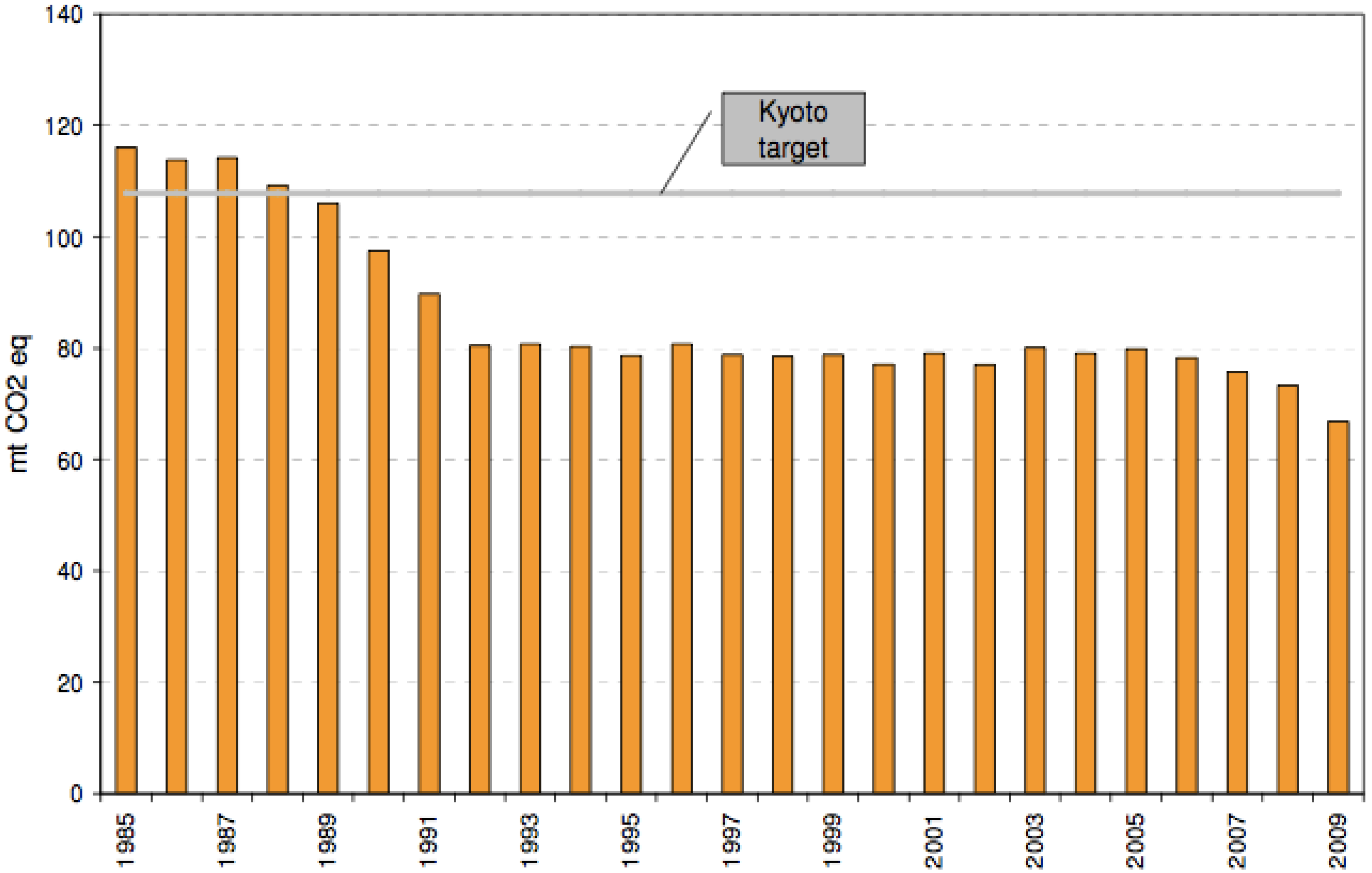
In 2009, Hungary emitted 63.792 million tones CO
2 equivalent GHG including absorbers. It is 43,3% lower compared to the average years 1985–87 that was the base for Hungary’s 6% undertaking in the Kyoto Protocol. Emissions stagnated between 1999–2005 due to the economic collapse. According to the last UNFCCC report in 2008 [
51] the greenhouse gas emissions of Hungary were stagnating until 2005, when a decrease has been observed as it is shown by
Figure 5, not including LULUCF (land use, land use change and forestry).
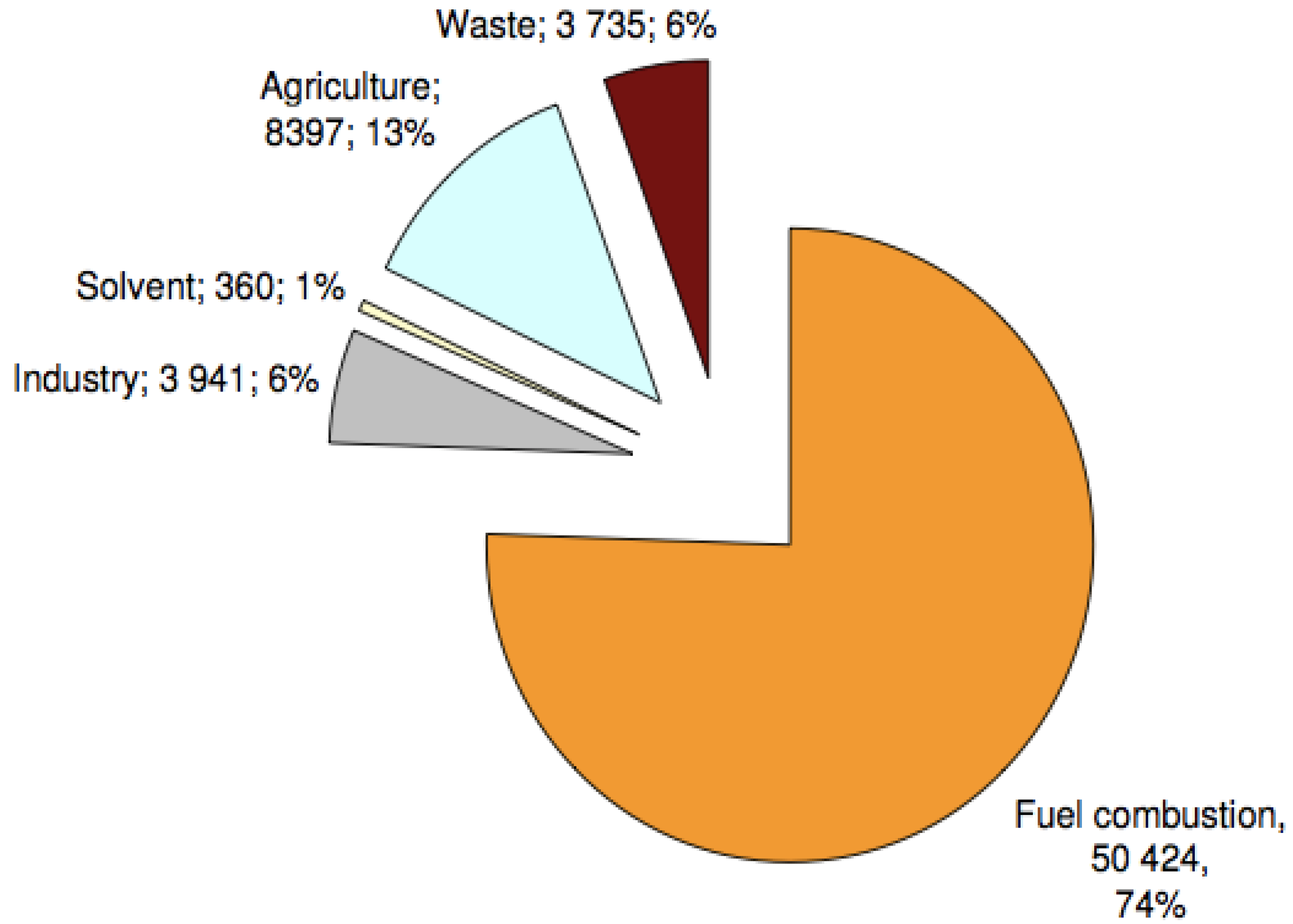
In 2009, carbon dioxide accounts for the 75%, methane for 13% and nitrous oxide for 11% of emission. The share of F-gases is not significant in the total emission. CO
2 mainly originates from the combustion of fossil energy. The main sources of methane emissions are landfills and animal farming. More than three quarters of emissions can be attributed to energy production. Another significant sector is agriculture (13%), followed by industry (6%) and waste (6%) (see
Figure 6).
Figure 5.
Hungary’s GHG reduction 1985–2005 (excluding LULUCF) [
52].
Figure 5.
Hungary’s GHG reduction 1985–2005 (excluding LULUCF) [
52].
Figure 6.
Hungary’s GHG emission by sectors in 2009 (thousand tones, CO
2eq, %) [
52].
Figure 6.
Hungary’s GHG emission by sectors in 2009 (thousand tones, CO
2eq, %) [
52].
The simplest way to achieve savings in households is to promote energy savings, with the estimated potential being around 20%. The results of raising awareness, behavior change, “turn it off” and “turn it down” type actions and initiatives stressing the need to offset rising energy prices and protecting the environment can already be felt in Hungary. These actions in our experience can only be successful if they take into account rigid thinking and old customs as well as comfort requirements and social demands. It is obvious that the potential for savings is very different for households, for transport, in small communities, etc.
Renewable resources can contribute to decreasing fossil fuel use and mitigation be they complex industrial processes or simple household methods. A fine example of the latter is compost production and use in gardens, a substitution for using fertilizers. Hungary’s potential for energy efficiency and savings is estimated at 25–30%. Improving technologies and processes, the maintenance of infrastructure, institutional development, government functions and civil organizations can all play a role in this. Increasing efficiency is possible in production and consumption, but is more investment-intensive than energy conservation. It is important to note that the combined deployment of conservation, increasing efficiency and using renewable resources can lead to synergic effects [
53].
Transport is another major source of CO
2 emissions, which, as opposed to industry, is constantly growing, making conservation and increasing efficiency in this area particularly important. Accounting for 10% of GDP, as well as 10 million workers, it is also a major source of pollution and noise emissions. The adverse effects of transport are amplified by congestion, resulting in traffic jams, aggravation for motorists and even more pollution [
54]. There are many areas of intervention, but the general goals include decreasing oil dependence and increasing the share of electric, hydrogen and biofuel vehicles. The basis of electrification is primarily nuclear energy. Using more sustainable fuels in public transport can also decrease CO
2 emissions. The main policies and incentives in Hungary as well as in Europe are focusing on first-generation biofuels by providing tax exemptions and other forms of support [
55]. Hungary due to its agricultural potential, climatic and economic conditions is well suited to the production of biofuels. Corn, wheat, rapeseed and other possible raw materials can achieve a relatively high yield. Overproduction, one of the major problems in recent years seemed to be a very good source of raw materials [
56]. As an agricultural country, Hungary cannot only produce energy crops (such as rapeseed and sunflower) efficiently, but crop production as well is likely to exceed domestic demand in the long term [
57].
Another important area of conservation and efficiency is building energetics, with a 40% share in Hungarian energy consumption (66% of which comes from heating and cooling.). Unfortunately, 70% of the 4.3 million buildings do not meet modern requirements. The energy saving potentials in the building stocks (both residential and public sectors) of Hungary are significant [
58,
59]. According to the NEGAJOULE2020 research project [
58], 34% of primary energy consumption goes to residential buildings and the remaining 66% is split among all other sectors (industry, traffic, public institutions
etc.). More than 40% (152 PJ) of the Hungarian household energy consumption could be saved with more energy-efficient buildings. The refurbishment of family houses can lead to the highest energy saving. Public buildings are a major source of wasted energy, especially in smaller communities, even though using local energy sources would be simpler to manage. An especially important area is the reconstruction, insulation of the housing estates built in the last decades, and making it possible to measure energy consumption individually. Currently, the mean heating energy use for a unit area is twice the Western European average. Improving district heating is also important for increasing efficiency. New, energy-conscious construction methods such as passive houses and other state of the art heating methods in accordance with OBREDIM (Observation, Boundaries, Resources, Evaluation, Design, Implementation, and Maintenance) are also spreading.
4. Climate Change and the Increasing Value of Renewable Energy Sources
According to the prognosis for Hungary, warming, drought and an increased frequency, damage and duration of extreme weather events can be expected [
38]. The so-called VAHAVA Report, titled “The global climate change: domestic effects and responses” has been created within the 3-year cooperation project between the Hungarian Academy of Sciences and the Ministry for Environment and Water (2003–2006), evaluating the situation in Hungary, related research and results based on a wide scientific synthesis. The VAHAVA Report served as a basis for the National Climate Change Strategy (2008–2025) [
39] defining Hungarian climate trends and expected changes, detailing climate protection and adaptation opportunities by sector. The decade that passed since the prognosis has proven it to be right, underlining the importance of preparation, prevention and energy security. Storms, flash floods, landslides and hailstorms have drawn attention to the importance of energy security. It is enough to consider the consequences of a power outage in households, transport,
etc. The topic also encompasses to insurance issues. Incentives towards prevention and diversifying the insurance system could be the results of expected future extreme weather events. With respect to these events, preparations must be coupled with damage control and restoration as well.
The National Energy Strategy (2011) taking shape in Hungary takes climate policy into account with respect to adaptation and mitigation and lists renewable energy sources as the second most important tool for achieving strategic goals [
46]:
Energy conservation;
Using renewable energy sources as much as possible;
Safe use of nuclear energy;
Electrifying transport based on nuclear energy;
Increased involvement of agriculture in energy production;
Compliance with the European energy infrastructure.
The National Energy Strategy (2011) [
46] stresses that the use of renewable energy sources should be fostered taking into account natural conditions, cost efficiency and other benefits (employment, food security, water conservation, forestry,
etc.) [
60]. The renewable energy mix of Hungary includes wind, solar, geothermal, hydro and biomass. Experts agree that biomass (and derived biodiesel and bioethanol) has considerable potential.
Wind energy, geothermal and solar collectors can also be locally significant. Hydropower is neglected, even though the plans have been ready for decades. Photovoltaic can play an important role in autonomous systems. Energy experts have estimated the share of renewables by 2025–2030 at only 8–10%, but it is evident that due to different constraints, pressures and innovation, this will be obsolete.
Hungarian calculations unfortunately do not pay due attention to energy production from waste, even as burning waste and biomass gasification make up 15–20% of renewables in some countries.
According to the prognosis of the Regional Centre for Energy Policy Research based on six scenarios, the share of renewables will be 15–20% by 2030 and 20–35% by 2050 with considerable CO
2 savings [
52].
Around 40% of Hungarian energy use goes to heating and cooling, an area where the share of households and the services sector is 60%, imposing considerable overheads. The Hungarian Energy Strategy Plan assumes a 30% decrease by 2030 with a 25% share of renewables (this could be higher for households and the services sector, up to 32%).
The advanced natural gas infrastructure of Hungary is vulnerable despite its geographic location because of the 80–85% unilateral imports. There are multiple ways to decrease this dependence. In the case of natural gas, renewables have an opportunity in heating and cooking.
5. The Role of Renewable Energy Sources in Sustainable Rural Development
Income and development gaps have clearly been increasing in Hungary since 1990, the regime change, and government initiatives have had little success in fighting this trend. According to OECD criteria, 96% of Hungary can be classified as a rural area, home to 74% of the population, underlining the pivotal role of rural areas in future development opportunities. The recent economic, social and environmental challenges have created ever-larger problems in these rural areas. Creating new strategies and models that contribute to increased employment in these areas is of exceptional importance as high unemployment and low qualifications are approaching a critical level and hindering development. According to previous Hungarian studies, the most important factors of the sustainability if micro-regions—related to the three dimensions of sustainability—are the following: community, economy, infrastructure, institutional system and natural environment [
61,
62,
63]. All these factors are connected with the utilization of local energy sources. Positive changes can be achieved in multiple priority areas of rural development through the improvement of the energy sector (increasing employment, sustainable development). According to experts, biomass-based energy production that takes sustainability criteria into account can contribute to saving and creating jobs in agriculture and increasing the competitiveness of rural areas [
64].
The National Rural Strategy is expected to be completed in 2012. This document will contain action plans for the revival of agriculture and rural areas. The comprehensive goals of the strategy are the following [
65]:
Saving and creating jobs in rural areas;
Retaining rural populations, restoring the demographic balance;
Providing energy and food security, eliminating vulnerability;
Increasing the competitiveness and market positions of agriculture and the food industry, restoring the balance of crop cultivation and animal husbandry;
Protecting water sources, soil, biodiversity and landscapes, increasing environmental security;
Energy production based on local resources and systems, energy security, decreasing foreign dependence;
Increasing rural quality of life, diversifying the rural economy;
Restoring the close connections between cities and surrounding rural areas.
The National Rural Strategy 2020 formulates concrete tasks and national programs for the implementation of these goals.
There are 174 statistical micro-regions in Hungary (corresponding to NUTS 4, and LAU 1 levels). These were analyzed through five indicator groups. Based on economic, infrastructural, social and employment indicators, it has been established that there are 33 particularly underdeveloped regions, home to 10% of the population. Hungary has one of the lowest employment figures in the EU, and the situation is exacerbated by the fact that 600,000 out of the 10 million population have no qualifications at all, and are concentrated in the 33 underprivileged regions. This makes it ever more important to foster and support a green program decreasing GHG emissions, promoting better land use patterns and bioenergy.
The program calculates first and foremost with burning primary biomass from crop cultivation byproducts using 0.5–10 MW co- or trigeneration power plants. In other cases, no electricity is being produced, heat is generated instead for heating/cooling. One version of the program calculates with 200–400 thousand hectares of energy forest. This can be achieved from currently unused land, providing 30–50,000 workers with a living. We have conducted studies on the micro-regional level in the Eneregio project (2007–2008), aiming to assess the status and outlook of Hungarian micro-regions with respect to energy, and to carry out a comparative analysis on sustainable energy management. The main goals of the research were the following:
Developing a methodology for determining and forecasting (scenarios until 2015) micro-regional energy demand;
Geographic identification of possible improvements in energy efficiency for energy-intensive industries and district heating;
Assessing micro-regional potentials for household energy savings (electricity, heating and cooling);
Assessing micro-regional renewable energy source potential: identifying environmentally friendly and economically efficient methods, complex economic-social-environmental analysis;
Micro-regional analysis of competitiveness, employment, environmental protection and development policy aspects of energy management.
A database has been created on the project web page that enables local decision makers to query their regional renewable energy mix, energy demand prognosis, renewable energy potential and local opportunities for energy conservation and efficiency.
When assessing renewable energy sources it is important to note that this is not conventional market production and exchange, but rather public goods and externalities, requiring different logic and policy. All renewable energy use decreases fossil fuel consumption in absolute and relative terms. The importance of which in Hungary is underlined by import dependence and the need to decrease GHG emissions.
Using biomass for energy production be it an agricultural product (wheat) or byproduct (straw, chaff) is not competitive with conventional agricultural production simply because food production meets a more important and basic need. This has been underlined by climate change in the recent past, and prognoses warn of soil degradation and scarce water, even as there are millions starving and have no clean drinking water and currently cannot irrigate their crops today.
Yet one of the reasons for using biomass in energy production often cited is that it breathes new life into rural areas, creating jobs and improving the quality of life, bringing with it a new industry.
There are more and more expert views that food production in Hungary is much more important than energy production when it comes to biomass. They stress that biodiesel is only competitive with oil through subsidies and that its low energy density increases shipping costs, while supply is uncertain in some cases.
There is now an agreement among experts that using renewable energy sources decreases import dependence, promotes sustainable development, environmental protection and induces synergic effects. The proposed measure of choice is economic effectiveness, a measure that is improved once external costs are introduced into the equation. Experts also agree that biomass is of primary importance among renewables, and can have the following uses:
Combustion, heat production, electricity production;
Production and sale of bio-briquettes as fuel for gas generators;
Producing bioethanol and biodiesel;
Burning and pyrolysis of combustible gases;
Biogas production.
Experiments are ongoing in all these fields in Hungary and reference plants are being built. The precondition for widespread use is the availability of affordable, mass-produced machinery. Until cellulosic fuel becomes a mature alternative, using byproducts could be the solution. The net calorific value of such possible energy sources can be seen in
Table 2.
Table 2.
Net calorific value of biomass byproducts [
64].
Table 2.
Net calorific value of biomass byproducts [64].
| Byproduct | Net Calorific Value (kJ/t) |
|---|
| Straw | 13.0–14.2 |
| Corn straw | 10.5–12.5 |
| Corn cob | 12.5–14.6 |
| Sunflower straw | 8.0–10.0 |
| Grapevine and fruit tree chips | 21.0–23.0 |
| Wood chips | 10.0–14.5 |
| Wood industry byproducts | 13.0–16.0 |
Considering the nature of byproducts (large volume, low weight), local use is the realistic goal because of high shipping costs. Briquetting is a viable solution to this problem and is being used as a substitute of oil in many areas. Pyrolysis and gasification was used during World War II for electricity production. Biogas production (anaerobic fermentation of organic matter) has also been used for a long time (e.g., for heating broiler chicken coops). Currently, this technology is implemented on a large scale. Biogas can also be used in the production of methanol. The yields of organic input can be seen in
Table 3.
Table 3.
Biogas production yields [
64].
Table 3.
Biogas production yields [64].
| Raw Material | dm3 gas/kg Input |
|---|
| Swine slurry | 445 |
| Stable manure | 225 |
| Wheat straw | 250 |
| Sewage sludge | 525 |
As it was mentioned before, there are more rural areas in Hungary than the EU average, and their sensitivity and vulnerability are greater from a certain viewpoint than that of other areas. The situation is complicated by the settlement structure of Hungary. The ratio of small settlements is remarkably high out of the 3200 settlements. The peculiar network of municipalities that is unique in Europe with its wide range of tasks and responsibilities and its thin-spread nature can also be mentioned. The overload resulting from obligatory municipality tasks and the difficulties of finding financial sources for optional tasks are a general problem.
Furthermore, our examinations suggest that among the dimensions and levels of sustainability, it is likely that on a local level, progress is easier, as it can be assumed that in a small region or community, the practical implementation of sustainability is a vital challenge to those living there [
66,
67].
The use of local-level assessments is pivotal to better grasp local reality [
68]. Furthermore, there is a lack of information on how local knowledge can encourage local mitigation and adaptation strategies. This is why we have chosen the micro-regional, settlement level, trying to find out how sustainability can be implemented and enforced in a region rich in natural values taking into consideration the possible effects of climate change. The subject of the analysis was the Lake Tisza region in Hungary and the 73 settlements in the Regional Development Council of Lake Tisza. This region has been selected because it is rich in environmental values (protected, Ramsar sites, Natura 2000 areas, Lake Tisza, Tisza), coupled with economical and social problems and a significant Romani population, making it suitable for the complex evaluation of the interdependences. The environmental values, biodiversity and natural ecosystems play special role in sustainability especially from the aspect of climate change [
69,
70]. One focal point of this examination was climate change on the local level especially dealing with the opinion of local stakeholders about energy efficiency and energy consciousness. The research mainly focused on how sustainability can be implemented for a livable settlement, environment and countryside. Determining the answer is complicated by the fact that the analyzed region is an especially disadvantaged area of Hungary.
In the interest of preparing for climate change it is expedient to develop an action plan to help preparation, prevention, alleviation and reconstruction so that possible courses of action will be clear to all. Developing local measures for saving energy, increasing efficiency and using alternative energy sources is equally important in preparation and decreasing living costs, with special emphasis on investments and development [
71]. Human health, the security of food and water supplies are critical among the effects of climate change. Water is especially important since the study shows that people in the region are extremely optimistic about water supply and quality perspectives. The existence of Lake Tisza and natural values justifies reviewing the status of and making suggestions for the future of water resources, water protection, alternative solutions and the rational use of groundwater, thermal water and irrigation. The results are summarized into a local model that can foster the practical implementation in the research area [
41]. This model has a significant role in putting climate change in a broad societal context regarding all dimensions of sustainable development, and putting together information on local mitigation and adaptation options that can fit recent policy instruments and structures of municipalities [
44].
6. Detailed Environmental Analysis of the Application Opportunities of Conditionally Renewable Resources
In the following paragraphs, there will be attempted to rank the different application opportunities of biomass relevant in Hungary according to its sustainability relevance. The methodological background for the ranking has been presented in the Strategic Environmental Assessment of the National Energy Strategy. Sustainability priority list of conditionally renewable resources in Hungary [
72]:
Biogas, landfill gas. The energetic utilization of high-methane byproducts from livestock and waste management is exceptionally important for the integration of environmental and sustainability efforts in energy management. In its effects, it is especially important for decreasing air pollution and improving air quality (including global effects). Biogas and landfill gas are also a viable alternative to partially substitute natural gas imports.
Decentralized utilization of agricultural and forestry byproducts. From a sustainability perspective, using agricultural and forestry byproducts in power plants with a capacity in excess of 20 MW is not desirable, in part because transport externalities may decrease the CO2 and energy balance to negative levels. Small scale, local power generation (e.g., direct heating, village heating, local pellet production) has climate protection advantages, however the environmental effects, especially from the aspects of local emissions, health risks and increasing food security.
Decentralized utilization of forest biomass (firewood) for heat production. It is important to note that firewood is less renewable than wood chips, therefore incentive and support systems must be developed based on local conditions. Local production should be preferred for its higher efficiency in energy conversion, improving energy efficiency, increasing the share of renewable resources, contributing to the protection of forests and decreases global air pollution effects. However, local emissions can still be a problem, same as with agricultural byproducts.
Woody biomass from energy plantations in heat and electricity production. This utilization method is disadvantageous from an environmental perspective because of its resemblance to intensive agriculture and resultant negative effects on water, soil and biodiversity. As the plantations require a considerable amount of chemicals, water security and vulnerability is an issue to be taken into account. It is important that energy plantations should be established in less valuable and vulnerable, marginal areas, minimizing the risks associated with food security.
Production and usage of biofuels. The energy policy of the EU and the Energy Strategy of Hungary both emphasize the use of locally available resources and local biofuel production. The share of biofuels in the Hungarian transport sector corresponds to the European average, currently at 4.4% by energy content. Demand for E85 is met by domestic production, using first generation technology with corn as the raw material. Price is currently competitive as a result of excise tax exemption for E85. The use of biofuels has beneficial effects on air quality and therefore human health, however their production and processing carries risks, especially in the areas of food security and environmental protection. Sustainability criteria should be taken into account during the production and use of biofuels (e.g., avoiding high transport costs, competition with food production, forest, landscape and soil protection). The utilization of biofuel production byproducts should also be emphasized. Second generation technologies should be preferred for their more favorable environmental implications, however corresponding large scale technologies and cost-benefit conditions are not yet fully known.
Forest biomass (firewood) for heat and electricity production. In 2009, 8% of electricity production came from renewable sources (two thirds of which was firewood and logs). This method of utilization has the least favorable environmental performance in renewable heat and electricity production, carrying environmental protection risks and generating environmental conflicts, and its use should therefore be minimized. It is important to note that the majority of renewable electricity production in Hungary comprises of burning firewood in obsolete coal power plants with low efficiency.
This sustainability priority list of conditionally renewable resources can contribute to the coherence between Hungarian climate and energy policy. Furthermore, it can foster the practical implementation of sustainable development.
7. The Main Barriers of Cost-Efficient GHG-Emission Reduction in Hungary
The impact of energy prices on achievable energy efficiency potential in Hungary is clear. Higher energy costs increase the value of savings, improves return on investment and increases the number of cost-efficient projects. Although indirect state support is still present in some areas (e.g., district heating), most other energy prices have largely converged on market price levels. The energy savings potential is mostly under-utilized because of the lack of investment capital and information, unpaid energy bills and uncertainties in property rights. Numerous studies and economic analyses have been conducted during the last decade to examine technologically feasible abatement options that can lead to the most significant reduction potential with the least social cost [
73,
74,
75]. For instance the Stern Review stresses energy prices based on social costs [
22]. According to these examinations it can be stated that there are options with both enormous savings and negative costs that provide the possibility for win-win solutions [
76].
Based on our findings, the role of domestic capital in energy and environmental investments is considerable, therefore mobilizing local industries and consumer spending is key to utilizing energy saving potentials. Foreign firms should also be encouraged to undertake energy efficiency investments. Experimental projects supporting the United Nations Framework Convention on Climate Change are good examples of how technical, financial and management barriers to energy and CO2 emission savings can be overcome.
Innovations in energy efficiency and related institutions can have a key role in retaining a competitive edge in the economic and environmental scene. International development loans do not currently support small projects because of high transaction costs compared to expected profits, a situation that should be changed. One of the ways to do this would be to channel capital through energy management consulting firms. These firms would enter into small service contracts and pay the loans of lots of small projects. The same purpose is served by on-lending operations from international development institutions to small local banks.
A further flaw is that there is insufficient experience in project development and the ex ante evaluation of investments that would be necessary to determine whether a project should be eligible for funding. The EBRD considers this the greatest barrier for energy efficiency developments. Helping the work of local managers, project leaders and bankers with experience exchange during the phase of project development would allow for greater efficiency. Energy efficiency centers working with local experts are a good example to follow in institutional development.
There are multiple opportunities for energy conservation in Hungary, but these are largely dependent on economic policy, technological development and capital investment. If, as a political measure to decrease emissions, a carbon or energy/carbon tax would be introduced, the redistribution of the proceeds could have a profound impact on prevention costs.
Increasing the share of renewable energy sources can only be socially viable with an increase in cost efficiency. If the above measures are implemented (and our calculations prove that they are economically effective), global sustainability can be promoted in such a way that it also increases the welfare potential of the “current generation”. Related main conclusions can be found in
Table 4 and
Table 5.
Table 4.
Economic effects of GHG emission reduction and adaptation measures (Source: own work).
Table 4.
Economic effects of GHG emission reduction and adaptation measures (Source: own work).
| Economic processes | Mitigation
“Avoiding the unmanageable” 1 | Adaptation
“Managing the unavoidable” 1 |
|---|
| Economic growth | - -
Average cost GDP 1% (standard deviation (−2)%–(+5)% (world average) (Stern Review) - -
Low GDP increasing effect in Hungary until 2025
| - -
After 2025 the increase in energy efficiency (production and especially consumption) will decrease GDP. However, welfare indicators (ISEW, GPI) may increase.
|
Economic equilibrium
“State budget” | - -
The price of coal (social cost: $85/t) $2.5 trillion income (world) (Stern Review)
| - -
Budgetary expenditures are lowered by pricing at the social cost (e.g., Transport), improving budget balance
|
| International | - -
Disrupted equilibrium due to fossil fuel import dependence - -
Neutral effect if support is increased for renewables
| - -
Utilizing domestic energy capacity leads to less import—positive effect
|
| Employment | - -
If coal is priced at the social cost, employment-stimulating effect (on human labor)
| - -
Using social costs makes human labor less expensive in comparison, increases employment
|
| Energy supply security | - -
Decreasing in the first 5 years - -
May improve due to carbon tax (renewables, labor)
| - -
Energy systems are regionally organized and coordinated, R&D increases energy efficiency, which in turn increases energy security (virtual power plants). Considerable benefits from innovation, improved cost effectiveness of mitigation technologies
|
| Technology policy | - -
New technologies are more expensive at the start (learning curve)
| - -
Mass dissemination of new technologies (energy production and usage) lowers costs below the costs of conventional technologies.
|
Table 5.
Social effects of GHG emission reduction and adaptation measures (Source: own work).
Table 5.
Social effects of GHG emission reduction and adaptation measures (Source: own work).
| Social processes | Mitigation
“Avoiding the unmanageable” 1 | Adaptation
“Managing the unavoidable” 1 |
|---|
| Human health | - -
Due to heat waves medical costs can reach 0.5–1% of GDP. (Stern Review)
| - -
Adaptation to the possible effects of climate change can reduce health damage
|
| Social and political security | - -
Increasing energy prices may increase the possible conflicts between the population and governments. - -
The social cost of carbon can lead to conflicts between energy producers and governments. - -
Pressure to soften the social cost of carbon.
| - -
Starting energy efficiency programs (financed by state budget) may decrease social conflicts and can cause corresponding interest between population and government in the long term.
|
| Migration | - -
The increasing sea level can result in the relocation of 250 million people by 2050. (Stern Review) - -
Hungary can be involved as a possible destination of migration.
| - -
Due to the effective adaptation no significant migration can be expected.
|
| Regional differences | - -
The increasing share of biofuels can slightly decreases rural migration. - -
Industrial technologies require little human labor thus significant growth in employment rate can not be expected.
| - -
Increased energy efficiency and decreased human labor taxes may enhance the economic efficiency of agro-environmental programs and keeping rural population.
|
8. Conclusions
As in most countries, it is also possible to introduce climate strategy measures in Hungary with zero social costs. The expedient management of climate change requires the combination of prevention, adaptation and dissemination initiatives. Strategies must meet a dual requirement: they must face the economic risks associated with premature measures, while also considering the adverse effects of delay.
Prevention is linked to mobilizing financial assets, supporting the development of new capacities and all possibilities for promoting behavioral change and an increased utilization of technical opportunities. Defining a prevention strategy on the national level combined with cost efficiency may highlight other aspects (such as national budget interests) as well. The selection of measures may be interconnected with environmental goals, such as decreasing other (non-GHG) emissions, afforestation or managing impacts on individual regions or communities.
Decreasing GHG emissions is possible from both a technical and a cost-effectiveness point of view. Considerable savings can be achieved through new investments after energy production and supply systems become obsolete, especially in the district heating sector and combined heat and power.
The need for increasing energy efficiency and decreasing GHG emissions necessitates the establishment of a service chain from energy production to consumption. Increasing energy efficiency, continuous and considerable support to research and the development of alternative energy sources are critical to the effective curbing of emissions. In addition to this, it is worth mentioning that our energy efficiency on a national level is lower than that of other OECD members [
78]. Targets previously set for biofuels share in the EU have not been reached (2% for 2005 and 5.75% by 2010). Despite these failures, in 2007 the EU has raised its target to an ambitious 10% by 2020. After careful analysis of all the impacts and conditions involved, perhaps it would be beneficial to rethink the approach to a mandatory 10% share by 2020 [
79].
Protecting and strengthening carbon sinks is an important and usually cost efficient element of prevention strategies. Although carbon capture through photosynthesis by forest biomass has varying costs, it is competitive with other measures across the board. Direct and indirect benefits of afforestation may offset the associated costs.
We have outlined the situation in Hungary concerning improving energy efficiency, one of the most efficient ways of fighting climate change with regards to both production and consumption. There are great losses and inefficiencies, making it possible to achieve considerable savings in a cost effective manner by increasing efficiency. Solutions that are win-win based on commercial costs are often not implemented because the income level of affected citizens is such that they cannot afford to invest in even the most beneficial solutions (bank loans with state guarantee and other such measures can be proposed in these cases). Energy efficiency could be improved in the coming decades by 10–30% with minimal social costs with the potential being even larger on the long term.
According to our review the importance of regional co-operation can be highlighted as an essential element of Hungary’s energy market and security policy. Increasing regional integration is necessary; it can have a positive effect on the security of supply. It strengthens diversity and improves liquidity. Furthermore, it helps to develop access to flexible resources, which are important to maintain system security at minimal cost. Even though the
per-capita energy consumption of Hungary is below the EU average, our examinations emphasized the fact that there is still energy efficiency potential in different sectors. It is recommended that the progress related to energy efficiency in building stock should be among the most important priorities of decision makers. In addition, it is important to establish stable and appealing conditions related to energy infrastructure investments. Altogether, the more rigorous EU mitigation goal could be advantageous for Hungary, since electricity price increases can be compensated by quota revenues coupled with a drop in the energy consumption of household and the tertiary sectors [
52]. This can have a significant impact on job creation due to building renovations.