


Abstract
Lithium-ion batteries serve as critical energy storage units for electric vehicles, unmanned aerial vehicles, and other emerging transportation systems. Numerous real-world incidents have demonstrated that thermal runaway (TR) remains a predominant cause of spontaneous combustion in these applications. Concerns over TR risks have significantly hindered broader adoption of lithium-ion batteries. While existing research predominantly focuses on battery heat generation mechanisms, TR initiation processes, and advanced materials with enhanced safety, limited attention has been paid to TR risk evolution induced by cycle-induced performance degradation. To address this gap, this study proposes a data-driven prognostic framework for quantifying TR risks under battery aging scenarios. Leveraging the Open Access XJTU Battery Dataset, we first identify eight degradation-sensitive parameters (including mean current, current standard deviation, and charging time, etc.) by analyzing temporal degradation patterns within characteristic segments of charging curves. These parameters are then fused into a composite degradation index through Physics-Informed Neural Networks (PINNs). Recognizing the stochastic nature of both degradation trajectories and TR-triggering stresses, a Wiener process-based random failure threshold model is developed to probabilistically predict TR risks under time-varying operational conditions. The proposed methodology enables quantitative risk assessment throughout battery service life, offering a novel perspective for aging-aware battery safety management.
1. Introduction
As the core power source for new-generation vehicles such as electric vehicles and drones, the safety of lithium-ion batteries directly affects the reliability of the entire vehicle and the safety of users’ lives and property [1]. However, the frequent incidents of spontaneous combustion in electric vehicles in recent years have highlighted that lithium-ion battery thermal runaway remains one of the most critical safety concerns [2,3,4,5]. Extensive research shows that thermal runaway is typically triggered by internal or external thermal abuse, mechanical abuse, or electrical abuse. Moreover, the likelihood of its occurrence significantly increases as battery performance degrades during use [6,7]. Consequently, dynamically predicting the thermal runaway risk of lithium-ion batteries throughout their entire lifecycle has become a key focus for both academia and industry.
Thermal runaway results from a series of chain exothermic reactions within the battery, typically initiated by the decomposition of the negative electrode’s solid electrolyte interphase (SEI) film. This is followed by reactions between the negative electrode and electrolyte, decomposition of the positive electrode material releasing oxygen, and subsequent electrolyte decomposition [8,9]. These reactions create a “heat-temperature-reaction” cycle, ultimately causing a rapid increase in battery temperature and triggering thermal runaway. Early research primarily focused on the triggering mechanisms and multiphysics coupling processes of thermal runaway. Tran et al. [10] systematically reviewed the chemical reaction pathways, exothermic stages, and model classifications related to lithium-ion battery thermal runaway. They summarized current applications of kinetic models, heat transfer models, and multiscale coupling models, identifying parameter calibration difficulties and computational complexity as the main bottlenecks in mechanism-based modeling. Wang et al. [11] further analyzed the evolution of multiscale thermal runaway models, proposing that incorporating material decomposition kinetics and gas release processes significantly enhances prediction accuracy. While such physics-based models effectively capture the essence of thermal behavior, their high parameter sensitivity and challenges in experimental validation hinder direct application in online risk prediction.
With advancements in sensor and data acquisition technologies, data-driven thermal runaway prediction has emerged as a new research focus. Qian et al. [12] conducted a systematic review of data-driven modeling and thermal management applications for lithium-ion battery thermal behavior, summarizing the use of statistical learning, machine learning, and hybrid models in heat-generation-rate prediction, temperature-field modeling, and cooling-strategy optimization. However, most existing studies focus primarily on thermal behavior itself, with insufficient characterization of the long-term evolution of thermal-runaway risk. Kitagawa et al. [13] integrated mechanism-based TR/TRP surrogate modeling with uncertainty analysis, yet the input variables remain dominated by thermophysical and structural parameters, leading to inadequate coupling with full life-cycle battery degradation states. Zhang et al. [14] experimentally investigated the relationships among aging pathways, material systems, and thermal-runaway characteristic parameters, conducting thermal-runaway tests on cells subjected to different aging conditions. Nevertheless, these studies generally remain limited to measuring changes in TR parameters under a small number of aging scenarios, rather than developing data-driven “thermal-runaway risk models” based on large-scale operational data and multi-source degradation information. Ouyang et al. [15] proposed an experimental data-driven thermal runaway prediction method. By modeling voltage and temperature data under varying initial states of charge and operating conditions, they achieved probabilistic prediction of the thermal runaway threshold. Choi et al. [16] employed neural networks to establish a rapid thermal runaway surrogate model. This approach significantly reduces simulation costs while maintaining prediction accuracy, enabling real-time forecasting capabilities. These methods overcome the strong parameter dependency of traditional models, though further research is needed to improve model interpretability and generalization capabilities.
In recent years, researchers have recognized that relying on a single monitoring signal is insufficient to accurately capture the complex degradation behavior of batteries. Consequently, they have proposed modeling approaches based on the fusion of multiple sources of degradation information. Xie et al. [17] introduced a multi-parameter fusion method for early thermal runaway warning. Through joint analysis of voltage and temperature characteristics, they found that sudden voltage drops often precede sharp temperature increases, serving as critical precursors to thermal runaway. Liu et al. [18] developed a multimodal deep learning framework that inputs multidimensional historical operational data into the network to achieve high-precision estimation of battery State of Health (SOH), validating the effectiveness of multi-source information fusion in degradation characterization and safety assessment. These studies provide new pathways for identifying potential thermal risks using multi-source data. In practical applications, both battery health and state of charge jointly influence safety performance. Aged battery modules may exhibit accelerated propagation speeds and heightened hazards during thermal runaway propagation [19,20,21,22]. Notably, the widespread adoption of fast-charging technology exposes aged batteries to increased thermal runaway risks during high-rate charging, including elevated internal resistance, localized overheating, and accelerated lithium plating [23,24,25,26].
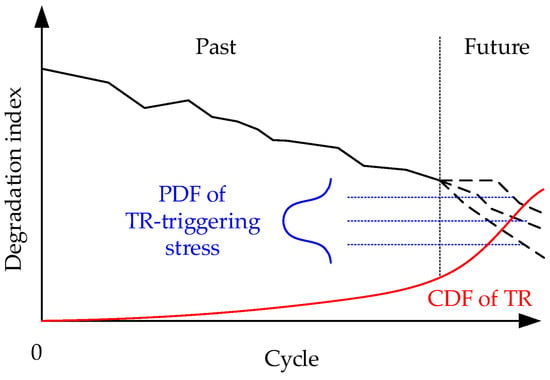
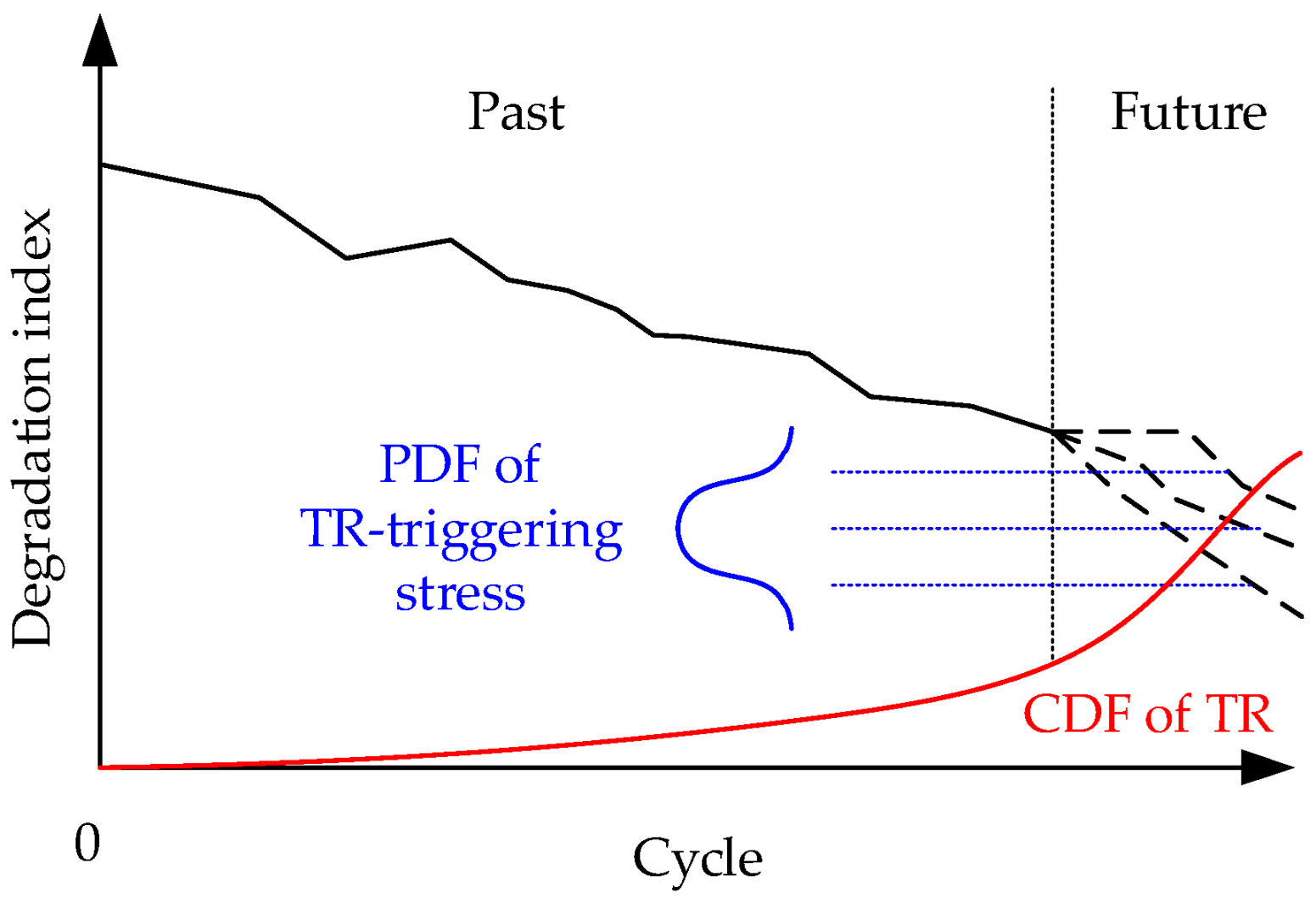
Currently, research on thermal runaway in lithium-ion batteries primarily focuses on material-level approaches and thermal management strategies, such as developing highly stable electrode materials, optimizing electrolyte formulations, and enhancing the efficiency of heat dissipation systems [27,28,29,30,31]. Additionally, many researchers are dedicated to elucidating the chain reaction mechanisms and critical conditions of thermal runaway, determining key parameters like the self-heating onset temperature (T1) using accelerated rate calorimetry (ARC) [32,33]. However, most existing studies rely on fresh batteries or standardized aged samples. Systematic modeling and quantitative analysis of how performance degradation caused by complex operating conditions during actual use affects the evolution of thermal stability remain lacking [34,35]. Notably, as illustrated in Figure 1, the degradation behavior of lithium-ion batteries involves a multi-mechanism coupled, path-dependent stochastic process influenced by random operating conditions during use. This introduces uncertainty into the degradation process of the battery’s “strength”—its capacity to withstand external stresses without undergoing thermal runaway. Furthermore, external triggering stresses also exhibit randomness, making it challenging to effectively quantify the probability of exceeding this “strength” (i.e., the thermal runaway risk) [36]. This characteristic renders traditional deterministic models incapable of accurately capturing risk dynamics in real-world scenarios, thereby failing to quantitatively characterize the gradually increasing thermal runaway risk of lithium-ion batteries as cycle numbers accumulate.
Figure 1.
Schematic Diagram of Thermal Runaway Risk Under Randomly Triggered Stress. As the number of cycles increases, the probability density function of the battery’s ‘strength’ (its ability to withstand stress, blue curves) degrades and shifts. Meanwhile, the external triggering stress (red curve) is random. Thermal runaway occurs when the random stress exceeds the battery’s current strength.
In summary, the current research landscape presents the following primary shortcomings: First, there is a need to extract integrated indicators from multi-source monitoring data that both reflect degradation status and correlate with thermal stability. Second, it is essential to develop probabilistic models that can simultaneously characterize the uncertainty of degradation processes and the randomness of external triggering stresses.
This paper proposes a method for predicting the risk of thermal runaway in power lithium-ion batteries by fusing multi-dimensional degradation information and employing stochastic process modeling. By integrating features such as the mean current and current standard deviation during charging through a PINNs-based model, a comprehensive parameter that characterizes both degradation and thermal runaway risk is developed. Additionally, a stochastic failure-threshold Wiener process model is introduced to quantify the probability of thermal runaway occurrence. This research addresses the modeling gap in dynamically mapping performance degradation to thermal runaway risk, providing proactive safety warnings for Battery Management Systems (BMS). This advancement supports the reliable operation of power batteries throughout their entire lifecycle.
2. Analysis of Lithium-Ion Battery Degradation and Thermal Runaway
2.1. Causes and Characterization of Lithium-Ion Battery Degradation
The degradation of lithium-ion batteries is a complex electrochemical process involving multiple coupled mechanisms, primarily manifested as the irreversible loss of active lithium and the continuous structural evolution of electrode materials. Among these factors, the solid electrolyte interphase (SEI) film grows continuously during cycling, persistently consuming active lithium and electrolyte, making it one of the primary contributors to capacity decay. Under conditions such as low temperatures, high-rate charging, or overcharging, lithium metal may deposit on the anode surface. This not only results in the loss of reversible lithium but may also trigger lithium dendrite growth, increasing the risk of internal short circuits. Cathode materials undergo structural phase transitions, lattice distortion, and even dissolution of transition metal ions during repeated lithium-ion intercalation and deintercalation cycles, further accelerating capacity decay. Additionally, electrolyte decomposition under high-temperature or high-voltage conditions contributes to increased internal resistance, hastening overall performance degradation. To quantify battery performance decline, the State of Health (SOH) is commonly used as a key evaluation metric, defined as the percentage of the current actual capacity relative to the rated initial capacity:
where represents the battery’s current maximum available capacity (Ah), and denotes the battery’s factory-rated capacity (Ah). State of Health (SOH) effectively reflects the degree of battery capacity degradation and serves as a crucial parameter for assessing battery aging.
However, as a macro-level performance metric, SOH primarily reflects capacity loss and does not comprehensively capture the evolution of a battery’s thermal safety characteristics. In practical applications, capacity degradation does not directly correlate with the risk of thermal runaway; therefore, relying solely on SOH cannot effectively assess the potential danger of thermal runaway under abuse conditions. To evaluate lithium-ion battery safety more comprehensively, it is essential to introduce characterization parameters that directly reflect thermal stability. T1, defined as the self-heating onset temperature of lithium-ion batteries, indicates the impact of accumulated internal side reactions on thermal safety characteristics [37]. Given T1’s direct correlation with both battery degradation status and thermal runaway behavior, this study employs T1 as a key indicator for modeling thermal runaway risk during battery aging.
2.2. Causes of Thermal Runaway and Factors Contributing to Increased Probability
Thermal runaway is the most severe safety failure mode in lithium-ion batteries. It is driven by a series of internal exothermic chain reactions that ultimately result in an uncontrollable, often explosive, release of energy. This phenomenon originates from the intrinsic thermal instability of the battery’s material system. A typical thermal runaway pathway proceeds sequentially through the following stages: decomposition of the solid electrolyte interphase (SEI) layer; reactions between the anode and the electrolyte; melting of the separator and the resulting internal short circuit; decomposition of the cathode material with concomitant oxygen release; and, finally, violent combustion of the electrolyte accompanied by material ejection. In thermal safety analysis, the self-heating onset temperature (T1) is a key parameter for evaluating battery thermal stability. Commonly determined using adiabatic techniques such as accelerated rate calorimetry (ARC), T1 is defined as the critical temperature at which the rate of heat generation within the cell begins to exceed the rate of heat dissipation to the surroundings. This point marks the transition of the battery from a thermally safe state to a self-heating regime.
Battery aging is a critical factor that elevates the risk of thermal runaway. Throughout cycling and operational use, the internal chemical and physical states of a battery undergo considerable alterations, including continuous thickening of the solid electrolyte interphase (SEI), irreversible loss of active lithium, structural degradation of electrode materials, and increased internal resistance. These degradation mechanisms directly influence the battery’s heat generation behavior and thermal stability. Their combined effect leads to a marked shift in the critical temperature parameter T1. For instance, after prolonged exposure to high temperatures and high-rate charging, the T1 value of power batteries can decrease significantly—from an initial 100 °C down to approximately 60 °C [38]. In such an aged condition, if local battery temperature exceeds the reduced T1 threshold due to ambient conditions or inadequate cooling performance, the self-heating phase is initiated. During this stage, internal exothermic side reactions commence and accelerate exponentially with rising temperature, in accordance with the Arrhenius law. If the thermal management system (TMS) fails to dissipate heat effectively at this point, the system rapidly progresses into severe instability: temperatures rise sharply, activating the aforementioned chain reactions and ultimately resulting in thermal runaway—manifested as fire or explosion. Thus, the evolution of the T1 parameter directly governs a battery’s ability to withstand external thermal challenges throughout its service life. A decline in T1 fundamentally indicates an elevated probability of thermal runaway. A thorough investigation and quantitative analysis of the intrinsic relationship between T1 and the battery’s degradation state are essential for accurately assessing and predicting thermal safety risks over the full battery lifecycle.
2.3. Analysis of T1 Degeneration Patterns and Stochastic Process Framework
Feng X et al. [39] investigated the common mechanisms underlying thermal runaway in lithium-ion batteries using extensive thermal analysis data. Through numerous thermal analysis experiments, the study qualitatively demonstrated that high-temperature accelerated aging typically leads to the formation of a thicker, more stable solid electrolyte interphase (SEI) film. This film may act as a “protective shell,” enhancing the battery’s thermal stability to some extent, as evidenced by an increase in the T1 value. Conversely, low-temperature or high-rate accelerated aging readily induces lithium metal deposition on the anode surface (lithiation). The deposited metallic lithium is highly reactive and can undergo violent reactions with the electrolyte at lower temperatures, significantly reducing the T1 value and greatly increasing thermal risk. Additionally, excessively high temperatures can destabilize the SEI film, causing it to decompose at lower temperatures and similarly leading to a decrease in the T1 value. These findings indicate that changes in T1 are not monotonically dependent but are highly influenced by the specific aging pathway of the battery, including the type, intensity, and history of aging stresses.
Ren D et al. [40] identified the relationship between T1 and SOH, demonstrating that T1 can be considered a function of battery SOH. Building on this foundation, the present study further investigates the impact of complex real-world operating conditions, where the service environment of lithium-ion batteries is inherently random—characterized by environmental temperature fluctuations, random fast charging events, and other factors. These random stresses, including high temperature, low temperature, and high-rate charging, collectively drive the decline in SOH and the evolution of the T1 parameter. Consequently, the variation in T1 itself constitutes a stochastic process influenced by external random stresses. Accordingly, the probabilistic thermal runaway risk model developed in this paper fundamentally treats T1 as a random variable that evolves with SOH and is affected by historical random stresses, rather than as a deterministic parameter. By constructing a stochastic evolution model for T1, we can more accurately predict the probability of thermal runaway initiation in a battery at a specific degradation state under random temperature excitations encountered during actual operating conditions. This approach enables dynamic and forward-looking risk assessment.
3. Lithium-Ion Battery Thermal Runaway Risk Prediction Modeling Process
3.1. Procedure of the Proposed Approach
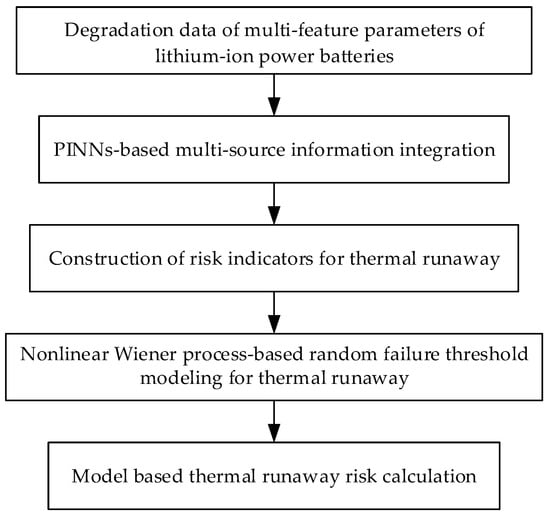
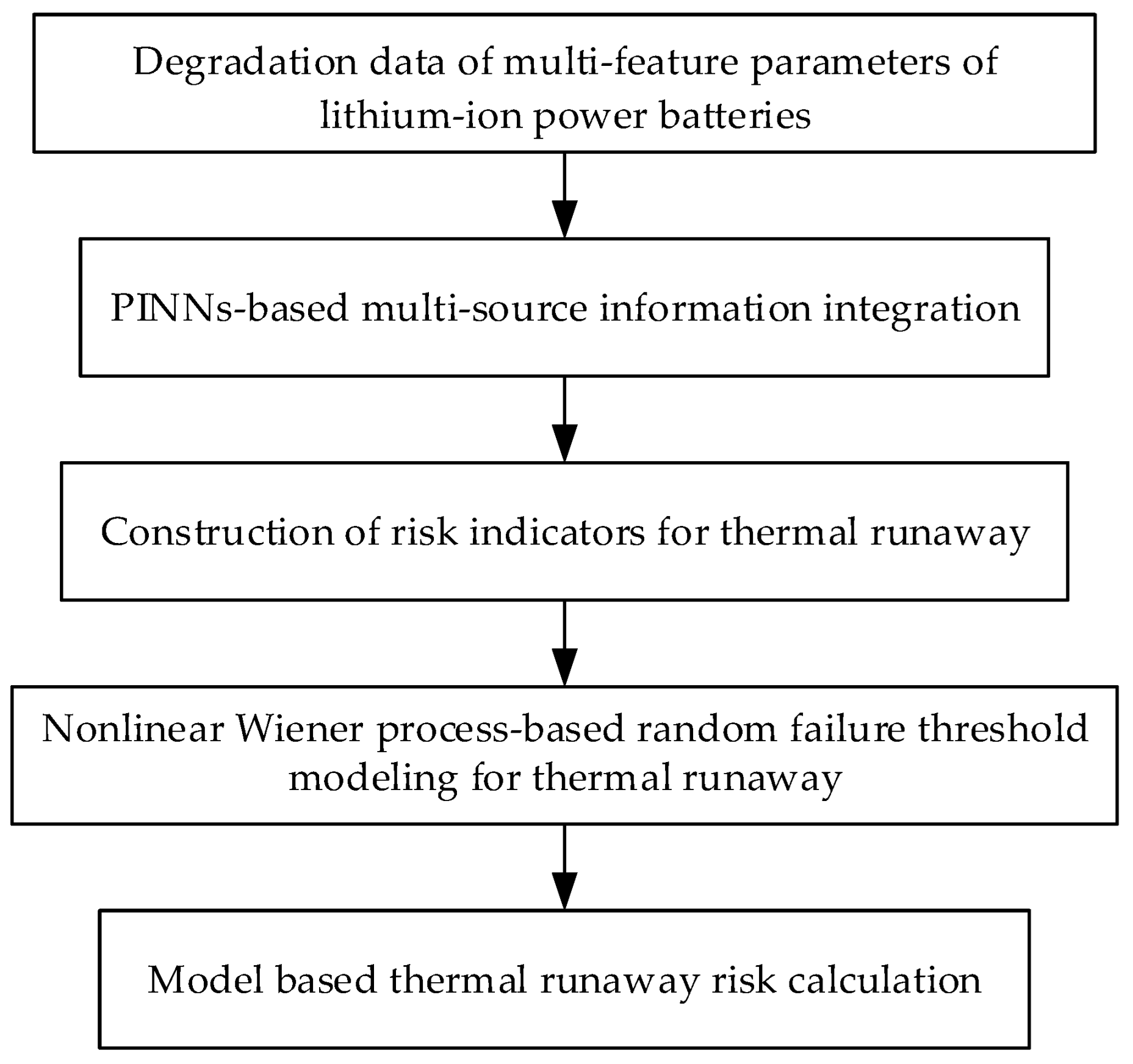
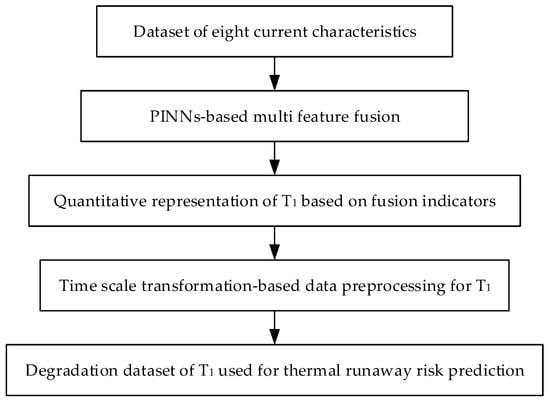
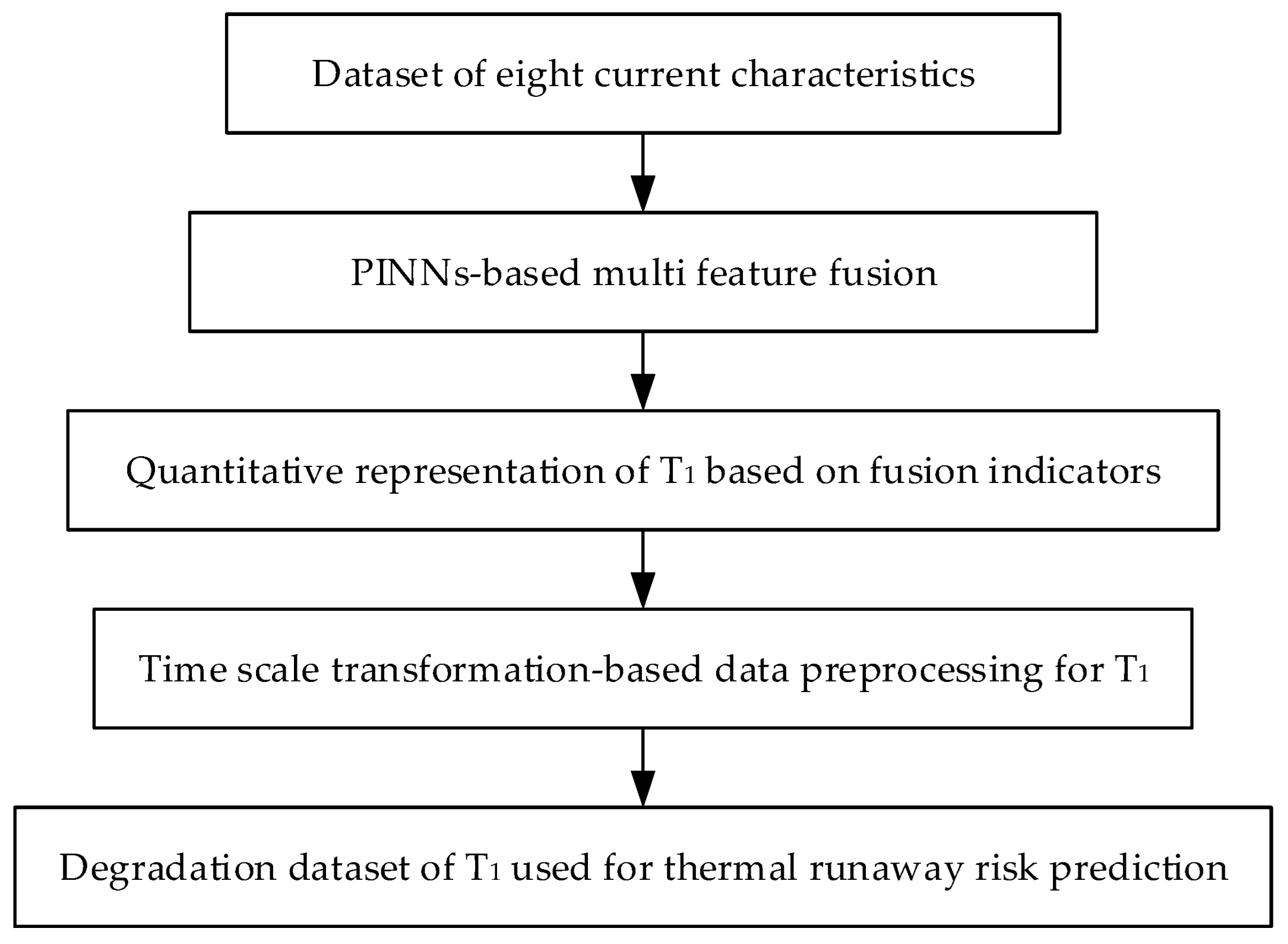
To improve the reliability of thermal safety management for lithium-ion batteries, especially in dynamically predicting thermal runaway risks throughout their entire lifecycle, this study proposes an integrated modeling framework that combines data-driven and physical mechanism approaches. The core of this framework involves using battery degradation data to dynamically track the degradation trajectory of a key thermal runaway indicator (T1) and quantifying the probability of thermal runaway risk based on stochastic process theory. The overall workflow is illustrated in Figure 2.
Figure 2.
Procedure for Thermal Runaway Risk Prediction. The process begins with data preprocessing of BMS monitoring data, followed by multi-parameter fusion using a Physics-Informed Neural Network (PINN). The T1 degradation trajectory is then linearized and modeled using a Wiener process to compute the dynamic probability of thermal runaway.
This process begins by preprocessing historical operational data, such as voltage and current monitored by the Battery Management System (BMS), to provide a high-quality, clean data foundation for subsequent analysis. Next, a PINNs-based model is employed to deeply integrate performance parameters, including current mean, current standard deviation, and charging time. The core advantage of this method lies in embedding the electrochemical-thermal coupling mechanism as a constraint within the learning process, enabling precise macroscopic characterization of unobservable internal states such as SEI film growth and active lithium loss. Based on the internal states inferred through PINNs fusion, the critical thermal runaway risk parameter T1 is derived. To facilitate subsequent stochastic process modeling, the nonlinear degradation trajectory of T1 undergoes a time-scale transformation, resulting in an approximately linear path within the transformed feature space. Finally, within this linear space, the Wiener process is used to model the degradation of T1 while accounting for the randomness of thermal runaway trigger stresses. This approach enables the derivation of the first-to-reach probability distribution for thermal runaway risk, thereby achieving dynamic probabilistic prediction of thermal safety status throughout the battery’s entire lifecycle.
3.2. Multivariate Degraded Information Fusion Method
To accurately determine T1, a key parameter characterizing thermal runaway risks in lithium-ion batteries, this study proposes a multi-degradation information fusion method. The workflow is illustrated in Figure 3, with its core principle being the integration of multiple monitorable external electrical characteristics to indirectly infer the thermal stability parameter T1, which is challenging to measure directly in real time.
Figure 3.
Multi-source information fusion for obtaining the characterization parameter T1. Multiple features are extracted from the charging current data and fused via a PINN to estimate the State of Health (SOH). The SOH is then mapped to the T1 parameter based on an offline-calibrated SOH-T1 relationship, which is subsequently linearized for stochastic process modeling.
First, multiple current-related feature values are extracted from battery degradation data. These features form a multivariate information vector that reflects changes in the battery’s internal state. Subsequently, PINNs are employed to deeply fuse this multivariate information. After obtaining reliable state of health (SOH) estimates via PINNs, the process proceeds to extract the SOH-T1 correlation. An intrinsic coupling exists between a battery’s macro-level performance degradation (SOH) and its micro-level thermal stability (T1). This relationship is typically calibrated and validated through offline adiabatic thermal runaway calorimetry experiments. However, the intrinsic relationship between SOH and T1 often exhibits nonlinear characteristics, making it unsuitable for direct dynamic prediction. Therefore, the next step involves linearizing the extracted correlation, transforming the nonlinear SOH-T1 relationship curve into an approximate straight line within a linear space. Within this linear space, a linear prediction model can be employed to dynamically extrapolate the current T1 value based on the estimated SOH.
Through this sequential series of data fusion and transformation steps, the model can generate real-time estimates of the representative parameter T1 from readily accessible, degraded data. This approach effectively overcomes the challenge of T1’s inability to be measured directly online, establishing a solid foundation for subsequent probability-based thermal runaway risk prediction based on T1 degradation trajectories.
3.3. Thermal Runaway Risk Prediction Model Based on Nonlinear Wiener Process
The degradation process of the composite degradation parameter T1, obtained through multi-parameter fusion, is transformed using nonlinear transformation and linear regression models into a monotonically increasing battery degradation process that follows a linear Wiener process:
where is the drift coefficient, characterizing the average rate of degradation; is the diffusion coefficient, characterizing the random fluctuations in the degradation process; is the standard Brownian motion. Therefore, at any time , follows a normal distribution, namely:
Define the onset of thermal runaway in a battery as the moment when the health indicator first crosses a critical failure threshold . Let denote the time of the first crossing into thermal runaway. The risk prior to time can be defined as:
For a linear Wiener process, the first crossing time follows an inverse Gaussian distribution.
If the external trigger stress for thermal runaway targeting the characteristic parameter T1 is a definite constant , then the cumulative distribution function (CDF) of the inverse Gaussian distribution, i.e., the thermal runaway risk function, is:
where denotes the cumulative distribution function (CDF) of the standard normal distribution.
However, in actual conditions, due to individual battery variations, the complexity of operating conditions, and the inherent unpredictability of thermal runaway itself, the external stress inducing thermal runaway is not a fixed value but a random variable. Assuming follows a normal distribution , its probability density function is:
At this point, the overall thermal runaway risk can be calculated using the following equation:
The analytical solution for the above integral expression is complex. When the standard deviation of the external applied stress is relatively small, approximate results can be obtained using mathematical methods such as Taylor series expansion:
This approximate form combines mathematical simplicity with engineering practicality. Notably, when = 0, the equation degenerates into the case of a fixed external trigger stress, verifying its consistency.
In this study, represents the health indicator derived from T1 after linearization through multi-source information fusion. The distribution parameters of the external trigger stress can be determined through statistical analysis of ambient temperatures in actual operating conditions of power batteries. This model successfully captures both the randomness of the performance degradation process ( and the randomness of thermal runaway trigger conditions , enabling a more comprehensive and accurate probabilistic prediction of lithium-ion battery thermal runaway risk.
4. Case Study and Discussion
4.1. Parameter Fusion for Thermal Runaway Risk Characterization Based on PINNs
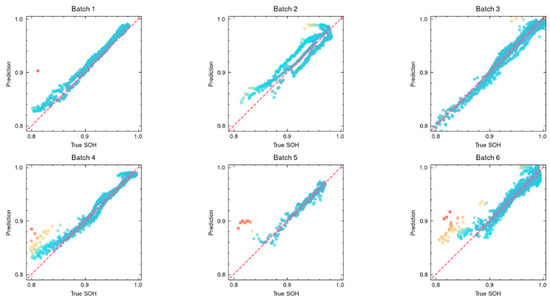
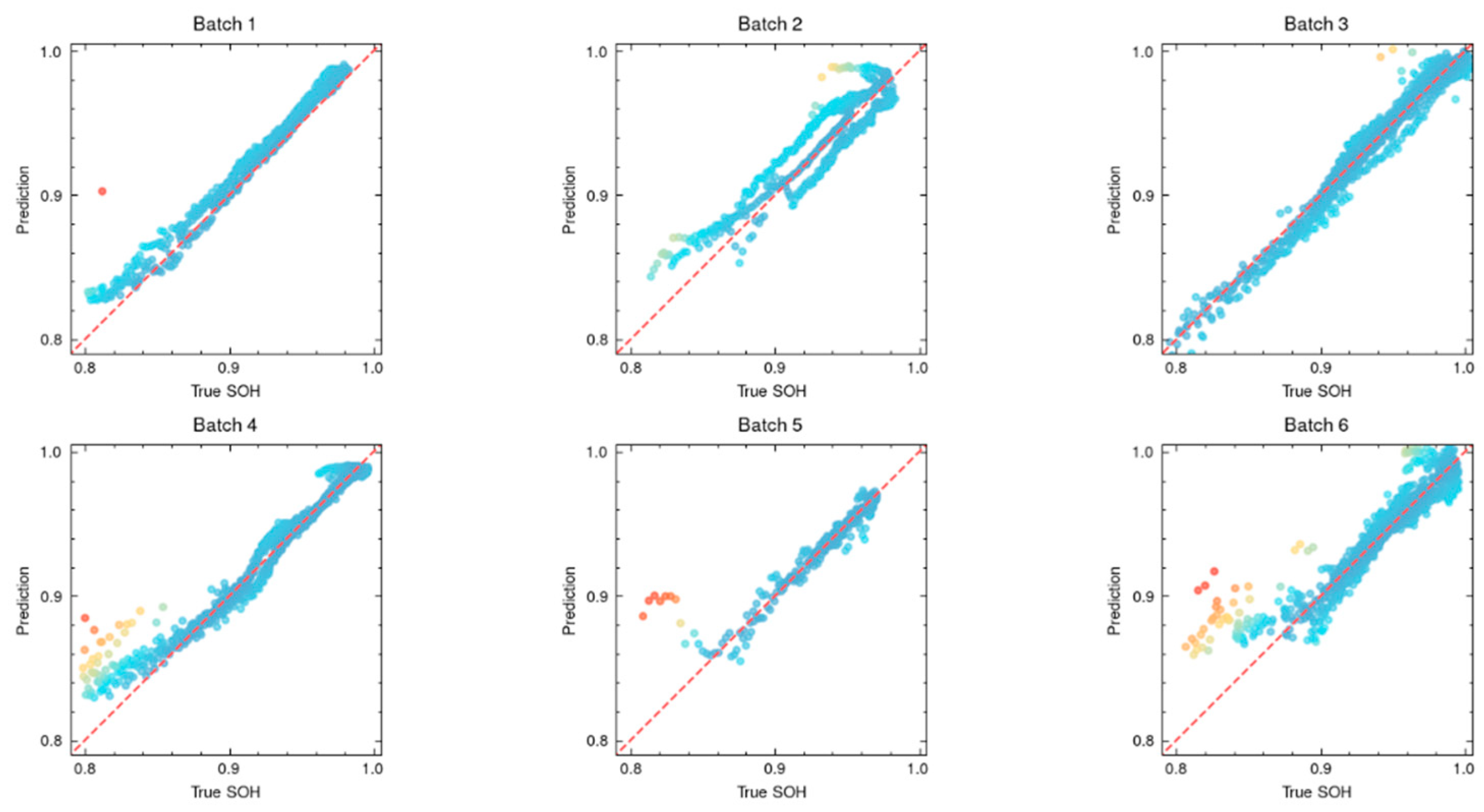
The charging and discharging data selected for modeling in this paper are from the XJTU battery dataset (used 18,650 nickel-cobalt-manganese (NCM) lithium-ion battery) [41], with the following test conditions: 2C (charging to 4.2 V with a constant current of 2.0C (4 A), then maintaining the voltage unchanged until the current drops to 0.05C (0.1 A); resting for 5 min; discharging at 1.0C (2 A) until 2.5 V; resting for 5 min). Wang F et al. [42] fused the mean, standard deviation, kurtosis, skewness, charge time, cumulative charge, curve slope, and curve entropy of voltage and current curves to obtain the SOH comparison results shown in Figure 4. The six batches represent batteries aged under different operational strategies. Batch 1 was specifically chosen because its charging-discharging protocol aligns with the experimental conditions used in Ren et al. [40].
Figure 4.
Fusion SOH Comparison Results. The SOH estimation results of proposed PINN. The predicted and true SOH are distributed near the diagonal, indicating that the model performs well.
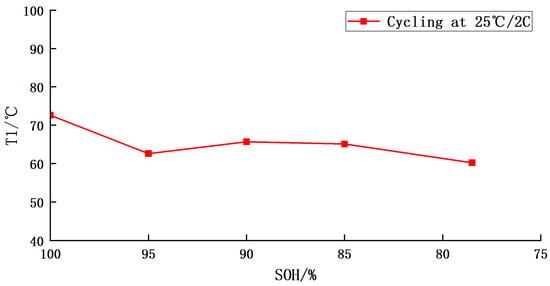
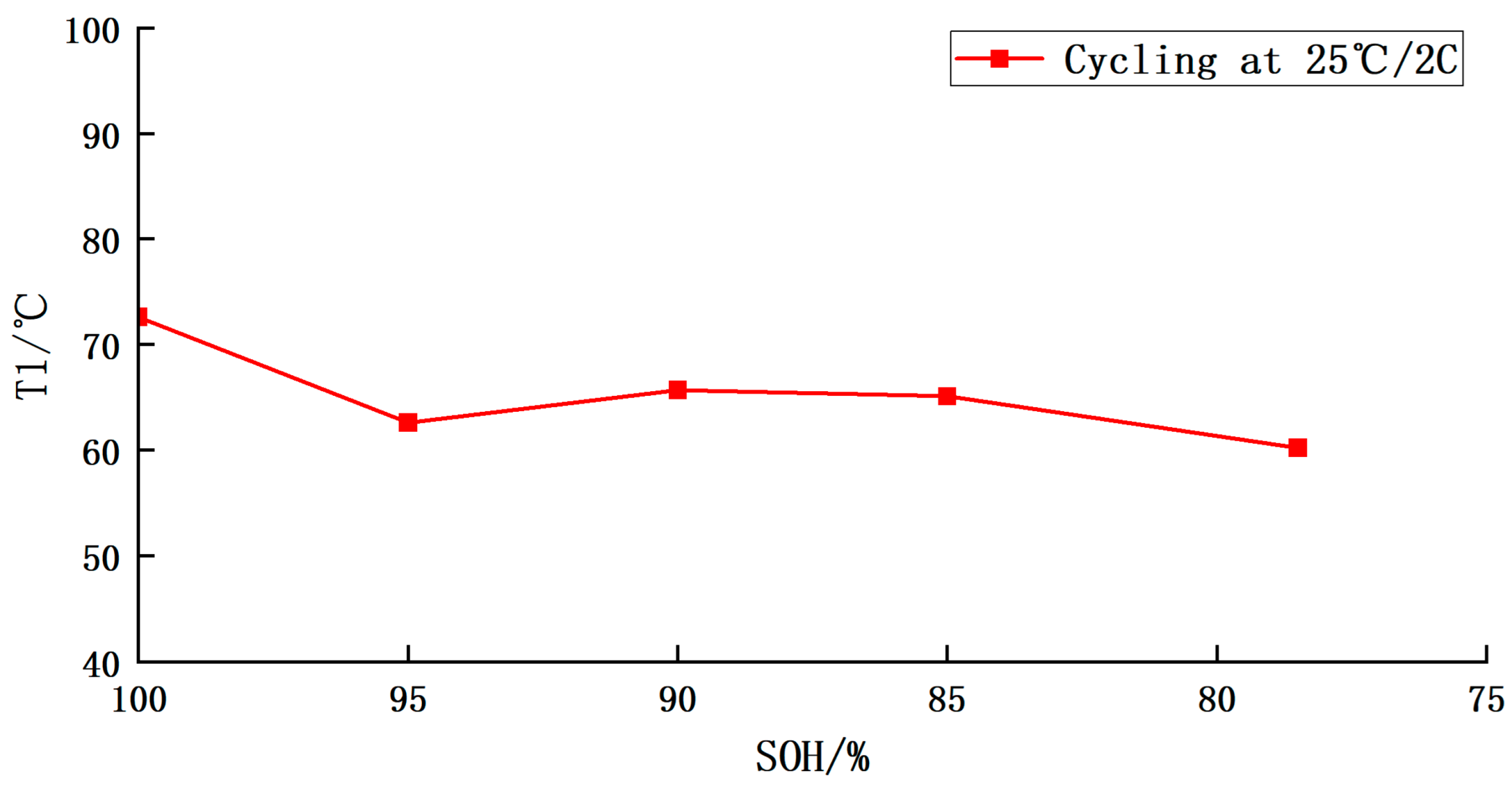
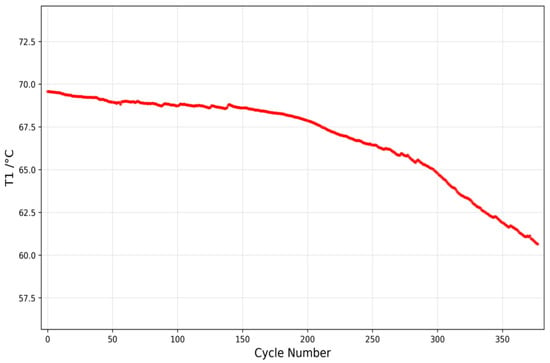
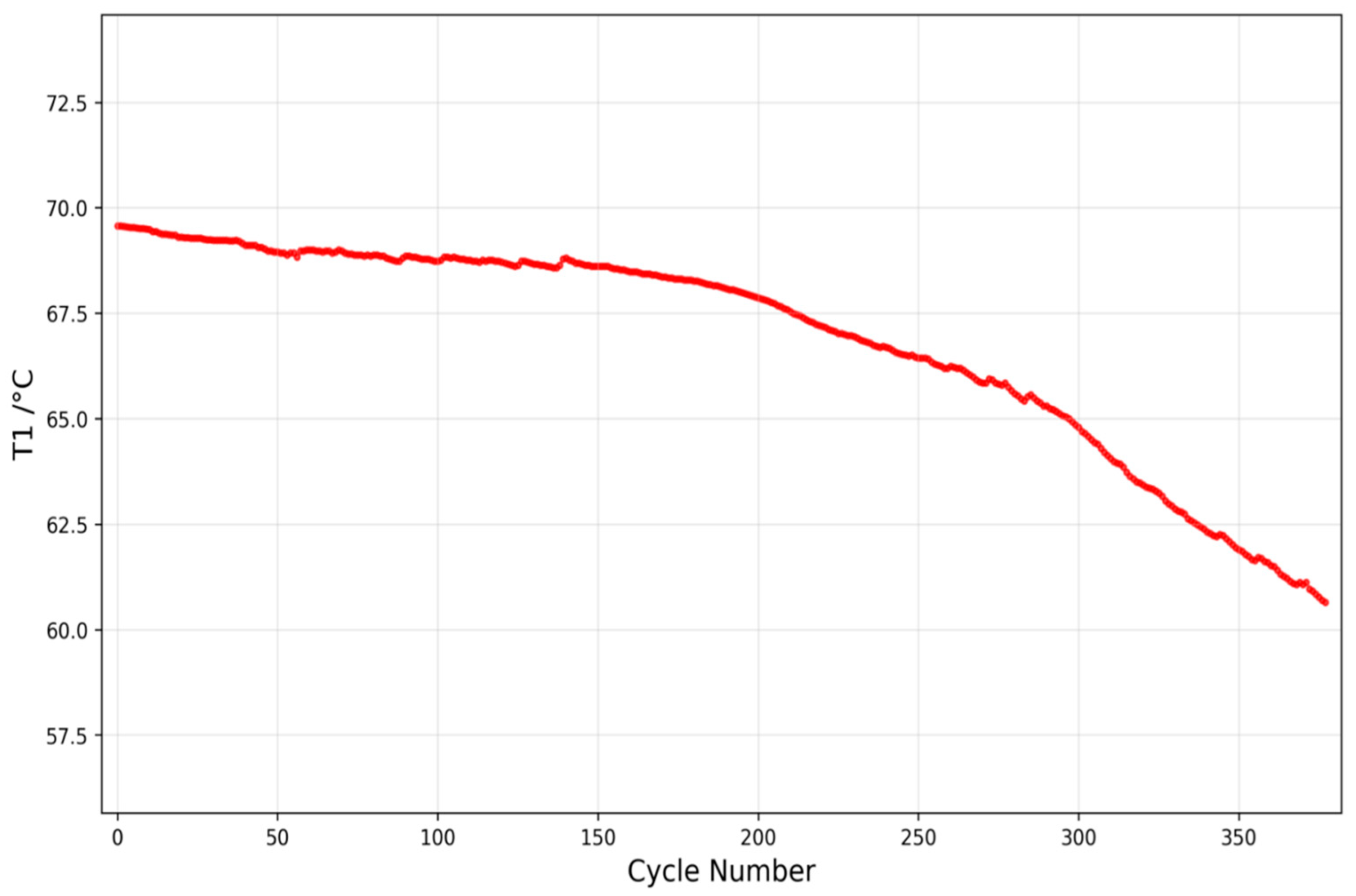
By calculating the Pearson correlation coefficients between features, the relationships among various features were analyzed. It was found that eight features related to current exhibited strong correlations with SOH. Therefore, this paper extracted eight current-related parameters that are highly correlated with lithium battery performance degradation: mean current, current standard deviation, current kurtosis, current skewness, charging time, cumulative charge, current curve slope, and current curve entropy. These parameters were used as multi-source information for fusion-based SOH estimation. Based on the approximate relationship between T1 and SOH shown in Figure 5, the T1 degradation curve depicted in Figure 6 was obtained.
Figure 5.
Relationship curve between T1 and SOH [40]. The plot shows a general trend of decreasing T1 with reducing SOH, indicating the degradation of thermal stability as the battery ages.
Figure 6.
Degradation Curve of Thermal Runaway Risk Characterization Parameters Obtained via Multi-Source Information Fusion. The T1 value, representing the battery’s thermal stability, decreases as the number of cycles increases.
Given the fundamental need to linearize degradation processes in Wiener process modeling, this paper employs a time-scale transformation to linearize the degradation of thermal runaway risk characterization parameters. The time-scale transformation model used is presented in Equation (9):
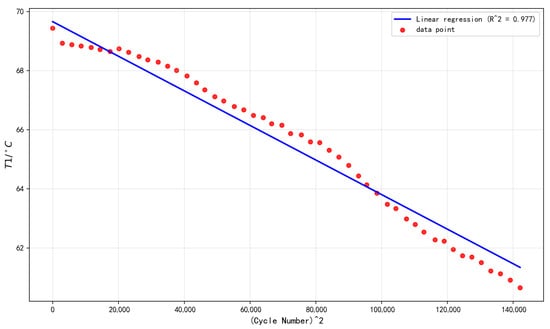
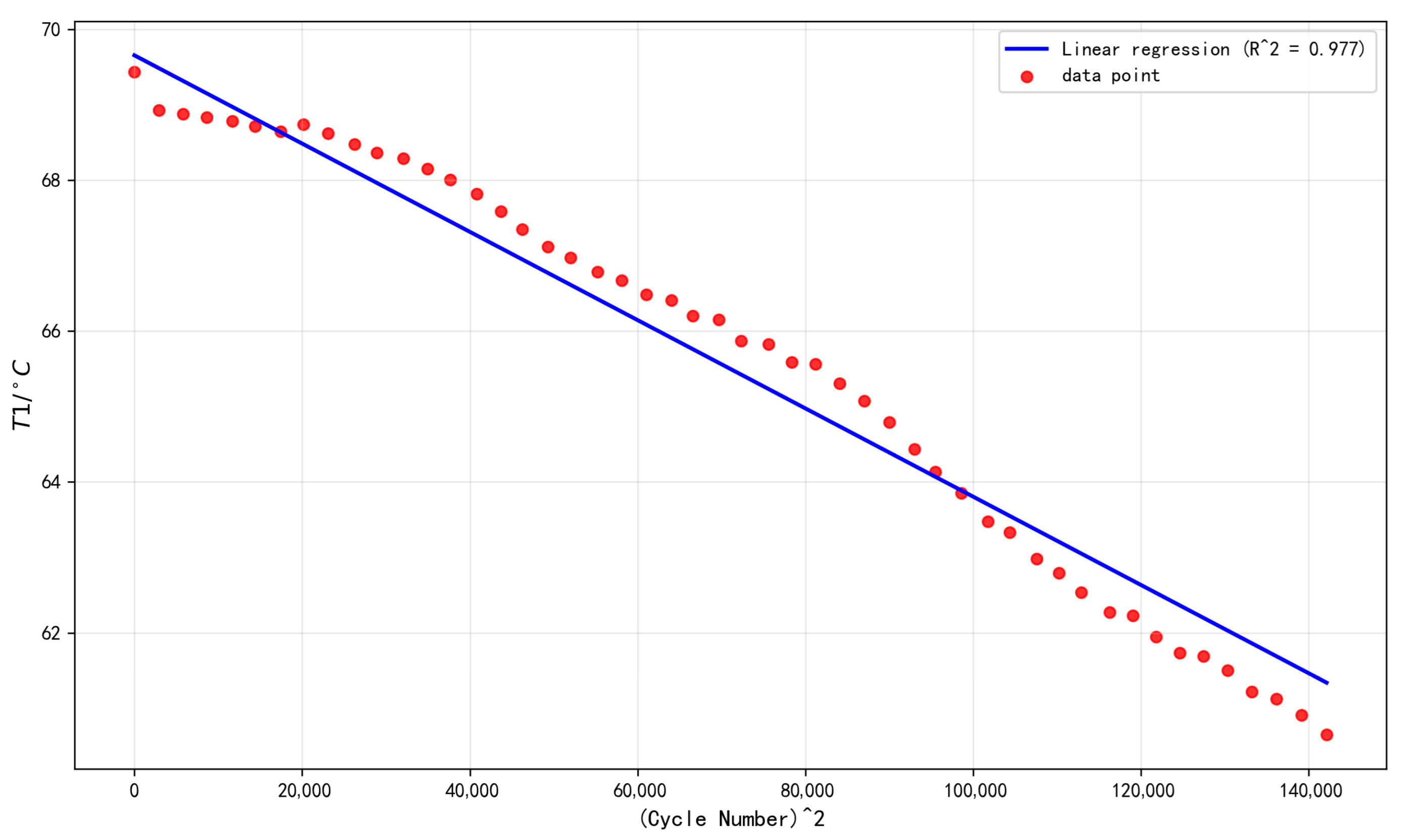
The (Cycle2) transformation maps the original cycle count to a new feature space, establishing a highly linear relationship between T1 and t. The coefficient of determination, R2, for this linear relationship reaches 0.977. The degenerate trajectory is illustrated in Figure 7.
Figure 7.
Linearization Results of Thermal Runaway Risk Characterization Parameters. The transformed data shows a strong linear relationship (R2 = 0.977), making it suitable for modeling with a linear Wiener process.
4.2. Parameter Estimation for Thermal Runaway Risk Prediction Model
The Wiener process is a continuous-time stochastic process commonly used to model battery degradation behavior. In this model, the drift coefficient represents the average degradation rate, while the diffusion coefficient reflects the variability in the degradation process. These parameters are estimated using the battery’s incremental degradation data.
Extract the degradation increment at each time step from the battery degradation data. Assuming the degradation amount at time step is , the degradation increment is defined as:
where denotes the transformed cycle count step size.
Employing the maximum likelihood estimation method, calculate the mean and standard deviation of the degenerative increment, serving as the drift coefficient and diffusion coefficient of the Wiener process, respectively:
Here, denotes the number of iterations for the degenerate increment. The estimated model parameters are = −6.177 × 10⁻⁵ and = 0.03524.
4.3. Thermal Runaway Risk Curve
The battery degradation process is modeled as a Wiener process. Thermal runaway is considered to occur when the degradation level first reaches a specific threshold. Due to the uncertainty surrounding this threshold, it is assumed that the random failure threshold follows a normal distribution:
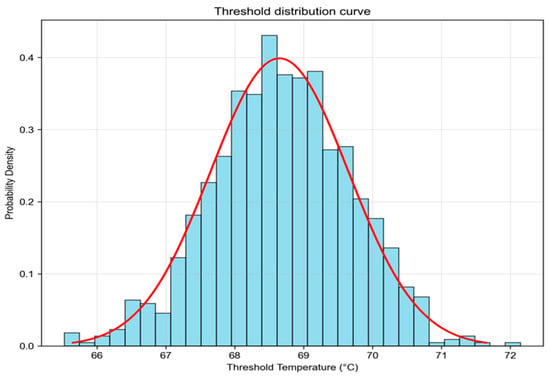
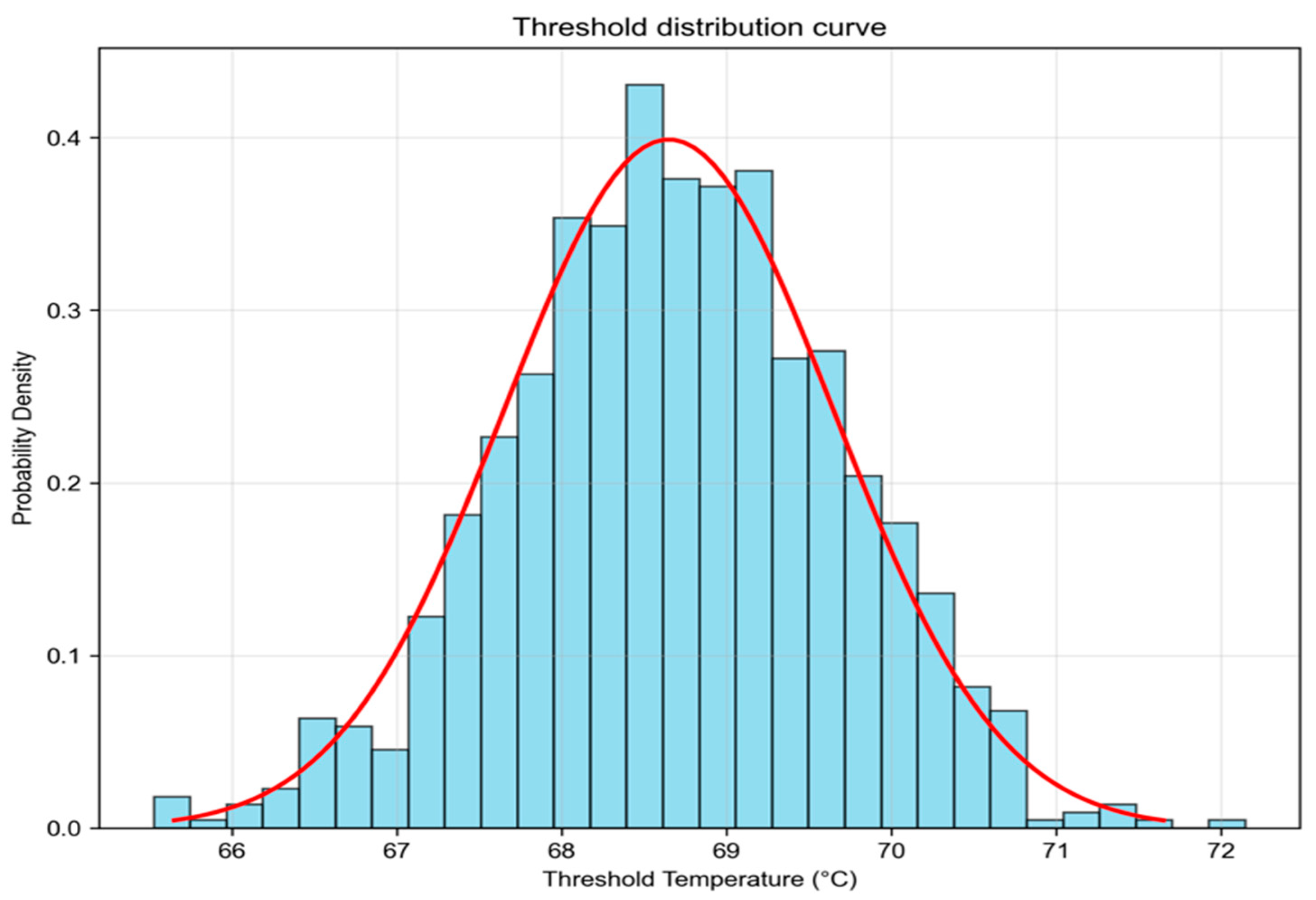
where denotes the mean and denotes the standard deviation. Based on the current operating conditions of lithium batteries, the distribution parameters for randomly triggered stresses are reasonably assumed to be = 68.65, = 1.00. The schematic diagram of the threshold distribution curve is shown in Figure 8:
Figure 8.
Schematic Diagram of Threshold Distribution. The threshold is assumed to follow a normal distribution with a mean of 68.65 and a standard deviation of 1.00.
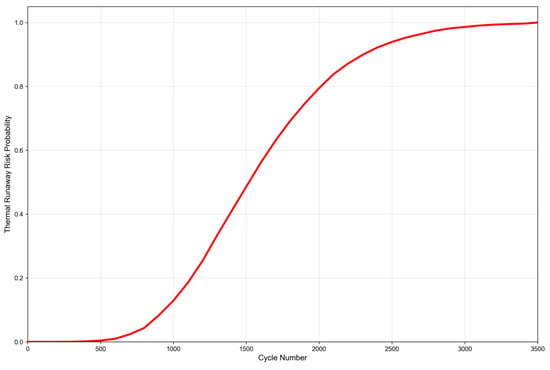
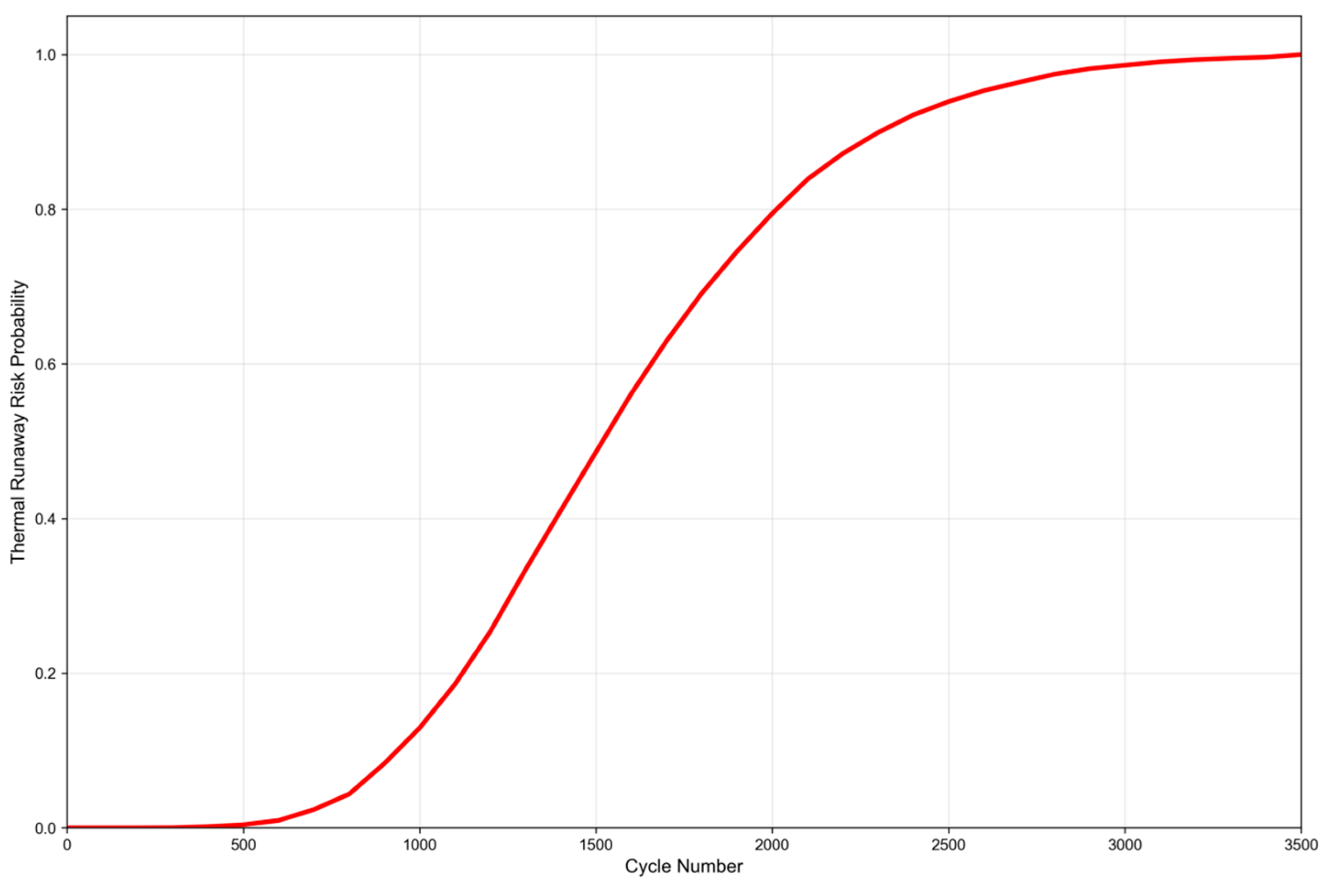
The random failure threshold complicates analytical calculations for predicting thermal runaway risks. Monte Carlo methods can approximate integral computations under random failure threshold conditions through numerical simulation, thereby circumventing complex analytical derivations while maintaining accuracy in long-term forecasting. This study employs Monte Carlo simulation to randomly sample 100 threshold values from the distribution, generating the thermal runaway risk curve for this lithium-ion battery, as shown in Figure 9.
Figure 9.
Thermal Runaway Risk Curve. The S-shaped curve indicates that the risk remains low during early cycles but increases non-linearly after approximately 500 cycles, exceeding 10% around 1000 cycles.
This graph illustrates the evolution of lithium-ion battery thermal runaway risk probability as the cycle count increases, based on the predictive model described above. The curve reveals the intrinsic relationship between battery aging and the degradation of thermal safety performance. Analysis of the thermal runaway risk probability curve shows an S-shaped growth pattern, indicating that the risk of thermal runaway in lithium-ion batteries increases non-linearly with cycle count. Specifically, when the cycle count is below 500, the risk probability remains near zero, representing a safe phase. Beyond 500 cycles, the risk probability begins to rise gradually, reflecting the potential hazards associated with accelerated battery aging. Upon reaching approximately 1000 cycles, the thermal runaway risk probability exceeds 10%, highlighting the need for targeted intervention measures to prevent thermal runaway events.
In summary, the generated curve characterizes the cumulative evolution of thermal runaway risk throughout battery cycling. It underscores the necessity for enhanced health monitoring and safety management strategies, particularly at high cycle counts where the probability of thermal runaway increases markedly. It should be noted that the present risk estimation is derived under assumed random trigger-stress conditions, and therefore may not fully represent all real-world operating scenarios.
Overall, the proposed lithium-ion battery thermal runaway risk prediction framework provides an effective means of quantifying the probabilistic occurrence of thermal runaway based on comprehensive degradation information obtained during actual battery use. The resulting risk curve delivers meaningful insights for battery health assessment and safety decision-making, highlighting the practical value of the method in real-world applications.
5. Conclusions
This study addresses the critical issue of the dynamic evolution of thermal runaway risk during the aging process of lithium-ion power batteries. It proposes a risk probability prediction method based on multi-factor degradation information fusion and stochastic process modeling. By systematically integrating electrochemical degradation data with data-driven analysis, the method effectively maps performance degradation to thermal runaway trigger probability estimation, providing novel insights for lithium-ion battery safety early warning systems. The principal conclusions of this research are as follows:
- (1)
- Through a multi-degradation information fusion approach, the model can indirectly estimate the characteristic parameter T1 using readily accessible degradation data. This method effectively addresses the challenge of T1’s inability to be measured directly in real time, thereby establishing a robust foundation for predicting thermal runaway risk probabilities based on T1 degradation trajectories.
- (2)
- The introduction of Wiener processes for stochastic modeling of battery degradation provides a comprehensive characterization of the uncertainty inherent in the cycling aging process of lithium-ion batteries. Furthermore, by addressing the non-deterministic nature of externally triggered stresses in thermal runaway, a risk model more closely aligned with engineering practice has been developed, enabling dynamic estimation of thermal runaway probability.
However, this study has certain limitations. Since the selected XJTU dataset did not include measured data for the battery thermal runaway characteristic parameter (T1), the risk modeling examples in this paper relied on the T1-SOH relationship curve for NCM523 batteries from the research by Ren D et al. [40] for method validation. Consequently, the model’s accuracy in practical applications depends heavily on the precision of the T1-SOH relationship.
Future research endeavors may proceed in the following directions: first, conduct T1 data measurement experiments and extend this methodology to different battery chemistries and complex operating conditions; second, investigating online updating mechanisms to enable real-time parameter identification and dynamic risk prediction.
In summary, the probabilistic risk estimation method proposed here not only serves as an effective theoretical tool for lithium-ion battery safety management but also provides valuable insights for degradation failure modeling in other fields that require high reliability.
Author Contributions
Conceptualization, Y.L. and S.G.; Methodology, Y.L., Q.C., Z.W. and S.G.; Software, S.G. and H.C.; Validation, M.Y. and W.Q.; Formal analysis, M.Y., W.Q. and Q.C.; Investigation, Y.L. and W.Q.; Resources, W.Q. and Z.W.; Data curation, S.G., Z.W. and M.Y.; Writing—original draft, Y.L. and S.G.; Writing—review and editing, Q.C. and H.C.; Supervision, Y.L. and Z.W.; Project administration, Y.L., Q.C. and W.Q.; Funding acquisition, W.Q. and Z.W. All authors have read and agreed to the published version of the manuscript.
Funding
This research was funded by Plan Project of Wenzhou Municipal Science and Technology [grant number S2023029], Zhejiang Provincial Key Research and Development Program [grant number 2025C02243] and Department of Education of Zhejiang Province [grant number Y202454576].
Data Availability Statement
The data presented in this study are available on request from the corresponding author.
Conflicts of Interest
Author Mei Ye was employed by Xinling Electric Co., Ltd. The remaining authors declare that the research was conducted in the absence of any commercial or financial relationships that could be construed as a potential conflict of interest.
Glossary
The following abbreviations are used in this manuscript:
| XJTU | Xi’an Jiaotong University |
| PINNs | Physics-Informed Neural Networks |
| SOH | State of Health |
| ARC | Accelerating Rate Calorimeter |
| probability density function | |
| CDF | cumulative distribution function |
| TR | Thermal Runaway |
| BMS | Battery Management System |
| SEI | Solid Electrolyte Interface |
| TMS | Thermal Management System |
| Battery’s current maximum available capacity | |
| Battery’s factory-rated capacity | |
| Composite degradation parameter (linearized form of T1) | |
| Drift coefficient in the Wiener process | |
| Diffusion coefficient in the Wiener process | |
| Standard Brownian motion | |
| Critical failure threshold for thermal runaway | |
| Mean of the random failure threshold | |
| Standard deviation of the random failure threshold | |
| First-passage time to thermal runaway | |
| Cumulative Distribution Function (CDF) of thermal runaway risk | |
| Cumulative Distribution Function of the standard normal distribution | |
| Probability Density Function (PDF) of the random threshold | |
| Battery charge–discharge cycle number | |
| Transformed time scale | |
| Degradation increment at time step | |
| Transformed cycle count step size | |
| Number of iterations for the degenerate increment |
References
- Meng, D.; Wang, X.; Chen, M.; Wang, J. Effects of Environmental Temperature on the Thermal Runaway of Lithium-Ion Batteries during Charging Process. J. Loss Prev. Process Ind. 2023, 83, 105084. [Google Scholar] [CrossRef] [Scilit]
- Han, Z.; Zhao, L.; Zhao, J.; Xu, G.; Liu, H.; Chen, M. An Experimental Study on the Thermal Runaway Propagation of Cycling Aged Lithium-Ion Battery Modules. Fire 2024, 7, 119. [Google Scholar] [CrossRef] [Scilit]
- Abada, S.; Petit, M.; Lecocq, A.; Marlair, G.; Sauvant-Moynot, V.; Huet, F. Combined Experimental and Modeling Approaches of the Thermal Runaway of Fresh and Aged Lithium-Ion Batteries. J. Power Sources 2018, 399, 264–273. [Google Scholar] [CrossRef] [Scilit]
- Khan, F.M.N.U.; Rasul, M.G.; Sayem, A.S.M.; Mandal, N.K. Design and Optimization of Lithium-Ion Battery as an Efficient Energy Storage Device for Electric Vehicles: A Comprehensive Review. J. Energy Storage 2023, 71, 108033. [Google Scholar] [CrossRef] [Scilit]
- Zhou, G.; Niu, C.; Kong, Y.; Wei, Z.; Wang, J.; Huang, Q.; Lu, H.; Zhang, Q. Research on Stimulation Responsive Electrolytes from the Perspective of Thermal Runaway in Lithium-Ion Batteries: A Review. Fuel 2024, 368, 131599. [Google Scholar] [CrossRef] [Scilit]
- Habib, A.K.M.R.R.; Butler, K. Alternatives to Lithium-Ion Batteries in Electric Vehicles. Future Technol. 2022, 1, 28–29. [Google Scholar] [CrossRef] [Scilit]
- Liu, J.; Wang, Z.; Bai, J. Influences of Multi Factors on Thermal Runaway Induced by Overcharging of Lithium-Ion Battery. J. Energy Chem. 2022, 70, 531–541. [Google Scholar] [CrossRef] [Scilit]
- Zhou, Z.; Ju, X.; Zhou, X.; Yang, L.; Cao, B. A Comprehensive Study on the Impact of Heating Position on Thermal Runaway of Prismatic Lithium-Ion Batteries. J. Power Sources 2022, 520, 230919. [Google Scholar] [CrossRef] [Scilit]
- Doose, S.; Hahn, A.; Fischer, S.; Müller, J.; Haselrieder, W.; Kwade, A. Comparison of the Consequences of State of Charge and State of Health on the Thermal Runaway Behavior of Lithium Ion Batteries. J. Energy Storage 2023, 62, 106837. [Google Scholar] [CrossRef] [Scilit]
- Tran, M.-K.; Mevawalla, A.; Aziz, A.; Panchal, S.; Xie, Y.; Fowler, M. A Review of Lithium-Ion Battery Thermal Runaway Modeling and Diagnosis Approaches. Processes 2022, 10, 1192. [Google Scholar] [CrossRef] [Scilit]
- Wang, G.; Ping, P.; Kong, D.; Peng, R.; He, X.; Zhang, Y.; Dai, X.; Wen, J. Advances and Challenges in Thermal Runaway Modeling of Lithium-Ion Batteries. Innovation 2024, 5, 100624. [Google Scholar] [CrossRef] [Scilit] [PubMed]
- Qian, W.; Fang, W.; Tian, Y.; Dai, G.; Yan, T.; Yang, S.; Wang, P. Data-Driven Prediction of Li-Ion Battery Thermal Behavior: Advances and Applications in Thermal Management. Processes 2025, 13, 2769. [Google Scholar] [CrossRef] [Scilit]
- Kitagawa, H.; Takagishi, Y.; Nishiuchi, M.; Saeki, K.; Baba, R.; Yamaue, T. Modelling of Thermal Runaway Propagation in Li-Ion Battery Cells Considering Variations in Thermal Property Measurements. Batteries 2025, 11, 386. [Google Scholar] [CrossRef] [Scilit]
- Zhang, L.; Liu, L.; Terekhov, A.; Warnberg, D.; Zhao, P. Thermal Runaway of Li-Ion Battery with Different Aging Histories. Process Saf. Environ. Prot. 2024, 185, 910–917. [Google Scholar] [CrossRef] [Scilit]
- Ouyang, N.; Zhang, W.; Yin, X.; Li, X.; Xie, Y.; He, H.; Long, Z. A Data-Driven Method for Predicting Thermal Runaway Propagation of Battery Modules Considering Uncertain Conditions. Energy 2023, 273, 127168. [Google Scholar] [CrossRef] [Scilit]
- Choi, H.J.; Kim, S.A.; Kim, C.H.; Shin, B.S. Machine Learning—Based on Analysis of EV Battery Thermal Runaway Simulation. J. Mech. Sci. Technol. 2025, 39, 3667–3677. [Google Scholar] [CrossRef] [Scilit]
- Xie, Z.; Zhang, Y.; Wang, H.; Li, P.; Shi, J.; Zhang, X.; Li, S. The Multi-Parameter Fusion Early Warning Method for Lithium Battery Thermal Runaway Based on Cloud Model and Dempster-Shafer Evidence Theory. Batteries 2024, 10, 325. [Google Scholar] [CrossRef] [Scilit]
- Liu, H.; Li, C.; Hu, X.; Li, J.; Zhang, K.; Xie, Y.; Wu, R.; Song, Z. Multi-Modal Framework for Battery State of Health Evaluation Using Open-Source Electric Vehicle Data. Nat. Commun. 2025, 16, 1137. [Google Scholar] [CrossRef] [Scilit]
- Mu, X.; Zhou, X.; Wang, W.; Xiao, Y.; Liao, C.; Longfei, H.; Kan, Y.; Song, L. Design of Compressible Flame Retardant Grafted Porous Organic Polymer Based Separator with High Fire Safety and Good Electrochemical Properties. Chem. Eng. J. 2021, 405, 126946. [Google Scholar] [CrossRef] [Scilit]
- Loveridge, M.J.; Remy, G.; Kourra, N.; Genieser, R.; Barai, A.; Lain, M.J.; Guo, Y.; Amor-Segan, M.; Williams, M.A.; Amietszajew, T.; et al. Looking Deeper into the Galaxy (Note 7). Batteries 2018, 4, 3. [Google Scholar] [CrossRef] [Scilit]
- Feng, J.-C.; Yan, J.; Yu, Z.; Zeng, X.; Xu, W. Case Study of an Industrial Park toward Zero Carbon Emission. Appl. Energy 2018, 209, 65–78. [Google Scholar] [CrossRef] [Scilit]
- Figueres, C.; Schellnhuber, H.J.; Whiteman, G.; Rockstrom, J.; Hobley, A.; Rahmstorf, S. Three Years to Safeguard Our Climate. Nature 2017, 546, 593–595. [Google Scholar] [CrossRef] [Scilit]
- Kalghatgi, G. Is It Really the End of Internal Combustion Engines and Petroleum in Transport? Appl. Energy 2018, 225, 965–974. [Google Scholar] [CrossRef] [Scilit]
- Bamisile, O.; Cai, D.; Adedeji, M.; Dagbasi, M.; Li, J.; Hu, Y.; Huang, Q. Thermo-Enviro-Exergoeconomic Analysis and Multi-Objective Optimization of a Novel Geothermal-Solar-Wind Micro-Multi-Energy System for Cleaner Energy Production. Process Saf. Environ. Prot. 2023, 170, 157–175. [Google Scholar] [CrossRef] [Scilit]
- Ma, Y.; Li, Y.P.; Huang, G.H. Planning China’s Non-Deterministic Energy System (2021–2060) to Achieve Carbon Neutrality. Appl. Energy 2023, 334, 120673. [Google Scholar] [CrossRef] [Scilit]
- Wang, W.; He, T.; He, S.; You, T.; Khan, F. Modeling of Thermal Runaway Propagation of NMC Battery Packs after Fast Charging Operation. Process Saf. Environ. Prot. 2021, 154, 104–117. [Google Scholar] [CrossRef] [Scilit]
- Gao, T.; Wang, Z.; Chen, S.; Guo, L. Hazardous Characteristics of Charge and Discharge of Lithium-Ion Batteries under Adiabatic Environment and Hot Environment. Int. J. Heat Mass Transf. 2019, 141, 419–431. [Google Scholar] [CrossRef] [Scilit]
- Zhang, H.; Bai, M.; Wang, X.; Gai, J.; Shu, C.-M.; Roy, N.; Liu, Y. Thermal Runaway Incidents-a Serious Cause of Concern: An Analysis of Runaway Incidents in China. Process Saf. Environ. Prot. 2021, 155, 277–286. [Google Scholar] [CrossRef] [Scilit]
- Chombo, P.V.; Laoonual, Y. Prediction of the Onset of Thermal Runaway and Its Thermal Hazards in 18650 Lithium-Ion Battery Abused by External Heating. Fire Saf. J. 2022, 129, 103560. [Google Scholar] [CrossRef] [Scilit]
- Duh, Y.-S.; Sun, Y.; Lin, X.; Zheng, J.; Wang, M.; Wang, Y.; Lin, X.; Jiang, X.; Zheng, Z.; Zheng, S.; et al. Characterization on Thermal Runaway of Commercial 18650 Lithium-Ion Batteries Used in Electric Vehicles: A Review. J. Energy Storage 2021, 41, 102888. [Google Scholar] [CrossRef] [Scilit]
- Feng, L.; Jiang, L.; Liu, J.; Wang, Z.; Wei, Z.; Wang, Q. Dynamic Overcharge Investigations of Lithium Ion Batteries with Different State of Health. J. Power Sources 2021, 507, 230262. [Google Scholar] [CrossRef] [Scilit]
- Liu, J.; Zhang, Y.; Bai, J.; Zhou, L.; Wang, Z. Influence of Lithium Plating on Lithium-Ion Battery Aging at High Temperature. Electrochim. Acta 2023, 454, 142362. [Google Scholar] [CrossRef] [Scilit]
- Liu, J.; Zhou, L.; Zhang, Y.; Wang, J.; Wang, Z. Aging Behavior and Mechanisms of Lithium-Ion Battery under Multi-Aging Path. J. Clean. Prod. 2023, 423, 138678. [Google Scholar] [CrossRef] [Scilit]
- Li, J.; Hao, Y.; Luo, Z.; Wang, J.; Zhang, S.; Hao, X.; Zhu, X.; Meng, W.; Qiu, J.; Ming, H. Multiscale Investigation of a Thermal Failure on Lithium-Ion Battery Module for Energy Storage. J. Energy Storage 2025, 124, 116875. [Google Scholar] [CrossRef] [Scilit]
- Hu, J.; Liu, T.; Wang, X.; Wang, Z.; Wu, L. Investigation on Thermal Runaway of 18,650 Lithium Ion Battery under Thermal Abuse Coupled with Charging. J. Energy Storage 2022, 51, 104482. [Google Scholar] [CrossRef] [Scilit]
- Hu, J.; Liu, T.; Tang, Q.; Wang, X. Experimental Investigation on Thermal Runaway Propagation in the Lithium Ion Battery Modules under Charging Condition. Appl. Therm. Eng. 2022, 211, 118522. [Google Scholar] [CrossRef] [Scilit]
- Feng, X.; Ren, D.; Zhang, S.; He, X.; Wang, L.; Ouyang, M. Influence of Aging Paths on the Thermal Runaway Features of Lithium-Ion Batteries in Accelerating Rate Calorimetry Tests. Int. J. Electrochem. Sci. 2019, 14, 44–58. [Google Scholar] [CrossRef] [Scilit] [PubMed]
- Patel, M.; Mishra, K.; Banerjee, R.; Chaudhari, J.; Kanchan, D.K.; Kumar, D. Fundamentals, Recent Developments and Prospects of Lithium and Non-Lithium Electrochemical Rechargeable Battery Systems. J. Energy Chem. 2023, 81, 221–259. [Google Scholar] [CrossRef] [Scilit]
- Feng, X.; Zheng, S.; Ren, D.; He, X.; Wang, L.; Cui, H.; Liu, X.; Jin, C.; Zhang, F.; Xu, C.; et al. Investigating the Thermal Runaway Mechanisms of Lithium-Ion Batteries Based on Thermal Analysis Database. Appl. Energy 2019, 246, 53–64. [Google Scholar] [CrossRef] [Scilit]
- Ren, D.; Hsu, H.; Li, R.; Feng, X.; Guo, D.; Han, X.; Lu, L.; He, X.; Gao, S.; Hou, J.; et al. A Comparative Investigation of Aging Effects on Thermal Runaway Behavior of Lithium-Ion Batteries. eTransportation 2019, 2, 100034. [Google Scholar] [CrossRef] [Scilit]
- Wang, F.; Zhai, Z.; Liu, B.; Zheng, S.; Zhao, Z.; Chen, X. Open Access Dataset, Code Library and Benchmarking Deep Learning Approaches for State-of-Health Estimation of Lithium-Ion Batteries. J. Energy Storage 2024, 77, 109884. [Google Scholar] [CrossRef] [Scilit]
- Wang, F.; Zhai, Z.; Zhao, Z.; Di, Y.; Chen, X. Physics-Informed Neural Network for Lithium-Ion Battery Degradation Stable Modeling and Prognosis. Nat. Commun. 2024, 15, 4332. [Google Scholar] [CrossRef] [Scilit] [PubMed]
Disclaimer/Publisher’s Note: The statements, opinions and data contained in all publications are solely those of the individual author(s) and contributor(s) and not of MDPI and/or the editor(s). MDPI and/or the editor(s) disclaim responsibility for any injury to people or property resulting from any ideas, methods, instructions or products referred to in the content. |
© 2025 by the authors. Licensee MDPI, Basel, Switzerland. This article is an open access article distributed under the terms and conditions of the Creative Commons Attribution (CC BY) license (https://creativecommons.org/licenses/by/4.0/).