1. Introduction
Hurricanes, all over the world, are known to be the most common and most devastating of all the natural disasters. Each year approximately 80–90 tropical cyclones reaching tropical storm intensity occur around the globe, of which about 40–50 attain hurricane intensity of 33 m/s [
1]. Data from National Hurricane Center (NHC) show that from 1949 to 1999, 302 hurricanes formed in the Atlantic basin, of which 78 made landfall in the United States and 31 of these hurricanes were intense. The south-east coasts of US are the most vulnerable to the hurricanes of Atlantic Ocean. In association with landfall, coastal regions are the most vulnerable due to strong winds (often exceeding about 100 mph); torrential rains (often exceeding 3 cm/hour and 20 cm/day) and storm surge (often exceeding about 8 ft). Damage due to high wind results in felling trees, building damage, disruption of transport and communication systems; continuous torrential rains for 1–3 days result in flash floods and storm surge lead to coastal inundation all affecting towards loss of life, property and disruption of public life. The estimated cost of losses due to catastrophic hurricanes is about $1.7 billion/ year on average from 1949 to 1988 and $4.2 billion/year from 1989 to 1999, which is attributable to population growth and increasing development in coastal regions. Most of the destruction from the hurricanes occurs during 2–3 days preceding the landfall and few hours after the landfall. All these reasons emphasize the need for improved understanding and prediction of hurricanes, more so the prediction of time and location of landfall and the evolution of hurricanes preceding the landfall.
For hurricane prediction, a variety of predictions models are available as statistical, dynamical, statistical-dynamical, trajectory and ensemble models. Statistical models are based on historical relationships between storm behavior and storm-specific details such as location and date; dynamical models, also known as numerical models, solve the physical equations of motion governing the atmosphere; Statistical-dynamical models blend both dynamical and statistical techniques by making a forecast based on established historical relationships between storm behavior and atmospheric variables provided by dynamical models; Trajectory models move a tropical cyclone (TC) based on the prevailing flow obtained from a dynamical model; and ensemble forecasts are generated by combining the forecasts from a collection of model forecasts.
The track and intensity of hurricanes, although happen simultaneously, are dependent on separate scale processes. While the track is dependent on large-scale processes, intensity changes depend on inner-core dynamics and its relationship with large-scale environment. For these reasons, even coarser grid global models were successful in track prediction [
2] whereas high resolution mesoscale models were needed for intensity prediction [
3]. Several studies were attempted with grid resolution of a few kilometers (1–10 km) to resolve the characteristic inner core hurricane features like eyewall, eye and rainbands [
4–
6]. Davis
et al. [
7] studied the intensification prior to landfall of Hurricane Katrina using ARW (Advanced Research Weather Research and Forecasting) Model with 4 km and 1.33 km resolutions and reported that the intensification is sensitive to model resolution and surface momentum exchange and that 1.33 km fine resolution improved the prediction of rapid intensification and the structure of rainbands and that coupling to a mixed layer model reduced the erroneous intensification prior to landfall. In contrast, Shen
et al. [
8] used a mesoscale resolving finite-volume general circulation model with near 25 and 12.5 km resolutions and their results indicated that finer resolution experiment with 12.5 km improved intensity prediction although intensity was overestimated as compared to observations but are comparable to similar WRF simulations with 12 km resolution.
For United States, NHC (National Hurricane Center) provides the official hurricane forecasts using objective guidance provided by different statistical and dynamical models. It is known that dynamical models are most complex based on mathematical formulation of atmospheric dynamics and physical processes and use initial state that can vary tremendously from the real atmosphere leading to uncertainty and forecast errors. Specifically errors in the initial state of a model tend to grow with time during the forecast. As of the current state, numerical models for weather prediction alone can provide the needed quantitative information of meteorological information such as pressure, rainfall and landfall point, which are necessary for the application of decision support systems and initiation of mitigation measures.
In this study, an attempt is made to evaluate the performance of three modeling systems of Weather Research and Forecasting (WRF) model, in the prediction of north Atlantic hurricanes through a case study of hurricane Katrina (2005). WRF model is chosen as it is the latest state of art mesoscale atmospheric model suitable for use in broad spectrum of applications across scales ranging from few meters to 1000’s of kilometers and for the applications in real time prediction and research development. The WRF modeling system, developed as a collaborative effort among the National Centers for Environmental Prediction (NOAA/NCEP), the NOAA Earth Systems Research Laboratory Global Systems Division (NOAA/ESRL/GSD), the National Center for Atmospheric Research (NCAR) Mesoscale Microscale Meteorology Division (MMM), the Department of Defense’s Air Force Weather Agency (AFWA), the Federal Aviation Administration (FAA), and with the participation of a number of university scientists and international collaborators, aims at advancing the understanding and prediction of mesoscale weather. The WRF system offers two separate dynamical cores, the Non-hydrostatic Mesoscale Model (NMM) and the Advanced Research WRF (ARW), and model systems developed for specific applications as HWRF (Hurricane WRF), and WRF/Chem (WRF-Chemistry). In view of the scope of this study for the prediction of Hurricane Katrina, the three modeling systems of ARW, NMM and HWRF were used to make a comparative evaluation of these three model systems in hurricane prediction through a case study of Hurricane Katrina. The authors are aware of nonhomogeneity due to use of different physics, numerics, vortex initialization and lateral boundary conditions (LBCs) for the three models used in the present study. HWRF model uses specific parameterization schemes of physical processes and advanced vortex initialization which are not available with ARW model. Although NMM model has possibility to use some schemes as of HWRF, we used schemes common to ARW and NMM models to facilitate comparison of these two models. This was not possible with HWRF, as some schemes in HWRF are not available in NMM, e.g., GFDL scheme for surface processes. The comparison of these three models is done with this limitation. Perfect LBCs were used with ARW and NMM models as forecast LBCs used in HWRF are not available. The results obtained from present study are to be viewed taking into consideration of these discrepancies.
The case study of hurricane Katrina was taken up as this hurricane was one of the 5 deadliest hurricanes ever to strike US and noted to be one of the most devastating natural disasters in US history. A brief description of hurricane Katrina, models, data and design of experiments is given in Section 2 and the results are presented in Section 3.
3. Results and Discussion
The results from the model integrations with ARW, NMM and HWRF models are presented in this section. As mentioned in Section 2.3, vortex initialization was done with the appropriate schemes leading to some differences in the initial conditions for the respective integrations. The salient differences in the characteristics of the model vortex at 0000 UTC of 27 August 2005 are first described, followed by the results of model integration in terms of the hurricane intensification and movement.
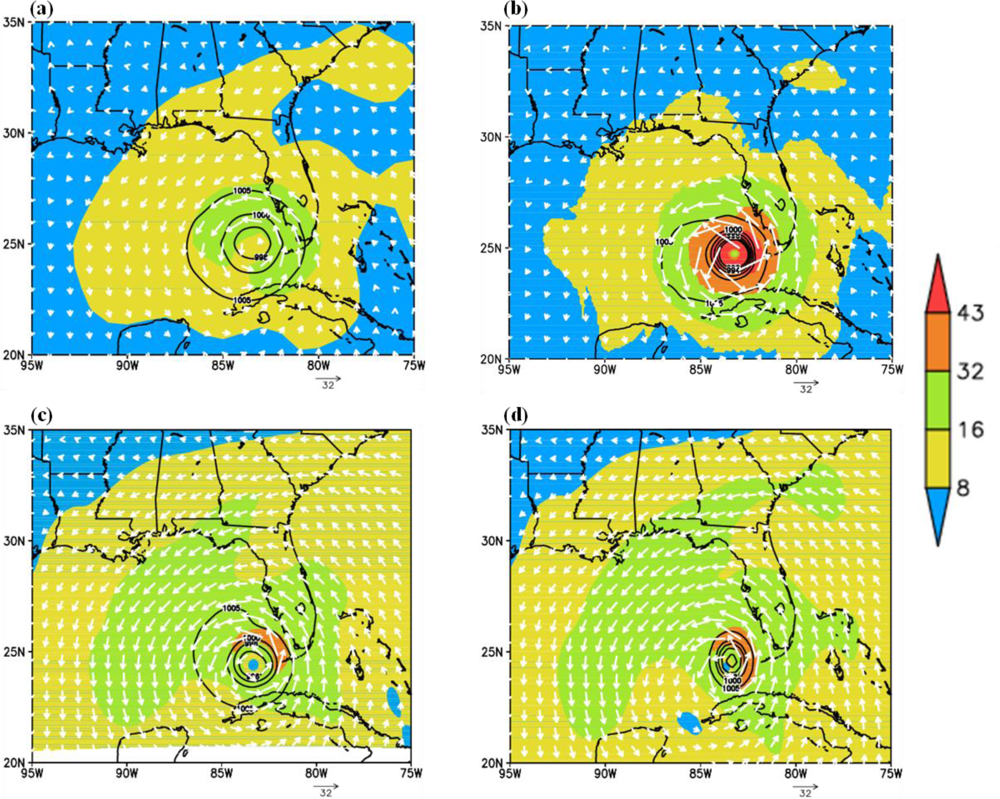
Characteristics of the initial vortex: At 0000 UTC of 27 August 2005, corresponding to the initial time of model integration, the sea level pressure (hPa) distribution and wind strength (m/s) and flow fields at 925 hPa for the HWRF, ARW and NMM models and NCEP FNL analysis are presented in
Figure 3. In this figure, isobars are shown as contours drawn at 5 hPa interval and with the outermost isobar as 1005 hPa; wind strength is shown as shaded with intensities of 8, 16, 32 and 43 m/s which correspond to threshold values of depression, tropical cyclone, Category-1 and Category-2 hurricanes and wind flow is shown as velocity barbs with the arrowhead pointing the direction of flow. The sea level pressure distribution shows concentric isobars with minimum central surface pressure values of 964 hPa for HWRF; 994 hPa for ARW and NMM; and 996 hPa in FNL analysis. The structure of isobars, as noted from the pattern of 1,005 hPa isobar, shows elongated pattern in all the model fields whereas it is nearly circular with about 250 km radius in FNL analysis. ARW and HWRF models show elongation towards west and NMM model shows elongated isobars to north and south. The corresponding west/east distances are 350/200 km for ARW model; 350/100 km for HWRF and north-south and east-west distances are 100 and 150 km respectively for NMM model, indicating the differences in asymmetries in the vortex at the initial time. Of all the three, NMM model has the smallest vortex in horizontal size, and HWRF has the largest pressure gradient due to the minimum central sea level pressure value of 965 hPa. As of 925 hPa level winds, both ARW and NMM models show maximum winds of 39 m/s and 40 m/s (Cat-1 hurricane winds) with the RMW (radius of maximum wind) as 174 km and 81 km respectively. In contrast, HWRF has maximum wind of 43 m/s (Cat-2 hurricane winds) at 70 km radius (RMW) and FNL analysis show maximum wind of 25 m/s (tropical storm winds) at 188 km radius (RMW). ARW and NMM models show concentric flow of tropical storm winds (16–32 m/s) more towards northwest with maxima (Cat-1 strength) towards north, whereas HWRF has nearly circular concentration of tropical storm winds (16–32 m/s) with Cat-2 maximum strength all around the center. FNL has maximum strength of tropical storm winds and mostly circular in shape. In comparison, HWRF model has the maximum wind of 43 m/s closer to the observed value of 46 m/s as compared to 37 m/s with ARW and 40 m/s with NMM model.
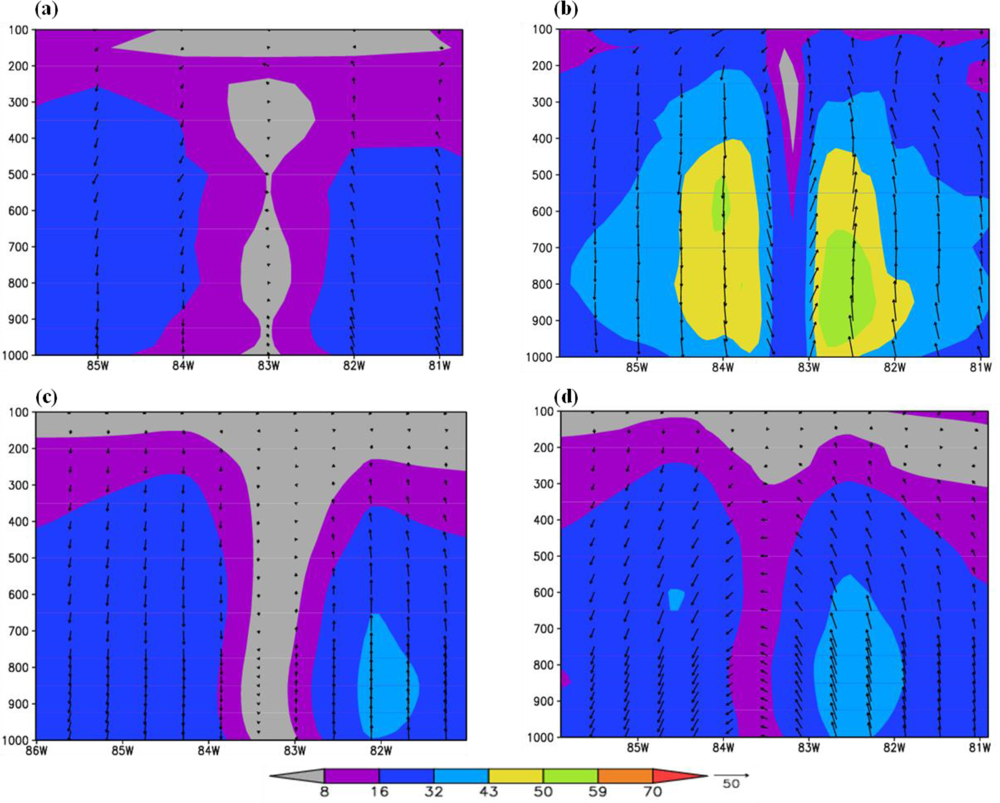
The longitude-vertical cross section of the horizontal wind along the latitude of the vortex center for FNL and the three models are presented in
Figure 4. It is noted that the vortex center location for the three models are 24.3486N, 83.4324W for ARW; 24.785N, 83.325W for NMM and 24.7N, 83.2W for HWRF as compared to the observed location at 24.6N, 83.3W and the corresponding track positional errors are 16, 21 and 32 km for HWRF, NMM and ARW models respectively. However the wind structure shows significant differences. The vortex in FNL analysis has a smaller core with larger radius of maximum wind (8–16 m/s) with radial extent up to 1 degree and vertically extending up to 400 hPa and outflow above. HWRF has core wind strength of 43–50 m/s extending up to 400 hPa level either side and with maximum winds of 50–59 m/s extending up to 650 hPa on east side and between 650–520 hPa levels towards west; ARW model has inner core winds of <8 m/s and with maximum winds (32–34 m/s) on the east side and height of maximum extending up to 650 hPa level; and NMM has inner core winds of 8–16 m/s with maximum winds of 32–43 m/s towards the east and with the maximum winds extending up to 550 hPa level. The significant differences of the structure of vortex are higher core and maximum strength winds in HWRF model and smaller inner core with higher maximum winds with higher vertical extent than ARW model.
Prediction of intensity: The simulation of the evolution of Hurricane Katrina during the model integration period (
i.e.,) from 0000 UTC of 27 August to 0000 UTC of 30 August, 2005 with the three models are presented (
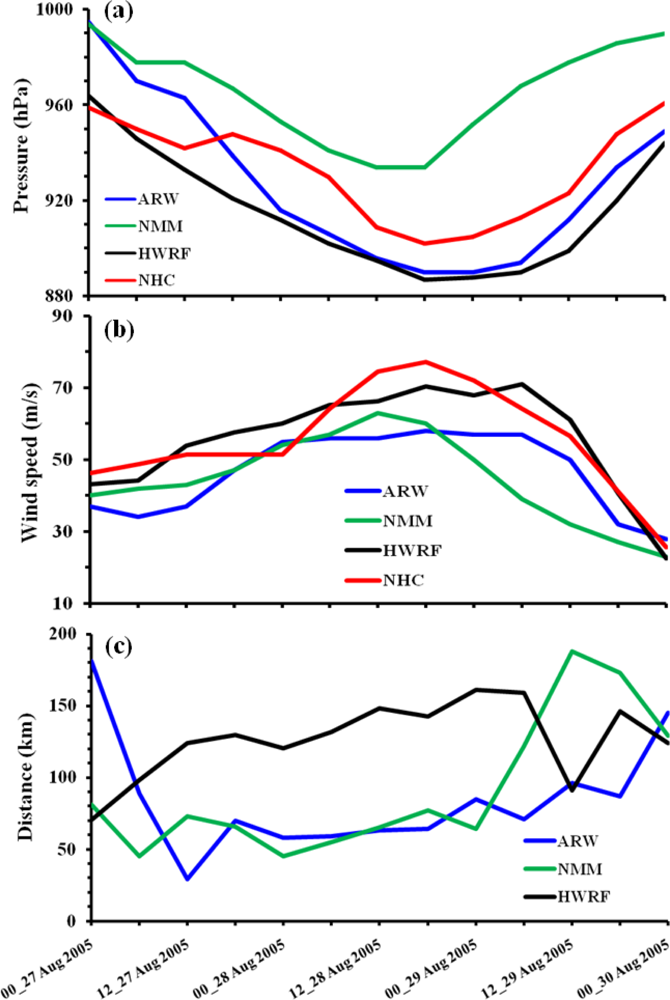
Figure 5) in terms of the time series of central sea level pressure (CSLP), 10-m level maximum wind (MW) and the radius of maximum wind (RMW). The time series of the simulated CSLP along with observations are shown in
Figure 5a. At the initial time, the CSLP in HWRF is nearly 965 hPa as of the observations whereas it is 995 hPa for the NMM and ARW models. This is one of the discrepancies in the characteristics of the initial vortex as initialized in the three models. All the three models simulate rapid deepening with the attainment of minimum CSLP around 36–42 hours. Although ARW model has higher CSLP at the initial time as compared to HWRF, both HWRF and ARW attain the same minimum value for CSLP as 890 hPa at 42 hour (
i.e.,) 1800 UTC of 28 August. Both HWRF and ARW simulate stronger hurricane than of the observations (940 hPa). But the time of attainment of minimum with ARW and HWRF models agrees with the observations. In comparison, NMM simulates a weaker hurricane with attainment of minimum CSLP of 940 hPa at 36 hour (
i.e.,) 1200 UTC of 28 August, 2005. All the three models simulate gradual weakening of hurricane after 1800 UTC of 28 August, 2005 as similar to the observations. It is significant to note from the life cycle of hurricane Katrina that the minimum CSLP slightly increased between 1200 UTC and 1800 UTC of 27 August, 2005 and correspondingly ARW and NMM models simulated reduced intensification retarded 6 hours (0600 to 1200 UTC) whereas HWRF did not show this feature. However, NMM model shows maintenance of same intensity and ARW a reduction in the rate of deepening during a 6 hour period between 0600–1200 UTC of 27 August, 2005 (
i.e.,) weakening period 6-hours earlier than observation.
The model simulated maximum wind at 10 m level from the three models along with NHC estimates are shown in
Figure 5b. The time variation of MW show that all the three models have the initial strength of the vortex to be slightly lower (37 m/s for ARW, 40 m/s for NMM and 43 m/s for HWRF) as compared to the NHC designated MW of 46 m/s.
These features of MW, minimum CSLP and the horizontal scale of hurricane vortex show that both HWRF and ARW models have nearly same horizontal size with stronger pressure gradients in HWRF as compared to NMM model with smaller horizontal size and pressure gradients higher than ARW model and less than HWRF model. NHC designated MW show slow intensification for 24 hours up to 0000 UTC of 28 August, rapid increase between 24–42 hours attaining a maximum of 75 m/s followed by rapid decrease. ARW predicts intensification from 12 to 24 hours, attaining a maximum of 58 m/s at 42 hours (1800 UTC 28 August), and decreases gradually after 54 hours. NMM model shows gradual increase up to 12 hours, then a steady increase up to 36 hours attaining a maximum of 63 m/s, followed by rapid decrease. In contrast, HWRF shows same intensity for first 6 hours, followed by gradual increase up to 42 hours attaining a maximum of 70 m/s maintained same intensity between 42–54 hours, followed by rapid decrease.
Of the three simulations, HWRF model is better with respect to the rapid intensification although time of attainment of MW is delayed by 12 hours. NMM shows better rate of intensification than HWRF but with underestimation of the maximum intensity. In contrast, ARW model simulated minimum CSLP as of HWRF but with lesser MW indicating a larger hurricane system with weaker pressure gradients.
The simulated RMW from the three models are shown in
Figure 5c. HWRF and NMM have the same RMW with a value of 70–80 km at the initial time as compared to 170 km in ARW model. HWRF simulates an increase of RMW up to 12 hours, and a slow increase between 12–48 hours reaching 160 km at 48 hours, remains same between 48 and 54 hours, followed by a decrease. In contrast, ARW model simulates rapid decrease during first 12 hours attaining 30 km as RMW, increase between 12 and 18 hours reaching 70 km, nearly same RMW of 70 km between 18–42 hours, and a gradual increase thereafter. NMM model simulated a decrease during first 6 hours reaching a value of 45 km, an increase in next 6 hours reaching 70 km followed by a decrease up to 24 hours reaching 50 km, a gradual increase up to 48 hours reaching 70 km, rapidly increasing to 180 km at 60 hours and a decrease thereafter. The time variations of RMW are typically different in the three simulations. NMM model maintain nearly the same RMW with minor fluctuations up to 48 hours followed by a rapid increase indicating slower changes in intensity up to 48 hours in association with gradual intensification. HWRF shows gradual increase of RMW up to 54 hours indicating increase of horizontal size in association with a mature stage hurricane. In contrast, ARW model simulated intensification during the first 12 hours as indicated by the shrinking of RMW and increase of horizontal size between 12–48 hours in association with the expansion of the hurricane system.
The typical values of minimum CSLP and MW and RMW indicated the differences in the characteristics of the initial vortex and their impact on the evolution of hurricane Katrina.
Structure of the vortex at mature stage: The characteristics of the hurricane at the mature stage for the experiments with ARW, NMM and HWRF models are shown in
Figures 6 and
7. The times of mature stage are based on the time of attainment of maximum intensity in terms of minimum central sea level pressure and maximum surface wind, which are 1200 UTC 28 August 2005 for HWRF and NMM models, and 2100 UTC 28 August 2005 for ARW model. The plots in
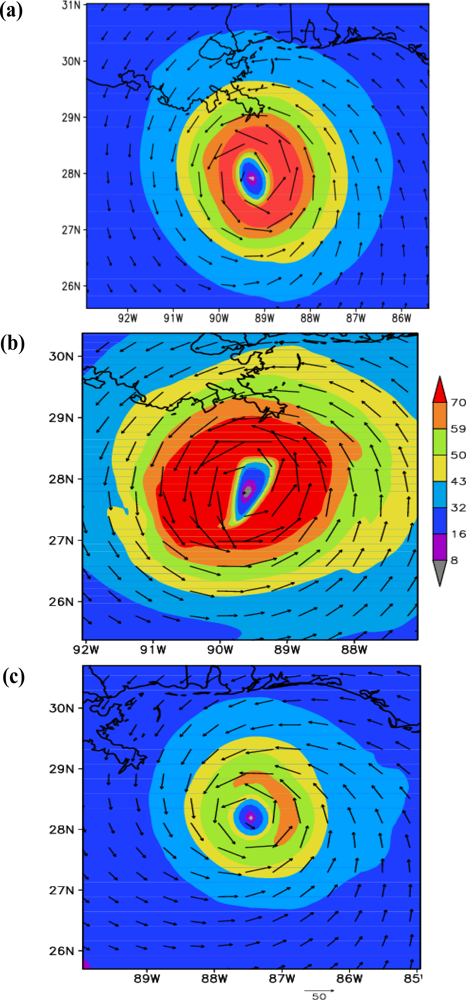
Figures 6 show horizontal wind flow with wind magnitude at 925 hPa level corresponding to the respective times of mature stage. HWRF model (
Figure 6a) simulated maximum winds exceeding 70 m/s at a radius of 50 km and winds are more symmetric than ARW and NMM model simulated winds. ARW model (
Figure 6b) simulated winds exceeding 70 m/s with a noted maximum value of 82 m/s at radius of 117 km and the wind asymmetry show larger horizontal extent towards east. NMM model simulated (
Figure 6c) maximum winds of 63 m/s at a radius of 65 km and the horizontal structure is more symmetrical than ARW with asymmetries as slightly larger horizontal extent towards east. The plots in
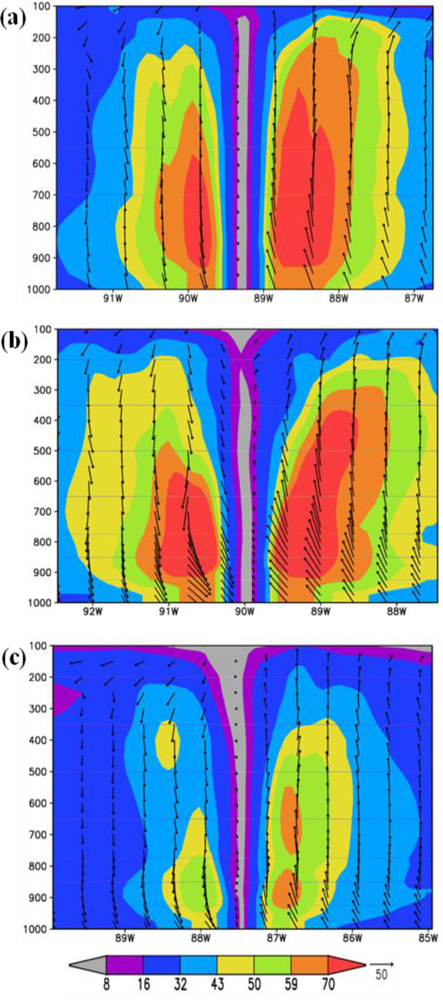
Figure 7 show the longitude-vertical sections of wind vectors (barbs and magnitude) along the latitudes of 27.86N for HWRF, 27.8757N for ARW and 28.2N for NMM models. HWRF model simulates narrow eye region through the vertical extent up to 150 hPa and with hurricane winds >70 m/s over a larger area towards east extending up to 400 hPa on the east side and 600 hPa towards west (
Figure 7a). ARW model simulated a narrow eye region with surrounding eye wall and with winds exceeding 70 m/s extending up to 350 hPa level on the eastside and 550 hPa on westside (
Figure 7b). The horizontal and vertical extent of maximum winds >70 m/s are slightly more in ARW model as compared to HWRF model. NMM model also simulated a narrow eye region surrounded by core of stronger winds with wind maximum of 59–70 m/s towards east and 50–59 m/s towards west (
Figure 7c). The vertical extent of 50–59 m/s winds extended up to 450 hPa on the eastern side as compared to 750 hPa on the western side. These features indicate that HWRF and ARW models simulated a hurricane with nearly same horizontal and vertical extent and larger than NMM model.
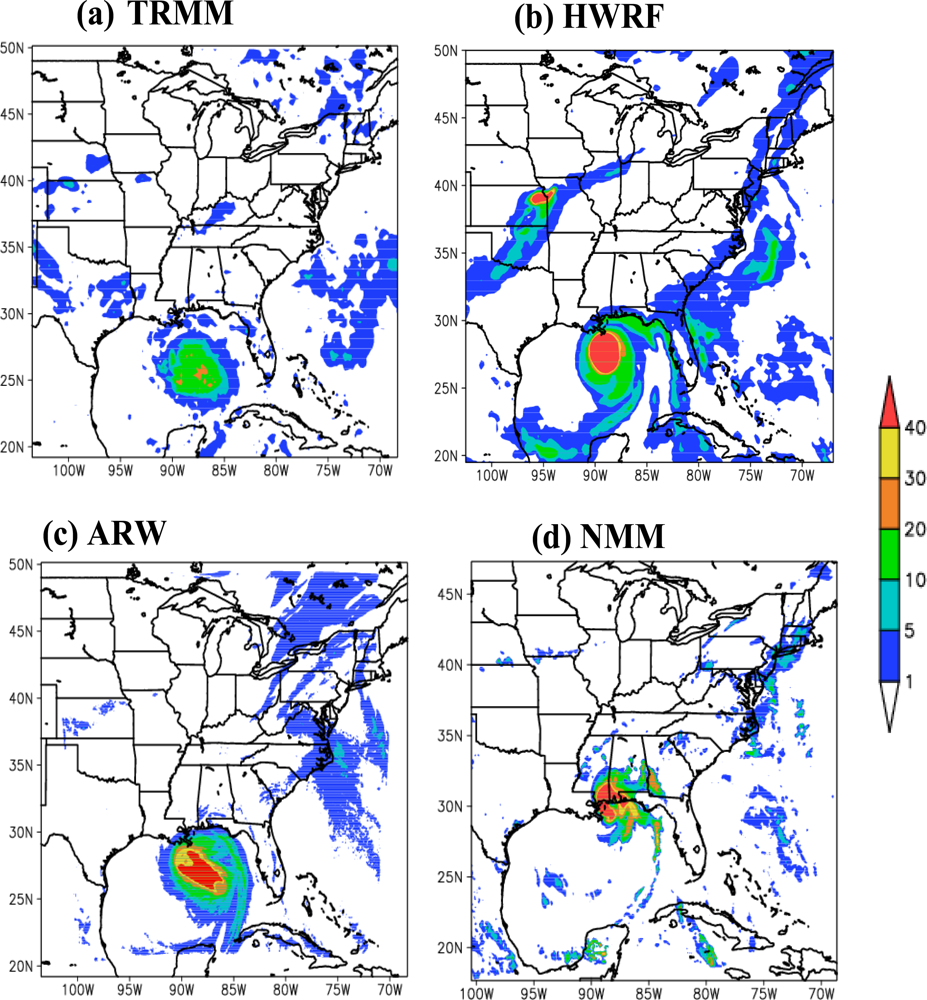
Predicted rainfall distribution: The spatial distribution of model simulated rainfall during the 24 hour period between 0000 UTC of 28 and 0000 UTC of 29 August, 2005 for the ARW, NMM and HWRF models along with TRMM observations are shown in
Figure 8. ARW model simulated concentrated regions of rainfall, with magnitude exceeding 40 cm, covering north Atlantic and adjoining coastal regions of Texas, Louisiana, Mississippi and Florida. The NMM model predicted concentrated rainfall exceeding 40 cm over coastal regions of Louisiana and Mississippi; and HWRF predicted all the rainfall over the North Atlantic Ocean with the maximum exceeding 30 cm to the west of Florida coast. As of the spatial distribution, HWRF produced the maximum towards east; ARW model to the west and NMM model to the north with respect to TRMM observations. ARW and NMM models overestimated the intensity whereas HWRF simulated smaller horizontal extent. The differences in the location of maximum of the three models are due to differences in the time and location of landfall. It is to be noted that HWRF has the landfall around 1000 UTC of 29 August near the location (29.4N, 89.8W) as of the observations, NMM has the landfall around 0000 UTC of 29 August at the location (30.43N, 88.35W) which is to the east of the observations and ARW model shown the landfall at 0900 UTC of 29 August and at the location (29.35N, 91.04W), which is to the west of the observed landfall.
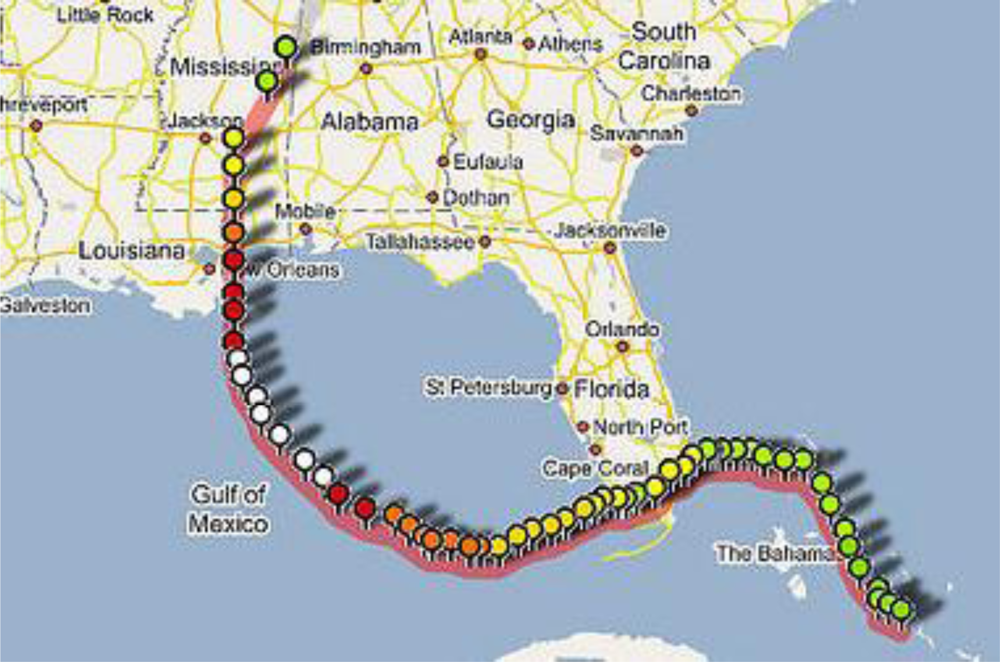
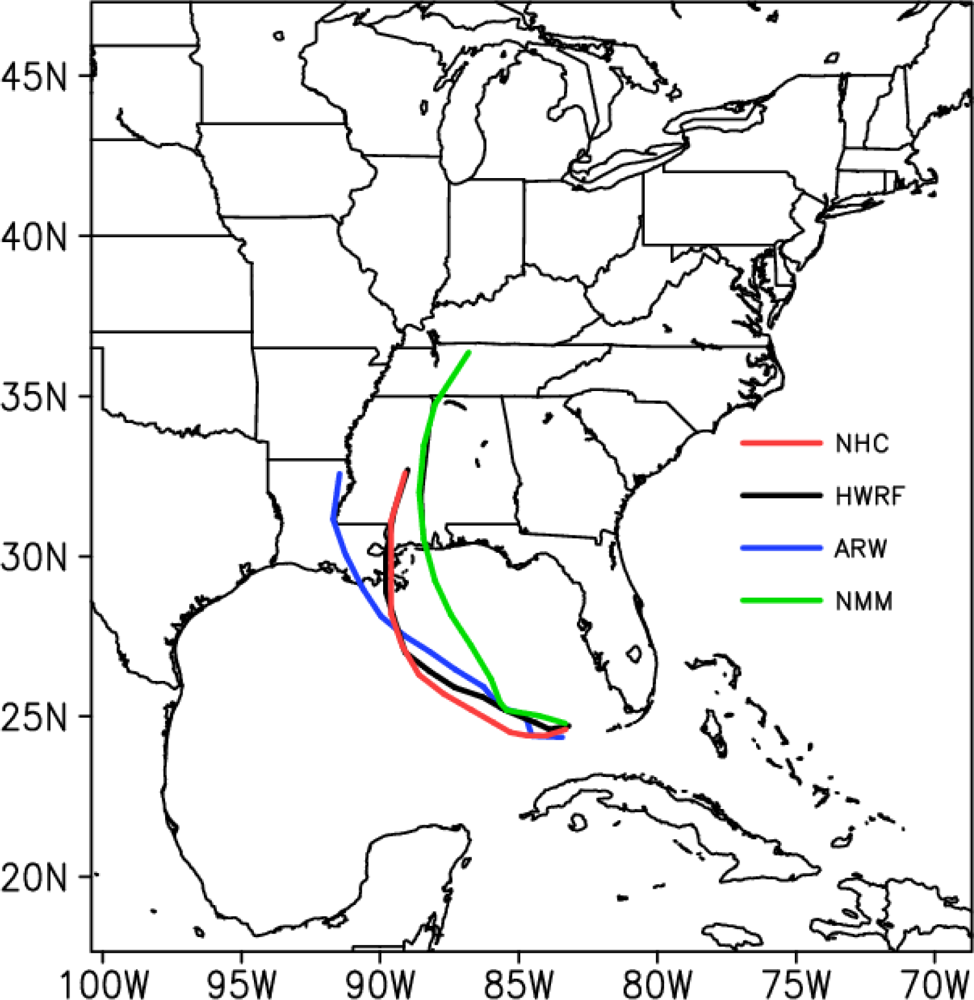
Prediction of the track: The model simulated track of hurricane Katrina with the three models along with the best track positions from NHC are shown in
Figure 9. Due to vortex initialization, the positions of initial vortex are nearly same in all the three models. However, there are differences in the structure which are described earlier in this section. Of all the three experiments, HWRF produced the best track with the track positions nearly same during the 48 hour period before the landfall and slightly towards east of the observed during the initial 24-hours. ARW model shows deviation of the track towards right of the observations during initial 24-hour period and gradually moving towards west of the observations after 36 hours with the final landfall over Texas coast that is towards west of the observed landfall. In contrast, NMM model shows deviation of the track towards east all through with the landfall over Mississippi coast (
i.e.,) to the east of the observations.
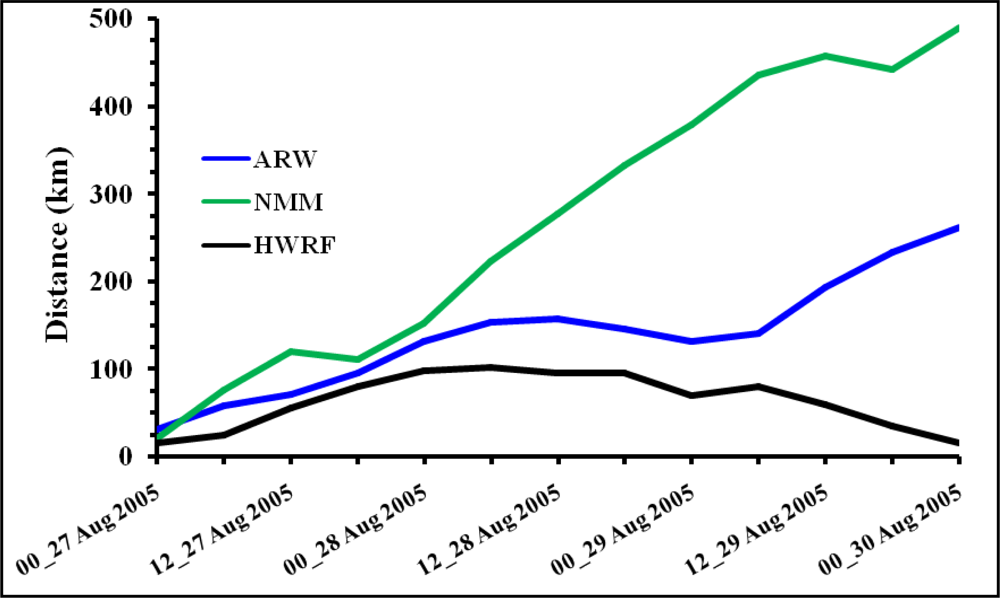
The vector track position errors at different times with different models are shown in
Figure 10 and values are given in
Table 2. HWRF has the minimum errors with values not exceeding 102 km and consistently less than 90 km during the last 24 hours of integration indicating the speed and track of hurricane Katrina closer to the observations. The errors with ARW model gradually increase reaching 132 km at 24 hours and 262 km at 72 hours whereas NMM model has the largest errors of 150 km at 24 hour and 490 km at 72 hours. These error statistics indicate that the NMM model has a higher speed of movement than ARW model contributing to larger track position errors.