3.1. Effect of Air Flow Rate under Static Groundwater Condition
The first three tests included a static groundwater condition and an initial TCE concentration of 300 mg/L. In all cases, the pore water sampling performed prior to air injection identified a concentration gradient within the contaminated soil profile. Higher initial TCE concentrations were observed in the bottom of the soil profile as compared to those measured at the top of the soil profile [
12]. The gradient is attributed to the injection process; the contaminant solution was injected at the bottom of the apparatus, which induced a wetting front and migration toward the top of the soil profile. The natural retardation factor of dissolved TCE within migrating groundwater likely contributed to the resulting gradient. Some adsorption to the soil media may also have occurred; however, this is expected to have been minimal due to the use of silica sand.
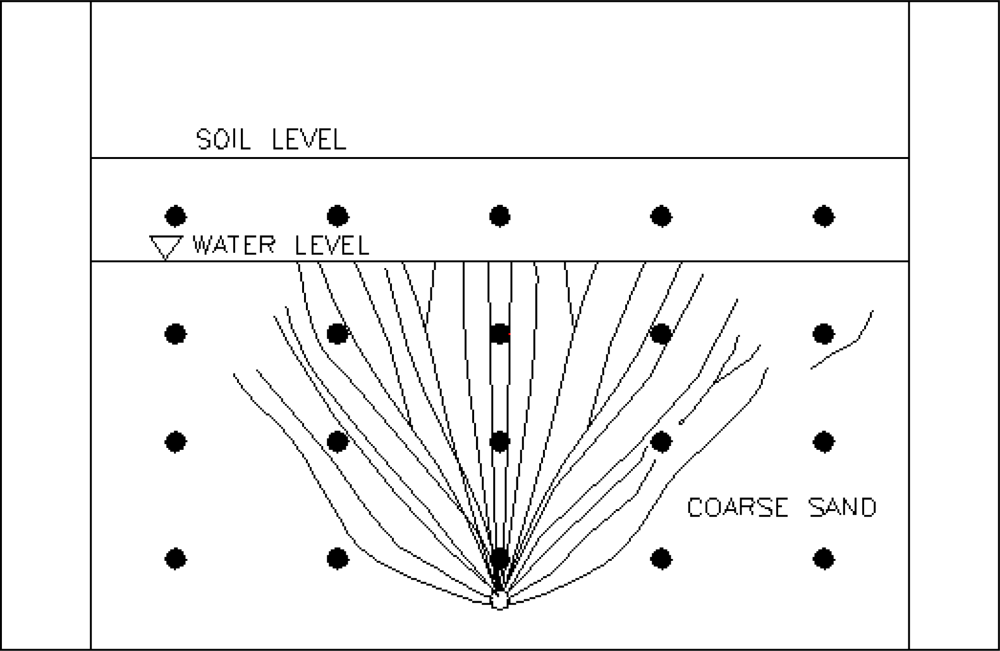
During the first test, air was injected at a rate of 2,225 mL/min (medium flow rate) under a pressure of 6.9 kPa. A dense network of air channels formed near the sparge point. The air channels decreased in density with increased vertical and lateral distance from the sparge point. As the air injection commenced, a relatively high air channel density was observed within the initial contaminant zone. A schematic of a representative zone of influence (ZOI) is shown in
Figure 2. However, the channel density was much lower with increased lateral distance from the sparge point, outside of the initial contaminant zone.
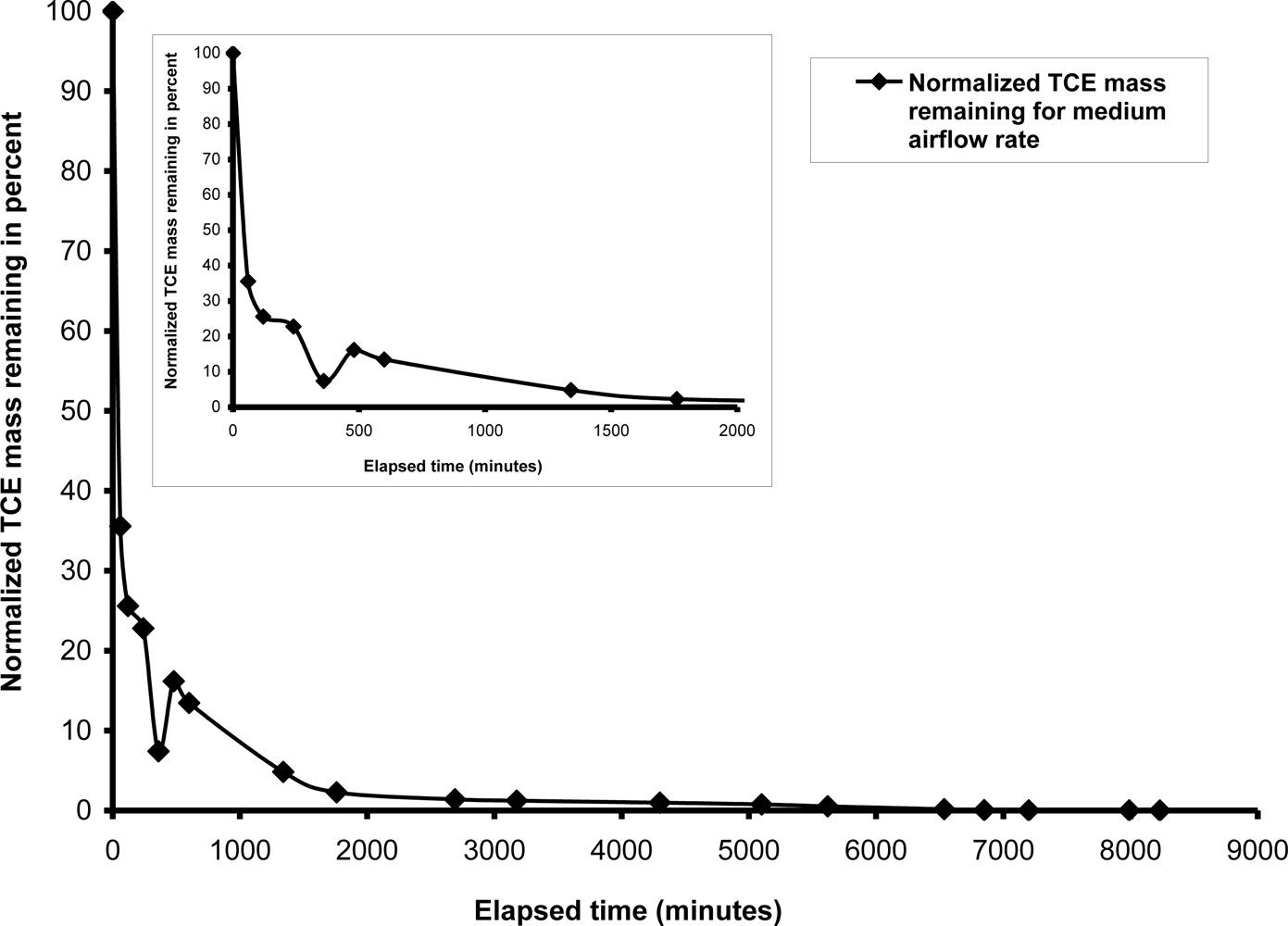
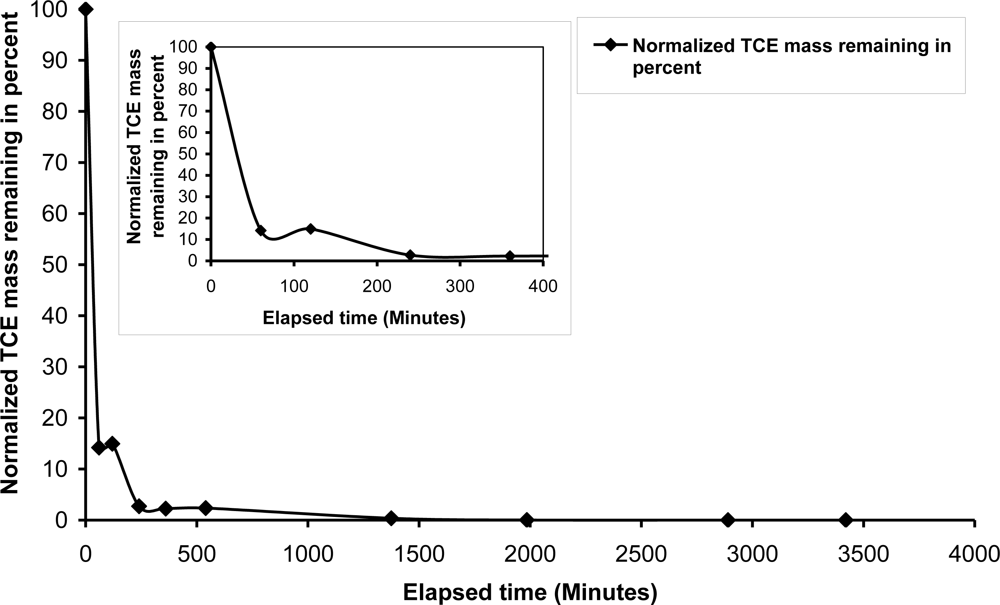
A rapid decrease in TCE concentration was observed during the first four hours of air injection and 50 percent of the TCE concentration reduction was observed during the first 30 minutes of air injection.
Figure 3 shows the rapid TCE mass and concentration reduction was followed by a characteristic “tailing” effect in which the rate of subsequent concentration reductions decreased noticeably. Approximately 90 percent of the TCE mass had been removed within the first 1,000 minutes, but residual concentrations were still present after 7,000 minutes of injection. Most of the residual TCE concentrations were located outside of the primary zone of influence (ZOI) after 4,300 minutes. The rapid TCE concentration reductions that occurred during the initial stages of air injection are attributable to the dominance of volatilization as a mass transfer process. A concentration gradient was induced between areas within the ZOI treatment zone (low concentrations of TCE) and areas outside of the ZOI (higher TCE concentrations). The concentration gradient induced diffusive transport of the TCE from the higher concentration areas into lower concentration areas, resulting in eventual removal upon migration into areas with greater air channel density within the ZOI. Following the rapid TCE concentration reduction during the early injection period, diffusion became a rate-limiting transport mechanism, resulting in the observed tailing effect.
For the second test, air was injected at a rate of 4,000 mL/min (high air flow) under a pressure of 6.9 kPa and with a static groundwater condition. Upon commencement of air injection, the ZOI was very similar to that observed in the medium air flow test, except a higher density of the channels was observed. Significant TCE concentration reductions were observed during the initial stages of air injection (
Figure 4). The rate of removal decreased with increased injection time, with the exception of areas adjacent to the sparge point or outside of the ZOI. Eventually, concentration reductions were observed at later stages of injection, including the top left of the contamination zone. Overall, the pattern of contaminant removal was similar to that observed during 2,225 mL/min air injection flow. There was a higher rate of contaminant removal during the early stages of the air injection; 90 percent of the normalized TCE mass was removed within 3 hours (
Figure 4). As testing progressed mass removal decreased, exhibiting a similar tailing effect, indicating that rate-limiting mass transfer processes, especially diffusion, had become dominant. Nevertheless, this effect was less pronounced and the residual concentrations were consistently lower using a high flow rate compared to a medium flow rate. The higher air injection rate induced a greater rate of volatilization, especially during the first few hours of air injection. This is clearly demonstrated by comparing the concentration profile of the medium air flow test with high air injection flow test for the same duration of air injection. However, as in the case of the medium air flow test, the period of rapid concentration removal was followed by a tailing effect in which concentration reductions occurred slowly. Furthermore, many zones outside of the ZOI exhibited residual TCE concentrations, even after 2,000 minutes of air injection.
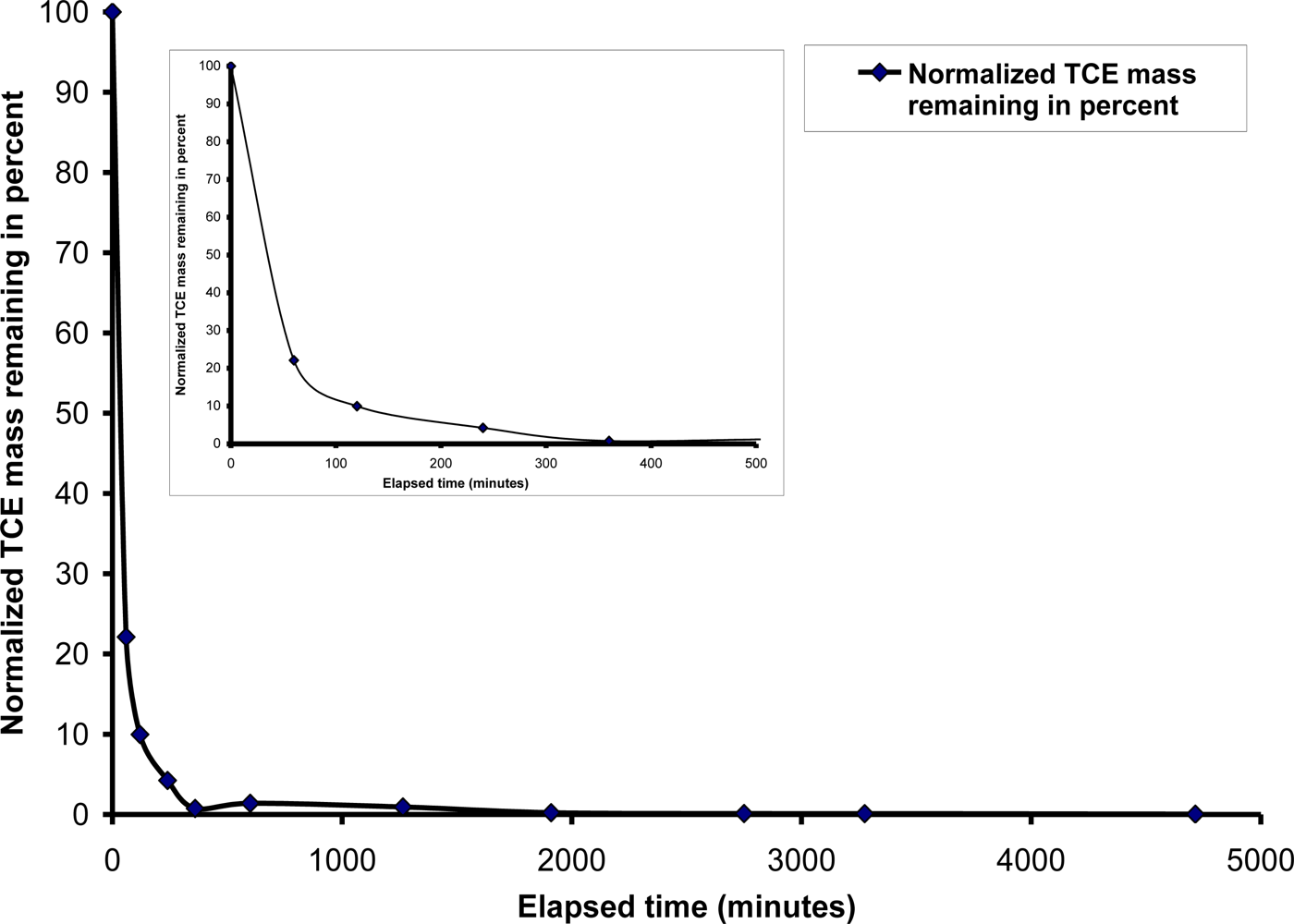
The third test was performed with a static groundwater condition, this time with an air injection rate of 7,156 mL/min (very high air flow) under a pressure of 6.9 kPa. An increased density of air channels were formed within and outside the initial contaminant zone as compared to those with lower flow rates. The rate of TCE removal was faster than that observed during the high air flow rate test. Almost 90 percent of the initial TCE mass was removed within the first hour of air injection (
Figure 5). As expected, a high TCE removal rate was observed in regions of high air channel density.
As demonstrated during these tests, volatilization was the dominant contaminant transport mechanism. Dissolved TCE within pore water was easily removed from the contaminated profile in areas adjacent to a dense air channel network. However, with increased air flow rates, pore-scale agitation enhanced mechanical dispersion, which in turn enhanced the partitioning of trapped dissolved TCE into the vapor phase. Additionally, the concentration gradient that developed between areas within and outside of the ZOI induced diffusive transport of TCE from these outside areas into the ZOI. This diffusion process was slow, as evidenced by the slower rates of concentration reductions as compared to the rates observed within the ZOI. This indicates that diffusion is a rate limiting process for remediation in areas outside of a sparge point ZOI.
3.2. Effect of Air Flow Rate under Groundwater Flow Condition
The next series of tests were performed with an induced groundwater flow. Following the initial saturation of the soil profile with the TCE solution and clean water, the constant-head clean water reservoirs were adjusted in height to induce groundwater flow under a hydraulic gradient of 0.011. Once groundwater flow was established across the soil profile, air injection commenced.
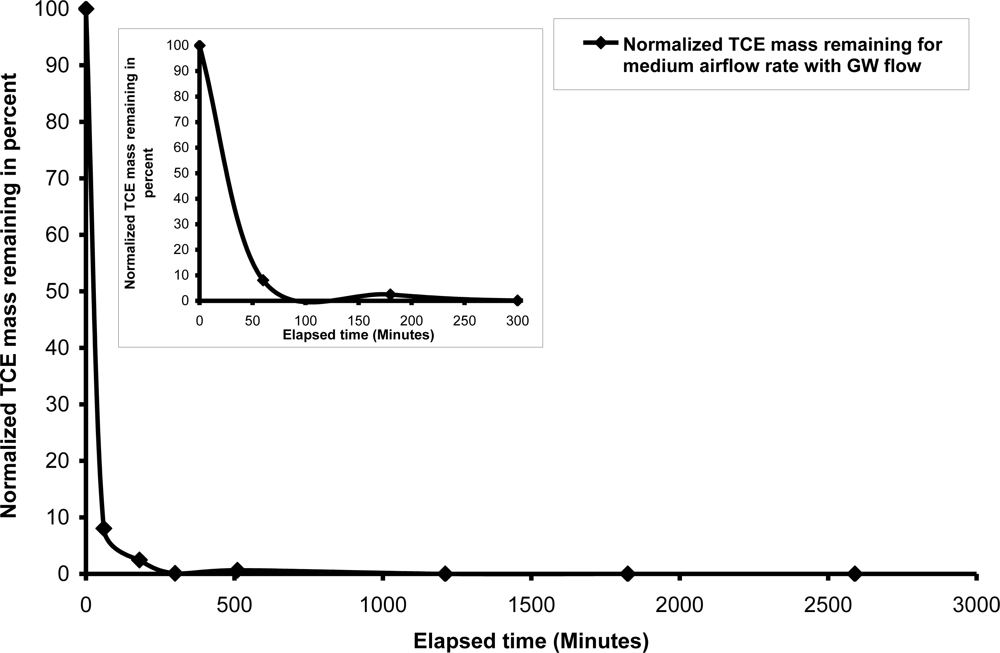
For the first test, air was injected at a rate of 2,225 mL/min (high air flow) under a pressure of 6.9 kPa. Once the air injection began, the groundwater gradient and flow was disrupted; therefore, the constant-head reservoirs were adjusted to maintain the desired flow and gradient. The resulting air flow pattern and ZOI were similar to previous tests performed with a static groundwater condition; with the exception of a decreased air channel density in the upper left (“upgradient”) region of the initial contaminant zone. However, it is unclear if this was the result of the induced groundwater flow. Nevertheless, the introduction of injected air did reduce relative hydraulic conductivity of the soil profile, as evidenced by the disrupted groundwater flow. Although the initial contaminant distribution was mainly restricted to the initial contaminant zone, the hydraulic gradient induced a TCE concentration gradient across the soil profile from left to right. TCE concentrations increased in the downgradient direction, having been induced by groundwater flow, even prior to the start of air injection. As in the case of the static groundwater condition, significant contaminant removal was observed in the first 60 minutes of air injection, especially near the sparge point. This rapid mass removal is attributed to both volatilization and advection/dispersion induced by groundwater flow. Complete mass removal occurred within approximately 1,200 minutes (
Figure 6).
The observed rate of removal was quite similar in most locations of the soil profile [
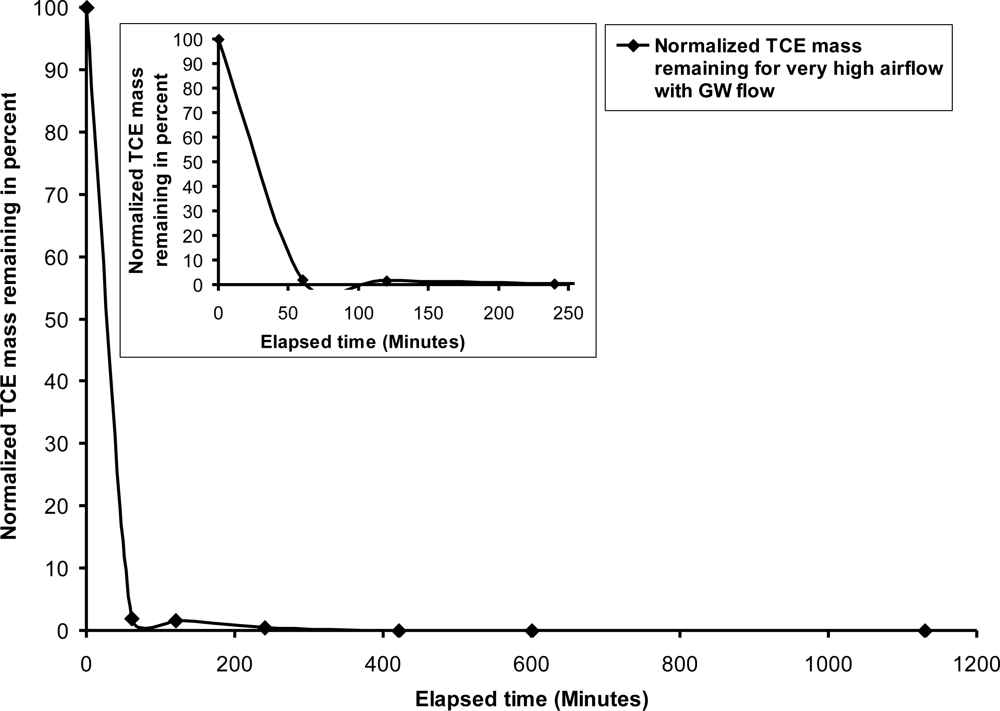
12]. As observed in tests with a static groundwater condition, rapid rates of TCE concentration reductions within the first hour of injection were followed by a tailing effect, resulting in eventual removal. When the air channel network formed, volatilization induced rapid mass reductions; however, as was observed with a static groundwater condition, the tailing effect was caused by the rate-limiting effect of diffusion. Dissolved TCE trapped within dead-end pore space was reliant upon diffusion for removal. Conversely, and perhaps counter-intuitively, faster mass reductions occurred in the upper levels of the soil profile, corresponding to areas with a lower air channel density. This is perhaps attributable to the greater effect of groundwater flow (due to a lessened reduction in hydraulic conductivity from air injection) and a greater degree of advection/dispersion. Groundwater effluent was also monitored. Trace concentrations were detected in effluent prior to air injection. However, during the initial stages of air injection, effluent TCE concentrations increased due to the induced advection/dispersion caused by the injected air. For instance, following 60 minutes of air injection, an effluent concentration of 248 mg/L was detected. Subsequent sampling indicated a decrease in effluent concentrations. The effluent did not exhibit detectable TCE concentrations after 30 hours of injection. An additional test was performed with induced groundwater flow (hydraulic gradient of 0.011) and an air injection rate of 7,156 mL/min (very high air flow) under a pressure of 6.9 kPa. A similar air channel pattern developed as compared to the previous test; however, as observed with a static groundwater condition, the zone immediately above and near the sparge point exhibited a higher degree of air channel formation. The greater channel density created a greater interfacial mass transfer area to induce volatilization, but it also led to a greater reduction in hydraulic conductivity and groundwater flow. As in the case of the test with 2,225 mL/min air flow, the rate of TCE removal was greater during the early stages of the air injection. This relatively higher rate of removal occurred in the first hour of the air injection, followed by a tailing effect. Complete mass removal occurred within 410 minutes of air injection (
Figure 7). Regions near the sparge point experienced rapid concentration reductions, followed by a pronounced tailing effect. Even though the greater degree of air channel density led to higher volatilization rates, as the TCE concentration declined, total mass removal became more dependent on rate-limiting diffusion. Additionally, the greater air channel density further decreased relative hydraulic conductivity, reducing the effects of groundwater flow-induced advection/dispersion.
Although regions downgradient from the ZOI initially free of contamination experienced infiltration due to groundwater-induced advective-dispersive transport, the extent was lessened as compared to that observed in the medium air flow test due to the reduced hydraulic conductivity and resulting groundwater flow. Also, as in the case of the medium air flow test, the groundwater effluent exhibited trace TCE concentrations prior to air injection, but greater concentrations during air injection. The peak TCE concentration was detected after one hour of air injection similar to that observed during medium air injection flow rate test. However, this effect was lessened as compared to the test with medium air flow. Although the decrease in relative hydraulic permeability of the porous media caused by higher air saturation could not stop downgradient contaminant migration, the effects were less pronounced, indicating the increased air saturation prevented downgradient migration to an appreciable extent. Therefore, increased air injection results in two important phenomena. First, increased air injection creates an increased air channel density and the mass transfer area necessary to induce volatilization. Secondly, increased air injection and the resulting air channel density reduced relative hydraulic conductivity within the ZOI. This reduced downgradient contaminant migration, which increased the contaminated groundwater residence time within the ZOI. Additionally, the reduced hydraulic conductivity and increased residence time lessened the degree of contaminant transport, or “smearing”, into downgradient regions unaffected by air flow, thus confining contamination to a region where more efficient removal occurred.
3.3. Effect of Higher Initial Dissolved Concentration
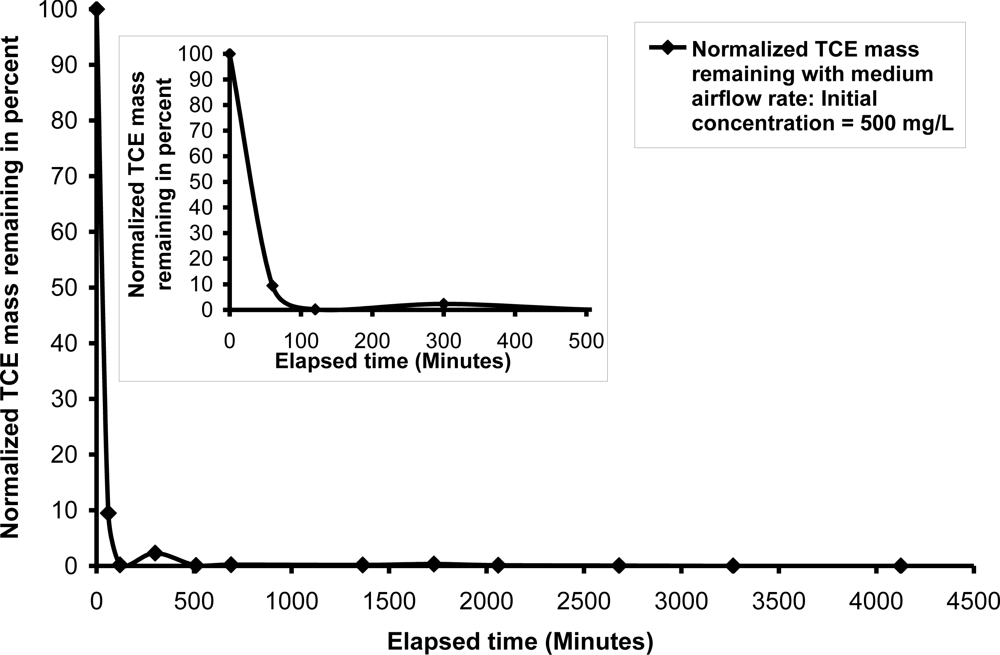
An additional test was performed to study the effect of the initial concentration of the contaminant on the overall mass removal during air injection. An initial TCE concentration of 500 mg/L was used, higher than the 300 mg/L used in earlier tests performed with groundwater flow. Once again, a hydraulic gradient of 0.011 was created to induce groundwater flow. Air was injected at a rate of 2,225 mL/min under a pressure of 6.9 kPa. As shown in
Figure 8, a slightly higher mass removal rate was observed as compared to previous tests, which is attributable to higher volatilization-induced concentration gradients and subsequent diffusive flux. As the test proceeded, and concentrations were reduced, the gradients approached those seen in earlier tests and a similar tailing effect occurred. This test required twice the air injection time as that observed in a similar test with a 300 mg/L initial TCE concentration. The greater TCE concentrations trapped in dead-end pores may have led to a temporary concentration increase once mobilized from the pores and prior to volatilization. As in the cases of other tests with groundwater flow, the groundwater effluent exhibited trace TCE concentrations prior to and at the beginning of air injection. This was followed by peak effluent concentrations one hour into the air injection process, which in turn was succeeded by decreased effluent concentrations as the air injection progressed. As in the other test cases, the initial increases in effluent concentrations were induced by the advection/dispersion resulting from air injection. Both the initial concentration and air injection rate have a direct impact on the TCE removal rate. However, comparatively speaking, the air injection rate has a greater impact on the removal rate than initial contaminant concentration. The test performed with the very high air flow rate has a similar initial rate of removal as that observed during the medium flow rate test, but a lessened tailing effect in the test with the very high flow rate resulting in a quicker complete mass removal time.