The Evaluation for Alterations of DOM Components from Upstream to Downstream Flow of Rivers in Toyama (Japan) Using Three-Dimensional Excitation-Emission Matrix Fluorescence Spectroscopy

Abstract
:1. Introduction
2. Experimental Section
2.1. Study Sites and Sampling
2.2. Methodology
3. Results and Discussion
3.1. Water Quality Parameters and DOC Concentration in the River Water
3.2. Properties of Fluorescence Dissolved Organic Matter in the River Water
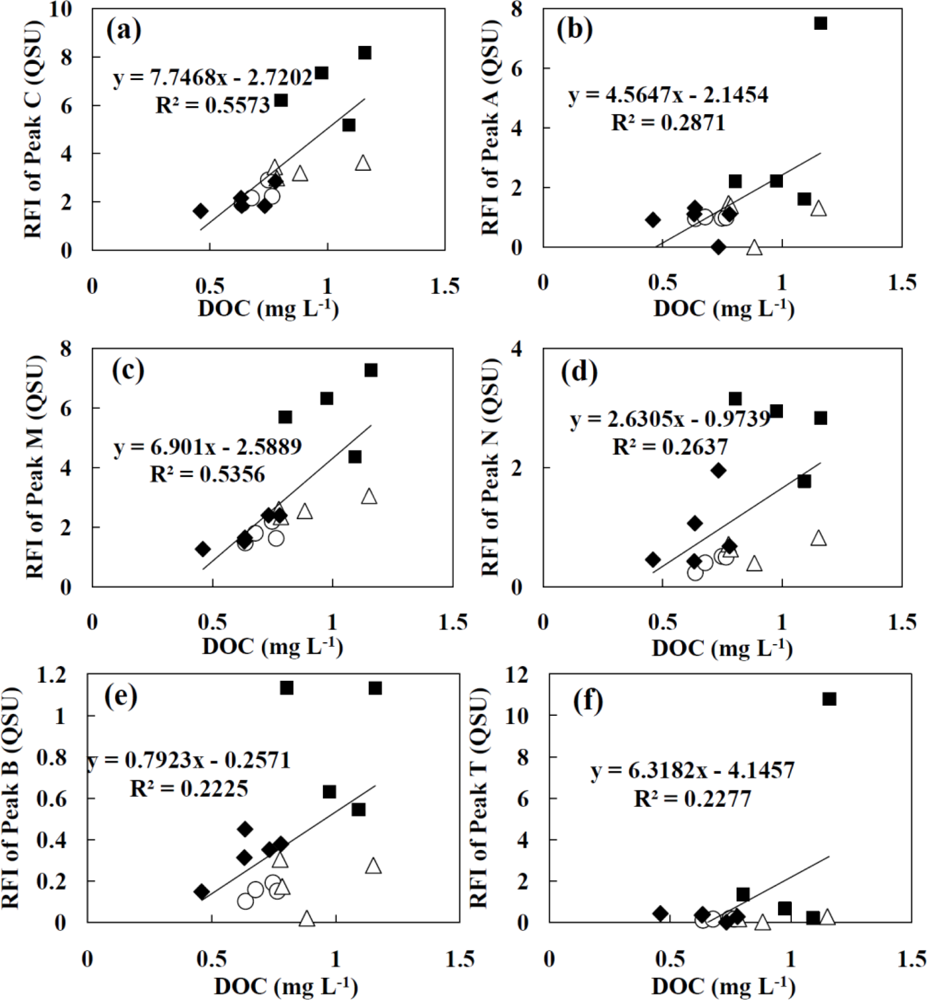
3.3. Relationship of the Fluorescence Peak Intensity with DOC Concentration
3.4. Fluorescence-Derived Indices
4. Conclusions
Acknowledgments
References
- Chiou, CT; Kile, DE; Brinton, TI; Malcolm, RL; Leenheer, JA; MacCarthy, P. A comparison of water solubility enhancements of organic solutes by aquatic humic materials and commercial humic acids. Environ. Sci. Technol 1987, 21, 1231–1234. [Google Scholar]
- Croue, J-P; Benedetti, MF; Violleau, D; Leenheer, JA. Characterization and copper binding of humic and nonhumic organic matter isolated from the South Platte River: Evidence for the presence of nitrogenous binding site. Environ. Sci. Technol 2003, 37, 328–336. [Google Scholar]
- McDonald, S; Bishop, AG; Prenzler, PD; Robards, K. Analytical chemistry of freshwater humic substances. Anal. Chim. Acta 2004, 527, 105–124. [Google Scholar]
- Amon, RMW; Benner, R. Bacterial utilization of different size classes of dissolved organic matter. Limnol. Oceanogr 1996, 41, 41–51. [Google Scholar]
- Mostofa, KM; Yoshioka, T; Konohira, E; Tanoue, E. Dynamics and characteristics of fluorescent dissolved organic matter in the groundwater, river and lake water. Water Air Soil Pollut 2007, 184, 157–176. [Google Scholar]
- Mostofa, K; Wu, F; Liu, C; Fang, W; Yuan, J; Ying, W; Wen, L; Yi, M. Characterization of Nanming River (southwestern China) sewerage-impacted pollution using an excitation-emission matrix and PARAFAC. Limnology 2010, 11, 217–231. [Google Scholar]
- Kalle, K. Fluoreszenz und gelbstoff im bottnischen und finnischen meerbusen. Deutsche Hydrographische Zeitschrift 1949, 2, 117–124. [Google Scholar]
- Coble, PG; Schultz, CA; Mopper, K. Fluorescence contouring analysis of DOC intercalibration experiment samples: A comparison of techniques. Mar. Chem 1993, 41, 173–178. [Google Scholar]
- Stedmon, CA; Markager, S; Tranvik, L; Kronberg, L; Slatis, T; Martinsen, W. Photochemical production of ammonium and transformation of dissolved organic matter in the Baltic sea. Mar. Chem 2007, 104, 227–240. [Google Scholar]
- Yamashita, Y; Tanoue, E. Chemical characterization of protein-like fluorophores in DOM in relation to aromatic amino acid. Mar. Chem 2003, 82, 255–271. [Google Scholar]
- Liu, R; Lead, JR; Baker, A. Fluorescence characterization of cross flow ultrafiltration derived freshwater colloidal and dissolved organic matter. Chemosphere 2007, 68, 1304–1311. [Google Scholar]
- McKnight, DM; Boyer, EW; Westerhoff, PK; Doran, PT; Kulbe, T; Andersen, DT. Spectrofluorometric characterization of dissolved organic matter for indication of precursor organic material and aromaticity. Limnol. Oceanogr 2001, 46, 38–48. [Google Scholar]
- Baker, A; Spencer, RGM. Characterization of dissolved organic matter from source of sea using fluorescence and absorbance spectroscopy. Sci. Total Environ 2004, 333, 217–232. [Google Scholar]
- Coble, PG. Characterization of marine and terrestrial DOM in seawater using excitation-emission matrix spectroscopy. Mar. Chem 1996, 51, 325–346. [Google Scholar]
- Maie, N; Parish, JK; Watanabe, A; Knicker, H; Benner, R; Abe, T; Kaiser, K; Jaffe, R. Chemical characteristics of dissolved organic nitrogen in an oligotrophic subtropical coastal ecosystem. Geochim. Cosmochim. Acta 2006, 70, 4491–4506. [Google Scholar]
- Yamashita, Y; Tanoue, E. Distribution and alteration of amino acid in bulk DOM along a transect from bay to oceanic waters. Mar. Chem 2003, 82, 145–160. [Google Scholar]
- Coble, PG; Del Castillo, CE; Avril, B. Distribution and optical properties of CDOM in the Arabian Sea during the 1995 Southwest Monsoon. Deep Sea Res 1998, 45, 2195–2223. [Google Scholar]
- Yamashita, Y; Tanoue, E. Chemical characterization of protein-like fluorophores in DOM in relation to aromatic amino acid. Mar. Chem 2003, 82, 255–271. [Google Scholar]
- Mayer, LM; Schick, LL; Loder, TC, III. Dissolved protein fluorescence in two marine estuaries. Mar. Chem 1999, 64, 171–179. [Google Scholar]
- Matsunaga, A; Kurokawa, H; Shyozen, K; Takayanagi, N; Ohto, M; Toyota, T; Nakajima, T. Temporal changes on nitrate concentrations in deep seawater pumped up at 321 m depth in Toyama Bay, Japan Sea. Deep Ocean Water Res 2003, 4, 67–72. (In Japanese). [Google Scholar]
- Taguchi, S; Ito-Oka, E; Masuyama, K; Kasahara, I; Goto, K. Application of organic solvent-soluble membrane filter in the preconcentration and determination of trace elements: Spectrophotometric determination of phosphorus as phosphomolybdenum blue. Talanta 1985, 32, 391–394. [Google Scholar]
- Porra, RJ; Thompson, WA; Kriedemann, PE. Determination of accurate extinction coefficients and simultaneous equations for assaying chlorophylls a and b extracted with four different solvents: Verification of the concentration of chlorophyll standards by atomic absorption spectroscopy. Biochim. Biophys. Acta 1989, 975, 384–394. [Google Scholar]
- Annual Report on the Environment in Toyama; Toyama Prefecture: Japan, 2005; pp. 21–29. (In Japanese).
- Mostofa, KMG; Honda, Y; Sakugawa, H. Dynamics and optical nature of dissolved organic matter in river waters in Hiroshima Prefecture, Japan. Geochem. J 2005, 39, 257–271. [Google Scholar]
- Determann, S; Lobbes, RM; Reuter, R; Rullkotter, J. Ultraviolet fluorescence excitation and emission spectroscopy of marine algae and bacteris. Mar. Chem 1998, 62, 137–156. [Google Scholar]
- Birdwell, JE; Engel, AS. Characterization of dissolved organic matter in cave and spring water using UV-Vis absorbance and fluorescence spectroscopy. Org. Geochem 2010, 41, 270–280. [Google Scholar]
- McKnight, DM; Boyer, EW; Westerhoff, PK; Doran, PT; Kule, T; Andersen, DT. Spectrofluorometric characterization of dissolved organic matter for indication of precursor organic material and aromaticity. Limnol. Oceanogr 2001, 46, 38–48. [Google Scholar]
- Huguet, A; Vacher, L; Relexans, S; Saubusse, S; Froidefond, JM; Parlanti, E. Properties of fluorescent dissolved organic matter in the Gironde Estuary. Org. Geochem 2009, 40, 706–719. [Google Scholar]
- Zsolany, A; Baigar, E; Jimenez, M; Steinweg, B; Saccomandi, F. Differentiating with fluorescence spectroscopy the sources of dissolved organic matter in soils subjected to drying. Chemosphere 1999, 38, 45–50. [Google Scholar]
- Kalbitz, K; Schmerwitz, J; Schwesig, D; Matzner, E. Biodegradation of soil-derived dissolved organic matter as related to its properties. Geoderma 2003, 113, 273–291. [Google Scholar]
- Wickland, KP; Neff, JC; Aiken, GR. Dissolved organic carbon in Alaskan boreal forest: Sources, chemical characteristics, and biodegradability. Ecosystems 2007, 10, 1323–1340. [Google Scholar]



| Samples | Site | pH | EC (μS/cm) | Turbidity (FAU) | Fe3+ | T-N | NO3-N | T-P | PO4-P | Chl. a (μg/L) | DOC (mg/L) | N/P |
|---|---|---|---|---|---|---|---|---|---|---|---|---|
| (mg/L) | (μg/L) | |||||||||||
| Oyabe River | 1 | 8.01 | 0.607 | 1 | 0.11 | 0.86 | 0.25 | 13.6 | 7.12 | 0.16 | 1.09 | 63.4 |
| 2 | 7.58 | 0.724 | 8 | 0.17 | 0.76 | 0.34 | 73.5 | 27.2 | 0.11 | 0.98 | 10.4 | |
| 3 | 7.68 | 0.887 | 8 | 0.19 | 0.83 | 0.33 | 36.4 | 18.9 | 0.12 | 0.80 | 22.8 | |
| 4 | 7.19 | 1.098 | 5 | 0.28 | 0.97 | 0.42 | 68.1 | 34.5 | 0.12 | 1.16 | 14.2 | |
| Shou River | 1 | 7.37 | 0.541 | 6 | 0.14 | 0.51 | 0.17 | 40.3 | 9.93 | 0.07 | 0.74 | 12.6 |
| 2 | 7.58 | 0.537 | 7 | 0.15 | 0.59 | 0.17 | 12.6 | 3.37 | 0.07 | 0.64 | 46.7 | |
| 3 | 7.76 | 0.547 | N.D. | 0.11 | 0.70 | 0.18 | 13.1 | 5.62 | 0.08 | 0.76 | 53.7 | |
| 4 | 7.74 | 0.555 | N.D. | 0.28 | 0.56 | 0.18 | 9.41 | 3.56 | 0.07 | 0.68 | 60.0 | |
| Jinzu River | 1 | 7.26 | 0.741 | N.D. | 0.03 | 0.73 | 0.26 | 16.5 | 13.9 | 0.06 | 0.88 | 44.3 |
| 2 | 7.33 | 0.758 | N.D. | 0.06 | 0.87 | 0.27 | 12.5 | 11.2 | 0.06 | 0.78 | 69.8 | |
| 3 | 7.33 | 0.752 | N.D. | 0.06 | 0.73 | 0.30 | 15.5 | 11.2 | 0.07 | 0.78 | 47.3 | |
| 4 | 7.22 | 1.025 | N.D. | 0.12 | 1.64 | 0.59 | 27.5 | 13.7 | 0.07 | 1.15 | 59.7 | |
| Jyouganji River | 1 | 7.71 | 0.660 | N.D. | 0.09 | 0.59 | 0.24 | 8.54 | 2.62 | 0.06 | 0.73 | 69.1 |
| 2 | 7.38 | 0.832 | N.D. | 0.10 | 0.57 | 0.20 | 8.42 | 3.56 | 0.05 | 0.63 | 67.8 | |
| 3 | 7.40 | 0.800 | N.D. | 0.07 | 0.57 | 0.24 | 8.57 | 2.43 | 0.05 | 0.46 | 66.5 | |
| 4 | 7.37 | 0.773 | 12 | 0.02 | 0.66 | 0.23 | 7.69 | 3.37 | 0.05 | 0.63 | 86.4 | |
| 5 | 7.33 | 0.827 | 4 | 0.17 | 0.79 | 0.24 | 11.5 | 5.81 | 0.03 | 0.78 | 68.7 | |
| Samples | Site | Peak C | Peak A | Peak M | Peak N | Peak B | Peak T | |
|---|---|---|---|---|---|---|---|---|
| Peak position (Ex/Em = nm) | RFI (QSU) | |||||||
| Oyabe River | 1 | 330/440 | 5.19 | 1.61 | 4.35 | 1.77 | 0.55 | 0.21 |
| 2 | 330/445 | 7.34 | 2.21 | 6.32 | 2.95 | 0.63 | 0.67 | |
| 3 | 330/440 | 6.21 | 2.20 | 5.69 | 3.15 | 1.13 | 1.35 | |
| 4 | 330/440 | 8.17 | 7.51 | 7.27 | 2.83 | 1.13 | 10.8 | |
| Shou River | 1 | 330/445 | 2.91 | 0.96 | 2.19 | 0.51 | 0.19 | 0.33 |
| 2 | 330/445 | 1.99 | 0.95 | 1.47 | 0.23 | 0.10 | 0.07 | |
| 3 | 330/445 | 2.24 | 0.98 | 1.62 | 0.49 | 0.15 | 0.17 | |
| 4 | 330/445 | 2.16 | 1.01 | 1.79 | 0.40 | 0.16 | 0.00 | |
| Jinzu River | 1 | 340/445 | 3.21 | 0.00 | 2.55 | 0.39 | 0.02 | 0.00 |
| 2 | 330/445 | 3.46 | 1.47 | 2.61 | 0.71 | 0.31 | 0.44 | |
| 3 | 330/440 | 2.98 | 1.38 | 2.35 | 0.63 | 0.17 | 0.22 | |
| 4 | 330/440 | 3.65 | 1.31 | 3.05 | 0.82 | 0.28 | 0.33 | |
| Jyouganji River | 1 | 330/440 | 1.85 | 0.00 | 2.39 | 1.95 | 0.35 | 0.00 |
| 2 | 340/410 | 2.40 | 1.31 | 1.64 | 1.06 | 0.45 | 0.38 | |
| 3 | 340/450 | 1.63 | 0.91 | 1.26 | 0.45 | 0.15 | 0.42 | |
| 4 | 330/445 | 2.17 | 1.10 | 2.40 | 0.43 | 0.31 | 0.34 | |
| 5 | 330/440 | 2.86 | 1.10 | 1.45 | 0.68 | 0.38 | 0.27 | |
| Samples | Peak C | Peak A | Peak M | Peak N | Peak B | Peak T | |
|---|---|---|---|---|---|---|---|
| Peak position (Ex/Em = nm) | RFI (QSU) | ||||||
| Sewage finished water | 340/440 | 66.0 | 5.56 | 28.5 | 21.3 | 13.3 | 0.65 |
| Agricultural water for paddies | 325/445 | 7.93 | 1.43 | 2.66 | 2.11 | 1.51 | 0.11 |
| Samples | Site | FIX | HIX | BIX |
|---|---|---|---|---|
| Oyabe R. | 1 | 1.39 | 6.23 | 0.55 |
| 2 | 1.43 | 4.58 | 0.63 | |
| 3 | 1.47 | 3.03 | 0.69 | |
| 4 | 1.60 | 4.47 | 0.72 | |
| Shou R. | 1 | 1.27 | 9.38 | 0.55 |
| 2 | 1.28 | 28.92 | 0.55 | |
| 3 | 1.30 | 11.09 | 0.55 | |
| 4 | 1.29 | 13.52 | 0.54 | |
| Jinzu R. | 1 | 1.46 | 356.66 | 0.56 |
| 2 | 1.35 | 6.91 | 0.54 | |
| 3 | 1.34 | 10.82 | 0.57 | |
| 4 | 1.35 | 14.22 | 0.56 | |
| Jyouganji R. | 1 | 1.28 | 4.21 | 0.96 |
| 2 | 1.49 | 2.85 | 0.66 | |
| 3 | 1.25 | 5.58 | 0.53 | |
| 4 | 1.31 | 8.21 | 0.63 | |
| 5 | 1.39 | 6.31 | 0.57 | |
| Sewage treatment water | 1.40 | 3.22 | 0.92 | |
| Agricultural water for paddy | 0.92 | 5.32 | 0.61 | |
| Suwannee River fulvic acid | 1.2 | 48 | 0.4 | |
© 2011 by the authors; licensee MDPI, Basel, Switzerland. This article is an open-access article distributed under the terms and conditions of the Creative Commons Attribution license (http://creativecommons.org/licenses/by/3.0/).
Share and Cite
Sazawa, K.; Tachi, M.; Wakimoto, T.; Kawakami, T.; Hata, N.; Taguchi, S.; Kuramitz, H. The Evaluation for Alterations of DOM Components from Upstream to Downstream Flow of Rivers in Toyama (Japan) Using Three-Dimensional Excitation-Emission Matrix Fluorescence Spectroscopy. Int. J. Environ. Res. Public Health 2011, 8, 1655-1670. https://doi.org/10.3390/ijerph8051655
Sazawa K, Tachi M, Wakimoto T, Kawakami T, Hata N, Taguchi S, Kuramitz H. The Evaluation for Alterations of DOM Components from Upstream to Downstream Flow of Rivers in Toyama (Japan) Using Three-Dimensional Excitation-Emission Matrix Fluorescence Spectroscopy. International Journal of Environmental Research and Public Health. 2011; 8(5):1655-1670. https://doi.org/10.3390/ijerph8051655
Chicago/Turabian StyleSazawa, Kazuto, Masaki Tachi, Takatoshi Wakimoto, Takanori Kawakami, Noriko Hata, Shigeru Taguchi, and Hideki Kuramitz. 2011. "The Evaluation for Alterations of DOM Components from Upstream to Downstream Flow of Rivers in Toyama (Japan) Using Three-Dimensional Excitation-Emission Matrix Fluorescence Spectroscopy" International Journal of Environmental Research and Public Health 8, no. 5: 1655-1670. https://doi.org/10.3390/ijerph8051655