<?xml version="1.0" encoding="UTF-8"?>
<!DOCTYPE article PUBLIC "-//NLM//DTD Journal Publishing DTD v2.3 20070202//EN" "journalpublishing.dtd">
<article xmlns:mml="http://www.w3.org/1998/Math/MathML" xmlns:xlink="http://www.w3.org/1999/xlink" xml:lang="en" article-type="research-article">
  <front>
    <journal-meta>
      <journal-id journal-id-type="publisher-id">ijerph</journal-id>
      <journal-title>International Journal of Environmental Research and Public Health</journal-title>
      <abbrev-journal-title abbrev-type="publisher">Int. J. Environ. Res. Public Health</abbrev-journal-title>
      <abbrev-journal-title abbrev-type="pubmed">International journal of environmental research and public health</abbrev-journal-title>
      <issn pub-type="epub">1660-4601</issn>
      <publisher>
        <publisher-name>MDPI</publisher-name>
      </publisher>
    </journal-meta>
    <article-meta>
      <article-id pub-id-type="doi">10.3390/ijerph8124425</article-id>
      <article-id pub-id-type="publisher-id">ijerph-08-04425</article-id>
      <article-categories>
        <subj-group>
          <subject>Article</subject>
        </subj-group>
      </article-categories>
      <title-group>
        <article-title>Generational Association Studies of Dopaminergic Genes in Reward Deficiency Syndrome (RDS) Subjects: Selecting Appropriate Phenotypes for Reward Dependence Behaviors</article-title>
      </title-group>
      <contrib-group>
        <contrib contrib-type="author">
          <name>
            <surname>Blum</surname>
            <given-names>Kenneth</given-names>
          </name>
          <xref rid="af1-ijerph-08-04425" ref-type="aff">1</xref>
          <xref rid="af11-ijerph-08-04425" ref-type="aff">11</xref>
          <xref rid="af14-ijerph-08-04425" ref-type="aff">14</xref>
          <xref rid="af16-ijerph-08-04425" ref-type="aff">16</xref>
          <xref rid="af17-ijerph-08-04425" ref-type="aff">17</xref>
          <xref rid="af18-ijerph-08-04425" ref-type="aff">18</xref>
          <xref rid="af19-ijerph-08-04425" ref-type="aff">19</xref>
          <xref rid="c1-ijerph-08-04425" ref-type="corresp">*</xref>
        </contrib>
        <contrib contrib-type="author">
          <name>
            <surname>Chen</surname>
            <given-names>Amanda L. C.</given-names>
          </name>
          <xref rid="af2-ijerph-08-04425" ref-type="aff">2</xref>
        </contrib>
        <contrib contrib-type="author">
          <name>
            <surname>Oscar-Berman</surname>
            <given-names>Marlene</given-names>
          </name>
          <xref rid="af3-ijerph-08-04425" ref-type="aff">3</xref>
        </contrib>
        <contrib contrib-type="author">
          <name>
            <surname>Chen</surname>
            <given-names>Thomas J. H.</given-names>
          </name>
          <xref rid="af4-ijerph-08-04425" ref-type="aff">4</xref>
          <xref rid="c1-ijerph-08-04425" ref-type="corresp">*</xref>
        </contrib>
        <contrib contrib-type="author">
          <name>
            <surname>Lubar</surname>
            <given-names>Joel</given-names>
          </name>
          <xref rid="af5-ijerph-08-04425" ref-type="aff">5</xref>
        </contrib>
        <contrib contrib-type="author">
          <name>
            <surname>White</surname>
            <given-names>Nancy</given-names>
          </name>
          <xref rid="af6-ijerph-08-04425" ref-type="aff">6</xref>
        </contrib>
        <contrib contrib-type="author">
          <name>
            <surname>Lubar</surname>
            <given-names>Judith</given-names>
          </name>
          <xref rid="af7-ijerph-08-04425" ref-type="aff">7</xref>
        </contrib>
        <contrib contrib-type="author">
          <name>
            <surname>Bowirrat</surname>
            <given-names>Abdalla</given-names>
          </name>
          <xref rid="af8-ijerph-08-04425" ref-type="aff">8</xref>
        </contrib>
        <contrib contrib-type="author">
          <name>
            <surname>Braverman</surname>
            <given-names>Eric</given-names>
          </name>
          <xref rid="af9-ijerph-08-04425" ref-type="aff">9</xref>
          <xref rid="af14-ijerph-08-04425" ref-type="aff">14</xref>
        </contrib>
        <contrib contrib-type="author">
          <name>
            <surname>Schoolfield</surname>
            <given-names>John</given-names>
          </name>
          <xref rid="af10-ijerph-08-04425" ref-type="aff">10</xref>
        </contrib>
        <contrib contrib-type="author">
          <name>
            <surname>Waite</surname>
            <given-names>Roger L.</given-names>
          </name>
          <xref rid="af11-ijerph-08-04425" ref-type="aff">11</xref>
        </contrib>
        <contrib contrib-type="author">
          <name>
            <surname>Downs</surname>
            <given-names>Bernard W.</given-names>
          </name>
          <xref rid="af11-ijerph-08-04425" ref-type="aff">11</xref>
        </contrib>
        <contrib contrib-type="author">
          <name>
            <surname>Madigan</surname>
            <given-names>Margaret</given-names>
          </name>
          <xref rid="af11-ijerph-08-04425" ref-type="aff">11</xref>
        </contrib>
        <contrib contrib-type="author">
          <name>
            <surname>Comings</surname>
            <given-names>David E.</given-names>
          </name>
          <xref rid="af12-ijerph-08-04425" ref-type="aff">12</xref>
        </contrib>
        <contrib contrib-type="author">
          <name>
            <surname>Davis</surname>
            <given-names>Caroline</given-names>
          </name>
          <xref rid="af13-ijerph-08-04425" ref-type="aff">13</xref>
        </contrib>
        <contrib contrib-type="author">
          <name>
            <surname>Kerner</surname>
            <given-names>Mallory M.</given-names>
          </name>
          <xref rid="af14-ijerph-08-04425" ref-type="aff">14</xref>
        </contrib>
        <contrib contrib-type="author">
          <name>
            <surname>Knopf</surname>
            <given-names>Jennifer</given-names>
          </name>
          <xref rid="af14-ijerph-08-04425" ref-type="aff">14</xref>
        </contrib>
        <contrib contrib-type="author">
          <name>
            <surname>Palomo</surname>
            <given-names>Tomas</given-names>
          </name>
          <xref rid="af15-ijerph-08-04425" ref-type="aff">15</xref>
        </contrib>
        <contrib contrib-type="author">
          <name>
            <surname>Giordano</surname>
            <given-names>John J.</given-names>
          </name>
          <xref rid="af16-ijerph-08-04425" ref-type="aff">16</xref>
          <xref rid="af17-ijerph-08-04425" ref-type="aff">17</xref>
        </contrib>
        <contrib contrib-type="author">
          <name>
            <surname>Morse</surname>
            <given-names>Siobhan A.</given-names>
          </name>
          <xref rid="af16-ijerph-08-04425" ref-type="aff">16</xref>
          <xref rid="af17-ijerph-08-04425" ref-type="aff">17</xref>
        </contrib>
        <contrib contrib-type="author">
          <name>
            <surname>Fornari</surname>
            <given-names>Frank</given-names>
          </name>
          <xref rid="af18-ijerph-08-04425" ref-type="aff">18</xref>
        </contrib>
        <contrib contrib-type="author">
          <name>
            <surname>Barh</surname>
            <given-names>Debmalya</given-names>
          </name>
          <xref rid="af19-ijerph-08-04425" ref-type="aff">19</xref>
        </contrib>
        <contrib contrib-type="author">
          <name>
            <surname>Femino</surname>
            <given-names>John</given-names>
          </name>
          <xref rid="af20-ijerph-08-04425" ref-type="aff">20</xref>
        </contrib>
        <contrib contrib-type="author">
          <name>
            <surname>Bailey</surname>
            <given-names>John A.</given-names>
          </name>
          <xref rid="af1-ijerph-08-04425" ref-type="aff">1</xref>
        </contrib>
      </contrib-group>
      <aff id="af1-ijerph-08-04425"><label>1 </label>Department of Psychiatry, School of Medicine and McKnight Brain Institute, University of Florida, W University Ave., Gainesville, FL 32601, USA; Email: <email>baileyjo@ufl.edu</email></aff>
      <aff id="af2-ijerph-08-04425"><label>2 </label>Department of Engineering Management Advanced Technology, Chang Jung Christian University, No. 396, Sec. 1, Changrong Road, Tainan 71101, Taiwan</aff>
      <aff id="af3-ijerph-08-04425"><label>3 </label>Department of Anatomy &amp; Neurobiology, Boston University School of Medicine, 72 East Concord Street, Boston, MA 02118, USA; Email: <email>Oscar@bu.edu</email></aff>
      <aff id="af4-ijerph-08-04425"><label>4 </label>Department of Occupational Safety and Health, Chang Jung Christian University, No. 396, Sec. 1, Changrong Road, Tainan 71101, Taiwan; Email:<email>tjhchen@yahoo.com.tw</email></aff>
      <aff id="af5-ijerph-08-04425"><label>5 </label>Emeritus, Department of Physiology, University of Tennessee, 719 Andy Holt Tower, Knoxville, TN 37996, USA; Email: <email>lubar@utkux.utcc.utk.edu</email></aff>
      <aff id="af6-ijerph-08-04425"><label>6 </label>Unique Mindcare, Inc., 1900 Saint James Place, Houston, TX 77056, USA; Email: <email>nancy@Uniquemindcare.com</email> </aff>
      <aff id="af7-ijerph-08-04425"><label>7 </label>Department of Neurofeedback, Southeastern Biofeedback and Neurobehavioral Clinic, 101 Westwood Road, Knoxville, TN 37919, USA; Email: <email>lubar@utkux.utcc.utk.edu</email></aff>
      <aff id="af8-ijerph-08-04425"><label>8 </label>Department of Neuroscience &amp; Population Genetics, EMMS Nazareth Hospital, Nazareth, Israel; Email: <email>bowirrat@netvision.net.il</email> </aff>
      <aff id="af9-ijerph-08-04425"><label>9 </label>Department of Neurosurgery, Weill Cornell College of Medicine, 1300 York Ave., New York, NY 10065, USA; Email: <email>pathfoundationny@gmail.com</email></aff>
      <aff id="af10-ijerph-08-04425"><label>10 </label>Department of Academic Informatics Services, University of Texas Health Science Center, 7703 Floyd Curl Drive, San Antonio, TX 78229, USA; Email: <email>schoolfield@uthscsa.edu</email></aff>
      <aff id="af11-ijerph-08-04425"><label>11 </label>Department of Nutrigenomics, LifeGen, Inc., P.O. Box 366, 570 Lederach Stattion Way, Lederach, PA 19450, USA; Email: <email>drw8@san.rr.com</email> (R.L.W.); <email>bernardwdowns@gmail.com</email> (B.W.D.); <email>MARGBETTS@hotmail.com</email> (M.M.)</aff>
      <aff id="af12-ijerph-08-04425"><label>12 </label>Department of Genomic Research, Carlsbad Science Foundation, Department of Medical Genetics, City of Hope National Medical Center, 1500 Duarte Road, Duarte, CA 91010, USA; Email: <email>dcomings@earthlink.net</email></aff>
      <aff id="af13-ijerph-08-04425"><label>13 </label>Department of Kinesiology and Health Sciences, York University, 4700 Keele Street, Toronto, ON M3J 1P3, Canada; Email: <email>cdavis@yorku.ca</email></aff>
      <aff id="af14-ijerph-08-04425"><label>14 </label>Department of Integrative Medicine, PATH Medical Research Foundation, 304 Park Ave. South, New York, NY 10010, USA; Email: <email>Mallory.kerner@gmail.com</email> (M.M.K.); <email>info@pathfoundationny.org</email> (J.K.)</aff>
      <aff id="af15-ijerph-08-04425"><label>15 </label>Hospital Universitario 12 de Octubre, Servicio de Psiquiatria, Av. Cordoba SN, Madrid 28041, Spain; Email: <email>tpalomo2004@yahoo.es</email></aff>
      <aff id="af16-ijerph-08-04425"><label>16 </label>Department of Holistic Medicine, G&amp;G Holistic Addiction Treatment, Inc., 1590 Northeast 162nd Street, North Miami Beach, FL 33162, USA; Email: <email>michg8@hotmail.com</email></aff>
      <aff id="af17-ijerph-08-04425"><label>17 </label>Department of Research, National Institute for Holistic Addiction Studies, 1590 Northeast 162nd Street, North Miami Beach, FL 33162, USA; Email: <email>samorse10@aol.com</email></aff>
      <aff id="af18-ijerph-08-04425"><label>18 </label>Dominion Diagnostics, Inc., 211 Circuit Road, North Kingstown, RI 02852, USA; Email: <email>ffornari@me.com</email></aff>
      <aff id="af19-ijerph-08-04425"><label>19 </label>Center for Genomics and Applied Gene Technology, Institute of Integrative Omics and Applied Biotechnology, Nonakuri, Purba Medinipur, West Bengal, India; Email: <email>dr.barh@gmail.com</email></aff>
      <aff id="af20-ijerph-08-04425"><label>20 </label>Meadows Edge Recovery Center, 580 10 Rod Road, North Kingstown, RI 02852, USA; Email: <email>jfemino@meadowsedge.com</email></aff>
      <author-notes>
        <corresp id="c1-ijerph-08-04425"><label>*</label> Authors to whom correspondence should be addressed; Email: <email>drd2gene@aol.com</email> (K.B.); <email>TJHchen@yahoo.com</email> (T.J.H.C.).</corresp>
      </author-notes>
      <pub-date pub-type="epub">
        <day>29</day>
        <month>11</month>
        <year>2011</year>
      </pub-date>
      <pub-date pub-type="collection">
        <month>12</month>
        <year>2011</year>
      </pub-date>
      <volume>8</volume>
      <issue>12</issue>
      <fpage>4425</fpage>
      <lpage>4459</lpage>
      <history>
        <date date-type="received">
          <day>26</day>
          <month>10</month>
          <year>2011</year>
        </date>
        <date date-type="rev-recd">
          <day>23</day>
          <month>11</month>
          <year>2011</year>
        </date>
        <date date-type="accepted">
          <day>23</day>
          <month>11</month>
          <year>2011</year>
        </date>
      </history>
      <permissions>
        <copyright-statement>©  2011 by the authors; licensee MDPI, Basel, Switzerland.</copyright-statement>
        <copyright-year>2011</copyright-year>
        <license xmlns:xlink="http://www.w3.org/1999/xlink" license-type="open-access" xlink:href="http://creativecommons.org/licenses/by/3.0/">
          <p>This article is an open-access article distributed under the terms and conditions of the Creative Commons Attribution license (http://creativecommons.org/licenses/by/3.0/).</p>
        </license>
      </permissions>
      <abstract>
        <p>Abnormal behaviors involving dopaminergic gene polymorphisms often reflect an insufficiency of usual feelings of satisfaction, or Reward Deficiency Syndrome (RDS). RDS results from a dysfunction in the “brain reward cascade,” a complex interaction among neurotransmitters (primarily dopaminergic and opioidergic). Individuals with a family history of alcoholism or other addictions may be born with a deficiency in the ability to produce or use these neurotransmitters. Exposure to prolonged periods of stress and alcohol or other substances also can lead to a corruption of the brain reward cascade function. We evaluated the potential association of four variants of dopaminergic candidate genes in RDS (dopamine D1 receptor gene [DRD1]; dopamine D2 receptor gene [DRD2]; dopamine transporter gene [DAT1]; dopamine beta-hydroxylase gene [DBH]). <italic>Methodology</italic>: We genotyped an experimental group of 55 subjects derived from up to five generations of two independent multiple-affected families compared to rigorously screened control subjects (e.g., N = 30 super controls for DRD2 gene polymorphisms). Data related to RDS behaviors were collected on these subjects plus 13 deceased family members. <italic>Results</italic>: Among the genotyped family members, the DRD2 Taq1 and the DAT1 10/10 alleles were significantly (at least p &lt; 0.015) more often found in the RDS families <italic>vs</italic>. controls. The TaqA1 allele occurred in 100% of Family A individuals (N = 32) and 47.8% of Family B subjects (11 of 23). No significant differences were found between the experimental and control positive rates for the other variants. <italic>Conclusions</italic>: Although our sample size was limited, and linkage analysis is necessary, the results support the putative role of dopaminergic polymorphisms in RDS behaviors. This study shows the importance of a nonspecific RDS phenotype and informs an understanding of how evaluating single subset behaviors of RDS may lead to spurious results. Utilization of a nonspecific “reward” phenotype may be a paradigm shift in future association and linkage studies involving dopaminergic polymorphisms and other neurotransmitter gene candidates.</p>
      </abstract>
      <kwd-group>
        <kwd>dopamine</kwd>
        <kwd>gene polymorphisms</kwd>
        <kwd>generational association studies</kwd>
        <kwd>phenotype</kwd>
        <kwd>“super normal” controls</kwd>
        <kwd>Reward Deficiency Syndrome (RDS) </kwd>
      </kwd-group>
    </article-meta>
  </front>
  <body>
    <sec sec-type="intro">
      <title>1. Introduction</title>
      <sec>
        <title>1.1. Background</title>
        <p>Reward Deficiency Syndrome (RDS) was first defined by our lab in 1996 as a putative predictor of impulsive and addictive behaviors [<xref ref-type="bibr" rid="B1-ijerph-08-04425">1</xref>,<xref ref-type="bibr" rid="B2-ijerph-08-04425">2</xref>,<xref ref-type="bibr" rid="B3-ijerph-08-04425">3</xref>,<xref ref-type="bibr" rid="B4-ijerph-08-04425">4</xref>,<xref ref-type="bibr" rid="B5-ijerph-08-04425">5</xref>,<xref ref-type="bibr" rid="B6-ijerph-08-04425">6</xref>,<xref ref-type="bibr" rid="B7-ijerph-08-04425">7</xref>]. It refers to an absence of usual feelings of satisfaction and a failure of the system that normally confers gratification, resulting in behaviors such as overeating, heavy cigarette smoking, drug and alcohol abuse, gambling, and hyperactivity (see <xref ref-type="table" rid="ijerph-08-04425-t001">Table 1</xref> in a later section). The syndrome has been linked to dysfunction of dopamine (DA) receptors, the genes for which show many mutant forms. In an attempt to resolve controversy regarding the causal contributions of mesolimbic DA systems to reward, we have evaluated the three main competing explanatory categories: “liking,” “learning,” and “wanting” [<xref ref-type="bibr" rid="B8-ijerph-08-04425">8</xref>], especially as they relate to RDS [<xref ref-type="bibr" rid="B9-ijerph-08-04425">9</xref>]. That is, DA may mediate: (a) the hedonic impact of reward (liking), (b) learned predictions about rewarding effects (learning), or (c) the pursuit of rewards by attributing incentive salience to reward-related stimuli (wanting). We evaluated these hypotheses, especially as they relate to the Reward Deficiency Syndrome (RDS), and we find that the incentive salience or “wanting” hypothesis of DA function is supported by a majority of the evidence [<xref ref-type="bibr" rid="B9-ijerph-08-04425">9</xref>]. </p>
        <p>Neuroimaging studies have shown that drugs of abuse, palatable foods, and anticipated behaviors such as sex and gaming affect brain regions involving reward circuitry, and may not be unidirectional. Gardner [<xref ref-type="bibr" rid="B10-ijerph-08-04425">10</xref>] has suggested that drugs of abuse that promote DA signals short circuit and sensitize dynamic mesolimbic mechanisms that evolved to attribute incentive salience to rewards. Accordingly, Gardner [<xref ref-type="bibr" rid="B10-ijerph-08-04425">10</xref>] further suggested that addictive drugs have in common that they are voluntarily self-administered, they enhance (directly or indirectly) dopaminergic synaptic function in the nucleus accumbens (NAc), and they stimulate the functioning of brain reward circuitry (producing the “high” that drug users seek). Blum and Gold [<xref ref-type="bibr" rid="B11-ijerph-08-04425">11</xref>] pointed out that reward circuitry is very complex, especially as these circuits relate to hedonic tone. Moreover, these circuits now are believed to be functionally more complex, also encoding attention, reward expectancy, disconfirmation of reward expectancy, and incentive motivation. Elevated stress levels, together with polymorphisms of dopaminergic genes and other neurotransmitter genetic variants, may have a cumulative effect on vulnerability to addiction. We and others believe that the RDS model of etiology holds very well for addictions [<xref ref-type="bibr" rid="B10-ijerph-08-04425">10</xref>].</p>
        <p>The D2 receptor has been associated with pleasure, and the DRD2 has been referred to as a reward gene [<xref ref-type="bibr" rid="B9-ijerph-08-04425">9</xref>,<xref ref-type="bibr" rid="B10-ijerph-08-04425">10</xref>,<xref ref-type="bibr" rid="B11-ijerph-08-04425">11</xref>,<xref ref-type="bibr" rid="B12-ijerph-08-04425">12</xref>,<xref ref-type="bibr" rid="B13-ijerph-08-04425">13</xref>,<xref ref-type="bibr" rid="B14-ijerph-08-04425">14</xref>,<xref ref-type="bibr" rid="B15-ijerph-08-04425">15</xref>,<xref ref-type="bibr" rid="B16-ijerph-08-04425">16</xref>]. The DRD2 gene, and especially the Taq1 A1 allele, has been associated with neuropsychiatric disorders in general, including alcoholism, other addictions (e.g., carbohydrate) [<xref ref-type="bibr" rid="B17-ijerph-08-04425">17</xref>,<xref ref-type="bibr" rid="B18-ijerph-08-04425">18</xref>,<xref ref-type="bibr" rid="B19-ijerph-08-04425">19</xref>,<xref ref-type="bibr" rid="B20-ijerph-08-04425">20</xref>,<xref ref-type="bibr" rid="B21-ijerph-08-04425">21</xref>,<xref ref-type="bibr" rid="B22-ijerph-08-04425">22</xref>,<xref ref-type="bibr" rid="B23-ijerph-08-04425">23</xref>], and it also may be involved in co-morbid antisocial personality disorder symptoms [<xref ref-type="bibr" rid="B24-ijerph-08-04425">24</xref>], especially in children and adults with attention deficit hyperactivity disorder (ADHD) or Tourette Syndrome [<xref ref-type="bibr" rid="B5-ijerph-08-04425">5</xref>,<xref ref-type="bibr" rid="B25-ijerph-08-04425">25</xref>] and high novelty seeking [<xref ref-type="bibr" rid="B26-ijerph-08-04425">26</xref>,<xref ref-type="bibr" rid="B27-ijerph-08-04425">27</xref>,<xref ref-type="bibr" rid="B28-ijerph-08-04425">28</xref>,<xref ref-type="bibr" rid="B29-ijerph-08-04425">29</xref>].</p>
        <p>DA is involved in a remarkable number of behavioral functions including cognition and motor effects [<xref ref-type="bibr" rid="B30-ijerph-08-04425">30</xref>], depending upon its localization in the brain. DA has been called the “anti-stress molecule” and/or the “pleasure molecule” [<xref ref-type="bibr" rid="B2-ijerph-08-04425">2</xref>,<xref ref-type="bibr" rid="B31-ijerph-08-04425">31</xref>,<xref ref-type="bibr" rid="B32-ijerph-08-04425">32</xref>,<xref ref-type="bibr" rid="B33-ijerph-08-04425">33</xref>] and is released into the synapse in the NAc where it stimulates a number of receptors (D1–D5), which results in increased feelings of well-being and stress reduction. The mesocorticolimbic dopaminergic pathway plays an especially important role in mediating the reinforcement of natural rewards like food and sex, as well as unnatural rewards like drugs of abuse. Natural rewards include satisfaction of physiological drives (e.g., hunger and reproduction) [<xref ref-type="bibr" rid="B34-ijerph-08-04425">34</xref>,<xref ref-type="bibr" rid="B35-ijerph-08-04425">35</xref>], and unnatural rewards are learned and involve satisfaction of acquired pleasures such as hedonic sensations [<xref ref-type="bibr" rid="B36-ijerph-08-04425">36</xref>,<xref ref-type="bibr" rid="B37-ijerph-08-04425">37</xref>] derived from alcohol and other drugs, as well as from gambling and other risk-taking behaviors [<xref ref-type="bibr" rid="B33-ijerph-08-04425">33</xref>,<xref ref-type="bibr" rid="B34-ijerph-08-04425">34</xref>,<xref ref-type="bibr" rid="B35-ijerph-08-04425">35</xref>,<xref ref-type="bibr" rid="B36-ijerph-08-04425">36</xref>,<xref ref-type="bibr" rid="B38-ijerph-08-04425">38</xref>,<xref ref-type="bibr" rid="B39-ijerph-08-04425">39</xref>]. </p>
        <p>In discussing RDS, we refer specifically to an insensitivity and inefficiency in the reward system [<xref ref-type="bibr" rid="B1-ijerph-08-04425">1</xref>,<xref ref-type="bibr" rid="B2-ijerph-08-04425">2</xref>,<xref ref-type="bibr" rid="B3-ijerph-08-04425">3</xref>,<xref ref-type="bibr" rid="B4-ijerph-08-04425">4</xref>,<xref ref-type="bibr" rid="B40-ijerph-08-04425">40</xref>,<xref ref-type="bibr" rid="B41-ijerph-08-04425">41</xref>]. There may be a common neurocircuitry [<xref ref-type="bibr" rid="B42-ijerph-08-04425">42</xref>] and neurobiology [<xref ref-type="bibr" rid="B43-ijerph-08-04425">43</xref>] for multiple addictions [<xref ref-type="bibr" rid="B44-ijerph-08-04425">44</xref>,<xref ref-type="bibr" rid="B45-ijerph-08-04425">45</xref>] and for a number of psychiatric disorders [<xref ref-type="bibr" rid="B43-ijerph-08-04425">43</xref>,<xref ref-type="bibr" rid="B44-ijerph-08-04425">44</xref>,<xref ref-type="bibr" rid="B45-ijerph-08-04425">45</xref>,<xref ref-type="bibr" rid="B46-ijerph-08-04425">46</xref>,<xref ref-type="bibr" rid="B47-ijerph-08-04425">47</xref>,<xref ref-type="bibr" rid="B48-ijerph-08-04425">48</xref>,<xref ref-type="bibr" rid="B49-ijerph-08-04425">49</xref>,<xref ref-type="bibr" rid="B50-ijerph-08-04425">50</xref>,<xref ref-type="bibr" rid="B51-ijerph-08-04425">51</xref>]. Due to specific genetic antecedents and environmental influences [<xref ref-type="bibr" rid="B52-ijerph-08-04425">52</xref>], a deficiency of the D2 receptors may predispose individuals to a high risk for multiple addictive, impulsive, and compulsive behaviors [<xref ref-type="bibr" rid="B4-ijerph-08-04425">4</xref>,<xref ref-type="bibr" rid="B31-ijerph-08-04425">31</xref>,<xref ref-type="bibr" rid="B53-ijerph-08-04425">53</xref>,<xref ref-type="bibr" rid="B54-ijerph-08-04425">54</xref>,<xref ref-type="bibr" rid="B55-ijerph-08-04425">55</xref>,<xref ref-type="bibr" rid="B56-ijerph-08-04425">56</xref>,<xref ref-type="bibr" rid="B57-ijerph-08-04425">57</xref>]. It is well known that alcohol and other drugs of abuse [<xref ref-type="bibr" rid="B58-ijerph-08-04425">58</xref>], as well as most positive reinforcers (e.g., sex [<xref ref-type="bibr" rid="B59-ijerph-08-04425">59</xref>], food [<xref ref-type="bibr" rid="B60-ijerph-08-04425">60</xref>], gambling [<xref ref-type="bibr" rid="B61-ijerph-08-04425">61</xref>,<xref ref-type="bibr" rid="B62-ijerph-08-04425">62</xref>,<xref ref-type="bibr" rid="B63-ijerph-08-04425">63</xref>], aggressive thrills [<xref ref-type="bibr" rid="B6-ijerph-08-04425">6</xref>]) cause activation and neuronal release of brain DA [<xref ref-type="bibr" rid="B32-ijerph-08-04425">32</xref>,<xref ref-type="bibr" rid="B62-ijerph-08-04425">62</xref>,<xref ref-type="bibr" rid="B63-ijerph-08-04425">63</xref>], which in turn can decrease negative feelings and satisfy abnormal cravings for alcohol, cocaine, heroin, and nicotine, and which are linked to low DA function [<xref ref-type="bibr" rid="B53-ijerph-08-04425">53</xref>,<xref ref-type="bibr" rid="B55-ijerph-08-04425">55</xref>,<xref ref-type="bibr" rid="B56-ijerph-08-04425">56</xref>,<xref ref-type="bibr" rid="B64-ijerph-08-04425">64</xref>,<xref ref-type="bibr" rid="B65-ijerph-08-04425">65</xref>,<xref ref-type="bibr" rid="B66-ijerph-08-04425">66</xref>,<xref ref-type="bibr" rid="B67-ijerph-08-04425">67</xref>,<xref ref-type="bibr" rid="B68-ijerph-08-04425">68</xref>,<xref ref-type="bibr" rid="B69-ijerph-08-04425">69</xref>,<xref ref-type="bibr" rid="B70-ijerph-08-04425">70</xref>,<xref ref-type="bibr" rid="B71-ijerph-08-04425">71</xref>,<xref ref-type="bibr" rid="B72-ijerph-08-04425">72</xref>,<xref ref-type="bibr" rid="B73-ijerph-08-04425">73</xref>,<xref ref-type="bibr" rid="B74-ijerph-08-04425">74</xref>,<xref ref-type="bibr" rid="B75-ijerph-08-04425">75</xref>,<xref ref-type="bibr" rid="B76-ijerph-08-04425">76</xref>,<xref ref-type="bibr" rid="B77-ijerph-08-04425">77</xref>,<xref ref-type="bibr" rid="B78-ijerph-08-04425">78</xref>]. </p>
        <p>Since there is a commonality in the mechanism by which drugs of abuse, smoking, food, sex, gaming—and their associated cues, e.g., seeing drug paraphernalia—stimulate the release of mesolimbic DA at the NAc, it is difficult to determine which, if any, of these RDS behaviors will specifically manifest in a family member. However, utilizing a Bayesian mathematical model, we have found that at least for carriers of the DRD2 A1 allele, the estimated predictive value is 74% [<xref ref-type="bibr" rid="B3-ijerph-08-04425">3</xref>]. Simply put, having this high predictive value suggests that an individual carrier could transfer one addiction for another [<xref ref-type="bibr" rid="B3-ijerph-08-04425">3</xref>]. In terms of gene expression at the mRNA level, there is specificity for many psychoactive drugs [<xref ref-type="bibr" rid="B79-ijerph-08-04425">79</xref>]. </p>
      </sec>
      <sec>
        <title>1.2. Brief Description of Risk Alleles in a Number of Dopaminergic Reward Genes</title>
        <p><italic>Dopamine D2 receptor gene (DRD2)</italic>. The DA D2 receptor gene (DRD2) first associated with severe alcoholism is the most widely studied gene in psychiatric genetics [<xref ref-type="bibr" rid="B19-ijerph-08-04425">19</xref>]. The Taq1 A is a single nucleotide polymorphism (SNP rs: 1800497) originally thought to be located in the 3'-untranslated region of the DRD2 but has since been shown to be located within exon 8 of an adjacent gene, the ankyrin repeat and kinase domain containing 1 (ANKK1). Importantly, while there may be distinct differences in function, the mis-location of the Taq1 A allele may be attributable to the ANKKI and the DRD2 being on the same haplotype or the ANKKI being involved in reward processing through a signal transduction pathway [<xref ref-type="bibr" rid="B80-ijerph-08-04425">80</xref>]. The ANKKI and the DRD2 gene polymorphisms may have distinct, different actions with regard to brain function [<xref ref-type="bibr" rid="B81-ijerph-08-04425">81</xref>]. Presence of the A1<sup>+</sup> genotype (A1/A1, A1/A2) compared to the A<sup>–</sup> genotype (A2/A2) is associated with reduced receptor density [<xref ref-type="bibr" rid="B82-ijerph-08-04425">82</xref>,<xref ref-type="bibr" rid="B83-ijerph-08-04425">83</xref>,<xref ref-type="bibr" rid="B84-ijerph-08-04425">84</xref>]. This reduction causes hypodopaminergic functioning in the DA reward pathway. Other DRD2 polymorphisms such as the C (57T, A SNP (rs: 6277) at exon 7 also associates with a number of RDS behaviors including drug use [<xref ref-type="bibr" rid="B85-ijerph-08-04425">85</xref>]. Compared to the T<sup>–</sup> genotype (C/C), the T<sup>+</sup> genotype (T/T, T/C) is associated with reduced translation of DRD2 mRNA and diminished DRD2 mRNA, leading to reduced DRD2 density and a predisposition to alcohol dependence [<xref ref-type="bibr" rid="B86-ijerph-08-04425">86</xref>]. The Taq1 A allele is a predictive risk allele in families [<xref ref-type="bibr" rid="B87-ijerph-08-04425">87</xref>]. </p>
        <p><italic>Dopamine transporter gene (DAT1).</italic> The DA transporter protein regulates DA-mediated neurotransmission by rapidly accumulating DA that has been released into the synapse [<xref ref-type="bibr" rid="B88-ijerph-08-04425">88</xref>]. The DA transporter gene (SLC6A3 or DAT1) is localized to chromosome 5p15.3. Moreover, there is a VNTR polymorphism within the 3' non-coding region of DAT1 [<xref ref-type="bibr" rid="B89-ijerph-08-04425">89</xref>]. There are two important alleles that may independently increase risk for RDS behaviors. The 9 repeat (9R) VNTR has been shown to influence gene expression and to augment transcription of the DA transporter protein, resulting in an enhanced clearance of synaptic DA, yielding reduced levels of DA to activate postsynaptic neurons. Presence of the 9R VNTR has also been linked to Substance Use Disorder [<xref ref-type="bibr" rid="B87-ijerph-08-04425">87</xref>]. Moreover, in terms of RDS behaviors, tandem repeats of the DA transporter gene (DAT) [<xref ref-type="bibr" rid="B90-ijerph-08-04425">90</xref>] have been associated with high risk for ADHD in children and in adults alike [<xref ref-type="bibr" rid="B91-ijerph-08-04425">91</xref>,<xref ref-type="bibr" rid="B92-ijerph-08-04425">92</xref>]. The 10-repeat allele is significant for hyperactivity-impulsivity (HI) symptoms [<xref ref-type="bibr" rid="B93-ijerph-08-04425">93</xref>]. </p>
        <p><italic>Dopamine D1 receptor gene (DRD1).</italic> Abnormalities in the dopaminergic reward pathways have frequently been implicated in substance abuse and addictive behaviors. Recent studies by Self [<xref ref-type="bibr" rid="B94-ijerph-08-04425">94</xref>] have suggested an important interaction between the DA D1 and D2 receptors in cocaine abuse. To test the hypothesis that the DRD1 gene might play a role in addictive behaviors Comings <italic>et al.</italic> [<xref ref-type="bibr" rid="B95-ijerph-08-04425">95</xref>], examined the alleles of the Dde I polymorphism in three independent groups of subjects with varying types of compulsive, addictive behaviors Tourette syndrome probands, smokers, and pathological gamblers. Specifically, in all three groups there was a significant representation of the frequency of homozygosity for the DRD1 Dde I 1 or 2 alleles in subjects with addictive behaviors. The DRD1 11 or 22 genotype was present in 41.3% of 63 controls and 57.3% of 227 TS probands (p = 0.024). When 23 quantitative traits were examined statistically, those carrying the 11 genotype consistently showed the highest scores. Based on these results, they examined the prevalence of the 11 genotype in controls and in Tourette syndrome probands. There was a highly significant progressive, linear increase in scores for gambling, alcohol use, and compulsive shopping. Problems with three additional behaviors, drug use, compulsive eating, and smoking also were significant. All six variables were related to addictive behaviors. In a totally separate group of controls and individuals attending a smoking cessation clinic, 39.3% of the controls <italic>versus</italic> 66.1% of the smokers carried the 11 or 22 genotype (p = 0.0002). In a third independent group of pathological gamblers, 55.8% carried the 11 or 22 genotype (p = 0.009 <italic>versus</italic> the combined controls). In the Tourette syndrome group and in smokers there was a significant additive effect of the DRD1 and DRD2 genes. The results for both the DRD1 and DRD2 genes, which have opposing effects on cyclic AMP, were consistent with negative and positive heterosis, respectively. These results support a role for genetic variants of the DRD1 gene in some addictive behaviors, and an interaction of genetic variants at the DRD1 and DRD2 genes. </p>
        <p>Volkow’s group [<xref ref-type="bibr" rid="B96-ijerph-08-04425">96</xref>], using <italic>in vivo</italic> optical microprobe imaging, tested the role of DA D1 receptors relative to DA D2 receptors during acute cocaine administration. Their results suggested that since activation of striatal D1R-expressing neurons (direct-pathway) enhanced cocaine reward, whereas activation of D2R-expressing neurons suppressed it (indirect-pathway), cocaine’s rewarding effects entailed both its fast stimulation of D1R (resulting in abrupt activation of direct-pathway neurons) and a slower stimulation of D2R (resulting in longer-lasting deactivation of indirect-pathway neurons). Lobo <italic>et al</italic>. also provided direct <italic>in vivo</italic> evidence of D2R and D1R optogenetic interactions in the striatal responses to acute cocaine administration [<xref ref-type="bibr" rid="B97-ijerph-08-04425">97</xref>].</p>
        <p><italic>Dopamine beta-hydroxylase gene (DBH)</italic>. DA β-hydroxylase (DBH) is a membrane-bound enzyme that converts DA to norepinephrine, thereby making norepinephrine and epinephrine the only transmitters synthesized inside vesicles (<uri>http://en.wikipedia.org/wiki/Dopamine_beta_hydroxylase</uri>). It is expressed in noradrenergic nerve terminals of the central and peripheral nervous systems, as well as in chromaffin cells of the adrenal medulla. Even prior to the emergence of the neuropsychogenetic field and candidate gene analysis was begun, Egeland identified a possible link to manic-depressive disorder and the tyrosine hydroxylase enzyme [<xref ref-type="bibr" rid="B98-ijerph-08-04425">98</xref>]. Subsequently, Comings and his colleagues [<xref ref-type="bibr" rid="B99-ijerph-08-04425">99</xref>] associated the DBH gene polymorphism with ADHD. Polymorphisms of three different dopaminergic genes, DA D2 receptor (DRD2), DBH, and DA transporter (DAT1), were examined in Tourette syndrome probands, their relatives, and controls. Each gene individually showed a significant correlation with various behavioral variables in these subjects. The additive and subtractive effects of the three genes were examined by genotyping all three genes in the same set of subjects. For nine of 20 Tourette syndrome associated comorbid behaviors, there was a significant linear association between the degree of loading for markers of three genes and the mean behavior scores. The behavior variables showing the significant associations were, in order: ADHD, stuttering oppositional defiant, tics, conduct, obsessive-compulsive, mania, alcohol abuse, and general anxiety. These are behaviors that constitute the most overt clinical aspects of Tourette syndrome. For 16 of the 20 behavior scores, there was a linear progressive decrease in the mean score, with progressively lesser loading for the three gene markers. </p>
        <p>In a recent PUBMED search, we coupled the terms DBH and ADHD, and we found 39 citations; the findings were both positive and negative. An interesting noteworthy example involves the work of Hess <italic>et al.</italic> [<xref ref-type="bibr" rid="B100-ijerph-08-04425">100</xref>]. Their findings did not implicate the DBH C-1021T polymorphism in the pathophysiology of depressive disorders or personality disorders, yet homozygosity at this locus appeared to increase the risk towards personality traits related to impulsiveness, aggression, and related disease states. In 2008, others [<xref ref-type="bibr" rid="B101-ijerph-08-04425">101</xref>] reported for polymorphisms G444A and C1603T in DBH, which were detected by univariant analysis, haplotype resulted in showing that the risk of ADHD was significantly increased in the presence of allele DBH +444A, as well as in the presence of allele DBH +1603T (O.R. = 15). Specifically, Barkley <italic>et al.</italic> [<xref ref-type="bibr" rid="B102-ijerph-08-04425">102</xref>] found that the DBH TaqI A2 allele, when homozygous, was associated with increased hyperactivity in childhood, pervasive behavior problems at adolescence, and earning less money on a card-playing task in adulthood. At adolescence, poorer test scores were also found only in the hyperactive group, which was homozygous for this allele. Similar associations with ADHD related behaviors have been reported by others [<xref ref-type="bibr" rid="B62-ijerph-08-04425">62</xref>,<xref ref-type="bibr" rid="B76-ijerph-08-04425">76</xref>,<xref ref-type="bibr" rid="B103-ijerph-08-04425">103</xref>], as well as in a meta-analysis showing the association of DBH and ADHD etiology [<xref ref-type="bibr" rid="B100-ijerph-08-04425">100</xref>]. Moreover, McKinney <italic>et al</italic>. [<xref ref-type="bibr" rid="B104-ijerph-08-04425">104</xref>] found that polymorphisms of DBH and MOA predicted whether a person was a heavy smoker and how many cigarettes they consumed. The findings of McKinney <italic>et al</italic>. [<xref ref-type="bibr" rid="B104-ijerph-08-04425">104</xref>] support the view that these enzymes help to determine a smoker’s requirement for nicotine and may explain why some people are predisposed to tobacco addiction and why some find it very difficult to stop smoking. </p>
        <p>We report here the results of the first intra-generational family association study, concerning a sampling of dopaminergic polymorphisms, utilizing a generalized RDS set of behaviors as the “phenotype” (see <xref ref-type="table" rid="ijerph-08-04425-t001">Table 1</xref> defining thirds phenotype) rather than any single select phenotype, as well as a group of “super normal” control subjects. Super controls have been extensively screened for many associated RDS behaviors as defined herein (see below). Our results provide sufficient evidence to support a new approach to the study of Reward Deficient aberrant behaviors.</p>
        <table-wrap id="ijerph-08-04425-t001" position="anchor">
          <object-id pub-id-type="pii">ijerph-08-04425-t001_Table 1</object-id>
          <label>Table 1</label>
          <caption>
            <p>Examples of behaviors and disorders [<xref ref-type="bibr" rid="B1-ijerph-08-04425">1</xref>,<xref ref-type="bibr" rid="B2-ijerph-08-04425">2</xref>,<xref ref-type="bibr" rid="B3-ijerph-08-04425">3</xref>,<xref ref-type="bibr" rid="B4-ijerph-08-04425">4</xref>,<xref ref-type="bibr" rid="B11-ijerph-08-04425">11</xref>,<xref ref-type="bibr" rid="B12-ijerph-08-04425">12</xref>,<xref ref-type="bibr" rid="B27-ijerph-08-04425">27</xref>,<xref ref-type="bibr" rid="B32-ijerph-08-04425">32</xref>,<xref ref-type="bibr" rid="B33-ijerph-08-04425">33</xref>,<xref ref-type="bibr" rid="B105-ijerph-08-04425">105</xref>,<xref ref-type="bibr" rid="B106-ijerph-08-04425">106</xref>,<xref ref-type="bibr" rid="B107-ijerph-08-04425">107</xref>,<xref ref-type="bibr" rid="B108-ijerph-08-04425">108</xref>,<xref ref-type="bibr" rid="B109-ijerph-08-04425">109</xref>,<xref ref-type="bibr" rid="B110-ijerph-08-04425">110</xref>,<xref ref-type="bibr" rid="B111-ijerph-08-04425">111</xref>,<xref ref-type="bibr" rid="B112-ijerph-08-04425">112</xref>,<xref ref-type="bibr" rid="B113-ijerph-08-04425">113</xref>,<xref ref-type="bibr" rid="B114-ijerph-08-04425">114</xref>,<xref ref-type="bibr" rid="B116-ijerph-08-04425">116</xref>,<xref ref-type="bibr" rid="B117-ijerph-08-04425">117</xref>,<xref ref-type="bibr" rid="B118-ijerph-08-04425">118</xref>,<xref ref-type="bibr" rid="B119-ijerph-08-04425">119</xref>,<xref ref-type="bibr" rid="B120-ijerph-08-04425">120</xref>,<xref ref-type="bibr" rid="B121-ijerph-08-04425">121</xref>,<xref ref-type="bibr" rid="B122-ijerph-08-04425">122</xref>,<xref ref-type="bibr" rid="B123-ijerph-08-04425">123</xref>,<xref ref-type="bibr" rid="B124-ijerph-08-04425">124</xref>,<xref ref-type="bibr" rid="B125-ijerph-08-04425">125</xref>,<xref ref-type="bibr" rid="B126-ijerph-08-04425">126</xref>,<xref ref-type="bibr" rid="B127-ijerph-08-04425">127</xref>,<xref ref-type="bibr" rid="B128-ijerph-08-04425">128</xref>,<xref ref-type="bibr" rid="B129-ijerph-08-04425">129</xref>,<xref ref-type="bibr" rid="B130-ijerph-08-04425">130</xref>,<xref ref-type="bibr" rid="B131-ijerph-08-04425">131</xref>,<xref ref-type="bibr" rid="B132-ijerph-08-04425">132</xref>,<xref ref-type="bibr" rid="B133-ijerph-08-04425">133</xref>,<xref ref-type="bibr" rid="B134-ijerph-08-04425">134</xref>,<xref ref-type="bibr" rid="B135-ijerph-08-04425">135</xref>,<xref ref-type="bibr" rid="B136-ijerph-08-04425">136</xref>,<xref ref-type="bibr" rid="B137-ijerph-08-04425">137</xref>,<xref ref-type="bibr" rid="B138-ijerph-08-04425">138</xref>,<xref ref-type="bibr" rid="B139-ijerph-08-04425">139</xref>,<xref ref-type="bibr" rid="B140-ijerph-08-04425">140</xref>,<xref ref-type="bibr" rid="B185-ijerph-08-04425">185</xref>,<xref ref-type="bibr" rid="B186-ijerph-08-04425">186</xref>,<xref ref-type="bibr" rid="B196-ijerph-08-04425">196</xref>,<xref ref-type="bibr" rid="B210-ijerph-08-04425">210</xref>,<xref ref-type="bibr" rid="B213-ijerph-08-04425">213</xref>] associated with Reward Deficiency Syndrome.</p>
          </caption>
          <table>
            <tbody>
              <tr>
                <td align="left" valign="middle">ADDICTIVE BEHAVIORS: Alcoholism; Drug Abuse; Smoking; Compulsive Eating and Obesity</td>
              </tr>
              <tr>
                <td align="left" valign="middle">IMPULSIVE BEHAVIORS: Attention Deficit Disorder; Attention Deficit Hyperactivity Disorder; Autistic Disorders; Tourette Syndrome</td>
              </tr>
              <tr>
                <td align="left" valign="middle">COMPULSIVE DISORDERS: Hypersexuality and Aberrant Sexual Behaviors; Pathological Gambling and Internet Gaming</td>
              </tr>
              <tr>
                <td align="left" valign="middle">PERSONALITY DISORDERS: Antisocial Personality Disorder; Conduct Disorder; Pathological Aggression; Generalized Anxiety Disorder</td>
              </tr>
            </tbody>
          </table>
        </table-wrap>
      </sec>
    </sec>
    <sec sec-type="methods">
      <title>2. Methodology</title>
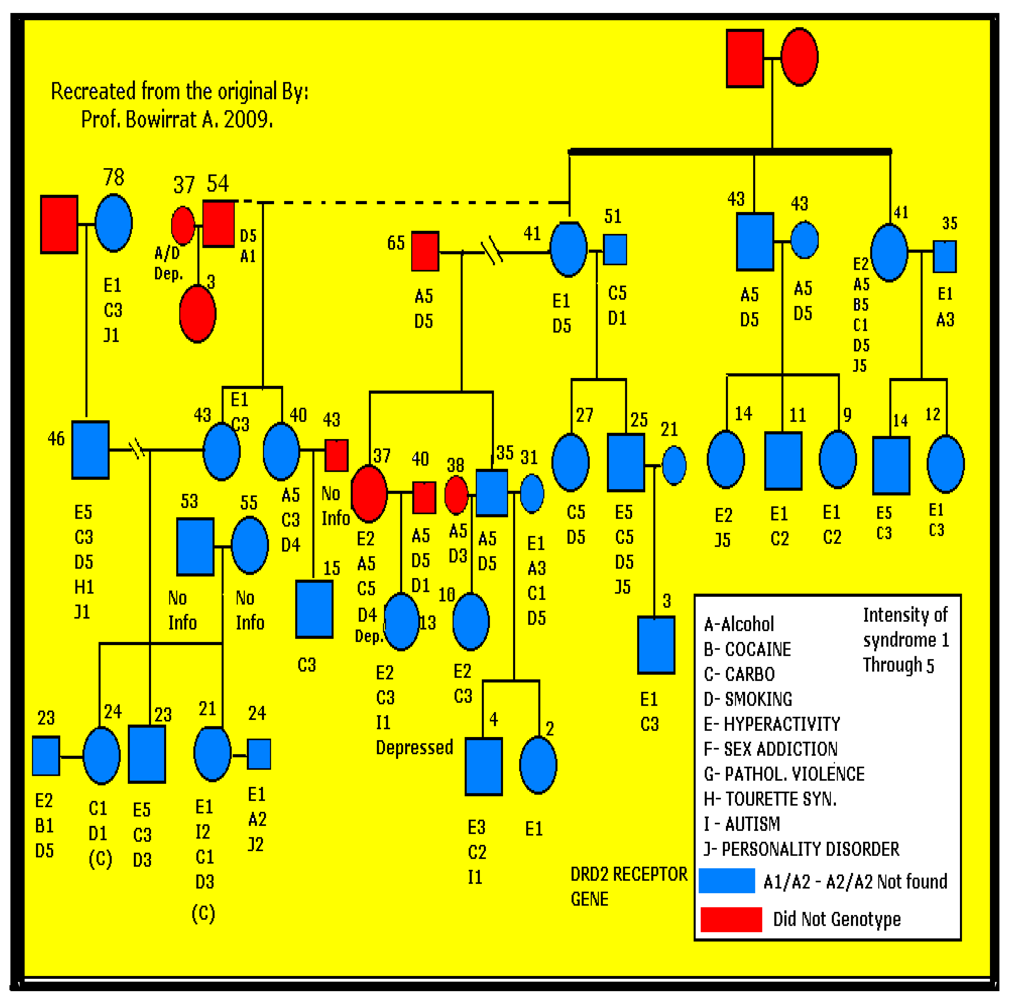
      <p>Although other neurotransmitter systems are involved in these complex behaviors representative of polygenic inheritance, we decided to evaluate the potential association of certain polymorphisms of the DA: D1 receptor (DRD1), DA D2 receptor (DRD2) [rs1800297 as a RFLP in “DRD2”] which it is near in the 3'-untranslated region contains ANKK1 on the opposite strand of DNA and our method herein targets the same site], DA transporter (DAT1), and DBH genes. To that end, we genotyped 55 subjects, from two independent multiple-affected families with documented RDS behaviors. There were four generations (Family A—initial proband was identified with ADHD) and five generations (Family B—initial probands was identified with substance use disorder). We had postmortem data related to RDS behaviors on all the deceased family members. A total of 13 members died, and their respective DNA specimens were not available. <xref ref-type="fig" rid="ijerph-08-04425-f001">Figure 1</xref> illustrates the genotyping and self-reported and family-identified behaviors for each family member.</p>
      <sec>
        <title>2.1. Subject Selection</title>
        <p>All individuals were evaluated through structured interviews using DMS-IV criteria and a number of neuropsychological and electrophysiological tests (e.g., Meyer-Briggs, Millon, TOVA, qEEG, <italic>etc</italic>.). The “super” control group consisted of 30 individuals selected from a total of 189 people attending PATH Medical Clinic, an integrative care center and research foundation in New York City, for both neurological and non-neurological problems (for more details, see [<xref ref-type="bibr" rid="B105-ijerph-08-04425">105</xref>]). These individuals were carefully screened, including their family history to exclude a number of RDS-related behaviors. The excluded behaviors included but where not limited to: alcoholism, substance use disorder, smoking behavior, carbohydrate binging, obesity, ADHD, posttraumatic stress disorder, conduct disorder, antisocial behavior, pathological gambling, aggressive offenses, pathological aggression, deviant sexual behavior, schizoid/avoidant behavioral cluster, and other Axis 1 and Axis 11 mental disorders. These subjects were genotyped for only the DRD2 gene polymorphisms (A1/A1, A1/A2. and A2/A2). In addition, we also genotyped 91 lesser screened controls (excluding only ADHD, pathological aggression, alcohol, tobacco, and other drug abuse and dependence) for the DAT1 9 and 10 alleles. Among these lesser-screened controls, 61 had DRD1 genotyping for the A1/A1, A2/A2, and A1/A2 alleles, and 51 had DBH genotyping for the B1/B1, B1/B2, and B2/B2 alleles. The study protocol was approved by the PATH Foundation IRB and ethics committee, and participants signed approved informed consent forms. </p>
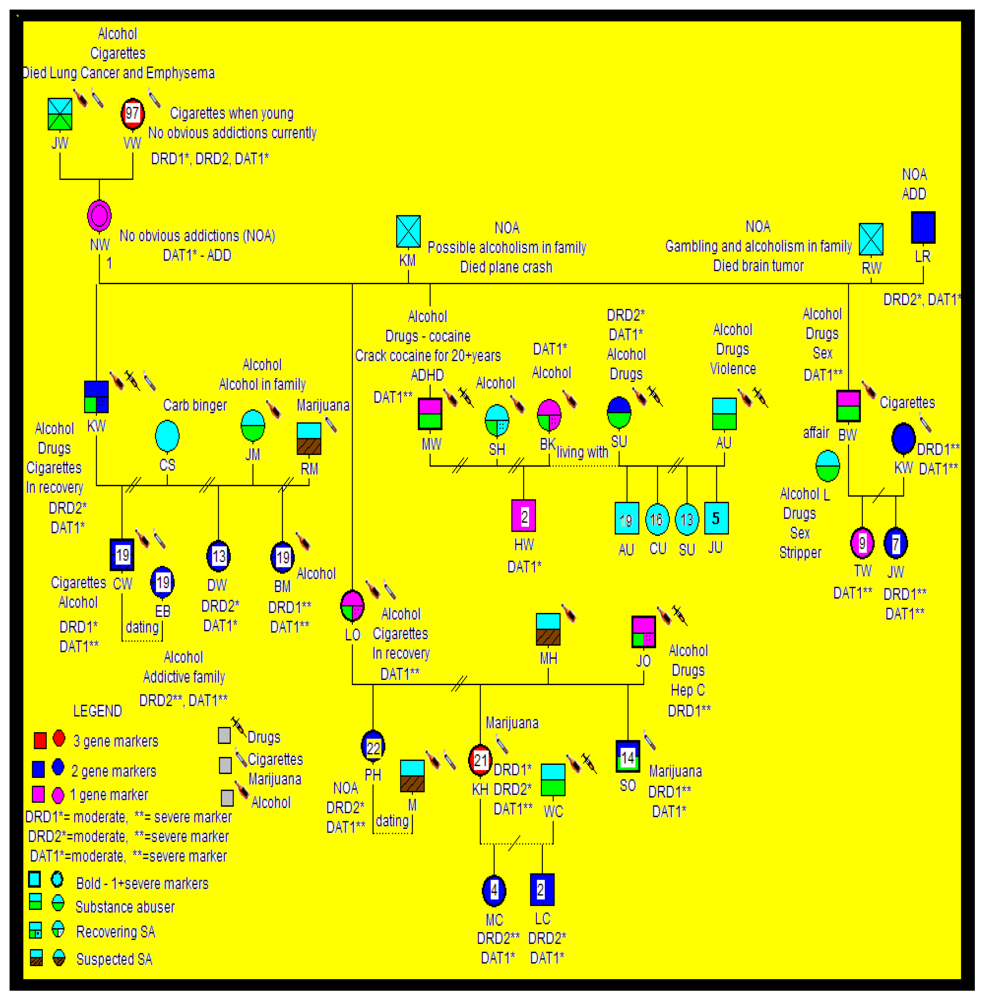
        <p>The experimental group consisted of 55 individuals from two independent families. Family A was provided for analysis by the Southeastern Biofeedback and Neurobehavioral Clinic, Knoxville, TN, and Family B was provided for analysis by the Enhancement Institute, Houston, TX (Unique Mind Care. Inc.) RDS diagnosis was available on 42 members from four generations of Family A (<xref ref-type="fig" rid="ijerph-08-04425-f001">Figure 1</xref>) and 26 members from five generations of Family B (<xref ref-type="table" rid="ijerph-08-04425-t002">Table 2</xref> and <xref ref-type="fig" rid="ijerph-08-04425-f002">Figure 2</xref>). These included 10 deceased Family A members and three deceased Family B members. A total of 32 Family A and 23 Family B individuals were genotyped. In Family A, there were a total of 14 males and 18 females genotyped at an average age of 31.6 ± 18.9 years, and for Family B there were nine males and 14 females genotyped with average age of 31.5 ± 24.2 years. The members of Family A had been diagnosed with ADHD, and the members of Family B had been diagnosed with substance use disorder. The RDS behaviors observed included alcoholism, cocaine dependence, marijuana abuse, intravenous drug dependence, carbohydrate binging, obesity, smoking, hyperactivity, sex addiction, pathological aggression, Tourette syndrome, autism, criminal activity, gambling, novelty seeking, and personality disorders (see <xref ref-type="fig" rid="ijerph-08-04425-f001">Figure 1</xref> and <xref ref-type="fig" rid="ijerph-08-04425-f002">Figure 2</xref>).</p>
      </sec>
      <sec>
        <title>2.2. Genotyping</title>
        <p>Buccal epithelial cells were collected by cotton swabs for DNA isolation. In some subjects, a blood sample was obtained. In this study we isolated the DNA and analyzed a number of genes. The genes include DRD1, DRD2, DAT1 and DBH. All subjects were genotyped based on a neutral identification number and read without knowledge of the individual being typed. Total genomic DNA was extracted from each coded blood/buccal sample, and aliquots were used for polymerase chain reaction (PCR) analysis. Genotyping was performed by a PCR technique. PCR was performed in 30-μL reaction mixtures containing 1.5 mM MgCl<sub>2</sub>, 2 mM 2'-deoxynucleotide 5'-triphosphates (dNTPs), 0.5 μMprimers, 1 μg of template DNA 1, 5 U of Taq polymerase (Boehringer Mannheim Corp., Indianapolis, IN, USA), and PCR buffer (20 mM Tris-HCL (pH 8.4) and 50 mM KCL. After an initial denaturation at 94 °C for 4 minutes, the DNA was amplified with 35 cycles of 30 seconds at 94 °C, 30 seconds at 58 °C, and 30 seconds at 72 °C, followed by a final extension step of 5 minutes at 72 °C.</p>
        <fig id="ijerph-08-04425-f001" position="anchor">
        <label>Figure 1</label>
        <caption>
          <p>Genotype results of the Dopamine D2 receptor gene (DRD2) polymorphism of family A (n = 32) identified with multiple Reward Deficiency Syndrome (RDS) behaviors.</p>
        </caption>
        <graphic xmlns:xlink="http://www.w3.org/1999/xlink" xlink:href="ijerph-08-04425-g001.tif"/>
      </fig>
        <p><italic>Dopamine D2 receptor gene.</italic> The oligo-nucleotide primers 5'-CCGTCGACCCTTCCTGAGT-GTCATCA-3' and 5'-CCGTCGACGGCTGGCCAAGTTGTCTA-3' were used to amplify a 310-base pair fragment spanning the polymorphic TaqA1site of the DRD2 gene. The D2A1 and D2A2 genotyping was performed by a PCR technique. The PCR product was digested with 5 U of Taq 1 for 22 hours at 65 °C for the Taq1A polymorphism. Digestion products were then resolved on a 3% agarose gel (5 V/cm) containing 0.65 μg/mL ethidium bromide. There were three DRD2 Taq1A genotypes: the predominant homozygote A2/A2, which exhibits three restriction fragments of 180 and 130 bp; the heterozygote A1/A2, which exhibits three restriction fragments of 310, 180, and 130 bp; and the rare homozygote A1/A1, which produces only the uncleaved 310-bp fragment [<xref ref-type="bibr" rid="B20-ijerph-08-04425">20</xref>].</p>
        <p><italic>Dopamine transporter gene.</italic> DAT1 was genotyped by the technique of Comings <italic>et al</italic>. [<xref ref-type="bibr" rid="B5-ijerph-08-04425">5</xref>]. </p>
        <p><italic>Dopamine D1 receptor gene.</italic> To examine the DRD1 gene we utilized the Dde I polymorphism consisting of an A to G change in the 5’ UTR, tested by the PCR procedure described by Thompson <italic>et al</italic>. [<xref ref-type="bibr" rid="B106-ijerph-08-04425">106</xref>]. </p>
        <p><italic>Dopamine beta-hydroxylase gene.</italic> For DBH, the Taq I B polymorphism was genotyped by the technique of d’Amato <italic>et al.</italic> [<xref ref-type="bibr" rid="B107-ijerph-08-04425">107</xref>]. </p>
        <fig id="ijerph-08-04425-f002" position="anchor">
          <label>Figure 2</label>
          <caption>
            <p>Association of dopaminergic gene polymorphisms with RDS behaviors in Family B (n = 23).</p>
          </caption>
          <graphic xmlns:xlink="http://www.w3.org/1999/xlink" xlink:href="ijerph-08-04425-g002.tif"/>
        </fig>
      </sec>
      <sec>
        <title>2.3. Statistical Analyses</title>
        <p>Demographic, clinical, laboratory, interview, and questionnaire data were coded and entered into a computer database. DRD1, DRD2, DAT1 and DBH allelic prevalence, obtained by personnel blinded to the aforementioned information, also was coded. All comparisons were based on 2 × 2 contingency tables. Pearson’s chi-square statistic was used to identify group differences, with p &lt; 0.05 considered statistically significant. In cases where at least one cell of the 2 × 2 contingency table had an expected frequency less than 5, Yates’ correction for continuity [<xref ref-type="bibr" rid="B108-ijerph-08-04425">108</xref>] was applied. To indicate the increase in odds of being gene positive for the experimental group relative to controls, odds ratios with 95% confidence intervals also were calculated. Group sample size of 55 for RDS and 30 for controls achieve 93% power to detect an odds ratio in the group porportions of 5.00 or more at the 0.05 level. All statistical analyses were performed using SPSS statistical software (SPSS, Inc., Chicago, IL, USA). </p>
      </sec>
    </sec>
    <sec sec-type="results">
      <title>3. Results</title>
      <sec>
        <title>3.1. Genotyping</title>
        <p><italic>Dopamine D2 receptor gene</italic>. A large percentage (78.2) of the experimental subjects (43 of 55) carried the DRD2 Taq A1 allele. When compared with “super controls,” (1/30 or 3.3% of the controls carried the DRD2A1 allele), the experimental rate was significantly greater (χ<sup>2</sup> = 43.6, p &lt; 0.001) with an odds ratio of 103.9 (12.8, 843.2). Similarly, with regard to the DRD2 gene, when the experimental group (n = 55) was compared with unscreened literature controls derived from 15 international studies (LCN) [LCN = 439/3,329 (31.32%)], the experimental rate was significantly greater (χ<sup>2</sup> = 187.1, p &lt; 0.001) with an odds ratio of 23.6 (12.3, 45.1) (<xref ref-type="table" rid="ijerph-08-04425-t002">Table 2</xref>). Since the gene positive rate for Family B was lower than that for the combined families, separate experimental <italic>vs</italic>. control comparisons were made using Family B alone. When compared to “super controls”, Family B had a significantly greater positive rate (χ<sup>2</sup> = 14.7, p &lt; 0.001) with an odds ratio of 26.6 (3.1, 229.3), and a similar result was found when compared to unscreened literature controls (χ<sup>2</sup> = 20.7, p &lt; 0.001) with an odds ratio of 6.0 (2.6, 13.8). Based on over 3,000 unscreened subjects, the A1 allele of the DRD2 gene is present in approximately one-third of the American population, whereas the A2 allele is present in two-thirds of the American population [<xref ref-type="bibr" rid="B9-ijerph-08-04425">9</xref>]. </p>
        <p><italic>Dopamine transporter gene</italic>. We found the less rigorous (no ADHD, alcoholism, substance abuse) 91 screened controls to carry the DAT1 10/10 in 34 subjects (37.4%); the 9/10 in 40 subjects (44.0%) and the 9/9 in 12 subjects (13.2%). With regard to the DAT1 gene, the 10/10 allele was present in 32 of 55 (58.2%) experimental group individuals in the two families. The experimental positive rate for the 10/10 allele was significantly greater (χ<sup>2</sup> = 6.0, p &lt; 0.015) with an odds ratio of 2.3 (1.2, 4.6). Moreover, 19 of the 32 probands (59.4%) from Family A (four generations) that were genotyped for the DAT1 gene carried the 10/10 allele, so that Family A had a significantly greater positive rate (χ<sup>2</sup> = 4.7, p &lt; 0.035) compared to controls with an odds ratio of 2.5 (1.1, 5.6). In Family B, 57.5% (13 of 23) carried the 10/10 genotype (<xref ref-type="table" rid="ijerph-08-04425-t002">Table 2</xref> and <xref ref-type="fig" rid="ijerph-08-04425-f001">Figure 1</xref>), but owing to the smaller sample size, the Family B positive rate was not significantly different (χ<sup>2</sup> = 2.8, p = 0.095) from controls. Based on genotype data for the DAT1 gene on 3,080 subjects, the 480 bp 10/10 allele occurs in approximately 55% of the unscreened American population; the 9/10 occurs in approximately 38% of unscreened Americans; and the rare 9/9 allele occurs in 7% of unscreened Americans [<xref ref-type="bibr" rid="B5-ijerph-08-04425">5</xref>]. </p>
        <p><italic>Dopamine D1 receptor gene</italic>. Because Comings <italic>et al</italic>. had shown the DA D1 receptor gene to be associated with substance use disorder [<xref ref-type="bibr" rid="B95-ijerph-08-04425">95</xref>], we analyzed this gene in Family B. When we compared subjects in Family B genotyped for polymorphisms of this gene with 61 controls, we found that in the Family B probands, 65.2 % carried the A1/A2 (15/23), 26.1% the A2/A2 (6/23), and 8.7% the A1/A1 (2/23) genotype (combined homozygosity A1/A1 and A2/A2 = 34.8%). When we compared the experimental homozygosity genotyping result against the 61 controls, for which three (4.9%) were positive for A1/A1, 20 (32.8%) were positive for A2/A2, and the combined homozygosity (A1/A1 and A2/A2) rate was 37.7%, no significant differences were observed (p &gt; 0.50). In the American population, genotyping data revealed that 6% carry the A1/A1 allele (moderately dysfunctional); 35% carry the A2/A2 allele (severe dysfunction); and 60% carry the A1/A2 allele (normal) [<xref ref-type="bibr" rid="B5-ijerph-08-04425">5</xref>]. </p>
        <p><italic>Dopamine beta-hydroxylase gene</italic>. Comparing the percent prevalence of the DA Beta-hydroxylase gene (DBHB1) in 51 controls [52.9 % (27/51)] with the 32 members genotyped only in Family A [65% (21/32)], DBHB1 was not significantly different (χ<sup>2</sup> = 1.3, p &gt; 0.25) (see <xref ref-type="table" rid="ijerph-08-04425-t002">Table 2</xref>). Since we found no significance with this gene in Family A, we decided not to test it in Family B. In the unscreened American population, genotyping data revealed that 21% carry the B1/B1 genotype, 69% carry the B1/B2 genotype and 58% carry the B2/B2 genotype [<xref ref-type="bibr" rid="B23-ijerph-08-04425">23</xref>,<xref ref-type="bibr" rid="B99-ijerph-08-04425">99</xref>]. However, the percentage decreases when one screens for no alcohol, drug or tobacco abuse/dependence (B1/B1 = 6%; B1/B2 = 21%; B2/B2 = 24%). </p>
      </sec>
      <sec>
        <title>3.2. Findings and Their Implications</title>
        <p><xref ref-type="table" rid="ijerph-08-04425-t002">Table 2</xref> summarizes the genotype results for dopaminergic genes in Families A and B. The results for each gene polymorphism are presented. </p>
        <table-wrap id="ijerph-08-04425-t002" position="anchor">
          <object-id pub-id-type="pii">ijerph-08-04425-t002_Table 2</object-id>
          <label>Table 2</label>
          <caption>
            <p>Genotype results for dopaminergic genes in Family A and Family B.</p>
          </caption>
          <table>
            <thead>
              <tr>
                <th align="left" valign="middle">Gene and Polymorphism</th>
                <th align="left" valign="middle">Percent Prevalence in Non-RDS Group</th>
                <th align="left" valign="middle">Percent Prevalence in Super Control Group</th>
                <th align="left" valign="middle">Percent Prevalence in RDS Group</th>
                <th align="left" valign="middle">Significance level p Value</th>
              </tr>
            </thead>
            <tbody>
              <tr>
                <td rowspan="2" align="left" valign="middle">
                  <bold>DRD2-A1 Allele</bold>
                </td>
                <td rowspan="2" align="left" valign="middle">31.32 (n = 3,143) *</td>
                <td rowspan="2" align="left" valign="middle">3.3 (n = 30) **</td>
                <td align="left" valign="middle">78.2 (n = 55)</td>
                <td align="left" valign="middle">* p &lt; 0.001</td>
              </tr>
              <tr>
                <td align="left" valign="middle">Family A and B</td>
                <td align="left" valign="middle">** p &lt; 0.001</td>
              </tr>
              <tr>
                <td rowspan="2" align="left" valign="middle">
                  <bold>DAT1-10/10 Allele</bold>
                </td>
                <td rowspan="2" align="left" valign="middle">37.4 (n = 91) *</td>
                <td rowspan="2" align="left" valign="middle">Not Applicable</td>
                <td align="left" valign="middle">58.18 (n = 55)</td>
                <td rowspan="2" align="left" valign="middle">*p &lt; 0.015</td>
              </tr>
              <tr>
                <td align="left" valign="middle">Family A and B</td>
              </tr>
              <tr>
                <td rowspan="2" align="left" valign="middle">
                  <bold>DBH-B1 Allele</bold>
                </td>
                <td rowspan="2" align="left" valign="middle">52.9 (n = 51)</td>
                <td rowspan="2" align="left" valign="middle">Not Applicable</td>
                <td align="left" valign="middle">65.0 (n = 32)</td>
                <td rowspan="2" align="left" valign="middle">Not significant</td>
              </tr>
              <tr>
                <td align="left" valign="middle">Family A</td>
              </tr>
              <tr>
                <td rowspan="2" align="left" valign="middle">
                  <bold>DRD1-A1/A1</bold>
                </td>
                <td rowspan="2" align="left" valign="middle">65.2 (n = 61)</td>
                <td rowspan="2" align="left" valign="middle">Not Applicable</td>
                <td align="left" valign="middle">31.0 (n = 23)</td>
                <td rowspan="2" align="left" valign="middle">Not significant</td>
              </tr>
              <tr>
                <td align="left" valign="middle">Family B</td>
              </tr>
            </tbody>
          </table>
        </table-wrap>
        <p><italic>Evaluating severity: Genetic Addiction Risk Score (GARS)</italic>. Interestingly, in Family A, 100% of the subjects had at least one dysfunctional dopaminergic polymorphism. However, in considering the role of dopaminergic gene polymorphisms in RDS behavior, unlike Family A, where 100% of the subjects carried the DRD2 A1 allele, in Family B only 47.8% carried the TaqA1. Therefore, for Family B only, we evaluated severity by utilizing a Genetic Addiction Risk Score (GARS), a multivariate genetic index score methodology (developed by LifeGen, Inc. and Dominion Diagnostics, Inc.; see [<xref ref-type="bibr" rid="B109-ijerph-08-04425">109</xref>]) to strengthen the predictive value of laboratory testing for genetic predispositions related to disease diagnosis, stratification, prognosis, metabolism, and nutritional response. In this regard, the breakdown of the polymorphic markers was as follows: two subjects carried three polymorphic markers; 13 subjects had two polymorphic markers and eight subjects carried one polymorphic marker. </p>
      </sec>
    </sec>
    <sec sec-type="discussion">
      <title>4. Discussion</title>
      <sec>
        <title>4.1. RDS, a Putative Endophenotype: Multiple Behaviors versus a Single Subset</title>
        <p>In doing association studies for which an investigator requires a representative control sample for a single RDS psychiatric diagnosis [<xref ref-type="bibr" rid="B18-ijerph-08-04425">18</xref>,<xref ref-type="bibr" rid="B22-ijerph-08-04425">22</xref>,<xref ref-type="bibr" rid="B24-ijerph-08-04425">24</xref>,<xref ref-type="bibr" rid="B110-ijerph-08-04425">110</xref>,<xref ref-type="bibr" rid="B111-ijerph-08-04425">111</xref>,<xref ref-type="bibr" rid="B112-ijerph-08-04425">112</xref>] or for potential subsets of RDS (see <xref ref-type="table" rid="ijerph-08-04425-t003">Table 3</xref>), the obvious limitation relates to controls poorly screened for multiple RDS behaviors and other related psychiatric disorders.</p>
        <p>Missing behaviors that are part of the RDS subset may be the reason for spurious results [<xref ref-type="bibr" rid="B9-ijerph-08-04425">9</xref>,<xref ref-type="bibr" rid="B87-ijerph-08-04425">87</xref>,<xref ref-type="bibr" rid="B113-ijerph-08-04425">113</xref>,<xref ref-type="bibr" rid="B114-ijerph-08-04425">114</xref>,<xref ref-type="bibr" rid="B115-ijerph-08-04425">115</xref>,<xref ref-type="bibr" rid="B116-ijerph-08-04425">116</xref>,<xref ref-type="bibr" rid="B117-ijerph-08-04425">117</xref>] when genotyping for single subsets of RDS behaviors. For example an individual may not drink or use drugs but may have other RDS behaviors like overeating or intensive video gaming. In support of this notion, we found a very strong association of the DA D2 receptor A1 allele (100%) in Family A. In addition, every individual in Family B also has at least one dopaminergic high risk allele (100%) [48% carried the DRD2 A1 allele]. Moreover, in Family B only three adult individuals had no addictive behaviors. When we compared our results in which 55 RDS subjects carried the DRD2 A1 allele at (78.2%) with the results of research by Noble [<xref ref-type="bibr" rid="B14-ijerph-08-04425">14</xref>] in which 597 severe alcoholic-dependent individuals (49.3%) carried the A1 allele, there was a significant difference between these two groups (χ<sup>2</sup> = 16.9, p &lt; 0.001). This demonstrated that the A1allele prevalence increases with multiple RDS behaviors. Here we propose that multifaceted non-specific RDS behaviors should be considered as the true “reward” phenotype (endophenotype) instead of a single subset RDS behavior such as alcoholism. Indeed, this may be a paradigm shift in future association and linkage studies using a different set of statistical methodologies.</p>
        <table-wrap id="ijerph-08-04425-t003" position="anchor">
          <object-id pub-id-type="pii">ijerph-08-04425-t003_Table 3</object-id>
          <label>Table 3</label>
          <caption>
            <p>Correlation of RDS and related neurological and psychiatric disorders with DRD2 SNP (a sampling).</p>
          </caption>
          <table>
            <thead>
              <tr>
                <th align="left" valign="middle">Reward Deficiency Syndrome or Related Disorder</th>
                <th align="left" valign="middle">Studies Demonstrating an Association with DRD2 Gene Polymorphism(s)</th>
              </tr>
            </thead>
            <tbody>
              <tr>
                <td align="left" valign="middle">Pathological Gambling</td>
                <td align="left" valign="middle">[<xref ref-type="bibr" rid="B4-ijerph-08-04425">4</xref>,<xref ref-type="bibr" rid="B5-ijerph-08-04425">5</xref>,<xref ref-type="bibr" rid="B33-ijerph-08-04425">33</xref>,<xref ref-type="bibr" rid="B61-ijerph-08-04425">61</xref>,<xref ref-type="bibr" rid="B62-ijerph-08-04425">62</xref>,<xref ref-type="bibr" rid="B63-ijerph-08-04425">63</xref>,<xref ref-type="bibr" rid="B64-ijerph-08-04425">64</xref>,<xref ref-type="bibr" rid="B140-ijerph-08-04425">140</xref>]</td>
              </tr>
              <tr>
                <td align="left" valign="middle">Attention Deficit Hyperactivity Disorder</td>
                <td align="left" valign="middle">[<xref ref-type="bibr" rid="B2-ijerph-08-04425">2</xref>,<xref ref-type="bibr" rid="B4-ijerph-08-04425">4</xref>,<xref ref-type="bibr" rid="B24-ijerph-08-04425">24</xref>,<xref ref-type="bibr" rid="B99-ijerph-08-04425">99</xref>,<xref ref-type="bibr" rid="B154-ijerph-08-04425">154</xref>,<xref ref-type="bibr" rid="B196-ijerph-08-04425">196</xref>,<xref ref-type="bibr" rid="B207-ijerph-08-04425">207</xref>,<xref ref-type="bibr" rid="B208-ijerph-08-04425">208</xref>,<xref ref-type="bibr" rid="B209-ijerph-08-04425">209</xref>,<xref ref-type="bibr" rid="B210-ijerph-08-04425">210</xref>] </td>
              </tr>
              <tr>
                <td align="left" valign="middle">Post-Traumatic Stress Disorder</td>
                <td align="left" valign="middle">[<xref ref-type="bibr" rid="B4-ijerph-08-04425">4</xref>,<xref ref-type="bibr" rid="B176-ijerph-08-04425">176</xref>,<xref ref-type="bibr" rid="B177-ijerph-08-04425">177</xref>,<xref ref-type="bibr" rid="B196-ijerph-08-04425">196</xref>,<xref ref-type="bibr" rid="B212-ijerph-08-04425">212</xref>,<xref ref-type="bibr" rid="B213-ijerph-08-04425">213</xref>] </td>
              </tr>
              <tr>
                <td align="left" valign="middle">Eating; Obesity and Related Sequela</td>
                <td align="left" valign="middle">[<xref ref-type="bibr" rid="B46-ijerph-08-04425">46</xref>,<xref ref-type="bibr" rid="B133-ijerph-08-04425">133</xref>,<xref ref-type="bibr" rid="B134-ijerph-08-04425">134</xref>,<xref ref-type="bibr" rid="B170-ijerph-08-04425">170</xref>,<xref ref-type="bibr" rid="B178-ijerph-08-04425">178</xref>,<xref ref-type="bibr" rid="B179-ijerph-08-04425">179</xref>,<xref ref-type="bibr" rid="B181-ijerph-08-04425">181</xref>,<xref ref-type="bibr" rid="B182-ijerph-08-04425">182</xref>,<xref ref-type="bibr" rid="B197-ijerph-08-04425">197</xref>,<xref ref-type="bibr" rid="B198-ijerph-08-04425">198</xref>,<xref ref-type="bibr" rid="B200-ijerph-08-04425">200</xref>]</td>
              </tr>
              <tr>
                <td align="left" valign="middle">Energy Production</td>
                <td align="left" valign="middle">[<xref ref-type="bibr" rid="B134-ijerph-08-04425">134</xref>,<xref ref-type="bibr" rid="B180-ijerph-08-04425">180</xref>]</td>
              </tr>
              <tr>
                <td align="left" valign="middle">Hypertension</td>
                <td align="left" valign="middle">[<xref ref-type="bibr" rid="B181-ijerph-08-04425">181</xref>,<xref ref-type="bibr" rid="B182-ijerph-08-04425">182</xref>]</td>
              </tr>
              <tr>
                <td align="left" valign="middle">Schizophrenia</td>
                <td align="left" valign="middle">[<xref ref-type="bibr" rid="B12-ijerph-08-04425">12</xref>,<xref ref-type="bibr" rid="B19-ijerph-08-04425">19</xref>,<xref ref-type="bibr" rid="B49-ijerph-08-04425">49</xref>,<xref ref-type="bibr" rid="B112-ijerph-08-04425">112</xref>,<xref ref-type="bibr" rid="B183-ijerph-08-04425">183</xref>]</td>
              </tr>
              <tr>
                <td align="left" valign="middle">Early-Onset Sexual Intercourse; Hyper sexuality</td>
                <td align="left" valign="middle">[<xref ref-type="bibr" rid="B136-ijerph-08-04425">136</xref>,<xref ref-type="bibr" rid="B203-ijerph-08-04425">203</xref>]</td>
              </tr>
              <tr>
                <td align="left" valign="middle">Anti-Social Personality</td>
                <td align="left" valign="middle">[<xref ref-type="bibr" rid="B18-ijerph-08-04425">18</xref>,<xref ref-type="bibr" rid="B53-ijerph-08-04425">53</xref>]</td>
              </tr>
              <tr>
                <td align="left" valign="middle">Pathological Aggression</td>
                <td align="left" valign="middle">[<xref ref-type="bibr" rid="B6-ijerph-08-04425">6</xref>,<xref ref-type="bibr" rid="B105-ijerph-08-04425">105</xref>,<xref ref-type="bibr" rid="B171-ijerph-08-04425">171</xref>,<xref ref-type="bibr" rid="B186-ijerph-08-04425">186</xref>]</td>
              </tr>
              <tr>
                <td align="left" valign="middle">Schizoid-Avoidant Behavior</td>
                <td align="left" valign="middle">[<xref ref-type="bibr" rid="B143-ijerph-08-04425">143</xref>]</td>
              </tr>
              <tr>
                <td align="left" valign="middle">Novelty or Sensation Seeking</td>
                <td align="left" valign="middle">[<xref ref-type="bibr" rid="B26-ijerph-08-04425">26</xref>,<xref ref-type="bibr" rid="B27-ijerph-08-04425">27</xref>,<xref ref-type="bibr" rid="B36-ijerph-08-04425">36</xref>,<xref ref-type="bibr" rid="B83-ijerph-08-04425">83</xref>,<xref ref-type="bibr" rid="B109-ijerph-08-04425">109</xref>,<xref ref-type="bibr" rid="B113-ijerph-08-04425">113</xref>,<xref ref-type="bibr" rid="B144-ijerph-08-04425">144</xref>,<xref ref-type="bibr" rid="B161-ijerph-08-04425">161</xref>]</td>
              </tr>
              <tr>
                <td align="left" valign="middle">Substance Abuse</td>
                <td align="left" valign="middle">[<xref ref-type="bibr" rid="B12-ijerph-08-04425">12</xref>,<xref ref-type="bibr" rid="B13-ijerph-08-04425">13</xref>,<xref ref-type="bibr" rid="B20-ijerph-08-04425">20</xref>,<xref ref-type="bibr" rid="B22-ijerph-08-04425">22</xref>,<xref ref-type="bibr" rid="B29-ijerph-08-04425">29</xref>,<xref ref-type="bibr" rid="B46-ijerph-08-04425">46</xref>,<xref ref-type="bibr" rid="B65-ijerph-08-04425">65</xref>,<xref ref-type="bibr" rid="B71-ijerph-08-04425">71</xref>,<xref ref-type="bibr" rid="B90-ijerph-08-04425">90</xref>,<xref ref-type="bibr" rid="B103-ijerph-08-04425">103</xref>,<xref ref-type="bibr" rid="B110-ijerph-08-04425">110</xref>,<xref ref-type="bibr" rid="B114-ijerph-08-04425">114</xref>,<xref ref-type="bibr" rid="B117-ijerph-08-04425">117</xref>,<xref ref-type="bibr" rid="B172-ijerph-08-04425">172</xref>,<xref ref-type="bibr" rid="B173-ijerph-08-04425">173</xref>,<xref ref-type="bibr" rid="B174-ijerph-08-04425">174</xref>,<xref ref-type="bibr" rid="B175-ijerph-08-04425">175</xref>,<xref ref-type="bibr" rid="B193-ijerph-08-04425">193</xref>,<xref ref-type="bibr" rid="B199-ijerph-08-04425">199</xref>,<xref ref-type="bibr" rid="B201-ijerph-08-04425">201</xref>,<xref ref-type="bibr" rid="B202-ijerph-08-04425">202</xref>,<xref ref-type="bibr" rid="B205-ijerph-08-04425">205</xref>] </td>
              </tr>
              <tr>
                <td align="left" valign="middle">Heroin Addiction</td>
                <td align="left" valign="middle">[<xref ref-type="bibr" rid="B13-ijerph-08-04425">13</xref>,<xref ref-type="bibr" rid="B48-ijerph-08-04425">48</xref>,<xref ref-type="bibr" rid="B66-ijerph-08-04425">66</xref>,<xref ref-type="bibr" rid="B111-ijerph-08-04425">111</xref>,<xref ref-type="bibr" rid="B160-ijerph-08-04425">160</xref>]</td>
              </tr>
              <tr>
                <td align="left" valign="middle">Nicotine Dependence and Smoking Behavior</td>
                <td align="left" valign="middle">[<xref ref-type="bibr" rid="B13-ijerph-08-04425">13</xref>,<xref ref-type="bibr" rid="B17-ijerph-08-04425">17</xref>,<xref ref-type="bibr" rid="B22-ijerph-08-04425">22</xref>,<xref ref-type="bibr" rid="B81-ijerph-08-04425">81</xref>,<xref ref-type="bibr" rid="B91-ijerph-08-04425">91</xref>,<xref ref-type="bibr" rid="B104-ijerph-08-04425">104</xref>,<xref ref-type="bibr" rid="B184-ijerph-08-04425">184</xref>,<xref ref-type="bibr" rid="B185-ijerph-08-04425">185</xref>]</td>
              </tr>
              <tr>
                <td align="left" valign="middle">Personality Disorders and Crime</td>
                <td align="left" valign="middle">[<xref ref-type="bibr" rid="B100-ijerph-08-04425">100</xref>,<xref ref-type="bibr" rid="B186-ijerph-08-04425">186</xref>]</td>
              </tr>
              <tr>
                <td align="left" valign="middle">Parkinson’s Disease</td>
                <td align="left" valign="middle">[<xref ref-type="bibr" rid="B187-ijerph-08-04425">187</xref>,<xref ref-type="bibr" rid="B188-ijerph-08-04425">188</xref>]</td>
              </tr>
              <tr>
                <td align="left" valign="middle">Migraine</td>
                <td align="left" valign="middle">[<xref ref-type="bibr" rid="B189-ijerph-08-04425">189</xref>]</td>
              </tr>
              <tr>
                <td align="left" valign="middle">Tourette Syndrome</td>
                <td align="left" valign="middle">[<xref ref-type="bibr" rid="B5-ijerph-08-04425">5</xref>,<xref ref-type="bibr" rid="B99-ijerph-08-04425">99</xref>,<xref ref-type="bibr" rid="B190-ijerph-08-04425">190</xref>]</td>
              </tr>
              <tr>
                <td align="left" valign="middle">Huntington’s Disease</td>
                <td align="left" valign="middle">[<xref ref-type="bibr" rid="B191-ijerph-08-04425">191</xref>]</td>
              </tr>
              <tr>
                <td align="left" valign="middle">Cell Metabolism</td>
                <td align="left" valign="middle">[<xref ref-type="bibr" rid="B47-ijerph-08-04425">47</xref>]</td>
              </tr>
              <tr>
                <td align="left" valign="middle">Major Psychoses &amp; Affective Disorder</td>
                <td align="left" valign="middle">[<xref ref-type="bibr" rid="B192-ijerph-08-04425">192</xref>,<xref ref-type="bibr" rid="B195-ijerph-08-04425">195</xref>,<xref ref-type="bibr" rid="B204-ijerph-08-04425">204</xref>]</td>
              </tr>
              <tr>
                <td align="left" valign="middle">Extraversion and Creativity</td>
                <td align="left" valign="middle">[<xref ref-type="bibr" rid="B21-ijerph-08-04425">21</xref>,<xref ref-type="bibr" rid="B23-ijerph-08-04425">23</xref>,<xref ref-type="bibr" rid="B145-ijerph-08-04425">145</xref>]</td>
              </tr>
            </tbody>
          </table>
        </table-wrap>
      </sec>
      <sec>
        <title>4.2. “Super” Controls as a Phenotype: Exclusion of Multiple RDS Behaviors</title>
        <p>For population-based studies in which the investigator requires a representative control sample, removing confounding cases from the control group may improve chances of finding significant differences between experimental and control groups. This approach, however, may risk a lack of representation in the control group. Even the use of stratified samples (weighting samples) may not be good enough [<xref ref-type="bibr" rid="B113-ijerph-08-04425">113</xref>,<xref ref-type="bibr" rid="B114-ijerph-08-04425">114</xref>,<xref ref-type="bibr" rid="B115-ijerph-08-04425">115</xref>,<xref ref-type="bibr" rid="B116-ijerph-08-04425">116</xref>].</p>
        <p>In the case of finding a “pure” phenotype, especially in the psychiatric arena, we really do not know if nature carved out the psychiatric disorders in the same fashion as is seen in the DSM. This is true because behavior is very complex, whereby specific genes for behavioral tendencies (anxiety, impulsivity, compulsivity, harm avoidance, aggressiveness, addiction <italic>etc</italic>.) accounts for only a small risk contribution to the overall phenotype. Therefore, we must shift our emphasis to the “systems biological” approach, which takes into account the inter relationship of dysfunctional behaviors, the polygenic nature of psychiatric disorders, and the environment. </p>
        <p>We should consider the established concept of RDS [<xref ref-type="bibr" rid="B1-ijerph-08-04425">1</xref>,<xref ref-type="bibr" rid="B2-ijerph-08-04425">2</xref>,<xref ref-type="bibr" rid="B3-ijerph-08-04425">3</xref>,<xref ref-type="bibr" rid="B4-ijerph-08-04425">4</xref>] to help define this complex array of behaviors associated with molecular dysfunctions. Victims of RDS are at increased vulnerability to addictive activities because they may carry polymorphic genes in dopaminergic pathways [<xref ref-type="bibr" rid="B117-ijerph-08-04425">117</xref>,<xref ref-type="bibr" rid="B118-ijerph-08-04425">118</xref>,<xref ref-type="bibr" rid="B119-ijerph-08-04425">119</xref>,<xref ref-type="bibr" rid="B120-ijerph-08-04425">120</xref>,<xref ref-type="bibr" rid="B121-ijerph-08-04425">121</xref>,<xref ref-type="bibr" rid="B122-ijerph-08-04425">122</xref>] that result in hypo-dopominergic function [<xref ref-type="bibr" rid="B60-ijerph-08-04425">60</xref>,<xref ref-type="bibr" rid="B61-ijerph-08-04425">61</xref>,<xref ref-type="bibr" rid="B62-ijerph-08-04425">62</xref>] caused by a reduced number of DA D2 receptors [<xref ref-type="bibr" rid="B55-ijerph-08-04425">55</xref>,<xref ref-type="bibr" rid="B117-ijerph-08-04425">117</xref>,<xref ref-type="bibr" rid="B118-ijerph-08-04425">118</xref>], reduced synthesis of DA (DA beta-hydroxylase) [<xref ref-type="bibr" rid="B5-ijerph-08-04425">5</xref>], reduced net release of pre-synaptic DA, possibly due to altered synthesis of DA (<sc>L</sc>-amino-acid decarboxylase) [<xref ref-type="bibr" rid="B123-ijerph-08-04425">123</xref>], increased synaptic clearance due to a high number of DA transporter sites [<xref ref-type="bibr" rid="B92-ijerph-08-04425">92</xref>,<xref ref-type="bibr" rid="B93-ijerph-08-04425">93</xref>,<xref ref-type="bibr" rid="B94-ijerph-08-04425">94</xref>,<xref ref-type="bibr" rid="B118-ijerph-08-04425">118</xref>,<xref ref-type="bibr" rid="B120-ijerph-08-04425">120</xref>,<xref ref-type="bibr" rid="B121-ijerph-08-04425">121</xref>,<xref ref-type="bibr" rid="B122-ijerph-08-04425">122</xref>] (DA transporter), and low D2 receptor densities [<xref ref-type="bibr" rid="B55-ijerph-08-04425">55</xref>,<xref ref-type="bibr" rid="B56-ijerph-08-04425">56</xref>,<xref ref-type="bibr" rid="B85-ijerph-08-04425">85</xref>,<xref ref-type="bibr" rid="B123-ijerph-08-04425">123</xref>,<xref ref-type="bibr" rid="B124-ijerph-08-04425">124</xref>,<xref ref-type="bibr" rid="B125-ijerph-08-04425">125</xref>,<xref ref-type="bibr" rid="B126-ijerph-08-04425">126</xref>,<xref ref-type="bibr" rid="B127-ijerph-08-04425">127</xref>] (DA D2 receptor). The need for a unified set of related symptoms in the affected phenotype is important not only for population-based association studies, but also for linkage analysis. The RDS concept involves, shared genes and behavioral tendencies as summarized in <xref ref-type="table" rid="ijerph-08-04425-t003">Table 3</xref><italic>.</italic> While poly-genes are involved [<xref ref-type="bibr" rid="B128-ijerph-08-04425">128</xref>,<xref ref-type="bibr" rid="B129-ijerph-08-04425">129</xref>,<xref ref-type="bibr" rid="B130-ijerph-08-04425">130</xref>,<xref ref-type="bibr" rid="B131-ijerph-08-04425">131</xref>,<xref ref-type="bibr" rid="B132-ijerph-08-04425">132</xref>,<xref ref-type="bibr" rid="B133-ijerph-08-04425">133</xref>,<xref ref-type="bibr" rid="B134-ijerph-08-04425">134</xref>,<xref ref-type="bibr" rid="B135-ijerph-08-04425">135</xref>,<xref ref-type="bibr" rid="B136-ijerph-08-04425">136</xref>,<xref ref-type="bibr" rid="B137-ijerph-08-04425">137</xref>,<xref ref-type="bibr" rid="B138-ijerph-08-04425">138</xref>,<xref ref-type="bibr" rid="B139-ijerph-08-04425">139</xref>,<xref ref-type="bibr" rid="B140-ijerph-08-04425">140</xref>,<xref ref-type="bibr" rid="B141-ijerph-08-04425">141</xref>,<xref ref-type="bibr" rid="B142-ijerph-08-04425">142</xref>,<xref ref-type="bibr" rid="B143-ijerph-08-04425">143</xref>,<xref ref-type="bibr" rid="B144-ijerph-08-04425">144</xref>,<xref ref-type="bibr" rid="B145-ijerph-08-04425">145</xref>], the common theme in all of these substances and behaviors is that they induce pre-synaptic DA release at the NAc [<xref ref-type="bibr" rid="B53-ijerph-08-04425">53</xref>,<xref ref-type="bibr" rid="B73-ijerph-08-04425">73</xref>,<xref ref-type="bibr" rid="B74-ijerph-08-04425">74</xref>,<xref ref-type="bibr" rid="B75-ijerph-08-04425">75</xref>,<xref ref-type="bibr" rid="B76-ijerph-08-04425">76</xref>,<xref ref-type="bibr" rid="B77-ijerph-08-04425">77</xref>]. Spectrum disorders such as ADHD, Tourette Syndrome, and autism are included due to DA dysregulation [<xref ref-type="bibr" rid="B1-ijerph-08-04425">1</xref>,<xref ref-type="bibr" rid="B5-ijerph-08-04425">5</xref>,<xref ref-type="bibr" rid="B24-ijerph-08-04425">24</xref>,<xref ref-type="bibr" rid="B25-ijerph-08-04425">25</xref>]. In fact love styles also associate with both serotonergic and dopaminergic gene polymorphisms [<xref ref-type="bibr" rid="B146-ijerph-08-04425">146</xref>]. </p>
        <p>A screened control group is essential for uncovering population-based associations where the disease in question may be very common. We know that approximately one-third of the population meet lifetime criteria for common psychiatric disorders according to the results of the Epidemiological Catchment Area survey. Since RDS is a “polygenic disorder” involving multiple genes and many polymorphisms [<xref ref-type="bibr" rid="B1-ijerph-08-04425">1</xref>,<xref ref-type="bibr" rid="B2-ijerph-08-04425">2</xref>,<xref ref-type="bibr" rid="B3-ijerph-08-04425">3</xref>,<xref ref-type="bibr" rid="B4-ijerph-08-04425">4</xref>] and requires a threshold number of polygenes, unaffected individuals in the population also carry some of these genes. AS stated earlier, the DA D2 receptor gene (A1 allele) is present in about one-third of unscreened Americans (29.4% in 3,329 subjects studied up until 2003) [<xref ref-type="bibr" rid="B14-ijerph-08-04425">14</xref>]. </p>
        <p>The use of super controls has been criticized by some on the grounds that their relatives will have rates of co-morbid disorders lower than that in the general population and may produce spurious co-aggregation of disorders within families. This argument is valid only if the same psychopathology that is removed from the control group is <italic>not</italic> excluded from among the probands and their relatives. </p>
        <p>This provides the rationale to encourage others to begin to carefully select true controls especially when dealing with complex traits such as RDS involving a number of associated gene polymorphisms [<xref ref-type="bibr" rid="B88-ijerph-08-04425">88</xref>,<xref ref-type="bibr" rid="B147-ijerph-08-04425">147</xref>,<xref ref-type="bibr" rid="B148-ijerph-08-04425">148</xref>,<xref ref-type="bibr" rid="B149-ijerph-08-04425">149</xref>]. </p>
        <p>Very few behaviors depend upon a single gene. Complexes of genes (polygenic) drive most of our heredity-based actions [<xref ref-type="bibr" rid="B150-ijerph-08-04425">150</xref>,<xref ref-type="bibr" rid="B151-ijerph-08-04425">151</xref>,<xref ref-type="bibr" rid="B152-ijerph-08-04425">152</xref>,<xref ref-type="bibr" rid="B153-ijerph-08-04425">153</xref>,<xref ref-type="bibr" rid="B154-ijerph-08-04425">154</xref>], suggesting that genetic panels or algorithms organized into genetic indexes, such as GARS may be valuable clinically to determine risk. Certainly abnormal functions of these brain systems can be due to specific genetic factors interacting with environmental factors [<xref ref-type="bibr" rid="B118-ijerph-08-04425">118</xref>,<xref ref-type="bibr" rid="B119-ijerph-08-04425">119</xref>,<xref ref-type="bibr" rid="B120-ijerph-08-04425">120</xref>,<xref ref-type="bibr" rid="B122-ijerph-08-04425">122</xref>,<xref ref-type="bibr" rid="B149-ijerph-08-04425">149</xref>,<xref ref-type="bibr" rid="B150-ijerph-08-04425">150</xref>,<xref ref-type="bibr" rid="B152-ijerph-08-04425">152</xref>,<xref ref-type="bibr" rid="B153-ijerph-08-04425">153</xref>,<xref ref-type="bibr" rid="B154-ijerph-08-04425">154</xref>]. Understanding the interactions of these components is likely to lead to better treatment.</p>
        <p>Because our study began in 1999 when less was known about dopaminergic genes, we did not genotype subjects for the following: D3–5 receptor genes, the MAO-A or MAO-B, or catechol <italic>O</italic>-methyltransferase. However, those will be analyzed in subsequent experiments. When we started these experiments, the specific roles of the dopaminergic genes in brain function remained inconclusive due to the lack of completely selective ligands that could distinguish between the members of the D1-like and D2-like DA receptor families. However, today we are making rapid progress distinguishing among the various DA receptors (see [<xref ref-type="bibr" rid="B96-ijerph-08-04425">96</xref>]). Our findings, while suggestive, must be interpreted with caution. In terms of inclusion/exclusion criteria, since this was a generational study, all subjects were included in the study without bias.</p>
      </sec>
      <sec>
        <title>4.3. Interactive Environmental and Genetic Roles in RDS Behaviors</title>
        <p>It is important to consider one of the most important new areas in neurobiology and genetics termed “epigenetics” and its role in RDS. Most recently, our group reviewed the epigenetics of ADHD and detailed the important interaction of environmental elements and gene expression [<xref ref-type="bibr" rid="B154-ijerph-08-04425">154</xref>]. We are cognizant of the simple mathematical equation P = G + E. whereby, any phenotype (RDS included) is equal to both one’s genome and environmental impact. The role of the contribution of genetics to illicit drug abuse was evaluated by van den Bree <italic>et al</italic>. [<xref ref-type="bibr" rid="B155-ijerph-08-04425">155</xref>] using structural equation, modeling genetic and environmental estimates and DSM-III abuse/dependence for sedatives, opioids, cocaine, stimulants, and cannabis, as well as any other illicit drugs. The authors found genetic influences for most measures, which were strongest for males and for clinical diagnoses of abuse/dependence compared to actual substance use. Most interestingly, common environmental influences played a greater role in use than abuse/dependence, suggesting that the severity of any RDS behavior may have a stronger genetic contribution relative to less severe forms. Moreover, this same group [<xref ref-type="bibr" rid="B156-ijerph-08-04425">156</xref>] in another study, among Caucasians with alcohol dependence characterized subtypes by differential loading on three dimensions: genetic, general environmental, and dyssocial environmental symptom scales. The mild subtype (60% of men and 66% of women) was distinguished by low mean scores on all three scales; the dyssocial subtype (24% of men and 20% of women) by low mean genetic and general environmental scores but high mean dyssocial environmental scores; and the severe subtype (16% of men and 14% of women) by high scores on the genetic and general environmental scales. Importantly, the severe subtype showed greater comorbid drug dependence and major depression, more treatment seeking, and a higher prevalence of parental alcoholism. Only the severe subtype showed a pattern of scale scores and clinical characteristics suggestive of substantial genetic influence. </p>
        <p>It is well known that environmental cues may induce relapse in drug dependent individuals. This phenomenon has been evaluated by Gerasimov <italic>et al</italic>. [<xref ref-type="bibr" rid="B157-ijerph-08-04425">157</xref>] to better understand the neurochemical mechanisms potentially mediating these cues by measuring NAc DA levels in animals exposed to environmental cues previously paired with cocaine administration. They found that in animals exposed to a cocaine-paired environment, NAc DA increased by 25%. In one study the intake of morphine altered the neurotransmitter turnover of DA differentially as function of passive compared non-passive infusion. Environmental contingent infusion compared to passive infusion of intravenous morphine significantly affected more brain regions up to 5 fold [<xref ref-type="bibr" rid="B158-ijerph-08-04425">158</xref>] suggesting impact of the environment on neurochemistry. The role of dopaminergic genes as a predictor of risk concerning personality traits has been positively identified in molecular genetic studies. Earlier work in our laboratory identified the relationship between schizoid avoidance [<xref ref-type="bibr" rid="B143-ijerph-08-04425">143</xref>] as well as impulsive and compulsive behaviors [<xref ref-type="bibr" rid="B159-ijerph-08-04425">159</xref>]. The work of The <italic>et al</italic>. [<xref ref-type="bibr" rid="B160-ijerph-08-04425">160</xref>] showing significantly higher frequency for the DRD2 TaqIA polymorphism among addicts (69.9%) compared to control subjects (42.6%; Fisher’s exact χ<sup>2</sup>, p &lt; 0.05) is in agreement with our earlier findings. They also observed that the studied addicts had higher scores for novelty seeking and harm avoidance personality traits but lower scores for reward dependence when compared to control subjects. This has been further supported by the work of Kazantseva <italic>et al</italic>. [<xref ref-type="bibr" rid="B161-ijerph-08-04425">161</xref>] on personality traits in a sample of 652 healthy individuals (222 men and 430 women) of Caucasian origin (233 Russians and 419 Tatars) from Russia. The subjects’ personality traits were assessed with Eysenck Personality Inventory and the Temperament and Character Inventory-125). There were significant effects of ANKK1/DRD2 Taq1A on Neuroticism (p = 0.016) and of SLC6A3 rs27072 on Persistence (p = 0.021) in both genders. The association between ANKK1/DRD2 Taq1A A2/A2-genotype and higher Novelty Seeking and lower Reward Dependence was shown in men only.</p>
        <p>Genetic and environmental influences also are important for the development of alcohol and drug dependence. Exposure to early life stress, has been shown to predict a wide range of psychopathology, including addiction. Enoch [<xref ref-type="bibr" rid="B162-ijerph-08-04425">162</xref>] has suggested that early life stress can result in permanent neurohormonal and hypothalamic-pituitary-adrenal axis changes, morphological changes in the brain, and gene expression changes in the mesolimbic DA reward pathway, all of which are implicated in the development of addiction. However, he further emphasized that a large proportion of children who have experienced even severe early life stress do not develop psychopathology, indicating that mediating factors such as gene-environment interactions and family and peer relationships are important for resilience. Most interestingly, Israel researchers Raz and Berger [<xref ref-type="bibr" rid="B163-ijerph-08-04425">163</xref>] published convincing evidence for the role of social interaction as it related to intake of morphine in animals. Specifically, adult Wistar rats housed in short-term isolation (21 days) consumed significantly more morphine solution (0.5 mg/mL) than rats living in pairs, both in one-bottle and in two-bottle tests. They also found that as little as 60-min of daily social-physical interaction with another rat was sufficient to completely abolish the increase in morphine consumption in socially restricted animals. Accordingly, these results indicate that environmental and situational factors influence drug intake in laboratory rats as they do in humans.</p>
        <p>Over many years of study, the consensus of the literature has suggested that prevention of drug-seeking relapse could be attenuated by enriched environments. For example, a recent French study by Chauvet <italic>et al</italic>. [<xref ref-type="bibr" rid="B164-ijerph-08-04425">164</xref>] showed, in animals, the potential “curative” influence of enriched environments in reducing cocaine-induced craving effects, thereby highlighting the importance of positive life conditions in facilitating abstinence and preventing relapse to cocaine addiction.</p>
        <p>There is no doubt that enriched life experiences, as well as reduced early prenatal and post natal stress, have impacts on impulsivity. In addition, reduced release of mesolimbic DA affected both by genes and by the environment, play a significant role in craving behavior and more importantly in relapse [<xref ref-type="bibr" rid="B165-ijerph-08-04425">165</xref>,<xref ref-type="bibr" rid="B166-ijerph-08-04425">166</xref>,<xref ref-type="bibr" rid="B167-ijerph-08-04425">167</xref>,<xref ref-type="bibr" rid="B168-ijerph-08-04425">168</xref>,<xref ref-type="bibr" rid="B169-ijerph-08-04425">169</xref>] as well as many RDS behaviors [<xref ref-type="bibr" rid="B170-ijerph-08-04425">170</xref>,<xref ref-type="bibr" rid="B171-ijerph-08-04425">171</xref>,<xref ref-type="bibr" rid="B172-ijerph-08-04425">172</xref>,<xref ref-type="bibr" rid="B173-ijerph-08-04425">173</xref>,<xref ref-type="bibr" rid="B174-ijerph-08-04425">174</xref>,<xref ref-type="bibr" rid="B175-ijerph-08-04425">175</xref>,<xref ref-type="bibr" rid="B176-ijerph-08-04425">176</xref>,<xref ref-type="bibr" rid="B177-ijerph-08-04425">177</xref>,<xref ref-type="bibr" rid="B178-ijerph-08-04425">178</xref>,<xref ref-type="bibr" rid="B179-ijerph-08-04425">179</xref>,<xref ref-type="bibr" rid="B180-ijerph-08-04425">180</xref>,<xref ref-type="bibr" rid="B181-ijerph-08-04425">181</xref>,<xref ref-type="bibr" rid="B182-ijerph-08-04425">182</xref>,<xref ref-type="bibr" rid="B183-ijerph-08-04425">183</xref>,<xref ref-type="bibr" rid="B184-ijerph-08-04425">184</xref>,<xref ref-type="bibr" rid="B185-ijerph-08-04425">185</xref>,<xref ref-type="bibr" rid="B186-ijerph-08-04425">186</xref>,<xref ref-type="bibr" rid="B187-ijerph-08-04425">187</xref>,<xref ref-type="bibr" rid="B188-ijerph-08-04425">188</xref>,<xref ref-type="bibr" rid="B189-ijerph-08-04425">189</xref>,<xref ref-type="bibr" rid="B190-ijerph-08-04425">190</xref>,<xref ref-type="bibr" rid="B191-ijerph-08-04425">191</xref>,<xref ref-type="bibr" rid="B192-ijerph-08-04425">192</xref>,<xref ref-type="bibr" rid="B193-ijerph-08-04425">193</xref>] </p>
      </sec>
      <sec>
        <title>4.4. From Bench to Bedside: Clinical Utility of RDS</title>
        <p>Historically, addictive disorders were categorized by the drug the patient was abusing, rather than the underlying neurocontrol circuitry that was being affected [<xref ref-type="bibr" rid="B194-ijerph-08-04425">194</xref>]. Alcohol and drug dependent individuals were considered to differ so substantially that treatment programs, as well as funding sources and regulatory agencies were distinct and separate. If insurance coverage was available, it was often restricted to the treatment of alcoholism, so that drug addicts often lied about their drug of choice in order to get admitted. Some methadone maintenance programs allowed drug addicts to drink, despite the fact that the leading cause of death at that time prior to viral infections was alcoholic cirrhosis. Self-help groups were organized around the drug of choice, such that if a person with a drug problem went to an Alcoholics Anonymous (AA) meeting, they were told that the meeting was for alcoholic-dependent individuals only and were asked to leave. Many polysubstance abusers who attended AA because they could not relate to Narcotics Anonymous (NA), learned not to volunteer their drug history. Patients on buprenorphine or methadone are still refrained from sponsoring or speaking at NA meetings, secondary to the belief that they are not abstinent (<uri>http://www.na.org/?ID=bulletins-bull29</uri>). </p>
        <p>Over the last 30 years the situation has improved because of our understanding of multiple addictive disorders as a brain disease [<xref ref-type="bibr" rid="B195-ijerph-08-04425">195</xref>,<xref ref-type="bibr" rid="B196-ijerph-08-04425">196</xref>,<xref ref-type="bibr" rid="B197-ijerph-08-04425">197</xref>,<xref ref-type="bibr" rid="B198-ijerph-08-04425">198</xref>,<xref ref-type="bibr" rid="B199-ijerph-08-04425">199</xref>,<xref ref-type="bibr" rid="B200-ijerph-08-04425">200</xref>,<xref ref-type="bibr" rid="B201-ijerph-08-04425">201</xref>,<xref ref-type="bibr" rid="B202-ijerph-08-04425">202</xref>,<xref ref-type="bibr" rid="B203-ijerph-08-04425">203</xref>,<xref ref-type="bibr" rid="B204-ijerph-08-04425">204</xref>,<xref ref-type="bibr" rid="B205-ijerph-08-04425">205</xref>,<xref ref-type="bibr" rid="B206-ijerph-08-04425">206</xref>]. Many programs have some treatment content on the medical aspects of addiction, although often it remains as an add-on without explicit integration into the other treatment suggestions. Often these presentations are provided by non-physicians in a treatment system that lacks a physician component in their multidisciplinary team, or depends upon medical referral to another agency or provider.</p>
        <p>Only a handful of treatment centers have utilized the neurobiology of addiction as an integral part of patient education with explicit integration of RDS into all treatment content especially as it relates ADHD, Posttraumatic stress disorder and drug dependence [<xref ref-type="bibr" rid="B207-ijerph-08-04425">207</xref>,<xref ref-type="bibr" rid="B208-ijerph-08-04425">208</xref>,<xref ref-type="bibr" rid="B209-ijerph-08-04425">209</xref>,<xref ref-type="bibr" rid="B210-ijerph-08-04425">210</xref>,<xref ref-type="bibr" rid="B211-ijerph-08-04425">211</xref>,<xref ref-type="bibr" rid="B212-ijerph-08-04425">212</xref>,<xref ref-type="bibr" rid="B213-ijerph-08-04425">213</xref>]. This section of this paper will share how RDS can assist in patient education and acceptance of treatment recommendations including participating in self help and use of medication assisted therapy. These recommendations are organized around the American Society of Addiction Medicine’s (ASAM) six dimensions of care [<xref ref-type="bibr" rid="B214-ijerph-08-04425">214</xref>] and by treatment chronology.</p>
        <p>ASAM’s six dimensions help to classify and assess treatment need and placement. They are: intoxication and withdrawal potential; biomedical conditions and complications; emotional behavioral conditions and complications; readiness for change; relapse potential; and recovery environment. Dimension 1 includes the substance use history, the extent of tolerance and physical dependence and the extent of polysubstance use. Clinicians are concerned about the extent of neuroadaptive changes and the severity of the addiction, but patients usually focus upon their drug of choice as the primary focus of intervention. We frequency hear from patients, “I came here to stop using cocaine, not alcohol and marijuana”. By reviewing the anatomy of control circuitry, the common pathway of DA release, and the concept of RDS as an inherited and acquired change in sensitivity and calibration of control circuitry, patients can now move from viewing the treatment providers as prohibitionists to seeing their concerns as medically based. Showing how DA increases in the NAc after natural rewards and by use of alcohol and drugs, patients understanding of the risk of cross addiction improves. Warning patients about continued use of substances that affect reward circuitry is coupled with drug testing to measure patient treatment adherence, especially when the program is providing detoxification and stabilization during early recovery. Documenting by patient history and drug testing that many patients have simultaneous poly substance use and dependence will allow for the program to document the medical necessity for testing and the choice of expanded panels to capture patients attempting to continue drug use that is not detectable by traditional testing. When testing for synthetic cannabinoids became available, we found that over 50% of patients in our adolescent IOP were getting high despite negative THC levels. </p>
        <p>Because of the high percentage of patients with co-occurring disorders (ASAM Dimension 2, medical, and Dimension 3, emotional/behavioral conditions and complications), use of RDS as a primary treatment concept allows patients to understand their biological differences and the role of inheritance. Over 80% of patients in our outpatient program have a positive family history of alcoholism and drug addiction, and often as children promised themselves that they would not grow up to be like their parents. Other patients suffer from binge eating, compulsive gambling, “shopaholism”, <italic>etc</italic>. A strong emphasis on the genetic aspects of RDS assists the patient in reducing guilt and shame and understanding how they could become something that they never planned on. This strengthens the importance of not over-relying on willpower and learning as primary treatment methods, and provides a medical justification of the counselors and sponsors recommendations. Acknowledging patients’ anhedonia during early recovery and incorporating thoughts, feelings and behaviors that increases reward, provides a therapeutic alliance and a potential acceptance by patients of treatment recommendations for proper nutrition, exercise, medications and other enjoyable activities.</p>
        <p>By explaining the association with other disorders, RDS allows for the program and the patient to utilize standardized screening techniques for conditions such as ADD, gambling, aberrant sexual behavior as well as for personality profiles of aggressive and antisocial behaviors. Diagnosing patients with an associated condition(s) allows for education and early treatment. We have frequently observed impulsive behavior result in relapses during early recovery, as well as interfering with the quality of life and improved workplace functioning. Treating ADD earlier in recovery can be challenging, especially if the patient is focused upon becoming drug free and views any medications for ADD as part of the addictive process. Explaining how early treatment can help restore neurochemical balances provides a medical explanation that differentiates getting high from experiencing improved reward responsiveness to natural stimuli.</p>
        <p>Not only is RDS helpful for the problems associated with ASAM Dimensions 1 through 3, but it also is most important in educating the patient about their disease (ASAM Dimension 4) and directly confronting altering cognition and defense mechanisms such as denial, rationalization, and justification. By explaining the pathophysiology of RDS, patients’ understanding of their illness improves significantly, especially in appreciating the subtle details of therapists’ recommendations. It is important for clinicians to explicitly connect RDS concepts with AA sayings and slogans so that the patient can understand why and how self-help works and is not simply an “option” in treatment. </p>
        <p>Relapse prevention (ASAM Dimension 5) can now be viewed as the processes of altered sensitivity and calibration of neuroadaptive circuitry, which affects hedonic tone, cue reactivity, and executive functioning. Warning patients that entering high risk situations during early recovery (the patient who frequents bars and who decides that it’s OK to play pool with his friends at the bar and drink soda), is not simply a matter of choice, but represents unintentional pressure upon altered circuitry. Understanding RDS concepts and the rate of restoration of recovery based neuroadaption allows for the patient to understand that the therapist recommendation is not punitive but protective. Many addicts do not understand that once the alcohol and drugs leave the body that the brain takes a long time to recover and may only reset itself to a genetically determined pre-morbid state. RDS emphasis the dynamics of neuroadaption of recovery and provides hope that improvement is possible, but at a rate of change that is dependent upon the amount of targeted treatment effort and the rate limiting steps from a biological perspective.</p>
        <p>ASAM Dimension 6 (recovery environment) emphasizes the environmental impact on treatment effectiveness and encompasses the interactivity of gene expression by environment factors. Patients tend to underestimate the power of the environment in influencing outcome and tend to justify maintenance of their old relationships and living situations as an independent factor. Once patients understand the bidirectional aspect of the recovery environment, their motivation for making difficult changes can be modified by these biologically based factors. </p>
      </sec>
    </sec>
    <sec>
      <title>5. Limitations, Caveats and Future Directions</title>
      <p>While we agree with the work of Sussman <italic>et al</italic>. [<xref ref-type="bibr" rid="B215-ijerph-08-04425">215</xref>] and his eloquent PACE model in terms of drug specificity based on many environmental elements, we further suggest that neurochemistry and certain specific genetic polymorphisms may lead to a non-specific hierarchical list of drugs of abuse and behaviors having a common neuro-chemical mechanism such as dopamine release in the NAc. However, this so called RDS phenotype is significantly impacted by availability of drugs,; awareness of drug availability, specific preference for one type over another type (depressant <italic>vs</italic>. stimulant), among other factors. </p>
      <p>Additional studies are required prior to any definitive interpretation of these data. We encourage other investigators to extend this work by analyzing many more families for hypodopaminergic genotypes. This should include D1–D5 receptors, MOA-A,B, COMT, as well as other reward genes. Certainly studies involving larger populations even in a few families over many generations (if possible) would strengthen this potentially important concept. Our laboratory is continuing our pursuit to enhance our knowledge base by carrying out linkage analysis to couple hypodopaminergic gene function with RDS behaviors. We encourage other investigators to perform similar experiments. </p>
    </sec>
    <sec sec-type="conclusions">
      <title>6. Conclusions</title>
      <p>While there have been other reports that help establish the RDS concept [<xref ref-type="bibr" rid="B169-ijerph-08-04425">169</xref>,<xref ref-type="bibr" rid="B170-ijerph-08-04425">170</xref>,<xref ref-type="bibr" rid="B171-ijerph-08-04425">171</xref>], additional research from multiple laboratories is warranted. The results summarized herein provide preliminary support for the hypothesis that dopaminergic genes, in particular the DRD2 and DAT1 polymorphisms, are significantly associated with the reward-dependent traits [<xref ref-type="bibr" rid="B172-ijerph-08-04425">172</xref>]. Although based on limited sample sizes, our findings may have direct implications for both the diagnosis and targeted treatment of RDS behaviors by analyzing the association of these dopaminergic genes and RDS behaviors in the form of proprietary algorithms or GARS. This research underscores the potential involvement of at least D2 receptor dysfunction as an important genetic antecedent to addiction as a disease. In keeping with the notion of common neurogenetic mechanisms, for impulsive, compulsive and addictive disorders, we propose that RDS is a basic phenotype covering many reward behaviors and pertinent psychiatric disorders (including spectrum disorders and Posttraumatic Stress Disorder) that should be included in the future in DSM as a genetic umbrella for many psychiatric diagnoses. </p>
      <p>While we are still evaluating these results using linkage analysis (requiring a different set of statistics), our present results suggest a paradigm shift in thinking about selecting appropriate phenotypes (controls and experimental) for reward dependence behaviors (due to reward deficiency). Further confirmation of these results should provide an impetus for appropriate and careful selection and screening of controls especially in reward dependence association studies in order to reduce the possibility of spurious outcomes (e.g., [<xref ref-type="bibr" rid="B173-ijerph-08-04425">173</xref>,<xref ref-type="bibr" rid="B211-ijerph-08-04425">211</xref>]).</p>
    </sec>
  </body>
  <back>
  <notes>
      <title>Conflict of Interest</title>
      <p>Kenneth Blum, Roger L. Waite, B. William Downs and Margaret A. Madigan are officers and stock holders of LifeGen, Inc., Lederach, PA, USA. LifeGen Inc. is the worldwide exclusive distributor of products related to patents concerning Reward Deficiency Syndrome. John Giordano and Frank Fornari are LifeGen partners.</p>
    </notes>
    <ack>
      <title>Acknowledgements</title>
      <p>Support for the writing of this paper came from the US Department of Veterans Affairs Medical Research Service and NIAAA grants R01-AA07112 and K05-AA00219 to MO-B. Additional funding came from grants awarded to PATH Research Foundation from LifeExtension Foundation, LifeGen Inc., Lederach, PA, USA. Funding also came from Electronic Waveform Lab, Huntington Beach, CA, USA, and Dominion Diagnostics, Inc. </p>
    </ack>
    <ref-list>
      <title>References</title>
      <ref id="B1-ijerph-08-04425">
        <label>1.</label>
        <citation citation-type="journal">
          <person-group person-group-type="author">
            <name>
              <surname>Blum</surname>
              <given-names>K.</given-names>
            </name>
            <name>
              <surname>Cull</surname>
              <given-names>J.G.</given-names>
            </name>
            <name>
              <surname>Braverman</surname>
              <given-names>E.R.</given-names>
            </name>
            <name>
              <surname>Comings</surname>
              <given-names>D.E.</given-names>
            </name>
          </person-group>
          <article-title>Reward deficiency syndrome</article-title>
          <source>Am. Sci.</source>
          <year>1996</year>
          <volume>84</volume>
          <fpage>132</fpage>
          <lpage>145</lpage>
        </citation>
      </ref>
      <ref id="B2-ijerph-08-04425">
        <label>2.</label>
        <citation citation-type="journal">
          <person-group person-group-type="author">
            <name>
              <surname>Blum</surname>
              <given-names>K.</given-names>
            </name>
            <name>
              <surname>Braverman</surname>
              <given-names>E.R.</given-names>
            </name>
          </person-group>
          <article-title>Reward deficiency syndrome: A biogenetic model for the diagnosis and treatment of impulsive, addictive, and compulsive behaviors</article-title>
          <source>J. Psychoactive Drugs</source>
          <year>2003</year>
          <volume>32</volume>
          <fpage>1</fpage>
          <lpage>112</lpage>
          <supplement>(Suppl)</supplement>
        </citation>
      </ref>
      <ref id="B3-ijerph-08-04425">
        <label>3.</label>
        <citation citation-type="journal">
          <person-group person-group-type="author">
            <name>
              <surname>Blum</surname>
              <given-names>K.</given-names>
            </name>
            <name>
              <surname>Sheridan</surname>
              <given-names>P.J.</given-names>
            </name>
            <name>
              <surname>Wood</surname>
              <given-names>R.C.</given-names>
            </name>
            <name>
              <surname>Braverman</surname>
              <given-names>E.R.</given-names>
            </name>
            <name>
              <surname>Chen</surname>
              <given-names>T.J.</given-names>
            </name>
            <name>
              <surname>Cull</surname>
              <given-names>J.G.</given-names>
            </name>
            <name>
              <surname>Comings</surname>
              <given-names>D.E.</given-names>
            </name>
          </person-group>
          <article-title>The D2 dopamine receptor gene as a determinant of reward deficiency syndrome</article-title>
          <source>J. R. Soc. Med.</source>
          <year>1996</year>
          <volume>89</volume>
          <fpage>396</fpage>
          <lpage>400</lpage>
        <pub-id pub-id-type="pmid">8774539</pub-id></citation>
      </ref>
      <ref id="B4-ijerph-08-04425">
        <label>4.</label>
        <citation citation-type="journal">
          <person-group person-group-type="author">
            <name>
              <surname>Comings</surname>
              <given-names>D.E.</given-names>
            </name>
            <name>
              <surname>Blum</surname>
              <given-names>K.</given-names>
            </name>
          </person-group>
          <article-title>Reward deficiency syndrome: Genetic aspects of behavioral disorders</article-title>
          <source>Prog. Brain Res.</source>
          <year>2000</year>
          <volume>126</volume>
          <fpage>325</fpage>
          <lpage>341</lpage>
        <pub-id pub-id-type="pmid">11105655</pub-id></citation>
      </ref>
      <ref id="B5-ijerph-08-04425">
        <label>5.</label>
        <citation citation-type="journal">
          <person-group person-group-type="author">
            <name>
              <surname>Comings</surname>
              <given-names>D.E.</given-names>
            </name>
            <name>
              <surname>Wu</surname>
              <given-names>S.</given-names>
            </name>
            <name>
              <surname>Chiu</surname>
              <given-names>C.</given-names>
            </name>
            <name>
              <surname>Ring</surname>
              <given-names>R.H.</given-names>
            </name>
            <name>
              <surname>Gade</surname>
              <given-names>R.</given-names>
            </name>
            <name>
              <surname>Ahn</surname>
              <given-names>C.</given-names>
            </name>
            <name>
              <surname>MacMurray</surname>
              <given-names>J.P.</given-names>
            </name>
            <name>
              <surname>Dietz</surname>
              <given-names>G.</given-names>
            </name>
            <name>
              <surname>Muhleman</surname>
              <given-names>D.</given-names>
            </name>
          </person-group>
          <article-title>Polygenic inheritance of Tourette syndrome, stuttering, attention deficit hyperactivity, conduct, and oppositional defiant disorder: The additive and subtractive effects of the three dopaminergic genes—DRD2, D beta H, and DAT1</article-title>
          <source>Am. J. Med. Genet.</source>
          <year>1996</year>
          <volume>67</volume>
          <fpage>264</fpage>
          <lpage>288</lpage>

        <pub-id pub-id-type="doi">10.1002/(SICI)1096-8628(19960531)67:3&lt;264::AID-AJMG4&gt;3.0.CO;2-N</pub-id><pub-id pub-id-type="pmid">8725745</pub-id></citation>
      </ref>
      <ref id="B6-ijerph-08-04425">
        <label>6.</label>
        <citation citation-type="journal">
          <person-group person-group-type="author">
            <name>
              <surname>Chen</surname>
              <given-names>T.J.H.</given-names>
            </name>
            <name>
              <surname>Blum</surname>
              <given-names>K.</given-names>
            </name>
            <name>
              <surname>Matthews</surname>
              <given-names>D.</given-names>
            </name>
            <name>
              <surname>Fisher</surname>
              <given-names>L.</given-names>
            </name>
            <name>
              <surname>Schnautz</surname>
              <given-names>N.</given-names>
            </name>
            <name>
              <surname>Braverman</surname>
              <given-names>E.R.</given-names>
            </name>
            <name>
              <surname>Schoolfield</surname>
              <given-names>J.</given-names>
            </name>
            <name>
              <surname>Downs</surname>
              <given-names>B.W.</given-names>
            </name>
            <name>
              <surname>Blum</surname>
              <given-names>S.H.</given-names>
            </name>
            <name>
              <surname>Mengucci</surname>
              <given-names>J.</given-names>
            </name>
            <etal/>
          </person-group>
          <article-title>Preliminary association of both the Dopamine D2 Receptor (DRD2) [<italic>Taq1 A1</italic> Allele] and the Dopamine Transporter (DAT1) [480 bp Allele] genes with pathological aggressive behavior, a clinical subtype of Reward Deficiency Syndrome (RDS) in adolescents</article-title>
          <source>Gene Ther. Mol. Biol.</source>
          <year>2007</year>
          <volume>11</volume>
          <fpage>93</fpage>
          <lpage>112</lpage>
        </citation>
      </ref>
      <ref id="B7-ijerph-08-04425">
        <label>7.</label>
        <citation citation-type="journal">
          <person-group person-group-type="author">
            <name>
              <surname>Eisenberg</surname>
              <given-names>D.T.</given-names>
            </name>
            <name>
              <surname>Campbell</surname>
              <given-names>B.</given-names>
            </name>
            <name>
              <surname>Mackillop</surname>
              <given-names>J.</given-names>
            </name>
            <name>
              <surname>Lum</surname>
              <given-names>J.K.</given-names>
            </name>
            <name>
              <surname>Wilson</surname>
              <given-names>D.S.</given-names>
            </name>
          </person-group>
          <article-title>Season of birth and dopamine receptor gene associations with impulsivity, sensation seeking and reproductive behaviors</article-title>
          <source>PLoS One</source>
          <year>2007</year>
          <volume>2</volume>

        </citation>
      </ref>
      <ref id="B8-ijerph-08-04425">
        <label>8.</label>
        <citation citation-type="journal">
          <person-group person-group-type="author">
            <name>
              <surname>Berridge</surname>
              <given-names>K.C.</given-names>
            </name>
          </person-group>
          <article-title>The debate over dopamine’s role in reward: The case for incentive salience</article-title>
          <source>Psychopharmacology (Berl.)</source>
          <year>2007</year>
          <volume>191</volume>
          <fpage>391</fpage>
          <lpage>431</lpage>

        <pub-id pub-id-type="doi">10.1007/s00213-006-0578-x</pub-id></citation>
      </ref>
      <ref id="B9-ijerph-08-04425">
        <label>9.</label>
        <citation citation-type="journal">
          <person-group person-group-type="author">
            <name>
              <surname>Blum</surname>
              <given-names>K.</given-names>
            </name>
            <name>
              <surname>Liu</surname>
              <given-names>Y.</given-names>
            </name>
            <name>
              <surname>Shriner</surname>
              <given-names>R.</given-names>
            </name>
            <name>
              <surname>Gold</surname>
              <given-names>M.S.</given-names>
            </name>
          </person-group>
          <article-title>Reward circuitry dopaminergic activation regulates food and drug craving behavior</article-title>
          <source>Curr. Pharm. Des.</source>
          <year>2011</year>
          <volume>17</volume>
          <fpage>1158</fpage>
          <lpage>1167</lpage>
        <pub-id pub-id-type="doi">10.2174/138161211795656819</pub-id><pub-id pub-id-type="pmid">21492092</pub-id></citation>
      </ref>
      <ref id="B10-ijerph-08-04425">
        <label>10.</label>
        <citation citation-type="journal">
          <person-group person-group-type="author">
            <name>
              <surname>Gardner</surname>
              <given-names>E.L.</given-names>
            </name>
          </person-group>
          <article-title>Addiction and brain reward and antireward pathways</article-title>
          <source>Adv. Psychosom. Med.</source>
          <year>2011</year>
          <volume>30</volume>
          <fpage>22</fpage>
          <lpage>60</lpage>
        <pub-id pub-id-type="pmid">21508625</pub-id></citation>
      </ref>
      <ref id="B11-ijerph-08-04425">
        <label>11.</label>
        <citation citation-type="journal">
          <person-group person-group-type="author">
            <name>
              <surname>Blum</surname>
              <given-names>K.</given-names>
            </name>
            <name>
              <surname>Gold</surname>
              <given-names>M.S.</given-names>
            </name>
          </person-group>
          <article-title>Neuro-chemical activation of brain reward meso-limbic circuitry is associated with relapse prevention and drug hunger: A hypothesis</article-title>
          <source>Med. Hypotheses</source>
          <year>2011</year>
          <volume>76</volume>
          <fpage>576</fpage>
          <lpage>584</lpage>
        <pub-id pub-id-type="doi">10.1016/j.mehy.2011.01.005</pub-id><pub-id pub-id-type="pmid">21306831</pub-id></citation>
      </ref>
      <ref id="B12-ijerph-08-04425">
        <label>12.</label>
        <citation citation-type="journal">
          <person-group person-group-type="author">
            <name>
              <surname>Noble</surname>
              <given-names>E.P.</given-names>
            </name>
          </person-group>
          <article-title>The D2 dopamine receptor gene: A review of association studies in alcoholism and phenotypes</article-title>
          <source>Alcohol</source>
          <year>1998</year>
          <volume>16</volume>
          <fpage>33</fpage>
          <lpage>45</lpage>
        <pub-id pub-id-type="doi">10.1016/S0741-8329(97)00175-4</pub-id><pub-id pub-id-type="pmid">9650634</pub-id></citation>
      </ref>
      <ref id="B13-ijerph-08-04425">
        <label>13.</label>
        <citation citation-type="journal">
          <person-group person-group-type="author">
            <name>
              <surname>Noble</surname>
              <given-names>E.P.</given-names>
            </name>
          </person-group>
          <article-title>The DRD2 gene in psychiatric and neurological disorder and its phenotypes</article-title>
          <source>Pharmacogenomics</source>
          <year>2000</year>
          <volume>1</volume>
          <fpage>309</fpage>
          <lpage>333</lpage>
        <pub-id pub-id-type="doi">10.1517/14622416.1.3.309</pub-id><pub-id pub-id-type="pmid">11256581</pub-id></citation>
      </ref>
      <ref id="B14-ijerph-08-04425">
        <label>14.</label>
        <citation citation-type="journal">
          <person-group person-group-type="author">
            <name>
              <surname>Noble</surname>
              <given-names>E.P.</given-names>
            </name>
          </person-group>
          <article-title>D2 Dopamine receptor gene in psychiatric and neurologic disorders and its phenotypes</article-title>
          <source>Am. J. Med. Genet.</source>
          <year>2003</year>
          <volume>116B</volume>
          <fpage>103</fpage>
          <lpage>125</lpage>
        <pub-id pub-id-type="doi">10.1002/ajmg.b.10005</pub-id><pub-id pub-id-type="pmid">12497624</pub-id></citation>
      </ref>
      <ref id="B15-ijerph-08-04425">
        <label>15.</label>
        <citation citation-type="journal">
          <person-group person-group-type="author">
            <name>
              <surname>Volkow</surname>
              <given-names>N.D.</given-names>
            </name>
            <name>
              <surname>Fowler</surname>
              <given-names>J.S.</given-names>
            </name>
            <name>
              <surname>Wang</surname>
              <given-names>G.J.</given-names>
            </name>
          </person-group>
          <article-title>Role of dopamine in drug reinforcement and addiction in humans: Results from imaging studies</article-title>
          <source>Behav. Pharmacol.</source>
          <year>2002</year>
          <volume>13</volume>
          <fpage>355</fpage>
          <lpage>366</lpage>
        <pub-id pub-id-type="doi">10.1097/00008877-200209000-00008</pub-id><pub-id pub-id-type="pmid">12394411</pub-id></citation>
      </ref>
      <ref id="B16-ijerph-08-04425">
        <label>16.</label>
        <citation citation-type="journal">
          <person-group person-group-type="author">
            <name>
              <surname>Downs</surname>
              <given-names>B.W.</given-names>
            </name>
            <name>
              <surname>Chen</surname>
              <given-names>A.L.C.</given-names>
            </name>
            <name>
              <surname>Chen</surname>
              <given-names>T.J.H.</given-names>
            </name>
            <name>
              <surname>Waite</surname>
              <given-names>R.L.</given-names>
            </name>
            <name>
              <surname>Braverman</surname>
              <given-names>E.R.</given-names>
            </name>
            <name>
              <surname>Kerner</surname>
              <given-names>M.</given-names>
            </name>
            <name>
              <surname>Braverman</surname>
              <given-names>D.</given-names>
            </name>
            <name>
              <surname>Rhoades</surname>
              <given-names>P.</given-names>
            </name>
            <name>
              <surname>Prihoda</surname>
              <given-names>T.J.</given-names>
            </name>
            <name>
              <surname>Palpmo</surname>
              <given-names>T.</given-names>
            </name>
            <etal/>
          </person-group>
          <article-title>Nutrigenomic targeting of carbohydrate craving behavior: Can we manage obesity and aberrant craving behavior with neurochemical pathway manipulation by immunological compatible substances (nutrients) using a Genetic Positioning System (GPS) Map?</article-title>
          <source>Med. Hypotheses</source>
          <year>2009</year>
          <volume>73</volume>
          <fpage>427</fpage>
          <lpage>434</lpage>
        <pub-id pub-id-type="doi">10.1016/j.mehy.2009.02.037</pub-id><pub-id pub-id-type="pmid">19450935</pub-id></citation>
      </ref>
      <ref id="B17-ijerph-08-04425">
        <label>17.</label>
        <citation citation-type="journal">
          <person-group person-group-type="author">
            <name>
              <surname>Vandenbergh</surname>
              <given-names>D.J.</given-names>
            </name>
            <name>
              <surname>O’Connor</surname>
              <given-names>R.J.</given-names>
            </name>
            <name>
              <surname>Grang</surname>
              <given-names>M.D.</given-names>
            </name>
            <name>
              <surname>Jefferson</surname>
              <given-names>A.L.</given-names>
            </name>
            <name>
              <surname>Vogler</surname>
              <given-names>G.P.</given-names>
            </name>
            <name>
              <surname>Strasser</surname>
              <given-names>A.A.</given-names>
            </name>
            <name>
              <surname>Kozlowski</surname>
              <given-names>L.T.</given-names>
            </name>
          </person-group>
          <article-title>Dopamine receptor genes (DRD2, DRD3, DRD4) and gene-gene interactions associated with smoking-related behaviors</article-title>
          <source>Addict. Biol.</source>
          <year>2007</year>
          <volume>12</volume>
          <fpage>106</fpage>
          <lpage>116</lpage>
        <pub-id pub-id-type="doi">10.1111/j.1369-1600.2007.00054.x</pub-id><pub-id pub-id-type="pmid">17407504</pub-id></citation>
      </ref>
      <ref id="B18-ijerph-08-04425">
        <label>18.</label>
        <citation citation-type="journal">
          <person-group person-group-type="author">
            <name>
              <surname>Wang</surname>
              <given-names>T.J.</given-names>
            </name>
            <name>
              <surname>Huang</surname>
              <given-names>S.Y.</given-names>
            </name>
            <name>
              <surname>Lin</surname>
              <given-names>W.W.</given-names>
            </name>
            <name>
              <surname>Lo</surname>
              <given-names>H.Y.</given-names>
            </name>
            <name>
              <surname>Wu</surname>
              <given-names>P.L.</given-names>
            </name>
            <name>
              <surname>Wang</surname>
              <given-names>Y.S.</given-names>
            </name>
            <name>
              <surname>Wu</surname>
              <given-names>Y.S.</given-names>
            </name>
            <name>
              <surname>Ko</surname>
              <given-names>H.C.</given-names>
            </name>
            <name>
              <surname>Shih</surname>
              <given-names>J.C.</given-names>
            </name>
            <name>
              <surname>Lu</surname>
              <given-names>R.B.</given-names>
            </name>
          </person-group>
          <article-title>Possible interaction between MAOA and DRD2 genes associated with antisocial alcoholism among Han Chinese men in Taiwan</article-title>
          <source>Prog. Neuropsychopharmacol. Biol. Psychiatry</source>
          <year>2007</year>
          <volume>31</volume>
          <fpage>108</fpage>
          <lpage>114</lpage>
        <pub-id pub-id-type="doi">10.1016/j.pnpbp.2006.08.010</pub-id><pub-id pub-id-type="pmid">17007976</pub-id></citation>
      </ref>
      <ref id="B19-ijerph-08-04425">
        <label>19.</label>
        <citation citation-type="journal">
          <person-group person-group-type="author">
            <name>
              <surname>Arinami</surname>
              <given-names>T.</given-names>
            </name>
            <name>
              <surname>Itokawa</surname>
              <given-names>M.</given-names>
            </name>
            <name>
              <surname>Aoki</surname>
              <given-names>J.</given-names>
            </name>
            <name>
              <surname>Shibuya</surname>
              <given-names>H.</given-names>
            </name>
            <name>
              <surname>Ookubo</surname>
              <given-names>Y.</given-names>
            </name>
            <name>
              <surname>Iwawaki</surname>
              <given-names>A.</given-names>
            </name>
            <name>
              <surname>Ota</surname>
              <given-names>K.</given-names>
            </name>
            <name>
              <surname>Shimizu</surname>
              <given-names>H.</given-names>
            </name>
            <name>
              <surname>Hamaguchi</surname>
              <given-names>H.</given-names>
            </name>
            <name>
              <surname>Toru</surname>
              <given-names>M.</given-names>
            </name>
          </person-group>
          <article-title>Further association study on dopamine D2 receptor S311C in schizophrenia and affective disorders</article-title>
          <source>Am. J. Med. Genet.</source>
          <year>1996</year>
          <volume>67</volume>
          <fpage>133</fpage>
          <lpage>138</lpage>
        <pub-id pub-id-type="doi">10.1002/(SICI)1096-8628(19960409)67:2&lt;133::AID-AJMG2&gt;3.0.CO;2-T</pub-id><pub-id pub-id-type="pmid">8723039</pub-id></citation>
      </ref>
      <ref id="B20-ijerph-08-04425">
        <label>20.</label>
        <citation citation-type="journal">
          <person-group person-group-type="author">
            <name>
              <surname>Blum</surname>
              <given-names>K.</given-names>
            </name>
            <name>
              <surname>Noble</surname>
              <given-names>E.P.</given-names>
            </name>
            <name>
              <surname>Sheridan</surname>
              <given-names>P.J.</given-names>
            </name>
            <name>
              <surname>Montgomery</surname>
              <given-names>A.</given-names>
            </name>
            <name>
              <surname>Ritchie</surname>
              <given-names>T.</given-names>
            </name>
            <name>
              <surname>Jagadeeswaran</surname>
              <given-names>P.</given-names>
            </name>
            <name>
              <surname>Nogami</surname>
              <given-names>H.</given-names>
            </name>
            <name>
              <surname>Briggs</surname>
              <given-names>A.H.</given-names>
            </name>
            <name>
              <surname>Cohn</surname>
              <given-names>J.B.</given-names>
            </name>
          </person-group>
          <article-title>Allelic association of human dopamine D2 receptor gene in alcoholism</article-title>
          <source>JAMA</source>
          <year>1990</year>
          <volume>263</volume>
          <fpage>2055</fpage>
          <lpage>2060</lpage>
        <pub-id pub-id-type="doi">10.1001/jama.1990.03440150063027</pub-id><pub-id pub-id-type="pmid">1969501</pub-id></citation>
      </ref>
      <ref id="B21-ijerph-08-04425">
        <label>21.</label>
        <citation citation-type="journal">
          <person-group person-group-type="author">
            <name>
              <surname>Cohen</surname>
              <given-names>M.X.</given-names>
            </name>
            <name>
              <surname>Young</surname>
              <given-names>J.</given-names>
            </name>
            <name>
              <surname>Baek</surname>
              <given-names>J.M.</given-names>
            </name>
            <name>
              <surname>Kessler</surname>
              <given-names>C.</given-names>
            </name>
            <name>
              <surname>Ranganath</surname>
              <given-names>C.</given-names>
            </name>
          </person-group>
          <article-title>Individual differences in extraversion and dopamine genetics predict neural reward responses</article-title>
          <source>Brain Res. Cogn. Brain Res.</source>
          <year>2005</year>
          <volume>25</volume>
          <fpage>851</fpage>
          <lpage>861</lpage>
        <pub-id pub-id-type="doi">10.1016/j.cogbrainres.2005.09.018</pub-id><pub-id pub-id-type="pmid">16289773</pub-id></citation>
      </ref>
      <ref id="B22-ijerph-08-04425">
        <label>22.</label>
        <citation citation-type="journal">
          <person-group person-group-type="author">
            <name>
              <surname>Preuss</surname>
              <given-names>U.W.</given-names>
            </name>
            <name>
              <surname>Zill</surname>
              <given-names>P.</given-names>
            </name>
            <name>
              <surname>Koller</surname>
              <given-names>G.</given-names>
            </name>
            <name>
              <surname>Bondy</surname>
              <given-names>B.</given-names>
            </name>
            <name>
              <surname>Sokya</surname>
              <given-names>M.</given-names>
            </name>
          </person-group>
          <article-title>D2 dopamine receptor gene haplotypes and their influence on alcohol and tobacco consumption magnitude in alcohol-dependent individuals</article-title>
          <source>Alcohol</source>
          <year>2007</year>
          <volume>42</volume>
          <fpage>258</fpage>
          <lpage>266</lpage>
        <pub-id pub-id-type="doi">10.1093/alcalc/agm030</pub-id></citation>
      </ref>
      <ref id="B23-ijerph-08-04425">
        <label>23.</label>
        <citation citation-type="journal">
          <person-group person-group-type="author">
            <name>
              <surname>Reuter</surname>
              <given-names>M.</given-names>
            </name>
            <name>
              <surname>Roth</surname>
              <given-names>S.</given-names>
            </name>
            <name>
              <surname>Holve</surname>
              <given-names>K.</given-names>
            </name>
            <name>
              <surname>Hennig</surname>
              <given-names>J.</given-names>
            </name>
          </person-group>
          <article-title>Identification of first candidate genes for creativity: A pilot study</article-title>
          <source>Brain Res.</source>
          <year>2006</year>
          <volume>1069</volume>
          <fpage>190</fpage>
          <lpage>197</lpage>
        <pub-id pub-id-type="doi">10.1016/j.brainres.2005.11.046</pub-id><pub-id pub-id-type="pmid">16403463</pub-id></citation>
      </ref>
      <ref id="B24-ijerph-08-04425">
        <label>24.</label>
        <citation citation-type="journal">
          <person-group person-group-type="author">
            <name>
              <surname>Comings</surname>
              <given-names>D.E.</given-names>
            </name>
            <name>
              <surname>Gade-Andavilu</surname>
              <given-names>R.</given-names>
            </name>
            <name>
              <surname>Gonzalez</surname>
              <given-names>N.</given-names>
            </name>
            <name>
              <surname>Wu</surname>
              <given-names>S.</given-names>
            </name>
            <name>
              <surname>Muhlman</surname>
              <given-names>D.</given-names>
            </name>
            <name>
              <surname>Blake</surname>
              <given-names>H.</given-names>
            </name>
            <name>
              <surname>Chiu</surname>
              <given-names>F.</given-names>
            </name>
            <name>
              <surname>Wang</surname>
              <given-names>E.</given-names>
            </name>
            <name>
              <surname>Farwell</surname>
              <given-names>K.</given-names>
            </name>
            <name>
              <surname>Darakjy</surname>
              <given-names>S.</given-names>
            </name>
            <etal/>
          </person-group>
          <article-title>Multivariate analysis of associations of 42 genes in ADHD, ODD and conduct disorder</article-title>
          <source>Clin. Genet.</source>
          <year>2000</year>
          <volume>58</volume>
          <fpage>31</fpage>
          <lpage>40</lpage>
        <pub-id pub-id-type="pmid">10945659</pub-id></citation>
      </ref>
      <ref id="B25-ijerph-08-04425">
        <label>25.</label>
        <citation citation-type="journal">
          <person-group person-group-type="author">
            <name>
              <surname>Chen</surname>
              <given-names>C.K.</given-names>
            </name>
            <name>
              <surname>Chen</surname>
              <given-names>S.L.</given-names>
            </name>
            <name>
              <surname>Mill</surname>
              <given-names>J.</given-names>
            </name>
            <name>
              <surname>Huang</surname>
              <given-names>Y.S.</given-names>
            </name>
            <name>
              <surname>Lin</surname>
              <given-names>S.K.</given-names>
            </name>
            <name>
              <surname>Curran</surname>
              <given-names>S.</given-names>
            </name>
            <name>
              <surname>Purcell</surname>
              <given-names>S.</given-names>
            </name>
            <name>
              <surname>Sham</surname>
              <given-names>P.</given-names>
            </name>
            <name>
              <surname>Asherson</surname>
              <given-names>P.</given-names>
            </name>
          </person-group>
          <article-title>The dopamine transporter gene is associated with attention deficit hyperactivity disorder in a Taiwanese sample</article-title>
          <source>Mol. Psychiatry</source>
          <year>2003</year>
          <volume>8</volume>
          <fpage>393</fpage>
          <lpage>396</lpage>
        <pub-id pub-id-type="doi">10.1038/sj.mp.4001238</pub-id><pub-id pub-id-type="pmid">12740596</pub-id></citation>
      </ref>
      <ref id="B26-ijerph-08-04425">
        <label>26.</label>
        <citation citation-type="journal">
          <person-group person-group-type="author">
            <name>
              <surname>Noble</surname>
              <given-names>E.P.</given-names>
            </name>
            <name>
              <surname>Ozkaragoz</surname>
              <given-names>T.Z.</given-names>
            </name>
            <name>
              <surname>Ritchie</surname>
              <given-names>T.</given-names>
            </name>
            <name>
              <surname>Zhang</surname>
              <given-names>X.</given-names>
            </name>
            <name>
              <surname>Bekin</surname>
              <given-names>T.R.</given-names>
            </name>
            <name>
              <surname>Belin</surname>
              <given-names>T.R.</given-names>
            </name>
            <name>
              <surname>Sparkes</surname>
              <given-names>R.S.</given-names>
            </name>
          </person-group>
          <article-title>D2 and D4 dopamine receptor polymorphisms and personality</article-title>
          <source>Am. J. Med. Genet.</source>
          <year>1998</year>
          <volume>81</volume>
          <fpage>257</fpage>
          <lpage>267</lpage>
        <pub-id pub-id-type="doi">10.1002/(SICI)1096-8628(19980508)81:3&lt;257::AID-AJMG10&gt;3.0.CO;2-E</pub-id><pub-id pub-id-type="pmid">9603615</pub-id></citation>
      </ref>
      <ref id="B27-ijerph-08-04425">
        <label>27.</label>
        <citation citation-type="journal">
          <person-group person-group-type="author">
            <name>
              <surname>Han</surname>
              <given-names>D.H.</given-names>
            </name>
            <name>
              <surname>Yoon</surname>
              <given-names>S.J.</given-names>
            </name>
            <name>
              <surname>Sung</surname>
              <given-names>Y.H.</given-names>
            </name>
            <name>
              <surname>Lee</surname>
              <given-names>Y.S.</given-names>
            </name>
            <name>
              <surname>Kee</surname>
              <given-names>B.S.</given-names>
            </name>
            <name>
              <surname>Lyoo</surname>
              <given-names>I.K.</given-names>
            </name>
            <name>
              <surname>Renshaw</surname>
              <given-names>P.F.</given-names>
            </name>
            <name>
              <surname>Cho</surname>
              <given-names>S.C.</given-names>
            </name>
          </person-group>
          <article-title>A preliminary study: Novelty seeking, frontal executive function, and dopamine receptor (D2) TaqI A gene polymorphism in patients with methamphetamine dependence</article-title>
          <source>Compr. Phsyciatry</source>
          <year>2008</year>
          <volume>49</volume>
          <fpage>387</fpage>
          <lpage>392</lpage>

        <pub-id pub-id-type="doi">10.1016/j.comppsych.2008.01.008</pub-id></citation>
      </ref>
      <ref id="B28-ijerph-08-04425">
        <label>28.</label>
        <citation citation-type="journal">
          <person-group person-group-type="author">
            <name>
              <surname>Ratsma</surname>
              <given-names>J.E.</given-names>
            </name>
            <name>
              <surname>van der Stelt</surname>
              <given-names>O.</given-names>
            </name>
            <name>
              <surname>Schoffelmeer</surname>
              <given-names>A.N.M.</given-names>
            </name>
            <name>
              <surname>Westerveld And</surname>
              <given-names>A.</given-names>
            </name>
            <name>
              <surname>Boudewijn Gunning</surname>
              <given-names>W.</given-names>
            </name>
          </person-group>
          <article-title>P3 event-related potential, dopamine D2 receptor A1 allele, and sensation-seeking in adult children of alcoholics</article-title>
          <source>Alcohol Clin.Exp. Res.</source>
          <year>2001</year>
          <volume>25</volume>
          <fpage>960</fpage>
          <lpage>967</lpage>

        <pub-id pub-id-type="doi">10.1111/j.1530-0277.2001.tb02303.x</pub-id><pub-id pub-id-type="pmid">11505019</pub-id></citation>
      </ref>
      <ref id="B29-ijerph-08-04425">
        <label>29.</label>
        <citation citation-type="journal">
          <person-group person-group-type="author">
            <name>
              <surname>Hill</surname>
              <given-names>S.Y.</given-names>
            </name>
            <name>
              <surname>Zezza</surname>
              <given-names>N.</given-names>
            </name>
            <name>
              <surname>Wipprecht</surname>
              <given-names>G.</given-names>
            </name>
            <name>
              <surname>Xu</surname>
              <given-names>J.</given-names>
            </name>
            <name>
              <surname>Neiswanger</surname>
              <given-names>K.</given-names>
            </name>
          </person-group>
          <article-title>Linkage studies of D2 and D4 receptor genes and alcoholism</article-title>
          <source>Am. J. Med. Genet.</source>
          <year>1999</year>
          <volume>88</volume>
          <fpage>676</fpage>
          <lpage>685</lpage>
        <pub-id pub-id-type="doi">10.1002/(SICI)1096-8628(19991215)88:6&lt;676::AID-AJMG18&gt;3.0.CO;2-S</pub-id><pub-id pub-id-type="pmid">10581489</pub-id></citation>
      </ref>
      <ref id="B30-ijerph-08-04425">
        <label>30.</label>
        <citation citation-type="journal">
          <person-group person-group-type="author">
            <name>
              <surname>van Holstein</surname>
              <given-names>M.</given-names>
            </name>
            <name>
              <surname>Aarts</surname>
              <given-names>E.</given-names>
            </name>
            <name>
              <surname>van der Schaaf</surname>
              <given-names>M.E.</given-names>
            </name>
            <name>
              <surname>Geurts</surname>
              <given-names>D.E.</given-names>
            </name>
            <name>
              <surname>Verkes</surname>
              <given-names>R.J.</given-names>
            </name>
            <name>
              <surname>Franke</surname>
              <given-names>B.</given-names>
            </name>
            <name>
              <surname>van Schouwenburg</surname>
              <given-names>M.R.</given-names>
            </name>
            <name>
              <surname>Cools</surname>
              <given-names>R.</given-names>
            </name>
          </person-group>
          <article-title>Human cognitive flexibility depends on dopamine D2 receptor signaling</article-title>
          <source>Psychopharmacology (Berl.)</source>
          <year>2011</year>
          <volume>218</volume>
          <fpage>567</fpage>
          <lpage>578</lpage>

        <pub-id pub-id-type="doi">10.1007/s00213-011-2340-2</pub-id></citation>
      </ref>
      <ref id="B31-ijerph-08-04425">
        <label>31.</label>
        <citation citation-type="journal">
          <person-group person-group-type="author">
            <name>
              <surname>Bau</surname>
              <given-names>C.H.D.</given-names>
            </name>
            <name>
              <surname>Almeida</surname>
              <given-names>S.</given-names>
            </name>
            <name>
              <surname>Hutz</surname>
              <given-names>M.H.</given-names>
            </name>
          </person-group>
          <article-title>The TaqI A1 allele of the dopamine D2 receptor gene and alcoholism in Brazil: Association and interaction with stress and harm avoidance on severity prediction</article-title>
          <source>Am. J. Med. Genet.</source>
          <year>2000</year>
          <volume>96</volume>
          <fpage>302</fpage>
          <lpage>306</lpage>
        <pub-id pub-id-type="doi">10.1002/1096-8628(20000612)96:3&lt;302::AID-AJMG13&gt;3.0.CO;2-I</pub-id><pub-id pub-id-type="pmid">10898904</pub-id></citation>
      </ref>
      <ref id="B32-ijerph-08-04425">
        <label>32.</label>
        <citation citation-type="journal">
          <person-group person-group-type="author">
            <name>
              <surname>Comings</surname>
              <given-names>D.E.</given-names>
            </name>
            <name>
              <surname>Gade</surname>
              <given-names>R.</given-names>
            </name>
            <name>
              <surname>MacMurray</surname>
              <given-names>J.P.</given-names>
            </name>
            <name>
              <surname>Muhlleman</surname>
              <given-names>D.</given-names>
            </name>
            <name>
              <surname>Peters</surname>
              <given-names>W.R.</given-names>
            </name>
          </person-group>
          <article-title>Genetic variants of the human obesity (OB) gene: association with body mass index in young women psychiatric symptoms, and interaction with the dopamine D2 receptor gene</article-title>
          <source>Mol. Psychiatry</source>
          <year>1996</year>
          <volume>1</volume>
          <fpage>325</fpage>
          <lpage>335</lpage>
        <pub-id pub-id-type="pmid">9118359</pub-id></citation>
      </ref>
      <ref id="B33-ijerph-08-04425">
        <label>33.</label>
        <citation citation-type="journal">
          <person-group person-group-type="author">
            <name>
              <surname>Comings</surname>
              <given-names>D.E.</given-names>
            </name>
            <name>
              <surname>Rosenthal</surname>
              <given-names>R.J.</given-names>
            </name>
            <name>
              <surname>Lesieur</surname>
              <given-names>H.R.</given-names>
            </name>
            <name>
              <surname>Rugle</surname>
              <given-names>L.J.</given-names>
            </name>
            <name>
              <surname>Muhleman</surname>
              <given-names>D.</given-names>
            </name>
            <name>
              <surname>Chiu</surname>
              <given-names>C.</given-names>
            </name>
            <name>
              <surname>Dietz</surname>
              <given-names>G.</given-names>
            </name>
            <name>
              <surname>Gade</surname>
              <given-names>R.</given-names>
            </name>
          </person-group>
          <article-title>A study of the dopamine D2 receptor gene in pathological gambling</article-title>
          <source>Pharmacogenetics</source>
          <year>1996</year>
          <volume>6</volume>
          <fpage>223</fpage>
          <lpage>234</lpage>
        <pub-id pub-id-type="doi">10.1097/00008571-199606000-00004</pub-id><pub-id pub-id-type="pmid">8807661</pub-id></citation>
      </ref>
      <ref id="B34-ijerph-08-04425">
        <label>34.</label>
        <citation citation-type="journal">
          <person-group person-group-type="author">
            <name>
              <surname>Koob</surname>
              <given-names>G.F.</given-names>
            </name>
          </person-group>
          <article-title>Neurobiology of addiction. Toward the development of new therapies</article-title>
          <source>Ann. NY Acad. Sci.</source>
          <year>2000</year>
          <volume>909</volume>
          <fpage>170</fpage>
          <lpage>185</lpage>
        <pub-id pub-id-type="pmid">10911930</pub-id></citation>
      </ref>
      <ref id="B35-ijerph-08-04425">
        <label>35.</label>
        <citation citation-type="journal">
          <person-group person-group-type="author">
            <name>
              <surname>Epping-Jordan</surname>
              <given-names>M.P.</given-names>
            </name>
            <name>
              <surname>Markou</surname>
              <given-names>A.</given-names>
            </name>
            <name>
              <surname>Koob</surname>
              <given-names>G.F.</given-names>
            </name>
          </person-group>
          <article-title>The dopamine D-1 receptor antagonist SCH 23390 injected into the dorsolateral bed nucleus of the stria terminalis decreased cocaine reinforcement in the rat</article-title>
          <source>Brain Res.</source>
          <year>1998</year>
          <volume>784</volume>
          <fpage>105</fpage>
          <lpage>115</lpage>
        <pub-id pub-id-type="doi">10.1016/S0006-8993(97)01190-6</pub-id><pub-id pub-id-type="pmid">9518570</pub-id></citation>
      </ref>
      <ref id="B36-ijerph-08-04425">
        <label>36.</label>
        <citation citation-type="journal">
          <person-group person-group-type="author">
            <name>
              <surname>Wightman</surname>
              <given-names>R.M.</given-names>
            </name>
            <name>
              <surname>Robinson</surname>
              <given-names>D.L.</given-names>
            </name>
          </person-group>
          <article-title>Transient changes in mesolimbic dopamine and their association with “reward”.</article-title>
          <source>J. Neurochem.</source>
          <year>2002</year>
          <volume>82</volume>
          <fpage>721</fpage>
          <lpage>735</lpage>
        <pub-id pub-id-type="doi">10.1046/j.1471-4159.2002.01005.x</pub-id><pub-id pub-id-type="pmid">12358778</pub-id></citation>
      </ref>
      <ref id="B37-ijerph-08-04425">
        <label>37.</label>
        <citation citation-type="journal">
          <person-group person-group-type="author">
            <name>
              <surname>Suhara</surname>
              <given-names>T.</given-names>
            </name>
            <name>
              <surname>Yasuno</surname>
              <given-names>F.</given-names>
            </name>
            <name>
              <surname>Sudo</surname>
              <given-names>Y.</given-names>
            </name>
            <name>
              <surname>Yamamoto</surname>
              <given-names>M.</given-names>
            </name>
            <name>
              <surname>Inoue</surname>
              <given-names>M.</given-names>
            </name>
            <name>
              <surname>Okubo</surname>
              <given-names>Y.</given-names>
            </name>
            <name>
              <surname>Suzuki</surname>
              <given-names>K.</given-names>
            </name>
          </person-group>
          <article-title>Dopamine D2 receptors in the insular cortex and the personality trait of novelty seeking</article-title>
          <source>Neuroimage</source>
          <year>2001</year>
          <volume>13</volume>
          <fpage>891</fpage>
          <lpage>895</lpage>
        <pub-id pub-id-type="pmid">11304084</pub-id></citation>
      </ref>
      <ref id="B38-ijerph-08-04425">
        <label>38.</label>
        <citation citation-type="journal">
          <person-group person-group-type="author">
            <name>
              <surname>Hodge</surname>
              <given-names>C.W.</given-names>
            </name>
            <name>
              <surname>Chappelle</surname>
              <given-names>A.M.</given-names>
            </name>
            <name>
              <surname>Samson</surname>
              <given-names>H.H.</given-names>
            </name>
          </person-group>
          <article-title>Dopamine receptors in the medial prefrontal cortex influence ethanol and sucrose-reinforced responding</article-title>
          <source>Alcohol Clin.Exp. Res.</source>
          <year>1996</year>
          <volume>20</volume>
          <fpage>1631</fpage>
          <lpage>1638</lpage>
        <pub-id pub-id-type="doi">10.1111/j.1530-0277.1996.tb01709.x</pub-id><pub-id pub-id-type="pmid">8986215</pub-id></citation>
      </ref>
      <ref id="B39-ijerph-08-04425">
        <label>39.</label>
        <citation citation-type="journal">
          <person-group person-group-type="author">
            <name>
              <surname>Hodge</surname>
              <given-names>C.W.</given-names>
            </name>
            <name>
              <surname>Cox</surname>
              <given-names>A.A.</given-names>
            </name>
          </person-group>
          <article-title>The discriminative stimulus effects of ethanol are mediated by NMDA and GABA(A) receptors in specific limbic brain regions</article-title>
          <source>Psychopharmacology (Berl.)</source>
          <year>1998</year>
          <volume>139</volume>
          <fpage>95</fpage>
          <lpage>107</lpage>
        <pub-id pub-id-type="doi">10.1007/s002130050694</pub-id></citation>
      </ref>
      <ref id="B40-ijerph-08-04425">
        <label>40.</label>
        <citation citation-type="journal">
          <person-group person-group-type="author">
            <name>
              <surname>Grant</surname>
              <given-names>K.A.</given-names>
            </name>
          </person-group>
          <article-title>Emerging neurochemical concepts in the actions of ethanol at ligand-gated ion channels</article-title>
          <source>Behav. Pharmacol.</source>
          <year>1994</year>
          <volume>5</volume>
          <fpage>383</fpage>
          <lpage>404</lpage>
        <pub-id pub-id-type="pmid">11224291</pub-id></citation>
      </ref>
      <ref id="B41-ijerph-08-04425">
        <label>41.</label>
        <citation citation-type="journal">
          <person-group person-group-type="author">
            <name>
              <surname>Althaus</surname>
              <given-names>M.</given-names>
            </name>
            <name>
              <surname>Groen</surname>
              <given-names>Y.</given-names>
            </name>
            <name>
              <surname>Wijers</surname>
              <given-names>A.A.</given-names>
            </name>
            <name>
              <surname>Mulder</surname>
              <given-names>L.J.</given-names>
            </name>
            <name>
              <surname>Minderaa</surname>
              <given-names>R.B.</given-names>
            </name>
            <name>
              <surname>Kema</surname>
              <given-names>I.P.</given-names>
            </name>
            <name>
              <surname>Dijck</surname>
              <given-names>J.D.</given-names>
            </name>
            <name>
              <surname>Hartman</surname>
              <given-names>C.A.</given-names>
            </name>
            <name>
              <surname>Hoekstra</surname>
              <given-names>P.J.</given-names>
            </name>
          </person-group>
          <article-title>Differential effects of 5-HTTLPR and DRD2/ANKKI1 polymorphisms on electrocortical measures of error and feedback processing in children</article-title>
          <source>Clin. Neurophysiol.</source>
          <year>2009</year>
          <volume>120</volume>
          <fpage>93</fpage>
          <lpage>107</lpage>
        <pub-id pub-id-type="doi">10.1016/j.clinph.2008.10.012</pub-id><pub-id pub-id-type="pmid">19046929</pub-id></citation>
      </ref>
      <ref id="B42-ijerph-08-04425">
        <label>42.</label>
        <citation citation-type="journal">
          <person-group person-group-type="author">
            <name>
              <surname>Rothman</surname>
              <given-names>R.B.</given-names>
            </name>
            <name>
              <surname>Blough</surname>
              <given-names>B.E.</given-names>
            </name>
            <name>
              <surname>Baumann</surname>
              <given-names>M.H.</given-names>
            </name>
          </person-group>
          <article-title>Duel dopamine/serotonin releasers as potential medications for stimulant and alcohol addictions</article-title>
          <source>AAPS J.</source>
          <year>2007</year>
          <volume>9</volume>
          <fpage>E1</fpage>
          <lpage>E10</lpage>
        <pub-id pub-id-type="doi">10.1208/aapsj0901001</pub-id><pub-id pub-id-type="pmid">17408232</pub-id></citation>
      </ref>
      <ref id="B43-ijerph-08-04425">
        <label>43.</label>
        <citation citation-type="journal">
          <person-group person-group-type="author">
            <name>
              <surname>Merlo</surname>
              <given-names>L.J.</given-names>
            </name>
            <name>
              <surname>Gold</surname>
              <given-names>M.S.</given-names>
            </name>
          </person-group>
          <article-title>Special report—Frontiers in psychiatric research: Addiction research: The state of the art in 2008</article-title>
          <source>Psychiatr. Times</source>
          <year>2008</year>
          <volume>25</volume>
          <fpage>52</fpage>
          <lpage>57</lpage>
        </citation>
      </ref>
      <ref id="B44-ijerph-08-04425">
        <label>44.</label>
        <citation citation-type="book">
          <person-group person-group-type="author">
            <name>
              <surname>Paczynski</surname>
              <given-names>R.P.</given-names>
            </name>
            <name>
              <surname>Gold</surname>
              <given-names>M.S.</given-names>
            </name>
          </person-group>
          <article-title>Cocaine and crack</article-title>
          <source>Lowinson and Ruiz’s Substance Abuse: A Comprehensive Textbook</source>
          <edition>5th</edition>
          <person-group person-group-type="editor">
            <name>
              <surname>Ruiz</surname>
              <given-names>P.</given-names>
            </name>
            <name>
              <surname>Strain</surname>
              <given-names>E.</given-names>
            </name>
          </person-group>
          <publisher-name>Lippincott Williams &amp; Wilkins</publisher-name>
          <publisher-loc>Baltimore, MD, USA</publisher-loc>
          <year>2011</year>
        </citation>
      </ref>
      <ref id="B45-ijerph-08-04425">
        <label>45.</label>
        <citation citation-type="journal">
          <person-group person-group-type="author">
            <name>
              <surname>Barnes</surname>
              <given-names>J.J.</given-names>
            </name>
            <name>
              <surname>Dean</surname>
              <given-names>A.J.</given-names>
            </name>
            <name>
              <surname>Nandam</surname>
              <given-names>L.S.</given-names>
            </name>
            <name>
              <surname>O'Connell</surname>
              <given-names>R.G.</given-names>
            </name>
            <name>
              <surname>Bellgrove</surname>
              <given-names>M.A.</given-names>
            </name>
          </person-group>
          <article-title>The molecular genetics of executive function: role of monoamine system genes</article-title>
          <source>Biol. Psychiatry</source>
          <year>2011</year>
          <volume>69</volume>
          <fpage>e127</fpage>
          <lpage>e143</lpage>

        <pub-id pub-id-type="doi">10.1016/j.biopsych.2010.12.040</pub-id><pub-id pub-id-type="pmid">21397212</pub-id></citation>
      </ref>
      <ref id="B46-ijerph-08-04425">
        <label>46.</label>
        <citation citation-type="journal">
          <person-group person-group-type="author">
            <name>
              <surname>Blum</surname>
              <given-names>K.</given-names>
            </name>
            <name>
              <surname>Braverman</surname>
              <given-names>E.R.</given-names>
            </name>
            <name>
              <surname>Wood</surname>
              <given-names>R.C.</given-names>
            </name>
            <name>
              <surname>Gill</surname>
              <given-names>J.</given-names>
            </name>
            <name>
              <surname>Li</surname>
              <given-names>C.</given-names>
            </name>
            <name>
              <surname>Chen</surname>
              <given-names>T.J.</given-names>
            </name>
            <name>
              <surname>Taub</surname>
              <given-names>M.</given-names>
            </name>
            <name>
              <surname>Montgomery</surname>
              <given-names>A.R.</given-names>
            </name>
            <name>
              <surname>Sheridan</surname>
              <given-names>P.J.</given-names>
            </name>
            <name>
              <surname>Cull</surname>
              <given-names>J.G.</given-names>
            </name>
          </person-group>
          <article-title>Increased prevalence of the Taq1 A1 allele of the dopamine receptor gene in obesity with comorbid substance use disorder</article-title>
          <source>Pharmacogenetics</source>
          <year>1996</year>
          <volume>6</volume>
          <fpage>297</fpage>
          <lpage>305</lpage>
        <pub-id pub-id-type="doi">10.1097/00008571-199608000-00003</pub-id><pub-id pub-id-type="pmid">8873216</pub-id></citation>
      </ref>
      <ref id="B47-ijerph-08-04425">
        <label>47.</label>
        <citation citation-type="journal">
          <person-group person-group-type="author">
            <name>
              <surname>Volkow</surname>
              <given-names>N.D.</given-names>
            </name>
            <name>
              <surname>Chang</surname>
              <given-names>L.</given-names>
            </name>
            <name>
              <surname>Wang</surname>
              <given-names>G.J.</given-names>
            </name>
            <name>
              <surname>Fowler</surname>
              <given-names>J.S.</given-names>
            </name>
            <name>
              <surname>Ding</surname>
              <given-names>Y.S.</given-names>
            </name>
            <name>
              <surname>Sedler</surname>
              <given-names>M.</given-names>
            </name>
            <name>
              <surname>Logan</surname>
              <given-names>J.</given-names>
            </name>
            <name>
              <surname>Franceschi</surname>
              <given-names>D.</given-names>
            </name>
            <name>
              <surname>Gatley</surname>
              <given-names>J.</given-names>
            </name>
            <name>
              <surname>Hitzemann</surname>
              <given-names>R.</given-names>
            </name>
            <etal/>
          </person-group>
          <article-title>Low level of brain dopamine D2 receptors in methamphetamine abusers: Associations with metabolism in the orbitofrontal cortex</article-title>
          <source>Am. J. Psychiatry</source>
          <year>2001</year>
          <volume>158</volume>
          <fpage>2015</fpage>
          <lpage>2021</lpage>

        <pub-id pub-id-type="doi">10.1176/appi.ajp.158.12.2015</pub-id><pub-id pub-id-type="pmid">11729018</pub-id></citation>
      </ref>
      <ref id="B48-ijerph-08-04425">
        <label>48.</label>
        <citation citation-type="journal">
          <person-group person-group-type="author">
            <name>
              <surname>Perez de los Cobos</surname>
              <given-names>J.</given-names>
            </name>
            <name>
              <surname>Baiget</surname>
              <given-names>M.</given-names>
            </name>
            <name>
              <surname>Trujols</surname>
              <given-names>J.</given-names>
            </name>
            <name>
              <surname>Sinol</surname>
              <given-names>N.</given-names>
            </name>
            <name>
              <surname>Volpini</surname>
              <given-names>V.</given-names>
            </name>
            <name>
              <surname>Banuls</surname>
              <given-names>E.</given-names>
            </name>
            <name>
              <surname>Calafell</surname>
              <given-names>F.</given-names>
            </name>
            <name>
              <surname>Luquero</surname>
              <given-names>E.</given-names>
            </name>
            <name>
              <surname>del Rio</surname>
              <given-names>E.</given-names>
            </name>
            <name>
              <surname>Alvarez</surname>
              <given-names>E.</given-names>
            </name>
          </person-group>
          <article-title>Allelic and genotypic associations of DRD2 TaqI A polymorphism with heroin dependence in Spanish subjects: A case control study</article-title>
          <source>Behav. Brain Funct.</source>
          <year>2007</year>
          <volume>3</volume>
        </citation>
      </ref>
      <ref id="B49-ijerph-08-04425">
        <label>49.</label>
        <citation citation-type="journal">
          <person-group person-group-type="author">
            <name>
              <surname>Schindler</surname>
              <given-names>K.M.</given-names>
            </name>
            <name>
              <surname>Pato</surname>
              <given-names>M.T.</given-names>
            </name>
            <name>
              <surname>Dourado</surname>
              <given-names>A.</given-names>
            </name>
            <name>
              <surname>Macedo</surname>
              <given-names>A.</given-names>
            </name>
            <name>
              <surname>Azevedo</surname>
              <given-names>M.H.</given-names>
            </name>
            <name>
              <surname>Kennedy</surname>
              <given-names>J.L.</given-names>
            </name>
            <name>
              <surname>Pato</surname>
              <given-names>C.N.</given-names>
            </name>
          </person-group>
          <article-title>Association and linkage disequilibrium between a functional polymorphism of the dopamine-2 receptor gene and schizophrenia in a genetically homogeneous Portuguese population</article-title>
          <source>Mol. Psychiatry</source>
          <year>2002</year>
          <volume>7</volume>
          <fpage>1002</fpage>
          <lpage>1005</lpage>
        <pub-id pub-id-type="doi">10.1038/sj.mp.4001126</pub-id><pub-id pub-id-type="pmid">12399954</pub-id></citation>
      </ref>
      <ref id="B50-ijerph-08-04425">
        <label>50.</label>
        <citation citation-type="journal">
          <person-group person-group-type="author">
            <name>
              <surname>Oscar-Berman</surname>
              <given-names>M.</given-names>
            </name>
            <name>
              <surname>Marinkovic</surname>
              <given-names>K.</given-names>
            </name>
          </person-group>
          <article-title>Alcohol: Effects on neurobehavioral functions and the brain</article-title>
          <source>Neuropsychol. Rev.</source>
          <year>2007</year>
          <volume>17</volume>
          <fpage>239</fpage>
          <lpage>257</lpage>
        <pub-id pub-id-type="doi">10.1007/s11065-007-9038-6</pub-id><pub-id pub-id-type="pmid">17874302</pub-id></citation>
      </ref>
      <ref id="B51-ijerph-08-04425">
        <label>51.</label>
        <citation citation-type="journal">
          <person-group person-group-type="author">
            <name>
              <surname>Dackis</surname>
              <given-names>C.A.</given-names>
            </name>
            <name>
              <surname>Gold</surname>
              <given-names>M.S.</given-names>
            </name>
            <name>
              <surname>Davies</surname>
              <given-names>R.K.</given-names>
            </name>
            <name>
              <surname>Sweeney</surname>
              <given-names>D.R.</given-names>
            </name>
          </person-group>
          <article-title>Bromocriptine treatment for cocaine abuse: The dopamine depletion hypothesis</article-title>
          <source>Int. J. Psychiatry Med.</source>
          <year>1985</year>
          <volume>15</volume>
          <fpage>125</fpage>
          <lpage>135</lpage>
        <pub-id pub-id-type="doi">10.2190/GXPA-98AK-4RR4-HD9B</pub-id><pub-id pub-id-type="pmid">3902694</pub-id></citation>
      </ref>
      <ref id="B52-ijerph-08-04425">
        <label>52.</label>
        <citation citation-type="journal">
          <person-group person-group-type="author">
            <name>
              <surname>Gold</surname>
              <given-names>M.S.</given-names>
            </name>
            <name>
              <surname>Graham</surname>
              <given-names>N.A.</given-names>
            </name>
            <name>
              <surname>Cocores</surname>
              <given-names>J.A.</given-names>
            </name>
            <name>
              <surname>Nixon</surname>
              <given-names>S.J.</given-names>
            </name>
          </person-group>
          <article-title>Editorial: Food addiction?</article-title>
          <source>J. Addict. Med.</source>
          <year>2009</year>
          <volume>3</volume>
          <fpage>42</fpage>
          <lpage>45</lpage>

        <pub-id pub-id-type="doi">10.1097/ADM.0b013e318199cd20</pub-id><pub-id pub-id-type="pmid">21768999</pub-id></citation>
      </ref>
      <ref id="B53-ijerph-08-04425">
        <label>53.</label>
        <citation citation-type="journal">
          <person-group person-group-type="author">
            <name>
              <surname>Rowe</surname>
              <given-names>D.C.</given-names>
            </name>
          </person-group>
          <article-title>Genetic and environmental components of antisocial behavior: A study of 265 twin pairs</article-title>
          <source>Criminology</source>
          <year>1986</year>
          <volume>24</volume>
          <fpage>513</fpage>
          <lpage>532</lpage>
        <pub-id pub-id-type="doi">10.1111/j.1745-9125.1986.tb00388.x</pub-id></citation>
      </ref>
      <ref id="B54-ijerph-08-04425">
        <label>54.</label>
        <citation citation-type="journal">
          <person-group person-group-type="author">
            <name>
              <surname>Halbus</surname>
              <given-names>M.</given-names>
            </name>
            <name>
              <surname>Magnusson</surname>
              <given-names>T.</given-names>
            </name>
            <name>
              <surname>Magnusson</surname>
              <given-names>O.</given-names>
            </name>
          </person-group>
          <article-title>Influence of 5-HT1B/1D receptors on dopamine in the guinea pig NAc: A microdialysis study</article-title>
          <source>Neurosci. Lett.</source>
          <year>1997</year>
          <volume>225</volume>
          <fpage>57</fpage>
          <lpage>60</lpage>
        <pub-id pub-id-type="doi">10.1016/S0304-3940(97)00178-X</pub-id><pub-id pub-id-type="pmid">9143017</pub-id></citation>
      </ref>
      <ref id="B55-ijerph-08-04425">
        <label>55.</label>
        <citation citation-type="journal">
          <person-group person-group-type="author">
            <name>
              <surname>Koob</surname>
              <given-names>G.F.</given-names>
            </name>
          </person-group>
          <article-title>Alcoholism: Allostasis and beyond</article-title>
          <source>Alcohol Clin. Exp. Res.</source>
          <year>2003</year>
          <volume>27</volume>
          <fpage>232</fpage>
          <lpage>243</lpage>
        <pub-id pub-id-type="doi">10.1097/01.ALC.0000057122.36127.C2</pub-id><pub-id pub-id-type="pmid">12605072</pub-id></citation>
      </ref>
      <ref id="B56-ijerph-08-04425">
        <label>56.</label>
        <citation citation-type="journal">
          <person-group person-group-type="author">
            <name>
              <surname>Hietata</surname>
              <given-names>J.</given-names>
            </name>
            <name>
              <surname>West</surname>
              <given-names>C.</given-names>
            </name>
            <name>
              <surname>Syvalahti</surname>
              <given-names>E.</given-names>
            </name>
            <name>
              <surname>Nagren</surname>
              <given-names>K.</given-names>
            </name>
            <name>
              <surname>Lehikoinen</surname>
              <given-names>P.</given-names>
            </name>
            <name>
              <surname>Sonninen</surname>
              <given-names>P.</given-names>
            </name>
            <name>
              <surname>Ruotsalainen</surname>
              <given-names>U.</given-names>
            </name>
          </person-group>
          <article-title>Striatal D2 dopamine receptor binding characteristics <italic>in vivo</italic> in patients with alcohol dependence</article-title>
          <source>Psychopharmacology (Berl.)</source>
          <year>1994</year>
          <volume>116</volume>
          <fpage>285</fpage>
          <lpage>290</lpage>

        <pub-id pub-id-type="doi">10.1007/BF02245330</pub-id></citation>
      </ref>
      <ref id="B57-ijerph-08-04425">
        <label>57.</label>
        <citation citation-type="journal">
          <person-group person-group-type="author">
            <name>
              <surname>Cools</surname>
              <given-names>A.R.</given-names>
            </name>
            <name>
              <surname>Gingras</surname>
              <given-names>M.A.</given-names>
            </name>
            <name>
              <surname>Nijmegen</surname>
              <given-names>J.</given-names>
            </name>
          </person-group>
          <article-title>High and low responders to novelty: A new tool in the search after the neurobiology of drug abuse liability</article-title>
          <source>Pharmacol. Biochem. Behav.</source>
          <year>1998</year>
          <volume>60</volume>
          <fpage>151</fpage>
          <lpage>159</lpage>
        <pub-id pub-id-type="doi">10.1016/S0091-3057(97)00586-8</pub-id><pub-id pub-id-type="pmid">9610937</pub-id></citation>
      </ref>
      <ref id="B58-ijerph-08-04425">
        <label>58.</label>
        <citation citation-type="journal">
          <person-group person-group-type="author">
            <name>
              <surname>Kuikka</surname>
              <given-names>J.T.</given-names>
            </name>
            <name>
              <surname>Repo</surname>
              <given-names>E.</given-names>
            </name>
            <name>
              <surname>Bergstrom</surname>
              <given-names>K.A.</given-names>
            </name>
            <name>
              <surname>Tupala</surname>
              <given-names>E.</given-names>
            </name>
            <name>
              <surname>Tihonen</surname>
              <given-names>J.</given-names>
            </name>
          </person-group>
          <article-title>Specific binding and laterality of human extrastriatal dopamine D2/D3 receptors in the late onset type 1 alcoholic patients</article-title>
          <source>Neurosci. Lett.</source>
          <year>2000</year>
          <volume>292</volume>
          <fpage>57</fpage>
          <lpage>59</lpage>
        <pub-id pub-id-type="doi">10.1016/S0304-3940(00)01423-3</pub-id><pub-id pub-id-type="pmid">10996449</pub-id></citation>
      </ref>
      <ref id="B59-ijerph-08-04425">
        <label>59.</label>
        <citation citation-type="journal">
          <person-group person-group-type="author">
            <name>
              <surname>Miller</surname>
              <given-names>W.B.</given-names>
            </name>
            <name>
              <surname>Pasta</surname>
              <given-names>D.J.</given-names>
            </name>
            <name>
              <surname>MacMurray</surname>
              <given-names>J.</given-names>
            </name>
            <name>
              <surname>Chiu</surname>
              <given-names>C.</given-names>
            </name>
            <name>
              <surname>Wu</surname>
              <given-names>H.</given-names>
            </name>
            <name>
              <surname>Comings</surname>
              <given-names>D.E.</given-names>
            </name>
          </person-group>
          <article-title>Dopamine receptor genes are associated with age at first sexual intercourse</article-title>
          <source>J. Biosoc. Sci.</source>
          <year>1999</year>
          <volume>31</volume>
          <fpage>43</fpage>
          <lpage>54</lpage>
        <pub-id pub-id-type="doi">10.1017/S0021932099000437</pub-id><pub-id pub-id-type="pmid">10081236</pub-id></citation>
      </ref>
      <ref id="B60-ijerph-08-04425">
        <label>60.</label>
        <citation citation-type="journal">
          <person-group person-group-type="author">
            <name>
              <surname>Davis</surname>
              <given-names>C.</given-names>
            </name>
            <name>
              <surname>Levitan</surname>
              <given-names>R.D.</given-names>
            </name>
            <name>
              <surname>Kaplan</surname>
              <given-names>A.S.</given-names>
            </name>
            <name>
              <surname>Carter</surname>
              <given-names>J.</given-names>
            </name>
            <name>
              <surname>Reid</surname>
              <given-names>C.</given-names>
            </name>
            <name>
              <surname>Curtis</surname>
              <given-names>C.</given-names>
            </name>
            <name>
              <surname>Patte</surname>
              <given-names>K.</given-names>
            </name>
            <name>
              <surname>Hwang</surname>
              <given-names>R.</given-names>
            </name>
            <name>
              <surname>Kennedy</surname>
              <given-names>J.L.</given-names>
            </name>
          </person-group>
          <article-title>Reward sensitivity and the D2 dopamine receptor gene: A case-control study of binge eating disorder</article-title>
          <source>Prog. Neuropsychopharmacol. Biol. Psychiatry.</source>
          <year>2008</year>
          <volume>32</volume>
          <fpage>620</fpage>
          <lpage>628</lpage>
        <pub-id pub-id-type="doi">10.1016/j.pnpbp.2007.09.024</pub-id><pub-id pub-id-type="pmid">18262320</pub-id></citation>
      </ref>
      <ref id="B61-ijerph-08-04425">
        <label>61.</label>
        <citation citation-type="journal">
          <person-group person-group-type="author">
            <name>
              <surname>Comings</surname>
              <given-names>D.E.</given-names>
            </name>
            <name>
              <surname>Gade-Andavolu</surname>
              <given-names>R.</given-names>
            </name>
            <name>
              <surname>Gonzalez</surname>
              <given-names>N.</given-names>
            </name>
            <name>
              <surname>Wu</surname>
              <given-names>S.</given-names>
            </name>
            <name>
              <surname>Muhleman</surname>
              <given-names>D.</given-names>
            </name>
            <name>
              <surname>Chen</surname>
              <given-names>C.</given-names>
            </name>
            <name>
              <surname>Koh</surname>
              <given-names>P.</given-names>
            </name>
            <name>
              <surname>Farwell</surname>
              <given-names>K.</given-names>
            </name>
            <name>
              <surname>Blake</surname>
              <given-names>H.</given-names>
            </name>
            <name>
              <surname>Dietz</surname>
              <given-names>G.</given-names>
            </name>
            <etal/>
          </person-group>
          <article-title>The additive effect of neurotransmitter genes in pathological gambling</article-title>
          <source>Clin. Genet.</source>
          <year>2001</year>
          <volume>60</volume>
          <fpage>107</fpage>
          <lpage>116</lpage>

        <pub-id pub-id-type="pmid">11553044</pub-id></citation>
      </ref>
      <ref id="B62-ijerph-08-04425">
        <label>62.</label>
        <citation citation-type="journal">
          <person-group person-group-type="author">
            <name>
              <surname>Ibanez</surname>
              <given-names>A.</given-names>
            </name>
            <name>
              <surname>Blanco</surname>
              <given-names>C.</given-names>
            </name>
            <name>
              <surname>Donahue</surname>
              <given-names>E.</given-names>
            </name>
            <name>
              <surname>Lesieur</surname>
              <given-names>H.R.</given-names>
            </name>
            <name>
              <surname>Perez de Castro</surname>
              <given-names>I.</given-names>
            </name>
            <name>
              <surname>Fernandez-Piqueras</surname>
              <given-names>J.</given-names>
            </name>
            <name>
              <surname>Saiz-Ruiz</surname>
              <given-names>J.</given-names>
            </name>
          </person-group>
          <article-title>Psychiatric comorbidity in pathological gamblers seeking treatment</article-title>
          <source>Am. J. Psychiatry</source>
          <year>2001</year>
          <volume>158</volume>
          <fpage>1733</fpage>
          <lpage>1735</lpage>
        <pub-id pub-id-type="doi">10.1176/appi.ajp.158.10.1733</pub-id><pub-id pub-id-type="pmid">11579014</pub-id></citation>
      </ref>
      <ref id="B63-ijerph-08-04425">
        <label>63.</label>
        <citation citation-type="journal">
          <person-group person-group-type="author">
            <name>
              <surname>Reuter</surname>
              <given-names>J.</given-names>
            </name>
            <name>
              <surname>Raedler</surname>
              <given-names>T.</given-names>
            </name>
            <name>
              <surname>Rose</surname>
              <given-names>M.</given-names>
            </name>
            <name>
              <surname>Hand</surname>
              <given-names>I.</given-names>
            </name>
            <name>
              <surname>Glasher</surname>
              <given-names>J.</given-names>
            </name>
            <name>
              <surname>Buchel</surname>
              <given-names>C.</given-names>
            </name>
          </person-group>
          <article-title>Pathological gambling is linked to reduced activation of the mesolimbic system</article-title>
          <source>Nat. Neurosci.</source>
          <year>2005</year>
          <volume>8</volume>
          <fpage>147</fpage>
          <lpage>148</lpage>
        <pub-id pub-id-type="doi">10.1038/nn1378</pub-id><pub-id pub-id-type="pmid">15643429</pub-id></citation>
      </ref>
      <ref id="B64-ijerph-08-04425">
        <label>64.</label>
        <citation citation-type="journal">
          <person-group person-group-type="author">
            <name>
              <surname>Koepp</surname>
              <given-names>M.J.</given-names>
            </name>
            <name>
              <surname>Gunn</surname>
              <given-names>R.N.</given-names>
            </name>
            <name>
              <surname>Lawrence</surname>
              <given-names>A.D.</given-names>
            </name>
            <name>
              <surname>Cunningham</surname>
              <given-names>V.J.</given-names>
            </name>
            <name>
              <surname>Dagher</surname>
              <given-names>A.</given-names>
            </name>
            <name>
              <surname>Jones</surname>
              <given-names>T.</given-names>
            </name>
            <name>
              <surname>Brooks</surname>
              <given-names>D.J.</given-names>
            </name>
            <name>
              <surname>Bench</surname>
              <given-names>C.J.</given-names>
            </name>
            <name>
              <surname>Grasby</surname>
              <given-names>P.M.</given-names>
            </name>
          </person-group>
          <article-title>Evidence for striatal dopamine release during a video game</article-title>
          <source>Nature</source>
          <year>1998</year>
          <volume>393</volume>
          <fpage>266</fpage>
          <lpage>268</lpage>
        <pub-id pub-id-type="doi">10.1038/30498</pub-id><pub-id pub-id-type="pmid">9607763</pub-id></citation>
      </ref>
      <ref id="B65-ijerph-08-04425">
        <label>65.</label>
        <citation citation-type="journal">
          <person-group person-group-type="author">
            <name>
              <surname>Noble</surname>
              <given-names>E.P.</given-names>
            </name>
            <name>
              <surname>Syndilko</surname>
              <given-names>K.</given-names>
            </name>
            <name>
              <surname>Fitch</surname>
              <given-names>R.J.</given-names>
            </name>
            <name>
              <surname>Ritchie</surname>
              <given-names>T.</given-names>
            </name>
            <name>
              <surname>Bohlman</surname>
              <given-names>M.C.</given-names>
            </name>
            <name>
              <surname>Guth</surname>
              <given-names>P.</given-names>
            </name>
            <name>
              <surname>Sheridan</surname>
              <given-names>P.J.</given-names>
            </name>
            <name>
              <surname>Montgomery</surname>
              <given-names>A.</given-names>
            </name>
            <name>
              <surname>Heinzmann</surname>
              <given-names>C.</given-names>
            </name>
            <name>
              <surname>Sparkes</surname>
              <given-names>R.S.</given-names>
            </name>
            <etal/>
          </person-group>
          <article-title>D2 dopamine receptor Taq1 A alleles in medically ill alcoholic and nonalcoholic patients</article-title>
          <source>Alcohol Alcohol.</source>
          <year>1994</year>
          <volume>129</volume>
          <fpage>729</fpage>
          <lpage>744</lpage>
        </citation>
      </ref>
      <ref id="B66-ijerph-08-04425">
        <label>66.</label>
        <citation citation-type="journal">
          <person-group person-group-type="author">
            <name>
              <surname>Li</surname>
              <given-names>Y.</given-names>
            </name>
            <name>
              <surname>Shao</surname>
              <given-names>C.</given-names>
            </name>
            <name>
              <surname>Zhang</surname>
              <given-names>D.</given-names>
            </name>
            <name>
              <surname>Zhao</surname>
              <given-names>M.</given-names>
            </name>
            <name>
              <surname>Lin</surname>
              <given-names>L.</given-names>
            </name>
            <name>
              <surname>Yan</surname>
              <given-names>P.</given-names>
            </name>
            <name>
              <surname>Xie</surname>
              <given-names>Y.</given-names>
            </name>
            <name>
              <surname>Jiang</surname>
              <given-names>K.</given-names>
            </name>
            <name>
              <surname>Jin</surname>
              <given-names>L.</given-names>
            </name>
          </person-group>
          <article-title>The effect of dopamine D2, D5 receptor and transporter (SLC6A3) polymorphisms on the cue-elicited heroin craving in Chinese</article-title>
          <source>Am. J. Med. Genet. B Neuropsychiatr. Genet.</source>
          <year>2006</year>
          <volume>141B</volume>
          <fpage>269</fpage>
          <lpage>273</lpage>
        <pub-id pub-id-type="doi">10.1002/ajmg.b.30264</pub-id><pub-id pub-id-type="pmid">16526040</pub-id></citation>
      </ref>
      <ref id="B67-ijerph-08-04425">
        <label>67.</label>
        <citation citation-type="journal">
          <person-group person-group-type="author">
            <name>
              <surname>Little</surname>
              <given-names>K.Y.</given-names>
            </name>
            <name>
              <surname>Zang</surname>
              <given-names>L.</given-names>
            </name>
          </person-group>
          <article-title>Striatal dopaminergic abnormalities in human cocaine users</article-title>
          <source>Am. J. Psychiatry</source>
          <year>1999</year>
          <volume>156</volume>
          <fpage>238</fpage>
          <lpage>245</lpage>
        <pub-id pub-id-type="pmid">9989560</pub-id></citation>
      </ref>
      <ref id="B68-ijerph-08-04425">
        <label>68.</label>
        <citation citation-type="journal">
          <person-group person-group-type="author">
            <name>
              <surname>Hutchinson</surname>
              <given-names>K.E.</given-names>
            </name>
            <name>
              <surname>McGeary</surname>
              <given-names>J.</given-names>
            </name>
            <name>
              <surname>Smolen</surname>
              <given-names>A.</given-names>
            </name>
            <name>
              <surname>Bryan</surname>
              <given-names>A.</given-names>
            </name>
            <name>
              <surname>Swift</surname>
              <given-names>R.M.</given-names>
            </name>
          </person-group>
          <article-title>The DRD4 VNTR polymorphism moderates craving after alcohol consumption</article-title>
          <source>Health Psychol.</source>
          <year>2002</year>
          <volume>21</volume>
          <fpage>139</fpage>
          <lpage>146</lpage>
        <pub-id pub-id-type="doi">10.1037/0278-6133.21.2.139</pub-id><pub-id pub-id-type="pmid">11950104</pub-id></citation>
      </ref>
      <ref id="B69-ijerph-08-04425">
        <label>69.</label>
        <citation citation-type="journal">
          <person-group person-group-type="author">
            <name>
              <surname>Adler</surname>
              <given-names>C.M.</given-names>
            </name>
            <name>
              <surname>Elman</surname>
              <given-names>I.</given-names>
            </name>
            <name>
              <surname>Weisenfield</surname>
              <given-names>N.</given-names>
            </name>
            <name>
              <surname>Kestler</surname>
              <given-names>L.</given-names>
            </name>
            <name>
              <surname>Pickar</surname>
              <given-names>D.</given-names>
            </name>
            <name>
              <surname>Breier</surname>
              <given-names>A.</given-names>
            </name>
          </person-group>
          <article-title>Effects of acute metabolic stress on striatal dopamine release in healthy volunteers</article-title>
          <source>Neuropsychopharmacology</source>
          <year>2000</year>
          <volume>22</volume>
          <fpage>545</fpage>
          <lpage>550</lpage>
        <pub-id pub-id-type="doi">10.1016/S0893-133X(99)00153-0</pub-id><pub-id pub-id-type="pmid">10731630</pub-id></citation>
      </ref>
      <ref id="B70-ijerph-08-04425">
        <label>70.</label>
        <citation citation-type="book">
          <person-group person-group-type="author">
            <name>
              <surname>Blum</surname>
              <given-names>K.</given-names>
            </name>
            <name>
              <surname>Payne</surname>
              <given-names>J.</given-names>
            </name>
          </person-group>
          <source>Alcohol and the Addictive Brain</source>
          <publisher-name>The Free Press (Simon and Schuster)</publisher-name>
          <publisher-loc>New York, NY, USA</publisher-loc>
          <year>1991</year>
        </citation>
      </ref>
      <ref id="B71-ijerph-08-04425">
        <label>71.</label>
        <citation citation-type="journal">
          <person-group person-group-type="author">
            <name>
              <surname>Blum</surname>
              <given-names>K.</given-names>
            </name>
            <name>
              <surname>Noble</surname>
              <given-names>E.P.</given-names>
            </name>
            <name>
              <surname>Sheridan</surname>
              <given-names>P.J.</given-names>
            </name>
            <name>
              <surname>Finley</surname>
              <given-names>O.</given-names>
            </name>
            <name>
              <surname>Montgomery</surname>
              <given-names>A.</given-names>
            </name>
            <name>
              <surname>Ritchie</surname>
              <given-names>T.</given-names>
            </name>
            <name>
              <surname>Ozkaragoz</surname>
              <given-names>T.</given-names>
            </name>
            <name>
              <surname>Fitch</surname>
              <given-names>R.J.</given-names>
            </name>
            <name>
              <surname>Sadlack</surname>
              <given-names>F.</given-names>
            </name>
            <name>
              <surname>Sheffield</surname>
              <given-names>D.</given-names>
            </name>
            <etal/>
          </person-group>
          <article-title>Association of the A1 allele of the D2 dopamine receptor gene with severe alcoholism</article-title>
          <source>Alcohol</source>
          <year>1991</year>
          <volume>8</volume>
          <fpage>409</fpage>
          <lpage>416</lpage>

        <pub-id pub-id-type="doi">10.1016/0741-8329(91)90693-Q</pub-id><pub-id pub-id-type="pmid">1839129</pub-id></citation>
      </ref>
      <ref id="B72-ijerph-08-04425">
        <label>72.</label>
        <citation citation-type="journal">
          <person-group person-group-type="author">
            <name>
              <surname>Carboni</surname>
              <given-names>E.</given-names>
            </name>
            <name>
              <surname>Silvagni</surname>
              <given-names>A.</given-names>
            </name>
            <name>
              <surname>Rolando</surname>
              <given-names>M.T.P.</given-names>
            </name>
            <name>
              <surname>Di Chiara</surname>
              <given-names>G.</given-names>
            </name>
          </person-group>
          <article-title>Stimulation of <italic>in vivo</italic> dopamine transmission in the bed nucleus of stria terminalis by reinforcing drugs</article-title>
          <source>J. Neurosci.</source>
          <year>2000</year>
          <volume>20</volume>
          <fpage>1</fpage>
          <lpage>5</lpage>

        <pub-id pub-id-type="pmid">10627575</pub-id></citation>
      </ref>
      <ref id="B73-ijerph-08-04425">
        <label>73.</label>
        <citation citation-type="journal">
          <person-group person-group-type="author">
            <name>
              <surname>Di Chiara</surname>
              <given-names>G.</given-names>
            </name>
          </person-group>
          <article-title>Drug addiction as dopamine-dependent associative learning disorder</article-title>
          <source>Eur. J. Pharmacol.</source>
          <year>1999</year>
          <volume>375</volume>
          <fpage>13</fpage>
          <lpage>30</lpage>
        <pub-id pub-id-type="doi">10.1016/S0014-2999(99)00372-6</pub-id><pub-id pub-id-type="pmid">10443561</pub-id></citation>
      </ref>
      <ref id="B74-ijerph-08-04425">
        <label>74.</label>
        <citation citation-type="journal">
          <person-group person-group-type="author">
            <name>
              <surname>Di Chiara</surname>
              <given-names>G.</given-names>
            </name>
          </person-group>
          <article-title>NAc shell and core dopamine: Differential role in behavior and addiction</article-title>
          <source>Behav. Res.</source>
          <year>2002</year>
          <volume>137</volume>
          <fpage>75</fpage>
          <lpage>114</lpage>
        <pub-id pub-id-type="doi">10.1016/S0166-4328(02)00286-3</pub-id></citation>
      </ref>
      <ref id="B75-ijerph-08-04425">
        <label>75.</label>
        <citation citation-type="journal">
          <person-group person-group-type="author">
            <name>
              <surname>Di Chiara</surname>
              <given-names>G.</given-names>
            </name>
            <name>
              <surname>Tanda</surname>
              <given-names>G.</given-names>
            </name>
            <name>
              <surname>Bassare</surname>
              <given-names>V.</given-names>
            </name>
            <name>
              <surname>Pontieri</surname>
              <given-names>F.</given-names>
            </name>
            <name>
              <surname>Acquas</surname>
              <given-names>E.</given-names>
            </name>
            <name>
              <surname>Fenu</surname>
              <given-names>S.</given-names>
            </name>
            <name>
              <surname>Cadoni</surname>
              <given-names>C.</given-names>
            </name>
            <name>
              <surname>Carboni</surname>
              <given-names>E.</given-names>
            </name>
          </person-group>
          <article-title>Drug addiction as a disorder of associative learning. Role of nucleus accumbens shell/extended amygdale dopamine</article-title>
          <source>Ann. NY Acad. Sci.</source>
          <year>1999</year>
          <volume>877</volume>
          <fpage>461</fpage>
          <lpage>485</lpage>
        <pub-id pub-id-type="doi">10.1111/j.1749-6632.1999.tb09283.x</pub-id><pub-id pub-id-type="pmid">10415665</pub-id></citation>
      </ref>
      <ref id="B76-ijerph-08-04425">
        <label>76.</label>
        <citation citation-type="journal">
          <person-group person-group-type="author">
            <name>
              <surname>Di Chiara</surname>
              <given-names>G.</given-names>
            </name>
            <name>
              <surname>Imperato</surname>
              <given-names>A.</given-names>
            </name>
          </person-group>
          <article-title>Drugs abused by humans preferentially increase synaptic dopamine concentrations in the mesolimbic systems of freely moving rats</article-title>
          <source>Proc. Natl. Acad. Sci. USA</source>
          <year>1988</year>
          <volume>85</volume>
          <fpage>5274</fpage>
          <lpage>5278</lpage>
        <pub-id pub-id-type="doi">10.1073/pnas.85.14.5274</pub-id><pub-id pub-id-type="pmid">2899326</pub-id></citation>
      </ref>
      <ref id="B77-ijerph-08-04425">
        <label>77.</label>
        <citation citation-type="journal">
          <person-group person-group-type="author">
            <name>
              <surname>Gessa</surname>
              <given-names>G.</given-names>
            </name>
            <name>
              <surname>Mutoni</surname>
              <given-names>F.</given-names>
            </name>
            <name>
              <surname>Coller</surname>
              <given-names>M.</given-names>
            </name>
            <name>
              <surname>Vargin</surname>
              <given-names>L.</given-names>
            </name>
            <name>
              <surname>Mercer</surname>
              <given-names>G.</given-names>
            </name>
          </person-group>
          <article-title>Low doses of ethanol activate dopaminergic neurons in the ventral tegmental area</article-title>
          <source>Brain Res.</source>
          <year>1986</year>
          <volume>48</volume>
          <fpage>201</fpage>
          <lpage>203</lpage>
        </citation>
      </ref>
      <ref id="B78-ijerph-08-04425">
        <label>78.</label>
        <citation citation-type="journal">
          <person-group person-group-type="author">
            <name>
              <surname>Eshleman</surname>
              <given-names>A.J.</given-names>
            </name>
            <name>
              <surname>Henningsen</surname>
              <given-names>R.A.</given-names>
            </name>
            <name>
              <surname>Neve</surname>
              <given-names>K.A.</given-names>
            </name>
            <name>
              <surname>Janowsky</surname>
              <given-names>A.</given-names>
            </name>
          </person-group>
          <article-title>Release of dopamine via the human transporter</article-title>
          <source>Mol. Pharmacol.</source>
          <year>1994</year>
          <volume>45</volume>
          <fpage>312</fpage>
          <lpage>316</lpage>
        <pub-id pub-id-type="pmid">7906856</pub-id></citation>
      </ref>
      <ref id="B79-ijerph-08-04425">
        <label>79.</label>
        <citation citation-type="journal">
          <person-group person-group-type="author">
            <name>
              <surname>Piechota</surname>
              <given-names>M.</given-names>
            </name>
            <name>
              <surname>Korostynski</surname>
              <given-names>M.</given-names>
            </name>
            <name>
              <surname>Solecki</surname>
              <given-names>W.</given-names>
            </name>
            <name>
              <surname>Gieryk</surname>
              <given-names>A.</given-names>
            </name>
            <name>
              <surname>Slezak</surname>
              <given-names>M.</given-names>
            </name>
            <name>
              <surname>Bilecki</surname>
              <given-names>W.</given-names>
            </name>
            <name>
              <surname>Ziolkowska</surname>
              <given-names>B.</given-names>
            </name>
            <name>
              <surname>Kostrzewa</surname>
              <given-names>E.</given-names>
            </name>
            <name>
              <surname>Cymerman</surname>
              <given-names>I.</given-names>
            </name>
            <name>
              <surname>Swiech</surname>
              <given-names>L.</given-names>
            </name>
            <etal/>
          </person-group>
          <article-title>The dissection of transcriptional modules regulated by various drugs of abuse in the mouse striatum</article-title>
          <source>Genome Biol.</source>
          <year>2010</year>
          <volume>11</volume>

        </citation>
      </ref>
      <ref id="B80-ijerph-08-04425">
        <label>80.</label>
        <citation citation-type="journal">
          <person-group person-group-type="author">
            <name>
              <surname>Neville</surname>
              <given-names>M.J.</given-names>
            </name>
            <name>
              <surname>Johnstone</surname>
              <given-names>E.C.</given-names>
            </name>
            <name>
              <surname>Walton</surname>
              <given-names>R.T.</given-names>
            </name>
          </person-group>
          <article-title>Identification and characterization of ANKK1: A novel kinase gene closely linked to DRD2 on chromosome band 11q23.1</article-title>
          <source>Hum. Mutat.</source>
          <year>2004</year>
          <volume>23</volume>
          <fpage>540</fpage>
          <lpage>545</lpage>

        <pub-id pub-id-type="doi">10.1002/humu.20039</pub-id><pub-id pub-id-type="pmid">15146457</pub-id></citation>
      </ref>
      <ref id="B81-ijerph-08-04425">
        <label>81.</label>
        <citation citation-type="journal">
          <person-group person-group-type="author">
            <name>
              <surname>Huang</surname>
              <given-names>W.</given-names>
            </name>
            <name>
              <surname>Payne</surname>
              <given-names>T.J.</given-names>
            </name>
            <name>
              <surname>Ma</surname>
              <given-names>J.Z.</given-names>
            </name>
            <name>
              <surname>Beuten</surname>
              <given-names>J.</given-names>
            </name>
            <name>
              <surname>Dupont</surname>
              <given-names>R.T.</given-names>
            </name>
            <name>
              <surname>Inohara</surname>
              <given-names>N.</given-names>
            </name>
            <name>
              <surname>Li</surname>
              <given-names>M.D.</given-names>
            </name>
          </person-group>
          <article-title>Significant association of ANKK1 and detection of a functional polymorphism with nicotine dependence in an African-American sample</article-title>
          <source>Neuropsychopharmacology</source>
          <year>2009</year>
          <volume>34</volume>
          <fpage>319</fpage>
          <lpage>330</lpage>
        <pub-id pub-id-type="doi">10.1038/npp.2008.37</pub-id><pub-id pub-id-type="pmid">18354387</pub-id></citation>
      </ref>
      <ref id="B82-ijerph-08-04425">
        <label>82.</label>
        <citation citation-type="journal">
          <person-group person-group-type="author">
            <name>
              <surname>Noble</surname>
              <given-names>E.P.</given-names>
            </name>
            <name>
              <surname>Blum</surname>
              <given-names>K.</given-names>
            </name>
            <name>
              <surname>Ritchie</surname>
              <given-names>T.</given-names>
            </name>
            <name>
              <surname>Montgomery</surname>
              <given-names>A.</given-names>
            </name>
            <name>
              <surname>Sheridan</surname>
              <given-names>P.</given-names>
            </name>
          </person-group>
          <article-title>Allelic associations of the D2 dopamine receptor gene with receptor-binding characteristics</article-title>
          <source>Arch. Gen. Psychiatry.</source>
          <year>1991</year>
          <volume>48</volume>
          <fpage>648</fpage>
          <lpage>654</lpage>
        <pub-id pub-id-type="doi">10.1001/archpsyc.1991.01810310066012</pub-id><pub-id pub-id-type="pmid">2069496</pub-id></citation>
      </ref>
      <ref id="B83-ijerph-08-04425">
        <label>83.</label>
        <citation citation-type="journal">
          <person-group person-group-type="author">
            <name>
              <surname>Montag</surname>
              <given-names>C.</given-names>
            </name>
            <name>
              <surname>Markett</surname>
              <given-names>S.</given-names>
            </name>
            <name>
              <surname>Basten</surname>
              <given-names>U.</given-names>
            </name>
            <name>
              <surname>Stelzel</surname>
              <given-names>C.</given-names>
            </name>
            <name>
              <surname>Fiebach</surname>
              <given-names>C.</given-names>
            </name>
            <name>
              <surname>Canli</surname>
              <given-names>T.</given-names>
            </name>
            <name>
              <surname>Reuter</surname>
              <given-names>M.</given-names>
            </name>
          </person-group>
          <article-title>Epistasis of the DRD2/ANKK1 Taq Ia and the BDNF Val66Met polymorphism impacts novelty seeking and harm avoidance</article-title>
          <source>Neuropsychopharmacology</source>
          <year>2010</year>
          <volume>35</volume>
          <fpage>1860</fpage>
          <lpage>1867</lpage>
        <pub-id pub-id-type="doi">10.1038/npp.2010.55</pub-id><pub-id pub-id-type="pmid">20410875</pub-id></citation>
      </ref>
      <ref id="B84-ijerph-08-04425">
        <label>84.</label>
        <citation citation-type="journal">
          <person-group person-group-type="author">
            <name>
              <surname>Jönsson</surname>
              <given-names>E.G.</given-names>
            </name>
            <name>
              <surname>Nöthen</surname>
              <given-names>M.M.</given-names>
            </name>
            <name>
              <surname>Grünhage</surname>
              <given-names>F.</given-names>
            </name>
            <name>
              <surname>Farde</surname>
              <given-names>L.</given-names>
            </name>
            <name>
              <surname>Nakashima</surname>
              <given-names>Y.</given-names>
            </name>
            <name>
              <surname>Propping</surname>
              <given-names>P.</given-names>
            </name>
            <name>
              <surname>Sedvall</surname>
              <given-names>G.C.</given-names>
            </name>
          </person-group>
          <article-title>Polymorphisms in the dopamine D2 receptor gene and their relationships to striatal dopamine receptor density of healthy volunteers</article-title>
          <source>Mol. Psychiatry</source>
          <year>1999</year>
          <volume>4</volume>
          <fpage>290</fpage>
          <lpage>296</lpage>
        <pub-id pub-id-type="doi">10.1038/sj.mp.4000532</pub-id><pub-id pub-id-type="pmid">10395223</pub-id></citation>
      </ref>
      <ref id="B85-ijerph-08-04425">
        <label>85.</label>
        <citation citation-type="journal">
          <person-group person-group-type="author">
            <name>
              <surname>Duan</surname>
              <given-names>J.</given-names>
            </name>
            <name>
              <surname>Wainwright</surname>
              <given-names>M.S.</given-names>
            </name>
            <name>
              <surname>Comeron</surname>
              <given-names>J.M.</given-names>
            </name>
            <name>
              <surname>Saitou</surname>
              <given-names>N.</given-names>
            </name>
            <name>
              <surname>Sanders</surname>
              <given-names>A.R.</given-names>
            </name>
            <name>
              <surname>Gelernter</surname>
              <given-names>J.</given-names>
            </name>
            <name>
              <surname>Gejman</surname>
              <given-names>P.V.</given-names>
            </name>
          </person-group>
          <article-title>Synonymous mutations in the human dopamine receptor D2 (DRD2) affect mRNA stability and synthesis of the receptor</article-title>
          <source>Hum. Mol. Genet.</source>
          <year>2003</year>
          <volume>12</volume>
          <fpage>205</fpage>
          <lpage>216</lpage>
        <pub-id pub-id-type="doi">10.1093/hmg/ddg055</pub-id><pub-id pub-id-type="pmid">12554675</pub-id></citation>
      </ref>
      <ref id="B86-ijerph-08-04425">
        <label>86.</label>
        <citation citation-type="journal">
          <person-group person-group-type="author">
            <name>
              <surname>Hirvonen</surname>
              <given-names>M.</given-names>
            </name>
            <name>
              <surname>Laakso</surname>
              <given-names>A.</given-names>
            </name>
            <name>
              <surname>Någren</surname>
              <given-names>K.</given-names>
            </name>
            <name>
              <surname>Rinne</surname>
              <given-names>J.O.</given-names>
            </name>
            <name>
              <surname>Pohjalainen</surname>
              <given-names>T.</given-names>
            </name>
            <name>
              <surname>Hietala</surname>
              <given-names>J.</given-names>
            </name>
          </person-group>
          <article-title>C957T polymorphism of the dopamine D2 receptor (DRD2) gene affects striatal DRD2 availability <italic>in vivo</italic></article-title>
          <source>Mol. Psychiatry</source>
          <year>2004</year>
          <volume>9</volume>
          <fpage>1060</fpage>
          <lpage>1061</lpage>

        <pub-id pub-id-type="doi">10.1038/sj.mp.4001561</pub-id><pub-id pub-id-type="pmid">15278099</pub-id></citation>
      </ref>
      <ref id="B87-ijerph-08-04425">
        <label>87.</label>
        <citation citation-type="journal">
          <person-group person-group-type="author">
            <name>
              <surname>Hill</surname>
              <given-names>S.Y.</given-names>
            </name>
            <name>
              <surname>Hoffman</surname>
              <given-names>E.K.</given-names>
            </name>
            <name>
              <surname>Zezza</surname>
              <given-names>N.</given-names>
            </name>
            <name>
              <surname>Thalamuthu</surname>
              <given-names>A.</given-names>
            </name>
            <name>
              <surname>Weeks</surname>
              <given-names>D.E.</given-names>
            </name>
            <name>
              <surname>Matthews</surname>
              <given-names>A.G.</given-names>
            </name>
            <name>
              <surname>Mukhopadhyay</surname>
              <given-names>I.</given-names>
            </name>
          </person-group>
          <article-title>Dopaminergic mutations: Within-family association and linkage in multiplex alcohol dependence families</article-title>
          <source>Am. J. Med. Genet. B Neuropsychiatr. Genet.</source>
          <year>2008</year>
          <volume>147B</volume>
          <fpage>517</fpage>
          <lpage>526</lpage>
        <pub-id pub-id-type="doi">10.1002/ajmg.b.30630</pub-id><pub-id pub-id-type="pmid">17948902</pub-id></citation>
      </ref>
      <ref id="B88-ijerph-08-04425">
        <label>88.</label>
        <citation citation-type="journal">
          <person-group person-group-type="author">
            <name>
              <surname>Vandenbergh</surname>
              <given-names>D.J.</given-names>
            </name>
          </person-group>
          <article-title>Molecular cloning of neurotransmitter transporter genes: Beyond coding region of cDNA</article-title>
          <source>Meth. Enzymol.</source>
          <year>1998</year>
          <volume>296</volume>
          <fpage>498</fpage>
          <lpage>514</lpage>
        <pub-id pub-id-type="pmid">9779470</pub-id></citation>
      </ref>
      <ref id="B89-ijerph-08-04425">
        <label>89.</label>
        <citation citation-type="journal">
          <person-group person-group-type="author">
            <name>
              <surname>Michelhaugh</surname>
              <given-names>S.K.</given-names>
            </name>
            <name>
              <surname>Fiskerstrand</surname>
              <given-names>C.</given-names>
            </name>
            <name>
              <surname>Lovejoy</surname>
              <given-names>E.</given-names>
            </name>
            <name>
              <surname>Bannon</surname>
              <given-names>M.J.</given-names>
            </name>
            <name>
              <surname>Quinn</surname>
              <given-names>J.P.</given-names>
            </name>
          </person-group>
          <article-title>The dopamine transporter gene (SLC6A3) variable number of tandem repeats domain enhances transcription in dopamine neurons</article-title>
          <source>J. Neurochem.</source>
          <year>2001</year>
          <volume>79</volume>
          <fpage>1033</fpage>
          <lpage>1038</lpage>
        <pub-id pub-id-type="pmid">11739616</pub-id></citation>
      </ref>
      <ref id="B90-ijerph-08-04425">
        <label>90.</label>
        <citation citation-type="journal">
          <person-group person-group-type="author">
            <name>
              <surname>Guindalini</surname>
              <given-names>C.</given-names>
            </name>
            <name>
              <surname>Howard</surname>
              <given-names>M.</given-names>
            </name>
            <name>
              <surname>Haddley</surname>
              <given-names>K.</given-names>
            </name>
            <name>
              <surname>Laranjeira</surname>
              <given-names>R.</given-names>
            </name>
            <name>
              <surname>Collier</surname>
              <given-names>D.</given-names>
            </name>
            <name>
              <surname>Ammar</surname>
              <given-names>N.</given-names>
            </name>
            <name>
              <surname>Craig</surname>
              <given-names>I.</given-names>
            </name>
            <name>
              <surname>O’Gara</surname>
              <given-names>C.</given-names>
            </name>
            <name>
              <surname>Bubb</surname>
              <given-names>V.J.</given-names>
            </name>
            <name>
              <surname>Greenwood</surname>
              <given-names>T.</given-names>
            </name>
            <etal/>
          </person-group>
          <article-title>A dopamine transporter gene functional variant associated with cocaine abuse in a Brazilian sample</article-title>
          <source>Proc. Natl. Acad. Sci. USA</source>
          <year>2006</year>
          <volume>103</volume>
          <fpage>4552</fpage>
          <lpage>4557</lpage>
        <pub-id pub-id-type="doi">10.1073/pnas.0504789103</pub-id><pub-id pub-id-type="pmid">16537431</pub-id></citation>
      </ref>
      <ref id="B91-ijerph-08-04425">
        <label>91.</label>
        <citation citation-type="journal">
          <person-group person-group-type="author">
            <name>
              <surname>Vandenbergh</surname>
              <given-names>D.J.</given-names>
            </name>
            <name>
              <surname>Bennett</surname>
              <given-names>C.J.</given-names>
            </name>
            <name>
              <surname>Grant</surname>
              <given-names>M.D.</given-names>
            </name>
            <name>
              <surname>Strasser</surname>
              <given-names>A.A.</given-names>
            </name>
            <name>
              <surname>O’Connor</surname>
              <given-names>R.</given-names>
            </name>
            <name>
              <surname>Stauffer</surname>
              <given-names>R.L.</given-names>
            </name>
            <name>
              <surname>Vogler</surname>
              <given-names>G.P.</given-names>
            </name>
            <name>
              <surname>Kozlowski</surname>
              <given-names>L.T.</given-names>
            </name>
          </person-group>
          <article-title>Smoking status and the human dopamine transporter variable number of tandem repeats (VNTR) polymorphism: Failure to replicate and finding that never-smokers may be different</article-title>
          <source>Nicotine Tob.Res.</source>
          <year>2002</year>
          <volume>4</volume>
          <fpage>333</fpage>
          <lpage>340</lpage>
        <pub-id pub-id-type="doi">10.1080/14622200210142689</pub-id><pub-id pub-id-type="pmid">12215242</pub-id></citation>
      </ref>
      <ref id="B92-ijerph-08-04425">
        <label>92.</label>
        <citation citation-type="journal">
          <person-group person-group-type="author">
            <name>
              <surname>Cook</surname>
              <given-names>E.H.</given-names>
              <suffix>Jr.</suffix>
            </name>
            <name>
              <surname>Stein</surname>
              <given-names>M.A.</given-names>
            </name>
            <name>
              <surname>Krasowski</surname>
              <given-names>M.D.</given-names>
            </name>
            <name>
              <surname>Cox</surname>
              <given-names>N.J.</given-names>
            </name>
            <name>
              <surname>Olkon</surname>
              <given-names>D.M.</given-names>
            </name>
            <name>
              <surname>Kieffer</surname>
              <given-names>J.E.</given-names>
            </name>
            <name>
              <surname>Leventhal</surname>
              <given-names>B.L.</given-names>
            </name>
          </person-group>
          <article-title>Association of attention-deficit disorder and the dopamine transporter gene</article-title>
          <source>Am. J. Hum. Genet.</source>
          <year>1995</year>
          <volume>56</volume>
          <fpage>993</fpage>
          <lpage>998</lpage>
        <pub-id pub-id-type="pmid">7717410</pub-id></citation>
      </ref>
      <ref id="B93-ijerph-08-04425">
        <label>93.</label>
        <citation citation-type="journal">
          <person-group person-group-type="author">
            <name>
              <surname>Lee</surname>
              <given-names>S.S.</given-names>
            </name>
            <name>
              <surname>Lahey</surname>
              <given-names>B.B.</given-names>
            </name>
            <name>
              <surname>Waldman</surname>
              <given-names>I.</given-names>
            </name>
            <name>
              <surname>Van Hulle</surname>
              <given-names>C.A.</given-names>
            </name>
            <name>
              <surname>Rathouz</surname>
              <given-names>P.</given-names>
            </name>
            <name>
              <surname>Pelham</surname>
              <given-names>W.E.</given-names>
            </name>
            <name>
              <surname>Loney</surname>
              <given-names>J.</given-names>
            </name>
            <name>
              <surname>Cook</surname>
              <given-names>E.H.</given-names>
            </name>
          </person-group>
          <article-title>Association of dopamine transporter genotype with disruptive behavior disorders in an eight-year longitudinal study of children and adolescents</article-title>
          <source>Am. J. Med. Genet. Neuropsychiatr. Genet.</source>
          <year>2007</year>
          <volume>144B</volume>
          <fpage>310</fpage>
          <lpage>317</lpage>
        <pub-id pub-id-type="doi">10.1002/ajmg.b.30447</pub-id></citation>
      </ref>
      <ref id="B94-ijerph-08-04425">
        <label>94.</label>
        <citation citation-type="journal">
          <person-group person-group-type="author">
            <name>
              <surname>Self</surname>
              <given-names>D.W.</given-names>
            </name>
          </person-group>
          <article-title>Regulation of drug-taking and -seeking behaviors by neuroadaptations in the mesolimbic dopamine system</article-title>
          <source>Neuropharmacology</source>
          <year>2004</year>
          <volume>47</volume>
          <fpage>242</fpage>
          <lpage>255</lpage>
          <supplement>(Suppl 1)</supplement>

        <pub-id pub-id-type="doi">10.1016/j.neuropharm.2004.07.005</pub-id><pub-id pub-id-type="pmid">15464141</pub-id></citation>
      </ref>
      <ref id="B95-ijerph-08-04425">
        <label>95.</label>
        <citation citation-type="journal">
          <person-group person-group-type="author">
            <name>
              <surname>Comings</surname>
              <given-names>D.E.</given-names>
            </name>
            <name>
              <surname>Gade</surname>
              <given-names>R.</given-names>
            </name>
            <name>
              <surname>Wu</surname>
              <given-names>S.</given-names>
            </name>
            <name>
              <surname>Chiu</surname>
              <given-names>C.</given-names>
            </name>
            <name>
              <surname>Dietz</surname>
              <given-names>G.</given-names>
            </name>
            <name>
              <surname>Muhleman</surname>
              <given-names>D.</given-names>
            </name>
            <name>
              <surname>Saucier</surname>
              <given-names>G.</given-names>
            </name>
            <name>
              <surname>Ferry</surname>
              <given-names>L.</given-names>
            </name>
            <name>
              <surname>Rosenthal</surname>
              <given-names>R.J.</given-names>
            </name>
            <name>
              <surname>Lesieur</surname>
              <given-names>H.R.</given-names>
            </name>
            <etal/>
          </person-group>
          <article-title>Studies of the potential role of the dopamine D1 receptor gene in addictive behaviors</article-title>
          <source>Mol. Psychiatry</source>
          <year>1997</year>
          <volume>2</volume>
          <fpage>44</fpage>
          <lpage>56</lpage>

        <pub-id pub-id-type="doi">10.1038/sj.mp.4000207</pub-id><pub-id pub-id-type="pmid">9154217</pub-id></citation>
      </ref>
      <ref id="B96-ijerph-08-04425">
        <label>96.</label>
        <citation citation-type="journal">
          <person-group person-group-type="author">
            <name>
              <surname>Luo</surname>
              <given-names>Z.</given-names>
            </name>
            <name>
              <surname>Volkow</surname>
              <given-names>N.D.</given-names>
            </name>
            <name>
              <surname>Heintz</surname>
              <given-names>N.</given-names>
            </name>
            <name>
              <surname>Pan</surname>
              <given-names>Y.</given-names>
            </name>
            <name>
              <surname>Du</surname>
              <given-names>C.</given-names>
            </name>
          </person-group>
          <article-title>Acute cocaine induces fast activation of D1 receptor and progressive deactivation of D2 receptor striatal neurons: <italic>In vivo</italic> optical microprobe [Ca<sup>2+</sup>]i imaging</article-title>
          <source>J. Neurosci.</source>
          <year>2011</year>
          <volume>31</volume>
          <fpage>13180</fpage>
          <lpage>13190</lpage>

        <pub-id pub-id-type="doi">10.1523/JNEUROSCI.2369-11.2011</pub-id><pub-id pub-id-type="pmid">21917801</pub-id></citation>
      </ref>
      <ref id="B97-ijerph-08-04425">
        <label>97.</label>
        <citation citation-type="journal">
          <person-group person-group-type="author">
            <name>
              <surname>Lobo</surname>
              <given-names>M.K.</given-names>
            </name>
            <name>
              <surname>Covington</surname>
              <given-names>H.E.</given-names>
              <suffix>3rd.</suffix>
            </name>
            <name>
              <surname>Chaudhury</surname>
              <given-names>D.</given-names>
            </name>
            <name>
              <surname>Friedman</surname>
              <given-names>A.K.</given-names>
            </name>
            <name>
              <surname>Sun</surname>
              <given-names>H.</given-names>
            </name>
            <name>
              <surname>Damez-Werno</surname>
              <given-names>D.</given-names>
            </name>
            <name>
              <surname>Dietz</surname>
              <given-names>D.M.</given-names>
            </name>
            <name>
              <surname>Zaman</surname>
              <given-names>S.</given-names>
            </name>
            <name>
              <surname>Koo</surname>
              <given-names>J.W.</given-names>
            </name>
            <name>
              <surname>Kennedy</surname>
              <given-names>P.J.</given-names>
            </name>
            <etal/>
          </person-group>
          <article-title>Cell type-specific loss of BDNF signaling mimics optogenetic control of cocaine reward</article-title>
          <source>Science</source>
          <year>2010</year>
          <volume>330</volume>
          <fpage>385</fpage>
          <lpage>390</lpage>
        <pub-id pub-id-type="doi">10.1126/science.1188472</pub-id><pub-id pub-id-type="pmid">20947769</pub-id></citation>
      </ref>
      <ref id="B98-ijerph-08-04425">
        <label>98.</label>
        <citation citation-type="journal">
          <person-group person-group-type="author">
            <name>
              <surname>Egeland</surname>
              <given-names>J.A.</given-names>
            </name>
          </person-group>
          <article-title>A genetic study of manic-depressive disorder among the old order Amish of Pennsylvania</article-title>
          <source>Pharmacopsychiatry</source>
          <year>1988</year>
          <volume>21</volume>
          <fpage>74</fpage>
          <lpage>75</lpage>
        <pub-id pub-id-type="doi">10.1055/s-2007-1014651</pub-id><pub-id pub-id-type="pmid">3164866</pub-id></citation>
      </ref>
      <ref id="B99-ijerph-08-04425">
        <label>99.</label>
        <citation citation-type="journal">
          <person-group person-group-type="author">
            <name>
              <surname>Comings</surname>
              <given-names>D.E.</given-names>
            </name>
          </person-group>
          <article-title>Clinical and molecular genetics of <bold>ADHD</bold> and Tourette syndrome. Two related polygenic disorders</article-title>
          <source>Ann. N. Y. Acad. Sci.</source>
          <year>2001</year>
          <volume>931</volume>
          <fpage>50</fpage>
          <lpage>83</lpage>

        <pub-id pub-id-type="pmid">11462757</pub-id></citation>
      </ref>
      <ref id="B100-ijerph-08-04425">
        <label>100.</label>
        <citation citation-type="journal">
          <person-group person-group-type="author">
            <name>
              <surname>Hess</surname>
              <given-names>C.</given-names>
            </name>
            <name>
              <surname>Reif</surname>
              <given-names>A.</given-names>
            </name>
            <name>
              <surname>Strobel</surname>
              <given-names>A.</given-names>
            </name>
            <name>
              <surname>Boreatti-Hümmer</surname>
              <given-names>A.</given-names>
            </name>
            <name>
              <surname>Heine</surname>
              <given-names>M.</given-names>
            </name>
            <name>
              <surname>Lesch</surname>
              <given-names>K.P.</given-names>
            </name>
            <name>
              <surname>Jacob</surname>
              <given-names>C.P.</given-names>
            </name>
          </person-group>
          <article-title>A functional dopamine-beta-hydroxylase gene promoter polymorphism is associated with impulsive personality styles, but not with affective disorders</article-title>
          <source>J. Neural. Transm.</source>
          <year>2009</year>
          <volume>116</volume>
          <fpage>121</fpage>
          <lpage>130</lpage>
        <pub-id pub-id-type="doi">10.1007/s00702-008-0138-0</pub-id><pub-id pub-id-type="pmid">18982239</pub-id></citation>
      </ref>
      <ref id="B101-ijerph-08-04425">
        <label>101.</label>
        <citation citation-type="journal">
          <person-group person-group-type="author">
            <name>
              <surname>McClernon</surname>
              <given-names>F.J.</given-names>
            </name>
            <name>
              <surname>Fuemmeler</surname>
              <given-names>B.F.</given-names>
            </name>
            <name>
              <surname>Kollins</surname>
              <given-names>S.H.</given-names>
            </name>
            <name>
              <surname>Kail</surname>
              <given-names>M.E.</given-names>
            </name>
            <name>
              <surname>Ashley-Koch</surname>
              <given-names>A.E.</given-names>
            </name>
          </person-group>
          <article-title>Interactions between genotype and retrospective ADHD symptoms predict lifetime smoking risk in a sample of young adults</article-title>
          <source>Nicotine Tob. Res.</source>
          <year>2008</year>
          <volume>10</volume>
          <fpage>117</fpage>
          <lpage>127</lpage>
        <pub-id pub-id-type="doi">10.1080/14622200701704913</pub-id><pub-id pub-id-type="pmid">18188752</pub-id></citation>
      </ref>
      <ref id="B102-ijerph-08-04425">
        <label>102.</label>
        <citation citation-type="journal">
          <person-group person-group-type="author">
            <name>
              <surname>Barkley</surname>
              <given-names>R.A.</given-names>
            </name>
            <name>
              <surname>Smith</surname>
              <given-names>K.M.</given-names>
            </name>
            <name>
              <surname>Fischer</surname>
              <given-names>M.</given-names>
            </name>
            <name>
              <surname>Navia</surname>
              <given-names>B.</given-names>
            </name>
          </person-group>
          <article-title>An examination of the behavioral and neuropsychological correlates of three ADHD candidate gene polymorphisms (DRD4 7+, DBH TaqI A2, and DAT1 40 bp VNTR) in hyperactive and normal children followed to adulthood</article-title>
          <source>Am. J. Med. Genet. B Neuropsychiatr. Genet.</source>
          <year>2006</year>
          <volume>141B</volume>
          <fpage>487</fpage>
          <lpage>498</lpage>

        <pub-id pub-id-type="doi">10.1002/ajmg.b.30326</pub-id><pub-id pub-id-type="pmid">16741944</pub-id></citation>
      </ref>
      <ref id="B103-ijerph-08-04425">
        <label>103.</label>
        <citation citation-type="journal">
          <person-group person-group-type="author">
            <name>
              <surname>Kirsch</surname>
              <given-names>P.</given-names>
            </name>
            <name>
              <surname>Reuter</surname>
              <given-names>M.</given-names>
            </name>
            <name>
              <surname>Mier</surname>
              <given-names>D.</given-names>
            </name>
            <name>
              <surname>Lonsdorf</surname>
              <given-names>T.</given-names>
            </name>
            <name>
              <surname>Stark</surname>
              <given-names>R.</given-names>
            </name>
            <name>
              <surname>Gallhofer</surname>
              <given-names>B.</given-names>
            </name>
            <name>
              <surname>Vaitl</surname>
              <given-names>D.</given-names>
            </name>
            <name>
              <surname>Hennig</surname>
              <given-names>J.</given-names>
            </name>
          </person-group>
          <article-title>Imaging gene-substance interactions: The effect of the DRD2 TaqIA polymorphism and the dopamine agonist bromocriptine on the brain activation during the anticipation of reward</article-title>
          <source>Neurosci.Lett.</source>
          <year>2006</year>
          <volume>405</volume>
          <fpage>196</fpage>
          <lpage>201</lpage>
        <pub-id pub-id-type="doi">10.1016/j.neulet.2006.07.030</pub-id><pub-id pub-id-type="pmid">16901644</pub-id></citation>
      </ref>
      <ref id="B104-ijerph-08-04425">
        <label>104.</label>
        <citation citation-type="journal">
          <person-group person-group-type="author">
            <name>
              <surname>McKinney</surname>
              <given-names>E.F.</given-names>
            </name>
            <name>
              <surname>Walton</surname>
              <given-names>R.T.</given-names>
            </name>
            <name>
              <surname>Yudkin</surname>
              <given-names>P.</given-names>
            </name>
            <name>
              <surname>Fuller</surname>
              <given-names>A.</given-names>
            </name>
            <name>
              <surname>Haldar</surname>
              <given-names>N.A.</given-names>
            </name>
            <name>
              <surname>Mant</surname>
              <given-names>D.</given-names>
            </name>
            <name>
              <surname>Murphy</surname>
              <given-names>M.</given-names>
            </name>
            <name>
              <surname>Welsh</surname>
              <given-names>K.I.</given-names>
            </name>
            <name>
              <surname>Marshall</surname>
              <given-names>S.E.</given-names>
            </name>
          </person-group>
          <article-title>Association between polymorphisms in dopamine metabolic enzymes and tobacco consumption in smokers</article-title>
          <source>Pharmacogenetics</source>
          <year>2000</year>
          <volume>10</volume>
          <fpage>483</fpage>
          <lpage>491</lpage>
        <pub-id pub-id-type="doi">10.1097/00008571-200008000-00001</pub-id><pub-id pub-id-type="pmid">10975602</pub-id></citation>
      </ref>
      <ref id="B105-ijerph-08-04425">
        <label>105.</label>
        <citation citation-type="journal">
          <person-group person-group-type="author">
            <name>
              <surname>Chen</surname>
              <given-names>T.J.</given-names>
            </name>
            <name>
              <surname>Blum</surname>
              <given-names>K.</given-names>
            </name>
            <name>
              <surname>Mathews</surname>
              <given-names>D.</given-names>
            </name>
            <name>
              <surname>Fisher</surname>
              <given-names>L.</given-names>
            </name>
            <name>
              <surname>Schnautz</surname>
              <given-names>N.</given-names>
            </name>
            <name>
              <surname>Braverman</surname>
              <given-names>E.R.</given-names>
            </name>
            <name>
              <surname>Schoolfield</surname>
              <given-names>J.</given-names>
            </name>
            <name>
              <surname>Downs</surname>
              <given-names>B.W.</given-names>
            </name>
            <name>
              <surname>Comings</surname>
              <given-names>D.E.</given-names>
            </name>
          </person-group>
          <article-title>Are dopamonergic genes involved in a predisposition to pathological aggression? Hypothesizing the importance of “super normal controls” in psychiatric genetic research of complex behavioral disorders</article-title>
          <source>Med. Hypotheses</source>
          <year>2005</year>
          <volume>65</volume>
          <fpage>703</fpage>
          <lpage>707</lpage>
        <pub-id pub-id-type="doi">10.1016/j.mehy.2005.04.037</pub-id><pub-id pub-id-type="pmid">15964153</pub-id></citation>
      </ref>
      <ref id="B106-ijerph-08-04425">
        <label>106.</label>
        <citation citation-type="journal">
          <person-group person-group-type="author">
            <name>
              <surname>Thompson</surname>
              <given-names>M.</given-names>
            </name>
            <name>
              <surname>Comings</surname>
              <given-names>D.E.</given-names>
            </name>
            <name>
              <surname>Feder</surname>
              <given-names>L.</given-names>
            </name>
            <name>
              <surname>George</surname>
              <given-names>S.R.</given-names>
            </name>
            <name>
              <surname>O’Dowd</surname>
              <given-names>B.F.</given-names>
            </name>
          </person-group>
          <article-title>Mutation screening of the dopamine D1 receptor region gene in Tourette’s syndrome and alcohol dependent patients</article-title>
          <source>Am. J. Med. Genet.</source>
          <year>1998</year>
          <volume>81</volume>
          <fpage>241</fpage>
          <lpage>244</lpage>
        <pub-id pub-id-type="doi">10.1002/(SICI)1096-8628(19980508)81:3&lt;241::AID-AJMG7&gt;3.0.CO;2-Z</pub-id><pub-id pub-id-type="pmid">9603612</pub-id></citation>
      </ref>
      <ref id="B107-ijerph-08-04425">
        <label>107.</label>
        <citation citation-type="journal">
          <person-group person-group-type="author">
            <name>
              <surname>D’Amato</surname>
              <given-names>T.</given-names>
            </name>
            <name>
              <surname>Leboyer</surname>
              <given-names>M.</given-names>
            </name>
            <name>
              <surname>Malafosse</surname>
              <given-names>A.</given-names>
            </name>
            <name>
              <surname>Samolyk</surname>
              <given-names>D.</given-names>
            </name>
            <name>
              <surname>Lamouroux</surname>
              <given-names>A.</given-names>
            </name>
            <name>
              <surname>Junien</surname>
              <given-names>C.</given-names>
            </name>
            <name>
              <surname>Mallet</surname>
              <given-names>J.</given-names>
            </name>
          </person-group>
          <article-title>Two TaqI dimorphic sites at the human beta-hydroxylase locus</article-title>
          <source>Nucleic Acids Res.</source>
          <year>1989</year>
          <volume>17</volume>
          <fpage>5871</fpage>
        <pub-id pub-id-type="doi">10.1093/nar/17.14.5871</pub-id><pub-id pub-id-type="pmid">2569723</pub-id></citation>
      </ref>
      <ref id="B108-ijerph-08-04425">
        <label>108.</label>
        <citation citation-type="book">
          <person-group person-group-type="author">
            <name>
              <surname>Siegel</surname>
              <given-names>S.</given-names>
            </name>
          </person-group>
          <source>Nonparametric Statistics for the Behavioral Sciences</source>
          <publisher-name>McGraw Hill Book Co</publisher-name>
          <publisher-loc>New York, NY, USA</publisher-loc>
          <year>1957</year>
          <fpage>104</fpage>
          <lpage>111</lpage>
        </citation>
      </ref>
      <ref id="B109-ijerph-08-04425">
        <label>109.</label>
        <citation citation-type="journal">
          <person-group person-group-type="author">
            <name>
              <surname>Blum</surname>
              <given-names>K.</given-names>
            </name>
            <name>
              <surname>Giordano</surname>
              <given-names>J.</given-names>
            </name>
            <name>
              <surname>Morse</surname>
              <given-names>S.</given-names>
            </name>
            <name>
              <surname>Liu</surname>
              <given-names>Y.</given-names>
            </name>
            <name>
              <surname>Tan</surname>
              <given-names>J.</given-names>
            </name>
            <name>
              <surname>Bowirrat</surname>
              <given-names>A.</given-names>
            </name>
            <name>
              <surname>Smolen</surname>
              <given-names>A.</given-names>
            </name>
            <name>
              <surname>Waite</surname>
              <given-names>R.</given-names>
            </name>
            <name>
              <surname>Downs</surname>
              <given-names>W.</given-names>
            </name>
            <name>
              <surname>Madigan</surname>
              <given-names>M.</given-names>
            </name>
            <etal/>
          </person-group>
          <article-title>Genetic Addiction Risk Score (GARS) analysis: Exploratory development of polymorphic risk alleles in poly-drug addicted males</article-title>
          <source>IIOAB J.</source>
          <year>2010</year>
          <volume>1</volume>
          <fpage>1</fpage>
          <lpage>14</lpage>
        </citation>
      </ref>
      <ref id="B110-ijerph-08-04425">
        <label>110.</label>
        <citation citation-type="journal">
          <person-group person-group-type="author">
            <name>
              <surname>Smith</surname>
              <given-names>L.</given-names>
            </name>
            <name>
              <surname>Watson</surname>
              <given-names>M.</given-names>
            </name>
            <name>
              <surname>Gates</surname>
              <given-names>S.</given-names>
            </name>
            <name>
              <surname>Ball</surname>
              <given-names>D.</given-names>
            </name>
            <name>
              <surname>Foxcroft</surname>
              <given-names>D.</given-names>
            </name>
          </person-group>
          <article-title>Meta-analysis of the association of the Taq1A polymorphism with the risk of alcohol dependency: A HuGE gene-disease association review</article-title>
          <source>Am. J. Epidemiol.</source>
          <year>2008</year>
          <volume>167</volume>
          <fpage>125</fpage>
          <lpage>138</lpage>
        <pub-id pub-id-type="pmid">17989061</pub-id></citation>
      </ref>
      <ref id="B111-ijerph-08-04425">
        <label>111.</label>
        <citation citation-type="journal">
          <person-group person-group-type="author">
            <name>
              <surname>Lawford</surname>
              <given-names>B.R.</given-names>
            </name>
            <name>
              <surname>Young</surname>
              <given-names>R.M.</given-names>
            </name>
            <name>
              <surname>Noble</surname>
              <given-names>E.P.</given-names>
            </name>
            <name>
              <surname>Sargent</surname>
              <given-names>J.</given-names>
            </name>
            <name>
              <surname>Rowell</surname>
              <given-names>J.</given-names>
            </name>
            <name>
              <surname>Shadforth</surname>
              <given-names>S.</given-names>
            </name>
            <name>
              <surname>Zhang</surname>
              <given-names>X.</given-names>
            </name>
            <name>
              <surname>Ritchie</surname>
              <given-names>T.</given-names>
            </name>
          </person-group>
          <article-title>The D(2) dopamine receptor A(1) allele and opioid dependence: Association with heroin use and response to methadone treatment</article-title>
          <source>Am. J. Med. Genet.</source>
          <year>2000</year>
          <volume>6</volume>
          <fpage>592</fpage>
          <lpage>598</lpage>
        </citation>
      </ref>
      <ref id="B112-ijerph-08-04425">
        <label>112.</label>
        <citation citation-type="journal">
          <person-group person-group-type="author">
            <name>
              <surname>Monakhov</surname>
              <given-names>M.</given-names>
            </name>
            <name>
              <surname>Golimbet</surname>
              <given-names>V.</given-names>
            </name>
            <name>
              <surname>Abramova</surname>
              <given-names>L.</given-names>
            </name>
            <name>
              <surname>Kaleda</surname>
              <given-names>V.</given-names>
            </name>
            <name>
              <surname>Karpov</surname>
              <given-names>V.</given-names>
            </name>
          </person-group>
          <article-title>Association study of three polymorphisms in the dopamine D2 receptor gene and schizophrenia in the Russian population</article-title>
          <source>Schizophr. Res.</source>
          <year>2008</year>
          <volume>100</volume>
          <fpage>302</fpage>
          <lpage>307</lpage>
        <pub-id pub-id-type="doi">10.1016/j.schres.2008.01.007</pub-id><pub-id pub-id-type="pmid">18255274</pub-id></citation>
      </ref>
      <ref id="B113-ijerph-08-04425">
        <label>113.</label>
        <citation citation-type="journal">
          <person-group person-group-type="author">
            <name>
              <surname>López</surname>
              <given-names>J.</given-names>
            </name>
            <name>
              <surname>López</surname>
              <given-names>V.</given-names>
            </name>
            <name>
              <surname>Rojas</surname>
              <given-names>D.</given-names>
            </name>
            <name>
              <surname>Carrasco</surname>
              <given-names>X.</given-names>
            </name>
            <name>
              <surname>Rothhammer</surname>
              <given-names>P.</given-names>
            </name>
            <name>
              <surname>García</surname>
              <given-names>R.</given-names>
            </name>
            <name>
              <surname>Rothhammer</surname>
              <given-names>F.</given-names>
            </name>
            <name>
              <surname>Aboitiz</surname>
              <given-names>F.</given-names>
            </name>
          </person-group>
          <article-title>Effect of psychostimulants on distinct attentional parameters in attentional deficit/hyperactivity disorder</article-title>
          <source>Biol. Res.</source>
          <year>2004</year>
          <volume>37</volume>
          <fpage>461</fpage>
          <lpage>468</lpage>
        <pub-id pub-id-type="pmid">15515970</pub-id></citation>
      </ref>
      <ref id="B114-ijerph-08-04425">
        <label>114.</label>
        <citation citation-type="journal">
          <person-group person-group-type="author">
            <name>
              <surname>Gorwood</surname>
              <given-names>P.</given-names>
            </name>
          </person-group>
          <article-title>Contribution of genetics to the concept of risk status for alcohol dependence</article-title>
          <source>J. Soc. Biol.</source>
          <year>2000</year>
          <volume>194</volume>
          <fpage>43</fpage>
          <lpage>49</lpage>
        <pub-id pub-id-type="pmid">11107549</pub-id></citation>
      </ref>
      <ref id="B115-ijerph-08-04425">
        <label>115.</label>
        <citation citation-type="journal">
          <person-group person-group-type="author">
            <name>
              <surname>Shao</surname>
              <given-names>H.</given-names>
            </name>
            <name>
              <surname>Burrage</surname>
              <given-names>L.C.</given-names>
            </name>
            <name>
              <surname>Sinasac</surname>
              <given-names>D.S.</given-names>
            </name>
            <name>
              <surname>Hill</surname>
              <given-names>A.E.</given-names>
            </name>
            <name>
              <surname>Ernest</surname>
              <given-names>S.R.</given-names>
            </name>
            <name>
              <surname>O’Brien</surname>
              <given-names>W.</given-names>
            </name>
            <name>
              <surname>Courtland</surname>
              <given-names>H.W.</given-names>
            </name>
            <name>
              <surname>Jepsen</surname>
              <given-names>K.J.</given-names>
            </name>
            <name>
              <surname>Kirby</surname>
              <given-names>A.</given-names>
            </name>
            <name>
              <surname>Kulbokas</surname>
              <given-names>E.J.</given-names>
            </name>
            <name>
              <surname>Daly</surname>
              <given-names>M.J.</given-names>
            </name>
            <name>
              <surname>Broman</surname>
              <given-names>K.W.</given-names>
            </name>
            <name>
              <surname>Lander</surname>
              <given-names>E.S.</given-names>
            </name>
            <name>
              <surname>Nadeau</surname>
              <given-names>J.H.</given-names>
            </name>
          </person-group>
          <article-title>Genetic architecture of complex traits: Large phenotypic effects and pervasive epistasis</article-title>
          <source>Proc. Natl. Acad. Sci. USA</source>
          <year>2008</year>
          <volume>105</volume>
          <fpage>19910</fpage>
          <lpage>19914</lpage>
        <pub-id pub-id-type="doi">10.1073/pnas.0810388105</pub-id><pub-id pub-id-type="pmid">19066216</pub-id></citation>
      </ref>
      <ref id="B116-ijerph-08-04425">
        <label>116.</label>
        <citation citation-type="book">
          <person-group person-group-type="author">
            <name>
              <surname>Hill</surname>
              <given-names>S.Y.</given-names>
            </name>
            <name>
              <surname>Neiswanger</surname>
              <given-names>K.</given-names>
            </name>
          </person-group>
          <article-title>The value of narrow psychiatric phenotypes and “Super” normal controls</article-title>
          <source>Handbook of Psychiatric Genetics</source>
          <person-group person-group-type="editor">
            <name>
              <surname>Blum</surname>
              <given-names>K.</given-names>
            </name>
            <name>
              <surname>Noble</surname>
              <given-names>E.P.</given-names>
            </name>
          </person-group>
          <publisher-name>CRC Press</publisher-name>
          <publisher-loc>Boca Raton, FL, USA</publisher-loc>
          <year>1997</year>
        </citation>
      </ref>
      <ref id="B117-ijerph-08-04425">
        <label>117.</label>
        <citation citation-type="journal">
          <person-group person-group-type="author">
            <name>
              <surname>Uhl</surname>
              <given-names>G.</given-names>
            </name>
            <name>
              <surname>Blum</surname>
              <given-names>K.</given-names>
            </name>
            <name>
              <surname>Noble</surname>
              <given-names>E.</given-names>
            </name>
            <name>
              <surname>Smith</surname>
              <given-names>S.</given-names>
            </name>
          </person-group>
          <article-title>Substance abuse vulnerability and D2 receptor genes</article-title>
          <source>Trends Neurosci.</source>
          <year>1993</year>
          <volume>16</volume>
          <fpage>83</fpage>
          <lpage>88</lpage>
        <pub-id pub-id-type="doi">10.1016/0166-2236(93)90128-9</pub-id><pub-id pub-id-type="pmid">7681236</pub-id></citation>
      </ref>
      <ref id="B118-ijerph-08-04425">
        <label>118.</label>
        <citation citation-type="journal">
          <person-group person-group-type="author">
            <name>
              <surname>Mash</surname>
              <given-names>D.C.</given-names>
            </name>
            <name>
              <surname>Staley</surname>
              <given-names>J.K.</given-names>
            </name>
            <name>
              <surname>Doepel</surname>
              <given-names>F.M.</given-names>
            </name>
            <name>
              <surname>Young</surname>
              <given-names>S.N.</given-names>
            </name>
            <name>
              <surname>Ervin</surname>
              <given-names>F.R.</given-names>
            </name>
            <name>
              <surname>Palmour</surname>
              <given-names>R.M.</given-names>
            </name>
          </person-group>
          <article-title>Altered dopamine transporter densities in alcohol-preferring vervet monkeys</article-title>
          <source>Neuroreport</source>
          <year>1996</year>
          <volume>7</volume>
          <fpage>457</fpage>
          <lpage>462</lpage>
        <pub-id pub-id-type="doi">10.1097/00001756-199601310-00020</pub-id><pub-id pub-id-type="pmid">8730805</pub-id></citation>
      </ref>
      <ref id="B119-ijerph-08-04425">
        <label>119.</label>
        <citation citation-type="journal">
          <person-group person-group-type="author">
            <name>
              <surname>Stice</surname>
              <given-names>E.</given-names>
            </name>
            <name>
              <surname>Spoor</surname>
              <given-names>S.</given-names>
            </name>
            <name>
              <surname>Bohon</surname>
              <given-names>C.</given-names>
            </name>
            <name>
              <surname>Small</surname>
              <given-names>D.M.</given-names>
            </name>
          </person-group>
          <article-title>Relation between obesity and blunted striatal response to food is moderated by Taq1A A1 allele</article-title>
          <source>Science</source>
          <year>2008</year>
          <volume>322</volume>
          <fpage>448</fpage>
          <lpage>452</lpage>
        </citation>
      </ref>
      <ref id="B120-ijerph-08-04425">
        <label>120.</label>
        <citation citation-type="journal">
          <person-group person-group-type="author">
            <name>
              <surname>Tupala</surname>
              <given-names>E.</given-names>
            </name>
            <name>
              <surname>Hall</surname>
              <given-names>H.</given-names>
            </name>
            <name>
              <surname>Bergstrom</surname>
              <given-names>K.</given-names>
            </name>
            <name>
              <surname>Mantere</surname>
              <given-names>T.</given-names>
            </name>
            <name>
              <surname>Rasanen</surname>
              <given-names>P.</given-names>
            </name>
            <name>
              <surname>Sarkioja</surname>
              <given-names>T.</given-names>
            </name>
            <name>
              <surname>Tiihonen</surname>
              <given-names>J.</given-names>
            </name>
          </person-group>
          <article-title>Dopamine D2 receptors and transporter in type 1 and 2 alcoholics measured with human whole hemisphere autoradiography</article-title>
          <source>Hum. Brain Mapp.</source>
          <year>2003</year>
          <volume>20</volume>
          <fpage>91</fpage>
          <lpage>102</lpage>
        <pub-id pub-id-type="doi">10.1002/hbm.10129</pub-id><pub-id pub-id-type="pmid">14505335</pub-id></citation>
      </ref>
      <ref id="B121-ijerph-08-04425">
        <label>121.</label>
        <citation citation-type="journal">
          <person-group person-group-type="author">
            <name>
              <surname>Tupala</surname>
              <given-names>E.</given-names>
            </name>
            <name>
              <surname>Hall</surname>
              <given-names>H.</given-names>
            </name>
            <name>
              <surname>Bergstrom</surname>
              <given-names>K.</given-names>
            </name>
            <name>
              <surname>Sarkioja</surname>
              <given-names>T.</given-names>
            </name>
            <name>
              <surname>Rasanen</surname>
              <given-names>P.</given-names>
            </name>
            <name>
              <surname>Mantere</surname>
              <given-names>P.</given-names>
            </name>
            <name>
              <surname>Callaway</surname>
              <given-names>J.</given-names>
            </name>
            <name>
              <surname>Hiltunen</surname>
              <given-names>J.</given-names>
            </name>
            <name>
              <surname>Tiihonen</surname>
              <given-names>J.</given-names>
            </name>
          </person-group>
          <article-title>Dopamine D(2)/D(3)-receptor and transporter densities in NAc and amygdale of type 1 and type 2 alcoholics</article-title>
          <source>Mol. Psychiatry</source>
          <year>2001</year>
          <volume>6</volume>
          <fpage>261</fpage>
          <lpage>267</lpage>
        <pub-id pub-id-type="doi">10.1038/sj.mp.4000859</pub-id><pub-id pub-id-type="pmid">11326293</pub-id></citation>
      </ref>
      <ref id="B122-ijerph-08-04425">
        <label>122.</label>
        <citation citation-type="journal">
          <person-group person-group-type="author">
            <name>
              <surname>Tupala</surname>
              <given-names>E.</given-names>
            </name>
            <name>
              <surname>Kuikka</surname>
              <given-names>J.T.</given-names>
            </name>
            <name>
              <surname>Hall</surname>
              <given-names>H.</given-names>
            </name>
            <name>
              <surname>Bergstrom</surname>
              <given-names>K.</given-names>
            </name>
            <name>
              <surname>Sarkioja</surname>
              <given-names>T.</given-names>
            </name>
            <name>
              <surname>Rasanen</surname>
              <given-names>P.</given-names>
            </name>
            <name>
              <surname>Mantere</surname>
              <given-names>T.</given-names>
            </name>
            <name>
              <surname>Hiltunen</surname>
              <given-names>J.</given-names>
            </name>
            <name>
              <surname>Vepsalainen</surname>
              <given-names>J.</given-names>
            </name>
            <name>
              <surname>Tiihonen</surname>
              <given-names>J.</given-names>
            </name>
          </person-group>
          <article-title>Measurement of the striatal dopamine transporter density and heterogeneity in type 1 alcoholics using human whole hemisphere autoradiography</article-title>
          <source>Neuroimage</source>
          <year>2001</year>
          <volume>1</volume>
          <fpage>87</fpage>
          <lpage>94</lpage>
        </citation>
      </ref>
      <ref id="B123-ijerph-08-04425">
        <label>123.</label>
        <citation citation-type="journal">
          <person-group person-group-type="author">
            <name>
              <surname>Laakso</surname>
              <given-names>A.</given-names>
            </name>
            <name>
              <surname>Pohjalainen</surname>
              <given-names>T.</given-names>
            </name>
            <name>
              <surname>Bergman</surname>
              <given-names>J.</given-names>
            </name>
            <name>
              <surname>Kajander</surname>
              <given-names>J.</given-names>
            </name>
            <name>
              <surname>Haaparanta</surname>
              <given-names>M.</given-names>
            </name>
            <name>
              <surname>Solin</surname>
              <given-names>O.</given-names>
            </name>
            <name>
              <surname>Syvalahti</surname>
              <given-names>E.</given-names>
            </name>
            <name>
              <surname>Hietala</surname>
              <given-names>J.</given-names>
            </name>
          </person-group>
          <article-title>The A1 allele of the human D2 dopamine receptor gene is associated with increased activity of striatal L-amino acid decarboxylase in healthy subjects</article-title>
          <source>Pharmacogenet. Genomics</source>
          <year>2005</year>
          <volume>15</volume>
          <fpage>387</fpage>
          <lpage>391</lpage>

        <pub-id pub-id-type="doi">10.1097/01213011-200506000-00003</pub-id><pub-id pub-id-type="pmid">15900211</pub-id></citation>
      </ref>
      <ref id="B124-ijerph-08-04425">
        <label>124.</label>
        <citation citation-type="journal">
          <person-group person-group-type="author">
            <name>
              <surname>Sambataro</surname>
              <given-names>F.</given-names>
            </name>
            <name>
              <surname>Fazio</surname>
              <given-names>L.</given-names>
            </name>
            <name>
              <surname>Taurisano</surname>
              <given-names>P.</given-names>
            </name>
            <name>
              <surname>Gelao</surname>
              <given-names>B.</given-names>
            </name>
            <name>
              <surname>Porcelli</surname>
              <given-names>A.</given-names>
            </name>
            <name>
              <surname>Mancini</surname>
              <given-names>M.</given-names>
            </name>
            <name>
              <surname>Sinibaldi</surname>
              <given-names>L.</given-names>
            </name>
            <name>
              <surname>Ursini</surname>
              <given-names>G.</given-names>
            </name>
            <name>
              <surname>Masellis</surname>
              <given-names>R.</given-names>
            </name>
            <name>
              <surname>Caforio</surname>
              <given-names>G.</given-names>
            </name>
            <etal/>
          </person-group>
          <article-title>DRD2 genotype-based variation of default mode network activity and of its relationship with striatal DAT binding</article-title>
          <source>Schizophr Bull.</source>
          <year>2011</year>

        </citation>
      </ref>
      <ref id="B125-ijerph-08-04425">
        <label>125.</label>
        <citation citation-type="journal">
          <person-group person-group-type="author">
            <name>
              <surname>Miller</surname>
              <given-names>N.S.</given-names>
            </name>
            <name>
              <surname>Gold</surname>
              <given-names>M.S.</given-names>
            </name>
          </person-group>
          <article-title>A hypothesis for a common neurochemical basis for alcohol and drug disorders</article-title>
          <source>Psychiatr. Clin. North Am.</source>
          <year>1993</year>
          <volume>15</volume>
          <fpage>105</fpage>
          <lpage>117</lpage>
        </citation>
      </ref>
      <ref id="B126-ijerph-08-04425">
        <label>126.</label>
        <citation citation-type="journal">
          <person-group person-group-type="author">
            <name>
              <surname>Parsian</surname>
              <given-names>A.</given-names>
            </name>
            <name>
              <surname>Todd</surname>
              <given-names>R.D.</given-names>
            </name>
            <name>
              <surname>Devor</surname>
              <given-names>E.J.</given-names>
            </name>
            <name>
              <surname>O’Malley</surname>
              <given-names>K.L.</given-names>
            </name>
            <name>
              <surname>Suarez</surname>
              <given-names>B.K.</given-names>
            </name>
            <name>
              <surname>Reich</surname>
              <given-names>T.</given-names>
            </name>
            <name>
              <surname>Cloninger</surname>
              <given-names>C.R.</given-names>
            </name>
          </person-group>
          <article-title>Alcoholism and alleles of the human D2 dopamine receptor locus: Studies of Association and linkage</article-title>
          <source>Arch. Gen. Psychiatry</source>
          <year>1991</year>
          <volume>48</volume>
          <fpage>655</fpage>
          <lpage>663</lpage>
        <pub-id pub-id-type="doi">10.1001/archpsyc.1991.01810310073013</pub-id><pub-id pub-id-type="pmid">2069497</pub-id></citation>
      </ref>
      <ref id="B127-ijerph-08-04425">
        <label>127.</label>
        <citation citation-type="journal">
          <person-group person-group-type="author">
            <name>
              <surname>Repo</surname>
              <given-names>E.</given-names>
            </name>
            <name>
              <surname>Kuikka</surname>
              <given-names>J.T.</given-names>
            </name>
            <name>
              <surname>Bergstrom</surname>
              <given-names>K.A.</given-names>
            </name>
            <name>
              <surname>Karbu</surname>
              <given-names>J.</given-names>
            </name>
            <name>
              <surname>Hiltunen</surname>
              <given-names>J.</given-names>
            </name>
            <name>
              <surname>Tiihonen</surname>
              <given-names>J.</given-names>
            </name>
          </person-group>
          <article-title>Dopamine transporter and D2-receptor density in late-onset alcoholism</article-title>
          <source>Psychopharmacology (Berl.)</source>
          <year>1999</year>
          <volume>147</volume>
          <fpage>314</fpage>
          <lpage>318</lpage>

        <pub-id pub-id-type="doi">10.1007/s002130051173</pub-id></citation>
      </ref>
      <ref id="B128-ijerph-08-04425">
        <label>128.</label>
        <citation citation-type="book">
          <person-group person-group-type="author">
            <name>
              <surname>Oscar-Berman</surname>
              <given-names>M.</given-names>
            </name>
            <name>
              <surname>McNamara</surname>
              <given-names>P.</given-names>
            </name>
            <name>
              <surname>Freedman</surname>
              <given-names>M.</given-names>
            </name>
          </person-group>
          <article-title>Delayed-Response Tasks: Parallels between experimental ablation studies and finding in patients with frontal lesions</article-title>
          <source>Frontal Lobe Function and Injury</source>
          <person-group person-group-type="editor">
            <name>
              <surname>Levin</surname>
              <given-names>H.S.</given-names>
            </name>
            <name>
              <surname>Eisenberg</surname>
              <given-names>H.M.</given-names>
            </name>
            <name>
              <surname>Benton</surname>
              <given-names>A.L.</given-names>
            </name>
          </person-group>
          <publisher-name>Oxford University Press</publisher-name>
          <publisher-loc>New York, NY, USA</publisher-loc>
          <year>1991</year>
          <fpage>231</fpage>
          <lpage>255</lpage>
        </citation>
      </ref>
      <ref id="B129-ijerph-08-04425">
        <label>129.</label>
        <citation citation-type="journal">
          <person-group person-group-type="author">
            <name>
              <surname>Walsh</surname>
              <given-names>S.L.</given-names>
            </name>
            <name>
              <surname>Cunningham</surname>
              <given-names>K.A.</given-names>
            </name>
          </person-group>
          <article-title>Serotonergic mechanisms involved in the discriminative stimulus, reinforcing and subjective effects of cocaine</article-title>
          <source>Psychopharmacology (Berl.)</source>
          <year>1997</year>
          <volume>130</volume>
          <fpage>41</fpage>
          <lpage>58</lpage>

        <pub-id pub-id-type="doi">10.1007/s002130050210</pub-id></citation>
      </ref>
      <ref id="B130-ijerph-08-04425">
        <label>130.</label>
        <citation citation-type="journal">
          <person-group person-group-type="author">
            <name>
              <surname>Pilla</surname>
              <given-names>M.</given-names>
            </name>
            <name>
              <surname>Perachon</surname>
              <given-names>S.</given-names>
            </name>
            <name>
              <surname>Sautel</surname>
              <given-names>F.</given-names>
            </name>
            <name>
              <surname>Garrido</surname>
              <given-names>F.</given-names>
            </name>
            <name>
              <surname>Mann</surname>
              <given-names>A.</given-names>
            </name>
            <name>
              <surname>Wermuth</surname>
              <given-names>C.G.</given-names>
            </name>
            <name>
              <surname>Schwartz</surname>
              <given-names>J.C.</given-names>
            </name>
            <name>
              <surname>Everitt</surname>
              <given-names>B.J.</given-names>
            </name>
            <name>
              <surname>Sokoloff</surname>
              <given-names>P.</given-names>
            </name>
          </person-group>
          <article-title>Selective inhibition of cocaine-seeking behavior by a partial dopamine D3 receptor agonist</article-title>
          <source>Nature</source>
          <year>1990</year>
          <volume>400</volume>
          <fpage>371</fpage>
          <lpage>375</lpage>
        </citation>
      </ref>
      <ref id="B131-ijerph-08-04425">
        <label>131.</label>
        <citation citation-type="journal">
          <person-group person-group-type="author">
            <name>
              <surname>Myers</surname>
              <given-names>R.D.</given-names>
            </name>
            <name>
              <surname>Robinson</surname>
              <given-names>D.E.</given-names>
            </name>
          </person-group>
          <article-title>Mmu and D2 receptor antisense oligonucleotides injected in nucleus accumbens suppress high alcohol intake in genetic drinking HEP rats</article-title>
          <source>Alcohol</source>
          <year>1999</year>
          <volume>18</volume>
          <fpage>225</fpage>
          <lpage>233</lpage>
        <pub-id pub-id-type="doi">10.1016/S0741-8329(99)00015-4</pub-id><pub-id pub-id-type="pmid">10456575</pub-id></citation>
      </ref>
      <ref id="B132-ijerph-08-04425">
        <label>132.</label>
        <citation citation-type="journal">
          <person-group person-group-type="author">
            <name>
              <surname>Xu</surname>
              <given-names>K.</given-names>
            </name>
            <name>
              <surname>Lichterman</surname>
              <given-names>D.</given-names>
            </name>
            <name>
              <surname>Kipsky</surname>
              <given-names>R.H.</given-names>
            </name>
            <name>
              <surname>Franke</surname>
              <given-names>P.</given-names>
            </name>
            <name>
              <surname>Liu</surname>
              <given-names>X.</given-names>
            </name>
            <name>
              <surname>Hu</surname>
              <given-names>Y.</given-names>
            </name>
            <name>
              <surname>Cao</surname>
              <given-names>L.</given-names>
            </name>
            <name>
              <surname>Schwab</surname>
              <given-names>S.G.</given-names>
            </name>
            <name>
              <surname>Wildenauer</surname>
              <given-names>D.B.</given-names>
            </name>
            <name>
              <surname>Bau</surname>
              <given-names>C.H.</given-names>
            </name>
            <etal/>
          </person-group>
          <article-title>Association of specific haplotypes of D2 dopamine receptor gene with vulnerability to heroin dependence in distinct populations</article-title>
          <source>Arch. Gen. Psychiatry</source>
          <year>2004</year>
          <volume>61</volume>
          <fpage>567</fpage>
          <lpage>606</lpage>
        </citation>
      </ref>
      <ref id="B133-ijerph-08-04425">
        <label>133.</label>
        <citation citation-type="journal">
          <person-group person-group-type="author">
            <name>
              <surname>Noble</surname>
              <given-names>E.P.</given-names>
            </name>
            <name>
              <surname>Noble</surname>
              <given-names>R.E.</given-names>
            </name>
            <name>
              <surname>Ritchie</surname>
              <given-names>T.</given-names>
            </name>
            <name>
              <surname>Grandy</surname>
              <given-names>D.K.</given-names>
            </name>
            <name>
              <surname>Sparkes</surname>
              <given-names>R.S.</given-names>
            </name>
          </person-group>
          <article-title>D1 receptor gene and obesity</article-title>
          <source>Int. J. Eat. Disord.</source>
          <year>1994</year>
          <volume>15</volume>
          <fpage>205</fpage>
          <lpage>217</lpage>
        <pub-id pub-id-type="doi">10.1002/1098-108X(199404)15:3&lt;205::AID-EAT2260150303&gt;3.0.CO;2-P</pub-id><pub-id pub-id-type="pmid">8199600</pub-id></citation>
      </ref>
      <ref id="B134-ijerph-08-04425">
        <label>134.</label>
        <citation citation-type="journal">
          <person-group person-group-type="author">
            <name>
              <surname>Epstein</surname>
              <given-names>L.H.</given-names>
            </name>
            <name>
              <surname>Temple</surname>
              <given-names>J.L.</given-names>
            </name>
            <name>
              <surname>Neaderhiser</surname>
              <given-names>B.J.</given-names>
            </name>
            <name>
              <surname>Salis</surname>
              <given-names>R.J.</given-names>
            </name>
            <name>
              <surname>Erbe</surname>
              <given-names>R.W.</given-names>
            </name>
            <name>
              <surname>Leddy</surname>
              <given-names>J.J.</given-names>
            </name>
          </person-group>
          <article-title>Food reinforcement, the dopamine D2 receptor genotype, and energy intake in obese and nonobese humans</article-title>
          <source>Behav. Neurosci.</source>
          <year>2007</year>
          <volume>121</volume>
          <fpage>877</fpage>
          <lpage>886</lpage>

        <pub-id pub-id-type="doi">10.1037/0735-7044.121.5.877</pub-id><pub-id pub-id-type="pmid">17907820</pub-id></citation>
      </ref>
      <ref id="B135-ijerph-08-04425">
        <label>135.</label>
        <citation citation-type="journal">
          <person-group person-group-type="author">
            <name>
              <surname>Meredith</surname>
              <given-names>J.M.</given-names>
            </name>
            <name>
              <surname>Moffatt</surname>
              <given-names>A.C.</given-names>
            </name>
            <name>
              <surname>Auger</surname>
              <given-names>A.P.</given-names>
            </name>
            <name>
              <surname>Snyder</surname>
              <given-names>G.L.</given-names>
            </name>
            <name>
              <surname>Greengard</surname>
              <given-names>P.</given-names>
            </name>
            <name>
              <surname>Blaustein</surname>
              <given-names>J.D.</given-names>
            </name>
          </person-group>
          <article-title>Mating-related stimulation induced phosphorylation of dopamine-and cyclic AMP-regulated phosphoprotein-32 in progestin receptor-containing areas in the female rat brain</article-title>
          <source>J. Neurosci.</source>
          <year>1998</year>
          <volume>18</volume>
          <fpage>10189</fpage>
          <lpage>10195</lpage>
        <pub-id pub-id-type="pmid">9822772</pub-id></citation>
      </ref>
      <ref id="B136-ijerph-08-04425">
        <label>136.</label>
        <citation citation-type="journal">
          <person-group person-group-type="author">
            <name>
              <surname>Miller</surname>
              <given-names>W.B.</given-names>
            </name>
            <name>
              <surname>Pasta</surname>
              <given-names>D.J.</given-names>
            </name>
            <name>
              <surname>MacMurray</surname>
              <given-names>J.</given-names>
            </name>
            <name>
              <surname>Chiu</surname>
              <given-names>C.</given-names>
            </name>
            <name>
              <surname>Wu</surname>
              <given-names>H.</given-names>
            </name>
            <name>
              <surname>Comings</surname>
              <given-names>D.E.</given-names>
            </name>
          </person-group>
          <article-title>Dopamine receptor genes are associated with age at first intercourse</article-title>
          <source>J. Biosoc. Sci.</source>
          <year>1999</year>
          <volume>31</volume>
          <fpage>43</fpage>
          <lpage>54</lpage>
        <pub-id pub-id-type="doi">10.1017/S0021932099000437</pub-id><pub-id pub-id-type="pmid">10081236</pub-id></citation>
      </ref>
      <ref id="B137-ijerph-08-04425">
        <label>137.</label>
        <citation citation-type="journal">
          <person-group person-group-type="author">
            <name>
              <surname>Pani</surname>
              <given-names>L.</given-names>
            </name>
            <name>
              <surname>Porcella</surname>
              <given-names>A.</given-names>
            </name>
            <name>
              <surname>Gessa</surname>
              <given-names>G.L.</given-names>
            </name>
          </person-group>
          <article-title>The role of stress in the pathophysiology of the dopaminergic system</article-title>
          <source>Mol. Psychiatry</source>
          <year>2000</year>
          <volume>5</volume>
          <fpage>14</fpage>
          <lpage>21</lpage>
        <pub-id pub-id-type="doi">10.1038/sj.mp.4000589</pub-id><pub-id pub-id-type="pmid">10673764</pub-id></citation>
      </ref>
      <ref id="B138-ijerph-08-04425">
        <label>138.</label>
        <citation citation-type="journal">
          <person-group person-group-type="author">
            <name>
              <surname>Binczycka-Anholcer</surname>
              <given-names>M.N.</given-names>
            </name>
          </person-group>
          <article-title>Aggressive behavior and the public health condition</article-title>
          <source>Wiad Lek.</source>
          <year>2002</year>
          <volume>55</volume>
          <fpage>627</fpage>
          <lpage>632</lpage>
        <pub-id pub-id-type="pmid">17657877</pub-id></citation>
      </ref>
      <ref id="B139-ijerph-08-04425">
        <label>139.</label>
        <citation citation-type="journal">
          <person-group person-group-type="author">
            <name>
              <surname>Pontius</surname>
              <given-names>A.A.</given-names>
            </name>
          </person-group>
          <article-title>Forensic significance of the limbic psychotic trigger reaction</article-title>
          <source>Bull. Am. Acad. Psychiatry Law</source>
          <year>1996</year>
          <volume>24</volume>
          <fpage>125</fpage>
          <lpage>134</lpage>
        <pub-id pub-id-type="pmid">8891328</pub-id></citation>
      </ref>
      <ref id="B140-ijerph-08-04425">
        <label>140.</label>
        <citation citation-type="journal">
          <person-group person-group-type="author">
            <name>
              <surname>Kamarajan</surname>
              <given-names>C.</given-names>
            </name>
            <name>
              <surname>Rangaswamy</surname>
              <given-names>M.</given-names>
            </name>
            <name>
              <surname>Tang</surname>
              <given-names>Y.</given-names>
            </name>
            <name>
              <surname>Chorlian</surname>
              <given-names>D.B.</given-names>
            </name>
            <name>
              <surname>Pandey</surname>
              <given-names>A.K.</given-names>
            </name>
            <name>
              <surname>Roopesh</surname>
              <given-names>B.N.</given-names>
            </name>
            <name>
              <surname>Manz</surname>
              <given-names>N.</given-names>
            </name>
            <name>
              <surname>Saunders</surname>
              <given-names>R.</given-names>
            </name>
            <name>
              <surname>Stimus</surname>
              <given-names>A.T.</given-names>
            </name>
            <name>
              <surname>Porjesz</surname>
              <given-names>B.</given-names>
            </name>
          </person-group>
          <article-title>Dysfunctional reward processing in male alcoholics: An ERP study during a gambling task</article-title>
          <source>J. Psychiatr. Res.</source>
          <year>2010</year>
          <volume>44</volume>
          <fpage>576</fpage>
          <lpage>590</lpage>
        <pub-id pub-id-type="doi">10.1016/j.jpsychires.2009.11.019</pub-id><pub-id pub-id-type="pmid">20035952</pub-id></citation>
      </ref>
      <ref id="B141-ijerph-08-04425">
        <label>141.</label>
        <citation citation-type="journal">
          <person-group person-group-type="author">
            <name>
              <surname>Gebhardt</surname>
              <given-names>C.</given-names>
            </name>
            <name>
              <surname>Leisch</surname>
              <given-names>F.</given-names>
            </name>
            <name>
              <surname>Schussler</surname>
              <given-names>P.</given-names>
            </name>
            <name>
              <surname>Fuchs</surname>
              <given-names>K.</given-names>
            </name>
            <name>
              <surname>Stompe</surname>
              <given-names>T.</given-names>
            </name>
            <name>
              <surname>Sieghart</surname>
              <given-names>W.</given-names>
            </name>
            <name>
              <surname>Hornik</surname>
              <given-names>K.</given-names>
            </name>
            <name>
              <surname>Kasper</surname>
              <given-names>S.</given-names>
            </name>
            <name>
              <surname>Aschauer</surname>
              <given-names>H.N.</given-names>
            </name>
          </person-group>
          <article-title>Non-association of dopamine D4 and D2 receptor genes with personality in healthy individuals</article-title>
          <source>Psychiatr. Genet.</source>
          <year>2000</year>
          <volume>10</volume>
          <fpage>131</fpage>
          <lpage>137</lpage>
        <pub-id pub-id-type="doi">10.1097/00041444-200010030-00005</pub-id><pub-id pub-id-type="pmid">11204349</pub-id></citation>
      </ref>
      <ref id="B142-ijerph-08-04425">
        <label>142.</label>
        <citation citation-type="journal">
          <person-group person-group-type="author">
            <name>
              <surname>Sugiura</surname>
              <given-names>M.</given-names>
            </name>
            <name>
              <surname>Kawashima</surname>
              <given-names>R.</given-names>
            </name>
            <name>
              <surname>Nakagawa</surname>
              <given-names>M.</given-names>
            </name>
            <name>
              <surname>Okada</surname>
              <given-names>K.</given-names>
            </name>
            <name>
              <surname>Sato</surname>
              <given-names>T.</given-names>
            </name>
            <name>
              <surname>Goto</surname>
              <given-names>R.</given-names>
            </name>
            <name>
              <surname>Sato</surname>
              <given-names>K.</given-names>
            </name>
            <name>
              <surname>Ono</surname>
              <given-names>S.</given-names>
            </name>
            <name>
              <surname>Schormann</surname>
              <given-names>T.</given-names>
            </name>
            <name>
              <surname>Zilles</surname>
              <given-names>K.</given-names>
            </name>
            <etal/>
          </person-group>
          <article-title>Correlation between human personality and neuronal activity in cerebral cortex</article-title>
          <source>Neuroimage</source>
          <year>2000</year>
          <volume>11</volume>
          <fpage>541</fpage>
          <lpage>546</lpage>

        <pub-id pub-id-type="doi">10.1006/nimg.2000.0564</pub-id><pub-id pub-id-type="pmid">10806039</pub-id></citation>
      </ref>
      <ref id="B143-ijerph-08-04425">
        <label>143.</label>
        <citation citation-type="journal">
          <person-group person-group-type="author">
            <name>
              <surname>Blum</surname>
              <given-names>K.</given-names>
            </name>
            <name>
              <surname>Braverman</surname>
              <given-names>E.R.</given-names>
            </name>
            <name>
              <surname>Wu</surname>
              <given-names>S.</given-names>
            </name>
            <name>
              <surname>Cull</surname>
              <given-names>J.G.</given-names>
            </name>
            <name>
              <surname>Chen</surname>
              <given-names>T.J.</given-names>
            </name>
            <name>
              <surname>Gill</surname>
              <given-names>J.</given-names>
            </name>
            <name>
              <surname>Wood</surname>
              <given-names>R.</given-names>
            </name>
            <name>
              <surname>Eisenberg</surname>
              <given-names>A.</given-names>
            </name>
            <name>
              <surname>Sherman</surname>
              <given-names>M.</given-names>
            </name>
            <name>
              <surname>Davis</surname>
              <given-names>K.R.</given-names>
            </name>
            <etal/>
          </person-group>
          <article-title>Association of polymorphisms of dopamine D2 receptor (DRD2) and dopamine transporter (DAT1) genes with schizoid/avoidant behavior (SAB).</article-title>
          <source>Mol. Psychiatry</source>
          <year>1997</year>
          <volume>2</volume>
          <fpage>239</fpage>
          <lpage>246</lpage>

        <pub-id pub-id-type="doi">10.1038/sj.mp.4000261</pub-id><pub-id pub-id-type="pmid">9152988</pub-id></citation>
      </ref>
      <ref id="B144-ijerph-08-04425">
        <label>144.</label>
        <citation citation-type="journal">
          <person-group person-group-type="author">
            <name>
              <surname>Keltikangas-Jarvinene</surname>
              <given-names>L.</given-names>
            </name>
            <name>
              <surname>Pulkki-Raback</surname>
              <given-names>L.</given-names>
            </name>
            <name>
              <surname>Eiovainio</surname>
              <given-names>M.</given-names>
            </name>
            <name>
              <surname>Raltakari</surname>
              <given-names>O.T.</given-names>
            </name>
            <name>
              <surname>Vilkari</surname>
              <given-names>J.</given-names>
            </name>
            <name>
              <surname>Lehtimaki</surname>
              <given-names>T.</given-names>
            </name>
          </person-group>
          <article-title>DRD2 C32806T modifies the effect of child-rearing environment on adulthood novelty seeking</article-title>
          <source>Am. J. Med. Genet. B Neuropsychiatr. Genet.</source>
          <year>2009</year>
          <volume>150B</volume>
          <fpage>389</fpage>
          <lpage>394</lpage>
        <pub-id pub-id-type="doi">10.1002/ajmg.b.30830</pub-id><pub-id pub-id-type="pmid">18615478</pub-id></citation>
      </ref>
      <ref id="B145-ijerph-08-04425">
        <label>145.</label>
        <citation citation-type="journal">
          <person-group person-group-type="author">
            <name>
              <surname>Golimbet</surname>
              <given-names>V.E.</given-names>
            </name>
            <name>
              <surname>Alfimova</surname>
              <given-names>M.V.</given-names>
            </name>
            <name>
              <surname>Gritsenko</surname>
              <given-names>I.K.</given-names>
            </name>
            <name>
              <surname>Ebstein</surname>
              <given-names>R.P.</given-names>
            </name>
          </person-group>
          <article-title>Relationship between dopamine system genes and extraversion and novelty seeking</article-title>
          <source>Neurosci. Behav. Physiol.</source>
          <year>2007</year>
          <volume>37</volume>
          <fpage>601</fpage>
          <lpage>606</lpage>
        <pub-id pub-id-type="doi">10.1007/s11055-007-0058-8</pub-id><pub-id pub-id-type="pmid">17657431</pub-id></citation>
      </ref>
      <ref id="B146-ijerph-08-04425">
        <label>146.</label>
        <citation citation-type="journal">
          <person-group person-group-type="author">
            <name>
              <surname>Emanuele</surname>
              <given-names>E.</given-names>
            </name>
            <name>
              <surname>Brondino</surname>
              <given-names>N.</given-names>
            </name>
            <name>
              <surname>Pesenti</surname>
              <given-names>S.</given-names>
            </name>
            <name>
              <surname>Re</surname>
              <given-names>S.</given-names>
            </name>
            <name>
              <surname>Geroldi</surname>
              <given-names>D.</given-names>
            </name>
          </person-group>
          <article-title>Genetic loading on human loving styles</article-title>
          <source>Neuro Endocrionl. Lett.</source>
          <year>2007</year>
          <volume>28</volume>
          <fpage>815</fpage>
          <lpage>821</lpage>
        </citation>
      </ref>
      <ref id="B147-ijerph-08-04425">
        <label>147.</label>
        <citation citation-type="journal">
          <person-group person-group-type="author">
            <name>
              <surname>Parsons</surname>
              <given-names>L.H.</given-names>
            </name>
            <name>
              <surname>Weiss</surname>
              <given-names>F.</given-names>
            </name>
            <name>
              <surname>Koob</surname>
              <given-names>G.F.</given-names>
            </name>
          </person-group>
          <article-title>Serotonin1b receptor stimulation enhances dopamine-mediated reinforcement</article-title>
          <source>Psychopharmacology (Berl.)</source>
          <year>1996</year>
          <volume>128</volume>
          <fpage>150</fpage>
          <lpage>160</lpage>

        <pub-id pub-id-type="doi">10.1007/s002130050120</pub-id></citation>
      </ref>
      <ref id="B148-ijerph-08-04425">
        <label>148.</label>
        <citation citation-type="journal">
          <person-group person-group-type="author">
            <name>
              <surname>Wise</surname>
              <given-names>R.A.</given-names>
            </name>
          </person-group>
          <article-title>Brain reward circuitry: Insight from unsensed incentives</article-title>
          <source>Neuron</source>
          <year>2002</year>
          <volume>36</volume>
          <fpage>229</fpage>
          <lpage>240</lpage>
        <pub-id pub-id-type="doi">10.1016/S0896-6273(02)00965-0</pub-id><pub-id pub-id-type="pmid">12383779</pub-id></citation>
      </ref>
      <ref id="B149-ijerph-08-04425">
        <label>149.</label>
        <citation citation-type="journal">
          <person-group person-group-type="author">
            <name>
              <surname>Yadid</surname>
              <given-names>G.</given-names>
            </name>
            <name>
              <surname>Pacak</surname>
              <given-names>K.</given-names>
            </name>
            <name>
              <surname>Kopin</surname>
              <given-names>I.J.</given-names>
            </name>
            <name>
              <surname>Goldstein</surname>
              <given-names>D.S.</given-names>
            </name>
          </person-group>
          <article-title>Endogenous serotonin stimulates striatal dopamine release in conscious rats</article-title>
          <source>J. Pharmacol. Exp. Ther.</source>
          <year>1994</year>
          <volume>270</volume>
          <fpage>1158</fpage>
          <lpage>1165</lpage>
        <pub-id pub-id-type="pmid">7932166</pub-id></citation>
      </ref>
      <ref id="B150-ijerph-08-04425">
        <label>150.</label>
        <citation citation-type="journal">
          <person-group person-group-type="author">
            <name>
              <surname>Hill</surname>
              <given-names>S.Y.</given-names>
            </name>
          </person-group>
          <article-title>Alternative strategies for uncovering genes contributing to alcoholism risk: Unpredictable findings in a genetic wonderland</article-title>
          <source>Alcohol</source>
          <year>1998</year>
          <volume>16</volume>
          <fpage>53</fpage>
          <lpage>59</lpage>
        <pub-id pub-id-type="doi">10.1016/S0741-8329(97)00177-8</pub-id><pub-id pub-id-type="pmid">9650636</pub-id></citation>
      </ref>
      <ref id="B151-ijerph-08-04425">
        <label>151.</label>
        <citation citation-type="journal">
          <person-group person-group-type="author">
            <name>
              <surname>Bouchard</surname>
              <given-names>T.J.</given-names>
            </name>
          </person-group>
          <article-title>Genes, environment, and personality</article-title>
          <source>Science</source>
          <year>1994</year>
          <volume>9</volume>
          <fpage>415</fpage>
          <lpage>421</lpage>
        </citation>
      </ref>
      <ref id="B152-ijerph-08-04425">
        <label>152.</label>
        <citation citation-type="journal">
          <person-group person-group-type="author">
            <name>
              <surname>Thut</surname>
              <given-names>G.</given-names>
            </name>
            <name>
              <surname>Schultz</surname>
              <given-names>W.</given-names>
            </name>
            <name>
              <surname>Roelcke</surname>
              <given-names>U.</given-names>
            </name>
            <name>
              <surname>Nienhusmeier</surname>
              <given-names>M.</given-names>
            </name>
            <name>
              <surname>Missimer</surname>
              <given-names>J.</given-names>
            </name>
            <name>
              <surname>Maguire</surname>
              <given-names>R.P.</given-names>
            </name>
            <name>
              <surname>Leenders</surname>
              <given-names>K.L.</given-names>
            </name>
          </person-group>
          <article-title>Activation of the human brain by monetary reward</article-title>
          <source>Neuroreport</source>
          <year>1997</year>
          <volume>8</volume>
          <fpage>1225</fpage>
          <lpage>1228</lpage>
        <pub-id pub-id-type="doi">10.1097/00001756-199703240-00033</pub-id><pub-id pub-id-type="pmid">9175118</pub-id></citation>
      </ref>
      <ref id="B153-ijerph-08-04425">
        <label>153.</label>
        <citation citation-type="book">
          <person-group person-group-type="author">
            <name>
              <surname>Clark</surname>
              <given-names>W.R.</given-names>
            </name>
            <name>
              <surname>Grunstein</surname>
              <given-names>M.</given-names>
            </name>
          </person-group>
          <article-title>Are we hardwired? The role of genes</article-title>
          <source>Human Behavior</source>
          <publisher-name>Oxford University Press</publisher-name>
          <publisher-loc>New York, NY, USA</publisher-loc>
          <year>2000</year>
        </citation>
      </ref>
      <ref id="B154-ijerph-08-04425">
        <label>154.</label>
        <citation citation-type="journal">
          <person-group person-group-type="author">
            <name>
              <surname>Archer</surname>
              <given-names>T.</given-names>
            </name>
            <name>
              <surname>Oscar-Berman</surname>
              <given-names>M.</given-names>
            </name>
            <name>
              <surname>Blum</surname>
              <given-names>K.</given-names>
            </name>
          </person-group>
          <article-title>Epigenetics in developmental disorder: ADHD and endophenotypes</article-title>
          <source>J. Genet. Syndr. Gene Ther.</source>
          <year>2011</year>
          <volume>2</volume>

        </citation>
      </ref>
      <ref id="B155-ijerph-08-04425">
        <label>155.</label>
        <citation citation-type="journal">
          <person-group person-group-type="author">
            <name>
              <surname>van den Bree</surname>
              <given-names>M.B.</given-names>
            </name>
            <name>
              <surname>Johnson</surname>
              <given-names>E.O.</given-names>
            </name>
            <name>
              <surname>Neale</surname>
              <given-names>M.C.</given-names>
            </name>
            <name>
              <surname>Pickens</surname>
              <given-names>R.W.</given-names>
            </name>
          </person-group>
          <article-title>Genetic and environmental influences on drug use and abuse/dependence in male and female twins</article-title>
          <source>DrugAlcohol Depend.</source>
          <year>1998</year>
          <volume>52</volume>
          <fpage>231</fpage>
          <lpage>241</lpage>
        <pub-id pub-id-type="doi">10.1016/S0376-8716(98)00101-X</pub-id></citation>
      </ref>
      <ref id="B156-ijerph-08-04425">
        <label>156.</label>
        <citation citation-type="journal">
          <person-group person-group-type="author">
            <name>
              <surname>Johnson</surname>
              <given-names>E.O.</given-names>
            </name>
            <name>
              <surname>van den Bree</surname>
              <given-names>M.B.</given-names>
            </name>
            <name>
              <surname>Gupman</surname>
              <given-names>A.E.</given-names>
            </name>
            <name>
              <surname>Pickens</surname>
              <given-names>R.W.</given-names>
            </name>
          </person-group>
          <article-title>Extension of a typology of alcohol dependence based on relative genetic and environmental loading</article-title>
          <source>Alcohol Clin. Exp. Res.</source>
          <year>1998</year>
          <volume>22</volume>
          <fpage>1421</fpage>
          <lpage>1429</lpage>
        <pub-id pub-id-type="doi">10.1111/j.1530-0277.1998.tb03930.x</pub-id><pub-id pub-id-type="pmid">9802523</pub-id></citation>
      </ref>
      <ref id="B157-ijerph-08-04425">
        <label>157.</label>
        <citation citation-type="journal">
          <person-group person-group-type="author">
            <name>
              <surname>Gerasimov</surname>
              <given-names>M.R.</given-names>
            </name>
            <name>
              <surname>Schiffer</surname>
              <given-names>W.K.</given-names>
            </name>
            <name>
              <surname>Gardner</surname>
              <given-names>E.L.</given-names>
            </name>
            <name>
              <surname>Marsteller</surname>
              <given-names>D.A.</given-names>
            </name>
            <name>
              <surname>Lennon</surname>
              <given-names>I.C.</given-names>
            </name>
            <name>
              <surname>Taylor</surname>
              <given-names>S.J.</given-names>
            </name>
            <name>
              <surname>Brodie</surname>
              <given-names>J.D.</given-names>
            </name>
            <name>
              <surname>Ashby</surname>
              <given-names>C.R.</given-names>
              <suffix>Jr.</suffix>
            </name>
            <name>
              <surname>Dewey</surname>
              <given-names>S.L.</given-names>
            </name>
          </person-group>
          <article-title>GABAergic blockade of cocaine-associated cue-induced increases in nucleus accumbens dopamine</article-title>
          <source>Eur. J. Pharmacol.</source>
          <year>2001</year>
          <volume>414</volume>
          <fpage>205</fpage>
          <lpage>209</lpage>
        <pub-id pub-id-type="doi">10.1016/S0014-2999(01)00800-7</pub-id><pub-id pub-id-type="pmid">11239920</pub-id></citation>
      </ref>
      <ref id="B158-ijerph-08-04425">
        <label>158.</label>
        <citation citation-type="journal">
          <person-group person-group-type="author">
            <name>
              <surname>Smith</surname>
              <given-names>J.E.</given-names>
            </name>
            <name>
              <surname>Co</surname>
              <given-names>C.</given-names>
            </name>
            <name>
              <surname>Freeman</surname>
              <given-names>M.E.</given-names>
            </name>
            <name>
              <surname>Lane</surname>
              <given-names>J.D.</given-names>
            </name>
          </person-group>
          <article-title>Brain neurotransmitter turnover correlated with morphine-seeking behavior of rats</article-title>
          <source>Pharmacol. Biochem. Behav.</source>
          <year>1982</year>
          <volume>16</volume>
          <fpage>509</fpage>
          <lpage>519</lpage>

        <pub-id pub-id-type="doi">10.1016/0091-3057(82)90460-9</pub-id><pub-id pub-id-type="pmid">6123120</pub-id></citation>
      </ref>
      <ref id="B159-ijerph-08-04425">
        <label>159.</label>
        <citation citation-type="journal">
          <person-group person-group-type="author">
            <name>
              <surname>Blum</surname>
              <given-names>K.</given-names>
            </name>
            <name>
              <surname>Sheridan</surname>
              <given-names>P.J.</given-names>
            </name>
            <name>
              <surname>Wood</surname>
              <given-names>R.C.</given-names>
            </name>
            <name>
              <surname>Braverman</surname>
              <given-names>E.R.</given-names>
            </name>
            <name>
              <surname>Chen</surname>
              <given-names>T.J.</given-names>
            </name>
            <name>
              <surname>Comings</surname>
              <given-names>D.E.</given-names>
            </name>
          </person-group>
          <article-title>Dopamine D2 receptor gene variants: Association and linkage studies in impulsive-addictive-compulsive behaviour</article-title>
          <source>Pharmacogenetics</source>
          <year>1995</year>
          <volume>5</volume>
          <fpage>121</fpage>
          <lpage>141</lpage>
        <pub-id pub-id-type="doi">10.1097/00008571-199506000-00001</pub-id><pub-id pub-id-type="pmid">7550364</pub-id></citation>
      </ref>
      <ref id="B160-ijerph-08-04425">
        <label>160.</label>
        <citation citation-type="journal">
          <person-group person-group-type="author">
            <name>
              <surname>The</surname>
              <given-names>L.K.</given-names>
            </name>
            <name>
              <surname>Izzuddin</surname>
              <given-names>A.F.</given-names>
            </name>
            <name>
              <surname>Fazleen Haslinda</surname>
              <given-names>M.H.</given-names>
            </name>
            <name>
              <surname>Zakaria</surname>
              <given-names>Z.A.</given-names>
            </name>
            <name>
              <surname>Salleh</surname>
              <given-names>M.Z.</given-names>
            </name>
          </person-group>
          <article-title>Tridimensional personalities and polymorphism of dopamine D2 receptor among heroin addicts</article-title>
          <source>Biol. Res. Nurs.</source>
          <year>2011</year>

        </citation>
      </ref>
      <ref id="B161-ijerph-08-04425">
        <label>161.</label>
        <citation citation-type="journal">
          <person-group person-group-type="author">
            <name>
              <surname>Kazantseva</surname>
              <given-names>A.</given-names>
            </name>
            <name>
              <surname>Gaysina</surname>
              <given-names>D.</given-names>
            </name>
            <name>
              <surname>Malykh</surname>
              <given-names>S.</given-names>
            </name>
            <name>
              <surname>Khusnutdinova</surname>
              <given-names>E.</given-names>
            </name>
          </person-group>
          <article-title>The role of dopamine transporter (SLC6A3) and dopamine D2 receptor/ankyrin repeat and kinase domain containing 1 (DRD2/ANKK1) gene polymorphisms in personality traits</article-title>
          <source>Prog. Neuropsychopharmacol. Biol. Psychiatry</source>
          <year>2011</year>
          <volume>35</volume>
          <fpage>1033</fpage>
          <lpage>1040</lpage>

        <pub-id pub-id-type="doi">10.1016/j.pnpbp.2011.02.013</pub-id><pub-id pub-id-type="pmid">21354244</pub-id></citation>
      </ref>
      <ref id="B162-ijerph-08-04425">
        <label>162.</label>
        <citation citation-type="journal">
          <person-group person-group-type="author">
            <name>
              <surname>Enoch</surname>
              <given-names>M.A.</given-names>
            </name>
          </person-group>
          <article-title>The role of early life stress as a predictor for alcohol and drug dependence</article-title>
          <source>Psychopharmacology (Berl.)</source>
          <year>2011</year>
          <volume>214</volume>
          <fpage>17</fpage>
          <lpage>31</lpage>

        <pub-id pub-id-type="doi">10.1007/s00213-010-1916-6</pub-id></citation>
      </ref>
      <ref id="B163-ijerph-08-04425">
        <label>163.</label>
        <citation citation-type="journal">
          <person-group person-group-type="author">
            <name>
              <surname>Raz</surname>
              <given-names>S.</given-names>
            </name>
            <name>
              <surname>Berger</surname>
              <given-names>B.D.</given-names>
            </name>
          </person-group>
          <article-title>Social isolation increases morphine intake: Behavioral and psychopharmacological aspects</article-title>
          <source>Behav. Pharmacol.</source>
          <year>2010</year>
          <volume>21</volume>
          <fpage>39</fpage>
          <lpage>46</lpage>
        <pub-id pub-id-type="doi">10.1097/FBP.0b013e32833470bd</pub-id><pub-id pub-id-type="pmid">19949320</pub-id></citation>
      </ref>
      <ref id="B164-ijerph-08-04425">
        <label>164.</label>
        <citation citation-type="journal">
          <person-group person-group-type="author">
            <name>
              <surname>Chauvet</surname>
              <given-names>C.</given-names>
            </name>
            <name>
              <surname>Lardeux</surname>
              <given-names>V.</given-names>
            </name>
            <name>
              <surname>Goldberg</surname>
              <given-names>S.R.</given-names>
            </name>
            <name>
              <surname>Jaber</surname>
              <given-names>M.</given-names>
            </name>
            <name>
              <surname>Solinas</surname>
              <given-names>M.</given-names>
            </name>
          </person-group>
          <article-title>Environmental enrichment reduces cocaine seeking and reinstatement induced by cues and stress but not by cocaine</article-title>
          <source>Neuropsychopharmacology</source>
          <year>2009</year>
          <volume>34</volume>
          <fpage>2767</fpage>
          <lpage>2778</lpage>
        <pub-id pub-id-type="doi">10.1038/npp.2009.127</pub-id><pub-id pub-id-type="pmid">19741591</pub-id></citation>
      </ref>
      <ref id="B165-ijerph-08-04425">
        <label>165.</label>
        <citation citation-type="journal">
          <person-group person-group-type="author">
            <name>
              <surname>Rhodes</surname>
              <given-names>T.</given-names>
            </name>
          </person-group>
          <article-title>Risk environments and drug harms: A social science for harm reduction approach</article-title>
          <source>Int. J. Drug Policy</source>
          <year>2009</year>
          <volume>20</volume>
          <fpage>193</fpage>
          <lpage>201</lpage>
        <pub-id pub-id-type="doi">10.1016/j.drugpo.2008.10.003</pub-id><pub-id pub-id-type="pmid">19147339</pub-id></citation>
      </ref>
      <ref id="B166-ijerph-08-04425">
        <label>166.</label>
        <citation citation-type="journal">
          <person-group person-group-type="author">
            <name>
              <surname>Perry</surname>
              <given-names>J.L.</given-names>
            </name>
            <name>
              <surname>Carroll</surname>
              <given-names>M.E.</given-names>
            </name>
          </person-group>
          <article-title>The role of impulsive behavior in drug abuse</article-title>
          <source>Psychopharmacology (Berl.)</source>
          <year>2008</year>
          <volume>200</volume>
          <fpage>1</fpage>
          <lpage>26</lpage>

        <pub-id pub-id-type="doi">10.1007/s00213-008-1173-0</pub-id></citation>
      </ref>
      <ref id="B167-ijerph-08-04425">
        <label>167.</label>
        <citation citation-type="journal">
          <person-group person-group-type="author">
            <name>
              <surname>Kippin</surname>
              <given-names>T.E.</given-names>
            </name>
            <name>
              <surname>Szumlinski</surname>
              <given-names>K.K.</given-names>
            </name>
            <name>
              <surname>Kapasova</surname>
              <given-names>Z.</given-names>
            </name>
            <name>
              <surname>Rezner</surname>
              <given-names>B.</given-names>
            </name>
            <name>
              <surname>See</surname>
              <given-names>R.E.</given-names>
            </name>
          </person-group>
          <article-title>Prenatal stress enhances responsiveness to cocaine</article-title>
          <source>Neuropsychopharmacology</source>
          <year>2008</year>
          <volume>33</volume>
          <fpage>769</fpage>
          <lpage>782</lpage>
        <pub-id pub-id-type="doi">10.1038/sj.npp.1301447</pub-id><pub-id pub-id-type="pmid">17487224</pub-id></citation>
      </ref>
      <ref id="B168-ijerph-08-04425">
        <label>168.</label>
        <citation citation-type="journal">
          <person-group person-group-type="author">
            <name>
              <surname>Abreu-Villaça</surname>
              <given-names>Y.</given-names>
            </name>
            <name>
              <surname>Queiroz-Gomes Fdo</surname>
              <given-names>E.</given-names>
            </name>
            <name>
              <surname>Dal Monte</surname>
              <given-names>A.P.</given-names>
            </name>
            <name>
              <surname>Filgueiras</surname>
              <given-names>C.C.</given-names>
            </name>
            <name>
              <surname>Manhães</surname>
              <given-names>A.C.</given-names>
            </name>
          </person-group>
          <article-title>Individual differences in novelty-seeking behavior but not in anxiety response to a new environment can predict nicotine consumption in adolescent C57BL/6 mice</article-title>
          <source>Behav. Brain Res.</source>
          <year>2006</year>
          <volume>167</volume>
          <fpage>175</fpage>
          <lpage>182</lpage>
        <pub-id pub-id-type="doi">10.1016/j.bbr.2005.09.003</pub-id><pub-id pub-id-type="pmid">16214235</pub-id></citation>
      </ref>
      <ref id="B169-ijerph-08-04425">
        <label>169.</label>
        <citation citation-type="journal">
          <person-group person-group-type="author">
            <name>
              <surname>Lu</surname>
              <given-names>L.</given-names>
            </name>
            <name>
              <surname>Xu</surname>
              <given-names>N.J.</given-names>
            </name>
            <name>
              <surname>Ge</surname>
              <given-names>X.</given-names>
            </name>
            <name>
              <surname>Yue</surname>
              <given-names>W.</given-names>
            </name>
            <name>
              <surname>Su</surname>
              <given-names>W.J.</given-names>
            </name>
            <name>
              <surname>Pei</surname>
              <given-names>G.</given-names>
            </name>
            <name>
              <surname>Ma</surname>
              <given-names>L.</given-names>
            </name>
          </person-group>
          <article-title>Reactivation of morphine conditioned place preference by drug priming: Role of environmental cues and sensitization</article-title>
          <source>Psychopharmacology (Berl.)</source>
          <year>2002</year>
          <volume>59</volume>
          <fpage>125</fpage>
          <lpage>132</lpage>
        </citation>
      </ref>
      <ref id="B170-ijerph-08-04425">
        <label>170.</label>
        <citation citation-type="journal">
          <person-group person-group-type="author">
            <name>
              <surname>Blum</surname>
              <given-names>K.</given-names>
            </name>
            <name>
              <surname>Chen</surname>
              <given-names>A.L.C.</given-names>
            </name>
            <name>
              <surname>Chen</surname>
              <given-names>T.J.H.</given-names>
            </name>
            <name>
              <surname>Rhoades</surname>
              <given-names>P.</given-names>
            </name>
            <name>
              <surname>Prihoda</surname>
              <given-names>T.J.</given-names>
            </name>
            <name>
              <surname>Downs</surname>
              <given-names>B.W.</given-names>
            </name>
            <name>
              <surname>Waite</surname>
              <given-names>R.L.</given-names>
            </name>
            <name>
              <surname>Williams</surname>
              <given-names>L.</given-names>
            </name>
            <name>
              <surname>Braverman</surname>
              <given-names>E.R.</given-names>
            </name>
            <name>
              <surname>Braverman</surname>
              <given-names>D.</given-names>
            </name>
            <etal/>
          </person-group>
          <article-title>LG839: Anti-obesity effects and polymorphic gene correlates of reward deficiency syndrome</article-title>
          <source>Adv. Ther.</source>
          <year>2008</year>
          <volume>25</volume>
          <fpage>894</fpage>
          <lpage>913</lpage>

        <pub-id pub-id-type="doi">10.1007/s12325-008-0093-z</pub-id><pub-id pub-id-type="pmid">18781289</pub-id></citation>
      </ref>
      <ref id="B171-ijerph-08-04425">
        <label>171.</label>
        <citation citation-type="journal">
          <person-group person-group-type="author">
            <name>
              <surname>Suzuki</surname>
              <given-names>H.</given-names>
            </name>
            <name>
              <surname>Han</surname>
              <given-names>S.D.</given-names>
            </name>
            <name>
              <surname>Lucas</surname>
              <given-names>L.R.</given-names>
            </name>
          </person-group>
          <article-title>Chronic passive exposure to aggression decreases D(2) and 5-HT(1B) receptor densities</article-title>
          <source>Physiol. Behav.</source>
          <year>2010</year>
          <volume>99</volume>
          <fpage>562</fpage>
          <lpage>570</lpage>
        <pub-id pub-id-type="doi">10.1016/j.physbeh.2010.01.018</pub-id><pub-id pub-id-type="pmid">20114057</pub-id></citation>
      </ref>
      <ref id="B172-ijerph-08-04425">
        <label>172.</label>
        <citation citation-type="journal">
          <person-group person-group-type="author">
            <name>
              <surname>Noble</surname>
              <given-names>E.P.</given-names>
            </name>
          </person-group>
          <article-title>Addiction and its reward process through polymorphisms of the D2 dopamine receptor gene: A review</article-title>
          <source>Eur. Psychiatry</source>
          <year>2000</year>
          <volume>15</volume>
          <fpage>79</fpage>
          <lpage>89</lpage>
        <pub-id pub-id-type="pmid">11861150</pub-id></citation>
      </ref>
      <ref id="B173-ijerph-08-04425">
        <label>173.</label>
        <citation citation-type="journal">
          <person-group person-group-type="author">
            <name>
              <surname>Lohoff</surname>
              <given-names>F.W.</given-names>
            </name>
            <name>
              <surname>Bloch</surname>
              <given-names>P.J.</given-names>
            </name>
            <name>
              <surname>Hodge</surname>
              <given-names>R.</given-names>
            </name>
            <name>
              <surname>Nall</surname>
              <given-names>A.H.</given-names>
            </name>
            <name>
              <surname>Ferraro</surname>
              <given-names>T.N.</given-names>
            </name>
            <name>
              <surname>Kampman</surname>
              <given-names>K.M.</given-names>
            </name>
            <name>
              <surname>Dackis</surname>
              <given-names>G.A.</given-names>
            </name>
            <name>
              <surname>O’Brien</surname>
              <given-names>C.P.</given-names>
            </name>
            <name>
              <surname>Pettinati</surname>
              <given-names>H.M.</given-names>
            </name>
            <name>
              <surname>Oslin</surname>
              <given-names>D.W.</given-names>
            </name>
          </person-group>
          <article-title>Association analysis between polymorphisms in dopamine D2 receptor (DRD2) and dopamine transporter (DAT1) genes with cocaine dependence</article-title>
          <source>Neurosci.Lett.</source>
          <year>2010</year>
          <volume>473</volume>
          <fpage>87</fpage>
          <lpage>91</lpage>
        <pub-id pub-id-type="doi">10.1016/j.neulet.2010.02.021</pub-id><pub-id pub-id-type="pmid">20170711</pub-id></citation>
      </ref>
      <ref id="B174-ijerph-08-04425">
        <label>174.</label>
        <citation citation-type="journal">
          <person-group person-group-type="author">
            <name>
              <surname>Yang</surname>
              <given-names>B.Z.</given-names>
            </name>
            <name>
              <surname>Kranzler</surname>
              <given-names>H.R.</given-names>
            </name>
            <name>
              <surname>Zhao</surname>
              <given-names>H.</given-names>
            </name>
            <name>
              <surname>Gruen</surname>
              <given-names>J.R.</given-names>
            </name>
            <name>
              <surname>Luo</surname>
              <given-names>X.</given-names>
            </name>
            <name>
              <surname>Gelernter</surname>
              <given-names>J.</given-names>
            </name>
          </person-group>
          <article-title>Haplotypic variants in DRD2, ANKK1, TTc12, and NCAM1 are associated with comorbid alcohol and drug dependence</article-title>
          <source>Alcohol Clin. Exp. Res.</source>
          <year>2008</year>
          <volume>32</volume>
          <fpage>2117</fpage>
          <lpage>2127</lpage>

        <pub-id pub-id-type="doi">10.1111/j.1530-0277.2008.00800.x</pub-id><pub-id pub-id-type="pmid">18828801</pub-id></citation>
      </ref>
      <ref id="B175-ijerph-08-04425">
        <label>175.</label>
        <citation citation-type="journal">
          <person-group person-group-type="author">
            <name>
              <surname>Volkow</surname>
              <given-names>N.D.</given-names>
            </name>
            <name>
              <surname>Wang</surname>
              <given-names>G.J.</given-names>
            </name>
            <name>
              <surname>Begleiter</surname>
              <given-names>H.G.</given-names>
            </name>
            <name>
              <surname>Porjesz</surname>
              <given-names>B.</given-names>
            </name>
            <name>
              <surname>Fowler</surname>
              <given-names>J.S.</given-names>
            </name>
            <name>
              <surname>Telang</surname>
              <given-names>F.</given-names>
            </name>
            <name>
              <surname>Wong</surname>
              <given-names>C.</given-names>
            </name>
            <name>
              <surname>Ma</surname>
              <given-names>Y.</given-names>
            </name>
            <name>
              <surname>Logan</surname>
              <given-names>J.</given-names>
            </name>
            <name>
              <surname>Goldstein</surname>
              <given-names>R.</given-names>
            </name>
            <etal/>
          </person-group>
          <article-title>High levels of dopamine D2 receptors in unaffected members of alcoholic families</article-title>
          <source>Arch. Gen. Psychiatry</source>
          <year>2006</year>
          <volume>63</volume>
          <fpage>999</fpage>
          <lpage>1008</lpage>

        <pub-id pub-id-type="doi">10.1001/archpsyc.63.9.999</pub-id><pub-id pub-id-type="pmid">16953002</pub-id></citation>
      </ref>
      <ref id="B176-ijerph-08-04425">
        <label>176.</label>
        <citation citation-type="journal">
          <person-group person-group-type="author">
            <name>
              <surname>Young</surname>
              <given-names>R.M.</given-names>
            </name>
            <name>
              <surname>Lawford</surname>
              <given-names>B.R.</given-names>
            </name>
            <name>
              <surname>Noble</surname>
              <given-names>E.P.</given-names>
            </name>
            <name>
              <surname>Kann</surname>
              <given-names>B.</given-names>
            </name>
            <name>
              <surname>Wilkie</surname>
              <given-names>A.</given-names>
            </name>
            <name>
              <surname>Ritchie</surname>
              <given-names>T.</given-names>
            </name>
            <name>
              <surname>Arnold</surname>
              <given-names>L.</given-names>
            </name>
            <name>
              <surname>Shadforth</surname>
              <given-names>S.</given-names>
            </name>
          </person-group>
          <article-title>Harmful drinking in military veterans with post-traumatic stress disorder: Association with the D2 dopamine receptor A1 allele</article-title>
          <source>Alcohol Alcohol.</source>
          <year>2002</year>
          <volume>37</volume>
          <fpage>451</fpage>
          <lpage>456</lpage>
        <pub-id pub-id-type="doi">10.1093/alcalc/37.5.451</pub-id><pub-id pub-id-type="pmid">12217937</pub-id></citation>
      </ref>
      <ref id="B177-ijerph-08-04425">
        <label>177.</label>
        <citation citation-type="journal">
          <person-group person-group-type="author">
            <name>
              <surname>Lawford</surname>
              <given-names>B.R.</given-names>
            </name>
            <name>
              <surname>McD Young</surname>
              <given-names>R.</given-names>
            </name>
            <name>
              <surname>Noble</surname>
              <given-names>E.P.</given-names>
            </name>
            <name>
              <surname>Kann</surname>
              <given-names>B.</given-names>
            </name>
            <name>
              <surname>Arnold</surname>
              <given-names>L.</given-names>
            </name>
            <name>
              <surname>Rowell</surname>
              <given-names>J.</given-names>
            </name>
            <name>
              <surname>Ritchie</surname>
              <given-names>T.L.</given-names>
            </name>
          </person-group>
          <article-title>D2 dopamine receptor gene polymorphism: Paroxetine and social functioning in posttraumatic stress disorder</article-title>
          <source>Eur. Neuropsychopharmacol.</source>
          <year>2003</year>
          <volume>13</volume>
          <fpage>313</fpage>
          <lpage>320</lpage>
        <pub-id pub-id-type="doi">10.1016/S0924-977X(02)00152-9</pub-id><pub-id pub-id-type="pmid">12957328</pub-id></citation>
      </ref>
      <ref id="B178-ijerph-08-04425">
        <label>178.</label>
        <citation citation-type="journal">
          <person-group person-group-type="author">
            <name>
              <surname>Comings</surname>
              <given-names>D.E.</given-names>
            </name>
            <name>
              <surname>Flanagan</surname>
              <given-names>S.D.</given-names>
            </name>
            <name>
              <surname>Dietz</surname>
              <given-names>G.</given-names>
            </name>
            <name>
              <surname>Muhleman</surname>
              <given-names>D.</given-names>
            </name>
            <name>
              <surname>Knell</surname>
              <given-names>E.</given-names>
            </name>
            <name>
              <surname>Grysin</surname>
              <given-names>R.</given-names>
            </name>
          </person-group>
          <article-title>The dopamine D2 receptor (DRD2) as a major gene in obesity and height</article-title>
          <source>Biochem. Med. Metab. Biol.</source>
          <year>1993</year>
          <volume>50</volume>
          <fpage>176</fpage>
          <lpage>185</lpage>
        <pub-id pub-id-type="doi">10.1006/bmmb.1993.1059</pub-id><pub-id pub-id-type="pmid">8260195</pub-id></citation>
      </ref>
      <ref id="B179-ijerph-08-04425">
        <label>179.</label>
        <citation citation-type="journal">
          <person-group person-group-type="author">
            <name>
              <surname>Jenkinson</surname>
              <given-names>C.P.</given-names>
            </name>
            <name>
              <surname>Hanson</surname>
              <given-names>R.</given-names>
            </name>
            <name>
              <surname>Cray</surname>
              <given-names>K.</given-names>
            </name>
            <name>
              <surname>Wiedrich</surname>
              <given-names>C.</given-names>
            </name>
            <name>
              <surname>Knowler</surname>
              <given-names>W.C.</given-names>
            </name>
            <name>
              <surname>Bogardus</surname>
              <given-names>C.</given-names>
            </name>
            <name>
              <surname>Baier</surname>
              <given-names>L.</given-names>
            </name>
          </person-group>
          <article-title>Associations of dopamine D2 receptor polymorphisms Ser311Cys and TaqIA with obesity or type 2 diabetes mellitus in Pima Indians</article-title>
          <source>Int. J. Obes. Relat. Metab. Disord.</source>
          <year>2000</year>
          <volume>24</volume>
          <fpage>1233</fpage>
          <lpage>1238</lpage>
        <pub-id pub-id-type="doi">10.1038/sj.ijo.0801381</pub-id><pub-id pub-id-type="pmid">11093282</pub-id></citation>
      </ref>
      <ref id="B180-ijerph-08-04425">
        <label>180.</label>
        <citation citation-type="journal">
          <person-group person-group-type="author">
            <name>
              <surname>Tataranni</surname>
              <given-names>P.A.</given-names>
            </name>
            <name>
              <surname>Baier</surname>
              <given-names>L.</given-names>
            </name>
            <name>
              <surname>Jenkinson</surname>
              <given-names>C.</given-names>
            </name>
            <name>
              <surname>Harper</surname>
              <given-names>I.</given-names>
            </name>
            <name>
              <surname>Del parigi</surname>
              <given-names>A.</given-names>
            </name>
            <name>
              <surname>Bogardus</surname>
              <given-names>C.</given-names>
            </name>
          </person-group>
          <article-title>A Ser311Cys mutation in the human dopamine receptor D2 gene is associated with reduced energy expenditure</article-title>
          <source>Diabetes</source>
          <year>2001</year>
          <volume>50</volume>
          <fpage>901</fpage>
          <lpage>904</lpage>
        <pub-id pub-id-type="doi">10.2337/diabetes.50.4.901</pub-id><pub-id pub-id-type="pmid">11289060</pub-id></citation>
      </ref>
      <ref id="B181-ijerph-08-04425">
        <label>181.</label>
        <citation citation-type="journal">
          <person-group person-group-type="author">
            <name>
              <surname>Thomas</surname>
              <given-names>G.N.</given-names>
            </name>
            <name>
              <surname>Tomlinson</surname>
              <given-names>B.</given-names>
            </name>
            <name>
              <surname>Critchley</surname>
              <given-names>J.A.</given-names>
            </name>
          </person-group>
          <article-title>Modulation of blood pressure and obesity with the dopamine D2 receptor gene TaqI polymorphism</article-title>
          <source>Hypertension</source>
          <year>2000</year>
          <volume>36</volume>
          <fpage>177</fpage>
          <lpage>182</lpage>
        <pub-id pub-id-type="doi">10.1161/01.HYP.36.2.177</pub-id><pub-id pub-id-type="pmid">10948074</pub-id></citation>
      </ref>
      <ref id="B182-ijerph-08-04425">
        <label>182.</label>
        <citation citation-type="journal">
          <person-group person-group-type="author">
            <name>
              <surname>Thomas</surname>
              <given-names>G.N.</given-names>
            </name>
            <name>
              <surname>Critchley</surname>
              <given-names>J.A.</given-names>
            </name>
            <name>
              <surname>Tomlinson</surname>
              <given-names>B.</given-names>
            </name>
            <name>
              <surname>Cockram</surname>
              <given-names>C.S.</given-names>
            </name>
            <name>
              <surname>Chan</surname>
              <given-names>J.C.</given-names>
            </name>
          </person-group>
          <article-title>Relationships between the TaqI polymorphism of the dopamine D2 receptor and blood pressure in hyperglycaemic and normoglycaemic Chinese subjects</article-title>
          <source>Clin. Endocrinol. (Oxf.)</source>
          <year>2001</year>
          <volume>55</volume>
          <fpage>605</fpage>
          <lpage>611</lpage>

        <pub-id pub-id-type="doi">10.1046/j.1365-2265.2001.01404.x</pub-id></citation>
      </ref>
      <ref id="B183-ijerph-08-04425">
        <label>183.</label>
        <citation citation-type="journal">
          <person-group person-group-type="author">
            <name>
              <surname>de Haan</surname>
              <given-names>L.</given-names>
            </name>
            <name>
              <surname>van Bruggen</surname>
              <given-names>M.</given-names>
            </name>
            <name>
              <surname>Lavalaye</surname>
              <given-names>J.</given-names>
            </name>
            <name>
              <surname>Booij</surname>
              <given-names>J.</given-names>
            </name>
            <name>
              <surname>Dingemans</surname>
              <given-names>P.M.</given-names>
            </name>
            <name>
              <surname>Linszen</surname>
              <given-names>D.</given-names>
            </name>
          </person-group>
          <article-title>Subjective experience and D2 receptor occupancy in patients with recent-onset schizophrenia treated with low-dose olanzapine or haloperidol: A randomized, double-blind study</article-title>
          <source>Am. J. Psychiatry</source>
          <year>2003</year>
          <volume>160</volume>
          <fpage>303</fpage>
          <lpage>309</lpage>
        <pub-id pub-id-type="doi">10.1176/appi.ajp.160.2.303</pub-id><pub-id pub-id-type="pmid">12562577</pub-id></citation>
      </ref>
      <ref id="B184-ijerph-08-04425">
        <label>184.</label>
        <citation citation-type="journal">
          <person-group person-group-type="author">
            <name>
              <surname>Spitz</surname>
              <given-names>M.R.</given-names>
            </name>
            <name>
              <surname>Shi</surname>
              <given-names>H.</given-names>
            </name>
            <name>
              <surname>Yang</surname>
              <given-names>F.</given-names>
            </name>
            <name>
              <surname>Hudmon</surname>
              <given-names>K.S.</given-names>
            </name>
            <name>
              <surname>Jiang</surname>
              <given-names>H.</given-names>
            </name>
            <name>
              <surname>Chamberlain</surname>
              <given-names>R.M.</given-names>
            </name>
            <name>
              <surname>Amos</surname>
              <given-names>C.I.</given-names>
            </name>
            <name>
              <surname>Wan</surname>
              <given-names>Y.</given-names>
            </name>
            <name>
              <surname>Cinciripini</surname>
              <given-names>P.</given-names>
            </name>
            <name>
              <surname>Hong</surname>
              <given-names>W.K.</given-names>
            </name>
            <etal/>
          </person-group>
          <article-title>Case-control study of the D2 dopamine receptor gene and smoking status in lung cancer patients</article-title>
          <source>J. Natl. Cancer Inst.</source>
          <year>1998</year>
          <volume>90</volume>
          <fpage>358</fpage>
          <lpage>363</lpage>

        <pub-id pub-id-type="doi">10.1093/jnci/90.5.358</pub-id><pub-id pub-id-type="pmid">9498485</pub-id></citation>
      </ref>
      <ref id="B185-ijerph-08-04425">
        <label>185.</label>
        <citation citation-type="journal">
          <person-group person-group-type="author">
            <name>
              <surname>Vandenbergh</surname>
              <given-names>D.J.</given-names>
            </name>
            <name>
              <surname>O’Connor</surname>
              <given-names>R.J.</given-names>
            </name>
            <name>
              <surname>Grant</surname>
              <given-names>M.D.</given-names>
            </name>
            <name>
              <surname>Jefferson</surname>
              <given-names>A.L.</given-names>
            </name>
            <name>
              <surname>Vogler</surname>
              <given-names>G.P.</given-names>
            </name>
            <name>
              <surname>Strasser</surname>
              <given-names>A.A.</given-names>
            </name>
            <name>
              <surname>Kozlowski</surname>
              <given-names>L.T.</given-names>
            </name>
          </person-group>
          <article-title>Dopamine receptor genes (DRD2, DRD3, and DRD4) and gene-gene interactions associated with smoking-related behaviors</article-title>
          <source>Addict. Biol.</source>
          <year>2007</year>
          <volume>12</volume>
          <fpage>106</fpage>
          <lpage>116</lpage>

        <pub-id pub-id-type="doi">10.1111/j.1369-1600.2007.00054.x</pub-id><pub-id pub-id-type="pmid">17407504</pub-id></citation>
      </ref>
      <ref id="B186-ijerph-08-04425">
        <label>186.</label>
        <citation citation-type="journal">
          <person-group person-group-type="author">
            <name>
              <surname>Guo</surname>
              <given-names>G.</given-names>
            </name>
            <name>
              <surname>Roettger</surname>
              <given-names>M.E.</given-names>
            </name>
            <name>
              <surname>Shih</surname>
              <given-names>J.C.</given-names>
            </name>
          </person-group>
          <article-title>Contributions of the DAT1 and DRD2 genes to serious and violent delinquency among adolescents and young adults</article-title>
          <source>Hum. Genet.</source>
          <year>2006</year>
          <volume>121</volume>
          <fpage>125</fpage>
          <lpage>136</lpage>
        <pub-id pub-id-type="pmid">17120049</pub-id></citation>
      </ref>
      <ref id="B187-ijerph-08-04425">
        <label>187.</label>
        <citation citation-type="journal">
          <person-group person-group-type="author">
            <name>
              <surname>Nakajima</surname>
              <given-names>T.</given-names>
            </name>
            <name>
              <surname>Nimura</surname>
              <given-names>T.</given-names>
            </name>
            <name>
              <surname>Yamaguchi</surname>
              <given-names>K.</given-names>
            </name>
            <name>
              <surname>Ando</surname>
              <given-names>T.</given-names>
            </name>
            <name>
              <surname>Itoh</surname>
              <given-names>M.</given-names>
            </name>
            <name>
              <surname>Yoshimoto</surname>
              <given-names>T.</given-names>
            </name>
            <name>
              <surname>Shirane</surname>
              <given-names>R.</given-names>
            </name>
          </person-group>
          <article-title>The impact of stereotactic pallidal surgery on the dopamine D2 receptor in Parkinson disease: A positron emission tomography study</article-title>
          <source>J. Neurosurg.</source>
          <year>2003</year>
          <volume>98</volume>
          <fpage>57</fpage>
          <lpage>63</lpage>
        <pub-id pub-id-type="doi">10.3171/jns.2003.98.1.0057</pub-id><pub-id pub-id-type="pmid">12546353</pub-id></citation>
      </ref>
      <ref id="B188-ijerph-08-04425">
        <label>188.</label>
        <citation citation-type="journal">
          <person-group person-group-type="author">
            <name>
              <surname>Stoessl</surname>
              <given-names>A.J.</given-names>
            </name>
            <name>
              <surname>de la Fuente-Fernandez</surname>
              <given-names>R.</given-names>
            </name>
          </person-group>
          <article-title>Dopamine receptors in Parkinson’s disease: Imaging studies</article-title>
          <source>Adv. Neurol.</source>
          <year>2003</year>
          <volume>91</volume>
          <fpage>65</fpage>
          <lpage>71</lpage>
        <pub-id pub-id-type="pmid">12442664</pub-id></citation>
      </ref>
      <ref id="B189-ijerph-08-04425">
        <label>189.</label>
        <citation citation-type="journal">
          <person-group person-group-type="author">
            <name>
              <surname>Peroutka</surname>
              <given-names>S.J.</given-names>
            </name>
            <name>
              <surname>Price</surname>
              <given-names>S.C.</given-names>
            </name>
            <name>
              <surname>Wilhoit</surname>
              <given-names>T.L.</given-names>
            </name>
            <name>
              <surname>Jones</surname>
              <given-names>K.W.</given-names>
            </name>
          </person-group>
          <article-title>Comorbid migraine with aura, anxiety, and depression is associated with dopamine D2 receptor (DRD 2) Ncol alleles</article-title>
          <source>Mol. Med.</source>
          <year>1998</year>
          <volume>4</volume>
          <fpage>14</fpage>
          <lpage>21</lpage>

        <pub-id pub-id-type="pmid">9513185</pub-id></citation>
      </ref>
      <ref id="B190-ijerph-08-04425">
        <label>190.</label>
        <citation citation-type="journal">
          <person-group person-group-type="author">
            <name>
              <surname>Lee</surname>
              <given-names>C.C.</given-names>
            </name>
            <name>
              <surname>Chou</surname>
              <given-names>I.C.</given-names>
            </name>
            <name>
              <surname>Tsai</surname>
              <given-names>C.H.</given-names>
            </name>
            <name>
              <surname>Wang</surname>
              <given-names>T.R.</given-names>
            </name>
            <name>
              <surname>Li</surname>
              <given-names>T.C.</given-names>
            </name>
            <name>
              <surname>Tsai</surname>
              <given-names>F.J.</given-names>
            </name>
          </person-group>
          <article-title>Dopamine receptor D2 gene polymorphisms are associated in Taiwanese children with Tourette syndrome</article-title>
          <source>Pediatr. Neurol.</source>
          <year>2005</year>
          <volume>33</volume>
          <fpage>272</fpage>
          <lpage>276</lpage>
        <pub-id pub-id-type="doi">10.1016/j.pediatrneurol.2005.05.005</pub-id><pub-id pub-id-type="pmid">16194726</pub-id></citation>
      </ref>
      <ref id="B191-ijerph-08-04425">
        <label>191.</label>
        <citation citation-type="journal">
          <person-group person-group-type="author">
            <name>
              <surname>Vetter</surname>
              <given-names>J.M.</given-names>
            </name>
            <name>
              <surname>Jehle</surname>
              <given-names>T.</given-names>
            </name>
            <name>
              <surname>Heinemeyer</surname>
              <given-names>J.</given-names>
            </name>
            <name>
              <surname>Franz</surname>
              <given-names>P.</given-names>
            </name>
            <name>
              <surname>Behrens</surname>
              <given-names>P.F.</given-names>
            </name>
            <name>
              <surname>Jackisch</surname>
              <given-names>R.</given-names>
            </name>
            <name>
              <surname>Landwehrmeyer</surname>
              <given-names>G.B.</given-names>
            </name>
            <name>
              <surname>Feuerstein</surname>
              <given-names>T.J.</given-names>
            </name>
          </person-group>
          <article-title>Mice transgenic for exon 1 of Huntington’s disease: Properties of cholinergic and dopaminergic pre-synaptic function in the striatum</article-title>
          <source>J. Neurochem.</source>
          <year>2003</year>
          <volume>85</volume>
          <fpage>1054</fpage>
          <lpage>1063</lpage>
        <pub-id pub-id-type="doi">10.1046/j.1471-4159.2003.01704.x</pub-id><pub-id pub-id-type="pmid">12716437</pub-id></citation>
      </ref>
      <ref id="B192-ijerph-08-04425">
        <label>192.</label>
        <citation citation-type="journal">
          <person-group person-group-type="author">
            <name>
              <surname>Serretti</surname>
              <given-names>A.</given-names>
            </name>
            <name>
              <surname>Lattuada</surname>
              <given-names>E.</given-names>
            </name>
            <name>
              <surname>Lorenzi</surname>
              <given-names>C.</given-names>
            </name>
            <name>
              <surname>Lilli</surname>
              <given-names>R.</given-names>
            </name>
            <name>
              <surname>Smeraldi</surname>
              <given-names>E.</given-names>
            </name>
          </person-group>
          <article-title>Dopamine receptor D2 Ser/Cys 311 variant is associated with delusion and disorganization symptomatology in major psychoses</article-title>
          <source>Mol. Psychiatry</source>
          <year>2000</year>
          <volume>5</volume>
          <fpage>270</fpage>
          <lpage>274</lpage>
        <pub-id pub-id-type="doi">10.1038/sj.mp.4000726</pub-id><pub-id pub-id-type="pmid">10889529</pub-id></citation>
      </ref>
      <ref id="B193-ijerph-08-04425">
        <label>193.</label>
        <citation citation-type="book">
          <person-group person-group-type="author">
            <name>
              <surname>Lowinson</surname>
              <given-names>J.</given-names>
            </name>
            <name>
              <surname>Ruiz</surname>
              <given-names>P.</given-names>
            </name>
            <name>
              <surname>Millman</surname>
              <given-names>R.</given-names>
            </name>
            <name>
              <surname>Langrod</surname>
              <given-names>J.</given-names>
            </name>
          </person-group>
          <source>Substance Abuse: A Comprehensive Textbook</source>
          <edition>3rd</edition>
          <publisher-name>William &amp; Wilkins</publisher-name>
          <publisher-loc>Philadelphia, PA, USA</publisher-loc>
          <year>1997</year>
        </citation>
      </ref>
      <ref id="B194-ijerph-08-04425">
        <label>194.</label>
        <citation citation-type="journal">
          <person-group person-group-type="author">
            <name>
              <surname>Panagis</surname>
              <given-names>G.</given-names>
            </name>
            <name>
              <surname>Nomikos</surname>
              <given-names>G.G.</given-names>
            </name>
            <name>
              <surname>Miliaressis</surname>
              <given-names>E.</given-names>
            </name>
            <name>
              <surname>Chergui</surname>
              <given-names>K.</given-names>
            </name>
            <name>
              <surname>Kastellakis</surname>
              <given-names>A.</given-names>
            </name>
            <name>
              <surname>Svensson</surname>
              <given-names>T.H.</given-names>
            </name>
            <name>
              <surname>Spyraki</surname>
              <given-names>C.</given-names>
            </name>
          </person-group>
          <article-title>Ventral pallidum self-stimulation induces stimulus dependent increase in c-fos expression in reward-related brain regions</article-title>
          <source>Neuroscience</source>
          <year>1997</year>
          <volume>77</volume>
          <fpage>175</fpage>
          <lpage>186</lpage>
        <pub-id pub-id-type="doi">10.1016/S0306-4522(96)00471-X</pub-id><pub-id pub-id-type="pmid">9044385</pub-id></citation>
      </ref>
      <ref id="B195-ijerph-08-04425">
        <label>195.</label>
        <citation citation-type="journal">
          <person-group person-group-type="author">
            <name>
              <surname>Smith</surname>
              <given-names>M.</given-names>
            </name>
            <name>
              <surname>Wasmuth</surname>
              <given-names>J.</given-names>
            </name>
            <name>
              <surname>McPherson</surname>
              <given-names>J.D.</given-names>
            </name>
          </person-group>
          <article-title>Cosegregation of an 11q22.3–9p22 translocation with affective disorder: Proximity of the dopamine D2 receptor gene relative to the translocation breakpoint</article-title>
          <source>Am. J. Hum. Genet.</source>
          <year>1989</year>
          <volume>45</volume>
          <fpage>A220</fpage>
        </citation>
      </ref>
      <ref id="B196-ijerph-08-04425">
        <label>196.</label>
        <citation citation-type="journal">
          <person-group person-group-type="author">
            <name>
              <surname>Comings</surname>
              <given-names>D.E.</given-names>
            </name>
            <name>
              <surname>Comings</surname>
              <given-names>B.G.</given-names>
            </name>
            <name>
              <surname>Muhleman</surname>
              <given-names>D.</given-names>
            </name>
            <name>
              <surname>Dietz</surname>
              <given-names>G.</given-names>
            </name>
            <name>
              <surname>Shahbahrami</surname>
              <given-names>B.</given-names>
            </name>
            <name>
              <surname>Tast</surname>
              <given-names>D.</given-names>
            </name>
            <name>
              <surname>Knell</surname>
              <given-names>E.</given-names>
            </name>
            <name>
              <surname>Kocsis</surname>
              <given-names>P.</given-names>
            </name>
            <name>
              <surname>Baumgarten</surname>
              <given-names>R.</given-names>
            </name>
            <name>
              <surname>Kovacs</surname>
              <given-names>B.W.</given-names>
            </name>
            <etal/>
          </person-group>
          <article-title>The dopamine D2 receptor locus as a modifying gene in neuropsychiatric disorders</article-title>
          <source>JAMA</source>
          <year>1991</year>
          <volume>266</volume>
          <fpage>1793</fpage>
          <lpage>1800</lpage>

        <pub-id pub-id-type="doi">10.1001/jama.1991.03470130073032</pub-id><pub-id pub-id-type="pmid">1832466</pub-id></citation>
      </ref>
      <ref id="B197-ijerph-08-04425">
        <label>197.</label>
        <citation citation-type="journal">
          <person-group person-group-type="author">
            <name>
              <surname>Joranby</surname>
              <given-names>L.</given-names>
            </name>
            <name>
              <surname>Frost Peneda</surname>
              <given-names>K.</given-names>
            </name>
            <name>
              <surname>Gold</surname>
              <given-names>M.S.</given-names>
            </name>
          </person-group>
          <article-title>Addiction to food and brain reward systems</article-title>
          <source>Sex. Addict. Compul.</source>
          <year>2005</year>
          <volume>12</volume>
          <fpage>201</fpage>
          <lpage>217</lpage>

        <pub-id pub-id-type="doi">10.1080/10720160500203765</pub-id></citation>
      </ref>
      <ref id="B198-ijerph-08-04425">
        <label>198.</label>
        <citation citation-type="journal">
          <person-group person-group-type="author">
            <name>
              <surname>Hoebel</surname>
              <given-names>B.G.</given-names>
            </name>
            <name>
              <surname>Avena</surname>
              <given-names>N.M.</given-names>
            </name>
            <name>
              <surname>Bocarsly</surname>
              <given-names>M.E.</given-names>
            </name>
            <name>
              <surname>Rada</surname>
              <given-names>P.</given-names>
            </name>
          </person-group>
          <article-title>Natural addiction: A behavioral and circuit model based on sugar addiction in rats</article-title>
          <source>J. Addict. Med.</source>
          <year>2009</year>
          <volume>3</volume>
          <fpage>33</fpage>
          <lpage>41</lpage>
        <pub-id pub-id-type="doi">10.1097/ADM.0b013e31819aa621</pub-id><pub-id pub-id-type="pmid">21768998</pub-id></citation>
      </ref>
      <ref id="B199-ijerph-08-04425">
        <label>199.</label>
        <citation citation-type="journal">
          <person-group person-group-type="author">
            <name>
              <surname>Hammond</surname>
              <given-names>J.C.</given-names>
            </name>
            <name>
              <surname>Gold</surname>
              <given-names>M.S.</given-names>
            </name>
          </person-group>
          <article-title>Caffeine dependence, withdrawal, overdose and treatment: A review</article-title>
          <source>Direct. Psychiatry</source>
          <year>2008</year>
          <volume>28</volume>
          <fpage>177</fpage>
          <lpage>189</lpage>
        </citation>
      </ref>
      <ref id="B200-ijerph-08-04425">
        <label>200.</label>
        <citation citation-type="journal">
          <person-group person-group-type="author">
            <name>
              <surname>Volkow</surname>
              <given-names>N.D.</given-names>
            </name>
            <name>
              <surname>Wise</surname>
              <given-names>R.A.</given-names>
            </name>
          </person-group>
          <article-title>How can drug addiction help us understand obesity?</article-title>
          <source>Nat. Neurosci.</source>
          <year>2005</year>
          <volume>8</volume>
          <fpage>555</fpage>
          <lpage>560</lpage>

        <pub-id pub-id-type="doi">10.1038/nn1452</pub-id><pub-id pub-id-type="pmid">15856062</pub-id></citation>
      </ref>
      <ref id="B201-ijerph-08-04425">
        <label>201.</label>
        <citation citation-type="journal">
          <person-group person-group-type="author">
            <name>
              <surname>Kleiner</surname>
              <given-names>K.D.</given-names>
            </name>
            <name>
              <surname>Gold</surname>
              <given-names>M.S.</given-names>
            </name>
            <name>
              <surname>Frost-Pineda</surname>
              <given-names>K.</given-names>
            </name>
            <name>
              <surname>Lenz-Brunsman</surname>
              <given-names>B.</given-names>
            </name>
            <name>
              <surname>Perri</surname>
              <given-names>M.G.</given-names>
            </name>
            <name>
              <surname>Jabocs</surname>
              <given-names>W.S.</given-names>
            </name>
          </person-group>
          <article-title>Body mass index and alcohol use</article-title>
          <source>J. Addict. Dis.</source>
          <year>2004</year>
          <volume>23</volume>
          <fpage>105</fpage>
          <lpage>118</lpage>
        <pub-id pub-id-type="doi">10.1300/J069v23n03_08</pub-id><pub-id pub-id-type="pmid">15256347</pub-id></citation>
      </ref>
      <ref id="B202-ijerph-08-04425">
        <label>202.</label>
        <citation citation-type="journal">
          <person-group person-group-type="author">
            <name>
              <surname>Warren</surname>
              <given-names>M.</given-names>
            </name>
            <name>
              <surname>Forst-Pineda</surname>
              <given-names>K.</given-names>
            </name>
            <name>
              <surname>Gold</surname>
              <given-names>M.</given-names>
            </name>
          </person-group>
          <article-title>Body mass index and marijuana use</article-title>
          <source>J. Addict. Dis.</source>
          <year>2005</year>
          <volume>24</volume>
          <fpage>95</fpage>
          <lpage>100</lpage>
        <pub-id pub-id-type="doi">10.1300/J069v24n03_08</pub-id><pub-id pub-id-type="pmid">16186086</pub-id></citation>
      </ref>
      <ref id="B203-ijerph-08-04425">
        <label>203.</label>
        <citation citation-type="journal">
          <person-group person-group-type="author">
            <name>
              <surname>Merlo</surname>
              <given-names>L.L.</given-names>
            </name>
            <name>
              <surname>Carnes</surname>
              <given-names>S.</given-names>
            </name>
            <name>
              <surname>Carnes</surname>
              <given-names>P.J.</given-names>
            </name>
            <name>
              <surname>Gold</surname>
              <given-names>M.S.</given-names>
            </name>
          </person-group>
          <article-title>Hypersexuality disorders: Addiction, compulsion, or impulse behaviors?</article-title>
          <source>Bio. Psychiatry</source>
          <year>2008</year>
          <volume>63</volume>
          <fpage>S1</fpage>
          <lpage>S301</lpage>

        <pub-id pub-id-type="doi">10.1016/j.biopsych.2008.02.010</pub-id></citation>
      </ref>
      <ref id="B204-ijerph-08-04425">
        <label>204.</label>
        <citation citation-type="journal">
          <person-group person-group-type="author">
            <name>
              <surname>Bruijnzeel</surname>
              <given-names>A.W.</given-names>
            </name>
            <name>
              <surname>Repetto</surname>
              <given-names>M.</given-names>
            </name>
            <name>
              <surname>Gold</surname>
              <given-names>M.S.</given-names>
            </name>
          </person-group>
          <article-title>Neurobiological mechanisms in addictive and psychiatric disorders</article-title>
          <source>Psychiatr. Clin. North Am.</source>
          <year>2004</year>
          <volume>27</volume>
          <fpage>661</fpage>
          <lpage>674</lpage>
        <pub-id pub-id-type="doi">10.1016/j.psc.2004.06.005</pub-id><pub-id pub-id-type="pmid">15550286</pub-id></citation>
      </ref>
      <ref id="B205-ijerph-08-04425">
        <label>205.</label>
        <citation citation-type="journal">
          <person-group person-group-type="author">
            <name>
              <surname>Bruijnzeel</surname>
              <given-names>T.</given-names>
            </name>
            <name>
              <surname>Gold</surname>
              <given-names>M.S.</given-names>
            </name>
          </person-group>
          <article-title>The role of corticotrophin-releasing factor-like peptides in cannabis, nicotine, and alcohol dependence</article-title>
          <source>Brain Res. Rev.</source>
          <year>2005</year>
          <volume>49</volume>
          <fpage>505</fpage>
          <lpage>528</lpage>

        <pub-id pub-id-type="doi">10.1016/j.brainresrev.2005.01.007</pub-id><pub-id pub-id-type="pmid">16269317</pub-id></citation>
      </ref>
      <ref id="B206-ijerph-08-04425">
        <label>206.</label>
        <citation citation-type="book">
          <person-group person-group-type="author">
            <name>
              <surname>Gold</surname>
              <given-names>M.S.</given-names>
            </name>
          </person-group>
          <source>Dual Diagnosis: Nosology, Diagnosis, and Treatment Confusion—Chicken or Egg?</source>
          <publisher-name>Haworth Press</publisher-name>
          <publisher-loc>New York, NY, USA</publisher-loc>
          <year>2007</year>
        </citation>
      </ref>
      <ref id="B207-ijerph-08-04425">
        <label>207.</label>
        <citation citation-type="journal">
          <person-group person-group-type="author">
            <name>
              <surname>Volkow</surname>
              <given-names>N.D.</given-names>
            </name>
            <name>
              <surname>Wang</surname>
              <given-names>G.J.</given-names>
            </name>
            <name>
              <surname>Kollins</surname>
              <given-names>S.H.</given-names>
            </name>
            <name>
              <surname>Wigal</surname>
              <given-names>T.L.</given-names>
            </name>
            <name>
              <surname>Newcorn</surname>
              <given-names>J.H.</given-names>
            </name>
            <name>
              <surname>Telang</surname>
              <given-names>F.</given-names>
            </name>
            <name>
              <surname>Fowler</surname>
              <given-names>J.S.</given-names>
            </name>
            <name>
              <surname>Zhu</surname>
              <given-names>W.</given-names>
            </name>
            <name>
              <surname>Logan</surname>
              <given-names>J.</given-names>
            </name>
            <name>
              <surname>Ma</surname>
              <given-names>Y.</given-names>
            </name>
            <etal/>
          </person-group>
          <article-title>Evaluating dopamine reward pathway in ADHD: Clinical implications</article-title>
          <source>JAMA</source>
          <year>2009</year>
          <volume>302</volume>
          <fpage>1084</fpage>
          <lpage>1091</lpage>

        <pub-id pub-id-type="doi">10.1001/jama.2009.1308</pub-id><pub-id pub-id-type="pmid">19738093</pub-id></citation>
      </ref>
      <ref id="B208-ijerph-08-04425">
        <label>208.</label>
        <citation citation-type="journal">
          <person-group person-group-type="author">
            <name>
              <surname>Nyman</surname>
              <given-names>E.S.</given-names>
            </name>
            <name>
              <surname>Ogdie</surname>
              <given-names>M.N.</given-names>
            </name>
            <name>
              <surname>Loukola</surname>
              <given-names>A.</given-names>
            </name>
            <name>
              <surname>Varilo</surname>
              <given-names>T.</given-names>
            </name>
            <name>
              <surname>Taanila</surname>
              <given-names>A.</given-names>
            </name>
            <name>
              <surname>Hurtig</surname>
              <given-names>T.</given-names>
            </name>
            <name>
              <surname>Moilanen</surname>
              <given-names>I.K.</given-names>
            </name>
            <name>
              <surname>Loo</surname>
              <given-names>S.K.</given-names>
            </name>
            <name>
              <surname>McGough</surname>
              <given-names>J.J.</given-names>
            </name>
            <name>
              <surname>Järvelin</surname>
              <given-names>M.R.</given-names>
            </name>
            <etal/>
          </person-group>
          <article-title>ADHD candidate gene study in a population-based birth cohort: Association with DBH and DRD2</article-title>
          <source>J. Am. Acad. Child. Adolesc. Psychiatry</source>
          <year>2007</year>
          <volume>46</volume>
          <fpage>1614</fpage>
          <lpage>1621</lpage>
 
        <pub-id pub-id-type="doi">10.1097/chi.0b013e3181579682</pub-id><pub-id pub-id-type="pmid">18030083</pub-id></citation>
      </ref>
      <ref id="B209-ijerph-08-04425">
        <label>209.</label>
        <citation citation-type="journal">
          <person-group person-group-type="author">
            <name>
              <surname>Faraone</surname>
              <given-names>S.V.</given-names>
            </name>
            <name>
              <surname>Perlis</surname>
              <given-names>R.H.</given-names>
            </name>
            <name>
              <surname>Doyle</surname>
              <given-names>A.E.</given-names>
            </name>
            <name>
              <surname>Smoller</surname>
              <given-names>J.W.</given-names>
            </name>
            <name>
              <surname>Goralnick</surname>
              <given-names>J.J.</given-names>
            </name>
            <name>
              <surname>Holmgren</surname>
              <given-names>M.A.</given-names>
            </name>
            <name>
              <surname>Sklar</surname>
              <given-names>P.</given-names>
            </name>
          </person-group>
          <article-title>Molecular genetics of attention-deficit/hyperactivity disorder</article-title>
          <source>Biol. Psychiatry</source>
          <year>2005</year>
          <volume>57</volume>
          <fpage>1313</fpage>
          <lpage>1323</lpage>
        <pub-id pub-id-type="doi">10.1016/j.biopsych.2004.11.024</pub-id><pub-id pub-id-type="pmid">15950004</pub-id></citation>
      </ref>
      <ref id="B210-ijerph-08-04425">
        <label>210.</label>
        <citation citation-type="journal">
          <person-group person-group-type="author">
            <name>
              <surname>Gizer</surname>
              <given-names>I.R.</given-names>
            </name>
            <name>
              <surname>Ficks</surname>
              <given-names>C.</given-names>
            </name>
            <name>
              <surname>Waldman</surname>
              <given-names>I.D.</given-names>
            </name>
          </person-group>
          <article-title>Candidate gene studies of ADHD: A meta-analytic review</article-title>
          <source>Hum. Genet.</source>
          <year>2009</year>
          <volume>126</volume>
          <fpage>51</fpage>
          <lpage>90</lpage>
        <pub-id pub-id-type="doi">10.1007/s00439-009-0694-x</pub-id><pub-id pub-id-type="pmid">19506906</pub-id></citation>
      </ref>
      <ref id="B211-ijerph-08-04425">
        <label>211.</label>
        <citation citation-type="journal">
          <person-group person-group-type="author">
            <name>
              <surname>Lu</surname>
              <given-names>R.B.</given-names>
            </name>
            <name>
              <surname>Ko</surname>
              <given-names>H.C.</given-names>
            </name>
            <name>
              <surname>Chang</surname>
              <given-names>F.M.</given-names>
            </name>
            <name>
              <surname>Yin</surname>
              <given-names>S.J.</given-names>
            </name>
            <name>
              <surname>Pakstis</surname>
              <given-names>A.J.</given-names>
            </name>
            <name>
              <surname>Kidd</surname>
              <given-names>J.R.</given-names>
            </name>
            <name>
              <surname>Kidd</surname>
              <given-names>K.K.</given-names>
            </name>
          </person-group>
          <article-title>No association between alcoholism and multiple polymorphism at the dopamine D2 receptor gene (DRD2) in three distinct Taiwanese populations</article-title>
          <source>Biol. Psychiatry</source>
          <year>1996</year>
          <volume>39</volume>
          <fpage>419</fpage>
          <lpage>429</lpage>
        <pub-id pub-id-type="doi">10.1016/0006-3223(95)00182-4</pub-id><pub-id pub-id-type="pmid">8679787</pub-id></citation>
      </ref>
      <ref id="B212-ijerph-08-04425">
        <label>212.</label>
        <citation citation-type="journal">
          <person-group person-group-type="author">
            <name>
              <surname>Comings</surname>
              <given-names>D.E.</given-names>
            </name>
            <name>
              <surname>Muhleman</surname>
              <given-names>D.</given-names>
            </name>
            <name>
              <surname>Gysin</surname>
              <given-names>R.</given-names>
            </name>
          </person-group>
          <article-title>Dopamine D2 receptor (DRD2) gene and susceptibility to posttraumatic stress disorder: A study and replication</article-title>
          <source>Biol. Psychiatry</source>
          <year>1996</year>
          <volume>40</volume>
          <fpage>368</fpage>
          <lpage>372</lpage>
        <pub-id pub-id-type="doi">10.1016/0006-3223(95)00519-6</pub-id><pub-id pub-id-type="pmid">8874837</pub-id></citation>
      </ref>
      <ref id="B213-ijerph-08-04425">
        <label>213.</label>
        <citation citation-type="journal">
          <person-group person-group-type="author">
            <name>
              <surname>Bowirrat</surname>
              <given-names>A.</given-names>
            </name>
            <name>
              <surname>Chen</surname>
              <given-names>T.J.</given-names>
            </name>
            <name>
              <surname>Blum</surname>
              <given-names>K.</given-names>
            </name>
            <name>
              <surname>Madigan</surname>
              <given-names>M.</given-names>
            </name>
            <name>
              <surname>Bailey</surname>
              <given-names>J.A.</given-names>
            </name>
            <name>
              <surname>Chuan Chen</surname>
              <given-names>A.L.</given-names>
            </name>
            <name>
              <surname>Downs</surname>
              <given-names>B.W.</given-names>
            </name>
            <name>
              <surname>Braverman</surname>
              <given-names>E.R.</given-names>
            </name>
            <name>
              <surname>Radi</surname>
              <given-names>S.</given-names>
            </name>
            <name>
              <surname>Waite</surname>
              <given-names>R.L.</given-names>
            </name>
            <etal/>
          </person-group>
          <article-title>Neuro-psychopharmacogenetics and neurological antecedents of posttraumatic stress disorder: Unlocking the mysteries of resilience and vulnerability</article-title>
          <source>Curr. Neuropharmacol.</source>
          <year>2010</year>
          <volume>8</volume>
          <fpage>335</fpage>
          <lpage>358</lpage>

        <pub-id pub-id-type="doi">10.2174/157015910793358123</pub-id><pub-id pub-id-type="pmid">21629442</pub-id></citation>
      </ref>
      <ref id="B214-ijerph-08-04425">
        <label>214.</label>
        <citation citation-type="book">
          <person-group person-group-type="author">
            <name>
              <surname>Lee</surname>
              <given-names>D.M.</given-names>
            </name>
          </person-group>
          <source>ASAM Patient Placement Criteria for the Treatment of Substance Related Disorders</source>
          <edition>2nd</edition>
          <publisher-name>American Society of Addiction Medicine</publisher-name>
          <publisher-loc>Chevy Chase, MD, USA</publisher-loc>
          <year>2001</year>
          <comment>(revised)</comment>
        </citation>
      </ref>
      <ref id="B215-ijerph-08-04425">
        <label>215.</label>
        <citation citation-type="journal">
          <person-group person-group-type="author">
            <name>
              <surname>Sussman</surname>
              <given-names>S.</given-names>
            </name>
            <name>
              <surname>Leventhal</surname>
              <given-names>A.</given-names>
            </name>
            <name>
              <surname>Bluthenthal</surname>
              <given-names>R.N.</given-names>
            </name>
            <name>
              <surname>Freimuth</surname>
              <given-names>M.</given-names>
            </name>
            <name>
              <surname>Forster</surname>
              <given-names>M.</given-names>
            </name>
            <name>
              <surname>Ames</surname>
              <given-names>S.L.</given-names>
            </name>
          </person-group>
          <article-title>A framework for the specificity of addictions</article-title>
          <source>Int. J. Environ. Res. Public Health.</source>
          <year>2011</year>
          <volume>8</volume>
          <fpage>3399</fpage>
          <lpage>3415</lpage>
        <pub-id pub-id-type="doi">10.3390/ijerph8083399</pub-id><pub-id pub-id-type="pmid">21909314</pub-id></citation>
      </ref>
    </ref-list>
  </back>
</article>