<?xml version="1.0" encoding="UTF-8"?>
<!DOCTYPE article PUBLIC "-//NLM//DTD Journal Publishing DTD v2.3 20070202//EN" "journalpublishing.dtd">
<article xmlns:xlink="http://www.w3.org/1999/xlink" xml:lang="en" article-type="research-article">
<front>
<journal-meta>
<journal-id journal-id-type="publisher-id">101238455</journal-id>
<journal-title>International Journal of Environmental Research and Public Health</journal-title>
<issn pub-type="epub">1660-4601</issn>
<publisher>
<publisher-name>Molecular Diversity Preservation International (MDPI)</publisher-name></publisher></journal-meta>
<article-meta>
<article-id pub-id-type="doi">10.3390/ijerph6020601</article-id>
<article-id pub-id-type="publisher-id">ijerph-06-00601</article-id>
<article-categories>
<subj-group>
<subject>Communication</subject></subj-group></article-categories>
<title-group>
<article-title>Nicotine Contamination in Particulate Matter Sampling</article-title></title-group>
<contrib-group>
<contrib contrib-type="author">
<name><surname>Chiu</surname><given-names>Yueh-Hsiu</given-names></name><xref ref-type="aff" rid="af1-ijerph-06-00601">1</xref><xref ref-type="corresp" rid="C1">*</xref></contrib>
<contrib contrib-type="author">
<name><surname>Hart</surname><given-names>Jaime E.</given-names></name><xref ref-type="aff" rid="af1-ijerph-06-00601">1</xref><xref ref-type="aff" rid="af2-ijerph-06-00601">2</xref><xref ref-type="aff" rid="af5-ijerph-06-00601">5</xref><xref ref-type="fn" rid="fn1-ijerph-06-00601"/></contrib>
<contrib contrib-type="author">
<name><surname>Smith</surname><given-names>Thomas J.</given-names></name><xref ref-type="aff" rid="af1-ijerph-06-00601">1</xref><xref ref-type="fn" rid="fn1-ijerph-06-00601"/></contrib>
<contrib contrib-type="author">
<name><surname>Hammond</surname><given-names>S. Katharine</given-names></name><xref ref-type="aff" rid="af3-ijerph-06-00601">3</xref><xref ref-type="fn" rid="fn1-ijerph-06-00601"/></contrib>
<contrib contrib-type="author">
<name><surname>Garshick</surname><given-names>Eric</given-names></name><xref ref-type="aff" rid="af2-ijerph-06-00601">2</xref><xref ref-type="aff" rid="af4-ijerph-06-00601">4</xref><xref ref-type="fn" rid="fn1-ijerph-06-00601"/></contrib>
<contrib contrib-type="author">
<name><surname>Laden</surname><given-names>Francine</given-names></name><xref ref-type="aff" rid="af1-ijerph-06-00601">1</xref><xref ref-type="aff" rid="af2-ijerph-06-00601">2</xref><xref ref-type="aff" rid="af5-ijerph-06-00601">5</xref><xref ref-type="fn" rid="fn1-ijerph-06-00601"/></contrib></contrib-group>
<aff id="af1-ijerph-06-00601">
<label>1</label> Exposure, Epidemiology and Risk Program, Department of Environmental Health, Harvard School of Public Health, Boston, MA 02215, USA</aff>
<aff id="af2-ijerph-06-00601">
<label>2</label> Channing Laboratory, Brigham and Women’s Hospital and Harvard Medical School, Boston, MA 02115, USA</aff>
<aff id="af3-ijerph-06-00601">
<label>3</label> School of Public Health, University of California, Berkeley, CA 94720, USA</aff>
<aff id="af4-ijerph-06-00601">
<label>4</label> Pulmonary and Critical Care Medicine Section, VA Boston Healthcare System, Boston, MA 02130, USA</aff>
<aff id="af5-ijerph-06-00601">
<label>5</label> Department of Epidemiology, Harvard School of Public Health, Boston, MA 02115, USA</aff>
<author-notes><fn id="fn1-ijerph-06-00601">
<p>E-Mails:
<email>jaime.hart@channing.harvard.edu</email> (J. H.);
<email>tsmith@hohp.harvard.edu</email> (T. S.);
<email>hammondk@berkeley.edu</email> (K. H.);
<email>Eric.Garshick@va.gov</email> (E. G.);
<email>francine.laden@channing.harvard.edu</email> (F. L.)</p></fn>
<corresp id="C1">
<label>*</label>Author to whom correspondence should be addressed; E-mail:
<email>yhchiu@hsph.harvard.edu</email>; Tel.: +1-617-525-2567</corresp></author-notes>
<pub-date pub-type="ppub">
<month>2</month>
<year>2009</year></pub-date>
<pub-date pub-type="epub">
<day>9</day>
<month>2</month>
<year>2009</year></pub-date>
<volume>6</volume>
<issue>2</issue>
<fpage>601</fpage>
<lpage>607</lpage>
<history>
<date date-type="received">
<day>31</day>
<month>12</month>
<year>2008</year></date>
<date date-type="accepted">
<day>4</day>
<month>2</month>
<year>2009</year></date></history>
<copyright-statement>© 2009 by the authors; licensee Molecular Diversity Preservation International, Basel, Switzerland.</copyright-statement>
<copyright-year>2009</copyright-year>
<license license-type="open-access" xlink:href="http://creativecommons.org/licenses/by/3.0">
<p>This article is an open-access article distributed under the terms and conditions of the Creative Commons Attribution license (<ext-link xlink:href="http://creativecommons.org/licenses/by/3.0/" ext-link-type="uri">http://creativecommons.org/licenses/by/3.0/</ext-link>).</p></license>
<abstract>
<p>We have addressed potential contamination of PM<sub>2.5</sub> filter samples by nicotine from cigarette smoke. We collected two nicotine samples – one nicotine sampling filter was placed inline after the collection of PM<sub>2.5</sub> and the other stood alone. The overall correlation between the two nicotine filter levels was 0.99. The nicotine collected on the “stand-alone” filter was slightly greater than that on the “in-line” filter (mean difference = 1.10 μg/m<sup>3</sup>), but the difference was statistically significant only when PM<sub>2.5</sub> was low (≤ 50 μg/m<sup>3</sup>). It is therefore important to account for personal and secondhand smoke exposure while assessing occupational and environmental PM.</p></abstract>
<kwd-group>
<kwd>Nicotine</kwd>
<kwd>particulate matter</kwd>
<kwd>sampling filter</kwd>
<kwd>contamination</kwd>
<kwd>secondhand smoke exposure</kwd>
<kwd>cigarette smoke</kwd></kwd-group></article-meta></front>
<body>
<sec sec-type="intro">
<label>1.</label>
<title>Introduction</title>
<p>One common problem of environmental exposure sampling is the possibility of capturing substances other than target chemicals or particles. Of particular concern is contamination by cigarette smoking in occupational studies where particulate matter (PM) is being used as the marker of exposure to environmental and industrial sources. Potential problems are the possibility of adsorption of vapor phase cigarette constituents or the possibility of contamination of cigarette smoke particles resulting in an over-estimation of PM exposures determined using filters [<xref ref-type="bibr" rid="b1-ijerph-06-00601">1</xref>]. In this study, we addressed potential contamination by nicotine, a marker of cigarette smoking, in PM<sub>2.5</sub> (particulate matter less than 2.5 microns in diameter) samples from US trucking industry drivers. The exposure of interest in this group is vehicle exhaust, primarily from diesel engines, but these individuals are allowed to smoke while driving, leading to possible over-estimation of their exposures to vehicle-related PM<sub>2.5</sub>.</p></sec>
<sec sec-type="results|discussion">
<label>2.</label>
<title>Results and Discussion</title>
<sec sec-type="results">
<label>2.1.</label>
<title>Results</title>
<p>A total of 16 samples were collected from the truck cabs of smoking drivers. <xref ref-type="table" rid="t1-ijerph-06-00601">Table 1</xref> shows the distributions of PM<sub>2.5</sub>, the “stand-alone” and “inline” nicotine concentrations, and the paired differences between the two measurements of nicotine concentrations, stratified by PM<sub>2.5</sub> concentration.</p>
<p>The average “stand-alone” nicotine concentration was 8.20 (SD 7.29) μg/m<sup>3</sup> and the average “inline” nicotine concentration was 7.10 (SD 7.03) μg/m<sup>3</sup>. PM<sub>2.5</sub> was bimodally distributed around 50 μg/m<sup>3</sup>, while the median level was 34.6 μg/m<sup>3</sup> for low PM<sub>2.5</sub> group (≤ 50 μg/m<sup>3</sup>) and was 111.9 μg/m<sup>3</sup> for high PM<sub>2.5</sub> group (&gt;50 μg/m<sup>3</sup>). In addition, nicotine levels were higher in samples with higher PM<sub>2.5</sub> concentrations. There was an average absolute difference of 1.10 μg/m<sup>3</sup> (<italic>p</italic>=0.0003) between the two measurements of nicotine concentrations, but the differences were statistically significant only in the low PM<sub>2.5</sub> group (<italic>p</italic>&lt;0.05).</p>
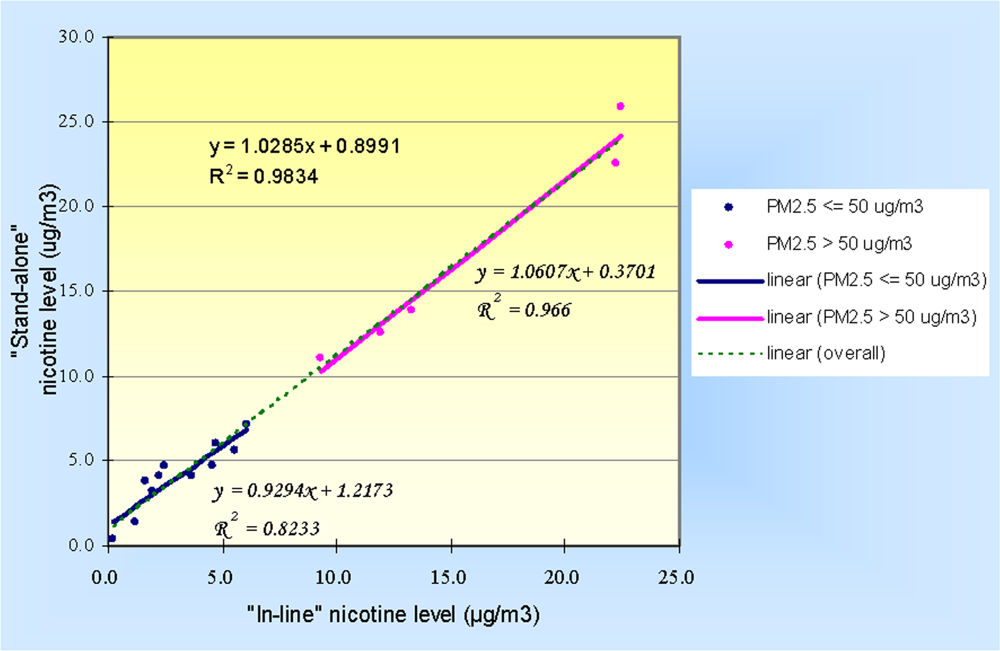
<p>The “stand-alone” versus “inline” nicotine concentrations are plotted in <xref ref-type="fig" rid="f1-ijerph-06-00601">Figure 1</xref>. They were highly correlated and the slope of the regression line was close to 1, both overall and when stratified by PM<sub>2.5</sub> concentration. The overall Pearson’s correlation coefficient was 0.99 (<italic>p</italic>&lt;0.0001), and was 0.98 (<italic>p</italic>=0.0027) for the high PM<sub>2.5</sub> group and 0.91 (<italic>p</italic>=0.0001) for the low PM<sub>2.5</sub> group.</p>
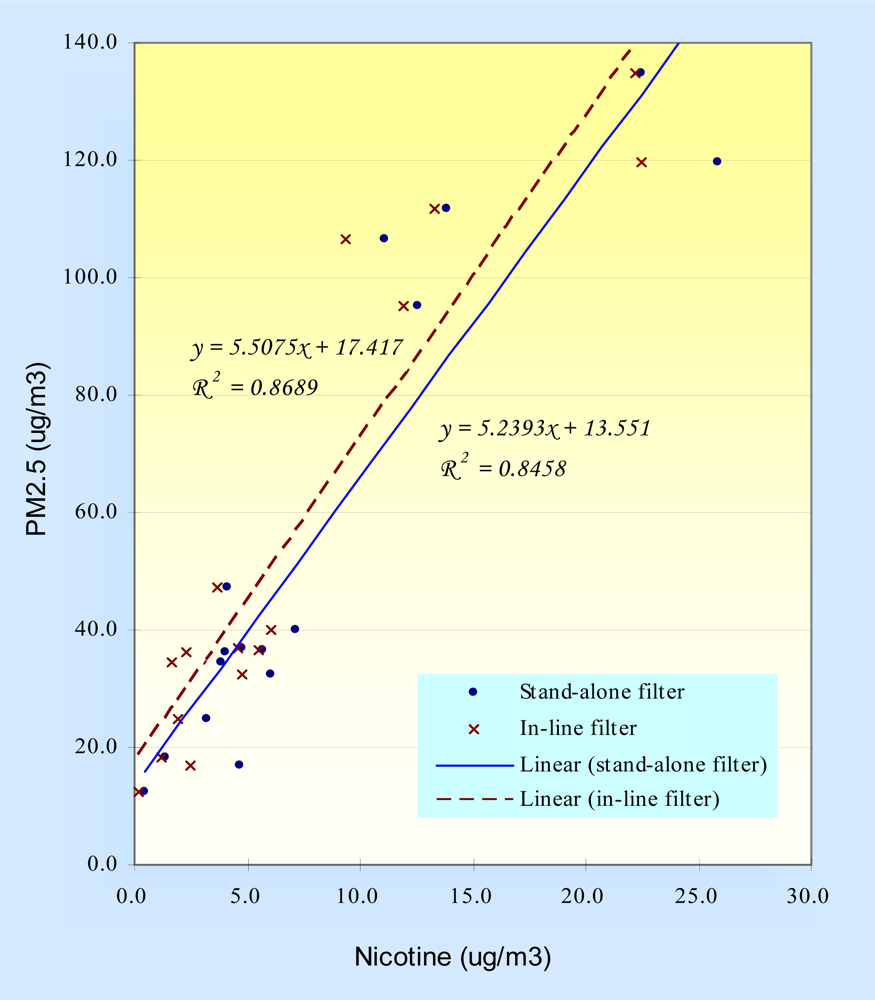
<p>To further investigate the association between PM<sub>2.5</sub> and nicotine concentrations, we also examined their correlation (<xref ref-type="fig" rid="f2-ijerph-06-00601">Figure 2</xref>). We found a strong correlation between both the “stand-alone” and “inline” nicotine concentrations and PM<sub>2.5</sub> (Pearson’s <italic>r</italic> = 0.92 and 0.93, respectively). The slopes of the two regression lines, “stand-alone” nicotine vs. PM<sub>2.5</sub> concentration (slope=5.5) and “inline” nicotine vs. PM<sub>2.5</sub> concentration (slope=5.2), were similar, suggesting that the adsorption of nicotine to the PM<sub>2.5</sub> filter was fairly systemic.</p></sec>
<sec sec-type="discussion">
<label>2.2.</label>
<title>Discussion</title>
<p>Our study showed that the overall difference in nicotine concentrations measured between “stand-alone” filters and filters behind PM<sub>2.5</sub> filters (“inline” filters) was small, indicating that PM<sub>2.5</sub> samples are not largely contaminated by nicotine from cigarette smoke. In other words, “inline” nicotine concentrations are not largely underestimated (average value of 1.10 ±0.96 μg/m<sup>3</sup>). In support of this is the finding of two separate regression lines from the two nicotine measurements versus PM<sub>2.5</sub>, indicating that there is a small but systematic difference between them. Although firm conclusions are limited by sample size, it is possible that the underestimation of “inline” nicotine concentrations was significant only where PM<sub>2.5</sub> concentrations were lower because the relative contribution of nicotine to overall mass is greater. The average percent of difference (calculated from dividing the absolute difference of the two nicotine levels by the “stand-alone” nicotine level and then times 100%) was larger in the low PM<sub>2.5</sub> group, compared to the high group, suggesting more variability or larger measurement errors in the former group. Another explanation is that the PM<sub>2.5</sub> sampling filter might have a small and fixed adsorption capacity for nicotine, which is independent of the particle loading – it appears as an offset of the regression line. This small amount of nicotine may only be detectable when the particle loading is also small. Also, the sample size was smaller in the group with higher PM<sub>2.5</sub> levels.</p>
<p>We did not separately measure nicotine in the vapor and particulate phase of cigarette smoke, and it is expected based on the known distribution of nicotine in cigarette smoke that nicotine is present predominantly in the vapor phase [<xref ref-type="bibr" rid="b2-ijerph-06-00601">2</xref>]. We also attempted to estimate the total particles from cigarette smoke from the “stand-alone” nicotine levels, using the ratio 8.6 suggested by a previous study of railroad workers and experiments conducted in a well-mixed chamber [<xref ref-type="bibr" rid="b3-ijerph-06-00601">3</xref>]. However, when applying this ratio to our samples, 56% of the estimated cigarette smoke particles were greater than the mass on the PM<sub>2.5</sub> filter. This might be due to the unique exposure scenario inside the truck cab. In addition, the constitutions in cigarette smoke may have changed over time. Further studies are needed to evaluate the potential contamination by particles from cigarette smoke on the PM<sub>2.5</sub> samples.</p>
<p>The results from our study showed that samples with higher PM<sub>2.5</sub> levels are associated with higher nicotine levels (<xref ref-type="fig" rid="f2-ijerph-06-00601">Figure 2</xref>), suggesting that a large proportion of PM<sub>2.5</sub> in a truck cab was derived from cigarette smoke. This implies that smoking in trucks or cars may relate to a potentially higher health risk, especially for transportation professionals who spend more time in these settings. In addition, although the contribution of nicotine to PM<sub>2.5</sub> filters in our samples was relatively small, the contribution was proportionally greater at lower PM<sub>2.5</sub> values. Our results indicate that it is important to consider the impact of secondhand and active smoking when sampling occupational and environmental exposures to airborne pollutants. Design methods include restricting exposure sampling to non-smokers or stratifying by cigarette smoke and secondhand smoke exposure [<xref ref-type="bibr" rid="b4-ijerph-06-00601">4</xref>,<xref ref-type="bibr" rid="b5-ijerph-06-00601">5</xref>]. Statistical modeling can also be used to control for cigarette smoke [<xref ref-type="bibr" rid="b6-ijerph-06-00601">6</xref>,<xref ref-type="bibr" rid="b7-ijerph-06-00601">7</xref>]. One problem with restriction and statistical modeling is that they only account for personal smoking but they might not adequately account for secondhand smoke exposures. Our study suggests that adjusting for nicotine as in our study might provide a way to adjust for PM filter contamination of nicotine related to cigarette smoking by deriving a correction factor – either overall or specific for different PM<sub>2.5</sub> levels (see <xref ref-type="table" rid="t1-ijerph-06-00601">Table 1</xref>). Finally, other exposure metrics which are not largely affected by smoking, e.g. elemental carbon (EC) [<xref ref-type="bibr" rid="b8-ijerph-06-00601">8</xref>], are often used to assess workers’ occupational exposures to diesel airborne pollutants [<xref ref-type="bibr" rid="b9-ijerph-06-00601">9</xref>–<xref ref-type="bibr" rid="b13-ijerph-06-00601">13</xref>]. In conclusion, we suggest that it is important to account for personal and secondhand smoke exposure while assessing low level occupational and environmental exposures to particles, especially when PM<sub>2.5</sub> level is less than 50 μg/m<sup>3</sup>. The collection of nicotine in this manner may be useful for adjusting PM<sub>2.5</sub> levels for the impact of nicotine from cigarette smoke.</p></sec></sec>
<sec sec-type="materials|methods">
<label>3.</label>
<title>Materials and Methods</title>
<sec>
<label>3.1.</label>
<title>Sampling Location</title>
<p>PM<sub>2.5</sub> and nicotine were measured in truck cabs of drivers who smoked. The participants were volunteers in the exposure assessment arm of the Trucking Industry Particle Study, a five-year national study of diesel exhaust exposure and lung cancer risk in four large unionized trucking companies [<xref ref-type="bibr" rid="b12-ijerph-06-00601">12</xref>].</p></sec>
<sec>
<label>3.2.</label>
<title>Sampling Schemes</title>
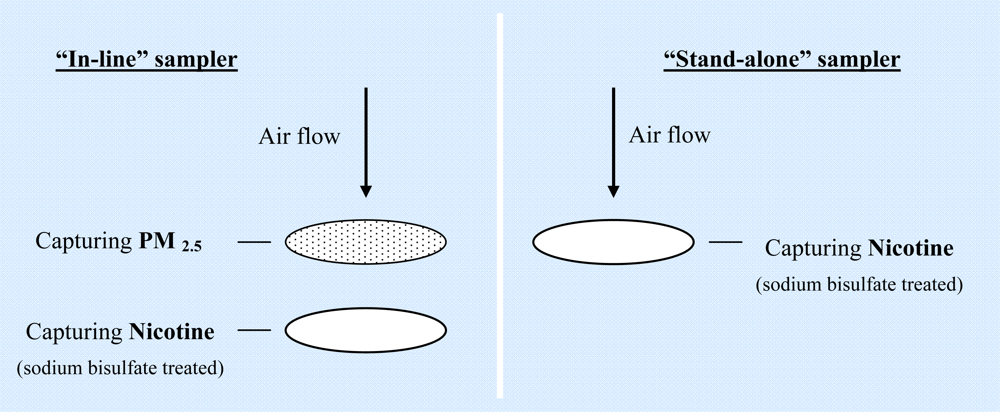
<p>The overall design of the exposure assessment and the methods used are described in detail elsewhere [<xref ref-type="bibr" rid="b2-ijerph-06-00601">2</xref>,<xref ref-type="bibr" rid="b12-ijerph-06-00601">12</xref>]. In brief, using an active sampler, PM<sub>2.5</sub> was collected across a work shift on pre-weighed Teflon filters (Pall Co., Ann Arbor MI) after the particles larger than 2.5 μm were removed by a cyclone separator. We placed a 37mm Teflon-coated glass fiber filter (Emfab TX40HI20WW, Pallflex Corp., Putnam, CT) treated with sodium bisulfate to collect vapor phase nicotine behind the PM<sub>2.5</sub> filter. To determine whether the second filter (i.e. the “inline sampler”) collecting vapor phase nicotine was underestimated as a result of adsorption of vapor phase nicotine on the first filter (collecting PM<sub>2.5</sub>), we measured nicotine levels with a “stand-alone” sodium bisulfate treated filter placed in parallel with the first sampler (<xref ref-type="fig" rid="f3-ijerph-06-00601">Figure 3</xref>). Since nicotine is mainly present in the vapor phase, we used the nicotine concentration measured from the “stand-alone” filter as an estimate of total nicotine level from cigarette smoke [<xref ref-type="bibr" rid="b2-ijerph-06-00601">2</xref>]. To avoid interfering with the driver’s activities, the sampling system was mounted to the dashboard next to the driver. The nicotine filters were analyzed by desorption of the nicotine and quantification by gas chromatography with nitrogen selective detection [<xref ref-type="bibr" rid="b2-ijerph-06-00601">2</xref>]. PM<sub>2.5</sub> filters were pre-weighed after humidity equilibrium (between 20–23 °C and between 35–45% relative humidity for at least 48 hours) in a chamber by an analytic balance (Micro-Gravimetric M5, Mettler Instruments Corp, Hightstown, NJ). After sampling, the PM<sub>2.5</sub> filters were reweighed after humidity equilibrium to determine the weight gain [<xref ref-type="bibr" rid="b12-ijerph-06-00601">12</xref>]. Concentrations were calculated by dividing mass collected (μg) from the estimated volume of air sampled (m<sup>3</sup>).</p></sec>
<sec sec-type="methods">
<label>3.3.</label>
<title>Statistical Analysis</title>
<p>To quantify vapor phase nicotine that became adsorbed to the PM<sub>2.5</sub> filter, we examined the difference of the “inline” and “stand-alone” nicotine concentrations using paired-t tests. We also assessed the correlations between PM<sub>2.5</sub> levels and nicotine levels. All data analyses were performed in SAS (V9.1.3, SAS Institute Inc., Cary, NC). The protocol was approved by the Human Subjects Committees at the Harvard School of Public Health, Brigham and Women’s Hospital, and VA Boston Healthcare System.</p></sec></sec></body>
<back>
<ack>
<p>This study is supported by the Flight Attendant Medical Research Institute (FAMRI) and NIH/NCI R01 CA90792.</p></ack>
<ref-list>
<title>References and Notes</title>
<ref id="b1-ijerph-06-00601"><label>1.</label><citation citation-type="journal"><person-group person-group-type="author"><name><surname>Hammond</surname><given-names>SK</given-names></name><name><surname>Smith</surname><given-names>TJ</given-names></name><name><surname>Woskie</surname><given-names>SR</given-names></name><name><surname>Leaderer</surname><given-names>BP</given-names></name><name><surname>Bettinger</surname><given-names>N</given-names></name></person-group><article-title>Markers of Exposure to Diesel Exhaust and Cigarette Smoke in Railroad Workers</article-title><source>Am. Ind. Hyg. Assoc. J</source><year>1988</year><volume>49</volume><fpage>516</fpage><lpage>522</lpage><pub-id pub-id-type="doi">10.1080/15298668891380150</pub-id><pub-id pub-id-type="pmid">2461070</pub-id></citation></ref>
<ref id="b2-ijerph-06-00601"><label>2.</label><citation citation-type="journal"><person-group person-group-type="author"><name><surname>Hammond</surname><given-names>SK</given-names></name><name><surname>Leaderer</surname><given-names>BP</given-names></name><name><surname>Roche</surname><given-names>AC</given-names></name><name><surname>Schenker</surname><given-names>M</given-names></name></person-group><article-title>Collection and analysis of nicotine as a marker for environmental tobacco smoke</article-title><source>Atmos. Environ</source><year>1987</year><volume>21</volume><fpage>457</fpage><lpage>461</lpage><pub-id pub-id-type="doi">10.1016/0004-6981(87)90027-8</pub-id></citation></ref>
<ref id="b3-ijerph-06-00601"><label>3.</label><citation citation-type="journal"><person-group person-group-type="author"><name><surname>Schenker</surname><given-names>MB</given-names></name><name><surname>Samuels</surname><given-names>SJ</given-names></name><name><surname>Kado</surname><given-names>NY</given-names></name><name><surname>Hammond</surname><given-names>SK</given-names></name><name><surname>Smith</surname><given-names>TJ</given-names></name><name><surname>Woskie</surname><given-names>SR</given-names></name></person-group><article-title>Markers of Exposure to Diesel Exhaust in Railroad Workers</article-title><source>Res. Rep. Health Eff. Inst</source><year>1990</year><volume>33</volume><fpage>1</fpage><lpage>51</lpage><pub-id pub-id-type="pmid">2264934</pub-id></citation></ref>
<ref id="b4-ijerph-06-00601"><label>4.</label><citation citation-type="journal"><person-group person-group-type="author"><name><surname>Phillips</surname><given-names>K</given-names></name><name><surname>Bentley</surname><given-names>MC</given-names></name><name><surname>Howard</surname><given-names>DA</given-names></name><name><surname>Alvan</surname><given-names>G</given-names></name></person-group><article-title>Assessment of environmental tobacco smoke and respirable suspended particle exposures for nonsmokers in Prague using personal monitoring</article-title><source>Int. Arch. Occup. Environ. Health</source><year>1998</year><volume>71</volume><fpage>379</fpage><lpage>390</lpage><pub-id pub-id-type="doi">10.1007/s004200050296</pub-id><pub-id pub-id-type="pmid">9766911</pub-id></citation></ref>
<ref id="b5-ijerph-06-00601"><label>5.</label><citation citation-type="journal"><person-group person-group-type="author"><name><surname>Phillips</surname><given-names>K</given-names></name><name><surname>Bentley</surname><given-names>MC</given-names></name></person-group><article-title>Seasonal assessment of environmental tobacco smoke and respirable suspended particle exposures for nonsmokers in Bremen using personal monitoring</article-title><source>Environ. Int</source><year>2001</year><volume>27</volume><fpage>69</fpage><lpage>85</lpage><pub-id pub-id-type="doi">10.1016/S0160-4120(01)00057-5</pub-id><pub-id pub-id-type="pmid">11488392</pub-id></citation></ref>
<ref id="b6-ijerph-06-00601"><label>6.</label><citation citation-type="journal"><person-group person-group-type="author"><name><surname>Iwai</surname><given-names>K</given-names></name><name><surname>Mizuno</surname><given-names>S</given-names></name><name><surname>Miyasaka</surname><given-names>Y</given-names></name><name><surname>Mori</surname><given-names>T</given-names></name></person-group><article-title>Correlation between suspended particles in the environmental air and causes of disease among inhabitants: cross-sectional studies using the vital statistics and air pollution data in Japan</article-title><source>Environ. Res</source><year>2005</year><volume>99</volume><fpage>106</fpage><lpage>117</lpage><pub-id pub-id-type="doi">10.1016/j.envres.2004.11.004</pub-id><pub-id pub-id-type="pmid">16053935</pub-id></citation></ref>
<ref id="b7-ijerph-06-00601"><label>7.</label><citation citation-type="journal"><person-group person-group-type="author"><name><surname>Nikasinovic</surname><given-names>L</given-names></name><name><surname>Just</surname><given-names>J</given-names></name><name><surname>Sahraoui</surname><given-names>F</given-names></name><name><surname>Seta</surname><given-names>N</given-names></name><name><surname>Grimfeld</surname><given-names>A</given-names></name><name><surname>Momas</surname><given-names>I</given-names></name></person-group><article-title>Nasal inflammation and personal exposure to fine particles PM2.5 in asthmatic children</article-title><source>J. Allergy Clin. Immunol</source><year>2006</year><volume>117</volume><fpage>1382</fpage><lpage>1388</lpage><pub-id pub-id-type="doi">10.1016/j.jaci.2006.03.023</pub-id><pub-id pub-id-type="pmid">16751001</pub-id></citation></ref>
<ref id="b8-ijerph-06-00601"><label>8.</label><citation citation-type="journal"><person-group person-group-type="author"><name><surname>Hildemann</surname><given-names>GR</given-names></name><name><surname>Markowski</surname><given-names>GR</given-names></name><name><surname>Cass</surname><given-names>GR</given-names></name></person-group><article-title>Chemical composition of emissions from urban sources of fine organic aerosol</article-title><source>Environ. Sci. Technol</source><year>1991</year><volume>25</volume><fpage>744</fpage><lpage>759</lpage><pub-id pub-id-type="doi">10.1021/es00016a021</pub-id></citation></ref>
<ref id="b9-ijerph-06-00601"><label>9.</label><citation citation-type="journal"><person-group person-group-type="author"><name><surname>Birch</surname><given-names>ME</given-names></name><name><surname>Cary</surname><given-names>RA</given-names></name></person-group><article-title>Elemental carbon-based method for occupational monitoring of particulate diesel exhaust: methodology and exposure issues</article-title><source>Analyst</source><year>1996</year><volume>121</volume><fpage>1183</fpage><lpage>1190</lpage><pub-id pub-id-type="doi">10.1039/an9962101183</pub-id><pub-id pub-id-type="pmid">8831275</pub-id></citation></ref>
<ref id="b10-ijerph-06-00601"><label>10.</label><citation citation-type="journal"><person-group person-group-type="author"><name><surname>Figueroa</surname><given-names>DA</given-names></name><name><surname>Rodriguez-Sierra</surname><given-names>CJ</given-names></name><name><surname>Jimenez-Velez</surname><given-names>BD</given-names></name></person-group><article-title>Concentrations of Ni and V, other heavy metals, arsenic, elemental and organic carbon in atmospheric fine particles (PM2.5) from Puerto Rico</article-title><source>Toxicol. Ind. Health</source><year>2006</year><volume>22</volume><fpage>87</fpage><lpage>99</lpage><pub-id pub-id-type="doi">10.1191/0748233706th247oa</pub-id><pub-id pub-id-type="pmid">16716038</pub-id></citation></ref>
<ref id="b11-ijerph-06-00601"><label>11.</label><citation citation-type="journal"><person-group person-group-type="author"><name><surname>Lee</surname><given-names>BK</given-names></name><name><surname>Smith</surname><given-names>TJ</given-names></name><name><surname>Garshick</surname><given-names>E</given-names></name><name><surname>Natkin</surname><given-names>J</given-names></name><name><surname>Reaser</surname><given-names>P</given-names></name><name><surname>Lane</surname><given-names>K</given-names></name><name><surname>Lee</surname><given-names>HK</given-names></name></person-group><article-title>Exposure of trucking company workers to particulate matter during the winter</article-title><source>Chemosphere</source><year>2005</year><volume>61</volume><fpage>1677</fpage><lpage>1690</lpage><pub-id pub-id-type="doi">10.1016/j.chemosphere.2005.03.091</pub-id><pub-id pub-id-type="pmid">15913707</pub-id></citation></ref>
<ref id="b12-ijerph-06-00601"><label>12.</label><citation citation-type="journal"><person-group person-group-type="author"><name><surname>Smith</surname><given-names>TJ</given-names></name><name><surname>Davis</surname><given-names>ME</given-names></name><name><surname>Reaser</surname><given-names>P</given-names></name><name><surname>Natkin</surname><given-names>J</given-names></name><name><surname>Hart</surname><given-names>JE</given-names></name><name><surname>Laden</surname><given-names>F</given-names></name><name><surname>Heff</surname><given-names>A</given-names></name><name><surname>Garshick</surname><given-names>E</given-names></name></person-group><article-title>Overview of particulate exposures in the US trucking industry</article-title><source>J. Environ. Monit</source><year>2006</year><volume>8</volume><fpage>711</fpage><lpage>720</lpage><pub-id pub-id-type="doi">10.1039/b601809b</pub-id><pub-id pub-id-type="pmid">16826284</pub-id></citation></ref>
<ref id="b13-ijerph-06-00601"><label>13.</label><citation citation-type="journal"><person-group person-group-type="author"><name><surname>Zaebst</surname><given-names>DD</given-names></name><name><surname>Clapp</surname><given-names>DE</given-names></name><name><surname>Blade</surname><given-names>LM</given-names></name></person-group><article-title>Quantitative determination of trucking industry workers’ exposures to diesel exhaust particles</article-title><source>Am. Ind. Hyg. Assoc. J</source><year>1991</year><volume>52</volume><fpage>529</fpage><lpage>541</lpage><pub-id pub-id-type="doi">10.1080/15298669191365162</pub-id><pub-id pub-id-type="pmid">1723577</pub-id></citation></ref></ref-list>
<sec sec-type="display-objects">
<title>Figures and Table</title>
<fig id="f1-ijerph-06-00601" position="float">
<label>Figure 1.</label>
<caption>
<p>Correlation between “stand-alone” filter and “inline” filter nicotine concentrations.</p></caption>
<graphic xlink:href="ijerph-06-00601f1.gif"/></fig>
<fig id="f2-ijerph-06-00601" position="float">
<label>Figure 2.</label>
<caption>
<p>Correlations between PM<sub>2.5</sub> concentrations and nicotine concentrations using two different sampling designs.</p></caption>
<graphic xlink:href="ijerph-06-00601f2.gif"/></fig>
<fig id="f3-ijerph-06-00601" position="float">
<label>Figure 3.</label>
<caption>
<p>Sampling designs of “stand-alone” sampler and “inline” sampler.</p></caption>
<graphic xlink:href="ijerph-06-00601f3.gif"/></fig>
<table-wrap id="t1-ijerph-06-00601" position="float">
<label>Table 1.</label>
<caption>
<p>Distributions of PM<sub>2.5</sub> (μg/m<sup>3</sup>), “stand-alone” and “inline” nicotine concentration (μg/m<sup>3</sup>), absolute nicotine concentration difference (μg/m<sup>3</sup>).</p></caption>
<table frame="hsides" rules="groups">
<thead>
<tr>
<th align="left"/>
<th align="center"/>
<th align="center" colspan="3"><bold>PM</bold><bold>2.5</bold> <bold>conc.</bold></th>
<th align="center" colspan="3"><bold>“Stand-alone” nicotine conc.</bold></th>
<th align="center" colspan="3"><bold>“In-line” nicotine conc.</bold></th>
<th align="center" colspan="4"><bold>Nicotine conc. difference [(“Stand-alone”) – (“In-line”)] <xref ref-type="table-fn" rid="tfn1-ijerph-06-00601">a</xref></bold></th></tr>
<tr>
<th align="left"/>
<th align="center"/>
<th colspan="13">
<hr/></th></tr>
<tr>
<th align="left"/>
<th align="center"><bold>N</bold></th>
<th align="center">Mean</th>
<th align="center">SD</th>
<th align="center">Range</th>
<th align="center">Mean</th>
<th align="center">SD</th>
<th align="center">Range</th>
<th align="center">Mean</th>
<th align="center">SD</th>
<th align="center">Range</th>
<th align="center">Mean</th>
<th align="center">SD</th>
<th align="center">Range</th>
<th align="center"/></tr></thead>
<tbody>
<tr>
<td align="left"><bold>Overall</bold></td>
<td align="center">16</td>
<td align="center">56.5</td>
<td align="center">41.5</td>
<td align="center">(12.5–134.9)</td>
<td align="center">8.20</td>
<td align="center">7.29</td>
<td align="center">(0.43–25.84)</td>
<td align="center">7.10</td>
<td align="center">7.03</td>
<td align="center">(0.20–22.47)</td>
<td align="center">1.10</td>
<td align="center">0.96</td>
<td align="center">(0.12–3.37)</td>
<td align="center">*</td></tr>
<tr>
<td align="left" colspan="15"><bold>PM<sub>2.5</sub> conc. <xref ref-type="table-fn" rid="tfn2-ijerph-06-00601">b</xref></bold></td></tr>
<tr>
<td align="left">  <italic>&gt; 50 μg/m</italic><italic><sup>3</sup></italic></td>
<td align="center">5</td>
<td align="center">113.7</td>
<td align="center">14.8</td>
<td align="center">(95.3–134.9)</td>
<td align="center">17.2</td>
<td align="center">6.58</td>
<td align="center">(11.1–25.84)</td>
<td align="center">15.8</td>
<td align="center">6.10</td>
<td align="center">(9.33–22.47)</td>
<td align="center">1.33</td>
<td align="center">1.27</td>
<td align="center">(0.33–3.37)</td>
<td align="center"/></tr>
<tr>
<td align="left">  <italic>≤50 μg/m</italic><italic><sup>3</sup></italic></td>
<td align="center">11</td>
<td align="center">30.5</td>
<td align="center">10.9</td>
<td align="center">(12.5–47.1)</td>
<td align="center">4.12</td>
<td align="center">1.96</td>
<td align="center">(0.43–7.16)</td>
<td align="center">3.13</td>
<td align="center">1.91</td>
<td align="center">(0.20–6.06)</td>
<td align="center">0.99</td>
<td align="center">0.83</td>
<td align="center">(0.12–2.25)</td>
<td align="center">*</td></tr></tbody></table>
<table-wrap-foot><fn id="tfn1-ijerph-06-00601">
<label>a</label>
<p> Paired T-test was used to examine the absolute difference between “stand-alone” and “inline” nicotine concentrations. (* <italic>p</italic>-vale &lt; 0.05)</p></fn><fn id="tfn2-ijerph-06-00601">
<label>b</label>
<p>PM<sub>2.5</sub> was bimodaly distributed around 50 μg/m<sup>3</sup>, which was chosen as the cut point. Subjects with nicotine conc. &gt; 10 μg/m<sup>3</sup> were all exposed to PM<sub>2.5</sub> conc. &gt; 50 μg/m<sup>3</sup>; subjects with nicotine conc. ≤10 μg/m<sup>3</sup> were all exposed to PM<sub>2.5</sub> conc. ≤ 50 μg/m<sup>3</sup>.</p></fn></table-wrap-foot></table-wrap></sec></back></article>