<?xml version="1.0" encoding="UTF-8"?>
<!DOCTYPE article PUBLIC "-//NLM//DTD Journal Publishing DTD v2.3 20070202//EN" "journalpublishing.dtd">
<article xmlns:mml="http://www.w3.org/1998/Math/MathML" xmlns:xlink="http://www.w3.org/1999/xlink" xml:lang="en" article-type="research-article">
  <front>
    <journal-meta>
      <journal-id journal-id-type="publisher-id">ijerph</journal-id>
      <journal-title>International Journal of Environmental Research and Public Health</journal-title>
      <abbrev-journal-title abbrev-type="publisher">Int. J. Environ. Res. Public Health</abbrev-journal-title>
      <abbrev-journal-title abbrev-type="pubmed">International journal of environmental research and public health</abbrev-journal-title>
      <issn pub-type="epub">1660-4601</issn>
      <publisher>
        <publisher-name>MDPI</publisher-name>
      </publisher>
    </journal-meta>
    <article-meta>
      <article-id pub-id-type="doi">10.3390/ijerph10020556</article-id>
      <article-id pub-id-type="publisher-id">ijerph-10-00556</article-id>
      <article-categories>
        <subj-group>
          <subject>Article</subject>
        </subj-group>
      </article-categories>
      <title-group>
        <article-title>Infectious Risk Assessment of Unsafe Handling Practices and Management of Clinical Solid Waste</article-title>
      </title-group>
      <contrib-group>
        <contrib contrib-type="author">
          <name>
            <surname>Hossain</surname>
            <given-names>Md. Sohrab</given-names>
          </name>
          <xref rid="af1-ijerph-10-00556" ref-type="aff">1</xref>
        </contrib>
        <contrib contrib-type="author">
          <name>
            <surname>Rahman</surname>
            <given-names>Nik Norulaini Nik Ab</given-names>
          </name>
          <xref rid="af2-ijerph-10-00556" ref-type="aff">2</xref>
        </contrib>
        <contrib contrib-type="author">
          <name>
            <surname>Balakrishnan</surname>
            <given-names>Venugopal</given-names>
          </name>
          <xref rid="af3-ijerph-10-00556" ref-type="aff">3</xref>
        </contrib>
        <contrib contrib-type="author">
          <name>
            <surname>Puvanesuaran</surname>
            <given-names>Vignesh R.</given-names>
          </name>
          <xref rid="af3-ijerph-10-00556" ref-type="aff">3</xref>
        </contrib>
        <contrib contrib-type="author">
          <name>
            <surname>Sarker</surname>
            <given-names>Md. Zaidul Islam</given-names>
          </name>
          <xref rid="af4-ijerph-10-00556" ref-type="aff">4</xref>
        </contrib>
        <contrib contrib-type="author">
          <name>
            <surname>Kadir</surname>
            <given-names>Mohd Omar Ab</given-names>
          </name>
          <xref rid="af1-ijerph-10-00556" ref-type="aff">1</xref>
          <xref rid="c1-ijerph-10-00556" ref-type="corresp">*</xref>
        </contrib>
      </contrib-group>
      <aff id="af1-ijerph-10-00556"><label>1</label> Department of Environmental Technology, School of Industrial Technology, Universiti Sains Malaysia, Penang 11800, Malaysia; E-Mail: <email>msh.id09@student.usm.my</email></aff>
      <aff id="af2-ijerph-10-00556"><label>2</label> School of Distance Education, Universiti Sains Malaysia, Penang 11800, Malaysia; E-Mail: <email>norulain@usm.my</email></aff>
      <aff id="af3-ijerph-10-00556"><label>3</label> Institute for Research in Molecular Medicine, Universiti Sains Malaysia, Penang 11800, Malaysia; E-Mails: <email>venugopal@usm.my</email> (V.B.); <email>vignesh.r.puvanesuaran@gmail.com</email> (V.R.P.)</aff>
      <aff id="af4-ijerph-10-00556"><label>4</label> Department of Pharmaceutical Technology, Faculty of Pharmacy, International Islamic University Malaysia, Kuantan Campus, Bandar Indera Mahkota, Kuantan 25200, Pahang, Malaysia; E-Mail: <email>zaidul@iium.edu.my</email></aff>
      <author-notes>
        <corresp id="c1-ijerph-10-00556"><label>*</label> Author to whom correspondence should be addressed; E-Mail: <email>akmomar@usm.my</email>; Tel.: +60-46-535-206; Fax: +60-46-585-435.</corresp>
      </author-notes>
      <pub-date pub-type="epub">
        <day>31</day>
        <month>01</month>
        <year>2013</year>
      </pub-date>
      <pub-date pub-type="ppub"><month>02</month>
        <year>2013</year>
      </pub-date>
      <volume>10</volume>
      <issue>2</issue>
      <fpage>556</fpage>
      <lpage>567</lpage>
      <history>
        <date date-type="received">
          <day>12</day>
          <month>12</month>
          <year>2012</year>
        </date>
        <date date-type="rev-recd">
          <day>17</day>
          <month>01</month>
          <year>2013</year>
        </date>
        <date date-type="accepted">
          <day>27</day>
          <month>01</month>
          <year>2013</year>
        </date>
      </history>
      <permissions>
        <copyright-statement>©  2013 by the authors; licensee MDPI, Basel, Switzerland.</copyright-statement>
        <copyright-year>2013</copyright-year>
        <license xmlns:xlink="http://www.w3.org/1999/xlink" license-type="open-access" xlink:href="http://creativecommons.org/licenses/by/3.0/">
          <p>This article is an open access article distributed under the terms and conditions of the Creative Commons Attribution license (http://creativecommons.org/licenses/by/3.0/).</p>
        </license>
      </permissions>
      <abstract>
        <p>The present study was undertaken to determine the bacterial agents present in various clinical solid wastes, general waste and clinical sharp waste. The waste was collected from different wards/units in a healthcare facility in Penang Island, Malaysia. The presence of bacterial agents in clinical and general waste was determined using the conventional bacteria identification methods. Several pathogenic bacteria including opportunistic bacterial agent such as <italic>Pseudomonas aeruginosa</italic>, <italic>Salmonella </italic>spp., <italic>Klebsiella pneumoniae</italic>, <italic>Serratia marcescens</italic>, <italic>Acinetobacter baumannii</italic>, <italic>Staphylococcus aureus</italic>, <italic>Staphylococcus epidermidis</italic>, <italic>Enterococcus faecalis</italic>, <italic>Streptococcus pyogenes</italic> were detected in clinical solid wastes. The presence of specific pathogenic bacterial strains in clinical sharp waste was determined using 16s rDNA analysis. In this study, several nosocomial pathogenic bacteria strains of <italic>Escherichia coli</italic>, <italic>Klebsiella pneumoniae</italic>, <italic>Proteus mirabilis</italic>, <italic>Lysinibacillus sphaericus</italic>, <italic>Serratia marcescens</italic>, and <italic>Staphylococcus aureus </italic>were detected in clinical sharp waste. The present study suggests that waste generated from healthcare facilities should be sterilized at the point of generation in order to eliminate nosocomial infections from the general waste or either of the clinical wastes.</p>
      </abstract>
      <kwd-group>
        <kwd>clinical solid waste</kwd>
        <kwd>clinical solid waste management</kwd>
        <kwd>healthcare waste</kwd>
        <kwd>pathogenic bacteria</kwd>
        <kwd>sharp waste</kwd>
      </kwd-group>
    </article-meta>
  </front>
  <body>
    <sec sec-type="intro">
      <title>1. Introduction</title>
      <p>There is growing worldwide awareness about effective control and safe handling of clinical solid waste due to the common concern for hospital hygiene [<xref ref-type="bibr" rid="B1-ijerph-10-00556">1</xref>,<xref ref-type="bibr" rid="B2-ijerph-10-00556">2</xref>]. The clinical solid waste defined by the Medical Waste Tracking Act of 1988 are solid waste materials, which are generated during diagnosis, treatment, vaccination, research or in the production or testing of biological products for humans and animals. The term clinical solid waste includes syringes, live vaccines, blood and other waste contaminated with bodily fluids, culture dishes, sharp objects, discarded surgical gloves, discarded surgical instruments, cultures, stocks, swabs used to inoculate cultures, removed body organs, <italic>etc.</italic> The collection, segregation and disposal of clinical solid waste entails labor intensive operations, involving many possibilities of direct contact with the waste increasing the risk of infections to the waste handlers [<xref ref-type="bibr" rid="B2-ijerph-10-00556">2</xref>,<xref ref-type="bibr" rid="B3-ijerph-10-00556">3</xref>,<xref ref-type="bibr" rid="B4-ijerph-10-00556">4</xref>].</p>
      <p>Earlier studies indicated that the clinical solid waste management at healthcare facilities is inadequate in developing countries [<xref ref-type="bibr" rid="B5-ijerph-10-00556">5</xref>,<xref ref-type="bibr" rid="B6-ijerph-10-00556">6</xref>,<xref ref-type="bibr" rid="B7-ijerph-10-00556">7</xref>,<xref ref-type="bibr" rid="B8-ijerph-10-00556">8</xref>,<xref ref-type="bibr" rid="B9-ijerph-10-00556">9</xref>]. In many developing countries, the clinical waste is handled and disposed together with non-clinical waste [<xref ref-type="bibr" rid="B1-ijerph-10-00556">1</xref>,<xref ref-type="bibr" rid="B6-ijerph-10-00556">6</xref>,<xref ref-type="bibr" rid="B9-ijerph-10-00556">9</xref>], which is creating a vital and even fatal health risk to health care workers and the general public [<xref ref-type="bibr" rid="B9-ijerph-10-00556">9</xref>,<xref ref-type="bibr" rid="B10-ijerph-10-00556">10</xref>,<xref ref-type="bibr" rid="B11-ijerph-10-00556">11</xref>,<xref ref-type="bibr" rid="B12-ijerph-10-00556">12</xref>]. Healthcare workers are prevalently exposed to diseases like cholera, plague, tuberculosis, hepatitis, skin infections, diphtheria, food poisoning, <italic>etc.</italic>, in either epidemic or even endemic form [<xref ref-type="bibr" rid="B9-ijerph-10-00556">9</xref>,<xref ref-type="bibr" rid="B12-ijerph-10-00556">12</xref>]. Surveys reveal that the incidences of contracting diseases are most prevalent among the waste handlers compared to other hospital staff [<xref ref-type="bibr" rid="B9-ijerph-10-00556">9</xref>,<xref ref-type="bibr" rid="B10-ijerph-10-00556">10</xref>]. Waste handler’s general exposure due to their occupational job functions could result in an infection during waste handling through punctures, cuts, inhalation or dermal contact than other healthcare staff. However, the literature on the spread of infectious diseases to clinical waste workers is extremely limited. Nevertheless, studies have summarized that poor management practices and improper precautions taken by clinical waste workers during waste collection, segregation and disposal might be the main reason of the spread of infectious diseases among clinical waste handlers [<xref ref-type="bibr" rid="B2-ijerph-10-00556">2</xref>,<xref ref-type="bibr" rid="B6-ijerph-10-00556">6</xref>,<xref ref-type="bibr" rid="B9-ijerph-10-00556">9</xref>]. </p>
      <p>Clinical solid waste is perceived by many as hazardous or infectious, and requires steps to minimize occupational incidents and environmental contamination [<xref ref-type="bibr" rid="B13-ijerph-10-00556">13</xref>,<xref ref-type="bibr" rid="B14-ijerph-10-00556">14</xref>,<xref ref-type="bibr" rid="B15-ijerph-10-00556">15</xref>,<xref ref-type="bibr" rid="B16-ijerph-10-00556">16</xref>]. Numerous studies have been conducted worldwide to define the best appropriate clinical waste management practice in order to minimize the health hazards and associate environmental contamination [<xref ref-type="bibr" rid="B1-ijerph-10-00556">1</xref>,<xref ref-type="bibr" rid="B5-ijerph-10-00556">5</xref>,<xref ref-type="bibr" rid="B6-ijerph-10-00556">6</xref>,<xref ref-type="bibr" rid="B7-ijerph-10-00556">7</xref>,<xref ref-type="bibr" rid="B8-ijerph-10-00556">8</xref>,<xref ref-type="bibr" rid="B9-ijerph-10-00556">9</xref>]. However, studies reported that one of the main reasons on the mismanagement of clinical solid waste is the lack of awareness of the waste handlers regarding the infectious risk of clinical solid waste [<xref ref-type="bibr" rid="B2-ijerph-10-00556">2</xref>,<xref ref-type="bibr" rid="B5-ijerph-10-00556">5</xref>,<xref ref-type="bibr" rid="B9-ijerph-10-00556">9</xref>,<xref ref-type="bibr" rid="B16-ijerph-10-00556">16</xref>]. </p>
      <p>The infectious risk posed by clinical solid waste to human health and the environment, which needs to be assessed, is the potential presence of pathogenic microorganisms. Clinical solid waste might contain a great variety of pathogenic microorganisms [<xref ref-type="bibr" rid="B16-ijerph-10-00556">16</xref>,<xref ref-type="bibr" rid="B17-ijerph-10-00556">17</xref>,<xref ref-type="bibr" rid="B18-ijerph-10-00556">18</xref>,<xref ref-type="bibr" rid="B19-ijerph-10-00556">19</xref>]. Among the various types of clinical waste, the handling of and disposal of sharps clinical waste is of great concern in developing and transitional countries of the World. Sharps waste such as hypodermic needles is considered a highly hazardous waste resulting from the common contamination from the patients’ blood [<xref ref-type="bibr" rid="B18-ijerph-10-00556">18</xref>]. Clinical sharps waste not only causes cuts and punctures but also infects wounds with the pathogens in the contaminated waste. Therefore, clinical sharp waste is considered as a waste with double or higher risk to healthcare workers. </p>
      <p>The potential microbiological risks associated with the clinical solid waste are still limited to the healthcare worker and other clinical personnel due to availability of inadequate data on type and quantity of pathogenic microorganism present in the clinical solid waste. Studies have been documented as regards to the infectious risks in clinical waste management [<xref ref-type="bibr" rid="B16-ijerph-10-00556">16</xref>,<xref ref-type="bibr" rid="B17-ijerph-10-00556">17</xref>,<xref ref-type="bibr" rid="B19-ijerph-10-00556">19</xref>], unfortunately scientifically substantiated evidence of the actual content of microorganisms, survival of microorganisms in clinical solid waste and the infectious risks to healthcare workers and the public are rare. Identifying the types and quantity of microorganisms present in clinical solid waste in order to achieve a reliable human health risk assessment are essential. The focus of this work was to identify and categorize the presence of pathogenic bacteria in clinical solid waste collected from various department/wards in a healthcare facility of Penang Island, Malaysia. The identification of bacteria in clinical sharp waste was conducted via molecular means, using 16s rDNA sequencing to evaluate the pathogenicity with the detection of the specific pathogenic bacterial strains. The outcome of this study may be useful to determine the reliable technology for the safe handling, disposal and the possible infectious threat of clinical solid waste.</p>
    </sec>
    <sec>
      <title>2. Experimental Section</title>
      <sec>
        <title>2.1. Clinical Solid Waste Collection and Preparation</title>
        <p>The clinical solid waste was collected from one of the largest healthcare facilities in Penang Island, Malaysia. Waste collection was conducted for a period of one month in April 2012, in cooperation with the hospital administration. Clinical solid waste sample was collected from different wards/units of the hospital: Dental ward, Microbiological lab, ICU unit, Dermatology unit, Isolation ward, Obstetrical &amp; Gynecology wards. The variations of the microbiological bacterial agents’ presence in clinical solid waste generated in the units/wards were investigated. The presence of bacterial agents in general waste which was collected from the central storage room was also determined. The materials used during collection and transportation of the waste from the hospital according to the healthcare waste management guideline and legislation of Ministry of Health, Malaysia [<xref ref-type="bibr" rid="B20-ijerph-10-00556">20</xref>]. </p>
        <p>The collected clinical waste samples were transferred to a Biohazard clinical waste bin. One liter of sterilized distilled water was then added to every kilogram of clinical waste sample and mixed vigorously using a glass rod. The prepared sample was stored at room temperature (25 ± 1 °C) for 1 h.</p>
      </sec>
      <sec>
        <title>2.2. Identification of the Bacteria in Clinical Solid Waste Using the Conventional Method</title>
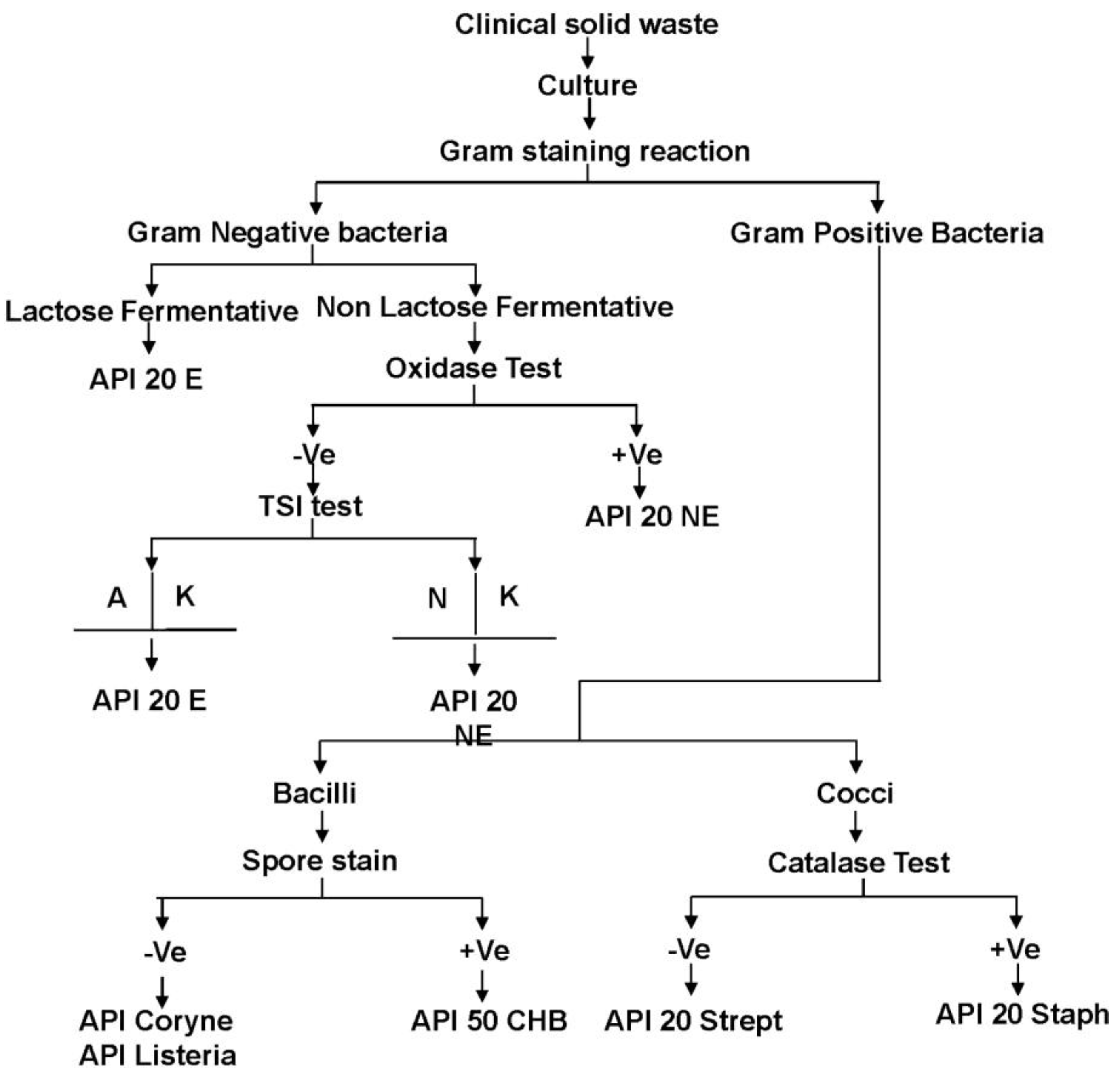
        <p>Bacterial identification was conducted following a manual of microbiological analysis [<xref ref-type="bibr" rid="B21-ijerph-10-00556">21</xref>]. A 0.1 mL aliquot of prepared contaminated sample was taken from the respective clinical solid waste storage bin to be cultured on agar media. Blood and MacConkey agar medium was used to culture the bacteria for Gram positive and Gram negative bacteria, respectively. Bacteria cultures on agar media were prepared in triplicate. Single isolated bacterium colonies were obtained following several steps of subculturing. Gram stain reaction and other biochemical tests including catalase test, oxidase test, triple sugar iron test were used for the morphological analysis of bacteria. Bacterial species were confirmed using selective Analytab Products Inc. (API) kit analysis. The details of bacterial identification are presented in <xref ref-type="fig" rid="ijerph-10-00556-f001">Figure 1</xref>. </p>
        <fig id="ijerph-10-00556-f001" position="float">
          <label>Figure 1</label>
          <caption>
            <p>Flow chart for the identification of bacteria in clinical solid waste. +Ve—positive; −Ve—Negative; A—Acid growth; K—Alkaline growth; N—Neutral.</p>
          </caption>
          <graphic xmlns:xlink="http://www.w3.org/1999/xlink" xlink:href="ijerph-10-00556-g001.tif"/>
        </fig>
      </sec>
      <sec>
        <title>2.3. Identification of the Bacteria in Clinical Sharp Waste Using Genomic DNA Profiling</title>
        <p>The collection of clinical sharp waste was conducted in cooperation with the studied hospital nurses in the month of May, 2012. Nurses on duty during the period were supplied with a sharp waste bin. Contaminated clinical sharp waste were collected from ICU unit, Dermatology unit, Isolation ward and Obstetrical &amp; Gynecology ward and put into the bin. Later, sterilized distilled water in the ratio of 1:2 L·kg<sup>−1</sup> was added into the collected clinical sharp waste bin and mixed vigorously using a glass rod. The sample was stored at room temperature (25 ± 1 °C) for 1 h prior to culture the bacteria on agar plates. A 0.1 mL sample of contaminated waste was taken from the respective clinical solid waste storage bin to culture on agar media. Blood and MacConkey agar medium was used to culture the bacteria for Gram positive and Gram negative bacteria, respectively. However, the culture of the contaminated waste was carried out thrice on blood and MacConkey agar media. Moreover, a few steps of subculturing were conducted in order to obtain single isolated bacterium colonies.</p>
        <p>In order to perform 16s rDNA analysis of the bacteria, the single isolated bacterium colony was transferred into nutrient broth and incubated for 18 h with agitation of 200 rpm and appropriate aeration. Later, the culture was pelleted through centrifugation at 1,500 × <italic>g</italic> for 20 min at 4 °C before the broth was discarded. QIAamp DNA Mini Kit (Qiagen, Hilden, Germany) was then utilized to extract the bacterial genomic DNA according to the manufacturer’s instructions. The extracted genomic DNA was then tested for integrity by quantifying its absorbance at A<sub>260</sub>/A<sub>280</sub> using a NanoPhotometer (Implen, Munich, Germany). The 16s rDNA sequencing was carried out by Macrogen (Seoul, Korea). The obtained sequences were than analyzed using the standard nucleotide BLAST tool (NCBI). The identities of the bacteria were determined by observing their similarity with the posted sequences (max identity; %).</p>
      </sec>
    </sec>
    <sec sec-type="results">
      <title>3. Results and Discussion</title>
      <p>Clinical solid waste may contain varieties of bacteria. The types and quantity of bacteria depend on the clinical solid waste compositions and its generation source. <xref ref-type="table" rid="ijerph-10-00556-t001">Table 1</xref> shows the types of bacteria recovered from the different wards/units in the Hospital studied. Nine types of Gram negative and seven types of Gram positive bacteria were detected in the clinical solid waste. The gram negative bacteria detected were <italic>Escherichia coli </italic> (<italic>E. coli</italic>), <italic>Proteus mirabilis </italic>(<italic>P. mirabilis</italic>), <italic>Pseudomonas aeruginosa </italic>(<italic>P. aeruginosa</italic>), <italic>Salmonella</italic> spp., <italic>Klebsiella pneumoniae</italic> (<italic>K. pneumoniae</italic>), <italic>Serratia liquefaciens</italic> (<italic>S. liquefaciens</italic>), <italic>Serratia marcescens </italic>(<italic>S. marcescens</italic>), <italic>Acinetobacter lwoffii</italic> (<italic>A. lwoffii</italic>) and <italic>Acinetobacter baumannii</italic> (<italic>A. baumannii</italic>) and of these <italic>E. coli</italic>; <italic>P. mirabilis</italic>, <italic>P. aeruginosa </italic>were most frequently found in various types of clinical solid waste. The Gram positive bacteria detected were <italic>Staphylococcus aureus</italic> (<italic>S. aureus)</italic>, <italic>Streptococcus mutans </italic>(<italic>S. mutans</italic>), <italic>Staphylococcus epidermidis</italic> (<italic>S. epidermidis</italic>), <italic>Enterococcus faecalis</italic> (<italic>E. faecalis</italic>), <italic>Lysinibacillus sphaericus</italic> (<italic>L. sphaericus</italic>), <italic>Streptococcus pyogenes</italic> (<italic>S</italic>. <italic>pyogenes</italic>), and <italic>Streptococcus agalactiae</italic> (<italic>S. agalactiae</italic>).</p>
      <table-wrap id="ijerph-10-00556-t001" position="float">
        <object-id pub-id-type="pii">ijerph-10-00556-t001_Table 1</object-id>
        <label>Table 1</label>
        <caption>
          <p>Detection of bacteria in clinical solid waste. </p>
        </caption>
        <table>
          <thead>
            <tr>
              <th align="center" valign="middle">No.</th>
              <th align="center" valign="middle">Type of clinical solid waste</th>
              <th align="center" valign="middle">Microorganisms</th>
            </tr>
          </thead>
          <tbody>
            <tr>
              <td rowspan="4" style="border-bottom:solid thin" align="center" valign="middle">1</td>
              <td rowspan="4" style="border-bottom:solid thin" align="center" valign="middle">General waste</td>
              <td align="center" valign="middle">
                <italic>Escherichia coli</italic>
              </td>
            </tr>
            <tr>
              <td valign="middle" align="center">
                <italic>Proteus mirabilis</italic>
              </td>
            </tr>
            <tr>
              <td valign="middle" align="center">
                <italic>Pseudomonas aeruginosa</italic>
              </td>
            </tr>
            <tr>
              <td valign="middle" style="border-bottom:solid thin">
                <italic>Staphylococcus aureus</italic>
              </td>
            </tr>
            <tr>
              <td rowspan="8" style="border-bottom:solid thin" align="center" valign="middle">2</td>
              <td rowspan="8" style="border-bottom:solid thin" align="center" valign="middle">Dental solid waste</td>
              <td align="center" valign="middle">
                <italic>Streptococcus mutans</italic>
              </td>
            </tr>
            <tr>
              <td valign="middle" align="center">
                <italic>Staphylococcus epidermidis</italic>
              </td>
            </tr>
            <tr>
              <td valign="middle" align="center"><italic>Salmonella </italic>spp.</td>
            </tr>
            <tr>
              <td valign="middle" align="center">
                <italic>Enterococcus faecalis</italic>
              </td>
            </tr>
            <tr>
              <td valign="middle" align="center">
                <italic>Klebsiella pneumoniae</italic>
              </td>
            </tr>
            <tr>
              <td valign="middle" align="center">
                <italic>Serratia liquefaciens</italic>
              </td>
            </tr>
            <tr>
              <td valign="middle" align="center">
                <italic>Escherichia coli</italic>
              </td>
            </tr>
            <tr>
              <td valign="middle" style="border-bottom:solid thin">
                <italic>Staphylococcus aureus</italic>
              </td>
            </tr>
            <tr>
              <td rowspan="16" style="border-bottom:solid thin" align="center" valign="middle">3</td>
              <td rowspan="16" style="border-bottom:solid thin" align="center" valign="middle">Microbiological lab waste</td>
              <td align="center" valign="middle">
                <italic>Streptococcus pyogenes</italic>
              </td>
            </tr>
            <tr>
              <td valign="middle" align="center">
                <italic>Streptococcus mutans</italic>
              </td>
            </tr>
            <tr>
              <td valign="middle" align="center">
                <italic>Escherichia coli</italic>
              </td>
            </tr>
            <tr>
              <td valign="middle" align="center">
                <italic>Klebsiella pneumoniae</italic>
              </td>
            </tr>
            <tr>
              <td valign="middle" align="center">
                <italic>Serratia liquefaciens</italic>
              </td>
            </tr>
            <tr>
              <td valign="middle" align="center">
                <italic>Serratia marcescens</italic>
              </td>
            </tr>
            <tr>
              <td valign="middle" align="center">
                <italic>Proteus mirabilis</italic>
              </td>
            </tr>
            <tr>
              <td valign="middle" align="center">
                <italic>Enterococcus faecalis</italic>
              </td>
            </tr>
            <tr>
              <td valign="middle" align="center">
                <italic>Staphylococcus aureus</italic>
              </td>
            </tr>
            <tr>
              <td valign="middle" align="center">
                <italic>Staphylococcus epidermidis</italic>
              </td>
            </tr>
            <tr>
              <td valign="middle" align="center">
                <italic>Staphylococcus lentus</italic>
              </td>
            </tr>
            <tr>
              <td valign="middle" align="center">
                <italic>Pseudomonas aeruginosa</italic>
              </td>
            </tr>
            <tr>
              <td valign="middle" align="center">
                <italic>Lysinibacillus sphaericus</italic>
              </td>
            </tr>
            <tr>
              <td valign="middle" align="center">
                <italic>Pseudomonas aeruginosa</italic>
              </td>
            </tr>
            <tr>
              <td valign="middle" align="center">
                <italic>Acinetobacter lwoffii</italic>
              </td>
            </tr>
            <tr>
              <td valign="middle" style="border-bottom:solid thin">
                <italic>Acinetobacter baumannii</italic>
              </td>
            </tr>
            <tr>
              <td rowspan="7" style="border-bottom:solid thin" align="center" valign="middle">4</td>
              <td rowspan="7" style="border-bottom:solid thin" align="center" valign="middle">Clinical solid waste from ICU unit</td>
              <td align="center" valign="middle">
                <italic>Acinetobacter baumannii</italic>
              </td>
            </tr>
            <tr>
              <td valign="middle" align="center">
                <italic>Klebsiella pneumoniae</italic>
              </td>
            </tr>
            <tr>
              <td valign="middle" align="center">
                <italic>Proteus mirabilis</italic>
              </td>
            </tr>
            <tr>
              <td valign="middle" align="center">
                <italic>Staphylococcus aureus</italic>
              </td>
            </tr>
            <tr>
              <td valign="middle" align="center">
                <italic>Pseudomonas aeruginosa</italic>
              </td>
            </tr>
            <tr>
              <td valign="middle" align="center">
                <italic>Escherichia coli</italic>
              </td>
            </tr>
            <tr>
              <td valign="middle" style="border-bottom:solid thin">
                <italic>Serratia marcescens</italic>
              </td>
            </tr>
            <tr>
              <td rowspan="4" style="border-bottom:solid thin" align="center" valign="middle">5</td>
              <td rowspan="4" style="border-bottom:solid thin" align="center" valign="middle">Clinical solid waste from Dermatology unit</td>
              <td align="center" valign="middle">
                <italic>Streptococcus pyogenes</italic>
              </td>
            </tr>
            <tr>
              <td valign="middle" align="center">
                <italic>Staphylococcus aureus</italic>
              </td>
            </tr>
            <tr>
              <td valign="middle" align="center">
                <italic>Staphylococcus epidermidis</italic>
              </td>
            </tr>
            <tr>
              <td valign="middle" style="border-bottom:solid thin">
                <italic>Pseudomonas aeruginosa</italic>
              </td>
            </tr>
            <tr>
              <td rowspan="10" style="border-bottom:solid thin" align="center" valign="middle">6</td>
              <td rowspan="10" style="border-bottom:solid thin" align="center" valign="middle">Clinical solid waste from Isolation wards</td>
              <td align="center" valign="middle">
                <italic>Streptococcus pyogenes</italic>
              </td>
            </tr>
            <tr>
              <td valign="middle" align="center">
                <italic>Staphylococcus aureus</italic>
              </td>
            </tr>
            <tr>
              <td valign="middle" align="center">
                <italic>Staphylococcus epidermidis</italic>
              </td>

            </tr>
            <tr>
              <td valign="middle" align="center">
                <italic>Enterococcus faecalis</italic>
              </td>
            </tr>
            <tr>
              <td valign="middle" align="center">
                <italic>Escherichia coli</italic>
              </td>
            </tr>
            <tr>
              <td valign="middle" align="center">
                <italic>Klebsiella pneumoniae</italic>
              </td>
            </tr>
            <tr>
              <td valign="middle" align="center">
                <italic>Enterococcus faecalis</italic>
              </td>
            </tr>
            <tr>
              <td valign="middle" align="center">
                <italic>Proteus mirabilis</italic>
              </td>
            </tr>
            <tr>
              <td valign="middle" align="center">
                <italic>Pseudomonas aeruginosa</italic>
              </td>
            </tr>
            <tr>
              <td valign="middle" style="border-bottom:solid thin">
                <italic>Lysinibacillus sphaericus</italic>
              </td>
            </tr>
            <tr>
              <td rowspan="4" align="center" valign="middle">7</td>
              <td rowspan="4" align="center" valign="middle">Clinical solid waste from Obstetrical &amp; Gynecology ward</td>
              <td align="center" valign="middle">
                <italic>Escherichia coli</italic>
              </td>
            </tr>
            <tr>
              <td valign="middle" align="center">
                <italic>Pseudomonas aeruginosa</italic>
              </td>
            </tr>
            <tr>
              <td valign="middle" align="center">
                <italic>Proteus mirabilis</italic>
              </td>
            </tr>
            <tr>
              <td valign="middle" align="center">
                <italic>Streptococcus agalactiae</italic>
              </td>
            </tr>
          </tbody>
        </table>
      </table-wrap>
      <p><italic>S. aureus </italic>was commonly found in waste collected from general solids, Microbiological lab, ICU and Dermatology units and Dental, Isolation, Obstetrical &amp; Gynecology wards. <italic>S. agalactiae</italic> was only detected in clinical waste collected from the Obstetrical &amp; Gynecology ward.</p>
      <p>Generation of clinical solid waste in healthcare facilities is increasing. Cautious handling and disposal is not a compromise due to its infectious nature. The survival time life of pathogenic microorganisms present in clinical solid waste has not been fully discussed in the literature. The survival time of pathogenic microorganisms will indicate its presence in clinical solid waste and help determine the safe procedures for handling and disposal of the waste. The present study demonstrated the presence pathogenic bacteria in various types of clinical solid waste. Sixteen different types of bacteria were detected in clinical solid waste. It was observed that many of the bacterial agents were common in the clinical solid wastes studied. The present study also detected the presence of <italic>E. coli</italic>, <italic>P. mirabilis</italic>, <italic>P. aeruginosa</italic> and <italic>S. aureus</italic> in general waste. Contrary to the present findings, previous studies reported that the general waste generated in a healthcare facilities are free from infectious bacterial agents [<xref ref-type="bibr" rid="B2-ijerph-10-00556">2</xref>,<xref ref-type="bibr" rid="B5-ijerph-10-00556">5</xref>,<xref ref-type="bibr" rid="B7-ijerph-10-00556">7</xref>,<xref ref-type="bibr" rid="B16-ijerph-10-00556">16</xref>,<xref ref-type="bibr" rid="B17-ijerph-10-00556">17</xref>]. However, Park <italic>et al.</italic> [<xref ref-type="bibr" rid="B19-ijerph-10-00556">19</xref>] determined the presence of <italic>Pseudomonas</italic> spp., <italic>Lactobacillus </italic>spp., <italic>Staphylococcus </italic>spp., in various types of clinical wastes and the bacterial agents in general waste were similar to the pathological waste. Alagoz and Kocasoy [<xref ref-type="bibr" rid="B22-ijerph-10-00556">22</xref>], also determined the presence of coliform bacteria, <italic>E. coli</italic>, <italic>Enterobacter</italic>, <italic>Pseudomonas </italic>spp., <italic>S. aureus</italic>, <italic>B. cereus</italic>, <italic>Salmonella </italic>spp. in clinical waste. Vieira <italic>et al.</italic> [<xref ref-type="bibr" rid="B23-ijerph-10-00556">23</xref>] detected various types bacterial agents in dental waste including <italic>Enterobacter </italic>spp., <italic>Salmonella </italic>spp., <italic>Klebsiella </italic>spp., <italic>Pseudomonas </italic>spp., <italic>Serratia </italic>spp., <italic>Proteus mirabilis</italic>, <italic>Escherichia </italic>spp., <italic>Staphylococcus </italic>spp., <italic>Enterococcus </italic>spp. and <italic>Streptococcus </italic>spp. Earlier researcher has mentioned that among the detected bacteria, <italic>P. aeruginosa</italic>, <italic>Klebsiella pneumoniae</italic>, <italic>P. mirabilis</italic>, <italic>S. aureus</italic>, <italic>Enterococcus faecalis</italic>, <italic>Streptococcus pyogenes</italic>, <italic>Serratia marcescens</italic>, <italic>Acinetobacter baumannii</italic>, <italic>Escherichia coli</italic> can be etiological agents for nosocomial infections [<xref ref-type="bibr" rid="B24-ijerph-10-00556">24</xref>,<xref ref-type="bibr" rid="B25-ijerph-10-00556">25</xref>,<xref ref-type="bibr" rid="B26-ijerph-10-00556">26</xref>,<xref ref-type="bibr" rid="B27-ijerph-10-00556">27</xref>,<xref ref-type="bibr" rid="B28-ijerph-10-00556">28</xref>,<xref ref-type="bibr" rid="B29-ijerph-10-00556">29</xref>,<xref ref-type="bibr" rid="B30-ijerph-10-00556">30</xref>,<xref ref-type="bibr" rid="B31-ijerph-10-00556">31</xref>,<xref ref-type="bibr" rid="B32-ijerph-10-00556">32</xref>,<xref ref-type="bibr" rid="B33-ijerph-10-00556">33</xref>,<xref ref-type="bibr" rid="B34-ijerph-10-00556">34</xref>,<xref ref-type="bibr" rid="B35-ijerph-10-00556">35</xref>]. <italic>Pseudomonas  aeruginosa</italic> is an opportunistic and highly adaptive pathogenic bacteria, which is a major hospital acquired pathogen. It is resistant to various environmental stresses, and able to survive in the environment without a host for more than 40 days [<xref ref-type="bibr" rid="B24-ijerph-10-00556">24</xref>,<xref ref-type="bibr" rid="B25-ijerph-10-00556">25</xref>]. Other researchers claimed <italic>Klebsiella pneumoniae</italic> as an opportunistic pathogen. It is a multi drug resistant nosocomial organism with the ability to produce extended-spectrum beta-lactamases (ESBL) [<xref ref-type="bibr" rid="B26-ijerph-10-00556">26</xref>,<xref ref-type="bibr" rid="B27-ijerph-10-00556">27</xref>]. <italic>P. mirabilis</italic> is the second most common cause of urinary tract infections and one of the important causes of nosocomial infections [<xref ref-type="bibr" rid="B28-ijerph-10-00556">28</xref>]. Tang <italic>et al.</italic> [<xref ref-type="bibr" rid="B29-ijerph-10-00556">29</xref>] reported <italic>S. aureus</italic> is capable of causing life-threatening infectious diseases such as pneumonia, meningitis, osteomyelitis, endocarditis, toxic shock syndrome, bacteremia, and sepsis. <italic>Enterococcus faecalis</italic> is a nosocomial opportunistic pathogen which can cause endocarditis and bacteremia, urinary tract infections, meningitis, and other infections in humans. <italic>Streptococcus pyogenes</italic> can produce a wide variety of systemic and cutaneous infections [<xref ref-type="bibr" rid="B30-ijerph-10-00556">30</xref>,<xref ref-type="bibr" rid="B31-ijerph-10-00556">31</xref>]. <italic>Serratia marcescens</italic> causes endemic and epidemic nosocomial infections and known to cause infections of the respiratory tract, urinary tract, wounds, and bloodstream [<xref ref-type="bibr" rid="B32-ijerph-10-00556">32</xref>,<xref ref-type="bibr" rid="B33-ijerph-10-00556">33</xref>]. <italic>Acinetobacter baumannii</italic> was reported to be a major cause of hospital-acquired infections and may cause a broad range of infections, including pneumonia, lung abscess, meningitis, septicaemia, urinary tract and wound infections [<xref ref-type="bibr" rid="B34-ijerph-10-00556">34</xref>,<xref ref-type="bibr" rid="B35-ijerph-10-00556">35</xref>]. One of the Gram positive spore-forming bacterium identified in the waste <italic>Lysinibacillus sphaericus</italic> is reported to be an accidental human pathogen which can causes bactermia, meningitis, pseudotumors, food infection [<xref ref-type="bibr" rid="B36-ijerph-10-00556">36</xref>].</p>
      <p>The bacterial strains detected in clinical sharp waste are presented in <xref ref-type="table" rid="ijerph-10-00556-t002">Table 2</xref>. The entire isolated DNA which was used for 16s rDNA sequencing were analyzed. The A<sub>260</sub>/A<sub>280 </sub>ratio was found to be 1.8 to 2.0, which is within the acceptable value. Results of 16s rDNA sequencing on 11 isolates were found to be ≥99% similar to the sequences listed in the NCBI database. Eight isolates were found to be &lt;99% similar to the sequence listed in the NCBI database. It was observed that of the 19 isolates sequenced, seven strains (36.84%) were <italic>E. coli</italic>, which represents the most abundant type of bacteria isolated from the collected samples. The other bacterial strains were <italic>K. pneumoniae</italic> (21.05%), <italic>L. sphaericus </italic>(10.53%), <italic>P. mirabilis </italic>(10.53%), <italic>S. marcescens </italic>(10.53%) and <italic>S. aureus </italic>(10.53%).</p>
      <table-wrap id="ijerph-10-00556-t002" position="float">
        <object-id pub-id-type="pii">ijerph-10-00556-t002_Table 2</object-id>
        <label>Table 2</label>
        <caption>
          <p>16s rDNA base identification of bacteria in clinical sharp waste.</p>
        </caption>
        <table>
<thead>
            <tr>
              <th colspan="2" style="border-bottom:solid thin" align="center" valign="middle">Exhibiting ≥99% 16s rDNA sequence homology with the blast results</th>
              <th colspan="2" style="border-bottom:solid thin" align="center" valign="middle">Exhibiting &lt;99% 16s rDNA sequence homology with the blast results similarity</th>
            </tr>
            <tr>
              <th align="center" valign="middle">Bacterial Strain</th>
              <th align="center" valign="middle">Accession ID</th>
              <th align="center" valign="middle">Bacterial Strain</th>
              <th align="center" valign="middle">Accession ID</th>
      </tr>
          </thead>
          <tbody>
            <tr>
              <td align="center" valign="middle"><italic>Escherichia coli</italic> strain D i14</td>
              <td align="center" valign="middle"><underline>CP002212.1</underline></td>
              <td align="center" valign="middle"><italic>Escherichia coli</italic> strain 114</td>
              <td align="center" valign="middle"><underline>JN180963.1</underline></td>
            </tr>
            <tr>
              <td align="center" valign="middle"><italic>Escherichia coli</italic> strain KO11FL</td>
              <td align="center" valign="middle"><underline>CP002970.1</underline></td>
              <td align="center" valign="middle"><italic>Escherichia coli</italic> strain APEC O1</td>
              <td align="center" valign="middle"><underline>CP000468.1</underline></td>
            </tr>
            <tr>
              <td align="center" valign="middle"><italic>Escherichia coli</italic> strain UM146</td>
              <td align="center" valign="middle"><underline>CP002167.1</underline></td>
              <td align="center" valign="middle"><italic>Escherichia coli</italic> strain BW2952</td>
              <td align="center" valign="middle"><underline>CP001396.1</underline></td>
            </tr>
            <tr>
              <td align="center" valign="middle"><italic>Klebsiella pneumoniae</italic> strain AGR/IICT/1</td>
              <td align="center" valign="middle"><underline>JQ973896.1</underline></td>
              <td align="center" valign="middle"><italic>Escherichia coli</italic> strain IHE3034</td>
              <td align="center" valign="middle"><underline>CP001969.1</underline></td>
            </tr>
            <tr>
              <td align="center" valign="middle"><italic>Klebsiella pneumoniae</italic> strain mcp11d</td>
              <td align="center" valign="middle"><underline>EF419182.1</underline></td>
              <td align="center" valign="middle"><italic>Klebsiella pneumoniae</italic> strain ELA-21o</td>
              <td align="center" valign="middle"><underline>FJ195012.1</underline></td>
            </tr>
            <tr>
              <td align="center" valign="middle"><italic>Proteus mirabilis</italic> strain HH134</td>
              <td align="center" valign="middle"><underline>HQ407314.1</underline></td>
              <td align="center" valign="middle"><italic>Klebsiella pneumoniae</italic> strain T89 16S</td>
              <td align="center" valign="middle"><underline>HQ407264.1</underline></td>
            </tr>
            <tr>
              <td align="center" valign="middle"><italic>Proteus mirabilis</italic> strain HH139</td>
              <td align="center" valign="middle"><underline>HQ407311.1</underline></td>
              <td align="center" valign="middle"><italic>Lysinibacillus sphaericus</italic> strain NBIGP 6</td>
              <td align="center" valign="middle"><underline>JF304288.1</underline></td>
            </tr>
            <tr>
              <td align="center" valign="middle"><italic>Serratia marcescens</italic> strain 21-3</td>
              <td align="center" valign="middle"><underline>JF429937.1</underline></td>
              <td rowspan="2" align="center" valign="middle"><italic>Lysinibacillus sphaericus</italic> strain SP19_LP11</td>
              <td rowspan="2" align="center" valign="middle"><underline>JQ289050.1</underline></td>
            </tr>
            <tr>
              <td align="center" valign="middle"><italic>Serratia marcescens</italic> strain CTC639-K12</td>
              <td align="center" valign="middle"><underline>JQ917918.1</underline></td>
            </tr>
            <tr>
              <td align="center" valign="middle"><italic>Staphylococcus aureus</italic> strain HO 5096 0412</td>
              <td align="center" valign="middle"><underline>HE681097.1</underline></td>
              <td rowspan="2" colspan="2" align="center" valign="middle"> </td>
            </tr>
            <tr>
              <td align="center" valign="middle"><italic>Staphylococcus aureus</italic> strain NBRC 102140</td>
              <td align="center" valign="middle"><underline>AB681714.1</underline></td>
            </tr>
          </tbody>
        </table>
      </table-wrap>
      <p>Clinical sharp waste is considered highly hazardous to healthcare workers due to its potential of infection by injury. The present study was conducted to determine the presence of bacterial agents in sharp waste using 16s rDNA sequencing in order to define the specific bacterial strains present. <italic>Escherichia coli</italic>, <italic>Klebsiella pneumoniae</italic>, <italic>Proteus mirabilis</italic>, <italic>Lysinibacillus sphaericus</italic>, <italic>Serratia marcescens</italic>, and <italic>Staphylococcus aureus </italic>were among the nosocomial strains of pathogenic bacteria detected in clinical sharp waste. Many of the detected bacterial strains of <italic>Klebsiella pneumoniae</italic>, <italic>Proteus mirabilis</italic>, <italic>Serratia marcescens</italic>, and <italic>Staphylococcus aureus </italic>are classified as resistant to various environmental stresses and able to produced ESBL [<xref ref-type="bibr" rid="B26-ijerph-10-00556">26</xref>,<xref ref-type="bibr" rid="B28-ijerph-10-00556">28</xref>,<xref ref-type="bibr" rid="B29-ijerph-10-00556">29</xref>,<xref ref-type="bibr" rid="B33-ijerph-10-00556">33</xref>,<xref ref-type="bibr" rid="B37-ijerph-10-00556">37</xref>]<italic>. </italic>Park <italic>et al.</italic> [<xref ref-type="bibr" rid="B19-ijerph-10-00556">19</xref>] reported that viral agents cannot survive in clinical sharp waste without a host organism as opposed to bacterial agents that could multiply and survive for a long time with environmental stress in nutritious clinical waste. The transmission of viral pathogens, including human immunodeficiency virus, hepatitis C virus, and HBV are caused during unsafe handling of the contaminated sharps such as needles and syringes. However, its transmission could be minimized by using the disposable syringes and protective materials to avoid the accidental exposure during handling. In this study the detection of the viral pathogen in clinical solid waste was not conducted.</p>
      <p>The most commonly used technology to treat clinical solid waste is incineration. Incineration is unable to inactivate heat resistance pathogenic bacteria, those are released to the environment through stack gas and bottom ash [<xref ref-type="bibr" rid="B14-ijerph-10-00556">14</xref>,<xref ref-type="bibr" rid="B38-ijerph-10-00556">38</xref>,<xref ref-type="bibr" rid="B39-ijerph-10-00556">39</xref>]. It is the common practice worldwide to dispose the general waste along with municipal waste via landfilling or open dumping without consideration of the presence of bacteria. There are some healthcare facilities that recycle the general solid waste materials [<xref ref-type="bibr" rid="B40-ijerph-10-00556">40</xref>,<xref ref-type="bibr" rid="B41-ijerph-10-00556">41</xref>]. However, the presence of pathogenic bacteria agent in general waste would be damaging to human health and the environment. Therefore, the present study strongly recommends sterilization of healthcare waste (whether general of clinical solid waste) at its generation source prior to its disposal in order to eliminate nosocomial infections and environmental pollution from clinical and general waste.</p>
    </sec>
    <sec sec-type="conclusions">
      <title>4. Conclusions</title>
      <p>This study confirmed the presence of pathogenic bacteria in various types of clinical solid waste, general waste and clinical sharp waste. Data from the presence of pathogenic bacteria in healthcare waste revealed that clinical solid wastes contain various types of nosocomial and opportunistic pathogenic bacteria. <italic>Pseudomonas  aeruginosa</italic>, <italic>Staphylococcus aureus</italic> was also detected in general waste. The findings of the present study recommend that clinical solid waste; general waste and clinical sharp waste be sterilized at the point of generation in order to eliminate nosocomial infections and possible environmental pollution.</p>
    </sec>
  </body>
  <back>
    <ack>
      <title>Acknowledgments</title>
      <p>The authors extend their thanks to Pn. Rosliza Abdul Rahman, Chief Medical Laboratory Technologist, Department of Microbiology and Parasitology, Hospital Universiti Sains Malaysia; Pn. Sabaria Osman, Senior Technologist, Institute for Research in Molecular Medicine, Universiti Sains Malaysia, due to their sharing knowledge during the study. One of the authors (Md. Sohrab Hossain) gratefully acknowledges the Institute for Post Graduate Studies, Universiti Sains Malaysia for providing a post graduate research fellowship and post graduate research grant (USM-RU-PRGS-1001/PTEKIND/843010) as financial support.</p>
    </ack>
    <notes>
      <title>Conflict of Interest</title>
      <p>The authors declare no conflict of interest.</p>
    </notes>
    <ref-list>
      <title>References</title>
      <ref id="B1-ijerph-10-00556">
        <label>1.</label>
        <citation citation-type="journal">
          <person-group person-group-type="author">
            <name>
              <surname>Bdour</surname>
              <given-names>A.</given-names>
            </name>
            <name>
              <surname>Altrabsheh</surname>
              <given-names>B.</given-names>
            </name>
            <name>
              <surname>Hadadin</surname>
              <given-names>N.</given-names>
            </name>
            <name>
              <surname>Al-Shareif</surname>
              <given-names>M.</given-names>
            </name>
          </person-group>
          <article-title>Assessment of medical wastes management practice: A case study of the northern part of Jordan</article-title>
          <source>Waste Management</source>
          <year>2007</year>
          <volume>27</volume>
          <fpage>746</fpage>
          <lpage>759</lpage>
          <pub-id pub-id-type="doi">10.1016/j.wasman.2006.03.004</pub-id>
        </citation>
      </ref>
      <ref id="B2-ijerph-10-00556">
        <label>2.</label>
        <citation citation-type="journal">
          <person-group person-group-type="author">
            <name>
              <surname>Hossain</surname>
              <given-names>M.S.</given-names>
            </name>
            <name>
              <surname>Santhanam</surname>
              <given-names>A.</given-names>
            </name>
            <name>
              <surname>Nik Norulaini</surname>
              <given-names>N.A.</given-names>
            </name>
            <name>
              <surname>Mohd Omar</surname>
              <given-names>A.K.</given-names>
            </name>
          </person-group>
          <article-title>Clinical solid waste management practices and its impact on human health and environment—A review</article-title>
          <source>Waste Management</source>
          <year>2011</year>
          <volume>31</volume>
          <fpage>754</fpage>
          <lpage>766</lpage>
        <pub-id pub-id-type="doi">10.1016/j.wasman.2010.11.008</pub-id><pub-id pub-id-type="pmid">21186116</pub-id></citation>
      </ref>
      <ref id="B3-ijerph-10-00556">
        <label>3.</label>
        <citation citation-type="journal">
          <person-group person-group-type="author">
            <name>
              <surname>Brent</surname>
              <given-names>A.C.</given-names>
            </name>
            <name>
              <surname>Rogers</surname>
              <given-names>D.E.C.</given-names>
            </name>
            <name>
              <surname>Ramabitsa-Siimane</surname>
              <given-names>T.S.M.</given-names>
            </name>
            <name>
              <surname>Rohwer</surname>
              <given-names>M.B.</given-names>
            </name>
          </person-group>
          <article-title>Application of the analytical hierarchy process to establish health care waste management systems that minimise infection risks in developing countries</article-title>
          <source>Eur. J. Oper. Res.</source>
          <year>2007</year>
          <volume>181</volume>
          <fpage>403</fpage>
          <lpage>424</lpage>
        <pub-id pub-id-type="doi">10.1016/j.ejor.2006.06.015</pub-id></citation>
      </ref>
      <ref id="B4-ijerph-10-00556">
        <label>4.</label>
        <citation citation-type="journal">
          <person-group person-group-type="author">
            <name>
              <surname>Siegel</surname>
              <given-names>J.D.</given-names>
            </name>
            <name>
              <surname>Rhinehart</surname>
              <given-names>E.</given-names>
            </name>
            <name>
              <surname>Jackson</surname>
              <given-names>M.</given-names>
            </name>
            <name>
              <surname>Chiarello</surname>
              <given-names>L.</given-names>
            </name>
          </person-group>
          <article-title>2007 Guideline for isolation precautions: Preventing transmission of infectious agents in health care settings</article-title>
          <source>Amer. J. Infect. Control</source>
          <year>2007</year>
          <volume>35</volume>
          <fpage>S65</fpage>
          <lpage>S164</lpage>
          <pub-id pub-id-type="doi">10.1016/j.ajic.2007.10.007</pub-id>
        </citation>
      </ref>
      <ref id="B5-ijerph-10-00556">
        <label>5.</label>
        <citation citation-type="journal">
          <person-group person-group-type="author">
            <name>
              <surname>Abd El-Salam</surname>
              <given-names>M.M.</given-names>
            </name>
          </person-group>
          <article-title>Hospital waste management in El-Beheira Governorate, Egypt</article-title>
          <source>J. Environ. Manage.</source>
          <year>2010</year>
          <volume>91</volume>
          <fpage>618</fpage>
          <lpage>629</lpage>
          <pub-id pub-id-type="doi">10.1016/j.jenvman.2009.08.012</pub-id>
        </citation>
      </ref>
      <ref id="B6-ijerph-10-00556">
        <label>6.</label>
        <citation citation-type="journal">
          <person-group person-group-type="author">
            <name>
              <surname>Al-Khatib</surname>
              <given-names>I.A.</given-names>
            </name>
            <name>
              <surname>Sato</surname>
              <given-names>C.</given-names>
            </name>
          </person-group>
          <article-title>Solid health care waste management status at health care centers in the West Bank—Palestinian Territory</article-title>
          <source>Waste Management</source>
          <year>2009</year>
          <volume>29</volume>
          <fpage>2398</fpage>
          <lpage>2403</lpage>
          <pub-id pub-id-type="doi">10.1016/j.wasman.2009.03.014</pub-id>
        </citation>
      </ref>
      <ref id="B7-ijerph-10-00556">
        <label>7.</label>
        <citation citation-type="journal">
          <person-group person-group-type="author">
            <name>
              <surname>Nemathaga</surname>
              <given-names>F.</given-names>
            </name>
            <name>
              <surname>Maringa</surname>
              <given-names>S.</given-names>
            </name>
            <name>
              <surname>Chimuka</surname>
              <given-names>L.</given-names>
            </name>
          </person-group>
          <article-title>Hospital solid waste management practices in Limpopo Province, South Africa: A case study of two hospitals</article-title>
          <source>Waste Management</source>
          <year>2008</year>
          <volume>28</volume>
          <fpage>1236</fpage>
          <lpage>1245</lpage>
          <pub-id pub-id-type="doi">10.1016/j.wasman.2007.03.033</pub-id>
        </citation>
      </ref>
      <ref id="B8-ijerph-10-00556">
        <label>8.</label>
        <citation citation-type="journal">
          <person-group person-group-type="author">
            <name>
              <surname>Singh</surname>
              <given-names>R.P.</given-names>
            </name>
            <name>
              <surname>Singh</surname>
              <given-names>P.</given-names>
            </name>
            <name>
              <surname>Araujo</surname>
              <given-names>A.S.F.</given-names>
            </name>
            <name>
              <surname>Hakimi Ibrahim</surname>
              <given-names>M.</given-names>
            </name>
            <name>
              <surname>Sulaiman</surname>
              <given-names>O.</given-names>
            </name>
          </person-group>
          <article-title>Management of urban solid waste: Vermicomposting a sustainable option</article-title>
          <source>Resour. Conserv. Recycl.</source>
          <year>2011</year>
          <volume>55</volume>
          <fpage>719</fpage>
          <lpage>729</lpage>
          <pub-id pub-id-type="doi">10.1016/j.resconrec.2011.02.005</pub-id>
        </citation>
      </ref>
      <ref id="B9-ijerph-10-00556">
        <label>9.</label>
        <citation citation-type="journal">
          <person-group person-group-type="author">
            <name>
              <surname>Coker</surname>
              <given-names>A.</given-names>
            </name>
            <name>
              <surname>Sangodoyin</surname>
              <given-names>A.</given-names>
            </name>
            <name>
              <surname>Sridhar</surname>
              <given-names>M.</given-names>
            </name>
            <name>
              <surname>Booth</surname>
              <given-names>C.</given-names>
            </name>
            <name>
              <surname>Olomolaiye</surname>
              <given-names>P.</given-names>
            </name>
            <name>
              <surname>Hammond</surname>
              <given-names>F.</given-names>
            </name>
          </person-group>
          <article-title>Medical waste management in Ibadan, Nigeria: Obstacles and prospects</article-title>
          <source>Waste Management</source>
          <year>2009</year>
          <volume>29</volume>
          <fpage>804</fpage>
          <lpage>811</lpage>
        <pub-id pub-id-type="pmid">18835151</pub-id><pub-id pub-id-type="doi">10.1016/j.wasman.2008.06.040</pub-id></citation>
      </ref>
      <ref id="B10-ijerph-10-00556">
        <label>10.</label>
        <citation citation-type="journal">
          <person-group person-group-type="author">
            <name>
              <surname>Al-Sohaibani</surname>
              <given-names>M.O.</given-names>
            </name>
            <name>
              <surname>Al-Sheikh</surname>
              <given-names>E.H.</given-names>
            </name>
            <name>
              <surname>Al-Ballal</surname>
              <given-names>S.J.</given-names>
            </name>
            <name>
              <surname>Mirghani</surname>
              <given-names>M.A.M.</given-names>
            </name>
            <name>
              <surname>Ramia</surname>
              <given-names>S.</given-names>
            </name>
          </person-group>
          <article-title>Occupational risk of hepatitis B and C infections in Saudi medical staff</article-title>
          <source>J. Hosp. Infect.</source>
          <year>1995</year>
          <volume>31</volume>
          <fpage>143</fpage>
          <lpage>147</lpage>
        <pub-id pub-id-type="pmid">8551020</pub-id><pub-id pub-id-type="doi">10.1016/0195-6701(95)90169-8</pub-id></citation>
      </ref>
      <ref id="B11-ijerph-10-00556">
        <label>11.</label>
        <citation citation-type="journal">
          <person-group person-group-type="author">
            <name>
              <surname>Franka</surname>
              <given-names>E.</given-names>
            </name>
            <name>
              <surname>El-Zoka</surname>
              <given-names>A.H.</given-names>
            </name>
            <name>
              <surname>Hussein</surname>
              <given-names>A.H.</given-names>
            </name>
            <name>
              <surname>Elbakosh</surname>
              <given-names>M.M.</given-names>
            </name>
            <name>
              <surname>Arafa</surname>
              <given-names>A.K.</given-names>
            </name>
            <name>
              <surname>Ghenghesh</surname>
              <given-names>K.S.</given-names>
            </name>
          </person-group>
          <article-title>Hepatitis B virus and hepatitis C virus in medical waste handlers in Tripoli, Libya</article-title>
          <source>J. Hosp. Infect.</source>
          <year>2009</year>
          <volume>72</volume>
          <fpage>258</fpage>
          <lpage>261</lpage>
          <pub-id pub-id-type="doi">10.1016/j.jhin.2009.03.019</pub-id>
        </citation>
      </ref>
      <ref id="B12-ijerph-10-00556">
        <label>12.</label>
        <citation citation-type="journal">
          <person-group person-group-type="author">
            <name>
              <surname>Gunson</surname>
              <given-names>R.N.</given-names>
            </name>
            <name>
              <surname>Shouval</surname>
              <given-names>D.</given-names>
            </name>
            <name>
              <surname>Roggendorf</surname>
              <given-names>M.</given-names>
            </name>
            <name>
              <surname>Zaaijer</surname>
              <given-names>H.</given-names>
            </name>
            <name>
              <surname>Nicholas</surname>
              <given-names>H.</given-names>
            </name>
            <name>
              <surname>Holzmann</surname>
              <given-names>H.</given-names>
            </name>
            <name>
              <surname>de Schryver</surname>
              <given-names>A.</given-names>
            </name>
            <name>
              <surname>Reynders</surname>
              <given-names>D.</given-names>
            </name>
            <name>
              <surname>Connell</surname>
              <given-names>J.</given-names>
            </name>
            <name>
              <surname>Gerlich</surname>
              <given-names>W.H.</given-names>
            </name>
            <name>
              <surname>Marinho</surname>
              <given-names>R.T.</given-names>
            </name>
            <name>
              <surname>Tsantoulas</surname>
              <given-names>D.</given-names>
            </name>
            <name>
              <surname>Rigopoulou</surname>
              <given-names>E.</given-names>
            </name>
            <name>
              <surname>Rosenheim</surname>
              <given-names>M.</given-names>
            </name>
            <name>
              <surname>Valla</surname>
              <given-names>D.</given-names>
            </name>
            <name>
              <surname>Puro</surname>
              <given-names>V.</given-names>
            </name>
            <name>
              <surname>Struwe</surname>
              <given-names>J.</given-names>
            </name>
            <name>
              <surname>Tedder</surname>
              <given-names>R.</given-names>
            </name>
            <name>
              <surname>Aitken</surname>
              <given-names>C.</given-names>
            </name>
            <name>
              <surname>Alter</surname>
              <given-names>M.</given-names>
            </name>
            <name>
              <surname>Schalm</surname>
              <given-names>S.W.</given-names>
            </name>
            <name>
              <surname>Carman</surname>
              <given-names>W.F.</given-names>
            </name>
          </person-group>
          <article-title>Hepatitis B virus (HBV) and hepatitis C virus (HCV) infections in health care workers (HCWs): Guidelines for prevention of transmission of HBV and HCV from HCW to patients</article-title>
          <source>J. Clin. Virol.</source>
          <year>2003</year>
          <volume>27</volume>
          <fpage>213</fpage>
          <lpage>230</lpage>
          <pub-id pub-id-type="doi">10.1016/S1386-6532(03)00087-8</pub-id>
        </citation>
      </ref>
      <ref id="B13-ijerph-10-00556">
        <label>13.</label>
        <citation citation-type="gov">
		  <collab>WHO</collab>
          <source>Safe Health-Care Waste Management: Policy Paper by the World Health Organisation</source>
          <publisher-name>Department of Protection of the Human Environment, Water, Sanitation and Health</publisher-name>
          <publisher-loc>Geneva, Switzerland</publisher-loc>
          <year>2005</year>
        </citation>
      </ref>
      <ref id="B14-ijerph-10-00556">
        <label>14.</label>
        <citation citation-type="journal">
          <person-group person-group-type="author">
            <name>
              <surname>Blenkharn</surname>
              <given-names>J.I.</given-names>
            </name>
          </person-group>
          <article-title>Safe disposal and effective destruction of clinical wastes</article-title>
          <source>J. Hosp. Infect.</source>
          <year>2005</year>
          <volume>60</volume>
          <fpage>295</fpage>
          <lpage>297</lpage>
          <pub-id pub-id-type="doi">10.1016/j.jhin.2005.01.029</pub-id>
        </citation>
      </ref>
      <ref id="B15-ijerph-10-00556">
        <label>15.</label>
        <citation citation-type="journal">
          <person-group person-group-type="author">
            <name>
              <surname>Borg</surname>
              <given-names>M.A.</given-names>
            </name>
          </person-group>
          <article-title>Clinical waste disposal—Getting the facts right</article-title>
          <source>J. Hosp. Infect.</source>
          <year>2007</year>
          <volume>65</volume>
          <fpage>178</fpage>
          <lpage>180</lpage>
        <pub-id pub-id-type="doi">10.1016/j.jhin.2006.09.017</pub-id></citation>
      </ref>
      <ref id="B16-ijerph-10-00556">
        <label>16.</label>
        <citation citation-type="journal">
          <person-group person-group-type="author">
            <name>
              <surname>Alagöz</surname>
              <given-names>A.Z.</given-names>
            </name>
            <name>
              <surname>Kocasoy</surname>
              <given-names>G.</given-names>
            </name>
          </person-group>
          <article-title>Determination of the best appropriate management methods for the health-care wastes in İstanbul</article-title>
          <source>Waste Management</source>
          <year>2008</year>
          <volume>28</volume>
          <fpage>1227</fpage>
          <lpage>1235</lpage>
          <pub-id pub-id-type="doi">10.1016/j.wasman.2007.05.018</pub-id>
        </citation>
      </ref>
      <ref id="B17-ijerph-10-00556">
        <label>17.</label>
        <citation citation-type="journal">
          <person-group person-group-type="author">
            <name>
              <surname>Saini</surname>
              <given-names>S.</given-names>
            </name>
            <name>
              <surname>Das</surname>
              <given-names>K.B.</given-names>
            </name>
            <name>
              <surname>Kapil</surname>
              <given-names>A.</given-names>
            </name>
            <name>
              <surname>Nagargan</surname>
              <given-names>S.</given-names>
            </name>
            <name>
              <surname>Sarma</surname>
              <given-names>R.K.</given-names>
            </name>
          </person-group>
          <article-title>The Study of bacterial flora of different types in hospital waste: Evaluation of waste treatment at aims hospital, New Delhi</article-title>
          <source>Bacter. Flora Hospit. Waste</source>
          <year>2004</year>
          <volume>35</volume>
          <fpage>986</fpage>
          <lpage>989</lpage>
        </citation>
      </ref>
      <ref id="B18-ijerph-10-00556">
        <label>18.</label>
        <citation citation-type="book">
          <person-group person-group-type="author">
            <name>
              <surname>Pruss</surname>
              <given-names>A.</given-names>
            </name>
            <name>
              <surname>Giroult</surname>
              <given-names>E.</given-names>
            </name>
            <name>
              <surname>Rushbrook</surname>
              <given-names>P.</given-names>
            </name>
          </person-group>
          <source>Safe Management of Wastes from Healthcare Activities</source>
          <publisher-name>World Health Organization</publisher-name>
          <publisher-loc>Geneva, Switzerland</publisher-loc>
          <year>1999</year>
        </citation>
      </ref>
      <ref id="B19-ijerph-10-00556">
        <label>19.</label>
        <citation citation-type="journal">
          <person-group person-group-type="author">
            <name>
              <surname>Park</surname>
              <given-names>H.</given-names>
            </name>
            <name>
              <surname>Lee</surname>
              <given-names>H.</given-names>
            </name>
            <name>
              <surname>Kim</surname>
              <given-names>M.</given-names>
            </name>
            <name>
              <surname>Lee</surname>
              <given-names>J.</given-names>
            </name>
            <name>
              <surname>Seong</surname>
              <given-names>S.-Y.</given-names>
            </name>
            <name>
              <surname>Ko</surname>
              <given-names>G.</given-names>
            </name>
          </person-group>
          <article-title>Detection and hazard assessment of pathogenic microorganisms in medical waste</article-title>
          <source>J. Environ. Sci. Health Part A</source>
          <year>2009</year>
          <volume>44</volume>
          <fpage>995</fpage>
          <lpage>1003</lpage>
          <pub-id pub-id-type="doi">10.1080/10934520902996898</pub-id>
        </citation>
      </ref>
      <ref id="B20-ijerph-10-00556">
        <label>20.</label>
        <citation citation-type="book">
          <source>Ministry of Health Guideline on the Handling and Management of Clinical Waste in Malaysia</source>
          <edition>3rd</edition>
          <publisher-name>Department of Environment, Federal Government Administrative Centre</publisher-name>
          <publisher-loc>Putrajaya, Malaysia</publisher-loc>
          <year>2009</year>
        </citation>
      </ref>
      <ref id="B21-ijerph-10-00556">
        <label>21.</label>
        <citation citation-type="book">
          <person-group person-group-type="author">
            <name>
              <surname>Lennette</surname>
              <given-names>H.E.</given-names>
            </name>
            <name>
              <surname>Spaulding</surname>
              <given-names>H.E.</given-names>
            </name>
            <name>
              <surname>Ruant</surname>
              <given-names>J.P.</given-names>
            </name>
          </person-group>
          <source>Manual of Clinical Microbiology</source>
          <edition>5th</edition>
          <publisher-name>American society for microbiology</publisher-name>
          <publisher-loc>Washington, DC, USA</publisher-loc>
          <year>1991</year>
        </citation>
      </ref>
      <ref id="B22-ijerph-10-00556">
        <label>22.</label>
        <citation citation-type="journal">
          <person-group person-group-type="author">
            <name>
              <surname>Alagöz</surname>
              <given-names>A.Z.</given-names>
            </name>
            <name>
              <surname>Kocasoy</surname>
              <given-names>G.</given-names>
            </name>
          </person-group>
          <article-title>Determination of the best appropriate management methods for the health-care wastes in İstanbul</article-title>
          <source>Waste Management</source>
          <year>2008</year>
          <volume>28</volume>
          <fpage>1227</fpage>
          <lpage>1235</lpage>
          <pub-id pub-id-type="doi">10.1016/j.wasman.2007.05.018</pub-id>
        </citation>
      </ref>
      <ref id="B23-ijerph-10-00556">
        <label>23.</label>
        <citation citation-type="journal">
          <person-group person-group-type="author">
            <name>
              <surname>Vieira</surname>
              <given-names>C.D.</given-names>
            </name>
            <name>
              <surname>de Carvalho</surname>
              <given-names>M.A.R.</given-names>
            </name>
            <name>
              <surname>de Menezes Cussiol</surname>
              <given-names>N.A.</given-names>
            </name>
            <name>
              <surname>Alvarez-Leite</surname>
              <given-names>M.E.</given-names>
            </name>
            <name>
              <surname>dos Santos</surname>
              <given-names>S.G.</given-names>
            </name>
            <name>
              <surname>da Fonseca Gomes</surname>
              <given-names>R.M.</given-names>
            </name>
            <name>
              <surname>Silva</surname>
              <given-names>M.X.</given-names>
            </name>
            <name>
              <surname>Nicoli</surname>
              <given-names>J.R.</given-names>
            </name>
            <name>
              <surname>de Macêdo Farias</surname>
              <given-names>L.</given-names>
            </name>
          </person-group>
          <article-title>Count, identification and antimicrobial susceptibility of bacteria recovered from dental solid waste in Brazil</article-title>
          <source>Waste Management</source>
          <year>2011</year>
          <volume>31</volume>
          <fpage>1327</fpage>
          <lpage>1332</lpage>
          <pub-id pub-id-type="doi">10.1016/j.wasman.2010.12.016</pub-id>
        </citation>
      </ref>
      <ref id="B24-ijerph-10-00556">
        <label>24.</label>
        <citation citation-type="journal">
          <person-group person-group-type="author">
            <name>
              <surname>Høiby</surname>
              <given-names>N.</given-names>
            </name>
          </person-group>
          <article-title>Isolation and treatment of cystic fibrosis patients with lung infections caused by <italic>Pseudomonas</italic> (Burkholderia) cepacia and multiresistant <italic>Pseudomonas aeruginosa</italic></article-title>
          <source>Neth. J. Med.</source>
          <year>1995</year>
          <volume>46</volume>
          <fpage>280</fpage>
          <lpage>287</lpage>
          <pub-id pub-id-type="doi">10.1016/0300-2977(95)00020-N</pub-id>
        </citation>
      </ref>
      <ref id="B25-ijerph-10-00556">
        <label>25.</label>
        <citation citation-type="journal">
          <person-group person-group-type="author">
            <name>
              <surname>Zembrzuska-Sadkowska</surname>
              <given-names>E.</given-names>
            </name>
            <name>
              <surname>Sneum</surname>
              <given-names>M.</given-names>
            </name>
            <name>
              <surname>Ojeniyi</surname>
              <given-names>B.</given-names>
            </name>
            <name>
              <surname>Heiden</surname>
              <given-names>L.</given-names>
            </name>
            <name>
              <surname>Høiby</surname>
              <given-names>N.</given-names>
            </name>
          </person-group>
          <article-title>Epidemiology of <italic>Pseudomonas aeruginosa</italic> infection and the role of contamination of the environment in the Danish Cystic Fibrosis Centre</article-title>
          <source>J. Hosp. Infect.</source>
          <year>1995</year>
          <volume>29</volume>
          <fpage>1</fpage>
          <lpage>7</lpage>
          <pub-id pub-id-type="doi">10.1016/0195-6701(95)90288-0</pub-id>
        </citation>
      </ref>
      <ref id="B26-ijerph-10-00556">
        <label>26.</label>
        <citation citation-type="journal">
          <person-group person-group-type="author">
            <name>
              <surname>Podschun</surname>
              <given-names>R.</given-names>
            </name>
            <name>
              <surname>Ullmann</surname>
              <given-names>U.</given-names>
            </name>
          </person-group>
          <article-title><italic>Klebsiella </italic>spp. as nosocomial pathogens: Epidemiology, taxonomy, typing methods, and pathogenicity factors</article-title>
          <source>Clin. Microbiol. Rev.</source>
          <year>1998</year>
          <volume>11</volume>
          <fpage>589</fpage>
          <lpage>603</lpage>
        <pub-id pub-id-type="pmid">9767057</pub-id></citation>
      </ref>
      <ref id="B27-ijerph-10-00556">
        <label>27.</label>
        <citation citation-type="journal">
          <person-group person-group-type="author">
            <name>
              <surname>Renois</surname>
              <given-names>F.</given-names>
            </name>
            <name>
              <surname>Jacques</surname>
              <given-names>J.</given-names>
            </name>
            <name>
              <surname>Guillard</surname>
              <given-names>T.</given-names>
            </name>
            <name>
              <surname>Moret</surname>
              <given-names>H.</given-names>
            </name>
            <name>
              <surname>Pluot</surname>
              <given-names>M.</given-names>
            </name>
            <name>
              <surname>Andreoletti</surname>
              <given-names>L.</given-names>
            </name>
            <name>
              <surname>de Champs</surname>
              <given-names>C.</given-names>
            </name>
          </person-group>
          <article-title>Preliminary investigation of a mice model of <italic>Klebsiella pneumoniae</italic> subsp. <italic>ozaenae</italic> induced pneumonia</article-title>
          <source>Microbes Infect.</source>
          <year>2011</year>
          <volume>13</volume>
          <fpage>1045</fpage>
          <lpage>1051</lpage>
        <pub-id pub-id-type="doi">10.1016/j.micinf.2011.05.013</pub-id><pub-id pub-id-type="pmid">21723409</pub-id></citation>
      </ref>
      <ref id="B28-ijerph-10-00556">
        <label>28.</label>
        <citation citation-type="book">
          <person-group person-group-type="author">
            <name>
              <surname>Coker</surname>
              <given-names>A.O.</given-names>
            </name>
            <name>
              <surname>Akanmu</surname>
              <given-names>A.M.</given-names>
            </name>
            <name>
              <surname>Sridhar</surname>
              <given-names>M.K.C.</given-names>
            </name>
            <name>
              <surname>Aladenola</surname>
              <given-names>I.O.</given-names>
            </name>
          </person-group>
          <source>Management of Pollution from an Hospital Incinerator in Nigeria</source>
          <publisher-name>WIT Press</publisher-name>
          <publisher-loc>Southampton, UK</publisher-loc>
          <year>2000</year>
        </citation>
      </ref>
      <ref id="B29-ijerph-10-00556">
        <label>29.</label>
        <citation citation-type="journal">
          <person-group person-group-type="author">
            <name>
              <surname>Tang</surname>
              <given-names>Y.-W.</given-names>
            </name>
            <name>
              <surname>Stratton</surname>
              <given-names>C.W.</given-names>
            </name>
          </person-group>
          <article-title><italic>Staphylococcus aureus</italic>: An old pathogen with new weapons</article-title>
          <source>Clin. Lab. Med.</source>
          <year>2010</year>
          <volume>30</volume>
          <fpage>179</fpage>
          <lpage>208</lpage>
          <pub-id pub-id-type="doi">10.1016/j.cll.2010.01.005</pub-id>
        </citation>
      </ref>
      <ref id="B30-ijerph-10-00556">
        <label>30.</label>
        <citation citation-type="journal">
          <person-group person-group-type="author">
            <name>
              <surname>Arciola</surname>
              <given-names>C.R.</given-names>
            </name>
            <name>
              <surname>Campoccia</surname>
              <given-names>D.</given-names>
            </name>
            <name>
              <surname>Baldassarri</surname>
              <given-names>L.</given-names>
            </name>
            <name>
              <surname>Pirini</surname>
              <given-names>V.</given-names>
            </name>
            <name>
              <surname>Huebner</surname>
              <given-names>J.</given-names>
            </name>
            <name>
              <surname>Montanaro</surname>
              <given-names>L.</given-names>
            </name>
          </person-group>
          <article-title>The role of <italic>Enterococcus faecalis</italic> in orthopaedic peri-implant infections demonstrated by automated ribotyping and cluster analysis</article-title>
          <source>Biomaterials</source>
          <year>2007</year>
          <volume>28</volume>
          <fpage>3987</fpage>
          <lpage>3995</lpage>
          <pub-id pub-id-type="doi">10.1016/j.biomaterials.2007.05.013</pub-id>
        </citation>
      </ref>
      <ref id="B31-ijerph-10-00556">
        <label>31.</label>
        <citation citation-type="journal">
          <person-group person-group-type="author">
            <name>
              <surname>Gómez-Gil</surname>
              <given-names>R.</given-names>
            </name>
            <name>
              <surname>Romero-Gómez</surname>
              <given-names>M.P.</given-names>
            </name>
            <name>
              <surname>García-Arias</surname>
              <given-names>A.</given-names>
            </name>
            <name>
              <surname>Ubeda</surname>
              <given-names>M.G.</given-names>
            </name>
            <name>
              <surname>Busselo</surname>
              <given-names>M.S.</given-names>
            </name>
            <name>
              <surname>Cisterna</surname>
              <given-names>R.</given-names>
            </name>
            <name>
              <surname>Gutiérrez-Altés</surname>
              <given-names>A.</given-names>
            </name>
            <name>
              <surname>Mingorance</surname>
              <given-names>J.</given-names>
            </name>
          </person-group>
          <article-title>Nosocomial outbreak of linezolid-resistant <italic>Enterococcus faecalis</italic> infection in a tertiary care hospital</article-title>
          <source>Diagn. Microbiol. Infect. Dis.</source>
          <year>2009</year>
          <volume>65</volume>
          <fpage>175</fpage>
          <lpage>179</lpage>
          <pub-id pub-id-type="doi">10.1016/j.diagmicrobio.2009.06.010</pub-id>
        </citation>
      </ref>
      <ref id="B32-ijerph-10-00556">
        <label>32.</label>
        <citation citation-type="journal">
          <person-group person-group-type="author">
            <name>
              <surname>Bremer</surname>
              <given-names>A.A.</given-names>
            </name>
            <name>
              <surname>Darouiche</surname>
              <given-names>R.O.</given-names>
            </name>
          </person-group>
          <article-title>Ventriculoperitoneal shunt infection due to <italic>Serratia marcescens</italic></article-title>
          <source>J. Infect.</source>
          <year>2005</year>
          <volume>50</volume>
          <fpage>138</fpage>
          <lpage>141</lpage>
          <pub-id pub-id-type="doi">10.1016/j.jinf.2003.09.005</pub-id>
        </citation>
      </ref>
      <ref id="B33-ijerph-10-00556">
        <label>33.</label>
        <citation citation-type="journal">
          <person-group person-group-type="author">
            <name>
              <surname>García</surname>
              <given-names>D.C.</given-names>
            </name>
            <name>
              <surname>Catalano</surname>
              <given-names>M.</given-names>
            </name>
            <name>
              <surname>Piñeiro</surname>
              <given-names>S.</given-names>
            </name>
            <name>
              <surname>Woloj</surname>
              <given-names>M.</given-names>
            </name>
            <name>
              <surname>Kaufman</surname>
              <given-names>S.</given-names>
            </name>
            <name>
              <surname>Sordelli</surname>
              <given-names>D.O.</given-names>
            </name>
          </person-group>
          <article-title>The emergence of resistance to amikacin in <italic>Serratia marcescens</italic> isolates from patients with nosocomial infection</article-title>
          <source>Int. J. Antimicrobial Agents</source>
          <year>1996</year>
          <volume>7</volume>
          <fpage>203</fpage>
          <lpage>210</lpage>
        <pub-id pub-id-type="doi">10.1016/S0924-8579(96)00322-6</pub-id></citation>
      </ref>
      <ref id="B34-ijerph-10-00556">
        <label>34.</label>
        <citation citation-type="journal">
          <person-group person-group-type="author">
            <name>
              <surname>Giamarellou</surname>
              <given-names>H.</given-names>
            </name>
            <name>
              <surname>Antoniadou</surname>
              <given-names>A.</given-names>
            </name>
            <name>
              <surname>Kanellakopoulou</surname>
              <given-names>K.</given-names>
            </name>
          </person-group>
          <article-title><italic>Acinetobacter baumannii</italic>: A universal threat to public health?</article-title>
          <source>Int. J. Antimicrobial Agents</source>
          <year>2008</year>
          <volume>32</volume>
          <fpage>106</fpage>
          <lpage>119</lpage>
        <pub-id pub-id-type="doi">10.1016/j.ijantimicag.2008.02.013</pub-id></citation>
      </ref>
      <ref id="B35-ijerph-10-00556">
        <label>35.</label>
        <citation citation-type="journal">
          <person-group person-group-type="author">
            <name>
              <surname>Marques</surname>
              <given-names>M.B.</given-names>
            </name>
            <name>
              <surname>Waites</surname>
              <given-names>K.B.</given-names>
            </name>
            <name>
              <surname>Mangino</surname>
              <given-names>J.E.</given-names>
            </name>
            <name>
              <surname>Hines</surname>
              <given-names>B.B.</given-names>
            </name>
            <name>
              <surname>Moser</surname>
              <given-names>S.A.</given-names>
            </name>
          </person-group>
          <article-title>Genotypic investigation of multidrug-resistant <italic>Acinetobacter baumannii</italic> infections in a medical intensive care unit</article-title>
          <source>J. Hosp. Infect.</source>
          <year>1997</year>
          <volume>37</volume>
          <fpage>125</fpage>
          <lpage>135</lpage>
          <pub-id pub-id-type="doi">10.1016/S0195-6701(97)90182-1</pub-id>
        </citation>
      </ref>
      <ref id="B36-ijerph-10-00556">
        <label>36.</label>
        <citation citation-type="journal">
          <person-group person-group-type="author">
            <name>
              <surname>Ahmed</surname>
              <given-names>I.</given-names>
            </name>
            <name>
              <surname>Yokota</surname>
              <given-names>A.</given-names>
            </name>
            <name>
              <surname>Yamazoe</surname>
              <given-names>A.</given-names>
            </name>
            <name>
              <surname>Fujiwara</surname>
              <given-names>T.</given-names>
            </name>
          </person-group>
          <article-title>Proposal of <italic>Lysinibacillus boronitolerans</italic> gen. nov. sp. nov., and transfer of <italic>Bacillus fusiformis</italic> to <italic>Lysinibacillus fusiformis</italic> comb. nov. and <italic>Bacillus sphaericus</italic> to <italic>Lysinibacillus sphaericus</italic> comb. nov</article-title>
          <source>Int. J. Syst. Evol. Microbial.</source>
          <year>2007</year>
          <volume>57</volume>
          <fpage>1117</fpage>
          <lpage>1125</lpage>
          <pub-id pub-id-type="doi">10.1099/ijs.0.63867-0</pub-id>
        </citation>
      </ref>
      <ref id="B37-ijerph-10-00556">
        <label>37.</label>
        <citation citation-type="journal">
          <person-group person-group-type="author">
            <name>
              <surname>Avasthi</surname>
              <given-names>T.S.</given-names>
            </name>
            <name>
              <surname>Kumar</surname>
              <given-names>N.</given-names>
            </name>
            <name>
              <surname>Baddam</surname>
              <given-names>R.</given-names>
            </name>
            <name>
              <surname>Hussain</surname>
              <given-names>A.</given-names>
            </name>
            <name>
              <surname>Nandanwar</surname>
              <given-names>N.</given-names>
            </name>
            <name>
              <surname>Jadhav</surname>
              <given-names>S.</given-names>
            </name>
            <name>
              <surname>Ahmed</surname>
              <given-names>N.</given-names>
            </name>
          </person-group>
          <article-title>Genome of multidrug-resistant uropathogenic <italic>Escherichia coli</italic> strain NA114 from India</article-title>
          <source>J. Bacteriol.</source>
          <year>2011</year>
          <volume>93</volume>
          <fpage>4272</fpage>
          <lpage>4273</lpage>
        </citation>
      </ref>
      <ref id="B38-ijerph-10-00556">
        <label>38.</label>
        <citation citation-type="journal">
          <person-group person-group-type="author">
            <name>
              <surname>Sawalem</surname>
              <given-names>M.</given-names>
            </name>
            <name>
              <surname>Selic</surname>
              <given-names>E.</given-names>
            </name>
            <name>
              <surname>Herbell</surname>
              <given-names>J.D.</given-names>
            </name>
          </person-group>
          <article-title>Hospital waste management in Libya: A case study</article-title>
          <source>Waste Management</source>
          <year>2009</year>
          <volume>29</volume>
          <fpage>1370</fpage>
          <lpage>1375</lpage>
          <pub-id pub-id-type="doi">10.1016/j.wasman.2008.08.028</pub-id>
        </citation>
      </ref>
      <ref id="B39-ijerph-10-00556">
        <label>39.</label>
        <citation citation-type="journal">
          <person-group person-group-type="author">
            <name>
              <surname>Matsui</surname>
              <given-names>M.</given-names>
            </name>
            <name>
              <surname>Kashima</surname>
              <given-names>Y.</given-names>
            </name>
            <name>
              <surname>Kawano</surname>
              <given-names>M.</given-names>
            </name>
            <name>
              <surname>Matsuda</surname>
              <given-names>M.</given-names>
            </name>
            <name>
              <surname>Ambe</surname>
              <given-names>K.</given-names>
            </name>
            <name>
              <surname>Wakimoto</surname>
              <given-names>T.</given-names>
            </name>
            <name>
              <surname>Doi</surname>
              <given-names>R.</given-names>
            </name>
          </person-group>
          <article-title>Dioxin-like potencies and extractable organohalogens (EOX) in medical, municipal and domestic waste incinerator ashes in Japan</article-title>
          <source>Chemosphere</source>
          <year>2003</year>
          <volume>53</volume>
          <fpage>971</fpage>
          <lpage>980</lpage>
          <pub-id pub-id-type="doi">10.1016/S0045-6535(03)00587-3</pub-id>
        </citation>
      </ref>
      <ref id="B40-ijerph-10-00556">
        <label>40.</label>
        <citation citation-type="journal">
          <person-group person-group-type="author">
            <name>
              <surname>Tsakona</surname>
              <given-names>M.</given-names>
            </name>
            <name>
              <surname>Anagnostopoulou</surname>
              <given-names>E.</given-names>
            </name>
            <name>
              <surname>Gidarakos</surname>
              <given-names>E.</given-names>
            </name>
          </person-group>
          <article-title>Hospital waste management and toxicity evaluation: A case study</article-title>
          <source>Waste Management</source>
          <year>2007</year>
          <volume>27</volume>
          <fpage>912</fpage>
          <lpage>920</lpage>
          <pub-id pub-id-type="doi">10.1016/j.wasman.2006.04.019</pub-id>
        </citation>
      </ref>
      <ref id="B41-ijerph-10-00556">
        <label>41.</label>
        <citation citation-type="journal">
          <person-group person-group-type="author">
            <name>
              <surname>Lee</surname>
              <given-names>B.-K.</given-names>
            </name>
            <name>
              <surname>Ellenbecker</surname>
              <given-names>M.J.</given-names>
            </name>
            <name>
              <surname>Moure-Ersaso</surname>
              <given-names>R.</given-names>
            </name>
          </person-group>
          <article-title>Alternatives for treatment and disposal cost reduction of regulated medical wastes</article-title>
          <source>Waste Management</source>
          <year>2004</year>
          <volume>24</volume>
          <fpage>143</fpage>
          <lpage>151</lpage>
        <pub-id pub-id-type="doi">10.1016/j.wasman.2003.10.008</pub-id><pub-id pub-id-type="pmid">14761753</pub-id></citation>
      </ref>
    </ref-list>
  </back>
</article>