
<?xml version="1.0" encoding="UTF-8"?>
<!DOCTYPE article PUBLIC "-//NLM//DTD Journal Publishing DTD v2.3 20070202//EN" "journalpublishing.dtd">
<article xmlns:xlink="http://www.w3.org/1999/xlink" xml:lang="en" article-type="research-article">
<front>
<journal-meta>
<journal-id journal-id-type="publisher-id">MD</journal-id>
<journal-title>Marine Drugs</journal-title>
<abbrev-journal-title>MD</abbrev-journal-title>
<issn pub-type="epub">1660-3397</issn>
<publisher>
<publisher-name>Molecular Diversity Preservation International</publisher-name></publisher></journal-meta>
<article-meta>
<article-id pub-id-type="doi">10.3390/md9050819</article-id>
<article-id pub-id-type="publisher-id">marinedrugs-09-00819</article-id>
<article-categories>
<subj-group>
<subject>Article</subject></subj-group></article-categories>
<title-group>
<article-title>Antiproliferative Activity of Violaxanthin Isolated from Bioguided Fractionation of <italic>Dunaliella tertiolecta</italic> Extracts</article-title></title-group>
<contrib-group>
<contrib contrib-type="author">
<name><surname>Pasquet</surname><given-names>Virginie</given-names></name><xref ref-type="aff" rid="af1-marinedrugs-09-00819"><sup>1</sup></xref></contrib>
<contrib contrib-type="author">
<name><surname>Morisset</surname><given-names>Perrine</given-names></name><xref ref-type="aff" rid="af1-marinedrugs-09-00819"><sup>1</sup></xref></contrib>
<contrib contrib-type="author">
<name><surname>Ihammouine</surname><given-names>Said</given-names></name><xref ref-type="aff" rid="af1-marinedrugs-09-00819"><sup>1</sup></xref></contrib>
<contrib contrib-type="author">
<name><surname>Chepied</surname><given-names>Amandine</given-names></name><xref ref-type="aff" rid="af1-marinedrugs-09-00819"><sup>1</sup></xref></contrib>
<contrib contrib-type="author">
<name><surname>Aumailley</surname><given-names>Lucie</given-names></name><xref ref-type="aff" rid="af1-marinedrugs-09-00819"><sup>1</sup></xref></contrib>
<contrib contrib-type="author">
<name><surname>Berard</surname><given-names>Jean-Baptiste</given-names></name><xref ref-type="aff" rid="af2-marinedrugs-09-00819"><sup>2</sup></xref></contrib>
<contrib contrib-type="author">
<name><surname>Serive</surname><given-names>Benoit</given-names></name><xref ref-type="aff" rid="af2-marinedrugs-09-00819"><sup>2</sup></xref></contrib>
<contrib contrib-type="author">
<name><surname>Kaas</surname><given-names>Raymond</given-names></name><xref ref-type="aff" rid="af2-marinedrugs-09-00819"><sup>2</sup></xref></contrib>
<contrib contrib-type="author">
<name><surname>Lanneluc</surname><given-names>Isabelle</given-names></name><xref ref-type="aff" rid="af1-marinedrugs-09-00819"><sup>1</sup></xref></contrib>
<contrib contrib-type="author">
<name><surname>Thiery</surname><given-names>Valerie</given-names></name><xref ref-type="aff" rid="af1-marinedrugs-09-00819"><sup>1</sup></xref></contrib>
<contrib contrib-type="author">
<name><surname>Lafferriere</surname><given-names>Mathieu</given-names></name><xref ref-type="aff" rid="af1-marinedrugs-09-00819"><sup>1</sup></xref></contrib>
<contrib contrib-type="author">
<name><surname>Piot</surname><given-names>Jean-Marie</given-names></name><xref ref-type="aff" rid="af1-marinedrugs-09-00819"><sup>1</sup></xref></contrib>
<contrib contrib-type="author">
<name><surname>Patrice</surname><given-names>Thierry</given-names></name><xref ref-type="aff" rid="af3-marinedrugs-09-00819"><sup>3</sup></xref></contrib>
<contrib contrib-type="author">
<name><surname>Cadoret</surname><given-names>Jean-Paul</given-names></name><xref ref-type="aff" rid="af2-marinedrugs-09-00819"><sup>2</sup></xref></contrib>
<contrib contrib-type="author">
<name><surname>Picot</surname><given-names>Laurent</given-names></name><xref ref-type="aff" rid="af1-marinedrugs-09-00819"><sup>1</sup></xref><xref ref-type="corresp" rid="c1-marinedrugs-09-00819"><sup>*</sup></xref></contrib></contrib-group>
<aff id="af1-marinedrugs-09-00819">
<label>1</label> University of La Rochelle, UMR CNRS 6250 LIENSs, F-17042 La Rochelle, France; E-Mails: <email>virginie.pasquet@univ-lr.fr</email> (V.P.); <email>perrinemorisset@hotmail.com</email> (P.M.); <email>said.ihammouine@hotmail.fr</email> (S.I.); <email>amandine.chepied@etudiant.univ-lr.fr</email> (A.C.); <email>lucie.aumailley@etudiant.univ-lr.fr</email> (L.A.); <email>isabelle.lanneluc@univ-lr.fr</email> (I.L.); <email>vthiery@univ-lr.fr</email> (V.T.); <email>mathieu_lafferiere@yahoo.fr</email> (M.L.); <email>jmpiot@univ-lr.fr</email> (J.-M.P.)</aff>
<aff id="af2-marinedrugs-09-00819">
<label>2</label> IFREMER Laboratory PBA, IFREMER Centre Nantes, F-44311 Nantes, France; E-Mails: <email>jean.baptiste.berard@ifremer.fr</email> (J.-B.B.); <email>benoit.serive@ifremer.fr</email> (B.S.); <email>raymond.kaas@ifremer.fr</email> (R.K.); <email>jean.paul.cadoret@ifremer.fr</email> (J.-P.C.)</aff>
<aff id="af3-marinedrugs-09-00819">
<label>3</label> Department LASER, CHU Nantes, F-44093 Nantes, France; E-Mail: <email>thierry.patrice@chu-nantes.fr</email></aff>
<author-notes>
<corresp id="c1-marinedrugs-09-00819">
<label>*</label>Author to whom correspondence should be addressed; E-Mail: <email>lpicot@univ-lr.fr</email>; Tel.: +33-5-46-45-82-20; Fax: +33-5-46-45-82-65.</corresp></author-notes>
<pub-date pub-type="collection">
<year>2011</year></pub-date>
<pub-date pub-type="epub">
<day>11</day>
<month>5</month>
<year>2011</year></pub-date>
<volume>9</volume>
<issue>5</issue>
<fpage>819</fpage>
<lpage>831</lpage>
<history>
<date date-type="received">
<day>29</day>
<month>3</month>
<year>2011</year></date>
<date date-type="rev-recd">
<day>27</day>
<month>4</month>
<year>2011</year></date>
<date date-type="accepted">
<day>4</day>
<month>5</month>
<year>2011</year></date></history>
<permissions>
<copyright-statement>© 2011 by the authors; licensee MDPI, Basel, Switzerland.</copyright-statement>
<copyright-year>2011</copyright-year>
<license license-type="open-access" xlink:href="http://creativecommons.org/licenses/by/3.0">
<p>This article is an open-access article distributed under the terms and conditions of the Creative Commons Attribution license (http://creativecommons.org/licenses/by/3.0/).</p></license></permissions>
<abstract>
<p><italic>Dunaliella tertiolecta</italic> (<italic>DT</italic>) was chemically investigated to isolate molecules inhibiting cancer cell proliferation and inducing apoptosis <italic>in vitro</italic>. The potency to inhibit cell growth was used for the bio-guided fractionation and isolation of active compounds using chromatographic techniques. The <italic>DT</italic> dichloromethane extract exhibited a strong anti-proliferative activity on MCF-7 and LNCaP cells, and was further fractionated and sub-fractionated by RP-HPLC. High resolution mass spectrometry and spectrophotometric analysis unequivocally identified violaxanthin as the most antiproliferative molecule present in <italic>DT</italic> DCM extract. Violaxanthin purified from <italic>DT</italic> induced MCF-7 dose-dependent growth inhibition in continuous and discontinuous treatments, at concentrations as low as 0.1 μg·mL<sup>−1</sup> (0.17 μM). Phosphatidylserine exposure, typical of early apoptosis, was observed after 48 h treatment at 8 μg·mL<sup>−1</sup> (13.3 μM) but no DNA fragmentation, characteristic of late apoptosis steps, could be detected even after 72 h treatment at 40 μg·mL<sup>−1</sup> (66.7 μM). Taken together, our results demonstrate the strong antiproliferative activity of violaxanthin on one human mammary cancer cell line, and suggest that studying the pharmacology of violaxanthin and pharmacomodulated derivatives on cancer cells may allow potent antiproliferative drugs to be obtained.</p></abstract>
<kwd-group>
<kwd>pigments</kwd>
<kwd>microalgae</kwd>
<kwd><italic>Dunaliella</italic></kwd>
<kwd>violaxanthin</kwd>
<kwd>carotenoid</kwd>
<kwd>cancer</kwd>
<kwd>apoptosis</kwd></kwd-group></article-meta></front>
<body>
<sec sec-type="intro">
<label>1.</label>
<title>Introduction</title>
<p>Despite significant progress in prevention, diagnosis, and development during the last 25 years, cancer still represents the second cause of mortality in developed countries, after cardiovascular diseases. Discovering new drugs that are more active, more selective, and less toxic, limiting deleterious side effects and tumor multidrug resistance, will obviously be a challenge for the 21st century. The isolation of potent anticancer molecules from the marine environment has generated interest in many groups to purify original compounds, understand their biological activity, and also identify the pharmacological targets of molecules previously known for their ecological function. Extensive screening of marine microalgae has led to the isolation and chemical determination of over 15,000 compounds, including fatty acids, sterols, phenolic compounds, terpenes, enzymes, polysaccharides, alkaloids, toxins and pigments [<xref ref-type="bibr" rid="b1-marinedrugs-09-00819">1</xref>]. The pharmacology of most of these molecules remains to be clearly established. Bio-guided fractionation of microalgae extracts, followed by studies on human cells, has demonstrated that many pigments, beyond their ecological function as light harvesting molecules, also act as potent bioactive compounds on cancer cells and may have great potential in the prevention and treatment of cancers [<xref ref-type="bibr" rid="b2-marinedrugs-09-00819">2</xref>]. In particular, carotenoids have received increasing attention because of the decreased incidence of cancers associated with their consumption in fruits and vegetables [<xref ref-type="bibr" rid="b3-marinedrugs-09-00819">3</xref>,<xref ref-type="bibr" rid="b4-marinedrugs-09-00819">4</xref>]. Marine microalgae contain up to 0.2% of carotenoids (w:w dry weight) and may thus be of high interest as functional food to prevent cancer, or as a source of pure carotenoids [<xref ref-type="bibr" rid="b5-marinedrugs-09-00819">5</xref>–<xref ref-type="bibr" rid="b7-marinedrugs-09-00819">7</xref>]. A large number of studies have demonstrated that purified carotenoids (β,β-carotene, β,α-carotene, lutein, zeaxanthin, lycopene, fucoxanthin, astaxanthin, neoxanthin) exert a direct antiproliferative activity on cancer cells grown <italic>in vitro</italic> and induce their apoptosis [<xref ref-type="bibr" rid="b8-marinedrugs-09-00819">8</xref>–<xref ref-type="bibr" rid="b15-marinedrugs-09-00819">15</xref>]. The molecular mechanisms ruling this cytotoxicity remain to be clearly established as a large variety of pharmacological effectors regulating cell proliferation, differentiation and apoptosis are affected by carotenoids.</p>
<p>As part of our ongoing activity dedicated to the research and pharmacomodulation of natural anticancer compounds, we screened extracts from various microalgae species, in order to purify and identify antiproliferative molecules. We report here the bioassay-guided isolation of violaxanthin as the major antiproliferative pigment in the dichloromethane extract of the Chlorophyceae <italic>Dunaliella tertiolecta</italic>. Violaxanthin exerted a potent antiproliferative activity on MCF-7 breast cancer cells, and induced biochemical changes typical of early apoptosis.</p></sec>
<sec sec-type="results|discussion">
<label>2.</label>
<title>Results and Discussion</title>
<sec>
<label>2.1.</label>
<title>Antiproliferative Activity of Microalgae Extracts</title>
<p>For each extract, the concentration inhibiting 50% of cell growth (Growth Inhibition 50%; GI<sub>50</sub>) was determined (<xref ref-type="table" rid="t1-marinedrugs-09-00819">Table 1</xref>).</p>
<p>DCM and EtOH <italic>DT</italic> extracts inhibited MCF-7 growth with equivalent potency and at low concentrations (GI<sub>50</sub> ≈ 60 μg·mL<sup>−1</sup>). The <italic>DT</italic> DCM extract also inhibited LNCaP growth, with a GI<sub>50</sub> close to the value determined on MCF-7 (GI<sub>50</sub> = 60.9 μg·mL<sup>−1</sup>). No extract inhibited MDA-MB-231 growth. The <italic>DT</italic> DCM extract, active both on MCF-7 and LNCaP cells, was selected to purify antiproliferative molecules by fractionation.</p></sec>
<sec sec-type="methods">
<label>2.2.</label>
<title>RP-HPLC Analysis, Fractionation and Sub-Fractionation of the DT DCM Extract</title>
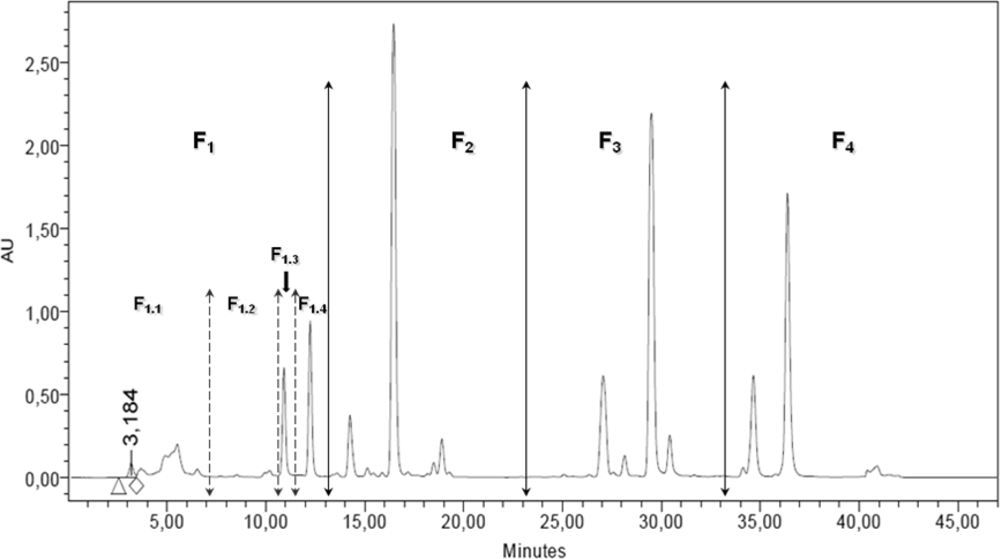
<p><xref ref-type="fig" rid="f1-marinedrugs-09-00819">Figure 1</xref> presents the <italic>DT</italic> DCM extract chromatogram obtained at 435 nm, with the definition of the fractions and sub-fractions tested on MCF-7.</p>
<p>Identification of the 11 major peaks present on the chromatogram was not performed at this step as we hypothesized that some fractions may not be active on cancer cells. The antiproliferative activity of each fraction was studied on the MCF-7 cell line as it was the most sensitive to the starting DCM extract, and grew faster than LNCaP. <xref ref-type="table" rid="t2-marinedrugs-09-00819">Table 2</xref> presents the antiproliferative activity of the four <italic>DT</italic> DCM fractions and the four F1 sub-fractions on MCF-7.</p>
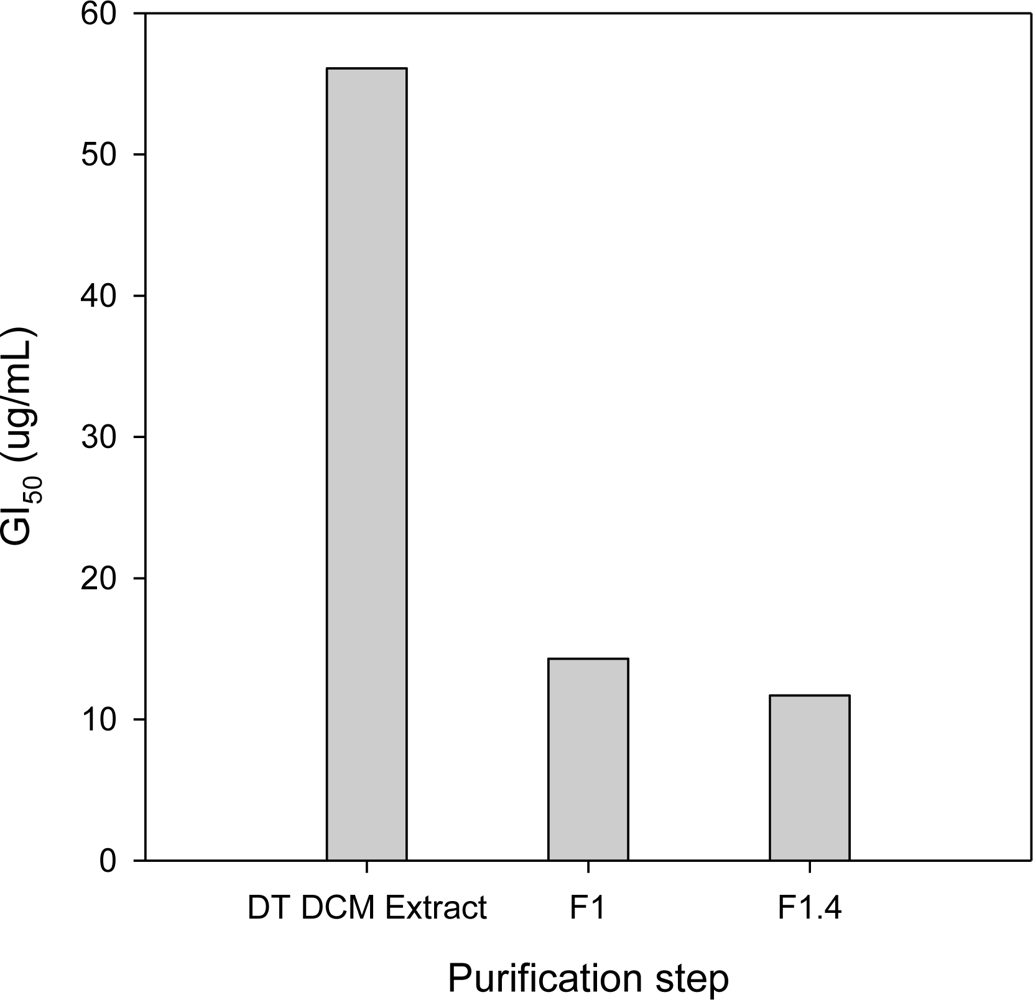
<p>Fraction 1 (F<sub>1</sub>) was identified as the only active fraction in the <italic>DT</italic> DCM extract, with a GI<sub>50</sub> = 14.3 μg·mL<sup>−1</sup>. Decrease of the GI<sub>50</sub> value compared to the DCM extract confirmed that this fraction was concentrated in active molecules (<xref ref-type="table" rid="t2-marinedrugs-09-00819">Table 2</xref>). The GI<sub>50</sub> of F<sub>2</sub>, F<sub>3</sub> and F<sub>4</sub> were superior to 100 μg·mL<sup>−1</sup> (<xref ref-type="table" rid="t2-marinedrugs-09-00819">Table 2</xref>), indicating that they did not contain potent antiproliferative molecules. F<sub>1.2</sub>, F<sub>1.3</sub> and F<sub>1.4</sub> strongly inhibited MCF-7 growth, with GI<sub>50</sub> values of 20.5, 18.9 and 11.7 μg·mL<sup>−1</sup>, respectively (<xref ref-type="table" rid="t2-marinedrugs-09-00819">Table 2</xref>). The GI<sub>50</sub> values of these three sub-fractions were in the range of that of the F<sub>1</sub> fraction, and confirmed that the three sub-fractions contained active molecules (<xref ref-type="table" rid="t2-marinedrugs-09-00819">Table 2</xref>). The GI<sub>50</sub> of F<sub>1.1</sub> was greater than 40 μg·mL<sup>−1</sup>. <xref ref-type="fig" rid="f2-marinedrugs-09-00819">Figure 2</xref> presents the GI<sub>50</sub> (μg·mL<sup>−1</sup>) measured on MCF-7 with the starting <italic>DT</italic> DCM extract, the F<sub>1</sub> fraction and the F<sub>1.4</sub> subfraction.</p>
<p>The GI<sub>50</sub> decreased with purification steps, indicating that the antiproliferative activity measured in the initial crude extract was not due to a synergistic action between several molecules in the mixture.</p></sec>
<sec>
<label>2.3.</label>
<title>Effect of the F<sub>1.4</sub> Sub-Fraction on MCF-7 Growth</title>
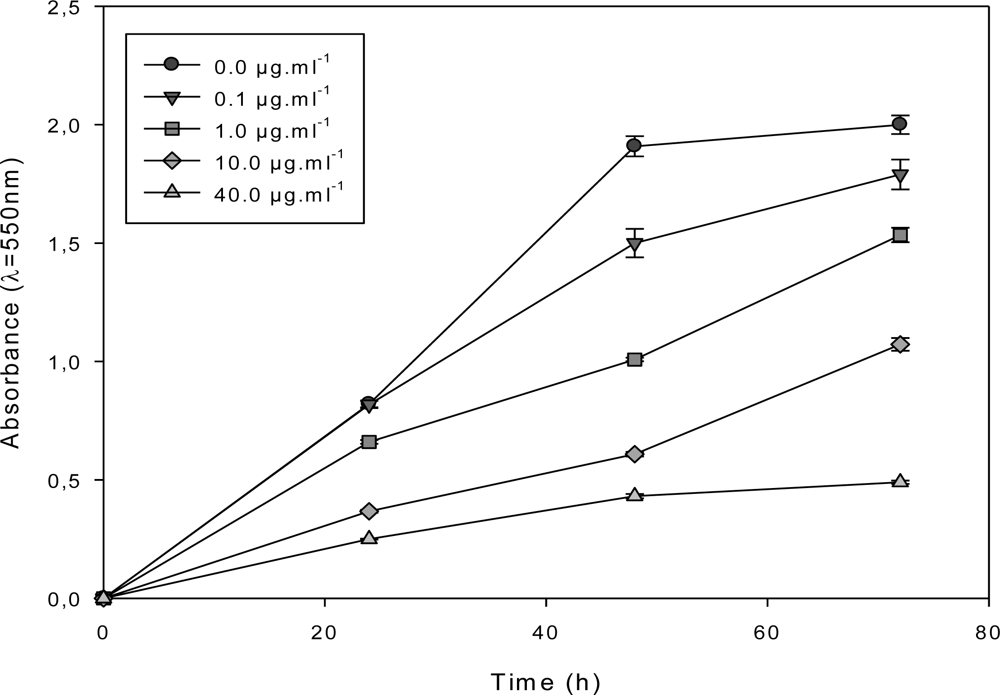
<p>The antiproliferative activity of the most active sub-fraction, F<sub>1.4</sub>, was assessed on MCF-7 continuously exposed for 72 h to increasing concentrations in the cell culture medium. F<sub>1.4</sub> inhibited MCF-7 growth at a concentration as low as 0.1 μg·mL<bold><sup>−</sup></bold><sup>1</sup> and in a dose-dependent manner from 0.1 to 40 μg·mL<sup>−1</sup> (<xref ref-type="fig" rid="f3-marinedrugs-09-00819">Figure 3</xref>).</p>
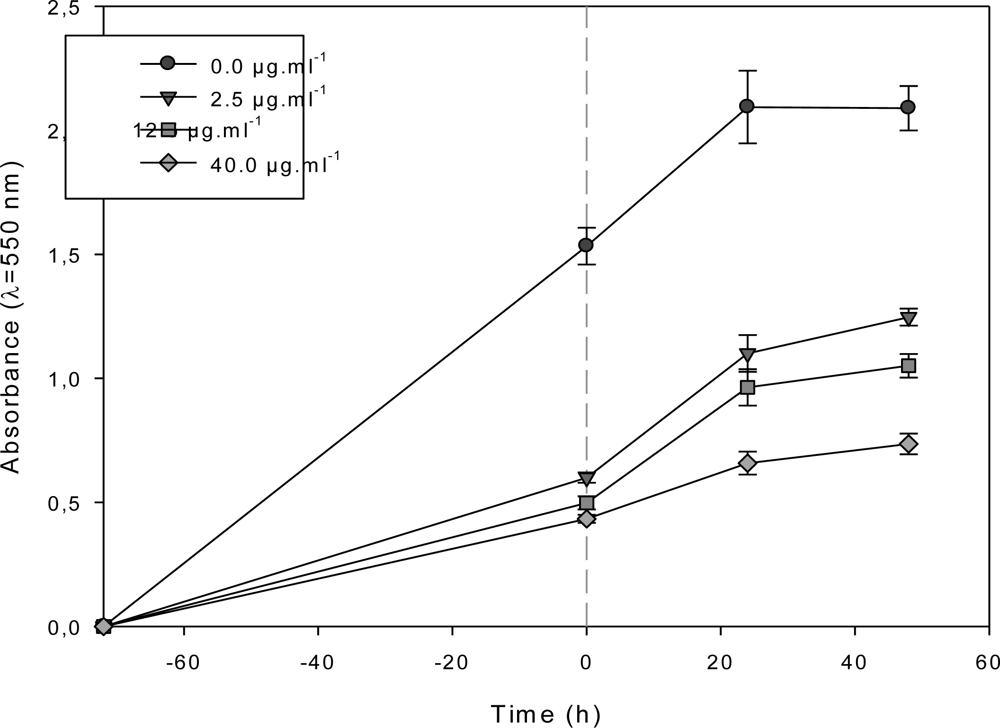
<p>A concentration of 40 μg·mL<sup>−1</sup> was necessary to observe a cytostatic activity on MCF-7 (<xref ref-type="fig" rid="f3-marinedrugs-09-00819">Figure 3</xref>). MCF-7 cells were also exposed for 72 h to various concentrations of F<sub>1.4</sub> in the cell culture medium, before changing the medium to a fresh control cell culture medium (<xref ref-type="fig" rid="f4-marinedrugs-09-00819">Figure 4</xref>).</p>
<p>At all tested concentrations, the growth rate increased when the culture medium containing F<sub>1.4</sub> was replaced with fresh culture medium, demonstrating that F<sub>1.4</sub> exerted a strong antiproliferative effect, without however killing all cells, in the range of the pharmacological concentrations studied.</p></sec>
<sec>
<label>2.4.</label>
<title>Characterization of the Antiproliferative Molecule Contained in F<sub>1.4</sub></title>
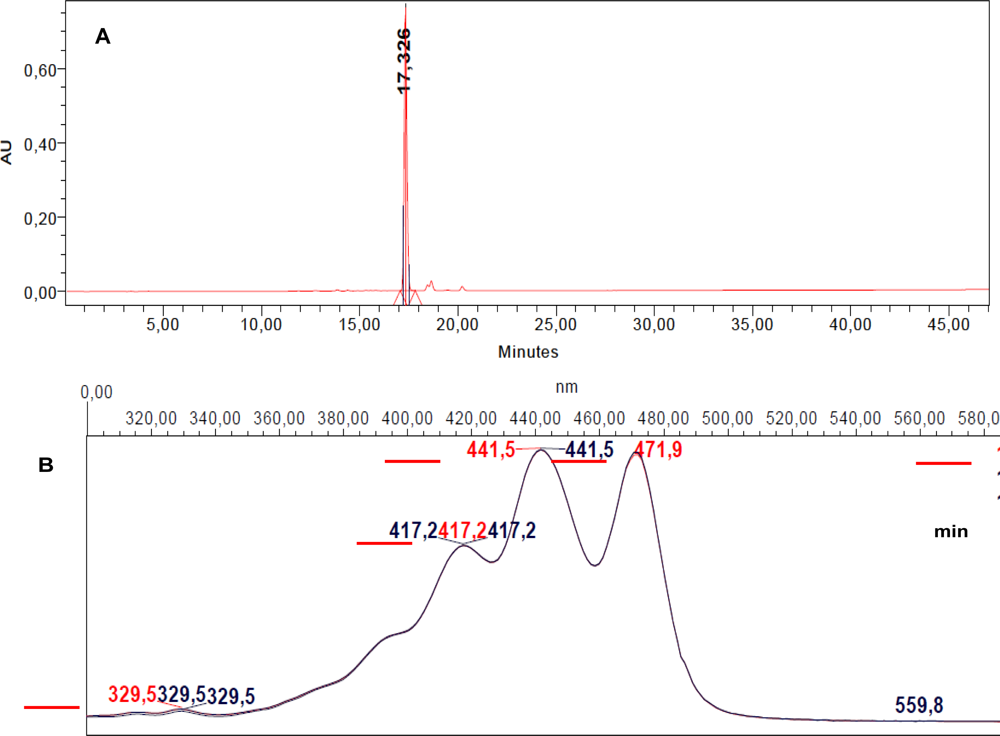
<p>Analytical RP-HPLC at 435 nm of F<sub>1.4</sub> demonstrated that 95% of this fraction corresponded to a single molecule M eluting at <italic>t</italic> = 17.326 min (<xref ref-type="fig" rid="f5-marinedrugs-09-00819">Figure 5</xref>).</p>
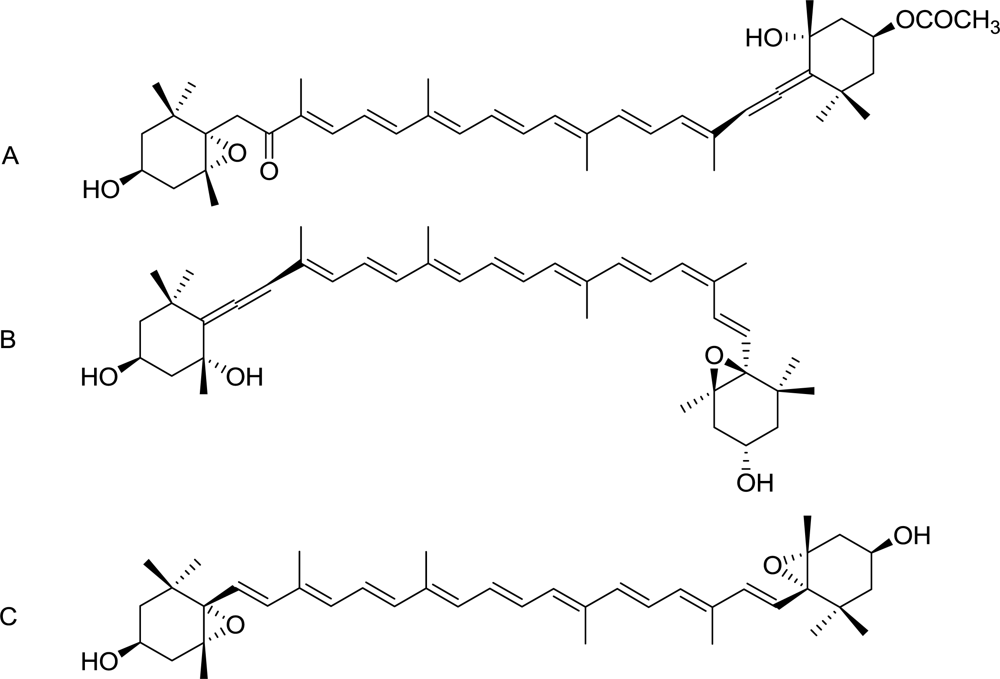
<p>Iterative semi-preparative RP-HPLC allowed the collection of 0.910 mg of F<sub>1.4</sub> from 1500 mg freeze-dried <italic>DT</italic> cells, indicating that M represented 0.0576% (w:w) of the freeze-dried microalgae content, considering the extraction yield to be 100%. The absorption spectrum of M was characteristic of a carotenoid pigment and presented maximal absorption peaks at 417.2, 441.5 and 471.9 nm, with a band III:II ratio of 96% (<xref ref-type="fig" rid="f5-marinedrugs-09-00819">Figure 5</xref>). These values were compared to data from reference spectra [<xref ref-type="bibr" rid="b16-marinedrugs-09-00819">16</xref>] which suggested that M was most probably violaxanthin, as its maximal absorption wavelengths and band III:II ratio were very close to the values measured with standard violaxanthin in ethanol. HRMS analysis unambiguously confirmed that M corresponded to violaxanthin (<xref ref-type="table" rid="t3-marinedrugs-09-00819">Table 3</xref>; <xref ref-type="fig" rid="f6-marinedrugs-09-00819">Figure 6C</xref>).</p></sec>
<sec>
<label>2.5.</label>
<title>Violaxanthin Induces Morphological and Biochemical Changes Characteristic of Early Apoptosis in MCF-7</title>
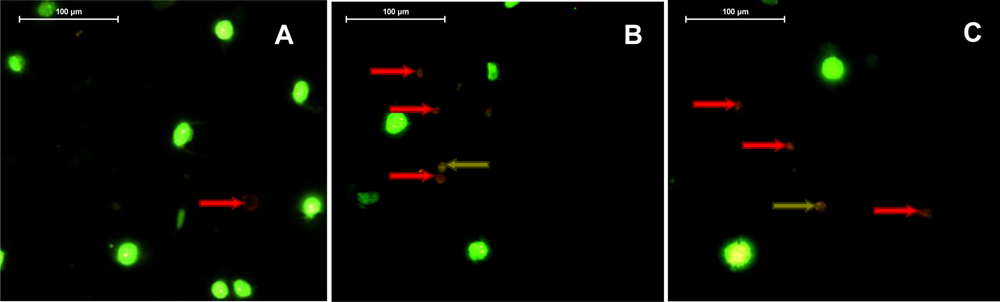
<p><xref ref-type="fig" rid="f7-marinedrugs-09-00819">Figure 7</xref> shows epifluorescence microphotographs of MCF-7 cells labeled with the DNA marker BOBO-1 (green) and Annexin-V-Alexa 568 (red) after 48 h incubation in the presence of various concentrations of violaxanthin purified from <italic>DT</italic>.</p>
<p>Only a small proportion of control cells (<xref ref-type="fig" rid="f7-marinedrugs-09-00819">Figure 7A</xref>) were identified as apoptotic (red arrows) or early necrotic (bright green spots). Violaxanthin 8 and 20 μg·mL<sup>−1</sup> (<xref ref-type="fig" rid="f7-marinedrugs-09-00819">Figures 7B and 7C</xref>, respectively) evoked MCF-7 apoptosis as indicated by the important increase in the number of cells binding annexin V without being labeled by BOBO-1. Only a few cells were identified as late necrotic after the violaxanthin treatment (green arrows).</p></sec>
<sec>
<label>2.6.</label>
<title>Violaxanthin Does Not Evoke MCF-7 DNA Fragmentation</title>
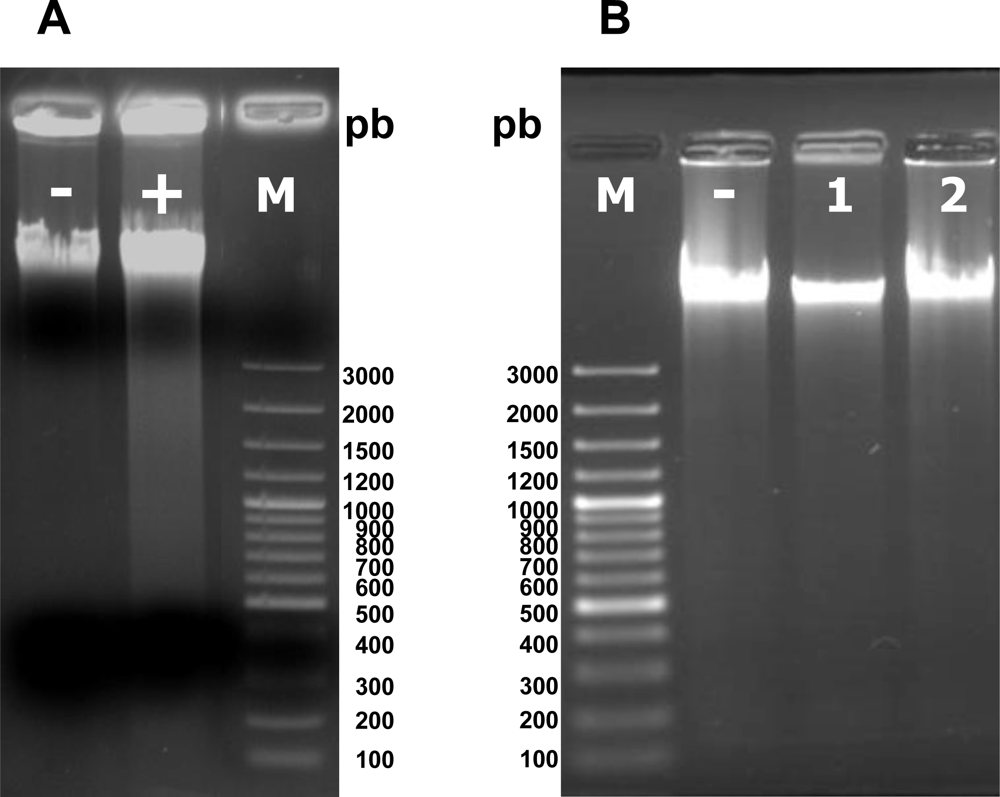
<p>Violaxanthin doses evoking phosphatidylserine translocation in MCF-7 cells did not induce DNA fragmentation, even after a 72 h treatment (<xref ref-type="fig" rid="f8-marinedrugs-09-00819">Figure 8B</xref>).</p>
<p>A higher dose of violaxanthin was tested, in the range of rational pharmacological doses (40 μg·mL<sup>−1</sup>) (66.4 μM), but no DNA fragmentation was observed even after 72 h incubation (<xref ref-type="fig" rid="f8-marinedrugs-09-00819">Figure 8</xref>).</p></sec></sec>
<sec>
<label>3.</label>
<title>Experimental Section</title>
<sec>
<label>3.1.</label>
<title>Microalgae</title>
<p><italic>Dunaliella tertiolecta</italic> (<italic>DT</italic>) belongs to the Chlorophyceae class (green microalgae). The genus <italic>Dunaliella</italic> exhibit a small ovoid unfrustulated cell (&lt;20 μm), covered of cellulose, xylans, mannans and/or glycoproteins, with two equal flagella inserted at the apexes of the cell. Chlorophyll <italic>a</italic>, chlorophyll <italic>b</italic>, β,β-carotene, neoxanthin, lutein and violaxanthin are the main pigments described in <italic>DT</italic> [<xref ref-type="bibr" rid="b17-marinedrugs-09-00819">17</xref>]. <italic>DT</italic> was selected as it does not contain fucoxanthin, which has already been extensively studied for its antiproliferative activity [<xref ref-type="bibr" rid="b9-marinedrugs-09-00819">9</xref>–<xref ref-type="bibr" rid="b15-marinedrugs-09-00819">15</xref>].</p></sec>
<sec>
<label>3.2.</label>
<title>Microalgae Culture, Collection and Storage</title>
<p>Microalgae were grown at IFREMER PBA, Nantes, France. <italic>DT</italic> strain CCMP364 (CCMP, USA) was cultivated in 10 L flasks under continuous illumination at an average light intensity of 180 μmol·m<sup>−2</sup>s<sup>−1</sup>. Growth was performed at 20 °C, in pH unregulated batch culture, in Walne (Conway) medium diluted in 0.22 μm sterile-filtered natural seawater. The <italic>DT</italic> cell suspension was harvested at the end of the exponential growth phase, and cells were separated from culture medium by soft centrifugation (4000 g, 20 min, 10 °C). Cells were frozen at −20 °C, sent to laboratory LIENSs, La Rochelle and freeze-dried at −55 °C and <italic>P</italic> &lt; 1 hPa, on a freeze-dryer equipped with a HetoLyoPro 3000 condenser and Heto cooling trap (Therma Electron Corporation, France).</p></sec>
<sec>
<label>3.3.</label>
<title>Successive Extractions in Dichloromethane, Ethanol and Water</title>
<p>In order to extract most microalgal organic molecules, on a wide range of polarity, successive extractions were performed in dichloromethane (DCM), ethanol (EtOH) and ultrapure water. A 1 g sample of freeze-dried microalgae powder was first extracted for 2 h in 100 mL DCM (1% w/v), at room temperature, under continuous shaking and in the dark. The mixture was filtered through a PVDF 0.22 μm membrane, and the DCM extract was evaporated to dryness in dark vials (45 °C, vacuum). The insoluble residue was collected, dried and successively extracted in ethanol and ultrapure water, in the same conditions, except that the water extract was collected by centrifugation (8000 g, 10 min, 4 °C) and filtered through a nitrocellulose membrane. The EtOH extract was evaporated to dryness in dark vials (45 °C, vacuum) and the aqueous extract was freeze-dried.</p></sec>
<sec sec-type="methods">
<label>3.4.</label>
<title>RP-HPLC Analysis and Fractionation</title>
<p>The RP-HPLC system was composed of a binary pump (Waters, W600), an autosampler (Waters, W717), a thermostated (20 °C) column compartment, and a photodiode-array detector (Waters, W486). Analytical RP-HPLC of the DCM extract was performed on a 20 μL sample injected in a Phenomenex Luna C18 (2) analytical column (250 × 4.6 mm, 10 μm), the mobile phase consisting of a ternary gradient of solvent A (Methanol/water (80/20)); solvent B (Acetonitrile/water (90/10)) and solvent C (ethyl acetate). The gradient flow program was adapted from Jeffrey and collaborators [<xref ref-type="bibr" rid="b18-marinedrugs-09-00819">18</xref>], as follows: 0 min, 100% A; 3 min, 100% B; 35 min, 30% B and 70% C; 38 min, 100% C; 41 min, 100% C; 43 min, 100% B; 45 min, 100% A. The flow rate was 1.0 mL·min<sup>−1</sup> and elution was monitored at 435 nm. Fractionation of the active extract was performed in semi-preparative conditions, using a semi-preparative Phenomenex Luna C18 (2) column (250 × 10 mm, 10 μm) with a flow rate fixed at 5 mL·min<sup>−1</sup>.</p></sec>
<sec>
<label>3.5.</label>
<title>Cell Culture</title>
<p>MCF-7 and MDA-MB-231 human mammary carcinoma cell lines, as well as A549 human lung adenocarcinoma cell line (LGC Standards, France) were grown as monolayers, at 37 °C in a 5% CO<sub>2</sub>–95% air humidified atmosphere, in DMEM (Gibco, France) supplemented with 10% heat-inactivated (56 °C, 30 min) FCS (Dutscher, France) to which penicillin 100 U·mL<sup>−1</sup> and streptomycin 100 μg·mL<sup>−1</sup> were added. LNCaP human prostatic carcinoma was grown as monolayer in RPMI (devoid of phenol red) supplemented with 10% heat-inactivated (56 °C, 30 min) FCS, penicillin 100 U·mL<sup>−1</sup> and streptomycin 100 μg·mL<sup>−1</sup>.</p></sec>
<sec>
<label>3.6.</label>
<title>Cell Viability Assay</title>
<p>The algal extracts and related fractions were evaporated to dryness and stock solutions were prepared in DMSO before being diluted in the cell culture medium. The final DMSO concentration was lower than 1% and tested as a negative control. Cell viability was studied using the MTT assay.</p></sec>
<sec>
<label>3.7.</label>
<title>Detection of Early and Late Steps of Apoptosis</title>
<sec>
<label>3.7.1.</label>
<title>Phosphatidylserines Translocation and DNA Staining</title>
<p>Ten thousand cells were grown for 24 h on epifluorescence live cell array slides (Nunc, Dutscher, France) and treated for 72 h with control culture medium or microalgae extracts diluted in cell culture medium. Phosphatidylserines translocation onto the outer side of the plasma membrane of early apoptotic cells was detected using Annexin-V-Alexa 568 fluorochrome (Roche, France). Since necrotic cells also expose phosphatidylserines because of the loss of membrane integrity, necrotic cells were distinguished from apoptotic cells by BOBO-1 labeling. BOBO-1 is a DNA-binding fluorochrome, excluded from living and apoptotic cells. Cells were incubated for 15 min at 20 °C with the labeling mix solution, and observed using a Leica epifluorescence microscope, equipped with an I3 epifluorescence filter block (blue excitation 450–490 nm) and a numeric camera. Early necrotic cells, having lost their cytoplasmic membrane integrity but with a round shaped nucleus, were labeled by BOBO-1 only and appeared as round green spots. Early apopotic cells, having exposed phosphatidylserines but with no cytoplasmic membrane damages, appeared as red spots. Late necrotic cells exhibited a red and green co-staining and a shrunk nucleus.</p></sec>
<sec>
<label>3.7.2.</label>
<title>DNA Fragmentation</title>
<p>DNA was extracted and purified from cancer cells using a combination of two kits (Macherey-Nagel). In a first step, 10<sup>6</sup> MCF-7 cells were lysed at 70 °C for 30 min in a lysis buffer (112 μL buffer T1, 25 μL proteinase K and 112 μL buffer B3 from the “Genomic DNA from Tissue” Kit). Then, DNA was purified using 360 μL of BB buffer (“Circulating DNA from Plasma” kit), which allows the purification of high and low molecular weight DNA fragments. DNA samples (5 μg) from control cells, cells treated with violaxanthin or cell treated with a control apoptosis inducer, DIM (3,3′-Diindolylmetane), were separated by electrophoresis on a 1.5% agarose/Tris–borate–EDTA (TBE) gel, stained with ethidium bromide and compared to standards ranging from 100 to 3000 bp (Fermentas) using a UV transilluminator.</p></sec></sec>
<sec>
<label>3.8.</label>
<title>High Resolution Mass Spectrometry (HRMS)</title>
<p>Accurate molecular weight of the bioactive molecules contained in <italic>DT</italic> extracts was determined by HRMS at the “Centre Régional de Mesures Physiques de l’Ouest”, University of Rennes 1, France. The mass spectrometer was a Bruker MicrO-Tof-Q 2, equipped with an ESI source, and samples were dissolved in CH<sub>2</sub>Cl<sub>2</sub>:CH<sub>3</sub>OH (90:10).</p></sec>
<sec>
<label>3.9.</label>
<title>Chemicals and Standards</title>
<p>All solvents used in this study were HPLC grade. Standard pigments were obtained from Chromadex, France. Ultra-pure water was obtained using a Milli-Q system (Millipore, France).</p></sec></sec>
<sec sec-type="conclusions">
<label>4.</label>
<title>Conclusions</title>
<p>Breast cancer is a major cause of mortality worldwide, and the development of new drugs is necessary to reduce mortality and limit tumor resistance to chemotherapy. This study unequivocally demonstrates the strong antiproliferative activity of violaxanthin on MCF-7 human mammary cancer cells grown <italic>in vitro</italic> and suggests that violaxanthin and derivatives obtained by pharmacomodulation should be studied as possible new drugs to cure breast cancer. Violaxanthin was already identified as possibly involved in the strong antiproliferative and pro-apoptotic activity of <italic>Chlorella ellipsoidea</italic> extracts on HCT116 human colon cancer cells [<xref ref-type="bibr" rid="b19-marinedrugs-09-00819">19</xref>]. Further studies should be undertaken to define the pharmacological mechanisms involved in its antiproliferative activity in human cancer cells. In this study, violaxanthin only represented 0.0576% (w:w) of the total freeze-dried <italic>DT</italic> content, with a theoretical extraction yield of 100%. Thus, it seems unrealistic to consider that violaxanthin could be purified from <italic>DT</italic> for therapeutic applications, even if physiological studies in <italic>Dunaliella</italic> or <italic>Chlorella</italic> may be carried out to increase production yields. Moreover, there is no clear evidence that epoxycarotenoids, despite their abundance in dietary fruits and vegetables, are absorbed <italic>per os</italic> by humans [<xref ref-type="bibr" rid="b20-marinedrugs-09-00819">20</xref>]. Recent studies indicate that epoxycarotenoids are metabolized before being absorbed <italic>per os</italic> in mice [<xref ref-type="bibr" rid="b21-marinedrugs-09-00819">21</xref>], suggesting that consumption of marine microalgae as functional food to obtain epoxycarotenoids for a putative cancer prevention or treatment is most probably less beneficial. It is, however, interesting to note that the oral administration of high doses of fucoxanthin in mice does not evoke acute or chronic toxicity, except the risk of hypercholesterolemia [<xref ref-type="bibr" rid="b22-marinedrugs-09-00819">22</xref>]. Additional studies will be necessary to get a clear understanding of epoxycarotenoids pharmacology and to consider their possible use to inhibit cancer cells growth <italic>in vivo</italic>.</p></sec></body>
<back>
<ack>
<p>We are grateful to the French Cancer League (Ligue Nationale contre le Cancer) for VP’s PhD grant. We thank the French National Research Agency (ANR), the French Cancer League and the Canceropole Grand Ouest “Marine Molecules for Cancerology” for financial support. This research was also supported by European grants from the “Fonds Europeen de Developpement Regional FEDER” and the “Contrats de Projet Etat-Region CPER”. We thank Philippe Jehan from the CRMPO lab, Rennes, for HRMS analysis.</p></ack>
<fn-group><fn>
<p><italic>Samples Availability:</italic> Available from the authors.</p></fn></fn-group>
<ref-list>
<title>References</title>
<ref id="b1-marinedrugs-09-00819"><label>1.</label><citation citation-type="book"><person-group person-group-type="author"><name><surname>Kornprobst</surname><given-names>J-M</given-names></name></person-group><source>Substances Naturelles D’origine Marine: Chimiodiversité, Pharmacodiversité, Biotechnologies</source><publisher-name>Lavoisier</publisher-name><publisher-loc>Paris, France</publisher-loc><year>2005</year><comment>Volume 1</comment></citation></ref>
<ref id="b2-marinedrugs-09-00819"><label>2.</label><citation citation-type="journal"><person-group person-group-type="author"><name><surname>Folmer</surname><given-names>F</given-names></name><name><surname>Jaspars</surname><given-names>M</given-names></name><name><surname>Dicato</surname><given-names>M</given-names></name><name><surname>Diederich</surname><given-names>M</given-names></name></person-group><article-title>Photosynthetic marine organisms as a source of anticancer compounds</article-title><source>Phytochem Rev</source><year>2010</year><volume>9</volume><fpage>557</fpage><lpage>579</lpage><pub-id pub-id-type="doi">10.1007/s11101-010-9200-2</pub-id></citation></ref>
<ref id="b3-marinedrugs-09-00819"><label>3.</label><citation citation-type="journal"><person-group person-group-type="author"><name><surname>Nishino</surname><given-names>H</given-names></name><name><surname>Murakoshi</surname><given-names>M</given-names></name><name><surname>Tokuda</surname><given-names>H</given-names></name><name><surname>Satomi</surname><given-names>Y</given-names></name></person-group><article-title>Cancer prevention by carotenoids</article-title><source>Arch Biochem Biophys</source><year>2009</year><volume>483</volume><fpage>165</fpage><lpage>168</lpage><pub-id pub-id-type="doi">10.1016/j.abb.2008.09.011</pub-id><pub-id pub-id-type="pmid">18848517</pub-id></citation></ref>
<ref id="b4-marinedrugs-09-00819"><label>4.</label><citation citation-type="journal"><person-group person-group-type="author"><name><surname>Nishino</surname><given-names>H</given-names></name><name><surname>Tokuda</surname><given-names>H</given-names></name><name><surname>Murakoshi</surname><given-names>M</given-names></name><name><surname>Satomi</surname><given-names>Y</given-names></name><name><surname>Masuda</surname><given-names>M</given-names></name><name><surname>Onozuka</surname><given-names>M</given-names></name><name><surname>Yamaguchi</surname><given-names>S</given-names></name><name><surname>Takayasu</surname><given-names>J</given-names></name><name><surname>Tsuruta</surname><given-names>J</given-names></name><name><surname>Okuda</surname><given-names>M</given-names></name><etal/></person-group><article-title>Cancer prevention by natural carotenoids</article-title><source>BioFactors</source><year>2000</year><volume>13</volume><fpage>89</fpage><lpage>94</lpage><pub-id pub-id-type="doi">10.1002/biof.5520130115</pub-id><pub-id pub-id-type="pmid">11237205</pub-id></citation></ref>
<ref id="b5-marinedrugs-09-00819"><label>5.</label><citation citation-type="journal"><person-group person-group-type="author"><name><surname>Del Campo</surname><given-names>JA</given-names></name><name><surname>Moreno</surname><given-names>J</given-names></name><name><surname>Rodríguez</surname><given-names>H</given-names></name><name><surname>Vargas</surname><given-names>MA</given-names></name><name><surname>Rivas</surname><given-names>J</given-names></name><name><surname>Guerrero</surname><given-names>MG</given-names></name></person-group><article-title>Carotenoid content of chlorophycean microalgae: Factors determining lutein accumulation in <italic>Muriellopsis</italic> sp. (Chlorophyta)</article-title><source>J Biotechnol</source><year>2000</year><volume>76</volume><fpage>51</fpage><lpage>59</lpage><pub-id pub-id-type="doi">10.1016/S0168-1656(99)00178-9</pub-id><pub-id pub-id-type="pmid">10784296</pub-id></citation></ref>
<ref id="b6-marinedrugs-09-00819"><label>6.</label><citation citation-type="journal"><person-group person-group-type="author"><name><surname>Dufossé</surname><given-names>L</given-names></name><name><surname>Galaup</surname><given-names>P</given-names></name><name><surname>Yaron</surname><given-names>A</given-names></name><name><surname>Arad</surname><given-names>SM</given-names></name><name><surname>Blanc</surname><given-names>P</given-names></name><name><surname>Chidambara Murthy</surname><given-names>KN</given-names></name><name><surname>Ravishankar</surname><given-names>GA</given-names></name></person-group><article-title>Microorganisms and microalgae as sources of pigments for food use: A scientific oddity or an industrial reality</article-title><source>Trends Food Sci Technol</source><year>2005</year><volume>16</volume><fpage>389</fpage><lpage>406</lpage><pub-id pub-id-type="doi">10.1016/j.tifs.2005.02.006</pub-id></citation></ref>
<ref id="b7-marinedrugs-09-00819"><label>7.</label><citation citation-type="journal"><person-group person-group-type="author"><name><surname>Milledge</surname><given-names>JJ</given-names></name></person-group><article-title>Commercial application of microalgae other than as biofuels: A brief review</article-title><source>Rev Environ Sci Biotechnol</source><year>2010</year><volume>10</volume><fpage>31</fpage><lpage>41</lpage></citation></ref>
<ref id="b8-marinedrugs-09-00819"><label>8.</label><citation citation-type="journal"><person-group person-group-type="author"><name><surname>Cui</surname><given-names>Y</given-names></name><name><surname>Lu</surname><given-names>Z</given-names></name><name><surname>Bai</surname><given-names>L</given-names></name><name><surname>Shi</surname><given-names>Z</given-names></name><name><surname>Zhao</surname><given-names>WE</given-names></name><name><surname>Zhao</surname><given-names>B</given-names></name></person-group><article-title>β-Carotene induces apoptosis and up-regulates peroxisome proliferator-activated receptor γ expression and reactive oxygen species production in MCF-7 cancer cells</article-title><source>Eur J Cancer</source><year>2007</year><volume>43</volume><fpage>2590</fpage><lpage>2601</lpage><pub-id pub-id-type="doi">10.1016/j.ejca.2007.08.015</pub-id><pub-id pub-id-type="pmid">17911009</pub-id></citation></ref>
<ref id="b9-marinedrugs-09-00819"><label>9.</label><citation citation-type="journal"><person-group person-group-type="author"><name><surname>Kotake-Nara</surname><given-names>E</given-names></name><name><surname>Asai</surname><given-names>A</given-names></name><name><surname>Nagao</surname><given-names>A</given-names></name></person-group><article-title>Neoxanthin and fucoxanthin induce apoptosis in PC-3 human prostate cancer cells</article-title><source>Cancer Lett</source><year>2005</year><volume>220</volume><fpage>75</fpage><lpage>84</lpage><pub-id pub-id-type="doi">10.1016/j.canlet.2004.07.048</pub-id><pub-id pub-id-type="pmid">15737690</pub-id></citation></ref>
<ref id="b10-marinedrugs-09-00819"><label>10.</label><citation citation-type="journal"><person-group person-group-type="author"><name><surname>Das</surname><given-names>SK</given-names></name><name><surname>Hashimoto</surname><given-names>T</given-names></name><name><surname>Kanazawa</surname><given-names>K</given-names></name></person-group><article-title>Growth inhibition of human hepatic carcinoma HepG2 cells by fucoxanthin is associated with down-regulation of cyclin D</article-title><source>Biochim Biophys Acta Gen Subj</source><year>2008</year><volume>1780</volume><fpage>743</fpage><lpage>749</lpage><pub-id pub-id-type="doi">10.1016/j.bbagen.2008.01.003</pub-id></citation></ref>
<ref id="b11-marinedrugs-09-00819"><label>11.</label><citation citation-type="journal"><person-group person-group-type="author"><name><surname>Das</surname><given-names>SK</given-names></name><name><surname>Hashimoto</surname><given-names>T</given-names></name><name><surname>Shimizu</surname><given-names>K</given-names></name><name><surname>Yoshida</surname><given-names>T</given-names></name><name><surname>Sakai</surname><given-names>T</given-names></name><name><surname>Sowa</surname><given-names>Y</given-names></name><name><surname>Komoto</surname><given-names>A</given-names></name><name><surname>Kanazawa</surname><given-names>K</given-names></name></person-group><article-title>Fucoxanthin induces cell cycle arrest at G0/G1 phase in human colon carcinoma cells through up-regulation of p21WAF1/Cip1</article-title><source>Biochim Biophys Acta Gen Subj</source><year>2005</year><volume>1726</volume><fpage>328</fpage><lpage>335</lpage><pub-id pub-id-type="doi">10.1016/j.bbagen.2005.09.007</pub-id></citation></ref>
<ref id="b12-marinedrugs-09-00819"><label>12.</label><citation citation-type="journal"><person-group person-group-type="author"><name><surname>Hosokawa</surname><given-names>M</given-names></name><name><surname>Kudo</surname><given-names>M</given-names></name><name><surname>Maeda</surname><given-names>H</given-names></name><name><surname>Kohno</surname><given-names>H</given-names></name><name><surname>Tanaka</surname><given-names>T</given-names></name><name><surname>Miyashita</surname><given-names>K</given-names></name></person-group><article-title>Fucoxanthin induces apoptosis and enhances the antiproliferative effect of the PPARγ ligand, troglitazone, on colon cancer cells</article-title><source>Biochim Biophys Acta Gen Subj</source><year>2004</year><volume>1675</volume><fpage>113</fpage><lpage>119</lpage><pub-id pub-id-type="doi">10.1016/j.bbagen.2004.08.012</pub-id></citation></ref>
<ref id="b13-marinedrugs-09-00819"><label>13.</label><citation citation-type="journal"><person-group person-group-type="author"><name><surname>Hosokawa</surname><given-names>M</given-names></name><name><surname>Wanezaki</surname><given-names>S</given-names></name><name><surname>Miyauchi</surname><given-names>K</given-names></name><name><surname>Kurihara</surname><given-names>H</given-names></name><name><surname>Kohno</surname><given-names>H</given-names></name><name><surname>Kawabata</surname><given-names>J</given-names></name><name><surname>Odashima</surname><given-names>S</given-names></name><name><surname>Takahashi</surname><given-names>K</given-names></name></person-group><article-title>Apoptosis-inducing effect of fucoxanthin on human leukemia cell line HL-60</article-title><source>Food Sci Technol Res</source><year>1999</year><volume>5</volume><fpage>243</fpage><lpage>246</lpage><pub-id pub-id-type="doi">10.3136/fstr.5.243</pub-id></citation></ref>
<ref id="b14-marinedrugs-09-00819"><label>14.</label><citation citation-type="journal"><person-group person-group-type="author"><name><surname>Moreau</surname><given-names>D</given-names></name><name><surname>Tomasoni</surname><given-names>C</given-names></name><name><surname>Jacquot</surname><given-names>C</given-names></name><name><surname>Kaas</surname><given-names>R</given-names></name><name><surname>Le Guedes</surname><given-names>R</given-names></name><name><surname>Cadoret</surname><given-names>JP</given-names></name><name><surname>Muller-Feuga</surname><given-names>A</given-names></name><name><surname>Kontiza</surname><given-names>I</given-names></name><name><surname>Vagias</surname><given-names>C</given-names></name><name><surname>Roussis</surname><given-names>V</given-names></name><etal/></person-group><article-title>Cultivated microalgae and the carotenoid fucoxanthin from <italic>Odontella aurita</italic> as potent anti-proliferative agents in bronchopulmonary and epithelial cell lines</article-title><source>Environ Toxicol Pharm</source><year>2006</year><volume>22</volume><fpage>97</fpage><lpage>103</lpage><pub-id pub-id-type="doi">10.1016/j.etap.2006.01.004</pub-id></citation></ref>
<ref id="b15-marinedrugs-09-00819"><label>15.</label><citation citation-type="journal"><person-group person-group-type="author"><name><surname>Nakazawa</surname><given-names>Y</given-names></name><name><surname>Sashima</surname><given-names>T</given-names></name><name><surname>Hosokawa</surname><given-names>M</given-names></name><name><surname>Miyashita</surname><given-names>K</given-names></name></person-group><article-title>Comparative evaluation of growth inhibitory effect of stereoisomers of fucoxanthin in human cancer cell lines</article-title><source>J Funct Foods</source><year>2009</year><volume>1</volume><fpage>88</fpage><lpage>97</lpage><pub-id pub-id-type="doi">10.1016/j.jff.2008.09.015</pub-id></citation></ref>
<ref id="b16-marinedrugs-09-00819"><label>16.</label><citation citation-type="book"><person-group person-group-type="author"><name><surname>Jeffrey</surname><given-names>SW</given-names></name><name><surname>Mantoura</surname><given-names>RFC</given-names></name><name><surname>Wright</surname><given-names>SW</given-names></name></person-group><source>Phytoplankton Pigments in Oceanography</source><publisher-name>UNESCO Publishing</publisher-name><publisher-loc>Paris, France</publisher-loc><year>1997</year><fpage>458</fpage><lpage>553</lpage></citation></ref>
<ref id="b17-marinedrugs-09-00819"><label>17.</label><citation citation-type="book"><person-group person-group-type="author"><name><surname>Jeffrey</surname><given-names>SW</given-names></name><name><surname>Mantoura</surname><given-names>RFC</given-names></name><name><surname>Wright</surname><given-names>SW</given-names></name></person-group><source>Phytoplankton Pigments in Oceanography</source><publisher-name>UNESCO Publishing</publisher-name><publisher-loc>Paris, France</publisher-loc><year>1997</year><fpage>292</fpage></citation></ref>
<ref id="b18-marinedrugs-09-00819"><label>18.</label><citation citation-type="book"><person-group person-group-type="author"><name><surname>Jeffrey</surname><given-names>SW</given-names></name><name><surname>Mantoura</surname><given-names>RFC</given-names></name><name><surname>Wright</surname><given-names>SW</given-names></name></person-group><source>Phytoplankton Pigments in Oceanography</source><publisher-name>UNESCO Publishing</publisher-name><publisher-loc>Paris, France</publisher-loc><year>1997</year><fpage>331</fpage></citation></ref>
<ref id="b19-marinedrugs-09-00819"><label>19.</label><citation citation-type="journal"><person-group person-group-type="author"><name><surname>Cha</surname><given-names>KH</given-names></name><name><surname>Koo</surname><given-names>SY</given-names></name><name><surname>Lee</surname><given-names>D</given-names></name></person-group><article-title>Antiproliferative effects of carotenoids extracted from <italic>Chlorella ellipsoidea</italic> and <italic>Chlorella vulgaris</italic> on human colon cancer cells</article-title><source>J Agric Food Chem</source><year>2008</year><volume>56</volume><fpage>10521</fpage><lpage>10526</lpage><pub-id pub-id-type="doi">10.1021/jf802111x</pub-id><pub-id pub-id-type="pmid">18942838</pub-id></citation></ref>
<ref id="b20-marinedrugs-09-00819"><label>20.</label><citation citation-type="journal"><person-group person-group-type="author"><name><surname>Barua</surname><given-names>AB</given-names></name></person-group><article-title>Intestinal absorption of epoxy-β-carotenes by humans</article-title><source>Biochem J</source><year>1999</year><volume>339</volume><fpage>359</fpage><lpage>362</lpage><pub-id pub-id-type="doi">10.1042/0264-6021:3390359</pub-id><pub-id pub-id-type="pmid">10191267</pub-id></citation></ref>
<ref id="b21-marinedrugs-09-00819"><label>21.</label><citation citation-type="journal"><person-group person-group-type="author"><name><surname>Hashimoto</surname><given-names>T</given-names></name><name><surname>Ozaki</surname><given-names>Y</given-names></name><name><surname>Taminato</surname><given-names>M</given-names></name><name><surname>Das</surname><given-names>S</given-names></name><name><surname>Mizuno</surname><given-names>M</given-names></name><name><surname>Yoshimura</surname><given-names>K</given-names></name><name><surname>Maoka</surname><given-names>T</given-names></name><name><surname>Kanazawa</surname><given-names>K</given-names></name></person-group><article-title>The distribution and accumulation of fucoxanthin and its metabolites after oral administration in mice</article-title><source>Br J Nutr</source><year>2009</year><volume>102</volume><fpage>242</fpage><lpage>248</lpage><pub-id pub-id-type="doi">10.1017/S0007114508199007</pub-id><pub-id pub-id-type="pmid">19173766</pub-id></citation></ref>
<ref id="b22-marinedrugs-09-00819"><label>22.</label><citation citation-type="journal"><person-group person-group-type="author"><name><surname>Beppu</surname><given-names>F</given-names></name><name><surname>Niwano</surname><given-names>Y</given-names></name><name><surname>Sato</surname><given-names>E</given-names></name><name><surname>Kohno</surname><given-names>M</given-names></name><name><surname>Tsukui</surname><given-names>T</given-names></name><name><surname>Hosokawa</surname><given-names>M</given-names></name><name><surname>Miyashita</surname><given-names>K</given-names></name></person-group><article-title><italic>In vitro</italic> and <italic>in vivo</italic> evaluation of mutagenicity of fucoxanthin (FX) and its metabolite fucoxanthinol (FXOH)</article-title><source>J Toxicol Sci</source><year>2009</year><volume>34</volume><fpage>693</fpage><lpage>698</lpage><pub-id pub-id-type="doi">10.2131/jts.34.693</pub-id><pub-id pub-id-type="pmid">19952505</pub-id></citation></ref></ref-list>
<sec sec-type="display-objects">
<title>Figures and Tables</title>
<fig id="f1-marinedrugs-09-00819" position="float">
<label>Figure 1.</label>
<caption>
<p>RP-HPLC chromatogram at 435 nm of <italic>Dunaliella tertiolecta</italic> (<italic>DT</italic>) DCM extract. Definition of the four fractions and the four sub-fractions to be collected by semi-preparative RP-HPLC.</p></caption>
<graphic xlink:href="marinedrugs-09-00819f1.gif"/></fig>
<fig id="f2-marinedrugs-09-00819" position="float">
<label>Figure 2.</label>
<caption>
<p>GI<sub>50</sub> (μg·mL<sup>−1</sup>) of <italic>DT</italic> DCM extract, F<sub>1</sub> fraction and F<sub>1.4</sub> sub-fraction on MCF-7.</p></caption>
<graphic xlink:href="marinedrugs-09-00819f2.gif"/></fig>
<fig id="f3-marinedrugs-09-00819" position="float">
<label>Figure 3.</label>
<caption>
<p>Growth kinetics of MCF-7 continuously treated with the <italic>DT</italic> DCM sub-fraction F<sub>1.4.</sub></p></caption>
<graphic xlink:href="marinedrugs-09-00819f3.gif"/></fig>
<fig id="f4-marinedrugs-09-00819" position="float">
<label>Figure 4.</label>
<caption>
<p>Growth kinetics of MCF-7 during discontinuous exposure to the <italic>DT</italic> DCM sub-fraction F<sub>1.4</sub> Change to control medium was made at <italic>t</italic><sub>0</sub> (gray dots).</p></caption>
<graphic xlink:href="marinedrugs-09-00819f4.gif"/></fig>
<fig id="f5-marinedrugs-09-00819" position="float">
<label>Figure 5.</label>
<caption>
<p>(<bold>A</bold>) RP-HPLC chromatogram of fraction F<sub>1.4</sub> at 435 nm. F<sub>1.4</sub> is mainly composed of a single molecule M eluting at <italic>t</italic> = 17.326 min; (<bold>B</bold>) Absorption spectrum of M at <italic>tr</italic> = 17.23, 17.33 and 17.50 min (peak start, peak maximum, peak end).</p></caption>
<graphic xlink:href="marinedrugs-09-00819f5.gif"/></fig>
<fig id="f6-marinedrugs-09-00819" position="float">
<label>Figure 6.</label>
<caption>
<p>Chemical structures of (<bold>A</bold>) fucoxanthin, (<bold>B</bold>) neoxanthin and (<bold>C</bold>) violaxanthin.</p></caption>
<graphic xlink:href="marinedrugs-09-00819f6.gif"/></fig>
<fig id="f7-marinedrugs-09-00819" position="float">
<label>Figure 7.</label>
<caption>
<p>Violaxanthin induces apoptosis of MCF-7 cells. Cells were incubated for 48 h in the presence of 0, 8 or 20 μg·mL<sup>−1</sup> of violaxanthin (<bold>A</bold>, <bold>B</bold> and <bold>C</bold>, respectively). Fluorochromes: BOBO-1 (green) and Annexin-V-Alexa 568 (red).</p></caption>
<graphic xlink:href="marinedrugs-09-00819f7.gif"/></fig>
<fig id="f8-marinedrugs-09-00819" position="float">
<label>Figure 8.</label>
<caption>
<p>(<bold>A</bold>) Agarose gel electrophoresis of DNA extracted from MCF-7 cells incubated for 72 h in the absence (lane –) or presence of 3,3′-Diindolylmethane 50 μM (DIM, control apoptosis inducer) (lane +); (<bold>B</bold>) Agarose gel electrophoresis of DNA extracted from MCF-7 cells treated with violaxanthin. MCF-7 cells were incubated for 72 h in the absence (lane –) or presence of violaxanthin 10 μg·mL<sup>−1</sup> (lane 1) and 40 μg·mL<sup>−1</sup> (lane 2).</p></caption>
<graphic xlink:href="marinedrugs-09-00819f8.gif"/></fig>
<table-wrap id="t1-marinedrugs-09-00819" position="float">
<label>Table 1.</label>
<caption>
<p>GI<sub>50</sub> (μg·mL<sup>−1</sup>) of <italic>Dunaliella tertiolecta</italic> extracts on four cancer cell lines. EtOH: ethanol; DCM: dichloromethane; ≫ means GI<sub>50</sub> &gt; 100 μg·mL<sup>−1</sup>.</p></caption>
<table frame="hsides" rules="groups">
<thead>
<tr>
<th align="center" valign="middle" rowspan="2"><bold>Extraction solvent</bold></th>
<th colspan="4" align="center" valign="bottom"><bold>Cell line</bold>
<hr/></th></tr>
<tr>
<th align="center" valign="bottom"><bold>MCF-7</bold></th>
<th align="center" valign="bottom"><bold>MDA-MB-231</bold></th>
<th align="center" valign="bottom"><bold>A549</bold></th>
<th align="center" valign="bottom"><bold>LNCaP</bold></th></tr></thead>
<tbody>
<tr>
<td align="center" valign="middle">Water</td>
<td align="center" valign="middle">≫</td>
<td align="center" valign="middle">≫</td></tr>
<tr>
<td align="center" valign="middle">EtOH</td>
<td align="center" valign="middle">61.5</td>
<td align="center" valign="middle">≫</td>
<td align="center" valign="middle">≫</td></tr>
<tr>
<td align="center" valign="middle">DCM</td>
<td align="center" valign="middle">56.1</td>
<td align="center" valign="middle">≫</td>
<td align="center" valign="middle">60.9</td></tr></tbody></table></table-wrap>
<table-wrap id="t2-marinedrugs-09-00819" position="float">
<label>Table 2.</label>
<caption>
<p>GI<sub>50</sub> (μg·mL<sup>−1</sup>) of <italic>DT</italic> DCM fractions and sub-fractions on the MCF-7 cell line. ≫ means GI<sub>50</sub> &gt; 100 μg·mL<sup>−1</sup>; &gt; means GI<sub>50</sub> &gt; 40 μg·mL<sup>−1</sup>.</p></caption>
<table frame="hsides" rules="rows">
<tbody>
<tr>
<td align="left" valign="top"><bold><italic>DT</italic> DCM fractions</bold></td>
<td align="center" valign="middle"><bold>F<sub>1</sub></bold></td>
<td align="center" valign="middle"><bold>F<sub>2</sub></bold></td>
<td align="center" valign="middle"><bold>F<sub>3</sub></bold></td>
<td align="center" valign="middle"><bold>F<sub>4</sub></bold></td></tr>
<tr>
<td align="center" valign="middle">  GI<sub>50</sub> (μg·mL<sup>−1</sup>)</td>
<td align="center" valign="middle">14.3</td>
<td align="center" valign="middle">≫</td>
<td align="center" valign="middle">≫</td></tr>
<tr>
<td align="left" valign="top"><bold><italic>DT</italic> DCM sub-fractions</bold></td>
<td align="center" valign="middle"><bold>F<sub>1.1</sub></bold></td>
<td align="center" valign="middle"><bold>F<sub>1.2</sub></bold></td>
<td align="center" valign="middle"><bold>F<sub>1.3</sub></bold></td>
<td align="center" valign="middle"><bold>F<sub>1.4</sub></bold></td></tr>
<tr>
<td align="center" valign="bottom">  GI<sub>50</sub> (μg·mL<sup>−1</sup>)</td>
<td align="center" valign="middle">&gt;</td>
<td align="center" valign="middle">20.5</td>
<td align="center" valign="middle">18.9</td>
<td align="center" valign="middle">11.7</td></tr>
<tr>
<td align="center" valign="top">  SEM GI<sub>50</sub> (μg·mL<sup>−1</sup>)</td>
<td align="center" valign="middle"/>
<td align="center" valign="middle">2.2</td>
<td align="center" valign="middle">8.85</td>
<td align="center" valign="middle">0.2</td></tr></tbody></table></table-wrap>
<table-wrap id="t3-marinedrugs-09-00819" position="float">
<label>Table 3.</label>
<caption>
<p>High resolution mass spectrometry (HRMS) identification of F<sub>1.4</sub>.</p></caption>
<table frame="hsides" rules="groups">
<thead>
<tr>
<th colspan="2" align="center" valign="bottom"><bold>Lead compound F<sub>1.4</sub></bold></th></tr></thead>
<tbody>
<tr>
<td align="left" valign="top">Molecular formula</td>
<td align="left" valign="middle">[M + Na]<sup>+</sup> (C<sub>40</sub>H<sub>56</sub>O<sub>4</sub>Na)</td></tr>
<tr>
<td align="left" valign="top">Theoretical molecular weight</td>
<td align="left" valign="middle">623.40763</td></tr>
<tr>
<td align="left" valign="top"><italic>z</italic></td>
<td align="left" valign="middle">1</td></tr>
<tr>
<td align="left" valign="top">Theoretical <italic>m/z</italic> value</td>
<td align="left" valign="middle">623.40708</td></tr>
<tr>
<td align="left" valign="top">Experimental <italic>m/z</italic> value [M + Na]</td>
<td align="left" valign="middle">623.4068 (0 ppm)</td></tr></tbody></table></table-wrap></sec></back></article>