<?xml version="1.0" encoding="UTF-8"?>
<!DOCTYPE article PUBLIC "-//NLM//DTD Journal Publishing DTD v2.3 20070202//EN" "journalpublishing.dtd">
<article xmlns:xlink="http://www.w3.org/1999/xlink" xml:lang="en" article-type="research-article">
<front>
<journal-meta>
<journal-id journal-id-type="publisher-id">MD</journal-id>
<journal-title>Marine Drugs</journal-title>
<abbrev-journal-title>MD</abbrev-journal-title>
<issn pub-type="epub">1660-3397</issn>
<publisher>
<publisher-name>Molecular Diversity Preservation International</publisher-name></publisher></journal-meta>
<article-meta>
<article-id pub-id-type="doi">10.3390/md9020256</article-id>
<article-id pub-id-type="publisher-id">marinedrugs-09-00256</article-id>
<article-categories>
<subj-group>
<subject>Article</subject></subj-group></article-categories>
<title-group>
<article-title>Synthesis of 1-Substituted Carbazolyl-1,2,3,4-tetrahydro- and Carbazolyl-3,4-dihydro-β-carboline Analogs as Potential Antitumor Agents</article-title></title-group>
<contrib-group>
<contrib contrib-type="author">
<name><surname>Shen</surname><given-names>Ya-Ching</given-names></name><xref ref-type="aff" rid="af1-marinedrugs-09-00256"><sup>1</sup></xref><xref ref-type="corresp" rid="c1-marinedrugs-09-00256"><sup>*</sup></xref></contrib>
<contrib contrib-type="author">
<name><surname>Chang</surname><given-names>Yao-To</given-names></name><xref ref-type="aff" rid="af1-marinedrugs-09-00256"><sup>1</sup></xref></contrib>
<contrib contrib-type="author">
<name><surname>Lin</surname><given-names>Chun-Ling</given-names></name><xref ref-type="aff" rid="af1-marinedrugs-09-00256"><sup>1</sup></xref></contrib>
<contrib contrib-type="author">
<name><surname>Liaw</surname><given-names>Chia-Ching</given-names></name><xref ref-type="aff" rid="af1-marinedrugs-09-00256"><sup>1</sup></xref></contrib>
<contrib contrib-type="author">
<name><surname>Kuo</surname><given-names>Yao Haur</given-names></name><xref ref-type="aff" rid="af2-marinedrugs-09-00256"><sup>2</sup></xref></contrib>
<contrib contrib-type="author">
<name><surname>Tu</surname><given-names>Lan-Chun</given-names></name><xref ref-type="aff" rid="af3-marinedrugs-09-00256"><sup>3</sup></xref></contrib>
<contrib contrib-type="author">
<name><surname>Yeh</surname><given-names>Sheau Farn</given-names></name><xref ref-type="aff" rid="af3-marinedrugs-09-00256"><sup>3</sup></xref></contrib>
<contrib contrib-type="author">
<name><surname>Chern</surname><given-names>Ji-Wang</given-names></name><xref ref-type="aff" rid="af1-marinedrugs-09-00256"><sup>1</sup></xref></contrib></contrib-group>
<aff id="af1-marinedrugs-09-00256">
<label>1</label> School of Pharmacy, National Taiwan University, Taipei 100, Taiwan; E-Mails: <email>ato@kiss99.com</email> (Y.-T.C.); <email>6850101@gmail.com</email> (C.-L.L.); <email>biogodas@hotmail.com</email> (C.-C.L.); <email>jwchern@ntu.edu.tw</email> (J.-W.C.)</aff>
<aff id="af2-marinedrugs-09-00256">
<label>2</label> National Research Institute of Chinese Medicine, Taipei 112, Taiwan; E-Mail: <email>kuoyh@nricm.edu.tw</email></aff>
<aff id="af3-marinedrugs-09-00256">
<label>3</label> Institute of Biochemistry, National Yang-Ming University, Taipei 112, Taiwan; E-Mail: <email>fyeh@ym.edu.tw</email> (S.F.Y.)</aff>
<author-notes>
<corresp id="c1-marinedrugs-09-00256">
<label>*</label> Author to whom correspondence should be addressed; E-Mail: <email>ycshen@ntu.edu.tw</email>; Tel.: +886-2-23123456 (ext.) 62226; Fax: +886-2-23919098.</corresp></author-notes>
<pub-date pub-type="collection">
<year>2011</year></pub-date>
<pub-date pub-type="epub">
<day>10</day>
<month>2</month>
<year>2011</year></pub-date>
<volume>9</volume>
<issue>2</issue>
<fpage>256</fpage>
<lpage>277</lpage>
<history>
<date date-type="received">
<day>30</day>
<month>12</month>
<year>2010</year></date>
<date date-type="rev-recd">
<day>31</day>
<month>1</month>
<year>2011</year></date>
<date date-type="accepted">
<day>7</day>
<month>2</month>
<year>2011</year></date></history>
<permissions>
<copyright-statement>© 2011 by the authors; licensee MDPI, Basel, Switzerland.</copyright-statement>
<copyright-year>2011</copyright-year>
<license license-type="open-access" xlink:href="http://creativecommons.org/licenses/by/3.0">
<p>This article is an open-access article distributed under the terms and conditions of the Creative Commons Attribution license (http://creativecommons.org/licenses/by/3.0/).</p></license></permissions>
<abstract>
<p>A series of 1-substituted carbazolyl-1,2,3,4-tetrahydro- and carbazolyl-3,4-dihydro-β-carboline analogs have been synthesized and evaluated for antitumor activity against human tumor cells including KB, DLD, NCI-H661, Hepa, and HepG2/A2 cell lines. Among these, compounds <bold>2</bold>, <bold>6</bold>, <bold>7</bold>, and <bold>9</bold> exhibited the most potent and selective activity against the tested tumor cells. As for inhibition of topoisomerase II, compounds <bold>1</bold>–<bold>14</bold> and <bold>18</bold> showed better activity than etoposide. Among them, compounds <bold>3</bold>, <bold>4</bold>, <bold>7</bold>, <bold>9</bold>, and <bold>10</bold> exhibited potent activity. The structure and activity relationship (SAR) study revealed correlation between carbon numbers of the side chain and biological activities. The molecular complex with DNA for compound <bold>2</bold> was proposed.</p></abstract>
<kwd-group>
<kwd>carbazolyl-1,2,3,4-tetrahydro-β-carbolines</kwd>
<kwd>carbazolyl-3,4-dihydro-β-carbolines</kwd>
<kwd>antitumor agents</kwd>
<kwd>structure activity relationship</kwd></kwd-group></article-meta></front>
<body>
<sec sec-type="intro">
<label>1.</label>
<title>Introduction</title>
<p>Marine invertebrates are rich in β-carboline alkaloids [<xref ref-type="bibr" rid="b1-marinedrugs-09-00256">1</xref>–<xref ref-type="bibr" rid="b3-marinedrugs-09-00256">3</xref>]. These natural β-carboline metabolites have been found to possess interesting antitumor and antiviral activities [<xref ref-type="bibr" rid="b4-marinedrugs-09-00256">4</xref>–<xref ref-type="bibr" rid="b6-marinedrugs-09-00256">6</xref>]. Eudistomins [<xref ref-type="bibr" rid="b7-marinedrugs-09-00256">7</xref>,<xref ref-type="bibr" rid="b8-marinedrugs-09-00256">8</xref>] and manzamines [<xref ref-type="bibr" rid="b9-marinedrugs-09-00256">9</xref>,<xref ref-type="bibr" rid="b10-marinedrugs-09-00256">10</xref>], which were isolated from tunicates and sponges, respectively, are of particular interest. The antiviral eudistomines C and E were active against HSV-2, Vaccinia virus and RNA viruses [<xref ref-type="bibr" rid="b11-marinedrugs-09-00256">11</xref>]. In addition, the novel manzamines exhibited potent antitumor, antibacterial, antifungal and anti-HIV activities [<xref ref-type="bibr" rid="b12-marinedrugs-09-00256">12</xref>–<xref ref-type="bibr" rid="b14-marinedrugs-09-00256">14</xref>]. The major compound, manzamine A, showed most potent activity against murine P-388 cells [<xref ref-type="bibr" rid="b15-marinedrugs-09-00256">15</xref>]. Our previous paper reported that manzamines A–D and H showed significant cytotoxicities against human KB-16, A-549 and HT-29 tumor cells [<xref ref-type="bibr" rid="b16-marinedrugs-09-00256">16</xref>]. The β-carboline and 3,4-dihydro-β-carboline moieties in manzamines appear to be essential for the biological activity. In order to investigate the structure and activity relationship (SAR) and bioactive center of manzamine A, the synthesis of 1-substituted carbazolyl-1,2,3,4-tetrahydro- and carbazolyl-3,4-dihydro-β-carboline derivatives were initiated [<xref ref-type="bibr" rid="b17-marinedrugs-09-00256">17</xref>]. The limited source of manzamine A make this current investigation more urgent and important. The purpose of this study does not include all SAR studies of manzamines and β-carboline analogs. However, a combination of β-carboline and various carbazole analogs is addressed. An attempt to realize the possible active center of manzamine A and the importance of the alkyl substituents on the nitrogen atom of carbazole ring was conducted. Thus, a facile synthetic method by the application of <italic>N</italic>-alkylation, Duff reaction [<xref ref-type="bibr" rid="b18-marinedrugs-09-00256">18</xref>], Pictet-Spengler reaction [<xref ref-type="bibr" rid="b19-marinedrugs-09-00256">19</xref>,<xref ref-type="bibr" rid="b20-marinedrugs-09-00256">20</xref>] and DDQ oxidation [<xref ref-type="bibr" rid="b21-marinedrugs-09-00256">21</xref>] succeeded in the production of compounds <bold>1</bold>–<bold>18</bold>. In this communication, we wish to report the preparation, structural elucidation and bioactivities of 1-substituted carbazolyl-1,2,3,4-tetrahydro- and carbazolyl-3,4-dihydro-β-carboline analogs.</p></sec>
<sec sec-type="results|discussion">
<label>2.</label>
<title>Results and Discussion</title>
<sec sec-type="methods">
<label>2.1.</label>
<title>Analog Design and Chemistry</title>
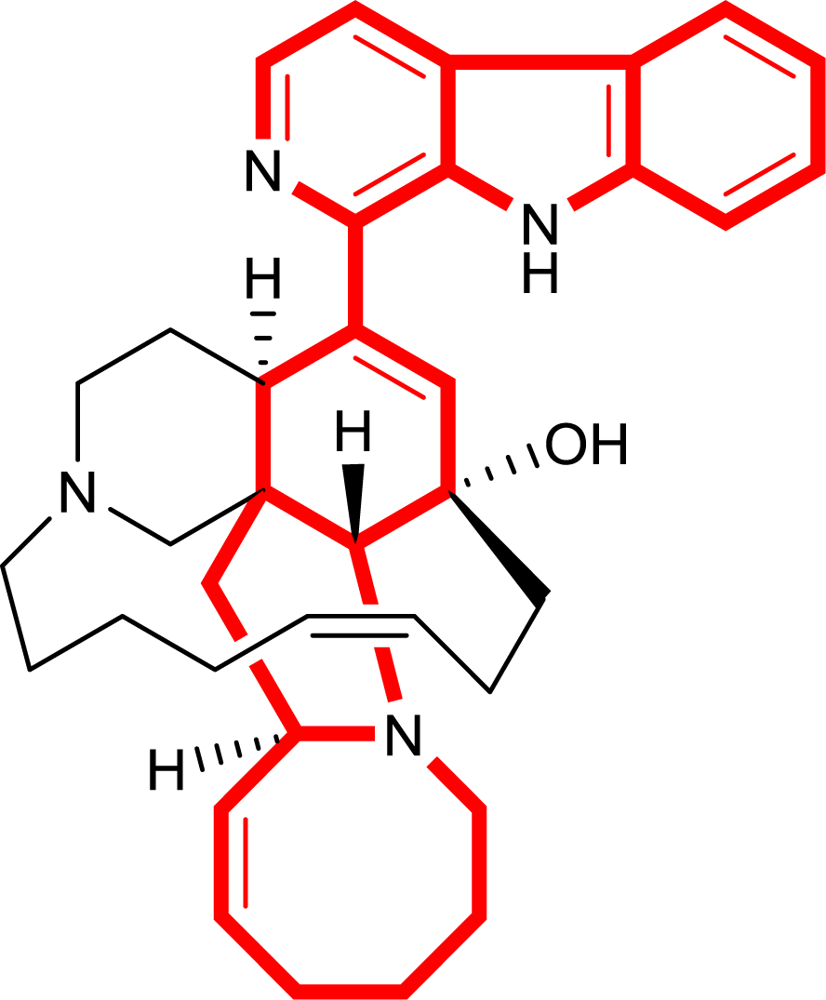
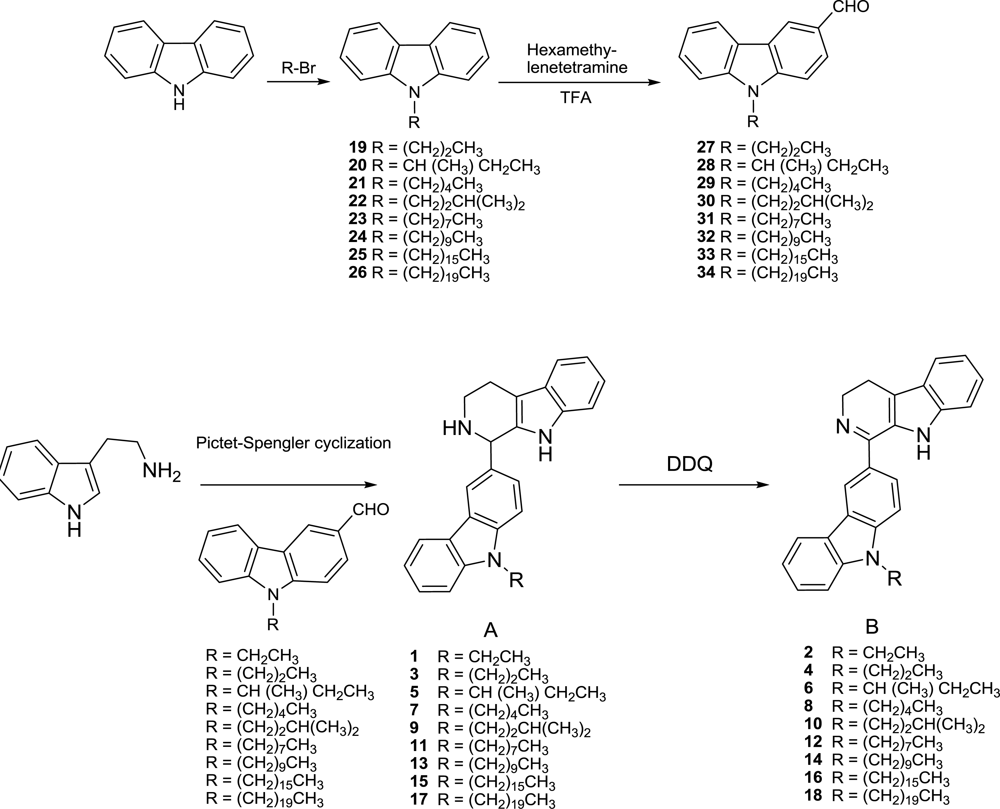
<p>The basic strategy for the synthesis of the target substances involved molecular modeling and SAR studies of manzamine analogs. To improve our knowledge of the main structural requirements needed for high antitumor activity, we synthesized two new series of 1-substituted carbazolyl-1,2,3,4-tetrahydro-β-carboline and carbazolyl-3,4-dihydro-β-carboline derivatives based on the analog design of manzamine A. These new compounds bear an <italic>N</italic>-alkyl carbazole conjugated with a β-carboline-like nucleus. The main part of manzamine A illustrated in <xref ref-type="fig" rid="f1-marinedrugs-09-00256">Figure 1</xref> is similar in both shape and size to our target compounds. The distances between <italic>N</italic> atom on carbazole and <italic>N</italic> atoms on carboline-nucleus are almost the same as those in the main part. With the aim of studying the SAR, we focused on the lengh of the <italic>N</italic>-alkyl side chain on the carbazole ring. Compounds <bold>19</bold>–<bold>26</bold> were prepared by <italic>N</italic>-alkylation of carbazole with the appropriate alkyl bromide as depicted in <xref ref-type="fig" rid="f4-marinedrugs-09-00256">Scheme 1</xref>. Subsequent synthesis of compounds <bold>27</bold>–<bold>34</bold> was achieved by Duff reaction, which required hexamethylenetetramine/trifloroacetic acid and the appropriate <italic>N</italic>-alkyl carbazole. Compounds <bold>1</bold>, <bold>3</bold>, <bold>5</bold>, <bold>7</bold>, <bold>9</bold>, <bold>11</bold>, <bold>13</bold>, <bold>15</bold>, and <bold>17</bold> (A series) were furnished from tryptamine and series of <italic>N</italic>-substituted 3-carbazolyl carboxyaldehydes (<bold>27</bold>–<bold>34</bold>, and <italic>N</italic>-ethyl-3-carboxyaldehyde, which was purchased from Sigma-Aldrich Co.) by application of Pictet-Spengler cyclization. Subsequent oxidation of 1,2,3,4-tetrahydro-β-carbolines (A) by DDQ yielded 3,4-dihydro-β-carboline derivatives (B series: <bold>2</bold>, <bold>4</bold>, <bold>6</bold>, <bold>8</bold>, <bold>10</bold>, <bold>12</bold>, <bold>14</bold>, <bold>16</bold>, <bold>18</bold>). The preparation and spectral data for <bold>1</bold>–<bold>34</bold> are described in the Experimental Section.</p></sec>
<sec>
<label>2.2.</label>
<title>Biological Activity</title>
<p>Cytotoxicity of new products <bold>1</bold>–<bold>18</bold> was tested against KB (human mouth epidermoid carcinoma); DLD (human colon adenocarcinoma), NCI-H661 (human lung large cell carcinoma) and Hepa (human hepatoma), HepG2/A2 (human hepatoma) tumor cells <italic>in vitro</italic>. The IC<sub>50</sub> values of these compounds are summarized in <xref ref-type="table" rid="t1-marinedrugs-09-00256">Table 1</xref>. <xref ref-type="table" rid="t1-marinedrugs-09-00256">Table 1</xref> shows that compounds <bold>1</bold>–<bold>12</bold> exhibited significant and/or selective cytotoxic activities. Among them, compounds <bold>2</bold> and <bold>6</bold> are most potent against KB tumor cells selectively. Compound <bold>7</bold> is more potent than <bold>2</bold> against NCI-H661 tumor cells although compound <bold>2</bold> shows most promising activity against all tumor cells. On the other hand, compounds <bold>14</bold>–<bold>18</bold> are inactive toward four tumor cells while compounds <bold>11</bold>–<bold>13</bold> exhibit weak, marginal or no activity. <xref ref-type="table" rid="t1-marinedrugs-09-00256">Table 1</xref> also shows that these compounds have selective cytotoxicity against HepG2/A2 tumor cells. Compounds <bold>2</bold>–<bold>4</bold> and <bold>8</bold> are active while others are inactive. In this assay, compound <bold>2</bold> exhibits most potent activity against the HepG2/A2 system.</p>
<p>The SAR study revealed that there was not a linear relationship between the carbon number of the side chain at <italic>N</italic> atom in carbazole and cytotoxicity. Nevertheless, we observed that, in general, elongation of the alkyl chain resulted in a decrease in activity. In fact, compounds <bold>11</bold>–<bold>18</bold> showed very weak or no activity toward HepG2/A2, KB and NCI-H661 cells even though compound <bold>11</bold> was active in DLD assay.</p>
<p>Inhibition activity of compounds <bold>1</bold>–<bold>18</bold> was evaluated against human DNA topoisomerases I and II. <xref ref-type="table" rid="t2-marinedrugs-09-00256">Table 2</xref> indicates that compounds <bold>1</bold>–<bold>14</bold> and <bold>18</bold> are more potent inhibitors of human DNA topoisomerase II than etoposide. Among the tested compounds, <bold>3</bold>, <bold>4</bold>, <bold>7</bold>, <bold>9</bold> and <bold>10</bold> were most potent. On the other hand, all compounds were inactive or showed mild activity against DNA topoisomerase I. Compounds <bold>3</bold>, <bold>4</bold>, <bold>9</bold> and <bold>10</bold> were 10- to 15-fold more potent against topoisomerase II (compared to etoposide) and superior to compounds <bold>1</bold> and <bold>2</bold>. On the other hand, compound <bold>18</bold> showed great activity while compounds <bold>15</bold>–<bold>17</bold> did not.</p>
<p>Compound <bold>7</bold> showed much better activity than that of <bold>2</bold> suggesting that the different degrees of activity might be explained by the differences in binding affinity or bioavailability such as drug uptake and fate of metabolism.</p></sec>
<sec>
<label>2.3.</label>
<title>Molecular Modeling</title>
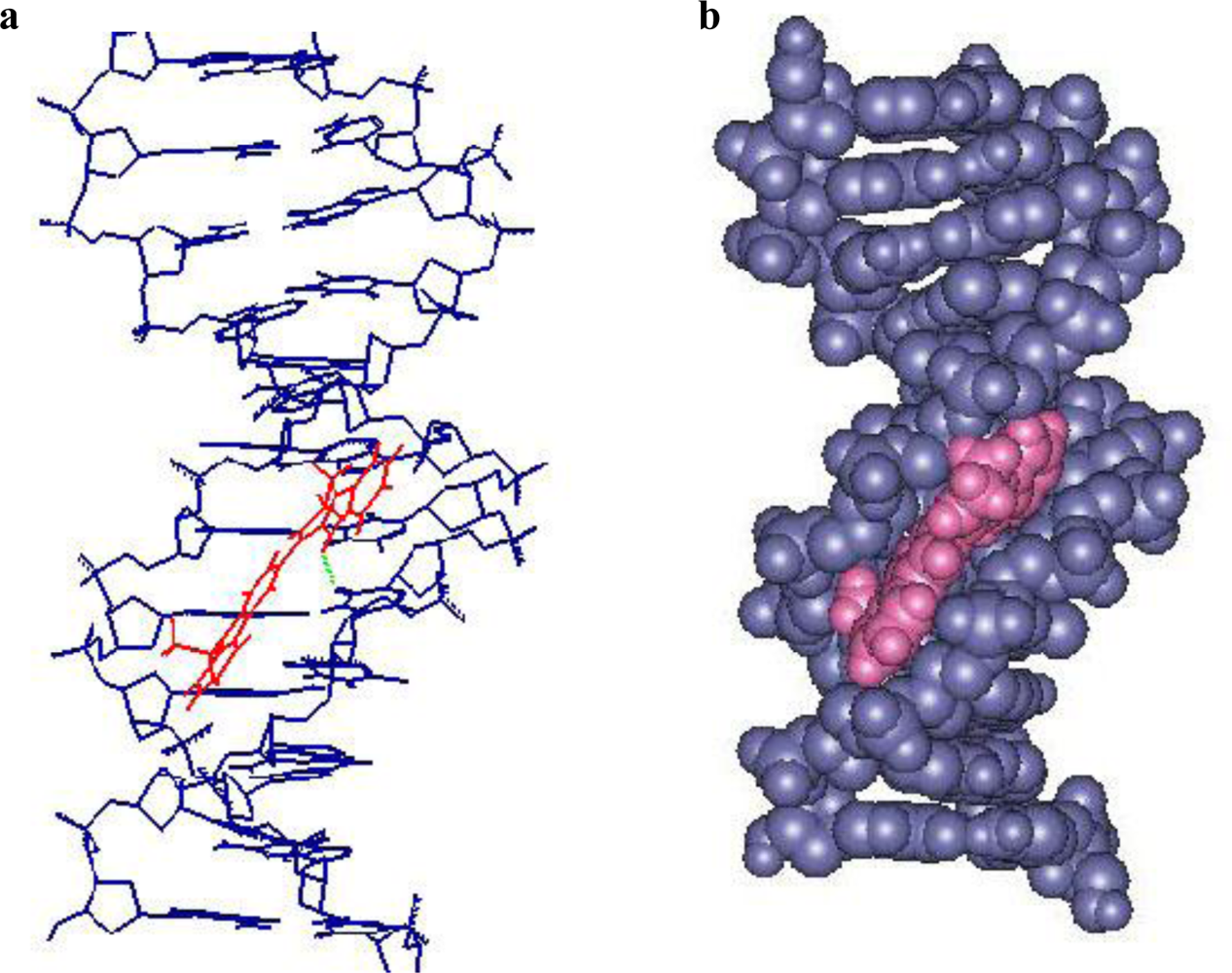
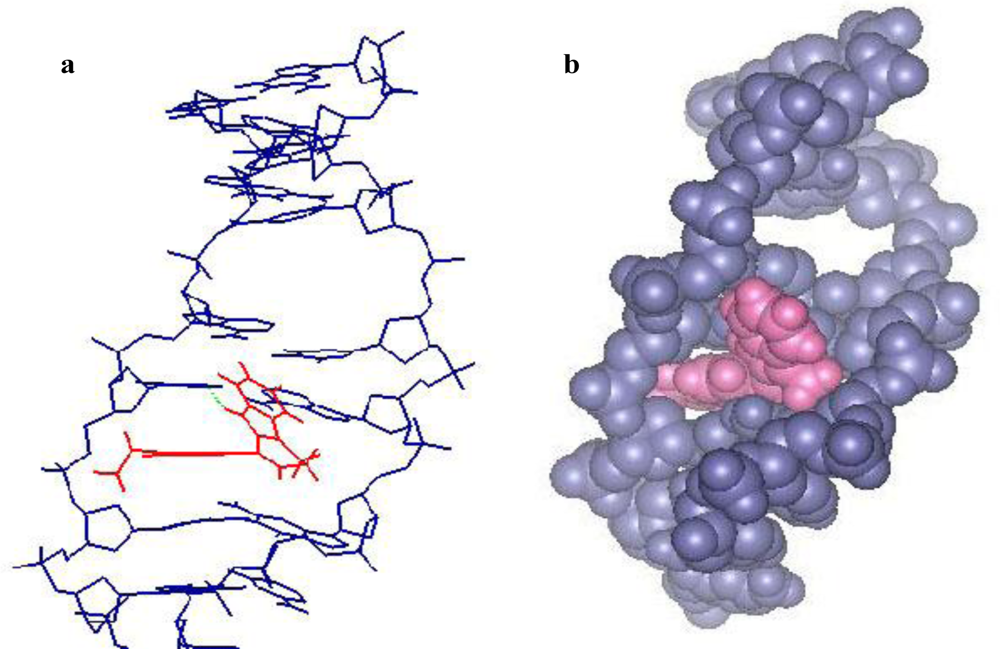
<p>To rationalize the biological activity results obtained for this novel series of carbazolyl-3,4-dihydro-β-carbolines, we carried out a molecular modeling study of compound <bold>2</bold>. The molecular modeling was performed by making use of two double strand DNA fragments (CGCTAGGG)<sub>2</sub> and (CGCGAATTCGCGG)<sub>2</sub>. <xref ref-type="fig" rid="f2-marinedrugs-09-00256">Figure 2</xref> shows the result of d(CGCATGGG)<sub>2</sub>-compound <bold>2</bold> complex. It was found that the binding conformation of this complex was formed by intercalation. Unlike the usual planar intercalators, compound <bold>2</bold> inserts into base pairs of DNA in a scissor-like conformation. We observed that the carbazole moiety of compound <bold>2</bold> was parallel with the thymidine base. However, the conformation of d(CGCGAATTGCG)<sub>2</sub>-compound <bold>2</bold> complex, as illustrated in <xref ref-type="fig" rid="f3-marinedrugs-09-00256">Figure 3</xref>, was formed by minor groove binding. In this case, compound <bold>2</bold> interacts with DNA by putting the carbazole moiety in the minor groove leaving the β-carboline chromophore outside. The estimated binding energy values for these two interaction forms are −16 and −186 kcal/mole, respectively. In these experiments, the occurrence of hydrogen bonding was observed in both conformations and resulted in the formation of a stable drug-DNA complex. The hydrogen bonding between the N-9 of β-carboline and the oxygen atom of C-2 in thymidine had a bonding length 1.86 and 2.02 Ǻ, respectively [<xref ref-type="bibr" rid="b22-marinedrugs-09-00256">22</xref>].</p></sec></sec>
<sec>
<label>3.</label>
<title>Experimental Section</title>
<sec sec-type="methods">
<label>3.1.</label>
<title>General Experimental Procedures</title>
<p>All of melting points were taken on a Buchi mp B-540 apparatus and were uncorrected. UV and IR spectra were recorded on Hitachi U-3210 and JASCO A-100 IR spectrophotometers, respectively. EIMS spectra were obtained on a MAT 112S-JMS D300 spectrometer, using direct inlet systems. HRMS data were taken on a JMX 110 mass spectrometer. <sup>1</sup>H- and <sup>13</sup>C-NMR spectra were recorded on a Bruker FT-300 spectrometer. Analytical thin-layer chromatography (TLC) was carried out on Kiesel gel GF<sub>254</sub> plates and detection was made under UV light. EM Kieselgel 60 (230–400 mesh ASTM) was used for column chromatography.</p></sec>
<sec>
<label>3.2.</label>
<title>Synthesis of Compounds <bold>1</bold>, <bold>3</bold>, <bold>5</bold>, <bold>7</bold>, <bold>9</bold>, <bold>11</bold>, <bold>13</bold>, <bold>15</bold>, and <bold>17</bold></title>
<p>To a stirred solution of tryptamine (160 mg, 0.1 mmol), the appropriate substituted aldehyde (<bold>27</bold>–<bold>34</bold>, and <italic>N</italic>-ethyl-3-carbazolyl carboxyaldehyde; 0.1 mmol) in acetic acid (30 mL) was heated to 100 °C. The reaction mixture was maintained at 100 °C for 24 h. After cooling, the reaction mixture was neutralized with NH<sub>4</sub>OH solution and extracted with CHCl<sub>3</sub>. The CHCl<sub>3</sub> layer was evaporated under vacuum, and the residue was chromatographed on a Silica gel column (10 g) and eluted with solvent mixture of CHCl<sub>3</sub>/MeOH using the following ratios and volumes (70:1, 50:1, 30:1 and 10:1; each 30 mL), to afford compounds <bold>1</bold>, <bold>3</bold>, <bold>5</bold>, <bold>7</bold>, <bold>9</bold>, <bold>11</bold>, <bold>13</bold>, <bold>15</bold>, and <bold>17</bold> with a yield in the range of 80–85%.</p>
<sec>
<label>3.2.1.</label>
<title>1-(9′-Ethyl-3′-carbazolyl)-1,2,3,4-tetrahydro-β-carboline (<bold>1</bold>)</title>
<p>Yellow solid; mp 240–242 °C; UV λ<sub>max</sub> 249, 269, 296, 332, 346 nm; IR (KBr) ν<sub>max</sub> 3164, 2973, 1600, 1471, 1334, 806 cm<sup>−1; 1</sup>H NMR (CDCl<sub>3</sub>) δ<sub>H</sub> 5.36 (1H, s, H-1), 3.37 (1H, m, H-3a), 3.13 (1H, m, H-3b), 2.87 (1H, m, H-4a), 2.97 (1H, m, H-4b), 7.64 (1H, d, overlap, H-5), 7.17 (1H, m, H-6), 7.14 (1H, m, H-7), 7.11 (1H, d, overlap, H-8), 7.29 (1H, d, overlap, H-1′), 7.36 (1H, d, overlap, H-2′), 8.04 (1H, s, H-4′), 7.44 (1H, d, overlap, H-5′), 7.52 (1H, m, H-6′), 7.25 (1H, m, H-7′), 8.00 (1H, d, overlap, H-8′), 4.37 (2H, q, <italic>J</italic> = 7.1 Hz, H-1″), 1.45 (3H, t, <italic>J</italic> = 7.1 Hz, H-2″); <sup>13</sup>C NMR (CDCl<sub>3</sub>) δ<sub>C</sub> 58.4 (d, C-1), 43.0 (t, C-3), 43.0 (t, C-4), 110.0 (s, C-4a), 127.6 (s, C-4b), 118.2 (d, C-5), 119.3 (d, C-6), 121.6 (d, C-7), 111.1 (d, C-8), 136.1 (s, C-8a), 135.5 (s, C-9a), 108.7 (d, C-1′), 126.5 (d, C-2′), 132.3 (s, C-3′), 120.7 (d, C-4′), 122.8 (s, C-4′a), 123.1 (s, C-4′b), 108.7 (d, C-5′), 126.0 (d, C-6′), 119.1 (d, C-7′), 120.5 (d, C-8′), 139.8 (s, C-8′a), 140.4 (s, C-9′a), 37.6 (t, C-1″), 13.9 (q, C-2″); EIMS <italic>m</italic>/<italic>z</italic> 365 (100, M<sup>+</sup>), 364 (82), 336 (46), 335 (63), 306 (31), 183 (17), 171 (51), 160 (16), 143 (18), 115 (17), 77 (5); HREIMS <italic>m</italic>/<italic>z</italic> 365.1890 ([M]<sup>+</sup>, calcd. for C<sub>25</sub>H<sub>23</sub>N<sub>3</sub>, 365.1892).</p></sec>
<sec>
<label>3.2.2.</label>
<title>1-(9′-Propyl-3′-carbazolyl)-1,2,3,4-tetrahydro-β-carboline (<bold>3</bold>)</title>
<p>Yellow solid; mp 110–112 °C; UV λ<sub>max</sub> 269, 296, 332, 346 nm; IR (KBr) ν<sub>max</sub> 3168, 3050, 2964, 1598, 1469, 1371, 808 cm<sup>−1; 1</sup>H NMR (CDCl<sub>3</sub>) δ<sub>H</sub> 5.37 (1H, s, H-1), 3.18 (1H, m, H-3a), 3.43 (1H, m, H-3b), 2.85 (1H, m, H-4a), 2.99 (1H, m, H-4b), 7.58 (1H, d, overlap, H-5), 7.19 (1H, m, H-6), 7.17 (1H, m, H-7), 7.16 (1H, d, overlap, H-8), 7.34 (1H, d, overlap, H-1′), 7.41 (1H, d, overlap, H-2′), 8.02 (1H, s, H-4′), 7.43 (1H, d, overlap, H-5′), 7.48 (1H, dd, overlap, H-6′), 7.23 (1H, dd, overlap, H-7′), 7.98 (1H, d, overlap, H-8′), 4.24 (2H, t, <italic>J</italic> = 7.0 Hz, H-1″), 1.89 (2H, m, H-2″), 0.96 (3H, t, <italic>J</italic> = 7.3 Hz, H-3″);<sup>13</sup>C NMR (CDCl<sub>3</sub>) δ<sub>C</sub> 58.3 (d, C-1), 42.8 (t, C-3), 22.4 (t, C-4), 109.9 (s, C-4a), 127.5 (s, C-4b), 118.2 (d, C-5), 119.3 (d, C-6), 121.6 (d, C-7), 111.1 (d, C-8), 136.1 (s, C-8a), 135.0 (s, C-9a), 109.7 (d, C-1′), 126.4 (d, C-2′), 131.7 (s, C-3′), 120.6 (d, C-4′), 122.6 (s, C-4′a), 122.9 (s, C-4′b), 108.9 (d, C-5′), 125.9 (d, C-6′), 119.1 (d, C-7′), 120.4 (d, C-8′), 140.4 (s, C-8′a), 140.9 (s, C-9′a), 44.7 (t, C-1″), 22.4 (t, C-2″)11.8 (q, C-3″); EIMS <italic>m</italic>/<italic>z</italic> 379 (89, M<sup>+</sup>), 378 (100, M-1<sup>+</sup>),350 (65), 306 (31), 190 (22), 180 (22), 171 (58), 159 (43), 115 (13), 77 (4).</p></sec>
<sec>
<label>3.2.3.</label>
<title>1-(9′-[1″-Methyl]propyl-3′-carbazolyl)-1,2,3,4-tetrahydro-β-carboline (<bold>5</bold>)</title>
<p>Yellow solid; mp 127–130 °C; UV λ<sub>max</sub> 222, 297, 332, 346 nm; IR (KBr) ν<sub>max</sub> 3454, 2969, 2929, 1458, 1335, 742 cm<sup>−1; 1</sup>H NMR (CDCl<sub>3</sub>) δ<sub>H</sub> 5.31 (1H, s, H-1), 3.16 (1H, m, H-3a), 3.42 (1H, m, H-3b), 2.87 (1H, m, H-4a), 2.97 (1H, m, H-4b), 7.64 (1H, d, overlap, H-5), 7.15 (1H, m, H-6), 7.15 (1H, m, H-7), 7.15 (1H, d, overlap, H-8), 7.53 (1H, d, overlap, H-1′), 7.33(1H, d, overlap, H-2′), 8.04 (1H, s, H-4′), 7.45 (1H, d, overlap, H-5′), 7.45 (1H, dd, overlap, H-6′), 7.21 (1H, dd, overlap, H-7′), 8.02 (1H, d, overlap, H-8′), 4.67 (2H, m, H-1″), 1.68 (2H, d, <italic>J</italic> = 6.9 Hz, H-2″), 2.03 (1H, m, H-3a″), 2.15 (1H, m, H-3b″), 0.96 (3H, t, <italic>J</italic> = 7.3 Hz, H-4″); <sup>13</sup>C NMR (CDCl<sub>3</sub>) δ<sub>C</sub> 58.3 (d, C-1), 43.0 (t, C-3), 19.1 (t, C-4), 110.0 (s, C-4a), 127.5 (s, C-4b), 118.2 (d, C-5), 109.3 (d, C-6), 121.5 (d, C-7), 110.1 (d, C-8), 135.9 (s, C-8a), 135.1 (s, C-9a), 110.3 (d, C-1′), 126.0 (d, C-2′), 131.6 (s, C-3′), 120.5 (d, C-4′), 122.9 (s, C-4′a), 123.8 (s, C-4′b), 110.2 (d, C-5′), 125.6 (d, C-6′), 118.7 (d, C-7′), 120.3 (d, C-8′), 140.5 (s, C-8′a), 139.7 (s, C-9′a), 53.0 (t, C-1″), 14.1 (t, C-2″), 28.0 (t, C-3″), 11.5 (t, C-4″); EIMS <italic>m</italic>/<italic>z</italic> 393 (100, M<sup>+</sup>), 364 (36), 336 (17), 306 (34), 193 (20), 180 (11), 171 (44), 144 (20), 115 (19), 57 (42).</p></sec>
<sec>
<label>3.2.4.</label>
<title>1-(9′-Pentyl-3′-carbazolyl)-1,2,3,4-tetrahydro-β-carboline (<bold>7</bold>)</title>
<p>Yellow solid; mp 129–130 °C; UV λ<sub>max</sub> 243, 266, 296, 332, 347 nm; IR (KBr) ν<sub>max</sub> 3405, 3164, 3050, 2929, 1600, 1467, 1338, 806 cm<sup>−1; 1</sup>H NMR (CDCl<sub>3</sub>) δ<sub>H</sub> 5.28 (1H, s, H-1), 3.14 (1H, m, H-3a), 3.41 (1H, m, H-3b), 2.85 (1H, m, H-4a), 2.99 (1H, m, H-4b), 7.63 (1H, d, overlap, H-5), 7.19 (1H, m, H-6), 7.18 (1H, m, H-7), 7.16 (1H, d, overlap, H-8), 7.34 (1H, d, overlap, H-1′), 7.37 (1H, d, overlap, H-2′), 8.03 (1H, s, H-4′), 7.42 (1H, d, overlap, H-5′), 7.49 (1H, dd, overlap, H-6′), 7.25 (1H, dd, overlap, H-7′), 7.99 (1H, d, overlap, H-8′), 4.27 (2H, t, <italic>J</italic> = 7.1 Hz, H-1″), 1.91 (2H, m, H-2″), 1.41 (2H, m, H-3″), 1.41 (2H, m, H-4″), 0.96 (3H, t, <italic>J</italic> = 7.3 Hz, H-2″); <sup>13</sup>C NMR (CDCl<sub>3</sub>) δ<sub>C</sub> 58.4 (d, C-1), 43.1 (t, C-3), 22.6 (t, C-4), 110.0 (s, C-4a), 127.6 (s, C-4b), 118.2 (d, C-5), 119.3 (d, C-6), 121.6 (d, C-7), 111.0 (d, C-8), 136.0 (s, C-8a), 135.4 (s, C-9a), 109.0 (d, C-1′), 126.4 (d, C-2′), 132.1 (s, C-3′), 120.6 (d, C-4′), 122.6 (s, C-4′a), 123.0 (s, C-4′b), 108.9 (d, C-5′), 125.9 (d, C-6′), 119.0 (d, C-7′), 120.4 (d, C-8′), 140.3 (s, C-8′a), 140.9 (s, C-9′a), 43.2 (t, C-1″), 28.7 (t, C-2″), 29.4 (t, C-3″), 22.5 (t, C-4″), 14.0 (q, C-5″); EIMS <italic>m</italic>/<italic>z</italic> 407 (90, M<sup>+</sup>), 406 (100, M − H<sup>+</sup>), 378 (55), 306 (31), 204 (13), 179 (19), 171 (46), 159 (27), 115 (15), 55 (8).</p></sec>
<sec>
<label>3.2.5.</label>
<title>1-(9′-[3″-Methylbutyl]-3′-carbazolyl)-1,2,3,4-tetrahydro-β-carboline (<bold>9</bold>)</title>
<p>Yellow solid; mp 99–101 °C; UV λ<sub>max</sub> 222, 296 nm; IR (KBr) ν<sub>max</sub> 3404, 3192, 3050, 2922, 1468, 1331, 742 cm<sup>−1; 1</sup>H NMR (CDCl<sub>3</sub>) δ<sub>H</sub> 5.34 (1H, s, H-1), 3.18 (1H, m, H-3a), 3.46 (1H, m, H-3b), 2.87 (1H, m, H-4a), 3.00 (1H, m, H-4b), 7.64 (1H, d, overlap, H-5), 7.17 (1H, dd, overlap, H-6), 7.15 (1H, dd, overlap, H-7), 7.14 (1H, d, overlap, H-8), 7.36 (1H, d, overlap, H-1′), 7.40 (1H, d, overlap, H-2′), 8.04 (1H, s, H-4′), 7.47 (1H, d, overlap, H-5′), 7.56 (1H, dd, overlap, H-6′), 7.22 (1H, dd, overlap, H-7′), 8.01 (1H, d, overlap, H-8′), 4.29 (2H, t, <italic>J</italic> = 7.2 Hz, H-1″), 1.73 (2H, m, H-2″), 1.73 (2H, m, H-3″), 1.02 (2H, d, <italic>J</italic> = 6.0 Hz, H-4″), 1.02 (3H, d, <italic>J</italic> = 6.0 Hz, H-5″); <sup>13</sup>C NMR (CDCl3) δ<sub>C</sub> 58.1 (d, C-1), 42.6 (t, C-3), 22.3 (t, C-4), 109.7 (s, C-4a), 127.3 (s, C-4b), 117.9 (d, C-5), 119.0 (d, C-6), 121.3 (d, C-7), 110.8 (d, C-8), 135.8 (s, C-8a), 135.2 (s, C-9a), 108.1 (d, C-1′), 126.2 (d, C-2′), 132.0 (s, C-3′), 120.4 (d, C-4′), 122.5 (s, C-4′a), 122.8 (s, C-4′b), 108.6 (d, C-5′), 125.7 (d, C-6′), 118.8 (d, C-7′), 120.2 (d, C-8′), 140.5 (s, C-8′a), 139.9 (s, C-9′a), 41.2 (t, C-1″), 37.3 (t, C-2″), 25.9 (t, C-3″), 22.4 (t, C-4″), 22.4 (q, C-5″); EIMS <italic>m</italic>/<italic>z</italic> 407 (90, M<sup>+</sup>), 378 (48), 319 (15), 306 (25), 204 (29), 180 (23), 171 (64), 160 (51), 55 (81), 43 (57).</p></sec>
<sec>
<label>3.2.6.</label>
<title>1-(9′-Octyl-3′-carbazolyl)-1,2,3,4-tetrahydro-β-carboline (<bold>11</bold>)</title>
<p>Yellow solid; mp 87–89 °C; UV λ<sub>max</sub> 247, 266, 296, 332, 347 nm; IR (KBr) ν<sub>max</sub> 3160, 3056, 2927, 1600, 1469, 1332, 806, 742 cm<sup>−1; 1</sup>H NMR (CDCl<sub>3</sub>) δ<sub>H</sub> 5.32 (1H, s, H-1), 3.18 (1H, m, H-3a), 3.44 (1H, m, H-3b), 2.88 (1H, m, H-4a), 2.97 (1H, m, H-4b), 7.64 (1H, d, overlap, H-5), 7.19 (1H, m, H-6), 7.17 (1H, m, H-7), 7.15 (1H, d, overlap, H-8), 7.33 (1H, d, overlap, H-1′), 7.39 (1H, d, overlap, H-2′), 8.04 (1H, s, H-4′), 7.47 (1H, d, overlap, H-5′), 7.54 (1H, dd, overlap, H-6′), 7.27 (1H, dd, overlap, H-7′), 8.01 (1H, d, overlap, H-8′), 4.27 (2H, t, <italic>J</italic> = 7.0 Hz, H-1″), 1.86 (2H, m, H-2″), 1.26–1.35 (10H, overlap, H-3″∼H-7″), 0.88 (3H, t, <italic>J</italic> = 6.7 Hz, H-8″); <sup>13</sup>C NMR (CDCl<sub>3</sub>) δ<sub>C</sub> 58.4 (d, C-1), 42.9 (t, C-3), 22.5 (t, C-4), 110.0 (s, C-4a), 127.6 (s, C-4b), 118.2 (d, C-5), 119.1 (d, C-6), 121.6 (d, C-7), 111.1 (d, C-8), 136.1 (s, C-8a), 135.3 (s, C-9a), 109.0 (d, C-1′), 126.4 (d, C-2′), 132.1 (s, C-3′), 120.6 (d, C-4′), 122.6 (s, C-4′a), 123.0 (s, C-4′b), 108.9 (d, C-5′), 125.9 (d, C-6′), 118.7 (d, C-7′), 120.4 (d, C-8′), 140.3 (s, C-8′a), 140.9 (s, C-9′a), 43.2 (t, C-1″), 29.1 (t, C-2″), 27.4 (t, C-3″), 29.5 (t, C-4″), 29.3 (t, C-5″), 31.8 (t, C-6″), 22.7 (t, C-7″), 14.2 (q, C-8″); EIMS <italic>m</italic>/<italic>z</italic> 449 (83, M<sup>+</sup>), 448 (100, M − H<sup>+</sup>), 420 (57), 405 (7), 319 (20), 306 (25), 225 (9), 180 (17), 171 (37), 160 (15), 57 (11).</p></sec>
<sec>
<label>3.2.7.</label>
<title>1-(9′-Decyl-3′-carbazolyl)-1,2,3,4-tetrahydro-β-carboline (<bold>13</bold>)</title>
<p>Yellow solid; mp 102–104 °C; UV λ<sub>max</sub> 240, 266, 296, 332, 347 nm; IR (KBr) <italic>v</italic><sub>max</sub> 3048, 2925, 1598, 1467, 1332, 806 cm<sup>−1; 1</sup>H NMR (CDCl<sub>3</sub>) δ<sub>H</sub> 5.37 (1H, s, H-1), 3.18 (1H, m, H-3a), 3.43 (1H, m, H-3b), 2.88 (1H, m, H-4a), 2.99 (1H, m, H-4b), 7.55 (1H, d, overlap, H-5), 7.15 (1H, m, H-6), 7.14 (1H, dd, m), 7.16 (1H, d, overlap, H-8), 7.33 (1H, d, overlap, H-1′), 7.40 (1H, d, overlap, H-2′), 8.02 (1H, s, H-4′), 7.38 (1H, d, overlap, H-5′), 7.47 (1H, dd, overlap, H-6′), 7.20 (1H, dd, overlap, H-7′), 8.00 (1H, d, overlap, H-8′), 4.25 (2H, t, <italic>J</italic> = 7.0 Hz, H-1″), 1.83 (2H, m, H-2″), 1.24–1.32 (14H, overlap, H-3″∼H-9″), 0.88 (3H, t, <italic>J</italic> =6.3 Hz, H-10″); <sup>13</sup>C NMR (CDCl<sub>3</sub>) δ<sub>C</sub> 58.0 (d, C-1), 42.4 (t, C-3), 21.6 (t, C-4), 109.8 (s, C-4a), 127.2 (s, C-4b), 118.2 (d, C-5), 119.4 (d, C-6), 121.8 (d, C-7), 110.9 (d, C-8), 135.9 (s, C-8a), 133.7 (s, C-9a), 108.9 (d, C-1′), 126.4 (d, C-2′), 130.1 (s, C-3′), 120.7 (d, C-4′), 122.4 (s, C-4′a), 122.9 (s, C-4′b), 108.7 (d, C-5′), 125.9 (d, C-6′), 119.0 (d, C-7′), 120.6 (d, C-8′), 140.4 (s, C-8′a), 140.7 (s, C-9′a), 43.1 (t, C-1″), 28.9 (t, C-2″), 27.2 (t, C-3″), 29.2–29.5 (t, C-4″∼C-7″), 31.8 (t, C-5″), 31.8 (t, C-8″), 22.6 (t, C-9″), 14.0 (q, C-10″); EIMS <italic>m</italic>/<italic>z</italic> 477 (87, M<sup>+</sup>), 476 (100, M − H<sup>+</sup>), 448 (46), 306 (21), 239 (15), 180 (25), 171 (56), 160 (43), 144 (13), 69 (12), 57 (36).</p></sec>
<sec>
<label>3.2.8.</label>
<title>1-(9′-Hexadecyl-3′-carbazolyl)-1,2,3,4-tetrahydro-β-carboline (<bold>15</bold>)</title>
<p>Yellow solid; mp 111–113 °C; UV λ<sub>max</sub> 240, 270 nm; IR (KBr) ν<sub>max</sub> 2952, 2923, 1467 cm<sup>−1; 1</sup>H NMR (CDCl<sub>3</sub>) δ<sub>H</sub> 5.34 (1H, s, H-1), 3.15 (1H, m, H-3a), 3.39 (1H, m, H-3b), 2.86 (1H, m, H-4a), 3.00 (1H, m, H-4b), 7.60 (1H, d, overlap, H-5), 7.14 (1H, dd, overlap, H-6), 7.16 (1H, dd, overlap, m), 7.17 (1H, d, overlap, H-8), 7.36 (1H, d, overlap, H-1′), 7.39 (1H, d, overlap, H-2′), 8.01 (1H, s, H-4′), 7.34 (1H, d, overlap, H-5′), 7.48 (1H, dd, overlap, H-6′), 7.21 (1H, dd, overlap, H-7′), 8.03 (1H, d, overlap, H-8′), 4.24 (2H, t, <italic>J</italic> = 7.2 Hz, H-1″), 1.83 (2H, m, H-2″), 1.26–1.33 (14H, overlap, H-3″∼H-15″), 0.90 (3H, t, <italic>J</italic> = 6.6 Hz, H-16″); <sup>13</sup>C NMR (CDCl<sub>3</sub>) δ<sub>C</sub> 58.4 (d, C-1), 43.2 (t, C-3), 22.7 (t, C-4), 109.9 (s, C-4a), 127.4 (s, C-4b), 118.2 (d, C-5), 119.4 (d, C-6), 121.7 (d, C-7), 110.9 (d, C-8), 134.9 (s, C-8a), 135.9 (s, C-9a), 109.0 (d, C-1′), 126.3 (d, C-2′), 131.3 (s, C-3′), 120.4 (d, C-4′), 122.5 (s, C-4′a), 122.9 (s, C-4′b), 108.8 (d, C-5′), 125.8 (d, C-6′), 119.0 (d, C-7′), 120.6 (d, C-8′), 140.8 (s, C-8′a), 140.4 (s, C-9′a), 43.2 (t, C-1″), 22.7–31.9 (t, C-4″∼C-15″), 14.1 (q, C-16″) ; EIMS <italic>m</italic>/<italic>z</italic> 561 (4, M<sup>+</sup>), 368 (1), 313 (1), 236 (3), 180 (2), 97 (6), 83 (11), 69 (17), 57 (28), 44 (100).</p></sec>
<sec>
<label>3.2.9.</label>
<title>1-(9′-Eicosyl-3′-carbazolyl)-1,2,3,4-tetrahydro-β-carboline (<bold>17</bold>)</title>
<p>Yellow amorphous powder; UV λ<sub>max</sub> 221, 263 nm; IR (KBr) ν<sub>max</sub> 3048, 2925, 1598, 1467, 1332, 806 cm<sup>−1; 1</sup>H NMR (CDCl<sub>3</sub>) δ<sub>H</sub> 5.38 (1H, s, H-1), 3.18 (1H, m, H-3a), 3.41 (1H, m, H-3b), 2.88 (1H, m, H-4a), 3.01 (1H, m, H-4b), 7.59 (1H, d, overlap, H-5), 7.14 (1H, dd, overlap, H-6), 7.16 (1H, dd, overlap, m), 7.17 (1H, d, overlap, H-8), 7.36 (1H, d, overlap, H-1′), 7.39 (1H, d, overlap, H-2′), 8.01 (1H, s, H-4′), 7.34 (1H, d, overlap, H-5′), 7.46 (1H, dd, overlap, H-6′), 7.21 (1H, dd, overlap, H-7′), 8.03 (1H, d, overlap, H-8′), 4.24 (2H, t, <italic>J</italic> = 7.2 Hz, H-1″), 1.83 (2H, m, H-2″), 1.26–1.33 (14H, overlap, H-3″∼H-19″), 0.91 (3H, t, <italic>J</italic> = 6.7 Hz, H-20″); <sup>13</sup>C NMR (CDCl<sub>3</sub>) δ<sub>C</sub> 57.2 (d, C-1), 40.8 (t, C-3), 20.0 (t, C-4), 108.5 (s, C-4a), 127.3 (s, C-4b), 117.9 (d, C-5), 119.1 (d, C-6), 121.9 (d, C-7), 111.0 (d, C-8), 130.8 (s, C-8a), 136.2 (s, C-9a), 108.8 (d, C-1′), 126.3 (d, C-2′), 131.8 (s, C-3′), 120.2 (d, C-4′), 122.1 (s, C-4′a), 122.8 (s, C-4′b), 108.7 (d, C-5′), 125.8 (d, C-6′), 118.9 (d, C-7′), 120.8 (d, C-8′), 140.6 (s, C-8′a), 140.5 (s, C-9′a), 42.9 (t, C-1″), 22.4–31.6 (t, C-2″∼C-19″), 13.7 (q, C-20″); EIMS <italic>m</italic>/<italic>z</italic> 617 (4, M<sup>+</sup>), 588 (1), 179 (6), 171 (26), 160 (43), 144 (4), 91 (4), 71 (15), 69 (10), 57 (59), 43 (100).</p></sec>
<sec>
<label>3.3.</label>
<title>Synthesis of Compounds <bold>2</bold>, <bold>4</bold>, <bold>6</bold>, <bold>8</bold>, <bold>10</bold>, <bold>12</bold>, <bold>14</bold>, <bold>16</bold>, and <bold>18</bold></title>
<p>To a stirred solution of compound A (<bold>1</bold>, <bold>3</bold>, <bold>5</bold>, <bold>7</bold>, <bold>9</bold>, <bold>11</bold>, <bold>13</bold>, <bold>15</bold>, <bold>17</bold>, 0.68 mmol) in EtOH (2 mL) and CHCl<sub>3</sub> (6 mL) at room temperature, 2,3-dichloro-5,6-dicyanobezoquinone (DDQ, 160 mg) was added. The reaction mixture was stirred for 30 mins. After concentration, the residue was applied on a prep. TLC and developed with CHCl<sub>3</sub>/MeOH (10:1) to yield a series of B (<bold>2</bold>, <bold>4</bold>, <bold>6</bold>, <bold>8</bold>, <bold>10</bold>, <bold>12</bold>, <bold>14</bold>, <bold>16</bold>, and <bold>18</bold>) (23–64% yield).</p></sec>
<sec>
<label>3.3.1.</label>
<title>1-(9′-Ethyl-3′-carbazolyl)-3,4-dihydro-β-carboline (<bold>2</bold>)</title>
<p>Yellow solid; mp 175–177 °C; UV λ<sub>max</sub> 236, 288, 323, 346 nm; IR (KBr) ν<sub>max</sub> 3164, 2973, 1600, 1471, 1334, 806 cm<sup>−1; 1</sup>H NMR (CDCl<sub>3</sub>) δ<sub>H</sub> 3.70 (2H, t, <italic>J</italic> = 7.5 Hz, H-3), 2.93 (2H, t, <italic>J</italic> = 7.5 Hz, H-4), 7.64 (1H, d, overlap, H-5), 7.19 (1H, m, H-6), 7.25 (1H, m, H-7), 7.43 (1H, d, overlap, H-8), 7.32 (1H, d, overlap,H-1′), 7.87 (1H, d, overlap, H-2′), 8.52 (1H, s, H-4′), 7.30 (1H, d, overlap, H-5′), 7.46 (1H, m, H-6′), 7.22 (1H, m, H-7′), 8.01 (1H, d, overlap, H-8′), 4.14 (2H, q, <italic>J</italic> = 7.0 Hz, H-1″), 1.34 (3H, t, <italic>J</italic> = 7.0 Hz, H-2″); <sup>13</sup>C NMR (CDCl<sub>3</sub>) δ<sub>C</sub> 160.5 (s, C-1), 46.4 (t, C-3), 19.4 (t, C-4), 112.8 (s, C-4a), 127.7 (s, C-4b), 120.1 (d, C-5), 120.6 (d, C-6), 125.2 (d, C-7), 112.8 (d, C-8), 138.1 (s, C-8a), 127.7 (s, C-9a), 108.7 (d, C-1′), 126.8 (d, C-2′), 141.4 (s, C-3′), 121.4 (d, C-4′), 122.9 (s, C-4′a), 123.1 (s, C-4′b), 108.5 (d, C-5′), 126.1 (d, C-6′), 119.5 (d, C-7′), 121.1 (d, C-8′), 126.1 (s, C-8′a), 140.3 (s, C-9′a), 37.4 (t, C-1″), 13.7 (q, C-2″); EIMS <italic>m</italic>/<italic>z</italic> 363 (100, M<sup>+</sup>), 362 (90), 346 (16), 335 (20), 319 (9), 306 (10), 174 (15), 160 (19), 77 (4), 55 (11); HREIMS <italic>m</italic>/<italic>z</italic> 363.1724 ([M]<sup>+</sup>, calcd. for C<sub>25</sub>H<sub>21</sub>N<sub>3</sub>, 363.1735).</p></sec>
<sec>
<label>3.3.2.</label>
<title>1-(9′-Propyl-3′-carbazolyl)-3,4-dihydro-β-carboline (<bold>4</bold>)</title>
<p>Yellow solid; mp 126–128 °C; UV λ<sub>max</sub> 239, 288, 323 nm; IR (KBr) ν<sub>max</sub> 3064, 2929, 1596, 1467, 1336, 808, 746 cm<sup>−1; 1</sup>H NMR (CDCl<sub>3</sub>) δ<sub>H</sub> 3.96 (2H, t, <italic>J</italic> = 8.2 Hz, H-3), 2.98 (2H, t, <italic>J</italic> = 8.3 Hz, H-4), 7.64 (1H, d, overlap, H-5), 7.17 (1H, m, H-6), 7.26 (1H, m, H-7), 7.44 (1H, d, overlap, H-8), 7.38 (1H, d, overlap, H-1′), 7.92 (1H, d, overlap, H-2′), 8.58 (1H, s, H-4′), 7.34 (1H, d, overlap, H-5′), 7.47 (1H, m, H-6′), 7.21 (1H, m, H-7′), 8.09 (1H, d, 7.6, H-8′), 4.21 (2H, t, <italic>J</italic> = 6.9 Hz, H-1″), 1.88 (2H, m, H-2″), 0.95(3H, t, 7.4); <sup>13</sup>C NMR (CDCl<sub>3</sub>) δ<sub>H</sub> 160.2 (s, C-1), 47.3 (t, C-3), 19.4 (t, C-4), 119.0 (s, C-4a), 125.4 (s, C-4b), 120.1 (d, C-5), 120.5 (d, C-6), 125.0 (d, C-7), 112.5 (d, C-8), 137.5 (s, C-8a), 127.8 (s, C-9a), 109.1 (d, C-1′), 126.5 (d, C-2′), 141.9 (s, C-3′), 120.9 (d, C-4′), 122.8 (s, C-4′a), 123.0 (s, C-4′b), 109.0 (d, C-5′), 126.3 (d, C-6′), 119.5 (d, C-7′), 120.8 (d, C-8′), 126.2 (s, C-8′a), 141.0 (s, C-9′a), 44.7 (t, C-1″), 22.3(t, C-2″), 11.7 (q, C-3″); EIMS <italic>m</italic>/<italic>z</italic> 377 (98, M<sup>+</sup>), 376 (100, M − H<sup>+</sup>), 346 (55), 319 (15), 306 (15), 205 (14), 180 (8), 174 (47), 159 (16), 115 (11), 77 (9), 57 (21); HREIMS <italic>m</italic>/<italic>z</italic> 377.1880 ([M]<sup>+</sup>, calcd. for C<sub>26</sub>H<sub>23</sub>N<sub>3</sub>, 377.1882).</p></sec>
<sec>
<label>3.3.3.</label>
<title>1-(9′-[1″-Methyl]propyl-3′-carbazolyl)-3,4-dihydro-β-carboline (<bold>6</bold>)</title>
<p>Yellow solid; mp 151–154 °C; UV λ<sub>max</sub> 237, 288 nm; IR (KBr) ν<sub>max</sub> 3051, 2921, 1468, 1335, 743 cm<sup>−1; 1</sup>H NMR (CDCl<sup>3</sup>) δ<sub>H</sub> 3.67 (2H, t, <italic>J</italic> = 8.1 Hz, H-3), 2.88 (2H, t, <italic>J</italic> = 8.1 Hz, H-4), 7.68 (1H, d, overlap, H-5), 7.19 (1H, m, H-6), 7.37 (1H, m, H-7), 7.56 (1H, d, overlap, H-8), 7.43 (1H, d, overlap,H-1′), 8.05 (1H, d, overlap, H-2′), 8.83 (1H, s, H-4′), 7.45 (1H, d, overlap, H-5′), 7.34 (1H, m, H-6′), 7.08 (1H, m, H-7′), 8.08 (1H, d, 7.6, H-8′), 4.56 (2H, t, <italic>J</italic> = 6.9 Hz, H-1″), 1.56 (2H, m, H-2″), 1.95 (3H, m, H-3″), 0.70 (3H, m, H-4″); <sup>13</sup>C NMR (CDCl<sub>3</sub>) δ<sub>C</sub> 160.2 (s, C-1), 43.0 (t, C-3), 19.4 (t, C-4), 113.9 (s, C-4a), 125.8 (s, C-4b), 120.9 (d, C-5), 121.6 (d, C-6), 126.8 (d, C-7), 113.9 (d, C-8), 140.9 (s, C-8a), 126.2 (s, C-9a), 111.0 (d, C-1′), 127.9 (d, C-2′), 140.8 (s, C-3′), 123.7 (d, C-4′), 123.2 (s, C-4′a), 123.7 (s, C-4′b), 111.0 (d, C-5′), 127.9 (d, C-6′), 120.5 (d, C-7′), 121.8 (d, C-8′), 124.0 (s, C-8′a), 140.1 (s, C-9′a), 53.7 (t, C-1″), 19.1 (q, C-2″), 28.1 (t, C-3″), 11.6 (q, C-4″); EIMS <italic>m</italic>/<italic>z</italic> 391 (72, M<sup>+</sup>), 360 (100), 332 (45), 306 (33), 180 (74), 167 (40), 140 (20), 115 (31), 57 (35), 41 (88); HRESIMS <italic>m</italic>/<italic>z</italic> 392.2125 ([M + H]<sup>+</sup>, calcd. for C<sub>27</sub>H<sub>26</sub>N<sub>3</sub>, 392.2127).</p></sec>
<sec>
<label>3.3.4.</label>
<title>1-(9′-Pentyl-3′-carbazolyl)-3,4-dihydro-β-carboline (<bold>8</bold>)</title>
<p>Yellow solid; mp 97–98 °C; UV λ<sub>max</sub> 236, 288, 324 nm; IR (KBr) ν<sub>max</sub> 3064, 2929, 1601, 1467, 1334, 808 cm<sup>−1; 1</sup>H NMR (CDCl<sub>3</sub>) δ<sub>H</sub> 3.40 (2H, t, <italic>J</italic> = 7.0 Hz, H-3), 2.91 (2H, t, <italic>J</italic> = 7.8 Hz, H-4), 7.62 (1H, d, overlap, H-5), 7.21 (1H, m, H-6), 7.34 (1H, m, H-7), 7.57 (1H, d, overlap, H-8), 7.27 (1H, d, overlap,H-1′), 7.97 (1H, d, overlap, H-2′), 8.64 (1H, s, H-4′), 7.31 (1H, d, overlap, H-5′), 7.48 (1H, m, H-6′), 7.25 (1H, m, H-7′), 8.06 (1H, d, 7.6, H-8′), 3.90 (2H, t, <italic>J</italic> = 6.9 Hz, H-1″), 1.71 (2H, m, H-2″), 1.28 (3H, m, H-3″), 1.34 (3H, m, H-4″), 0.84 (t, 6.6, H-5″); <sup>13</sup>C NMR (CDCl<sub>3</sub>) δ<sub>C</sub> 160.5 (s, C-1), 44.9 (t, C-3), 19.3 (t, C-4), 119.4 (s, C-4a), 124.2 (s, C-4b), 120.1 (d, C-5), 120.6 (d, C-6), 125.7 (d, C-7), 113.0 (d, C-8), 138.8 (s, C-8a), 127.2 (s, C-9a), 108.7 (d, C-1′), 127.0 (d, C-2′), 142.0 (s, C-3′), 121.7 (d, C-4′), 122.6 (s, C-4′a), 123.0 (s, C-4′b), 108.6 (d, C-5′), 126.0 (d, C-6′), 119.4 (d, C-7′), 121.1 (d, C-8′), 124.8 (s, C-8′a), 140.5 (s, C-9′a), 42.6 (t, C-1″), 28.3 (t, C-2″), 29.1 (t, C-3″), 22.2 (t, C-4″), 13.8 (q, C-5″); EIMS <italic>m</italic>/<italic>z</italic> 405 (83, M<sup>+</sup>), 404 (100, M − H<sup>+</sup>), 377 (25), 346 (29), 332 (9), 306 (13), 203 (10), 174 (55), 159 (25), 57 (16); HREIMS <italic>m</italic>/<italic>z</italic> 405.2199 ([M]<sup>+</sup>, calcd. for C<sub>28</sub>H<sub>27</sub>N<sub>3</sub>, 405.2205).</p></sec>
<sec>
<label>3.3.5.</label>
<title>1-(9′-[3″-Methylbutyl]-3′-carbazolyl)-3,4-dihydro-β-carboline (<bold>10</bold>)</title>
<p>Yellow solid; mp 135–137 °C; UV λ<sub>max</sub> 236, 289 nm; IR (KBr) ν<sub>max</sub> 3068, 2927, 1587, 1465, 1332, 741 cm<sup>−1; 1</sup>H NMR (CDCl<sub>3</sub>) δ<sub>H</sub> 3.56 (2H, t, <italic>J</italic> = 8.0 Hz, H-3), 2.76 (2H, t, <italic>J</italic> = 8.0 Hz, H-4), 7.41 (1H, d, overlap, H-5), 7.16 (1H, m, H-6), 7.41 (1H, m, H-7), 7.79 (1H, d, overlap, H-8), 7.24 (1H, d, overlap,H-1′), 8.03 (1H, d, overlap, H-2′), 8.86 (1H, s, H-4′), 7.16 (1H, d, overlap, H-5′), 7.36 (1H, m, H-6′), 7.14 (1H, m, H-7′), 8.12 (1H, d, <italic>J</italic> = 7.6 Hz, H-8′), 3.74 (2H, t, <italic>J</italic> = 6.9 Hz, H-1″), 1.44 (2H, m, H-2″), 1.54 (2H, m, H-3″), 0.90 (6H, d, <italic>J</italic> = 7.6 Hz, H-4″, 5″); <sup>13</sup>C NMR (CDCl<sub>3</sub>) δ<sub>C</sub> 160.9 (s, C-1), 41.2 (t, C-3), 19.3 (t, C-4), 114.3 (s, C-4a), 126.8 (s, C-4b), 120.6 (d, C-5), 121.5 (d, C-6), 126.8 (d, C-7), 114.3 (d, C-8), 140.6 (s, C-8a), 126.8 (s, C-9a), 109.3 (d, C-1′), 128.8 (d, C-2′), 143.1 (s, C-3′), 123.4 (d, C-4′), 121.7 (s, C-4′a), 122.5 (s, C-4′b), 108.9 (d, C-5′), 128.0 (d, C-6′), 120.4 (d, C-7′), 121.6 (d, C-8′), 124.2 (s, C-8′a), 140.6 (s, C-9′a), 41.2 (t, C-1″), 37.1 (q, C-2″), 26.1 (t, C-3″), 22.4 (q, C-4″, 5″); EIMS <italic>m</italic>/<italic>z</italic> 405 (22, M<sup>+</sup>), 346 (13), 332 (3), 180 (2), 174 (10), 160 (5), 83 (7), 69 (12), 55 (20), 44 (100); HRESIMS <italic>m</italic>/<italic>z</italic> 406.2284 ([M + H]<sup>+</sup>, calcd. for C<sub>28</sub>H<sub>28</sub>N<sub>3</sub>, 406.2283).</p></sec>
<sec>
<label>3.3.6.</label>
<title>1-(9′-Octyl-3′-carbazolyl)-3,4-dihydro-β-carboline (<bold>12</bold>)</title>
<p>Yellow solid; mp 91–92 °C; UV λ<sub>max</sub> 226, 287, 324 nm; IR (KBr) ν<sub>max</sub> 3058, 2927, 1596, 1467, 1336, 744 cm<sup>−1; 1</sup>H NMR (CDCl<sub>3</sub>) δ<sub>H</sub> 3.77 (2H, t, <italic>J</italic> = 8.3 Hz, H-3), 2.88 (2H, t, <italic>J</italic> = 8.7 Hz, H-4), 7.62 (1H, d, overlap, H-5), 7.17 (1H, m, H-6), 7.30 (1H, m, H-7), 7.45 (1H, d, overlap, H-8), 7.33 (1H, d, overlap,H-1′), 7.87 (1H, d, overlap, H-2′), 8.53 (1H, s, H-4′), 7.36 (1H, d, overlap, H-5′), 7.51 (1H, m, H-6′), 7.19 (1H, m, H-7′), 8.03 (1H, d, 7.6, H-8′), 4.08 (2H, t, <italic>J</italic> = 6.9 Hz, H-1″), 1.76 (2H, m, H-2″), 1.30 (3H, m, H-3″), 1.27–1.29 (8H, m, H-4″∼H-7″), 0.92 (t, 6.1, H-8″); <sup>13</sup>C NMR (CDCl<sub>3</sub>) δ<sub>C</sub> 160.1 (s, C-1), 44.8 (t, C-3), 19.4 (t, C-4), 118.1 (s, C-4a), 125.6 (s, C-4b), 120.0 (d, C-5), 120.3 (d, C-6), 124.5 (d, C-7), 112.2 (d, C-8), 136.8 (s, C-8a), 128.3 (s, C-9a), 109.0 (d, C-1′), 126.5 (d, C-2′), 141.5 (s, C-3′), 120.7 (d, C-4′), 122.9 (s, C-4′a), 122.9 (s, C-4′b), 108.9 (d, C-5′), 125.8 (d, C-6′), 119.3 (d, C-7′), 120.4 (d, C-8′), 128.0 (s, C-8′a), 141.0 (s, C-9′a), 43.2 (t, C-1″), 29.0 (t, C-2″), 27.3 (t, C-3″), 29.4 (t, C-4″), 29.2 (t, C-5″), 31.8 (t, C-6″), 22.6 (t, C-7″), 14.2 (q, C-8″); EIMS <italic>m</italic>/<italic>z</italic> 447 (81, M<sup>+</sup>), 446 (100, M − H<sup>+</sup>), 432 (6), 419 (20), 404 (8), 362 (10), 346 (29), 319 (15), 174 (67), 160 (9), 69 (23), 57 (46); HREIMS <italic>m</italic>/<italic>z</italic> 447.2673 ([M]<sup>+</sup>, calcd. for C<sub>31</sub>H<sub>33</sub>N<sub>3</sub>, 447.2674).</p></sec>
<sec>
<label>3.3.7.</label>
<title>1-(9′-Decyl-3′-carbazolyl)-3,4-dihydro-β-carboline (<bold>14</bold>)</title>
<p>Yellow solid; mp 78–80 °C; UV λ<sub>max</sub> 233, 289, 323 nm; IR (KBr) ν<sub>max</sub> 3058, 2927, 1598, 1467, 1336, 808 cm<sup>−1; 1</sup>H NMR (CDCl<sub>3</sub>) δ<sub>H</sub> 3.96 (2H, t, <italic>J</italic> = 7.9 Hz, H-3), 2.94 (2H, t, <italic>J</italic> = 8.3 Hz, H-4), 7.67 (1H, d, overlap, H-5), 7.20 (1H, m, H-6), 7.28 (1H, m, H-7), 7.38 (1H, d, overlap, H-8), 7.43 (1H, d, overlap,H-1′), 7.85 (1H, d, overlap, H-2′), 8.47 (1H, s, H-4′), 7.41 (1H, d, overlap, H-5′), 7.50 (1H, m, H-6′), 7.22 (1H, m, H-7′), 8.02 (1H, d, 7.7, H-8′), 4.23 (2H, t, <italic>J</italic> = 7.0 Hz, H-1″), 1.83 (2H, m, H-2″), 1.28–1.33 (14H, m, H-4″∼H-9″), 0.93 (t, 6.3, H-10″); <sup>13</sup>C NMR (CDCl<sub>3</sub>) δ<sub>C</sub> 159.9 (s, C-1), 48.1 (t, C-3), 19.2 (t, C-4), 117.9 (s, C-4a), 125.4 (s, C-4b), 119.8 (d, C-5), 120.1 (d, C-6), 124.3 (d, C-7), 112.1 (d, C-8), 136.7 (s, C-8a), 128.2 (s, C-9a), 108.8 (d, C-1′), 125.7 (d, C-2′), 141.3 (s, C-3′), 120.6 (d, C-4′), 122.7 (s, C-4′a), 122.7 (s, C-4′b), 108.7 (d, C-5′), 125.9 (d, C-6′), 119.1 (d, C-7′), 120.3 (d, C-8′), 127.8 (s, C-8′a), 140.7 (s, C-9′a), 43.0 (t, C-1″), 28.7 (t, C-2″), 27.1 (t, C-3″), 29.1–29.6 (t, C-4″∼C-7″), 31.7 (t, C-8″), 22.5 (t, C-9″), 14.0 (q, C-10″); EIMS <italic>m</italic>/<italic>z</italic> 475 (39, M<sup>+</sup>), 460 (4), 349 (27), 335 (25), 335 (63), 319 (10), 173 (76), 159 (22), 97 (19), 83 (23), 69 (38), 57 (79); HREIMS <italic>m</italic>/<italic>z</italic> 475.2987 ([M]<sup>+</sup>, calcd. for C<sub>33</sub>H<sub>37</sub>N<sub>3</sub>, 475.2988).</p></sec>
<sec>
<label>3.3.8.</label>
<title>1-(9′-Hexadecyl-3′-carbazolyl)-3,4-dihydro-β-carboline (<bold>16</bold>)</title>
<p>Yellow solid; mp 90–92 °C; UV λ<sub>max</sub> 238, 288 nm; IR (KBr) ν<sub>max</sub> 3060, 2925, 1597, 1468, 1338, 744 cm<sup>−1; 1</sup>H NMR (CDCl<sub>3</sub>) δ<sub>H</sub> 3.93 (2H, t, <italic>J</italic> = 8.1 Hz, H-3), 2.93 (2H, t, <italic>J</italic> = 8.1 Hz, H-4), 7.64 (1H, d, overlap, H-5), 7.26 (1H, m, H-6), 7.32 (1H, m, H-7), 7.52 (1H, d, overlap, H-8), 7.38 (1H, d, overlap, H-1′), 7.86 (1H, d, overlap, H-2′), 8.49 (1H, s, H-4′), 7.41 (1H, d, overlap, H-5′), 7.45 (1H, m, H-6′), 7.23 (1H, m, H-7′), 8.04 (1H, d, <italic>J</italic> = 7.6 Hz, H-8′), 4.19 (2H, t, <italic>J</italic> = 7.2 Hz, H-1″), 1.80 (2H, m, H-2″), 1.12–1.46 (26H, m, H-3″∼15″), 0.90 (3H, t, <italic>J</italic> = 6.6 Hz, H-16″); <sup>13</sup>C NMR (CDCl<sub>3</sub>) δ<sub>C</sub> 160.1 (s, C-1), 47.5 (t, C-3), 19.4 (t, C-4), 112.9 (s, C-4a), 125.4 (s, C-4b), 120.0 (d, C-5), 120.4 (d, C-6), 125.4 (d, C-7), 112.4 (d, C-8), 137.3 (s, C-8a), 127.8 (s, C-9a), 108.9 (d, C-1′), 126.1 (d, C-2′), 141.7 (s, C-3′), 120.7 (d, C-4′), 122.7 (s, C-4′a), 122.9 (s, C-4′b), 109.0 (d, C-5′), 126.1 (d, C-6′), 119.4 (d, C-7′), 120.4 (d, C-8′), 124.9 (s, C-8′a), 140.7 (s, C-9′a), 43.1 (t, C-1″), 22.6–31.9 (C-2″∼15″), 14.1 (q, C-16″); EIMS <italic>m</italic>/<italic>z</italic> 559 (20, M<sup>+</sup>), 532 (3), 418 (2), 346 (20), 180 (6), 174 (30), 83 (5), 69 (11), 57 (41), 44 (100); HRESIMS <italic>m</italic>/<italic>z</italic> 560.4008 ([M + H]<sup>+</sup>, calcd. for C<sub>39</sub>H<sub>50</sub>N<sub>3</sub>, 560.4005).</p></sec>
<sec>
<label>3.3.9.</label>
<title>1-(9′-Eicosyl-3′-carbazolyl)-3,4-dihydro-β-carboline (<bold>18</bold>)</title>
<p>Yellow solid; mp 91–93 °C; UV λ<sub>max</sub> 222, 239, 260, 288 nm; IR (KBr) ν<sub>max</sub> 3062, 2921, 1465, 1338, 744 cm<sup>−1; 1</sup>H NMR (CDCl<sub>3</sub>) δ<sub>H</sub> 3.87 (2H, t, <italic>J</italic> = 8.0 Hz, H-3), 2.93 (2H, t, <italic>J</italic> = 8.10 Hz, H-4), 7.61 (1H, d, overlap, H-5), 7.16 (1H, m, H-6), 7.33 (1H, m, H-7), 7.53 (1H, d, overlap, H-8), 7.29 (1H, d, overlap,H-1′), 7.99 (1H, d, overlap, H-2′), 8.70 (1H, s, H-4′), 7.38 (1H, d, overlap, H-5′), 7.44 (1H, m, H-6′), 7.18 (1H, m, H-7′), 8.08 (1H, d, <italic>J</italic> = 7.3 Hz, H-8′), 4.07 (2H, t, <italic>J</italic> = 7.3 Hz, H-1″), 1.75 (2H, m, H-2″), 1.25–1.37 (34H, m, H-3″∼19″), 0.88 (3H, t, <italic>J</italic> = 6.7 Hz, H-20″); <sup>13</sup>C NMR (CDCl<sub>3</sub>) δ<sub>C</sub> 160.6 (s, C-1), 44.8 (t, C-3), 19.2 (t, C-4), 113.2 (s, C-4a), 127.3 (s, C-4b), 120.3 (d, C-5), 120.9 (d, C-6), 126.4 (d, C-7), 113.2 (d, C-8), 139.2 (s, C-8a), 127.3 (s, C-9a), 109.1 (d, C-1′), 127.3 (d, C-2′), 142.4 (s, C-3′), 122.1 (d, C-4′), 122.6 (s, C-4′a), 123.0 (s, C-4′b), 109.1 (d, C-5′), 126.4 (d, C-6′), 119.9 (d, C-7′), 121.1 (d, C-8′), 126.4 (s, C-8′a), 140.8 (s, C-9′a), 43.0 (t, C-1″), 22.6–31.9 (C-2″∼19″), 14.1 (q, C-20″); EIMS <italic>m</italic>/<italic>z</italic> 615 (17, M<sup>+</sup>), 588 (4), 364 (20), 246 (14), 174 (15), 121 (35), 91 (41), 71 (45), 69 (64), 57 (100); HRESIMS <italic>m</italic>/<italic>z</italic> 616.4627 ([M + H]<sup>+</sup>, calcd. for C<sub>43</sub>H<sub>48</sub>N<sub>3</sub>, 616.4631).</p></sec></sec>
<sec>
<label>3.4.</label>
<title>Synthesis of Compounds <bold>19</bold>–<bold>22</bold></title>
<p>To a stirred solution of carbazole (2.0 g, 1.2 mmol) and K<sub>2</sub>CO<sub>3</sub> (1.7 g) in acetone (30 mL), 1-bromopropane, 1-bromopentane, 1-bromooctane and 1-bromodecane were slowly added, respectively (each 5 mL). The reaction mixture was stirred at 50 °C for 24 hours. After filtration and evaporation of the solvent under vacuum, the residue was chromatographed on a silicagel column (60 g) and eluted with <italic>n</italic>-hexane to afford compounds <bold>19</bold>–<bold>22</bold> with a yield which varied in a range of 23–25%.</p>
<sec>
<label>3.4.1.</label>
<title><italic>N</italic>-Propylcarbazole (<bold>19</bold>)</title>
<p>White solid; UV λ<sub>max</sub> 244, 261, 293, 330, 344 nm; IR (CH<sub>2</sub>Cl<sub>2</sub>) ν<sub>max</sub> 3021, 1596, 1484, 1344, 721 cm<sup>−1; 1</sup>H NMR (CDCl<sub>3</sub>) δ<sub>H</sub> 8.16 (1H, d, <italic>J</italic> = 7.7 Hz, H-2), 7.31 (1H, dd, <italic>J</italic> = 7.7, 6.8 Hz, H-3), 7.52 (1H, dd, <italic>J</italic> = 7.7, 6.8 Hz, H-4), 7.45 (1H, d, <italic>J</italic> = 7.9 Hz, H-5), 4.32 (2H, t, <italic>J</italic> = 7.1 Hz, H-1′), 1.97 (2H, m, H-2′), 1.03 (3H, t, <italic>J</italic> = 7.4 Hz, H-3′); <sup>13</sup>C NMR (CDCl<sub>3</sub>) δ<sub>C</sub> 140.3 (s, C-1), 120.1 (d, C-2), 118.8 (d, C-3), 126.5 (d, C-4), 108.9 (d, C-5), 122.6 (s, C-6), 44.1 (t, C-1′), 22.3 (t, C-2′), 11.5 (q, C-3′); EIMS <italic>m</italic>/<italic>z</italic> 209 (85, M<sup>+</sup>), 180 (100), 166 (30), 152 (56), 140 (16), 127 (5), 90 (8), 84 (8), 77 (7), 49 (11).</p></sec>
<sec>
<label>3.4.2.</label>
<title><italic>N</italic>-Pentylcarbazole (<bold>20</bold>)</title>
<p>White solid; UV λ<sub>max</sub> 254, 261, 293, 330, 344 nm; IR (CH<sub>2</sub>Cl<sub>2</sub>) ν<sub>max</sub> 3064, 1596, 1484, 1346, 721 cm<sup>−1; 1</sup>H NMR (CDCl<sub>3</sub>) δ<sub>H</sub> 8.14 (1H, d, <italic>J</italic> = 7.7 Hz, H-2), 7.26 (1H, dd, <italic>J</italic> = 7.7, 6.8 Hz, H-3), 7.50 (1H, dd, <italic>J</italic> = 7.7, 6.8 Hz, H-4), 7.43 (1H, d, <italic>J</italic> = 7.9 Hz, H-5), 4.33 (2H, t, <italic>J</italic> = 7.1 Hz, H-1′), 1.94 (2H, m, H-2′), 1.38–1.43 (4H, overlap, H-3′, 4′), 0.91 (3H, t, <italic>J</italic> = 6.8 Hz, H-5′; <sup>13</sup>C NMR (CDCl<sub>3</sub>) δ<sub>C</sub> 140.4 (s, C-1), 120.3 (d, C-2), 118.6 (d, C-3), 125.5 (d, C-4), 108.6 (d, C-5), 122.8 (s, C-6), 43.0 (t, C-1′), 28.6 (t, C-2′), 29.4 (t, C-3′), 22.4 (t, C-4′), 13.9 (q, C-5′); EIMS <italic>m</italic>/<italic>z</italic> 237 (27, M<sup>+</sup>), 180 (100), 166 (7), 152 (19), 140 (5), 127 (2), 84 (2), 77 (2), 49 (2).</p></sec>
<sec>
<label>3.4.3.</label>
<title><italic>N</italic>-Octylcarbazole (<bold>21</bold>)</title>
<p>White solid; UV λ<sub>max</sub> 264, 263, 330, 344 nm; IR (CH<sub>2</sub>Cl<sub>2</sub>) ν<sub>max</sub> 3040, 1596, 1484, 1346, 748, 721 cm<sup>−1; 1</sup>H NMR (CDCl<sub>3</sub>) δ<sub>H</sub> 8.23 (1H, d, <italic>J</italic> = 7.7 Hz, H-2), 7.33 (1H, dd, <italic>J</italic> = 7.7, 6.8 Hz, H-3), 7.58 (1H, dd, <italic>J</italic> = 7.7, 6.8 Hz, H-4), 7.51 (1H, d, <italic>J</italic> = 7.9 Hz, H-5), 4.37 (2H, t, <italic>J</italic> = 7.2 Hz, H-1′), 1.97 (2H, m, H-2′), 1.37–1.44 (10H, overlap, H-3′∼7′), 1.01 (3H, t, <italic>J</italic> = 6.2 Hz, H-8′; <sup>13</sup>C NMR (CDCl<sub>3</sub>) δ<sub>C</sub> 140.6 (s, C-1), 120.5 (d, C-2), 118.8 (d, C-3), 125.7 (d, C-4), 108.8 (d, C-5), 123.0 (s, C-6), 43.2 (t, C-1′), 29.1 (t, C-2′), 27.4 (t, C-3′), 29.5 (t, C-4′), 29.3 (t, C-5′), 31.9 (t, C-6′), 22.8 (t, C-7′), 14.2 (q, C-8′); EIMS <italic>m</italic>/<italic>z</italic> 279 (84, M<sup>+</sup>), 180 (100), 166 (17), 152 (31), 140 (7), 81 (8), 77 (4), 69 (29), 55 (33).</p></sec>
<sec>
<label>3.4.4.</label>
<title><italic>N</italic>-Decylcarbazole (<bold>22</bold>)</title>
<p>White solid; UV λ<sub>max</sub> 263, 330, 344 nm; IR (CH<sub>2</sub>Cl<sub>2</sub>) ν<sub>max</sub> 2925, 2852, 1484, 1342, 748, 721 cm<sup>−1; 1</sup>H NMR (CDCl<sub>3</sub>) δ<sub>H</sub> 7.96 (1H, d, <italic>J</italic> = 7.7 Hz, H-2), 7.09 (1H, dd, <italic>J</italic> = 7.7, 6.9 Hz, H-3), 7.34 (1H, dd, <italic>J</italic> = 7.7, 6.9 Hz, H-4), 7.24 (1H, d, <italic>J</italic> = 8.0 Hz, H-5), 4.12 (2H, t, <italic>J</italic> = 7.2 Hz, H-1′), 1.71 (2H, m, H-2′), 1.11–1.19 (14H, overlap, H-3′∼9′), 0.76 (3H, t, <italic>J</italic> = 6.4 Hz, H-10′; <sup>13</sup>C NMR (CDCl<sub>3</sub>) δ<sub>C</sub> 140.3 (s, C-1), 120.2 (d, C-2), 118.6 (d, C-3), 125.4 (d, C-4), 108.5 (d, C-5), 122.8 (s, C-6), 42.9 (t, C-1′), 28.8 (t, C-2′), 27.2 (t, C-3′), 29.2–29.5 (t, C-4′∼7′), 31.8 (t, C-8′), 22.6 (t, C-9′), 14.0 (q, C-10′); EIMS <italic>m</italic>/<italic>z</italic> 307 (84, M+), 194 (7), 180 (100), 166 (14), 152 (22), 140 (5), 81 (5), 69 (23), 55 (32).</p></sec></sec>
<sec>
<label>3.5.</label>
<title>Synthesis of Compounds <bold>23</bold>–<bold>26</bold></title>
<p>To a stirred solution of carbazole (1.0 g, 0.6 mmol) and KOH (0.5 g) in EtOH (20 mL), 1-bromo-3-methylbuane, 2-bromopentane, 1-bromohexadecane, 1-bromoeicosane were slowly added, respectively (each 1 mL or 1 g). The reaction mixture was stirred at 50 °C for 24 h. After filtration and evaporation of the solvent under vacuum, the residue was chromatographed on a silica gel column (30 g) and eluted with <italic>n</italic>-hexane to afford compounds <bold>23</bold>–<bold>26</bold> with a yield which varied in a range of 50–75%.</p>
<sec>
<label>3.5.1.</label>
<title><italic>N</italic>-3′-Methylbutylcarbazole (<bold>23</bold>)</title>
<p>White solid; UV λ<sub>max</sub> 221, 294, 331, 345 nm; IR (CH<sub>2</sub>Cl<sub>2</sub>) ν<sub>max</sub> 3053, 2956, 1452, 748, 721 cm<sup>−1; 1</sup>H NMR (CDCl<sub>3</sub>) δ<sub>H</sub> 8.14 (1H, d, <italic>J</italic> = 7.7 Hz, H-2), 7.26 (1H, dd, <italic>J</italic> = 7.7, 7.0 Hz, H-3), 7.49 (1H, dd, <italic>J</italic> = 7.9, 7.0 Hz, H-4), 7.43 (1H, d, <italic>J</italic> = 7.9 Hz, H-5), 4.34 (2H, t, <italic>J</italic> = 7.4 Hz, H-1′), 1.77 (4H, m, H-2′, 3′), 1.06 (4H, d, <italic>J</italic> = 6.2 Hz, H-4′, 5′); <sup>13</sup>C NMR (CDCl<sub>3</sub>) δ<sub>C</sub> 140.3 (s, C-1), 120.3 (d, C-2), 118.7 (d, C-3), 125.5 (d, C-4), 108.5 (d, C-5), 122.9 (s, C-6), 41.3 (t, C-1′), 26.1 (t, C-2′), 37.5 (d, C-3′), 22.6 (q, C-4′), 22.6 (q, C-5′); EIMS <italic>m</italic>/<italic>z</italic> 237 (94, M<sup>+</sup>), 180 (100), 166 (20), 152 (39), 140 (15), 127 (4), 69 (5), 41 (69).</p></sec>
<sec>
<label>3.5.2.</label>
<title><italic>N</italic>-1′-Methylpropylcarbazole (<bold>24</bold>)</title>
<p>White solid; UV λ<sub>max</sub> 221, 294, 330, 344 nm; IR (CH<sub>2</sub>Cl<sub>2</sub>) ν<sub>max</sub> 2962, 1454, 748, 721 cm<sup>−1; 1</sup>H NMR (CDCl<sub>3</sub>) δ<sub>H</sub> 8.19 (1H, d, <italic>J</italic> = 7.7 Hz, H-2), 7.29 (1H, dd, <italic>J</italic> = 7.7, 6.9 Hz, H-3), 7.50 (1H, dd, <italic>J</italic> = 8.0, 6.9 Hz, H-4), 7.58 (1H, d, <italic>J</italic> = 8.0 Hz, H-5), 4.74 (2H, m, H-1′), 1.74 (2H, d, <italic>J</italic> = 7.0 Hz, H-2′), 2.07, (2H, m, H-3′), 0.86 (3H, t, <italic>J</italic> = 7.4 Hz, H-4′); <sup>13</sup>C NMR (CDCl<sup>3</sup>) δ<sub>C</sub> 139.9 (s, C-1), 120.2 (d, C-2), 118.5 (d, C-3), 125.3 (d, C-4), 110.0 (d, C-5), 123.2 (s, C-6), 52.8 (d, C-1′), 19.0 (q, C-2′), 27.9 (t, C-3′), 11.4 (q, C-4′); EIMS <italic>m</italic>/<italic>z</italic> 223 (36, M<sup>+</sup>), 194 (100), 180 (4), 166 (36), 152 (6), 140 (21), 115 (7), 57 (13), 49 (8).</p></sec>
<sec>
<label>3.5.3.</label>
<title><italic>N</italic>-Hexadecylcarbazole (<bold>25</bold>)</title>
<p>White solid; UV λ<sub>max</sub> 229, 236, 261, 293 nm; IR (CH<sub>2</sub>Cl<sub>2</sub>) ν<sub>max</sub> 3049, 2943, 1452, 746, 719 cm<sup>−1; 1</sup>H NMR (CDCl<sub>3</sub>) δ<sub>H</sub> 8.11 (1H, d, <italic>J</italic> = 7.8 Hz, H-2), 7.24 (1H, dd, <italic>J</italic> = 7.8, 6.9 Hz, H-3), 7.47 (1H, dd, <italic>J</italic> = 8.0, 6.9 Hz, H-4), 7.42 (1H, d, <italic>J</italic> = 8.0 Hz, H-5), 4.31 (2H, t, <italic>J</italic> = 7.2 Hz, H-1′), 1.88 (2H, m, H-2′), 1.25–1.27 (26H, overlap, H-3′∼15′), 0.89 (3H, t, <italic>J</italic> = 6.3 Hz, H-16′); <sup>13</sup>C NMR (CDCl<sub>3</sub>) δ<sub>C</sub> 140.2 (s, C-1), 120.3 (d, C-2), 118.6 (d, C-3), 125.6 (d, C-4), 108.7 (d, C-5), 122.8 (s, C-6), 43.2 (t, C-1′), 22.8–32.0 (t, C-2′∼15′), 14.2 (q, C-16′); EIMS <italic>m</italic>/<italic>z</italic> 391 (82, M<sup>+</sup>), 194 (7), 180 (100), 167 (9), 152 (10), 97 (11), 83 (18), 69 (30), 57 (51), 43 (68).</p></sec>
<sec>
<label>3.5.4.</label>
<title><italic>N</italic>-Eicosylcarbazole (<bold>26</bold>)</title>
<p>White solid; UV λ<sub>max</sub> 333, 346 nm; IR (CH<sub>2</sub>Cl<sub>2</sub>) ν<sub>max</sub> 3050, 2956, 1450, 746, 719 cm<sup>−1; 1</sup>H NMR (CDCl<sub>3</sub>) δ<sub>H</sub> 8.25 (1H, d, <italic>J</italic> = 7.7 Hz, H-2), 7.37 (1H, t, <italic>J</italic> = 7.4 Hz, H-3), 7.60 (1H, t, <italic>J</italic> = 7.4 Hz, H-4), 7.52 (1H, d, <italic>J</italic> = 8.5 Hz, H-5), 4.38 (2H, t, <italic>J</italic> = 7.2 Hz, H-1′), 1.98 (2H, m, H-2′), 1.40–1.44 (34H, overlap, H-3′∼19′), 1.07 (3H, t, <italic>J</italic> = 6.4 Hz, H-16′); <sup>13</sup>C NMR (CDCl<sub>3</sub>) δ<sub>C</sub> 140.4 (s, C-1), 120.3 (d, C-2), 118.7 (d, C-3), 125.5 (d, C-4), 108.6 (d, C-5), 122.9 (s, C-6), 43.0 (t, C-1′), 22.7–32.0 (t, C-2′∼19′), 14.1 (q, C-20′); EIMS <italic>m</italic>/<italic>z</italic> 447 (69, M<sup>+</sup>), 194 (5), 180 (100), 167 (8), 152 (7), 97 (3), 83 (5), 69 (9), 57 (33), 43 (60).</p></sec></sec>
<sec>
<label>3.6.</label>
<title>Synthesis of Compounds <bold>27</bold>–<bold>30</bold></title>
<p>To a stirred solution of <italic>N</italic>-propylcarbazole (<bold>19</bold>, 620 mg, 2.9 mmol), <italic>N</italic>-pentylcarbazole (<bold>20</bold>, 680 mg, 2.8 mmol), <italic>N</italic>-octylcarbazole (<bold>21</bold>, 1 g, 3.5 mmol), or <italic>N</italic>-decylcarbazole (<bold>22</bold>, 1 g, 3.2 mmol), with hexamethylenetetramine (420–500 mg, 3–3.5 mmol) in tetrahydrofuran (3–10 mL), trifluroacetic acid (1–3.5 mL) was slowly added. The reaction mixtures were refluxed at 80 °C for 3.5 h. After cooling, the solution was partitioned between H<sub>2</sub>O and CHCl<sub>3</sub>. The CHCl<sub>3</sub>-soluble layer was evaporated under vacuum, the residue was chromatographed on a silica gel column (10 g) and eluted with <italic>N</italic>-hexane/CHCl<sub>3</sub> mixture with increasing polarity to yield compounds <bold>27</bold>–<bold>30</bold> with a yield 30–34%.</p>
<sec>
<label>3.6.1.</label>
<title><italic>N</italic>-Propyl-3-carbazolyl Carboxyaldehyde (<bold>27</bold>)</title>
<p>White solid; UV λ<sub>max</sub> 234, 271, 329 nm; IR (CH<sub>2</sub>Cl<sub>2</sub>) ν<sub>max</sub> 2964, 2875, 1685, 1592, 1469, 1349, 1338, 806 cm<sup>−1; 1</sup>H NMR (CDCl<sub>3</sub>) δ<sub>H</sub> 7.45 (1H, d, <italic>J</italic> = 8.4 Hz, H-1), 7.98 (1H, d, <italic>J</italic> = 8.5 Hz, H-2), 8.60 (1H, s, H-4), 7.47 (1H, d, <italic>J</italic> = 6.2 Hz, H-5), 7.53 (1H, dd, <italic>J</italic> = 7.1, 6.2 Hz, H-6), 7.33 (1H, dd, <italic>J</italic> = 7.7, 7.1 Hz, H-7), 8.15 (1H, d, <italic>J</italic> = 7.7 Hz, H-8), 10.09 (s, CHO), 4.29 (2H, t, <italic>J</italic> = 7.1 Hz, H-1′), 1.93 (2H, m, H-2′), 0.98 (3H, t, <italic>J</italic> = 7.4 Hz, H-3′); <sup>13</sup>C NMR (CDCl<sub>3</sub>) δ<sub>C</sub> 109.0 (d, C-1), 127.2 (d, C-2), 128.5 (s, C-3), 124.0 (d, C-4), 123.1 (s, C-4a), 123.0 (s, C-4b), 109.5 (d, C-5), 126.7 (d, C-6), 120.3 (d, C-7), 120.7 (d, C-8), 141.3 (s, C-8a), 144.2 (s, C-9a), 191.8 (d, CHO), 44.9 (t, C-1′), 22.3 (t, C-2′), 11.8 (q, C-3′); EIMS <italic>m</italic>/<italic>z</italic> 237 (84, M<sup>+</sup>), 208 (100), 180 (24), 166 (12), 152 (21), 139 (7), 84 (7), 77 (3), 69 (5), 49 (15).</p></sec>
<sec>
<label>3.6.2.</label>
<title><italic>N</italic>-Pentyl-3-carbazolyl Carboxyaldehyde (<bold>28</bold>)</title>
<p>White solid; UV λ<sub>max</sub> 234, 271, 329 nm; IR (CH<sub>2</sub>Cl<sub>2</sub>) ν<sub>max</sub> 2954, 2929, 1685, 1592, 1467, 1349, 1326, 748 cm<sup>−1; 1</sup>H NMR (CDCl<sub>3</sub>) δ<sub>H</sub> 7.47 (1H, d, <italic>J</italic> = 8.4 Hz, H-1), 8.01 (1H, d, <italic>J</italic> = 8.5 Hz, H-2), 8.61 (1H, s, H-4), 7.50 (1H, d, <italic>J</italic> = 6.0 Hz, H-5), 7.55 (1H, dd, <italic>J</italic> = 7.0, 6.0 Hz, H-6), 7.33 (1H, dd, <italic>J</italic> = 7.6, 7.0 Hz, H-7), 8.16 (1H, d, <italic>J</italic> = 7.6 Hz, H-8), 10.10 (s, CHO), 4.34 (2H, t, <italic>J</italic> = 7.3 Hz, H-1′), 1.89 (2H, m, H-2′), 1.26–1.37 (2H, m, H-3′), 1.26–1.37 (2H, m, H-4′), 0.98 (3H, t, <italic>J</italic> = 6.3 Hz, H-5′); <sup>13</sup>C NMR (CDCl<sub>3</sub>) δ<sub>C</sub> 109.3 (d, C-1), 127.1 (d, C-2), 128.4 (s, C-3), 123.9 (d, C-4), 122.9 (s, C-4a), 123.0 (s, C-4b), 108.9 (d, C-5), 126.6 (d, C-6), 120.2 (d, C-7), 120.7 (d, C-8), 141.1 (s, C-8a), 144.0 (s, C-9a), 191.7 (d, CHO), 43.3 (t, C-1′), 28.5 (t, C-2′), 29.3 (t, C-3′), 22.3 (t, C-4′), 13.8 (q, C-5′); EIMS <italic>m</italic>/<italic>z</italic> 266 (99, M + 1<sup>+</sup>), 265 (76, M<sup>+</sup>), 208 (34), 180 (14), 167 (12), 154 (100), 136 (73), 107 (25), 89 (21), 77 (25), 55 (26).</p></sec>
<sec>
<label>3.6.3.</label>
<title><italic>N</italic>-Octyl-3-carbazolyl Carboxyaldehyde (<bold>29</bold>)</title>
<p>White solid; UV λ<sub>max</sub> 234, 276, 290, 331 nm; IR (CH<sub>2</sub>Cl<sub>2</sub>) ν<sub>max</sub> 2950, 2927, 2875, 1687, 1592, 1467, 1351, 1338 cm<sup>−1; 1</sup>H NMR (CDCl<sub>3</sub>) δ<sub>H</sub> 7.46 (1H, d, <italic>J</italic> = 8.4 Hz, H-1), 8.02 (1H, d, <italic>J</italic> = 8.5 Hz, H-2), 8.62 (1H, s, H-4), 7.48 (1H, d, <italic>J</italic> = 7.7 Hz, H-5), 7.54 (1H, dd, <italic>J</italic> = 7.1, 7.7 Hz, H-6), 7.33 (1H, dd, <italic>J</italic> = 7.6, 7.1 Hz, H-7), 8.16 (1H, d, <italic>J</italic> = 7.6 Hz, H-8), 10.10 (s, CHO), 4.34 (2H, t, <italic>J</italic> = 7.1 Hz, H-1′), 1.88 (2H, m, H-2′), 1.25–1.36 (2H, m, H-3′), 1.25–1.30 (2H, m, H-4′), 1.26–1.36 (2H, m, H-5′), 1.25–1.36 (2H, m, H-6′), 1.25–1.36 (2H, m, H-7′), 0.86 (3H, t, <italic>J</italic> = 7.4 Hz, H-8′); <sup>13</sup>C NMR (CDCl<sub>3</sub>) δ<sub>C</sub> 109.0 (d, C-1), 127.2 (d, C-2), 128.5 (s, C-3), 124.0 (d, C-4), 123.1 (s, C-4a), 123.0 (s, C-4b), 109.4 (d, C-5), 126.7 (d, C-6), 120.3 (d, C-7), 120.8 (d, C-8), 141.2 (s, C-8a), 144.1 (s, C-9a), 191.8 (d, CHO), 43.5 (t, C-1′), 29.1 (t, C-2′), 27.3 (t, C-3′), 29.7 (t, C-4′), 29.3 (t, C-5′), 31.8 (t, C-6′), 22.6 (t, C-7′), 14.1 (q, C-8′); EIMS <italic>m</italic>/<italic>z</italic> 307 (71, M<sup>+</sup>), 242 (12), 224 (56), 208 (100), 180 (34), 166 (13), 152 (25), 139 (6), 77 (4), 69 (26), 55 (43).</p></sec>
<sec>
<label>3.6.4.</label>
<title><italic>N</italic>-Decyl-3-carbazolyl Carboxyaldehyde (<bold>30</bold>)</title>
<p>White solid; UV λ<sub>max</sub> 234, 274, 290, 331 nm; IR (CH<sub>2</sub>Cl<sub>2</sub>) ν<sub>max</sub> 2952, 2925, 1687, 1592, 1467, 1351, 1338, 806 cm<sup>−1; 1</sup>H NMR (CDCl<sub>3</sub>) δ<sub>H</sub> 7.47 (1H, d, <italic>J</italic> = 8.4 Hz, H-1), 8.02 (1H, d, <italic>J</italic> = 8.4 Hz, H-2), 8.62 (1H, s, H-4), 7.49 (1H, d, <italic>J</italic> = 7.5 Hz, H-5), 7.54 (1H, dd, <italic>J</italic> = 6.9, 7.5 Hz, H-6), 7.35 (1H, dd, <italic>J</italic> = 7.6, 6.9 Hz, H-7), 8.17 (1H, d, <italic>J</italic> = 7.6 Hz, H-8), 10.11 (s, CHO), 4.31 (2H, t, <italic>J</italic> = 7.2 Hz, H-1′), 1.91 (2H, m, H-2′), 1.26–1.37 (2H, m, H-3′), 1.26–1.37 (2H, m, H-4′), 1.26–1.37 (2H, m, H-5′), 1.26–1.37 (2H, m, H-6′), 1.26–1.37 (2H, m, H-7′), 1.26–1.37 (2H, m, H-8′), 1.26–1.37 (2H, m, H-9′), 0.89 (3H, t, <italic>J</italic> = 6.2 Hz, H-10′); <sup>13</sup>C NMR (CDCl<sub>3</sub>) δ<sub>C</sub> 109.0 (d, C-1), 127.2 (d, C-2), 128.5 (s, C-3), 124.0 (d, C-4), 123.1 (s, C-4a), 123.0 (s, C-4b), 109.4 (d, C-5), 126.7 (d, C-6), 120.3 (d, C-7), 120.8 (d, C-8), 141.2 (s, C-8a), 144.1 (s, C-9a), 191.8 (d, CHO), 43.5 (t, C-1′), 28.9 (t, C-2′), 27.3 (t, C-3′), 29.3–29.5 (t, C-4′), 29.3–29.5 (t, C-5′), 29.3–29.5 (t, C-6′), 29.3–29.5 (t, C-7′), 31.9 (t, C-8′). 22.7 (t, C-9′), 14.1 (q, C-10′); EIMS <italic>m</italic>/<italic>z</italic> 335 (67, M<sup>+</sup>), 224 (7), 208 (100), 194 (5), 180 (23), 166 (7), 77 (1), 69 (9), 55 (3), 43 (43).</p></sec></sec>
<sec>
<label>3.7.</label>
<title>Synthesis of Compounds <bold>31</bold>–<bold>34</bold></title>
<p>Trifluroacetic acid (2.5–5 mL) was slowly added to a stirred solution of <italic>N</italic>-3′-methylbutylcarbazole (<bold>23</bold>, 950 mg, 5.1 mmol), <italic>N</italic>-1′-methylpropylcarbazole (<bold>24</bold>, 950 mg, 4.3 mmol), <italic>N</italic>-hexadecylcarbazole (<bold>25</bold>, 1.2 g, 3.0 mmol), or <italic>N</italic>-decylcarbazole (<bold>26</bold>, 950 mg, 2.1 mmol), with hexamethylenetetramine (810 mg–1 g, 5.1–6.3 mmol) in tetrahydrofuran (2.5–5 mL). The reaction mixtures were refluxed at 80 °C for 3.5 hours. After cooling, the solution was partitioned between H<sub>2</sub>O and CHCl<sub>3</sub>. The CHCl<sub>3</sub>-soluble layer was evaporated under vacuum, the residue was chromatographed on a silica gel column (10 g) and eluted with <italic>N</italic>-hexane/CHCl<sub>3</sub> mixture with increasing polarity to yield compounds <bold>31</bold>–<bold>34</bold> with a yield of 21–25%.</p>
<sec>
<label>3.7.1.</label>
<title><italic>N</italic>-3′-Methylbutyl-3-carbazolyl Carboxyaldehyde (<bold>31</bold>)</title>
<p>White solid; UV λ<sub>max</sub> 232, 271, 294, 331 nm; IR (CH<sub>2</sub>Cl<sub>2</sub>) ν<sub>max</sub> 2956, 1685, 1593, 748 cm<sup>−1; 1</sup>H NMR (CDCl<sub>3</sub>) δ<sub>H</sub> 7.45 (1H, d, <italic>J</italic> = 8.3 Hz, H-1), 8.01 (1H, d, <italic>J</italic> = 8.5 Hz, H-2), 8.60 (1H, s, H-4), 7.45 (1H, d, <italic>J</italic> = 8.0 Hz, H-5), 7.54 (1H, dd, <italic>J</italic> = 8.0Hz, H-6), 7.33 (1H, dd, <italic>J</italic> = 7.2, 7.7 Hz, H-7), 8.15 (1H, d, <italic>J</italic> = 7.7 Hz, H-8), 10.10 (s, CHO), 4.33 (2H, t, <italic>J</italic> = 6.6 Hz, H-1′), 1.76 (2H, m, H-2′), 1.76 (3H, m, H-3′), 1.04 (2H, d, <italic>J</italic> = 5.0 Hz, H-4′), 1.04 (2H, d, <italic>J</italic> = 5.0 Hz, H-3′); <sup>13</sup>C NMR (CDCl<sub>3</sub>) δ<sub>C</sub> 108.8 (d, C-1), 127.1 (d, C-2), 128.5 (s, C-3), 123.9 (d, C-4), 123.0 (s, C-4a), 123.1 (s, C-4b), 109.2 (d, C-5), 126.7 (d, C-6), 120.3 (d, C-7), 120.7 (d, C-8), 141.0 (s, C-8a), 143.9 (s, C-9a), 191.7 (d, CHO), 41.7 (t, C-1′), 26.1 (t, C-2′), 37.4 (d, C-3′), 22.5 (q, C-4′), 22.5 (q, C-5′); EIMS <italic>m</italic>/<italic>z</italic> 265 (81, M<sup>+</sup>), 208 (100), 195 (9), 180 (34), 166 (16), 152 (33), 139 (9), 84 (8), 69 (10), 41 (33).</p></sec>
<sec>
<label>3.7.2.</label>
<title><italic>N</italic>-1′-Methylpropyl-3-carbazolyl Carboxyaldehyde (<bold>32</bold>)</title>
<p>White solid; UV λ<sub>max</sub> 232, 276, 294, 332 nm; IR (CH<sub>2</sub>Cl<sub>2</sub>) ν<sub>max</sub> 2962, 1685, 1684, 1591, 1489, 1338, 748 cm<sup>−1; 1</sup>H NMR (CDCl<sub>3</sub>) δ<sub>H</sub> 7.58 (1H, d, <italic>J</italic> = 8.7 Hz, H-1), 8.00 (1H, d, <italic>J</italic> = 8.7 Hz, H-2), 8.64 (1H, s, H-4), 7.58 (1H, d, <italic>J</italic> = 8.2 Hz, H-5), 7.51 (1H, dd, <italic>J</italic> = 8.2, 7.1 Hz, H-6), 7.32 (1H, dd, <italic>J</italic> = 7.61, 7.7 Hz, H-7), 8.18 (1H, d, <italic>J</italic> = 7.7 Hz, H-8), 10.10 (s, CHO), 4.73 (2H, m, H-1′), 1.71 (2H, d, <italic>J</italic> = 7.0 Hz, H-2′), 2.50–2.30 (2H, m, H-3′), 0.80 (2H, m, H-4′); <sup>13</sup>C NMR (CDCl<sub>3</sub>) δ<sub>C</sub> 110.1 (d, C-1), 126.8 (d, C-2), 128.2 (s, C-3), 123.7 (d, C-4), 123.4 (s, C-4a), 123.4 (s, C-4b), 110.8 (d, C-5), 126.4 (d, C-6), 120.0 (d, C-7), 120.6 (d, C-8), 141.0 (s, C-8a), 144.0 (s, C-9a), 191.6 (d, CHO), 53.5 (d, C-1′), 19.1 (q, C-2′), 28.0 (t, C-3′), 11.4 (q, C-4′); EIMS <italic>m</italic>/<italic>z</italic> 251 (80, M<sup>+</sup>), 222 (100), 194 (78), 180 (5), 166 (54), 152 (10), 139 (31), 113 (6), 69 (11), 57 (29).</p></sec>
<sec>
<label>3.7.3.</label>
<title><italic>N</italic>-Hexadecyl-3-carbazolyl Carboxyaldehyde (<bold>33</bold>)</title>
<p>White solid; UV λ<sub>max</sub> 234, 294, 332 nm; IR (CH<sub>2</sub>Cl<sub>2</sub>) ν<sub>max</sub> 2920, 1689, 1593, 1462, 1352, 806 cm<sup>−1; 1</sup>H NMR (CDCl<sub>3</sub>) δ<sub>H</sub> 7.48 (1H, d, <italic>J</italic> = 8.5 Hz, H-1), 8.01 (1H, d, <italic>J</italic> = 8.5 Hz, H-2), 8.62 (1H, s, H-4), 7.46 (1H, d, <italic>J</italic> = 8.1 Hz, H-5), 7.54 (1H, dd, <italic>J</italic> = 8.1, 7.1 Hz, H-6), 7.33 (1H, dd, <italic>J</italic> = 7.1, 7.7 Hz, H-7), 8.17 (1H, d, <italic>J</italic> = 7.7 Hz, H-8), 10.10 (s, CHO), 4.34 (2H, t, <italic>J</italic> = 7.2 Hz, H-1′), 1.90 (2H, m, H-2′), 1.24–1.26 (2H, m, H-3′), 1.24–1.26 (2H, m, H-4′), 1.24–1.26 (2H, m, H-5′), 1.24–1.26 (2H, m, H-6′∼15′), 0.89 (2H, m, H-16′); <sup>13</sup>C NMR (CDCl<sub>3</sub>) δ<sub>C</sub> 109.0 (d, C-1), 127.2 (d, C-2), 128.6 (s, C-3), 126.8 (d, C-4), 123.1 (s, C-4a), 123.1 (s, C-4b), 109.5 (d, C-5), 126.8 (d, C-6), 120.3 (d, C-7), 120.8 (d, C-8), 141.2 (s, C-8a), 144.1 (s, C-9a), 191.8 (d, CHO), 43.5 (t, C-1′), 22.8–32.0 (m, C-2′), 22.8–32.0 (m, C-3′), 22.8–32.0 (m, C-4′), 22.8–32.0 (m, C-5′), 22.8–32.0 (m, C-6′∼15′), 14.2 (q, C-16′); EIMS <italic>m</italic>/<italic>z</italic> 419 (53, M<sup>+</sup>), 208 (100), 194 (4), 180 (20), 166 (6), 152 (6), 83 (2), 69 (7), 57 (31), 43 (91).</p></sec>
<sec>
<label>3.7.4.</label>
<title><italic>N</italic>-Eicosyl-3-carbazolyl Carboxyaldehyde (<bold>34</bold>)</title>
<p>White solid; UV λ<sub>max</sub> 235, 275, 290 nm; IR (CH<sub>2</sub>Cl<sub>2</sub>) ν<sub>max</sub> 2918, 1687, 752 cm<sup>−1; 1</sup>H NMR (CDCl<sub>3</sub>) δ<sub>H</sub> 7.46 (1H, d, <italic>J</italic> = 8.5 Hz, H-1), 8.01 (1H, d, <italic>J</italic> = 8.5 Hz, H-2), 8.60 (1H, s, H-4), 7.46 (1H, d, <italic>J</italic> = 8.1 Hz, H-5), 7.54 (1H, dd, <italic>J</italic> = 8.1, 7.1 Hz, H-6), 7.33 (1H, dd, <italic>J</italic> = 7.1, 7.7 Hz, H-7), 8.17 (1H, d, <italic>J</italic> = 7.7 Hz, H-8), 10.10 (s, CHO), 4.31 (2H, t, <italic>J</italic> = 7.2 Hz, H-1′), 1.89 (2H, m, H-2′), 1.25–1.27 (2H, m, H-3′), 1.25–1.27 (2H, m, H-4′), 1.25–1.27 (2H, m, H-5′), 1.25–1.27 (2H, m, H-6′∼15′), 1.25–1.27 (2H, m, H-16′), 1.25–1.27 (2H, m, H-17′∼19′), 0.90 (3H, t, <italic>J</italic> = 7.7 Hz, H-20′); <sup>13</sup>C NMR (CDCl<sub>3</sub>) δ<sub>C</sub> 108.9 (d, C-1), 127.1 (d, C-2), 128.8 (s, C-3), 123.9 (d, C-4), 123.0 (s, C-4a), 123.0 (s, C-4b), 109.3 (d, C-5), 126.6 (d, C-6), 120.2 (d, C-7), 120.7 (d, C-8), 140.6 (s, C-8a), 143.6 (s, C-9a), 191.6 (d, CHO), 43.4 (t, C-1′), 22.7–31.9 (t, C-2′), 22.7–31.9 (t, C-3′), 22.7–31.9 (t, C-4′), 22.7–31.9 (t, C-5′), 22.7–31.9 (t, C-6′∼15′), 22.7–31.9 (t, C-16′), 22.7–31.9 (t, C-17′∼19′), 14.1 (q, C-20′).; EIMS <italic>m</italic>/<italic>z</italic> 475 (71, M<sup>+</sup>), 208 (100), 194 (5), 180 (28), 166 (7), 152 (8), 83 (7), 69 (17), 57 (57), 43 (88)</p></sec></sec>
<sec>
<label>3.8.</label>
<title>Cytotoxicity Assay</title>
<p>The cytotoxic activities of compounds against KB (human mouth epidermoid carcinoma), DLD (human colon adenocarcinoma), NCI-H661 (human lung large cell carcinoma), Hepa (human hepatoma), and HepG2/A2 (human hepatoblastoma) cells were assayed by the MTT{3-(4,5-dimethylthiazole-2-yl)-2,5-diphenyltetrazolium bromide} colorimetric assay as previously described [<xref ref-type="bibr" rid="b23-marinedrugs-09-00256">23</xref>]. The cells for assay were cultured in RPMI-1640 medium supplemented with 5% CO<sub>2</sub> in an incubator at 37 °C. The cytotoxicity assay depends on the binding of methylene blue to fixed monolayers of cells at pH 8.5, washing the monolayer, and releasing the dye by lowering the pH value. Samples and control standard drugs were prepared at a concentration of 1, 10, 40, and 100 μg/mL. After seeding 2880 cells/well in a 96-well microplate for 3 h, 20 μL of sample or standard agent was placed in each well and incubated at 37 °C for 3 days. After removing the medium from the microplates, the cells were fixed with 10% formaldehyde in 0.9% saline for 30 min, then dyed with 1% (w/v) methylene blue in 0.01 M borate-buffer (100 μL/well) for 30 min. The 96-well plate was dipped into a 0.01 M borate-buffer solution four times in order to remove the dye. Then, 100 μL/well of EtOH-0.1 M HCl (1:1) was added as a dye eluting solvent, and the absorbance was measured on a microtiter plate reader (Dynatech, MR 7000) at a wavelength of 650 nm. The ED<sub>50</sub> value was defined by a comparison with the untreated cells as the concentration of test sample resulting in 50% reduction of absorbance. Doxorubicin was used as a standard compound.</p></sec>
<sec>
<label>3.9.</label>
<title>Relaxation Assay of Topoisomerases I and II</title>
<p>Topoisomerases I and II <bold>(</bold>topo I and II) assays were measured by assessing relaxation of supercoiled pBR322 plasmid DNA according to [<xref ref-type="bibr" rid="b24-marinedrugs-09-00256">24</xref>]. Using camptothecin (CPT) as topo I and etoposide (VP-16) as topo II positive controls, test samples were dissolved in 5% (v/v) DMSO and then diluted to appropriate concentrations. In summary, topo I (TopoGen) was mixed with the test sample and 10× volume of assay buffer (100 mM Tris-HCl, 10 mM EDTA, 1.5 M NACl, 1.0% BSA, 1 M spermidine, and 50% glycerol), and then supercoiled DNA (pBR322) was added. In topo II assay, the mixture contained test sample and buffer including 50 mM Tris-HCl, 120 mM KCl, 10 mM MgCl<sub>2</sub>, 0.5 mM ATP, 0.5 mM dithiothreitol, 2 μg BSA, pBR322 plasmid DNA (0.25 μg), and 3U of topo II (TopoGen) in final volume of 20 μL. After incubation of topo I or topo II mixture for 30 min at 37 °C, 2 λ 10% SDS and 2.5 λ proteinase K were added for 1 h. The reaction mixtures were electrophoresed on a 2% agarose gel (50 V, 20 min; 100 V, 30 min; 110 V, 30 min) and stained with ethidium bromide. Finally, by a densitometer of ImageMaster<sup>®</sup> (Fujifilm thermal imaging system, FTI-500), the gels were directly scanned and the area representing supercoiled DNA was calculated. Concentrations for 50% inhibition (IC<sub>50</sub>) were determined by interpolation from plots of topoisomerases I or II activity <italic>versus</italic> inhibitor concentration. Etoposide was used as a standard.</p></sec>
<sec>
<label>3.10.</label>
<title>Molecular Modeling</title>
<p>The three dimensional structures of DNA duplexes were obtained from the Brookhaven Protein Databank (PDB code 108d or 264d). The 3D structures of compound <bold>2</bold> were constructed as a protonated form and were assigned Gasteiger-Huckel partial charges using Sybyl 7.0 (Tripos Associates; St. Louis, MO, USA) as previously described [<xref ref-type="bibr" rid="b25-marinedrugs-09-00256">25</xref>]. The AutoTors module was used to specify two rotatable bonds in <bold>2</bold> for AutoDock. The initial complex structure was then optimized by energy minimization with the Tripos force field, employing the Powell method with an energy-gradient-convergence criterion of 0.05 kcal/(mol Ǻ) and a distance-dependent dielectric constant of 4 r. To carry out AutoDock simulations, a grid box was defined to enclose the interaction cavity with dimensions of 18.8 × 18.8 × 18.8 Ǻ. The grid maps for energy scoring were calculated with Autogrid using a grid-point spacing of 0.375 Ǻ, and 100 × 76 × 76 grid points for 108 d, or 70 × 70 × 110 grid points for 264 d. 200 independent docking runs were carried out using the Lamarckian genetic algorithm (LGA) with a maximum number of 5,000,000 energy evaluations and a population of 50 randomly initiated individuals. The lowest-energy docked conformations proposed the energetically favorable binding modes of compound <bold>2</bold> to DNA.</p></sec></sec>
<sec sec-type="conclusions">
<label>4.</label>
<title>Conclusions</title>
<p>In summary, a series of 1-substituted carbazolyl-1,2,3,4-tetrahydro- and carbazolyl-3,4-dihydro-β-carboline analogs have been synthesized and evaluated as potential antitumor agents. Among them, compound <bold>7</bold> and <bold>6</bold> showed the most potent and selective activity against NCI-H661 and KB tumor cells, respectively. Compound <bold>9</bold> possessed most potent activity against DLD tumor cells. Compound <bold>2</bold> exhibited most promising activity against KB, NCI-H661 and Hepa (or HepG<sub>2</sub>/A<sub>2</sub>) tumor cell lines. Inhibition of human DNA topoisomerase II revealed that compounds <bold>3</bold> and <bold>4</bold> are quite promising for further development of enzyme inhibitors. The SAR revealed that there was a lack of complete correlation between carbon numbers of the side chain and biological activities. However, the negative correlation was present between the alkyl side chain length in cytotoxicity tests. The optimal chain length is between 2 and 5 carbons. The optimal chain length for anti-topoisomerase II may be 3 and 5 carbons. The DNA binding capacity, which favored minor groove binding, was thus influenced by the alkyl substitution on carbazole chromophore and proton donor on β-carboline chromophore. On the basis of the SAR study, synthesis of analogs of lead compounds <bold>2</bold>, <bold>3</bold>, <bold>6</bold>, <bold>7</bold> and <bold>9</bold>, in order to search for more potent activity, is currently in progress.</p></sec></body>
<back>
<ack>
<p>We thank Ho Chao Lein and Yu Shiu Ching of the NSC Southern NMR and MS Instrument Center for measurement of NMR an MS spectral data. This research was supported by grants from the National Science Council, Republic of China (NSC 98-2113-M-002-002-MY3).</p></ack>
<fn-group><fn>
<p><italic>Samples Availability:</italic> Available from the corresponding author.</p></fn></fn-group>
<ref-list>
<title>References</title>
<ref id="b1-marinedrugs-09-00256"><label>1.</label><citation citation-type="journal"><person-group person-group-type="author"><name><surname>Blackman</surname><given-names>AJ</given-names></name><name><surname>Matthews</surname><given-names>DJ</given-names></name><name><surname>Narkowicz</surname><given-names>CK</given-names></name></person-group><article-title>β-Carboline alkaloids from the marine bryozoan <italic>Costaticella hastata</italic></article-title><source>J Nat Prod</source><year>1987</year><volume>50</volume><fpage>494</fpage><lpage>496</lpage><pub-id pub-id-type="doi">10.1021/np50051a026</pub-id></citation></ref>
<ref id="b2-marinedrugs-09-00256"><label>2.</label><citation citation-type="journal"><person-group person-group-type="author"><name><surname>Kearns</surname><given-names>PS</given-names></name><name><surname>Coll</surname><given-names>JC</given-names></name><name><surname>Rideout</surname><given-names>JA</given-names></name></person-group><article-title>A beta-carboline dimer from an ascidian, <italic>Didemnum</italic> sp</article-title><source>J Nat Prod</source><year>1995</year><volume>58</volume><fpage>1075</fpage><lpage>1076</lpage><pub-id pub-id-type="doi">10.1021/np50121a014</pub-id></citation></ref>
<ref id="b3-marinedrugs-09-00256"><label>3.</label><citation citation-type="journal"><person-group person-group-type="author"><name><surname>Kobayashi</surname><given-names>J</given-names></name><name><surname>Tsuda</surname><given-names>M</given-names></name><name><surname>Kawasaki</surname><given-names>N</given-names></name><name><surname>Sasaki</surname><given-names>T</given-names></name><name><surname>Mikami</surname><given-names>Y</given-names></name></person-group><article-title>6-Hydroxymanzamine A and 3,4-Dihydromanzamine A, New Alkaloids from the Okinawan Marine Sponge <italic>Amphimedon</italic> sp</article-title><source>J Nat Prod</source><year>1994</year><volume>57</volume><fpage>1737</fpage><lpage>1740</lpage><pub-id pub-id-type="doi">10.1021/np50114a021</pub-id><pub-id pub-id-type="pmid">7714542</pub-id></citation></ref>
<ref id="b4-marinedrugs-09-00256"><label>4.</label><citation citation-type="journal"><person-group person-group-type="author"><name><surname>Mc Nulty</surname><given-names>J</given-names></name><name><surname>Still</surname><given-names>IWJ</given-names></name></person-group><article-title>Selective methylation and Stereoselective Reduction of a β-Carboline to a N(2)-Methyl-1,2,3,4-tetrahydro-β-carboline</article-title><source>Tetrahedron Lett</source><year>1995</year><volume>36</volume><fpage>7965</fpage><lpage>7966</lpage><pub-id pub-id-type="doi">10.1016/0040-4039(95)01754-6</pub-id></citation></ref>
<ref id="b5-marinedrugs-09-00256"><label>5.</label><citation citation-type="journal"><person-group person-group-type="author"><name><surname>Still</surname><given-names>IWJ</given-names></name><name><surname>Mc Nulty</surname><given-names>J</given-names></name></person-group><article-title>The Synthesis of Eudistomins S and T: β-carbolines from the Tunicate <italic>Eudistoma olivaceum</italic></article-title><source>Heterocycles</source><year>1989</year><volume>29</volume><fpage>2057</fpage><lpage>2059</lpage><pub-id pub-id-type="doi">10.3987/COM-89-5118</pub-id></citation></ref>
<ref id="b6-marinedrugs-09-00256"><label>6.</label><citation citation-type="journal"><person-group person-group-type="author"><name><surname>Nowak</surname><given-names>W</given-names></name><name><surname>Gerlach</surname><given-names>H</given-names></name></person-group><article-title>Synthesis of Manzamine C, Infractine and 6-Hydroxyinfractine</article-title><source>Liebigs Ann Chem</source><year>1993</year><volume>1993</volume><fpage>153</fpage><lpage>159</lpage><pub-id pub-id-type="doi">10.1002/jlac.199319930128</pub-id></citation></ref>
<ref id="b7-marinedrugs-09-00256"><label>7.</label><citation citation-type="journal"><person-group person-group-type="author"><name><surname>Badre</surname><given-names>A</given-names></name><name><surname>Boulanger</surname><given-names>A</given-names></name><name><surname>Mansom</surname><given-names>AE</given-names></name><name><surname>Banaigs</surname><given-names>B</given-names></name><name><surname>Combaut</surname><given-names>G</given-names></name><name><surname>Francisco</surname><given-names>C</given-names></name></person-group><article-title>Eudistomin U and Isoeudistomin U, New Alkaloids from the Carribean Ascidian <italic>Lissoclinum fragile</italic></article-title><source>J Nat Prod</source><year>1994</year><volume>57</volume><fpage>528</fpage><lpage>533</lpage><pub-id pub-id-type="doi">10.1021/np50106a016</pub-id><pub-id pub-id-type="pmid">8021654</pub-id></citation></ref>
<ref id="b8-marinedrugs-09-00256"><label>8.</label><citation citation-type="journal"><person-group person-group-type="author"><name><surname>Rinehart</surname><given-names>KL</given-names><suffix>Jr</suffix></name><name><surname>Kobajashi</surname><given-names>J</given-names></name><name><surname>Harbour</surname><given-names>GC</given-names></name><name><surname>Gilmore</surname><given-names>J</given-names></name><name><surname>Mascal</surname><given-names>M</given-names></name><name><surname>Holt</surname><given-names>TG</given-names></name><name><surname>Shield</surname><given-names>LS</given-names></name><name><surname>Lafargue</surname><given-names>F</given-names></name></person-group><article-title>Eudistomins A–Q, β-carbolines from the antiviral Caribbean tunicate Eudistoma olivaceum</article-title><source>J Am Chem Soc</source><year>1987</year><volume>109</volume><fpage>3378</fpage><lpage>3387</lpage><pub-id pub-id-type="doi">10.1021/ja00245a031</pub-id></citation></ref>
<ref id="b9-marinedrugs-09-00256"><label>9.</label><citation citation-type="journal"><person-group person-group-type="author"><name><surname>Crews</surname><given-names>P</given-names></name><name><surname>Cheng</surname><given-names>XC</given-names></name><name><surname>Adamczeski</surname><given-names>M</given-names></name><name><surname>Rodriguez</surname><given-names>J</given-names></name><name><surname>Jaspars</surname><given-names>M</given-names></name><name><surname>Schmitz</surname><given-names>FJ</given-names></name><name><surname>Traeger</surname><given-names>SC</given-names></name><name><surname>Pordesimo</surname><given-names>EO</given-names></name></person-group><article-title>1,2,3,4-tetrahydro-8-hydroxymanzamines, alkaloids from two different haplosclerid sponges</article-title><source>Tetrahedron</source><year>1994</year><volume>50</volume><fpage>13567</fpage><lpage>13574</lpage><pub-id pub-id-type="doi">10.1016/S0040-4020(01)85671-4</pub-id></citation></ref>
<ref id="b10-marinedrugs-09-00256"><label>10.</label><citation citation-type="journal"><person-group person-group-type="author"><name><surname>Sakai</surname><given-names>R</given-names></name><name><surname>Kohmoto</surname><given-names>S</given-names></name><name><surname>Higa</surname><given-names>T</given-names></name><name><surname>Jefford</surname><given-names>CW</given-names></name><name><surname>Bernardinelli</surname><given-names>G</given-names></name></person-group><article-title>Manzamine B and C, two novel alkaloids from the sponge <italic>haliclona</italic> sp</article-title><source>Tetrahedron Lett</source><year>1987</year><volume>28</volume><fpage>5493</fpage><lpage>5496</lpage><pub-id pub-id-type="doi">10.1016/S0040-4039(00)96762-5</pub-id></citation></ref>
<ref id="b11-marinedrugs-09-00256"><label>11.</label><citation citation-type="book"><person-group person-group-type="author"><name><surname>Munro</surname><given-names>MHG</given-names></name><name><surname>Luibrand</surname><given-names>RT</given-names></name><name><surname>Blunt</surname><given-names>JW</given-names></name></person-group><article-title>The search for antiviral and anticancer compounds from marine organisms</article-title><source>Bioorganic Marine Chemistry</source><person-group person-group-type="editor"><name><surname>Scheuer</surname><given-names>PJ</given-names></name></person-group><publisher-name>Springer-Verlag</publisher-name><publisher-loc>New York, NY, USA</publisher-loc><year>1987</year><comment>Volume 1</comment><fpage>103</fpage><lpage>105</lpage></citation></ref>
<ref id="b12-marinedrugs-09-00256"><label>12.</label><citation citation-type="journal"><person-group person-group-type="author"><name><surname>Ichiba</surname><given-names>T</given-names></name><name><surname>Sakai</surname><given-names>R</given-names></name><name><surname>Kohmoto</surname><given-names>S</given-names></name><name><surname>Saucy</surname><given-names>G</given-names></name><name><surname>Higa</surname><given-names>T</given-names></name></person-group><article-title>New manzamine alkaloids from a sponge of the genus xestospongia</article-title><source>Tetrahedron Lett</source><year>1988</year><volume>29</volume><fpage>3083</fpage><lpage>3086</lpage><pub-id pub-id-type="doi">10.1016/0040-4039(88)85091-3</pub-id></citation></ref>
<ref id="b13-marinedrugs-09-00256"><label>13.</label><citation citation-type="book"><person-group person-group-type="author"><name><surname>Higa</surname><given-names>T</given-names></name></person-group><article-title>Structure elucidation</article-title><source>Studies in Natural Product Chemistry</source><person-group person-group-type="editor"><name><surname>Atta-Ur-Rahman</surname></name></person-group><publisher-name>Elsevier</publisher-name><publisher-loc>New York, NY, USA</publisher-loc><year>1989</year><comment>Volume 5</comment><fpage>346</fpage><lpage>353</lpage></citation></ref>
<ref id="b14-marinedrugs-09-00256"><label>14.</label><citation citation-type="journal"><person-group person-group-type="author"><name><surname>Yousaf</surname><given-names>M</given-names></name><name><surname>Hammond</surname><given-names>NL</given-names></name><name><surname>Peng</surname><given-names>J</given-names></name><name><surname>Wahyuono</surname><given-names>S</given-names></name><name><surname>McIntosh</surname><given-names>KA</given-names></name><name><surname>Charman</surname><given-names>WN</given-names></name><name><surname>Mayer</surname><given-names>AMS</given-names></name><name><surname>Hamann</surname><given-names>MT</given-names></name></person-group><article-title>New Manzamine Alkaloids from an Indo-Pacific Sponge. Pharmacokinetics, Oral Availability, and the Significant Activity of Several Manzamines against HIV-I, AIDS Opportunistic Infections, and Inflammatory Diseases</article-title><source>J Med Chem</source><year>2004</year><volume>47</volume><fpage>3512</fpage><lpage>3517</lpage><pub-id pub-id-type="doi">10.1021/jm030475b</pub-id><pub-id pub-id-type="pmid">15214779</pub-id></citation></ref>
<ref id="b15-marinedrugs-09-00256"><label>15.</label><citation citation-type="journal"><person-group person-group-type="author"><name><surname>Sakai</surname><given-names>R</given-names></name><name><surname>Higa</surname><given-names>T</given-names></name><name><surname>Jefford</surname><given-names>CW</given-names></name><name><surname>Bernardinelli</surname><given-names>G</given-names></name></person-group><article-title>Manzamine A, a novel antitumor alkaloid from a sponge</article-title><source>J Am Chem Soc</source><year>1986</year><volume>108</volume><fpage>6404</fpage><lpage>6405</lpage><pub-id pub-id-type="doi">10.1021/ja00280a055</pub-id></citation></ref>
<ref id="b16-marinedrugs-09-00256"><label>16.</label><citation citation-type="journal"><person-group person-group-type="author"><name><surname>Shen</surname><given-names>YC</given-names></name><name><surname>Tai</surname><given-names>HR</given-names></name><name><surname>Duh</surname><given-names>CY</given-names></name></person-group><article-title>Bioactive constituents from <italic>Heliclona</italic> sp., a Formosan marine sponge</article-title><source>Chin Pharm J</source><year>1996</year><volume>48</volume><fpage>1</fpage><lpage>10</lpage></citation></ref>
<ref id="b17-marinedrugs-09-00256"><label>17.</label><citation citation-type="journal"><person-group person-group-type="author"><name><surname>Yeh</surname><given-names>SF</given-names></name><name><surname>Shen</surname><given-names>YC</given-names></name></person-group><article-title>1-Substituted 1,2,3,4-Tetrahydro-β-Carboline and 3,4-Dihydro-β-Carboline and Analogs as Antitumor Agents</article-title><source>US Patent 6,720,331</source><day>13</day><month>April</month><year>2004</year></citation></ref>
<ref id="b18-marinedrugs-09-00256"><label>18.</label><citation citation-type="journal"><person-group person-group-type="author"><name><surname>Duff</surname><given-names>JC</given-names></name></person-group><article-title>A new method for the preparation of <italic>p</italic>-dialkylaminobenzaldehydes</article-title><source>J Chem Soc</source><year>1945</year><fpage>276</fpage><lpage>277</lpage><pub-id pub-id-type="doi">10.1039/JR9450000276.</pub-id></citation></ref>
<ref id="b19-marinedrugs-09-00256"><label>19.</label><citation citation-type="journal"><person-group person-group-type="author"><name><surname>Valentine</surname><given-names>D</given-names><suffix>Jr</suffix></name><name><surname>Scot</surname><given-names>JW</given-names></name></person-group><article-title>Asymmetric synthesis</article-title><source>Synthesis</source><year>1978</year><volume>1978</volume><fpage>329</fpage><lpage>356</lpage><pub-id pub-id-type="doi">10.1055/s-1978-24739</pub-id></citation></ref>
<ref id="b20-marinedrugs-09-00256"><label>20.</label><citation citation-type="journal"><person-group person-group-type="author"><name><surname>Kawashima</surname><given-names>Y</given-names></name><name><surname>Horiguchi</surname><given-names>A</given-names></name><name><surname>Taguchi</surname><given-names>M</given-names></name><name><surname>Tuyuki</surname><given-names>Y</given-names></name><name><surname>Karasawa</surname><given-names>Y</given-names></name><name><surname>Araki</surname><given-names>H</given-names></name><name><surname>Hatayama</surname><given-names>K</given-names></name></person-group><article-title>Synthesis and Pharmacological Evaluation of 1,2,3,4-Tetrahydro-β-carboline Derivatives</article-title><source>Chem Pharm Bull</source><year>1995</year><volume>43</volume><fpage>783</fpage><lpage>787</lpage><pub-id pub-id-type="doi">10.1248/cpb.43.783</pub-id><pub-id pub-id-type="pmid">7553965</pub-id></citation></ref>
<ref id="b21-marinedrugs-09-00256"><label>21.</label><citation citation-type="journal"><person-group person-group-type="author"><name><surname>Kondo</surname><given-names>K</given-names></name><name><surname>Shigemori</surname><given-names>H</given-names></name><name><surname>Kikuchi</surname><given-names>Y</given-names></name><name><surname>Ishibashi</surname><given-names>M</given-names></name><name><surname>Sasaki</surname><given-names>T</given-names></name><name><surname>Kobajashi</surname><given-names>J</given-names></name></person-group><article-title>Ircinals A and B from the Okinawan marine sponge <italic>Ircinia</italic> sp.: plausible biogenetic precursors of manzamine alkaloids</article-title><source>J Org Chem</source><year>1992</year><volume>57</volume><fpage>2480</fpage><lpage>2483</lpage><pub-id pub-id-type="doi">10.1021/jo00034a052</pub-id></citation></ref>
<ref id="b22-marinedrugs-09-00256"><label>22.</label><citation citation-type="journal"><person-group person-group-type="author"><name><surname>Pezzuto</surname><given-names>JM</given-names></name><name><surname>Che</surname><given-names>CT</given-names></name><name><surname>Mc Pherson</surname><given-names>DD</given-names></name><name><surname>Zhu</surname><given-names>JP</given-names></name><name><surname>Topcu</surname><given-names>G</given-names></name><name><surname>Erdelmeir</surname><given-names>CAJ</given-names></name><name><surname>Cordell</surname><given-names>GA</given-names></name></person-group><article-title>DNA as an Affinity Probe Useful in the Detection and Isolation of Biologically Active Natural Products</article-title><source>J Nat Prod</source><year>1991</year><volume>54</volume><fpage>1522</fpage><lpage>1530</lpage><pub-id pub-id-type="doi">10.1021/np50078a006</pub-id><pub-id pub-id-type="pmid">1812211</pub-id></citation></ref>
<ref id="b23-marinedrugs-09-00256"><label>23.</label><citation citation-type="journal"><person-group person-group-type="author"><name><surname>Shen</surname><given-names>Y-C</given-names></name><name><surname>Wang</surname><given-names>S-S</given-names></name><name><surname>Pan</surname><given-names>Y-L</given-names></name><name><surname>Lo</surname><given-names>K-L</given-names></name><name><surname>Chakraborty</surname><given-names>R</given-names></name><name><surname>Chien</surname><given-names>CT</given-names></name><name><surname>Kuo</surname><given-names>YH</given-names></name><name><surname>Lin</surname><given-names>Y-C</given-names></name></person-group><article-title>New Taxane Diterpenoids from the Leaves and Twigs of <italic>Taxus sumatrana</italic></article-title><source>J Nat Prod</source><year>2002</year><volume>65</volume><fpage>1848</fpage><lpage>1852</lpage><pub-id pub-id-type="doi">10.1021/np0202273</pub-id><pub-id pub-id-type="pmid">12502326</pub-id></citation></ref>
<ref id="b24-marinedrugs-09-00256"><label>24.</label><citation citation-type="journal"><person-group person-group-type="author"><name><surname>Yang Kuo</surname><given-names>LM</given-names></name><name><surname>Chen</surname><given-names>KY</given-names></name><name><surname>Hwang</surname><given-names>SY</given-names></name><name><surname>Chen</surname><given-names>JL</given-names></name><name><surname>Liu</surname><given-names>YY</given-names></name><name><surname>Liaw</surname><given-names>CC</given-names></name><name><surname>Ye</surname><given-names>PH</given-names></name><name><surname>Chou</surname><given-names>CJ</given-names></name><name><surname>Shen</surname><given-names>CC</given-names></name><name><surname>Kuo</surname><given-names>YH</given-names></name></person-group><article-title>DNA Topoisomerase I Inhibitor, Ergosterol Peroxide from <italic>Penicillium oxalicum</italic></article-title><source>Planta Med</source><year>2005</year><volume>71</volume><fpage>77</fpage><lpage>79</lpage><pub-id pub-id-type="doi">10.1055/s-2005-837755</pub-id><pub-id pub-id-type="pmid">15678378</pub-id></citation></ref>
<ref id="b25-marinedrugs-09-00256"><label>25.</label><citation citation-type="journal"><person-group person-group-type="author"><name><surname>Tu</surname><given-names>L-C</given-names></name><name><surname>Chen</surname><given-names>C-S</given-names></name><name><surname>Hsiao</surname><given-names>I-C</given-names></name><name><surname>Chern</surname><given-names>J-W</given-names></name><name><surname>Lin</surname><given-names>C-H</given-names></name><name><surname>Shen</surname><given-names>Y-C</given-names></name><name><surname>Yeh</surname><given-names>S-F</given-names></name></person-group><article-title>The β-Carboline Analog Mana-Hox Causes Mitotic Aberration by Interacting with DNA</article-title><source>Chem Biol</source><year>2005</year><volume>12</volume><fpage>1317</fpage><lpage>1324</lpage><pub-id pub-id-type="doi">10.1016/j.chembiol.2005.09.014</pub-id><pub-id pub-id-type="pmid">16356849</pub-id></citation></ref></ref-list>
<sec sec-type="display-objects">
<title>Figures and Tables</title>
<fig id="f1-marinedrugs-09-00256" position="float">
<label>Figure 1.</label>
<caption>
<p>The main part of manzamine A.</p></caption>
<graphic xlink:href="marinedrugs-09-00256f1.gif"/></fig>
<fig id="f2-marinedrugs-09-00256" position="float">
<label>Figure 2.</label>
<caption>
<p>Plot of the d(CGCATGGG)<sub>2</sub>-compound <bold>2</bold> complex. (<bold>a</bold>) Line plot: Three-dimensional structural model of <bold>2</bold> with DNA receptor binding site; (<bold>b</bold>) Space-filling plot: Compound <bold>2</bold>, red; DNA duplex, blue.</p></caption>
<graphic xlink:href="marinedrugs-09-00256f2.gif"/></fig>
<fig id="f3-marinedrugs-09-00256" position="float">
<label>Figure 3.</label>
<caption>
<p>Plot of the d(CGCGAATTGCG)<sub>2</sub>-compound <bold>2</bold> complex. (<bold>a</bold>) Line plot: Three-dimensional structural model of <bold>2</bold> with DNA receptor binding site; (<bold>b</bold>) Space-filling plot: Compound <bold>2</bold>, red; DNA duplex, blue.</p></caption>
<graphic xlink:href="marinedrugs-09-00256f3.gif"/></fig>
<fig id="f4-marinedrugs-09-00256" position="float">
<label>Scheme 1.</label>
<caption>
<p>Preparation of compounds <bold>1</bold>–<bold>36</bold>.</p></caption>
<graphic xlink:href="marinedrugs-09-00256f4.gif"/></fig>
<table-wrap id="t1-marinedrugs-09-00256" position="float">
<label>Table 1.</label>
<caption>
<p>Cytotoxicity of Compounds <bold>1</bold>–<bold>18</bold> against Human Cancer Cells (IC<sub>50</sub>, μg/mL) <xref ref-type="table-fn" rid="tfn1-marinedrugs-09-00256"><sup>a</sup></xref>.</p></caption>
<table frame="hsides" rules="groups">
<thead>
<tr>
<th align="center" valign="bottom"><bold>Compound/Cell line</bold></th>
<th align="center" valign="bottom"><bold>KB</bold></th>
<th align="center" valign="bottom"><bold>DLD</bold></th>
<th align="center" valign="bottom"><bold>NCI-H661</bold></th>
<th align="center" valign="bottom"><bold>Hepa</bold></th>
<th align="center" valign="bottom"><bold>HepG2/A2</bold></th></tr></thead>
<tbody>
<tr>
<td align="center" valign="top"><bold>1</bold></td>
<td align="center" valign="top">3.47</td>
<td align="center" valign="top">1.69</td>
<td align="center" valign="top">1.82</td>
<td align="center" valign="top">NT <xref ref-type="table-fn" rid="tfn2-marinedrugs-09-00256"><sup>b</sup></xref></td>
<td align="center" valign="top">NT</td></tr>
<tr>
<td align="center" valign="top"><bold>2</bold></td>
<td align="center" valign="top">0.71</td>
<td align="center" valign="top">1.09</td>
<td align="center" valign="top">0.84</td>
<td align="center" valign="top">NT</td>
<td align="center" valign="top">0.60</td></tr>
<tr>
<td align="center" valign="top"><bold>3</bold></td>
<td align="center" valign="top">1.84</td>
<td align="center" valign="top">1.58</td>
<td align="center" valign="top">2.14</td>
<td align="center" valign="top">NT</td>
<td align="center" valign="top">6.10</td></tr>
<tr>
<td align="center" valign="top"><bold>4</bold></td>
<td align="center" valign="top">2.72</td>
<td align="center" valign="top">2.16</td>
<td align="center" valign="top">5.02</td>
<td align="center" valign="top">NT</td>
<td align="center" valign="top">5.10</td></tr>
<tr>
<td align="center" valign="top"><bold>5</bold></td>
<td align="center" valign="top">3.00</td>
<td align="center" valign="top">NT</td>
<td align="center" valign="top">2.25</td>
<td align="center" valign="top">NT</td></tr>
<tr>
<td align="center" valign="top"><bold>6</bold></td>
<td align="center" valign="top">0.48</td>
<td align="center" valign="top">NT</td>
<td align="center" valign="top">2.67</td>
<td align="center" valign="top">NT</td></tr>
<tr>
<td align="center" valign="top"><bold>7</bold></td>
<td align="center" valign="top">3.45</td>
<td align="center" valign="top">3.75</td>
<td align="center" valign="top">0.22</td>
<td align="center" valign="top">NT</td>
<td align="center" valign="top">20.50</td></tr>
<tr>
<td align="center" valign="top"><bold>8</bold></td>
<td align="center" valign="top">&gt;20</td>
<td align="center" valign="top">1.29</td>
<td align="center" valign="top">3.39</td>
<td align="center" valign="top">NT</td>
<td align="center" valign="top">5.40</td></tr>
<tr>
<td align="center" valign="top"><bold>9</bold></td>
<td align="center" valign="top">2.96</td>
<td align="center" valign="top">NT</td>
<td align="center" valign="top">1.12</td>
<td align="center" valign="top">NT</td></tr>
<tr>
<td align="center" valign="top"><bold>10</bold></td>
<td align="center" valign="top">3.13</td>
<td align="center" valign="top">NT</td>
<td align="center" valign="top">4.40</td>
<td align="center" valign="top">NT</td></tr>
<tr>
<td align="center" valign="top"><bold>11</bold></td>
<td align="center" valign="top">&gt;20</td>
<td align="center" valign="top">1.57</td>
<td align="center" valign="top">&gt;20</td>
<td align="center" valign="top">NT</td>
<td align="center" valign="top">20.70</td></tr>
<tr>
<td align="center" valign="top"><bold>12</bold></td>
<td align="center" valign="top">9.13</td>
<td align="center" valign="top">2.55</td>
<td align="center" valign="top">5.28</td>
<td align="center" valign="top">NT</td>
<td align="center" valign="top">30.10</td></tr>
<tr>
<td align="center" valign="top"><bold>13</bold></td>
<td align="center" valign="top">6.36</td>
<td align="center" valign="top">10.40</td>
<td align="center" valign="top">13.90</td>
<td align="center" valign="top">NT</td>
<td align="center" valign="top">&gt;60</td></tr>
<tr>
<td align="center" valign="top"><bold>14</bold></td>
<td align="center" valign="top">&gt;20</td>
<td align="center" valign="top">&gt;60</td></tr>
<tr>
<td align="center" valign="top"><bold>15</bold></td>
<td align="center" valign="top">&gt;20</td>
<td align="center" valign="top">&gt;60</td></tr>
<tr>
<td align="center" valign="top"><bold>16</bold></td>
<td align="center" valign="top">&gt;20</td>
<td align="center" valign="top">&gt;60</td></tr>
<tr>
<td align="center" valign="top"><bold>17</bold></td>
<td align="center" valign="top">&gt;20</td>
<td align="center" valign="top">&gt;60</td></tr>
<tr>
<td align="center" valign="top"><bold>18</bold></td>
<td align="center" valign="top">&gt;20</td>
<td align="center" valign="top">&gt;60</td></tr></tbody></table>
<table-wrap-foot><fn id="tfn1-marinedrugs-09-00256">
<label>a</label>
<p>The concentration of compound which inhibited 50% (IC<sub>50</sub>) of the growth of tumor cell lines (KB, human mouth epidermoid carcinoma; DLD, human colon adenocarcinoma; NCI-H661, human lung large cell carcinoma; Hepa and HepG2/A2, human hepatoma); All data estimated by interpolation method; Doxorubicin was used as a positive control (IC<sub>50</sub>, 0.1 μg/mL);</p></fn><fn id="tfn2-marinedrugs-09-00256">
<label>b</label>
<p>Not tested.</p></fn></table-wrap-foot></table-wrap>
<table-wrap id="t2-marinedrugs-09-00256" position="float">
<label>Table 2.</label>
<caption>
<p>Inhibition of DNA topoisomerases I and II (IC<sub>50</sub>, μg/mL) <xref ref-type="table-fn" rid="tfn3-marinedrugs-09-00256"><sup>a</sup></xref> by compounds <bold>1</bold>–<bold>18</bold>.</p></caption>
<table frame="hsides" rules="groups">
<thead>
<tr>
<th align="center" valign="middle"><bold>Compound</bold></th>
<th align="center" valign="middle"><bold>DNA topoisomerase I</bold></th>
<th align="center" valign="middle"><bold>DNA topoisomerase II</bold></th></tr></thead>
<tbody>
<tr>
<td align="center" valign="top"><bold>1</bold></td>
<td align="center" valign="top">&gt;100</td>
<td align="center" valign="top">9.5</td></tr>
<tr>
<td align="center" valign="top"><bold>2</bold></td>
<td align="center" valign="top">&gt;100</td>
<td align="center" valign="top">8.5</td></tr>
<tr>
<td align="center" valign="top"><bold>3</bold></td>
<td align="center" valign="top">47.0</td>
<td align="center" valign="top">1.6</td></tr>
<tr>
<td align="center" valign="top"><bold>4</bold></td>
<td align="center" valign="top">&gt;100</td>
<td align="center" valign="top">2.1</td></tr>
<tr>
<td align="center" valign="top"><bold>5</bold></td>
<td align="center" valign="top">&gt;100</td>
<td align="center" valign="top">10.0</td></tr>
<tr>
<td align="center" valign="top"><bold>6</bold></td>
<td align="center" valign="top">&gt;100</td>
<td align="center" valign="top">26.0</td></tr>
<tr>
<td align="center" valign="top"><bold>7</bold></td>
<td align="center" valign="top">89.0</td>
<td align="center" valign="top">2.7</td></tr>
<tr>
<td align="center" valign="top"><bold>8</bold></td>
<td align="center" valign="top">58.0</td>
<td align="center" valign="top">22.0</td></tr>
<tr>
<td align="center" valign="top"><bold>9</bold></td>
<td align="center" valign="top">96.0</td>
<td align="center" valign="top">2.8</td></tr>
<tr>
<td align="center" valign="top"><bold>10</bold></td>
<td align="center" valign="top">67.0</td>
<td align="center" valign="top">2.7</td></tr>
<tr>
<td align="center" valign="top"><bold>11</bold></td>
<td align="center" valign="top">&gt;100</td>
<td align="center" valign="top">30.0</td></tr>
<tr>
<td align="center" valign="top"><bold>12</bold></td>
<td align="center" valign="top">&gt;100</td>
<td align="center" valign="top">29.0</td></tr>
<tr>
<td align="center" valign="top"><bold>13</bold></td>
<td align="center" valign="top">&gt;100</td>
<td align="center" valign="top">28.0</td></tr>
<tr>
<td align="center" valign="top"><bold>14</bold></td>
<td align="center" valign="top">&gt;100</td>
<td align="center" valign="top">19.0</td></tr>
<tr>
<td align="center" valign="top"><bold>15</bold></td>
<td align="center" valign="top">&gt;100</td>
<td align="center" valign="top">&gt;100</td></tr>
<tr>
<td align="center" valign="top"><bold>16</bold></td>
<td align="center" valign="top">&gt;100</td>
<td align="center" valign="top">&gt;100</td></tr>
<tr>
<td align="center" valign="top"><bold>17</bold></td>
<td align="center" valign="top">&gt;100</td>
<td align="center" valign="top">&gt;100</td></tr>
<tr>
<td align="center" valign="top"><bold>18</bold></td>
<td align="center" valign="top">&gt;100</td>
<td align="center" valign="top">5.6</td></tr>
<tr>
<td align="center" valign="top"><bold>Camptothecin</bold></td>
<td align="center" valign="top">17.0</td>
<td align="center" valign="top">NT</td></tr>
<tr>
<td align="center" valign="top"><bold>Etoposide</bold></td>
<td align="center" valign="top">NT</td>
<td align="center" valign="top">31.0</td></tr></tbody></table>
<table-wrap-foot><fn id="tfn3-marinedrugs-09-00256">
<label>a</label>
<p>Each compound was examined with five concentrations at 5, 10, 25, 50 and 100 μg/mL; The IC<sub>50</sub> value was measured based on the degree of inhibition at these five concentrations; NT: Not tested.</p></fn></table-wrap-foot></table-wrap></sec></back></article>