<?xml version="1.0" encoding="UTF-8"?>
<!DOCTYPE article PUBLIC "-//NLM//DTD Journal Publishing DTD v2.3 20070202//EN" "journalpublishing.dtd">
<article xmlns:xlink="http://www.w3.org/1999/xlink" xml:lang="en" article-type="research-article">
<front>
<journal-meta>
<journal-id journal-id-type="publisher-id">MD</journal-id>
<journal-title>Marine Drugs</journal-title>
<abbrev-journal-title>MD</abbrev-journal-title>
<issn pub-type="epub">1660-3397</issn>
<publisher>
<publisher-name>Molecular Diversity Preservation International</publisher-name></publisher></journal-meta>
<article-meta>
<article-id pub-id-type="doi">10.3390/md8041049</article-id>
<article-id pub-id-type="publisher-id">marinedrugs-08-01049</article-id>
<article-categories>
<subj-group>
<subject>Article</subject></subj-group></article-categories>
<title-group>
<article-title>LC/MS Analysis of Tetrodotoxin and Its Deoxy Analogs in the Marine Puffer Fish <italic>Fugu niphobles</italic> from the Southern Coast of Korea, and in the Brackishwater Puffer Fishes <italic>Tetraodon nigroviridis</italic> and <italic>Tetraodon biocellatus</italic> from Southeast Asia</article-title></title-group>
<contrib-group>
<contrib contrib-type="author">
<name><surname>Jang</surname><given-names>Jun-Ho</given-names></name><xref ref-type="aff" rid="af1-marinedrugs-08-01049">1</xref></contrib>
<contrib contrib-type="author">
<name><surname>Lee</surname><given-names>Jong-Soo</given-names></name><xref ref-type="aff" rid="af2-marinedrugs-08-01049">2</xref></contrib>
<contrib contrib-type="author">
<name><surname>Yotsu-Yamashita</surname><given-names>Mari</given-names></name><xref ref-type="aff" rid="af1-marinedrugs-08-01049">1</xref><xref ref-type="corresp" rid="c1-marinedrugs-08-01049">*</xref></contrib></contrib-group>
<aff id="af1-marinedrugs-08-01049">
<label>1</label> Graduate School of Agricultural Science, Tohoku University, 1-1 Tsutsumidori-Amamiyamachi, Aoba-ku, Sendai 981-8555, Japan; E-Mail: 
<email>jun-ho-jang@uiowa.edu</email></aff>
<aff id="af2-marinedrugs-08-01049">
<label>2</label> Department of Seafood Science and Technology, Institute of Marine Industry, Gyeongsang National University, Tongyeong, Gyeongnam 650-160, Korea; E-Mail: 
<email>leejs@gnu.ac.kr</email></aff>
<author-notes>
<corresp id="c1-marinedrugs-08-01049">*Author to whom correspondence should be addressed; E-Mail: 
<email>myama@biochem.tohoku.ac.jp</email>; Tel.: +81-22-717-8922; Fax: +81-22-717-8922.</corresp></author-notes>
<pub-date pub-type="collection">
<year>2010</year></pub-date>
<pub-date pub-type="epub">
<day>31</day>
<month>3</month>
<year>2010</year></pub-date>
<volume>8</volume>
<issue>4</issue>
<fpage>1049</fpage>
<lpage>1058</lpage>
<history>
<date date-type="received">
<day>9</day>
<month>2</month>
<year>2010</year></date>
<date date-type="rev-recd">
<day>23</day>
<month>3</month>
<year>2010</year></date>
<date date-type="accepted">
<day>29</day>
<month>3</month>
<year>2010</year></date></history>
<permissions>
<copyright-statement>© 2010 by the authors; licensee Molecular Diversity Preservation International, Basel, Switzerland</copyright-statement>
<copyright-year>2010</copyright-year>
<license license-type="open-access" xlink:href="http://creativecommons.org/licenses/by/3.0">
<p>This article is an open-access article distributed under the terms and conditions of the Creative Commons Attribution license (http://creativecommons.org/licenses/by/3.0/).</p></license></permissions>
<abstract>
<p>Tetrodotoxin (TTX) and its deoxy analogs, 5-deoxyTTX, 11-deoxyTTX, 6,11-dideoxyTTX, and 5,6,11-trideoxyTTX, were quantified in the tissues of three female and three male specimens of the marine puffer fish, <italic>Fugu niphobles,</italic> from the southern coast of Korea, and in the whole body of the brackishwater puffer fishes, <italic>Tetraodon nigroviridis</italic> (12 specimens) and <italic>Tetrodon biocellatus</italic> (three specimens) from Southeast Asia using LC/MS in single ion mode (SIM). Identification of these four deoxy analogs in the ovarian tissue of <italic>F. niphobles</italic> were further confirmed by LC/MS/MS. TTX and 5,6,11-trideoxyTTX were detected in all three puffer fish species as the major TTX analogs, similar to Japanese <italic>Fugu pardalis</italic>. While 6,11-dideoxyTTX was also found to be a major analog in almost all tissues of Korean <italic>F. niphobles</italic>, this analog was minor in the two <italic>Tetraodon</italic> species and Japanese <italic>F. pardalis</italic>. Among the tissues of <italic>F. niphobles</italic>, the concentrations of TTXs were highest in the ovaries (female) and skin (female and male).</p></abstract>
<kwd-group>
<kwd>tetrodotoxin</kwd>
<kwd>6,11-dideoxytetrodotoxin</kwd>
<kwd>puffer fish</kwd>
<kwd>LC/MS</kwd>
<kwd>LC/MS/MS</kwd></kwd-group></article-meta></front>
<body>
<sec sec-type="intro">
<title>1. Introduction</title>
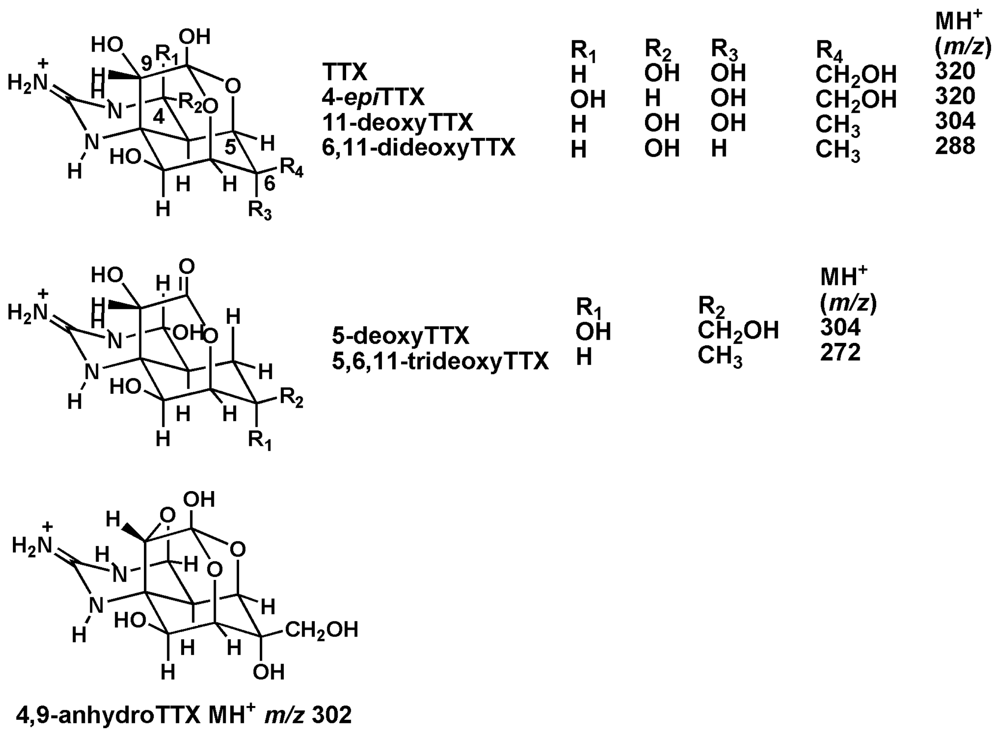
<p>Tetrodotoxin (TTX), the primary chemical toxin of puffer fishes, exists as a mixture of its analogs (<xref ref-type="fig" rid="f1-marinedrugs-08-01049">Figure 1</xref>). Among them, 4-<italic>epi</italic>TTX and 4,9-anhydroTTX are the chemical equilibrium analogs of TTX [<xref ref-type="bibr" rid="b1-marinedrugs-08-01049">1</xref>,<xref ref-type="bibr" rid="b2-marinedrugs-08-01049">2</xref>]. Four deoxy analogs, such as 5-deoxyTTX [<xref ref-type="bibr" rid="b3-marinedrugs-08-01049">3</xref>], 11-deoxyTTX [<xref ref-type="bibr" rid="b4-marinedrugs-08-01049">4</xref>], 6,11-dideoxyTTX [<xref ref-type="bibr" rid="b5-marinedrugs-08-01049">5</xref>] and 5,6,11-trideoxyTTX [<xref ref-type="bibr" rid="b6-marinedrugs-08-01049">6</xref>], were also isolated from puffer fishes and/or newts as the chemical non-equilibrium analogs. The values of LD<sub>50</sub> (50% lethal dose, mice, intraperitoneal injection) of TTX, 11-deoxyTTX, and 6,11-dideoxyTTX were determined as 10 μg/kg [<xref ref-type="bibr" rid="b7-marinedrugs-08-01049">7</xref>], 70 μg/kg [<xref ref-type="bibr" rid="b4-marinedrugs-08-01049">4</xref>], and 420 μg/kg [<xref ref-type="bibr" rid="b5-marinedrugs-08-01049">5</xref>], respectively, and the value of LD<sub>99</sub> of 5,6,11-trideoxyTTX was 750 μg/kg [<xref ref-type="bibr" rid="b6-marinedrugs-08-01049">6</xref>]. The LD value of 5-deoxyTTX has not been determined yet.</p>
<p>We previously established the hydrophilic interaction liquid chromatography-electrospray ionization/mass spectrometry (HILIC-ESI/MS) system for TTXs [<xref ref-type="bibr" rid="b8-marinedrugs-08-01049">8</xref>,<xref ref-type="bibr" rid="b9-marinedrugs-08-01049">9</xref>]. This system has enabled us to quantify the four deoxy analogs of TTX which were not detectable with liquid chromatography fluorescent detection (LC-FLD) [<xref ref-type="bibr" rid="b8-marinedrugs-08-01049">8</xref>,<xref ref-type="bibr" rid="b11-marinedrugs-08-01049">11</xref>–<xref ref-type="bibr" rid="b12-marinedrugs-08-01049">12</xref>]. Using this LC/MS, distribution of TTX analogs among tissues of Japanese marine puffer fish <italic>Fugu pardalis</italic> was revealed, and 5,6,11-trideoxyTTX was found to be the major analog in all tissues [<xref ref-type="bibr" rid="b10-marinedrugs-08-01049">10</xref>]. Rodriguez <italic>et al</italic>. [<xref ref-type="bibr" rid="b13-marinedrugs-08-01049">13</xref>] also reported the presence of TTX and 5,6,11-trideoxyTTX as the major TTX analogs in the European trumpet shell, <italic>Charonia lampas lampas</italic>, using LC/MS/MS. Contrary to the marine animals, 5,6,11-trideoxyTTX was not detected in the newt, <italic>Cynops ensicauda</italic> [<xref ref-type="bibr" rid="b9-marinedrugs-08-01049">9</xref>]. It has not been clarified whether these deoxy analogs and TTX are chemically modified with each other in puffer fishes, or if they are all produced by the TTX producing bacteria [<xref ref-type="bibr" rid="b14-marinedrugs-08-01049">14</xref>,<xref ref-type="bibr" rid="b15-marinedrugs-08-01049">15</xref>]. However, these analogs can be speculated to be precursors or metabolites of TTX [<xref ref-type="bibr" rid="b16-marinedrugs-08-01049">16</xref>,<xref ref-type="bibr" rid="b17-marinedrugs-08-01049">17</xref>] because of their structural similarity. To support this assumption, we need to confirm that these deoxy analogs are commonly present in a range of species of puffer fishes.</p>
<p>Herein we examined the contents of TTX and its deoxy analogs in the tissues of three female and three male specimens of the marine puffer fish <italic>F. niphobles</italic> collected at the southern coast of Korea, and in two brackishwater puffer fishes <italic>Tetraodon nigroviridis</italic> and <italic>Tetraodon biocellatus</italic> from Southeast Asia, purchased in a pet market in Japan [<xref ref-type="bibr" rid="b18-marinedrugs-08-01049">18</xref>], by LC/MS in HILIC mode.</p></sec>
<sec sec-type="results|discussion">
<title>2. Results and Discussion</title>
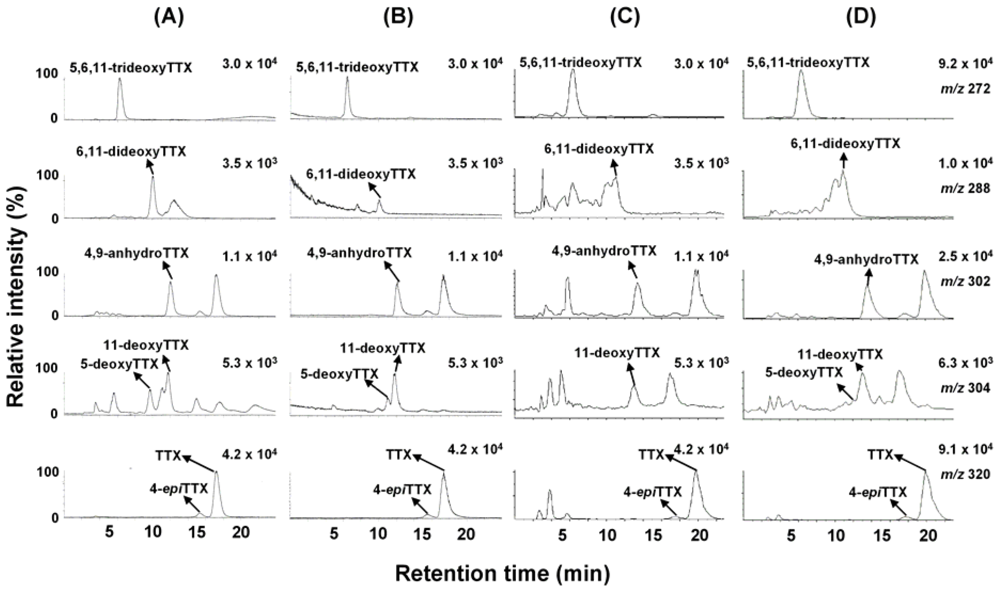
<p>TTXs were quantified by LC/MS in single ion monitoring (SIM) mode, because the ratios of signal to noise of the peaks of TTXs were higher than those obtained by LC/MS/MS in multiple reaction monitoring (MRM) mode, probably due to some specific reasons related to our MS spectrometer. Tetrodonic acid was not analyzed in this study. In <xref ref-type="fig" rid="f2-marinedrugs-08-01049">Figure 2</xref>, LC/MS separation in SIM mode of (B) the ovary from female no. 3 specimen of Korean <italic>F. niphobles,</italic> (C) whole body of no. 5 specimen of <italic>T. nigroviridis,</italic> and (D) whole body of no. 2 specimen of <italic>T. biocellatus</italic> from Southeast Asia are illustrated as representatives. Based on the peak area on the mass chromatograms, the concentrations of TTXs in the ovary from female no. 3 <italic>F. niphobles</italic> are estimated at TTX (263 nmol/g), 4-<italic>epi</italic>TTX (26 nmol/g), 4,9-anhydroTTX (83 nmol/g), 5-deoxyTTX (22 nmol/g), 11-deoxyTTX (39 nmol/g), 6,11-dideoxyTTX (310 nmol/g), and 5,6,11-trideoxyTTX (603 nmol/g). Similarly, the toxin contents in each tissue of three female and three male specimens of <italic>F. niphobles,</italic> and those in whole body of twelve specimens of <italic>T. nigroviridis</italic> and three specimens of <italic>T. biocellatus</italic> are determined, and summarized in <xref ref-type="table" rid="t1-marinedrugs-08-01049">Table 1</xref> and <xref ref-type="table" rid="t2-marinedrugs-08-01049">Table 2</xref>, respectively.</p>
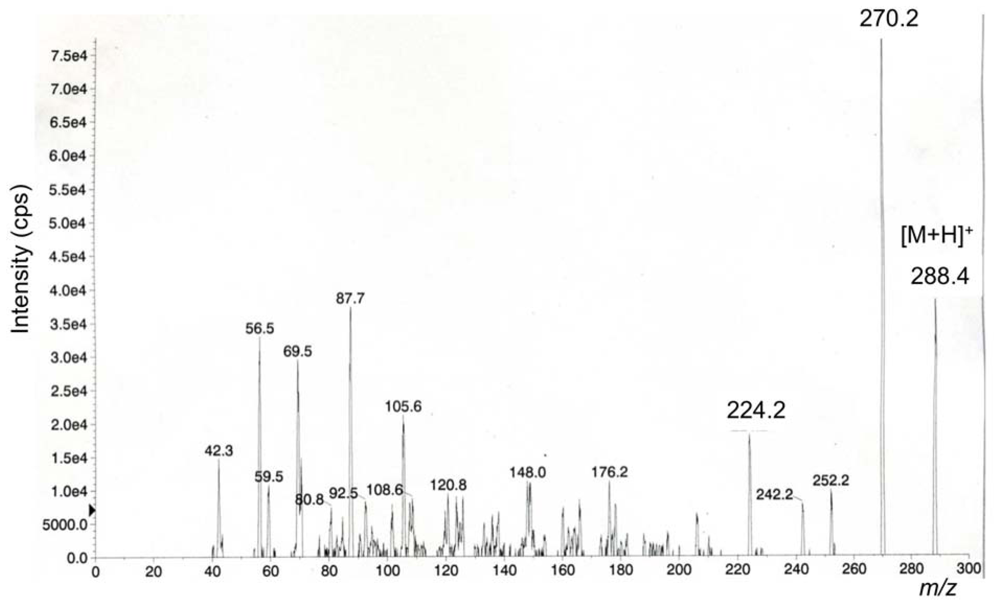
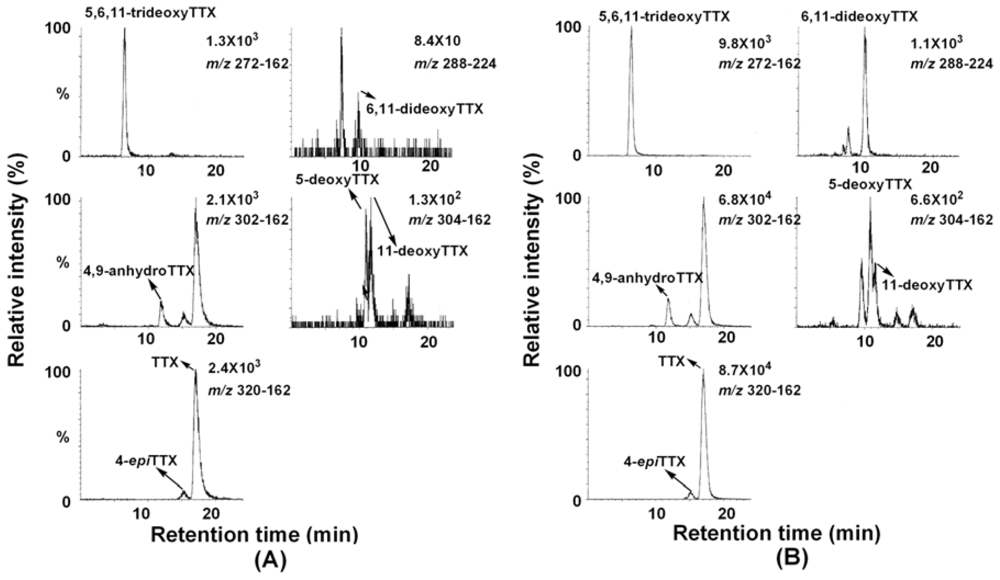
<p>We previously reported characteristic fragment ions, including a major ion at <italic>m/z</italic> 162, from [M+H]<sup>+</sup> ions of TTX, 4-<italic>epi</italic>TTX, 4,9-anhydroTTX, 5-deoxyTTX, 11-deoxyTTX, and 5,6,11-trideoxyTTX by MS/MS (product ion) scan, and applied them to detection of TTXs by LC/MS/MS in MRM mode [<xref ref-type="bibr" rid="b8-marinedrugs-08-01049">8</xref>] as listed in <xref ref-type="table" rid="t3-marinedrugs-08-01049">Table 3</xref>. In the present study, we determined the major fragment ions by product ion scan from [M+H]<sup>+</sup> <italic>m/z</italic> 288 for 6,11-dideoxyTTX for the first time (<xref ref-type="fig" rid="f3-marinedrugs-08-01049">Figure 3</xref>). Distinctively from other TTX analogs [<xref ref-type="bibr" rid="b8-marinedrugs-08-01049">8</xref>], 6,11-dideoxyTTX produced the major fragment ion at <italic>m/z</italic> 224 instead at <italic>m/z</italic>162. Therefore, <italic>m/z</italic> 288–224 fragment was set up for detection of 6,11-dideoxyTTX by LC/MS/MS. Identification of TTX analogs by LC/MS in SIM mode was confirmed by LC/MS/MS in MRM mode, only for the ovary from female no. 3 Korean <italic>F. niphobles</italic> (<xref ref-type="fig" rid="f4-marinedrugs-08-01049">Figure 4B</xref>).</p>
<p>As shown in <xref ref-type="table" rid="t1-marinedrugs-08-01049">Table 1</xref> and <xref ref-type="table" rid="t2-marinedrugs-08-01049">Table 2</xref>, TTX and 5,6,11-trideoxyTTX are commonly detected as the major toxins in all tissues of Korean <italic>F. niphobles</italic> and also in the two <italic>Tetraodon</italic> species, similar to Japanese <italic>Fugu pardalis</italic> as we reported previously [<xref ref-type="bibr" rid="b10-marinedrugs-08-01049">10</xref>]. Interestingly, 6,11-dideoxyTTX, which was previously discovered in the ovaries of Japanese <italic>F. pardalis</italic> as a minor analog [<xref ref-type="bibr" rid="b5-marinedrugs-08-01049">5</xref>], is detected as another major TTX analog in almost all tissues in Korean <italic>F. niphobles</italic> with exception of the skin from females. Also, the concentration of 6,11-dideoxyTTX is higher than that of TTX in the intestine and liver from female no. 3 <italic>F. niphobles</italic>. This analog is also detected in some specimens of <italic>T. nigroviridis</italic> and <italic>T. biocellatus</italic> as a minor analog. 5-DeoxyTTX and 11-deoxyTTX are contained in low concentrations in almost all tissues of Korean <italic>F. niphobles</italic>, but they are less than detection limit (&lt;0.5 nmol/g) in the muscle and testicle. 11-DeoxyTTX is a minor analog also in the two <italic>Tetraodon</italic> species, while 5-deoxyTTX is slightly detected only in <italic>T. biocellatus</italic> and it is less than detection limit (&lt;0.5 nmol/g) in <italic>T. nigroviridis.</italic> Except for 5-deoxyTTX in <italic>T. nigroviridis</italic>, these data suggest that these four deoxy analogs of TTX are commonly present in puffer fishes, although the ratios of them are specific to the species of puffer fishes or to the regions where the fishes were collected.</p>
<p>Among the tissues of Korean <italic>F. niphobles</italic>, the concentration of TTXs is highest in the ovary and skin. This is in agreement with the report by Ryu <italic>et al</italic>. [<xref ref-type="bibr" rid="b19-marinedrugs-08-01049">19</xref>] that skin was highly toxic (10–674 mouse unit/g = 7–465 nmol/g TTX) in Korean <italic>F. niphobles</italic> by mouse assay method (1 mouse unit is equivalent to 220 ng of TTX). Also, this is consistent with the data reported by Kono <italic>et al</italic>. [<xref ref-type="bibr" rid="b20-marinedrugs-08-01049">20</xref>] that dietarily administrated TTX to Japanese cultured juvenile <italic>F. niphobles</italic> was first accumulated in liver and then transferred to skin. According to Ikeda <italic>et al</italic>. [<xref ref-type="bibr" rid="b21-marinedrugs-08-01049">21</xref>], the high toxicity in the ovaries of <italic>Takifugu</italic> (=<italic>Fugu</italic>) <italic>poecilonotus</italic> might account for the TTXs transfer from liver, skin, intestine, and muscle into the ovaries during spawning season. Unlike Korean <italic>F. niphobles</italic>, Japanese <italic>F. pardalis</italic> contained the highest concentration of TTXs in ovary and liver, and medium level TTXs in skin [<xref ref-type="bibr" rid="b10-marinedrugs-08-01049">10</xref>]. Edible parts except intestine and ovary of <italic>F. niphobles,</italic> which contained fewer than 10 mouse units per gram, are used in a favorite fish soup or other food materials in Korea and cause TTX poisoning sporadically. More careful precautions need to be taken to remove toxic body parts before cooking. Concerning the toxicity of the puffer fishes genus <italic>Tetraodon</italic>, Shin-Jung <italic>et al</italic>. [<xref ref-type="bibr" rid="b22-marinedrugs-08-01049">22</xref>] examined the toxicity of 42 and 12 specimens of <italic>T. ocellatus</italic> and <italic>T. nigroviridis</italic>, respectively, collected in Taiwan by using mouse bioassay, and identified TTX and 4,9-anhydroTTX in both species by LC. The authors reported the highest toxicity score of <italic>T. nigroviridis</italic> to be 124 mouse unit/g (=85 nmol/g TTX), rather lower than those found in our present study (<xref ref-type="table" rid="t2-marinedrugs-08-01049">Table 2</xref>).</p></sec>
<sec>
<title>3. Experimental Section</title>
<sec>
<title>3.1. Puffer fishes specimens</title>
<p>Specimens of three female and three male each of <italic>F. niphobles</italic> (body weight 12–37 g) were collected on May 12<sup>th</sup>, 2008 at Tongyeong bay, South Korea. The twelve specimens of <italic>T. nigroviridis</italic> (body weight 0.8–3.8 g, sex not identified) and three specimens of <italic>T. biocellatus</italic> (body weight 1.6–3.7g, sex not identified) collected from Southeast Asia were purchased in a pet market of Miyagi Prefecture, Japan. Samples were immediately kept on ice, transported to the laboratory and kept frozen below −20 °C for no longer than a month until use.</p></sec>
<sec>
<title>3.2. Preparation of sample solutions</title>
<p>Sample solutions were prepared as we reported previously [<xref ref-type="bibr" rid="b8-marinedrugs-08-01049">8</xref>,<xref ref-type="bibr" rid="b9-marinedrugs-08-01049">9</xref>] with minor modification. <italic>F. niphobles</italic> were dissected to obtain organs of ovary/testis, liver, intestine, dorsal skin and dorsal muscle, while <italic>T. nigroviridis</italic> and <italic>T. biocellatus</italic> were used as whole body. The toxins were extracted from a part (1 g) of homogenized tissues with 5 mL of 0.05 M acetic acid (v/v) by heating in boiling water for 5 min. The obtained suspensions were centrifuged at 4,000 rpm for 15 min at 4 °C, then the supernatants were filled up to 5 mL with 0.05 M acetic acid. An aliquot (2 mL) was applied to the reverse phase cartridge column (Sep-Pak C18, Waters) which was equilibrated with water after washing with MeOH before use. The first passing solution (1.5 mL) was discarded, and the following 0.5 mL was collected and defatted with CHCl<sub>3</sub> (0.5 mL). After removal of the remaining CHCl<sub>3</sub> under the stream of N<sub>2</sub> gas, the aqueous phase was lyophilized and filled up to 5 mL with water, and then loaded on an activated charcoal (0.5 mL), which was packed in a glass pipette. After washing the column with water (0.5 mL), the toxins were eluted with acetic acid/EtOH/H<sub>2</sub>O (1:50:49, 1.5 mL), and the volatile was evaporated from the eluate. The remaining residue was dissolved in 0.5 mL of 0.05 M acetic acid, and then ultrafiltered (Ultrafree-MC, 10,000 NMWL, Millipore, Bedford, MA) by centrifugation at 8,000 rpm for 15 min at 4 °C. This filtrate was used as the sample solution for LC/MS and LC/MS/MS analysis.</p></sec>
<sec>
<title>3.3. Preparation of semi-purified TTXs mixture as the standard for LC/MS</title>
<p>Semi-purified TTXs mixture was prepared from the ovary of <italic>Fugu poecilonotus</italic>, collected in Shimonoseki, Japan, by extraction of toxins with hot 0.05 M acetic acid, followed by partition with ethyl acetate and purification on a charcoal column [<xref ref-type="bibr" rid="b6-marinedrugs-08-01049">6</xref>]. TTX, 4-<italic>epi</italic>TTX, 4,9-anhydroTTX, 5-deoxyTTX, 11-deoxyTTX, 6,11-dideoxyTTX, and 5,6,11-trideoxyTTX in the obtained mixture were quantified using LC/MS in SIM mode on the basis of the standard curve for each analog drawn using highly purified analogs [<xref ref-type="bibr" rid="b8-marinedrugs-08-01049">8</xref>–<xref ref-type="bibr" rid="b10-marinedrugs-08-01049">10</xref>]. Because highly purified TTX analogs are very limited, we used this semi-purified TTXs mixture as the standard for LC/MS.</p></sec>
<sec>
<title>3.4. LC/MS, MS/MS, and LC/MS/MS</title>
<p>LC/MS was performed based on HILIC as we reported previously [<xref ref-type="bibr" rid="b9-marinedrugs-08-01049">9</xref>, <xref ref-type="bibr" rid="b10-marinedrugs-08-01049">10</xref>]. Briefly, LC system consisted of a Shimadzu LC-10AD pump (Japan) and a TSKgel Amide-80 column (2.0-i.d. x 150 mm, 5 μm, Toso, Tokyo, Japan). LC was performed using an aqueous solution containing 16 mM ammonium formate buffer (pH 5.5) and acetonitrile (3:7, v/v) as a mobile phase at a flow rate of 0.2 mL/min at 25 °C. LC/MS, LC/MS/MS and flow-injection MS/MS experiments were recorded on API2000 mass spectrometer (Applied Bio-systems MDS SCIEX, Foster City, CA) equipped with an ESI source in the positive-ion mode. ESI was evoked by a spray voltage of +5.5 kV and heated capillary temperature was maintained at 500 °C. Six ions at <italic>m/z</italic> 272, 288, 302, 304 and 320 corresponding to the [M+H]<sup>+</sup> ions of TTX analogs were detected in SIM mode, respectively. The dwell time was set at 200 ms per Da. The MS/MS measurements of 6,11-dideoxyTTX was based on collision induced dissociation (CID) occurring in the collision cell (Q2) of the triple quadrupole at a collision energy of 42 eV. Nitrogen was used as the target gas. 150 pmol of authentic 6,11-dideoxyTTX [<xref ref-type="bibr" rid="b5-marinedrugs-08-01049">5</xref>] (4 μl in 0.05M acetic acid) was introduced into the mass spectrometer by flow injection with methanol at a flow rate of 0.2 mL/min. The LC/MS/MS was performed under the same conditions as those used for the LC/MS and MS/MS experiments. The ions <italic>m/z</italic> 320–162 for TTX and 4-<italic>epi</italic>TTX, <italic>m/z</italic> 302–162 for 4,9-anhydroTTX, <italic>m/z</italic> 304–162 for 5-deoxyTTX and 11-deoxyTTX, <italic>m/z</italic> 288–224 for 6,11-dideoxyTTX, and <italic>m/z</italic> 272–162 for 5,6,11-tridexyTTX were detected in MRM mode [<xref ref-type="bibr" rid="b8-marinedrugs-08-01049">8</xref>]. The minimum TTX and its analogs to be detected were 0.5 nmol/g tissue in SIM mode.</p></sec></sec>
<sec sec-type="conclusions">
<title>4. Conclusions</title>
<p>In this study, four deoxy analogs of TTX were all detected in three species of puffer fishes tested with exception of 5-deoxyTTX in <italic>T. nigroviridis</italic>. We also found these deoxy analogs in ovary from Japanese <italic>Fugu poecilonotus</italic> when we prepared standard mixture of TTXs for LC/MS as described in the Experimental section. These results indicate that the deoxy analogs of TTX are common analogs in a range of puffer fishes. For the next work, we should investigate whether these deoxy analogs are chemically modified with each other in puffer fishes, or if they are provided from external origin, such as bacteria [<xref ref-type="bibr" rid="b14-marinedrugs-08-01049">14</xref>,<xref ref-type="bibr" rid="b15-marinedrugs-08-01049">15</xref>] and then accumulated in puffer fishes. The ability of puffer fishes to accumulate TTX was confirmed by Yamamori et al.[<xref ref-type="bibr" rid="b23-marinedrugs-08-01049">23</xref>] and Kono et al.[<xref ref-type="bibr" rid="b20-marinedrugs-08-01049">20</xref>] by the fact that cultured juvenile non-toxic Japanese <italic>Takifugu</italic> (<italic>Fugu</italic>) <italic>niphobles</italic> become toxic when TTX and its analogs were dietarily administered. Kono <italic>et al</italic>.[<xref ref-type="bibr" rid="b24-marinedrugs-08-01049">24</xref>] also reported that cultured juvenile <italic>F. niphobles</italic> administered TTX by intramuscular injection did not transform TTX to deoxy analogs or to 11-oxoTTX (which has CHO in the position of R<sub>4</sub> in <xref ref-type="fig" rid="f1-marinedrugs-08-01049">Figure 1</xref> instead of CH<sub>2</sub>OH of TTX). However, transformation from deoxy analogs or 11-oxoTTX to TTX has not been tested, and dietary administration might be important for such experiments. We will further examine whether these deoxy analogs are the products of transformation or metabolites in puffer fishes.</p></sec></body>
<back>
<ack>
<title>Acknowledgements</title>
<p>The authors acknowledge financial support from the Japan Society for the Promotion of Science (JSPS), Research Fellow No. 200805892 to J. H. J., and Grants-in-Aid for Scientific Research No. 21380070 to M. Y. Y.</p></ack>
<ref-list>
<title>References and Notes</title>
<ref id="b1-marinedrugs-08-01049"><label>1</label><citation citation-type="journal"><person-group person-group-type="author"><name><surname>Goto</surname><given-names>T</given-names></name><name><surname>Kishi</surname><given-names>Y</given-names></name><name><surname>Takahashi</surname><given-names>S</given-names></name><name><surname>Hirata</surname><given-names>Y</given-names></name></person-group><article-title>Tetrodotoxin</article-title><source>Tetrahedron</source><year>1965</year><volume>21</volume><fpage>2059</fpage><lpage>2088</lpage><pub-id pub-id-type="doi">10.1016/S0040-4020(01)98344-9</pub-id><pub-id pub-id-type="pmid">5896483</pub-id></citation></ref>
<ref id="b2-marinedrugs-08-01049"><label>2</label><citation citation-type="journal"><person-group person-group-type="author"><name><surname>Nakamura</surname><given-names>M</given-names></name><name><surname>Yasumoto</surname><given-names>T</given-names></name></person-group><article-title>Tetrodotoxin derivatives in puffer fish</article-title><source>Toxicon</source><year>1985</year><volume>23</volume><fpage>271</fpage><lpage>276</lpage><pub-id pub-id-type="doi">10.1016/0041-0101(85)90149-7</pub-id><pub-id pub-id-type="pmid">4024136</pub-id></citation></ref>
<ref id="b3-marinedrugs-08-01049"><label>3</label><citation citation-type="journal"><person-group person-group-type="author"><name><surname>Yotsu-Yamashita</surname><given-names>M</given-names></name><name><surname>Schimmele</surname><given-names>B</given-names></name><name><surname>Yasumoto</surname><given-names>T</given-names></name></person-group><article-title>Isolation and structural assignment of 5-deoxytetrodotoxin from the puffer fish <italic>Fugu poecilonotus</italic></article-title><source>Biosci Biotechnol Biochem</source><year>1999</year><volume>63</volume><fpage>961</fpage><lpage>963</lpage><pub-id pub-id-type="doi">10.1271/bbb.63.961</pub-id><pub-id pub-id-type="pmid">10380642</pub-id></citation></ref>
<ref id="b4-marinedrugs-08-01049"><label>4</label><citation citation-type="journal"><person-group person-group-type="author"><name><surname>Yasumoto</surname><given-names>T</given-names></name><name><surname>Yotsu</surname><given-names>M</given-names></name><name><surname>Murata</surname><given-names>M</given-names></name><name><surname>Naoki</surname><given-names>H</given-names></name></person-group><article-title>New tetrodotoxin analogue from the newt <italic>Cynops ensicauda</italic></article-title><source>J Am Chem Soc</source><year>1988</year><volume>110</volume><fpage>2344</fpage><lpage>2345</lpage><pub-id pub-id-type="doi">10.1021/ja00215a078</pub-id></citation></ref>
<ref id="b5-marinedrugs-08-01049"><label>5</label><citation citation-type="journal"><person-group person-group-type="author"><name><surname>Jang</surname><given-names>JH</given-names></name><name><surname>Yotsu-Yamashita</surname><given-names>M</given-names></name></person-group><article-title>6,11-DideoxyTTX from the puffer fish, <italic>Fugu pardalis</italic></article-title><source>Toxicon</source><year>2007</year><volume>50</volume><fpage>947</fpage><lpage>951</lpage><pub-id pub-id-type="doi">10.1016/j.toxicon.2007.06.026</pub-id><pub-id pub-id-type="pmid">17826815</pub-id></citation></ref>
<ref id="b6-marinedrugs-08-01049"><label>6</label><citation citation-type="journal"><person-group person-group-type="author"><name><surname>Yotsu-Yamashita</surname><given-names>M</given-names></name><name><surname>Yamagishi</surname><given-names>Y</given-names></name><name><surname>Yasumoto</surname><given-names>T</given-names></name></person-group><article-title>5,6,11-Trideoxytetrodotoxin from the puffer fish, <italic>Fugu poecilonotus</italic></article-title><source>Tetrahedron Lett</source><year>1995</year><volume>36</volume><fpage>9329</fpage><lpage>9332</lpage><pub-id pub-id-type="doi">10.1016/0040-4039(95)02020-P</pub-id></citation></ref>
<ref id="b7-marinedrugs-08-01049"><label>7</label><citation citation-type="journal"><person-group person-group-type="author"><name><surname>Kao</surname><given-names>CY</given-names></name><name><surname>Furman</surname><given-names>F</given-names></name></person-group><article-title>A Pharmacological studies on tetrodotoxin, a potent neurotoxin</article-title><source>J Pharmacol Exp Ther</source><year>1963</year><volume>140</volume><fpage>31</fpage><lpage>40</lpage><pub-id pub-id-type="pmid">13962288</pub-id></citation></ref>
<ref id="b8-marinedrugs-08-01049"><label>8</label><citation citation-type="journal"><person-group person-group-type="author"><name><surname>Shoji</surname><given-names>Y</given-names></name><name><surname>Yotsu-Yamashita</surname><given-names>M</given-names></name><name><surname>Miyazawa</surname><given-names>T</given-names></name><name><surname>Yasumoto</surname><given-names>T</given-names></name></person-group><article-title>Electrospray ionization mass spectrometry of tetrodotoxin and its analogs: liquid mass spectrometry, and liquid chromatography/tandem mass spectrometry</article-title><source>Anal Biochem</source><year>2001</year><volume>290</volume><fpage>10</fpage><lpage>17</lpage><pub-id pub-id-type="doi">10.1006/abio.2000.4953</pub-id><pub-id pub-id-type="pmid">11180932</pub-id></citation></ref>
<ref id="b9-marinedrugs-08-01049"><label>9</label><citation citation-type="journal"><person-group person-group-type="author"><name><surname>Nakagawa</surname><given-names>T</given-names></name><name><surname>Jang</surname><given-names>J</given-names></name><name><surname>Yotsu-Yamashita</surname><given-names>M</given-names></name></person-group><article-title>Hydrophilic interaction liquid chromatography-electrospray ionization mass spectrometry of tetrodotoxin and its analogs</article-title><source>Anal Biochem</source><year>2006</year><volume>352</volume><fpage>142</fpage><lpage>144</lpage><pub-id pub-id-type="doi">10.1016/j.ab.2006.02.010</pub-id><pub-id pub-id-type="pmid">16574054</pub-id></citation></ref>
<ref id="b10-marinedrugs-08-01049"><label>10</label><citation citation-type="journal"><person-group person-group-type="author"><name><surname>Jang</surname><given-names>J</given-names></name><name><surname>Yotsu-Yamashita</surname><given-names>M</given-names></name></person-group><article-title>Distribution of tetrodotoxin, saxitoxin, and their analogs among tissues of the puffer fish <italic>Fugu pardalis</italic></article-title><source>Toxicon</source><year>2006</year><volume>48</volume><fpage>980</fpage><lpage>987</lpage><pub-id pub-id-type="doi">10.1016/j.toxicon.2006.07.034</pub-id><pub-id pub-id-type="pmid">16997342</pub-id></citation></ref>
<ref id="b11-marinedrugs-08-01049"><label>11</label><citation citation-type="journal"><person-group person-group-type="author"><name><surname>Yasumoto</surname><given-names>T</given-names></name><name><surname>Michishita</surname><given-names>T</given-names></name></person-group><article-title>Fluorometric determination of tetrodotoxin by high performance liquid chromatography</article-title><source>Agric Biol Chem</source><year>1985</year><volume>49</volume><fpage>3077</fpage><lpage>3080</lpage><pub-id pub-id-type="doi">10.1271/bbb1961.49.3077</pub-id></citation></ref>
<ref id="b12-marinedrugs-08-01049"><label>12</label><citation citation-type="journal"><person-group person-group-type="author"><name><surname>Yotsu</surname><given-names>M</given-names></name><name><surname>Endo</surname><given-names>A</given-names></name><name><surname>Yasumoto</surname><given-names>T</given-names></name></person-group><article-title>An improved tetrodotoxin analyzer</article-title><source>Agric Biol Chem</source><year>1989</year><volume>53</volume><fpage>895</fpage><lpage>898</lpage></citation></ref>
<ref id="b13-marinedrugs-08-01049"><label>13</label><citation citation-type="journal"><person-group person-group-type="author"><name><surname>Rodriguez</surname><given-names>P</given-names></name><name><surname>Alfonso</surname><given-names>A</given-names></name><name><surname>Vale</surname><given-names>C</given-names></name><name><surname>Alfonso</surname><given-names>C</given-names></name><name><surname>Vale</surname><given-names>P</given-names></name><name><surname>Tellez</surname><given-names>A</given-names></name><name><surname>Botana</surname><given-names>LM</given-names></name></person-group><article-title>First toxicity report of tetrodotoxin and 5,6,11-trideoxyTTX in the trumpet shell <italic>Charonia lampas lampas</italic> in Europe</article-title><source>Anal Chem</source><year>2008</year><volume>80</volume><fpage>5622</fpage><lpage>5629</lpage><pub-id pub-id-type="doi">10.1021/ac800769e</pub-id><pub-id pub-id-type="pmid">18558725</pub-id></citation></ref>
<ref id="b14-marinedrugs-08-01049"><label>14</label><citation citation-type="journal"><person-group person-group-type="author"><name><surname>Yasumoto</surname><given-names>T</given-names></name><name><surname>Yasumura</surname><given-names>D</given-names></name><name><surname>Yotsu</surname><given-names>M</given-names></name><name><surname>Michishita</surname><given-names>T</given-names></name><name><surname>Endo</surname><given-names>A</given-names></name><name><surname>Kotaki</surname><given-names>Y</given-names></name></person-group><article-title>Bacterial production of tetrodotoxin and anhydrotetrodotoxin</article-title><source>Agric Biol Chem</source><year>1986</year><volume>50</volume><fpage>793</fpage><lpage>795</lpage><pub-id pub-id-type="doi">10.1271/bbb1961.50.793</pub-id></citation></ref>
<ref id="b15-marinedrugs-08-01049"><label>15</label><citation citation-type="journal"><person-group person-group-type="author"><name><surname>Noguchi</surname><given-names>T</given-names></name><name><surname>Jeo</surname><given-names>J</given-names></name><name><surname>Arakawa</surname><given-names>O</given-names></name><name><surname>Sugita</surname><given-names>H</given-names></name><name><surname>Deguchi</surname><given-names>Y</given-names></name><name><surname>Shida</surname><given-names>Y</given-names></name><name><surname>Hashimoto</surname><given-names>K</given-names></name></person-group><article-title>Occurrence of tetrodotoxin and anhydrotetrodotoxin in <italic>Vibrio</italic> sp. Isolated from the intestines of a xanthid crab, <italic>Atergatis floridus</italic></article-title><source>J Biochem</source><year>1986</year><volume>99</volume><fpage>311</fpage><lpage>314</lpage><pub-id pub-id-type="pmid">3754255</pub-id></citation></ref>
<ref id="b16-marinedrugs-08-01049"><label>16</label><citation citation-type="journal"><person-group person-group-type="author"><name><surname>Yasumoto</surname><given-names>T</given-names></name><name><surname>Yotsu-Yamashita</surname><given-names>M</given-names></name></person-group><article-title>Chemical and etiological studies on tetrodotoxin and its analogs</article-title><source>J Toxicol Toxin Rev</source><year>1996</year><volume>15</volume><fpage>81</fpage><lpage>90</lpage><pub-id pub-id-type="doi">10.3109/15569549609064078</pub-id></citation></ref>
<ref id="b17-marinedrugs-08-01049"><label>17</label><citation citation-type="journal"><person-group person-group-type="author"><name><surname>Yotsu-Yamashita</surname><given-names>M</given-names></name></person-group><article-title>Chemistry of puffer fish toxin</article-title><source>J Toxicol Toxin Rev</source><year>2001</year><volume>20</volume><fpage>51</fpage><lpage>66</lpage><pub-id pub-id-type="doi">10.1081/TXR-100102536</pub-id></citation></ref>
<ref id="b18-marinedrugs-08-01049"><label>18</label><citation citation-type="confproc"><person-group person-group-type="author"><name><surname>Jang</surname><given-names>JH</given-names></name><name><surname>Yotsu-Yamashita</surname><given-names>M</given-names></name></person-group><article-title>Tetrodotoxin and 5,6,11-trideoxytetrodotoxin in <italic>Tetraodon nigroviridis</italic> and <italic>T. biocellatus</italic> collected from Southeast Asia</article-title><conf-name>Proceedings of the 5th World Fisheries Congress, Preliminary data of Tetraodon nigroviridis and Tetraodon biocellatus has been reported in the proceedings</conf-name><conf-loc>Yokohama, Japan</conf-loc><conf-date>20–24 October 2008</conf-date></citation></ref>
<ref id="b19-marinedrugs-08-01049"><label>19</label><citation citation-type="journal"><person-group person-group-type="author"><name><surname>Ryu</surname><given-names>CH</given-names></name><name><surname>Kim</surname><given-names>DG</given-names></name><name><surname>Kim</surname><given-names>JH</given-names></name><name><surname>Jang</surname><given-names>JH</given-names></name><name><surname>Lee</surname><given-names>JS</given-names></name></person-group><article-title>Toxicity of the Grass puffer, <italic>Takifugu niphobles</italic> (Bogseom)</article-title><source>J Korean Soc Food Sci Nutr</source><year>2003</year><volume>32</volume><fpage>986</fpage><lpage>990</lpage><comment>(in Korean)</comment><pub-id pub-id-type="doi">10.3746/jkfn.2003.32.7.986</pub-id></citation></ref>
<ref id="b20-marinedrugs-08-01049"><label>20</label><citation citation-type="journal"><person-group person-group-type="author"><name><surname>Kono</surname><given-names>M</given-names></name><name><surname>Matsui</surname><given-names>T</given-names></name><name><surname>Furukawa</surname><given-names>K</given-names></name><name><surname>Yotsu-Yamashita</surname><given-names>M</given-names></name><name><surname>Yamamori</surname><given-names>K</given-names></name></person-group><article-title>Accumulation of tetrodotoxin and 4,9-anhydrotetrodotoxin in cultured juvenile kusafugu <italic>Fugu niphobles</italic> by dietary administration of natural toxic komonfugu <italic>Fugu poecilonotus</italic> liver</article-title><source>Toxicon</source><year>2008</year><volume>51</volume><fpage>1269</fpage><lpage>1273</lpage><pub-id pub-id-type="doi">10.1016/j.toxicon.2008.02.017</pub-id><pub-id pub-id-type="pmid">18420245</pub-id></citation></ref>
<ref id="b21-marinedrugs-08-01049"><label>21</label><citation citation-type="journal"><person-group person-group-type="author"><name><surname>Ikeda</surname><given-names>K</given-names></name><name><surname>Emoto</surname><given-names>Y</given-names></name><name><surname>Tatsuno</surname><given-names>R</given-names></name><name><surname>Wang</surname><given-names>JJ</given-names></name><name><surname>Ngy</surname><given-names>L</given-names></name><name><surname>Taniyama</surname><given-names>S</given-names></name><name><surname>Takatani</surname><given-names>T</given-names></name><name><surname>Arakawa</surname><given-names>O</given-names></name></person-group><article-title>Maturation-associated changes in toxicity of the pufferfish <italic>Takifugu poecilonotus</italic></article-title><source>Toxicon</source><year>2010</year><volume>55</volume><fpage>289</fpage><lpage>297</lpage><pub-id pub-id-type="doi">10.1016/j.toxicon.2009.08.001</pub-id><pub-id pub-id-type="pmid">19682483</pub-id></citation></ref>
<ref id="b22-marinedrugs-08-01049"><label>22</label><citation citation-type="journal"><person-group person-group-type="author"><name><surname>Shin-Jung</surname><given-names>L</given-names></name><name><surname>Liao</surname><given-names>CF</given-names></name><name><surname>Arakawa</surname><given-names>O</given-names></name><name><surname>Noguchi</surname><given-names>T</given-names></name><name><surname>Hwang</surname><given-names>DF</given-names></name></person-group><article-title>Toxicities of two freshwater puffers in Taiwan</article-title><source>J Nat Toxins</source><year>2002</year><volume>11</volume><fpage>103</fpage><lpage>110</lpage><pub-id pub-id-type="pmid">12009110</pub-id></citation></ref>
<ref id="b23-marinedrugs-08-01049"><label>23</label><citation citation-type="journal"><person-group person-group-type="author"><name><surname>Yamamori</surname><given-names>K</given-names></name><name><surname>Furukawa</surname><given-names>K</given-names></name><name><surname>Kono</surname><given-names>M</given-names></name><name><surname>Matsui</surname><given-names>T</given-names></name></person-group><article-title>The toxification of juvenile cultured kusafugu <italic>Takifugu niphobles</italic> by oral administration of crystalline tetrodotoxin</article-title><source>J Food Hyg Soc Jpn</source><year>2004</year><volume>45</volume><fpage>73</fpage><lpage>75</lpage><comment>(in Japanese)</comment><pub-id pub-id-type="doi">10.3358/shokueishi.45.73</pub-id></citation></ref>
<ref id="b24-marinedrugs-08-01049"><label>24</label><citation citation-type="journal"><person-group person-group-type="author"><name><surname>Kono</surname><given-names>M</given-names></name><name><surname>Matsui</surname><given-names>T</given-names></name><name><surname>Furukawa</surname><given-names>K</given-names></name><name><surname>Takase</surname><given-names>T</given-names></name><name><surname>Yamamori</surname><given-names>K</given-names></name><name><surname>Kaneda</surname><given-names>H</given-names></name><name><surname>Aoki</surname><given-names>D</given-names></name><name><surname>Jang</surname><given-names>JH</given-names></name><name><surname>Yotsu-Yamashita</surname><given-names>M</given-names></name></person-group><article-title>Examination of transformation among tetrodotoxin and its analogs in the living cultured juvenile puffer fish, kusafugu, <italic>Fugu niphobles</italic> by intramuscular administration</article-title><source>Toxicon</source><year>2008</year><volume>52</volume><fpage>714</fpage><lpage>720</lpage><pub-id pub-id-type="doi">10.1016/j.toxicon.2008.08.002</pub-id><pub-id pub-id-type="pmid">18775741</pub-id></citation></ref></ref-list>
<sec sec-type="display-objects">
<title>Figures and Tables</title>
<fig id="f1-marinedrugs-08-01049" position="float">
<label>Figure 1</label>
<caption>
<p>The chemical structures of TTX and its analogs found in puffer fishes.</p></caption><graphic xlink:href="marinedrugs-08-01049f1.gif"/></fig>
<fig id="f2-marinedrugs-08-01049" position="float">
<label>Figure 2</label>
<caption>
<p>The mass chromatograms of LC/MS in SIM mode. (<bold>A</bold>) Volume of 4 μl of the semi-purified TTXs mixture containing TTX (53 pmol), 4-<italic>epi</italic>TTX (5.6 pmol), 4,9-anhydroTTX (7.4 pmol), 5-deoxyTTX (1.8 pmol), 11-deoxtyTTX (6.8 pmol), 6,11-dideoxyTTX (1.5 pmol), and 5,6,11-trideoxyTTX (38 pmol) prepared from ovary of <italic>F. poecilonotus</italic> as standard [<xref ref-type="bibr" rid="b10-marinedrugs-08-01049">10</xref>], (<bold>B</bold>) Sample solution (1 μl) of the ovary from female no. 3 <italic>F. niphobles</italic>, (<bold>C</bold>) Sample solution (1 μl) of whole body of no. 5 specimen of <italic>T. nigroviridis,</italic> (<bold>D</bold>) Sample solution (1 μl) of whole body of no. 2 specimen of <italic>T. biocellatus</italic>.</p></caption><graphic xlink:href="marinedrugs-08-01049f2.gif"/></fig>
<fig id="f3-marinedrugs-08-01049" position="float">
<label>Figure 3</label>
<caption>
<p>The fragment ion spectrum from [M+H]<sup>+</sup> <italic>m/z</italic> 288 of 6,11-dideoxyTTX (150 pmol) injected into 0.2 mL/min of methanol. Collision energy: 42 eV.</p></caption><graphic xlink:href="marinedrugs-08-01049f3.gif"/></fig>
<fig id="f4-marinedrugs-08-01049" position="float">
<label>Figure 4</label>
<caption>
<p>The mass chromatograms of the LC/MS/MS obtained under MRM operation (<italic>m/z</italic> 320–162 for TTX and 4-<italic>epi</italic>TTX, <italic>m/z</italic> 302–162 for 4,9-anhydroTTX, <italic>m/z</italic> 304–162 for 5-deoxyTTX and 11-deoxyTTX, 288–224 for 6,11-dideoxyTTX, and <italic>m/z</italic> 272–162 for 5,6,11-tridexyTTX). (A) Volume of 4 μl of the semi-purified TTXs mixture containing TTX (53 pmol), 4-<italic>epi</italic>TTX (5.6 pmol), 4,9-anhydroTTX (7.4 pmol), 5-deoxyTTX (1.8 pmol), 11-deoxtyTTX (6.8 pmol), 6,11-dideoxyTTX (1.5 pmol), and 5,6,11-trideoxyTTX (38 pmol) prepared from ovary of <italic>F. poecilonotus</italic> as standard [<xref ref-type="bibr" rid="b10-marinedrugs-08-01049">10</xref>], (B) Volume of 1 μl of ovary sample solution from female no. 3 <italic>F. niphobles</italic>.</p></caption><graphic xlink:href="marinedrugs-08-01049f4.gif"/></fig>
<table-wrap id="t1-marinedrugs-08-01049" position="float">
<label>Table 1</label>
<caption>
<p>Anatomical distribution of TTX and its analogs in <italic>F. niphobles</italic> (n = 3).</p></caption>
<table frame="hsides" rules="groups">
<thead>
<tr>
<th valign="top" align="left">Tissue</th>
<th valign="top" align="left">Sex</th>
<th valign="top" colspan="7" align="center">Toxin content (nmol/g)<hr/></th></tr>
<tr><th valign="top" align="left"/><th valign="top" align="left"/>
<th valign="top" align="left">TTX</th>
<th valign="top" align="left">4-<italic>epi</italic>TTX</th>
<th valign="top" align="left">4,9-anhydro TTX</th>
<th valign="top" align="left">5-deoxy TTX</th>
<th valign="top" align="left">11-deoxy TTX</th>
<th valign="top" align="left">6,11-dideoxy TTX</th>
<th valign="top" align="left">5,6,11-trideoxy TTX</th></tr></thead>
<tbody>
<tr>
<td valign="middle" align="left">Ovary</td>
<td valign="middle" align="left">F</td>
<td valign="middle" align="left">129–263</td>
<td valign="middle" align="left">10–26</td>
<td valign="middle" align="left">30–83</td>
<td valign="middle" align="left">4–22</td>
<td valign="middle" align="left">8–39</td>
<td valign="middle" align="left">77–310</td>
<td valign="middle" align="left">289–603</td></tr>
<tr>
<td valign="middle" align="left">Testicle</td>
<td valign="middle" align="left">M</td>
<td valign="middle" align="left">1–11</td>
<td valign="middle" align="left">&lt;0.5–1</td>
<td valign="middle" align="left">&lt;0.5–3</td>
<td valign="middle" align="left">&lt;0.5</td>
<td valign="middle" align="left">&lt;0.5–9</td>
<td valign="middle" align="left">1–13</td></tr>
<tr>
<td valign="middle" align="left">Liver</td>
<td valign="middle" align="left">F</td>
<td valign="middle" align="left">4–24</td>
<td valign="middle" align="left">&lt;0.5–6</td>
<td valign="middle" align="left">5–39</td>
<td valign="middle" align="left">&lt;0.5–3</td>
<td valign="middle" align="left">&lt;0.5–1</td>
<td valign="middle" align="left">1–24</td>
<td valign="middle" align="left">3–16</td></tr>
<tr><td valign="middle" align="left"/>
<td valign="middle" align="left">M</td>
<td valign="middle" align="left">9–31</td>
<td valign="middle" align="left">1–3</td>
<td valign="middle" align="left">9–15</td>
<td valign="middle" align="left">&lt;0.5–2</td>
<td valign="middle" align="left">&lt;0.5–1</td>
<td valign="middle" align="left">&lt;0.5–59</td>
<td valign="middle" align="left">10–18</td></tr>
<tr>
<td valign="middle" align="left">Skin</td>
<td valign="middle" align="left">F</td>
<td valign="middle" align="left">78–93</td>
<td valign="middle" align="left">8–10</td>
<td valign="middle" align="left">21–30</td>
<td valign="middle" align="left">3–10</td>
<td valign="middle" align="left">3–8</td>
<td valign="middle" align="left">6–13</td>
<td valign="middle" align="left">110–155</td></tr>
<tr><td valign="middle" align="left"/>
<td valign="middle" align="left">M</td>
<td valign="middle" align="left">38–197</td>
<td valign="middle" align="left">2–9</td>
<td valign="middle" align="left">6–26</td>
<td valign="middle" align="left">1–7</td>
<td valign="middle" align="left">1–9</td>
<td valign="middle" align="left">2–28</td>
<td valign="middle" align="left">39–153</td></tr>
<tr>
<td valign="middle" align="left">Muscle</td>
<td valign="middle" align="left">F</td>
<td valign="middle" align="left">3–8</td>
<td valign="middle" align="left">&lt;0.5–1</td>
<td valign="middle" align="left">&lt;0.5</td>
<td valign="middle" align="left">1–6</td>
<td valign="middle" align="left">5–7</td></tr>
<tr><td valign="middle" align="left"/>
<td valign="middle" align="left">M</td>
<td valign="middle" align="left">8–16</td>
<td valign="middle" align="left">1–3</td>
<td valign="middle" align="left">&lt;0.5–1</td>
<td valign="middle" align="left">&lt;0.5</td>
<td valign="middle" align="left">&lt;0.5–5</td>
<td valign="middle" align="left">&lt;0.5–14</td></tr>
<tr>
<td valign="middle" align="left">Intestine</td>
<td valign="middle" align="left">F</td>
<td valign="middle" align="left">8–67</td>
<td valign="middle" align="left">1–16</td>
<td valign="middle" align="left">7–110</td>
<td valign="middle" align="left">1–4</td>
<td valign="middle" align="left">&lt;0.5–12</td>
<td valign="middle" align="left">11–145</td>
<td valign="middle" align="left">25–71</td></tr>
<tr><td valign="middle" align="left"/>
<td valign="middle" align="left">M</td>
<td valign="middle" align="left">3–7</td>
<td valign="middle" align="left">&lt;0.5–1</td>
<td valign="middle" align="left">2–6</td>
<td valign="middle" align="left">&lt;0.5</td>
<td valign="middle" align="left">2–28</td>
<td valign="middle" align="left">5–7</td></tr></tbody></table></table-wrap>
<table-wrap id="t2-marinedrugs-08-01049" position="float">
<label>Table 2</label>
<caption>
<p>The contents of TTX and its analogs in the whole body extracts of <italic>T. nigroviridis</italic> (n = 12) and <italic>T. biocellatus</italic> (n = 3).</p></caption>
<table frame="hsides" rules="groups">
<thead>
<tr>
<th valign="top" align="left">Species</th>
<th valign="top" colspan="7" align="left">Toxin content (nmol/g)<hr/></th></tr>
<tr><th valign="top" align="left"/>
<th valign="top" align="left">TTX</th>
<th valign="top" align="left">4-<italic>epi</italic>TTX</th>
<th valign="top" align="left">4,9-anhydro TTX</th>
<th valign="top" align="left">5-deoxy TTX</th>
<th valign="top" align="left">11-deoxy TTX</th>
<th valign="top" align="left">6,11-dideoxy TTX</th>
<th valign="top" align="left">5,6,11-trideoxy TTX</th></tr></thead>
<tbody>
<tr>
<td valign="middle" align="left"><italic>T. nigroviridis</italic></td>
<td valign="middle" align="left">0.6–294</td>
<td valign="middle" align="left">&lt;0.5–5</td>
<td valign="middle" align="left">&lt;0.5–47</td>
<td valign="middle" align="left">&lt;0.5–7</td>
<td valign="middle" align="left">&lt;0.5–8</td>
<td valign="middle" align="left">&lt;0.5–151</td></tr>
<tr>
<td valign="middle" align="left"><italic>T. biocellatus</italic></td>
<td valign="middle" align="left">27–190</td>
<td valign="middle" align="left">2–16</td>
<td valign="middle" align="left">4–41</td>
<td valign="middle" align="left">&lt;0.5–2</td>
<td valign="middle" align="left">&lt;0.5–17</td>
<td valign="middle" align="left">&lt;0.5–18</td>
<td valign="middle" align="left">21–202</td></tr></tbody></table></table-wrap>
<table-wrap id="t3-marinedrugs-08-01049" position="float">
<label>Table 3</label>
<caption>
<p>MRM conditions for TTX analogs in positive ESI-mode. Collision Energy: 42 eV.</p></caption>
<table frame="hsides" rules="groups">
<thead>
<tr><th valign="top" align="center"/>
<th valign="top" align="center">Precursor (<italic>m/z</italic>)</th>
<th valign="top" align="center">Product (<italic>m/z</italic>)</th>
<th valign="top" align="center">Retention time (min)</th></tr></thead>
<tbody>
<tr>
<td valign="middle" align="center">TTX</td>
<td valign="middle" align="center">320</td>
<td valign="middle" align="center">162</td>
<td valign="middle" align="center">17.04</td></tr>
<tr>
<td valign="middle" align="center">4-<italic>epi</italic>TTX</td>
<td valign="middle" align="center">320</td>
<td valign="middle" align="center">162</td>
<td valign="middle" align="center">15.15</td></tr>
<tr>
<td valign="middle" align="center">4,9-anhydroTTX</td>
<td valign="middle" align="center">302</td>
<td valign="middle" align="center">162</td>
<td valign="middle" align="center">11.75</td></tr>
<tr>
<td valign="middle" align="center">5-deoxyTTX</td>
<td valign="middle" align="center">304</td>
<td valign="middle" align="center">162</td>
<td valign="middle" align="center">10.82</td></tr>
<tr>
<td valign="middle" align="center">11-deoxyTTX</td>
<td valign="middle" align="center">304</td>
<td valign="middle" align="center">162</td>
<td valign="middle" align="center">11.50</td></tr>
<tr>
<td valign="middle" align="center">6,11-dideoxyTTX</td>
<td valign="middle" align="center">288</td>
<td valign="middle" align="center">224</td>
<td valign="middle" align="center">10.04</td></tr>
<tr>
<td valign="middle" align="center">5,6,11-trideoxyTTX</td>
<td valign="middle" align="center">272</td>
<td valign="middle" align="center">162</td>
<td valign="middle" align="center">6.24</td></tr></tbody></table></table-wrap></sec></back></article>