<?xml version="1.0" encoding="UTF-8"?>
<!DOCTYPE article PUBLIC "-//NLM//DTD Journal Publishing DTD v2.3 20070202//EN" "journalpublishing.dtd">
<article xmlns:xlink="http://www.w3.org/1999/xlink" xml:lang="en" article-type="review-article">
<front>
<journal-meta>
<journal-id journal-id-type="publisher-id">MD</journal-id>
<journal-title>Marine Drugs</journal-title>
<abbrev-journal-title>MD</abbrev-journal-title>
<issn pub-type="epub">1660-3397</issn>
<publisher>
<publisher-name>Molecular Diversity Preservation International</publisher-name></publisher></journal-meta>
<article-meta>
<article-id pub-id-type="doi">10.3390/md8030678</article-id>
<article-id pub-id-type="publisher-id">marinedrugs-08-00678</article-id>
<article-categories>
<subj-group>
<subject>Review</subject></subj-group></article-categories>
<title-group>
<article-title>Prymnesins: Toxic Metabolites of the Golden Alga, <italic>Prymnesium parvum</italic> Carter (Haptophyta)</article-title></title-group>
<contrib-group>
<contrib contrib-type="author">
<name><surname>Manning</surname><given-names>Schonna R.</given-names></name><xref ref-type="corresp" rid="c1-marinedrugs-08-00678">*</xref></contrib>
<contrib contrib-type="author">
<name><surname>La Claire</surname><given-names>John W.</given-names><suffix>II</suffix></name></contrib>
<aff id="af1-marinedrugs-08-00678">Section of MCD Biology, The University of Texas at Austin, 1 University Station, A6700, Austin, Texas 78712, USA</aff></contrib-group>
<author-notes>
<corresp id="c1-marinedrugs-08-00678">* Author to whom correspondence should be addressed; E-Mail: 
<email>schonna.manning@gmail.com</email>; Tel.: +1-512-475-9727; Fax: +1-512-232-3402.</corresp></author-notes>
<pub-date pub-type="collection">
<year>2010</year></pub-date>
<pub-date pub-type="epub">
<day>16</day>
<month>3</month>
<year>2010</year></pub-date>
<volume>8</volume>
<issue>3</issue>
<fpage>678</fpage>
<lpage>704</lpage>
<history>
<date date-type="received">
<day>6</day>
<month>1</month>
<year>2010</year></date>
<date date-type="rev-recd">
<day>9</day>
<month>3</month>
<year>2010</year></date>
<date date-type="accepted">
<day>10</day>
<month>3</month>
<year>2010</year></date></history>
<permissions>
<copyright-statement>© 2010 by the authors; licensee Molecular Diversity Preservation International, Basel, Switzerland</copyright-statement>
<copyright-year>2010</copyright-year>
<license license-type="open-access" xlink:href="http://creativecommons.org/licenses/by/3.0">
<p>This article is an open-access article distributed under the terms and conditions of the Creative Commons Attribution license (http://creativecommons.org/licenses/by/3.0/).</p></license></permissions>
<abstract>
<p>Increasingly over the past century, seasonal fish kills associated with toxic blooms of <italic>Prymnesium parvum</italic> have devastated aquaculture and native fish, shellfish, and mollusk populations worldwide. Protracted blooms of <italic>P. parvum</italic> can result in major disturbances to the local ecology and extensive monetary losses. Toxicity of this alga is attributed to a collection of compounds known as prymnesins, which exhibit potent cytotoxic, hemolytic, neurotoxic and ichthyotoxic effects. These secondary metabolites are especially damaging to gill-breathing organisms and they are believed to interact directly with plasma membranes, compromising integrity by permitting ion leakage. Several factors appear to function in the activation and potency of prymnesins including salinity, pH, ion availability, and growth phase. Prymnesins may function as defense compounds to prevent herbivory and some investigations suggest that they have allelopathic roles. Since the last extensive review was published, two prymnesins have been chemically characterized and ongoing investigations are aimed at the purification and analysis of numerous other toxic metabolites from this alga. More information is needed to unravel the mechanisms of prymnesin synthesis and the significance of these metabolites. Such work should greatly improve our limited understanding of the physiology and biochemistry of <italic>P. parvum</italic> and how to mitigate its blooms.</p></abstract>
<kwd-group>
<kwd>harmful algal blooms (HAB)</kwd>
<kwd>ichthyotoxins</kwd>
<kwd>prymnesins</kwd>
<kwd>Prymnesium parvum</kwd>
<kwd>polyketides</kwd></kwd-group></article-meta></front>
<body>
<sec sec-type="intro">
<title>1. Introduction</title>
<p>Several species of <italic>Prymnesium</italic> Massart are known to synthesize noxious chemicals as measured by their effects on erythrocytes and gill-breathing organisms (<xref ref-type="table" rid="t1-marinedrugs-08-00678">Table 1</xref>) [<xref ref-type="bibr" rid="b1-marinedrugs-08-00678">1</xref>–<xref ref-type="bibr" rid="b9-marinedrugs-08-00678">9</xref>]. This organism is especially notorious for seasonal harmful algal blooms (HAB) wherein cell densities increase rapidly with the accompanying presence of potent ichthyotoxins [<xref ref-type="bibr" rid="b3-marinedrugs-08-00678">3</xref>,<xref ref-type="bibr" rid="b10-marinedrugs-08-00678">10</xref>]. Persistent HAB involving <italic>Prymnesium</italic> can seriously threaten local wildlife, resulting in tremendous losses to the ecology and the economy of the affected regions [<xref ref-type="bibr" rid="b2-marinedrugs-08-00678">2</xref>,<xref ref-type="bibr" rid="b11-marinedrugs-08-00678">11</xref>]. Due to the breadth of its distribution and the frequency of toxic events, the majority of studies have implicated <italic>P. parvum</italic> and <italic>P. parvum</italic> f<italic>. patelliferum</italic>, which appear to be conspecific and may well represent alternate stages in a haploid-diploid life cycle [<xref ref-type="bibr" rid="b12-marinedrugs-08-00678">12</xref>]. The toxic principles of <italic>P. parvum</italic> f. <italic>patelliferum</italic> are similar in their effects and it is possible that they may be identical, or at least closely-related, compounds to those we review here [<xref ref-type="bibr" rid="b5-marinedrugs-08-00678">5</xref>,<xref ref-type="bibr" rid="b13-marinedrugs-08-00678">13</xref>]. The present review focuses on the toxic principles isolated from <italic>P. parvum</italic>, with exceptions noted.</p>
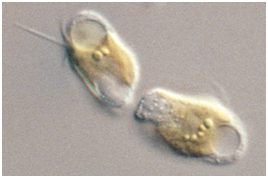
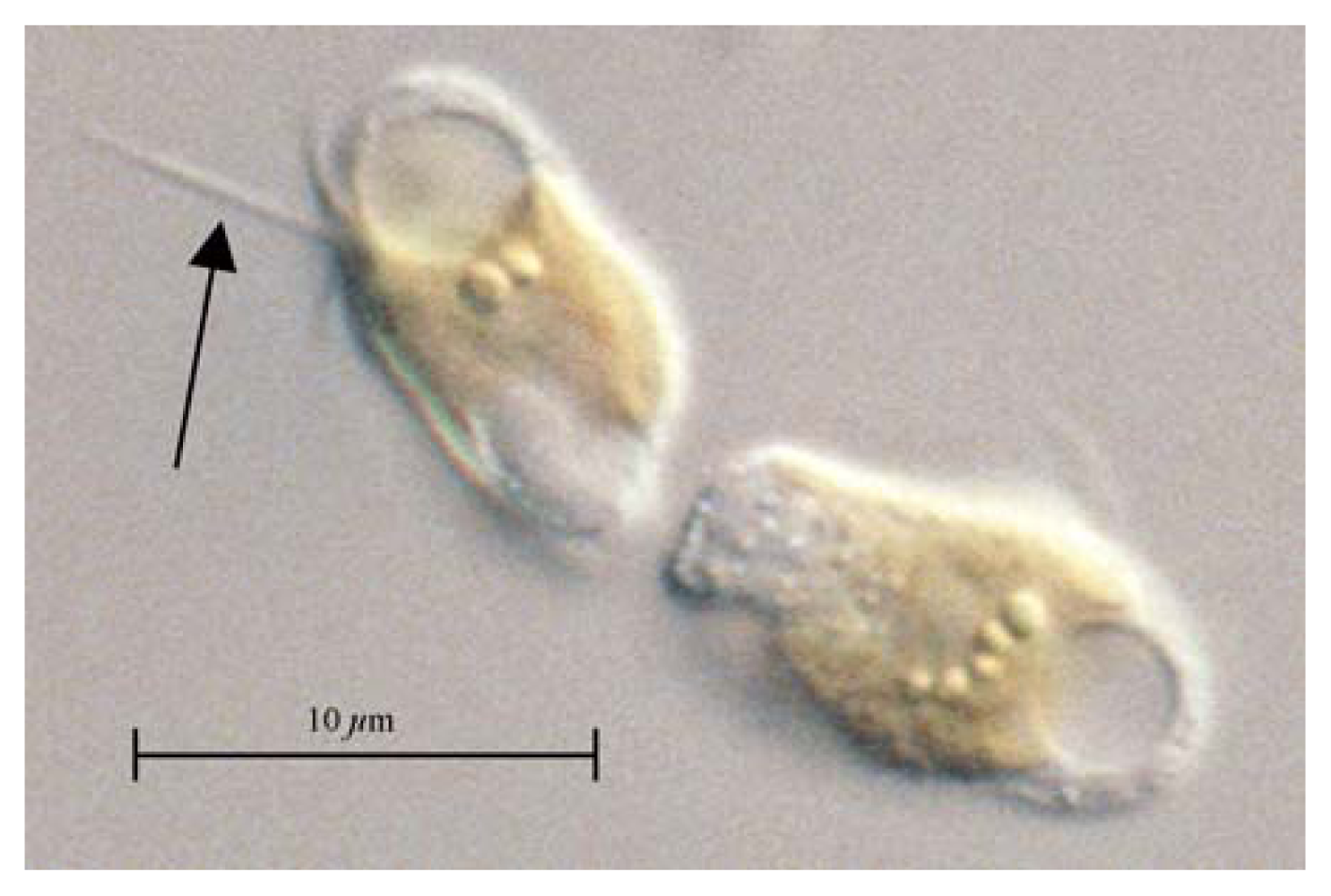
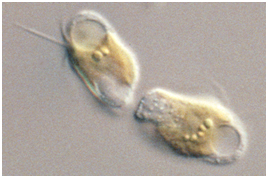
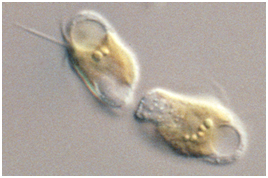
<p><italic>P. parvum</italic> is unicellular, ranging in size from 8–15 μm in length by 4–10 μm wide and having two flagella of roughly equal length positioned at the anterior end (<xref ref-type="fig" rid="f1-marinedrugs-08-00678">Figure 1</xref>) [<xref ref-type="bibr" rid="b14-marinedrugs-08-00678">14</xref>–<xref ref-type="bibr" rid="b16-marinedrugs-08-00678">16</xref>]. These oblong cells possess two prominent ochre-colored chloroplasts positioned on either side of a centrally-located nucleus. Plastids of these golden (chromist) algae contain chlorophylls-<italic>a</italic>, -<italic>c</italic>, and an abundance of carotenoids [<xref ref-type="bibr" rid="b17-marinedrugs-08-00678">17</xref>–<xref ref-type="bibr" rid="b19-marinedrugs-08-00678">19</xref>]. A threadlike organelle, the haptonema, projects between the flagella and this structure is a unifying characteristic of the phylum [<xref ref-type="bibr" rid="b20-marinedrugs-08-00678">20</xref>]. This structure can vary greatly in length and in function between species; it is very short and non-coiling in <italic>P. parvum</italic> [<xref ref-type="bibr" rid="b14-marinedrugs-08-00678">14</xref>]. Proposed uses for the haptonema include it being a sensory device, which is used to attach to substrates or to capture and aggregate prey [<xref ref-type="bibr" rid="b21-marinedrugs-08-00678">21</xref>,<xref ref-type="bibr" rid="b22-marinedrugs-08-00678">22</xref>]. The haptonema is secretory in species of the related <italic>Chrysochromulina</italic> where glycolipid compounds are released from a region at the base of the organelle [<xref ref-type="bibr" rid="b21-marinedrugs-08-00678">21</xref>]. Structurally, the haptonema of <italic>P. parvum</italic> closely resemble those of <italic>Chrysochromulina</italic>, but the secretory attributes have not been demonstrated to our knowledge.</p>
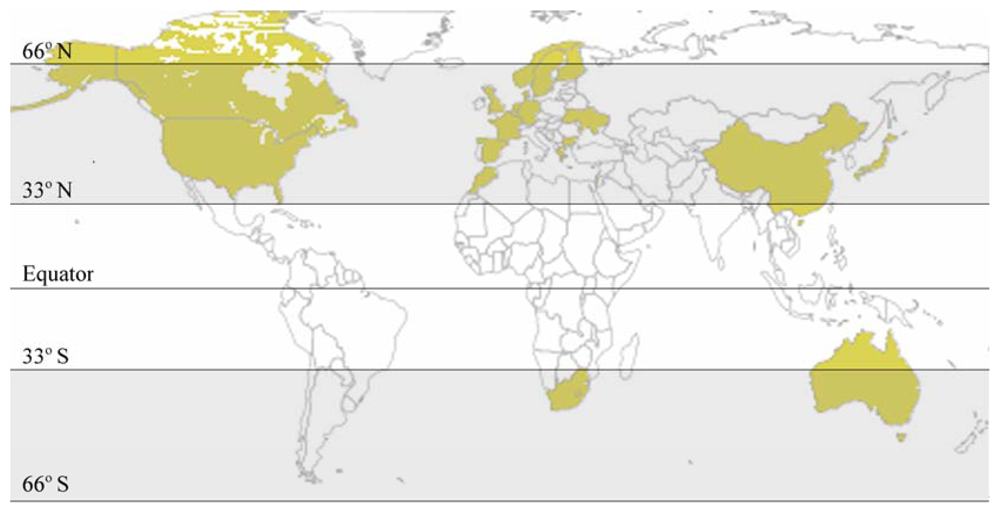
<p><italic>P. parvum</italic> was first identified by Liebert and Deerns [<xref ref-type="bibr" rid="b23-marinedrugs-08-00678">23</xref>] in association with a bloom event in Denmark that reported diseased and dying fish. This alga was later confirmed with another toxic bloom [<xref ref-type="bibr" rid="b24-marinedrugs-08-00678">24</xref>]. However, one report suggested that <italic>P. parvum</italic> may have been responsible for earlier fish kills in the Baltic Sea during the late 1800’s [<xref ref-type="bibr" rid="b25-marinedrugs-08-00678">25</xref>]. The alga has since been extensively documented as being associated with seasonal toxic blooms and mass mortality events in aquaculture ponds and in native populations of gill-breathing animals. Recurring HAB of <italic>P. parvum</italic> are a nuisance on several continents (<xref ref-type="fig" rid="f2-marinedrugs-08-00678">Figure 2</xref>). The majority of recorded blooms tend to be isolated to cooler waters located in the subtropical and temperate zones between the Tropic of Cancer and Arctic Circle and between the Tropic of Capricorn and Antarctic Circle. HAB of <italic>P. parvum</italic> often form in brackish estuarine waters, but a large number of blooms are known to occur in mainland fresh water reservoirs [<xref ref-type="bibr" rid="b27-marinedrugs-08-00678">27</xref>,<xref ref-type="bibr" rid="b28-marinedrugs-08-00678">28</xref>]. It is believed that this organism is principally of marine origin [<xref ref-type="bibr" rid="b29-marinedrugs-08-00678">29</xref>]. Although reports of <italic>P. parvum</italic>-related fish kills in freshwater reservoirs are growing in number, how this marine organism “invaded” freshwater reservoirs is presently unknown. Proposed vectors of transfer include contaminated bilge water, bird guano and encystment [<xref ref-type="bibr" rid="b11-marinedrugs-08-00678">11</xref>,<xref ref-type="bibr" rid="b15-marinedrugs-08-00678">15</xref>].</p></sec>
<sec>
<title>2. Prymnesins</title>
<p>Toxin-based investigations with <italic>P. parvum</italic> and other toxic prymnesiophytes have been ongoing for 90 years, and there are several reviews available (e.g., [<xref ref-type="bibr" rid="b3-marinedrugs-08-00678">3</xref>,<xref ref-type="bibr" rid="b26-marinedrugs-08-00678">26</xref>]). However, a major synthesis of the literature on prymnesins themselves has not been conducted in over 25 years [<xref ref-type="bibr" rid="b30-marinedrugs-08-00678">30</xref>–<xref ref-type="bibr" rid="b33-marinedrugs-08-00678">33</xref>]. Since last reviewed, two of these compounds have been isolated and chemically characterized [<xref ref-type="bibr" rid="b34-marinedrugs-08-00678">34</xref>–<xref ref-type="bibr" rid="b37-marinedrugs-08-00678">37</xref>], and phytochemical work indicates the existence of other toxic metabolites from this alga that are under study in various laboratories (e.g., [<xref ref-type="bibr" rid="b38-marinedrugs-08-00678">38</xref>,<xref ref-type="bibr" rid="b39-marinedrugs-08-00678">39</xref>]). Also, we now know much more about the ecology, molecular biology, and secondary metabolism of this alga that warrant further consideration in this context [<xref ref-type="bibr" rid="b40-marinedrugs-08-00678">40</xref>–<xref ref-type="bibr" rid="b43-marinedrugs-08-00678">43</xref>]. Surprisingly little is yet known regarding the molecular mechanisms of prymnesin synthesis, the mode of its transport, or the biological relevance of toxin production in this alga.</p>
<sec>
<title>2.1. Isolation and Characterization of Prymnesins</title>
<p>The actual number of different substances that comprise the “prymnesins” is not presently known, but their broad range of biological activities support the notion that extracts from cells and from cell-free supernatants are composed of a complex and diverse mixture of toxic metabolites [<xref ref-type="bibr" rid="b30-marinedrugs-08-00678">30</xref>–<xref ref-type="bibr" rid="b32-marinedrugs-08-00678">32</xref>,<xref ref-type="bibr" rid="b44-marinedrugs-08-00678">44</xref>–<xref ref-type="bibr" rid="b47-marinedrugs-08-00678">47</xref>]. For example, Ulitzur and Shilo [<xref ref-type="bibr" rid="b48-marinedrugs-08-00678">48</xref>] isolated 6 hemolytic fractions that were potentially chemically distinct from a hemolysin extracted by Kozakai <italic>et al.</italic> [<xref ref-type="bibr" rid="b49-marinedrugs-08-00678">49</xref>] and the toxic compound isolated by Paster [<xref ref-type="bibr" rid="b39-marinedrugs-08-00678">39</xref>]. Discrepancies between published investigations are likely due to the techniques used for the extraction of prymnesins, resulting in the isolation of unique sets of compounds that separate differently based on their affinity for different solvent(s). Therefore, caution must be exercised when interpreting data and comparing studies. Variations in toxicity reported for different extracts may well be attributed to the extraction methods resulting in extracts containing only a subset of all the possible toxic substances and activities.</p>
<p>Prymnesins have been characterized as glycolipids, galactolipids, proteolipids and lipid-carbohydrate compounds [<xref ref-type="bibr" rid="b32-marinedrugs-08-00678">32</xref>,<xref ref-type="bibr" rid="b39-marinedrugs-08-00678">39</xref>,<xref ref-type="bibr" rid="b48-marinedrugs-08-00678">48</xref>–<xref ref-type="bibr" rid="b50-marinedrugs-08-00678">50</xref>]. Crude extractions have been performed with both whole cells and culture filtrates of <italic>P. parvum</italic> and many different approaches have been taken to separate the toxic principles. All of these methods are founded on the differential extraction of prymnesins using an organic mobile phase [<xref ref-type="bibr" rid="b32-marinedrugs-08-00678">32</xref>,<xref ref-type="bibr" rid="b47-marinedrugs-08-00678">47</xref>]. As a rule, the toxic fractions have been found to be the most soluble in polar organic solvents, and they demonstrate low affinity (and extremely low solubility) in highly non-polar organics. Toxins can be extracted, albeit very slowly, from cells using aqueous solutions; however, extracts from cells are greater than three times more concentrated when extracted with an organic solvent [<xref ref-type="bibr" rid="b32-marinedrugs-08-00678">32</xref>]. Shilo and Rosenberger [<xref ref-type="bibr" rid="b46-marinedrugs-08-00678">46</xref>] reported that prymnesins were not retained by either anion or cation exchange resins. However, Yariv and Hestrin [<xref ref-type="bibr" rid="b31-marinedrugs-08-00678">31</xref>] were able to obtain a concentrated sample of prymnesins by passing culture filtrates over precipitated Mg(OH)<sub>2</sub>, which suggests that some prymnesins demonstrate an affinity for this basic adsorbant material.</p>
<p>Regarding the extraction of prymnesins from whole cells, cells are typically washed several times with cold acetone [<xref ref-type="bibr" rid="b34-marinedrugs-08-00678">34</xref>,<xref ref-type="bibr" rid="b35-marinedrugs-08-00678">35</xref>,<xref ref-type="bibr" rid="b39-marinedrugs-08-00678">39</xref>,<xref ref-type="bibr" rid="b46-marinedrugs-08-00678">46</xref>,<xref ref-type="bibr" rid="b48-marinedrugs-08-00678">48</xref>]. Shilo and Rosenberger [<xref ref-type="bibr" rid="b46-marinedrugs-08-00678">46</xref>] found that prymnesins are not soluble in acetone, which makes this an ideal organic solvent to eliminate interfering compounds including chlorophylls and accessory pigments. Afterwards, polar organics such as methanol, ethanol and/or <italic>n</italic>-propanol are usually employed to extract prymnesins from the cell remains [<xref ref-type="bibr" rid="b34-marinedrugs-08-00678">34</xref>,<xref ref-type="bibr" rid="b35-marinedrugs-08-00678">35</xref>,<xref ref-type="bibr" rid="b39-marinedrugs-08-00678">39</xref>,<xref ref-type="bibr" rid="b46-marinedrugs-08-00678">46</xref>,<xref ref-type="bibr" rid="b51-marinedrugs-08-00678">51</xref>]. In some cases, multiple rounds of precipitation (e.g., using diethyl ether) are utilized to separate the toxic fractions; further purification of the target compounds can be achieved using column chromatography and/or additional rounds of partitioning between biphasic solvents (e.g., <italic>n-</italic>butanol) [<xref ref-type="bibr" rid="b32-marinedrugs-08-00678">32</xref>,<xref ref-type="bibr" rid="b39-marinedrugs-08-00678">39</xref>]. Prymnesin extracts have also been prepared from whole algal cell suspensions by liquid-liquid chromatography using a CHCl<sub>3</sub>:MeOH phase system, wherein the toxins are extracted into the lower phase that consists of a suspension of CHCl<sub>3</sub>/MeOH [<xref ref-type="bibr" rid="b48-marinedrugs-08-00678">48</xref>,<xref ref-type="bibr" rid="b52-marinedrugs-08-00678">52</xref>,<xref ref-type="bibr" rid="b53-marinedrugs-08-00678">53</xref>]. It is reported that prymnesins are most stable when they are stored at cooler temperatures as a dry powder; similarly, these extracts are more soluble in organic solvents than in water, and are less labile under acidic conditions near pH 5 [<xref ref-type="bibr" rid="b32-marinedrugs-08-00678">32</xref>,<xref ref-type="bibr" rid="b54-marinedrugs-08-00678">54</xref>].</p>
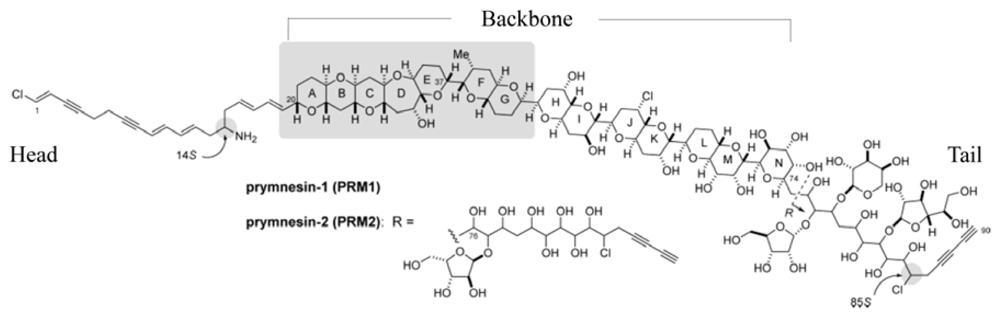
<p>It wasn’t until the mid-1990’s that we had the first glimpse of what two of these compounds actually look like. Prymnesin-1 (prym1) and prymnesin-2 (prym2) were meticulously isolated from whole algal cells by a group in Japan and these were the first toxic metabolites to be chemically characterized from any isolate of <italic>P. parvum</italic> using modern analytical methods (<xref ref-type="fig" rid="f3-marinedrugs-08-00678">Figure 3</xref>) [<xref ref-type="bibr" rid="b34-marinedrugs-08-00678">34</xref>,<xref ref-type="bibr" rid="b35-marinedrugs-08-00678">35</xref>]. Purified prym1 and prym2 were shown to be potent polyketides with ichthyotoxic and hemolytic activities when present at nanomolar concentrations [<xref ref-type="bibr" rid="b34-marinedrugs-08-00678">34</xref>,<xref ref-type="bibr" rid="b35-marinedrugs-08-00678">35</xref>]. Prym1 and prym2 are ladder-like, polycyclic ethers that posses several noteworthy features. These complex compounds are remarkable in that they have double and triple carbon-carbon bonds in the unsaturated head and tail regions, an amino group, several chlorines, four 1,6-dioxadecalin units, and an assortment of sugar moieties [<xref ref-type="bibr" rid="b34-marinedrugs-08-00678">34</xref>,<xref ref-type="bibr" rid="b35-marinedrugs-08-00678">35</xref>]. Structurally, prym1 and prym2 are homologous compounds with a common head and backbone: they differ only in the number and in the type of sugars in the tail region, with prym2 containing a rare L-xylose. Prym1 was shown to be slightly more polar (due to the additional sugar residues) and it elutes ahead of prym2 in reversed-phase C-18 chromatography [<xref ref-type="bibr" rid="b34-marinedrugs-08-00678">34</xref>,<xref ref-type="bibr" rid="b35-marinedrugs-08-00678">35</xref>].</p>
<p>The structural elucidation of prym1 and prym2 has been especially challenging due to their poor solubility in the deuterated organic solvents used with analytical methods such as proton nuclear magnetic resonance (NMR). However, chemical derivatives (e.g., <italic>N</italic>-acetylation) did demonstrate improved solubility and also provided a quantifiable shift in the mass/charge (m/z) for negative ion fast atom bombardment-mass spectrometry (FAB-MS) spectra [<xref ref-type="bibr" rid="b34-marinedrugs-08-00678">34</xref>]. However, chemical structures that have been elucidated from spectral analyses are often inaccurate and reassignments are common due to the complexity of many secondary metabolites [<xref ref-type="bibr" rid="b55-marinedrugs-08-00678">55</xref>]. The backbone of prym1, comprised of rings A-N, was characterized using a computational approach [<xref ref-type="bibr" rid="b56-marinedrugs-08-00678">56</xref>]. Partial (in some cases, total) synthesis of compounds is also useful to reproduce structures and to determine the correct conformations. Recently, investigators have synthesized truncated ring models of prym1 and prym2. This work has led to the verification of the HI/JK rings, the conformation of the chiral centers at C14 and C85, and the reassignment of the juncture between rings E-F (<xref ref-type="fig" rid="f3-marinedrugs-08-00678">Figure 3</xref>) [<xref ref-type="bibr" rid="b36-marinedrugs-08-00678">36</xref>,<xref ref-type="bibr" rid="b37-marinedrugs-08-00678">37</xref>].</p></sec>
<sec>
<title>2.2. Putative Synthesis of the Polyketides, Prym1 and Prym2</title>
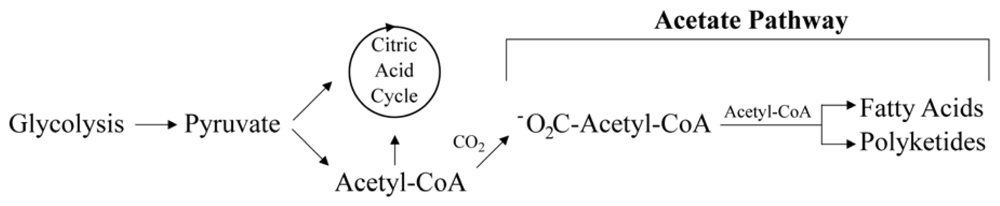
<p>Very little is known about the synthesis of prymnesins <italic>in vivo</italic>. However, it is very likely that prym1 and prym2 are derived from acetate-related metabolism based on what we know about their structures. In other organisms, the acetate pathway is responsible for the generation of fatty acids, as well as numerous secondary products that include polyketides and non-ribosomal peptides (<xref ref-type="fig" rid="f4-marinedrugs-08-00678">Figure 4</xref>) [<xref ref-type="bibr" rid="b57-marinedrugs-08-00678">57</xref>,<xref ref-type="bibr" rid="b58-marinedrugs-08-00678">58</xref>]. Both primary and secondary metabolites synthesized in this pathway utilize 2-, 3-, and 4-carbon basic skeletal types coupled to coenzyme-A (CoA) [<xref ref-type="bibr" rid="b58-marinedrugs-08-00678">58</xref>,<xref ref-type="bibr" rid="b59-marinedrugs-08-00678">59</xref>]. Subunits are subsequently combined by successive decarboxylative condensations resulting in chain elongation.</p>
<p>The biosynthesis of polyketides has many features in common with fatty acid synthesis and it uses similar, perhaps some of the same, enzymatic domains. Cane and Walsh [<xref ref-type="bibr" rid="b57-marinedrugs-08-00678">57</xref>] described polyketide synthase (PKS) as a modular “megaprotein” possessing a core catalytic domain and auxiliary (carrier) domains. The core domain contains the ketosynthase (KS), acyltransferase (AT) and the acyl carrier protein (ACP)—to which the growing polyketide molecule is tethered via an acyl-<italic>S</italic>-enzyme of the 20 Å long phosphopantetheine arm. The AT domain catalyzes priming of the donor ACP with monomers, and the carbon-carbon bond-forming step is performed by the KS domain. The auxiliary domains encode for ketoreductase (KR), dehydratase (DH), and enoyl reductase (ER). The growing polyketide is handed over from one reactive thiol group to the next by transacetylation reactions. This process is repeated until the ultimate chain length has been achieved, whereupon thioesterase (TE) facilitates the removal of the polyketide by hydrolysis at the distal end of the pantetheine prosthetic group. The individual enzymes function to modify the elongating molecule before adding the next subunit. Chain elongation ceases when all of the “programmed” subunits are incorporated, resulting in a single-chain carbon backbone. Some PKSs also contain enzymes for cyclization (CYC) in addition to other secondary modifications (e.g., methylation) [<xref ref-type="bibr" rid="b58-marinedrugs-08-00678">58</xref>,<xref ref-type="bibr" rid="b59-marinedrugs-08-00678">59</xref>]. Note that cyclization may occur prior to or after the release of the polyketide from TE.</p>
<p>A minimal PKS operon contains only the gene for KS, whereas diverse PKSs may contain all, parts or none of the respective domain sequences [<xref ref-type="bibr" rid="b59-marinedrugs-08-00678">59</xref>,<xref ref-type="bibr" rid="b60-marinedrugs-08-00678">60</xref>]. Structurally, prym1 and prym2 resemble other heterocyclic algal toxins produced by Type I PKSs, such as okadaic acid produced by marine diatoms, and brevetoxin and maitotoxin synthesized by the dinoflagellates <italic>Karenia brevis</italic> and <italic>Gambierdiscus toxicus</italic>, respectively [<xref ref-type="bibr" rid="b61-marinedrugs-08-00678">61</xref>,<xref ref-type="bibr" rid="b62-marinedrugs-08-00678">62</xref>]. These polyether polyketides are non-aromatic, which is characteristic of the Type I modular (non-iterative) PKSs found in bacteria, fungi, animals and some monocotyledonous plants. There is still some debate as to whether PKS associated with dinoflagellates is actually of bacterial origin [<xref ref-type="bibr" rid="b63-marinedrugs-08-00678">63</xref>]; in fact, the Type I PKS genes attributed to <italic>Prorocentrum</italic> have been isolated from associated bacteria (<italic>Roseobacter</italic>) [<xref ref-type="bibr" rid="b64-marinedrugs-08-00678">64</xref>]. Nevertheless, Type I PKS genes were recently isolated and sequenced from axenic cultures of <italic>P. parvum</italic> [<xref ref-type="bibr" rid="b41-marinedrugs-08-00678">41</xref>] and the related haptophyte <italic>Emiliania huxleyi</italic> (Haptophyta) [<xref ref-type="bibr" rid="b65-marinedrugs-08-00678">65</xref>], as well as from the green alga <italic>Chlamydomonas reinhardtii</italic> (Chlorophyta) [<xref ref-type="bibr" rid="b65-marinedrugs-08-00678">65</xref>].</p>
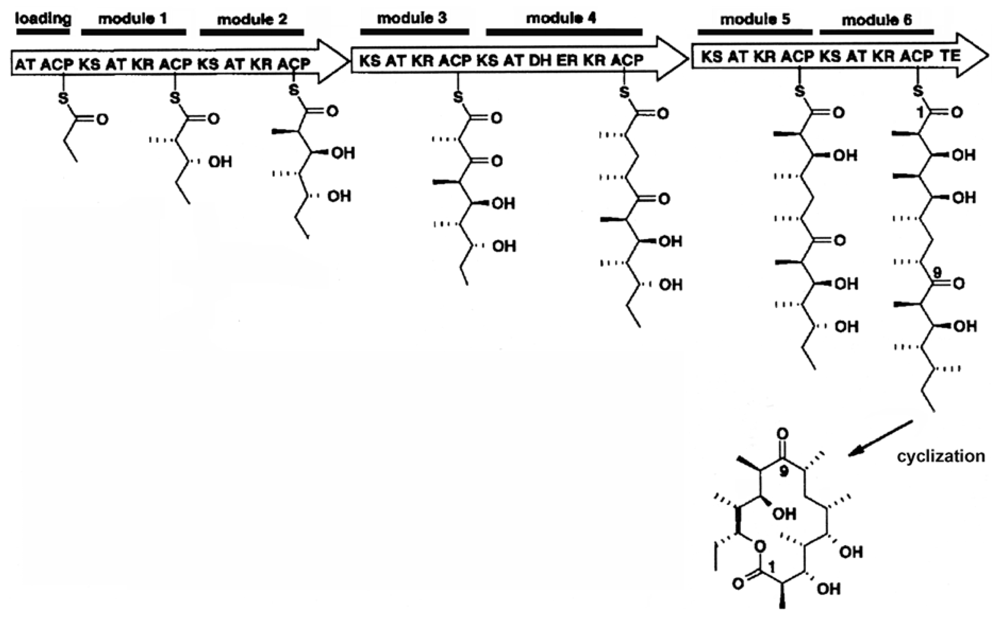
<p>In general, Type I PKS genes encode multiple catalytic domains organized into modules and each complete subunit may be composed of 2 or more modules (<xref ref-type="fig" rid="f5-marinedrugs-08-00678">Figure 5</xref>) [<xref ref-type="bibr" rid="b64-marinedrugs-08-00678">64</xref>]. Each module contains all functional domains required for exactly one round of chain extension and modification. The complexity and diversity among polyketides and PKSs are a result of mutation, multiple gene duplications, deletions, and horizontal gene transfer [<xref ref-type="bibr" rid="b59-marinedrugs-08-00678">59</xref>]. We postulate that these modules might also potentially operate independently of one another in <italic>P. parvum</italic> to generate a diverse array of smaller, yet related polyether molecules, as was demonstrated in mutational analyses using a bacterial PKS [<xref ref-type="bibr" rid="b66-marinedrugs-08-00678">66</xref>].</p>
<p>Type I PKS enzymes are analogous to the Type I FAS, and polyketide elongation is performed on an enzymatic framework prearranged into open reading frame modules encoding the mulitmeric protein complex (<xref ref-type="fig" rid="f6-marinedrugs-08-00678">Figure 6</xref>). Because of this, it is likely that polyketide synthesis occurs in the stroma of plastids, which is known to be the case for FAS in green algae [<xref ref-type="bibr" rid="b67-marinedrugs-08-00678">67</xref>]. It should be noted that these mechanisms have not yet been elucidated for <italic>P. parvum</italic>. Glycosylation is a common modification of secondary metabolites, and this might be a mechanism for tagging prym1 and prym2 for transport. This process changes the physical and chemical properties of the compounds, their bioactivity and their sub-cellular localization [<xref ref-type="bibr" rid="b68-marinedrugs-08-00678">68</xref>]. Post-synthesis modifications (such as glycosylation) probably occur at the Golgi apparatus or endoplasmic reticulum, where many different molecules are tagged and packaged for transport [<xref ref-type="bibr" rid="b69-marinedrugs-08-00678">69</xref>]. More information regarding cellular location of polyketide synthesis, storage and transport would be of great importance in determining the biological significance of prymnesins to the alga (see later).</p>
<p>Until recently, there were very few gene sequences available for <italic>P. parvum</italic>. An expressed sequence tag analysis of <italic>P. parvum</italic> identified a number of gene products that may be involved with acetate metabolism and polyketide synthesis [<xref ref-type="bibr" rid="b41-marinedrugs-08-00678">41</xref>]. Interestingly, these transcripts have a high sequence similarity to bacterial Type I PKS genes. More specifically, individual Type I PKS genes in <italic>P. parvum</italic> have their nucleotide sequence identities most similar to <italic>Roseovarius</italic> (a bacterium) and <italic>Nostoc</italic> (a cyanobacterium), and one PKS subunit is most closely related to that of a eukaryotic stramenopile [<xref ref-type="bibr" rid="b41-marinedrugs-08-00678">41</xref>]. In addition, there are at least 43 different unique genes whose products have been classified as being involved with secondary metabolite synthesis, catabolism and transport, including ACP synthase, oligoketide cyclase, and DH that are potentially relevant to polyketide synthesis. Another 40 unigenes are classified as encoding proteins involved with lipid synthesis and transport, which could also have parallel roles in the manufacture of polyketides. Finally, there are a number of genes expressing vesicle transport-related proteins. Interestingly, the most abundantly expressed gene transcripts have no known sequence homology [<xref ref-type="bibr" rid="b41-marinedrugs-08-00678">41</xref>]. More work is needed in this area to determine which of these genes’ products directly participate in the synthesis or transport of prym1, prym2 and other toxic metabolites of <italic>P. parvum</italic>.</p>
<p>The vitamins thiamine (B<sub>1</sub>) and cobalamin (B<sub>12</sub>) are required in culture media and are considered essential for the growth of most known <italic>P. parvum</italic> strains [<xref ref-type="bibr" rid="b22-marinedrugs-08-00678">22</xref>,<xref ref-type="bibr" rid="b32-marinedrugs-08-00678">32</xref>]. Several genes have been elucidated whose products are related to thiamine and cobalamin metabolism [<xref ref-type="bibr" rid="b41-marinedrugs-08-00678">41</xref>]. On the other hand, biotin (B<sub>7</sub>) and pantothenate (B<sub>5</sub>) have not been shown to be essential for growth, yet both vitamins are prosthetic groups essential to the synthesis of primary and secondary metabolites. Acetyl-CoA carboxylase is a biotin-dependent enzyme in the acetate pathway and an essential component in the synthesis of fatty acids and polyketides. Similarly, pantothenate is required for the production of CoA, and in turn ACP. EST analyses indicate that <italic>P. parvum</italic> may possess several genes encoding enzymes involved in these B-vitamin synthetic pathways, and it is therefore likely that <italic>P. parvum</italic> is able to synthesize biotin and pantothenic acid <italic>de novo</italic> [<xref ref-type="bibr" rid="b41-marinedrugs-08-00678">41</xref>].</p></sec></sec>
<sec>
<title>3. Modes of Prymnesin Toxicity</title>
<p>Prymnesin extracts are reported to have saponin-like properties that are responsible for a host of deleterious effects including cytotoxicity, neurotoxicity, hemolysis, and ichthyotoxicity [<xref ref-type="bibr" rid="b30-marinedrugs-08-00678">30</xref>,<xref ref-type="bibr" rid="b31-marinedrugs-08-00678">31</xref>,<xref ref-type="bibr" rid="b33-marinedrugs-08-00678">33</xref>]. This broad spectrum of activities is owed in part to their amphipathic and ionophoretic properties [<xref ref-type="bibr" rid="b70-marinedrugs-08-00678">70</xref>]. Structurally, prym1 and prym2 are detergent-like compounds possessing both polar and non-polar ends. It should be noted that most toxicity studies have tested crude extracts, which contain toxic fractions as well as other substances. Therefore it is difficult to determine which compound(s) is (are) accountable for any individual biological effect.</p>
<p>Cytotoxicity in the presence of prymnesins is described as possessing two distinct stages. The first response to exposure is cell swelling, which can be measured by the uptake of Trypan Blue dye; the second phase is death/lysis [<xref ref-type="bibr" rid="b51-marinedrugs-08-00678">51</xref>]. Cell swelling and lysis can take less than an hour or may take several hours depending on temperature and pH. Elevated pH and temperatures were found to be concomitant with an increase in cell lysis; however, this process could be halted by reversing the culturing conditions [<xref ref-type="bibr" rid="b51-marinedrugs-08-00678">51</xref>]. Based on observations with bacteria and membrane preparations, it has been proposed that prymnesins interact directly with specific components of the plasma membrane (e.g., membrane sterols) [<xref ref-type="bibr" rid="b32-marinedrugs-08-00678">32</xref>,<xref ref-type="bibr" rid="b71-marinedrugs-08-00678">71</xref>]. It is believed that prymnesins form micelles in aqueous solutions (due to their detergent-like properties) and that these aggregates assemble within the plasma membrane of exposed cells to form negatively-charged pores that are permselective to cations [<xref ref-type="bibr" rid="b31-marinedrugs-08-00678">31</xref>,<xref ref-type="bibr" rid="b50-marinedrugs-08-00678">50</xref>]. Moreover, the prymnesins have been shown to increase membrane conductance, which can be measured as a fluctuation in transmembrane ion concentrations [<xref ref-type="bibr" rid="b50-marinedrugs-08-00678">50</xref>,<xref ref-type="bibr" rid="b72-marinedrugs-08-00678">72</xref>]. Prymnesin toxicity is known to be dose-dependent and it responds in a linear manner when analyzing log prymnesin concentration <italic>vs.</italic> log membrane conductance.</p>
<p>Prymnesin extracts also possess potent neurological toxicity where it is thought that they interfere with the re-uptake of neurotransmitters at the post-neuronal synapse. Parnas and Abbott [<xref ref-type="bibr" rid="b73-marinedrugs-08-00678">73</xref>] demonstrated that this mechanism is carried out at the myoneural junction, where prymnesins inhibit acetylcholine and interfere with calcium signaling. Shilo [<xref ref-type="bibr" rid="b74-marinedrugs-08-00678">74</xref>] reported that an intravenous injection of prymnesins stops heart muscle by rapid depolarization and by altering the membrane permeability to calcium ions. In another study, an injection of prymnesin evoked muscle contractions, which was followed by the reversal of the acetylcholine-induced contractions and paralysis [<xref ref-type="bibr" rid="b32-marinedrugs-08-00678">32</xref>,<xref ref-type="bibr" rid="b75-marinedrugs-08-00678">75</xref>]. An intravenous injection of prymnesins resulted in a sudden drop in blood pressure and respiratory arrest [<xref ref-type="bibr" rid="b76-marinedrugs-08-00678">76</xref>]. Meldahl and Fonnum [<xref ref-type="bibr" rid="b77-marinedrugs-08-00678">77</xref>,<xref ref-type="bibr" rid="b78-marinedrugs-08-00678">78</xref>] discovered that prymnesins from <italic>P. parvum</italic> f. <italic>patelliferum</italic> inhibit the sodium-dependent uptake of L-glutamate and γ-aminobutyric acid, and they enhance the calcium-dependent release of acetylcholine. In accordance, Mariussen <italic>et al</italic>. [<xref ref-type="bibr" rid="b79-marinedrugs-08-00678">79</xref>] found that prymnesins were responsible for the calcium-dependent release of glutamine at brain synaptosomes.</p>
<p>Prymnesins are also renowned for their potent erythrolytic capacity and prym1 and prym2 are reported to be 5,000 times more hemolytic than a plant-based saponin [<xref ref-type="bibr" rid="b62-marinedrugs-08-00678">62</xref>,<xref ref-type="bibr" rid="b80-marinedrugs-08-00678">80</xref>–<xref ref-type="bibr" rid="b82-marinedrugs-08-00678">82</xref>]. Crude prymnesin extracts can be isolated from either culture supernatants or cells, however cellular extracts exhibit a higher degree of hemolytic activity [<xref ref-type="bibr" rid="b31-marinedrugs-08-00678">31</xref>,<xref ref-type="bibr" rid="b47-marinedrugs-08-00678">47</xref>]. Prymnesins isolated from culture media yielded approximately 6700 hemolytic units (H.U.) per mg; by comparison, there was nearly six times this concentration found in cells, representing roughly 40,000 H.U. per mg [<xref ref-type="bibr" rid="b32-marinedrugs-08-00678">32</xref>].</p>
<p>The ichthyotoxic effects of prymnesins are by far the most noticeable, due to the frequency of blooms and distress caused by extensive fish kills. Many species of fish are documented as being sensitive to these compounds, as well as many amphibians, mollusks and crustaceans [<xref ref-type="bibr" rid="b33-marinedrugs-08-00678">33</xref>]. Prymnesins are noted as being especially lethal to gill-breathing organisms and they can be fatal at nanomolar concentrations [<xref ref-type="bibr" rid="b11-marinedrugs-08-00678">11</xref>,<xref ref-type="bibr" rid="b52-marinedrugs-08-00678">52</xref>,<xref ref-type="bibr" rid="b74-marinedrugs-08-00678">74</xref>,<xref ref-type="bibr" rid="b82-marinedrugs-08-00678">82</xref>]. After <italic>Gambusia</italic> were treated with prymnesins in addition to co-factors, their gills became darkly-stained with Trypan Blue within 5 min [<xref ref-type="bibr" rid="b1-marinedrugs-08-00678">1</xref>]. Interestingly, Shilo and Aschner [<xref ref-type="bibr" rid="b83-marinedrugs-08-00678">83</xref>] found that tadpoles (<italic>Bufo</italic>) were resistant to the effects of prymnesins shortly after metamorphosis, indicating that prymnesins affected tadpoles during the gill-breathing stage only.</p>
<p>Exogenous prymnesins are not documented as being harmful to mammals or mature, lung-breathing amphibians [<xref ref-type="bibr" rid="b32-marinedrugs-08-00678">32</xref>]; toxic waters mistakenly used for irrigation and rinsing vegetables had no deleterious effects [<xref ref-type="bibr" rid="b53-marinedrugs-08-00678">53</xref>].</p></sec>
<sec>
<title>4. Variables Affecting the Presence and Toxicity of Prymnesins</title>
<p>The presence of prymnesins differs with nutrient availability, salinity, light, temperature, pH, as well as growth stage of the alga [<xref ref-type="bibr" rid="b5-marinedrugs-08-00678">5</xref>,<xref ref-type="bibr" rid="b11-marinedrugs-08-00678">11</xref>,<xref ref-type="bibr" rid="b30-marinedrugs-08-00678">30</xref>,<xref ref-type="bibr" rid="b31-marinedrugs-08-00678">31</xref>,<xref ref-type="bibr" rid="b39-marinedrugs-08-00678">39</xref>,<xref ref-type="bibr" rid="b42-marinedrugs-08-00678">42</xref>,<xref ref-type="bibr" rid="b54-marinedrugs-08-00678">54</xref>,<xref ref-type="bibr" rid="b84-marinedrugs-08-00678">84</xref>,<xref ref-type="bibr" rid="b85-marinedrugs-08-00678">85</xref>]. Moreover, it has been demonstrated that actual prymnesin toxicity varies in dynamic physical and chemical conditions [<xref ref-type="bibr" rid="b28-marinedrugs-08-00678">28</xref>,<xref ref-type="bibr" rid="b46-marinedrugs-08-00678">46</xref>]. This is not unusual with toxin-producing microalgae. It is well known that growth conditions greatly affect the synthesis of secondary metabolites, and these compounds often increase in the presence of limiting conditions [<xref ref-type="bibr" rid="b86-marinedrugs-08-00678">86</xref>,<xref ref-type="bibr" rid="b87-marinedrugs-08-00678">87</xref>]. Interestingly, the intensity and range of noxious effects are also dependent on the activation of prymnesins in the presence of specific co-factors [<xref ref-type="bibr" rid="b88-marinedrugs-08-00678">88</xref>,<xref ref-type="bibr" rid="b89-marinedrugs-08-00678">89</xref>]. The ratio of hemolytic to ichthyotoxic activity is also variable and dependent on certain environmental factors; the hemolytic principle is not always accompanied by toxicity to fish [<xref ref-type="bibr" rid="b46-marinedrugs-08-00678">46</xref>,<xref ref-type="bibr" rid="b90-marinedrugs-08-00678">90</xref>]. These studies clearly illustrate that toxin synthesis and activation are likely very complicated processes that are potentially synergistic in response to environmental stimuli. As such, this may account for differences in observed toxicity under differing environmental and growth conditions.</p>
<sec>
<title>4.1. Nutrient Availability</title>
<p><italic>P. parvum</italic> can thrive in a wide range of physical conditions, but nutrient availability has been shown to greatly influence HAB and toxin formation in this organism. Agricultural effluents and eutrophication of waters are commonly implicated in a growth surge in <italic>P. parvum</italic> populations [<xref ref-type="bibr" rid="b11-marinedrugs-08-00678">11</xref>,<xref ref-type="bibr" rid="b91-marinedrugs-08-00678">91</xref>,<xref ref-type="bibr" rid="b92-marinedrugs-08-00678">92</xref>]. High nitrogen (in the form of nitrate or nitrite) and phosphorus (phosphate) concentrations support the rapid growth and formation of blooms that subsequently result in an imbalance of N and P sources. These limiting conditions ultimately slow the growth of <italic>P. parvum</italic>, which is usually accompanied by an increase in toxicity (as noted later) [<xref ref-type="bibr" rid="b5-marinedrugs-08-00678">5</xref>,<xref ref-type="bibr" rid="b30-marinedrugs-08-00678">30</xref>,<xref ref-type="bibr" rid="b93-marinedrugs-08-00678">93</xref>]. Mesocosm experiments over the course of five years indicated a reduction in toxicity in nutrient-replete conditions [<xref ref-type="bibr" rid="b43-marinedrugs-08-00678">43</xref>]. These observations suggest that extracellular prymnesins decrease appreciably when growth and nutrient conditions are favorable; therefore, it has been proposed that prymnesin toxicity can be controlled by nutrient manipulation [<xref ref-type="bibr" rid="b94-marinedrugs-08-00678">94</xref>]. However, a decrease in exotoxins may also be concomitant with an increase in intracellular toxins (see later).</p>
<p>Phosphorus and (to a lesser degree) nitrogen availability are probably among the most widely-studied factors related to prymnesin toxicity. Shilo [<xref ref-type="bibr" rid="b74-marinedrugs-08-00678">74</xref>] was the first to demonstrate elevated toxicity of <italic>P. parvum</italic> in association with low phosphorus conditions, and this trend has been confirmed in subsequent studies [<xref ref-type="bibr" rid="b5-marinedrugs-08-00678">5</xref>,<xref ref-type="bibr" rid="b77-marinedrugs-08-00678">77</xref>,<xref ref-type="bibr" rid="b82-marinedrugs-08-00678">82</xref>,<xref ref-type="bibr" rid="b85-marinedrugs-08-00678">85</xref>,<xref ref-type="bibr" rid="b95-marinedrugs-08-00678">95</xref>]. Shilo [<xref ref-type="bibr" rid="b30-marinedrugs-08-00678">30</xref>] reported a 10- to 20-fold increase in the amount of intracellular prymnesins when grown in P-limited conditions; a rise in toxin concentration was also documented for culture supernatants. Johansson and Granéli [<xref ref-type="bibr" rid="b95-marinedrugs-08-00678">95</xref>] analyzed the effects of N and P levels on cell density, chemical composition and toxicity of <italic>P. parvum</italic>, being the first to show increased toxicity under N-limiting conditions. Hemolytic activity was observed regardless of the nutrient conditions, so they proposed that cell stress (resulting in lysis and death?) was the cause for increased toxicity rather than the direct involvement of either N or P in toxin synthesis <italic>per se</italic> [<xref ref-type="bibr" rid="b96-marinedrugs-08-00678">96</xref>]. This is also in agreement with analyses confirming increased toxicity in senescing/dying cultures of <italic>P. parvum</italic> (see later).</p>
<p>The addition of a carbon source has also been shown to augment toxicity in populations of <italic>P. parvum</italic>. Dark-incubated cultures were able to grow in glycerol-supplemented media [<xref ref-type="bibr" rid="b84-marinedrugs-08-00678">84</xref>], and the addition of glycerol has been demonstrated to cause an increase in toxicity [<xref ref-type="bibr" rid="b97-marinedrugs-08-00678">97</xref>]. We postulate that this increased toxicity might be correlated to a surge in glycolytic activity from the exogenous carbon source. This would provide precursor molecules for the acetate pathway that might be used for polyketide synthesis. Conversely, glycerol and glucose have been shown to interfere with the formation of secondary metabolites in some organisms [<xref ref-type="bibr" rid="b86-marinedrugs-08-00678">86</xref>]. It is obvious that more information is needed to determine the roles of various nutrients in prymnesin toxicity and possible inhibitory pathways.</p>
<p>Beyond being photosynthetic, <italic>P. parvum</italic> is also known to phagocytose bacteria and other photosynthetic algae, which may provide exogenous N, P and carbon sources in times of nutrient limitation [<xref ref-type="bibr" rid="b98-marinedrugs-08-00678">98</xref>,<xref ref-type="bibr" rid="b99-marinedrugs-08-00678">99</xref>]. Legrand <italic>et al</italic>. [<xref ref-type="bibr" rid="b94-marinedrugs-08-00678">94</xref>] demonstrated that <italic>P. parvum</italic> f. <italic>patelliferum</italic> utilizes various sources of phosphate including inorganic, dissolved, organic and particulate forms; similarly, <italic>P. parvum</italic> has been shown to utilize ammonia, methionine and ethionine as alternative N-sources [<xref ref-type="bibr" rid="b22-marinedrugs-08-00678">22</xref>,<xref ref-type="bibr" rid="b100-marinedrugs-08-00678">100</xref>]. Recent findings by Carvalho and Granéli [<xref ref-type="bibr" rid="b101-marinedrugs-08-00678">101</xref>] indicate that <italic>P. parvum</italic> is truly mixotrophic and therefore feeds heterotrophically under both nutrient-limiting conditions and in nutrient-replete cultures. Interestingly, bacterial suspensions of <italic>Proteus vulgaris</italic> and <italic>Bacillus subtilis</italic> decreased toxicity by 50% in one hour [<xref ref-type="bibr" rid="b83-marinedrugs-08-00678">83</xref>], suggesting that these bacteria may be capable of metabolizing at least some of the toxins [<xref ref-type="bibr" rid="b102-marinedrugs-08-00678">102</xref>].</p></sec>
<sec>
<title>4.2. Salinity</title>
<p>Due to the predominance of blooms in low salinity and brackish water systems, many studies have examined the effects of salinity on prymnesin toxicity. The broad osmotic tolerances of <italic>P. parvum</italic> have been well-documented [<xref ref-type="bibr" rid="b5-marinedrugs-08-00678">5</xref>,<xref ref-type="bibr" rid="b22-marinedrugs-08-00678">22</xref>,<xref ref-type="bibr" rid="b97-marinedrugs-08-00678">97</xref>,<xref ref-type="bibr" rid="b103-marinedrugs-08-00678">103</xref>]. In most cases, <italic>P. parvum</italic> has been recorded in highly-mineralized freshwaters between 3 and 8 ppt (e.g., [<xref ref-type="bibr" rid="b28-marinedrugs-08-00678">28</xref>]); some assert that <italic>P. parvum</italic> can grow almost anywhere, in salinities ranging from 1 to 45 ppt [<xref ref-type="bibr" rid="b22-marinedrugs-08-00678">22</xref>,<xref ref-type="bibr" rid="b40-marinedrugs-08-00678">40</xref>,<xref ref-type="bibr" rid="b103-marinedrugs-08-00678">103</xref>]. However, low salinity conditions have been shown to have a negative effect on growth rates of <italic>P. parvum</italic>. Baker <italic>et al</italic>. [<xref ref-type="bibr" rid="b104-marinedrugs-08-00678">104</xref>] illustrated that there is a decrease in growth rate concurrent with a decrease in salinity, even when grown in nutrient-sufficient conditions. Interestingly, Dickson and Kirst [<xref ref-type="bibr" rid="b27-marinedrugs-08-00678">27</xref>] postulated that the broad osmotic tolerance of <italic>P. parvum</italic> is related to their ability to synthesize a range of compatible solutes coupled to a partial exclusion of toxic ions. The fact that gene transcripts encoding various ion transporters were among the most highly-expressed ones in log-phase cultures of <italic>P. parvum</italic>, may also help to explain how this alga is able to handle such a broad range of salinities [<xref ref-type="bibr" rid="b41-marinedrugs-08-00678">41</xref>].</p>
<p>Specific ions may play a role in prymnesin toxicity, but these assessments are limited and conflicting data have been reported. Paster [<xref ref-type="bibr" rid="b32-marinedrugs-08-00678">32</xref>] noted that the optimum NaCl concentration for growth and toxin production in <italic>P. parvum</italic> is between 0.3–5% (=3–50 ppt) (see also [<xref ref-type="bibr" rid="b1-marinedrugs-08-00678">1</xref>]) Salt begins to inhibit toxicity at levels greater that 5–12% NaCl [<xref ref-type="bibr" rid="b32-marinedrugs-08-00678">32</xref>]. This is not surprising as this represents salt concentrations of 50–120 ppt, exceeding two to four times the salinity of open ocean seawater. Paster [<xref ref-type="bibr" rid="b32-marinedrugs-08-00678">32</xref>] found elevated ichthyotoxicity for cultures grown in 5% (0.75 ppt) artificial seawater (ASW that contained ~15 g/L salts) and the lowest toxicities are documented for cultures grown in 30% (4.5 ppt) ASW. Interestingly, there appeared to be an absence of ichthyotoxicity in salinities &gt;30% seawater. However, a lack of extracellular bioactivity is not directly related to intracellular toxin production, as there are still large quantities of toxins able to be extracted from the cells themselves [<xref ref-type="bibr" rid="b32-marinedrugs-08-00678">32</xref>,<xref ref-type="bibr" rid="b76-marinedrugs-08-00678">76</xref>,<xref ref-type="bibr" rid="b105-marinedrugs-08-00678">105</xref>]. Shilo and Rosenberger [<xref ref-type="bibr" rid="b46-marinedrugs-08-00678">46</xref>] reported that the hemolytic property of prymnesins was inversely related to salinity with the highest hemolysis observed for cultures grown in 1% salt (=10 ppt). In contrast, Larsen and Bryant [<xref ref-type="bibr" rid="b40-marinedrugs-08-00678">40</xref>] found no significant differences in toxicity for <italic>P. parvum</italic> when grown at different salinities, which they felt could indicate metabolic differences among different strains of the alga. Since a decrease in toxicity in the culture media was reported to coincide with an increase in intracellular toxins [<xref ref-type="bibr" rid="b76-marinedrugs-08-00678">76</xref>], we conclude that both the cells and the supernatants need to be carefully analyzed in order to determine any relationships between salinity and toxicity.</p></sec>
<sec>
<title>4.3. Light</title>
<p>Light is a factor that is often associated with prymnesin toxicity, but published observations are somewhat inconsistent. <italic>P. parvum</italic> has been documented as naturally occurring in moderate-to-low light conditions, but some isolates have shown a preference for (and grow better with) higher illumination [<xref ref-type="bibr" rid="b40-marinedrugs-08-00678">40</xref>,<xref ref-type="bibr" rid="b106-marinedrugs-08-00678">106</xref>,<xref ref-type="bibr" rid="b107-marinedrugs-08-00678">107</xref>]. However, where <italic>P. parvum</italic> actually exists in the environment may be somewhat dependent on local community structure, which may also play a role in the stratification and distribution of <italic>P. parvum</italic> in the water column.</p>
<p>Many studies have shown that both light quality and light intensity are physical properties that are essential for the synthesis and activity of prymnesins [<xref ref-type="bibr" rid="b28-marinedrugs-08-00678">28</xref>,<xref ref-type="bibr" rid="b47-marinedrugs-08-00678">47</xref>,<xref ref-type="bibr" rid="b74-marinedrugs-08-00678">74</xref>]. On the other hand, some have concluded that light is not necessary for toxin production in <italic>P. parvum</italic> [<xref ref-type="bibr" rid="b108-marinedrugs-08-00678">108</xref>]. Dark-grown cultures reportedly have a reduced amount of intracellular toxins, which supports the latter claim; but an increase in toxin concentration was detected later in the stationary phase of culture [<xref ref-type="bibr" rid="b89-marinedrugs-08-00678">89</xref>]. This finding is in agreement with growth studies that observed differences in toxicity and it suggests that toxic compounds are accumulating in the cells steadily throughout the exponential growth curve (see later). Since <italic>P. parvum</italic> is mixotrophic and can feed in the absence of light, these accounts suggest that light may not be necessary as long as there is sufficient food to provide carbon skeletons for prymnesin synthesis.</p>
<p>Interestingly, cultures that were grown under constant illumination demonstrated no ichthyotoxic activity, but did retain the hemolytic activity [<xref ref-type="bibr" rid="b106-marinedrugs-08-00678">106</xref>]. It was postulated that the ichthyotoxic principles may either be inactivated or they may degrade more rapidly than the compounds responsible for hemolysis [<xref ref-type="bibr" rid="b45-marinedrugs-08-00678">45</xref>]; alternatively, it is possible that multiple factors are responsible for hemolysis, some of which remain to be characterized. In accordance, exotoxins were inactivated after 90 min when treated with UV and visible wavelengths of light (255 nm and 400–520 nm, respectively) [<xref ref-type="bibr" rid="b107-marinedrugs-08-00678">107</xref>,<xref ref-type="bibr" rid="b109-marinedrugs-08-00678">109</xref>]; however, intracellular toxins were not affected, suggesting that these compounds are being protected by some mechanism or they may be stored in vesicles [<xref ref-type="bibr" rid="b97-marinedrugs-08-00678">97</xref>].</p></sec>
<sec>
<title>4.4. Temperature</title>
<p><italic>P. parvum</italic> is eurythermal, being capable of growing at temperatures ranging from 2–30 °C [<xref ref-type="bibr" rid="b22-marinedrugs-08-00678">22</xref>,<xref ref-type="bibr" rid="b28-marinedrugs-08-00678">28</xref>,<xref ref-type="bibr" rid="b39-marinedrugs-08-00678">39</xref>,<xref ref-type="bibr" rid="b83-marinedrugs-08-00678">83</xref>]. This has made it difficult to determine whether ambient temperature plays a significant role in prymnesin presence or toxicity. Globally, recurring HAB of <italic>P. parvum</italic> do not always occur at the same time of the year. Blooms in the southern United States appear throughout the fall and winter months [<xref ref-type="bibr" rid="b26-marinedrugs-08-00678">26</xref>]; in China, blooms form in the late spring and early fall [<xref ref-type="bibr" rid="b28-marinedrugs-08-00678">28</xref>]; and a summer bloom in Finland was characterized as having water surface temperatures around 20–25° C [<xref ref-type="bibr" rid="b53-marinedrugs-08-00678">53</xref>].</p>
<p>Similarly, optimum temperatures for growth and toxicity vary greatly among different geographic isolates of the alga. The optimum temperature of a strain from Denmark was around 26 °C, and growth was limited by temperatures near 10 °C [<xref ref-type="bibr" rid="b11-marinedrugs-08-00678">11</xref>]. In contrast, Larsen and Bryant [<xref ref-type="bibr" rid="b40-marinedrugs-08-00678">40</xref>] found that most (but not all) of the strains they studied had maximum growth rates at 15 °C. Given the broad temperature tolerances of <italic>P. parvum</italic>, there are no clear-cut correlations between specific temperatures and toxicity [<xref ref-type="bibr" rid="b30-marinedrugs-08-00678">30</xref>].</p></sec>
<sec>
<title>4.5. pH</title>
<p>The various modes of prymnesin toxicity are also restricted to different pH ranges, with hemolysis and ichthyotoxicity highest during acidic and alkaline pH conditions, respectively. Prymnesins are also acid- and base-labile, which means that they are only functional under certain pH conditions [<xref ref-type="bibr" rid="b52-marinedrugs-08-00678">52</xref>]. Shilo and Rosenberger [<xref ref-type="bibr" rid="b46-marinedrugs-08-00678">46</xref>] demonstrated that an increase in pH to alkaline levels eliminated the hemolytic activity, but did not appear to affect ichthyotoxicity. In fact, these authors state that toxicity in fish requires a pH &gt; 7.0, which is in agreement with the observations that toxic <italic>P. parvum</italic> occurs in Chinese waters ranging from pH 7.2 to 9.3 [<xref ref-type="bibr" rid="b28-marinedrugs-08-00678">28</xref>]. Ulitzur and Shilo [<xref ref-type="bibr" rid="b88-marinedrugs-08-00678">88</xref>] reported that activation of the ichthyotoxic property is dependent on cationic activation at a pH greater than 8.0 with maximum toxicity observed at pH 9.0 (see below). Conversely, hemolysis can occur in conditions as low as pH 5, with decreasing hemolytic activity with increasing alkalinity. These studies show that pH can greatly affect the range, nature and intensity of prymnesins’ toxic properties, which also suggests that numerous (and probably some unknown) compounds may be at work here.</p></sec>
<sec>
<title>4.6. Co-factors</title>
<p>The primary reason why the presence of prymnesins and actual ichthyotoxicity are not necessarily related is because co-factors are required to “activate” prymnesins [<xref ref-type="bibr" rid="b5-marinedrugs-08-00678">5</xref>,<xref ref-type="bibr" rid="b30-marinedrugs-08-00678">30</xref>,<xref ref-type="bibr" rid="b31-marinedrugs-08-00678">31</xref>,<xref ref-type="bibr" rid="b85-marinedrugs-08-00678">85</xref>]. Furthermore, the type of activator determines the extent and severity of the toxic effects [<xref ref-type="bibr" rid="b89-marinedrugs-08-00678">89</xref>]. Toxicity to fish is greatly enhanced by the presence of Na<sup>+</sup>, Ca<sup>2+</sup>, and Mg<sup>2+</sup>, as well as by antibiotics (e.g., streptomycin) and polyamines (e.g., spermine) [<xref ref-type="bibr" rid="b1-marinedrugs-08-00678">1</xref>,<xref ref-type="bibr" rid="b30-marinedrugs-08-00678">30</xref>,<xref ref-type="bibr" rid="b88-marinedrugs-08-00678">88</xref>,<xref ref-type="bibr" rid="b89-marinedrugs-08-00678">89</xref>,<xref ref-type="bibr" rid="b105-marinedrugs-08-00678">105</xref>]. Shilo and Rosenberger [<xref ref-type="bibr" rid="b46-marinedrugs-08-00678">46</xref>] established that divalent cations were more effective than monovalent ones in promoting ichthyotoxicity. These ion interactions may play a role in the aggregation, complexation and structural conformation of prymnesin molecules (as are common with polyether ionophores, e.g., the monensin-Na<sup>+</sup> complex [<xref ref-type="bibr" rid="b110-marinedrugs-08-00678">110</xref>]), which may in turn affect the ability of prymnesins to interact with specific components of the plasma membrane [<xref ref-type="bibr" rid="b1-marinedrugs-08-00678">1</xref>,<xref ref-type="bibr" rid="b70-marinedrugs-08-00678">70</xref>].</p></sec>
<sec>
<title>4.7. Biotic Factors</title>
<p>Toxicity in this alga and in culture filtrates also varies with growth phase, <italic>i.e.</italic>, lag phase, exponential phase and stationary phase cultures, in addition to the abiotic and community interactions mentioned [<xref ref-type="bibr" rid="b30-marinedrugs-08-00678">30</xref>,<xref ref-type="bibr" rid="b83-marinedrugs-08-00678">83</xref>]. While Paster [<xref ref-type="bibr" rid="b32-marinedrugs-08-00678">32</xref>] found a significant positive correlation between the concentration of <italic>P. parvum</italic> cells and the degree of exotoxins, some have suggested that factors necessary for growth and toxicity are regulated by different parameters [<xref ref-type="bibr" rid="b74-marinedrugs-08-00678">74</xref>,<xref ref-type="bibr" rid="b111-marinedrugs-08-00678">111</xref>]. In fact, Reich and Aschner [<xref ref-type="bibr" rid="b10-marinedrugs-08-00678">10</xref>] noted that concentration of prymnesins in the surrounding media is not always related to the intracellular concentrations of prymnesins. Extensive mortalities have been observed with low cell concentrations, and dense blooms of <italic>P. parvum</italic> have been documented as having no toxic effects [<xref ref-type="bibr" rid="b74-marinedrugs-08-00678">74</xref>,<xref ref-type="bibr" rid="b83-marinedrugs-08-00678">83</xref>]. Guo <italic>et al</italic>. [<xref ref-type="bibr" rid="b28-marinedrugs-08-00678">28</xref>] confirmed that the appearance of extracellular toxins from <italic>P. parvum</italic> has been shown to be independent of cell density, with the two parameters having no clearly-defined relationship.</p>
<p>A reduction in ichthyotoxicity is typically observed during periods of rapid growth (e.g., exponential phase) and the effects of prymnesins are most obvious when populations of <italic>P. parvum</italic> reach limiting conditions (e.g., stationary phase) [<xref ref-type="bibr" rid="b28-marinedrugs-08-00678">28</xref>]. Similarly, Houdan <italic>et al</italic>. [<xref ref-type="bibr" rid="b4-marinedrugs-08-00678">4</xref>] reported that <italic>P. parvum</italic> cultures were less toxic to cultures of the brachiopod crustacean <italic>Artemia</italic> while in the exponential, growing phase. During the stationary phase (which happens to correspond to the highest cell concentrations and limiting conditions), they found complete mortality of <italic>Artemia</italic> nauplii. This is not surprising since secondary metabolism increases during periods when balanced growth has ceased [<xref ref-type="bibr" rid="b87-marinedrugs-08-00678">87</xref>]. This is often the case with eutrophication leading to surge in algal growth, which is subsequently followed by nutrient imbalance and limiting conditions (e.g., [<xref ref-type="bibr" rid="b93-marinedrugs-08-00678">93</xref>,<xref ref-type="bibr" rid="b95-marinedrugs-08-00678">95</xref>]).</p>
<p>Berman [<xref ref-type="bibr" rid="b111-marinedrugs-08-00678">111</xref>] followed the total endo- and exotoxin content in growing cultures. In this study, it was noted that the concentrations of both hemolytic and ichthyotoxic compounds increased with culture age on a per-cell basis, implying that these compounds might be synthesized constitutively and accumulate as a result. In agreement, Paster [<xref ref-type="bibr" rid="b32-marinedrugs-08-00678">32</xref>] reported that prymnesins are synthesized throughout the alga’s life cycle, and are only released after cell death and disintegration of the cell components. This also lends more support to prymnesins serving a possible intrinsic function, because it would seem unlikely that cells would store waste products long-term (see later). Superficially, it would appear that there is a difference in the presence of endo- and exotoxins, but more information is needed regarding the mechanism of release to make further conclusions on the roles of these compounds.</p>
<p>Differences among published studies could be attributed to the methods of extraction, how cells and cell-free supernatants were being compared, how toxicity was quantified, the presence of cofactors, examining cultured <italic>vs</italic>. natural samples, differing geographic isolates, <italic>etc.</italic></p></sec></sec>
<sec>
<title>5. Biological Relevance of Prymnesins</title>
<p>It has been suggested that under certain conditions, the production of prymnesins may contribute in a number of ways toward improving the growth of the alga, or alternatively they may behave primarily as defensive compounds as are so many other secondary metabolites [<xref ref-type="bibr" rid="b112-marinedrugs-08-00678">112</xref>,<xref ref-type="bibr" rid="b113-marinedrugs-08-00678">113</xref>]. Prymnesins have been largely depicted as being extracellular (exo-) toxins, but the precise mechanisms of how these substances are released into the environment are not presently known [<xref ref-type="bibr" rid="b31-marinedrugs-08-00678">31</xref>,<xref ref-type="bibr" rid="b109-marinedrugs-08-00678">109</xref>]. Given their presence in water samples and in culture media, it is postulated that prymnesins could be either secreted, excreted or released into the environment as a result of cell lysis and death (or some combination thereof) [<xref ref-type="bibr" rid="b83-marinedrugs-08-00678">83</xref>,<xref ref-type="bibr" rid="b95-marinedrugs-08-00678">95</xref>,<xref ref-type="bibr" rid="b114-marinedrugs-08-00678">114</xref>]. Physiologically, these terms imply very different processes for the externalization of prymnesins, as well as the biological role(s) of prymnesins and the health of the alga.</p>
<p>Prymnesins can be found in great abundance in the cells themselves as compared to culture filtrates, and this would lead one to believe that prymnesins are fulfilling some internal function; it is clearly not favorable to synthesize an abundance of energetically-expensive compounds without imparting some benefit to the organism producing the substance(s) in question [<xref ref-type="bibr" rid="b31-marinedrugs-08-00678">31</xref>,<xref ref-type="bibr" rid="b32-marinedrugs-08-00678">32</xref>,<xref ref-type="bibr" rid="b46-marinedrugs-08-00678">46</xref>,<xref ref-type="bibr" rid="b47-marinedrugs-08-00678">47</xref>]. Many secondary metabolites have intracellular roles as endotoxins, signaling compounds or storage products [<xref ref-type="bibr" rid="b87-marinedrugs-08-00678">87</xref>], and we postulate that prymnesins may have similar functions.</p>
<p>The defensive properties of prymnesins have been well-defined, and it is obvious that the presence of prymnesins imparts numerous benefits to populations of <italic>P. parvum</italic>. Prymnesins have been shown to deter herbivores and reduce grazing, which also affects the feeding habits and viability of predator species [<xref ref-type="bibr" rid="b115-marinedrugs-08-00678">115</xref>–<xref ref-type="bibr" rid="b117-marinedrugs-08-00678">117</xref>]. For example, copepod feeding was lower in the presence of <italic>P. parvum</italic> f. <italic>patelliferum</italic> and the animals preferred non-toxic algae if given the choice [<xref ref-type="bibr" rid="b115-marinedrugs-08-00678">115</xref>,<xref ref-type="bibr" rid="b118-marinedrugs-08-00678">118</xref>,<xref ref-type="bibr" rid="b119-marinedrugs-08-00678">119</xref>]. Although it is not always clear whether lowered feeding is a result of the presence of exotoxins or the avoidance of noxious algae, these studies support the notion that toxin production may aid in the growth and survival of <italic>P. parvum</italic> by making the alga a less palatable option.</p>
<p>Production of prymnesins may also confer <italic>P. parvum</italic> with the ability to capture prey organisms. Prymnesins are toxic to other algae and certain bacteria, and it was proposed that prymnesin toxicity was a mechanism for paralyzing prey prior to ingestion [<xref ref-type="bibr" rid="b38-marinedrugs-08-00678">38</xref>]. Later observations confirmed that prymnesins effectively paralyzed or killed prey organisms, which were rapidly phagocytosed thereafter by encroaching <italic>P. parvum</italic> cells [<xref ref-type="bibr" rid="b117-marinedrugs-08-00678">117</xref>,<xref ref-type="bibr" rid="b120-marinedrugs-08-00678">120</xref>,<xref ref-type="bibr" rid="b121-marinedrugs-08-00678">121</xref>]. Skovgaard and Hansen [<xref ref-type="bibr" rid="b114-marinedrugs-08-00678">114</xref>] pointed out that this is a functional advantage because <italic>P. parvum</italic> is otherwise unable to catch prey due to its short, stiff haptonema, as compared to many other haptophytes. Furthermore, if the haptonema is indeed secretory in this alga, it would be interesting to know the constituents of this secreted material to determine if they are related in any way to toxicity of <italic>P. parvum</italic>.</p>
<p>Prymnesins as exotoxins also have allelopathic effects by the elimination of competing algal species [<xref ref-type="bibr" rid="b31-marinedrugs-08-00678">31</xref>,<xref ref-type="bibr" rid="b116-marinedrugs-08-00678">116</xref>,<xref ref-type="bibr" rid="b122-marinedrugs-08-00678">122</xref>,<xref ref-type="bibr" rid="b123-marinedrugs-08-00678">123</xref>]. In fact, Houdan <italic>et al</italic>. [<xref ref-type="bibr" rid="b4-marinedrugs-08-00678">4</xref>] noted that competing algae lost the ability to swim in the presence of prymnesins. It has been suggested that prymnesins, as allelochemicals, may play a role in its ecological strategy due to the modest growth rate of <italic>P. parvum</italic> [<xref ref-type="bibr" rid="b103-marinedrugs-08-00678">103</xref>,<xref ref-type="bibr" rid="b124-marinedrugs-08-00678">124</xref>,<xref ref-type="bibr" rid="b125-marinedrugs-08-00678">125</xref>]. However, it cannot be stated unequivocally that prymnesins are allelochemicals until a mechanism of delivery is shown to correlate directly with any observed effects [<xref ref-type="bibr" rid="b126-marinedrugs-08-00678">126</xref>].</p>
<p>Finally, if prymnesins are released as a process of excretion, this would suggest that these substances are mere waste products. Prymnesins are also very likely to be released into the environment as a result of cell lysis. Future studies aimed at sub-cellular localization of the prymnesins and ones identifying potential metabolic and secretory pathways will be necessary to unravel the mechanisms by which these toxins wind up in the surrounding medium. This information would also be of significance in deciphering the incentives behind synthesizing prymnesins as well as in clarifying any of their intrinsic and extrinsic functions.</p></sec>
<sec>
<title>6. Detection of Prymnesins</title>
<p>Presently, there are no methods available for the specific detection of individual prymnesins themselves. The structural elucidation of the complex prym1 and prym2 molecules was a significant advancement in the study of this organism that has opened the door for the study of other toxic metabolites in <italic>P. parvum</italic>. Prym1 and prym2 were chemically characterized by positive-mode ESI-LC/MS and NMR [<xref ref-type="bibr" rid="b34-marinedrugs-08-00678">34</xref>,<xref ref-type="bibr" rid="b35-marinedrugs-08-00678">35</xref>]. While, these and related analytical methods are highly-sensitive and capable of validating both mass and structural features, generating procedures for mass spectra can be very complex, expensive, and time-consuming. Toxin-containing fractions must also be highly-enriched and contain few interfering substances for confident detection and quantification. Moreover, there are no standards presently available for prym1, prym2, or for crude extracts of prymnesins. Consequently, such spectroscopic methods are not practical for prymnesin identification in natural or cultured samples. The chemical isolation of individual prymnesins has proved especially challenging, and new methods will need to be developed for the specific <italic>in vitro</italic> detection of toxic metabolites from this alga.</p>
<p>Bioassay-based methods are widely used to detect the effects of prymnesins. These have been developed to quantify the various bioactivities of prymnesin extracts incorporating erythrocyte, crustacean, and fish model systems [<xref ref-type="bibr" rid="b32-marinedrugs-08-00678">32</xref>,<xref ref-type="bibr" rid="b40-marinedrugs-08-00678">40</xref>,<xref ref-type="bibr" rid="b127-marinedrugs-08-00678">127</xref>]. Due to the different modes of toxicity, ideally more than one type of assay should be employed to quantify the individual effects of toxin extracts [<xref ref-type="bibr" rid="b52-marinedrugs-08-00678">52</xref>,<xref ref-type="bibr" rid="b82-marinedrugs-08-00678">82</xref>]. It is also important to keep in mind that the various toxin activities are dependent on co-factors or electrolytes in the assay media, which may not be reflective of toxicity in native/environmental conditions.</p>
<p>The hemolytic assay is considered very sensitive and requires 100-fold less prymnesins per unit volume than ichthyotoxicity-based assays [<xref ref-type="bibr" rid="b32-marinedrugs-08-00678">32</xref>]. Rabbit erythrocytes have been used for a number of analyses [<xref ref-type="bibr" rid="b32-marinedrugs-08-00678">32</xref>,<xref ref-type="bibr" rid="b39-marinedrugs-08-00678">39</xref>,<xref ref-type="bibr" rid="b45-marinedrugs-08-00678">45</xref>], while others have utilized other animal and fish as sources of red blood cells [<xref ref-type="bibr" rid="b31-marinedrugs-08-00678">31</xref>]. Hemolytic activity of prymnesins is dependent upon the presence of electrolytes in the assay medium, and it is estimated that approximately 5000 prymnesin molecules are needed per erythrocyte to initiate lysis [<xref ref-type="bibr" rid="b32-marinedrugs-08-00678">32</xref>]. The strain of <italic>P. parvum</italic> also appears to contribute to different results with this assay. For example, the cell concentration of <italic>P. parvum</italic> that elicits 50% hemolysis was approximately 10,000 cells/mL compared to 50,000 cells/mL for <italic>P. parvum</italic> f. <italic>patelliferum</italic> [<xref ref-type="bibr" rid="b52-marinedrugs-08-00678">52</xref>]. Eschbach <italic>et al</italic>. [<xref ref-type="bibr" rid="b127-marinedrugs-08-00678">127</xref>] used carp erythrocytes to test toxicity of whole cell extracts and compared results with saponin-based standards. In their assessment, hemolytic activity was recorded as a function of absorbance at 414 nm (from released hemoglobin) and the extent of hemolysis was sigmoidal as a function of prymnesin concentration. The hemolytic concentration necessary to elicit 50% hemolysis (HC<sub>50</sub>) for purified prym2 was 10.5 nM; hemolytic activity was unaffected by Ca<sup>2+</sup> but was affected by erythrocyte origin [<xref ref-type="bibr" rid="b128-marinedrugs-08-00678">128</xref>].</p>
<p>Toxicity of prymnesins can also be measured by their effects on crustaceans (e.g., <italic>Artemia</italic>) and fish (e.g., <italic>Gambusia</italic>) [<xref ref-type="bibr" rid="b88-marinedrugs-08-00678">88</xref>]. Both strain and growth phase of the alga may result in differences in observed toxicity. The lethal concentration of <italic>P. parvum</italic> cells leading to 50% <italic>Artemia</italic> mortality was recorded as being approximately ~1,000 cells/mL, whereas ~2,700 cells/mL was necessary when using a strain of <italic>P. parvum</italic> f. <italic>patelliferum</italic> [<xref ref-type="bibr" rid="b52-marinedrugs-08-00678">52</xref>]. With respect to growth phase of <italic>P. parvum</italic>, less than 1.0 × 10<sup>5</sup> stationary-phase cells/mL were required for 50% <italic>Artemia</italic> mortality <italic>vs</italic>. 5.0 × 10<sup>5</sup> exponential-phase cells/mL [<xref ref-type="bibr" rid="b4-marinedrugs-08-00678">4</xref>]. Clearly, the effects of prymnesins on crustaceans are not easily comparable and therefore may not represent equal measures of toxicity depending on growth phase and algal strain. The lethal concentration of purified prym2 with 50% fish mortality (LC<sub>50</sub>) is 300 nM without any co-factor, and 3 nM with the addition of 2.0 mM Ca<sup>2+</sup> [<xref ref-type="bibr" rid="b128-marinedrugs-08-00678">128</xref>]. The addition of a co-factor obviously promotes a 100-fold increase in toxicity in this system, which may be the cause of heightened toxicity in mineral-rich environments.</p>
<p>Alternatively, as a substitute for measuring toxins, there are several methods available for the specific detection of <italic>P. parvum</italic> cells themselves. Traditionally, <italic>P. parvum</italic> identity is confirmed by microscopy, but many cell and molecular techniques are now available in addition to morphology-based identifications. Oligonucleotide (rRNA) probes were designed for the detection of <italic>Prymnesium</italic> utilizing dot-blot hybridization and fluorescence <italic>in situ</italic> hybridization [<xref ref-type="bibr" rid="b129-marinedrugs-08-00678">129</xref>,<xref ref-type="bibr" rid="b130-marinedrugs-08-00678">130</xref>]. In addition, solid-phase cytometry methods are available for the identification of <italic>P. parvum</italic> using fluorescently-labeled species-specific probes and monoclonal antibodies [<xref ref-type="bibr" rid="b131-marinedrugs-08-00678">131</xref>–<xref ref-type="bibr" rid="b133-marinedrugs-08-00678">133</xref>]. Conventional polymerase chain reaction (PCR)-based detection and quantification was made possible for several isolates of <italic>P. parvum</italic> using species-specific oligonucleotide primers [<xref ref-type="bibr" rid="b134-marinedrugs-08-00678">134</xref>]. These techniques are capable of detecting several geographic isolates of <italic>P. parvum</italic>, as well as some isolates of the conspecific, <italic>P. parvum</italic> f<italic>. patelliferum</italic>. The most recently developed assays utilize real-time, qPCR technology for the detection and quantification of <italic>P. parvum</italic> [<xref ref-type="bibr" rid="b135-marinedrugs-08-00678">135</xref>,<xref ref-type="bibr" rid="b136-marinedrugs-08-00678">136</xref>]. These methods are particularly useful for the early detection of <italic>P. parvum</italic> when cell concentrations and toxic effects are below detectable limits.</p></sec>
<sec sec-type="conclusions">
<title>7. Conclusions and Future Prospects</title>
<p>HAB events of the last century have greatly increased the awareness of prymnesins, toxic principles produced by the golden alga, <italic>P. parvum</italic>. It is obvious that many abiotic and biotic factors appear to be correlated with toxin presence within cells and in the surrounding medium, and overall prymnesin activity. Still it is difficult to generate models correlating prymnesin synthesis, toxicity and bloom formation partly because published reports are on disparate strains of <italic>P. parvum</italic> and toxin-based analyses are at times conflicting. Extreme differences can exist in toxin content and in toxin composition between different geographic isolates, and these differences are closely tied to the local environmental conditions and community ecology [<xref ref-type="bibr" rid="b87-marinedrugs-08-00678">87</xref>]. Therefore, it is believed that many of these discrepancies can be attributed to inherent qualities of the various geographic strains for this widely-distributed alga [<xref ref-type="bibr" rid="b40-marinedrugs-08-00678">40</xref>]. Moreover, the broad spectrum of toxic effects raises the question of how many compounds are actually responsible for toxicity in this alga, and we postulate that the type and number of prymnesins may expand in the future and may also differ among geographic isolates of <italic>P. parvum</italic>.</p>
<p>The inactivation of prymnesins and eradication of <italic>P. parvum</italic> would be of great interest to fish and wildlife biologists working to mitigate HAB. The inactivation of prymnesin toxicity has been observed to occur under certain physicochemical conditions, but many methods are not feasible when balancing healthy fish culture and while retaining beneficial algae. Furthermore, it is difficult to determine which of these many toxic substances are being inactivated or if some of these toxins are merely inactive under the given conditions. Ammonium and copper sulfates are commonly employed for the eradication of <italic>P. parvum</italic> in fish culture ponds [<xref ref-type="bibr" rid="b28-marinedrugs-08-00678">28</xref>,<xref ref-type="bibr" rid="b89-marinedrugs-08-00678">89</xref>,<xref ref-type="bibr" rid="b137-marinedrugs-08-00678">137</xref>], but these chemicals have to be used at levels necessary to kill the alga without severely harming the fish [<xref ref-type="bibr" rid="b138-marinedrugs-08-00678">138</xref>]. Gou <italic>et al</italic>. [<xref ref-type="bibr" rid="b28-marinedrugs-08-00678">28</xref>] also tested the effectiveness of fertilizers and mud, but found that reducing the salinity to less than 2 ppt effectively suppressed algal growth without compromising the health of the fish. As was noted, <italic>P. parvum</italic> and its ensuing prymnesin toxicity might also be controlled by nutrient manipulation [<xref ref-type="bibr" rid="b94-marinedrugs-08-00678">94</xref>]. Finally, the use of flocculant clays has also shown some promise for the mitigation of <italic>P. parvum</italic>, but the clays appear to cause an increase in the presence of prymnesins, which is likely due to the stress and sedimentation from clay treatment [<xref ref-type="bibr" rid="b96-marinedrugs-08-00678">96</xref>].</p>
<p>Many variables play into observed differences in prymnesin toxicity, but the central issues lie with the specific extraction technique and the source of the toxin extraction (cells <italic>vs</italic>. culture filtrates). Each extraction technique potentially represents a different subset of toxic substances with variable activities and it is obvious that standard methods of extraction and quantification need to be established for any meaningful comparative purposes. Furthermore, we conclude that environmental parameters need to be established for individual geographic isolates of <italic>P. parvum</italic> so that we may better understand toxicity in this alga. Genome- and chemical-based investigations have presented avenues for probe development and gene expression analyses. The confirmation of the gene products thought to be involved in prymnesin synthesis would be of great interest, since they could potentially be manipulated using environmental controls and mutational analyses [<xref ref-type="bibr" rid="b87-marinedrugs-08-00678">87</xref>]. The sub-cellular location of prymnesins’ synthetic pathways, their sequestration and their mode of release into the environment would be of great value in determining the roles of toxin-production in this alga. It is clear that a more complete understanding of the molecular and biochemical triggers of prymnesin synthesis are needed in order to better monitor this and other HAB-forming organisms.</p></sec></body>
<back>
<ack>
<title>Acknowledgements</title>
<p>Most of the <italic>P. parvum</italic> work carried out in the La Claire laboratory over the previous several years has been funded by grants #128321, #160993 and #185336 from the Texas Parks and Wildlife Department and the U.S. Fish and Wildlife Service. We are very grateful for their support, and particularly to Loraine Fries and Greg Southard (TPWD) and David Herrin and Jerry Brand U.T. Austin), for many stimulating conversations on the topic of prymnesins.</p></ack>
<fn-group><fn>
<p><italic>Samples Availability:</italic> Not available</p></fn></fn-group>
<ref-list>
<title>References and Notes</title>
<ref id="b1-marinedrugs-08-00678"><label>1</label><citation citation-type="journal"><person-group person-group-type="author"><name><surname>Ulitzur</surname><given-names>S</given-names></name><name><surname>Shilo</surname><given-names>M</given-names></name></person-group><article-title>Mode of action of <italic>Prymnesium parvum</italic> ichthyotoxin</article-title><source>J Protozool</source><year>1966</year><volume>13</volume><fpage>332</fpage><lpage>336</lpage></citation></ref>
<ref id="b2-marinedrugs-08-00678"><label>2</label><citation citation-type="book"><person-group person-group-type="author"><name><surname>Moestrup</surname><given-names>Ø</given-names></name></person-group><article-title>Economic aspects: Blooms, nuisance species and toxins</article-title><source>The Haptophyte Algae, The Systematics Association</source><person-group person-group-type="editor"><name><surname>Green</surname><given-names>JC</given-names></name><name><surname>Leadbeater</surname><given-names>BSC</given-names></name></person-group><publisher-name>Oxford University Press</publisher-name><publisher-loc>New York, NY, USA</publisher-loc><year>1994</year><volume>Special Volume 51</volume><fpage>265</fpage><lpage>285</lpage></citation></ref>
<ref id="b3-marinedrugs-08-00678"><label>3</label><citation citation-type="book"><person-group person-group-type="author"><name><surname>Edvardsen</surname><given-names>B</given-names></name><name><surname>Paasche</surname><given-names>E</given-names></name></person-group><article-title>Bloom Dynamics and Physiology of <italic>Prymnesium</italic> and <italic>Chrysochromulina</italic></article-title><source>Physiological Ecology of Harmful Algal Blooms: NATO ASI Series</source><person-group person-group-type="editor"><name><surname>Anderson</surname><given-names>DM</given-names></name><name><surname>Cembella</surname><given-names>AD</given-names></name><name><surname>Hallegraeff</surname><given-names>GM</given-names></name></person-group><publisher-name>Springer-Verlag</publisher-name><publisher-loc>Berlin, Germany</publisher-loc><year>1998</year><volume>G41</volume><fpage>193</fpage><lpage>208</lpage></citation></ref>
<ref id="b4-marinedrugs-08-00678"><label>4</label><citation citation-type="journal"><person-group person-group-type="author"><name><surname>Houdan</surname><given-names>A</given-names></name><name><surname>Bonnard</surname><given-names>A</given-names></name><name><surname>Fresnel</surname><given-names>J</given-names></name><name><surname>Fouchard</surname><given-names>S</given-names></name><name><surname>Billard</surname><given-names>C</given-names></name><name><surname>Probert</surname><given-names>I</given-names></name></person-group><article-title>Toxicity of coastal coccolithophores (Prymnesiophyceae, Haptophyta)</article-title><source>J Plankton Res</source><year>2004</year><volume>26</volume><fpage>875</fpage><lpage>883</lpage><pub-id pub-id-type="doi">10.1093/plankt/fbh079</pub-id></citation></ref>
<ref id="b5-marinedrugs-08-00678"><label>5</label><citation citation-type="journal"><person-group person-group-type="author"><name><surname>Larsen</surname><given-names>A</given-names></name><name><surname>Eikrem</surname><given-names>W</given-names></name><name><surname>Paasche</surname><given-names>E</given-names></name></person-group><article-title>Growth and toxicity in <italic>Prymnesium patelliferum</italic> (Prymnesiophyceae) isolated from Norwegian waters</article-title><source>Can J Bot</source><year>1993</year><volume>71</volume><fpage>1357</fpage><lpage>1362</lpage><pub-id pub-id-type="doi">10.1139/b93-161</pub-id></citation></ref>
<ref id="b6-marinedrugs-08-00678"><label>6</label><citation citation-type="journal"><person-group person-group-type="author"><name><surname>Chang</surname><given-names>FH</given-names></name><name><surname>Ryan</surname><given-names>KG</given-names></name></person-group><article-title><italic>Prymnesium calathiferum</italic> sp. nov. (Prymnesiophyceae), a new species isolated from Northland, New Zealand</article-title><source>Phycologia</source><year>1985</year><volume>24</volume><fpage>191</fpage><lpage>198</lpage><pub-id pub-id-type="doi">10.2216/i0031-8884-24-2-191.1</pub-id></citation></ref>
<ref id="b7-marinedrugs-08-00678"><label>7</label><citation citation-type="journal"><person-group person-group-type="author"><name><surname>Fresnel</surname><given-names>J</given-names></name><name><surname>Probert</surname><given-names>I</given-names></name><name><surname>Billard</surname><given-names>C</given-names></name></person-group><article-title><italic>Prymnesium faveolatum</italic> sp. nov. (Prymnesiophyceae), a new toxic species from the Mediterranean Sea</article-title><source>Vie Milieu</source><year>2001</year><volume>51</volume><fpage>89</fpage><lpage>97</lpage></citation></ref>
<ref id="b8-marinedrugs-08-00678"><label>8</label><citation citation-type="journal"><person-group person-group-type="author"><name><surname>Conrad</surname><given-names>W</given-names></name></person-group><article-title>Notes protistologiques. XXI. Sur les Chrysomonadines à trois fouets. Aperçu synoptique</article-title><source>Bull Mus R Hist Nat Belg</source><year>1941</year><volume>17</volume><fpage>1</fpage><lpage>16</lpage></citation></ref>
<ref id="b9-marinedrugs-08-00678"><label>9</label><citation citation-type="journal"><person-group person-group-type="author"><name><surname>Kell</surname><given-names>V</given-names></name><name><surname>Noack</surname><given-names>B</given-names></name></person-group><article-title>Mass mortality caused by <italic>Prymnesium saltans</italic> Massart in the Kleiner Jasmunder Bodden (Rugen), April 1990</article-title><source>J. Appl. Ichthyol</source><year>1991</year><volume>7</volume><fpage>187</fpage><lpage>192</lpage><pub-id pub-id-type="doi">10.1111/j.1439-0426.1991.tb00526.x</pub-id></citation></ref>
<ref id="b10-marinedrugs-08-00678"><label>10</label><citation citation-type="journal"><person-group person-group-type="author"><name><surname>Reich</surname><given-names>K</given-names></name><name><surname>Aschner</surname><given-names>M</given-names></name></person-group><article-title>Mass development and control of the phytoflagellate <italic>Prymnesium</italic> in fish ponds in Palestine</article-title><source>Palestine J Bot</source><year>1947</year><volume>4</volume><fpage>14</fpage><lpage>23</lpage></citation></ref>
<ref id="b11-marinedrugs-08-00678"><label>11</label><citation citation-type="journal"><person-group person-group-type="author"><name><surname>Hallegraeff</surname><given-names>GM</given-names></name></person-group><article-title>A review of harmful algal blooms and their apparent global increase</article-title><source>Phycologia</source><year>1993</year><volume>32</volume><fpage>79</fpage><lpage>99</lpage><pub-id pub-id-type="doi">10.2216/i0031-8884-32-2-79.1</pub-id></citation></ref>
<ref id="b12-marinedrugs-08-00678"><label>12</label><citation citation-type="journal"><person-group person-group-type="author"><name><surname>Larsen</surname><given-names>A</given-names></name></person-group><article-title><italic>Prymnesium parvum</italic> and <italic>P. patelliferum</italic> (Haptophyta) – one species</article-title><source>Phycologia</source><year>1999</year><volume>38</volume><fpage>541</fpage><lpage>543</lpage><pub-id pub-id-type="doi">10.2216/i0031-8884-38-6-541.1</pub-id></citation></ref>
<ref id="b13-marinedrugs-08-00678"><label>13</label><citation citation-type="journal"><person-group person-group-type="author"><name><surname>Meldahl</surname><given-names>AS</given-names></name><name><surname>Fonnum</surname><given-names>F</given-names></name></person-group><article-title>Effect of toxin of <italic>Prymnesium patelliferum</italic> on neurotransmitter transport mechanisms: development of a sensitive test method</article-title><source>J Toxicol Environ Health</source><year>1993</year><volume>38</volume><fpage>57</fpage><lpage>67</lpage><pub-id pub-id-type="doi">10.1080/15287399309531700</pub-id><pub-id pub-id-type="pmid">8093627</pub-id></citation></ref>
<ref id="b14-marinedrugs-08-00678"><label>14</label><citation citation-type="journal"><person-group person-group-type="author"><name><surname>Manton</surname><given-names>I</given-names></name><name><surname>Leedale</surname><given-names>GF</given-names></name></person-group><article-title>Observations on the fine structure of <italic>Prymnesium parvum</italic> Carter</article-title><source>Arch Mikrobiol</source><year>1963</year><volume>45</volume><fpage>285</fpage><lpage>303</lpage><pub-id pub-id-type="doi">10.1007/BF00405989</pub-id></citation></ref>
<ref id="b15-marinedrugs-08-00678"><label>15</label><citation citation-type="journal"><person-group person-group-type="author"><name><surname>Green</surname><given-names>JC</given-names></name><name><surname>Hibberd</surname><given-names>DJ</given-names></name><name><surname>Pienaar</surname><given-names>RN</given-names></name></person-group><article-title>The taxonomy of <italic>Prymnesium</italic> (Prymnesiophyceae) including a description of a new cosmopolitan species, <italic>P. patellifera sp.</italic> nov., and further observations on <italic>P. parvum</italic> N. Carter</article-title><source>Brit Phycol J</source><year>1982</year><volume>17</volume><fpage>363</fpage><lpage>382</lpage><pub-id pub-id-type="doi">10.1080/00071618200650381</pub-id></citation></ref>
<ref id="b16-marinedrugs-08-00678"><label>16</label><citation citation-type="book"><person-group person-group-type="author"><name><surname>Green</surname><given-names>JC</given-names></name><name><surname>Hori</surname><given-names>T</given-names></name></person-group><article-title>Flagella and flagellar roots</article-title><source>The Haptophyte Algae, The Systematics Association</source><person-group person-group-type="editor"><name><surname>Green</surname><given-names>JC</given-names></name><name><surname>Leadbeater</surname><given-names>BSC</given-names></name></person-group><publisher-name>Oxford University Press</publisher-name><publisher-loc>New York, USA</publisher-loc><year>1994</year><volume>Special Volume 51</volume><fpage>47</fpage><lpage>71</lpage></citation></ref>
<ref id="b17-marinedrugs-08-00678"><label>17</label><citation citation-type="book"><person-group person-group-type="author"><name><surname>Bjørnland</surname><given-names>T</given-names></name><name><surname>Liaaen-Jensen</surname><given-names>S</given-names></name></person-group><article-title>Distribution patterns of carotenoids in relation to chromophyte phylogeny and systematics</article-title><source>The Chromophyte Algae: Problems and Perspectives</source><person-group person-group-type="editor"><name><surname>Green</surname><given-names>JC</given-names></name><name><surname>Leadbeater</surname><given-names>BSC</given-names></name><name><surname>Diver</surname><given-names>WI</given-names></name></person-group><publisher-name>Clarendon Press</publisher-name><publisher-loc>Oxford, UK</publisher-loc><year>1989</year><volume>Systematics Association Special Volume </volume><issue>38</issue><fpage>37</fpage><lpage>60</lpage></citation></ref>
<ref id="b18-marinedrugs-08-00678"><label>18</label><citation citation-type="book"><person-group person-group-type="author"><name><surname>Jeffrey</surname><given-names>SW</given-names></name><name><surname>Wright</surname><given-names>SW</given-names></name></person-group><article-title>Photosynthetic pigments in the Haptophyta</article-title><source>The Haptophyte Algae, The Systematics Association</source><person-group person-group-type="editor"><name><surname>Green</surname><given-names>JC</given-names></name><name><surname>Leadbeater</surname><given-names>BSC</given-names></name></person-group><publisher-name>Oxford University Press</publisher-name><publisher-loc>New York, NY, USA</publisher-loc><year>1994</year><volume>Special Volume 51</volume><fpage>111</fpage><lpage>132</lpage></citation></ref>
<ref id="b19-marinedrugs-08-00678"><label>19</label><citation citation-type="journal"><person-group person-group-type="author"><name><surname>Yoon</surname><given-names>HS</given-names></name><name><surname>Hackett</surname><given-names>JD</given-names></name><name><surname>Pinto</surname><given-names>G</given-names></name><name><surname>Bhattacharya</surname><given-names>D</given-names></name></person-group><article-title>The single ancient origin of chromist plastids</article-title><source>P Nat Acad Sci USA</source><year>2002</year><volume>99</volume><fpage>15507</fpage><lpage>15512</lpage><pub-id pub-id-type="doi">10.1073/pnas.242379899</pub-id></citation></ref>
<ref id="b20-marinedrugs-08-00678"><label>20</label><citation citation-type="journal"><person-group person-group-type="author"><name><surname>Parke</surname><given-names>M</given-names></name><name><surname>Manton</surname><given-names>I</given-names></name><name><surname>Clarke</surname><given-names>B</given-names></name></person-group><article-title>Studies on marine flagellates: three new species of <italic>Chrysochromulina</italic></article-title><source>J Mar Biol Assoc UK</source><year>1955</year><volume>34</volume><fpage>579</fpage><lpage>609</lpage><pub-id pub-id-type="doi">10.1017/S0025315400008833</pub-id></citation></ref>
<ref id="b21-marinedrugs-08-00678"><label>21</label><citation citation-type="book"><person-group person-group-type="author"><name><surname>Inouye</surname><given-names>I</given-names></name><name><surname>Kawachi</surname><given-names>M</given-names></name></person-group><article-title>The haptonema</article-title><source>The Haptophyte Algae, The Systematics Association</source><person-group person-group-type="editor"><name><surname>Green</surname><given-names>JC</given-names></name><name><surname>Leadbeater</surname><given-names>BSC</given-names></name></person-group><publisher-name>Oxford University Press</publisher-name><publisher-loc>New York NY, USA</publisher-loc><year>1994</year><volume>Special Volume 51</volume><fpage>73</fpage><lpage>90</lpage></citation></ref>
<ref id="b22-marinedrugs-08-00678"><label>22</label><citation citation-type="journal"><person-group person-group-type="author"><name><surname>McLaughlin</surname><given-names>JJA</given-names></name></person-group><article-title>Euryhaline chrysomonads: Nutrition and toxigenesis in <italic>Prymnesium parvum</italic>, with notes on <italic>Isochrysis galbana</italic> and <italic>Monochrysis lutheri</italic></article-title><source>J Protozool</source><year>1958</year><volume>5</volume><fpage>75</fpage><lpage>81</lpage></citation></ref>
<ref id="b23-marinedrugs-08-00678"><label>23</label><citation citation-type="journal"><person-group person-group-type="author"><name><surname>Liebert</surname><given-names>F</given-names></name><name><surname>Deerns</surname><given-names>WM</given-names></name></person-group><article-title>Onderzoek naar de oorzak van een Vischsterfte in den Polder Workumer Nieuwland, nabij Workum</article-title><source>Verhandungen en Rapporten uitgegeven door Rijkinstituten voor Visscherijonderzoek</source><year>1920</year><volume>1</volume><fpage>81</fpage><lpage>93</lpage></citation></ref>
<ref id="b24-marinedrugs-08-00678"><label>24</label><citation citation-type="journal"><person-group person-group-type="author"><name><surname>Otterstrøm</surname><given-names>CV</given-names></name><name><surname>Steemann-Nielsen</surname><given-names>E</given-names></name></person-group><article-title>Two cases of extensive mortality in fishes caused by the flagellate <italic>Prymnesium parvum</italic> Carter</article-title><source>Rept Danish Biol Stat</source><year>1940</year><volume>44</volume><fpage>1</fpage><lpage>24</lpage></citation></ref>
<ref id="b25-marinedrugs-08-00678"><label>25</label><citation citation-type="journal"><person-group person-group-type="author"><name><surname>Strodtmann</surname><given-names>S</given-names></name></person-group><article-title>Über die vermeintliche Schädlichkeit der Wasserblüte</article-title><source>Forschungsber Biol Stn Plön</source><year>1898</year><volume>6</volume><fpage>206</fpage><lpage>212</lpage></citation></ref>
<ref id="b26-marinedrugs-08-00678"><label>26</label><citation citation-type="web"><person-group person-group-type="author"><name><surname>Watson</surname><given-names>S</given-names></name></person-group><article-title>Literature review of the microalga <italic>Prymnesium parvum</italic> and its associated toxicity</article-title><source>Prepared for the Texas Parks and Wildlife Department</source><year>2001</year><comment>Available online: <ext-link xlink:href="http://www.tpwd.state.tx.us/landwater/water/environconcerns/hab/ga/literature/" ext-link-type="uri">http://www.tpwd.state.tx.us/landwater/water/environconcerns/hab/ga/literature/</ext-link></comment><access-date>Accessed December 2009</access-date></citation></ref>
<ref id="b27-marinedrugs-08-00678"><label>27</label><citation citation-type="journal"><person-group person-group-type="author"><name><surname>Dickson</surname><given-names>DMJ</given-names></name><name><surname>Kirst</surname><given-names>GO</given-names></name></person-group><article-title>Osmotic adjustment in marine eukaryotic algae: The role of inorganic ions, quaternary ammonium, tertiary sulphonium and carbohydrate solutes. II. Prasinophytes and haptophytes</article-title><source>New Phytol</source><year>1987</year><volume>106</volume><fpage>657</fpage><lpage>666</lpage><pub-id pub-id-type="doi">10.1111/j.1469-8137.1987.tb00166.x</pub-id></citation></ref>
<ref id="b28-marinedrugs-08-00678"><label>28</label><citation citation-type="journal"><person-group person-group-type="author"><name><surname>Guo</surname><given-names>MX</given-names></name><name><surname>Harrison</surname><given-names>PJ</given-names></name><name><surname>Taylor</surname><given-names>FJR</given-names></name></person-group><article-title>Fish kills related to <italic>Prymnesium parvum</italic> N. Carter (Haptophyta) in the People’s Republic of China</article-title><source>J Appl Phycol</source><year>1996</year><volume>8</volume><fpage>111</fpage><lpage>117</lpage><pub-id pub-id-type="doi">10.1007/BF02186313</pub-id></citation></ref>
<ref id="b29-marinedrugs-08-00678"><label>29</label><citation citation-type="book"><person-group person-group-type="author"><name><surname>Nicholls</surname><given-names>KH</given-names></name></person-group><article-title>Haptophyte Algae</article-title><source>Freshwater Algae of North America</source><person-group person-group-type="editor"><name><surname>Wehr</surname><given-names>D</given-names></name><name><surname>Smith</surname><given-names>RG</given-names></name></person-group><publisher-name>Academic Press</publisher-name><publisher-loc>Boston, MA, USA</publisher-loc><year>2003</year><fpage>511</fpage><lpage>521</lpage></citation></ref>
<ref id="b30-marinedrugs-08-00678"><label>30</label><citation citation-type="book"><person-group person-group-type="author"><name><surname>Shilo</surname><given-names>M</given-names></name></person-group><article-title>Toxins of Chrysophyceae</article-title><source>Microbial Toxins</source><person-group person-group-type="editor"><name><surname>Kadis</surname><given-names>S</given-names></name><name><surname>Ciegler</surname><given-names>A</given-names></name><name><surname>Ajl</surname><given-names>SJ</given-names></name></person-group><publisher-name>Academic Press</publisher-name><publisher-loc>New York, NY, USA</publisher-loc><year>1971</year><fpage>7</fpage><lpage>14</lpage></citation></ref>
<ref id="b31-marinedrugs-08-00678"><label>31</label><citation citation-type="journal"><person-group person-group-type="author"><name><surname>Yariv</surname><given-names>J</given-names></name><name><surname>Hestrin</surname><given-names>S</given-names></name></person-group><article-title>Toxicity of the extracellular phase of <italic>Prymnesium parvum</italic> cultures</article-title><source>J Gen Microbiol</source><year>1961</year><volume>24</volume><fpage>165</fpage><lpage>175</lpage><pub-id pub-id-type="pmid">13787241</pub-id></citation></ref>
<ref id="b32-marinedrugs-08-00678"><label>32</label><citation citation-type="book"><person-group person-group-type="author"><name><surname>Paster</surname><given-names>Z</given-names></name></person-group><article-title>Pharmacology and mode of action of prymnesin</article-title><source>Marine Pharmacognosy: Action of Marine Biotoxins at the Cellular Level</source><person-group person-group-type="editor"><name><surname>Martin</surname><given-names>DF</given-names></name><name><surname>Padilla</surname><given-names>GM</given-names></name></person-group><publisher-name>Academic Press</publisher-name><publisher-loc>New York, NY, USA</publisher-loc><year>1973</year><fpage>241</fpage><lpage>263</lpage></citation></ref>
<ref id="b33-marinedrugs-08-00678"><label>33</label><citation citation-type="book"><person-group person-group-type="author"><name><surname>Shilo</surname><given-names>M</given-names></name></person-group><article-title>The toxic principles of <italic>Prymnesium parvum</italic></article-title><source>The Water Environment: Algal Toxins and Health</source><person-group person-group-type="editor"><name><surname>Carmichael</surname><given-names>WW</given-names></name></person-group><publisher-name>Plenum Press</publisher-name><publisher-loc>New York, NY, USA</publisher-loc><year>1981</year><fpage>37</fpage><lpage>47</lpage></citation></ref>
<ref id="b34-marinedrugs-08-00678"><label>34</label><citation citation-type="journal"><person-group person-group-type="author"><name><surname>Igarashi</surname><given-names>T</given-names></name><name><surname>Satake</surname><given-names>M</given-names></name><name><surname>Yasumoto</surname><given-names>T</given-names></name></person-group><article-title>Prymnesin-2: A potent ichthyotoxic and hemolytic glycoside isolated from the red alga <italic>Prymnesium parvum</italic></article-title><source>J Am Chem Soc</source><year>1996</year><volume>118</volume><fpage>479</fpage><lpage>480</lpage><pub-id pub-id-type="doi">10.1021/ja9534112</pub-id></citation></ref>
<ref id="b35-marinedrugs-08-00678"><label>35</label><citation citation-type="journal"><person-group person-group-type="author"><name><surname>Igarashi</surname><given-names>T</given-names></name><name><surname>Satake</surname><given-names>M</given-names></name><name><surname>Yasumoto</surname><given-names>T</given-names></name></person-group><article-title>Structures and partial stereochemical assignments for prymnesin-1 and prymnesin-2: Potent ichthyotoxic and hemolytic glycosides isolated from the red alga <italic>Prymnesium parvum</italic></article-title><source>J Am Chem Soc</source><year>1999</year><volume>121</volume><fpage>8499</fpage><lpage>8511</lpage><pub-id pub-id-type="doi">10.1021/ja991740e</pub-id></citation></ref>
<ref id="b36-marinedrugs-08-00678"><label>36</label><citation citation-type="journal"><person-group person-group-type="author"><name><surname>Sasaki</surname><given-names>M</given-names></name><name><surname>Shida</surname><given-names>T</given-names></name><name><surname>Tachibana</surname><given-names>K</given-names></name></person-group><article-title>Synthesis and stereochemical confirmation of the HI/JK ring system of prymnesins, potent hemolytic and ichthyotoxic glycoside toxins isolated from the red tide alga</article-title><source>Tetrahedron Lett</source><year>2001</year><volume>42</volume><fpage>5725</fpage><lpage>5728</lpage><pub-id pub-id-type="doi">10.1016/S0040-4039(01)01067-X</pub-id></citation></ref>
<ref id="b37-marinedrugs-08-00678"><label>37</label><citation citation-type="journal"><person-group person-group-type="author"><name><surname>Sasaki</surname><given-names>M</given-names></name><name><surname>Ebine</surname><given-names>M</given-names></name><name><surname>Takagi</surname><given-names>H</given-names></name><name><surname>Takakura</surname><given-names>H</given-names></name><name><surname>Shida</surname><given-names>T</given-names></name><name><surname>Satake</surname><given-names>M</given-names></name><name><surname>Oshima</surname><given-names>Y</given-names></name><name><surname>Igarashi</surname><given-names>T</given-names></name><name><surname>Yasumotao</surname><given-names>T</given-names></name></person-group><article-title>Synthesis of the CDE/FG ring models of prymnesins: reassignment of the relative configuration of the E/F ring juncture</article-title><source>Org Lett</source><year>2004</year><volume>6</volume><fpage>1501</fpage><lpage>1504</lpage><pub-id pub-id-type="doi">10.1021/ol049569l</pub-id><pub-id pub-id-type="pmid">15101777</pub-id></citation></ref>
<ref id="b38-marinedrugs-08-00678"><label>38</label><citation citation-type="journal"><person-group person-group-type="author"><name><surname>Ulitzur</surname><given-names>S</given-names></name><name><surname>Shilo</surname><given-names>M</given-names></name></person-group><article-title>Effect of <italic>Prymnesium parvum</italic> toxin, cetyltrimethyl-ammonium bromide and sodium dodecyl sulphate on bacteria</article-title><source>J Gen Microbiol</source><year>1970</year><volume>62</volume><fpage>363</fpage><lpage>370</lpage><pub-id pub-id-type="pmid">4992994</pub-id></citation></ref>
<ref id="b39-marinedrugs-08-00678"><label>39</label><citation citation-type="thesis"><person-group person-group-type="author"><name><surname>Paster</surname><given-names>Z</given-names></name></person-group><article-title>Purification and properties of prymnesin, the toxin formed by <italic>Prymnesium parvum</italic> (Chrysomonadinae)</article-title><source>PhD Thesis</source><publisher-name>Hebrew University</publisher-name><publisher-loc>Jerusalem, Israel</publisher-loc><year>1968</year></citation></ref>
<ref id="b40-marinedrugs-08-00678"><label>40</label><citation citation-type="journal"><person-group person-group-type="author"><name><surname>Larsen</surname><given-names>A</given-names></name><name><surname>Bryant</surname><given-names>S</given-names></name></person-group><article-title>Growth rate and toxicity of <italic>Prymnesium parvum</italic> and <italic>Prymnesium patelliferum</italic> (Haptophyta) in response to changes in salinity, light and temperature</article-title><source>Sarsia</source><year>1998</year><volume>83</volume><fpage>409</fpage><lpage>418</lpage></citation></ref>
<ref id="b41-marinedrugs-08-00678"><label>41</label><citation citation-type="journal"><person-group person-group-type="author"><name><surname>La Claire</surname><given-names>JW</given-names></name></person-group><article-title>II. Analysis of expressed sequence tags from the harmful alga, <italic>Prymnesium parvum</italic> (Prymnesiophyceae, Haptophyta)</article-title><source>Mar Biotech</source><year>2006</year><volume>8</volume><fpage>534</fpage><lpage>546</lpage><pub-id pub-id-type="doi">10.1007/s10126-005-5182-2</pub-id></citation></ref>
<ref id="b42-marinedrugs-08-00678"><label>42</label><citation citation-type="journal"><person-group person-group-type="author"><name><surname>Baker</surname><given-names>JW</given-names></name><name><surname>Grover</surname><given-names>JP</given-names></name><name><surname>Brooks</surname><given-names>BW</given-names></name><name><surname>Urena-Boeck</surname><given-names>F</given-names></name><name><surname>Roelke</surname><given-names>DL</given-names></name><name><surname>Errera</surname><given-names>RM</given-names></name><name><surname>Kiesling</surname><given-names>RL</given-names></name></person-group><article-title>Growth and toxicity of <italic>Prymnesium parvum</italic> (Haptophyta) as a function of salinity, light, and temperature</article-title><source>J Phycol</source><year>2007</year><volume>43</volume><fpage>219</fpage><lpage>227</lpage><pub-id pub-id-type="doi">10.1111/j.1529-8817.2007.00323.x</pub-id></citation></ref>
<ref id="b43-marinedrugs-08-00678"><label>43</label><citation citation-type="journal"><person-group person-group-type="author"><name><surname>Roelke</surname><given-names>DL</given-names></name><name><surname>Errera</surname><given-names>E</given-names></name><name><surname>Kiesling</surname><given-names>R</given-names></name><name><surname>Brooks</surname><given-names>BW</given-names></name><name><surname>Grover</surname><given-names>JP</given-names></name><name><surname>Schwierzke</surname><given-names>L</given-names></name><name><surname>Urena-Brock</surname><given-names>F</given-names></name><name><surname>Baker</surname><given-names>J</given-names></name><name><surname>Pinckney</surname><given-names>JL</given-names></name></person-group><article-title>Effects of nutrient enrichment on <italic>Prymnesium parvum</italic> population dynamics and toxicity: Results from field experiments, Lake Possum Kingdom, USA</article-title><source>Aquat Microb Ecol</source><year>2007</year><volume>46</volume><fpage>125</fpage><lpage>140</lpage><pub-id pub-id-type="doi">10.3354/ame046125</pub-id></citation></ref>
<ref id="b44-marinedrugs-08-00678"><label>44</label><citation citation-type="journal"><person-group person-group-type="author"><name><surname>Carter</surname><given-names>N</given-names></name></person-group><article-title>New or interesting algae from brackish water</article-title><source>Arch Protistenkd</source><year>1937</year><volume>90</volume><fpage>1</fpage><lpage>68</lpage></citation></ref>
<ref id="b45-marinedrugs-08-00678"><label>45</label><citation citation-type="journal"><person-group person-group-type="author"><name><surname>Reich</surname><given-names>K</given-names></name><name><surname>Bergmann</surname><given-names>F</given-names></name><name><surname>Kidron</surname><given-names>M</given-names></name></person-group><article-title>Studies on the homogeneity of prymnesin, the toxin isolated from <italic>Prymnesium parvum</italic> Carter</article-title><source>Toxicon</source><year>1965</year><volume>3</volume><fpage>33</fpage><lpage>39</lpage><pub-id pub-id-type="doi">10.1016/0041-0101(65)90065-6</pub-id><pub-id pub-id-type="pmid">5885369</pub-id></citation></ref>
<ref id="b46-marinedrugs-08-00678"><label>46</label><citation citation-type="journal"><person-group person-group-type="author"><name><surname>Shilo</surname><given-names>M</given-names></name><name><surname>Rosenberger</surname><given-names>M</given-names></name></person-group><article-title>Studies on the toxic principles formed by the chrysomonad <italic>Prymnesium parvum</italic> Carter</article-title><source>Ann NY Acad Sci</source><year>1960</year><volume>90</volume><fpage>866</fpage><lpage>876</lpage></citation></ref>
<ref id="b47-marinedrugs-08-00678"><label>47</label><citation citation-type="book"><person-group person-group-type="author"><name><surname>Yariv</surname><given-names>J</given-names></name></person-group><article-title>Toxicity of <italic>Prymnesium</italic> cultures</article-title><source>PhD Thesis</source><publisher-name>Hebrew University</publisher-name><publisher-loc>Jerusalem, Israel</publisher-loc><year>1958</year></citation></ref>
<ref id="b48-marinedrugs-08-00678"><label>48</label><citation citation-type="journal"><person-group person-group-type="author"><name><surname>Ulitzur</surname><given-names>S</given-names></name><name><surname>Shilo</surname><given-names>M</given-names></name></person-group><article-title>Procedure for purification and separation of <italic>Prymnesium parvum</italic> toxins</article-title><source>Biochim Biophys Acta</source><year>1970</year><volume>201</volume><fpage>350</fpage><lpage>363</lpage><pub-id pub-id-type="doi">10.1016/0304-4165(70)90310-7</pub-id><pub-id pub-id-type="pmid">5418727</pub-id></citation></ref>
<ref id="b49-marinedrugs-08-00678"><label>49</label><citation citation-type="journal"><person-group person-group-type="author"><name><surname>Kozakai</surname><given-names>H</given-names></name><name><surname>Oshima</surname><given-names>Y</given-names></name><name><surname>Yasumoto</surname><given-names>T</given-names></name></person-group><article-title>Isolation and structural elucidation of hemolysin from the phytoflagellate <italic>Prymnesium parvum</italic></article-title><source>Agric Biol Chem</source><year>1982</year><volume>46</volume><fpage>233</fpage><lpage>236</lpage><source>Mar Drugs</source><year>2010</year><volume>8</volume><fpage>699</fpage></citation></ref>
<ref id="b50-marinedrugs-08-00678"><label>50</label><citation citation-type="journal"><person-group person-group-type="author"><name><surname>Moran</surname><given-names>A</given-names></name><name><surname>Ilani</surname><given-names>A</given-names></name></person-group><article-title>The effect of prymnesin on the electric conductivity of thin lipid membranes</article-title><source>J Membr Biol</source><year>1974</year><volume>16</volume><fpage>237</fpage><lpage>256</lpage><pub-id pub-id-type="doi">10.1007/BF01872417</pub-id><pub-id pub-id-type="pmid">4835415</pub-id></citation></ref>
<ref id="b51-marinedrugs-08-00678"><label>51</label><citation citation-type="journal"><person-group person-group-type="author"><name><surname>Dafni</surname><given-names>Z</given-names></name><name><surname>Shilo</surname><given-names>M</given-names></name></person-group><article-title>The cytotoxic principle of the phytoflagellate <italic>Prymnesium parvum</italic></article-title><source>J Cell Biol</source><year>1966</year><volume>28</volume><fpage>461</fpage><lpage>471</lpage><pub-id pub-id-type="doi">10.1083/jcb.28.3.461</pub-id><pub-id pub-id-type="pmid">6006600</pub-id></citation></ref>
<ref id="b52-marinedrugs-08-00678"><label>52</label><citation citation-type="book"><person-group person-group-type="author"><name><surname>Meldahl</surname><given-names>AS</given-names></name><name><surname>Kvernstuen</surname><given-names>J</given-names></name><name><surname>Grasbakken</surname><given-names>GJ</given-names></name><name><surname>Edvardsen</surname><given-names>B</given-names></name><name><surname>Fonnum</surname><given-names>F</given-names></name></person-group><article-title>Toxic Activity of <italic>Prymnesium</italic> spp. and <italic>Chrysochromulina</italic> spp. tested by different test methods</article-title><conf-name>Harmful Marine Algal Blooms: Proceedings of the Sixth International Conference on Toxic Marine Phytoplankton</conf-name><conf-loc>Nantes, France</conf-loc><conf-date>October 1993</conf-date><person-group person-group-type="editor"><name><surname>Lassus</surname><given-names>P</given-names></name><name><surname>Arzul</surname><given-names>G</given-names></name><name><surname>Erard-Le Denn</surname><given-names>E</given-names></name><name><surname>Gentien</surname><given-names>P</given-names></name><name><surname>Marcaillou-Le Baut</surname><given-names>C</given-names></name></person-group><publisher-name>Springer-Verlag</publisher-name><publisher-loc>New York, NY, USA</publisher-loc><year>1995</year><fpage>315</fpage><lpage>320</lpage></citation></ref>
<ref id="b53-marinedrugs-08-00678"><label>53</label><citation citation-type="journal"><person-group person-group-type="author"><name><surname>Lindholm</surname><given-names>T</given-names></name><name><surname>Ohman</surname><given-names>P</given-names></name><name><surname>Kurki-Helasmo</surname><given-names>K</given-names></name><name><surname>Kincaid</surname><given-names>B</given-names></name><name><surname>Meriluoto</surname><given-names>J</given-names></name></person-group><article-title>Toxic algae and fish mortality in a brackish-water lake in Aland, SW Finland</article-title><source>Hydrobiologia</source><year>1999</year><volume>397</volume><fpage>109</fpage><lpage>120</lpage><pub-id pub-id-type="doi">10.1023/A:1003667728458</pub-id></citation></ref>
<ref id="b54-marinedrugs-08-00678"><label>54</label><citation citation-type="thesis"><person-group person-group-type="author"><name><surname>Kvernstuen</surname><given-names>J</given-names></name></person-group><article-title>Factors of importance for the stability of a toxic actively extract from the phytoflagellate <italic>Prymnesium patelliferum</italic> Green, Hibberd &amp; Pienaar</article-title><source>MSc Thesis</source><publisher-name>University of Oslo</publisher-name><publisher-loc>Oslo, Norway</publisher-loc><year>1993</year></citation></ref>
<ref id="b55-marinedrugs-08-00678"><label>55</label><citation citation-type="journal"><person-group person-group-type="author"><name><surname>Usami</surname><given-names>Y</given-names></name></person-group><article-title>Recent synthesis studies leading to structural revisions of marine natural products</article-title><source>Mar Drugs</source><year>2009</year><volume>7</volume><fpage>314</fpage><lpage>330</lpage><pub-id pub-id-type="doi">10.3390/md7030314</pub-id><pub-id pub-id-type="pmid">19841716</pub-id></citation></ref>
<ref id="b56-marinedrugs-08-00678"><label>56</label><citation citation-type="journal"><person-group person-group-type="author"><name><surname>Glendenning</surname><given-names>L</given-names></name><name><surname>Igarashi</surname><given-names>T</given-names></name><name><surname>Yasumoto</surname><given-names>T</given-names></name></person-group><article-title>Examination of the conformational properties of the prymnesin system: A computational chemistry approach</article-title><source>Bull Chem Soc Jpn</source><year>1996</year><volume>69</volume><fpage>2253</fpage><lpage>2263</lpage><pub-id pub-id-type="doi">10.1246/bcsj.69.2253</pub-id></citation></ref>
<ref id="b57-marinedrugs-08-00678"><label>57</label><citation citation-type="journal"><person-group person-group-type="author"><name><surname>Cane</surname><given-names>DE</given-names></name><name><surname>Walsh</surname><given-names>CT</given-names></name></person-group><article-title>The parallel and convergent universes of polyketide synthases and non-ribosomal peptide synthases</article-title><source>Chem Biol</source><year>1999</year><volume>6</volume><fpage>R319</fpage><lpage>325</lpage><pub-id pub-id-type="doi">10.1016/S1074-5521(00)80001-0</pub-id><pub-id pub-id-type="pmid">10631508</pub-id></citation></ref>
<ref id="b58-marinedrugs-08-00678"><label>58</label><citation citation-type="book"><person-group person-group-type="author"><name><surname>Mann</surname><given-names>J</given-names></name></person-group><article-title>Secondary metabolites derived from acetate: Fatty acids and polyketides</article-title><source>Secondary Metabolism</source><edition>2nd Ed</edition><person-group person-group-type="editor"><name><surname>Atkins</surname><given-names>PW</given-names></name><name><surname>Holker</surname><given-names>JSE</given-names></name><name><surname>Holliday</surname><given-names>AK</given-names></name></person-group><publisher-name>Oxford University Press</publisher-name><publisher-loc>New York, NY, USA</publisher-loc><year>2001</year><fpage>25</fpage><lpage>94</lpage></citation></ref>
<ref id="b59-marinedrugs-08-00678"><label>59</label><citation citation-type="book"><person-group person-group-type="author"><name><surname>Baerson</surname><given-names>SR</given-names></name><name><surname>Rimando</surname><given-names>AM</given-names></name></person-group><article-title>A Plethora of Polyketides: Structures, Biological Activities, and Enzymes</article-title><source>Polyketides: Biosynthesis, Biological Activity, and Genetic Engineering</source><comment>ACS Symposium Series 955</comment><person-group person-group-type="editor"><name><surname>Rimando</surname><given-names>AM</given-names></name><name><surname>Baerson</surname><given-names>SR</given-names></name></person-group><publisher-name>American Chemical Society</publisher-name><publisher-loc>Washington, D.C., USA</publisher-loc><year>2005</year><comment>ACS Symposium Series 955</comment><fpage>2</fpage><lpage>14</lpage></citation></ref>
<ref id="b60-marinedrugs-08-00678"><label>60</label><citation citation-type="book"><person-group person-group-type="author"><name><surname>Hopwood</surname><given-names>DA</given-names></name><name><surname>Khosla</surname><given-names>C</given-names></name></person-group><article-title>Genes for polyketide secondary metabolic pathways in microorganisms and plants</article-title><conf-name>Symposium on Secondary Metabolites: Their Function and Evolution</conf-name><publisher-name>Ciba Foundation</publisher-name><publisher-loc>London, UK</publisher-loc><conf-date>18–20 February 1992</conf-date><person-group person-group-type="editor"><name><surname>Chadwick</surname><given-names>DJ</given-names></name><name><surname>Whelan</surname><given-names>J</given-names></name></person-group><publisher-name>John Wiley and Sons Ltd</publisher-name><publisher-loc>London, UK</publisher-loc><year>1992</year><volume>151</volume><fpage>88</fpage><lpage>112</lpage></citation></ref>
<ref id="b61-marinedrugs-08-00678"><label>61</label><citation citation-type="journal"><person-group person-group-type="author"><name><surname>Shimizu</surname><given-names>Y</given-names></name></person-group><article-title>Microalgal metabolites: a new perspective</article-title><source>Annu Rev Microbiol</source><year>1996</year><volume>50</volume><fpage>431</fpage><lpage>465</lpage><pub-id pub-id-type="doi">10.1146/annurev.micro.50.1.431</pub-id><pub-id pub-id-type="pmid">8905087</pub-id></citation></ref>
<ref id="b62-marinedrugs-08-00678"><label>62</label><citation citation-type="journal"><person-group person-group-type="author"><name><surname>Murata</surname><given-names>M</given-names></name><name><surname>Yasumoto</surname><given-names>T</given-names></name></person-group><article-title>The structure elucidation and biological activities of high molecular weight algal toxins: Maitotoxin, prymnesins and zooxanthellatoxins</article-title><source>Nat Prod Rep</source><year>2000</year><volume>17</volume><fpage>293</fpage><lpage>314</lpage><pub-id pub-id-type="doi">10.1039/a901979k</pub-id><pub-id pub-id-type="pmid">10888014</pub-id></citation></ref>
<ref id="b63-marinedrugs-08-00678"><label>63</label><citation citation-type="journal"><person-group person-group-type="author"><name><surname>Doucette</surname><given-names>GJ</given-names></name></person-group><article-title>Interactions between bacteria and harmful algae: A review</article-title><source>Nat Toxins</source><year>1995</year><volume>3</volume><fpage>65</fpage><lpage>74</lpage><pub-id pub-id-type="doi">10.1002/nt.2620030202</pub-id><pub-id pub-id-type="pmid">7613737</pub-id></citation></ref>
<ref id="b64-marinedrugs-08-00678"><label>64</label><citation citation-type="journal"><person-group person-group-type="author"><name><surname>Perez</surname><given-names>R</given-names></name><name><surname>Liu</surname><given-names>L</given-names></name><name><surname>Lopez</surname><given-names>J</given-names></name><name><surname>An</surname><given-names>T</given-names></name><name><surname>Rein</surname><given-names>KS</given-names></name></person-group><article-title>Diverse bacterial PKS sequences derived from okadaic acid-producing dinoflagellates</article-title><source>Mar Drugs</source><year>2008</year><volume>6</volume><fpage>164</fpage><lpage>179</lpage><pub-id pub-id-type="doi">10.3390/md6020164</pub-id><pub-id pub-id-type="pmid">18728765</pub-id></citation></ref>
<ref id="b65-marinedrugs-08-00678"><label>65</label><citation citation-type="journal"><person-group person-group-type="author"><name><surname>John</surname><given-names>U</given-names></name><name><surname>Beszteri</surname><given-names>B</given-names></name><name><surname>Derelle</surname><given-names>E</given-names></name><name><surname>Van de Peer</surname><given-names>Y</given-names></name><name><surname>Read</surname><given-names>B</given-names></name><name><surname>Moreau</surname><given-names>H</given-names></name><name><surname>Cembella</surname><given-names>A</given-names></name></person-group><article-title>Novel insights into evolution of protistan polyketide synthases through phylogenomic analyses</article-title><source>Protist</source><year>2008</year><volume>159</volume><fpage>21</fpage><lpage>30</lpage><pub-id pub-id-type="doi">10.1016/j.protis.2007.08.001</pub-id><pub-id pub-id-type="pmid">17931970</pub-id></citation></ref>
<ref id="b66-marinedrugs-08-00678"><label>66</label><citation citation-type="book"><person-group person-group-type="author"><name><surname>Tsantrizos</surname><given-names>YS</given-names></name><name><surname>Yang</surname><given-names>XS</given-names></name></person-group><article-title>Macrolide and polyether polyketides: Biosynthesis and molecular diversity</article-title><source>Recent advances in phytochemistry: Evolution of Metabolic Pathways</source><person-group person-group-type="editor"><name><surname>Romeo</surname><given-names>JT</given-names></name><name><surname>Ibrahim</surname><given-names>R</given-names></name><name><surname>Varin</surname><given-names>L</given-names></name><name><surname>De Luca</surname><given-names>V</given-names></name></person-group><publisher-name>Elsevier Science</publisher-name><publisher-loc>Oxford, UK</publisher-loc><year>2000</year><volume>34</volume><fpage>91</fpage><lpage>108</lpage></citation></ref>
<ref id="b67-marinedrugs-08-00678"><label>67</label><citation citation-type="journal"><person-group person-group-type="author"><name><surname>Guschina</surname><given-names>IA</given-names></name><name><surname>Harwood</surname><given-names>JL</given-names></name></person-group><article-title>Lipids and lipid metabolism in eukaryotic algae</article-title><source>Prog Lipid Res</source><year>2006</year><volume>45</volume><fpage>160</fpage><lpage>186</lpage><pub-id pub-id-type="doi">10.1016/j.plipres.2006.01.001</pub-id><pub-id pub-id-type="pmid">16492482</pub-id></citation></ref>
<ref id="b68-marinedrugs-08-00678"><label>68</label><citation citation-type="book"><person-group person-group-type="author"><name><surname>Vogt</surname><given-names>T</given-names></name></person-group><article-title>Glycosyltransferases involved in plant secondary metabolism</article-title><source>Recent Advances in Phytochemistry: Evolution of Metabolic Pathways</source><person-group person-group-type="editor"><name><surname>Romeo</surname><given-names>JT</given-names></name><name><surname>Ibrahim</surname><given-names>R</given-names></name><name><surname>Varin</surname><given-names>L</given-names></name><name><surname>De Luca</surname><given-names>V</given-names></name></person-group><publisher-name>Elsevier Science</publisher-name><publisher-loc>Oxford, UK</publisher-loc><year>2000</year><volume>34</volume><fpage>317</fpage><lpage>347</lpage></citation></ref>
<ref id="b69-marinedrugs-08-00678"><label>69</label><citation citation-type="book"><person-group person-group-type="author"><name><surname>Vaistij</surname><given-names>FE</given-names></name><name><surname>Lim</surname><given-names>EK</given-names></name><name><surname>Edwards</surname><given-names>R</given-names></name><name><surname>Bowles</surname><given-names>DJ</given-names></name></person-group><article-title>Glycosylation of secondary metabolites and xenobiotics</article-title><source>Plant-derived Natural Products: Synthesis, Function, and Application</source><person-group person-group-type="editor"><name><surname>Osbourn</surname><given-names>AE</given-names></name><name><surname>Lanzotti</surname><given-names>V</given-names></name></person-group><publisher-name>Springer</publisher-name><publisher-loc>New York, NY, USA</publisher-loc><year>2009</year><volume>1</volume><fpage>209</fpage><lpage>228</lpage></citation></ref>
<ref id="b70-marinedrugs-08-00678"><label>70</label><citation citation-type="journal"><person-group person-group-type="author"><name><surname>Ulitzur</surname><given-names>S</given-names></name></person-group><article-title>The amphiphatic nature of <italic>Prymnesium parvum</italic> hemolysin</article-title><source>Biochim Biophys Acta</source><year>1973</year><volume>298</volume><fpage>673</fpage><lpage>679</lpage><pub-id pub-id-type="doi">10.1016/0005-2736(73)90083-7</pub-id><pub-id pub-id-type="pmid">4716996</pub-id></citation></ref>
<ref id="b71-marinedrugs-08-00678"><label>71</label><citation citation-type="journal"><person-group person-group-type="author"><name><surname>Imai</surname><given-names>M</given-names></name><name><surname>Inoue</surname><given-names>K</given-names></name></person-group><article-title>The mechanism on the action of <italic>Prymnesium</italic> toxin on membranes</article-title><source>Biochim Biophys Acta</source><year>1974</year><volume>352</volume><fpage>344</fpage><lpage>348</lpage><pub-id pub-id-type="doi">10.1016/0005-2736(74)90226-0</pub-id><pub-id pub-id-type="pmid">4601665</pub-id></citation></ref>
<ref id="b72-marinedrugs-08-00678"><label>72</label><citation citation-type="journal"><person-group person-group-type="author"><name><surname>Moran</surname><given-names>A</given-names></name><name><surname>Bamberg</surname><given-names>E</given-names></name><name><surname>Froelich</surname><given-names>O</given-names></name></person-group><article-title>Unit response and membrane composition dependence of conductance changes produced by <italic>Prymnesium</italic> toxin</article-title><source>Isr J Med Sci</source><year>1975</year><volume>11</volume><fpage>853</fpage><lpage>853</lpage></citation></ref>
<ref id="b73-marinedrugs-08-00678"><label>73</label><citation citation-type="journal"><person-group person-group-type="author"><name><surname>Parnas</surname><given-names>I</given-names></name><name><surname>Abbott</surname><given-names>BC</given-names></name></person-group><article-title>Physiological activity of the ichthyotoxin from <italic>Prymnesium parvum</italic></article-title><source>Toxicon</source><year>1965</year><volume>3</volume><fpage>133</fpage><lpage>145</lpage><pub-id pub-id-type="doi">10.1016/0041-0101(65)90007-3</pub-id><pub-id pub-id-type="pmid">5867068</pub-id></citation></ref>
<ref id="b74-marinedrugs-08-00678"><label>74</label><citation citation-type="journal"><person-group person-group-type="author"><name><surname>Shilo</surname><given-names>M</given-names></name></person-group><article-title>Formation and mode of action of algal toxins</article-title><source>Bacteriol Rev</source><year>1967</year><volume>31</volume><fpage>180</fpage><lpage>193</lpage><pub-id pub-id-type="pmid">4864729</pub-id></citation></ref>
<ref id="b75-marinedrugs-08-00678"><label>75</label><citation citation-type="journal"><person-group person-group-type="author"><name><surname>Meldahl</surname><given-names>AS</given-names></name><name><surname>Aas</surname><given-names>P</given-names></name><name><surname>Fonnum</surname><given-names>F</given-names></name></person-group><article-title>Extract of the marine alga <italic>Prymnesium patelliferum</italic> induces release of acetylcholine from cholinergic nerves in the rat bronchial smooth tissue</article-title><source>Acta Physiol Scand</source><year>1996</year><volume>156</volume><fpage>99</fpage><lpage>107</lpage><pub-id pub-id-type="doi">10.1046/j.1365-201X.1996.459176000.x</pub-id><pub-id pub-id-type="pmid">8868265</pub-id></citation></ref>
<ref id="b76-marinedrugs-08-00678"><label>76</label><citation citation-type="journal"><person-group person-group-type="author"><name><surname>Parnas</surname><given-names>I</given-names></name><name><surname>Bergmann</surname><given-names>F</given-names></name><name><surname>Reich</surname><given-names>K</given-names></name></person-group><article-title>Pharmacological effects of ichthyotoxin of <italic>Prymnesium parvum</italic></article-title><source>Bull Res Counc Isr</source><year>1963</year><volume>E10</volume><fpage>225</fpage></citation></ref>
<ref id="b77-marinedrugs-08-00678"><label>77</label><citation citation-type="journal"><person-group person-group-type="author"><name><surname>Meldahl</surname><given-names>AS</given-names></name><name><surname>Fonnum</surname><given-names>F</given-names></name></person-group><article-title>Effect of toxin of <italic>Prymnesium patelliferum</italic> on neurotransmitter transport mechanisms: Development of a sensitive test method</article-title><source>J Toxicol Environ Health</source><year>1993</year><volume>38</volume><fpage>57</fpage><lpage>67</lpage><pub-id pub-id-type="doi">10.1080/15287399309531700</pub-id><pub-id pub-id-type="pmid">8093627</pub-id></citation></ref>
<ref id="b78-marinedrugs-08-00678"><label>78</label><citation citation-type="journal"><person-group person-group-type="author"><name><surname>Meldahl</surname><given-names>AS</given-names></name><name><surname>Fonnum</surname><given-names>F</given-names></name></person-group><article-title>The effects of a purified toxic extract of <italic>Prymnesium patelliferum</italic> on transport of ions through the plasma membrane of synaptosomes</article-title><source>Toxicon</source><year>1995</year><volume>33</volume><fpage>1071</fpage><lpage>1086</lpage><pub-id pub-id-type="doi">10.1016/0041-0101(95)00038-N</pub-id><pub-id pub-id-type="pmid">8533141</pub-id></citation></ref>
<ref id="b79-marinedrugs-08-00678"><label>79</label><citation citation-type="journal"><person-group person-group-type="author"><name><surname>Mariussen</surname><given-names>E</given-names></name><name><surname>Nelson</surname><given-names>GN</given-names></name><name><surname>Fonnum</surname><given-names>F</given-names></name></person-group><article-title>A toxic extract of the marine phytoflagellate <italic>Prymnesium parvum</italic> induces calcium-dependent release of glutamate from rat brain synaptosomes</article-title><source>J Toxicol Environ Heal A</source><year>2005</year><volume>68</volume><fpage>67</fpage><lpage>79</lpage><pub-id pub-id-type="doi">10.1080/15287390590524046</pub-id></citation></ref>
<ref id="b80-marinedrugs-08-00678"><label>80</label><citation citation-type="book"><person-group person-group-type="author"><name><surname>Padilla</surname><given-names>GM</given-names></name><name><surname>Martin</surname><given-names>DF</given-names></name></person-group><article-title>Interactions of prymnesin with erythrocyte membranes</article-title><source>Marine Pharmacognosy: Action of Marine Biotoxins at the Cellular Level</source><person-group person-group-type="editor"><name><surname>Martin</surname><given-names>DF</given-names></name><name><surname>Padilla</surname><given-names>GM</given-names></name></person-group><publisher-name>Academic Press</publisher-name><publisher-loc>New York, NY, USA</publisher-loc><year>1973</year><fpage>265</fpage><lpage>295</lpage></citation></ref>
<ref id="b81-marinedrugs-08-00678"><label>81</label><citation citation-type="journal"><person-group person-group-type="author"><name><surname>Binford</surname><given-names>JS</given-names><suffix>Jr</suffix></name><name><surname>Martin</surname><given-names>DF</given-names></name><name><surname>Padilla</surname><given-names>GM</given-names></name></person-group><article-title>Hemolysis induced by <italic>Prymnesium parvum</italic> toxin calorimetric studies</article-title><source>Biochim Biophys Acta</source><year>1973</year><volume>291</volume><fpage>156</fpage><lpage>164</lpage><source>Mar Drugs</source><year>2010</year><volume>8</volume><fpage>701</fpage></citation></ref>
<ref id="b82-marinedrugs-08-00678"><label>82</label><citation citation-type="journal"><person-group person-group-type="author"><name><surname>Meldahl</surname><given-names>AS</given-names></name><name><surname>Edvardsen</surname><given-names>B</given-names></name><name><surname>Fonnum</surname><given-names>F</given-names></name></person-group><article-title>Toxicity of four potentially ichthyotoxic marine phytoflagellates determined by four different test methods</article-title><source>J Toxicol Environ Health</source><year>1994</year><volume>42</volume><fpage>289</fpage><lpage>301</lpage><pub-id pub-id-type="doi">10.1080/15287399409531880</pub-id><pub-id pub-id-type="pmid">7912738</pub-id></citation></ref>
<ref id="b83-marinedrugs-08-00678"><label>83</label><citation citation-type="journal"><person-group person-group-type="author"><name><surname>Shilo</surname><given-names>M</given-names></name><name><surname>Aschner</surname><given-names>M</given-names></name></person-group><article-title>Factors governing the toxicity of cultures containing phytoflagellate <italic>Prymnesium parvum</italic> Carter</article-title><source>J Gen Microbiol</source><year>1953</year><volume>8</volume><fpage>333</fpage><lpage>343</lpage><pub-id pub-id-type="pmid">13061737</pub-id></citation></ref>
<ref id="b84-marinedrugs-08-00678"><label>84</label><citation citation-type="journal"><person-group person-group-type="author"><name><surname>Rahat</surname><given-names>M</given-names></name><name><surname>Jahn</surname><given-names>TL</given-names></name></person-group><article-title>Growth of <italic>Prymnesium parvum</italic> in the dark: Note on ichthyotoxin formation</article-title><source>J Protozool</source><year>1965</year><volume>12</volume><fpage>246</fpage><lpage>250</lpage><pub-id pub-id-type="pmid">5859661</pub-id></citation></ref>
<ref id="b85-marinedrugs-08-00678"><label>85</label><citation citation-type="journal"><person-group person-group-type="author"><name><surname>Dafni</surname><given-names>Z</given-names></name><name><surname>Ulitzur</surname><given-names>S</given-names></name><name><surname>Shilo</surname><given-names>M</given-names></name></person-group><article-title>Influence of light and phosphate on toxin production and growth of <italic>Prymnesium parvum</italic></article-title><source>J Gen Microbiol</source><year>1972</year><volume>70</volume><fpage>199</fpage><lpage>207</lpage><pub-id pub-id-type="doi">10.1099/00221287-70-2-199</pub-id></citation></ref>
<ref id="b86-marinedrugs-08-00678"><label>86</label><citation citation-type="book"><person-group person-group-type="author"><name><surname>Demain</surname><given-names>AL</given-names></name></person-group><article-title>Microbial secondary metabolism: A new theoretical frontier for academia a new opportunity for industry</article-title><conf-name>Symposium on Secondary Metabolites: Their Function and Evolution</conf-name><conf-loc>London, UK</conf-loc><conf-date>18–20 February 1992</conf-date><person-group person-group-type="editor"><name><surname>Chadwick</surname><given-names>DJ</given-names></name><name><surname>Whelan</surname><given-names>J</given-names></name></person-group><publisher-name>John Wiley and Sons Ltd</publisher-name><publisher-loc>London, UK</publisher-loc><year>1992</year><volume>151</volume><fpage>3</fpage><lpage>23</lpage></citation></ref>
<ref id="b87-marinedrugs-08-00678"><label>87</label><citation citation-type="journal"><person-group person-group-type="author"><name><surname>Plumley</surname><given-names>FG</given-names></name></person-group><article-title>Marine algal toxins: Biochemistry, genetics, and molecular biology</article-title><source>Limnol Oceanogr</source><year>1997</year><volume>42</volume><fpage>1252</fpage><lpage>1264</lpage><pub-id pub-id-type="doi">10.4319/lo.1997.42.5_part_2.1252</pub-id></citation></ref>
<ref id="b88-marinedrugs-08-00678"><label>88</label><citation citation-type="journal"><person-group person-group-type="author"><name><surname>Ulitzur</surname><given-names>S</given-names></name><name><surname>Shilo</surname><given-names>M</given-names></name></person-group><article-title>A sensitive assay system for determination of the ichthyotoxicity of <italic>Prymnesium parvum</italic></article-title><source>J Gen Microbiol</source><year>1964</year><volume>36</volume><fpage>161</fpage><lpage>169</lpage><pub-id pub-id-type="pmid">14195640</pub-id></citation></ref>
<ref id="b89-marinedrugs-08-00678"><label>89</label><citation citation-type="book"><person-group person-group-type="author"><name><surname>Rijn</surname><given-names>J</given-names></name><name><surname>Shilo</surname><given-names>M</given-names></name></person-group><article-title>Environmental factors in fish culture systems</article-title><source>Fish Culture in Warm Water Systems</source><person-group person-group-type="editor"><name><surname>Shilo</surname><given-names>M</given-names></name><name><surname>Sarig</surname><given-names>S</given-names></name></person-group><publisher-name>CRC Press Inc</publisher-name><publisher-loc>Boca Raton, FL, USA</publisher-loc><year>1989</year><fpage>163</fpage><lpage>177</lpage></citation></ref>
<ref id="b90-marinedrugs-08-00678"><label>90</label><citation citation-type="journal"><person-group person-group-type="author"><name><surname>Simonsen</surname><given-names>S</given-names></name><name><surname>Moestrup</surname><given-names>Ø</given-names></name></person-group><article-title>Toxicity tests in eight species of <italic>Chrysochromulina</italic> (Haptophyta)</article-title><source>Can J Bot</source><year>1997</year><volume>75</volume><fpage>129</fpage><lpage>136</lpage><pub-id pub-id-type="doi">10.1139/b97-015</pub-id></citation></ref>
<ref id="b91-marinedrugs-08-00678"><label>91</label><citation citation-type="journal"><person-group person-group-type="author"><name><surname>Collins</surname><given-names>M</given-names></name></person-group><article-title>Algal toxins</article-title><source>Microbiol Rev</source><year>1978</year><volume>42</volume><fpage>725</fpage><lpage>746</lpage><pub-id pub-id-type="pmid">16350233</pub-id></citation></ref>
<ref id="b92-marinedrugs-08-00678"><label>92</label><citation citation-type="journal"><person-group person-group-type="author"><name><surname>Holdway</surname><given-names>PA</given-names></name><name><surname>Watson</surname><given-names>RA</given-names></name><name><surname>Moss</surname><given-names>B</given-names></name></person-group><article-title>Aspects of ecology of <italic>Prymnesium parvum</italic> (Haptophyta) and water chemistry in Norfolk Broads, England</article-title><source>Freshwater Biol</source><year>1978</year><volume>8</volume><fpage>295</fpage><lpage>311</lpage><pub-id pub-id-type="doi">10.1111/j.1365-2427.1978.tb01451.x</pub-id></citation></ref>
<ref id="b93-marinedrugs-08-00678"><label>93</label><citation citation-type="book"><person-group person-group-type="author"><name><surname>Sabour</surname><given-names>B</given-names></name><name><surname>Loudiki</surname><given-names>LM</given-names></name><name><surname>Oudra</surname><given-names>B</given-names></name><name><surname>Oubraim</surname><given-names>S</given-names></name><name><surname>Fawzi</surname><given-names>B</given-names></name><name><surname>Fadlaoui</surname><given-names>S</given-names></name><name><surname>Chlaida</surname><given-names>M</given-names></name><name><surname>Vasconcelos</surname><given-names>V</given-names></name></person-group><article-title>Blooms of <italic>Prymnesium parvum</italic> associated with fish mortalities in a hyper eutrophic brackish lake in Morocco</article-title><source>Harmful Algae: An IOC Newsletter on Toxic Algae and Algal Blooms</source><person-group person-group-type="editor"><name><surname>Wyatt</surname><given-names>T</given-names></name></person-group><publisher-name>IOC</publisher-name><publisher-loc>Vigo, Spain</publisher-loc><year>2000</year><issue>21</issue></citation></ref>
<ref id="b94-marinedrugs-08-00678"><label>94</label><citation citation-type="journal"><person-group person-group-type="author"><name><surname>Legrand</surname><given-names>C</given-names></name><name><surname>Johansson</surname><given-names>N</given-names></name><name><surname>Johnsen</surname><given-names>G</given-names></name><name><surname>Borsheim</surname><given-names>KY</given-names></name><name><surname>Granéli</surname><given-names>E</given-names></name></person-group><article-title>Phagotrophy and toxicity variation in the mixotrophic <italic>Prymnesium patelliferum</italic> (Haptophyceae)</article-title><source>Limnol Oceanogr</source><year>2001</year><volume>46</volume><fpage>1208</fpage><lpage>1214</lpage><pub-id pub-id-type="doi">10.4319/lo.2001.46.5.1208</pub-id></citation></ref>
<ref id="b95-marinedrugs-08-00678"><label>95</label><citation citation-type="journal"><person-group person-group-type="author"><name><surname>Johansson</surname><given-names>N</given-names></name><name><surname>Granéli</surname><given-names>E</given-names></name></person-group><article-title>Influence of different nutrient condition on cell density, chemical composition and toxicity of <italic>Prymnesium parvum</italic> (Haptophyta) in semi-continuous cultures</article-title><source>J Exp Mar Biol Ecol</source><year>1999</year><volume>239</volume><fpage>243</fpage><lpage>258</lpage><pub-id pub-id-type="doi">10.1016/S0022-0981(99)00048-9</pub-id></citation></ref>
<ref id="b96-marinedrugs-08-00678"><label>96</label><citation citation-type="journal"><person-group person-group-type="author"><name><surname>Hagström</surname><given-names>JA</given-names></name><name><surname>Granéli</surname><given-names>E</given-names></name></person-group><article-title>Removal of <italic>Prymnesium parvum</italic> (Haptophyceae) cells under different nutrient conditions by clay</article-title><source>Harmful Algae</source><year>2004</year><volume>4</volume><fpage>249</fpage><lpage>260</lpage></citation></ref>
<ref id="b97-marinedrugs-08-00678"><label>97</label><citation citation-type="journal"><person-group person-group-type="author"><name><surname>Padilla</surname><given-names>GM</given-names></name></person-group><article-title>Growth and toxigenesis of the chrysomonad <italic>Prymnesium</italic> as a function of salinity</article-title><source>J Protozool</source><year>1970</year><volume>17</volume><fpage>456</fpage><lpage>462</lpage></citation></ref>
<ref id="b98-marinedrugs-08-00678"><label>98</label><citation citation-type="journal"><person-group person-group-type="author"><name><surname>Nygaard</surname><given-names>K</given-names></name><name><surname>Tobiesen</surname><given-names>A</given-names></name></person-group><article-title>Bacterivory in algae - a survival strategy during nutrient limitation</article-title><source>Limnol Oceanogr</source><year>1993</year><volume>38</volume><fpage>273</fpage><lpage>279</lpage><pub-id pub-id-type="doi">10.4319/lo.1993.38.2.0273</pub-id></citation></ref>
<ref id="b99-marinedrugs-08-00678"><label>99</label><citation citation-type="journal"><person-group person-group-type="author"><name><surname>Martin-Cerceda</surname><given-names>M</given-names></name><name><surname>Novarino</surname><given-names>G</given-names></name><name><surname>Young</surname><given-names>JR</given-names></name></person-group><article-title>Grazing by <italic>Prymnesium parvum</italic> on small planktonic diatoms</article-title><source>Aquat Microb Ecol</source><year>2003</year><volume>33</volume><fpage>191</fpage><lpage>199</lpage><pub-id pub-id-type="doi">10.3354/ame033191</pub-id></citation></ref>
<ref id="b100-marinedrugs-08-00678"><label>100</label><citation citation-type="journal"><person-group person-group-type="author"><name><surname>Rahat</surname><given-names>M</given-names></name><name><surname>Reich</surname><given-names>K</given-names></name></person-group><article-title>The B<sub>12</sub> vitamins and methionine in the metabolism of <italic>Prymnesium parvum</italic></article-title><source>J Gen Microbiol</source><year>1963</year><volume>31</volume><fpage>203</fpage><lpage>209</lpage><pub-id pub-id-type="pmid">13990463</pub-id></citation></ref>
<ref id="b101-marinedrugs-08-00678"><label>101</label><citation citation-type="journal"><person-group person-group-type="author"><name><surname>Carvalho</surname><given-names>WF</given-names></name><name><surname>Granéli</surname><given-names>E</given-names></name></person-group><article-title>Contribution of phagotrophy versus autotrophy to <italic>Prymnesium parvum</italic> growth under nitrogen and phosphorus sufficiency and deficiency</article-title><source>Harmful Algae</source><year>2010</year><volume>9</volume><fpage>105</fpage><lpage>115</lpage><pub-id pub-id-type="doi">10.1016/j.hal.2009.08.007</pub-id></citation></ref>
<ref id="b102-marinedrugs-08-00678"><label>102</label><citation citation-type="journal"><person-group person-group-type="author"><name><surname>Sundh</surname><given-names>I</given-names></name></person-group><article-title>Characterization of phytoplankton extracellular products (PDOC) and their subsequent uptake by heterotrophic organisms in a mesotrophic forest lake</article-title><source>J Plankton Res</source><year>1989</year><volume>11</volume><fpage>463</fpage><lpage>486</lpage><pub-id pub-id-type="doi">10.1093/plankt/11.3.463</pub-id></citation></ref>
<ref id="b103-marinedrugs-08-00678"><label>103</label><citation citation-type="journal"><person-group person-group-type="author"><name><surname>Brand</surname><given-names>LE</given-names></name></person-group><article-title>The salinity tolerance of forty-six marine phytoplankton isolates</article-title><source>Estuar Coast Shelf Sci</source><year>1984</year><volume>18</volume><fpage>543</fpage><lpage>556</lpage><pub-id pub-id-type="doi">10.1016/0272-7714(84)90089-1</pub-id></citation></ref>
<ref id="b104-marinedrugs-08-00678"><label>104</label><citation citation-type="journal"><person-group person-group-type="author"><name><surname>Baker</surname><given-names>JW</given-names></name><name><surname>Grover</surname><given-names>JP</given-names></name><name><surname>Ramachandrannair</surname><given-names>R</given-names></name><name><surname>Black</surname><given-names>C</given-names></name><name><surname>Valenti</surname><given-names>TW</given-names></name><name><surname>Brooks</surname><given-names>BW</given-names></name><name><surname>Roelke</surname><given-names>DL</given-names></name></person-group><article-title>Growth at the edge of the niche: An experimental study of the harmful alga <italic>Prymnesium parvum</italic></article-title><source>Limnol Oceanogr</source><year>2009</year><volume>54</volume><fpage>1679</fpage><lpage>1687</lpage><pub-id pub-id-type="doi">10.4319/lo.2009.54.5.1679</pub-id></citation></ref>
<ref id="b105-marinedrugs-08-00678"><label>105</label><citation citation-type="journal"><person-group person-group-type="author"><name><surname>Reich</surname><given-names>K</given-names></name><name><surname>Rotberg</surname><given-names>J</given-names></name></person-group><article-title>Some factors influencing the production of toxin poisonous to fish in bacteria-free cultures of <italic>Prymnesium</italic></article-title><source>Bull Res Counc Isr</source><year>1958</year><volume>7B</volume><fpage>208</fpage></citation></ref>
<ref id="b106-marinedrugs-08-00678"><label>106</label><citation citation-type="journal"><person-group person-group-type="author"><name><surname>Reich</surname><given-names>K</given-names></name><name><surname>Parnas</surname><given-names>I</given-names></name></person-group><article-title>Effect of illumination on ichthyotoxin in an axenic culture of <italic>Prymnesium parvum</italic> Carter</article-title><source>J Protozool</source><year>1962</year><volume>9</volume><fpage>38</fpage><lpage>40</lpage></citation></ref>
<ref id="b107-marinedrugs-08-00678"><label>107</label><citation citation-type="journal"><person-group person-group-type="author"><name><surname>Parnas</surname><given-names>I</given-names></name><name><surname>Spiegelstein</surname><given-names>M</given-names></name></person-group><article-title>Photoinactivation of ichthyotoxin of <italic>Prymnesium parvum</italic> in cultures and fish ponds</article-title><source>Fish Fish Breed Isr</source><year>1963</year><volume>1</volume><fpage>13</fpage><lpage>17</lpage></citation></ref>
<ref id="b108-marinedrugs-08-00678"><label>108</label><citation citation-type="book"><person-group person-group-type="author"><name><surname>Rahat</surname><given-names>M</given-names></name><name><surname>Kushnir</surname><given-names>M</given-names></name></person-group><article-title>Toxin synthesis in dark and light grown cultures of <italic>Prymnesium parvum</italic></article-title><source>Toxins from Plant and Animal Origin</source><person-group person-group-type="editor"><name><surname>de Vries</surname><given-names>A</given-names></name><name><surname>Kochva</surname><given-names>E</given-names></name></person-group><publisher-name>Gordon and Breach</publisher-name><publisher-loc>New York, NY, USA</publisher-loc><year>1971</year><volume>1</volume><fpage>191</fpage><lpage>202</lpage></citation></ref>
<ref id="b109-marinedrugs-08-00678"><label>109</label><citation citation-type="journal"><person-group person-group-type="author"><name><surname>Parnas</surname><given-names>I</given-names></name><name><surname>Reich</surname><given-names>K</given-names></name><name><surname>Bergmann</surname><given-names>F</given-names></name></person-group><article-title>Photoinactivation of ichthyotoxin from axenic cultures of <italic>Prymnesium parvum</italic> Carter</article-title><source>Appl Microbiol</source><year>1962</year><volume>10</volume><fpage>237</fpage><lpage>239</lpage><pub-id pub-id-type="pmid">14483988</pub-id></citation></ref>
<ref id="b110-marinedrugs-08-00678"><label>110</label><citation citation-type="journal"><person-group person-group-type="author"><name><surname>Almeida-Paz</surname><given-names>FA</given-names></name><name><surname>Gates</surname><given-names>PJ</given-names></name><name><surname>Fowler</surname><given-names>S</given-names></name><name><surname>Gallimore</surname><given-names>A</given-names></name><name><surname>Harvey</surname><given-names>B</given-names></name><name><surname>Lopes</surname><given-names>NP</given-names></name><name><surname>Stark</surname><given-names>J</given-names></name><name><surname>Staunton</surname><given-names>CBW</given-names></name><name><surname>Klinowski</surname><given-names>J</given-names></name><name><surname>Spencer</surname><given-names>JB</given-names></name></person-group><article-title>Sodium monensin dihydrate</article-title><source>Acta Crystallogr</source><year>2003</year><volume>E59</volume><fpage>m1050</fpage><lpage>m1052</lpage></citation></ref>
<ref id="b111-marinedrugs-08-00678"><label>111</label><citation citation-type="thesis"><person-group person-group-type="author"><name><surname>Berman</surname><given-names>I</given-names></name></person-group><article-title>Formation of toxic principles in concentrated cell suspensions of <italic>Prymnesium parvum</italic></article-title><source>MSc, 1960, Thesis</source><publisher-name>Hebrew Univ.</publisher-name><publisher-loc>Jerusalem, Israel</publisher-loc></citation></ref>
<ref id="b112-marinedrugs-08-00678"><label>112</label><citation citation-type="book"><person-group person-group-type="author"><name><surname>Vining</surname><given-names>LC</given-names></name></person-group><article-title>Role of secondary metabolites from microbes</article-title><conf-name>Symposium on Secondary Metabolites: Their Function and Evolution</conf-name><conf-loc>Ciba Foundation, London, UK</conf-loc><conf-date>18–20 February 1992</conf-date><person-group person-group-type="editor"><name><surname>Chadwick</surname><given-names>DJ</given-names></name><name><surname>Whelan</surname><given-names>J</given-names></name></person-group><publisher-name>John Wiley and Sons Ltd</publisher-name><publisher-loc>London, UK</publisher-loc><year>1992</year><volume>151</volume><fpage>184</fpage><lpage>198</lpage></citation></ref>
<ref id="b113-marinedrugs-08-00678"><label>113</label><citation citation-type="journal"><person-group person-group-type="author"><name><surname>Yasumoto</surname><given-names>T</given-names></name></person-group><article-title>The chemistry and biological function of natural marine toxins</article-title><source>Chem Rec</source><year>2001</year><volume>1</volume><fpage>228</fpage><lpage>242</lpage><pub-id pub-id-type="doi">10.1002/tcr.1010</pub-id><pub-id pub-id-type="pmid">11895121</pub-id></citation></ref>
<ref id="b114-marinedrugs-08-00678"><label>114</label><citation citation-type="journal"><person-group person-group-type="author"><name><surname>Skovgaard</surname><given-names>A</given-names></name><name><surname>Hansen</surname><given-names>PJ</given-names></name></person-group><article-title>Food uptake in the harmful alga Prymnesium parvum mediated by excreted toxins</article-title><source>Limnol Oceanogr</source><year>2003</year><volume>48</volume><fpage>1161</fpage><lpage>1166</lpage><pub-id pub-id-type="doi">10.4319/lo.2003.48.3.1161</pub-id></citation></ref>
<ref id="b115-marinedrugs-08-00678"><label>115</label><citation citation-type="journal"><person-group person-group-type="author"><name><surname>Koski</surname><given-names>M</given-names></name><name><surname>Rosenberg</surname><given-names>M</given-names></name><name><surname>Viitasalo</surname><given-names>M</given-names></name><name><surname>Tanskanen</surname><given-names>S</given-names></name><name><surname>Sjölund</surname><given-names>U</given-names></name></person-group><article-title>Is <italic>Prymnesium patelliferum</italic> toxic for copepods? – grazing, egg production, and egestion of the calanoid copepod <italic>Eurytemora affinis</italic> in mixtures of “good” and “bad” food</article-title><source>J Mar Sci</source><year>1999</year><volume>56</volume><issue>supplement</issue><fpage>131</fpage><lpage>139</lpage></citation></ref>
<ref id="b116-marinedrugs-08-00678"><label>116</label><citation citation-type="journal"><person-group person-group-type="author"><name><surname>Granéli</surname><given-names>E</given-names></name><name><surname>Johansson</surname><given-names>N</given-names></name></person-group><article-title>Effects of the toxic haptophyte <italic>Prymnesium parvum</italic> on the survival and feeding of a ciliate: the influence of different nutrient conditions</article-title><source>Mar Ecol-Prog Ser</source><year>2003</year><volume>254</volume><fpage>49</fpage><lpage>56</lpage></citation></ref>
<ref id="b117-marinedrugs-08-00678"><label>117</label><citation citation-type="journal"><person-group person-group-type="author"><name><surname>Tillmann</surname><given-names>U</given-names></name></person-group><article-title>Kill and eat your predator: A winning strategy of the planktonic flagellate <italic>Prymnesium parvum</italic></article-title><source>Aquat Microb Ecol</source><year>2003</year><volume>32</volume><fpage>73</fpage><lpage>84</lpage></citation></ref>
<ref id="b118-marinedrugs-08-00678"><label>118</label><citation citation-type="journal"><person-group person-group-type="author"><name><surname>Nejstgaard</surname><given-names>JC</given-names></name><name><surname>Solberg</surname><given-names>PT</given-names></name></person-group><article-title>Repression of copepod feeding and fecundity by the toxic haptophyte <italic>Prymnesium patelliferum</italic></article-title><source>Sarsia</source><year>1996</year><volume>81</volume><fpage>339</fpage><lpage>344</lpage></citation></ref>
<ref id="b119-marinedrugs-08-00678"><label>119</label><citation citation-type="journal"><person-group person-group-type="author"><name><surname>Sopanen</surname><given-names>S</given-names></name><name><surname>Koski</surname><given-names>M</given-names></name><name><surname>Uronen</surname><given-names>P</given-names></name><name><surname>Kuuppo</surname><given-names>P</given-names></name><name><surname>Lehtinen</surname><given-names>S</given-names></name><name><surname>Legrand</surname><given-names>C</given-names></name><name><surname>Tamminen</surname><given-names>T</given-names></name></person-group><article-title><italic>Prymnesium parvum</italic> exotoxins affect the grazing and viability of the calanoid copepod <italic>Eurytemora affinis</italic></article-title><source>Mar Ecol-Prog Ser</source><year>2008</year><volume>361</volume><fpage>191</fpage><lpage>202</lpage></citation></ref>
<ref id="b120-marinedrugs-08-00678"><label>120</label><citation citation-type="journal"><person-group person-group-type="author"><name><surname>Tillmann</surname><given-names>U</given-names></name></person-group><article-title>Phagotrophy by a plastidic haptophyte <italic>Prymnesium patelliferum</italic></article-title><source>Aquat Microb Ecol</source><year>1998</year><volume>14</volume><fpage>155</fpage><lpage>160</lpage></citation></ref>
<ref id="b121-marinedrugs-08-00678"><label>121</label><citation citation-type="journal"><person-group person-group-type="author"><name><surname>Skovgaard</surname><given-names>A</given-names></name><name><surname>Legrand</surname><given-names>C</given-names></name><name><surname>Hansen</surname><given-names>PJ</given-names></name><name><surname>Granéli</surname><given-names>E</given-names></name></person-group><article-title>Effects of nutrient limitation on food uptake in the toxic haptophyte <italic>Prymnesium parvum</italic></article-title><source>Aquat Microb Ecol</source><year>2003</year><volume>31</volume><fpage>259</fpage><lpage>265</lpage></citation></ref>
<ref id="b122-marinedrugs-08-00678"><label>122</label><citation citation-type="book"><person-group person-group-type="author"><name><surname>Arlstad</surname><given-names>S</given-names></name></person-group><article-title>The allelopathic effect of <italic>Prymnesium parvum</italic>, <italic>Prymnesium patelliferum</italic>, and <italic>Chrysochromulina polylepis</italic></article-title><source>M.Sc. Thesis</source><year>1991</year><publisher-name>University of Copenhagen</publisher-name><publisher-loc>Demark</publisher-loc></citation></ref>
<ref id="b123-marinedrugs-08-00678"><label>123</label><citation citation-type="journal"><person-group person-group-type="author"><name><surname>Granéli</surname><given-names>E</given-names></name><name><surname>Weberg</surname><given-names>M</given-names></name><name><surname>Salomon</surname><given-names>PS</given-names></name></person-group><article-title>Harmful algal blooms of allelopathic microalgal species: The role of eutrophication</article-title><source>Harmful Algae</source><year>2008</year><volume>8</volume><fpage>94</fpage><lpage>102</lpage></citation></ref>
<ref id="b124-marinedrugs-08-00678"><label>124</label><citation citation-type="journal"><person-group person-group-type="author"><name><surname>Legrand</surname><given-names>C</given-names></name><name><surname>Rengefors</surname><given-names>K</given-names></name><name><surname>Fistarol</surname><given-names>GO</given-names></name><name><surname>Granéli</surname><given-names>E</given-names></name></person-group><article-title>Allelopathy in phytoplankton - biochemical, ecological and evolutionary aspects</article-title><source>Phycologia</source><year>2003</year><volume>42</volume><fpage>406</fpage><lpage>419</lpage></citation></ref>
<ref id="b125-marinedrugs-08-00678"><label>125</label><citation citation-type="journal"><person-group person-group-type="author"><name><surname>Fistarol</surname><given-names>GO</given-names></name><name><surname>Legrand</surname><given-names>C</given-names></name><name><surname>Granéli</surname><given-names>E</given-names></name></person-group><article-title>Allelopathic effect of <italic>Prymnesium parvum</italic> on a natural plankton community</article-title><source>Mar Ecol-Prog Ser</source><year>2003</year><volume>255</volume><fpage>115</fpage><lpage>125</lpage></citation></ref>
<ref id="b126-marinedrugs-08-00678"><label>126</label><citation citation-type="journal"><person-group person-group-type="author"><name><surname>Willis</surname><given-names>RJ</given-names></name></person-group><article-title>The historical bases of the concept of allelopathy</article-title><source>J Hist Biol</source><year>1985</year><volume>18</volume><fpage>71</fpage><lpage>102</lpage></citation></ref>
<ref id="b127-marinedrugs-08-00678"><label>127</label><citation citation-type="journal"><person-group person-group-type="author"><name><surname>Eschbach</surname><given-names>E</given-names></name><name><surname>Scharsack</surname><given-names>JP</given-names></name><name><surname>Uwe</surname><given-names>J</given-names></name><name><surname>Medlin</surname><given-names>LK</given-names></name></person-group><article-title>Improved erythrocyte lysis assay in microtiter plates for sensitive detection and efficient measurement of haemolytic compounds from ichthyotoxic algae</article-title><source>J Appl Toxicol</source><year>2001</year><volume>21</volume><fpage>512</fpage><lpage>519</lpage></citation></ref>
<ref id="b128-marinedrugs-08-00678"><label>128</label><citation citation-type="journal"><person-group person-group-type="author"><name><surname>Igarashi</surname><given-names>T</given-names></name><name><surname>Aritake</surname><given-names>S</given-names></name><name><surname>Yasumoto</surname><given-names>T</given-names></name></person-group><article-title>Biological activities of prymnesin-2 isolated from a red tide alga <italic>Prymnesium parvum</italic></article-title><source>Nat Toxins</source><year>1998</year><volume>6</volume><fpage>35</fpage><lpage>41</lpage><pub-id pub-id-type="pmid">9851510</pub-id></citation></ref>
<ref id="b129-marinedrugs-08-00678"><label>129</label><citation citation-type="journal"><person-group person-group-type="author"><name><surname>Simon</surname><given-names>N</given-names></name><name><surname>Brenner</surname><given-names>J</given-names></name><name><surname>Edvardsen</surname><given-names>B</given-names></name><name><surname>Medlin</surname><given-names>LK</given-names></name></person-group><article-title>The identification of <italic>Chrysochromulina</italic> and <italic>Prymnesium</italic> species (Haptophyta, Prymnesiophyceae) using fluorescent or chemiluminescent oligonucleotide probes: A means for improving studies on toxic algae</article-title><source>Eur J Phycol</source><year>1997</year><volume>32</volume><fpage>393</fpage><lpage>401</lpage></citation></ref>
<ref id="b130-marinedrugs-08-00678"><label>130</label><citation citation-type="journal"><person-group person-group-type="author"><name><surname>Simon</surname><given-names>N</given-names></name><name><surname>Campbell</surname><given-names>L</given-names></name><name><surname>Ornolfsdottir</surname><given-names>E</given-names></name><name><surname>Groben</surname><given-names>R</given-names></name><name><surname>Guillou</surname><given-names>L</given-names></name><name><surname>Lange</surname><given-names>M</given-names></name><name><surname>Medlin</surname><given-names>LK</given-names></name></person-group><article-title>Oligonucleotide probes for the identification of three algal groups by dot blot and fluorescent whole-cell hybridization</article-title><source>J Eukaryot Microbiol</source><year>2000</year><volume>47</volume><fpage>76</fpage><lpage>84</lpage><pub-id pub-id-type="pmid">10651300</pub-id></citation></ref>
<ref id="b131-marinedrugs-08-00678"><label>131</label><citation citation-type="journal"><person-group person-group-type="author"><name><surname>Lange</surname><given-names>M</given-names></name><name><surname>Guillou</surname><given-names>L</given-names></name><name><surname>Vaulot</surname><given-names>D</given-names></name><name><surname>Simon</surname><given-names>N</given-names></name><name><surname>Amann</surname><given-names>RI</given-names></name><name><surname>Ludwig</surname><given-names>W</given-names></name><name><surname>Medlin</surname><given-names>LK</given-names></name></person-group><article-title>Identification of the Class Prymnesiophyceae and the genus <italic>Phaeocystis</italic> with ribosomal RNA-targeted nucleic acid probes detected by flow cytometry</article-title><source>J Phycol</source><year>1996</year><volume>32</volume><fpage>858</fpage><lpage>868</lpage></citation></ref>
<ref id="b132-marinedrugs-08-00678"><label>132</label><citation citation-type="journal"><person-group person-group-type="author"><name><surname>Töbe</surname><given-names>K</given-names></name><name><surname>Eller</surname><given-names>G</given-names></name><name><surname>Medlin</surname><given-names>LK</given-names></name></person-group><article-title>Automated detection and enumeration for toxic algae by solid-phase cytometry and the introduction of a new probe for <italic>Prymnesium parvum</italic> (Haptophyta: Prymnesiophyceae)</article-title><source>J Plank Res</source><year>2006</year><volume>28</volume><fpage>643</fpage><lpage>657</lpage></citation></ref>
<ref id="b133-marinedrugs-08-00678"><label>133</label><citation citation-type="journal"><person-group person-group-type="author"><name><surname>West</surname><given-names>NJ</given-names></name><name><surname>Bacchieri</surname><given-names>R</given-names></name><name><surname>Hansen</surname><given-names>G</given-names></name><name><surname>Tomas</surname><given-names>C</given-names></name><name><surname>Lebaron</surname><given-names>P</given-names></name><name><surname>Moreau</surname><given-names>H</given-names></name></person-group><article-title>Rapid quantification of the toxic alga <italic>Prymnesium parvum</italic> in natural samples by use of a specific monoclonal antibody and solid-phase cytometry</article-title><source>Appl Environ Microb</source><year>2006</year><volume>72</volume><fpage>860</fpage><lpage>886</lpage></citation></ref>
<ref id="b134-marinedrugs-08-00678"><label>134</label><citation citation-type="thesis"><person-group person-group-type="author"><name><surname>Manning</surname><given-names>SR</given-names></name></person-group><article-title>Multiplex polymerase chain reaction (PCR) method for the rapid and sensitive species-specific detection of the harmful alga, <italic>Prymnesium parvum</italic> Carter (Haptophyta)</article-title><source>MA Thesis</source><year>2006</year><publisher-name>The University of Texas</publisher-name><publisher-loc>Austin, USA</publisher-loc></citation></ref>
<ref id="b135-marinedrugs-08-00678"><label>135</label><citation citation-type="journal"><person-group person-group-type="author"><name><surname>Galluzzi</surname><given-names>L</given-names></name><name><surname>Bertozzini</surname><given-names>E</given-names></name><name><surname>Penna</surname><given-names>A</given-names></name><name><surname>Perini</surname><given-names>F</given-names></name><name><surname>Pigalarga</surname><given-names>A</given-names></name><name><surname>Granéli</surname><given-names>E</given-names></name><name><surname>Magnani</surname><given-names>M</given-names></name></person-group><article-title>Detection and quantification of <italic>Prymnesium parvum</italic> (Haptophyceae) by real-time PCR</article-title><source>Lett Appl Microbiol</source><year>2008</year><volume>46</volume><fpage>261</fpage><lpage>266</lpage><pub-id pub-id-type="pmid">18086191</pub-id></citation></ref>
<ref id="b136-marinedrugs-08-00678"><label>136</label><citation citation-type="journal"><person-group person-group-type="author"><name><surname>Manning</surname><given-names>SR</given-names></name><name><surname>La Claire</surname><given-names>JW</given-names></name></person-group><article-title>II. Multiplex PCR methods for the species-specific detection and quantification of <italic>Prymnesium parvum</italic> (Haptophyta)</article-title><source>J Appl Phycol</source><year>2010</year><comment>in press</comment></citation></ref>
<ref id="b137-marinedrugs-08-00678"><label>137</label><citation citation-type="journal"><person-group person-group-type="author"><name><surname>Barkoh</surname><given-names>A</given-names></name><name><surname>Smith</surname><given-names>D</given-names></name><name><surname>Schlechte</surname><given-names>JW</given-names></name></person-group><article-title>An effective minimum concentration of un-ionized ammonia nitrogen for controlling <italic>Prymnesium parvum</italic></article-title><source>N Am J Aquacult</source><year>2003</year><volume>65</volume><fpage>220</fpage><lpage>225</lpage></citation></ref>
<ref id="b138-marinedrugs-08-00678"><label>138</label><citation citation-type="journal"><person-group person-group-type="author"><name><surname>Hickel</surname><given-names>B</given-names></name></person-group><article-title>Fish mortality in a carp pond associated with mass development of toxic phytoflagellate <italic>Prymnesium parvum</italic> Carter (Haptophyceae)</article-title><source>Archiv Fischereiwiss</source><year>1976</year><volume>27</volume><fpage>143</fpage><lpage>148</lpage></citation></ref></ref-list>
<sec sec-type="display-objects">
<title>Figures and Table</title>
<fig id="f1-marinedrugs-08-00678" position="float">
<label>Figure 1</label>
<caption>
<p>Light micrograph of two <italic>P. parvum</italic> cells (UTEX 2797). The haptonema (arrow) is shown projecting between the two flagella in the upper cell.</p></caption><graphic xlink:href="marinedrugs-08-00678f1.gif"/></fig>
<fig id="f2-marinedrugs-08-00678" position="float">
<label>Figure 2</label>
<caption>
<p>Global distribution of <italic>P. parvum</italic> by country where reported. Most blooms occur in temperate and subtropical zones. Adapted from [<xref ref-type="bibr" rid="b2-marinedrugs-08-00678">2</xref>,<xref ref-type="bibr" rid="b3-marinedrugs-08-00678">3</xref>,<xref ref-type="bibr" rid="b26-marinedrugs-08-00678">26</xref>], and others.</p></caption><graphic xlink:href="marinedrugs-08-00678f2.gif"/></fig>
<fig id="f3-marinedrugs-08-00678" position="float">
<label>Figure 3</label>
<caption>
<p>Structures of prym1 and prym2 (inset). Synthesis studies have confirmed the absolute conformation of the ring series A-K and the sinistral (S) chiral centers at carbons 14 and 85. Reproduced with minor modifications with permission from American Chemical Society [<xref ref-type="bibr" rid="b37-marinedrugs-08-00678">37</xref>].</p></caption><graphic xlink:href="marinedrugs-08-00678f3.gif"/></fig>
<fig id="f4-marinedrugs-08-00678" position="float">
<label>Figure 4</label>
<caption>
<p>The acetate pathway is responsible for the synthesis of primary and secondary metabolites including fatty acids, polyketides and non-ribosomal peptides. Adapted from Mann [<xref ref-type="bibr" rid="b58-marinedrugs-08-00678">58</xref>], with permission from Oxford University Press.</p></caption><graphic xlink:href="marinedrugs-08-00678f4.gif"/></fig>
<fig id="f5-marinedrugs-08-00678" position="float">
<label>Figure 5</label>
<caption>
<p>Organization of a putative gene cluster encoding a Type I PKS subunit. The programming of complex polyketides is achieved by discrete modules containing multiple catalytic domains. Adapted from [<xref ref-type="bibr" rid="b59-marinedrugs-08-00678">59</xref>,<xref ref-type="bibr" rid="b60-marinedrugs-08-00678">60</xref>,<xref ref-type="bibr" rid="b66-marinedrugs-08-00678">66</xref>].</p></caption><graphic xlink:href="marinedrugs-08-00678f5.gif"/></fig>
<fig id="f6-marinedrugs-08-00678" position="float">
<label>Figure 6</label>
<caption>
<p>Type I PKS is a modular multiprotein complex. In this example, subunits are added successively by chain elongation tethered to an enzymatic framework. After the ultimate chain length is obtained, the polyketide is released, whereupon it undergoes secondary transformation, such as cyclization. Reproduced with minor modifications with permission from Elsevier [<xref ref-type="bibr" rid="b66-marinedrugs-08-00678">66</xref>].</p></caption><graphic xlink:href="marinedrugs-08-00678f6.gif"/></fig>
<table-wrap id="t1-marinedrugs-08-00678" position="float">
<label>Table 1</label>
<caption>
<p>Species of <italic>Prymnesium</italic> documented as toxic to aquatic life. Adapted from [<xref ref-type="bibr" rid="b1-marinedrugs-08-00678">1</xref>–<xref ref-type="bibr" rid="b4-marinedrugs-08-00678">4</xref>], and others.</p></caption>
<table frame="hsides" rules="groups">
<thead>
<tr>
<th align="left">Species</th>
<th align="left">Source</th></tr></thead>
<tbody>
<tr>
<td align="left"><italic>Prymnesium parvum</italic></td>
<td align="left">[<xref ref-type="bibr" rid="b2-marinedrugs-08-00678">2</xref>,<xref ref-type="bibr" rid="b3-marinedrugs-08-00678">3</xref>]</td></tr>
<tr>
<td align="left"><italic>P. parvum</italic> f. <italic>patelliferum</italic></td>
<td align="left">[<xref ref-type="bibr" rid="b5-marinedrugs-08-00678">5</xref>]</td></tr>
<tr>
<td align="left"><italic>P. calathiferum</italic></td>
<td align="left">[<xref ref-type="bibr" rid="b6-marinedrugs-08-00678">6</xref>]</td></tr>
<tr>
<td align="left"><italic>P. faveolatum</italic></td>
<td align="left">[<xref ref-type="bibr" rid="b7-marinedrugs-08-00678">7</xref>]</td></tr>
<tr>
<td align="left"><italic>P. saltans</italic></td>
<td align="left">[<xref ref-type="bibr" rid="b7-marinedrugs-08-00678">7</xref>–<xref ref-type="bibr" rid="b9-marinedrugs-08-00678">9</xref><xref ref-type="table-fn" rid="tfn1-marinedrugs-08-00678">*</xref>]</td></tr>
<tr>
<td align="left"><italic>P. zebrinum</italic></td>
<td align="left">[<xref ref-type="bibr" rid="b7-marinedrugs-08-00678">7</xref>]</td></tr></tbody></table>
<table-wrap-foot><fn id="tfn1-marinedrugs-08-00678">
<label>*</label>
<p>Organism described with one fish kill may have actually been <italic>P. parvum</italic> [<xref ref-type="bibr" rid="b2-marinedrugs-08-00678">2</xref>].</p></fn></table-wrap-foot></table-wrap></sec></back></article>