
<?xml version="1.0" encoding="UTF-8"?>
<!DOCTYPE article PUBLIC "-//NLM//DTD Journal Publishing DTD v2.3 20070202//EN" "journalpublishing.dtd">
<article xmlns:xlink="http://www.w3.org/1999/xlink" xml:lang="en" article-type="review-article">
<front>
<journal-meta>
<journal-id journal-id-type="publisher-id">MD</journal-id>
<journal-title>Marine Drugs</journal-title>
<abbrev-journal-title>MD</abbrev-journal-title>
<issn pub-type="epub">1660-3397</issn>
<publisher>
<publisher-name>Molecular Diversity Preservation International</publisher-name></publisher></journal-meta>
<article-meta>
<article-id pub-id-type="doi">10.3390/md8020313</article-id>
<article-id pub-id-type="publisher-id">marinedrugs-08-00313</article-id>
<article-categories>
<subj-group>
<subject>Review</subject></subj-group></article-categories>
<title-group>
<article-title>Bioactive Sesterterpenes and Triterpenes from Marine Sponges: Occurrence and Pharmacological Significance</article-title></title-group>
<contrib-group>
<contrib contrib-type="author">
<name><surname>Ebada</surname><given-names>Sherif S.</given-names></name><xref ref-type="aff" rid="af1-marinedrugs-08-00313">1</xref><xref ref-type="aff" rid="af3-marinedrugs-08-00313">3</xref><xref ref-type="corresp" rid="c1-marinedrugs-08-00313">*</xref></contrib>
<contrib contrib-type="author">
<name><surname>Lin</surname><given-names>WenHan</given-names></name><xref ref-type="aff" rid="af2-marinedrugs-08-00313">2</xref></contrib>
<contrib contrib-type="author">
<name><surname>Proksch</surname><given-names>Peter</given-names></name><xref ref-type="aff" rid="af1-marinedrugs-08-00313">1</xref><xref ref-type="corresp" rid="c1-marinedrugs-08-00313">*</xref></contrib></contrib-group>
<aff id="af1-marinedrugs-08-00313">
<label>1</label> Institute of Pharmaceutical Biology and Biotechnology, Heinrich-Heine University, Universitaetsstrasse 1, D-40225 Duesseldorf, Germany</aff>
<aff id="af2-marinedrugs-08-00313">
<label>2</label> State Key Laboratory of Natural and Biomimetic Drugs, Peking University, Beijing 100083, China; E-Mail: 
<email>whlin@bjmu.edu.cn</email></aff>
<aff id="af3-marinedrugs-08-00313">
<label>3</label> Department of Pharmacognosy and Phytochemistry, Faculty of Pharmacy, Ain-Shams University, Abbasia, Cairo, Egypt</aff>
<author-notes>
<corresp id="c1-marinedrugs-08-00313">*Authors to whom correspondence should be addressed; 
<email>sherif.Elsayed@uni-duesseldorf.de</email> (S.S.E.); 
<email>proksch@uni-duesseldorf.de</email> (P.P.); Tel.: +49-211-81-14163; Fax: +49-211-81-11923.</corresp></author-notes>
<pub-date pub-type="collection">
<year>2010</year></pub-date>
<pub-date pub-type="epub">
<day>23</day>
<month>2</month>
<year>2010</year></pub-date>
<volume>8</volume>
<issue>2</issue>
<fpage>313</fpage>
<lpage>346</lpage>
<history>
<date date-type="received">
<day>20</day>
<month>1</month>
<year>2010</year></date>
<date date-type="rev-recd">
<day>5</day>
<month>2</month>
<year>2010</year></date>
<date date-type="accepted">
<day>20</day>
<month>2</month>
<year>2010</year></date></history>
<permissions>
<copyright-statement>© 2010 by the authors; licensee Molecular Diversity Preservation International, Basel, Switzerland</copyright-statement>
<copyright-year>2010</copyright-year>
<license license-type="open-access" xlink:href="http://creativecommons.org/licenses/by/3.0">
<p>This article is an open-access article distributed under the terms and conditions of the Creative Commons Attribution license (http://creativecommons.org/licenses/by/3.0/).</p></license></permissions>
<abstract>
<p>Marine ecosystems (&gt;70% of the planet’s surface) comprise a continuous resource of immeasurable biological activities and immense chemical entities. This diversity has provided a unique source of chemical compounds with potential bioactivities that could lead to potential new drug candidates. Many marine-living organisms are soft bodied and/or sessile. Consequently, they have developed toxic secondary metabolites or obtained them from microorganisms to defend themselves against predators [<xref ref-type="bibr" rid="b1-marinedrugs-08-00313">1</xref>]. For the last 30–40 years, marine invertebrates have been an attractive research topic for scientists all over the world. A relatively small number of marine plants, animals and microbes have yielded more than 15,000 natural products including numerous compounds with potential pharmaceutical potential. Some of these have already been launched on the pharmaceutical market such as Prialt<sup>®</sup> (ziconotide; potent analgesic) and Yondelis<sup>®</sup> (trabectedin or ET-743; antitumor) while others have entered clinical trials, e.g., alpidin and kahalalide F. Amongst the vast array of marine natural products, the terpenoids are one of the more commonly reported and discovered to date. Sesterterpenoids (C<sub>25</sub>) and triterpenoids (C<sub>30</sub>) are of frequent occurrence, particularly in marine sponges, and they show prominent bioactivities. In this review, we survey sesterterpenoids and triterpenoids obtained from marine sponges and highlight their bioactivities.</p></abstract>
<kwd-group>
<kwd>sesterterpenoids</kwd>
<kwd>triterpenoids</kwd>
<kwd>marine sponges</kwd></kwd-group></article-meta></front>
<body>
<sec sec-type="intro">
<title>1. Introduction</title>
<p>Terpenes include primary and secondary metabolites, all biosynthesized from the five carbon isoprene building units [<xref ref-type="bibr" rid="b2-marinedrugs-08-00313">2</xref>]. Structural modification of these isoprene units leads a massively diverse range of derivatives with a wide array of chemical structures and biological properties. While higher plants’ terpenoids were already studied and ethnopharmacologically rationalized centuries ago, those from marine counterparts were not explored until the first half of the 20<sup>th</sup> century.</p>
<p>Steroidal terpenoids were the first marine isoprenes to be discovered by Bergmann during the 1930s–1940s, particularly sterols that were obtained from various marine macroorganisms [<xref ref-type="bibr" rid="b3-marinedrugs-08-00313">3</xref>]. Secondary metabolites, including terpenes, play an important ecological role in marine organisms. Being sessile and soft bodied, marine organisms face a harsh competition for space, reproduction, maintenance of an unfouled surface and deterrence of predation [<xref ref-type="bibr" rid="b4-marinedrugs-08-00313">4</xref>]. Therefore, marine organisms have developed bioactive secondary metabolites as a potential defensive means against competitors and/or predators [<xref ref-type="bibr" rid="b1-marinedrugs-08-00313">1</xref>]. These compounds are rapidly diluted after being released into the water and hence have to be of outstanding potency to retain their efficacy. These bioactivity(ies) proved appealing for chemical ecologists as well as for pharmacologists in their search for new drugs to treat or cure serious ailments such as inflammatory, infectious and cancerous diseases.</p>
<p>Marine terpenoids dominate much of the literature expression with a huge number of derivatives having been obtained from marine resources. It seems pointless to compile a review that includes all major classes of marine terpenoids. Therefore, in this review we concentrate on two major classes of marine isoprenes from sponges, namely the sesterterpenoids (C<sub>25</sub>) and triterpenoids (C<sub>30</sub>) with particular attention placed on their biological activities.</p>
<p>Marine triterpenoids were the first terpenoids reported from marine resources and since then a vast array of derivatives have been documented. In this review, we cover steroidal saponins and isomalabaricane triterpenoids. In addition, marine sponges have been identified as one of the prime resources of sesterterpenes and hence we also survey this class of marine terpenoids.</p></sec>
<sec>
<title>2. Sesterterpenes (C<sub>25</sub>)</title>
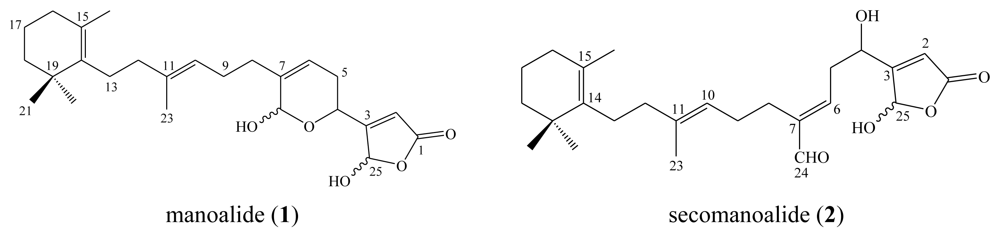
<p>Manoalide (<bold>1</bold>) is the parent compound of a series of marine sponge metabolites belonging to the sesterterpene class. Manoalide was first reported in 1980 by Scheuer from the marine sponge <italic>Luffariella variabilis</italic> (class Demospongiae; order Dictyoceratida; family Thorectidae) collected in Palau [<xref ref-type="bibr" rid="b5-marinedrugs-08-00313">5</xref>] with activity as an antibiotic against <italic>Streptomyces pyogenes</italic> and <italic>Staphylococcus aureus</italic>.</p>
<fig id="f4-marinedrugs-08-00313" position="anchor"><graphic xlink:href="marinedrugs-08-00313f4.gif"/></fig>
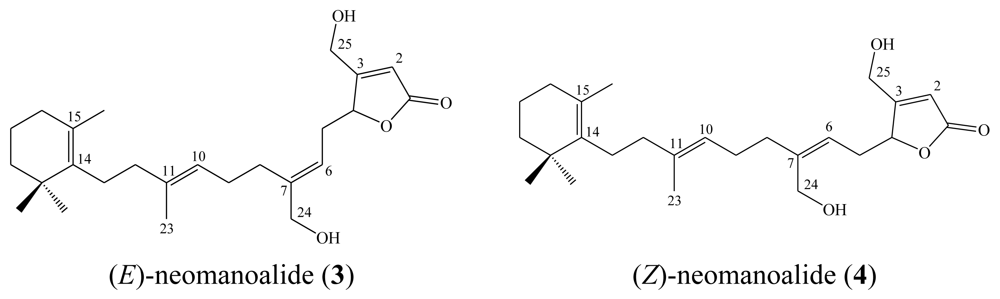
<p>One year later, Scheuer reported three additional related metabolites from the same Palauan sponge, namely secomanoalide (<bold>2</bold>), (<italic>E</italic>)-neomanoalide (<bold>3</bold>) and (<italic>Z</italic>)-neomanoalide (<bold>4</bold>) [<xref ref-type="bibr" rid="b6-marinedrugs-08-00313">6</xref>]. All three compounds, as well as the parent compound (<bold>1</bold>), displayed antibacterial activity against Gram positive bacteria (<italic>Staphylococcus aureus</italic> and <italic>Bacillus subtilis</italic>) but were inactive against <italic>Escherichia coli</italic>, <italic>Pseudomonas aeruginosa</italic> and <italic>Candida albicans</italic> [<xref ref-type="bibr" rid="b6-marinedrugs-08-00313">6</xref>].</p>
<fig id="f5-marinedrugs-08-00313" position="anchor"><graphic xlink:href="marinedrugs-08-00313f5.gif"/></fig>
<p>Later, marine sponges belonging to the family Thorectidae, including species of the genera <italic>Luffariella</italic> [<xref ref-type="bibr" rid="b7-marinedrugs-08-00313">7</xref>–<xref ref-type="bibr" rid="b19-marinedrugs-08-00313">19</xref>], <italic>Hyrtios</italic> [<xref ref-type="bibr" rid="b20-marinedrugs-08-00313">20</xref>,<xref ref-type="bibr" rid="b21-marinedrugs-08-00313">21</xref>], <italic>Thorectandra</italic> [<xref ref-type="bibr" rid="b22-marinedrugs-08-00313">22</xref>], <italic>Cacospongia</italic> [<xref ref-type="bibr" rid="b23-marinedrugs-08-00313">23</xref>,<xref ref-type="bibr" rid="b24-marinedrugs-08-00313">24</xref>], <italic>Fasciospongia</italic> [<xref ref-type="bibr" rid="b25-marinedrugs-08-00313">25</xref>–<xref ref-type="bibr" rid="b28-marinedrugs-08-00313">28</xref>], <italic>Acanthodendrilla</italic> [<xref ref-type="bibr" rid="b29-marinedrugs-08-00313">29</xref>] and <italic>Aplysinopsis</italic> [<xref ref-type="bibr" rid="b30-marinedrugs-08-00313">30</xref>], were also found to be rich sources of novel bioactive sesterterpenoids related to manoalide.</p>
<p>Manoalide was further investigated and found to be a potent inhibitor of phospholipase A<sub>2</sub> (PLA<sub>2</sub>) [<xref ref-type="bibr" rid="b31-marinedrugs-08-00313">31</xref>–<xref ref-type="bibr" rid="b38-marinedrugs-08-00313">38</xref>]. Subsequently, many structurally related metabolites with PLA<sub>2</sub> inhibitory activity were also reported [<xref ref-type="bibr" rid="b8-marinedrugs-08-00313">8</xref>, <xref ref-type="bibr" rid="b39-marinedrugs-08-00313">39</xref>–<xref ref-type="bibr" rid="b45-marinedrugs-08-00313">45</xref>]. PLA<sub>2</sub> is an enzyme that specifically catalyzes the hydrolysis of phospholipids at the <italic>S</italic><italic><sub>N</sub></italic><italic>-</italic>2 position to produce a lysophospholipid and arachidonic acid, which in turn provides the substrate for proinflammatory mediators such as leukotrienes, prostaglandins and thromboxanes, collectively known as the eicosanoids [<xref ref-type="bibr" rid="b41-marinedrugs-08-00313">41</xref>]. Since manoalide revealed an irreversible inhibition of phospholipase A<sub>2</sub> (PLA<sub>2</sub>) [<xref ref-type="bibr" rid="b33-marinedrugs-08-00313">33</xref>], the structure-activity relationships (SAR) of this compound attracted scientific interests to study and to understand both PLA<sub>2</sub> function and mechanism of action in the whole cell. Therefore, several studies were successfully performed to determine the contributions of the various functional groups incorporated in <bold>1</bold> and its analogs, such as the <italic>γ</italic>-hydroxybutenolide, <italic>α</italic>-hydroxydihydropyran and trimethylcyclohexenyl ring systems, to the efficacy as PLA<sub>2</sub> inhibitors [<xref ref-type="bibr" rid="b36-marinedrugs-08-00313">36</xref>,<xref ref-type="bibr" rid="b41-marinedrugs-08-00313">41</xref>,<xref ref-type="bibr" rid="b45-marinedrugs-08-00313">45</xref>]. These studies indicated that (1) the existence of the hemiacetal in the <italic>α</italic>-hydroxydihydropyran ring is crucial for irreversible binding, (2) the <italic>γ</italic>-hydroxybutenolide ring is involved in the initial interaction with PLA<sub>2</sub> and (3) the hydrophobic nature of the trimethylcyclohexenyl ring system allows non-bonded interactions with the enzyme that enhances the potency of these analogs. These studies suggested that the closed ring form of manoalide is the predominant molecular moiety that accounts for the selective and potent inhibition of PLA<sub>2</sub> [<xref ref-type="bibr" rid="b36-marinedrugs-08-00313">36</xref>].</p>
<p>Manoalide analogs also exhibited other bioactivities including molluscicidal [<xref ref-type="bibr" rid="b10-marinedrugs-08-00313">10</xref>], cytotoxicity [<xref ref-type="bibr" rid="b13-marinedrugs-08-00313">13</xref>,<xref ref-type="bibr" rid="b14-marinedrugs-08-00313">14</xref>,<xref ref-type="bibr" rid="b16-marinedrugs-08-00313">16</xref>,<xref ref-type="bibr" rid="b20-marinedrugs-08-00313">20</xref>,<xref ref-type="bibr" rid="b23-marinedrugs-08-00313">23</xref>,<xref ref-type="bibr" rid="b26-marinedrugs-08-00313">26</xref>,<xref ref-type="bibr" rid="b29-marinedrugs-08-00313">29</xref>,<xref ref-type="bibr" rid="b30-marinedrugs-08-00313">30</xref>,<xref ref-type="bibr" rid="b47-marinedrugs-08-00313">47</xref>–<xref ref-type="bibr" rid="b49-marinedrugs-08-00313">49</xref>], inhibitory activity of Cdc25 phosphatase [<xref ref-type="bibr" rid="b46-marinedrugs-08-00313">46</xref>], nicotinic antagonistic activity [<xref ref-type="bibr" rid="b12-marinedrugs-08-00313">12</xref>] and fish deterrent properties [<xref ref-type="bibr" rid="b26-marinedrugs-08-00313">26</xref>,<xref ref-type="bibr" rid="b49-marinedrugs-08-00313">49</xref>]. Therefore, chemical synthesis and derivatization of manoalide attracted much interest leading to a better understanding of the structure activity relationships (SAR) and/or for the plausible mechanism of action [<xref ref-type="bibr" rid="b35-marinedrugs-08-00313">35</xref>,<xref ref-type="bibr" rid="b38-marinedrugs-08-00313">38</xref>–<xref ref-type="bibr" rid="b40-marinedrugs-08-00313">40</xref>,<xref ref-type="bibr" rid="b43-marinedrugs-08-00313">43</xref>,<xref ref-type="bibr" rid="b44-marinedrugs-08-00313">44</xref>,<xref ref-type="bibr" rid="b50-marinedrugs-08-00313">50</xref>,<xref ref-type="bibr" rid="b51-marinedrugs-08-00313">51</xref>]. Manoalide (<bold>1</bold>) was licensed to Allergan Pharmaceuticals and reached phase II clinical trials as a topical antipsoriatic. Its development was, however, discontinued due to formulation problems. The compound is now commercially available as a biochemical standard tool to block the action of PLA<sub>2</sub> [<xref ref-type="bibr" rid="b52-marinedrugs-08-00313">52</xref>].</p>
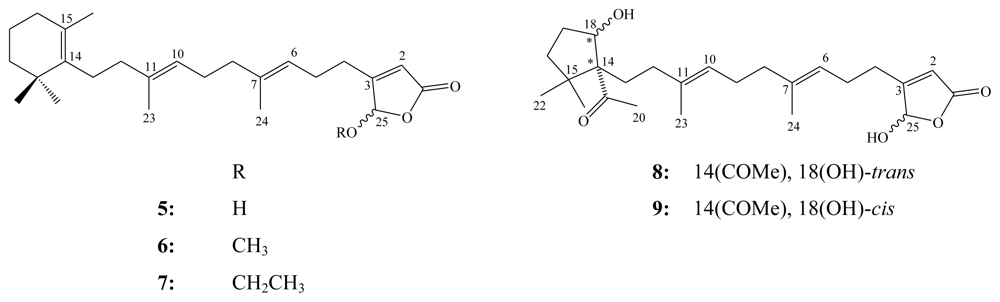
<p>Luffariellolide (<bold>5</bold>) is a sesterterpenoid analog of secomanoalide (<bold>2</bold>), which was first reported from a Palauan sponge <italic>Luffariella</italic> sp. [<xref ref-type="bibr" rid="b8-marinedrugs-08-00313">8</xref>]. Structurally, luffariellolide differed in having C-24 as methyl group instead of an aldehyde functionality as in <bold>2</bold> and it was obtained as the (<italic>Z</italic>) isomer as well.</p>
<fig id="f6-marinedrugs-08-00313" position="anchor"><graphic xlink:href="marinedrugs-08-00313f6.gif"/></fig>
<p>In contrast to the irreversible inhibitory action of manoalide (<bold>1</bold>) towards PLA<sub>2</sub>, luffariellolide (<bold>5</bold>) is a slightly less potent, but a partially reversible inhibitor. This meant that <bold>5</bold> became a more preferable anti-inflammatory agent for potential pharmacological investigation [<xref ref-type="bibr" rid="b8-marinedrugs-08-00313">8</xref>].</p>
<p>In addition to luffariellolide (<bold>5</bold>), its 25-<italic>O</italic>-methyl (<bold>6</bold>) and 25-<italic>O</italic>-ethyl derivatives (<bold>7</bold>), five related sesterterpenes, acantholides A–E, were obtained from the Indonesian sponge <italic>Acanthodendrilla</italic> sp. [<xref ref-type="bibr" rid="b29-marinedrugs-08-00313">29</xref>]. Acantholide D (<bold>8</bold>) and E (<bold>9</bold>) represent rare variants for the C<sub>14</sub>–C<sub>20</sub> segment in this type of linear sesterterpenes in which they have the 1-acetylcyclopentan-5-ol moiety replacing the trimethylcyclohexenyl ring. Luffariellolide (<bold>5</bold>) and its 25-<italic>O</italic>-methyl congener (<bold>6</bold>), as well as acantholide E (<bold>9</bold>), were cytotoxic against the mouse lymphoma L5178Y cell line with IC<sub>50</sub> values of 8.5, 1.8, and 16.8 μM, respectively. Interestingly, these results suggest that the 25-<italic>O</italic>-methyl group in <bold>6</bold> and the stereochemistry of 1-acetylcyclopentan-5-ol in <bold>9</bold> play an important role [<xref ref-type="bibr" rid="b29-marinedrugs-08-00313">29</xref>].</p>
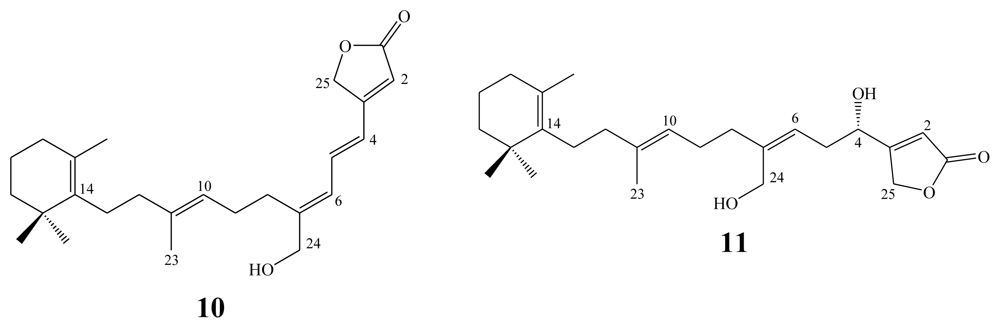
<p>Luffariolides A–J represent a related group of sesterterpenoidal analogs, which have been obtained from different collections of the Okinawan marine sponge <italic>Luffariella</italic> sp. [<xref ref-type="bibr" rid="b13-marinedrugs-08-00313">13</xref>,<xref ref-type="bibr" rid="b14-marinedrugs-08-00313">14</xref>,<xref ref-type="bibr" rid="b16-marinedrugs-08-00313">16</xref>].</p>
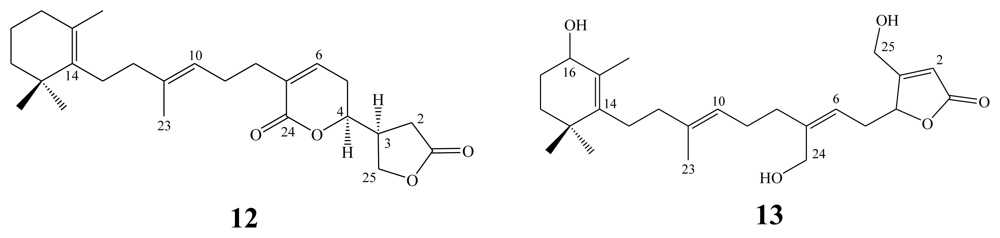
<p>All luffariolides exhibited significant cytotoxicity against murine lymphoma L1210 cells with IC<sub>50</sub> values ranging between 2.9–19.3 μM. Amongst them, luffariolides A (<bold>10</bold>, IC<sub>50</sub> 2.9 μM), B (<bold>11</bold>, IC<sub>50</sub> 3.23 μM), E (<bold>12</bold>, IC<sub>50</sub> 3.0 μM) and F (<bold>13</bold>, IC<sub>50</sub> 3.8 μM) were the most active ones [<xref ref-type="bibr" rid="b13-marinedrugs-08-00313">13</xref>,<xref ref-type="bibr" rid="b14-marinedrugs-08-00313">14</xref>,<xref ref-type="bibr" rid="b16-marinedrugs-08-00313">16</xref>].</p>
<fig id="f7-marinedrugs-08-00313" position="anchor"><graphic xlink:href="marinedrugs-08-00313f7.gif"/></fig>
<fig id="f8-marinedrugs-08-00313" position="anchor"><graphic xlink:href="marinedrugs-08-00313f8.gif"/></fig>
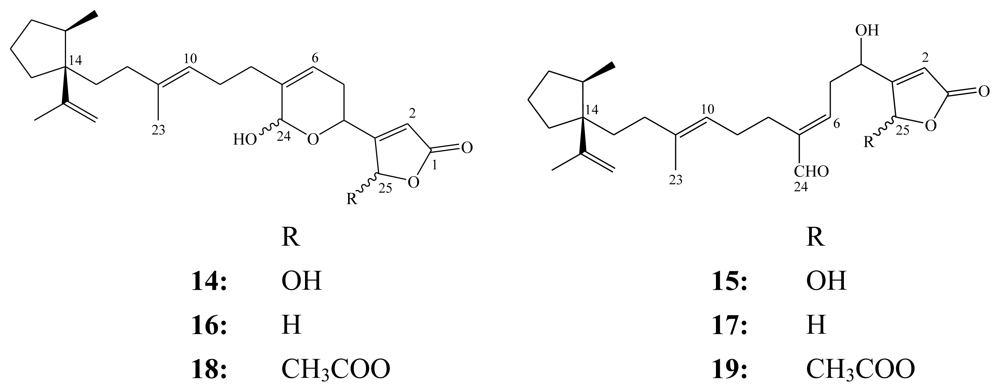
<p>Luffariellins A (<bold>14</bold>) and B (<bold>15</bold>) [<xref ref-type="bibr" rid="b7-marinedrugs-08-00313">7</xref>] together with their respective 25-acetoxy derivatives (<bold>18</bold> and <bold>19</bold>) [<xref ref-type="bibr" rid="b18-marinedrugs-08-00313">18</xref>] were isolated from the marine sponge <italic>Luffariella variabilis</italic> collected off different locations in Palau and in Australia, whereas luffariellins C (<bold>16</bold>) and D (<bold>17</bold>) were obtained from the shell-less marine mollusc <italic>Chromodoris funerea</italic> collected from the Kaibakku lake shores in Palau [<xref ref-type="bibr" rid="b53-marinedrugs-08-00313">53</xref>].</p>
<fig id="f9-marinedrugs-08-00313" position="anchor"><graphic xlink:href="marinedrugs-08-00313f9.gif"/></fig>
<p>Luffariellins (<bold>14</bold>–<bold>19</bold>) are all characterized by the 1-isoproprenyl-2-methylcyclopentane ring system replacing the trimethylcyclohexenyl moiety in other manoalide analogs. Despite this discrepancy in chemical structure, luffariellins A (<bold>14</bold>) and B (<bold>15</bold>) retain identical functional groups as present in manoalide (<bold>1</bold>) and secomanoalide (<bold>2</bold>), respectively. Therefore, not surprisingly each respective pair was shown to have similar anti-inflammatory properties to <bold>1</bold> and <bold>2</bold> [<xref ref-type="bibr" rid="b7-marinedrugs-08-00313">7</xref>].</p>
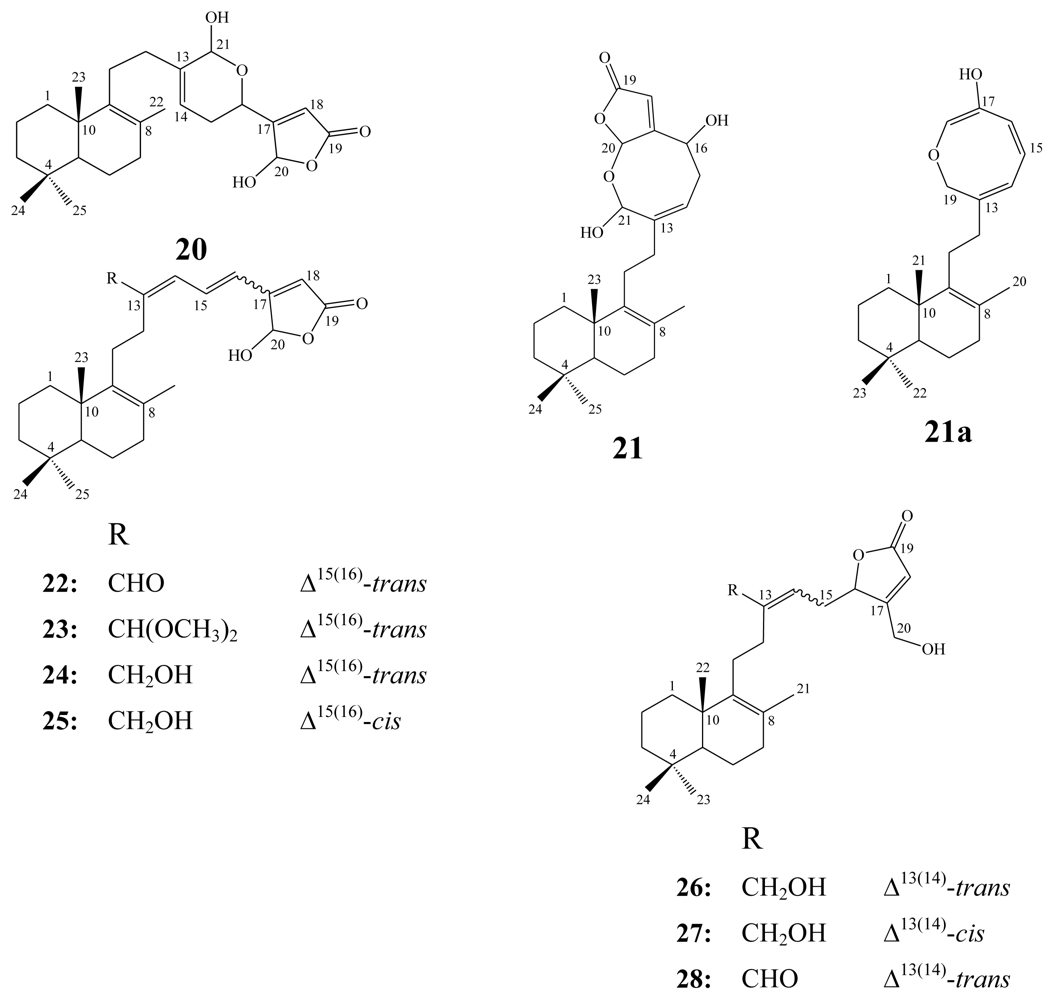
<p>Luffarin metabolites comprise another group of compounds represented by 28 derivatives. 26 of them, luffarins A–Z, have been reported from the Australian marine sponge <italic>Luffariella geometrica</italic> [<xref ref-type="bibr" rid="b12-marinedrugs-08-00313">12</xref>], while the other two were obtained from the Adriatic Sea sponge <italic>Fasciospongia cavernosa</italic> [<xref ref-type="bibr" rid="b28-marinedrugs-08-00313">28</xref>]. Based on the chemical structures, luffarins have been classified into 14 bicyclic sesterterpenes, luffarins A–N; one bicyclic bisnorsesterterpene, luffarin O; one monocyclic sesterterpene, luffarin P; and six acyclic sesterterpenes, luffarin Q–V, in addition to four diterpenoidal derivatives, luffarin W–Z [<xref ref-type="bibr" rid="b12-marinedrugs-08-00313">12</xref>].</p>
<p>All luffarins were tested for antimicrobial activity against <italic>Staphylococcus aureus</italic>, <italic>Micrococcus</italic> sp., and <italic>Saccharomyces cerevisiae</italic>. Only luffarins C–F (<bold>22</bold>–<bold>25</bold>), K (<bold>26</bold>) and L (<bold>27</bold>) showed activity against both <italic>S. aureus</italic> and <italic>Micrococcus</italic> sp. [<xref ref-type="bibr" rid="b12-marinedrugs-08-00313">12</xref>], whereas luffarins A (<bold>20</bold>) and M (<bold>28</bold>) revealed only mild activity against the latter. Moreover, some luffarins were also found to be effective inhibitors of nicotinic receptors [<xref ref-type="bibr" rid="b12-marinedrugs-08-00313">12</xref>].</p>
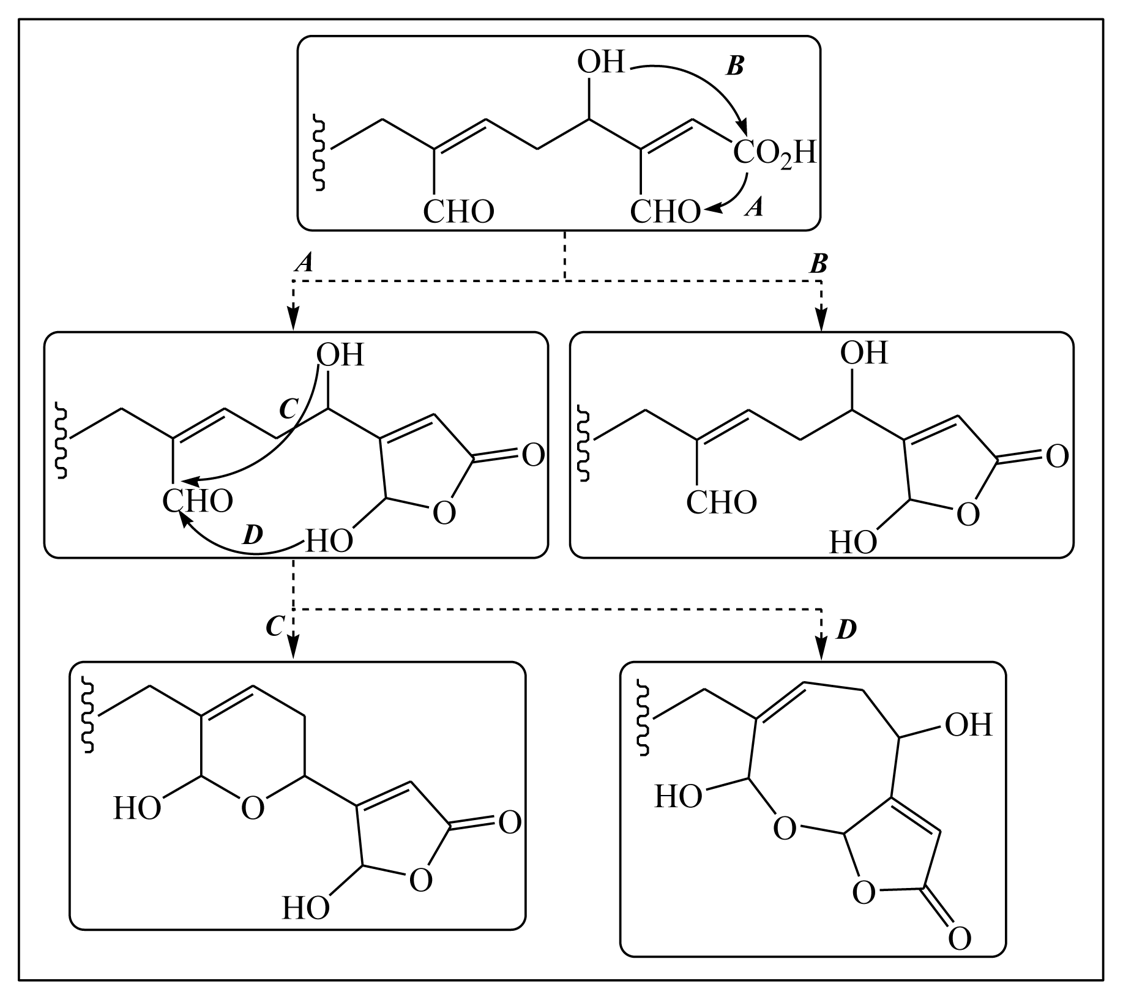
<p>Biosynthetically, a relationship could be recognized between the various luffarins as illustrated in <xref ref-type="fig" rid="f1-marinedrugs-08-00313">Figure 1</xref>. Luffarins appear to belong to the same enantiomeric series as reported for manoalide-type marine natural products. It is also curious to note that no acyclic luffarins incorporated the hydroxylated butenolide functionality. Perhaps the most interesting luffarins from a biosynthetic point of view are luffarins B (<bold>21</bold>) and O (<bold>21a</bold>), which were the first examples of a hitherto unknown cyclization pattern in compounds of this class [<xref ref-type="bibr" rid="b12-marinedrugs-08-00313">12</xref>].</p>
<fig id="f10-marinedrugs-08-00313" position="anchor"><graphic xlink:href="marinedrugs-08-00313f10.gif"/></fig>
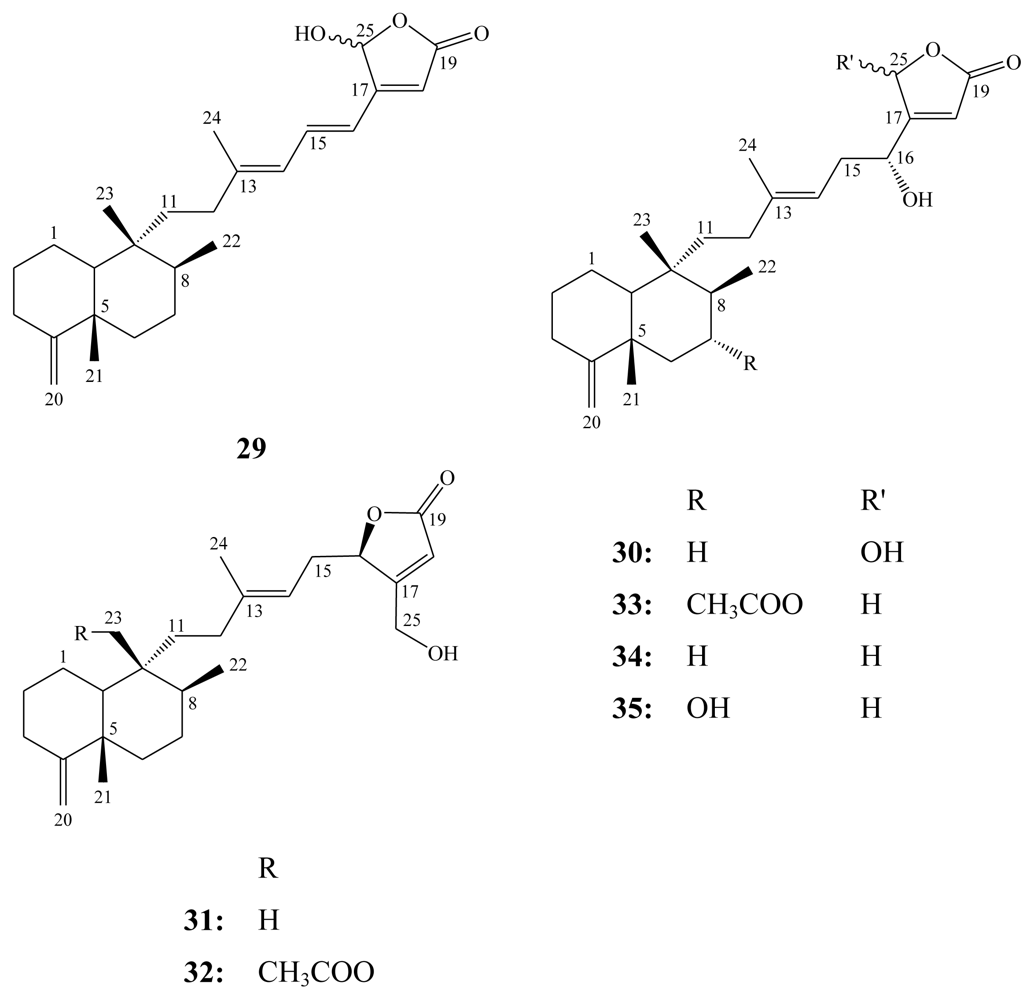
<p>Another example of bicyclic sesterterpenes are thorectandrols A–E (<bold>31</bold>–<bold>35</bold>) that were isolated from a Palauan collection of the marine sponge <italic>Thorectandra</italic> sp. [<xref ref-type="bibr" rid="b47-marinedrugs-08-00313">47</xref>,<xref ref-type="bibr" rid="b48-marinedrugs-08-00313">48</xref>] together with the parent compounds of this group palauolide (<bold>29</bold>) and palauolol (<bold>30</bold>). Palauolide (<bold>29</bold>) was obtained first as an antimicrobial sesterterpene from a three sponge association collected in Palau [<xref ref-type="bibr" rid="b54-marinedrugs-08-00313">54</xref>]. While palauolol (<bold>30</bold>) was identified as an anti-inflammatory sesterterpene from the Palauan sponge <italic>Fascaplysinopsis</italic> sp. and chemically it was recognized as being a secondary alcohol that upon dehydration yields <bold>29</bold> [<xref ref-type="bibr" rid="b55-marinedrugs-08-00313">55</xref>].</p>
<fig id="f11-marinedrugs-08-00313" position="anchor"><graphic xlink:href="marinedrugs-08-00313f11.gif"/></fig>
<p>All thorectandrols (<bold>31</bold>–<bold>35</bold>) in addition to palauolide (<bold>29</bold>) and palauolol (<bold>30</bold>) were tested for antiproliferative activity against six to twelve human tumor cell lines depending on sample availability [<xref ref-type="bibr" rid="b48-marinedrugs-08-00313">48</xref>]. Palauolol (<bold>30</bold>) was active against all tested cell lines except A549 (non small lung cancer), with IC<sub>50</sub> values in the range 1.2–1.7 μM, while palauolide (<bold>29</bold>) showed a diminished activity. On the other hand, thorectandrols A–E revealed only weak to no cytotoxicity against the tested cell lines (IC<sub>50</sub>’s 70–100 μM). While firm deductions on the structural requirements for activity were not possible, it appeared that the presence of both the hemiacetal lactone functionality and the 16-hydroxyl group in palauolol (<bold>30</bold>) enhanced cytotoxicity compared to palauolide (<bold>29</bold>) and other thorectandrols [<xref ref-type="bibr" rid="b48-marinedrugs-08-00313">48</xref>].</p>
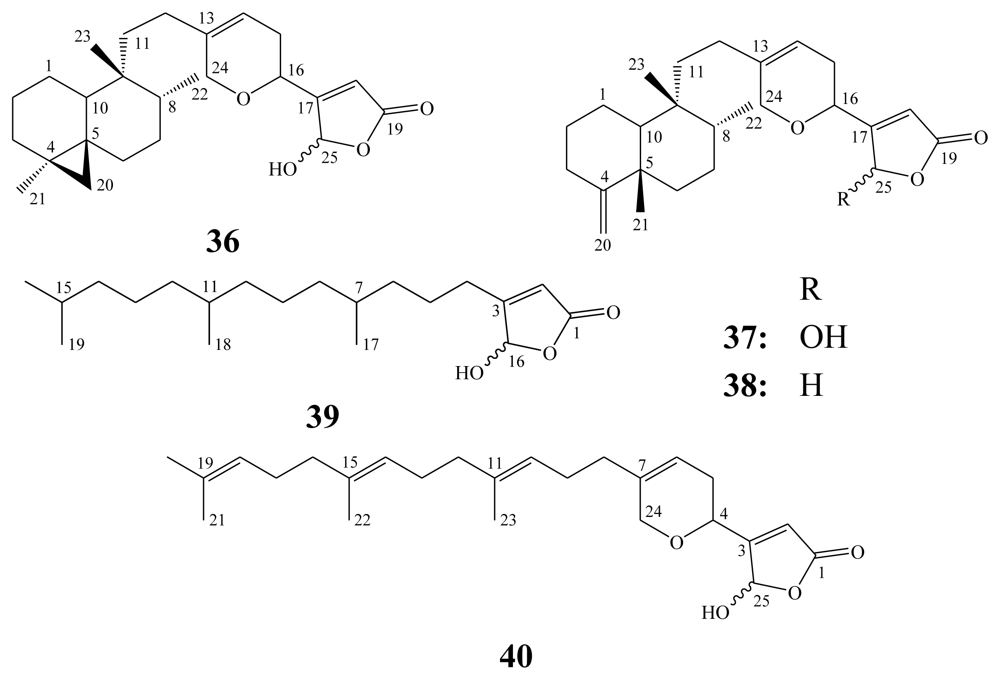
<p>Cacospongionolides (<bold>36</bold>–<bold>40</bold>) were isolated from different collections of the marine sponge <italic>Fasciospongia cavernosa</italic> (=<italic>Cacospongia mollior</italic>) collected from the Mediterranean Sea [<xref ref-type="bibr" rid="b23-marinedrugs-08-00313">23</xref>,<xref ref-type="bibr" rid="b26-marinedrugs-08-00313">26</xref>,<xref ref-type="bibr" rid="b49-marinedrugs-08-00313">49</xref>,<xref ref-type="bibr" rid="b56-marinedrugs-08-00313">56</xref>]. Cacospongionolides A (<bold>36</bold>), B (<bold>37</bold>) and its 25-deoxy derivative (<bold>38</bold>) revealed a bicyclic sesterterpenoidal skeleton, resembling luffarins and thorectandrols, with the addition of a <italic>γ</italic>-hydroxybutenolide moiety. The other cacospongionolides C (<bold>39</bold>) and D (<bold>40</bold>) are acyclic diterpenoidal derivatives. Despite the structural relation with luffarins and thorectandrols, cacospongionolides (<bold>36</bold>–<bold>38</bold>) together with cacospongionolide D (<bold>40</bold>) exhibited significant cytotoxicity [<xref ref-type="bibr" rid="b23-marinedrugs-08-00313">23</xref>,<xref ref-type="bibr" rid="b26-marinedrugs-08-00313">26</xref>,<xref ref-type="bibr" rid="b49-marinedrugs-08-00313">49</xref>,<xref ref-type="bibr" rid="b56-marinedrugs-08-00313">56</xref>]. This notion suggested a possible relation between the presence of the <italic>γ</italic>-hydroxybutenolide moiety and the cytotoxicity.</p>
<fig id="f12-marinedrugs-08-00313" position="anchor"><graphic xlink:href="marinedrugs-08-00313f12.gif"/></fig>
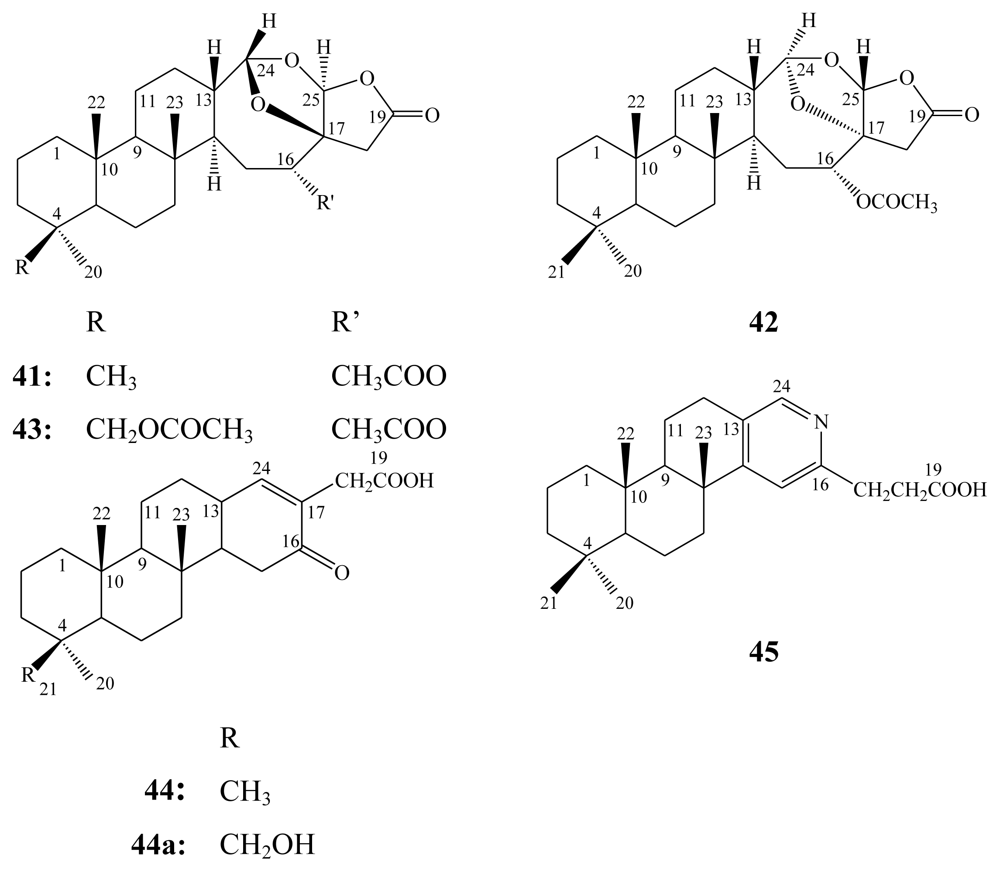
<p>Petrosaspongiolides A (<bold>41</bold>) and B (<bold>42</bold>) were the first cheilantane sesterterpene lactones to be isolated from a New Caledonian sponge incorrectly assigned to the genus <italic>Dactylospongia</italic> [<xref ref-type="bibr" rid="b57-marinedrugs-08-00313">57</xref>] and then reassigned as a new genus and a new species: <italic>Petrosaspongia nigra</italic> (Bergquist 1995 sp. nov., class Demospongiae; order Dictyoceratida; family Spongidae) [<xref ref-type="bibr" rid="b58-marinedrugs-08-00313">58</xref>].</p>
<p>From another New Caledonian collection of the same sponge, 15 additional petrosaspongiolide congeners (C–R) were isolated [<xref ref-type="bibr" rid="b59-marinedrugs-08-00313">59</xref>,<xref ref-type="bibr" rid="b60-marinedrugs-08-00313">60</xref>].</p>
<fig id="f13-marinedrugs-08-00313" position="anchor"><graphic xlink:href="marinedrugs-08-00313f13.gif"/></fig>
<p>From the chloroform extract of another Dictyoceratida sponge of the genus <italic>Spongia</italic>, 21-hydroxy derivatives of petrosaspongiolides K (<bold>44a</bold>) and P (<bold>48a</bold>) were isolated in addition to four other pyridinium alkaloids named spongidines A–D (<bold>51</bold>–<bold>54</bold>) [<xref ref-type="bibr" rid="b61-marinedrugs-08-00313">61</xref>]. Spongidines were found to be structurally related to petrosaspongiolide L (<bold>45</bold>) particularly in the presence of pyridine ring.</p>
<fig id="f14-marinedrugs-08-00313" position="anchor"><graphic xlink:href="marinedrugs-08-00313f14.gif"/></fig>
<p>Petrosaspongiolides A–L were subjected to <italic>in vitro</italic> cytotoxicity assay against the human bronchopulmonary NSCLC-N6 carcinoma cell line. They revealed IC<sub>50</sub> values ranging between 1.0–32.2 μM [<xref ref-type="bibr" rid="b59-marinedrugs-08-00313">59</xref>]. Petrosaspongiolides C (<bold>43</bold>) and K (<bold>44</bold>) exhibited the highest potency with IC<sub>50</sub> values of 1.0 and 3.5 μM, respectively. However, petrosaspongiolides A (<bold>41</bold>) and B (<bold>42</bold>) were the least cytotoxic congeners <italic>in vitro</italic> with IC<sub>50</sub> values of 28 and 32.2 μM, respectively, <bold>41</bold> inhibited tumoral proliferation <italic>in vivo</italic> at 20 mg/Kg without significant toxicity when tested on immunosuppressed rats carrying a bronchopulmonary tumor (NSCLC-N6) [<xref ref-type="bibr" rid="b59-marinedrugs-08-00313">59</xref>].</p>
<p>Petrosasponiolides M–R (<bold>46</bold>–<bold>50</bold>) revealed the presence of a <italic>γ</italic>-hydroxybutenolide moiety and a hemiacetal function. Due to these structural similarities to manoalide (<bold>1</bold>), petrosaspongiolides M–R have received special attention from the scientific community to study their inhibitory activity against PLA<sub>2</sub> from different resources to point out their specificity. Two main groups of PLA<sub>2</sub> enzymes have been reported [<xref ref-type="bibr" rid="b62-marinedrugs-08-00313">62</xref>], the secretory PLA<sub>2</sub> (sPLA<sub>2</sub> groups I, II, III, V, IX, and X with relatively small molecular weights) and the cytosolic PLA<sub>2</sub> (cPLA<sub>2</sub> groups IV, VI, VII, and VIII with higher molecular weights). Inhibition of specific PLA<sub>2</sub> constitutes a potentially useful approach for treating a wide variety of inflammatory disorders such as spetic shock, adult respiratory distress syndrome, arthritis, and acute pancreatitis [<xref ref-type="bibr" rid="b61-marinedrugs-08-00313">61</xref>].</p>
<p>Petrosaspongiolides M–R (<bold>46</bold>–<bold>50</bold>) together with 21-hydroxy derivatives of petrosaspongiolides K (<bold>44a</bold>) and P (<bold>48a</bold>), and spongidines A–D (<bold>51</bold>–<bold>54</bold>) were tested on five different sPLA<sub>2</sub>s belonging to the groups I (<italic>Naja naja</italic> venom and porcine pancreatic enzymes), II (human synovial recombinant and rat air-pouch secretory enzymes), and III (bee venom enzyme) [<xref ref-type="bibr" rid="b60-marinedrugs-08-00313">60</xref>,<xref ref-type="bibr" rid="b61-marinedrugs-08-00313">61</xref>].</p>
<p>Among petrosaspongiolide derivatives, <bold>46</bold> and <bold>48a</bold> inhibited mainly human synovial PLA<sub>2</sub> with IC<sub>50</sub> values of 1.6 and 5.8 μM, respectively, compared to manoalide (<bold>1</bold>) (IC<sub>50</sub> = 3.9 μM) [<xref ref-type="bibr" rid="b60-marinedrugs-08-00313">60</xref>,<xref ref-type="bibr" rid="b61-marinedrugs-08-00313">61</xref>]. Petrosaspongiolide M (<bold>46</bold>) also inhibited bee venom PLA<sub>2</sub> enzyme with IC<sub>50</sub> of 0.6 μM, compared to <bold>1</bold> (IC<sub>50</sub> of 7.5 μM) [<xref ref-type="bibr" rid="b60-marinedrugs-08-00313">60</xref>].</p>
<p>The mechanism of action of petrosaspongiolides M–R (<bold>46</bold>–<bold>50</bold>) as anti-inflammatory marine metabolites has been the topic for many research articles [<xref ref-type="bibr" rid="b63-marinedrugs-08-00313">63</xref>–<xref ref-type="bibr" rid="b68-marinedrugs-08-00313">68</xref>]. The covalent binding of <bold>46</bold> to bee venom PLA<sub>2</sub> has been investigated by mass spectrometry and molecular modeling. The mass increment observed was consistent with the formation of a Schiff base by reaction of a PLA<sub>2</sub> amino group with the hemiacetal function at the C-25 atom of the petrosaspongiolide M <italic>γ</italic>-hydroxybutenolide ring [<xref ref-type="bibr" rid="b63-marinedrugs-08-00313">63</xref>]. The molecular mechanism of inactivating the bee venom and the human type IIA secretory PLA<sub>2</sub>s by petrosaspongiolides R (<bold>50</bold>) [<xref ref-type="bibr" rid="b67-marinedrugs-08-00313">67</xref>], and M (<bold>46</bold>) [<xref ref-type="bibr" rid="b68-marinedrugs-08-00313">68</xref>], respectively, has been investigated. In both cases, either covalent (imine formation) and/or non-covalent (van der Waals) interactions contributed to the inhibitory activity against PLA<sub>2</sub> enzymes [<xref ref-type="bibr" rid="b67-marinedrugs-08-00313">67</xref>,<xref ref-type="bibr" rid="b68-marinedrugs-08-00313">68</xref>]. Due to potent anti-inflammatory properties of petrosaspongiolides, their chemical synthesis has been interestingly investigated. Recently, the first enantioselective synthesis of petrosaspongiolide R (<bold>50</bold>) has been successfully performed [<xref ref-type="bibr" rid="b69-marinedrugs-08-00313">69</xref>].</p></sec>
<sec>
<title>3. Triterpenes (C<sub>30</sub>)</title>
<p>Steroidal triterpenes were the first marine isoprenes to be discovered in the 1930s. Scientific interest has been driven towards these metabolites due to the isolation of biosynthetically unprecedented derivatives possessing a broad spectrum of bioactivity(ies). Marine triterpenoids have been reported from various marine macroorganisms. In this section, we survey two examples of triterpenoidal metabolites namely isomalabaricane triterpenes and steroidal saponins obtained from marine sponges with particular attention being drawn to their pharmacological significance.</p>
<sec>
<title>3.1. Isomalabaricane triterpenes</title>
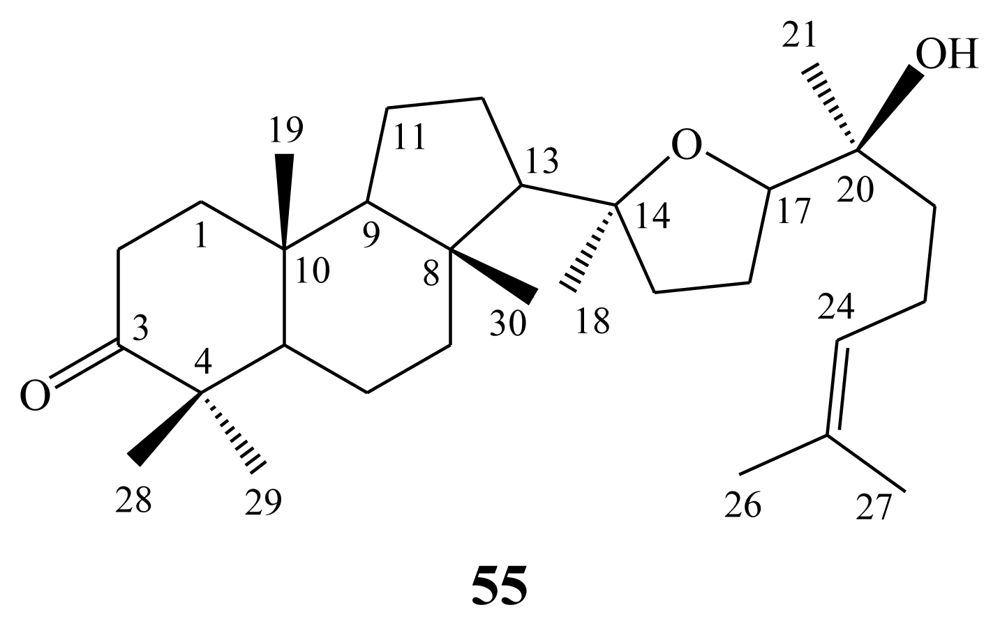
<p>Malabaricol (<bold>55</bold>) is the chief triterpene constituent of a yellow pigment obtained from the wood of the terrestrial plant <italic>Ailanthus malabarica</italic> (family Simaroubaceae), after which the whole group of related compounds was named [<xref ref-type="bibr" rid="b70-marinedrugs-08-00313">70</xref>–<xref ref-type="bibr" rid="b72-marinedrugs-08-00313">72</xref>]. Malabaricane, the trivial name of this group of compounds, was given to the hydrocarbon system (3<italic>S</italic><sup>*</sup>,3a<italic>R</italic><sup>*</sup>,5a<italic>S</italic><sup>*</sup>,9a<italic>S</italic><sup>*</sup>,9b<italic>S</italic><sup>*</sup>)-3a,6,6,9a-tetramethyl-3-(1,5,9- trimethyldecyl)perhydr-obenz[<italic>e</italic>]indene, where the tricylic nucleus has a <italic>trans</italic>-<italic>anti</italic>-<italic>trans</italic> ring junction [<xref ref-type="bibr" rid="b71-marinedrugs-08-00313">71</xref>,<xref ref-type="bibr" rid="b72-marinedrugs-08-00313">72</xref>].</p>
<fig id="f15-marinedrugs-08-00313" position="anchor"><graphic xlink:href="marinedrugs-08-00313f15.gif"/></fig>
<p>The malabaricanes are structurally characterized by a tricyclic triterpenoid core and a conjugated polyene side chain [<xref ref-type="bibr" rid="b70-marinedrugs-08-00313">70</xref>–<xref ref-type="bibr" rid="b72-marinedrugs-08-00313">72</xref>], whereas the isomalabaricane skeleton is embedded in a 4,4,8,10-tetramethyl-perhydrobenz[<italic>e</italic>]indene with a <italic>trans</italic>-<italic>syn</italic>-<italic>trans</italic> ring junction, that leads to an unfavorable twist-boat conformation for the central ring [<xref ref-type="bibr" rid="b73-marinedrugs-08-00313">73</xref>,<xref ref-type="bibr" rid="b74-marinedrugs-08-00313">74</xref>].</p>
<p>Isomalabaricane triterpenes were first reported from a Fijian collection of the sponge <italic>Jaspis stellifera</italic> [<xref ref-type="bibr" rid="b73-marinedrugs-08-00313">73</xref>] and the Somalian marine sponge <italic>Stelletta</italic> sp. [<xref ref-type="bibr" rid="b74-marinedrugs-08-00313">74</xref>]. Since then, they have been isolated from several genera of marine sponges belonging to the order Astrophorida including members of the genera <italic>Rhabdastrella</italic> [<xref ref-type="bibr" rid="b75-marinedrugs-08-00313">75</xref>,<xref ref-type="bibr" rid="b80-marinedrugs-08-00313">80</xref>,<xref ref-type="bibr" rid="b82-marinedrugs-08-00313">82</xref>,<xref ref-type="bibr" rid="b86-marinedrugs-08-00313">86</xref>,<xref ref-type="bibr" rid="b93-marinedrugs-08-00313">93</xref>,<xref ref-type="bibr" rid="b94-marinedrugs-08-00313">94</xref>,<xref ref-type="bibr" rid="b96-marinedrugs-08-00313">96</xref>,<xref ref-type="bibr" rid="b100-marinedrugs-08-00313">100</xref>], <italic>Stelletta</italic> [<xref ref-type="bibr" rid="b77-marinedrugs-08-00313">77</xref>–<xref ref-type="bibr" rid="b79-marinedrugs-08-00313">79</xref>,<xref ref-type="bibr" rid="b85-marinedrugs-08-00313">85</xref>,<xref ref-type="bibr" rid="b88-marinedrugs-08-00313">88</xref>,<xref ref-type="bibr" rid="b92-marinedrugs-08-00313">92</xref>], <italic>Jaspis</italic> [<xref ref-type="bibr" rid="b81-marinedrugs-08-00313">81</xref>,<xref ref-type="bibr" rid="b87-marinedrugs-08-00313">87</xref>,<xref ref-type="bibr" rid="b89-marinedrugs-08-00313">89</xref>,<xref ref-type="bibr" rid="b98-marinedrugs-08-00313">98</xref>,<xref ref-type="bibr" rid="b99-marinedrugs-08-00313">99</xref>,<xref ref-type="bibr" rid="b101-marinedrugs-08-00313">101</xref>,<xref ref-type="bibr" rid="b102-marinedrugs-08-00313">102</xref>], and <italic>Geodia</italic> [<xref ref-type="bibr" rid="b83-marinedrugs-08-00313">83</xref>,<xref ref-type="bibr" rid="b90-marinedrugs-08-00313">90</xref>,<xref ref-type="bibr" rid="b95-marinedrugs-08-00313">95</xref>].</p>
<p>Isomalabaricane triterpenoids having polyene conjugated functionality can be classified into three groups: (1) stelletins principally possessing the <italic>γ</italic>-pyrone functionality, which could be ring-opened in some of its congeners yielding the side chain with terminal free carboxylic acid and methyl moieties, (2) stelliferins oxygenated at C-22, and 3) globostellatic acids whose main feature is a carboxyl group at C-4. In addition to triterpenoids, the isomalabaricane core has been also recognized in some sesqui- and/or sesterterpenes. The isomalabaricane terpenoids were sometimes trivially named according to their sponge origin.</p>
<p>Upon light exposure, the isomalabaricane-type terpenes readily isomerize at the C-13 position. Therefore, during isolation and characterization processes, they rapidly equilibrate into a 1:1 mixture of the 13<italic>E</italic> and 13<italic>Z</italic> isomers [<xref ref-type="bibr" rid="b78-marinedrugs-08-00313">78</xref>–<xref ref-type="bibr" rid="b80-marinedrugs-08-00313">80</xref>,<xref ref-type="bibr" rid="b88-marinedrugs-08-00313">88</xref>,<xref ref-type="bibr" rid="b89-marinedrugs-08-00313">89</xref>,<xref ref-type="bibr" rid="b98-marinedrugs-08-00313">98</xref>,<xref ref-type="bibr" rid="b99-marinedrugs-08-00313">99</xref>]. Nevertheless, these compounds continue to gain a great deal of attention because of their significant cytotoxic activity [<xref ref-type="bibr" rid="b79-marinedrugs-08-00313">79</xref>,<xref ref-type="bibr" rid="b89-marinedrugs-08-00313">89</xref>], whereas the nature of the natural isomer, either 13<italic>E</italic> or 13<italic>Z</italic> or both, is still unresolved. Recently it was reported that the <sup>1</sup>H NMR spectrum of a crude extract obtained from the fresh sponge <italic>Rhabdastrella</italic> aff. <italic>distinca</italic> (Hainan, the South China Sea) revealed that it mostly contained isomalabaricanes with the 13<italic>E</italic>-configuration (H-15 of most derivatives appeared around 7.0 ppm). Thus, the 13<italic>Z</italic> isomers were suggested in this case to be formed through isomerization during the isolation and analytical procedures [<xref ref-type="bibr" rid="b86-marinedrugs-08-00313">86</xref>].</p>
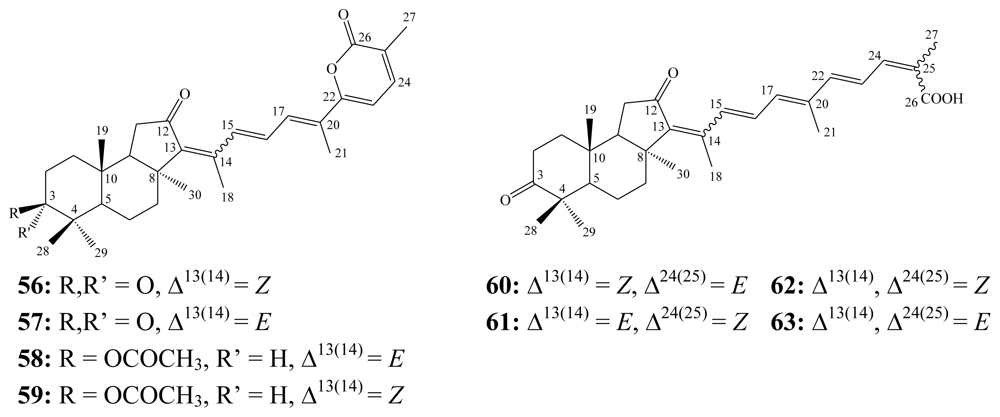
<p>Stelletins comprise the first group of isomalabaricane-type triterpenoids. Stelletin A (<bold>56</bold>) was recognized in 1981 as a yellow triterpenoidal pigment from the Fijian marine sponge <italic>Jaspis stellifera</italic> [<xref ref-type="bibr" rid="b73-marinedrugs-08-00313">73</xref>]. Later, it was obtained together with its <italic>E</italic> isomer, stelletin B (<bold>57</bold>), from the marine sponge <italic>Stelletta tenuis</italic> collected off Hainan Island, China [<xref ref-type="bibr" rid="b77-marinedrugs-08-00313">77</xref>]. Stelletin A (<bold>56</bold>) revealed significant cytotoxicity against murine leukemia P388 cell line with IC<sub>50</sub> of 2.1 nM [<xref ref-type="bibr" rid="b77-marinedrugs-08-00313">77</xref>].</p>
<fig id="f16-marinedrugs-08-00313" position="anchor"><graphic xlink:href="marinedrugs-08-00313f16.gif"/></fig>
<p>Stelletin G (<bold>62</bold>), with an opened <italic>γ</italic>-pyrone and featuring terminal -COOH and -CH<sub>3</sub> functionalities, was isolated together with <bold>56</bold> from <italic>J. stellifera</italic> [<xref ref-type="bibr" rid="b73-marinedrugs-08-00313">73</xref>]. Later, stelletins G (<bold>62</bold>) was reported from the Australian marine sponge <italic>Stelletta</italic> sp. together with stelletins E (<bold>60</bold>) and F (<bold>61</bold>) [<xref ref-type="bibr" rid="b78-marinedrugs-08-00313">78</xref>]. The <italic>E</italic> isomer of stelletin G (<bold>62</bold>) was isolated from the marine sponge <italic>Rhabdastrella globostellata</italic> collected from the South China Sea and it was given the trivial name rhabdastrellic acid–A (<bold>63</bold>) [<xref ref-type="bibr" rid="b75-marinedrugs-08-00313">75</xref>,<xref ref-type="bibr" rid="b76-marinedrugs-08-00313">76</xref>].</p>
<p>Research interests have been intensively driven toward this group of triterpenoidal derivatives, which led to the isolation of eight further stelletins C,D, and H–M [<xref ref-type="bibr" rid="b78-marinedrugs-08-00313">78</xref>–<xref ref-type="bibr" rid="b80-marinedrugs-08-00313">80</xref>,<xref ref-type="bibr" rid="b82-marinedrugs-08-00313">82</xref>,<xref ref-type="bibr" rid="b85-marinedrugs-08-00313">85</xref>], in addition to 22,23-dihydrostelletin D [<xref ref-type="bibr" rid="b81-marinedrugs-08-00313">81</xref>].</p>
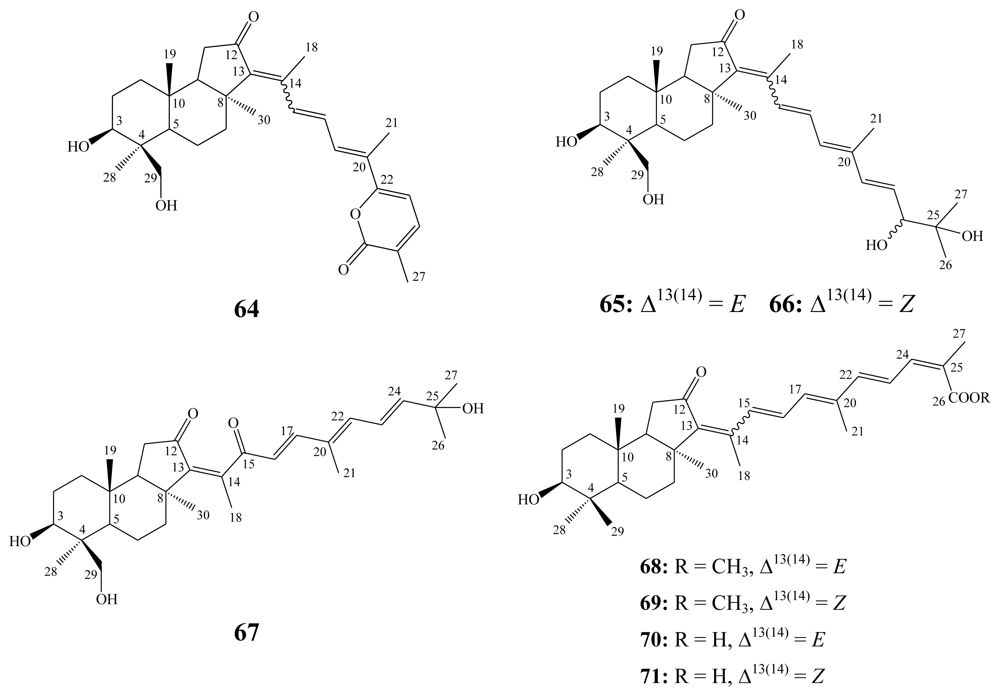
<p>Rhabdastrellins A–F (<bold>64</bold>–<bold>69</bold>), along with stelletins L (<bold>70</bold>) and M (<bold>71</bold>), were obtained from the marine sponge <italic>Rhabdastrella</italic> aff. <italic>distinca</italic> collected from a coral reef off Hainan, in the South China Sea [<xref ref-type="bibr" rid="b86-marinedrugs-08-00313">86</xref>]. Four of the rhabdastrellins (<bold>64</bold>–<bold>67</bold>) exhibited a primary alcohol moiety at C-29 instead of a methyl group as for the stelletins and the other two rhabdastrellins E (<bold>68</bold>) and F (<bold>69</bold>). While all rhabdastrellins and stelletins L and M share a hydroxyl group at C-3 instead of a carbonyl group as in other stelletins [<xref ref-type="bibr" rid="b86-marinedrugs-08-00313">86</xref>].</p>
<fig id="f17-marinedrugs-08-00313" position="anchor"><graphic xlink:href="marinedrugs-08-00313f17.gif"/></fig>
<p>The antiproliferative profile of stelletins A–F (<bold>56</bold>–<bold>61</bold>) has been examined at the National Cancer Institute (NCI, Australia) against 60 cell lines. Due to the rapid isomerization upon light exposure, stelletins were tested as isomeric pairs. Stelletin C(<bold>58</bold>)/D(<bold>59</bold>) pair was the most potent derivative with a mean panel GI<sub>50</sub> of 0.09 μM. The stelletin E(<bold>60</bold>)/F(<bold>61</bold>) pair was approximately 10-times less potent (mean GI<sub>50</sub> of 0.98 μM) [<xref ref-type="bibr" rid="b79-marinedrugs-08-00313">79</xref>].</p>
<p>Apoptotic cell death is a stress response of cells to cytotoxic agents that might be executed either through a receptor-mediated pathway that activates caspase-8 or through a receptor-independent pathway that involves the cyclin-kinase inhibitors p53/p21. Both pathways lead to a translocation of pro-apoptotic Bax protein to the mitochondria, thereby resulting in a dissipation of mitochondrial membrane potential, activation of caspase-3, and execution of the apoptotic machinery [<xref ref-type="bibr" rid="b84-marinedrugs-08-00313">84</xref>].</p>
<p>Stelletin A (<bold>56</bold>) demonstrated a differential cytotoxicity against human leukemia HL-60 cells (IC<sub>50</sub> 0.9 μM) compared to human prostate cancer LNCaP cells (IC<sub>50</sub> 260 μM) by activation of NADPH oxidase, which induces oxidative cell death through a FasL–caspase-3-apoptotic pathway [<xref ref-type="bibr" rid="b83-marinedrugs-08-00313">83</xref>]. Stelletins B (<bold>57</bold>) and E (<bold>60</bold>) revealed selective cytotoxicity toward p21-deficient human colon tumor HCT-116 cells with IC<sub>50</sub> values of 0.043 and 0.039 μM, respectively [<xref ref-type="bibr" rid="b80-marinedrugs-08-00313">80</xref>]. Stelletins L (<bold>70</bold>) and M (<bold>71</bold>) exhibited selective cytotoxicity against stomach cancer AGS cells with IC<sub>50</sub> values of 3.9 and 2.1 μM, respectively [<xref ref-type="bibr" rid="b85-marinedrugs-08-00313">85</xref>]. Rhabdastrellic acid–A (<bold>63</bold>) also inhibited proliferation of human leukemia HL-60 cells with an IC<sub>50</sub> value of 1.5 μM through inhibition of the PI3K/Akt pathway and induction of caspase-3 dependent-apoptosis [<xref ref-type="bibr" rid="b76-marinedrugs-08-00313">76</xref>]. Only rhabdastrellin A (<bold>64</bold>) possessed moderate inhibitory activity toward human leukemia HL-60 cells (IC<sub>50</sub> = 8.7 μM) while other rhabdastrellins were inactive (IC<sub>50</sub> &gt; 20 μM) [<xref ref-type="bibr" rid="b86-marinedrugs-08-00313">86</xref>].</p>
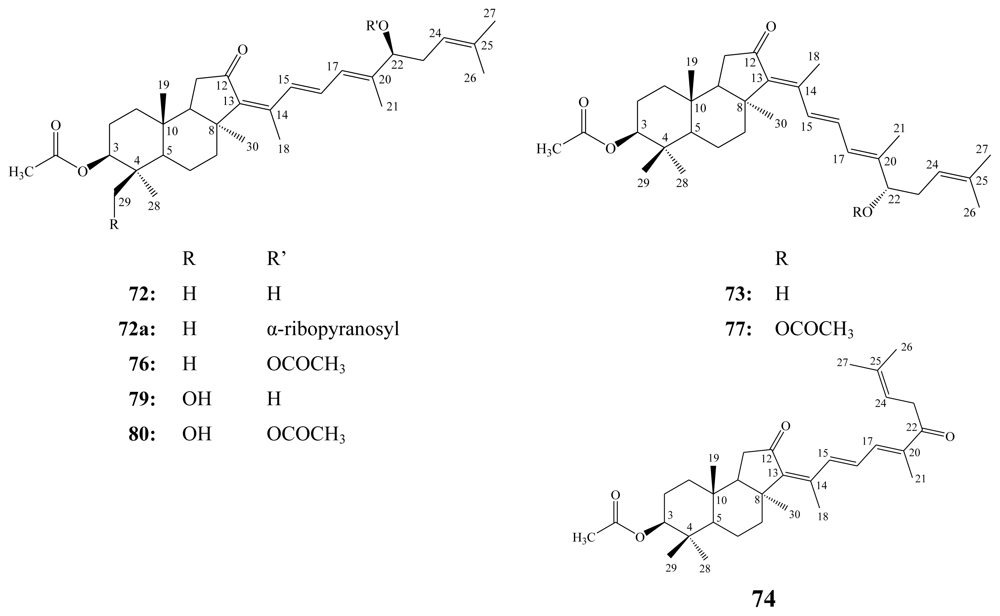
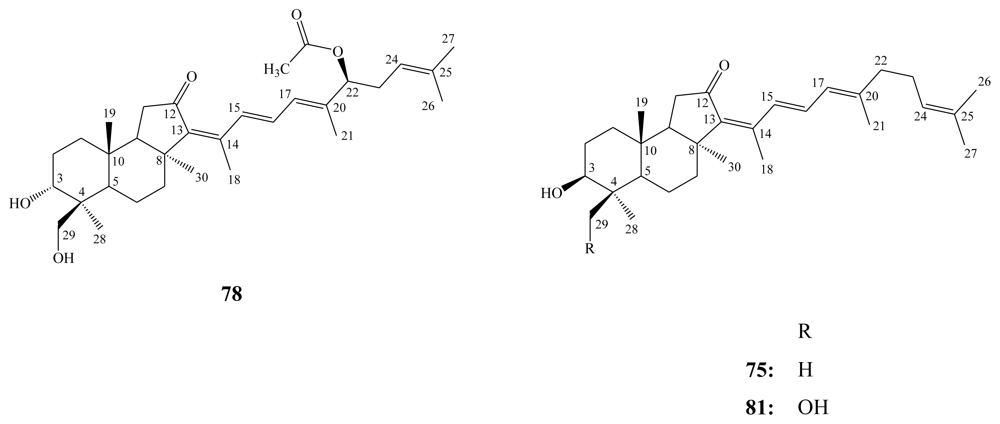
<p>Stelliferins are the second group of isomalabaricane triterpenes. To the best of our knowledge, 13 compounds belonging to this group have been reported. In addition to stelliferins A–F (<bold>72</bold>–<bold>77</bold>), which have been isolated from the Okinawan marine sponge <italic>Jaspis stellifera</italic> [<xref ref-type="bibr" rid="b87-marinedrugs-08-00313">87</xref>], stelliferin G (<bold>78</bold>) and 29-hydroxy derivatives of stelliferins A (<bold>79</bold>) and E (<bold>80</bold>) have been isolated from an unidentified species of the genus <italic>Jaspis</italic> collected near Tonga [<xref ref-type="bibr" rid="b89-marinedrugs-08-00313">89</xref>].</p>
<fig id="f18-marinedrugs-08-00313" position="anchor"><graphic xlink:href="marinedrugs-08-00313f18.gif"/></fig>
<p>The 29-hydroxy derivative of stelliferin D (<bold>81</bold>) together with 3-epimeric isomers of <bold>79</bold> and <bold>80</bold> were reported from the marine sponge <italic>Stelletta globostellata</italic> collected by SCUBA off Mage-jima Island, Japan [<xref ref-type="bibr" rid="b88-marinedrugs-08-00313">88</xref>]. Whereas stelliferin riboside (<bold>72a</bold>), the first example of a glycosylated stelliferin, was isolated from the Fijian sponge <italic>Geodia globostellata</italic> [<xref ref-type="bibr" rid="b90-marinedrugs-08-00313">90</xref>].</p>
<fig id="f19-marinedrugs-08-00313" position="anchor"><graphic xlink:href="marinedrugs-08-00313f19.gif"/></fig>
<p>Stelliferins A–F (<bold>72</bold>–<bold>77</bold>) exhibited potent <italic>in vitro</italic> antineoplastic activities against murine lymphoma L1210 cells (IC<sub>50</sub> of 1.1–5.0 μM) and human epidermoid carcinoma KB cells (IC<sub>50</sub> of 2.8–13.0 μM) [<xref ref-type="bibr" rid="b87-marinedrugs-08-00313">87</xref>], while the isomeric mixture of stelliferin G (<bold>78</bold>) and 29-hydroxystelliferin A (<bold>79</bold>) showed the highest inhibitory activity against the melanoma MALME-3M cell line with IC<sub>50</sub> values of 0.2 and 0.4 μM, respectively [<xref ref-type="bibr" rid="b89-marinedrugs-08-00313">89</xref>]. Stelliferin riboside (<bold>72a</bold>) displayed moderate cytotoxicity against ovarian A2780 cancer cells (IC<sub>50</sub> = 60 μM) [<xref ref-type="bibr" rid="b90-marinedrugs-08-00313">90</xref>].</p>
<p>Due to the significant antiproliferative activity exhibited by stelletins and stelliferins, research efforts have been directed towards their chemical synthesis. In 1999, Raeppel <italic>et al</italic>. successfully synthesized the common <italic>trans</italic>-<italic>syn</italic>-<italic>trans</italic> perhydrobenz[e]indene moiety in the isomalabaricane-type terpenoids, which enabled the chemical synthesis of stelletins and stelliferins [<xref ref-type="bibr" rid="b91-marinedrugs-08-00313">91</xref>].</p>
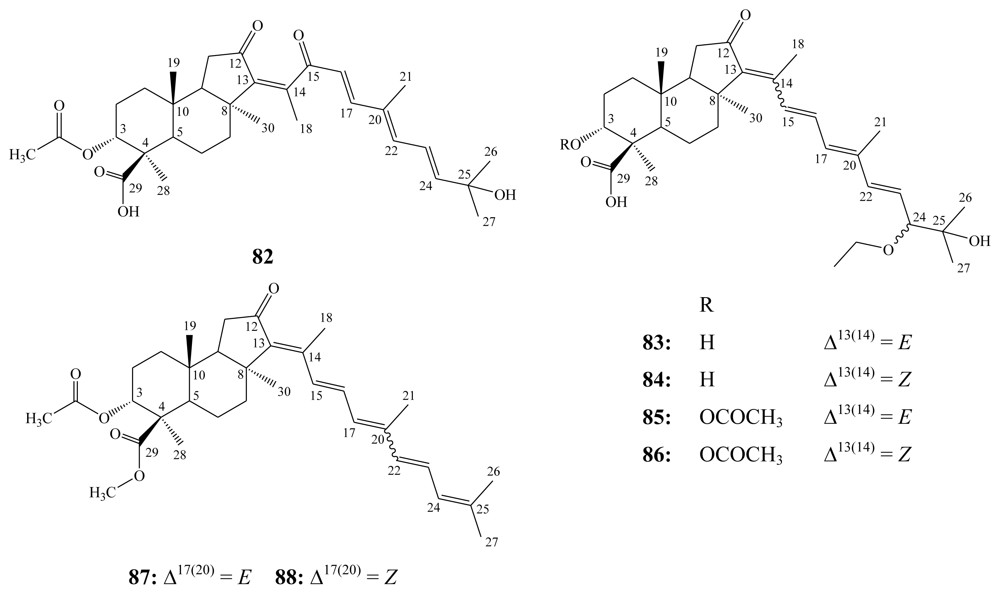
<p>Globostellatic acid (<bold>82</bold>) is the prototype of the third group of isomalabaricane-type triterpenoids sharing carboxylation at C-4. It was first isolated together with three other derivatives, globostellatic acids B–D, from the marine sponge <italic>Stelletta globostellata</italic> collected off Mage Island near Kagoshima, Japan [<xref ref-type="bibr" rid="b92-marinedrugs-08-00313">92</xref>].</p>
<p>Other globostellatic acid congeners, F–M, and X methyl esters, have been reported from different collections of the Indonesian marine sponge <italic>Rhabdastrella globostellata</italic> [<xref ref-type="bibr" rid="b93-marinedrugs-08-00313">93</xref>,<xref ref-type="bibr" rid="b94-marinedrugs-08-00313">94</xref>].</p>
<p>Globostellatic acids revealed potent cytotoxicity similar to the stelletins and stelliferins. Globostellatic acids A–D demonstrated significant cytotoxicity against murine leukemia P388 cells with IC<sub>50</sub> values of 0.2–0.8 μM [<xref ref-type="bibr" rid="b92-marinedrugs-08-00313">92</xref>].</p>
<p>For cytotoxicity toward mouse lymphoma L5178Y cells, the 3-<italic>O</italic>-deacetyl congeners, globostellatic acids H/I (<bold>83</bold>/<bold>84</bold>) were the most active with an IC<sub>50</sub> of 0.31 nM. However, acetylation of the C-3 hydroxyl group decreases its bioactivity abruptly, as in globostellatic acids J/K (<bold>85</bold>/<bold>86</bold>), with an IC<sub>50</sub> of 8.28 nM. The reverse was found for the 13<italic>Z</italic> isomer of stelliferin riboside (<bold>72a</bold>) that revealed higher activity than its 3-<italic>O</italic>-deacetyl congener with IC<sub>50</sub> values of 0.22 and 2.40 nM, respectively [<xref ref-type="bibr" rid="b93-marinedrugs-08-00313">93</xref>].</p>
<p>On the other hand, globostellatic acids showed only moderate or no cytotoxicity against either human cervix carcinoma HeLa or rat pheochromocytoma PC-12 cell lines [<xref ref-type="bibr" rid="b93-marinedrugs-08-00313">93</xref>]. Two globostellatic acid X methyl esters (<bold>87</bold> and <bold>88</bold>), possessing the 13<italic>E</italic>-geometry, inhibited proliferation of human umbilical vein endothelial cells (HUVECs), 80- to 250-fold greater in comparison to several other cell lines and hence inhibiting angiogenesis which if pathologically uncontrolled, accompanies several diseases such as atherosclerosis, arthritis, diabetic retinopathy, and cancer.</p>
<fig id="f20-marinedrugs-08-00313" position="anchor"><graphic xlink:href="marinedrugs-08-00313f20.gif"/></fig>
<p>13<italic>E</italic>,17<italic>E</italic>- Globostellatic acid X methyl ester (<bold>87</bold>) also inhibited basic fibroblast growth factor (bFGF)-induced tubular formation and vascular endothelial growth factor (VEGF)-induced migration of HUVECs. In addition, <bold>87</bold> induced apoptosis of HUVECs without affecting their VEGF-induced phosphorylation of ERK1/2 kinases [<xref ref-type="bibr" rid="b94-marinedrugs-08-00313">94</xref>].</p>
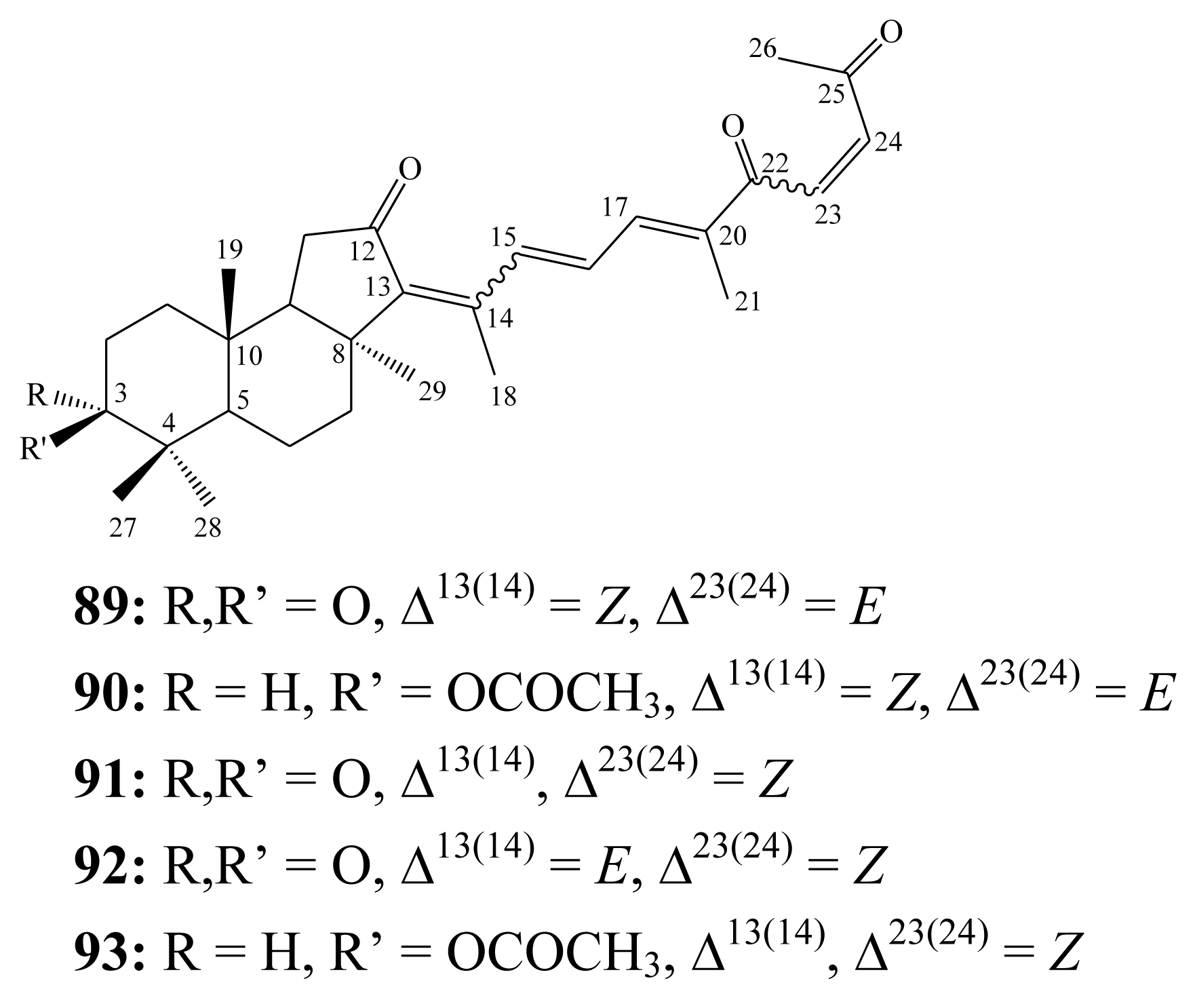
<p>Geoditins, which are stelliferin-related isomalabaricane triterpenoids, are mainly oxygenated at both C-22 and C-25. Five geoditins (<bold>89</bold>–<bold>93</bold>) were obtained from the marine sponges <italic>Geodia japonica</italic> [<xref ref-type="bibr" rid="b95-marinedrugs-08-00313">95</xref>] and <italic>Rhabdastrella</italic> aff. <italic>distinca</italic> [<xref ref-type="bibr" rid="b96-marinedrugs-08-00313">96</xref>] collected at different locations in the South China Sea.</p>
<fig id="f21-marinedrugs-08-00313" position="anchor"><graphic xlink:href="marinedrugs-08-00313f21.gif"/></fig>
<p>Geoditins (<bold>89</bold>–<bold>93</bold>) were submitted for bioassays against several human tumor cell lines including HL-60 (promyelocytic leukemia), PC-3MIE8 (prostate carcinoma), BGC-823 (gastric carcinoma), MDA-MB-423 (breast carcinoma), Bel-7402 (hepatocellular carcinoma) and HeLa (cervical carcinoma) cells. Isogeoditin A (<bold>91</bold>) showed significant cytotoxicity towards the former three cell lines with IC<sub>50</sub> values of 0.3, 0.2 and 1.0 μM, respectively. While 13<italic>E</italic>-isogeoditin A (<bold>92</bold>) revealed no cytotoxic activity, implying that the <italic>Z</italic>-geometry at C-13 enhances antiproliferative activity compared to the <italic>E</italic>-form [<xref ref-type="bibr" rid="b96-marinedrugs-08-00313">96</xref>]. Geoditin A (<bold>89</bold>) proved to be cytotoxic against HL-60 cells [IC<sub>50</sub> = 6.7 μM)] while geoditin B (<bold>90</bold>) exhibited relatively weak cytotoxicity. Mechanistically, geoditin A (<bold>89</bold>) markedly induced reactive oxygen species (ROS), decreased mitochondrial membrane potential and mediated a caspase-3 apoptosis pathway [<xref ref-type="bibr" rid="b97-marinedrugs-08-00313">97</xref>].</p>
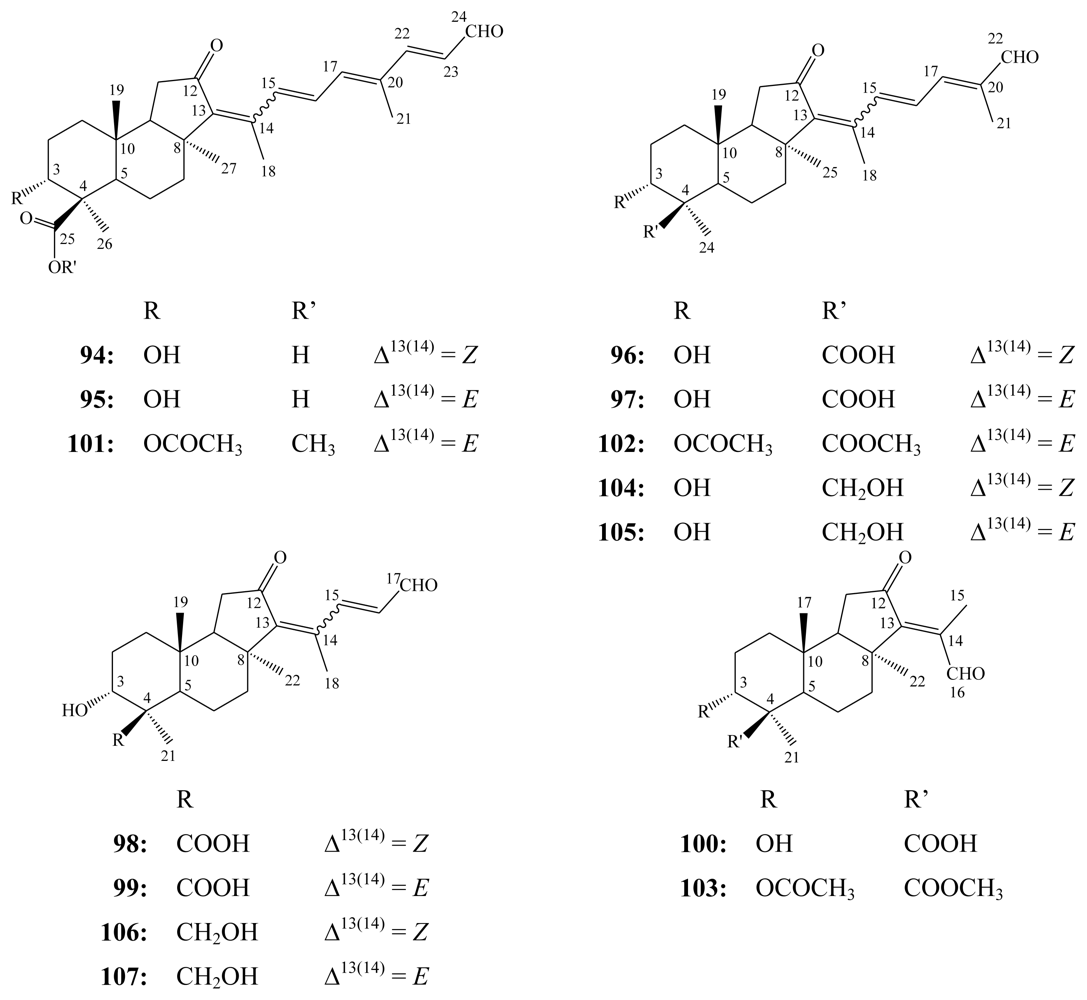
<p>Jaspiferals (<bold>94</bold>–<bold>103</bold>) and aurorals (<bold>104</bold>–<bold>107</bold>) are isomalabaricane-type terpenoids differentiated into nortriterpenoids, norsesterterpenoids and norditerpenes possessing a 3<italic>α</italic>-hydroxy group. Jaspiferals A–G (<bold>94</bold>–<bold>100</bold>) were purified from the Okinawan marine sponge <italic>Jaspis stellifera</italic> [<xref ref-type="bibr" rid="b98-marinedrugs-08-00313">98</xref>] while the 3-<italic>O</italic>-acetyl and methyl ester derivatives of jaspiferals B (<bold>101</bold>), D (<bold>102</bold>) and E (<bold>103</bold>) were obtained from a new species of <italic>Jaspis</italic> collected at the Vanuatu Islands [<xref ref-type="bibr" rid="b99-marinedrugs-08-00313">99</xref>]. Aurorals (<bold>104</bold>–<bold>107</bold>) have been isolated from the New Caledonian marine sponge <italic>Rhabdastrella globostellata</italic> [<xref ref-type="bibr" rid="b100-marinedrugs-08-00313">100</xref>].</p>
<fig id="f22-marinedrugs-08-00313" position="anchor"><graphic xlink:href="marinedrugs-08-00313f22.gif"/></fig>
<p>Jaspiferals A–G (<bold>94</bold>–<bold>100</bold>) exhibited <italic>in vitro</italic> cytotoxicity against murine lymphoma L1210 cells with IC<sub>50</sub> values of 1.6–10.4 μM, whereas only jaspiferals E–G (<bold>98</bold>–<bold>100</bold>) revealed antineoplastic activity against human epidermoid carcinoma KB cells (IC<sub>50</sub> of 5.2–14.7 μM) [<xref ref-type="bibr" rid="b98-marinedrugs-08-00313">98</xref>]. Jaspiferal G (<bold>100</bold>) exhibited antifungal activity against <italic>Cryptococcus neoformans</italic> (MIC, 144 μM) and <italic>Trichophyton memtagrophytes</italic> (MIC, 36 μM), and antibacterial activity against <italic>Sarcina lutea</italic> (MIC, 144 μM), while the mixture of jaspiferals E (<bold>98</bold>) and F (<bold>99</bold>) showed antifungal activity against <italic>T. memtagrophyes</italic> (MIC, 134 μM) [<xref ref-type="bibr" rid="b98-marinedrugs-08-00313">98</xref>]. On the other hand, the 3-<italic>O</italic>-acetyl, methyl ester derivatives of jaspiferals B (<bold>101</bold>), D (<bold>102</bold>) and E (<bold>103</bold>) revealed weak cytotoxicity against L1220 cells (IC<sub>50</sub> &gt; 8.8 μM) [<xref ref-type="bibr" rid="b99-marinedrugs-08-00313">99</xref>].</p>
<p>Aurorals (<bold>104</bold>–<bold>107</bold>), which differ from jaspiferals C–F (<bold>96</bold>–<bold>99</bold>) by the presence of a primary alcohol group at the C-4 position, exhibited stronger cytotoxicity against KB cells. The isomeric mixtures of aurorals (<bold>104</bold>/<bold>105</bold>), (<bold>106</bold>/<bold>107</bold>) and jaspiferals C/D (<bold>96</bold>/<bold>97</bold>) showed IC<sub>50</sub> values of 0.5, 22.2 and 13.3 μM, respectively, while jaspiferals E/F (<bold>98</bold>/<bold>99</bold>) were inactive up to 27 μM [<xref ref-type="bibr" rid="b100-marinedrugs-08-00313">100</xref>].</p>
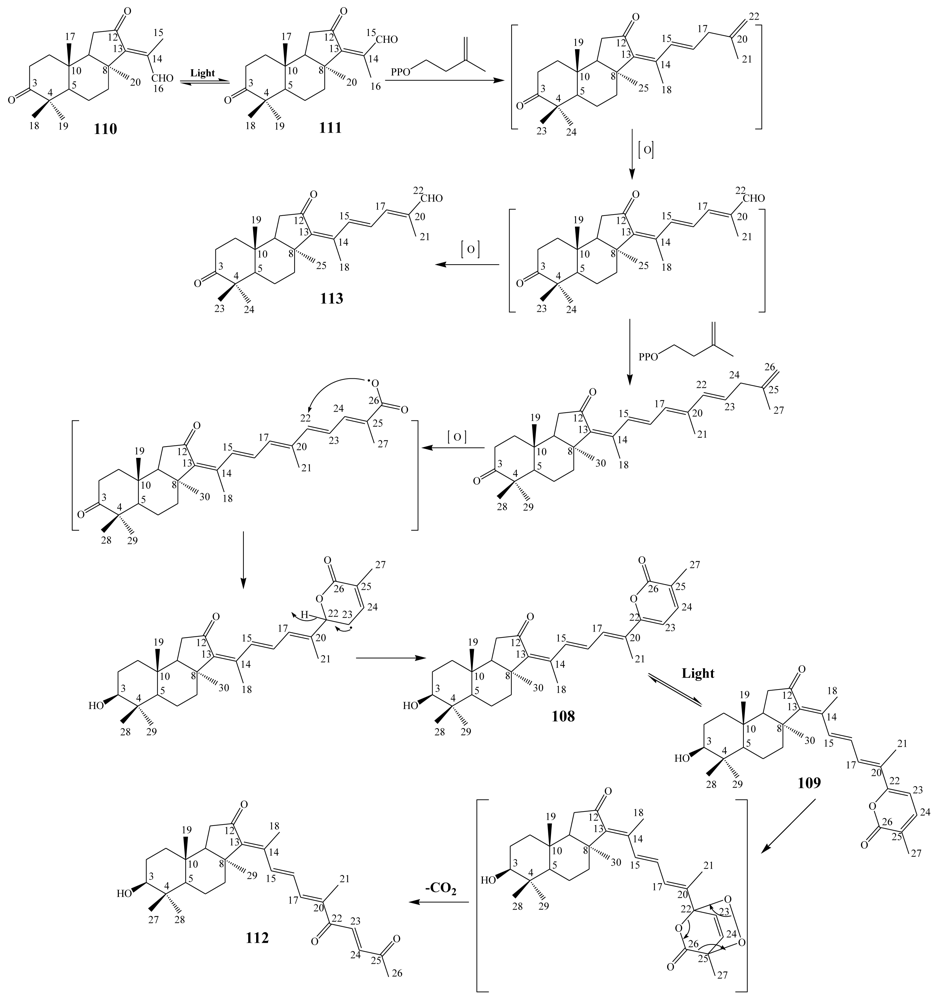
<p>Jaspolides represent another example of isomalabaricane-type terpenoids of either monomeric or dimeric congeners. Monomeric congeners of jaspolides could be classified into triterpenes, jaspolides A (<bold>108</bold>) and B (<bold>109</bold>); sesterterpene, jaspolide F (<bold>113</bold>); diterpenes, jaspolides C (<bold>110</bold>) and D (<bold>111</bold>); and nortriterpene, jaspolide E (<bold>112</bold>) which were all isolated from the marine sponge <italic>Jaspis</italic> sp. collected from the South China Sea [<xref ref-type="bibr" rid="b101-marinedrugs-08-00313">101</xref>].</p>
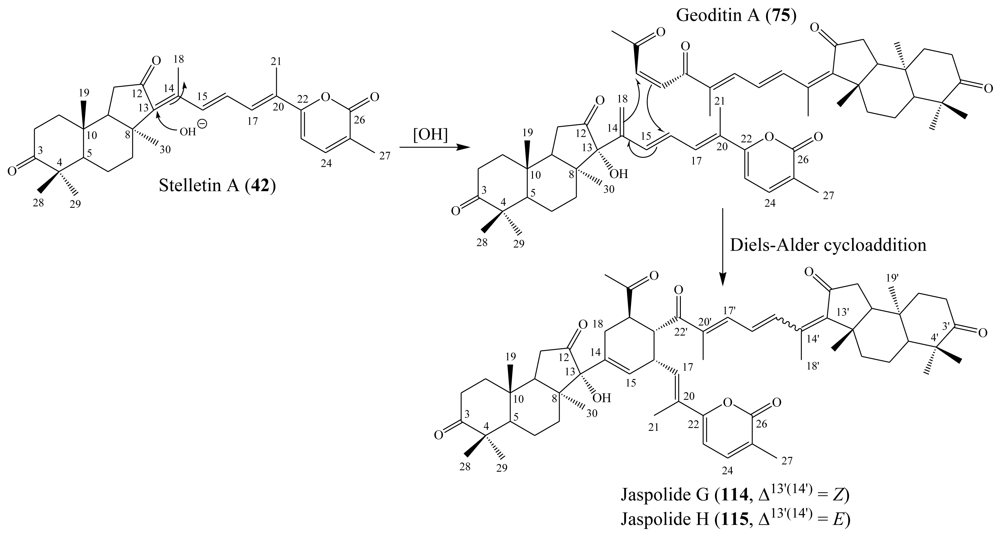
<p>A presumable biogenetic transformation scheme of jaspolides A–F (<bold>108</bold>–<bold>113</bold>) (<xref ref-type="fig" rid="f2-marinedrugs-08-00313">Figure 2</xref>), revealed that light-induced isomerization is responsible for the jaspolides A/B (<bold>108</bold>/<bold>109</bold>) and C/D (<bold>110</bold>/<bold>111</bold>) isomeric pairs. In addition it substantiated jaspolide D (<bold>111</bold>) as a precursor to jaspolide F (<bold>113</bold>), formed through condensation with an isoprenyl pyrophosphate (IPP) followed by oxidation at a terminal methyl group [<xref ref-type="bibr" rid="b101-marinedrugs-08-00313">101</xref>]. Jaspolides G (<bold>114</bold>) and H (<bold>115</bold>) are dimeric isomalabaricane congeners which were isolated from the same Chinese sponge <italic>Jaspis</italic> sp. and their proposed biogenetic pathway (<xref ref-type="fig" rid="f3-marinedrugs-08-00313">Figure 3</xref>) suggested that they were derived from stelletin A (<bold>56</bold>) yielding the left moiety, and the nortriterpene, geoditin A (<bold>89</bold>) yielding the right moiety [<xref ref-type="bibr" rid="b102-marinedrugs-08-00313">102</xref>].</p>
<p>Jaspolide B (<bold>109</bold>) arrested HL-60 cells in the G<sub>2</sub>/M phase of the cell cycle and induced apoptosis in a dose- and time-dependent manner. Jaspolide B with an IC<sub>50</sub> value of 0.61 μM exhibited a comparable efficacy as that of paclitaxel (IC<sub>50</sub> = 0.78 μM). These results suggested <bold>109</bold> to be a promising anticancer agent for chemotherapy of leukemia by prohibiting cell cycle progression at the G<sub>2</sub>/M phase and triggering apoptosis [<xref ref-type="bibr" rid="b103-marinedrugs-08-00313">103</xref>].</p>
<p>In a further study with human hepatoma cells, jaspolide B (<bold>109</bold>) inhibited the growth of Bel-7402 and HepG2 cells with IC<sub>50</sub> values of 29.1 and 29.5 μM, respectively. Incubation with 0.5 μM of <bold>109</bold> caused time-dependent induction of apoptosis in Bel-7402 as confirmed by the enhancement of mitochondrial masses, cell membrane permeability, and nuclear condensation. In conclusion, the anticancer effect of jaspolide B involves multiple mechanisms including apoptosis induction, cell cycle arrest, and microtubule disassembly but these were weaker than colchicine, a well-known microtubule disassembly agent [<xref ref-type="bibr" rid="b104-marinedrugs-08-00313">104</xref>]. These multiple mechanisms of jaspolide B, especially the apoptosis induction, pose interesting perspectives for further exploration of the isomalabaricane-type terpenes as potential anticancer agents.</p>
<p>Since the class of isomalabaricane terpenoidal metabolites has been reported in the literature from different sponge species of the genera <italic>Rhabdastrella</italic>, <italic>Stelletta</italic>, <italic>Jaspis</italic>, and <italic>Geodia</italic> as shown above, the identity of these sponges has been questioned and reevaluated. Interestingly, the taxonomic reevaluation of these sponges revealed that they all might be reassigned to <italic>Rhabdastrella globostellata</italic> (class Demospongiae; order Astrophorida; family Ancorinidae) [<xref ref-type="bibr" rid="b80-marinedrugs-08-00313">80</xref>]. However, it could not be ascertained for the isomalabaricane producing <italic>Stelletta</italic> sp. from Somalia [<xref ref-type="bibr" rid="b74-marinedrugs-08-00313">74</xref>] and <italic>Stelletta tenuis</italic> from China [<xref ref-type="bibr" rid="b77-marinedrugs-08-00313">77</xref>]. The latter, collected from an identical location (Hainan Island), was taxonomically recognized as <italic>R. globostellata</italic> [<xref ref-type="bibr" rid="b75-marinedrugs-08-00313">75</xref>].</p></sec>
<sec>
<title>3.2. Steroidal saponins</title>
<p>In the Kingdom Animalia, steroidal and triterpene glycosides are predominant metabolites of starfishes and sea cucumbers, respectively [<xref ref-type="bibr" rid="b108-marinedrugs-08-00313">108</xref>]. In addition, these types of glycosides have also been isolated from marine sponges. To the best of our knowledge, around 80 sponge triterpenoidal glycosides have been reported to date, including erylosides [<xref ref-type="bibr" rid="b107-marinedrugs-08-00313">107</xref>–<xref ref-type="bibr" rid="b114-marinedrugs-08-00313">114</xref>], formosides [<xref ref-type="bibr" rid="b115-marinedrugs-08-00313">115</xref>,<xref ref-type="bibr" rid="b116-marinedrugs-08-00313">116</xref>], nobiloside [<xref ref-type="bibr" rid="b117-marinedrugs-08-00313">117</xref>], and sokodosides [<xref ref-type="bibr" rid="b118-marinedrugs-08-00313">118</xref>] from different sponge species of the genus <italic>Erylus</italic>; sarasinosides from the marine sponges <italic>Asteropus sarasinosum</italic> [<xref ref-type="bibr" rid="b120-marinedrugs-08-00313">120</xref>–<xref ref-type="bibr" rid="b123-marinedrugs-08-00313">123</xref>], <italic>Melophlus isis</italic> [<xref ref-type="bibr" rid="b124-marinedrugs-08-00313">124</xref>], and <italic>M. sarassinorum</italic> [<xref ref-type="bibr" rid="b125-marinedrugs-08-00313">125</xref>]; mycalosides from <italic>Mycale laxissima</italic> [<xref ref-type="bibr" rid="b126-marinedrugs-08-00313">126</xref>–<xref ref-type="bibr" rid="b128-marinedrugs-08-00313">128</xref>]; ectyoplasides and feroxosides from the Caribbean marine sponge <italic>Ectyoplasia ferox</italic> [<xref ref-type="bibr" rid="b129-marinedrugs-08-00313">129</xref>,<xref ref-type="bibr" rid="b130-marinedrugs-08-00313">130</xref>]; ulososides from <italic>Ulosa</italic> sp. [<xref ref-type="bibr" rid="b131-marinedrugs-08-00313">131</xref>,<xref ref-type="bibr" rid="b132-marinedrugs-08-00313">132</xref>]; wondosterols from a two-sponge association [<xref ref-type="bibr" rid="b133-marinedrugs-08-00313">133</xref>]; and pachastrelloside A from a marine sponge of the genus <italic>Pachastrella</italic> [<xref ref-type="bibr" rid="b134-marinedrugs-08-00313">134</xref>]. The majority of these glycosides belong to norlanostane-triterpenoidal saponins, derived from lanosterol or related triterpenes as a result of oxidative elimination of one or two methyl groups.</p>
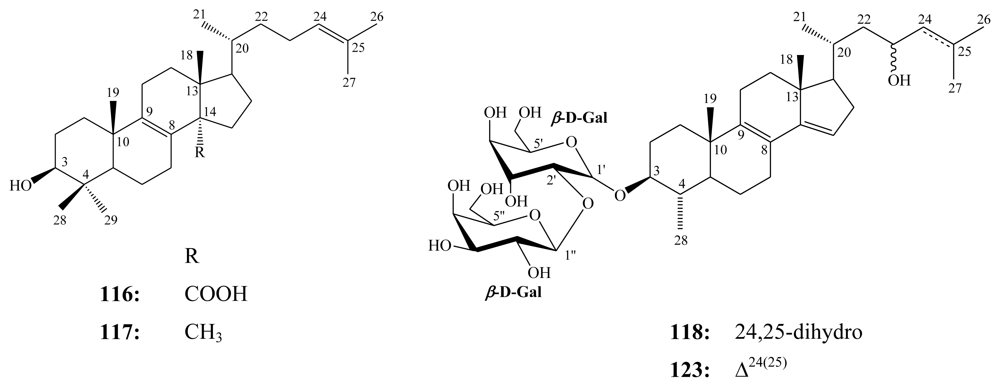
<p>Penasterol (<bold>116</bold>), an acidic steroidal metabolite closely related to lanosterol (<bold>117</bold>) and possessing potent antileukemic activity, was originally isolated from the Okinawan marine sponge <italic>Penares</italic> sp. in 1988 [<xref ref-type="bibr" rid="b105-marinedrugs-08-00313">105</xref>]. Penasterol together with its analogs penasterone and acetylpenasterol, isolated from the Okinawan marine sponge <italic>Penares incrustans</italic>, inhibit IgE-dependent histamine release from rat mast cells [<xref ref-type="bibr" rid="b106-marinedrugs-08-00313">106</xref>].</p>
<p>Eryloside A (<bold>118</bold>) was the first eryloside congener isolated from the Red Sea sponge <italic>Erylus lendenfeldi</italic> (class Demospongiae; order Choristida; family Geodiidae) [<xref ref-type="bibr" rid="b107-marinedrugs-08-00313">107</xref>]. Twenty eight additional erylosides (A–F, F<sub>1</sub>–F<sub>7</sub>, G–V) have been reported from different species of the genus <italic>Erylus</italic> including <italic>E. goffrilleri</italic> [<xref ref-type="bibr" rid="b109-marinedrugs-08-00313">109</xref>,<xref ref-type="bibr" rid="b114-marinedrugs-08-00313">114</xref>], <italic>E. formosus</italic> [<xref ref-type="bibr" rid="b110-marinedrugs-08-00313">110</xref>,<xref ref-type="bibr" rid="b113-marinedrugs-08-00313">113</xref>], <italic>E. nobilis</italic> [<xref ref-type="bibr" rid="b111-marinedrugs-08-00313">111</xref>], in addition to another collection of <italic>E. lendenfeldi</italic> [<xref ref-type="bibr" rid="b112-marinedrugs-08-00313">112</xref>].</p>
<fig id="f23-marinedrugs-08-00313" position="anchor"><graphic xlink:href="marinedrugs-08-00313f23.gif"/></fig>
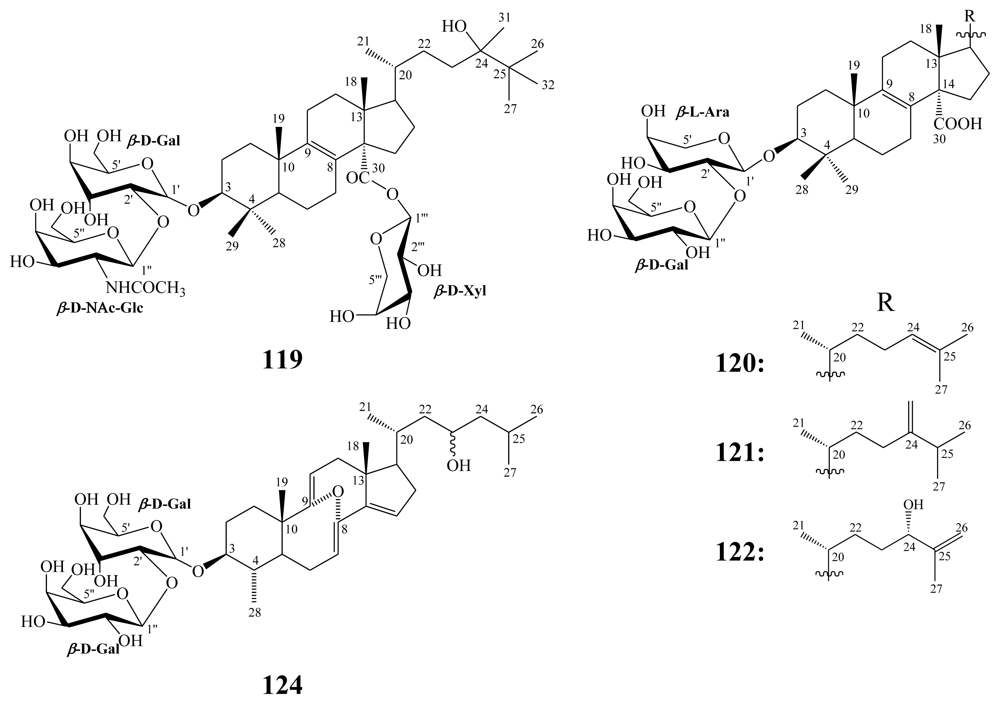
<p>For eryloside A (<bold>118</bold>), antitumor activity against murine leukemia P388 cells with an IC<sub>50</sub> = 5.7 μM and antifungal activity against <italic>Candida albicans</italic> (MIC = 21.1 μM) have been reported [<xref ref-type="bibr" rid="b107-marinedrugs-08-00313">107</xref>]. Eryloside E (<bold>119</bold>), glycosylated at C-30 through an ester linkage with the rare <italic>t</italic>-butyl substitution of the side chain, was isolated from an Atlantic sponge <italic>Erylus goffrilleri</italic> [<xref ref-type="bibr" rid="b109-marinedrugs-08-00313">109</xref>]. It revealed immunosuppressive activity with an EC<sub>50</sub> of 1.8 μM and a therapeutic index (TI) of 9.5, which indicated that the immunosuppressive effect is specific and is not due to a general cytotoxic effect [<xref ref-type="bibr" rid="b109-marinedrugs-08-00313">109</xref>].</p>
<fig id="f24-marinedrugs-08-00313" position="anchor"><graphic xlink:href="marinedrugs-08-00313f24.gif"/></fig>
<p>Eryloside F (<bold>120</bold>) was reported from two collections of the marine sponge <italic>E. formosus</italic> [<xref ref-type="bibr" rid="b110-marinedrugs-08-00313">110</xref>] and exhibited potent thrombin receptor antagonistic activity. Furthermore, it inhibited platelet aggregation <italic>in vitro</italic>. Against hepytocyte HepG2 cells, <bold>120</bold> possessed little activity [<xref ref-type="bibr" rid="b110-marinedrugs-08-00313">110</xref>]. Erylosides F<sub>1</sub> (<bold>121</bold>) and F<sub>3</sub> (<bold>122</bold>) were isolated along with nine other congeners from the Caribbean sponge <italic>E. formosus</italic> [<xref ref-type="bibr" rid="b113-marinedrugs-08-00313">113</xref>]. In contrast to its 24-epimer, eryloside F<sub>3</sub> (<bold>122</bold>) induced early apoptosis in Ehrlich carcinoma cells at 130 μM, while erylosides F (<bold>120</bold>) and F<sub>1</sub> (<bold>121</bold>) activated the Ca<sup>2+</sup> influx into mouse spleenocytes at the same doses [<xref ref-type="bibr" rid="b113-marinedrugs-08-00313">113</xref>].</p>
<p>Erylosides K (<bold>123</bold>) and L (<bold>124</bold>) have been obtained together with <bold>118</bold> from another collection of the Red Sea marine sponge <italic>Erylus lendenfeldi</italic> [<xref ref-type="bibr" rid="b112-marinedrugs-08-00313">112</xref>]. While <bold>123</bold> was identified as the 24,25-didehydro congener of eryloside A, eryloside L (<bold>124</bold>) incorporated a naturally unprecedented 8<italic>α</italic>,9<italic>α</italic>-epoxy-4<italic>α</italic>-methyl-8,9-secocholesta-7,9(11),14-triene skeleton [<xref ref-type="bibr" rid="b112-marinedrugs-08-00313">112</xref>]. Erylosides A (<bold>118</bold>) and K (<bold>123</bold>) led to a 50% mortality rate in the brine shrimp assay at a concentration of 0.14 mM. Whereas, eryloside L (<bold>124</bold>) was inactive at the same concentration [<xref ref-type="bibr" rid="b112-marinedrugs-08-00313">112</xref>].</p>
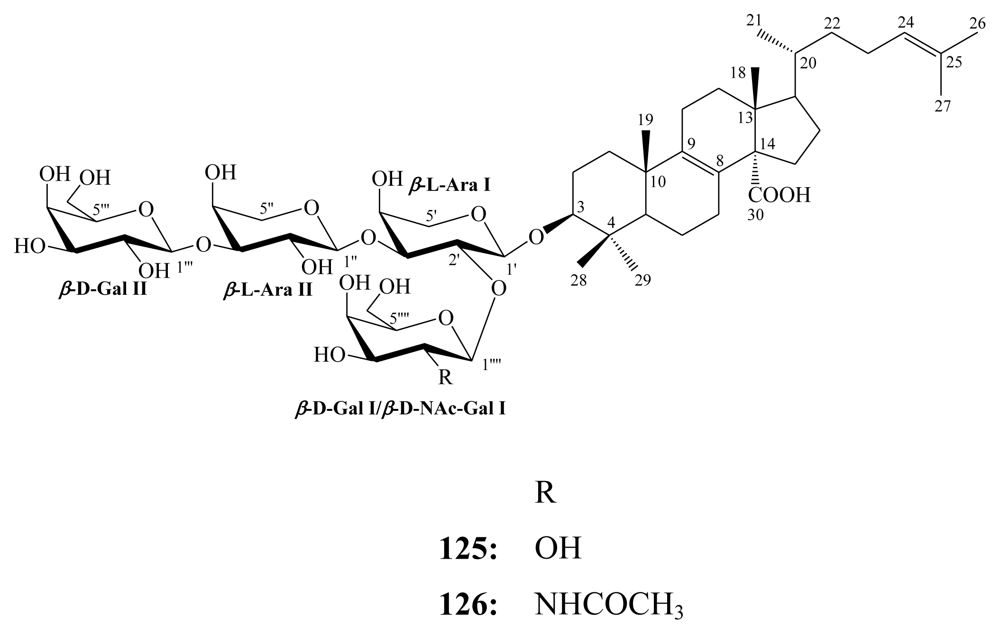
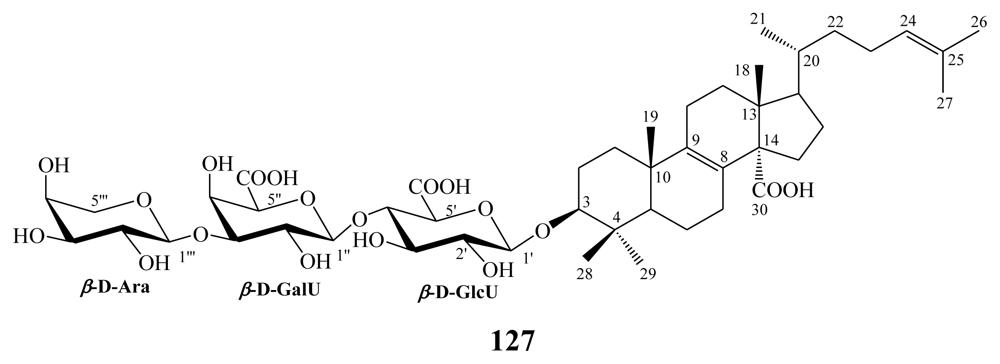
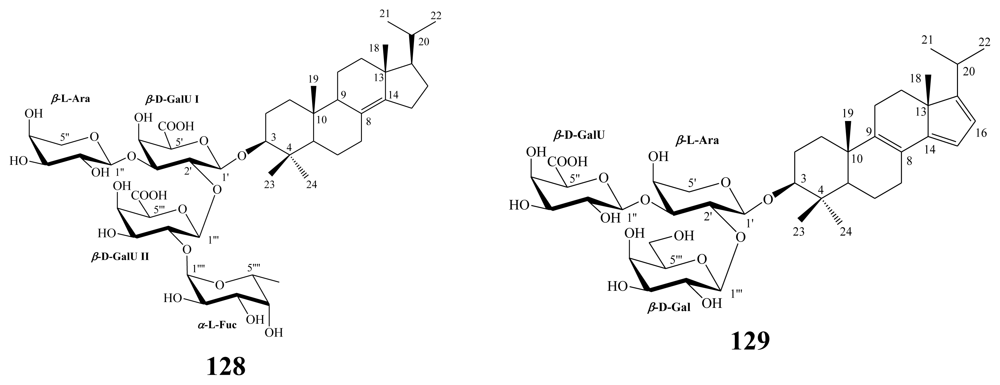
<p>In addition to erylosides, the marine sponges <italic>E. formosus</italic> and <italic>E. nobilis</italic> produced other steroidal saponins identified as formosides A (<bold>125</bold>) [<xref ref-type="bibr" rid="b115-marinedrugs-08-00313">115</xref>] and B (<bold>126</bold>) [<xref ref-type="bibr" rid="b116-marinedrugs-08-00313">116</xref>]; and nobiloside (<bold>127</bold>) [<xref ref-type="bibr" rid="b117-marinedrugs-08-00313">117</xref>], respectively, whilst sokodosides A (<bold>128</bold>) and B (<bold>129</bold>) have been obtained from the marine sponge <italic>Erylus placenta</italic> [<xref ref-type="bibr" rid="b118-marinedrugs-08-00313">118</xref>]. A convergent synthesis of the trisaccharides of <bold>129</bold> has been successfully performed [<xref ref-type="bibr" rid="b119-marinedrugs-08-00313">119</xref>].</p>
<p>Formoside A (<bold>125</bold>) was first reported by Jaspars and Crews in 1994 from the Caribbean marine sponge <italic>Erylus formosus</italic> [<xref ref-type="bibr" rid="b115-marinedrugs-08-00313">115</xref>]. Later, it was isolated together with formoside B (<bold>126</bold>) from another collection of the same sponge from the Bahamas [<xref ref-type="bibr" rid="b116-marinedrugs-08-00313">116</xref>]. Formoside A (<bold>125</bold>) and its <italic>N</italic>-acetyl galactosamine derivative, formoside B (<bold>126</bold>) possess deterrent properties against predatory fish. Therefore, they were suggested to have important ecological functions, resembling those ascribed to similar compounds present in sea stars, sea cucumbers, and terrestrial plants [<xref ref-type="bibr" rid="b116-marinedrugs-08-00313">116</xref>].</p>
<fig id="f25-marinedrugs-08-00313" position="anchor"><graphic xlink:href="marinedrugs-08-00313f25.gif"/></fig>
<p>Nobiloside (<bold>127</bold>), a penasterol saponin, was reported from the marine sponge <italic>E. nobilis</italic> collected off Shikine-jima Island, Japan [<xref ref-type="bibr" rid="b117-marinedrugs-08-00313">117</xref>] and revealed the presence of a carboxylic group at C-30 in addition to uronic acid moieties. Nobiloside (<bold>127</bold>) inhibited neuraminidase from the bacterium <italic>Clostridium perfrigens</italic> with an IC<sub>50</sub> of 0.5 μM [<xref ref-type="bibr" rid="b117-marinedrugs-08-00313">117</xref>].</p>
<fig id="f26-marinedrugs-08-00313" position="anchor"><graphic xlink:href="marinedrugs-08-00313f26.gif"/></fig>
<p>Sokodosides A (<bold>128</bold>) and B (<bold>129</bold>) were obtained from the marine sponge <italic>E. placenta</italic> collected off Hachijo Island, Japan [<xref ref-type="bibr" rid="b118-marinedrugs-08-00313">118</xref>]. They possessed a novel carbon skeleton as characterized by the presence of a combination of an isopropyl side chain and the 4,4-dimethyl steroid nucleus. Moreover, sokodoside B (<bold>129</bold>) exhibited double bonds at unusual positions Δ<sup>8(9),14(15),16(17)</sup>.</p>
<fig id="f27-marinedrugs-08-00313" position="anchor"><graphic xlink:href="marinedrugs-08-00313f27.gif"/></fig>
<p>Both sokodosides displayed moderate antifungal activity against the fungus <italic>Mortierella ramanniana</italic> and the yeast <italic>Saccharomyces cereivisiae,</italic> but no antibacterial activity was found. Additionally, sokodosides A (<bold>128</bold>) and B (<bold>129</bold>) exhibited cytotoxic activity against P388 cells with IC<sub>50</sub> values of 103 and 62 μM, respectively [<xref ref-type="bibr" rid="b118-marinedrugs-08-00313">118</xref>].</p>
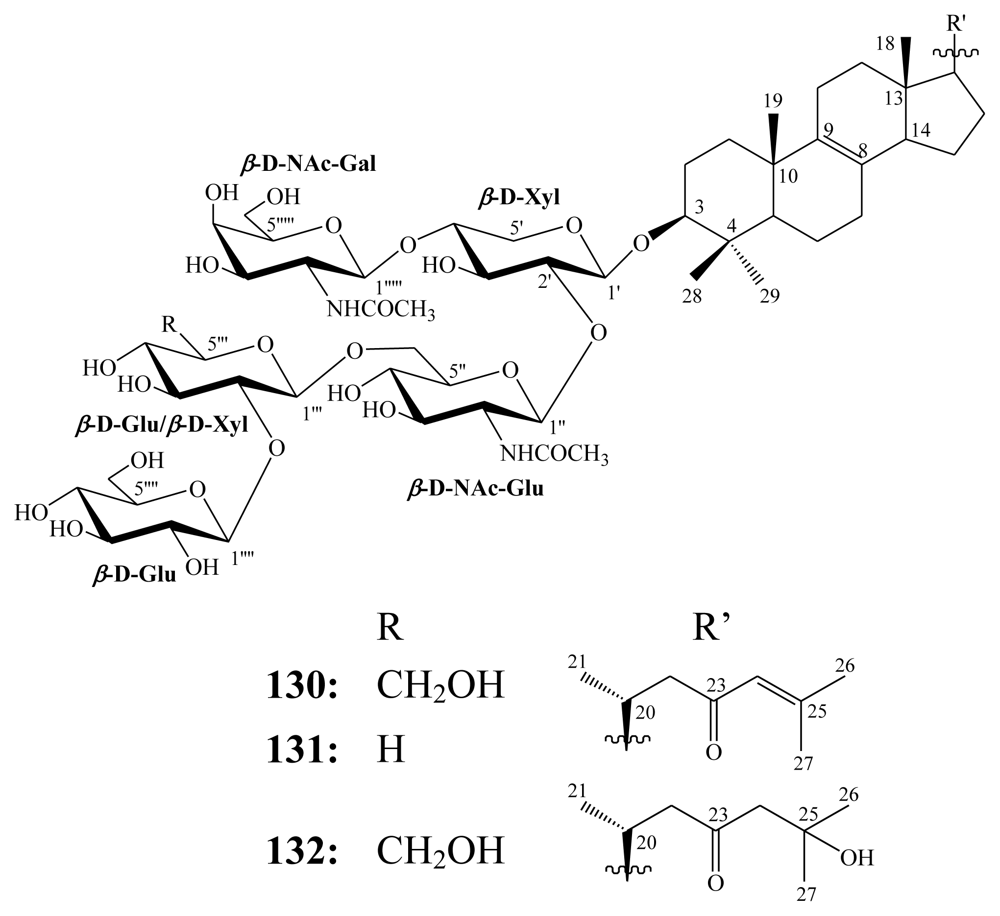
<p>Sarasinosides follow erylosides in the number of isolated metabolites. To date, 21 sarasinoside congeners have been reported, which all featured a carbonyl group at C-23 position. Sarasinoside A<sub>1</sub> (<bold>130</bold>) was the first steroidal saponin reported in the literature, even before eryloside A (<bold>118</bold>), from the Palauan marine sponge <italic>Asteropus sarasinsum</italic>, together with other eight new congeners [<xref ref-type="bibr" rid="b120-marinedrugs-08-00313">120</xref>–<xref ref-type="bibr" rid="b122-marinedrugs-08-00313">122</xref>]. Then, from the same sponge collected in the Solomon Islands, four additional sarasinosides D–G were reported [<xref ref-type="bibr" rid="b123-marinedrugs-08-00313">123</xref>]. From each of the marine sponges <italic>Melophlus isis</italic> (Guam) [<xref ref-type="bibr" rid="b124-marinedrugs-08-00313">124</xref>] and <italic>M. sarassinorum</italic> (Indonesia) [<xref ref-type="bibr" rid="b125-marinedrugs-08-00313">125</xref>], four sarasinoside congeners were isolated.</p>
<p>Among the sarasinoside congeners known to date, sarasinoside A<sub>1</sub> (<bold>130</bold>) and B<sub>1</sub> (<bold>131</bold>) exhibited piscicidal activity against <italic>Poecilia reticulata</italic> with LD<sub>50</sub> values (48 h) of 0.3 and 0.6 μM, respectively [<xref ref-type="bibr" rid="b120-marinedrugs-08-00313">120</xref>,<xref ref-type="bibr" rid="b122-marinedrugs-08-00313">122</xref>].</p>
<fig id="f28-marinedrugs-08-00313" position="anchor"><graphic xlink:href="marinedrugs-08-00313f28.gif"/></fig>
<p>Sarasinoside A<sub>1</sub> is known to possess moderate cytotoxicity <italic>in vitro</italic> against leukemia P388 [<xref ref-type="bibr" rid="b121-marinedrugs-08-00313">121</xref>] and K562 [<xref ref-type="bibr" rid="b124-marinedrugs-08-00313">124</xref>] cell lines with IC<sub>50</sub> values of 2.2 and 5.0 μM, respectively. Sarasinoside A<sub>3</sub>, which differs from A<sub>1</sub> (<bold>130</bold>) in having Δ<sup>8(9),14(15)</sup> instead of Δ<sup>8(9)</sup> unsaturation, exhibited mild cytotoxic activity with an IC<sub>50</sub> of 13.3 μM [<xref ref-type="bibr" rid="b124-marinedrugs-08-00313">124</xref>].</p>
<p>In the agar diffusion antimicrobial assay (10 <italic>μ</italic>g/disc), sarasinoside A<sub>1</sub> showed strong and selective activity against the yeast <italic>S. cerevisiae</italic> but was inactive against <italic>B. subtilis</italic> and <italic>E. coli</italic>. On the other hand, sarasinoside J (<bold>132</bold>) was active against <italic>S. cerevisiae</italic> and showed moderate antibacterial activity against <italic>B. subtilis</italic> and <italic>E. coli</italic> [<xref ref-type="bibr" rid="b125-marinedrugs-08-00313">125</xref>].</p>
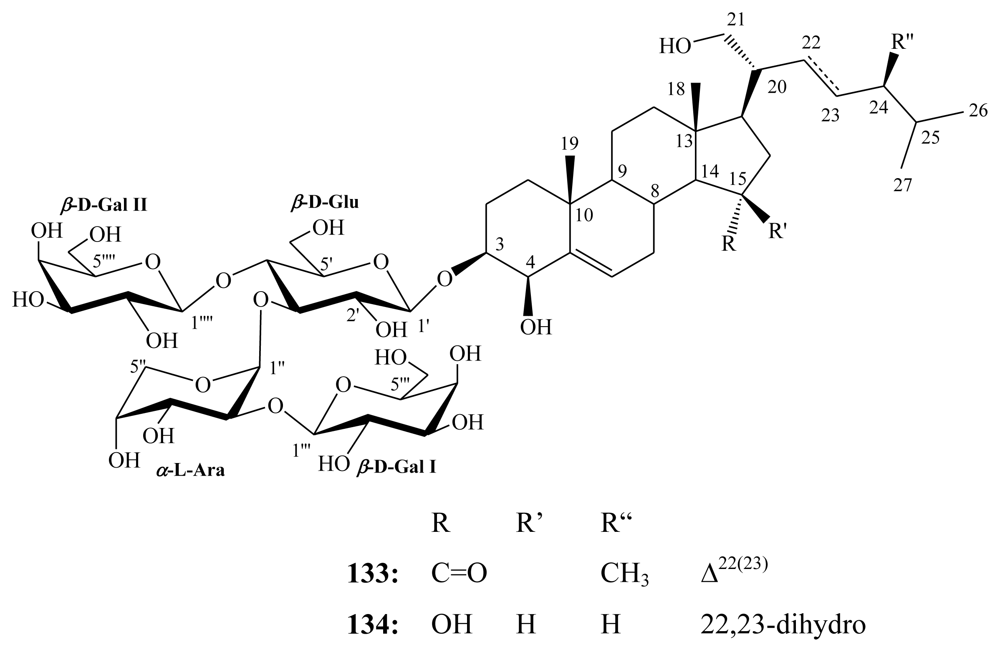
<p>Mycalosides include eleven steroidal saponin congeners that were isolated from the Caribbean marine sponge <italic>Mycale laxissima</italic> (class Demospongiae; order Poecilosclerida; family Mycalidae) collected near San-Felipe Island, Cuba [<xref ref-type="bibr" rid="b126-marinedrugs-08-00313">126</xref>–<xref ref-type="bibr" rid="b128-marinedrugs-08-00313">128</xref>]. They were all characterized by having oxygenated C-4, C-15, and C-21 positions.</p>
<p>Mycaloside A (<bold>133</bold>) and G (<bold>134</bold>) as well as the total glycoside fraction did not influence nonfertilized eggs and the developing embryo up to the 8-blastomere stage at concentrations of up to 94.6 μM. However, these compounds were effective as spermatostatics when preincubated for 15 min with sea urchin sperm with an EC<sub>50</sub> of 3.04 μM. The total glycoside fraction generated a less toxic effect (EC<sub>50</sub> = 7.03 <italic>μ</italic>g/mL) [<xref ref-type="bibr" rid="b127-marinedrugs-08-00313">127</xref>].</p>
<fig id="f29-marinedrugs-08-00313" position="anchor"><graphic xlink:href="marinedrugs-08-00313f29.gif"/></fig>
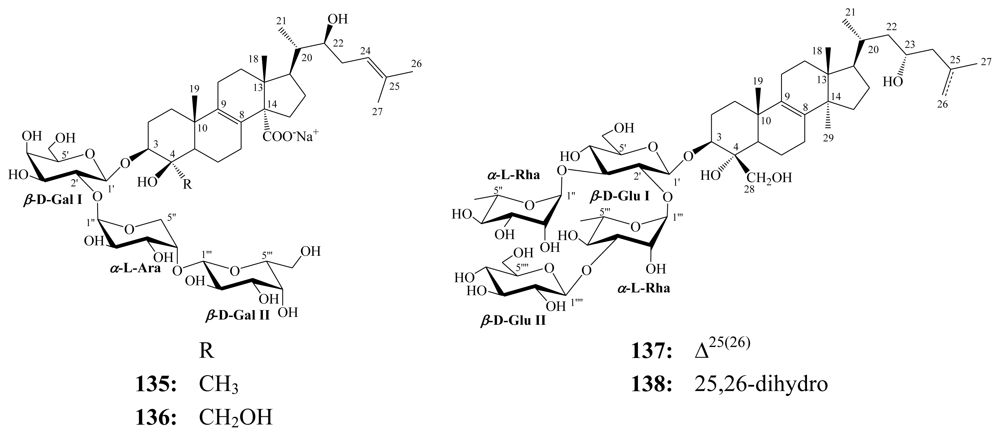
<p>Ectyoplasides A (<bold>135</bold>) and B (<bold>136</bold>) were first isolated from the Caribbean sponge <italic>E. ferox</italic> (class Demospongiae; order Axinellida; family Raspaliidae) collected along the coasts of San Salvador Island, Bahamas [<xref ref-type="bibr" rid="b129-marinedrugs-08-00313">129</xref>]. The compounds are C-4 norpenasterol triterpenoidal derivatives. Later, ectyoplasides were reisolated together with feroxosides A (<bold>137</bold>) and B (<bold>138</bold>) from the same sponge collected along the coasts of Grand Bahama Island [<xref ref-type="bibr" rid="b130-marinedrugs-08-00313">130</xref>]. Feroxosides have been shown to be unusual C-4 norlanostane triterpenes glycosylated with a rhamnose-containing tetrasaccharide chain.</p>
<fig id="f30-marinedrugs-08-00313" position="anchor"><graphic xlink:href="marinedrugs-08-00313f30.gif"/></fig>
<p>Against murine fibrosarcoma WEHI164, murine leukemia P388, and murine monocyte-macrophage J774 cell lines, both ectyoplasides (<bold>135</bold> and <bold>136</bold>) exhibited moderate <italic>in vitro</italic> cytotoxic activity with IC<sub>50</sub> values ranging from 9.0 to 11.4 μM [<xref ref-type="bibr" rid="b129-marinedrugs-08-00313">129</xref>], whilst against the latter cell line, feroxosides (<bold>137</bold> and <bold>138</bold>) were mildly cytotoxic (IC<sub>50</sub> = 17.6 μM) [<xref ref-type="bibr" rid="b130-marinedrugs-08-00313">130</xref>].</p>
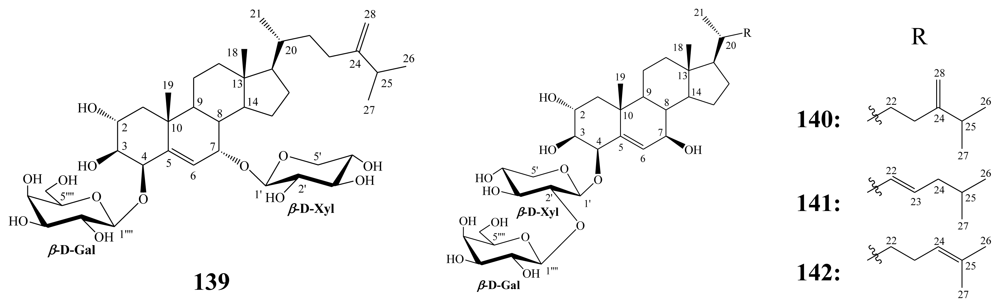
<p>Pachastrelloside A (<bold>139</bold>) was obtained from the marine sponge <italic>Pachastrella</italic> sp. (Kagami Bay, Japan) and revealed the presence of a cholest-5,24-diene-2<italic>α</italic>,3<italic>β</italic>,4<italic>β</italic>,7<italic>α</italic>-tetraol aglycone that was glycosylated at the C-4 and C-7 positions with <italic>β</italic>-D-xylopyranose and <italic>β</italic>-D-galactopyranose moieties, respectively [<xref ref-type="bibr" rid="b134-marinedrugs-08-00313">134</xref>].</p>
<fig id="f31-marinedrugs-08-00313" position="anchor"><graphic xlink:href="marinedrugs-08-00313f31.gif"/></fig>
<p>A Korean sponge-association composed of <italic>Poecillastra wondoensis</italic> and <italic>Jaspis wondoensis</italic> resulted in the isolation of wondosterols A–C (<bold>140</bold>–<bold>142</bold>), which are structurally related to <bold>139</bold> [<xref ref-type="bibr" rid="b133-marinedrugs-08-00313">133</xref>]. Wondosterols were shown to have a <italic>β</italic>-OH group at C-7 and they were all diglycosylated at C-3 with <italic>β</italic>-D-xylopyranose connected to <italic>β</italic>-D-galactopyranose.</p>
<p>Wondosterols A–C (<bold>140</bold>–<bold>142</bold>) were weakly cytotoxic against P388 cells (IC<sub>50</sub> = 63 μM) and at a concentration of 10 <italic>μ</italic>g/disk only <bold>140</bold> and <bold>142</bold> showed antibacterial activities against <italic>P. aeruginosa</italic> and <italic>E. coli</italic> [<xref ref-type="bibr" rid="b133-marinedrugs-08-00313">133</xref>]. Pachastrelloside A (<bold>139</bold>) inhibited cell division of fertilized starfish (<italic>Asterina pectinifera</italic>) eggs at 35 μM [<xref ref-type="bibr" rid="b134-marinedrugs-08-00313">134</xref>].</p></sec></sec>
<sec>
<title>4. Future Aspects</title>
<p>The enormous diversity of marine natural products combined with improved global concerns to find new therapeutic agents for the treatment of different ailments provide the stimulus to evaluate marine natural products in clinical trials. Marine drug discovery faces many obstacles including a sufficient supply, and the low concentrations of some compounds that may account for less than 10<sup>−6</sup>% of the wet weight [<xref ref-type="bibr" rid="b135-marinedrugs-08-00313">135</xref>]. However, there have been substantial advances, suggesting that sustainable sourcing could be achievable. Since the continuous and exhaustive harvesting of terrestrial drug lead resources proved to be unreliable and resulted in the frequent re-isolation of known compounds, researchers from academia and from pharmaceutical companies alike are now turning their focus to the sea in search for new lead structures from nature. Nevertheless, the large scale production of marine natural products for clinical use is a real challenge, and therefore environmentally sound and economically feasible alternatives are required.</p>
<p>Chemical synthesis is among the first strategies to be explored, but unfortunately the structural complexity of marine metabolites with novel mechanisms of action and high selectivity has resulted in only a few successful examples with this strategy such as the conus toxin ziconotide [<xref ref-type="bibr" rid="b136-marinedrugs-08-00313">136</xref>]. A second strategy, but also as labor-intensive, is to study the pharmacological significance of marine natural product pharmacophores and then attempt to define the critical pharmacophore that can result in practical drugs based on a marine prototype via chemical synthesis, degradation, modification or a combination of these.</p>
<p>Aquaculture of the source organisms, including sponges, tunicates, and bryozoans, with an aim at securing a sustainable supply of the active constituent(s), has progressed notably in cancer applications. However, in most cases the biomass currently generated is still far from that required, should a marine-based drug finally enter the pharmaceutical market [<xref ref-type="bibr" rid="b137-marinedrugs-08-00313">137</xref>]. Furthermore, the cultivation of invertebrates in their natural environment is subject to several hazards and threats, such as destruction by storms or diseases. An intriguing strategy has been to identify the true producers of bioactive compounds and to explore whether or not they are of microbial origin including bacteria, cyanobacteria, or fungi that are known to harbour within the tissues of marine invertebrates.</p>
<p>If bacterial or other associated microorganisms proved to produce the compounds of interest, a careful design of special culture media would be crucial for large-scale fermentation e.g., ET-743 production. Currently, only 5% or less of the symbiotic bacteria present in marine specimens can be cultivated under standard conditions [<xref ref-type="bibr" rid="b138-marinedrugs-08-00313">138</xref>]. Consequently, molecular approaches offer particularly promising alternatives through the transfer of biosynthetic gene clusters to a vector suitable for large-scale fermentation, thereby avoiding the obstacles in culturing symbiotic bacteria.</p>
<p>Oceans will play a potential role in the future to control and relieve the global disease burden. In spite of the substantial development that has been achieved in disclosing novel drug leads from marine resources, more efforts are still required for more chemical entities to reach to clinical applications.</p></sec></body>
<back>
<ack>
<title>Acknowledgements</title>
<p>Preparation of this review was supported by a grant of BMBF (to P.P.). A scholarship granted and financed by the Egyptian government (predoctoral fellowship for S.S.E.) is gratefully acknowledged.</p></ack>
<fn-group><fn>
<p><italic>Samples Availability:</italic> Available from the authors.</p></fn></fn-group>
<ref-list>
<title>References and Notes</title>
<ref id="b1-marinedrugs-08-00313"><label>1</label><citation citation-type="journal"><person-group person-group-type="author"><name><surname>Braekman</surname><given-names>JC</given-names></name><name><surname>Daloze</surname><given-names>D</given-names></name></person-group><article-title>Chemical defence in sponges</article-title><source>Pure Appl Chem</source><year>1986</year><volume>58</volume><fpage>357</fpage><lpage>364</lpage><pub-id pub-id-type="doi">10.1351/pac198658030357</pub-id></citation></ref>
<ref id="b2-marinedrugs-08-00313"><label>2</label><citation citation-type="journal"><person-group person-group-type="author"><name><surname>Ruzicka</surname><given-names>ZL</given-names></name></person-group><article-title>The isoprene rule and the biogenesis of terpenic compounds</article-title><source>Experientia</source><year>1953</year><volume>9</volume><fpage>357</fpage><lpage>367</lpage><pub-id pub-id-type="doi">10.1007/BF02167631</pub-id><pub-id pub-id-type="pmid">13116962</pub-id></citation></ref>
<ref id="b3-marinedrugs-08-00313"><label>3</label><citation citation-type="journal"><person-group person-group-type="author"><name><surname>Bergmann</surname><given-names>W</given-names></name><name><surname>Johnson</surname><given-names>TB</given-names></name></person-group><article-title>The chemistry of marine animals. <bold>I</bold>. The sponge <italic>Microciona pralifera</italic></article-title><source>Z Physiol Chem</source><year>1933</year><volume>222</volume><fpage>220</fpage><lpage>226</lpage><pub-id pub-id-type="doi">10.1515/bchm2.1933.222.5-6.220</pub-id></citation></ref>
<ref id="b4-marinedrugs-08-00313"><label>4</label><citation citation-type="journal"><person-group person-group-type="author"><name><surname>Fusetani</surname><given-names>N</given-names></name></person-group><article-title>Biofouling and antifouling</article-title><source>Nat Prod Rep</source><year>2004</year><volume>21</volume><fpage>94</fpage><lpage>104</lpage><pub-id pub-id-type="doi">10.1039/b302231p</pub-id><pub-id pub-id-type="pmid">15039837</pub-id></citation></ref>
<ref id="b5-marinedrugs-08-00313"><label>5</label><citation citation-type="journal"><person-group person-group-type="author"><name><surname>De Silva</surname><given-names>ED</given-names></name><name><surname>Scheuer</surname><given-names>PJ</given-names></name></person-group><article-title>Manoalide, an antibiotic sesterterpenoid from the marine sponge <italic>Luffariella variabilis</italic> (Polejaeff)</article-title><source>Tetrahedron Lett</source><year>1980</year><volume>21</volume><fpage>1611</fpage><lpage>1614</lpage><pub-id pub-id-type="doi">10.1016/S0040-4039(00)77766-5</pub-id></citation></ref>
<ref id="b6-marinedrugs-08-00313"><label>6</label><citation citation-type="journal"><person-group person-group-type="author"><name><surname>De Silva</surname><given-names>ED</given-names></name><name><surname>Scheuer</surname><given-names>PJ</given-names></name></person-group><article-title>Three new sesterterpenoid antibiotics from the marine sponge <italic>Luffariella variabilis</italic> (Polejaeff)</article-title><source>Tetrahedron Lett</source><year>1981</year><volume>22</volume><fpage>3147</fpage><lpage>3150</lpage><pub-id pub-id-type="doi">10.1016/S0040-4039(01)81849-9</pub-id></citation></ref>
<ref id="b7-marinedrugs-08-00313"><label>7</label><citation citation-type="journal"><person-group person-group-type="author"><name><surname>Kernan</surname><given-names>MR</given-names></name><name><surname>Faulkner</surname><given-names>DJ</given-names></name><name><surname>Jacobs</surname><given-names>RS</given-names></name></person-group><article-title>The luffariellins, novel anti-inflammatory sesterterpenes of chemotaxonomic importance from the marine sponge <italic>Luffariella variabilis</italic></article-title><source>J Org Chem</source><year>1987</year><volume>52</volume><fpage>3081</fpage><lpage>3083</lpage><pub-id pub-id-type="doi">10.1021/jo00390a021</pub-id></citation></ref>
<ref id="b8-marinedrugs-08-00313"><label>8</label><citation citation-type="journal"><person-group person-group-type="author"><name><surname>Albizati</surname><given-names>KF</given-names></name><name><surname>Holman</surname><given-names>T</given-names></name><name><surname>Faulkner</surname><given-names>DJ</given-names></name><name><surname>Glaser</surname><given-names>KB</given-names></name><name><surname>Jacobs</surname><given-names>RS</given-names></name></person-group><article-title>Luffariellolide, an anti-inflammatory sesterterpene from the marine sponge <italic>Luffariella</italic> sp</article-title><source>Experientia</source><year>1987</year><volume>43</volume><fpage>949</fpage><lpage>950</lpage><pub-id pub-id-type="doi">10.1007/BF01951682</pub-id></citation></ref>
<ref id="b9-marinedrugs-08-00313"><label>9</label><citation citation-type="journal"><person-group person-group-type="author"><name><surname>Kernan</surname><given-names>MR</given-names></name><name><surname>Faulkner</surname><given-names>DJ</given-names></name><name><surname>Parkanyi</surname><given-names>L</given-names></name><name><surname>Clardy</surname><given-names>J</given-names></name><name><surname>de Carvalho</surname><given-names>MS</given-names></name><name><surname>Jacobs</surname><given-names>RS</given-names></name></person-group><article-title>Luffolide, a novel anti-inflammatory terpene from the sponge <italic>Luffariella</italic> sp</article-title><source>Experientia</source><year>1989</year><volume>45</volume><fpage>388</fpage><lpage>390</lpage><pub-id pub-id-type="doi">10.1007/BF01957489</pub-id><pub-id pub-id-type="pmid">2707379</pub-id></citation></ref>
<ref id="b10-marinedrugs-08-00313"><label>10</label><citation citation-type="journal"><person-group person-group-type="author"><name><surname>König</surname><given-names>GM</given-names></name><name><surname>Wright</surname><given-names>AD</given-names></name><name><surname>Sticher</surname><given-names>O</given-names></name></person-group><article-title>Four new antibacterial sesterterpenes from a marine sponge of the genus <italic>Luffariella</italic></article-title><source>J Nat Prod</source><year>1992</year><volume>55</volume><fpage>174</fpage><lpage>178</lpage><pub-id pub-id-type="doi">10.1021/np50080a004</pub-id><pub-id pub-id-type="pmid">1624940</pub-id></citation></ref>
<ref id="b11-marinedrugs-08-00313"><label>11</label><citation citation-type="journal"><person-group person-group-type="author"><name><surname>Potts</surname><given-names>BCM</given-names></name><name><surname>Capon</surname><given-names>RJ</given-names></name><name><surname>Faulkner</surname><given-names>DJ</given-names></name></person-group><article-title>Luffalactone and (4<italic>E</italic>,6<italic>E</italic>)-dehydromanoalide from the sponge <italic>Luffariella variabilis</italic></article-title><source>J Org Chem</source><year>1992</year><volume>57</volume><fpage>2965</fpage><lpage>2967</lpage><pub-id pub-id-type="doi">10.1021/jo00036a043</pub-id></citation></ref>
<ref id="b12-marinedrugs-08-00313"><label>12</label><citation citation-type="journal"><person-group person-group-type="author"><name><surname>Butler</surname><given-names>MS</given-names></name><name><surname>Capon</surname><given-names>RJ</given-names></name></person-group><article-title>The luffarins (A–Z), novel terpenes from an Australian marine sponge <italic>Luffariella geometrica</italic></article-title><source>Aust J Chem</source><year>1992</year><volume>45</volume><fpage>1705</fpage><lpage>1743</lpage><pub-id pub-id-type="doi">10.1071/CH9921705</pub-id></citation></ref>
<ref id="b13-marinedrugs-08-00313"><label>13</label><citation citation-type="journal"><person-group person-group-type="author"><name><surname>Tsuda</surname><given-names>M</given-names></name><name><surname>Shigemori</surname><given-names>H</given-names></name><name><surname>Ishibashi</surname><given-names>M</given-names></name><name><surname>Sasaki</surname><given-names>T</given-names></name><name><surname>Kobayashi</surname><given-names>J</given-names></name></person-group><article-title>Luffariolides A–E, new cytotoxic sesterterpenes from the Okinawan marine sponge <italic>Luffariella</italic> sp</article-title><source>J Org Chem</source><year>1992</year><volume>57</volume><fpage>3503</fpage><lpage>3507</lpage><pub-id pub-id-type="doi">10.1021/jo00038a051</pub-id></citation></ref>
<ref id="b14-marinedrugs-08-00313"><label>14</label><citation citation-type="journal"><person-group person-group-type="author"><name><surname>Kobayashi</surname><given-names>J</given-names></name><name><surname>Zeng</surname><given-names>CM</given-names></name><name><surname>Ishibashi</surname><given-names>M</given-names></name><name><surname>Sasaki</surname><given-names>T</given-names></name></person-group><article-title>Luffariolides F and G, new manoalide derivatives from the Okinawan marine sponge <italic>Luffariella</italic> sp</article-title><source>J Nat Prod</source><year>1993</year><volume>56</volume><fpage>436</fpage><lpage>439</lpage><pub-id pub-id-type="doi">10.1021/np50093a020</pub-id><pub-id pub-id-type="pmid">8482949</pub-id></citation></ref>
<ref id="b15-marinedrugs-08-00313"><label>15</label><citation citation-type="journal"><person-group person-group-type="author"><name><surname>Reddy</surname><given-names>MVR</given-names></name><name><surname>Harper</surname><given-names>MK</given-names></name><name><surname>Faulkner</surname><given-names>DJ</given-names></name></person-group><article-title>Luffasterols A–C, 9,11-secosterols from the Palauan sponge <italic>Luffariella</italic> sp</article-title><source>J Nat Prod</source><year>1997</year><volume>60</volume><fpage>41</fpage><lpage>43</lpage><pub-id pub-id-type="doi">10.1021/np9606207</pub-id><pub-id pub-id-type="pmid">9014351</pub-id></citation></ref>
<ref id="b16-marinedrugs-08-00313"><label>16</label><citation citation-type="journal"><person-group person-group-type="author"><name><surname>Tsuda</surname><given-names>M</given-names></name><name><surname>Endo</surname><given-names>T</given-names></name><name><surname>Mikami</surname><given-names>Y</given-names></name><name><surname>Fromont</surname><given-names>J</given-names></name><name><surname>Kobayashi</surname><given-names>J</given-names></name></person-group><article-title>Luffariolides H and J, new sesterterpenes from a marine sponge <italic>Luffariella</italic></article-title><source>J Nat Prod</source><year>2002</year><volume>65</volume><fpage>1507</fpage><lpage>1508</lpage><pub-id pub-id-type="doi">10.1021/np0202071</pub-id><pub-id pub-id-type="pmid">12398555</pub-id></citation></ref>
<ref id="b17-marinedrugs-08-00313"><label>17</label><citation citation-type="journal"><person-group person-group-type="author"><name><surname>Namikoshi</surname><given-names>M</given-names></name><name><surname>Suzuki</surname><given-names>S</given-names></name><name><surname>Meguro</surname><given-names>S</given-names></name><name><surname>Nagai</surname><given-names>H</given-names></name><name><surname>Koike</surname><given-names>Y</given-names></name><name><surname>Kitazawa</surname><given-names>A</given-names></name><name><surname>Kobayashi</surname><given-names>H</given-names></name><name><surname>Oda</surname><given-names>T</given-names></name><name><surname>Yamada</surname><given-names>J</given-names></name></person-group><article-title>Manoalide derivatives from a marine sponge <italic>Luffariella</italic> sp. collected in Palau</article-title><source>Fish Sci</source><year>2004</year><volume>70</volume><fpage>152</fpage><lpage>158</lpage></citation></ref>
<ref id="b18-marinedrugs-08-00313"><label>18</label><citation citation-type="journal"><person-group person-group-type="author"><name><surname>Ettinger-Epstein</surname><given-names>P</given-names></name><name><surname>Motti</surname><given-names>CA</given-names></name><name><surname>de Nys</surname><given-names>R</given-names></name><name><surname>Wright</surname><given-names>AD</given-names></name><name><surname>Battershill</surname><given-names>CN</given-names></name><name><surname>Tapiolas</surname><given-names>DM</given-names></name></person-group><article-title>Acetylated sesterterpenes from the Great Barrier reef sponge <italic>Luffariella variabilis</italic></article-title><source>J Nat Prod</source><year>2007</year><volume>70</volume><fpage>648</fpage><lpage>651</lpage><pub-id pub-id-type="doi">10.1021/np060240d</pub-id><pub-id pub-id-type="pmid">17295541</pub-id></citation></ref>
<ref id="b19-marinedrugs-08-00313"><label>19</label><citation citation-type="journal"><person-group person-group-type="author"><name><surname>Gauvin-Bialecki</surname><given-names>A</given-names></name><name><surname>Aknin</surname><given-names>M</given-names></name><name><surname>Smadja</surname><given-names>J</given-names></name></person-group><article-title>24-<italic>O</italic>-Ethylmanoalide, a manoalide-related sesterterpene from the marine sponge <italic>Luffariella</italic> cf. variabilis</article-title><source>Molecules</source><year>2008</year><volume>13</volume><fpage>3184</fpage><lpage>3191</lpage><pub-id pub-id-type="doi">10.3390/molecules13123184</pub-id><pub-id pub-id-type="pmid">19078858</pub-id></citation></ref>
<ref id="b20-marinedrugs-08-00313"><label>20</label><citation citation-type="journal"><person-group person-group-type="author"><name><surname>Kobayashi</surname><given-names>M</given-names></name><name><surname>Okamoto</surname><given-names>T</given-names></name><name><surname>Hayashi</surname><given-names>K</given-names></name><name><surname>Yokoyama</surname><given-names>N</given-names></name><name><surname>Sasaki</surname><given-names>T</given-names></name><name><surname>Kitagawa</surname><given-names>I</given-names></name></person-group><article-title>Marine natural products. XXXII. Absolute configurations of C-4 of the manoalide family, biologically active sesterterpenes from the marine sponge <italic>Hyrtios erecta</italic></article-title><source>Chem Pharm Bull</source><year>1994</year><volume>42</volume><fpage>265</fpage><lpage>270</lpage><pub-id pub-id-type="doi">10.1248/cpb.42.265</pub-id><pub-id pub-id-type="pmid">8149454</pub-id></citation></ref>
<ref id="b21-marinedrugs-08-00313"><label>21</label><citation citation-type="journal"><person-group person-group-type="author"><name><surname>Bourguet-Kondracki</surname><given-names>ML</given-names></name><name><surname>Debitus</surname><given-names>C</given-names></name><name><surname>Guyot</surname><given-names>M</given-names></name></person-group><article-title>Biologically active sesterterpenes from a new Caledonian marine sponge <italic>Hyrtios</italic> sp</article-title><source>J Chem Res</source><year>1996</year><fpage>192</fpage><lpage>193</lpage></citation></ref>
<ref id="b22-marinedrugs-08-00313"><label>22</label><citation citation-type="journal"><person-group person-group-type="author"><name><surname>Cambie</surname><given-names>RC</given-names></name><name><surname>Craw</surname><given-names>PA</given-names></name><name><surname>Bergquist</surname><given-names>PR</given-names></name><name><surname>Karuso</surname><given-names>P</given-names></name></person-group><article-title>Chemistry of sponges, III. Manoalide monoacetate and thorectolide monoacetate, two new seterterpenoids from <italic>Thorectandra excavatus</italic></article-title><source>J Nat Prod</source><year>1988</year><volume>51</volume><fpage>331</fpage><lpage>334</lpage><pub-id pub-id-type="doi">10.1021/np50056a026</pub-id></citation></ref>
<ref id="b23-marinedrugs-08-00313"><label>23</label><citation citation-type="journal"><person-group person-group-type="author"><name><surname>De Rosa</surname><given-names>S</given-names></name><name><surname>de Stefano</surname><given-names>S</given-names></name><name><surname>Zavodnik</surname><given-names>N</given-names></name></person-group><article-title>Cacospongionolide: a new antitumoral sesterterpene, from the marine sponge <italic>Cacospongia mollior</italic></article-title><source>J Org Chem</source><year>1988</year><volume>53</volume><fpage>5020</fpage><lpage>5023</lpage><pub-id pub-id-type="doi">10.1021/jo00256a022</pub-id></citation></ref>
<ref id="b24-marinedrugs-08-00313"><label>24</label><citation citation-type="journal"><person-group person-group-type="author"><name><surname>Tasdemir</surname><given-names>D</given-names></name><name><surname>Concepción</surname><given-names>GP</given-names></name><name><surname>Mangalindan</surname><given-names>GC</given-names></name><name><surname>Harper</surname><given-names>MK</given-names></name><name><surname>Hajdu</surname><given-names>E</given-names></name><name><surname>Ireland</surname><given-names>CM</given-names></name></person-group><article-title>New terpenoids from a <italic>Cacospongia</italic> sp. from the Philippines</article-title><source>Tetrahedron</source><year>2000</year><volume>56</volume><fpage>9025</fpage><lpage>9030</lpage><pub-id pub-id-type="doi">10.1016/S0040-4020(00)00755-9</pub-id></citation></ref>
<ref id="b25-marinedrugs-08-00313"><label>25</label><citation citation-type="journal"><person-group person-group-type="author"><name><surname>Montagnac</surname><given-names>A</given-names></name><name><surname>Païs</surname><given-names>M</given-names></name><name><surname>Debitus</surname><given-names>C</given-names></name></person-group><article-title>Fasciospongides A, B and C, new manoalide derivatives from the sponge <italic>Fasciospongia</italic> sp</article-title><source>J Nat Prod</source><year>1994</year><volume>57</volume><fpage>186</fpage><lpage>190</lpage><pub-id pub-id-type="doi">10.1021/np50103a032</pub-id></citation></ref>
<ref id="b26-marinedrugs-08-00313"><label>26</label><citation citation-type="journal"><person-group person-group-type="author"><name><surname>De Rosa</surname><given-names>S</given-names></name><name><surname>Crispino</surname><given-names>A</given-names></name><name><surname>de Giulio</surname><given-names>A</given-names></name><name><surname>Iodice</surname><given-names>C</given-names></name><name><surname>Pronzato</surname><given-names>R</given-names></name><name><surname>Zavodnik</surname><given-names>N</given-names></name></person-group><article-title>Cacospongionolide B, a new sesterterpene from the sponge <italic>Fasciospongia cavernosa</italic></article-title><source>J Nat Prod</source><year>1995</year><volume>58</volume><fpage>1776</fpage><lpage>1780</lpage><pub-id pub-id-type="doi">10.1021/np50125a024</pub-id><pub-id pub-id-type="pmid">8594155</pub-id></citation></ref>
<ref id="b27-marinedrugs-08-00313"><label>27</label><citation citation-type="journal"><person-group person-group-type="author"><name><surname>De Rosa</surname><given-names>S</given-names></name><name><surname>Crispino</surname><given-names>A</given-names></name><name><surname>de Giulio</surname><given-names>A</given-names></name><name><surname>Iodice</surname><given-names>C</given-names></name><name><surname>Tommonaro</surname><given-names>G</given-names></name></person-group><article-title>Cavernosolide, a new sesterterpene from a Tyrrhenian sponge</article-title><source>J Nat Prod</source><year>1997</year><volume>60</volume><fpage>844</fpage><lpage>846</lpage><pub-id pub-id-type="doi">10.1021/np970183b</pub-id></citation></ref>
<ref id="b28-marinedrugs-08-00313"><label>28</label><citation citation-type="journal"><person-group person-group-type="author"><name><surname>De Rosa</surname><given-names>S</given-names></name><name><surname>Carbonelli</surname><given-names>S</given-names></name></person-group><article-title>Two new luffarin derivatives from the Adriatic Sea sponge <italic>Fasciospongia cavernosa</italic></article-title><source>Tetrahedron</source><year>2006</year><volume>62</volume><fpage>2845</fpage><lpage>2849</lpage><pub-id pub-id-type="doi">10.1016/j.tet.2006.01.014</pub-id></citation></ref>
<ref id="b29-marinedrugs-08-00313"><label>29</label><citation citation-type="journal"><person-group person-group-type="author"><name><surname>Elkhayat</surname><given-names>E</given-names></name><name><surname>Edrada</surname><given-names>RA</given-names></name><name><surname>Ebel</surname><given-names>R</given-names></name><name><surname>Wray</surname><given-names>V</given-names></name><name><surname>van Soest</surname><given-names>R</given-names></name><name><surname>Wiryowidagdo</surname><given-names>S</given-names></name><name><surname>Mohamed</surname><given-names>MH</given-names></name><name><surname>Müller</surname><given-names>WEG</given-names></name><name><surname>Proksch</surname><given-names>P</given-names></name></person-group><article-title>New luffariellolide derivatives from the Indonesian sponge <italic>Acanthodendrilla</italic> sp</article-title><source>J Nat Prod</source><year>2004</year><volume>67</volume><fpage>1809</fpage><lpage>1817</lpage><pub-id pub-id-type="doi">10.1021/np040118j</pub-id><pub-id pub-id-type="pmid">15568767</pub-id></citation></ref>
<ref id="b30-marinedrugs-08-00313"><label>30</label><citation citation-type="journal"><person-group person-group-type="author"><name><surname>Ueoka</surname><given-names>R</given-names></name><name><surname>Nakao</surname><given-names>Y</given-names></name><name><surname>Fujii</surname><given-names>S</given-names></name><name><surname>van Soest</surname><given-names>RWM</given-names></name><name><surname>Matsunaga</surname><given-names>S</given-names></name></person-group><article-title>Aplysinoplides A–C, cytotoxic sesterterpnes from the marine sponge <italic>Aplysinopsis digitata</italic></article-title><source>J Nat Prod</source><year>2008</year><volume>71</volume><fpage>1089</fpage><lpage>1091</lpage><pub-id pub-id-type="doi">10.1021/np8001207</pub-id><pub-id pub-id-type="pmid">18461996</pub-id></citation></ref>
<ref id="b31-marinedrugs-08-00313"><label>31</label><citation citation-type="journal"><person-group person-group-type="author"><name><surname>De Freitas</surname><given-names>JC</given-names></name><name><surname>Blankemeier</surname><given-names>LA</given-names></name><name><surname>Jacobs</surname><given-names>RS</given-names></name></person-group><article-title><italic>In vitro</italic> inactivation of the neurotoxic action of <italic>β</italic>-bungarotoxin by the marine natural product, manoalide</article-title><source>Experientia</source><year>1984</year><volume>40</volume><fpage>864</fpage><lpage>865</lpage><pub-id pub-id-type="doi">10.1007/BF01951998</pub-id><pub-id pub-id-type="pmid">6468604</pub-id></citation></ref>
<ref id="b32-marinedrugs-08-00313"><label>32</label><citation citation-type="journal"><person-group person-group-type="author"><name><surname>Lombardo</surname><given-names>D</given-names></name><name><surname>Dennis</surname><given-names>EA</given-names></name></person-group><article-title>Cobra venom phospholipase A<sub>2</sub> inhibition by manoalide. A novel type of phospholipase inhibitor</article-title><source>J Biol Chem</source><year>1985</year><volume>260</volume><fpage>7234</fpage><lpage>7240</lpage><pub-id pub-id-type="pmid">3997864</pub-id></citation></ref>
<ref id="b33-marinedrugs-08-00313"><label>33</label><citation citation-type="journal"><person-group person-group-type="author"><name><surname>Glaser</surname><given-names>KB</given-names></name><name><surname>Jacobs</surname><given-names>RS</given-names></name></person-group><article-title>Molecular pharmacology of manoalide. Inactivation of bee venom phospholipase A<sub>2</sub></article-title><source>Biochem Pharmacol</source><year>1986</year><volume>35</volume><fpage>449</fpage><lpage>453</lpage><pub-id pub-id-type="doi">10.1016/0006-2952(86)90218-2</pub-id><pub-id pub-id-type="pmid">3947381</pub-id></citation></ref>
<ref id="b34-marinedrugs-08-00313"><label>34</label><citation citation-type="journal"><person-group person-group-type="author"><name><surname>Glaser</surname><given-names>KB</given-names></name><name><surname>Jacobs</surname><given-names>RS</given-names></name></person-group><article-title>Inactivation of bee venom phospholipase A<sub>2</sub> by manoalide. A model based on the reactivity of manoalide with amino acids and peptide sequences</article-title><source>Biochem Pharmacol</source><year>1987</year><volume>36</volume><fpage>2079</fpage><lpage>2086</lpage><pub-id pub-id-type="doi">10.1016/0006-2952(87)90134-1</pub-id><pub-id pub-id-type="pmid">3111475</pub-id></citation></ref>
<ref id="b35-marinedrugs-08-00313"><label>35</label><citation citation-type="journal"><person-group person-group-type="author"><name><surname>Bennett</surname><given-names>CF</given-names></name><name><surname>Mong</surname><given-names>S</given-names></name><name><surname>Clarke</surname><given-names>MA</given-names></name><name><surname>Kruse</surname><given-names>LI</given-names></name><name><surname>Crooke</surname><given-names>ST</given-names></name></person-group><article-title>Differential effects of manoalide on secreted and intracellular phospholipases</article-title><source>Biochem Pharmacol</source><year>1987</year><volume>36</volume><fpage>733</fpage><lpage>740</lpage><pub-id pub-id-type="doi">10.1016/0006-2952(87)90727-1</pub-id><pub-id pub-id-type="pmid">3103628</pub-id></citation></ref>
<ref id="b36-marinedrugs-08-00313"><label>36</label><citation citation-type="journal"><person-group person-group-type="author"><name><surname>Glaser</surname><given-names>KB</given-names></name><name><surname>de Carvalho</surname><given-names>MS</given-names></name><name><surname>Jacobs</surname><given-names>RS</given-names></name><name><surname>Kernan</surname><given-names>MR</given-names></name><name><surname>Faulkner</surname><given-names>DJ</given-names></name></person-group><article-title>Manoalide: structure-activity studies and definition of the pharmacophore for phospholipase A<sub>2</sub> inactivation</article-title><source>Mol Pharmacol</source><year>1989</year><volume>36</volume><fpage>782</fpage><lpage>788</lpage><pub-id pub-id-type="pmid">2586492</pub-id></citation></ref>
<ref id="b37-marinedrugs-08-00313"><label>37</label><citation citation-type="journal"><person-group person-group-type="author"><name><surname>Jacobson</surname><given-names>PB</given-names></name><name><surname>Marshall</surname><given-names>LA</given-names></name><name><surname>Sung</surname><given-names>A</given-names></name><name><surname>Jacobs</surname><given-names>RS</given-names></name></person-group><article-title>Inactivation of human synovial fluid phospholipase A<sub>2</sub> by the marine natural product, manoalide</article-title><source>Biochem Pharmacol</source><year>1990</year><volume>39</volume><fpage>1557</fpage><lpage>1564</lpage><pub-id pub-id-type="doi">10.1016/0006-2952(90)90521-L</pub-id><pub-id pub-id-type="pmid">2337412</pub-id></citation></ref>
<ref id="b38-marinedrugs-08-00313"><label>38</label><citation citation-type="journal"><person-group person-group-type="author"><name><surname>Ortiz</surname><given-names>AR</given-names></name><name><surname>Pisabarro</surname><given-names>MT</given-names></name><name><surname>Gago</surname><given-names>F</given-names></name></person-group><article-title>Molecular model of the interaction of bee venom phospholipase A<sub>2</sub> with manoalide</article-title><source>J Med Chem</source><year>1993</year><volume>36</volume><fpage>1866</fpage><lpage>1879</lpage><pub-id pub-id-type="doi">10.1021/jm00065a010</pub-id><pub-id pub-id-type="pmid">8515424</pub-id></citation></ref>
<ref id="b39-marinedrugs-08-00313"><label>39</label><citation citation-type="journal"><person-group person-group-type="author"><name><surname>Deems</surname><given-names>RA</given-names></name><name><surname>Lombardo</surname><given-names>D</given-names></name><name><surname>Morgan</surname><given-names>BP</given-names></name><name><surname>Mihelich</surname><given-names>ED</given-names></name><name><surname>Dennis</surname><given-names>EA</given-names></name></person-group><article-title>The inhibition of phospholipase A<sub>2</sub> by manoalide and manoalide analogues</article-title><source>Biochim Biophys Acta</source><year>1987</year><volume>917</volume><fpage>258</fpage><lpage>268</lpage><pub-id pub-id-type="doi">10.1016/0005-2760(87)90130-5</pub-id><pub-id pub-id-type="pmid">3801502</pub-id></citation></ref>
<ref id="b40-marinedrugs-08-00313"><label>40</label><citation citation-type="journal"><person-group person-group-type="author"><name><surname>Reynolds</surname><given-names>LJ</given-names></name><name><surname>Morgan</surname><given-names>BP</given-names></name><name><surname>Hite</surname><given-names>GA</given-names></name><name><surname>Mihelich</surname><given-names>ED</given-names></name><name><surname>Dennis</surname><given-names>EA</given-names></name></person-group><article-title>Phospholipase A<sub>2</sub> inhibition and modification by manoalogue</article-title><source>J Am Chem Soc</source><year>1988</year><volume>110</volume><fpage>5172</fpage><lpage>5177</lpage><pub-id pub-id-type="doi">10.1021/ja00223a044</pub-id></citation></ref>
<ref id="b41-marinedrugs-08-00313"><label>41</label><citation citation-type="journal"><person-group person-group-type="author"><name><surname>Potts</surname><given-names>BCM</given-names></name><name><surname>Faulkner</surname><given-names>DJ</given-names></name><name><surname>Jacobs</surname><given-names>RS</given-names></name></person-group><article-title>Phospholipase A<sub>2</sub> inhibitors from marine organisms</article-title><source>J Nat Prod</source><year>1992</year><volume>55</volume><fpage>1701</fpage><lpage>1717</lpage><pub-id pub-id-type="doi">10.1021/np50090a001</pub-id><pub-id pub-id-type="pmid">1294693</pub-id></citation></ref>
<ref id="b42-marinedrugs-08-00313"><label>42</label><citation citation-type="journal"><person-group person-group-type="author"><name><surname>Reynolds</surname><given-names>LJ</given-names></name><name><surname>Mihelich</surname><given-names>ED</given-names></name><name><surname>Dennis</surname><given-names>EA</given-names></name></person-group><article-title>Inhibition of venom phospholipase A<sub>2</sub> by manoalide and manoalogue</article-title><source>J Biol Chem</source><year>1991</year><volume>266</volume><fpage>16512</fpage><lpage>16517</lpage><pub-id pub-id-type="pmid">1885583</pub-id></citation></ref>
<ref id="b43-marinedrugs-08-00313"><label>43</label><citation citation-type="journal"><person-group person-group-type="author"><name><surname>Potts</surname><given-names>BCM</given-names></name><name><surname>Faulkner</surname><given-names>DJ</given-names></name><name><surname>de Carvalho</surname><given-names>MS</given-names></name><name><surname>Jacobs</surname><given-names>RS</given-names></name></person-group><article-title>Chemical mechanism of inactivation of bee venom phospholipase A<sub>2</sub> by the marine natural products manoalide, luffariellolide, and scalaradial</article-title><source>J Am Chem Soc</source><year>1992</year><volume>114</volume><fpage>5093</fpage><lpage>5100</lpage><pub-id pub-id-type="doi">10.1021/ja00039a021</pub-id></citation></ref>
<ref id="b44-marinedrugs-08-00313"><label>44</label><citation citation-type="journal"><person-group person-group-type="author"><name><surname>De Rosa</surname><given-names>M</given-names></name><name><surname>Giordano</surname><given-names>S</given-names></name><name><surname>Scettri</surname><given-names>A</given-names></name><name><surname>Sodano</surname><given-names>G</given-names></name><name><surname>Soriente</surname><given-names>A</given-names></name><name><surname>Pastor</surname><given-names>PG</given-names></name><name><surname>Alcaraz</surname><given-names>MJ</given-names></name><name><surname>Payá</surname><given-names>M</given-names></name></person-group><article-title>Synthesis and comparison of the anti-inflammatory activity of manoalide and cacospongionolide B analogues</article-title><source>J Med Chem</source><year>1998</year><volume>41</volume><fpage>3232</fpage><lpage>3238</lpage><pub-id pub-id-type="doi">10.1021/jm980027h</pub-id><pub-id pub-id-type="pmid">9703468</pub-id></citation></ref>
<ref id="b45-marinedrugs-08-00313"><label>45</label><citation citation-type="journal"><person-group person-group-type="author"><name><surname>Mann</surname><given-names>J</given-names></name></person-group><article-title>Sponges to wipe away pain</article-title><source>Nature</source><year>1992</year><volume>358</volume><fpage>540</fpage><pub-id pub-id-type="doi">10.1038/358540a0</pub-id><pub-id pub-id-type="pmid">1501709</pub-id></citation></ref>
<ref id="b46-marinedrugs-08-00313"><label>46</label><citation citation-type="journal"><person-group person-group-type="author"><name><surname>Blanchard</surname><given-names>JL</given-names></name><name><surname>Epstein</surname><given-names>DM</given-names></name><name><surname>Boisclair</surname><given-names>MD</given-names></name><name><surname>Rudolph</surname><given-names>J</given-names></name><name><surname>Pal</surname><given-names>K</given-names></name></person-group><article-title>Dysidiolide and related <italic>γ</italic>-hydroxybutenolide compounds as inhibitors of the protein tyrosine phosphatase, CDC25</article-title><source>Bioorg Med Chem Lett</source><year>1999</year><volume>9</volume><fpage>2537</fpage><lpage>2538</lpage><pub-id pub-id-type="doi">10.1016/S0960-894X(99)00431-X</pub-id><pub-id pub-id-type="pmid">10498203</pub-id></citation></ref>
<ref id="b47-marinedrugs-08-00313"><label>47</label><citation citation-type="journal"><person-group person-group-type="author"><name><surname>Charan</surname><given-names>RD</given-names></name><name><surname>McKee</surname><given-names>TC</given-names></name><name><surname>Boyd</surname><given-names>MR</given-names></name></person-group><article-title>Thorectandrols A and B, new cytotoxic sesterterpenes from the marine sponge <italic>Thorectandra</italic> species</article-title><source>J Nat Prod</source><year>2001</year><volume>64</volume><fpage>661</fpage><lpage>663</lpage><pub-id pub-id-type="doi">10.1021/np000544e</pub-id><pub-id pub-id-type="pmid">11374971</pub-id></citation></ref>
<ref id="b48-marinedrugs-08-00313"><label>48</label><citation citation-type="journal"><person-group person-group-type="author"><name><surname>Charan</surname><given-names>RD</given-names></name><name><surname>McKee</surname><given-names>TC</given-names></name><name><surname>Boyd</surname><given-names>MR</given-names></name></person-group><article-title>Thorectandols C, D, and E, new sesterterpenes from the marine sponge <italic>Thorectandra</italic> sp</article-title><source>J Nat Prod</source><year>2002</year><volume>65</volume><fpage>492</fpage><lpage>495</lpage><pub-id pub-id-type="doi">10.1021/np010439k</pub-id><pub-id pub-id-type="pmid">11975486</pub-id></citation></ref>
<ref id="b49-marinedrugs-08-00313"><label>49</label><citation citation-type="journal"><person-group person-group-type="author"><name><surname>De Rosa</surname><given-names>S</given-names></name><name><surname>de Giulio</surname><given-names>A</given-names></name><name><surname>Crispino</surname><given-names>A</given-names></name><name><surname>Iodice</surname><given-names>C</given-names></name><name><surname>Tommonaro</surname><given-names>G</given-names></name></person-group><article-title>Further bioactive sesterterpenes from the Tyrrhenian sponge <italic>Fasciospongia cavernosa</italic></article-title><source>Nat Prod Res</source><year>1997</year><volume>10</volume><fpage>267</fpage><lpage>274</lpage></citation></ref>
<ref id="b50-marinedrugs-08-00313"><label>50</label><citation citation-type="journal"><person-group person-group-type="author"><name><surname>Barrero</surname><given-names>AF</given-names></name><name><surname>Alvarez-Manzaneda</surname><given-names>EJ</given-names></name><name><surname>Chahboun</surname><given-names>R</given-names></name><name><surname>Cuerva</surname><given-names>JM</given-names></name><name><surname>Segovia</surname><given-names>A</given-names></name></person-group><article-title>Synthetic applications of the thermal rearrangement of ozonides: first enantiospecific synthesis of marine metabolite Luffarin W</article-title><source>Synlett</source><year>2000</year><volume>9</volume><fpage>1269</fpage><lpage>1272</lpage></citation></ref>
<ref id="b51-marinedrugs-08-00313"><label>51</label><citation citation-type="journal"><person-group person-group-type="author"><name><surname>Boukouvalas</surname><given-names>J</given-names></name><name><surname>Robichaud</surname><given-names>J</given-names></name><name><surname>Maltais</surname><given-names>F</given-names></name></person-group><article-title>A unified strategy for the regiospecific assembly of homoallayl-substituted butenolides and <italic>γ</italic>-hydroxybutenolides: first synthesis of luffariellolide</article-title><source>Synlett</source><year>2006</year><volume>16</volume><fpage>2480</fpage><lpage>2482</lpage></citation></ref>
<ref id="b52-marinedrugs-08-00313"><label>52</label><citation citation-type="journal"><person-group person-group-type="author"><name><surname>Gross</surname><given-names>H</given-names></name><name><surname>König</surname><given-names>GM</given-names></name></person-group><article-title>Terpenoids from marine organisms: unique structures and their pharmacological potential</article-title><source>Phytochem Rev</source><year>2006</year><volume>5</volume><fpage>115</fpage><lpage>141</lpage><pub-id pub-id-type="doi">10.1007/s11101-005-5464-3</pub-id></citation></ref>
<ref id="b53-marinedrugs-08-00313"><label>53</label><citation citation-type="journal"><person-group person-group-type="author"><name><surname>Kernan</surname><given-names>MR</given-names></name><name><surname>Barrabee</surname><given-names>EB</given-names></name><name><surname>Faulkner</surname><given-names>DJ</given-names></name></person-group><article-title>Variation of the metabolites of <italic>Chromodoris funerea</italic>: comparison of specimen from a Palauan marine lake with those from adjacent waters</article-title><source>Comp Biochem Physiol</source><year>1988</year><volume>89B</volume><fpage>275</fpage><lpage>278</lpage></citation></ref>
<ref id="b54-marinedrugs-08-00313"><label>54</label><citation citation-type="journal"><person-group person-group-type="author"><name><surname>Sullivan</surname><given-names>B</given-names></name><name><surname>Faulkner</surname><given-names>DJ</given-names></name></person-group><article-title>An antimicrobial sesterterpene from a Palauan sponge</article-title><source>Tetrahedron Lett</source><year>1982</year><volume>23</volume><fpage>907</fpage><lpage>910</lpage><pub-id pub-id-type="doi">10.1016/S0040-4039(00)86979-8</pub-id></citation></ref>
<ref id="b55-marinedrugs-08-00313"><label>55</label><citation citation-type="journal"><person-group person-group-type="author"><name><surname>Schmidt</surname><given-names>EW</given-names></name><name><surname>Faulkner</surname><given-names>DJ</given-names></name></person-group><article-title>Palauolol, a new anti-inflammatory sesterterpene from the sponge <italic>Fascaplysinopsis</italic> sp. from Palau</article-title><source>Tetrahedron Lett</source><year>1996</year><volume>37</volume><fpage>3951</fpage><lpage>3954</lpage><pub-id pub-id-type="doi">10.1016/0040-4039(96)00718-6</pub-id></citation></ref>
<ref id="b56-marinedrugs-08-00313"><label>56</label><citation citation-type="journal"><person-group person-group-type="author"><name><surname>De Rosa</surname><given-names>S</given-names></name><name><surname>Puliti</surname><given-names>R</given-names></name><name><surname>Crispino</surname><given-names>A</given-names></name><name><surname>de Giulio</surname><given-names>A</given-names></name><name><surname>de Sena</surname><given-names>C</given-names></name><name><surname>Iodice</surname><given-names>C</given-names></name><name><surname>Mattia</surname><given-names>CA</given-names></name></person-group><article-title>25-Deoxycacospongionolide B and cacospongionolide C, two new terpenoids from the sponge <italic>Fasciospongia cavernosa</italic></article-title><source>Tetrahedron</source><year>1995</year><volume>51</volume><fpage>10731</fpage><lpage>10736</lpage><pub-id pub-id-type="doi">10.1016/0040-4020(95)00638-O</pub-id></citation></ref>
<ref id="b57-marinedrugs-08-00313"><label>57</label><citation citation-type="journal"><person-group person-group-type="author"><name><surname>Lal</surname><given-names>AR</given-names></name><name><surname>Cambie</surname><given-names>RC</given-names></name><name><surname>Rickard</surname><given-names>CEF</given-names></name><name><surname>Bergquist</surname><given-names>PR</given-names></name></person-group><article-title>Sesterterpene lactones from a sponge species of the genus <italic>Dactylospongia</italic></article-title><source>Tetrahedron Lett</source><year>1994</year><volume>35</volume><fpage>2603</fpage><lpage>2606</lpage><pub-id pub-id-type="doi">10.1016/S0040-4039(00)77183-8</pub-id></citation></ref>
<ref id="b58-marinedrugs-08-00313"><label>58</label><citation citation-type="journal"><person-group person-group-type="author"><name><surname>Cambie</surname><given-names>CR</given-names></name><name><surname>Lal</surname><given-names>AR</given-names></name><name><surname>Rickard</surname><given-names>CEF</given-names></name></person-group><article-title>A sesterterpene lactone from <italic>Petrosaspongia nigra</italic> sp. nov</article-title><source>Acta Cryst</source><year>1996</year><volume>C52</volume><fpage>709</fpage><lpage>711</lpage></citation></ref>
<ref id="b59-marinedrugs-08-00313"><label>59</label><citation citation-type="journal"><person-group person-group-type="author"><name><surname>Gomez-Paloma</surname><given-names>L</given-names></name><name><surname>Randazzo</surname><given-names>A</given-names></name><name><surname>Minale</surname><given-names>L</given-names></name><name><surname>Debitus</surname><given-names>C</given-names></name><name><surname>Roussakis</surname><given-names>C</given-names></name></person-group><article-title>New cytotoxic sesterterpenes from the New Caledonian marine sponge <italic>Petrosaspongia nigra</italic> (Bergquist)</article-title><source>Tetrahedron</source><year>1997</year><volume>53</volume><fpage>10451</fpage><lpage>10458</lpage><pub-id pub-id-type="doi">10.1016/S0040-4020(97)00656-X</pub-id></citation></ref>
<ref id="b60-marinedrugs-08-00313"><label>60</label><citation citation-type="journal"><person-group person-group-type="author"><name><surname>Randazzo</surname><given-names>A</given-names></name><name><surname>Debitus</surname><given-names>C</given-names></name><name><surname>Minale</surname><given-names>L</given-names></name><name><surname>Pastor</surname><given-names>PG</given-names></name><name><surname>Alcaraz</surname><given-names>MJ</given-names></name><name><surname>Payá</surname><given-names>M</given-names></name><name><surname>Gomez-Paloma</surname><given-names>L</given-names></name></person-group><article-title>Petrosaspongiolodes M–R: new potent and selective phosphoplipase A<sub>2</sub> inhibitors from the New Caledonian marine sponge <italic>Petrosaspongia nigra</italic></article-title><source>J Nat Prod</source><year>1998</year><volume>61</volume><fpage>571</fpage><lpage>575</lpage><pub-id pub-id-type="doi">10.1021/np9704922</pub-id><pub-id pub-id-type="pmid">9599251</pub-id></citation></ref>
<ref id="b61-marinedrugs-08-00313"><label>61</label><citation citation-type="journal"><person-group person-group-type="author"><name><surname>De Marino</surname><given-names>S</given-names></name><name><surname>Iorizzi</surname><given-names>M</given-names></name><name><surname>Zollo</surname><given-names>F</given-names></name><name><surname>Debitus</surname><given-names>C</given-names></name><name><surname>Menou</surname><given-names>J.-L</given-names></name><name><surname>Ospina</surname><given-names>LF</given-names></name><name><surname>Alcaraz</surname><given-names>MJ</given-names></name><name><surname>Payá</surname><given-names>M</given-names></name></person-group><article-title>New pyridinium alkaloids from a marine sponge of the genus <italic>Spongia</italic> with a human phospholipase A<sub>2</sub> inhibitor profile</article-title><source>J Nat Prod</source><year>2000</year><volume>63</volume><fpage>322</fpage><lpage>326</lpage><pub-id pub-id-type="doi">10.1021/np990374+</pub-id><pub-id pub-id-type="pmid">10757711</pub-id></citation></ref>
<ref id="b62-marinedrugs-08-00313"><label>62</label><citation citation-type="journal"><person-group person-group-type="author"><name><surname>Balsinde</surname><given-names>J</given-names></name><name><surname>Balboa</surname><given-names>MA</given-names></name><name><surname>Insel</surname><given-names>PA</given-names></name><name><surname>Dennis</surname><given-names>EA</given-names></name></person-group><article-title>Regulation and inhibition of phospholipase A<sub>2</sub></article-title><source>Ann Rev Pharmacol Toxicol</source><year>1999</year><volume>39</volume><fpage>175</fpage><lpage>189</lpage><pub-id pub-id-type="doi">10.1146/annurev.pharmtox.39.1.175</pub-id></citation></ref>
<ref id="b63-marinedrugs-08-00313"><label>63</label><citation citation-type="journal"><person-group person-group-type="author"><name><surname>Dal Piaz</surname><given-names>FD</given-names></name><name><surname>Casapullo</surname><given-names>A</given-names></name><name><surname>Randazzo</surname><given-names>A</given-names></name><name><surname>Riccio</surname><given-names>R</given-names></name><name><surname>Pucci</surname><given-names>P</given-names></name><name><surname>Marino</surname><given-names>G</given-names></name><name><surname>Gomez-Paloma</surname><given-names>L</given-names></name></person-group><article-title>Molecular basis of phospholipase A<sub>2</sub> inhibition by petrosaspongiolide M</article-title><source>ChemBioChem</source><year>2002</year><volume>3</volume><fpage>664</fpage><lpage>671</lpage><pub-id pub-id-type="doi">10.1002/1439-7633(20020703)3:7&lt;664::AID-CBIC664&gt;3.0.CO;2-9</pub-id><pub-id pub-id-type="pmid">12325001</pub-id></citation></ref>
<ref id="b64-marinedrugs-08-00313"><label>64</label><citation citation-type="journal"><person-group person-group-type="author"><name><surname>Monti</surname><given-names>MC</given-names></name><name><surname>Casapullo</surname><given-names>A</given-names></name><name><surname>Riccio</surname><given-names>R</given-names></name><name><surname>Gomez-Paloma</surname><given-names>L</given-names></name></person-group><article-title>Further insights on the structural aspects of PLA<sub>2</sub> inhibition by <italic>γ</italic>-hydroxybutenolide-containing natural products: a comparative study of petrosaspongiolides M–R</article-title><source>Bioorg Med Chem</source><year>2004</year><volume>12</volume><fpage>1467</fpage><lpage>1474</lpage><pub-id pub-id-type="doi">10.1016/j.bmc.2003.12.038</pub-id><pub-id pub-id-type="pmid">15018920</pub-id></citation></ref>
<ref id="b65-marinedrugs-08-00313"><label>65</label><citation citation-type="journal"><person-group person-group-type="author"><name><surname>Monti</surname><given-names>MC</given-names></name><name><surname>Casapullo</surname><given-names>A</given-names></name><name><surname>Riccio</surname><given-names>R</given-names></name><name><surname>Gomez-Paloma</surname><given-names>L</given-names></name></person-group><article-title>PLA<sub>2</sub>-mediated catalytic activation of its inhibitor 25-acetyl-petrosaspongiolide M: serendipitous identification of a new PLA<sub>2</sub> suicide inhibitor</article-title><source>FEBS Lett</source><year>2004</year><volume>578</volume><fpage>269</fpage><lpage>274</lpage><pub-id pub-id-type="doi">10.1016/j.febslet.2004.10.100</pub-id><pub-id pub-id-type="pmid">15589831</pub-id></citation></ref>
<ref id="b66-marinedrugs-08-00313"><label>66</label><citation citation-type="journal"><person-group person-group-type="author"><name><surname>Gomez-Paloma</surname><given-names>L</given-names></name><name><surname>Monti</surname><given-names>MC</given-names></name><name><surname>Terracciano</surname><given-names>S</given-names></name><name><surname>Casapullo</surname><given-names>A</given-names></name><name><surname>Riccio</surname><given-names>R</given-names></name></person-group><article-title>Chemistry and biology of anti-inflammatory marine natural products. Phospholipase A<sub>2</sub> inhibitors</article-title><source>Curr Org Chem</source><year>2005</year><volume>9</volume><fpage>1419</fpage><lpage>1427</lpage><pub-id pub-id-type="doi">10.2174/1385272054880205</pub-id></citation></ref>
<ref id="b67-marinedrugs-08-00313"><label>67</label><citation citation-type="journal"><person-group person-group-type="author"><name><surname>Monti</surname><given-names>MC</given-names></name><name><surname>Riccio</surname><given-names>R</given-names></name><name><surname>Casapullo</surname><given-names>A</given-names></name></person-group><article-title>Effects of petrosaspongiolide R on the surface topology of bee venom PLA<sub>2</sub>: a limited proteolysis and mass spectrometry analysis</article-title><source>Bioorg Chem</source><year>2009</year><volume>37</volume><fpage>6</fpage><lpage>10</lpage><pub-id pub-id-type="doi">10.1016/j.bioorg.2008.09.001</pub-id><pub-id pub-id-type="pmid">18945473</pub-id></citation></ref>
<ref id="b68-marinedrugs-08-00313"><label>68</label><citation citation-type="journal"><person-group person-group-type="author"><name><surname>Monti</surname><given-names>MC</given-names></name><name><surname>Casapullo</surname><given-names>A</given-names></name><name><surname>Cavasotto</surname><given-names>CN</given-names></name><name><surname>Tosco</surname><given-names>A</given-names></name><name><surname>Dal Piaz</surname><given-names>F</given-names></name><name><surname>Ziemys</surname><given-names>A</given-names></name><name><surname>Margarucci</surname><given-names>L</given-names></name><name><surname>Riccio</surname><given-names>R</given-names></name></person-group><article-title>The binding mode of petrosaspongiolide M to the human group IIA phospholipase A<sub>2</sub>: exploring the role of covalent and noncovalent interactions in the inhibition process</article-title><source>Chem Eur J</source><year>2009</year><volume>15</volume><fpage>1155</fpage><lpage>1163</lpage><pub-id pub-id-type="doi">10.1002/chem.200801512</pub-id><pub-id pub-id-type="pmid">19065693</pub-id></citation></ref>
<ref id="b69-marinedrugs-08-00313"><label>69</label><citation citation-type="journal"><person-group person-group-type="author"><name><surname>Ferreiro-Mederos</surname><given-names>L</given-names></name><name><surname>Lanners</surname><given-names>S</given-names></name><name><surname>Henchiri</surname><given-names>H</given-names></name><name><surname>Fekih</surname><given-names>A</given-names></name><name><surname>Hanquet</surname><given-names>G</given-names></name></person-group><article-title>Hemisynthesis of two marine cheilantane sesterterpenes from (−)-sclareol: first enantioselective synthesis of petrosaspongiolide R</article-title><source>Nat Prod Res</source><year>2009</year><volume>23</volume><fpage>256</fpage><lpage>263</lpage><pub-id pub-id-type="doi">10.1080/14786410801997075</pub-id><pub-id pub-id-type="pmid">19235026</pub-id></citation></ref>
<ref id="b70-marinedrugs-08-00313"><label>70</label><citation citation-type="journal"><person-group person-group-type="author"><name><surname>Chawla</surname><given-names>A</given-names></name><name><surname>Dev</surname><given-names>S</given-names></name></person-group><article-title>A new class of triterpenoids from <italic>Ailanthus malabarica</italic> DC. Derivatives of malabaricane</article-title><source>Tetrahedron Lett</source><year>1967</year><volume>8</volume><fpage>4837</fpage><lpage>4843</lpage><pub-id pub-id-type="doi">10.1016/S0040-4039(01)89615-5</pub-id></citation></ref>
<ref id="b71-marinedrugs-08-00313"><label>71</label><citation citation-type="journal"><person-group person-group-type="author"><name><surname>Sobti</surname><given-names>RR</given-names></name><name><surname>Dev</surname><given-names>S</given-names></name></person-group><article-title>A direct correlation of (+)-malabaricol with (+)-ambreinolide</article-title><source>Tetrahedron Lett</source><year>1968</year><volume>9</volume><fpage>2215</fpage><lpage>2217</lpage><pub-id pub-id-type="doi">10.1016/S0040-4039(00)89723-3</pub-id></citation></ref>
<ref id="b72-marinedrugs-08-00313"><label>72</label><citation citation-type="journal"><person-group person-group-type="author"><name><surname>Paton</surname><given-names>WF</given-names></name><name><surname>Paul</surname><given-names>IC</given-names></name><name><surname>Bajaj</surname><given-names>AG</given-names></name><name><surname>Dev</surname><given-names>S</given-names></name></person-group><article-title>The structure of malabaricol</article-title><source>Tetrahedron Lett</source><year>1979</year><volume>20</volume><fpage>4153</fpage><lpage>4154</lpage><pub-id pub-id-type="doi">10.1016/S0040-4039(01)86530-8</pub-id></citation></ref>
<ref id="b73-marinedrugs-08-00313"><label>73</label><citation citation-type="journal"><person-group person-group-type="author"><name><surname>Ravi</surname><given-names>BN</given-names></name><name><surname>Wells</surname><given-names>RJ</given-names></name><name><surname>Croft</surname><given-names>KD</given-names></name></person-group><article-title>Malabaricane triterpenes from a Fijian collection of the sponge <italic>Jaspis stellifera</italic></article-title><source>J Org Chem</source><year>1981</year><volume>46</volume><fpage>1998</fpage><lpage>2001</lpage><pub-id pub-id-type="doi">10.1021/jo00323a006</pub-id></citation></ref>
<ref id="b74-marinedrugs-08-00313"><label>74</label><citation citation-type="journal"><person-group person-group-type="author"><name><surname>McCabe</surname><given-names>T</given-names></name><name><surname>Clardy</surname><given-names>J</given-names></name><name><surname>Minale</surname><given-names>L</given-names></name><name><surname>Pizza</surname><given-names>C</given-names></name><name><surname>Zollo</surname><given-names>F</given-names></name><name><surname>Riccio</surname><given-names>R</given-names></name></person-group><article-title>A triterpenoid pigment with the isomalabaricane skeleton from the marine sponge <italic>Stelletta</italic> sp</article-title><source>Tetrahedron Lett</source><year>1982</year><volume>23</volume><fpage>3307</fpage><lpage>3310</lpage><pub-id pub-id-type="doi">10.1016/S0040-4039(00)87601-7</pub-id></citation></ref>
<ref id="b75-marinedrugs-08-00313"><label>75</label><citation citation-type="journal"><person-group person-group-type="author"><name><surname>Rao</surname><given-names>Z</given-names></name><name><surname>Deng</surname><given-names>S</given-names></name><name><surname>Wu</surname><given-names>H</given-names></name><name><surname>Jiang</surname><given-names>S</given-names></name></person-group><article-title>Rhabdastrellic acid–A, a novel triterpenoid from the marine sponge <italic>Rhabdastrella globostellata</italic></article-title><source>J Nat Prod</source><year>1997</year><volume>60</volume><fpage>1163</fpage><lpage>1164</lpage><pub-id pub-id-type="doi">10.1021/np960729e</pub-id></citation></ref>
<ref id="b76-marinedrugs-08-00313"><label>76</label><citation citation-type="journal"><person-group person-group-type="author"><name><surname>Guo</surname><given-names>J.-F</given-names></name><name><surname>Zhou</surname><given-names>J.-M</given-names></name><name><surname>Zhang</surname><given-names>Y</given-names></name><name><surname>Deng</surname><given-names>R</given-names></name><name><surname>Liu</surname><given-names>J.-N</given-names></name><name><surname>Feng</surname><given-names>G.-K</given-names></name><name><surname>Liu</surname><given-names>Z.-C</given-names></name><name><surname>Xiao</surname><given-names>D.-J</given-names></name><name><surname>Deng</surname><given-names>S.-Z</given-names></name><name><surname>Zhu</surname><given-names>X.-F</given-names></name></person-group><article-title>Rhabdastrellic acid–A inhibited PI3K/Akt pathway and induced apoptosis in human leukemia HL–60 cells</article-title><source>Cell Biol Int</source><year>2008</year><volume>32</volume><fpage>48</fpage><lpage>54</lpage><pub-id pub-id-type="doi">10.1016/j.cellbi.2007.08.009</pub-id><pub-id pub-id-type="pmid">17920303</pub-id></citation></ref>
<ref id="b77-marinedrugs-08-00313"><label>77</label><citation citation-type="journal"><person-group person-group-type="author"><name><surname>Su</surname><given-names>JY</given-names></name><name><surname>Meng</surname><given-names>YH</given-names></name><name><surname>Zeng</surname><given-names>LM</given-names></name><name><surname>Fu</surname><given-names>X</given-names></name><name><surname>Schmitz</surname><given-names>FJ</given-names></name></person-group><article-title>Stellettin A, a new triterpenoid pigment from the marine sponge <italic>Stelletta tenuis</italic></article-title><source>J Nat Prod</source><year>1994</year><volume>57</volume><fpage>1450</fpage><lpage>1451</lpage><pub-id pub-id-type="doi">10.1021/np50112a017</pub-id><pub-id pub-id-type="pmid">7807129</pub-id></citation></ref>
<ref id="b78-marinedrugs-08-00313"><label>78</label><citation citation-type="journal"><person-group person-group-type="author"><name><surname>McCormick</surname><given-names>JL</given-names></name><name><surname>McKee</surname><given-names>TC</given-names></name><name><surname>Cardellina</surname><given-names>JH</given-names><suffix>II</suffix></name><name><surname>Leid</surname><given-names>M</given-names></name><name><surname>Boyd</surname><given-names>MR</given-names></name></person-group><article-title>Cytotoxic triterpenes from a marine sponge, <italic>Stelletta</italic> sp</article-title><source>J Nat Prod</source><year>1996</year><volume>59</volume><fpage>1047</fpage><lpage>1050</lpage><pub-id pub-id-type="doi">10.1021/np960541v</pub-id><pub-id pub-id-type="pmid">8946745</pub-id></citation></ref>
<ref id="b79-marinedrugs-08-00313"><label>79</label><citation citation-type="journal"><person-group person-group-type="author"><name><surname>McKee</surname><given-names>TC</given-names></name><name><surname>Bokesch</surname><given-names>HR</given-names></name><name><surname>McCormick</surname><given-names>JL</given-names></name><name><surname>Rashid</surname><given-names>MA</given-names></name><name><surname>Spielvogel</surname><given-names>D</given-names></name><name><surname>Gustafson</surname><given-names>KR</given-names></name><name><surname>Alavanja</surname><given-names>MM</given-names></name><name><surname>Cardellina</surname><given-names>JH</given-names><suffix>II</suffix></name><name><surname>Boyd</surname><given-names>MR</given-names></name></person-group><article-title>Isolation and characterization of new anti-HIV and cytotoxic leads from plants, marine, and microbial organisms</article-title><source>J Nat Prod</source><year>1997</year><volume>60</volume><fpage>431</fpage><lpage>438</lpage><pub-id pub-id-type="doi">10.1021/np970031g</pub-id><pub-id pub-id-type="pmid">9170286</pub-id></citation></ref>
<ref id="b80-marinedrugs-08-00313"><label>80</label><citation citation-type="journal"><person-group person-group-type="author"><name><surname>Tasdemir</surname><given-names>D</given-names></name><name><surname>Mangalindan</surname><given-names>GC</given-names></name><name><surname>Concepción</surname><given-names>GP</given-names></name><name><surname>Verbitski</surname><given-names>SM</given-names></name><name><surname>Rabindran</surname><given-names>S</given-names></name><name><surname>Miranda</surname><given-names>M</given-names></name><name><surname>Greenstein</surname><given-names>M</given-names></name><name><surname>Hooper</surname><given-names>JNA</given-names></name><name><surname>Harper</surname><given-names>MK</given-names></name><name><surname>Ireland</surname><given-names>CM</given-names></name></person-group><article-title>Bioactive isomalabaricane triterpenes from the marine sponge <italic>Rhabdastrella globostellata</italic></article-title><source>J Nat Prod</source><year>2002</year><volume>65</volume><fpage>210</fpage><lpage>214</lpage><pub-id pub-id-type="doi">10.1021/np0104020</pub-id><pub-id pub-id-type="pmid">11858759</pub-id></citation></ref>
<ref id="b81-marinedrugs-08-00313"><label>81</label><citation citation-type="journal"><person-group person-group-type="author"><name><surname>Tang</surname><given-names>SA</given-names></name><name><surname>Deng</surname><given-names>ZW</given-names></name><name><surname>Li</surname><given-names>J</given-names></name><name><surname>Fu</surname><given-names>HZ</given-names></name><name><surname>Pei</surname><given-names>YH</given-names></name><name><surname>Zhang</surname><given-names>S</given-names></name><name><surname>Lin</surname><given-names>WH</given-names></name></person-group><article-title>A new isomalabaricane triterpenoid from sponge <italic>Jaspis</italic> sp</article-title><source>Chin Chem Lett</source><year>2005</year><volume>16</volume><fpage>353</fpage><lpage>355</lpage></citation></ref>
<ref id="b82-marinedrugs-08-00313"><label>82</label><citation citation-type="journal"><person-group person-group-type="author"><name><surname>Clement</surname><given-names>JA</given-names></name><name><surname>Li</surname><given-names>M</given-names></name><name><surname>Hecht</surname><given-names>SM</given-names></name><name><surname>Kingston</surname><given-names>DGI</given-names></name></person-group><article-title>Bioactive isomalabaricane triterpenoids from <italic>Rhabdastrella globostellata</italic> that stabilize the binding of DNA polymerase <italic>β</italic> to DNA</article-title><source>J Nat Prod</source><year>2006</year><volume>69</volume><fpage>373</fpage><lpage>376</lpage><pub-id pub-id-type="doi">10.1021/np0504107</pub-id><pub-id pub-id-type="pmid">16562838</pub-id></citation></ref>
<ref id="b83-marinedrugs-08-00313"><label>83</label><citation citation-type="journal"><person-group person-group-type="author"><name><surname>Liu</surname><given-names>WK</given-names></name><name><surname>Cheung</surname><given-names>FWK</given-names></name><name><surname>Che</surname><given-names>C.-T</given-names></name></person-group><article-title>Stellettin A induces oxidative stress and apoptosis in HL–60 human leukemia and LNCaP prostate cancer cell lines</article-title><source>J Nat Prod</source><year>2006</year><volume>69</volume><fpage>934</fpage><lpage>937</lpage><pub-id pub-id-type="doi">10.1021/np058122y</pub-id><pub-id pub-id-type="pmid">16792413</pub-id></citation></ref>
<ref id="b84-marinedrugs-08-00313"><label>84</label><citation citation-type="journal"><person-group person-group-type="author"><name><surname>Krysko</surname><given-names>DV</given-names></name><name><surname>Roels</surname><given-names>F</given-names></name><name><surname>Leybaert</surname><given-names>L</given-names></name><name><surname>D’Herde</surname><given-names>K</given-names></name></person-group><article-title>Mitochrondrial transmembrane potential changes support the concept of mitochondrial heterogeneity during apoptosis</article-title><source>J Histochem Cytochem</source><year>2001</year><volume>49</volume><fpage>1277</fpage><lpage>1284</lpage><pub-id pub-id-type="doi">10.1177/002215540104901010</pub-id><pub-id pub-id-type="pmid">11561012</pub-id></citation></ref>
<ref id="b85-marinedrugs-08-00313"><label>85</label><citation citation-type="journal"><person-group person-group-type="author"><name><surname>Lin</surname><given-names>H.-W</given-names></name><name><surname>Wang</surname><given-names>Z.-L</given-names></name><name><surname>Wu</surname><given-names>J.-H</given-names></name><name><surname>Shi</surname><given-names>N</given-names></name><name><surname>Zhang</surname><given-names>H.-J</given-names></name><name><surname>Chen</surname><given-names>W.-S</given-names></name><name><surname>Morris-Natschke</surname><given-names>SL</given-names></name><name><surname>Lin</surname><given-names>A.-S</given-names></name></person-group><article-title>Stellettins L and M, cytotoxic isomalabaricane-type triterpenes, and sterols from the marine sponge <italic>Stelletta tenuis</italic></article-title><source>J Nat Prod</source><year>2007</year><volume>70</volume><fpage>1114</fpage><lpage>1117</lpage><pub-id pub-id-type="doi">10.1021/np070069l</pub-id><pub-id pub-id-type="pmid">17604394</pub-id></citation></ref>
<ref id="b86-marinedrugs-08-00313"><label>86</label><citation citation-type="journal"><person-group person-group-type="author"><name><surname>Lv</surname><given-names>F</given-names></name><name><surname>Xu</surname><given-names>M</given-names></name><name><surname>Deng</surname><given-names>Z</given-names></name><name><surname>de Voogd</surname><given-names>NJ</given-names></name><name><surname>van Soest</surname><given-names>RWM</given-names></name><name><surname>Proksch</surname><given-names>P</given-names></name><name><surname>Lin</surname><given-names>WH</given-names></name></person-group><article-title>Rhabdastrellins A – F, isomalabaricane triterpenes from the marine sponge <italic>Rhabdastrella</italic> aff. distinca</article-title><source>J Nat Prod</source><year>2008</year><volume>71</volume><fpage>1738</fpage><lpage>1741</lpage><pub-id pub-id-type="doi">10.1021/np800324v</pub-id><pub-id pub-id-type="pmid">18826276</pub-id></citation></ref>
<ref id="b87-marinedrugs-08-00313"><label>87</label><citation citation-type="journal"><person-group person-group-type="author"><name><surname>Tsuda</surname><given-names>M</given-names></name><name><surname>Ishibashi</surname><given-names>M</given-names></name><name><surname>Agemi</surname><given-names>K</given-names></name><name><surname>Sasaki</surname><given-names>T</given-names></name><name><surname>Kobayashi</surname><given-names>J</given-names></name></person-group><article-title>Stelliferins A–F, new antineoplastic isomalabaricane triterpenes from the Okinawan marine sponge <italic>Jaspis stellifera</italic></article-title><source>Tetrahedron</source><year>1991</year><volume>47</volume><fpage>2181</fpage><lpage>2194</lpage><pub-id pub-id-type="doi">10.1016/S0040-4020(01)96129-0</pub-id></citation></ref>
<ref id="b88-marinedrugs-08-00313"><label>88</label><citation citation-type="journal"><person-group person-group-type="author"><name><surname>Oku</surname><given-names>N</given-names></name><name><surname>Matsunaga</surname><given-names>S</given-names></name><name><surname>Wada</surname><given-names>SI</given-names></name><name><surname>Watabe</surname><given-names>S</given-names></name><name><surname>Fusetani</surname><given-names>N</given-names></name></person-group><article-title>New isomalabaricane triterpenes from the marine sponge <italic>Stelletta globostellata</italic> that induce morphological changes in rat fibroblasts</article-title><source>J Nat Prod</source><year>2000</year><volume>63</volume><fpage>205</fpage><lpage>209</lpage><pub-id pub-id-type="doi">10.1021/np990333d</pub-id><pub-id pub-id-type="pmid">10691710</pub-id></citation></ref>
<ref id="b89-marinedrugs-08-00313"><label>89</label><citation citation-type="journal"><person-group person-group-type="author"><name><surname>Meragelman</surname><given-names>KM</given-names></name><name><surname>McKee</surname><given-names>TC</given-names></name><name><surname>Boyd</surname><given-names>MR</given-names></name></person-group><article-title>New cytotoxic isomalabaricane triterpenes from the sponge <italic>Jaspis</italic> species</article-title><source>J Nat Prod</source><year>2001</year><volume>64</volume><fpage>389</fpage><lpage>392</lpage><pub-id pub-id-type="doi">10.1021/np000478g</pub-id><pub-id pub-id-type="pmid">11277766</pub-id></citation></ref>
<ref id="b90-marinedrugs-08-00313"><label>90</label><citation citation-type="journal"><person-group person-group-type="author"><name><surname>Tabudravu</surname><given-names>JN</given-names></name><name><surname>Jaspars</surname><given-names>M</given-names></name></person-group><article-title>Stelliferin riboside, a triterpene monosaccharide isolated from the Fijian sponge <italic>Geodia globostellifera</italic></article-title><source>J Nat Prod</source><year>2001</year><volume>64</volume><fpage>813</fpage><lpage>815</lpage><pub-id pub-id-type="doi">10.1021/np010019v</pub-id><pub-id pub-id-type="pmid">11421753</pub-id></citation></ref>
<ref id="b91-marinedrugs-08-00313"><label>91</label><citation citation-type="journal"><person-group person-group-type="author"><name><surname>Raeppel</surname><given-names>F</given-names></name><name><surname>Weibel</surname><given-names>J.-M</given-names></name><name><surname>Heissler</surname><given-names>D</given-names></name></person-group><article-title>Synthesis of the <italic>trans</italic>-<italic>syn</italic>-<italic>trans</italic> perhydrobenz[<italic>e</italic>]indene moiety of the stellettins and the stelliferins</article-title><source>Tetrahedron Lett</source><year>1999</year><volume>40</volume><fpage>6377</fpage><lpage>6381</lpage><pub-id pub-id-type="doi">10.1016/S0040-4039(99)01240-X</pub-id></citation></ref>
<ref id="b92-marinedrugs-08-00313"><label>92</label><citation citation-type="journal"><person-group person-group-type="author"><name><surname>Ryu</surname><given-names>G</given-names></name><name><surname>Matsunaga</surname><given-names>S</given-names></name><name><surname>Fusetani</surname><given-names>N</given-names></name></person-group><article-title>Globostellatic acids A–D, new cytotoxic isomalabaricane triterpenes from the marine sponge <italic>Stelletta globostelleta</italic></article-title><source>J Nat Prod</source><year>1996</year><volume>59</volume><fpage>512</fpage><lpage>514</lpage><pub-id pub-id-type="doi">10.1021/np9601317</pub-id><pub-id pub-id-type="pmid">8778241</pub-id></citation></ref>
<ref id="b93-marinedrugs-08-00313"><label>93</label><citation citation-type="journal"><person-group person-group-type="author"><name><surname>Fouad</surname><given-names>M</given-names></name><name><surname>Edrada</surname><given-names>RA</given-names></name><name><surname>Ebel</surname><given-names>R</given-names></name><name><surname>Wray</surname><given-names>V</given-names></name><name><surname>Müller</surname><given-names>WEG</given-names></name><name><surname>Lin</surname><given-names>WH</given-names></name><name><surname>Proksch</surname><given-names>P</given-names></name></person-group><article-title>Cytotoxic isomalabaricane triterpenes from the marine sponge <italic>Rhabdastrella globostellata</italic></article-title><source>J Nat Prod</source><year>2006</year><volume>69</volume><fpage>211</fpage><lpage>218</lpage><pub-id pub-id-type="doi">10.1021/np050346t</pub-id><pub-id pub-id-type="pmid">16499318</pub-id></citation></ref>
<ref id="b94-marinedrugs-08-00313"><label>94</label><citation citation-type="journal"><person-group person-group-type="author"><name><surname>Aoki</surname><given-names>S</given-names></name><name><surname>Sanagawa</surname><given-names>M</given-names></name><name><surname>Watanabe</surname><given-names>Y</given-names></name><name><surname>Setiawan</surname><given-names>A</given-names></name><name><surname>Arai</surname><given-names>M</given-names></name><name><surname>Kobayashi</surname><given-names>M</given-names></name></person-group><article-title>Novel isomalabaricane triterpenes, exhibiting selective anti-proliferative activity against vascular endothelial cells, from marine sponge <italic>Rhabdastrella globostellata</italic></article-title><source>Bioorg Med Chem</source><year>2007</year><volume>15</volume><fpage>4818</fpage><lpage>4828</lpage><pub-id pub-id-type="doi">10.1016/j.bmc.2007.04.070</pub-id><pub-id pub-id-type="pmid">17524651</pub-id></citation></ref>
<ref id="b95-marinedrugs-08-00313"><label>95</label><citation citation-type="journal"><person-group person-group-type="author"><name><surname>Zhang</surname><given-names>WH</given-names></name><name><surname>Che</surname><given-names>C.-T</given-names></name></person-group><article-title>Isomalabaricane-type nortriterpenoids and other constituents of the marine sponge <italic>Geodia japonica</italic></article-title><source>J Nat Prod</source><year>2001</year><volume>64</volume><fpage>1489</fpage><lpage>1492</lpage><pub-id pub-id-type="doi">10.1021/np0100789</pub-id><pub-id pub-id-type="pmid">11754596</pub-id></citation></ref>
<ref id="b96-marinedrugs-08-00313"><label>96</label><citation citation-type="journal"><person-group person-group-type="author"><name><surname>Lv</surname><given-names>F</given-names></name><name><surname>Deng</surname><given-names>Z</given-names></name><name><surname>Li</surname><given-names>J</given-names></name><name><surname>Fu</surname><given-names>H</given-names></name><name><surname>van Soest</surname><given-names>RWM</given-names></name><name><surname>Proksch</surname><given-names>P</given-names></name><name><surname>Lin</surname><given-names>WH</given-names></name></person-group><article-title>Isomalabaricane-type compounds from the marine sponge <italic>Rhabdastrella</italic> aff. distinca</article-title><source>J Nat Prod</source><year>2004</year><volume>67</volume><fpage>2033</fpage><lpage>2036</lpage><pub-id pub-id-type="doi">10.1021/np040145+</pub-id><pub-id pub-id-type="pmid">15620246</pub-id></citation></ref>
<ref id="b97-marinedrugs-08-00313"><label>97</label><citation citation-type="journal"><person-group person-group-type="author"><name><surname>Liu</surname><given-names>WK</given-names></name><name><surname>Ho</surname><given-names>JCK</given-names></name><name><surname>Che</surname><given-names>CT</given-names></name></person-group><article-title>Apoptotic activity of isomalabaricane triterpenes on human promyelocytic leukemia HL-60 cells</article-title><source>Cancer Lett</source><year>2005</year><volume>230</volume><fpage>102</fpage><lpage>110</lpage><pub-id pub-id-type="doi">10.1016/j.canlet.2004.12.034</pub-id><pub-id pub-id-type="pmid">16253766</pub-id></citation></ref>
<ref id="b98-marinedrugs-08-00313"><label>98</label><citation citation-type="journal"><person-group person-group-type="author"><name><surname>Kobayashi</surname><given-names>J</given-names></name><name><surname>Yuasa</surname><given-names>K</given-names></name><name><surname>Kobayashi</surname><given-names>T</given-names></name><name><surname>Sasaki</surname><given-names>T</given-names></name><name><surname>Tsuda</surname><given-names>M</given-names></name></person-group><article-title>Jaspiferals A–G, new cytotoxic isomalabaricane-type nortriterpenoids from Okinawan marine sponge <italic>Jaspis stellifera</italic></article-title><source>Tetrahedron</source><year>1996</year><volume>52</volume><fpage>5745</fpage><lpage>5750</lpage><pub-id pub-id-type="doi">10.1016/0040-4020(96)00206-2</pub-id></citation></ref>
<ref id="b99-marinedrugs-08-00313"><label>99</label><citation citation-type="journal"><person-group person-group-type="author"><name><surname>Zampella</surname><given-names>A</given-names></name><name><surname>D’Auria</surname><given-names>MV</given-names></name><name><surname>Debitus</surname><given-names>C</given-names></name><name><surname>Menou</surname><given-names>J.-L</given-names></name></person-group><article-title>New isomalabaricane derivatives from a new species of <italic>Jaspis</italic> sponge collected at the Vanuatu Islands</article-title><source>J Nat Prod</source><year>2000</year><volume>63</volume><fpage>943</fpage><lpage>946</lpage><pub-id pub-id-type="doi">10.1021/np000088u</pub-id><pub-id pub-id-type="pmid">10924170</pub-id></citation></ref>
<ref id="b100-marinedrugs-08-00313"><label>100</label><citation citation-type="journal"><person-group person-group-type="author"><name><surname>Bourguet-Kondracki</surname><given-names>M-LA</given-names></name><name><surname>Debitus</surname><given-names>C</given-names></name><name><surname>Guyot</surname><given-names>M</given-names></name></person-group><article-title>New cytotoxic isomalabaricane-type sesterterpenes from the new Caledonian marine sponge <italic>Rhabdastrella globostellata</italic></article-title><source>Tetrahedron Lett</source><year>2000</year><volume>41</volume><fpage>3087</fpage><lpage>3090</lpage><pub-id pub-id-type="doi">10.1016/S0040-4039(00)00345-2</pub-id></citation></ref>
<ref id="b101-marinedrugs-08-00313"><label>101</label><citation citation-type="journal"><person-group person-group-type="author"><name><surname>Tang</surname><given-names>S</given-names></name><name><surname>Pei</surname><given-names>Y</given-names></name><name><surname>Fu</surname><given-names>H</given-names></name><name><surname>Deng</surname><given-names>Z</given-names></name><name><surname>Li</surname><given-names>J</given-names></name><name><surname>Proksch</surname><given-names>P</given-names></name><name><surname>Lin</surname><given-names>WH</given-names></name></person-group><article-title>Jaspolides A–F, six new isomalabaricane-type terpenoids from the sponge <italic>Jaspis</italic> sp</article-title><source>Chem Pharm Bull</source><year>2006</year><volume>54</volume><fpage>4</fpage><lpage>8</lpage><pub-id pub-id-type="doi">10.1248/cpb.54.4</pub-id><pub-id pub-id-type="pmid">16394540</pub-id></citation></ref>
<ref id="b102-marinedrugs-08-00313"><label>102</label><citation citation-type="journal"><person-group person-group-type="author"><name><surname>Tang</surname><given-names>S</given-names></name><name><surname>Deng</surname><given-names>Z</given-names></name><name><surname>Proksch</surname><given-names>P</given-names></name><name><surname>Lin</surname><given-names>WH</given-names></name></person-group><article-title>Jaspolides G and H, unique bisisomalabaricanes from the Chinese marine sponge <italic>Jaspis</italic> sp</article-title><source>Tetrahedron Lett</source><year>2007</year><volume>48</volume><fpage>5443</fpage><lpage>5447</lpage><pub-id pub-id-type="doi">10.1016/j.tetlet.2007.06.003</pub-id></citation></ref>
<ref id="b103-marinedrugs-08-00313"><label>103</label><citation citation-type="journal"><person-group person-group-type="author"><name><surname>Li</surname><given-names>M</given-names></name><name><surname>Wei</surname><given-names>S.-Y</given-names></name><name><surname>Tang</surname><given-names>S.-A</given-names></name><name><surname>Lin</surname><given-names>W.-H</given-names></name><name><surname>Cui</surname><given-names>J.-R</given-names></name></person-group><article-title>Antileukemic activity of jaspolide B, an isomalabaricance-type triterpene from marine sponge <italic>Jaspis</italic> sp. on human promyeloleukemic HL-60 cells</article-title><source>J Ch Pharm Sci</source><year>2008</year><volume>17</volume><fpage>11</fpage><lpage>15</lpage></citation></ref>
<ref id="b104-marinedrugs-08-00313"><label>104</label><citation citation-type="journal"><person-group person-group-type="author"><name><surname>Wei</surname><given-names>S.-Y</given-names></name><name><surname>Li</surname><given-names>M</given-names></name><name><surname>Tang</surname><given-names>SA</given-names></name><name><surname>Sun</surname><given-names>W</given-names></name><name><surname>Xu</surname><given-names>B</given-names></name><name><surname>Cui</surname><given-names>J.-R</given-names></name><name><surname>Lin</surname><given-names>W.-H</given-names></name></person-group><article-title>Induction of apoptosis accompanying with G<sub>1</sub> phase arrest and microtubule disassembly in human hepatoma cells by jaspolide B, a new isomalabaricane-type triterpene</article-title><source>Cancer Lett</source><year>2008</year><volume>262</volume><fpage>114</fpage><lpage>122</lpage><pub-id pub-id-type="doi">10.1016/j.canlet.2007.11.039</pub-id><pub-id pub-id-type="pmid">18191890</pub-id></citation></ref>
<ref id="b105-marinedrugs-08-00313"><label>105</label><citation citation-type="journal"><person-group person-group-type="author"><name><surname>Cheng</surname><given-names>JF</given-names></name><name><surname>Kobayashi</surname><given-names>J</given-names></name><name><surname>Nakamura</surname><given-names>H</given-names></name><name><surname>Ohizumi</surname><given-names>Y</given-names></name><name><surname>Hirata</surname><given-names>Y</given-names></name><name><surname>Sasaki</surname><given-names>T</given-names></name></person-group><article-title>Penasterol, a novel antileukemic sterol from the Okinawan marine sponge <italic>Penares</italic> sp</article-title><source>J Chem Soc Perkin Trans I</source><year>1988</year><volume>8</volume><fpage>2403</fpage><lpage>2406</lpage></citation></ref>
<ref id="b106-marinedrugs-08-00313"><label>106</label><citation citation-type="journal"><person-group person-group-type="author"><name><surname>Shoji</surname><given-names>N</given-names></name><name><surname>Umeyama</surname><given-names>A</given-names></name><name><surname>Motoki</surname><given-names>S</given-names></name><name><surname>Arihara</surname><given-names>S</given-names></name><name><surname>Ishida</surname><given-names>T</given-names></name><name><surname>Nomoto</surname><given-names>K</given-names></name><name><surname>Kobayashi</surname><given-names>J</given-names></name><name><surname>Takei</surname><given-names>M</given-names></name></person-group><article-title>Potent inhibitors of histamine release, two novel triterpenoids from the Okinawan marine sponge <italic>Penares incrustans</italic></article-title><source>J Nat Prod</source><year>1992</year><volume>55</volume><fpage>1682</fpage><lpage>1685</lpage><pub-id pub-id-type="doi">10.1021/np50089a021</pub-id><pub-id pub-id-type="pmid">1282538</pub-id></citation></ref>
<ref id="b107-marinedrugs-08-00313"><label>107</label><citation citation-type="journal"><person-group person-group-type="author"><name><surname>Carmely</surname><given-names>S</given-names></name><name><surname>Roll</surname><given-names>M</given-names></name><name><surname>Loya</surname><given-names>Y</given-names></name><name><surname>Kashman</surname><given-names>Y</given-names></name></person-group><article-title>The structure of eryloside A, a new antitumor and antifungal 4-methylated steroidal glycoside from the sponge <italic>Erylus lendenfeldi</italic></article-title><source>J Nat Prod</source><year>1989</year><volume>52</volume><fpage>167</fpage><lpage>170</lpage><pub-id pub-id-type="doi">10.1021/np50061a022</pub-id><pub-id pub-id-type="pmid">2723665</pub-id></citation></ref>
<ref id="b108-marinedrugs-08-00313"><label>108</label><citation citation-type="journal"><person-group person-group-type="author"><name><surname>D’Auria</surname><given-names>MV</given-names></name><name><surname>Paloma</surname><given-names>LG</given-names></name><name><surname>Minale</surname><given-names>L</given-names></name><name><surname>Riccio</surname><given-names>R</given-names></name><name><surname>Debitus</surname><given-names>C</given-names></name></person-group><article-title>Structure characterization by two-dimensional NMR spectroscopy, of two marine triterpene oligosaccharides from a Pacific sponge of the genus</article-title><source>Erylus Tetrahedron</source><year>1992</year><volume>48</volume><fpage>491</fpage><lpage>498</lpage><pub-id pub-id-type="doi">10.1016/S0040-4020(01)89011-6</pub-id></citation></ref>
<ref id="b109-marinedrugs-08-00313"><label>109</label><citation citation-type="journal"><person-group person-group-type="author"><name><surname>Gulavita</surname><given-names>NK</given-names></name><name><surname>Wright</surname><given-names>AE</given-names></name><name><surname>Kelly-Borges</surname><given-names>M</given-names></name><name><surname>Longley</surname><given-names>RE</given-names></name><name><surname>Yarwood</surname><given-names>D</given-names></name><name><surname>Sills</surname><given-names>MA</given-names></name></person-group><article-title>Eryloside E from an Atlantic sponge <italic>Erylus goffrilleri</italic></article-title><source>Tetrahedron Lett</source><year>1994</year><volume>35</volume><fpage>4299</fpage><lpage>4302</lpage><pub-id pub-id-type="doi">10.1016/S0040-4039(00)73338-7</pub-id></citation></ref>
<ref id="b110-marinedrugs-08-00313"><label>110</label><citation citation-type="journal"><person-group person-group-type="author"><name><surname>Stead</surname><given-names>P</given-names></name><name><surname>Hiscox</surname><given-names>S</given-names></name><name><surname>Robinson</surname><given-names>PS</given-names></name><name><surname>Pike</surname><given-names>NB</given-names></name><name><surname>Sidebottom</surname><given-names>PJ</given-names></name><name><surname>Roberts</surname><given-names>AD</given-names></name><name><surname>Taylor</surname><given-names>NL</given-names></name><name><surname>Wright</surname><given-names>AE</given-names></name><name><surname>Pomponi</surname><given-names>SA</given-names></name><name><surname>Langely</surname><given-names>D</given-names></name></person-group><article-title>Eryoside F, a novel penasterol disaccharide possessing potent thrombin receptor antagonist activity</article-title><source>Bioorg Med Chem Lett</source><year>2000</year><volume>10</volume><fpage>661</fpage><lpage>664</lpage><pub-id pub-id-type="doi">10.1016/S0960-894X(00)00063-9</pub-id><pub-id pub-id-type="pmid">10762048</pub-id></citation></ref>
<ref id="b111-marinedrugs-08-00313"><label>111</label><citation citation-type="journal"><person-group person-group-type="author"><name><surname>Shin</surname><given-names>J</given-names></name><name><surname>Lee</surname><given-names>H.-S</given-names></name><name><surname>Woo</surname><given-names>L</given-names></name><name><surname>Rho</surname><given-names>J.-R</given-names></name><name><surname>Seo</surname><given-names>Y</given-names></name><name><surname>Cho</surname><given-names>KW</given-names></name><name><surname>Sim</surname><given-names>CJ</given-names></name></person-group><article-title>New triterpenoid saponins from the sponge <italic>Erylus nobilis</italic></article-title><source>J Nat Prod</source><year>2001</year><volume>64</volume><fpage>767</fpage><lpage>771</lpage><pub-id pub-id-type="doi">10.1021/np010047d</pub-id><pub-id pub-id-type="pmid">11421740</pub-id></citation></ref>
<ref id="b112-marinedrugs-08-00313"><label>112</label><citation citation-type="journal"><person-group person-group-type="author"><name><surname>Fouad</surname><given-names>M</given-names></name><name><surname>Al-Trabeen</surname><given-names>K</given-names></name><name><surname>Badran</surname><given-names>M</given-names></name><name><surname>Wray</surname><given-names>V</given-names></name><name><surname>Edrada</surname><given-names>R</given-names></name><name><surname>Proksch</surname><given-names>P</given-names></name><name><surname>Ebel</surname><given-names>R</given-names></name></person-group><article-title>New steroidal saponins from the sponge <italic>Erylus lendenfeldi</italic></article-title><source>ARKIVOC</source><year>2004</year><volume>xiii</volume><fpage>17</fpage><lpage>27</lpage></citation></ref>
<ref id="b113-marinedrugs-08-00313"><label>113</label><citation citation-type="journal"><person-group person-group-type="author"><name><surname>Antonov</surname><given-names>AS</given-names></name><name><surname>Kalinovsky</surname><given-names>AI</given-names></name><name><surname>Stonik</surname><given-names>VA</given-names></name><name><surname>Afiyatullov</surname><given-names>SS</given-names></name><name><surname>Aminin</surname><given-names>DL</given-names></name><name><surname>Dmitrenok</surname><given-names>PS</given-names></name><name><surname>Mollo</surname><given-names>E</given-names></name><name><surname>Cimino</surname><given-names>G</given-names></name></person-group><article-title>Isolation and structures of erylosides from the Caribbean sponge <italic>Erylus formosus</italic></article-title><source>J Nat Prod</source><year>2007</year><volume>70</volume><fpage>169</fpage><lpage>178</lpage><pub-id pub-id-type="doi">10.1021/np060364q</pub-id><pub-id pub-id-type="pmid">17315957</pub-id></citation></ref>
<ref id="b114-marinedrugs-08-00313"><label>114</label><citation citation-type="journal"><person-group person-group-type="author"><name><surname>Afiyatullov</surname><given-names>SS</given-names></name><name><surname>Kalinovsky</surname><given-names>AI</given-names></name><name><surname>Antonov</surname><given-names>AS</given-names></name><name><surname>Ponomarenko</surname><given-names>LP</given-names></name><name><surname>Dmitrenok</surname><given-names>PS</given-names></name><name><surname>Aminin</surname><given-names>DL</given-names></name><name><surname>Krasokhin</surname><given-names>VB</given-names></name><name><surname>Nosova</surname><given-names>VM</given-names></name><name><surname>Kisin</surname><given-names>AV</given-names></name></person-group><article-title>Isolation and structures of erylosides from the Caribbean sponge <italic>Erylus goffrilleri</italic></article-title><source>J Nat Prod</source><year>2007</year><volume>70</volume><fpage>1871</fpage><lpage>1877</lpage><pub-id pub-id-type="doi">10.1021/np070319y</pub-id><pub-id pub-id-type="pmid">18004814</pub-id></citation></ref>
<ref id="b115-marinedrugs-08-00313"><label>115</label><citation citation-type="journal"><person-group person-group-type="author"><name><surname>Jaspars</surname><given-names>M</given-names></name><name><surname>Crews</surname><given-names>P</given-names></name></person-group><article-title>A triterpene tetrasaccharide, formoside, from the Caribbean Choristida sponge <italic>Erylus formosus</italic></article-title><source>Tetrahedron Lett</source><year>1994</year><volume>35</volume><fpage>7501</fpage><lpage>7504</lpage><pub-id pub-id-type="doi">10.1016/S0040-4039(00)78328-6</pub-id></citation></ref>
<ref id="b116-marinedrugs-08-00313"><label>116</label><citation citation-type="journal"><person-group person-group-type="author"><name><surname>Kubanek</surname><given-names>J</given-names></name><name><surname>Pawlik</surname><given-names>JR</given-names></name><name><surname>Eve</surname><given-names>TM</given-names></name><name><surname>Fenical</surname><given-names>W</given-names></name></person-group><article-title>Triterpene glycosides defend the Caribbean reef sponge <italic>Erylus formosus</italic> from predatory fishes</article-title><source>Mar Ecol Prog Ser</source><year>2000</year><volume>207</volume><fpage>69</fpage><lpage>77</lpage><pub-id pub-id-type="doi">10.3354/meps207069</pub-id></citation></ref>
<ref id="b117-marinedrugs-08-00313"><label>117</label><citation citation-type="journal"><person-group person-group-type="author"><name><surname>Takada</surname><given-names>K</given-names></name><name><surname>Nakao</surname><given-names>Y</given-names></name><name><surname>Matsunaga</surname><given-names>S</given-names></name><name><surname>van Soest</surname><given-names>RWM</given-names></name><name><surname>Fusetani</surname><given-names>N</given-names></name></person-group><article-title>Nobiloside, a new neuraminidase inhibitory triterpenoidal saponin from the marine sponge <italic>Erylus nobilis</italic></article-title><source>J Nat Prod</source><year>2002</year><volume>65</volume><fpage>411</fpage><lpage>413</lpage><pub-id pub-id-type="doi">10.1021/np010480n</pub-id><pub-id pub-id-type="pmid">11908993</pub-id></citation></ref>
<ref id="b118-marinedrugs-08-00313"><label>118</label><citation citation-type="journal"><person-group person-group-type="author"><name><surname>Okada</surname><given-names>Y</given-names></name><name><surname>Matsunaga</surname><given-names>S</given-names></name><name><surname>van Soest</surname><given-names>RWM</given-names></name><name><surname>Fusetani</surname><given-names>N</given-names></name></person-group><article-title>Sokodosides, steroid glycosides with an isopropyl side chain, from the marine sponge <italic>Erylus placenta</italic></article-title><source>J Org Chem</source><year>2006</year><volume>71</volume><fpage>4884</fpage><lpage>4888</lpage><pub-id pub-id-type="doi">10.1021/jo060653j</pub-id><pub-id pub-id-type="pmid">16776517</pub-id></citation></ref>
<ref id="b119-marinedrugs-08-00313"><label>119</label><citation citation-type="journal"><person-group person-group-type="author"><name><surname>Dasgupta</surname><given-names>S</given-names></name><name><surname>Pramanik</surname><given-names>K</given-names></name><name><surname>Mukhopadhyay</surname><given-names>B</given-names></name></person-group><article-title>Oligosaccarides through reactivity tuning: convergent synthesis of the trisaccharides of the steroid glycoside sokodoside B isolated from marine sponge <italic>Erylus placenta</italic></article-title><source>Tetrahedron</source><year>2007</year><volume>63</volume><fpage>12310</fpage><lpage>12316</lpage><pub-id pub-id-type="doi">10.1016/j.tet.2007.09.072</pub-id></citation></ref>
<ref id="b120-marinedrugs-08-00313"><label>120</label><citation citation-type="journal"><person-group person-group-type="author"><name><surname>Kitagawa</surname><given-names>I</given-names></name><name><surname>Kobayashi</surname><given-names>M</given-names></name><name><surname>Okamoto</surname><given-names>Y</given-names></name><name><surname>Yoshikawa</surname><given-names>M</given-names></name><name><surname>Hamamoto</surname><given-names>Y</given-names></name></person-group><article-title>Structures of sarasinosides A<sub>1</sub>, B<sub>1</sub>, and C<sub>1</sub>; new norlanostane-triterpenoid oligosaccharides from the Palauan marine sponge <italic>Asteropus sarasinosum</italic></article-title><source>Chem Pharm Bull</source><year>1987</year><volume>35</volume><fpage>5036</fpage><lpage>5039</lpage><pub-id pub-id-type="doi">10.1248/cpb.35.5036</pub-id><pub-id pub-id-type="pmid">3451822</pub-id></citation></ref>
<ref id="b121-marinedrugs-08-00313"><label>121</label><citation citation-type="journal"><person-group person-group-type="author"><name><surname>Schmitz</surname><given-names>FJ</given-names></name><name><surname>Ksebati</surname><given-names>MB</given-names></name><name><surname>Gunasekera</surname><given-names>SP</given-names></name><name><surname>Agarwal</surname><given-names>S</given-names></name></person-group><article-title>Sarasinoside A<sub>1</sub>: A saponin containing amino sugars isolated from a sponge</article-title><source>J Org Chem</source><year>1988</year><volume>53</volume><fpage>5941</fpage><lpage>5947</lpage><pub-id pub-id-type="doi">10.1021/jo00260a025</pub-id></citation></ref>
<ref id="b122-marinedrugs-08-00313"><label>122</label><citation citation-type="journal"><person-group person-group-type="author"><name><surname>Kobayashi</surname><given-names>M</given-names></name><name><surname>Okamoto</surname><given-names>Y</given-names></name><name><surname>Kitagawa</surname><given-names>I</given-names></name></person-group><article-title>Marine natural products. XXVIII. The structures of sarasinosides A<sub>1</sub>, A<sub>2</sub>, A<sub>3</sub>, B<sub>1</sub>, B<sub>2</sub>, B<sub>3</sub>, C<sub>1</sub>, C<sub>2</sub>, and C<sub>3</sub>, nine new norlanostane-triterpenoidal oligosaccharides from the Palauan marine sponge <italic>Asteropus sarasinosum</italic></article-title><source>Chem Pharm Bull</source><year>1991</year><volume>39</volume><fpage>2867</fpage><lpage>2877</lpage><pub-id pub-id-type="doi">10.1248/cpb.39.2867</pub-id></citation></ref>
<ref id="b123-marinedrugs-08-00313"><label>123</label><citation citation-type="journal"><person-group person-group-type="author"><name><surname>Espada</surname><given-names>A</given-names></name><name><surname>Jiménez</surname><given-names>C</given-names></name><name><surname>Rodríguez</surname><given-names>J</given-names></name><name><surname>Crews</surname><given-names>P</given-names></name><name><surname>Riguera</surname><given-names>R</given-names></name></person-group><article-title>Sarasinosides D–G: four new triterpenoid saponins from the sponge <italic>Asteropus sarasinosum</italic></article-title><source>Tetrahedron</source><year>1992</year><volume>48</volume><fpage>8685</fpage><lpage>8696</lpage><pub-id pub-id-type="doi">10.1016/S0040-4020(01)89444-8</pub-id></citation></ref>
<ref id="b124-marinedrugs-08-00313"><label>124</label><citation citation-type="journal"><person-group person-group-type="author"><name><surname>Lee</surname><given-names>H.-S</given-names></name><name><surname>Seo</surname><given-names>Y</given-names></name><name><surname>Cho</surname><given-names>KW</given-names></name><name><surname>Rho</surname><given-names>J.-R</given-names></name><name><surname>Shin</surname><given-names>J</given-names></name><name><surname>Paul</surname><given-names>VJ</given-names></name></person-group><article-title>New triterpenoid saponins from the sponge <italic>Melophlus isis</italic></article-title><source>J Nat Prod</source><year>2000</year><volume>63</volume><fpage>915</fpage><lpage>919</lpage><pub-id pub-id-type="doi">10.1021/np990589j</pub-id><pub-id pub-id-type="pmid">10924165</pub-id></citation></ref>
<ref id="b125-marinedrugs-08-00313"><label>125</label><citation citation-type="journal"><person-group person-group-type="author"><name><surname>Dai</surname><given-names>H.-F</given-names></name><name><surname>Edrada</surname><given-names>RA</given-names></name><name><surname>Ebel</surname><given-names>R</given-names></name><name><surname>Nimtz</surname><given-names>M</given-names></name><name><surname>Wray</surname><given-names>V</given-names></name><name><surname>Proksch</surname><given-names>P</given-names></name></person-group><article-title>Norlanostane triterpenoidal saponins from the marine sponge <italic>Melophlus sarassinorum</italic></article-title><source>J Nat Prod</source><year>2005</year><volume>68</volume><fpage>1231</fpage><lpage>1237</lpage><pub-id pub-id-type="doi">10.1021/np050152d</pub-id><pub-id pub-id-type="pmid">16124767</pub-id></citation></ref>
<ref id="b126-marinedrugs-08-00313"><label>126</label><citation citation-type="journal"><person-group person-group-type="author"><name><surname>Kalinovsky</surname><given-names>AI</given-names></name><name><surname>Antonov</surname><given-names>AS</given-names></name><name><surname>Afiyatullov</surname><given-names>SS</given-names></name><name><surname>Dmitrenok</surname><given-names>PS</given-names></name><name><surname>Evtuschenko</surname><given-names>EV</given-names></name><name><surname>Stonik</surname><given-names>VA</given-names></name></person-group><article-title>Mycaloside A, a new steroid oligoglycoside with an unprecedented structure from the Caribbean sponge <italic>Mycale laxissima</italic></article-title><source>Tetrahedron Lett</source><year>2002</year><volume>43</volume><fpage>523</fpage><lpage>525</lpage><pub-id pub-id-type="doi">10.1016/S0040-4039(01)02184-0</pub-id></citation></ref>
<ref id="b127-marinedrugs-08-00313"><label>127</label><citation citation-type="journal"><person-group person-group-type="author"><name><surname>Antonov</surname><given-names>AS</given-names></name><name><surname>Afiyatullov</surname><given-names>SS</given-names></name><name><surname>Kalinovsky</surname><given-names>AI</given-names></name><name><surname>Ponomarenko</surname><given-names>LP</given-names></name><name><surname>Dmitrenok</surname><given-names>PS</given-names></name><name><surname>Aminin</surname><given-names>DL</given-names></name><name><surname>Agafonosa</surname><given-names>IG</given-names></name><name><surname>Stonik</surname><given-names>VA</given-names></name></person-group><article-title>Mycalosides B–I, eight new spermostatic steroid oligoglycosides from the sponge <italic>Mycale laxissima</italic></article-title><source>J Nat Prod</source><year>2003</year><volume>66</volume><fpage>1082</fpage><lpage>1088</lpage><pub-id pub-id-type="doi">10.1021/np0300030</pub-id><pub-id pub-id-type="pmid">12932129</pub-id></citation></ref>
<ref id="b128-marinedrugs-08-00313"><label>128</label><citation citation-type="journal"><person-group person-group-type="author"><name><surname>Afiyatullov</surname><given-names>SS</given-names></name><name><surname>Antonov</surname><given-names>AS</given-names></name><name><surname>Kalinovsky</surname><given-names>AI</given-names></name><name><surname>Dmitrenok</surname><given-names>PS</given-names></name></person-group><article-title>Two new steroid oligoglycosides from the Caribbean sponge <italic>Mycale laxissima</italic></article-title><source>Nat Prod Commun</source><year>2008</year><volume>3</volume><fpage>1581</fpage><lpage>1586</lpage></citation></ref>
<ref id="b129-marinedrugs-08-00313"><label>129</label><citation citation-type="journal"><person-group person-group-type="author"><name><surname>Cafieri</surname><given-names>F</given-names></name><name><surname>Fattorusso</surname><given-names>E</given-names></name><name><surname>Taglialatela-Scafati</surname><given-names>O</given-names></name></person-group><article-title>Ectyoplasides A–B – unique triterpene oligoglycosides from the Caribbean sponge <italic>Ectyoplasia ferox</italic></article-title><source>Eur J Org Chem</source><year>1999</year><fpage>231</fpage><lpage>238</lpage></citation></ref>
<ref id="b130-marinedrugs-08-00313"><label>130</label><citation citation-type="journal"><person-group person-group-type="author"><name><surname>Campagnuolo</surname><given-names>C</given-names></name><name><surname>Fattorusso</surname><given-names>E</given-names></name><name><surname>Taglialatela-Scafati</surname><given-names>O</given-names></name></person-group><article-title>Feroxosides A–B, two norlanostane tetraglycosides from the Caribbean sponge <italic>Ectyoplasia ferox</italic></article-title><source>Tetrahedron</source><year>2001</year><volume>57</volume><fpage>4049</fpage><lpage>4055</lpage><pub-id pub-id-type="doi">10.1016/S0040-4020(01)00287-3</pub-id></citation></ref>
<ref id="b131-marinedrugs-08-00313"><label>131</label><citation citation-type="journal"><person-group person-group-type="author"><name><surname>Antonov</surname><given-names>AS</given-names></name><name><surname>Kalinovsky</surname><given-names>AI</given-names></name><name><surname>Stonik</surname><given-names>VA</given-names></name></person-group><article-title>Ulososide B, a new unusual norlanostanetriterpene glycoside and its genuine aglycone from the Madagascar sponge <italic>Ulosa</italic> sp</article-title><source>Tetrahedron Lett</source><year>1998</year><volume>39</volume><fpage>3807</fpage><lpage>3808</lpage><pub-id pub-id-type="doi">10.1016/S0040-4039(98)00589-9</pub-id></citation></ref>
<ref id="b132-marinedrugs-08-00313"><label>132</label><citation citation-type="journal"><person-group person-group-type="author"><name><surname>Antonov</surname><given-names>AS</given-names></name><name><surname>Kalinovskii</surname><given-names>AI</given-names></name><name><surname>Dmitrenok</surname><given-names>PS</given-names></name><name><surname>Stonik</surname><given-names>VA</given-names></name></person-group><article-title>New triterpene glycosides from <italic>Ulosa</italic> sp. sponge</article-title><source>Russ J Bioorg Chem</source><year>2002</year><volume>28</volume><fpage>183</fpage><lpage>188</lpage><pub-id pub-id-type="doi">10.1023/A:1015700102890</pub-id></citation></ref>
<ref id="b133-marinedrugs-08-00313"><label>133</label><citation citation-type="journal"><person-group person-group-type="author"><name><surname>Ryu</surname><given-names>G</given-names></name><name><surname>Choi</surname><given-names>BW</given-names></name><name><surname>Lee</surname><given-names>BH</given-names></name><name><surname>Hwang</surname><given-names>K.-H</given-names></name><name><surname>Lee</surname><given-names>UC</given-names></name><name><surname>Jeong</surname><given-names>DS</given-names></name><name><surname>Lee</surname><given-names>NH</given-names></name></person-group><article-title>Wondosterols A–C, three steroidal glycosides from a Korean marine two-sponge association</article-title><source>Tetrahedron</source><year>1999</year><volume>55</volume><fpage>13171</fpage><lpage>13178</lpage><pub-id pub-id-type="doi">10.1016/S0040-4020(99)00810-8</pub-id></citation></ref>
<ref id="b134-marinedrugs-08-00313"><label>134</label><citation citation-type="journal"><person-group person-group-type="author"><name><surname>Hirota</surname><given-names>H</given-names></name><name><surname>Takayama</surname><given-names>S</given-names></name><name><surname>Miyashiro</surname><given-names>S</given-names></name><name><surname>Ozaki</surname><given-names>Y</given-names></name><name><surname>Ikegami</surname><given-names>S</given-names></name></person-group><article-title>Structure of a novel steroidal saponin, pachastrelloside A, obtained from a marine sponge of the genus <italic>Pachastrella</italic></article-title><source>Tetrahedron Lett</source><year>1990</year><volume>31</volume><fpage>3321</fpage><lpage>3324</lpage><pub-id pub-id-type="doi">10.1016/S0040-4039(00)89054-1</pub-id></citation></ref>
<ref id="b135-marinedrugs-08-00313"><label>135</label><citation citation-type="journal"><person-group person-group-type="author"><name><surname>Proksch</surname><given-names>P</given-names></name><name><surname>Edrada</surname><given-names>RA</given-names></name><name><surname>Ebel</surname><given-names>R</given-names></name></person-group><article-title>Drugs from the sea: current status and microbiological applications</article-title><source>Appl Micobiol Biotechnol</source><year>2002</year><volume>59</volume><fpage>125</fpage><lpage>134</lpage><pub-id pub-id-type="doi">10.1007/s00253-002-1006-8</pub-id></citation></ref>
<ref id="b136-marinedrugs-08-00313"><label>136</label><citation citation-type="book"><person-group person-group-type="author"><name><surname>Olivera</surname><given-names>BM</given-names></name></person-group><article-title><italic>ω</italic>-Conotoxin MVIIA: from marine snail venom to analgesic drug</article-title><source>Drugs from the Sea</source><person-group person-group-type="editor"><name><surname>Fusetani</surname><given-names>N</given-names></name></person-group><publisher-name>Basel</publisher-name><publisher-loc>Karger, Switzerland</publisher-loc><year>2000</year><fpage>74</fpage><lpage>85</lpage></citation></ref>
<ref id="b137-marinedrugs-08-00313"><label>137</label><citation citation-type="book"><person-group person-group-type="author"><name><surname>Mendola</surname><given-names>D</given-names></name></person-group><article-title>Aquacultural production of bryostatin 1 and ecteinascidin 743</article-title><source>Drugs from the Sea</source><person-group person-group-type="editor"><name><surname>Fusetani</surname><given-names>N</given-names></name></person-group><publisher-name>Karger</publisher-name><publisher-loc>Basel, Switzerland</publisher-loc><year>2000</year><fpage>74</fpage><lpage>85</lpage></citation></ref>
<ref id="b138-marinedrugs-08-00313"><label>138</label><citation citation-type="journal"><person-group person-group-type="author"><name><surname>Fenical</surname><given-names>W</given-names></name></person-group><article-title>Chemical studies of marine bacteria: developing a new resource</article-title><source>Chem Rev</source><year>1993</year><volume>93</volume><fpage>1673</fpage><lpage>1683</lpage><pub-id pub-id-type="doi">10.1021/cr00021a001</pub-id></citation></ref></ref-list>
<sec sec-type="display-objects">
<title>Figures</title>
<fig id="f1-marinedrugs-08-00313" position="float">
<label>Figure 1</label>
<caption>
<p>Postulated biosynthetic relationship between all known <italic>Luffariella</italic> metabolites [<xref ref-type="bibr" rid="b12-marinedrugs-08-00313">12</xref>].</p></caption><graphic xlink:href="marinedrugs-08-00313f1.gif"/></fig>
<fig id="f2-marinedrugs-08-00313" position="float">
<label>Figure 2</label>
<caption>
<p>Proposed biogenetic transformation of jaspolides A–F (<bold>108</bold>–<bold>113</bold>) [<xref ref-type="bibr" rid="b101-marinedrugs-08-00313">101</xref>].</p></caption><graphic xlink:href="marinedrugs-08-00313f2.gif"/></fig>
<fig id="f3-marinedrugs-08-00313" position="float">
<label>Figure 3</label>
<caption>
<p>Postulated biogenetic pathway of jaspolides G (<bold>114</bold>) and H (<bold>115</bold>) [<xref ref-type="bibr" rid="b102-marinedrugs-08-00313">102</xref>].</p></caption><graphic xlink:href="marinedrugs-08-00313f3.gif"/></fig></sec></back></article>