<?xml version="1.0" encoding="UTF-8"?>
<!DOCTYPE article PUBLIC "-//NLM//DTD Journal Publishing DTD v2.3 20070202//EN" "journalpublishing.dtd">
<article xmlns:xlink="http://www.w3.org/1999/xlink" xml:lang="en" article-type="review-article">
<front>
<journal-meta>
<journal-id journal-id-type="publisher-id">MD</journal-id>
<journal-title>Marine Drugs</journal-title>
<abbrev-journal-title>MD</abbrev-journal-title>
<issn pub-type="epub">1660-3397</issn>
<publisher>
<publisher-name>Molecular Diversity Preservation International</publisher-name></publisher></journal-meta>
<article-meta>
<article-id pub-id-type="doi">10.3390/md7030268</article-id>
<article-id pub-id-type="publisher-id">marinedrugs-07-00268</article-id>
<article-categories>
<subj-group>
<subject>Review</subject></subj-group></article-categories>
<title-group>
<article-title>Phage Therapy and Photodynamic Therapy: Low Environmental Impact Approaches to Inactivate Microorganisms in Fish Farming Plants</article-title></title-group>
<contrib-group>
<contrib contrib-type="author">
<name><surname>Almeida</surname><given-names>Adelaide</given-names></name><xref ref-type="aff" rid="af1-marinedrugs-07-00268">1</xref><xref ref-type="corresp" rid="c1-marinedrugs-07-00268">*</xref></contrib>
<contrib contrib-type="author">
<name><surname>Cunha</surname><given-names>Ângela</given-names></name><xref ref-type="aff" rid="af1-marinedrugs-07-00268">1</xref></contrib>
<contrib contrib-type="author">
<name><surname>Gomes</surname><given-names>Newton C.M.</given-names></name><xref ref-type="aff" rid="af1-marinedrugs-07-00268">1</xref></contrib>
<contrib contrib-type="author">
<name><surname>Alves</surname><given-names>Eliana</given-names></name><xref ref-type="aff" rid="af1-marinedrugs-07-00268">1</xref></contrib>
<contrib contrib-type="author">
<name><surname>Costa</surname><given-names>Liliana</given-names></name><xref ref-type="aff" rid="af1-marinedrugs-07-00268">1</xref></contrib>
<contrib contrib-type="author">
<name><surname>Faustino</surname><given-names>Maria A.F.</given-names></name><xref ref-type="aff" rid="af2-marinedrugs-07-00268">2</xref></contrib></contrib-group>
<aff id="af1-marinedrugs-07-00268">
<label>1</label> CESAM and Department of Biology, University of Aveiro, Campus Universitário de Santiago, 3810-193 Aveiro – Portugal; E-Mails:<email>acunha@ua.pt</email> (A.C.);<email>gomesncm@ua.pt</email> (N.C.M.G.);<email>elianaalves@ua.pt</email> (E.A.);<email>lcosta@ua.pt</email> (L.C.)</aff>
<aff id="af2-marinedrugs-07-00268">
<label>2</label> QOPNA and Department of Chemistry, University of Aveiro, Campus Universitário de Santiago, 3810-193 Aveiro – Portugal; E-Mail:<email>faustino@ua.pt</email></aff>
<author-notes>
<corresp id="c1-marinedrugs-07-00268">* Author to whom correspondence should be addressed; E-Mail:<email>aalmeida@ua.pt</email>; Tel.: +351 234 370784</corresp></author-notes>
<pub-date pub-type="collection">
<month>9</month>
<year>2009</year></pub-date>
<pub-date pub-type="epub">
<day>30</day>
<month>7</month>
<year>2009</year></pub-date>
<volume>7</volume>
<issue>3</issue>
<fpage>268</fpage>
<lpage>313</lpage>
<history>
<date date-type="received">
<day>21</day>
<month>5</month>
<year>2009</year></date>
<date date-type="rev-recd">
<day>22</day>
<month>6</month>
<year>2009</year></date>
<date date-type="accepted">
<day>25</day>
<month>6</month>
<year>2009</year></date></history>
<permissions>
<copyright-statement>© 2009 by the authors; licensee Molecular Diversity Preservation International, Basel, Switzerland</copyright-statement>
<copyright-year>2009</copyright-year>
<license license-type="open-access" xlink:href="http://creativecommons.org/licenses/by/3.0">
<p>This article is an open-access article distributed under the terms and conditions of the Creative Commons Attribution license (http://creativecommons.org/licenses/by/3.0/).</p></license></permissions>
<abstract>
<p>Owing to the increasing importance of aquaculture to compensate for the progressive worldwide reduction of natural fish and to the fact that several fish farming plants often suffer from heavy financial losses due to the development of infections caused by microbial pathogens, including multidrug resistant bacteria, more environmentally-friendly strategies to control fish infections are urgently needed to make the aquaculture industry more sustainable. The aim of this review is to briefly present the typical fish farming diseases and their threats and discuss the present state of chemotherapy to inactivate microorganisms in fish farming plants as well as to examine the new environmentally friendly approaches to control fish infection namely phage therapy and photodynamic antimicrobial therapy.</p></abstract>
<kwd-group>
<kwd>phage therapy</kwd>
<kwd>photodynamic therapy</kwd>
<kwd>fish farming</kwd>
<kwd>antibiotic resistance</kwd></kwd-group></article-meta></front>
<body>
<sec sec-type="intro">
<title>1. Introduction</title>
<p>Aquaculture comprises all types of culture of aquatic animals and plants in fresh, brackish and marine environments [<xref ref-type="bibr" rid="b1-marinedrugs-07-00268">1</xref>]. Aquaculture has many forms, being the most frequent open net pens or cages in offshore areas and ponds and tanks in coastal or inland waters. Offshore aquaculture is often used to raise salmon and trout. Inland aquaculture is used to raise a variety of finfish such as catfish, yellowtail, tilapia and seabream. Offshore pens, cages and coastal ponds being open to the surrounding water means that the fish can potentially be infected with and/or transmit waterborne diseases to/from wild stocks. Fully enclosed or recirculating systems farming has the advantage of being land based and not having to be in close proximity to the sea.</p>
<p>Aquaculture provides nearly one-third of the world’s seafood supplies and is one of the fastest growing agricultural sector. Over the past ten years, aquaculture production has increased on average by 6% per year [<xref ref-type="bibr" rid="b2-marinedrugs-07-00268">2</xref>]. Production has increased from 8.7 million tons of fish in 1990 to 31.6 million tons in 2006 [<xref ref-type="bibr" rid="b2-marinedrugs-07-00268">2</xref>,<xref ref-type="bibr" rid="b3-marinedrugs-07-00268">3</xref>]. Fish farming plants, however, often suffer from heavy financial losses [<xref ref-type="bibr" rid="b4-marinedrugs-07-00268">4</xref>–<xref ref-type="bibr" rid="b6-marinedrugs-07-00268">6</xref>], due to the development of infections caused by microbial pathogens, including multidrug resistant bacteria that are easily transmitted through water and therefore able to infect a great variety of fish species.</p>
<sec>
<title>1.1. Fish Farming Diseases</title>
<p>Cultured fishes are constantly threatened by microbial attacks. The main biological agents that cause water-borne diseases are bacteria, viruses, protists and helminths, oomycetes and, to a lesser extent, fungi. However, bacterial diseases are main problems in the expanding aquaculture industry [<xref ref-type="bibr" rid="b7-marinedrugs-07-00268">7</xref>–<xref ref-type="bibr" rid="b9-marinedrugs-07-00268">9</xref>]. Several fish farming plants often suffer from heavy losses owing to the frequent development of infections caused essentially by bacteria. There are two broad groups of bacteria of public health significance that contaminate fish: those naturally present in the environment-the indigenous microflora (e.g., <italic>Photobacterium damselae, Vibrio anguillarum, V. vulnificus, Aeromonas hydrophila, Aeromonas. salmonicida</italic>) and those introduced through environmental contamination by domestic animals excreta and/or human wastes – non-indigenous microflora (e.g., Enterobactereaceae such as <italic>Salmonella sp.</italic> and <italic>Escherichia coli</italic>) [<xref ref-type="bibr" rid="b10-marinedrugs-07-00268">10</xref>–<xref ref-type="bibr" rid="b16-marinedrugs-07-00268">16</xref>]. Although there is a rapid die-off of enteric bacteria in managed farm fish, significant numbers of those bacteria remain on the skin and in the guts of fish and can cause a health risk to consumers. Vibriosis and photobacteriosis (formerly pasteurellosis) are primarily diseases of marine and estuarine fish, both in natural and commercial production systems throughout the world, occurring only occasionally in freshwater fish. Vibriosis and photobacteriosis diseases can cause significant mortality in fish, reaching values of up to 100% in infected facilities, being currently responsible for the most outbreaks of fish farming plants. The vibriosis and photobacteriosis are caused by bacteria from the family Vibrionaceae. Vibriosis is caused by species from the genera <italic>Photobacterium</italic> (namely <italic>Photobacterium damselae</italic> subsp. <italic>damselae</italic>, formerly <italic>Vibrio damselae</italic>) and <italic>Vibrio</italic> (namely <italic>V. anguillarum</italic>, <italic>V. vulnificus</italic>, <italic>V. alfinolyticus</italic>, <italic>V. parahaemolyticus</italic> and <italic>V. salmonicida</italic>). Photobacteriosis is caused by <italic>P. damselae</italic> subsp. <italic>piscicida</italic> (formerly <italic>Pasteurella piscicida</italic>) that is a highly pathogenic bacterium that does not seem to have host specificity, infecting potentially an ample range of fish species [<xref ref-type="bibr" rid="b17-marinedrugs-07-00268">17</xref>,<xref ref-type="bibr" rid="b18-marinedrugs-07-00268">18</xref>]. Starting from 1990, European countries (especially Southern European countries) were confronted with this pathogen. Since then, several countries from the Mediterranean area such as France, Italy, Spain, Greece, Portugal, Turkey, Malta, Israel and Croatia, have been dealing with high mortality rates in cultured populations of seabass (<italic>Dicentrarchus labrax</italic>) and seabream (<italic>Sparus aurata</italic>) [<xref ref-type="bibr" rid="b19-marinedrugs-07-00268">19</xref>]. At the present, photobacteriosis continues to be a severe problem in intensive culture of different fish species in the Mediterranean area and Japan. Vibrionaceae species are also known to cause disease in humans, most often following to the consumption of contaminated aquaculture products. <italic>Rickettsia</italic>-like bacteria are also an important group of fish pathogens, affecting a variety of fish species from diverse geographical aquatic environments [<xref ref-type="bibr" rid="b20-marinedrugs-07-00268">20</xref>]. <italic>A. salmonicida</italic>, causative agent of furunculosis, is also a fish pathogen that is capable of infecting a wide range of host species [<xref ref-type="bibr" rid="b21-marinedrugs-07-00268">21</xref>]. <italic>Edwardsiella tarda</italic> causes mortalities of flounder [<xref ref-type="bibr" rid="b22-marinedrugs-07-00268">22</xref>,<xref ref-type="bibr" rid="b23-marinedrugs-07-00268">23</xref>]. A gliding bacteria <italic>Cytophaga marina</italic> (formerly <italic>Flexibacter maritimus</italic>) that produces extracellular toxins has been occurring in red and black sea breams, yellowtail and in flounder [<xref ref-type="bibr" rid="b24-marinedrugs-07-00268">24</xref>,<xref ref-type="bibr" rid="b25-marinedrugs-07-00268">25</xref>]. <italic>Flexibacter</italic> sp. had occurred also in sea urchin hatcheries [<xref ref-type="bibr" rid="b26-marinedrugs-07-00268">26</xref>]. <italic>Flavobacterium psychrophilum</italic> and more recently <italic>Pseudomonas plecoglossicida</italic> have been recognized as important pathogens of freshwater fish [<xref ref-type="bibr" rid="b27-marinedrugs-07-00268">27</xref>].</p>
<p>Viral diseases can cause heavy losses in production in marine aquaculture industry [<xref ref-type="bibr" rid="b6-marinedrugs-07-00268">6</xref>,<xref ref-type="bibr" rid="b28-marinedrugs-07-00268">28</xref>]. Although human infections caused by the consumption of fish appear to show a low risk because viruses causing disease in fish are not pathogenic to humans, many different viruses are known pathogens of already well-studied fishes, such as yellowtail [<xref ref-type="bibr" rid="b29-marinedrugs-07-00268">29</xref>], Japanese flounder [<xref ref-type="bibr" rid="b30-marinedrugs-07-00268">30</xref>,<xref ref-type="bibr" rid="b31-marinedrugs-07-00268">31</xref>] and black seabream [<xref ref-type="bibr" rid="b32-marinedrugs-07-00268">32</xref>]. Other viruses are still being discovered [<xref ref-type="bibr" rid="b33-marinedrugs-07-00268">33</xref>], such as spot syndrome viruses that now constitute a new virus family [<xref ref-type="bibr" rid="b34-marinedrugs-07-00268">34</xref>]. Viruses infecting commercial fish have been intensively studied and have found to encompass a wide range of viral families, including Irodovirus, Rhabdovirus, Birnavirus, Nodavirus, Reovirus, and Herpesviruses [<xref ref-type="bibr" rid="b35-marinedrugs-07-00268">35</xref>,<xref ref-type="bibr" rid="b36-marinedrugs-07-00268">36</xref>]. Some of these viruses have broad host ranges and seem to circulate between marine waters and freshwaters, making the transmission of the virus to new areas a serious threat. Two rhabdoviruses that cause infectious haematopoietic necrosis in salmonids of North America and haemorrhagic septicaemia in trout of Europe farms have been detected in other continents and have been also isolated in a broad range of other fish species [<xref ref-type="bibr" rid="b37-marinedrugs-07-00268">37</xref>–<xref ref-type="bibr" rid="b39-marinedrugs-07-00268">39</xref>].</p>
<p>Parasite-related food safety concerns in aquaculture are limited to a few helminth species, and the hazards are largely focused on communities where consumption of raw or inadequately cooked fish is a cultural habit [<xref ref-type="bibr" rid="b40-marinedrugs-07-00268">40</xref>]. The main human diseases caused by fish-borne parasites are trematodiasis, cestodiasis and nematodiasis. There is a lack of specific and quantitative information about the extent of the hazard in fish but the little information available indicates that trematode parasites are transmitted from farmed fish [<xref ref-type="bibr" rid="b40-marinedrugs-07-00268">40</xref>]. Parasites are also a concern because they often cause damage to fish tissue, creating an ideal location for bacterium infection to begin.</p>
<p>Infections caused by aquatic Oomycetes can affect eggs, fingerlings and adult fishes when they get injured mechanically or as a result of infections by other microorganisms. Such fish infections are common in freshwater and brackish water throughout the world [<xref ref-type="bibr" rid="b41-marinedrugs-07-00268">41</xref>,<xref ref-type="bibr" rid="b42-marinedrugs-07-00268">42</xref>] and are considered the second cause of infection, after bacteria, in freshwater aquaculture. Oomycetes infections caused by members of <italic>Saprolegnia</italic> represent a major challenge to a number of freshwater fishes [<xref ref-type="bibr" rid="b43-marinedrugs-07-00268">43</xref>,<xref ref-type="bibr" rid="b44-marinedrugs-07-00268">44</xref>]. <italic>Saprolegnia</italic> has a large impact on salmonids [<xref ref-type="bibr" rid="b45-marinedrugs-07-00268">45</xref>,<xref ref-type="bibr" rid="b46-marinedrugs-07-00268">46</xref>] but infects also a number of other fishes [<xref ref-type="bibr" rid="b47-marinedrugs-07-00268">47</xref>]. <italic>Saprolegnia</italic> infections in aquaculture were kept under control with malachite green, but this chemical has been banned worldwide since 2002 due to its carcinogenic and toxicological effects. Consequently, <italic>Saprolegnia parasitica</italic> is now, in economic terms, a very important fish pathogen, especially for catfish, salmon and trout species. <italic>Aphanomyces invadans</italic> is also an invasive oomycete pathogen of freshwater and estuarine fishes [<xref ref-type="bibr" rid="b48-marinedrugs-07-00268">48</xref>] that is the main aetiological agent of epizootic ulcerative syndrome, infecting many species of fish. <italic>Phoma herbarum</italic> has been associated with outbreaks of systemic mycosis in salmonid fish [<xref ref-type="bibr" rid="b49-marinedrugs-07-00268">49</xref>,<xref ref-type="bibr" rid="b50-marinedrugs-07-00268">50</xref>].</p>
<p>Diseases are more frequent in farmed fish than in the wild. Farmed fish live at greater density than wild fish which enhances the transference of pathogens between individuals. Overfeeding, high temperature and fast growth to cultivate fish as soon as possible in fish farming plants create unfavorable conditions. Moreover, overfeeding causes accumulation of organic wastes which are feed for microorganisms increasing the risk of disease outbreaks. Sick, moribund and dead fish increase also the risk of pathogens when they are not properly removed from the farming area, namely if water renewal rate is low. Also, opportunistic pathogens may become more aggressive in a polluted environment. It has been shown that pathogenic microorganisms are not introduced to the aquatic environment by farmed fish [<xref ref-type="bibr" rid="b51-marinedrugs-07-00268">51</xref>] but it has been suggested that wild fish are the major source of pathogens [<xref ref-type="bibr" rid="b51-marinedrugs-07-00268">51</xref>]. The frequency of sick individuals in wild stocks is usually low, but the number of infected individuals can be high because fish can be infected without being diseased. The wild infected fish can run rampant in densely packed offshore and inland aquaculture fish farms [<xref ref-type="bibr" rid="b51-marinedrugs-07-00268">51</xref>]. Records of offshore and inland aquaculture of fish indicate the prevalence of the same species of bacteria and viruses [<xref ref-type="bibr" rid="b35-marinedrugs-07-00268">35</xref>,<xref ref-type="bibr" rid="b52-marinedrugs-07-00268">52</xref>–<xref ref-type="bibr" rid="b55-marinedrugs-07-00268">55</xref>]. However, the parasite pathogenic communities of aquaculture cultured fish appeared to vary with changes in salinity and with a decline in fish richness and diversity [<xref ref-type="bibr" rid="b56-marinedrugs-07-00268">56</xref>]. Some species like salmon and trout, that are farmed mainly in offshore area, develop a specific pathogenic infectious salmon anaemia virus [<xref ref-type="bibr" rid="b57-marinedrugs-07-00268">57</xref>–<xref ref-type="bibr" rid="b59-marinedrugs-07-00268">59</xref>]. This virus causes an emerging infection in Atlantic Salmon at the time when the most prevalent bacteria infections were gradually brought under control [<xref ref-type="bibr" rid="b58-marinedrugs-07-00268">58</xref>]. The salmon anaemia virus was first detected in 1984 in Norwegian farms, appeared in Canada in 1996 and reached the Scottish salmon farms in 1998. Virus appeared in Clilean farms in 1999, in Farol Island and USA in 2001. The main reservoir for salmon anaemia virus is marine environment and the dominant transmission route is horizontal transmission [<xref ref-type="bibr" rid="b59-marinedrugs-07-00268">59</xref>]. Vertical transmission of salmon anaemia virus represents a new route of transmission within farmed populations of salmonids [<xref ref-type="bibr" rid="b60-marinedrugs-07-00268">60</xref>]. There is no evidence sufficient to link farmed fish to disease outbreaks in wild pacific salmon but evidence suggests that wild fish are the major sources of salmon anaemia virus [<xref ref-type="bibr" rid="b61-marinedrugs-07-00268">61</xref>]. Salmon and trout farms act also as a reservoir for sea lice, a parasite that is easily spread from one fish to another [<xref ref-type="bibr" rid="b62-marinedrugs-07-00268">62</xref>,<xref ref-type="bibr" rid="b63-marinedrugs-07-00268">63</xref>].</p></sec>
<sec>
<title>1.2. Preventive Measures in Fish Farming Plants</title>
<p>Disease prevention is the preferred health management and most cost-effective option with respect to aquaculture diseases. However, it is not always economically feasible to culture the animals under optimal conditions and give them the optimal feed, so the risk of infection and the need of effective biocontrol techniques always exist. Prevention and control of infections are especially difficult in fish farming conditions, due to the ubiquitous nature and the rapid spreading of such pathogens. The problem is further accentuated by several factors, such as (1) low microbiological water quality (high levels of faecal indicators of water quality) in many fish farms [<xref ref-type="bibr" rid="b16-marinedrugs-07-00268">16</xref>,<xref ref-type="bibr" rid="b64-marinedrugs-07-00268">64</xref>,<xref ref-type="bibr" rid="b65-marinedrugs-07-00268">65</xref>] (2) irregular and adverse environmental conditions (e.g., increased temperatures, salinity changes, oxygen depletion, high organic loads) which can act as predisposing agents for the outbreak of the disease, often by weakening the innate defense systems of the fish [<xref ref-type="bibr" rid="b54-marinedrugs-07-00268">54</xref>]; (3) high stocking densities (higher than that indicated by each species) used in fish farming plants decreases resistance to infection [<xref ref-type="bibr" rid="b54-marinedrugs-07-00268">54</xref>]; (4) different stages of the fish life cycle are susceptible to infections [<xref ref-type="bibr" rid="b66-marinedrugs-07-00268">66</xref>]; (5) increasing problems with resistance against antibiotics in common pathogenic bacteria and the concern about spreading of antibiotics in the environment [<xref ref-type="bibr" rid="b54-marinedrugs-07-00268">54</xref>]; (6) many chemotherapeutic agents that are effective against bacteria and oomycetes exhibit a low activity against endospores and zoospores [<xref ref-type="bibr" rid="b66-marinedrugs-07-00268">66</xref>]; (7) significant number of pathogenic spores persist on the fish epidermis even after quarantine [<xref ref-type="bibr" rid="b66-marinedrugs-07-00268">66</xref>]; and (8) few drugs are licensed for fisheries use [<xref ref-type="bibr" rid="b31-marinedrugs-07-00268">31</xref>,<xref ref-type="bibr" rid="b35-marinedrugs-07-00268">35</xref>,<xref ref-type="bibr" rid="b67-marinedrugs-07-00268">67</xref>].</p>
<sec>
<title>1.2.1. Vaccination</title>
<p>Although vaccination would be the ideal method for the prevention of infectious diseases, commercially available vaccines in the aquaculture field are still very limited [<xref ref-type="bibr" rid="b68-marinedrugs-07-00268">68</xref>–<xref ref-type="bibr" rid="b71-marinedrugs-07-00268">71</xref>]. Pasteurelosis and vibriosis have been controlled to a great extent through the use of vaccines [<xref ref-type="bibr" rid="b68-marinedrugs-07-00268">68</xref>,<xref ref-type="bibr" rid="b72-marinedrugs-07-00268">72</xref>]. A toxoid-enriched whole-cell vaccine against <italic>Photobacterium damsela piscicida</italic> was applied by bath immersion achieving 75% survival when applied to fish with 0.5–2.0 g. A vaccine against the <italic>Vibrio spp</italic>. has proven effective in European Salmonid aquaculture, especially when administered by injection. Prophylactic immunization for other bacterial diseases of farmed fish has been attempted with some success, namely against <italic>Aeromonas salmonicida</italic> and <italic>Yersinia ruckeri</italic> [<xref ref-type="bibr" rid="b72-marinedrugs-07-00268">72</xref>]. Vaccinated fishes appear to grow and survive better than their unvaccinated counterparts, however the exact nature of the immunity provided is not clear [<xref ref-type="bibr" rid="b71-marinedrugs-07-00268">71</xref>]. Currently, injectable polyvalent vaccines are used because some fish are vulnerable to infections by multiple bacterial strains. However, there are still no commercially available vaccines against two other important bacterial fish diseases: bacterial kidney disease and rickettsial septicaemia. Moreover, vaccination is not possible in the case of fish larvae, which generally are most susceptible to disease, because it is practically unfeasible to handle these small animals and also because it is believed that fish larvae do not have the ability to develop specific immunity [<xref ref-type="bibr" rid="b73-marinedrugs-07-00268">73</xref>].</p>
<p>The development of vaccines for fish viral diseases was rather unsuccessful for a long period. There were developed killed virus vaccines for two viral diseases, infectious pancreatic necrosis virus and infectious hematopoietic necrosis virus, and a recombinant DNA based vaccine for infectious pancreatic necrosis virus [<xref ref-type="bibr" rid="b74-marinedrugs-07-00268">74</xref>]. However, only the recombinant DNA produced vaccine is commercially available. The killed virus vaccines have produced unsatisfactory results due to killed virus residual virulence in the target species, virulence for other fish species, persistence in the treated fish and the fear that the virus might revert to virulence [<xref ref-type="bibr" rid="b75-marinedrugs-07-00268">75</xref>,<xref ref-type="bibr" rid="b76-marinedrugs-07-00268">76</xref>]. As happens with bacteria, the difficulty in developing anti-viral vaccines is due to the fact that these diseases occur primarily at the fish fry age and it is difficult to inject these small animals.</p></sec>
<sec>
<title>1.2.2. Chemotherapy</title>
<p>Although chemotherapy has shown to be a rapid and effective method to treat or prevent infections, the more frequently used chemotherapeutic agents are often responsible for the development of drug resistant microbial strains. The regular use of artificial feeds supplemented with antibiotics in intensive and semi-intensive aquaculture systems to prevent the spread of disease and their massive use to control infections has resulted in the development of resistant strains, which have made antibiotic treatments ineffective. As microorganisms replicate rapidly, the possibility of a mutation quickly becomes predominant throughout the microbial population, which helps a microbe to survive, for instance, in the presence of an antibiotic drug. In fact, in marine environment more than 90% of bacterial strains are resistant to more than one antibiotic and 20% are resistant to five at least [<xref ref-type="bibr" rid="b77-marinedrugs-07-00268">77</xref>]. The horizontal transfer of resistance to human pathogens and the presence of antibiotic and of other drugs residues in aquaculture products for human consumption constitute important threats to public health, generating problems of allergy and toxicity and probably carrying out alterations of the normal human gut microflora [<xref ref-type="bibr" rid="b78-marinedrugs-07-00268">78</xref>]. Antibiotic-resistant microorganisms also enter into the marine water environment from human and animal sources. These bacteria are able to spread their genes in water-indigenous bacteria, which also contain resistance genes, increasing the problems associated with antibiotic resistant bacteria in the environment, namely in fish farming plants [<xref ref-type="bibr" rid="b79-marinedrugs-07-00268">79</xref>].</p>
<p>Approximately half of the world’s antibiotics are used for animals [<xref ref-type="bibr" rid="b80-marinedrugs-07-00268">80</xref>], as in fish farms, where antibiotics are used as growth promoters. In Asiatic countries where aquaculture is an important industry, a great variety of antibiotics, equivalent to 500–600 tones per year, are used in a prophylactic way, some on a daily basis [<xref ref-type="bibr" rid="b81-marinedrugs-07-00268">81</xref>]. In Thailand, 56 of the 76 farmers considered in the study of Holmstrom <italic>et al</italic>. used antibiotics [<xref ref-type="bibr" rid="b82-marinedrugs-07-00268">82</xref>]. More than ten different antibiotics, including chloramphenicol, gentamycin, trimethoprim, tiamulin, tetracyclines, quinolones and sulfonamids were used. Tendencia and Pena reported the use of a great variety of antibiotics in the Phillipines, including oxytetracycline, oxolinic acid chloramphenicol, furozolidine, nitrofurans, erythromycin and sulfonamids [<xref ref-type="bibr" rid="b83-marinedrugs-07-00268">83</xref>]. In South America, a broad range of antibiotics is also used in aquaculture, namely oxytetracycline, florfenicol, trimethoprim-sulfamethoxazole, sarafloxacin and enrofloxacin [<xref ref-type="bibr" rid="b84-marinedrugs-07-00268">84</xref>]. In Europe, chemotherapy is also widely practiced in aquaculture, but only a limited number of legislated antibiotics are allowed, such as amoxacillin, ampicillin, chloramphenicol, erythromycin, florfenicol, flumequine, oxolinic acid, oxytetracycline, nitrofurazone, sulphadiazine-trimethoprim and tetracycline [<xref ref-type="bibr" rid="b18-marinedrugs-07-00268">18</xref>,<xref ref-type="bibr" rid="b67-marinedrugs-07-00268">67</xref>,<xref ref-type="bibr" rid="b85-marinedrugs-07-00268">85</xref>,<xref ref-type="bibr" rid="b86-marinedrugs-07-00268">86</xref>]. The emergence of antibiotic resistant pathogens obligates the ban or restriction on the use of antibiotics by various producing (exporting) and consuming (importing) countries. This situation reflects the need for the development of alternative technologies to antibiotics in aquaculture to control bacterial pathogens.</p>
<p>Other biocides than antibiotics are also extensively used in the worldwide aquaculture industry to treat protozoal and fungal infections. The most frequently used are malachite green and formaldehyde. Malachite green is a triarylmethane dye that is highly effective against important protozoal and fungal infections [<xref ref-type="bibr" rid="b87-marinedrugs-07-00268">87</xref>–<xref ref-type="bibr" rid="b89-marinedrugs-07-00268">89</xref>]. Basically, it works as an ectoparasiticide, but it has also been used to control skin flukes and gill flukes. Although topically applied, these compounds might also be absorbed systemically and produce significant internal effects. Today it is well known that malachite green is environmentally persistent and produces a wide range of acute toxic effects on various fish species and certain mammals [<xref ref-type="bibr" rid="b90-marinedrugs-07-00268">90</xref>]. It causes serious public health hazards and also poses potential environmental problems. Consequently, malachite green has become in a highly controversial compound due to the risks it poses to the consumers of treated fish [<xref ref-type="bibr" rid="b91-marinedrugs-07-00268">91</xref>] including its effects on the immune, respiratory and reproductive systems and its genotoxic, carcinogenic and mutagenic properties [<xref ref-type="bibr" rid="b90-marinedrugs-07-00268">90</xref>]. Despite the use of this dye has been banned in 2002 in several countries, it is still being used in many parts of the world due to its low cost, ready availability, efficacy and lack of a proper alternative. On the other hand, there is also concern about the fate of malachite green, as its reduced form, leucomalachite green, that occur as a contaminant in aquatic and terrestrial ecosystems [<xref ref-type="bibr" rid="b92-marinedrugs-07-00268">92</xref>] and, as mentioned, potential human health hazards. Moreover, some bacterial isolates from diseased carp and trouts have been found to be resistant to malachite green [<xref ref-type="bibr" rid="b93-marinedrugs-07-00268">93</xref>]. More recently, potential alternative chemicals to malachite green, like bronopol (2-bromo-2-nitropropane-1,3-diol), chlorine dioxide, hydrogen peroxide and humic acids, were explored. Bronopol it is being used for the treatment of fish and appears to be a safe and effective replacement for malachite green in prevention of fungal-like infections [<xref ref-type="bibr" rid="b94-marinedrugs-07-00268">94</xref>,<xref ref-type="bibr" rid="b95-marinedrugs-07-00268">95</xref>]. Chlorine dioxide [<xref ref-type="bibr" rid="b96-marinedrugs-07-00268">96</xref>] and hydrogen peroxide [<xref ref-type="bibr" rid="b97-marinedrugs-07-00268">97</xref>] have also been found to control fungal-like infections in fish as effectively as malachite green. Humic acids have also been evaluated as alternative disinfectants [<xref ref-type="bibr" rid="b98-marinedrugs-07-00268">98</xref>].</p>
<p>Formaldehyde and formalin formulations are also used as disinfectants for prophylaxis of fish eggs and in first stages of larval development of fish [<xref ref-type="bibr" rid="b42-marinedrugs-07-00268">42</xref>,<xref ref-type="bibr" rid="b99-marinedrugs-07-00268">99</xref>]. Effects of sodium chloride, formalin and iodine on the hatching success of common carp eggs have been showed [<xref ref-type="bibr" rid="b99-marinedrugs-07-00268">99</xref>] and have been proposed as an effective treatment to reduce mortality in infected adult fish [<xref ref-type="bibr" rid="b42-marinedrugs-07-00268">42</xref>]. However, the use of formaldehyde has a significant environmental impact and is also suspected that to pose carcinogenic risk to mammals, causing harmful effects on human health [<xref ref-type="bibr" rid="b42-marinedrugs-07-00268">42</xref>]. Its use is therefore disencouraged, limited or even banned in several countries [<xref ref-type="bibr" rid="b100-marinedrugs-07-00268">100</xref>].</p>
<p>In this way, to reduce the risk of development and spreading of microbial resistances and to control fish diseases in aquaculture, alternative strategies must be developed to allow the use of reasonably cheap and more environmentally friendly methods. In this revision, we present the state of chemotherapy to inactivate microorganisms in fish farming plants as well as the new environmentally friendly approaches to control fish infection.</p></sec></sec></sec>
<sec sec-type="discussion">
<title>2. Phage Therapy: A Low Environmental Impact Technology as an Alternative to Antibiotics</title>
<p>Bacterial diseases are a major problem in the expanding aquaculture [<xref ref-type="bibr" rid="b7-marinedrugs-07-00268">7</xref>–<xref ref-type="bibr" rid="b9-marinedrugs-07-00268">9</xref>]. The increasing problems related with worldwide emergence of antibiotic resistance in common pathogenic bacteria, such as vancomycin-resistant enterococci and multidrug resistant staphylococci, and concern about spreading of antibiotics in the environment due to anthropogenic activities, come out the need to find new methods to control fish bacterial pathogens. Phage therapy represents a potentially viable alternative to antibiotics and to other antibacterial compounds to inactivate indigenous and non-indigenous pathogenic bacteria in fish farming plants.</p>
<sec>
<title>2.1. Bacteriophages in the Marine Environment</title>
<p>Based on the new classification system proposed by Raoult and Forterre for viruses, a prokaryotic virus can be defined as a capsid-encoding organism that is composed by proteins and nucleic acids, self-assembles in a nucleocapsid that uses a ribosome-encoding prokaryotic organism for the completion of its life cycle [<xref ref-type="bibr" rid="b101-marinedrugs-07-00268">101</xref>].</p>
<p>The world of prokaryotic viruses, including the traditional bacteriophages (phages) and the viruses of Archaea, is currently in a period of renaissance, due to metagenomic sequencing advances and the isolation of diverse novel virus-host systems [<xref ref-type="bibr" rid="b102-marinedrugs-07-00268">102</xref>]. The resurgence of interest in prokaryotic viruses began in the mid 1990s as a consequence of the extraordinary abundance in the biosphere, especially in the marine environment, and of the unchallenged acceptance of the fact that viruses represent the greatest pool of genetic diversity on the planet [<xref ref-type="bibr" rid="b103-marinedrugs-07-00268">103</xref>–<xref ref-type="bibr" rid="b105-marinedrugs-07-00268">105</xref>]. Nowadays, phage research is as alive and full of promises as it was during its apogee of the 1960s and early 1970s [<xref ref-type="bibr" rid="b102-marinedrugs-07-00268">102</xref>]. Coincidentally, there was a parallel reawakening of interest in exploiting the enormous diversity of viruses that infect bacterial pathogens for phage therapy to control or prevent diseases from bacterial origins.</p>
<p>Viruses are, by far, the most abundant biological entities in the aquatic systems [<xref ref-type="bibr" rid="b106-marinedrugs-07-00268">106</xref>–<xref ref-type="bibr" rid="b110-marinedrugs-07-00268">110</xref>]. Their enormous abundance (around 10<sup>10</sup>–10<sup>11</sup> particles L<sup>−1</sup> of water) [<xref ref-type="bibr" rid="b36-marinedrugs-07-00268">36</xref>,<xref ref-type="bibr" rid="b111-marinedrugs-07-00268">111</xref>,<xref ref-type="bibr" rid="b112-marinedrugs-07-00268">112</xref>] and vast diversity still need more studies to provide the vital clues to the real function of viruses in natural ecosystems. The estimation of 10<sup>30–31</sup> viruses in marine waters [<xref ref-type="bibr" rid="b36-marinedrugs-07-00268">36</xref>,<xref ref-type="bibr" rid="b108-marinedrugs-07-00268">108</xref>,<xref ref-type="bibr" rid="b113-marinedrugs-07-00268">113</xref>] corresponds to 10<sup>23–25</sup> viral infections per second [<xref ref-type="bibr" rid="b36-marinedrugs-07-00268">36</xref>,<xref ref-type="bibr" rid="b114-marinedrugs-07-00268">114</xref>]. Most marine viruses are bacteriophages that kill bacteria [<xref ref-type="bibr" rid="b112-marinedrugs-07-00268">112</xref>], playing a significant role on the prokaryotic communities [<xref ref-type="bibr" rid="b36-marinedrugs-07-00268">36</xref>]. Viral lysis in surface waters removes 20–40% of the standing stocks of prokaryotes each day [<xref ref-type="bibr" rid="b115-marinedrugs-07-00268">115</xref>] and can match grazing by protists as a source of mortality of bacteria [<xref ref-type="bibr" rid="b111-marinedrugs-07-00268">111</xref>,<xref ref-type="bibr" rid="b112-marinedrugs-07-00268">112</xref>,<xref ref-type="bibr" rid="b116-marinedrugs-07-00268">116</xref>]. Consequently, viral lysis plays a significant role on the cycling of nutrients and organic matter [<xref ref-type="bibr" rid="b106-marinedrugs-07-00268">106</xref>]. In addition, viruses may influence the species composition of microbial communities [<xref ref-type="bibr" rid="b108-marinedrugs-07-00268">108</xref>]. They have a restricted range of host cells and, consequently, infection by a particular virus does not act on total microbial assemblage but rather on specific sub-populations.</p>
<p>In the marine environment most phages have dsDNA genome [<xref ref-type="bibr" rid="b112-marinedrugs-07-00268">112</xref>], belonging mainly (96% of the total) to Caudoviridales order (families Myoviridae, Siphoviridae and Podoviridae) [<xref ref-type="bibr" rid="b117-marinedrugs-07-00268">117</xref>]. The first metagenomic analysis focused on phages/viruses confirmed the dominance of dsDNA tailed phages in marine viral communities [<xref ref-type="bibr" rid="b118-marinedrugs-07-00268">118</xref>–<xref ref-type="bibr" rid="b120-marinedrugs-07-00268">120</xref>], but also metagenomic approach showed that a large number of sequences (6% of the total) correspond to ssDNA phages belonging to Microviridae family [<xref ref-type="bibr" rid="b103-marinedrugs-07-00268">103</xref>]. This group was previously overlooked because the amplification and cloning excluded ssDNA viruses. RNA phages are also present in the marine environment [<xref ref-type="bibr" rid="b121-marinedrugs-07-00268">121</xref>–<xref ref-type="bibr" rid="b126-marinedrugs-07-00268">126</xref>] but in a recent metagenomic analysis of coastal waters no RNA phages were detected [<xref ref-type="bibr" rid="b104-marinedrugs-07-00268">104</xref>]. However, Culley <italic>et al</italic>. showed that the marine environment is a reservoir of previously unknown RNA viruses, revealing that 98% of RNA viruses belong to positive-sense ssRNA viruses [<xref ref-type="bibr" rid="b104-marinedrugs-07-00268">104</xref>] and that the predominant hosts of marine RNA viruses are eukaryotes. In that study, however, most of the RNA phages were classified as unknown and maybe some of them are RNA phages, since there are only a few number of viral RNA sequences in the databases, which difficults viral diversity interpretation. Other studies also showed that RNA viruses are an important component of the marine virome [<xref ref-type="bibr" rid="b127-marinedrugs-07-00268">127</xref>].</p>
<p>Most of the bacteriophages used in phage therapy in marine environment belong to the dsDNA groups, specifically to Siphoviridae family [<xref ref-type="bibr" rid="b12-marinedrugs-07-00268">12</xref>,<xref ref-type="bibr" rid="b27-marinedrugs-07-00268">27</xref>,<xref ref-type="bibr" rid="b128-marinedrugs-07-00268">128</xref>–<xref ref-type="bibr" rid="b130-marinedrugs-07-00268">130</xref>] and rarely to Myoviridae family [<xref ref-type="bibr" rid="b12-marinedrugs-07-00268">12</xref>,<xref ref-type="bibr" rid="b27-marinedrugs-07-00268">27</xref>,<xref ref-type="bibr" rid="b128-marinedrugs-07-00268">128</xref>]. However, high mutation rates and short generation times of RNA phages make them a dynamic population of genetic variants that are capable of infecting multiple host species [<xref ref-type="bibr" rid="b131-marinedrugs-07-00268">131</xref>], which suggests that RNA phages might be important agents for phage therapy.</p>
<p>The study of virus-host interactions is essential in order to make possible use of bacteriophages to inactivate pathogenic bacteria in the aquatic environment. Viruses can interact with their hosts in two major and distinctive ways, the lytic and lysogenic cycles of infection and more sporadically through pseudolysogeny. In the lytic cycle the phages replicate their genome, producing new progeny viruses that are released through cell host lysis into the environment where they infect new bacterial cells. This capability to destroy bacteria is in the basis of using lytic phages as therapeutic or prophylactic agents. Phage multiplication is very rapid, they replicate exponentially as bacteria, declining when the number of bacteria decreases and disappearing when bacteria die. This behaviour contrasts with antibiotics where that decay, after application, occurs by excretion or by metabolic degradation.</p>
<p>A lysogenic infection occurs when the viral genome is integrated into the nucleic acid of host cell and replicates together with it, passing onto daughter cells. Prophages remain dormant within the host chromosome until the lytic cycle is induced by physical or chemical agents, such as radiation, pollutants and changes in temperature, salinity and nutrient concentration [<xref ref-type="bibr" rid="b132-marinedrugs-07-00268">132</xref>–<xref ref-type="bibr" rid="b135-marinedrugs-07-00268">135</xref>]. The expression of lytic genes following damage to the host DNA by any of the above mechanisms is a viral strategy that has evolved to ensure viral propagation when conditions for host survival are compromised [<xref ref-type="bibr" rid="b136-marinedrugs-07-00268">136</xref>]. Lysogeny might be a viral survival strategy to ensure periods of low host density during nutrient starvation [<xref ref-type="bibr" rid="b137-marinedrugs-07-00268">137</xref>,<xref ref-type="bibr" rid="b138-marinedrugs-07-00268">138</xref>]. Lysogenic bacteria may also gain specific advantages from their relationship with phages that improve their overall fitness. These effects may occur through process of conversion, whereby prophage genes are expressed in the lysogens, resulting in expanded metabolic capabilities, antibiotic resistance and toxin production, but usually in homoimmunity [<xref ref-type="bibr" rid="b139-marinedrugs-07-00268">139</xref>] that provides resistance to superinfection by the same or similar strains of phages. There are some classical data referring that <italic>E. coli</italic> cells containing prophage grow up quicker than nonlysogenic <italic>E. coli</italic> strain [<xref ref-type="bibr" rid="b140-marinedrugs-07-00268">140</xref>,<xref ref-type="bibr" rid="b141-marinedrugs-07-00268">141</xref>].</p>
<p>Pseudolysogeny (i.e., false lysogen) is described as a phenomenon where there is a constant production of phage in the presence of high host cell abundance [<xref ref-type="bibr" rid="b142-marinedrugs-07-00268">142</xref>]. The phage lysis results not in total host death, some cells are not destroyed, but rather in a state whereby a high abundance of phage coexists with exponential host growth. This might be the result of a mixture of sensitive and resistant host cells and/or a mixture of temperate and virulent phages. In pseudolysogeny infection, bacteriophage can either proceed with lytic infection or enter a dormant intracellular phase [<xref ref-type="bibr" rid="b108-marinedrugs-07-00268">108</xref>] but in this case, the phage genome does not integrate into host cellular replicons. Pseudolysogeny is an environmental condition in which starved bacterial cells coexist in an unstable relationship with infective viruses [<xref ref-type="bibr" rid="b143-marinedrugs-07-00268">143</xref>,<xref ref-type="bibr" rid="b144-marinedrugs-07-00268">144</xref>]. Under these conditions, host cells do not provide enough energy in order to phage entering into a true lysogenic or lytic condition.</p>
<p>The prevalence of lytic and lysogenic infection in the marine environment is a topic of considerable debate. Freifelder stated that more than 90% of known bacteriophages are temperate [<xref ref-type="bibr" rid="b138-marinedrugs-07-00268">138</xref>], but other authors [<xref ref-type="bibr" rid="b133-marinedrugs-07-00268">133</xref>,<xref ref-type="bibr" rid="b142-marinedrugs-07-00268">142</xref>,<xref ref-type="bibr" rid="b145-marinedrugs-07-00268">145</xref>] suggested that only around 50% of bacterial strains contained inducible prophages. Although a great percentage of phages are temperate, they are not suitable candidates for phage therapy since they may not immediately destroy bacteria.</p></sec>
<sec>
<title>2.2. Phage Therapy and Its Clinical Applications</title>
<p>Even though phages were discovered by the early 1920s and their infectious cycles understood by that time, the literature of the past half-century is almost silent on the possible therapeutic role of phages against infectious diseases. The poor understanding of mechanisms of bacterial pathogenesis and the nature of phage-host interactions, including lysogeny, led to a succession of badly designed and executed experiments. On the other hand, with the advent of antibiotic therapy, the use of phages became disregarded after the Second World War. In the 1970s, recovering previous enthusiasm on the application of phages to prevent and to treat human infections [<xref ref-type="bibr" rid="b146-marinedrugs-07-00268">146</xref>,<xref ref-type="bibr" rid="b147-marinedrugs-07-00268">147</xref>], studies of Smith <italic>et al</italic>. using <italic>E. coli</italic> models with mice and farm animals, showed that phages could be used for both treatment and prophylaxis against bacterial infections [<xref ref-type="bibr" rid="b148-marinedrugs-07-00268">148</xref>]. Thereafter, many other Polish and ex-Soviet Union study groups showed successful clinical usages of phages for drug-resistant infections in humans [<xref ref-type="bibr" rid="b146-marinedrugs-07-00268">146</xref>]. After this, many successful results using animal models were showed. The therapeutic efficacy of phage therapy against infectious diseases caused by <italic>Pseudomonas aeruginosa</italic> [<xref ref-type="bibr" rid="b149-marinedrugs-07-00268">149</xref>,<xref ref-type="bibr" rid="b150-marinedrugs-07-00268">150</xref>], <italic>Staphylococcus aureus</italic> (including methicillin-resistant <italic>S. aureus</italic>) [<xref ref-type="bibr" rid="b151-marinedrugs-07-00268">151</xref>,<xref ref-type="bibr" rid="b152-marinedrugs-07-00268">152</xref>], <italic>E. coli</italic> [<xref ref-type="bibr" rid="b147-marinedrugs-07-00268">147</xref>], <italic>Enterococcus faecium</italic> (including vancomycin-resistant <italic>Enterococcus</italic>) [<xref ref-type="bibr" rid="b153-marinedrugs-07-00268">153</xref>], <italic>Streptococcus pneumoniae</italic> [<xref ref-type="bibr" rid="b154-marinedrugs-07-00268">154</xref>], <italic>Helicobacter pylori</italic> [<xref ref-type="bibr" rid="b155-marinedrugs-07-00268">155</xref>], <italic>Klebsiella pneumoniae</italic> [<xref ref-type="bibr" rid="b156-marinedrugs-07-00268">156</xref>] and <italic>Salmonella enteritidis</italic> [<xref ref-type="bibr" rid="b157-marinedrugs-07-00268">157</xref>,<xref ref-type="bibr" rid="b158-marinedrugs-07-00268">158</xref>] has been shown in experimental animal models. With regards to human health, in the past, phage was administered in Poland and the Soviet Union orally, tropically or systemically to treat a wide variety of infections (suppurative wound, gastroenteritis, sepsis, osteomyelitis, dermatitis, emphysemas and pneumonia) in both adults and children [<xref ref-type="bibr" rid="b146-marinedrugs-07-00268">146</xref>]. In general the success rates were of 80–95% and neither adverse reactions nor reversible diseases were detectable. Consequently, in the Eastern Europe commercialization of phage therapy products was rapid. For instance, in the 1930s, Eli Lilly produced seven phage products for treat a range of infections, including abscesses, suppurating wounds and respiratory infections [<xref ref-type="bibr" rid="b159-marinedrugs-07-00268">159</xref>]. However, the evaluation of the efficacy of the phage therapy was based only on qualitative clinical assessment without details of doses and of other clinical criteria [<xref ref-type="bibr" rid="b146-marinedrugs-07-00268">146</xref>]. On the other hand, by 1940, the discovery of antibiotics diverted research attention from phage therapy, namely in the USA and Western Europe. However, the use of the phage therapy has persisted without interruption in Eastern Europe and phages are being commercialized by a number of companies [<xref ref-type="bibr" rid="b160-marinedrugs-07-00268">160</xref>]. The emergence of antibiotic-resistant bacteria has substancially enhanced the interest in phage therapy even by USA and Western Europe. Phage therapy is now ongoing phase I/II clinical trials and by 2011 it can reasonably be envisioned that phage treatments would be into phase III or in clinical use [<xref ref-type="bibr" rid="b102-marinedrugs-07-00268">102</xref>]. Nowadays, more than a dozen companies and universities are working on phage therapy for human, using current standards of clinical and microbiological research [<xref ref-type="bibr" rid="b161-marinedrugs-07-00268">161</xref>]. An <italic>Escherichia coli</italic> phase II trial is in preparation in order to control <italic>E. coli</italic> diarrhea by the Mestle Research Centre of Switzerland and no adverse reactions were detected. A successful phase II trial against antibiotic-resistant <italic>Pseudomonas aeruginosa</italic> ear infection was already completed in the UK by the BioControl Company. The company is now pursuing a phase III trial in the near future.</p></sec>
<sec>
<title>2.3. Phage Therapy and Its Fish Farm Application</title>
<p>Recent studies testify the use of bacteriophages as biocontrol agents in food [<xref ref-type="bibr" rid="b158-marinedrugs-07-00268">158</xref>,<xref ref-type="bibr" rid="b162-marinedrugs-07-00268">162</xref>–<xref ref-type="bibr" rid="b164-marinedrugs-07-00268">164</xref>], in plants [<xref ref-type="bibr" rid="b165-marinedrugs-07-00268">165</xref>], to control cyanobacterial blooms and for wastewater treatment [<xref ref-type="bibr" rid="b166-marinedrugs-07-00268">166</xref>]. Although phages of some fish-pathogenic bacteria have been described and characterized [<xref ref-type="bibr" rid="b151-marinedrugs-07-00268">151</xref>,<xref ref-type="bibr" rid="b167-marinedrugs-07-00268">167</xref>–<xref ref-type="bibr" rid="b173-marinedrugs-07-00268">173</xref>], these studies were mainly concerned with identifying bacteriophages for use in bacterial typing schemes or for the characterization of bacteriophages properties, including their potential role in virulence. However, there have been few attempts (<xref ref-type="table" rid="t1-marinedrugs-07-00268">Table 1</xref>) to use phages towards preventing bacterial infections in fish [<xref ref-type="bibr" rid="b15-marinedrugs-07-00268">15</xref>,<xref ref-type="bibr" rid="b27-marinedrugs-07-00268">27</xref>,<xref ref-type="bibr" rid="b174-marinedrugs-07-00268">174</xref>]. The results of these few studies using phages specific to <italic>Lactococcus garvieae</italic> and to <italic>P. plecoglossicida</italic>, pathogens of yellowtail and of ayu (<italic>Plecoglossus altivelis</italic>), respectively, suggest that phages could be useful for controlling bacterial infections of fish.</p>
<p>Nakai <italic>et al</italic> described the <italic>in vivo</italic> survival of <italic>L. garvieae</italic> bacteriophages and the potential of the phage for controlling experimental <italic>L. garvieae</italic> infection in yellowtail [<xref ref-type="bibr" rid="b15-marinedrugs-07-00268">15</xref>]. Phages were administered by injecting phage infected cells into spleen or intestine, to avoid fish defense, and also by phage-impregnated food. The survival rate was much higher in yellowtail that were injected with phages after challenge with <italic>L. garvieae</italic> (survival rate 100% of 20 yellowtail), compared with that of control fish without phage injection (survival rate 10% of 20 yellowtail). Simultaneous administration of live <italic>L. garvieae</italic> and phage enhanced the recovery of the phage from the fish organs. Protection was also obtained in yellowtail receiving phage-impregnated feed. Orally administered phage was detected at high plaque-forming units from the intestines and spleens of the phage-treated fish until 48 hours after administration. These results indicate that intraperitoneally or orally administered anti-<italic>L. garvieae</italic> phage prevented fish from experimental <italic>L. garvieae</italic> infection, suggesting the potential use of the phage for controlling the disease and that the use of bacterial cells as a protector or vehicle did not influence the curative effect of phage. Neutralizing antibodies were not detected in the fish sera that repeatedly received phages [<xref ref-type="bibr" rid="b15-marinedrugs-07-00268">15</xref>]. Following, two types of bacteriophages specific to <italic>P. plecoglossicida</italic>, the causative agent of bacterial hemorrhagic ascites disease in cultured ayu fish were isolated from diseased ayu and from rearing pond water [<xref ref-type="bibr" rid="b27-marinedrugs-07-00268">27</xref>]. Oral administration of phage-impregnated feed to ayu resulted in protection against experimental infection with <italic>P. plecoglossicida</italic>. After oral administration of <italic>P. plecoglossicida</italic>, cells of this bacterium were always detected in the kidneys of control fish that did not receive the phage treatment, while the cells quickly disappeared from the phage-treated fish. Ayu mortality was significantly lower in phage-treated fish (22.5% of mortality) than in the non-infected fish (60% of mortality). These results indicate that orally administered phage can be expected to kill bacterial cells in internal organs, as well as bacterial cells in the intestine, which means that phage therapy can be effective at the systemic infection stage. All phage isolates obtained in this study were <italic>P. plecoglossicida</italic> specific but not strain specific, suggesting that a single phage strain or a few phage strains could provide effective phage therapy. The fact that infection was established by oral route also suggests that the intestine is an important portal of entry for the pathogen, and the narrow host range of phage should be an advantage in phage treatment because the phage does not harm the normal intestinal microflora. Phage-resistant variants of <italic>P. plecoglossicida</italic>, which were induced <italic>in vitro</italic>, lacked virulence for ayu, and no phage-resistant variants were obtained from fish that died after phage treatment, suggesting that phage could be used to control this disease. The therapeutic effects against <italic>P. plecoglossicida</italic> infection in ayu, using the two previously isolated phages were also examined [<xref ref-type="bibr" rid="b174-marinedrugs-07-00268">174</xref>]. The mixture of the two phages exhibited the highest inhibitory activity. Mortalities of fish receiving one of the phage varied from 53.3 to 40.0%, decreasing to 20.0% when the mixture of the two phages were used, but increasing to 93.3% in the control fish receiving no phages. Their results showed the therapeutic effect of phages in natural infections. In a field trial, when phage-impregnated feed was administered to ayu in a pond where the disease occurred naturally (fish mortality about 10 Kg d<sup>−1</sup> (ca. n = 900 d<sup>−1</sup>), daily mortality of fish decreased at a constant level (5 % per day) from days 3 to 15, reaching a steady state at about 6 Kg mortality d<sup>−1</sup> (ca. n = 300 d<sup>−1</sup>) thereafter, corresponding to one-third reduction in relation to natural conditions. They confirm the success of phage treatment by detecting neither phage-resistant organisms nor phage-neutralizing antibodies in diseased fish or apparently healthy fish, respectively.</p>
<p>More recently, other studies on phage therapy have been carried out to control bacterial infections in fish farms. Imbeault <italic>et al</italic>. confirmed the earlier results of Park and Nakai [<xref ref-type="bibr" rid="b174-marinedrugs-07-00268">174</xref>], showing that bacteriophage combination could be successfully used in preventive programs on fish farms [<xref ref-type="bibr" rid="b175-marinedrugs-07-00268">175</xref>]. They studied the interaction between <italic>A. salmonicida</italic> and a bacteriophage to treat furunculosis in brook trout. Their results showed that more than one phage could infect <italic>A. salmonicida</italic> and that mutant resistant to one phage was sensitive to other or more phages. Resistant bacteria had a shorter generation time than the original strain and the success of their replating was very low. More than 25% of the mutants seemed to revert to the original strain phenotype after the first plating. All mutants were sensitive to three or more phages [<xref ref-type="bibr" rid="b175-marinedrugs-07-00268">175</xref>]. In another recent study, phage therapy was also used to control furunculosis of Atlantic salmon caused by <italic>A. salmonicida</italic> [<xref ref-type="bibr" rid="b176-marinedrugs-07-00268">176</xref>]. Fishes which were injected with bacteriophages immediately after challenge, died at a significant slower rate than those that were either not treated with phages or treated 24 hours past challenge. However, the end result (100% mortality) was not affected. Phages were isolated from fish that had succumbed to furunculosis but phages-resistant <italic>A. salmonicida</italic> isolates were recovered from mortalities in all the treatments. The results show that although there were no safety problems associated with the approach, furunculosis in Atlantic salmon is not really controllable by phages application. Walakira <italic>et al</italic>. isolated to two lytic bacteriophages specific for <italic>Edwardsiella ictaluri</italic> that cause enteric septicemia of catfish [<xref ref-type="bibr" rid="b177-marinedrugs-07-00268">177</xref>]. Each <italic>E. ictaluri</italic> strain tested was susceptible to phage infection with variable efficiencies but with no evidence of lysogeny and with no plaques detected on other bacterial species, demonstrating their potential use as biotherapeutic and diagnostic agents associated with enteric septicemia of catfish. A number of lytic phages of <italic>Flavobacterium psychrophilum</italic> that infect trout, causing the rainbow trout fry syndrome disease and cold water disease in fish farms were also isolated [<xref ref-type="bibr" rid="b178-marinedrugs-07-00268">178</xref>] and these phages showed broad host range on <italic>F. psychrophilum</italic>, suggesting that they could be used in phage therapy.</p>
<p>Some other studies focused in diseases caused by luminescent vibrios such as <italic>Vibrio harveyi</italic> and closed related bacteria as for instance <italic>Vibrio campbelli</italic>, <italic>V. parahaemolyticus</italic>, <italic>Vibrio cholerae</italic> and <italic>V. vulnificus</italic> that infect hatchery environments have only recently been reported (<xref ref-type="table" rid="t1-marinedrugs-07-00268">Table 1</xref>). Some of these bacteria also infect fish farm plants and cause serious human infections. A host range of seven phages from hatchery and creek water of aquaculture systems specific to <italic>V. harveyi</italic> were characterized and showed that all the phages were highly lytic against <italic>V. harveyi</italic>, showing different lytic spectrum for the large number of isolates tested (183 isolates) [<xref ref-type="bibr" rid="b128-marinedrugs-07-00268">128</xref>]. These phages lysed between 15 and 65% of the strains. Six of the seven phages have a broad lytic spectrum and could be potential candidates for biocontrol of the <italic>V. harveyi</italic> in aquatic systems. None of the phages were able to infect other <italic>Vibrio</italic> species. In another study a phage with lytic activity against all fifty <italic>V. harveyi</italic> tested were isolated from shrimp farm water [<xref ref-type="bibr" rid="b129-marinedrugs-07-00268">129</xref>]. This phage was tested both in laboratory system and in a hatchery for its potential to protected <italic>Panaeus monodon</italic> from luminous vibriosis. Microcosm studies with <italic>P. monodon</italic> larvae infected with <italic>V. harveyi</italic> showed that larval survival in the presence of phages was enhanced (80%) as compared with the control (25%). Treatment with bacteriophages improved larval survival and brought about decline in luminescent <italic>V. harveyi</italic> counts in hatchery tanks. Interestingly, the phages treatment performed much better than daily addition of antibiotics (5 mg L<sup>−1</sup> oxytetracyclin and 10 mg L<sup>−1</sup> kanamycin). The results showed that antibiotic treatment led to initial reduction of luminous bacteria after forty-eight hours when bacteria proliferate to about 10<sup>6</sup> PFU mL<sup>−1</sup> (survival of 40%) but when the water was treated with phages the luminous bacteria were not detected throughout the seventeen day study period (survival of 86% in the phage treated tank). The phages used in this study did not carried virulence genes. The results suggest that bacteriophages have potential for biocontrol of <italic>V. harveyi</italic> in hatchery systems [<xref ref-type="bibr" rid="b129-marinedrugs-07-00268">129</xref>]. Karunasagar <italic>et al</italic>. also isolated four lytic phages from oyster tissue and from shrimp hatchery water that lysed 55–70% of the one hundred <italic>V. harveyi</italic> isolates tested [<xref ref-type="bibr" rid="b130-marinedrugs-07-00268">130</xref>]. The bacteriophage treatment at 2 × 10<sup>6</sup> PFU mL<sup>−1</sup> level resulted in over 85% survival of <italic>P. monodon</italic> larvae. Bacteriophages used in this study are not associated with virulence of <italic>V. harveyi</italic> but are effective in controlling the population of these bacteria in hatchery systems. However, Chrisolite <italic>et al</italic>. showed that although phages of the luminescent <italic>V. harveyi</italic> occur in a hatchery and co-exist with <italic>V. harveyi cells</italic>, the outbreak of luminescent bacterial disease in the shrimp system remained [<xref ref-type="bibr" rid="b179-marinedrugs-07-00268">179</xref>].</p></sec>
<sec>
<title>2.4. Advantages of Phage Therapy over Chemotherapy in the Environment</title>
<p>There are several potential advantages of the application of phage therapy over chemotherapy in the environment. (1) Specific target, phages are usually highly specific to a single species or even strain of bacteria and therefore cause much less damage to the normal intestinal fish flora and to natural non-target bacteria. (2) Limited resistance development, bacteria will certainly develop resistance to phages too, but since phages have a higher mutation and replication rate, they can outcompete the adaptation of the bacteria and development of resistance is therefore limited. Moreover, it is comparably easier to find new phages than new antibiotics because phage co-evolving with their host bacteria, outnumbering bacteria in the environment by tenfold, makes possible the rapid isolation of new lytic phages from the environment for phage-resistant bacterial mutants. So, even if the bacteria acquire phage resistance, new mutant phage that acts lytically against these bacteria can be used against the targeted bacteria [<xref ref-type="bibr" rid="b151-marinedrugs-07-00268">151</xref>]. Smith <italic>et al</italic>. showed that infections produced by phage-resistant mutants of an enteropathogenic strain of <italic>E. coli</italic> and their parents could be successfully controlled with mutant phage derived from phage that had been active against the parent bacteria [<xref ref-type="bibr" rid="b180-marinedrugs-07-00268">180</xref>,<xref ref-type="bibr" rid="b181-marinedrugs-07-00268">181</xref>]. It is already possible to prepare a mixture of different strains of phages that would prevent the emergence of a resistant strain during phage treatment. On the other hand, purified phage-encoded peptidoglycan hydrolase (lysin) has been reported to be effective for the treatment of bacterial infectious diseases caused by Gram-positive bacteria such as <italic>Streptococcus pyogenes</italic>, <italic>S. pneumoniae</italic>, <italic>Bacillus anthracis</italic> and group B streptococci. Therefore, the solution to the problem of phage-resistant bacteria can be found. (3) Limited impact, unlike antibiotics, phages are self-replicating as well as self-limiting. They replicate exponentially as bacteria and decline when bacteria number decreases. Depending of the form of application, a single dose may be sufficient. Reports have revealed that a single treatment with phage leads to recovery in mice with infections caused by <italic>E. coli</italic> [<xref ref-type="bibr" rid="b182-marinedrugs-07-00268">182</xref>], <italic>P. aeruginosa</italic> [<xref ref-type="bibr" rid="b149-marinedrugs-07-00268">149</xref>], methicillin-resistant <italic>S. aureus</italic> [<xref ref-type="bibr" rid="b151-marinedrugs-07-00268">151</xref>], and vancomycin-resistant <italic>E. faecium</italic> [<xref ref-type="bibr" rid="b150-marinedrugs-07-00268">150</xref>,<xref ref-type="bibr" rid="b153-marinedrugs-07-00268">153</xref>]. (4) Regulatory approval, since phages are naturally occurring and very abundant, there may be substantially fewer problems involved in obtained regulatory approval for their use. (5) High resistance of phages to environmental conditions, phages are found within the same environment as their bacterial hosts, indicating the ability of these phages to survive in the same surrounding as their host bacteria. It is well known that phages are more resistant to environmental conditions that bacteria [<xref ref-type="bibr" rid="b183-marinedrugs-07-00268">183</xref>,<xref ref-type="bibr" rid="b184-marinedrugs-07-00268">184</xref>]. (6) Flexible, fast and inexpensive technology. The use of phages to control infections in aquatic environment as fish diseases seems to be particularly promising. As the host fish organisms live in aqueous media, the therapeutic phage can have continuous and closely physiological contact with the pathogens in a natural arrangement.</p>
<p>In line with the advantages stated above the use of bacteriophage therapy in aquaculture seems to be very promising. However, there is the undesirable possibility that phage particles may be removed from the circulatory system by host defence systems, perhaps by neutralization of the administered phages by antibodies. The preparation of several phage strains with different antigenicities may solve this problem. Duckworth and Gulig have suggested that phage therapy is usually completed before specific immunity develops [<xref ref-type="bibr" rid="b185-marinedrugs-07-00268">185</xref>]. Furthermore, Merril <italic>et al</italic>. developed a technique of serial passage in mice to select for phage mutants able to remain in the circulatory system, and they isolated phage mutants that circulated for long periods [<xref ref-type="bibr" rid="b186-marinedrugs-07-00268">186</xref>]. A second important problem is that lytic phages, as temperate ones [<xref ref-type="bibr" rid="b187-marinedrugs-07-00268">187</xref>–<xref ref-type="bibr" rid="b189-marinedrugs-07-00268">189</xref>] may act as vectors for transferring genes to the bacteria, namely genes that confer resistance to antibiotics and that encode virulence, transforming even non-pathogenic bacteria in pathogenic ones [<xref ref-type="bibr" rid="b173-marinedrugs-07-00268">173</xref>,<xref ref-type="bibr" rid="b190-marinedrugs-07-00268">190</xref>,<xref ref-type="bibr" rid="b191-marinedrugs-07-00268">191</xref>]. The global rate of phage-mediated genetic modification in bacteria has been estimated as being up to 20 × 10<sup>15</sup> gene transfer events per second [<xref ref-type="bibr" rid="b192-marinedrugs-07-00268">192</xref>] However, it is well known that bacterial cell surface act as a virulence factor, but some of the surface components can also be the receptor for phage attachment, and consequently phage-resistant variants of a virulent organism would not be pathogenic. As stated by Anonymous (1983), adaptation of a pathogen and a phage in which the bacterial surface virulence determinant is the attachment site for the phage may be essential for successful phage therapy [<xref ref-type="bibr" rid="b193-marinedrugs-07-00268">193</xref>]. Consequently, before using phages for therapy it would be important to test whether they carry any virulence genes and whether it would be safe to use them.</p></sec></sec>
<sec>
<title>3. Photodynamic Therapy: A New Antimicrobial Approach to Infectious Disease</title>
<p>The use of light to treat a disease is referred to as phototherapy [<xref ref-type="bibr" rid="b194-marinedrugs-07-00268">194</xref>,<xref ref-type="bibr" rid="b195-marinedrugs-07-00268">195</xref>] and its use goes back to the ancient civilizations where heliotherapy was used to improve certain disease conditions, and extracts of plants and seeds were used to enhance pigmentation induced by sunlight. Nowadays, phototherapy constitutes a branch of medicine and has its major applications in dermatological diseases, neonatal jaundice and more recently in the treatment of bladder, esophageal, gastric, cervical and lung cancers and some other diseases [<xref ref-type="bibr" rid="b196-marinedrugs-07-00268">196</xref>–<xref ref-type="bibr" rid="b198-marinedrugs-07-00268">198</xref>]. The term photodynamic action (photodynamische Wirkung) was introduced in 1903 by Hermann von Tappeiner based on Raab studies. These studies showed that the combined action of light and a drug (acridine orange) killed paramecia efficiently. Indeed the main characteristic of photochemotherapy is the fact that either factor alone is ineffective and only their concurrent action makes them therapeutically successful [<xref ref-type="bibr" rid="b199-marinedrugs-07-00268">199</xref>]. The photodynamic process comprises the action of three components: a photosensitizing agent, visible light and the presence of oxygen. The concept of photochemotherapy is based on the preferential affinity of the PS to target cells. The subsequent irradiation with visible light in the presence of oxygen induces cell damage extensive enough to ensure the inactivation of the microorganisms. It is generally accepted that cytotoxic agents such as singlet oxygen (<sup>1</sup>O<sub>2</sub>) and reactive oxygen radicals (hydrogen peroxide [H<sub>2</sub>O<sub>2</sub>], superoxide [O<sub>2</sub><sup>•−</sup>], hydroxyl radical [−OH<sup>•−</sup>]) generated by the PS action which transfer part of the absorbed energy to molecular oxygen, are the species causing cell disruption [<xref ref-type="bibr" rid="b196-marinedrugs-07-00268">196</xref>,<xref ref-type="bibr" rid="b200-marinedrugs-07-00268">200</xref>–<xref ref-type="bibr" rid="b204-marinedrugs-07-00268">204</xref>].</p>
<sec>
<title>3.1. Photosensitizers</title>
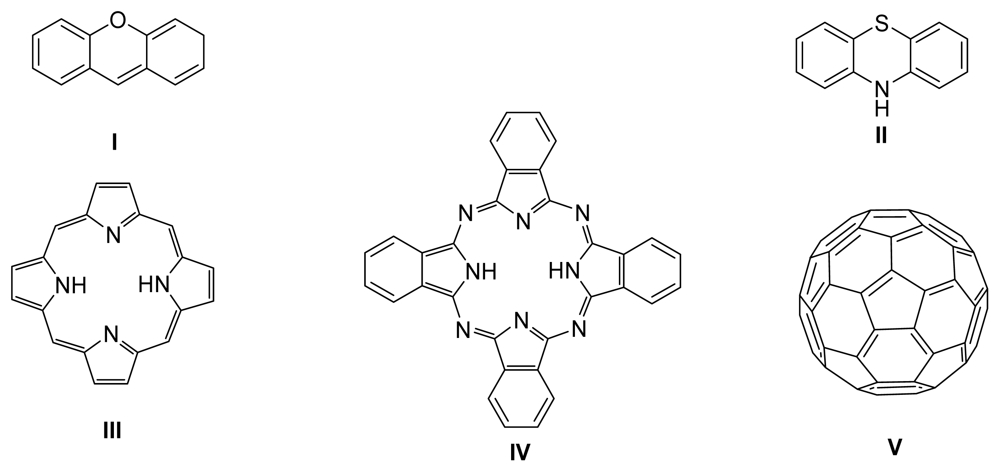
<p>A photosensitizer (PS) can be a natural or a synthetic compound which undergoes excitation after interaction with an appropriate radiation emitted from a light source. This gives rise to activated species (e.g., molecular oxygen) which are very reactive towards the chemical environment thus producing molecular consequences on important biological targets. For a compound to be considered for use in photodynamic treatment it must fulfill some properties which are application dependent. However, regardless of other requisites, all of the PS must have good absorption capacity at the wavelength of the spectral region where the light is emitted and show good efficiency to generate singlet oxygen [<xref ref-type="bibr" rid="b205-marinedrugs-07-00268">205</xref>–<xref ref-type="bibr" rid="b207-marinedrugs-07-00268">207</xref>]. The photosensitizing properties of organic dyes (such as rose bengal, eosin, and methylene blue), fullerenes [<xref ref-type="bibr" rid="b208-marinedrugs-07-00268">208</xref>], porphyrins (of natural and synthetic origin), phthalocyanines and related tetrapyrrolic macrocycles, were evaluated (<xref ref-type="fig" rid="f1-marinedrugs-07-00268">Figure 1</xref>).</p>
<p>In photodynamic treatment of cancer, three generations of PS can be identified. The first generation comprises the Haematoporphyrin derivative (HpD) and its analogues including Photofrin<sup>®</sup>, the first formulation approved for cancer treatment in several countries; second generation is constituted by structurally distinct compounds with long-wavelength absorption; and the third generation comprises the above mentioned structurally distinct compounds with long-wavelength absorption, but now bound to carriers for selective accumulation in the tumors (e.g., antibodies) [<xref ref-type="bibr" rid="b205-marinedrugs-07-00268">205</xref>].</p>
<p>Porphyrins and analogues have been the most promising compounds used in photochemotherapy. Their natural occurrence and the important role in vital processes such as photosynthesis, oxygen transport and storage were responsible for decades of research devoted to the establishment of new and efficient synthetic methodologies to prepare them. New and highly efficient synthetic routes have generated many porphyrin-like compounds with unique characteristics for their uses in several other applications such as oxidative catalysis [<xref ref-type="bibr" rid="b209-marinedrugs-07-00268">209</xref>,<xref ref-type="bibr" rid="b210-marinedrugs-07-00268">210</xref>] and as biomimetic model systems of the primary processes of photosynthesis [<xref ref-type="bibr" rid="b211-marinedrugs-07-00268">211</xref>,<xref ref-type="bibr" rid="b212-marinedrugs-07-00268">212</xref>]. Presently, the interest also includes the supramolecular units, namely molecular recognition in chemical receptors and sensors [<xref ref-type="bibr" rid="b213-marinedrugs-07-00268">213</xref>–<xref ref-type="bibr" rid="b215-marinedrugs-07-00268">215</xref>], as light-harvesting devices [<xref ref-type="bibr" rid="b216-marinedrugs-07-00268">216</xref>–<xref ref-type="bibr" rid="b219-marinedrugs-07-00268">219</xref>] and as materials for advanced technologies, mainly in nanosciences [<xref ref-type="bibr" rid="b220-marinedrugs-07-00268">220</xref>,<xref ref-type="bibr" rid="b221-marinedrugs-07-00268">221</xref>]. Nevertheless, the photodynamic treatment is certainly the most promising application of porphyrin-like compounds.</p>
<p>The photodynamic treatment efficiency, namely in the photoinactivation of microorganisms, depends on several factors such as the presence or absence of charge, charge distribution and the presence of peripheral substituents. The porphyrin skeleton is essentially hydrophobic. This feature may be an important factor affecting the preferential accumulation in cellular hydrophobic loci since such molecules must be able to get into cells by crossing lipid membranes which brings insolubility in water and physiological fluids. To overcome this fact, adequate formulations have to be used [<xref ref-type="bibr" rid="b222-marinedrugs-07-00268">222</xref>–<xref ref-type="bibr" rid="b224-marinedrugs-07-00268">224</xref>]. However, the structural modification of the porphyrinic core can provide the required peripheral substituents (like the carbohydrate residues, charge groups with positive charge) used to control water solubility and their affinity for target cells [<xref ref-type="bibr" rid="b225-marinedrugs-07-00268">225</xref>,<xref ref-type="bibr" rid="b226-marinedrugs-07-00268">226</xref>]. For instance, synthetic porphyrins may be transformed into cationic entities through the insertion of positively charged substituents in the peripheral positions of the macrocycle which may largely affect the kinetics and extent of binding with microbial cells [<xref ref-type="bibr" rid="b44-marinedrugs-07-00268">44</xref>,<xref ref-type="bibr" rid="b100-marinedrugs-07-00268">100</xref>,<xref ref-type="bibr" rid="b103-marinedrugs-07-00268">103</xref>]. The charge on a photosensitizing molecule plays an important role in its biological properties. Cationic <italic>meso</italic>-substituted porphyrins have been proved to be more efficient and more photostable in water disinfection than other cationic PS as methylene blue (phenothiazinium dye) and rose bengal (xanthene dye) [<xref ref-type="bibr" rid="b227-marinedrugs-07-00268">227</xref>].</p>
<p>The nature and distribution of some functional groups in the molecule make it hydrophobic, hydrophilic or amphiphilic. Information about these properties is important because they affect, in a crucial way, the photophysical parameters and the efficacy of the PS [<xref ref-type="bibr" rid="b228-marinedrugs-07-00268">228</xref>]. A chemical compound is amphiphilic if possesses both hydrophilic and hydrophobic characteristics. In the transport system of cell membranes, the lipid bilayer of the membrane allows for passive transport of hydrophobic molecules. This means that molecules that repel water may diffuse across the cellular membrane without the need for an active transport system, like that of adenosine 5′-triphosphate. Therefore, the hydrophobic PS can more easily diffuse across the cell membrane and improve the efficiency of photodynamic effect. But as mentioned, the PS must be in solution, so it needs to be hydrophilic. Therefore, the ideal PS must have both hydrophilic and hydrophobic properties, making it amphiphilic. There are some factors which increase the amphiphilic character of the porphyrins such as the asymmetric charge distribution at their peripheral positions, and charges combined in different patterns with highly lipophilic groups (e.g., trifluoromethyl groups) [<xref ref-type="bibr" rid="b229-marinedrugs-07-00268">229</xref>–<xref ref-type="bibr" rid="b235-marinedrugs-07-00268">235</xref>]. The increase in the amphiphilic character of the PS seems to enhance its affinity for microorganisms which helps a better accumulation in the cells/particles [<xref ref-type="bibr" rid="b231-marinedrugs-07-00268">231</xref>,<xref ref-type="bibr" rid="b235-marinedrugs-07-00268">235</xref>,<xref ref-type="bibr" rid="b236-marinedrugs-07-00268">236</xref>] accompanied by an increase in the photocytotoxic activity [<xref ref-type="bibr" rid="b233-marinedrugs-07-00268">233</xref>]. Besides lipophilicity properties, other important parameters in the make-up of the PS must be considered. The degree of ionization, electric charge, molecular size, non-specific protein binding are same of the other factors which influence the photodynamic therapy response [<xref ref-type="bibr" rid="b237-marinedrugs-07-00268">237</xref>].</p></sec>
<sec>
<title>3.2. Photodymamic Therapy and Its Clinic Applications</title>
<p>At the beginning of its history, the first photochemotherapeutic approach was applied in medicine in 1903 by Albert Jesionek and Hermann von Tappeiner to the treatment of patients with malignant skin lesions [<xref ref-type="bibr" rid="b238-marinedrugs-07-00268">238</xref>]. However, since the middle of the last century, photochemotherapy applied to microorganisms was forgotten mainly because of the discovery and massive production of antibiotics [<xref ref-type="bibr" rid="b202-marinedrugs-07-00268">202</xref>]. Nowadays, photochemotherapy applications are again found in medicine, namely in the treatment of tumours. Photodynamic therapy (PDT) is the name commonly given to photochemotherapy of cancer [<xref ref-type="bibr" rid="b200-marinedrugs-07-00268">200</xref>]. In PDT, the administered photosensitizing compound selectively accumulates in the target cells and local irradiation is employed on the lesion (visible light, normally laser light delivered by optical fibers) [<xref ref-type="bibr" rid="b201-marinedrugs-07-00268">201</xref>,<xref ref-type="bibr" rid="b239-marinedrugs-07-00268">239</xref>,<xref ref-type="bibr" rid="b240-marinedrugs-07-00268">240</xref>]. The combination of two nontoxic elements, i.e. drug and light in the presence of molecular oxygen in the surrounding medium results in the selective destruction of tissue [<xref ref-type="bibr" rid="b239-marinedrugs-07-00268">239</xref>] through very localized cytotoxic effect [<xref ref-type="bibr" rid="b201-marinedrugs-07-00268">201</xref>].</p>
<p>Since the 1990’s, PDT has been successfully employed in the treatment of many tumors, including skin cancer, oral cavity cancer, bronchial cancer, esophageal cancer, bladder cancer, head and neck tumors in addition to nonmalignant diseases [<xref ref-type="bibr" rid="b241-marinedrugs-07-00268">241</xref>]. Besides cancer treatment, a very successful PDT application (FDA approved) has been in ophthalmology, to treat age-related macular degeneration [<xref ref-type="bibr" rid="b242-marinedrugs-07-00268">242</xref>].</p>
<p>Although the main use of PDT has focused on cancer treatment, the worldwide emergence of antibiotic resistance amongst pathogenic bacteria has led to a major research effort to find alternative antibacterial therapeutics [<xref ref-type="bibr" rid="b243-marinedrugs-07-00268">243</xref>] to which, it is hypothesized, microorganisms will not easily be able to develop resistance.</p>
<p>Currently, photodynamic antimicrobial chemotherapy (PACT) is receiving considerable attention for its potentialities as a new form of antimicrobial treatment [<xref ref-type="bibr" rid="b44-marinedrugs-07-00268">44</xref>,<xref ref-type="bibr" rid="b203-marinedrugs-07-00268">203</xref>,<xref ref-type="bibr" rid="b206-marinedrugs-07-00268">206</xref>]. All studies that have examined the killing of antibiotic resistant bacteria by the combination of PS and light, have found them to be equally as susceptible as their native counterparts [<xref ref-type="bibr" rid="b203-marinedrugs-07-00268">203</xref>,<xref ref-type="bibr" rid="b204-marinedrugs-07-00268">204</xref>,<xref ref-type="bibr" rid="b244-marinedrugs-07-00268">244</xref>]. Studies carried out with porphyrin derivatives pointed out to the great potentialities of this type of compounds for biomedical applications [<xref ref-type="bibr" rid="b196-marinedrugs-07-00268">196</xref>,<xref ref-type="bibr" rid="b228-marinedrugs-07-00268">228</xref>]. Recent studies, in particular, have demonstrated that PACT can be effective in the selective inactivation of microorganisms and it can become a potential alternative for the treatment and eradication of microbial infections [<xref ref-type="bibr" rid="b202-marinedrugs-07-00268">202</xref>,<xref ref-type="bibr" rid="b245-marinedrugs-07-00268">245</xref>]. Because the delivery of visible light is almost by definition a localized process, PACT for infections is likely to be applied exclusively to localized disease, as opposed to systemic infections, such as bacteremia [<xref ref-type="bibr" rid="b202-marinedrugs-07-00268">202</xref>]. In contrast to PDT for cancer, where the PS is usually injected into the bloodstream and accumulates preferentially in the tumor cells, PACT for localized infections is thought to be carried out by local delivery of the PS into the infected area by several methods such as topical application, instillation, interstitial injection or aerosol delivery [<xref ref-type="bibr" rid="b202-marinedrugs-07-00268">202</xref>]. The key issues that need to be addressed considering the photoinactivation of microorganisms are the effectiveness of the treatment in destroying sufficient numbers of the disease-causing pathogens; effective selectivity of the PS for the microbes, thus avoiding an unacceptable degree of photodynamic damage to host tissue in the area of infection; and the avoidance of regrowth of the pathogens from a few survivors following the treatment [<xref ref-type="bibr" rid="b202-marinedrugs-07-00268">202</xref>]. One of the main applications of PACT in the clinical area consists in the sterilization of blood and blood products, preventing of viral contamination. Remarkably, the human immunodeficiency virus has been inactivated <italic>in vitro</italic> by PACT [<xref ref-type="bibr" rid="b207-marinedrugs-07-00268">207</xref>,<xref ref-type="bibr" rid="b246-marinedrugs-07-00268">246</xref>–<xref ref-type="bibr" rid="b250-marinedrugs-07-00268">250</xref>]. Further applications of PACT would be skin surface disinfection, decolonization of nasal MRSA and wound healing in the future [<xref ref-type="bibr" rid="b44-marinedrugs-07-00268">44</xref>,<xref ref-type="bibr" rid="b202-marinedrugs-07-00268">202</xref>,<xref ref-type="bibr" rid="b237-marinedrugs-07-00268">237</xref>,<xref ref-type="bibr" rid="b251-marinedrugs-07-00268">251</xref>]</p></sec>
<sec>
<title>3.3. Photodymamic Antimicrobial Therapy Application in the Environment</title>
<p>Currently, photodynamic antimicrobial therapy has been studied having in view not only its application to the clinical field, but also to the environmental area [<xref ref-type="bibr" rid="b204-marinedrugs-07-00268">204</xref>,<xref ref-type="bibr" rid="b227-marinedrugs-07-00268">227</xref>,<xref ref-type="bibr" rid="b232-marinedrugs-07-00268">232</xref>,<xref ref-type="bibr" rid="b233-marinedrugs-07-00268">233</xref>,<xref ref-type="bibr" rid="b235-marinedrugs-07-00268">235</xref>,<xref ref-type="bibr" rid="b236-marinedrugs-07-00268">236</xref>,<xref ref-type="bibr" rid="b244-marinedrugs-07-00268">244</xref>, <xref ref-type="bibr" rid="b252-marinedrugs-07-00268">252</xref>–<xref ref-type="bibr" rid="b269-marinedrugs-07-00268">269</xref>] (<xref ref-type="table" rid="t2-marinedrugs-07-00268">Table 2</xref>). This approach has been considered as a possibility for use in water disinfection [<xref ref-type="bibr" rid="b227-marinedrugs-07-00268">227</xref>,<xref ref-type="bibr" rid="b270-marinedrugs-07-00268">270</xref>]. Traditional water disinfection methods use chlorine, chlorine dioxide, ozone and ultraviolet radiation and are very efficient against a large range of microorganisms [<xref ref-type="bibr" rid="b271-marinedrugs-07-00268">271</xref>]. However, those treatments involve high costs and difficulties of implementation at large scale due to operational, personnel qualification and logistic deficits [<xref ref-type="bibr" rid="b271-marinedrugs-07-00268">271</xref>]. Ultraviolet radiation and ozone treatment are very expensive options to apply to a larger scale and disinfectants form toxic by-products, being the chlorine’s by-products the most toxic ones [<xref ref-type="bibr" rid="b272-marinedrugs-07-00268">272</xref>]. Effectiveness of PACT was observed on the destruction of faecal bacteria [<xref ref-type="bibr" rid="b227-marinedrugs-07-00268">227</xref>,<xref ref-type="bibr" rid="b253-marinedrugs-07-00268">253</xref>,<xref ref-type="bibr" rid="b273-marinedrugs-07-00268">273</xref>–<xref ref-type="bibr" rid="b277-marinedrugs-07-00268">277</xref>], viruses [<xref ref-type="bibr" rid="b278-marinedrugs-07-00268">278</xref>,<xref ref-type="bibr" rid="b279-marinedrugs-07-00268">279</xref>] and helminths eggs [<xref ref-type="bibr" rid="b280-marinedrugs-07-00268">280</xref>] in environmental waters.</p>
<p>The extension of the photodynamic principle to a new environmentally-friendly technology can become economically viable if the PS is immobilized on a solid matrix in order to allow the photoinactivation process and subsequent retention of the PS, after photodynamic action, to avoid the release of the PS to the water output [<xref ref-type="bibr" rid="b277-marinedrugs-07-00268">277</xref>,<xref ref-type="bibr" rid="b281-marinedrugs-07-00268">281</xref>]. As a consequence, some studies have developed PS immobilized on solid supports and the photodynamic inactivation (PI) against faecal bacteria was tested [<xref ref-type="bibr" rid="b232-marinedrugs-07-00268">232</xref>,<xref ref-type="bibr" rid="b275-marinedrugs-07-00268">275</xref>,<xref ref-type="bibr" rid="b277-marinedrugs-07-00268">277</xref>,<xref ref-type="bibr" rid="b281-marinedrugs-07-00268">281</xref>,<xref ref-type="bibr" rid="b282-marinedrugs-07-00268">282</xref>]. Bonnett <italic>et al.</italic> used a phthalocyanine immobilized on a polymeric membrane of chitosan in a model reactor of water disinfection [<xref ref-type="bibr" rid="b281-marinedrugs-07-00268">281</xref>]. They used an <italic>E. coli</italic> suspension of 10<sup>5</sup> cell mL<sup>−1</sup> representing the significant levels of water contamination. Also, when the dyed membrane was stored in the dark for nine months, the photodynamic action was still detectable, demonstrating the thermodynamic stability of the PS system. They concluded that with that model system, the photoinactivation with immobilized PS can be used to lower microbial levels in water flow systems and that might also have applications in water detoxification [<xref ref-type="bibr" rid="b281-marinedrugs-07-00268">281</xref>]. The same group also immobilized zinc phthalocyanines in a silicate matrix to test their photobactericidal properties on <italic>E. coli</italic> in model aqueous media. Although they obtained moderate PI, they concluded that phthalocyanines can be immobilized successfully in a silicate matrix and also used for photodisinfection of microbially polluted waters [<xref ref-type="bibr" rid="b232-marinedrugs-07-00268">232</xref>,<xref ref-type="bibr" rid="b275-marinedrugs-07-00268">275</xref>,<xref ref-type="bibr" rid="b277-marinedrugs-07-00268">277</xref>,<xref ref-type="bibr" rid="b281-marinedrugs-07-00268">281</xref>,<xref ref-type="bibr" rid="b282-marinedrugs-07-00268">282</xref>]. Regenerated cellulose impregnated with 5,10,15,20-tetrakis(1-methylpyridinium-4-yl)porphyrin tetra-<italic>p</italic>-tosylate showed photobactericidal activity against <italic>S. aureus</italic>, <italic>E. coli</italic>, <italic>Proteus vulgaris</italic> and <italic>Bacillus subtilis</italic> [<xref ref-type="bibr" rid="b275-marinedrugs-07-00268">275</xref>]. Two mono-hydroxyl zinc-porphyrin derivatives were immobilized on poly(methyl methacrylate), with respectively anionic and cationic net charge. The cationic derivative immobilized on poly(methyl methacrylate) polymer showed to have effective inhibitory effect in the photoinactivation of <italic>Deinococcus radiodurans</italic> [<xref ref-type="bibr" rid="b283-marinedrugs-07-00268">283</xref>]. Krouit <italic>et al.</italic> showed efficient photoinactivation of Gram-positive and Gram-negative bacterial strains by cellulose films with immobilized porphyrin derivatives [<xref ref-type="bibr" rid="b284-marinedrugs-07-00268">284</xref>–<xref ref-type="bibr" rid="b286-marinedrugs-07-00268">286</xref>]. Presently, new inorganic-organic hybrids (‘smart’ materials) based on tricationic porphyrin derivatives are also used at the photoinactivation of a large spectrum of microorganisms [<xref ref-type="bibr" rid="b287-marinedrugs-07-00268">287</xref>]. Preliminary results obtained with a tricationic porphyrin derivative immobilized in nanoparticles showed that inorganic-organic hybrids present antimicrobial activity and allows the recovery and recycling of the photosensitizing agent [<xref ref-type="bibr" rid="b287-marinedrugs-07-00268">287</xref>–<xref ref-type="bibr" rid="b289-marinedrugs-07-00268">289</xref>]. One of the tested inorganic-organic hybrids was able to inactivate Gram-positive, Gram-negative and T4-like bacteriophage to the limits of detection (up to 7 logs of inactivation) as the PS did in the unbound form [<xref ref-type="bibr" rid="b288-marinedrugs-07-00268">288</xref>,<xref ref-type="bibr" rid="b289-marinedrugs-07-00268">289</xref>]. Besides, Jiménez-Hernández <italic>et al</italic>. used as sensitizers, Ru(II) polypyridyl complexes grafted to polymer in a homemade microreactor with a solar simulator source for laboratory-scale water disinfection assays using a water sample containing <italic>E. coli</italic> and <italic>Enterococcus faecalis</italic> (2 × 10<sup>3</sup> CFU mL<sup>−1</sup>). They concluded that photodisinfection with visible light was significant against both microorganisms [<xref ref-type="bibr" rid="b277-marinedrugs-07-00268">277</xref>].</p></sec>
<sec>
<title>3.4. Photodynamic Antimicrobial Therapy Application in Fish Farm Plants</title>
<p>Although just a few studies have been conducted in this field (<xref ref-type="table" rid="t2-marinedrugs-07-00268">Table 2</xref>), preliminary results obtained at both laboratory level and pilot station suggest that the photochemical technique, using porphyrin derivatives as PS, has a great potential also for the disinfection of fish farming plant waters [<xref ref-type="bibr" rid="b100-marinedrugs-07-00268">100</xref>,<xref ref-type="bibr" rid="b290-marinedrugs-07-00268">290</xref>]. These studies showed that cell cultures of Gram-positive bacteria (e.g., meticillin-resistant <italic>S. aureus</italic>), Gram-negative bacteria (e.g., <italic>E. coli</italic>), fungal (e.g., <italic>C. albicans</italic>) and fungal-like pathogens (e.g., <italic>Saprolegnia</italic> spp.) and parasitic protozoa (e.g., <italic>Acanthamoeba palestinensis</italic>) showed a 5–6 log decrease in the microbial population after 10 minutes of irradiation with low light intensities (ca. 50 mW cm<sup>−2</sup>) in the presence of micromolar PS doses [<xref ref-type="bibr" rid="b290-marinedrugs-07-00268">290</xref>]. Magaraggia <italic>et al</italic>. have also shown that a micromolar concentration of a porphyrinic PS promoted the cure of saprolegniosis in trout-farming pools containing naturally or artificially <italic>Saprolegnia</italic> infected fish (inactivation of 6–7 logs) without perilesional damage of the fish. A stock of fish were transferred to a 1,000 L tank and, after acclimatization, skin fish was infected by scraping dorsal trout epidermis and inoculated with <italic>Saprolegnia</italic> by direct contact of the lesions with mycelium wads. The infected group was dark incubated with 0.6 mg L<sup>−1</sup> for 10 min in an 80–150 L pool and irradiated for 1 h kept in a closed circuit and recirculated by a motor-driven pump. The irradiation was performed by using the 400–800 nm wavelength interval emitted from two 100 W incandescent filament lamps and the water temperature was kept at 13 °C throughout the light exposure. The treatment was daily repeated for six consecutive days. After each treatment repetition, fish were moved to a 1,000 L tank. The onset of the infection in healthy fish was reduced about 50%. Recurrence of the saprolegniosis in the <italic>Saprolegnia</italic> infected sites or in others sites of the fish was not observed. The trout set with spontaneous infection by <italic>Saprolegnia</italic> a complete remission of the infection was induced within one week. The same micromolar concentrations exhibited also higher photosensitizing activity over meticillin-resistant <italic>S. aureus</italic> and <italic>E. coli</italic> (up 7 logs decrease) [<xref ref-type="bibr" rid="b100-marinedrugs-07-00268">100</xref>]. The antimicrobial effects of PDT were also demonstrated for <italic>V. vulnificus</italic> that frequently infects fish farming water [<xref ref-type="bibr" rid="b291-marinedrugs-07-00268">291</xref>]. Similarly, ten bacterial species (<italic>V. anguilarum, V. parahaemolyticus</italic>, <italic>Photobacterium damselae</italic> subsp. <italic>damselae</italic>, <italic>Photobacterium damselae</italic> subsp. <italic>piscicida</italic>, <italic>A. salmonicida</italic>, <italic>E. coli</italic>, <italic>Enterobacter</italic>, <italic>S. aureus</italic>, <italic>E. faecalis</italic>, <italic>Pseudomonas</italic> sp.) isolated from a fish farming plant waters were effectively inactivated (up to 7 logs) <italic>in vitro</italic> with cationic porphyrins, at micromolar PS doses, after 90–270 minutes of irradiation with a very low light intensity of 4 mW cm<sup>−2</sup> [<xref ref-type="bibr" rid="b292-marinedrugs-07-00268">292</xref>], showing that photodynamic therapy can be used to photoinactivate fish bacterial pathogens in fish farm waters even during dark days of winter time. In these experiments fifty milliliters of bacterial suspensions from bacterial cultures (~10<sup>8</sup> cells mL<sup>−1</sup>) were diluted ten-fold in phosphate buffered saline to a final concentration of ~ 10<sup>7</sup> colony forming units mL<sup>−1</sup> and exposed, in 600 mL glass beakers, to the PS under the white light. Bacterial inactivation was evaluated by counting the number of colonies, by pour plating method, in the exposed samples.</p>
<p>Irradiation of fish farming waters by solar light, which penetrates deeply into the water column, thereby allowing the uniform illumination of large volumes [<xref ref-type="bibr" rid="b293-marinedrugs-07-00268">293</xref>] makes this technology inexpensive since it is based on the use of low cost visible light sources.</p>
<p>The promising results of PACT on a large range of microorganisms, Gram-positive and Gram-negative bacteria including multidrug-resistant strains, bacterial spores, virus, bacteriophages, yeasts and helminths eggs [<xref ref-type="bibr" rid="b233-marinedrugs-07-00268">233</xref>,<xref ref-type="bibr" rid="b243-marinedrugs-07-00268">243</xref>,<xref ref-type="bibr" rid="b255-marinedrugs-07-00268">255</xref>,<xref ref-type="bibr" rid="b256-marinedrugs-07-00268">256</xref>,<xref ref-type="bibr" rid="b267-marinedrugs-07-00268">267</xref>,<xref ref-type="bibr" rid="b273-marinedrugs-07-00268">273</xref>,<xref ref-type="bibr" rid="b274-marinedrugs-07-00268">274</xref>,<xref ref-type="bibr" rid="b276-marinedrugs-07-00268">276</xref>,<xref ref-type="bibr" rid="b279-marinedrugs-07-00268">279</xref>,<xref ref-type="bibr" rid="b294-marinedrugs-07-00268">294</xref>–<xref ref-type="bibr" rid="b299-marinedrugs-07-00268">299</xref>] and the knowledge that the porphyrins’ mode of action make the selection of photoresistant strains very unlikely [<xref ref-type="bibr" rid="b237-marinedrugs-07-00268">237</xref>,<xref ref-type="bibr" rid="b300-marinedrugs-07-00268">300</xref>], suggest that this principle can be applied to photodecontamination of fish farming plants, in order to destroy pathogenic microorganisms. To implement this technology in fish farming plants some studies will be need to be carried out, namely pertaining to the determination of the stability of the new hybrid-porphyrin conjugates under visible light irradiation conditions. Moreover, there are no studies on the impact that this procedure might have on the total microbial community structure after treatment.</p></sec>
<sec>
<title>3.5. Advantages of Photodynamic Antimicrobial Chemotherapy over other Treatments in the Environment</title>
<p>The main favorable aspects of PACT for environmental use are the following [<xref ref-type="bibr" rid="b44-marinedrugs-07-00268">44</xref>,<xref ref-type="bibr" rid="b251-marinedrugs-07-00268">251</xref>]: (1) a broad spectrum of action: the PS inactivates efficiently bacteria, viruses, fungi, and parasites in both the dormant and vegetative states contrarily to chemotherapy and phage therapy; (2) an efficient phototoxic activity against both wild and antibiotic-resistant microbial strains; (3) the lack of selection of photoresistant microbial species; (4) a low mutagenic potential; (5) a high selectivity in the killing of pathogens as compared with the main constituents of potential host tissues; (6) a high selectivity in space and time: the microsecond short lifetime and high reactivity of singlet oxygen (the main pathway of PACT inactivation), restricts the photooxidative damage to the microenvironment of the site where it is generated to about 0.1 μm [<xref ref-type="bibr" rid="b194-marinedrugs-07-00268">194</xref>,<xref ref-type="bibr" rid="b195-marinedrugs-07-00268">195</xref>]; (7) the lack of generation of potentially dangerous or toxic by-products from photoinduced degradation of the photosensitizing agent; (8) cost-effective technology, as it is based on the use of visible light sources, as solar irradiation; (9) the possibility to reuse the immobilized PS which makes this technology less expensive and avoids its diffusion to the environment, preventing any risk of environmental contamination.</p></sec></sec>
<sec sec-type="conclusions">
<title>Conclusions</title>
<p>The possibility to inactivate fish pathogenic microorganisms with phages and/or immobilized photosensitizers is outstanding, being the major advantage the efficient water disinfection degree obtained without risk to fishes or to the environment. The safety of the photodynamic therapy approach is increased as porphyrin derivatives apparently do not induce the selection of resistant microbial strains. Although, in some cases, phage therapy approach can lead to the selection of resistant bacteria, its occurrence and impact is not as so frequent and harmful as antibiotics chemotherapy.</p>
<p>The new approaches described in this review are intrinsically low cost compared to the chemical compound normally used in aquaculture systems and are conceived to be environmentally-friendly and to exhibit a high level of safety for various ecosystems, as well as for humans, animals and plants.</p>
<p>More studies are needed in order to gather a detailed understanding of phage-bacterium and of photosensitizer-microorganisms interactions in aquaculture systems subjected to different environmental pressure. A better understanding of phage therapy and of photodynamic therapy as adjuvant use of antibiotics and/or other disinfectant in fish farming plants also need to be further studied.</p>
<p>Each of the two techniques has its advantages but also its limitations. The application of phage and of photodynamic therapies must be based on a careful evaluation of each case, before replacing conventional approaches. Nevertheless, a good biocontrol management strategy might be the use of more than one technique in rotation to prevent resistance development. Alternatively, it might be valuable to apply both techniques to maximize protection against pathogenic microorganisms.</p></sec></body>
<back>
<ref-list>
<title>References and Notes</title>
<ref id="b1-marinedrugs-07-00268"><label>1</label><citation citation-type="book"><person-group person-group-type="author"><name><surname>Pillay</surname><given-names>TVR</given-names></name><name><surname>Kutty</surname><given-names>MN</given-names></name></person-group><source>Aquaculture: Principles and Practices</source><publisher-name>Wiley-Blackwell</publisher-name><publisher-loc>Oxford, UK</publisher-loc><year>2005</year></citation></ref>
<ref id="b2-marinedrugs-07-00268"><label>2</label><citation citation-type="book"><collab>FAO</collab><source>The State of World Fisheries and Aquaculture-2008</source><publisher-name>FAO Fisheries and Aquaculture Department</publisher-name><publisher-loc>Rome, Italy</publisher-loc><year>2009</year></citation></ref>
<ref id="b3-marinedrugs-07-00268"><label>3</label><citation citation-type="book"><collab>FAO</collab><source>The State of World Fisheries and Aquaculture</source><publisher-name>FAO Fisheries and Aquaculture Department</publisher-name><publisher-loc>Rome, Italy</publisher-loc><year>1998</year></citation></ref>
<ref id="b4-marinedrugs-07-00268"><label>4</label><citation citation-type="journal"><person-group person-group-type="author"><name><surname>Flegel</surname><given-names>TW</given-names></name></person-group><article-title>Detection of major penaeid shrimp viruses in Asia, a historical perspective with emphasis on Thailand</article-title><source>Aquaculture</source><year>2006</year><volume>258</volume><fpage>1</fpage><lpage>33</lpage><pub-id pub-id-type="doi">10.1016/j.aquaculture.2006.05.013</pub-id></citation></ref>
<ref id="b5-marinedrugs-07-00268"><label>5</label><citation citation-type="confproc"><person-group person-group-type="author"><name><surname>Subasinghe</surname><given-names>RP</given-names></name><name><surname>Bondad-Reantaso</surname><given-names>MG</given-names></name><name><surname>McGladdery</surname><given-names>SE</given-names></name></person-group><person-group person-group-type="editor"><name><surname>Subasinghe</surname><given-names>RP</given-names></name><name><surname>Bueno</surname><given-names>P</given-names></name><name><surname>Phillips</surname><given-names>MJ</given-names></name><name><surname>Hough</surname><given-names>C</given-names></name><name><surname>McGladdery</surname><given-names>SE</given-names></name><name><surname>Arthur</surname><given-names>JR</given-names></name></person-group><article-title>Aquaculture development, health and wealth</article-title><source>Aquaculture in the Millennium. Technical Proceedings of the Conference on Aquaculture in the Third Millennium</source><conf-loc>Bangkok, Thailand</conf-loc><year>2001</year></citation></ref>
<ref id="b6-marinedrugs-07-00268"><label>6</label><citation citation-type="confproc"><person-group person-group-type="author"><name><surname>Saksida</surname><given-names>S</given-names></name><name><surname>Constantine</surname><given-names>J</given-names></name><name><surname>Karreman</surname><given-names>GA</given-names></name><name><surname>Neville</surname><given-names>C</given-names></name><name><surname>Sweeting</surname><given-names>R</given-names></name><name><surname>Beamish</surname><given-names>R</given-names></name></person-group><article-title>Evaluation of sea lice, Lepeophtheirus salmonis, abundance levels on farmed salmon in British Columbia, Canada</article-title><conf-name>The Proceedings from the International Symposium on Veterinary Epidemiology and Economics XI</conf-name><conf-loc>Cairns, Australia</conf-loc><year>2006</year></citation></ref>
<ref id="b7-marinedrugs-07-00268"><label>7</label><citation citation-type="journal"><person-group person-group-type="author"><name><surname>Alderman</surname><given-names>DJ</given-names></name></person-group><article-title>Geographical spread of bacterial and fungal diseases of crustaceans</article-title><source>Rev Sci Tech OIE</source><year>1996</year><fpage>603</fpage><lpage>632</lpage></citation></ref>
<ref id="b8-marinedrugs-07-00268"><label>8</label><citation citation-type="journal"><person-group person-group-type="author"><name><surname>Shao</surname><given-names>ZJ</given-names></name></person-group><article-title>Aquaculture pharmaceuticals and biologicals: current perspectives and future possibilities</article-title><source>Adv Drug Delivery Rev</source><year>2001</year><volume>50</volume><fpage>229</fpage><lpage>243</lpage><pub-id pub-id-type="doi">10.1016/S0169-409X(01)00159-4</pub-id></citation></ref>
<ref id="b9-marinedrugs-07-00268"><label>9</label><citation citation-type="journal"><person-group person-group-type="author"><name><surname>Wahli</surname><given-names>T</given-names></name><name><surname>Knuesel</surname><given-names>R</given-names></name><name><surname>Bernet</surname><given-names>D</given-names></name><name><surname>Segner</surname><given-names>H</given-names></name><name><surname>Pugovkin</surname><given-names>D</given-names></name><name><surname>Burkhardt-Holm</surname><given-names>P</given-names></name><name><surname>Escher</surname><given-names>M</given-names></name><name><surname>Schmidt-Posthaus</surname><given-names>H</given-names></name></person-group><article-title>Proliferative kidney disease in Switzerland: current state of knowledge</article-title><source>J Fish Dis</source><year>2002</year><volume>25</volume><fpage>491</fpage><lpage>500</lpage><pub-id pub-id-type="doi">10.1046/j.1365-2761.2002.00401.x</pub-id></citation></ref>
<ref id="b10-marinedrugs-07-00268"><label>10</label><citation citation-type="journal"><person-group person-group-type="author"><name><surname>Muroga</surname><given-names>K</given-names></name><name><surname>Iida</surname><given-names>M</given-names></name><name><surname>Matsumoto</surname><given-names>H</given-names></name><name><surname>Nakai</surname><given-names>T</given-names></name></person-group><article-title>Detection of <italic>Vibrio anguillarum</italic> from waters</article-title><source>Nippon Suisan Gakk</source><year>1986</year><volume>52</volume><fpage>641</fpage><lpage>647</lpage><pub-id pub-id-type="doi">10.2331/suisan.52.641</pub-id></citation></ref>
<ref id="b11-marinedrugs-07-00268"><label>11</label><citation citation-type="journal"><person-group person-group-type="author"><name><surname>Muroga</surname><given-names>K</given-names></name><name><surname>Tanasomwang</surname><given-names>V</given-names></name><name><surname>Momoyama</surname><given-names>K</given-names></name></person-group><article-title><italic>Vibrio anguillarum</italic> infection in juveniles of tiger puffer (<italic>Takifugu rubripes</italic>)</article-title><source>Fish Pathol</source><year>1987</year><volume>22</volume><fpage>29</fpage><lpage>30</lpage><pub-id pub-id-type="doi">10.3147/jsfp.22.29</pub-id></citation></ref>
<ref id="b12-marinedrugs-07-00268"><label>12</label><citation citation-type="journal"><person-group person-group-type="author"><name><surname>Nakai</surname><given-names>T</given-names></name><name><surname>Park</surname><given-names>SC</given-names></name></person-group><article-title>Bacteriophage therapy of infectious diseases in aquaculture</article-title><source>Res Microbiol</source><year>2002</year><volume>153</volume><fpage>13</fpage><lpage>18</lpage><pub-id pub-id-type="doi">10.1016/S0923-2508(01)01280-3</pub-id><pub-id pub-id-type="pmid">11881893</pub-id></citation></ref>
<ref id="b13-marinedrugs-07-00268"><label>13</label><citation citation-type="journal"><person-group person-group-type="author"><name><surname>Fukuda</surname><given-names>Y</given-names></name><name><surname>Nguyen</surname><given-names>HD</given-names></name><name><surname>Furuhashi</surname><given-names>M</given-names></name><name><surname>Nakai</surname><given-names>T</given-names></name></person-group><article-title>Mass mortality of cultured sevenband grouper, <italic>Epinephelus septemfasciatus</italic>, associated with viral nervous necrosis</article-title><source>Fish Pathol</source><year>1996</year><volume>31</volume><fpage>165</fpage><lpage>170</lpage><pub-id pub-id-type="doi">10.3147/jsfp.31.165</pub-id></citation></ref>
<ref id="b14-marinedrugs-07-00268"><label>14</label><citation citation-type="journal"><person-group person-group-type="author"><name><surname>Iida</surname><given-names>H</given-names></name><name><surname>Tanaka</surname><given-names>S</given-names></name><name><surname>Shibata</surname><given-names>Y</given-names></name></person-group><article-title>Small GTP-binding protein, Rab6, is associated with secretory granules in atrial myocytes</article-title><source>Am J Physiol Cell Physiol</source><year>1997</year><volume>272</volume><fpage>1594</fpage><lpage>1601</lpage></citation></ref>
<ref id="b15-marinedrugs-07-00268"><label>15</label><citation citation-type="journal"><person-group person-group-type="author"><name><surname>Nakai</surname><given-names>T</given-names></name><name><surname>Sugimoto</surname><given-names>R</given-names></name><name><surname>Park</surname><given-names>K</given-names></name><name><surname>Matsuoka</surname><given-names>S</given-names></name><name><surname>Mori</surname><given-names>K</given-names></name><name><surname>Nishioka</surname><given-names>T</given-names></name><name><surname>Maruyama</surname><given-names>K</given-names></name></person-group><article-title>Protective effects of bacteriophage on experimental <italic>Lactococcus garvieae</italic> infection in yellowtail</article-title><source>Dis Aquat Org</source><year>1999</year><volume>37</volume><fpage>33</fpage><lpage>41</lpage><pub-id pub-id-type="doi">10.3354/dao037033</pub-id><pub-id pub-id-type="pmid">10439901</pub-id></citation></ref>
<ref id="b16-marinedrugs-07-00268"><label>16</label><citation citation-type="confproc"><person-group person-group-type="author"><name><surname>Huss</surname><given-names>BCR</given-names></name></person-group><article-title>Gershom Scholem's major trends in Jewish Mysticism: 50 years after</article-title><conf-name>Proceedings of the Sixth International Conference on the History of Jewish Mysticism</conf-name><year>1994</year><fpage>1265</fpage><lpage>1267</lpage></citation></ref>
<ref id="b17-marinedrugs-07-00268"><label>17</label><citation citation-type="confproc"><person-group person-group-type="author"><name><surname>Noya</surname><given-names>M</given-names></name><name><surname>Magarinos</surname><given-names>B</given-names></name><name><surname>Lamas</surname><given-names>J</given-names></name></person-group><article-title>La administracion intraperitoneal y oral de glucano afecta al sistema immune no especifico y a la resistencia de la dorada, <italic>Sparus aurata</italic>, a la pasteurelosis</article-title><conf-name>Proceedings of the Fifth National Congress of Aquaculture</conf-name><conf-loc>Sant Carles de la Rapita, Spain</conf-loc><year>1995</year><fpage>734</fpage><lpage>738</lpage></citation></ref>
<ref id="b18-marinedrugs-07-00268"><label>18</label><citation citation-type="journal"><person-group person-group-type="author"><name><surname>Toranzo</surname><given-names>AE</given-names></name><name><surname>Barreiro</surname><given-names>S</given-names></name><name><surname>Casal</surname><given-names>JF</given-names></name><name><surname>Figueras</surname><given-names>A</given-names></name><name><surname>Magariños</surname><given-names>B</given-names></name><name><surname>Barja</surname><given-names>JL</given-names></name></person-group><article-title>Pasteurellosis in cultured gilthead seabream, <italic>Sparus aurata</italic>: first report in Spain</article-title><source>Aquaculture</source><year>1991</year><volume>99</volume><fpage>1</fpage><lpage>15</lpage><pub-id pub-id-type="doi">10.1016/0044-8486(91)90284-E</pub-id></citation></ref>
<ref id="b19-marinedrugs-07-00268"><label>19</label><citation citation-type="journal"><person-group person-group-type="author"><name><surname>Thyssen</surname><given-names>A</given-names></name><name><surname>Ollevier</surname><given-names>F</given-names></name></person-group><article-title><italic>In vitro</italic> antimicrobial susceptibility of <italic>Photobacterium damselae</italic> subsp. <italic>piscicida</italic> to 15 different antimicrobial agents</article-title><source>Aquaculture</source><year>2001</year><volume>200</volume><fpage>259</fpage><lpage>269</lpage><pub-id pub-id-type="doi">10.1016/S0044-8486(01)00517-8</pub-id></citation></ref>
<ref id="b20-marinedrugs-07-00268"><label>20</label><citation citation-type="journal"><person-group person-group-type="author"><name><surname>Fryer</surname><given-names>JL</given-names></name><name><surname>Lannan</surname><given-names>CN</given-names></name></person-group><article-title>Rickettsial infections of fish</article-title><source>Annu Rev Fish Dis</source><year>1996</year><volume>6</volume><fpage>3</fpage><lpage>13</lpage><pub-id pub-id-type="doi">10.1016/S0959-8030(96)90002-2</pub-id></citation></ref>
<ref id="b21-marinedrugs-07-00268"><label>21</label><citation citation-type="book"><person-group person-group-type="author"><name><surname>Bernoth</surname><given-names>EM</given-names></name></person-group><source>Furunculosis: multidisciplinary fish disease research</source><publisher-name>Elsevier Academic Press</publisher-name><publisher-loc>San Diego, CA, USA</publisher-loc><year>1997</year></citation></ref>
<ref id="b22-marinedrugs-07-00268"><label>22</label><citation citation-type="journal"><person-group person-group-type="author"><name><surname>Nakatsugawa</surname><given-names>T</given-names></name></person-group><article-title><italic>Edwardsiella tarda</italic> isolated from cultured young flounder</article-title><source>Fish Pathol</source><year>1983</year><volume>18</volume><fpage>99</fpage><lpage>101</lpage><pub-id pub-id-type="doi">10.3147/jsfp.18.99</pub-id></citation></ref>
<ref id="b23-marinedrugs-07-00268"><label>23</label><citation citation-type="journal"><person-group person-group-type="author"><name><surname>Mekuchi</surname><given-names>T</given-names></name><name><surname>Kiyokawa</surname><given-names>T</given-names></name><name><surname>Honda</surname><given-names>K</given-names></name><name><surname>Nakai</surname><given-names>T</given-names></name><name><surname>Muroga</surname><given-names>K</given-names></name></person-group><article-title>Vaccination trials in the Japanese flounder against Edwardsiellosis</article-title><source>Fish Pathol</source><year>1995</year><volume>30</volume><fpage>251</fpage><lpage>256</lpage><pub-id pub-id-type="doi">10.3147/jsfp.30.251</pub-id></citation></ref>
<ref id="b24-marinedrugs-07-00268"><label>24</label><citation citation-type="journal"><person-group person-group-type="author"><name><surname>Kusuda</surname><given-names>R</given-names></name><name><surname>Kimura</surname><given-names>H</given-names></name></person-group><article-title>Characteristics of gliding bacterium isolated from cultured yellowtail <italic>Seriola quinqueradiata</italic></article-title><source>Bull Japan Soc Sci Fish</source><year>1982</year><volume>48</volume><fpage>1107</fpage><lpage>1112</lpage><pub-id pub-id-type="doi">10.2331/suisan.48.1107</pub-id></citation></ref>
<ref id="b25-marinedrugs-07-00268"><label>25</label><citation citation-type="journal"><person-group person-group-type="author"><name><surname>Wakabayashi</surname><given-names>H</given-names></name><name><surname>Hikida</surname><given-names>M</given-names></name><name><surname>Masumura</surname><given-names>K</given-names></name></person-group><article-title><italic>Flexibacter</italic> infection in cultured marine fish in Japan</article-title><source>Helgolander Meeresun</source><year>1984</year><volume>37</volume><fpage>587</fpage><lpage>593</lpage></citation></ref>
<ref id="b26-marinedrugs-07-00268"><label>26</label><citation citation-type="journal"><person-group person-group-type="author"><name><surname>Hamaguchi</surname><given-names>M</given-names></name><name><surname>Kawahara</surname><given-names>I</given-names></name><name><surname>Usuki</surname><given-names>H</given-names></name></person-group><article-title>Mass mortality of <italic>Pseudocentrotus depressus</italic> caused by a bacterial infection in summer</article-title><source>Suisan Zoshoku</source><year>1993</year><volume>41</volume><fpage>189</fpage><lpage>193</lpage></citation></ref>
<ref id="b27-marinedrugs-07-00268"><label>27</label><citation citation-type="journal"><person-group person-group-type="author"><name><surname>Park</surname><given-names>SC</given-names></name><name><surname>Shimamura</surname><given-names>I</given-names></name><name><surname>Fukunaga</surname><given-names>M</given-names></name><name><surname>Mori</surname><given-names>K-I</given-names></name><name><surname>Nakai</surname><given-names>T</given-names></name></person-group><article-title>Isolation of bacteriophages specific to a fish pathogen, <italic>Pseudomonas plecoglossicida</italic>, as a candidate for disease control</article-title><source>Appl Environ Microbiol</source><year>2000</year><volume>66</volume><fpage>1416</fpage><lpage>1422</lpage><pub-id pub-id-type="doi">10.1128/AEM.66.4.1416-1422.2000</pub-id><pub-id pub-id-type="pmid">10742221</pub-id></citation></ref>
<ref id="b28-marinedrugs-07-00268"><label>28</label><citation citation-type="journal"><person-group person-group-type="author"><name><surname>Munn</surname><given-names>CB</given-names></name></person-group><article-title>Viruses as pathogens of marine organisms-from bacteria to whales</article-title><source>J Mar Biol Ass UK</source><year>2006</year><volume>86</volume><fpage>453</fpage><lpage>467</lpage><pub-id pub-id-type="doi">10.1017/S002531540601335X</pub-id></citation></ref>
<ref id="b29-marinedrugs-07-00268"><label>29</label><citation citation-type="journal"><person-group person-group-type="author"><name><surname>Sorimachi</surname><given-names>M</given-names></name><name><surname>Hara</surname><given-names>T</given-names></name></person-group><article-title>Characteristics and pathogenicity of a virus isolated from yellowtail fingerlings showing ascites</article-title><source>Fish Pathol</source><year>1985</year><volume>19</volume><fpage>231</fpage><lpage>238</lpage><pub-id pub-id-type="doi">10.3147/jsfp.19.231</pub-id></citation></ref>
<ref id="b30-marinedrugs-07-00268"><label>30</label><citation citation-type="journal"><person-group person-group-type="author"><name><surname>Iida</surname><given-names>Y</given-names></name><name><surname>Masumura</surname><given-names>K</given-names></name><name><surname>Nakai</surname><given-names>T</given-names></name><name><surname>Sorimachi</surname><given-names>M</given-names></name><name><surname>Matsuda</surname><given-names>H</given-names></name></person-group><article-title>A viral disease in larvae and juveniles of the Japanese flounder <italic>Paralichthys olivaceus</italic></article-title><source>J Aquat Anim Health</source><year>1989</year><volume>1</volume><fpage>7</fpage><lpage>12</lpage><pub-id pub-id-type="doi">10.1577/1548-8667(1989)001&lt;0007:AVDILA&gt;2.3.CO;2</pub-id></citation></ref>
<ref id="b31-marinedrugs-07-00268"><label>31</label><citation citation-type="journal"><person-group person-group-type="author"><name><surname>Kusuda</surname><given-names>R</given-names></name><name><surname>Kawai</surname><given-names>K</given-names></name></person-group><article-title>Bacterial diseases of cultured marine fish in Japan</article-title><source>Fish Pathol</source><year>1998</year><volume>33</volume><fpage>221</fpage><lpage>227</lpage><pub-id pub-id-type="doi">10.3147/jsfp.33.221</pub-id></citation></ref>
<ref id="b32-marinedrugs-07-00268"><label>32</label><citation citation-type="journal"><person-group person-group-type="author"><name><surname>Miyazaki</surname><given-names>T</given-names></name><name><surname>Fujiwara</surname><given-names>K</given-names></name><name><surname>Kobara</surname><given-names>J</given-names></name><name><surname>Matsumoto</surname><given-names>N</given-names></name><name><surname>Abe</surname><given-names>M</given-names></name><name><surname>Nagano</surname><given-names>T</given-names></name></person-group><article-title>Histopathology associated with two viral diseases of larval and juvenile fishes: epidermal necrosis of the Japanese flounder <italic>Paralichthys olivaceus</italic> and epithelial necrosis of black sea bream <italic>Acanthopagrus schlegeli</italic></article-title><source>J Aquat Anim Health</source><year>1989</year><volume>1</volume><fpage>85</fpage><lpage>93</lpage><pub-id pub-id-type="doi">10.1577/1548-8667(1989)001&lt;0085:HAWTVD&gt;2.3.CO;2</pub-id></citation></ref>
<ref id="b33-marinedrugs-07-00268"><label>33</label><citation citation-type="journal"><person-group person-group-type="author"><name><surname>Nakatsugawa</surname><given-names>T</given-names></name></person-group><article-title>Studies on amyotrophia of Japanese black abalone, <italic>Nordotis discus discus</italic></article-title><source>Kyoto Inst Ocean Fish Sci</source><year>2000</year><issue>Spec. Rep. 5</issue><fpage>1</fpage><lpage>61</lpage></citation></ref>
<ref id="b34-marinedrugs-07-00268"><label>34</label><citation citation-type="book"><person-group person-group-type="author"><name><surname>Vlak</surname><given-names>JM</given-names></name><name><surname>Bonami</surname><given-names>JR</given-names></name><name><surname>Flegel</surname><given-names>TW</given-names></name><name><surname>Kou</surname><given-names>GH</given-names></name><name><surname>Lightner</surname><given-names>DV</given-names></name><name><surname>Loh</surname><given-names>CF</given-names></name><name><surname>Loh</surname><given-names>PC</given-names></name><name><surname>Walker</surname><given-names>PW</given-names></name></person-group><person-group person-group-type="editor"><name><surname>Fauquet</surname><given-names>CM</given-names></name><name><surname>Mayo</surname><given-names>MA</given-names></name><name><surname>Maniloff</surname><given-names>J</given-names></name><name><surname>Desselberger</surname><given-names>U</given-names></name><name><surname>Ball</surname><given-names>LA</given-names></name></person-group><article-title>Nimaviridae-Virus Taxonomy</article-title><source>8th Reports of the International Committee on Taxonomy of Viruses</source><publisher-name>Academic Press, Elsevier</publisher-name><publisher-loc>New York, NY, USA</publisher-loc><year>2005</year></citation></ref>
<ref id="b35-marinedrugs-07-00268"><label>35</label><citation citation-type="journal"><person-group person-group-type="author"><name><surname>Muroga</surname><given-names>K</given-names></name></person-group><article-title>Viral and bacterial diseases of marine fish and shellfish in Japanese hatcheries</article-title><source>Aquaculture</source><year>2001</year><volume>202</volume><fpage>23</fpage><lpage>44</lpage></citation></ref>
<ref id="b36-marinedrugs-07-00268"><label>36</label><citation citation-type="journal"><person-group person-group-type="author"><name><surname>Suttle</surname><given-names>CA</given-names></name></person-group><article-title>Marine viruses-major players in the global ecosystem</article-title><source>Nat Rev Microbiol</source><year>2007</year><volume>5</volume><fpage>801</fpage><lpage>812</lpage><pub-id pub-id-type="pmid">17853907</pub-id></citation></ref>
<ref id="b37-marinedrugs-07-00268"><label>37</label><citation citation-type="journal"><person-group person-group-type="author"><name><surname>Meyers</surname><given-names>T</given-names></name><name><surname>Short</surname><given-names>S</given-names></name><name><surname>Lipson</surname><given-names>K</given-names></name></person-group><article-title>Isolation of the North American strain of viral hemorrhagic septicemia virus (VHSV) associated with epizootic mortality in two new host species of Alaskan marine fish</article-title><source>Dis Aquat Org</source><year>1999</year><volume>38</volume><fpage>81</fpage><lpage>86</lpage><pub-id pub-id-type="pmid">10598280</pub-id></citation></ref>
<ref id="b38-marinedrugs-07-00268"><label>38</label><citation citation-type="journal"><person-group person-group-type="author"><name><surname>Kurath</surname><given-names>G</given-names></name><name><surname>Garver</surname><given-names>KA</given-names></name><name><surname>Troyer</surname><given-names>RM</given-names></name><name><surname>Emmenegger</surname><given-names>EJ</given-names></name><name><surname>Einer-Jensen</surname><given-names>K</given-names></name><name><surname>Anderson</surname><given-names>ED</given-names></name></person-group><article-title>Phylogeography of infectious haematopoietic necrosis virus in North America</article-title><source>J Gen Virol</source><year>2003</year><volume>84</volume><fpage>803</fpage><lpage>814</lpage><pub-id pub-id-type="pmid">12655081</pub-id></citation></ref>
<ref id="b39-marinedrugs-07-00268"><label>39</label><citation citation-type="journal"><person-group person-group-type="author"><name><surname>Skall</surname><given-names>HF</given-names></name><name><surname>Olesen</surname><given-names>NJ</given-names></name><name><surname>Mellergaard</surname><given-names>S</given-names></name></person-group><article-title>Viral haemorrhagic septicaemia virus in marine fish and its implications for fish farming-a review</article-title><source>J Fish Dis</source><year>2005</year><volume>28</volume><fpage>509</fpage><lpage>529</lpage><pub-id pub-id-type="pmid">16266325</pub-id></citation></ref>
<ref id="b40-marinedrugs-07-00268"><label>40</label><citation citation-type="book"><collab>World Health Organization</collab><source>The World Health Report 1995-Bridging the Gaps</source><publisher-name>WHO</publisher-name><publisher-loc>Geneva, Switzerland</publisher-loc><year>1995</year></citation></ref>
<ref id="b41-marinedrugs-07-00268"><label>41</label><citation citation-type="journal"><person-group person-group-type="author"><name><surname>Ogbonna</surname><given-names>CIC</given-names></name><name><surname>Alabi</surname><given-names>RO</given-names></name></person-group><article-title>Studies on species of fungi associated with mycotic infections of fish in a Nigerian freshwater fish pond</article-title><source>Hydrobiologia</source><year>1991</year><volume>220</volume><fpage>131</fpage><lpage>135</lpage></citation></ref>
<ref id="b42-marinedrugs-07-00268"><label>42</label><citation citation-type="journal"><person-group person-group-type="author"><name><surname>Gieseker</surname><given-names>CM</given-names></name><name><surname>Serfling</surname><given-names>SG</given-names></name><name><surname>Reimschuessel</surname><given-names>R</given-names></name></person-group><article-title>Formalin treatment to reduce mortality associated with <italic>Saprolegnia parasitica</italic> in rainbow trout, <italic>Oncorhynchus mykiss</italic></article-title><source>Aquaculture</source><year>2006</year><volume>253</volume><fpage>120</fpage><lpage>129</lpage></citation></ref>
<ref id="b43-marinedrugs-07-00268"><label>43</label><citation citation-type="journal"><person-group person-group-type="author"><name><surname>Leaño</surname><given-names>EM</given-names></name><name><surname>Vrijmoed</surname><given-names>LLP</given-names></name><name><surname>Jones</surname><given-names>EBG</given-names></name></person-group><article-title><italic>Saprolegnia diclina</italic> isolated from pond cultured red drum (<italic>Sciaenops ocellatus</italic>) in Hong Kong</article-title><source>Mycol Res</source><year>1999</year><volume>103</volume><fpage>701</fpage><lpage>706</lpage></citation></ref>
<ref id="b44-marinedrugs-07-00268"><label>44</label><citation citation-type="journal"><person-group person-group-type="author"><name><surname>Jori</surname><given-names>G</given-names></name><name><surname>Fabris</surname><given-names>C</given-names></name><name><surname>Soncin</surname><given-names>M</given-names></name><name><surname>Ferro</surname><given-names>S</given-names></name><name><surname>Coppellotti</surname><given-names>O</given-names></name><name><surname>Dei</surname><given-names>D</given-names></name><name><surname>Fantetti</surname><given-names>L</given-names></name><name><surname>Chiti</surname><given-names>G</given-names></name><name><surname>Roncucci</surname><given-names>G</given-names></name></person-group><article-title>Photodynamic therapy in the treatment of microbial infections: basic principles and perspective applications</article-title><source>Lasers Surg Med</source><year>2006</year><volume>38</volume><fpage>468</fpage><lpage>481</lpage><pub-id pub-id-type="pmid">16788934</pub-id></citation></ref>
<ref id="b45-marinedrugs-07-00268"><label>45</label><citation citation-type="book"><person-group person-group-type="author"><name><surname>Beakes</surname><given-names>GW</given-names></name><name><surname>Wood</surname><given-names>SE</given-names></name><name><surname>Burr</surname><given-names>AW</given-names></name></person-group><person-group person-group-type="editor"><name><surname>Mueller</surname><given-names>J</given-names></name></person-group><source>Salmon Saprolegniasis</source><publisher-name>US Department of Energy, Bonneville Power Administration</publisher-name><publisher-loc>Portland, OR, USA</publisher-loc><year>1994</year></citation></ref>
<ref id="b46-marinedrugs-07-00268"><label>46</label><citation citation-type="journal"><person-group person-group-type="author"><name><surname>Hatai</surname><given-names>K</given-names></name><name><surname>Hoshiai</surname><given-names>G</given-names></name></person-group><article-title>Mass mortality in cultured coho salmon (<italic>Oncorhynchus kisutch</italic>) due to <italic>Saprolegnia parasitica</italic> coker</article-title><source>J Wildl Dis</source><year>1992</year><volume>28</volume><fpage>532</fpage><lpage>536</lpage><pub-id pub-id-type="pmid">1474649</pub-id></citation></ref>
<ref id="b47-marinedrugs-07-00268"><label>47</label><citation citation-type="book"><person-group person-group-type="author"><name><surname>Bruno</surname><given-names>DW</given-names></name><name><surname>Wood</surname><given-names>BP</given-names></name></person-group><person-group person-group-type="editor"><name><surname>Woo</surname><given-names>PTK</given-names></name><name><surname>Bruno</surname><given-names>DW</given-names></name></person-group><source>Fish Diseases and Disorders, Viral, Bacterial and Fungal Infections</source><publisher-name>CABI Publishing</publisher-name><publisher-loc>Wallingford, Oxon, UK</publisher-loc><year>1999</year><volume>3</volume></citation></ref>
<ref id="b48-marinedrugs-07-00268"><label>48</label><citation citation-type="journal"><person-group person-group-type="author"><name><surname>Willoughby</surname><given-names>LG</given-names></name><name><surname>Roberts</surname><given-names>RJ</given-names></name><name><surname>Chinabut</surname><given-names>S</given-names></name></person-group><article-title>Aphanomyces invaderis sp. nov., the fungal pathogen of freshwater tropical fish affected by epizootic ulcerative syndrome</article-title><source>J Fish Dis</source><year>1995</year><volume>18</volume><fpage>273</fpage><lpage>276</lpage></citation></ref>
<ref id="b49-marinedrugs-07-00268"><label>49</label><citation citation-type="journal"><person-group person-group-type="author"><name><surname>Burton</surname><given-names>TO</given-names></name><name><surname>Meyers</surname><given-names>TR</given-names></name><name><surname>Starkey</surname><given-names>NS</given-names></name><name><surname>Follett</surname><given-names>JE</given-names></name></person-group><article-title>Experimental transmission of the fungus phoma herbarum to Chinook salmon</article-title><source>J Aquat Anim Health</source><year>2004</year><volume>16</volume><fpage>251</fpage><lpage>257</lpage></citation></ref>
<ref id="b50-marinedrugs-07-00268"><label>50</label><citation citation-type="journal"><person-group person-group-type="author"><name><surname>Mohamed</surname><given-names>F</given-names></name><name><surname>Ehab</surname><given-names>E</given-names></name><name><surname>Scott</surname><given-names>F</given-names></name><name><surname>Silva</surname><given-names>V</given-names></name><name><surname>Mendoza</surname><given-names>L</given-names></name></person-group><article-title>Outbreaks of phaeohyphomycosis in the chinook salmon (<italic>Oncorhynchus tshawytscha</italic>) caused by <italic>Phoma herbarum</italic></article-title><source>Mycopathologia</source><year>2007</year><volume>163</volume><fpage>41</fpage><lpage>48</lpage><pub-id pub-id-type="pmid">17216330</pub-id></citation></ref>
<ref id="b51-marinedrugs-07-00268"><label>51</label><citation citation-type="journal"><person-group person-group-type="author"><name><surname>Weiss</surname><given-names>KR</given-names></name></person-group><article-title>Fish farms become feedlots of the sea</article-title><source>Los Angeles Times</source><month>December</month><day>9</day><year>2002</year></citation></ref>
<ref id="b52-marinedrugs-07-00268"><label>52</label><citation citation-type="book"><person-group person-group-type="author"><name><surname>Karlsson</surname><given-names>L</given-names></name><name><surname>Bjerselius</surname><given-names>R</given-names></name><name><surname>Aune</surname><given-names>M</given-names></name><name><surname>Darnerud</surname><given-names>PO</given-names></name><name><surname>Glynn</surname><given-names>A</given-names></name><name><surname>Tysklind</surname><given-names>M</given-names></name><name><surname>Wichardt</surname><given-names>U-P</given-names></name></person-group><article-title>Impacts of the fishery, disease, and contaminants on Baltic salmon (<italic>Salmo salar</italic> L.) in the sea</article-title><publisher-name>North Pacific Anadromous Fish Comission</publisher-name><year>2002</year></citation></ref>
<ref id="b53-marinedrugs-07-00268"><label>53</label><citation citation-type="journal"><person-group person-group-type="author"><name><surname>Dalton</surname><given-names>R</given-names></name></person-group><article-title>Aquaculture: Fishing for trouble</article-title><source>Nature</source><year>2004</year><volume>431</volume><fpage>502</fpage><lpage>504</lpage><pub-id pub-id-type="pmid">15457229</pub-id></citation></ref>
<ref id="b54-marinedrugs-07-00268"><label>54</label><citation citation-type="journal"><person-group person-group-type="author"><name><surname>Defoirdt</surname><given-names>T</given-names></name><name><surname>Boon</surname><given-names>N</given-names></name><name><surname>Sorgeloos</surname><given-names>P</given-names></name><name><surname>Verstraete</surname><given-names>W</given-names></name><name><surname>Bossier</surname><given-names>P</given-names></name></person-group><article-title>Alternatives to antibiotics to control bacterial infections: luminescent vibriosis in aquaculture as an example</article-title><source>Trends Biotechnol</source><year>2007</year><volume>25</volume><fpage>472</fpage><lpage>479</lpage><pub-id pub-id-type="pmid">17719667</pub-id></citation></ref>
<ref id="b55-marinedrugs-07-00268"><label>55</label><citation citation-type="journal"><person-group person-group-type="author"><name><surname>Mladineo</surname><given-names>I</given-names></name></person-group><article-title>Parasite communities of Adriatic cage-reared fish</article-title><source>Dis Aquat Organ</source><year>2005</year><volume>64</volume><fpage>77</fpage><lpage>83</lpage><pub-id pub-id-type="pmid">15900691</pub-id></citation></ref>
<ref id="b56-marinedrugs-07-00268"><label>56</label><citation citation-type="journal"><person-group person-group-type="author"><name><surname>Kennedy</surname><given-names>CR</given-names></name><name><surname>Di Cave</surname><given-names>D</given-names></name><name><surname>Berrilli</surname><given-names>F</given-names></name><name><surname>Orecchia</surname><given-names>P</given-names></name></person-group><article-title>Composition and structure of helminth communities in eels <italic>Anguilla anguilla</italic> from Italian coastal lagoons</article-title><source>J Helminthol</source><year>1997</year><volume>71</volume><fpage>35</fpage><lpage>40</lpage><pub-id pub-id-type="pmid">9166436</pub-id></citation></ref>
<ref id="b57-marinedrugs-07-00268"><label>57</label><citation citation-type="journal"><person-group person-group-type="author"><name><surname>Plarre</surname><given-names>H</given-names></name><name><surname>Devold</surname><given-names>M</given-names></name><name><surname>Snow</surname><given-names>M</given-names></name><name><surname>Nylund</surname><given-names>A</given-names></name></person-group><article-title>Prevalence of infectious salmon anaemia virus (ISAV) in wild salmonids in western Norway</article-title><source>Dis Aquat Organ</source><year>2005</year><volume>66</volume><fpage>71</fpage><lpage>79</lpage><pub-id pub-id-type="pmid">16175969</pub-id></citation></ref>
<ref id="b58-marinedrugs-07-00268"><label>58</label><citation citation-type="journal"><person-group person-group-type="author"><name><surname>Rimstad</surname><given-names>E</given-names></name><name><surname>Mjaaland</surname><given-names>S</given-names></name><name><surname>Snow</surname><given-names>M</given-names></name><name><surname>Mikalsen</surname><given-names>AB</given-names></name><name><surname>Cunningham</surname><given-names>CO</given-names></name></person-group><article-title>Characterization of the infectious salmon anemia virus genomic segment that encodes the putative hemagglutinin</article-title><source>J Virol</source><year>2001</year><volume>75</volume><fpage>5352</fpage><lpage>5356</lpage><pub-id pub-id-type="pmid">11333916</pub-id></citation></ref>
<ref id="b59-marinedrugs-07-00268"><label>59</label><citation citation-type="journal"><person-group person-group-type="author"><name><surname>Nylund</surname><given-names>A</given-names></name><name><surname>Devold</surname><given-names>M</given-names></name><name><surname>Plarre</surname><given-names>H</given-names></name><name><surname>Isdal</surname><given-names>E</given-names></name><name><surname>Aarseth</surname><given-names>M</given-names></name></person-group><article-title>Emergence and maintenance of infectious salmon anaemia virus (ISAV) in Europe: a new hypothesis</article-title><source>Dis Aquat Organ</source><year>2003</year><volume>56</volume><fpage>11</fpage><lpage>24</lpage><pub-id pub-id-type="pmid">14524497</pub-id></citation></ref>
<ref id="b60-marinedrugs-07-00268"><label>60</label><citation citation-type="journal"><person-group person-group-type="author"><name><surname>Vike</surname><given-names>S</given-names></name><name><surname>Nylund</surname><given-names>S</given-names></name><name><surname>Nylund</surname><given-names>A</given-names></name></person-group><article-title>ISA virus in Chile: evidence of vertical transmission</article-title><source>Arch Virol</source><year>2009</year><volume>154</volume><fpage>1</fpage><lpage>8</lpage><pub-id pub-id-type="pmid">19034606</pub-id></citation></ref>
<ref id="b61-marinedrugs-07-00268"><label>61</label><citation citation-type="journal"><person-group person-group-type="author"><name><surname>Raynard</surname><given-names>RS</given-names></name><name><surname>Murray</surname><given-names>AG</given-names></name><name><surname>Gregory</surname><given-names>A</given-names></name></person-group><article-title>Infectious salmon anaemia virus in wild fish from Scotland</article-title><source>Dis Aquat Org</source><year>2001</year><volume>46</volume><fpage>93</fpage><lpage>100</lpage><pub-id pub-id-type="pmid">11678233</pub-id></citation></ref>
<ref id="b62-marinedrugs-07-00268"><label>62</label><citation citation-type="journal"><person-group person-group-type="author"><name><surname>Pike</surname><given-names>AW</given-names></name><name><surname>Wadsworth</surname><given-names>SL</given-names></name></person-group><article-title>Sealice on salmonids: Their biology and control</article-title><source>Adv Parasitol</source><year>1999</year><volume>44</volume><fpage>233</fpage><lpage>337</lpage><pub-id pub-id-type="pmid">10563397</pub-id></citation></ref>
<ref id="b63-marinedrugs-07-00268"><label>63</label><citation citation-type="book"><person-group person-group-type="author"><name><surname>Anon</surname></name></person-group><source>Sea lice as a population regulating factor in Norwegian salmon: status, effects of measures and future management</source><publisher-name>Institute of Marine Research</publisher-name><publisher-loc>Bergen, Norway</publisher-loc><year>2005</year></citation></ref>
<ref id="b64-marinedrugs-07-00268"><label>64</label><citation citation-type="book"><person-group person-group-type="author"><name><surname>Howgate</surname><given-names>PC</given-names></name><name><surname>Lima dos Santos</surname><given-names>CA</given-names></name><name><surname>Shehadeh</surname><given-names>ZK</given-names></name></person-group><source>Safety of food products from aquaculture</source><publisher-name>FAO</publisher-name><publisher-loc>Rome, Italy</publisher-loc><year>1997</year></citation></ref>
<ref id="b65-marinedrugs-07-00268"><label>65</label><citation citation-type="book"><person-group person-group-type="author"><name><surname>Almeida</surname><given-names>A</given-names></name><name><surname>Cunha</surname><given-names>Â</given-names></name><name><surname>Santos</surname><given-names>L</given-names></name><name><surname>Salvador</surname><given-names>S</given-names></name><name><surname>Gomes</surname><given-names>A</given-names></name></person-group><person-group person-group-type="editor"><name><surname>Mendez-Vilas</surname><given-names>A</given-names></name></person-group><source>Current Research Topics in Applied Microbiology and Microbial Biotechnology</source><publisher-name>World Scientific Publishing Co. Pte. Ltd</publisher-name><publisher-loc>Singapore</publisher-loc><year>2009</year></citation></ref>
<ref id="b66-marinedrugs-07-00268"><label>66</label><citation citation-type="book"><person-group person-group-type="author"><name><surname>Alderman</surname><given-names>DJ</given-names></name></person-group><person-group person-group-type="editor"><name><surname>De Pauw</surname><given-names>N</given-names></name><name><surname>Joyce</surname><given-names>J</given-names></name></person-group><article-title>Aquaculture and environment</article-title><source>European Aquaculture Society Special Publication 16</source><publisher-name>EAS</publisher-name><publisher-loc>Bruxelles, Belgium</publisher-loc><year>1999</year></citation></ref>
<ref id="b67-marinedrugs-07-00268"><label>67</label><citation citation-type="web"><collab>Commision Regulation (EC) 1911/2005</collab><article-title>Amending Annex I to Council Regulation (EEC) No 2377/90 laying down a Community procedure for the establishment of maximum residue limits of veterinary medicinal products in foodstuffs of animal origin, as regards flugestone acetate</article-title><source>Official Journal of the European Union</source><year>2005</year><comment>Available online: <ext-link xlink:href="http://eurlex.europa.eu/LexUriServ/LexUriServ.do?uri=OJ:L:2005:305:0030:0031:EN:PDF" ext-link-type="uri">http://eurlex.europa.eu/LexUriServ/LexUriServ.do?uri=OJ:L:2005:305:0030:0031:EN:PDF</ext-link></comment></citation></ref>
<ref id="b68-marinedrugs-07-00268"><label>68</label><citation citation-type="journal"><person-group person-group-type="author"><name><surname>Romalde</surname><given-names>J</given-names></name></person-group><article-title><italic>Photobacterium damselae</italic> subsp. <italic>piscicida</italic>: an integrated view of a bacterial fish pathogen</article-title><source>Int Microbiol</source><year>2002</year><volume>1</volume><fpage>3</fpage><lpage>9</lpage></citation></ref>
<ref id="b69-marinedrugs-07-00268"><label>69</label><citation citation-type="journal"><person-group person-group-type="author"><name><surname>Arijo</surname><given-names>S</given-names></name><name><surname>Rico</surname><given-names>R</given-names></name><name><surname>Chabrillon</surname><given-names>M</given-names></name><name><surname>Diaz-Rosales</surname><given-names>P</given-names></name><name><surname>Martínez-Manzanares</surname><given-names>E</given-names></name><name><surname>Balebona</surname><given-names>MC</given-names></name><name><surname>Magariños</surname><given-names>B</given-names></name><name><surname>Toranzo</surname><given-names>AE</given-names></name><name><surname>Moriñigo</surname><given-names>MA</given-names></name></person-group><article-title>Effectiveness of a divalent vaccine for sole, <italic>Solea senegalensis</italic> (Kaup), against <italic>Vibrio harveyi</italic> and <italic>Photobacterium damselae</italic> subsp. <italic>piscicida</italic></article-title><source>J Fish Dis</source><year>2005</year><volume>28</volume><fpage>33</fpage><lpage>38</lpage><pub-id pub-id-type="pmid">15660791</pub-id></citation></ref>
<ref id="b70-marinedrugs-07-00268"><label>70</label><citation citation-type="journal"><person-group person-group-type="author"><name><surname>Lin</surname><given-names>X</given-names></name><name><surname>Huang</surname><given-names>JC</given-names></name><name><surname>Mitchell</surname><given-names>TG</given-names></name><name><surname>Heitman</surname><given-names>J</given-names></name></person-group><article-title>Virulence attributes and hyphal growth of <italic>C. neoformans</italic> are quantitative traits and the MATα allele enhances filamentation</article-title><source>PLoS Genet</source><year>2006</year><volume>2</volume><fpage>e187</fpage><pub-id pub-id-type="pmid">17112316</pub-id></citation></ref>
<ref id="b71-marinedrugs-07-00268"><label>71</label><citation citation-type="book"><person-group person-group-type="author"><name><surname>Reed</surname><given-names>PA</given-names></name><name><surname>Francis-Floyd</surname><given-names>R</given-names></name></person-group><source>Vibrio infections of fish</source><publisher-name>Institute of Food and Agricultural Sciences, University of Florida</publisher-name><publisher-loc>Gainesville, FL, USA</publisher-loc><year>1996</year></citation></ref>
<ref id="b72-marinedrugs-07-00268"><label>72</label><citation citation-type="journal"><person-group person-group-type="author"><name><surname>Press</surname><given-names>CM</given-names></name><name><surname>Lillehaug</surname><given-names>A</given-names></name></person-group><article-title>Vaccination in European salmonid aquaculture: a review of practices and prospects</article-title><source>Br Vet J</source><year>1995</year><volume>151</volume><fpage>45</fpage><lpage>69</lpage><pub-id pub-id-type="pmid">7735870</pub-id></citation></ref>
<ref id="b73-marinedrugs-07-00268"><label>73</label><citation citation-type="journal"><person-group person-group-type="author"><name><surname>Vadstein</surname><given-names>O</given-names></name></person-group><article-title>The use of immunostimulation in marine larviculture: possibilities and challenges</article-title><source>Aquaculture</source><year>1997</year><volume>155</volume><fpage>401</fpage><lpage>417</lpage></citation></ref>
<ref id="b74-marinedrugs-07-00268"><label>74</label><citation citation-type="book"><person-group person-group-type="author"><name><surname>Christie</surname><given-names>KE</given-names></name></person-group><person-group person-group-type="editor"><name><surname>Gudding</surname><given-names>R</given-names></name><name><surname>Lillehaug</surname><given-names>A</given-names></name><name><surname>Midtlyng</surname><given-names>P</given-names></name><name><surname>Brown</surname><given-names>F</given-names></name></person-group><source>Fish Vaccinology</source><publisher-name>Karger</publisher-name><publisher-loc>Basel, Switzerland</publisher-loc><year>1997</year><volume>90</volume></citation></ref>
<ref id="b75-marinedrugs-07-00268"><label>75</label><citation citation-type="book"><person-group person-group-type="author"><name><surname>Fijan</surname><given-names>N</given-names></name></person-group><person-group person-group-type="editor"><name><surname>Ellis</surname><given-names>AE</given-names></name></person-group><source>Fish Vaccination</source><publisher-name>Academis Press</publisher-name><publisher-loc>London, UK</publisher-loc><year>1988</year></citation></ref>
<ref id="b76-marinedrugs-07-00268"><label>76</label><citation citation-type="book"><person-group person-group-type="author"><name><surname>Leong</surname><given-names>JC</given-names></name><name><surname>Fryer</surname><given-names>JL</given-names></name><name><surname>Winton</surname><given-names>JR</given-names></name></person-group><person-group person-group-type="editor"><name><surname>Ellis</surname><given-names>AE</given-names></name></person-group><source>Fish Vaccination</source><publisher-name>Academic Press</publisher-name><publisher-loc>London, UK</publisher-loc><year>1988</year></citation></ref>
<ref id="b77-marinedrugs-07-00268"><label>77</label><citation citation-type="book"><person-group person-group-type="author"><name><surname>Martinez</surname><given-names>JL</given-names></name></person-group><person-group person-group-type="editor"><name><surname>Fingerman</surname><given-names>N</given-names></name></person-group><source>Recent Advances in Marine Biotechnology. Molecular Genetics of Marine Organisms</source><publisher-name>Science Publishers, Inc</publisher-name><publisher-loc>Enfield, New Hampshire, USA</publisher-loc><year>2003</year><volume>10</volume></citation></ref>
<ref id="b78-marinedrugs-07-00268"><label>78</label><citation citation-type="journal"><person-group person-group-type="author"><name><surname>Cabello</surname><given-names>FC</given-names></name></person-group><article-title>Heavy use of prophylactic antibiotics in aquaculture: a growing problem for human and animal health and for the environment</article-title><source>Environ Microbiol</source><year>2006</year><volume>8</volume><fpage>1137</fpage><lpage>1144</lpage><pub-id pub-id-type="pmid">16817922</pub-id></citation></ref>
<ref id="b79-marinedrugs-07-00268"><label>79</label><citation citation-type="journal"><person-group person-group-type="author"><name><surname>Baquero</surname><given-names>F</given-names></name><name><surname>Martínez</surname><given-names>J-L</given-names></name><name><surname>Cantón</surname><given-names>R</given-names></name></person-group><article-title>Antibiotics and antibiotic resistance in water environments</article-title><source>Curr Opin Biotechnol</source><year>2008</year><volume>19</volume><fpage>260</fpage><lpage>265</lpage><pub-id pub-id-type="pmid">18534838</pub-id></citation></ref>
<ref id="b80-marinedrugs-07-00268"><label>80</label><citation citation-type="journal"><person-group person-group-type="author"><name><surname>Lorch</surname><given-names>A</given-names></name></person-group><article-title>Bacteriophages: an alternative to antibiotics?</article-title><source>Biotechnol Dev Monit</source><year>1999</year><fpage>14</fpage><lpage>17</lpage></citation></ref>
<ref id="b81-marinedrugs-07-00268"><label>81</label><citation citation-type="confproc"><person-group person-group-type="author"><name><surname>Moriarty</surname><given-names>DJW</given-names></name></person-group><article-title>Microbial Biosynthesis: New Frontiers</article-title><conf-name>Proceedings of the 8th International Symposium on Microbial Ecologytlantic</conf-name><publisher-name>Canada Society for Microbial Ecology</publisher-name><publisher-loc>Halifax, NS, Canada</publisher-loc><year>1999</year><fpage>237</fpage><lpage>243</lpage></citation></ref>
<ref id="b82-marinedrugs-07-00268"><label>82</label><citation citation-type="journal"><person-group person-group-type="author"><name><surname>Holmström</surname><given-names>K</given-names></name><name><surname>Gräslund</surname><given-names>S</given-names></name><name><surname>Wahlström</surname><given-names>A</given-names></name><name><surname>Poungshompoo</surname><given-names>S</given-names></name><name><surname>Bengtsson</surname><given-names>B-E</given-names></name><name><surname>Kautsky</surname><given-names>N</given-names></name></person-group><article-title>Antibiotic use in shrimp farming and implications for environmental impacts and human health</article-title><source>Int J Food Sci Technol</source><year>2003</year><volume>38</volume><fpage>255</fpage><lpage>266</lpage></citation></ref>
<ref id="b83-marinedrugs-07-00268"><label>83</label><citation citation-type="journal"><person-group person-group-type="author"><name><surname>Tendencia</surname><given-names>EA</given-names></name><name><surname>de la Peña</surname><given-names>LD</given-names></name></person-group><article-title>Antibiotic resistance of bacteria from shrimp ponds</article-title><source>Aquaculture</source><year>2001</year><volume>195</volume><fpage>193</fpage><lpage>204</lpage></citation></ref>
<ref id="b84-marinedrugs-07-00268"><label>84</label><citation citation-type="journal"><person-group person-group-type="author"><name><surname>Roque</surname><given-names>A</given-names></name><name><surname>Molina-Aja</surname><given-names>A</given-names></name><name><surname>Bolán-Mejía</surname><given-names>C</given-names></name><name><surname>Gomez-Gil</surname><given-names>B</given-names></name></person-group><article-title><italic>In vitro</italic> susceptibility to 15 antibiotics of vibrios isolated from penaeid shrimps in Northwestern Mexico</article-title><source>Int J Antimicrob Agents</source><year>2001</year><volume>17</volume><fpage>383</fpage><lpage>387</lpage><pub-id pub-id-type="pmid">11337225</pub-id></citation></ref>
<ref id="b85-marinedrugs-07-00268"><label>85</label><citation citation-type="journal"><person-group person-group-type="author"><name><surname>Bakopoulos</surname><given-names>V</given-names></name><name><surname>Adams</surname><given-names>A</given-names></name><name><surname>Richards</surname><given-names>RH</given-names></name></person-group><article-title>Some biochemical properties and antibiotic sensitivities of <italic>Pasteurella piscicida</italic> isolated in Greece and comparison with strains from Japan, France and Italy</article-title><source>J Fish Dis</source><year>1995</year><volume>18</volume><fpage>1</fpage><lpage>7</lpage></citation></ref>
<ref id="b86-marinedrugs-07-00268"><label>86</label><citation citation-type="journal"><person-group person-group-type="author"><name><surname>Sano</surname><given-names>T</given-names></name></person-group><article-title>Control of fish disease, and the use of drugs and vaccines in Japan</article-title><source>J Appl Ichthyol</source><year>1998</year><volume>14</volume><fpage>131</fpage><lpage>137</lpage></citation></ref>
<ref id="b87-marinedrugs-07-00268"><label>87</label><citation citation-type="journal"><person-group person-group-type="author"><name><surname>Alderman</surname><given-names>DJ</given-names></name></person-group><article-title>Malachite green: A review</article-title><source>J Fish Dis</source><year>1985</year><volume>8</volume><fpage>289</fpage><lpage>298</lpage></citation></ref>
<ref id="b88-marinedrugs-07-00268"><label>88</label><citation citation-type="journal"><person-group person-group-type="author"><name><surname>Schnick</surname><given-names>RA</given-names></name></person-group><article-title>The impetus to register new therapeutants for aquaculture</article-title><source>Prog Fish-Cult</source><year>1988</year><volume>50</volume><fpage>190</fpage><lpage>196</lpage></citation></ref>
<ref id="b89-marinedrugs-07-00268"><label>89</label><citation citation-type="book"><person-group person-group-type="author"><name><surname>Hoffman</surname><given-names>GL</given-names></name><name><surname>Meyer</surname><given-names>FP</given-names></name></person-group><source>Parasites of Freshwater Fishes: A Review of Their Control and Treatment</source><publisher-name>TFH Publications</publisher-name><publisher-loc>Jersey City, NJ, USA</publisher-loc><year>1974</year></citation></ref>
<ref id="b90-marinedrugs-07-00268"><label>90</label><citation citation-type="journal"><person-group person-group-type="author"><name><surname>Srivastava</surname><given-names>S</given-names></name><name><surname>Sinha</surname><given-names>R</given-names></name><name><surname>Roy</surname><given-names>D</given-names></name></person-group><article-title>Toxicological effects of malachite green</article-title><source>Aquat Toxicol</source><year>2004</year><volume>66</volume><fpage>319</fpage><lpage>329</lpage><pub-id pub-id-type="pmid">15129773</pub-id></citation></ref>
<ref id="b91-marinedrugs-07-00268"><label>91</label><citation citation-type="journal"><person-group person-group-type="author"><name><surname>Alderman</surname><given-names>DJ</given-names></name><name><surname>Clifton-Hadley</surname><given-names>RS</given-names></name></person-group><article-title>Malachite green: a pharmacokinetic study in rainbow trout, <italic>Oncorhynchus mykiss</italic> (Walbaum)</article-title><source>J Fish Dis</source><year>1993</year><volume>16</volume><fpage>297</fpage><lpage>311</lpage></citation></ref>
<ref id="b92-marinedrugs-07-00268"><label>92</label><citation citation-type="book"><person-group person-group-type="author"><name><surname>Burchmore</surname><given-names>S</given-names></name><name><surname>Wilkinson</surname><given-names>M</given-names></name></person-group><source>Proposed environmental quality standards for malachite green in water (DWE 9026)</source><publisher-name>Water Research Center</publisher-name><publisher-loc>Marlow, Buckinghamshire, UK</publisher-loc><year>1993</year></citation></ref>
<ref id="b93-marinedrugs-07-00268"><label>93</label><citation citation-type="journal"><person-group person-group-type="author"><name><surname>Prasenjit</surname><given-names>D</given-names></name><name><surname>Katoch</surname><given-names>RC</given-names></name><name><surname>Subhas</surname><given-names>V</given-names></name><name><surname>Kumar</surname><given-names>R</given-names></name></person-group><article-title>Drug sensitivity of gram positive bacteria from fish fauna of Himachal Pradesh</article-title><source>Indian Vet J</source><year>2001</year><volume>78</volume><fpage>576</fpage><lpage>578</lpage></citation></ref>
<ref id="b94-marinedrugs-07-00268"><label>94</label><citation citation-type="journal"><person-group person-group-type="author"><name><surname>Hardwick</surname><given-names>J</given-names></name></person-group><article-title>Pyceze an alternative to malachite green-TRT01</article-title><source>Trout News (CEFAS)</source><year>2000</year><fpage>28</fpage><lpage>29</lpage></citation></ref>
<ref id="b95-marinedrugs-07-00268"><label>95</label><citation citation-type="journal"><person-group person-group-type="author"><name><surname>Kaijser</surname><given-names>B</given-names></name><name><surname>Torud</surname><given-names>B</given-names></name><name><surname>Sorgaard</surname><given-names>M</given-names></name></person-group><article-title>Replacing malachite green</article-title><source>Fish Farm Int</source><year>2001</year><volume>28</volume><fpage>25</fpage></citation></ref>
<ref id="b96-marinedrugs-07-00268"><label>96</label><citation citation-type="journal"><person-group person-group-type="author"><name><surname>Chen</surname><given-names>CR</given-names></name><name><surname>Meng</surname><given-names>CM</given-names></name><name><surname>Chen</surname><given-names>CF</given-names></name></person-group><article-title>Eradication of stable chlorine dioxide for adherent bacteria on fish zygotes</article-title><source>J Huazhong Agric Univ</source><year>2001</year><volume>20</volume><fpage>568</fpage><lpage>570</lpage></citation></ref>
<ref id="b97-marinedrugs-07-00268"><label>97</label><citation citation-type="journal"><person-group person-group-type="author"><name><surname>Yamamoto</surname><given-names>A</given-names></name><name><surname>Toyomura</surname><given-names>S</given-names></name><name><surname>Saneyoshi</surname><given-names>M</given-names></name><name><surname>Hatai</surname><given-names>K</given-names></name></person-group><article-title>Control of fungal infection of salmonid eggs by hydrogen peroxide</article-title><source>Fish Pathol</source><year>2001</year><volume>4</volume><fpage>241</fpage><lpage>246</lpage></citation></ref>
<ref id="b98-marinedrugs-07-00268"><label>98</label><citation citation-type="journal"><person-group person-group-type="author"><name><surname>Heidrich</surname><given-names>S</given-names></name><name><surname>Herms</surname><given-names>J</given-names></name><name><surname>Schneider</surname><given-names>J</given-names></name></person-group><article-title>Chromatography with humic acids in fish culture</article-title><source>EAFP</source><year>1999</year><fpage>157</fpage><lpage>163</lpage></citation></ref>
<ref id="b99-marinedrugs-07-00268"><label>99</label><citation citation-type="journal"><person-group person-group-type="author"><name><surname>Khodabandeh</surname><given-names>S</given-names></name><name><surname>Abtahi</surname><given-names>B</given-names></name></person-group><article-title>Effects of sodium chloride, formalin and iodine on the hatching success of common carp, <italic>Cyprinus carpio</italic>, eggs</article-title><source>J Appl Ichthyol</source><year>2006</year><volume>22</volume><fpage>54</fpage><lpage>56</lpage></citation></ref>
<ref id="b100-marinedrugs-07-00268"><label>100</label><citation citation-type="journal"><person-group person-group-type="author"><name><surname>Magaraggia</surname><given-names>M</given-names></name><name><surname>Faccenda</surname><given-names>F</given-names></name><name><surname>Gandolfi</surname><given-names>A</given-names></name><name><surname>Jori</surname><given-names>G</given-names></name></person-group><article-title>Treatment of microbiologically polluted aquaculture waters by a novel photochemical technique of potentially low environmental impact</article-title><source>J Environ Monit</source><year>2006</year><volume>8</volume><fpage>923</fpage><lpage>931</lpage><pub-id pub-id-type="pmid">16951752</pub-id></citation></ref>
<ref id="b101-marinedrugs-07-00268"><label>101</label><citation citation-type="journal"><person-group person-group-type="author"><name><surname>Raoult</surname><given-names>D</given-names></name><name><surname>Forterre</surname><given-names>P</given-names></name></person-group><article-title>Redefining viruses: lessons from Mimivirus</article-title><source>Nat Rev Microbiol</source><year>2008</year><volume>6</volume><fpage>315</fpage><lpage>319</lpage><pub-id pub-id-type="pmid">18311164</pub-id></citation></ref>
<ref id="b102-marinedrugs-07-00268"><label>102</label><citation citation-type="journal"><person-group person-group-type="author"><name><surname>Comeau</surname><given-names>AM</given-names></name><name><surname>Hatfull</surname><given-names>GF</given-names></name><name><surname>Krisch</surname><given-names>HM</given-names></name><name><surname>Lindell</surname><given-names>D</given-names></name><name><surname>Mann</surname><given-names>NH</given-names></name><name><surname>Prangishvili</surname><given-names>D</given-names></name></person-group><article-title>Exploring the prokaryotic virosphere</article-title><source>Res Microbiol</source><year>2008</year><volume>159</volume><fpage>306</fpage><lpage>313</lpage><pub-id pub-id-type="pmid">18639443</pub-id></citation></ref>
<ref id="b103-marinedrugs-07-00268"><label>103</label><citation citation-type="journal"><person-group person-group-type="author"><name><surname>Angly</surname><given-names>FE</given-names></name><name><surname>Felts</surname><given-names>B</given-names></name><name><surname>Breitbart</surname><given-names>M</given-names></name><name><surname>Salamon</surname><given-names>P</given-names></name><name><surname>Edwards</surname><given-names>RA</given-names></name><name><surname>Carlson</surname><given-names>C</given-names></name><name><surname>Chan</surname><given-names>AM</given-names></name><name><surname>Haynes</surname><given-names>M</given-names></name><name><surname>Kelley</surname><given-names>S</given-names></name><name><surname>Liu</surname><given-names>H</given-names></name><name><surname>Mahaffy</surname><given-names>JM</given-names></name><name><surname>Mueller</surname><given-names>JE</given-names></name><name><surname>Nulton</surname><given-names>J</given-names></name><name><surname>Olson</surname><given-names>R</given-names></name><name><surname>Parsons</surname><given-names>R</given-names></name><name><surname>Rayhawk</surname><given-names>S</given-names></name><name><surname>Suttle</surname><given-names>CA</given-names></name><name><surname>Rohwer</surname><given-names>F</given-names></name></person-group><article-title>The marine viromes of four oceanic regions</article-title><source>PLoS Biol</source><year>2006</year><volume>4</volume><fpage>e368</fpage><pub-id pub-id-type="pmid">17090214</pub-id></citation></ref>
<ref id="b104-marinedrugs-07-00268"><label>104</label><citation citation-type="journal"><person-group person-group-type="author"><name><surname>Culley</surname><given-names>AI</given-names></name><name><surname>Lang</surname><given-names>AS</given-names></name><name><surname>Suttle</surname><given-names>CA</given-names></name></person-group><article-title>Metagenomic analysis of coastal RNA virus communities</article-title><source>Science</source><year>2006</year><volume>312</volume><fpage>1795</fpage><lpage>1798</lpage><pub-id pub-id-type="pmid">16794078</pub-id></citation></ref>
<ref id="b105-marinedrugs-07-00268"><label>105</label><citation citation-type="journal"><person-group person-group-type="author"><name><surname>Allen</surname><given-names>MJ</given-names></name><name><surname>Wilson</surname><given-names>WH</given-names></name></person-group><article-title>Aquatic virus diversity accessed through omic techniques: A route map to function</article-title><source>Curr Opin Microbiol</source><year>2008</year><volume>11</volume><fpage>226</fpage><lpage>232</lpage><pub-id pub-id-type="pmid">18554975</pub-id></citation></ref>
<ref id="b106-marinedrugs-07-00268"><label>106</label><citation citation-type="journal"><person-group person-group-type="author"><name><surname>Fuhrman</surname><given-names>JA</given-names></name></person-group><article-title>Marine viruses and their biogeochemical and ecological effects</article-title><source>Nature</source><year>1999</year><volume>399</volume><fpage>541</fpage><lpage>548</lpage><pub-id pub-id-type="pmid">10376593</pub-id></citation></ref>
<ref id="b107-marinedrugs-07-00268"><label>107</label><citation citation-type="journal"><person-group person-group-type="author"><name><surname>Wilhelm</surname><given-names>SW</given-names></name><name><surname>Suttle</surname><given-names>CA</given-names></name></person-group><article-title>Viruses and nutrient cycles in the sea</article-title><source>Bioscience</source><year>1999</year><volume>49</volume><fpage>781</fpage><lpage>788</lpage></citation></ref>
<ref id="b108-marinedrugs-07-00268"><label>108</label><citation citation-type="journal"><person-group person-group-type="author"><name><surname>Wommack</surname><given-names>KE</given-names></name><name><surname>Colwell</surname><given-names>RR</given-names></name></person-group><article-title>Virioplankton: viruses in aquatic ecosystems</article-title><source>Microbiol Mol Biol Rev</source><year>2000</year><volume>64</volume><fpage>69</fpage><lpage>114</lpage><pub-id pub-id-type="pmid">10704475</pub-id></citation></ref>
<ref id="b109-marinedrugs-07-00268"><label>109</label><citation citation-type="journal"><person-group person-group-type="author"><name><surname>Fischer</surname><given-names>UR</given-names></name><name><surname>Velimirov</surname><given-names>B</given-names></name></person-group><article-title>High control of bacterial production by viruses in a eutrophic oxbow lake</article-title><source>Aquat Microb Ecol</source><year>2002</year><volume>27</volume><fpage>1</fpage><lpage>12</lpage></citation></ref>
<ref id="b110-marinedrugs-07-00268"><label>110</label><citation citation-type="book"><person-group person-group-type="author"><name><surname>Suttle</surname><given-names>CA</given-names></name></person-group><person-group person-group-type="editor"><name><surname>Hurst</surname><given-names>CJ</given-names></name></person-group><source>Viral Ecology</source><publisher-name>Academic Press</publisher-name><publisher-loc>New York, NY, USA</publisher-loc><year>2000</year></citation></ref>
<ref id="b111-marinedrugs-07-00268"><label>111</label><citation citation-type="journal"><person-group person-group-type="author"><name><surname>Almeida</surname><given-names>MA</given-names></name><name><surname>Cunha</surname><given-names>MA</given-names></name><name><surname>Alcântara</surname><given-names>F</given-names></name></person-group><article-title>Loss of estuarine bacteria by viral infection and predation in microcosm conditions</article-title><source>Microb Ecol</source><year>2001</year><volume>42</volume><fpage>562</fpage><lpage>571</lpage><pub-id pub-id-type="pmid">12024239</pub-id></citation></ref>
<ref id="b112-marinedrugs-07-00268"><label>112</label><citation citation-type="journal"><person-group person-group-type="author"><name><surname>Weinbauer</surname><given-names>M</given-names></name></person-group><article-title>Ecology of prokaryotic viruses</article-title><source>FEMS Microbiol Rev</source><year>2004</year><volume>28</volume><fpage>127</fpage><lpage>181</lpage><pub-id pub-id-type="pmid">15109783</pub-id></citation></ref>
<ref id="b113-marinedrugs-07-00268"><label>113</label><citation citation-type="journal"><person-group person-group-type="author"><name><surname>Suttle</surname><given-names>CA</given-names></name></person-group><article-title>Viruses in the sea</article-title><source>Nature</source><year>2005</year><volume>437</volume><fpage>356</fpage><lpage>361</lpage><pub-id pub-id-type="pmid">16163346</pub-id></citation></ref>
<ref id="b114-marinedrugs-07-00268"><label>114</label><citation citation-type="journal"><person-group person-group-type="author"><name><surname>Pedulla</surname><given-names>ML</given-names></name><name><surname>Ford</surname><given-names>ME</given-names></name><name><surname>Houtz</surname><given-names>JM</given-names></name><name><surname>Karthikeyan</surname><given-names>T</given-names></name><name><surname>Wadsworth</surname><given-names>C</given-names></name><name><surname>Lewis</surname><given-names>JA</given-names></name><name><surname>Jacobs-Sera</surname><given-names>D</given-names></name><name><surname>Falbo</surname><given-names>J</given-names></name><name><surname>Gross</surname><given-names>J</given-names></name><name><surname>Pannunzio</surname><given-names>NR</given-names></name><name><surname>Brucker</surname><given-names>W</given-names></name><name><surname>Kumar</surname><given-names>V</given-names></name><name><surname>Kandasamy</surname><given-names>J</given-names></name><name><surname>Keenan</surname><given-names>L</given-names></name><name><surname>Bardarov</surname><given-names>S</given-names></name><name><surname>Kriakov</surname><given-names>J</given-names></name><name><surname>Lawrence</surname><given-names>JG</given-names></name><name><surname>Jacobs</surname><given-names>WR</given-names><suffix>Jr</suffix></name><name><surname>Hendrix</surname><given-names>RW</given-names></name><name><surname>Hatfull</surname><given-names>GF</given-names></name></person-group><article-title>Origins of highly mosaic mycobacteriophage genomes</article-title><source>Cell</source><year>2003</year><volume>113</volume><fpage>171</fpage><lpage>182</lpage><pub-id pub-id-type="pmid">12705866</pub-id></citation></ref>
<ref id="b115-marinedrugs-07-00268"><label>115</label><citation citation-type="journal"><person-group person-group-type="author"><name><surname>Suttle</surname><given-names>CA</given-names></name></person-group><article-title>The significance of viruses to mortality in aquatic microbial communities</article-title><source>Microb Ecol</source><year>1994</year><volume>28</volume><fpage>237</fpage><lpage>243</lpage></citation></ref>
<ref id="b116-marinedrugs-07-00268"><label>116</label><citation citation-type="journal"><person-group person-group-type="author"><name><surname>Fuhrman</surname><given-names>JA</given-names></name><name><surname>Noble</surname><given-names>RT</given-names></name></person-group><article-title>Viruses and protists cause similar bacterial mortality in coastal seawater</article-title><source>Limnol Oceanogr</source><year>1995</year><volume>40</volume><fpage>1236</fpage><lpage>1242</lpage></citation></ref>
<ref id="b117-marinedrugs-07-00268"><label>117</label><citation citation-type="journal"><person-group person-group-type="author"><name><surname>Yoshida</surname><given-names>T</given-names></name><name><surname>Takashima</surname><given-names>Y</given-names></name><name><surname>Tomaru</surname><given-names>Y</given-names></name><name><surname>Shirai</surname><given-names>Y</given-names></name><name><surname>Takao</surname><given-names>Y</given-names></name><name><surname>Hiroishi</surname><given-names>S</given-names></name><name><surname>Nagasaki</surname><given-names>K</given-names></name></person-group><article-title>Isolation and characterization of a cyanophage infecting the toxic cyanobacterium <italic>Microcystis aeruginosa</italic></article-title><source>Appl Environ Microbiol</source><year>2006</year><volume>72</volume><fpage>1239</fpage><lpage>1247</lpage><pub-id pub-id-type="pmid">16461672</pub-id></citation></ref>
<ref id="b118-marinedrugs-07-00268"><label>118</label><citation citation-type="journal"><person-group person-group-type="author"><name><surname>Breitbart</surname><given-names>M</given-names></name><name><surname>Hewson</surname><given-names>I</given-names></name><name><surname>Felts</surname><given-names>B</given-names></name><name><surname>Mahaffy</surname><given-names>JM</given-names></name><name><surname>Nulton</surname><given-names>J</given-names></name><name><surname>Salamon</surname><given-names>P</given-names></name><name><surname>Rohwer</surname><given-names>F</given-names></name></person-group><article-title>Metagenomic analyses of an uncultured viral community from human feces</article-title><source>J Bacteriol</source><year>2003</year><volume>185</volume><fpage>6220</fpage><lpage>6223</lpage><pub-id pub-id-type="pmid">14526037</pub-id></citation></ref>
<ref id="b119-marinedrugs-07-00268"><label>119</label><citation citation-type="journal"><person-group person-group-type="author"><name><surname>Breitbart</surname><given-names>M</given-names></name><name><surname>Miyake</surname><given-names>JH</given-names></name><name><surname>Rohwer</surname><given-names>F</given-names></name></person-group><article-title>Global distribution of nearly identical phage-encoded DNA sequences</article-title><source>FEMS Microbiol Lett</source><year>2004</year><volume>236</volume><fpage>249</fpage><lpage>256</lpage><pub-id pub-id-type="pmid">15251204</pub-id></citation></ref>
<ref id="b120-marinedrugs-07-00268"><label>120</label><citation citation-type="journal"><person-group person-group-type="author"><name><surname>Breitbart</surname><given-names>M</given-names></name><name><surname>Salamon</surname><given-names>P</given-names></name><name><surname>Andresen</surname><given-names>B</given-names></name><name><surname>Mahaffy</surname><given-names>JM</given-names></name><name><surname>Segall</surname><given-names>AM</given-names></name><name><surname>Mead</surname><given-names>D</given-names></name><name><surname>Azam</surname><given-names>F</given-names></name><name><surname>Rohwer</surname><given-names>F</given-names></name></person-group><article-title>Genomic analysis of uncultured marine viral communities</article-title><source>Proc Natl Acad Sci USA</source><year>2002</year><volume>99</volume><fpage>14250</fpage><lpage>14255</lpage><pub-id pub-id-type="pmid">12384570</pub-id></citation></ref>
<ref id="b121-marinedrugs-07-00268"><label>121</label><citation citation-type="journal"><person-group person-group-type="author"><name><surname>B⊘rsheim</surname><given-names>KY</given-names></name></person-group><article-title>Native marine bacteriophages</article-title><source>FEMS Microbiol Lett</source><year>1993</year><volume>102</volume><fpage>141</fpage><lpage>159</lpage></citation></ref>
<ref id="b122-marinedrugs-07-00268"><label>122</label><citation citation-type="journal"><person-group person-group-type="author"><name><surname>Alcântara</surname><given-names>F</given-names></name><name><surname>Almeida</surname><given-names>MA</given-names></name></person-group><article-title>Virological quality of the Ria de Aveiro: validity of potential microbial indicators</article-title><source>Aquat Ecol</source><year>1995</year><volume>29</volume><fpage>419</fpage><lpage>425</lpage></citation></ref>
<ref id="b123-marinedrugs-07-00268"><label>123</label><citation citation-type="journal"><person-group person-group-type="author"><name><surname>Dore</surname><given-names>WJ</given-names></name><name><surname>Henshilwood</surname><given-names>K</given-names></name><name><surname>Lees</surname><given-names>DN</given-names></name></person-group><article-title>Evaluation of F-specific RNA bacteriophage as a candidate human enteric virus indicator for bivalue molluscan shellfish</article-title><source>Appl Environ Microbiol</source><year>2000</year><fpage>1280</fpage><lpage>1295</lpage></citation></ref>
<ref id="b124-marinedrugs-07-00268"><label>124</label><citation citation-type="journal"><person-group person-group-type="author"><name><surname>Grabow</surname><given-names>WOK</given-names></name></person-group><article-title>Bacteriophages: update on application as models for viruses in water</article-title><source>Water SA</source><year>2001</year><volume>2</volume><fpage>251</fpage><lpage>268</lpage></citation></ref>
<ref id="b125-marinedrugs-07-00268"><label>125</label><citation citation-type="journal"><person-group person-group-type="author"><name><surname>Cole</surname><given-names>D</given-names></name><name><surname>Long</surname><given-names>SC</given-names></name><name><surname>Sobsey</surname><given-names>MD</given-names></name></person-group><article-title>Evaluation of F+ RNA and DNA coliphages as sources-specific indicators of fecal contamination in surface waters</article-title><source>Appl Environ Microbiol</source><year>2003</year><volume>69</volume><fpage>6507</fpage><lpage>6514</lpage><pub-id pub-id-type="pmid">14602607</pub-id></citation></ref>
<ref id="b126-marinedrugs-07-00268"><label>126</label><citation citation-type="journal"><person-group person-group-type="author"><name><surname>Griffin</surname><given-names>DW</given-names></name><name><surname>Stokes</surname><given-names>R</given-names></name><name><surname>Rose</surname><given-names>JB</given-names></name><name><surname>Paul</surname><given-names>JH</given-names></name></person-group><article-title>Bacterial indicator occurrence and the use of an F+ specific RNA coliphage assay to identify fecal sources in Homosassa Springs, Florida</article-title><source>Microb Ecol</source><year>2000</year><volume>39</volume><fpage>56</fpage><lpage>64</lpage><pub-id pub-id-type="pmid">10790518</pub-id></citation></ref>
<ref id="b127-marinedrugs-07-00268"><label>127</label><citation citation-type="journal"><person-group person-group-type="author"><name><surname>Culley</surname><given-names>AI</given-names></name><name><surname>Lang</surname><given-names>AS</given-names></name><name><surname>Suttle</surname><given-names>CA</given-names></name></person-group><article-title>High diversity of unknown picorna-like viruses in the sea</article-title><source>Nature</source><year>2003</year><volume>424</volume><fpage>1054</fpage><lpage>1057</lpage><pub-id pub-id-type="pmid">12944967</pub-id></citation></ref>
<ref id="b128-marinedrugs-07-00268"><label>128</label><citation citation-type="journal"><person-group person-group-type="author"><name><surname>Shivu</surname><given-names>MM</given-names></name><name><surname>Rajeeva</surname><given-names>BC</given-names></name><name><surname>Girisha</surname><given-names>SK</given-names></name><name><surname>Karunasagar</surname><given-names>I</given-names></name><name><surname>Krohne</surname><given-names>G</given-names></name><name><surname>Karunasagar</surname><given-names>I</given-names></name></person-group><article-title>Molecular characterization of <italic>Vibrio harveyi</italic> bacteriophages isolated from aquaculture environments along the coast of India</article-title><source>Environ Microbiol</source><year>2007</year><volume>9</volume><fpage>322</fpage><lpage>331</lpage><pub-id pub-id-type="pmid">17222131</pub-id></citation></ref>
<ref id="b129-marinedrugs-07-00268"><label>129</label><citation citation-type="journal"><person-group person-group-type="author"><name><surname>Vinod</surname><given-names>MG</given-names></name><name><surname>Shivu</surname><given-names>MM</given-names></name><name><surname>Umesha</surname><given-names>KR</given-names></name><name><surname>Rajeeva</surname><given-names>BC</given-names></name><name><surname>Krohne</surname><given-names>G</given-names></name><name><surname>Karunasagar</surname><given-names>I</given-names></name><name><surname>Karunasagar</surname><given-names>I</given-names></name></person-group><article-title>Isolation of <italic>Vibrio harveyi</italic> bacteriophage with a potential for biocontrol of luminous vibriosis in hatchery environments</article-title><source>Aquaculture</source><year>2006</year><volume>255</volume><fpage>117</fpage><lpage>124</lpage></citation></ref>
<ref id="b130-marinedrugs-07-00268"><label>130</label><citation citation-type="journal"><person-group person-group-type="author"><name><surname>Karunasagar</surname><given-names>I</given-names></name><name><surname>Shivu</surname><given-names>MM</given-names></name><name><surname>Girisha</surname><given-names>SK</given-names></name><name><surname>Krohne</surname><given-names>G</given-names></name><name><surname>Karunasagar</surname><given-names>I</given-names></name></person-group><article-title>Biocontrol of pathogens in shrimp hatcheries using bacteriophages</article-title><source>Aquaculture</source><year>2007</year><volume>268</volume><fpage>288</fpage><lpage>292</lpage></citation></ref>
<ref id="b131-marinedrugs-07-00268"><label>131</label><citation citation-type="journal"><person-group person-group-type="author"><name><surname>Drake</surname><given-names>JW</given-names></name><name><surname>Holland</surname><given-names>JJ</given-names></name></person-group><article-title>Mutation rates among RNA viruses</article-title><source>Proc Natl Acad Sci USA</source><year>1999</year><volume>96</volume><fpage>13910</fpage><lpage>13913</lpage><pub-id pub-id-type="pmid">10570172</pub-id></citation></ref>
<ref id="b132-marinedrugs-07-00268"><label>132</label><citation citation-type="journal"><person-group person-group-type="author"><name><surname>Cissoko</surname><given-names>M</given-names></name><name><surname>Desnues</surname><given-names>A</given-names></name><name><surname>Bouvy</surname><given-names>M</given-names></name><name><surname>Sime-Ngando</surname><given-names>T</given-names></name><name><surname>Verling</surname><given-names>E</given-names></name><name><surname>Bettarel</surname><given-names>Y</given-names></name></person-group><article-title>Effects of freshwater and seawater mixing on virio- and bacterioplankton in a tropical estuary</article-title><source>Freshwater Biol</source><year>2008</year><volume>53</volume><fpage>1154</fpage><lpage>1162</lpage></citation></ref>
<ref id="b133-marinedrugs-07-00268"><label>133</label><citation citation-type="journal"><person-group person-group-type="author"><name><surname>Cochran</surname><given-names>PK</given-names></name><name><surname>Kellog</surname><given-names>CA</given-names></name><name><surname>Paul</surname><given-names>JH</given-names></name></person-group><article-title>Prophage induction of indigenous marine lysogenic bacteria by environmental pollutants</article-title><source>Mar Ecol-Prog Ser</source><year>1998</year><volume>164</volume><fpage>125</fpage><lpage>133</lpage></citation></ref>
<ref id="b134-marinedrugs-07-00268"><label>134</label><citation citation-type="journal"><person-group person-group-type="author"><name><surname>McDaniel</surname><given-names>L</given-names></name><name><surname>Paul</surname><given-names>JH</given-names></name></person-group><article-title>Effect of nutrient addition and environmental factors on prophage induction in natural populations of marine <italic>Synechococcus</italic> species</article-title><source>Appl Environ Microbiol</source><year>2005</year><volume>71</volume><fpage>842</fpage><lpage>850</lpage><pub-id pub-id-type="pmid">15691939</pub-id></citation></ref>
<ref id="b135-marinedrugs-07-00268"><label>135</label><citation citation-type="journal"><person-group person-group-type="author"><name><surname>Weinbauer</surname><given-names>MG</given-names></name><name><surname>Suttle</surname><given-names>CA</given-names></name></person-group><article-title>Lysogeny and prophage induction in coastal and offshore bacterial communities</article-title><source>Aquat Microb Ecol</source><year>1999</year><volume>18</volume><fpage>217</fpage><lpage>225</lpage></citation></ref>
<ref id="b136-marinedrugs-07-00268"><label>136</label><citation citation-type="journal"><person-group person-group-type="author"><name><surname>Ramírez</surname><given-names>E</given-names></name><name><surname>Villaverde</surname><given-names>A</given-names></name></person-group><article-title>Viral spread within ageing bacterial populations</article-title><source>Gene</source><year>1997</year><volume>202</volume><fpage>147</fpage><lpage>149</lpage><pub-id pub-id-type="pmid">9427558</pub-id></citation></ref>
<ref id="b137-marinedrugs-07-00268"><label>137</label><citation citation-type="journal"><person-group person-group-type="author"><name><surname>Wilson</surname><given-names>WH</given-names></name><name><surname>Mann</surname><given-names>NH</given-names></name></person-group><article-title>Lysogenic and lytic viral production in marine microbial communities</article-title><source>Aquat Microb Ecol</source><year>1997</year><volume>13</volume><fpage>95</fpage><lpage>100</lpage></citation></ref>
<ref id="b138-marinedrugs-07-00268"><label>138</label><citation citation-type="book"><person-group person-group-type="author"><name><surname>Freifelder</surname><given-names>D</given-names></name></person-group><source>Molecular Biology: A Comprehensive Introduction to Prokaryotes and Eukaryotes</source><publisher-name>Science Books International</publisher-name><publisher-loc>Boston, MA, USA</publisher-loc><year>1983</year></citation></ref>
<ref id="b139-marinedrugs-07-00268"><label>139</label><citation citation-type="book"><person-group person-group-type="author"><name><surname>Levin</surname><given-names>BR</given-names></name><name><surname>Lenski</surname><given-names>RE</given-names></name></person-group><person-group person-group-type="editor"><name><surname>Futuyma</surname><given-names>DJSM</given-names></name></person-group><source>Coevolution</source><publisher-name>Sinauer</publisher-name><publisher-loc>Sunderland, UK</publisher-loc><year>1983</year></citation></ref>
<ref id="b140-marinedrugs-07-00268"><label>140</label><citation citation-type="journal"><person-group person-group-type="author"><name><surname>Edlin</surname><given-names>G</given-names></name><name><surname>Lin</surname><given-names>L</given-names></name><name><surname>Kudrna</surname><given-names>R</given-names></name></person-group><article-title>Lambda lysogens of <italic>E. coli</italic> reproduce more rapidly than non-lysogens</article-title><source>Nature</source><year>1975</year><volume>255</volume><fpage>735</fpage><lpage>737</lpage><pub-id pub-id-type="pmid">1094307</pub-id></citation></ref>
<ref id="b141-marinedrugs-07-00268"><label>141</label><citation citation-type="journal"><person-group person-group-type="author"><name><surname>Edlin</surname><given-names>G</given-names></name><name><surname>Lin</surname><given-names>L</given-names></name><name><surname>Bitner</surname><given-names>R</given-names></name></person-group><article-title>Reproductive fitness of P1, P2, and Mu lysogens of <italic>Escherichia coli</italic></article-title><source>J Virol</source><year>1977</year><volume>21</volume><fpage>560</fpage><lpage>564</lpage><pub-id pub-id-type="pmid">319256</pub-id></citation></ref>
<ref id="b142-marinedrugs-07-00268"><label>142</label><citation citation-type="book"><person-group person-group-type="author"><name><surname>Ackermann</surname><given-names>H-W</given-names></name><name><surname>DuBow</surname><given-names>MS</given-names></name></person-group><source>Viruses of prokaryotes</source><publisher-name>CRC Press</publisher-name><publisher-loc>Boca Raton, FL, USA</publisher-loc><year>1987</year></citation></ref>
<ref id="b143-marinedrugs-07-00268"><label>143</label><citation citation-type="journal"><person-group person-group-type="author"><name><surname>Ripp</surname><given-names>S</given-names></name><name><surname>Miller</surname><given-names>RV</given-names></name></person-group><article-title>The role of pseudolysogeny in bacteriophage-host interactions in a natural freshwater environment</article-title><source>Microbiology (Reading, Engl)</source><year>1997</year><volume>143</volume><fpage>2065</fpage><lpage>2070</lpage></citation></ref>
<ref id="b144-marinedrugs-07-00268"><label>144</label><citation citation-type="journal"><person-group person-group-type="author"><name><surname>Ripp</surname><given-names>S</given-names></name><name><surname>Miller</surname><given-names>RV</given-names></name></person-group><article-title>Dynamics of the pseudolysogenic response in slowly growing cells of <italic>Pseudomonas aeruginosa</italic></article-title><source>Microbiology (Reading, Engl)</source><year>1998</year><volume>144</volume><fpage>2225</fpage><lpage>2232</lpage></citation></ref>
<ref id="b145-marinedrugs-07-00268"><label>145</label><citation citation-type="journal"><person-group person-group-type="author"><name><surname>Jiang</surname><given-names>SC</given-names></name><name><surname>Paul</surname><given-names>JH</given-names></name></person-group><article-title>Seasonal and diel abundance of viruses and occurrence of lysogeny/bacteriogenicity in the marine environment</article-title><source>Mar Ecol-Prog Ser</source><year>1994</year><volume>104</volume><fpage>163</fpage><lpage>172</lpage></citation></ref>
<ref id="b146-marinedrugs-07-00268"><label>146</label><citation citation-type="journal"><person-group person-group-type="author"><name><surname>Alisky</surname><given-names>J</given-names></name><name><surname>Iczkowski</surname><given-names>K</given-names></name><name><surname>Rapoport</surname><given-names>A</given-names></name><name><surname>Troitsky</surname><given-names>N</given-names></name></person-group><article-title>Bacteriophages show promise as antimicrobial agents</article-title><source>J Infect</source><year>1998</year><volume>36</volume><fpage>5</fpage><lpage>15</lpage><pub-id pub-id-type="pmid">9515662</pub-id></citation></ref>
<ref id="b147-marinedrugs-07-00268"><label>147</label><citation citation-type="journal"><person-group person-group-type="author"><name><surname>Barrow</surname><given-names>P</given-names></name><name><surname>Lovell</surname><given-names>M</given-names></name><name><surname>Berchieri</surname><given-names>A</given-names><suffix>Jr</suffix></name></person-group><article-title>Use of lytic bacteriophage for control of experimental <italic>Escherichia coli</italic> septicemia and meningitis in chickens and calves</article-title><source>Clin Diagn Lab Immunol</source><year>1998</year><volume>5</volume><fpage>294</fpage><lpage>298</lpage><pub-id pub-id-type="pmid">9605979</pub-id></citation></ref>
<ref id="b148-marinedrugs-07-00268"><label>148</label><citation citation-type="journal"><person-group person-group-type="author"><name><surname>Smith</surname><given-names>HW</given-names></name><name><surname>Huggins</surname><given-names>MB</given-names></name></person-group><article-title>Treatment of experimental <italic>Escherichia coli</italic> infection in mice with colicine V</article-title><source>J Med Microbiol</source><year>1977</year><volume>10</volume><fpage>479</fpage><lpage>482</lpage><pub-id pub-id-type="pmid">335071</pub-id></citation></ref>
<ref id="b149-marinedrugs-07-00268"><label>149</label><citation citation-type="journal"><person-group person-group-type="author"><name><surname>Hagens</surname><given-names>S</given-names></name><name><surname>Habel</surname><given-names>A</given-names></name><name><surname>von Ahsen</surname><given-names>U</given-names></name><name><surname>von Gabain</surname><given-names>A</given-names></name><name><surname>Blasi</surname><given-names>U</given-names></name></person-group><article-title>Therapy of experimental pseudomonas infections with a nonreplicating genetically modified phage</article-title><source>Antimicrob Agents Chemother</source><year>2004</year><volume>48</volume><fpage>3817</fpage><lpage>3822</lpage><pub-id pub-id-type="pmid">15388440</pub-id></citation></ref>
<ref id="b150-marinedrugs-07-00268"><label>150</label><citation citation-type="journal"><person-group person-group-type="author"><name><surname>Watanabe</surname><given-names>R</given-names></name><name><surname>Matsumoto</surname><given-names>T</given-names></name><name><surname>Sano</surname><given-names>G</given-names></name><name><surname>Ishii</surname><given-names>Y</given-names></name><name><surname>Tateda</surname><given-names>K</given-names></name><name><surname>Sumiyama</surname><given-names>Y</given-names></name><name><surname>Uchiyama</surname><given-names>J</given-names></name><name><surname>Sakurai</surname><given-names>S</given-names></name><name><surname>Matsuzaki</surname><given-names>S</given-names></name><name><surname>Imai</surname><given-names>S</given-names></name><name><surname>Yamaguchi</surname><given-names>K</given-names></name></person-group><article-title>Efficacy of bacteriophage therapy against gut-derived sepsis caused by <italic>Pseudomonas aeruginosa</italic> in mice</article-title><source>Antimicrob Agents Chemother</source><year>2007</year><volume>51</volume><fpage>446</fpage><lpage>452</lpage><pub-id pub-id-type="pmid">17116686</pub-id></citation></ref>
<ref id="b151-marinedrugs-07-00268"><label>151</label><citation citation-type="journal"><person-group person-group-type="author"><name><surname>Matsuzaki</surname><given-names>S</given-names></name><name><surname>Yasuda</surname><given-names>M</given-names></name><name><surname>Nishikawa</surname><given-names>H</given-names></name><name><surname>Kuroda</surname><given-names>M</given-names></name><name><surname>Ujihara</surname><given-names>T</given-names></name><name><surname>Shuin</surname><given-names>T</given-names></name><name><surname>Shen</surname><given-names>Y</given-names></name><name><surname>Jin</surname><given-names>Z</given-names></name><name><surname>Fujimoto</surname><given-names>S</given-names></name><name><surname>Nasimuzzaman</surname><given-names>MÂD</given-names></name><name><surname>Wakiguchi</surname><given-names>H</given-names></name><name><surname>Sugihara</surname><given-names>S</given-names></name><name><surname>Sugiura</surname><given-names>T</given-names></name><name><surname>Koda</surname><given-names>S</given-names></name><name><surname>Muraoka</surname><given-names>A</given-names></name><name><surname>Imai</surname><given-names>S</given-names></name></person-group><article-title>Experimental protection of mice against lethal <italic>Staphylococcus aureus</italic> infection by novel bacteriophage phi MR11</article-title><source>J Infect Dis</source><year>2003</year><volume>187</volume><fpage>613</fpage><lpage>624</lpage><pub-id pub-id-type="pmid">12599078</pub-id></citation></ref>
<ref id="b152-marinedrugs-07-00268"><label>152</label><citation citation-type="journal"><person-group person-group-type="author"><name><surname>Wills</surname><given-names>QF</given-names></name><name><surname>Kerrigan</surname><given-names>C</given-names></name><name><surname>Soothill</surname><given-names>JS</given-names></name></person-group><article-title>Experimental bacteriophage protection against <italic>Staphylococcus aureus</italic> abscesses in a rabbit model</article-title><source>Antimicrob Agents Chemother</source><year>2005</year><volume>49</volume><fpage>1220</fpage><lpage>1221</lpage><pub-id pub-id-type="pmid">15728933</pub-id></citation></ref>
<ref id="b153-marinedrugs-07-00268"><label>153</label><citation citation-type="journal"><person-group person-group-type="author"><name><surname>Biswas</surname><given-names>B</given-names></name><name><surname>Adhya</surname><given-names>S</given-names></name><name><surname>Washart</surname><given-names>P</given-names></name><name><surname>Paul</surname><given-names>B</given-names></name><name><surname>Trostel</surname><given-names>AN</given-names></name><name><surname>Powell</surname><given-names>B</given-names></name><name><surname>Carlton</surname><given-names>R</given-names></name><name><surname>Merril</surname><given-names>CR</given-names></name></person-group><article-title>Bacteriophage therapy rescues mice bacteremic from a clinical isolate of vancomycin-resistant <italic>Enterococcus faecium</italic></article-title><source>Infect Immun</source><year>2002</year><volume>70</volume><fpage>204</fpage><lpage>210</lpage><pub-id pub-id-type="pmid">11748184</pub-id></citation></ref>
<ref id="b154-marinedrugs-07-00268"><label>154</label><citation citation-type="journal"><person-group person-group-type="author"><name><surname>Jado</surname><given-names>I</given-names></name><name><surname>Lopez</surname><given-names>R</given-names></name><name><surname>Garcia</surname><given-names>E</given-names></name><name><surname>Fenoll</surname><given-names>A</given-names></name><name><surname>Casal</surname><given-names>J</given-names></name><name><surname>Garcia</surname><given-names>P</given-names></name></person-group><collab>on behalf of the Spanish Pneumococcal Infection Study, N</collab><article-title>Phage lytic enzymes as therapy for antibiotic-resistant <italic>Streptococcus pneumoniae</italic> infection in a murine sepsis model</article-title><source>J Antimicrob Chemother</source><year>2003</year><volume>52</volume><fpage>967</fpage><lpage>973</lpage><pub-id pub-id-type="pmid">14613958</pub-id></citation></ref>
<ref id="b155-marinedrugs-07-00268"><label>155</label><citation citation-type="journal"><person-group person-group-type="author"><name><surname>Cao</surname><given-names>J</given-names></name><name><surname>Sun</surname><given-names>Y-Q</given-names></name><name><surname>Berglindh</surname><given-names>T</given-names></name><name><surname>Mellgard</surname><given-names>B</given-names></name><name><surname>Li</surname><given-names>Z-Q</given-names></name><name><surname>Mardh</surname><given-names>B</given-names></name><name><surname>Mardh</surname><given-names>S</given-names></name></person-group><article-title>Helicobacter pylori-antigen-binding fragments expressed on the filamentous M13 phage prevent bacterial growth</article-title><source>Biochim Biophys Acta</source><year>2000</year><volume>1474</volume><fpage>107</fpage><lpage>113</lpage><pub-id pub-id-type="pmid">10699497</pub-id></citation></ref>
<ref id="b156-marinedrugs-07-00268"><label>156</label><citation citation-type="journal"><person-group person-group-type="author"><name><surname>Bogovazova</surname><given-names>GG</given-names></name><name><surname>Voroshilova</surname><given-names>NN</given-names></name><name><surname>Bondarenko</surname><given-names>VM</given-names></name></person-group><article-title>The efficacy of <italic>Klebsiella pneumoniae</italic> bacteriophage in the therapy of experimental <italic>Klebsiella</italic> infection</article-title><source>Zh Mikrobiol Epidemiol Immunobiol</source><year>1991</year><volume>4</volume><fpage>5</fpage><lpage>8</lpage><pub-id pub-id-type="pmid">1882608</pub-id></citation></ref>
<ref id="b157-marinedrugs-07-00268"><label>157</label><citation citation-type="journal"><person-group person-group-type="author"><name><surname>Fiorentin</surname><given-names>L</given-names></name><name><surname>Vieira</surname><given-names>ND</given-names></name><name><surname>Barioni Júnior</surname><given-names>W</given-names></name></person-group><article-title>Use of lytic bacteriophages to reduce <italic>Salmonella enteritidis</italic> in experimentally contaminated chicken cuts</article-title><source>Rev Bras Cienc Avic</source><year>2005</year><volume>7</volume><fpage>255</fpage><lpage>260</lpage></citation></ref>
<ref id="b158-marinedrugs-07-00268"><label>158</label><citation citation-type="journal"><person-group person-group-type="author"><name><surname>Toro</surname><given-names>H</given-names></name><name><surname>Price</surname><given-names>SB</given-names></name><name><surname>McKee</surname><given-names>AS</given-names></name><name><surname>Hoerr</surname><given-names>FJ</given-names></name><name><surname>Krehling</surname><given-names>J</given-names></name><name><surname>Perdue</surname><given-names>M</given-names></name><name><surname>Bauermeister</surname><given-names>L</given-names></name></person-group><article-title>Use of bacteriophages in combination with competitive exclusion to reduce <italic>Salmonella</italic> from infected chickens</article-title><source>Avian Dis</source><year>2005</year><volume>9</volume><fpage>118</fpage><lpage>124</lpage></citation></ref>
<ref id="b159-marinedrugs-07-00268"><label>159</label><citation citation-type="book"><person-group person-group-type="author"><name><surname>Sulakvelidze</surname><given-names>A</given-names></name><name><surname>Kutter</surname><given-names>E</given-names></name></person-group><person-group person-group-type="editor"><name><surname>Kutter</surname><given-names>E</given-names></name><name><surname>Sulakvelidze</surname><given-names>A</given-names></name></person-group><source>Bacteriophages: Biology and Applications</source><publisher-name>CRC Press</publisher-name><publisher-loc>Boca Ratan, FL, USA</publisher-loc><year>2005</year></citation></ref>
<ref id="b160-marinedrugs-07-00268"><label>160</label><citation citation-type="journal"><person-group person-group-type="author"><name><surname>Housby</surname><given-names>JN</given-names></name><name><surname>Mann</surname><given-names>NH</given-names></name></person-group><article-title>Phage therapy</article-title><source>Drug Discov Today</source><year>2009</year><volume>14</volume><fpage>536</fpage><lpage>540</lpage><pub-id pub-id-type="pmid">19508915</pub-id></citation></ref>
<ref id="b161-marinedrugs-07-00268"><label>161</label><citation citation-type="journal"><person-group person-group-type="author"><name><surname>Brussow</surname><given-names>H</given-names></name></person-group><article-title>Phage therapy: the <italic>Escherichia coli</italic> experience</article-title><source>Microbiology</source><year>2005</year><volume>151</volume><fpage>2133</fpage><lpage>2140</lpage><pub-id pub-id-type="pmid">16000704</pub-id></citation></ref>
<ref id="b162-marinedrugs-07-00268"><label>162</label><citation citation-type="journal"><person-group person-group-type="author"><name><surname>Leverentz</surname><given-names>B</given-names></name><name><surname>Conway</surname><given-names>WS</given-names></name><name><surname>Alavidze</surname><given-names>Z</given-names></name><name><surname>Janisiewicz</surname><given-names>WJ</given-names></name><name><surname>Fuchs</surname><given-names>Y</given-names></name><name><surname>Camp</surname><given-names>MJ</given-names></name><name><surname>Chighladze</surname><given-names>E</given-names></name><name><surname>Sulakvelidze</surname><given-names>A</given-names></name></person-group><article-title>Examination of bacteriophage as a biocontrol method for salmonella on fresh-cut fruit: a model study</article-title><source>J Food Protect</source><year>2001</year><volume>64</volume><fpage>1116</fpage><lpage>1121</lpage></citation></ref>
<ref id="b163-marinedrugs-07-00268"><label>163</label><citation citation-type="journal"><person-group person-group-type="author"><name><surname>Goode</surname><given-names>D</given-names></name><name><surname>Allen</surname><given-names>VM</given-names></name><name><surname>Barrow</surname><given-names>PA</given-names></name></person-group><article-title>Reduction of experimental <italic>Salmonella</italic> and <italic>Campylobacter</italic> contamination of chicken skin by application of lytic bacteriophages</article-title><source>Appl Environ Microbiol</source><year>2003</year><volume>69</volume><fpage>5032</fpage><lpage>5036</lpage><pub-id pub-id-type="pmid">12902308</pub-id></citation></ref>
<ref id="b164-marinedrugs-07-00268"><label>164</label><citation citation-type="journal"><person-group person-group-type="author"><name><surname>Huff</surname><given-names>WE</given-names></name><name><surname>Huff</surname><given-names>GR</given-names></name><name><surname>Rath</surname><given-names>NC</given-names></name><name><surname>Balog</surname><given-names>JM</given-names></name><name><surname>Donoghue</surname><given-names>AM</given-names></name></person-group><article-title>Alternatives to antibiotics: utilization of bacteriophage to treat colibacillosis and prevent foodborne pathogens</article-title><source>Poult Sci</source><year>2005</year><volume>84</volume><fpage>655</fpage><lpage>659</lpage><pub-id pub-id-type="pmid">15844825</pub-id></citation></ref>
<ref id="b165-marinedrugs-07-00268"><label>165</label><citation citation-type="journal"><person-group person-group-type="author"><name><surname>Flaherty</surname><given-names>JE</given-names></name><name><surname>Jones</surname><given-names>JB</given-names></name><name><surname>Harbaugh</surname><given-names>BK</given-names></name><name><surname>Somodi</surname><given-names>GC</given-names></name><name><surname>Jackson</surname><given-names>LE</given-names></name></person-group><article-title>Control of bacterial spot on tomato in the greenhouse and field with h-mutant bacteriophages</article-title><source>HortScience</source><year>2000</year><volume>35</volume><fpage>882</fpage><lpage>884</lpage></citation></ref>
<ref id="b166-marinedrugs-07-00268"><label>166</label><citation citation-type="journal"><person-group person-group-type="author"><name><surname>Withey</surname><given-names>S</given-names></name><name><surname>Cartmell</surname><given-names>E</given-names></name><name><surname>Avery</surname><given-names>LM</given-names></name><name><surname>Stephenson</surname><given-names>T</given-names></name></person-group><article-title>Bacteriophages-potential for application in wastewater treatment processes</article-title><source>Sci Total Environ</source><year>2005</year><volume>339</volume><fpage>1</fpage><lpage>18</lpage><pub-id pub-id-type="pmid">15740754</pub-id></citation></ref>
<ref id="b167-marinedrugs-07-00268"><label>167</label><citation citation-type="journal"><person-group person-group-type="author"><name><surname>Stevenson</surname><given-names>RMW</given-names></name><name><surname>Airdrie</surname><given-names>DW</given-names></name></person-group><article-title>Isolation of <italic>Yersinia ruckeri</italic> bacteriophages</article-title><source>Appl Environ Microbiol</source><year>1984</year><volume>47</volume><fpage>1201</fpage><lpage>1205</lpage><pub-id pub-id-type="pmid">16346556</pub-id></citation></ref>
<ref id="b168-marinedrugs-07-00268"><label>168</label><citation citation-type="journal"><person-group person-group-type="author"><name><surname>Rodgers</surname><given-names>CJ</given-names></name><name><surname>Pringle</surname><given-names>JH</given-names></name><name><surname>McCarthy</surname><given-names>DH</given-names></name><name><surname>Austin</surname><given-names>B</given-names></name></person-group><article-title>Quantitative and qualitative studies of <italic>Aeromonas salmonicida</italic> bacteriophage</article-title><source>J Gen Microbiol</source><year>1981</year><volume>125</volume><fpage>335</fpage><lpage>345</lpage></citation></ref>
<ref id="b169-marinedrugs-07-00268"><label>169</label><citation citation-type="journal"><person-group person-group-type="author"><name><surname>Wu</surname><given-names>JL</given-names></name><name><surname>Chao</surname><given-names>WJ</given-names></name></person-group><article-title>The epizootic of milkfish vibriosis and its biological control by bacteriophage AS10, COA Fisheries No. 10</article-title><source>Fish Disease Research VI</source><year>1984</year><fpage>34</fpage><lpage>46</lpage></citation></ref>
<ref id="b170-marinedrugs-07-00268"><label>170</label><citation citation-type="journal"><person-group person-group-type="author"><name><surname>Wu</surname><given-names>JL</given-names></name><name><surname>Lin</surname><given-names>HM</given-names></name><name><surname>Jan</surname><given-names>L</given-names></name><name><surname>Hsu</surname><given-names>YL</given-names></name><name><surname>Chang</surname><given-names>LH</given-names></name></person-group><article-title>Biological control of fish pathogen, <italic>Aeromonas hydrophila</italic>, by bacteriophage AH1</article-title><source>Fish Pathol</source><year>1981</year><volume>15</volume><fpage>271</fpage><lpage>276</lpage></citation></ref>
<ref id="b171-marinedrugs-07-00268"><label>171</label><citation citation-type="journal"><person-group person-group-type="author"><name><surname>Merino</surname><given-names>S</given-names></name><name><surname>Camprubi</surname><given-names>S</given-names></name><name><surname>Tomas</surname><given-names>JM</given-names></name></person-group><article-title>Isolation and characterization of bacteriophage PM2 from <italic>Aeromonas hydrophila</italic></article-title><source>FEMS Microbiol Lett</source><year>1990</year><volume>68</volume><fpage>239</fpage><lpage>244</lpage></citation></ref>
<ref id="b172-marinedrugs-07-00268"><label>172</label><citation citation-type="journal"><person-group person-group-type="author"><name><surname>Yuksel</surname><given-names>S</given-names></name><name><surname>Thompson</surname><given-names>K</given-names></name><name><surname>Ellis</surname><given-names>A</given-names></name><name><surname>Adams</surname><given-names>A</given-names></name></person-group><article-title>Purification of <italic>Piscirickettsia salmonis</italic> and associated phage particles</article-title><source>Dis Aquat Org</source><year>2001</year><volume>44</volume><fpage>231</fpage><lpage>235</lpage><pub-id pub-id-type="pmid">11383571</pub-id></citation></ref>
<ref id="b173-marinedrugs-07-00268"><label>173</label><citation citation-type="journal"><person-group person-group-type="author"><name><surname>Munro</surname><given-names>J</given-names></name><name><surname>Oakey</surname><given-names>J</given-names></name><name><surname>Bromage</surname><given-names>E</given-names></name><name><surname>Owens</surname><given-names>L</given-names></name></person-group><article-title>Experimental bacteriophage-mediated virulence in strains of <italic>Vibrio harveyi</italic></article-title><source>Dis Aquat Org</source><year>2003</year><volume>54</volume><fpage>187</fpage><lpage>194</lpage><pub-id pub-id-type="pmid">12803382</pub-id></citation></ref>
<ref id="b174-marinedrugs-07-00268"><label>174</label><citation citation-type="journal"><person-group person-group-type="author"><name><surname>Park</surname><given-names>S</given-names></name><name><surname>Nakai</surname><given-names>T</given-names></name></person-group><article-title>Bacteriophage control of <italic>Pseudomonas plecoglossicida</italic> infection in ayu <italic>Plecoglossus altivelis</italic></article-title><source>Dis Aquat Org</source><year>2003</year><volume>53</volume><fpage>33</fpage><lpage>39</lpage><pub-id pub-id-type="pmid">12608566</pub-id></citation></ref>
<ref id="b175-marinedrugs-07-00268"><label>175</label><citation citation-type="journal"><person-group person-group-type="author"><name><surname>Imbeault</surname><given-names>S</given-names></name><name><surname>Parent</surname><given-names>S</given-names></name><name><surname>Lagacé</surname><given-names>M</given-names></name><name><surname>Uhland</surname><given-names>CF</given-names></name><name><surname>Blais</surname><given-names>J-F</given-names></name></person-group><article-title>Using bacteriophages to prevent furunculosis caused by <italic>Aeromonas salmonicida</italic> in farmed brook trout</article-title><source>J Aquat Anim Health</source><year>2006</year><volume>18</volume><fpage>203</fpage><lpage>214</lpage></citation></ref>
<ref id="b176-marinedrugs-07-00268"><label>176</label><citation citation-type="journal"><person-group person-group-type="author"><name><surname>Verner-Jeffreys</surname><given-names>DW</given-names></name><name><surname>Algoet</surname><given-names>M</given-names></name><name><surname>Pond</surname><given-names>MJ</given-names></name><name><surname>Virdee</surname><given-names>HK</given-names></name><name><surname>Bagwell</surname><given-names>NJ</given-names></name><name><surname>Roberts</surname><given-names>EG</given-names></name></person-group><article-title>Furunculosis in Atlantic salmon (<italic>Salmo salar</italic> L.) is not readily controllable by bacteriophage therapy</article-title><source>Aquaculture</source><year>2007</year><volume>270</volume><fpage>475</fpage><lpage>484</lpage></citation></ref>
<ref id="b177-marinedrugs-07-00268"><label>177</label><citation citation-type="journal"><person-group person-group-type="author"><name><surname>Walakira</surname><given-names>JK</given-names></name><name><surname>Carrias</surname><given-names>AA</given-names></name><name><surname>Hossain</surname><given-names>MJ</given-names></name><name><surname>Jones</surname><given-names>E</given-names></name><name><surname>Terhune</surname><given-names>JS</given-names></name><name><surname>Liles</surname><given-names>MR</given-names></name></person-group><article-title>Identification and characterization of bacteriophages specific to the catfish pathogen, <italic>Edwardsiella ictaluri</italic></article-title><source>J Appl Microbiol</source><year>2008</year><volume>105</volume><fpage>2133</fpage><lpage>2142</lpage><pub-id pub-id-type="pmid">19120659</pub-id></citation></ref>
<ref id="b178-marinedrugs-07-00268"><label>178</label><citation citation-type="journal"><person-group person-group-type="author"><name><surname>Stenholm</surname><given-names>AR</given-names></name><name><surname>Dalsgaard</surname><given-names>I</given-names></name><name><surname>Middelboe</surname><given-names>M</given-names></name></person-group><article-title>Isolation and characterization of bacteriophages infecting the fish pathogen <italic>Flavobacterium psychrophilum</italic></article-title><source>Appl Environ Microbiol</source><year>2008</year><volume>74</volume><fpage>4070</fpage><lpage>4078</lpage><pub-id pub-id-type="pmid">18469131</pub-id></citation></ref>
<ref id="b179-marinedrugs-07-00268"><label>179</label><citation citation-type="journal"><person-group person-group-type="author"><name><surname>Chrisolite</surname><given-names>B</given-names></name><name><surname>Thiyagarajan</surname><given-names>S</given-names></name><name><surname>Alavandi</surname><given-names>SV</given-names></name><name><surname>Abhilash</surname><given-names>EC</given-names></name><name><surname>Kalaimani</surname><given-names>N</given-names></name><name><surname>Vijayan</surname><given-names>KK</given-names></name><name><surname>Santiago</surname><given-names>TC</given-names></name></person-group><article-title>Distribution of luminescent <italic>Vibrio harveyi</italic> and their bacteriophages in a commercial shrimp hatchery in South India</article-title><source>Aquaculture</source><year>2008</year><volume>275</volume><fpage>13</fpage><lpage>19</lpage></citation></ref>
<ref id="b180-marinedrugs-07-00268"><label>180</label><citation citation-type="journal"><person-group person-group-type="author"><name><surname>Smith</surname><given-names>HW</given-names></name><name><surname>Huggins</surname><given-names>RB</given-names></name></person-group><article-title>Effectiveness of phages in treating experimental <italic>Escherichia coli</italic> diarrhoea in calves, piglets and lambs</article-title><source>J Gen Microbiol</source><year>1983</year><volume>129</volume><fpage>2659</fpage><lpage>2675</lpage><pub-id pub-id-type="pmid">6355391</pub-id></citation></ref>
<ref id="b181-marinedrugs-07-00268"><label>181</label><citation citation-type="journal"><person-group person-group-type="author"><name><surname>Smith</surname><given-names>HW</given-names></name><name><surname>Huggins</surname><given-names>MB</given-names></name><name><surname>Shaw</surname><given-names>KM</given-names></name></person-group><article-title>The control of experimental <italic>Escherichia coli</italic> diarrhea in calves by means of bacteriophages</article-title><source>J Gen Microbiol</source><year>1987</year><volume>133</volume><fpage>1111</fpage><lpage>1126</lpage><pub-id pub-id-type="pmid">3309177</pub-id></citation></ref>
<ref id="b182-marinedrugs-07-00268"><label>182</label><citation citation-type="journal"><person-group person-group-type="author"><name><surname>Smith</surname><given-names>HW</given-names></name><name><surname>Huggins</surname><given-names>RB</given-names></name></person-group><article-title>Successful treatment of experimental <italic>E. coli</italic> infections in mice using phage: Its general superiority over antibiotics</article-title><source>J Gen Microbiol</source><year>1982</year><volume>128</volume><fpage>307</fpage><lpage>318</lpage><pub-id pub-id-type="pmid">7042903</pub-id></citation></ref>
<ref id="b183-marinedrugs-07-00268"><label>183</label><citation citation-type="journal"><person-group person-group-type="author"><name><surname>Durán</surname><given-names>AE</given-names></name><name><surname>Muniesa</surname><given-names>M</given-names></name><name><surname>Méndez</surname><given-names>X</given-names></name><name><surname>Valero</surname><given-names>F</given-names></name><name><surname>Lucena</surname><given-names>F</given-names></name><name><surname>Jofre</surname><given-names>J</given-names></name></person-group><article-title>Removal and inactivation of indicator bacteriophages in fresh waters</article-title><source>J Appl Microbiol</source><year>2002</year><volume>92</volume><fpage>338</fpage><lpage>347</lpage><pub-id pub-id-type="pmid">11849363</pub-id></citation></ref>
<ref id="b184-marinedrugs-07-00268"><label>184</label><citation citation-type="journal"><person-group person-group-type="author"><name><surname>Lucena</surname><given-names>F</given-names></name><name><surname>Duran</surname><given-names>AE</given-names></name><name><surname>Morón</surname><given-names>A</given-names></name><name><surname>Calderón</surname><given-names>E</given-names></name><name><surname>Campos</surname><given-names>C</given-names></name><name><surname>Gantzer</surname><given-names>C</given-names></name><name><surname>Skraber</surname><given-names>S</given-names></name><name><surname>Jofre</surname><given-names>J</given-names></name></person-group><article-title>Reduction of bacterial indicators and bacteriophages infecting faecal bacteria in primary and secondary wastewater treatments</article-title><source>J Appl Microbiol</source><year>2004</year><volume>97</volume><fpage>1069</fpage><lpage>1076</lpage><pub-id pub-id-type="pmid">15479424</pub-id></citation></ref>
<ref id="b185-marinedrugs-07-00268"><label>185</label><citation citation-type="journal"><person-group person-group-type="author"><name><surname>Duckworth</surname><given-names>DH</given-names></name><name><surname>Gulig</surname><given-names>PA</given-names></name></person-group><article-title>Bacteriophages: potential treatment for bacterial infections</article-title><source>BioDrugs</source><year>2002</year><volume>16</volume><fpage>57</fpage><lpage>62</lpage><pub-id pub-id-type="pmid">11909002</pub-id></citation></ref>
<ref id="b186-marinedrugs-07-00268"><label>186</label><citation citation-type="journal"><person-group person-group-type="author"><name><surname>Merril</surname><given-names>CR</given-names></name><name><surname>Biswas</surname><given-names>B</given-names></name><name><surname>Carlton</surname><given-names>R</given-names></name><name><surname>Jensen</surname><given-names>NC</given-names></name><name><surname>Creed</surname><given-names>GJ</given-names></name><name><surname>Zullo</surname><given-names>S</given-names></name><name><surname>Adhya</surname><given-names>S</given-names></name></person-group><article-title>Long-circulating bacteriophage as antibacterial agents</article-title><source>Proc Natl Acad Sci USA</source><year>1996</year><volume>93</volume><fpage>3188</fpage><lpage>3192</lpage><pub-id pub-id-type="pmid">8622911</pub-id></citation></ref>
<ref id="b187-marinedrugs-07-00268"><label>187</label><citation citation-type="journal"><person-group person-group-type="author"><name><surname>Oakey</surname><given-names>HJ</given-names></name><name><surname>Owens</surname><given-names>L</given-names></name></person-group><article-title>A new bacteriophage, VHML, isolated from a toxin-producing strain of <italic>Vibrio harveyi</italic> in tropical Australia</article-title><source>J Appl Microbiol</source><year>2000</year><volume>89</volume><fpage>702</fpage><lpage>709</lpage><pub-id pub-id-type="pmid">11054176</pub-id></citation></ref>
<ref id="b188-marinedrugs-07-00268"><label>188</label><citation citation-type="journal"><person-group person-group-type="author"><name><surname>Oakey</surname><given-names>HJ</given-names></name><name><surname>Cullen</surname><given-names>BR</given-names></name><name><surname>Owens</surname><given-names>L</given-names></name></person-group><article-title>The complete nucleotide sequence of the <italic>Vibrio harveyi</italic> bacteriophage VHML</article-title><source>J Appl Microbiol</source><year>2002</year><volume>93</volume><fpage>1089</fpage><lpage>1098</lpage><pub-id pub-id-type="pmid">12452967</pub-id></citation></ref>
<ref id="b189-marinedrugs-07-00268"><label>189</label><citation citation-type="journal"><person-group person-group-type="author"><name><surname>Austin</surname><given-names>B</given-names></name><name><surname>Pride</surname><given-names>AC</given-names></name><name><surname>Rhodie</surname><given-names>GA</given-names></name></person-group><article-title>Association of a bacteriophage with virulence in <italic>Vibrio harveyi</italic></article-title><source>J Fish Dis</source><year>2003</year><volume>26</volume><fpage>55</fpage><lpage>58</lpage><pub-id pub-id-type="pmid">12962212</pub-id></citation></ref>
<ref id="b190-marinedrugs-07-00268"><label>190</label><citation citation-type="journal"><person-group person-group-type="author"><name><surname>Ruangpan</surname><given-names>L</given-names></name><name><surname>Yaowanit</surname><given-names>D</given-names></name><name><surname>Sataporn</surname><given-names>D</given-names></name><name><surname>Siriporn</surname><given-names>S</given-names></name><name><surname>Flegel</surname><given-names>TW</given-names></name></person-group><article-title>Lethal toxicity of <italic>Vibrio harveyi</italic> to cultivated <italic>Penaeus monodon</italic> induced by a bacteriophage</article-title><source>Dis Aquat Org</source><year>1999</year><volume>35</volume><fpage>195</fpage><lpage>201</lpage></citation></ref>
<ref id="b191-marinedrugs-07-00268"><label>191</label><citation citation-type="journal"><person-group person-group-type="author"><name><surname>Wagner</surname><given-names>PL</given-names></name><name><surname>Waldor</surname><given-names>MK</given-names></name></person-group><article-title>Bacteriophage control of bacterial virulence</article-title><source>Infect Immun</source><year>2002</year><volume>70</volume><fpage>3985</fpage><lpage>3993</lpage><pub-id pub-id-type="pmid">12117903</pub-id></citation></ref>
<ref id="b192-marinedrugs-07-00268"><label>192</label><citation citation-type="journal"><person-group person-group-type="author"><name><surname>Brussow</surname><given-names>H</given-names></name><name><surname>Canchaya</surname><given-names>C</given-names></name><name><surname>Hardt</surname><given-names>W-D</given-names></name></person-group><article-title>Phages and the evolution of bacterial pathogens: from genomic rearrangements to lysogenic conversion</article-title><source>Microbiol Mol Biol Rev</source><year>2004</year><volume>68</volume><fpage>560</fpage><lpage>602</lpage><pub-id pub-id-type="pmid">15353570</pub-id></citation></ref>
<ref id="b193-marinedrugs-07-00268"><label>193</label><citation citation-type="journal"><collab>Anonymous Phage therapy</collab><source>Lancet</source><year>1983</year><volume>2</volume><fpage>1287</fpage><lpage>1288</lpage><pub-id pub-id-type="pmid">6139625</pub-id></citation></ref>
<ref id="b194-marinedrugs-07-00268"><label>194</label><citation citation-type="journal"><person-group person-group-type="author"><name><surname>Raab</surname><given-names>O</given-names></name></person-group><article-title>Uber die wirkung fluoreszierender stoffe auf Infusorien</article-title><source>Z Biol</source><year>1900</year><fpage>524</fpage><lpage>546</lpage></citation></ref>
<ref id="b195-marinedrugs-07-00268"><label>195</label><citation citation-type="journal"><person-group person-group-type="author"><name><surname>Moan</surname><given-names>J</given-names></name><name><surname>Peng</surname><given-names>Q</given-names></name></person-group><article-title>An outline of the hundred-year history of PDT</article-title><source>Anticancer Res</source><year>2003</year><fpage>3591</fpage><lpage>3600</lpage></citation></ref>
<ref id="b196-marinedrugs-07-00268"><label>196</label><citation citation-type="book"><person-group person-group-type="author"><name><surname>Bonnett</surname><given-names>R</given-names></name></person-group><source>Chemical Aspects of Photodynamic Therapy</source><publisher-name>Gordon and Breach Science</publisher-name><publisher-loc>Amsterdam</publisher-loc><year>2000</year></citation></ref>
<ref id="b197-marinedrugs-07-00268"><label>197</label><citation citation-type="journal"><person-group person-group-type="author"><name><surname>Juarranz</surname><given-names>A</given-names></name><name><surname>Jaen</surname><given-names>P</given-names></name><name><surname>Sanz-Rodriguez</surname><given-names>F</given-names></name><name><surname>Cuevas</surname><given-names>J</given-names></name><name><surname>Gonzalez</surname><given-names>S</given-names></name></person-group><article-title>Photodynamic therapy of cancer. Basic principles and applications</article-title><source>Clin Transl Oncol</source><year>2008</year><volume>10</volume><fpage>148</fpage><lpage>154</lpage><pub-id pub-id-type="pmid">18321817</pub-id></citation></ref>
<ref id="b198-marinedrugs-07-00268"><label>198</label><citation citation-type="book"><person-group person-group-type="author"><name><surname>Kadish</surname><given-names>KM</given-names></name><name><surname>Smith</surname><given-names>KM</given-names></name><name><surname>Guilard</surname><given-names>R</given-names></name></person-group><source>The Porphyrin Handbook</source><edition>1st ed</edition><publisher-name>Academic Press</publisher-name><publisher-loc>San Diego, CA, USA</publisher-loc><year>2000</year></citation></ref>
<ref id="b199-marinedrugs-07-00268"><label>199</label><citation citation-type="journal"><person-group person-group-type="author"><name><surname>Via</surname><given-names>LD</given-names></name><name><surname>Magno</surname><given-names>SM</given-names></name></person-group><article-title>Photochemotherapy in the treatment of cancer</article-title><source>Curr Med Chem</source><year>2001</year><volume>8</volume><fpage>1405</fpage><lpage>1418</lpage><pub-id pub-id-type="pmid">11562274</pub-id></citation></ref>
<ref id="b200-marinedrugs-07-00268"><label>200</label><citation citation-type="journal"><person-group person-group-type="author"><name><surname>Dougherty</surname><given-names>TJ</given-names></name><name><surname>Gomer</surname><given-names>CJ</given-names></name><name><surname>Henderson</surname><given-names>BW</given-names></name><name><surname>Jori</surname><given-names>G</given-names></name><name><surname>Kessel</surname><given-names>D</given-names></name><name><surname>Korbelik</surname><given-names>M</given-names></name><name><surname>Moan</surname><given-names>J</given-names></name><name><surname>Peng</surname><given-names>Q</given-names></name></person-group><article-title>Photodynamic therapy</article-title><source>J Natl Cancer Inst</source><year>1998</year><volume>90</volume><fpage>889</fpage><lpage>905</lpage><pub-id pub-id-type="pmid">9637138</pub-id></citation></ref>
<ref id="b201-marinedrugs-07-00268"><label>201</label><citation citation-type="journal"><person-group person-group-type="author"><name><surname>Shackley</surname><given-names>D</given-names></name><name><surname>Whitehurst</surname><given-names>C</given-names></name><name><surname>Clarke</surname><given-names>N</given-names></name><name><surname>Betts</surname><given-names>C</given-names></name><name><surname>Moore</surname><given-names>J</given-names></name></person-group><article-title>Photodynamic therapy</article-title><source>J R Soc Med</source><year>1999</year><volume>29</volume><fpage>562</fpage><lpage>565</lpage></citation></ref>
<ref id="b202-marinedrugs-07-00268"><label>202</label><citation citation-type="journal"><person-group person-group-type="author"><name><surname>Hamblin</surname><given-names>MR</given-names></name><name><surname>Hasan</surname><given-names>T</given-names></name></person-group><article-title>Photodynamic therapy: A new antimicrobial approach to infectious disease?</article-title><source>Photochem Photobiol Sci</source><year>2004</year><volume>3</volume><fpage>436</fpage><lpage>450</lpage><pub-id pub-id-type="pmid">15122361</pub-id></citation></ref>
<ref id="b203-marinedrugs-07-00268"><label>203</label><citation citation-type="journal"><person-group person-group-type="author"><name><surname>Wainwright</surname><given-names>M</given-names></name></person-group><article-title>Photodynamic antimicrobial chemotherapy (PACT)</article-title><source>J Antimicrob Chemother</source><year>1998</year><volume>42</volume><fpage>13</fpage><lpage>28</lpage><pub-id pub-id-type="pmid">9700525</pub-id></citation></ref>
<ref id="b204-marinedrugs-07-00268"><label>204</label><citation citation-type="journal"><person-group person-group-type="author"><name><surname>Wainwright</surname><given-names>M</given-names></name><name><surname>Phoenix</surname><given-names>D</given-names></name><name><surname>Laycock</surname><given-names>S</given-names></name><name><surname>Wareing</surname><given-names>D</given-names></name><name><surname>Wright</surname><given-names>P</given-names></name></person-group><article-title>Photobactericidal activity of phenothiazinium dyes against methicillin-resistant strains of <italic>Staphylococcus aureus</italic></article-title><source>FEMS Microbiol Lett</source><year>1998</year><fpage>177</fpage><lpage>181</lpage></citation></ref>
<ref id="b205-marinedrugs-07-00268"><label>205</label><citation citation-type="journal"><person-group person-group-type="author"><name><surname>De Rosa</surname><given-names>MC</given-names></name><name><surname>Crutchley</surname><given-names>RJ</given-names></name></person-group><article-title>Photosensitized singlet oxygen and its applications</article-title><source>Coord Chem Rev</source><year>2002</year><volume>233</volume><fpage>351</fpage><lpage>371</lpage></citation></ref>
<ref id="b206-marinedrugs-07-00268"><label>206</label><citation citation-type="journal"><person-group person-group-type="author"><name><surname>Jori</surname><given-names>G</given-names></name><name><surname>Brown</surname><given-names>SB</given-names></name></person-group><article-title>Photosensitized inactivation of microorganisms</article-title><source>Photochem Photobiol Sci</source><year>2004</year><volume>3</volume><fpage>403</fpage><lpage>405</lpage><pub-id pub-id-type="pmid">15122355</pub-id></citation></ref>
<ref id="b207-marinedrugs-07-00268"><label>207</label><citation citation-type="journal"><person-group person-group-type="author"><name><surname>Wainwright</surname><given-names>M</given-names></name></person-group><article-title>Methylene blue derivatives-suitable photoantimicrobials for blood product disinfection?</article-title><source>Int J Antimicrob Agents</source><year>2000</year><volume>16</volume><fpage>381</fpage><lpage>394</lpage><pub-id pub-id-type="pmid">11118846</pub-id></citation></ref>
<ref id="b208-marinedrugs-07-00268"><label>208</label><citation citation-type="journal"><person-group person-group-type="author"><name><surname>Mroz</surname><given-names>P</given-names></name><name><surname>Tegos</surname><given-names>GP</given-names></name><name><surname>Gali</surname><given-names>H</given-names></name><name><surname>Wharton</surname><given-names>T</given-names></name><name><surname>Sarna</surname><given-names>T</given-names></name><name><surname>Hamblin</surname><given-names>MR</given-names></name></person-group><article-title>Photodynamic therapy with fullerenes</article-title><source>Photochem Photobiol Sci</source><year>2007</year><volume>6</volume><fpage>1139</fpage><lpage>1149</lpage><pub-id pub-id-type="pmid">17973044</pub-id></citation></ref>
<ref id="b209-marinedrugs-07-00268"><label>209</label><citation citation-type="book"><person-group person-group-type="author"><name><surname>Montanari</surname><given-names>F</given-names></name><name><surname>Casella</surname><given-names>L</given-names></name></person-group><source>Metalloporphyrins Catalyzed Oxidations</source><publisher-name>Kluwer Academic</publisher-name><publisher-loc>Dordrecht, The Netherlands</publisher-loc><year>1994</year></citation></ref>
<ref id="b210-marinedrugs-07-00268"><label>210</label><citation citation-type="journal"><person-group person-group-type="author"><name><surname>Feiters</surname><given-names>MC</given-names></name><name><surname>Rowan</surname><given-names>AE</given-names></name><name><surname>Nolte</surname><given-names>RJM</given-names></name></person-group><article-title>From simple to supramolecular cytochrome P450 mimics</article-title><source>Chem Soc Rev</source><year>2000</year><volume>29</volume><fpage>375</fpage><lpage>384</lpage></citation></ref>
<ref id="b211-marinedrugs-07-00268"><label>211</label><citation citation-type="journal"><person-group person-group-type="author"><name><surname>Kropf</surname><given-names>M</given-names></name><name><surname>van Loyen</surname><given-names>D</given-names></name><name><surname>Schwarz</surname><given-names>O</given-names></name><name><surname>Durr</surname><given-names>H</given-names></name></person-group><article-title>Biomimetic models of the photosynthetic reaction center based on ruthenium-polypyridine complexes</article-title><source>J Phys Chem A</source><year>1998</year><volume>102</volume><fpage>5499</fpage><lpage>5505</lpage></citation></ref>
<ref id="b212-marinedrugs-07-00268"><label>212</label><citation citation-type="journal"><person-group person-group-type="author"><name><surname>Choi</surname><given-names>MS</given-names></name><name><surname>Yamazaki</surname><given-names>T</given-names></name><name><surname>Yamazaki</surname><given-names>I</given-names></name><name><surname>Aida</surname><given-names>T</given-names></name></person-group><article-title>Bioinspired molecular design of light-harvesting multiporphyrin arrays</article-title><source>Angew Chem Int Ed Engl</source><year>2004</year><volume>43</volume><fpage>150</fpage><lpage>158</lpage><pub-id pub-id-type="pmid">14695602</pub-id></citation></ref>
<ref id="b213-marinedrugs-07-00268"><label>213</label><citation citation-type="book"><person-group person-group-type="author"><name><surname>James</surname><given-names>TD</given-names></name><name><surname>Shinkai</surname><given-names>S</given-names></name></person-group><source>Host-Guest Chemistry</source><publisher-name>Springer-Verlag Berlin</publisher-name><publisher-loc>Berlin</publisher-loc><year>2002</year><volume>218</volume></citation></ref>
<ref id="b214-marinedrugs-07-00268"><label>214</label><citation citation-type="journal"><person-group person-group-type="author"><name><surname>Maiya</surname><given-names>BG</given-names></name></person-group><article-title>New porphyrin architectures and host-guest chemistry</article-title><source>J Porphyrins Phthalocyanines</source><year>2004</year><volume>8</volume><fpage>1118</fpage><lpage>1128</lpage></citation></ref>
<ref id="b215-marinedrugs-07-00268"><label>215</label><citation citation-type="journal"><person-group person-group-type="author"><name><surname>Wada</surname><given-names>K</given-names></name><name><surname>Mizutani</surname><given-names>T</given-names></name><name><surname>Matsuoka</surname><given-names>H</given-names></name><name><surname>Kitagawa</surname><given-names>S</given-names></name></person-group><article-title>A new strategy for the design of water-soluble synthetic receptors: specific recognition of DNA intercalators and diamines</article-title><source>Chem-Eur J</source><year>2003</year><volume>9</volume><fpage>2368</fpage><lpage>2380</lpage><pub-id pub-id-type="pmid">12772312</pub-id></citation></ref>
<ref id="b216-marinedrugs-07-00268"><label>216</label><citation citation-type="journal"><person-group person-group-type="author"><name><surname>Guldi</surname><given-names>DM</given-names></name></person-group><article-title>Fullerene-porphyrin architectures; photosynthetic antenna and reaction center models</article-title><source>Chem Soc Rev</source><year>2002</year><volume>31</volume><fpage>22</fpage><lpage>36</lpage><pub-id pub-id-type="pmid">12108980</pub-id></citation></ref>
<ref id="b217-marinedrugs-07-00268"><label>217</label><citation citation-type="journal"><person-group person-group-type="author"><name><surname>Guldi</surname><given-names>DM</given-names></name><name><surname>Rahman</surname><given-names>GMA</given-names></name><name><surname>Prato</surname><given-names>M</given-names></name><name><surname>Jux</surname><given-names>N</given-names></name><name><surname>Qin</surname><given-names>S</given-names></name><name><surname>Ford</surname><given-names>W</given-names></name></person-group><article-title>Single-wall carbon nanotubes as integrative building blocks for solar-energy conversion</article-title><source>Angew Chem Int Ed Engl</source><year>2005</year><volume>44</volume><fpage>2015</fpage><lpage>2018</lpage><pub-id pub-id-type="pmid">15724261</pub-id></citation></ref>
<ref id="b218-marinedrugs-07-00268"><label>218</label><citation citation-type="journal"><person-group person-group-type="author"><name><surname>Tagmatarchis</surname><given-names>N</given-names></name><name><surname>Prato</surname><given-names>M</given-names></name><name><surname>Guldi</surname><given-names>DM</given-names></name></person-group><article-title>Soluble carbon nanotube ensembles for light-induced electron transfer interactions</article-title><source>Physica E</source><year>2005</year><volume>29</volume><fpage>546</fpage><lpage>550</lpage></citation></ref>
<ref id="b219-marinedrugs-07-00268"><label>219</label><citation citation-type="journal"><person-group person-group-type="author"><name><surname>Tomé</surname><given-names>JPC</given-names></name><name><surname>Pereira</surname><given-names>AMVM</given-names></name><name><surname>Alonso</surname><given-names>CMA</given-names></name><name><surname>Neves</surname><given-names>MGPMS</given-names></name><name><surname>Tomé</surname><given-names>AC</given-names></name><name><surname>Silva</surname><given-names>AMS</given-names></name><name><surname>Cavaleiro</surname><given-names>JAS</given-names></name><name><surname>Martínez-Díaz</surname><given-names>MV</given-names></name><name><surname>Torres</surname><given-names>T</given-names></name><name><surname>Rahman</surname><given-names>GMA</given-names></name><name><surname>Ramey</surname><given-names>J</given-names></name><name><surname>Guldi</surname><given-names>DM</given-names></name></person-group><article-title>Synthesis and photophysical studies of new porphyrin-phthalocyanine dyads with hindered rotation</article-title><source>Eur J Org Chem</source><year>2005</year><fpage>257</fpage><lpage>267</lpage></citation></ref>
<ref id="b220-marinedrugs-07-00268"><label>220</label><citation citation-type="journal"><person-group person-group-type="author"><name><surname>Ehli</surname><given-names>C</given-names></name><name><surname>Aminur Rahman</surname><given-names>GM</given-names></name><name><surname>Jux</surname><given-names>N</given-names></name><name><surname>Balbinot</surname><given-names>D</given-names></name><name><surname>Guldi</surname><given-names>DM</given-names></name><name><surname>Paolucci</surname><given-names>F</given-names></name><name><surname>Marcaccio</surname><given-names>M</given-names></name><name><surname>Paolucci</surname><given-names>D</given-names></name><name><surname>Melle-Franco</surname><given-names>M</given-names></name><name><surname>Zerbetto</surname><given-names>F</given-names></name><name><surname>Campidelli</surname><given-names>S</given-names></name><name><surname>Prato</surname><given-names>M</given-names></name></person-group><article-title>Interactions in single wall carbon nanotubes/pyrene/porphyrin nanohybrids</article-title><source>J Am Chem Soc</source><year>2006</year><volume>128</volume><fpage>11222</fpage><lpage>11231</lpage><pub-id pub-id-type="pmid">16925441</pub-id></citation></ref>
<ref id="b221-marinedrugs-07-00268"><label>221</label><citation citation-type="journal"><person-group person-group-type="author"><name><surname>Guldi</surname><given-names>DM</given-names></name><name><surname>Rahman</surname><given-names>GMA</given-names></name><name><surname>Jux</surname><given-names>N</given-names></name><name><surname>Tagmatarchis</surname><given-names>N</given-names></name><name><surname>Prato</surname><given-names>M</given-names></name></person-group><article-title>Integrating single-wall carbon nanotubes into donor-acceptor nanohybrids</article-title><source>Angew Chem Int Ed Engl</source><year>2004</year><volume>43</volume><fpage>5526</fpage><lpage>5530</lpage><pub-id pub-id-type="pmid">15484237</pub-id></citation></ref>
<ref id="b222-marinedrugs-07-00268"><label>222</label><citation citation-type="journal"><person-group person-group-type="author"><name><surname>Bautista-Sanchez</surname><given-names>A</given-names></name><name><surname>Kasselouri</surname><given-names>A</given-names></name><name><surname>Desroches</surname><given-names>MC</given-names></name><name><surname>Blais</surname><given-names>J</given-names></name><name><surname>Maillard</surname><given-names>P</given-names></name><name><surname>de Oliveira</surname><given-names>DM</given-names></name><name><surname>Tedesco</surname><given-names>AC</given-names></name><name><surname>Prognon</surname><given-names>P</given-names></name><name><surname>Delaire</surname><given-names>J</given-names></name></person-group><article-title>Photophysical properties of glucoconjugated chlorins and porphyrins and their associations with cyclodextrins</article-title><source>J Photochem Photobiol B Biol</source><year>2005</year><volume>81</volume><fpage>154</fpage><lpage>162</lpage></citation></ref>
<ref id="b223-marinedrugs-07-00268"><label>223</label><citation citation-type="journal"><person-group person-group-type="author"><name><surname>Derycke</surname><given-names>ASL</given-names></name><name><surname>de Witte</surname><given-names>PAM</given-names></name></person-group><article-title>Liposomes for photodynamic therapy</article-title><source>Adv Drug Delivery Rev</source><year>2004</year><volume>56</volume><fpage>17</fpage><lpage>30</lpage></citation></ref>
<ref id="b224-marinedrugs-07-00268"><label>224</label><citation citation-type="journal"><person-group person-group-type="author"><name><surname>Lang</surname><given-names>K</given-names></name><name><surname>Mosinger</surname><given-names>J</given-names></name><name><surname>Wagnerova</surname><given-names>DM</given-names></name></person-group><article-title>Photophysical properties of porphyrinoid sensitizers non-covalently bound to host molecules; models for photodynamic therapy</article-title><source>Coord Chem Rev</source><year>2004</year><volume>248</volume><fpage>321</fpage><lpage>350</lpage></citation></ref>
<ref id="b225-marinedrugs-07-00268"><label>225</label><citation citation-type="book"><person-group person-group-type="author"><name><surname>Cavaleiro</surname><given-names>JAS</given-names></name><name><surname>Tomé</surname><given-names>JPC</given-names></name><name><surname>Faustino</surname><given-names>MAF</given-names></name></person-group><person-group person-group-type="editor"><name><surname>El-Ashry</surname><given-names>ESH</given-names></name></person-group><source>Heterocycles from Carbohydrate Precursors</source><publisher-name>Springer-Verlag</publisher-name><publisher-loc>Berlin Heidelberg, Germany</publisher-loc><year>2007</year><volume>7</volume></citation></ref>
<ref id="b226-marinedrugs-07-00268"><label>226</label><citation citation-type="journal"><person-group person-group-type="author"><name><surname>Mikata</surname><given-names>Y</given-names></name><name><surname>Onchi</surname><given-names>Y</given-names></name><name><surname>Tabata</surname><given-names>K</given-names></name><name><surname>Ogura</surname><given-names>SI</given-names></name><name><surname>Okura</surname><given-names>I</given-names></name><name><surname>Ono</surname><given-names>H</given-names></name><name><surname>Yano</surname><given-names>S</given-names></name></person-group><article-title>Sugar-dependent photocytotoxic property of tetra- and octa-glycoconjugated tetraphenylporphyrins</article-title><source>Tetrahedron Lett</source><year>1998</year><volume>39</volume><fpage>4505</fpage><lpage>4508</lpage></citation></ref>
<ref id="b227-marinedrugs-07-00268"><label>227</label><citation citation-type="journal"><person-group person-group-type="author"><name><surname>Jemli</surname><given-names>M</given-names></name><name><surname>Alouini</surname><given-names>Z</given-names></name><name><surname>Sabbahi</surname><given-names>S</given-names></name><name><surname>Gueddari</surname><given-names>M</given-names></name></person-group><article-title>Destruction of fecal bacteria in wastewater by three photosensitizers</article-title><source>J Environ Monit</source><year>2002</year><volume>4</volume><fpage>511</fpage><lpage>516</lpage><pub-id pub-id-type="pmid">12195992</pub-id></citation></ref>
<ref id="b228-marinedrugs-07-00268"><label>228</label><citation citation-type="journal"><person-group person-group-type="author"><name><surname>Nyman</surname><given-names>ES</given-names></name><name><surname>Hynninen</surname><given-names>PH</given-names></name></person-group><article-title>Research advances in the use of tetrapyrrolic photosensitizers for photodynamic therapy</article-title><source>J Photochem Photobiol B, Biol</source><year>2004</year><volume>73</volume><fpage>1</fpage><lpage>28</lpage><pub-id pub-id-type="pmid">14732247</pub-id></citation></ref>
<ref id="b229-marinedrugs-07-00268"><label>229</label><citation citation-type="journal"><person-group person-group-type="author"><name><surname>Ando</surname><given-names>A</given-names></name><name><surname>Kumadaki</surname><given-names>I</given-names></name></person-group><article-title>Progress on the syntheses of fluorine analogs of natural porphyrins potentially useful for the diagnosis and therapy of certain cancers</article-title><source>J Fluor Chem</source><year>1999</year><volume>100</volume><fpage>135</fpage><lpage>146</lpage></citation></ref>
<ref id="b230-marinedrugs-07-00268"><label>230</label><citation citation-type="journal"><person-group person-group-type="author"><name><surname>Banfi</surname><given-names>S</given-names></name><name><surname>Caruso</surname><given-names>E</given-names></name><name><surname>Buccafurni</surname><given-names>L</given-names></name><name><surname>Battini</surname><given-names>V</given-names></name><name><surname>Zazzaron</surname><given-names>S</given-names></name><name><surname>Barbieri</surname><given-names>P</given-names></name><name><surname>Orlandi</surname><given-names>V</given-names></name></person-group><article-title>Antibacterial activity of tetraaryl-porphyrin photosensitizers: An <italic>in vitro</italic> study on Gram negative and Gram positive bacteria</article-title><source>J Photochem Photobiol B, Biol</source><year>2006</year><volume>85</volume><fpage>28</fpage><lpage>38</lpage><pub-id pub-id-type="pmid">16737820</pub-id></citation></ref>
<ref id="b231-marinedrugs-07-00268"><label>231</label><citation citation-type="journal"><person-group person-group-type="author"><name><surname>Boyle</surname><given-names>RW</given-names></name><name><surname>Dolphin</surname><given-names>D</given-names></name></person-group><article-title>Structure and biodistribution relationships of photodynamic sensitizers</article-title><source>Photochem Photobiol</source><year>1996</year><volume>64</volume><fpage>469</fpage><lpage>485</lpage><pub-id pub-id-type="pmid">8806226</pub-id></citation></ref>
<ref id="b232-marinedrugs-07-00268"><label>232</label><citation citation-type="journal"><person-group person-group-type="author"><name><surname>Caminos</surname><given-names>D</given-names></name><name><surname>Durantini</surname><given-names>E</given-names></name></person-group><article-title>Photodynamic inactivation of <italic>Escherichia coli</italic> immobilized on agar surfaces by a tricationic porphyrin</article-title><source>Bioorg Med Chem</source><year>2006</year><volume>14</volume><fpage>4253</fpage><lpage>4259</lpage><pub-id pub-id-type="pmid">16481175</pub-id></citation></ref>
<ref id="b233-marinedrugs-07-00268"><label>233</label><citation citation-type="journal"><person-group person-group-type="author"><name><surname>Caminos</surname><given-names>DA</given-names></name><name><surname>Spesia</surname><given-names>MB</given-names></name><name><surname>Durantini</surname><given-names>EN</given-names></name></person-group><article-title>Photodynamic inactivation of <italic>Escherichia coli</italic> by novel <italic>meso</italic>-substituted porphyrins by 4-(3-N,N,N-trimethylammoniumpropoxy)phenyl and 4-(trifluoromethyl)phenyl groups</article-title><source>Photochem Photobiol Sci</source><year>2005</year><volume>5</volume><fpage>56</fpage><lpage>65</lpage><pub-id pub-id-type="pmid">16395428</pub-id></citation></ref>
<ref id="b234-marinedrugs-07-00268"><label>234</label><citation citation-type="journal"><person-group person-group-type="author"><name><surname>Grancho</surname><given-names>JCP</given-names></name><name><surname>Pereira</surname><given-names>MM</given-names></name><name><surname>Miguel</surname><given-names>MDG</given-names></name><name><surname>Gonçalves</surname><given-names>AMR</given-names></name><name><surname>Burrows</surname><given-names>HD</given-names></name></person-group><article-title>Synthesis, spectra and photophysics of some free base tetrafluoroalkyl and tetrafluoroaryl porphyrins with potential applications in imaging</article-title><source>Photochem Photobiol</source><year>2002</year><volume>75</volume><fpage>249</fpage><lpage>256</lpage><pub-id pub-id-type="pmid">11950090</pub-id></citation></ref>
<ref id="b235-marinedrugs-07-00268"><label>235</label><citation citation-type="journal"><person-group person-group-type="author"><name><surname>Spesia</surname><given-names>MB</given-names></name><name><surname>Lazzeri</surname><given-names>D</given-names></name><name><surname>Pascual</surname><given-names>L</given-names></name><name><surname>Rovera</surname><given-names>M</given-names></name><name><surname>Durantini</surname><given-names>EN</given-names></name></person-group><article-title>Photoinactivation of <italic>Escherichia coli</italic> using porphyrin derivatives with different number of cationic charges</article-title><source>FEMS Immunol Med Microbiol</source><year>2005</year><volume>44</volume><fpage>289</fpage><lpage>295</lpage><pub-id pub-id-type="pmid">15907451</pub-id></citation></ref>
<ref id="b236-marinedrugs-07-00268"><label>236</label><citation citation-type="journal"><person-group person-group-type="author"><name><surname>Lazzeri</surname><given-names>D</given-names></name><name><surname>Rovera</surname><given-names>M</given-names></name><name><surname>Pascual</surname><given-names>L</given-names></name><name><surname>Durantini</surname><given-names>EN</given-names></name></person-group><article-title>Photodynamic studies and photoinactivation of <italic>Escherichia coli</italic> using <italic>meso</italic>-substituted cationic porphyrin derivatives with asymmetric charge distribution</article-title><source>Photochem Photobiol</source><year>2004</year><volume>80</volume><fpage>286</fpage><lpage>293</lpage><pub-id pub-id-type="pmid">15362952</pub-id></citation></ref>
<ref id="b237-marinedrugs-07-00268"><label>237</label><citation citation-type="journal"><person-group person-group-type="author"><name><surname>Maisch</surname><given-names>T</given-names></name><name><surname>Szeimies</surname><given-names>RM</given-names></name><name><surname>Jori</surname><given-names>G</given-names></name><name><surname>Abels</surname><given-names>C</given-names></name></person-group><article-title>Antibacterial photodynamic therapy in dermatology</article-title><source>Photochem Photobiol Sci</source><year>2004</year><volume>3</volume><fpage>907</fpage><lpage>917</lpage><pub-id pub-id-type="pmid">15480480</pub-id></citation></ref>
<ref id="b238-marinedrugs-07-00268"><label>238</label><citation citation-type="journal"><person-group person-group-type="author"><name><surname>von Tappeiner</surname><given-names>H</given-names></name><name><surname>Jesionek</surname><given-names>A</given-names></name></person-group><article-title>Therapeutische versuche mit fluoreszierenden stoffen</article-title><source>Münch Med Wochenschr</source><year>1903</year><fpage>2042</fpage><lpage>2044</lpage></citation></ref>
<ref id="b239-marinedrugs-07-00268"><label>239</label><citation citation-type="journal"><person-group person-group-type="author"><name><surname>Luksiene</surname><given-names>Z</given-names></name></person-group><article-title>Photodynamic therapy: mechanism of action and ways to improve the efficiency of treatment</article-title><source>Medicina (Kaunas)</source><year>2003</year><volume>39</volume><fpage>1137</fpage><lpage>1150</lpage></citation></ref>
<ref id="b240-marinedrugs-07-00268"><label>240</label><citation citation-type="journal"><person-group person-group-type="author"><name><surname>Triesscheijn</surname><given-names>M</given-names></name><name><surname>Baas</surname><given-names>P</given-names></name><name><surname>Schellens</surname><given-names>JHM</given-names></name><name><surname>Stewart</surname><given-names>FA</given-names></name></person-group><article-title>Photodynamic therapy in oncology</article-title><source>Oncologist</source><year>2006</year><volume>11</volume><fpage>1034</fpage><lpage>1044</lpage><pub-id pub-id-type="pmid">17030646</pub-id></citation></ref>
<ref id="b241-marinedrugs-07-00268"><label>241</label><citation citation-type="journal"><person-group person-group-type="author"><name><surname>Ackroyd</surname><given-names>R</given-names></name><name><surname>Kelty</surname><given-names>C</given-names></name><name><surname>Brown</surname><given-names>N</given-names></name><name><surname>Reed</surname><given-names>M</given-names></name></person-group><article-title>The history of photodetection and photodynamic therapy</article-title><source>Photochem Photobiol</source><year>2001</year><volume>74</volume><fpage>656</fpage><pub-id pub-id-type="pmid">11723793</pub-id></citation></ref>
<ref id="b242-marinedrugs-07-00268"><label>242</label><citation citation-type="journal"><person-group person-group-type="author"><name><surname>Bressler</surname><given-names>NM</given-names></name><name><surname>Bressler</surname><given-names>SB</given-names></name></person-group><article-title>Photodynamic therapy with verteporfin (Visudyne): impact on ophthalmology and visual sciences</article-title><source>Invest Ophthalmol Vis Sci</source><year>2000</year><fpage>624</fpage><lpage>628</lpage></citation></ref>
<ref id="b243-marinedrugs-07-00268"><label>243</label><citation citation-type="journal"><person-group person-group-type="author"><name><surname>Cassell</surname><given-names>G</given-names></name><name><surname>Mekalanos</surname><given-names>J</given-names></name></person-group><article-title>Development of antimicrobial agents in the era of new and reemerging infectious diseases and increasing antibiotic resistance</article-title><source>J Am Med Assoc</source><year>2001</year><fpage>601</fpage><lpage>605</lpage></citation></ref>
<ref id="b244-marinedrugs-07-00268"><label>244</label><citation citation-type="journal"><person-group person-group-type="author"><name><surname>Wilson</surname><given-names>M</given-names></name><name><surname>Yianni</surname><given-names>C</given-names></name></person-group><article-title>Killing of methicillin-resistant <italic>Staphylococcus aureus</italic> by low-power laser light</article-title><source>J Med Microbiol</source><year>1995</year><volume>42</volume><fpage>62</fpage><lpage>66</lpage><pub-id pub-id-type="pmid">7739027</pub-id></citation></ref>
<ref id="b245-marinedrugs-07-00268"><label>245</label><citation citation-type="journal"><person-group person-group-type="author"><name><surname>O'Riordan</surname><given-names>K</given-names></name><name><surname>Akilov</surname><given-names>OE</given-names></name><name><surname>Hasan</surname><given-names>T</given-names></name></person-group><article-title>The potential for photodynamic therapy in the treatment of localized infections</article-title><source>Photodiagnosis Photodyn Ther</source><year>2005</year><volume>2</volume><fpage>247</fpage><lpage>262</lpage></citation></ref>
<ref id="b246-marinedrugs-07-00268"><label>246</label><citation citation-type="book"><person-group person-group-type="author"><name><surname>Ben-Hur</surname><given-names>E</given-names></name><name><surname>Chan</surname><given-names>WS</given-names></name><name><surname>Yim</surname><given-names>Z</given-names></name><name><surname>Zuk</surname><given-names>MM</given-names></name><name><surname>Dayal</surname><given-names>V</given-names></name><name><surname>Roth</surname><given-names>N</given-names></name><name><surname>Heldman</surname><given-names>E</given-names></name><name><surname>Lazlo</surname><given-names>A</given-names></name><name><surname>Valeri</surname><given-names>CR</given-names></name><name><surname>Horowitz</surname><given-names>B</given-names></name></person-group><source>Optical Methods for Tumor Treatment and Detection: Mechanisms and Techniques in Photodynamic Therapy IX</source><year>2000</year><fpage>34</fpage><lpage>39</lpage></citation></ref>
<ref id="b247-marinedrugs-07-00268"><label>247</label><citation citation-type="journal"><person-group person-group-type="author"><name><surname>Floyd</surname><given-names>RA</given-names></name><name><surname>Schneider</surname><given-names>JE</given-names></name><name><surname>Dittmer</surname><given-names>DR</given-names></name></person-group><article-title>Methylene blue photoinactivation of RNA viruses</article-title><source>Antiviral Res</source><year>2004</year><volume>61</volume><fpage>141</fpage><lpage>151</lpage><pub-id pub-id-type="pmid">15168794</pub-id></citation></ref>
<ref id="b248-marinedrugs-07-00268"><label>248</label><citation citation-type="journal"><person-group person-group-type="author"><name><surname>Grandadam</surname><given-names>M</given-names></name><name><surname>Ingrand</surname><given-names>D</given-names></name><name><surname>Huraux</surname><given-names>JM</given-names></name><name><surname>Aveline</surname><given-names>B</given-names></name><name><surname>Delgado</surname><given-names>O</given-names></name><name><surname>VeverBizet</surname><given-names>C</given-names></name><name><surname>Brault</surname><given-names>D</given-names></name></person-group><article-title>Photodynamic inactivation of cell-free HIV strains by a red-absorbing chlorin-type photosensitizer</article-title><source>J Photochem Photobiol B, Biol</source><year>1995</year><volume>31</volume><fpage>171</fpage><lpage>177</lpage><pub-id pub-id-type="pmid">8583284</pub-id></citation></ref>
<ref id="b249-marinedrugs-07-00268"><label>249</label><citation citation-type="journal"><person-group person-group-type="author"><name><surname>Hirayama</surname><given-names>J</given-names></name><name><surname>Ikebuchi</surname><given-names>K</given-names></name><name><surname>Abe</surname><given-names>H</given-names></name><name><surname>Kwon</surname><given-names>KW</given-names></name><name><surname>Ohnishi</surname><given-names>Y</given-names></name><name><surname>Horiuchi</surname><given-names>M</given-names></name><name><surname>Shinagawa</surname><given-names>M</given-names></name><name><surname>Ikuta</surname><given-names>K</given-names></name><name><surname>Kamo</surname><given-names>N</given-names></name><name><surname>Sekiguchi</surname><given-names>S</given-names></name></person-group><article-title>Photoinactivation of virus infectivity by hypocrellin A</article-title><source>Photochem Photobiol</source><year>1997</year><volume>66</volume><fpage>697</fpage><lpage>700</lpage><pub-id pub-id-type="pmid">9383993</pub-id></citation></ref>
<ref id="b250-marinedrugs-07-00268"><label>250</label><citation citation-type="journal"><person-group person-group-type="author"><name><surname>Wagner</surname><given-names>SJ</given-names></name><name><surname>Robinette</surname><given-names>D</given-names></name><name><surname>Storry</surname><given-names>J</given-names></name><name><surname>Chen</surname><given-names>XY</given-names></name><name><surname>Shumaker</surname><given-names>J</given-names></name><name><surname>Benade</surname><given-names>L</given-names></name></person-group><article-title>Differential sensitivities of viruses in red-cell suspensions to methylene-blue photosensitization</article-title><source>Transfusion</source><year>1994</year><volume>34</volume><fpage>521</fpage><lpage>526</lpage><pub-id pub-id-type="pmid">8023394</pub-id></citation></ref>
<ref id="b251-marinedrugs-07-00268"><label>251</label><citation citation-type="journal"><person-group person-group-type="author"><name><surname>Maisch</surname><given-names>T</given-names></name></person-group><article-title>Anti-microbial photodynamic therapy: useful in the future?</article-title><source>Lasers Med Sci</source><year>2007</year><volume>22</volume><fpage>83</fpage><lpage>91</lpage><pub-id pub-id-type="pmid">17120167</pub-id></citation></ref>
<ref id="b252-marinedrugs-07-00268"><label>252</label><citation citation-type="journal"><person-group person-group-type="author"><name><surname>Carre</surname><given-names>V</given-names></name><name><surname>Gaud</surname><given-names>O</given-names></name><name><surname>Sylvain</surname><given-names>I</given-names></name><name><surname>Bourdon</surname><given-names>O</given-names></name><name><surname>Spiro</surname><given-names>M</given-names></name><name><surname>Biais</surname><given-names>J</given-names></name><name><surname>Granet</surname><given-names>R</given-names></name><name><surname>Krausz</surname><given-names>P</given-names></name><name><surname>Guilloton</surname><given-names>M</given-names></name></person-group><article-title>Fungicidal properties of <italic>meso</italic>-arylglycosylporphyrins: influence of sugar substituents on photoinduced damage in the yeast <italic>Saccharomyces cerevisiae</italic></article-title><source>J Photochem Photobiol B Biol</source><year>1999</year><volume>48</volume><fpage>57</fpage><lpage>62</lpage></citation></ref>
<ref id="b253-marinedrugs-07-00268"><label>253</label><citation citation-type="journal"><person-group person-group-type="author"><name><surname>Carvalho</surname><given-names>CMB</given-names></name><name><surname>Gomes</surname><given-names>A</given-names></name><name><surname>Fernandes</surname><given-names>SCD</given-names></name><name><surname>Prata</surname><given-names>ACB</given-names></name><name><surname>Almeida</surname><given-names>MA</given-names></name><name><surname>Cunha</surname><given-names>MA</given-names></name><name><surname>Tome</surname><given-names>JPC</given-names></name><name><surname>Faustino</surname><given-names>MAF</given-names></name><name><surname>Neves</surname><given-names>M</given-names></name><name><surname>Tome</surname><given-names>AC</given-names></name></person-group><article-title>Photoinactivation of bacteria in wastewater by porphyrins: bacterial beta-galactosidase activity and leucine-uptake as methods to monitor the process</article-title><source>J Photochem Photobiol B, Biol</source><year>2007</year><volume>88</volume><fpage>112</fpage><lpage>118</lpage><pub-id pub-id-type="pmid">17616398</pub-id></citation></ref>
<ref id="b254-marinedrugs-07-00268"><label>254</label><citation citation-type="journal"><person-group person-group-type="author"><name><surname>Cormick</surname><given-names>MP</given-names></name><name><surname>Alvarez</surname><given-names>MG</given-names></name><name><surname>Rovera</surname><given-names>M</given-names></name><name><surname>Durantini</surname><given-names>EN</given-names></name></person-group><article-title>Photodynamic inactivation of <italic>Candida albicans</italic> sensitized by tri- and tetra-cationic porphyrin derivatives</article-title><source>Eur J Med Chem</source><year>2009</year><volume>44</volume><fpage>1592</fpage><lpage>1599</lpage><pub-id pub-id-type="pmid">18762356</pub-id></citation></ref>
<ref id="b255-marinedrugs-07-00268"><label>255</label><citation citation-type="journal"><person-group person-group-type="author"><name><surname>Demidova</surname><given-names>T</given-names></name><name><surname>Hamblin</surname><given-names>M</given-names></name></person-group><article-title>Effect of cell-photosensitizer binding and cell density on microbial photoinactivation</article-title><source>Antimicrob Agents Chemother</source><year>2005</year><volume>49</volume><fpage>2329</fpage><lpage>2335</lpage><pub-id pub-id-type="pmid">15917529</pub-id></citation></ref>
<ref id="b256-marinedrugs-07-00268"><label>256</label><citation citation-type="journal"><person-group person-group-type="author"><name><surname>Demidova</surname><given-names>TN</given-names></name><name><surname>Hamblin</surname><given-names>MR</given-names></name></person-group><article-title>Photodynamic inactivation of <italic>Bacillus</italic> spores, mediated by phenothiazinium dyes</article-title><source>Appl Environ Microbiol</source><year>2005</year><volume>71</volume><fpage>6918</fpage><lpage>6925</lpage><pub-id pub-id-type="pmid">16269726</pub-id></citation></ref>
<ref id="b257-marinedrugs-07-00268"><label>257</label><citation citation-type="journal"><person-group person-group-type="author"><name><surname>Drábková</surname><given-names>M</given-names></name><name><surname>Marálek</surname><given-names>B</given-names></name><name><surname>Admiraal</surname><given-names>W</given-names></name></person-group><article-title>Photodynamic therapy against cyanobacteria</article-title><source>Environ Toxicol</source><year>2007</year><volume>22</volume><fpage>112</fpage><lpage>115</lpage><pub-id pub-id-type="pmid">17295267</pub-id></citation></ref>
<ref id="b258-marinedrugs-07-00268"><label>258</label><citation citation-type="journal"><person-group person-group-type="author"><name><surname>Ehrenberg</surname><given-names>B</given-names></name><name><surname>Malik</surname><given-names>Z</given-names></name><name><surname>Nitzan</surname><given-names>Y</given-names></name><name><surname>Ladan</surname><given-names>H</given-names></name><name><surname>Johnson</surname><given-names>F</given-names></name><name><surname>Hemmi</surname><given-names>G</given-names></name><name><surname>Sessler</surname><given-names>J</given-names></name></person-group><article-title>The binding and photosensitization effects of tetrabenzoporphyrins and texaphyrin in bacterial cells</article-title><source>Lasers Med Sci</source><year>1993</year><volume>8</volume><fpage>197</fpage><lpage>203</lpage></citation></ref>
<ref id="b259-marinedrugs-07-00268"><label>259</label><citation citation-type="journal"><person-group person-group-type="author"><name><surname>Foschi</surname><given-names>F</given-names></name><name><surname>Fontana</surname><given-names>CR</given-names></name><name><surname>Ruggiero</surname><given-names>K</given-names></name><name><surname>Riahi</surname><given-names>R</given-names></name><name><surname>Vera</surname><given-names>A</given-names></name><name><surname>Doukas</surname><given-names>AG</given-names></name><name><surname>Pagonis</surname><given-names>TC</given-names></name><name><surname>Kent</surname><given-names>R</given-names></name><name><surname>Stashenko</surname><given-names>PP</given-names></name><name><surname>Soukos</surname><given-names>NS</given-names></name></person-group><article-title>Photodynamic inactivation of <italic>Enterococcus faecalis</italic> in dental root canals <italic>in vitro</italic></article-title><source>Lasers Surg Med</source><year>2007</year><volume>39</volume><fpage>782</fpage><lpage>787</lpage><pub-id pub-id-type="pmid">18081066</pub-id></citation></ref>
<ref id="b260-marinedrugs-07-00268"><label>260</label><citation citation-type="journal"><person-group person-group-type="author"><name><surname>Gábor</surname><given-names>F</given-names></name><name><surname>Szocs</surname><given-names>K</given-names></name><name><surname>Maillard</surname><given-names>P</given-names></name><name><surname>Csík</surname><given-names>G</given-names></name></person-group><article-title>Photobiological activity of exogenous and endogenous porphyrin derivatives in <italic>Escherichia coli</italic> and <italic>Enterococcus hirae</italic> cells</article-title><source>Radiat Environ Biophys</source><year>2001</year><volume>V40</volume><fpage>145</fpage><lpage>151</lpage></citation></ref>
<ref id="b261-marinedrugs-07-00268"><label>261</label><citation citation-type="journal"><person-group person-group-type="author"><name><surname>Grinholc</surname><given-names>M</given-names></name><name><surname>Szramka</surname><given-names>B</given-names></name><name><surname>Kurlenda</surname><given-names>J</given-names></name><name><surname>Graczyk</surname><given-names>A</given-names></name><name><surname>Bielawski</surname><given-names>KP</given-names></name></person-group><article-title>Bactericidal effect of photodynamic inactivation against methicillin-resistant and methicillin-susceptible <italic>Staphylococcus aureus</italic> is strain-dependent</article-title><source>J Photochem Photobiol B, Biol</source><year>2008</year><volume>90</volume><fpage>57</fpage><lpage>63</lpage><pub-id pub-id-type="pmid">18093839</pub-id></citation></ref>
<ref id="b262-marinedrugs-07-00268"><label>262</label><citation citation-type="journal"><person-group person-group-type="author"><name><surname>Maisch</surname><given-names>T</given-names></name><name><surname>Bosl</surname><given-names>C</given-names></name><name><surname>Szeimies</surname><given-names>RM</given-names></name><name><surname>Lehn</surname><given-names>N</given-names></name><name><surname>Abels</surname><given-names>C</given-names></name></person-group><article-title>Photodynamic effects of novel XF porphyrin derivatives on prokaryotic and eukaryotic cells</article-title><source>Antimicrob Agents Chemother</source><year>2005</year><volume>49</volume><fpage>1542</fpage><lpage>1552</lpage><pub-id pub-id-type="pmid">15793136</pub-id></citation></ref>
<ref id="b263-marinedrugs-07-00268"><label>263</label><citation citation-type="journal"><person-group person-group-type="author"><name><surname>Merchat</surname><given-names>M</given-names></name><name><surname>Bertolini</surname><given-names>G</given-names></name><name><surname>Giacomini</surname><given-names>P</given-names></name><name><surname>Villanueva</surname><given-names>A</given-names></name><name><surname>Jori</surname><given-names>G</given-names></name></person-group><article-title><italic>Meso</italic>-substituted cationic porphyrins as efficient photosensitizers of gram-positive and gram-negative bacteria</article-title><source>J Photochem Photobiol B, Biol</source><year>1996</year><volume>32</volume><fpage>153</fpage><lpage>157</lpage><pub-id pub-id-type="pmid">8622178</pub-id></citation></ref>
<ref id="b264-marinedrugs-07-00268"><label>264</label><citation citation-type="journal"><person-group person-group-type="author"><name><surname>Merchat</surname><given-names>M</given-names></name><name><surname>Spikes</surname><given-names>J</given-names></name><name><surname>Bertoloni</surname><given-names>G</given-names></name><name><surname>Jori</surname><given-names>G</given-names></name></person-group><article-title>Studies on the mechanism of bacteria photosensitization by <italic>meso</italic>-substituted cationic porphyrins</article-title><source>J Photochem Photobiol B Biol</source><year>1996</year><volume>35</volume><fpage>149</fpage><lpage>157</lpage></citation></ref>
<ref id="b265-marinedrugs-07-00268"><label>265</label><citation citation-type="journal"><person-group person-group-type="author"><name><surname>Minnock</surname><given-names>A</given-names></name><name><surname>Vernon</surname><given-names>DI</given-names></name><name><surname>Schofield</surname><given-names>J</given-names></name><name><surname>Griffiths</surname><given-names>J</given-names></name><name><surname>Parish</surname><given-names>JH</given-names></name><name><surname>Brown</surname><given-names>SB</given-names></name></person-group><article-title>Mechanism of uptake of a cationic water-soluble pyridinium zinc phthalocyanine across the outer membrane of <italic>Escherichia coli</italic></article-title><source>Antimicrob Agents Chemother</source><year>2000</year><volume>44</volume><fpage>522</fpage><lpage>527</lpage><pub-id pub-id-type="pmid">10681312</pub-id></citation></ref>
<ref id="b266-marinedrugs-07-00268"><label>266</label><citation citation-type="journal"><person-group person-group-type="author"><name><surname>Nitzan</surname><given-names>Y</given-names></name><name><surname>Ashkenazi</surname><given-names>H</given-names></name></person-group><article-title>Photoinactivation of <italic>Acinetobacter baumannii</italic> and <italic>Escherichia coli</italic> B by a cationic hydrophilic porphyrin at various light wavelengths</article-title><source>Curr Microbiol</source><year>2001</year><volume>V42</volume><fpage>408</fpage><lpage>414</lpage></citation></ref>
<ref id="b267-marinedrugs-07-00268"><label>267</label><citation citation-type="journal"><person-group person-group-type="author"><name><surname>Oliveira</surname><given-names>A</given-names></name><name><surname>Almeida</surname><given-names>A</given-names></name><name><surname>Carvalho</surname><given-names>CMB</given-names></name><name><surname>Tomé</surname><given-names>JPC</given-names></name><name><surname>Faustino</surname><given-names>MAF</given-names></name><name><surname>Neves</surname><given-names>MGPMS</given-names></name><name><surname>Tomé</surname><given-names>AC</given-names></name><name><surname>Cavaleiro</surname><given-names>JAS</given-names></name><name><surname>Cunha</surname><given-names>Â</given-names></name></person-group><article-title>Porphyrin derivatives as photosensitizers for the inactivation of <italic>Bacillus cereus</italic> endospores</article-title><source>J Appl Microbiol</source><year>2009</year><comment>In press</comment></citation></ref>
<ref id="b268-marinedrugs-07-00268"><label>268</label><citation citation-type="journal"><person-group person-group-type="author"><name><surname>Tang</surname><given-names>HM</given-names></name><name><surname>Hamblin</surname><given-names>MR</given-names></name><name><surname>Yow</surname><given-names>CMN</given-names></name></person-group><article-title>A comparative <italic>in vitro</italic> photoinactivation study of clinical isolates of multidrug-resistant pathogens</article-title><source>J Infect Chemother</source><year>2007</year><volume>13</volume><fpage>87</fpage><lpage>91</lpage><pub-id pub-id-type="pmid">17458675</pub-id></citation></ref>
<ref id="b269-marinedrugs-07-00268"><label>269</label><citation citation-type="journal"><person-group person-group-type="author"><name><surname>Nitzan</surname><given-names>Y</given-names></name><name><surname>Balzam-Sudakevitz</surname><given-names>A</given-names></name><name><surname>Ashkenazi</surname><given-names>H</given-names></name></person-group><article-title>Eradication of <italic>Acinetobacter baumannii</italic> by photosensitized agents <italic>in vitro</italic></article-title><source>J Photochem Photobiol B, Biol</source><year>1998</year><volume>42</volume><fpage>211</fpage><lpage>218</lpage><pub-id pub-id-type="pmid">9595710</pub-id></citation></ref>
<ref id="b270-marinedrugs-07-00268"><label>270</label><citation citation-type="journal"><person-group person-group-type="author"><name><surname>Rojas-Valencia</surname><given-names>M</given-names></name><name><surname>Orta-de-Velásquez</surname><given-names>M</given-names></name><name><surname>Vaca-Mier</surname><given-names>M</given-names></name><name><surname>Franco</surname><given-names>V</given-names></name></person-group><article-title>Ozonation by-products issued from the destruction of microorganisms present in wastewaters treated for reuse</article-title><source>Water Sci Technol</source><year>2004</year><volume>50</volume><fpage>187</fpage><lpage>193</lpage><pub-id pub-id-type="pmid">15553475</pub-id></citation></ref>
<ref id="b271-marinedrugs-07-00268"><label>271</label><citation citation-type="book"><person-group person-group-type="author"><name><surname>Mendes</surname><given-names>B</given-names></name><name><surname>Oliveira</surname><given-names>J</given-names></name></person-group><source>Qualidade da água para consumo humano</source><publisher-name>Lidel</publisher-name><publisher-loc>Lisboa</publisher-loc><year>2004</year></citation></ref>
<ref id="b272-marinedrugs-07-00268"><label>272</label><citation citation-type="journal"><person-group person-group-type="author"><name><surname>Richardson</surname><given-names>SD</given-names></name><name><surname>Thruston</surname><given-names>AD</given-names></name><name><surname>Caughran</surname><given-names>TV</given-names></name><name><surname>Chen</surname><given-names>PH</given-names></name><name><surname>Collette</surname><given-names>TW</given-names></name><name><surname>Schenck</surname><given-names>KM</given-names></name><name><surname>Lykins</surname><given-names>BW</given-names></name><name><surname>Rav-Acha</surname><given-names>C</given-names></name><name><surname>Glezer</surname><given-names>V</given-names></name></person-group><article-title>Identification of new drinking water disinfection by-products from ozone, chlorine dioxide, chloramine, and chlorine</article-title><source>Water Air Soil Pollut</source><year>2000</year><volume>123</volume><fpage>95</fpage><lpage>102</lpage></citation></ref>
<ref id="b273-marinedrugs-07-00268"><label>273</label><citation citation-type="journal"><person-group person-group-type="author"><name><surname>Alves</surname><given-names>E</given-names></name><name><surname>Carvalho</surname><given-names>CMB</given-names></name><name><surname>Tome</surname><given-names>JPC</given-names></name><name><surname>Faustino</surname><given-names>MAF</given-names></name><name><surname>Neves</surname><given-names>M</given-names></name><name><surname>Tome</surname><given-names>AC</given-names></name><name><surname>Cavaleiro</surname><given-names>JAS</given-names></name><name><surname>Cunha</surname><given-names>A</given-names></name><name><surname>Mendo</surname><given-names>S</given-names></name><name><surname>Adelaide</surname><given-names>A</given-names></name></person-group><article-title>Photodynamic inactivation of recombinant bioluminescent <italic>Escherichia coli</italic> by cationic porphyrins under artificial and solar irradiation</article-title><source>J Ind Microbiol Biotechnol</source><year>2008</year><volume>35</volume><fpage>1447</fpage><lpage>1454</lpage><pub-id pub-id-type="pmid">18712538</pub-id></citation></ref>
<ref id="b274-marinedrugs-07-00268"><label>274</label><citation citation-type="journal"><person-group person-group-type="author"><name><surname>Alves</surname><given-names>E</given-names></name><name><surname>Costa</surname><given-names>L</given-names></name><name><surname>Carvalho</surname><given-names>C</given-names></name><name><surname>Tome</surname><given-names>J</given-names></name><name><surname>Faustino</surname><given-names>M</given-names></name><name><surname>Neves</surname><given-names>M</given-names></name><name><surname>Tome</surname><given-names>A</given-names></name><name><surname>Cavaleiro</surname><given-names>J</given-names></name><name><surname>Cunha</surname><given-names>A</given-names></name><name><surname>Almeida</surname><given-names>A</given-names></name></person-group><article-title>Charge effect on the photoinactivation of Gram-negative and Gram-positive bacteria by cationic <italic>meso</italic>-substituted porphyrins</article-title><source>BMC Microbiol</source><year>2009</year><volume>9</volume><fpage>70</fpage><pub-id pub-id-type="pmid">19368706</pub-id></citation></ref>
<ref id="b275-marinedrugs-07-00268"><label>275</label><citation citation-type="journal"><person-group person-group-type="author"><name><surname>Bonnett</surname><given-names>R</given-names></name><name><surname>Evans</surname><given-names>RL</given-names></name><name><surname>Galia</surname><given-names>AB</given-names></name></person-group><article-title>Photochemotherapy: Photodynamic Therapy and Other Modalities III</article-title><source>Proc SPIE</source><year>1997</year><volume>3191</volume><fpage>79</fpage><lpage>88</lpage></citation></ref>
<ref id="b276-marinedrugs-07-00268"><label>276</label><citation citation-type="journal"><person-group person-group-type="author"><name><surname>Cerveny</surname><given-names>KE</given-names></name><name><surname>DePaola</surname><given-names>A</given-names></name><name><surname>Duckworth</surname><given-names>DH</given-names></name><name><surname>Gulig</surname><given-names>PA</given-names></name></person-group><article-title>Phage therapy of local and systemic disease caused by <italic>Vibrio vulnificus</italic> in iron-dextran-treated mice</article-title><source>Infect Immun</source><year>2002</year><volume>70</volume><fpage>6251</fpage><lpage>6262</lpage><pub-id pub-id-type="pmid">12379704</pub-id></citation></ref>
<ref id="b277-marinedrugs-07-00268"><label>277</label><citation citation-type="journal"><person-group person-group-type="author"><name><surname>Jiménez-Hernández</surname><given-names>ME</given-names></name><name><surname>Manjón</surname><given-names>F</given-names></name><name><surname>Garcia-Fresnadillo</surname><given-names>D</given-names></name><name><surname>Orellana</surname><given-names>G</given-names></name></person-group><article-title>Solar water disinfection by singlet oxygen photogenerated with polymer-supported Ru(II) sensitizers</article-title><source>Sol Energy</source><year>2006</year><volume>80</volume><fpage>1382</fpage><lpage>1387</lpage></citation></ref>
<ref id="b278-marinedrugs-07-00268"><label>278</label><citation citation-type="journal"><person-group person-group-type="author"><name><surname>Casteel</surname><given-names>MJ</given-names></name><name><surname>Jayaraj</surname><given-names>K</given-names></name><name><surname>Gold</surname><given-names>A</given-names></name><name><surname>Ball</surname><given-names>LM</given-names></name><name><surname>Sobsey</surname><given-names>MD</given-names></name></person-group><article-title>Photoinactivation of hepatitis A virus by synthetic porphyrins</article-title><source>Photochem Photobiol</source><year>2004</year><volume>80</volume><fpage>294</fpage><lpage>300</lpage><pub-id pub-id-type="pmid">15362943</pub-id></citation></ref>
<ref id="b279-marinedrugs-07-00268"><label>279</label><citation citation-type="journal"><person-group person-group-type="author"><name><surname>Costa</surname><given-names>L</given-names></name><name><surname>Alves</surname><given-names>E</given-names></name><name><surname>Carvalho</surname><given-names>C</given-names></name><name><surname>Tomé</surname><given-names>J</given-names></name><name><surname>Faustino</surname><given-names>M</given-names></name><name><surname>Neves</surname><given-names>M</given-names></name><name><surname>Tomé</surname><given-names>A</given-names></name><name><surname>Cavaleiro</surname><given-names>J</given-names></name><name><surname>Cunha</surname><given-names>Â</given-names></name><name><surname>Almeida</surname><given-names>A</given-names></name></person-group><article-title>Sewage bacteriophage photoinactivation by cationic porphyrins: a study of charge effect</article-title><source>Photochem Photobiol Sci</source><year>2008</year><volume>7</volume><fpage>415</fpage><lpage>422</lpage><pub-id pub-id-type="pmid">18385883</pub-id></citation></ref>
<ref id="b280-marinedrugs-07-00268"><label>280</label><citation citation-type="journal"><person-group person-group-type="author"><name><surname>Alouini</surname><given-names>Z</given-names></name><name><surname>Jemli</surname><given-names>M</given-names></name></person-group><article-title>Destruction of helminth eggs by photosensitized porphyrin</article-title><source>J Environ Monit</source><year>2001</year><volume>3</volume><fpage>548</fpage><lpage>551</lpage><pub-id pub-id-type="pmid">11695127</pub-id></citation></ref>
<ref id="b281-marinedrugs-07-00268"><label>281</label><citation citation-type="journal"><person-group person-group-type="author"><name><surname>Bonnett</surname><given-names>R</given-names></name><name><surname>Krysteva</surname><given-names>MA</given-names></name><name><surname>Lalov</surname><given-names>IG</given-names></name><name><surname>Artarsky</surname><given-names>SV</given-names></name></person-group><article-title>Water disinfection using photosensitizers immobilized on chitosan</article-title><source>Water Res</source><year>2006</year><volume>40</volume><fpage>1269</fpage><lpage>1275</lpage><pub-id pub-id-type="pmid">16499945</pub-id></citation></ref>
<ref id="b282-marinedrugs-07-00268"><label>282</label><citation citation-type="journal"><person-group person-group-type="author"><name><surname>Artarsky</surname><given-names>S</given-names></name><name><surname>Dimitrova</surname><given-names>S</given-names></name><name><surname>Bonnett</surname><given-names>R</given-names></name><name><surname>Krysteva</surname><given-names>M</given-names></name></person-group><article-title>Immobilization of zinc phthalocyanines in silicate matrices and investigation of their photobactericidal effect on <italic>E.coli</italic></article-title><source>Sci World J</source><year>2006</year><volume>6</volume><fpage>374</fpage><lpage>382</lpage></citation></ref>
<ref id="b283-marinedrugs-07-00268"><label>283</label><citation citation-type="journal"><person-group person-group-type="author"><name><surname>Faust</surname><given-names>D</given-names></name><name><surname>Funken</surname><given-names>KH</given-names></name><name><surname>Horneck</surname><given-names>G</given-names></name><name><surname>Milow</surname><given-names>B</given-names></name><name><surname>Ortner</surname><given-names>J</given-names></name><name><surname>Sattlegger</surname><given-names>M</given-names></name><name><surname>Schafer</surname><given-names>M</given-names></name><name><surname>Schmitz</surname><given-names>C</given-names></name></person-group><article-title>Immobilized photosensitizers for solar photochemical applications</article-title><source>Sol Energy</source><year>1999</year><volume>65</volume><fpage>71</fpage><lpage>74</lpage></citation></ref>
<ref id="b284-marinedrugs-07-00268"><label>284</label><citation citation-type="journal"><person-group person-group-type="author"><name><surname>Krouit</surname><given-names>M</given-names></name><name><surname>Bras</surname><given-names>J</given-names></name><name><surname>Belgacem</surname><given-names>MN</given-names></name></person-group><article-title>Cellulose surface grafting with polycaprolactone by heterogeneous click-chemistry</article-title><source>Eur Polym J</source><year>2008</year><volume>44</volume><fpage>4074</fpage><lpage>4081</lpage></citation></ref>
<ref id="b285-marinedrugs-07-00268"><label>285</label><citation citation-type="journal"><person-group person-group-type="author"><name><surname>Krouit</surname><given-names>M</given-names></name><name><surname>Granet</surname><given-names>R</given-names></name><name><surname>Branland</surname><given-names>P</given-names></name><name><surname>Verneuil</surname><given-names>B</given-names></name><name><surname>Krausz</surname><given-names>P</given-names></name></person-group><article-title>New photoantimicrobial films composed of porphyrinated lipophilic cellulose esters</article-title><source>Bioorg Med Chem Lett</source><year>2006</year><volume>16</volume><fpage>1651</fpage><lpage>1655</lpage><pub-id pub-id-type="pmid">16377183</pub-id></citation></ref>
<ref id="b286-marinedrugs-07-00268"><label>286</label><citation citation-type="journal"><person-group person-group-type="author"><name><surname>Krouit</surname><given-names>M</given-names></name><name><surname>Granet</surname><given-names>R</given-names></name><name><surname>Krausz</surname><given-names>P</given-names></name></person-group><article-title>Photobactericidal plastic films based on cellulose esterified by chloroacetate and a cationic porphyrin</article-title><source>Bioorg Med Chem</source><year>2008</year><volume>16</volume><fpage>10091</fpage><lpage>10097</lpage><pub-id pub-id-type="pmid">18954991</pub-id></citation></ref>
<ref id="b287-marinedrugs-07-00268"><label>287</label><citation citation-type="journal"><person-group person-group-type="author"><name><surname>Cavaleiro</surname><given-names>JAS</given-names></name><name><surname>Almeida</surname><given-names>A</given-names></name><name><surname>Tomé</surname><given-names>JPC</given-names></name><name><surname>Faustino</surname><given-names>MAF</given-names></name><name><surname>Neves</surname><given-names>MGPMS</given-names></name><name><surname>Tomé</surname><given-names>AC</given-names></name><name><surname>Carvalho</surname><given-names>CMB</given-names></name><name><surname>Costa</surname><given-names>L</given-names></name><name><surname>Alves</surname><given-names>E</given-names></name><name><surname>Oliveira</surname><given-names>A</given-names></name><name><surname>Cunha</surname><given-names>Â</given-names></name></person-group><article-title>Antimicrobial photodynamic activity of porphyrin derivatives: Potential application on medical and water disinfection</article-title><source>J Porphyrins Phthalocyanines</source><year>2009</year><comment>In press</comment></citation></ref>
<ref id="b288-marinedrugs-07-00268"><label>288</label><citation citation-type="other">Almeida, M.A.; Cavaleiro, J.A.S.; Rocha, J.; Carvalho, C.M.B.; Costa, L.A.S.; Alves, E.S.C.F.; Cunha, M.A.S.D.A.; Tomé, J.P.C.; Faustino, M.A.F.; Neves, M.G.P.M.S.; Tomé, A.C.; Lin, Z.; Rainho, J.P.J. Materiais híbridos nanomagnete-porfirina, processo para a sua síntese e respectiva aplicação em formulações para desinfecção de águas. C07D 487/22 (2006.01) ed.; <italic>Portuguese Patent 103, 828</italic>, 2009.</citation></ref>
<ref id="b289-marinedrugs-07-00268"><label>289</label><citation citation-type="book"><person-group person-group-type="author"><name><surname>Costa</surname><given-names>L</given-names></name><name><surname>Carvalho</surname><given-names>CMB</given-names></name><name><surname>Tomé</surname><given-names>JPC</given-names></name><name><surname>Faustino</surname><given-names>MAF</given-names></name><name><surname>Neves</surname><given-names>MGPMS</given-names></name><name><surname>Tomé</surname><given-names>AC</given-names></name><name><surname>Cavaleiro</surname><given-names>JAS</given-names></name><name><surname>Lin</surname><given-names>Z</given-names></name><name><surname>Rainho</surname><given-names>JPJ</given-names></name><name><surname>Rocha</surname><given-names>J</given-names></name><name><surname>Cunha</surname><given-names>Â</given-names></name><name><surname>Almeida</surname><given-names>A</given-names></name></person-group><person-group person-group-type="editor"><name><surname>Mendez-Vilas</surname><given-names>A</given-names></name></person-group><article-title>Sewage bacteriophage photoinactivation by porphyrins immobilized in solid matrixes</article-title><conf-name>II International Conference on Environmental Industrial and Applied Microbiology (BioMicroworld2007)</conf-name><publisher-name>World Scientific Publishing Co. Pte. Ltd</publisher-name><publisher-loc>Toh Tuck Link, Singapore</publisher-loc><year>2007</year></citation></ref>
<ref id="b290-marinedrugs-07-00268"><label>290</label><citation citation-type="journal"><person-group person-group-type="author"><name><surname>Jori</surname><given-names>G</given-names></name><name><surname>Coppellotti</surname><given-names>O</given-names></name></person-group><article-title>Inactivation of pathogenic microorganisms by photodynamic techniques: mechanistic aspects and perspective applications</article-title><source>Anti-Infect Agents Med Chem</source><year>2007</year><volume>6</volume><fpage>119</fpage><lpage>131</lpage></citation></ref>
<ref id="b291-marinedrugs-07-00268"><label>291</label><citation citation-type="journal"><person-group person-group-type="author"><name><surname>Wong</surname><given-names>P-N</given-names></name><name><surname>Mak</surname><given-names>S-K</given-names></name><name><surname>Lo</surname><given-names>M-W</given-names></name><name><surname>Lo</surname><given-names>K-Y</given-names></name><name><surname>Tong</surname><given-names>GM-W</given-names></name><name><surname>Wong</surname><given-names>Y</given-names></name><name><surname>Wong</surname><given-names>AK-M</given-names></name></person-group><article-title><italic>Vibrio vulnificus</italic> peritonitis after handling of seafood in a patient receiving CAPD</article-title><source>Am J Kidney Dis</source><year>2005</year><volume>46</volume><fpage>e87</fpage><lpage>e90</lpage><pub-id pub-id-type="pmid">16253715</pub-id></citation></ref>
<ref id="b292-marinedrugs-07-00268"><label>292</label><citation citation-type="book"><person-group person-group-type="author"><name><surname>Arrojado</surname><given-names>C</given-names></name></person-group><source>Evaluation of antibacterial activity of free-porphyrins to inactive fish pathogenic bacteria</source><comment>MSc Thesis</comment><publisher-name>Department of Biology, University of Aveiro</publisher-name><publisher-loc>Aveiro, Portugal</publisher-loc><year>2009</year></citation></ref>
<ref id="b293-marinedrugs-07-00268"><label>293</label><citation citation-type="book"><person-group person-group-type="author"><name><surname>Baker</surname><given-names>KS</given-names></name><name><surname>Smith</surname><given-names>RC</given-names></name></person-group><person-group person-group-type="editor"><name><surname>Calkins</surname><given-names>J</given-names></name></person-group><source>The Role of Solar Ultraviolet Radiation in Marine Ecosystems</source><publisher-name>Plenum Press</publisher-name><publisher-loc>New York, NY, USA</publisher-loc><year>1982</year></citation></ref>
<ref id="b294-marinedrugs-07-00268"><label>294</label><citation citation-type="journal"><person-group person-group-type="author"><name><surname>Capella</surname><given-names>M</given-names></name><name><surname>Coelho</surname><given-names>A</given-names></name><name><surname>Menezes</surname><given-names>S</given-names></name></person-group><article-title>Effect of glucose on photodynamic action of methylene blue in <italic>Escherichia coli</italic> cells</article-title><source>Photochem Photobiol</source><year>1996</year><fpage>205</fpage><lpage>210</lpage></citation></ref>
<ref id="b295-marinedrugs-07-00268"><label>295</label><citation citation-type="journal"><person-group person-group-type="author"><name><surname>Contag</surname><given-names>C</given-names></name><name><surname>Contag</surname><given-names>P</given-names></name><name><surname>Mullins</surname><given-names>J</given-names></name><name><surname>Spilman</surname><given-names>S</given-names></name><name><surname>Stevenson</surname><given-names>D</given-names></name><name><surname>Benaron</surname><given-names>D</given-names></name></person-group><article-title>Photonic detection of bacterial pathogens in living hosts</article-title><source>Mol Microbiol</source><year>1995</year><volume>4</volume><fpage>593</fpage><lpage>603</lpage></citation></ref>
<ref id="b296-marinedrugs-07-00268"><label>296</label><citation citation-type="journal"><person-group person-group-type="author"><name><surname>Contag</surname><given-names>CH</given-names></name><name><surname>Jenkins</surname><given-names>D</given-names></name><name><surname>Contag</surname><given-names>PR</given-names></name><name><surname>Negrin</surname><given-names>RS</given-names></name><name><surname>Christopher</surname><given-names>H</given-names></name></person-group><article-title>Use of reporter genes for optical measurements of neoplastic disease <italic>in vivo</italic></article-title><source>Neoplasia</source><year>2000</year><volume>2</volume><fpage>41</fpage><lpage>52</lpage><pub-id pub-id-type="pmid">10933067</pub-id></citation></ref>
<ref id="b297-marinedrugs-07-00268"><label>297</label><citation citation-type="journal"><person-group person-group-type="author"><name><surname>Cunha</surname><given-names>B</given-names></name></person-group><article-title>Antibiotic resistance. Control strategies</article-title><source>Crit Care Clin</source><year>1998</year><fpage>309</fpage><lpage>327</lpage></citation></ref>
<ref id="b298-marinedrugs-07-00268"><label>298</label><citation citation-type="journal"><person-group person-group-type="author"><name><surname>Demidova</surname><given-names>T</given-names></name><name><surname>Gad</surname><given-names>F</given-names></name><name><surname>Zahra</surname><given-names>T</given-names></name><name><surname>Francis</surname><given-names>K</given-names></name><name><surname>Hamblin</surname><given-names>M</given-names></name></person-group><article-title>Monitoring photodynamic therapy of localized infections by bioluminescence imaging of genetically engineered bacteria</article-title><source>J Photochem Photobiol B, Biol</source><year>2005</year><volume>81</volume><fpage>25</fpage></citation></ref>
<ref id="b299-marinedrugs-07-00268"><label>299</label><citation citation-type="journal"><person-group person-group-type="author"><name><surname>Tome</surname><given-names>JPC</given-names></name><name><surname>Neves</surname><given-names>MGPMS</given-names></name><name><surname>Tome</surname><given-names>AC</given-names></name><name><surname>Cavaleiro</surname><given-names>JAS</given-names></name><name><surname>Soncin</surname><given-names>M</given-names></name><name><surname>Magaraggia</surname><given-names>M</given-names></name><name><surname>Ferro</surname><given-names>S</given-names></name><name><surname>Jori</surname><given-names>G</given-names></name></person-group><article-title>Synthesis and antibacterial activity of new poly-<italic>S</italic>-lysine-porphyrin conjugates</article-title><source>J Med Chem</source><year>2004</year><volume>47</volume><fpage>6649</fpage><lpage>6652</lpage><pub-id pub-id-type="pmid">15588101</pub-id></citation></ref>
<ref id="b300-marinedrugs-07-00268"><label>300</label><citation citation-type="journal"><person-group person-group-type="author"><name><surname>Malik</surname><given-names>Z</given-names></name><name><surname>Ladan</surname><given-names>H</given-names></name><name><surname>Nitzan</surname><given-names>Y</given-names></name></person-group><article-title>Photodynamic inactivation of Gram-negative bacteria: Problems and possible solutions</article-title><source>J Photochem Photobiol B Biol</source><year>1992</year><fpage>262</fpage><lpage>266</lpage></citation></ref></ref-list>
<sec sec-type="display-objects">
<title>Figure and Tables</title>
<fig id="f1-marinedrugs-07-00268" position="float">
<label>Figure 1</label>
<caption>
<p>Skeletons of xanthene (I), phenothiazine (II), porphyrin (III) phthalocyanine (IV) and fullerene (V) photosensitizers.</p></caption><graphic xlink:href="marinedrugs-07-00268f1.gif"/></fig>
<table-wrap id="t1-marinedrugs-07-00268" position="float">
<label>Table 1</label>
<caption>
<p>Use of bacteriophages to control pathogenic bacteria.</p></caption>
<table frame="box" rules="all">
<thead>
<tr>
<th align="left">Reference</th>
<th align="left">Phage</th>
<th align="left">Bacteria</th>
<th align="left">Treated fish/shellfish</th>
<th align="left">Phage application</th>
<th align="left">Effects</th></tr></thead>
<tbody>
<tr valign="top">
<td align="left">Barrow <italic>et al</italic>., 1998 [<xref ref-type="bibr" rid="b147-marinedrugs-07-00268">147</xref>]</td>
<td align="left">Bacteriophage R isolated from domestic sewage</td>
<td align="left"><italic>E. coli H247 (O18:K1:H7)</italic> (bacteremic)</td>
<td align="left">Chickens and calves</td>
<td align="left">Intramuscular (10<sup>2</sup>–10<sup>6</sup> PFU) and intracranial (10<sup>6</sup> PFU) inoculation of chickens; oral and intramuscular inoculation of calves with 3 × 10<sup>10</sup> PFU)</td>
<td align="left">Protection against morbidity and mortality</td></tr>
<tr valign="top">
<td align="left">Biswas <italic>et al</italic>., 2002 [<xref ref-type="bibr" rid="b153-marinedrugs-07-00268">153</xref>]</td>
<td align="left"><italic>Enterococcus</italic> phages ENB6 and C33 isolated from raw sewage</td>
<td align="left">Vancomycin-resistant <italic>Enterococcus faecium</italic> (agent of VRE bacteremia)</td>
<td align="left">BALB/c mice</td>
<td align="left">Intraperitoneal injection of 3 × 10<sup>8</sup> PFU</td>
<td align="left">Complete rescue of bacteraemia in 48 hours</td></tr>
<tr valign="top">
<td align="left">Bogovazova <italic>et al</italic>., 1991 [<xref ref-type="bibr" rid="b156-marinedrugs-07-00268">156</xref>]</td>
<td align="left"><italic>Klebsiella pneumoniae</italic> bacteriophage</td>
<td align="left"><italic>Klebsiella</italic></td>
<td align="left">BALB/c mice</td>
<td align="left">Intraperitoneal, intravenous or intranasal administration</td>
<td align="left">Rescue of generalized <italic>Klebsiella</italic> infection</td></tr>
<tr valign="top">
<td align="left">Cao <italic>et al</italic>., 2000 [<xref ref-type="bibr" rid="b155-marinedrugs-07-00268">155</xref>]</td>
<td align="left"><italic>Helicobacter pylori</italic> M13 recombinant phage</td>
<td align="left"><italic>Helicobacter pylori</italic></td>
<td align="left">BALB/c mice</td>
<td align="left">Oral administration of 10<sup>7</sup> PFU</td>
<td align="left">Reduction of stomach colonization by <italic>Helicobacter pylori</italic></td></tr>
<tr valign="top">
<td align="left">Fiorentin <italic>et al</italic>., 2005 [<xref ref-type="bibr" rid="b157-marinedrugs-07-00268">157</xref>]</td>
<td align="left"><italic>Salmonella enteritidis</italic> lytic phages CNPSA 1, CNPSA 3, CNPSA 4</td>
<td align="left"><italic>Salmonella enteritidis</italic></td>
<td align="left">Chicken cuts (thighs and drumsticks)</td>
<td align="left">Immersion in 10<sup>9</sup> CFU mL<sup>−1</sup> bacteriophage suspensions</td>
<td align="left">Reduction of <italic>Salmonella enteritidis</italic> counts in treated chicken cuts</td></tr>
<tr valign="top">
<td align="left">Flaherty <italic>et al</italic>., 2000 [<xref ref-type="bibr" rid="b165-marinedrugs-07-00268">165</xref>]</td>
<td align="left"><italic>Xanthomonas campestris</italic> pv. <italic>vesicatoria</italic> specific H-mutant bacteriophages</td>
<td align="left"><italic>Xanthomonas campestris</italic> pv. <italic>vesicatoria</italic></td>
<td align="left">“Sunbeam” tomato <italic>Lycopersicon esculentum</italic></td>
<td align="left">Foliar applications of 10<sup>8</sup> PFU mL<sup>−1</sup> phage suspensions</td>
<td align="left">Reduction of bacterial spots and increase in fruit weight</td></tr>
<tr valign="top">
<td align="left">Goode <italic>et al</italic>., 2003 [<xref ref-type="bibr" rid="b163-marinedrugs-07-00268">163</xref>]</td>
<td align="left"><italic>Salmonella enteritidis</italic> phage types P125589, phage 29C and transducing lambdoid phage P22, HTint, isolated on <italic>S. enterica</italic> serovar Enteritidis from sewage; <italic>Campylobacter jejuni</italic> phage 12673</td>
<td align="left"><italic>Salmonella enterica</italic> serovar Enteritidis and <italic>Campylobacter jejuni</italic></td>
<td align="left">Chicken skin</td>
<td align="left">Surface spreading with 10<sup>3</sup> PFU cm<sup>−2</sup></td>
<td align="left">Reduction by 2 log units in bacterial abundance over 48 hours</td></tr>
<tr valign="top">
<td align="left">Hagens <italic>et al</italic>., 2004 [<xref ref-type="bibr" rid="b149-marinedrugs-07-00268">149</xref>]</td>
<td align="left">Genetically engineered non-replicating, non-lytic filamentous phage Pf3R obtained from phage Pt1 isolated from river water using PAO1 as the host</td>
<td align="left"><italic>Pseudomonas aeruginosa</italic></td>
<td align="left">BALB/c mice</td>
<td align="left">Intraperitoneal inoculation with 10<sup>6</sup>–10<sup>8</sup> PFU</td>
<td align="left">Higher survival rate and reduced inflammatory response after 12–24 hours</td></tr>
<tr valign="top">
<td align="left">Huff <italic>et al</italic>., 2005 [<xref ref-type="bibr" rid="b164-marinedrugs-07-00268">164</xref>]</td>
<td align="left"><italic>Escherichia coli</italic> phages SPR02 and DAF6</td>
<td align="left"><italic>Escherichia coli</italic> isolated from poultry</td>
<td align="left">Broiler chickens</td>
<td align="left">Injection in the air sac with 10<sup>4</sup> or 10<sup>8</sup> PFU mL<sup>−1</sup> phage suspensions and bird spraying with phage suspensions</td>
<td align="left">Decreased bird mortality</td></tr>
<tr valign="top">
<td align="left">Imbeault <italic>et al</italic>., 2006 [<xref ref-type="bibr" rid="b175-marinedrugs-07-00268">175</xref>]</td>
<td align="left">HER 110</td>
<td align="left"><italic>Aeromonas salmonicida HER 1107</italic></td>
<td align="left">Brook trout <italic>Salvelinus fontinalis</italic></td>
<td align="left">Addition to aquarium water of stock bacteriophage suspensions 10<sup>9</sup> PFU mL<sup>−1</sup></td>
<td align="left">The onset of furunculosis in brook trout was delayed by 7 days</td></tr>
<tr valign="top">
<td align="left">Jado <italic>et al</italic>., 2003 [<xref ref-type="bibr" rid="b154-marinedrugs-07-00268">154</xref>]</td>
<td align="left">Phage-coded lysins (enzybiotic): Pal amidase and/or Cpl-1 lysozyme</td>
<td align="left">Antibiotic-resistant <italic>Streptococcus pneumoniae</italic> 541, serotype 6B</td>
<td align="left">BALB/c mice</td>
<td align="left">Intraperitoneal injection of 1 mg mL<sup>−1</sup> (110 000 U mg<sup>−1</sup>) enzyme solutions</td>
<td align="left">Rescue of bacteraemia and prevention of death in 72 hours</td></tr>
<tr valign="top">
<td align="left">Karunasa gar <italic>et al</italic>., 2007 [<xref ref-type="bibr" rid="b130-marinedrugs-07-00268">130</xref>]</td>
<td align="left">Siphoviridae isolated from from oyster tissue and from shrimp hatchery water</td>
<td align="left"><italic>Vibrio harveyi</italic></td>
<td align="left">Shrimp larvae <italic>Penaeus monodon</italic></td>
<td align="left">Ammendment of water in hatchery tanks with bacteriophage suspension (10<sup>6</sup> PFU mL<sup>−1</sup>)</td>
<td align="left">Improved larval survival</td></tr>
<tr valign="top">
<td align="left">Leverentez <italic>et al</italic>., 2001 [<xref ref-type="bibr" rid="b162-marinedrugs-07-00268">162</xref>]</td>
<td align="left"><italic>Salmonella</italic> – specific phages</td>
<td align="left"><italic>Salmonella enteritidis</italic></td>
<td align="left">Fresh-cut fruit (melons and apples)</td>
<td align="left">Direct application of 5 × 10<sup>7</sup> PFU mL<sup>−1</sup> phage suspension on fruit slices</td>
<td align="left">Reduction of <italic>Salmonella</italic> concentration by 2.5–3.5 logs on melon but not on apple</td></tr>
<tr valign="top">
<td align="left">Matsuzaki <italic>et al</italic>., 2003 [<xref ref-type="bibr" rid="b151-marinedrugs-07-00268">151</xref>]</td>
<td align="left">Bacteriophage fMR11</td>
<td align="left"><italic>Staphylococcus aureus</italic></td>
<td align="left">BALB/c mice</td>
<td align="left">Intraperitoneal inoculation with phage suspension</td>
<td align="left">Higher survival rate and bacterial eradication in 1 and 7 days</td></tr>
<tr valign="top">
<td align="left">Nakai and Park, 2002 [<xref ref-type="bibr" rid="b12-marinedrugs-07-00268">12</xref>]</td>
<td align="left">Siphoviridae isolated from diseased fish and sea water in fish culture cages.</td>
<td align="left"><italic>Lactococcus garvieae</italic>, formerly <italic>Enterococcus seriolicida</italic></td>
<td align="left">Yellowtail <italic>Seliora quinqueradiata</italic> and Ayu <italic>Plecoglossus altivelis</italic></td>
<td align="left">Oral administration of phage-impregnated feed or intraperitoneal injection</td>
<td align="left">Protective/curative effect (increase in the survival rate)</td></tr>
<tr valign="top">
<td align="left">Nakai <italic>et al</italic>., 1999 [<xref ref-type="bibr" rid="b15-marinedrugs-07-00268">15</xref>]</td>
<td align="left">Siphoviridae isolated from diseased fish and sea water in fish culture cages.</td>
<td align="left"><italic>Lactococcus garvieae</italic>, formerly <italic>Enterococcus seriolicida</italic></td>
<td align="left">Yellowtail <italic>Seliora quinqueradiata</italic></td>
<td align="left">Oral administration of phage-impregnated feed or intraperitoneal injection</td>
<td align="left">Protective/curative effect (increase in the survival rate)</td></tr>
<tr valign="top">
<td align="left">Park and Nakai, 2003 [<xref ref-type="bibr" rid="b174-marinedrugs-07-00268">174</xref>]</td>
<td align="left">PPp-W4 (Podoviridae) PPpW-3 (Myoviridae)</td>
<td align="left"><italic>Pseudomonas plecoglossicida</italic></td>
<td align="left">Ayu <italic>Plecoglossus altivelis</italic></td>
<td align="left">Oral administration of phage-impregnated feed (10<sup>7</sup> PFU/fish).</td>
<td align="left">Reduced infection and increased fish survival</td></tr>
<tr valign="top">
<td align="left">Park <italic>et al</italic>., 2000 [<xref ref-type="bibr" rid="b27-marinedrugs-07-00268">27</xref>]</td>
<td align="left">Myoviridae and Podoviridae isolated from diseased ayu and the rearing pond water</td>
<td align="left"><italic>Pseudomonas plecoglossicida</italic></td>
<td align="left">Ayu <italic>Plecoglossus altivelis</italic></td>
<td align="left">Oral administration of phage-impregnated feed</td>
<td align="left">Protection against experimental infection</td></tr>
<tr valign="top">
<td align="left">Toro <italic>et al.</italic>, 2005 [<xref ref-type="bibr" rid="b158-marinedrugs-07-00268">158</xref>]</td>
<td align="left"><italic>Salmonella</italic> – specific bacteriophages</td>
<td align="left"><italic>Salmonella typhimurium</italic></td>
<td align="left">Chicken</td>
<td align="left">Oral administration</td>
<td align="left">Reduction in <italic>Salmonella</italic> counts in cecum and ileum treated chickens</td></tr>
<tr valign="top">
<td align="left">Verner-Jeffreys <italic>et al.</italic>, 2007 [<xref ref-type="bibr" rid="b176-marinedrugs-07-00268">176</xref>]</td>
<td align="left"><italic>Aeromonas salmonicida</italic> phages O, R and B</td>
<td align="left"><italic>Aeromonas salmonicida</italic> subsp. <italic>salmonicida</italic></td>
<td align="left">Atlantic salmon <italic>Salmo salar</italic></td>
<td align="left">Injection (1.9 × 10<sup>8</sup> PFU/fish), oral administration (1.88 × 10<sup>5</sup> PFU g<sup>−1</sup>) and bath (1.04 × 10<sup>5</sup> PFU mL<sup>−1</sup>)</td>
<td align="left">Lower rate mortality but similar absolute mortality. No protection was offered by any of the bacteriophage treatments.</td></tr>
<tr valign="top">
<td align="left">Vinod <italic>et al.</italic>, 2006 [<xref ref-type="bibr" rid="b129-marinedrugs-07-00268">129</xref>]</td>
<td align="left">Siphoviridae</td>
<td align="left"><italic>Vibrio harveyi</italic></td>
<td align="left">Shrimp larvae <italic>Penaeus monodon</italic></td>
<td align="left"><italic>In vitro</italic> ammendment with bacteriophage suspension (10<sup>9</sup> PFU mL<sup>−1</sup>)</td>
<td align="left">Improved larval survival</td></tr>
<tr valign="top">
<td align="left">Watanabe <italic>et al.</italic>, 2007 [<xref ref-type="bibr" rid="b150-marinedrugs-07-00268">150</xref>]</td>
<td align="left">Phage strain KPP10 isolated from a highly polluted river using <italic>P. aeruginosa</italic> strain PA20 as the host.</td>
<td align="left"><italic>Pseudomonas aeruginosa</italic> strain D4 (agent of gut-derived sepsis)</td>
<td align="left">ICR mice</td>
<td align="left">Intraperitoneal inoculation with 10<sup>10</sup> PFU</td>
<td align="left">Higher survival rate and reduced inflammatory response after 24 hours</td></tr>
<tr valign="top">
<td align="left">Wills <italic>et al.</italic>, 2005 [<xref ref-type="bibr" rid="b152-marinedrugs-07-00268">152</xref>]</td>
<td align="left">Bacteriophage LS2a</td>
<td align="left"><italic>Staphylococcus aureus</italic> strain 2698 (abscess forming)</td>
<td align="left">New Zealand White rabbits</td>
<td align="left">Subcutaneous injection with 2 × 10<sup>9</sup> PFU</td>
<td align="left">Prevention of abscess formation</td></tr></tbody></table></table-wrap>
<table-wrap id="t2-marinedrugs-07-00268" position="float">
<label>Table 2</label>
<caption>
<p>Use of photosensitizers and light to inactivate pathogenic microorganisms.</p></caption>
<table frame="box" rules="all">
<thead>
<tr>
<th align="left">Reference</th>
<th align="left">Microorganisms</th>
<th align="left">Photosensitizer (PS)</th>
<th align="left">Concentration of PS</th>
<th align="left">Irradiation time</th>
<th align="left">Type of light</th>
<th align="left">Light dose</th>
<th align="left">Fluence rate</th>
<th align="left">Cell concentration</th></tr></thead>
<tbody>
<tr valign="top">
<td align="left">Alouini <italic>et al.</italic>, 2001 [<xref ref-type="bibr" rid="b280-marinedrugs-07-00268">280</xref>]</td>
<td align="left">Helminth eggs</td>
<td align="left">Cationic <italic>meso</italic>-substituted porphyrin, tetra-(4-<italic>N-</italic>methylpyridyl) porphin tetratosylate (T4MPYP)</td>
<td align="left">10 μM</td>
<td align="left">30 minutes</td>
<td align="left">Visible light</td><td align="left"/>
<td align="left">0.5 W cm<sup>−2</sup></td>
<td align="left">15–20 cell mL<sup>−1</sup></td></tr>
<tr valign="top">
<td align="left">Alves <italic>et al.</italic>, 2008 [<xref ref-type="bibr" rid="b273-marinedrugs-07-00268">273</xref>]</td>
<td align="left">Recombinant bioluminescent <italic>Escherichia coli (E. coli)</italic></td>
<td align="left">Three cationic <italic>meso-</italic>substituted porphyrin derivatives</td>
<td align="left">0.5 μM, 1μM and 5 μM</td>
<td align="left">0–270 minutes</td>
<td align="left">Artificial white light/sunlight</td>
<td align="left">64.8 J cm<sup>−2</sup>/1004.4 J cm<sup>−2</sup></td>
<td align="left">40 W cm<sup>−2</sup>/~620 W cm<sup>−2</sup></td>
<td align="left">10<sup>7</sup> CFU mL<sup>−1</sup></td></tr>
<tr valign="top">
<td align="left">Alves <italic>et al.</italic>, 2009 [<xref ref-type="bibr" rid="b274-marinedrugs-07-00268">274</xref>]</td>
<td align="left"><italic>E. coli</italic> and <italic>Enterococcus faecalis (E. faecalis)</italic></td>
<td align="left">Seven cationic porphyrins differing in <italic>meso-</italic>substituent groups, charge number and charge distribution</td>
<td align="left">0.5 μM, 1 μM and 5 μM</td>
<td align="left">0–270 minutes</td>
<td align="left">White light</td>
<td align="left">64.8 J cm<sup>−2</sup></td>
<td align="left">40 W cm<sup>−2</sup></td>
<td align="left">10<sup>7</sup> CFU mL<sup>−1</sup></td></tr>
<tr valign="top">
<td align="left">Banfi <italic>et al.</italic>, 2006 [<xref ref-type="bibr" rid="b230-marinedrugs-07-00268">230</xref>]</td>
<td align="left"><italic>E. coli</italic>, <italic>Pseudomonas aeruginosa</italic> and <italic>Staphylococcus aureus (S. aureus)</italic></td>
<td align="left">Three tetracationic porphyrins, a dicationic porphyrin and a neutral porphyrin</td>
<td align="left">0.4–60 μM</td>
<td align="left">30–60 minutes</td>
<td align="left">Visible light</td>
<td align="left">266 J cm<sup>−2</sup></td><td align="left"/>
<td align="left">10<sup>8</sup> CFU mL<sup>−1</sup></td></tr>
<tr valign="top">
<td align="left">Caminos and Durantini, 2006 [<xref ref-type="bibr" rid="b232-marinedrugs-07-00268">232</xref>]</td>
<td align="left"><italic>E. coli</italic> immobilized on agar surfaces</td>
<td align="left">5,10,15-tris[4-(3-N,N,N-trimethylammoniumpropoxy) phenyl]-20-(4-trifluoromethylphenyl)-porphyrin iodide and 5,10,15,20-tetra(4-N,N,N-trimethylammoniumphenyl) porphyrin p-tosylate</td>
<td align="left">0–14 nmol</td>
<td align="left">0–180 minutes</td>
<td align="left">Visible light (a projector or midday sun)</td><td align="left"/>
<td align="left">90 mW cm<sup>−2</sup></td>
<td align="left">small colonies on agar surfaces</td></tr>
<tr valign="top">
<td align="left">Carre <italic>et al.</italic>, 1999 [<xref ref-type="bibr" rid="b252-marinedrugs-07-00268">252</xref>]</td>
<td align="left"><italic>Saccharomyces cerevisiae</italic></td>
<td align="left">Neutral <italic>meso-</italic>arylglycosylporphyrins</td>
<td align="left">10<sup>−5</sup> M</td>
<td align="left">10–120 minutes</td>
<td align="left">Visible light (150 W tungsten lamps)</td><td align="left"/>
<td align="left">500 W m<sup>−2</sup></td>
<td align="left">10<sup>7</sup> CFU mL<sup>−1</sup></td></tr>
<tr valign="top">
<td align="left">Carvalho <italic>et al.</italic>, 2007 [<xref ref-type="bibr" rid="b253-marinedrugs-07-00268">253</xref>]</td>
<td align="left">Faecal coliforms</td>
<td align="left">Two sets of neutral and cationic porphyrins</td>
<td align="left">5 μM</td>
<td align="left">270 minutes</td>
<td align="left">White light (9 mW cm<sup>−2</sup>)</td><td align="left"/><td align="left"/><td align="left"/></tr>
<tr valign="top">
<td align="left">Cormick <italic>et al.</italic>, 2009 [<xref ref-type="bibr" rid="b254-marinedrugs-07-00268">254</xref>]</td>
<td align="left"><italic>Candida albicans (C. albicans)</italic>strain PC31</td>
<td align="left">5-(4-trifluorophenyl)-10,15,20-tris(4-trimethylammoniumphenyl) porphyrin iodide (TFAP<sup>3+</sup>); 5,10,15,20-tetra(4-N,N,N-trimethylammoniumphenyl) porphyrin p-tosylate (TMAP<sup>4+</sup>); 5,10,15,20-tetra(4-sulphonatophenyl) porphyrin (TPPS4 ) sodium salt</td>
<td align="left">1 μM–5 μM</td>
<td align="left">240 minutes</td>
<td align="left">Visible light (350–800 nm)</td><td align="left"/>
<td align="left">90 mW cm<sup>−2</sup></td>
<td align="left">10<sup>6</sup>–10<sup>8</sup> CFU mL<sup>−1</sup></td></tr>
<tr valign="top">
<td align="left">Demidova and Hamblin, 2005 [<xref ref-type="bibr" rid="b255-marinedrugs-07-00268">255</xref>]</td>
<td align="left"><italic>E. coli, S. aureus</italic>, <italic>C. albicans</italic></td>
<td align="left">Rose bengal, toluidine blue O, and a poly-L-lysine chlorin(e6) conjugate (pL-ce6)</td>
<td align="left">2–3.3 mM</td><td align="left"/>
<td align="left">Visible light (noncoherent light source with interchangeable fiber bundles)</td>
<td align="left">0 to 200 J cm<sup>−2</sup></td>
<td align="left">50 to 400 mW cm<sup>−2</sup></td>
<td align="left">10<sup>7</sup>–10<sup>8</sup> CFU mL<sup>−1</sup></td></tr>
<tr valign="top">
<td align="left">Demidova and Hamblin, 2005 [<xref ref-type="bibr" rid="b256-marinedrugs-07-00268">256</xref>]</td>
<td align="left"><italic>Bacillus atrophaeus</italic> (ATCC 9372), <italic>B. cereus</italic> (ATCC14579), <italic>B. megaterium</italic> (ATCC14581), <italic>B. thuringiensis</italic> (ATCC 33740) and <italic>B. subtilis</italic> (ATCC 6051)</td>
<td align="left">Rose bengal, toluidine blue O, methylene blue, new methylene blue N (zinc chloride double salt; NMBN), 1,9-dimethylmethylene blue chloride (DMMB), 5-phenyl-10,15,20-tris(N-methyl-4-pyridyl-)porphyrin chloride [TriP(4)], poly-L-lysine chlorin(e6) conjugate, benzoporphyrin derivative</td>
<td align="left">5μM–1.600 μM</td>
<td align="left">180 minutes</td>
<td align="left">Visible light (noncoherent light source with interchangeable fiber bundles)</td>
<td align="left">0 to 200 J cm<sup>−2</sup></td>
<td align="left">200 to 400 mW cm<sup>−2</sup></td>
<td align="left">10<sup>7</sup> CFU mL<sup>−1</sup></td></tr>
<tr valign="top">
<td align="left">Drábková <italic>et al.</italic>, 2007 [<xref ref-type="bibr" rid="b257-marinedrugs-07-00268">257</xref>]</td>
<td align="left">Cyanobacteria</td>
<td align="left">Phthalocyanines, tetraphenol porphyrine, methylene blue</td>
<td align="left">0.001–5 mg L<sup>−1</sup></td>
<td align="left">60 minutes</td>
<td align="left">White ligh (5000 lx under fluorescent tubes)</td><td align="left"/>
<td align="left">5000 lx under fluorescent tubes</td>
<td align="left">10<sup>5</sup>–10<sup>6</sup> CFU mL<sup>−1</sup></td></tr>
<tr valign="top">
<td align="left">Ehrenberg <italic>et al.</italic>, 1993 [<xref ref-type="bibr" rid="b258-marinedrugs-07-00268">258</xref>]</td>
<td align="left"><italic>S. aureus</italic> and <italic>E. coli</italic></td>
<td align="left">Mg and Zn-tetrabenzoporphyrin</td><td align="left"/><td align="left"/><td align="left"/><td align="left"/><td align="left"/><td align="left"/></tr>
<tr valign="top">
<td align="left">Foschi <italic>et al.</italic>, 2007 [<xref ref-type="bibr" rid="b259-marinedrugs-07-00268">259</xref>]</td>
<td align="left"><italic>E. faecalis</italic> (ATCC 29212)</td>
<td align="left">Methylene blue</td>
<td align="left">16.75 mM</td>
<td align="left">10 minutes</td>
<td align="left">Diode laser</td>
<td align="left">60 J cm<sup>−2</sup></td>
<td align="left">100 mW cm<sup>−2</sup></td>
<td align="left">10<sup>9</sup> CFU mL<sup>−1</sup></td></tr>
<tr valign="top">
<td align="left">Gábor <italic>et al.</italic>, 2001 [<xref ref-type="bibr" rid="b260-marinedrugs-07-00268">260</xref>]</td>
<td align="left"><italic>E. coli</italic> and <italic>Enterococcus hirae</italic></td>
<td align="left">Exogenous and endogenous porphyrin derivatives</td>
<td align="left">1.2 × 10<sup>−6</sup>–4 × 10<sup>−3</sup> M</td>
<td align="left">120 minutes</td>
<td align="left">White ligh (halogen lamp)</td>
<td align="left">0.08–0.25 W cm<sup>−2</sup></td>
<td align="left">10<sup>7</sup> CFU mL<sup>−1</sup></td><td align="left"/></tr>
<tr valign="top">
<td align="left">Grinholc <italic>et al.</italic>, 2008 [<xref ref-type="bibr" rid="b261-marinedrugs-07-00268">261</xref>]</td>
<td align="left">40 methicillinresistant <italic>S. aureus</italic> (MRSA) and 40 methicillin sensitive <italic>S. aureus</italic> (MSSA) strains; and also one reference strain of <italic>S. aureus</italic> (ATCC 25904)</td>
<td align="left">Protoporphyrin diarginate (PPArg2)</td>
<td align="left">25 μM</td><td align="left"/>
<td align="left">White ligh (624 nm)</td>
<td align="left">12 J cm<sup>−2</sup></td><td align="left"/><td align="left"/></tr>
<tr valign="top">
<td align="left">Jemli <italic>et al.</italic>, 2002 [<xref ref-type="bibr" rid="b227-marinedrugs-07-00268">227</xref>]</td>
<td align="left">Fecal coliforms</td>
<td align="left">Rose Bengal, methylene blue, <italic>meso</italic>-substituted cationic porphyrin</td>
<td align="left">1μM, 5μM, 10μM</td>
<td align="left">60 minutes</td>
<td align="left">Sunlight</td>
<td align="left">234 μM m<sup>−2</sup> s<sup>−1</sup></td>
<td align="left">1235 mW cm<sup>−2</sup></td><td align="left"/></tr>
<tr valign="top">
<td align="left">Lazzeri <italic>et al.</italic>, 2004 [<xref ref-type="bibr" rid="b236-marinedrugs-07-00268">236</xref>]</td>
<td align="left"><italic>E. coli</italic></td>
<td align="left">Asymmetric <italic>meso</italic>-substituted cationic porphyrins: 5,10-di(4-methylphenyl)-15,20-di(4-trimethylammoniumphenyl)porphyrin iodide 1 and 5-(4-trifluorophenyl)-10,15,20-tris(4-trimethylammoniumphenyl)porphyrin iodide 2 and its metal complex with Pd(II) 3 and a non cationic sensitizer 5-(4-carboxyphenyl)-10,15,20-tris(4-methylphenyl)porphyrin 4</td>
<td align="left">10 μM</td>
<td align="left">30 minutes</td>
<td align="left">Withe ligh (slide projector equipped with a 150 W lamp)</td><td align="left"/>
<td align="left">90 mW cm<sup>−2</sup></td>
<td align="left">10<sup>6</sup> CFU mL<sup>−1</sup></td></tr>
<tr valign="top">
<td align="left">Maisch <italic>et al.</italic>, 2005 [<xref ref-type="bibr" rid="b262-marinedrugs-07-00268">262</xref>]</td>
<td align="left">Two MRSA strains, one MSSA strain, one methicillin-resistant <italic>Staphylococcus epidermidis</italic> strain, one <italic>E. coli</italic> strain</td>
<td align="left">Porphyrin-based photosensitizers (CTP1, XF70, and XF73)</td>
<td align="left">0–10 μM</td>
<td align="left">15 minutes</td>
<td align="left">Visible light (incoherent light source, UV236; 380 to 480 nm)</td>
<td align="left">13.7 J cm<sup>−2</sup></td>
<td align="left">15.2 mW cm<sup>−2</sup></td>
<td align="left">10<sup>8</sup>–10<sup>9</sup> CFU mL<sup>−1</sup></td></tr>
<tr valign="top">
<td align="left">Merchat <italic>et al.</italic>, 1996 [<xref ref-type="bibr" rid="b263-marinedrugs-07-00268">263</xref>]</td>
<td align="left"><italic>Vibrio anguillarum E. coli Enterococcus seriolicida</italic></td>
<td align="left">Two <italic>meso</italic>-substituted cationic porphyrins: tetra(4N-methyl-pyridyl) porphine tetraiodide and tetra(4N,N,N-trimethyl-anilinium) porphine, and negatively charged <italic>meso-</italic>substituted porphyrin, tetra(4-sulphonatophenyl)porphine</td>
<td align="left">10 μg mL<sup>−1</sup></td>
<td align="left">0–30 minutes</td>
<td align="left">White light (four 250 W tungsten lamps)</td><td align="left"/>
<td align="left">6 mW cm<sup>−2</sup></td>
<td align="left">10<sup>8</sup> CFU mL<sup>−1</sup></td></tr>
<tr valign="top">
<td align="left">Merchat <italic>et al.</italic> (b), 1996 [<xref ref-type="bibr" rid="b264-marinedrugs-07-00268">264</xref>]</td>
<td align="left"><italic>Vibrio anguillarum E. coli Enterococcus seriolicida</italic></td>
<td align="left"><italic>meso</italic>-tetra (4-N-methyl-pyridyl) porphine tetraiodide, T4(4-N-MePy)P; <italic>meso</italic>-tetra (3-N-methyl-pyridyl)porphine tetrachloride, 1"4(3-N-MePy) P; tri(4-N-methyl-pyridyl) monophenylporphine Iritosylate, T3(4-N-MePy) PhP; di(N-methyl-4-pyridyl)diphenylporphine dichloride (D(4-N-MePy) Ph2P</td>
<td align="left">8.4 μM</td>
<td align="left">0–30 minutes</td>
<td align="left">White ligh (250 W quartztungsten lamps)</td><td align="left"/>
<td align="left">6 mW cm<sup>−2</sup></td><td align="left"/></tr>
<tr valign="top">
<td align="left">Nitzan and Ashkenazi, 2001 [<xref ref-type="bibr" rid="b266-marinedrugs-07-00268">266</xref>]</td>
<td align="left"><italic>Acinetobacter baumannii</italic> and <italic>Escherichia coli</italic> B</td>
<td align="left">Cationic TMPyP</td>
<td align="left">29.4 mmol L<sup>−1</sup> (p), 3.7 mmol L<sup>−1</sup> (}), 1.83 mmol L<sup>−1</sup> (F), and 0.73 mmol L<sup>−1</sup> (h)</td><td align="left"/>
<td align="left">Blue, green and red light</td><td align="left"/>
<td align="left">140–150 mW cm<sup>−2</sup></td>
<td align="left">10<sup>9</sup> CFU mL<sup>−1</sup></td></tr>
<tr valign="top">
<td align="left">Nitzan <italic>et al.</italic>, 1998 [<xref ref-type="bibr" rid="b269-marinedrugs-07-00268">269</xref>]</td>
<td align="left"><italic>Acinetobacter baumannii</italic></td>
<td align="left">Deuteroporphyrin (Dp) and polymyxin nonapeptide (PMNP) ; Cd-texaphyrin (Cd-Tx) in the presence of PMNP; cationic photosensitizer tetramethylpyridyl porphine (TMPyP); anionic photosensitizer tetra-sulfonatophenyl porphine (TPPS4)</td>
<td align="left">Deuteroporphyrin (Dp) at a concentration of 34 Ixmoles I ~ and polymyxin nonapeptide (PMNP) at a concentration of 200 txmoles 1 ~</td>
<td align="left">0–210 minutes</td>
<td align="left">White ligh (unfiltered tungsten lamps)</td><td align="left"/>
<td align="left">140 W m<sup>−2</sup></td>
<td align="left">10<sup>8</sup> CFU mL<sup>−1</sup></td></tr>
<tr valign="top">
<td align="left">Oliveira <italic>et al.</italic>, 2009 [<xref ref-type="bibr" rid="b267-marinedrugs-07-00268">267</xref>]</td>
<td align="left"><italic>Bacillus cereus</italic> endospores and vegetative cells</td>
<td align="left">Neutral and cationic porphyrin derivatives, and phenothiazinium dye toluidine blue O and 10,15,20-tris(1-methylpyridinium-4-yl)-5-(phenyl)porphyrin tri-iodide (Tri-Py+-Me-Ph, tricationic</td>
<td align="left">10 and 60 μM</td>
<td align="left">4 and 10 minutes for endospores and for 15 minutes for vegetative cells</td>
<td align="left">White light (400–800 nm)</td>
<td align="left">152.1 J cm<sup>−2</sup> (maximum dosis)</td>
<td align="left">1690 W m<sup>−2</sup></td>
<td align="left">10<sup>6</sup>–10<sup>7</sup> CFU mL<sup>−1</sup></td></tr>
<tr valign="top">
<td align="left">Spesia <italic>et al.</italic>, 2005 [<xref ref-type="bibr" rid="b235-marinedrugs-07-00268">235</xref>]</td>
<td align="left"><italic>E. coli</italic></td>
<td align="left">Meso-substituted cationic porphyrins, 5-[4-(trimethylammonium)phenyl]-10,15,20-tris(2,4,6-trimethoxyphenyl)porphyrin iodide 1, 5,10-di(4-methylphenyl)-15,20-di(4-trimethylammoniumphenyl)porphyrin iodide 2 and 5-(4-trifluorophenyl)-10,15,20-tris(4-trimethylammoniumphenyl)porphyrin iodide 3</td>
<td align="left">10 μM</td>
<td align="left">5 minutes</td>
<td align="left">Visible light</td><td align="left"/>
<td align="left">0.68, 2.60 and 90 mW cm<sup>−2</sup></td>
<td align="left">10<sup>6</sup> CFU mL<sup>−1</sup></td></tr>
<tr valign="top">
<td align="left">Tang <italic>et al.</italic>, 2007 [<xref ref-type="bibr" rid="b268-marinedrugs-07-00268">268</xref>]</td>
<td align="left"><italic>S. aureus</italic> (ATCC 25923), <italic>E. coli</italic> (ATCC 25922), a clinical isolate of MRSA, and a clinical isolate of ESBL-producing <italic>E. coli</italic></td>
<td align="left">Toluidine blue O and poly-l-lysine chlorin(e6) conjugate (pL-ce6)</td>
<td align="left">4–8 μM</td>
<td align="left">30 minutes</td>
<td align="left">Red light</td>
<td align="left">10–30 J cm<sup>−2</sup></td>
<td align="left">400 W</td>
<td align="left">10<sup>8</sup> CFU mL<sup>−1</sup></td></tr>
<tr valign="top">
<td align="left">Wainwright <italic>et al.</italic>, 1998 [<xref ref-type="bibr" rid="b204-marinedrugs-07-00268">204</xref>]</td>
<td align="left">MRSA strains</td>
<td align="left">Phenothiazinium dyes</td><td align="left"/><td align="left"/><td align="left"/><td align="left"/><td align="left"/><td align="left"/></tr>
<tr valign="top">
<td align="left">Wilson and Yianni, 1995 [<xref ref-type="bibr" rid="b244-marinedrugs-07-00268">244</xref>]</td>
<td align="left">MRSA strain</td>
<td align="left">Toluidine blue</td>
<td align="left">1.6–12.5 μg mL<sup>−1</sup></td>
<td align="left">1 minute</td>
<td align="left">Low power helium/neon laser</td>
<td align="left">0.5–2.1 J cm<sup>−2</sup></td>
<td align="left">35 mW</td>
<td align="left">10<sup>10</sup> CFU mL<sup>−1</sup></td></tr></tbody></table></table-wrap></sec></back></article>