<?xml version="1.0" encoding="utf-8"?>
<!DOCTYPE article PUBLIC "-//NLM//DTD Journal Publishing DTD v2.3 20070202//EN" "journalpublishing.dtd">
<article article-type="research-article" xmlns:xlink="http://www.w3.org/1999/xlink">
	<front>
		<journal-meta>
			<journal-id journal-id-type="publisher-id">MD</journal-id>
			<journal-title>Marine Drugs</journal-title>
			<abbrev-journal-title>MD</abbrev-journal-title>
			<issn pub-type="epub">1660-3397</issn>
			<publisher>
				<publisher-name>Molecular Diversity Preservation International</publisher-name>
			</publisher>
		</journal-meta>
		<article-meta>
			<article-id pub-id-type="publisher-id">marinedrugs-05-00040</article-id>
			<article-categories>
				<subj-group>
					<subject>Full Original Paper</subject>
				</subj-group>
			</article-categories>
			<title-group>
				<article-title>Antifungal Activity Evaluation of the Constituents of <italic>Haliclona baeri</italic> and <italic>Haliclona cymaeformis</italic>, Collected from the Gulf of Thailand</article-title>
			</title-group>
			<contrib-group>
				<contrib contrib-type="author">
					<name>
						<surname>Wattanadilok</surname>
						<given-names>Rawiwan</given-names>
					</name>
					<xref ref-type="aff" rid="af1-marinedrugs-05-00040">1</xref>
					<xref ref-type="aff" rid="af3-marinedrugs-05-00040">3</xref>
				</contrib>
				<contrib contrib-type="author">
					<name>
						<surname>Sawangwong</surname>
						<given-names>Pichan</given-names>
					</name>
					<xref ref-type="aff" rid="af2-marinedrugs-05-00040">2</xref>
				</contrib>
				<contrib contrib-type="author">
					<name>
						<surname>Rodrigues</surname>
						<given-names>C&#x000E1;tia</given-names>
					</name>
					<xref ref-type="aff" rid="af4-marinedrugs-05-00040">4</xref>
					<xref ref-type="aff" rid="af6-marinedrugs-05-00040">6</xref>
				</contrib>
				<contrib contrib-type="author">
					<name>
						<surname>Cidade</surname>
						<given-names>Honorina</given-names>
					</name>
					<xref ref-type="aff" rid="af4-marinedrugs-05-00040">4</xref>
					<xref ref-type="aff" rid="af6-marinedrugs-05-00040">6</xref>
				</contrib>
				<contrib contrib-type="author">
					<name>
						<surname>Pinto</surname>
						<given-names>Madalena</given-names>
					</name>
					<xref ref-type="aff" rid="af4-marinedrugs-05-00040">4</xref>
					<xref ref-type="aff" rid="af6-marinedrugs-05-00040">6</xref>
				</contrib>
				<contrib contrib-type="author">
					<name>
						<surname>Pinto</surname>
						<given-names>Eugenia</given-names>
					</name>
					<xref ref-type="aff" rid="af5-marinedrugs-05-00040">5</xref>
					<xref ref-type="aff" rid="af6-marinedrugs-05-00040">6</xref>
				</contrib>
				<contrib contrib-type="author">
					<name>
						<surname>Silva</surname>
						<given-names>Artur</given-names>
					</name>
					<xref ref-type="aff" rid="af7-marinedrugs-05-00040">7</xref>
				</contrib>
				<contrib contrib-type="author">
					<name>
						<surname>Kijjoa</surname>
						<given-names>Anake</given-names>
					</name>
					<xref ref-type="aff" rid="af3-marinedrugs-05-00040">3</xref>
					<xref ref-type="aff" rid="af8-marinedrugs-05-00040">8</xref>
					<xref ref-type="corresp" rid="c1-marinedrugs-05-00040">&#x0002A;</xref>
				</contrib>
			</contrib-group>
			<aff id="af1-marinedrugs-05-00040">
				<label>1</label> Bangsaen Institute of Marine Science (BIMS), Burapha University, Bangsaen, Chonburi 20131, Thailand</aff>
			<aff id="af2-marinedrugs-05-00040">
				<label>2</label> Department of Aquatic Science, Faculty of Sciences, Burapha University, Bangsaen, Chonburi 20131, Thailand</aff>
			<aff id="af3-marinedrugs-05-00040">
				<label>3</label> Centro Interdisciplinar de Investiga&#x000E7;&#x000E3;o Marinha e Ambiental (CIIMAR), Universidade do Porto, Rua dos Bragas 289, 4050-123 Porto, Portugal</aff>
			<aff id="af4-marinedrugs-05-00040">
				<label>4</label> Laborat&#x000F3;rio de Qu&#x000ED;mica Org&#x000E2;nica, Faculdade de Farm&#x000E1;cia, Universidade do Porto, Rua An&#x000ED;bal Cunha 164, 4050-047 Porto, Portugal</aff>
			<aff id="af5-marinedrugs-05-00040">
				<label>5</label> Laborat&#x000F3;rio de Microbiologia, Faculdade de Farm&#x000E1;cia, Universidade do Porto, Rua An&#x000ED;bal Cunha 164, 4050-047 Porto, Portugal</aff>
			<aff id="af6-marinedrugs-05-00040">
				<label>6</label> Centro de Estudos de Qu&#x000ED;mica Org&#x000E2;nica, Fitoqu&#x000ED;mica e Farmacologia da Universidade do Porto (CEQOFFUP), Rua An&#x000ED;bal Cunha 164, 4050-047 Porto, Portugal</aff>
			<aff id="af7-marinedrugs-05-00040">
				<label>7</label> Departamento de Qu&#x000ED;mica, Universidade de Aveiro, 4810-1933 Aveiro, Portugal</aff>
			<aff id="af8-marinedrugs-05-00040">
				<label>8</label>
				<italic>ICBAS</italic>-Instituto de Ci&#x000EA;ncias Biom&#x000E9;dicas Abel Salazar, Universidade do Porto, 4099-003 Porto, Portugal</aff>
			<author-notes>
				<corresp id="c1-marinedrugs-05-00040">&#x0002A; Author to whom correspondence should be addressed; Email:
					<email>ankijjoa@icbas.up.pt</email>
				</corresp>
			</author-notes>
			<pub-date pub-type="collection">
				<month>6</month>
				<year>2007</year>
			</pub-date>
			<pub-date pub-type="epub">
				<day>25</day>
				<month>6</month>
				<year>2007</year>
			</pub-date>
			<volume>5</volume>
			<issue>2</issue>
			<fpage>40</fpage>
			<lpage>51</lpage>
			<history>
				<date date-type="received">
					<day>31</day>
					<month>5</month>
					<year>2007</year>
				</date>
				<date date-type="accepted">
					<day>23</day>
					<month>6</month>
					<year>2007</year>
				</date>
			</history>
			<copyright-statement>&#x000A9; 2007 by MDPI</copyright-statement>
			<copyright-year>2007</copyright-year>
			<abstract>
				<p>A new compound maleimide-5-oxime was isolated, together with 3,4-dihydroxybenzoic acid, tetillapyrone, from the ethyl acetate extract of the marine sponge <italic>Haliclona baeri</italic> while tetillapyrone, nortetillapyrone, <italic>p</italic>-hydroxybenzaldehyde and phenylacetic acid were isolated from the ethyl acetate extract of <italic>Haliclona cymaeformis,</italic> collected from the Gulf of Thailand. The structures of tetillapyrone and nortetillapyrone were re-examined using HMBC correlations. Maleimide-5-oxime, tetillapyrone and nortetillapyrone were found to be inactive against three human tumor cell lines (the estrogen-dependent ER(&#x0002B;) MCF-7, the estrogen-independent ER(&#x02212;) MDA-MB-231 and NCI-H460. Maleimide-5-oxime, <italic>p</italic>-hydroxybenzaldehyde, phenylacetic acid, tetillapyrone and nortetillapyrone were evaluated for their growth inhibitory effect against seven yeasts and eight filamentous fungi. Only nortetillapyrone showed antifungal activity, with a preponderance on the dermatophytic filamentous fungi.</p>
			</abstract>
			<kwd-group>
				<kwd>
					<italic>Haliclona baeri</italic>
				</kwd>
				<kwd>
					<italic>Haliclona cymaeformis</italic>
				</kwd>
				<kwd>tetillapyrone</kwd>
				<kwd>nortetillapyrone</kwd>
				<kwd>antifungal activity</kwd>
				<kwd>dermatophytes</kwd>
			</kwd-group>
		</article-meta>
	</front>
	<body>
		<sec sec-type="intro">
			<title>1. Introduction</title>
			<p>The frequency of invasive fungal infection has risen substantially with the increasing numbers of immunocompromised patients, such as those infected with HIV, receiving cancer chemotherapy, immunosuppressive therapy, or treatment with broad-spectrum antibiotics &#x0005B;<xref ref-type="bibr" rid="b1-marinedrugs-05-00040">1</xref>&#x0005D;. The most frequently encountered infections are caused by the yeast <italic>Candida albicans</italic> and by species of filamentous fungus <italic>Aspergillus</italic>. Other fungal pathogens that have emerged in recent years include yeast species such as <italic>Candida glabata</italic>, <italic>C. krusei</italic>, <italic>C. tropicalis</italic>, <italic>Cryptococcus</italic> and <italic>Trichosporon</italic> and filamentous fungi such as <italic>Fusarium, Rhizopus and Rhizomucor</italic> &#x0005B;<xref ref-type="bibr" rid="b2-marinedrugs-05-00040">2</xref>&#x0005D;. On the other hand, dermatophytes, which invade and multiply in keratinized tissues &#x0005B;<xref ref-type="bibr" rid="b3-marinedrugs-05-00040">3</xref>&#x0005D; and cause infection, have a worldwide distribution with geographical differences in the incidence and prevalence of different dermatophyte species &#x0005B;<xref ref-type="bibr" rid="b4-marinedrugs-05-00040">4</xref>&#x0005D; and the most common agents belong to three genera: <italic>Epidermophyton</italic>, <italic>Trichophyton</italic> and <italic>Microsporum</italic>. Majority of clinically used antifungals suffer from various drawbacks in terms of toxicity, efficacy and cost, and their frequent use has led to the emergence of resistant strains. Hence, there is a great demand for novel antifungal agents belonging to the wide range of structural classes, selectively acting on novel targets with fewer side effects &#x0005B;<xref ref-type="bibr" rid="b5-marinedrugs-05-00040">5</xref>&#x0005D;.</p>
			<p>There is mounting evidence that fungi display highly specific adaptations in the marine environment that include the production of unique secondary metabolites antibiotics &#x0005B;<xref ref-type="bibr" rid="b1-marinedrugs-05-00040">1</xref>&#x0005D;. The fact that marine organisms contain secondary metabolites different from their terrestrial counterparts in structure and biological activity has led to the hypothesis that marine organisms may contain efficient antifungal compounds, with different modes of action and selective antifungal activity compared with human cells &#x0005B;<xref ref-type="bibr" rid="b6-marinedrugs-05-00040">6</xref>&#x0005D;.</p>
			<p>Sponges in the genus <italic>Haliclona</italic> are well-known for producing a variety of secondary metabolites, most commonly bioactive alkaloids &#x0005B;<xref ref-type="bibr" rid="b7-marinedrugs-05-00040">7</xref>&#x0005D; and many of which are cytotoxic &#x0005B;<xref ref-type="bibr" rid="b8-marinedrugs-05-00040">8</xref>&#x0005D;. Antifungal compounds isolated from <italic>Haliclona</italic> include haliclonadiamine, an alkaloid isolated from <italic>Haliclona sp.</italic> from Palau &#x0005B;<xref ref-type="bibr" rid="b9-marinedrugs-05-00040">9</xref>&#x0005D; and alkyl amino alcohols, halaminols A, B and C from the tropical marine sponge <italic>Haliclona sp</italic>., collected on the Great Barrier Reef &#x0005B;<xref ref-type="bibr" rid="b10-marinedrugs-05-00040">10</xref>&#x0005D;.</p>
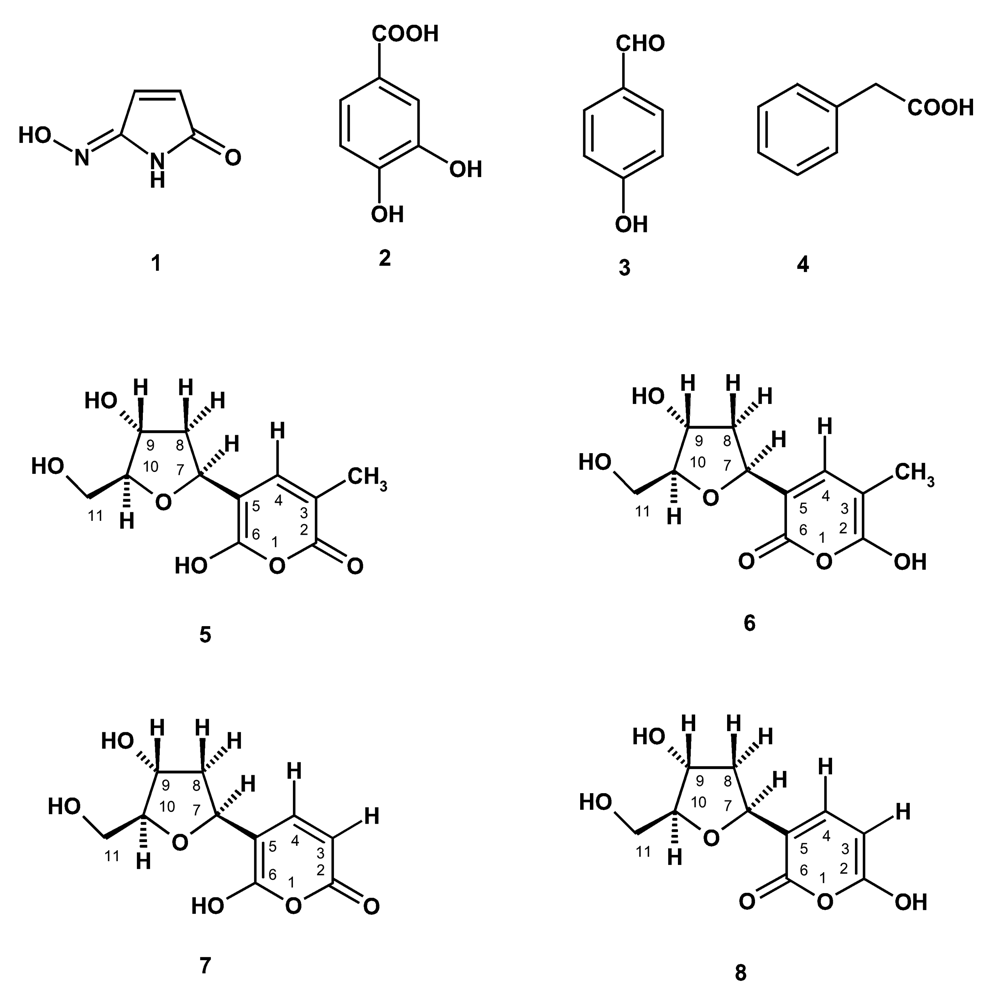
			<p>In the course of our investigation on bioactive compounds from the marine sponges from the Gulf of Thailand, we have investigated the chemical constituents of the two marine sponges <italic>Haliclona baeri</italic> and <italic>Haliclona cymaeformis,</italic> collected from the coastal area of Chonburi Province and from Koh Chang, Trad Province, Eastern Thailand, respectively. Isolated from <italic>Haliclona baeri</italic> were a new maleimide-5-oxime (<bold>1</bold>), 3,4-dihydroxybenzoic acid (<bold>2</bold>), tetillapyrone (<bold>5</bold> and <bold>6</bold>) while <italic>Haliclona cymaeformis</italic> furnished, besides tetillapyrone (<bold>5</bold> and <bold>6</bold>), <italic>p</italic>-hydroxybenzaldehyde (<bold>3</bold>), phenylacetic acid (<bold>4</bold>) and nortetillapyrone (<bold>7</bold> and <bold>8</bold>) (<xref ref-type="fig" rid="f1-marinedrugs-05-00040">Figure 1</xref>). We have also re-examined the structures of tetillapyrone and nortetillapyrone, previously reported by our group from <italic>Tetilla japonica</italic> &#x0005B;<xref ref-type="bibr" rid="b11-marinedrugs-05-00040">11</xref>&#x0005D;, as well as investigated the antifungal activity of the isolated compounds.</p>
		</sec>
		<sec sec-type="results|discussion">
			<title>2. Results and Discussion</title>
			<p>We have previously reported isolation of tetillapyrone (<bold>5</bold>) and nortetillapyrone (<bold>8</bold>) from the marine sponge <italic>Tetilla japonica</italic>, collected from the Gulf of Thailand &#x0005B;<xref ref-type="bibr" rid="b11-marinedrugs-05-00040">11</xref>&#x0005D;. Though the structures of both compounds were established by <sup>1</sup>H, <sup>13</sup>CNMR, COSY, NOESY, HETCOR, HMBC and HRMS as well as by X-ray analysis in the case of tetillapyrone (<bold>5</bold>), there were still some uncertainties with respect to the pyrone moiety. The correlations observed in the HMBC spectrum for both compounds raised some doubts about the correct position of the hydroxyl and carbonyl groups of the pyrone ring. In addition, the data obtained from the X-ray analysis did not provide any evidence if a hydrogen atom was attached to the oxygen atom on C-2 or on C-6. Besides, the positions of the hydroxyl and carbonyl groups of the pyrone ring in the structure of nortetillapyrone (<bold>8</bold>) were opposite to those observed in the pryrone ring of tetillapyrone (<bold>5</bold>). All of these evidences, combined with the new isolation of more quantities of tetillapyrone and nortetillapyrone from the marine sponges <italic>H. cymaeformis</italic> and <italic>H. baeri</italic>, have led us to re-examine their structures by careful analysis of the HMBC spectra of both compounds.</p>
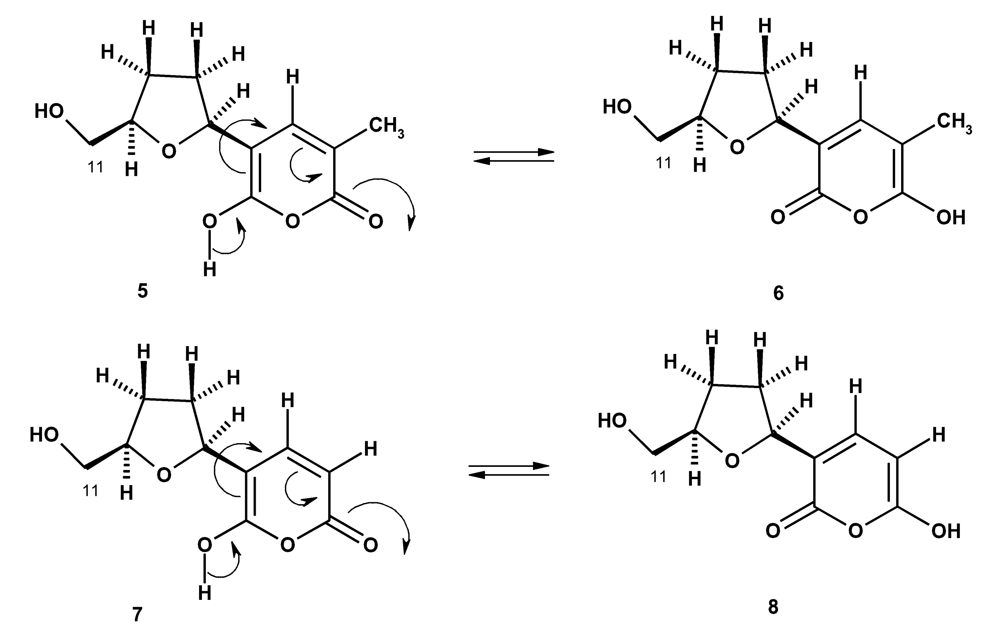
			<p>The structure of tetillapyrone (<bold>5</bold>), previously proposed by us &#x0005B;<xref ref-type="bibr" rid="b11-marinedrugs-05-00040">11</xref>&#x0005D;, was based on the fact that one carbon signal was missing in the <sup>13</sup>C NMR spectrum and thus the carbon signal at &#x003B4;109.45 was attributed to C-3 and C-5 of the pyrone ring. As the protons of the methyl group (&#x003B4;1.76s) on C-3 of the pyrone ring and the hydroxyl proton at &#x003B4;11.28s, showed crosspeaks with the carbon at &#x003B4;109.45, we have concluded that the hydroxyl group was on C-6. In fact, it is improbable that C-3 and C-5 could have the same chemical shift value as both carbons have completely different environment. Carefully examining the HMBC at 500 MHz spectrum of tetillapyrone (<xref ref-type="table" rid="t1-marinedrugs-05-00040">Table 1</xref>), we have found that the methyl protons (&#x003B4;1.78s) gave strong correlations to, besides C-4 (&#x003B4;136.21), the carbons at &#x003B4;109.43 (C-3), 150 54 (C-6) and 163.85 (C-2). This was very strange since the methyl protons were five bonds away from C-5. On the other hand, the hydroxyl proton at &#x003B4;11.30 brs (OH-6) showed also correlation with the carbon at &#x003B4;109.43 (C-3), which is also of five bonds distance. However, the only chance for this to happen is that tetillapyrone does not exist as only one compound (<bold>5</bold>) but instead as two compounds (<bold>5</bold> and <bold>6)</bold>. Thus the correlations observed in the HMBC spectrum were due to the methyl protons (&#x003B4;1.78s) with the carbons at &#x003B4;150.54 (C-2 of compound <bold>6</bold>) and &#x003B4;163.85 (C-2 of compound <bold>5</bold>), respectively. This also explains the correlation observed between the hydroxyl proton at &#x003B4;11.30 <italic>brs</italic> (OH-2) and the carbon at &#x003B4;109.43 (C-3) of compound <bold>6</bold>.</p>
			<p>It is interesting to note that in the structure previously proposed for nortetillapyrone (<bold>8</bold>), the positions of the hydroxyl and carbonyl groups of the pyrone moiety were opposite to those found in the structure <bold>5</bold> of tetillapyrone. Though, the HMBC spectrum showed strong correlation between H-3 (&#x003B4;5.62) and the carbon at &#x003B4;163.18, like that in structure <bold>5</bold> of tetillapyrone, the correlation between H-3 and the hydroxyl proton at &#x003B4; 11.23 brs observed in the COSY spectrum, has led to the conclusion that nortetillapyrone should have the structure <bold>8</bold>. In this structure, the chemical shift values of the carbonyl carbon (&#x003B4;150.48) and the enolic carbon (&#x003B4;163.18) were opposite to those found in tetillapyrone (<bold>5</bold>). However, there is no satisfactory explanation for this incongruence. The only possibility is, like in the case of tetillapyrone, nortetillapyrone also exists, in solution, as two compounds (<bold>7</bold> and <bold>8)</bold>. In this circumstance, the correlation observed in HMBC spectrum (<xref ref-type="table" rid="t2-marinedrugs-05-00040">Table 2</xref>) between H-4 (&#x003B4; 5.52<italic>d</italic>) and the carbon at &#x003B4;163.18 (C-2) was due to structure <bold>7,</bold> while the correlation between H-4 (&#x003B4; 5.52<italic>d</italic>) and the hydroxyl group at &#x003B4;11.23 brs (OH-2), observed in the COSY spectrum, was due to structure <bold>8</bold>.</p>
			<p>Since structures <bold>5</bold> and <bold>6</bold> of tetillapyrone are tautomers, they can exist in equilibrium in the solution. In the same way, structures <bold>7</bold> and <bold>8</bold> are also tautomers of nortetllapyrone and thus can also exist in equilibrium in the solution (<xref ref-type="fig" rid="f2-marinedrugs-05-00040">Figure 2</xref>).</p>
			<p>The structure of compound <bold>1</bold> was identified as maleimide-5-oxime by spectroscopic and HRMS data. EIHRMS of compound <bold>1</bold> gave the molecular ion peak at 122.02723, indicating its molecular formula as C<sub>4</sub>H<sub>4</sub>N<sub>2</sub>O<sub>2</sub> (cald.122.02728). The <sup>1</sup>H and <sup>13</sup>C NMR spectra of compound <bold>1</bold> were very simple, showing the proton and chemical shift values very similar to those observed for 3-methylmaleimide-5-oxime, previously isolated from the marine sponge <italic>Pseudoceratina purpurea</italic> by our group &#x0005B;<xref ref-type="bibr" rid="b12-marinedrugs-05-00040">12</xref>&#x0005D;. However, the <sup>1</sup>HNMR of compound <bold>1</bold> showed two doublets of two coupled protons at &#x003B4; 7.40d (<italic>J</italic>&#x0003D;7.6 Hz) and 5.45d (<italic>J</italic>&#x0003D;7.6 Hz) instead of the signals of the vinylic methyl protons (&#x003B4; 1.73d, <italic>J</italic>&#x0003D;0.9Hz) and a vinylic proton (&#x003B4; 7.2.6d, <italic>J</italic>&#x0003D;0.9Hz).</p>
			<p>In order to investigate the biological activity of the constituents of the two marine sponges, maleimide-5-oxime (<bold>1</bold>), <italic>p</italic>-hydroxybenzaldehyde (<bold>3</bold>), phenylacetic acid (<bold>4</bold>), tetillapyrone (<bold>5</bold> and <bold>6</bold>), and nortetillapyrone (<bold>7</bold> and <bold>8</bold>) were evaluated for their growth inhibitory effect against seven yeasts (<italic>Candida albicans</italic>, <italic>C. glabata</italic>, <italic>C. dubliniensis</italic>, <italic>C. tropicalis</italic>, <italic>C. krusei</italic>, <italic>C. parapsilosis</italic>, <italic>Cryptococcus neoformans</italic>), three non dermatophyte filamentous fungi (<italic>Aspergillus fumigatus</italic>, <italic>A. flavus</italic>, <italic>A. niger</italic>) and five dermatophyte filamentous fungi (<italic>Microsporum gypseum</italic>, <italic>M. canis</italic>, <italic>Trichophyton mentagrophytes</italic>, <italic>T. rubrum</italic> and <italic>Epidermophyton floccosum</italic>). Maleimide-5-oxime (<bold>1</bold>), <italic>p</italic>-hydroxybenzaldehyde (<bold>3</bold>), phenylacetic acid (<bold>4</bold>) and tetillapyrone (<bold>5</bold> and <bold>6</bold>) were found to be inactive against all the test organisms (MIC &gt; 250 &#x003BC;g/mL). Among the compounds tested, only nortetillapyrone (<bold>7</bold>, <bold>8</bold>) showed growth inhibitory effect against tested fungal strains. Interestingly, some selectivity was observed for this compound. It showed no activity against <italic>Candida albicans</italic>, <italic>C. krusei</italic> and <italic>C. parapsilosis</italic> even at maximum concentration tested (250 &#x003BC;g/mL). However, nortetillapyrone showed some activity against <italic>C. tropicalis</italic> (250 &#x003BC;g/mL) and good activity against <italic>C. glabrata</italic> (62.5&#x02013;31.25 &#x003BC;g/mL), <italic>C. dubliniensis</italic> (62.5 &#x003BC;g/mL) and <italic>Cryptococcus neoformans</italic> (31.25 &#x003BC;g/mL). In Addition, this compound exhibited significant antifungal activity against dermatophytes with the MIC values ranging from 31.25 to 125 &#x003BC;g/mL. It was more active against <italic>Microsporum canis</italic> (31.25 &#x003BC;g/mL) and less active against <italic>Trichophyton rubrum</italic> (62.5&#x02013;125 &#x003BC;g/mL). Nortetillapyrone showed no activity against <italic>Aspergillus</italic> species even at maximum concentration tested (250 &#x003BC;g/mL).</p>
			<p>Maleimide-5-oxime (<bold>1</bold>), tetillapyrone (<bold>5</bold> and <bold>6</bold>), and nortetillapyrone (<bold>7</bold> and <bold>8</bold>) were also evaluated for their capacity to inhibit the <italic>in vitro</italic> growth of three human tumor cell lines, namely the estrogen-dependent ER(&#x0002B;) MCF-7 (human breast adenocarcinoma), the estrogen-independent ER(&#x02212;) MDA-MB-231 (human breast adenocarcinoma) and NCI-H460 (non-small cell lung cancer). Maleimide-5-oxime (<bold>1</bold>) and tetillapyrone (<bold>5</bold> and <bold>6</bold>) were found to be inactive against all the cell lines tested (GI<sub>50</sub> &gt; 200 &#x003BC;M) while nortetillapyrone (<bold>7</bold> and <bold>8</bold>) only weakly inhibited the growth of estrogen-independent ER (&#x02212;) MDA-MB-231 cell line (GI<sub>50</sub> &#x0003D; 155.7 &#x003BC;M) but was inactive against the estrogen-dependent ER (&#x0002B;) MCF-7 and NCI-H460 cell lines (GI<sub>50</sub> &gt; 200 &#x003BC;M).</p>
		</sec>
		<sec sec-type="conclusion">
			<title>3. Conclusion</title>
			<p>As most antifungal compounds from marine origin are cytotoxic, consequently they have not generally been considered promising antifungal agents for clinical application &#x0005B;<xref ref-type="bibr" rid="b6-marinedrugs-05-00040">6</xref>&#x0005D;. Though many secondary metabolites from marine source were reported for their antifungal activity, their cytotoxic effect has not been measured. From this point of view, nortetillapyrone showed a very interesting biological activity profile. This compound not only selectively inhibits the growth of dermatophytes but also possesses no cytotoxicity against the tumor cell lines. Consequently, the structural feature of nortetillapyrone could serve as a model for development of a potential antifungal agent with therapeutic value.</p>
		</sec>
		<sec>
			<title>4. Experimental</title>
			<sec>
				<title>4.1. General</title>
				<p>
					<sup>1</sup>H and 13C NMR spectra were recorded at ambient temperature in CDCl<sub>3</sub> and DMSO on a Bruker AMC instrument operating at 300.12 and 75.47 MHz, respectively or a Bruker DRX instrument operating at 500, respectively 125 MHz. EI mass spectra were measured on a Hitachi Perkin-Elmer RMV-6M instrument. HRMS spectra were measured on a Kratos concept II 2 sector mass spectrometer. The accelerating voltage was 8 kV. Si gel for chromatography was silica gel 60 (0.2&#x02013;0.5 mm Merck) for analytical work and for preparative work TLC silica gel 60 GF 254 Merck.</p>
			</sec>
			<sec>
				<title>4.2. Animal material</title>
				<p>
					<italic>Haliclona cymaeformis</italic> (Esper, 1794) order Haplosclerida, family Chalinidae, was collected by Scuba diving in the Gulf of Thailand near Koh Chang (2 meter depth), Trad Province in March 2004. <italic>Haliclona baeri</italic> (Wilson, 1952) was also collected by Scuba diving in the in the coastal area of Chonburi Province (3 meter depth). The sponge materials were identified by Dr. Sumaitt Putchakarn and the vouchers of the specimens, registered as BIMS-I 953 and BIMS-I 1766, respectively were deposited at Bangsaen Institute of Marine Science (BIMS), Burapha University, Bangsaen, Chonburi, Thailand. The materials were frozen immediately at &#x02212;20&#x000BA;C prior to extraction.</p>
			</sec>
			<sec>
				<title>4.3. Extraction, isolation and characterization of the constituents of Haliclona baeri</title>
				<p>The sample (1.3 kg net weight) was thawed, homogenized with EtOH (3 L), allowed to stand for 24 h in a dark chamber and filtered. The residue on the filter paper was again extracted with EtOH (2 &#x000D7; 3L), the aqueous alcoholic extracts were combined, evaporated at reduced pressure to ca. 500 ml and extracted with EtOAc (3 &#x000D7; 500mL). The EtOAc extracts were combined and concentrated at reduced pressure to give the crude EtOAc extract. This (10 g) was chromatographed over a Si gel column (120g) and eluted with petrol-CHCl<sub>3</sub> and CHCl<sub>3</sub>-Me<sub>2</sub>O, 350 ml fractions being eluted as follows. Frs 1&#x02013;62 (petrol-CHCl<sub>3</sub>, 1:1), 63&#x02013;78 (petrol-CHCl<sub>3</sub>, 3:7), 79&#x02013;95 (petrol-CHCl<sub>3</sub>, 1:9), 96&#x02013;182 (CHCl<sub>3</sub>-Me<sub>2</sub>O, 4:1), 183&#x02013;206 (CHCl<sub>3</sub>- Me<sub>2</sub>O, 3:2). Frs 101&#x02013;114 were combined (107.8 mg) and purified by TLC (Si gel, CHCl<sub>3</sub>-Me<sub>2</sub>O&#x02013;HCO<sub>2</sub>H, 5:5:0.1) to give 8.6 mg of maleimide 5-oxime (<bold>1</bold>). Frs 125&#x02013;198 were combined (185.6 mg) and purified by TLC (Si gel, CHCl<sub>3</sub>-MeOH-HCO<sub>2</sub>H, 93:7:1) to give 13.1 mg 3,4-dihydroxybenzoic acid (<bold>2</bold>) and 8.0 mg of tetillapyrone (<bold>5</bold>and <bold>6</bold>).</p>
			</sec>
			<sec>
				<title>4.4. Extraction, isolation and characterization of the constituents of Haliclona cymaeformis</title>
				<p>The sample of <italic>Haliclona cymaeformis</italic> (7.6 kg net weight) was thawed, homogenized with EtOH (10L), allowed to stand for 24 h in the dark chamber and filtered. The residue on the filter paper was again extracted with EtOH (2 &#x000D7; 10L), the aqueous alcoholic extracts were combined, evaporated at reduced pressure to give <italic>ca.</italic> 700 ml and extracted with EtOAc (3 &#x000D7; 1L). The EtOAc extracts were combined and concentrated at reduced pressure to give a crude EtOAc extract (21g). This extract was applied to flash chromatography column of Si Gel (150 g) and eluted with CHCl<sub>3</sub> (frs. 1&#x02013;5; 5 &#x000D7; 200 mL), CHCl<sub>3</sub>-MeOH,, 49:1 (frs 6&#x02013;15; 10 &#x000D7; 200 mL), CHCl<sub>3</sub>-MeOH,, 19:1 (frs16&#x02013;20; 5 &#x000D7; 200 mL), CHCl<sub>3</sub>-MeOH,, 9:1 (frs 21&#x02013;22; 2 &#x000D7; 500 mL), EtOAc (frs 23&#x02013;24; 2 &#x000D7; 500mL) and MeOH (frs 25&#x02013;26; 2 &#x000D7; 500mL). Frs 18&#x02013;24 were combined (3.1g), applied on the flash chromatography column of ODS-A gel (35g) and eluted with mixture of MeOH-H<sub>2</sub>O; 7:3 (sfr 1; 200mL), MeOH-H<sub>2</sub>O; 4:1 (sfr 2; 200mL), MeOH-H<sub>2</sub>O; 9:1 (sfr 3; 2 &#x000D7; 100mL), MeOH (sfr 4; 400mL), CHCl<sub>3</sub>-MeOH-H<sub>2</sub>O; 14:6:1 (sfr 5, 400mL). Sfr 1 (156 mg) was purified by TLC Si gel, CHCl<sub>3</sub>-MeOH-HCO<sub>2</sub>H, 19:1:0.1) to give 3.5 mg of <italic>p</italic>-hydroxybenzaldehyde (<bold>3</bold>) and 15 mg of tetillapyrone (<bold>5</bold> and <bold>6</bold>). Sfr 5 (103 mg) was purified by TLC (Si gel, CHCl<sub>3</sub>-MeOH-HCO<sub>2</sub>H, 19:1:0.1) to give 7 mg of phenylacetic acid (<bold>4</bold>) and 17 mg of nortetillapyrone (<bold>7</bold> and <bold>8</bold>).</p>
				<p>
					<italic>Maleimide-5-oxime</italic> (<bold>1</bold>): yellow viscous mass; EI HRMS 122.02723 (M<sup>&#x0002B;</sup>),cald for C<sub>4</sub>H<sub>4</sub>N<sub>2</sub>O<sub>2</sub>, 122.02728.<sup>1</sup>HNMR (300 MHz, DMSO): &#x003B4;11.03 brs (&#x02212;NH), 10.86 brs (&#x0003D;N-OH), 7.40d (<italic>J</italic>&#x0003D;7.6 Hz, H-4), 5.45d (<italic>J</italic>&#x0003D;7.6 Hz, H-3), <sup>13</sup>CNMR (75.47 MHz, DMSO): &#x003B4;164.37 (CO-2), 151.54 (C-5), 142.22 (CH-4), 100.24 (CH-3).</p>
			</sec>
			<sec>
				<title>4.5. Biological Activity</title>
				<sec>
					<title>5.5.1. Cell Growth Assay</title>
					<p>The effect of compounds on the growth of human tumor cell lines were evaluated according to the procedure adopted by National Cancer Institute (NCI, USA) for the <italic>in vitro</italic> anticancer drug discovery screen which uses the protein-binding dye sulforhodamine B (SRB) to assess cell growth inhibition &#x0005B;<xref ref-type="bibr" rid="b13-marinedrugs-05-00040">13</xref>, <xref ref-type="bibr" rid="b14-marinedrugs-05-00040">14</xref>&#x0005D; and according to the method described by Kijjoa <italic>et al</italic>. &#x0005B;<xref ref-type="bibr" rid="b15-marinedrugs-05-00040">15</xref>&#x0005D;.</p>
				</sec>
				<sec>
					<title>5.5.2. Antifungal Activity Determination</title>
					<p>Antifungal activity of maleimide-5-oxime (<bold>1</bold>), <italic>p</italic>-hydroxybenzaldehyde (<bold>3</bold>), phenylacetic acid (<bold>4</bold>), tetillapyrone (<bold>5</bold> and <bold>6</bold>) and nortetillapyrone (<bold>7</bold> and <bold>8</bold>) was evaluated against <italic>Candida</italic>, <italic>Aspergillus</italic> and dermatophyte strains: three yeasts clinical strains, one of <italic>Cryptococcus neoformans</italic> PH1, one of <italic>Candida dubliniensis</italic> PH10 and one of <italic>C. glabrata</italic> D10R, as well as, four American Type Culture Collection (ATCC) type strains (<italic>C. albicans</italic> ATTC 10231, <italic>C. tropicalis</italic> ATCC 13803, <italic>C. krusei</italic> ATCC 6258 and <italic>C. parapsilosis</italic> ATCC 90018); one <italic>Aspergillus</italic> clinical strain (<italic>A. flavus</italic> F44), as well as, two ATCC type strains (<italic>A. niger</italic> ATCC 16404, and <italic>A. fumigatus</italic> ATCC 46645); five dermatophyte clinical strains (<italic>Microsporum canis</italic> FF1, <italic>M. gypseum</italic> FF3, <italic>Trichophyton rubrum</italic> FF5, <italic>T. mentagrophytes</italic> FF7 and <italic>Epidermophyton floccosum</italic> FF9).</p>
					<p>The fungal isolates were identified by standard microbiology methods and stored on Sabouraud Dextrose broth with glycerol at &#x02212;70&#x000BA;C and subcultured in Sabouraud-Chloramphenicol agar. Minimal Inhibitory Concentration (MIC) was determined by a microdilution method according to the CLSI reference method M27-A2 for yeasts &#x0005B;<xref ref-type="bibr" rid="b16-marinedrugs-05-00040">16</xref>&#x0005D;, and M38-A for filamentous fungi &#x0005B;<xref ref-type="bibr" rid="b17-marinedrugs-05-00040">17</xref>&#x0005D;. The test was performed in sterile 96 flat-bottom well microtitration plates and the medium used was MOPS-buffered RPMI 1640. Briefly, MICs were determined for all yeasts strains with the adjusted final inoculum of 1&#x02013;4 &#x000D7; 10<sup>4</sup> CFU/mL, prepared from a 24&#x02013;48 hours culture. With filamentous fungi (except for <italic>Epidermophyton floccosum</italic>), the final inoculum used was 4&#x02013;8 &#x000D7; 10<sup>4</sup>CFU/mL, prepared from a sporulated culture. For <italic>Epidermophyton floccosum</italic>, the final inoculum was 8 &#x000D7; 10<sup>4</sup> to 1.6 &#x000D7; 10<sup>5</sup> CFU/mL. Two fold serial dilutions of compounds in DMSO, ranging from 250 to 15.125 &#x003BC;g/mL, were tested. Fungal growth controls, with and without DMSO, were included. The final DMSO concentration was 2&#x00025;, and did not affect the fungal growth. In addition, reference antifungal compounds, fluconazole (Pfizer, United Kingdom) for yeasts and dermatophytes or amphotericin B (Sigma) for <italic>Aspergillus</italic>, were used as the standard antifungal drugs. Twofold serial dilutions ranging from 128 to 0.25 &#x003BC;g/mL for fluconazole and 16 to 0.063 &#x003BC;g/mL for amphotericin B were used. Plates were incubated at 30&#x000BA;C for 48 hours for <italic>Candida</italic> species, 72 hours for <italic>Cryptococcus neoformans,</italic> 4&#x02013;5 days for <italic>Aspergillus</italic> species and 8 days for dermatophytes. Quality control determinations of the MIC of fluconazole were ensured by testing <italic>C. parapsilosis</italic> ATCC 90018. The results were within the recommended limits. All determinations were performed in duplicate and three independent experiments lead to concordant results.</p>
				</sec>
			</sec>
		</sec>
	</body>
	<back>
		<ack>
			<title>Acknowledgements</title>
			<p>This work was supported by FCT-Funda&#x000E7;&#x000E3;o para a Ci&#x000EA;ncia e Tecnologia (Project POCI/MAR/58114/2004) and Unidade de ID 226/94; FEDER and POCI, and GRICES. Work in Thailand was supported by the Thailand Research Fund (No. TRG 4780003). We thank Dr. Sumaitt Puchakarn, BIMS, Burapha University, Thailand, for collection and identification of the sponge materials and Dr. Graham Eaton, Department of Chemistry, University of Leicester, UK for HRMS.</p>
		</ack>
		<fn-group>
			<fn>
				<p>
					<italic>Sample Availability:</italic> Available from the author.</p>
			</fn>
		</fn-group>
		<ref-list>
			<title>References</title>
			<ref id="b1-marinedrugs-05-00040">
				<label>1</label>
				<citation citation-type="journal">
					<person-group person-group-type="author">
						<name>
							<surname>Li</surname>
							<given-names>HY</given-names>
						</name>
						<name>
							<surname>Matsunaga</surname>
							<given-names>S</given-names>
						</name>
						<name>
							<surname>Fusetani</surname>
							<given-names>N</given-names>
						</name>
					</person-group>
					<article-title>Antifungal metabolites from marine sponges</article-title>
					<source>Curr Org Chem</source>
					<year>1998</year>
					<volume>2</volume>
					<fpage>649</fpage>
					<lpage>682</lpage>
				</citation>
			</ref>
			<ref id="b2-marinedrugs-05-00040">
				<label>2</label>
				<citation citation-type="journal">
					<person-group person-group-type="author">
						<name>
							<surname>Richardson</surname>
							<given-names>MD</given-names>
						</name>
					</person-group>
					<article-title>Changing patterns and trends in systematic fungal infections</article-title>
					<source>J Antimicrobial Chemother</source>
					<year>2005</year>
					<volume>56</volume>
					<fpage>i5</fpage>
					<lpage>i11</lpage>
				</citation>
			</ref>
			<ref id="b3-marinedrugs-05-00040">
				<label>3</label>
				<citation citation-type="journal">
					<person-group person-group-type="author">
						<name>
							<surname>Gupta</surname>
							<given-names>AK</given-names>
						</name>
						<name>
							<surname>Tu</surname>
							<given-names>LQ</given-names>
						</name>
					</person-group>
					<article-title>Dermatophytes: Diagnosis and treatment</article-title>
					<source>J Am Acad Dermatol</source>
					<year>2006</year>
					<volume>54</volume>
					<fpage>1050</fpage>
					<lpage>1055</lpage>
				</citation>
			</ref>
			<ref id="b4-marinedrugs-05-00040">
				<label>4</label>
				<citation citation-type="journal">
					<person-group person-group-type="author">
						<name>
							<surname>Johnson</surname>
							<given-names>L</given-names>
						</name>
					</person-group>
					<article-title>Dermatophytes-the skin eaters</article-title>
					<source>Mycologist</source>
					<year>2003</year>
					<volume>17</volume>
					<fpage>147</fpage>
					<lpage>149</lpage>
				</citation>
			</ref>
			<ref id="b5-marinedrugs-05-00040">
				<label>5</label>
				<citation citation-type="journal">
					<person-group person-group-type="author">
						<name>
							<surname>Sundriyal</surname>
							<given-names>S</given-names>
						</name>
						<name>
							<surname>Sharma</surname>
							<given-names>RK</given-names>
						</name>
						<name>
							<surname>Jain</surname>
							<given-names>R</given-names>
						</name>
					</person-group>
					<article-title>Current advances in antifungal targets and drug development</article-title>
					<source>Curr Med Chem</source>
					<year>2006</year>
					<volume>13</volume>
					<fpage>1321</fpage>
					<lpage>1335</lpage>
				</citation>
			</ref>
			<ref id="b6-marinedrugs-05-00040">
				<label>6</label>
				<citation citation-type="journal">
					<person-group person-group-type="author">
						<name>
							<surname>Donia</surname>
							<given-names>M</given-names>
						</name>
						<name>
							<surname>Hartmann</surname>
							<given-names>M</given-names>
						</name>
					</person-group>
					<article-title>Marine natural products and their potential applications as anti-infective agents</article-title>
					<source>THE LANCET Infectious Disease</source>
					<year>2003</year>
					<volume>3</volume>
					<fpage>338</fpage>
					<lpage>348</lpage>
				</citation>
			</ref>
			<ref id="b7-marinedrugs-05-00040">
				<label>7</label>
				<citation citation-type="journal">
					<person-group person-group-type="author">
						<name>
							<surname>Faulkner</surname>
							<given-names>DJ</given-names>
						</name>
					</person-group>
					<article-title>Marine Natural Products</article-title>
					<source>Nat Prod Rep</source>
					<year>1993</year>
					<volume>10</volume>
					<fpage>497</fpage>
					<lpage>539</lpage>
				</citation>
			</ref>
			<ref id="b8-marinedrugs-05-00040">
				<label>8</label>
				<citation citation-type="journal">
					<person-group person-group-type="author">
						<name>
							<surname>Rashid</surname>
							<given-names>MA</given-names>
						</name>
						<name>
							<surname>Gustafson</surname>
							<given-names>KR</given-names>
						</name>
						<name>
							<surname>Boswell</surname>
							<given-names>JL</given-names>
						</name>
						<name>
							<surname>Boyd</surname>
							<given-names>MR</given-names>
						</name>
					</person-group>
					<article-title>Haligramides A and B, two new cytotoxic hexapeptides from the marine sponge <italic>Haliclona nigra</italic>
					</article-title>
					<source>J Nat Prod</source>
					<year>2000</year>
					<volume>63</volume>
					<fpage>956</fpage>
					<lpage>959</lpage>
				</citation>
			</ref>
			<ref id="b9-marinedrugs-05-00040">
				<label>9</label>
				<citation citation-type="journal">
					<person-group person-group-type="author">
						<name>
							<surname>Fahy</surname>
							<given-names>E</given-names>
						</name>
						<name>
							<surname>Molinski</surname>
							<given-names>TF</given-names>
						</name>
						<name>
							<surname>Harper</surname>
							<given-names>MK</given-names>
						</name>
						<name>
							<surname>Sulliwan</surname>
							<given-names>BW</given-names>
						</name>
						<name>
							<surname>Faulkner</surname>
							<given-names>DJ</given-names>
						</name>
					</person-group>
					<article-title>Haliclonadiamine: an antimicrobial alkaloid from the sponge <italic>Haliclona</italic> sp</article-title>
					<source>Tetrahedron Lett</source>
					<year>1988</year>
					<volume>29</volume>
					<fpage>3427</fpage>
					<lpage>3428</lpage>
				</citation>
			</ref>
			<ref id="b10-marinedrugs-05-00040">
				<label>10</label>
				<citation citation-type="journal">
					<person-group person-group-type="author">
						<name>
							<surname>Clark</surname>
							<given-names>RJ</given-names>
						</name>
						<name>
							<surname>Garson</surname>
							<given-names>MJ</given-names>
						</name>
						<name>
							<surname>Hooper</surname>
							<given-names>JNA</given-names>
						</name>
					</person-group>
					<article-title>Halaminols A-C, three new alkyl amino alcohol from the sponge <italic>Haliclona sp</italic>
					</article-title>
					<source>J Nat Prod</source>
					<year>2001</year>
					<volume>64</volume>
					<fpage>1568</fpage>
					<lpage>1571</lpage>
				</citation>
			</ref>
			<ref id="b11-marinedrugs-05-00040">
				<label>11</label>
				<citation citation-type="journal">
					<person-group person-group-type="author">
						<name>
							<surname>Watanadilok</surname>
							<given-names>R</given-names>
						</name>
						<name>
							<surname>Sonchaeng</surname>
							<given-names>P</given-names>
						</name>
						<name>
							<surname>Kijjoa</surname>
							<given-names>A</given-names>
						</name>
						<name>
							<surname>Damas</surname>
							<given-names>AM</given-names>
						</name>
						<name>
							<surname>Gales</surname>
							<given-names>L</given-names>
						</name>
						<name>
							<surname>Silva</surname>
							<given-names>AMS</given-names>
						</name>
						<name>
							<surname>Herz</surname>
							<given-names>W</given-names>
						</name>
					</person-group>
					<article-title>Tetillapyrone and nortetillapyrone, two unusual hydroxypyran-2-ones from the marine sponge <italic>Tetilla japonica</italic>
					</article-title>
					<source>J Nat Prod</source>
					<year>2001</year>
					<volume>64</volume>
					<fpage>1056</fpage>
					<lpage>1058</lpage>
				</citation>
			</ref>
			<ref id="b12-marinedrugs-05-00040">
				<label>12</label>
				<citation citation-type="journal">
					<person-group person-group-type="author">
						<name>
							<surname>Kijjoa</surname>
							<given-names>A</given-names>
						</name>
						<name>
							<surname>Bessa</surname>
							<given-names>J</given-names>
						</name>
						<name>
							<surname>Wattanadilok</surname>
							<given-names>R</given-names>
						</name>
						<name>
							<surname>Sawangwong</surname>
							<given-names>P</given-names>
						</name>
						<name>
							<surname>Nascimento</surname>
							<given-names>MSJ</given-names>
						</name>
						<name>
							<surname>Pedro</surname>
							<given-names>M</given-names>
						</name>
						<name>
							<surname>Silva</surname>
							<given-names>AMS</given-names>
						</name>
						<name>
							<surname>Eaton</surname>
							<given-names>G</given-names>
						</name>
						<name>
							<surname>van Soest</surname>
							<given-names>R</given-names>
						</name>
						<name>
							<surname>Herz</surname>
							<given-names>W</given-names>
						</name>
					</person-group>
					<article-title>Dibromotyrosine derivatives, a maleimide, aplysamine -2 and other constituents of the marine sponge <italic>Pseudoceratina purpurea</italic>
					</article-title>
					<source>Zeitschrift fur Naturforschung</source>
					<year>2005</year>
					<volume>60b</volume>
					<fpage>904</fpage>
					<lpage>908</lpage>
				</citation>
			</ref>
			<ref id="b13-marinedrugs-05-00040">
				<label>13</label>
				<citation citation-type="journal">
					<person-group person-group-type="author">
						<name>
							<surname>Monks</surname>
							<given-names>A</given-names>
						</name>
						<name>
							<surname>Scudiero</surname>
							<given-names>D</given-names>
						</name>
						<name>
							<surname>Skehan</surname>
							<given-names>P</given-names>
						</name>
						<name>
							<surname>Shoemaker</surname>
							<given-names>R</given-names>
						</name>
						<name>
							<surname>Paul</surname>
							<given-names>K</given-names>
						</name>
						<name>
							<surname>Vistica</surname>
							<given-names>D</given-names>
						</name>
						<name>
							<surname>Hose</surname>
							<given-names>C</given-names>
						</name>
						<name>
							<surname>Langley</surname>
							<given-names>J</given-names>
						</name>
						<name>
							<surname>Cronise</surname>
							<given-names>P</given-names>
						</name>
						<name>
							<surname>Vaigro-Wolff</surname>
							<given-names>A</given-names>
						</name>
						<name>
							<surname>Gray-Goodrich</surname>
							<given-names>M</given-names>
						</name>
						<name>
							<surname>Campbell</surname>
							<given-names>H</given-names>
						</name>
						<name>
							<surname>Mayo</surname>
							<given-names>J</given-names>
						</name>
						<name>
							<surname>Boyd</surname>
							<given-names>M</given-names>
						</name>
					</person-group>
					<article-title>Feasibility of a high-flux anticancer drug screen using a diverse panel of cultured human tumor cell lines</article-title>
					<source>J Natl Cancer Inst</source>
					<year>1991</year>
					<volume>83</volume>
					<fpage>757</fpage>
					<lpage>776</lpage>
				</citation>
			</ref>
			<ref id="b14-marinedrugs-05-00040">
				<label>14</label>
				<citation citation-type="journal">
					<person-group person-group-type="author">
						<name>
							<surname>Skehan</surname>
							<given-names>P</given-names>
						</name>
						<name>
							<surname>Storeng</surname>
							<given-names>R</given-names>
						</name>
						<name>
							<surname>Scudiero</surname>
							<given-names>D</given-names>
						</name>
						<name>
							<surname>Monks</surname>
							<given-names>A</given-names>
						</name>
						<name>
							<surname>McMahon</surname>
							<given-names>J</given-names>
						</name>
						<name>
							<surname>Vistica</surname>
							<given-names>D</given-names>
						</name>
						<name>
							<surname>Warren</surname>
							<given-names>JT</given-names>
						</name>
						<name>
							<surname>Bokesch</surname>
							<given-names>H</given-names>
						</name>
						<name>
							<surname>Kenny</surname>
							<given-names>S</given-names>
						</name>
						<name>
							<surname>Boyd</surname>
							<given-names>MR</given-names>
						</name>
					</person-group>
					<article-title>New calorimetric cytotoxic assay for anticancer drug screening</article-title>
					<source>J Natl Cancer Inst</source>
					<year>1990</year>
					<volume>82</volume>
					<fpage>1107</fpage>
					<lpage>1112</lpage>
				</citation>
			</ref>
			<ref id="b15-marinedrugs-05-00040">
				<label>15</label>
				<citation citation-type="journal">
					<person-group person-group-type="author">
						<name>
							<surname>Kijjoa</surname>
							<given-names>A</given-names>
						</name>
						<name>
							<surname>Wattanadilok</surname>
							<given-names>R</given-names>
						</name>
						<name>
							<surname>Campos</surname>
							<given-names>N</given-names>
						</name>
						<name>
							<surname>Nascimento</surname>
							<given-names>MSJ</given-names>
						</name>
						<name>
							<surname>Pinto</surname>
							<given-names>M</given-names>
						</name>
						<name>
							<surname>Herz</surname>
							<given-names>W</given-names>
						</name>
					</person-group>
					<article-title>Anticancer activity Evaluation of Kuanoniamines A and C isolated from the marine sponge <italic>Oceanapia sagittaria:collected from the Gulf of Thailand</italic>
					</article-title>
					<source>Mar Drugs</source>
					<year>2007</year>
					<volume>5</volume>
					<fpage>6</fpage>
					<lpage>22</lpage>
				</citation>
			</ref>
			<ref id="b16-marinedrugs-05-00040">
				<label>16</label>
				<citation citation-type="book">
					<collab>National Committee for Clinical Laboratory Standards</collab>
					<year>2002</year>
					<source>Reference Method for Broth Dilution Antifungal Susceptibility Testing of Yeasts: approved standard Document M27-A2</source>
					<publisher-loc>Wayne, PA</publisher-loc>
					<publisher-name>National Committee for Clinical Laboratory Standards</publisher-name>
				</citation>
			</ref>
			<ref id="b17-marinedrugs-05-00040">
				<label>17</label>
				<citation citation-type="book">
					<collab>National Committee for Clinical Laboratory Standards</collab>
					<year>2002</year>
					<source>Reference Method for Broth Dilution Antifungal Susceptibility Testing of Filamentous Fungi: approved standard Document M38-A</source>
					<publisher-loc>Wayne, PA</publisher-loc>
					<publisher-name>National Committee for Clinical Laboratory Standards</publisher-name>
					<comment>
						<italic>Sample Availability:</italic> Available from the author</comment>
				</citation>
			</ref>
		</ref-list>
		<sec sec-type="display-objects">
			<title>Figures and Tables</title>
			<fig id="marinedrugs-05-00040-f001" position="float">
				<label>Figure 1</label>
				<caption>
					<p>Compounds isolated from <italic>Haliclona baeri</italic> and <italic>H. cymaeformis</italic>
					</p>
				</caption>
				<graphic xmlns:xlink="http://www.w3.org/1999/xlink" xlink:href="marinedrugs-05-00040-g001.tif"/>
			</fig>
			<fig id="marinedrugs-05-00040-f001" position="float">
				<label>Figure 2</label>
				<caption>
					<p>Tautomerization of tetillapyrone (<bold>5</bold>, <bold>6</bold>) and nortetillapyrone (<bold>6</bold>, <bold>7</bold>).</p>
				</caption>
				<graphic xmlns:xlink="http://www.w3.org/1999/xlink" xlink:href="marinedrugs-05-00040-g002.tif"/>
			</fig>
			<table-wrap id="t1-marinedrugs-05-00040" position="float">
				<label>Table 1</label>
				<caption>
					<p>
						<sup>1</sup>H and <sup>13</sup>C NMR data (500 MHz, DMSO) of tetillapyrone (<bold>5</bold> and <bold>6</bold>).</p>
				</caption>
				<table frame="hsides" rules="groups">
					<thead>
						<tr>
							<th align="left">Position</th>
							<th align="left">&#x003B4;H (Hz)<xref ref-type="table-fn" rid="tfn1-marinedrugs-05-00040">a</xref>
							</th>
							<th align="left">&#x003B4;C mult<xref ref-type="table-fn" rid="tfn2-marinedrugs-05-00040">b</xref>
							</th>
							<th align="left">COSY</th>
							<th align="left">HMBC</th>
						</tr>
					</thead>
					<tbody>
						<tr>
							<td align="left">2</td>
							<td align="left">-----</td>
							<td align="left">150.54/163.85</td>
							<td align="left"/>
							<td align="left"/>
						</tr>
						<tr>
							<td align="left">3</td>
							<td align="left">-----</td>
							<td align="left">109.43</td>
							<td align="left"/>
							<td align="left"/>
						</tr>
						<tr>
							<td align="left">4</td>
							<td align="left">7.72d (1.0)</td>
							<td align="left">136.21</td>
							<td align="left">Me</td>
							<td align="left">Me, C-2/C-6, C-3</td>
						</tr>
						<tr>
							<td align="left">5</td>
							<td align="left">-----</td>
							<td align="left">?</td>
							<td align="left"/>
							<td align="left"/>
						</tr>
						<tr>
							<td align="left">6</td>
							<td align="left">-----</td>
							<td align="left">150.54/163.85</td>
							<td align="left"/>
							<td align="left"/>
						</tr>
						<tr>
							<td align="left">7</td>
							<td align="left">6.18t (6.4)</td>
							<td align="left">83.75</td>
							<td align="left">H-8</td>
							<td align="left">C-4, C-6</td>
						</tr>
						<tr>
							<td align="left">8</td>
							<td align="left">2.08m</td>
							<td align="left">39.49</td>
							<td align="left">H-7, H-9</td>
							<td align="left">C-7, C-9</td>
						</tr>
						<tr>
							<td align="left">9</td>
							<td align="left">4.25q (3.1)</td>
							<td align="left">70.45</td>
							<td align="left">H-8, H-10</td>
							<td align="left"/>
						</tr>
						<tr>
							<td align="left">10</td>
							<td align="left">3.77dd (6.7, 3.8)</td>
							<td align="left">87.30</td>
							<td align="left">H-9, H-11</td>
							<td align="left">C-9, C-7</td>
						</tr>
						<tr>
							<td align="left">11</td>
							<td align="left">3.60dd (11.8, 3.8)
								<break/>3.55dd (11.8, 3.8)</td>
							<td align="left">61.35</td>
							<td align="left">H-10</td>
							<td align="left">C-9</td>
						</tr>
						<tr>
							<td align="left">CH<sub>3</sub>
							</td>
							<td align="left">1.78d (1.0)</td>
							<td align="left">12.36</td>
							<td align="left">H-4</td>
							<td align="left">C-3, C-4, C-2/C-6</td>
						</tr>
						<tr>
							<td align="left">OH-2</td>
							<td align="left">11.30 brs</td>
							<td align="left">-----</td>
							<td align="left"/>
							<td align="left">C-3</td>
						</tr>
						<tr>
							<td align="left">OH-9</td>
							<td align="left">5.27d (4.1)</td>
							<td align="left">-----</td>
							<td align="left"/>
							<td align="left">C-8, C-9, C-10</td>
						</tr>
						<tr>
							<td align="left">OH-11</td>
							<td align="left">5.06t (5.1)</td>
							<td align="left">-----</td>
							<td align="left"/>
							<td align="left">C-10, C-11</td>
						</tr>
					</tbody>
				</table>
				<table-wrap-foot>
					<fn id="tfn1-marinedrugs-05-00040">
						<label>a</label>
						<p>
							<italic>J</italic> values in parenthesis. </p>
					</fn>
					<fn id="tfn2-marinedrugs-05-00040">
						<label>b</label>
						<p>Multiplicities deduced by DEPT.</p>
					</fn>
				</table-wrap-foot>
			</table-wrap>
			<table-wrap id="t2-marinedrugs-05-00040" position="float">
				<label>Table 2</label>
				<caption>
					<p>
						<sup>1</sup>H and <sup>13</sup>C NMR data (500 MHz, DMSO) of nortetillapyrone (<bold>7</bold> and <bold>8</bold>)</p>
				</caption>
				<table frame="hsides" rules="groups">
					<thead>
						<tr>
							<th align="left">Position</th>
							<th align="left">&#x003B4;H (Hz)<xref ref-type="table-fn" rid="tfn3-marinedrugs-05-00040">a</xref>
							</th>
							<th align="left">&#x003B4;C mult<xref ref-type="table-fn" rid="tfn4-marinedrugs-05-00040">b</xref>
							</th>
							<th align="left">COSY</th>
							<th align="left">HMBC</th>
						</tr>
					</thead>
					<tbody>
						<tr>
							<td align="left">2</td>
							<td align="left">-----</td>
							<td align="left">150.48/163.18</td>
							<td align="left"/>
							<td align="left"/>
						</tr>
						<tr>
							<td align="left">3</td>
							<td align="left">6.52d (8.1)</td>
							<td align="left">101.78</td>
							<td align="left">H-4</td>
							<td align="left">C-4, C-2 (w)</td>
						</tr>
						<tr>
							<td align="left">4</td>
							<td align="left">7.85d (8.1)</td>
							<td align="left">140.56</td>
							<td align="left">H-3</td>
							<td align="left">C-7(w), C-3, C-2/C-6</td>
						</tr>
						<tr>
							<td align="left">5</td>
							<td align="left">-----</td>
							<td align="left">?</td>
							<td align="left"/>
							<td align="left"/>
						</tr>
						<tr>
							<td align="left">6</td>
							<td align="left"/>
							<td align="left">150.48/163.18</td>
							<td align="left"/>
							<td align="left"/>
						</tr>
						<tr>
							<td align="left">7</td>
							<td align="left">6.13t (7.0)</td>
							<td align="left">84.11</td>
							<td align="left">H-8</td>
							<td align="left">C-4, C-2/C-6</td>
						</tr>
						<tr>
							<td align="left">8</td>
							<td align="left">2.10m</td>
							<td align="left">39.75</td>
							<td align="left">H-7, H-9</td>
							<td align="left">C-7, C-9</td>
						</tr>
						<tr>
							<td align="left">9</td>
							<td align="left">4.21m</td>
							<td align="left">70.40</td>
							<td align="left">H-8, H-10</td>
							<td align="left"/>
						</tr>
						<tr>
							<td align="left">10</td>
							<td align="left">3.76dd (6.4, 3.2)</td>
							<td align="left">87.43</td>
							<td align="left">H-9, H-11</td>
							<td align="left">C-11</td>
						</tr>
						<tr>
							<td align="left">11</td>
							<td align="left">3.53m</td>
							<td align="left">61.27</td>
							<td align="left">H-10</td>
							<td align="left"/>
						</tr>
						<tr>
							<td align="left">OH-2</td>
							<td align="left">11.23brs</td>
							<td align="left">-----</td>
							<td align="left"/>
							<td align="left"/>
						</tr>
						<tr>
							<td align="left">OH-9</td>
							<td align="left">8.45brs</td>
							<td align="left">-----</td>
							<td align="left"/>
							<td align="left"/>
						</tr>
						<tr>
							<td align="left">OH-11</td>
							<td align="left">-----</td>
							<td align="left">-----</td>
							<td align="left"/>
							<td align="left"/>
						</tr>
					</tbody>
				</table>
				<table-wrap-foot>
					<fn id="tfn3-marinedrugs-05-00040">
						<label>a</label>
						<p>
							<italic>J</italic> values in parenthesis. </p>
					</fn>
					<fn id="tfn4-marinedrugs-05-00040">
						<label>b</label>
						<p>Multiplicities deduced by DEPT ; w &#x0003D; weak</p>
					</fn>
				</table-wrap-foot>
			</table-wrap>
			<table-wrap id="t3-marinedrugs-05-00040" position="float">
				<label>Table 3</label>
				<caption>
					<p>Antifungal activity (MIC) of nortetillapyrone (<bold>7</bold>, <bold>8</bold>) for <italic>Candida</italic>, <italic>Aspergillus</italic> and dermatophyte strains.</p>
				</caption>
				<table frame="hsides" rules="groups">
					<thead>
						<tr>
							<th colspan="4" align="center">MIC (&#x003BC;g/ml)</th>
						</tr>
						<tr>
							<th colspan="4" align="left">
								<hr/>
							</th>
						</tr>
						<tr>
							<th align="left">Test strain</th>
							<th align="left">nortetillapyrone (<bold>7</bold>, <bold>8</bold>)</th>
							<th align="left">Fuconazole</th>
							<th align="left">Amphotericin B</th>
						</tr>
					</thead>
					<tbody>
						<tr>
							<td colspan="4" align="left">
								<bold>Yeasts</bold>
							</td>
						</tr>
						<tr>
							<td align="left">
								<italic>Candida albicans</italic>
							</td>
							<td align="left">&gt;250</td>
							<td align="left">1</td>
							<td align="left">NT</td>
						</tr>
						<tr>
							<td align="left">
								<italic>C. glabata</italic>
							</td>
							<td align="left">31.25&#x02013;62.5</td>
							<td align="left">32</td>
							<td align="left">NT</td>
						</tr>
						<tr>
							<td align="left">
								<italic>C. dubliniensis</italic>
							</td>
							<td align="left">62.5</td>
							<td align="left">NT</td>
							<td align="left">NT</td>
						</tr>
						<tr>
							<td align="left">
								<italic>C. tropicalis</italic>
							</td>
							<td align="left">250</td>
							<td align="left">4</td>
							<td align="left">NT</td>
						</tr>
						<tr>
							<td align="left">
								<italic>C. krusei</italic>
							</td>
							<td align="left">&gt;250</td>
							<td align="left">64&#x02013;128</td>
							<td align="left">NT</td>
						</tr>
						<tr>
							<td align="left">
								<italic>C. parapsilosis</italic>
							</td>
							<td align="left">&gt;250</td>
							<td align="left">&lt;1</td>
							<td align="left">NT</td>
						</tr>
						<tr>
							<td align="left">
								<italic>Cryptococcus neoformans</italic>
							</td>
							<td align="left">31.25</td>
							<td align="left">NT</td>
							<td align="left">NT</td>
						</tr>
						<tr>
							<td colspan="4" align="left">
								<bold>Filamentous fungi,</bold>
								<bold>
									<italic>Aspergillus</italic>
								</bold>
							</td>
						</tr>
						<tr>
							<td align="left">
								<italic>Aspergillus fumigatus</italic>
							</td>
							<td align="left">&gt;250</td>
							<td align="left">NT</td>
							<td align="left">1</td>
						</tr>
						<tr>
							<td align="left">
								<italic>A. flavus</italic>
							</td>
							<td align="left">&gt;250</td>
							<td align="left">NT</td>
							<td align="left">1&#x02013;2</td>
						</tr>
						<tr>
							<td align="left">
								<italic>A. niger</italic>
							</td>
							<td align="left">&gt;250</td>
							<td align="left">NT</td>
							<td align="left">2</td>
						</tr>
						<tr>
							<td colspan="4" align="left">
								<bold>Filamentous fungi, dermatophytes</bold>
							</td>
						</tr>
						<tr>
							<td align="left">
								<italic>Microsporum gypseum</italic>
							</td>
							<td align="left">62.5</td>
							<td align="left">&gt;128</td>
							<td align="left">NT</td>
						</tr>
						<tr>
							<td align="left">
								<italic>M. canis</italic>
							</td>
							<td align="left">31.25</td>
							<td align="left">128</td>
							<td align="left">NT</td>
						</tr>
						<tr>
							<td align="left">
								<italic>Trichophyton mentagrophytes</italic>
							</td>
							<td align="left">125</td>
							<td align="left">16&#x02013;32</td>
							<td align="left">NT</td>
						</tr>
						<tr>
							<td align="left">
								<italic>T. rubrum</italic>
							</td>
							<td align="left">62.5&#x02013;125</td>
							<td align="left">16&#x02013;32</td>
							<td align="left">NT</td>
						</tr>
						<tr>
							<td align="left">
								<italic>Epidermophyton floccosum</italic>
							</td>
							<td align="left">62.5</td>
							<td align="left">16</td>
							<td align="left">NT</td>
						</tr>
					</tbody>
				</table>
				<table-wrap-foot>
					<fn id="tfn5-marinedrugs-05-00040">
						<p>NT &#x0003D; not tested</p>
					</fn>
				</table-wrap-foot>
			</table-wrap>
		</sec>
	</back>
</article>