
<?xml version="1.0" encoding="UTF-8"?>
<!DOCTYPE article PUBLIC "-//NLM//DTD Journal Publishing DTD v2.3 20070202//EN" "journalpublishing.dtd">
<article xmlns:mml="http://www.w3.org/1998/Math/MathML" xmlns:xlink="http://www.w3.org/1999/xlink" xml:lang="en" article-type="research-article">
  <front>
    <journal-meta>
      <journal-id journal-id-type="publisher-id">marinedrugs</journal-id>
      <journal-title>Marine Drugs</journal-title>
      <abbrev-journal-title abbrev-type="publisher">Mar. Drugs</abbrev-journal-title>
      <abbrev-journal-title abbrev-type="pubmed">Marine Drugs</abbrev-journal-title>
      <issn pub-type="epub">1660-3397</issn>
      <publisher>
        <publisher-name>MDPI</publisher-name>
      </publisher>
    </journal-meta>
    <article-meta>
      <article-id pub-id-type="doi">10.3390/md11020377</article-id>
      <article-id pub-id-type="publisher-id">marinedrugs-11-00377</article-id>
      <article-categories>
        <subj-group>
          <subject>Article</subject>
        </subj-group>
      </article-categories>
      <title-group>
        <article-title>Identification of Three Genes Encoding for the Late Acyltransferases of Lipid A in <italic>Cronobacter sakazakii</italic></article-title>
      </title-group>
      <contrib-group>
        <contrib contrib-type="author">
          <name>
            <surname>Cai</surname>
            <given-names>Liping</given-names>
          </name>
          <xref rid="af1-marinedrugs-11-00377" ref-type="aff">1</xref>
          <xref rid="af2-marinedrugs-11-00377" ref-type="aff">2</xref>
          <xref rid="fn1-marinedrugs-11-00377" ref-type="fn">†</xref>
        </contrib>
        <contrib contrib-type="author">
          <name>
            <surname>Li</surname>
            <given-names>Yanyan</given-names>
          </name>
          <xref rid="af1-marinedrugs-11-00377" ref-type="aff">1</xref>
          <xref rid="af2-marinedrugs-11-00377" ref-type="aff">2</xref>
          <xref rid="fn1-marinedrugs-11-00377" ref-type="fn">†</xref>
        </contrib>
        <contrib contrib-type="author">
          <name>
            <surname>Tao</surname>
            <given-names>Guanjun</given-names>
          </name>
          <xref rid="af1-marinedrugs-11-00377" ref-type="aff">1</xref>
        </contrib>
        <contrib contrib-type="author">
          <name>
            <surname>Guo</surname>
            <given-names>Wen</given-names>
          </name>
          <xref rid="af1-marinedrugs-11-00377" ref-type="aff">1</xref>
          <xref rid="af2-marinedrugs-11-00377" ref-type="aff">2</xref>
        </contrib>
        <contrib contrib-type="author">
          <name>
            <surname>Zhang</surname>
            <given-names>Chan</given-names>
          </name>
          <xref rid="af1-marinedrugs-11-00377" ref-type="aff">1</xref>
        </contrib>
        <contrib contrib-type="author">
          <name>
            <surname>Wang</surname>
            <given-names>Xiaoyuan</given-names>
          </name>
          <xref rid="af1-marinedrugs-11-00377" ref-type="aff">1</xref>
          <xref rid="af2-marinedrugs-11-00377" ref-type="aff">2</xref>
          <xref rid="c1-marinedrugs-11-00377" ref-type="corresp">*</xref>
        </contrib>
      </contrib-group>
      <aff id="af1-marinedrugs-11-00377"><label>1</label> State Key Laboratory of Food Science and Technology, Jiangnan University, 1800 Lihu Road, Wuxi 214122, China; E-Mails: <email>cailiping7659617@sina.com</email> (L.C.); <email>yanyanli1123@hotmail.com</email> (Y.L.); <email>taogj@sina.com</email> (G.T.); <email>guowen0807@163.com</email> (W.G.); <email>zhangchan622@163.com</email> (C.Z.)</aff>
      <aff id="af2-marinedrugs-11-00377"><label>2</label> Key Laboratory of Industrial Biotechnology of Ministry of Education, Jiangnan University, 1800 Lihu Road, Wuxi 214122, China</aff>
      <author-notes>
        <fn id="fn1-marinedrugs-11-00377">
          <label>† </label>
          <p>These authors contributed equally to this work.</p>
        </fn>
        <corresp id="c1-marinedrugs-11-00377"><label>*</label> Author to whom correspondence should be addressed; E-Mail: <email>xiaoyuanwang@hotmail.com</email>; Tel./Fax: +86-510-85329239.</corresp>
      </author-notes>
      <pub-date pub-type="epub">
        <day>31</day>
        <month>01</month>
        <year>2013</year>
      </pub-date>
      <pub-date pub-type="collection"><month>02</month>
        <year>2013</year>
      </pub-date>
      <volume>11</volume>
      <issue>2</issue>
      <fpage>377</fpage>
      <lpage>386</lpage>
      <history>
        <date date-type="received">
          <day>10</day>
          <month>12</month>
          <year>2012</year>
        </date>
        <date date-type="rev-recd">
          <day>06</day>
          <month>01</month>
          <year>2013</year>
        </date>
        <date date-type="accepted">
          <day>09</day>
          <month>01</month>
          <year>2013</year>
        </date>
      </history>
      <permissions>
        <copyright-statement>©  2013 by the authors; licensee MDPI, Basel, Switzerland.</copyright-statement>
        <copyright-year>2013</copyright-year>
        <license xmlns:xlink="http://www.w3.org/1999/xlink" license-type="open-access" xlink:href="http://creativecommons.org/licenses/by/3.0/">
          <p>This article is an open access article distributed under the terms and conditions of the Creative Commons Attribution license (http://creativecommons.org/licenses/by/3.0/).</p>
        </license>
      </permissions>
      <abstract>
        <p>Lipid A, the hydrophobic anchor of lipopolysaccharide, is an essential component in the outer membrane of most Gram-negative bacteria. Food-borne pathogen <italic>Cronobacter sakazakii </italic>synthesizes two lipid A species, differing by the length of the secondary acyl chain. In this work, we identified three genes ESA02293, ESA02951 and ESA01386 encoding for the late acyltransferases of lipid A biosynthesis pathway in <italic>C. sakazakii</italic>. Based on the sequence alignment, proteins YP_001438378.1 encoded by ESA02293, YP_001439016.1 encoded by ESA02951, and YP_001437482.1 encoded by ESA01386 are homologous to <italic>E. coli</italic> LpxL, LpxP and LpxM, respectively. Functions of the three acyltransferases were confirmed by overexpressing the genes in <italic>E. coli</italic>, isolating lipid As and analyzing their structures using an ESI/MS. <italic>C. sakazakii</italic> LpxL and LpxM transfer a C14:0 secondary acyl chain to the 2′- and 3′-position of lipid A, respectively. <italic>C. sakazakii</italic> LpxP can transfer either a C16:1 or a C14:0 secondary acyl chains to the 2′-position of lipid A.</p>
      </abstract>
      <kwd-group>
        <kwd>
          <italic> Cronobacter sakazakii</italic>
        </kwd>
        <kwd>lipid A</kwd>
        <kwd>acyltransferase</kwd>
        <kwd>
          <italic>lpxL</italic>
        </kwd>
        <kwd>
          <italic>lpxM</italic>
        </kwd>
        <kwd>
          <italic>lpxP</italic>
        </kwd>
      </kwd-group>
    </article-meta>
  </front>
  <body>
    <sec sec-type="intro">
      <title>1. Introduction</title>
      <p>Lipid Ais the hydrophobic anchor of lipopolysaccharide in the outer membrane of Gram-negative bacteria [<xref ref-type="bibr" rid="B1-marinedrugs-11-00377">1</xref>]. It is recognized by the TLR4/MD2 receptor of the innate immune system, which triggers an inﬂammatory response accompanied by massive over-production of cytokines and leads to Gram-negative septic shock [<xref ref-type="bibr" rid="B2-marinedrugs-11-00377">2</xref>,<xref ref-type="bibr" rid="B3-marinedrugs-11-00377">3</xref>,<xref ref-type="bibr" rid="B4-marinedrugs-11-00377">4</xref>]. <italic>Cronobacter sakazakii</italic> is a Gram-negative bacterial pathogen associated with contaminated, temperature-abused, powdered infant formula, which can cause meningitis and enterocolitis in neonates. <italic>Cronobacter sakazakii</italic> synthesizes two lipid A species, but the biosynthesis of lipid A in <italic>C. sakazakii</italic> has not been well characterized [<xref ref-type="bibr" rid="B5-marinedrugs-11-00377">5</xref>,<xref ref-type="bibr" rid="B6-marinedrugs-11-00377">6</xref>].</p>
      <p>In <italic>E. coli</italic>, lipid A contains four 3-hydroxyacyl chains at the 2-, 3-, 2′-, and 3′-positions, and two acyl chains linked to the 2′-, and 3′-hydroxyacyl chains, forming acyloxyacyl moieties [<xref ref-type="bibr" rid="B7-marinedrugs-11-00377">7</xref>]. The four primary 3-hydroxyacyl chains are added by acyltransferases LpxA [<xref ref-type="bibr" rid="B8-marinedrugs-11-00377">8</xref>] and LpxD [<xref ref-type="bibr" rid="B9-marinedrugs-11-00377">9</xref>,<xref ref-type="bibr" rid="B10-marinedrugs-11-00377">10</xref>], and the two secondary acyl chains are added by late acyltransferases LpxL, LpxP and LpxM. <italic>E. coli</italic> LpxL transfers a C12:0 secondary acyl chain to the 2′-position of lipid A [<xref ref-type="bibr" rid="B11-marinedrugs-11-00377">11</xref>,<xref ref-type="bibr" rid="B12-marinedrugs-11-00377">12</xref>,<xref ref-type="bibr" rid="B13-marinedrugs-11-00377">13</xref>], LpxP has high similarity to LpxL, and can transfer a C16:0 secondary acyl chain to the 2′-position of lipid A at low temperature (12 °C) [<xref ref-type="bibr" rid="B14-marinedrugs-11-00377">14</xref>,<xref ref-type="bibr" rid="B15-marinedrugs-11-00377">15</xref>], LpxM transfers a C14:0 secondary acyl chain to the 3′-position of lipid A [<xref ref-type="bibr" rid="B16-marinedrugs-11-00377">16</xref>]. In contrast to <italic>E. coli</italic>, which synthesizes only one lipid A species, <italic>C. sakazakii</italic>, synthesizes two lipid A species, differing on the length of the secondary acyl chains at 2′- and 3′-positions. Late acyltransferases of lipid A in <italic>C. sakazakii</italic> have not been reported.</p>
      <p>In this work, we identified three genes encoding the late acyltransferases of lipid A in <italic>C. sakazakii</italic> BAA894. Three enzymes encoded by genes ESA02293, ESA02952 and ESA01386 are homologous to <italic>E. coli</italic> LpxL, LpxP and LpxM, respectively. Like <italic>E. coli</italic> LpxM, <italic>C. sakazakii</italic> LpxM transfers a C14:0 secondary acyl chain to the 3′-position of lipid A, <italic>C. sakazakii</italic> LpxL and LpxP, however, functions differently from <italic>E. coli</italic> LpxL and LpxP. <italic>C. sakazakii</italic> LpxL transfers a C14:0 secondary acyl chain to the 2′-position of lipid A, while <italic>C. sakazakii</italic> LpxP can transfer either a C16:1 or a C14:0 secondary acyl chain to the 2′-position of lipid A even at ambient temperatures. These three acyltransferases might play important roles in biosynthesis of lipid A in <italic>C. sakazakii</italic>.</p>
    </sec>
    <sec sec-type="results">
      <title>2. Results and Discussion</title>
      <sec>
        <title>2.1. Three Genes Encoding Late Acyltransferases Were Found in <italic>C. sakazakii</italic> BAA894</title>
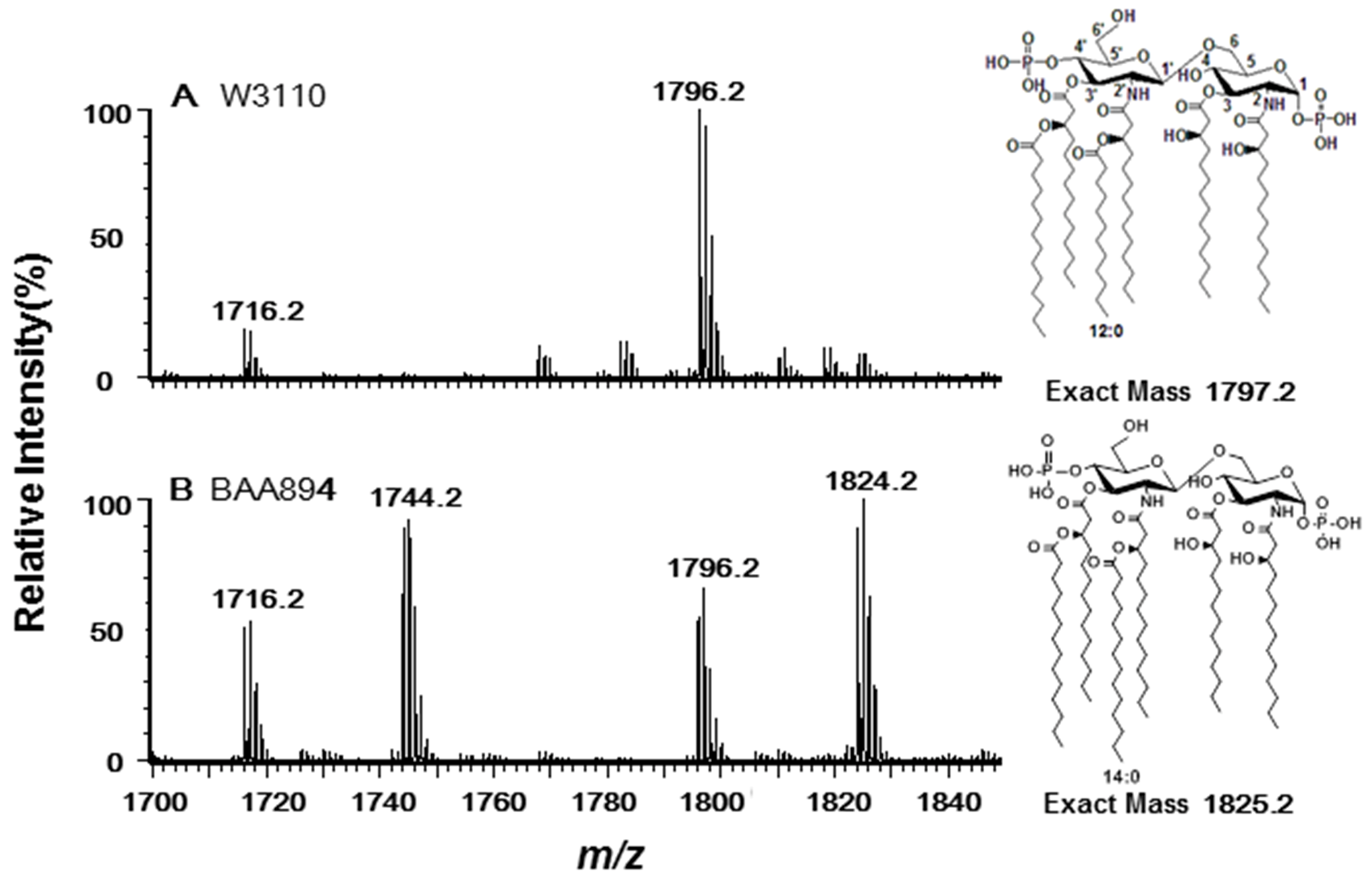
        <p>Lipid A samples were extracted from <italic>E. coli </italic>W3110 and <italic>C. sakazakii </italic>BAA894, respectively, and analyzed using ESI/MS in the negative ion mode (<xref ref-type="fig" rid="marinedrugs-11-00377-f001">Figure 1</xref>). Two majorions at <italic>m/z</italic> 1796.1 and 1716.2 were observed in the spectrum of <italic>E. coli</italic> Lipid A as expected (<xref ref-type="fig" rid="marinedrugs-11-00377-f001">Figure 1</xref>A). The peak at <italic>m/z</italic> 1796.1 was created by the molecular ion [M − H]<sup>−</sup> of lipid A; the peak at <italic>m/z</italic> 1716.2 arisen by loss of a phosphate from the lipid A during the extraction procedure [<xref ref-type="bibr" rid="B5-marinedrugs-11-00377">5</xref>]. The spectrum of <italic>C. sakazakii</italic> lipid A showed four major peaks at <italic>m/z</italic> 1716.1, 1744.1, 1796.1 and 1824.1, respectively (<xref ref-type="fig" rid="marinedrugs-11-00377-f001">Figure 1</xref>B). Two of the peaks (<italic>m/z</italic> 1716.1 and 1796.1) are the same to that of <italic>E. coli</italic> lipid A, while the other two peaks (<italic>m/z</italic> 1744.1 and 1824.1) differ from the first two by 28 Da, suggesting that <italic>C. sakazakii </italic>BAA894 synthesizes two different species of lipid A which differ at the length of secondary fatty acyl chains at 2′ and 3′-position [<xref ref-type="bibr" rid="B6-marinedrugs-11-00377">6</xref>].</p>
        <fig id="marinedrugs-11-00377-f001" position="float">
          <label>Figure 1</label>
          <caption>
            <p>Negative ion electrospray ionization (ESI)/MS analysis of lipid A purified from <italic>E. coli </italic>W3110 (<bold>A</bold>) and <italic>C. sakazakii</italic> BAA894 (<bold>B</bold>). The chemical structures of the major lipid A species are shown on the right. </p>
          </caption>
          <graphic xmlns:xlink="http://www.w3.org/1999/xlink" xlink:href="marinedrugs-11-00377-g001.tif"/>
        </fig>
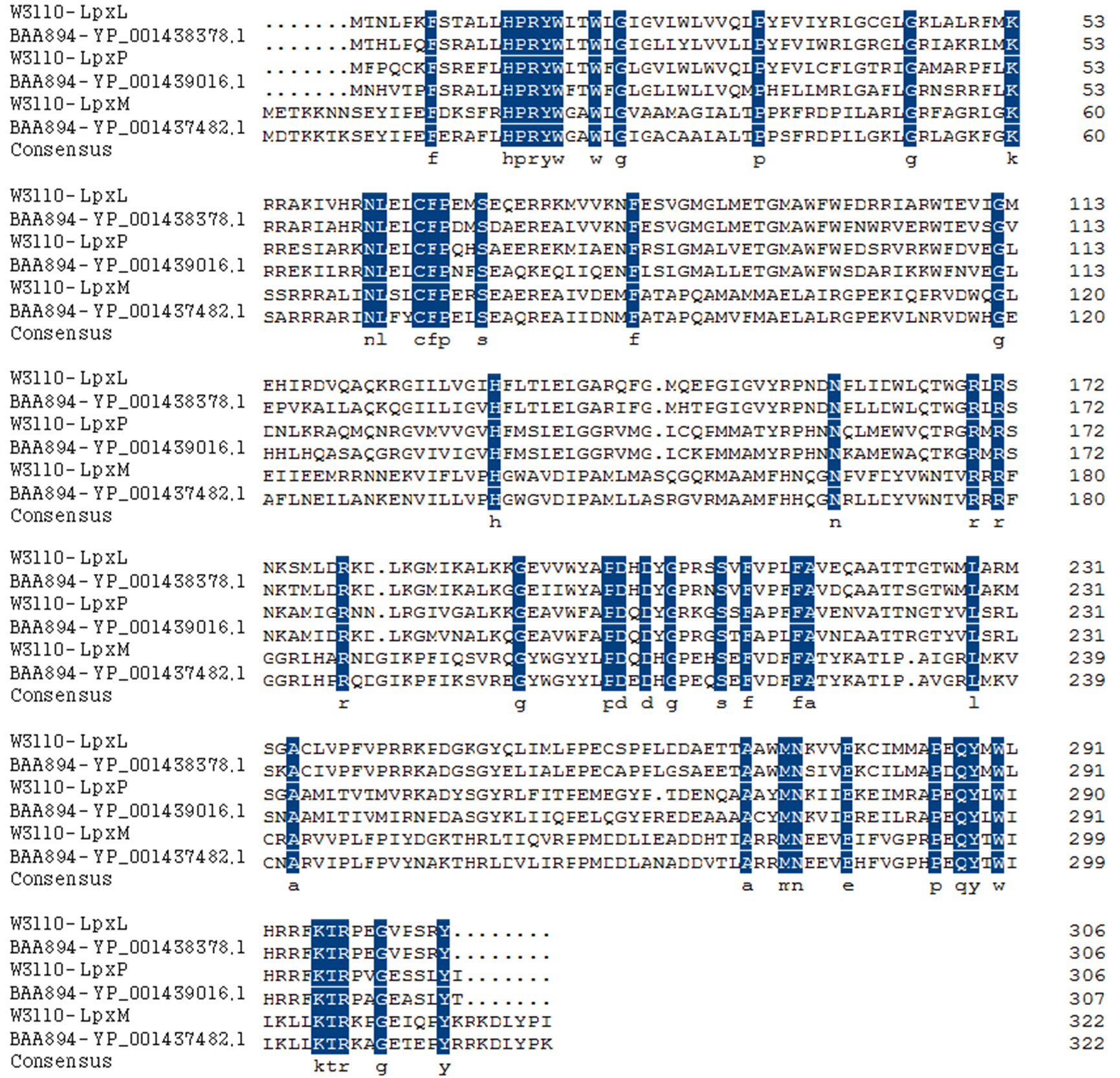
        <p>To explore the nature of diversity of the secondary fatty acyl chains of lipid A in <italic>C. sakazakii</italic>, BLASTp search against the genome of <italic>C. sakazakii</italic> BAA894 was performed, using <italic>E. coli</italic> LpxL, LpxP and LpxM as queries. Three late acyltransferases YP_001438378.1, YP_001439016.1, and YP_001437482.1 were revealed and the sequence alignments of all these proteins are shown in <xref ref-type="fig" rid="marinedrugs-11-00377-f002">Figure 2</xref>. YP_001438378.1 is encoded by ESA02293, contains 306 amino acids, and shares 79%, 51% and 31% identity to <italic>E. coli</italic> LpxL, LpxP and LpxM, respectively. YP_001439016.1 is encoded by ESA02951, contains 307 amino acids, and shares 55%, 71% and 28% identity to <italic>E. coli</italic> LpxL, LpxP and LpxM, respectively. YP_001437482.1 is encoded by ESA01386, contains 322 amino acids, and shares 30%, 28% and 75% identity to <italic>E. coli</italic> LpxL, LpxP and LpxM, respectively. Based on the sequence similarity, YP_001438378.1 is proposed as <italic>C. sakazakii</italic> LpxL, YP_001439016.1 as <italic>C. sakazakii</italic> LpxP and YP_001437482.1 as <italic>C. sakazakii</italic> LpxM.</p>
        <p>To confirm the function of the three putative acyltransferases, genes ESA02293, ESA02951 and ESA01386 were cloned into pWSK29, and transformed into <italic>E. coli</italic> mutant MLK1067 and MKV15b. MLK1067 was constructed by inactivating <italic>lpxM</italic> in <italic>E. coli</italic> and can only synthesize pentaacylated lipid A [<xref ref-type="bibr" rid="B16-marinedrugs-11-00377">16</xref>]; MKV15b is a Lpxl, LpxM, LpxP triple <italic>E. coli</italic> mutant and could only synthesize tetraacylated lipid A [<xref ref-type="bibr" rid="B17-marinedrugs-11-00377">17</xref>].</p>
        <fig id="marinedrugs-11-00377-f002" position="float">
          <label>Figure 2</label>
          <caption>
            <p>Sequence alignment of three putative late acyltransferases in  <italic>C. sakazakii</italic> BAA894 with <italic>E. coli</italic> LpxL, LpxM, and LpxP. The consensus residues are emphasized.</p>
          </caption>
          <graphic xmlns:xlink="http://www.w3.org/1999/xlink" xlink:href="marinedrugs-11-00377-g002.tif"/>
        </fig>
      </sec>
      <sec>
        <title>2.2. Acyltransferases Encoded by ESA02293 and ESA02952 Are Homologous to <italic>E. coli</italic> LpxL and LpxP, Respectively</title>
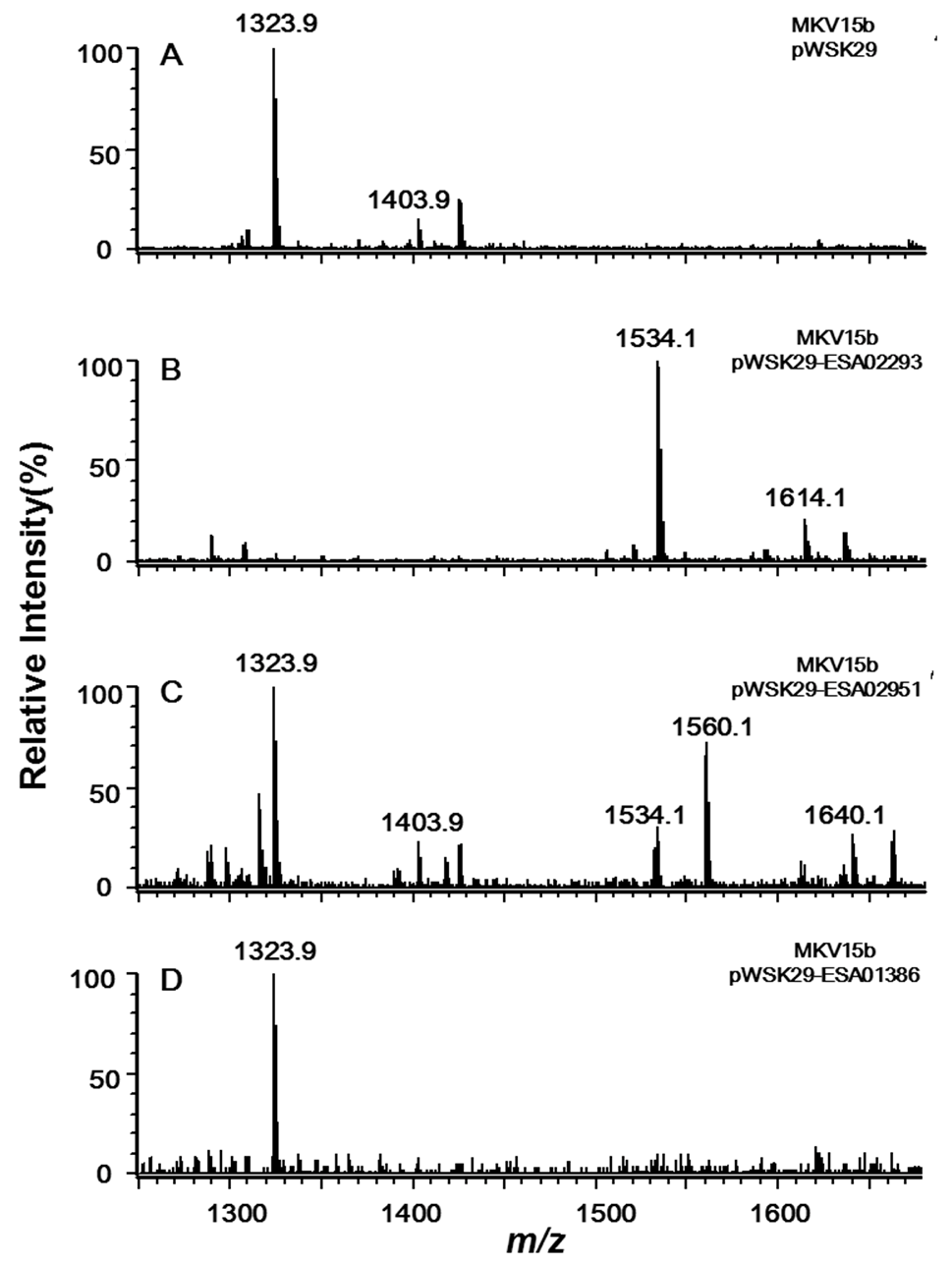
        <p>Lipid A and its derivatives were isolated from MKV15b/PWSK29, MK15b/pWSK29-ESA02293, MK15b/pWSK29-ESA02951, and MK15b/pWSK29-ESA01386, respectively, and analyzed by ESI/MS (<xref ref-type="fig" rid="marinedrugs-11-00377-f003">Figure 3</xref>).</p>
        <p>Two major ions at <italic>m/z</italic> 1403.9 and 1323.9 were observed in the spectrum of lipid A from the control MKV15b/pWSK29 (<xref ref-type="fig" rid="marinedrugs-11-00377-f003">Figure 3</xref>A). The peak at <italic>m/z</italic> 1403.9 is created by the molecular ion [M − H]<sup>−</sup> of lipid A containing two phosphate groups and four primary fatty acid chains; the peak at <italic>m/z</italic> 1323.9 arises by loss of a phosphate from the molecular ion during the extraction procedure. In the spectrum of lipid A sample from MKV15b/pWSK29-ESA02293, two major ions were also observed (<xref ref-type="fig" rid="marinedrugs-11-00377-f003">Figure 3</xref>B). The molecular ion at <italic>m/z</italic> 1614.1 differs from that of the lipid A from MKV15b/pWSK29 by 210 amu, that is, a C14:0 fatty acid unit. The peak at <italic>m/z</italic> 1534.1 arises by loss of a phosphate from the molecular ion. The results indicate that the enzyme encoded by ESA02293 transfers a C14:0 secondary acyl chain to the 2′-position of lipid A. </p>
        <fig id="marinedrugs-11-00377-f003" position="float">
          <label>Figure 3</label>
          <caption>
            <p>Negative ion ESI/MS analysis of lipid A isolated from <italic>E. coli </italic>MKV15b/pWSK29 (<bold>A</bold>), MKV15b/pWSK29-ESA02293 (<bold>B</bold>), MKV15b/pWSK29-ESA02951 (<bold>C</bold>) and MKV15b/pWSK29-ESA01386 (<bold>D</bold>).</p>
          </caption>
          <graphic xmlns:xlink="http://www.w3.org/1999/xlink" xlink:href="marinedrugs-11-00377-g003.tif"/>
        </fig>
        <p>Six peaks were observed in the spectrum of lipid A sample from MKV15b/pWSK29-ESA02951 (<xref ref-type="fig" rid="marinedrugs-11-00377-f003">Figure 3</xref>C). Peaks at <italic>m/z</italic> 1323.9 and 1403.9 are the same to that found in spectrum of lipid A from both MKV15b/pWSK29. Peaks at <italic>m/z</italic> 1534.1 and 1614.1 are the same to that found in spectrum of lipid A from MKV15b/pWSK29-ESA02293. This indicates that the enzyme encoded by ESA02951 can transfer a C14:0 secondary acyl chain to the 2′-position of lipid A, but its efficiency is not as high as the enzyme encoded by ESA02293. In addition, there were two new peaks at <italic>m/z</italic> 1560.1 and 1640.1 in the spectrum of lipid A from MKV15b/pWSK29-ESA02951; the former might arise by loss of a phosphate form the later. The molecular ion at <italic>m/z </italic>1640.1 differs from that of the molecular ion of lipid A from MKV15b/pWSK29 by 236 amu moiety, that is, a C16:1 fatty acid unit. The results indicate that the enzyme encoded by ESA02951 could transfer a C14:0 or a C16:1 secondary acyl chain to the 2′-position of lipid A.</p>
        <p>The spectrum of lipid A sample from MK15b/pWSK29-ESA01386 only showed a peak at <italic>m/z</italic> 1323.9 created by the molecular ion losing a phosphate, which is exactly the same as that of the control strain MKV15b/pWSK29 (<xref ref-type="fig" rid="marinedrugs-11-00377-f003">Figure 3</xref>D), suggesting the enzyme encoded by the gene ESA01386 does not function on the substrate lipid A with only four primary fatty acyl chains. Based on the analysis of sequence and function, the acyltransferase encoded by ESA02293 should be the LpxL in <italic>C. sakazakii</italic>, and the acyltransferase encoded by ESA_02952 should be the LpxP in <italic>C. sakazakii</italic>.</p>
        <p>Because there is a second molecular ion at <italic>m/z</italic> 1796.2 in the <italic>C. sakazakii</italic> lipid A mass spectrum (<xref ref-type="fig" rid="marinedrugs-11-00377-f001">Figure 1</xref>B), there might be another acyltransferase in <italic>C. sakazakii</italic> which transfers a C12:0 secondary acyl chain to lipid A. This acyltransferase may have no sequence similarity to LpxL. This situation was observed for LpxH, a key enzyme in the lipid A biosynthesis of <italic>E. coli</italic>. A new enzyme LpxI which has no sequence similarity to LpxH but generates the same products by a different route was recently found in <italic>Caulobacter crescentus</italic> [<xref ref-type="bibr" rid="B18-marinedrugs-11-00377">18</xref>]. Unlike <italic>E. coli</italic> LpxP which transfers a C16:1 acyl chain only at low temperature (12 °C), <italic>C. sakazakii</italic> LpxP can function at ambient temperature and can transfer either a C14:0 or a C16:1 secondary acyl chains. It would be interesting to study the structural difference of these two LpxP proteins to figure out the machnism for their different substrate specificity and temperature regulation.</p>
      </sec>
      <sec>
        <title>2.3. Acyltransferase Encoded by ESA01386 Is the Homologue of <italic>E. coli</italic> LpxM</title>
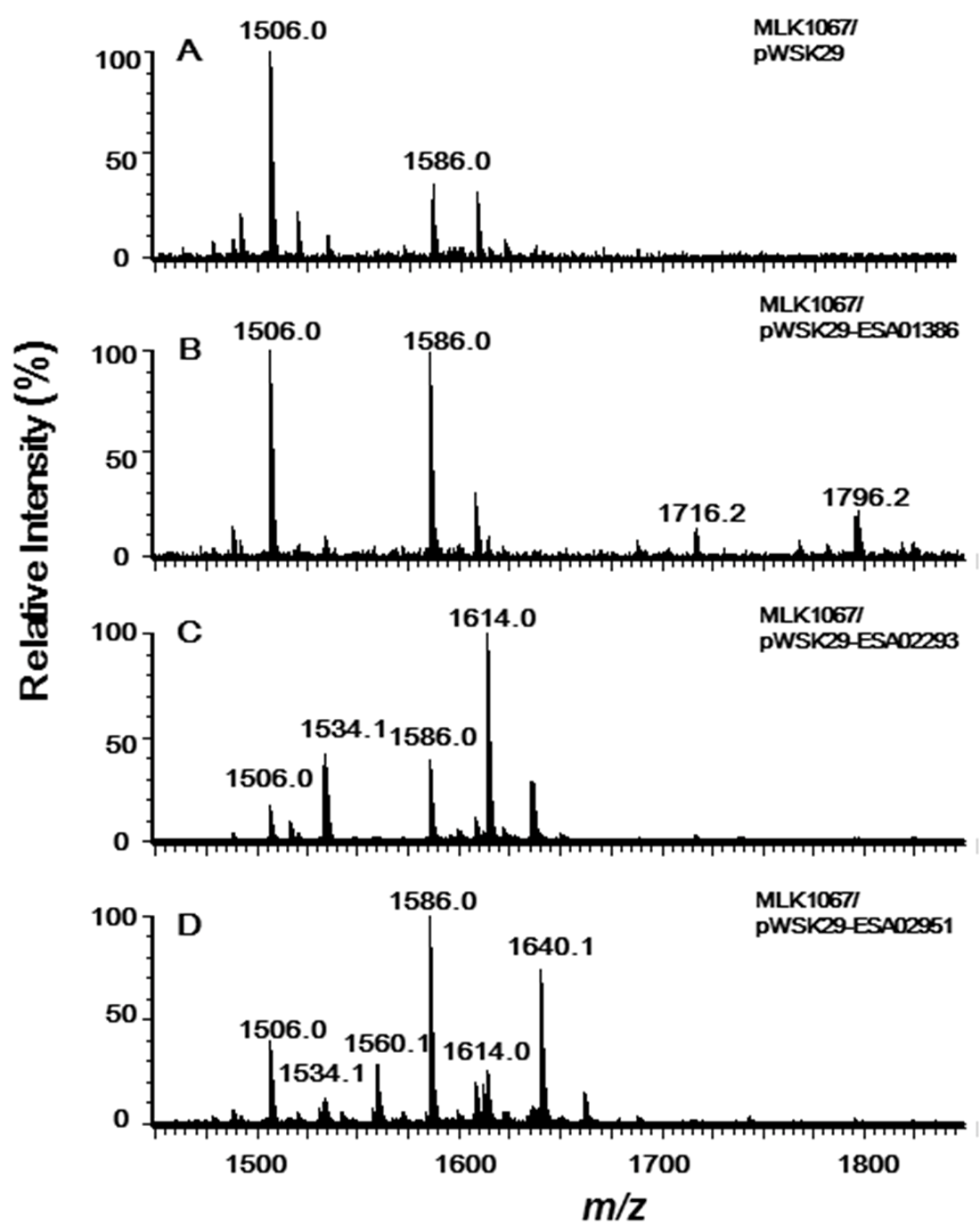
        <p>Lipid A and its derivatives were isolated from MLK1067/PWSK29, MLK1067/pWSK29-ESA02293, MLK1067/pWSK29-ESA02951, and MLK1067/pWSK29-ESA01386, respectively, and analyzed by ESI/MS (<xref ref-type="fig" rid="marinedrugs-11-00377-f004">Figure 4</xref>). </p>
        <fig id="marinedrugs-11-00377-f004" position="float">
          <label>Figure 4</label>
          <caption>
            <p>Negative ion ESI/MS analysis of lipid A isolated from <italic>E. coli </italic>MLK1067/pWSK29 (<bold>A</bold>), MLK1067/pWSK29-ESA01386 (<bold>B</bold>), MLK1067/pWSK29-ESA02293 (<bold>C</bold>) and MLK1067/pWSK29-ESA02951 (<bold>D</bold>).</p>
          </caption>
          <graphic xmlns:xlink="http://www.w3.org/1999/xlink" xlink:href="marinedrugs-11-00377-g004.tif"/>
        </fig>
        <p>Lipid A isolated from MLK1067/pWSK29 showed two major peaks in the spectrum; one is the molecular ion [M − H]<sup>−</sup> at <italic>m/z</italic> 1586.0 [<xref ref-type="bibr" rid="B6-marinedrugs-11-00377">6</xref>], and the other at <italic>m/z</italic> 1506.0 is derived by loss of a phosphate form the molecular ion (<xref ref-type="fig" rid="marinedrugs-11-00377-f004">Figure 4</xref>A). Two additional peaks at <italic>m/z</italic> 1716.2 and 1796.2 were observed in the spectrum of lipid A samples from MLK1067/pWSK29-ESA01386 (<xref ref-type="fig" rid="marinedrugs-11-00377-f004">Figure 4</xref>B). The peak at <italic>m/z</italic> 1796.2 should be from the molecular ion [M − H]<sup>−</sup>, and the peak at <italic>m/z</italic> 1716.2 is derived from the molecular ion by loss of a phosphate. The <italic>m/z</italic> value difference between the two molecular ions of lipid A from MLK1067/pWSK29 and MLK1067/pWSK29-ESA01386 is 210 amu, that is, a C14:0 acyl chain. This suggests that the enzyme encoded by ESA01386 could transfer a C14:0 fatty acids to the 3′-position of lipid A, but its efficiency is not as high as <italic>E. coli </italic>LpxM because the majority of lipid A in the cell are in the pentaacylated form. Considering <italic>C. sakazakii</italic> LpxL transfers a C14:0 secondary acyl chain to the 2′-position of lipid A (<xref ref-type="fig" rid="marinedrugs-11-00377-f003">Figure 3</xref>B), the pentaacylated lipid A with a C12:0 secondary fatty acyl chain in <italic>E. coli</italic> MLK1067 might not the ideal substrate for this enzyme. Based on the analysis of sequence and function, the acyltransferase encoded by ESA01386 should be the LpxM in <italic>C. sakazakii</italic>. </p>
        <p>The peaks at <italic>m/z</italic> 1796.2 and 1716.2 were not observed in the spectra of lipid A samples from MLK1067/pWSK29-ESA02293 and MLK1067/pWSK29-ESA02951, confirming that the enzymes encoded by ESA02293 and ESA02951 cannot add any acyl chains to the 3′-position of lipid A. In addition to the two peaks at <italic>m/z </italic>1506.0 and 1586.0 observed in the control, two addition peaks at <italic>m/z </italic>1534.1 and 1614.0 were observed in the spectrum of lipid A from MLK1067/pWSK29-ESA02293 (<xref ref-type="fig" rid="marinedrugs-11-00377-f004">Figure 4</xref>C), confirming again that  <italic>C. sakazakii</italic> LpxL prefers to transfer a C14:0 acyl chain to the 2′-position of lipid A. </p>
        <p>Six peaks were observed in the spectrum of lipid A sample from MLK1067/pWSK29-ESA02951 (<xref ref-type="fig" rid="marinedrugs-11-00377-f004">Figure 4</xref>D). Peaks at <italic>m/z</italic> 1506.0 and 1586.0 are the same to that found in spectrum of lipid A from MLK1067/pWSK29. Peaks at <italic>m/z</italic> 1534.1 and 1614.1 are the same to that found in spectrum of lipid A from MKV15b/pWSK29-ESA02293 or MLK1067/pWSK29-ESA02293. Peaks at <italic>m/z</italic> 1560.1 and 1640.1 are the same to that found in the spectrum of lipid A from MKV15b/pWSK29-ESA02951 (<xref ref-type="fig" rid="marinedrugs-11-00377-f003">Figure 3</xref>C). These data further confirm that <italic>C. sakazakii</italic> LpxP can transfer either a C16:1 or a C14:0 secondary acyl chain to the 2′-position of lipid A.</p>
      </sec>
    </sec>
    <sec>
      <title>3. Experimental Section</title>
      <sec>
        <title>3.1. DNA Preparation and PCR Techniques</title>
        <p>Plasmid DNA was prepared by using the EZ-10 spin column plasmid mini-preps kit from Bio Basic Inc. (Markham, Canada). Fifty microliters of PCR reaction mixture was used in this study, which contains 5 μL 10× Extaq buffer, 4 μL dNTP (2.5 mM each), 1 μL plasmid template, 1 μL forward primer (20 μM), 1 μL reverse primer (20 μM), and 0.5 μL Extaq polymerase. The PCR reaction was started at 94 °C for 5 min, followed by 35 cycles of denaturation (30 s at 94 °C), annealing, and extension. PCR products were puriﬁed using the TIAN gel puriﬁcation kit from Tiangen (Beijing, China). Primers synthesis and DNA sequencing were performed by Sangon (Shanghai, China).</p>
      </sec>
      <sec>
        <title>3.2. Construction of Plasmids Containing Genes ESA02293, ESA02951 or ESA01386</title>
        <p>ESA02293, ESA02951, and ESA01386 genes were obtained by PCR, using the genome of <italic>C. sakazakii</italic> BAA-894 as a template. All the primers used for the clones were listed in <xref ref-type="table" rid="marinedrugs-11-00377-t001">Table 1</xref>. Briefly, all the forward primers contained an XbaI site, and all the reverse primers contained a BamHI site. The PCR products were purified, digested with XbaI and BamHI, and ligated into the vector pWSK29 which was similarly digested. The resulting plasmids were designated as pWSK29-ESA02293, pWSK29-ESA02951 and pWSK29-ESA01386, respectively. These plasmids were transformed into <italic>E. coli </italic>mutants MLK1067 [<xref ref-type="bibr" rid="B5-marinedrugs-11-00377">5</xref>] and MKV15b [<xref ref-type="bibr" rid="B17-marinedrugs-11-00377">17</xref>], resulting strains MLK1067/pWSK29-ESA02293, MLK1067/pWSK29-ESA02951, MLK1067/pWSK29-ESA01386, MLV15b/pWSK29-ESA02293, MLV15b/pWSK29-ESA02951, and MLV15b/pWSK29-ESA01386. All strains used in this study are listed in <xref ref-type="table" rid="marinedrugs-11-00377-t001">Table 1</xref>. All <italic>C. sakazakii</italic> and <italic>E. coli </italic>stains were grown in LB media at 37 °C. 100 μg/mL ampicillin, 50 μg/mL kanamycin, or 20 μg/mL chloramphenicol were used when necessary.</p>
        <table-wrap id="marinedrugs-11-00377-t001" position="float">
          <object-id pub-id-type="pii">marinedrugs-11-00377-t001_Table 1</object-id>
          <label>Table 1</label>
          <caption>
            <p>Stains and primers used in this study.</p>
          </caption>
          <table>
            <thead>
              <tr>
                <th align="center" valign="middle">Strains or oligonucleotides</th>
                <th align="center" valign="middle">Relevant characteristic or sequence</th>
                <th align="center" valign="middle">Source or purpose</th>
              </tr>
            </thead>
            <tbody>
              <tr>
                <td align="center" valign="middle"><bold>Strains</bold></td>
                <td align="center" valign="middle"> </td>
                <td align="center" valign="middle"> </td>
              </tr>
              <tr>
                <td align="center" valign="middle">ATCC BAA894</td>
                <td align="center" valign="middle">Wild-type <italic>C. sakazakii</italic></td>
                <td align="center" valign="middle">ATCC</td>
              </tr>
              <tr>
                <td align="center" valign="middle">W3110</td>
                <td align="center" valign="middle">Wide-type <italic>E. coli</italic></td>
                <td align="center" valign="middle">ATCC</td>
              </tr>
              <tr>
                <td align="center" valign="middle">MKV15b </td>
                <td align="center" valign="middle">
                  <italic>W3110 lpxL</italic>
                  <italic>::Tn10 lpxM</italic>
                  <italic>::Ωcam lpxP</italic>
                  <italic>::kan </italic>
                </td>
                <td align="center" valign="middle">[<xref ref-type="bibr" rid="B17-marinedrugs-11-00377">17</xref>]</td>
              </tr>
              <tr>
                <td align="center" valign="middle">MKV15b/pWSK29</td>
                <td align="center" valign="middle">MKV15b harboring pWSK29</td>
                <td align="center" valign="middle">This work</td>
              </tr>
              <tr>
                <td align="center" valign="middle">MKV15b/pWSK29-ESA02293</td>
                <td align="center" valign="middle">MKV15b harboring pWSK29-ESA02293</td>
                <td align="center" valign="middle">This work</td>
              </tr>
              <tr>
                <td align="center" valign="middle">MKV15b/pWSK29-ESA02951</td>
                <td align="center" valign="middle">MKV15b harboring pWSK29-ESA02951</td>
                <td align="center" valign="middle">This work</td>
              </tr>
              <tr>
                <td align="center" valign="middle">MKV15b/pWSK29-ESA01386</td>
                <td align="center" valign="middle">MKV15b harboring pWSK29-ESA01386</td>
                <td align="center" valign="middle">This work</td>
              </tr>
              <tr>
                <td align="center" valign="middle">MLK1067</td>
                <td align="center" valign="middle">
                  <italic>W3110 lpxM</italic>
                  <italic>::Ωcam</italic>
                </td>
                <td align="center" valign="middle">[<xref ref-type="bibr" rid="B16-marinedrugs-11-00377">16</xref>]</td>
              </tr>
              <tr>
                <td align="center" valign="middle">MLK1067/pWSK29</td>
                <td align="center" valign="middle">MLK1067 harboring pWSK29</td>
                <td align="center" valign="middle">This work</td>
              </tr>
              <tr>
                <td align="center" valign="middle">MLK1067/pWSK29-ESA01386</td>
                <td align="center" valign="middle">MLK1067 harboring pWSK29-ESA01386</td>
                <td align="center" valign="middle">This work</td>
              </tr>
              <tr>
                <td align="center" valign="middle">MLK1067/pWSK29-ESA02293</td>
                <td align="center" valign="middle">MLK1067 harboring pWSK29-ESA02293</td>
                <td align="center" valign="middle">This work</td>
              </tr>
              <tr>
                <td align="center" valign="middle">MLK1067/pWSK29-ESA02951</td>
                <td align="center" valign="middle">MLK1067 harboring pWSK29-ESA02951</td>
                <td align="center" valign="middle">This work</td>
              </tr>
              <tr>
                <td align="center" valign="middle"><bold>Oligonucleotides</bold></td>
                <td align="center" valign="middle"> </td>
                <td align="center" valign="middle"> </td>
              </tr>
              <tr>
                <td align="center" valign="middle">F-ESA02293</td>
                <td align="center" valign="middle">GC<underline>TCTAGA</underline>ATGACGCATTTACCGCAATT</td>
                <td align="center" valign="middle">Forward primer for cloning ESA-02293</td>
              </tr>
              <tr>
                <td align="center" valign="middle">R-ESA02293</td>
                <td align="center" valign="middle">CG<underline>GGATCC</underline>TTAGTAGCGGGACGGCACGC</td>
                <td align="center" valign="middle">Reverse primer for cloning ESA-02293</td>
              </tr>
              <tr>
                <td align="center" valign="middle">F-ESA02951</td>
                <td align="center" valign="middle">GC<underline>TCTAGA</underline>ATGAATCACGTCACGCCTTTTTC</td>
                <td align="center" valign="middle">Forward primer for cloning ESA-02951</td>
              </tr>
              <tr>
                <td align="center" valign="middle">R-ESA02951</td>
                <td align="center" valign="middle">CG<underline>GGATCC</underline>TCAGGTATAGAGCGACGCTTC</td>
                <td align="center" valign="middle">Reverse primer for cloning ESA-02951</td>
              </tr>
              <tr>
                <td align="center" valign="middle">F-ESA01386</td>
                <td align="center" valign="middle">GC<underline>TCTAGA</underline>ATGGACACAAAAAAAACAAAAAGTG</td>
                <td align="center" valign="middle">Forward primer for cloning ESA-01386</td>
              </tr>
              <tr>
                <td align="center" valign="middle">R-ESA01386</td>
                <td align="center" valign="middle">CGG<underline>GATCC</underline>TTATTTCGGATAAAGATCTTTGC</td>
                <td align="center" valign="middle">Reverse primer for cloning ESA-01386</td>
              </tr>
            </tbody>
          </table>
        </table-wrap>
      </sec>
      <sec>
        <title>3.3. Lipid A Isolation from Different <italic>E. coli</italic> Strains</title>
        <p>Lipid A was isolated using the Bligh-Dyer method [<xref ref-type="bibr" rid="B19-marinedrugs-11-00377">19</xref>]. Briefly, 200 mL cultures were grown in LB broth at 37 °C to OD<sub>600</sub> of 1.0. Cells were harvested by centrifugation at 8000 rpm and washed twice with ddH<sub>2</sub>O. The cell pellet was resuspended in 76 mL of a single-phase Bligh-Dyer mixture containing chloroform/methanol/H<sub>2</sub>O (1:2:0.8, v/v/v), incubated with stirring at room temperature for 1 h. The insoluble debris was collected by centrifugation at 2000 rpm for 20 min and washed three times with single-phase Bligh-Dyer mixture. The debris was resuspended in 27 mL of 12.5 mM sodium acetate (pH 4.5), heated at 100 °C for 30 min, and cooled to room temperature. The suspension was mixed with 30 mL chloroform and 30 mL methanol, and the two phases were separated by centrifugation. The lower phase contains lipid A, and was dried under a stream of nitrogen.</p>
      </sec>
      <sec>
        <title>3.4. Mass Spectrometry Analysis</title>
        <p>All the mass spectra of lipid A samples were acquired on a Waters SYNAPT quadrupole time-of-flight mass spectrometer equipped with an electrospray ionization (ESI) source. Lipid A samples were dissolved in chloroform/methanol (2:1, v/v) and subjected to ESI/MS in the negative ion mode. Data acquisition and analysis were performed using Mass Lynx V4.1 software [<xref ref-type="bibr" rid="B20-marinedrugs-11-00377">20</xref>].</p>
      </sec>
    </sec>
    <sec sec-type="conclusions">
      <title>4. Conclusions</title>
      <p>Unlike <italic>E. coli</italic> which usually synthesizes only one lipid A species, <italic>C. sakazakii</italic> BAA894 synthesizes two different species of lipid A, differing on the length of the secondary acyl chain at 2′-position. Here, we identified three late acyltransferases in <italic>C. sakazakii</italic> BAA894. The enzyme encoded by the gene ESA02293 is homologous to <italic>E. coli</italic> LpxL, and transfers a C14:0 acyl chain to the 2′-position of lipid A. The enzyme encoded by the gene ESA_02953 is homologous to <italic>E. coli</italic> LpxP, and transfers either a C16:1 or a C14:0 acyl chains to the 2′-position of lipid A. The enzyme encoded by ESA01386 is homologous to <italic>E. coli</italic> LpxM, and transfer a C14:0 acyl chain to the lipid A at 3′-position. Since the number and length of secondary acyl chains of lipid A are important for the recognition of TLR4/MD2 to LPS, these late acyltransferases found in this study might be useful to construct various lipid A moieties for studying the immune responses.</p>
    </sec>
  </body>
  <back>
    <ack>
      <title>Acknowledgments</title>
      <p>Funding was provided by grants from National key Basic Research Program of China (973 Program 2012CB725202), the National Natural Science Foundation of China (NSFC31170069), the Specialized Research Fund for the Doctoral Program of Higher Education (SRFDP20100093110005).</p>
    </ack>
 <fn-group>
  <fn>
    <p><italic>Samples Availability:</italic> Available from the authors.</p>
  </fn>
 </fn-group>	
    <ref-list>
      <title>References</title>
      <ref id="B1-marinedrugs-11-00377">
        <label>1.</label>
        <citation citation-type="journal">
          <person-group person-group-type="author">
            <name>
              <surname>Wang</surname>
              <given-names>X.</given-names>
            </name>
            <name>
              <surname>Quinn</surname>
              <given-names>P.J.</given-names>
            </name>
          </person-group>
          <article-title>Lipopolysaccharide: Biosynthetic pathway and structure modification</article-title>
          <source>Prog. Lipid Res.</source>
          <year>2010</year>
          <volume>49</volume>
          <fpage>97</fpage>
          <lpage>107</lpage>
          <pub-id pub-id-type="doi">10.1016/j.plipres.2009.06.002</pub-id>
        </citation>
      </ref>
      <ref id="B2-marinedrugs-11-00377">
        <label>2.</label>
        <citation citation-type="journal">
          <person-group person-group-type="author">
            <name>
              <surname>Raetz</surname>
              <given-names>C.R.</given-names>
            </name>
            <name>
              <surname>Garrett</surname>
              <given-names>T.A.</given-names>
            </name>
            <name>
              <surname>Reynolds</surname>
              <given-names>C.M.</given-names>
            </name>
            <name>
              <surname>Shaw</surname>
              <given-names>W.A.</given-names>
            </name>
            <name>
              <surname>Moore</surname>
              <given-names>J.D.</given-names>
            </name>
            <name>
              <surname>Smith</surname>
              <given-names>D.C.</given-names>
            </name>
            <name>
              <surname>Ribeiro</surname>
              <given-names>A.A.</given-names>
            </name>
            <name>
              <surname>Murphy</surname>
              <given-names>R.C.</given-names>
            </name>
            <name>
              <surname>Ulevitch</surname>
              <given-names>R.J.</given-names>
            </name>
            <name>
              <surname>Fearns</surname>
              <given-names>C.</given-names>
            </name>
            <etal/>
          </person-group>
          <article-title>Kdo2-Lipid A of <italic>Escherichia coli</italic>, a defined endotoxin that activates macrophages via TLR-4</article-title>
          <source>J. Lipid Res.</source>
          <year>2006</year>
          <volume>47</volume>
          <fpage>1097</fpage>
          <lpage>1111</lpage>
          <pub-id pub-id-type="doi">10.1194/jlr.M600027-JLR200</pub-id>
        </citation>
      </ref>
      <ref id="B3-marinedrugs-11-00377">
        <label>3.</label>
        <citation citation-type="journal">
          <person-group person-group-type="author">
            <name>
              <surname>Miller</surname>
              <given-names>S.I.</given-names>
            </name>
            <name>
              <surname>Ernst</surname>
              <given-names>R.K.</given-names>
            </name>
            <name>
              <surname>Bader</surname>
              <given-names>M.W.</given-names>
            </name>
          </person-group>
          <article-title>LPS, TLR4 and infectious disease diversity</article-title>
          <source>Nat. Rev. Microbiol.</source>
          <year>2005</year>
          <volume>3</volume>
          <fpage>36</fpage>
          <lpage>46</lpage>
          <pub-id pub-id-type="doi">10.1038/nrmicro1068</pub-id>
        </citation>
      </ref>
      <ref id="B4-marinedrugs-11-00377">
        <label>4.</label>
        <citation citation-type="journal">
          <person-group person-group-type="author">
            <name>
              <surname>Triantafilou</surname>
              <given-names>M.</given-names>
            </name>
            <name>
              <surname>Triantafilou</surname>
              <given-names>K.</given-names>
            </name>
          </person-group>
          <article-title>The dynamics of LPS recognition: Complex orchestration of multiple receptors</article-title>
          <source>J. Endotoxin Res.</source>
          <year>2005</year>
          <volume>11</volume>
          <fpage>5</fpage>
          <lpage>11</lpage>
        <pub-id pub-id-type="pmid">15826372</pub-id></citation>
      </ref>
      <ref id="B5-marinedrugs-11-00377">
        <label>5.</label>
        <citation citation-type="journal">
          <person-group person-group-type="author">
            <name>
              <surname>Chen</surname>
              <given-names>J.</given-names>
            </name>
            <name>
              <surname>Tao</surname>
              <given-names>G.</given-names>
            </name>
            <name>
              <surname>Wang</surname>
              <given-names>X.</given-names>
            </name>
          </person-group>
          <article-title>Construction of an <italic>Escherichia coli</italic> mutant producing monophosphoryl lipid A</article-title>
          <source>Biotechnol. Lett.</source>
          <year>2011</year>
          <volume>33</volume>
          <fpage>1013</fpage>
          <lpage>1019</lpage>
          <pub-id pub-id-type="doi">10.1007/s10529-011-0521-z</pub-id>
        </citation>
      </ref>
      <ref id="B6-marinedrugs-11-00377">
        <label>6.</label>
        <citation citation-type="journal">
          <person-group person-group-type="author">
            <name>
              <surname>Zhang</surname>
              <given-names>C.</given-names>
            </name>
            <name>
              <surname>Li</surname>
              <given-names>Y.</given-names>
            </name>
            <name>
              <surname>Tao</surname>
              <given-names>G.</given-names>
            </name>
            <name>
              <surname>Li</surname>
              <given-names>Y.</given-names>
            </name>
            <name>
              <surname>Wang</surname>
              <given-names>X.</given-names>
            </name>
          </person-group>
          <article-title>Characterization of lipid A <italic>Cronobacter sakazakii</italic></article-title>
          <source>Eur. J. Mass Spectrom.</source>
          <year>2010</year>
          <volume>16</volume>
          <fpage>531</fpage>
          <lpage>538</lpage>
          <pub-id pub-id-type="doi">10.1255/ejms.1074</pub-id>
        </citation>
      </ref>
      <ref id="B7-marinedrugs-11-00377">
        <label>7.</label>
        <citation citation-type="journal">
          <person-group person-group-type="author">
            <name>
              <surname>Raetz</surname>
              <given-names>C.R.</given-names>
            </name>
            <name>
              <surname>Guan</surname>
              <given-names>Z.</given-names>
            </name>
            <name>
              <surname>Ingram</surname>
              <given-names>B.O.</given-names>
            </name>
            <name>
              <surname>Six</surname>
              <given-names>D.A.</given-names>
            </name>
            <name>
              <surname>Song</surname>
              <given-names>F.</given-names>
            </name>
            <name>
              <surname>Wang</surname>
              <given-names>X.</given-names>
            </name>
            <name>
              <surname>Zhao</surname>
              <given-names>J.</given-names>
            </name>
          </person-group>
          <article-title>Discovery of new biosynthetic pathways: The lipid A story</article-title>
          <source>J. Lipid Res.</source>
          <year>2009</year>
          <volume>50</volume>
          <fpage>S103</fpage>
          <lpage>S108</lpage>
        <pub-id pub-id-type="pmid">18974037</pub-id></citation>
      </ref>
      <ref id="B8-marinedrugs-11-00377">
        <label>8.</label>
        <citation citation-type="journal">
          <person-group person-group-type="author">
            <name>
              <surname>Williams</surname>
              <given-names>A.H.</given-names>
            </name>
            <name>
              <surname>Raetz</surname>
              <given-names>C.R.</given-names>
            </name>
          </person-group>
          <article-title>Structural basis for the acyl chain selectivity and mechanism of UDP-<italic>N</italic>-acetylglucosamine acyltransferase</article-title>
          <source>Proc. Natl. Acad. Sci. USA</source>
          <year>2007</year>
          <volume>104</volume>
          <fpage>13543</fpage>
          <lpage>13550</lpage>
        <pub-id pub-id-type="doi">10.1073/pnas.0705833104</pub-id><pub-id pub-id-type="pmid">17698807</pub-id></citation>
      </ref>
      <ref id="B9-marinedrugs-11-00377">
        <label>9.</label>
        <citation citation-type="journal">
          <person-group person-group-type="author">
            <name>
              <surname>Buetow</surname>
              <given-names>L.</given-names>
            </name>
            <name>
              <surname>Smith</surname>
              <given-names>T.K.</given-names>
            </name>
            <name>
              <surname>Dawson</surname>
              <given-names>A.</given-names>
            </name>
            <name>
              <surname>Fyffe</surname>
              <given-names>S.</given-names>
            </name>
            <name>
              <surname>Hunter</surname>
              <given-names>W.N.</given-names>
            </name>
          </person-group>
          <article-title>Structure and reactivity of LpxD, the <italic>N</italic>-acyltransferase of lipid A biosynthesis</article-title>
          <source>Proc. Natl. Acad. Sci. USA</source>
          <year>2007</year>
          <volume>104</volume>
          <fpage>4321</fpage>
          <lpage>4326</lpage>
        <pub-id pub-id-type="pmid">17360522</pub-id><pub-id pub-id-type="doi">10.1073/pnas.0606356104</pub-id></citation>
      </ref>
      <ref id="B10-marinedrugs-11-00377">
        <label>10.</label>
        <citation citation-type="journal">
          <person-group person-group-type="author">
            <name>
              <surname>Li</surname>
              <given-names>Y.</given-names>
            </name>
            <name>
              <surname>Powell</surname>
              <given-names>D.A.</given-names>
            </name>
            <name>
              <surname>Shaffer</surname>
              <given-names>S.A.</given-names>
            </name>
            <name>
              <surname>Rasko</surname>
              <given-names>D.A.</given-names>
            </name>
            <name>
              <surname>Pelletier</surname>
              <given-names>M.R.</given-names>
            </name>
            <name>
              <surname>Leszyk</surname>
              <given-names>J.D.</given-names>
            </name>
            <name>
              <surname>Scott</surname>
              <given-names>A.J.</given-names>
            </name>
            <name>
              <surname>Masoudi</surname>
              <given-names>A.</given-names>
            </name>
            <name>
              <surname>Goodlett</surname>
              <given-names>D.R.</given-names>
            </name>
            <name>
              <surname>Wang</surname>
              <given-names>X.</given-names>
            </name>
            <etal/>
          </person-group>
          <article-title>LPS remodeling is an evolved survival strategy for bacteria</article-title>
          <source>Proc. Natl. Acad. Sci. USA</source>
          <year>2012</year>
          <volume>109</volume>
          <fpage>8716</fpage>
          <lpage>8721</lpage>
        <pub-id pub-id-type="doi">10.1073/pnas.1202908109</pub-id><pub-id pub-id-type="pmid">22586119</pub-id></citation>
      </ref>
      <ref id="B11-marinedrugs-11-00377">
        <label>11.</label>
        <citation citation-type="journal">
          <person-group person-group-type="author">
            <name>
              <surname>McLendon</surname>
              <given-names>M.K.</given-names>
            </name>
            <name>
              <surname>Schilling</surname>
              <given-names>B.</given-names>
            </name>
            <name>
              <surname>Hunt</surname>
              <given-names>J.R.</given-names>
            </name>
            <name>
              <surname>Apicella</surname>
              <given-names>M.A.</given-names>
            </name>
            <name>
              <surname>Gibson</surname>
              <given-names>B.W.</given-names>
            </name>
          </person-group>
          <article-title>Identification of LpxL, a late acyltransferase of <italic>Francisella tularensis</italic></article-title>
          <source>Infect. Immun.</source>
          <year>2007</year>
          <volume>75</volume>
          <fpage>5518</fpage>
          <lpage>5531</lpage>
        <pub-id pub-id-type="doi">10.1128/IAI.01288-06</pub-id><pub-id pub-id-type="pmid">17724076</pub-id></citation>
      </ref>
      <ref id="B12-marinedrugs-11-00377">
        <label>12.</label>
        <citation citation-type="journal">
          <person-group person-group-type="author">
            <name>
              <surname>Clementz</surname>
              <given-names>T.</given-names>
            </name>
            <name>
              <surname>Bednarski</surname>
              <given-names>J.J.</given-names>
            </name>
            <name>
              <surname>Raetz</surname>
              <given-names>C.R.</given-names>
            </name>
          </person-group>
          <article-title>Function of the htrB high temperature requirement gene of <italic>Escherchia coli</italic> in the acylation of lipid A: HtrB catalyzed incorporation of laurate</article-title>
          <source>J. Biol. Chem.</source>
          <year>1996</year>
          <volume>271</volume>
          <fpage>12095</fpage>
          <lpage>12102</lpage>
        <pub-id pub-id-type="doi">10.1074/jbc.271.20.12095</pub-id><pub-id pub-id-type="pmid">8662613</pub-id></citation>
      </ref>
      <ref id="B13-marinedrugs-11-00377">
        <label>13.</label>
        <citation citation-type="journal">
          <person-group person-group-type="author">
            <name>
              <surname>Geurtsen</surname>
              <given-names>J.</given-names>
            </name>
            <name>
              <surname>Angevaare</surname>
              <given-names>E.</given-names>
            </name>
            <name>
              <surname>Janssen</surname>
              <given-names>M.</given-names>
            </name>
            <name>
              <surname>Hamstra</surname>
              <given-names>H.J.</given-names>
            </name>
            <name>
              <surname>ten Hove</surname>
              <given-names>J.</given-names>
            </name>
            <name>
              <surname>de Haan</surname>
              <given-names>A.</given-names>
            </name>
            <name>
              <surname>Kuipers</surname>
              <given-names>B.</given-names>
            </name>
            <name>
              <surname>Tommassen</surname>
              <given-names>J.</given-names>
            </name>
            <name>
              <surname>van der Ley</surname>
              <given-names>P.</given-names>
            </name>
          </person-group>
          <article-title>A novel secondary acyl chain in the lipopolysaccharide of <italic>Bordetella pertussis</italic> required for efficient infection of human macrophages</article-title>
          <source>J. Biol. Chem.</source>
          <year>2007</year>
          <volume>282</volume>
          <fpage>37875</fpage>
          <lpage>37884</lpage>
        <pub-id pub-id-type="doi">10.1074/jbc.M706391200</pub-id><pub-id pub-id-type="pmid">17967899</pub-id></citation>
      </ref>
      <ref id="B14-marinedrugs-11-00377">
        <label>14.</label>
        <citation citation-type="journal">
          <person-group person-group-type="author">
            <name>
              <surname>Carty</surname>
              <given-names>S.M.</given-names>
            </name>
            <name>
              <surname>Sreekumar</surname>
              <given-names>K.R.</given-names>
            </name>
            <name>
              <surname>Raetz</surname>
              <given-names>C.R.</given-names>
            </name>
          </person-group>
          <article-title>Effect of cold shock on lipid A biosynthesis in <italic>Escherichia coli</italic>. Induction At 12 degrees C of an acyltransferase specific for palmitoleoyl-acyl carrier protein</article-title>
          <source>J. Biol. Chem.</source>
          <year>1999</year>
          <volume>274</volume>
          <fpage>9677</fpage>
          <lpage>9685</lpage>
        <pub-id pub-id-type="doi">10.1074/jbc.274.14.9677</pub-id><pub-id pub-id-type="pmid">10092655</pub-id></citation>
      </ref>
      <ref id="B15-marinedrugs-11-00377">
        <label>15.</label>
        <citation citation-type="journal">
          <person-group person-group-type="author">
            <name>
              <surname>Vorachek-Warren</surname>
              <given-names>M.K.</given-names>
            </name>
            <name>
              <surname>Carty</surname>
              <given-names>S.M.</given-names>
            </name>
            <name>
              <surname>Lin</surname>
              <given-names>S.</given-names>
            </name>
            <name>
              <surname>Cotter</surname>
              <given-names>R.J.</given-names>
            </name>
            <name>
              <surname>Raetz</surname>
              <given-names>C.R.</given-names>
            </name>
          </person-group>
          <article-title>An Escherichia coli mutant lacking the cold shock-induced palmitoleoyltransferase of lipid A biosynthesis: Absence of unsaturated acyl chains and antibiotic hypersensitivity at 12 degrees C</article-title>
          <source>J. Biol. Chem.</source>
          <year>2002</year>
          <volume>277</volume>
          <fpage>14186</fpage>
          <lpage>14193</lpage>
        <pub-id pub-id-type="doi">10.1074/jbc.M200408200</pub-id><pub-id pub-id-type="pmid">11830594</pub-id></citation>
      </ref>
      <ref id="B16-marinedrugs-11-00377">
        <label>16.</label>
        <citation citation-type="journal">
          <person-group person-group-type="author">
            <name>
              <surname>Brozek</surname>
              <given-names>K.A.</given-names>
            </name>
            <name>
              <surname>Raetz</surname>
              <given-names>C.R.</given-names>
            </name>
          </person-group>
          <article-title>Biosynthesis of lipid A in <italic>Escherichia coli</italic>. Acyl carrier protein-dependent incorporation of laurate and myristate</article-title>
          <source>J. Biol. Chem.</source>
          <year>1990</year>
          <volume>265</volume>
          <fpage>15410</fpage>
          <lpage>15417</lpage>
        <pub-id pub-id-type="pmid">2203778</pub-id></citation>
      </ref>
      <ref id="B17-marinedrugs-11-00377">
        <label>17.</label>
        <citation citation-type="journal">
          <person-group person-group-type="author">
            <name>
              <surname>Vorachek-Warren</surname>
              <given-names>M.K.</given-names>
            </name>
            <name>
              <surname>Ramirez</surname>
              <given-names>S.</given-names>
            </name>
            <name>
              <surname>Cotter</surname>
              <given-names>R.J.</given-names>
            </name>
            <name>
              <surname>Raetz</surname>
              <given-names>C.R.</given-names>
            </name>
          </person-group>
          <article-title>A triple mutant of <italic>Escherichia coli</italic> lacking secondary acyl chains on lipid A</article-title>
          <source>J. Biol. Chem.</source>
          <year>2002</year>
          <volume>277</volume>
          <fpage>14194</fpage>
          <lpage>14205</lpage>
        <pub-id pub-id-type="doi">10.1074/jbc.M200409200</pub-id><pub-id pub-id-type="pmid">11830595</pub-id></citation>
      </ref>
      <ref id="B18-marinedrugs-11-00377">
        <label>18.</label>
        <citation citation-type="journal">
          <person-group person-group-type="author">
            <name>
              <surname>Metzger</surname>
              <given-names>L.E.</given-names>
            </name>
            <name>
              <surname>Raetz</surname>
              <given-names>C.R.</given-names>
            </name>
          </person-group>
          <article-title>An alternative route for UDP-diacylglucosamine hydrolysis in bacterial lipid A biosynthesis</article-title>
          <source>Biochemistry</source>
          <year>2010</year>
          <volume>49</volume>
          <fpage>6715</fpage>
          <lpage>6726</lpage>
          <pub-id pub-id-type="doi">10.1021/bi1008744</pub-id>
        </citation>
      </ref>
      <ref id="B19-marinedrugs-11-00377">
        <label>19.</label>
        <citation citation-type="journal">
          <person-group person-group-type="author">
            <name>
              <surname>Bligh</surname>
              <given-names>E.G.</given-names>
            </name>
            <name>
              <surname>Dyer</surname>
              <given-names>W.J.</given-names>
            </name>
          </person-group>
          <article-title>A rapid method of total lipid extraction and purification</article-title>
          <source>Can. J. Biochem. Physiol.</source>
          <year>1959</year>
          <volume>37</volume>
          <fpage>911</fpage>
          <lpage>917</lpage>
          <pub-id pub-id-type="doi">10.1139/o59-099</pub-id>
        </citation>
      </ref>
      <ref id="B20-marinedrugs-11-00377">
        <label>20.</label>
        <citation citation-type="other">
          <source>MassLynx Software</source>
          <edition>version 4.1</edition>
          <publisher-name>Waters Corporation</publisher-name>
          <publisher-loc>Milford, MA, USA</publisher-loc>
          <year>2005</year>
        </citation>
      </ref>
    </ref-list>
  </back>
</article>