<?xml version="1.0" encoding="UTF-8"?>
<!DOCTYPE article PUBLIC "-//NLM//DTD Journal Publishing DTD v2.3 20070202//EN" "journalpublishing.dtd">
<article xmlns:mml="http://www.w3.org/1998/Math/MathML" xmlns:xlink="http://www.w3.org/1999/xlink" xml:lang="en" article-type="research-article">
  <front>
    <journal-meta>
      <journal-id journal-id-type="publisher-id">marinedrugs</journal-id>
      <journal-title>Marine Drugs</journal-title>
      <abbrev-journal-title abbrev-type="publisher">Mar. Drugs</abbrev-journal-title>
      <abbrev-journal-title abbrev-type="pubmed">Marine Drugs</abbrev-journal-title>
      <issn pub-type="epub">1660-3397</issn>
      <publisher>
        <publisher-name>MDPI</publisher-name>
      </publisher>
    </journal-meta>
    <article-meta>
      <article-id pub-id-type="doi">10.3390/md11010050</article-id>
      <article-id pub-id-type="publisher-id">marinedrugs-11-00050</article-id>
      <article-categories>
        <subj-group>
          <subject>Article</subject>
        </subj-group>
      </article-categories>
      <title-group>
        <article-title>Fucoxanthin Enhances Cisplatin-Induced Cytotoxicity via NFκB-Mediated Pathway and Downregulates DNA Repair Gene Expression in Human Hepatoma HepG2 Cells</article-title>
      </title-group>
      <contrib-group>
        <contrib contrib-type="author">
          <name>
            <surname>Liu</surname>
            <given-names>Cheng-Ling</given-names>
          </name>
          <xref rid="af1-marinedrugs-11-00050" ref-type="aff">1</xref>
        </contrib>
        <contrib contrib-type="author">
          <name>
            <surname>Lim</surname>
            <given-names>Yun-Ping</given-names>
          </name>
          <xref rid="af2-marinedrugs-11-00050" ref-type="aff">2</xref>
          <xref rid="af3-marinedrugs-11-00050" ref-type="aff">3</xref>
        </contrib>
        <contrib contrib-type="author">
          <name>
            <surname>Hu</surname>
            <given-names>Miao-Lin</given-names>
          </name>
          <xref rid="af1-marinedrugs-11-00050" ref-type="aff">1</xref>
          <xref rid="af4-marinedrugs-11-00050" ref-type="aff">4</xref>
          <xref rid="c1-marinedrugs-11-00050" ref-type="corresp">*</xref>
        </contrib>
      </contrib-group>
      <aff id="af1-marinedrugs-11-00050"><label>1</label> Department of Food Science and Biotechnology, National Chung Hsing University, Taichung 402, Taiwan; E-Mail: <email>liouoiu@msn.com</email> </aff>
      <aff id="af2-marinedrugs-11-00050"><label>2</label> Department of Pharmacy, College of Pharmacy, China Medical University, Taichung 404, Taiwan; E-Mail: <email>limyp@mail.cmu.edu.tw</email> </aff>
      <aff id="af3-marinedrugs-11-00050"><label>3</label> Department of Emergency, Toxicology Center, China Medical University Hospital, Taichung 404, Taiwan</aff>
      <aff id="af4-marinedrugs-11-00050"><label>4</label> Agricultural Biotechnology Center, National Chung Hsing University, Taichung 402, Taiwan</aff>
      <author-notes>
        <corresp id="c1-marinedrugs-11-00050"><label>*</label> Author to whom correspondence should be addressed; E-Mail: <email>mlhuhu@nchu.edu.tw</email>; Tel./Fax: +886-4-2281-2363.</corresp>
      </author-notes>
      <pub-date pub-type="epub">
        <day>08</day>
        <month>01</month>
        <year>2013</year>
      </pub-date>
      <pub-date pub-type="collection"><month>01</month>
        <year>2013</year>
      </pub-date>
      <volume>11</volume>
      <issue>1</issue>
      <fpage>50</fpage>
      <lpage>66</lpage>
      <history>
        <date date-type="received">
          <day>10</day>
          <month>10</month>
          <year>2012</year>
        </date>
        <date date-type="rev-recd">
          <day>14</day>
          <month>11</month>
          <year>2012</year>
        </date>
        <date date-type="accepted">
          <day>13</day>
          <month>12</month>
          <year>2012</year>
        </date>
      </history>
      <permissions>
        <copyright-statement>©  2013 by the authors; licensee MDPI, Basel, Switzerland.</copyright-statement>
        <copyright-year>2013</copyright-year>
        <license xmlns:xlink="http://www.w3.org/1999/xlink" license-type="open-access" xlink:href="http://creativecommons.org/licenses/by/3.0/">
          <p>This article is an open-access article distributed under the terms and conditions of the Creative Commons Attribution license (http://creativecommons.org/licenses/by/3.0/).</p>
        </license>
      </permissions>
      <abstract>
        <p>Cisplain, a platinum-containing anticancer drug, has been shown to enhance DNA repair and to inhibit cell apoptosis, leading to drug resistance. Thus, the combination of anticancer drugs with nutritional factors is a potential strategy for improving the efficacy of cisplatin chemotherapy. In this study, we investigated the anti-proliferative effects of a combination of fucoxanthin, the major non-provitamin A carotenoid found in <italic>Undaria Pinnatifida</italic>, and cisplatin in human hepatoma HepG2 cells. We found that fucoxanthin (1–10 μΜ) pretreatment for 24 h followed by cisplatin (10 μΜ) for 24 h significantly decreased cell proliferation, as compared with cisplatin treatment alone. Mechanistically, we showed that fucoxanthin attenuated cisplatin-induced NFκB expression and enhanced the NFκB-regulated Bax/Bcl-2 mRNA ratio. Cisplatin alone induced mRNA expression of excision repair cross complementation 1 (ERCC1) and thymidine phosphorylase (TP) through phosphorylation of ERK, p38 and PI3K/AKT pathways. However, fucoxanthin pretreatment significantly attenuated cisplatin-induced ERCC1 and TP mRNA expression, leading to improvement of chemotherapeutic efficacy of cisplatin. The results suggest that a combined treatment with fucoxanthin and cisplatin could lead to a potentially important new therapeutic strategy against human hepatoma cells. </p>
      </abstract>
      <kwd-group>
        <kwd>fucoxanthin</kwd>
        <kwd>cisplatin</kwd>
        <kwd>NFκB</kwd>
        <kwd>DNA repair</kwd>
        <kwd>MAPK</kwd>
        <kwd>PI3K/AKT</kwd>
      </kwd-group>
    </article-meta>
  </front>
  <body>
    <sec sec-type="intro">
      <title>1. Introduction</title>
      <p>Hepatocellular carcinoma (HCC) is the major cause of cancer death in Taiwan and one of the most common cancers in the world, accounting for approximately 6% of all human cancers [<xref ref-type="bibr" rid="B1-marinedrugs-11-00050">1</xref>,<xref ref-type="bibr" rid="B2-marinedrugs-11-00050">2</xref>]. For most patients with unresectable HCC, chemotherapy plays an important role in the treatment of HCC [<xref ref-type="bibr" rid="B3-marinedrugs-11-00050">3</xref>]. Unfortunately, chemotherapy has limited effect on survival owing to multiple drug resistance (MDR) [<xref ref-type="bibr" rid="B4-marinedrugs-11-00050">4</xref>]. Much evidence indicates that the MDR is involved in drug efflux, DNA repair activity, and altered survival and apoptotic signaling pathways [<xref ref-type="bibr" rid="B5-marinedrugs-11-00050">5</xref>]. Thus, the new therapeutic strategies for malignant HCC using combined therapies or combined agents with distinct molecular mechanisms are considered more promising for higher therapy efficacy, resulting in better survival.</p>
      <p>Platinum antitumor compounds, such as cisplatin (<italic>cis</italic>-diamminedichloroplatinum (II)) and its analogs, have been used widely as a chemotherapeutic drug for a variety of malignancies including hepatocellular carcinoma [<xref ref-type="bibr" rid="B6-marinedrugs-11-00050">6</xref>]. Platinum can directly bind to intra- and inter-strand DNA molecules to form predominantly platinum-DNA adducts that ultimately interfere with DNA transcription and replication and result in cell death [<xref ref-type="bibr" rid="B7-marinedrugs-11-00050">7</xref>,<xref ref-type="bibr" rid="B8-marinedrugs-11-00050">8</xref>,<xref ref-type="bibr" rid="B9-marinedrugs-11-00050">9</xref>]. Although cisplatin is extensively used in chemotherapy, its effectiveness is limited by acquired or intrinsic resistance [<xref ref-type="bibr" rid="B10-marinedrugs-11-00050">10</xref>]. A number of mechanisms of cisplatin resistance in cancer cells has been recognized: (1) increased reflux; (2) increased inactivation by sulfhydryl molecules such as glutathione; (3) altered expression of proteins in signal transduction pathways that control apoptosis; and (4) increased DNA repair [<xref ref-type="bibr" rid="B11-marinedrugs-11-00050">11</xref>]. DNA repair pathways that may result in platinum-based chemotherapeutic resistance include mismatch repair (MMR) and nucleotide excision repair (NER) [<xref ref-type="bibr" rid="B12-marinedrugs-11-00050">12</xref>,<xref ref-type="bibr" rid="B13-marinedrugs-11-00050">13</xref>]. Excision repair cross-complementation group 1 (ERCC1) is the initial enzyme in the NER pathway of DNA repair, and reports have shown that increased mRNA levels of ERCC1 are associated with clinical resistance to platinum-based chemotherapy in human lung, gastric, ovarian, cervical, and colorectal carcinomas and impact with the survival rate of cancer patients [<xref ref-type="bibr" rid="B14-marinedrugs-11-00050">14</xref>,<xref ref-type="bibr" rid="B15-marinedrugs-11-00050">15</xref>,<xref ref-type="bibr" rid="B16-marinedrugs-11-00050">16</xref>,<xref ref-type="bibr" rid="B17-marinedrugs-11-00050">17</xref>,<xref ref-type="bibr" rid="B18-marinedrugs-11-00050">18</xref>]. In addition, thymidine phosphorylase (TP), a key enzyme in the pyrimidine nucleoside salvage pathway, is known to catalyze the reversible conversion of thymidine to thymine and 2-deoxy-<sc>D</sc>-ribose-1-phosphate [<xref ref-type="bibr" rid="B19-marinedrugs-11-00050">19</xref>]. TP expression in various kinds of tumors is higher than that in the adjacent non-neoplastic tissues [<xref ref-type="bibr" rid="B20-marinedrugs-11-00050">20</xref>], and TP-overexpressed cell lines are more resistant to various apoptosis-inducing stimuli such as cisplatin and microtubule-interfering agents, hypoxia, and Fas ligands [<xref ref-type="bibr" rid="B21-marinedrugs-11-00050">21</xref>,<xref ref-type="bibr" rid="B22-marinedrugs-11-00050">22</xref>,<xref ref-type="bibr" rid="B23-marinedrugs-11-00050">23</xref>].</p>
      <p>Nuclear transcription factor kappa B (NFκB), a heterodimeric protein composed of different combinations of members of the Rel family of transcription factors, is inactivated in the cytoplasm by IκBs, a class of inhibitor proteins. Phosphorylation of IκB by upstream kinases promotes its ubiquitination-dependent degradation, allowing NFκB to translocate to the nucleus and induce target genes, which is associated with cell proliferation [<xref ref-type="bibr" rid="B24-marinedrugs-11-00050">24</xref>], angiogenesis [<xref ref-type="bibr" rid="B25-marinedrugs-11-00050">25</xref>], metastasis [<xref ref-type="bibr" rid="B26-marinedrugs-11-00050">26</xref>], suppression of apoptosis [<xref ref-type="bibr" rid="B27-marinedrugs-11-00050">27</xref>], promotion of oncogenesis [<xref ref-type="bibr" rid="B28-marinedrugs-11-00050">28</xref>], and cancer therapy resistance [<xref ref-type="bibr" rid="B24-marinedrugs-11-00050">24</xref>]. NFκB is known to inhibit apoptosis through induction of anti-apoptotic proteins or suppression of pro-apoptotic genes, and the ratio of pro- and antiapoptotic Bcl-2 family members is critical to determine cell susceptibility to apoptotic insults [<xref ref-type="bibr" rid="B29-marinedrugs-11-00050">29</xref>,<xref ref-type="bibr" rid="B30-marinedrugs-11-00050">30</xref>]. Much evidence indicates that several anticancer drugs such as cisplatin, docetaxel, gemcitabine induce NFκB nuclear translocation and activation of its target genes, thereby potentially leading to chemoresistance [<xref ref-type="bibr" rid="B31-marinedrugs-11-00050">31</xref>]. For example, it has been reported that increased resistance of human cervical carcinoma cells to cisplatin is partly mediated via enhancement of cisplatin-induced NFκB activation [<xref ref-type="bibr" rid="B32-marinedrugs-11-00050">32</xref>]. Therefore, agents capable of inhibiting NFκB function might be considered as an adjuvant approach in combination with chemotherapeutic agents for a variety of cancers. </p>
      <p>Fucoxanthin is one of the most abundant carotenoids and contributes more than 10% of the estimated total production of carotenoids in nature [<xref ref-type="bibr" rid="B33-marinedrugs-11-00050">33</xref>]. This carotenoid has been shown to have several biological functions, such as antioxidant activity [<xref ref-type="bibr" rid="B34-marinedrugs-11-00050">34</xref>,<xref ref-type="bibr" rid="B35-marinedrugs-11-00050">35</xref>,<xref ref-type="bibr" rid="B36-marinedrugs-11-00050">36</xref>,<xref ref-type="bibr" rid="B37-marinedrugs-11-00050">37</xref>], anti-obese effect [<xref ref-type="bibr" rid="B38-marinedrugs-11-00050">38</xref>,<xref ref-type="bibr" rid="B39-marinedrugs-11-00050">39</xref>], antidiabetic activity [<xref ref-type="bibr" rid="B40-marinedrugs-11-00050">40</xref>], antimutagenicity [<xref ref-type="bibr" rid="B41-marinedrugs-11-00050">41</xref>], anti-inflammation [<xref ref-type="bibr" rid="B42-marinedrugs-11-00050">42</xref>,<xref ref-type="bibr" rid="B43-marinedrugs-11-00050">43</xref>], and anticancer effects [<xref ref-type="bibr" rid="B44-marinedrugs-11-00050">44</xref>,<xref ref-type="bibr" rid="B45-marinedrugs-11-00050">45</xref>]. A previous report revealed that inhibition of proliferation of human hepatoma HepG2 cells by fucoxanthin is related to cell cycle arrest by downregulation of cyclin D and induction of GADD45A gene expression [<xref ref-type="bibr" rid="B45-marinedrugs-11-00050">45</xref>,<xref ref-type="bibr" rid="B46-marinedrugs-11-00050">46</xref>,<xref ref-type="bibr" rid="B47-marinedrugs-11-00050">47</xref>]. We recently reported that fucoxanthin exhibits anti-drug resistance potential and that the effect is likely associated with attenuated interaction between pregnane X receptor (PXR) and coactivator (SRC-1), thereby potentially preventing activation of PXR-mediated CYP3A4 and MDR1 expression [<xref ref-type="bibr" rid="B48-marinedrugs-11-00050">48</xref>]. As the combination of anticancer drugs with nutritional factors is a potential strategy for improving the efficacy of chemotherapy, we herein employed human hepatoma HepG2 cells to determine whether a combination of fucoxanthin and cisplatin may enhance the inhibition of cell proliferation.</p>
    </sec>
    <sec sec-type="results">
      <title>2. Results</title>
      <sec>
        <title>2.1. Fucoxanthin Increases the Sensitivity of Cisplatin in HepG2 Cells</title>
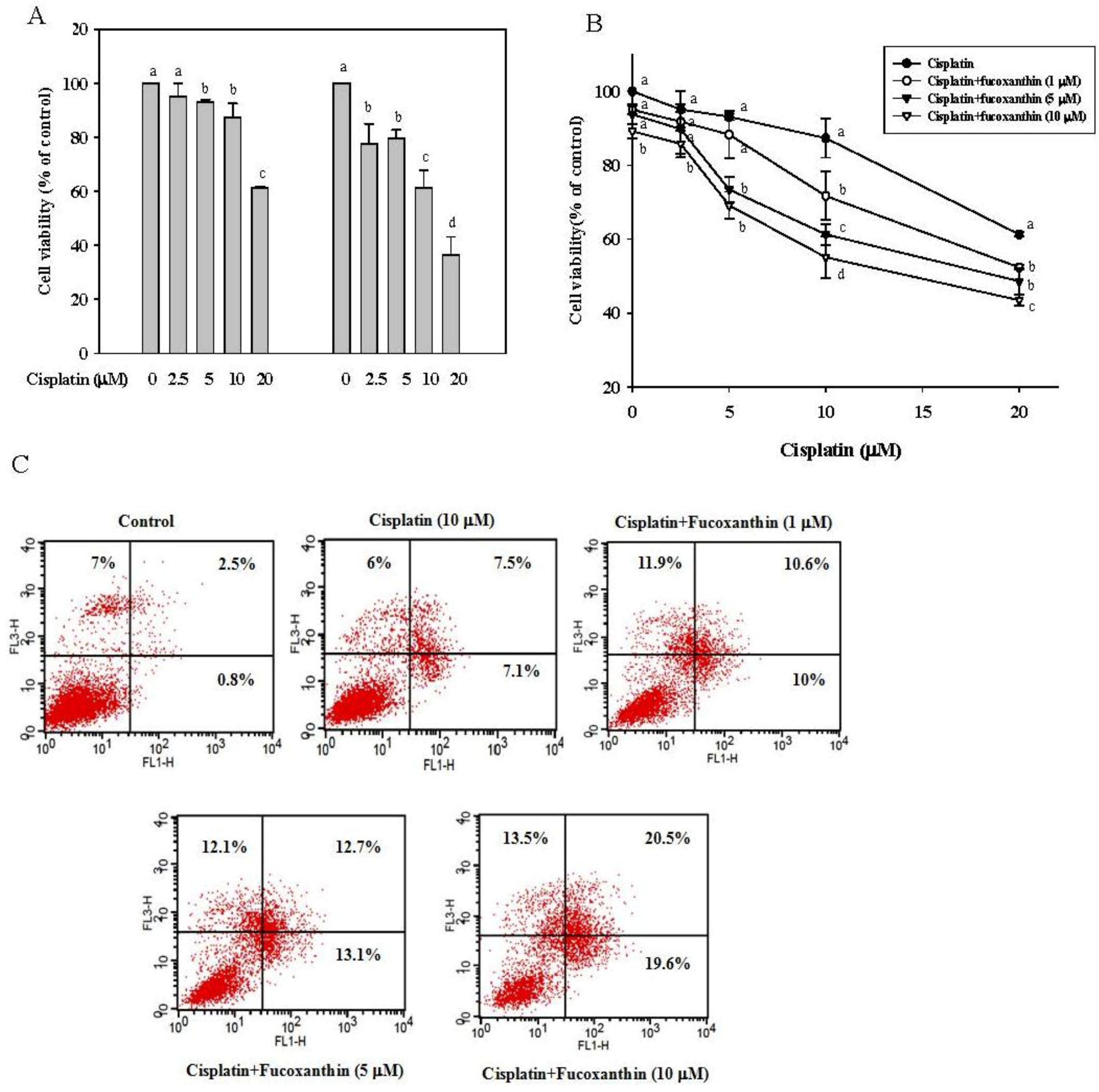
        <p>InHepG2 cells treated with cisplatin (2.5–20 μM) for 24 and 48 h, (<xref ref-type="fig" rid="marinedrugs-11-00050-f001">Figure 1</xref>A), we found that cisplatin significantly inhibited the cell viability (13% at 24 h and 39% at 48 h, <italic>P</italic> &lt; 0.05, respectively, at 10 μM cisplatin). In addition, fucoxanthin significantly inhibited the cell proliferation of HepG2 by 17% and 28% after incubation with 10 μM fucoxanthin for 24 h and 48 h, respectively (<xref ref-type="supplementary-material" rid="marinedrugs-11-00050-s001">Figure S1</xref>). To investigate whether fucoxanthin increases the sensitivity of cisplatin in HepG2 cells, we pre-incubated HepG2 cells with fucothanxin (1–10 μM) for 24 h followed by incubation with cisplatin (2.5–20 μM) for 24 h. Results reveal that the cell viability of HepG2 cells was significantly and concentration-dependently inhibited (<xref ref-type="fig" rid="marinedrugs-11-00050-f001">Figure 1</xref>B), with an inhibition of 37% at 10 μM fucoxanthin and 10 μM cisplatin, as compared with cisplatin treatment alone. In addition, the combination of fucoxanthin with cisplatin increased early apoptotic cells (PI negative, Annexin V-FITC positive) and late apoptotic cells (PI positive, Annexin V-FITC positive) (<xref ref-type="fig" rid="marinedrugs-11-00050-f001">Figure 1</xref>C). The results indicate that fucoxanthin enhances the anti-proliferative effect of cisplatin in human hepatoma HepG2 cells.</p>
        <fig id="marinedrugs-11-00050-f001" position="float">
          <label>Figure 1</label>
          <caption>
            <p>Effects of cisplatin (2.5–20 μM) alone or in combination with fucoxanthin (1–10 μM) on cell viability of human hepatoma HepG2 cells. (<bold>A</bold>) Cell viability of HepG2 cells incubated with cisplatin for 24 and 48 h. (<bold>B</bold>) Cell viability of HepG2 cells incubated with cisplatin (2.5–10 μM) for 24 h after pretreatment with fucoxanthin (1–10 μM) for 24 h. (<bold>C</bold>) Apoptotic cells in HepG2 cells incubated with cisplatin (2.5–10 μM) for 24 h after pretreatment with fucoxanthin (1–10 μM) for 24 h. Values are means ± SD, <italic>n</italic> = 3; means without a common letter differ significantly, <italic>P</italic> &lt; 0.05.</p>
          </caption>
          <graphic xmlns:xlink="http://www.w3.org/1999/xlink" xlink:href="marinedrugs-11-00050-g001.tif"/>
        </fig>
      </sec>
      <sec>
        <title>2.2. Fucoxanthin Attenuates the NFκB Expression Induced by Cisplatin and Restores the Phosphorylation of IκB-α Inhibited by Cisplatin</title>
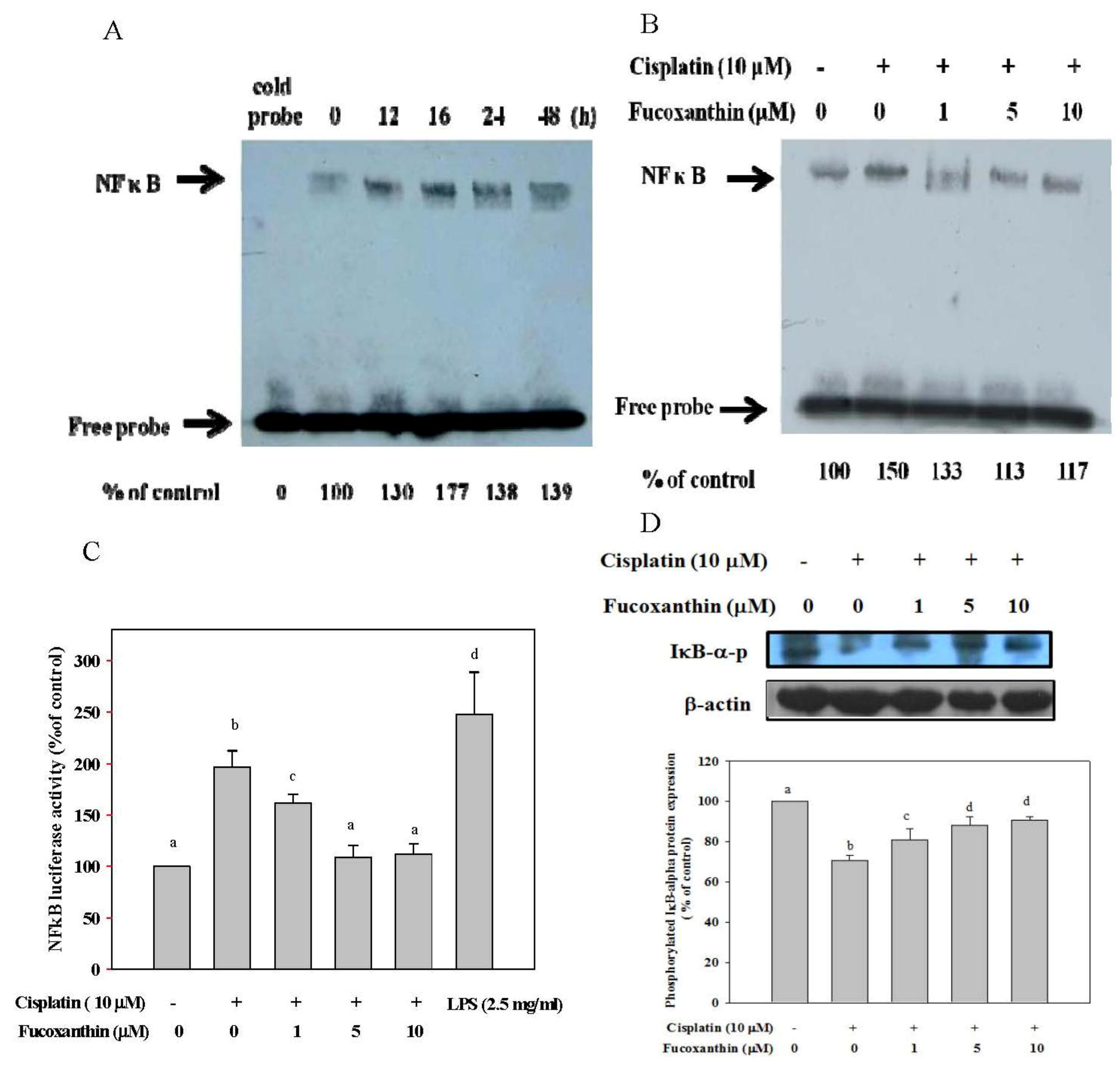
        <p>We also evaluated the effect of fucoxanthin on NFκB expression induced by cisplatin in HepG2 cells, as determined by the EMSA and NFκB reporter gene assays. As shown as in <xref ref-type="fig" rid="marinedrugs-11-00050-f002">Figure 2</xref>A, cisplatin μM) most strongly induced NFκB binding activity at 16 h of incubation (by 77%, as compared with untreated cells). However, fucoxanthin concentration-dependently attenuated cisplatin-induced NFκB binding activity, with a 37% inhibition at 5 μM fucoxanthin (<xref ref-type="fig" rid="marinedrugs-11-00050-f002">Figure 2</xref>B). We also showed that fucoxanthin significantly and concentration-dependently attenuated cisplatin-induced NFκB luciferase activity in a similar pattern to that of NFκB binding activity (<xref ref-type="fig" rid="marinedrugs-11-00050-f002">Figure 2</xref>C). In addition, fucoxanthin significantly and concentration-dependently restored cisplatin-inhibited IκB-α<bold><italic>-</italic></bold>phosphorylation in HepG2 cells at 24 h of incubation, as compared with cisplatin treatment alone (<xref ref-type="fig" rid="marinedrugs-11-00050-f002">Figure 2</xref>D). </p>
        <fig id="marinedrugs-11-00050-f002" position="float">
          <label>Figure 2</label>
          <caption>
            <p>NFκB expression in HepG2 cells pretreated with fucoxanthin (0–10 μM) followed by incubation with cisplatin (10 μM). (<bold>A</bold>) NFκB expression in HepG2 cells incubated with cisplatin (10 μM) for 0–48 h; (<bold>B</bold>) NFκB expression in HepG2 cells incubated with cisplatin (10 μM) for 16 h after pretreatment with fucoxanthin (1–10 μM) for 24 h; (<bold>C</bold>) NFκB luciferase activity expression in HepG2 cells incubated with cisplatin (10 μM) for 16 h after pretreatment with fucoxanthin (1–10 μM) for 24 h; (<bold>D</bold>) Phosphorylation of IκBin HepG2 cells incubated with cisplatin (10 μM) for 16 h after pretreatment with fucoxanthin (1–10 μM) for 24 h. Values are means ± SD, <italic>n</italic> = 3; means without a common letter differ significantly, <italic>P</italic> &lt; 0.05.</p>
          </caption>
          <graphic xmlns:xlink="http://www.w3.org/1999/xlink" xlink:href="marinedrugs-11-00050-g002.tif"/>
        </fig>
      </sec>
      <sec>
        <title>2.3. Fucoxanthin Combined with Cisplatin Increases the Ratio of Bax/Bcl-2 mRNA Expression in HepG2 Cells</title>
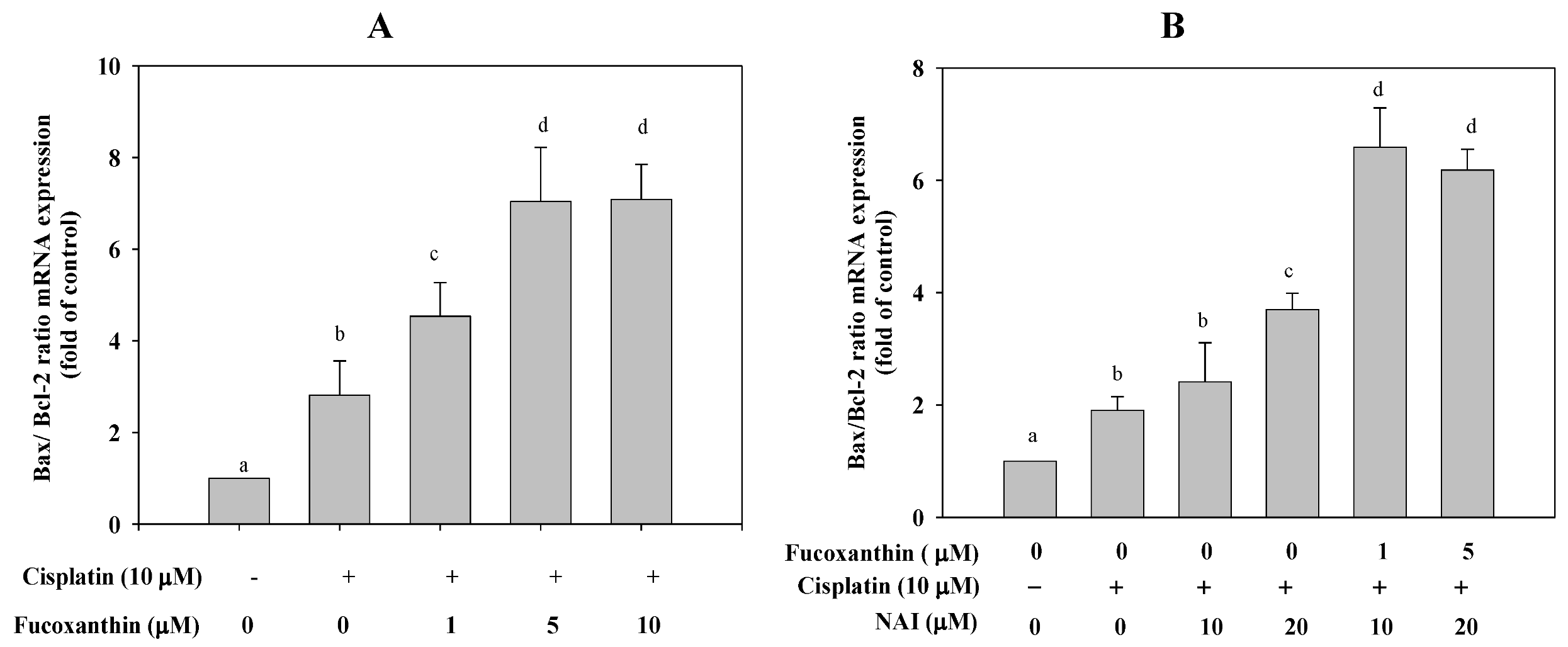
        <p>Treatment of HepG2 cells with cisplatin (10 μM) for 24 h significantly increased the ratio of Bax/Bcl-2 mRNA expression (by 1.8-fold, <italic>P</italic> &lt; 0.001, as compared with untreated cells). However, pretreatment of HepG2 cells with fucoxanthin for 24 h followed by incubation with cisplatin for 24 h significantly and concentration-dependently increased the ratio of Bax/Bcl-2 mRNA expression (by 4.3 fold, <italic>P</italic> &lt; 0.001, as compared with cisplatin treatment alone) (<xref ref-type="fig" rid="marinedrugs-11-00050-f003">Figure 3</xref>A). To further determine whether fucoxanthin in combination with cisplatin enhances the ratio of Bax/Bcl-2 mRNA primarily through NFκB-regulated pathways, we pretreated HepG2 cells with fucoxanthin for 24 h followed by incubation with an NFκB activation inhibitor (NAI) (10 and 20 μM) for 2 h and then by incubation with cisplatin (10 μM) for 24 h. We found that the combination of fucoxanthin, NAI and cisplatin synergistically or additively increased the ratio of Bax/Bcl-2 mRNA expression, as compared with the NFκB activation inhibitor alone (<xref ref-type="fig" rid="marinedrugs-11-00050-f003">Figure 3</xref>B). Thus, the data indicate that fucoxanthin increases the ratio of Bax/Bcl-2 mRNA expression and that this effect is likely associated with inhibition of the NFκB pathway.</p>
        <fig id="marinedrugs-11-00050-f003" position="float">
          <label>Figure 3</label>
          <caption>
            <p>(<bold>A</bold>) The ratio of Bax/Bcl-2 mRNA in HepG2 cells pretreated with fucoxanthin (1–10 μM) for 24 h followed by incubation with cisplatin (10 μM) for 24 h. (<bold>B</bold>) The ratio of Bax/Bcl-2 mRNA in HepG2 cells pretreated with fucoxanthin (5 μM) for 24 h followed by incubation with NFκB activation inhibitor (NAI, 20 μΜ) for 2 h and then treated cisplatin (10 μM) for 24 h. Values are means ± SD, <italic>n</italic> = 3; means without a common letter differ significantly, <italic>P</italic> &lt; 0.05.</p>
          </caption>
          <graphic xmlns:xlink="http://www.w3.org/1999/xlink" xlink:href="marinedrugs-11-00050-g003.tif"/>
        </fig>
      </sec>
      <sec>
        <title>2.4. Fucoxanthin Attenuates mRNA Expression of ERCC1 and TP Induced by Cisplatin</title>
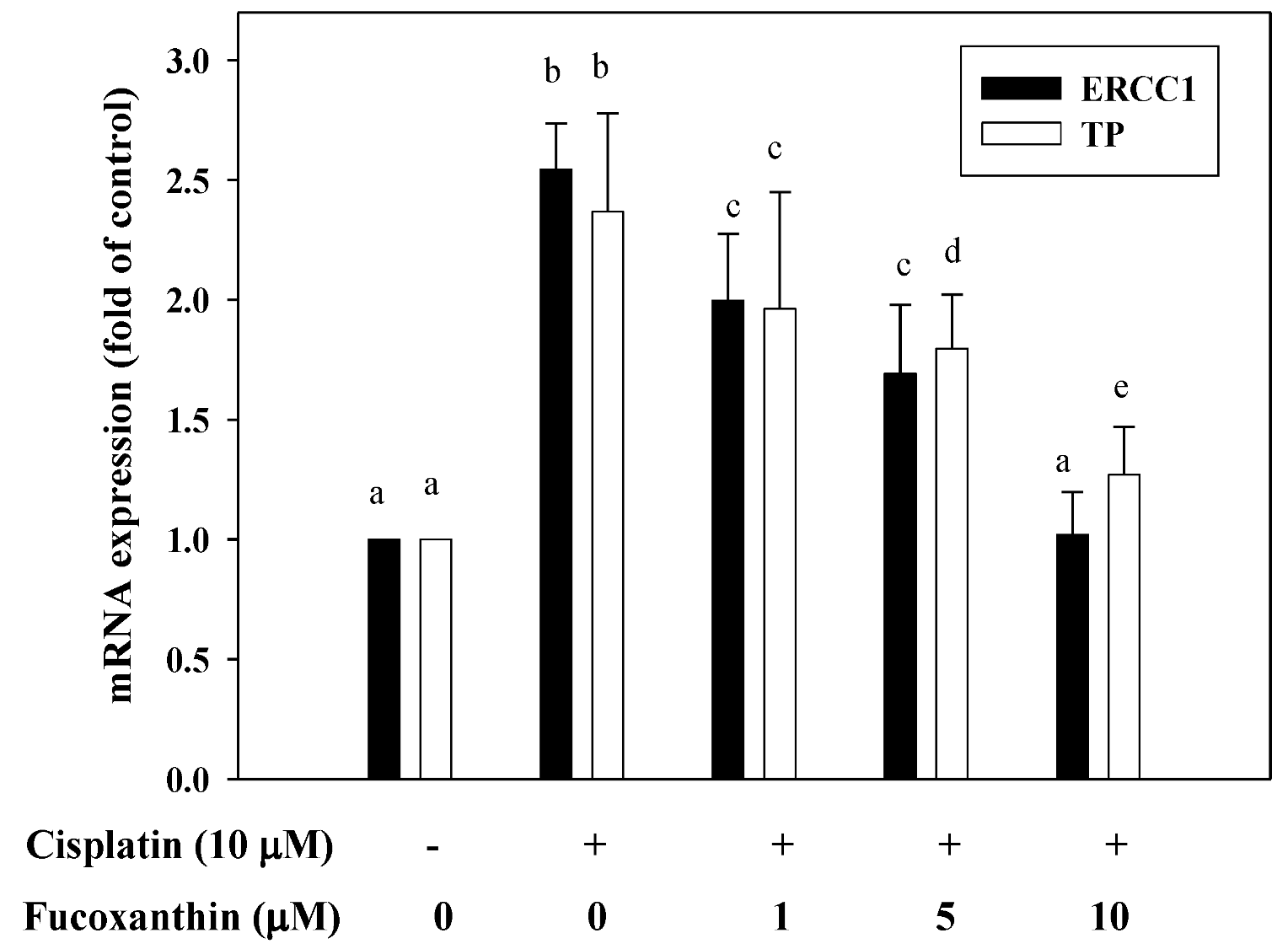
        <p>Real-time PCR was performed to evaluate the mRNA levels of ERCC1 and TP. As shown in <xref ref-type="fig" rid="marinedrugs-11-00050-f004">Figure 4</xref>, cisplatin (10 μM) treatment alone significantly increased the mRNA expression of ERCC1 and TP in HepG2 cells. However, the induced mRNA expression of ERCC1 and TP in HepG2 cells by cisplatin (10 μM) was attenuated by pretreatment with fucoxanthin (1–10 μM) for 24 h, with a 1.5-fold and a 1.2-fold inhibition, respectively, at 10 μM fucoxanthin, as compared with cisplatin treatment alone. </p>
        <fig id="marinedrugs-11-00050-f004" position="float">
          <label>Figure 4</label>
          <caption>
            <p>The level of ERCC1 and TP mRNA in HepG2 cells pretreated with fucoxanthin (1–10 μM) for 24 h followed by incubation with cisplatin (10 μM) for 24 h. Values are means ± SD, <italic>n</italic> = 3; means without a common letter differ significantly, <italic>P</italic> &lt; 0.05.</p>
          </caption>
          <graphic xmlns:xlink="http://www.w3.org/1999/xlink" xlink:href="marinedrugs-11-00050-g004.tif"/>
        </fig>
      </sec>
      <sec>
        <title>2.5. Fucoxanthin Attenuates the Phosphorylation of ERK1/2, p38, AKT and PI3K in HepG2 Cells</title>
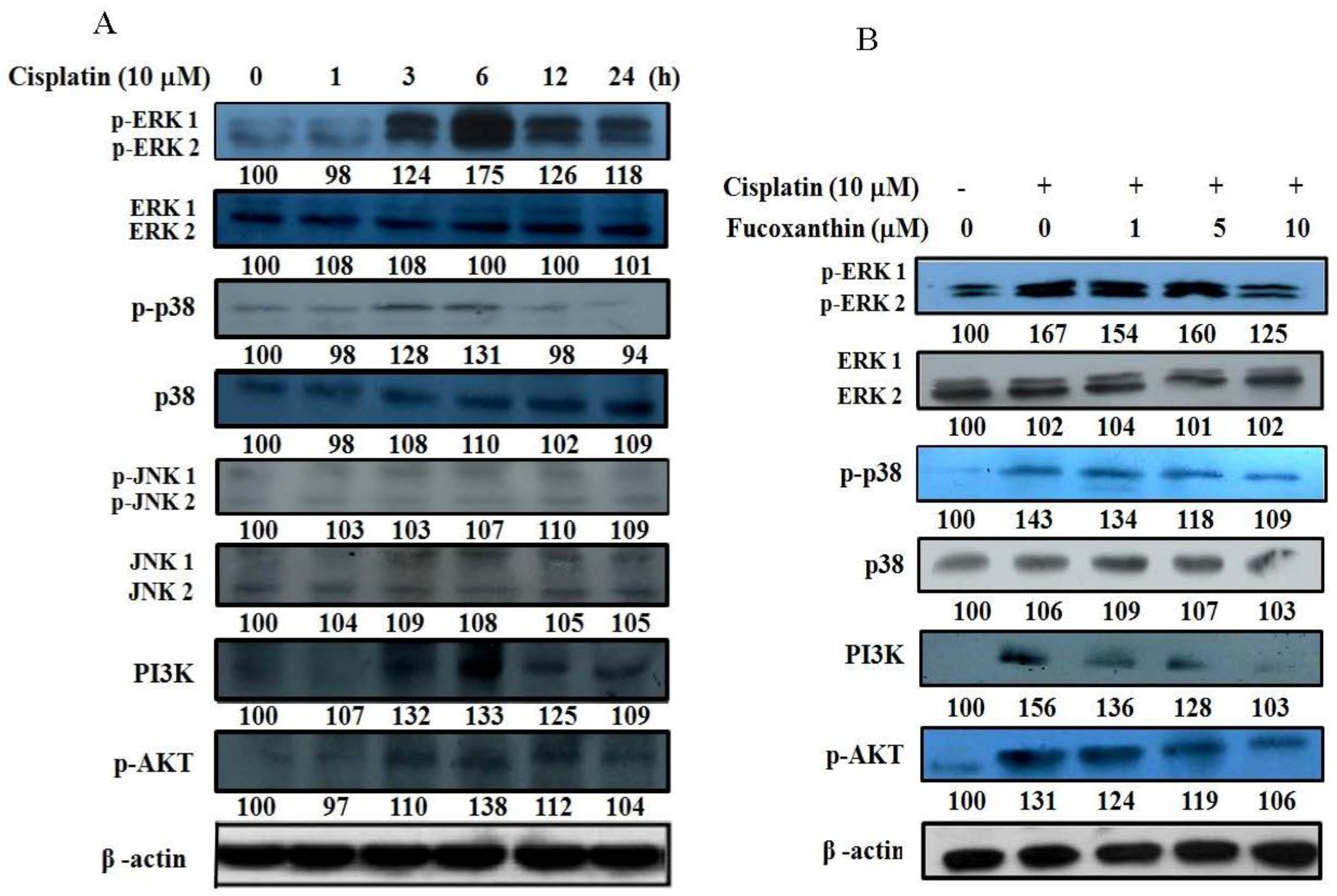
        <p>The time effect of cisplatin on protein expression of the mitogen-activated protein kinase (MAPK) family (p38, ERK, and JNK) and phosphatidylinositol 3-kinase (PI3K)/AKT in HepG2 cells were determined by Western blotting. Results reveal that cisplatin (10 μM) markedly increased the phosphorylation of ERK, p38 and PI3K/AKT at 6 h of incubation, but it did not affect the phosphorylation of JNK or the protein expression of ERK, p38 and JNK (<xref ref-type="fig" rid="marinedrugs-11-00050-f005">Figure 5</xref>A). We then determined whether pretreatment of HepG2 cells with fucoxanthin (1–10 μM) for 24 h attenuates the induction of MAPK family and PI3K/AKT protein expression by cisplatin (10 μM). We found that fucoxanthin concentration-dependently attenuated cisplatin-induced phosphorylation of ERK, p38 and PI3K/AKT (<xref ref-type="fig" rid="marinedrugs-11-00050-f005">Figure 5</xref>B). </p>
        <fig id="marinedrugs-11-00050-f005" position="float">
          <label>Figure 5</label>
          <caption>
            <p>The protein expression of MAPK family and PI3K/AKT in HepG2 cells pretreated with fucoxanthin (0–10 μM) followed by incubation with cisplatin (10 μM). (<bold>A</bold>) The protein expression of MAPK family and PI3K/AKT in HepG2 cells incubated with cisplatin (10 μM) for 0–24 h. (<bold>B</bold>) The protein expression of MAPK family and PI3K/AKT in HepG2 cells incubated with cisplatin (10 μM) for 6 h after pretreatment with fucoxanthin (1–10μM) for 24 h.</p>
          </caption>
          <graphic xmlns:xlink="http://www.w3.org/1999/xlink" xlink:href="marinedrugs-11-00050-g005.tif"/>
        </fig>
      </sec>
      <sec>
        <title>2.6. Effect of Fucoxanthin in Combination with ERK, p38 and PI3K Inhibitor on ERCC1 and TP mRNA Expression in HepG2 Cells</title>
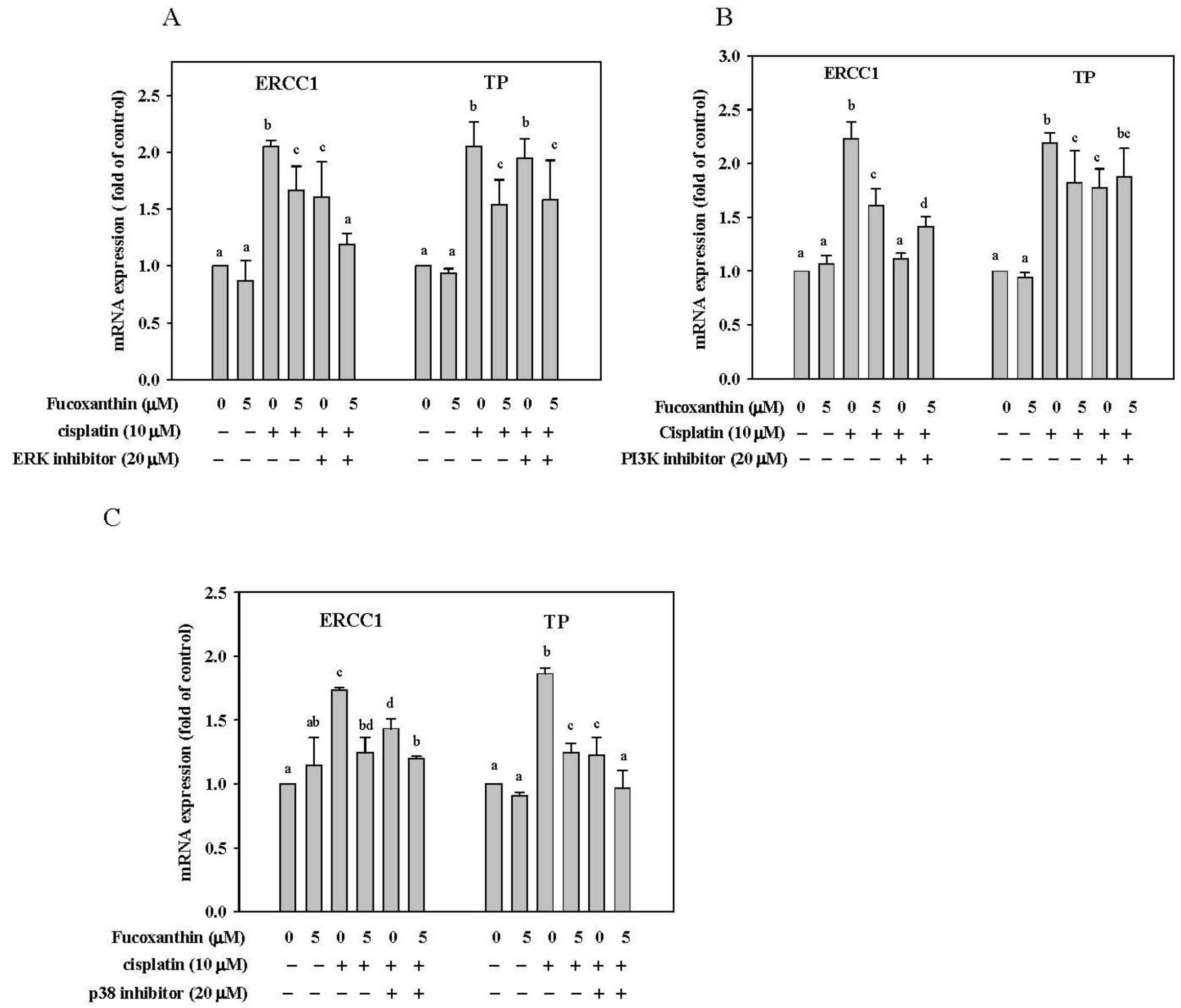
        <p>We then determined whether the attenuation of fucoxanthin on ERCC1 and TP mRNA expression induced by cisplatin occur primarily through the inhibition of ERK, p38 and PI3K/AKT pathway. HepG2 cells were pre-incubated with fucoxanthin (5 μM) for 24 h followed by incubation with ERK inhibitor (PD98059; 20 μM), p38 inhibitor (SB203580; 20 μM) or PI3K inhibitor (LY294002; 20 μM) for 1 h and then with cisplatin (10 μM) for 24 h. The concentration of 5 μM fucoxanthin was chosen because it only produced a slight inhibition of mRNA expression for ERCC1 and TP (see <xref ref-type="fig" rid="marinedrugs-11-00050-f004">Figure 4</xref>). We found that the combination of fucoxanthin, cisplatin and the ERK inhibitor or PI3K inhibitor synergistically inhibited ERCC1 mRNA expression but not TP mRNA expression (<xref ref-type="fig" rid="marinedrugs-11-00050-f006">Figure 6</xref>A,B). In contrast, the combination of fucoxanthin with p38 inhibitor enhanced the inhibition of mRNA expression of TP but not ERCC1 (<xref ref-type="fig" rid="marinedrugs-11-00050-f006">Figure 6</xref>C). Thus, the results reveal that fucoxanthin may inhibit ERCC1 mRNA expression through ERK and PI3K/AKT pathway but may inhibit TP mRNA expression through p38 pathway. </p>
        <fig id="marinedrugs-11-00050-f006" position="float">
          <label>Figure 6</label>
          <caption>
            <p>The level of ERCC1 and TP mRNA in HepG2 cells pretreated with fucoxanthin (5 μM) for 24 h followed by incubation with a specific inhibitor (20 μM) for 1 h and then treated cisplatin (10 μM) for 24 h. (<bold>A</bold>) ERK inhibitor (PD98059); (<bold>B</bold>) PI3K inhibitor (LY294002); (C) p38 inhibitor (SB203580). Values are means ± SD, <italic>n</italic> = 3; means without a common letter differ significantly, <italic>P</italic> &lt; 0.05.</p>
          </caption>
          <graphic xmlns:xlink="http://www.w3.org/1999/xlink" xlink:href="marinedrugs-11-00050-g006.tif"/>
        </fig>
      </sec>
    </sec>
    <sec sec-type="discussion">
      <title>3. Discussion</title>
      <p>The main question addressed by this study was whether a combination of fucoxanthin and cisplatin improves the efficacy of chemotherapy and enhances the inhibition of cell proliferation. Our data demonstrate for the first time that fucoxanthin in combination with cisplatin inhibits the cell proliferation of human hepatoma HepG2 cells and that this combined effect involves NFκB mediated-pathways and attenuation of the DNA repair gene expression induced by cisplatin. </p>
      <p>A probable mechanism by which fucoxanthin improves the efficacy of cisplatin chemotherapy is through the inhibition of NFκB expression and the increase in NFκB-regulated Bax/Bcl-2 mRNA expression. NFκB is known to suppress apoptosis through the loss of pro-apoptotic factors (e.g., functional p53 or Bax) or the activation of anti-apoptotic factors such as Bcl-2, Bcl-XL or IAPs (Inhibitors of Apoptosis Proteins) to block caspase-8 activation [<xref ref-type="bibr" rid="B24-marinedrugs-11-00050">24</xref>]. Moreover, NFκB binding sites were found in the promoter of Bcl-2, Bcl-xL, and survivin [<xref ref-type="bibr" rid="B49-marinedrugs-11-00050">49</xref>], suggesting that these apoptotic factors may be regulated by NFκB. Overexpression of the antiapoptotic molecules Bcl-2 or Bcl-xL can cause resistance to anticancer drugs [<xref ref-type="bibr" rid="B50-marinedrugs-11-00050">50</xref>]. We found that fucoxanthin pretreatment attenuated cisplatin-induced DNA-binding activity of NFκB, restored cisplatin-inhibited IκB-α<bold><italic>-</italic></bold>phosphorylation, and increased the ratio of Bax/Bcl-2 mRNA expression, rendering cancer cells sensitive to apoptosis induced by cisplatin. Many NFκB inhibitors have been identified <italic>in vitro </italic>such as proteasome inhibitors, genistein, parthenolide, flavopiridol and gliotoxin, enhance the cytotoxic effect of anticancer agents [<xref ref-type="bibr" rid="B29-marinedrugs-11-00050">29</xref>]. In the present study, we found that fucoxanthin strongly attenuated cisplatin-induced NFκB activation, suggesting that fucoxanthin may be an NFκB inhibitor. </p>
      <p>Another probable mechanism by which fucoxanthin improves the efficacy of cisplatin chemotherapy is through the inhibition of mRNA expression of DNA repair genes ERCC1 and TP. Tumor DNA repair capacity is frequently increased as an inherent cellular mechanism for evading cell death as a result of administration of chemotherapeutic drugs. Increased expression of ERCC1 in several cancers has been associated with more efficient removal of DNA adducts induced by platinum, leading to clinical resistance to cisplatin-based chemotherapy [<xref ref-type="bibr" rid="B51-marinedrugs-11-00050">51</xref>]. Depletion of endogenous ERCC1 expression by si-ERCC1 RNA transfection was shown to significantly enhance the cytotoxicity of cisplatin [<xref ref-type="bibr" rid="B52-marinedrugs-11-00050">52</xref>]. In the present study, we found that fucoxanthin pretreatment significantly attenuated cisplatin-induced ERCC1 and TP mRNA expression. Recently, Tsai <italic>et al.</italic> [<xref ref-type="bibr" rid="B53-marinedrugs-11-00050">53</xref>] have shown that curcumin downregulates the expression levels of TP and ERCC1, which helps overcome platinum resistance in cancer cells. </p>
      <p>MAPK family and PI3K/AKT pathways play important roles in the regulation of cell proliferation, differentiation, apoptosis and DNA repair pathways [<xref ref-type="bibr" rid="B54-marinedrugs-11-00050">54</xref>]. Protein kinase C and Ras have been suggested to be involved in the activation of ERK1/2 by cisplatin [<xref ref-type="bibr" rid="B55-marinedrugs-11-00050">55</xref>]. AKT may promote cell survival by phosphorylating and inactivating the pro-apoptotic proteins BAD (Bcl-2-associated death protein) and caspase-9 [<xref ref-type="bibr" rid="B56-marinedrugs-11-00050">56</xref>]. It has been reported that the inactivation of NFκB-binding activity sensitizes human ovarian cancer cells to cisplatin <italic>in vitro </italic> [<xref ref-type="bibr" rid="B57-marinedrugs-11-00050">57</xref>] and that the combined therapy of cisplatin with a PI3K inhibitor enhances the apoptotic effect of cisplatin <italic>in vivo </italic> [<xref ref-type="bibr" rid="B58-marinedrugs-11-00050">58</xref>]. In this study, we found that cisplatin activated the phosphorylation of ERK1/2, p38, AKT and PI3K in human hepatoma HepG2 cells and that fucoxanthin pretreatment attenuated cisplatin-induced phosphorylation of all these signaling molecules to sensitize cancer cells to apoptosis induced by cisplatin. With regard to the DNA repair system, it has been shown that specific MERK/ERK and PI3K inhibitors prevent ERCC1 induction, whereas JNK and p38 inhibitors are without effects in human hepatoma cells [<xref ref-type="bibr" rid="B59-marinedrugs-11-00050">59</xref>]. Interestingly, curcumin and emodin, which are natural anthraquinone derivatives found in the roots and rhizomes of numerous plants, were found to enhance cisplatin-induced cytotoxicity via downregulation of ERCC1 and inactivation of ERK1/2 in non-small cell lung cancer [<xref ref-type="bibr" rid="B52-marinedrugs-11-00050">52</xref>]. The inhibition of the PI3K pathway on ERCC1 basal expression has been confirmed by using shRNA against FRAP/mTOR, a key kinase involved in nucleotide excision repair pathway [<xref ref-type="bibr" rid="B60-marinedrugs-11-00050">60</xref>]. TP, a key enzyme in the pyrimidine nucleoside salvage pathway, was also found to be regulated by NFκB- and p38 MAPK-mediated signaling in patients with nasopharyngeal carcinoma [<xref ref-type="bibr" rid="B61-marinedrugs-11-00050">61</xref>]. In the present study, we found that fucoxanthin inhibited ERCC1 mRNA expression through the ERK and PI3K/AKT pathways, whereas this carotenoid inhibited TP expression through the p38 pathway, as evidenced by using specific inhibitors. The results indicate that the improved chemotherapeutic efficacy of cisplatin by fucoxanthin may also involve inhibition of mRNA expression of some DNA repair genes through downregulation of ERK, p38, and PI3K/AKT pathways. </p>
    </sec>
    <sec>
      <title>4. Experimental Section</title>
      <sec>
        <title>4.1. Materials</title>
        <p>Dulbecco’s modified eagle medium (DMEM), fetal bovine serum (FBS), trypsin, penicillin, sodium pyruvate, and non-essential amino acids (NEAA) were purchased from GIBCO/BRL (Maryland, MD, USA). MAPK/extracellular signal-regulated kinase (ERK) 1/2, c-Jun NH2-terminal kinase (JNK)/stress-activated protein kinase and p38 MAPK proteins and phosphorylated proteins, phosphatidylinositol 3-kinase (PI3K)/AKT, ERK inhibitor (PD98059), p38 inhibitor (SB203580) and PI3K inhibitor (LY294002) were purchased from Cell Signaling Technology (Beverly, MA). NFκB activation inhibitor was purchased from Merck Millipore (Billerica, MA, USA). Fucoxanthin was extracted from <italic>Undaria pinnatifida</italic> and purified, as we reported previously [<xref ref-type="bibr" rid="B62-marinedrugs-11-00050">62</xref>]. The purified fucoxanthin was dissolved in ethanol to a final concentration of 10 mM as the stock solution. Before the experiment, fucoxanthin solutions were prepared freshly in a mixture of ethanol and FBS (1:9), as adopted from the preparation of lycopene solution [<xref ref-type="bibr" rid="B63-marinedrugs-11-00050">63</xref>]. </p>
      </sec>
      <sec>
        <title>4.2. Cell Cultures</title>
        <p>The human hepatoblastoma HepG2 cell line was obtained from Food Industry Research and Development Institute (FIRDI, Hsinchu, Taiwan) and maintained in DMEM supplemented with 10% fetal bovine serum without antibiotics under 5% CO<sub>2</sub> at 37 °C.</p>
      </sec>
      <sec>
        <title>4.3. Assessment of Cell Viability</title>
        <p>Cell viability was evaluated using the modified acid-phosphatase (ACP) assay, with <italic>p</italic>-nitrophenyl phosphate (PNPP) disodium salt as a substrate. The cell culture media were aspirated, and the cells were washed with phosphate-buffered saline (PBS). Following the wash, 100 μL of the ACP reagent (0.1 M sodium acetate (pH 5.5), 0.1% Triton X-100, and 10 mM PNPP) was added. After 1 h of incubation at 37 °C, the enzyme activity was stopped by adding 10 μL of 1 N NaOH, and the enzyme activity was determined photometrically at a wavelength of 405 nm [<xref ref-type="bibr" rid="B64-marinedrugs-11-00050">64</xref>].</p>
      </sec>
      <sec>
        <title>4.4. Real-Time Polymerase Chain Reaction</title>
        <p>Total RNA in cell cultures was extracted with REzol reagent (PROtech Technologies, Inc., Placentia, CA, USA), and 1 μg of total RNA was reverse-transcribed by using oligo-dT as a primer in 20 μL reverse-transcription solutions containing 1 μL reverse transcriptase (Promega, Sunnyvale, CA, USA). Real-time PCR performed with a Corbett instrument (Applied Biosystems, Carlsbad, CA, USA) using SYBR Green Master Mix (ProTech, Placentia, CA, USA) according to the manufacturer’s instructions. In all real-time PCR experiments, both a non-template control (NTC) and a standard curve were amplified, as well. The RNA abundance was normalized to β-actin RNA in each sample. The primers used in this study were as follows: ERCC1 forward 5′-CCCTGGGAATTTGGCGACGTAA-3′, reverse 5′-CTCCAGGTACCGCCCAGCTTCC-3′; TP forward 5′-AGCTGGAGTCTATTCCTGGATT-3′, reverse 5′-GGCTGCATATAGGATTCCGTC-3′; β-actin forward 5′-GTGGGGCGCCCCAGGCACCA-3′, reverse 3′-CACCCCGCGGGGTCCGTGGT-5′.</p>
      </sec>
      <sec>
        <title>4.5. Western Blotting</title>
        <p>Protein expression of MAPK family (ERK, p38, JNK, p-JNK, p-ERK and p-p38) and PI3K/AKT (PI3K, AKT and p-AKT) was measured by Western blotting. In cell culture experiments, the medium was removed and cells were rinsed with PBS twice. After the addition of 0.5 mL of cold RIPA buffer and protease inhibitors, cells were scraped and followed by a mild vortexing at 0 °C for 20 min. The cell lysates were then subjected to a centrifugation of 10,000 rpm for 30 min at 4 °C. Total protein (50 μg) from the supernatant was resolved on SDS-PAGE and transferred onto a PVDF membrane. After blocking with TBS buffer (20 mmol/L Tris-HCl, 150 mmol/L NaCl, pH 7.4) containing 5% nonfat milk, the membrane was incubated with monoclonal antibody followed by incubation with horseradish peroxidase-conjugated anti-goat IgG, and then visualized using an ECL chemiluminescent detection kit (Amersham, Sweden). The relative density of the immunoreactive bands was quantitated by densitometry (Gel Pro Analyzer TM, version 3.0, Media Cybernetics, Rockville, MD, USA).</p>
      </sec>
      <sec>
        <title>4.6. Preparation of Nuclear Extracts and Electrophoretic Mobility Shift Assay (EMSA)</title>
        <p>Nuclear protein extracts (5 μg) were prepared according to the modified method of a previous study [<xref ref-type="bibr" rid="B65-marinedrugs-11-00050">65</xref>]. Binding activities of transcription factors including NFκB were analyzed by EMSA. Electrophoretic mobility shift assay (EMSA) was performed with LightShift Chemiluminescent EMSA Kit (Pierce Biotechnology, Rockford, IL, Country), as described previously [<xref ref-type="bibr" rid="B66-marinedrugs-11-00050">66</xref>]. The NFκB consensus oligonucleotide probe (5′-AGTTGAGGGGACTTTCCCAGGC-3′) was end-labeled with biotin (Sangon, Shanghai, China). Briefly, nuclear extract (5 μg) was incubated with 10 ng NFκB (p65) probe. For the cold probe assay, 40 ng of unlabeled (cold) NFκB probe was mixed with sample 5 min before adding 10 ng biotin-labeled NFκB probe. Protein-DNA complexes were then resolved by non-denaturing polyacrylamide gel electrophoresis (PAGE). After blocking, avidin-HRP was applied and detected by enhanced chemiluminescence (ECL, Amersham). The relative NFκB levels were quantitated by Matrox Inspector 2.1 software.</p>
      </sec>
      <sec>
        <title>4.7. Transfection and Luciferase Reporter Gene Assays</title>
        <p>HepG2 cells (1.8 × 10<sup>4</sup> cells/well) were plated in 96-microwell-white-plates (Nalge Nunc, Rochester, New York, NY, USA) before transfection. The NFκB plasmid vector (pGL4.32 (luc2P/NF-κB-RE/Hygro)) contains five copies of an NFκB response element was purchased from Promega (Sunnyvale, CA, USA). Transfection of NFκB plasmid vector (0.15 μg) into HepG2 cells was performed using TransIL-LT1 Transfection Reagent (Mirus, Madison, WI, USA), and in all experiments, the pRL-TK Renilla reporter vector (0.02 μg) (Promega, Sunnyvale, CA, USA) was used as an internal control. The cells were then incubated with cisplatin (10 μM) for 16 h after pretreatment with fucoxanthin (1–10 μM) for 24 h. Renilla and firefly luciferase activities were measured using the Dual-Luciferase Reporter Assay System (Promega, Sunnyvale, CA, USA).</p>
      </sec>
      <sec>
        <title>4.8. Statistical Analysis</title>
        <p>All experiments were repeated at least thrice. Values are expressed as means ± SD and analyzed using one way ANOVA followed by LSD test for comparisons of group means, when the F ratios were significant. All statistical analyses were performed using SPSS for Windows, version 10 (SPSS, Inc., Armonk, NY, USA); a <italic>P</italic> value &lt; 0.05 is considered statistically significant.</p>
      </sec>
    </sec>
    <sec sec-type="conclusions">
      <title>5. Conclusions</title>
      <p>In conclusion, the present study demonstrates that pretreatment with fucoxanthin improves the chemotherapeutic efficacy of cisplatin by enhancing the inhibition of cell proliferation of human hepatoma HepG2. These effects of fucoxanthin may involve the inhibition of NFκB expression and the increase in Bax/Bcl-2 mRNA ratios regulated by NFκB, as well as the decrease of DNA repair systems regulated by ERK, p38 and PI3K/AKT, leading to sensitized cancer cells to apoptosis induced by cisplatin. The results suggest that the combined treatment of fucoxanthin and cisplatin may provide a novel therapeutic approach to decrease cisplatin-induced drug resistance.</p>
    </sec>
  </body>
  <back>
    <ack>
      <title>Acknowledgments</title>
      <p>This work was supported in part by the Ministry of Education, Taiwan, ROC, under the ATU plan and NSC101-2320-B-039-007-MY3 from the National Science Council, Executive Yuan, Taiwan.</p>
    </ack>
 <app-group>
    <app>
        <title>Supplementary Files</title>
        <supplementary-material xmlns:xlink="http://www.w3.org/1999/xlink" id="marinedrugs-11-00050-s001" xlink:href="marinedrugs-11-00050-s001.pdf">
        <label>Supplementary File 1</label>
            <caption>
                <p>Supplementary Information (PDF, 42 KB)</p>
            </caption>
        </supplementary-material>
    </app>
</app-group>
    <ref-list>
      <title>References</title>
      <ref id="B1-marinedrugs-11-00050">
        <label>1.</label>
        <citation citation-type="journal">
          <person-group person-group-type="author">
            <name>
              <surname>Di Bisceglie</surname>
              <given-names>A.M.</given-names>
            </name>
          </person-group>
          <article-title>Epidemiology and clinical presentation of hepatocellular carcinoma</article-title>
          <source>J. Vasc. Interv. Radiol.</source>
          <year>2002</year>
          <volume>13</volume>
          <fpage>S169</fpage>
          <lpage>S171</lpage>
          <pub-id pub-id-type="doi">10.1016/S1051-0443(07)61783-7</pub-id>
        </citation>
      </ref>
      <ref id="B2-marinedrugs-11-00050">
        <label>2.</label>
        <citation citation-type="journal">
          <person-group person-group-type="author">
            <name>
              <surname>Montalto</surname>
              <given-names>G.</given-names>
            </name>
            <name>
              <surname>Cervello</surname>
              <given-names>M.</given-names>
            </name>
            <name>
              <surname>Giannitrapani</surname>
              <given-names>L.</given-names>
            </name>
            <name>
              <surname>Dantona</surname>
              <given-names>F.</given-names>
            </name>
            <name>
              <surname>Terranova</surname>
              <given-names>A.</given-names>
            </name>
            <name>
              <surname>Castagnetta</surname>
              <given-names>L.A.</given-names>
            </name>
          </person-group>
          <article-title>Epidemiology, risk factors, and natural history of hepatocellular carcinoma</article-title>
          <source>Ann. N. Y. Acad. Sci.</source>
          <year>2002</year>
          <volume>963</volume>
          <fpage>13</fpage>
          <lpage>20</lpage>
        <pub-id pub-id-type="pmid">12095924</pub-id></citation>
      </ref>
      <ref id="B3-marinedrugs-11-00050">
        <label>3.</label>
        <citation citation-type="journal">
          <person-group person-group-type="author">
            <name>
              <surname>Chau</surname>
              <given-names>G.Y.</given-names>
            </name>
            <name>
              <surname>Lui</surname>
              <given-names>W.Y.</given-names>
            </name>
            <name>
              <surname>Tsay</surname>
              <given-names>S.H.</given-names>
            </name>
            <name>
              <surname>Chao</surname>
              <given-names>Y.</given-names>
            </name>
            <name>
              <surname>King</surname>
              <given-names>K.L.</given-names>
            </name>
            <name>
              <surname>Wu</surname>
              <given-names>C.W.</given-names>
            </name>
          </person-group>
          <article-title>Postresectional adjuvant intraportal chemotherapy in patients with hepatocellular carcinoma: A case-control study</article-title>
          <source>Ann. Surg. Oncol.</source>
          <year>2006</year>
          <volume>13</volume>
          <fpage>1329</fpage>
          <lpage>1337</lpage>
          <pub-id pub-id-type="doi">10.1245/s10434-006-9004-1</pub-id>
        </citation>
      </ref>
      <ref id="B4-marinedrugs-11-00050">
        <label>4.</label>
        <citation citation-type="journal">
          <person-group person-group-type="author">
            <name>
              <surname>Tong</surname>
              <given-names>S.W.</given-names>
            </name>
            <name>
              <surname>Yang</surname>
              <given-names>Y.X.</given-names>
            </name>
            <name>
              <surname>Hu</surname>
              <given-names>H.D.</given-names>
            </name>
            <name>
              <surname>An</surname>
              <given-names>X.</given-names>
            </name>
            <name>
              <surname>Ye</surname>
              <given-names>F.</given-names>
            </name>
            <name>
              <surname>Hu</surname>
              <given-names>P.</given-names>
            </name>
            <name>
              <surname>Ren</surname>
              <given-names>H.</given-names>
            </name>
            <name>
              <surname>Li</surname>
              <given-names>S.L.</given-names>
            </name>
            <name>
              <surname>Zhang</surname>
              <given-names>D.Z.</given-names>
            </name>
          </person-group>
          <article-title>Proteomic investigation of 5-fluorouracil resistance in a human hepatocellular carcinoma cell line</article-title>
          <source>J. Cell. Biochem.</source>
          <year>2012</year>
          <volume>113</volume>
          <fpage>1671</fpage>
          <lpage>1680</lpage>
        <pub-id pub-id-type="pmid">22189913</pub-id></citation>
      </ref>
      <ref id="B5-marinedrugs-11-00050">
        <label>5.</label>
        <citation citation-type="journal">
          <person-group person-group-type="author">
            <name>
              <surname>Dietel</surname>
              <given-names>M.</given-names>
            </name>
          </person-group>
          <article-title>Molecular mechanisms and possibilities of overcoming drug resistance in gastrointestinal tumors</article-title>
          <source>Recent Results Cancer Res.</source>
          <year>1996</year>
          <volume>142</volume>
          <fpage>89</fpage>
          <lpage>101</lpage>
          <pub-id pub-id-type="doi">10.1007/978-3-642-80035-1_7</pub-id>
        </citation>
      </ref>
      <ref id="B6-marinedrugs-11-00050">
        <label>6.</label>
        <citation citation-type="journal">
          <person-group person-group-type="author">
            <name>
              <surname>Go</surname>
              <given-names>R.S.</given-names>
            </name>
            <name>
              <surname>Adjei</surname>
              <given-names>A.A.</given-names>
            </name>
          </person-group>
          <article-title>Review of the comparative pharmacology and clinical activity of cisplatin and carboplatin</article-title>
          <source>J. Clin. Oncol.</source>
          <year>1999</year>
          <volume>17</volume>
          <fpage>409</fpage>
          <lpage>422</lpage>
        <pub-id pub-id-type="pmid">10458260</pub-id></citation>
      </ref>
      <ref id="B7-marinedrugs-11-00050">
        <label>7.</label>
        <citation citation-type="journal">
          <person-group person-group-type="author">
            <name>
              <surname>Cepeda</surname>
              <given-names>V.</given-names>
            </name>
            <name>
              <surname>Fuertes</surname>
              <given-names>M.A.</given-names>
            </name>
            <name>
              <surname>Castilla</surname>
              <given-names>J.</given-names>
            </name>
            <name>
              <surname>Alonso</surname>
              <given-names>C.</given-names>
            </name>
            <name>
              <surname>Quevedo</surname>
              <given-names>C.</given-names>
            </name>
            <name>
              <surname>Perez</surname>
              <given-names>J.M.</given-names>
            </name>
          </person-group>
          <article-title>Biochemical mechanisms of cisplatin cytotoxicity</article-title>
          <source>Anticancer Agents Med. Chem.</source>
          <year>2007</year>
          <volume>7</volume>
          <fpage>3</fpage>
          <lpage>18</lpage>
          <pub-id pub-id-type="doi">10.2174/187152007779314044</pub-id>
        </citation>
      </ref>
      <ref id="B8-marinedrugs-11-00050">
        <label>8.</label>
        <citation citation-type="journal">
          <person-group person-group-type="author">
            <name>
              <surname>Zorbas</surname>
              <given-names>H.</given-names>
            </name>
            <name>
              <surname>Keppler</surname>
              <given-names>B.K.</given-names>
            </name>
          </person-group>
          <article-title>Cisplatin damage: Are DNA repair proteins saviors or traitors to the cell?</article-title>
          <source>ChemBioChem</source>
          <year>2005</year>
          <volume>6</volume>
          <fpage>1157</fpage>
          <lpage>1166</lpage>
          <pub-id pub-id-type="doi">10.1002/cbic.200400427</pub-id>
        </citation>
      </ref>
      <ref id="B9-marinedrugs-11-00050">
        <label>9.</label>
        <citation citation-type="journal">
          <person-group person-group-type="author">
            <name>
              <surname>Van de Vaart</surname>
              <given-names>P.J.</given-names>
            </name>
            <name>
              <surname>van der Vange</surname>
              <given-names>N.</given-names>
            </name>
            <name>
              <surname>Zoetmulder</surname>
              <given-names>F.A.</given-names>
            </name>
            <name>
              <surname>van Goethem</surname>
              <given-names>A.R.</given-names>
            </name>
            <name>
              <surname>van Tellingen</surname>
              <given-names>O.</given-names>
            </name>
            <name>
              <surname>ten Bokkel Huinink</surname>
              <given-names>W.W.</given-names>
            </name>
            <name>
              <surname>Beijnen</surname>
              <given-names>J.H.</given-names>
            </name>
            <name>
              <surname>Bartelink</surname>
              <given-names>H.</given-names>
            </name>
            <name>
              <surname>Begg</surname>
              <given-names>A.C.</given-names>
            </name>
          </person-group>
          <article-title>Intraperitoneal cisplatin with regional hyperthermia in advanced ovarian cancer: Pharmacokinetics and cisplatin-DNA adduct formation in patients and ovarian cancer cell lines</article-title>
          <source>Eur. J. Cancer</source>
          <year>1998</year>
          <volume>34</volume>
          <fpage>148</fpage>
          <lpage>154</lpage>
        <pub-id pub-id-type="doi">10.1016/S0959-8049(97)00370-5</pub-id><pub-id pub-id-type="pmid">9624250</pub-id></citation>
      </ref>
      <ref id="B10-marinedrugs-11-00050">
        <label>10.</label>
        <citation citation-type="journal">
          <person-group person-group-type="author">
            <name>
              <surname>Kartalou</surname>
              <given-names>M.</given-names>
            </name>
            <name>
              <surname>Essigmann</surname>
              <given-names>J.M.</given-names>
            </name>
          </person-group>
          <article-title>Mechanisms of resistance to cisplatin</article-title>
          <source>Mutat. Res.</source>
          <year>2001</year>
          <volume>478</volume>
          <fpage>23</fpage>
          <lpage>43</lpage>
          <pub-id pub-id-type="doi">10.1016/S0027-5107(01)00141-5</pub-id>
        </citation>
      </ref>
      <ref id="B11-marinedrugs-11-00050">
        <label>11.</label>
        <citation citation-type="journal">
          <person-group person-group-type="author">
            <name>
              <surname>Shahzad</surname>
              <given-names>M.M.</given-names>
            </name>
            <name>
              <surname>Lopez-Berestein</surname>
              <given-names>G.</given-names>
            </name>
            <name>
              <surname>Sood</surname>
              <given-names>A.K.</given-names>
            </name>
          </person-group>
          <article-title>Novel strategies for reversing platinum resistance</article-title>
          <source>Drug Resist. Updat.</source>
          <year>2009</year>
          <volume>12</volume>
          <fpage>148</fpage>
          <lpage>152</lpage>
          <pub-id pub-id-type="doi">10.1016/j.drup.2009.09.001</pub-id>
        </citation>
      </ref>
      <ref id="B12-marinedrugs-11-00050">
        <label>12.</label>
        <citation citation-type="journal">
          <person-group person-group-type="author">
            <name>
              <surname>Helleday</surname>
              <given-names>T.</given-names>
            </name>
            <name>
              <surname>Petermann</surname>
              <given-names>E.</given-names>
            </name>
            <name>
              <surname>Lundin</surname>
              <given-names>C.</given-names>
            </name>
            <name>
              <surname>Hodgson</surname>
              <given-names>B.</given-names>
            </name>
            <name>
              <surname>Sharma</surname>
              <given-names>R.A.</given-names>
            </name>
          </person-group>
          <article-title>DNA repair pathways as targets for cancer therapy</article-title>
          <source>Nat. Rev. Cancer</source>
          <year>2008</year>
          <volume>8</volume>
          <fpage>193</fpage>
          <lpage>204</lpage>
          <pub-id pub-id-type="doi">10.1038/nrc2342</pub-id>
        </citation>
      </ref>
      <ref id="B13-marinedrugs-11-00050">
        <label>13.</label>
        <citation citation-type="journal">
          <person-group person-group-type="author">
            <name>
              <surname>Rabik</surname>
              <given-names>C.A.</given-names>
            </name>
            <name>
              <surname>Dolan</surname>
              <given-names>M.E.</given-names>
            </name>
          </person-group>
          <article-title>Molecular mechanisms of resistance and toxicity associated with platinating agents</article-title>
          <source>Cancer Treat. Rev.</source>
          <year>2007</year>
          <volume>33</volume>
          <fpage>9</fpage>
          <lpage>23</lpage>
          <pub-id pub-id-type="doi">10.1016/j.ctrv.2006.09.006</pub-id>
        </citation>
      </ref>
      <ref id="B14-marinedrugs-11-00050">
        <label>14.</label>
        <citation citation-type="journal">
          <person-group person-group-type="author">
            <name>
              <surname>Shirota</surname>
              <given-names>Y.</given-names>
            </name>
            <name>
              <surname>Stoehlmacher</surname>
              <given-names>J.</given-names>
            </name>
            <name>
              <surname>Brabender</surname>
              <given-names>J.</given-names>
            </name>
            <name>
              <surname>Xiong</surname>
              <given-names>Y.P.</given-names>
            </name>
            <name>
              <surname>Uetake</surname>
              <given-names>H.</given-names>
            </name>
            <name>
              <surname>Danenberg</surname>
              <given-names>K.D.</given-names>
            </name>
            <name>
              <surname>Groshen</surname>
              <given-names>S.</given-names>
            </name>
            <name>
              <surname>Tsao-Wei</surname>
              <given-names>D.D.</given-names>
            </name>
            <name>
              <surname>Danenberg</surname>
              <given-names>P.V.</given-names>
            </name>
            <name>
              <surname>Lenz</surname>
              <given-names>H.J.</given-names>
            </name>
          </person-group>
          <article-title>ERCC1 and thymidylate synthase mRNA levels predict survival for colorectal cancer patients receiving combination oxaliplatin and fluorouracil chemotherapy</article-title>
          <source>J. Clin. Oncol.</source>
          <year>2001</year>
          <volume>19</volume>
          <fpage>4298</fpage>
          <lpage>4304</lpage>
        <pub-id pub-id-type="pmid">11731512</pub-id></citation>
      </ref>
      <ref id="B15-marinedrugs-11-00050">
        <label>15.</label>
        <citation citation-type="journal">
          <person-group person-group-type="author">
            <name>
              <surname>Lord</surname>
              <given-names>R.V.</given-names>
            </name>
            <name>
              <surname>Brabender</surname>
              <given-names>J.</given-names>
            </name>
            <name>
              <surname>Gandara</surname>
              <given-names>D.</given-names>
            </name>
            <name>
              <surname>Alberola</surname>
              <given-names>V.</given-names>
            </name>
            <name>
              <surname>Camps</surname>
              <given-names>C.</given-names>
            </name>
            <name>
              <surname>Domine</surname>
              <given-names>M.</given-names>
            </name>
            <name>
              <surname>Cardenal</surname>
              <given-names>F.</given-names>
            </name>
            <name>
              <surname>Sanchez</surname>
              <given-names>J.M.</given-names>
            </name>
            <name>
              <surname>Gumerlock</surname>
              <given-names>P.H.</given-names>
            </name>
            <name>
              <surname>Taron</surname>
              <given-names>M.</given-names>
            </name>
            <etal/>
          </person-group>
          <article-title>Low ERCC1 expression correlates with prolonged survival after cisplatin plus gemcitabine chemotherapy in non-small cell lung cancer</article-title>
          <source>Clin. Cancer Res.</source>
          <year>2002</year>
          <volume>8</volume>
          <fpage>2286</fpage>
          <lpage>2291</lpage>
        <pub-id pub-id-type="pmid">12114432</pub-id></citation>
      </ref>
      <ref id="B16-marinedrugs-11-00050">
        <label>16.</label>
        <citation citation-type="journal">
          <person-group person-group-type="author">
            <name>
              <surname>Zhou</surname>
              <given-names>W.</given-names>
            </name>
            <name>
              <surname>Gurubhagavatula</surname>
              <given-names>S.</given-names>
            </name>
            <name>
              <surname>Liu</surname>
              <given-names>G.</given-names>
            </name>
            <name>
              <surname>Park</surname>
              <given-names>S.</given-names>
            </name>
            <name>
              <surname>Neuberg</surname>
              <given-names>D.S.</given-names>
            </name>
            <name>
              <surname>Wain</surname>
              <given-names>J.C.</given-names>
            </name>
            <name>
              <surname>Lynch</surname>
              <given-names>T.J.</given-names>
            </name>
            <name>
              <surname>Su</surname>
              <given-names>L.</given-names>
            </name>
            <name>
              <surname>Christiani</surname>
              <given-names>D.C.</given-names>
            </name>
          </person-group>
          <article-title>Excision repair cross-complementation group 1 polymorphism predicts overall survival in advanced non-small cell lung cancer patients treated with platinum-based chemotherapy</article-title>
          <source>Clin. Cancer Res.</source>
          <year>2004</year>
          <volume>10</volume>
          <fpage>4939</fpage>
          <lpage>4943</lpage>
        <pub-id pub-id-type="doi">10.1158/1078-0432.CCR-04-0247</pub-id><pub-id pub-id-type="pmid">15297394</pub-id></citation>
      </ref>
      <ref id="B17-marinedrugs-11-00050">
        <label>17.</label>
        <citation citation-type="journal">
          <person-group person-group-type="author">
            <name>
              <surname>Selvakumaran</surname>
              <given-names>M.</given-names>
            </name>
            <name>
              <surname>Pisarcik</surname>
              <given-names>D.A.</given-names>
            </name>
            <name>
              <surname>Bao</surname>
              <given-names>R.</given-names>
            </name>
            <name>
              <surname>Yeung</surname>
              <given-names>A.T.</given-names>
            </name>
            <name>
              <surname>Hamilton</surname>
              <given-names>T.C.</given-names>
            </name>
          </person-group>
          <article-title>Enhanced cisplatin cytotoxicity by disturbing the nucleotide excision repair pathway in ovarian cancer cell lines</article-title>
          <source>Cancer Res.</source>
          <year>2003</year>
          <volume>63</volume>
          <fpage>1311</fpage>
          <lpage>1316</lpage>
        <pub-id pub-id-type="pmid">12649192</pub-id></citation>
      </ref>
      <ref id="B18-marinedrugs-11-00050">
        <label>18.</label>
        <citation citation-type="journal">
          <person-group person-group-type="author">
            <name>
              <surname>Gossage</surname>
              <given-names>L.</given-names>
            </name>
            <name>
              <surname>Madhusudan</surname>
              <given-names>S.</given-names>
            </name>
          </person-group>
          <article-title>Current status of excision repair cross complementing-group 1 (ERCC1) in cancer</article-title>
          <source>Cancer Treat. Rev.</source>
          <year>2007</year>
          <volume>33</volume>
          <fpage>565</fpage>
          <lpage>577</lpage>
          <pub-id pub-id-type="doi">10.1016/j.ctrv.2007.07.001</pub-id>
        </citation>
      </ref>
      <ref id="B19-marinedrugs-11-00050">
        <label>19.</label>
        <citation citation-type="journal">
          <person-group person-group-type="author">
            <name>
              <surname>Bijnsdorp</surname>
              <given-names>I.V.</given-names>
            </name>
            <name>
              <surname>Azijli</surname>
              <given-names>K.</given-names>
            </name>
            <name>
              <surname>Jansen</surname>
              <given-names>E.E.</given-names>
            </name>
            <name>
              <surname>Wamelink</surname>
              <given-names>M.M.</given-names>
            </name>
            <name>
              <surname>Jakobs</surname>
              <given-names>C.</given-names>
            </name>
            <name>
              <surname>Struys</surname>
              <given-names>E.A.</given-names>
            </name>
            <name>
              <surname>Fukushima</surname>
              <given-names>M.</given-names>
            </name>
            <name>
              <surname>Kruyt</surname>
              <given-names>F.A.</given-names>
            </name>
            <name>
              <surname>Peters</surname>
              <given-names>G.J.</given-names>
            </name>
          </person-group>
          <article-title>Accumulation of thymidine-derived sugars in thymidine phosphorylase overexpressing cells</article-title>
          <source>Biochem. Pharmacol.</source>
          <year>2010</year>
          <volume>80</volume>
          <fpage>786</fpage>
          <lpage>792</lpage>
          <pub-id pub-id-type="doi">10.1016/j.bcp.2010.05.009</pub-id>
        </citation>
      </ref>
      <ref id="B20-marinedrugs-11-00050">
        <label>20.</label>
        <citation citation-type="journal">
          <person-group person-group-type="author">
            <name>
              <surname>Nakayama</surname>
              <given-names>Y.</given-names>
            </name>
            <name>
              <surname>Inoue</surname>
              <given-names>Y.</given-names>
            </name>
            <name>
              <surname>Nagashima</surname>
              <given-names>N.</given-names>
            </name>
            <name>
              <surname>Katsuki</surname>
              <given-names>T.</given-names>
            </name>
            <name>
              <surname>Matsumoto</surname>
              <given-names>K.</given-names>
            </name>
            <name>
              <surname>Kadowaki</surname>
              <given-names>K.</given-names>
            </name>
            <name>
              <surname>Shibao</surname>
              <given-names>K.</given-names>
            </name>
            <name>
              <surname>Tsurudome</surname>
              <given-names>Y.</given-names>
            </name>
            <name>
              <surname>Hirata</surname>
              <given-names>K.</given-names>
            </name>
            <name>
              <surname>Sako</surname>
              <given-names>T.</given-names>
            </name>
            <etal/>
          </person-group>
          <article-title>Expression levels of thymidine phosphorylase (TP) and dihydropyrimidine dehydrogenase (DPD) in patients with gastrointestinal cancer</article-title>
          <source>Anticancer Res.</source>
          <year>2005</year>
          <volume>25</volume>
          <fpage>3755</fpage>
          <lpage>3761</lpage>
        <pub-id pub-id-type="pmid">16302736</pub-id></citation>
      </ref>
      <ref id="B21-marinedrugs-11-00050">
        <label>21.</label>
        <citation citation-type="journal">
          <person-group person-group-type="author">
            <name>
              <surname>Mori</surname>
              <given-names>S.</given-names>
            </name>
            <name>
              <surname>Takao</surname>
              <given-names>S.</given-names>
            </name>
            <name>
              <surname>Ikeda</surname>
              <given-names>R.</given-names>
            </name>
            <name>
              <surname>Noma</surname>
              <given-names>H.</given-names>
            </name>
            <name>
              <surname>Mataki</surname>
              <given-names>Y.</given-names>
            </name>
            <name>
              <surname>Wang</surname>
              <given-names>X.</given-names>
            </name>
            <name>
              <surname>Akiyama</surname>
              <given-names>S.</given-names>
            </name>
            <name>
              <surname>Aikou</surname>
              <given-names>T.</given-names>
            </name>
          </person-group>
          <article-title>Thymidine phosphorylase suppresses Fas-induced apoptotic signal transduction independent of its enzymatic activity</article-title>
          <source>Biochem. Biophys. Res. Commun.</source>
          <year>2002</year>
          <volume>295</volume>
          <fpage>300</fpage>
          <lpage>305</lpage>
          <pub-id pub-id-type="doi">10.1016/S0006-291X(02)00662-9</pub-id>
        </citation>
      </ref>
      <ref id="B22-marinedrugs-11-00050">
        <label>22.</label>
        <citation citation-type="journal">
          <person-group person-group-type="author">
            <name>
              <surname>Ikeda</surname>
              <given-names>R.</given-names>
            </name>
            <name>
              <surname>Furukawa</surname>
              <given-names>T.</given-names>
            </name>
            <name>
              <surname>Mitsuo</surname>
              <given-names>R.</given-names>
            </name>
            <name>
              <surname>Noguchi</surname>
              <given-names>T.</given-names>
            </name>
            <name>
              <surname>Kitazono</surname>
              <given-names>M.</given-names>
            </name>
            <name>
              <surname>Okumura</surname>
              <given-names>H.</given-names>
            </name>
            <name>
              <surname>Sumizawa</surname>
              <given-names>T.</given-names>
            </name>
            <name>
              <surname>Haraguchi</surname>
              <given-names>M.</given-names>
            </name>
            <name>
              <surname>Che</surname>
              <given-names>X.F.</given-names>
            </name>
            <name>
              <surname>Uchimiya</surname>
              <given-names>H.</given-names>
            </name>
            <etal/>
          </person-group>
          <article-title>Thymidine phosphorylase inhibits apoptosis induced by cisplatin</article-title>
          <source>Biochem. Biophys. Res. Commun.</source>
          <year>2003</year>
          <volume>301</volume>
          <fpage>358</fpage>
          <lpage>363</lpage>
          <pub-id pub-id-type="doi">10.1016/S0006-291X(02)03034-6</pub-id>
        </citation>
      </ref>
      <ref id="B23-marinedrugs-11-00050">
        <label>23.</label>
        <citation citation-type="journal">
          <person-group person-group-type="author">
            <name>
              <surname>Jeung</surname>
              <given-names>H.C.</given-names>
            </name>
            <name>
              <surname>Che</surname>
              <given-names>X.F.</given-names>
            </name>
            <name>
              <surname>Haraguchi</surname>
              <given-names>M.</given-names>
            </name>
            <name>
              <surname>Furukawa</surname>
              <given-names>T.</given-names>
            </name>
            <name>
              <surname>Zheng</surname>
              <given-names>C.L.</given-names>
            </name>
            <name>
              <surname>Sumizawa</surname>
              <given-names>T.</given-names>
            </name>
            <name>
              <surname>Rha</surname>
              <given-names>S.Y.</given-names>
            </name>
            <name>
              <surname>Roh</surname>
              <given-names>J.K.</given-names>
            </name>
            <name>
              <surname>Akiyama</surname>
              <given-names>S.</given-names>
            </name>
          </person-group>
          <article-title>Thymidine phosphorylase suppresses apoptosis induced by microtubule-interfering agents</article-title>
          <source>Biochem. Pharmacol.</source>
          <year>2005</year>
          <volume>70</volume>
          <fpage>13</fpage>
          <lpage>21</lpage>
        <pub-id pub-id-type="doi">10.1016/j.bcp.2005.04.017</pub-id><pub-id pub-id-type="pmid">15907805</pub-id></citation>
      </ref>
      <ref id="B24-marinedrugs-11-00050">
        <label>24.</label>
        <citation citation-type="journal">
          <person-group person-group-type="author">
            <name>
              <surname>Baldwin</surname>
              <given-names>A.S.</given-names>
            </name>
          </person-group>
          <article-title>Control of oncogenesis and cancer therapy resistance by the transcription factor NF-κB</article-title>
          <source>J. Clin. Investig.</source>
          <year>2001</year>
          <volume>107</volume>
          <fpage>241</fpage>
          <lpage>246</lpage>
          <pub-id pub-id-type="doi">10.1172/JCI11991</pub-id>
        </citation>
      </ref>
      <ref id="B25-marinedrugs-11-00050">
        <label>25.</label>
        <citation citation-type="journal">
          <person-group person-group-type="author">
            <name>
              <surname>Tabruyn</surname>
              <given-names>S.P.</given-names>
            </name>
            <name>
              <surname>Griffioen</surname>
              <given-names>A.W.</given-names>
            </name>
          </person-group>
          <article-title>A new role for NF-κB in angiogenesis inhibition</article-title>
          <source>Cell. Death Differ.</source>
          <year>2007</year>
          <volume>14</volume>
          <fpage>1393</fpage>
          <lpage>1397</lpage>
          <pub-id pub-id-type="doi">10.1038/sj.cdd.4402156</pub-id>
        </citation>
      </ref>
      <ref id="B26-marinedrugs-11-00050">
        <label>26.</label>
        <citation citation-type="journal">
          <person-group person-group-type="author">
            <name>
              <surname>Andela</surname>
              <given-names>V.B.</given-names>
            </name>
            <name>
              <surname>Gordon</surname>
              <given-names>A.H.</given-names>
            </name>
            <name>
              <surname>Zotalis</surname>
              <given-names>G.</given-names>
            </name>
            <name>
              <surname>Rosier</surname>
              <given-names>R.N.</given-names>
            </name>
            <name>
              <surname>Goater</surname>
              <given-names>J.J.</given-names>
            </name>
            <name>
              <surname>Lewis</surname>
              <given-names>G.D.</given-names>
            </name>
            <name>
              <surname>Schwarz</surname>
              <given-names>E.M.</given-names>
            </name>
            <name>
              <surname>Puzas</surname>
              <given-names>J.E.</given-names>
            </name>
            <name>
              <surname>O’Keefe</surname>
              <given-names>R.J.</given-names>
            </name>
          </person-group>
          <article-title>NFκB: A pivotal transcription factor in prostate cancer metastasis to bone</article-title>
          <source>Clin. Orthop. Relat. Res.</source>
          <year>2003</year>
          <volume>415</volume>
          <supplement>(Suppl.)</supplement>
          <fpage>S75</fpage>
          <lpage>S85</lpage>
        <pub-id pub-id-type="doi">10.1097/01.blo.0000093048.96273.aa</pub-id><pub-id pub-id-type="pmid">14600595</pub-id></citation>
      </ref>
      <ref id="B27-marinedrugs-11-00050">
        <label>27.</label>
        <citation citation-type="journal">
          <person-group person-group-type="author">
            <name>
              <surname>Tomita</surname>
              <given-names>M.</given-names>
            </name>
            <name>
              <surname>Kawakami</surname>
              <given-names>H.</given-names>
            </name>
            <name>
              <surname>Uchihara</surname>
              <given-names>J.N.</given-names>
            </name>
            <name>
              <surname>Okudaira</surname>
              <given-names>T.</given-names>
            </name>
            <name>
              <surname>Masuda</surname>
              <given-names>M.</given-names>
            </name>
            <name>
              <surname>Takasu</surname>
              <given-names>N.</given-names>
            </name>
            <name>
              <surname>Matsuda</surname>
              <given-names>T.</given-names>
            </name>
            <name>
              <surname>Ohta</surname>
              <given-names>T.</given-names>
            </name>
            <name>
              <surname>Tanaka</surname>
              <given-names>Y.</given-names>
            </name>
            <name>
              <surname>Ohshiro</surname>
              <given-names>K.</given-names>
            </name>
            <etal/>
          </person-group>
          <article-title>Curcumin (diferuloylmethane) inhibits constitutive active NF-κB, leading to suppression of cell growth of human T-cell leukemia virus type I-infected T-cell lines and primary adult T-cell leukemia cells</article-title>
          <source>Int. J. Cancer</source>
          <year>2006</year>
          <volume>118</volume>
          <fpage>765</fpage>
          <lpage>772</lpage>
          <pub-id pub-id-type="doi">10.1002/ijc.21389</pub-id>
        </citation>
      </ref>
      <ref id="B28-marinedrugs-11-00050">
        <label>28.</label>
        <citation citation-type="journal">
          <person-group person-group-type="author">
            <name>
              <surname>Sharma</surname>
              <given-names>H.W.</given-names>
            </name>
            <name>
              <surname>Narayanan</surname>
              <given-names>R.</given-names>
            </name>
          </person-group>
          <article-title>The NF-κB transcription factor in oncogenesis</article-title>
          <source>Anticancer Res.</source>
          <year>1996</year>
          <volume>16</volume>
          <fpage>589</fpage>
          <lpage>596</lpage>
        <pub-id pub-id-type="pmid">8687102</pub-id></citation>
      </ref>
      <ref id="B29-marinedrugs-11-00050">
        <label>29.</label>
        <citation citation-type="journal">
          <person-group person-group-type="author">
            <name>
              <surname>Nakanishi</surname>
              <given-names>C.</given-names>
            </name>
            <name>
              <surname>Toi</surname>
              <given-names>M.</given-names>
            </name>
          </person-group>
          <article-title>Nuclear factor-κB inhibitors as sensitizers to anticancer drugs</article-title>
          <source>Nat. Rev. Cancer</source>
          <year>2005</year>
          <volume>5</volume>
          <fpage>297</fpage>
          <lpage>309</lpage>
          <pub-id pub-id-type="doi">10.1038/nrc1588</pub-id>
        </citation>
      </ref>
      <ref id="B30-marinedrugs-11-00050">
        <label>30.</label>
        <citation citation-type="journal">
          <person-group person-group-type="author">
            <name>
              <surname>Shou</surname>
              <given-names>Y.</given-names>
            </name>
            <name>
              <surname>Li</surname>
              <given-names>N.</given-names>
            </name>
            <name>
              <surname>Li</surname>
              <given-names>L.</given-names>
            </name>
            <name>
              <surname>Borowitz</surname>
              <given-names>J.L.</given-names>
            </name>
            <name>
              <surname>Isom</surname>
              <given-names>G.E.</given-names>
            </name>
          </person-group>
          <article-title>NF-κB-mediated up-regulation of Bcl-XS and Bax contributes to cytochrome <italic>c</italic> release in cyanide-induced apoptosis</article-title>
          <source>J. Neurochem.</source>
          <year>2002</year>
          <volume>81</volume>
          <fpage>842</fpage>
          <lpage>852</lpage>
          <pub-id pub-id-type="doi">10.1046/j.1471-4159.2002.00880.x</pub-id>
        </citation>
      </ref>
      <ref id="B31-marinedrugs-11-00050">
        <label>31.</label>
        <citation citation-type="journal">
          <person-group person-group-type="author">
            <name>
              <surname>Sarkar</surname>
              <given-names>F.H.</given-names>
            </name>
            <name>
              <surname>Li</surname>
              <given-names>Y.</given-names>
            </name>
          </person-group>
          <article-title>Using chemopreventive agents to enhance the efficacy of cancer therapy</article-title>
          <source>Cancer Res.</source>
          <year>2006</year>
          <volume>66</volume>
          <fpage>3347</fpage>
          <lpage>3350</lpage>
          <pub-id pub-id-type="doi">10.1158/0008-5472.CAN-05-4526</pub-id>
        </citation>
      </ref>
      <ref id="B32-marinedrugs-11-00050">
        <label>32.</label>
        <citation citation-type="journal">
          <person-group person-group-type="author">
            <name>
              <surname>Yeh</surname>
              <given-names>P.Y.</given-names>
            </name>
            <name>
              <surname>Chuang</surname>
              <given-names>S.E.</given-names>
            </name>
            <name>
              <surname>Yeh</surname>
              <given-names>K.H.</given-names>
            </name>
            <name>
              <surname>Song</surname>
              <given-names>Y.C.</given-names>
            </name>
            <name>
              <surname>Cheng</surname>
              <given-names>A.L.</given-names>
            </name>
          </person-group>
          <article-title>Involvement of nuclear transcription factor-κB in low-dose doxorubicin-induced drug resistance of cervical carcinoma cells</article-title>
          <source>Biochem. Pharmacol.</source>
          <year>2003</year>
          <volume>66</volume>
          <fpage>25</fpage>
          <lpage>33</lpage>
        <pub-id pub-id-type="doi">10.1016/S0006-2952(03)00250-8</pub-id><pub-id pub-id-type="pmid">12818362</pub-id></citation>
      </ref>
      <ref id="B33-marinedrugs-11-00050">
        <label>33.</label>
        <citation citation-type="journal">
          <person-group person-group-type="author">
            <name>
              <surname>Dembitsky</surname>
              <given-names>V.M.</given-names>
            </name>
            <name>
              <surname>Maoka</surname>
              <given-names>T.</given-names>
            </name>
          </person-group>
          <article-title>Allenic and cumulenic lipids</article-title>
          <source>Prog. Lipid Res.</source>
          <year>2007</year>
          <volume>46</volume>
          <fpage>328</fpage>
          <lpage>375</lpage>
          <pub-id pub-id-type="doi">10.1016/j.plipres.2007.07.001</pub-id>
        </citation>
      </ref>
      <ref id="B34-marinedrugs-11-00050">
        <label>34.</label>
        <citation citation-type="journal">
          <person-group person-group-type="author">
            <name>
              <surname>Sachindra</surname>
              <given-names>N.M.</given-names>
            </name>
            <name>
              <surname>Sato</surname>
              <given-names>E.</given-names>
            </name>
            <name>
              <surname>Maeda</surname>
              <given-names>H.</given-names>
            </name>
            <name>
              <surname>Hosokawa</surname>
              <given-names>M.</given-names>
            </name>
            <name>
              <surname>Niwano</surname>
              <given-names>Y.</given-names>
            </name>
            <name>
              <surname>Kohno</surname>
              <given-names>M.</given-names>
            </name>
            <name>
              <surname>Miyashita</surname>
              <given-names>K.</given-names>
            </name>
          </person-group>
          <article-title>Radical scavenging and singlet oxygen quenching activity of marine carotenoid fucoxanthin and its metabolites</article-title>
          <source>J. Agric. Food Chem.</source>
          <year>2007</year>
          <volume>55</volume>
          <fpage>8516</fpage>
          <lpage>8522</lpage>
          <pub-id pub-id-type="doi">10.1021/jf071848a</pub-id>
        </citation>
      </ref>
      <ref id="B35-marinedrugs-11-00050">
        <label>35.</label>
        <citation citation-type="journal">
          <person-group person-group-type="author">
            <name>
              <surname>Heo</surname>
              <given-names>S.J.</given-names>
            </name>
            <name>
              <surname>Jeon</surname>
              <given-names>Y.J.</given-names>
            </name>
          </person-group>
          <article-title>Protective effect of fucoxanthin isolated from <italic>Sargassum siliquastrum</italic> on UV-B induced cell damage</article-title>
          <source>J. Photochem. Photobiol. B</source>
          <year>2009</year>
          <volume>95</volume>
          <fpage>101</fpage>
          <lpage>107</lpage>
          <pub-id pub-id-type="doi">10.1016/j.jphotobiol.2008.11.011</pub-id>
        </citation>
      </ref>
      <ref id="B36-marinedrugs-11-00050">
        <label>36.</label>
        <citation citation-type="journal">
          <person-group person-group-type="author">
            <name>
              <surname>Liu</surname>
              <given-names>C.L.</given-names>
            </name>
            <name>
              <surname>Liang</surname>
              <given-names>A.L.</given-names>
            </name>
            <name>
              <surname>Hu</surname>
              <given-names>M.L.</given-names>
            </name>
          </person-group>
          <article-title>Protective effects of fucoxanthin against ferric  nitrilotriacetate-induced oxidative stress in murine hepatic BNL CL.2 cells</article-title>
          <source>Toxicol. In Vitro</source>
          <year>2011</year>
          <volume>25</volume>
          <fpage>1314</fpage>
          <lpage>1319</lpage>
          <pub-id pub-id-type="doi">10.1016/j.tiv.2011.04.023</pub-id>
        </citation>
      </ref>
      <ref id="B37-marinedrugs-11-00050">
        <label>37.</label>
        <citation citation-type="journal">
          <person-group person-group-type="author">
            <name>
              <surname>Liu</surname>
              <given-names>C.L.</given-names>
            </name>
            <name>
              <surname>Chiu</surname>
              <given-names>Y.T.</given-names>
            </name>
            <name>
              <surname>Hu</surname>
              <given-names>M.L.</given-names>
            </name>
          </person-group>
          <article-title>Fucoxanthin enhances HO-1 and NQO1 expression in murine hepatic BNL CL.2 cells through activation of the Nrf2/ARE system partially by its pro-oxidant activity</article-title>
          <source>J. Agric. Food Chem.</source>
          <year>2011</year>
          <volume>59</volume>
          <fpage>11344</fpage>
          <lpage>11351</lpage>
        <pub-id pub-id-type="doi">10.1021/jf2029785</pub-id><pub-id pub-id-type="pmid">21919437</pub-id></citation>
      </ref>
      <ref id="B38-marinedrugs-11-00050">
        <label>38.</label>
        <citation citation-type="journal">
          <person-group person-group-type="author">
            <name>
              <surname>Maeda</surname>
              <given-names>H.</given-names>
            </name>
            <name>
              <surname>Hosokawa</surname>
              <given-names>M.</given-names>
            </name>
            <name>
              <surname>Sashima</surname>
              <given-names>T.</given-names>
            </name>
            <name>
              <surname>Takahashi</surname>
              <given-names>N.</given-names>
            </name>
            <name>
              <surname>Kawada</surname>
              <given-names>T.</given-names>
            </name>
            <name>
              <surname>Miyashita</surname>
              <given-names>K.</given-names>
            </name>
          </person-group>
          <article-title>Fucoxanthin and its metabolite, fucoxanthinol, suppress adipocyte differentiation in 3T3-L1 cells</article-title>
          <source>Int. J. Mol. Med.</source>
          <year>2006</year>
          <volume>18</volume>
          <fpage>147</fpage>
          <lpage>152</lpage>
        <pub-id pub-id-type="pmid">16786166</pub-id></citation>
      </ref>
      <ref id="B39-marinedrugs-11-00050">
        <label>39.</label>
        <citation citation-type="journal">
          <person-group person-group-type="author">
            <name>
              <surname>Jeon</surname>
              <given-names>S.M.</given-names>
            </name>
            <name>
              <surname>Kim</surname>
              <given-names>H.J.</given-names>
            </name>
            <name>
              <surname>Woo</surname>
              <given-names>M.N.</given-names>
            </name>
            <name>
              <surname>Lee</surname>
              <given-names>M.K.</given-names>
            </name>
            <name>
              <surname>Shin</surname>
              <given-names>Y.C.</given-names>
            </name>
            <name>
              <surname>Park</surname>
              <given-names>Y.B.</given-names>
            </name>
            <name>
              <surname>Choi</surname>
              <given-names>M.S.</given-names>
            </name>
          </person-group>
          <article-title>Fucoxanthin-rich seaweed extract suppresses body weight gain and improves lipid metabolism in high-fat-fed C57BL/6J mice</article-title>
          <source>Biotechnol. J.</source>
          <year>2010</year>
          <volume>5</volume>
          <fpage>961</fpage>
          <lpage>969</lpage>
          <pub-id pub-id-type="doi">10.1002/biot.201000215</pub-id>
        </citation>
      </ref>
      <ref id="B40-marinedrugs-11-00050">
        <label>40.</label>
        <citation citation-type="journal">
          <person-group person-group-type="author">
            <name>
              <surname>Maeda</surname>
              <given-names>H.</given-names>
            </name>
            <name>
              <surname>Hosokawa</surname>
              <given-names>M.</given-names>
            </name>
            <name>
              <surname>Sashima</surname>
              <given-names>T.</given-names>
            </name>
            <name>
              <surname>Miyashita</surname>
              <given-names>K.</given-names>
            </name>
          </person-group>
          <article-title>Dietary combination of fucoxanthin and fish oil attenuates the weight gain of white adipose tissue and decreases blood glucose in obese/diabetic KK-Ay mice</article-title>
          <source>J. Agric. Food Chem.</source>
          <year>2007</year>
          <volume>55</volume>
          <fpage>7701</fpage>
          <lpage>7706</lpage>
          <pub-id pub-id-type="doi">10.1021/jf071569n</pub-id>
        </citation>
      </ref>
      <ref id="B41-marinedrugs-11-00050">
        <label>41.</label>
        <citation citation-type="journal">
          <person-group person-group-type="author">
            <name>
              <surname>Nishino</surname>
              <given-names>H.</given-names>
            </name>
            <name>
              <surname>Tokuda</surname>
              <given-names>H.</given-names>
            </name>
            <name>
              <surname>Murakoshi</surname>
              <given-names>M.</given-names>
            </name>
            <name>
              <surname>Satomi</surname>
              <given-names>Y.</given-names>
            </name>
            <name>
              <surname>Masuda</surname>
              <given-names>M.</given-names>
            </name>
            <name>
              <surname>Onozuka</surname>
              <given-names>M.</given-names>
            </name>
            <name>
              <surname>Yamaguchi</surname>
              <given-names>S.</given-names>
            </name>
            <name>
              <surname>Takayasu</surname>
              <given-names>J.</given-names>
            </name>
            <name>
              <surname>Tsuruta</surname>
              <given-names>J.</given-names>
            </name>
            <name>
              <surname>Okuda</surname>
              <given-names>M.</given-names>
            </name>
            <etal/>
          </person-group>
          <article-title>Cancer prevention by natural carotenoids</article-title>
          <source>Biofactors</source>
          <year>2000</year>
          <volume>13</volume>
          <fpage>89</fpage>
          <lpage>94</lpage>
          <pub-id pub-id-type="doi">10.1002/biof.5520130115</pub-id>
        </citation>
      </ref>
      <ref id="B42-marinedrugs-11-00050">
        <label>42.</label>
        <citation citation-type="journal">
          <person-group person-group-type="author">
            <name>
              <surname>Kim</surname>
              <given-names>K.N.</given-names>
            </name>
            <name>
              <surname>Heo</surname>
              <given-names>S.J.</given-names>
            </name>
            <name>
              <surname>Yoon</surname>
              <given-names>W.J.</given-names>
            </name>
            <name>
              <surname>Kang</surname>
              <given-names>S.M.</given-names>
            </name>
            <name>
              <surname>Ahn</surname>
              <given-names>G.</given-names>
            </name>
            <name>
              <surname>Yi</surname>
              <given-names>T.H.</given-names>
            </name>
            <name>
              <surname>Jeon</surname>
              <given-names>Y.J.</given-names>
            </name>
          </person-group>
          <article-title>Fucoxanthin inhibits the inflammatory response by suppressing the activation of NF-κB and MAPKs in lipopolysaccharide-induced RAW 264.7 macrophages</article-title>
          <source>Eur. J. Pharmacol.</source>
          <year>2010</year>
          <volume>649</volume>
          <fpage>369</fpage>
          <lpage>375</lpage>
          <pub-id pub-id-type="doi">10.1016/j.ejphar.2010.09.032</pub-id>
        </citation>
      </ref>
      <ref id="B43-marinedrugs-11-00050">
        <label>43.</label>
        <citation citation-type="journal">
          <person-group person-group-type="author">
            <name>
              <surname>Zaragoza</surname>
              <given-names>M.C.</given-names>
            </name>
            <name>
              <surname>Lopez</surname>
              <given-names>D.</given-names>
            </name>
            <name>
              <surname>Sáiz</surname>
              <given-names>M.P.</given-names>
            </name>
            <name>
              <surname>Poquet</surname>
              <given-names>M.</given-names>
            </name>
            <name>
              <surname>Perez</surname>
              <given-names>J.</given-names>
            </name>
            <name>
              <surname>Puig-Parellada</surname>
              <given-names>P.</given-names>
            </name>
            <name>
              <surname>Marmol</surname>
              <given-names>F.</given-names>
            </name>
            <name>
              <surname>Simonetti</surname>
              <given-names>P.</given-names>
            </name>
            <name>
              <surname>Gardana</surname>
              <given-names>C.</given-names>
            </name>
            <name>
              <surname>Lerat</surname>
              <given-names>Y.</given-names>
            </name>
            <etal/>
          </person-group>
          <article-title>Toxicity and antioxidant activity<italic> in vitro</italic> and<italic> in vivo</italic> of two <italic>Fucus vesiculosus</italic> extracts</article-title>
          <source>J. Agric. Food Chem.</source>
          <year>2008</year>
          <volume>56</volume>
          <fpage>7773</fpage>
          <lpage>7780</lpage>
        <pub-id pub-id-type="doi">10.1021/jf8007053</pub-id><pub-id pub-id-type="pmid">18683949</pub-id></citation>
      </ref>
      <ref id="B44-marinedrugs-11-00050">
        <label>44.</label>
        <citation citation-type="journal">
          <person-group person-group-type="author">
            <name>
              <surname>Yu</surname>
              <given-names>R.X.</given-names>
            </name>
            <name>
              <surname>Hu</surname>
              <given-names>X.M.</given-names>
            </name>
            <name>
              <surname>Xu</surname>
              <given-names>S.Q.</given-names>
            </name>
            <name>
              <surname>Jiang</surname>
              <given-names>Z.J.</given-names>
            </name>
            <name>
              <surname>Yang</surname>
              <given-names>W.</given-names>
            </name>
          </person-group>
          <article-title>Effects of fucoxanthin on proliferation and apoptosis in human gastric adenocarcinoma MGC-803 cells via JAK/STAT signal pathway</article-title>
          <source>Eur. J. Pharmacol.</source>
          <year>2011</year>
          <volume>657</volume>
          <fpage>10</fpage>
          <lpage>19</lpage>
          <pub-id pub-id-type="doi">10.1016/j.ejphar.2010.12.006</pub-id>
        </citation>
      </ref>
      <ref id="B45-marinedrugs-11-00050">
        <label>45.</label>
        <citation citation-type="journal">
          <person-group person-group-type="author">
            <name>
              <surname>Satomi</surname>
              <given-names>Y.</given-names>
            </name>
            <name>
              <surname>Nishino</surname>
              <given-names>H.</given-names>
            </name>
          </person-group>
          <article-title>Implication of mitogen-activated protein kinase in the induction of G1 cell cycle arrest and <italic>gadd45</italic> expression by the carotenoid fucoxanthin in human cancer cells</article-title>
          <source>Biochim. Biophys. Acta</source>
          <year>2009</year>
          <volume>1790</volume>
          <fpage>260</fpage>
          <lpage>266</lpage>
          <pub-id pub-id-type="doi">10.1016/j.bbagen.2009.01.003</pub-id>
        </citation>
      </ref>
      <ref id="B46-marinedrugs-11-00050">
        <label>46.</label>
        <citation citation-type="journal">
          <person-group person-group-type="author">
            <name>
              <surname>Das</surname>
              <given-names>S.K.</given-names>
            </name>
            <name>
              <surname>Hashimoto</surname>
              <given-names>T.</given-names>
            </name>
            <name>
              <surname>Kanazawa</surname>
              <given-names>K.</given-names>
            </name>
          </person-group>
          <article-title>Growth inhibition of human hepatic carcinoma HepG2 cells by fucoxanthin is associated with down-regulation of cyclin D</article-title>
          <source>Biochim. Biophys. Acta</source>
          <year>2008</year>
          <volume>1780</volume>
          <fpage>743</fpage>
          <lpage>749</lpage>
          <pub-id pub-id-type="doi">10.1016/j.bbagen.2008.01.003</pub-id>
        </citation>
      </ref>
      <ref id="B47-marinedrugs-11-00050">
        <label>47.</label>
        <citation citation-type="journal">
          <person-group person-group-type="author">
            <name>
              <surname>Yoshiko</surname>
              <given-names>S.</given-names>
            </name>
            <name>
              <surname>Hoyoku</surname>
              <given-names>N.</given-names>
            </name>
          </person-group>
          <article-title>Fucoxanthin, a natural carotenoid, induces G1 arrest and GADD45 gene expression in human cancer cells</article-title>
          <source>In Vivo</source>
          <year>2007</year>
          <volume>21</volume>
          <fpage>305</fpage>
          <lpage>309</lpage>
        <pub-id pub-id-type="pmid">17436581</pub-id></citation>
      </ref>
      <ref id="B48-marinedrugs-11-00050">
        <label>48.</label>
        <citation citation-type="journal">
          <person-group person-group-type="author">
            <name>
              <surname>Liu</surname>
              <given-names>C.L.</given-names>
            </name>
            <name>
              <surname>Lim</surname>
              <given-names>Y.P.</given-names>
            </name>
            <name>
              <surname>Hu</surname>
              <given-names>M.L.</given-names>
            </name>
          </person-group>
          <article-title>Fucoxanthin attenuates rifampin-induced cytochrome P450 3A4 (CYP3A4) and multiple drug resistance 1 (MDR1) gene expression through pregnane X receptor (PXR)-mediated pathways in human hepatoma HepG2 and colon adenocarcinoma LS174T cells</article-title>
          <source>Mar. Drugs</source>
          <year>2012</year>
          <volume>10</volume>
          <fpage>242</fpage>
          <lpage>257</lpage>
          <pub-id pub-id-type="doi">10.3390/md10010242</pub-id>
        </citation>
      </ref>
      <ref id="B49-marinedrugs-11-00050">
        <label>49.</label>
        <citation citation-type="journal">
          <person-group person-group-type="author">
            <name>
              <surname>Viatour</surname>
              <given-names>P.</given-names>
            </name>
            <name>
              <surname>Bentires-Alj</surname>
              <given-names>M.</given-names>
            </name>
            <name>
              <surname>Chariot</surname>
              <given-names>A.</given-names>
            </name>
            <name>
              <surname>Deregowski</surname>
              <given-names>V.</given-names>
            </name>
            <name>
              <surname>de Leval</surname>
              <given-names>L.</given-names>
            </name>
            <name>
              <surname>Merville</surname>
              <given-names>M.P.</given-names>
            </name>
            <name>
              <surname>Bours</surname>
              <given-names>V.</given-names>
            </name>
          </person-group>
          <article-title>NF-κB2/p100 induces Bcl-2 expression</article-title>
          <source>Leukemia</source>
          <year>2003</year>
          <volume>17</volume>
          <fpage>1349</fpage>
          <lpage>1356</lpage>
          <pub-id pub-id-type="doi">10.1038/sj.leu.2402982</pub-id>
        </citation>
      </ref>
      <ref id="B50-marinedrugs-11-00050">
        <label>50.</label>
        <citation citation-type="journal">
          <person-group person-group-type="author">
            <name>
              <surname>Minn</surname>
              <given-names>A.J.</given-names>
            </name>
            <name>
              <surname>Rudin</surname>
              <given-names>C.M.</given-names>
            </name>
            <name>
              <surname>Boise</surname>
              <given-names>L.H.</given-names>
            </name>
            <name>
              <surname>Thompson</surname>
              <given-names>C.B.</given-names>
            </name>
          </person-group>
          <article-title>Expression of bcl-xL can confer a multidrug resistance phenotype</article-title>
          <source>Blood</source>
          <year>1995</year>
          <volume>86</volume>
          <fpage>1903</fpage>
          <lpage>1910</lpage>
        <pub-id pub-id-type="pmid">7655019</pub-id></citation>
      </ref>
      <ref id="B51-marinedrugs-11-00050">
        <label>51.</label>
        <citation citation-type="journal">
          <person-group person-group-type="author">
            <name>
              <surname>Altaha</surname>
              <given-names>R.</given-names>
            </name>
            <name>
              <surname>Liang</surname>
              <given-names>X.</given-names>
            </name>
            <name>
              <surname>Yu</surname>
              <given-names>J.J.</given-names>
            </name>
            <name>
              <surname>Reed</surname>
              <given-names>E.</given-names>
            </name>
          </person-group>
          <article-title>Excision repair cross complementing-group 1: Gene expression and platinum resistance</article-title>
          <source>Int. J. Mol. Med.</source>
          <year>2004</year>
          <volume>14</volume>
          <fpage>959</fpage>
          <lpage>970</lpage>
        <pub-id pub-id-type="pmid">15547660</pub-id></citation>
      </ref>
      <ref id="B52-marinedrugs-11-00050">
        <label>52.</label>
        <citation citation-type="journal">
          <person-group person-group-type="author">
            <name>
              <surname>Ko</surname>
              <given-names>J.C.</given-names>
            </name>
            <name>
              <surname>Su</surname>
              <given-names>Y.J.</given-names>
            </name>
            <name>
              <surname>Lin</surname>
              <given-names>S.T.</given-names>
            </name>
            <name>
              <surname>Jhan</surname>
              <given-names>J.Y.</given-names>
            </name>
            <name>
              <surname>Ciou</surname>
              <given-names>S.C.</given-names>
            </name>
            <name>
              <surname>Cheng</surname>
              <given-names>C.M.</given-names>
            </name>
            <name>
              <surname>Chiu</surname>
              <given-names>Y.F.</given-names>
            </name>
            <name>
              <surname>Kuo</surname>
              <given-names>Y.H.</given-names>
            </name>
            <name>
              <surname>Tsai</surname>
              <given-names>M.S.</given-names>
            </name>
            <name>
              <surname>Lin</surname>
              <given-names>Y.W.</given-names>
            </name>
          </person-group>
          <article-title>Emodin enhances cisplatin-induced cytotoxicity via down-regulation of ERCC1 and inactivation of ERK1/2</article-title>
          <source>Lung Cancer</source>
          <year>2010</year>
          <volume>69</volume>
          <fpage>155</fpage>
          <lpage>164</lpage>
          <pub-id pub-id-type="doi">10.1016/j.lungcan.2009.10.013</pub-id>
        </citation>
      </ref>
      <ref id="B53-marinedrugs-11-00050">
        <label>53.</label>
        <citation citation-type="journal">
          <person-group person-group-type="author">
            <name>
              <surname>Tsai</surname>
              <given-names>M.S.</given-names>
            </name>
            <name>
              <surname>Weng</surname>
              <given-names>S.H.</given-names>
            </name>
            <name>
              <surname>Kuo</surname>
              <given-names>Y.H.</given-names>
            </name>
            <name>
              <surname>Chiu</surname>
              <given-names>Y.F.</given-names>
            </name>
            <name>
              <surname>Lin</surname>
              <given-names>Y.W.</given-names>
            </name>
          </person-group>
          <article-title>Synergistic effect of curcumin and cisplatin via down-regulation of thymidine phosphorylase and excision repair cross-complementary 1 (ERCC1)</article-title>
          <source>Mol. Pharmacol.</source>
          <year>2011</year>
          <volume>80</volume>
          <fpage>136</fpage>
          <lpage>146</lpage>
          <pub-id pub-id-type="doi">10.1124/mol.111.071316</pub-id>
        </citation>
      </ref>
      <ref id="B54-marinedrugs-11-00050">
        <label>54.</label>
        <citation citation-type="journal">
          <person-group person-group-type="author">
            <name>
              <surname>Zhang</surname>
              <given-names>W.</given-names>
            </name>
            <name>
              <surname>Liu</surname>
              <given-names>H.T.</given-names>
            </name>
          </person-group>
          <article-title>MAPK signal pathways in the regulation of cell proliferation in mammalian cells</article-title>
          <source>Cell Res.</source>
          <year>2002</year>
          <volume>12</volume>
          <fpage>9</fpage>
          <lpage>18</lpage>
          <pub-id pub-id-type="doi">10.1038/sj.cr.7290105</pub-id>
        </citation>
      </ref>
      <ref id="B55-marinedrugs-11-00050">
        <label>55.</label>
        <citation citation-type="journal">
          <person-group person-group-type="author">
            <name>
              <surname>Basu</surname>
              <given-names>A.</given-names>
            </name>
            <name>
              <surname>Tu</surname>
              <given-names>H.</given-names>
            </name>
          </person-group>
          <article-title>Activation of ERK during DNA damage-induced apoptosis involves protein kinase Cδ</article-title>
          <source>Biochem. Biophys. Res. Commun.</source>
          <year>2005</year>
          <volume>334</volume>
          <fpage>1068</fpage>
          <lpage>1073</lpage>
          <pub-id pub-id-type="doi">10.1016/j.bbrc.2005.06.199</pub-id>
        </citation>
      </ref>
      <ref id="B56-marinedrugs-11-00050">
        <label>56.</label>
        <citation citation-type="journal">
          <person-group person-group-type="author">
            <name>
              <surname>Datta</surname>
              <given-names>S.R.</given-names>
            </name>
            <name>
              <surname>Dudek</surname>
              <given-names>H.</given-names>
            </name>
            <name>
              <surname>Tao</surname>
              <given-names>X.</given-names>
            </name>
            <name>
              <surname>Masters</surname>
              <given-names>S.</given-names>
            </name>
            <name>
              <surname>Fu</surname>
              <given-names>H.</given-names>
            </name>
            <name>
              <surname>Gotoh</surname>
              <given-names>Y.</given-names>
            </name>
            <name>
              <surname>Greenberg</surname>
              <given-names>M.E.</given-names>
            </name>
          </person-group>
          <article-title>Akt phosphorylation of BAD couples survival signals to the cell-intrinsic death machinery</article-title>
          <source>Cell</source>
          <year>1997</year>
          <volume>91</volume>
          <fpage>231</fpage>
          <lpage>241</lpage>
          <pub-id pub-id-type="doi">10.1016/S0092-8674(00)80405-5</pub-id>
        </citation>
      </ref>
      <ref id="B57-marinedrugs-11-00050">
        <label>57.</label>
        <citation citation-type="journal">
          <person-group person-group-type="author">
            <name>
              <surname>Mabuchi</surname>
              <given-names>S.</given-names>
            </name>
            <name>
              <surname>Ohmichi</surname>
              <given-names>M.</given-names>
            </name>
            <name>
              <surname>Nishio</surname>
              <given-names>Y.</given-names>
            </name>
            <name>
              <surname>Hayasaka</surname>
              <given-names>T.</given-names>
            </name>
            <name>
              <surname>Kimura</surname>
              <given-names>A.</given-names>
            </name>
            <name>
              <surname>Ohta</surname>
              <given-names>T.</given-names>
            </name>
            <name>
              <surname>Saito</surname>
              <given-names>M.</given-names>
            </name>
            <name>
              <surname>Kawagoe</surname>
              <given-names>J.</given-names>
            </name>
            <name>
              <surname>Takahashi</surname>
              <given-names>K.</given-names>
            </name>
            <name>
              <surname>Yada-Hashimoto</surname>
              <given-names>N.</given-names>
            </name>
            <etal/>
          </person-group>
          <article-title>Inhibition of NFκB increases the efficacy of cisplatin in<italic> in vitro</italic> and<italic> in vivo</italic> ovarian cancer models</article-title>
          <source>J. Biol. Chem.</source>
          <year>2004</year>
          <volume>279</volume>
          <fpage>23477</fpage>
          <lpage>23485</lpage>
        <pub-id pub-id-type="doi">10.1074/jbc.M313709200</pub-id><pub-id pub-id-type="pmid">15026414</pub-id></citation>
      </ref>
      <ref id="B58-marinedrugs-11-00050">
        <label>58.</label>
        <citation citation-type="journal">
          <person-group person-group-type="author">
            <name>
              <surname>Ohta</surname>
              <given-names>T.</given-names>
            </name>
            <name>
              <surname>Ohmichi</surname>
              <given-names>M.</given-names>
            </name>
            <name>
              <surname>Hayasaka</surname>
              <given-names>T.</given-names>
            </name>
            <name>
              <surname>Mabuchi</surname>
              <given-names>S.</given-names>
            </name>
            <name>
              <surname>Saitoh</surname>
              <given-names>M.</given-names>
            </name>
            <name>
              <surname>Kawagoe</surname>
              <given-names>J.</given-names>
            </name>
            <name>
              <surname>Takahashi</surname>
              <given-names>K.</given-names>
            </name>
            <name>
              <surname>Igarashi</surname>
              <given-names>H.</given-names>
            </name>
            <name>
              <surname>Du</surname>
              <given-names>B.</given-names>
            </name>
            <name>
              <surname>Doshida</surname>
              <given-names>M.</given-names>
            </name>
            <etal/>
          </person-group>
          <article-title>Inhibition of phosphatidylinositol 3-kinase increases efficacy of cisplatin in<italic> in vivo</italic> ovarian cancer models</article-title>
          <source>Endocrinology</source>
          <year>2006</year>
          <volume>147</volume>
          <fpage>1761</fpage>
          <lpage>1769</lpage>
        <pub-id pub-id-type="pmid">16396982</pub-id></citation>
      </ref>
      <ref id="B59-marinedrugs-11-00050">
        <label>59.</label>
        <citation citation-type="journal">
          <person-group person-group-type="author">
            <name>
              <surname>Andrieux</surname>
              <given-names>L.O.</given-names>
            </name>
            <name>
              <surname>Fautrel</surname>
              <given-names>A.</given-names>
            </name>
            <name>
              <surname>Bessard</surname>
              <given-names>A.</given-names>
            </name>
            <name>
              <surname>Guillouzo</surname>
              <given-names>A.</given-names>
            </name>
            <name>
              <surname>Baffet</surname>
              <given-names>G.</given-names>
            </name>
            <name>
              <surname>Langouet</surname>
              <given-names>S.</given-names>
            </name>
          </person-group>
          <article-title>GATA-1 is essential in EGF-mediated induction of nucleotide excision repair activity and ERCC1 expression through ERK2 in human hepatoma cells</article-title>
          <source>Cancer Res.</source>
          <year>2007</year>
          <volume>67</volume>
          <fpage>2114</fpage>
          <lpage>2123</lpage>
        <pub-id pub-id-type="doi">10.1158/0008-5472.CAN-06-3821</pub-id><pub-id pub-id-type="pmid">17332341</pub-id></citation>
      </ref>
      <ref id="B60-marinedrugs-11-00050">
        <label>60.</label>
        <citation citation-type="journal">
          <person-group person-group-type="author">
            <name>
              <surname>Bessard</surname>
              <given-names>A.</given-names>
            </name>
            <name>
              <surname>Coutant</surname>
              <given-names>A.</given-names>
            </name>
            <name>
              <surname>Rescan</surname>
              <given-names>C.</given-names>
            </name>
            <name>
              <surname>Ezan</surname>
              <given-names>F.</given-names>
            </name>
            <name>
              <surname>Fremin</surname>
              <given-names>C.</given-names>
            </name>
            <name>
              <surname>Courselaud</surname>
              <given-names>B.</given-names>
            </name>
            <name>
              <surname>Ilyin</surname>
              <given-names>G.</given-names>
            </name>
            <name>
              <surname>Baffet</surname>
              <given-names>G.</given-names>
            </name>
          </person-group>
          <article-title>An MLCK-dependent window in late G1 controls S phase entry of proliferating rodent hepatocytes via ERK-p70S6K pathway</article-title>
          <source>Hepatology</source>
          <year>2006</year>
          <volume>44</volume>
          <fpage>152</fpage>
          <lpage>163</lpage>
          <pub-id pub-id-type="doi">10.1002/hep.21222</pub-id>
        </citation>
      </ref>
      <ref id="B61-marinedrugs-11-00050">
        <label>61.</label>
        <citation citation-type="journal">
          <person-group person-group-type="author">
            <name>
              <surname>Chen</surname>
              <given-names>C.C.</given-names>
            </name>
            <name>
              <surname>Chen</surname>
              <given-names>L.C.</given-names>
            </name>
            <name>
              <surname>Liang</surname>
              <given-names>Y.</given-names>
            </name>
            <name>
              <surname>Tsang</surname>
              <given-names>N.M.</given-names>
            </name>
            <name>
              <surname>Chang</surname>
              <given-names>Y.S.</given-names>
            </name>
          </person-group>
          <article-title>Epstein-Barr virus latent membrane protein 1 induces the chemotherapeutic target, thymidine phosphorylase, via NF-κB and p38 MAPK pathways</article-title>
          <source>Cell. Signal.</source>
          <year>2010</year>
          <volume>22</volume>
          <fpage>1132</fpage>
          <lpage>1142</lpage>
          <pub-id pub-id-type="doi">10.1016/j.cellsig.2010.03.008</pub-id>
        </citation>
      </ref>
      <ref id="B62-marinedrugs-11-00050">
        <label>62.</label>
        <citation citation-type="journal">
          <person-group person-group-type="author">
            <name>
              <surname>Liu</surname>
              <given-names>C.L.</given-names>
            </name>
            <name>
              <surname>Huang</surname>
              <given-names>Y.S.</given-names>
            </name>
            <name>
              <surname>Hosokawa</surname>
              <given-names>M.</given-names>
            </name>
            <name>
              <surname>Miyashita</surname>
              <given-names>K.</given-names>
            </name>
            <name>
              <surname>Hu</surname>
              <given-names>M.L.</given-names>
            </name>
          </person-group>
          <article-title>Inhibition of proliferation of a hepatoma cell line by fucoxanthin in relation to cell cycle arrest and enhanced gap junctional intercellular communication</article-title>
          <source>Chem. Biol. Interact.</source>
          <year>2009</year>
          <volume>182</volume>
          <fpage>165</fpage>
          <lpage>172</lpage>
          <pub-id pub-id-type="doi">10.1016/j.cbi.2009.08.017</pub-id>
        </citation>
      </ref>
      <ref id="B63-marinedrugs-11-00050">
        <label>63.</label>
        <citation citation-type="journal">
          <person-group person-group-type="author">
            <name>
              <surname>Lin</surname>
              <given-names>C.Y.</given-names>
            </name>
            <name>
              <surname>Huang</surname>
              <given-names>C.S.</given-names>
            </name>
            <name>
              <surname>Hu</surname>
              <given-names>M.L.</given-names>
            </name>
          </person-group>
          <article-title>The use of fetal bovine serum as delivery vehicle to improve the uptake and stability of lycopene in cell culture studies</article-title>
          <source>Br. J. Nutr.</source>
          <year>2007</year>
          <volume>98</volume>
          <fpage>226</fpage>
          <lpage>232</lpage>
          <pub-id pub-id-type="doi">10.1017/S0007114507691752</pub-id>
        </citation>
      </ref>
      <ref id="B64-marinedrugs-11-00050">
        <label>64.</label>
        <citation citation-type="journal">
          <person-group person-group-type="author">
            <name>
              <surname>Lim</surname>
              <given-names>Y.P.</given-names>
            </name>
            <name>
              <surname>Kuo</surname>
              <given-names>S.C.</given-names>
            </name>
            <name>
              <surname>Lai</surname>
              <given-names>M.L.</given-names>
            </name>
            <name>
              <surname>Huang</surname>
              <given-names>J.D.</given-names>
            </name>
          </person-group>
          <article-title>Inhibition of CYP3A4 expression by ketoconazole is mediated by the disruption of pregnane X receptor, steroid receptor coactivator-1, and hepatocyte nuclear factor 4alpha interaction</article-title>
          <source>Pharmacogenetics Genomics</source>
          <year>2009</year>
          <volume>19</volume>
          <fpage>11</fpage>
          <lpage>24</lpage>
          <pub-id pub-id-type="doi">10.1097/FPC.0b013e32831665ea</pub-id>
        </citation>
      </ref>
      <ref id="B65-marinedrugs-11-00050">
        <label>65.</label>
        <citation citation-type="journal">
          <person-group person-group-type="author">
            <name>
              <surname>Chen</surname>
              <given-names>Y.C.</given-names>
            </name>
            <name>
              <surname>Kuo</surname>
              <given-names>T.C.</given-names>
            </name>
            <name>
              <surname>Lin-Shiau</surname>
              <given-names>S.Y.</given-names>
            </name>
            <name>
              <surname>Lin</surname>
              <given-names>J.K.</given-names>
            </name>
          </person-group>
          <article-title>Induction of HSP70 gene expression by modulation of Ca(+2) ion and cellular p53 protein by curcumin in colorectal carcinoma cells</article-title>
          <source>Mol. Carcinog.</source>
          <year>1996</year>
          <volume>17</volume>
          <fpage>224</fpage>
          <lpage>234</lpage>
          <pub-id pub-id-type="doi">10.1002/(SICI)1098-2744(199612)17:4&lt;224::AID-MC6&gt;3.0.CO;2-D</pub-id>
        </citation>
      </ref>
      <ref id="B66-marinedrugs-11-00050">
        <label>66.</label>
        <citation citation-type="journal">
          <person-group person-group-type="author">
            <name>
              <surname>Shukla</surname>
              <given-names>S.</given-names>
            </name>
            <name>
              <surname>Maclennan</surname>
              <given-names>G.T.</given-names>
            </name>
            <name>
              <surname>Marengo</surname>
              <given-names>S.R.</given-names>
            </name>
            <name>
              <surname>Resnick</surname>
              <given-names>M.I.</given-names>
            </name>
            <name>
              <surname>Gupta</surname>
              <given-names>S.</given-names>
            </name>
          </person-group>
          <article-title>Constitutive activation of P I3 K-Akt and NF-κB during prostate cancer progression in autochthonous transgenic mouse model</article-title>
          <source>Prostate</source>
          <year>2005</year>
          <volume>64</volume>
          <fpage>224</fpage>
          <lpage>239</lpage>
          <pub-id pub-id-type="doi">10.1002/pros.20217</pub-id>
        </citation>
      </ref>
    </ref-list>
    <fn-group>
  <fn>
    <p><italic>Samples Availability:</italic> Available from the authors.</p>
  </fn>
 </fn-group>	
  </back>
</article>