<?xml version="1.0" encoding="UTF-8"?>
<!DOCTYPE article PUBLIC "-//NLM//DTD Journal Publishing DTD v2.3 20070202//EN" "journalpublishing.dtd">
<article xmlns:mml="http://www.w3.org/1998/Math/MathML" xmlns:xlink="http://www.w3.org/1999/xlink" xml:lang="en" article-type="review-article">
  <front>
    <journal-meta>
      <journal-id journal-id-type="publisher-id">marinedrugs</journal-id>
      <journal-title>Marine Drugs</journal-title>
      <abbrev-journal-title abbrev-type="publisher">Mar. Drugs</abbrev-journal-title>
      <abbrev-journal-title abbrev-type="pubmed">Marine Drugs</abbrev-journal-title>
      <issn pub-type="epub">1660-3397</issn>
      <publisher>
        <publisher-name>MDPI</publisher-name>
      </publisher>
    </journal-meta>
    <article-meta>
      <article-id pub-id-type="doi">10.3390/md10050963</article-id>
      <article-id pub-id-type="publisher-id">marinedrugs-10-00963</article-id>
      <article-categories>
        <subj-group>
          <subject>Review</subject>
        </subj-group>
      </article-categories>
      <title-group>
        <article-title>Bioactive Peptides and Depsipeptides with Anticancer Potential: Sources from Marine Animals</article-title>
      </title-group>
      <contrib-group>
        <contrib contrib-type="author">
          <name>
            <surname>Suarez-Jimenez</surname>
            <given-names>Guadalupe-Miroslava</given-names>
          </name>
        </contrib>
        <contrib contrib-type="author">
          <name>
            <surname>Burgos-Hernandez</surname>
            <given-names>Armando</given-names>
          </name>
        </contrib>
        <contrib contrib-type="author">
          <name>
            <surname>Ezquerra-Brauer</surname>
            <given-names>Josafat-Marina</given-names>
          </name>
          <xref rid="c1-marinedrugs-10-00963" ref-type="corresp">*</xref>
        </contrib>
      </contrib-group>
      <aff id="af1-marinedrugs-10-00963">Department of Research and Food Science Graduate Program, University of Sonora, Apartado Postal 1658, Hermosillo, Sonora, Mexico; Email: <email>msuarez@guayacan.uson.mx</email> (G.-M.S.-J.); <email>aburgos@guayacan.uson.mx</email> (A.B.-H.)</aff>
      <author-notes>
        <corresp id="c1-marinedrugs-10-00963"><label>* </label>Author to whom correspondence should be addressed; Email: <email>ezquerra@guayacan.uson.mx</email>; Tel.: +526-622-592-208; Fax: +526-622-592-209.</corresp>
      </author-notes>
      <pub-date pub-type="epub">
        <day>26</day>
        <month>04</month>
        <year>2012</year>
      </pub-date>
      <pub-date pub-type="collection"><month>05</month>
        <year>2012</year>
      </pub-date>
      <volume>10</volume>
      <issue>5</issue>
      <fpage>963</fpage>
      <lpage>986</lpage>
      <history>
        <date date-type="received">
          <day>31</day>
          <month>12</month>
          <year>2011</year>
        </date>
        <date date-type="rev-recd">
          <day>24</day>
          <month>03</month>
          <year>2012</year>
        </date>
        <date date-type="accepted">
          <day>05</day>
          <month>04</month>
          <year>2012</year>
        </date>
      </history>
      <permissions>
        <copyright-statement>©  2012 by the authors; licensee MDPI, Basel, Switzerland.</copyright-statement>
        <copyright-year>2012</copyright-year>
        <license xmlns:xlink="http://www.w3.org/1999/xlink" license-type="open-access" xlink:href="http://creativecommons.org/licenses/by/3.0/">
          <p>This article is an open-access article distributed under the terms and conditions of the Creative Commons Attribution license (http://creativecommons.org/licenses/by/3.0/).</p>
        </license>
      </permissions>
      <abstract>
        <p>Biologically active compounds with different modes of action, such as, antiproliferative, antioxidant, antimicrotubule, have been isolated from marine sources, specifically algae and cyanobacteria. Recently research has been focused on peptides from marine animal sources, since they have been found as secondary metabolites from sponges, ascidians, tunicates, and mollusks. The structural characteristics of these peptides include various unusual amino acid residues which may be responsible for their bioactivity. Moreover, protein hydrolysates formed by the enzymatic digestion of aquatic and marine by-products are an important source of bioactive peptides. Purified peptides from these sources have been shown to have antioxidant activity and cytotoxic effect on several human cancer cell lines such as HeLa, AGS, and DLD-1. These characteristics imply that the use of peptides from marine sources has potential for the prevention and treatment of cancer, and that they might also be useful as molecular models in anticancer drug research. This review focuses on the latest studies and critical research in this field, and evidences the immense potential of marine animals as bioactive peptide sources.</p>
      </abstract>
      <kwd-group>
        <kwd>bioactive peptide</kwd>
        <kwd>anticancer</kwd>
        <kwd>antiproliferative</kwd>
        <kwd>marine compounds</kwd>
      </kwd-group>
    </article-meta>
  </front>
  <body>
    <sec sec-type="intro">
      <title>1. Introduction</title>
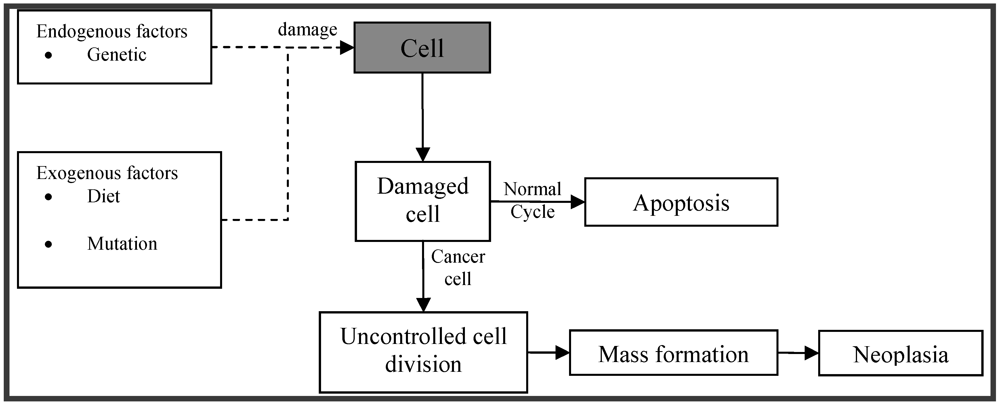
      <p>Cancer is one of the leading causes of death in the developed world. Cell division is a physiological process that occurs in tissues. Balance between proliferation and programmed cell death is maintained under normal circumstances, usually in the form of apoptosis, by tightly regulating both processes. Certain mutations in DNA lead to cancer by disrupting the programming regulating processes. Carcinogenesis is a process by which normal cells are transformed into cancer cells (<xref ref-type="fig" rid="marinedrugs-10-00963-f001">Figure 1</xref>). It is characterized by a progression of changes at both, cellular and genetic level, that reprogram a cell to undergo uncontrolled division, thus forming a malignant mass (tumor) that can spread to distant locations [<xref ref-type="bibr" rid="B1-marinedrugs-10-00963">1</xref>].</p>
      <fig id="marinedrugs-10-00963-f001" position="anchor">
        <label>Figure 1</label>
        <caption>
          <p>Schematic depiction of pathophysiology of cancer.</p>
        </caption>
        <graphic xmlns:xlink="http://www.w3.org/1999/xlink" xlink:href="marinedrugs-10-00963-g001.tif"/>
      </fig>
      <p>Dietary compounds have been isolated and identified in order to contribute to both, good health maintenance and prevention of chronic diseases such as cancer. There has been increased focus on bioactive peptides, which have been defined as “food derived components (naturally occurring or enzymatically generated) that, in addition to their nutritional value exert a physiological effect in the body” [<xref ref-type="bibr" rid="B2-marinedrugs-10-00963">2</xref>].</p>
      <p>Compounds from marine sources have been reported to have bioactive properties with varying degrees of action [<xref ref-type="bibr" rid="B3-marinedrugs-10-00963">3</xref>,<xref ref-type="bibr" rid="B4-marinedrugs-10-00963">4</xref>,<xref ref-type="bibr" rid="B5-marinedrugs-10-00963">5</xref>], such as anti-tumor, anti-cancer, anti-microtubule, anti-proliferative, anti-hypertensive, cytotoxic, as well as antibiotic properties [<xref ref-type="bibr" rid="B6-marinedrugs-10-00963">6</xref>,<xref ref-type="bibr" rid="B7-marinedrugs-10-00963">7</xref>,<xref ref-type="bibr" rid="B8-marinedrugs-10-00963">8</xref>]. These compounds, that have been isolated from marine sources are of varying chemical nature including phenols, alkaloids, terpenoids, polyesters, and other secondary metabolites which are present in sponges, bacteria, dinoflagellate, and seaweed [<xref ref-type="bibr" rid="B9-marinedrugs-10-00963">9</xref>]. Since biodiversity of the marine environment far exceeds that of the terrestrial environment, research on the use of marine natural products as pharmaceutical agents has been steadily increasing. Throughout evolution, marine organisms have developed into very refined physiological and biochemical systems; therefore, these organisms have developed unique adaptation strategies that enable them to survive in dark, cold, and highly pressurized environments. On the other hand, there is an intense competition for survival among the wide variety of species. All these species have developed chemical means to defend against predation, overgrowth by competing species, or conversely, to subdue motile prey species for ingestion. Also, secondary metabolites, which are produced by marine invertebrates and bacteria, have yielded medicinal products such as novel anti-inflammatory, anti-cancer, and antibiotics agents [<xref ref-type="bibr" rid="B10-marinedrugs-10-00963">10</xref>].</p>
      <p>Food-derived bioactive peptides represent one source of health-enhancing components. These peptides may be released during gastrointestinal digestion or food processing from a multitude of plant and animal proteins, especially milk, soy, and fish proteins [<xref ref-type="bibr" rid="B11-marinedrugs-10-00963">11</xref>]. Recently, there has been an increment in the number of studies focused on marine bioactive peptides. Many bioactive peptides and depsipeptides with anticancer potential have been extracted from various marine animals like tunicates, sponges, soft corals, sea hares, nudibranchs, bryozoans, sea slugs, and other marine organisms [<xref ref-type="bibr" rid="B12-marinedrugs-10-00963">12</xref>,<xref ref-type="bibr" rid="B13-marinedrugs-10-00963">13</xref>,<xref ref-type="bibr" rid="B14-marinedrugs-10-00963">14</xref>]. There is an extensive group of peptides and depsipeptides extracted from marine animals, however, this review focuses on the most studied that have achieved clinical trials and furthermore some that are commercially available such Aplidine [<xref ref-type="bibr" rid="B15-marinedrugs-10-00963">15</xref>]. Biologically active peptides obtained from marine animal species are considered to have diverse activities, including opioid agonistic, mineral binding, immunomodulatory, antimicrobial, antioxidant, antithrombotic, hypocholesterolemic, and antihypertensive actions [<xref ref-type="bibr" rid="B16-marinedrugs-10-00963">16</xref>]. By modulating and improving physiological functions, bioactive peptides may provide new therapeutic applications for the prevention and/or treatment of chronic diseases. As components of diverse marine species with certain health claims, bioactive peptides are of particular pharmaceutical interest [<xref ref-type="bibr" rid="B9-marinedrugs-10-00963">9</xref>].</p>
      <p>All substances sold as drugs in the United States must be approved by the federal Food and Drug Administration. This approval process requires a series of phased drug trials. The first phases involve <italic>in vitro</italic> and animal testing. If no adverse side effects are observed and significant ameliorative effects are found, testing on human subjects is undertaken. This process may take years because of the need to search for long-term side effects and to optimize methods for drug administration and dosage [<xref ref-type="bibr" rid="B17-marinedrugs-10-00963">17</xref>].</p>
      <p>This review compiles the most relevant studies performed in order to comply with development of peptides and depsipeptides derived from marine animals as anticancer drugs. With the latest increase in peptide research, the purpose of this review is to facilitate discussion on this issue since marine peptides are one of the recent perspectives in the development of new compounds for further drugs and therapeutic use in the treatment of cancer. Bioactive peptides and depsipeptides, most currently studied from animal marine species with anticancer potential and which have reached clinical trials, have therefore been examined.</p>
    </sec>
    <sec>
      <title>2. Sources of Bioactive Marine Peptides</title>
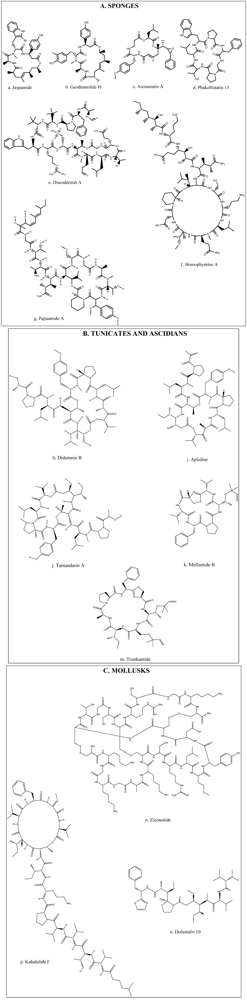
      <p>A diversity of peptides with bioactivity has been mainly extracted from various marine animals such as tunicates, sponges, and mollusks. This extensive group of bioactive peptides which have been reported in recent studies includes compounds such as Stylisin from Jamaican sponge <italic>Stylissa caribica</italic> [<xref ref-type="bibr" rid="B18-marinedrugs-10-00963">18</xref>], Papuamides from sponge of the genus Melophlus collected in the Solomon Islands [<xref ref-type="bibr" rid="B19-marinedrugs-10-00963">19</xref>]. Many of these compounds have been isolated, characterized, synthesized and further modified for the development of analogs in order to improve their activities [<xref ref-type="bibr" rid="B20-marinedrugs-10-00963">20</xref>,<xref ref-type="bibr" rid="B21-marinedrugs-10-00963">21</xref>,<xref ref-type="bibr" rid="B22-marinedrugs-10-00963">22</xref>,<xref ref-type="bibr" rid="B23-marinedrugs-10-00963">23</xref>]. However, among these bioactive peptides and depsipeptides, several have been studied in depth, and even have been taken to clinical study levels (<xref ref-type="table" rid="marinedrugs-10-00963-t001">Table 1</xref>). Many of these compounds have biological activities and hence have potential beneficial uses in health promotion or disease treatment [<xref ref-type="bibr" rid="B3-marinedrugs-10-00963">3</xref>,<xref ref-type="bibr" rid="B6-marinedrugs-10-00963">6</xref>]. Recently, much attention has been paid to discover the structural, compositional, and sequential properties of bioactive peptides from marine sources. <xref ref-type="fig" rid="marinedrugs-10-00963-f002">Figure 2</xref> illustrates the chemical structures of the most prevalent bioactive peptides and depsipeptides obtained from marine animals such as sponges, ascidians, tunicates and mollusks. Three methods have been used to produce marine bioactive peptides; solvent extraction, enzymatic hydrolysis, and microbial fermentation of marine proteins. However, particularly in food and pharmaceutical industries, the enzymatic hydrolysis method is preferred on account of the lack of residual organic solvents or toxic chemicals in the products [<xref ref-type="bibr" rid="B11-marinedrugs-10-00963">11</xref>].</p>
      <table-wrap id="marinedrugs-10-00963-t001" position="anchor">
        <object-id pub-id-type="pii">marinedrugs-10-00963-t001_Table 1</object-id>
        <label>Table 1</label>
        <caption>
          <p>Marine animal sources of bioactive peptides with anticancer potential.</p>
        </caption>
        <table>
<thead>
            <tr>
              <th align="center" valign="middle">Compound</th>
              <th align="center" valign="middle">Source</th>
              <th align="center" valign="middle">Organism</th>
              <th align="center" valign="middle">Bioactivity</th>
              <th align="center" valign="middle">Reference</th>
            </tr>
          </thead>
          <tbody>
            <tr style="background:silver">
              <td align="center" valign="middle">
                <bold>Aplidine</bold>
              </td>
              <td align="center" valign="middle">Ascidian</td>
              <td align="center" valign="middle">
                <italic>Aplidium albicans</italic>
              </td>
              <td align="center" valign="middle">Antitumor Anti leukemic</td>
              <td align="center" valign="middle">[<xref ref-type="bibr" rid="B24-marinedrugs-10-00963">24</xref>,<xref ref-type="bibr" rid="B25-marinedrugs-10-00963">25</xref>]</td>
            </tr>
            <tr>
              <td align="center" valign="middle">
                <bold>Arenastatin A</bold>
              </td>
              <td align="center" valign="middle">Sponge</td>
              <td align="center" valign="middle">
                <italic>Dysidea arenaria</italic>
              </td>
              <td align="center" valign="middle">Antitubulin</td>
              <td align="center" valign="middle">[<xref ref-type="bibr" rid="B26-marinedrugs-10-00963">26</xref>,<xref ref-type="bibr" rid="B27-marinedrugs-10-00963">27</xref>,<xref ref-type="bibr" rid="B28-marinedrugs-10-00963">28</xref>]</td>
            </tr>
            <tr style="background:silver">
              <td align="center" valign="middle">
                <bold>Aurilide</bold>
              </td>
              <td align="center" valign="middle">Tunicate</td>
              <td align="center" valign="middle">
                <italic>Dolabella auricularia</italic>
              </td>
              <td align="center" valign="middle">Antitumor</td>
              <td align="center" valign="middle">[<xref ref-type="bibr" rid="B29-marinedrugs-10-00963">29</xref>,<xref ref-type="bibr" rid="B30-marinedrugs-10-00963">30</xref>]</td>
            </tr>
            <tr>
              <td align="center" valign="middle">
                <bold>Didemnin</bold>
              </td>
              <td align="center" valign="middle">Tunicate</td>
              <td align="center" valign="middle"><italic>Trididemnum</italic> sp.</td>
              <td align="center" valign="middle">Antitumor</td>
              <td align="center" valign="middle">[<xref ref-type="bibr" rid="B3-marinedrugs-10-00963">3</xref>,<xref ref-type="bibr" rid="B31-marinedrugs-10-00963">31</xref>]</td>
            </tr>
            <tr style="background:silver">
              <td align="center" valign="middle">
                <bold>Dolastatin</bold>
              </td>
              <td align="center" valign="middle">Mollusk</td>
              <td align="center" valign="middle">
                <italic>Dolabella auricularia</italic>
              </td>
              <td align="center" valign="middle">Antineoplastic</td>
              <td align="center" valign="middle">[<xref ref-type="bibr" rid="B32-marinedrugs-10-00963">32</xref>]</td>
            </tr>
            <tr>
              <td align="center" valign="middle">
                <bold>Geodiamolide H</bold>
              </td>
              <td align="center" valign="middle">Sponge</td>
              <td align="center" valign="middle"><italic>Geodia</italic> sp.</td>
              <td align="center" valign="middle">Antiprolfierative</td>
              <td align="center" valign="middle">[<xref ref-type="bibr" rid="B28-marinedrugs-10-00963">28</xref>,<xref ref-type="bibr" rid="B33-marinedrugs-10-00963">33</xref>]</td>
            </tr>
            <tr style="background:silver">
              <td align="center" valign="middle">
                <bold>Homophymines</bold>
              </td>
              <td align="center" valign="middle">Sponge</td>
              <td align="center" valign="middle"><italic>Homophymia</italic> sp.</td>
              <td align="center" valign="middle">Antitumor</td>
              <td align="center" valign="middle">[<xref ref-type="bibr" rid="B34-marinedrugs-10-00963">34</xref>]</td>
            </tr>
            <tr>
              <td align="center" valign="middle">
                <bold>Jaspamide</bold>
              </td>
              <td align="center" valign="middle">Sponge</td>
              <td align="center" valign="middle"><italic>Jaspis</italic> sp. <italic>Hemiastrrella</italic> sp.</td>
              <td align="center" valign="middle">Antiproliferative</td>
              <td align="center" valign="middle">[<xref ref-type="bibr" rid="B35-marinedrugs-10-00963">35</xref>,<xref ref-type="bibr" rid="B36-marinedrugs-10-00963">36</xref>]</td>
            </tr>
            <tr style="background:silver">
              <td align="center" valign="middle">
                <bold>Kahalalide F</bold>
              </td>
              <td align="center" valign="middle">Mollusk</td>
              <td align="center" valign="middle"><italic>Elysia rufescens</italic>, <italic>Spisula polynyma</italic></td>
              <td align="center" valign="middle">Antitubulin</td>
              <td align="center" valign="middle">[<xref ref-type="bibr" rid="B28-marinedrugs-10-00963">28</xref>]</td>
            </tr>
            <tr>
              <td align="center" valign="middle">
                <bold>Keenamide A</bold>
              </td>
              <td align="center" valign="middle">Mollusk</td>
              <td align="center" valign="middle">
                <italic>Pleurobranchus forskalii</italic>
              </td>
              <td align="center" valign="middle">Antitumor</td>
              <td align="center" valign="middle">[<xref ref-type="bibr" rid="B37-marinedrugs-10-00963">37</xref>]</td>
            </tr>
            <tr style="background:silver">
              <td align="center" valign="middle">
                <bold>Mollamide</bold>
              </td>
              <td align="center" valign="middle">Ascidian</td>
              <td align="center" valign="middle">
                <italic>Didemnum molle</italic>
              </td>
              <td align="center" valign="middle">Antiproliferative</td>
              <td align="center" valign="middle">[<xref ref-type="bibr" rid="B30-marinedrugs-10-00963">30</xref>,<xref ref-type="bibr" rid="B38-marinedrugs-10-00963">38</xref>]</td>
            </tr>
            <tr>
              <td align="center" valign="middle">
                <bold>Phakellistatins</bold>
              </td>
              <td align="center" valign="middle">Sponge</td>
              <td align="center" valign="middle">
                <italic>Phakellia carteri</italic>
              </td>
              <td align="center" valign="middle">Antiproliferative</td>
              <td align="center" valign="middle">[<xref ref-type="bibr" rid="B30-marinedrugs-10-00963">30</xref>,<xref ref-type="bibr" rid="B39-marinedrugs-10-00963">39</xref>]</td>
            </tr>
            <tr style="background:silver">
              <td align="center" valign="middle">
                <bold>Tamandarins A and B</bold>
              </td>
              <td align="center" valign="middle">Ascidian</td>
              <td align="center" valign="middle"><italic>Didemnum</italic> sp.</td>
              <td align="center" valign="middle">Antitumor</td>
              <td align="center" valign="middle">[<xref ref-type="bibr" rid="B30-marinedrugs-10-00963">30</xref>,<xref ref-type="bibr" rid="B40-marinedrugs-10-00963">40</xref>]</td>
            </tr>
            <tr>
              <td align="center" valign="middle">
                <bold>Trunkamide A</bold>
              </td>
              <td align="center" valign="middle">Ascidian</td>
              <td align="center" valign="middle"><italic>Lissoclinum</italic> sp.</td>
              <td align="center" valign="middle">Antitumor</td>
              <td align="center" valign="middle">[<xref ref-type="bibr" rid="B30-marinedrugs-10-00963">30</xref>,<xref ref-type="bibr" rid="B41-marinedrugs-10-00963">41</xref>]</td>
            </tr>
          </tbody>
        </table>
      </table-wrap>
      <sec>
        <title>2.1. Sponges</title>
        <p>Approximately 10,000 sponges have been described worldwide and most of them live in marine environments [<xref ref-type="bibr" rid="B42-marinedrugs-10-00963">42</xref>,<xref ref-type="bibr" rid="B43-marinedrugs-10-00963">43</xref>]. A range of bioactive compounds has been found in about 11 sponge genera. Three of these genera (Haliclona, Petrosia, and Discodemia) produce influential anti-cancer and anti-inflammatory agents [<xref ref-type="bibr" rid="B44-marinedrugs-10-00963">44</xref>]. There are a number of research studies on bioactive peptides from sponges, mostly cyclodepsipeptides, which are secondary metabolites with unusual amino acids and non-amino acid moieties. These compounds possess a wide spectrum of biological activities; however, it is difficult to isolate them in sufficient quantity for pharmacological testing [<xref ref-type="bibr" rid="B30-marinedrugs-10-00963">30</xref>].</p>
        <p>Jaspamide is a cyclic depsipeptide isolated from sponges of the genus <italic>Jaspis</italic> and <italic>Hemiastrella</italic>. It possess a 15-carbon macrocyclic ring containing three amino acid residues (<xref ref-type="fig" rid="marinedrugs-10-00963-f002">Figure 2</xref>a) and has proved to be a bioactive compound inducing apoptosis in HL-60 human promyelocytic leukemia cell line [<xref ref-type="bibr" rid="B7-marinedrugs-10-00963">7</xref>,<xref ref-type="bibr" rid="B35-marinedrugs-10-00963">35</xref>,<xref ref-type="bibr" rid="B45-marinedrugs-10-00963">45</xref>], and Jurkat T cells [<xref ref-type="bibr" rid="B46-marinedrugs-10-00963">46</xref>]. Nine new cyclodepsipeptides, <italic>Homophymines</italic>, B–E, and A1–E1, isolated from the sponge <italic>Homophymia</italic> sp. have shown very potent cytotoxic activity with IC<sub>50</sub> values in the nM range. This activity has been reported against several human cancer cell lines [<xref ref-type="bibr" rid="B28-marinedrugs-10-00963">28</xref>,<xref ref-type="bibr" rid="B34-marinedrugs-10-00963">34</xref>] with moderate selectivity against human prostate (PC3) and ovarian (OV3) carcinoma. <italic>Homophymines</italic> A1–E1, which possesses the 4-amino-6-carbamoyl-2,3-dihydroxyhexanoic acid residue (<xref ref-type="fig" rid="marinedrugs-10-00963-f002">Figure 2</xref>f), exerts stronger potency than the corresponding A–E compounds which possess the same residue present in its carboxy form [<xref ref-type="bibr" rid="B34-marinedrugs-10-00963">34</xref>].</p>
      <fig id="marinedrugs-10-00963-f002" position="anchor">
        <label>Figure 2</label>
        <caption>
          <p>Chemical structures of bioactive peptides and depsipeptides from marine animal sources: (<bold>A</bold>) Sponges; (<bold>B</bold>) Tunicates and Ascidians and (<bold>C</bold>) Mollusks.</p>
        </caption>
        <graphic xmlns:xlink="http://www.w3.org/1999/xlink" xlink:href="marinedrugs-10-00963-g002.tif"/>
      </fig>
        <p><italic>Geodiamolide</italic> H (<xref ref-type="fig" rid="marinedrugs-10-00963-f002">Figure 2</xref>b) isolated from a Brazilian sponge <italic>Geodia corticostylifera</italic> have demonstrated antiproliferative activity against breast cancer cells by altering the actin cytoskeleton [<xref ref-type="bibr" rid="B33-marinedrugs-10-00963">33</xref>]. <italic>Discodermins</italic> tetradecapeptides are another group of cytotoxic peptides obtained from sponges of the genus <italic>Discodermia</italic> sp. containing 13–14 known and rare amino acids as a chain, with a macrocyclic ring constituted by lactonization of a threonine unit with the carboxy terminal (<xref ref-type="fig" rid="marinedrugs-10-00963-f002">Figure 2</xref>e). <italic>Discodermins</italic> A–H were tested against A549 human lung cell line and P388 murine leukemia cells, all showing cytotoxicity [<xref ref-type="bibr" rid="B3-marinedrugs-10-00963">3</xref>].</p>
        <p><italic>Arenastatin</italic> A (<xref ref-type="fig" rid="marinedrugs-10-00963-f002">Figure 2</xref>c) is a cyclodepsipeptide isolated from <italic>Dysidia arenaria</italic> that have demonstrated a potent cytotoxicity against KB cells with an IC<sub>50</sub> of 5 pg/mL [<xref ref-type="bibr" rid="B3-marinedrugs-10-00963">3</xref>]. <italic>Papuamides</italic> A–D isolated from sponges of the genus <italic>Theonella</italic>, are the first marine-derived peptides reported to contain 3-hydroxyleucine and homoproline residues and a 2,3-dihydroxy-2,6,8-trimethyldeca-(4<italic>Z</italic>,6<italic>E</italic>)-dienoic acid moiety, <italic>N</italic>-linked to a terminal glycine residue (<xref ref-type="fig" rid="marinedrugs-10-00963-f002">Figure 2</xref>g). It has also been discovered that <italic>Papuamides</italic> A and B inhibited the infection of human <italic>T</italic>-lymphoblastoid cells by HIV-1 <italic>in vitro</italic> [<xref ref-type="bibr" rid="B3-marinedrugs-10-00963">3</xref>,<xref ref-type="bibr" rid="B47-marinedrugs-10-00963">47</xref>].</p>
        <p><italic>Phakellistatins</italic> isolated from the Western Indian Ocean sponge <italic>Phalkellia carteri</italic> inhibit leukemia cell growth [<xref ref-type="bibr" rid="B39-marinedrugs-10-00963">39</xref>]. Another related compound, <italic>Phakellistatin</italic> 13 (<xref ref-type="fig" rid="marinedrugs-10-00963-f002">Figure 2</xref>d) from sponge <italic>Phakellia fusca</italic> was cytotoxic against the human hepatoma BEL-7404 cell line with an ED<sub>50</sub> &lt; 10<sup>−2</sup> μg/mL. Synthetic specimens of Phakellistatin were found to be chemically but not biologically (cancer cell lines) identical to the natural products. The reason might be a conformational difference, especially around the proline residue [<xref ref-type="bibr" rid="B30-marinedrugs-10-00963">30</xref>,<xref ref-type="bibr" rid="B48-marinedrugs-10-00963">48</xref>].</p>
      </sec>
      <sec>
        <title>2.2. Tunicates and Ascidians</title>
        <p>Bioactive peptides with novel structures have also been shown in ascidians. Sack-like sea squirts inhabiting the sea floor, produce a complex anti-tumor compound which is, hundreds to thousands of times more influential than any cancer concoction now in use [<xref ref-type="bibr" rid="B10-marinedrugs-10-00963">10</xref>]. One of these potent compounds is <italic>Didemnin</italic>, isolated at first from the Caribbean tunicate <italic>Trididemnum solidum</italic> but later obtained from other species of the same genus [<xref ref-type="bibr" rid="B3-marinedrugs-10-00963">3</xref>,<xref ref-type="bibr" rid="B49-marinedrugs-10-00963">49</xref>]. Among these compounds, <italic>Didemnin</italic> B (<xref ref-type="fig" rid="marinedrugs-10-00963-f002">Figure 2</xref>h) has the most potent antitumor activity and also has showed antiproliferative activity against human prostatic cancer cell lines [<xref ref-type="bibr" rid="B3-marinedrugs-10-00963">3</xref>,<xref ref-type="bibr" rid="B31-marinedrugs-10-00963">31</xref>]. <italic>Didemnin</italic> B inhibits the synthesis of RNA, DNA and proteins [<xref ref-type="bibr" rid="B50-marinedrugs-10-00963">50</xref>]. Substantial evidence of activity in preclinical models with dose-dependent and tolerable toxicity profiles led to phase I clinical trials, making this peptide the first marine natural product to be evaluated in clinical trials [<xref ref-type="bibr" rid="B51-marinedrugs-10-00963">51</xref>,<xref ref-type="bibr" rid="B52-marinedrugs-10-00963">52</xref>]. The toxicity profile of <italic>Didemnin</italic> B was quite similar across the trials, with dose-dependent nausea and vomiting as the most commonly reported side effects. Phase II trials using <italic>Didemnin</italic> B at the recommended doses were inefficient, while trials using more aggressive regimens resulted in higher levels of toxicity, including cardiotoxicity [<xref ref-type="bibr" rid="B53-marinedrugs-10-00963">53</xref>,<xref ref-type="bibr" rid="B54-marinedrugs-10-00963">54</xref>,<xref ref-type="bibr" rid="B55-marinedrugs-10-00963">55</xref>].</p>
        <p><italic>Aplidine</italic> (<xref ref-type="fig" rid="marinedrugs-10-00963-f002">Figure 2</xref>i) is a cyclodepsipeptide isolated from the tunicate <italic>Aplidium albicans</italic>, which has been shown to have anticancer activity against a variety of human cancer cell lines, such as breast, melanoma and lung cancers [<xref ref-type="bibr" rid="B28-marinedrugs-10-00963">28</xref>,<xref ref-type="bibr" rid="B56-marinedrugs-10-00963">56</xref>], which appear to be sensitive to low concentrations of this compound. Aplidine’s mode of action involves several pathways, including cell cycle arrest and inhibition of protein synthesis, thus inducing apoptosis of cancer cells [<xref ref-type="bibr" rid="B57-marinedrugs-10-00963">57</xref>]. Furthermore, <italic>Aplidine</italic> possesses a unique and differential mechanism of cytotoxicity which involves the inhibition of ornithine descarboxylase, an enzyme that is critical in the process of tumor formation and growth [<xref ref-type="bibr" rid="B24-marinedrugs-10-00963">24</xref>]. <italic>Aplidine</italic> also inhibits the expression of the vascular endothelial growth factor gene, having antiangiogenic effects [<xref ref-type="bibr" rid="B25-marinedrugs-10-00963">25</xref>]. <italic>Aplidine</italic>, was well tolerated with minor toxicity in finished Phase I clinical trials with the most common side effects being asthenia, nausea, vomiting and transient transaminitis, but not inducing hematological toxicity, mucositis or alopecia [<xref ref-type="bibr" rid="B56-marinedrugs-10-00963">56</xref>,<xref ref-type="bibr" rid="B58-marinedrugs-10-00963">58</xref>,<xref ref-type="bibr" rid="B59-marinedrugs-10-00963">59</xref>]. Neuromuscular toxicity with the elevation of creatine phosphokinase levels has been dose limited, but seemed to be readily reversible with oral carnitine [<xref ref-type="bibr" rid="B56-marinedrugs-10-00963">56</xref>]. <italic>Aplidine</italic> has shown antitumor activity in phase I trials [<xref ref-type="bibr" rid="B56-marinedrugs-10-00963">56</xref>,<xref ref-type="bibr" rid="B58-marinedrugs-10-00963">58</xref>], and has already undergone active phase II studies in solid tumors [<xref ref-type="bibr" rid="B60-marinedrugs-10-00963">60</xref>,<xref ref-type="bibr" rid="B61-marinedrugs-10-00963">61</xref>,<xref ref-type="bibr" rid="B62-marinedrugs-10-00963">62</xref>].</p>
        <p><italic>Tamandarins</italic> A (<xref ref-type="fig" rid="marinedrugs-10-00963-f002">Figure 2</xref>j) and B are also cytotoxic depsipeptides from a marine ascidian of the family Didemnidae, which was evaluated against various human cancer cell lines [<xref ref-type="bibr" rid="B30-marinedrugs-10-00963">30</xref>,<xref ref-type="bibr" rid="B40-marinedrugs-10-00963">40</xref>]. <italic>Mollamide</italic> is a cyclodepsipeptide obtained from the ascidian <italic>Didemnum molle</italic>, and it has shown cytotoxicity against a range of cell lines with IC<sub>50</sub> values of 1 μg/mL toward P388 murine leukemia line and 2.5 μg/mL against A549 human lung carcinoma and HT29 human colon carcinoma [<xref ref-type="bibr" rid="B30-marinedrugs-10-00963">30</xref>,<xref ref-type="bibr" rid="B38-marinedrugs-10-00963">38</xref>]. <italic>Trunkamide</italic> A is a cyclopeptide with a tiazoline ring similar to <italic>Mollamide</italic> (<xref ref-type="fig" rid="marinedrugs-10-00963-f002">Figure 2</xref>k,m) obtained from ascidians of the genus <italic>Lissoclinum</italic>, where antitumor activity under preclinical trials has been demonstrated [<xref ref-type="bibr" rid="B30-marinedrugs-10-00963">30</xref>,<xref ref-type="bibr" rid="B41-marinedrugs-10-00963">41</xref>].</p>
      </sec>
      <sec>
        <title>2.3. Mollusks</title>
        <p>Mollusks are species that have a wide range of uses in pharmacology. Sea hare, a shelled organism, produces bioactive metabolites used in the treatment of cancerous tumors [<xref ref-type="bibr" rid="B10-marinedrugs-10-00963">10</xref>]. <italic>Ziconotide</italic> is a 25 amino acid peptide with three disulphide bonds (<xref ref-type="fig" rid="marinedrugs-10-00963-f002">Figure 2</xref>n); and is present in the venom of the predatory Indo-Pacific marine mollusk, <italic>Conus magus.</italic> It possesses remarkable analgesic activity, which has proved to be 1000 times more active than morphine in animal models of nociceptic pain [<xref ref-type="bibr" rid="B63-marinedrugs-10-00963">63</xref>]. Cone snails belonging to the genus <italic>Conus</italic> are a valuable source of active peptides named conotoxins. They consist of a mixture of peptides with short chains of amino acids (8–35) rich in disulfide. Studies have postulated that these peptides could be of interest in the treatment of cancer [<xref ref-type="bibr" rid="B3-marinedrugs-10-00963">3</xref>,<xref ref-type="bibr" rid="B64-marinedrugs-10-00963">64</xref>].</p>
        <p><italic>Dolastatins</italic> is a family of cytotoxic peptides isolated from the mollusk <italic>Dollabella auricularia</italic>, where the linear pentapeptide <italic>Dolastatin</italic> 10 (<xref ref-type="fig" rid="marinedrugs-10-00963-f002">Figure 2</xref>o) and the depsipeptide <italic>Dolastatin</italic> 15 have had the most promising antiproliferative activity reported [<xref ref-type="bibr" rid="B65-marinedrugs-10-00963">65</xref>,<xref ref-type="bibr" rid="B66-marinedrugs-10-00963">66</xref>]. <italic>Dolastatin</italic> 10 is an antineoplastic substance proven against several cancer cell lines [<xref ref-type="bibr" rid="B67-marinedrugs-10-00963">67</xref>] and has been evaluated in various phase I clinical trials reporting good tolerability and identifying myelosuppression as the dose limiting toxicity. Other side effects observed were peripheral sensory neuropathies, pain, swelling, and erythema at the injection site [<xref ref-type="bibr" rid="B67-marinedrugs-10-00963">67</xref>,<xref ref-type="bibr" rid="B68-marinedrugs-10-00963">68</xref>]. Complexity and low yield of chemical synthesis of dolastatins, together with low water solubility, have been significant obstacles to broader clinical evaluation, triggering the development of analog compounds [<xref ref-type="bibr" rid="B69-marinedrugs-10-00963">69</xref>,<xref ref-type="bibr" rid="B70-marinedrugs-10-00963">70</xref>].</p>
        <p>A 60-kDa protein, Bursatellanin-P, was purified from the purple ink of the sea hare <italic>Bursatella leachii</italic> showing anti-HIV activity [<xref ref-type="bibr" rid="B71-marinedrugs-10-00963">71</xref>]. <italic>Keenamide A</italic> is a cytotoxic cyclic hexapeptide isolated from the mollusk <italic>Pleurobranchus forskalii</italic>, which elicits antitumor activity via unknown mechanisms. This compound exhibited significant activity against the P388, A549, MEL-20 and HT-29 tumor cell lines [<xref ref-type="bibr" rid="B37-marinedrugs-10-00963">37</xref>].</p>
        <p>Kahalalides is a family of peptides isolated from the sacoglossan mollusk <italic>Elysia rufescens</italic>. Among these, Kahalalide F is a dehydroamino-butyric acid-containing peptide (<xref ref-type="fig" rid="marinedrugs-10-00963-f002">Figure 2</xref>p) which is known to exhibit interesting antitumor activity [<xref ref-type="bibr" rid="B72-marinedrugs-10-00963">72</xref>]. Kahalalide F has shown <italic>in vitro</italic> and <italic>in vivo</italic> selectivity for prostate-derived cell lines and tumors [<xref ref-type="bibr" rid="B73-marinedrugs-10-00963">73</xref>,<xref ref-type="bibr" rid="B74-marinedrugs-10-00963">74</xref>]. It has been observed that Kahalalide F induces disturbances in lysosomal function that might lead to intracellular acidification and cell death. These results suggest that cells with high lysosomal activity, such as prostate cancer cells, would be a suitable tumor type to use to explore the activity of this peptide [<xref ref-type="bibr" rid="B72-marinedrugs-10-00963">72</xref>]. In phase I clinical trials, Kahalalide F exhibited clinical benefits in treated patients and low toxicity with few side effects restricted to fatigue, headache, vomiting, and pruritus limited to the hands. Since hematological toxicities have not been observed, Kahalalide F results show suitability for trials in combination with other anticancer agents [<xref ref-type="bibr" rid="B75-marinedrugs-10-00963">75</xref>]. There is evidence that suggests that Kahalalide F may be active against other tumor types and deserves further clinical testing either as a single agent or in combination [<xref ref-type="bibr" rid="B75-marinedrugs-10-00963">75</xref>]. Currently, this agent is undergoing phase II clinical trials for the treatment of lung and prostate cancers, and melanoma [<xref ref-type="bibr" rid="B76-marinedrugs-10-00963">76</xref>].</p>
      </sec>
      <sec>
        <title>2.4. Marine Protein Hydrolysates</title>
        <p>In recent years, there has been a considerable amount of research focused on the liberation of bioactive peptides encrypted within food proteins, and towards the use of peptides as functional food ingredients that promote health maintenance or as potential drugs for the treatment of chronic diseases. Interestingly, within the parent protein sequence, the peptides are inactive and thus must be released to exert an effect. These bioactive peptides are usually 2–20 amino acid residues in length: however, some have been reported to be longer than 20 amino acid residues [<xref ref-type="bibr" rid="B77-marinedrugs-10-00963">77</xref>].</p>
        <p>Protein hydrolysis is the method used to obtain peptides from food protein sources with different biological activities, such as antioxidant, antihypertensive, antimicrobial and antiproliferative. It consists of breaking the peptide bond and subsequent generation of smaller peptides or free amino acids, if an adequate control of the hydrolysis is achieved [<xref ref-type="bibr" rid="B78-marinedrugs-10-00963">78</xref>]. The protein hydrolysis method most commonly used is enzymatic hydrolysis, since alkaline hydrolysis is not frequently used due to the racemization or destruction of certain amino acids at high pH [<xref ref-type="bibr" rid="B79-marinedrugs-10-00963">79</xref>]. On the other hand, the acid method has the disadvantage that tryptophan is completely destroyed, while serine and threonine are destroyed by 5–10% and asparagine and glutamine are hydrolyzed to their corresponding acids [<xref ref-type="bibr" rid="B80-marinedrugs-10-00963">80</xref>].</p>
        <p>Enzymatic hydrolysis is carried out under controlled pH and temperature conditions that reduce the formation of undesirable products [<xref ref-type="bibr" rid="B78-marinedrugs-10-00963">78</xref>]. Several enzymes are used to obtain hydrolysates, among which are the digestive and microbial proteases, including alcalase, trypsin, pepsin, chymotrypsin, pancreatin, pepsin, and thermolysin, among others [<xref ref-type="bibr" rid="B81-marinedrugs-10-00963">81</xref>]. Moreover, studies have demonstrated that enzymatic hydrolysis most likely increases the antioxidative activity of the resulting hydrolysate via the enhancement of radical scavenging activity [<xref ref-type="bibr" rid="B82-marinedrugs-10-00963">82</xref>].</p>
        <p>Fish is an important source of protein worldwide; additionally, fish proteins offer huge potential as novel sources of bioactive peptides. Hydrolysates of several marine proteins have been assayed for various bioactivities. Peptides present in protein hydrolysates have biological activities depending on their molecular weights and amino acid sequences. Crude hydrolysates are subsequently fractionated to separate individual peptides using different techniques, mainly reverse phase high performance liquid chromatography (RP-HPLC) or gel permeation chromatography [<xref ref-type="bibr" rid="B4-marinedrugs-10-00963">4</xref>,<xref ref-type="bibr" rid="B13-marinedrugs-10-00963">13</xref>,<xref ref-type="bibr" rid="B83-marinedrugs-10-00963">83</xref>].</p>
        <p>Enzymatic hydrolysis of food proteins is considered an efficient way to recover potent bioactive peptides, since several peptides obtained by this process have different bioactivities and this may represent a potential approach to anticancer drugs. Up to now, bioactive peptides with potential anticancer exhibiting antioxidant and antiproliferative effects have been found in the hydrolysates of marine proteins [<xref ref-type="bibr" rid="B84-marinedrugs-10-00963">84</xref>,<xref ref-type="bibr" rid="B85-marinedrugs-10-00963">85</xref>,<xref ref-type="bibr" rid="B86-marinedrugs-10-00963">86</xref>,<xref ref-type="bibr" rid="B87-marinedrugs-10-00963">87</xref>] (<xref ref-type="table" rid="marinedrugs-10-00963-t002">Table 2</xref>).</p>
        <table-wrap id="marinedrugs-10-00963-t002" position="anchor">
          <object-id pub-id-type="pii">marinedrugs-10-00963-t002_Table 2</object-id>
          <label>Table 2</label>
          <caption>
            <p>Bioactivity of peptides from marine protein enzymatic hydrolysates with anticancer potential.</p>
          </caption>
          <table>
  <thead>
    <tr>
      <th align="center" valign="middle">Source</th>
                <th align="center" valign="middle">Enzyme</th>
                <th align="center" valign="middle">Amino Acid Sequence</th>
                <th align="center" valign="middle">Bioactivity</th>
                <th align="center" valign="middle">Reference</th>
              </tr>
  </thead>
  <tbody>
              <tr style="background:silver">
                <td align="center" valign="middle">
                  <bold>Alaska pollack collagen (<italic>Theragra chalcogramma</italic>)</bold>
                </td>
                <td align="center" valign="middle">Trypsin and Flavourzyme</td>
                <td align="center" valign="middle">nd </td>
                <td align="center" valign="middle">Antioxidant 
                <italic>in vitro</italic></td>
                <td align="center" valign="middle">[<xref ref-type="bibr" rid="B88-marinedrugs-10-00963">88</xref>]</td>
    </tr>
              <tr>
                <td align="center" valign="middle">
                  <bold>Croaker muscle (<italic>Otolithes ruber</italic>)</bold>
                </td>
                <td align="center" valign="middle">Pepsin, followed by Trypsin + αChymotrypsin</td>
                <td align="center" valign="middle">GNRGFACRHA</td>
                <td align="center" valign="middle">Antioxidant 
                <italic>in vitro</italic></td>
                <td align="center" valign="middle">[<xref ref-type="bibr" rid="B89-marinedrugs-10-00963">89</xref>]</td>
              </tr>
              <tr style="background:silver">
                <td align="center" valign="middle">
                  <bold>Flyingfish (<italic>Exocoetus volitans</italic>)</bold>
                </td>
                <td align="center" valign="middle">Trypsin</td>
                <td align="center" valign="middle">nd</td>
                <td align="center" valign="middle">Antioxidant Antiproliferative for Hep G2</td>
                <td align="center" valign="middle">[<xref ref-type="bibr" rid="B14-marinedrugs-10-00963">14</xref>]</td>
    </tr>
              <tr>
                <td align="center" valign="middle">
                  <bold>Flying squid skin gelatin (<italic>Ommastrephes batramii</italic>)</bold>
                </td>
                <td align="center" valign="middle">Pepsin, followed by Trypsin + αChymotrypsin</td>
                <td align="center" valign="middle">nd</td>
                <td align="center" valign="middle">Antioxidant 
                <italic>in vitro</italic></td>
                <td align="center" valign="middle">[<xref ref-type="bibr" rid="B90-marinedrugs-10-00963">90</xref>]</td>
              </tr>
              <tr style="background:silver">
                <td align="center" valign="middle">
                  <bold>Horse mackerel muscle (<italic>Magalapsis cordyla</italic>)</bold>
                </td>
                <td align="center" valign="middle">Pepsin, followed by Trypsin + αChymotrypsin</td>
                <td align="center" valign="middle">NHRYDR</td>
                <td align="center" valign="middle">Antioxidant 
                <italic>in vitro</italic></td>
                <td align="center" valign="middle">[<xref ref-type="bibr" rid="B89-marinedrugs-10-00963">89</xref>]</td>
    </tr>
              <tr>
                <td align="center" valign="middle">
                  <bold>Jellyfish umbrella collagen (<italic>Rhopilema esculentum</italic>)</bold>
                </td>
                <td align="center" valign="middle">Trypsin and Flavourzyme</td>
                <td align="center" valign="middle">nd</td>
                <td align="center" valign="middle">Antioxidant</td>
                <td align="center" valign="middle">[<xref ref-type="bibr" rid="B88-marinedrugs-10-00963">88</xref>]</td>
              </tr>
              <tr style="background:silver">
                <td align="center" valign="middle">
                  <bold>Jumbo flying squid skin gelatin (<italic>Dosidicus gigas</italic>)</bold>
                </td>
                <td align="center" valign="middle">Esperase and Alcalase</td>
                <td align="center" valign="middle">nd</td>
                <td align="center" valign="middle">Antioxidant 
                <italic>in vitro</italic> Antiproliferative/Cytotoxic on MCF-7 and U87 cells</td>
                <td align="center" valign="middle">[<xref ref-type="bibr" rid="B82-marinedrugs-10-00963">82</xref>,<xref ref-type="bibr" rid="B91-marinedrugs-10-00963">91</xref>]</td>
    </tr>
              <tr>
                <td align="center" valign="middle">
                  <bold>Oyster (<italic>Crassostrea gigas</italic>)</bold>
                </td>
                <td align="center" valign="middle">Protease from 
                <italic>Bacillus</italic> sp. SM98011</td>
                <td align="center" valign="middle">nd</td>
                <td align="center" valign="middle">Antitumor in BALB/c mice</td>
                <td align="center" valign="middle">[<xref ref-type="bibr" rid="B4-marinedrugs-10-00963">4</xref>]</td>
              </tr>
              <tr style="background:silver">
                <td align="center" valign="middle">
                  <bold>Smooth hound (<italic>Mustelus mustelus</italic>)</bold>
                </td>
                <td align="center" valign="middle">LMW alkaline protease</td>
                <td align="center" valign="middle">nd</td>
                <td align="center" valign="middle">Antioxidant 
                <italic>in vitro</italic></td>
                <td align="center" valign="middle">[<xref ref-type="bibr" rid="B92-marinedrugs-10-00963">92</xref>]</td>
    </tr>
              <tr>
                <td align="center" valign="middle">
                  <bold>Solitary tunicate (<italic>Styela clava</italic>)</bold>
                </td>
                <td align="center" valign="middle">Alcalase</td>
                <td align="center" valign="middle">nd</td>
                <td align="center" valign="middle">Antioxidant 
                <italic>in vitro</italic> Antiproliferative on AGS, DLD-1, and HeLa cells</td>
                <td align="center" valign="middle">[<xref ref-type="bibr" rid="B13-marinedrugs-10-00963">13</xref>]</td>
              </tr>
              <tr style="background:silver">
                <td align="center" valign="middle">
                  <bold>Threadfin bream (<italic>Nemipterus japonicas</italic>)</bold>
                </td>
                <td align="center" valign="middle">Trypsin</td>
                <td align="center" valign="middle">nd</td>
                <td align="center" valign="middle">Antioxidant Antiproliferative on HepG2</td>
                <td align="center" valign="middle">[<xref ref-type="bibr" rid="B14-marinedrugs-10-00963">14</xref>]</td>
    </tr>
              <tr>
                <td align="center" valign="middle">
                  <bold>Tilapia (<italic>Oreochromis niloticus</italic>)</bold>
                </td>
                <td align="center" valign="middle">Cryotin, Flavourzyme, Alcalase</td>
                <td align="center" valign="middle">nd</td>
                <td align="center" valign="middle">Antioxidant 
                <italic>in vitro</italic></td>
                <td align="center" valign="middle">[<xref ref-type="bibr" rid="B93-marinedrugs-10-00963">93</xref>,<xref ref-type="bibr" rid="B94-marinedrugs-10-00963">94</xref>]</td>
              </tr>
              <tr style="background:silver">
                <td align="center" valign="middle">
                  <bold>Tuna dark muscle byproduct (<italic>Thunnus tonggol</italic>)</bold>
                </td>
                <td align="center" valign="middle">Papain and Protease XXIII</td>
                <td align="center" valign="middle">LPHVLTPEAGAT<break/>PTAEGGVYMVT</td>
                <td align="center" valign="middle">Antiproliferative on MCF7 cells</td>
                <td align="center" valign="middle">[<xref ref-type="bibr" rid="B83-marinedrugs-10-00963">83</xref>]</td>
    </tr>
              <tr>
                <td align="center" valign="middle">
                  <bold>Tuna skin gelatin (<italic>Thunnus</italic> spp.)</bold>
                </td>
                <td align="center" valign="middle">Alcalase</td>
                <td align="center" valign="middle">nd</td>
                <td align="center" valign="middle">Antioxidant 
                <italic>in vitro</italic></td>
                <td align="center" valign="middle">[<xref ref-type="bibr" rid="B82-marinedrugs-10-00963">82</xref>]</td>
              </tr>
  </tbody>
          </table>
    <table-wrap-foot>
      <fn>
        <p>nd = not determined.</p>
      </fn>
    </table-wrap-foot>		
		</table-wrap>
        <sec>
          <title>By-Products from Processing Hydrolysates</title>
          <p>The most common definition of by-products is that referring to all the raw material remaining after the production of the main products. The general understanding of by-products, when considering round fish such as cod, is that the main body flesh (constituting the fillets) is considered to be the main product, but the head, backbones, trimmings (cut-offs), skin and guts constitute what is generally thought as by-products [<xref ref-type="bibr" rid="B95-marinedrugs-10-00963">95</xref>]. The definition of rest raw materials in the fish industry varies with fish species as well as with the harvesting and processing methods used [<xref ref-type="bibr" rid="B96-marinedrugs-10-00963">96</xref>].</p>
          <p>A major issue for food producers is the discarding of by-products from food processing. Adding value to waste streams is very appealing to food producers, as the by-products are usually incorporated into low economic value products such as animal feed.</p>
          <p>Bioactive peptides from various marine enzymatically hydrolyzed by-products such as fish bones [<xref ref-type="bibr" rid="B97-marinedrugs-10-00963">97</xref>], shrimp waste [<xref ref-type="bibr" rid="B98-marinedrugs-10-00963">98</xref>], tuna head [<xref ref-type="bibr" rid="B99-marinedrugs-10-00963">99</xref>], have been identified. Hydrolyzed protein from the viscera of mackerel was used to obtain bioactive peptides [<xref ref-type="bibr" rid="B89-marinedrugs-10-00963">89</xref>]. Also, sardinelle by-product hydrolysates have been a good source of peptides with high antioxidant activity [<xref ref-type="bibr" rid="B100-marinedrugs-10-00963">100</xref>]. There is a large number of studies on the enzymatic hydrolysis of collagen or gelatin used for the production of bioactive peptides. Among these, squid and tuna skin gelatin hydrolysates, enzymatically produced, have shown antioxidant activity measured by the Fe reducing capacity (FRAP) and the ABTS radical scavenging methods [<xref ref-type="bibr" rid="B82-marinedrugs-10-00963">82</xref>].</p>
        </sec>
      </sec>
    </sec>
    <sec>
      <title>3. Anticancer Activities of Marine Animal Peptides</title>
      <p>Bioactive peptides usually contain 2–20 amino acid residues and their activities are based on their amino acid composition and sequence. These peptides are reported to be involved in various biological functions such as, antioxidant, antiproliferative, antitubulin and cytotoxic activities [<xref ref-type="bibr" rid="B16-marinedrugs-10-00963">16</xref>,<xref ref-type="bibr" rid="B101-marinedrugs-10-00963">101</xref>]. These activities could confer anticancer potential, which will give a use in cancer therapy.</p>
      <sec>
        <title>3.1. Antioxidative Activity</title>
        <p>Antioxidants are known to be beneficial to human health as they may protect the body against molecules known as reactive oxygen species (ROS). ROS can attack membrane lipids, protein, and DNA. This consecutively can be a causative factor in many diseases such as cancer. As ROS are involved in cancer development, compounds with high ROS reduction activity are likely to be able to prevent cancer incidence, since the oxidative stress inhibition leads to reduced genetic alteration such as mutation and chromosomal rearrangements which play a vital role in the initiation of carcinogenesis [<xref ref-type="bibr" rid="B13-marinedrugs-10-00963">13</xref>].</p>
        <p>Antioxidant peptides have been found in numerous foodstuffs including algae protein waste [<xref ref-type="bibr" rid="B102-marinedrugs-10-00963">102</xref>], milk [<xref ref-type="bibr" rid="B103-marinedrugs-10-00963">103</xref>] and enzymatically produced protein hydrolysates [<xref ref-type="bibr" rid="B84-marinedrugs-10-00963">84</xref>,<xref ref-type="bibr" rid="B86-marinedrugs-10-00963">86</xref>,<xref ref-type="bibr" rid="B104-marinedrugs-10-00963">104</xref>,<xref ref-type="bibr" rid="B105-marinedrugs-10-00963">105</xref>]. Among these, numerous fish protein hydrolysates (from sources such as Tilapia) have demonstrated antioxidant potential. They have significant ability to scavenge ROS and reduce ferric ions [<xref ref-type="bibr" rid="B106-marinedrugs-10-00963">106</xref>]. Hydrolysates from mackerel muscle obtained with Protease N, contain peptides with antioxidant activity <italic>in vitro</italic>. The antioxidant activity is measured by the peptide’s capacity to scavenge the free radical α,α-diphenyl-β-picrylhydrazil (DPPH) and reduce Fe<sup>3+</sup> to Fe<sup>2+</sup> [<xref ref-type="bibr" rid="B107-marinedrugs-10-00963">107</xref>]. This antioxidant potential is similar to that reported for protein hydrolysates from other sources, such as casein enzymatic hydrolysate, which exhibits significant ability to scavenge ROS [<xref ref-type="bibr" rid="B108-marinedrugs-10-00963">108</xref>]. Also soy and wheat protein hydrolysates showed strong capacity to scavenge DPPH [<xref ref-type="bibr" rid="B109-marinedrugs-10-00963">109</xref>].</p>
        <p>Hydrolysates of several skin gelatins such as flying squid (<italic>Ommastrephes batramii</italic>) [<xref ref-type="bibr" rid="B90-marinedrugs-10-00963">90</xref>], tuna (<italic>Thunnus</italic> spp.) and jumbo flying squid (<italic>Dosidicus gigas</italic>) [<xref ref-type="bibr" rid="B82-marinedrugs-10-00963">82</xref>,<xref ref-type="bibr" rid="B110-marinedrugs-10-00963">110</xref>] have been shown to possess antioxidant activity. Gelatin peptides mainly contain hydrophobic amino acids and abundance of these amino acids favors a high emulsifying ability to hydrophilic-hydrophobic partitioning in the peptide sequence [<xref ref-type="bibr" rid="B84-marinedrugs-10-00963">84</xref>]. In addition, specific amino acid arrangements with their abundance of Gly, Pro and Hyp, merit special consideration, as the content of Pro residues has a scavenging effect on radicals and the percentage of hydroxylation seems to be related to the antioxidant properties as measured by FRAP [<xref ref-type="bibr" rid="B82-marinedrugs-10-00963">82</xref>]. Hence, marine gelatin derived peptides are expected to exert high antioxidant effects among other antioxidant peptide sequences [<xref ref-type="bibr" rid="B82-marinedrugs-10-00963">82</xref>,<xref ref-type="bibr" rid="B84-marinedrugs-10-00963">84</xref>]. Therefore, marine-derived bioactive peptides with antioxidative properties may have great potential for use as nutraceuticals and pharmaceuticals and as a substitute for synthetic antioxidants.</p>
        <p>Muscle hydrolysates of horse mackerel (<italic>Magalapsis cordyla</italic>) and croaker (<italic>Otolithes ruber</italic>) [<xref ref-type="bibr" rid="B89-marinedrugs-10-00963">89</xref>], <italic>Nemipterus japonicas</italic> and <italic>Exocoetus volitans</italic> [<xref ref-type="bibr" rid="B14-marinedrugs-10-00963">14</xref>] have been shown to have an ability to scavenge free radicals and reactive oxygen species, showing antioxidant activity. Protein hydrolysates obtained from Channel catfish (<italic>Ictalurus punctatus</italic>) protein isolates [<xref ref-type="bibr" rid="B104-marinedrugs-10-00963">104</xref>] and from jellyfish (<italic>Rhopilema esculentum</italic>) umbrella collagen [<xref ref-type="bibr" rid="B105-marinedrugs-10-00963">105</xref>] have shown antioxidant activity as determined by different methods.</p>
        <p>Flying squid gelatin hydrolysate (enzymatically obtained) showed high antioxidant ability. At concentrations of 16 and 12 mg/mL, the hydrolysate showed a superior ability to scavenge DPPH free radicals than BHA and α-tocopherol, respectively. This hydrolysate was found to be rich in antioxidant amino acids including tyrosine, histidine, proline, alanine, and leucine. Furthermore, it appeared that hydrolysate fractions having a molecular weight ranging from 383 to 1492 Da, might be responsible for its antioxidant activity. Moreover, the size (usually lower molecular weight) and the amino acid composition were found to be strongly correlated to their antioxidant activity [<xref ref-type="bibr" rid="B90-marinedrugs-10-00963">90</xref>]. The mechanisms of action of peptides as antioxidants is not clearly known, but its activity has been attributed to certain amino acid sequences, that include some aromatic amino acids and histidine [<xref ref-type="bibr" rid="B111-marinedrugs-10-00963">111</xref>]. High amounts of histidine and some hydrophobic amino acids are associated with antioxidant potency [<xref ref-type="bibr" rid="B112-marinedrugs-10-00963">112</xref>]. The activity of histidine-containing peptides is thought to be connected to a hydrogen-donating ability, lipid peroxyradical trapping, and/or the metal ion chelating ability of the imidazole group [<xref ref-type="bibr" rid="B113-marinedrugs-10-00963">113</xref>]. The addition of a leucine or proline residue to the <italic>N</italic>-terminus of a histidine–histidine dipeptide would enhance antioxidant activity. The hydrophobicity of the peptide also appears to be an important factor for its antioxidant activity due to an increased accessibility to hydrophobic targets [<xref ref-type="bibr" rid="B114-marinedrugs-10-00963">114</xref>].</p>
      </sec>
      <sec>
        <title>3.2. Antiproliferative Activity</title>
        <p><italic>Didemnin</italic> depsipeptides are cytotoxic to cancer cell lines by inhibiting protein synthesis <italic>in vitro</italic> [<xref ref-type="bibr" rid="B115-marinedrugs-10-00963">115</xref>]. It is suggested that protein synthesis may be inhibited by the binding of <italic>Didemnins</italic> to ribosome-EF-1α complex, since there is a correlation between inhibiting protein synthesis in cell lysates and in human adenocarcinoma MCF-7 cells [<xref ref-type="bibr" rid="B116-marinedrugs-10-00963">116</xref>]. Studies with Jaspamide in HL-60 human leukemia cell line revealed that nanomolar concentrations of this depsipeptide induced inhibition of cell proliferation and increased polynuclear cells [<xref ref-type="bibr" rid="B35-marinedrugs-10-00963">35</xref>].</p>
        <p><italic>Cryptophycin</italic>-52, a member of the family of the marine depsipeptides Cryptophycins, produced by total chemical synthesis, showed antitumor activity at picomolar concentrations. This compound was shown to inhibit cancer cell proliferation by stabilizing spindle microtubules, binding tightly and non-covalently to a single high-affinity site on tubulin, while also inducing a conformational change in the tubulin molecule [<xref ref-type="bibr" rid="B7-marinedrugs-10-00963">7</xref>,<xref ref-type="bibr" rid="B117-marinedrugs-10-00963">117</xref>].</p>
        <p>Peptides and amino acids from several dietary proteins have been reported to show antitumor or antiproliferative activities, most of them from vegetal sources [<xref ref-type="bibr" rid="B118-marinedrugs-10-00963">118</xref>,<xref ref-type="bibr" rid="B119-marinedrugs-10-00963">119</xref>,<xref ref-type="bibr" rid="B120-marinedrugs-10-00963">120</xref>,<xref ref-type="bibr" rid="B121-marinedrugs-10-00963">121</xref>]. However, the antiproliferative activities of marine proteins have been barely studied. Hydrolysates from three blue whiting, three cod, three plaice and one salmon were identified as significant growth inhibitors on MCF-7/6 and MDA-MB-231 cell lines. Composition analysis evidenced they contained a complex mixture of free amino acids and peptides of various sizes ranging up to 7 kDa [<xref ref-type="bibr" rid="B85-marinedrugs-10-00963">85</xref>]. An enzymatic protein hydrolysate of oyster inhibited the growth of transplantable sarcoma-S180 in a dose-dependent manner in BALB/c mice, showing strong immunostimulating effects [<xref ref-type="bibr" rid="B4-marinedrugs-10-00963">4</xref>]. The antitumor drug cyclophosphamide, which possesses a high tumor inhibitory rate, was also shown to have a strong immunosuppressive effect [<xref ref-type="bibr" rid="B122-marinedrugs-10-00963">122</xref>]. In contrast, oyster hydrolysates inhibited tumor growth by improving the immune function in S108-bearing mice, which suggests a potential use in tumor therapy [<xref ref-type="bibr" rid="B4-marinedrugs-10-00963">4</xref>]. An enzymatic hydrolysate from jumbo squid skin gelatin showed cytotoxic effect against MCF-7 and U87 cell lines, with IC<sub>50</sub> values of 0.13 and 0.10 mg/mL, respectively [<xref ref-type="bibr" rid="B91-marinedrugs-10-00963">91</xref>]. Solitary tunicate hydrolysate exhibited strong antioxidant activity, including DPPH, ABTS, H<sub>2</sub>O<sub>2</sub>, and OH radical scavenging activities. Moreover, this hydrolysate also showed potent anticancer activity against AGS, DLD-1, and HeLa cancer cells. However, the anticancer activities of these fractions (IC<sub>50</sub> 577.1–1240.0 μg/mL) were much lower than that of commercial standards such as Paclitaxel (IC<sub>50</sub> 2.2–24.6 μg/mL) and 5-Fluorouracyl (IC<sub>50</sub> 3.4–34.5 μg/mL) [<xref ref-type="bibr" rid="B13-marinedrugs-10-00963">13</xref>].</p>
        <p>Peptide fraction of <italic>Nemipterus japonicas</italic> and <italic>Exocoetus volitans</italic> hydrolysates exerted significant antiproliferative effect on human hepatocellular liver carcinoma cell lines (Hep G2) with IC<sub>50</sub> values 48.5 mg/mL and 21.6 mg/mL, respectively. Moreover, these fractions did not show any cytotoxicity effect for Vero (kidney epithelial cells of the African Green Monkey) cell lines [<xref ref-type="bibr" rid="B14-marinedrugs-10-00963">14</xref>]. Peptides isolated from enzymatic hydrolysate of tuna dark muscle by-product show a dose-dependent inhibition effect of the MCF-7 cells with IC<sub>50</sub> values of 8.1 and 8.8 μM [<xref ref-type="bibr" rid="B83-marinedrugs-10-00963">83</xref>]. These results showed that tuna dark muscle by-product might be a good source to produce antiproliferative peptides which may be useful in therapy as agents with high pharmaceutical value.</p>
        <p>Isolation and identification of the specific peptide sequences of peptides that are responsible for the antioxidative and anticancer effects also should be carried out. It may be assumed that the low molecular weight peptides have greater molecular mobility and diffusivity than the high molecular weight peptides, which appears to improve interactions with cancer cell components and enhances anticancer activity [<xref ref-type="bibr" rid="B13-marinedrugs-10-00963">13</xref>]. Although a study on the mechanism of action revealed that modulation of hydrophobicity of peptides plays a crucial role against cancer cells [<xref ref-type="bibr" rid="B123-marinedrugs-10-00963">123</xref>]. However, studies on the effects of the antiproliferative peptides on cell cycle of normal and transformed cells, on the structure of the bioactive peptides, and <italic>in vivo</italic> studies of these activities, need to be further investigated.</p>
      </sec>
    </sec>
    <sec>
      <title>4. Pharmacological Application and New Perspectives of Bioactive Peptides</title>
      <p>Currently the number of natural products is increasing; however, very few compounds have reached the market. A limited number of identified peptides found in marine animals are in preclinical trials and some of them have made it to different phases of clinical trials to prove their potential as antitumor drugs. <italic>Cemadotin</italic>, a peptide obtained from sea slug and <italic>Aplidine</italic>, a potent apoptosis inducer depsipeptide isolated from tunicate <italic>Aplidin albicans</italic>, are under phase II clinical trials [<xref ref-type="bibr" rid="B61-marinedrugs-10-00963">61</xref>,<xref ref-type="bibr" rid="B62-marinedrugs-10-00963">62</xref>]. Kahalalide F which has shown antitumor activity [<xref ref-type="bibr" rid="B72-marinedrugs-10-00963">72</xref>] has recently undergone phase III clinical trials for the treatment of lung and prostate cancers along with melanoma [<xref ref-type="bibr" rid="B76-marinedrugs-10-00963">76</xref>].</p>
      <p>Limited research on bioactive marine animal peptides may be due to the lack of sufficient quantities of the compounds, problems in accessing the source of the samples, difficulties in isolation and purification procedures as well as to ecological considerations. Moreover, chemical synthesis of these peptides plays an important role in structure determination. This is challenging since the synthesis of the required amounts of the compound might constitute a problem, and moreover it has been demonstrated that some conformational issues are determinant in the bioactivity of these molecules.</p>
      <p>Peptides produced by enzymatic hydrolysis of marine proteins are an alternative source of bioactive compounds with anticancer potential, since they have shown antioxidant and antiproliferative activities. However, <italic>in vivo</italic> studies are needed in order to achieve complete anticancer drug development. The use of specific enzymes enables the selection of rupture sites in the protein sequence that could be determinant for peptide bioactivity. However, there is a need for further research in order to elucidate the bioactive peptide structure, to determine its mode of action, and to determine the way it interacts with the cancer cell cycle.</p>
      <p>Increasing use of genomics combined with biosynthesis might represent a strategy for the production of natural marine peptides. An alternative would be that the advances in the field of genomics, proteomics and metabolomics could have a high impact on the identification and production of peptides as antitumor agents. Finding the coding sequence of DNA that codifies for bioactive peptide will be a significant achievement for the production of these compounds.</p>
    </sec>
    <sec sec-type="conclusions">
      <title>5. Conclusions</title>
      <p>Finding a cure for cancer is one of the greatest actual challenges for pharmacology and medicine. There is an extensive research effort aimed at obtaining efficient compounds of natural origin. Most of the marine peptides subjected to clinical trials are secondary metabolites from animals, but there exists a widely unexplored field in marine protein hydrolysates.</p>
      <p>Studies on peptides obtained from protein hydrolysates, have shown that these molecules have antioxidant, antiproliferative, and antimutagenic activities which could confer on them anticancer potential; however, more research on the mode of action on the cell cycle or apoptosis of cancer cell lines is necessary. Nevertheless, there is a need for scaled-up production of these compounds, which could be achieved by utilization of marine byproducts.</p>
    </sec>
  </body>
  <back>
    <ack>
      <title>Acknowledgments</title>
      <p>We acknowledge to CONACyT (Consejo Nacional de Ciencia y Tecnología) for financing grant proposals 154046 and 107102.</p>
    </ack>
    <ref-list>
      <title>References</title>
      <ref id="B1-marinedrugs-10-00963">
        <label>1.</label>
        <citation citation-type="journal">
          <person-group person-group-type="author">
            <name>
              <surname>Fearon</surname>
              <given-names>E.R.</given-names>
            </name>
            <name>
              <surname>Vogelstein</surname>
              <given-names>B.</given-names>
            </name>
          </person-group>
          <article-title>A genetic model for colorectal tumorigenesis</article-title>
          <source>Cell</source>
          <year>1990</year>
          <volume>61</volume>
          <fpage>759</fpage>
          <lpage>767</lpage>
        <pub-id pub-id-type="doi">10.1016/0092-8674(90)90186-I</pub-id><pub-id pub-id-type="pmid">2188735</pub-id></citation>
      </ref>
      <ref id="B2-marinedrugs-10-00963">
        <label>2.</label>
        <citation citation-type="journal">
          <person-group person-group-type="author">
            <name>
              <surname>Vermeirssen</surname>
              <given-names>V.</given-names>
            </name>
            <name>
              <surname>Camp</surname>
              <given-names>J.V.</given-names>
            </name>
            <name>
              <surname>Verstraete</surname>
              <given-names>W.</given-names>
            </name>
          </person-group>
          <article-title>Bioavailability of angiotensin I converting enzyme inhibitory peptides</article-title>
          <source>Br. J. Nutr.</source>
          <year>2007</year>
          <volume>92</volume>
          <fpage>357</fpage>
          <lpage>366</lpage>
        </citation>
      </ref>
      <ref id="B3-marinedrugs-10-00963">
        <label>3.</label>
        <citation citation-type="journal">
          <person-group person-group-type="author">
            <name>
              <surname>Aneiros</surname>
              <given-names>A.</given-names>
            </name>
            <name>
              <surname>Garateix</surname>
              <given-names>A.</given-names>
            </name>
          </person-group>
          <article-title>Bioactive peptides from marine sources: Pharmacological properties and isolation procedures</article-title>
          <source>J. Chromatogr. B Anal. Technol. Biomed. Life Sci.</source>
          <year>2004</year>
          <volume>803</volume>
          <fpage>41</fpage>
          <lpage>53</lpage>
        <pub-id pub-id-type="doi">10.1016/j.jchromb.2003.11.005</pub-id></citation>
      </ref>
      <ref id="B4-marinedrugs-10-00963">
        <label>4.</label>
        <citation citation-type="journal">
          <person-group person-group-type="author">
            <name>
              <surname>Wang</surname>
              <given-names>Y.</given-names>
            </name>
            <name>
              <surname>He</surname>
              <given-names>H.</given-names>
            </name>
            <name>
              <surname>Wang</surname>
              <given-names>G.</given-names>
            </name>
            <name>
              <surname>Wu</surname>
              <given-names>H.</given-names>
            </name>
            <name>
              <surname>Zhou</surname>
              <given-names>B.</given-names>
            </name>
            <name>
              <surname>Chen</surname>
              <given-names>X.</given-names>
            </name>
            <name>
              <surname>Zhang</surname>
              <given-names>Y.</given-names>
            </name>
          </person-group>
          <article-title>Oyster (<italic>Crassostrea gigas</italic>) hydrolysates produced on a plant scale have antitumor activity and immunostimulating effects in BALB/c Mice</article-title>
          <source>Mar. Drugs</source>
          <year>2010</year>
          <volume>8</volume>
          <fpage>255</fpage>
          <lpage>268</lpage>
          <pub-id pub-id-type="doi">10.3390/md8020255</pub-id>
        </citation>
      </ref>
      <ref id="B5-marinedrugs-10-00963">
        <label>5.</label>
        <citation citation-type="journal">
          <person-group person-group-type="author">
            <name>
              <surname>Wilson-Sanchez</surname>
              <given-names>G.</given-names>
            </name>
            <name>
              <surname>Moreno-Félix</surname>
              <given-names>C.</given-names>
            </name>
            <name>
              <surname>Velazquez</surname>
              <given-names>C.</given-names>
            </name>
            <name>
              <surname>Plascencia-Jatomea</surname>
              <given-names>M.</given-names>
            </name>
            <name>
              <surname>Acosta</surname>
              <given-names>A.</given-names>
            </name>
            <name>
              <surname>Machi-Lara</surname>
              <given-names>L.</given-names>
            </name>
            <name>
              <surname>Aldana-Madrid</surname>
              <given-names>M.L.</given-names>
            </name>
            <name>
              <surname>Ezquerra-Brauer</surname>
              <given-names>J.M.</given-names>
            </name>
            <name>
              <surname>Robles-Zepeda</surname>
              <given-names>R.</given-names>
            </name>
            <name>
              <surname>Burgos-Hernandez</surname>
              <given-names>A.</given-names>
            </name>
          </person-group>
          <article-title>Antimutagenicity and antiproliferative studies of lipidic extracts from white shrimp (<italic>Litopenaeus vannamei</italic>)</article-title>
          <source>Mar. Drugs</source>
          <year>2010</year>
          <volume>8</volume>
          <fpage>2795</fpage>
          <lpage>2809</lpage>
          <pub-id pub-id-type="doi">10.3390/md8112795</pub-id>
        </citation>
      </ref>
      <ref id="B6-marinedrugs-10-00963">
        <label>6.</label>
        <citation citation-type="journal">
          <person-group person-group-type="author">
            <name>
              <surname>Bhatnagar</surname>
              <given-names>I.</given-names>
            </name>
            <name>
              <surname>Kim</surname>
              <given-names>S.</given-names>
            </name>
          </person-group>
          <article-title>Immense essence of excellence: Marine microbial bioactive compounds</article-title>
          <source>Mar. Drugs</source>
          <year>2010</year>
          <volume>8</volume>
          <fpage>2673</fpage>
          <lpage>2701</lpage>
        <pub-id pub-id-type="doi">10.3390/md8102673</pub-id><pub-id pub-id-type="pmid">21116414</pub-id></citation>
      </ref>
      <ref id="B7-marinedrugs-10-00963">
        <label>7.</label>
        <citation citation-type="journal">
          <person-group person-group-type="author">
            <name>
              <surname>Mayer</surname>
              <given-names>F.</given-names>
            </name>
            <name>
              <surname>Mueller</surname>
              <given-names>S.</given-names>
            </name>
            <name>
              <surname>Malenke</surname>
              <given-names>E.</given-names>
            </name>
            <name>
              <surname>Kuczyk</surname>
              <given-names>M.</given-names>
            </name>
            <name>
              <surname>Hartmann</surname>
              <given-names>J.T.</given-names>
            </name>
            <name>
              <surname>Bokemeyer</surname>
              <given-names>C.</given-names>
            </name>
          </person-group>
          <article-title>Induction of apoptosis by flavopiridol unrelated to cell cycle arrest in germ cell tumour derived cell lines</article-title>
          <source>Invest. New Drugs</source>
          <year>2005</year>
          <volume>23</volume>
          <fpage>205</fpage>
          <lpage>211</lpage>
        <pub-id pub-id-type="doi">10.1007/s10637-005-6728-x</pub-id><pub-id pub-id-type="pmid">15868376</pub-id></citation>
      </ref>
      <ref id="B8-marinedrugs-10-00963">
        <label>8.</label>
        <citation citation-type="journal">
          <person-group person-group-type="author">
            <name>
              <surname>Wijesekara</surname>
              <given-names>I.</given-names>
            </name>
            <name>
              <surname>Kim</surname>
              <given-names>S.</given-names>
            </name>
          </person-group>
          <article-title>Angiotensin-I-converting enzyme (ACE) inhibitors from marine resources: Prospects in the pharmaceutical industry</article-title>
          <source>Mar. Drugs</source>
          <year>2010</year>
          <volume>8</volume>
          <fpage>1080</fpage>
          <lpage>1093</lpage>
        <pub-id pub-id-type="doi">10.3390/md8041080</pub-id><pub-id pub-id-type="pmid">20479968</pub-id></citation>
      </ref>
      <ref id="B9-marinedrugs-10-00963">
        <label>9.</label>
        <citation citation-type="journal">
          <person-group person-group-type="author">
            <name>
              <surname>Jimeno</surname>
              <given-names>J.</given-names>
            </name>
            <name>
              <surname>Faircloth</surname>
              <given-names>G.</given-names>
            </name>
            <name>
              <surname>Soussa-Faro</surname>
              <given-names>J.F.</given-names>
            </name>
            <name>
              <surname>Scheuer</surname>
              <given-names>P.</given-names>
            </name>
            <name>
              <surname>Rinehart</surname>
              <given-names>K.</given-names>
            </name>
          </person-group>
          <article-title>New marine derived anticancer therapeutics—A journey from the sea to clinical trials</article-title>
          <source>Mar. drugs</source>
          <year>2004</year>
          <volume>2</volume>
          <fpage>14</fpage>
          <lpage>29</lpage>
        <pub-id pub-id-type="doi">10.3390/md201014</pub-id></citation>
      </ref>
      <ref id="B10-marinedrugs-10-00963">
        <label>10.</label>
        <citation citation-type="journal">
          <person-group person-group-type="author">
            <name>
              <surname>Chakraborty</surname>
              <given-names>S.</given-names>
            </name>
            <name>
              <surname>Ghosh</surname>
              <given-names>U.</given-names>
            </name>
          </person-group>
          <article-title>Oceans: a store of house of drugs—A review</article-title>
          <source>J. Pharm. Res.</source>
          <year>2010</year>
          <volume>3</volume>
          <fpage>1293</fpage>
          <lpage>1296</lpage>
        </citation>
      </ref>
      <ref id="B11-marinedrugs-10-00963">
        <label>11.</label>
        <citation citation-type="journal">
          <person-group person-group-type="author">
            <name>
              <surname>Ryan</surname>
              <given-names>J.T.</given-names>
            </name>
            <name>
              <surname>Ross</surname>
              <given-names>R.P.</given-names>
            </name>
            <name>
              <surname>Bolton</surname>
              <given-names>D.</given-names>
            </name>
            <name>
              <surname>Fitzgerald</surname>
              <given-names>G.F.</given-names>
            </name>
            <name>
              <surname>Stanton</surname>
              <given-names>C.</given-names>
            </name>
          </person-group>
          <article-title>Bioactive peptides from muscle sources: Meat and fish</article-title>
          <source>Nutrients</source>
          <year>2011</year>
          <volume>3</volume>
          <fpage>765</fpage>
          <lpage>791</lpage>
        <pub-id pub-id-type="doi">10.3390/nu3090765</pub-id><pub-id pub-id-type="pmid">22254123</pub-id></citation>
      </ref>
      <ref id="B12-marinedrugs-10-00963">
        <label>12.</label>
        <citation citation-type="journal">
          <person-group person-group-type="author">
            <name>
              <surname>Haefner</surname>
              <given-names>B.</given-names>
            </name>
          </person-group>
          <article-title>Drugs from the deep: Marine natural products as drug candidates</article-title>
          <source>Drug Discovery Today</source>
          <year>2003</year>
          <volume>8</volume>
          <fpage>536</fpage>
          <lpage>544</lpage>
        <pub-id pub-id-type="doi">10.1016/S1359-6446(03)02713-2</pub-id><pub-id pub-id-type="pmid">12821301</pub-id></citation>
      </ref>
      <ref id="B13-marinedrugs-10-00963">
        <label>13.</label>
        <citation citation-type="journal">
          <person-group person-group-type="author">
            <name>
              <surname>Jumeri</surname>
            </name>
            <name>
              <surname>Kim</surname>
              <given-names>S.M.</given-names>
            </name>
          </person-group>
          <article-title>Antioxidant and anticancer activities of enzymatic hydrolysates of solitary tunicate (<italic>Styela clava</italic>)</article-title>
          <source>Food Sci. Biotechnol.</source>
          <year>2011</year>
          <volume>20</volume>
          <fpage>1075</fpage>
          <lpage>1085</lpage>
          <pub-id pub-id-type="doi">10.1007/s10068-011-0146-y</pub-id>
        </citation>
      </ref>
      <ref id="B14-marinedrugs-10-00963">
        <label>14.</label>
        <citation citation-type="journal">
          <person-group person-group-type="author">
            <name>
              <surname>Naqash</surname>
              <given-names>S.Y.</given-names>
            </name>
            <name>
              <surname>Nazeer</surname>
              <given-names>R.A.</given-names>
            </name>
          </person-group>
          <article-title>Antioxidant activity of hydrolysates and peptide fractions of <italic>Nemipterus japonicus</italic> and <italic>Exocoetus volitans</italic> muscle</article-title>
          <source>J. Aquat. Food Prod. Technol.</source>
          <year>2010</year>
          <volume>19</volume>
          <fpage>180</fpage>
          <lpage>192</lpage>
          <pub-id pub-id-type="doi">10.1080/10498850.2010.506256</pub-id>
        </citation>
      </ref>
      <ref id="B15-marinedrugs-10-00963">
        <label>15.</label>
        <citation citation-type="journal">
          <person-group person-group-type="author">
            <name>
              <surname>Holzinger</surname>
              <given-names>A.</given-names>
            </name>
            <name>
              <surname>Meindl</surname>
              <given-names>U.</given-names>
            </name>
          </person-group>
          <article-title>Jasplakinolide, a novel actin targeting peptide, inhibits cell growth and induces actin filament polymerization in the green alga <italic>Micrasteria</italic></article-title>
          <source>Cell Motil. Cytoskeleton</source>
          <year>1997</year>
          <volume>38</volume>
          <fpage>365</fpage>
          <lpage>372</lpage>
          <pub-id pub-id-type="doi">10.1002/(SICI)1097-0169(1997)38:4&lt;365::AID-CM6&gt;3.0.CO;2-2</pub-id>
        </citation>
      </ref>
      <ref id="B16-marinedrugs-10-00963">
        <label>16.</label>
        <citation citation-type="journal">
          <person-group person-group-type="author">
            <name>
              <surname>Kim</surname>
              <given-names>S.</given-names>
            </name>
            <name>
              <surname>Wijesekara</surname>
              <given-names>I.</given-names>
            </name>
          </person-group>
          <article-title>Development and biological activities of marine-derived bioactive peptides: A review</article-title>
          <source>J. Funct. Foods</source>
          <year>2010</year>
          <volume>2</volume>
          <fpage>1</fpage>
          <lpage>9</lpage>
        <pub-id pub-id-type="doi">10.1016/j.jff.2010.01.003</pub-id></citation>
      </ref>
      <ref id="B17-marinedrugs-10-00963">
        <label>17.</label>
        <citation citation-type="book">
          <person-group person-group-type="author">
            <name>
              <surname>Libes</surname>
              <given-names>S.M.</given-names>
            </name>
          </person-group>
          <article-title>Organic Product from the Sea: Pharmaceuticals, Nutraceuticals, Food Additives, and Cosmoceuticals</article-title>
          <source>Introduction to Marine Biogeochemistry</source>
          <edition>2nd</edition>
          <person-group person-group-type="editor">
            <name>
              <surname>Libes</surname>
              <given-names>S.M.</given-names>
            </name>
          </person-group>
          <publisher-name>Academic Press</publisher-name>
          <publisher-loc>Conway, SC, USA</publisher-loc>
          <year>2009</year>
        </citation>
      </ref>
      <ref id="B18-marinedrugs-10-00963">
        <label>18.</label>
        <citation citation-type="journal">
          <person-group person-group-type="author">
            <name>
              <surname>Mohammed</surname>
              <given-names>R.</given-names>
            </name>
            <name>
              <surname>Peng</surname>
              <given-names>J.N.</given-names>
            </name>
            <name>
              <surname>Kelly</surname>
              <given-names>M.</given-names>
            </name>
            <name>
              <surname>Hamann</surname>
              <given-names>M.T.</given-names>
            </name>
          </person-group>
          <article-title>Cyclic heptapeptides from the Jamaican sponge <italic>Stylissa caribica</italic></article-title>
          <source>J. Nat. Prod.</source>
          <year>2006</year>
          <volume>69</volume>
          <fpage>1739</fpage>
          <lpage>1744</lpage>
          <pub-id pub-id-type="doi">10.1021/np060006n</pub-id>
        </citation>
      </ref>
      <ref id="B19-marinedrugs-10-00963">
        <label>19.</label>
        <citation citation-type="journal">
          <person-group person-group-type="author">
            <name>
              <surname>Prasad</surname>
              <given-names>P.</given-names>
            </name>
            <name>
              <surname>Aalbersberg</surname>
              <given-names>W.</given-names>
            </name>
            <name>
              <surname>Feussner</surname>
              <given-names>K.D.</given-names>
            </name>
            <name>
              <surname>van Wagoner</surname>
              <given-names>R.M.</given-names>
            </name>
          </person-group>
          <article-title>Papuamides E and F, cytotoxic depsipeptides from the marine sponge <italic>Melophlus</italic> sp</article-title>
          <source>Tetrahedron</source>
          <year>2011</year>
          <volume>67</volume>
          <fpage>8529</fpage>
          <lpage>8531</lpage>
        <pub-id pub-id-type="doi">10.1016/j.tet.2011.08.100</pub-id><pub-id pub-id-type="pmid">22003260</pub-id></citation>
      </ref>
      <ref id="B20-marinedrugs-10-00963">
        <label>20.</label>
        <citation citation-type="journal">
          <person-group person-group-type="author">
            <name>
              <surname>Lee</surname>
              <given-names>J.</given-names>
            </name>
            <name>
              <surname>Currano</surname>
              <given-names>J.N.</given-names>
            </name>
            <name>
              <surname>Carroll</surname>
              <given-names>P.J.</given-names>
            </name>
            <name>
              <surname>Joullie</surname>
              <given-names>M.M.</given-names>
            </name>
          </person-group>
          <article-title>Didemnins, tamandarins and related natural products</article-title>
          <source>Nat. Prod. Rep.</source>
          <year>2012</year>
          <volume>29</volume>
          <fpage>404</fpage>
          <lpage>424</lpage>
        <pub-id pub-id-type="doi">10.1039/c2np00065b</pub-id><pub-id pub-id-type="pmid">22270031</pub-id></citation>
      </ref>
      <ref id="B21-marinedrugs-10-00963">
        <label>21.</label>
        <citation citation-type="journal">
          <person-group person-group-type="author">
            <name>
              <surname>Shilabin</surname>
              <given-names>A.G.</given-names>
            </name>
            <name>
              <surname>Hamann</surname>
              <given-names>M.T.</given-names>
            </name>
          </person-group>
          <article-title><italic>In vitro</italic> and <italic>in vivo</italic> evaluation of select kahalalide F analogs with antitumor and antifungal activities</article-title>
          <source>Bioorg. Med. Chem.</source>
          <year>2011</year>
          <volume>19</volume>
          <fpage>6628</fpage>
          <lpage>6632</lpage>
          <pub-id pub-id-type="doi">10.1016/j.bmc.2011.06.050</pub-id>
        </citation>
      </ref>
      <ref id="B22-marinedrugs-10-00963">
        <label>22.</label>
        <citation citation-type="journal">
          <person-group person-group-type="author">
            <name>
              <surname>Adrio</surname>
              <given-names>J.</given-names>
            </name>
            <name>
              <surname>Cuevas</surname>
              <given-names>C.</given-names>
            </name>
            <name>
              <surname>Manzanares</surname>
              <given-names>I.</given-names>
            </name>
            <name>
              <surname>Joullie</surname>
              <given-names>M.M.</given-names>
            </name>
          </person-group>
          <article-title>Total synthesis and biological evaluation of tamandarin B analogues</article-title>
          <source>J. Org. Chem.</source>
          <year>2007</year>
          <volume>72</volume>
          <fpage>5129</fpage>
          <lpage>5138</lpage>
        <pub-id pub-id-type="doi">10.1021/jo070412r</pub-id><pub-id pub-id-type="pmid">17555353</pub-id></citation>
      </ref>
      <ref id="B23-marinedrugs-10-00963">
        <label>23.</label>
        <citation citation-type="journal">
          <person-group person-group-type="author">
            <name>
              <surname>Simmons</surname>
              <given-names>T.</given-names>
            </name>
            <name>
              <surname>Andrianasolo</surname>
              <given-names>E.</given-names>
            </name>
            <name>
              <surname>McPhail</surname>
              <given-names>K.</given-names>
            </name>
            <name>
              <surname>Flatt</surname>
              <given-names>P.</given-names>
            </name>
            <name>
              <surname>Gerwick</surname>
              <given-names>W.</given-names>
            </name>
          </person-group>
          <article-title>Marine natural products as anticancer drugs</article-title>
          <source>Mol. Cancer Ther.</source>
          <year>2005</year>
          <volume>4</volume>
          <fpage>333</fpage>
          <lpage>342</lpage>
        <pub-id pub-id-type="pmid">15713904</pub-id></citation>
      </ref>
      <ref id="B24-marinedrugs-10-00963">
        <label>24.</label>
        <citation citation-type="journal">
          <person-group person-group-type="author">
            <name>
              <surname>Erba</surname>
              <given-names>E.</given-names>
            </name>
            <name>
              <surname>Bassano</surname>
              <given-names>L.</given-names>
            </name>
            <name>
              <surname>di Liberti</surname>
              <given-names>G.</given-names>
            </name>
            <name>
              <surname>Muradore</surname>
              <given-names>I.</given-names>
            </name>
            <name>
              <surname>Chiorino</surname>
              <given-names>G.</given-names>
            </name>
            <name>
              <surname>Ubezio</surname>
              <given-names>P.</given-names>
            </name>
            <name>
              <surname>Vignati</surname>
              <given-names>S.</given-names>
            </name>
            <name>
              <surname>Codegoni</surname>
              <given-names>A.</given-names>
            </name>
            <name>
              <surname>Desiderio</surname>
              <given-names>M.A.</given-names>
            </name>
            <name>
              <surname>Faircloth</surname>
              <given-names>G.</given-names>
            </name>
            <etal/>
          </person-group>
          <article-title>Cell cycle phase perturbations and apoptosis in tumour cells induced by aplidine</article-title>
          <source>Br. J. Cancer</source>
          <year>2002</year>
          <volume>86</volume>
          <fpage>1510</fpage>
          <lpage>1517</lpage>
        <pub-id pub-id-type="doi">10.1038/sj.bjc.6600265</pub-id><pub-id pub-id-type="pmid">11986788</pub-id></citation>
      </ref>
      <ref id="B25-marinedrugs-10-00963">
        <label>25.</label>
        <citation citation-type="journal">
          <person-group person-group-type="author">
            <name>
              <surname>Broggini</surname>
              <given-names>M.</given-names>
            </name>
            <name>
              <surname>Marchini</surname>
              <given-names>S.V.</given-names>
            </name>
            <name>
              <surname>Galliera</surname>
              <given-names>E.</given-names>
            </name>
            <name>
              <surname>Borsotti</surname>
              <given-names>P.</given-names>
            </name>
            <name>
              <surname>Taraboletti</surname>
              <given-names>G.</given-names>
            </name>
            <name>
              <surname>Erba</surname>
              <given-names>E.</given-names>
            </name>
            <name>
              <surname>Sironi</surname>
              <given-names>M.</given-names>
            </name>
            <name>
              <surname>Jimeno</surname>
              <given-names>J.</given-names>
            </name>
            <name>
              <surname>Faircloth</surname>
              <given-names>G.T.</given-names>
            </name>
            <name>
              <surname>Giavazzi</surname>
              <given-names>R.</given-names>
            </name>
            <etal/>
          </person-group>
          <article-title>Aplidine, a new anticancer agent of marine origin, inhibits vascular endothelial growth factor (VEGF) secretion and blocks VEGF-VEGFR-1 (flt-1) autocrine loop in human leukemia cells MOLT-4</article-title>
          <source>Leukemia</source>
          <year>2003</year>
          <volume>17</volume>
          <fpage>52</fpage>
          <lpage>59</lpage>
        <pub-id pub-id-type="doi">10.1038/sj.leu.2402788</pub-id><pub-id pub-id-type="pmid">12529660</pub-id></citation>
      </ref>
      <ref id="B26-marinedrugs-10-00963">
        <label>26.</label>
        <citation citation-type="journal">
          <person-group person-group-type="author">
            <name>
              <surname>Morita</surname>
              <given-names>K.</given-names>
            </name>
            <name>
              <surname>Koiso</surname>
              <given-names>Y.</given-names>
            </name>
            <name>
              <surname>Hashimoto</surname>
              <given-names>Y.</given-names>
            </name>
            <name>
              <surname>Kobayashi</surname>
              <given-names>M.</given-names>
            </name>
            <name>
              <surname>Wang</surname>
              <given-names>W.</given-names>
            </name>
            <name>
              <surname>Ohyabu</surname>
              <given-names>N.</given-names>
            </name>
            <name>
              <surname>Iwasaki</surname>
              <given-names>S.</given-names>
            </name>
          </person-group>
          <article-title>Interaction of arenastatin A with porcine brain tubulin</article-title>
          <source>Biol. Pharm. Bull.</source>
          <year>1997</year>
          <volume>20</volume>
          <fpage>171</fpage>
          <lpage>174</lpage>
        <pub-id pub-id-type="doi">10.1248/bpb.20.171</pub-id><pub-id pub-id-type="pmid">9057981</pub-id></citation>
      </ref>
      <ref id="B27-marinedrugs-10-00963">
        <label>27.</label>
        <citation citation-type="journal">
          <person-group person-group-type="author">
            <name>
              <surname>Kotoku</surname>
              <given-names>N.</given-names>
            </name>
            <name>
              <surname>Kato</surname>
              <given-names>T.</given-names>
            </name>
            <name>
              <surname>Narumi</surname>
              <given-names>F.</given-names>
            </name>
            <name>
              <surname>Ohtani</surname>
              <given-names>E.</given-names>
            </name>
            <name>
              <surname>Kamada</surname>
              <given-names>S.</given-names>
            </name>
            <name>
              <surname>Aoki</surname>
              <given-names>S.</given-names>
            </name>
            <name>
              <surname>Okada</surname>
              <given-names>N.</given-names>
            </name>
            <name>
              <surname>Nakagawa</surname>
              <given-names>S.</given-names>
            </name>
            <name>
              <surname>Kobayashi</surname>
              <given-names>M.</given-names>
            </name>
          </person-group>
          <article-title>Synthesis of 15,20-triamide analogue with polar substituent on the phenyl ring of arenastatin A, an extremely potent cytotoxic spongean depsipeptide</article-title>
          <source>Bioorg. Med. Chem.</source>
          <year>2006</year>
          <volume>14</volume>
          <fpage>7446</fpage>
          <lpage>7457</lpage>
        <pub-id pub-id-type="doi">10.1016/j.bmc.2006.07.019</pub-id><pub-id pub-id-type="pmid">16877000</pub-id></citation>
      </ref>
      <ref id="B28-marinedrugs-10-00963">
        <label>28.</label>
        <citation citation-type="journal">
          <person-group person-group-type="author">
            <name>
              <surname>Andavan</surname>
              <given-names>G.</given-names>
            </name>
            <name>
              <surname>Lemmens-Gruber</surname>
              <given-names>R.</given-names>
            </name>
          </person-group>
          <article-title>Cyclodepsipeptides from marine sponges: Natural agents for drug research</article-title>
          <source>Mar. Drugs</source>
          <year>2010</year>
          <volume>8</volume>
          <fpage>810</fpage>
          <lpage>834</lpage>
        <pub-id pub-id-type="doi">10.3390/md8030810</pub-id><pub-id pub-id-type="pmid">20411126</pub-id></citation>
      </ref>
      <ref id="B29-marinedrugs-10-00963">
        <label>29.</label>
        <citation citation-type="journal">
          <person-group person-group-type="author">
            <name>
              <surname>Suenaga</surname>
              <given-names>K.</given-names>
            </name>
            <name>
              <surname>Mutou</surname>
              <given-names>T.</given-names>
            </name>
            <name>
              <surname>Shibata</surname>
              <given-names>T.</given-names>
            </name>
            <name>
              <surname>Itoh</surname>
              <given-names>T.</given-names>
            </name>
            <name>
              <surname>Kigoshi</surname>
              <given-names>H.</given-names>
            </name>
            <name>
              <surname>Yamada</surname>
              <given-names>K.</given-names>
            </name>
          </person-group>
          <article-title>Isolation and stereostructure of aurilide, a novel cyclodepsipeptide from the Japanese sea hare <italic>Dolabella auricularia</italic></article-title>
          <source>Tetrahedron Lett.</source>
          <year>1996</year>
          <volume>37</volume>
          <fpage>6771</fpage>
          <lpage>6774</lpage>
        <pub-id pub-id-type="doi">10.1016/S0040-4039(96)01464-5</pub-id></citation>
      </ref>
      <ref id="B30-marinedrugs-10-00963">
        <label>30.</label>
        <citation citation-type="journal">
          <person-group person-group-type="author">
            <name>
              <surname>Hamada</surname>
              <given-names>Y.</given-names>
            </name>
            <name>
              <surname>Shioiri</surname>
              <given-names>T.</given-names>
            </name>
          </person-group>
          <article-title>Recent progress of the synthetic studies of biologically active marine cyclic peptides and depsipeptides</article-title>
          <source>Chem. Rev.</source>
          <year>2005</year>
          <volume>105</volume>
          <fpage>4441</fpage>
          <lpage>4482</lpage>
        <pub-id pub-id-type="doi">10.1021/cr0406312</pub-id><pub-id pub-id-type="pmid">16351050</pub-id></citation>
      </ref>
      <ref id="B31-marinedrugs-10-00963">
        <label>31.</label>
        <citation citation-type="journal">
          <person-group person-group-type="author">
            <name>
              <surname>Geldof</surname>
              <given-names>A.</given-names>
            </name>
            <name>
              <surname>Mastbergen</surname>
              <given-names>S.</given-names>
            </name>
            <name>
              <surname>Henrar</surname>
              <given-names>R.</given-names>
            </name>
            <name>
              <surname>Faircloth</surname>
              <given-names>G.</given-names>
            </name>
          </person-group>
          <article-title>Cytotoxicity and neurocytotoxicity of new marine anticancer agents evaluated using <italic>in vitro</italic> assays</article-title>
          <source>Cancer Chemother. Pharmacol.</source>
          <year>1999</year>
          <volume>44</volume>
          <fpage>312</fpage>
          <lpage>318</lpage>
          <pub-id pub-id-type="doi">10.1007/s002800050983</pub-id>
        </citation>
      </ref>
      <ref id="B32-marinedrugs-10-00963">
        <label>32.</label>
        <citation citation-type="journal">
          <person-group person-group-type="author">
            <name>
              <surname>Pettit</surname>
              <given-names>G.R.</given-names>
            </name>
            <name>
              <surname>Singh</surname>
              <given-names>S.B.</given-names>
            </name>
            <name>
              <surname>Hogan</surname>
              <given-names>F.</given-names>
            </name>
            <name>
              <surname>Lloyd-Williams</surname>
              <given-names>P.</given-names>
            </name>
            <name>
              <surname>Herald</surname>
              <given-names>C.L.</given-names>
            </name>
            <name>
              <surname>Burbett</surname>
              <given-names>D.D.</given-names>
            </name>
            <name>
              <surname>Clewlow</surname>
              <given-names>P.J.</given-names>
            </name>
          </person-group>
          <article-title>The absolute configuration and synthesis of natural (−)-dolostatin 10</article-title>
          <source>J. Am. Chem. Soc.</source>
          <year>1989</year>
          <volume>70</volume>
          <fpage>5463</fpage>
          <lpage>5465</lpage>
        </citation>
      </ref>
      <ref id="B33-marinedrugs-10-00963">
        <label>33.</label>
        <citation citation-type="journal">
          <person-group person-group-type="author">
            <name>
              <surname>Freitas</surname>
              <given-names>V.</given-names>
            </name>
            <name>
              <surname>Rangel</surname>
              <given-names>M.</given-names>
            </name>
            <name>
              <surname>Bisson</surname>
              <given-names>L.</given-names>
            </name>
            <name>
              <surname>Jaeger</surname>
              <given-names>R.</given-names>
            </name>
            <name>
              <surname>Machado-Santelli</surname>
              <given-names>G.</given-names>
            </name>
          </person-group>
          <article-title>The geodiamolide H, derived from Brazilian sponge <italic>Geodia corticostylifera</italic>, regulates actin cytoskeleton, migration and invasion of breast cancer cells cultured in three-dimensional environment</article-title>
          <source>J. Cell. Physiol.</source>
          <year>2008</year>
          <volume>216</volume>
          <fpage>583</fpage>
          <lpage>594</lpage>
          <pub-id pub-id-type="doi">10.1002/jcp.21432</pub-id>
        </citation>
      </ref>
      <ref id="B34-marinedrugs-10-00963">
        <label>34.</label>
        <citation citation-type="journal">
          <person-group person-group-type="author">
            <name>
              <surname>Zampella</surname>
              <given-names>A.</given-names>
            </name>
            <name>
              <surname>Sepe</surname>
              <given-names>V.</given-names>
            </name>
            <name>
              <surname>Luciano</surname>
              <given-names>P.</given-names>
            </name>
            <name>
              <surname>Bellotta</surname>
              <given-names>F.</given-names>
            </name>
            <name>
              <surname>Monti</surname>
              <given-names>M.</given-names>
            </name>
            <name>
              <surname>D’Auria</surname>
              <given-names>M.</given-names>
            </name>
            <name>
              <surname>Jepsen</surname>
              <given-names>T.</given-names>
            </name>
            <name>
              <surname>Petek</surname>
              <given-names>S.</given-names>
            </name>
            <name>
              <surname>Adeline</surname>
              <given-names>M.</given-names>
            </name>
            <name>
              <surname>Laprevote</surname>
              <given-names>O.</given-names>
            </name>
            <etal/>
          </person-group>
          <article-title>Homophymine A, an anti-HIV cyclodepsipeptide from the sponge <italic>Homophymia</italic> sp</article-title>
          <source>J. Org. Chem.</source>
          <year>2008</year>
          <volume>73</volume>
          <fpage>5319</fpage>
          <lpage>5327</lpage>
        <pub-id pub-id-type="doi">10.1021/jo800583b</pub-id><pub-id pub-id-type="pmid">18563935</pub-id></citation>
      </ref>
      <ref id="B35-marinedrugs-10-00963">
        <label>35.</label>
        <citation citation-type="journal">
          <person-group person-group-type="author">
            <name>
              <surname>Nakazawa</surname>
              <given-names>H.</given-names>
            </name>
            <name>
              <surname>Kitano</surname>
              <given-names>K.</given-names>
            </name>
            <name>
              <surname>Cioca</surname>
              <given-names>D.</given-names>
            </name>
            <name>
              <surname>Ishikawa</surname>
              <given-names>M.</given-names>
            </name>
            <name>
              <surname>Ueno</surname>
              <given-names>M.</given-names>
            </name>
            <name>
              <surname>Ishida</surname>
              <given-names>F.</given-names>
            </name>
            <name>
              <surname>Kiyosawa</surname>
              <given-names>K.</given-names>
            </name>
          </person-group>
          <article-title>Induction of polyploidization by jaspamide in HL-60 cells</article-title>
          <source>Acta Haematol.</source>
          <year>2000</year>
          <volume>104</volume>
          <fpage>65</fpage>
          <lpage>71</lpage>
        <pub-id pub-id-type="doi">10.1159/000039754</pub-id><pub-id pub-id-type="pmid">11154977</pub-id></citation>
      </ref>
      <ref id="B36-marinedrugs-10-00963">
        <label>36.</label>
        <citation citation-type="journal">
          <person-group person-group-type="author">
            <name>
              <surname>Gala</surname>
              <given-names>F.</given-names>
            </name>
            <name>
              <surname>D’Auria</surname>
              <given-names>M.</given-names>
            </name>
            <name>
              <surname>de Marino</surname>
              <given-names>S.</given-names>
            </name>
            <name>
              <surname>Sepe</surname>
              <given-names>V.</given-names>
            </name>
            <name>
              <surname>Zollo</surname>
              <given-names>F.</given-names>
            </name>
            <name>
              <surname>Smith</surname>
              <given-names>C.</given-names>
            </name>
            <name>
              <surname>Copper</surname>
              <given-names>J.</given-names>
            </name>
            <name>
              <surname>Zampella</surname>
              <given-names>A.</given-names>
            </name>
          </person-group>
          <article-title>Jaspamides H–L, new actin-targeting depsipeptides from the sponge <italic>Jaspis splendans</italic></article-title>
          <source>Tetrahedron</source>
          <year>2008</year>
          <volume>64</volume>
          <fpage>7127</fpage>
          <lpage>7130</lpage>
        <pub-id pub-id-type="doi">10.1016/j.tet.2008.05.037</pub-id></citation>
      </ref>
      <ref id="B37-marinedrugs-10-00963">
        <label>37.</label>
        <citation citation-type="journal">
          <person-group person-group-type="author">
            <name>
              <surname>Wesson</surname>
              <given-names>K.</given-names>
            </name>
            <name>
              <surname>Hamann</surname>
              <given-names>M.</given-names>
            </name>
          </person-group>
          <article-title>Keenamide A, a bioactive cyclic peptide from the marine mollusk <italic>Pleurobranchus forskalii</italic></article-title>
          <source>J. Nat. Prod.</source>
          <year>1996</year>
          <volume>59</volume>
          <fpage>629</fpage>
          <lpage>631</lpage>
          <pub-id pub-id-type="doi">10.1021/np960153t</pub-id>
        </citation>
      </ref>
      <ref id="B38-marinedrugs-10-00963">
        <label>38.</label>
        <citation citation-type="journal">
          <person-group person-group-type="author">
            <name>
              <surname>Carroll</surname>
              <given-names>A.</given-names>
            </name>
            <name>
              <surname>Bowden</surname>
              <given-names>B.</given-names>
            </name>
            <name>
              <surname>Coll</surname>
              <given-names>J.</given-names>
            </name>
            <name>
              <surname>Hockless</surname>
              <given-names>D.</given-names>
            </name>
            <name>
              <surname>Skelton</surname>
              <given-names>B.</given-names>
            </name>
            <name>
              <surname>White</surname>
              <given-names>A.</given-names>
            </name>
          </person-group>
          <article-title>Studies of Australian ascidians. Mollamide, a cytotoxic cyclic heptapeptide from the compound ascidian <italic>Didemnum molle</italic></article-title>
          <source>Aust. J. Chem.</source>
          <year>1994</year>
          <volume>47</volume>
          <fpage>61</fpage>
          <lpage>69</lpage>
          <pub-id pub-id-type="doi">10.1071/CH9940061</pub-id>
        </citation>
      </ref>
      <ref id="B39-marinedrugs-10-00963">
        <label>39.</label>
        <citation citation-type="journal">
          <person-group person-group-type="author">
            <name>
              <surname>Li</surname>
              <given-names>W.-L.</given-names>
            </name>
            <name>
              <surname>Yi</surname>
              <given-names>Y.-H.</given-names>
            </name>
            <name>
              <surname>Wu</surname>
              <given-names>H.-M.</given-names>
            </name>
            <name>
              <surname>Xu</surname>
              <given-names>Q.-Z.</given-names>
            </name>
            <name>
              <surname>Tang</surname>
              <given-names>H.-F.</given-names>
            </name>
            <name>
              <surname>Zhou</surname>
              <given-names>D.-Z.</given-names>
            </name>
            <name>
              <surname>Lin</surname>
              <given-names>H.-W.</given-names>
            </name>
            <name>
              <surname>Wang</surname>
              <given-names>Z.-H.</given-names>
            </name>
          </person-group>
          <article-title>Isolation and structure of the cytotoxic cycloheptapeptide Phakellistatin 13</article-title>
          <source>J. Nat. Prod.</source>
          <year>2002</year>
          <volume>66</volume>
          <fpage>146</fpage>
          <lpage>148</lpage>
        </citation>
      </ref>
      <ref id="B40-marinedrugs-10-00963">
        <label>40.</label>
        <citation citation-type="journal">
          <person-group person-group-type="author">
            <name>
              <surname>Vervoort</surname>
              <given-names>H.</given-names>
            </name>
            <name>
              <surname>Fenical</surname>
              <given-names>W.</given-names>
            </name>
            <name>
              <surname>Epifanio</surname>
              <given-names>R.</given-names>
            </name>
          </person-group>
          <article-title>Tamandarins A and B: New cytotoxic depsipeptides from a Brazilian ascidian of the family Didemnidae</article-title>
          <source>J. Org. Chem.</source>
          <year>2000</year>
          <volume>65</volume>
          <fpage>782</fpage>
          <lpage>792</lpage>
        <pub-id pub-id-type="doi">10.1021/jo991425a</pub-id><pub-id pub-id-type="pmid">10814011</pub-id></citation>
      </ref>
      <ref id="B41-marinedrugs-10-00963">
        <label>41.</label>
        <citation citation-type="journal">
          <person-group person-group-type="author">
            <name>
              <surname>Wipf</surname>
              <given-names>P.</given-names>
            </name>
            <name>
              <surname>Miller</surname>
              <given-names>C.</given-names>
            </name>
            <name>
              <surname>Venkatraman</surname>
              <given-names>S.</given-names>
            </name>
            <name>
              <surname>Fritch</surname>
              <given-names>P.</given-names>
            </name>
          </person-group>
          <article-title>Thiolysis of oxazolines—A new, selective method for the direct conversion of peptide oxazolines into thiazolines</article-title>
          <source>Tetrahedron Lett.</source>
          <year>1995</year>
          <volume>36</volume>
          <fpage>6395</fpage>
          <lpage>6398</lpage>
        <pub-id pub-id-type="doi">10.1016/0040-4039(95)01322-9</pub-id></citation>
      </ref>
      <ref id="B42-marinedrugs-10-00963">
        <label>42.</label>
        <citation citation-type="book">
          <person-group person-group-type="author">
            <name>
              <surname>Bergquist</surname>
              <given-names>R.M.</given-names>
            </name>
          </person-group>
          <article-title>The Porifera</article-title>
          <source>Invertebrate Zoology</source>
          <edition>2nd</edition>
          <person-group person-group-type="editor">
            <name>
              <surname>Anderson</surname>
              <given-names>D.T.</given-names>
            </name>
          </person-group>
          <publisher-name>Oxford University Press</publisher-name>
          <publisher-loc>Oxford, UK</publisher-loc>
          <year>2001</year>
          <fpage>10</fpage>
          <lpage>27</lpage>
        </citation>
      </ref>
      <ref id="B43-marinedrugs-10-00963">
        <label>43.</label>
        <citation citation-type="book">
          <article-title>Demosponge Distribution Patterns</article-title>
          <source>Sponges in Time and Space</source>
          <person-group person-group-type="editor">
            <name>
              <surname>van Soest</surname>
              <given-names>R.W.M.</given-names>
            </name>
            <name>
              <surname>van Kempen</surname>
              <given-names>T.M.G.</given-names>
            </name>
            <name>
              <surname>Braekman</surname>
              <given-names>J.-C.</given-names>
            </name>
          </person-group>
          <publisher-name>Balkema</publisher-name>
          <publisher-loc>Rotterdam, The Netherlands</publisher-loc>
          <year>1994</year>
          <fpage>213</fpage>
          <lpage>223</lpage>
        </citation>
      </ref>
      <ref id="B44-marinedrugs-10-00963">
        <label>44.</label>
        <citation citation-type="journal">
          <person-group person-group-type="author">
            <name>
              <surname>Blunt</surname>
              <given-names>J.</given-names>
            </name>
            <name>
              <surname>Copp</surname>
              <given-names>B.</given-names>
            </name>
            <name>
              <surname>Munro</surname>
              <given-names>M.</given-names>
            </name>
            <name>
              <surname>Northcote</surname>
              <given-names>P.</given-names>
            </name>
            <name>
              <surname>Prinsep</surname>
              <given-names>M.</given-names>
            </name>
          </person-group>
          <article-title>Marine natural products</article-title>
          <source>Nat. Prod. Rep.</source>
          <year>2004</year>
          <volume>21</volume>
          <fpage>1</fpage>
          <lpage>49</lpage>
        <pub-id pub-id-type="doi">10.1039/b305250h</pub-id><pub-id pub-id-type="pmid">15039834</pub-id></citation>
      </ref>
      <ref id="B45-marinedrugs-10-00963">
        <label>45.</label>
        <citation citation-type="journal">
          <person-group person-group-type="author">
            <name>
              <surname>Cioca</surname>
              <given-names>D.P.</given-names>
            </name>
            <name>
              <surname>Kitano</surname>
              <given-names>K.</given-names>
            </name>
          </person-group>
          <article-title>Induction of apoptosis and CD10/neutral endopeptidase expression by jaspamide in HL-60 line cells</article-title>
          <source>Cell. Mol. Life Sci.</source>
          <year>2002</year>
          <volume>59</volume>
          <fpage>1377</fpage>
          <lpage>1387</lpage>
        <pub-id pub-id-type="doi">10.1007/s00018-002-8515-6</pub-id><pub-id pub-id-type="pmid">12363040</pub-id></citation>
      </ref>
      <ref id="B46-marinedrugs-10-00963">
        <label>46.</label>
        <citation citation-type="journal">
          <person-group person-group-type="author">
            <name>
              <surname>Odaka</surname>
              <given-names>C.</given-names>
            </name>
            <name>
              <surname>Sanders</surname>
              <given-names>M.L.</given-names>
            </name>
            <name>
              <surname>Crews</surname>
              <given-names>P.</given-names>
            </name>
          </person-group>
          <article-title>Jasplakinolide induces apoptosis in various transformed cell lines by a caspase-3-like protease-dependent pathway</article-title>
          <source>Clin. Diagn. Lab. Immunol.</source>
          <year>2000</year>
          <volume>7</volume>
          <fpage>947</fpage>
          <lpage>952</lpage>
        <pub-id pub-id-type="pmid">11063504</pub-id></citation>
      </ref>
      <ref id="B47-marinedrugs-10-00963">
        <label>47.</label>
        <citation citation-type="journal">
          <person-group person-group-type="author">
            <name>
              <surname>Ford</surname>
              <given-names>P.W</given-names>
            </name>
            <name>
              <surname>Gustafson</surname>
              <given-names>K.R.</given-names>
            </name>
            <name>
              <surname>McKee</surname>
              <given-names>T.C.</given-names>
            </name>
            <name>
              <surname>Shigematsu</surname>
              <given-names>N.</given-names>
            </name>
            <name>
              <surname>Maurizi</surname>
              <given-names>L.K.</given-names>
            </name>
            <name>
              <surname>Pannell</surname>
              <given-names>L.K.</given-names>
            </name>
            <name>
              <surname>Williams</surname>
              <given-names>D.E.</given-names>
            </name>
            <name>
              <surname>de Silva</surname>
              <given-names>E.P.</given-names>
            </name>
            <name>
              <surname>Lassota</surname>
              <given-names>P.</given-names>
            </name>
            <name>
              <surname>Allen</surname>
              <given-names>T.M.</given-names>
            </name>
            <etal/>
          </person-group>
          <article-title>Papuamides A-D, HIV-inhibitory and cytotoxic depsipeptides from the sponges <italic>Theonella mirabilis</italic> and <italic>Theonella swinhoei</italic> collected in Papua New Guinea</article-title>
          <source>J. Am. Chem. Soc.</source>
          <year>1999</year>
          <volume>121</volume>
          <fpage>5899</fpage>
          <lpage>5909</lpage>
        <pub-id pub-id-type="doi">10.1021/ja990582o</pub-id></citation>
      </ref>
      <ref id="B48-marinedrugs-10-00963">
        <label>48.</label>
        <citation citation-type="journal">
          <person-group person-group-type="author">
            <name>
              <surname>Napolitano</surname>
              <given-names>A.</given-names>
            </name>
            <name>
              <surname>Rodriquez</surname>
              <given-names>M.</given-names>
            </name>
            <name>
              <surname>Bruno</surname>
              <given-names>I.</given-names>
            </name>
            <name>
              <surname>Marzocco</surname>
              <given-names>S.</given-names>
            </name>
            <name>
              <surname>Autore</surname>
              <given-names>G.</given-names>
            </name>
            <name>
              <surname>Riccio</surname>
              <given-names>R.</given-names>
            </name>
            <name>
              <surname>Gomez-Paloma</surname>
              <given-names>L.</given-names>
            </name>
          </person-group>
          <article-title>Synthesis, structural aspects and cytotoxicity of the natural cyclopeptides yunnanins A, C and phakellistatins 1, 10</article-title>
          <source>Tetrahedron</source>
          <year>2003</year>
          <volume>59</volume>
          <fpage>10203</fpage>
          <lpage>10211</lpage>
        <pub-id pub-id-type="doi">10.1016/j.tet.2003.10.073</pub-id></citation>
      </ref>
      <ref id="B49-marinedrugs-10-00963">
        <label>49.</label>
        <citation citation-type="book">
          <person-group person-group-type="author">
            <name>
              <surname>Schmitz</surname>
              <given-names>F.J.</given-names>
            </name>
            <name>
              <surname>Bowden</surname>
              <given-names>B.F.</given-names>
            </name>
            <name>
              <surname>Toth</surname>
              <given-names>S.</given-names>
            </name>
          </person-group>
          <article-title>Antitumor and Cytotoxic Compounds from Marine Organism</article-title>
          <source>Marine Biotechnology: Pharmaceutical and Bioactive Natural Products</source>
          <person-group person-group-type="editor">
            <name>
              <surname>Attaway</surname>
              <given-names>D.H.</given-names>
            </name>
            <name>
              <surname>Zaborsky</surname>
              <given-names>O.R.</given-names>
            </name>
          </person-group>
          <publisher-name>Plenum Press</publisher-name>
          <publisher-loc>New York, NY, USA</publisher-loc>
          <year>1993</year>
          <volume>1</volume>
          <fpage>197</fpage>
          <lpage>308</lpage>
        </citation>
      </ref>
      <ref id="B50-marinedrugs-10-00963">
        <label>50.</label>
        <citation citation-type="journal">
          <person-group person-group-type="author">
            <name>
              <surname>Vera</surname>
              <given-names>M.D.</given-names>
            </name>
            <name>
              <surname>Joullié</surname>
              <given-names>M.M.</given-names>
            </name>
          </person-group>
          <article-title>Natural products as probes of cell biology: 20 years of didemnin research</article-title>
          <source>Med. Res. Rev.</source>
          <year>2002</year>
          <volume>22</volume>
          <fpage>102</fpage>
          <lpage>145</lpage>
        <pub-id pub-id-type="doi">10.1002/med.10003</pub-id><pub-id pub-id-type="pmid">11857636</pub-id></citation>
      </ref>
      <ref id="B51-marinedrugs-10-00963">
        <label>51.</label>
        <citation citation-type="journal">
          <person-group person-group-type="author">
            <name>
              <surname>Stewart</surname>
              <given-names>J.A.</given-names>
            </name>
            <name>
              <surname>Low</surname>
              <given-names>J.B.</given-names>
            </name>
            <name>
              <surname>Roberts</surname>
              <given-names>J.D.</given-names>
            </name>
            <name>
              <surname>Blow</surname>
              <given-names>A.</given-names>
            </name>
          </person-group>
          <article-title>A phase I clinical trial of didemnin B</article-title>
          <source>Cancer</source>
          <year>1991</year>
          <volume>68</volume>
          <fpage>2550</fpage>
          <lpage>2554</lpage>
        <pub-id pub-id-type="doi">10.1002/1097-0142(19911215)68:12&lt;2550::AID-CNCR2820681203&gt;3.0.CO;2-Q</pub-id><pub-id pub-id-type="pmid">1933801</pub-id></citation>
      </ref>
      <ref id="B52-marinedrugs-10-00963">
        <label>52.</label>
        <citation citation-type="journal">
          <person-group person-group-type="author">
            <name>
              <surname>Maroun</surname>
              <given-names>J.A.</given-names>
            </name>
            <name>
              <surname>Stewart</surname>
              <given-names>D.</given-names>
            </name>
            <name>
              <surname>Verma</surname>
              <given-names>S.</given-names>
            </name>
            <name>
              <surname>Eisenhauer</surname>
              <given-names>E.</given-names>
            </name>
          </person-group>
          <article-title>Phase I clinical study of didemnin B. A National Cancer Institute of Canada Clinical Trials Group study</article-title>
          <source>Invest. New Drugs</source>
          <year>1998</year>
          <volume>16</volume>
          <fpage>51</fpage>
          <lpage>56</lpage>
          <pub-id pub-id-type="doi">10.1023/A:1006099401417</pub-id>
        </citation>
      </ref>
      <ref id="B53-marinedrugs-10-00963">
        <label>53.</label>
        <citation citation-type="journal">
          <person-group person-group-type="author">
            <name>
              <surname>Kucuk</surname>
              <given-names>O.</given-names>
            </name>
            <name>
              <surname>Young</surname>
              <given-names>M.L.</given-names>
            </name>
            <name>
              <surname>Habermann</surname>
              <given-names>T.M.</given-names>
            </name>
            <name>
              <surname>Wolf</surname>
              <given-names>B.C.</given-names>
            </name>
            <name>
              <surname>Jimeno</surname>
              <given-names>J.</given-names>
            </name>
            <name>
              <surname>Cassileth</surname>
              <given-names>P.A.</given-names>
            </name>
          </person-group>
          <article-title>Phase II trail of didemnin B in previously treated non-Hodgkin’s lymphoma: An Eastern Cooperative Oncology Group (ECOG) study</article-title>
          <source>Am. J. Clin. Oncol.</source>
          <year>2000</year>
          <volume>23</volume>
          <fpage>273</fpage>
          <lpage>277</lpage>
        <pub-id pub-id-type="doi">10.1097/00000421-200006000-00013</pub-id><pub-id pub-id-type="pmid">10857892</pub-id></citation>
      </ref>
      <ref id="B54-marinedrugs-10-00963">
        <label>54.</label>
        <citation citation-type="journal">
          <person-group person-group-type="author">
            <name>
              <surname>Benvenuto</surname>
              <given-names>J.A.</given-names>
            </name>
            <name>
              <surname>Newman</surname>
              <given-names>R.A.</given-names>
            </name>
            <name>
              <surname>Bignami</surname>
              <given-names>G.S.</given-names>
            </name>
            <name>
              <surname>Raybould</surname>
              <given-names>T.J.</given-names>
            </name>
            <name>
              <surname>Raber</surname>
              <given-names>M.N.</given-names>
            </name>
            <name>
              <surname>Esparza</surname>
              <given-names>L.</given-names>
            </name>
            <name>
              <surname>Walters</surname>
              <given-names>R.S.</given-names>
            </name>
          </person-group>
          <article-title>Phase II clinical and pharmacological study of didemnin B in patients with metastatic breast cancer</article-title>
          <source>Invest. New Drugs</source>
          <year>1992</year>
          <volume>10</volume>
          <fpage>113</fpage>
          <lpage>117</lpage>
        <pub-id pub-id-type="doi">10.1007/BF00873128</pub-id><pub-id pub-id-type="pmid">1500265</pub-id></citation>
      </ref>
      <ref id="B55-marinedrugs-10-00963">
        <label>55.</label>
        <citation citation-type="journal">
          <person-group person-group-type="author">
            <name>
              <surname>Shin</surname>
              <given-names>D.M.</given-names>
            </name>
            <name>
              <surname>Holoye</surname>
              <given-names>P.Y.</given-names>
            </name>
            <name>
              <surname>Murphy</surname>
              <given-names>W.K.</given-names>
            </name>
            <name>
              <surname>Forman</surname>
              <given-names>A.</given-names>
            </name>
            <name>
              <surname>Papasozomenos</surname>
              <given-names>S.C.</given-names>
            </name>
            <name>
              <surname>Hong</surname>
              <given-names>W.K.</given-names>
            </name>
            <name>
              <surname>Raber</surname>
              <given-names>M.</given-names>
            </name>
          </person-group>
          <article-title>Phase I/II clinical trial of didemnin B in non-small-cell lung cancer: Neuromuscular toxicity is dose-limiting</article-title>
          <source>Cancer Chemother. Pharmacol.</source>
          <year>1991</year>
          <volume>29</volume>
          <fpage>145</fpage>
          <lpage>149</lpage>
        <pub-id pub-id-type="doi">10.1007/BF00687325</pub-id><pub-id pub-id-type="pmid">1662119</pub-id></citation>
      </ref>
      <ref id="B56-marinedrugs-10-00963">
        <label>56.</label>
        <citation citation-type="journal">
          <person-group person-group-type="author">
            <name>
              <surname>Faivre</surname>
              <given-names>S.</given-names>
            </name>
            <name>
              <surname>Chieze</surname>
              <given-names>S.</given-names>
            </name>
            <name>
              <surname>Delbaldo</surname>
              <given-names>C.</given-names>
            </name>
            <name>
              <surname>Ady-Vago</surname>
              <given-names>N.</given-names>
            </name>
            <name>
              <surname>Guzman</surname>
              <given-names>C.</given-names>
            </name>
            <name>
              <surname>Lopez-Lazaro</surname>
              <given-names>L.</given-names>
            </name>
            <name>
              <surname>Lozahic</surname>
              <given-names>S.</given-names>
            </name>
            <name>
              <surname>Jimeno</surname>
              <given-names>J.</given-names>
            </name>
            <name>
              <surname>Pico</surname>
              <given-names>F.</given-names>
            </name>
            <name>
              <surname>Armand</surname>
              <given-names>J.</given-names>
            </name>
            <etal/>
          </person-group>
          <article-title>Phase I and pharmacokinetic study of aplidine, a new marine cyclodepsipeptide in patients with advanced malignancies</article-title>
          <source>J. Clin. Oncol.</source>
          <year>2005</year>
          <volume>23</volume>
          <fpage>7871</fpage>
          <lpage>7880</lpage>
        <pub-id pub-id-type="doi">10.1200/JCO.2005.09.357</pub-id><pub-id pub-id-type="pmid">16172454</pub-id></citation>
      </ref>
      <ref id="B57-marinedrugs-10-00963">
        <label>57.</label>
        <citation citation-type="journal">
          <person-group person-group-type="author">
            <name>
              <surname>García-Fernández</surname>
              <given-names>L.F.</given-names>
            </name>
            <name>
              <surname>Losada</surname>
              <given-names>A.</given-names>
            </name>
            <name>
              <surname>Alcaide</surname>
              <given-names>V.</given-names>
            </name>
            <name>
              <surname>Alvarez</surname>
              <given-names>A.M.</given-names>
            </name>
            <name>
              <surname>Cuadrado</surname>
              <given-names>A.</given-names>
            </name>
            <name>
              <surname>González</surname>
              <given-names>L.</given-names>
            </name>
            <name>
              <surname>Nakayama</surname>
              <given-names>K.</given-names>
            </name>
            <name>
              <surname>Nakayama</surname>
              <given-names>K.I.</given-names>
            </name>
            <name>
              <surname>Fernández-Sousa</surname>
              <given-names>J.M.</given-names>
            </name>
            <name>
              <surname>Muñoz</surname>
              <given-names>A.</given-names>
            </name>
            <etal/>
          </person-group>
          <article-title>Aplidin induces the mitochondrial apoptotic pathway via oxidative stress-mediated JNK and p38 activation and protein kinase C delta</article-title>
          <source>Oncogene</source>
          <year>2002</year>
          <volume>21</volume>
          <fpage>7533</fpage>
          <lpage>7544</lpage>
        <pub-id pub-id-type="doi">10.1038/sj.onc.1205972</pub-id><pub-id pub-id-type="pmid">12386816</pub-id></citation>
      </ref>
      <ref id="B58-marinedrugs-10-00963">
        <label>58.</label>
        <citation citation-type="journal">
          <person-group person-group-type="author">
            <name>
              <surname>Maroun</surname>
              <given-names>J.A.</given-names>
            </name>
            <name>
              <surname>Belanger</surname>
              <given-names>K.</given-names>
            </name>
            <name>
              <surname>Seymour</surname>
              <given-names>L.</given-names>
            </name>
            <name>
              <surname>Matthews</surname>
              <given-names>S.</given-names>
            </name>
            <name>
              <surname>Roach</surname>
              <given-names>J.</given-names>
            </name>
            <name>
              <surname>Dionne</surname>
              <given-names>J.</given-names>
            </name>
            <name>
              <surname>Soulieres</surname>
              <given-names>D.</given-names>
            </name>
            <name>
              <surname>Stewart</surname>
              <given-names>D.</given-names>
            </name>
            <name>
              <surname>Goel</surname>
              <given-names>R.</given-names>
            </name>
            <name>
              <surname>Charpentier</surname>
              <given-names>D.</given-names>
            </name>
            <etal/>
          </person-group>
          <article-title>Phase I study of Aplidine in a dailyx5 one-hour infusion every 3 weeks in patients with solid tumors refractory to standard therapy. A National Cancer Institute of Canada Clinical Trials Group study: NCIC CTG IND 115</article-title>
          <source>Ann. Oncol.</source>
          <year>2006</year>
          <volume>17</volume>
          <fpage>1371</fpage>
          <lpage>1378</lpage>
        <pub-id pub-id-type="doi">10.1093/annonc/mdl165</pub-id><pub-id pub-id-type="pmid">16966366</pub-id></citation>
      </ref>
      <ref id="B59-marinedrugs-10-00963">
        <label>59.</label>
        <citation citation-type="confproc">
          <person-group person-group-type="author">
            <name>
              <surname>Armand</surname>
              <given-names>J.-V.</given-names>
            </name>
            <name>
              <surname>Ady-Vago</surname>
              <given-names>N.</given-names>
            </name>
            <name>
              <surname>Faivre</surname>
              <given-names>S.</given-names>
            </name>
          </person-group>
          <article-title>Phase I and Pharmacokinetic Study of Aplidine (apl) Given as a 24-Hour Continuous Infusion Every Other Week (q2w) in Patients (pts) with Solid Tumor (st) and Lymphoma (NHL)</article-title>
          <source>Proceeding of 2001 ASCO Annual Meeting</source>
          <publisher-name>American Society of Clinical Oncology</publisher-name>
          <publisher-loc>San Francisco, CA, USA</publisher-loc>
          <year>2001</year>
        </citation>
      </ref>
      <ref id="B60-marinedrugs-10-00963">
        <label>60.</label>
        <citation citation-type="journal">
          <person-group person-group-type="author">
            <name>
              <surname>Moneo</surname>
              <given-names>V.</given-names>
            </name>
            <name>
              <surname>Serelde</surname>
              <given-names>B.G.</given-names>
            </name>
            <name>
              <surname>Leal</surname>
              <given-names>J.F.</given-names>
            </name>
            <name>
              <surname>Blanco-Aparicio</surname>
              <given-names>C.</given-names>
            </name>
            <name>
              <surname>Diaz-Uriarte</surname>
              <given-names>R.</given-names>
            </name>
            <name>
              <surname>Aracil</surname>
              <given-names>M.</given-names>
            </name>
            <name>
              <surname>Tercero</surname>
              <given-names>J.C.</given-names>
            </name>
            <name>
              <surname>Jimeno</surname>
              <given-names>J.</given-names>
            </name>
            <name>
              <surname>Carnero</surname>
              <given-names>A.</given-names>
            </name>
          </person-group>
          <article-title>Levels of p27(kip1) determine Aplidin sensitivity</article-title>
          <source>Mol. Cancer Ther.</source>
          <year>2007</year>
          <volume>6</volume>
          <fpage>1310</fpage>
          <lpage>1316</lpage>
        <pub-id pub-id-type="doi">10.1158/1535-7163.MCT-06-0729</pub-id><pub-id pub-id-type="pmid">17431109</pub-id></citation>
      </ref>
      <ref id="B61-marinedrugs-10-00963">
        <label>61.</label>
        <citation citation-type="journal">
          <person-group person-group-type="author">
            <name>
              <surname>Mitsiades</surname>
              <given-names>C.</given-names>
            </name>
            <name>
              <surname>Ocio</surname>
              <given-names>E.</given-names>
            </name>
            <name>
              <surname>Pandiella</surname>
              <given-names>A.</given-names>
            </name>
            <name>
              <surname>Maiso</surname>
              <given-names>P.</given-names>
            </name>
            <name>
              <surname>Gajate</surname>
              <given-names>C.</given-names>
            </name>
            <name>
              <surname>Garayoa</surname>
              <given-names>M.</given-names>
            </name>
            <name>
              <surname>Vilanova</surname>
              <given-names>D.</given-names>
            </name>
            <name>
              <surname>Montero</surname>
              <given-names>J.</given-names>
            </name>
            <name>
              <surname>Mitsiades</surname>
              <given-names>N.</given-names>
            </name>
            <name>
              <surname>McMullan</surname>
              <given-names>C.</given-names>
            </name>
            <etal/>
          </person-group>
          <article-title>Aplidin, a marine organism-derived compound with potent antimyeloma activity <italic>in vitro</italic> and <italic>in vivo</italic></article-title>
          <source>Cancer Res.</source>
          <year>2008</year>
          <volume>68</volume>
          <fpage>5216</fpage>
          <lpage>5225</lpage>
        <pub-id pub-id-type="doi">10.1158/0008-5472.CAN-07-5725</pub-id><pub-id pub-id-type="pmid">18593922</pub-id></citation>
      </ref>
      <ref id="B62-marinedrugs-10-00963">
        <label>62.</label>
        <citation citation-type="journal">
          <person-group person-group-type="author">
            <name>
              <surname>Bhatnagar</surname>
              <given-names>I.</given-names>
            </name>
            <name>
              <surname>Kim</surname>
              <given-names>S.</given-names>
            </name>
          </person-group>
          <article-title>Marine antitumor drugs: Status, shortfalls and strategies</article-title>
          <source>Mar. Drugs</source>
          <year>2010</year>
          <volume>8</volume>
          <fpage>2702</fpage>
          <lpage>2720</lpage>
        <pub-id pub-id-type="doi">10.3390/md8102702</pub-id><pub-id pub-id-type="pmid">21116415</pub-id></citation>
      </ref>
      <ref id="B63-marinedrugs-10-00963">
        <label>63.</label>
        <citation citation-type="book">
          <person-group person-group-type="author">
            <name>
              <surname>Olivera</surname>
              <given-names>B.M.</given-names>
            </name>
          </person-group>
          <article-title>w-Conotoxin MVIIA: From Marine Snail Venom to Analgesic Drug</article-title>
          <source>Drugs from the Sea</source>
          <person-group person-group-type="editor">
            <name>
              <surname>Fusetani</surname>
              <given-names>N.</given-names>
            </name>
          </person-group>
          <publisher-name>Karger</publisher-name>
          <publisher-loc>Basel, Switzerland</publisher-loc>
          <year>2000</year>
          <fpage>74</fpage>
          <lpage>85</lpage>
        </citation>
      </ref>
      <ref id="B64-marinedrugs-10-00963">
        <label>64.</label>
        <citation citation-type="journal">
          <person-group person-group-type="author">
            <name>
              <surname>Shen</surname>
              <given-names>G.</given-names>
            </name>
            <name>
              <surname>Layer</surname>
              <given-names>R.</given-names>
            </name>
            <name>
              <surname>McCabe</surname>
              <given-names>R.</given-names>
            </name>
          </person-group>
          <article-title>Conopeptides: From deadly venoms to novel therapeutics</article-title>
          <source>Drug Discovery Today</source>
          <year>2000</year>
          <volume>5</volume>
          <fpage>98</fpage>
          <lpage>106</lpage>
        <pub-id pub-id-type="doi">10.1016/S1359-6446(99)01454-3</pub-id><pub-id pub-id-type="pmid">10675883</pub-id></citation>
      </ref>
      <ref id="B65-marinedrugs-10-00963">
        <label>65.</label>
        <citation citation-type="journal">
          <person-group person-group-type="author">
            <name>
              <surname>Pettit</surname>
              <given-names>G.R.</given-names>
            </name>
            <name>
              <surname>Srirangam</surname>
              <given-names>J.K.</given-names>
            </name>
            <name>
              <surname>Barkoczy</surname>
              <given-names>J.</given-names>
            </name>
            <name>
              <surname>Williams</surname>
              <given-names>M.D.</given-names>
            </name>
            <name>
              <surname>Durkin</surname>
              <given-names>K.P.</given-names>
            </name>
            <name>
              <surname>Boyd</surname>
              <given-names>M.R.</given-names>
            </name>
            <name>
              <surname>Bai</surname>
              <given-names>R.</given-names>
            </name>
            <name>
              <surname>Hamel</surname>
              <given-names>E.</given-names>
            </name>
            <name>
              <surname>Schmidt</surname>
              <given-names>J.M.</given-names>
            </name>
            <name>
              <surname>Chapuis</surname>
              <given-names>J.C.</given-names>
            </name>
          </person-group>
          <article-title>Antineoplastic agents 337. Synthesis of dolastatin 10 structural modifications</article-title>
          <source>Anticancer Drug Des.</source>
          <year>1995</year>
          <volume>10</volume>
          <fpage>529</fpage>
          <lpage>544</lpage>
        <pub-id pub-id-type="pmid">7495477</pub-id></citation>
      </ref>
      <ref id="B66-marinedrugs-10-00963">
        <label>66.</label>
        <citation citation-type="journal">
          <person-group person-group-type="author">
            <name>
              <surname>Pettit</surname>
              <given-names>G.R.</given-names>
            </name>
            <name>
              <surname>Flahive</surname>
              <given-names>E.J.</given-names>
            </name>
            <name>
              <surname>Boyd</surname>
              <given-names>M.R.</given-names>
            </name>
            <name>
              <surname>Bai</surname>
              <given-names>R.</given-names>
            </name>
            <name>
              <surname>Hamel</surname>
              <given-names>E.</given-names>
            </name>
            <name>
              <surname>Pettit</surname>
              <given-names>R.K.</given-names>
            </name>
            <name>
              <surname>Schmidt</surname>
              <given-names>J.M.</given-names>
            </name>
          </person-group>
          <article-title>Antineoplastic agents 360. Synthesis and cancer cell growth inhibitory studies of dolastatin 15 structural modifications</article-title>
          <source>Anticancer Drug Des.</source>
          <year>1998</year>
          <volume>13</volume>
          <fpage>47</fpage>
          <lpage>66</lpage>
        <pub-id pub-id-type="pmid">9474242</pub-id></citation>
      </ref>
      <ref id="B67-marinedrugs-10-00963">
        <label>67.</label>
        <citation citation-type="journal">
          <person-group person-group-type="author">
            <name>
              <surname>Garteiz</surname>
              <given-names>D.A.</given-names>
            </name>
            <name>
              <surname>Madden</surname>
              <given-names>T.</given-names>
            </name>
            <name>
              <surname>Beck</surname>
              <given-names>D.E.</given-names>
            </name>
            <name>
              <surname>Huie</surname>
              <given-names>W.R.</given-names>
            </name>
            <name>
              <surname>McManus</surname>
              <given-names>K.T.</given-names>
            </name>
            <name>
              <surname>Abbruzzese</surname>
              <given-names>J.L.</given-names>
            </name>
            <name>
              <surname>Chen</surname>
              <given-names>W.</given-names>
            </name>
            <name>
              <surname>Newman</surname>
              <given-names>R.A.</given-names>
            </name>
          </person-group>
          <article-title>Quantitation of dolastatin-10 using HPLC/electrospray ionization mass spectrometry: application in a phase I clinical trial</article-title>
          <source>Cancer Chemother. Pharmacol.</source>
          <year>1998</year>
          <volume>41</volume>
          <fpage>299</fpage>
          <lpage>306</lpage>
        <pub-id pub-id-type="doi">10.1007/s002800050743</pub-id><pub-id pub-id-type="pmid">9488599</pub-id></citation>
      </ref>
      <ref id="B68-marinedrugs-10-00963">
        <label>68.</label>
        <citation citation-type="journal">
          <person-group person-group-type="author">
            <name>
              <surname>Pitot</surname>
              <given-names>H.C.</given-names>
            </name>
            <name>
              <surname>McElroy</surname>
              <given-names>E.A.</given-names>
            </name>
            <name>
              <surname>Reid</surname>
              <given-names>J.M.</given-names>
            </name>
            <name>
              <surname>Windebank</surname>
              <given-names>A.J.</given-names>
            </name>
            <name>
              <surname>Sloan</surname>
              <given-names>J.A.</given-names>
            </name>
            <name>
              <surname>Erlichman</surname>
              <given-names>C.</given-names>
            </name>
            <name>
              <surname>Bagniewski</surname>
              <given-names>P.G.</given-names>
            </name>
            <name>
              <surname>Walker</surname>
              <given-names>D.L.</given-names>
            </name>
            <name>
              <surname>Rubin</surname>
              <given-names>J.</given-names>
            </name>
            <name>
              <surname>Goldberg</surname>
              <given-names>R.M.</given-names>
            </name>
            <etal/>
          </person-group>
          <article-title>Phase I trial of dolastatin-10 (NSC 376128) in patients with advanced solid tumors</article-title>
          <source>Clin. Cancer Res.</source>
          <year>1999</year>
          <volume>5</volume>
          <fpage>525</fpage>
          <lpage>531</lpage>
        <pub-id pub-id-type="pmid">10100703</pub-id></citation>
      </ref>
      <ref id="B69-marinedrugs-10-00963">
        <label>69.</label>
        <citation citation-type="journal">
          <person-group person-group-type="author">
            <name>
              <surname>Tamura</surname>
              <given-names>K.</given-names>
            </name>
            <name>
              <surname>Nakagawa</surname>
              <given-names>K.</given-names>
            </name>
            <name>
              <surname>Kurata</surname>
              <given-names>T.</given-names>
            </name>
            <name>
              <surname>Satoh</surname>
              <given-names>T.</given-names>
            </name>
            <name>
              <surname>Nogami</surname>
              <given-names>T.</given-names>
            </name>
            <name>
              <surname>Takeda</surname>
              <given-names>K.</given-names>
            </name>
            <name>
              <surname>Mitsuoka</surname>
              <given-names>S.</given-names>
            </name>
            <name>
              <surname>Yoshimura</surname>
              <given-names>N.</given-names>
            </name>
            <name>
              <surname>Kudoh</surname>
              <given-names>S.</given-names>
            </name>
            <name>
              <surname>Negoro</surname>
              <given-names>S.</given-names>
            </name>
            <etal/>
          </person-group>
          <article-title>Phase I study of TZT-1027, a novel synthetic dolastatin 10 derivative and inhibitor of tubulin polymerization, which was administered to patients with advanced solid tumors on days 1 and 8 in 3-week courses</article-title>
          <source>Cancer Chemother. Pharmacol.</source>
          <year>2007</year>
          <volume>60</volume>
          <fpage>285</fpage>
          <lpage>293</lpage>
          <pub-id pub-id-type="doi">10.1007/s00280-006-0382-7</pub-id>
        </citation>
      </ref>
      <ref id="B70-marinedrugs-10-00963">
        <label>70.</label>
        <citation citation-type="journal">
          <person-group person-group-type="author">
            <name>
              <surname>de Arruda</surname>
              <given-names>M.</given-names>
            </name>
            <name>
              <surname>Cocchiaro</surname>
              <given-names>C.A.</given-names>
            </name>
            <name>
              <surname>Nelson</surname>
              <given-names>C.M.</given-names>
            </name>
            <name>
              <surname>Grinnell</surname>
              <given-names>C.M.</given-names>
            </name>
            <name>
              <surname>Janssen</surname>
              <given-names>B.</given-names>
            </name>
            <name>
              <surname>Haupt</surname>
              <given-names>A.</given-names>
            </name>
            <name>
              <surname>Barlozzari</surname>
              <given-names>T.</given-names>
            </name>
          </person-group>
          <article-title>LU103793 (NSC D-669356): A synthetic peptide that interacts with microtubules and inhibits mitosis</article-title>
          <source>Cancer Res.</source>
          <year>1995</year>
          <volume>55</volume>
          <fpage>3085</fpage>
          <lpage>3092</lpage>
        <pub-id pub-id-type="pmid">7606731</pub-id></citation>
      </ref>
      <ref id="B71-marinedrugs-10-00963">
        <label>71.</label>
        <citation citation-type="journal">
          <person-group person-group-type="author">
            <name>
              <surname>Rajaganapathi</surname>
              <given-names>J.</given-names>
            </name>
            <name>
              <surname>Kathiresan</surname>
              <given-names>K.</given-names>
            </name>
            <name>
              <surname>Singh</surname>
              <given-names>T.P.</given-names>
            </name>
          </person-group>
          <article-title>Purification of anti-HIV protein from purple fluid of the sea hare <italic>Bursatella leachii</italic> de Blainville</article-title>
          <source>Mar. Biotechnol.</source>
          <year>2002</year>
          <volume>4</volume>
          <fpage>447</fpage>
          <lpage>453</lpage>
          <pub-id pub-id-type="doi">10.1007/s10126-002-0012-2</pub-id>
        </citation>
      </ref>
      <ref id="B72-marinedrugs-10-00963">
        <label>72.</label>
        <citation citation-type="journal">
          <person-group person-group-type="author">
            <name>
              <surname>García-Rocha</surname>
              <given-names>M.</given-names>
            </name>
            <name>
              <surname>Bonay</surname>
              <given-names>P.</given-names>
            </name>
            <name>
              <surname>Avila</surname>
              <given-names>J.</given-names>
            </name>
          </person-group>
          <article-title>The antitumoral compound Kahalalide F acts on cell lysosomes</article-title>
          <source>Cancer Lett.</source>
          <year>1996</year>
          <volume>99</volume>
          <fpage>43</fpage>
          <lpage>50</lpage>
        <pub-id pub-id-type="doi">10.1016/0304-3835(95)04036-6</pub-id><pub-id pub-id-type="pmid">8564928</pub-id></citation>
      </ref>
      <ref id="B73-marinedrugs-10-00963">
        <label>73.</label>
        <citation citation-type="journal">
          <person-group person-group-type="author">
            <name>
              <surname>Faircloth</surname>
              <given-names>G.T.</given-names>
            </name>
            <name>
              <surname>Smith</surname>
              <given-names>B.</given-names>
            </name>
            <name>
              <surname>Grant</surname>
              <given-names>W.</given-names>
            </name>
          </person-group>
          <article-title>Selective antitumor activity of Kahalalide F, a marine-derived cyclic depsipeptide</article-title>
          <source>Proc. Am. Assoc. Cancer Res.</source>
          <year>2001</year>
          <volume>42</volume>
          <fpage>1140</fpage>
        </citation>
      </ref>
      <ref id="B74-marinedrugs-10-00963">
        <label>74.</label>
        <citation citation-type="journal">
          <person-group person-group-type="author">
            <name>
              <surname>Rademaker-Lakhai</surname>
              <given-names>J.M.</given-names>
            </name>
            <name>
              <surname>Horenblas</surname>
              <given-names>S.</given-names>
            </name>
            <name>
              <surname>Meinhardt</surname>
              <given-names>W.</given-names>
            </name>
            <name>
              <surname>Stokvis</surname>
              <given-names>E.</given-names>
            </name>
            <name>
              <surname>de Reijke</surname>
              <given-names>T.M.</given-names>
            </name>
            <name>
              <surname>Jimeno</surname>
              <given-names>J.M.</given-names>
            </name>
            <name>
              <surname>Lopez-Lazaro</surname>
              <given-names>L.</given-names>
            </name>
            <name>
              <surname>Lopez Martin</surname>
              <given-names>J.A.</given-names>
            </name>
            <name>
              <surname>Beijnen</surname>
              <given-names>J.H.</given-names>
            </name>
            <name>
              <surname>Schellens</surname>
              <given-names>J.H.</given-names>
            </name>
          </person-group>
          <article-title>Phase I clinical and pharmacokinetic study of kahalalide F in patients with advanced androgen refractory prostate cancer</article-title>
          <source>Clin. Cancer Res.</source>
          <year>2005</year>
          <volume>11</volume>
          <fpage>1854</fpage>
          <lpage>1862</lpage>
        <pub-id pub-id-type="doi">10.1158/1078-0432.CCR-04-1534</pub-id><pub-id pub-id-type="pmid">15756010</pub-id></citation>
      </ref>
      <ref id="B75-marinedrugs-10-00963">
        <label>75.</label>
        <citation citation-type="journal">
          <person-group person-group-type="author">
            <name>
              <surname>Pardo</surname>
              <given-names>B.</given-names>
            </name>
            <name>
              <surname>Paz-Ares</surname>
              <given-names>L.</given-names>
            </name>
            <name>
              <surname>Tabernero</surname>
              <given-names>J.</given-names>
            </name>
            <name>
              <surname>Ciruelos</surname>
              <given-names>E.</given-names>
            </name>
            <name>
              <surname>García</surname>
              <given-names>M.</given-names>
            </name>
            <name>
              <surname>Salazar</surname>
              <given-names>R.</given-names>
            </name>
            <name>
              <surname>López</surname>
              <given-names>A.</given-names>
            </name>
            <name>
              <surname>Blanco</surname>
              <given-names>M.</given-names>
            </name>
            <name>
              <surname>Nieto</surname>
              <given-names>A.</given-names>
            </name>
            <name>
              <surname>Jimeno</surname>
              <given-names>J.</given-names>
            </name>
            <etal/>
          </person-group>
          <article-title>Phase I clinical and pharmacokinetic study of kahalalide F administered weekly as a 1-hour infusion to patients with advanced solid tumors</article-title>
          <source>Clin. Cancer Res.</source>
          <year>2008</year>
          <volume>14</volume>
          <fpage>1116</fpage>
          <lpage>1123</lpage>
        <pub-id pub-id-type="doi">10.1158/1078-0432.CCR-07-4366</pub-id><pub-id pub-id-type="pmid">18281545</pub-id></citation>
      </ref>
      <ref id="B76-marinedrugs-10-00963">
        <label>76.</label>
        <citation citation-type="journal">
          <person-group person-group-type="author">
            <name>
              <surname>Martín-Algarra</surname>
              <given-names>S.</given-names>
            </name>
            <name>
              <surname>Espinosa</surname>
              <given-names>E.</given-names>
            </name>
            <name>
              <surname>Rubió</surname>
              <given-names>J.</given-names>
            </name>
            <name>
              <surname>López</surname>
              <given-names>J.J.L.</given-names>
            </name>
            <name>
              <surname>Manzano</surname>
              <given-names>J.L.</given-names>
            </name>
            <name>
              <surname>Carrión</surname>
              <given-names>L.A.</given-names>
            </name>
            <name>
              <surname>Plazaola</surname>
              <given-names>A.</given-names>
            </name>
            <name>
              <surname>Tanovic</surname>
              <given-names>A.</given-names>
            </name>
            <name>
              <surname>Paz-Ares</surname>
              <given-names>L.</given-names>
            </name>
          </person-group>
          <article-title>Phase II study of weekly Kahalalide F in patients with advanced malignant melanoma</article-title>
          <source>Eur. J. Cancer</source>
          <year>2009</year>
          <volume>45</volume>
          <fpage>732</fpage>
          <lpage>735</lpage>
        <pub-id pub-id-type="doi">10.1016/j.ejca.2008.12.005</pub-id><pub-id pub-id-type="pmid">19186051</pub-id></citation>
      </ref>
      <ref id="B77-marinedrugs-10-00963">
        <label>77.</label>
        <citation citation-type="journal">
          <person-group person-group-type="author">
            <name>
              <surname>Erdmann</surname>
              <given-names>K.</given-names>
            </name>
            <name>
              <surname>Cheung</surname>
              <given-names>B.W.Y.</given-names>
            </name>
            <name>
              <surname>Schröder</surname>
              <given-names>H.</given-names>
            </name>
          </person-group>
          <article-title>The possible roles of food-derived bioactive peptides in reducing the risk of cardiovascular disease</article-title>
          <source>J. Nutr. Biochem.</source>
          <year>2008</year>
          <volume>19</volume>
          <fpage>643</fpage>
          <lpage>654</lpage>
        <pub-id pub-id-type="doi">10.1016/j.jnutbio.2007.11.010</pub-id><pub-id pub-id-type="pmid">18495464</pub-id></citation>
      </ref>
      <ref id="B78-marinedrugs-10-00963">
        <label>78.</label>
        <citation citation-type="journal">
          <person-group person-group-type="author">
            <name>
              <surname>Vioque</surname>
              <given-names>J.</given-names>
            </name>
            <name>
              <surname>Pedroche</surname>
              <given-names>J.</given-names>
            </name>
            <name>
              <surname>Yust</surname>
              <given-names>M.M.</given-names>
            </name>
            <name>
              <surname>Millán</surname>
              <given-names>F.</given-names>
            </name>
            <name>
              <surname>Clemente</surname>
              <given-names>A.</given-names>
            </name>
          </person-group>
          <article-title>Obtención y aplicación de hidrolizados protéicos</article-title>
          <source>Grasas Aceites</source>
          <year>2001</year>
          <volume>52</volume>
          <fpage>132</fpage>
          <lpage>136</lpage>
        </citation>
      </ref>
      <ref id="B79-marinedrugs-10-00963">
        <label>79.</label>
        <citation citation-type="journal">
          <person-group person-group-type="author">
            <name>
              <surname>Neklyudov</surname>
              <given-names>A.</given-names>
            </name>
            <name>
              <surname>Ivankin</surname>
              <given-names>A.</given-names>
            </name>
            <name>
              <surname>Berdutina</surname>
              <given-names>A.</given-names>
            </name>
          </person-group>
          <article-title>Properties and uses of protein hydrolysates (Review)</article-title>
          <source>Appl. Biochem. Microbiol.</source>
          <year>2000</year>
          <volume>36</volume>
          <fpage>452</fpage>
          <lpage>459</lpage>
        <pub-id pub-id-type="doi">10.1007/BF02731888</pub-id></citation>
      </ref>
      <ref id="B80-marinedrugs-10-00963">
        <label>80.</label>
        <citation citation-type="book">
          <person-group person-group-type="author">
            <name>
              <surname>Walker</surname>
              <given-names>J.M.</given-names>
            </name>
            <name>
              <surname>Sweeney</surname>
              <given-names>P.J.</given-names>
            </name>
          </person-group>
          <article-title>Production of Protein Hydrolysates Using Enzymes</article-title>
          <source>The Protein Protocols Handbook</source>
          <edition>2nd</edition>
          <person-group person-group-type="editor">
            <name>
              <surname>Walker</surname>
              <given-names>J.M.</given-names>
            </name>
          </person-group>
          <publisher-name>Humana Press</publisher-name>
          <publisher-loc>Hatfield, UK</publisher-loc>
          <year>2002</year>
        </citation>
      </ref>
      <ref id="B81-marinedrugs-10-00963">
        <label>81.</label>
        <citation citation-type="journal">
          <person-group person-group-type="author">
            <name>
              <surname>Korhonen</surname>
              <given-names>H.</given-names>
            </name>
            <name>
              <surname>Pihlanto</surname>
              <given-names>A.</given-names>
            </name>
          </person-group>
          <article-title>Bioactive peptides: Production and functionality</article-title>
          <source>Int. Dairy J.</source>
          <year>2006</year>
          <volume>16</volume>
          <fpage>945</fpage>
          <lpage>960</lpage>
        <pub-id pub-id-type="doi">10.1016/j.idairyj.2005.10.012</pub-id></citation>
      </ref>
      <ref id="B82-marinedrugs-10-00963">
        <label>82.</label>
        <citation citation-type="journal">
          <person-group person-group-type="author">
            <name>
              <surname>Aleman</surname>
              <given-names>A.</given-names>
            </name>
            <name>
              <surname>Gimenez</surname>
              <given-names>B.</given-names>
            </name>
            <name>
              <surname>Montero</surname>
              <given-names>P.</given-names>
            </name>
            <name>
              <surname>Gomez-Guillen</surname>
              <given-names>M.</given-names>
            </name>
          </person-group>
          <article-title>Antioxidant activity of several marine skin gelatins</article-title>
          <source>LWT Food Sci. Technol.</source>
          <year>2011</year>
          <volume>44</volume>
          <fpage>407</fpage>
          <lpage>413</lpage>
        <pub-id pub-id-type="doi">10.1016/j.lwt.2010.09.003</pub-id></citation>
      </ref>
      <ref id="B83-marinedrugs-10-00963">
        <label>83.</label>
        <citation citation-type="journal">
          <person-group person-group-type="author">
            <name>
              <surname>Hsu</surname>
              <given-names>K.</given-names>
            </name>
            <name>
              <surname>Li-Chan</surname>
              <given-names>E.</given-names>
            </name>
            <name>
              <surname>Jao</surname>
              <given-names>C.</given-names>
            </name>
          </person-group>
          <article-title>Antiproliferative activity of peptides prepared from enzymatic hydrolysates of tuna dark muscle on human breast cancer cell line MCF-7</article-title>
          <source>Food Chem.</source>
          <year>2011</year>
          <volume>126</volume>
          <fpage>617</fpage>
          <lpage>622</lpage>
        <pub-id pub-id-type="doi">10.1016/j.foodchem.2010.11.066</pub-id></citation>
      </ref>
      <ref id="B84-marinedrugs-10-00963">
        <label>84.</label>
        <citation citation-type="journal">
          <person-group person-group-type="author">
            <name>
              <surname>Mendis</surname>
              <given-names>E.</given-names>
            </name>
            <name>
              <surname>Rajapakse</surname>
              <given-names>N.</given-names>
            </name>
            <name>
              <surname>Kim</surname>
              <given-names>S.K.</given-names>
            </name>
          </person-group>
          <article-title>Antioxidant properties of a radical-scavenging peptide purified from enzymatically prepared fish skin gelatin hydrolysate</article-title>
          <source>J. Agric. Food Chem.</source>
          <year>2005</year>
          <volume>53</volume>
          <fpage>581</fpage>
          <lpage>587</lpage>
        <pub-id pub-id-type="doi">10.1021/jf048877v</pub-id><pub-id pub-id-type="pmid">15686405</pub-id></citation>
      </ref>
      <ref id="B85-marinedrugs-10-00963">
        <label>85.</label>
        <citation citation-type="journal">
          <person-group person-group-type="author">
            <name>
              <surname>Picot</surname>
              <given-names>L.</given-names>
            </name>
            <name>
              <surname>Bordenave</surname>
              <given-names>S.</given-names>
            </name>
            <name>
              <surname>Didelot</surname>
              <given-names>S.</given-names>
            </name>
            <name>
              <surname>Fruitier-Arnaudin</surname>
              <given-names>I.</given-names>
            </name>
            <name>
              <surname>Sannier</surname>
              <given-names>F.</given-names>
            </name>
            <name>
              <surname>Thorkelsson</surname>
              <given-names>G.</given-names>
            </name>
            <name>
              <surname>Berge</surname>
              <given-names>J.P.</given-names>
            </name>
            <name>
              <surname>Guerard</surname>
              <given-names>F.</given-names>
            </name>
            <name>
              <surname>Chabeaud</surname>
              <given-names>A.</given-names>
            </name>
            <name>
              <surname>Piot</surname>
              <given-names>J.M.</given-names>
            </name>
          </person-group>
          <article-title>Antiproliferative activity of fish protein hydrolysates on human breast cancer cell lines</article-title>
          <source>Process Biochem.</source>
          <year>2006</year>
          <volume>41</volume>
          <fpage>1217</fpage>
          <lpage>1222</lpage>
        <pub-id pub-id-type="doi">10.1016/j.procbio.2005.11.024</pub-id></citation>
      </ref>
      <ref id="B86-marinedrugs-10-00963">
        <label>86.</label>
        <citation citation-type="journal">
          <person-group person-group-type="author">
            <name>
              <surname>Kim</surname>
              <given-names>S.</given-names>
            </name>
            <name>
              <surname>Je</surname>
              <given-names>J.</given-names>
            </name>
            <name>
              <surname>Kim</surname>
              <given-names>S.</given-names>
            </name>
          </person-group>
          <article-title>Purification and characterization of antioxidant peptide from hoki (<italic>Johnius belengerii</italic>) frame protein by gastrointestinal digestion</article-title>
          <source>J. Nutr. Biochem.</source>
          <year>2007</year>
          <volume>18</volume>
          <fpage>31</fpage>
          <lpage>38</lpage>
          <pub-id pub-id-type="doi">10.1016/j.jnutbio.2006.02.006</pub-id>
        </citation>
      </ref>
      <ref id="B87-marinedrugs-10-00963">
        <label>87.</label>
        <citation citation-type="journal">
          <person-group person-group-type="author">
            <name>
              <surname>Aleman</surname>
              <given-names>A.</given-names>
            </name>
            <name>
              <surname>Gimenez</surname>
              <given-names>B.</given-names>
            </name>
            <name>
              <surname>Perez-Santin</surname>
              <given-names>E.</given-names>
            </name>
            <name>
              <surname>Gomez-Guillen</surname>
              <given-names>M.</given-names>
            </name>
            <name>
              <surname>Montero</surname>
              <given-names>P.</given-names>
            </name>
          </person-group>
          <article-title>Contribution of Leu and Hyp residues to antioxidant and ACE-inhibitory activities of peptide sequences isolated from squid gelatin hydrolysate</article-title>
          <source>Food Chem.</source>
          <year>2011</year>
          <volume>125</volume>
          <fpage>334</fpage>
          <lpage>341</lpage>
        <pub-id pub-id-type="doi">10.1016/j.foodchem.2010.08.058</pub-id></citation>
      </ref>
      <ref id="B88-marinedrugs-10-00963">
        <label>88.</label>
        <citation citation-type="journal">
          <person-group person-group-type="author">
            <name>
              <surname>Zhuang</surname>
              <given-names>Y.L.</given-names>
            </name>
            <name>
              <surname>Li</surname>
              <given-names>B.F.</given-names>
            </name>
            <name>
              <surname>Zhao</surname>
              <given-names>X.</given-names>
            </name>
          </person-group>
          <article-title>The scavenging of free radical and oxygen species activities and hydration capacity of collagen hydrolysates from walleye pollock (<italic>Theragra chalcogramma</italic>) skin</article-title>
          <source>J. Ocean Univ. China</source>
          <year>2009</year>
          <volume>8</volume>
          <fpage>171</fpage>
          <lpage>176</lpage>
          <pub-id pub-id-type="doi">10.1007/s11802-009-0171-0</pub-id>
        </citation>
      </ref>
      <ref id="B89-marinedrugs-10-00963">
        <label>89.</label>
        <citation citation-type="journal">
          <person-group person-group-type="author">
            <name>
              <surname>Kumar</surname>
              <given-names>N.</given-names>
            </name>
            <name>
              <surname>Nazeer</surname>
              <given-names>R.</given-names>
            </name>
            <name>
              <surname>Jaiganesh</surname>
              <given-names>R.</given-names>
            </name>
          </person-group>
          <article-title>Purification and biochemical characterization of antioxidant peptide from horse mackerel (<italic>Magalaspis cordyla</italic>) viscera protein</article-title>
          <source>Peptides</source>
          <year>2011</year>
          <volume>32</volume>
          <fpage>1496</fpage>
          <lpage>1501</lpage>
          <pub-id pub-id-type="doi">10.1016/j.peptides.2011.05.020</pub-id>
        </citation>
      </ref>
      <ref id="B90-marinedrugs-10-00963">
        <label>90.</label>
        <citation citation-type="journal">
          <person-group person-group-type="author">
            <name>
              <surname>Chen</surname>
              <given-names>X.-E.</given-names>
            </name>
            <name>
              <surname>Xie</surname>
              <given-names>N.-N.</given-names>
            </name>
            <name>
              <surname>Fang</surname>
              <given-names>X.-B.</given-names>
            </name>
            <name>
              <surname>Yu</surname>
              <given-names>H.</given-names>
            </name>
            <name>
              <surname>Ya-mei</surname>
              <given-names>J.</given-names>
            </name>
            <name>
              <surname>Zhen-da</surname>
              <given-names>L.</given-names>
            </name>
          </person-group>
          <article-title>Antioxidant activity and molecular weight distribution of <italic>in vitro</italic> gastrointestinal digestive hydrolysate from Flying squid (<italic>Ommastrephes batramii</italic>) skin-gelatin</article-title>
          <source>Food Sci.</source>
          <year>2010</year>
          <volume>31</volume>
          <fpage>123</fpage>
          <lpage>130</lpage>
        </citation>
      </ref>
      <ref id="B91-marinedrugs-10-00963">
        <label>91.</label>
        <citation citation-type="journal">
          <person-group person-group-type="author">
            <name>
              <surname>Aleman</surname>
              <given-names>A.</given-names>
            </name>
            <name>
              <surname>Perez-Santin</surname>
              <given-names>E.</given-names>
            </name>
            <name>
              <surname>Bordenave-Juchereau</surname>
              <given-names>S.</given-names>
            </name>
            <name>
              <surname>Arnaudin</surname>
              <given-names>I.</given-names>
            </name>
            <name>
              <surname>Gomez-Guillen</surname>
              <given-names>M.</given-names>
            </name>
            <name>
              <surname>Montero</surname>
              <given-names>P.</given-names>
            </name>
          </person-group>
          <article-title>Squid gelatin hydrolysates with antihypertensive, anticancer and antioxidant activity</article-title>
          <source>Food Res. Int.</source>
          <year>2011</year>
          <volume>44</volume>
          <fpage>1044</fpage>
          <lpage>1051</lpage>
        <pub-id pub-id-type="doi">10.1016/j.foodres.2011.03.010</pub-id></citation>
      </ref>
      <ref id="B92-marinedrugs-10-00963">
        <label>92.</label>
        <citation citation-type="journal">
          <person-group person-group-type="author">
            <name>
              <surname>Bougatef</surname>
              <given-names>A.</given-names>
            </name>
            <name>
              <surname>Hajji</surname>
              <given-names>M.</given-names>
            </name>
            <name>
              <surname>Balti</surname>
              <given-names>R.</given-names>
            </name>
            <name>
              <surname>Lassoued</surname>
              <given-names>I.</given-names>
            </name>
            <name>
              <surname>Triki-Ellouz</surname>
              <given-names>Y.</given-names>
            </name>
            <name>
              <surname>Nasri</surname>
              <given-names>M.</given-names>
            </name>
          </person-group>
          <article-title>Antioxidant and free radical-scavenging activities of smooth hound (<italic>Mustelus mustelus</italic>) muscle protein hydrolysates obtained by gastrointestinal proteases</article-title>
          <source>Food Chem.</source>
          <year>2009</year>
          <volume>114</volume>
          <fpage>1198</fpage>
          <lpage>1205</lpage>
          <pub-id pub-id-type="doi">10.1016/j.foodchem.2008.10.075</pub-id>
        </citation>
      </ref>
      <ref id="B93-marinedrugs-10-00963">
        <label>93.</label>
        <citation citation-type="journal">
          <person-group person-group-type="author">
            <name>
              <surname>Raghavan</surname>
              <given-names>S.</given-names>
            </name>
            <name>
              <surname>Kristinsson</surname>
              <given-names>H.G.</given-names>
            </name>
          </person-group>
          <article-title>Antioxidative efficacy of alkali-treated tilapia protein hydrolysates: A comparative study of five enzymes</article-title>
          <source>J. Agric. Food Chem.</source>
          <year>2008</year>
          <volume>56</volume>
          <fpage>1434</fpage>
          <lpage>1441</lpage>
        <pub-id pub-id-type="doi">10.1021/jf0733160</pub-id><pub-id pub-id-type="pmid">18247531</pub-id></citation>
      </ref>
      <ref id="B94-marinedrugs-10-00963">
        <label>94.</label>
        <citation citation-type="journal">
          <person-group person-group-type="author">
            <name>
              <surname>Foh</surname>
              <given-names>M.B.K.</given-names>
            </name>
            <name>
              <surname>Amadou</surname>
              <given-names>I.</given-names>
            </name>
            <name>
              <surname>Foh</surname>
              <given-names>B.M.</given-names>
            </name>
            <name>
              <surname>Kamara</surname>
              <given-names>M.T.</given-names>
            </name>
            <name>
              <surname>Xia</surname>
              <given-names>W.S.</given-names>
            </name>
          </person-group>
          <article-title>Functionality and antioxidant properties of Tilapia (<italic>Oreochromis niloticus</italic>) as influenced by the degree of hydrolysis</article-title>
          <source>Int. J. Mol. Sci.</source>
          <year>2010</year>
          <volume>11</volume>
          <fpage>1851</fpage>
          <lpage>1869</lpage>
          <pub-id pub-id-type="doi">10.3390/ijms11041851</pub-id>
        </citation>
      </ref>
      <ref id="B95-marinedrugs-10-00963">
        <label>95.</label>
        <citation citation-type="journal">
          <person-group person-group-type="author">
            <name>
              <surname>Gildberg</surname>
              <given-names>A.</given-names>
            </name>
            <name>
              <surname>Arnesen</surname>
              <given-names>J.</given-names>
            </name>
            <name>
              <surname>Carlehog</surname>
              <given-names>M.</given-names>
            </name>
          </person-group>
          <article-title>Utilisation of cod backbone by biochemical fractionation</article-title>
          <source>Process Biochem.</source>
          <year>2002</year>
          <volume>38</volume>
          <fpage>475</fpage>
          <lpage>480</lpage>
        <pub-id pub-id-type="doi">10.1016/S0032-9592(02)00103-6</pub-id></citation>
      </ref>
      <ref id="B96-marinedrugs-10-00963">
        <label>96.</label>
        <citation citation-type="journal">
          <person-group person-group-type="author">
            <name>
              <surname>Rustad</surname>
              <given-names>T.</given-names>
            </name>
            <name>
              <surname>Storrø</surname>
              <given-names>I.</given-names>
            </name>
            <name>
              <surname>Slizyte</surname>
              <given-names>R.</given-names>
            </name>
          </person-group>
          <article-title>Possibilities for the utilisation of marine by-products</article-title>
          <source>Int. J. Food Sci. Technol.</source>
          <year>2011</year>
          <volume>46</volume>
          <fpage>2001</fpage>
          <lpage>2014</lpage>
        <pub-id pub-id-type="doi">10.1111/j.1365-2621.2011.02736.x</pub-id></citation>
      </ref>
      <ref id="B97-marinedrugs-10-00963">
        <label>97.</label>
        <citation citation-type="journal">
          <person-group person-group-type="author">
            <name>
              <surname>Centenaro</surname>
              <given-names>G.S.</given-names>
            </name>
            <name>
              <surname>Mellado</surname>
              <given-names>M.S.</given-names>
            </name>
            <name>
              <surname>Prentice-Hernández</surname>
              <given-names>C.</given-names>
            </name>
          </person-group>
          <article-title>Antioxidant activity of protein hydrolysates of fish and chicken bones</article-title>
          <source>Adv. J. Food Sci. Technol.</source>
          <year>2011</year>
          <volume>3</volume>
          <fpage>280</fpage>
          <lpage>288</lpage>
        </citation>
      </ref>
      <ref id="B98-marinedrugs-10-00963">
        <label>98.</label>
        <citation citation-type="journal">
          <person-group person-group-type="author">
            <name>
              <surname>Dey</surname>
              <given-names>S.</given-names>
            </name>
            <name>
              <surname>Dora</surname>
              <given-names>K.</given-names>
            </name>
          </person-group>
          <article-title>Antioxidative activity of protein hydrolysate produced by alcalase hydrolysis from shrimp waste (<italic>Penaeus monodon</italic> and <italic>Penaeus indicus</italic>)</article-title>
          <source>J. Food Technol.</source>
          <year>2012</year>
          <volume>49</volume>
          <fpage>1</fpage>
          <lpage>9</lpage>
          <pub-id pub-id-type="doi">10.1007/s13197-011-0293-4</pub-id>
        </citation>
      </ref>
      <ref id="B99-marinedrugs-10-00963">
        <label>99.</label>
        <citation citation-type="journal">
          <person-group person-group-type="author">
            <name>
              <surname>Ovissipour</surname>
              <given-names>M.</given-names>
            </name>
            <name>
              <surname>Abedian</surname>
              <given-names>A.</given-names>
            </name>
            <name>
              <surname>Motamedzadegan</surname>
              <given-names>A.</given-names>
            </name>
            <name>
              <surname>Rasco</surname>
              <given-names>B.</given-names>
            </name>
            <name>
              <surname>Safari</surname>
              <given-names>R.</given-names>
            </name>
            <name>
              <surname>Shahiri</surname>
              <given-names>H.</given-names>
            </name>
          </person-group>
          <article-title>The effect of enzymatic hydrolysis time and temperature on the properties of protein hydrolysates from Persian sturgeon (<italic>Acipenser persicus</italic>) viscera</article-title>
          <source>Food Chem.</source>
          <year>2009</year>
          <volume>115</volume>
          <fpage>238</fpage>
          <lpage>242</lpage>
          <pub-id pub-id-type="doi">10.1016/j.foodchem.2008.12.013</pub-id>
        </citation>
      </ref>
      <ref id="B100-marinedrugs-10-00963">
        <label>100.</label>
        <citation citation-type="journal">
          <person-group person-group-type="author">
            <name>
              <surname>Bougatef</surname>
              <given-names>A.</given-names>
            </name>
            <name>
              <surname>Nedjar-Arroume</surname>
              <given-names>N.</given-names>
            </name>
            <name>
              <surname>Manni</surname>
              <given-names>L.</given-names>
            </name>
            <name>
              <surname>Ravallec</surname>
              <given-names>R.</given-names>
            </name>
            <name>
              <surname>Barkia</surname>
              <given-names>A.</given-names>
            </name>
            <name>
              <surname>Guillochon</surname>
              <given-names>D.</given-names>
            </name>
            <name>
              <surname>Nasri</surname>
              <given-names>M.</given-names>
            </name>
          </person-group>
          <article-title>Purification and identification of novel antioxidant peptides from enzymatic hydrolysates of sardinelle (<italic>Sardinella aurita</italic>) by-products proteins</article-title>
          <source>Food Chem.</source>
          <year>2010</year>
          <volume>118</volume>
          <fpage>559</fpage>
          <lpage>565</lpage>
          <pub-id pub-id-type="doi">10.1016/j.foodchem.2009.05.021</pub-id>
        </citation>
      </ref>
      <ref id="B101-marinedrugs-10-00963">
        <label>101.</label>
        <citation citation-type="journal">
          <person-group person-group-type="author">
            <name>
              <surname>Elias</surname>
              <given-names>C.</given-names>
            </name>
            <name>
              <surname>Pereira</surname>
              <given-names>F.</given-names>
            </name>
            <name>
              <surname>Dias</surname>
              <given-names>F.</given-names>
            </name>
            <name>
              <surname>Silva</surname>
              <given-names>T.</given-names>
            </name>
            <name>
              <surname>Lopes</surname>
              <given-names>A.</given-names>
            </name>
            <name>
              <surname>d’Avila-Levy</surname>
              <given-names>C.</given-names>
            </name>
            <name>
              <surname>Branquinha</surname>
              <given-names>M.</given-names>
            </name>
            <name>
              <surname>Santos</surname>
              <given-names>A.</given-names>
            </name>
          </person-group>
          <article-title>Cysteine peptidases in the tomato trypanosomatid <italic>Phytomonas serpens</italic>: Influence of growth conditions, similarities with cruzipain and secretion to the extracellular environment</article-title>
          <source>Exp. Parasitol.</source>
          <year>2008</year>
          <volume>120</volume>
          <fpage>343</fpage>
          <lpage>352</lpage>
          <pub-id pub-id-type="doi">10.1016/j.exppara.2008.08.011</pub-id>
        </citation>
      </ref>
      <ref id="B102-marinedrugs-10-00963">
        <label>102.</label>
        <citation citation-type="journal">
          <person-group person-group-type="author">
            <name>
              <surname>Sheih</surname>
              <given-names>I.</given-names>
            </name>
            <name>
              <surname>Fang</surname>
              <given-names>T.</given-names>
            </name>
            <name>
              <surname>Wu</surname>
              <given-names>T.</given-names>
            </name>
            <name>
              <surname>Lin</surname>
              <given-names>P.</given-names>
            </name>
          </person-group>
          <article-title>Anticancer and antioxidant activities of the peptide fraction from algae protein waste</article-title>
          <source>J. Agric. Food Chem.</source>
          <year>2010</year>
          <volume>58</volume>
          <fpage>1202</fpage>
          <lpage>1207</lpage>
        <pub-id pub-id-type="doi">10.1021/jf903089m</pub-id><pub-id pub-id-type="pmid">19916544</pub-id></citation>
      </ref>
      <ref id="B103-marinedrugs-10-00963">
        <label>103.</label>
        <citation citation-type="journal">
          <person-group person-group-type="author">
            <name>
              <surname>Kamau</surname>
              <given-names>S.M.</given-names>
            </name>
            <name>
              <surname>Lu</surname>
              <given-names>R.-R.</given-names>
            </name>
          </person-group>
          <article-title>The effect of enzymes and hydrolysis conditions on degree of hydrolysis and DPPH radical scavenging activity of whey protein hydrolysates</article-title>
          <source>Curr. Res. Dairy Sci.</source>
          <year>2011</year>
          <volume>3</volume>
          <fpage>25</fpage>
          <lpage>35</lpage>
        <pub-id pub-id-type="doi">10.3923/crds.2011.25.35</pub-id></citation>
      </ref>
      <ref id="B104-marinedrugs-10-00963">
        <label>104.</label>
        <citation citation-type="journal">
          <person-group person-group-type="author">
            <name>
              <surname>Theodore</surname>
              <given-names>A.</given-names>
            </name>
            <name>
              <surname>Raghavan</surname>
              <given-names>S.</given-names>
            </name>
            <name>
              <surname>Kristinsson</surname>
              <given-names>H.</given-names>
            </name>
          </person-group>
          <article-title>Antioxidative activity of protein hydrolysates prepared from alkaline-aided channel catfish protein isolates</article-title>
          <source>J. Agric. Food Chem.</source>
          <year>2008</year>
          <volume>56</volume>
          <fpage>7459</fpage>
          <lpage>7466</lpage>
        <pub-id pub-id-type="doi">10.1021/jf800185f</pub-id><pub-id pub-id-type="pmid">18662014</pub-id></citation>
      </ref>
      <ref id="B105-marinedrugs-10-00963">
        <label>105.</label>
        <citation citation-type="journal">
          <person-group person-group-type="author">
            <name>
              <surname>Zhuang</surname>
              <given-names>Y.</given-names>
            </name>
            <name>
              <surname>Zhao</surname>
              <given-names>X.</given-names>
            </name>
            <name>
              <surname>Li</surname>
              <given-names>B.</given-names>
            </name>
          </person-group>
          <article-title>Optimization of antioxidant activity by response surface methodology in hydrolysates of jellyfish (<italic>Rhopilema esculentum</italic>) umbrella collagen</article-title>
          <source>J. Zhejiang Univ. Sci. B</source>
          <year>2009</year>
          <volume>10</volume>
          <fpage>572</fpage>
          <lpage>579</lpage>
          <pub-id pub-id-type="doi">10.1631/jzus.B0920081</pub-id>
        </citation>
      </ref>
      <ref id="B106-marinedrugs-10-00963">
        <label>106.</label>
        <citation citation-type="journal">
          <person-group person-group-type="author">
            <name>
              <surname>Raghavan</surname>
              <given-names>S.</given-names>
            </name>
            <name>
              <surname>Kristinsson</surname>
              <given-names>H.G.</given-names>
            </name>
            <name>
              <surname>Leeuwenburgh</surname>
              <given-names>C.</given-names>
            </name>
          </person-group>
          <article-title>Radical scavenging and reducing ability of tilapia (<italic>Oreochromis niloticus</italic>) protein hydrolysates</article-title>
          <source>J. Agric. Food Chem.</source>
          <year>2008</year>
          <volume>56</volume>
          <fpage>10359</fpage>
          <lpage>10367</lpage>
        <pub-id pub-id-type="doi">10.1021/jf8017194</pub-id><pub-id pub-id-type="pmid">18828605</pub-id></citation>
      </ref>
      <ref id="B107-marinedrugs-10-00963">
        <label>107.</label>
        <citation citation-type="journal">
          <person-group person-group-type="author">
            <name>
              <surname>Wu</surname>
              <given-names>H.</given-names>
            </name>
            <name>
              <surname>Chen</surname>
              <given-names>H.</given-names>
            </name>
            <name>
              <surname>Shiau</surname>
              <given-names>C.</given-names>
            </name>
          </person-group>
          <article-title>Free amino acids and peptides as related to antioxidant properties in protein hydrolysates of mackerel (<italic>Scomber austriasicus</italic>)</article-title>
          <source>Food Res. Int.</source>
          <year>2003</year>
          <volume>36</volume>
          <fpage>949</fpage>
          <lpage>957</lpage>
          <pub-id pub-id-type="doi">10.1016/S0963-9969(03)00104-2</pub-id>
        </citation>
      </ref>
      <ref id="B108-marinedrugs-10-00963">
        <label>108.</label>
        <citation citation-type="journal">
          <person-group person-group-type="author">
            <name>
              <surname>López-Exposito</surname>
              <given-names>I.</given-names>
            </name>
            <name>
              <surname>Quirós</surname>
              <given-names>A.</given-names>
            </name>
            <name>
              <surname>Amigo</surname>
              <given-names>L.</given-names>
            </name>
            <name>
              <surname>Recio</surname>
              <given-names>I.</given-names>
            </name>
          </person-group>
          <article-title>Casein hydrolysates as a source of antimicrobial, antioxidant and antihypertensive peptides</article-title>
          <source>Lait</source>
          <year>2007</year>
          <volume>87</volume>
          <fpage>241</fpage>
          <lpage>249</lpage>
        <pub-id pub-id-type="doi">10.1051/lait:2007019</pub-id></citation>
      </ref>
      <ref id="B109-marinedrugs-10-00963">
        <label>109.</label>
        <citation citation-type="journal">
          <person-group person-group-type="author">
            <name>
              <surname>Park</surname>
              <given-names>E.Y.</given-names>
            </name>
            <name>
              <surname>Morimae</surname>
              <given-names>M.</given-names>
            </name>
            <name>
              <surname>Matsumura</surname>
              <given-names>Y.</given-names>
            </name>
            <name>
              <surname>Nakamura</surname>
              <given-names>Y.</given-names>
            </name>
            <name>
              <surname>Sato</surname>
              <given-names>K.</given-names>
            </name>
          </person-group>
          <article-title>Antioxidant activity of some protein hydrolysates and their fractions with different isoelectric points</article-title>
          <source>J. Agric. Food Chem.</source>
          <year>2008</year>
          <volume>56</volume>
          <fpage>9246</fpage>
          <lpage>9251</lpage>
        <pub-id pub-id-type="doi">10.1021/jf801836u</pub-id><pub-id pub-id-type="pmid">18788748</pub-id></citation>
      </ref>
      <ref id="B110-marinedrugs-10-00963">
        <label>110.</label>
        <citation citation-type="journal">
          <person-group person-group-type="author">
            <name>
              <surname>Gomez-Guillen</surname>
              <given-names>M.</given-names>
            </name>
            <name>
              <surname>Gimenez</surname>
              <given-names>B.</given-names>
            </name>
            <name>
              <surname>Lopez-Caballero</surname>
              <given-names>M.</given-names>
            </name>
            <name>
              <surname>Montero</surname>
              <given-names>M.</given-names>
            </name>
          </person-group>
          <article-title>Functional and bioactive properties of collagen and gelatin from alternative sources: A review</article-title>
          <source>Food Hydrocoll.</source>
          <year>2011</year>
          <volume>25</volume>
          <fpage>1813</fpage>
          <lpage>1827</lpage>
        <pub-id pub-id-type="doi">10.1016/j.foodhyd.2011.02.007</pub-id></citation>
      </ref>
      <ref id="B111-marinedrugs-10-00963">
        <label>111.</label>
        <citation citation-type="journal">
          <person-group person-group-type="author">
            <name>
              <surname>Suetsuna</surname>
              <given-names>K.</given-names>
            </name>
            <name>
              <surname>Ukeda</surname>
              <given-names>H.</given-names>
            </name>
            <name>
              <surname>Ochi</surname>
              <given-names>H.</given-names>
            </name>
          </person-group>
          <article-title>Isolation and characterization of free radical scavenging activities peptides derived from casein</article-title>
          <source>J. Nutr. Biochem.</source>
          <year>2000</year>
          <volume>11</volume>
          <fpage>128</fpage>
          <lpage>131</lpage>
        <pub-id pub-id-type="doi">10.1016/S0955-2863(99)00083-2</pub-id><pub-id pub-id-type="pmid">10742656</pub-id></citation>
      </ref>
      <ref id="B112-marinedrugs-10-00963">
        <label>112.</label>
        <citation citation-type="journal">
          <person-group person-group-type="author">
            <name>
              <surname>Pena-Ramos</surname>
              <given-names>E.</given-names>
            </name>
            <name>
              <surname>Xiong</surname>
              <given-names>Y.</given-names>
            </name>
            <name>
              <surname>Arteaga</surname>
              <given-names>G.</given-names>
            </name>
          </person-group>
          <article-title>Fractionation and characterisation for antioxidant activity of hydrolysed whey protein</article-title>
          <source>J. Sci. Food Agric.</source>
          <year>2004</year>
          <volume>84</volume>
          <fpage>1908</fpage>
          <lpage>1918</lpage>
        <pub-id pub-id-type="doi">10.1002/jsfa.1886</pub-id></citation>
      </ref>
      <ref id="B113-marinedrugs-10-00963">
        <label>113.</label>
        <citation citation-type="journal">
          <person-group person-group-type="author">
            <name>
              <surname>Chan</surname>
              <given-names>K.M.</given-names>
            </name>
            <name>
              <surname>Decker</surname>
              <given-names>E.A.</given-names>
            </name>
          </person-group>
          <article-title>Endogenous skeletal muscle antioxidants</article-title>
          <source>Crit. Rev. Food Sci. Nutr.</source>
          <year>1994</year>
          <volume>34</volume>
          <fpage>403</fpage>
          <lpage>426</lpage>
        <pub-id pub-id-type="doi">10.1080/10408399409527669</pub-id><pub-id pub-id-type="pmid">7945896</pub-id></citation>
      </ref>
      <ref id="B114-marinedrugs-10-00963">
        <label>114.</label>
        <citation citation-type="journal">
          <person-group person-group-type="author">
            <name>
              <surname>Chen</surname>
              <given-names>H.M.</given-names>
            </name>
            <name>
              <surname>Muramoto</surname>
              <given-names>K.</given-names>
            </name>
            <name>
              <surname>Yamauchi</surname>
              <given-names>F.</given-names>
            </name>
            <name>
              <surname>Fujimoto</surname>
              <given-names>K.</given-names>
            </name>
            <name>
              <surname>Nokihara</surname>
              <given-names>K.</given-names>
            </name>
          </person-group>
          <article-title>Antioxidative properties of histidine-containing peptides designed from peptide fragments found in the digests of a soybean protein</article-title>
          <source>J. Agric. Food Chem.</source>
          <year>1998</year>
          <volume>46</volume>
          <fpage>49</fpage>
          <lpage>53</lpage>
        <pub-id pub-id-type="doi">10.1021/jf970649w</pub-id><pub-id pub-id-type="pmid">10554195</pub-id></citation>
      </ref>
      <ref id="B115-marinedrugs-10-00963">
        <label>115.</label>
        <citation citation-type="journal">
          <person-group person-group-type="author">
            <name>
              <surname>Ahuja</surname>
              <given-names>D.</given-names>
            </name>
            <name>
              <surname>Geiger</surname>
              <given-names>A.</given-names>
            </name>
            <name>
              <surname>Ramanjulu</surname>
              <given-names>J.</given-names>
            </name>
            <name>
              <surname>Vera</surname>
              <given-names>M.</given-names>
            </name>
            <name>
              <surname>SirDeshpande</surname>
              <given-names>B.</given-names>
            </name>
            <name>
              <surname>Pfizenmayer</surname>
              <given-names>A.</given-names>
            </name>
            <name>
              <surname>Abazeed</surname>
              <given-names>M.</given-names>
            </name>
            <name>
              <surname>Krosky</surname>
              <given-names>D.</given-names>
            </name>
            <name>
              <surname>Beidler</surname>
              <given-names>D.</given-names>
            </name>
            <name>
              <surname>Joullie</surname>
              <given-names>M.</given-names>
            </name>
            <etal/>
          </person-group>
          <article-title>Inhibition of protein synthesis by didemnins: Cell potency and SAR</article-title>
          <source>J. Med. Chem.</source>
          <year>2000</year>
          <volume>43</volume>
          <fpage>4212</fpage>
          <lpage>4218</lpage>
        <pub-id pub-id-type="doi">10.1021/jm000168v</pub-id><pub-id pub-id-type="pmid">11063617</pub-id></citation>
      </ref>
      <ref id="B116-marinedrugs-10-00963">
        <label>116.</label>
        <citation citation-type="journal">
          <person-group person-group-type="author">
            <name>
              <surname>Mayer</surname>
              <given-names>A.M.</given-names>
            </name>
            <name>
              <surname>Gustafson</surname>
              <given-names>K.R.</given-names>
            </name>
          </person-group>
          <article-title>Marine pharmacology in 2000: Antitumor and cytotoxic compounds</article-title>
          <source>Int. J. Cancer</source>
          <year>2003</year>
          <volume>105</volume>
          <fpage>291</fpage>
          <lpage>299</lpage>
        <pub-id pub-id-type="doi">10.1002/ijc.11080</pub-id><pub-id pub-id-type="pmid">12704660</pub-id></citation>
      </ref>
      <ref id="B117-marinedrugs-10-00963">
        <label>117.</label>
        <citation citation-type="journal">
          <person-group person-group-type="author">
            <name>
              <surname>Panda</surname>
              <given-names>D.</given-names>
            </name>
            <name>
              <surname>Ananthnarayan</surname>
              <given-names>V.</given-names>
            </name>
            <name>
              <surname>Larson</surname>
              <given-names>G.</given-names>
            </name>
            <name>
              <surname>Shih</surname>
              <given-names>C.</given-names>
            </name>
            <name>
              <surname>Jordan</surname>
              <given-names>M.</given-names>
            </name>
            <name>
              <surname>Wilson</surname>
              <given-names>L.</given-names>
            </name>
          </person-group>
          <article-title>Interaction of the antitumor compound cryptophycin-52 with tubulin</article-title>
          <source>Biochemistry</source>
          <year>2000</year>
          <volume>39</volume>
          <fpage>14121</fpage>
          <lpage>14127</lpage>
        <pub-id pub-id-type="doi">10.1021/bi0010827</pub-id><pub-id pub-id-type="pmid">11087360</pub-id></citation>
      </ref>
      <ref id="B118-marinedrugs-10-00963">
        <label>118.</label>
        <citation citation-type="journal">
          <person-group person-group-type="author">
            <name>
              <surname>Armstrong</surname>
              <given-names>W.</given-names>
            </name>
            <name>
              <surname>Kennedy</surname>
              <given-names>A.</given-names>
            </name>
            <name>
              <surname>Wan</surname>
              <given-names>X.</given-names>
            </name>
            <name>
              <surname>Atiba</surname>
              <given-names>J.</given-names>
            </name>
            <name>
              <surname>McLaren</surname>
              <given-names>E.</given-names>
            </name>
            <name>
              <surname>Meyskens</surname>
              <given-names>F.</given-names>
            </name>
          </person-group>
          <article-title>Single-dose administration of Bowman-Birk inhibitor concentrate in patients with oral leukoplakia</article-title>
          <source>Cancer Epidemiol. Biomark. Prev.</source>
          <year>2000</year>
          <volume>9</volume>
          <fpage>43</fpage>
          <lpage>47</lpage>
        </citation>
      </ref>
      <ref id="B119-marinedrugs-10-00963">
        <label>119.</label>
        <citation citation-type="journal">
          <person-group person-group-type="author">
            <name>
              <surname>Kobayashi</surname>
              <given-names>H.</given-names>
            </name>
            <name>
              <surname>Suzuki</surname>
              <given-names>M.</given-names>
            </name>
            <name>
              <surname>Kanayama</surname>
              <given-names>N.</given-names>
            </name>
            <name>
              <surname>Terao</surname>
              <given-names>T.</given-names>
            </name>
          </person-group>
          <article-title>A soybean Kunitz trypsin inhibitor suppresses ovarian cancer cell invasion by blocking urokinase upregulation</article-title>
          <source>Clin. Exp. Metastasis</source>
          <year>2004</year>
          <volume>21</volume>
          <fpage>159</fpage>
          <lpage>166</lpage>
        <pub-id pub-id-type="doi">10.1023/B:CLIN.0000024751.73174.c2</pub-id><pub-id pub-id-type="pmid">15168733</pub-id></citation>
      </ref>
      <ref id="B120-marinedrugs-10-00963">
        <label>120.</label>
        <citation citation-type="journal">
          <person-group person-group-type="author">
            <name>
              <surname>Galvez</surname>
              <given-names>A.</given-names>
            </name>
            <name>
              <surname>Chen</surname>
              <given-names>N.</given-names>
            </name>
            <name>
              <surname>Macasieb</surname>
              <given-names>J.</given-names>
            </name>
            <name>
              <surname>de Lumen</surname>
              <given-names>B.</given-names>
            </name>
          </person-group>
          <article-title>Chemopreventive property of a soybean peptide (lunasin) that binds to deacetylated histones and inhibits acetylation</article-title>
          <source>Cancer Res.</source>
          <year>2001</year>
          <volume>61</volume>
          <fpage>7473</fpage>
          <lpage>7478</lpage>
        <pub-id pub-id-type="pmid">11606382</pub-id></citation>
      </ref>
      <ref id="B121-marinedrugs-10-00963">
        <label>121.</label>
        <citation citation-type="journal">
          <person-group person-group-type="author">
            <name>
              <surname>Jeong</surname>
              <given-names>H.</given-names>
            </name>
            <name>
              <surname>Jeong</surname>
              <given-names>J.</given-names>
            </name>
            <name>
              <surname>Kim</surname>
              <given-names>D.</given-names>
            </name>
            <name>
              <surname>de Lumen</surname>
              <given-names>B.</given-names>
            </name>
          </person-group>
          <article-title>Inhibition of core histone acetylation by the cancer preventive peptide lunasin</article-title>
          <source>J. Agric. Food Chem.</source>
          <year>2007</year>
          <volume>55</volume>
          <fpage>632</fpage>
          <lpage>637</lpage>
        <pub-id pub-id-type="doi">10.1021/jf062405u</pub-id><pub-id pub-id-type="pmid">17263453</pub-id></citation>
      </ref>
      <ref id="B122-marinedrugs-10-00963">
        <label>122.</label>
        <citation citation-type="journal">
          <person-group person-group-type="author">
            <name>
              <surname>Li</surname>
              <given-names>X.</given-names>
            </name>
            <name>
              <surname>Jiao</surname>
              <given-names>L.L.</given-names>
            </name>
            <name>
              <surname>Zhang</surname>
              <given-names>X.</given-names>
            </name>
            <name>
              <surname>Tian</surname>
              <given-names>W.M.</given-names>
            </name>
            <name>
              <surname>Chen</surname>
              <given-names>S.</given-names>
            </name>
            <name>
              <surname>Zhang</surname>
              <given-names>L.P.</given-names>
            </name>
          </person-group>
          <article-title>Anti-tumor and immunomodulating activities of proteoglycans from mycelium of <italic>Phellinus nigricans</italic> and culture medium</article-title>
          <source>Int. Immunopharmacol.</source>
          <year>2008</year>
          <volume>8</volume>
          <fpage>909</fpage>
          <lpage>915</lpage>
          <pub-id pub-id-type="doi">10.1016/j.intimp.2008.02.008</pub-id>
        </citation>
      </ref>
      <ref id="B123-marinedrugs-10-00963">
        <label>123.</label>
        <citation citation-type="journal">
          <person-group person-group-type="author">
            <name>
              <surname>Huang</surname>
              <given-names>Y.</given-names>
            </name>
            <name>
              <surname>Wang</surname>
              <given-names>X.</given-names>
            </name>
            <name>
              <surname>Wang</surname>
              <given-names>H.</given-names>
            </name>
            <name>
              <surname>Liu</surname>
              <given-names>Y.</given-names>
            </name>
            <name>
              <surname>Chen</surname>
              <given-names>Y.</given-names>
            </name>
          </person-group>
          <article-title>Studies on mechanism of action of anticancer peptides by modulation of hydrophobicity within a defined structural framework</article-title>
          <source>Mol. Cancer Ther.</source>
          <year>2011</year>
          <volume>10</volume>
          <fpage>416</fpage>
          <lpage>426</lpage>
        <pub-id pub-id-type="doi">10.1158/1535-7163.MCT-10-0811</pub-id><pub-id pub-id-type="pmid">21252288</pub-id></citation>
      </ref>
    </ref-list>
	<fn-group>
	 <fn>
	   <p><italic>Samples Availability</italic>: Available from the authors.</p>
	 </fn>
	</fn-group>
<app-group>
<app>
<title>Supplementary Files</title>
<supplementary-material xmlns:xlink="http://www.w3.org/1999/xlink" id="marinedrugs-10-00963-s001" xlink:href="marinedrugs-10-00963-s001.zip">
<label>Supplementary File 1:</label>
<caption>
<p>ZIP-Document (ZIP, 46 KB)</p>
</caption>
</supplementary-material>
</app>
</app-group>	
  </back>
</article>