
<?xml version="1.0" encoding="UTF-8"?>
<!DOCTYPE article PUBLIC "-//NLM//DTD Journal Publishing DTD v2.3 20070202//EN" "journalpublishing.dtd">
<article xmlns:mml="http://www.w3.org/1998/Math/MathML" xmlns:xlink="http://www.w3.org/1999/xlink" xml:lang="en" article-type="review-article">
  <front>
    <journal-meta>
      <journal-id journal-id-type="publisher-id">pharmaceuticals</journal-id>
      <journal-title>Pharmaceuticals</journal-title>
      <abbrev-journal-title abbrev-type="publisher">Pharmaceuticals</abbrev-journal-title>
      <abbrev-journal-title abbrev-type="pubmed">Pharmaceuticals</abbrev-journal-title>
      <issn pub-type="epub">1424-8247</issn>
      <publisher>
        <publisher-name>MDPI</publisher-name>
      </publisher>
    </journal-meta>
    <article-meta>
      <article-id pub-id-type="doi">10.3390/ph5121291</article-id>
      <article-id pub-id-type="publisher-id">pharmaceuticals-05-01291</article-id>
      <article-categories>
        <subj-group>
          <subject>Review</subject>
        </subj-group>
      </article-categories>
      <title-group>
        <article-title>Multiple Facets of cAMP Signalling and Physiological Impact: cAMP Compartmentalization in the Lung</article-title>
      </title-group>
      
      <contrib-group>
        <contrib contrib-type="author">
          <name>
            <surname>Oldenburger</surname>
            <given-names>Anouk</given-names>
          </name>
          <xref rid="af1-pharmaceuticals-05-01291" ref-type="aff">1</xref>
		  <xref rid="af2-pharmaceuticals-05-01291" ref-type="aff">2</xref>
          <xref rid="c1-pharmaceuticals-05-01291" ref-type="corresp">*</xref>
        </contrib>
        <contrib contrib-type="author">
          <name>
            <surname>Maarsingh</surname>
            <given-names>Harm</given-names>
          </name>
          <xref rid="af1-pharmaceuticals-05-01291" ref-type="aff">1</xref>
          <xref rid="af2-pharmaceuticals-05-01291" ref-type="aff">2</xref>
        </contrib>
        <contrib contrib-type="author">
          <name>
            <surname>Schmidt</surname>
            <given-names>Martina</given-names>
          </name>
          <xref rid="af1-pharmaceuticals-05-01291" ref-type="aff">1</xref>
          <xref rid="af2-pharmaceuticals-05-01291" ref-type="aff">2</xref>
        </contrib>
      </contrib-group>
      
	  <aff id="af1-pharmaceuticals-05-01291"><label>1 </label>Department of Molecular Pharmacology, Groningen Research Institute for Pharmacy, University of Groningen, 9713 AV, Groningen, The Netherlands</aff>
      <aff id="af2-pharmaceuticals-05-01291"><label>2 </label>Groningen Research Institute for Asthma and COPD, University of Groningen, University Medical Center Groningen, 9700 RB, Groningen, The Netherlands</aff>
	  <author-notes>
        <corresp id="c1-pharmaceuticals-05-01291"><label>*</label> Author to whom correspondence should be addressed; Email: <email>a.oldenburger@rug.nl</email>; Telephone: +31-50-363-3304; Fax: +31-50-363-6908.</corresp>
      </author-notes>
      <pub-date pub-type="epub">
        <day>29</day>
        <month>11</month>
        <year>2012</year>
      </pub-date>
      <pub-date pub-type="collection"> <month>12</month>
        <year>2012</year>
      </pub-date>
      <volume>5</volume>
      <issue>12</issue>
      <fpage>1291</fpage>
      <lpage>1331</lpage>
      <history>
        <date date-type="received">
          <day>18</day>
          <month>09</month>
          <year>2012</year>
        </date>
        <date date-type="rev-recd">
          <day>15</day>
          <month>11</month>
          <year>2012</year>
        </date>
        <date date-type="accepted">
          <day>20</day>
          <month>11</month>
          <year>2012</year>
        </date>
      </history>
      <permissions>
        <copyright-statement>© 2012 by the authors; licensee MDPI, Basel, Switzerland.</copyright-statement>
        <copyright-year>2012</copyright-year>
        <license xmlns:xlink="http://www.w3.org/1999/xlink" license-type="open-access" xlink:href="http://creativecommons.org/licenses/by/3.0/">
          <p>This article is an open-access article distributed under the terms and conditions of the Creative Commons Attribution license (http://creativecommons.org/licenses/by/3.0/).</p>
        </license>
      </permissions>
      <abstract>
        <p>Therapies involving elevation of the endogenous suppressor cyclic AMP (cAMP) are currently used in the treatment of several chronic inflammatory disorders, including chronic obstructive pulmonary disease (COPD). Characteristics of COPD are airway obstruction, airway inflammation and airway remodelling, processes encompassed by increased airway smooth muscle mass, epithelial changes, goblet cell and submucosal gland hyperplasia. In addition to inflammatory cells, airway smooth muscle cells and (myo)fibroblasts, epithelial cells underpin a variety of key responses in the airways such as inflammatory cytokine release, airway remodelling, mucus hypersecretion and airway barrier function. Cigarette smoke, being next to environmental pollution the main cause of COPD, is believed to cause epithelial hyperpermeability by disrupting the barrier function. Here we will focus on the most recent progress on compartmentalized signalling by cAMP. In addition to G protein-coupled receptors, adenylyl cyclases, cAMP-specific phospho-diesterases (PDEs) maintain compartmentalized cAMP signalling. Intriguingly, spatially discrete cAMP-sensing signalling complexes seem also to involve distinct members of the A-kinase anchoring (AKAP) superfamily and IQ motif containing GTPase activating protein (IQGAPs). In this review, we will highlight the interaction between cAMP and the epithelial barrier to retain proper lung function and to alleviate COPD symptoms and focus on the possible molecular mechanisms involved in this process. Future studies should include the development of cAMP-sensing multiprotein complex specific disruptors and/or stabilizers to orchestrate cellular functions. Compartmentalized cAMP signalling regulates important cellular processes in the lung and may serve as a therapeutic target.</p>
      </abstract>
      <kwd-group>
        <kwd>cAMP compartmentalization</kwd>
        <kwd>barrier function</kwd>
        <kwd>COPD</kwd>
        <kwd>A-kinase anchoring proteins (AKAPs)</kwd>
        <kwd>Epac</kwd>
      </kwd-group>
    </article-meta>
  </front>
  <body>
    <sec sec-type="intro">
      <title>1. Introduction</title>
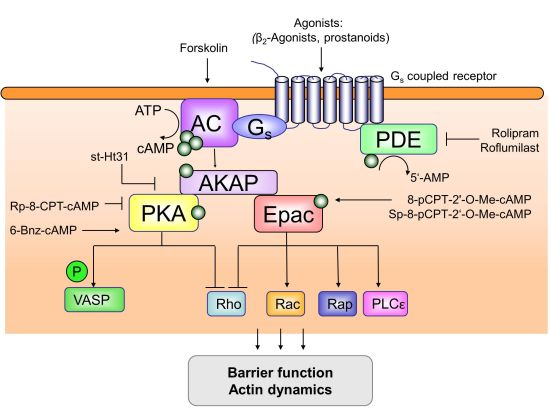
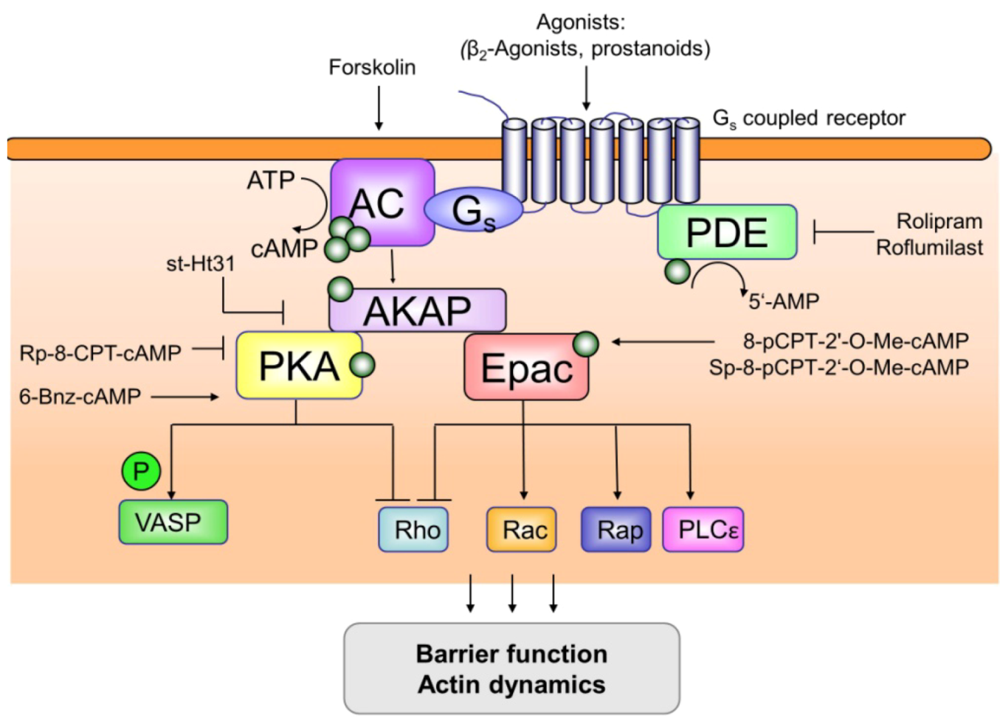
      <p>Cyclic adenosine monophosphate (cAMP), the most common and universal secondary messenger, regulates physiological processes as diverse as calcium handling, secretion, ion channel conductance, learning and memory, metabolic events, cardiac and smooth muscle contraction, cell growth and differentiation, apoptosis, inflammation, and barrier functioning [<xref ref-type="bibr" rid="B1-pharmaceuticals-05-01291">1</xref>,<xref ref-type="bibr" rid="B2-pharmaceuticals-05-01291">2</xref>]. The impact and complexity of research into the molecular architecture of cAMP signalling is not only reflected by five Nobel awards since the discovery of cAMP in 1957 by Sutherland and colleagues [<xref ref-type="bibr" rid="B1-pharmaceuticals-05-01291">1</xref>], but also by a unique interplay of signalling components that tightly control the cellular content of cAMP. Next to G protein-coupled receptors, adenylyl cyclases (ACs) and cAMP-specific phosphodiesterases (PDEs) maintain the spatio-temporal nature of cAMP signalling by shaping a cAMP gradient throughout the cell [<xref ref-type="bibr" rid="B3-pharmaceuticals-05-01291">3</xref>,<xref ref-type="bibr" rid="B4-pharmaceuticals-05-01291">4</xref>,<xref ref-type="bibr" rid="B5-pharmaceuticals-05-01291">5</xref>]. Subcellular membrane clustering of receptors, ACs and PDEs to lipid rafts and caveolae [<xref ref-type="bibr" rid="B6-pharmaceuticals-05-01291">6</xref>,<xref ref-type="bibr" rid="B7-pharmaceuticals-05-01291">7</xref>,<xref ref-type="bibr" rid="B8-pharmaceuticals-05-01291">8</xref>], and cell compartment-specific (co)localization to distinct cAMP effectors [<xref ref-type="bibr" rid="B9-pharmaceuticals-05-01291">9</xref>,<xref ref-type="bibr" rid="B10-pharmaceuticals-05-01291">10</xref>,<xref ref-type="bibr" rid="B11-pharmaceuticals-05-01291">11</xref>,<xref ref-type="bibr" rid="B12-pharmaceuticals-05-01291">12</xref>,<xref ref-type="bibr" rid="B13-pharmaceuticals-05-01291">13</xref>] further support the maintenance of spatio-temporal compartmentalized cAMP signalling. Moreover, A-kinase anchoring proteins (AKAPs) facilitate subcellular cAMP spatio-temporal compartmentalization by generating spatially discrete signalling complexes that create local gradients of cAMP, and thereby permit and control specific cellular responses (<xref ref-type="fig" rid="pharmaceuticals-05-01291-f001">Figure 1</xref>) [<xref ref-type="bibr" rid="B14-pharmaceuticals-05-01291">14</xref>,<xref ref-type="bibr" rid="B15-pharmaceuticals-05-01291">15</xref>,<xref ref-type="bibr" rid="B16-pharmaceuticals-05-01291">16</xref>,<xref ref-type="bibr" rid="B17-pharmaceuticals-05-01291">17</xref>]. Dysfunctions of cAMP-sensing AKAP complexes seem to contribute to the progression of a wide variety of diseases, including chronic heart failure, cardiac arrhythmia, Alzheimer’s dementia, HIV infection, diabetes mellitus and cancer [<xref ref-type="bibr" rid="B17-pharmaceuticals-05-01291">17</xref>,<xref ref-type="bibr" rid="B18-pharmaceuticals-05-01291">18</xref>,<xref ref-type="bibr" rid="B19-pharmaceuticals-05-01291">19</xref>,<xref ref-type="bibr" rid="B20-pharmaceuticals-05-01291">20</xref>,<xref ref-type="bibr" rid="B21-pharmaceuticals-05-01291">21</xref>], hence, current research intends to target the spatio-temporal cAMP-responsive complexes to provide novel therapeutical interventions [<xref ref-type="bibr" rid="B5-pharmaceuticals-05-01291">5</xref>,<xref ref-type="bibr" rid="B11-pharmaceuticals-05-01291">11</xref>,<xref ref-type="bibr" rid="B12-pharmaceuticals-05-01291">12</xref>,<xref ref-type="bibr" rid="B17-pharmaceuticals-05-01291">17</xref>,<xref ref-type="bibr" rid="B22-pharmaceuticals-05-01291">22</xref>]. </p>
      <p>In this review we will discuss the recent progress on spatio-temporal compartmentalized cAMP signalling from the receptors coupled to the cAMP pathway up to the subtle interplay between the distinct cAMP-sensitive effectors that maintain cAMP-sensing multiprotein complexes. In particular, we will focus on the impact of perturbation of cAMP-sensing signalling complexes in the development and progression of chronic obstructive pulmonary disease (COPD), a chronic inflammatory lung disease characterized by airway obstruction, emphysema and airway remodelling. Remodelling processes encompass increased airway smooth muscle mass, epithelial changes, goblet cell and submucosal gland hyperplasia—leading to mucus hypersecretion [<xref ref-type="bibr" rid="B23-pharmaceuticals-05-01291">23</xref>,<xref ref-type="bibr" rid="B24-pharmaceuticals-05-01291">24</xref>,<xref ref-type="bibr" rid="B25-pharmaceuticals-05-01291">25</xref>,<xref ref-type="bibr" rid="B26-pharmaceuticals-05-01291">26</xref>,<xref ref-type="bibr" rid="B27-pharmaceuticals-05-01291">27</xref>,<xref ref-type="bibr" rid="B28-pharmaceuticals-05-01291">28</xref>,<xref ref-type="bibr" rid="B29-pharmaceuticals-05-01291">29</xref>,<xref ref-type="bibr" rid="B30-pharmaceuticals-05-01291">30</xref>]. In addition to inflammatory cells, airway smooth muscle cells and (myo)fibroblasts, epithelial cells underpin a variety of key responses in the airways such as inflammatory cytokine release, airway remodelling, mucus hypersecretion and the barrier function [<xref ref-type="bibr" rid="B23-pharmaceuticals-05-01291">23</xref>,<xref ref-type="bibr" rid="B24-pharmaceuticals-05-01291">24</xref>,<xref ref-type="bibr" rid="B25-pharmaceuticals-05-01291">25</xref>,<xref ref-type="bibr" rid="B26-pharmaceuticals-05-01291">26</xref>,<xref ref-type="bibr" rid="B27-pharmaceuticals-05-01291">27</xref>,<xref ref-type="bibr" rid="B28-pharmaceuticals-05-01291">28</xref>,<xref ref-type="bibr" rid="B29-pharmaceuticals-05-01291">29</xref>,<xref ref-type="bibr" rid="B30-pharmaceuticals-05-01291">30</xref>]. Cigarette smoke—together with environmental pollution—is the main risk factor for COPD and induces inflammatory processes, alveolar destruction (emphysema), fibrosis and epithelial hyperpermeability by disrupting the barrier function, releasing proteases and inducing multiple inflammatory genes [<xref ref-type="bibr" rid="B27-pharmaceuticals-05-01291">27</xref>,<xref ref-type="bibr" rid="B28-pharmaceuticals-05-01291">28</xref>,<xref ref-type="bibr" rid="B29-pharmaceuticals-05-01291">29</xref>,<xref ref-type="bibr" rid="B31-pharmaceuticals-05-01291">31</xref>]. Disruption of the epithelial barrier is associated with epithelial remodelling that also accounts for goblet cell metaplasia and mucus gland hypertrophy in COPD [<xref ref-type="bibr" rid="B32-pharmaceuticals-05-01291">32</xref>,<xref ref-type="bibr" rid="B33-pharmaceuticals-05-01291">33</xref>]. Mucus hypersecretion contributes to the morbidity and mortality of COPD, particularly in those patients with more severe disease [<xref ref-type="bibr" rid="B27-pharmaceuticals-05-01291">27</xref>,<xref ref-type="bibr" rid="B28-pharmaceuticals-05-01291">28</xref>,<xref ref-type="bibr" rid="B34-pharmaceuticals-05-01291">34</xref>]. In the treatment of obstructive lung diseases, including COPD, cAMP elevating drugs are widely used. Already in the early eighties it has been reported that cAMP elevating agents, such as β<sub>2</sub>-agonists, prostanoids and the direct AC activator forskolin (<xref ref-type="fig" rid="pharmaceuticals-05-01291-f001">Figure 1</xref>), temper oedema in whole animal, isolated lung, and clinical studies of lung injury, phenomena which could be linked to an increase in barrier function in pulmonary endothelial cells [<xref ref-type="bibr" rid="B2-pharmaceuticals-05-01291">2</xref>].</p>
	  
	  <fig id="pharmaceuticals-05-01291-f001" position="anchor">
        <label>Figure 1</label>
        <caption>
          <p>Overview of compartmentalization of cAMP signalling. G<sub>s</sub>-protein coupled receptors are stimulated by their appropriate ligands such as β<sub>2</sub>-agonists and prostanoids. Subsequently, activation of adenylyl cyclase (AC) will lead to the production of the second messenger cyclic AMP (cAMP), whereas cAMP-specific phosphodiesterases (PDEs) will shape the cAMP gradient throughout the cell. Alternatively, AC can be directly activated by the cell membrane-permeable diterpene forskolin from the Indian plant <italic>Coleus forskolhlii</italic>. Elevation of cellular cAMP will simultaneously induce the activation of protein kinase A (PKA) and of the exchange protein directly activated by cAMP (Epac). Members of the A-kinase anchoring protein (AKAP) family will support the maintenance of cAMP compartmentalization upon binding to the cAMP-producing receptors, the cAMP effectors PKA and/or Epac as well as PDEs. The generation of cAMP-sensing multiprotein complexes by AKAPs is of tremendous importance to maintain spatio-temporal cAMP signalling at specific and discrete locations within the cell to regulate specific cellular responses upon signalling to several distinct effector proteins including vasodilator-stimulated phosphoprotein (VASP), a subset of small GTPases, and phospholipase C-ε (PLC-ε). Shown are tools being used to study the functioning of the cAMP-sensing multiprotein complexes: st-Ht31, the PKA binding blocking peptide known to act as a generic AKAP inhibitor [<xref ref-type="bibr" rid="B14-pharmaceuticals-05-01291">14</xref>,<xref ref-type="bibr" rid="B15-pharmaceuticals-05-01291">15</xref>,<xref ref-type="bibr" rid="B16-pharmaceuticals-05-01291">16</xref>]; 8-pCPT-2'-O-Me-cAMP and/or Sp-8-pCPT-2'-O-Me-cAMP, activator of Epac; 6-Bnz-cAMP, activator of PKA; Rp-8-CPT-cAMP, Rp-cAMPs, Rp-8-Bromo-cAMPs inhibitors of PKA. </p>
        </caption>
        <graphic xmlns:xlink="http://www.w3.org/1999/xlink" xlink:href="pharmaceuticals-05-01291-g001.tif"/>
      </fig>
      
      <p>Our current knowledge, however, about the molecular mechanisms underlying proper epithelial barrier functioning in the airways is mainly based on studies with focus on the endothelial barrier in the vasculature [<xref ref-type="bibr" rid="B2-pharmaceuticals-05-01291">2</xref>]. For the purpose of this review, we will outline our current knowledge about compartmentalized cAMP signalling. We will highlight the role of the epithelial barrier to maintain proper lung functioning and to alleviate COPD symptoms. The regulation of the endothelial barrier will serve as a starting point, and whenever appropriate, we will focus on the epithelial barrier function.</p>
    </sec>
    <sec>
      <title>2. Spatio-Temporal Nature of Compartmentalized cAMP Signalling: Paradigm Shifts</title>
      <p>The formation of cAMP is initiated by the stimulation of G<sub>s</sub>-protein-coupled receptors, such as the β<sub>2</sub>-adrenoceptor and distinct prostanoid receptor subtypes. As members of the largest superfamily of cell surface signalling molecules, cAMP-elevating G<sub>s</sub>-protein-coupled receptors represent the most prominent family of validated pharmacological targets in biomedicine [<xref ref-type="bibr" rid="B1-pharmaceuticals-05-01291">1</xref>,<xref ref-type="bibr" rid="B35-pharmaceuticals-05-01291">35</xref>,<xref ref-type="bibr" rid="B36-pharmaceuticals-05-01291">36</xref>]. In obstructive airways diseases short- and long-acting β<sub>2</sub>-agonists, such as salbutamol/albuterol, fenoterol, formoterol and indaceterol, are clinically widely used and act via stimulation of G<sub>s</sub>-protein-coupled receptors [<xref ref-type="bibr" rid="B37-pharmaceuticals-05-01291">37</xref>,<xref ref-type="bibr" rid="B38-pharmaceuticals-05-01291">38</xref>,<xref ref-type="bibr" rid="B39-pharmaceuticals-05-01291">39</xref>,<xref ref-type="bibr" rid="B40-pharmaceuticals-05-01291">40</xref>]. In addition, recent studies emphasize also substantial progress to pharmacologically target the prostanoid PGE<sub>2</sub>-receptors to alleviate symptoms of obstructive lung diseases [<xref ref-type="bibr" rid="B41-pharmaceuticals-05-01291">41</xref>,<xref ref-type="bibr" rid="B42-pharmaceuticals-05-01291">42</xref>,<xref ref-type="bibr" rid="B43-pharmaceuticals-05-01291">43</xref>,<xref ref-type="bibr" rid="B44-pharmaceuticals-05-01291">44</xref>,<xref ref-type="bibr" rid="B45-pharmaceuticals-05-01291">45</xref>]. Over the last years substantial progress has been made to decipher the distinct signalling properties of cAMP. Initially, elevation of cellular cAMP by β<sub>2</sub>-agonists and prostanoids were expected to simultaneously stimulate both protein kinase A (PKA) and the exchange protein directly activated by cAMP (Epac) [<xref ref-type="bibr" rid="B1-pharmaceuticals-05-01291">1</xref>,<xref ref-type="bibr" rid="B46-pharmaceuticals-05-01291">46</xref>,<xref ref-type="bibr" rid="B47-pharmaceuticals-05-01291">47</xref>]. Meanwhile, it is generally accepted that spatio-temporal compartmentalization of cAMP maintained by cAMP-sensing AKAP-bearing multiprotein complexes and PDEs is of utmost importance to gain signalling specificity of cAMP [<xref ref-type="bibr" rid="B4-pharmaceuticals-05-01291">4</xref>,<xref ref-type="bibr" rid="B9-pharmaceuticals-05-01291">9</xref>,<xref ref-type="bibr" rid="B10-pharmaceuticals-05-01291">10</xref>,<xref ref-type="bibr" rid="B11-pharmaceuticals-05-01291">11</xref>,<xref ref-type="bibr" rid="B12-pharmaceuticals-05-01291">12</xref>,<xref ref-type="bibr" rid="B13-pharmaceuticals-05-01291">13</xref>,<xref ref-type="bibr" rid="B14-pharmaceuticals-05-01291">14</xref>,<xref ref-type="bibr" rid="B15-pharmaceuticals-05-01291">15</xref>,<xref ref-type="bibr" rid="B16-pharmaceuticals-05-01291">16</xref>,<xref ref-type="bibr" rid="B17-pharmaceuticals-05-01291">17</xref>].</p>
      <p>Generally, G protein coupled receptors are considered as cell surface recognition sites sensing ions, hormones, neurotransmitters, autocoids and extracellular matrix components [<xref ref-type="bibr" rid="B36-pharmaceuticals-05-01291">36</xref>,<xref ref-type="bibr" rid="B38-pharmaceuticals-05-01291">38</xref>,<xref ref-type="bibr" rid="B48-pharmaceuticals-05-01291">48</xref>,<xref ref-type="bibr" rid="B49-pharmaceuticals-05-01291">49</xref>,<xref ref-type="bibr" rid="B50-pharmaceuticals-05-01291">50</xref>]. More recent studies showed that also internalized G protein-coupled receptors—until now believed to act as a ‘loss-of-function’ receptor signal—maintain signalling properties [<xref ref-type="bibr" rid="B18-pharmaceuticals-05-01291">18</xref>,<xref ref-type="bibr" rid="B51-pharmaceuticals-05-01291">51</xref>,<xref ref-type="bibr" rid="B52-pharmaceuticals-05-01291">52</xref>,<xref ref-type="bibr" rid="B53-pharmaceuticals-05-01291">53</xref>]. Using fluorescence resonance energy transfer to track intracellular cAMP fluctuations following activation of typically G<sub>s</sub>-protein-coupled receptors [<xref ref-type="bibr" rid="B51-pharmaceuticals-05-01291">51</xref>,<xref ref-type="bibr" rid="B52-pharmaceuticals-05-01291">52</xref>], it has been reported that AC signalling is not necessarily restricted to the plasma membrane, but could be also detected in the endosome compartment. Indeed, endosomes, in which internalized receptors may end up, are now recognized as essential sites of cellular signalling [<xref ref-type="bibr" rid="B54-pharmaceuticals-05-01291">54</xref>,<xref ref-type="bibr" rid="B55-pharmaceuticals-05-01291">55</xref>], In addition, actin-stabilized endosomal microdomains profoundly affect the endosomal recycling and thereby the signalling properties of the β<sub>2</sub>-adrenoceptor [<xref ref-type="bibr" rid="B56-pharmaceuticals-05-01291">56</xref>]. Strikingly, Nikolaev and colleagues demonstrated that the β<sub>2</sub>-adrenoceptor its redistributed in heart failure, thereby compartmentalizing cAMP, a process proposed to contribute to the failing myocardial phenotype [<xref ref-type="bibr" rid="B18-pharmaceuticals-05-01291">18</xref>]. While the novel concept of cAMP signalling by internalized G protein-coupled receptors has recently been adapted to the signalling properties of the β<sub>2</sub>-adrenoceptor in human small airways [<xref ref-type="bibr" rid="B37-pharmaceuticals-05-01291">37</xref>], evidence that such mechanisms are operational in distinct structural airway cell subtypes, including bronchial epithelial cells, still has to be provided. </p>
      <p>Intriguingly, ligand-directed signalling or biased agonism, referring to G<sub>s</sub>-induced cAMP- <italic>versus</italic> β-arrestin-mediated signalling in response to different agonists [<xref ref-type="bibr" rid="B48-pharmaceuticals-05-01291">48</xref>,<xref ref-type="bibr" rid="B49-pharmaceuticals-05-01291">49</xref>,<xref ref-type="bibr" rid="B57-pharmaceuticals-05-01291">57</xref>,<xref ref-type="bibr" rid="B58-pharmaceuticals-05-01291">58</xref>,<xref ref-type="bibr" rid="B59-pharmaceuticals-05-01291">59</xref>], adds another level of complexity of G<sub>s</sub>-protein-coupled receptor signalling, and has recently been reviewed within the context of obstructive lung diseases and the β<sub>2</sub>-adrenoceptor [<xref ref-type="bibr" rid="B38-pharmaceuticals-05-01291">38</xref>,<xref ref-type="bibr" rid="B40-pharmaceuticals-05-01291">40</xref>,<xref ref-type="bibr" rid="B60-pharmaceuticals-05-01291">60</xref>,<xref ref-type="bibr" rid="B61-pharmaceuticals-05-01291">61</xref>,<xref ref-type="bibr" rid="B62-pharmaceuticals-05-01291">62</xref>]. In mice, genetic ablation of either β-arrestin-1 or -2 prevented against bleomycin-induced pulmonary fibrosis and fibroblast invasion, suggesting a role for β-arrestin in fibrosis [<xref ref-type="bibr" rid="B63-pharmaceuticals-05-01291">63</xref>]. In support, β-arrestin-2 expression in increased in cell models of cystic fibrosis as well as in nasal tissue from patients [<xref ref-type="bibr" rid="B64-pharmaceuticals-05-01291">64</xref>]. In human bronchial epithelial cells, β-arrestin is necessary for the transcription of matrix metalloproteinases (MMPs) by diesel exhaust particles, a risk factor for COPD [<xref ref-type="bibr" rid="B65-pharmaceuticals-05-01291">65</xref>]. In addition to modulation of remodelling processes, β-arrestin is involved in agonist-induced desensitisation of the β<sub>2</sub>-receptor by inducing the internalization of this receptor [<xref ref-type="bibr" rid="B48-pharmaceuticals-05-01291">48</xref>]. Lefkowitz and colleagues reported that β-arrestin-mediated signalling exerts an even higher degree of regulation that relies on distinct phosphorylation sites of seven transmembrane receptors [<xref ref-type="bibr" rid="B66-pharmaceuticals-05-01291">66</xref>,<xref ref-type="bibr" rid="B67-pharmaceuticals-05-01291">67</xref>,<xref ref-type="bibr" rid="B68-pharmaceuticals-05-01291">68</xref>]. Likewise, β-arrestin-dependent signalling and trafficking of the β<sub>2</sub>-adrenoceptor also involve an unique deubiquitinase-ligase interplay [<xref ref-type="bibr" rid="B69-pharmaceuticals-05-01291">69</xref>,<xref ref-type="bibr" rid="B70-pharmaceuticals-05-01291">70</xref>]. Although recent studies indicate that ligand-directed signalling contributes to the functional responses of airway smooth muscle cells and lung fibroblasts [<xref ref-type="bibr" rid="B71-pharmaceuticals-05-01291">71</xref>,<xref ref-type="bibr" rid="B72-pharmaceuticals-05-01291">72</xref>], comparable studies in airway epithelial cells are still lacking. Further regulation of G<sub>s</sub> signalling is mediated by the AKAP family members AKAP5 (aka AKAP79/150) and AKAP12 (aka AKAP250/Gravin), which regulate the de- and resensitization of the β<sub>2</sub>-adrenoceptor, respectively, and interact next to cAMP signalling proteins also with β-arrestin [<xref ref-type="bibr" rid="B14-pharmaceuticals-05-01291">14</xref>,<xref ref-type="bibr" rid="B15-pharmaceuticals-05-01291">15</xref>,<xref ref-type="bibr" rid="B16-pharmaceuticals-05-01291">16</xref>,<xref ref-type="bibr" rid="B17-pharmaceuticals-05-01291">17</xref>,<xref ref-type="bibr" rid="B73-pharmaceuticals-05-01291">73</xref>,<xref ref-type="bibr" rid="B74-pharmaceuticals-05-01291">74</xref>,<xref ref-type="bibr" rid="B75-pharmaceuticals-05-01291">75</xref>]. Thus, it is tempting to speculate that biased agonism might also profoundly alter the functional responses of AKAP-bearing multiprotein complexes. Moreover, receptors that ‘typically’ signal via G<sub>s</sub>, including the β<sub>2</sub>-adrenoceptors, have also been shown to couple to other G-proteins, including G<sub>i</sub> and G<sub>12/13</sub>, adding another layer of complexity to the regulatory pathways [<xref ref-type="bibr" rid="B76-pharmaceuticals-05-01291">76</xref>].</p>
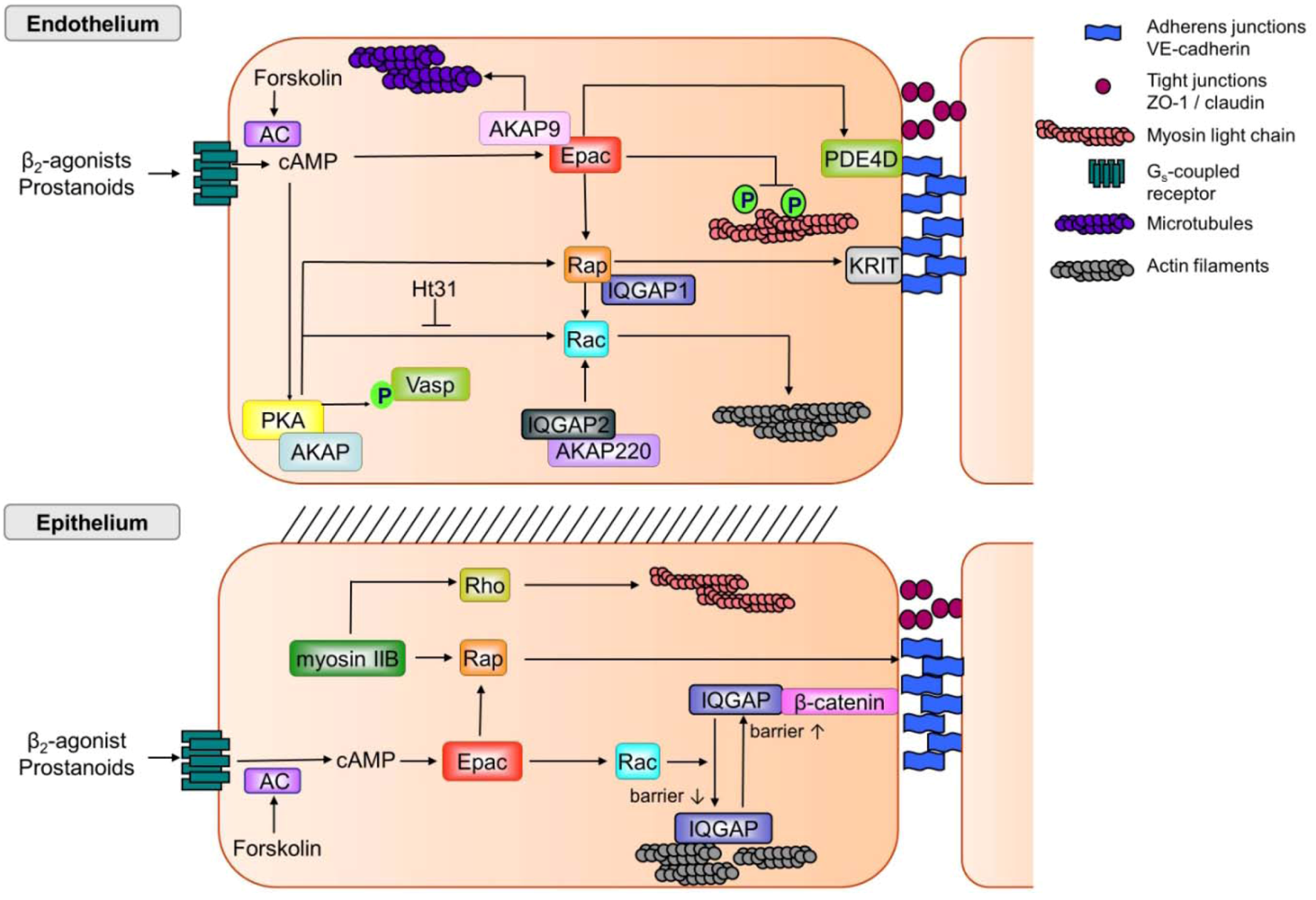
      <p>Recent studies indicate that, next to PDEs and ACs [<xref ref-type="bibr" rid="B77-pharmaceuticals-05-01291">77</xref>], members of the AKAP superfamily are of tremendous importance to maintain compartmentalized cAMP signalling and to prevent the progression of several diseases, such as chronic heart failure, Alzheimer’s dementia and cancer [<xref ref-type="bibr" rid="B17-pharmaceuticals-05-01291">17</xref>,<xref ref-type="bibr" rid="B18-pharmaceuticals-05-01291">18</xref>,<xref ref-type="bibr" rid="B19-pharmaceuticals-05-01291">19</xref>,<xref ref-type="bibr" rid="B77-pharmaceuticals-05-01291">77</xref>]. AKAPs exhibit a distinct (sub)cellular expression pattern and linkage to a diverse subset of target proteins including G<sub>s</sub>-protein coupled receptors and ACs, cAMP effector proteins like PKA and Epac as well as cAMP-degrading PDEs (<xref ref-type="fig" rid="pharmaceuticals-05-01291-f001">Figure 1</xref>). Cooper and colleagues reported recently that AKAP5 is target of palmitylation-dependent localization to lipid rafts and that the lipid modification of AKAP5 promotes its regulation of the calcium-sensitive AC subtype 8, adding an additional regulatory and targeting option for AKAP members [<xref ref-type="bibr" rid="B78-pharmaceuticals-05-01291">78</xref>]. Based on their binding specificity, cellular expression profiles and cellular localization, AKAPs integrate differential coupling of cAMP to specific cellular responses, including smooth muscle tone, cell proliferation and differentiation, learning and memory, inflammation, fibrosis, and barrier functioning (<xref ref-type="fig" rid="pharmaceuticals-05-01291-f001">Figure 1</xref>) [<xref ref-type="bibr" rid="B14-pharmaceuticals-05-01291">14</xref>,<xref ref-type="bibr" rid="B15-pharmaceuticals-05-01291">15</xref>,<xref ref-type="bibr" rid="B16-pharmaceuticals-05-01291">16</xref>,<xref ref-type="bibr" rid="B17-pharmaceuticals-05-01291">17</xref>]. Intriguingly, the first cAMP-responsive multiprotein complexes identified in the heart and neurons possess a rather distinct composition: i) the cardiac-specific cAMP-responsive complex is maintained by the <italic>nuclear</italic> envelope-associated mAKAP, PKA, PDE4D3 and Epac1 [<xref ref-type="bibr" rid="B79-pharmaceuticals-05-01291">79</xref>], whereas ii) the neuronal cAMP-sensing complex is maintained by the <italic>plasma membrane</italic>-associated AKAP5, PKA, Epac2 and phosphoinositide 3-kinase-dependent protein kinase B (PKB/Akt) [<xref ref-type="bibr" rid="B80-pharmaceuticals-05-01291">80</xref>]. Generation of distinct cAMP-sensitive multiprotein complexes maintained by AKAP family members might turn out to be the key to explain that even though Epac and PKA can act independently, most cAMP-dependent processes are interconnectively regulated by Epac and PKA. Classically, most cAMP effects were assigned to PKA [<xref ref-type="bibr" rid="B81-pharmaceuticals-05-01291">81</xref>,<xref ref-type="bibr" rid="B82-pharmaceuticals-05-01291">82</xref>,<xref ref-type="bibr" rid="B83-pharmaceuticals-05-01291">83</xref>].The identification of Epac as an cAMP-regulated guanine nucleotide exchange factor (GEF) that favours GDP/GTP exchange and thereby activation of small Ras-like GTPases, profoundly changed the classical cAMP-PKA dogma [<xref ref-type="bibr" rid="B84-pharmaceuticals-05-01291">84</xref>,<xref ref-type="bibr" rid="B85-pharmaceuticals-05-01291">85</xref>]. The cAMP mediators Epac1 (aka cAMP-GEF-I) and Epac2 (aka cAMP-GEF-II) function as molecular links between members of the Ras superfamily such as Rho, Rac and Ras [<xref ref-type="bibr" rid="B86-pharmaceuticals-05-01291">86</xref>,<xref ref-type="bibr" rid="B87-pharmaceuticals-05-01291">87</xref>,<xref ref-type="bibr" rid="B88-pharmaceuticals-05-01291">88</xref>,<xref ref-type="bibr" rid="B89-pharmaceuticals-05-01291">89</xref>,<xref ref-type="bibr" rid="B90-pharmaceuticals-05-01291">90</xref>]. Members of the Ras superfamily belong to the GTP-ases which switch between a GDP-bound (inactive) state and a GTP-bound (active) state. Guanine exchange factors (GEFs) such as Epac, will exchange GDP for GTP, activating the effector. GTPase-activating proteins (GAPs) will reduce GTP-ase activity due to GTP hydrolyzation. GTP-binding of Rho, Rac or Ras will induce a diversity of cellular processes (see <xref ref-type="fig" rid="pharmaceuticals-05-01291-f001">Figure 1</xref>).</p>
      <p>Upon activation of distinct subset of small GTPases, Epac1 and Epac2 signal to phospholipase C-ε [<xref ref-type="bibr" rid="B91-pharmaceuticals-05-01291">91</xref>,<xref ref-type="bibr" rid="B92-pharmaceuticals-05-01291">92</xref>], phospholipase D [<xref ref-type="bibr" rid="B90-pharmaceuticals-05-01291">90</xref>,<xref ref-type="bibr" rid="B93-pharmaceuticals-05-01291">93</xref>], extracellular signal-regulated kinases (ERK1/2) [<xref ref-type="bibr" rid="B94-pharmaceuticals-05-01291">94</xref>,<xref ref-type="bibr" rid="B95-pharmaceuticals-05-01291">95</xref>,<xref ref-type="bibr" rid="B96-pharmaceuticals-05-01291">96</xref>,<xref ref-type="bibr" rid="B97-pharmaceuticals-05-01291">97</xref>,<xref ref-type="bibr" rid="B98-pharmaceuticals-05-01291">98</xref>,<xref ref-type="bibr" rid="B99-pharmaceuticals-05-01291">99</xref>], PKB/Akt [<xref ref-type="bibr" rid="B80-pharmaceuticals-05-01291">80</xref>,<xref ref-type="bibr" rid="B99-pharmaceuticals-05-01291">99</xref>,<xref ref-type="bibr" rid="B100-pharmaceuticals-05-01291">100</xref>,<xref ref-type="bibr" rid="B101-pharmaceuticals-05-01291">101</xref>,<xref ref-type="bibr" rid="B102-pharmaceuticals-05-01291">102</xref>,<xref ref-type="bibr" rid="B103-pharmaceuticals-05-01291">103</xref>,<xref ref-type="bibr" rid="B104-pharmaceuticals-05-01291">104</xref>] and NF-κB [<xref ref-type="bibr" rid="B105-pharmaceuticals-05-01291">105</xref>,<xref ref-type="bibr" rid="B106-pharmaceuticals-05-01291">106</xref>,<xref ref-type="bibr" rid="B107-pharmaceuticals-05-01291">107</xref>], and thereby control distinct cellular responses, including calcium handling, smooth muscle tone, cell proliferation and differentiation, migration, fibrogenic and inflammatory responses as well as barrier functioning [<xref ref-type="bibr" rid="B2-pharmaceuticals-05-01291">2</xref>,<xref ref-type="bibr" rid="B46-pharmaceuticals-05-01291">46</xref>,<xref ref-type="bibr" rid="B107-pharmaceuticals-05-01291">107</xref>,<xref ref-type="bibr" rid="B108-pharmaceuticals-05-01291">108</xref>,<xref ref-type="bibr" rid="B109-pharmaceuticals-05-01291">109</xref>,<xref ref-type="bibr" rid="B110-pharmaceuticals-05-01291">110</xref>]. We would like to refer the reader to excellent recent reviews with focus on the molecular signalling properties of Epac [<xref ref-type="bibr" rid="B2-pharmaceuticals-05-01291">2</xref>,<xref ref-type="bibr" rid="B46-pharmaceuticals-05-01291">46</xref>,<xref ref-type="bibr" rid="B47-pharmaceuticals-05-01291">47</xref>,<xref ref-type="bibr" rid="B108-pharmaceuticals-05-01291">108</xref>,<xref ref-type="bibr" rid="B109-pharmaceuticals-05-01291">109</xref>,<xref ref-type="bibr" rid="B110-pharmaceuticals-05-01291">110</xref>,<xref ref-type="bibr" rid="B111-pharmaceuticals-05-01291">111</xref>,<xref ref-type="bibr" rid="B112-pharmaceuticals-05-01291">112</xref>].</p>
      <p>Recent studies reported on the contribution of cAMP-sensing AKAP-bearing multiprotein complexes to functional responses of different cell types of the airways. Human airway smooth muscle express seven of the nine membrane-bound AC subtypes [<xref ref-type="bibr" rid="B113-pharmaceuticals-05-01291">113</xref>]. The AC subtypes 5/6 differentially respond to β<sub>2</sub>-adrenoceptor and prostanoid receptor agonists, and thereby represent key molecules to generate cAMP [<xref ref-type="bibr" rid="B113-pharmaceuticals-05-01291">113</xref>,<xref ref-type="bibr" rid="B114-pharmaceuticals-05-01291">114</xref>,<xref ref-type="bibr" rid="B115-pharmaceuticals-05-01291">115</xref>], a process predominantly tuned by PDE4D5 [<xref ref-type="bibr" rid="B3-pharmaceuticals-05-01291">3</xref>,<xref ref-type="bibr" rid="B4-pharmaceuticals-05-01291">4</xref>,<xref ref-type="bibr" rid="B61-pharmaceuticals-05-01291">61</xref>]. As the expression of PDE4D5 is up-regulated by cAMP on the level of gene expression, protein expression and activity [<xref ref-type="bibr" rid="B116-pharmaceuticals-05-01291">116</xref>], cAMP seems to provide a feed-backward signal to diminish its own signalling properties. As PDE4D5 forms a complex with AKAP5 [<xref ref-type="bibr" rid="B74-pharmaceuticals-05-01291">74</xref>], up-regulation of PDE4D5 may alter the delicate spatio-temporal cAMP compartmentalization in human airway smooth muscle and thereby contribute to the progression of airway obstruction. Penn and colleagues reported very recently on the expression of a distinct subset of AKAPs, particularly AKAP12 and ezrin and its impact on compartmentalized cAMP signalling in human airway smooth muscle [<xref ref-type="bibr" rid="B117-pharmaceuticals-05-01291">117</xref>]. </p>
      <p>Human lung fibroblasts have been reported to express six of the nine membrane-bound AC subtypes [<xref ref-type="bibr" rid="B118-pharmaceuticals-05-01291">118</xref>] (<xref ref-type="table" rid="pharmaceuticals-05-01291-t001">Table 1</xref>). As in human airway smooth muscle, the AC subtypes 5/6 generate cAMP [<xref ref-type="bibr" rid="B118-pharmaceuticals-05-01291">118</xref>], whereas PDE4 subtypes hydrolyse cAMP in human lung fibroblasts [<xref ref-type="bibr" rid="B119-pharmaceuticals-05-01291">119</xref>,<xref ref-type="bibr" rid="B120-pharmaceuticals-05-01291">120</xref>,<xref ref-type="bibr" rid="B121-pharmaceuticals-05-01291">121</xref>]. A recent study by Peters-Golden and colleagues showed that the AKAP family member AKAP9 (aka AKAP450) represents a key protein for cAMP compartmentalization in fibrotic lung fibroblasts [<xref ref-type="bibr" rid="B122-pharmaceuticals-05-01291">122</xref>]. They reported that collagen deposition is controlled by a prostaglandin E<sub>2</sub> (PGE<sub>2</sub>)-sensing AKAP9-PKA-protein phosphatase 2A multiprotein complex [<xref ref-type="bibr" rid="B122-pharmaceuticals-05-01291">122</xref>]. Activation of fibroblasts and subsequent collagen synthesis is inhibited by extracellular anti-fibrotic plasmin by restoring the PGE<sub>2</sub>-sensitivity of the fibroblast-specific AKAP9 (splice variant AKAP450) complex [<xref ref-type="bibr" rid="B122-pharmaceuticals-05-01291">122</xref>]. Intriguingly, AKAP9 (splice variant AKAP450) was found to generate a complex with PDE4 [<xref ref-type="bibr" rid="B123-pharmaceuticals-05-01291">123</xref>]. As selective inhibitors of PDE4 including rolipram, cilomilast and roflumilast are studied in clinical trials or licensed for use in COPD [<xref ref-type="bibr" rid="B34-pharmaceuticals-05-01291">34</xref>,<xref ref-type="bibr" rid="B124-pharmaceuticals-05-01291">124</xref>,<xref ref-type="bibr" rid="B125-pharmaceuticals-05-01291">125</xref>,<xref ref-type="bibr" rid="B126-pharmaceuticals-05-01291">126</xref>], targeting AKAP9-PDE4 complexes might be of benefit for COPD patients. The smallest splice variant of AKAP9, Yotiao can associate with ACs subtypes 1, 2, 3 and 9, leading to more phosphorylation of effectors by PKA [<xref ref-type="bibr" rid="B127-pharmaceuticals-05-01291">127</xref>].</p>
      <table-wrap id="pharmaceuticals-05-01291-t001" position="float">
        <object-id pub-id-type="pii">pharmaceuticals-05-01291-t001_Table 1</object-id>
        <label>Table 1</label>
        <caption>
          <p>Expression of elements of cAMP signalling in cells and tissues involved in the pathogenesis of lung diseases.</p>
        </caption>
        <table>
<thead>
            <tr>
              <th align="center" valign="middle"> </th>
              <th align="center" valign="middle">Epac</th>
              <th align="center" valign="middle">PKA</th>
              <th align="center" valign="middle">AKAP</th>
              <th align="center" valign="middle">PDE</th>
              <th align="center" valign="middle">AC</th>
              <th align="center" valign="middle">small GTPases</th>
            </tr>
          </thead>
          <tbody>
            <tr>
              <td align="center" valign="middle">Bronchial epithelium</td>
              <td align="center" valign="middle">Epac1 [<xref ref-type="bibr" rid="B128-pharmaceuticals-05-01291">128</xref>] <break/>Epac 1 &amp; 2 [<xref ref-type="bibr" rid="B129-pharmaceuticals-05-01291">129</xref>]</td>
              <td align="center" valign="middle">PKA [<xref ref-type="bibr" rid="B29-pharmaceuticals-05-01291">29</xref>]</td>
              <td align="center" valign="middle">AKAP9 [<xref ref-type="bibr" rid="B130-pharmaceuticals-05-01291">130</xref>]</td>
              <td align="center" valign="middle">++ PDE4, PDE1 [<xref ref-type="bibr" rid="B131-pharmaceuticals-05-01291">131</xref>,<xref ref-type="bibr" rid="B132-pharmaceuticals-05-01291">132</xref>] <break/>+- PDE3, PDE5 [<xref ref-type="bibr" rid="B131-pharmaceuticals-05-01291">131</xref>,<xref ref-type="bibr" rid="B132-pharmaceuticals-05-01291">132</xref>] <break/>PDE4D [<xref ref-type="bibr" rid="B133-pharmaceuticals-05-01291">133</xref>] <break/>PDE3A [<xref ref-type="bibr" rid="B134-pharmaceuticals-05-01291">134</xref>] <break/>PDE7A1&amp;2 [<xref ref-type="bibr" rid="B135-pharmaceuticals-05-01291">135</xref>]</td>
              <td align="center" valign="middle">AC9 [<xref ref-type="bibr" rid="B136-pharmaceuticals-05-01291">136</xref>,<xref ref-type="bibr" rid="B137-pharmaceuticals-05-01291">137</xref>] <break/>AC1, 4, 7, 8 [<xref ref-type="bibr" rid="B138-pharmaceuticals-05-01291">138</xref>] <break/>sAC [<xref ref-type="bibr" rid="B139-pharmaceuticals-05-01291">139</xref>]</td>
              <td align="center" valign="middle">Rap [<xref ref-type="bibr" rid="B140-pharmaceuticals-05-01291">140</xref>,<xref ref-type="bibr" rid="B141-pharmaceuticals-05-01291">141</xref>,<xref ref-type="bibr" rid="B142-pharmaceuticals-05-01291">142</xref>] <break/>Rac [<xref ref-type="bibr" rid="B29-pharmaceuticals-05-01291">29</xref>,<xref ref-type="bibr" rid="B141-pharmaceuticals-05-01291">141</xref>,<xref ref-type="bibr" rid="B142-pharmaceuticals-05-01291">142</xref>,<xref ref-type="bibr" rid="B143-pharmaceuticals-05-01291">143</xref>,<xref ref-type="bibr" rid="B144-pharmaceuticals-05-01291">144</xref>,<xref ref-type="bibr" rid="B145-pharmaceuticals-05-01291">145</xref>] <break/>Rap1 [<xref ref-type="bibr" rid="B129-pharmaceuticals-05-01291">129</xref>,<xref ref-type="bibr" rid="B143-pharmaceuticals-05-01291">143</xref>] <break/> Rap2</td>
            </tr>
            
            <tr>
              <td align="center" valign="middle">Vascular endothelium</td>
              <td align="center" valign="middle">Epac1 [<xref ref-type="bibr" rid="B146-pharmaceuticals-05-01291">146</xref>,<xref ref-type="bibr" rid="B147-pharmaceuticals-05-01291">147</xref>,<xref ref-type="bibr" rid="B148-pharmaceuticals-05-01291">148</xref>,<xref ref-type="bibr" rid="B149-pharmaceuticals-05-01291">149</xref>]</td>
              <td align="center" valign="middle">PKA [<xref ref-type="bibr" rid="B147-pharmaceuticals-05-01291">147</xref>]</td>
              <td align="center" valign="middle">AKAP9 [<xref ref-type="bibr" rid="B149-pharmaceuticals-05-01291">149</xref>] <break/>Gravin [<xref ref-type="bibr" rid="B150-pharmaceuticals-05-01291">150</xref>]</td>
              <td align="center" valign="middle">PDE4D [<xref ref-type="bibr" rid="B22-pharmaceuticals-05-01291">22</xref>,<xref ref-type="bibr" rid="B147-pharmaceuticals-05-01291">147</xref>,<xref ref-type="bibr" rid="B151-pharmaceuticals-05-01291">151</xref>] <break/>PDE4 [<xref ref-type="bibr" rid="B135-pharmaceuticals-05-01291">135</xref>] <break/>PDE3 [<xref ref-type="bibr" rid="B135-pharmaceuticals-05-01291">135</xref>]</td>
              <td align="center" valign="middle">Membrane bound [<xref ref-type="bibr" rid="B2-pharmaceuticals-05-01291">2</xref>] <break/>Soluble AC [<xref ref-type="bibr" rid="B2-pharmaceuticals-05-01291">2</xref>] <break/>AC2, 3, 5, 6 [<xref ref-type="bibr" rid="B138-pharmaceuticals-05-01291">138</xref>]</td>
              <td align="center" valign="middle">Rap [<xref ref-type="bibr" rid="B143-pharmaceuticals-05-01291">143</xref>,<xref ref-type="bibr" rid="B146-pharmaceuticals-05-01291">146</xref>,<xref ref-type="bibr" rid="B147-pharmaceuticals-05-01291">147</xref>,<xref ref-type="bibr" rid="B149-pharmaceuticals-05-01291">149</xref>,<xref ref-type="bibr" rid="B152-pharmaceuticals-05-01291">152</xref>] <break/>Rac [<xref ref-type="bibr" rid="B146-pharmaceuticals-05-01291">146</xref>,<xref ref-type="bibr" rid="B147-pharmaceuticals-05-01291">147</xref>,<xref ref-type="bibr" rid="B152-pharmaceuticals-05-01291">152</xref>,<xref ref-type="bibr" rid="B153-pharmaceuticals-05-01291">153</xref>,<xref ref-type="bibr" rid="B154-pharmaceuticals-05-01291">154</xref>,<xref ref-type="bibr" rid="B155-pharmaceuticals-05-01291">155</xref>,<xref ref-type="bibr" rid="B156-pharmaceuticals-05-01291">156</xref>,<xref ref-type="bibr" rid="B157-pharmaceuticals-05-01291">157</xref>] <break/>Rac1 [<xref ref-type="bibr" rid="B158-pharmaceuticals-05-01291">158</xref>] <break/>RRas [<xref ref-type="bibr" rid="B147-pharmaceuticals-05-01291">147</xref>,<xref ref-type="bibr" rid="B159-pharmaceuticals-05-01291">159</xref>]</td>
            </tr>
            
            <tr>
              <td align="center" valign="middle">Airway smooth muscle cells</td>
              <td align="center" valign="middle">Epac1 [<xref ref-type="bibr" rid="B95-pharmaceuticals-05-01291">95</xref>,<xref ref-type="bibr" rid="B107-pharmaceuticals-05-01291">107</xref>,<xref ref-type="bibr" rid="B129-pharmaceuticals-05-01291">129</xref>] <break/>Epac2 [<xref ref-type="bibr" rid="B95-pharmaceuticals-05-01291">95</xref>,<xref ref-type="bibr" rid="B107-pharmaceuticals-05-01291">107</xref>,<xref ref-type="bibr" rid="B129-pharmaceuticals-05-01291">129</xref>]</td>
              <td align="center" valign="middle">PKA [<xref ref-type="bibr" rid="B107-pharmaceuticals-05-01291">107</xref>]</td>
              <td align="center" valign="middle">AKAP5, 9, 12 [<xref ref-type="bibr" rid="B160-pharmaceuticals-05-01291">160</xref>] <break/>Gravin, ezrin [<xref ref-type="bibr" rid="B117-pharmaceuticals-05-01291">117</xref>,<xref ref-type="bibr" rid="B150-pharmaceuticals-05-01291">150</xref>]</td>
              <td align="center" valign="middle">PDE1C, 3, 5A, 7 [<xref ref-type="bibr" rid="B135-pharmaceuticals-05-01291">135</xref>,<xref ref-type="bibr" rid="B161-pharmaceuticals-05-01291">161</xref>] <break/>PDE7A1&amp;2 [<xref ref-type="bibr" rid="B135-pharmaceuticals-05-01291">135</xref>]</td>
              <td align="center" valign="middle">7 membrane bound subtypes [<xref ref-type="bibr" rid="B118-pharmaceuticals-05-01291">118</xref>]<break/> 1, 3-7, 9 [<xref ref-type="bibr" rid="B115-pharmaceuticals-05-01291">115</xref>] <break/>2, 6, 7, 9 [<xref ref-type="bibr" rid="B113-pharmaceuticals-05-01291">113</xref>]</td>
              <td align="center" valign="middle">RhoA [<xref ref-type="bibr" rid="B87-pharmaceuticals-05-01291">87</xref>] <break/>Rac1 [<xref ref-type="bibr" rid="B87-pharmaceuticals-05-01291">87</xref>] <break/>Rap1 [<xref ref-type="bibr" rid="B95-pharmaceuticals-05-01291">95</xref>] <break/>Rap2 [<xref ref-type="bibr" rid="B95-pharmaceuticals-05-01291">95</xref>]</td>
            </tr>
            
            <tr>
              <td align="center" valign="middle">Vascular smooth muscle cells</td>
              <td align="center" valign="middle">Epac1 [<xref ref-type="bibr" rid="B162-pharmaceuticals-05-01291">162</xref>]<break/>Epac2 [<xref ref-type="bibr" rid="B162-pharmaceuticals-05-01291">162</xref>]</td>
              <td align="center" valign="middle">PKA [<xref ref-type="bibr" rid="B162-pharmaceuticals-05-01291">162</xref>]</td>
              <td align="center" valign="middle">AKAP12 [<xref ref-type="bibr" rid="B163-pharmaceuticals-05-01291">163</xref>]</td>
              <td align="center" valign="middle">PDE1(C), 3(A), 5 [<xref ref-type="bibr" rid="B135-pharmaceuticals-05-01291">135</xref>] <break/>PDE7A1&amp;2 [<xref ref-type="bibr" rid="B135-pharmaceuticals-05-01291">135</xref>] <break/>1A, 1C, 2A, 3A, 3B, 4A, 4B, 4C, 4D, 5A, 7A, 7B, 8A, 9A, 9B, 10A and 11A [<xref ref-type="bibr" rid="B164-pharmaceuticals-05-01291">164</xref>]</td>
              <td align="center" valign="middle">AC1, 2, 3, 4, 6, 7, 9 [<xref ref-type="bibr" rid="B165-pharmaceuticals-05-01291">165</xref>]<break/>2, 3, 5, 6, 7, 8 [<xref ref-type="bibr" rid="B138-pharmaceuticals-05-01291">138</xref>]</td>
              <td align="center" valign="middle">Rap1 [<xref ref-type="bibr" rid="B166-pharmaceuticals-05-01291">166</xref>] <break/>Rac1 [<xref ref-type="bibr" rid="B167-pharmaceuticals-05-01291">167</xref>] <break/>RhoA [<xref ref-type="bibr" rid="B168-pharmaceuticals-05-01291">168</xref>, <xref ref-type="bibr" rid="B169-pharmaceuticals-05-01291">169</xref>]</td>
            </tr>
            <tr>
              <td align="center" valign="middle"/>
              <td align="center" valign="middle"/>
            </tr>
            <tr>
              <td align="center" valign="middle"> </td>
              <td align="center" valign="middle"/>
              <td align="center" valign="middle"> </td>
              <td align="center" valign="middle"/>
            </tr>
            <tr>
              <td align="center" valign="middle">Pulmonary fibroblasts</td>
              <td align="center" valign="middle">Epac [<xref ref-type="bibr" rid="B72-pharmaceuticals-05-01291">72</xref>] <break/>Epac1 [<xref ref-type="bibr" rid="B170-pharmaceuticals-05-01291">170</xref>] <break/>Epac2* [<xref ref-type="bibr" rid="B170-pharmaceuticals-05-01291">170</xref>] <break/>*only mRNA not protein</td>
              <td align="center" valign="middle">PKA [<xref ref-type="bibr" rid="B122-pharmaceuticals-05-01291">122</xref>]</td>
              <td align="center" valign="middle">AKAP9 [<xref ref-type="bibr" rid="B122-pharmaceuticals-05-01291">122</xref>]</td>
              <td align="center" valign="middle">PDE4A, B, D [<xref ref-type="bibr" rid="B119-pharmaceuticals-05-01291">119</xref>] <break/>3A&amp;B, 4A5, 4B2, 4C1, 4D3, 7 [<xref ref-type="bibr" rid="B171-pharmaceuticals-05-01291">171</xref>]</td>
              <td align="center" valign="middle">6 membrane bound subtypes [<xref ref-type="bibr" rid="B118-pharmaceuticals-05-01291">118</xref>]</td>
              <td align="center" valign="middle">Rho A [<xref ref-type="bibr" rid="B172-pharmaceuticals-05-01291">172</xref>] <break/>Rac1 [<xref ref-type="bibr" rid="B172-pharmaceuticals-05-01291">172</xref>] <break/>Rac2 [<xref ref-type="bibr" rid="B172-pharmaceuticals-05-01291">172</xref>] <break/>Rap1 [<xref ref-type="bibr" rid="B173-pharmaceuticals-05-01291">173</xref>]</td>
            </tr>
           
            <tr>
              <td align="center" valign="middle">Inflammatory cells</td>
              <td align="center" valign="middle">Epac1 [<xref ref-type="bibr" rid="B109-pharmaceuticals-05-01291">109</xref>]</td>
              <td align="center" valign="middle">PKA [<xref ref-type="bibr" rid="B109-pharmaceuticals-05-01291">109</xref>]</td>
              <td align="center" valign="middle">Ezrin [<xref ref-type="bibr" rid="B174-pharmaceuticals-05-01291">174</xref>]<break/>AKAP9 [<xref ref-type="bibr" rid="B175-pharmaceuticals-05-01291">175</xref>]</td>
              <td align="center" valign="middle">PDE4B2 [<xref ref-type="bibr" rid="B176-pharmaceuticals-05-01291">176</xref>]<break/>PDE1B, 3A, 7A1, 2, 3 [<xref ref-type="bibr" rid="B135-pharmaceuticals-05-01291">135</xref>]<break/>7A1&amp;7A2 [<xref ref-type="bibr" rid="B177-pharmaceuticals-05-01291">177</xref>]</td>
              <td align="center" valign="middle">AC [<xref ref-type="bibr" rid="B178-pharmaceuticals-05-01291">178</xref>]<break/>1, 2, 6, 9 [<xref ref-type="bibr" rid="B179-pharmaceuticals-05-01291">179</xref>]<break/>4, 5, 6, 7, 9, sAC [<xref ref-type="bibr" rid="B180-pharmaceuticals-05-01291">180</xref>]<break/>sAC [<xref ref-type="bibr" rid="B181-pharmaceuticals-05-01291">181</xref>]</td>
              <td align="center" valign="middle">Rap [<xref ref-type="bibr" rid="B182-pharmaceuticals-05-01291">182</xref>]<break/>Ras [<xref ref-type="bibr" rid="B182-pharmaceuticals-05-01291">182</xref>]<break/>Rac1 [<xref ref-type="bibr" rid="B183-pharmaceuticals-05-01291">183</xref>]<break/>Rho [<xref ref-type="bibr" rid="B183-pharmaceuticals-05-01291">183</xref>]</td>
            </tr>
            
          </tbody>
        </table></table-wrap>
      <p>Since airway smooth muscle cells and lung fibroblast both differentially contribute to chronic inflammation, airway obstruction and airway remodelling in COPD there might be a distinct underlying molecular mechanism for these symptoms in airway smooth muscle cells and lung fibroblast. The diverse complex profile of PDE4 subtypes to AKAP5 in airway smooth muscle compared to AKAP9 in lung fibroblasts may be responsible for this.</p>
      <p>In contrast to the substantial progress of our current knowledge on the spatio-temporal compartmentalization of cAMP signalling in human airway smooth muscle and lung fibroblasts including subcellular clustering of receptors, ACs and PDEs, neither expression profiling of AC and PDE subtypes nor identification of cAMP-sensing AKAP-bearing multiprotein complexes in human bronchial and/or alveolar epithelial cells have yet been studied in detail (for an overview see <xref ref-type="table" rid="pharmaceuticals-05-01291-t001">Table 1</xref>). Whole lung tissue has been reported to express eight of the nine membrane bound AC subtypes [<xref ref-type="bibr" rid="B6-pharmaceuticals-05-01291">6</xref>,<xref ref-type="bibr" rid="B184-pharmaceuticals-05-01291">184</xref>,<xref ref-type="bibr" rid="B185-pharmaceuticals-05-01291">185</xref>]. In particular, the AC subtype 9 seems to represent the key molecule to generate cAMP and thereby alleviate symptoms of obstructive pulmonary disorders [<xref ref-type="bibr" rid="B136-pharmaceuticals-05-01291">136</xref>,<xref ref-type="bibr" rid="B137-pharmaceuticals-05-01291">137</xref>]. Interestingly, a recent report indicated that production of cAMP by the soluble AC subtype contributes to ciliary beat frequency in fully differentiated ciliated airway epithelial cells [<xref ref-type="bibr" rid="B186-pharmaceuticals-05-01291">186</xref>]. Different PDE isoforms are expressed in different epithelial cells. Whereas whole lung tissue primarily expresses PDE4 [<xref ref-type="bibr" rid="B187-pharmaceuticals-05-01291">187</xref>], primary alveolar A549 cells highly express PDE4 compared to PDE1, PDE3 and PDE5 and primary human bronchial epithelial (HBE) cells equally express PDE4 and PDE1, but express lower levels of PDE3 and PDE5 [<xref ref-type="bibr" rid="B131-pharmaceuticals-05-01291">131</xref>,<xref ref-type="bibr" rid="B132-pharmaceuticals-05-01291">132</xref>]. In contrast to studies in endothelial cells, cAMP-sensing multiprotein complexes maintained by AKAPs have not been studied yet in airway epithelial cells, even though PDE4 is complexed with AKAP9 [<xref ref-type="bibr" rid="B123-pharmaceuticals-05-01291">123</xref>]. In human umbilical vein endothelial cells (HUVECs), Epac1-dependent Rap1 activation and subsequent elevations in cortical actin and VE-cadherin increased barrier function. Parallel to this pathway Epac1-AKAP9 complex is required for microtubule growth, integrin adhesion at cell-cell borders and the endothelial barrier function [<xref ref-type="bibr" rid="B149-pharmaceuticals-05-01291">149</xref>]. In line with the previous finding that AKAP9 controls spatio-temporal cAMP dynamics of PDE4 [<xref ref-type="bibr" rid="B123-pharmaceuticals-05-01291">123</xref>], Maurice and colleagues demonstrated that PDE4D-dependent binding of Epac1 to a VE-cadherin-based signalling complex controls vascular permeability [<xref ref-type="bibr" rid="B147-pharmaceuticals-05-01291">147</xref>]. Cell-cell adhesion and integrin-extracellular matrix interactions also seem to rely on Epac, particularly Epac1 [<xref ref-type="bibr" rid="B22-pharmaceuticals-05-01291">22</xref>,<xref ref-type="bibr" rid="B151-pharmaceuticals-05-01291">151</xref>]. Interestingly, in polarized human Calu-3 airway epithelial cells it has been reported that a functional cAMP diffusion barrier maintained by PDE4D determines the activity of the cystic fibrosis transmembrane conductance regulator (CFTR) chloride channel, indicating that functional responses to cAMP in airway epithelial cells rely on cAMP microdomains even though the existence of cAMP-sensing AKAP-bearing multiprotein complexes have not been studied yet [<xref ref-type="bibr" rid="B133-pharmaceuticals-05-01291">133</xref>]. However, Zaccolo and colleagues demonstrated recently that CFTR regulation in human airway epithelial cells required next to the subcortical cytoskeleton compartmentalized cAMP signalling. High cAMP levels localized at the plasma membrane are needed for PKA-dependent activation of CFTR. Compartmentalization is accomplished by a multi-protein complex with Na/H exchange regulatory factor-1 and ezrin. Next to PKA, Epac has also been shown to activate CFTR in response via activation of Rap2 [<xref ref-type="bibr" rid="B188-pharmaceuticals-05-01291">188</xref>] In models of cystic fibrosis, a disease associated with mutations in the CFTR gene, overexpression of wildtype CFTR resulted in an organised cAMP compartmentalization and restored fluid homeostasis [<xref ref-type="bibr" rid="B189-pharmaceuticals-05-01291">189</xref>]. In bronchial epithelial cells, compartmentalized cAMP signaling at the CFTR is regulated by PDE3A in a macrocomplex. PDE3A decreases cAMP at the membrane, thereby inactivating CFTR [<xref ref-type="bibr" rid="B134-pharmaceuticals-05-01291">134</xref>]. Compartmentalization of cAMP at the CFTR is further maintained by binding of the cAMP efflux transporter multidrug resistance protein-4 to CFTR, which reduces cAMP levels near the plasma membrane and reduces CFTR function [<xref ref-type="bibr" rid="B190-pharmaceuticals-05-01291">190</xref>]. </p>
      <p>In addition, multiprotein complexes supporting compartmentalized cAMP signalling are involved in secretory and proliferative functions in airway smooth muscle cells and are maintained by AKAP5 (aka AKAP79/150) and AKAP12 (aka AKAP250). Cigarette smoke-induced perturbation of airway smooth muscle compartmentalization of cAMP might contribute to the development and progression of COPD [<xref ref-type="bibr" rid="B160-pharmaceuticals-05-01291">160</xref>,<xref ref-type="bibr" rid="B191-pharmaceuticals-05-01291">191</xref>]. To summarize, distinct composition of cAMP-responsive AKAP-bearing multiprotein complexes seem to generate and to maintain local cAMP gradients, and thereby to regulate cell-type specific functions in structural airway cells. </p>
      <p>The functional role of cAMP-signalling complexes can be studied using pharmacological tools. Perturbation of AKAP-bearing complexes can be achieved with the PKA-binding blocking peptides such as st-Ht31 [<xref ref-type="bibr" rid="B14-pharmaceuticals-05-01291">14</xref>,<xref ref-type="bibr" rid="B16-pharmaceuticals-05-01291">16</xref>,<xref ref-type="bibr" rid="B17-pharmaceuticals-05-01291">17</xref>]. Novel developed AKAP complex disrupters seem to effectively modulate compartmentalized cardiac cAMP signalling [<xref ref-type="bibr" rid="B192-pharmaceuticals-05-01291">192</xref>,<xref ref-type="bibr" rid="B193-pharmaceuticals-05-01291">193</xref>]. Direct activation of cAMP-generating AC subtypes can be achieved by the cell membrane-permeable diterpene forskolin from the Indian plant <italic>Coleus forskolhlii</italic> [<xref ref-type="bibr" rid="B6-pharmaceuticals-05-01291">6</xref>]. Novel N<sup>6</sup>-derivatives of cAMP, such as 6-Bnz-cAMP, directly and selectively activate PKA [<xref ref-type="bibr" rid="B194-pharmaceuticals-05-01291">194</xref>,<xref ref-type="bibr" rid="B195-pharmaceuticals-05-01291">195</xref>], whereas inhibition of PKA is achieved by H89 and the more selective inhibitors Rp-8-CPT-cAMPS, Rp-cAMPS and Rp-8-Bromo-cAMPS [<xref ref-type="bibr" rid="B195-pharmaceuticals-05-01291">195</xref>,<xref ref-type="bibr" rid="B196-pharmaceuticals-05-01291">196</xref>,<xref ref-type="bibr" rid="B197-pharmaceuticals-05-01291">197</xref>]. Direct activation of Epac (both Epac1 and Epac2) can be achieved by 8-pCPT-2’-<italic>O</italic>-Me-cAMP [<xref ref-type="bibr" rid="B194-pharmaceuticals-05-01291">194</xref>,<xref ref-type="bibr" rid="B195-pharmaceuticals-05-01291">195</xref>,<xref ref-type="bibr" rid="B198-pharmaceuticals-05-01291">198</xref>,<xref ref-type="bibr" rid="B199-pharmaceuticals-05-01291">199</xref>] and the PDE-resistant and cell membrane-permeable Sp-8-pCPT-2’-<italic>O</italic>-Me-cAMP, which exhibits an even increased specificity towards Epac [<xref ref-type="bibr" rid="B195-pharmaceuticals-05-01291">195</xref>,<xref ref-type="bibr" rid="B200-pharmaceuticals-05-01291">200</xref>]. Although pharmacological inhibitors of Epac proteins are not available, <italic>in vitro</italic> down-regulation of Epac expression by silencing RNA provided the first insight into Epac-specific functions [<xref ref-type="bibr" rid="B95-pharmaceuticals-05-01291">95</xref>,<xref ref-type="bibr" rid="B107-pharmaceuticals-05-01291">107</xref>,<xref ref-type="bibr" rid="B170-pharmaceuticals-05-01291">170</xref>,<xref ref-type="bibr" rid="B173-pharmaceuticals-05-01291">173</xref>] (<xref ref-type="fig" rid="pharmaceuticals-05-01291-f001">Figure 1</xref>). The recently developed Epac1 and Epac2 knock-out mice should be supportive to specifically assign cellular functions to Epac1 and Epac2 [<xref ref-type="bibr" rid="B201-pharmaceuticals-05-01291">201</xref>,<xref ref-type="bibr" rid="B202-pharmaceuticals-05-01291">202</xref>]. These tools allowed studies on the novel aspects of the spatio-temporal nature of (compartmentalized) cAMP signalling in COPD. </p>
    </sec>
    <sec>
      <title>3. Cellular Diversity in cAMP Responses: Compartmentalization?</title>
      <p>COPD is a chronic inflammatory lung disease mainly caused by cigarette smoking and environmental pollution, and is expected to be the fifth cause of death worldwide by 2020, based on World Health Organization estimates [<xref ref-type="bibr" rid="B203-pharmaceuticals-05-01291">203</xref>]. COPD is characterized by a very slow progressive onset and by respiratory symptoms such as wheezing, cough, chest tightness and dyspnea [<xref ref-type="bibr" rid="B26-pharmaceuticals-05-01291">26</xref>,<xref ref-type="bibr" rid="B34-pharmaceuticals-05-01291">34</xref>,<xref ref-type="bibr" rid="B204-pharmaceuticals-05-01291">204</xref>,<xref ref-type="bibr" rid="B205-pharmaceuticals-05-01291">205</xref>,<xref ref-type="bibr" rid="B206-pharmaceuticals-05-01291">206</xref>]. COPD mainly afflicts middle-aged and elderly people, who usually bear a history of heavy smoking [<xref ref-type="bibr" rid="B207-pharmaceuticals-05-01291">207</xref>,<xref ref-type="bibr" rid="B208-pharmaceuticals-05-01291">208</xref>]. Long-term exposure to smoke (especially cigarette smoke) represents the main risk factor to develop COPD, although less than 25% of smokers develops COPD and at least 15% of COPD-related mortality occurs in never-smokers, suggesting that other factors may be important as well [<xref ref-type="bibr" rid="B207-pharmaceuticals-05-01291">207</xref>,<xref ref-type="bibr" rid="B208-pharmaceuticals-05-01291">208</xref>,<xref ref-type="bibr" rid="B209-pharmaceuticals-05-01291">209</xref>].Cigarette smoke consist of several distinct components such as tar, nicotine, carbon monoxide, ammonia carbonyls, volatiles, semi-volatiles, phenols, aromatic amines and N-nitrosamines [<xref ref-type="bibr" rid="B210-pharmaceuticals-05-01291">210</xref>], and in particular the high level of reactive organic radicals (particle size &lt; 0.5 μm) seems to profoundly disturb functional responses of airway-related cells in the small airways [<xref ref-type="bibr" rid="B24-pharmaceuticals-05-01291">24</xref>,<xref ref-type="bibr" rid="B26-pharmaceuticals-05-01291">26</xref>,<xref ref-type="bibr" rid="B211-pharmaceuticals-05-01291">211</xref>,<xref ref-type="bibr" rid="B212-pharmaceuticals-05-01291">212</xref>]. Cigarette smoke-induced damage of the airway epithelium initiates a chronic cycle of injury and repair that involves the innate immune response, and the recruitment of macrophages as well of neutrophils [<xref ref-type="bibr" rid="B213-pharmaceuticals-05-01291">213</xref>,<xref ref-type="bibr" rid="B214-pharmaceuticals-05-01291">214</xref>]. Such processes contribute to an increase in the neutrophil attractant interleukin-8 and mucus hypersecretion [<xref ref-type="bibr" rid="B27-pharmaceuticals-05-01291">27</xref>,<xref ref-type="bibr" rid="B28-pharmaceuticals-05-01291">28</xref>,<xref ref-type="bibr" rid="B30-pharmaceuticals-05-01291">30</xref>,<xref ref-type="bibr" rid="B34-pharmaceuticals-05-01291">34</xref>,<xref ref-type="bibr" rid="B215-pharmaceuticals-05-01291">215</xref>,<xref ref-type="bibr" rid="B216-pharmaceuticals-05-01291">216</xref>,<xref ref-type="bibr" rid="B217-pharmaceuticals-05-01291">217</xref>] both of which are known to be associated with a higher risk of bacterial or viral infections [<xref ref-type="bibr" rid="B28-pharmaceuticals-05-01291">28</xref>]. Up to 25% of all exacerbations in COPD patients contain the bacteria strains <italic>Haemophilius influenzae</italic> and <italic>Moraxella catarrhalis</italic>, and especially the acquisition of new bacterial strains seems to be important for the onset of exacerbations [<xref ref-type="bibr" rid="B34-pharmaceuticals-05-01291">34</xref>,<xref ref-type="bibr" rid="B217-pharmaceuticals-05-01291">217</xref>]. Mucus hypersecretion and inflammatory mediators not only promote bacterial and/or viral infections, but also enhance inflammatory responses and thereby decrease mucociliarly clearance [<xref ref-type="bibr" rid="B34-pharmaceuticals-05-01291">34</xref>,<xref ref-type="bibr" rid="B217-pharmaceuticals-05-01291">217</xref>]. Thus, cigarette smoke-induced inflammation and mucus hypersecretion most likely promote the development and progression of typical COPD features. </p>
      <p>The accelerated, not fully reversible decline in lung function in COPD is characterized by infiltration and activation of inflammatory cells, particularly macrophages, lymphocytes and neutrophils, which promote the release of proteases and inflammatory cytokines, including interleukin-8 and tumor necrosis factor [<xref ref-type="bibr" rid="B24-pharmaceuticals-05-01291">24</xref>,<xref ref-type="bibr" rid="B25-pharmaceuticals-05-01291">25</xref>,<xref ref-type="bibr" rid="B26-pharmaceuticals-05-01291">26</xref>,<xref ref-type="bibr" rid="B204-pharmaceuticals-05-01291">204</xref>]. Small airways and lung parenchyma are predominantly affected upon inflammation in COPD patients and contribute to the airway obstruction and progressive loss of lung function [<xref ref-type="bibr" rid="B34-pharmaceuticals-05-01291">34</xref>,<xref ref-type="bibr" rid="B218-pharmaceuticals-05-01291">218</xref>]. In addition to inflammatory cells, structural cells, including airway smooth muscle and epithelial cells, underpin a variety of key responses in the airways, such as smooth muscle contraction, airway remodelling, inflammatory cytokine release and mucus hypersecretion, features known to underpin airway obstruction in COPD [<xref ref-type="bibr" rid="B24-pharmaceuticals-05-01291">24</xref>,<xref ref-type="bibr" rid="B26-pharmaceuticals-05-01291">26</xref>,<xref ref-type="bibr" rid="B34-pharmaceuticals-05-01291">34</xref>]. Although the occurrence of airway hyperresponsiveness in COPD is debated, a considerable amount of COPD patients have been shown to exhibit higher responsiveness to contractile stimuli and the severity of airway hyperresponsiveness appears to be a good predictor of the rapid decline in lung function in patients with COPD [<xref ref-type="bibr" rid="B219-pharmaceuticals-05-01291">219</xref>,<xref ref-type="bibr" rid="B220-pharmaceuticals-05-01291">220</xref>,<xref ref-type="bibr" rid="B221-pharmaceuticals-05-01291">221</xref>]. Airway smooth muscle mass increases significantly in the small airways in COPD [<xref ref-type="bibr" rid="B222-pharmaceuticals-05-01291">222</xref>,<xref ref-type="bibr" rid="B223-pharmaceuticals-05-01291">223</xref>,<xref ref-type="bibr" rid="B224-pharmaceuticals-05-01291">224</xref>,<xref ref-type="bibr" rid="B225-pharmaceuticals-05-01291">225</xref>], and this increase is believed to be a main contributor to airway hyperresponsiveness [<xref ref-type="bibr" rid="B226-pharmaceuticals-05-01291">226</xref>].</p>
      <p>Airway remodelling typically appears later in adult life [<xref ref-type="bibr" rid="B227-pharmaceuticals-05-01291">227</xref>,<xref ref-type="bibr" rid="B228-pharmaceuticals-05-01291">228</xref>], and predominantly affects small airways and lung parenchyma [<xref ref-type="bibr" rid="B227-pharmaceuticals-05-01291">227</xref>,<xref ref-type="bibr" rid="B228-pharmaceuticals-05-01291">228</xref>]. Airway remodelling in COPD is inextricably linked to the inflammatory cell infiltration into lung tissue and encompasses emphysema, increased mucous, squamous cell metaplasia and increased airway smooth muscle mass, enlargement of the bronchial mucus glands, increased mucus content in the airway lumen, airway fibrosis, and increased epithelial cell proliferation [<xref ref-type="bibr" rid="B24-pharmaceuticals-05-01291">24</xref>]. Vascular remodelling due to inflammatory infiltration of the vessels, is also a characteristic feature of COPD and may generate pulmonary hypertension [<xref ref-type="bibr" rid="B229-pharmaceuticals-05-01291">229</xref>]. An imbalance between proteases (including MMPs) and endogenous antiproteases is likely to be involved in the development of emphysema [<xref ref-type="bibr" rid="B230-pharmaceuticals-05-01291">230</xref>,<xref ref-type="bibr" rid="B231-pharmaceuticals-05-01291">231</xref>,<xref ref-type="bibr" rid="B232-pharmaceuticals-05-01291">232</xref>]. Fibrosis around the small airways is also believed to play a major role in the irreversible airway narrowing in COPD [<xref ref-type="bibr" rid="B233-pharmaceuticals-05-01291">233</xref>]. Airway fibrosis is considered to be the result of an abnormal wound repair mechanism, involving the recruitment and activation of (myo)fibroblasts, which may be derived from resident mesenchymal cells, circulating fibrocytes and epithelial-to-mesenchymal transition, a process in which epithelial cells transdifferentiate into fibroblasts [<xref ref-type="bibr" rid="B234-pharmaceuticals-05-01291">234</xref>,<xref ref-type="bibr" rid="B235-pharmaceuticals-05-01291">235</xref>,<xref ref-type="bibr" rid="B236-pharmaceuticals-05-01291">236</xref>]. Activated fibroblasts produce huge amounts of extracellular matrix proteins like collagens, proteoglycans and glycoproteins like fibronectin and laminins, thus contributing to fibrotic responses in COPD [<xref ref-type="bibr" rid="B204-pharmaceuticals-05-01291">204</xref>,<xref ref-type="bibr" rid="B235-pharmaceuticals-05-01291">235</xref>,<xref ref-type="bibr" rid="B237-pharmaceuticals-05-01291">237</xref>]. In surgically resected lung tissues, increased accumulation of inflammatory exudates with mucus in the small airways was noted to correlate with the severity of disease [<xref ref-type="bibr" rid="B23-pharmaceuticals-05-01291">23</xref>]. In COPD, structural changes include increased and altered extracellular matrix deposition and increased airway smooth mass, increased microvasculature, thickening of the reticular basement membrane, goblet cell metaplasia and epithelial changes [<xref ref-type="bibr" rid="B204-pharmaceuticals-05-01291">204</xref>,<xref ref-type="bibr" rid="B238-pharmaceuticals-05-01291">238</xref>,<xref ref-type="bibr" rid="B239-pharmaceuticals-05-01291">239</xref>,<xref ref-type="bibr" rid="B240-pharmaceuticals-05-01291">240</xref>,<xref ref-type="bibr" rid="B241-pharmaceuticals-05-01291">241</xref>]. Epithelial remodelling driven by cigarette smoke induces epithelial hyperpermeability and the disruption of the epithelial barrier function [<xref ref-type="bibr" rid="B27-pharmaceuticals-05-01291">27</xref>,<xref ref-type="bibr" rid="B29-pharmaceuticals-05-01291">29</xref>], processes known to correlate with goblet cell metaplasia and mucus gland hypertrophy [<xref ref-type="bibr" rid="B32-pharmaceuticals-05-01291">32</xref>,<xref ref-type="bibr" rid="B33-pharmaceuticals-05-01291">33</xref>]. In COPD patients with more severe disease, mucus hypersecretion account for morbidity and mortality [<xref ref-type="bibr" rid="B27-pharmaceuticals-05-01291">27</xref>,<xref ref-type="bibr" rid="B34-pharmaceuticals-05-01291">34</xref>].</p>
      <p>Currently, no preventive or curative pharmacological treatment exists for COPD. Airflow obstruction in COPD is predominantly treated with anticholinergics and β<sub>2</sub>-agonists [<xref ref-type="bibr" rid="B242-pharmaceuticals-05-01291">242</xref>,<xref ref-type="bibr" rid="B243-pharmaceuticals-05-01291">243</xref>,<xref ref-type="bibr" rid="B244-pharmaceuticals-05-01291">244</xref>], the latter known to induce bronchodilation by elevating cAMP. β<sub>2</sub>-Agonists effectively reduce airflow obstruction, but have only a poor effect on airway inflammation [<xref ref-type="bibr" rid="B204-pharmaceuticals-05-01291">204</xref>]. Although airway inflammation in asthma can be well controlled by treatment with inhaled glucocorticosteroids in most patients, COPD patients are often characterized by a relative glucocorticosteroid insensitivity [<xref ref-type="bibr" rid="B245-pharmaceuticals-05-01291">245</xref>]. However, β<sub>2</sub>-agonists can augment the anti-inflammatory effect of glucocorticosteroids [<xref ref-type="bibr" rid="B246-pharmaceuticals-05-01291">246</xref>]. Although β<sub>2</sub>-agonists have been shown to inhibit cytokine release <italic>in vitro</italic> [<xref ref-type="bibr" rid="B247-pharmaceuticals-05-01291">247</xref>,<xref ref-type="bibr" rid="B248-pharmaceuticals-05-01291">248</xref>], evidence for their anti-inflammatory properties <italic>in vivo</italic> is still lacking [<xref ref-type="bibr" rid="B73-pharmaceuticals-05-01291">73</xref>]. This discrepancy might be explained by the development of β<sub>2</sub>-adrenoceptor desensitization, particularly in inflammatory cells [<xref ref-type="bibr" rid="B249-pharmaceuticals-05-01291">249</xref>]. Hence, in inflammatory cells inhibitors of phosphodiesterase (PDE) maintain the beneficial effects of β<sub>2</sub>-agonists without the risk of receptor desensitization due to their capacity to elevate cAMP by preventing its breakdown, and control inflammation in the airways and thereby possibly the frequency of exacerbations [<xref ref-type="bibr" rid="B125-pharmaceuticals-05-01291">125</xref>]. Selective inhibitors of PDE4, such as rolipram and roflumilast, have undergone clinical trials to determine their usefulness/efficacy in the treatment of COPD [<xref ref-type="bibr" rid="B124-pharmaceuticals-05-01291">124</xref>]. In contrast to β<sub>2</sub>-agonists, these PDE inhibitors only marginally reduce airflow obstruction [<xref ref-type="bibr" rid="B34-pharmaceuticals-05-01291">34</xref>,<xref ref-type="bibr" rid="B124-pharmaceuticals-05-01291">124</xref>,<xref ref-type="bibr" rid="B250-pharmaceuticals-05-01291">250</xref>,<xref ref-type="bibr" rid="B251-pharmaceuticals-05-01291">251</xref>,<xref ref-type="bibr" rid="B252-pharmaceuticals-05-01291">252</xref>,<xref ref-type="bibr" rid="B253-pharmaceuticals-05-01291">253</xref>]. Notably, though both β<sub>2</sub>-agonists and phosphodiesterase (PDE) inhibitors elevate cAMP, they modulate distinct cellular functions. Compartmentalization of cAMP and its effectors could explain these distinct cellular responses to cAMP by different cAMP elevating drugs. </p>
    </sec>
    <sec>
      <title>4. Regulation of Epithelial Barrier Function: Tight Junctions <italic>versus</italic> Adherens Junctions</title>
      <p>The following sections will discuss the maintenance of the epithelial barrier in health and disease to maintain proper lung functioning and to alleviate COPD symptoms. Prior to that, we will summarize central structural features of tight and adherens junctions that underpin the maintenance of a proper barrier. Herein, we will mainly focus on the epithelial barrier, and we would like to refer the reader to excellent reviews with focus on the molecular components of the endothelial barrier [<xref ref-type="bibr" rid="B254-pharmaceuticals-05-01291">254</xref>,<xref ref-type="bibr" rid="B255-pharmaceuticals-05-01291">255</xref>,<xref ref-type="bibr" rid="B256-pharmaceuticals-05-01291">256</xref>,<xref ref-type="bibr" rid="B257-pharmaceuticals-05-01291">257</xref>,<xref ref-type="bibr" rid="B258-pharmaceuticals-05-01291">258</xref>,<xref ref-type="bibr" rid="B259-pharmaceuticals-05-01291">259</xref>,<xref ref-type="bibr" rid="B260-pharmaceuticals-05-01291">260</xref>].</p>
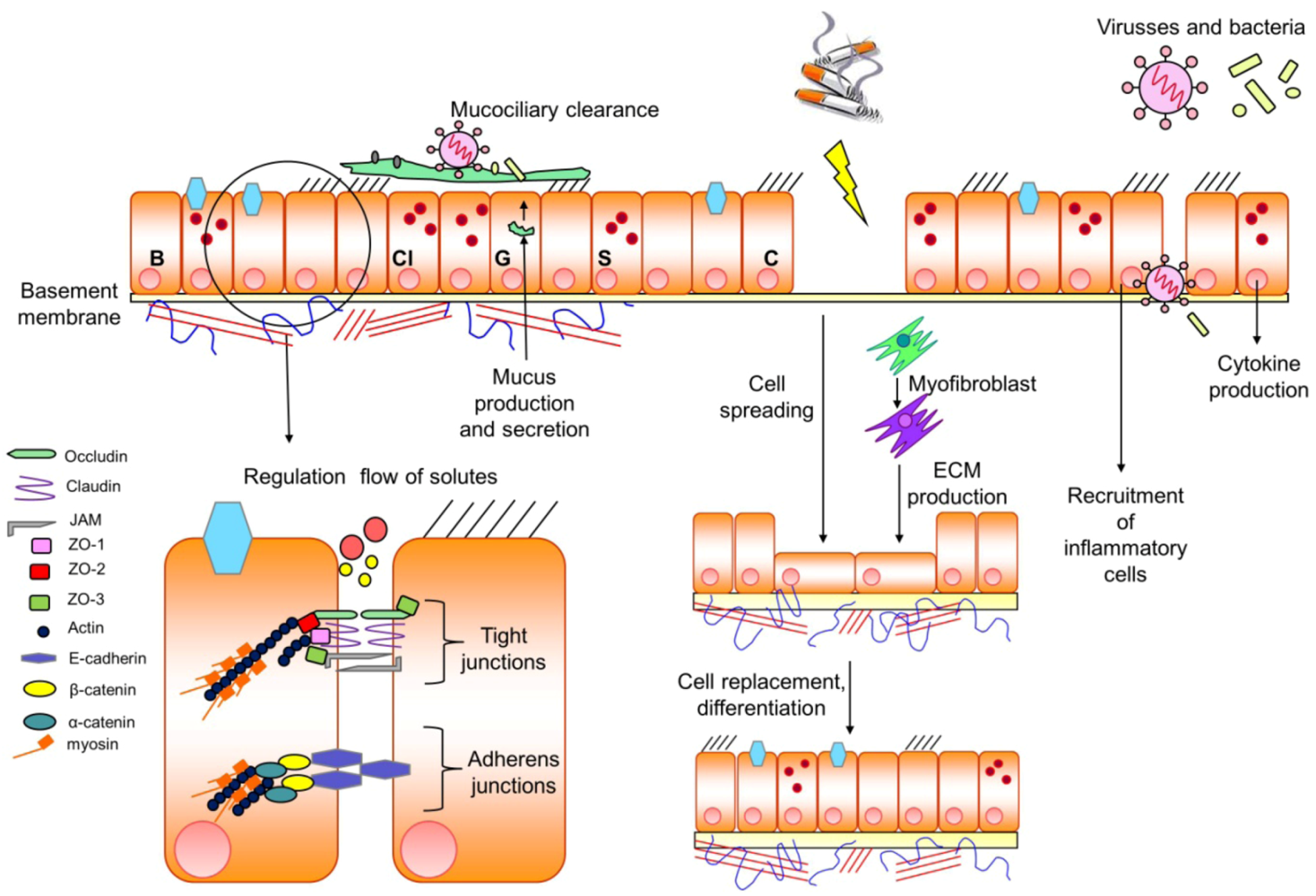
      <p>In healthy subjects, the epithelium forms a continuous lining to the airways and to the environment, and play a unique role as a barrier against external deleterious agents by elaboration of a series of defence mechanims developed to protect the airways from insults [<xref ref-type="bibr" rid="B212-pharmaceuticals-05-01291">212</xref>,<xref ref-type="bibr" rid="B240-pharmaceuticals-05-01291">240</xref>,<xref ref-type="bibr" rid="B261-pharmaceuticals-05-01291">261</xref>,<xref ref-type="bibr" rid="B262-pharmaceuticals-05-01291">262</xref>]. The airway epithelium defence system is comprised of several different functions, including structural features of the epithelium that maintain the epithelial barrier integrity, effective mucociliary clearance upon tight regulation of ciliary beating leading to an effective mucociliary clearance, and coordinated regulation of epithelial secretory properties to release molecules with antibacterial, antioxidant, and antiprotease activities [<xref ref-type="bibr" rid="B211-pharmaceuticals-05-01291">211</xref>,<xref ref-type="bibr" rid="B236-pharmaceuticals-05-01291">236</xref>,<xref ref-type="bibr" rid="B240-pharmaceuticals-05-01291">240</xref>,<xref ref-type="bibr" rid="B261-pharmaceuticals-05-01291">261</xref>]. Exposure to cigarette smoke severely alters airway epithelium morphology and function, and subsequently initiates a chronic cycle of injury and repair [<xref ref-type="bibr" rid="B29-pharmaceuticals-05-01291">29</xref>,<xref ref-type="bibr" rid="B213-pharmaceuticals-05-01291">213</xref>,<xref ref-type="bibr" rid="B214-pharmaceuticals-05-01291">214</xref>]. The different types of epithelial cells encompass rather distinct functions within the epithelial cell layer (<xref ref-type="fig" rid="pharmaceuticals-05-01291-f002">Figure 2</xref>). </p>
      <fig id="pharmaceuticals-05-01291-f002" position="anchor">
        <label>Figure 2</label>
        <caption>
          <p>Epithelial barrier functions. Shown are key features of the epithelial barrier under healthy conditions and in the presence of toxic particles and/or infectious agents. Intriguingly, the different cell types composing the epithelial barrier including ciliated (C) cells, basal (B) cells, clara (C) cells and goblet (G) cells exhibit rather diverse functions within the barrier. Ciliated cells are responsible for the mucociliary clearance of infectious agents. Goblet cells produce the mucus needed for the clearance process. Clara cells contain granules filled with antiproteases known to be released by these cells upon their activation. Basement membrane is composed of basal cells known to exhibit next to their structural role a variety of distinct functions within the epithelium (see text for further details). Intercellular cell-cell contact between epithelial cells is achieved by tight junctions and adherens junctions. Adherens junctions ensure a tight adhesion of cells, whereas tight junctions act as a size selective barrier for certain ions and molecules. Exposure of epithelial cells to toxic <inline-graphic xmlns:xlink="http://www.w3.org/1999/xlink" xlink:href="pharmaceuticals-05-01291-i001.tif"/> such as cigarette smoke <inline-graphic xmlns:xlink="http://www.w3.org/1999/xlink" xlink:href="pharmaceuticals-05-01291-i002.tif"/> a (persistent) damage of the epithelial barrier, a process being compensated by cell spreading and production of extracellular matrix (ECM) by myofibroblasts to gain cell replacement and differentiation of distinct cells within the epithelium. In addition, toxic particles such as viruses and/or bacteria within the epithelial barrier will induce the recruitment of inflammatory cells and the production of cytokines to diminish the entrance of the devastating particles. For further details see text.</p>
        </caption>
        <graphic xmlns:xlink="http://www.w3.org/1999/xlink" xlink:href="pharmaceuticals-05-01291-g002.tif"/>
      </fig>
      <p>Essentially, the main cell types within the epithelium are divided between secretory and ciliated cells. Epithelial ciliated cells are engaged to transport the mucus out of the airways and thereby to remove the pathogens and toxic particles trapped in the mucus. The functionally close interplay between ciliated and secretory epithelial cells is illustrated by the fact that mucus being utilized by ciliated cells to maintain their proper transport function is produced and secreted by goblet cells, a secretory cell type of the epithelium, whereas a distinct subset of secretory cells release antimicrobial substances as a defence against unwanted pathogens [<xref ref-type="bibr" rid="B212-pharmaceuticals-05-01291">212</xref>,<xref ref-type="bibr" rid="B240-pharmaceuticals-05-01291">240</xref>,<xref ref-type="bibr" rid="B261-pharmaceuticals-05-01291">261</xref>]. The epithelium also consists of basal cells [<xref ref-type="bibr" rid="B263-pharmaceuticals-05-01291">263</xref>,<xref ref-type="bibr" rid="B264-pharmaceuticals-05-01291">264</xref>,<xref ref-type="bibr" rid="B265-pharmaceuticals-05-01291">265</xref>], a separate layer of cells covering most of the airway basal lamina. Due to their central position within the epithelium, basal cells interact with the columnar epithelium (a single cell layer of epithelium cells lining the respiratory tract), neurons, the basement membrane as well as underlying mesenchymal cells, and represent a key component of the epithelial-mesenchymal trophic unit of larger airways [<xref ref-type="bibr" rid="B240-pharmaceuticals-05-01291">240</xref>,<xref ref-type="bibr" rid="B264-pharmaceuticals-05-01291">264</xref>]. Basal cells execute diverse functions within the epithelial cell layer such as the inflammatory response, transepithelial water movement, oxidant defence of the tissue, the formation of the lateral intercellular space and progenitor cell functions for epithelium-associated cells, in particular during the development of the epithelium [<xref ref-type="bibr" rid="B263-pharmaceuticals-05-01291">263</xref>,<xref ref-type="bibr" rid="B264-pharmaceuticals-05-01291">264</xref>,<xref ref-type="bibr" rid="B265-pharmaceuticals-05-01291">265</xref>].</p>
      <p>The epithelium is composed of continuous intercellular barriers such as tight junctions known to account for a size-selective barrier of molecules into the epithelium [<xref ref-type="bibr" rid="B266-pharmaceuticals-05-01291">266</xref>]. Tight junctions are located between the apical and lateral cell surface and thereby maintain cell polarity. Tight junctions are characterized by a unique expression profile of proteins such as claudins, occludins, zona occludens and junction adhesion molecules (JAMs) [<xref ref-type="bibr" rid="B266-pharmaceuticals-05-01291">266</xref>,<xref ref-type="bibr" rid="B267-pharmaceuticals-05-01291">267</xref>,<xref ref-type="bibr" rid="B268-pharmaceuticals-05-01291">268</xref>] (<xref ref-type="fig" rid="pharmaceuticals-05-01291-f002">Figure 2</xref>). Currently, three members of the JAM family of transmembrane proteins have been identified: JAM-A, JAM-B and JAM-C. In particular, JAM-A is highly expressed in the tight junctions of the epithelial cells. In addition, JAM-A controls neutrophil transmigration, primarily across endothelial cells [<xref ref-type="bibr" rid="B267-pharmaceuticals-05-01291">267</xref>,<xref ref-type="bibr" rid="B269-pharmaceuticals-05-01291">269</xref>,<xref ref-type="bibr" rid="B270-pharmaceuticals-05-01291">270</xref>]. As neutrophil numbers seem to be indicative for COPD severity and exacerbation frequency [<xref ref-type="bibr" rid="B34-pharmaceuticals-05-01291">34</xref>,<xref ref-type="bibr" rid="B271-pharmaceuticals-05-01291">271</xref>], it is tempting to speculate that dysfunctions on the level of JAM-A might be also of importance for typical COPD disease features. Interestingly, the coxsackievirus and adenovirus receptor (CAR) represents another member of the JAM family [<xref ref-type="bibr" rid="B272-pharmaceuticals-05-01291">272</xref>,<xref ref-type="bibr" rid="B273-pharmaceuticals-05-01291">273</xref>], and has been reported to regulate the barrier function of tight junctions in epithelial cells [<xref ref-type="bibr" rid="B267-pharmaceuticals-05-01291">267</xref>,<xref ref-type="bibr" rid="B274-pharmaceuticals-05-01291">274</xref>]. </p>
      <p>Zona occludens (ZO) proteins represent other components of the tight junctions [<xref ref-type="bibr" rid="B262-pharmaceuticals-05-01291">262</xref>,<xref ref-type="bibr" rid="B275-pharmaceuticals-05-01291">275</xref>], that regulate junction formation and the interaction with the actin cytoskeleton [<xref ref-type="bibr" rid="B276-pharmaceuticals-05-01291">276</xref>,<xref ref-type="bibr" rid="B277-pharmaceuticals-05-01291">277</xref>,<xref ref-type="bibr" rid="B278-pharmaceuticals-05-01291">278</xref>,<xref ref-type="bibr" rid="B279-pharmaceuticals-05-01291">279</xref>]. Of the three members of the ZO protein family, ZO-1, ZO-2 and ZO-3, ZO-1 exhibits a rather abundant expression profile and binds to myosin, F-actin, ZO-2 and ZO-3 [<xref ref-type="bibr" rid="B262-pharmaceuticals-05-01291">262</xref>,<xref ref-type="bibr" rid="B275-pharmaceuticals-05-01291">275</xref>,<xref ref-type="bibr" rid="B280-pharmaceuticals-05-01291">280</xref>,<xref ref-type="bibr" rid="B281-pharmaceuticals-05-01291">281</xref>] (<xref ref-type="fig" rid="pharmaceuticals-05-01291-f002">Figure 2</xref>). Studies in Madin-Darby canine kidney cells demonstrated that downregulation of ZO-1 using stable expression of a ZO-1 short hairpin silencing RNA profoundly altered junctional morphology and the organization of the actin cytoskeleton. Decrease of ZO-1 largely reduced the amount of cell-cell contacts and resulted in an intracellular accumulation of actin [<xref ref-type="bibr" rid="B282-pharmaceuticals-05-01291">282</xref>]. Importantly, transepithelial electrical resistance measurements demonstrated that the reduction of ZO-1 expression was paralleled by a reduction of the epithelial barrier as shown by a size selective increase in the movement of molecules &lt; 4 Å through the disrupted barrier [<xref ref-type="bibr" rid="B282-pharmaceuticals-05-01291">282</xref>]. Taken together, ZO-1 controls paracellular permeability by coupling to components of the junctional actin cytoskeleton. Next to the tight junctions, the epithelium consists of an additional intercellular barrier, namely the adherens junctions predominantly expressed at the more basal side of the epithelial cells. Adherens junctions are characterized by the expression of cadherin family members such as E-cadherin and catenin [<xref ref-type="bibr" rid="B141-pharmaceuticals-05-01291">141</xref>,<xref ref-type="bibr" rid="B262-pharmaceuticals-05-01291">262</xref>,<xref ref-type="bibr" rid="B275-pharmaceuticals-05-01291">275</xref>,<xref ref-type="bibr" rid="B283-pharmaceuticals-05-01291">283</xref>]. E-cadherin interacts with α-catenin and/or β-catenin to form adherens junctions [<xref ref-type="bibr" rid="B262-pharmaceuticals-05-01291">262</xref>,<xref ref-type="bibr" rid="B275-pharmaceuticals-05-01291">275</xref>], a process strengthened by connection of adherens junctions to actin filaments present at intracellular sites of the cell-cell contacts [<xref ref-type="bibr" rid="B141-pharmaceuticals-05-01291">141</xref>]. Actin present in epithelial cells will form a circumferential belt which is bound to the adherens junction. Myosin, as part of this belt and bounded to actin, can control the shape of the cell via this belt [<xref ref-type="bibr" rid="B240-pharmaceuticals-05-01291">240</xref>,<xref ref-type="bibr" rid="B264-pharmaceuticals-05-01291">264</xref>,<xref ref-type="bibr" rid="B284-pharmaceuticals-05-01291">284</xref>] (<xref ref-type="fig" rid="pharmaceuticals-05-01291-f002">Figure 2</xref>). Based on this, myosin fulfils an important function in the molecular architecture of both tight junctions and adherens junctions. As the predominantly expressed protein in the muscle, myosin binds to actin and thereby enables actomyosin-mediated muscle contraction, a process being under control of Rho-Rho-kinase [<xref ref-type="bibr" rid="B262-pharmaceuticals-05-01291">262</xref>,<xref ref-type="bibr" rid="B268-pharmaceuticals-05-01291">268</xref>,<xref ref-type="bibr" rid="B285-pharmaceuticals-05-01291">285</xref>,<xref ref-type="bibr" rid="B286-pharmaceuticals-05-01291">286</xref>]. The phosphorylation of the Rho-Rho-kinase target myosin light chain is decreased due to a reduction in the RhoA/Rac1 ratio via cAMP-driven Epac activation. Dephosphorylation of the myosin light chain relaxes the smooth muscle [<xref ref-type="bibr" rid="B87-pharmaceuticals-05-01291">87</xref>,<xref ref-type="bibr" rid="B88-pharmaceuticals-05-01291">88</xref>]. Myosin light chain, not only found in smooth muscle cells, but also in epithelial cells can be phosphorylated by Rho-Rho-kinase, increasing the epithelial barrier. </p>
      <p>From the multiple myosin isoforms, myosin IIA and IIB are primarily expressed at cell-cell contacts [<xref ref-type="bibr" rid="B287-pharmaceuticals-05-01291">287</xref>]. Importantly, is has been reported recently that myosin IIA and myosin IIB engage rather distinct signalling cascades to regulate cadherin junctions in MCF7 breast epithelial cells [<xref ref-type="bibr" rid="B142-pharmaceuticals-05-01291">142</xref>]. Junctional localization of myosin IIA requires next to E-cadherin adhesion, Rho-Rho-kinase and myosin light chain-kinase activation, and thereby subsequently increase the contractile force of the circumferential belt and tight junction integrity. Myosin IIB, via Rap1A, supports myosin IIA-Rho-Rho-kinase signalling to E-cadherin and to myosin light chain kinase, and thereby also subsequently induce the stabilisation of the apical ring structure and enhancement of the junctional integrity [<xref ref-type="bibr" rid="B142-pharmaceuticals-05-01291">142</xref>]. Thus, both myosin IIA and myosin IIB might modulate the epithelial barrier function upon enhancement of the (tight) junction integrity through signalling via a rather distinct subset of small GTPases, namely RhoA and Rap1A. Several recent reports indicate that Rap1 regulates cell-cell junction formation through signalling to E-cadherin-catenin and integrin-extracellular matrix complexes [<xref ref-type="bibr" rid="B22-pharmaceuticals-05-01291">22</xref>,<xref ref-type="bibr" rid="B151-pharmaceuticals-05-01291">151</xref>,<xref ref-type="bibr" rid="B288-pharmaceuticals-05-01291">288</xref>,<xref ref-type="bibr" rid="B289-pharmaceuticals-05-01291">289</xref>]. Thus, it is tempting to assume that Epac, by activation of Rap1, importantly regulates the barrier function. As it has been also shown that E-cadherin internalization induces GTP-loading, thus, activation of Rap1 [<xref ref-type="bibr" rid="B140-pharmaceuticals-05-01291">140</xref>], these findings might indicate that the activity state of Rap1 is not only controlled by guanine nucleotide exchange factors but also by structural components of the cell-cell barrier.</p>
      <p>The next layer of the epithelial barrier, the basement membrane belongs to the basement membrane zone and is a central component of the epithelial mesenchymal trophic unit, the latter known to consist of opposing layers of epithelial and mesenchymal cells separated by the basement membrane [<xref ref-type="bibr" rid="B240-pharmaceuticals-05-01291">240</xref>,<xref ref-type="bibr" rid="B263-pharmaceuticals-05-01291">263</xref>,<xref ref-type="bibr" rid="B264-pharmaceuticals-05-01291">264</xref>,<xref ref-type="bibr" rid="B265-pharmaceuticals-05-01291">265</xref>]. The basement membrane executes several distinct functions such as epithelium-extracellular matrix attachment, barrier functioning, cell-cell/cell-matrix communication and binding of growth factor, including the epidermal growth factor and the transforming growth factor-β (TGF-β) [<xref ref-type="bibr" rid="B240-pharmaceuticals-05-01291">240</xref>,<xref ref-type="bibr" rid="B263-pharmaceuticals-05-01291">263</xref>,<xref ref-type="bibr" rid="B264-pharmaceuticals-05-01291">264</xref>,<xref ref-type="bibr" rid="B265-pharmaceuticals-05-01291">265</xref>] (<xref ref-type="fig" rid="pharmaceuticals-05-01291-f002">Figure 2</xref>). Although thickening of the epithelial reticular basement membrane is a typical feature of asthma [<xref ref-type="bibr" rid="B228-pharmaceuticals-05-01291">228</xref>], structural alterations on the level of the basement membrane and its potential impact on typical COPD features is still a matter of debate. The extracellular matrix underneath the basement membrane consists of several distinct components such as collagens, proteoglycans and glycoproteins like fibronectin and laminins [<xref ref-type="bibr" rid="B212-pharmaceuticals-05-01291">212</xref>,<xref ref-type="bibr" rid="B261-pharmaceuticals-05-01291">261</xref>,<xref ref-type="bibr" rid="B262-pharmaceuticals-05-01291">262</xref>,<xref ref-type="bibr" rid="B263-pharmaceuticals-05-01291">263</xref>,<xref ref-type="bibr" rid="B264-pharmaceuticals-05-01291">264</xref>]. In COPD patients a decrease in proteoglycans, such as decorin and biglycan, is observed. Collagen and fibronectin are increased in patients with emphysema leading to airway wall fibrosis [<xref ref-type="bibr" rid="B204-pharmaceuticals-05-01291">204</xref>,<xref ref-type="bibr" rid="B238-pharmaceuticals-05-01291">238</xref>,<xref ref-type="bibr" rid="B240-pharmaceuticals-05-01291">240</xref>,<xref ref-type="bibr" rid="B264-pharmaceuticals-05-01291">264</xref>,<xref ref-type="bibr" rid="B284-pharmaceuticals-05-01291">284</xref>,<xref ref-type="bibr" rid="B290-pharmaceuticals-05-01291">290</xref>].</p>
      <p>Activated fibroblasts produce huge amounts of the extracellular matrix components, but also regulate the production of MMPs and endogenous antiproteinases [<xref ref-type="bibr" rid="B291-pharmaceuticals-05-01291">291</xref>,<xref ref-type="bibr" rid="B292-pharmaceuticals-05-01291">292</xref>,<xref ref-type="bibr" rid="B293-pharmaceuticals-05-01291">293</xref>]. Elevation of TGF-β promotes cell proliferation and extracellular matrix deposition by fibroblasts, whereas MMP-2 and MMP-9 (gelatinase / collagenase) and MMP-12 (elastase), which are increased in sputum of COPD patients [<xref ref-type="bibr" rid="B204-pharmaceuticals-05-01291">204</xref>,<xref ref-type="bibr" rid="B294-pharmaceuticals-05-01291">294</xref>] promote pro-fibrotic responses as well as destruction of the alveolar parenchyma. Thus, an imbalance between matrix metalloproteinase and their appropriate antiproteinase may contribute to fibrosis and emphysema in COPD [<xref ref-type="bibr" rid="B204-pharmaceuticals-05-01291">204</xref>,<xref ref-type="bibr" rid="B294-pharmaceuticals-05-01291">294</xref>,<xref ref-type="bibr" rid="B295-pharmaceuticals-05-01291">295</xref>,<xref ref-type="bibr" rid="B296-pharmaceuticals-05-01291">296</xref>,<xref ref-type="bibr" rid="B297-pharmaceuticals-05-01291">297</xref>]. </p>
      <p>Cigarette smoke belongs to the major risk factors of COPD [<xref ref-type="bibr" rid="B32-pharmaceuticals-05-01291">32</xref>,<xref ref-type="bibr" rid="B298-pharmaceuticals-05-01291">298</xref>], and is known to induce a vicious cycle of injury and repair in the airway epithelium upon adaptation on the level of tight junction and adherens junction morphology and function [<xref ref-type="bibr" rid="B31-pharmaceuticals-05-01291">31</xref>,<xref ref-type="bibr" rid="B212-pharmaceuticals-05-01291">212</xref>,<xref ref-type="bibr" rid="B213-pharmaceuticals-05-01291">213</xref>,<xref ref-type="bibr" rid="B214-pharmaceuticals-05-01291">214</xref>], a process which may eventually end up in transcriptional reprogramming of the airway epithelium [<xref ref-type="bibr" rid="B29-pharmaceuticals-05-01291">29</xref>]. Unfortunately, cigarette smoke-induced repair mechanism may also worsen airway obstruction of COPD patients through mucus hypersecretion by goblet cell hyperplasia, down-regulation of epithelial ciliated cells and hypertrophy of the submucosal gland [<xref ref-type="bibr" rid="B24-pharmaceuticals-05-01291">24</xref>,<xref ref-type="bibr" rid="B204-pharmaceuticals-05-01291">204</xref>,<xref ref-type="bibr" rid="B212-pharmaceuticals-05-01291">212</xref>,<xref ref-type="bibr" rid="B213-pharmaceuticals-05-01291">213</xref>,<xref ref-type="bibr" rid="B261-pharmaceuticals-05-01291">261</xref>]. Importantly, a recent study of Crystal and colleagues demonstrated that cigarette smoke exposure of airway epithelium induced a profound down-regulation of the majority of the typical tight junction and adherens junctions components including claudins, ZO proteins, E-cadherin and catenin [<xref ref-type="bibr" rid="B29-pharmaceuticals-05-01291">29</xref>]. In contrast, cigarette smoke exposure induced a profound up-regulation of molecular pathways known to be critical for epithelial differentiation including the phosphatase and tensin homolog (PTEN), phosphoinositide 3-kinase-dependent PKB/Akt, the cAMP effector PKA and Rac [<xref ref-type="bibr" rid="B29-pharmaceuticals-05-01291">29</xref>]. As several recent studies indicate that a proper signal balance between RhoA <italic>versus</italic> Rac1 seems to be of utmost importance for the regulation of both the endothelial and epithelial barrier [<xref ref-type="bibr" rid="B2-pharmaceuticals-05-01291">2</xref>,<xref ref-type="bibr" rid="B112-pharmaceuticals-05-01291">112</xref>,<xref ref-type="bibr" rid="B153-pharmaceuticals-05-01291">153</xref>,<xref ref-type="bibr" rid="B299-pharmaceuticals-05-01291">299</xref>,<xref ref-type="bibr" rid="B300-pharmaceuticals-05-01291">300</xref>,<xref ref-type="bibr" rid="B301-pharmaceuticals-05-01291">301</xref>], a subtle interplay between the cAMP-effector Rap1 and Rac1 might be envisioned as a key event to preserve the structure and function of tight and adherens junctions (<xref ref-type="fig" rid="pharmaceuticals-05-01291-f003">Figure 3</xref>). Particularly, the impact of Rac1 on the endothelial barrier seems to be rather puzzling as both stabilization and destabilization of the endothelial barrier integrity have been observed [<xref ref-type="bibr" rid="B147-pharmaceuticals-05-01291">147</xref>,<xref ref-type="bibr" rid="B152-pharmaceuticals-05-01291">152</xref>,<xref ref-type="bibr" rid="B153-pharmaceuticals-05-01291">153</xref>,<xref ref-type="bibr" rid="B154-pharmaceuticals-05-01291">154</xref>,<xref ref-type="bibr" rid="B155-pharmaceuticals-05-01291">155</xref>,<xref ref-type="bibr" rid="B156-pharmaceuticals-05-01291">156</xref>,<xref ref-type="bibr" rid="B157-pharmaceuticals-05-01291">157</xref>] (<xref ref-type="fig" rid="pharmaceuticals-05-01291-f002">Figure 2</xref> and <xref ref-type="fig" rid="pharmaceuticals-05-01291-f003">Figure 3</xref>). Intriguingly, these opposing findings might be partly explained by the distinct barrier protection properties of Rac1 in micro-vascular <italic>versus</italic> macro-vascular endothelial cells. Future studies should intend to unravel the precise underlying molecular signalling pathways and thereby to develop novel therapeutical interventions to restore and to maintain proper epithelial barrier in patients with COPD.</p>
      <p>In epithelial cells, cAMP elevation will activate Rap and Rac via Epac. Rac in its active state will reduce the binding of IQGAP1 to β-catenin, resulting in a decrease of the epithelial barrier [<xref ref-type="bibr" rid="B141-pharmaceuticals-05-01291">141</xref>]. Rap is also activated by myosin IIB and will thereby enhance the barrier via E-cadherin. Myosin IIB will also activate Rho-Rho-kinase which via myosin light chain phosphorylation will increase the barrier properties [<xref ref-type="bibr" rid="B142-pharmaceuticals-05-01291">142</xref>].</p>
    </sec>
    <sec>
      <title>5. Novel Aspects of Barrier Functioning</title>
      <p>Insights into the molecular mechanisms being implicated in the maintenance or even restoration of the epithelial barrier function are still rather limited, therefore we will outline the molecular mechanisms that maintain the endothelial barrier function in the vasculature, we will translate these findings onto the regulation of the epithelial barrier function in COPD. </p>
	  
	  <fig id="pharmaceuticals-05-01291-f003" position="anchor">
        <label>Figure 3</label>
        <caption>
          <p>cAMP signalling in endothelial cells <italic>vs.</italic> epithelial cells. β<sub>2</sub>-agonists and prostanoids which activate their appropriate G-protein coupled receptor, and forskolin which activates adenylcyclase (AC) will increase cAMP production in both endothelial and epithelial cells resulting in cell type specific responses in both cells. In endothelial cells, cAMP increase will cause activation of both PKA and Epac. Activation of Epac will enhance microtubule growth which is AKAP9-dependent [<xref ref-type="bibr" rid="B148-pharmaceuticals-05-01291">148</xref>]. Epac activation will result in binding to PDE4D (phosphodiesterase 4D) which binds to the E-cadherin complex causing improvement of the barrier [<xref ref-type="bibr" rid="B147-pharmaceuticals-05-01291">147</xref>]. Next to this, Epac activation will reduce the phosphorylation of the myosin light chain, causing relaxation and improvement of the barrier [<xref ref-type="bibr" rid="B87-pharmaceuticals-05-01291">87</xref>,<xref ref-type="bibr" rid="B88-pharmaceuticals-05-01291">88</xref>]. The other effector of cAMP, PKA, anchored to AKAP (A-kinase anchoring protein) will activate both Rap and Rac. Active Rap, stabilized by IQGAP1, can activate KRIT which stabilizes cell-cell contacts. IQGAP2, bound to AKAP220, mediates calcium-dependent Rac activation which can alter actin dynamics [<xref ref-type="bibr" rid="B143-pharmaceuticals-05-01291">143</xref>,<xref ref-type="bibr" rid="B144-pharmaceuticals-05-01291">144</xref>,<xref ref-type="bibr" rid="B145-pharmaceuticals-05-01291">145</xref>,<xref ref-type="bibr" rid="B302-pharmaceuticals-05-01291">302</xref>,<xref ref-type="bibr" rid="B303-pharmaceuticals-05-01291">303</xref>]. In epithelial cells, cAMP elevation will activate Rap and Rac via Epac. Rac in its active state will reduce the binding of IQGAP1 to β-catenin, resulting in a decrease of the epithelial barrier [<xref ref-type="bibr" rid="B141-pharmaceuticals-05-01291">141</xref>]. Rap is also activated by myosin IIB and will thereby enhance the barrier via E-cadherin. Myosin IIB will also activate Rho-Rho-kinase which via myosin light chain phosphorylation will increase the barrier properties [<xref ref-type="bibr" rid="B142-pharmaceuticals-05-01291">142</xref>].</p>
        </caption>
        <graphic xmlns:xlink="http://www.w3.org/1999/xlink" xlink:href="pharmaceuticals-05-01291-g003.tif"/>
      </fig>
      
      <p>It is generally accepted that several endothelial barrier disrupting agents, such as tumor necrosis factor-, thrombin and the bacterial endotoxin lipopolysaccharide, profoundly alter the molecular architecture as well as the dynamics of the actin-microtubule network known to comprise the barrier tight and adherens junctions [<xref ref-type="bibr" rid="B258-pharmaceuticals-05-01291">258</xref>,<xref ref-type="bibr" rid="B259-pharmaceuticals-05-01291">259</xref>,<xref ref-type="bibr" rid="B260-pharmaceuticals-05-01291">260</xref>,<xref ref-type="bibr" rid="B261-pharmaceuticals-05-01291">261</xref>,<xref ref-type="bibr" rid="B262-pharmaceuticals-05-01291">262</xref>]. Importantly, cAMP elevating agents such as β<sub>2</sub>-agonists, prostanoids (prostacyclin, prostaglandin, PGE<sub>2</sub>) and the direct AC activator forskolin effectively reduce the leakage of the endothelial barrier in whole animals, isolated lungs and in clinical studies under both resting conditions and exposure to inflammatory mediators [<xref ref-type="bibr" rid="B2-pharmaceuticals-05-01291">2</xref>,<xref ref-type="bibr" rid="B304-pharmaceuticals-05-01291">304</xref>,<xref ref-type="bibr" rid="B305-pharmaceuticals-05-01291">305</xref>,<xref ref-type="bibr" rid="B306-pharmaceuticals-05-01291">306</xref>]. Several conclusive studies by Waschke and colleagues [<xref ref-type="bibr" rid="B153-pharmaceuticals-05-01291">153</xref>,<xref ref-type="bibr" rid="B156-pharmaceuticals-05-01291">156</xref>,<xref ref-type="bibr" rid="B157-pharmaceuticals-05-01291">157</xref>,<xref ref-type="bibr" rid="B307-pharmaceuticals-05-01291">307</xref>] demonstrated that at least part of the cAMP-dependent enhancement of the human dermal microvascular endothelial barrier (measured by transelectrical resistance (TER)) is mediated via the activation of Rac1 by both vasodilator-stimulated phosphoprotein (VASP) and AKAP-anchored PKA (<xref ref-type="fig" rid="pharmaceuticals-05-01291-f003">Figure 3</xref>). Activation of Rac1 by AKAP-anchored PKA was sensitive to the PKA-AKAP-binding blocking peptides st-Ht31 [<xref ref-type="bibr" rid="B158-pharmaceuticals-05-01291">158</xref>]. As shown in human lung microvascular endothelial cells [<xref ref-type="bibr" rid="B308-pharmaceuticals-05-01291">308</xref>], PKA-dependent phosphorylation of VASP might also contribute to the barrier protection. </p>
      <p>Although the members of the AKAP superfamily involved in the barrier function of human dermal microvascular endothelial cells still have to be identified, these results indicate that compartmentalized cAMP signalling by AKAPs contribute to the endothelial barrier function. The magnitude of the cAMP-dependent endothelial barrier maintenance, a process being paralleled by the subcellular localization of endothelial adherens junction marker VE-cadherin [<xref ref-type="bibr" rid="B153-pharmaceuticals-05-01291">153</xref>,<xref ref-type="bibr" rid="B156-pharmaceuticals-05-01291">156</xref>,<xref ref-type="bibr" rid="B157-pharmaceuticals-05-01291">157</xref>], profoundly differs between the β<sub>2</sub>-agonist epinephrine, the direct AC activator forskolin and the PDE4 inhibitor rolipram, the latter being non-effective on its own and acquiring biological effectiveness only in the presence of forskolin. These findings indicate that forskolin and rolipram are functionally different and/or require a distinct assembly of cAMP signalling pools. Indeed, studies from Maurice and colleagues demonstrated that PDE4D-bearing VE-cadherin-based multiprotein complexes control the vascular permeability in HUVECs [<xref ref-type="bibr" rid="B147-pharmaceuticals-05-01291">147</xref>,<xref ref-type="bibr" rid="B155-pharmaceuticals-05-01291">155</xref>]. Next to PDE4D and VE-cadherin, cAMP-dependent Epac1 was shown to be vital for the regulation of the endothelial barrier in HUVECs [<xref ref-type="bibr" rid="B147-pharmaceuticals-05-01291">147</xref>]. Indeed, subsequent studies by Waschke and colleagues indicated that the direct Epac activator 8-pCPT-2'-<italic>O</italic>-Me-cAMP mimicked the effect of epinephrine and forskolin on the barrier function and subcellular distribution of VE-cadherin in human microvascular endothelial cells [<xref ref-type="bibr" rid="B153-pharmaceuticals-05-01291">153</xref>,<xref ref-type="bibr" rid="B157-pharmaceuticals-05-01291">157</xref>]. As shown before for VASP and AKAP-anchored PKA, direct activation of Epac induced also the GTP-loading of Rac1 [<xref ref-type="bibr" rid="B153-pharmaceuticals-05-01291">153</xref>,<xref ref-type="bibr" rid="B157-pharmaceuticals-05-01291">157</xref>]. In addition, Hordijk and colleagues reported that Rac1 induced the production of reactive oxygen species and subsequently induced subcellular redistribution of VE-cadherin-catenin complexes in HUVECs [<xref ref-type="bibr" rid="B309-pharmaceuticals-05-01291">309</xref>]. Such mechanisms might worsen the endothelial barrier function under inflammatory disease conditions (<xref ref-type="fig" rid="pharmaceuticals-05-01291-f003">Figure 3</xref>).</p>
      <p>Interestingly, protection of the endothelial barrier upon activation of Rac1 was restricted to microvascular endothelial cells [<xref ref-type="bibr" rid="B157-pharmaceuticals-05-01291">157</xref>]. It is tempting to speculate that a distinct subset of cAMP-sensing AKAP-bearing multiprotein complexes might be expressed in micro-vascular <italic>versus</italic> macro-vascular endothelial cells. In support, recent studies point to the existence of a rather heterogeneous composition of such multiprotein complexes in cardiomyocytes [<xref ref-type="bibr" rid="B79-pharmaceuticals-05-01291">79</xref>], neurons [<xref ref-type="bibr" rid="B19-pharmaceuticals-05-01291">19</xref>], human lung fibroblasts [<xref ref-type="bibr" rid="B82-pharmaceuticals-05-01291">82</xref>,<xref ref-type="bibr" rid="B122-pharmaceuticals-05-01291">122</xref>] and airway smooth muscle [<xref ref-type="bibr" rid="B117-pharmaceuticals-05-01291">117</xref>]. Such diversity may also -at least in part- explain the opposing effects on the endothelial barrier – both protection and disruption - observed upon β<sub>2</sub>-adrenegic receptor stimulation [<xref ref-type="bibr" rid="B153-pharmaceuticals-05-01291">153</xref>,<xref ref-type="bibr" rid="B156-pharmaceuticals-05-01291">156</xref>]. </p>
      <p>Birukova and colleagues characterized the molecular mechanisms leading to Rac1 activation by Epac1 in human pulmonary artery endothelial cells <italic>in vitro</italic> and in ventilator-induced lung injury <italic>in vivo</italic> [<xref ref-type="bibr" rid="B146-pharmaceuticals-05-01291">146</xref>,<xref ref-type="bibr" rid="B310-pharmaceuticals-05-01291">310</xref>,<xref ref-type="bibr" rid="B311-pharmaceuticals-05-01291">311</xref>,<xref ref-type="bibr" rid="B312-pharmaceuticals-05-01291">312</xref>,<xref ref-type="bibr" rid="B313-pharmaceuticals-05-01291">313</xref>]. Elevation of cellular cAMP content, <italic>e.g.</italic>, by prostaglandin E<sub>2</sub> and prostacyclin I<sub>2</sub>, induced GTP-loading of Rac1 via Epac1-dependent Rap1 activation and the engagement of the Rac-specific GEFs Tiam1 and Vav2, processes being supported by PKA and the inhibition of p115 Rho-GEF-dependent activation of RhoA. Altogether, these mechanisms contribute to the barrier protection observed in human pulmonary artery endothelial cells <italic>in vitro</italic> and to the attenuation of ventilator-induced lung injury <italic>in vivo</italic> [<xref ref-type="bibr" rid="B146-pharmaceuticals-05-01291">146</xref>,<xref ref-type="bibr" rid="B310-pharmaceuticals-05-01291">310</xref>,<xref ref-type="bibr" rid="B311-pharmaceuticals-05-01291">311</xref>,<xref ref-type="bibr" rid="B312-pharmaceuticals-05-01291">312</xref>,<xref ref-type="bibr" rid="B313-pharmaceuticals-05-01291">313</xref>]. As reported for the molecular mechanisms leading to the relaxation of smooth muscle [<xref ref-type="bibr" rid="B87-pharmaceuticals-05-01291">87</xref>,<xref ref-type="bibr" rid="B88-pharmaceuticals-05-01291">88</xref>], Epac1 most likely protects the endothelial barrier by decreasing the phosphorylation of the Rho-Rho-kinase target myosin light chain by skewing the balance of RhoA/Rac1 activation towards Rac1. These recent findings confirmed initial studies by the research groups of Mayadas [<xref ref-type="bibr" rid="B148-pharmaceuticals-05-01291">148</xref>,<xref ref-type="bibr" rid="B314-pharmaceuticals-05-01291">314</xref>] and Mochizuki [<xref ref-type="bibr" rid="B22-pharmaceuticals-05-01291">22</xref>,<xref ref-type="bibr" rid="B314-pharmaceuticals-05-01291">314</xref>], reporting on the first molecular link of Epac and the actin-microtubule, and its impact on the regulation of the barrier function in HUVECs and human pulmonary aortic endothelial cells. Recently, Ginsberg and colleagues demonstrated that Krit1 (Krev1 interaction trapped gene) is required for the stabilization of β-catenin-bearing cell-cell contacts by the Epac effector Rap1, and that the Epac-Rap1 effector Krit1 is required for the maintenance of the endothelial barrier [<xref ref-type="bibr" rid="B315-pharmaceuticals-05-01291">315</xref>,<xref ref-type="bibr" rid="B316-pharmaceuticals-05-01291">316</xref>]. Loss of Krit1, known to account for the loss of endothelial junctions in cerebral cavernous malformations [<xref ref-type="bibr" rid="B316-pharmaceuticals-05-01291">316</xref>], induces destabilization of the endothelial barrier by increasing the phosphorylation of the Rho-Rho-kinase target myosin light chain. Although the involvement of Epac has not been studied by Ginsberg and colleagues [<xref ref-type="bibr" rid="B316-pharmaceuticals-05-01291">316</xref>], these findings might indicate that Epac-bearing multiprotein complexes are of utmost importance to maintain the endothelial barrier properties (<xref ref-type="fig" rid="pharmaceuticals-05-01291-f003">Figure 3</xref>).</p>
      <p>Intriguingly, Mayadas and colleagues reported recently that AKAP9 induced Epac1-dependent-microtubule growth resulting in stabilization of the barrier function in HUVECs and human dermal microvascular endothelial cells [<xref ref-type="bibr" rid="B149-pharmaceuticals-05-01291">149</xref>]. As AKAP9 has been reported to bind to PDE4 [<xref ref-type="bibr" rid="B123-pharmaceuticals-05-01291">123</xref>], PDE4D-dependent Epac1 binding to VE-cadherin-based signalling complexes might contribute to the maintenance of the micro-vascular endothelial permeability [<xref ref-type="bibr" rid="B147-pharmaceuticals-05-01291">147</xref>]. This process which might be supported by an Epac1 dependent enhancement of cell-cell adhesion and integrin-extracellular matrix interactions [<xref ref-type="bibr" rid="B22-pharmaceuticals-05-01291">22</xref>,<xref ref-type="bibr" rid="B151-pharmaceuticals-05-01291">151</xref>]. As Waschke and colleagues reported recently on the activation of Rac1 by AKAP-anchored PKA [<xref ref-type="bibr" rid="B158-pharmaceuticals-05-01291">158</xref>], it is tempting to speculate that the AKAP9 mediates the Epac-dependent Rac1 activation in human micro-vascular endothelial cells. In addition, it has been reported that a GTPase-deficient mutant of IQGAP1 induced GTP-loading of Rac1 and inhibited IQGAP1 sequestration of β-catenin, and thereby subsequently stabilized E-cadherin-dependent barrier function of MCF7 breast epithelial cells which show epithelium characteristics [<xref ref-type="bibr" rid="B143-pharmaceuticals-05-01291">143</xref>,<xref ref-type="bibr" rid="B144-pharmaceuticals-05-01291">144</xref>,<xref ref-type="bibr" rid="B145-pharmaceuticals-05-01291">145</xref>]. As IQGAP1 binds also to the Epac-effector Rap1 [<xref ref-type="bibr" rid="B143-pharmaceuticals-05-01291">143</xref>], Epac-dependent compartmentalized cAMP signalling in human micro-vascular endothelial cells might require next to AKAP superfamily members IQGAPs. In line with this assumption, Scott and colleagues demonstrated recently that a calcium-dependent AKAP220-IQGAP2 complex mediated Rac activation and thereby cellular actin remodelling [<xref ref-type="bibr" rid="B143-pharmaceuticals-05-01291">143</xref>,<xref ref-type="bibr" rid="B302-pharmaceuticals-05-01291">302</xref>,<xref ref-type="bibr" rid="B303-pharmaceuticals-05-01291">303</xref>]. The existence of such AKAP-IQGAP complexes in the endothelium and their contribution to the regulation of the endothelial barrier still has to be studied. </p>
      <p>Although it is generally accepted that cigarette smoke alters the epithelial functions in COPD remodelling [<xref ref-type="bibr" rid="B27-pharmaceuticals-05-01291">27</xref>,<xref ref-type="bibr" rid="B28-pharmaceuticals-05-01291">28</xref>,<xref ref-type="bibr" rid="B29-pharmaceuticals-05-01291">29</xref>,<xref ref-type="bibr" rid="B30-pharmaceuticals-05-01291">30</xref>,<xref ref-type="bibr" rid="B31-pharmaceuticals-05-01291">31</xref>,<xref ref-type="bibr" rid="B32-pharmaceuticals-05-01291">32</xref>,<xref ref-type="bibr" rid="B33-pharmaceuticals-05-01291">33</xref>], the molecular mechanisms contributing to the regulation of the epithelial barrier are by far less characterized compared to several recent studies with focus on the endothelial barrier. Little information is known on the epithelial barrier in COPD, but studies performed in other types of epithelial cells may indicate a potential role of cAMP signalling pathway in the restoration of the barrier in COPD patients. </p>
      <p>It has been reported for podocytes (renal glomerular visceral epithelial cells) that the AC activator forskolin induced a redistribution of ZO-1, E-cadherin, and β-catenin to cell-cell contacts [<xref ref-type="bibr" rid="B317-pharmaceuticals-05-01291">317</xref>]. On the other hand, reduction of cellular cAMP levels upon PDE inhibition by pentoxifylline attenuated tight junctions of immunostimulated Caco-2 human intestinal epithelial cells [<xref ref-type="bibr" rid="B318-pharmaceuticals-05-01291">318</xref>]. </p>
      <p>Importantly, Menke and colleagues reported recently that transformation of the human pancreatic carcinoma epithelial-like cell line PANC-1 with constitutively active Rac1(V12) profoundly altered the subcellular distribution of E-cadherin- β-catenin complexes and thereby epithelial cell-cell contacts in an IQGAP1-dependent manner, whereas cell transformation with dominant negative Rac1 (N17) had the opposite effect [<xref ref-type="bibr" rid="B141-pharmaceuticals-05-01291">141</xref>]. Together with the finding that in MCF7 breast epithelial cells myosin IIB signals via Rap1A to E-cadherin and to the Rho-Rho-kinase effector myosin light chain and subsequently enhance junctional integrity [<xref ref-type="bibr" rid="B142-pharmaceuticals-05-01291">142</xref>], a diligent balance of the GDP/GTP-loading of the small GTPase superfamily members Rac1 and Rap1 -most likely driven by compartmentalized cAMP signalling by a distinct subset of AKAPs and IQGAPs- seem to be of key importance to maintain a proper barrier function in epithelial cells. Of interest to note is that IQGAP1 and IQGAP2 seem to be differentially involved in the regulation of the cellular barrier [<xref ref-type="bibr" rid="B143-pharmaceuticals-05-01291">143</xref>,<xref ref-type="bibr" rid="B144-pharmaceuticals-05-01291">144</xref>,<xref ref-type="bibr" rid="B145-pharmaceuticals-05-01291">145</xref>] and the actin-microtubule network dynamics [<xref ref-type="bibr" rid="B302-pharmaceuticals-05-01291">302</xref>,<xref ref-type="bibr" rid="B303-pharmaceuticals-05-01291">303</xref>]. Indeed, recent research indicate also that IQGAP1 and IQGAP2 fulfill distinct functions in tumorigenesis, whereas IQGAP1 acts as an oncogene IQGAP2 seems to act as a tumor suppressor (<xref ref-type="fig" rid="pharmaceuticals-05-01291-f003">Figure 3</xref>) [<xref ref-type="bibr" rid="B319-pharmaceuticals-05-01291">319</xref>]. Preliminary results of our group show that cigarette smoke-mediated disruption of human bronchial epithelial (HBE) barrier correlates with a down-regulation of AKAP9 [<xref ref-type="bibr" rid="B130-pharmaceuticals-05-01291">130</xref>]. As AC9 is the main isoform in bronchial epithelial cells [<xref ref-type="bibr" rid="B123-pharmaceuticals-05-01291">123</xref>,<xref ref-type="bibr" rid="B136-pharmaceuticals-05-01291">136</xref>], it is tempting to speculate that the previous described interaction between AC9 and AKAP9/Yotiao [<xref ref-type="bibr" rid="B127-pharmaceuticals-05-01291">127</xref>] is involved in this process. Next to AKAP9, AKAP5 and AKAP12 are also expressed in human bronchial epithelial cells, but their expression is not sensitive to cigarette smoke exposure. Importantly, the expression of AKAP9 mRNA was also down-regulated in primary epithelial cells of current smokers compared to non/ex-smokers as well as in lung biopsies from COPD patients [<xref ref-type="bibr" rid="B320-pharmaceuticals-05-01291">320</xref>]. </p>
      <p>Taken together, compartmentalized cAMP signalling maintained by a distinct subset of cAMP-responsive multi-protein complexes seen also to account for the proper functioning of the epithelial barrier, the latter known to be derailed in patients with COPD. Future research should aim to target cell-type specific cAMP-sensing complexes to augment our current therapeutically treatment regimes for chronic inflammatory disorders such as COPD.</p>
    </sec>
    <sec sec-type="conclusions">
      <title>6. Conclusions</title>
      <p>G-protein-coupled receptors, adenylyl cyclases and PDEs regulate, in a spatio-temporal manner, the cellular cAMP concentration and subsequent cAMP signalling. Compartimentalization of cAMP signalling through a distinct subset of multi-domain proteins of the AKAP family supports fine-tuning of the net-outcome of cAMP-regulated cellular responses. Novel insights into cAMP compartmentalization upon manipulation of these multi-protein complexes may lead to new therapies in diseases like heart failure, cancer and COPD, known to be characterized by cAMP dysfunction. </p>
      <p>In COPD, dysfunction of the epithelial barrier results in progression of disease symptoms. Since cAMP exhibits protection of the barrier function in endothelial cells, targeting the cAMP pathway may also restore the damaged epithelial barrier in COPD. Given the importance of compartmentalized cAMP signalling in regulating cellular barrier functions, alterations in maintenance of the protein-protein communication may lead to the observed barrier dysfunction in COPD. Upon activation of Rap and inhibition of Rho, the cAMP effectors Epac and PKA increase cellular barrier function.</p>
      <p>Future studies with focus on cAMP compartmentalization will be required to further unravel the underlying molecular mechanisms. Further understanding of this compartmentalized cAMP signalling will be of benefit for improvement of the current therapeutic arsenal for the treatment of COPD.</p>
    </sec>
   
  </body>
  <back> 
  
    <ack>
      <title>Acknowledgements</title>
      <p>This work was supported by a grant by the Nederlands Astma Fonds (NAF 2009: projectnr: 3.2.09.034, NAF 2011: projectnr: 3.2.11.015) and a Rosalind Franklin Fellowship from the University of Groningen to M. Schmidt. Harm Maarsingh is supported by MSD (Oss, The Netherlands). </p>
    </ack>
	<notes>
      <title>Conflict of interest</title>
      <p>The authors declare no conflict of interest.</p>
    </notes>
    <ref-list>
      <title>References</title>
      <ref id="B1-pharmaceuticals-05-01291">
        <label>1.</label>
        <citation citation-type="journal">
          <person-group person-group-type="author">
            <name>
              <surname>Beavo</surname>
              <given-names>J.A.</given-names>
            </name>
            <name>
              <surname>Brunton</surname>
              <given-names>L.L.</given-names>
            </name>
          </person-group>
          <article-title>Cyclic nucleotide research -- still expanding after half a century</article-title>
          <source>Nat. Rev. Mol. Cell Biol.</source>
          <year>2002</year>
          <volume>3</volume>
          <fpage>710</fpage>
          <lpage>718</lpage>
        <pub-id pub-id-type="doi">10.1038/nrm911</pub-id><pub-id pub-id-type="pmid">12209131</pub-id></citation>
      </ref>
      <ref id="B2-pharmaceuticals-05-01291">
        <label>2.</label>
        <citation citation-type="journal">
          <person-group person-group-type="author">
            <name>
              <surname>Sayner</surname>
              <given-names>S.L.</given-names>
            </name>
          </person-group>
          <article-title>Emerging themes of cAMP regulation of the pulmonary endothelial barrier</article-title>
          <source>Am. J. Physiol. Lung Cell Mol. Physiol.</source>
          <year>2011</year>
          <volume>300</volume>
          <fpage>L667</fpage>
          <lpage>L678</lpage>
          <pub-id pub-id-type="doi">10.1152/ajplung.00433.2010</pub-id>
        </citation>
      </ref>
      <ref id="B3-pharmaceuticals-05-01291">
        <label>3.</label>
        <citation citation-type="journal">
          <person-group person-group-type="author">
            <name>
              <surname>Conti</surname>
              <given-names>M.</given-names>
            </name>
            <name>
              <surname>Beavo</surname>
              <given-names>J.</given-names>
            </name>
          </person-group>
          <article-title>Biochemistry and physiology of cyclic nucleotide phosphodiesterases: essential components in cyclic nucleotide signaling</article-title>
          <source>Annu. Rev. Biochem.</source>
          <year>2007</year>
          <volume>76</volume>
          <fpage>481</fpage>
          <lpage>511</lpage>
          <pub-id pub-id-type="doi">10.1146/annurev.biochem.76.060305.150444</pub-id>
        </citation>
      </ref>
      <ref id="B4-pharmaceuticals-05-01291">
        <label>4.</label>
        <citation citation-type="journal">
          <person-group person-group-type="author">
            <name>
              <surname>Houslay</surname>
              <given-names>M.D.</given-names>
            </name>
          </person-group>
          <article-title>Underpinning compartmentalised cAMP signalling through targeted cAMP breakdown</article-title>
          <source>Trends Biochem. Sci.</source>
          <year>2010</year>
          <volume>35</volume>
          <fpage>91</fpage>
          <lpage>100</lpage>
          <pub-id pub-id-type="doi">10.1016/j.tibs.2009.09.007</pub-id>
        </citation>
      </ref>
      <ref id="B5-pharmaceuticals-05-01291">
        <label>5.</label>
        <citation citation-type="journal">
          <person-group person-group-type="author">
            <name>
              <surname>McCahill</surname>
              <given-names>A.C.</given-names>
            </name>
            <name>
              <surname>Huston</surname>
              <given-names>E.</given-names>
            </name>
            <name>
              <surname>Li</surname>
              <given-names>X.</given-names>
            </name>
            <name>
              <surname>Houslay</surname>
              <given-names>M.D.</given-names>
            </name>
          </person-group>
          <article-title>PDE4 associates with different scaffolding proteins: modulating interactions for certain diseases</article-title>
          <source>Handb. Exp. Pharmacol</source>
          <year>2008</year>
          <volume>186</volume>
          <fpage>125</fpage>
          <lpage>166</lpage>
          <pub-id pub-id-type="doi">10.1007/978-3-540-72843-6_6</pub-id>
        </citation>
      </ref>
      <ref id="B6-pharmaceuticals-05-01291">
        <label>6.</label>
        <citation citation-type="journal">
          <person-group person-group-type="author">
            <name>
              <surname>Hanoune</surname>
              <given-names>J.</given-names>
            </name>
            <name>
              <surname>Defer</surname>
              <given-names>N.</given-names>
            </name>
          </person-group>
          <article-title>Regulation and role of adenylyl cyclase isoforms</article-title>
          <source>Annu. Rev. Pharmacol Toxicol.</source>
          <year>2001</year>
          <volume>41</volume>
          <fpage>145</fpage>
          <lpage>174</lpage>
          <pub-id pub-id-type="doi">10.1146/annurev.pharmtox.41.1.145</pub-id>
        </citation>
      </ref>
      <ref id="B7-pharmaceuticals-05-01291">
        <label>7.</label>
        <citation citation-type="journal">
          <person-group person-group-type="author">
            <name>
              <surname>Patel</surname>
              <given-names>H.H.</given-names>
            </name>
            <name>
              <surname>Murray</surname>
              <given-names>F.</given-names>
            </name>
            <name>
              <surname>Insel</surname>
              <given-names>P.A.</given-names>
            </name>
          </person-group>
          <article-title>G-protein-coupled receptor-signaling components in membrane raft and caveolae microdomains</article-title>
          <source>Handb. Exp. Pharmacol</source>
          <year>2008</year>
          <fpage>167</fpage>
          <lpage>184</lpage>
        </citation>
      </ref>
      <ref id="B8-pharmaceuticals-05-01291">
        <label>8.</label>
        <citation citation-type="journal">
          <person-group person-group-type="author">
            <name>
              <surname>Patel</surname>
              <given-names>H.H.</given-names>
            </name>
            <name>
              <surname>Murray</surname>
              <given-names>F.</given-names>
            </name>
            <name>
              <surname>Insel</surname>
              <given-names>P.A.</given-names>
            </name>
          </person-group>
          <article-title>Caveolae as organizers of pharmacologically relevant signal transduction molecules</article-title>
          <source>Annu. Rev. Pharmacol Toxicol.</source>
          <year>2008</year>
          <volume>48</volume>
          <fpage>359</fpage>
          <lpage>391</lpage>
          <pub-id pub-id-type="doi">10.1146/annurev.pharmtox.48.121506.124841</pub-id>
        </citation>
      </ref>
      <ref id="B9-pharmaceuticals-05-01291">
        <label>9.</label>
        <citation citation-type="journal">
          <person-group person-group-type="author">
            <name>
              <surname>Zaccolo</surname>
              <given-names>M.</given-names>
            </name>
            <name>
              <surname>Pozzan</surname>
              <given-names>T.</given-names>
            </name>
          </person-group>
          <article-title>Discrete microdomains with high concentration of cAMP in stimulated rat neonatal cardiac myocytes</article-title>
          <source>Science</source>
          <year>2002</year>
          <volume>295</volume>
          <fpage>1711</fpage>
          <lpage>1715</lpage>
          <pub-id pub-id-type="doi">10.1126/science.1069982</pub-id>
        </citation>
      </ref>
      <ref id="B10-pharmaceuticals-05-01291">
        <label>10.</label>
        <citation citation-type="journal">
          <person-group person-group-type="author">
            <name>
              <surname>Di Benedetto</surname>
              <given-names>G.</given-names>
            </name>
            <name>
              <surname>Zoccarato</surname>
              <given-names>A.</given-names>
            </name>
            <name>
              <surname>Lissandron</surname>
              <given-names>V.</given-names>
            </name>
            <name>
              <surname>Terrin</surname>
              <given-names>A.</given-names>
            </name>
            <name>
              <surname>Li</surname>
              <given-names>X.</given-names>
            </name>
            <name>
              <surname>Houslay</surname>
              <given-names>M.D.</given-names>
            </name>
            <name>
              <surname>Baillie</surname>
              <given-names>G.S.</given-names>
            </name>
            <name>
              <surname>Zaccolo</surname>
              <given-names>M.</given-names>
            </name>
          </person-group>
          <article-title>Protein kinase A type I and type II define distinct intracellular signaling compartments</article-title>
          <source>Circ. Res.</source>
          <year>2008</year>
          <volume>103</volume>
          <fpage>836</fpage>
          <lpage>844</lpage>
        <pub-id pub-id-type="doi">10.1161/CIRCRESAHA.108.174813</pub-id><pub-id pub-id-type="pmid">18757829</pub-id></citation>
      </ref>
      <ref id="B11-pharmaceuticals-05-01291">
        <label>11.</label>
        <citation citation-type="journal">
          <person-group person-group-type="author">
            <name>
              <surname>Zaccolo</surname>
              <given-names>M.</given-names>
            </name>
          </person-group>
          <article-title>cAMP signal transduction in the heart: understanding spatial control for the development of novel therapeutic strategies</article-title>
          <source>Br. J. Pharmacol.</source>
          <year>2009</year>
          <volume>158</volume>
          <fpage>50</fpage>
          <lpage>60</lpage>
          <pub-id pub-id-type="doi">10.1111/j.1476-5381.2009.00185.x</pub-id>
        </citation>
      </ref>
      <ref id="B12-pharmaceuticals-05-01291">
        <label>12.</label>
        <citation citation-type="journal">
          <person-group person-group-type="author">
            <name>
              <surname>Zaccolo</surname>
              <given-names>M.</given-names>
            </name>
          </person-group>
          <article-title>Spatial control of cAMP signalling in health and disease</article-title>
          <source>Curr. Opin. Pharmacol.</source>
          <year>2011</year>
          <volume>11</volume>
          <fpage>649</fpage>
          <lpage>655</lpage>
          <pub-id pub-id-type="doi">10.1016/j.coph.2011.09.014</pub-id>
        </citation>
      </ref>
      <ref id="B13-pharmaceuticals-05-01291">
        <label>13.</label>
        <citation citation-type="journal">
          <person-group person-group-type="author">
            <name>
              <surname>Stangherlin</surname>
              <given-names>A.</given-names>
            </name>
            <name>
              <surname>Zaccolo</surname>
              <given-names>M.</given-names>
            </name>
          </person-group>
          <article-title>Phosphodiesterases and subcellular compartmentalized cAMP signaling in the cardiovascular system</article-title>
          <source>Am. J. Physiol Heart Circ. Physiol.</source>
          <year>2012</year>
          <volume>302</volume>
          <fpage>H379</fpage>
          <lpage>H390</lpage>
          <pub-id pub-id-type="doi">10.1152/ajpheart.00766.2011</pub-id>
        </citation>
      </ref>
      <ref id="B14-pharmaceuticals-05-01291">
        <label>14.</label>
        <citation citation-type="journal">
          <person-group person-group-type="author">
            <name>
              <surname>Beene</surname>
              <given-names>D.L.</given-names>
            </name>
            <name>
              <surname>Scott</surname>
              <given-names>J.D.</given-names>
            </name>
          </person-group>
          <article-title>A-kinase anchoring proteins take shape</article-title>
          <source>Curr. Opin. Cell Biol.</source>
          <year>2007</year>
          <volume>19</volume>
          <fpage>192</fpage>
          <lpage>198</lpage>
          <pub-id pub-id-type="doi">10.1016/j.ceb.2007.02.011</pub-id>
        </citation>
      </ref>
      <ref id="B15-pharmaceuticals-05-01291">
        <label>15.</label>
        <citation citation-type="journal">
          <person-group person-group-type="author">
            <name>
              <surname>Skroblin</surname>
              <given-names>P.</given-names>
            </name>
            <name>
              <surname>Grossmann</surname>
              <given-names>S.</given-names>
            </name>
            <name>
              <surname>Schafer</surname>
              <given-names>G.</given-names>
            </name>
            <name>
              <surname>Rosenthal</surname>
              <given-names>W.</given-names>
            </name>
            <name>
              <surname>Klussmann</surname>
              <given-names>E.</given-names>
            </name>
          </person-group>
          <article-title>Mechanisms of protein kinase A anchoring</article-title>
          <source>Int. Rev. Cell Mol. Biol.</source>
          <year>2010</year>
          <volume>283</volume>
          <fpage>235</fpage>
          <lpage>330</lpage>
          <pub-id pub-id-type="doi">10.1016/S1937-6448(10)83005-9</pub-id>
        </citation>
      </ref>
      <ref id="B16-pharmaceuticals-05-01291">
        <label>16.</label>
        <citation citation-type="journal">
          <person-group person-group-type="author">
            <name>
              <surname>Wong</surname>
              <given-names>W.</given-names>
            </name>
            <name>
              <surname>Scott</surname>
              <given-names>J.D.</given-names>
            </name>
          </person-group>
          <article-title>AKAP signalling complexes: focal points in space and time</article-title>
          <source>Nat. Rev. Mol. Cell Biol.</source>
          <year>2004</year>
          <volume>5</volume>
          <fpage>959</fpage>
          <lpage>970</lpage>
          <pub-id pub-id-type="doi">10.1038/nrm1527</pub-id>
        </citation>
      </ref>
      <ref id="B17-pharmaceuticals-05-01291">
        <label>17.</label>
        <citation citation-type="journal">
          <person-group person-group-type="author">
            <name>
              <surname>Tröger</surname>
              <given-names>J.</given-names>
            </name>
            <name>
              <surname>Moutty</surname>
              <given-names>M.C.</given-names>
            </name>
            <name>
              <surname>Skroblin</surname>
              <given-names>P.</given-names>
            </name>
            <name>
              <surname>Klussmann</surname>
              <given-names>E.</given-names>
            </name>
          </person-group>
          <article-title>A-kinase anchoring proteins as potential drug targets</article-title>
          <source>Br. J. Pharmacol.</source>
          <year>2012</year>
          <volume>166</volume>
          <fpage>420</fpage>
          <lpage>433</lpage>
          <pub-id pub-id-type="doi">10.1111/j.1476-5381.2011.01796.x</pub-id>
        </citation>
      </ref>
      <ref id="B18-pharmaceuticals-05-01291">
        <label>18.</label>
        <citation citation-type="journal">
          <person-group person-group-type="author">
            <name>
              <surname>Nikolaev</surname>
              <given-names>V.O.</given-names>
            </name>
            <name>
              <surname>Moshkov</surname>
              <given-names>A.</given-names>
            </name>
            <name>
              <surname>Lyon</surname>
              <given-names>A.R.</given-names>
            </name>
            <name>
              <surname>Miragoli</surname>
              <given-names>M.</given-names>
            </name>
            <name>
              <surname>Novak</surname>
              <given-names>P.</given-names>
            </name>
            <name>
              <surname>Paur</surname>
              <given-names>H.</given-names>
            </name>
            <name>
              <surname>Lohse</surname>
              <given-names>M.J.</given-names>
            </name>
            <name>
              <surname>Korchev</surname>
              <given-names>Y.E.</given-names>
            </name>
            <name>
              <surname>Harding</surname>
              <given-names>S.E.</given-names>
            </name>
            <name>
              <surname>Gorelik</surname>
              <given-names>J.</given-names>
            </name>
          </person-group>
          <article-title>Beta2-adrenergic receptor redistribution in heart failure changes cAMP compartmentation</article-title>
          <source>Science</source>
          <year>2010</year>
          <volume>327</volume>
          <fpage>1653</fpage>
          <lpage>1657</lpage>
          <pub-id pub-id-type="doi">10.1126/science.1185988</pub-id>
        </citation>
      </ref>
      <ref id="B19-pharmaceuticals-05-01291">
        <label>19.</label>
        <citation citation-type="journal">
          <person-group person-group-type="author">
            <name>
              <surname>Ostroveanu</surname>
              <given-names>A.</given-names>
            </name>
            <name>
              <surname>van der Zee</surname>
              <given-names>E.</given-names>
            </name>
            <name>
              <surname>Eisel</surname>
              <given-names>U.L.</given-names>
            </name>
            <name>
              <surname>Schmidt</surname>
              <given-names>M.</given-names>
            </name>
            <name>
              <surname>Nijholt</surname>
              <given-names>I.M.</given-names>
            </name>
          </person-group>
          <article-title>Exchange protein directly activated by cyclic AMP2 (Epac2) plays a specific and time-limited role in memory retrieval</article-title>
          <source>Hippocampus</source>
          <year>2010</year>
          <volume>20</volume>
          <fpage>1018</fpage>
          <lpage>1026</lpage>
          <pub-id pub-id-type="doi">10.1002/hipo.20700</pub-id>
        </citation>
      </ref>
      <ref id="B20-pharmaceuticals-05-01291">
        <label>20.</label>
        <citation citation-type="journal">
          <person-group person-group-type="author">
            <name>
              <surname>Aye</surname>
              <given-names>T.-T.</given-names>
            </name>
            <name>
              <surname>Soni</surname>
              <given-names>S.</given-names>
            </name>
            <name>
              <surname>van Veen</surname>
              <given-names>T.A.B.</given-names>
            </name>
            <name>
              <surname>van der Heyden</surname>
              <given-names>M.A.G.</given-names>
            </name>
            <name>
              <surname>Cappadona</surname>
              <given-names>S.</given-names>
            </name>
            <name>
              <surname>Varro</surname>
              <given-names>A.</given-names>
            </name>
            <name>
              <surname>de Weger</surname>
              <given-names>R.A.</given-names>
            </name>
            <name>
              <surname>de Jonge</surname>
              <given-names>N.</given-names>
            </name>
            <name>
              <surname>Vos</surname>
              <given-names>M.A.</given-names>
            </name>
            <name>
              <surname>Heck</surname>
              <given-names>A.J.R.</given-names>
            </name>
            <name>
              <surname>Scholten</surname>
              <given-names>A.</given-names>
            </name>
          </person-group>
          <article-title>Reorganized PKA-AKAP associations in the failing human heart</article-title>
          <source>J. Mol. Cell. Cardiol.</source>
          <year>2012</year>
          <volume>52</volume>
          <fpage>511</fpage>
          <lpage>518</lpage>
          <pub-id pub-id-type="doi">10.1016/j.yjmcc.2011.06.003</pub-id>
        </citation>
      </ref>
      <ref id="B21-pharmaceuticals-05-01291">
        <label>21.</label>
        <citation citation-type="journal">
          <person-group person-group-type="author">
            <name>
              <surname>Kovanich</surname>
              <given-names>D.</given-names>
            </name>
            <name>
              <surname>van der Heyden</surname>
              <given-names>M.A.</given-names>
            </name>
            <name>
              <surname>Aye</surname>
              <given-names>T.T.</given-names>
            </name>
            <name>
              <surname>van Veen</surname>
              <given-names>T.A.</given-names>
            </name>
            <name>
              <surname>Heck</surname>
              <given-names>A.J.</given-names>
            </name>
            <name>
              <surname>Scholten</surname>
              <given-names>A.</given-names>
            </name>
          </person-group>
          <article-title>Sphingosine kinase interacting proteins is an A-kinase anchroing protein specific for type I cAMP-dependent protein kinase</article-title>
          <source>Chembiochem.</source>
          <year>2010</year>
          <volume>3</volume>
          <fpage>963</fpage>
          <lpage>971</lpage>
        </citation>
      </ref>
      <ref id="B22-pharmaceuticals-05-01291">
        <label>22.</label>
        <citation citation-type="journal">
          <person-group person-group-type="author">
            <name>
              <surname>Noda</surname>
              <given-names>K.</given-names>
            </name>
            <name>
              <surname>Zhang</surname>
              <given-names>J.</given-names>
            </name>
            <name>
              <surname>Fukuhara</surname>
              <given-names>S.</given-names>
            </name>
            <name>
              <surname>Kunimotot</surname>
              <given-names>S.</given-names>
            </name>
            <name>
              <surname>Yoshimura</surname>
              <given-names>M.</given-names>
            </name>
            <name>
              <surname>Mochizuki</surname>
              <given-names>N.</given-names>
            </name>
          </person-group>
          <article-title>Vascular endothelial-cadherin stabilizes at cell-cell junctions by anchoring to circumferential actin bundles through a- and b-catenins in cyclic AMP-Epac1-Rap1 signal-activated endothelial cells</article-title>
          <source>Mol. Cell. Biol.</source>
          <year>2010</year>
          <volume>21</volume>
          <fpage>584</fpage>
          <lpage>596</lpage>
        <pub-id pub-id-type="doi">10.1091/mbc.E09-07-0580</pub-id></citation>
      </ref>
      <ref id="B23-pharmaceuticals-05-01291">
        <label>23.</label>
        <citation citation-type="journal">
          <person-group person-group-type="author">
            <name>
              <surname>Hogg</surname>
              <given-names>J.C.</given-names>
            </name>
            <name>
              <surname>Chu</surname>
              <given-names>F.</given-names>
            </name>
            <name>
              <surname>Utokaparch</surname>
              <given-names>S.</given-names>
            </name>
            <name>
              <surname>Woods</surname>
              <given-names>R.</given-names>
            </name>
            <name>
              <surname>Elliott</surname>
              <given-names>W.M.</given-names>
            </name>
            <name>
              <surname>Buzatu</surname>
              <given-names>L.</given-names>
            </name>
            <name>
              <surname>Cherniack</surname>
              <given-names>R.M.</given-names>
            </name>
            <name>
              <surname>Rogers</surname>
              <given-names>R.M.</given-names>
            </name>
            <name>
              <surname>Sciurba</surname>
              <given-names>F.C.</given-names>
            </name>
            <name>
              <surname>Coxson</surname>
              <given-names>H.O.</given-names>
            </name>
            <name>
              <surname>Pare</surname>
              <given-names>P.D.</given-names>
            </name>
          </person-group>
          <article-title>The nature of small-airway obstruction in chronic obstructive pulmonary disease</article-title>
          <source>N. Engl. J. Med.</source>
          <year>2004</year>
          <volume>350</volume>
          <fpage>2645</fpage>
          <lpage>2653</lpage>
          <pub-id pub-id-type="doi">10.1056/NEJMoa032158</pub-id>
        </citation>
      </ref>
      <ref id="B24-pharmaceuticals-05-01291">
        <label>24.</label>
        <citation citation-type="journal">
          <person-group person-group-type="author">
            <name>
              <surname>Hogg</surname>
              <given-names>J.C.</given-names>
            </name>
            <name>
              <surname>Timens</surname>
              <given-names>W.</given-names>
            </name>
          </person-group>
          <article-title>The pathology of chronic obstructive pulmonary disease</article-title>
          <source>Annu. Rev. Pathol.</source>
          <year>2009</year>
          <volume>4</volume>
          <fpage>435</fpage>
          <lpage>459</lpage>
          <pub-id pub-id-type="doi">10.1146/annurev.pathol.4.110807.092145</pub-id>
        </citation>
      </ref>
      <ref id="B25-pharmaceuticals-05-01291">
        <label>25.</label>
        <citation citation-type="journal">
          <person-group person-group-type="author">
            <name>
              <surname>Barnes</surname>
              <given-names>P.J.</given-names>
            </name>
          </person-group>
          <article-title>Immunology of asthma and chronic obstructive pulmonary disease</article-title>
          <source>Nat. Rev. Immunol.</source>
          <year>2008</year>
          <volume>8</volume>
          <fpage>183</fpage>
          <lpage>192</lpage>
          <pub-id pub-id-type="doi">10.1038/nri2254</pub-id>
        </citation>
      </ref>
      <ref id="B26-pharmaceuticals-05-01291">
        <label>26.</label>
        <citation citation-type="journal">
          <person-group person-group-type="author">
            <name>
              <surname>van den Berge</surname>
              <given-names>M.</given-names>
            </name>
            <name>
              <surname>ten Hacken</surname>
              <given-names>N.H.</given-names>
            </name>
            <name>
              <surname>Cohen</surname>
              <given-names>J.</given-names>
            </name>
            <name>
              <surname>Douma</surname>
              <given-names>W.R.</given-names>
            </name>
            <name>
              <surname>Postma</surname>
              <given-names>D.S.</given-names>
            </name>
          </person-group>
          <article-title>Small airway disease in asthma and COPD: clinical implications</article-title>
          <source>Chest</source>
          <year>2011</year>
          <volume>139</volume>
          <fpage>412</fpage>
          <lpage>423</lpage>
        <pub-id pub-id-type="doi">10.1378/chest.10-1210</pub-id><pub-id pub-id-type="pmid">21285055</pub-id></citation>
      </ref>
      <ref id="B27-pharmaceuticals-05-01291">
        <label>27.</label>
        <citation citation-type="journal">
          <person-group person-group-type="author">
            <name>
              <surname>Rogers</surname>
              <given-names>D.F.</given-names>
            </name>
            <name>
              <surname>Barnes</surname>
              <given-names>P.J.</given-names>
            </name>
          </person-group>
          <article-title>Trends in clinical practice: Treatment of airway mucus hypersecretion</article-title>
          <source>Ann. Med.</source>
          <year>2006</year>
          <volume>38</volume>
          <fpage>116</fpage>
          <lpage>125</lpage>
          <pub-id pub-id-type="doi">10.1080/07853890600585795</pub-id>
        </citation>
      </ref>
      <ref id="B28-pharmaceuticals-05-01291">
        <label>28.</label>
        <citation citation-type="journal">
          <person-group person-group-type="author">
            <name>
              <surname>Lai</surname>
              <given-names>H.</given-names>
            </name>
            <name>
              <surname>Rogers</surname>
              <given-names>D.F.</given-names>
            </name>
          </person-group>
          <article-title>New pharmacotherapy for airway mucus hypersecretion in asthma and COPD: Targeting intracellular signaling pathways</article-title>
          <source>J. Aerosol. Med. Pulm. Drug Deliv.</source>
          <year>2010</year>
          <volume>23</volume>
          <fpage>219</fpage>
          <lpage>231</lpage>
          <pub-id pub-id-type="doi">10.1089/jamp.2009.0802</pub-id>
        </citation>
      </ref>
      <ref id="B29-pharmaceuticals-05-01291">
        <label>29.</label>
        <citation citation-type="journal">
          <person-group person-group-type="author">
            <name>
              <surname>Shaykhiev</surname>
              <given-names>R.</given-names>
            </name>
            <name>
              <surname>Otaki</surname>
              <given-names>F.</given-names>
            </name>
            <name>
              <surname>Bonsu</surname>
              <given-names>P.</given-names>
            </name>
            <name>
              <surname>Dang</surname>
              <given-names>D.T.</given-names>
            </name>
            <name>
              <surname>Teater</surname>
              <given-names>M.</given-names>
            </name>
            <name>
              <surname>Strulovici-Barel</surname>
              <given-names>Y.</given-names>
            </name>
            <name>
              <surname>Salit</surname>
              <given-names>J.</given-names>
            </name>
            <name>
              <surname>Harvey</surname>
              <given-names>B.G.</given-names>
            </name>
            <name>
              <surname>Crystal</surname>
              <given-names>R.G.</given-names>
            </name>
          </person-group>
          <article-title>Cigarette smoking reprograms apical junctional complex molecular architecture in the human airway epithelium in vivo</article-title>
          <source>Cell. Mol. Life Sci.</source>
          <year>2011</year>
          <volume>68</volume>
          <fpage>877</fpage>
          <lpage>892</lpage>
          <pub-id pub-id-type="doi">10.1007/s00018-010-0500-x</pub-id>
        </citation>
      </ref>
      <ref id="B30-pharmaceuticals-05-01291">
        <label>30.</label>
        <citation citation-type="journal">
          <person-group person-group-type="author">
            <name>
              <surname>Lai</surname>
              <given-names>H.Y.</given-names>
            </name>
            <name>
              <surname>Rogers</surname>
              <given-names>D.F.</given-names>
            </name>
          </person-group>
          <article-title>Mucus hypersecretion in asthma: intracellular signalling pathways as targets for pharmacotherapy</article-title>
          <source>Curr. Opin. Allergy Clin. Immunol.</source>
          <year>2010</year>
          <volume>10</volume>
          <fpage>67</fpage>
          <lpage>76</lpage>
          <pub-id pub-id-type="doi">10.1097/ACI.0b013e328334643a</pub-id>
        </citation>
      </ref>
      <ref id="B31-pharmaceuticals-05-01291">
        <label>31.</label>
        <citation citation-type="journal">
          <person-group person-group-type="author">
            <name>
              <surname>Heijink</surname>
              <given-names>I.H.</given-names>
            </name>
            <name>
              <surname>Brandenburg</surname>
              <given-names>S.M.</given-names>
            </name>
            <name>
              <surname>Postma</surname>
              <given-names>D.S.</given-names>
            </name>
            <name>
              <surname>van Oosterhout</surname>
              <given-names>A.J.M.</given-names>
            </name>
          </person-group>
          <article-title>Cigarette smoke impairs airway epithelial barrier function and cell-cell contact recovery</article-title>
          <source>Eur. Respir. J.</source>
          <year>2012</year>
          <volume>39</volume>
          <fpage>419</fpage>
          <lpage>428</lpage>
          <pub-id pub-id-type="doi">10.1183/09031936.00193810</pub-id>
        </citation>
      </ref>
      <ref id="B32-pharmaceuticals-05-01291">
        <label>32.</label>
        <citation citation-type="journal">
          <person-group person-group-type="author">
            <name>
              <surname>Lapperre</surname>
              <given-names>T.S.</given-names>
            </name>
            <name>
              <surname>Sont</surname>
              <given-names>J.K.</given-names>
            </name>
            <name>
              <surname>van Schadewijk</surname>
              <given-names>A.</given-names>
            </name>
            <name>
              <surname>Gosman</surname>
              <given-names>M.M.E.</given-names>
            </name>
            <name>
              <surname>Postma</surname>
              <given-names>D.S.</given-names>
            </name>
            <name>
              <surname>Bajema</surname>
              <given-names>I.M.</given-names>
            </name>
            <name>
              <surname>Timens</surname>
              <given-names>W.</given-names>
            </name>
            <name>
              <surname>Maua</surname>
              <given-names>T.</given-names>
            </name>
            <name>
              <surname>Hiemstra</surname>
              <given-names>P.S.</given-names>
            </name>
            <name>
              <surname>the GLUCOLD Study group</surname>
            </name>
          </person-group>
          <article-title>Smoking cessation and bronchial epithelial remodelling in COPD: a cross-sectional study</article-title>
          <source>Respir. Res.</source>
          <year>2007</year>
          <volume>8</volume>
          <fpage>85</fpage>
          <pub-id pub-id-type="doi">10.1186/1465-9921-8-85</pub-id>
        </citation>
      </ref>
      <ref id="B33-pharmaceuticals-05-01291">
        <label>33.</label>
        <citation citation-type="journal">
          <person-group person-group-type="author">
            <name>
              <surname>Voynow</surname>
              <given-names>J.A.</given-names>
            </name>
            <name>
              <surname>Rubin</surname>
              <given-names>B.K.</given-names>
            </name>
          </person-group>
          <article-title>Mucins, mucus, and sputum</article-title>
          <source>Chest</source>
          <year>2009</year>
          <volume>135</volume>
          <fpage>505</fpage>
          <lpage>512</lpage>
          <pub-id pub-id-type="doi">10.1378/chest.08-0412</pub-id>
        </citation>
      </ref>
      <ref id="B34-pharmaceuticals-05-01291">
        <label>34.</label>
        <citation citation-type="journal">
          <person-group person-group-type="author">
            <name>
              <surname>Hurst</surname>
              <given-names>J.R.</given-names>
            </name>
            <name>
              <surname>Vestbo</surname>
              <given-names>J.</given-names>
            </name>
            <name>
              <surname>Anzueto</surname>
              <given-names>A.</given-names>
            </name>
            <name>
              <surname>Locantore</surname>
              <given-names>N.</given-names>
            </name>
            <name>
              <surname>Mullerova</surname>
              <given-names>H.</given-names>
            </name>
            <name>
              <surname>Tal-Singer</surname>
              <given-names>R.</given-names>
            </name>
            <name>
              <surname>Miller</surname>
              <given-names>B.</given-names>
            </name>
            <name>
              <surname>Lomas</surname>
              <given-names>D.A.</given-names>
            </name>
            <name>
              <surname>Agusti</surname>
              <given-names>A.</given-names>
            </name>
            <name>
              <surname>Macnee</surname>
              <given-names>W.</given-names>
            </name>
            <name>
              <surname>Calverley</surname>
              <given-names>P.</given-names>
            </name>
            <name>
              <surname>Rennard</surname>
              <given-names>S.</given-names>
            </name>
            <name>
              <surname>Wouters</surname>
              <given-names>E.F.</given-names>
            </name>
            <name>
              <surname>Wedzicha</surname>
              <given-names>J.A.</given-names>
            </name>
          </person-group>
          <article-title>Susceptibility to exacerbation in chronic obstructive pulmonary disease</article-title>
          <source>N. Engl. J. Med.</source>
          <year>2010</year>
          <volume>363</volume>
          <fpage>1128</fpage>
          <lpage>1138</lpage>
        <pub-id pub-id-type="doi">10.1056/NEJMoa0909883</pub-id><pub-id pub-id-type="pmid">20843247</pub-id></citation>
      </ref>
      <ref id="B35-pharmaceuticals-05-01291">
        <label>35.</label>
        <citation citation-type="journal">
          <person-group person-group-type="author">
            <name>
              <surname>Hopkins</surname>
              <given-names>A.L.</given-names>
            </name>
            <name>
              <surname>Groom</surname>
              <given-names>C.R.</given-names>
            </name>
          </person-group>
          <article-title>The druggable genome</article-title>
          <source>Nat. Rev. Drug Discov.</source>
          <year>2002</year>
          <volume>1</volume>
          <fpage>727</fpage>
          <lpage>730</lpage>
          <pub-id pub-id-type="doi">10.1038/nrd892</pub-id>
        </citation>
      </ref>
      <ref id="B36-pharmaceuticals-05-01291">
        <label>36.</label>
        <citation citation-type="journal">
          <person-group person-group-type="author">
            <name>
              <surname>Pierce</surname>
              <given-names>K.L.</given-names>
            </name>
            <name>
              <surname>Premont</surname>
              <given-names>R.T.</given-names>
            </name>
            <name>
              <surname>Lefkowitz</surname>
              <given-names>R.J.</given-names>
            </name>
          </person-group>
          <article-title>Seven-transmembrane receptors</article-title>
          <source>Nat. Rev. Mol. Cell Biol.</source>
          <year>2002</year>
          <volume>3</volume>
          <fpage>639</fpage>
          <lpage>650</lpage>
        <pub-id pub-id-type="doi">10.1038/nrm908</pub-id><pub-id pub-id-type="pmid">12209124</pub-id></citation>
      </ref>
      <ref id="B37-pharmaceuticals-05-01291">
        <label>37.</label>
        <citation citation-type="journal">
          <person-group person-group-type="author">
            <name>
              <surname>Cooper</surname>
              <given-names>P.R.</given-names>
            </name>
            <name>
              <surname>Kurten</surname>
              <given-names>R.C.</given-names>
            </name>
            <name>
              <surname>Zhang</surname>
              <given-names>J.</given-names>
            </name>
            <name>
              <surname>Nicholls</surname>
              <given-names>D.J.</given-names>
            </name>
            <name>
              <surname>Dainty</surname>
              <given-names>I.A.</given-names>
            </name>
            <name>
              <surname>Panettieri</surname>
              <given-names>R.A.</given-names>
            </name>
          </person-group>
          <article-title>Formoterol and salmeterol induce a similar degree of beta2-adrenoceptor tolerance in human small airways but via different mechanisms</article-title>
          <source>Br. J. Pharmacol.</source>
          <year>2011</year>
          <volume>163</volume>
          <fpage>521</fpage>
          <lpage>532</lpage>
        <pub-id pub-id-type="doi">10.1111/j.1476-5381.2011.01257.x</pub-id><pub-id pub-id-type="pmid">21306583</pub-id></citation>
      </ref>
      <ref id="B38-pharmaceuticals-05-01291">
        <label>38.</label>
        <citation citation-type="journal">
          <person-group person-group-type="author">
            <name>
              <surname>Penn</surname>
              <given-names>R.B.</given-names>
            </name>
          </person-group>
          <article-title>Embracing emerging paradigms of G protein-coupled receptor agonism and signaling to address airway smooth muscle pathobiology in asthma</article-title>
          <source>Naunyn Schmiedebergs Arch. Pharmacol.</source>
          <year>2008</year>
          <volume>378</volume>
          <fpage>149</fpage>
          <lpage>169</lpage>
          <pub-id pub-id-type="doi">10.1007/s00210-008-0263-1</pub-id>
        </citation>
      </ref>
      <ref id="B39-pharmaceuticals-05-01291">
        <label>39.</label>
        <citation citation-type="journal">
          <person-group person-group-type="author">
            <name>
              <surname>Bateman</surname>
              <given-names>E.D.</given-names>
            </name>
            <name>
              <surname>Hurd</surname>
              <given-names>S.S.</given-names>
            </name>
            <name>
              <surname>Barnes</surname>
              <given-names>P.J.</given-names>
            </name>
            <name>
              <surname>Bousquet</surname>
              <given-names>J.</given-names>
            </name>
            <name>
              <surname>Drazen</surname>
              <given-names>J.M.</given-names>
            </name>
            <name>
              <surname>FitzGerald</surname>
              <given-names>M.</given-names>
            </name>
            <name>
              <surname>Gibson</surname>
              <given-names>P.</given-names>
            </name>
            <name>
              <surname>Ohta</surname>
              <given-names>K.</given-names>
            </name>
            <name>
              <surname>O'Byrne</surname>
              <given-names>P.</given-names>
            </name>
            <name>
              <surname>Pedersen</surname>
              <given-names>S.E.</given-names>
            </name>
            <name>
              <surname>Pizzichini</surname>
              <given-names>E.</given-names>
            </name>
            <name>
              <surname>Sullivan</surname>
              <given-names>S.D.</given-names>
            </name>
            <name>
              <surname>Wenzel</surname>
              <given-names>S.E.</given-names>
            </name>
            <name>
              <surname>Zar</surname>
              <given-names>H.J.</given-names>
            </name>
          </person-group>
          <article-title>Global strategy for asthma management and prevention: GINA executive summary</article-title>
          <source>Eur. Respir. J.</source>
          <year>2008</year>
          <volume>31</volume>
          <fpage>143</fpage>
          <lpage>178</lpage>
          <pub-id pub-id-type="doi">10.1183/09031936.00138707</pub-id>
        </citation>
      </ref>
      <ref id="B40-pharmaceuticals-05-01291">
        <label>40.</label>
        <citation citation-type="journal">
          <person-group person-group-type="author">
            <name>
              <surname>Penn</surname>
              <given-names>R.B.</given-names>
            </name>
          </person-group>
          <article-title>Agonizing over agonism: should asthmatics turn their beta-receptors on or off?</article-title>
          <source>Proc. Natl. Acad. Sci. USA</source>
          <year>2009</year>
          <volume>106</volume>
          <fpage>2095</fpage>
          <lpage>2096</lpage>
          <pub-id pub-id-type="doi">10.1073/pnas.0812935106</pub-id>
        </citation>
      </ref>
      <ref id="B41-pharmaceuticals-05-01291">
        <label>41.</label>
        <citation citation-type="journal">
          <person-group person-group-type="author">
            <name>
              <surname>Yan</surname>
              <given-names>H.</given-names>
            </name>
            <name>
              <surname>Deshpande</surname>
              <given-names>D.A.</given-names>
            </name>
            <name>
              <surname>Misior</surname>
              <given-names>A.M.</given-names>
            </name>
            <name>
              <surname>Miles</surname>
              <given-names>M.C.</given-names>
            </name>
            <name>
              <surname>Saxena</surname>
              <given-names>H.</given-names>
            </name>
            <name>
              <surname>Riemer</surname>
              <given-names>E.C.</given-names>
            </name>
            <name>
              <surname>Pascual</surname>
              <given-names>R.M.</given-names>
            </name>
            <name>
              <surname>Panettieri</surname>
              <given-names>R.A.</given-names>
            </name>
            <name>
              <surname>Penn</surname>
              <given-names>R.B.</given-names>
            </name>
          </person-group>
          <article-title>Anti-mitogenic effects of {beta}-agonists and PGE2 on airway smooth muscle are PKA dependent</article-title>
          <source>FASEB J.</source>
          <year>2011</year>
          <volume>25</volume>
          <fpage>389</fpage>
          <lpage>397</lpage>
        <pub-id pub-id-type="doi">10.1096/fj.10-164798</pub-id><pub-id pub-id-type="pmid">20805374</pub-id></citation>
      </ref>
      <ref id="B42-pharmaceuticals-05-01291">
        <label>42.</label>
        <citation citation-type="journal">
          <person-group person-group-type="author">
            <name>
              <surname>Bauman</surname>
              <given-names>K.A.</given-names>
            </name>
            <name>
              <surname>Wettlaufer</surname>
              <given-names>S.H.</given-names>
            </name>
            <name>
              <surname>Okunishi</surname>
              <given-names>K.</given-names>
            </name>
            <name>
              <surname>Vannella</surname>
              <given-names>K.M.</given-names>
            </name>
            <name>
              <surname>Stoolman</surname>
              <given-names>J.S.</given-names>
            </name>
            <name>
              <surname>Huang</surname>
              <given-names>S.K.</given-names>
            </name>
            <name>
              <surname>Courey</surname>
              <given-names>A.J.</given-names>
            </name>
            <name>
              <surname>White</surname>
              <given-names>E.S.</given-names>
            </name>
            <name>
              <surname>Hogaboam</surname>
              <given-names>C.M.</given-names>
            </name>
            <name>
              <surname>Simon</surname>
              <given-names>R.H.</given-names>
            </name>
            <name>
              <surname>Toews</surname>
              <given-names>G.B.</given-names>
            </name>
            <name>
              <surname>Sisson</surname>
              <given-names>T.H.</given-names>
            </name>
            <name>
              <surname>Moore</surname>
              <given-names>B.B.</given-names>
            </name>
            <name>
              <surname>Peters-Golden</surname>
              <given-names>M.</given-names>
            </name>
          </person-group>
          <article-title>The antifibrotic effects of plasminogen activation occur via prostaglandin E2 synthesis in humans and mice</article-title>
          <source>J. Clin. Invest.</source>
          <year>2010</year>
          <volume>120</volume>
          <fpage>1950</fpage>
          <lpage>1960</lpage>
        <pub-id pub-id-type="doi">10.1172/JCI38369</pub-id><pub-id pub-id-type="pmid">20501949</pub-id></citation>
      </ref>
      <ref id="B43-pharmaceuticals-05-01291">
        <label>43.</label>
        <citation citation-type="journal">
          <person-group person-group-type="author">
            <name>
              <surname>Huang</surname>
              <given-names>S.K.</given-names>
            </name>
            <name>
              <surname>Fisher</surname>
              <given-names>A.S.</given-names>
            </name>
            <name>
              <surname>Scruggs</surname>
              <given-names>A.M.</given-names>
            </name>
            <name>
              <surname>White</surname>
              <given-names>E.S.</given-names>
            </name>
            <name>
              <surname>Hogaboam</surname>
              <given-names>C.M.</given-names>
            </name>
            <name>
              <surname>Richardson</surname>
              <given-names>B.C.</given-names>
            </name>
            <name>
              <surname>Peters-Golden</surname>
              <given-names>M.</given-names>
            </name>
          </person-group>
          <article-title>Hypermethylation of PTGER2 confers prostaglandin E2 resistance in fibrotic fibroblasts from humans and mice</article-title>
          <source>Am. J. Pathol.</source>
          <year>2010</year>
          <volume>177</volume>
          <fpage>2245</fpage>
          <lpage>2255</lpage>
        <pub-id pub-id-type="doi">10.2353/ajpath.2010.100446</pub-id><pub-id pub-id-type="pmid">20889571</pub-id></citation>
      </ref>
      <ref id="B44-pharmaceuticals-05-01291">
        <label>44.</label>
        <citation citation-type="journal">
          <person-group person-group-type="author">
            <name>
              <surname>Stumm</surname>
              <given-names>C.L.</given-names>
            </name>
            <name>
              <surname>Wettlaufer</surname>
              <given-names>S.H.</given-names>
            </name>
            <name>
              <surname>Jancar</surname>
              <given-names>S.</given-names>
            </name>
            <name>
              <surname>Peters-Golden</surname>
              <given-names>M.</given-names>
            </name>
          </person-group>
          <article-title>Airway remodeling in murine asthma correlates with a defect in PGE2 synthesis by lung fibroblasts</article-title>
          <source>Am. J. Physiol Lung Cell Mol. Physiol.</source>
          <year>2011</year>
          <volume>301</volume>
          <fpage>L636</fpage>
          <lpage>L644</lpage>
          <pub-id pub-id-type="doi">10.1152/ajplung.00158.2011</pub-id>
        </citation>
      </ref>
      <ref id="B45-pharmaceuticals-05-01291">
        <label>45.</label>
        <citation citation-type="journal">
          <person-group person-group-type="author">
            <name>
              <surname>Sears</surname>
              <given-names>M.R.</given-names>
            </name>
          </person-group>
          <article-title>Safe use of long-acting b-agonists: what have we learnt?</article-title>
          <source>Expert. Opin. Drug. Saf.</source>
          <year>2012</year>
          <volume>10</volume>
          <fpage>767</fpage>
          <lpage>778</lpage>
          <pub-id pub-id-type="doi">10.1517/14740338.2011.579900</pub-id>
        </citation>
      </ref>
      <ref id="B46-pharmaceuticals-05-01291">
        <label>46.</label>
        <citation citation-type="journal">
          <person-group person-group-type="author">
            <name>
              <surname>Bos</surname>
              <given-names>J.L.</given-names>
            </name>
          </person-group>
          <article-title>Epac: a new cAMP target and new avenues in cAMP research</article-title>
          <source>Nat. Rev. Mol. Cell. Biol.</source>
          <year>2003</year>
          <volume>4</volume>
          <fpage>733</fpage>
          <lpage>738</lpage>
          <pub-id pub-id-type="doi">10.1038/nrm1197</pub-id>
        </citation>
      </ref>
      <ref id="B47-pharmaceuticals-05-01291">
        <label>47.</label>
        <citation citation-type="journal">
          <person-group person-group-type="author">
            <name>
              <surname>Gloerich</surname>
              <given-names>M.</given-names>
            </name>
            <name>
              <surname>Bos</surname>
              <given-names>J.L.</given-names>
            </name>
          </person-group>
          <article-title>Epac: defining a new mechanism for cAMP action</article-title>
          <source>Annu. Rev. Pharmacol. Toxicol.</source>
          <year>2010</year>
          <volume>50</volume>
          <fpage>355</fpage>
          <lpage>375</lpage>
          <pub-id pub-id-type="doi">10.1146/annurev.pharmtox.010909.105714</pub-id>
        </citation>
      </ref>
      <ref id="B48-pharmaceuticals-05-01291">
        <label>48.</label>
        <citation citation-type="journal">
          <person-group person-group-type="author">
            <name>
              <surname>Whalen</surname>
              <given-names>E.J.</given-names>
            </name>
            <name>
              <surname>Rajagopal</surname>
              <given-names>S.</given-names>
            </name>
            <name>
              <surname>Lefkowitz</surname>
              <given-names>R.J.</given-names>
            </name>
          </person-group>
          <article-title>Therapeutic potential of beta-arrestin- and G protein-biased agonists</article-title>
          <source>Trends Mol. Med.</source>
          <year>2011</year>
          <volume>17</volume>
          <fpage>126</fpage>
          <lpage>139</lpage>
        <pub-id pub-id-type="doi">10.1016/j.molmed.2010.11.004</pub-id><pub-id pub-id-type="pmid">21183406</pub-id></citation>
      </ref>
      <ref id="B49-pharmaceuticals-05-01291">
        <label>49.</label>
        <citation citation-type="journal">
          <person-group person-group-type="author">
            <name>
              <surname>Rajagopal</surname>
              <given-names>S.</given-names>
            </name>
            <name>
              <surname>Rajagopal</surname>
              <given-names>K.</given-names>
            </name>
            <name>
              <surname>Lefkowitz</surname>
              <given-names>R.J.</given-names>
            </name>
          </person-group>
          <article-title>Teaching old receptors new tricks: biasing seven-transmembrane receptors</article-title>
          <source>Nat Rev. Drug Discov.</source>
          <year>2010</year>
          <volume>9</volume>
          <fpage>373</fpage>
          <lpage>386</lpage>
        <pub-id pub-id-type="doi">10.1038/nrd3024</pub-id><pub-id pub-id-type="pmid">20431569</pub-id></citation>
      </ref>
      <ref id="B50-pharmaceuticals-05-01291">
        <label>50.</label>
        <citation citation-type="journal">
          <person-group person-group-type="author">
            <name>
              <surname>Reiter</surname>
              <given-names>E.</given-names>
            </name>
            <name>
              <surname>Ahn</surname>
              <given-names>S.</given-names>
            </name>
            <name>
              <surname>Shukla</surname>
              <given-names>A.K.</given-names>
            </name>
            <name>
              <surname>Lefkowitz</surname>
              <given-names>R.J.</given-names>
            </name>
          </person-group>
          <article-title>Molecular mechanisms of b-arrestin-biased agonism at seven-transmembrane receptors</article-title>
          <source>Annu. Rev. Pharmacol. Toxicol.</source>
          <year>2012</year>
          <volume>52</volume>
          <fpage>179</fpage>
          <lpage>197</lpage>
          <pub-id pub-id-type="doi">10.1146/annurev.pharmtox.010909.105800</pub-id>
        </citation>
      </ref>
      <ref id="B51-pharmaceuticals-05-01291">
        <label>51.</label>
        <citation citation-type="journal">
          <person-group person-group-type="author">
            <name>
              <surname>Calebiro</surname>
              <given-names>D.</given-names>
            </name>
            <name>
              <surname>Nikolaev</surname>
              <given-names>V.O.</given-names>
            </name>
            <name>
              <surname>Gagliani</surname>
              <given-names>M.C.</given-names>
            </name>
            <name>
              <surname>de</surname>
              <given-names>F.T.</given-names>
            </name>
            <name>
              <surname>Dees</surname>
              <given-names>C.</given-names>
            </name>
            <name>
              <surname>Tacchetti</surname>
              <given-names>C.</given-names>
            </name>
            <name>
              <surname>Persani</surname>
              <given-names>L.</given-names>
            </name>
            <name>
              <surname>Lohse</surname>
              <given-names>M.J.</given-names>
            </name>
          </person-group>
          <article-title>Persistent cAMP-signals triggered by internalized G-protein-coupled receptors</article-title>
          <source>PLoS. Biol.</source>
          <year>2009</year>
          <volume>7</volume>
          <fpage>1</fpage>
          <lpage>8</lpage>
        </citation>
      </ref>
      <ref id="B52-pharmaceuticals-05-01291">
        <label>52.</label>
        <citation citation-type="journal">
          <person-group person-group-type="author">
            <name>
              <surname>Ferrandon</surname>
              <given-names>S.</given-names>
            </name>
            <name>
              <surname>Feinstein</surname>
              <given-names>T.N.</given-names>
            </name>
            <name>
              <surname>Castro</surname>
              <given-names>M.</given-names>
            </name>
            <name>
              <surname>Wang</surname>
              <given-names>B.</given-names>
            </name>
            <name>
              <surname>Bouley</surname>
              <given-names>R.</given-names>
            </name>
            <name>
              <surname>Potts</surname>
              <given-names>J.T.</given-names>
            </name>
            <name>
              <surname>Gardella</surname>
              <given-names>T.J.</given-names>
            </name>
            <name>
              <surname>Vilardaga</surname>
              <given-names>J.-P.</given-names>
            </name>
          </person-group>
          <article-title>Sustained cyclic AMP production by parathroid hormone receptor endocytosis</article-title>
          <source>Nat. Chem. Biol.</source>
          <year>2009</year>
          <volume>5</volume>
          <fpage>734</fpage>
          <lpage>742</lpage>
          <pub-id pub-id-type="doi">10.1038/nchembio.206</pub-id>
        </citation>
      </ref>
      <ref id="B53-pharmaceuticals-05-01291">
        <label>53.</label>
        <citation citation-type="journal">
          <person-group person-group-type="author">
            <name>
              <surname>Calebiro</surname>
              <given-names>D.</given-names>
            </name>
            <name>
              <surname>Nikolaev</surname>
              <given-names>V.O.</given-names>
            </name>
            <name>
              <surname>Lohse</surname>
              <given-names>M.J.</given-names>
            </name>
          </person-group>
          <article-title>Imaging of persistent cAMP signaling by internalized G protein-coupled receptors</article-title>
          <source>J. Mol. Endocrinol.</source>
          <year>2010</year>
          <volume>45</volume>
          <fpage>1</fpage>
          <lpage>8</lpage>
        <pub-id pub-id-type="doi">10.1677/JME-10-0014</pub-id><pub-id pub-id-type="pmid">20378719</pub-id></citation>
      </ref>
      <ref id="B54-pharmaceuticals-05-01291">
        <label>54.</label>
        <citation citation-type="journal">
          <person-group person-group-type="author">
            <name>
              <surname>Murphy</surname>
              <given-names>J.E.</given-names>
            </name>
            <name>
              <surname>Padilla</surname>
              <given-names>B.E.</given-names>
            </name>
            <name>
              <surname>Hasdemir</surname>
              <given-names>B.</given-names>
            </name>
            <name>
              <surname>Cottrell</surname>
              <given-names>G.S.</given-names>
            </name>
            <name>
              <surname>Bunnett</surname>
              <given-names>N.W.</given-names>
            </name>
          </person-group>
          <article-title>Endosomes: a legitimate platform for the signaling train</article-title>
          <source>Proc. Natl. Acad. Sci. USA</source>
          <year>2009</year>
          <volume>106</volume>
          <fpage>17615</fpage>
          <lpage>17622</lpage>
        <pub-id pub-id-type="doi">10.1073/pnas.0906541106</pub-id><pub-id pub-id-type="pmid">19822761</pub-id></citation>
      </ref>
      <ref id="B55-pharmaceuticals-05-01291">
        <label>55.</label>
        <citation citation-type="journal">
          <person-group person-group-type="author">
            <name>
              <surname>Platta</surname>
              <given-names>H.W.</given-names>
            </name>
            <name>
              <surname>Stenmark</surname>
              <given-names>H.</given-names>
            </name>
          </person-group>
          <article-title>Endocytosis and signaling</article-title>
          <source>Curr. Opin. Cell Biol.</source>
          <year>2011</year>
          <volume>23</volume>
          <fpage>393</fpage>
          <lpage>403</lpage>
          <pub-id pub-id-type="doi">10.1016/j.ceb.2011.03.008</pub-id>
        </citation>
      </ref>
      <ref id="B56-pharmaceuticals-05-01291">
        <label>56.</label>
        <citation citation-type="journal">
          <person-group person-group-type="author">
            <name>
              <surname>Puthenveedu</surname>
              <given-names>M.A.</given-names>
            </name>
            <name>
              <surname>Lauffer</surname>
              <given-names>B.</given-names>
            </name>
            <name>
              <surname>Temkin</surname>
              <given-names>P.</given-names>
            </name>
            <name>
              <surname>Vistein</surname>
              <given-names>R.</given-names>
            </name>
            <name>
              <surname>Carlton</surname>
              <given-names>P.</given-names>
            </name>
            <name>
              <surname>Thorn</surname>
              <given-names>K.</given-names>
            </name>
            <name>
              <surname>Taunton</surname>
              <given-names>J.</given-names>
            </name>
            <name>
              <surname>Weiner</surname>
              <given-names>O.D.</given-names>
            </name>
            <name>
              <surname>Parton</surname>
              <given-names>R.G.</given-names>
            </name>
            <name>
              <surname>von Zastrow</surname>
              <given-names>M.</given-names>
            </name>
          </person-group>
          <article-title>Sequence-dependent sorting of recycling proteins by actin-stabilized endosomal microdomains</article-title>
          <source>Cell</source>
          <year>2010</year>
          <volume>143</volume>
          <fpage>761</fpage>
          <lpage>773</lpage>
          <pub-id pub-id-type="doi">10.1016/j.cell.2010.10.003</pub-id>
        </citation>
      </ref>
      <ref id="B57-pharmaceuticals-05-01291">
        <label>57.</label>
        <citation citation-type="journal">
          <person-group person-group-type="author">
            <name>
              <surname>Kendall</surname>
              <given-names>R.T.</given-names>
            </name>
            <name>
              <surname>Strungs</surname>
              <given-names>E.G.</given-names>
            </name>
            <name>
              <surname>Rachidi</surname>
              <given-names>S.M.</given-names>
            </name>
            <name>
              <surname>Lee</surname>
              <given-names>M.-H.</given-names>
            </name>
            <name>
              <surname>El-Shewy</surname>
              <given-names>H.M.</given-names>
            </name>
            <name>
              <surname>Luttrell</surname>
              <given-names>D.K.</given-names>
            </name>
            <name>
              <surname>Janech</surname>
              <given-names>M.G.</given-names>
            </name>
            <name>
              <surname>Luttrell</surname>
              <given-names>L.M.</given-names>
            </name>
          </person-group>
          <article-title>The b-arrestin pathway-selective type 1A angiotensin receptor (AT1a) agonist [Sar1, IL4, Ile8] angiotensin II regulates a robust G protein-independent signaling network</article-title>
          <source>J. Biol. Chem.</source>
          <year>2011</year>
          <volume>286</volume>
          <fpage>19880</fpage>
          <lpage>19891</lpage>
        <pub-id pub-id-type="doi">10.1074/jbc.M111.233080</pub-id><pub-id pub-id-type="pmid">21502318</pub-id></citation>
      </ref>
      <ref id="B58-pharmaceuticals-05-01291">
        <label>58.</label>
        <citation citation-type="journal">
          <person-group person-group-type="author">
            <name>
              <surname>Walters</surname>
              <given-names>R.W.</given-names>
            </name>
            <name>
              <surname>Shukla</surname>
              <given-names>A.K.</given-names>
            </name>
            <name>
              <surname>Kovacs</surname>
              <given-names>J.J.</given-names>
            </name>
            <name>
              <surname>Violin</surname>
              <given-names>J.D.</given-names>
            </name>
            <name>
              <surname>DeWire</surname>
              <given-names>S.M.</given-names>
            </name>
            <name>
              <surname>Lam</surname>
              <given-names>C.M.</given-names>
            </name>
            <name>
              <surname>Chen</surname>
              <given-names>J.R.</given-names>
            </name>
            <name>
              <surname>Muehlbauer</surname>
              <given-names>M.J.</given-names>
            </name>
            <name>
              <surname>Whalen</surname>
              <given-names>E.J.</given-names>
            </name>
            <name>
              <surname>Lefkowitz</surname>
              <given-names>R.J.</given-names>
            </name>
          </person-group>
          <article-title>b-arrestin 1 mediates nicotinic acid-induced flushing, but not its antilipolytic effects, in mice</article-title>
          <source>J. Clin. Invest.</source>
          <year>2009</year>
          <volume>119</volume>
          <fpage>1312</fpage>
          <lpage>1321</lpage>
        <pub-id pub-id-type="doi">10.1172/JCI36806</pub-id><pub-id pub-id-type="pmid">19349687</pub-id></citation>
      </ref>
      <ref id="B59-pharmaceuticals-05-01291">
        <label>59.</label>
        <citation citation-type="journal">
          <person-group person-group-type="author">
            <name>
              <surname>Rajagopal</surname>
              <given-names>S.</given-names>
            </name>
            <name>
              <surname>Ahn</surname>
              <given-names>S.</given-names>
            </name>
            <name>
              <surname>Gowen-MacDonald</surname>
              <given-names>W.</given-names>
            </name>
            <name>
              <surname>Lam</surname>
              <given-names>C.M.</given-names>
            </name>
            <name>
              <surname>DeWire</surname>
              <given-names>S.M.</given-names>
            </name>
            <name>
              <surname>Violin</surname>
              <given-names>J.D.</given-names>
            </name>
            <name>
              <surname>Lefkowitz</surname>
              <given-names>R.J.</given-names>
            </name>
          </person-group>
          <article-title>Quantifying ligand bias at seven-transmembrane receptors</article-title>
          <source>Mol. Pharmacol.</source>
          <year>2011</year>
          <volume>80</volume>
          <fpage>367</fpage>
          <lpage>377</lpage>
          <pub-id pub-id-type="doi">10.1124/mol.111.072801</pub-id>
        </citation>
      </ref>
      <ref id="B60-pharmaceuticals-05-01291">
        <label>60.</label>
        <citation citation-type="journal">
          <person-group person-group-type="author">
            <name>
              <surname>Nguyen</surname>
              <given-names>L.P.</given-names>
            </name>
            <name>
              <surname>Lin</surname>
              <given-names>R.</given-names>
            </name>
            <name>
              <surname>Parra</surname>
              <given-names>S.</given-names>
            </name>
            <name>
              <surname>Omoluabi</surname>
              <given-names>O.</given-names>
            </name>
            <name>
              <surname>Hanania</surname>
              <given-names>N.A.</given-names>
            </name>
            <name>
              <surname>Tuvim</surname>
              <given-names>M.J.</given-names>
            </name>
            <name>
              <surname>Knoll</surname>
              <given-names>B.J.</given-names>
            </name>
            <name>
              <surname>Dickey</surname>
              <given-names>B.F.</given-names>
            </name>
            <name>
              <surname>Bond</surname>
              <given-names>R.A.</given-names>
            </name>
          </person-group>
          <article-title>Beta2-adrenoceptor signaling is required for the development of an asthma phenotype in a murine model</article-title>
          <source>Proc. Natl. Acad. Sci. USA</source>
          <year>2009</year>
          <volume>106</volume>
          <fpage>2435</fpage>
          <lpage>2440</lpage>
        <pub-id pub-id-type="doi">10.1073/pnas.0810902106</pub-id><pub-id pub-id-type="pmid">19171883</pub-id></citation>
      </ref>
      <ref id="B61-pharmaceuticals-05-01291">
        <label>61.</label>
        <citation citation-type="journal">
          <person-group person-group-type="author">
            <name>
              <surname>Billington</surname>
              <given-names>C.K.</given-names>
            </name>
            <name>
              <surname>Hall</surname>
              <given-names>I.P.</given-names>
            </name>
          </person-group>
          <article-title>Novel cyclic AMP Signalling Paradigms: Therapeutic Implications for Airway Disease</article-title>
          <source>Br. J. Pharmacol.</source>
          <year>2011</year>
          <volume>166</volume>
          <fpage>401</fpage>
          <lpage>410</lpage>
          <pub-id pub-id-type="doi">10.1111/j.1476-5381.2011.01719.x</pub-id>
        </citation>
      </ref>
      <ref id="B62-pharmaceuticals-05-01291">
        <label>62.</label>
        <citation citation-type="journal">
          <person-group person-group-type="author">
            <name>
              <surname>Walker</surname>
              <given-names>J.K.</given-names>
            </name>
            <name>
              <surname>Penn</surname>
              <given-names>R.B.</given-names>
            </name>
            <name>
              <surname>Hanania</surname>
              <given-names>N.A.</given-names>
            </name>
            <name>
              <surname>Dickey</surname>
              <given-names>B.F.</given-names>
            </name>
            <name>
              <surname>Bond</surname>
              <given-names>R.A.</given-names>
            </name>
          </person-group>
          <article-title>New perspectives regarding beta(2) -adrenoceptor ligands in the treatment of asthma</article-title>
          <source>Br. J. Pharmacol.</source>
          <year>2011</year>
          <volume>163</volume>
          <fpage>18</fpage>
          <lpage>28</lpage>
          <pub-id pub-id-type="doi">10.1111/j.1476-5381.2010.01178.x</pub-id>
        </citation>
      </ref>
      <ref id="B63-pharmaceuticals-05-01291">
        <label>63.</label>
        <citation citation-type="journal">
          <person-group person-group-type="author">
            <name>
              <surname>Lovgren</surname>
              <given-names>A.K.</given-names>
            </name>
            <name>
              <surname>Kovacs</surname>
              <given-names>J.J.</given-names>
            </name>
            <name>
              <surname>Xie</surname>
              <given-names>T.</given-names>
            </name>
            <name>
              <surname>Potts</surname>
              <given-names>E.N.</given-names>
            </name>
            <name>
              <surname>Li</surname>
              <given-names>Y.</given-names>
            </name>
            <name>
              <surname>Foster</surname>
              <given-names>W.M.</given-names>
            </name>
            <name>
              <surname>Liang</surname>
              <given-names>J.</given-names>
            </name>
            <name>
              <surname>Meltzer</surname>
              <given-names>E.B.</given-names>
            </name>
            <name>
              <surname>Jiang</surname>
              <given-names>D.</given-names>
            </name>
            <name>
              <surname>Lefkowitz</surname>
              <given-names>R.J.</given-names>
            </name>
            <name>
              <surname>Noble</surname>
              <given-names>P.W.</given-names>
            </name>
          </person-group>
          <article-title>beta-arrestin deficiency protects against pulmonary fibrosis in mice and prevents fibroblast invasion of extracellular matrix</article-title>
          <source>Sci. Transl. Med.</source>
          <year>2011</year>
          <volume>3</volume>
          <fpage>74</fpage>
          <lpage>ra23</lpage>
          <pub-id pub-id-type="doi">10.1126/scitranslmed.3001564</pub-id>
        </citation>
      </ref>
      <ref id="B64-pharmaceuticals-05-01291">
        <label>64.</label>
        <citation citation-type="journal">
          <person-group person-group-type="author">
            <name>
              <surname>Manson</surname>
              <given-names>M.E.</given-names>
            </name>
            <name>
              <surname>Corey</surname>
              <given-names>D.A.</given-names>
            </name>
            <name>
              <surname>White</surname>
              <given-names>N.M.</given-names>
            </name>
            <name>
              <surname>Kelley</surname>
              <given-names>T.J.</given-names>
            </name>
          </person-group>
          <article-title>cAMP-mediated regulation of cholesterol accumulation in cystic fibrosis and Niemann-Pick type C cells</article-title>
          <source>Am. J. Physiol. Lung Cell Mol. Physiol.</source>
          <year>2008</year>
          <volume>295</volume>
          <fpage>L809</fpage>
          <lpage>L819</lpage>
          <pub-id pub-id-type="doi">10.1152/ajplung.90402.2008</pub-id>
        </citation>
      </ref>
      <ref id="B65-pharmaceuticals-05-01291">
        <label>65.</label>
        <citation citation-type="journal">
          <person-group person-group-type="author">
            <name>
              <surname>Li</surname>
              <given-names>J.</given-names>
            </name>
            <name>
              <surname>Ghio</surname>
              <given-names>A.J.</given-names>
            </name>
            <name>
              <surname>Cho</surname>
              <given-names>S.H.</given-names>
            </name>
            <name>
              <surname>Brinckerhoff</surname>
              <given-names>C.E.</given-names>
            </name>
            <name>
              <surname>Simon</surname>
              <given-names>S.A.</given-names>
            </name>
            <name>
              <surname>Liedtke</surname>
              <given-names>W.</given-names>
            </name>
          </person-group>
          <article-title>Diesel exhaust particles activate the matrix-metalloproteinase-1 gene in human bronchial epithelia in a beta-arrestin-dependent manner via activation of RAS</article-title>
          <source>Environ. Health Perspect.</source>
          <year>2009</year>
          <volume>117</volume>
          <fpage>400</fpage>
          <lpage>409</lpage>
        <pub-id pub-id-type="pmid">19337515</pub-id></citation>
      </ref>
      <ref id="B66-pharmaceuticals-05-01291">
        <label>66.</label>
        <citation citation-type="journal">
          <person-group person-group-type="author">
            <name>
              <surname>Nobles</surname>
              <given-names>K.N.</given-names>
            </name>
            <name>
              <surname>Xiao</surname>
              <given-names>K.</given-names>
            </name>
            <name>
              <surname>Ahn</surname>
              <given-names>S.</given-names>
            </name>
            <name>
              <surname>Shukla</surname>
              <given-names>A.K.</given-names>
            </name>
            <name>
              <surname>Lam</surname>
              <given-names>C.M.</given-names>
            </name>
            <name>
              <surname>Rajagopal</surname>
              <given-names>S.</given-names>
            </name>
            <name>
              <surname>Strachan</surname>
              <given-names>R.T.</given-names>
            </name>
            <name>
              <surname>Huang</surname>
              <given-names>T.Y.</given-names>
            </name>
            <name>
              <surname>Bressler</surname>
              <given-names>E.A.</given-names>
            </name>
            <name>
              <surname>Hara</surname>
              <given-names>M.R.</given-names>
            </name>
            <name>
              <surname>Shenoy</surname>
              <given-names>S.K.</given-names>
            </name>
            <name>
              <surname>Gygi</surname>
              <given-names>S.P.</given-names>
            </name>
            <name>
              <surname>Lefkowitz</surname>
              <given-names>R.J.</given-names>
            </name>
          </person-group>
          <article-title>Distinct phosphorylation sites on the b(2)-adrenergic receptor establish a barcode that encodes differential functions of b-arrestin</article-title>
          <source>Sci. Signal.</source>
          <year>2011</year>
          <volume>4</volume>
          <fpage>ra51</fpage>
          <pub-id pub-id-type="doi">10.1126/scisignal.2001707</pub-id>
        </citation>
      </ref>
      <ref id="B67-pharmaceuticals-05-01291">
        <label>67.</label>
        <citation citation-type="journal">
          <person-group person-group-type="author">
            <name>
              <surname>Khasai</surname>
              <given-names>A.W.</given-names>
            </name>
            <name>
              <surname>Xiao</surname>
              <given-names>K.</given-names>
            </name>
            <name>
              <surname>Rajagopal</surname>
              <given-names>S.</given-names>
            </name>
            <name>
              <surname>Ahn</surname>
              <given-names>S.</given-names>
            </name>
            <name>
              <surname>Shukla</surname>
              <given-names>A.K.</given-names>
            </name>
            <name>
              <surname>Sun</surname>
              <given-names>J.</given-names>
            </name>
            <name>
              <surname>Oas</surname>
              <given-names>T.G.</given-names>
            </name>
            <name>
              <surname>Lefkowitz</surname>
              <given-names>R.J.</given-names>
            </name>
          </person-group>
          <article-title>Multiple ligand-specific conformations of the b2-adrenergic receptor</article-title>
          <source>Nat. Chem. Biol.</source>
          <year>2011</year>
          <volume>7</volume>
          <fpage>692</fpage>
          <lpage>700</lpage>
          <pub-id pub-id-type="doi">10.1038/nchembio.634</pub-id>
        </citation>
      </ref>
      <ref id="B68-pharmaceuticals-05-01291">
        <label>68.</label>
        <citation citation-type="journal">
          <person-group person-group-type="author">
            <name>
              <surname>Xiao</surname>
              <given-names>K.</given-names>
            </name>
            <name>
              <surname>Sun</surname>
              <given-names>J.</given-names>
            </name>
            <name>
              <surname>Kim</surname>
              <given-names>J.</given-names>
            </name>
            <name>
              <surname>Rajagopal</surname>
              <given-names>S.</given-names>
            </name>
            <name>
              <surname>Zhai</surname>
              <given-names>B.</given-names>
            </name>
            <name>
              <surname>Villen</surname>
              <given-names>J.</given-names>
            </name>
            <name>
              <surname>Haas</surname>
              <given-names>W.</given-names>
            </name>
            <name>
              <surname>Kovacs</surname>
              <given-names>J.J.</given-names>
            </name>
            <name>
              <surname>Shukla</surname>
              <given-names>A.K.</given-names>
            </name>
            <name>
              <surname>Hara</surname>
              <given-names>M.R.</given-names>
            </name>
            <name>
              <surname>Hernandez</surname>
              <given-names>M.</given-names>
            </name>
            <name>
              <surname>Lachmann</surname>
              <given-names>A.</given-names>
            </name>
            <name>
              <surname>Zhao</surname>
              <given-names>S.</given-names>
            </name>
            <name>
              <surname>Lin</surname>
              <given-names>Y.</given-names>
            </name>
            <name>
              <surname>Cheng</surname>
              <given-names>Y.</given-names>
            </name>
            <name>
              <surname>Mizuno</surname>
              <given-names>K.</given-names>
            </name>
            <name>
              <surname>Maáyan</surname>
              <given-names>A.</given-names>
            </name>
            <name>
              <surname>Gygi</surname>
              <given-names>S.P.</given-names>
            </name>
            <name>
              <surname>Lefkowitz</surname>
              <given-names>R.J.</given-names>
            </name>
          </person-group>
          <article-title>Global phosphorylation analysis of b-arrestin-mediated signaling downstream of a seven transmembrane receptor (7TMR)</article-title>
          <source>Proc. Natl. Acad. Sci. US A</source>
          <year>2010</year>
          <volume>107</volume>
          <fpage>15299</fpage>
          <lpage>15304</lpage>
        <pub-id pub-id-type="doi">10.1073/pnas.1008461107</pub-id></citation>
      </ref>
      <ref id="B69-pharmaceuticals-05-01291">
        <label>69.</label>
        <citation citation-type="journal">
          <person-group person-group-type="author">
            <name>
              <surname>Berthouze</surname>
              <given-names>M.</given-names>
            </name>
            <name>
              <surname>Venkataramanan</surname>
              <given-names>V.</given-names>
            </name>
            <name>
              <surname>Li</surname>
              <given-names>Y.</given-names>
            </name>
            <name>
              <surname>Shenoy</surname>
              <given-names>S.K.</given-names>
            </name>
          </person-group>
          <article-title>The deubiquitinases USP33 and USP20 coordinate b2 adrenergic receptor recycling and resensitization</article-title>
          <source>EMBO J.</source>
          <year>2009</year>
          <volume>28</volume>
          <fpage>1684</fpage>
          <lpage>1696</lpage>
          <pub-id pub-id-type="doi">10.1038/emboj.2009.128</pub-id>
        </citation>
      </ref>
      <ref id="B70-pharmaceuticals-05-01291">
        <label>70.</label>
        <citation citation-type="journal">
          <person-group person-group-type="author">
            <name>
              <surname>Shenoy</surname>
              <given-names>S.K.</given-names>
            </name>
            <name>
              <surname>Modi</surname>
              <given-names>A.S.</given-names>
            </name>
            <name>
              <surname>Shukla</surname>
              <given-names>A.K.</given-names>
            </name>
            <name>
              <surname>Xiao</surname>
              <given-names>K.</given-names>
            </name>
            <name>
              <surname>Berthouze</surname>
              <given-names>M.</given-names>
            </name>
            <name>
              <surname>Ahn</surname>
              <given-names>S.</given-names>
            </name>
            <name>
              <surname>Wilkinson</surname>
              <given-names>K.D.</given-names>
            </name>
            <name>
              <surname>Miller</surname>
              <given-names>W.E.</given-names>
            </name>
            <name>
              <surname>Lefkowitz</surname>
              <given-names>R.J.</given-names>
            </name>
          </person-group>
          <article-title>b-Arrestin-dependent signaling and trafficking of 7-transmembrane receptor is reciprocally regulated by the deubititinase USP33 and the E3 ligase Mdm2</article-title>
          <source>Proc. Natl. Acad. Sci. USA</source>
          <year>2009</year>
          <volume>106</volume>
          <fpage>6650</fpage>
          <lpage>6655</lpage>
        <pub-id pub-id-type="doi">10.1073/pnas.0901083106</pub-id><pub-id pub-id-type="pmid">19363159</pub-id></citation>
      </ref>
      <ref id="B71-pharmaceuticals-05-01291">
        <label>71.</label>
        <citation citation-type="journal">
          <person-group person-group-type="author">
            <name>
              <surname>Billington</surname>
              <given-names>C.K.</given-names>
            </name>
            <name>
              <surname>Hall</surname>
              <given-names>I.P.</given-names>
            </name>
          </person-group>
          <article-title>Real time analysis of beta(2)-adrenoceptor-mediated signaling kinetics in human primary airway smooth muscle cells reveals both ligand and dose dependent differences</article-title>
          <source>Respir. Res.</source>
          <year>2011</year>
          <volume>12</volume>
          <fpage>89</fpage>
          <pub-id pub-id-type="doi">10.1186/1465-9921-12-89</pub-id>
        </citation>
      </ref>
      <ref id="B72-pharmaceuticals-05-01291">
        <label>72.</label>
        <citation citation-type="journal">
          <person-group person-group-type="author">
            <name>
              <surname>Lamyel</surname>
              <given-names>F.</given-names>
            </name>
            <name>
              <surname>Warnken-Uhlich</surname>
              <given-names>M.</given-names>
            </name>
            <name>
              <surname>Seemann</surname>
              <given-names>W.K.</given-names>
            </name>
            <name>
              <surname>Mohr</surname>
              <given-names>K.</given-names>
            </name>
            <name>
              <surname>Kostenis</surname>
              <given-names>E.</given-names>
            </name>
            <name>
              <surname>Ahmedat</surname>
              <given-names>A.S.</given-names>
            </name>
            <name>
              <surname>Smit</surname>
              <given-names>M.</given-names>
            </name>
            <name>
              <surname>Gosens</surname>
              <given-names>R.</given-names>
            </name>
            <name>
              <surname>Meurs</surname>
              <given-names>H.</given-names>
            </name>
            <name>
              <surname>Miller-Larsson</surname>
              <given-names>A.</given-names>
            </name>
            <name>
              <surname>Racke</surname>
              <given-names>K.</given-names>
            </name>
          </person-group>
          <article-title>The beta2-subtype of adrenoceptors mediates inhibition of pro-fibrotic events in human lung fibroblasts</article-title>
          <source>Naunyn Schmiedebergs Arch. Pharmacol.</source>
          <year>2011</year>
          <volume>384</volume>
          <fpage>133</fpage>
          <lpage>145</lpage>
          <pub-id pub-id-type="doi">10.1007/s00210-011-0655-5</pub-id>
        </citation>
      </ref>
      <ref id="B73-pharmaceuticals-05-01291">
        <label>73.</label>
        <citation citation-type="journal">
          <person-group person-group-type="author">
            <name>
              <surname>Giembycz</surname>
              <given-names>M.A.</given-names>
            </name>
            <name>
              <surname>Newton</surname>
              <given-names>R.</given-names>
            </name>
          </person-group>
          <article-title>Beyond the dogma: novel beta2-adrenoceptor signalling in the airways</article-title>
          <source>Eur. Respir. J.</source>
          <year>2006</year>
          <volume>27</volume>
          <fpage>1286</fpage>
          <lpage>1306</lpage>
          <pub-id pub-id-type="doi">10.1183/09031936.06.00112605</pub-id>
        </citation>
      </ref>
      <ref id="B74-pharmaceuticals-05-01291">
        <label>74.</label>
        <citation citation-type="journal">
          <person-group person-group-type="author">
            <name>
              <surname>Lynch</surname>
              <given-names>M.J.</given-names>
            </name>
            <name>
              <surname>Baillie</surname>
              <given-names>G.S.</given-names>
            </name>
            <name>
              <surname>Mohamed</surname>
              <given-names>A.</given-names>
            </name>
            <name>
              <surname>Li</surname>
              <given-names>X.</given-names>
            </name>
            <name>
              <surname>Maisonneuve</surname>
              <given-names>C.</given-names>
            </name>
            <name>
              <surname>Klussmann</surname>
              <given-names>E.</given-names>
            </name>
            <name>
              <surname>Van</surname>
              <given-names>H.G.</given-names>
            </name>
            <name>
              <surname>Houslay</surname>
              <given-names>M.D.</given-names>
            </name>
          </person-group>
          <article-title>RNA silencing identifies PDE4D5 as the functionally relevant cAMP phosphodiesterase interacting with beta arrestin to control the protein kinase A/AKAP79-mediated switching of the beta2-adrenergic receptor to activation of ERK in HEK293B2 cells</article-title>
          <source>J. Biol. Chem.</source>
          <year>2005</year>
          <volume>280</volume>
          <fpage>33178</fpage>
          <lpage>33189</lpage>
        <pub-id pub-id-type="doi">10.1074/jbc.M414316200</pub-id><pub-id pub-id-type="pmid">16030021</pub-id></citation>
      </ref>
      <ref id="B75-pharmaceuticals-05-01291">
        <label>75.</label>
        <citation citation-type="journal">
          <person-group person-group-type="author">
            <name>
              <surname>Lin</surname>
              <given-names>F.</given-names>
            </name>
            <name>
              <surname>Wang</surname>
              <given-names>H.</given-names>
            </name>
            <name>
              <surname>Malbon</surname>
              <given-names>C.C.</given-names>
            </name>
          </person-group>
          <article-title>Gravin-mediated formation of signaling complexes in beta2-adrenergic receptor desensitization and resensitization</article-title>
          <source>J. Biol. Chem.</source>
          <year>2000</year>
          <volume>275</volume>
          <fpage>19025</fpage>
          <lpage>19034</lpage>
        <pub-id pub-id-type="doi">10.1074/jbc.275.25.19025</pub-id><pub-id pub-id-type="pmid">10858453</pub-id></citation>
      </ref>
      <ref id="B76-pharmaceuticals-05-01291">
        <label>76.</label>
        <citation citation-type="journal">
          <person-group person-group-type="author">
            <name>
              <surname>Anderson</surname>
              <given-names>G.P.</given-names>
            </name>
          </person-group>
          <article-title>Current issues with beta2-adrenoceptor agonists: pharmacology and molecular and cellular mechanisms</article-title>
          <source>Clin. Rev. Allergy Immunol.</source>
          <year>2006</year>
          <volume>31</volume>
          <fpage>119</fpage>
          <lpage>130</lpage>
          <pub-id pub-id-type="doi">10.1385/CRIAI:31:2:119</pub-id>
        </citation>
      </ref>
      <ref id="B77-pharmaceuticals-05-01291">
        <label>77.</label>
        <citation citation-type="journal">
          <person-group person-group-type="author">
            <name>
              <surname>Cooper</surname>
              <given-names>D.M.</given-names>
            </name>
          </person-group>
          <article-title>Compartmentalization of adenylate cyclase and cAMP signalling</article-title>
          <source>Biochem. Soc Trans.</source>
          <year>2005</year>
          <volume>33</volume>
          <fpage>1319</fpage>
          <lpage>1322</lpage>
          <pub-id pub-id-type="doi">10.1042/BST20051319</pub-id>
        </citation>
      </ref>
      <ref id="B78-pharmaceuticals-05-01291">
        <label>78.</label>
        <citation citation-type="journal">
          <person-group person-group-type="author">
            <name>
              <surname>Delint-Ramirez</surname>
              <given-names>I.</given-names>
            </name>
            <name>
              <surname>Willoughby</surname>
              <given-names>D.</given-names>
            </name>
            <name>
              <surname>Hammond</surname>
              <given-names>G.V.R.</given-names>
            </name>
            <name>
              <surname>Ayling</surname>
              <given-names>L.J.</given-names>
            </name>
            <name>
              <surname>Cooper</surname>
              <given-names>D.M.F.</given-names>
            </name>
          </person-group>
          <article-title>Palmitylation targets AKAP79 protein to lipid rafts and promotes its regulation of calcium-sensitive adenylyl cyclase type 8</article-title>
          <source>J. Biol. Chem.</source>
          <year>2011</year>
          <volume>286</volume>
          <fpage>32962</fpage>
          <lpage>32975</lpage>
        <pub-id pub-id-type="doi">10.1074/jbc.M111.243899</pub-id><pub-id pub-id-type="pmid">21771783</pub-id></citation>
      </ref>
      <ref id="B79-pharmaceuticals-05-01291">
        <label>79.</label>
        <citation citation-type="journal">
          <person-group person-group-type="author">
            <name>
              <surname>Dodge-Kafka</surname>
              <given-names>K.L.</given-names>
            </name>
            <name>
              <surname>Soughayer</surname>
              <given-names>J.</given-names>
            </name>
            <name>
              <surname>Pare</surname>
              <given-names>G.C.</given-names>
            </name>
            <name>
              <surname>Carlisle Michel</surname>
              <given-names>J.J.</given-names>
            </name>
            <name>
              <surname>Langeberg</surname>
              <given-names>L.K.</given-names>
            </name>
            <name>
              <surname>Kapiloff</surname>
              <given-names>M.S.</given-names>
            </name>
            <name>
              <surname>Scott</surname>
              <given-names>J.D.</given-names>
            </name>
          </person-group>
          <article-title>The protein kinase A anchoring protein mAKAP coordinates two integrated cAMP effector pathways</article-title>
          <source>Nature</source>
          <year>2005</year>
          <volume>437</volume>
          <fpage>574</fpage>
          <lpage>578</lpage>
          <pub-id pub-id-type="doi">10.1038/nature03966</pub-id>
        </citation>
      </ref>
      <ref id="B80-pharmaceuticals-05-01291">
        <label>80.</label>
        <citation citation-type="journal">
          <person-group person-group-type="author">
            <name>
              <surname>Nijholt</surname>
              <given-names>I.M.</given-names>
            </name>
            <name>
              <surname>Dolga</surname>
              <given-names>A.M.</given-names>
            </name>
            <name>
              <surname>Ostroveanu</surname>
              <given-names>A.</given-names>
            </name>
            <name>
              <surname>Luiten</surname>
              <given-names>P.G.</given-names>
            </name>
            <name>
              <surname>Schmidt</surname>
              <given-names>M.</given-names>
            </name>
            <name>
              <surname>Eisel</surname>
              <given-names>U.L.</given-names>
            </name>
          </person-group>
          <article-title>Neuronal AKAP150 coordinates PKA and Epac-mediated PKB/Akt phosphorylation</article-title>
          <source>Cell Signal.</source>
          <year>2008</year>
          <volume>20</volume>
          <fpage>1715</fpage>
          <lpage>1724</lpage>
          <pub-id pub-id-type="doi">10.1016/j.cellsig.2008.05.001</pub-id>
        </citation>
      </ref>
      <ref id="B81-pharmaceuticals-05-01291">
        <label>81.</label>
        <citation citation-type="journal">
          <person-group person-group-type="author">
            <name>
              <surname>Cohen</surname>
              <given-names>P.</given-names>
            </name>
          </person-group>
          <article-title>Protein kinases--the major drug targets of the twenty-first century?</article-title>
          <source>Nat. Rev. Drug Discov.</source>
          <year>2002</year>
          <volume>1</volume>
          <fpage>309</fpage>
          <lpage>315</lpage>
          <pub-id pub-id-type="doi">10.1038/nrd773</pub-id>
        </citation>
      </ref>
      <ref id="B82-pharmaceuticals-05-01291">
        <label>82.</label>
        <citation citation-type="journal">
          <person-group person-group-type="author">
            <name>
              <surname>Tasken</surname>
              <given-names>K.</given-names>
            </name>
            <name>
              <surname>Aandahl</surname>
              <given-names>E.M.</given-names>
            </name>
          </person-group>
          <article-title>Localized effects of cAMP mediated by distinct routes of protein kinase A</article-title>
          <source>Physiol Rev.</source>
          <year>2004</year>
          <volume>84</volume>
          <fpage>137</fpage>
          <lpage>167</lpage>
          <pub-id pub-id-type="doi">10.1152/physrev.00021.2003</pub-id>
        </citation>
      </ref>
      <ref id="B83-pharmaceuticals-05-01291">
        <label>83.</label>
        <citation citation-type="journal">
          <person-group person-group-type="author">
            <name>
              <surname>Zambon</surname>
              <given-names>A.C.</given-names>
            </name>
            <name>
              <surname>Zhang</surname>
              <given-names>L.</given-names>
            </name>
            <name>
              <surname>Minovitsky</surname>
              <given-names>S.</given-names>
            </name>
            <name>
              <surname>Kanter</surname>
              <given-names>J.R.</given-names>
            </name>
            <name>
              <surname>Prabhakar</surname>
              <given-names>S.</given-names>
            </name>
            <name>
              <surname>Salomonis</surname>
              <given-names>N.</given-names>
            </name>
            <name>
              <surname>Vranizan</surname>
              <given-names>K.</given-names>
            </name>
            <name>
              <surname>Dubchak</surname>
              <given-names>I.</given-names>
            </name>
            <name>
              <surname>Conklin</surname>
              <given-names>B.R.</given-names>
            </name>
            <name>
              <surname>Insel</surname>
              <given-names>P.A.</given-names>
            </name>
          </person-group>
          <article-title>Gene expression patterns define key transcriptional events in cell-cycle regulation by cAMP and protein kinase A</article-title>
          <source>Proc. Natl. Acad. Sci. USA</source>
          <year>2005</year>
          <volume>102</volume>
          <fpage>8561</fpage>
          <lpage>8566</lpage>
        <pub-id pub-id-type="doi">10.1073/pnas.0503363102</pub-id><pub-id pub-id-type="pmid">15939874</pub-id></citation>
      </ref>
      <ref id="B84-pharmaceuticals-05-01291">
        <label>84.</label>
        <citation citation-type="journal">
          <person-group person-group-type="author">
            <name>
              <surname>de Rooij</surname>
              <given-names>J.</given-names>
            </name>
            <name>
              <surname>Zwartkruis</surname>
              <given-names>F.J.</given-names>
            </name>
            <name>
              <surname>Verheijen</surname>
              <given-names>M.H.</given-names>
            </name>
            <name>
              <surname>Cool</surname>
              <given-names>R.H.</given-names>
            </name>
            <name>
              <surname>Nijman</surname>
              <given-names>S.M.</given-names>
            </name>
            <name>
              <surname>Wittinghofer</surname>
              <given-names>A.</given-names>
            </name>
            <name>
              <surname>Bos</surname>
              <given-names>J.L.</given-names>
            </name>
          </person-group>
          <article-title>Epac is a Rap1 guanine-nucleotide-exchange factor directly activated by cyclic AMP</article-title>
          <source>Nature</source>
          <year>1998</year>
          <volume>396</volume>
          <fpage>474</fpage>
          <lpage>477</lpage>
          <pub-id pub-id-type="doi">10.1038/24884</pub-id>
        </citation>
      </ref>
      <ref id="B85-pharmaceuticals-05-01291">
        <label>85.</label>
        <citation citation-type="journal">
          <person-group person-group-type="author">
            <name>
              <surname>Kawasaki</surname>
              <given-names>H.</given-names>
            </name>
            <name>
              <surname>Springett</surname>
              <given-names>G.M.</given-names>
            </name>
            <name>
              <surname>Mochizuki</surname>
              <given-names>N.</given-names>
            </name>
            <name>
              <surname>Toki</surname>
              <given-names>S.</given-names>
            </name>
            <name>
              <surname>Nakaya</surname>
              <given-names>M.</given-names>
            </name>
            <name>
              <surname>Matsuda</surname>
              <given-names>M.</given-names>
            </name>
            <name>
              <surname>Housman</surname>
              <given-names>D.E.</given-names>
            </name>
            <name>
              <surname>Graybiel</surname>
              <given-names>A.M.</given-names>
            </name>
          </person-group>
          <article-title>A family of cAMP-binding proteins that directly activate Rap1</article-title>
          <source>Science</source>
          <year>1998</year>
          <volume>282</volume>
          <fpage>2275</fpage>
          <lpage>2279</lpage>
          <pub-id pub-id-type="doi">10.1126/science.282.5397.2275</pub-id>
        </citation>
      </ref>
      <ref id="B86-pharmaceuticals-05-01291">
        <label>86.</label>
        <citation citation-type="journal">
          <person-group person-group-type="author">
            <name>
              <surname>Krugmann</surname>
              <given-names>S.</given-names>
            </name>
            <name>
              <surname>Williams</surname>
              <given-names>R.</given-names>
            </name>
            <name>
              <surname>Stephens</surname>
              <given-names>L.</given-names>
            </name>
            <name>
              <surname>Hawkins</surname>
              <given-names>P.T.</given-names>
            </name>
          </person-group>
          <article-title>ARAP3 is a PI3K- and RAP-regulated GAP for RhoA</article-title>
          <source>Curr. Biol.</source>
          <year>2004</year>
          <volume>14</volume>
          <fpage>1380</fpage>
          <lpage>1384</lpage>
          <pub-id pub-id-type="doi">10.1016/j.cub.2004.07.058</pub-id>
        </citation>
      </ref>
      <ref id="B87-pharmaceuticals-05-01291">
        <label>87.</label>
        <citation citation-type="journal">
          <person-group person-group-type="author">
            <name>
              <surname>Roscioni</surname>
              <given-names>S.S.</given-names>
            </name>
            <name>
              <surname>Maarsingh</surname>
              <given-names>H.</given-names>
            </name>
            <name>
              <surname>Elzinga</surname>
              <given-names>C.R.</given-names>
            </name>
            <name>
              <surname>Schuur</surname>
              <given-names>J.</given-names>
            </name>
            <name>
              <surname>Menzen</surname>
              <given-names>M.</given-names>
            </name>
            <name>
              <surname>Halayko</surname>
              <given-names>A.J.</given-names>
            </name>
            <name>
              <surname>Meurs</surname>
              <given-names>H.</given-names>
            </name>
            <name>
              <surname>Schmidt</surname>
              <given-names>M.</given-names>
            </name>
          </person-group>
          <article-title>Epac as a novel effector of airway smooth muscle relaxation</article-title>
          <source>J. Cell Mol. Med.</source>
          <year>2011</year>
          <volume>15</volume>
          <fpage>1551</fpage>
          <lpage>1562</lpage>
          <pub-id pub-id-type="doi">10.1111/j.1582-4934.2010.01150.x</pub-id>
        </citation>
      </ref>
      <ref id="B88-pharmaceuticals-05-01291">
        <label>88.</label>
        <citation citation-type="journal">
          <person-group person-group-type="author">
            <name>
              <surname>Zieba</surname>
              <given-names>B.J.</given-names>
            </name>
            <name>
              <surname>Artamonov</surname>
              <given-names>M.V.</given-names>
            </name>
            <name>
              <surname>Jin</surname>
              <given-names>L.</given-names>
            </name>
            <name>
              <surname>Momotani</surname>
              <given-names>K.</given-names>
            </name>
            <name>
              <surname>Ho</surname>
              <given-names>R.</given-names>
            </name>
            <name>
              <surname>Franke</surname>
              <given-names>A.S.</given-names>
            </name>
            <name>
              <surname>Neppl</surname>
              <given-names>R.L.</given-names>
            </name>
            <name>
              <surname>Stevenson</surname>
              <given-names>A.S.</given-names>
            </name>
            <name>
              <surname>Khromov</surname>
              <given-names>A.S.</given-names>
            </name>
            <name>
              <surname>Chrzanowska-Wodnicka</surname>
              <given-names>M.</given-names>
            </name>
            <name>
              <surname>Somlyo</surname>
              <given-names>A.V.</given-names>
            </name>
          </person-group>
          <article-title>The cAMP-responsive Rap1 guanine nucleotide exchange factor, Epac, induces smooth muscle relaxation by down-regulation of RhoA activity</article-title>
          <source>J. Biol. Chem.</source>
          <year>2011</year>
          <volume>286</volume>
          <fpage>16681</fpage>
          <lpage>16692</lpage>
        <pub-id pub-id-type="doi">10.1074/jbc.M110.205062</pub-id><pub-id pub-id-type="pmid">21454546</pub-id></citation>
      </ref>
      <ref id="B89-pharmaceuticals-05-01291">
        <label>89.</label>
        <citation citation-type="journal">
          <person-group person-group-type="author">
            <name>
              <surname>Li</surname>
              <given-names>Y.</given-names>
            </name>
            <name>
              <surname>Asuri</surname>
              <given-names>S.</given-names>
            </name>
            <name>
              <surname>Rebhun</surname>
              <given-names>J.F.</given-names>
            </name>
            <name>
              <surname>Castro</surname>
              <given-names>A.F.</given-names>
            </name>
            <name>
              <surname>Paranavitana</surname>
              <given-names>N.C.</given-names>
            </name>
            <name>
              <surname>Quilliam</surname>
              <given-names>L.A.</given-names>
            </name>
          </person-group>
          <article-title>The RAP1 guanine nucleotide exchange factor Epac2 couples cyclic AMP and Ras signals at the plasma membrane</article-title>
          <source>J. Biol. Chem.</source>
          <year>2006</year>
          <volume>281</volume>
          <fpage>2506</fpage>
          <lpage>2514</lpage>
        <pub-id pub-id-type="pmid">16316996</pub-id></citation>
      </ref>
      <ref id="B90-pharmaceuticals-05-01291">
        <label>90.</label>
        <citation citation-type="journal">
          <person-group person-group-type="author">
            <name>
              <surname>Lopez De Jesus</surname>
             <given-names>M.</given-names>
            </name>
            <name>
              <surname>Stope</surname>
              <given-names>M.B.</given-names>
            </name>
            <name>
              <surname>Oude Weernink</surname>
              <given-names>P.A.</given-names>
            </name>
            <name>
              <surname>Mahlke</surname>
              <given-names>Y.</given-names>
            </name>
            <name>
              <surname>Borgermann</surname>
              <given-names>C.</given-names>
            </name>
            <name>
              <surname>Ananaba</surname>
              <given-names>V.N.</given-names>
            </name>
            <name>
              <surname>Rimmbach</surname>
              <given-names>C.</given-names>
            </name>
            <name>
              <surname>Rosskopf</surname>
              <given-names>D.</given-names>
            </name>
            <name>
              <surname>Michel</surname>
              <given-names>M.C.</given-names>
            </name>
            <name>
              <surname>Jakobs</surname>
              <given-names>K.H.</given-names>
            </name>
            <name>
              <surname>Schmidt</surname>
              <given-names>M.</given-names>
            </name>
          </person-group>
          <article-title>Cyclic AMP-dependent and Epac-mediated activation of R-Ras by G protein-coupled receptors leads to phospholipase D stimulation</article-title>
          <source>J. Biol. Chem.</source>
          <year>2006</year>
          <volume>281</volume>
          <fpage>21837</fpage>
          <lpage>21847</lpage>
        <pub-id pub-id-type="doi">10.1074/jbc.M604156200</pub-id><pub-id pub-id-type="pmid">16754664</pub-id></citation>
      </ref>
      <ref id="B91-pharmaceuticals-05-01291">
        <label>91.</label>
        <citation citation-type="journal">
          <person-group person-group-type="author">
            <name>
              <surname>Oestreich</surname>
              <given-names>E.A.</given-names>
            </name>
            <name>
              <surname>Wang</surname>
              <given-names>H.</given-names>
            </name>
            <name>
              <surname>Malik</surname>
              <given-names>S.</given-names>
            </name>
            <name>
              <surname>Kaproth-Joslin</surname>
              <given-names>K.A.</given-names>
            </name>
            <name>
              <surname>Blaxall</surname>
              <given-names>B.C.</given-names>
            </name>
            <name>
              <surname>Kelley</surname>
              <given-names>G.G.</given-names>
            </name>
            <name>
              <surname>Dirksen</surname>
              <given-names>R.T.</given-names>
            </name>
            <name>
              <surname>Smrcka</surname>
              <given-names>A.V.</given-names>
            </name>
          </person-group>
          <article-title>Epac-mediated activation of phospholipase C(epsilon) plays a critical role in beta-adrenergic receptor-dependent enhancement of Ca2+ mobilization in cardiac myocytes</article-title>
          <source>J. Biol. Chem.</source>
          <year>2007</year>
          <volume>282</volume>
          <fpage>5488</fpage>
          <lpage>5495</lpage>
        <pub-id pub-id-type="pmid">17178726</pub-id></citation>
      </ref>
      <ref id="B92-pharmaceuticals-05-01291">
        <label>92.</label>
        <citation citation-type="journal">
          <person-group person-group-type="author">
            <name>
              <surname>Schmidt</surname>
              <given-names>M.</given-names>
            </name>
            <name>
              <surname>Evellin</surname>
              <given-names>S.</given-names>
            </name>
            <name>
              <surname>Weernink</surname>
              <given-names>P.A.</given-names>
            </name>
            <name>
              <surname>von</surname>
              <given-names>D.F.</given-names>
            </name>
            <name>
              <surname>Rehmann</surname>
              <given-names>H.</given-names>
            </name>
            <name>
              <surname>Lomasney</surname>
              <given-names>J.W.</given-names>
            </name>
            <name>
              <surname>Jakobs</surname>
              <given-names>K.H.</given-names>
            </name>
          </person-group>
          <article-title>A new phospholipase-C-calcium signalling pathway mediated by cyclic AMP and a Rap GTPase</article-title>
          <source>Nat. Cell Biol.</source>
          <year>2001</year>
          <volume>3</volume>
          <fpage>1020</fpage>
          <lpage>1024</lpage>
          <pub-id pub-id-type="doi">10.1038/ncb1101-1020</pub-id>
        </citation>
      </ref>
      <ref id="B93-pharmaceuticals-05-01291">
        <label>93.</label>
        <citation citation-type="journal">
          <person-group person-group-type="author">
            <name>
              <surname>Han</surname>
              <given-names>L.</given-names>
            </name>
            <name>
              <surname>Stope</surname>
              <given-names>M.B.</given-names>
            </name>
            <name>
              <surname>de Jesus</surname>
              <given-names>M.L.</given-names>
            </name>
            <name>
              <surname>Oude Weernink</surname>
              <given-names>P.A.</given-names>
            </name>
            <name>
              <surname>Urban</surname>
              <given-names>M.</given-names>
            </name>
            <name>
              <surname>Wieland</surname>
              <given-names>T.</given-names>
            </name>
            <name>
              <surname>Rosskopf</surname>
              <given-names>D.</given-names>
            </name>
            <name>
              <surname>Mizuno</surname>
              <given-names>K.</given-names>
            </name>
            <name>
              <surname>Jakobs</surname>
              <given-names>K.H.</given-names>
            </name>
            <name>
              <surname>Schmidt</surname>
              <given-names>M.</given-names>
            </name>
          </person-group>
          <article-title>Direct stimulation of receptor-controlled phospholipase D1 by phospho-cofilin</article-title>
          <source>EMBO J.</source>
          <year>2007</year>
          <volume>26</volume>
          <fpage>4189</fpage>
          <lpage>4202</lpage>
          <pub-id pub-id-type="doi">10.1038/sj.emboj.7601852</pub-id>
        </citation>
      </ref>
      <ref id="B94-pharmaceuticals-05-01291">
        <label>94.</label>
        <citation citation-type="journal">
          <person-group person-group-type="author">
            <name>
              <surname>Wang</surname>
              <given-names>C.</given-names>
            </name>
            <name>
              <surname>Gu</surname>
              <given-names>Y.</given-names>
            </name>
            <name>
              <surname>Li</surname>
              <given-names>G.W.</given-names>
            </name>
            <name>
              <surname>Huang</surname>
              <given-names>L.Y.</given-names>
            </name>
          </person-group>
          <article-title>A critical role of the cAMP sensor Epac in switching protein kinase signalling in prostaglandin E2-induced potentiation of P2X3 receptor currents in inflamed rats</article-title>
          <source>J. Physiol.</source>
          <year>2007</year>
          <volume>584</volume>
          <fpage>191</fpage>
          <lpage>203</lpage>
          <pub-id pub-id-type="doi">10.1113/jphysiol.2007.135616</pub-id>
        </citation>
      </ref>
      <ref id="B95-pharmaceuticals-05-01291">
        <label>95.</label>
        <citation citation-type="journal">
          <person-group person-group-type="author">
            <name>
              <surname>Roscioni</surname>
              <given-names>S.S.</given-names>
            </name>
            <name>
              <surname>Kistemaker</surname>
              <given-names>L.E.</given-names>
            </name>
            <name>
              <surname>Menzen</surname>
              <given-names>M.H.</given-names>
            </name>
            <name>
              <surname>Elzinga</surname>
              <given-names>C.R.</given-names>
            </name>
            <name>
              <surname>Gosens</surname>
              <given-names>R.</given-names>
            </name>
            <name>
              <surname>Halayko</surname>
              <given-names>A.J.</given-names>
            </name>
            <name>
              <surname>Meurs</surname>
              <given-names>H.</given-names>
            </name>
            <name>
              <surname>Schmidt</surname>
              <given-names>M.</given-names>
            </name>
          </person-group>
          <article-title>PKA and Epac cooperate to augment bradykinin-induced interleukin-8 release from human airway smooth muscle cells</article-title>
          <source>Respir. Res.</source>
          <year>2009</year>
          <volume>10</volume>
          <fpage>88</fpage>
          <pub-id pub-id-type="doi">10.1186/1465-9921-10-88</pub-id>
        </citation>
      </ref>
      <ref id="B96-pharmaceuticals-05-01291">
        <label>96.</label>
        <citation citation-type="journal">
          <person-group person-group-type="author">
            <name>
              <surname>Roscioni</surname>
              <given-names>S.S.</given-names>
            </name>
            <name>
              <surname>Dekkers</surname>
              <given-names>B.G.</given-names>
            </name>
            <name>
              <surname>Prins</surname>
              <given-names>A.G.</given-names>
            </name>
            <name>
              <surname>Menzen</surname>
              <given-names>M.H.</given-names>
            </name>
            <name>
              <surname>Meurs</surname>
              <given-names>H.</given-names>
            </name>
            <name>
              <surname>Schmidt</surname>
              <given-names>M.</given-names>
            </name>
            <name>
              <surname>Maarsingh</surname>
              <given-names>H.</given-names>
            </name>
          </person-group>
          <article-title>cAMP inhibits modulation of airway smooth muscle phenotype via the exchange protein activated by cAMP (Epac) and protein kinase A</article-title>
          <source>Br. J. Pharmacol.</source>
          <year>2011</year>
          <volume>162</volume>
          <fpage>193</fpage>
          <lpage>209</lpage>
          <pub-id pub-id-type="doi">10.1111/j.1476-5381.2010.01011.x</pub-id>
        </citation>
      </ref>
      <ref id="B97-pharmaceuticals-05-01291">
        <label>97.</label>
        <citation citation-type="journal">
          <person-group person-group-type="author">
            <name>
              <surname>Keiper</surname>
              <given-names>M.</given-names>
            </name>
            <name>
              <surname>Stope</surname>
              <given-names>M.B.</given-names>
            </name>
            <name>
              <surname>Szatkowski</surname>
              <given-names>D.</given-names>
            </name>
            <name>
              <surname>Bohm</surname>
              <given-names>A.</given-names>
            </name>
            <name>
              <surname>Tysack</surname>
              <given-names>K.</given-names>
            </name>
            <name>
              <surname>Vom</surname>
              <given-names>D.F.</given-names>
            </name>
            <name>
              <surname>Saur</surname>
              <given-names>O.</given-names>
            </name>
            <name>
              <surname>Oude Weernink</surname>
              <given-names>P.A.</given-names>
            </name>
            <name>
              <surname>Evellin</surname>
              <given-names>S.</given-names>
            </name>
            <name>
              <surname>Jakobs</surname>
              <given-names>K.H.</given-names>
            </name>
            <name>
              <surname>Schmidt</surname>
              <given-names>M.</given-names>
            </name>
          </person-group>
          <article-title>Epac- and Ca2+ -controlled activation of Ras and extracellular signal-regulated kinases by Gs-coupled receptors</article-title>
          <source>J. Biol. Chem.</source>
          <year>2004</year>
          <volume>279</volume>
          <fpage>46497</fpage>
          <lpage>46508</lpage>
        <pub-id pub-id-type="doi">10.1074/jbc.M403604200</pub-id><pub-id pub-id-type="pmid">15319437</pub-id></citation>
      </ref>
      <ref id="B98-pharmaceuticals-05-01291">
        <label>98.</label>
        <citation citation-type="journal">
          <person-group person-group-type="author">
            <name>
              <surname>Kiermayer</surname>
              <given-names>S.</given-names>
            </name>
            <name>
              <surname>Biondi</surname>
              <given-names>R.M.</given-names>
            </name>
            <name>
              <surname>Imig</surname>
              <given-names>J.</given-names>
            </name>
            <name>
              <surname>Plotz</surname>
              <given-names>G.</given-names>
            </name>
            <name>
              <surname>Haupenthal</surname>
              <given-names>J.</given-names>
            </name>
            <name>
              <surname>Zeuzem</surname>
              <given-names>S.</given-names>
            </name>
            <name>
              <surname>Piiper</surname>
              <given-names>A.</given-names>
            </name>
          </person-group>
          <article-title>Epac activation converts cAMP from a proliferative into a differentiation signal in PC12 cells</article-title>
          <source>Mol. Biol. Cell</source>
          <year>2005</year>
          <volume>16</volume>
          <fpage>5639</fpage>
          <lpage>5648</lpage>
          <pub-id pub-id-type="doi">10.1091/mbc.E05-05-0432</pub-id>
        </citation>
      </ref>
      <ref id="B99-pharmaceuticals-05-01291">
        <label>99.</label>
        <citation citation-type="journal">
          <person-group person-group-type="author">
            <name>
              <surname>Grandoch</surname>
              <given-names>M.</given-names>
            </name>
            <name>
              <surname>López de Jesús</surname>
              <given-names>M.</given-names>
            </name>
            <name>
              <surname>Oude Weernink</surname>
              <given-names>P.A.</given-names>
            </name>
            <name>
              <surname>Weber</surname>
              <given-names>A.-A.</given-names>
            </name>
            <name>
              <surname>Jakobs</surname>
              <given-names>K.H.</given-names>
            </name>
            <name>
              <surname>Schmidt</surname>
              <given-names>M.</given-names>
            </name>
          </person-group>
          <article-title>B cell receptor-induced growth arrest and apoptosis in WEHI-231 immature B lymphoma cells involve cyclic AMP and Epac proteins</article-title>
          <source>Cell Signal.</source>
          <year>2009</year>
          <volume>4</volume>
          <fpage>609</fpage>
          <lpage>621</lpage>
        </citation>
      </ref>
      <ref id="B100-pharmaceuticals-05-01291">
        <label>100.</label>
        <citation citation-type="journal">
          <person-group person-group-type="author">
            <name>
              <surname>Kwak</surname>
              <given-names>H.J.</given-names>
            </name>
            <name>
              <surname>Park</surname>
              <given-names>K.M.</given-names>
            </name>
            <name>
              <surname>Choi</surname>
              <given-names>H.E.</given-names>
            </name>
            <name>
              <surname>Chung</surname>
              <given-names>K.S.</given-names>
            </name>
            <name>
              <surname>Lim</surname>
              <given-names>H.J.</given-names>
            </name>
            <name>
              <surname>Park</surname>
              <given-names>H.Y.</given-names>
            </name>
          </person-group>
          <article-title>PDE4 inhibitor, roflumilast protects cardiomyocytes against NO-induced apoptosis via activation of PKA and Epac dual pathways</article-title>
          <source>Cell Signal.</source>
          <year>2008</year>
          <volume>20</volume>
          <fpage>803</fpage>
          <lpage>814</lpage>
          <pub-id pub-id-type="doi">10.1016/j.cellsig.2007.12.011</pub-id>
        </citation>
      </ref>
      <ref id="B101-pharmaceuticals-05-01291">
        <label>101.</label>
        <citation citation-type="journal">
          <person-group person-group-type="author">
            <name>
              <surname>Mei</surname>
              <given-names>F.C.</given-names>
            </name>
            <name>
              <surname>Qiao</surname>
              <given-names>J.</given-names>
            </name>
            <name>
              <surname>Tsygankova</surname>
              <given-names>O.M.</given-names>
            </name>
            <name>
              <surname>Meinkoth</surname>
              <given-names>J.L.</given-names>
            </name>
            <name>
              <surname>Quilliam</surname>
              <given-names>L.A.</given-names>
            </name>
            <name>
              <surname>Cheng</surname>
              <given-names>X.</given-names>
            </name>
          </person-group>
          <article-title>Differential signaling of cyclic AMP: opposing effects of exchange protein directly activated by cyclic AMP and cAMP-dependent protein kinase on protein kinase B activation</article-title>
          <source>J. Biol. Chem.</source>
          <year>2002</year>
          <volume>277</volume>
          <fpage>11497</fpage>
          <lpage>11504</lpage>
        <pub-id pub-id-type="doi">10.1074/jbc.M110856200</pub-id><pub-id pub-id-type="pmid">11801596</pub-id></citation>
      </ref>
      <ref id="B102-pharmaceuticals-05-01291">
        <label>102.</label>
        <citation citation-type="journal">
          <person-group person-group-type="author">
            <name>
              <surname>Misra</surname>
              <given-names>U.K.</given-names>
            </name>
            <name>
              <surname>Pizzo</surname>
              <given-names>S.V.</given-names>
            </name>
          </person-group>
          <article-title>Coordinate regulation of forskolin-induced cellular proliferation in macrophages by protein kinase A/cAMP-response element-binding protein (CREB) and Epac1-Rap1 signaling: effects of silencing CREB gene expression on Akt activation</article-title>
          <source>J. Biol. Chem.</source>
          <year>2005</year>
          <volume>280</volume>
          <fpage>38276</fpage>
          <lpage>38289</lpage>
          <pub-id pub-id-type="doi">10.1074/jbc.M507332200</pub-id>
        </citation>
      </ref>
      <ref id="B103-pharmaceuticals-05-01291">
        <label>103.</label>
        <citation citation-type="journal">
          <person-group person-group-type="author">
            <name>
              <surname>Misra</surname>
              <given-names>U.K.</given-names>
            </name>
            <name>
              <surname>Kaczowka</surname>
              <given-names>S.</given-names>
            </name>
            <name>
              <surname>Pizzo</surname>
              <given-names>S.V.</given-names>
            </name>
          </person-group>
          <article-title>The cAMP-activated GTP exchange factor, Epac1 upregulates plasma membrane and nuclear Akt kinase activities in 8-CPT-2-O-Me-cAMP-stimulated macrophages: Gene silencing of the cAMP-activated GTP exchange Epac1 prevents 8-CPT-2-O-Me-cAMP activation of Akt activity in macrophages</article-title>
          <source>Cell Signal.</source>
          <year>2008</year>
          <volume>20</volume>
          <fpage>1459</fpage>
          <lpage>1470</lpage>
          <pub-id pub-id-type="doi">10.1016/j.cellsig.2008.04.002</pub-id>
        </citation>
      </ref>
      <ref id="B104-pharmaceuticals-05-01291">
        <label>104.</label>
        <citation citation-type="journal">
          <person-group person-group-type="author">
            <name>
              <surname>Hewer</surname>
              <given-names>R.C.</given-names>
            </name>
            <name>
              <surname>Sala-Newby</surname>
              <given-names>G.B.</given-names>
            </name>
            <name>
              <surname>Wu</surname>
              <given-names>Y.-J.</given-names>
            </name>
            <name>
              <surname>Newby</surname>
              <given-names>A.C.</given-names>
            </name>
            <name>
              <surname>Bond</surname>
              <given-names>M.</given-names>
            </name>
          </person-group>
          <article-title>PKA and Epac synergistically inhibit smooth muscle cell proliferation</article-title>
          <source>J. Mol. Cell. Cardiol.</source>
          <year>2011</year>
          <volume>50</volume>
          <fpage>87</fpage>
          <lpage>98</lpage>
          <pub-id pub-id-type="doi">10.1016/j.yjmcc.2010.10.010</pub-id>
        </citation>
      </ref>
      <ref id="B105-pharmaceuticals-05-01291">
        <label>105.</label>
        <citation citation-type="journal">
          <person-group person-group-type="author">
            <name>
              <surname>Fuld</surname>
              <given-names>S.</given-names>
            </name>
            <name>
              <surname>Borland</surname>
              <given-names>G.</given-names>
            </name>
            <name>
              <surname>Yarwood</surname>
              <given-names>S.J.</given-names>
            </name>
          </person-group>
          <article-title>Elevation of cyclic AMP in Jurkat T-cells provokes distinct transcriptional responses through the protein kinase A (PKA) and exchange protein activated by cyclic AMP (EPAC) pathways</article-title>
          <source>Exp. Cell Res.</source>
          <year>2005</year>
          <volume>309</volume>
          <fpage>161</fpage>
          <lpage>173</lpage>
          <pub-id pub-id-type="doi">10.1016/j.yexcr.2005.05.016</pub-id>
        </citation>
      </ref>
      <ref id="B106-pharmaceuticals-05-01291">
        <label>106.</label>
        <citation citation-type="journal">
          <person-group person-group-type="author">
            <name>
              <surname>Scheibner</surname>
              <given-names>K.A.</given-names>
            </name>
            <name>
              <surname>Boodoo</surname>
              <given-names>S.</given-names>
            </name>
            <name>
              <surname>Collins</surname>
              <given-names>S.</given-names>
            </name>
            <name>
              <surname>Black</surname>
              <given-names>K.E.</given-names>
            </name>
            <name>
              <surname>Chan-Li</surname>
              <given-names>Y.</given-names>
            </name>
            <name>
              <surname>Zarek</surname>
              <given-names>P.</given-names>
            </name>
            <name>
              <surname>Powell</surname>
              <given-names>J.D.</given-names>
            </name>
            <name>
              <surname>Horton</surname>
              <given-names>M.R.</given-names>
            </name>
          </person-group>
          <article-title>The adenosine a2a receptor inhibits matrix-induced inflammation in a novel fashion</article-title>
          <source>Am. J. Respir. Cell Mol. Biol.</source>
          <year>2009</year>
          <volume>40</volume>
          <fpage>251</fpage>
          <lpage>259</lpage>
        <pub-id pub-id-type="pmid">18703794</pub-id></citation>
      </ref>
      <ref id="B107-pharmaceuticals-05-01291">
        <label>107.</label>
        <citation citation-type="journal">
          <person-group person-group-type="author">
            <name>
              <surname>Oldenburger</surname>
              <given-names>A.</given-names>
            </name>
            <name>
              <surname>Roscioni</surname>
              <given-names>S.S.</given-names>
            </name>
            <name>
              <surname>Jansen</surname>
              <given-names>E.</given-names>
            </name>
            <name>
              <surname>Menzen</surname>
              <given-names>M.H.</given-names>
            </name>
            <name>
              <surname>Halayko</surname>
              <given-names>A.J.</given-names>
            </name>
            <name>
              <surname>Timens</surname>
              <given-names>W.</given-names>
            </name>
            <name>
              <surname>Meurs</surname>
              <given-names>H.</given-names>
            </name>
            <name>
              <surname>Maarsingh</surname>
              <given-names>H.</given-names>
            </name>
            <name>
              <surname>Schmidt</surname>
              <given-names>M.</given-names>
            </name>
          </person-group>
          <article-title>Anti-inflammatory role of the cAMP effectors Epac and PKA: implications in chronic obstructive pulmonary disease</article-title>
          <source>PLoS One</source>
          <year>2012</year>
          <fpage>e31574</fpage>
        </citation>
      </ref>
      <ref id="B108-pharmaceuticals-05-01291">
        <label>108.</label>
        <citation citation-type="journal">
          <person-group person-group-type="author">
            <name>
              <surname>Borland</surname>
              <given-names>G.</given-names>
            </name>
            <name>
              <surname>Smith</surname>
              <given-names>B.O.</given-names>
            </name>
            <name>
              <surname>Yarwood</surname>
              <given-names>S.J.</given-names>
            </name>
          </person-group>
          <article-title>EPAC proteins transduce diverse cellular actions of cAMP</article-title>
          <source>Br. J. Pharmacol.</source>
          <year>2009</year>
          <volume>158</volume>
          <fpage>70</fpage>
          <lpage>86</lpage>
          <pub-id pub-id-type="doi">10.1111/j.1476-5381.2008.00087.x</pub-id>
        </citation>
      </ref>
      <ref id="B109-pharmaceuticals-05-01291">
        <label>109.</label>
        <citation citation-type="journal">
          <person-group person-group-type="author">
            <name>
              <surname>Grandoch</surname>
              <given-names>M.</given-names>
            </name>
            <name>
              <surname>Roscioni</surname>
              <given-names>S.S.</given-names>
            </name>
            <name>
              <surname>Schmidt</surname>
              <given-names>M.</given-names>
            </name>
          </person-group>
          <article-title>The role of Epac proteins, novel cAMP mediators, in the regulation of immune, lung and neuronal functions</article-title>
          <source>Br. J. Pharmacol.</source>
          <year>2010</year>
          <volume>159</volume>
          <fpage>265</fpage>
          <lpage>284</lpage>
          <pub-id pub-id-type="doi">10.1111/j.1476-5381.2009.00458.x</pub-id>
        </citation>
      </ref>
      <ref id="B110-pharmaceuticals-05-01291">
        <label>110.</label>
        <citation citation-type="journal">
          <person-group person-group-type="author">
            <name>
              <surname>Roscioni</surname>
              <given-names>S.S.</given-names>
            </name>
            <name>
              <surname>Elzinga</surname>
              <given-names>C.R.</given-names>
            </name>
            <name>
              <surname>Schmidt</surname>
              <given-names>M.</given-names>
            </name>
          </person-group>
          <article-title>Epac: effectors and biological functions</article-title>
          <source>Naunyn Schmiedebergs Arch. Pharmacol.</source>
          <year>2008</year>
          <volume>377</volume>
          <fpage>345</fpage>
          <lpage>357</lpage>
          <pub-id pub-id-type="doi">10.1007/s00210-007-0246-7</pub-id>
        </citation>
      </ref>
      <ref id="B111-pharmaceuticals-05-01291">
        <label>111.</label>
        <citation citation-type="journal">
          <person-group person-group-type="author">
            <name>
              <surname>Schmidt</surname>
              <given-names>M.</given-names>
            </name>
            <name>
              <surname>Sand</surname>
              <given-names>C.</given-names>
            </name>
            <name>
              <surname>Jakobs</surname>
              <given-names>K.H.</given-names>
            </name>
            <name>
              <surname>Michel</surname>
              <given-names>M.C.</given-names>
            </name>
            <name>
              <surname>Oude Weernink</surname>
              <given-names>P.A.</given-names>
            </name>
          </person-group>
          <article-title>Epac and the cardiovascular system</article-title>
          <source>Curr. Opin. Pharmacol.</source>
          <year>2007</year>
          <volume>7</volume>
          <fpage>193</fpage>
          <lpage>200</lpage>
          <pub-id pub-id-type="doi">10.1016/j.coph.2006.10.004</pub-id>
        </citation>
      </ref>
      <ref id="B112-pharmaceuticals-05-01291">
        <label>112.</label>
        <citation citation-type="journal">
          <person-group person-group-type="author">
            <name>
              <surname>Lorenowicz</surname>
              <given-names>M.J.</given-names>
            </name>
            <name>
              <surname>Fernandez-Borja</surname>
              <given-names>M.</given-names>
            </name>
            <name>
              <surname>Hordijk</surname>
              <given-names>P.L.</given-names>
            </name>
          </person-group>
          <article-title>cAMP signaling in leukocyte transendothelial migration</article-title>
          <source>Arterioscler. Thromb. Vasc. Biol.</source>
          <year>2007</year>
          <volume>27</volume>
          <fpage>1014</fpage>
          <lpage>1022</lpage>
          <pub-id pub-id-type="doi">10.1161/ATVBAHA.106.132282</pub-id>
        </citation>
      </ref>
      <ref id="B113-pharmaceuticals-05-01291">
        <label>113.</label>
        <citation citation-type="journal">
          <person-group person-group-type="author">
            <name>
              <surname>Billington</surname>
              <given-names>C.K.</given-names>
            </name>
            <name>
              <surname>Hall</surname>
              <given-names>I.P.</given-names>
            </name>
            <name>
              <surname>Mundell</surname>
              <given-names>S.J.</given-names>
            </name>
            <name>
              <surname>Parent</surname>
              <given-names>J.L.</given-names>
            </name>
            <name>
              <surname>Panettieri</surname>
              <given-names>R.A.</given-names>
              <suffix>Jr.</suffix>
            </name>
            <name>
              <surname>Benovic</surname>
              <given-names>J.L.</given-names>
            </name>
            <name>
              <surname>Penn</surname>
              <given-names>R.B.</given-names>
            </name>
          </person-group>
          <article-title>Inflammatory and contractile agents sensitize specific adenylyl cyclase isoforms in human airway smooth muscle</article-title>
          <source>Am. J. Respir. Cell Mol. Biol.</source>
          <year>1999</year>
          <volume>21</volume>
          <fpage>597</fpage>
          <lpage>606</lpage>
        <pub-id pub-id-type="pmid">10536119</pub-id></citation>
      </ref>
      <ref id="B114-pharmaceuticals-05-01291">
        <label>114.</label>
        <citation citation-type="journal">
          <person-group person-group-type="author">
            <name>
              <surname>Bogard</surname>
              <given-names>A.S.</given-names>
            </name>
            <name>
              <surname>Xu</surname>
              <given-names>C.</given-names>
            </name>
            <name>
              <surname>Ostrom</surname>
              <given-names>R.S.</given-names>
            </name>
          </person-group>
          <article-title>Human bronchial smooth muscle cells express adenylyl cyclase isoforms 2, 4, and 6 in distinct membrane microdomains</article-title>
          <source>J. Pharmacol Exp. Ther.</source>
          <year>2011</year>
          <volume>337</volume>
          <fpage>209</fpage>
          <lpage>217</lpage>
          <pub-id pub-id-type="doi">10.1124/jpet.110.177923</pub-id>
        </citation>
      </ref>
      <ref id="B115-pharmaceuticals-05-01291">
        <label>115.</label>
        <citation citation-type="journal">
          <person-group person-group-type="author">
            <name>
              <surname>Xu</surname>
              <given-names>D.</given-names>
            </name>
            <name>
              <surname>Isaacs</surname>
              <given-names>C.</given-names>
            </name>
            <name>
              <surname>Hall</surname>
              <given-names>I.P.</given-names>
            </name>
            <name>
              <surname>Emala</surname>
              <given-names>C.W.</given-names>
            </name>
          </person-group>
          <article-title>Human airway smooth muscle expresses 7 isoforms of adenylyl cyclase: a dominant role for isoform V</article-title>
          <source>Am. J. Physiol Lung Cell Mol. Physiol</source>
          <year>2001</year>
          <volume>281</volume>
          <fpage>L832</fpage>
          <lpage>L843</lpage>
        <pub-id pub-id-type="pmid">11557587</pub-id></citation>
      </ref>
      <ref id="B116-pharmaceuticals-05-01291">
        <label>116.</label>
        <citation citation-type="journal">
          <person-group person-group-type="author">
            <name>
              <surname>Le Jeune</surname>
              <given-names>I.</given-names>
            </name>
            <name>
              <surname>Shepherd</surname>
              <given-names>M.</given-names>
            </name>
            <name>
              <surname>Van</surname>
              <given-names>H.G.</given-names>
            </name>
            <name>
              <surname>Houslay</surname>
              <given-names>M.D.</given-names>
            </name>
            <name>
              <surname>Hall</surname>
              <given-names>I.P.</given-names>
            </name>
          </person-group>
          <article-title>Cyclic AMP-dependent transcriptional up-regulation of phosphodiesterase 4D5 in human airway smooth muscle cells. Identification and characterization of a novel PDE4D5 promoter</article-title>
          <source>J. Biol. Chem.</source>
          <year>2002</year>
          <volume>277</volume>
          <fpage>35980</fpage>
          <lpage>35989</lpage>
        <pub-id pub-id-type="doi">10.1074/jbc.M204832200</pub-id><pub-id pub-id-type="pmid">12121997</pub-id></citation>
      </ref>
      <ref id="B117-pharmaceuticals-05-01291">
        <label>117.</label>
        <citation citation-type="journal">
          <person-group person-group-type="author">
            <name>
              <surname>Horvat</surname>
              <given-names>S.J.</given-names>
            </name>
            <name>
              <surname>Deshpande</surname>
              <given-names>D.A.</given-names>
            </name>
            <name>
              <surname>Yan</surname>
              <given-names>H.</given-names>
            </name>
            <name>
              <surname>Panettieri</surname>
              <given-names>R.A.</given-names>
            </name>
            <name>
              <surname>Codina</surname>
              <given-names>J.</given-names>
            </name>
            <name>
              <surname>DuBose</surname>
              <given-names>T.D.</given-names>
            </name>
            <name>
              <surname>Xin</surname>
              <given-names>W.</given-names>
            </name>
            <name>
              <surname>Rich</surname>
              <given-names>T.C.</given-names>
            </name>
            <name>
              <surname>Penn</surname>
              <given-names>R.B.</given-names>
            </name>
          </person-group>
          <article-title>A-kinase anchoring proteins regulate compartmenalized cAMP signaling in airway smooth muscle</article-title>
          <source>FASEB J.</source>
          <year>2012</year>
          <volume>9</volume>
          <fpage>3670</fpage>
          <lpage>3679</lpage>
        </citation>
      </ref>
      <ref id="B118-pharmaceuticals-05-01291">
        <label>118.</label>
        <citation citation-type="journal">
          <person-group person-group-type="author">
            <name>
              <surname>Liu</surname>
              <given-names>X.</given-names>
            </name>
            <name>
              <surname>Ostrom</surname>
              <given-names>R.S.</given-names>
            </name>
            <name>
              <surname>Insel</surname>
              <given-names>P.A.</given-names>
            </name>
          </person-group>
          <article-title>cAMP-elevating agents and adenylyl cyclase overexpression promote an antifibrotic phenotype in pulmonary fibroblasts</article-title>
          <source>Am. J. Physiol Cell Physiol.</source>
          <year>2004</year>
          <volume>286</volume>
          <fpage>C1089</fpage>
          <lpage>C1099</lpage>
        <pub-id pub-id-type="pmid">15075208</pub-id></citation>
      </ref>
      <ref id="B119-pharmaceuticals-05-01291">
        <label>119.</label>
        <citation citation-type="journal">
          <person-group person-group-type="author">
            <name>
              <surname>Selige</surname>
              <given-names>J.</given-names>
            </name>
            <name>
              <surname>Hatzelmann</surname>
              <given-names>A.</given-names>
            </name>
            <name>
              <surname>Dunkern</surname>
              <given-names>T.</given-names>
            </name>
          </person-group>
          <article-title>The differential impact of PDE4 subtypes in human lung fibroblasts on cytokine-induced proliferation and myofibroblast conversion</article-title>
          <source>J. Cell Physiol.</source>
          <year>2011</year>
          <volume>226</volume>
          <fpage>1970</fpage>
          <lpage>1980</lpage>
          <pub-id pub-id-type="doi">10.1002/jcp.22529</pub-id>
        </citation>
      </ref>
      <ref id="B120-pharmaceuticals-05-01291">
        <label>120.</label>
        <citation citation-type="journal">
          <person-group person-group-type="author">
            <name>
              <surname>Selige</surname>
              <given-names>J.</given-names>
            </name>
            <name>
              <surname>Tenor</surname>
              <given-names>H.</given-names>
            </name>
            <name>
              <surname>Hatzelmann</surname>
              <given-names>A.</given-names>
            </name>
            <name>
              <surname>Dunkern</surname>
              <given-names>T.</given-names>
            </name>
          </person-group>
          <article-title>Cytokine-dependent balance of mitogenic effects in primary human lung fibroblasts related to cyclic AMP signaling and phosphodiesterase 4 inhibition</article-title>
          <source>J. Cell Physiol.</source>
          <year>2010</year>
          <volume>223</volume>
          <fpage>317</fpage>
          <lpage>326</lpage>
        <pub-id pub-id-type="pmid">20082309</pub-id></citation>
      </ref>
      <ref id="B121-pharmaceuticals-05-01291">
        <label>121.</label>
        <citation citation-type="journal">
          <person-group person-group-type="author">
            <name>
              <surname>Togo</surname>
              <given-names>S.</given-names>
            </name>
            <name>
              <surname>Liu</surname>
              <given-names>X.</given-names>
            </name>
            <name>
              <surname>Wang</surname>
              <given-names>X.</given-names>
            </name>
            <name>
              <surname>Sugiura</surname>
              <given-names>H.</given-names>
            </name>
            <name>
              <surname>Kamio</surname>
              <given-names>K.</given-names>
            </name>
            <name>
              <surname>Kawasaki</surname>
              <given-names>S.</given-names>
            </name>
            <name>
              <surname>Kobayashi</surname>
              <given-names>T.</given-names>
            </name>
            <name>
              <surname>Ertl</surname>
              <given-names>R.F.</given-names>
            </name>
            <name>
              <surname>Ahn</surname>
              <given-names>Y.</given-names>
            </name>
            <name>
              <surname>Holz</surname>
              <given-names>O.</given-names>
            </name>
            <name>
              <surname>Magnussen</surname>
              <given-names>H.</given-names>
            </name>
            <name>
              <surname>Fredriksson</surname>
              <given-names>K.</given-names>
            </name>
            <name>
              <surname>Skold</surname>
              <given-names>C.M.</given-names>
            </name>
            <name>
              <surname>Rennard</surname>
              <given-names>S.I.</given-names>
            </name>
          </person-group>
          <article-title>PDE4 inhibitors roflumilast and rolipram augment PGE2 inhibition of TGF-{beta}1-stimulated fibroblasts</article-title>
          <source>Am. J. Physiol. Lung Cell Mol. Physiol.</source>
          <year>2009</year>
          <volume>296</volume>
          <fpage>L959</fpage>
          <lpage>L969</lpage>
          <pub-id pub-id-type="doi">10.1152/ajplung.00508.2007</pub-id>
        </citation>
      </ref>
      <ref id="B122-pharmaceuticals-05-01291">
        <label>122.</label>
        <citation citation-type="journal">
          <person-group person-group-type="author">
            <name>
              <surname>Okunishi</surname>
              <given-names>K.</given-names>
            </name>
            <name>
              <surname>Sisson</surname>
              <given-names>T.H.</given-names>
            </name>
            <name>
              <surname>Huang</surname>
              <given-names>S.K.</given-names>
            </name>
            <name>
              <surname>Hogaboam</surname>
              <given-names>C.M.</given-names>
            </name>
            <name>
              <surname>Simon</surname>
              <given-names>R.H.</given-names>
            </name>
            <name>
              <surname>Peters-Golden</surname>
              <given-names>M.</given-names>
            </name>
          </person-group>
          <article-title>Plasmin overcomes resistance to prostaglandin E2 in fibrotic lung fibroblasts by reorganizing protein kinase A signaling</article-title>
          <source>J. Biol. Chem.</source>
          <year>2011</year>
          <volume>286</volume>
          <fpage>32231</fpage>
          <lpage>32243</lpage>
        <pub-id pub-id-type="doi">10.1074/jbc.M111.235606</pub-id><pub-id pub-id-type="pmid">21795691</pub-id></citation>
      </ref>
      <ref id="B123-pharmaceuticals-05-01291">
        <label>123.</label>
        <citation citation-type="journal">
          <person-group person-group-type="author">
            <name>
              <surname>Tasken</surname>
              <given-names>K.A.</given-names>
            </name>
            <name>
              <surname>Collas</surname>
              <given-names>P.</given-names>
            </name>
            <name>
              <surname>Kemmner</surname>
              <given-names>W.A.</given-names>
            </name>
            <name>
              <surname>Witczak</surname>
              <given-names>O.</given-names>
            </name>
            <name>
              <surname>Conti</surname>
              <given-names>M.</given-names>
            </name>
            <name>
              <surname>Tasken</surname>
              <given-names>K.</given-names>
            </name>
          </person-group>
          <article-title>Phosphodiesterase 4D and protein kinase a type II constitute a signaling unit in the centrosomal area</article-title>
          <source>J. Biol. Chem.</source>
          <year>2001</year>
          <volume>276</volume>
          <fpage>21999</fpage>
          <lpage>22002</lpage>
        <pub-id pub-id-type="doi">10.1074/jbc.C000911200</pub-id><pub-id pub-id-type="pmid">11285255</pub-id></citation>
      </ref>
      <ref id="B124-pharmaceuticals-05-01291">
        <label>124.</label>
        <citation citation-type="journal">
          <person-group person-group-type="author">
            <name>
              <surname>Calverley</surname>
              <given-names>P.M.</given-names>
            </name>
            <name>
              <surname>Rabe</surname>
              <given-names>K.F.</given-names>
            </name>
            <name>
              <surname>Goehring</surname>
              <given-names>U.M.</given-names>
            </name>
            <name>
              <surname>Kristiansen</surname>
              <given-names>S.</given-names>
            </name>
            <name>
              <surname>Fabbri</surname>
              <given-names>L.M.</given-names>
            </name>
            <name>
              <surname>Martinez</surname>
              <given-names>F.J.</given-names>
            </name>
          </person-group>
          <article-title>Roflumilast in symptomatic chronic obstructive pulmonary disease: two randomised clinical trials</article-title>
          <source>Lancet</source>
          <year>2009</year>
          <volume>374</volume>
          <fpage>685</fpage>
          <lpage>694</lpage>
          <pub-id pub-id-type="doi">10.1016/S0140-6736(09)61255-1</pub-id>
        </citation>
      </ref>
      <ref id="B125-pharmaceuticals-05-01291">
        <label>125.</label>
        <citation citation-type="journal">
          <person-group person-group-type="author">
            <name>
              <surname>Spina</surname>
              <given-names>D.</given-names>
            </name>
          </person-group>
          <article-title>PDE4 inhibitors: current status</article-title>
          <source>Br. J. Pharmacol.</source>
          <year>2008</year>
          <volume>155</volume>
          <fpage>308</fpage>
          <lpage>315</lpage>
          <pub-id pub-id-type="doi">10.1038/bjp.2008.307</pub-id>
        </citation>
      </ref>
      <ref id="B126-pharmaceuticals-05-01291">
        <label>126.</label>
        <citation citation-type="journal">
          <person-group person-group-type="author">
            <name>
              <surname>Michalski</surname>
              <given-names>J.M.</given-names>
            </name>
            <name>
              <surname>Golden</surname>
              <given-names>G.</given-names>
            </name>
            <name>
              <surname>Ikari</surname>
              <given-names>J.</given-names>
            </name>
            <name>
              <surname>Rennard</surname>
              <given-names>S.I.</given-names>
            </name>
          </person-group>
          <article-title>PDE4: A novel target in the treatment of chronic obstructive pulmonary disease</article-title>
          <source>Clin. Pharmacol. Ther.</source>
          <year>2011</year>
          <pub-id pub-id-type="doi">10.1038/clpt.2011.266</pub-id>
        </citation>
      </ref>
      <ref id="B127-pharmaceuticals-05-01291">
        <label>127.</label>
        <citation citation-type="journal">
          <person-group person-group-type="author">
            <name>
              <surname>Li</surname>
              <given-names>Y.</given-names>
            </name>
            <name>
              <surname>Chen</surname>
              <given-names>L.</given-names>
            </name>
            <name>
              <surname>Kass</surname>
              <given-names>R.S.</given-names>
            </name>
            <name>
              <surname>Dessauer</surname>
              <given-names>C.W.</given-names>
            </name>
          </person-group>
          <article-title>The A-kinase anchoring protein Yotiao facilitates complex formation between adenylyl cyclase type 9 and the IKs potassium channel in heart</article-title>
          <source>J Biol. Chem.</source>
          <year>2012</year>
          <volume>287</volume>
          <fpage>29815</fpage>
          <lpage>29824</lpage>
          <pub-id pub-id-type="doi">10.1074/jbc.M112.380568</pub-id>
        </citation>
      </ref>
      <ref id="B128-pharmaceuticals-05-01291">
        <label>128.</label>
        <citation citation-type="journal">
          <person-group person-group-type="author">
            <name>
              <surname>Qin</surname>
              <given-names>Y.</given-names>
            </name>
            <name>
              <surname>Stokman</surname>
              <given-names>G.</given-names>
            </name>
            <name>
              <surname>Yan</surname>
              <given-names>K.</given-names>
            </name>
            <name>
              <surname>Ramaiahgari</surname>
              <given-names>S.</given-names>
            </name>
            <name>
              <surname>Verbeek</surname>
              <given-names>F.</given-names>
            </name>
            <name>
              <surname>de Graauw</surname>
              <given-names>M.</given-names>
            </name>
            <name>
              <surname>van de Water</surname>
              <given-names>B.</given-names>
            </name>
            <name>
              <surname>Price</surname>
              <given-names>L.S.</given-names>
            </name>
          </person-group>
          <article-title>Cyclic AMP signalling protects proximal tubular epithelial cells from cisplatin-induced apoptosis via activation of Epac</article-title>
          <source>Br. J. Pharmacol.</source>
          <year>2011</year>
          <pub-id pub-id-type="doi">10.1111/j.1476–5381.2011.01594.x</pub-id>
        </citation>
      </ref>
      <ref id="B129-pharmaceuticals-05-01291">
        <label>129.</label>
        <citation citation-type="thesis">
          <person-group person-group-type="author">
            <name>
              <surname>Roscioni</surname>
              <given-names>S.S.</given-names>
            </name>
          </person-group>
          <article-title>Epac as a novel regulator of airway smooth muscle phenotype and function. Potential implications in asthma and COPD</article-title>
          <source>Ph.D. Degree</source>
          <publisher-name>University of Groningen</publisher-name>
          <publisher-loc>The Netherland</publisher-loc>
          <year>2010</year>
        </citation>
      </ref>
      <ref id="B130-pharmaceuticals-05-01291">
        <label>130.</label>
        <citation citation-type="journal">
          <person-group person-group-type="author">
            <name>
              <surname>Oldenburger</surname>
              <given-names>A.</given-names>
            </name>
            <name>
              <surname>Rijks</surname>
              <given-names>W.</given-names>
            </name>
            <name>
              <surname>Poppinga</surname>
              <given-names>W.</given-names>
            </name>
            <name>
              <surname>Roscioni</surname>
              <given-names>S.S.</given-names>
            </name>
            <name>
              <surname>Heijink</surname>
              <given-names>I.H.</given-names>
            </name>
            <name>
              <surname>Maarsingh</surname>
              <given-names>H.</given-names>
            </name>
            <name>
              <surname>Schmidt</surname>
              <given-names>M.</given-names>
            </name>
          </person-group>
          <article-title>Interaction between cigarette smoke and cyclic AMP signaling in human bronchial epithelial function</article-title>
          <source>FASEB J.</source>
          <year>2011</year>
          <volume>25</volume>
          <fpage>659.13</fpage>
        </citation>
      </ref>
      <ref id="B131-pharmaceuticals-05-01291">
        <label>131.</label>
        <citation citation-type="journal">
          <person-group person-group-type="author">
            <name>
              <surname>Dent</surname>
              <given-names>G.</given-names>
            </name>
            <name>
              <surname>White</surname>
              <given-names>S.R.</given-names>
            </name>
            <name>
              <surname>Tenor</surname>
              <given-names>H.</given-names>
            </name>
            <name>
              <surname>Bodtke</surname>
              <given-names>K.</given-names>
            </name>
            <name>
              <surname>Schudt</surname>
              <given-names>C.</given-names>
            </name>
            <name>
              <surname>Leff</surname>
              <given-names>A.R.</given-names>
            </name>
            <name>
              <surname>Magnussen</surname>
              <given-names>H.</given-names>
            </name>
            <name>
              <surname>Rabe</surname>
              <given-names>K.F.</given-names>
            </name>
          </person-group>
          <article-title>Cyclic nucleotide phosphodiesterase in human bronchial epithelial cells: characterization of isoenyzmes and functional effects of PDE inhibitors</article-title>
          <source>Pulm. Pharmacol. Ther.</source>
          <year>1998</year>
          <volume>11</volume>
          <fpage>47</fpage>
          <lpage>56</lpage>
          <pub-id pub-id-type="doi">10.1006/pupt.1998.0115</pub-id>
        </citation>
      </ref>
      <ref id="B132-pharmaceuticals-05-01291">
        <label>132.</label>
        <citation citation-type="journal">
          <person-group person-group-type="author">
            <name>
              <surname>Mata</surname>
              <given-names>M.</given-names>
            </name>
            <name>
              <surname>Sarria</surname>
              <given-names>B.</given-names>
            </name>
            <name>
              <surname>Buenestado</surname>
              <given-names>A.</given-names>
            </name>
            <name>
              <surname>Cortijo</surname>
              <given-names>J.</given-names>
            </name>
            <name>
              <surname>Cerda</surname>
              <given-names>M.</given-names>
            </name>
            <name>
              <surname>Morcillo</surname>
              <given-names>E.J.</given-names>
            </name>
          </person-group>
          <article-title>Phosphodiesterase 4 inhibition decreases MUC5AC expression induced by epidermal growth factor in human airway epithelial cells</article-title>
          <source>Thorax</source>
          <year>2005</year>
          <volume>60</volume>
          <fpage>144</fpage>
          <lpage>152</lpage>
          <pub-id pub-id-type="doi">10.1136/thx.2004.025692</pub-id>
        </citation>
      </ref>
      <ref id="B133-pharmaceuticals-05-01291">
        <label>133.</label>
        <citation citation-type="journal">
          <person-group person-group-type="author">
            <name>
              <surname>Barnes</surname>
              <given-names>A.P.</given-names>
            </name>
            <name>
              <surname>Livera</surname>
              <given-names>G.</given-names>
            </name>
            <name>
              <surname>Huang</surname>
              <given-names>P.</given-names>
            </name>
            <name>
              <surname>Sun</surname>
              <given-names>C.</given-names>
            </name>
            <name>
              <surname>O'Neal</surname>
              <given-names>W.K.</given-names>
            </name>
            <name>
              <surname>Conti</surname>
              <given-names>M.</given-names>
            </name>
            <name>
              <surname>Stutts</surname>
              <given-names>M.J.</given-names>
            </name>
            <name>
              <surname>Milgram</surname>
              <given-names>S.L.</given-names>
            </name>
          </person-group>
          <article-title>Phosphodiesterase 4D forms a cAMP diffusion barrier at the apical membrane of the airway epithelium</article-title>
          <source>J. Biol. Chem.</source>
          <year>2005</year>
          <volume>280</volume>
          <fpage>7997</fpage>
          <lpage>8003</lpage>
        <pub-id pub-id-type="pmid">15611099</pub-id></citation>
      </ref>
      <ref id="B134-pharmaceuticals-05-01291">
        <label>134.</label>
        <citation citation-type="journal">
          <person-group person-group-type="author">
            <name>
              <surname>Penmatsa</surname>
              <given-names>H.</given-names>
            </name>
            <name>
              <surname>Zhang</surname>
              <given-names>W.</given-names>
            </name>
            <name>
              <surname>Yarlagadda</surname>
              <given-names>S.</given-names>
            </name>
            <name>
              <surname>Li</surname>
              <given-names>C.</given-names>
            </name>
            <name>
              <surname>Conoley</surname>
              <given-names>V.G.</given-names>
            </name>
            <name>
              <surname>Yue</surname>
              <given-names>J.</given-names>
            </name>
            <name>
              <surname>Bahouth</surname>
              <given-names>S.W.</given-names>
            </name>
            <name>
              <surname>Buddington</surname>
              <given-names>R.K.</given-names>
            </name>
            <name>
              <surname>Zhang</surname>
              <given-names>G.</given-names>
            </name>
            <name>
              <surname>Nelson</surname>
              <given-names>D.J.</given-names>
            </name>
            <name>
              <surname>Sonecha</surname>
              <given-names>M.D.</given-names>
            </name>
            <name>
              <surname>Manganiello</surname>
              <given-names>V.</given-names>
            </name>
            <name>
              <surname>Wine</surname>
              <given-names>J.J.</given-names>
            </name>
            <name>
              <surname>Naren</surname>
              <given-names>A.P.</given-names>
            </name>
          </person-group>
          <article-title>Compartmentalized cyclic adenosine 3', 5'-monophosphate at the plasma membrane clusters PDE3A and cystic fibrosis transmembrane conductance regulator into microdomains</article-title>
          <source>Mol. Biol Cell</source>
          <year>2010</year>
          <volume>21</volume>
          <fpage>1097</fpage>
          <lpage>1110</lpage>
        <pub-id pub-id-type="doi">10.1091/mbc.E09-08-0655</pub-id><pub-id pub-id-type="pmid">20089840</pub-id></citation>
      </ref>
      <ref id="B135-pharmaceuticals-05-01291">
        <label>135.</label>
        <citation citation-type="journal">
          <person-group person-group-type="author">
            <name>
              <surname>Halpin</surname>
              <given-names>D.M.</given-names>
            </name>
          </person-group>
          <article-title>ABCD of the phosphodiesterase family: interaction and differential activity in COPD</article-title>
          <source>Int. J. Chron. Obstruct. Pulmon. Dis.</source>
          <year>2008</year>
          <volume>3</volume>
          <fpage>543</fpage>
          <lpage>561</lpage>
        <pub-id pub-id-type="pmid">19281073</pub-id></citation>
      </ref>
      <ref id="B136-pharmaceuticals-05-01291">
        <label>136.</label>
        <citation citation-type="journal">
          <person-group person-group-type="author">
            <name>
              <surname>Small</surname>
              <given-names>K.M.</given-names>
            </name>
            <name>
              <surname>Brown</surname>
              <given-names>K.M.</given-names>
            </name>
            <name>
              <surname>Theiss</surname>
              <given-names>C.T.</given-names>
            </name>
            <name>
              <surname>Seman</surname>
              <given-names>C.A.</given-names>
            </name>
            <name>
              <surname>Weiss</surname>
              <given-names>S.T.</given-names>
            </name>
            <name>
              <surname>Liggett</surname>
              <given-names>S.B.</given-names>
            </name>
          </person-group>
          <article-title>An Ile to Met polmorphism in the catalytic domain of adenylyl cycalse type 9 confers reduced beta2-adrenergic receptor stimulation</article-title>
          <source>Pharmacogenetics</source>
          <year>2003</year>
          <volume>13</volume>
          <fpage>535</fpage>
          <lpage>541</lpage>
          <pub-id pub-id-type="doi">10.1097/00008571-200309000-00002</pub-id>
        </citation>
      </ref>
      <ref id="B137-pharmaceuticals-05-01291">
        <label>137.</label>
        <citation citation-type="journal">
          <person-group person-group-type="author">
            <name>
              <surname>Tantisira</surname>
              <given-names>K.G.</given-names>
            </name>
            <name>
              <surname>Small</surname>
              <given-names>K.M.</given-names>
            </name>
            <name>
              <surname>Litonjua</surname>
              <given-names>A.A.</given-names>
            </name>
            <name>
              <surname>Weiss</surname>
              <given-names>S.T.</given-names>
            </name>
            <name>
              <surname>Liggett</surname>
              <given-names>S.B.</given-names>
            </name>
          </person-group>
          <article-title>Molecular properties and pharmacogenetics of a polymorphism of adenylyl cyclase type 9 in asthma: interaction between b-agonist and corticosteroid pathways</article-title>
          <source>Hum. Mol. Genet.</source>
          <year>2005</year>
          <volume>14</volume>
          <fpage>1671</fpage>
          <lpage>1677</lpage>
          <pub-id pub-id-type="doi">10.1093/hmg/ddi175</pub-id>
        </citation>
      </ref>
      <ref id="B138-pharmaceuticals-05-01291">
        <label>138.</label>
        <citation citation-type="journal">
          <person-group person-group-type="author">
            <name>
              <surname>Jourdan</surname>
              <given-names>K.B.</given-names>
            </name>
            <name>
              <surname>Mason</surname>
              <given-names>N.A.</given-names>
            </name>
            <name>
              <surname>Long</surname>
              <given-names>L.</given-names>
            </name>
            <name>
              <surname>Philips</surname>
              <given-names>P.G.</given-names>
            </name>
            <name>
              <surname>Wilkins</surname>
              <given-names>M.R.</given-names>
            </name>
            <name>
              <surname>Morrell</surname>
              <given-names>N.W.</given-names>
            </name>
          </person-group>
          <article-title>Characterization of adenylyl cyclase isoforms in rat peripheral pulmonary arteries</article-title>
          <source>Am. J. Physiol Lung Cell Mol. Physiol.</source>
          <year>2001</year>
          <volume>280</volume>
          <fpage>L1359</fpage>
          <lpage>L1369</lpage>
        <pub-id pub-id-type="pmid">11350817</pub-id></citation>
      </ref>
      <ref id="B139-pharmaceuticals-05-01291">
        <label>139.</label>
        <citation citation-type="journal">
          <person-group person-group-type="author">
            <name>
              <surname>Wang</surname>
              <given-names>Y.</given-names>
            </name>
            <name>
              <surname>Lam</surname>
              <given-names>C.S.</given-names>
            </name>
            <name>
              <surname>Wu</surname>
              <given-names>F.</given-names>
            </name>
            <name>
              <surname>Wang</surname>
              <given-names>W.</given-names>
            </name>
            <name>
              <surname>Duan</surname>
              <given-names>Y.</given-names>
            </name>
            <name>
              <surname>Huang</surname>
              <given-names>P.</given-names>
            </name>
          </person-group>
          <article-title>Regulation of CFTR channels by HCO(3)--sensitive soluble adenylyl cyclase in human airway epithelial cells</article-title>
          <source>Am. J. Physiol. Cell. Physiol.</source>
          <year>2005</year>
          <volume>289</volume>
          <fpage>C1145</fpage>
          <lpage>C1151</lpage>
          <pub-id pub-id-type="doi">10.1152/ajpcell.00627.2004</pub-id>
        </citation>
      </ref>
      <ref id="B140-pharmaceuticals-05-01291">
        <label>140.</label>
        <citation citation-type="journal">
          <person-group person-group-type="author">
            <name>
              <surname>Blazac</surname>
              <given-names>F.</given-names>
            </name>
            <name>
              <surname>Avolio</surname>
              <given-names>M.</given-names>
            </name>
            <name>
              <surname>Degani</surname>
              <given-names>S.</given-names>
            </name>
            <name>
              <surname>Kaverina</surname>
              <given-names>I.</given-names>
            </name>
            <name>
              <surname>Torti</surname>
              <given-names>M.</given-names>
            </name>
            <name>
              <surname>Silengo</surname>
              <given-names>L.</given-names>
            </name>
            <name>
              <surname>Small</surname>
              <given-names>J.V.</given-names>
            </name>
            <name>
              <surname>Retta</surname>
              <given-names>S.F.</given-names>
            </name>
          </person-group>
          <article-title>E-cadherin endocytosis regulates the activity of Rap1: a traffic light GTPase at the croosraods between cadherin and integrin function</article-title>
          <source>J. Cell Sci.</source>
          <year>2005</year>
          <volume>118</volume>
          <fpage>4765</fpage>
          <lpage>4783</lpage>
          <pub-id pub-id-type="doi">10.1242/jcs.02584</pub-id>
        </citation>
      </ref>
      <ref id="B141-pharmaceuticals-05-01291">
        <label>141.</label>
        <citation citation-type="journal">
          <person-group person-group-type="author">
            <name>
              <surname>Hage</surname>
              <given-names>B.</given-names>
            </name>
            <name>
              <surname>Meinel</surname>
              <given-names>K.</given-names>
            </name>
            <name>
              <surname>Baum</surname>
              <given-names>I.</given-names>
            </name>
            <name>
              <surname>Giehl</surname>
              <given-names>K.</given-names>
            </name>
            <name>
              <surname>Menke</surname>
              <given-names>A.</given-names>
            </name>
          </person-group>
          <article-title>Rac1 activation inhibits E-cadherin-mediated adherens junctions via binding to IQGAP1 in pancreatic carcinoma cells</article-title>
          <source>Cell Commun. Signal.</source>
          <year>2009</year>
          <volume>7</volume>
          <fpage>23</fpage>
          <pub-id pub-id-type="doi">10.1186/1478-811X-7-23</pub-id>
        </citation>
      </ref>
      <ref id="B142-pharmaceuticals-05-01291">
        <label>142.</label>
        <citation citation-type="journal">
          <person-group person-group-type="author">
            <name>
              <surname>Smutny</surname>
              <given-names>M.</given-names>
            </name>
            <name>
              <surname>Cox</surname>
              <given-names>L.H.</given-names>
            </name>
            <name>
              <surname>Leerberg</surname>
              <given-names>J.M.</given-names>
            </name>
            <name>
              <surname>Kovacs</surname>
              <given-names>E.M.</given-names>
            </name>
            <name>
              <surname>Conti</surname>
              <given-names>M.A.</given-names>
            </name>
            <name>
              <surname>Ferguson</surname>
              <given-names>C.</given-names>
            </name>
            <name>
              <surname>Hamilton</surname>
              <given-names>N.A.</given-names>
            </name>
            <name>
              <surname>Parton</surname>
              <given-names>R.G.</given-names>
            </name>
            <name>
              <surname>Adelstein</surname>
              <given-names>R.S.</given-names>
            </name>
            <name>
              <surname>Yap</surname>
              <given-names>A.S.</given-names>
            </name>
          </person-group>
          <article-title>Myosin II isoforms identify distinct functional modules that support integrity of the epithelial zonula adherens</article-title>
          <source>Nat. Cell Biol.</source>
          <year>2010</year>
          <volume>12</volume>
          <fpage>696</fpage>
          <lpage>702</lpage>
          <pub-id pub-id-type="doi">10.1038/ncb2072</pub-id>
        </citation>
      </ref>
      <ref id="B143-pharmaceuticals-05-01291">
        <label>143.</label>
        <citation citation-type="journal">
          <person-group person-group-type="author">
            <name>
              <surname>Jeong</surname>
              <given-names>H.-W.</given-names>
            </name>
            <name>
              <surname>Li</surname>
              <given-names>Z.</given-names>
            </name>
            <name>
              <surname>Brown</surname>
              <given-names>M.D.</given-names>
            </name>
            <name>
              <surname>Sacks</surname>
              <given-names>D.B.</given-names>
            </name>
          </person-group>
          <article-title>IQGAP1 binds Rap1 and modulates its activity</article-title>
          <source>J. Biol. Chem.</source>
          <year>2007</year>
          <volume>282</volume>
          <fpage>20752</fpage>
          <lpage>20762</lpage>
          <pub-id pub-id-type="doi">10.1074/jbc.M700487200</pub-id>
        </citation>
      </ref>
      <ref id="B144-pharmaceuticals-05-01291">
        <label>144.</label>
        <citation citation-type="journal">
          <person-group person-group-type="author">
            <name>
              <surname>Kuroda</surname>
              <given-names>S.</given-names>
            </name>
            <name>
              <surname>Fukata</surname>
              <given-names>M.</given-names>
            </name>
            <name>
              <surname>Nakagawa</surname>
              <given-names>M.</given-names>
            </name>
            <name>
              <surname>Fuji</surname>
              <given-names>K.</given-names>
            </name>
            <name>
              <surname>Nakmura</surname>
              <given-names>T.</given-names>
            </name>
            <name>
              <surname>Ookubo</surname>
              <given-names>T.</given-names>
            </name>
            <name>
              <surname>Izawa</surname>
              <given-names>I.</given-names>
            </name>
            <name>
              <surname>Nagase</surname>
              <given-names>T.</given-names>
            </name>
            <name>
              <surname>Nomura</surname>
              <given-names>N.</given-names>
            </name>
            <name>
              <surname>Tani</surname>
              <given-names>H.</given-names>
            </name>
            <name>
              <surname>Shoji</surname>
              <given-names>I.</given-names>
            </name>
            <name>
              <surname>Matsuura</surname>
              <given-names>Y.</given-names>
            </name>
            <name>
              <surname>Ynoehara</surname>
              <given-names>S.</given-names>
            </name>
            <name>
              <surname>Kaibuchi</surname>
              <given-names>K.</given-names>
            </name>
          </person-group>
          <article-title>Role of IQGAP1, a target of the small GTPases Cdc42 and Rac1, in regulation of E-cadherin mediated cell-cell adhesion</article-title>
          <source>Science</source>
          <year>1998</year>
          <volume>281</volume>
          <fpage>832</fpage>
          <lpage>835</lpage>
          <pub-id pub-id-type="doi">10.1126/science.281.5378.832</pub-id>
        </citation>
      </ref>
      <ref id="B145-pharmaceuticals-05-01291">
        <label>145.</label>
        <citation citation-type="journal">
          <person-group person-group-type="author">
            <name>
              <surname>Noritake</surname>
              <given-names>J.</given-names>
            </name>
            <name>
              <surname>Watanbe</surname>
              <given-names>T.</given-names>
            </name>
            <name>
              <surname>Sato</surname>
              <given-names>K.</given-names>
            </name>
            <name>
              <surname>Wang</surname>
              <given-names>S.</given-names>
            </name>
            <name>
              <surname>Kaibuchi</surname>
              <given-names>K.</given-names>
            </name>
          </person-group>
          <article-title>IQGAP1: a key regulator of adhesion and migration</article-title>
          <source>J. Cell Sci.</source>
          <year>2005</year>
          <volume>118</volume>
          <fpage>2085</fpage>
          <lpage>2092</lpage>
          <pub-id pub-id-type="doi">10.1242/jcs.02379</pub-id>
        </citation>
      </ref>
      <ref id="B146-pharmaceuticals-05-01291">
        <label>146.</label>
        <citation citation-type="journal">
          <person-group person-group-type="author">
            <name>
              <surname>Birukova</surname>
              <given-names>A.A.</given-names>
            </name>
            <name>
              <surname>Burdette</surname>
              <given-names>D.</given-names>
            </name>
            <name>
              <surname>Moldobaeva</surname>
              <given-names>N.</given-names>
            </name>
            <name>
              <surname>Xing</surname>
              <given-names>J.</given-names>
            </name>
            <name>
              <surname>Fu</surname>
              <given-names>P.</given-names>
            </name>
            <name>
              <surname>Birukov</surname>
              <given-names>K.G.</given-names>
            </name>
          </person-group>
          <article-title>Rac GTPase is a hub for protein kinase A and epac signaling in endothelial barrier protection by cAMP</article-title>
          <source>Microvascul. Res.</source>
          <year>2010</year>
          <volume>79</volume>
          <fpage>128</fpage>
          <lpage>138</lpage>
          <pub-id pub-id-type="doi">10.1016/j.mvr.2009.11.007</pub-id>
        </citation>
      </ref>
      <ref id="B147-pharmaceuticals-05-01291">
        <label>147.</label>
        <citation citation-type="journal">
          <person-group person-group-type="author">
            <name>
              <surname>Rampersad</surname>
              <given-names>S.N.</given-names>
            </name>
            <name>
              <surname>Ovens</surname>
              <given-names>J.D.</given-names>
            </name>
            <name>
              <surname>Huston</surname>
              <given-names>E.</given-names>
            </name>
            <name>
              <surname>Umana</surname>
              <given-names>M.B.</given-names>
            </name>
            <name>
              <surname>Wilson</surname>
              <given-names>L.S.</given-names>
            </name>
            <name>
              <surname>Netherton</surname>
              <given-names>S.J.</given-names>
            </name>
            <name>
              <surname>Lynch</surname>
              <given-names>M.J.</given-names>
            </name>
            <name>
              <surname>Baillie</surname>
              <given-names>G.S.</given-names>
            </name>
            <name>
              <surname>Houslay</surname>
              <given-names>M.D.</given-names>
            </name>
            <name>
              <surname>Maurice</surname>
              <given-names>D.H.</given-names>
            </name>
          </person-group>
          <article-title>Cyclic AMP phosphodieseterase 4D (PDE4D) tethers EPAC1 in a vascular endothelial cadherin (VE-Cad)-based signaling complex and controls cAMP-mediated vascular permeabilbity</article-title>
          <source>J. Biol. Chem.</source>
          <year>2010</year>
          <volume>285</volume>
          <fpage>33614</fpage>
          <lpage>33622</lpage>
        <pub-id pub-id-type="doi">10.1074/jbc.M110.140004</pub-id><pub-id pub-id-type="pmid">20732872</pub-id></citation>
      </ref>
      <ref id="B148-pharmaceuticals-05-01291">
        <label>148.</label>
        <citation citation-type="journal">
          <person-group person-group-type="author">
            <name>
              <surname>Sehrawat</surname>
              <given-names>S.</given-names>
            </name>
            <name>
              <surname>Cullere</surname>
              <given-names>X.</given-names>
            </name>
            <name>
              <surname>Patel</surname>
              <given-names>S.</given-names>
            </name>
            <name>
              <surname>Italiano</surname>
              <given-names>J.</given-names>
            </name>
            <name>
              <surname>Mayadas</surname>
              <given-names>T.N.</given-names>
            </name>
          </person-group>
          <article-title>Role of Epac1, an exchange factor for rap GTPases, in endothelial microtubule dynamics and barrier function</article-title>
          <source>Mol. Biol. Cell</source>
          <year>2008</year>
          <volume>19</volume>
          <fpage>1261</fpage>
          <lpage>1270</lpage>
        <pub-id pub-id-type="pmid">18172027</pub-id></citation>
      </ref>
      <ref id="B149-pharmaceuticals-05-01291">
        <label>149.</label>
        <citation citation-type="journal">
          <person-group person-group-type="author">
            <name>
              <surname>Sehrawat</surname>
              <given-names>S.</given-names>
            </name>
            <name>
              <surname>Ernandez</surname>
              <given-names>T.</given-names>
            </name>
            <name>
              <surname>Cullere</surname>
              <given-names>X.</given-names>
            </name>
            <name>
              <surname>Takahashi</surname>
              <given-names>M.</given-names>
            </name>
            <name>
              <surname>Ono</surname>
              <given-names>Y.</given-names>
            </name>
            <name>
              <surname>Komarova</surname>
              <given-names>Y.</given-names>
            </name>
            <name>
              <surname>Mayadas</surname>
              <given-names>T.N.</given-names>
            </name>
          </person-group>
          <article-title>AKAP9 regulation of microtubule dynamics promotes Epac1-induced endothelial barrier properties</article-title>
          <source>Blood</source>
          <year>2011</year>
          <volume>117</volume>
          <fpage>708</fpage>
          <lpage>718</lpage>
          <pub-id pub-id-type="doi">10.1182/blood-2010-02-268870</pub-id>
        </citation>
      </ref>
      <ref id="B150-pharmaceuticals-05-01291">
        <label>150.</label>
        <citation citation-type="journal">
          <person-group person-group-type="author">
            <name>
              <surname>Diviani</surname>
              <given-names>D.</given-names>
            </name>
            <name>
              <surname>Soderling</surname>
              <given-names>J.</given-names>
            </name>
            <name>
              <surname>Scott</surname>
              <given-names>J.D.</given-names>
            </name>
          </person-group>
          <article-title>AKAP-Lbc anchors protein kinase A and nucleates Galpha 12-selective Rho-mediated stress fiber formation</article-title>
          <source>J. Biol. Chem.</source>
          <year>2001</year>
          <volume>276</volume>
          <fpage>44247</fpage>
          <lpage>44257</lpage>
          <pub-id pub-id-type="doi">10.1074/jbc.M106629200</pub-id>
        </citation>
      </ref>
      <ref id="B151-pharmaceuticals-05-01291">
        <label>151.</label>
        <citation citation-type="journal">
          <person-group person-group-type="author">
            <name>
              <surname>Suh</surname>
              <given-names>H.N.</given-names>
            </name>
            <name>
              <surname>Han</surname>
              <given-names>H.J.</given-names>
            </name>
          </person-group>
          <article-title>Laminin regulates mouse embryonic stem cell migration: involvement of Epac1/Rap1 and Ra1/cdc42</article-title>
          <source>Am. J. Physiol. Cell Physiol.</source>
          <year>2010</year>
          <volume>298</volume>
          <fpage>C1159</fpage>
          <lpage>C1169</lpage>
          <pub-id pub-id-type="doi">10.1152/ajpcell.00496.2009</pub-id>
        </citation>
      </ref>
      <ref id="B152-pharmaceuticals-05-01291">
        <label>152.</label>
        <citation citation-type="journal">
          <person-group person-group-type="author">
            <name>
              <surname>Netherton</surname>
              <given-names>S.J.</given-names>
            </name>
            <name>
              <surname>Sutton</surname>
              <given-names>J.A.</given-names>
            </name>
            <name>
              <surname>Wilson</surname>
              <given-names>L.S.</given-names>
            </name>
            <name>
              <surname>Carter</surname>
              <given-names>R.L.</given-names>
            </name>
            <name>
              <surname>Maurice</surname>
              <given-names>D.H.</given-names>
            </name>
          </person-group>
          <article-title>Both protein kinase A and exchange protein directly activated by cAMP coordinate adhesion of human vascular endothelial cells</article-title>
          <source>Circ. Res.</source>
          <year>2007</year>
          <volume>101</volume>
          <fpage>768</fpage>
          <lpage>776</lpage>
          <pub-id pub-id-type="doi">10.1161/CIRCRESAHA.106.146159</pub-id>
        </citation>
      </ref>
      <ref id="B153-pharmaceuticals-05-01291">
        <label>153.</label>
        <citation citation-type="journal">
          <person-group person-group-type="author">
            <name>
              <surname>Baumer</surname>
              <given-names>Y.</given-names>
            </name>
            <name>
              <surname>Spindler</surname>
              <given-names>V.</given-names>
            </name>
            <name>
              <surname>Werthmann</surname>
              <given-names>R.C.</given-names>
            </name>
            <name>
              <surname>Bünnemann</surname>
              <given-names>M.</given-names>
            </name>
            <name>
              <surname>Waschke</surname>
              <given-names>J.</given-names>
            </name>
          </person-group>
          <article-title>Role of Rac1 and cAMP in endothelial barrier stabilization and thrombin-induced barrier breakdown</article-title>
          <source>J. Cell. Physiol.</source>
          <year>2008</year>
          <volume>220</volume>
          <fpage>716</fpage>
          <lpage>726</lpage>
        </citation>
      </ref>
      <ref id="B154-pharmaceuticals-05-01291">
        <label>154.</label>
        <citation citation-type="journal">
          <person-group person-group-type="author">
            <name>
              <surname>Pullar</surname>
              <given-names>C.E.</given-names>
            </name>
            <name>
              <surname>Grahn</surname>
              <given-names>J.C.</given-names>
            </name>
            <name>
              <surname>Liu</surname>
              <given-names>W.</given-names>
            </name>
            <name>
              <surname>Isseroff</surname>
              <given-names>R.R.</given-names>
            </name>
          </person-group>
          <article-title>b2-Adrenergic receptor activation delays wound healing</article-title>
          <source>FASEB J.</source>
          <year>2004</year>
          <volume>20</volume>
          <fpage>76</fpage>
          <lpage>86</lpage>
        </citation>
      </ref>
      <ref id="B155-pharmaceuticals-05-01291">
        <label>155.</label>
        <citation citation-type="journal">
          <person-group person-group-type="author">
            <name>
              <surname>Raymond</surname>
              <given-names>D.R.</given-names>
            </name>
            <name>
              <surname>Wilson</surname>
              <given-names>L.S.</given-names>
            </name>
            <name>
              <surname>Carter</surname>
              <given-names>R.L.</given-names>
            </name>
            <name>
              <surname>Maurice</surname>
              <given-names>D.H.</given-names>
            </name>
          </person-group>
          <article-title>Numerous distinct PKA-, or Epac-based, signalling complexes allow selective phosphodiesterase 3 and phosphodiesterase 4 coordination of cell adhesion</article-title>
          <source>Cell Signal.</source>
          <year>2007</year>
          <volume>19</volume>
          <fpage>2507</fpage>
          <lpage>2512</lpage>
          <pub-id pub-id-type="doi">10.1016/j.cellsig.2007.08.005</pub-id>
        </citation>
      </ref>
      <ref id="B156-pharmaceuticals-05-01291">
        <label>156.</label>
        <citation citation-type="journal">
          <person-group person-group-type="author">
            <name>
              <surname>Spindler</surname>
              <given-names>V.</given-names>
            </name>
            <name>
              <surname>Waschke</surname>
              <given-names>J.</given-names>
            </name>
          </person-group>
          <article-title>Beta-adrenergic stimulation contributes to maintenance of endothelial barrier functions under baseline conditions</article-title>
          <source>Microcirculation</source>
          <year>2011</year>
          <volume>18</volume>
          <fpage>118</fpage>
          <lpage>127</lpage>
          <pub-id pub-id-type="doi">10.1111/j.1549-8719.2010.00072.x</pub-id>
        </citation>
      </ref>
      <ref id="B157-pharmaceuticals-05-01291">
        <label>157.</label>
        <citation citation-type="journal">
          <person-group person-group-type="author">
            <name>
              <surname>Spindler</surname>
              <given-names>V.</given-names>
            </name>
            <name>
              <surname>Peter</surname>
              <given-names>D.</given-names>
            </name>
            <name>
              <surname>Harms</surname>
              <given-names>G.S.</given-names>
            </name>
            <name>
              <surname>Asan</surname>
              <given-names>E.</given-names>
            </name>
            <name>
              <surname>Waschke</surname>
              <given-names>J.</given-names>
            </name>
          </person-group>
          <article-title>Ultrastructural analysis reveals cAMP-dependent enhancement of microvascular endothelial barrier functions via Rac1-mediated reorganization of intercellular junctions</article-title>
          <source>Am. J. Pathol.</source>
          <year>2011</year>
          <volume>178</volume>
          <fpage>2424</fpage>
          <lpage>2436</lpage>
          <pub-id pub-id-type="doi">10.1016/j.ajpath.2011.01.014</pub-id>
        </citation>
      </ref>
      <ref id="B158-pharmaceuticals-05-01291">
        <label>158.</label>
        <citation citation-type="journal">
          <person-group person-group-type="author">
            <name>
              <surname>Schlegel</surname>
              <given-names>N.</given-names>
            </name>
            <name>
              <surname>Waschke</surname>
              <given-names>J.</given-names>
            </name>
          </person-group>
          <article-title>VASP is involved in cAMP-mediated rac 1 activation in microvascular endothelial cells</article-title>
          <source>Am. J. Cell Physiol.</source>
          <year>2009</year>
          <volume>296</volume>
          <fpage>C453</fpage>
          <lpage>C462</lpage>
          <pub-id pub-id-type="doi">10.1152/ajpcell.00360.2008</pub-id>
        </citation>
      </ref>
      <ref id="B159-pharmaceuticals-05-01291">
        <label>159.</label>
        <citation citation-type="journal">
          <person-group person-group-type="author">
            <name>
              <surname>Cole</surname>
              <given-names>A.L.</given-names>
            </name>
            <name>
              <surname>Subbanagounder</surname>
              <given-names>G.</given-names>
            </name>
            <name>
              <surname>Mukhopadhyay</surname>
              <given-names>S.</given-names>
            </name>
            <name>
              <surname>Berliner</surname>
              <given-names>J.A.</given-names>
            </name>
            <name>
              <surname>Vora</surname>
              <given-names>D.K.</given-names>
            </name>
          </person-group>
          <article-title>Oxidized phospholipid-induced endothelial cell/monocyte interaction is mediated by a cAMP-dependent R-Ras/PI3-kinase pathway</article-title>
          <source>Arterioscler. Thromb. Vasc. Biol.</source>
          <year>2003</year>
          <volume>23</volume>
          <fpage>1384</fpage>
          <lpage>1390</lpage>
          <pub-id pub-id-type="doi">10.1161/01.ATV.0000081215.45714.71</pub-id>
        </citation>
      </ref>
      <ref id="B160-pharmaceuticals-05-01291">
        <label>160.</label>
        <citation citation-type="web">
          <person-group person-group-type="author">
            <name>
              <surname>Poppinga</surname>
              <given-names>W.J.</given-names>
            </name>
            <name>
              <surname>Holtzer</surname>
              <given-names>L.J.</given-names>
            </name>
            <name>
              <surname>Skroblin</surname>
              <given-names>P.</given-names>
            </name>
            <name>
              <surname>Klussmann</surname>
              <given-names>E.</given-names>
            </name>
            <name>
              <surname>Maarsingh</surname>
              <given-names>H.</given-names>
            </name>
            <name>
              <surname>Schmidt</surname>
              <given-names>M.</given-names>
            </name>
          </person-group>
          <article-title>A-kinase anchoring proteins (AKAPs) regulate airway smooth muscle sceretory and proliferative functions</article-title>
          <access-date>accessed on 28 November 2012</access-date>
          <comment>Available online:<ext-link xmlns:xlink="http://www.w3.org/1999/xlink" xlink:href="http://www.pA2online.org/abstracts/Vol10Issue1abst004P.pdf" ext-link-type="uri">http://www.pA2online.org/abstracts/Vol10Issue1abst004P.pdf</ext-link></comment>
        </citation>
      </ref>
      <ref id="B161-pharmaceuticals-05-01291">
        <label>161.</label>
        <citation citation-type="journal">
          <person-group person-group-type="author">
            <name>
              <surname>Omori</surname>
              <given-names>K.</given-names>
            </name>
            <name>
              <surname>Kotera</surname>
              <given-names>J.</given-names>
            </name>
          </person-group>
          <article-title>Overview of PDEs and their regulation</article-title>
          <source>Circ. Res.</source>
          <year>2007</year>
          <volume>100</volume>
          <fpage>309</fpage>
          <lpage>327</lpage>
          <pub-id pub-id-type="doi">10.1161/01.RES.0000256354.95791.f1</pub-id>
        </citation>
      </ref>
      <ref id="B162-pharmaceuticals-05-01291">
        <label>162.</label>
        <citation citation-type="journal">
          <person-group person-group-type="author">
            <name>
              <surname>Purves</surname>
              <given-names>G.I.</given-names>
            </name>
            <name>
              <surname>Kamishima</surname>
              <given-names>T.</given-names>
            </name>
            <name>
              <surname>Davies</surname>
              <given-names>L.M.</given-names>
            </name>
            <name>
              <surname>Quayle</surname>
              <given-names>J.M.</given-names>
            </name>
            <name>
              <surname>Dart</surname>
              <given-names>C.</given-names>
            </name>
          </person-group>
          <article-title>Exchange protein activated by cAMP (Epac) mediates cAMP-dependent but protein kinase A-insensitive modulation of vascular ATP-sensitive potassium channels</article-title>
          <source>J. Physiol.</source>
          <year>2009</year>
          <volume>587</volume>
          <fpage>3639</fpage>
          <lpage>3650</lpage>
          <pub-id pub-id-type="doi">10.1113/jphysiol.2009.173534</pub-id>
        </citation>
      </ref>
      <ref id="B163-pharmaceuticals-05-01291">
        <label>163.</label>
        <citation citation-type="journal">
          <person-group person-group-type="author">
            <name>
              <surname>Streb</surname>
              <given-names>J.W.</given-names>
            </name>
            <name>
              <surname>Long</surname>
              <given-names>X.</given-names>
            </name>
            <name>
              <surname>Lee</surname>
              <given-names>T.H.</given-names>
            </name>
            <name>
              <surname>Sun</surname>
              <given-names>Q.</given-names>
            </name>
            <name>
              <surname>Kitchen</surname>
              <given-names>C.M.</given-names>
            </name>
            <name>
              <surname>Georger</surname>
              <given-names>M.A.</given-names>
            </name>
            <name>
              <surname>Slivano</surname>
              <given-names>O.J.</given-names>
            </name>
            <name>
              <surname>Blaner</surname>
              <given-names>W.S.</given-names>
            </name>
            <name>
              <surname>Carr</surname>
              <given-names>D.W.</given-names>
            </name>
            <name>
              <surname>Gelman</surname>
              <given-names>I.H.</given-names>
            </name>
            <name>
              <surname>Miano</surname>
              <given-names>J.M.</given-names>
            </name>
          </person-group>
          <article-title>Retinoid-induced expression and activity of an immediate early tumor suppressor gene in vascular smooth muscle cells</article-title>
          <source>PLos One</source>
          <year>2011</year>
          <volume>6</volume>
          <fpage>e18538</fpage>
        <pub-id pub-id-type="doi">10.1371/journal.pone.0018538</pub-id><pub-id pub-id-type="pmid">21483686</pub-id></citation>
      </ref>
      <ref id="B164-pharmaceuticals-05-01291">
        <label>164.</label>
        <citation citation-type="journal">
          <person-group person-group-type="author">
            <name>
              <surname>Murray</surname>
              <given-names>F.</given-names>
            </name>
            <name>
              <surname>Patel</surname>
              <given-names>H.H.</given-names>
            </name>
            <name>
              <surname>Suda</surname>
              <given-names>R.Y.</given-names>
            </name>
            <name>
              <surname>Zhang</surname>
              <given-names>S.</given-names>
            </name>
            <name>
              <surname>Thistlethwaite</surname>
              <given-names>P.A.</given-names>
            </name>
            <name>
              <surname>Yuan</surname>
              <given-names>J.X.</given-names>
            </name>
            <name>
              <surname>Insel</surname>
              <given-names>P.A.</given-names>
            </name>
          </person-group>
          <article-title>Expression and activity of cAMP phosphodiesterase isoforms in pulmonary artery smooth muscle cells from patients with pulmonary hypertension: role for PDE1</article-title>
          <source>Am. J. Physiol. Lung Cell Mol. Physiol.</source>
          <year>2007</year>
          <volume>292</volume>
          <fpage>L294</fpage>
          <lpage>L303</lpage>
        <pub-id pub-id-type="pmid">16980375</pub-id></citation>
      </ref>
      <ref id="B165-pharmaceuticals-05-01291">
        <label>165.</label>
        <citation citation-type="journal">
          <person-group person-group-type="author">
            <name>
              <surname>El-Haroun</surname>
              <given-names>H.</given-names>
            </name>
            <name>
              <surname>Bradbury</surname>
              <given-names>D.</given-names>
            </name>
            <name>
              <surname>Clayton</surname>
              <given-names>A.</given-names>
            </name>
            <name>
              <surname>Knox</surname>
              <given-names>A.J.</given-names>
            </name>
          </person-group>
          <article-title>Interleukin-1beta, transforming growth factor-beta1, and bradykinin attenuate cyclic AMP production by human pulmonary artery smooth muscle cells in response to prostacyclin analogues and prostaglandin E2 by cyclooxygenase-2 induction and downregulation of adenylyl cyclase isoforms 1, 2, and 4</article-title>
          <source>Circ. Res.</source>
          <year>2004</year>
          <volume>94</volume>
          <fpage>353</fpage>
          <lpage>361</lpage>
          <pub-id pub-id-type="doi">10.1161/01.RES.0000111801.48626.F4</pub-id>
        </citation>
      </ref>
      <ref id="B166-pharmaceuticals-05-01291">
        <label>166.</label>
        <citation citation-type="journal">
          <person-group person-group-type="author">
            <name>
              <surname>Yokoyama</surname>
              <given-names>U.</given-names>
            </name>
            <name>
              <surname>Minamisawa</surname>
              <given-names>S.</given-names>
            </name>
            <name>
              <surname>Quan</surname>
              <given-names>H.</given-names>
            </name>
            <name>
              <surname>Akaike</surname>
              <given-names>T.</given-names>
            </name>
            <name>
              <surname>Jin</surname>
              <given-names>M.</given-names>
            </name>
            <name>
              <surname>Otsu</surname>
              <given-names>K.</given-names>
            </name>
            <name>
              <surname>Ulucan</surname>
              <given-names>C.</given-names>
            </name>
            <name>
              <surname>Wang</surname>
              <given-names>X.</given-names>
            </name>
            <name>
              <surname>Baljinnyam</surname>
              <given-names>E.</given-names>
            </name>
            <name>
              <surname>Takaoka</surname>
              <given-names>M.</given-names>
            </name>
            <name>
              <surname>Sata</surname>
              <given-names>M.</given-names>
            </name>
            <name>
              <surname>Ishikawa</surname>
              <given-names>Y.</given-names>
            </name>
          </person-group>
          <article-title>Epac1 is upregulated during neointima formation and promotes vascular smooth muscle cell migration</article-title>
          <source>Am. J. Physiol. Heart. Circ. Physiol.</source>
          <year>2008</year>
          <volume>295</volume>
          <fpage>H1547</fpage>
          <lpage>H1555</lpage>
          <pub-id pub-id-type="doi">10.1152/ajpheart.01317.2007</pub-id>
        </citation>
      </ref>
      <ref id="B167-pharmaceuticals-05-01291">
        <label>167.</label>
        <citation citation-type="journal">
          <person-group person-group-type="author">
            <name>
              <surname>Diebold</surname>
              <given-names>I.</given-names>
            </name>
            <name>
              <surname>Petry</surname>
              <given-names>A.</given-names>
            </name>
            <name>
              <surname>Djordjevic</surname>
              <given-names>T.</given-names>
            </name>
            <name>
              <surname>Belaiba</surname>
              <given-names>R.S.</given-names>
            </name>
            <name>
              <surname>Fineman</surname>
              <given-names>J.</given-names>
            </name>
            <name>
              <surname>Black</surname>
              <given-names>S.</given-names>
            </name>
            <name>
              <surname>Schreiber</surname>
              <given-names>C.</given-names>
            </name>
            <name>
              <surname>Fratz</surname>
              <given-names>S.</given-names>
            </name>
            <name>
              <surname>Hess</surname>
              <given-names>J.</given-names>
            </name>
            <name>
              <surname>Kietzmann</surname>
              <given-names>T.</given-names>
            </name>
            <name>
              <surname>Gorlach</surname>
              <given-names>A.</given-names>
            </name>
          </person-group>
          <article-title>Reciprocal regulation of Rac1 and PAK-1 by HIF-1alpha: a positive-feedback loop promoting pulmonary vascular remodeling</article-title>
          <source>Antioxid. Redox. Signal.</source>
          <year>2010</year>
          <volume>13</volume>
          <fpage>399</fpage>
          <lpage>412</lpage>
          <pub-id pub-id-type="doi">10.1089/ars.2009.3013</pub-id>
        </citation>
      </ref>
      <ref id="B168-pharmaceuticals-05-01291">
        <label>168.</label>
        <citation citation-type="journal">
          <person-group person-group-type="author">
            <name>
              <surname>Bailly</surname>
              <given-names>K.</given-names>
            </name>
            <name>
              <surname>Ridley</surname>
              <given-names>A.J.</given-names>
            </name>
            <name>
              <surname>Hall</surname>
              <given-names>S.M.</given-names>
            </name>
            <name>
              <surname>Haworth</surname>
              <given-names>S.G.</given-names>
            </name>
          </person-group>
          <article-title>RhoA activation by hypoxia in pulmonary arterial smooth muscle cells is age and site specific</article-title>
          <source>Circ. Res.</source>
          <year>2004</year>
          <volume>94</volume>
          <fpage>1383</fpage>
          <lpage>1391</lpage>
          <pub-id pub-id-type="doi">10.1161/01.RES.0000128405.83582.2e</pub-id>
        </citation>
      </ref>
      <ref id="B169-pharmaceuticals-05-01291">
        <label>169.</label>
        <citation citation-type="journal">
          <person-group person-group-type="author">
            <name>
              <surname>Guilluy</surname>
              <given-names>C.</given-names>
            </name>
            <name>
              <surname>Eddahibi</surname>
              <given-names>S.</given-names>
            </name>
            <name>
              <surname>Agard</surname>
              <given-names>C.</given-names>
            </name>
            <name>
              <surname>Guignabert</surname>
              <given-names>C.</given-names>
            </name>
            <name>
              <surname>Izikki</surname>
              <given-names>M.</given-names>
            </name>
            <name>
              <surname>Tu</surname>
              <given-names>L.</given-names>
            </name>
            <name>
              <surname>Savale</surname>
              <given-names>L.</given-names>
            </name>
            <name>
              <surname>Humbert</surname>
              <given-names>M.</given-names>
            </name>
            <name>
              <surname>Fadel</surname>
              <given-names>E.</given-names>
            </name>
            <name>
              <surname>Adnot</surname>
              <given-names>S.</given-names>
            </name>
            <name>
              <surname>Loirand</surname>
              <given-names>G.</given-names>
            </name>
            <name>
              <surname>Pacaud</surname>
              <given-names>P.</given-names>
            </name>
          </person-group>
          <article-title>RhoA and Rho kinase activation in human pulmonary hypertension: role of 5-HT signaling</article-title>
          <source>Am. J. Respir. Crit. Care. Med.</source>
          <year>2009</year>
          <volume>179</volume>
          <fpage>1151</fpage>
          <lpage>1158</lpage>
          <pub-id pub-id-type="doi">10.1164/rccm.200805-691OC</pub-id>
        </citation>
      </ref>
      <ref id="B170-pharmaceuticals-05-01291">
        <label>170.</label>
        <citation citation-type="journal">
          <person-group person-group-type="author">
            <name>
              <surname>Haag</surname>
              <given-names>S.</given-names>
            </name>
            <name>
              <surname>Warnken</surname>
              <given-names>M.</given-names>
            </name>
            <name>
              <surname>Juergens</surname>
              <given-names>U.R.</given-names>
            </name>
            <name>
              <surname>Racke</surname>
              <given-names>K.</given-names>
            </name>
          </person-group>
          <article-title>Role of Epac1 in mediating anti-proliferative effects of prostanoid EP(2) receptors and cAMP in human lung fibroblasts</article-title>
          <source>Naunyn Schmiedebergs Arch. Pharmacol.</source>
          <year>2008</year>
          <volume>378</volume>
          <fpage>617</fpage>
          <lpage>630</lpage>
          <pub-id pub-id-type="doi">10.1007/s00210-008-0334-3</pub-id>
        </citation>
      </ref>
      <ref id="B171-pharmaceuticals-05-01291">
        <label>171.</label>
        <citation citation-type="journal">
          <person-group person-group-type="author">
            <name>
              <surname>Kohyama</surname>
              <given-names>T.</given-names>
            </name>
            <name>
              <surname>Liu</surname>
              <given-names>X.</given-names>
            </name>
            <name>
              <surname>Wen</surname>
              <given-names>F.Q.</given-names>
            </name>
            <name>
              <surname>Zhu</surname>
              <given-names>Y.K.</given-names>
            </name>
            <name>
              <surname>Wang</surname>
              <given-names>H.</given-names>
            </name>
            <name>
              <surname>Kim</surname>
              <given-names>H.J.</given-names>
            </name>
            <name>
              <surname>Takizawa</surname>
              <given-names>H.</given-names>
            </name>
            <name>
              <surname>Cieslinski</surname>
              <given-names>L.B.</given-names>
            </name>
            <name>
              <surname>Barnette</surname>
              <given-names>M.S.</given-names>
            </name>
            <name>
              <surname>Rennard</surname>
              <given-names>S.I.</given-names>
            </name>
          </person-group>
          <article-title>PDE4 inhibitors attenuate fibroblast chemotaxis and contraction of native collagen gels</article-title>
          <source>Am. J. Respir. Cell Mol. Biol.</source>
          <year>2002</year>
          <volume>26</volume>
          <fpage>694</fpage>
          <lpage>701</lpage>
        <pub-id pub-id-type="pmid">12034568</pub-id></citation>
      </ref>
      <ref id="B172-pharmaceuticals-05-01291">
        <label>172.</label>
        <citation citation-type="journal">
          <person-group person-group-type="author">
            <name>
              <surname>Tufvesson</surname>
              <given-names>E.</given-names>
            </name>
            <name>
              <surname>Westergren-Thorsson</surname>
              <given-names>G.</given-names>
            </name>
          </person-group>
          <article-title>Biglycan and decorin induce morphological and cytoskeletal changes involving signalling by the small GTPases RhoA and Rac1 resulting in lung fibroblast migration</article-title>
          <source>J. Cell Sci.</source>
          <year>2003</year>
          <volume>116</volume>
          <fpage>4857</fpage>
          <lpage>4864</lpage>
          <pub-id pub-id-type="doi">10.1242/jcs.00808</pub-id>
        </citation>
      </ref>
      <ref id="B173-pharmaceuticals-05-01291">
        <label>173.</label>
        <citation citation-type="journal">
          <person-group person-group-type="author">
            <name>
              <surname>Huang</surname>
              <given-names>S.K.</given-names>
            </name>
            <name>
              <surname>Wettlaufer</surname>
              <given-names>S.H.</given-names>
            </name>
            <name>
              <surname>Chung</surname>
              <given-names>J.</given-names>
            </name>
            <name>
              <surname>Peters-Golden</surname>
              <given-names>M.</given-names>
            </name>
          </person-group>
          <article-title>Prostaglandin E2 inhibits specific lung fibroblast functions via selective actions of PKA and Epac-1</article-title>
          <source>Am. J. Respir. Cell Mol. Biol.</source>
          <year>2008</year>
          <volume>39</volume>
          <fpage>482</fpage>
          <lpage>489</lpage>
          <pub-id pub-id-type="doi">10.1165/rcmb.2008-0080OC</pub-id>
        </citation>
      </ref>
      <ref id="B174-pharmaceuticals-05-01291">
        <label>174.</label>
        <citation citation-type="journal">
          <person-group person-group-type="author">
            <name>
              <surname>Brudvik</surname>
              <given-names>K.W.</given-names>
            </name>
            <name>
              <surname>Tasken</surname>
              <given-names>K.</given-names>
            </name>
          </person-group>
          <article-title>Modulation of T cell immune functions by the prostaglandin E(2) - cAMP pathway in chronic inflammatory states</article-title>
          <source>Br. J. Pharmacol.</source>
          <year>2012</year>
          <volume>166</volume>
          <fpage>411</fpage>
          <lpage>419</lpage>
          <pub-id pub-id-type="doi">10.1111/j.1476-5381.2011.01800.x</pub-id>
        </citation>
      </ref>
      <ref id="B175-pharmaceuticals-05-01291">
        <label>175.</label>
        <citation citation-type="journal">
          <person-group person-group-type="author">
            <name>
              <surname>El Din El Homasany BS</surname>
            </name>
            <name>
              <surname>Volkov</surname>
              <given-names>Y.</given-names>
            </name>
            <name>
              <surname>Takahashi</surname>
              <given-names>M.</given-names>
            </name>
            <name>
              <surname>Ono</surname>
              <given-names>Y.</given-names>
            </name>
            <name>
              <surname>Keryer</surname>
              <given-names>G.</given-names>
            </name>
            <name>
              <surname>Delouvee</surname>
              <given-names>A.</given-names>
            </name>
            <name>
              <surname>Looby</surname>
              <given-names>E.</given-names>
            </name>
            <name>
              <surname>Long</surname>
              <given-names>A.</given-names>
            </name>
            <name>
              <surname>Kelleher</surname>
              <given-names>D.</given-names>
            </name>
          </person-group>
          <article-title>The scaffolding protein CG-NAP/AKAP450 is a critical integrating component of the LFA-1-induced signaling complex in migratory T cells</article-title>
          <source>J. Immunol.</source>
          <year>2005</year>
          <volume>175</volume>
          <fpage>7811</fpage>
          <lpage>7818</lpage>
        <pub-id pub-id-type="pmid">16339516</pub-id></citation>
      </ref>
      <ref id="B176-pharmaceuticals-05-01291">
        <label>176.</label>
        <citation citation-type="journal">
          <person-group person-group-type="author">
            <name>
              <surname>Wang</surname>
              <given-names>P.</given-names>
            </name>
            <name>
              <surname>Wu</surname>
              <given-names>P.</given-names>
            </name>
            <name>
              <surname>Ohleth</surname>
              <given-names>K.M.</given-names>
            </name>
            <name>
              <surname>Egan</surname>
              <given-names>R.W.</given-names>
            </name>
            <name>
              <surname>Billah</surname>
              <given-names>M.M.</given-names>
            </name>
          </person-group>
          <article-title>Phosphodiesterase 4B2 is the predominant phosphodiesterase species and undergoes differential regulation of gene expression in human monocytes and neutrophils</article-title>
          <source>Mol. Pharmacol.</source>
          <year>1999</year>
          <volume>56</volume>
          <fpage>170</fpage>
          <lpage>174</lpage>
        <pub-id pub-id-type="pmid">10385698</pub-id></citation>
      </ref>
      <ref id="B177-pharmaceuticals-05-01291">
        <label>177.</label>
        <citation citation-type="journal">
          <person-group person-group-type="author">
            <name>
              <surname>Smith</surname>
              <given-names>S.J.</given-names>
            </name>
            <name>
              <surname>Brookes-Fazakerley</surname>
              <given-names>S.</given-names>
            </name>
            <name>
              <surname>Donnelly</surname>
              <given-names>L.E.</given-names>
            </name>
            <name>
              <surname>Barnes</surname>
              <given-names>P.J.</given-names>
            </name>
            <name>
              <surname>Barnette</surname>
              <given-names>M.S.</given-names>
            </name>
            <name>
              <surname>Giembycz</surname>
              <given-names>M.A.</given-names>
            </name>
          </person-group>
          <article-title>Ubiquitous expression of phosphodiesterase 7A in human proinflammatory and immune cells</article-title>
          <source>Am J Physiol Lung Cell Mol. Physiol.</source>
          <year>2003</year>
          <volume>284</volume>
          <fpage>L279</fpage>
          <lpage>L289</lpage>
        <pub-id pub-id-type="pmid">12388353</pub-id></citation>
      </ref>
      <ref id="B178-pharmaceuticals-05-01291">
        <label>178.</label>
        <citation citation-type="journal">
          <person-group person-group-type="author">
            <name>
              <surname>Mosenden</surname>
              <given-names>R.</given-names>
            </name>
            <name>
              <surname>Tasken</surname>
              <given-names>K.</given-names>
            </name>
          </person-group>
          <article-title>Cyclic AMP-mediated immune regulation--overview of mechanisms of action in T cells</article-title>
          <source>Cell Signal.</source>
          <year>2011</year>
          <volume>23</volume>
          <fpage>1009</fpage>
          <lpage>1016</lpage>
          <pub-id pub-id-type="doi">10.1016/j.cellsig.2010.11.018</pub-id>
        </citation>
      </ref>
      <ref id="B179-pharmaceuticals-05-01291">
        <label>179.</label>
        <citation citation-type="journal">
          <person-group person-group-type="author">
            <name>
              <surname>Chang</surname>
              <given-names>L.C.</given-names>
            </name>
            <name>
              <surname>Wang</surname>
              <given-names>C.J.</given-names>
            </name>
            <name>
              <surname>Lin</surname>
              <given-names>Y.L.</given-names>
            </name>
            <name>
              <surname>Wang</surname>
              <given-names>J.P.</given-names>
            </name>
          </person-group>
          <article-title>Expression of adenylyl cyclase isoforms in neutrophils</article-title>
          <source>Biochim. Biophys. Acta</source>
          <year>2003</year>
          <volume>1640</volume>
          <fpage>53</fpage>
          <lpage>60</lpage>
          <pub-id pub-id-type="doi">10.1016/S0167-4889(03)00003-X</pub-id>
        </citation>
      </ref>
      <ref id="B180-pharmaceuticals-05-01291">
        <label>180.</label>
        <citation citation-type="journal">
          <person-group person-group-type="author">
            <name>
              <surname>Risoe</surname>
              <given-names>P.K.</given-names>
            </name>
            <name>
              <surname>Wang</surname>
              <given-names>Y.</given-names>
            </name>
            <name>
              <surname>Stuestol</surname>
              <given-names>J.F.</given-names>
            </name>
            <name>
              <surname>Aasen</surname>
              <given-names>A.O.</given-names>
            </name>
            <name>
              <surname>Wang</surname>
              <given-names>J.E.</given-names>
            </name>
            <name>
              <surname>Dahle</surname>
              <given-names>M.K.</given-names>
            </name>
          </person-group>
          <article-title>Lipopolysaccharide attenuates mRNA levels of several adenylyl cyclase isoforms in vivo</article-title>
          <source>Biochim. Biophys. Acta</source>
          <year>2007</year>
          <volume>1772</volume>
          <fpage>32</fpage>
          <lpage>39</lpage>
        <pub-id pub-id-type="doi">10.1016/j.bbadis.2006.08.007</pub-id><pub-id pub-id-type="pmid">17008068</pub-id></citation>
      </ref>
      <ref id="B181-pharmaceuticals-05-01291">
        <label>181.</label>
        <citation citation-type="journal">
          <person-group person-group-type="author">
            <name>
              <surname>Han</surname>
              <given-names>H.</given-names>
            </name>
            <name>
              <surname>Stessin</surname>
              <given-names>A.</given-names>
            </name>
            <name>
              <surname>Roberts</surname>
              <given-names>J.</given-names>
            </name>
            <name>
              <surname>Hess</surname>
              <given-names>K.</given-names>
            </name>
            <name>
              <surname>Gautam</surname>
              <given-names>N.</given-names>
            </name>
            <name>
              <surname>Kamenetsky</surname>
              <given-names>M.</given-names>
            </name>
            <name>
              <surname>Lou</surname>
              <given-names>O.</given-names>
            </name>
            <name>
              <surname>Hyde</surname>
              <given-names>E.</given-names>
            </name>
            <name>
              <surname>Nathan</surname>
              <given-names>N.</given-names>
            </name>
            <name>
              <surname>Muller</surname>
              <given-names>W.A.</given-names>
            </name>
            <name>
              <surname>Buck</surname>
              <given-names>J.</given-names>
            </name>
            <name>
              <surname>Levin</surname>
              <given-names>L.R.</given-names>
            </name>
            <name>
              <surname>Nathan</surname>
              <given-names>C.</given-names>
            </name>
          </person-group>
          <article-title>Calcium-sensing soluble adenylyl cyclase mediates TNF signal transduction in human neutrophils</article-title>
          <source>J. Exp. Med.</source>
          <year>2005</year>
          <volume>202</volume>
          <fpage>353</fpage>
          <lpage>361</lpage>
        <pub-id pub-id-type="doi">10.1084/jem.20050778</pub-id><pub-id pub-id-type="pmid">16043520</pub-id></citation>
      </ref>
      <ref id="B182-pharmaceuticals-05-01291">
        <label>182.</label>
        <citation citation-type="journal">
          <person-group person-group-type="author">
            <name>
              <surname>Reedquist</surname>
              <given-names>K.A.</given-names>
            </name>
            <name>
              <surname>Tak</surname>
              <given-names>P.P.</given-names>
            </name>
          </person-group>
          <article-title>Signal transduction pathways in chronic inflammatory autoimmune disease: small GTPases</article-title>
          <source>Open. Rheumatol. J.</source>
          <year>2012</year>
          <volume>6</volume>
          <fpage>259</fpage>
          <lpage>272</lpage>
        <pub-id pub-id-type="doi">10.2174/1874312901206010259</pub-id><pub-id pub-id-type="pmid">23028410</pub-id></citation>
      </ref>
      <ref id="B183-pharmaceuticals-05-01291">
        <label>183.</label>
        <citation citation-type="journal">
          <person-group person-group-type="author">
            <name>
              <surname>Zhang</surname>
              <given-names>J.</given-names>
            </name>
            <name>
              <surname>Zhu</surname>
              <given-names>J.</given-names>
            </name>
            <name>
              <surname>Bu</surname>
              <given-names>X.</given-names>
            </name>
            <name>
              <surname>Cushion</surname>
              <given-names>M.</given-names>
            </name>
            <name>
              <surname>Kinane</surname>
              <given-names>T.B.</given-names>
            </name>
            <name>
              <surname>Avraham</surname>
              <given-names>H.</given-names>
            </name>
            <name>
              <surname>Koziel</surname>
              <given-names>H.</given-names>
            </name>
          </person-group>
          <article-title>Cdc42 and RhoB activation are required for mannose receptor-mediated phagocytosis by human alveolar macrophages</article-title>
          <source>Mol. Biol. Cell</source>
          <year>2005</year>
          <volume>16</volume>
          <fpage>824</fpage>
          <lpage>834</lpage>
        <pub-id pub-id-type="pmid">15574879</pub-id></citation>
      </ref>
      <ref id="B184-pharmaceuticals-05-01291">
        <label>184.</label>
        <citation citation-type="journal">
          <person-group person-group-type="author">
            <name>
              <surname>Pierre</surname>
              <given-names>S.</given-names>
            </name>
            <name>
              <surname>Eschenhagen</surname>
              <given-names>T.</given-names>
            </name>
            <name>
              <surname>Geisslinger</surname>
              <given-names>G.</given-names>
            </name>
            <name>
              <surname>Scholich</surname>
              <given-names>K.</given-names>
            </name>
          </person-group>
          <article-title>Capturing adenylyl cyclases as potential drug targets</article-title>
          <source>Nat Rev. Drug Discov.</source>
          <year>2009</year>
          <volume>8</volume>
          <fpage>321</fpage>
          <lpage>335</lpage>
        <pub-id pub-id-type="doi">10.1038/nrd2827</pub-id><pub-id pub-id-type="pmid">19337273</pub-id></citation>
      </ref>
      <ref id="B185-pharmaceuticals-05-01291">
        <label>185.</label>
        <citation citation-type="journal">
          <person-group person-group-type="author">
            <name>
              <surname>Defer</surname>
              <given-names>N.</given-names>
            </name>
            <name>
              <surname>Best-Belpomme</surname>
              <given-names>M.</given-names>
            </name>
            <name>
              <surname>Hanoune</surname>
              <given-names>J.</given-names>
            </name>
          </person-group>
          <article-title>Tissue specificity and physiological relevance of various isoforms of adenylyl cyclase</article-title>
          <source>Am. J. Renal Physiol.</source>
          <year>2000</year>
          <volume>279</volume>
          <fpage>F400</fpage>
          <lpage>F416</lpage>
        </citation>
      </ref>
      <ref id="B186-pharmaceuticals-05-01291">
        <label>186.</label>
        <citation citation-type="journal">
          <person-group person-group-type="author">
            <name>
              <surname>Schmid</surname>
              <given-names>A.</given-names>
            </name>
            <name>
              <surname>Sutto</surname>
              <given-names>Z.</given-names>
            </name>
            <name>
              <surname>Nlend</surname>
              <given-names>M.-C.</given-names>
            </name>
            <name>
              <surname>Horvath</surname>
              <given-names>G.</given-names>
            </name>
            <name>
              <surname>Schmid</surname>
              <given-names>N.</given-names>
            </name>
            <name>
              <surname>Buck</surname>
              <given-names>J.</given-names>
            </name>
            <name>
              <surname>Levin</surname>
              <given-names>L.R.</given-names>
            </name>
            <name>
              <surname>Conner</surname>
              <given-names>G.E.</given-names>
            </name>
            <name>
              <surname>Fregien</surname>
              <given-names>N.</given-names>
            </name>
            <name>
              <surname>Salathe</surname>
              <given-names>M.</given-names>
            </name>
          </person-group>
          <article-title>Soluble adenylyl cyclase is localized to cilia and contributes to ciliary beat frequency regulation via production of cAMP</article-title>
          <source>J. Gen. Physiol.</source>
          <year>2007</year>
          <volume>130</volume>
          <fpage>99</fpage>
          <lpage>109</lpage>
        <pub-id pub-id-type="doi">10.1085/jgp.200709784</pub-id><pub-id pub-id-type="pmid">17591988</pub-id></citation>
      </ref>
      <ref id="B187-pharmaceuticals-05-01291">
        <label>187.</label>
        <citation citation-type="journal">
          <person-group person-group-type="author">
            <name>
              <surname>Lopez</surname>
              <given-names>E.</given-names>
            </name>
            <name>
              <surname>Jarreau</surname>
              <given-names>P.-H.</given-names>
            </name>
            <name>
              <surname>Zana</surname>
              <given-names>E.</given-names>
            </name>
            <name>
              <surname>Franco-Montoya</surname>
              <given-names>M.-L.</given-names>
            </name>
            <name>
              <surname>Schmitz</surname>
              <given-names>T.</given-names>
            </name>
            <name>
              <surname>Evain-Brion</surname>
              <given-names>D.</given-names>
            </name>
            <name>
              <surname>Bourbon</surname>
              <given-names>J.</given-names>
            </name>
            <name>
              <surname>Delacourt</surname>
              <given-names>C.</given-names>
            </name>
            <name>
              <surname>Mehats</surname>
              <given-names>C.</given-names>
            </name>
          </person-group>
          <article-title>Differential expression of cyclic nucleotide phosphodiesterases 4 in developing rat lung</article-title>
          <source>Develop. Dynam.</source>
          <year>2010</year>
          <volume>239</volume>
          <fpage>2470</fpage>
          <lpage>2478</lpage>
        <pub-id pub-id-type="doi">10.1002/dvdy.22374</pub-id></citation>
      </ref>
      <ref id="B188-pharmaceuticals-05-01291">
        <label>188.</label>
        <citation citation-type="journal">
          <person-group person-group-type="author">
            <name>
              <surname>Hoque</surname>
              <given-names>K.M.</given-names>
            </name>
            <name>
              <surname>Woodward</surname>
              <given-names>O.M.</given-names>
            </name>
            <name>
              <surname>van Rossum</surname>
              <given-names>D.B.</given-names>
            </name>
            <name>
              <surname>Zachos</surname>
              <given-names>N.C.</given-names>
            </name>
            <name>
              <surname>Chen</surname>
              <given-names>L.</given-names>
            </name>
            <name>
              <surname>Leung</surname>
              <given-names>G.P.</given-names>
            </name>
            <name>
              <surname>Guggino</surname>
              <given-names>W.B.</given-names>
            </name>
            <name>
              <surname>Guggino</surname>
              <given-names>S.E.</given-names>
            </name>
            <name>
              <surname>Tse</surname>
              <given-names>C.M.</given-names>
            </name>
          </person-group>
          <article-title>Epac1 mediates protein kinase A-independent mechanism of forskolin-activated intestinal chloride secretion</article-title>
          <source>J. Gen. Physiol.</source>
          <year>2010</year>
          <volume>135</volume>
          <fpage>43</fpage>
          <lpage>58</lpage>
        <pub-id pub-id-type="doi">10.1085/jgp.200910339</pub-id><pub-id pub-id-type="pmid">20038525</pub-id></citation>
      </ref>
      <ref id="B189-pharmaceuticals-05-01291">
        <label>189.</label>
        <citation citation-type="journal">
          <person-group person-group-type="author">
            <name>
              <surname>Monterisi</surname>
              <given-names>S.</given-names>
            </name>
            <name>
              <surname>Favia</surname>
              <given-names>M.G.L.</given-names>
            </name>
            <name>
              <surname>Cardone</surname>
              <given-names>R.A.</given-names>
            </name>
            <name>
              <surname>Marzulli</surname>
              <given-names>D.</given-names>
            </name>
            <name>
              <surname>Reshkin</surname>
              <given-names>S.J.</given-names>
            </name>
            <name>
              <surname>Casavola</surname>
              <given-names>V.</given-names>
            </name>
            <name>
              <surname>Zaccolo</surname>
              <given-names>M.</given-names>
            </name>
          </person-group>
          <article-title>CFTR regulation in human airway epithelial cells requires integrity of the actin cytoskeleton and compartmentalized cAMP and PKA activity</article-title>
          <source>J. Cell Sci.</source>
          <year>2012</year>
          <volume>125</volume>
          <fpage>1106</fpage>
          <lpage>1117</lpage>
        <pub-id pub-id-type="doi">10.1242/jcs.089086</pub-id><pub-id pub-id-type="pmid">22302988</pub-id></citation>
      </ref>
      <ref id="B190-pharmaceuticals-05-01291">
        <label>190.</label>
        <citation citation-type="journal">
          <person-group person-group-type="author">
            <name>
              <surname>Li</surname>
              <given-names>C.</given-names>
            </name>
            <name>
              <surname>Krishnamurthy</surname>
              <given-names>P.C.</given-names>
            </name>
            <name>
              <surname>Penmatsa</surname>
              <given-names>H.</given-names>
            </name>
            <name>
              <surname>Marrs</surname>
              <given-names>K.L.</given-names>
            </name>
            <name>
              <surname>Wang</surname>
              <given-names>X.Q.</given-names>
            </name>
            <name>
              <surname>Zaccolo</surname>
              <given-names>M.</given-names>
            </name>
            <name>
              <surname>Jalink</surname>
              <given-names>K.</given-names>
            </name>
            <name>
              <surname>Li</surname>
              <given-names>M.</given-names>
            </name>
            <name>
              <surname>Nelson</surname>
              <given-names>D.J.</given-names>
            </name>
            <name>
              <surname>Schuetz</surname>
              <given-names>J.D.</given-names>
            </name>
            <name>
              <surname>Naren</surname>
              <given-names>A.P.</given-names>
            </name>
          </person-group>
          <article-title>Spatiotemporal coupling of cAMP transporter to CFTR chloride channel function in the gut epithelia</article-title>
          <source>Cell</source>
          <year>2007</year>
          <volume>131</volume>
          <fpage>940</fpage>
          <lpage>951</lpage>
        <pub-id pub-id-type="doi">10.1016/j.cell.2007.09.037</pub-id><pub-id pub-id-type="pmid">18045536</pub-id></citation>
      </ref>
      <ref id="B191-pharmaceuticals-05-01291">
        <label>191.</label>
        <citation citation-type="journal">
          <person-group person-group-type="author">
            <name>
              <surname>Schmidt</surname>
              <given-names>M.</given-names>
            </name>
            <name>
              <surname>Oldenburger</surname>
              <given-names>A.</given-names>
            </name>
            <name>
              <surname>Poppinga</surname>
              <given-names>W.</given-names>
            </name>
            <name>
              <surname>Roscioni</surname>
              <given-names>S.S.</given-names>
            </name>
            <name>
              <surname>Heijink</surname>
              <given-names>  I.H.</given-names>
            </name>
            <name>
              <surname>Timens</surname>
              <given-names>W.</given-names>
            </name>
            <name>
              <surname>Skroblin</surname>
              <given-names>P.</given-names>
            </name>
            <name>
              <surname>Klussmann</surname>
              <given-names>E.</given-names>
            </name>
            <name>
              <surname>Maarsingh</surname>
              <given-names>H.</given-names>
            </name>
          </person-group>
          <article-title>Cigarette smoke and A-kinase anchoring proteins (AKAPs) in human airway smooth muscle function</article-title>
          <source>FASEB J.</source>
          <year>2011</year>
          <volume>25</volume>
          <fpage>864.6</fpage>
        </citation>
      </ref>
      <ref id="B192-pharmaceuticals-05-01291">
        <label>192.</label>
        <citation citation-type="journal">
          <person-group person-group-type="author">
            <name>
              <surname>Patel</surname>
              <given-names>H.H.</given-names>
            </name>
            <name>
              <surname>Hamuro</surname>
              <given-names>L.L.</given-names>
            </name>
            <name>
              <surname>Chun</surname>
              <given-names>B.J.</given-names>
            </name>
            <name>
              <surname>Kawaraguchi</surname>
              <given-names>Y.</given-names>
            </name>
            <name>
              <surname>Quick</surname>
              <given-names>A.</given-names>
            </name>
            <name>
              <surname>Olson</surname>
              <given-names>G.</given-names>
            </name>
            <name>
              <surname>Insel</surname>
              <given-names>P.A.</given-names>
            </name>
            <name>
              <surname>Giles</surname>
              <given-names>W.R.</given-names>
            </name>
            <name>
              <surname>Taylor</surname>
              <given-names>S.S.</given-names>
            </name>
            <name>
              <surname>Roth</surname>
              <given-names>D.M.</given-names>
            </name>
          </person-group>
          <article-title>Disruption of protein kinase A localization using a trans-activator of transcription (TAT)-conjugated A-kinase-anchoring peptide reduces cardiac function</article-title>
          <source>J. Biol. Chem.</source>
          <year>2010</year>
          <volume>285</volume>
          <fpage>27632</fpage>
          <lpage>27640</lpage>
        <pub-id pub-id-type="doi">10.1074/jbc.M110.146589</pub-id><pub-id pub-id-type="pmid">20581396</pub-id></citation>
      </ref>
      <ref id="B193-pharmaceuticals-05-01291">
        <label>193.</label>
        <citation citation-type="journal">
          <person-group person-group-type="author">
            <name>
              <surname>Christian</surname>
              <given-names>F.</given-names>
            </name>
            <name>
              <surname>Sazaszák</surname>
              <given-names>M.</given-names>
            </name>
            <name>
              <surname>Friedl</surname>
              <given-names>S.</given-names>
            </name>
            <name>
              <surname>Drewianka</surname>
              <given-names>S.</given-names>
            </name>
            <name>
              <surname>Lorenz</surname>
              <given-names>D.</given-names>
            </name>
            <name>
              <surname>Goncalves</surname>
              <given-names>A.</given-names>
            </name>
            <name>
              <surname>Furkert</surname>
              <given-names>J.</given-names>
            </name>
            <name>
              <surname>Vargas</surname>
              <given-names>C.</given-names>
            </name>
            <name>
              <surname>Schmieder</surname>
              <given-names>P.</given-names>
            </name>
            <name>
              <surname>Götz</surname>
              <given-names>F.</given-names>
            </name>
            <name>
              <surname>Zühlke</surname>
              <given-names>K.</given-names>
            </name>
            <name>
              <surname>Moutty</surname>
              <given-names>M.</given-names>
            </name>
            <name>
              <surname>Göttert</surname>
              <given-names>H.</given-names>
            </name>
            <name>
              <surname>Gáspàr</surname>
              <given-names>R.</given-names>
            </name>
            <name>
              <surname>Noack</surname>
              <given-names>C.</given-names>
            </name>
            <name>
              <surname>Bergmann</surname>
              <given-names>M.</given-names>
            </name>
            <name>
              <surname>Kass</surname>
              <given-names>R.</given-names>
            </name>
            <name>
              <surname>Hampel</surname>
              <given-names>K.</given-names>
            </name>
            <name>
              <surname>Kashin</surname>
              <given-names>D.</given-names>
            </name>
            <name>
              <surname>Genieser</surname>
              <given-names>H.-G.</given-names>
            </name>
            <name>
              <surname>Herberg</surname>
              <given-names>F.W.</given-names>
            </name>
            <name>
              <surname>Willoughby</surname>
              <given-names>D.</given-names>
            </name>
            <name>
              <surname>Cooper</surname>
              <given-names>D.M.F.</given-names>
            </name>
            <name>
              <surname>Baillie</surname>
              <given-names>G.S.</given-names>
            </name>
            <name>
              <surname>Houslay</surname>
              <given-names>M.D.</given-names>
            </name>
            <name>
              <surname>von Kries</surname>
              <given-names>J.P.</given-names>
            </name>
            <name>
              <surname>Zimmermann</surname>
              <given-names>B.</given-names>
            </name>
            <name>
              <surname>Rosenthal</surname>
              <given-names>W.</given-names>
            </name>
            <name>
              <surname>Klussmann</surname>
              <given-names>E.</given-names>
            </name>
          </person-group>
          <article-title>Small molecule AKAP-protein kinase A (PKA) interaction disruptors that activate PKA interfere with compartmentalized cAMP signaling in cardiac myocytes</article-title>
          <source>J. Biol. Chem.</source>
          <year>2011</year>
          <volume>286</volume>
          <fpage>9079</fpage>
          <lpage>9096</lpage>
        <pub-id pub-id-type="doi">10.1074/jbc.M110.160614</pub-id><pub-id pub-id-type="pmid">21177871</pub-id></citation>
      </ref>
      <ref id="B194-pharmaceuticals-05-01291">
        <label>194.</label>
        <citation citation-type="journal">
          <person-group person-group-type="author">
            <name>
              <surname>Christensen</surname>
              <given-names>A.E.</given-names>
            </name>
            <name>
              <surname>Selheim</surname>
              <given-names>F.</given-names>
            </name>
            <name>
              <surname>de</surname>
              <given-names>R.J.</given-names>
            </name>
            <name>
              <surname>Dremier</surname>
              <given-names>S.</given-names>
            </name>
            <name>
              <surname>Schwede</surname>
              <given-names>F.</given-names>
            </name>
            <name>
              <surname>Dao</surname>
              <given-names>K.K.</given-names>
            </name>
            <name>
              <surname>Martinez</surname>
              <given-names>A.</given-names>
            </name>
            <name>
              <surname>Maenhaut</surname>
              <given-names>C.</given-names>
            </name>
            <name>
              <surname>Bos</surname>
              <given-names>J.L.</given-names>
            </name>
            <name>
              <surname>Genieser</surname>
              <given-names>H.G.</given-names>
            </name>
            <name>
              <surname>Doskeland</surname>
              <given-names>S.O.</given-names>
            </name>
          </person-group>
          <article-title>cAMP analog mapping of Epac1 and cAMP kinase. Discriminating analogs demonstrate that Epac and cAMP kinase act synergistically to promote PC-12 cell neurite extension</article-title>
          <source>J. Biol. Chem.</source>
          <year>2003</year>
          <volume>278</volume>
          <fpage>35394</fpage>
          <lpage>35402</lpage>
        <pub-id pub-id-type="doi">10.1074/jbc.M302179200</pub-id><pub-id pub-id-type="pmid">12819211</pub-id></citation>
      </ref>
      <ref id="B195-pharmaceuticals-05-01291">
        <label>195.</label>
        <citation citation-type="journal">
          <person-group person-group-type="author">
            <name>
              <surname>Poppe</surname>
              <given-names>H.</given-names>
            </name>
            <name>
              <surname>Rybalkin</surname>
              <given-names>S.D.</given-names>
            </name>
            <name>
              <surname>Rehmann</surname>
              <given-names>H.</given-names>
            </name>
            <name>
              <surname>Hinds</surname>
              <given-names>T.R.</given-names>
            </name>
            <name>
              <surname>Tang</surname>
              <given-names>X.B.</given-names>
            </name>
            <name>
              <surname>Christensen</surname>
              <given-names>A.E.</given-names>
            </name>
            <name>
              <surname>Schwede</surname>
              <given-names>F.</given-names>
            </name>
            <name>
              <surname>Genieser</surname>
              <given-names>H.G.</given-names>
            </name>
            <name>
              <surname>Bos</surname>
              <given-names>J.L.</given-names>
            </name>
            <name>
              <surname>Doskeland</surname>
              <given-names>S.O.</given-names>
            </name>
            <name>
              <surname>Beavo</surname>
              <given-names>J.A.</given-names>
            </name>
            <name>
              <surname>Butt</surname>
              <given-names>E.</given-names>
            </name>
          </person-group>
          <article-title>Cyclic nucleotide analogs as probes of signaling pathways</article-title>
          <source>Nat. Methods</source>
          <year>2008</year>
          <volume>5</volume>
          <fpage>277</fpage>
          <lpage>278</lpage>
        <pub-id pub-id-type="doi">10.1038/nmeth0408-277</pub-id><pub-id pub-id-type="pmid">18376388</pub-id></citation>
      </ref>
      <ref id="B196-pharmaceuticals-05-01291">
        <label>196.</label>
        <citation citation-type="journal">
          <person-group person-group-type="author">
            <name>
              <surname>Botelho</surname>
              <given-names>L.H.</given-names>
            </name>
            <name>
              <surname>Rothermel</surname>
              <given-names>J.D.</given-names>
            </name>
            <name>
              <surname>Coombs</surname>
              <given-names>R.V.</given-names>
            </name>
            <name>
              <surname>Jastorff</surname>
              <given-names>B.</given-names>
            </name>
          </person-group>
          <article-title>cAMP analog antagonists of cAMP action</article-title>
          <source>Methods Enzymol.</source>
          <year>1988</year>
          <volume>159</volume>
          <fpage>159</fpage>
          <lpage>172</lpage>
        <pub-id pub-id-type="pmid">2842582</pub-id></citation>
      </ref>
      <ref id="B197-pharmaceuticals-05-01291">
        <label>197.</label>
        <citation citation-type="journal">
          <person-group person-group-type="author">
            <name>
              <surname>Gjertsen</surname>
              <given-names>B.T.</given-names>
            </name>
            <name>
              <surname>Mellgren</surname>
              <given-names>G.</given-names>
            </name>
            <name>
              <surname>Otten</surname>
              <given-names>A.</given-names>
            </name>
            <name>
              <surname>Maronde</surname>
              <given-names>E.</given-names>
            </name>
            <name>
              <surname>Genieser</surname>
              <given-names>H.G.</given-names>
            </name>
            <name>
              <surname>Jastorff</surname>
              <given-names>B.</given-names>
            </name>
            <name>
              <surname>Vintermyr</surname>
              <given-names>O.K.</given-names>
            </name>
            <name>
              <surname>McKnight</surname>
              <given-names>G.S.</given-names>
            </name>
            <name>
              <surname>Doskeland</surname>
              <given-names>S.O.</given-names>
            </name>
          </person-group>
          <article-title>Novel (Rp)-cAMPS analogs as tools for inhibition of cAMP-kinase in cell culture. Basal cAMP-kinase activity modulates interleukin-1 beta action</article-title>
          <source>J. Biol. Chem.</source>
          <year>1995</year>
          <volume>270</volume>
          <fpage>20599</fpage>
          <lpage>20607</lpage>
        <pub-id pub-id-type="doi">10.1074/jbc.270.35.20599</pub-id><pub-id pub-id-type="pmid">7657638</pub-id></citation>
      </ref>
      <ref id="B198-pharmaceuticals-05-01291">
        <label>198.</label>
        <citation citation-type="journal">
          <person-group person-group-type="author">
            <name>
              <surname>Holz</surname>
              <given-names>G.G.</given-names>
            </name>
            <name>
              <surname>Chepurny</surname>
              <given-names>O.G.</given-names>
            </name>
            <name>
              <surname>Schwede</surname>
              <given-names>F.</given-names>
            </name>
          </person-group>
          <article-title>Epac-selective cAMP analogs: new tools with which to evaluate the signal transduction properties of cAMP-regulated guanine nucleotide exchange factors</article-title>
          <source>Cell Signal.</source>
          <year>2008</year>
          <volume>20</volume>
          <fpage>10</fpage>
          <lpage>20</lpage>
        <pub-id pub-id-type="doi">10.1016/j.cellsig.2007.07.009</pub-id><pub-id pub-id-type="pmid">17716863</pub-id></citation>
      </ref>
      <ref id="B199-pharmaceuticals-05-01291">
        <label>199.</label>
        <citation citation-type="journal">
          <person-group person-group-type="author">
            <name>
              <surname>Rehmann</surname>
              <given-names>H.</given-names>
            </name>
            <name>
              <surname>Schwede</surname>
              <given-names>F.</given-names>
            </name>
            <name>
              <surname>Doskeland</surname>
              <given-names>S.O.</given-names>
            </name>
            <name>
              <surname>Wittinghofer</surname>
              <given-names>A.</given-names>
            </name>
            <name>
              <surname>Bos</surname>
              <given-names>J.L.</given-names>
            </name>
          </person-group>
          <article-title>Ligand-mediated activation of the cAMP-responsive guanine nucleotide exchange factor Epac</article-title>
          <source>J. Biol. Chem.</source>
          <year>2003</year>
          <volume>278</volume>
          <fpage>38548</fpage>
          <lpage>38556</lpage>
        <pub-id pub-id-type="doi">10.1074/jbc.M306292200</pub-id><pub-id pub-id-type="pmid">12888551</pub-id></citation>
      </ref>
      <ref id="B200-pharmaceuticals-05-01291">
        <label>200.</label>
        <citation citation-type="journal">
          <person-group person-group-type="author">
            <name>
              <surname>Laxman</surname>
              <given-names>S.</given-names>
            </name>
            <name>
              <surname>Riechers</surname>
              <given-names>A.</given-names>
            </name>
            <name>
              <surname>Sadilek</surname>
              <given-names>M.</given-names>
            </name>
            <name>
              <surname>Schwede</surname>
              <given-names>F.</given-names>
            </name>
            <name>
              <surname>Beavo</surname>
              <given-names>J.A.</given-names>
            </name>
          </person-group>
          <article-title>Hydrolysis products of cAMP analogs cause transformation of Trypanosoma brucei from slender to stumpy-like forms</article-title>
          <source>Proc. Natl. Acad. Sci. USA</source>
          <year>2006</year>
          <volume>103</volume>
          <fpage>19194</fpage>
          <lpage>19199</lpage>
        <pub-id pub-id-type="doi">10.1073/pnas.0608971103</pub-id><pub-id pub-id-type="pmid">17142316</pub-id></citation>
      </ref>
      <ref id="B201-pharmaceuticals-05-01291">
        <label>201.</label>
        <citation citation-type="journal">
          <person-group person-group-type="author">
            <name>
              <surname>Shibasaki</surname>
              <given-names>T.</given-names>
            </name>
            <name>
              <surname>Takahashi</surname>
              <given-names>H.</given-names>
            </name>
            <name>
              <surname>Miki</surname>
              <given-names>T.</given-names>
            </name>
            <name>
              <surname>Sunaga</surname>
              <given-names>Y.</given-names>
            </name>
            <name>
              <surname>Matsumura</surname>
              <given-names>K.</given-names>
            </name>
            <name>
              <surname>Yamanaka</surname>
              <given-names>M.</given-names>
            </name>
            <name>
              <surname>Zhang</surname>
              <given-names>C.</given-names>
            </name>
            <name>
              <surname>Tamamoto</surname>
              <given-names>A.</given-names>
            </name>
            <name>
              <surname>Satoh</surname>
              <given-names>T.</given-names>
            </name>
            <name>
              <surname>Miyazaki</surname>
              <given-names>J.</given-names>
            </name>
            <name>
              <surname>Seino</surname>
              <given-names>S.</given-names>
            </name>
          </person-group>
          <article-title>Essential role of Epac2/Rap1 signaling in regulation of insulin granule dynamics by cAMP</article-title>
          <source>Proc. Natl. Acad. Sci. USA</source>
          <year>2007</year>
          <volume>104</volume>
          <fpage>19333</fpage>
          <lpage>19338</lpage>
        <pub-id pub-id-type="doi">10.1073/pnas.0707054104</pub-id><pub-id pub-id-type="pmid">18040047</pub-id></citation>
      </ref>
      <ref id="B202-pharmaceuticals-05-01291">
        <label>202.</label>
        <citation citation-type="journal">
          <person-group person-group-type="author">
            <name>
              <surname>Suzuki</surname>
              <given-names>S.</given-names>
            </name>
            <name>
              <surname>Yokoyama</surname>
              <given-names>U.</given-names>
            </name>
            <name>
              <surname>Abe</surname>
              <given-names>T.</given-names>
            </name>
            <name>
              <surname>Kiyonari</surname>
              <given-names>H.</given-names>
            </name>
            <name>
              <surname>Yamashita</surname>
              <given-names>N.</given-names>
            </name>
            <name>
              <surname>Kato</surname>
              <given-names>Y.</given-names>
            </name>
            <name>
              <surname>Kurotani</surname>
              <given-names>R.</given-names>
            </name>
            <name>
              <surname>Sato</surname>
              <given-names>M.</given-names>
            </name>
            <name>
              <surname>Okumura</surname>
              <given-names>S.</given-names>
            </name>
            <name>
              <surname>Ishikawa</surname>
              <given-names>Y.</given-names>
            </name>
          </person-group>
          <article-title>Differential roles of Epac in regulating cell death in neuronal and myocardial cells</article-title>
          <source>J. Biol. Chem.</source>
          <year>2010</year>
          <volume>285</volume>
          <fpage>24248</fpage>
          <lpage>24259</lpage>
        <pub-id pub-id-type="doi">10.1074/jbc.M109.094581</pub-id><pub-id pub-id-type="pmid">20516079</pub-id></citation>
      </ref>
      <ref id="B203-pharmaceuticals-05-01291">
        <label>203.</label>
        <citation citation-type="web">
          <article-title>Global Initiative for Chronic Obstructive Lung Disease. Global Strategy for Diagnosis, Management, and Prevention of COPD</article-title>
          <year>2010</year>
          <access-date>accessed on 28 November 2013</access-date>
          <comment>Available online:<ext-link xmlns:xlink="http://www.w3.org/1999/xlink" xlink:href="http://www.goldcopd.org/" ext-link-type="uri">http://www.goldcopd.org/</ext-link></comment>
        </citation>
      </ref>
      <ref id="B204-pharmaceuticals-05-01291">
        <label>204.</label>
        <citation citation-type="journal">
          <person-group person-group-type="author">
            <name>
              <surname>Postma</surname>
              <given-names>D.S.</given-names>
            </name>
            <name>
              <surname>Timens</surname>
              <given-names>W.</given-names>
            </name>
          </person-group>
          <article-title>Remodeling in asthma and chronic obstructive pulmonary disease</article-title>
          <source>Proc. Am. Thorac. Soc.</source>
          <year>2006</year>
          <volume>3</volume>
          <fpage>434</fpage>
          <lpage>439</lpage>
          <pub-id pub-id-type="doi">10.1513/pats.200601-006AW</pub-id>
        </citation>
      </ref>
      <ref id="B205-pharmaceuticals-05-01291">
        <label>205.</label>
        <citation citation-type="journal">
          <person-group person-group-type="author">
            <name>
              <surname>Briggs</surname>
              <given-names>M.W.</given-names>
            </name>
            <name>
              <surname>Sacks</surname>
              <given-names>D.B.</given-names>
            </name>
          </person-group>
          <article-title>IQGAPs proteins are integral components of cytoskeletal regulation</article-title>
          <source>EMBO Reports</source>
          <year>2003</year>
          <volume>4</volume>
          <fpage>571</fpage>
          <lpage>574</lpage>
          <pub-id pub-id-type="doi">10.1038/sj.embor.embor867</pub-id>
        </citation>
      </ref>
      <ref id="B206-pharmaceuticals-05-01291">
        <label>206.</label>
        <citation citation-type="journal">
          <person-group person-group-type="author">
            <name>
              <surname>Doherty</surname>
              <given-names>D.E.</given-names>
            </name>
          </person-group>
          <article-title>The pathophysiology of airway dysfunction</article-title>
          <source>Am. J. Med.</source>
          <year>2004</year>
          <volume>117 Suppl 12A</volume>
          <fpage>11S</fpage>
          <lpage>23S</lpage>
        <pub-id pub-id-type="pmid">23331438</pub-id></citation>
      </ref>
      <ref id="B207-pharmaceuticals-05-01291">
        <label>207.</label>
        <citation citation-type="journal">
          <person-group person-group-type="author">
            <name>
              <surname>Rabe</surname>
              <given-names>K.F.</given-names>
            </name>
            <name>
              <surname>Hurd</surname>
              <given-names>S.S.</given-names>
            </name>
            <name>
              <surname>Anzueto</surname>
              <given-names>A.</given-names>
            </name>
            <name>
              <surname>Barnes</surname>
              <given-names>P.J.</given-names>
            </name>
            <name>
              <surname>Buist</surname>
              <given-names>S.A.</given-names>
            </name>
            <name>
              <surname>Calverley</surname>
              <given-names>P.</given-names>
            </name>
            <name>
              <surname>Fukuchi</surname>
              <given-names>Y.</given-names>
            </name>
            <name>
              <surname>Jenkins</surname>
              <given-names>C.</given-names>
            </name>
            <name>
              <surname>Rodriguez-Roisin</surname>
              <given-names>R.</given-names>
            </name>
            <name>
              <surname>van Weel</surname>
              <given-names>C.</given-names>
            </name>
            <name>
              <surname>Zielinski</surname>
              <given-names>J.</given-names>
            </name>
          </person-group>
          <article-title>Global strategy for the diagnosis, management, and prevention of chronic obstructive pulmonary disease: GOLD executive summary</article-title>
          <source>Am. J. Respir. Crit Care Med.</source>
          <year>2007</year>
          <volume>176</volume>
          <fpage>532</fpage>
          <lpage>555</lpage>
          <pub-id pub-id-type="doi">10.1164/rccm.200703-456SO</pub-id>
        </citation>
      </ref>
      <ref id="B208-pharmaceuticals-05-01291">
        <label>208.</label>
        <citation citation-type="journal">
          <person-group person-group-type="author">
            <name>
              <surname>Barnes</surname>
              <given-names>P.J.</given-names>
            </name>
            <name>
              <surname>Shapiro</surname>
              <given-names>S.D.</given-names>
            </name>
            <name>
              <surname>Pauwels</surname>
              <given-names>R.A.</given-names>
            </name>
          </person-group>
          <article-title>Chronic obstructive pulmonary disease: molecular and cellular mechanisms</article-title>
          <source>Eur. Respir J.</source>
          <year>2003</year>
          <volume>22</volume>
          <fpage>672</fpage>
          <lpage>688</lpage>
          <pub-id pub-id-type="doi">10.1183/09031936.03.00040703</pub-id>
        </citation>
      </ref>
      <ref id="B209-pharmaceuticals-05-01291">
        <label>209.</label>
        <citation citation-type="journal">
          <person-group person-group-type="author">
            <name>
              <surname>Mannino</surname>
              <given-names>D.M.</given-names>
            </name>
          </person-group>
          <article-title>COPD: epidemiology, prevalence, morbidity and mortality, and disease heterogeneity</article-title>
          <source>Chest</source>
          <year>2002</year>
          <volume>121</volume>
          <fpage>121S</fpage>
          <lpage>126S</lpage>
          <pub-id pub-id-type="doi">10.1378/chest.121.5_suppl.121S</pub-id>
        </citation>
      </ref>
      <ref id="B210-pharmaceuticals-05-01291">
        <label>210.</label>
        <citation citation-type="journal">
          <person-group person-group-type="author">
            <name>
              <surname>Shin</surname>
              <given-names>H.J.</given-names>
            </name>
            <name>
              <surname>Sohn</surname>
              <given-names>H.O.</given-names>
            </name>
            <name>
              <surname>Han</surname>
              <given-names>J.H.</given-names>
            </name>
            <name>
              <surname>Park</surname>
              <given-names>C.H.</given-names>
            </name>
            <name>
              <surname>Lee</surname>
              <given-names>H.S.</given-names>
            </name>
            <name>
              <surname>Hwang</surname>
              <given-names>K.J.</given-names>
            </name>
            <name>
              <surname>Hyun</surname>
              <given-names>H.C.</given-names>
            </name>
          </person-group>
          <article-title>Effect of cigarette filters on the chemical composition and in vitro biological activity of cigarette mainstream smoke</article-title>
          <source>Food Chem. Toxicol.</source>
          <year>2009</year>
          <volume>47</volume>
          <fpage>192</fpage>
          <lpage>197</lpage>
          <pub-id pub-id-type="doi">10.1016/j.fct.2008.10.028</pub-id>
        </citation>
      </ref>
      <ref id="B211-pharmaceuticals-05-01291">
        <label>211.</label>
        <citation citation-type="journal">
          <person-group person-group-type="author">
            <name>
              <surname>Domagala-Kulawik</surname>
              <given-names>J.</given-names>
            </name>
          </person-group>
          <article-title>Effects of cigarette smoke on the lung and systemic immunity</article-title>
          <source>J. Physiol. Pharmacol.</source>
          <year>2008</year>
          <volume>59 Suppl 6</volume>
          <fpage>19</fpage>
          <lpage>34</lpage>
        <pub-id pub-id-type="pmid">23070083</pub-id></citation>
      </ref>
      <ref id="B212-pharmaceuticals-05-01291">
        <label>212.</label>
        <citation citation-type="journal">
          <person-group person-group-type="author">
            <name>
              <surname>Thorley</surname>
              <given-names>A.J.</given-names>
            </name>
            <name>
              <surname>Tetley</surname>
              <given-names>T.D.</given-names>
            </name>
          </person-group>
          <article-title>Pulmonary epithelium, cigarette smoke, and chronic obstructive pulmonary disease</article-title>
          <source>Int. J. Chron. Obstruct. Pulmon. Dis.</source>
          <year>2007</year>
          <volume>2</volume>
          <fpage>409</fpage>
          <lpage>428</lpage>
        <pub-id pub-id-type="pmid">18268916</pub-id></citation>
      </ref>
      <ref id="B213-pharmaceuticals-05-01291">
        <label>213.</label>
        <citation citation-type="journal">
          <person-group person-group-type="author">
            <name>
              <surname>Crosby</surname>
              <given-names>L.M.</given-names>
            </name>
            <name>
              <surname>Waters</surname>
              <given-names>C.M.</given-names>
            </name>
          </person-group>
          <article-title>Epithelial repair mechanisms in the lung</article-title>
          <source>Am. J. Physiol Lung Cell Mol. Physiol.</source>
          <year>2010</year>
          <volume>298</volume>
          <fpage>L715</fpage>
          <lpage>L731</lpage>
          <pub-id pub-id-type="doi">10.1152/ajplung.00361.2009</pub-id>
        </citation>
      </ref>
      <ref id="B214-pharmaceuticals-05-01291">
        <label>214.</label>
        <citation citation-type="journal">
          <person-group person-group-type="author">
            <name>
              <surname>Kode</surname>
              <given-names>A.</given-names>
            </name>
            <name>
              <surname>Yang</surname>
              <given-names>S.R.</given-names>
            </name>
            <name>
              <surname>Rahman</surname>
              <given-names>I.</given-names>
            </name>
          </person-group>
          <article-title>Differential effects of cigarette smoke on oxidative stress and proinflammatory cytokine release in primary human airway epithelial cells and in a variety of transformed alveolar epithelial cells</article-title>
          <source>Respir. Res.</source>
          <year>2006</year>
          <volume>7</volume>
          <fpage>132</fpage>
          <pub-id pub-id-type="doi">10.1186/1465-9921-7-132</pub-id>
        </citation>
      </ref>
      <ref id="B215-pharmaceuticals-05-01291">
        <label>215.</label>
        <citation citation-type="journal">
          <person-group person-group-type="author">
            <name>
              <surname>Oenema</surname>
              <given-names>T.A.</given-names>
            </name>
            <name>
              <surname>Kolahian</surname>
              <given-names>S.</given-names>
            </name>
            <name>
              <surname>Nanninga</surname>
              <given-names>J.E.</given-names>
            </name>
            <name>
              <surname>Rieks</surname>
              <given-names>D.</given-names>
            </name>
            <name>
              <surname>Hiemstra</surname>
              <given-names>P.S.</given-names>
            </name>
            <name>
              <surname>Zuyderduyn</surname>
              <given-names>S.</given-names>
            </name>
            <name>
              <surname>Halayko</surname>
              <given-names>A.J.</given-names>
            </name>
            <name>
              <surname>Meurs</surname>
              <given-names>H.</given-names>
            </name>
            <name>
              <surname>Gosens</surname>
              <given-names>R.</given-names>
            </name>
          </person-group>
          <article-title>Pro-inflammatory mechanisms of muscarinic receptor stimulation in airway smooth muscle</article-title>
          <source>Respir. Res.</source>
          <year>2010</year>
          <volume>11</volume>
          <fpage>130</fpage>
          <pub-id pub-id-type="doi">10.1186/1465-9921-11-130</pub-id>
        </citation>
      </ref>
      <ref id="B216-pharmaceuticals-05-01291">
        <label>216.</label>
        <citation citation-type="journal">
          <person-group person-group-type="author">
            <name>
              <surname>Pease</surname>
              <given-names>J.E.</given-names>
            </name>
            <name>
              <surname>Sabroe</surname>
              <given-names>I.</given-names>
            </name>
          </person-group>
          <article-title>The role of interleukin-8 and its receptors in inflammatory lung disease: Implications for therapy</article-title>
          <source>Am. J. Respir. Med.</source>
          <year>2002</year>
          <volume>1</volume>
          <fpage>19</fpage>
          <lpage>25</lpage>
          <pub-id pub-id-type="doi">10.1007/BF03257159</pub-id>
        </citation>
      </ref>
      <ref id="B217-pharmaceuticals-05-01291">
        <label>217.</label>
        <citation citation-type="journal">
          <person-group person-group-type="author">
            <name>
              <surname>Taylor</surname>
              <given-names>J.D.</given-names>
            </name>
          </person-group>
          <article-title>COPD and the response of the lung to tobacco smoke exposure</article-title>
          <source>Pulm. Pharmacol. Ther.</source>
          <year>2010</year>
          <volume>23</volume>
          <fpage>376</fpage>
          <lpage>383</lpage>
          <pub-id pub-id-type="doi">10.1016/j.pupt.2010.04.003</pub-id>
        </citation>
      </ref>
      <ref id="B218-pharmaceuticals-05-01291">
        <label>218.</label>
        <citation citation-type="journal">
          <person-group person-group-type="author">
            <name>
              <surname>Cornwell</surname>
              <given-names>W.D.</given-names>
            </name>
            <name>
              <surname>Kim</surname>
              <given-names>V.</given-names>
            </name>
            <name>
              <surname>Song</surname>
              <given-names>C.</given-names>
            </name>
            <name>
              <surname>Rogers</surname>
              <given-names>T.J.</given-names>
            </name>
          </person-group>
          <article-title>Pathogenesis of inflammation and repair in advanced COPD</article-title>
          <source>Semin. Respir. Crit. Care Med</source>
          <year>2010</year>
          <volume>31</volume>
          <fpage>257</fpage>
          <lpage>266</lpage>
          <pub-id pub-id-type="doi">10.1055/s-0030-1254066</pub-id>
        </citation>
      </ref>
      <ref id="B219-pharmaceuticals-05-01291">
        <label>219.</label>
        <citation citation-type="journal">
          <person-group person-group-type="author">
            <name>
              <surname>Postma</surname>
              <given-names>D.S.</given-names>
            </name>
            <name>
              <surname>Kerstjens</surname>
              <given-names>H.A.</given-names>
            </name>
          </person-group>
          <article-title>Characteristics of airway hyperresponsiveness in asthma and chronic obstructive pulmonary disease</article-title>
          <source>Am. J. Respir. Crit. Care Med.</source>
          <year>1998</year>
          <volume>158</volume>
          <fpage>S187</fpage>
          <lpage>S192</lpage>
        <pub-id pub-id-type="pmid">9817744</pub-id></citation>
      </ref>
      <ref id="B220-pharmaceuticals-05-01291">
        <label>220.</label>
        <citation citation-type="journal">
          <person-group person-group-type="author">
            <name>
              <surname>Tashkin</surname>
              <given-names>D.P.</given-names>
            </name>
            <name>
              <surname>Altose</surname>
              <given-names>M.D.</given-names>
            </name>
            <name>
              <surname>Connett</surname>
              <given-names>J.E.</given-names>
            </name>
            <name>
              <surname>Kanner</surname>
              <given-names>R.E.</given-names>
            </name>
            <name>
              <surname>Lee</surname>
              <given-names>W.W.</given-names>
            </name>
            <name>
              <surname>Wise</surname>
              <given-names>R.A.</given-names>
            </name>
          </person-group>
          <article-title>Methacholine reactivity predicts changes in lung function over time in smokers with early chronic obstructive pulmonary disease. The Lung Health Study Research Group</article-title>
          <source>Am. J. Respir. Crit. Care Med.</source>
          <year>1996</year>
          <volume>153</volume>
          <fpage>1802</fpage>
          <lpage>1811</lpage>
        <pub-id pub-id-type="pmid">8665038</pub-id></citation>
      </ref>
      <ref id="B221-pharmaceuticals-05-01291">
        <label>221.</label>
        <citation citation-type="journal">
          <person-group person-group-type="author">
            <name>
              <surname>Tashkin</surname>
              <given-names>D.P.</given-names>
            </name>
            <name>
              <surname>Altose</surname>
              <given-names>M.D.</given-names>
            </name>
            <name>
              <surname>Bleecker</surname>
              <given-names>E.R.</given-names>
            </name>
            <name>
              <surname>Connett</surname>
              <given-names>J.E.</given-names>
            </name>
            <name>
              <surname>Kanner</surname>
              <given-names>R.E.</given-names>
            </name>
            <name>
              <surname>Lee</surname>
              <given-names>W.W.</given-names>
            </name>
            <name>
              <surname>Wise</surname>
              <given-names>R.</given-names>
            </name>
          </person-group>
          <article-title>The lung health study: airway responsiveness to inhaled methacholine in smokers with mild to moderate airflow limitation. The Lung Health Study Research Group</article-title>
          <source>Am. Rev. Respir. Dis.</source>
          <year>1992</year>
          <volume>145</volume>
          <fpage>301</fpage>
          <lpage>310</lpage>
        <pub-id pub-id-type="pmid">1736734</pub-id></citation>
      </ref>
      <ref id="B222-pharmaceuticals-05-01291">
        <label>222.</label>
        <citation citation-type="journal">
          <person-group person-group-type="author">
            <name>
              <surname>Saetta</surname>
              <given-names>M.</given-names>
            </name>
            <name>
              <surname>Di</surname>
              <given-names>S.A.</given-names>
            </name>
            <name>
              <surname>Turato</surname>
              <given-names>G.</given-names>
            </name>
            <name>
              <surname>Facchini</surname>
              <given-names>F.M.</given-names>
            </name>
            <name>
              <surname>Corbino</surname>
              <given-names>L.</given-names>
            </name>
            <name>
              <surname>Mapp</surname>
              <given-names>C.E.</given-names>
            </name>
            <name>
              <surname>Maestrelli</surname>
              <given-names>P.</given-names>
            </name>
            <name>
              <surname>Ciaccia</surname>
              <given-names>A.</given-names>
            </name>
            <name>
              <surname>Fabbri</surname>
              <given-names>L.M.</given-names>
            </name>
          </person-group>
          <article-title>CD8+ T-lymphocytes in peripheral airways of smokers with chronic obstructive pulmonary disease</article-title>
          <source>Am. J. Respir. Crit Care Med.</source>
          <year>1998</year>
          <volume>157</volume>
          <fpage>822</fpage>
          <lpage>826</lpage>
        <pub-id pub-id-type="pmid">9517597</pub-id></citation>
      </ref>
      <ref id="B223-pharmaceuticals-05-01291">
        <label>223.</label>
        <citation citation-type="journal">
          <person-group person-group-type="author">
            <name>
              <surname>Bosken</surname>
              <given-names>C.H.</given-names>
            </name>
            <name>
              <surname>Wiggs</surname>
              <given-names>B.R.</given-names>
            </name>
            <name>
              <surname>Pare</surname>
              <given-names>P.D.</given-names>
            </name>
            <name>
              <surname>Hogg</surname>
              <given-names>J.C.</given-names>
            </name>
          </person-group>
          <article-title>Small airway dimensions in smokers with obstruction to airflow</article-title>
          <source>Am. Rev. Respir. Dis.</source>
          <year>1990</year>
          <volume>142</volume>
          <fpage>563</fpage>
          <lpage>570</lpage>
          <pub-id pub-id-type="doi">10.1164/ajrccm/142.3.563</pub-id>
        </citation>
      </ref>
      <ref id="B224-pharmaceuticals-05-01291">
        <label>224.</label>
        <citation citation-type="journal">
          <person-group person-group-type="author">
            <name>
              <surname>Cosio</surname>
              <given-names>M.G.</given-names>
            </name>
            <name>
              <surname>Hale</surname>
              <given-names>K.A.</given-names>
            </name>
            <name>
              <surname>Niewoehner</surname>
              <given-names>D.E.</given-names>
            </name>
          </person-group>
          <article-title>Morphologic and morphometric effects of prolonged cigarette smoking on the small airways</article-title>
          <source>Am. Rev. Respir. Dis.</source>
          <year>1980</year>
          <volume>122</volume>
          <fpage>266</fpage>
          <lpage>271</lpage>
        </citation>
      </ref>
      <ref id="B225-pharmaceuticals-05-01291">
        <label>225.</label>
        <citation citation-type="journal">
          <person-group person-group-type="author">
            <name>
              <surname>Saetta</surname>
              <given-names>M.</given-names>
            </name>
            <name>
              <surname>Turato</surname>
              <given-names>G.</given-names>
            </name>
            <name>
              <surname>Baraldo</surname>
              <given-names>S.</given-names>
            </name>
            <name>
              <surname>Zanin</surname>
              <given-names>A.</given-names>
            </name>
            <name>
              <surname>Braccioni</surname>
              <given-names>F.</given-names>
            </name>
            <name>
              <surname>Mapp</surname>
              <given-names>C.E.</given-names>
            </name>
            <name>
              <surname>Maestrelli</surname>
              <given-names>P.</given-names>
            </name>
            <name>
              <surname>Cavallesco</surname>
              <given-names>G.</given-names>
            </name>
            <name>
              <surname>Papi</surname>
              <given-names>A.</given-names>
            </name>
            <name>
              <surname>Fabbri</surname>
              <given-names>L.M.</given-names>
            </name>
          </person-group>
          <article-title>Goblet cell hyperplasia and epithelial inflammation in peripheral airways of smokers with both symptoms of chronic bronchitis and chronic airflow limitation</article-title>
          <source>Am. J. Respir. Crit. Care Med.</source>
          <year>2000</year>
          <volume>161</volume>
          <fpage>1016</fpage>
          <lpage>1021</lpage>
        <pub-id pub-id-type="pmid">10712357</pub-id></citation>
      </ref>
      <ref id="B226-pharmaceuticals-05-01291">
        <label>226.</label>
        <citation citation-type="journal">
          <person-group person-group-type="author">
            <name>
              <surname>Lambert</surname>
              <given-names>R.K.</given-names>
            </name>
            <name>
              <surname>Wiggs</surname>
              <given-names>B.R.</given-names>
            </name>
            <name>
              <surname>Kuwano</surname>
              <given-names>K.</given-names>
            </name>
            <name>
              <surname>Hogg</surname>
              <given-names>J.C.</given-names>
            </name>
            <name>
              <surname>Pare</surname>
              <given-names>P.D.</given-names>
            </name>
          </person-group>
          <article-title>Functional significance of increased airway smooth muscle in asthma and COPD</article-title>
          <source>J. Appl. Physiol.</source>
          <year>1993</year>
          <volume>74</volume>
          <fpage>2771</fpage>
          <lpage>2781</lpage>
          <pub-id pub-id-type="doi">10.1063/1.354625</pub-id>
        </citation>
      </ref>
      <ref id="B227-pharmaceuticals-05-01291">
        <label>227.</label>
        <citation citation-type="journal">
          <person-group person-group-type="author">
            <name>
              <surname>Jeffery</surname>
              <given-names>P.K.</given-names>
            </name>
          </person-group>
          <article-title>Remodeling in asthma and chronic obstructive lung disease</article-title>
          <source>Am. J. Respir. Crit Care Med.</source>
          <year>2001</year>
          <volume>164</volume>
          <fpage>S28</fpage>
          <lpage>S38</lpage>
        <pub-id pub-id-type="pmid">11734464</pub-id></citation>
      </ref>
      <ref id="B228-pharmaceuticals-05-01291">
        <label>228.</label>
        <citation citation-type="journal">
          <person-group person-group-type="author">
            <name>
              <surname>Jeffery</surname>
              <given-names>P.K.</given-names>
            </name>
          </person-group>
          <article-title>Comparison of the structural and inflammatory features of COPD and asthma. Giles F. Filley Lecture</article-title>
          <source>Chest</source>
          <year>2000</year>
          <volume>117</volume>
          <fpage>251S</fpage>
          <lpage>260S</lpage>
          <pub-id pub-id-type="doi">10.1378/chest.117.5_suppl_1.251S</pub-id>
        </citation>
      </ref>
      <ref id="B229-pharmaceuticals-05-01291">
        <label>229.</label>
        <citation citation-type="journal">
          <person-group person-group-type="author">
            <name>
              <surname>Barbera</surname>
              <given-names>J.A.</given-names>
            </name>
            <name>
              <surname>Blanco</surname>
              <given-names>I.</given-names>
            </name>
          </person-group>
          <article-title>Pulmonary hypertension in patients with chronic obstructive pulmonary disease: advances in pathophysiology and management</article-title>
          <source>Drugs</source>
          <year>2009</year>
          <volume>69</volume>
          <fpage>1153</fpage>
          <lpage>1171</lpage>
          <pub-id pub-id-type="doi">10.2165/00003495-200969090-00002</pub-id>
        </citation>
      </ref>
      <ref id="B230-pharmaceuticals-05-01291">
        <label>230.</label>
        <citation citation-type="journal">
          <person-group person-group-type="author">
            <name>
              <surname>Barnes</surname>
              <given-names>P.J.</given-names>
            </name>
          </person-group>
          <article-title>Mechanisms in COPD: differences from asthma</article-title>
          <source>Chest</source>
          <year>2000</year>
          <volume>117</volume>
          <fpage>10S</fpage>
          <lpage>14S</lpage>
          <pub-id pub-id-type="doi">10.1378/chest.117.2_suppl.10S</pub-id>
        </citation>
      </ref>
      <ref id="B231-pharmaceuticals-05-01291">
        <label>231.</label>
        <citation citation-type="journal">
          <person-group person-group-type="author">
            <name>
              <surname>Finlay</surname>
              <given-names>G.A.</given-names>
            </name>
            <name>
              <surname>Russell</surname>
              <given-names>K.J.</given-names>
            </name>
            <name>
              <surname>McMahon</surname>
              <given-names>K.J.</given-names>
            </name>
            <name>
              <surname>D'arcy</surname>
              <given-names>E.M.</given-names>
            </name>
            <name>
              <surname>Masterson</surname>
              <given-names>J.B.</given-names>
            </name>
            <name>
              <surname>FitzGerald</surname>
              <given-names>M.X.</given-names>
            </name>
            <name>
              <surname>O'Connor</surname>
              <given-names>C.M.</given-names>
            </name>
          </person-group>
          <article-title>Elevated levels of matrix metalloproteinases in bronchoalveolar lavage fluid of emphysematous patients</article-title>
          <source>Thorax</source>
          <year>1997</year>
          <volume>52</volume>
          <fpage>502</fpage>
          <lpage>506</lpage>
          <pub-id pub-id-type="doi">10.1136/thx.52.6.502</pub-id>
        </citation>
      </ref>
      <ref id="B232-pharmaceuticals-05-01291">
        <label>232.</label>
        <citation citation-type="journal">
          <person-group person-group-type="author">
            <name>
              <surname>Ohnishi</surname>
              <given-names>K.</given-names>
            </name>
            <name>
              <surname>Takagi</surname>
              <given-names>M.</given-names>
            </name>
            <name>
              <surname>Kurokawa</surname>
              <given-names>Y.</given-names>
            </name>
            <name>
              <surname>Satomi</surname>
              <given-names>S.</given-names>
            </name>
            <name>
              <surname>Konttinen</surname>
              <given-names>Y.T.</given-names>
            </name>
          </person-group>
          <article-title>Matrix metalloproteinase-mediated extracellular matrix protein degradation in human pulmonary emphysema</article-title>
          <source>Lab. Invest.</source>
          <year>1998</year>
          <volume>78</volume>
          <fpage>1077</fpage>
          <lpage>1087</lpage>
        <pub-id pub-id-type="pmid">9759652</pub-id></citation>
      </ref>
      <ref id="B233-pharmaceuticals-05-01291">
        <label>233.</label>
        <citation citation-type="journal">
          <person-group person-group-type="author">
            <name>
              <surname>Matsuba</surname>
              <given-names>K.</given-names>
            </name>
            <name>
              <surname>Thurlbeck</surname>
              <given-names>W.M.</given-names>
            </name>
          </person-group>
          <article-title>The number and dimensions of small airways in emphysematous lungs</article-title>
          <source>Am. J. Pathol.</source>
          <year>1972</year>
          <volume>67</volume>
          <fpage>265</fpage>
          <lpage>275</lpage>
        <pub-id pub-id-type="pmid">5021102</pub-id></citation>
      </ref>
      <ref id="B234-pharmaceuticals-05-01291">
        <label>234.</label>
        <citation citation-type="journal">
          <person-group person-group-type="author">
            <name>
              <surname>Wynn</surname>
              <given-names>T.A.</given-names>
            </name>
          </person-group>
          <article-title>Integrating mechanisms of pulmonary fibrosis</article-title>
          <source>J. Exp. Med.</source>
          <year>2011</year>
          <volume>208</volume>
          <fpage>1339</fpage>
          <lpage>1350</lpage>
          <pub-id pub-id-type="doi">10.1084/jem.20110551</pub-id>
        </citation>
      </ref>
      <ref id="B235-pharmaceuticals-05-01291">
        <label>235.</label>
        <citation citation-type="journal">
          <person-group person-group-type="author">
            <name>
              <surname>Salazar</surname>
              <given-names>L.M.</given-names>
            </name>
            <name>
              <surname>Herrera</surname>
              <given-names>A.M.</given-names>
            </name>
          </person-group>
          <article-title>Fibrotic response of tissue remodeling in COPD</article-title>
          <source>Lung</source>
          <year>2011</year>
          <volume>189</volume>
          <fpage>101</fpage>
          <lpage>109</lpage>
          <pub-id pub-id-type="doi">10.1007/s00408-011-9279-2</pub-id>
        </citation>
      </ref>
      <ref id="B236-pharmaceuticals-05-01291">
        <label>236.</label>
        <citation citation-type="journal">
          <person-group person-group-type="author">
            <name>
              <surname>Coraux</surname>
              <given-names>C.</given-names>
            </name>
            <name>
              <surname>Roux</surname>
              <given-names>J.</given-names>
            </name>
            <name>
              <surname>Jolly</surname>
              <given-names>T.</given-names>
            </name>
            <name>
              <surname>Birembaut</surname>
              <given-names>P.</given-names>
            </name>
          </person-group>
          <article-title>Epithelial cell-extracellular matrix interactions and stem cells in airway epithelial regeneration</article-title>
          <source>Proc. Am. Thorac. Soc.</source>
          <year>2008</year>
          <volume>5</volume>
          <fpage>689</fpage>
          <lpage>694</lpage>
          <pub-id pub-id-type="doi">10.1513/pats.200801-010AW</pub-id>
        </citation>
      </ref>
      <ref id="B237-pharmaceuticals-05-01291">
        <label>237.</label>
        <citation citation-type="journal">
          <person-group person-group-type="author">
            <name>
              <surname>Fernandes</surname>
              <given-names>D.J.</given-names>
            </name>
            <name>
              <surname>Bonacci</surname>
              <given-names>J.V.</given-names>
            </name>
            <name>
              <surname>Stewart</surname>
              <given-names>A.G.</given-names>
            </name>
          </person-group>
          <article-title>Extracellular matrix, integrins, and mesenchymal cell function in the airways</article-title>
          <source>Curr. Drug Targets</source>
          <year>2006</year>
          <volume>7</volume>
          <fpage>567</fpage>
          <lpage>577</lpage>
          <pub-id pub-id-type="doi">10.2174/138945006776818700</pub-id>
        </citation>
      </ref>
      <ref id="B238-pharmaceuticals-05-01291">
        <label>238.</label>
        <citation citation-type="journal">
          <person-group person-group-type="author">
            <name>
              <surname>Jeffery</surname>
              <given-names>P.K.</given-names>
            </name>
          </person-group>
          <article-title>Remodeling and inflammation of bronchi in asthma and chronic obstructive pulmonary disease</article-title>
          <source>Proc. Am. Thorac. Soc.</source>
          <year>2004</year>
          <volume>1</volume>
          <fpage>176</fpage>
          <lpage>183</lpage>
          <pub-id pub-id-type="doi">10.1513/pats.200402-009MS</pub-id>
        </citation>
      </ref>
      <ref id="B239-pharmaceuticals-05-01291">
        <label>239.</label>
        <citation citation-type="journal">
          <person-group person-group-type="author">
            <name>
              <surname>Mauad</surname>
              <given-names>T.</given-names>
            </name>
            <name>
              <surname>Dolhnikoff</surname>
              <given-names>M.</given-names>
            </name>
          </person-group>
          <article-title>Pathologic similarities and differences between asthma and chronic obstructive pulmonary disease</article-title>
          <source>Curr. Opin. Pulm. Med.</source>
          <year>2008</year>
          <volume>14</volume>
          <fpage>31</fpage>
          <lpage>38</lpage>
          <pub-id pub-id-type="doi">10.1097/MCP.0b013e3282f19846</pub-id>
        </citation>
      </ref>
      <ref id="B240-pharmaceuticals-05-01291">
        <label>240.</label>
        <citation citation-type="journal">
          <person-group person-group-type="author">
            <name>
              <surname>Knight</surname>
              <given-names>D.A.</given-names>
            </name>
            <name>
              <surname>Holgate</surname>
              <given-names>S.T.</given-names>
            </name>
          </person-group>
          <article-title>The airway epithelium: Structural and functional properties in health and disease</article-title>
          <source>Respirology</source>
          <year>2003</year>
          <volume>8</volume>
          <fpage>432</fpage>
          <lpage>446</lpage>
          <pub-id pub-id-type="doi">10.1046/j.1440-1843.2003.00493.x</pub-id>
        </citation>
      </ref>
      <ref id="B241-pharmaceuticals-05-01291">
        <label>241.</label>
        <citation citation-type="journal">
          <person-group person-group-type="author">
            <name>
              <surname>Petecchia</surname>
              <given-names>L.</given-names>
            </name>
            <name>
              <surname>Sabatini</surname>
              <given-names>F.</given-names>
            </name>
            <name>
              <surname>Varesio</surname>
              <given-names>L.</given-names>
            </name>
            <name>
              <surname>Camoirano</surname>
              <given-names>A.</given-names>
            </name>
            <name>
              <surname>Usai</surname>
              <given-names>C.</given-names>
            </name>
            <name>
              <surname>Pezzolo</surname>
              <given-names>A.</given-names>
            </name>
            <name>
              <surname>Rossi</surname>
              <given-names>G.A.</given-names>
            </name>
          </person-group>
          <article-title>Bronchial airway epithelial cell damage following exposure to cigarette smoke includes disassembly of tight junction components mediated by the extracellular signal-regulated kinase 1/2 pathway</article-title>
          <source>Chest</source>
          <year>2009</year>
          <volume>135</volume>
          <fpage>1502</fpage>
          <lpage>1512</lpage>
          <pub-id pub-id-type="doi">10.1378/chest.08-1780</pub-id>
        </citation>
      </ref>
      <ref id="B242-pharmaceuticals-05-01291">
        <label>242.</label>
        <citation citation-type="journal">
          <person-group person-group-type="author">
            <name>
              <surname>Giembycz</surname>
              <given-names>M.A.</given-names>
            </name>
            <name>
              <surname>Kaur</surname>
              <given-names>M.</given-names>
            </name>
            <name>
              <surname>Leigh</surname>
              <given-names>R.</given-names>
            </name>
            <name>
              <surname>Newton</surname>
              <given-names>R.</given-names>
            </name>
          </person-group>
          <article-title>A Holy Grail of asthma management: toward understanding how long-acting beta(2)-adrenoceptor agonists enhance the clinical efficacy of inhaled corticosteroids</article-title>
          <source>Br. J. Pharmacol.</source>
          <year>2008</year>
          <volume>153</volume>
          <fpage>1090</fpage>
          <lpage>1104</lpage>
        <pub-id pub-id-type="pmid">18071293</pub-id></citation>
      </ref>
      <ref id="B243-pharmaceuticals-05-01291">
        <label>243.</label>
        <citation citation-type="journal">
          <person-group person-group-type="author">
            <name>
              <surname>Barnes</surname>
              <given-names>P.J.</given-names>
            </name>
          </person-group>
          <article-title>New therapies for chronic obstructive pulmonary disease</article-title>
          <source>Med. Princ. Pract.</source>
          <year>2010</year>
          <volume>19</volume>
          <fpage>330</fpage>
          <lpage>338</lpage>
          <pub-id pub-id-type="doi">10.1159/000316368</pub-id>
        </citation>
      </ref>
      <ref id="B244-pharmaceuticals-05-01291">
        <label>244.</label>
        <citation citation-type="journal">
          <person-group person-group-type="author">
            <name>
              <surname>Pauwels</surname>
              <given-names>R.A.</given-names>
            </name>
            <name>
              <surname>Buist</surname>
              <given-names>A.S.</given-names>
            </name>
            <name>
              <surname>Calverley</surname>
              <given-names>P.M.</given-names>
            </name>
            <name>
              <surname>Jenkins</surname>
              <given-names>C.R.</given-names>
            </name>
            <name>
              <surname>Hurd</surname>
              <given-names>S.S.</given-names>
            </name>
          </person-group>
          <article-title>Global strategy for the diagnosis, management, and prevention of chronic obstructive pulmonary disease. NHLBI/WHO Global Initiative for Chronic Obstructive Lung Disease (GOLD) Workshop summary</article-title>
          <source>Am J Respir. Crit. Care Med.</source>
          <year>2001</year>
          <volume>163</volume>
          <fpage>1256</fpage>
          <lpage>1276</lpage>
        <pub-id pub-id-type="pmid">11316667</pub-id></citation>
      </ref>
      <ref id="B245-pharmaceuticals-05-01291">
        <label>245.</label>
        <citation citation-type="journal">
          <person-group person-group-type="author">
            <name>
              <surname>Keatings</surname>
              <given-names>V.M.</given-names>
            </name>
            <name>
              <surname>Jatakanon</surname>
              <given-names>A.</given-names>
            </name>
            <name>
              <surname>Worsdell</surname>
              <given-names>Y.M.</given-names>
            </name>
            <name>
              <surname>Barnes</surname>
              <given-names>P.J.</given-names>
            </name>
          </person-group>
          <article-title>Effects of inhaled and oral glucocorticoids on inflammatory indices in asthma and COPD</article-title>
          <source>Am. J. Respir. Crit Care Med.</source>
          <year>1997</year>
          <volume>155</volume>
          <fpage>542</fpage>
          <lpage>548</lpage>
        <pub-id pub-id-type="pmid">9032192</pub-id></citation>
      </ref>
      <ref id="B246-pharmaceuticals-05-01291">
        <label>246.</label>
        <citation citation-type="journal">
          <person-group person-group-type="author">
            <name>
              <surname>Barnes</surname>
              <given-names>N.C.</given-names>
            </name>
            <name>
              <surname>Qiu</surname>
              <given-names>Y.S.</given-names>
            </name>
            <name>
              <surname>Pavord</surname>
              <given-names>I.D.</given-names>
            </name>
            <name>
              <surname>Parker</surname>
              <given-names>D.</given-names>
            </name>
            <name>
              <surname>Davis</surname>
              <given-names>P.A.</given-names>
            </name>
            <name>
              <surname>Zhu</surname>
              <given-names>J.</given-names>
            </name>
            <name>
              <surname>Johnson</surname>
              <given-names>M.</given-names>
            </name>
            <name>
              <surname>Thomson</surname>
              <given-names>N.C.</given-names>
            </name>
            <name>
              <surname>Jeffery</surname>
              <given-names>P.K.</given-names>
            </name>
          </person-group>
          <article-title>Antiinflammatory effects of salmeterol/fluticasone propionate in chronic obstructive lung disease</article-title>
          <source>Am. J. Respir. Crit Care Med.</source>
          <year>2006</year>
          <volume>173</volume>
          <fpage>736</fpage>
          <lpage>743</lpage>
          <pub-id pub-id-type="doi">10.1164/rccm.200508-1321OC</pub-id>
        </citation>
      </ref>
      <ref id="B247-pharmaceuticals-05-01291">
        <label>247.</label>
        <citation citation-type="journal">
          <person-group person-group-type="author">
            <name>
              <surname>Kaur</surname>
              <given-names>M.</given-names>
            </name>
            <name>
              <surname>Holden</surname>
              <given-names>N.S.</given-names>
            </name>
            <name>
              <surname>Wilson</surname>
              <given-names>S.M.</given-names>
            </name>
            <name>
              <surname>Sukkar</surname>
              <given-names>M.B.</given-names>
            </name>
            <name>
              <surname>Chung</surname>
              <given-names>K.F.</given-names>
            </name>
            <name>
              <surname>Barnes</surname>
              <given-names>P.J.</given-names>
            </name>
            <name>
              <surname>Newton</surname>
              <given-names>R.</given-names>
            </name>
            <name>
              <surname>Giembycz</surname>
              <given-names>M.A.</given-names>
            </name>
          </person-group>
          <article-title>Effect of beta2-adrenoceptor agonists and other cAMP-elevating agents on inflammatory gene expression in human ASM cells: a role for protein kinase A</article-title>
          <source>Am. J. Physiol Lung Cell Mol. Physiol.</source>
          <year>2008</year>
          <volume>295</volume>
          <fpage>L505</fpage>
          <lpage>L514</lpage>
          <pub-id pub-id-type="doi">10.1152/ajplung.00046.2008</pub-id>
        </citation>
      </ref>
      <ref id="B248-pharmaceuticals-05-01291">
        <label>248.</label>
        <citation citation-type="journal">
          <person-group person-group-type="author">
            <name>
              <surname>Hallsworth</surname>
              <given-names>M.P.</given-names>
            </name>
            <name>
              <surname>Twort</surname>
              <given-names>C.H.</given-names>
            </name>
            <name>
              <surname>Lee</surname>
              <given-names>T.H.</given-names>
            </name>
            <name>
              <surname>Hirst</surname>
              <given-names>S.J.</given-names>
            </name>
          </person-group>
          <article-title>beta(2)-adrenoceptor agonists inhibit release of eosinophil-activating cytokines from human airway smooth muscle cells</article-title>
          <source>Br. J. Pharmacol.</source>
          <year>2001</year>
          <volume>132</volume>
          <fpage>729</fpage>
          <lpage>741</lpage>
          <pub-id pub-id-type="doi">10.1038/sj.bjp.0703866</pub-id>
        </citation>
      </ref>
      <ref id="B249-pharmaceuticals-05-01291">
        <label>249.</label>
        <citation citation-type="journal">
          <person-group person-group-type="author">
            <name>
              <surname>Shore</surname>
              <given-names>S.A.</given-names>
            </name>
            <name>
              <surname>Moore</surname>
              <given-names>P.E.</given-names>
            </name>
          </person-group>
          <article-title>Regulation of beta-adrenergic responses in airway smooth muscle</article-title>
          <source>Respir. Physiol. Neurobiol.</source>
          <year>2003</year>
          <volume>137</volume>
          <fpage>179</fpage>
          <lpage>195</lpage>
          <pub-id pub-id-type="doi">10.1016/S1569-9048(03)00146-0</pub-id>
        </citation>
      </ref>
      <ref id="B250-pharmaceuticals-05-01291">
        <label>250.</label>
        <citation citation-type="journal">
          <person-group person-group-type="author">
            <name>
              <surname>Banner</surname>
              <given-names>K.H.</given-names>
            </name>
            <name>
              <surname>Press</surname>
              <given-names>N.J.</given-names>
            </name>
          </person-group>
          <article-title>PDE3/4 inhibitors as therapeutic agents for chronic obstructive pulmonary disease</article-title>
          <source>Br. J. Pharmacol.</source>
          <year>2009</year>
          <volume>157</volume>
          <fpage>892</fpage>
          <lpage>906</lpage>
          <pub-id pub-id-type="doi">10.1111/j.1476-5381.2009.00170.x</pub-id>
        </citation>
      </ref>
      <ref id="B251-pharmaceuticals-05-01291">
        <label>251.</label>
        <citation citation-type="journal">
          <person-group person-group-type="author">
            <name>
              <surname>Gross</surname>
              <given-names>N.J.</given-names>
            </name>
            <name>
              <surname>Giembycz</surname>
              <given-names>M.A.</given-names>
            </name>
            <name>
              <surname>Rennard</surname>
              <given-names>S.I.</given-names>
            </name>
          </person-group>
          <article-title>Treatment of chronic obstructive pulmonary disease with roflumilast, a new phosphodiesterase 4 inhibitor</article-title>
          <source>J. ChronicObstruct. Pulmon. Dis.</source>
          <year>2010</year>
          <volume>7</volume>
          <fpage>141</fpage>
          <lpage>153</lpage>
          <pub-id pub-id-type="doi">10.3109/15412551003758304</pub-id>
        </citation>
      </ref>
      <ref id="B252-pharmaceuticals-05-01291">
        <label>252.</label>
        <citation citation-type="journal">
          <person-group person-group-type="author">
            <name>
              <surname>Giembycz</surname>
              <given-names>M.A.</given-names>
            </name>
            <name>
              <surname>Field</surname>
              <given-names>S.K.</given-names>
            </name>
          </person-group>
          <article-title>Roflumilast: first phosphodiesterase 4 inhibitor approved for treatment of COPD</article-title>
          <source>Drug Desig. Develop. Therap.</source>
          <year>2010</year>
          <volume>4</volume>
          <fpage>147</fpage>
          <lpage>158</lpage>
        </citation>
      </ref>
      <ref id="B253-pharmaceuticals-05-01291">
        <label>253.</label>
        <citation citation-type="journal">
          <person-group person-group-type="author">
            <name>
              <surname>Press</surname>
              <given-names>N.J.</given-names>
            </name>
            <name>
              <surname>Banner</surname>
              <given-names>K.H.</given-names>
            </name>
          </person-group>
          <article-title>PDE4 inhibitors - a review of the current field</article-title>
          <source>Prog. Med. Chem.</source>
          <year>2009</year>
          <volume>47</volume>
          <fpage>37</fpage>
          <lpage>74</lpage>
          <pub-id pub-id-type="doi">10.1016/S0079-6468(08)00202-6</pub-id>
        </citation>
      </ref>
      <ref id="B254-pharmaceuticals-05-01291">
        <label>254.</label>
        <citation citation-type="journal">
          <person-group person-group-type="author">
            <name>
              <surname>Sowa</surname>
              <given-names>G.</given-names>
            </name>
          </person-group>
          <article-title>Caveolae, caveolins, cavins, and endothelial cell function: new insights</article-title>
          <source>Front Physiol.</source>
          <year>2012</year>
          <volume>2</volume>
          <fpage>120</fpage>
        <pub-id pub-id-type="pmid">22232608</pub-id></citation>
      </ref>
      <ref id="B255-pharmaceuticals-05-01291">
        <label>255.</label>
        <citation citation-type="journal">
          <person-group person-group-type="author">
            <name>
              <surname>Fish</surname>
              <given-names>J.E.</given-names>
            </name>
          </person-group>
          <article-title>A primer on the role of microRNAs in endothelial biology and vascular disease</article-title>
          <source>Semin. Nephrol.</source>
          <year>2012</year>
          <volume>32</volume>
          <fpage>167</fpage>
          <lpage>175</lpage>
          <pub-id pub-id-type="doi">10.1016/j.semnephrol.2012.02.003</pub-id>
        </citation>
      </ref>
      <ref id="B256-pharmaceuticals-05-01291">
        <label>256.</label>
        <citation citation-type="journal">
          <person-group person-group-type="author">
            <name>
              <surname>Hirase</surname>
              <given-names>T.</given-names>
            </name>
            <name>
              <surname>Noda</surname>
              <given-names>K.</given-names>
            </name>
          </person-group>
          <article-title>Endothelial dysfunction as a cellular mechanism for vascular failure</article-title>
          <source>Am. J. Physiol. Heart Circ. Physiol.</source>
          <year>2012</year>
          <volume>302</volume>
          <fpage>H499</fpage>
          <lpage>H505</lpage>
          <pub-id pub-id-type="doi">10.1152/ajpheart.00325.2011</pub-id>
        </citation>
      </ref>
      <ref id="B257-pharmaceuticals-05-01291">
        <label>257.</label>
        <citation citation-type="journal">
          <person-group person-group-type="author">
            <name>
              <surname>Vestweber</surname>
              <given-names>D.</given-names>
            </name>
          </person-group>
          <article-title>Novel insights into leukocyte extravasation</article-title>
          <source>Curr. Opin. Hematol.</source>
          <year>2012</year>
          <volume>19</volume>
          <fpage>212</fpage>
          <lpage>217</lpage>
          <pub-id pub-id-type="doi">10.1097/MOH.0b013e3283523e78</pub-id>
        </citation>
      </ref>
      <ref id="B258-pharmaceuticals-05-01291">
        <label>258.</label>
        <citation citation-type="journal">
          <person-group person-group-type="author">
            <name>
              <surname>Vestweber</surname>
              <given-names>D.</given-names>
            </name>
            <name>
              <surname>Broermann</surname>
              <given-names>A.</given-names>
            </name>
            <name>
              <surname>Schulte</surname>
              <given-names>D.</given-names>
            </name>
          </person-group>
          <article-title>Control of endothelial barrier function by regulating vascular endothelial-cadherin</article-title>
          <source>Curr. Opin. Hematol.</source>
          <year>2010</year>
          <volume>17</volume>
          <fpage>230</fpage>
          <lpage>236</lpage>
          <pub-id pub-id-type="doi">10.1097/MOH.0b013e328338664b</pub-id>
        </citation>
      </ref>
      <ref id="B259-pharmaceuticals-05-01291">
        <label>259.</label>
        <citation citation-type="journal">
          <person-group person-group-type="author">
            <name>
              <surname>Vestweber</surname>
              <given-names>D.</given-names>
            </name>
            <name>
              <surname>Winderlich</surname>
              <given-names>M.</given-names>
            </name>
            <name>
              <surname>Cagna</surname>
              <given-names>G.</given-names>
            </name>
            <name>
              <surname>Nottebaum</surname>
              <given-names>A.F.</given-names>
            </name>
          </person-group>
          <article-title>Cell adhesion dynamics at endothelial junctions: VE-cadherin as a major player</article-title>
          <source>Trends Cell Biol.</source>
          <year>2009</year>
          <volume>19</volume>
          <fpage>8</fpage>
          <lpage>15</lpage>
          <pub-id pub-id-type="doi">10.1016/j.tcb.2008.10.001</pub-id>
        </citation>
      </ref>
      <ref id="B260-pharmaceuticals-05-01291">
        <label>260.</label>
        <citation citation-type="journal">
          <person-group person-group-type="author">
            <name>
              <surname>Vestweber</surname>
              <given-names>D.</given-names>
            </name>
          </person-group>
          <article-title>Adhesion and signaling molecules that control endothelial cell contacts</article-title>
          <source>Immunol. Rev.</source>
          <year>2007</year>
          <volume>218</volume>
          <fpage>178</fpage>
          <lpage>196</lpage>
          <pub-id pub-id-type="doi">10.1111/j.1600-065X.2007.00533.x</pub-id>
        </citation>
      </ref>
      <ref id="B261-pharmaceuticals-05-01291">
        <label>261.</label>
        <citation citation-type="journal">
          <person-group person-group-type="author">
            <name>
              <surname>Davies</surname>
              <given-names>D.E.</given-names>
            </name>
          </person-group>
          <article-title>The role of the epithelium in airway remodeling in asthma</article-title>
          <source>Proc. Am. Thorac. Soc.</source>
          <year>2009</year>
          <volume>6</volume>
          <fpage>678</fpage>
          <lpage>682</lpage>
          <pub-id pub-id-type="doi">10.1513/pats.200907-067DP</pub-id>
        </citation>
      </ref>
      <ref id="B262-pharmaceuticals-05-01291">
        <label>262.</label>
        <citation citation-type="journal">
          <person-group person-group-type="author">
            <name>
              <surname>Niessen</surname>
              <given-names>C.M.</given-names>
            </name>
          </person-group>
          <article-title>Tight junctions/adherens junctions: Basic structure and function</article-title>
          <source>J. Investig Dermatol.</source>
          <year>2007</year>
          <volume>127</volume>
          <fpage>2525</fpage>
          <lpage>2532</lpage>
          <pub-id pub-id-type="doi">10.1038/sj.jid.5700865</pub-id>
        </citation>
      </ref>
      <ref id="B263-pharmaceuticals-05-01291">
        <label>263.</label>
        <citation citation-type="journal">
          <person-group person-group-type="author">
            <name>
              <surname>Evans</surname>
              <given-names>M.J.</given-names>
            </name>
            <name>
              <surname>Fanucchi</surname>
              <given-names>M.V.</given-names>
            </name>
            <name>
              <surname>Plopper</surname>
              <given-names>C.G.</given-names>
            </name>
            <name>
              <surname>Hyde</surname>
              <given-names>D.M.</given-names>
            </name>
          </person-group>
          <article-title>Postnatal development of the lamina reticularis in primate airways</article-title>
          <source>Anatom. Rec.</source>
          <year>2010</year>
          <volume>293</volume>
          <fpage>947</fpage>
          <lpage>954</lpage>
          <pub-id pub-id-type="doi">10.1002/ar.20824</pub-id>
        </citation>
      </ref>
      <ref id="B264-pharmaceuticals-05-01291">
        <label>264.</label>
        <citation citation-type="journal">
          <person-group person-group-type="author">
            <name>
              <surname>Evans</surname>
              <given-names>M.J.</given-names>
            </name>
            <name>
              <surname>van Winkle</surname>
              <given-names>L.S.</given-names>
            </name>
            <name>
              <surname>Fanucchi</surname>
              <given-names>M.V.</given-names>
            </name>
            <name>
              <surname>Plopper</surname>
              <given-names>C.G.</given-names>
            </name>
          </person-group>
          <article-title>Cellular and molecular characteristics of basal cells in airway epithelium</article-title>
          <source>Experiment. Lung Res.</source>
          <year>2001</year>
          <volume>27</volume>
          <fpage>401</fpage>
          <lpage>415</lpage>
        </citation>
      </ref>
      <ref id="B265-pharmaceuticals-05-01291">
        <label>265.</label>
        <citation citation-type="journal">
          <person-group person-group-type="author">
            <name>
              <surname>Evans</surname>
              <given-names>M.J.</given-names>
            </name>
            <name>
              <surname>van Winkle</surname>
              <given-names>L.S.</given-names>
            </name>
            <name>
              <surname>Fanucchi</surname>
              <given-names>M.V.</given-names>
            </name>
            <name>
              <surname>Toskala</surname>
              <given-names>E.</given-names>
            </name>
            <name>
              <surname>Luck</surname>
              <given-names>E.C.</given-names>
            </name>
            <name>
              <surname>Sannes</surname>
              <given-names>P.L.</given-names>
            </name>
            <name>
              <surname>Plopper</surname>
              <given-names>C.G.</given-names>
            </name>
          </person-group>
          <article-title>Three-dimensional organization of the lamina reticularis in the rat tracheal basement membrane</article-title>
          <source>Am. J. Respir. Cell Mol. Biol.</source>
          <year>2000</year>
          <volume>22</volume>
          <fpage>393</fpage>
          <lpage>397</lpage>
        <pub-id pub-id-type="pmid">10745018</pub-id></citation>
      </ref>
      <ref id="B266-pharmaceuticals-05-01291">
        <label>266.</label>
        <citation citation-type="journal">
          <person-group person-group-type="author">
            <name>
              <surname>Anderson</surname>
              <given-names>J.M.</given-names>
            </name>
            <name>
              <surname>van Italie</surname>
              <given-names>C.M.</given-names>
            </name>
          </person-group>
          <article-title>Physiology and function of the tight junction</article-title>
          <source>ColdSpringHarb. Perspect. Biol.</source>
          <year>2009</year>
          <volume>1</volume>
          <fpage>a002584</fpage>
        </citation>
      </ref>
      <ref id="B267-pharmaceuticals-05-01291">
        <label>267.</label>
        <citation citation-type="journal">
          <person-group person-group-type="author">
            <name>
              <surname>Chiba</surname>
              <given-names>H.</given-names>
            </name>
            <name>
              <surname>Osanai</surname>
              <given-names>M.</given-names>
            </name>
            <name>
              <surname>Murata</surname>
              <given-names>M.</given-names>
            </name>
            <name>
              <surname>Kojima</surname>
              <given-names>T.</given-names>
            </name>
            <name>
              <surname>Sawada</surname>
              <given-names>N.</given-names>
            </name>
          </person-group>
          <article-title>Transmembrane proteins of tight junctions</article-title>
          <source>Biochim. Biophys. Acta</source>
          <year>2008</year>
          <volume>1778</volume>
          <fpage>588</fpage>
          <lpage>600</lpage>
          <pub-id pub-id-type="doi">10.1016/j.bbamem.2007.08.017</pub-id>
        </citation>
      </ref>
      <ref id="B268-pharmaceuticals-05-01291">
        <label>268.</label>
        <citation citation-type="journal">
          <person-group person-group-type="author">
            <name>
              <surname>Terry</surname>
              <given-names>S.</given-names>
            </name>
            <name>
              <surname>Nie</surname>
              <given-names>M.</given-names>
            </name>
            <name>
              <surname>Matter</surname>
              <given-names>K.</given-names>
            </name>
            <name>
              <surname>Balda</surname>
              <given-names>M.S.</given-names>
            </name>
          </person-group>
          <article-title>Rho signaling and tight junction functions</article-title>
          <source>Physiology</source>
          <year>2010</year>
          <volume>25</volume>
          <fpage>16</fpage>
          <lpage>26</lpage>
          <pub-id pub-id-type="doi">10.1152/physiol.00034.2009</pub-id>
        </citation>
      </ref>
      <ref id="B269-pharmaceuticals-05-01291">
        <label>269.</label>
        <citation citation-type="journal">
          <person-group person-group-type="author">
            <name>
              <surname>Corada</surname>
              <given-names>M.</given-names>
            </name>
            <name>
              <surname>Chimeti</surname>
              <given-names>S.</given-names>
            </name>
            <name>
              <surname>Cera</surname>
              <given-names>M.R.</given-names>
            </name>
            <name>
              <surname>Vinci</surname>
              <given-names>M.</given-names>
            </name>
            <name>
              <surname>Salio</surname>
              <given-names>M.</given-names>
            </name>
            <name>
              <surname>Fiordaliso</surname>
              <given-names>F.</given-names>
            </name>
            <name>
              <surname>De Angelis</surname>
              <given-names>N.</given-names>
            </name>
            <name>
              <surname>Villa</surname>
              <given-names>A.</given-names>
            </name>
            <name>
              <surname>Bossi</surname>
              <given-names>M.</given-names>
            </name>
            <name>
              <surname>Staszewsky</surname>
              <given-names>L.I.</given-names>
            </name>
            <name>
              <surname>Vecchi</surname>
              <given-names>A.</given-names>
            </name>
            <name>
              <surname>Parazzoli</surname>
              <given-names>D.</given-names>
            </name>
            <name>
              <surname>Motoike</surname>
              <given-names>T.</given-names>
            </name>
            <name>
              <surname>Latini</surname>
              <given-names>R.</given-names>
            </name>
            <name>
              <surname>Dejana</surname>
              <given-names>E.</given-names>
            </name>
          </person-group>
          <article-title>Junctional adhesion molecule-A-deficient polymorphonuclear cells show reduced diapedesis in peritonitis and heart ischemia-reperfusion injury</article-title>
          <source>Proc. Natl. Acad. Sci. USA</source>
          <year>2005</year>
          <volume>102</volume>
          <fpage>10634</fpage>
          <lpage>10639</lpage>
        <pub-id pub-id-type="doi">10.1073/pnas.0500147102</pub-id><pub-id pub-id-type="pmid">16027360</pub-id></citation>
      </ref>
      <ref id="B270-pharmaceuticals-05-01291">
        <label>270.</label>
        <citation citation-type="journal">
          <person-group person-group-type="author">
            <name>
              <surname>Khandoga</surname>
              <given-names>A.</given-names>
            </name>
            <name>
              <surname>Kessler</surname>
              <given-names>J.S.</given-names>
            </name>
            <name>
              <surname>Meissner</surname>
              <given-names>H.</given-names>
            </name>
            <name>
              <surname>Hanschen</surname>
              <given-names>M.</given-names>
            </name>
            <name>
              <surname>Corada</surname>
              <given-names>M.</given-names>
            </name>
            <name>
              <surname>Motoike</surname>
              <given-names>T.</given-names>
            </name>
            <name>
              <surname>Enders</surname>
              <given-names>G.</given-names>
            </name>
            <name>
              <surname>Dejana</surname>
              <given-names>E.</given-names>
            </name>
            <name>
              <surname>Krombach</surname>
              <given-names>F.</given-names>
            </name>
          </person-group>
          <article-title>Junctional adhesion moleculae A deficiency increases hepatic ischmia-reperfusion injury despite reduction of neutrophil transendothelial migration</article-title>
          <source>Blood</source>
          <year>2005</year>
          <volume>106</volume>
          <fpage>725</fpage>
          <lpage>733</lpage>
          <pub-id pub-id-type="doi">10.1182/blood-2004-11-4416</pub-id>
        </citation>
      </ref>
      <ref id="B271-pharmaceuticals-05-01291">
        <label>271.</label>
        <citation citation-type="journal">
          <person-group person-group-type="author">
            <name>
              <surname>Quint</surname>
              <given-names>J.K.</given-names>
            </name>
            <name>
              <surname>Wedzicha</surname>
              <given-names>J.A.</given-names>
            </name>
          </person-group>
          <article-title>The neutrophil in chronic obstructive pulmonary disease</article-title>
          <source>J. Allergy Clin. Immunol.</source>
          <year>2007</year>
          <volume>119</volume>
          <fpage>1065</fpage>
          <lpage>1071</lpage>
          <pub-id pub-id-type="doi">10.1016/j.jaci.2006.12.640</pub-id>
        </citation>
      </ref>
      <ref id="B272-pharmaceuticals-05-01291">
        <label>272.</label>
        <citation citation-type="journal">
          <person-group person-group-type="author">
            <name>
              <surname>Walters</surname>
              <given-names>R.W.</given-names>
            </name>
            <name>
              <surname>Freimuth</surname>
              <given-names>P.</given-names>
            </name>
            <name>
              <surname>Moninger</surname>
              <given-names>T.O.</given-names>
            </name>
            <name>
              <surname>Ganske</surname>
              <given-names>I.</given-names>
            </name>
            <name>
              <surname>Zabner</surname>
              <given-names>J.</given-names>
            </name>
            <name>
              <surname>Welsh</surname>
              <given-names>M.J.</given-names>
            </name>
          </person-group>
          <article-title>Adenovirus fiber disrupts CAR-mediated intercellular adhesion allowing virus escape</article-title>
          <source>Cell</source>
          <year>2002</year>
          <volume>110</volume>
          <fpage>789</fpage>
          <lpage>799</lpage>
          <pub-id pub-id-type="doi">10.1016/S0092-8674(02)00912-1</pub-id>
        </citation>
      </ref>
      <ref id="B273-pharmaceuticals-05-01291">
        <label>273.</label>
        <citation citation-type="journal">
          <person-group person-group-type="author">
            <name>
              <surname>Cohen</surname>
              <given-names>C.J.</given-names>
            </name>
            <name>
              <surname>Shieh</surname>
              <given-names>J.T.C.</given-names>
            </name>
            <name>
              <surname>Pickles</surname>
              <given-names>R.J.</given-names>
            </name>
            <name>
              <surname>Okegawa</surname>
              <given-names>T.</given-names>
            </name>
            <name>
              <surname>Hsieh</surname>
              <given-names>J.-T.</given-names>
            </name>
            <name>
              <surname>Bergelson</surname>
              <given-names>J.M.</given-names>
            </name>
          </person-group>
          <article-title>The coxsackievirus and adenovirus receptor is a transmembrane component of the tight junction</article-title>
          <source>Proc. Natl. Acad. Sci. USA</source>
          <year>2001</year>
          <volume>98</volume>
          <fpage>15191</fpage>
          <lpage>15196</lpage>
        <pub-id pub-id-type="doi">10.1073/pnas.261452898</pub-id><pub-id pub-id-type="pmid">11734628</pub-id></citation>
      </ref>
      <ref id="B274-pharmaceuticals-05-01291">
        <label>274.</label>
        <citation citation-type="journal">
          <person-group person-group-type="author">
            <name>
              <surname>Zen</surname>
              <given-names>K.</given-names>
            </name>
            <name>
              <surname>Liu</surname>
              <given-names>Y.</given-names>
            </name>
            <name>
              <surname>McCall</surname>
              <given-names>I.C.</given-names>
            </name>
            <name>
              <surname>Wu</surname>
              <given-names>T.</given-names>
            </name>
            <name>
              <surname>Lee</surname>
              <given-names>W.</given-names>
            </name>
            <name>
              <surname>Babbin</surname>
              <given-names>B.A.</given-names>
            </name>
            <name>
              <surname>Nusrat</surname>
              <given-names>A.</given-names>
            </name>
            <name>
              <surname>Parkos</surname>
              <given-names>C.A.</given-names>
            </name>
          </person-group>
          <article-title>Neutrophil migration across tight junctions is mediated by adhesive interactions between epithelial coxsackie and adenovirus receptor and a junctional adhesion molecule-like protein on neutrophils</article-title>
          <source>Mol. Biol. Cell</source>
          <year>2005</year>
          <volume>16</volume>
          <fpage>2694</fpage>
          <lpage>2703</lpage>
          <pub-id pub-id-type="doi">10.1091/mbc.E05-01-0036</pub-id>
        </citation>
      </ref>
      <ref id="B275-pharmaceuticals-05-01291">
        <label>275.</label>
        <citation citation-type="journal">
          <person-group person-group-type="author">
            <name>
              <surname>Giepsmans</surname>
              <given-names>B.N.</given-names>
            </name>
            <name>
              <surname>Ijzendoorn</surname>
              <given-names>S.C.</given-names>
            </name>
          </person-group>
          <article-title>Epithelial cell-cell junctions and plasma membrane domains</article-title>
          <source>Biochim. Biophys. Acta</source>
          <year>2009</year>
          <volume>1788</volume>
          <fpage>820</fpage>
          <lpage>831</lpage>
          <pub-id pub-id-type="doi">10.1016/j.bbamem.2008.07.015</pub-id>
        </citation>
      </ref>
      <ref id="B276-pharmaceuticals-05-01291">
        <label>276.</label>
        <citation citation-type="journal">
          <person-group person-group-type="author">
            <name>
              <surname>Hernandez</surname>
              <given-names>S.</given-names>
            </name>
            <name>
              <surname>Chavez Munguia</surname>
              <given-names>B.</given-names>
            </name>
            <name>
              <surname>Gonzalez-Mariscal</surname>
              <given-names>L.</given-names>
            </name>
          </person-group>
          <article-title>ZO-2 silencing in epithelial cells perturbs the gate and fence function of tight junctions and leads to an atypical monolayer architecture</article-title>
          <source>Exp. Cell Res.</source>
          <year>2007</year>
          <volume>313</volume>
          <fpage>1533</fpage>
          <lpage>1547</lpage>
          <pub-id pub-id-type="doi">10.1016/j.yexcr.2007.01.026</pub-id>
        </citation>
      </ref>
      <ref id="B277-pharmaceuticals-05-01291">
        <label>277.</label>
        <citation citation-type="journal">
          <person-group person-group-type="author">
            <name>
              <surname>Fanning</surname>
              <given-names>A.S.</given-names>
            </name>
            <name>
              <surname>Jameson</surname>
              <given-names>B.J.</given-names>
            </name>
            <name>
              <surname>Jesaitis</surname>
              <given-names>L.A.</given-names>
            </name>
            <name>
              <surname>Anderson</surname>
              <given-names>J.M.</given-names>
            </name>
          </person-group>
          <article-title>The tight junction protein ZO-1 establishes a link between the transmembrane protein occludin and the actin cytoskeleton</article-title>
          <source>J. Biol. Chem.</source>
          <year>1998</year>
          <volume>273</volume>
          <fpage>29745</fpage>
          <lpage>29753</lpage>
        <pub-id pub-id-type="doi">10.1074/jbc.273.45.29745</pub-id><pub-id pub-id-type="pmid">9792688</pub-id></citation>
      </ref>
      <ref id="B278-pharmaceuticals-05-01291">
        <label>278.</label>
        <citation citation-type="journal">
          <person-group person-group-type="author">
            <name>
              <surname>González-Mariscal</surname>
              <given-names>L.</given-names>
            </name>
            <name>
              <surname>Tapia</surname>
              <given-names>R.</given-names>
            </name>
            <name>
              <surname>Chamorro</surname>
              <given-names>D.</given-names>
            </name>
          </person-group>
          <article-title>Crosstalk of tight junctions components with signaling pathways</article-title>
          <source>Biochim. Biophys. Acta</source>
          <year>2008</year>
          <volume>1778</volume>
          <fpage>729</fpage>
          <lpage>756</lpage>
          <pub-id pub-id-type="doi">10.1016/j.bbamem.2007.08.018</pub-id>
        </citation>
      </ref>
      <ref id="B279-pharmaceuticals-05-01291">
        <label>279.</label>
        <citation citation-type="journal">
          <person-group person-group-type="author">
            <name>
              <surname>Guillemot</surname>
              <given-names>L.</given-names>
            </name>
            <name>
              <surname>Paschoud</surname>
              <given-names>S.</given-names>
            </name>
            <name>
              <surname>Pulimeno</surname>
              <given-names>P.</given-names>
            </name>
            <name>
              <surname>Foglia</surname>
              <given-names>A.</given-names>
            </name>
            <name>
              <surname>Citi</surname>
              <given-names>S.</given-names>
            </name>
          </person-group>
          <article-title>The cytoplasmic plaque of tight junctions: a scaffolding and signalling center</article-title>
          <source>Biochim. Biophys. Acta</source>
          <year>2008</year>
          <volume>1778</volume>
          <fpage>601</fpage>
          <lpage>613</lpage>
          <pub-id pub-id-type="doi">10.1016/j.bbamem.2007.09.032</pub-id>
        </citation>
      </ref>
      <ref id="B280-pharmaceuticals-05-01291">
        <label>280.</label>
        <citation citation-type="journal">
          <person-group person-group-type="author">
            <name>
              <surname>Rodgers</surname>
              <given-names>L.S.</given-names>
            </name>
            <name>
              <surname>Fanning</surname>
              <given-names>A.S.</given-names>
            </name>
          </person-group>
          <article-title>Regulation of epithelial permeability by the actin cytoskeleton</article-title>
          <source>Cytoskeleton</source>
          <year>2011</year>
          <volume>68</volume>
          <fpage>653</fpage>
          <lpage>660</lpage>
          <pub-id pub-id-type="doi">10.1002/cm.20547</pub-id>
        </citation>
      </ref>
      <ref id="B281-pharmaceuticals-05-01291">
        <label>281.</label>
        <citation citation-type="journal">
          <person-group person-group-type="author">
            <name>
              <surname>Fanning</surname>
              <given-names>A.S.</given-names>
            </name>
            <name>
              <surname>Anderson</surname>
              <given-names>J.M.</given-names>
            </name>
          </person-group>
          <article-title>Zonula occludens-1 and -2 are cytosolic scaffolds that regulate the assembly of cellular junctions</article-title>
          <source>Ann. N. Y. Acad. Sci.</source>
          <year>2009</year>
          <volume>1165</volume>
          <fpage>113</fpage>
          <lpage>120</lpage>
          <pub-id pub-id-type="doi">10.1111/j.1749-6632.2009.04440.x</pub-id>
        </citation>
      </ref>
      <ref id="B282-pharmaceuticals-05-01291">
        <label>282.</label>
        <citation citation-type="journal">
          <person-group person-group-type="author">
            <name>
              <surname>van Itallie</surname>
              <given-names>C.M.</given-names>
            </name>
            <name>
              <surname>Fanning</surname>
              <given-names>A.S.</given-names>
            </name>
            <name>
              <surname>Bridhges</surname>
              <given-names>A.</given-names>
            </name>
            <name>
              <surname>Anderson</surname>
              <given-names>J.M.</given-names>
            </name>
          </person-group>
          <article-title>ZO-1 stabilizes the tight junction solute barrier through coupling to the perijunctional cytoskeleton</article-title>
          <source>Mol. Biol. Cell</source>
          <year>2009</year>
          <volume>20</volume>
          <fpage>3930</fpage>
          <lpage>3940</lpage>
          <pub-id pub-id-type="doi">10.1091/mbc.E09-04-0320</pub-id>
        </citation>
      </ref>
      <ref id="B283-pharmaceuticals-05-01291">
        <label>283.</label>
        <citation citation-type="journal">
          <person-group person-group-type="author">
            <name>
              <surname>Nawijn</surname>
              <given-names>M.C.</given-names>
            </name>
            <name>
              <surname>Hackett</surname>
              <given-names>T.L.</given-names>
            </name>
            <name>
              <surname>Postma</surname>
              <given-names>D.S.</given-names>
            </name>
            <name>
              <surname>van Oosterhout</surname>
              <given-names>A.J.M.</given-names>
            </name>
            <name>
              <surname>Heijink</surname>
              <given-names>I.H.</given-names>
            </name>
          </person-group>
          <article-title>E-cadherin: gatekeeper of airway mucosa and allergic sensitization</article-title>
          <source>Trends Immunol.</source>
          <year>2011</year>
          <volume>32</volume>
          <fpage>248</fpage>
          <lpage>255</lpage>
          <pub-id pub-id-type="doi">10.1016/j.it.2011.03.004</pub-id>
        </citation>
      </ref>
      <ref id="B284-pharmaceuticals-05-01291">
        <label>284.</label>
        <citation citation-type="book">
          <person-group person-group-type="author">
            <name>
              <surname>Lodish</surname>
              <given-names>H.</given-names>
            </name>
            <name>
              <surname>Berk</surname>
              <given-names>A.</given-names>
            </name>
            <name>
              <surname>Zipursky</surname>
              <given-names>S.L.</given-names>
            </name>
          </person-group>
          <source>Molecular Cell Biology</source>
          <edition>4th</edition>
          <publisher-name>W.H. Freeman and Company</publisher-name>
          <publisher-loc>New York, NY, USA</publisher-loc>
          <year>2000</year>
        </citation>
      </ref>
      <ref id="B285-pharmaceuticals-05-01291">
        <label>285.</label>
        <citation citation-type="journal">
          <person-group person-group-type="author">
            <name>
              <surname>Goeckeler</surname>
              <given-names>Z.M.</given-names>
            </name>
            <name>
              <surname>Wysolmerski</surname>
              <given-names>R.B.</given-names>
            </name>
          </person-group>
          <article-title>Myosin phosphatase and cofilin mediate cAMP/cAMP-dependent protein kinase-induced decline in endothelial isometric tension and myosin II regulatory light chain phosphorylation</article-title>
          <source>J. Biol. Chem.</source>
          <year>2005</year>
          <volume>280</volume>
          <fpage>33083</fpage>
          <lpage>33095</lpage>
          <pub-id pub-id-type="doi">10.1074/jbc.M503173200</pub-id>
        </citation>
      </ref>
      <ref id="B286-pharmaceuticals-05-01291">
        <label>286.</label>
        <citation citation-type="journal">
          <person-group person-group-type="author">
            <name>
              <surname>Pritchard</surname>
              <given-names>C.A.</given-names>
            </name>
            <name>
              <surname>Hayes</surname>
              <given-names>L.</given-names>
            </name>
            <name>
              <surname>Wojnowski</surname>
              <given-names>L.</given-names>
            </name>
            <name>
              <surname>Zimmer</surname>
              <given-names>A.</given-names>
            </name>
            <name>
              <surname>Marais</surname>
              <given-names>R.M.</given-names>
            </name>
            <name>
              <surname>Norman</surname>
              <given-names>J.C.</given-names>
            </name>
          </person-group>
          <article-title>B-Raf acts via ROCKII/LIMK/Cofilin pathway to maintain actin stress fibres in fibroblasts</article-title>
          <source>Mol. Cell. Biol.</source>
          <year>2004</year>
          <volume>24</volume>
          <fpage>5937</fpage>
          <lpage>5952</lpage>
          <pub-id pub-id-type="doi">10.1128/MCB.24.13.5937-5952.2004</pub-id>
        </citation>
      </ref>
      <ref id="B287-pharmaceuticals-05-01291">
        <label>287.</label>
        <citation citation-type="journal">
          <person-group person-group-type="author">
            <name>
              <surname>De La Cruz</surname>
              <given-names>E.M.</given-names>
            </name>
            <name>
              <surname>Ostap</surname>
              <given-names>E.M.</given-names>
            </name>
          </person-group>
          <article-title>Relating biochemistry and function in the myosin superfamily</article-title>
          <source>Curr. Opin. Cell Biol.</source>
          <year>2004</year>
          <volume>16</volume>
          <fpage>61</fpage>
          <lpage>67</lpage>
          <pub-id pub-id-type="doi">10.1016/j.ceb.2003.11.011</pub-id>
        </citation>
      </ref>
      <ref id="B288-pharmaceuticals-05-01291">
        <label>288.</label>
        <citation citation-type="journal">
          <person-group person-group-type="author">
            <name>
              <surname>Pannekoek</surname>
              <given-names>W.J.</given-names>
            </name>
            <name>
              <surname>Kooistra</surname>
              <given-names>M.R.</given-names>
            </name>
            <name>
              <surname>Zwartkruis</surname>
              <given-names>F.J.</given-names>
            </name>
            <name>
              <surname>Bos</surname>
              <given-names>J.L.</given-names>
            </name>
          </person-group>
          <article-title>Cell-cell junction formation: The role of Rap1 and Rap1 guanine nucleotide exchange factors</article-title>
          <source>Biochim. Biophys. Acta</source>
          <year>2009</year>
          <volume>1788</volume>
          <fpage>790</fpage>
          <lpage>796</lpage>
          <pub-id pub-id-type="doi">10.1016/j.bbamem.2008.12.010</pub-id>
        </citation>
      </ref>
      <ref id="B289-pharmaceuticals-05-01291">
        <label>289.</label>
        <citation citation-type="journal">
          <person-group person-group-type="author">
            <name>
              <surname>Retta</surname>
              <given-names>S.F.</given-names>
            </name>
            <name>
              <surname>Balzac</surname>
              <given-names>F.</given-names>
            </name>
            <name>
              <surname>Avolio</surname>
              <given-names>M.</given-names>
            </name>
          </person-group>
          <article-title>Rap1: A turnabout for the crosstalk between cadherins and integrins</article-title>
          <source>Eur. J. Cell Biol.</source>
          <year>2006</year>
          <volume>85</volume>
          <fpage>283</fpage>
          <lpage>293</lpage>
          <pub-id pub-id-type="doi">10.1016/j.ejcb.2005.09.007</pub-id>
        </citation>
      </ref>
      <ref id="B290-pharmaceuticals-05-01291">
        <label>290.</label>
        <citation citation-type="journal">
          <person-group person-group-type="author">
            <name>
              <surname>van Straaten</surname>
              <given-names>J.F.</given-names>
            </name>
            <name>
              <surname>Coers</surname>
              <given-names>W.</given-names>
            </name>
            <name>
              <surname>Noordhoek</surname>
              <given-names>J.A.</given-names>
            </name>
            <name>
              <surname>Huitema</surname>
              <given-names>S.</given-names>
            </name>
            <name>
              <surname>Flipsen</surname>
              <given-names>J.T.</given-names>
            </name>
            <name>
              <surname>Kauffman</surname>
              <given-names>H.F.</given-names>
            </name>
            <name>
              <surname>Timens</surname>
              <given-names>W.</given-names>
            </name>
            <name>
              <surname>Postma</surname>
              <given-names>D.S.</given-names>
            </name>
          </person-group>
          <article-title>Proteoglycan changes in the extracellular matrix of lung tissue from patients with pulmonary emphysema</article-title>
          <source>Mod. Pathol.</source>
          <year>1999</year>
          <volume>12</volume>
          <fpage>697</fpage>
          <lpage>705</lpage>
        <pub-id pub-id-type="pmid">10430274</pub-id></citation>
      </ref>
      <ref id="B291-pharmaceuticals-05-01291">
        <label>291.</label>
        <citation citation-type="journal">
          <person-group person-group-type="author">
            <name>
              <surname>Greenlee</surname>
              <given-names>K.J.</given-names>
            </name>
            <name>
              <surname>Werb</surname>
              <given-names>Z.</given-names>
            </name>
            <name>
              <surname>Kheradmand</surname>
              <given-names>F.</given-names>
            </name>
          </person-group>
          <article-title>Matrix metalloproteinase in lung: Multiple, multifarious, and multifaceted</article-title>
          <source>Physiol. Rev.</source>
          <year>2007</year>
          <volume>87</volume>
          <fpage>69</fpage>
          <lpage>98</lpage>
          <pub-id pub-id-type="doi">10.1152/physrev.00022.2006</pub-id>
        </citation>
      </ref>
      <ref id="B292-pharmaceuticals-05-01291">
        <label>292.</label>
        <citation citation-type="journal">
          <person-group person-group-type="author">
            <name>
              <surname>Page-McCaw</surname>
              <given-names>A.</given-names>
            </name>
            <name>
              <surname>Ewald</surname>
              <given-names>A.J.</given-names>
            </name>
            <name>
              <surname>Werb</surname>
              <given-names>Z.</given-names>
            </name>
          </person-group>
          <article-title>Matrix metalloproteinases and the regulation of tissue remodelling</article-title>
          <source>Nat. Rev. Mol. Cell Biol.</source>
          <year>2007</year>
          <volume>8</volume>
          <fpage>221</fpage>
          <lpage>233</lpage>
          <pub-id pub-id-type="doi">10.1038/nrm2125</pub-id>
        </citation>
      </ref>
      <ref id="B293-pharmaceuticals-05-01291">
        <label>293.</label>
        <citation citation-type="journal">
          <person-group person-group-type="author">
            <name>
              <surname>Parks</surname>
              <given-names>W.C.</given-names>
            </name>
            <name>
              <surname>Wilson</surname>
              <given-names>C.L.</given-names>
            </name>
            <name>
              <surname>López-Boado</surname>
              <given-names>Y.S.</given-names>
            </name>
          </person-group>
          <article-title>Matrix metalloproteinases as modulators of inflammtion and innate immunity</article-title>
          <source>Nat. Rev. Immunol.</source>
          <year>2004</year>
          <volume>4</volume>
          <fpage>617</fpage>
          <lpage>629</lpage>
          <pub-id pub-id-type="doi">10.1038/nri1418</pub-id>
        </citation>
      </ref>
      <ref id="B294-pharmaceuticals-05-01291">
        <label>294.</label>
        <citation citation-type="journal">
          <person-group person-group-type="author">
            <name>
              <surname>Gueders</surname>
              <given-names>M.M.</given-names>
            </name>
            <name>
              <surname>Foidart</surname>
              <given-names>J.M.</given-names>
            </name>
            <name>
              <surname>Noel</surname>
              <given-names>A.</given-names>
            </name>
            <name>
              <surname>Cataldo</surname>
              <given-names>D.D.</given-names>
            </name>
          </person-group>
          <article-title>Matrix metalloproteinases (MMPs) and tissue inhibitors of MMPs in the respiratory tract: Potential implications in asthma and other lung diseases</article-title>
          <source>Eur. J. Pharmacol.</source>
          <year>2006</year>
          <volume>533</volume>
          <fpage>133</fpage>
          <lpage>144</lpage>
          <pub-id pub-id-type="doi">10.1016/j.ejphar.2005.12.082</pub-id>
        </citation>
      </ref>
      <ref id="B295-pharmaceuticals-05-01291">
        <label>295.</label>
        <citation citation-type="journal">
          <person-group person-group-type="author">
            <name>
              <surname>Vadenbroucke</surname>
              <given-names>R.E.</given-names>
            </name>
            <name>
              <surname>Dejonckheere</surname>
              <given-names>E.</given-names>
            </name>
            <name>
              <surname>Libert</surname>
              <given-names>C.</given-names>
            </name>
          </person-group>
          <article-title>A therapeutic role for matrix metalloproteinase inhibitors in lung diseases?</article-title>
          <source>Eur. Respir. J.</source>
          <year>2011</year>
          <volume>38</volume>
          <fpage>1200</fpage>
          <lpage>1214</lpage>
          <pub-id pub-id-type="doi">10.1183/09031936.00027411</pub-id>
        </citation>
      </ref>
      <ref id="B296-pharmaceuticals-05-01291">
        <label>296.</label>
        <citation citation-type="journal">
          <person-group person-group-type="author">
            <name>
              <surname>Demedts</surname>
              <given-names>I.K.</given-names>
            </name>
            <name>
              <surname>Brusselle</surname>
              <given-names>G.G.</given-names>
            </name>
            <name>
              <surname>Bracke</surname>
              <given-names>K.R.</given-names>
            </name>
            <name>
              <surname>Vemaelen</surname>
              <given-names>K.Y.</given-names>
            </name>
            <name>
              <surname>Pauwels</surname>
              <given-names>R.A.</given-names>
            </name>
          </person-group>
          <article-title>Matrix metalloproteinases in asthma and COPD</article-title>
          <source>Curr. Opin. Pharmacol.</source>
          <year>2005</year>
          <volume>5</volume>
          <fpage>257</fpage>
          <lpage>263</lpage>
          <pub-id pub-id-type="doi">10.1016/j.coph.2004.12.005</pub-id>
        </citation>
      </ref>
      <ref id="B297-pharmaceuticals-05-01291">
        <label>297.</label>
        <citation citation-type="journal">
          <person-group person-group-type="author">
            <name>
              <surname>Oikonomid</surname>
              <given-names>S.</given-names>
            </name>
            <name>
              <surname>Kostikas</surname>
              <given-names>K.</given-names>
            </name>
            <name>
              <surname>Tsilioni</surname>
              <given-names>I.</given-names>
            </name>
            <name>
              <surname>Tanou</surname>
              <given-names>K.</given-names>
            </name>
            <name>
              <surname>Gourgoulianis</surname>
              <given-names>K.I.</given-names>
            </name>
            <name>
              <surname>Kiropoulos</surname>
              <given-names>T.S.</given-names>
            </name>
          </person-group>
          <article-title>Matrix metalloproteinases in respiratory diseases: from pathogenesis to potential clinical implications</article-title>
          <source>Curr. Med. Chem.</source>
          <year>2009</year>
          <volume>16</volume>
          <fpage>1214</fpage>
          <lpage>1228</lpage>
          <pub-id pub-id-type="doi">10.2174/092986709787846587</pub-id>
        </citation>
      </ref>
      <ref id="B298-pharmaceuticals-05-01291">
        <label>298.</label>
        <citation citation-type="journal">
          <person-group person-group-type="author">
            <name>
              <surname>Vial</surname>
              <given-names>W.C.</given-names>
            </name>
          </person-group>
          <article-title>Cigarette smoking and lung disease</article-title>
          <source>Am. J. Med. Sci.</source>
          <year>1986</year>
          <volume>291</volume>
          <fpage>130</fpage>
          <lpage>142</lpage>
          <pub-id pub-id-type="doi">10.1097/00000441-198602000-00011</pub-id>
        </citation>
      </ref>
      <ref id="B299-pharmaceuticals-05-01291">
        <label>299.</label>
        <citation citation-type="journal">
          <person-group person-group-type="author">
            <name>
              <surname>Lawrence</surname>
              <given-names>D.W.</given-names>
            </name>
            <name>
              <surname>Comerford</surname>
              <given-names>K.M.</given-names>
            </name>
            <name>
              <surname>Colgan</surname>
              <given-names>S.P.</given-names>
            </name>
          </person-group>
          <article-title>Role of VASP in reestablishment of epithelial tight junction assembly after Ca2+ switch</article-title>
          <source>Am. J. Physi. Am. J. Physiol. Cell Physiol.</source>
          <year>2002</year>
          <volume>282</volume>
          <fpage>C1235</fpage>
          <lpage>C1245</lpage>
        </citation>
      </ref>
      <ref id="B300-pharmaceuticals-05-01291">
        <label>300.</label>
        <citation citation-type="journal">
          <person-group person-group-type="author">
            <name>
              <surname>Lorenowicz</surname>
              <given-names>M.J.</given-names>
            </name>
            <name>
              <surname>Fernandez-Borja</surname>
              <given-names>M.</given-names>
            </name>
            <name>
              <surname>van Stalborch</surname>
              <given-names>A.M.</given-names>
            </name>
            <name>
              <surname>van Sterkenburg</surname>
              <given-names>M.A.</given-names>
            </name>
            <name>
              <surname>Hiemstra</surname>
              <given-names>P.S.</given-names>
            </name>
            <name>
              <surname>Hordijk</surname>
              <given-names>P.L.</given-names>
            </name>
          </person-group>
          <article-title>Microtubule dynamics and rac-1 signaling independently regulate barrier function in lung epithelial cells</article-title>
          <source>Am. J. Physiol. Lung Cell Mol. Physiol.</source>
          <year>2007</year>
          <volume>293</volume>
          <fpage>L1321</fpage>
          <lpage>L1331</lpage>
          <pub-id pub-id-type="doi">10.1152/ajplung.00443.2006</pub-id>
        </citation>
      </ref>
      <ref id="B301-pharmaceuticals-05-01291">
        <label>301.</label>
        <citation citation-type="journal">
          <person-group person-group-type="author">
            <name>
              <surname>Baumer</surname>
              <given-names>Y.</given-names>
            </name>
            <name>
              <surname>Drenckhahn</surname>
              <given-names>D.</given-names>
            </name>
            <name>
              <surname>Waschke</surname>
              <given-names>J.</given-names>
            </name>
          </person-group>
          <article-title>cAMP induced Rac1-mediated cytoskeletal reorganization in microvascular endothelium</article-title>
          <source>Histochem. Cell Biol.</source>
          <year>2008</year>
          <volume>129</volume>
          <fpage>765</fpage>
          <lpage>778</lpage>
        <pub-id pub-id-type="doi">10.1007/s00418-008-0422-y</pub-id><pub-id pub-id-type="pmid">18392843</pub-id></citation>
      </ref>
      <ref id="B302-pharmaceuticals-05-01291">
        <label>302.</label>
        <citation citation-type="journal">
          <person-group person-group-type="author">
            <name>
              <surname>Logue</surname>
              <given-names>J.S.</given-names>
            </name>
            <name>
              <surname>Whiting</surname>
              <given-names>J.L.</given-names>
            </name>
            <name>
              <surname>Tunquist</surname>
              <given-names>B.</given-names>
            </name>
            <name>
              <surname>Langeberg</surname>
              <given-names>L.K.</given-names>
            </name>
            <name>
              <surname>Scott</surname>
              <given-names>J.D.</given-names>
            </name>
          </person-group>
          <article-title>Anchored protein kinase A recruitment of active Rac GTPase</article-title>
          <source>J. Biol. Chem.</source>
          <year>2011</year>
          <volume>286</volume>
          <fpage>22113</fpage>
          <lpage>22121</lpage>
        <pub-id pub-id-type="doi">10.1074/jbc.M111.232660</pub-id><pub-id pub-id-type="pmid">21460214</pub-id></citation>
      </ref>
      <ref id="B303-pharmaceuticals-05-01291">
        <label>303.</label>
        <citation citation-type="journal">
          <person-group person-group-type="author">
            <name>
              <surname>Logue</surname>
              <given-names>J.S.</given-names>
            </name>
            <name>
              <surname>Whiting</surname>
              <given-names>J.L.</given-names>
            </name>
            <name>
              <surname>Scott</surname>
              <given-names>J.D.</given-names>
            </name>
          </person-group>
          <article-title>Sequestering Rac with PKA confers cAMP control of cytoskeletal remodeling</article-title>
          <source>SmallGTPases</source>
          <year>2011</year>
          <volume>3</volume>
          <fpage>173</fpage>
          <lpage>176</lpage>
        </citation>
      </ref>
      <ref id="B304-pharmaceuticals-05-01291">
        <label>304.</label>
        <citation citation-type="journal">
          <person-group person-group-type="author">
            <name>
              <surname>Michel</surname>
              <given-names>C.C.</given-names>
            </name>
            <name>
              <surname>Curry</surname>
              <given-names>F.E.</given-names>
            </name>
          </person-group>
          <article-title>Microvascular permeability</article-title>
          <source>Physiol. Rev.</source>
          <year>1999</year>
          <volume>79</volume>
          <fpage>703</fpage>
          <lpage>761</lpage>
        <pub-id pub-id-type="pmid">10390517</pub-id></citation>
      </ref>
      <ref id="B305-pharmaceuticals-05-01291">
        <label>305.</label>
        <citation citation-type="journal">
          <person-group person-group-type="author">
            <name>
              <surname>Metha</surname>
              <given-names>D.</given-names>
            </name>
            <name>
              <surname>Malik</surname>
              <given-names>A.B.</given-names>
            </name>
          </person-group>
          <article-title>Signaling mechanisms regulating endothelial permeability</article-title>
          <source>Physiol. Rev.</source>
          <year>2006</year>
          <volume>86</volume>
          <fpage>279</fpage>
          <lpage>367</lpage>
          <pub-id pub-id-type="doi">10.1152/physrev.00012.2005</pub-id>
        </citation>
      </ref>
      <ref id="B306-pharmaceuticals-05-01291">
        <label>306.</label>
        <citation citation-type="journal">
          <person-group person-group-type="author">
            <name>
              <surname>Serezani</surname>
              <given-names>C.H.</given-names>
            </name>
            <name>
              <surname>Ballinger</surname>
              <given-names>M.N.</given-names>
            </name>
            <name>
              <surname>Aronoff</surname>
              <given-names>D.M.</given-names>
            </name>
            <name>
              <surname>Peters-Golden</surname>
              <given-names>M.</given-names>
            </name>
          </person-group>
          <article-title>Cyclic AMP: master regulator of innate immune cell function</article-title>
          <source>Am. J. Respir. Cell Mol. Biol.</source>
          <year>2008</year>
          <volume>39</volume>
          <fpage>127</fpage>
          <lpage>132</lpage>
          <pub-id pub-id-type="doi">10.1165/rcmb.2008-0091TR</pub-id>
        </citation>
      </ref>
      <ref id="B307-pharmaceuticals-05-01291">
        <label>307.</label>
        <citation citation-type="journal">
          <person-group person-group-type="author">
            <name>
              <surname>Spindler</surname>
              <given-names>V.</given-names>
            </name>
            <name>
              <surname>Schlegel</surname>
              <given-names>N.</given-names>
            </name>
            <name>
              <surname>Waschke</surname>
              <given-names>J.</given-names>
            </name>
          </person-group>
          <article-title>Role of GTPases in control of microvascular permeability</article-title>
          <source>Cardiovasc. Res.</source>
          <year>2010</year>
          <volume>87</volume>
          <fpage>243</fpage>
          <lpage>253</lpage>
          <pub-id pub-id-type="doi">10.1093/cvr/cvq086</pub-id>
        </citation>
      </ref>
      <ref id="B308-pharmaceuticals-05-01291">
        <label>308.</label>
        <citation citation-type="journal">
          <person-group person-group-type="author">
            <name>
              <surname>Bogatcheva</surname>
              <given-names>N.V.</given-names>
            </name>
            <name>
              <surname>Zemskova</surname>
              <given-names>M.A.</given-names>
            </name>
            <name>
              <surname>Kovalenkov</surname>
              <given-names>Y.</given-names>
            </name>
            <name>
              <surname>Poirier</surname>
              <given-names>C.</given-names>
            </name>
            <name>
              <surname>Verin</surname>
              <given-names>A.D.</given-names>
            </name>
          </person-group>
          <article-title>Molecular mechanisms mediating protective effect of cAMP on lipopolysaccharide (LPS)-induced human lung microvascular endothelial (HLMVEC) hyperpermeability</article-title>
          <source>J. Cell. Physiol.</source>
          <year>2009</year>
          <volume>221</volume>
          <fpage>750</fpage>
          <lpage>759</lpage>
          <pub-id pub-id-type="doi">10.1002/jcp.21913</pub-id>
        </citation>
      </ref>
      <ref id="B309-pharmaceuticals-05-01291">
        <label>309.</label>
        <citation citation-type="journal">
          <person-group person-group-type="author">
            <name>
              <surname>van Wetering</surname>
              <given-names>S.</given-names>
            </name>
            <name>
              <surname>van Buul</surname>
              <given-names>J.D.</given-names>
            </name>
            <name>
              <surname>Quik</surname>
              <given-names>S.</given-names>
            </name>
            <name>
              <surname>Mul</surname>
              <given-names>F.P.J.</given-names>
            </name>
            <name>
              <surname>Anthony</surname>
              <given-names>E.C.</given-names>
            </name>
            <name>
              <surname>ten Klosster</surname>
              <given-names>J.-P.</given-names>
            </name>
            <name>
              <surname>Collard</surname>
              <given-names>J.G.</given-names>
            </name>
            <name>
              <surname>Hordijk</surname>
              <given-names>P.L.</given-names>
            </name>
          </person-group>
          <article-title>Reactive oxygen species mediate Rac-induced loss of cell-cell adhesion in primary human endothelial cells</article-title>
          <source>J. CellSci.</source>
          <year>2002</year>
          <volume>115</volume>
          <fpage>1837</fpage>
          <lpage>1846</lpage>
        </citation>
      </ref>
      <ref id="B310-pharmaceuticals-05-01291">
        <label>310.</label>
        <citation citation-type="journal">
          <person-group person-group-type="author">
            <name>
              <surname>Birukova</surname>
              <given-names>A.A.</given-names>
            </name>
            <name>
              <surname>Zagranichnaya</surname>
              <given-names>T.</given-names>
            </name>
            <name>
              <surname>Alekseeva</surname>
              <given-names>E.</given-names>
            </name>
            <name>
              <surname>Bokoch</surname>
              <given-names>G.M.</given-names>
            </name>
            <name>
              <surname>Birukov</surname>
              <given-names>K.G.</given-names>
            </name>
          </person-group>
          <article-title>Epac/Rap and PKA are novel mechanisms of ANP-induced Rac-mediated pulmonary endothelial barrier protection</article-title>
          <source>J. Cell Physiol.</source>
          <year>2008</year>
          <volume>215</volume>
          <fpage>715</fpage>
          <lpage>724</lpage>
          <pub-id pub-id-type="doi">10.1002/jcp.21354</pub-id>
        </citation>
      </ref>
      <ref id="B311-pharmaceuticals-05-01291">
        <label>311.</label>
        <citation citation-type="journal">
          <person-group person-group-type="author">
            <name>
              <surname>Birukova</surname>
              <given-names>A.A.</given-names>
            </name>
            <name>
              <surname>Fu</surname>
              <given-names>P.</given-names>
            </name>
            <name>
              <surname>Xing</surname>
              <given-names>J.</given-names>
            </name>
            <name>
              <surname>Birukov</surname>
              <given-names>K.G.</given-names>
            </name>
          </person-group>
          <article-title>Rap1 mediates protective effects of iloprost against ventilator-induced lung injury</article-title>
          <source>J. Appl. Physiol.</source>
          <year>2009</year>
          <volume>107</volume>
          <fpage>1900</fpage>
          <lpage>1910</lpage>
          <pub-id pub-id-type="doi">10.1152/japplphysiol.00462.2009</pub-id>
        </citation>
      </ref>
      <ref id="B312-pharmaceuticals-05-01291">
        <label>312.</label>
        <citation citation-type="journal">
          <person-group person-group-type="author">
            <name>
              <surname>Birukova</surname>
              <given-names>A.A.</given-names>
            </name>
            <name>
              <surname>Zagranichnaya</surname>
              <given-names>T.</given-names>
            </name>
            <name>
              <surname>Fu</surname>
              <given-names>P.</given-names>
            </name>
            <name>
              <surname>Alekseeva</surname>
              <given-names>E.</given-names>
            </name>
            <name>
              <surname>Cheng</surname>
              <given-names>X.</given-names>
            </name>
            <name>
              <surname>Jacobson</surname>
              <given-names>J.R.</given-names>
            </name>
            <name>
              <surname>Birukov</surname>
              <given-names>K.G.</given-names>
            </name>
          </person-group>
          <article-title>Prostaglandines PGE2 and PGI2 promote endothelial barrier enhancement via PKA- and Epac1/Rap1-dependent Rac activation</article-title>
          <source>Exp. Cell Res.</source>
          <year>2007</year>
          <volume>313</volume>
          <fpage>2504</fpage>
          <lpage>2520</lpage>
          <pub-id pub-id-type="doi">10.1016/j.yexcr.2007.03.036</pub-id>
        </citation>
      </ref>
      <ref id="B313-pharmaceuticals-05-01291">
        <label>313.</label>
        <citation citation-type="journal">
          <person-group person-group-type="author">
            <name>
              <surname>Xing</surname>
              <given-names>J.</given-names>
            </name>
            <name>
              <surname>Birukova</surname>
              <given-names>A.A.</given-names>
            </name>
          </person-group>
          <article-title>ANP attenuates inflammatory signaling and Rho pathway of lung endothelial permeability induced by LPS and TNFa</article-title>
          <source>Microvascul. Res.</source>
          <year>2010</year>
          <volume>79</volume>
          <fpage>56</fpage>
          <lpage>62</lpage>
          <pub-id pub-id-type="doi">10.1016/j.mvr.2009.11.006</pub-id>
        </citation>
      </ref>
      <ref id="B314-pharmaceuticals-05-01291">
        <label>314.</label>
        <citation citation-type="journal">
          <person-group person-group-type="author">
            <name>
              <surname>Cullere</surname>
              <given-names>X.</given-names>
            </name>
            <name>
              <surname>Shaw</surname>
              <given-names>S.K.</given-names>
            </name>
            <name>
              <surname>Andersson</surname>
              <given-names>L.</given-names>
            </name>
            <name>
              <surname>Hirahashi</surname>
              <given-names>J.</given-names>
            </name>
            <name>
              <surname>Luscinskas</surname>
              <given-names>F.W.</given-names>
            </name>
            <name>
              <surname>Mayadas</surname>
              <given-names>T.N.</given-names>
            </name>
          </person-group>
          <article-title>Regulation of vascular endothelial barrier function by Epac, a cAMP-activated exchange factor for Rap GTPase</article-title>
          <source>Blood</source>
          <year>2005</year>
          <volume>105</volume>
          <fpage>1950</fpage>
          <lpage>1955</lpage>
          <pub-id pub-id-type="doi">10.1182/blood-2004-05-1987</pub-id>
        </citation>
      </ref>
      <ref id="B315-pharmaceuticals-05-01291">
        <label>315.</label>
        <citation citation-type="journal">
          <person-group person-group-type="author">
            <name>
              <surname>Glading</surname>
              <given-names>A.</given-names>
            </name>
            <name>
              <surname>Han</surname>
              <given-names>J.</given-names>
            </name>
            <name>
              <surname>Stockton</surname>
              <given-names>R.A.</given-names>
            </name>
            <name>
              <surname>Ginsberg</surname>
              <given-names>M.H.</given-names>
            </name>
          </person-group>
          <article-title>KRIT-1/CCM1 is a Rap1 effector that regulates endothelial cell cell junctions</article-title>
          <source>J. Cell Biol.</source>
          <year>2007</year>
          <volume>179</volume>
          <fpage>247</fpage>
          <lpage>254</lpage>
          <pub-id pub-id-type="doi">10.1083/jcb.200705175</pub-id>
        </citation>
      </ref>
      <ref id="B316-pharmaceuticals-05-01291">
        <label>316.</label>
        <citation citation-type="journal">
          <person-group person-group-type="author">
            <name>
              <surname>Stockton</surname>
              <given-names>R.A.</given-names>
            </name>
            <name>
              <surname>Shenkar</surname>
              <given-names>R.</given-names>
            </name>
            <name>
              <surname>Awad</surname>
              <given-names>I.A.</given-names>
            </name>
            <name>
              <surname>Ginsberg</surname>
              <given-names>M.H.</given-names>
            </name>
          </person-group>
          <article-title>Cerebral cavernous malformations proteins inhibit Rho kinase to stabilize vascular integrity</article-title>
          <source>J. Exp. Med.</source>
          <year>2010</year>
          <volume>4</volume>
          <fpage>881</fpage>
          <lpage>896</lpage>
        </citation>
      </ref>
      <ref id="B317-pharmaceuticals-05-01291">
        <label>317.</label>
        <citation citation-type="journal">
          <person-group person-group-type="author">
            <name>
              <surname>Gao</surname>
              <given-names>S.</given-names>
            </name>
            <name>
              <surname>Li</surname>
              <given-names>C.</given-names>
            </name>
            <name>
              <surname>Shimokawa</surname>
              <given-names>T.</given-names>
            </name>
            <name>
              <surname>Terashita</surname>
              <given-names>T.</given-names>
            </name>
            <name>
              <surname>Matsuda</surname>
              <given-names>S.</given-names>
            </name>
            <name>
              <surname>Yaoita</surname>
              <given-names>E.</given-names>
            </name>
            <name>
              <surname>Kobayashi</surname>
              <given-names>N.</given-names>
            </name>
          </person-group>
          <article-title>Rho-family small GTPases are involved in forskolin-induced cell-cell contact formation of renal glomerular podocytes in vitro</article-title>
          <source>Cell Tissue Res.</source>
          <year>2007</year>
          <volume>328</volume>
          <fpage>391</fpage>
          <lpage>400</lpage>
          <pub-id pub-id-type="doi">10.1007/s00441-006-0365-3</pub-id>
        </citation>
      </ref>
      <ref id="B318-pharmaceuticals-05-01291">
        <label>318.</label>
        <citation citation-type="journal">
          <person-group person-group-type="author">
            <name>
              <surname>Costantini</surname>
              <given-names>T.W.</given-names>
            </name>
            <name>
              <surname>Deree</surname>
              <given-names>J.</given-names>
            </name>
            <name>
              <surname>Loomis</surname>
              <given-names>W.</given-names>
            </name>
            <name>
              <surname>Putman</surname>
              <given-names>J.G.</given-names>
            </name>
            <name>
              <surname>Choi</surname>
              <given-names>S.</given-names>
            </name>
            <name>
              <surname>Baird</surname>
              <given-names>A.</given-names>
            </name>
            <name>
              <surname>Eliceiri</surname>
              <given-names>B.P.</given-names>
            </name>
            <name>
              <surname>Bansal</surname>
              <given-names>V.</given-names>
            </name>
            <name>
              <surname>Coimbra</surname>
              <given-names>R.</given-names>
            </name>
          </person-group>
          <article-title>Phosphodiesterase inhibition attenuates alterations to the tight junction proteins occludin and ZO-1 in immunostimulated caco-2 intestinal monolayers</article-title>
          <source>Life Sci.</source>
          <year>2009</year>
          <volume>84</volume>
          <fpage>18</fpage>
          <lpage>22</lpage>
          <pub-id pub-id-type="doi">10.1016/j.lfs.2008.10.007</pub-id>
        </citation>
      </ref>
      <ref id="B319-pharmaceuticals-05-01291">
        <label>319.</label>
        <citation citation-type="journal">
          <person-group person-group-type="author">
            <name>
              <surname>White</surname>
              <given-names>C.D.</given-names>
            </name>
            <name>
              <surname>Brown</surname>
              <given-names>M.D.</given-names>
            </name>
            <name>
              <surname>Sacks</surname>
              <given-names>D.B.</given-names>
            </name>
          </person-group>
          <article-title>IQGAPs in cancer: A family of scaffold proteins underlying tumorigenesis</article-title>
          <source>FEBS Lett.</source>
          <year>2009</year>
          <volume>583</volume>
          <fpage>1817</fpage>
          <lpage>1824</lpage>
          <pub-id pub-id-type="doi">10.1016/j.febslet.2009.05.007</pub-id>
        </citation>
      </ref>
      <ref id="B320-pharmaceuticals-05-01291">
        <label>320.</label>
        <citation citation-type="web">
          <person-group person-group-type="author">
            <name>
              <surname>Oldenburger</surname>
              <given-names>A.</given-names>
            </name>
            <name>
              <surname>Rijks</surname>
              <given-names>W.F.</given-names>
            </name>
            <name>
              <surname>Sewbalaksing</surname>
              <given-names>V.D.</given-names>
            </name>
            <name>
              <surname>Poppinga</surname>
              <given-names>W.J.</given-names>
            </name>
            <name>
              <surname>Heijink</surname>
              <given-names>I.H.</given-names>
            </name>
            <name>
              <surname>Maarsingh</surname>
              <given-names>H.</given-names>
            </name>
            <name>
              <surname>Schmidt</surname>
              <given-names>M.</given-names>
            </name>
          </person-group>
          <article-title>A-kinase anchoring proteins (AKAPs) as potential novel therapeutic targets to improve cigarette smoke-induced loss of epithelial barrier function</article-title>
          <access-date>accessed on 28 November 2012</access-date>
          <comment>Available online:<ext-link xmlns:xlink="http://www.w3.org/1999/xlink" xlink:href="http://www.pA2online.org/abstracts/Vol10Issue3abst108P.pdf" ext-link-type="uri">http://www.pA2online.org/abstracts/Vol10Issue3abst108P.pdf</ext-link></comment>
        </citation>
      </ref>
    </ref-list>
  </back>
</article>