
<?xml version="1.0" encoding="UTF-8"?>
<!DOCTYPE article PUBLIC "-//NLM//DTD Journal Publishing DTD v2.3 20070202//EN" "journalpublishing.dtd">
<article xmlns:mml="http://www.w3.org/1998/Math/MathML" xmlns:xlink="http://www.w3.org/1999/xlink" article-type="research-article">
  <front>
    <journal-meta>
      <journal-id journal-id-type="publisher-id">10</journal-id>
      <journal-title>Pharmaceuticals</journal-title>
      <abbrev-journal-title abbrev-type="publisher">Pharmaceuticals</abbrev-journal-title>
      <abbrev-journal-title abbrev-type="pubmed">Pharmaceuticals</abbrev-journal-title>
      <abbrev-journal-title>Pharmaceuticals</abbrev-journal-title>
      <issn pub-type="epub">1424-8247</issn>
      <publisher>
        <publisher-name>MDPI</publisher-name>
      </publisher>
    <abbrev-journal-title abbrev-type="system">pharmaceuticals</abbrev-journal-title></journal-meta>
    <article-meta><article-id pub-id-type="pii">pharmaceuticals-03-00679</article-id>
      <article-id pub-id-type="publisher-id">ph3030679</article-id>
      <article-id pub-id-type="doi">10.3390/ph3030679</article-id>
      <article-id pub-id-type="pii">pharmaceuticals-03-00679</article-id>
      <article-categories>
        <subj-group>
          <subject>Article</subject>
        </subj-group>
      </article-categories>
      <title-group>
        <article-title>2-Deoxystreptamine Conjugates by Truncation–Derivatization of Neomycin</article-title>
      </title-group>
      <contrib-group>
        <contrib contrib-type="author">
          <name>
            <surname>Aslam</surname>
            <given-names>M. Waqar</given-names>
          </name>
          <xref rid="aff1" ref-type="aff">1</xref>
        </contrib>
        <contrib contrib-type="author">
          <name>
            <surname>Tabares</surname>
            <given-names>Leandro C.</given-names>
          </name>
          <xref rid="aff2" ref-type="aff">2</xref>
        </contrib>
        <contrib contrib-type="author">
          <name>
            <surname>Andreoni</surname>
            <given-names>Alessio</given-names>
          </name>
          <xref rid="aff2" ref-type="aff">2</xref>
        </contrib>
        <contrib contrib-type="author">
          <name>
            <surname>Canters</surname>
            <given-names>Gerard W.</given-names>
          </name>
          <xref rid="aff2" ref-type="aff">2</xref>
        </contrib>
        <contrib contrib-type="author">
          <name>
            <surname>Rutjes</surname>
            <given-names>Floris P.J.T.</given-names>
          </name>
          <xref rid="aff1" ref-type="aff">1</xref>
        </contrib>
        <contrib contrib-type="author">
          <name>
            <surname>van Delft</surname>
            <given-names>Floris L. </given-names>
          </name>
          <xref rid="aff1" ref-type="aff">1</xref>
          <xref rid="c1" ref-type="corresp">*</xref>
        </contrib>
      </contrib-group>
      <aff id="aff1"><label>1</label>          Radboud University Nijmegen, IMM Organic Chemistry, Heyendaalseweg 135, 6525 AJ, Nijmegen, the Netherlands</aff>
      <aff id="aff2"><label>2</label>          Leiden Institute of Chemistry, Leiden University, Einsteinweg 55, 2300 RA, Leiden, the Netherlands</aff>
      <author-notes>
        <corresp id="c1">*  Author to whom correspondence should be addressed; E-Mail: F.vanDelft@science.ru.nl; Tel.: +31-024-365-2373; Fax: +31-024-365-3393.</corresp>
      </author-notes>
      <pub-date pub-type="epub">
        <day>15</day>
        <month>03</month>
        <year>2010</year>
      </pub-date>
      <volume>3</volume>
      <issue>3</issue>
      <fpage>679</fpage>
      <lpage>701</lpage>
      <history>
        <date date-type="received">
          <day>18</day>
          <month>12</month>
          <year>2009</year>
        </date>
        <date date-type="rev-recd">
          <day>08</day>
          <month>03</month>
          <year>2010</year>
        </date>
        <date date-type="accepted">
          <day>10</day>
          <month>03</month>
          <year>2010</year>
        </date>
      </history>
      <permissions>
        <copyright-statement>2010 by the authors; licensee MDPI, Basel, Switzerland</copyright-statement>
        <copyright-year>2010</copyright-year>
        <license xmlns:xlink="http://www.w3.org/1999/xlink" license-type="open-access" xlink:href="http://creativecommons.org/licenses/by/3.0/">
          <p>This is an open-access article distributed under the terms of the Creative Commons Attribution License, which permits unrestricted use, distribution, and reproduction in any medium, provided the original work is properly cited.</p>
        </license>
      </permissions>
      <abstract>
        <p>A small library of truncated neomycin-conjugates is prepared by consecutive removal of 2,6-diaminoglucose rings, oxidation-reductive amination of ribose, oxidation-conjugation of aminopyridine/aminoquinoline and finally dimerization. The dimeric conjugates were evaluated for antibacterial activity with a unique hemocyanin-based biosensor. Based on the outcome of these results, a second-generation set of monomeric conjugates was prepared and found to display significant antibacterial activity, in particular with respect to kanamycin-resistant <italic>E. coli.</italic></p>
      </abstract>
      <kwd-group>
        <kwd>aminoglycosides</kwd>
        <kwd>morpholine</kwd>
        <kwd>aminopyridine</kwd>
        <kwd>aminoquinoline</kwd>
        <kwd>hemocyanin</kwd>
        <kwd>biosensor</kwd>
        <kwd>fluorescence</kwd>
      </kwd-group>
    <supplement>2010</supplement></article-meta>
  </front>
  <body>
    <sec>
      <title>Introduction</title>
      <p>Aminoglycosides, a group of naturally occurring compounds obtained from actinomycetes of the genus <italic>Streptomyces</italic> or <italic>Micromonospora</italic> [<xref ref-type="bibr" rid="B1">1</xref>] are in clinical use as antibiotics as a result of their broad antimicrobial spectrum and rapid bactericidal effects [<xref ref-type="bibr" rid="B2">2</xref>]. Aminoglycosides bind to 16S ribosomal RNA at the tRNA acceptor A-site (aminoacyl site), and affect the ability of the ribosome to decode mRNA correctly during protein synthesis[<xref ref-type="bibr" rid="B3">3</xref>,<xref ref-type="bibr" rid="B4">4</xref>,<xref ref-type="bibr" rid="B5">5</xref>]. Unfortunately, toxic side effects and growing bacterial resistance [<xref ref-type="bibr" rid="B6">6</xref>,<xref ref-type="bibr" rid="B7">7</xref>] have narrowed the significance of aminoglycosides as antibiotics. The most common mechanism of resistance is the enzymatic modification of one or more functional groups of the aminoglycoside drug by bacterial enzymes [<xref ref-type="bibr" rid="B8">8</xref>,<xref ref-type="bibr" rid="B9">9</xref>,<xref ref-type="bibr" rid="B10">10</xref>]. Due to these limitations, aminoglycosides are the focus of attention of research groups around the world and numerous structural analogues of the aminoglycosides have been synthesized over the years [<xref ref-type="bibr" rid="B11">11</xref>,<xref ref-type="bibr" rid="B12">12</xref>,<xref ref-type="bibr" rid="B13">13</xref>]. The main objective of the synthetic modifications of the aminoglycosides is to circumvent the bacterial resistance without loss in binding affinity of these drugs. In the majority of studies, naturally occurring aminoglycosides are modified by regioselective diversifications of the appropriate functional groups while keeping the whole structure intact [<xref ref-type="bibr" rid="B14">14</xref>,<xref ref-type="bibr" rid="B15">15</xref>,<xref ref-type="bibr" rid="B16">16</xref>,<xref ref-type="bibr" rid="B17">17</xref>,<xref ref-type="bibr" rid="B18">18</xref>,<xref ref-type="bibr" rid="B19">19</xref>,<xref ref-type="bibr" rid="B20">20</xref>,<xref ref-type="bibr" rid="B21">21</xref>]. However, it is clear that structures with a high resemblance to the natural compounds are most likely to undergo modification by bacterial resistance enzymes. Therefore, unlike this strategy we intended to utilize a minimal core element for the development of new structural analogues. Because bacterial enzymes have evolved to modify the structures of naturally occurring aminoglycosides, stripping off the targeted alcohol and amino functions evades the problem of bacterial resistance. On the other hand, such a strategy will concomitantly also reduce antibacterial activity because the same heteroatoms are responsible for RNA binding. Therefore, in order to restore affinity, lost by functional group removal, we envisaged conjugation of such a truncated aminoglycoside with a non-aminoglycoside type RNA ligand. Such a strategy has earlier proven successful for conjugation of native aminoglycosides to acridines [<xref ref-type="bibr" rid="B22">22</xref>,<xref ref-type="bibr" rid="B23">23</xref>], nucleobases [<xref ref-type="bibr" rid="B24">24</xref>], nucleotides [<xref ref-type="bibr" rid="B25">25</xref>], peptides [<xref ref-type="bibr" rid="B26">26</xref>,<xref ref-type="bibr" rid="B27">27</xref>], and other antibiotics [<xref ref-type="bibr" rid="B28">28</xref>]. Also, diversification of neamine as a structural motif for the synthesis of RNA ligands has been explored by several research groups [<xref ref-type="bibr" rid="B29">29</xref>,<xref ref-type="bibr" rid="B30">30</xref>,<xref ref-type="bibr" rid="B31">31</xref>,<xref ref-type="bibr" rid="B32">32</xref>,<xref ref-type="bibr" rid="B33">33</xref>]. However, neamine still contains the diaminosugar ring I of aminoglycosides, and is therefore a substrate for several resistance enzymes. Dimeric aminoglycoside have also divulged an improved RNA binding than individual aminoglycosides [<xref ref-type="bibr" rid="B34">34</xref>,<xref ref-type="bibr" rid="B35">35</xref>,<xref ref-type="bibr" rid="B36">36</xref>,<xref ref-type="bibr" rid="B37">37</xref>,<xref ref-type="bibr" rid="B38">38</xref>,<xref ref-type="bibr" rid="B39">39</xref>,<xref ref-type="bibr" rid="B40">40</xref>,<xref ref-type="bibr" rid="B41">41</xref>,<xref ref-type="bibr" rid="B42">42</xref>,<xref ref-type="bibr" rid="B43">43</xref>], therefore we made the dimers of our conjugates with conformationally adaptable linkers to further enhance binding affinity. These compounds were then tested for antibacterial activity against <italic>E. coli </italic>with a fluorescence-based assay.</p>
    </sec>
    <sec>
      <title>Results and Discussion</title>
      <sec>
        <title>Synthesis of 5-O-Morpholino-2-Deoxystreptamine</title>
        <p>Our strategy is based on the fundamental observation that the key structural feature of (nearly) all aminoglycosides is not a carbohydrate but a diaminocyclohexitol ring termed 2-deoxystreptamine [<xref ref-type="bibr" rid="B44">44</xref>]. It was hypothesized that 2-deoxystreptamine is a crucial scaffold to build aminoglycoside libraries and that the all-equatorial substitution pattern is highly favorable to position other pharmacophores in the proper orientation. Although a large number of synthetic routes to 2-deoxystreptamine have been developed over the years [<xref ref-type="bibr" rid="B44">44</xref>], including contributions from our own lab [<xref ref-type="bibr" rid="B45">45</xref>,<xref ref-type="bibr" rid="B46">46</xref>,<xref ref-type="bibr" rid="B47">47</xref>,<xref ref-type="bibr" rid="B48">48</xref>], we realized that the most straightforward and cheapest route to 2-deoxystreptamine commences from natural neomycin. Apart from that, we surmised that <italic>partial</italic> degradation of neomycin would leave the ribofuranoside as a suitable substituent at the 5-position of 2-deoxystreptamine, as in structure <bold>2 </bold>(Scheme 1). Thus, <italic>N</italic>-Boc-protected neomycin <bold>1 [<xref ref-type="bibr" rid="B49">49</xref>]</bold> was reacted with 12 equivalents of sodium metaperiodate resulting in the oxidative cleavage of vicinal diols on both 2,6-diaminosugars. The intermediate tetraaldehyde was not purified due to its instability, but upon base treatment underwent smooth β-elimination under the influence of an amine base, to give 5-<italic>O</italic>-ribosyl-2-deoxystreptamine <bold>2</bold>. Use of different bases like <italic>n</italic>-butyl amine, ammonium hydroxide and triethylamine gave the same results in terms of yield and reaction time. Importantly, <bold>2</bold> was purified by direct recrystallization from dichloromethane leading to highly pure product <bold>2</bold> in a 48% average yield over the two steps. The resulting pseudodisaccharide <bold>2</bold> was once again subjected to sodium metaperiodate cleavage of the diol to give a dialdehyde, this time followed by reductive amination with propargylamine, to afford morpholine <bold>3</bold> substituted with an acetylene moiety. Unfortunately, the formation of open chain diamine side products could not be fully avoided, thus significantly suppressing the yield.</p>
        <fig id="scheme1" position="float">
          <label>Scheme 1</label>
          <caption>
            <p>Synthesis of acetylene-substituted morpholino-2-deoxystreptamine conjugate</p>
          </caption>
          <graphic xmlns:xlink="http://www.w3.org/1999/xlink" xlink:href="scheme1.tif" scale="0"/>
        </fig>
        <p><italic>Reagents and conditions</italic>: a) NaIO<sub>4</sub>, H<sub>2</sub>O, MeOH, overnight (o.n.); b) Et<sub>3</sub>N, MeOH, o.n. (45–52%). c) <italic>i. </italic>NaIO<sub>4</sub>, MeOH, H<sub>2</sub>O, 2 h, <italic>ii. </italic>propargylamine, NaBH<sub>3</sub>CN, AcOH, MeOH, 1 h (41%).</p>
      </sec>
      <sec>
        <title>Synthesis and Conjugation of Aminopyridines and Aminoquinolines</title>
        <p>As aminoglycoside antibiotics function by selective recognition and binding to a specific RNA sequence, the removal of two of the aminoglycopyranosides is detrimental for RNA affinity. Therefore, we opted to restore the binding affinity by conjugation with other RNA ligands. To this end, we surmised that aminopyridines and aminoquinolines [<xref ref-type="bibr" rid="B50">50</xref>] could nicely serve our purpose because these molecules are of low molecular weight and contain no aliphatic amine functionality, but nevertheless have been reported to bind with <italic>E. coli</italic> A-site RNA in micromolar range. We selected the two tightest binders from the series of aminopyridines, e.g., 2-(2-aminoethylamino)-4-methylpyridine and 2-(2-aminoethylamino)-5-methylpyridine, and the best aminoquinoline ligand 2-(2-aminoethylamino)-4-methylquinoline (Scheme 2). In order to be able to conjugate the arylamine ligands to our morpholine compound, we designed a route involving reductive amination via the primary alcohol of <bold>3</bold>. Therefore, we first prepared derivatives of the arylamines by treating the commercially available chloropyridines and a chloroquinoline with 1,2-ethylenediamine at 150 °C for 18 hours as shown in the Scheme 2, to afford the desired 2-aminoethyl modified arylamines <bold>5</bold>–<bold>7</bold> in reasonable yield. </p>
        <fig id="scheme2" position="float">
          <label>Scheme 2</label>
          <caption>
            <p>Synthesis of substituted aminopyridines and aminoquinolines</p>
          </caption>
          <graphic xmlns:xlink="http://www.w3.org/1999/xlink" xlink:href="scheme2.tif" scale="0"/>
        </fig>
        <p><italic>Reagents and conditions</italic>: a) 1,2-ethylenediamine, 150 °C, 20 h (<bold>5</bold>: 46%, <bold>6</bold>: 51%, <bold>7</bold>: 48%).</p>
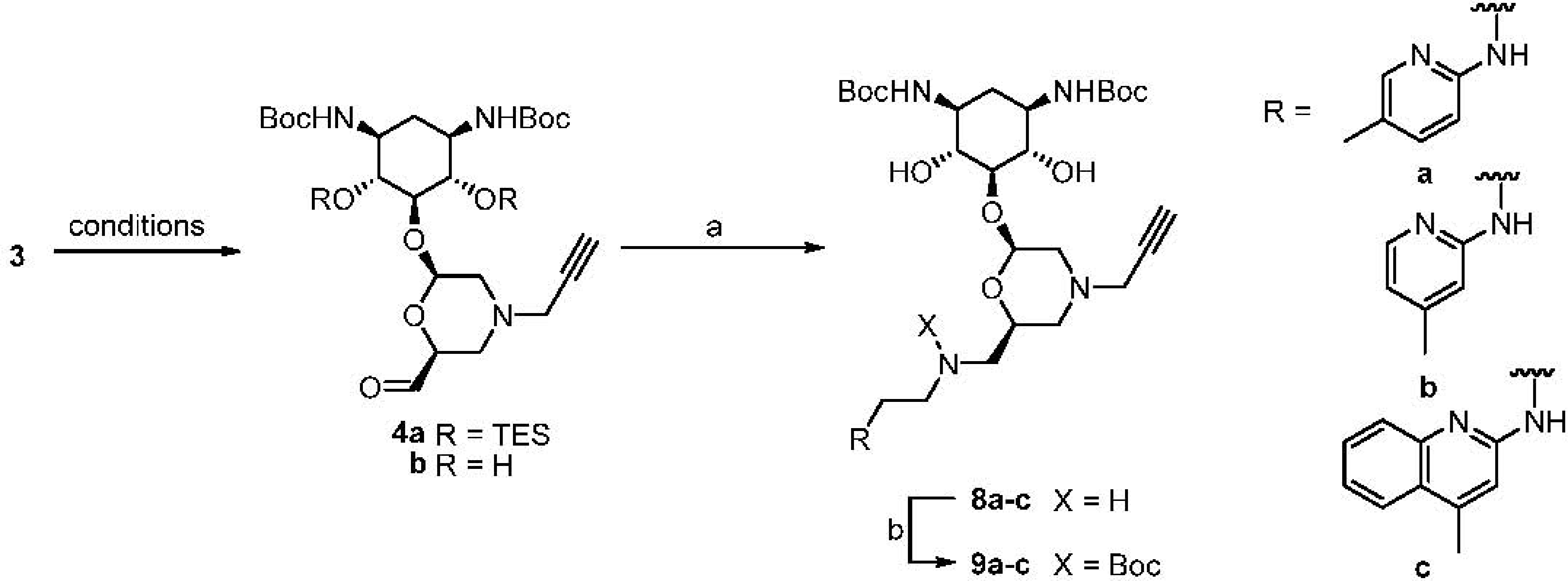
        <p>Having the primary amines at hand, the next step involved the diversification of morpholine <bold>3</bold> by conjugation with the aminoethyl derivatives <bold>5</bold>–<bold>7</bold>. For this purpose the primary hydroxyl of the compound <bold>3</bold> appeared most appropriate since it is most accessible and leaves the chiral secondary alcohols of 2-deoxystreptamine intact. Since reductive amination is such a robust conjugation technology, we aimed to selectively oxidize the primary alcohol of <bold>3</bold>. Because it is known that Swern oxidations can be selectively executed at <italic>O</italic>-TES protected primary alcohols [<xref ref-type="bibr" rid="B51">51</xref>], we treated compound <bold>3</bold> with TESOTf and triethylamine in dichloromethane to protect all hydroxyls with the TES group. Subsequently, the triply TES-protected derivative was subjected to Swern oxidation conditions (oxalyl chloride, DMSO, -78 °C°0 °C), in order to selectively oxidize the primary hydroxyl. However, an inseparable mixture of compounds was obtained (<xref ref-type="table" rid="table1">Table 1</xref>, entry 1).</p>
        <fig id="scheme3" position="float">
          <label>Scheme 3</label>
          <caption>
            <p>Conjugation of morpholine to aminopyridines and aminoquinolines</p>
          </caption>
          <graphic xmlns:xlink="http://www.w3.org/1999/xlink" xlink:href="scheme3.tif" scale="0"/>
        </fig>
        <p>Because Swern oxidation of TES ethers was not successful, we opted for a selective oxidation of the primary alcohol without<italic/>protective groups. However, attempts to oxidize the primary hydroxyl with TCCA/TEMPO [<xref ref-type="bibr" rid="B52">52</xref>] (entry 2) or IBX [<xref ref-type="bibr" rid="B53">53</xref>] (entry 3) gave no or less than 10% conversion, respectively. Finally, we succeeded (entry 4) in oxidizing the primary hydroxyl group with Dess-Martin periodinane [<xref ref-type="bibr" rid="B54">54</xref>] to give selectively the desired aldehyde <bold>4b</bold>.<bold/>However, also in this case the reaction did not go to completion, reaching a maximum of about 60% conversion. Further attempts to optimize the reaction conditions, e.g., variation in temperature, solvents or stoichiometry of the oxidant did not improve the outcome. </p>
        <table-wrap id="table1" position="float"><object-id pub-id-type="pii">pharmaceuticals-03-00679_table1</object-id>
          <object-id pub-id-type="pii">pharmaceuticals-03-00679_table1</object-id>
          <label>Table 1</label>
          <caption>
            <p>Conditions for selective oxidation of primary alcohal.</p>
          </caption>
          <table>
            <thead>
              <tr>
                <th align="left" valign="middle">
                  <bold>Entry</bold>
                </th>
                <th align="left" valign="middle">
                  <bold>Conditions</bold>
                </th>
                <th align="left" valign="middle">
                  <bold>Product</bold>
                </th>
                <th align="left" valign="middle">
                  <bold>Yield</bold>
                </th>
              </tr>
            </thead>
            <tbody>
              <tr>
                <td align="left" valign="middle">1</td>
                <td align="left" valign="middle">TESOTf, Et<sub>3</sub>N, CH<sub>2</sub>Cl<sub>2</sub>, r.t., 3 hii) (COCl)<sub>2</sub>, DMSO, CH<sub>2</sub>Cl<sub>2</sub>, -78 °C°0 °C</td>
                <td align="left" valign="middle">
                  <bold>4a</bold>
                </td>
                <td align="left" valign="middle">mixture</td>
              </tr>
              <tr>
                <td align="left" valign="middle">2</td>
                <td align="left" valign="middle">TCCA, TEMPO, CH<sub>3</sub>CN, r.t., 16 h</td>
                <td align="left" valign="middle">
                  <bold>4b</bold>
                </td>
                <td align="left" valign="middle">no reaction</td>
              </tr>
              <tr>
                <td align="left" valign="middle">3</td>
                <td align="left" valign="middle">IBX, DMF, r.t.°80 °C, 16 h</td>
                <td align="left" valign="middle">
                  <bold>4b</bold>
                </td>
                <td align="left" valign="middle">&lt;10% conversion</td>
              </tr>
              <tr>
                <td align="left" valign="middle">4</td>
                <td align="left" valign="middle">DMP, DMF, r.t., 16 h</td>
                <td align="left" valign="middle">
                  <bold>4b</bold>
                </td>
                <td align="left" valign="middle">60% conversion</td>
              </tr>
            </tbody>
          </table>
          <table-wrap-foot>
            <fn>
              <p><italic>Reagents and conditions</italic>: a) <bold>5</bold>/<bold>6</bold>/<bold>7</bold>, NaBH<sub>3</sub>CN, AcOH, MeOH, 3 h. b) Boc<sub>2</sub>O, DMAP, CH<sub>2</sub>Cl<sub>2, </sub>4 h (<bold>9a</bold>: 34%, <bold>9b</bold>: 37%, <bold>9c</bold>: 32%, for two steps).</p>
            </fn>
          </table-wrap-foot>
        </table-wrap>
        <p>The resulting aldehyde <bold>4b</bold> was subjected to the next reaction without purification on account of its instability. We therefore proceeded to couple crude aldehyde <bold>4b</bold> with aminopyridine and aminoquinoline derivatives <bold>5–7 </bold>(Scheme 3). Therefore, compounds <bold>5–7</bold> were condensed with aldehyde <bold>4b</bold> employing standard reductive amination conditions, e.g., NaBH<sub>3</sub>CN and AcOH in methanol. The relatively low yields of the resulting compounds <bold>8a-c</bold> can be ascribed to incomplete oxidation of the compound <bold>3</bold> in the proceeding step, apart from the fact that accompanying dialkylation of amines was observed during the reductive amination. However, in this case the desired conjugates <bold>9a</bold>-<bold>c </bold>could be readily purified by silica gel column chromatography. Both for this purpose and for follow-up chemistry, it was found most convenient to convert the resulting secondary amino functions of the initial products <bold>8a</bold>-<bold>c</bold> into Boc-protected carbamates under the influence of Boc<sub>2</sub>O and DMAP in CH<sub>2</sub>Cl<sub>2</sub>. Thus, heteroconjugates <bold>9a</bold>-<bold>c </bold>of truncated neomycin with non-aminoglycoside type RNA ligands were successfully prepared.</p>
      </sec>
      <sec>
        <title>Dimerization and Deprotection of the Conjugates</title>
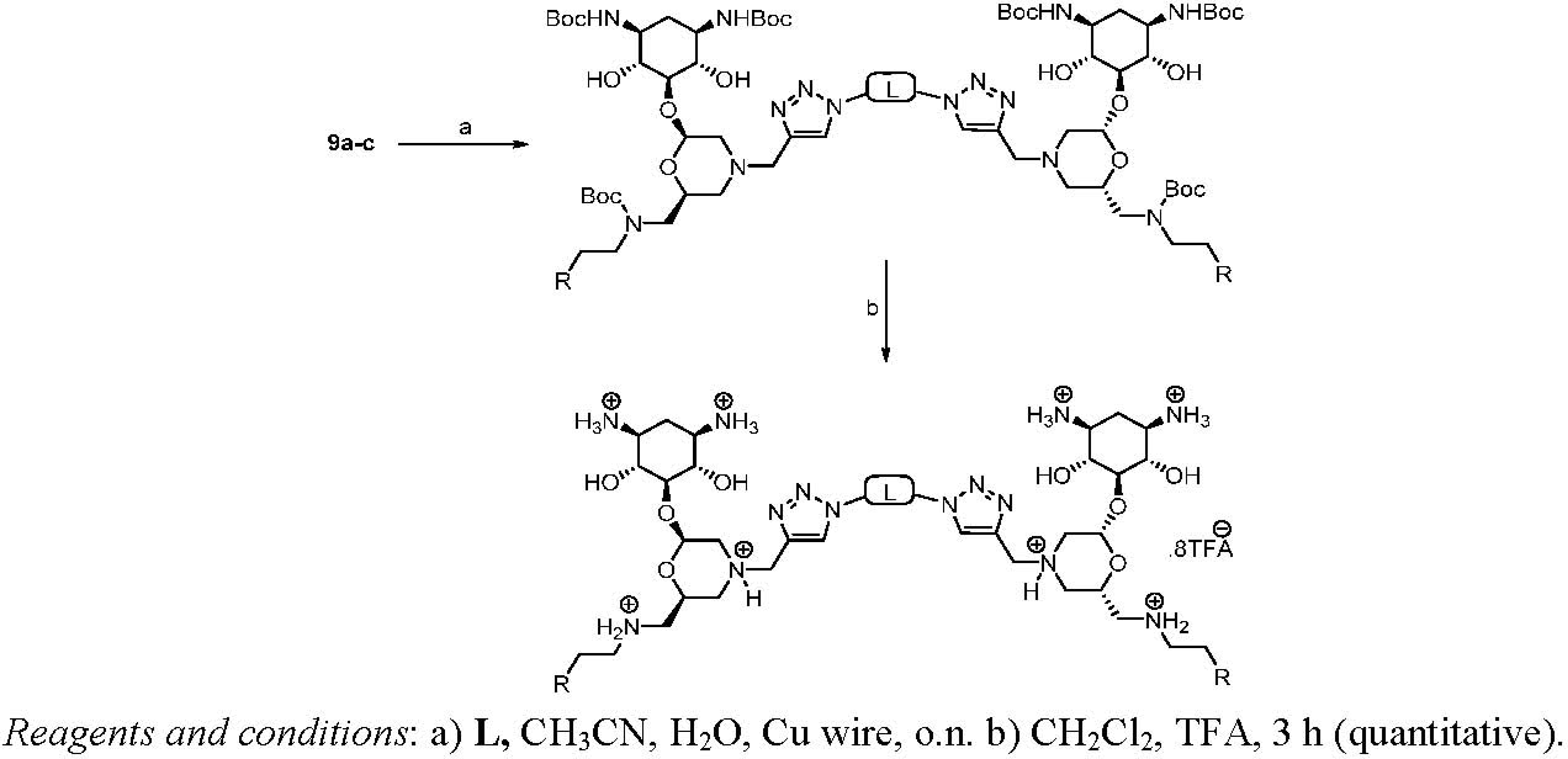
        <p>Obviously, the obtained arylamine-morpholine-2-deoxystreptamine conjugates contain a functional handle at the morpholine ring in the form of the propargyl moiety. Based on the popular copper(I)-catalyzed azide acetylene cycloaddition (CuAAC) [<xref ref-type="bibr" rid="B55">55</xref>,<xref ref-type="bibr" rid="B56">56</xref>], it is clear that the propargyl moiety provides an excellent handle for the preparation of further conjugates. Therefore, we next utilized the copper-catalyzed (3+2) cycloaddition chemistry to make immers with a range of mono- and bisazido-functionalized linkers. This approach provided maximum synthetic flexibility and proved effective for the synthesis of various monomers and immers from the building blocks <bold>9a</bold>-<bold>c</bold>. Thus, the synthetic heteroconjugates were treated with a monoazide (benzyl azide, 1 equiv.) or bisazides <bold>A</bold>-<bold>E</bold> (0.5 equiv.) in a mixture of water and acetonitrile in the presence of copper-wire [<xref ref-type="bibr" rid="B57">57</xref>] to make the respective monomers <bold>9a</bold>-<bold>cE</bold> and dimers <bold>9a</bold>-<bold>cA </bold>to <bold>9a</bold>-<bold>cD</bold> in reasonable to good yields (<xref ref-type="table" rid="table2">Table 2</xref>). Finally, acidic deprotection of the Boc protective groups was performed in a 1:2 mixture of TFA and DCM to afford the respective monomers and the dimers in quantitative yields, giving a final set of 15 arylamine-aminoglycoside conjugates (3 monomers, 12 dimers). For biological evaluation, all of the compounds were purified by reversed phase HPLC, giving the pure conjugates in 5–20 mg quantitities.<bold/></p>
        <fig id="scheme4" position="float">
          <label>Scheme 4</label>
          <caption>
            <p>Dimerization and deprotection of the conjugates</p>
          </caption>
          <graphic xmlns:xlink="http://www.w3.org/1999/xlink" xlink:href="scheme4.tif" scale="0"/>
        </fig>
        <p><italic>Reagents and conditions</italic>: a) <bold>L, </bold>CH<sub>3</sub>CN, H<sub>2</sub>O, Cu wire, o.n. b) CH<sub>2</sub>Cl<sub>2</sub>, TFA, 3 h (quantitative).</p>
        <table-wrap id="table2" position="float"><object-id pub-id-type="pii">pharmaceuticals-03-00679_table2</object-id>
          <object-id pub-id-type="pii">pharmaceuticals-03-00679_table2</object-id>
          <label>Table 2</label>
          <caption>
            <p>Linkers used for synthesis of dimers 9aA-9cE.</p>
          </caption>
          <table>
            <thead>
              <tr>
                <th align="left" valign="middle">
                  <bold>Entry</bold>
                </th>
                <th align="left" valign="middle">
                  <bold>Linker (L)</bold>
                </th>
                <th align="left" valign="middle">
                  <bold>Startingmaterial</bold>
                </th>
                <th align="left" valign="middle">
                  <bold>Product</bold>
                </th>
                <th align="left" valign="middle">
                  <bold>Yield</bold>
                </th>
              </tr>
            </thead>
            <tbody>
              <tr>
                <td align="left" valign="middle">123</td>
                <td align="left" valign="middle">
                  <graphic xmlns:xlink="http://www.w3.org/1999/xlink" xlink:href="pharmaceuticals-03-00679-i001.tif" scale="0"/>
                </td>
                <td align="left" valign="middle">
                  <bold>9a</bold>
                  <bold>9b</bold>
                  <bold>9c</bold>
                </td>
                <td align="left" valign="middle">
                  <bold>9aA</bold>
                  <bold>9bA</bold>
                  <bold>9cA</bold>
                </td>
                <td align="left" valign="middle">63%73%60%</td>
              </tr>
              <tr>
                <td align="left" valign="middle">456</td>
                <td align="left" valign="middle">
                  <graphic xmlns:xlink="http://www.w3.org/1999/xlink" xlink:href="pharmaceuticals-03-00679-i002.tif" scale="0"/>
                </td>
                <td align="left" valign="middle">
                  <bold>9a</bold>
                  <bold>9b</bold>
                  <bold>9c</bold>
                </td>
                <td align="left" valign="middle">
                  <bold>9aB</bold>
                  <bold>9bB</bold>
                  <bold>9cB</bold>
                </td>
                <td align="left" valign="middle">57%65%58%</td>
              </tr>
              <tr>
                <td align="left" valign="middle">789</td>
                <td align="left" valign="middle">
                  <graphic xmlns:xlink="http://www.w3.org/1999/xlink" xlink:href="pharmaceuticals-03-00679-i003.tif" scale="0"/>
                </td>
                <td align="left" valign="middle">
                  <bold>9a</bold>
                  <bold>9b</bold>
                  <bold>9c</bold>
                </td>
                <td align="left" valign="middle">
                  <bold>9aC</bold>
                  <bold>9bC</bold>
                  <bold>9cC</bold>
                </td>
                <td align="left" valign="middle">61%66%69%</td>
              </tr>
              <tr>
                <td align="left" valign="middle">101112</td>
                <td align="left" valign="middle">
                  <graphic xmlns:xlink="http://www.w3.org/1999/xlink" xlink:href="pharmaceuticals-03-00679-i004.tif" scale="0"/>
                </td>
                <td align="left" valign="middle">
                  <bold>9a</bold>
                  <bold>9b</bold>
                  <bold>9c</bold>
                </td>
                <td align="left" valign="middle">
                  <bold>9aD</bold>
                  <bold>9bD</bold>
                  <bold>9cD</bold>
                </td>
                <td align="left" valign="middle">60%65%66%</td>
              </tr>
              <tr>
                <td align="left" valign="middle">131415</td>
                <td align="left" valign="middle">
                  <graphic xmlns:xlink="http://www.w3.org/1999/xlink" xlink:href="pharmaceuticals-03-00679-i005.tif" scale="0"/>
                </td>
                <td align="left" valign="middle">
                  <bold>9a</bold>
                  <bold>9b</bold>
                  <bold>9c</bold>
                </td>
                <td align="left" valign="middle">
                  <bold>9aE</bold>
                  <bold>9bE</bold>
                  <bold>9cE</bold>
                </td>
                <td align="left" valign="middle">87%92%90%</td>
              </tr>
            </tbody>
          </table>
        </table-wrap>
      </sec>
      <sec>
        <title>Evaluation of Antibacterial Activity</title>
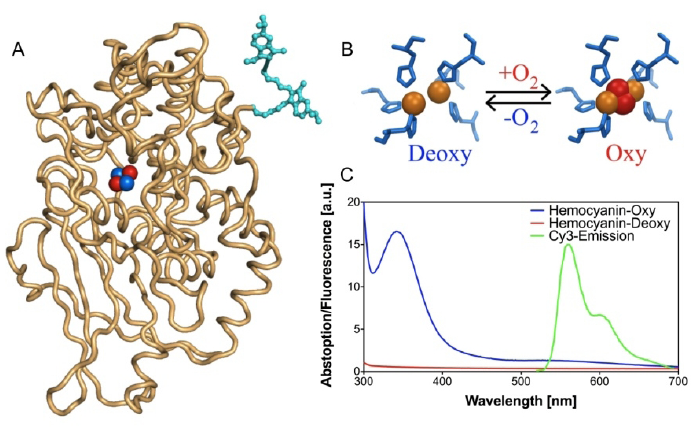
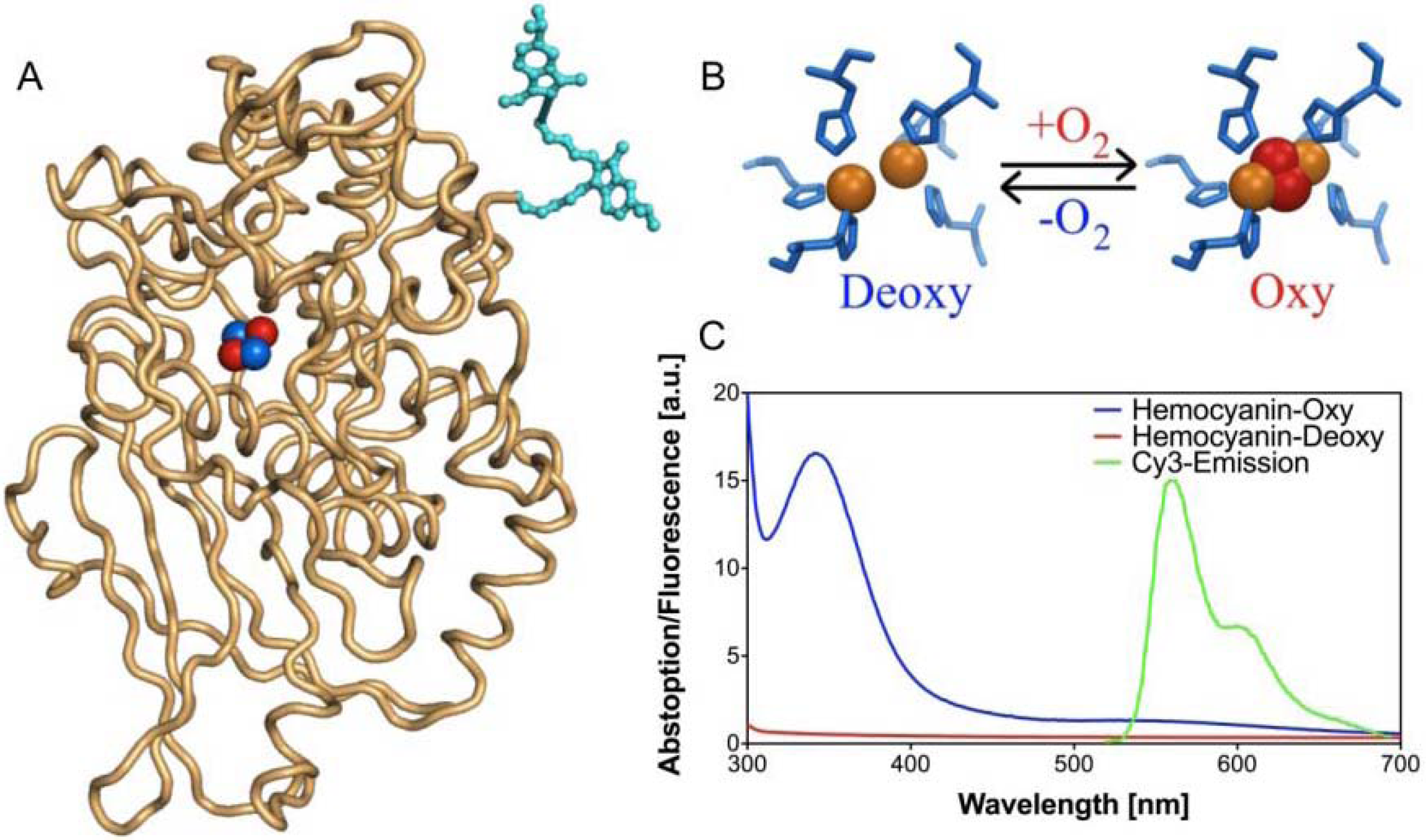
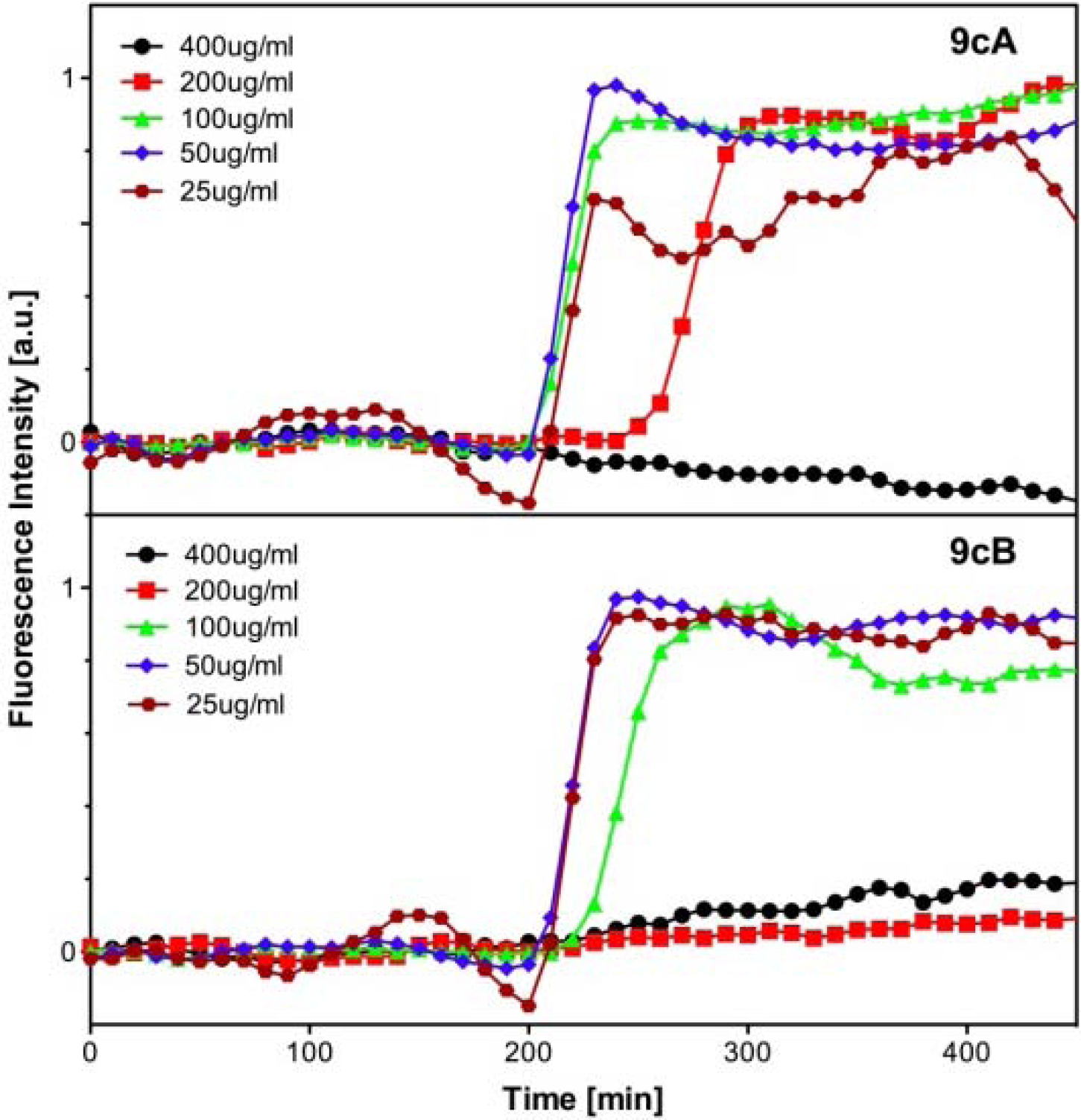
        <p>Having prepared the desired conjugates, we were interested to investigate the antibacterial activity of these compounds. Determination of antibacterial activity is normally expressed in MIC (minimal inhibitory concentration) by growing bacteria in medium containing increasing amounts of the presumed antibiotic. Such an assay typically requires substantial amounts of compounds (30–70 mg), clearly exceeding the amount of compound that we had prepared. With small amounts of substrate, antibacterial activity can also be determined with Kirby-Bauer disc test, but that provides only a qualitative measure of activity. Alternatively, a plethora of RNA-binding assays have been developed [<xref ref-type="bibr" rid="B58">58</xref>,<xref ref-type="bibr" rid="B59">59</xref>,<xref ref-type="bibr" rid="B60">60</xref>,<xref ref-type="bibr" rid="B61">61</xref>,<xref ref-type="bibr" rid="B62">62</xref>,<xref ref-type="bibr" rid="B63">63</xref>,<xref ref-type="bibr" rid="B64">64</xref>,<xref ref-type="bibr" rid="B65">65</xref>,<xref ref-type="bibr" rid="B66">66</xref>,<xref ref-type="bibr" rid="B67">67</xref>,<xref ref-type="bibr" rid="B68">68</xref>,<xref ref-type="bibr" rid="B69">69</xref>], but a strong drawback of such assays is that they do not include cell-wall penetration or resistance mechanisms, obviously key in determining the overall activity of an antibiotic [<xref ref-type="bibr" rid="B70">70</xref>]. An alternative approach, recently reported by some of us [<xref ref-type="bibr" rid="B71">71</xref>], determines MICs on whole bacteria in a simple and rapid assay and moreover requires only minimal amounts (&lt; 2 mg) of substrate. The technique relies on a fluorescence-based cell viability assay and involves a hemocyanin-based oxygen biosensor to monitor oxygen consumption of bacteria and subsequently bacterial cell growth (<xref ref-type="fig" rid="figure1">Figure 1</xref>).</p>
        <fig id="figure1" position="float">
          <label>Figure 1</label>
          <caption>
            <p>(A) Representation of Cy3-labeled hemocyanin. The Cy3 dye (cyan) is showed attached to the end terminus of a monomer hemocyanin. (B) Detail of hemocyanin active site showing the active site histidines (blue), copper ions (orange) and the binding oxygen molecule (red). (C) The absorption spectra of the deoxygenated (red) and oxygenated (blue) forms of hemocyanin together with the emission spectrum of Cy3 (green).</p>
          </caption>
          <graphic xmlns:xlink="http://www.w3.org/1999/xlink" xlink:href="pharmaceuticals-03-00679-g001.tif" scale="0"/>
        </fig>
        <p>Deoxygenated hemocyanin has no absorption in the visible spectrum but upon oxygenation a strong band centered at 340 nm and a weak band around 570 nm appear (<xref ref-type="fig" rid="figure1">Figure 1</xref>B). If a fluorescent label is attached to the N-terminus of hemocyanin, this change in absorption can be translated into a change of fluorescence intensity of an attached label (Cy3, Cyanine 3 fluorescent dye) through a Förster resonance energy transfer (FRET) mechanism (<xref ref-type="fig" rid="figure1">Figure 1</xref>A) [<xref ref-type="bibr" rid="B72">72</xref>]. The efficiency of this energy transfer depends on the distance and orientation between the donor and the acceptor and also on the overlap integral between the donor emission and acceptor absorption spectra (<xref ref-type="fig" rid="figure1">Figure 1</xref>C). In this way, when the protein is in its deoxygenated state (Cy3-Deoxy-Hemocyanin), all the energy absorbed by the label is emitted normally as fluorescence. Upon oxygenation of hemocyanin (Cy3-Oxy-Hemocyanin), energy is transferred from Cy3 by radiationless decay to the copper center of hemocyanin, resulting in a decrease in the fluorescence intensity. Thus, when a bacterial culture grows aerobically, oxygen in the medium is gradually consumed. This results in a drop of the oxygen concentration, eventually resulting in an anaerobic medium. When hemocyanin-based oxygen biosensor is present, this oxygen depletion results in an increase of the fluorescence intensity emitted by the Cy3 label attached to protein [<xref ref-type="bibr" rid="B71">71</xref>].<bold>Error! Bookmark not defined.</bold> Tests were carried out as described<bold>Error! Bookmark not defined.</bold> [<xref ref-type="bibr" rid="B71">71</xref>] with an initial cell concentration of 10<sup>5</sup> cfu/mL.</p>
        <fig id="figure2" position="float">
          <label>Figure 2</label>
          <caption>
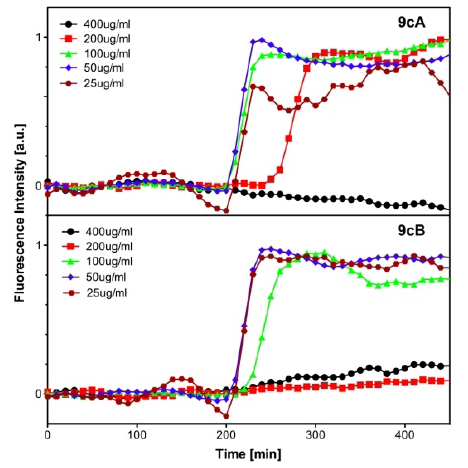
            <p>Fluorescence intensity time traces at 570 nm (excitation 550 nm) of cultures of <italic>E. coli</italic> containing Cy3-labeled  hemocyanin as a function of antibiotic concentration. Antibiotic concentrations of <bold>9cA</bold> and <bold>9cB</bold> are stated.</p>
          </caption>
          <graphic xmlns:xlink="http://www.w3.org/1999/xlink" xlink:href="pharmaceuticals-03-00679-g002.tif" scale="0"/>
        </fig>
        <p>We determined the MICs of our heteroconjugates with the fluorescence-based cell viability assay against several bacterial strains (<italic>E. coli, E. coli kan.<sup>r </sup></italic>e.g.,<italic/>kanamycin-resistant <italic>E. coli</italic>)<italic/>using kanamycin as a positive control. As can be seen from <xref ref-type="fig" rid="figure2">Figure 2</xref>, using compound <bold>9cA </bold>and<bold> 9cB</bold> as an example, the MIC is determined by performing the bacterial growth in medium containing increasing amounts of our compounds. The MIC values of our synthetic analogues can be determined from <xref ref-type="fig" rid="figure2">Figure 2</xref> and are depicted in <xref ref-type="table" rid="table3">Table 3</xref>.</p>
        <table-wrap id="table3" position="float"><object-id pub-id-type="pii">pharmaceuticals-03-00679_table3</object-id>
          <object-id pub-id-type="pii">pharmaceuticals-03-00679_table3</object-id>
          <label>Table 3</label>
          <caption>
            <p>MIC values (µg/ mL) as determind by the fluorescence-based cell growth assay.</p>
          </caption>
          <table>
            <thead>
              <tr>
                <th rowspan="2" align="left" valign="middle">
                  <bold>Entry</bold>
                </th>
                <th rowspan="2" align="left" valign="middle">
                  <bold>bacterial strain</bold>
                </th>
                <th colspan="7" align="middle" valign="middle">
                  <bold>MIC (μg/ mL)</bold>
                </th>
              </tr>
              <tr>
                <th align="left" valign="middle">
                  <bold>kanamycin</bold>
                </th>
                <th align="left" valign="middle">
                  <bold>s.m.</bold>
                </th>
                <th align="left" valign="middle">
                  <bold>linker A</bold>
                </th>
                <th align="left" valign="middle">
                  <bold>linkerB</bold>
                </th>
                <th align="left" valign="middle">
                  <bold>linkerC</bold>
                </th>
                <th align="left" valign="middle">
                  <bold>linkerD</bold>
                </th>
                <th align="left" valign="middle">
                  <bold>linkerE</bold>
                </th>
              </tr>
            </thead>
            <tbody>
              <tr>
                <td align="left" valign="middle">1</td>
                <td align="left" valign="middle">
                  <italic>E. coli</italic>
                </td>
                <td align="left" valign="middle">10</td>
                <td align="left" valign="middle">
                  <bold>9a</bold>
                </td>
                <td align="left" valign="middle">200–400</td>
                <td align="left" valign="middle">200–400</td>
                <td align="left" valign="middle">400–800</td>
                <td align="left" valign="middle">400–800</td>
                <td align="left" valign="middle">400–800</td>
              </tr>
              <tr>
                <td align="left" valign="middle">2</td>
                <td align="left" valign="middle">-do-</td>
                <td align="left" valign="middle">10</td>
                <td align="left" valign="middle">
                  <bold>9b</bold>
                </td>
                <td align="left" valign="middle">400–800</td>
                <td align="left" valign="middle">400–800</td>
                <td align="left" valign="middle">400–800</td>
                <td align="left" valign="middle">400–800</td>
                <td align="left" valign="middle">400–800</td>
              </tr>
              <tr>
                <td align="left" valign="middle">3</td>
                <td align="left" valign="middle">-do-</td>
                <td align="left" valign="middle">10</td>
                <td align="left" valign="middle">
                  <bold>9c</bold>
                </td>
                <td align="left" valign="middle">200–400</td>
                <td align="left" valign="middle">100–200</td>
                <td align="left" valign="middle">200–400</td>
                <td align="left" valign="middle">400–800</td>
                <td align="left" valign="middle">200–400</td>
              </tr>
            </tbody>
          </table>
        </table-wrap>
      </sec>
      <sec>
        <title>Second Generation Monomeric Ligands</title>
        <p>Unfortunately, our set of dimers of heteroconjugates exhibited lower antibacterial activity than that of natural kanamycin when tested against <italic>E. coli</italic>. In fact, only compound <bold>9cB</bold> demonstrated reasonable antibacterial activity. Moreover, and in contrast to expectation, it is clear that the dimers do not show improved activity compared to the monomeric substrates <bold>9a</bold>-<bold>cE</bold>.</p>
        <fig id="scheme5" position="float">
          <label>Scheme 5</label>
          <caption>
            <p>Synthesis and deprotection of monomeric ligands.</p>
          </caption>
          <graphic xmlns:xlink="http://www.w3.org/1999/xlink" xlink:href="scheme5.tif" scale="0"/>
        </fig>
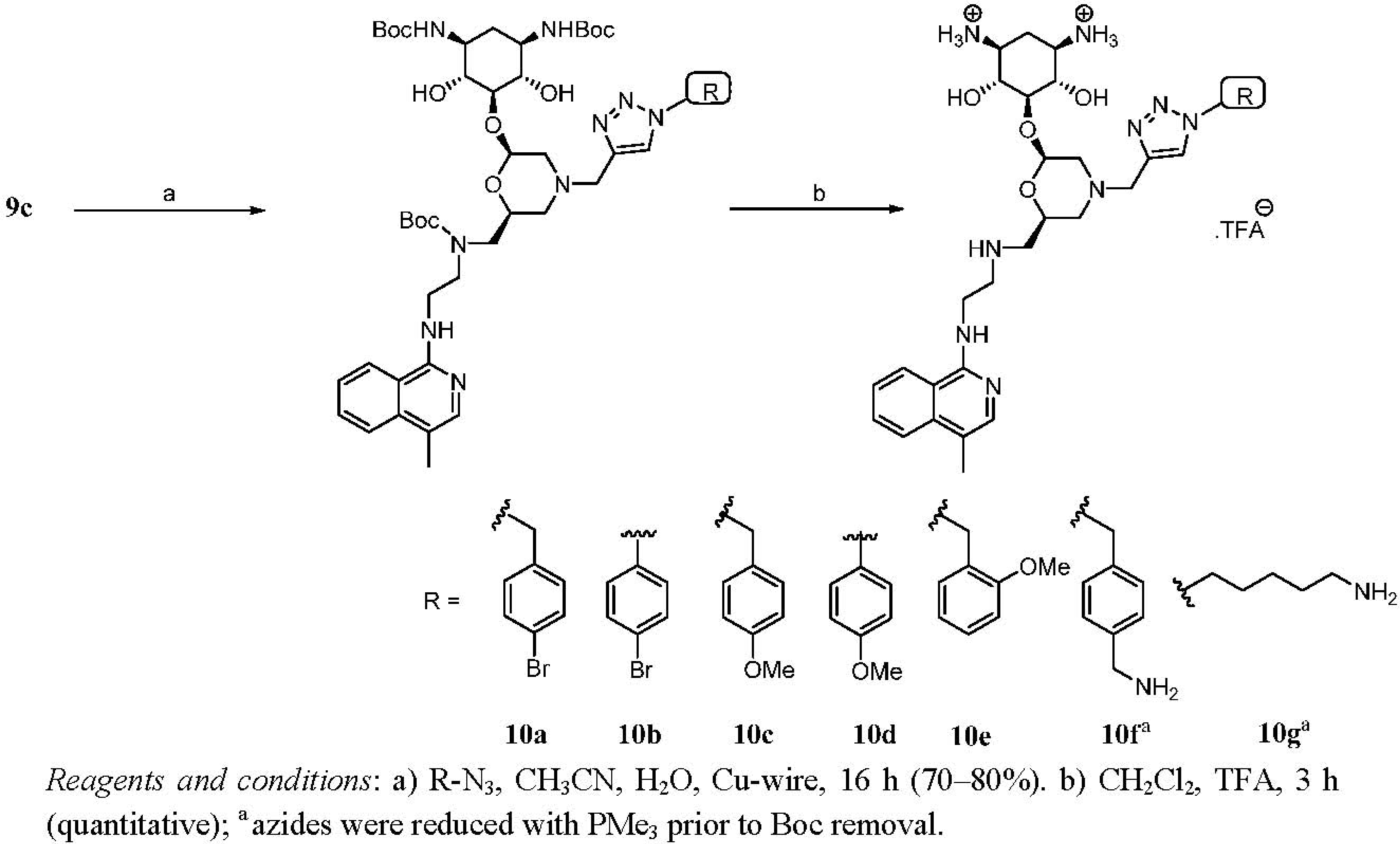
        <p><italic>Reagents and conditions</italic>: a) R-N<sub>3</sub>, CH<sub>3</sub>CN, H<sub>2</sub>O, Cu-wire, 16 h (70–80%). b) CH<sub>2</sub>Cl<sub>2</sub>, TFA, 3 h (quantitative); <sup>a </sup>azides were reduced with PMe<sub>3</sub> prior to Boc removal.</p>
        <p>The lack of improved activity is in contrast to findings by other groups [<xref ref-type="bibr" rid="B34">34</xref>,<xref ref-type="bibr" rid="B35">35</xref>,<xref ref-type="bibr" rid="B36">36</xref>,<xref ref-type="bibr" rid="B37">37</xref>,<xref ref-type="bibr" rid="B38">38</xref>,<xref ref-type="bibr" rid="B39">39</xref>,<xref ref-type="bibr" rid="B40">40</xref>,<xref ref-type="bibr" rid="B41">41</xref>,<xref ref-type="bibr" rid="B42">42</xref>,<xref ref-type="bibr" rid="B43">43</xref>], which may be explained in our case by the relatively short linkers employed. It is not excluded that a short linker is precluding cooperative binding of the other end of the molecule to a second binding pocket. Whatever the reason, the fact that the MIC value of the monomeric compound <bold>9cE</bold> was comparable to that of different dimers stimulated us to explore whether antibacterial activity of the more simple, monomeric heteroconjugates could be further raised by modification of the azide partner for cycloaddition to the acetylene. Thus, we selected a range of aromatic and aliphatic azides and coupled these to acetylene derivatives <bold>9a</bold>-<bold>c </bold>with CuAAC to obtain a set of monomeric compounds <bold>10a-g </bold>with different substituents (Scheme 5).<bold/>Thus, compounds<bold> 10a–e</bold> were synthesized by simply treating <bold>9c</bold> with different monoazides in a mixture of water and acetonitrile in the presence of copper wire. For the synthesis of amino-terminated compounds <bold>10f </bold>and <bold>10g, </bold>acetylene<bold> 9c </bold>was treated with an excess of 1,4-bis(azidomethyl)benzene or 1,5-diazidopentane, to give the respective monosubstituted triazole adducts, followed by Staudinger reduction of the unreacted azide group at the other chain terminus under the action of PMe<sub>3</sub>. Again, all compounds <bold>10a</bold>-<bold>g</bold> were purified to homogeneity by reversed-phased HPLC before evaluation of antibacterial activity. Next, we tested the antibacterial activity of this set of compounds employing the same fluorescence-based cell viability assay and the results are summarized in <xref ref-type="table" rid="table3">Table 3</xref>. As evident from MIC values, <italic>para</italic>-bromo substitution of the aromatic ring enhanced the antibacterial activity of compounds <bold>10a</bold> and <bold>10b</bold>. The rest of the monomeric compounds, with a methoxy- or methylamino-substituent on the aromatic ring <bold>10c-10f</bold>,<bold/>or with the aliphatic chain <bold>10g</bold> showed a reduced antibacterial activity compared to that of unsubstituted parent compound <bold>9cE. </bold>Finally we tested the MIC of the most active compounds against the kanamycin resistant strains of <italic>E. coli</italic> (<xref ref-type="table" rid="table4">Table 4</xref>, entry 2). We were happy to find that compounds <bold>10a </bold>and <bold>10b </bold>have distinct antibacterial activity against <italic>E. coli. </italic>More importantly, compound <bold>10b </bold>displayed an improved activity against the kanamycin-resistant <italic>E. coli </italic>strain revealing that omission of the diaminoglycosides indeed fulfills our desired aim to reduce susceptibility to resistance mechanisms. The search for further synthetic analogues of aminoglycosides with such improved traits is currently ongoing in our laboratory.</p>
        <table-wrap id="table4" position="float"><object-id pub-id-type="pii">pharmaceuticals-03-00679_table4</object-id>
          <object-id pub-id-type="pii">pharmaceuticals-03-00679_table4</object-id>
          <label>Table 4</label>
          <caption>
            <p>MIC values (μg/mL) as determined by fluorescence-based cell growth assay.</p>
          </caption>
          <table>
            <thead>
              <tr>
                <th rowspan="2" align="left" valign="middle">
                  <bold>Entry</bold>
                </th>
                <th rowspan="2" align="left" valign="middle">
                  <bold>bacterial strains</bold>
                </th>
                <th colspan="10" align="left" valign="middle">
                  <bold>MIC (μg/mL)</bold>
                </th>
              </tr>
              <tr>
                <th align="left" valign="middle">
                  <bold>kanamycin</bold>
                </th>
                <th align="left" valign="middle">
                  <bold>10a</bold>
                </th>
                <th align="left" valign="middle">
                  <bold>10b</bold>
                </th>
                <th align="left" valign="middle">
                  <bold>10c</bold>
                </th>
                <th align="left" valign="middle">
                  <bold>10d</bold>
                </th>
                <th align="left" valign="middle">
                  <bold>10e</bold>
                </th>
                <th align="left" valign="middle">
                  <bold>10f</bold>
                </th>
                <th align="left" valign="middle">
                  <bold>10g</bold>
                </th>
                <th align="left" valign="middle">
                  <bold>9cB</bold>
                </th>
                <th align="left" valign="middle">
                  <bold>9cE</bold>
                </th>
              </tr>
            </thead>
            <tbody>
              <tr>
                <td align="left" valign="middle">1</td>
                <td align="left" valign="middle">
                  <italic>E. coli</italic>
                </td>
                <td align="left" valign="middle">10</td>
                <td align="left" valign="middle">100-200</td>
                <td align="left" valign="middle">100-200</td>
                <td align="left" valign="middle">400-800</td>
                <td align="left" valign="middle">400-800</td>
                <td align="left" valign="middle">400-800</td>
                <td align="left" valign="middle">400-800</td>
                <td align="left" valign="middle">400-800</td>
                <td align="left" valign="middle">-</td>
                <td align="left" valign="middle">-</td>
              </tr>
              <tr>
                <td align="left" valign="middle">2</td>
                <td align="left" valign="middle">
                  <italic>E. coli kan<sup>r</sup></italic>
                </td>
                <td align="left" valign="middle">400–800</td>
                <td align="left" valign="middle">400-800</td>
                <td align="left" valign="middle">200-400</td>
                <td align="left" valign="middle">&gt;800</td>
                <td align="left" valign="middle">-</td>
                <td align="left" valign="middle">-</td>
                <td align="left" valign="middle">-</td>
                <td align="left" valign="middle">-</td>
                <td align="left" valign="middle">&gt;800</td>
                <td align="left" valign="middle">&gt;800</td>
              </tr>
            </tbody>
          </table>
        </table-wrap>
      </sec>
    </sec>
    <sec>
      <title>Experimental Section</title>
      <sec>
        <title>General</title>
        <p>TLC analyses are performed on silica gel-coated plates (Merck 60 F254) with the indicated solvent mixture. Compounds were detected with ammonium molybdate or potassium permanganate staining, or UV light. Flash column chromatography was carried out using ACROS silica gel (0.035–0.070 mm, ca 6 nm pore diameter). Solvents were distilled from appropriate drying agents prior to use. Unless stated otherwise, all chemicals were purchased and used as such. IR spectra were recorded on an ATI Mattson Genesis Series FTIR spectrometer; absorption reported in cm<sup>-1</sup>. NMR spectra were recorded on a Bruker DMX 300 (75 MHz), and a Varian 400 (400 MHz) spectrometer. <sup>1</sup>H-NMR and <sup>13</sup>C-NMR spectra are reported in ppm units on the δ scale. Coupling constants are reported as <italic>J</italic>-values in Hz. Semipreparative RP-HPLC was performed using a C<sub>18 </sub>column (10 × 250 mm, 5 µm) with HPLC grade MilliQ containing 0.1% TFA (eluant A) and acetonitrile containing 0.1% TFA (eluant B) with a gradient of 5 → 50% of B in 30 min. Compounds were detected by UV absorption at 215 and 254 nm.</p>
      </sec>
      <sec>
        <title>Hexa-N-(tert-butoxycarbonyl) neomycin B (<bold>1</bold>)<bold> [49]</bold><bold/></title>
        <p>To a solution of neomycin B (2 g, 2.2 mmol) in a mixture of H<sub>2</sub>O/1,4-dioxane (30 mL, 1:1 v/v) was added Na<sub>2</sub>CO<sub>3 </sub>and di-<italic>tert</italic>-butyl dicarbonate. The reaction mixture was stirred at room temperature for 6 h. Dioxane was removed by evaporation and the residue was partitioned between EtOAc (100 mL) and H<sub>2</sub>O (100 mL). The aqueous layer was extracted with EtOAc (2 ×50 mL) and the combined organic layers werewashed with brine (100 mL), dried (Na<sub>2</sub>SO<sub>4</sub>) and concentrated <italic>in vacuo</italic>. Purification by column chromatography (MeOH/CH<sub>2</sub>Cl<sub>2</sub>, 1/9) afforded <bold>1 </bold>(2.2 g, 82%) as an amorphous white solid. <italic>R</italic><sub>F </sub>0.49 (MeOH/CH<sub>2</sub>Cl<sub>2</sub>, 1/9). HRMS (ESI) <italic>m/z </italic>calcd. for C<sub>53</sub>H<sub>94</sub>N<sub>6</sub>O<sub>25</sub> (M+Na)<sup>+</sup>: 1237.6166, found: 1237.6141.</p>
      </sec>
      <sec>
        <title>5-O-(β-d-ribofuranosyl)-2-deoxystreptamine (<bold>2</bold>)</title>
        <p><bold> </bold>To a solution of <bold>1 </bold>(1 g, 0.82 mmol) in 25 mL of MeOH, was added 25 mL of a H<sub>2</sub>O solution of NaIO<sub>4</sub> (2.12 g, 9.8 mmol). The reaction mixture was stirred at room temperature for 16 h. Methanol was removed by evaporation and the residue was partitioned between EtOAc (100 mL) and H<sub>2</sub>O (50 mL). The aqueous layer was extracted with EtOAc (2 × 50 mL) and the combined organic layers werewashed with brine (100 mL), dried (Na<sub>2</sub>SO<sub>4</sub>) and concentrated <italic>in vacuo</italic>. The residue was dissolved in MeOH (30 mL), and Et<sub>3</sub>N (2 mL) was added. The reaction mixture was stirred at room temperature for 16 h and then concentrated in <italic>vacuo</italic>. Purification by crystallization from CH<sub>2</sub>Cl<sub>2 </sub>(100 mL) afforded compound <bold>2</bold> (212 mg, 52%) as a white amorphous solid. <italic>R</italic><sub>F </sub>0.12 (MeOH/CH<sub>2</sub>Cl<sub>2</sub>, 1/9); <sup>1</sup>H-NMR (MeOD, 400 MHz) δ 5.21 (s, 1H), 4.32 (dd, <italic>J </italic>=4.5, 7.7 Hz, 1H), 3.99 (d, <italic>J </italic>=4.5 Hz, 1H), 3.90 (dt, <italic>J </italic>=2.6, 7.7 Hz, 1H), 3.78 (dd, <italic>J </italic>=2.3, 12.1 Hz, 1H), 3.60 (dd, <italic>J </italic>=2.6, 12.1 Hz, 1H), 3.40–3.15 (m, 10H), 2.02 (dt, <italic>J </italic>=4.2, 7.9 Hz, 1H), 1.41 (s, 18H), 1.21 (m, 1H); <sup>13</sup>C-NMR (MeOD, 75 MHz): δ 156.3, 107.8, 83.8, 82.3, 78.2, 74.7, 72.7, 68.6, 59.7, 50.6, 33.8,26.8; HRMS (ESI) <italic>m/z </italic>calcd. for C<sub>21</sub>H<sub>38</sub>N<sub>2</sub>O<sub>11</sub> (M+Na)<sup>+</sup>: 517.2373, found: 517.2375.</p>
      </sec>
      <sec>
        <title>5-O-(N-propyn-1-yl -morpholino)-2-deoxystreptamine<bold/>(<bold>3</bold>)</title>
        <p>To a solution of <bold>2 </bold>(830 mg, 1.68 mmol) in 20 mL of MeOH, was added 20 mL of a H<sub>2</sub>O solution of NaIO<sub>4</sub> (431 mg, 2.016 mmol). The reaction mixture was stirred at room temperature for 2 h. The methanol was removed by evaporation and the residue was partitioned between EtOAc (100 mL) and H<sub>2</sub>O (50 mL). The aqueous layer was extracted with EtOAc (2 ×50 mL) and the combined organic layers werewashed with brine (100 mL), dried (Na<sub>2</sub>SO<sub>4</sub>) and concentrated <italic>in vacuo</italic>. The residue was dissolved in 15 mL of MeOH, and NaBH<sub>3</sub>CN (422 mg, 6.72 mmol) was added. To the resulting mixture was added drop-wise a solution of propargylamine (138 μL, 2.52 mmol) and AcOH (403 μL, 6.72 mmol) in MeOH (1 mL). The reaction mixture was stirred at room temperature for 2 h. The reaction was then quenched with 0.5 mL of Et<sub>3</sub>N and concentrated <italic>in vacuo</italic>. The residue was taken up in EtOAc (100 mL), washed with saturated NaHCO<sub>3</sub> (2 × 50 mL) and brine (50 mL). The organic layer was dried (Na<sub>2</sub>SO<sub>4</sub>), filtered and concentrated <italic>in vacuo</italic>.Purification by column chromatography (MeOH/CH<sub>2</sub>Cl<sub>2</sub>, 1/9) afforded <bold>1 </bold>(358 mg, 41%) as an amorphous white solid. <italic>R</italic><sub>F </sub>0.34 (MeOH/CH<sub>2</sub>Cl<sub>2</sub>, 1/9); <sup>1</sup>H-NMR (MeOD, 400 MHz) δ 4.85 (dd, <italic>J </italic>= 2.3, 8.6 Hz, 1H), 3.70 (m, 1H), 3.57 (dd, <italic>J </italic>= 1.7, 5.1Hz, 2H), 3.42–3.19 (m, 11H), 3.01 (d, <italic>J </italic>= 10.5 Hz, 1H), 2.70 (d, <italic>J </italic>= 11.1 Hz, 1H), 2.65 (t, <italic>J </italic>= 2.3 Hz, 1H), 2.13 (m, 2H), 2.02 (dt, <italic>J </italic>= 3.9, 13.0 Hz, 1H), 1.41 (s, 18H), 1.21 (dd, <italic>J </italic>= 12.5 Hz, 1H). <sup>13</sup>C-NMR (MeOD, 75 MHz): δ 156.2, 99.7, 85.2, 78.1, 76.7, 74.1, 73.5, 72.5, 61.9, 54.1, 51.3, 50.6, 50.4, 45.1, 33.6, 26.8; HRMS (ESI) <italic>m/z </italic>calcd. for C<sub>24</sub>H<sub>41</sub>N<sub>3</sub>O<sub>9</sub> (M+H)<sup>+</sup>: 516.2921, found: 516.2925.<bold/></p>
      </sec>
      <sec>
        <title>2-(2-Aminoethylamino)-4-methylpyridine (<bold>5</bold>)</title>
        <p>A solution of 2-chloro-4-methylpyridine (0.876 mL, 10 mmol) in 1,2-diaminoethane (6 mL) was heated at 150°C for 18 h. The volatiles were removed in <italic>vacuo</italic>. Purification by column chromatography (10% MeOH/CH<sub>2</sub>Cl<sub>2 </sub>to 20% MeOH/CH<sub>2</sub>Cl<sub>2</sub>) afforded <bold>5 </bold>(700 mg, 46%) as a yellow oil; <sup>1</sup>H-NMR (MeOD, 300 MHz) δ 7.76 (d, <italic>J </italic>= 4.8 Hz, 1H), 6.36 (m, 2H), 3.31 (t, <italic>J </italic>= 6.2 Hz, 2H), 2.79 (t, <italic>J </italic>= 6.2 Hz, 2H), 2.17 (s, 3H); <sup>13</sup>C-NMR (MeOD, 75 MHz): δ 156.5, 145.0, 136.2, 121.1, 106.6, 40.1, 39.9, 15.5.HRMS (ESI) <italic>m/z </italic>calcd. for C<sub>8</sub>H<sub>13</sub>N<sub>3</sub> (M+H)<sup>+</sup>: 152.1187, found: 152.1199.</p>
      </sec>
      <sec>
        <title>2-(2-Aminoethylamino)-5-methylpyridine (<bold>6</bold>)</title>
        <p><bold> </bold>A solution of 2-chloro-5-methylpyridine (0.434 mL, 5 mmol) in 1,2-diaminoethane (3 mL) was heated at 150°C for 18 h. The volatiles were removed in <italic>vacuo</italic>. Purification by column chromatography (10% MeOH/CH<sub>2</sub>Cl<sub>2 </sub>to 20% MeOH/CH<sub>2</sub>Cl<sub>2</sub>) afforded <bold>6 </bold>(386 mg, 51%) as a yellow oil; <sup>1</sup>H-NMR (MeOD, 300 MHz) δ 7.72 (m, 1H), 7.27 (dd, <italic>J </italic>= 2.5, 8.5 Hz, 1H), 6.46 (d, <italic>J </italic>= 8.5 Hz, 1H), 3.30 (t, <italic>J </italic>= 6.2 Hz, 2H), 2.79 (t, <italic>J </italic>= 6.2 Hz, 2H), 2.13 (s, 3H). <sup>13</sup>C-NMR (MeOD, 75 MHz): δ 156.6, 145.3, 138.0, 120.3, 107.7, 43.5, 40.1, 15.5; HRMS (ESI) <italic>m/z </italic>calcd. For C<sub>8</sub>H<sub>13</sub>N<sub>3</sub> (M+H)<sup>+</sup>: 152.1187, found: 152.1199.</p>
      </sec>
      <sec>
        <title>2-Aminoethylamino)-4-methylquinoline (<bold>7</bold>)</title>
        <p><bold><italic> </italic></bold>A solution of 2-chloro-4-methylquinoline (1.7 g, 10 mmol) in 1,2-diaminoethane (6 mL) was heated at 150°C for 18 h. The volatiles were removed in <italic>vacuo</italic>. Purification by column chromatography (10% MeOH/CH<sub>2</sub>Cl<sub>2 </sub>to 20% MeOH/CH<sub>2</sub>Cl<sub>2</sub>) afforded <bold>7 </bold>(963 mg, 48%) as a yellow oil; <sup>1</sup>H-NMR (MeOD, 300 MHz) δ 7.72 (dd, <italic>J </italic>= 1.2, 8.1 Hz, 1H), 7.59 (dq, <italic>J </italic>= 0.5, 1.2, 8.4 Hz, 1H), 7.45 (ddd, <italic>J </italic>= 1.4, 6.9, 8.4 Hz, 1H), 7.17 (ddd, <italic>J </italic>= 1.2, 6.9, 8.1 Hz, 1H), 6.59 (d, <italic>J </italic>= 1.0 Hz, 1H), 3.50 (t, <italic>J </italic>= 6.2 Hz, 2H), 2.86 (t, <italic>J </italic>= 6.2 Hz, 2H), 2.48 (d, <italic>J </italic>= 1.0 Hz, 3H). <sup>13</sup>C-NMR (MeOD, 75 MHz): δ 156.9, 147.0, 144.2, 128.4, 124.5, 123.0, 122.8, 120.9, 111.9, 42.6, 40.3, 16.9; HRMS (ESI) <italic>m/z </italic>calcd. for C<sub>12</sub>H<sub>15</sub>N<sub>3</sub> (M+H)<sup>+</sup>: 202.1344, found: 202.1335.</p>
      </sec>
      <sec>
        <title>5-O-(N-propyn-1-yl-2-(methylamino-N-ethylamino-N -4-methylpyridin-2-yl)-morpholino)-2-deoxystreptamine<bold> 8a</bold></title>
        <p>To a solution of <bold>3</bold> (65 mg, 0.126 mmol) in DMF (1 mL), was added Dess-Martin periodinane (64 mg, 0.151mmol). The reaction mixture was stirred overnight at room temperature. The reaction was quenched with a saturated solution of NaHCO<sub>3 </sub>(20 mL) and extracted with EtOAc (3 ×25 mL). The combined organic layers were washed with H<sub>2</sub>O (2 × 25 mL) and brine (25 mL), dried (Na<sub>2</sub>SO<sub>4</sub>) and concentrated <italic>in vacuo</italic>. The residue was dissolved in 2 mL of MeOH, and NaBH<sub>3</sub>CN (12 mg, 0.189 mmol) was added. To the reaction mixture was added a solution of <bold>5</bold> (57 mg, 0.378 mmol) and AcOH (11 μL, 0.189 mmol) in MeOH (0.5 mL). The reaction mixture was stirred at room temperature for 4 h. The reaction was quenched with 0.1 mL of Et<sub>3</sub>N and concentrated in <italic>vacuo</italic>. The residue was taken up in EtOAc (50 mL), washed with saturated NaHCO<sub>3</sub> (2 × 25 mL) and brine (25 mL). The organic layer was dried (Na<sub>2</sub>SO<sub>4</sub>), filtered and concentrated <italic>in vacuo</italic>. Purification by column chromatography (MeOH/CH<sub>2</sub>Cl<sub>2</sub>, 1/9) afforded <bold>8a </bold>(32 mg, 39%) as a white solid. <italic>R</italic><sub>F </sub>0.22 (MeOH/CH<sub>2</sub>Cl<sub>2</sub>, 1/9); <sup>1</sup>H- NMR (MeOD, 400 MHz) δ 7.89 (d, <italic>J </italic>=  5.4 Hz, 1H), 6.52 (d, <italic>J </italic>= 5.4 Hz, 1H), 6.47 (s, 1H), 5.03 (d, <italic>J </italic>= 7.5 Hz, 1H), 3.96 (m, 1H), 3.57 (q, <italic>J </italic>= 5.6, 10.3 Hz, 2H), 3.41–3.15 (m, 12H), 2.94 (d, <italic>J </italic>= 10.3 Hz, 1H), 2.70 (m, 2H), 2.29 (dd, <italic>J </italic>= 7.7, 11.0 Hz, 1H), 2.22 (s, 3H), 1.99 (m. 1H), 1.41 (d, <italic>J</italic>= 8.4 Hz, 18H), 1.24 (m, 1H); <sup>13</sup>C-NMR (MeOD, 75 MHz): δ 156.3, 156.2, 149.1, 144.9, 126.9, 114.3, 109.2, 99.5, 83.2, 78.2, 76.4, 74.8, 73.7, 72.8, 69.1, 54.0, 51.5, 48.7, 45.0, 38.2, 33.8, 26.8, 19.2; HRMS (ESI) <italic>m/z </italic>calcd. for C<sub>32</sub>H<sub>52</sub>N<sub>6</sub>O<sub>8</sub> (M+H)<sup>+</sup>: 649.3924, found: 649.3923.</p>
      </sec>
      <sec>
        <title>5-O-(N-propyn-1-yl-2-(methylamino-N-ethylamino-N -5-methylpyridin-2-yl)-morpholino)-2-deoxystreptamine<bold/><bold>8b</bold></title>
        <p><bold> </bold>To a solution of <bold>3</bold> (80 mg, 0.155 mmol) in DMF (1 mL), was added Dess-Martin periodinane (79 mg, 0.186 mmol). The reaction mixture was stirred overnight at room temperature. The reaction was quenched with a saturated solution of NaHCO<sub>3 </sub>(20 mL) and extracted with EtOAc (3 × 25 mL). The combined organic layers were washed with H<sub>2</sub>O (2 × 25 mL) and brine (25 mL), dried (Na<sub>2</sub>SO<sub>4</sub>) and concentrated <italic>in vacuo</italic>. The residue was dissolved in 3 mL of MeOH, and NaBH<sub>3</sub>CN (14 mg, 0.232 mmol) was added. To the resulting mixture was added a solution of <bold>6</bold> (70 mg, 0.465 mmol) and AcOH (14 μL, 0.232 mmol) in MeOH (0.5 mL). The reaction mixture was stirred at room temperature for 4 h. The reaction was quenched with 0.1 mL of Et<sub>3</sub>N and concentrated in <italic>vacuo</italic>. The residue was taken up in EtOAc (50 mL), washed with saturated NaHCO<sub>3</sub> (2 × 25 mL) and brine (25 mL). The organic layer was dried (Na<sub>2</sub>SO<sub>4</sub>), filtered and concentrated <italic>in vacuo</italic>. Purification by column chromatography (MeOH/CH<sub>2</sub>Cl<sub>2</sub>, 1/9) afforded <bold>8b </bold>(41 mg, 41%) as a white solid. <italic>R</italic><sub>F </sub>0.22 (MeOH/CH<sub>2</sub>Cl<sub>2</sub>, 1/9); <sup>1</sup>H- NMR (MeOD, 400 MHz) δ 7.74 (s, 1Η),7.28 (dd, <italic>J </italic>= 2.3, 8.5 Hz, 1H), 6.5 (d, <italic>J </italic>= 8.5 Hz, 1H), 4.85 (dd, <italic>J </italic>= 2.3, 8.6 Hz, 1H), 3.80 (m, 1H), 3.42–3.19 (m, 11H), 2.99 (d, <italic>J </italic>= 10.3 Hz, 1H), 2.18–2.00 (m, 5H), 1.40 (d, <italic>J </italic>= 7.2 Hz, 18H), 1.26 (m, 1H); <sup>13</sup>C-NMR (MeOD, 75 MHz): δ 156.6, 156.3, 156.1, 145.1, 138.2, 120.5, 108.1, 99.8, 85.2, 78.2, 76.6, 76.2, 74.2, 73.5, 72.6, 71.7, 54.1, 52.5, 50.5, 50.0, 45.0, 39.9, 33.8, 26.8, 15.4; HRMS (ESI) <italic>m/z </italic>calcd. for C<sub>32</sub>H<sub>52</sub>N<sub>6</sub>O<sub>8</sub> (M+H)<sup>+</sup>: 649.3924, found: 649.3923.</p>
      </sec>
      <sec>
        <title>5-O-(N-propyn-1-yl-2-(methylamino-N-ethylamino-N-4-methylquinolin-2-yl)-morpholino)-2-deoxystreptamine<bold> 8c</bold></title>
        <p><bold> </bold>To a solution of <bold>3</bold> (100 mg, 0.194 mmol) in DMF (1 mL), was added Dess-Martin periodinane (99 mg, 0.232 mmol). The reaction mixture was stirred overnight at room temperature. The reaction was quenched with saturated solution of NaHCO<sub>3 </sub>(20 mL) and extracted with EtOAc (3 × 25 mL). The combined organic layers were washed with H<sub>2</sub>O (2 × 25 mL) and brine (25 mL), dried (Na<sub>2</sub>SO<sub>4</sub>) and concentrated <italic>in vacuo</italic>. The residue was dissolved in 4 mL of MeOH, and NaBH<sub>3</sub>CN (18 mg, 0.291 mmol) was added. To the resulting mixture was added a solution of <bold>7</bold> (116 mg, 0.582 mmol) and AcOH (17.5 μL, 0.291 mmol) in MeOH (0.5 mL). The reaction mixture was stirred at room temperature for 4 h. The reaction was quenched with 0.1 mL of Et<sub>3</sub>N and concentrated in <italic>vacuo</italic>. The residue was taken up in EtOAc (50 mL), washed with saturated NaHCO<sub>3</sub> (2 × 25 mL) and brine (25 mL). The organic layer was dried (Na<sub>2</sub>SO<sub>4</sub>), filtered and concentrated <italic>in vacuo</italic>. Purification by column chromatography (MeOH/CH<sub>2</sub>Cl<sub>2</sub>, 1/9) afforded <bold>8c </bold>(52 mg, 38%) as a white solid. <italic>R</italic><sub>F </sub>0.21 (MeOH/CH<sub>2</sub>Cl<sub>2</sub>, 1/9); <sup>1</sup>H-NMR (MeOD, 400 MHz) δ 7.84 (d, <italic>J </italic>= 8.1 Hz, 1H), 7.62 (d, <italic>J </italic>= 3.4 Hz, 1H), 7.30 (q, <italic>J </italic>= 4.1, 8.1 Hz, 1H), 6.72 (d, <italic>J </italic>= 1.0 Hz, 1H), 5.06 (d, <italic>J </italic>= 6.3 Hz, 1H), 3.97 (m, 1H), 3.75 (t, <italic>J </italic>= 5.0 Hz, 2H), 3.44–3.18 (m, 13H), 2.95 (d, <italic>J </italic>= 11.0 Hz, 1H), 2.72–2.65 (m, 2H), 2.57 (d, <italic>J </italic>= 1.0 Hz, 3H), 2.30 (dd, <italic>J </italic>= 7.7, 11.0 Hz, 1H), 2.17 (dd, <italic>J </italic>= 9.3, 11.1 Hz, 1H), 2.03 (dt, <italic>J </italic>= 3.8, 12.5 Hz, 1H), 1.42 (d, <italic>J </italic>= 9.1 Hz, 18H), 1.32 (m, 1H); <sup>13</sup>C-NMR (MeOD, 75 MHz): δ 156.7, 145.9, 145.2, 129.4, 123.7, 123.3, 123.1, 122.0, 112.0, 99.6, 83.5, 78.2, 76.4, 74.7, 73.7, 72.8, 69.2, 54.0, 51.6, 49.1, 48.5, 45.0, 38.4, 26.9, 17.0; HRMS (ESI) <italic>m/z </italic>calcd. for C<sub>36</sub>H<sub>54</sub>N<sub>6</sub>O<sub>8</sub> (M+H)<sup>+</sup>: 699.4081, found: 699.4062.</p>
      </sec>
      <sec>
        <title>General procedure for Boc-protection of<bold> 9a-c</bold></title>
        <p>To a solution of <bold>8a-c </bold>(0.15 mmol) in CH<sub>2</sub>Cl<sub>2 </sub>(2 mL) was added di-<italic>tert</italic>-butyl dicarbonate (0.18 mmol, 1.2 equiv.) and DMAP (5 mg). The reaction mixture was stirred at room temperature for 5 h. The volatiles were removed in <italic>vacuo</italic>. Purification by column chromatography (MeOH/CH<sub>2</sub>Cl<sub>2</sub>, 1/9) gave the desired product.</p>
        <p>5-O-(N-propyn-1-yl-2-(methylamino-N-(Tert-Butoxycarbonyl)ethylamino-N -4-methylpyridin-2-yl)-</p>
        <p><italic>morpholino)-2-deoxystreptamine</italic><bold> 9a</bold>:<bold/>Yield 87%, white solid. <italic>R</italic><sub>F </sub>0.43 (MeOH/CH<sub>2</sub>Cl<sub>2</sub>, 1/9); HRMS (ESI) <italic>m/z </italic>calcd. for C<sub>37</sub>H<sub>60</sub>N<sub>6</sub>O<sub>10</sub> (M+H)<sup>+</sup>: 749.4449, found: 749.4434.</p>
        <p>5-O-(N-propyn-1-yl-2-(methylamino-N-(Tert-Butoxycarbonyl)ethylamino-N -5-methylpyridin-2-yl)-orpholino)-2-deoxystreptamine<bold> 9b</bold>: Yield 90%, white solid. R<sub>F </sub>0.43 (MeOH/CH<sub>2</sub>Cl<sub>2</sub>, 1/9); HRMS (ESI) m/z calcd. for C<sub>37</sub>H<sub>60</sub>N<sub>6</sub>O<sub>10</sub> (M+H)<sup>+</sup>: 749.4449, found: 749.4434.</p>
        <p>5-O-(N-propyn-1-yl-2-(methylamino-N-(Tert-Butoxycarbonyl)ethylamino-N -4-methylquinolin-2-yl)-morpholino)-2-deoxystreptamine<bold> 9c</bold>: Yield 84%, white solid. R<sub>F </sub>0.46 (MeOH/CH<sub>2</sub>Cl<sub>2</sub>, 1/9); HRMS (ESI) m/z calcd. for C<sub>41</sub>H<sub>62</sub>N<sub>6</sub>O<sub>10</sub> (M+H)<sup>+</sup>: 799.4605, found: 799.4587.</p>
      </sec>
      <sec>
        <title>3.3.General procedure for the synthesis of bis-azides<bold> A-D</bold></title>
        <p>To a solution of a commercially obtained dibromide (2.5 mmol) in 10 mL of DMF was added NaN<sub>3</sub> (6.0 mmol). The reaction mixture was stirred at 60 °C for 5 h. The reaction was then quenched with H<sub>2</sub>O and extracted with Et<sub>2</sub>O. The organic layers were washed with H<sub>2</sub>O and brine, dried (Na<sub>2</sub>SO<sub>4</sub>) and concentrated in <italic>vacuo</italic>. Purification by column chromatography (EtOAc/heptane, 1/20) gave the pure product.</p>
        <p><italic>1,4-bis(Azidomethyl)benzene</italic><bold/>(<bold>A</bold>): Yield 86%, oil. <italic>R</italic><sub>F </sub>0.34 (EtOAc/heptane, 1/8); <sup>1</sup>H-NMR (CDCl<sub>3</sub>, 300 MHz) δ 7.34 (s, 4H), 4.35 (s, 4H); <sup>13</sup>C-NMR (CDCl<sub>3</sub>, 75 MHz): δ 135.0, 128.1, 53.9.</p>
        <p><italic>1,2-bis(Azidomethyl)benzene</italic> (<bold>B</bold>): Yield 82%, oil. <italic>R</italic><sub>F </sub>0.36 (EtOAc/heptane, 1/8); <sup>1</sup>H-NMR (CDCl<sub>3</sub>, 300 MHz) δ 7.38 (s, 4H), 4.43 (s, 4H); <sup>13</sup>C-NMR (CDCl<sub>3</sub>, 75 MHz): δ 133.4, 129.6, 128.5, 51.7.</p>
        <p><italic>1,5-Diazidopentane</italic> (<bold>C</bold>)<bold>: </bold>Yield 91%, liquid. <italic>R</italic><sub>F </sub>0.49 (EtOAc/heptane, 1/8); <sup>1</sup>H-NMR (CDCl<sub>3</sub>, 300 MHz) δ3.25 (t, <italic>J </italic>= 6.7 Hz, 4H), 1.60 (m, 4H), 1.42 (m, 2H); <sup>13</sup>C-NMR (CDCl<sub>3</sub>, 75 MHz) δ 50.7, 27.9, 23.4.</p>
        <p><italic>1,4-Diazidobutane (</italic><bold>D</bold>)<bold>: </bold>Yield 86%, liquid. <italic>R</italic><sub>F </sub>0.51 (EtOAc/heptane, 1/8); <sup>1</sup>H-NMR (CDCl<sub>3</sub>, 300 MHz) δ 3.27(t, <italic>J </italic>= 5.7 Hz, 4H), 1.61 (m, 4H); <sup>13</sup>C-NMR (CDCl<sub>3</sub>, 75 MHz) δ 50.4, 25.6.</p>
      </sec>
      <sec>
        <title>1-Bromo-4-(azidomethyl)bromobenzene</title>
        <p>To a solution of 1-bromo-4-(bromomethyl)benzene (200 mg, 0.80 mmol) in 1 mL of DMF was added NaN<sub>3</sub> (52 mg, 0.80 mmol). The reaction mixture was stirred at 60 °Cfor 5 h. The reaction was then quenched with H<sub>2</sub>O and extracted with Et<sub>2</sub>O. The organic layers were washed with H<sub>2</sub>O and brine, dried (Na<sub>2</sub>SO<sub>4</sub>)and concentrated in <italic>vacuo</italic>. Purification by column chromatography (EtOAc/heptane, 1/20) gave 1-bromo-4-(azidomethyl)benzene (156 mg, 92%) as a colorless liquid. <italic>R</italic><sub>F </sub>0.51 (EtOAc/heptane, 1/8); <sup>1</sup>H-NMR (CDCl<sub>3</sub>, 400 MHz) δ 7.47 (d, <italic>J </italic>= 8.4 Hz, 2H), 7.15 (d, <italic>J </italic>= 8.4 Hz, 2H), 4.24 (s, 2H); <sup>13</sup>C-NMR (CDCl<sub>3</sub>, 75 MHz) δ 133.9, 131.5, 129.3, 121.8, 53.6.</p>
      </sec>
      <sec>
        <title>1-Azido-4-bromobenzene</title>
        <p>To a solution of NaN<sub>3</sub> (1.5 g, 24.3mmol) in a mixture of H<sub>2</sub>O/CH<sub>2</sub>Cl<sub>2</sub> (7.5 mL, 1:1 v/v) at 0 °C, was added Tf<sub>2</sub>O (2.01 mL, 12.15mmol). The reaction mixture was stirred at room temperature for 2 h. After quenching with aqueous NaHCO<sub>3</sub>, the layers were separated and the aqueous layer was extracted with CH<sub>2</sub>Cl<sub>2</sub> (5.75 mL). The organic layers were combined to afford 9.5 mL of TfN<sub>3</sub> solution. Then, to a solution of <italic>para</italic>-bromoaniline (700mg, 4.06mmol) and CuSO<sub>4</sub> (5 mg) in H<sub>2</sub>O (9.5 mL) was added the TfN<sub>3</sub> solution, MeOH (31 mL) and Et<sub>3</sub>N (1.6 mL). The reaction mixture was stirred overnight at room temperature. Then solid NaHCO<sub>3</sub> (1.0 g) was added carefully and the organic solvents were evaporated. The aqueous residue was extracted with EtOAc (3 × 100 mL), and the organic layers were combined, dried (Na<sub>2</sub>SO<sub>4</sub>), and concentrated <italic>in vacuo</italic> to give a yellow liquid. Purification by column chromatography (EtOAc/heptane, 1/20) afforded 1-azido-4-bromobenzene (630mg, 78%) as a colorless liquid. <italic>R</italic><sub>F </sub>0.61 (EtOAc/heptane, 1/8); <sup>1</sup>H-NMR (CDCl<sub>3</sub>, 400 MHz) δ 7.44 (d, <italic>J </italic>= 8.9 Hz, 2H), 6.89 (d, <italic>J </italic>= 8.9 Hz, 2H); <sup>13</sup>C-NMR (CDCl<sub>3</sub>, 75 MHz) δ 138.7, 132.3, 120.1, 117.2.</p>
      </sec>
      <sec>
        <title>1-Azidomethyl)-4-methoxybenzene</title>
        <p>To a solution of 1-(chloromethyl)-4-methoxybenzene (400 μL, 2.9 mmol) in 2 mL of DMF was added NaN<sub>3</sub> (188 mg, 2.9 mmol). The reaction mixture was stirred at 60 °C for 5 h. The reaction was then quenched with H<sub>2</sub>O and extracted with Et<sub>2</sub>O. The organic layers were washed with H<sub>2</sub>O and brine, dried (Na<sub>2</sub>SO<sub>4</sub>) and concentrated in <italic>vacuo</italic>. Purification by column chromatography (EtOAc/heptane, 1/20) gave 1-(azidomethyl)-4-methoxybenzene (410 mg, 87%) as a colorless liquid. <italic>R</italic><sub>F </sub>0.36 (EtOAc/heptane, 1/8); <sup>1</sup>H-NMR (CDCl<sub>3</sub>, 400 MHz) δ 7.23(d, <italic>J </italic>= 8.8 Hz, 2H), 6.90 (d, <italic>J </italic>= 8.8 Hz, 2H), 4.24 (s, 2H), 3.78 (s, 3H); <sup>13</sup>C-NMR (CDCl<sub>3</sub>, 75 MHz) δ 159.2, 129.2, 126.9, 113.7, 54.7, 53.9.</p>
      </sec>
      <sec>
        <title>1-Azido-4-methoxybenzene</title>
        <p>To a solution of NaN<sub>3</sub> (1.5 g, 24.3mmol) in a mixture of H<sub>2</sub>O/CH<sub>2</sub>Cl<sub>2</sub> (7.5 mL, 1:1 v/v) at 0 °C, was added Tf<sub>2</sub>O (2.01 mL, 12.15mmol). The reaction mixture was stirred at room temperature for 2 h. After quenching with aqueous NaHCO<sub>3</sub>, the layers were separated and the aqueous layer was extracted with CH<sub>2</sub>Cl<sub>2</sub> (5.75 mL). The organic layers were combined to afford 9.5 mL of TfN<sub>3</sub> solution. Then, to a solution of <italic>para</italic>-methoxyaniline (500mg, 4.06mmol) and CuSO<sub>4</sub> (5 mg) in H<sub>2</sub>O (9.5 mL) was added the TfN<sub>3</sub> solution, MeOH (31 mL) and Et<sub>3</sub>N (1.6 mL). The reaction mixture was stirred overnight at room temperature. Then solid NaHCO<sub>3</sub> (1.0 g) was added carefully and the organic solvents were evaporated. The aqueous residue was extracted with EtOAc (3 × 100 mL), and the organic layers were combined, dried (Na<sub>2</sub>SO<sub>4</sub>), and concentrated <italic>in vacuo</italic> to give yellow liqued. Purification by column chromatography (EtOAc/heptane, 1/20) afforded 1-azido-4-methoxybenzene (490mg, 81%) as a colorless liquid. <italic>R</italic><sub>F </sub>0.42 (EtOAc/heptane, 1/8); <sup>1</sup>H-NMR (CDCl<sub>3</sub>, 400 MHz) δ 6.94 (m, 2H), 6.87 (m, 2H), 3.78 (s, 3H); <sup>13</sup>C-NMR (CDCl<sub>3</sub>, 75 MHz) δ156.5, 131.8, 119.5, 114.6, 55.0.</p>
      </sec>
      <sec>
        <title>1-Azidomethyl)-2-methoxybenzene</title>
        <p>To a solution of 1-(chloromethyl)-2-methoxybenzene (400 μL, 2.9 mmol) in 2 mL of DMF was added NaN<sub>3</sub> (188 mg, 2.9 mmol). The reaction mixture was stirred at 60 °C for 5 h. The reaction was then quenched with H<sub>2</sub>O and extracted with Et<sub>2</sub>O. The organic layers were washed with H<sub>2</sub>O and brine, dried (Na<sub>2</sub>SO<sub>4</sub>) and concentrated in <italic>vacuo</italic>. Purification by column chromatography (EtOAc/heptane, 1/20) gave 1-(azidomethyl)-2-methoxybenzene (406 mg, 86%) as a colorless liquid. <italic>R</italic><sub>F </sub>0.44 (EtOAc/heptane, 1/8). <sup>1</sup>H-NMR (CDCl<sub>3</sub>, 400 MHz) δ 7.29(m, 2H), 6.94 (m, 2H), 4.35 (s, 2H), 3.84 (s, 3H).<sup>13</sup>C-NMR (CDCl<sub>3</sub>, 75 MHz) δ 157.2, 129.6, 129.3, 123.4, 120.1, 110.1, 54.8, 49.7.</p>
        <sec>
          <title>General Procedure for Copper (I)-Catalyzed Azido-Alkyne Cycloaddition (CuAAC) (Compounds <bold>9aA-10g</bold>), exemplified for compound <bold>9aA</bold></title>
          <p>To a solution of <bold>9a</bold> (15 mg, 0.020 mmol) in a mixture of MeCN/H<sub>2</sub>O (2 mL, 20:1 v/v), was added linker <bold>A </bold>(1.8 mg, .010 mmol). The reactionmixture was stirred at room temperature in the presence of a Cu-wired stirringbar. After 3 h, the Cu-wire was removed and stirring wasprolonged until all starting material was consumed. The volatiles were removed in <italic>vacuo. </italic>Purification by column chromatography (MeOH/CH<sub>2</sub>Cl<sub>2</sub>, 1/9) afforded <bold>9aA </bold>(11 mg, 63%) as a white solid. HRMS (ESI) <italic>m/z </italic>calcd. for C<sub>52</sub>H<sub>80</sub>N<sub>18</sub>O<sub>8</sub> (M+H)<sup>+</sup>: 1085.6484, found: 1085.6464; RP-HPLC: <italic>t</italic><sub>R</sub>  = 15.42 min.</p>
          <p><italic>Dimer</italic><bold> 9aB: </bold>Yield 57%, white solid. HRMS (ESI) <italic>m/z </italic>calcd. for C<sub>52</sub>H<sub>80</sub>N<sub>18</sub>O<sub>8</sub> (M+H)<sup>+</sup>: 1085.6484, found: 1085.6482; RP-HPLC: <italic>t</italic><sub>R</sub> = 17.23 min.</p>
        </sec>
        <p><italic>Dimer</italic><bold>9aC: </bold>Yield 61%, white solid.<sup> 1</sup>H-NMR (MeOD, 400 MHz): δ 7.95 (s, 2H), 7.78 (d, <italic>J </italic>= 6.4 Hz, 2H), 6.91 (s, 2H), 6.81 (dd, <italic>J </italic>= 6.6, 1.4 Hz, 2H), 5.09 (d, <italic>J </italic>= 7.7 Hz, 2H), 4.36 (t, <italic>J </italic>= 7.0 Hz, 4H), 4.10 (m, 2H), 3.89 (s, 2H), 3.77 (t, <italic>J </italic>= 6.0 Hz, 4H), 3.65 (t, <italic>J </italic>= 9.2 Hz, 2H), 3.48 (m, 6H), 3.35 (m, 4H), 3.21 (m, 6H), 2.39 (s, 6H), 2.36 (dt, <italic>J </italic>= 8.2, 3.8 Hz, 2H), 1.91 (m, 4H), 1.72 (q, <italic>J </italic>= 12.4 Hz, 2H), 1.27 (m, 2H). HRMS (ESI) <italic>m/z</italic>calcd for C<sub>49</sub>H<sub>82</sub>N<sub>18</sub>O<sub>8</sub> (M+H)<sup>+</sup>: 1051.6641, found: 1051.6577; RP-HPLC: <italic>t</italic><sub>R</sub> = 16.33 min.</p>
        <p><italic>Dimer</italic><bold>9aD: </bold>Yield 60%, white solid. HRMS (ESI) <italic>m/z </italic>calcd. for C<sub>48</sub>H<sub>80</sub>N<sub>18</sub>O<sub>8</sub> (M+H)<sup>+</sup>: 1037.6484, found: 1037.6448; RP-HPLC: <italic>t</italic><sub>R</sub> = 16.28 min.</p>
        <p><italic>Dimer</italic><bold> 9aE: </bold>Yield 87%, white solid. HRMS (ESI) <italic>m/z </italic>calcd. for C<sub>29</sub>H<sub>43</sub>N<sub>9</sub>O<sub>4</sub> (M+H)<sup>+</sup>: 582.3516, found: 582.3516; RP-HPLC: <italic>t</italic><sub>R</sub> = 15.12 min.</p>
        <p><italic>Dimer</italic><bold> 9bA: </bold>Yield 73%, white solid. HRMS (ESI) <italic>m/z</italic> calcd. for C<sub>52</sub>H<sub>80</sub>N<sub>18</sub>O<sub>8</sub> (M+H)<sup>+</sup>: 1085.6412, found: 1085.6419; RP-HPLC: <italic>t</italic><sub>R</sub> = 16.72 min.</p>
        <p><italic>Dimer </italic><bold>9b</bold>B<bold>: </bold>Yield 65%, white solid. HRMS (ESI) <italic>m/z </italic>calcd. for C<sub>52</sub>H<sub>80</sub>N<sub>18</sub>O<sub>8</sub> (M+H)<sup>+</sup>: 1085.6484, found: 1085.6442; RP-HPLC: <italic>t</italic><sub>R</sub> = 16.44 min.</p>
        <p><italic>Dimer </italic><bold>9bC: </bold>Yield 66%, white solid. HRMS (ESI) <italic>m/z </italic>calcd. for C<sub>49</sub>H<sub>82</sub>N<sub>18</sub>O<sub>8</sub> (M+H)<sup>+</sup>: 1051.6641, found: 1051.6641; RP-HPLC: <italic>t</italic><sub>R</sub> = 17.11 min.</p>
        <p><italic>Dimer</italic><bold> 9bD: </bold>Yield 65%, white solid. HRMS (ESI) <italic>m/z </italic>calcd. for C<sub>48</sub>H<sub>80</sub>N<sub>18</sub>O<sub>8</sub> (M+H)<sup>+</sup>: 1037.6484, found: 1037.6460; RP-HPLC: <italic>t</italic><sub>R</sub> = 16.81 min.</p>
        <p><italic>Dimer</italic><bold> 9bE: </bold>Yield 92%, white solid. HRMS (ESI) <italic>m/z </italic>calcd. for C<sub>29</sub>H<sub>43</sub>N<sub>9</sub>O<sub>4</sub> (M+H)<sup>+</sup>: 582.3516, found: 582.3516; RP-HPLC: <italic>t</italic><sub>R</sub> = 16.19 min.</p>
        <p><italic>Dimer</italic><bold>9cA: </bold>Yield 60%, white solid. HRMS (ESI) <italic>m/z </italic>calcd. for C<sub>60</sub>H<sub>84</sub>N<sub>18</sub>O<sub>8</sub> (M+H)<sup>+</sup>: 1185.6797, found: 1185.6878; RP-HPLC: <italic>t</italic><sub>R</sub> = 22.72 min.</p>
        <p><italic>Dimer</italic><bold>9cB: </bold>Yield 58%, white solid; HRMS (ESI) <italic>m/z </italic>calcd. for C<sub>60</sub>H<sub>84</sub>N<sub>18</sub>O<sub>8</sub> (M+H)<sup>+</sup>: 1185.6797, found: 1185.6781; RP-HPLC: <italic>t</italic><sub>R</sub> = 24.13 min.</p>
        <p><italic>Dimer</italic><bold> 9cC: </bold>Yield 69%, white solid.<sup> 1</sup>H-NMR (MeOD, 400 MHz): δ 8.09 (s, 2H), 7.96 (d, <italic>J </italic>= 8.1 Hz, 2H), 7.82 (s, 2H), 7.71 (t, <italic>J </italic>= 7.2 Hz, 2H), 7.49 (t, <italic>J </italic>= 8.1 Hz, 2H), 6.99 (s, 2H), 5.24 (d, <italic>J </italic>= 7.4 Hz, 2H), 4.44 (s, 2H), 4.34 (t, <italic>J </italic>= 7.0 Hz, 4H), 3.95 (s, 4H), 3.65 (t, <italic>J </italic>= 9.1 Hz, 4H), 3.38–3.60 (m, 8H), 3.27 (t, <italic>J</italic> = 6.6 Hz, 4H), 3.16 (m, 4H), 2.95 (s, 2H), 2.63 (s, 4H), 2.32 (dt, <italic>J</italic> = 12.2, 4.1 Hz, 2H), 1.87 (m, 4H), 1.69 (q, <italic>J</italic> = 12.2 Hz, 2H), 1.26 (m, 2H); HRMS (ESI) <italic>m/z </italic>calcd. for C<sub>57</sub>H<sub>86</sub>N<sub>18</sub>O<sub>8</sub> (M+H)<sup>+</sup>: 1151.6954, found: 1151.6945; RP-HPLC: <italic>t</italic><sub>R</sub> = 21.61 min.</p>
        <p><italic>Dimer</italic><bold>9cD: </bold>Yield 66%, white solid; HRMS (ESI) <italic>m/z </italic>calcd. for C<sub>56</sub>H<sub>84</sub>N<sub>18</sub>O<sub>8</sub> (M+H)<sup>+</sup>: 1137.6797, found: 1137.6793; RP-HPLC: <italic>t</italic><sub>R</sub> = 23.12 min.</p>
        <p><italic>Dimer</italic><bold> 9cE: </bold>Yield 90%, white solid; HRMS (ESI) <italic>m/z </italic>calcd. for C<sub>33</sub>H<sub>45</sub>N<sub>9</sub>O<sub>4</sub> (M+H)<sup>+</sup>: 632.3672, found: 632.3669; RP-HPLC: <italic>t</italic><sub>R</sub> = 19.87 min.</p>
        <p><italic>Compound</italic><bold> 10a:</bold>Yield 79%, white solid;<sup> 1</sup>H-NMR (MeOD, 400 MHz): δ 8.04 (s, 1H), 8.02 (d, J = 8.4 Hz, 1H), 7.77 (t, <italic>J </italic>= 7.7 Hz, 1H), 7.55 (t, <italic>J </italic>= 7.7 Hz, 1H), 7.50 (d, <italic>J </italic>= 8.2 Hz, 2H), 7.24 (d, <italic>J </italic>= 8.2 Hz, 2H), 5.55 (s, 2H), 5.16 (d, <italic>J </italic>= 7.2 Hz, 1H), 4.17 (s, 3H), 3.98 (t, <italic>J </italic>= 6.0 Hz, 2H), 3.65 (t, <italic>J </italic>= 9.0 Hz, 1H), 3.56 (m, 1H), 3.48 (t, <italic>J </italic>= 9.7 Hz, 4H), 3.37 (dd, <italic>J </italic>= 12.8, 2.3 Hz, 1H), 3.20 (m, 4H), 2.69 (s, 3H), 2.60 (m, 2H), 2.36 (dt, <italic>J </italic>= 8.1, 3.7 Hz, 1H), 1.71 (q, <italic>J </italic>= 12.4 Hz, 1H); HRMS (ESI) <italic>m/z </italic>calcd. for C<sub>33</sub>H<sub>44</sub>N<sub>9</sub>O<sub>4</sub>Br (M+H)<sup>+</sup>: 710.2777, found: 710.2761; RP-HPLC: <italic>t</italic><sub>R</sub> = 20.43 min.</p>
        <p><italic>Compound</italic><bold> 10b: </bold>Yield 71%, white solid; HRMS (ESI) <italic>m/z </italic>calcd. for C<sub>32</sub>H<sub>42</sub>N<sub>9</sub>O<sub>4</sub>Br (M+H)<sup>+</sup>: 696.2621, found: 696.2664; RP-HPLC: <italic>t</italic><sub>R</sub> = 21.18 min.</p>
        <p><italic>Compound</italic><bold> 10c: </bold>Yield 77%, white solid; <sup>1</sup>H-NMR (MeOD, 400 MHz): δ 8.03 (s, 1H), 8.01 (d, <italic>J </italic>= 8.1 Hz, 1H), 7.76 (t, <italic>J </italic>= 7.7 Hz, 1H), 7.54 (t, <italic>J </italic>= 7.7 Hz, 1H), 7.28 (d, <italic>J </italic>= 8.7 Hz, 2H), 6.88 (d, <italic>J </italic>= 8.7 Hz, 2H), 5.49 (s, 2H), 5.23 (d, <italic>J </italic>= 7.0 Hz, 1H), 4.36 (s, 2H), 4.28 (t, <italic>J </italic>= 9.5 Hz, 1H), 3.99 (t, <italic>J </italic>= 5.5 Hz, 2H), 3.74 (s, 3H), 3.66 (t, <italic>J </italic>= 9.1 Hz, 1H), 3.63 (d, <italic>J </italic>= 11.5 Hz, 1H), 3.57 (dd, <italic>J </italic>= 12.8, 6.4 Hz, 1H), 3.36–3.55 (m, 4H), 3.31 (s, 3H), 2.84 (m, 2H), 2.68 (s, 2H), 2.37 (dt, <italic>J </italic>= 12.0, 4.0 Hz, 1H), 1.73 (q, <italic>J </italic>= 12.5 Hz, 1H); HRMS (ESI) <italic>m/z </italic>calcd. for C<sub>34</sub>H<sub>47</sub>N<sub>9</sub>O<sub>5</sub> (M+H)<sup>+</sup>: 662.3778, found: 662.3758; RP-HPLC: <italic>t</italic><sub>R</sub> = 21.34 min.</p>
        <p><italic>Compound</italic><bold> 10d: </bold>Yield 72%, white solid; HRMS (ESI) <italic>m/z </italic>calcd. for C<sub>33</sub>H<sub>45</sub>N9O<sub>5</sub> (M+H)<sup>+</sup>: 648.3621, found: 648.3600; RP-HPLC: <italic>t</italic><sub>R</sub> = 20.63 min.</p>
        <p><italic>Compound</italic><bold> 10e: </bold>Yield 81%, white solid;<sup> 1</sup>H-NMR (MeOD, 400 MHz): δ 8.02 (d, <italic>J </italic>= 8.2 Hz, 1H), 7.97 (s, 1H), 7.77 (dd, <italic>J </italic>= 8.2, 7.2 Hz, 1H), 7.55 (dd, <italic>J </italic>= 8.2, 7.2 Hz, 1H), 7.33 (m, 1H), 7.23 (dd, <italic>J </italic>= 7.4, 1.6 Hz, 1H), 7.00 (d, <italic>J </italic>= 8.3 Hz, 1H), 6.92 (dt, <italic>J </italic>= 7.5, 1.0 Hz, 1H), 5.55 (s, 2H), 5.19 (d, <italic>J </italic>= 8.3 Hz, 1H), 4.24 (s, 3H), 3.99 (t, <italic>J </italic>= 5.9 Hz, 2H), 3.83 (s, 3H), 3.68 (t, <italic>J </italic>= 9.2 Hz, 1H), 3.35–3.60 (m, 5H), 2.84 (m, 3H), 2.69 (s, 4H), 2.36 (dt, <italic>J </italic>= 12.1, 4.0 Hz, 1H), 1.71 (q, <italic>J </italic>=12.6 Hz, 1H); HRMS (ESI) <italic>m/z</italic>calcd for C<sub>34</sub>H<sub>47</sub>N<sub>9</sub>O<sub>5</sub> (M+H)<sup>+</sup>: 662.3778, found: 662.3769; RP-HPLC: <italic>t</italic><sub>R</sub> = 21.15 min.</p>
        <p><italic>Compound</italic><bold> 10f: </bold>Yield 70%, white solid; HRMS (ESI) <italic>m/z </italic>calcd. for C<sub>34</sub>H<sub>48</sub>N<sub>10</sub>O<sub>4</sub> (M+H)<sup>+</sup>: 661.3938, found: 661.3914; RP-HPLC: <italic>t</italic><sub>R</sub> = 21.32 min.</p>
        <p><italic>Compound </italic><bold>10g: </bold>Yield 68%, white solid; HRMS (ESI) <italic>m/z </italic>calcd. for C<sub>31</sub>H<sub>50</sub>N<sub>10</sub>O<sub>4</sub> (M+H)<sup>+</sup>: 627.4094, found: 627.4084; RP-HPLC: <italic>t</italic><sub>R</sub> = 21.12 min.</p>
      </sec>
      <sec>
        <title>FRET-based oxygen-sensitive assay<bold> [71]</bold></title>
        <p>A typical experiment using a 96-well U-bottom plate was performed as follows. Serial dilutions of a freshly grown cell culture were made in LB to achieve 10<sup>9</sup> to 10<sup>2</sup> colony-forming units (cfu, confirmed by colony plate counting). Wells were prepared in triplicate by filling each well with 180 μl of the cell dilution plus 20 μL of Cy3-labeled hemocyanin solution (0.5–1 μM end-concentration). To avoid evaporation and rapid oxygen diffusion, 50 μL of mineral oil was added on top of each well. For antibiotic resistance tests, the initial number of cells was 10<sup>7</sup> cfu/well. Kanamycin was added to a final concentration of 0.05 to 5000 μg/mL. Controls were performed by adding Cy3 or Cy3-labeled BSA instead of Cy3-labeled hemocyanin to the cell culture as well as by using unlabeled hemocyanin. The fluorescence of Cy3-labeled hemocyanin in LB without cells was also monitored as a control in the absence of oxygen consumption.</p>
      </sec>
    </sec>
    <sec>
      <title>Conclusions</title>
      <p>A set of dimers of aminoglycoside analogues has been synthesized from natural neomycin via a straightforward route. Cleavage of both diaminoglucose pyranoses was followed by installation of an N-propargylated morpholine. Subsequent selective oxidation of the primary alcohol and immediate conjugation to arylamine by reductive amination led to three different 2-deoxystreptamine conjugates. Dimerization of the resulting conjugates with a range of bisazides afforded a small library of potential RNA-binding ligands in a straightforward synthetic route involving minimal protecting group transformations. All compounds were evaluated for antibacterial activity employing a novel fluorescence-based cell viability essay and compared to kanamycin. Several of the compounds, dimers and monomers, showed antibacterial activity, with values lying in the high micromolar range. Further optimization of the conjugates is therefore required, e.g., by introduction of longer spacers between the arylamines and the morpholine to allow cooperative binding. Similar reasoning may be applied to the dimers, as well as to the monofunctionalized morpholines.</p>
    </sec>
  </body>
  <back>
    <ack>
      <p>Luigi Bubacco (Padua University) is kindly acknowledged for supplying us with hemocyanin protein. This work is financially supported by the Higher Education Commission (HEC) of Pakistan, by providing a PhD-fellowship (M.W.A.).</p>
    </ack>
    <ref-list>
      <ref id="B1">
        <citation citation-type="journal">
          <person-group person-group-type="author">
            <name>
              <surname>Zembower</surname>
              <given-names>T.R.</given-names>
            </name>
            <name>
              <surname>Noskin</surname>
              <given-names>G.A.</given-names>
            </name>
            <name>
              <surname>Postelnick</surname>
              <given-names>M.J.</given-names>
            </name>
            <name>
              <surname>Nguyen</surname>
              <given-names>C.</given-names>
            </name>
            <name>
              <surname>Peterson</surname>
              <given-names>L.R.</given-names>
            </name>
          </person-group>
          <article-title>The Utility of Aminoglycosides in an Era of Emerging During of Resistance</article-title>
          <source>Int. J. Antimicrob. Agents</source>
          <year>1998</year>
          <volume>10</volume>
          <fpage>95</fpage>
          <lpage>105</lpage>
          <pub-id pub-id-type="doi">10.1016/S0924-8579(98)00033-8</pub-id>
          <pub-id pub-id-type="pmid">9716286</pub-id>
        </citation>
      </ref>
      <ref id="B2">
        <citation citation-type="journal">
          <person-group person-group-type="author">
            <name>
              <surname>Recht</surname>
              <given-names>M.I.</given-names>
            </name>
            <name>
              <surname>Douthwaite</surname>
              <given-names>S.</given-names>
            </name>
            <name>
              <surname>Puglisi</surname>
              <given-names>J.D.</given-names>
            </name>
          </person-group>
          <article-title>Basis for Prokaryotic Specificity of Action of Aminoglycoside Antibiotics</article-title>
          <source>EMBO J.</source>
          <year>1999</year>
          <volume>18</volume>
          <fpage>3133</fpage>
          <lpage>3138</lpage>
          <pub-id pub-id-type="pmid">10357824</pub-id>
          <pub-id pub-id-type="doi">10.1093/emboj/18.11.3133</pub-id>
        </citation>
      </ref>
      <ref id="B3">
        <citation citation-type="journal">
          <person-group person-group-type="author">
            <name>
              <surname>Beaucaire</surname>
              <given-names>G.</given-names>
            </name>
          </person-group>
          <article-title>The role of aminoglycosides in Modern Therapy</article-title>
          <source>J. Chemother.</source>
          <year>1995</year>
          <volume>7</volume>
          <fpage>111</fpage>
          <lpage>123</lpage>
          <pub-id pub-id-type="pmid">8622100</pub-id>
        </citation>
      </ref>
      <ref id="B4">
        <citation citation-type="journal">
          <person-group person-group-type="author">
            <name>
              <surname>Zhao</surname>
              <given-names>F.</given-names>
            </name>
            <name>
              <surname>Zhao</surname>
              <given-names>Q.</given-names>
            </name>
            <name>
              <surname>Blount</surname>
              <given-names>K.F.</given-names>
            </name>
            <name>
              <surname>Han</surname>
              <given-names>Q.</given-names>
            </name>
            <name>
              <surname>Tor</surname>
              <given-names>Y.</given-names>
            </name>
            <name>
              <surname>Hermann</surname>
              <given-names>T.</given-names>
            </name>
          </person-group>
          <article-title>Molecular Recognition of RNA by Neomycin and a Restricted Neomycin Derivative</article-title>
          <source>Angew. Chem. Int.</source>
          <year>2005</year>
          <volume>44</volume>
          <fpage>5329</fpage>
          <lpage>5334</lpage>
          <pub-id pub-id-type="doi">10.1002/anie.200500903</pub-id>
        </citation>
      </ref>
      <ref id="B5">
        <citation citation-type="journal">
          <person-group person-group-type="author">
            <name>
              <surname>Magnet</surname>
              <given-names>S.</given-names>
            </name>
            <name>
              <surname>Blanchard</surname>
              <given-names>J.S.</given-names>
            </name>
          </person-group>
          <article-title>Molecular Insights into Aminoglycoside Action and Resistance</article-title>
          <source>Chem. Rev.</source>
          <year>2005</year>
          <volume>105</volume>
          <fpage>477</fpage>
          <lpage>497</lpage>
          <pub-id pub-id-type="doi">10.1021/cr0301088</pub-id>
          <pub-id pub-id-type="pmid">15700953</pub-id>
        </citation>
      </ref>
      <ref id="B6">
        <citation citation-type="journal">
          <person-group person-group-type="author">
            <name>
              <surname>Zembower</surname>
              <given-names>T.R.</given-names>
            </name>
            <name>
              <surname>Noskin</surname>
              <given-names>G.A.</given-names>
            </name>
            <name>
              <surname>Postelnick</surname>
              <given-names>M.J.</given-names>
            </name>
            <name>
              <surname>Nguyen</surname>
              <given-names>C.</given-names>
            </name>
            <name>
              <surname>Peterson</surname>
              <given-names>L.R.</given-names>
            </name>
          </person-group>
          <article-title>The Utility of Aminoglycosides in an Era of Emerging During of Resistance</article-title>
          <source>Int. J. Antimicrob. Agents</source>
          <year>1998</year>
          <volume>10</volume>
          <fpage>95</fpage>
          <lpage>105</lpage>
          <pub-id pub-id-type="doi">10.1016/S0924-8579(98)00033-8</pub-id>
          <pub-id pub-id-type="pmid">9716286</pub-id>
        </citation>
      </ref>
      <ref id="B7">
        <citation citation-type="journal">
          <person-group person-group-type="author">
            <name>
              <surname>Nagai</surname>
              <given-names>J.</given-names>
            </name>
            <name>
              <surname>Takano</surname>
              <given-names>M.</given-names>
            </name>
          </person-group>
          <article-title>Molecular Aspects of Renal Handling of Aminoglycoside and Strategies for Preventing the Nephrotoxicity</article-title>
          <source>Drug Metab. Pharmacokinet.</source>
          <year>2004</year>
          <volume>19</volume>
          <fpage>159</fpage>
          <lpage>170</lpage>
          <pub-id pub-id-type="doi">10.2133/dmpk.19.159</pub-id>
          <pub-id pub-id-type="pmid">15499183</pub-id>
        </citation>
      </ref>
      <ref id="B8">
        <citation citation-type="journal">
          <person-group person-group-type="author">
            <name>
              <surname>Hayashi</surname>
              <given-names>S.F.</given-names>
            </name>
            <name>
              <surname>Norcia</surname>
              <given-names>L.J.</given-names>
            </name>
            <name>
              <surname>Seibel</surname>
              <given-names>S.B.</given-names>
            </name>
            <name>
              <surname>Silvia</surname>
              <given-names>A.M.</given-names>
            </name>
          </person-group>
          <article-title>Structure-activity Relationships of Hygromycin A and its Analogs: Protein Synthesis Inhibition Activity in a Cell-Free System</article-title>
          <source>J. Antibiot.</source>
          <year>1997</year>
          <volume>50</volume>
          <fpage>514</fpage>
          <lpage>521</lpage>
          <pub-id pub-id-type="pmid">9268009</pub-id>
        </citation>
      </ref>
      <ref id="B9">
        <citation citation-type="journal">
          <person-group person-group-type="author">
            <name>
              <surname>Hotta</surname>
              <given-names>K.</given-names>
            </name>
            <name>
              <surname>Zhu</surname>
              <given-names>C.B.</given-names>
            </name>
            <name>
              <surname>Ogata</surname>
              <given-names>T.</given-names>
            </name>
            <name>
              <surname>Sunada</surname>
              <given-names>A.</given-names>
            </name>
            <name>
              <surname>Ishikawa</surname>
              <given-names>J.</given-names>
            </name>
            <name>
              <surname>Mizuno</surname>
              <given-names>S.</given-names>
            </name>
            <name>
              <surname>Kondo</surname>
              <given-names>S.</given-names>
            </name>
          </person-group>
          <article-title>Enzymatic 2'-N-Acetylation of Arbekacin and Antibiotic Activity of its Product</article-title>
          <source>J. Antibiot.</source>
          <year>1996</year>
          <volume>49</volume>
          <fpage>458</fpage>
          <lpage>464</lpage>
          <pub-id pub-id-type="pmid">8682723</pub-id>
        </citation>
      </ref>
      <ref id="B10">
        <citation citation-type="journal">
          <person-group person-group-type="author">
            <name>
              <surname>Shaw</surname>
              <given-names>K.J.</given-names>
            </name>
            <name>
              <surname>Rather</surname>
              <given-names>P.N.</given-names>
            </name>
            <name>
              <surname>Hare</surname>
              <given-names>R.S.</given-names>
            </name>
            <name>
              <surname>Miller</surname>
              <given-names>G.H.</given-names>
            </name>
          </person-group>
          <article-title>Molecular Genetics of Aminoglycoside Resistance Genes and familial Relationships of the Aminoglycoside-Modifying Enzymes</article-title>
          <source>Microbiol. Rev.</source>
          <year>1993</year>
          <volume>57</volume>
          <fpage>138</fpage>
          <lpage>163</lpage>
          <pub-id pub-id-type="pmid">8385262</pub-id>
        </citation>
      </ref>
      <ref id="B11">
        <citation citation-type="journal">
          <person-group person-group-type="author">
            <name>
              <surname>Rai</surname>
              <given-names>R.</given-names>
            </name>
            <name>
              <surname>Chen</surname>
              <given-names>H.N.</given-names>
            </name>
            <name>
              <surname>Czyryca</surname>
              <given-names>P.G.</given-names>
            </name>
            <name>
              <surname>Li</surname>
              <given-names>J.</given-names>
            </name>
            <name>
              <surname>Chang</surname>
              <given-names>C.W.T.</given-names>
            </name>
          </person-group>
          <article-title>Design and Synthesis of Pyrankacin: A Pyranmycin Class of Broad-Spectrum Aminoglycoside Antibiotic</article-title>
          <source>Org. Lett.</source>
          <year>2006</year>
          <volume>8</volume>
          <fpage>887</fpage>
          <lpage>889</lpage>
          <pub-id pub-id-type="doi">10.1021/ol0529750</pub-id>
          <pub-id pub-id-type="pmid">16494466</pub-id>
        </citation>
      </ref>
      <ref id="B12">
        <citation citation-type="journal">
          <person-group person-group-type="author">
            <name>
              <surname>Wang</surname>
              <given-names>J.</given-names>
            </name>
            <name>
              <surname>Li</surname>
              <given-names>J.</given-names>
            </name>
            <name>
              <surname>Chen</surname>
              <given-names>H.N.</given-names>
            </name>
            <name>
              <surname>Chang</surname>
              <given-names>H.</given-names>
            </name>
            <name>
              <surname>Tanifum</surname>
              <given-names>C.T.</given-names>
            </name>
            <name>
              <surname>Liu</surname>
              <given-names>H.H.</given-names>
            </name>
            <name>
              <surname>Czyryca</surname>
              <given-names>P.G.</given-names>
            </name>
            <name>
              <surname>Chang</surname>
              <given-names>C.W.T.</given-names>
            </name>
          </person-group>
          <article-title>Glycodiversification for the Optimization of the Kanamycin Class Aminoglycosides</article-title>
          <source>J. Med. Chem.</source>
          <year>2005</year>
          <volume>48</volume>
          <fpage>6271</fpage>
          <lpage>6285</lpage>
          <pub-id pub-id-type="pmid">16190754</pub-id>
          <pub-id pub-id-type="doi">10.1021/jm050368c</pub-id>
        </citation>
      </ref>
      <ref id="B13">
        <citation citation-type="journal">
          <person-group person-group-type="author">
            <name>
              <surname>Ding</surname>
              <given-names>Y.</given-names>
            </name>
            <name>
              <surname>Hofstadler</surname>
              <given-names>S.A.</given-names>
            </name>
            <name>
              <surname>Swayze</surname>
              <given-names>E.E.</given-names>
            </name>
            <name>
              <surname>Risen</surname>
              <given-names>L.</given-names>
            </name>
            <name>
              <surname>Griffey</surname>
              <given-names>R.H.</given-names>
            </name>
          </person-group>
          <article-title>Design and Synthesis of Paromomycin-Related Heterocycle-Substituted Aminoglycoside Mimetics Based on a Mass Spectrometry RNA-Binding Assay</article-title>
          <source>Angew. Chem. Int. Ed.</source>
          <year>2003</year>
          <volume>42</volume>
          <fpage>3409</fpage>
          <lpage>3412</lpage>
          <pub-id pub-id-type="doi">10.1002/anie.200351354</pub-id>
        </citation>
      </ref>
      <ref id="B14">
        <citation citation-type="journal">
          <person-group person-group-type="author">
            <name>
              <surname>Kudyba</surname>
              <given-names>I.</given-names>
            </name>
            <name>
              <surname>Fernandez</surname>
              <given-names>D.P.</given-names>
            </name>
            <name>
              <surname>Bottger</surname>
              <given-names>E.C.</given-names>
            </name>
            <name>
              <surname>Vasella</surname>
              <given-names>A.</given-names>
            </name>
          </person-group>
          <article-title>Synthesis of Paromomycin Derivatives Modified at C(5'') to Selectively Target Bacterial rRNA</article-title>
          <source>Carbohydr. Res.</source>
          <year>2007</year>
          <volume>342</volume>
          <fpage>499</fpage>
          <lpage>519</lpage>
          <pub-id pub-id-type="doi">10.1016/j.carres.2006.09.014</pub-id>
          <pub-id pub-id-type="pmid">17049499</pub-id>
        </citation>
      </ref>
      <ref id="B15">
        <citation citation-type="journal">
          <person-group person-group-type="author">
            <name>
              <surname>Francois</surname>
              <given-names>B.</given-names>
            </name>
            <name>
              <surname>Szychowski</surname>
              <given-names>J.</given-names>
            </name>
            <name>
              <surname>Adhikari</surname>
              <given-names>S.S.</given-names>
            </name>
            <name>
              <surname>Pachamuthu</surname>
              <given-names>K.</given-names>
            </name>
            <name>
              <surname>Swayze</surname>
              <given-names>E.E.</given-names>
            </name>
            <name>
              <surname>Griffey</surname>
              <given-names>R.H.</given-names>
            </name>
            <name>
              <surname>Migawa</surname>
              <given-names>M.T.</given-names>
            </name>
            <name>
              <surname>Westhof</surname>
              <given-names>E.</given-names>
            </name>
            <name>
              <surname>Hanessian</surname>
              <given-names>S.</given-names>
            </name>
          </person-group>
          <article-title>Antibacterial Aminoglycosides with a Modified Mode of Binding to the Ribosomal-RNA Decoding Site</article-title>
          <source>Angew. Chem. Int. Ed.</source>
          <year>2004</year>
          <volume>43</volume>
          <fpage>6735</fpage>
          <lpage>6738</lpage>
          <pub-id pub-id-type="doi">10.1002/anie.200462092</pub-id>
        </citation>
      </ref>
      <ref id="B16">
        <citation citation-type="journal">
          <person-group person-group-type="author">
            <name>
              <surname>Fridman</surname>
              <given-names>M.</given-names>
            </name>
            <name>
              <surname>Blakhov</surname>
              <given-names>V.</given-names>
            </name>
            <name>
              <surname>Yaron</surname>
              <given-names>S.</given-names>
            </name>
            <name>
              <surname>Baasov</surname>
              <given-names>T. </given-names>
            </name>
          </person-group>
          <article-title>A New Class of Branched Aminoglycosides: Pseudo-Pentasaccharide Derivatives of Neomycin B</article-title>
          <source>Org. Lett.</source>
          <year>2003</year>
          <volume>5</volume>
          <fpage>3575</fpage>
          <lpage>3578</lpage>
          <pub-id pub-id-type="doi">10.1021/ol035213i</pub-id>
          <pub-id pub-id-type="pmid">14507176</pub-id>
        </citation>
      </ref>
      <ref id="B17">
        <citation citation-type="journal">
          <person-group person-group-type="author">
            <name>
              <surname>Roestamadji</surname>
              <given-names>J.</given-names>
            </name>
            <name>
              <surname>Grapsas</surname>
              <given-names>I.</given-names>
            </name>
            <name>
              <surname>Mobashery</surname>
              <given-names>S.</given-names>
            </name>
          </person-group>
          <article-title>Mechanism-based Inactivation of Bacterial Aminoglycoside 3' Phosphotransferases</article-title>
          <source>J. Am. Chem. Soc.</source>
          <year>1995</year>
          <volume>117</volume>
          <fpage>80</fpage>
          <lpage>84</lpage>
          <pub-id pub-id-type="doi">10.1021/ja00106a009</pub-id>
        </citation>
      </ref>
      <ref id="B18">
        <citation citation-type="journal">
          <person-group person-group-type="author">
            <name>
              <surname>Hanessian</surname>
              <given-names>S.</given-names>
            </name>
            <name>
              <surname>Tremblay</surname>
              <given-names>M.</given-names>
            </name>
            <name>
              <surname>Swayze</surname>
              <given-names>E.E. </given-names>
            </name>
          </person-group>
          <article-title>Tobramycin Analouges with C-5 Aminoalkyl Ether Chains Intended to Mimic Rings III and IV of Paromomycin</article-title>
          <source>Tetrahedron</source>
          <year>2003</year>
          <volume>59</volume>
          <fpage>983</fpage>
          <lpage>993</lpage>
          <pub-id pub-id-type="doi">10.1016/S0040-4020(02)01624-1</pub-id>
        </citation>
      </ref>
      <ref id="B19">
        <citation citation-type="journal">
          <person-group person-group-type="author">
            <name>
              <surname>Fridman</surname>
              <given-names>M.</given-names>
            </name>
            <name>
              <surname>Blakhov</surname>
              <given-names>V.</given-names>
            </name>
            <name>
              <surname>Lee</surname>
              <given-names>L.V.</given-names>
            </name>
            <name>
              <surname>Liang</surname>
              <given-names>F.S.</given-names>
            </name>
            <name>
              <surname>Wong</surname>
              <given-names>C.H.</given-names>
            </name>
            <name>
              <surname>Baasov</surname>
              <given-names>T.</given-names>
            </name>
          </person-group>
          <article-title>Dual Effect of Synthetic Aminoglycosides: Antibacterial Activity Against <italic>Bacillus Anthracis</italic> and Inhibition of Anthrax Lethal Factor</article-title>
          <source>Angew. Chem. Int. Ed.</source>
          <year>2005</year>
          <volume>44</volume>
          <fpage>447</fpage>
          <lpage>452</lpage>
          <pub-id pub-id-type="doi">10.1002/anie.200462003</pub-id>
        </citation>
      </ref>
      <ref id="B20">
        <citation citation-type="journal">
          <person-group person-group-type="author">
            <name>
              <surname>Ye</surname>
              <given-names>X.S.</given-names>
            </name>
            <name>
              <surname>Zhang</surname>
              <given-names>L.H.</given-names>
            </name>
          </person-group>
          <article-title>Aminoglycoside Mimetics as Small-molecule Drugs Targeting RNA</article-title>
          <source>Curr. Med. Chem.</source>
          <year>2002</year>
          <volume>9</volume>
          <fpage>929</fpage>
          <lpage>939</lpage>
          <pub-id pub-id-type="doi">10.2174/0929867024606740</pub-id>
          <pub-id pub-id-type="pmid">11966454</pub-id>
        </citation>
      </ref>
      <ref id="B21">
        <citation citation-type="book">
          <person-group person-group-type="author">
            <name>
              <surname>Arya</surname>
              <given-names>D.P.</given-names>
            </name>
          </person-group>
          <article-title>Design, Chemical Synthesis and Antibacterial Activity of Kanamycin and Neomycin Class Aminoglycoside Antibiotics</article-title>
          <source>Aminoglycoside Antibiotics: From Chemical Biology to Drug Discovery</source>
          <publisher-name>Wiley</publisher-name>
          <publisher-loc>New Jersey, USA</publisher-loc>
          <year>2007</year>
        </citation>
      </ref>
      <ref id="B22">
        <citation citation-type="journal">
          <person-group person-group-type="author">
            <name>
              <surname>Kirk</surname>
              <given-names>S.R.</given-names>
            </name>
            <name>
              <surname>Luedtke</surname>
              <given-names>N.W.</given-names>
            </name>
            <name>
              <surname>Tor</surname>
              <given-names>Y.</given-names>
            </name>
          </person-group>
          <article-title>Neomycin-Acridine Conjugate: A Potent Inhibitor of Rev-RRE Binding</article-title>
          <source>J. Am. Chem. Soc.</source>
          <year>2000</year>
          <volume>122</volume>
          <fpage>980</fpage>
          <lpage>981</lpage>
          <pub-id pub-id-type="doi">10.1021/ja993387i</pub-id>
        </citation>
      </ref>
      <ref id="B23">
        <citation citation-type="journal">
          <person-group person-group-type="author">
            <name>
              <surname>Kaiser</surname>
              <given-names>M.</given-names>
            </name>
            <name>
              <surname>Sainlos</surname>
              <given-names>M.</given-names>
            </name>
            <name>
              <surname>Lehn</surname>
              <given-names>J.</given-names>
            </name>
            <name>
              <surname>Bombard</surname>
              <given-names>S.</given-names>
            </name>
            <name>
              <surname>Teulade-Fichou</surname>
              <given-names>M.</given-names>
            </name>
          </person-group>
          <article-title>Aminoglycoside-quinacridine Conjugates: Towards Recognition of the P6.1 Element of Telomerase RNA</article-title>
          <source>Chem. Bio. Chem.</source>
          <year>2006</year>
          <volume>7</volume>
          <fpage>321</fpage>
          <lpage>329</lpage>
        <pub-id pub-id-type="doi">10.1002/cbic.200500354</pub-id><pub-id pub-id-type="pmid">16408312</pub-id></citation>
      </ref>
      <ref id="B24">
        <citation citation-type="journal">
          <person-group person-group-type="author">
            <name>
              <surname>Blount</surname>
              <given-names>K.F.</given-names>
            </name>
            <name>
              <surname>Tor</surname>
              <given-names>Y.</given-names>
            </name>
          </person-group>
          <article-title>A Tale of Two Targets: Differential RNA Selectivity of Nucleobase-Aminoglycoside Conjugates</article-title>
          <source>Chem. Bio. Chem.</source>
          <year>2006</year>
          <volume>7</volume>
          <fpage>1612</fpage>
          <lpage>1621</lpage>
        <pub-id pub-id-type="doi">10.1002/cbic.200600109</pub-id><pub-id pub-id-type="pmid">16915600</pub-id></citation>
      </ref>
      <ref id="B25">
        <citation citation-type="journal">
          <person-group person-group-type="author">
            <name>
              <surname>Charles</surname>
              <given-names>I.</given-names>
            </name>
            <name>
              <surname>Xi</surname>
              <given-names>H.</given-names>
            </name>
            <name>
              <surname>Arya</surname>
              <given-names>D.P.</given-names>
            </name>
          </person-group>
          <article-title>Sequence-specific Targeting of RNA with an Oligonuleotide-Neomycin Conjugate</article-title>
          <source>Bioconjug. Chem.</source>
          <year>2007</year>
          <volume>18</volume>
          <fpage>160</fpage>
          <lpage>169</lpage>
          <pub-id pub-id-type="doi">10.1021/bc060249r</pub-id>
          <pub-id pub-id-type="pmid">17226969</pub-id>
        </citation>
      </ref>
      <ref id="B26">
        <citation citation-type="journal">
          <person-group person-group-type="author">
            <name>
              <surname>Ahn</surname>
              <given-names>D.</given-names>
            </name>
            <name>
              <surname>Yu</surname>
              <given-names>J.</given-names>
            </name>
          </person-group>
          <article-title>Library Construction of Neomycin-dipeptide Heteroconjugates and Selection Against RRE RNA</article-title>
          <source>Bioorg. Med. Chem.</source>
          <year>2005</year>
          <volume>13</volume>
          <fpage>1177</fpage>
          <lpage>1183</lpage>
          <pub-id pub-id-type="doi">10.1016/j.bmc.2004.11.021</pub-id>
          <pub-id pub-id-type="pmid">15670926</pub-id>
        </citation>
      </ref>
      <ref id="B27">
        <citation citation-type="journal">
          <person-group person-group-type="author">
            <name>
              <surname>Hyun</surname>
              <given-names>S.</given-names>
            </name>
            <name>
              <surname>Lee</surname>
              <given-names>K.H.</given-names>
            </name>
            <name>
              <surname>Yu</surname>
              <given-names>J.</given-names>
            </name>
          </person-group>
          <article-title>A Strategy for the Design of Selective RNA Binding Agents, Preparations and RRE RNA Binding Affinities of a Neomycin-peptide Nucleic Acid Heteroconjugate Library</article-title>
          <source>Bioorg. Med. Chem. Lett.</source>
          <year>2006</year>
          <volume>16</volume>
          <fpage>4757</fpage>
          <lpage>4759</lpage>
          <pub-id pub-id-type="doi">10.1016/j.bmcl.2006.06.094</pub-id>
          <pub-id pub-id-type="pmid">16875816</pub-id>
        </citation>
      </ref>
      <ref id="B28">
        <citation citation-type="journal">
          <person-group person-group-type="author">
            <name>
              <surname>Lee</surname>
              <given-names>J.</given-names>
            </name>
            <name>
              <surname>Kwon</surname>
              <given-names>M.</given-names>
            </name>
            <name>
              <surname>Lee</surname>
              <given-names>K.H.</given-names>
            </name>
            <name>
              <surname>Jeong</surname>
              <given-names>S.</given-names>
            </name>
            <name>
              <surname>Hyun</surname>
              <given-names>S.</given-names>
            </name>
            <name>
              <surname>Shin</surname>
              <given-names>K.J.</given-names>
            </name>
            <name>
              <surname>Yu</surname>
              <given-names>J.</given-names>
            </name>
          </person-group>
          <article-title>An Approach to Enhance Specificity Against RNA Targets Using Heteroconjugates of Aminoglycosides and Chloramphenicol (or Linezolid)</article-title>
          <source>J. Am. Chem. Soc.</source>
          <year>2004</year>
          <volume>126</volume>
          <fpage>1956</fpage>
          <lpage>1957</lpage>
          <pub-id pub-id-type="pmid">14971927</pub-id>
          <pub-id pub-id-type="doi">10.1021/ja038937y</pub-id>
        </citation>
      </ref>
      <ref id="B29">
        <citation citation-type="journal">
          <person-group person-group-type="author">
            <name>
              <surname>Park</surname>
              <given-names>W.K.C.</given-names>
            </name>
            <name>
              <surname>Auer</surname>
              <given-names>M.</given-names>
            </name>
            <name>
              <surname>Jaksche</surname>
              <given-names>H.</given-names>
            </name>
            <name>
              <surname>Wong</surname>
              <given-names>C.H.</given-names>
            </name>
          </person-group>
          <article-title>Rapid Combinatorial Synthesis of Aminoglycoside Antibiotics Mimetics: Use of a Polyethylene glycol-linked Amine and Neamine Derived Aldehyde
in Multicomponent Condensation as a Strategy for the Discovery of New Inhibitors of the HIV RNA Rev Response Element</article-title>
          <source>J. Am. Chem. Soc.</source>
          <year>1996</year>
          <volume>118</volume>
          <fpage>10150</fpage>
          <lpage>10155</lpage>
          <pub-id pub-id-type="doi">10.1021/ja9612817</pub-id>
        </citation>
      </ref>
      <ref id="B30">
        <citation citation-type="journal">
          <person-group person-group-type="author">
            <name>
              <surname>Greenberg</surname>
              <given-names>W.A.</given-names>
            </name>
            <name>
              <surname>Priestley</surname>
              <given-names>E.S.</given-names>
            </name>
            <name>
              <surname>Sears</surname>
              <given-names>P.S.</given-names>
            </name>
            <name>
              <surname>Alper</surname>
              <given-names>P.B.</given-names>
            </name>
            <name>
              <surname>Rosenbohn</surname>
              <given-names>C.</given-names>
            </name>
            <name>
              <surname>Hendrix</surname>
              <given-names>M.</given-names>
            </name>
            <name>
              <surname>Hung</surname>
              <given-names>S.C.</given-names>
            </name>
            <name>
              <surname>Wong</surname>
              <given-names>C.H.</given-names>
            </name>
          </person-group>
          <article-title>Design and Synthesis of New Aminoglycoside Antibiotics Containing Neamine as an Optimal Core: Correlation of Antibiotic Activity with <italic>in Vitro</italic> Inhibition of Translation</article-title>
          <source>J. Am. Chem. Soc.</source>
          <year>1999</year>
          <volume>121</volume>
          <fpage>6527</fpage>
          <lpage>6541</lpage>
          <pub-id pub-id-type="doi">10.1021/ja9910356</pub-id>
        </citation>
      </ref>
      <ref id="B31">
        <citation citation-type="journal">
          <person-group person-group-type="author">
            <name>
              <surname>Nunns</surname>
              <given-names>C.L.</given-names>
            </name>
            <name>
              <surname>Spence</surname>
              <given-names>L.A.</given-names>
            </name>
            <name>
              <surname>Slater</surname>
              <given-names>M.J.</given-names>
            </name>
            <name>
              <surname>Berrisford</surname>
              <given-names>D.J.</given-names>
            </name>
          </person-group>
          <article-title>Synthesis of Neamine Libraries for RNA Recognition Using Solution Phase Chemistry</article-title>
          <source>Tetrahedron Lett.</source>
          <year>1999</year>
          <volume>40</volume>
          <fpage>9341</fpage>
          <lpage>9345</lpage>
          <pub-id pub-id-type="doi">10.1016/S0040-4039(99)01978-4</pub-id>
        </citation>
      </ref>
      <ref id="B32">
        <citation citation-type="journal">
          <person-group person-group-type="author">
            <name>
              <surname>Ryu</surname>
              <given-names>D.H.</given-names>
            </name>
            <name>
              <surname>Tan</surname>
              <given-names>C.H.</given-names>
            </name>
            <name>
              <surname>Rando</surname>
              <given-names>R.R.</given-names>
            </name>
          </person-group>
          <article-title>Synthesis of (+), (-) Neamine and Their Positional Isomers as Potential Antibiotics</article-title>
          <source>Bioorg. Med. Chem. Lett.</source>
          <year>2003</year>
          <volume>13</volume>
          <fpage>901</fpage>
          <lpage>903</lpage>
          <pub-id pub-id-type="pmid">12617917</pub-id>
          <pub-id pub-id-type="doi">10.1016/S0960-894X(02)01073-9</pub-id>
        </citation>
      </ref>
      <ref id="B33">
        <citation citation-type="journal">
          <person-group person-group-type="author">
            <name>
              <surname>Minowa</surname>
              <given-names>N.</given-names>
            </name>
            <name>
              <surname>Akiyama</surname>
              <given-names>Y.</given-names>
            </name>
            <name>
              <surname>Hiraiwa</surname>
              <given-names>Y.</given-names>
            </name>
            <name>
              <surname>Maebashi</surname>
              <given-names>K.</given-names>
            </name>
            <name>
              <surname>Usui</surname>
              <given-names>T.</given-names>
            </name>
            <name>
              <surname>Ikeda</surname>
              <given-names>D.</given-names>
            </name>
          </person-group>
          <article-title>Synthesis and Antibacterial Activity of Novel Neamine Derivatives</article-title>
          <source>Bioorg. Med. Chem. Lett.</source>
          <year>2006</year>
          <volume>16</volume>
          <fpage>6351</fpage>
          <lpage>6354</lpage>
          <pub-id pub-id-type="doi">10.1016/j.bmcl.2006.09.007</pub-id>
          <pub-id pub-id-type="pmid">16997557</pub-id>
        </citation>
      </ref>
      <ref id="B34">
        <citation citation-type="journal">
          <person-group person-group-type="author">
            <name>
              <surname>Michael</surname>
              <given-names>K.</given-names>
            </name>
            <name>
              <surname>Wang</surname>
              <given-names>H.</given-names>
            </name>
            <name>
              <surname>Tor</surname>
              <given-names>Y.</given-names>
            </name>
          </person-group>
          <article-title>Enhanced RNA Binding of Dimerized Aminoglycosides</article-title>
          <source>Bioorg. Med. Chem.</source>
          <year>1999</year>
          <volume>7</volume>
          <fpage>1361</fpage>
          <lpage>1371</lpage>
          <pub-id pub-id-type="doi">10.1016/S0968-0896(99)00071-1</pub-id>
          <pub-id pub-id-type="pmid">10465410</pub-id>
        </citation>
      </ref>
      <ref id="B35">
        <citation citation-type="journal">
          <person-group person-group-type="author">
            <name>
              <surname>Wang</surname>
              <given-names>H.</given-names>
            </name>
            <name>
              <surname>Tor</surname>
              <given-names>Y.</given-names>
            </name>
          </person-group>
          <article-title>Dimeric Aminoglycosides: Design, Synthesis and RNA Binding</article-title>
          <source>Bioorg. Med. Chem. Lett.</source>
          <year>1997</year>
          <volume>7</volume>
          <fpage>1951</fpage>
          <lpage>1956</lpage>
          <pub-id pub-id-type="doi">10.1016/S0960-894X(97)00339-9</pub-id>
        </citation>
      </ref>
      <ref id="B36">
        <citation citation-type="journal">
          <person-group person-group-type="author">
            <name>
              <surname>Sucheck</surname>
              <given-names>S.J.</given-names>
            </name>
            <name>
              <surname>Wong</surname>
              <given-names>A.L.</given-names>
            </name>
            <name>
              <surname>Koeller</surname>
              <given-names>K.M.</given-names>
            </name>
            <name>
              <surname>Boehr</surname>
              <given-names>D.D.</given-names>
            </name>
            <name>
              <surname>Draker</surname>
              <given-names>K.A.</given-names>
            </name>
            <name>
              <surname>Sears. P.</surname>
              <given-names/>
            </name>
            <name>
              <surname>Wright</surname>
              <given-names>G.D.</given-names>
            </name>
            <name>
              <surname>Wong</surname>
              <given-names>C.H.</given-names>
            </name>
          </person-group>
          <article-title>Design of Bifunctional Antibiotics that Target Bacterial rRNA and Inhibit Resistance-causing Enzymes</article-title>
          <source>J. Am. Chem. Soc.</source>
          <year>2000</year>
          <volume>122</volume>
          <fpage>5230</fpage>
          <lpage>5231</lpage>
          <pub-id pub-id-type="doi">10.1021/ja000575w</pub-id>
        </citation>
      </ref>
      <ref id="B37">
        <citation citation-type="journal">
          <person-group person-group-type="author">
            <name>
              <surname>Tok</surname>
              <given-names>J.B.H.</given-names>
            </name>
            <name>
              <surname>Huffman</surname>
              <given-names>G.R.</given-names>
            </name>
          </person-group>
          <article-title>Enhanced Binding of Aminoglycoside Dimer to a ”Dimerized” A-site rRNA Construct</article-title>
          <source>Bioorg. Med. Chem. Lett.</source>
          <year>2000</year>
          <volume>10</volume>
          <fpage>1593</fpage>
          <lpage>1595</lpage>
          <pub-id pub-id-type="doi">10.1016/S0960-894X(00)00299-7</pub-id>
          <pub-id pub-id-type="pmid">10915059</pub-id>
        </citation>
      </ref>
      <ref id="B38">
        <citation citation-type="journal">
          <person-group person-group-type="author">
            <name>
              <surname>Tok</surname>
              <given-names>J.B.H.</given-names>
            </name>
            <name>
              <surname>Dunn</surname>
              <given-names>L.J.</given-names>
            </name>
            <name>
              <surname>Des Jean</surname>
              <given-names>R.C.</given-names>
            </name>
          </person-group>
          <article-title>Binding of Dimeric Aminoglycosides to the HIV-1 Rev Response Element (RRE) RNA Construct</article-title>
          <source>Bioorg. Med. Chem. Lett.</source>
          <year>2001</year>
          <volume>11</volume>
          <fpage>1127</fpage>
          <lpage>1131</lpage>
          <pub-id pub-id-type="pmid">11354359</pub-id>
          <pub-id pub-id-type="doi">10.1016/S0960-894X(01)00149-4</pub-id>
        </citation>
      </ref>
      <ref id="B39">
        <citation citation-type="journal">
          <person-group person-group-type="author">
            <name>
              <surname>Tok</surname>
              <given-names>J.B.H.</given-names>
            </name>
            <name>
              <surname>Fenker J.</surname>
              <given-names/>
            </name>
          </person-group>
          <article-title>Novel Synthesis and RNA-binding Properties of Aminoglycoside Dimers Conjugated <italic>via</italic> a Naphthalene diimide-based Intercalator</article-title>
          <source>Bioorg. Med. Chem. Lett.</source>
          <year>2001</year>
          <volume>11</volume>
          <fpage>2987</fpage>
          <lpage>2991</lpage>
          <pub-id pub-id-type="pmid">11677142</pub-id>
          <pub-id pub-id-type="doi">10.1016/S0960-894X(01)00602-3</pub-id>
        </citation>
      </ref>
      <ref id="B40">
        <citation citation-type="journal">
          <person-group person-group-type="author">
            <name>
              <surname>Leudtke</surname>
              <given-names>N.W.</given-names>
            </name>
            <name>
              <surname>Liu</surname>
              <given-names>Q.</given-names>
            </name>
            <name>
              <surname>Tor</surname>
              <given-names>Y.</given-names>
            </name>
          </person-group>
          <article-title>RNA-ligand Interactions: Affinity and Specificity of Aminoglycoside Dimers and Acridine Conjugates to the HIV-1 Rev Response Element</article-title>
          <source>Biochemistry</source>
          <year>2003</year>
          <volume>42</volume>
          <fpage>11391</fpage>
          <lpage>11403</lpage>
          <pub-id pub-id-type="pmid">14516190</pub-id>
          <pub-id pub-id-type="doi">10.1021/bi034766y</pub-id>
        </citation>
      </ref>
      <ref id="B41">
        <citation citation-type="journal">
          <person-group person-group-type="author">
            <name>
              <surname>Riguet</surname>
              <given-names>E.</given-names>
            </name>
            <name>
              <surname>Desire</surname>
              <given-names>J.</given-names>
            </name>
            <name>
              <surname>Boden</surname>
              <given-names>O.</given-names>
            </name>
            <name>
              <surname>Ludwig</surname>
              <given-names>V.</given-names>
            </name>
            <name>
              <surname>Gobel</surname>
              <given-names>M.</given-names>
            </name>
            <name>
              <surname>Bailly</surname>
              <given-names>C.</given-names>
            </name>
            <name>
              <surname>Decout</surname>
              <given-names>J.L.</given-names>
            </name>
          </person-group>
          <article-title>Neamine Dimers Targeting the HIV-1 TAR RNA</article-title>
          <source>Bioorg. Med. Chem. Lett.</source>
          <year>2005</year>
          <volume>15</volume>
          <fpage>4651</fpage>
          <lpage>4655</lpage>
          <pub-id pub-id-type="doi">10.1016/j.bmcl.2005.07.082</pub-id>
          <pub-id pub-id-type="pmid">16153833</pub-id>
        </citation>
      </ref>
      <ref id="B42">
        <citation citation-type="journal">
          <person-group person-group-type="author">
            <name>
              <surname>Liang</surname>
              <given-names>C.H.</given-names>
            </name>
            <name>
              <surname>Romero</surname>
              <given-names>A.</given-names>
            </name>
            <name>
              <surname>Rabuka</surname>
              <given-names>D.</given-names>
            </name>
            <name>
              <surname>Sgarbi</surname>
              <given-names>P.W.M.</given-names>
            </name>
            <name>
              <surname>Marby</surname>
              <given-names>K.A.</given-names>
            </name>
            <name>
              <surname>Duffield</surname>
              <given-names>J.</given-names>
            </name>
            <name>
              <surname>Yao</surname>
              <given-names>S.</given-names>
            </name>
            <name>
              <surname>Cheng</surname>
              <given-names>M.L.</given-names>
            </name>
            <name>
              <surname>Ichikawa</surname>
              <given-names>Y.</given-names>
            </name>
            <name>
              <surname>Sears. P.</surname>
              <given-names/>
            </name>
            <name>
              <surname>Hu</surname>
              <given-names>C.</given-names>
            </name>
            <name>
              <surname>Hwang</surname>
              <given-names>S.B.</given-names>
            </name>
            <name>
              <surname>Shue</surname>
              <given-names>Y.K.</given-names>
            </name>
            <name>
              <surname>Sucheck</surname>
              <given-names>S.J.</given-names>
            </name>
          </person-group>
          <article-title>Structure-activity Releationship of Bivalent Aminoglycosides and Evaluation of Their Microbiological Activities</article-title>
          <source>Bioorg. Med. Chem. Lett.</source>
          <year>2005</year>
          <volume>15</volume>
          <fpage>2123</fpage>
          <lpage>2128</lpage>
          <pub-id pub-id-type="pmid">15808482</pub-id>
          <pub-id pub-id-type="doi">10.1016/j.bmcl.2005.02.029</pub-id>
        </citation>
      </ref>
      <ref id="B43">
        <citation citation-type="journal">
          <person-group person-group-type="author">
            <name>
              <surname>Chen</surname>
              <given-names>G.H.</given-names>
            </name>
            <name>
              <surname>Pan</surname>
              <given-names>P.</given-names>
            </name>
            <name>
              <surname>Chen</surname>
              <given-names>Y.</given-names>
            </name>
            <name>
              <surname>Meng</surname>
              <given-names>X.B.</given-names>
            </name>
            <name>
              <surname>Li</surname>
              <given-names>Z.J.</given-names>
            </name>
          </person-group>
          <article-title>Selective Deprotection of the Cbz Amine Protecting Group for the Facile Synthesis of Kanamycin A Dimers Linked at N-3'' Position</article-title>
          <source>Tetrahedron</source>
          <year>2009</year>
          <volume>65</volume>
          <fpage>5922</fpage>
          <lpage>5927</lpage>
          <pub-id pub-id-type="doi">10.1016/j.tet.2009.06.002</pub-id>
        </citation>
      </ref>
      <ref id="B44">
        <citation citation-type="journal">
          <person-group person-group-type="author">
            <name>
              <surname>Busscher</surname>
              <given-names>G.F.</given-names>
            </name>
            <name>
              <surname>Rutjes</surname>
              <given-names>F.P.J.T.</given-names>
            </name>
            <name>
              <surname>van Delft</surname>
              <given-names>F.L.</given-names>
            </name>
          </person-group>
          <article-title>2-Deoxystreptamine: Central Scaffold of Aminoglycoside Antibiotics</article-title>
          <source>Chem. Rev.</source>
          <year>2005</year>
          <volume>205</volume>
          <fpage>775</fpage>
          <lpage>792</lpage>
          <pub-id pub-id-type="doi">10.1021/cr0404085</pub-id>
        </citation>
      </ref>
      <ref id="B45">
        <citation citation-type="journal">
          <person-group person-group-type="author">
            <name>
              <surname>Busscher</surname>
              <given-names>G.F.</given-names>
            </name>
            <name>
              <surname>Rutjes</surname>
              <given-names>F.P.J.T.</given-names>
            </name>
            <name>
              <surname>van Delft</surname>
              <given-names>F.L.</given-names>
            </name>
          </person-group>
          <article-title>Synthesis of a Protected Enantiomerically Pure 2-Deoxystreptamine Derivative from d-Allylglycine</article-title>
          <source>Tetrahedron Lett.</source>
          <year>2004</year>
          <volume>69</volume>
          <fpage>3629</fpage>
          <lpage>3632</lpage>
          <pub-id pub-id-type="doi">10.1016/j.tetlet.2004.03.051</pub-id>
        </citation>
      </ref>
      <ref id="B46">
        <citation citation-type="journal">
          <person-group person-group-type="author">
            <name>
              <surname>Busscher</surname>
              <given-names>G.F.</given-names>
            </name>
            <name>
              <surname>Groothuys</surname>
              <given-names>S.</given-names>
            </name>
            <name>
              <surname>de Gelder</surname>
              <given-names>R.</given-names>
            </name>
            <name>
              <surname>Rutjes</surname>
              <given-names>F.P.J.T.</given-names>
            </name>
            <name>
              <surname>van Delft</surname>
              <given-names>F.L.</given-names>
            </name>
          </person-group>
          <article-title>Efficient Preparation of a 1,3-Diazidocyclitol as a Versatile 2-Deoxystreptamine Precursor</article-title>
          <source>J. Org. Chem.</source>
          <year>2004</year>
          <volume>69</volume>
          <fpage>4477</fpage>
          <lpage>4481</lpage>
          <pub-id pub-id-type="doi">10.1021/jo049788k</pub-id>
          <pub-id pub-id-type="pmid">15202904</pub-id>
        </citation>
      </ref>
      <ref id="B47">
        <citation citation-type="journal">
          <person-group person-group-type="author">
            <name>
              <surname>van den Broek</surname>
              <given-names>S.A.M.W.</given-names>
            </name>
            <name>
              <surname>Gruijters</surname>
              <given-names>B.W.T.</given-names>
            </name>
            <name>
              <surname>Rutjes</surname>
              <given-names>F.P.J.T.</given-names>
            </name>
            <name>
              <surname>van Delft</surname>
              <given-names>F.L.</given-names>
            </name>
            <name>
              <surname>Blaauw</surname>
              <given-names>R.H.</given-names>
            </name>
          </person-group>
          <article-title>A Short and Scalable Route to Orthogonally <italic>O</italic>-Protected 2-Deoxystreptamine</article-title>
          <source>J. Org. Chem.</source>
          <year>2007</year>
          <volume>72</volume>
          <fpage>3577</fpage>
          <lpage>3580</lpage>
          <pub-id pub-id-type="doi">10.1021/jo062369y</pub-id>
          <pub-id pub-id-type="pmid">17385914</pub-id>
        </citation>
      </ref>
      <ref id="B48">
        <citation citation-type="journal">
          <person-group person-group-type="author">
            <name>
              <surname>Aslam</surname>
              <given-names>M.W.</given-names>
            </name>
            <name>
              <surname>Busscher</surname>
              <given-names>G.F.</given-names>
            </name>
            <name>
              <surname>Weiner</surname>
              <given-names>D.P.</given-names>
            </name>
            <name>
              <surname>de Gelder</surname>
              <given-names>R.</given-names>
            </name>
            <name>
              <surname>Rutjes</surname>
              <given-names>F.P.J.T.</given-names>
            </name>
            <name>
              <surname>van Delft</surname>
              <given-names>F.L.</given-names>
            </name>
          </person-group>
          <article-title>Fully Orthogonally Protected 2-Deoxystreptamine from Kanamycin</article-title>
          <source>J. Org. Chem.</source>
          <year>2008</year>
          <volume>73</volume>
          <fpage>5131</fpage>
          <lpage>5134</lpage>
          <pub-id pub-id-type="doi">10.1021/jo8004414</pub-id>
          <pub-id pub-id-type="pmid">18522414</pub-id>
        </citation>
      </ref>
      <ref id="B49">
        <citation citation-type="journal">
          <person-group person-group-type="author">
            <name>
              <surname>Michael</surname>
              <given-names>K.</given-names>
            </name>
            <name>
              <surname>Wang</surname>
              <given-names>H.</given-names>
            </name>
            <name>
              <surname>Tor</surname>
              <given-names>Y.</given-names>
            </name>
          </person-group>
          <article-title>Enhanced RNA-Binding of Dimerized Aminoglycosides</article-title>
          <source>Bioorg. Med. Chem.</source>
          <year>1999</year>
          <volume>7</volume>
          <fpage>1361</fpage>
          <lpage>1371</lpage>
          <pub-id pub-id-type="doi">10.1016/S0968-0896(99)00071-1</pub-id>
          <pub-id pub-id-type="pmid">10465410</pub-id>
        </citation>
      </ref>
      <ref id="B50">
        <citation citation-type="journal">
          <person-group person-group-type="author">
            <name>
              <surname>Yu</surname>
              <given-names>L.</given-names>
            </name>
            <name>
              <surname>Oost</surname>
              <given-names>T.K.</given-names>
            </name>
            <name>
              <surname>Schkeryantz</surname>
              <given-names>J.M.</given-names>
            </name>
            <name>
              <surname>Yang</surname>
              <given-names>J.</given-names>
            </name>
            <name>
              <surname>Janowick</surname>
              <given-names>D.</given-names>
            </name>
            <name>
              <surname>Fesik</surname>
              <given-names>S.W.</given-names>
            </name>
          </person-group>
          <article-title>Discovery of Aminoglycoside Mimetics by NMR-based Screening of <italic>Escherichia Coli</italic> A-site RNA</article-title>
          <source>J. Am. Chem. Soc.</source>
          <year>2003</year>
          <volume>125</volume>
          <fpage>4444</fpage>
          <lpage>4450</lpage>
          <pub-id pub-id-type="pmid">12683814</pub-id>
          <pub-id pub-id-type="doi">10.1021/ja021354o</pub-id>
        </citation>
      </ref>
      <ref id="B51">
        <citation citation-type="journal">
          <person-group person-group-type="author">
            <name>
              <surname>Rodriguez</surname>
              <given-names>A.</given-names>
            </name>
            <name>
              <surname>Nomen</surname>
              <given-names>M.</given-names>
            </name>
            <name>
              <surname>Spur</surname>
              <given-names>B.W.</given-names>
            </name>
            <name>
              <surname>Godfroid</surname>
              <given-names>J.J.</given-names>
            </name>
          </person-group>
          <article-title>Selective Oxidation of Primary Silyl Ethers and its Application to the Synthesis of Natural Products</article-title>
          <source>Tetrahedron Lett.</source>
          <year>1999</year>
          <volume>40</volume>
          <fpage>5161</fpage>
          <lpage>5164</lpage>
          <pub-id pub-id-type="doi">10.1016/S0040-4039(99)00956-9</pub-id>
        </citation>
      </ref>
      <ref id="B52">
        <citation citation-type="journal">
          <person-group person-group-type="author">
            <name>
              <surname>Luca</surname>
              <given-names>L.D.</given-names>
            </name>
            <name>
              <surname>Giacomelli</surname>
              <given-names>G.</given-names>
            </name>
            <name>
              <surname>Masala</surname>
              <given-names>S.</given-names>
            </name>
            <name>
              <surname>Porcheddu</surname>
              <given-names>A.</given-names>
            </name>
          </person-group>
          <article-title>Trichloroisocynauric/TEMPO Oxidation of Alcohols under Mild Conditions: A Close Investigation</article-title>
          <source>J. Org. Chem.</source>
          <year>2003</year>
          <volume>68</volume>
          <fpage>4999</fpage>
          <lpage>5001</lpage>
          <pub-id pub-id-type="pmid">12790622</pub-id>
          <pub-id pub-id-type="doi">10.1021/jo034276b</pub-id>
        </citation>
      </ref>
      <ref id="B53">
        <citation citation-type="journal">
          <person-group person-group-type="author">
            <name>
              <surname>More</surname>
              <given-names>J.D.</given-names>
            </name>
            <name>
              <surname>Finney</surname>
              <given-names>N.S.</given-names>
            </name>
          </person-group>
          <article-title>A Simple and Advantageous Protocol for the Oxidation of Alcohols with <italic>O</italic>-iodoxybenzoic Acid (IBX)</article-title>
          <source>Org. Lett.</source>
          <year>2002</year>
          <volume>4</volume>
          <fpage>3001</fpage>
          <lpage>3003</lpage>
          <pub-id pub-id-type="doi">10.1021/ol026427n</pub-id>
        </citation>
      </ref>
      <ref id="B54">
        <citation citation-type="journal">
          <person-group person-group-type="author">
            <name>
              <surname>Dess</surname>
              <given-names>D.B.</given-names>
            </name>
            <name>
              <surname>Martin</surname>
              <given-names>J.C.</given-names>
            </name>
          </person-group>
          <article-title>Readially Accessible12-1-5 Oxidant for the Conversion of Primary and Secondary Alcohols to Aldehydes and Ketones</article-title>
          <source>J. Org. Chem.</source>
          <year>1983</year>
          <volume>48</volume>
          <fpage>4155</fpage>
          <lpage>4156</lpage>
          <pub-id pub-id-type="doi">10.1021/jo00170a070</pub-id>
        </citation>
      </ref>
      <ref id="B55">
        <citation citation-type="journal">
          <person-group person-group-type="author">
            <name>
              <surname>Tornøe</surname>
              <given-names>C.W.</given-names>
            </name>
            <name>
              <surname>Christensen</surname>
              <given-names>C.</given-names>
            </name>
            <name>
              <surname>Meldal</surname>
              <given-names>M.</given-names>
            </name>
          </person-group>
          <article-title>Peptidotriazoles on Solid Phase: [1,2,3]-triazoles by Regiospecific Copper (I)-catalyzed 1,3-dipolar Cycloadditions of Terminal Alkynes to Azides</article-title>
          <source>J. Org. Chem.</source>
          <year>2002</year>
          <volume>67</volume>
          <fpage>3057</fpage>
          <lpage>3064</lpage>
          <pub-id pub-id-type="doi">10.1021/jo011148j</pub-id>
          <pub-id pub-id-type="pmid">11975567</pub-id>
        </citation>
      </ref>
      <ref id="B56">
        <citation citation-type="journal">
          <person-group person-group-type="author">
            <name>
              <surname>Rostovtsev</surname>
              <given-names>V.V.</given-names>
            </name>
            <name>
              <surname>Green</surname>
              <given-names>L.G.</given-names>
            </name>
            <name>
              <surname>Fokin</surname>
              <given-names>V.V.</given-names>
            </name>
            <name>
              <surname>Sharpless</surname>
              <given-names>K.B.</given-names>
            </name>
          </person-group>
          <article-title>A Stepwise Huisgen Cycloaddition Process: Copper (I)-catalyzed Regioselective Ligation of Azides and Terminal Alkynes</article-title>
          <source>Angew. Chem. Int. Ed.</source>
          <year>2002</year>
          <volume>41</volume>
          <fpage>2596</fpage>
          <lpage>2599</lpage>
          <pub-id pub-id-type="doi">10.1002/1521-3773(20020715)41:14&lt;2596::AID-ANIE2596&gt;3.0.CO;2-4</pub-id>
        </citation>
      </ref>
      <ref id="B57">
        <citation citation-type="journal">
          <person-group person-group-type="author">
            <name>
              <surname>Jawalekar</surname>
              <given-names>A.M.</given-names>
            </name>
            <name>
              <surname>Cremers</surname>
              <given-names>N.M.J.G.O.</given-names>
            </name>
            <name>
              <surname>van der Marel</surname>
              <given-names>H.S.O.G.A.</given-names>
            </name>
            <name>
              <surname>Rutjes</surname>
              <given-names>F.P.J.T.</given-names>
            </name>
            <name>
              <surname>van Delft</surname>
              <given-names>F.L.</given-names>
            </name>
          </person-group>
          <article-title>Conjugation of Nucleosides and Oligonucleotides by [3+2] Cycloaddition</article-title>
          <source>J. Org. Chem.</source>
          <year>2008</year>
          <volume>73</volume>
          <fpage>287</fpage>
          <lpage>290</lpage>
          <pub-id pub-id-type="doi">10.1021/jo702023s</pub-id>
          <pub-id pub-id-type="pmid">18052191</pub-id>
        </citation>
      </ref>
      <ref id="B58">
        <citation citation-type="journal">
          <person-group person-group-type="author">
            <name>
              <surname>Wang</surname>
              <given-names>Y.</given-names>
            </name>
            <name>
              <surname>Killian</surname>
              <given-names>J.</given-names>
            </name>
            <name>
              <surname>Hamasaki</surname>
              <given-names>K.</given-names>
            </name>
            <name>
              <surname>Rando</surname>
              <given-names>R.R.</given-names>
            </name>
          </person-group>
          <article-title>RNA Molecules That Specifically and Stoichiometrically Bind Aminoglycoside Antibiotics with High Affinities</article-title>
          <source>Biochemistry</source>
          <year>1996</year>
          <volume>35</volume>
          <fpage>12338</fpage>
          <lpage>12346</lpage>
          <pub-id pub-id-type="pmid">8823168</pub-id>
          <pub-id pub-id-type="doi">10.1021/bi960878w</pub-id>
        </citation>
      </ref>
      <ref id="B59">
        <citation citation-type="journal">
          <person-group person-group-type="author">
            <name>
              <surname>Wang</surname>
              <given-names>Y.</given-names>
            </name>
            <name>
              <surname>Hamasaki</surname>
              <given-names>K.</given-names>
            </name>
            <name>
              <surname>Rando</surname>
              <given-names>R.R.</given-names>
            </name>
          </person-group>
          <article-title>Specificity of Aminoglycoside Binding to RNA Construct Derived from the 16S rRNA Decoding Region and the HIV-RRE Activator Region</article-title>
          <source>Biochemistry</source>
          <year>1997</year>
          <volume>36</volume>
          <fpage>768</fpage>
          <lpage>779</lpage>
          <pub-id pub-id-type="pmid">9020774</pub-id>
          <pub-id pub-id-type="doi">10.1021/bi962095g</pub-id>
        </citation>
      </ref>
      <ref id="B60">
        <citation citation-type="journal">
          <person-group person-group-type="author">
            <name>
              <surname>Wang</surname>
              <given-names>Y.</given-names>
            </name>
            <name>
              <surname>Hamasaki</surname>
              <given-names>K.</given-names>
            </name>
            <name>
              <surname>Rando</surname>
              <given-names>R.R.</given-names>
            </name>
          </person-group>
          <article-title>Specificity in the Binding of Aminoglycoside to HIV-RRE RNA</article-title>
          <source>Biochemistry</source>
          <year>1999</year>
          <volume>38</volume>
          <fpage>8548</fpage>
          <lpage>8554</lpage>
          <pub-id pub-id-type="pmid">10387102</pub-id>
          <pub-id pub-id-type="doi">10.1021/bi990273a</pub-id>
        </citation>
      </ref>
      <ref id="B61">
        <citation citation-type="journal">
          <person-group person-group-type="author">
            <name>
              <surname>Ryu</surname>
              <given-names>D.H.</given-names>
            </name>
            <name>
              <surname>Rando</surname>
              <given-names>R.R.</given-names>
            </name>
          </person-group>
          <article-title>Aminoglycoside Binding to Human and Bacterial A-site rRNA Decoding Region Construct</article-title>
          <source>Bioorg. Med. Chem.</source>
          <year>2001</year>
          <volume>9</volume>
          <fpage>2601</fpage>
          <lpage>2608</lpage>
          <pub-id pub-id-type="doi">10.1016/S0968-0896(01)00034-7</pub-id>
        </citation>
      </ref>
      <ref id="B62">
        <citation citation-type="journal">
          <person-group person-group-type="author">
            <name>
              <surname>Ryu</surname>
              <given-names>D.H.</given-names>
            </name>
            <name>
              <surname>Litovchick</surname>
              <given-names>A.</given-names>
            </name>
            <name>
              <surname>Rando</surname>
              <given-names>R.R.</given-names>
            </name>
          </person-group>
          <article-title>Stereospecificity of Aminoglycoside-Ribosomal Interactions</article-title>
          <source>Biochemistry</source>
          <year>2002</year>
          <volume>41</volume>
          <fpage>10499</fpage>
          <lpage>10509</lpage>
          <pub-id pub-id-type="doi">10.1021/bi026086l</pub-id>
          <pub-id pub-id-type="pmid">12173937</pub-id>
        </citation>
      </ref>
      <ref id="B63">
        <citation citation-type="journal">
          <person-group person-group-type="author">
            <name>
              <surname>Luedtke</surname>
              <given-names>N.W.</given-names>
            </name>
            <name>
              <surname>Liu</surname>
              <given-names>Q.</given-names>
            </name>
            <name>
              <surname>Tor</surname>
              <given-names>Y.</given-names>
            </name>
          </person-group>
          <article-title>RNA-ligand Interactions: Affinity and Specificity of Aminoglycoside Dimers and Acridine Conjugates to the HIV-1 Rev Response Element</article-title>
          <source>Biochemistry</source>
          <year>2003</year>
          <volume>42</volume>
          <fpage>11391</fpage>
          <lpage>11403</lpage>
          <pub-id pub-id-type="doi">10.1021/bi034766y</pub-id>
          <pub-id pub-id-type="pmid">14516190</pub-id>
        </citation>
      </ref>
      <ref id="B64">
        <citation citation-type="journal">
          <person-group person-group-type="author">
            <name>
              <surname>Xiao</surname>
              <given-names>G.</given-names>
            </name>
            <name>
              <surname>Kumar</surname>
              <given-names>A.</given-names>
            </name>
            <name>
              <surname>Li</surname>
              <given-names>K.</given-names>
            </name>
            <name>
              <surname>Rigl</surname>
              <given-names>C.T.</given-names>
            </name>
            <name>
              <surname>Bajic</surname>
              <given-names>M.</given-names>
            </name>
            <name>
              <surname>Davis</surname>
              <given-names>T.M.</given-names>
            </name>
            <name>
              <surname>Boykin</surname>
              <given-names>D.W.</given-names>
            </name>
            <name>
              <surname>Wilson</surname>
              <given-names>W.D.</given-names>
            </name>
          </person-group>
          <article-title>Inhibition of the HIV-1 Rev-RRE Complex Formation by Unfused Aromatic Cations</article-title>
          <source>Bioorg. Med. Chem.</source>
          <year>2001</year>
          <volume>9</volume>
          <fpage>1097</fpage>
          <lpage>1113</lpage>
          <pub-id pub-id-type="doi">10.1016/S0968-0896(00)00344-8</pub-id>
          <pub-id pub-id-type="pmid">11377168</pub-id>
        </citation>
      </ref>
      <ref id="B65">
        <citation citation-type="journal">
          <person-group person-group-type="author">
            <name>
              <surname>Arya</surname>
              <given-names>D.P.</given-names>
            </name>
            <name>
              <surname>Coffee</surname>
              <given-names>R.L.</given-names>
            </name>
            <name>
              <surname>Xue</surname>
              <given-names>L.</given-names>
            </name>
          </person-group>
          <article-title>From Triplex to B-form Duplex Stabalization: Reversal of Target Selectivity by Aminoglycoside Dimers</article-title>
          <source>Bioorg. Med. Chem. Lett.</source>
          <year>2004</year>
          <volume>14</volume>
          <fpage>4643</fpage>
          <lpage>4646</lpage>
          <pub-id pub-id-type="doi">10.1016/j.bmcl.2004.07.002</pub-id>
          <pub-id pub-id-type="pmid">15324880</pub-id>
        </citation>
      </ref>
      <ref id="B66">
        <citation citation-type="journal">
          <person-group person-group-type="author">
            <name>
              <surname>Kaul</surname>
              <given-names>M.</given-names>
            </name>
            <name>
              <surname>Barbieri</surname>
              <given-names>C.M.</given-names>
            </name>
            <name>
              <surname>Pilch</surname>
              <given-names>D.S.</given-names>
            </name>
          </person-group>
          <article-title>Fluorescence-based Approach for Detecting and Characterizing Antibiotic-induced Conformational Changes in Ribosomal RNA: Comparing Aminoglycoside Binding to Prokaryotic and Eukaryotic Ribosomal RNA
Sequences</article-title>
          <source>J. Am. Chem. Soc.</source>
          <year>2004</year>
          <volume>126</volume>
          <fpage>3447</fpage>
          <lpage>3453</lpage>
          <pub-id pub-id-type="doi">10.1021/ja030568i</pub-id>
          <pub-id pub-id-type="pmid">15025471</pub-id>
        </citation>
      </ref>
      <ref id="B67">
        <citation citation-type="journal">
          <person-group person-group-type="author">
            <name>
              <surname>Verhelst</surname>
              <given-names>S.H.</given-names>
            </name>
            <name>
              <surname>Michiels</surname>
              <given-names>P.J.</given-names>
            </name>
            <name>
              <surname>van der Marel</surname>
              <given-names>G.A.</given-names>
            </name>
            <name>
              <surname>van Boeckel</surname>
              <given-names>C.A.</given-names>
            </name>
            <name>
              <surname>van Boom</surname>
              <given-names>J.H.</given-names>
            </name>
          </person-group>
          <article-title>Surface Plasmon Resonance Evaluation of Various Aminoglycoside-RNA Hairpin Interactions Reveal Low Degree of Selectivity</article-title>
          <source>Chem. Bio. Chem.</source>
          <year>2004</year>
          <volume>5</volume>
          <fpage>937</fpage>
          <lpage>942</lpage>
        <pub-id pub-id-type="doi">10.1002/cbic.200300819</pub-id><pub-id pub-id-type="pmid">15239050</pub-id></citation>
      </ref>
      <ref id="B68">
        <citation citation-type="journal">
          <person-group person-group-type="author">
            <name>
              <surname>Agnelli</surname>
              <given-names>F.</given-names>
            </name>
            <name>
              <surname>Sucheck</surname>
              <given-names>S.J.</given-names>
            </name>
            <name>
              <surname>Marby</surname>
              <given-names>K.A.</given-names>
            </name>
            <name>
              <surname>Rabuka</surname>
              <given-names>D.</given-names>
            </name>
            <name>
              <surname>Yao</surname>
              <given-names>S.L.</given-names>
            </name>
            <name>
              <surname>Sears</surname>
              <given-names>P.S.</given-names>
            </name>
            <name>
              <surname>Liang</surname>
              <given-names>F.S.</given-names>
            </name>
            <name>
              <surname>Wong</surname>
              <given-names>C.H.</given-names>
            </name>
          </person-group>
          <article-title>Dimeric Aminoglycosides as Antibiotics</article-title>
          <source>Angew. Chem. Int. Ed.</source>
          <year>2004</year>
          <volume>43</volume>
          <fpage>1562</fpage>
          <lpage>1566</lpage>
          <pub-id pub-id-type="doi">10.1002/anie.200353225</pub-id>
        </citation>
      </ref>
      <ref id="B69">
        <citation citation-type="journal">
          <person-group person-group-type="author">
            <name>
              <surname>Swayze</surname>
              <given-names>E.E.</given-names>
            </name>
            <name>
              <surname>Jefferson</surname>
              <given-names>E.A.</given-names>
            </name>
            <name>
              <surname>Sannes-Lowery</surname>
              <given-names>K.A.</given-names>
            </name>
            <name>
              <surname>Blyn</surname>
              <given-names>L.B.</given-names>
            </name>
            <name>
              <surname>Risen</surname>
              <given-names>L.M.</given-names>
            </name>
            <name>
              <surname>Arakawa</surname>
              <given-names>S.</given-names>
            </name>
            <name>
              <surname>Osgood</surname>
              <given-names>S.A.</given-names>
            </name>
            <name>
              <surname>Hofstadler</surname>
              <given-names>S.A.</given-names>
            </name>
            <name>
              <surname>Griffey</surname>
              <given-names>R.H.</given-names>
            </name>
          </person-group>
          <article-title>SAR by MS: A Ligand Based Technique for Drug Lead Discovery Against Structured RNA Targets</article-title>
          <source>J. Med. Chem.</source>
          <year>2002</year>
          <volume>45</volume>
          <fpage>3816</fpage>
          <lpage>3819</lpage>
          <pub-id pub-id-type="doi">10.1021/jm0255466</pub-id>
          <pub-id pub-id-type="pmid">12190303</pub-id>
        </citation>
      </ref>
      <ref id="B70">
        <citation citation-type="journal">
          <person-group person-group-type="author">
            <name>
              <surname>Kaul</surname>
              <given-names>M.</given-names>
            </name>
            <name>
              <surname>Barbieri</surname>
              <given-names>C.M.</given-names>
            </name>
            <name>
              <surname>Pilch</surname>
              <given-names>D.S.</given-names>
            </name>
          </person-group>
          <article-title>Aminoglycoside-induced Reduction in Nucleotide Mobility at the Ribosomal RNA A-site as a Potentially Key Determinant of Antibacterial Activity</article-title>
          <source>J. Am. Chem. Soc.</source>
          <year>2006</year>
          <volume>128</volume>
          <fpage>1261</fpage>
          <lpage>1271</lpage>
          <pub-id pub-id-type="doi">10.1021/ja056159z</pub-id>
          <pub-id pub-id-type="pmid">16433544</pub-id>
        </citation>
      </ref>
      <ref id="B71">
        <citation citation-type="journal">
          <person-group person-group-type="author">
            <name>
              <surname>Strianese</surname>
              <given-names>M.</given-names>
            </name>
            <name>
              <surname>Zauner</surname>
              <given-names>G.</given-names>
            </name>
            <name>
              <surname>Tepper</surname>
              <given-names>A.W.J.W.</given-names>
            </name>
            <name>
              <surname>Bubacco</surname>
              <given-names>L.</given-names>
            </name>
            <name>
              <surname>Breukink</surname>
              <given-names>E.</given-names>
            </name>
            <name>
              <surname>Aartsma</surname>
              <given-names>T.J.</given-names>
            </name>
            <name>
              <surname>Canters</surname>
              <given-names>G.W.</given-names>
            </name>
            <name>
              <surname>Tabares</surname>
              <given-names>L.C.</given-names>
            </name>
          </person-group>
          <article-title>A Protein-based Oxygen Biosensor for High-throughput Mointoring of Cell Growth and Cell Viability</article-title>
          <source>Anal. Biochem.</source>
          <year>2009</year>
          <volume>385</volume>
          <fpage>242</fpage>
          <lpage>248</lpage>
          <pub-id pub-id-type="doi">10.1016/j.ab.2008.11.017</pub-id>
          <pub-id pub-id-type="pmid">19084497</pub-id>
        </citation>
      </ref>
      <ref id="B72">
        <citation citation-type="journal">
          <person-group person-group-type="author">
            <name>
              <surname>Zauner</surname>
              <given-names>G.</given-names>
            </name>
            <name>
              <surname>Strianes</surname>
              <given-names>M.</given-names>
            </name>
            <name>
              <surname>Bubacco</surname>
              <given-names>L.</given-names>
            </name>
            <name>
              <surname>Aartsma</surname>
              <given-names>T.J.</given-names>
            </name>
            <name>
              <surname>Tepper</surname>
              <given-names>A.W.J.W.</given-names>
            </name>
            <name>
              <surname>Canters</surname>
              <given-names>G.W. </given-names>
            </name>
          </person-group>
          <article-title>Tryptophan-to-dye Fluorescence Energy Transfer Applied to Oxygen Sensing by Using Type-3 Copper Proteins</article-title>
          <source>Chem. Eur. J.</source>
          <year>2007</year>
          <volume>13</volume>
          <fpage>7085</fpage>
          <lpage>7090</lpage>
          <pub-id pub-id-type="doi">10.1002/chem.200601806</pub-id>
        </citation>
      </ref>
    </ref-list>
  </back>
</article>