

Behavior of Random Hole Optical Fibers under Gamma Ray Irradiation and Its Potential Use in Radiation Sensing Applications


Abstract
:1. Introduction
2. Experimental Section
2.1 Fabrication of RHOF
2.2. Experimental setup
3. Results and Discussion
4. Conclusions
Acknowledgments
References
- Knight, J.C.; Birks, T.A.; Russell, P.S.J.; Atkins, D.M. All silica single-mode fiber with photonic crystal cladding. Optics Letters 1996, 21(19), 1547–1549. [Google Scholar]
- Kominsky, D.; Pickrell, G.; Stolen, R. Generation of random-hole optical fiber. Optics Letters 2003, 28(16), 1409–11. [Google Scholar]
- Pickrell, G.; Kominsky, D.; Stolen, R.; Ellis, F.; Jeong, K.; Safaai-Jazi, A.; Anbo, W. Microstructural analysis of random hole optical fibers. Photonics Technology Letters, IEEE 2004, 16(2), 491–493. [Google Scholar]
- Huston, A.L.; Justus, B.L.; Falkenstein, P.L.; Miller, R.W.; Ning, H.; Altemus, R. Remote optical fiber dosimetry. Nuclear Instruments & Methods in Physics Research Section B-Beam Interactions with Materials & Atoms 2001, 184(1-2), 55–67. [Google Scholar]
- Friebele, E.J.; Taylor, E.W.; Turguet de Beauregard, G.; Wall, J.A.; Barnes, C.E. Interlaboratory comparison of radiation-induced attenuation in optical fibers. I. Steady-state exposures. Journal of Lightwave Technology 1988, 6(2), 165–171. [Google Scholar]
- Taylor, E.W.; Friebele, E.J.; Henschel, H.; West, R.H.; Krinsky, J.A.; Barnes, C.E. Interlaboratory comparison of radiation-induced attenuation in optical fibers. II. steady-state exposures. Journal of Lightwave Technology 1990, 8(6), 967–976. [Google Scholar]
- Friebele, E.J.; Lyons, P.B.; Blackburn, J.; Henschel, H.; Johan, A.; Krinsky, J.A.; Robinson, A.; Scheneider, W.; Smith, D.; Taylor, E.W.; Turquet de Beauregard, G.Y.; West, R.H.; Zagarino, P. Interlaboratory comparison of radiation-induced attenuation in optical fibers. III. Transient exposures. Journal of Lightwave Technology 1990, 8(6), 977–989. [Google Scholar]
- Brichard, B.; Borgermans, P.; Fernandez, A.F.; Lammens, K.; Decreton, A. Radiation effect in silica optical fiber exposed to intense mixed neutron-gamma radiation field. IEEE Transactions on Nuclear Science 2001, 48(6), 2069–2073. [Google Scholar]
- Kakuta, T.; Shikama, T.; Narui, M.; Sagawa, T. Behavior of optical fibers under heavy irradiation. Fusion Engineering and Design 1998, 41(1-4), 201–205. [Google Scholar]
- Girard, S.; Keurinck, J.; Ouerdane, Y.; Meunier, J.P.; Boukenter, A. γ-rays and pulsed X-ray radiation responses of germanosilicate single-mode optical fibers: influence of cladding codopants. Journal of Lightwave Technology 2004, 22(8), 1915–1922. [Google Scholar]
- Girard, S.; Yahya, A.; Boukenter, A.; Ouerdane, Y.; Meunier, J.P.; Kristiansen, R.E.; Vienne, G. Gamma-radiation-induced attenuation in photonic crystal fibre. Electronics Letters 2002, 38(20), 1169–1171. [Google Scholar]
- Kosolapov, A.F.; Nikolin, I.V.; Tomashuk, A.L.; Semjonov, S.L.; Zabezhailov, M.O. Optical losses in as-prepared and gamma-irradiated microstructured silica-core optical fibers. Inorganic Materials 2004, 40(11), 1229–32. [Google Scholar]
- Girard, S.; Baggio, J.; Leray, J.L. Radiation-induced effects in a new class of optical waveguides: the air-guiding photonic crystal fibers. IEEE Transactions on Nuclear Science 2005, 52(6), 2683–2688. [Google Scholar]
- Kominsky, D. Development of random hole optical fiber and crucible technique optical fibers. PhD Dissertation, Materials Science and Engineering, Virginia Polytechnic Institute and State University, Blacksburg, VA, 2005. [Google Scholar]
- Kainasskii, I.S.; Degtyareva, E.V.; Kukhtenko, V.A. Carborundum Products Bonded with Silicon Nitride. Ogneupory 1960, 25(4), 175–80. [Google Scholar]
- Dianov, E.M.; Golant, K.M.; Khrapko, R.R.; Tomashuk, A.L. Nitrogen doped silica core fibres: a new type of radiation-resistant fibre. Electronics Letters 1995, 31(17), 1490–1491. [Google Scholar]
- Hansen, T.P.; Jes, B.; Jakobsen, C.; Vienne, G.; Simonsen, H.R.; Nielsen, M.D.; Skovgaard, P.M.W.; Folkenberg, J.R.; Bjarklev, A. Air-guiding photonic bandgap fibers: spectral properties, macrobending loss, and practical handling. Journal of Lightwave Technology 2004, 22(1), 11–15. [Google Scholar]
- Tomashu, A.L.; Golant, K.M.; Dianov, E.M.; Medvedkov, O.I.; Plaksin, O.A.; Stepanov, V.A.; Stepanov, P.A.; Demenko, P.V.; Chernov, V.M.; Klyamkin, S.N. Radiation-induced absorption and luminescence in specially hardened large-core silica optical fibers. IEEE Transactions on Nuclear Science 2000, 47(3), 693–698. [Google Scholar]
- Girard, S.; Baggio, J.; Bisutti, J. 14-MeV Neutron, γ-Ray, and Pulsed X-Ray Radiation-Induced Effects on Multimode Silica-Based Optical Fibers. IEEE Transactions on Nuclear Science 2006, 53(6), 3750–3757. [Google Scholar]
- Bondarenko, A.V.; Dyad'kin, A.P.; Kashchuk, Y.A.; Krasil'nikov, A.V.; Polyakov, G.A.; Rastyagaev, I.N.; Skopintsev, D.A.; Tugarinov, S.N.; Yartsev, V.P.; Bogatyrev, V.A.; Tomashuk, A.L.; Klyamkin, S.N.; Bender, S.E. A study of radiation resistance of silica optical fibers under conditions of reactor irradiation. Instruments and Experimental Techniques 2006, 49(2), 190–8. [Google Scholar]
- Henschel, H.; Kohn, O.; Weinand, U. A new radiation hard optical fiber for high-dose values. IEEE Transactions on Nuclear Science 2002, 49(3), 1432–1438. [Google Scholar]
- Van Uffelen, M.; Jucker, P. Radiation resistance of fiberoptic components and predictive models for optical fiber systems in nuclear environments. IEEE Transactions on Nuclear Science 1998, 45(3), 1558–1565. [Google Scholar]
- Girard, S.; Brichard, B.; Baggio, J.; Berghmans, F.; Decreton, M. Comparative Study of Pulsed X-Ray and γ-Ray Radiation-Induced Effects in Pure-Silica-Core Optical Fibers. IEEE Transactions on Nuclear Science 2006, 53(4), 1756–1763. [Google Scholar]
- Ott, M.N. Radiation effects data on commercially available optical fiber: database summary. In IEEE Radiation Effects Data Workshop; 2002; IEEE; pp. 24–31. [Google Scholar]
- Henschel, H.; Kuhnhenn, J.; Weinand, U. Radiation hard optical fibers. In Optical Fiber Communication Conference Technical Digest; 2005; IEEE; Volume 4, p. 4. [Google Scholar]
- Pickrell, G.; Peng, W.; Wang, A. Random-hole optical fiber evanescent-wave gas sensing. Optics Letters 2004, 29(13), 1476–1478. [Google Scholar]
- Kosolapov, A.F.; Semjonov, S.L.; Tomashuk, A.L. Improvement of radiation resistance of multimode silica-core holey fibers. In Reliability of Optical Fiber Components, Devices, Systems, and Networks III, Proc. of SPIE; 2006; 6193, pp. 1–7. [Google Scholar]
- Sreckovic, M.; Marinovic, A.; Glisic, R.; Rajkovic, V.; Pantelic, S.; Mioc, U.; Kovacevic, M. Properties of fiber optical materials after exposure to nuclear radiation. In 20th International Conference on Microelectronics; 1995; IEEE; Volume 1, pp. 289–292. [Google Scholar]
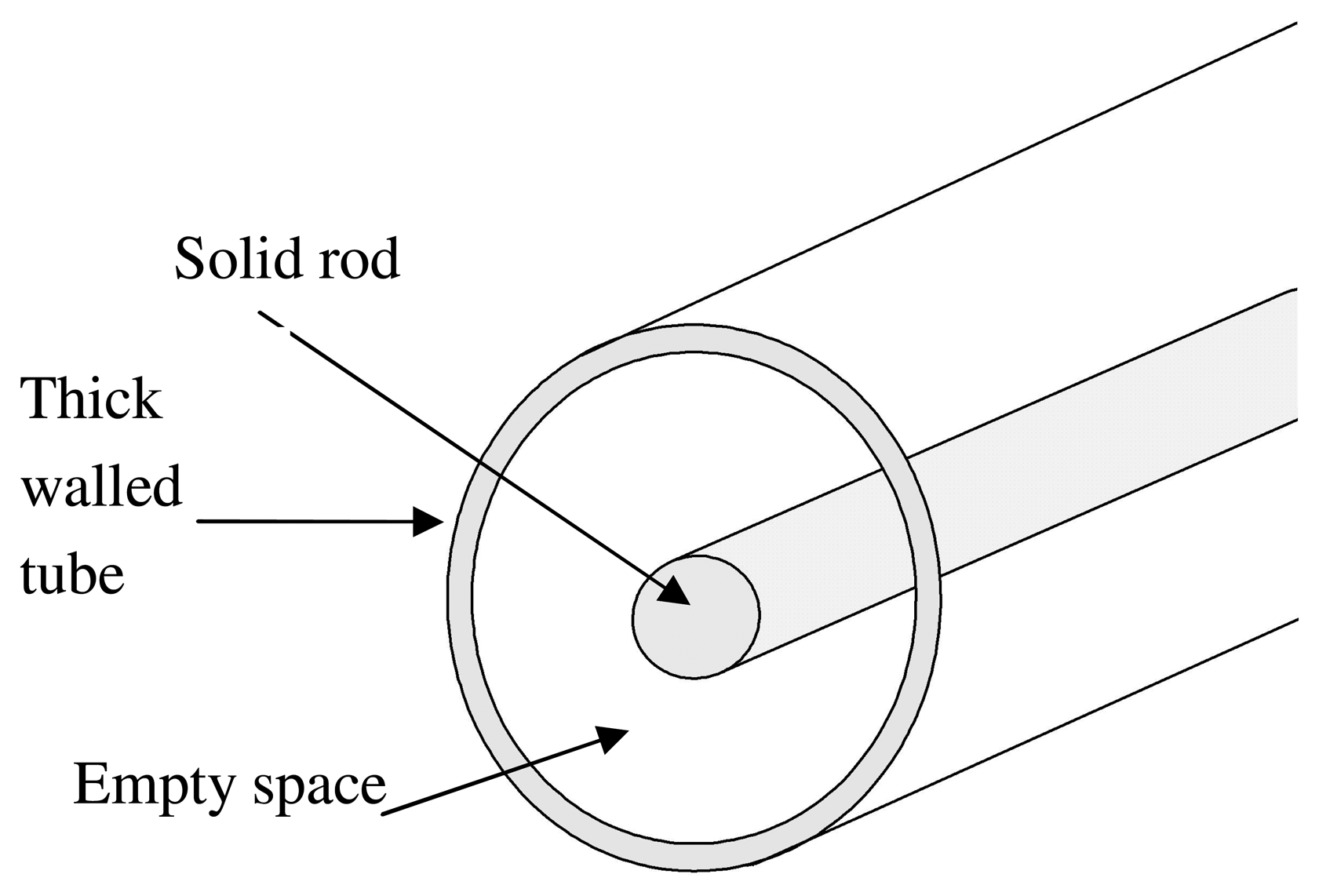
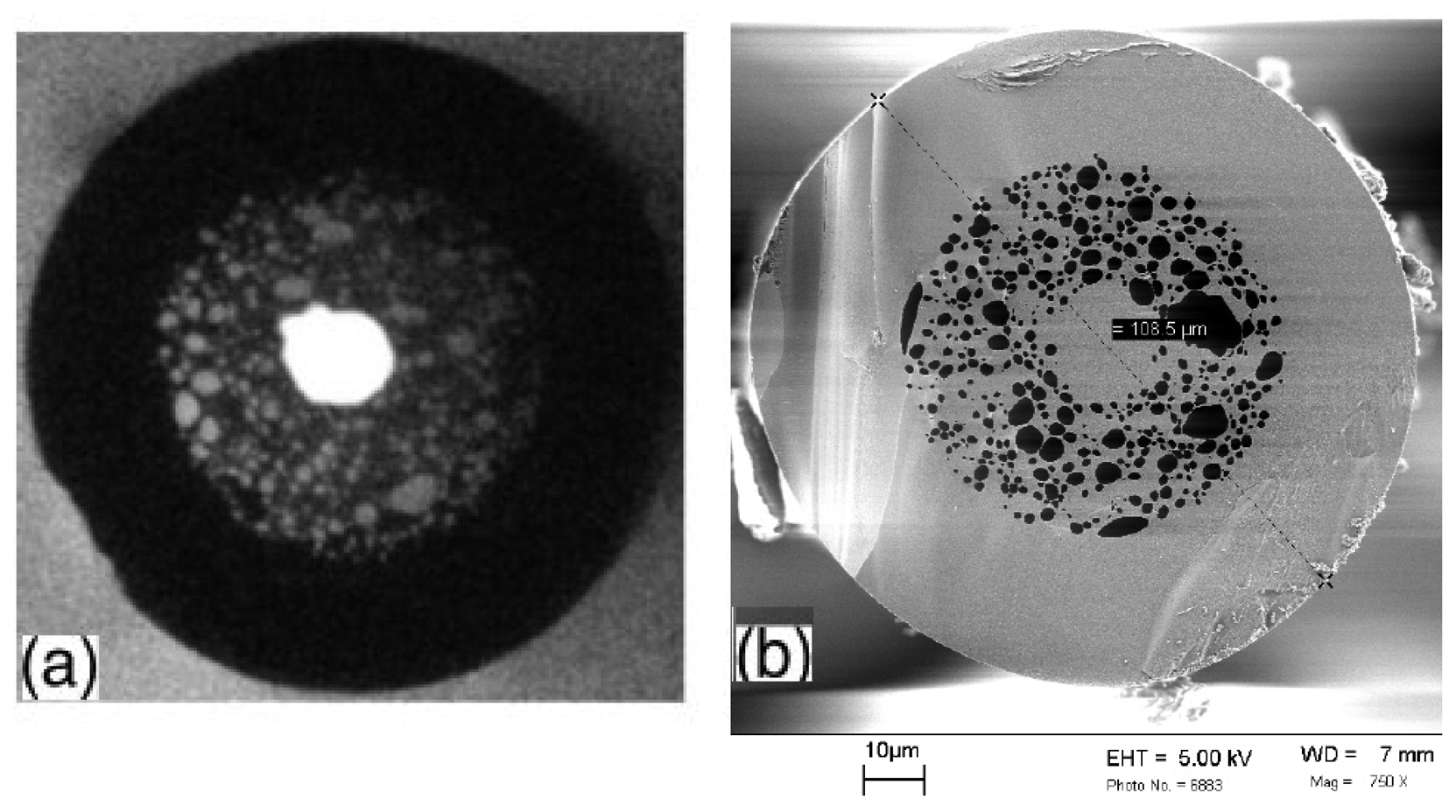
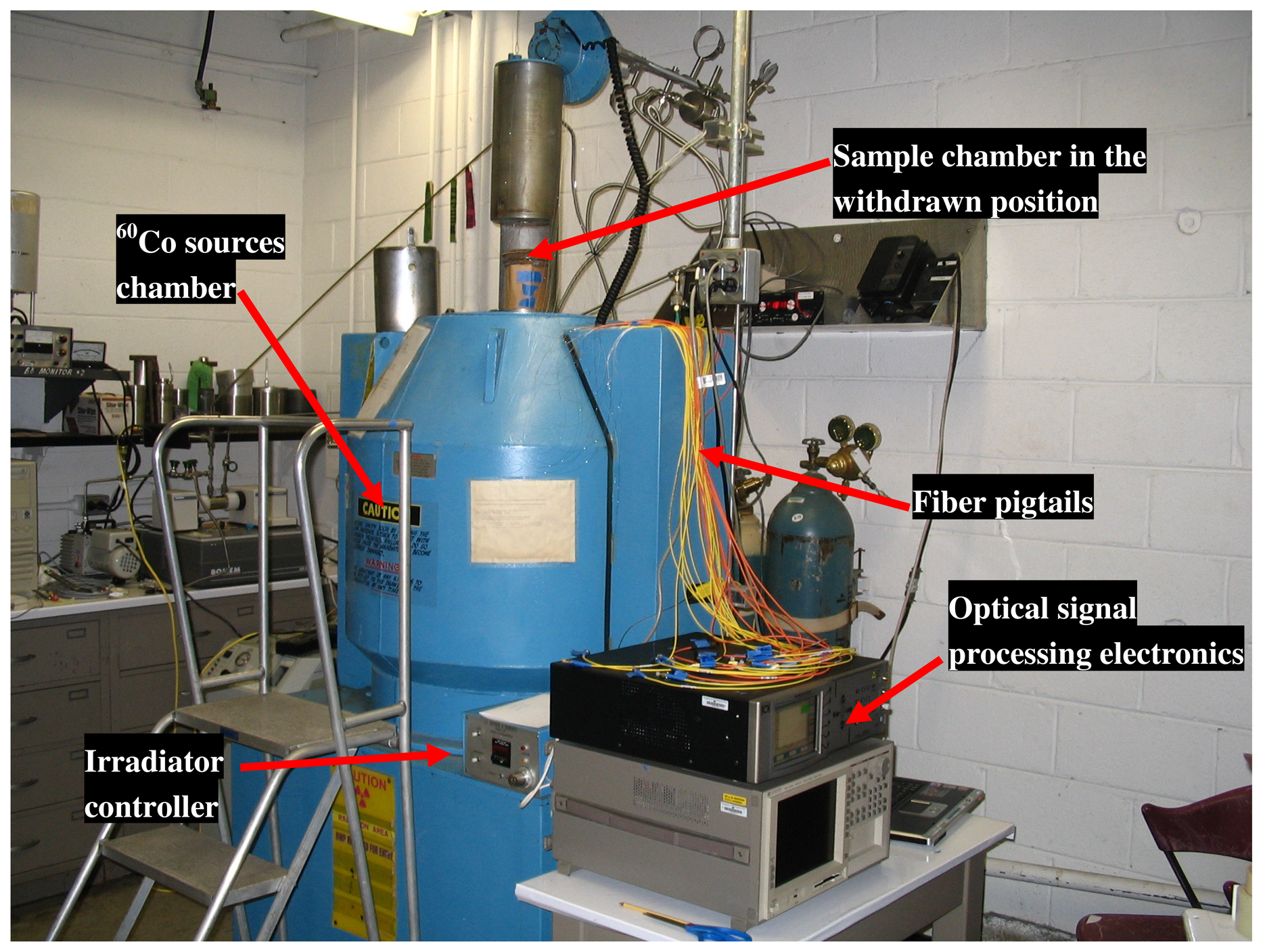
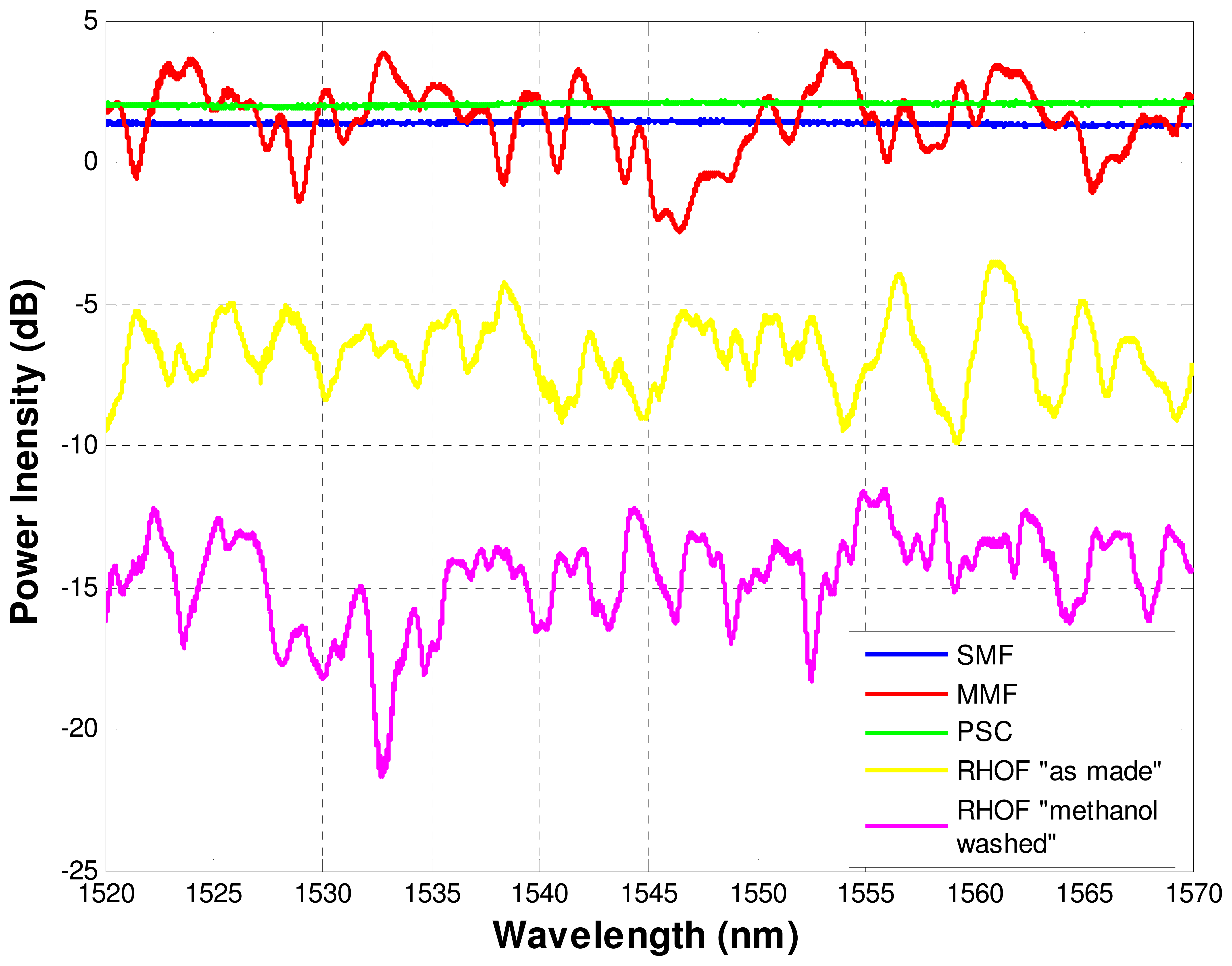
© 2007 by MDPI ( http://www.mdpi.org). Reproduction is permitted for noncommercial purposes.
Share and Cite
Alfeeli, B.; Pickrell, G.; Garland, M.A.; Wang, A. Behavior of Random Hole Optical Fibers under Gamma Ray Irradiation and Its Potential Use in Radiation Sensing Applications. Sensors 2007, 7, 676-688. https://doi.org/10.3390/s7050676
Alfeeli B, Pickrell G, Garland MA, Wang A. Behavior of Random Hole Optical Fibers under Gamma Ray Irradiation and Its Potential Use in Radiation Sensing Applications. Sensors. 2007; 7(5):676-688. https://doi.org/10.3390/s7050676
Chicago/Turabian StyleAlfeeli, Bassam, Gary Pickrell, Marc A. Garland, and Anbo Wang. 2007. "Behavior of Random Hole Optical Fibers under Gamma Ray Irradiation and Its Potential Use in Radiation Sensing Applications" Sensors 7, no. 5: 676-688. https://doi.org/10.3390/s7050676

