

Detection of Aeromonas hydrophila in Liquid Media by Volatile Production Similarity Patterns, Using a FF-2A Electronic Nose

 ,
,
Abstract
1. Introduction
2. Experimental Section
2.1. Microorganisms and Culture Conditions
2.2. Measurement and Calculation of Volatile Compounds and Standard Gases
3. Results and Discussion
4. Conclusions
Acknowledgments
References
- Rock, F.; Barsan, N.; Weimar, U. Electronic nose: Current status and future trends. Chem Rev. 2008, 108, 705–725. [Google Scholar]
- Rakow, N.A.; Susllck, K.S. A colorimetric sensor array for odour visualization. Nature 2000, 406, 710–713. [Google Scholar]
- Susllck, K.S.; Rakow, N.A.; Sen, A. Colorimetric sensor arrays for molecular recognition. Tetrahedron 2004, 60, 11133–11138. [Google Scholar]
- Shirasu, M.; Fujioka, K.; Kakishima, S.; Tomizawa, Y.; Nagai, S.; Murata, J.; Manome, Y.; Touhara, K. Chemical identity of a rotting animal-like odor emitted from the inflorescence of the Titan Arum (Amorphophallus titanum). Biosci. Biotechnol. Biochem. 2010, 74, 2550–2554. [Google Scholar]
- Fujioka, K.; Shirasu, M.; Manome, Y.; Ito, N.; Kakishima, S.; Minami, T.; Tominaga, T.; Shimozono, F.; Iwamoto, T.; Ikeda, K.; Yamamoto, K.; Murata, J.; Tomizawa, Y. Objective display and discrimination of floral odors from amorphophallus titanum, bloomed on different dates and at different locations, using an electronic nose. Sensors 2012, 12, 2152–2161. [Google Scholar]
- Pandey, S.K.; Kim, K.H. Human body-odor components and their determination. Trac-Trends Anal. Chem. 2011, 30, 784–796. [Google Scholar]
- Holmberg, M.; Gustafsson, F.; Hornsten, E.G.; Winquist, F.; Nilsson, L.E.; Ljung, L.; Lundstorm, I. Bacteria classification based on feature extraction from sensor data. Biotechnol. Tech. 1998, 12, 319–324. [Google Scholar]
- Gardner, J.W.; Craven, M.; Dow, C.; Hines, E.L. The prediction of bacteria type and culture growth phase by an electronic nose with a multi-layer perception network. Meas. Sci. Technol. 1998, 9, 120–127. [Google Scholar]
- Gibson, T.D.; Prosser, O.; Hulbert, J.N.; Marshall, R.W.; Corcoran, P.; Lowery, P.; Ruck-Keene, E.A.; Heron, S. Detection and simultaneous identification of microorganisms from headspace samples using an electronic nose. Sens. Actuators B Chem. 1997, 44, 413–422. [Google Scholar]
- Casalinuovo, I.A.; Pierro, D.; Bruno, E.; Francesco, P.; Coletta, M. Experimental use of a new surface acoustic wave sensor for the rapid identification of bacteria and yeasts. Lett. Appl. Microbiol. 2006, 42, 24–29. [Google Scholar]
- Fujioka, K.; Arakawa, E.; Kita, J.A.Y.; Okuda, T.; Manome, Y.; Yamamoto, K. Combination of real-value smell and metaphor exfpression aids yeast detection. PLoS One 2009, 4, e7939. [Google Scholar]
- Mohamed, E.I.; Linder, R.; Periello, G.; di Daniele, N.; Poppl, S.J.; De Lorenzo, A. Predicting Type 2 diabetes using an electronic nose-based artificial neural network analysis. Diabetes Nutr. Metab. 2002, 15, 215–221. [Google Scholar]
- Pavlou, A.K.; Magan, N.; Jones, J.M.; Brown, J.; Klatser, P.; Turner, A.P.F. Detection of Mycobacterium tuberculosis (TB) in vitro and in situ using an electronic nose in combination with a neural network system. Biosens. Bioelectron. 2004, 20, 538–544. [Google Scholar]
- Thaler, E.R.; Hanson, C.W. Use of an electronic nose to diagnose bacterial sinusitis. Am. J. Rhinol. 2006, 20, 170–172. [Google Scholar]
- Turner, A.P.; Magan, N. Electronic noses and disease diagnostics. Nat. Rev. Microbiol. 2004, 2, 161–166. [Google Scholar]
- Gutierrez-Mendez, N.; Vallejo-Cordoba, B.; Gonzalez-Cordova, A.F.; Nevarez-Moorillon, G.V.; Rivera-Chavira, B. Evaluation of aroma generation of Lactococcus lactis with an electronic nose and sensory analysis. J. Dairy Sci. 2008, 91, 49–57. [Google Scholar]
- Keshri, G.; Voysey, P.; Magan, N. Early detection of spoilage moulds in bread using volatile production patterns and quantitative enzyme assays. J. Appl. Microbiol. 2002, 92, 165–172. [Google Scholar]
- Mamat, M.; Samad, S.A.; Hannan, M.A. An electronic nose for reliable measurement and correct classification of beverages. Sensors 2011, 11, 6435–6453. [Google Scholar]
- Peris, M.; Escuder-Gilabert, L. A 21st century technique for food control: Electronic noses. Anal. Chim. Acta 2009, 638, 1–15. [Google Scholar]
- Baldwin, E.A.; Bai, J.; Plotto, A.; Dea, S. Electronic noses and tongues: Applications for the food and pharmaceutical industries. Sensors 2011, 11, 4744–4766. [Google Scholar]
- Martin-Carnahan, A.; Joseph, S.W.; Family, I. Aeromonadaceae Colwell, MacDonell and De Ley 1986. In Bergey's Manual of Systematic Bacteriology, 2nd ed.; Brenner, D., Krieg, N.R., Staley, J.T., Eds.; Springer: Berlin, Germany, 2005; Volume 2, p. 556. [Google Scholar]
- Von Graevenitz, A. The role of Aeromonas in Diarrhea: A review. Infection 2007, 35, 59–64. [Google Scholar]
- Holmes, P.; Niccolls, L.M.; Sartory, D.P. The ecology of mesophilic Aeromonas in the aquatic environment. In The Genus Aeromonas; Austin, B., Altwegg, M., Golling, P.J., Joseph, S.W., Eds.; John Wiley & Sons Ltd.: West Sussex, UK, 1996; pp. 127–150. [Google Scholar]
- Borchardt, M.A.; Stemper, M.E.; Standridge, J.H. Aeromonas isolates from human diarrheic stool and groundwater compared by pulsed-field gel electrophoresis. Emerg. Infect. Dis. 2003, 9, 224–228. [Google Scholar]
- Martin-Carnahan, A.; Joseph, S.W.; Genus, I. Aeromonas Stanier 1943. In Bergey's Manual of Systematic Bacteriology, 2nd ed.; Brenner, D., Krieg, N.R., Staley, J.T., Eds.; Springer: Berlin, Germany, 2005; Volume 2, pp. 557–578. [Google Scholar]
- Nomura, T. Maturation pathway of hemolysin of Aeromonas sobria and the mechanism of action of the hemolysin. Yakugaku Zasshi 2001, 121, 481–485. [Google Scholar]
- Erova, T.E.; Sha, J.; Horneman, A.J.; Borchardt, M.A.; Khajanchi, B.K.; Fadl, A.A.; Chopra, A.K. Identification of a new hemolysin from diarrheal isolate SSU of Aeromonas hydrophila. FEMS Microbiol. Lett. 2007, 275, 301–311. [Google Scholar]
- Guimaraes, M.S.; Andrade, J.R.; Freitas-Almeida, A.C.; Ferreira, M.C. Aeromonas hydrophila vacuolating activity in the Caco-2 human enterocyte cell line as a putative virulence factor. FEMS Microbiol. Lett. 2002, 207, 127–131. [Google Scholar]
- Brink, A.J.; Giannakopoulos, E.; VilJoen, H.G. Fishtank water as a source of a rare case of Aeromonas hydrophila septicaemia. S. Afr. Med. J. 1998, 88, 1011–1012. [Google Scholar]
- Ender, P.T.; Dolan, M.J.; Dolan, D.; Farmer, J.; Melcher, G.P. Near-drowning-associated Aeromonas pneumonia. J. Emerg. Med. 1996, 14, 737–741. [Google Scholar]
- Sakata, K.; Ikeda, Y.; Mori, T.; Okamoto, K.; Ideguchi, K.; Nakagawa, K.; Yasumitsu, T. A severe case of aeromonas hydrophila infection after surgery for gastric cancer. Jpn. J. Gastroenterol. Surg. 2003, 36, 470–475. [Google Scholar]
- Sen, K.; Rodgers, M. Distribution of six virulence factors in Aeromonas species isolated from US drinking water utilities: A PCR identification. J. Appl. Microbiol. 2004, 97, 1077–1086. [Google Scholar]
- Nam, I.; Joh, K. Rapid detection of virulence factors of Aeromonas isolated from trout farm by hexaplex-PCR. J. Microbiol. 2007, 45, 297–304. [Google Scholar]
- Richards, G.P.; Watoson, M.A. A simple fluorogenic method to detect Vibrio cholerae and Aeromonas hydrophila in well water for areas impacted by catastrophic disasters. Am. J. Trop. Med. Hyg. 2006, 75, 516–521. [Google Scholar]
- Lee, S.; Kim, J.; Shin, S.G.; Hwang, S. Biokinetic parameters and behavior of Aeromonas hydrophila during anaerobic growth. Biothechnol. Lett. 2008, 30, 1011–1016. [Google Scholar]
- Abbot, S.L.; Cheung, W.K.W.; Janda, J.M. The Genus Aeromonas: Biochemical characteristics, atypical reactions, and phenotypic identification schemes. J. Clin. Microbiol. 2003, 41, 2348–2357. [Google Scholar]
- Kita, J.; Aoyama, Y.; Kinoshita, M.; Akamaru, H.; Okada, M. Role of “FF-2A” electronic nose and its applications—Focusing on odor monitoring. Shimadzu Rev. 2007, 64, 63–73. [Google Scholar]
- Aoyama, Y. An electronic nose and application to smell evaluation of food and dink by it. J. Integr. Study Dietary Habit. 2006, 17, 266–270. [Google Scholar]
- Uchida, N.; Takahashi, Y.K.; Tanifuji, M.; Mori, K. Odor maps in the mammalian Olfactory bulb: Domain organization and odorant structural features. Nat. Neurosci. 2000, 3, 1035–1043. [Google Scholar]
- Kiritsakis, A.K. Flavor components of olive oil—A review. J. Am. Oil Chem. Soc. 1998, 75, 673–681. [Google Scholar]
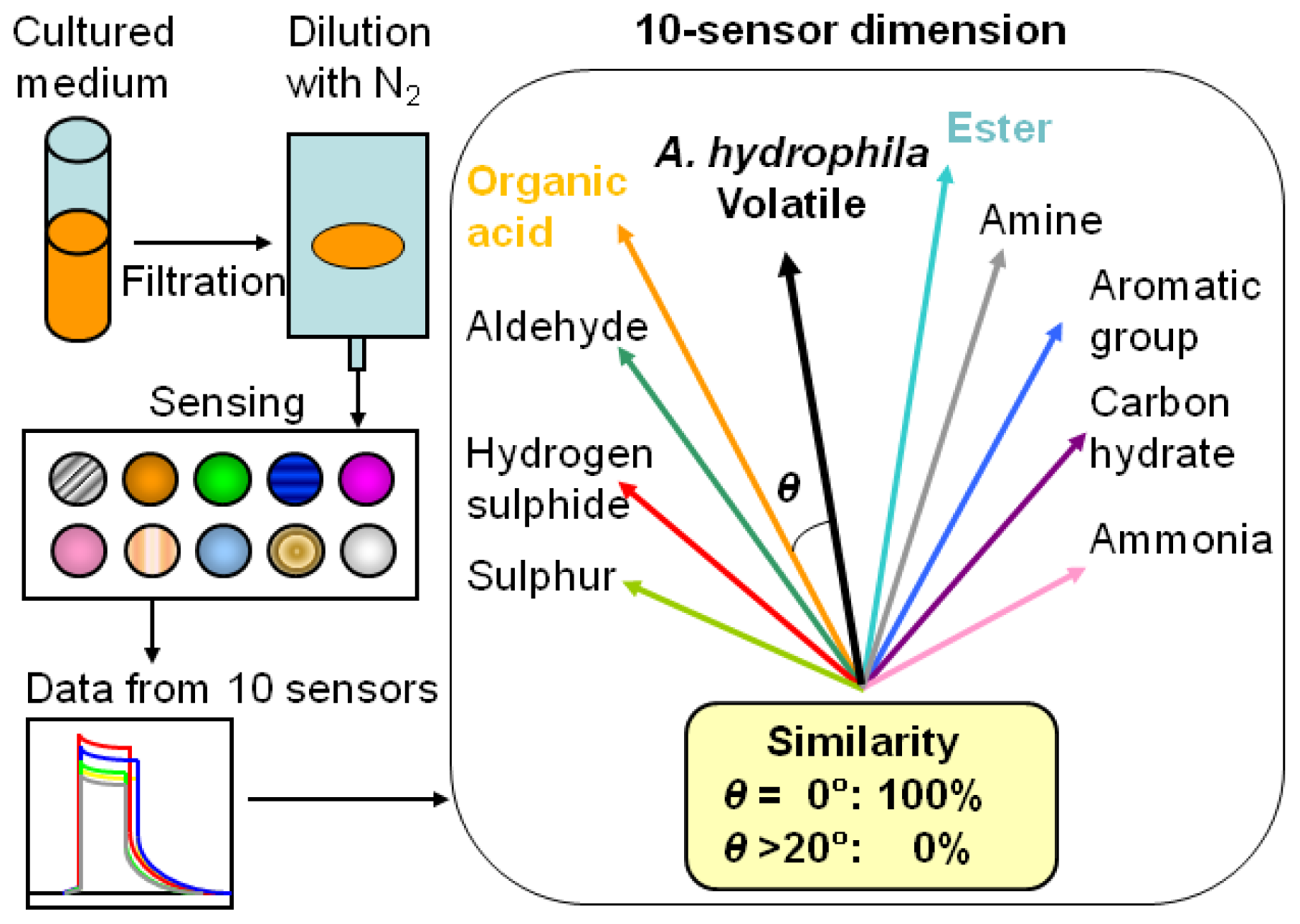
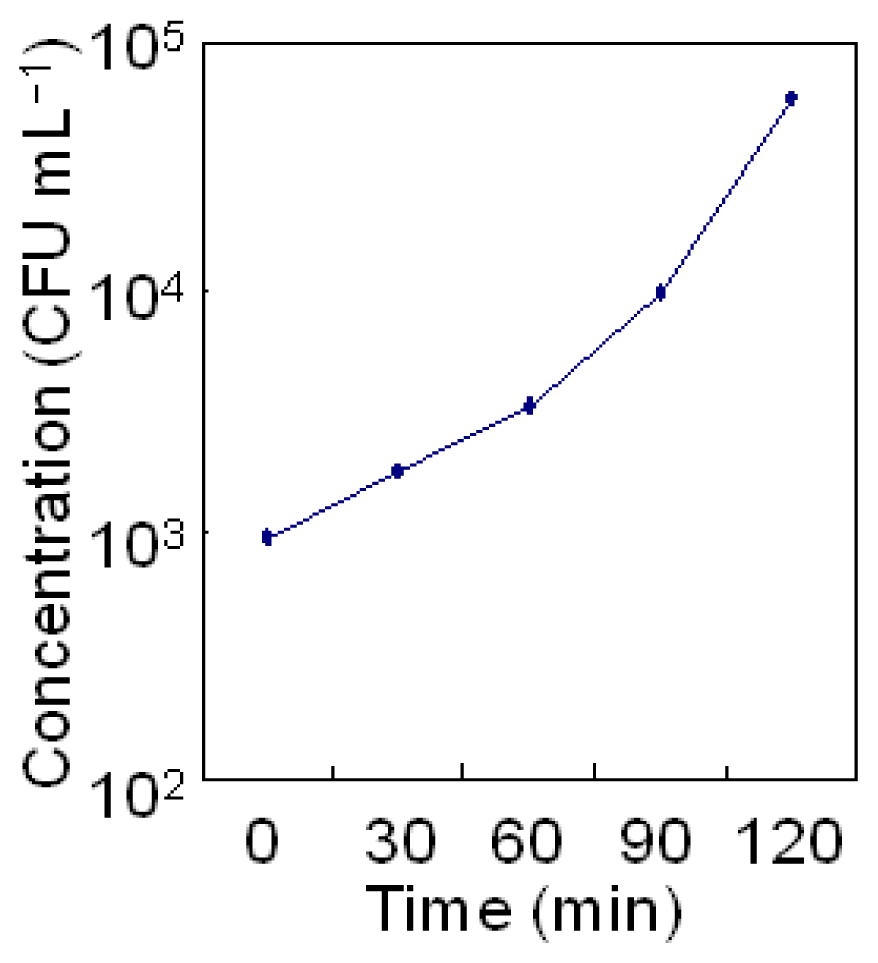
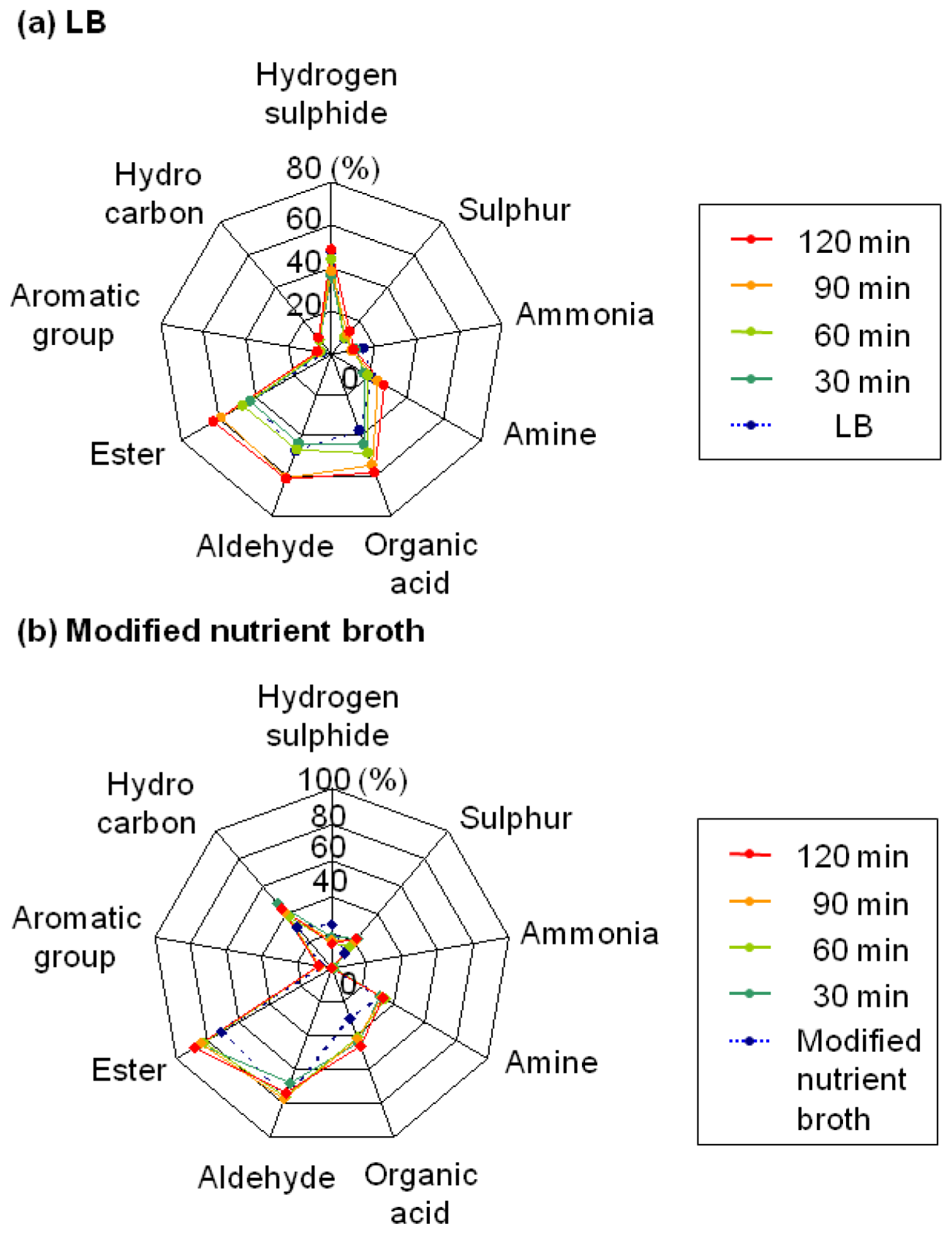
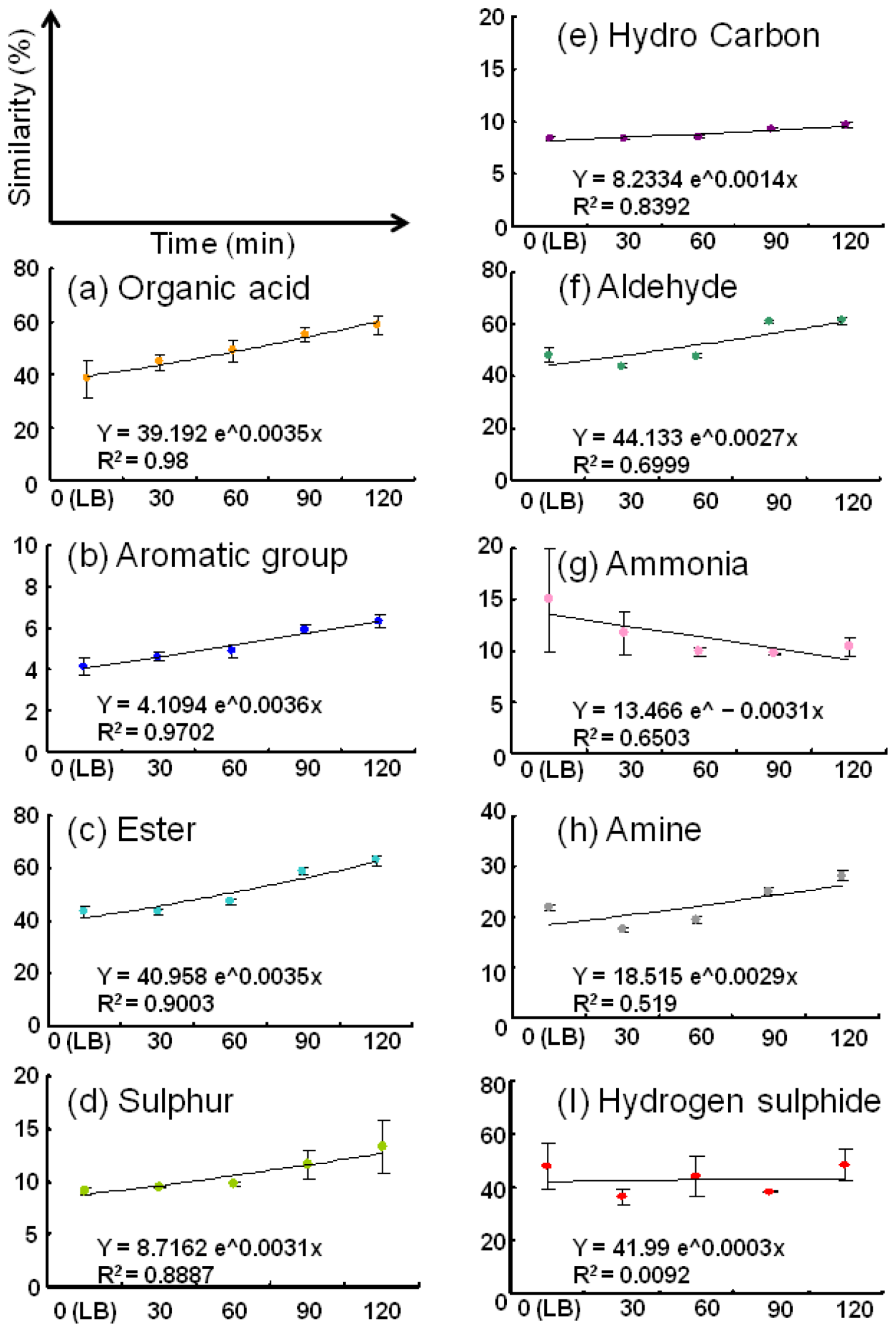
© 2013 by the authors; licensee MDPI, Basel, Switzerland. This article is an open access article distributed under the terms and conditions of the Creative Commons Attribution license (http://creativecommons.org/licenses/by/3.0/).
Share and Cite
Fujioka, K.; Arakawa, E.; Kita, J.-i.; Aoyama, Y.; Manome, Y.; Ikeda, K.; Yamamoto, K. Detection of Aeromonas hydrophila in Liquid Media by Volatile Production Similarity Patterns, Using a FF-2A Electronic Nose. Sensors 2013, 13, 736-745. https://doi.org/10.3390/s130100736
Fujioka K, Arakawa E, Kita J-i, Aoyama Y, Manome Y, Ikeda K, Yamamoto K. Detection of Aeromonas hydrophila in Liquid Media by Volatile Production Similarity Patterns, Using a FF-2A Electronic Nose. Sensors. 2013; 13(1):736-745. https://doi.org/10.3390/s130100736
Chicago/Turabian StyleFujioka, Kouki, Eiji Arakawa, Jun-ichi Kita, Yoshihiro Aoyama, Yoshinobu Manome, Keiichi Ikeda, and Kenji Yamamoto. 2013. "Detection of Aeromonas hydrophila in Liquid Media by Volatile Production Similarity Patterns, Using a FF-2A Electronic Nose" Sensors 13, no. 1: 736-745. https://doi.org/10.3390/s130100736
APA StyleFujioka, K., Arakawa, E., Kita, J.-i., Aoyama, Y., Manome, Y., Ikeda, K., & Yamamoto, K. (2013). Detection of Aeromonas hydrophila in Liquid Media by Volatile Production Similarity Patterns, Using a FF-2A Electronic Nose. Sensors, 13(1), 736-745. https://doi.org/10.3390/s130100736

