
<?xml version="1.0" encoding="UTF-8"?>
<!DOCTYPE article PUBLIC "-//NLM//DTD Journal Publishing DTD v2.3 20070202//EN" "journalpublishing.dtd">
<article xmlns:xlink="http://www.w3.org/1999/xlink" xml:lang="en" article-type="research-article">
<front>
<journal-meta>
<journal-id journal-id-type="nlm-ta">Sensors</journal-id>
<journal-title>Sensors</journal-title>
<issn pub-type="epub">1424-8220</issn>
<publisher>
<publisher-name>Molecular Diversity Preservation International (MDPI)</publisher-name></publisher></journal-meta>
<article-meta>
<article-id pub-id-type="doi">10.3390/s120303669</article-id>
<article-id pub-id-type="publisher-id">sensors-12-03669</article-id>
<article-categories>
<subj-group>
<subject>Article</subject></subj-group></article-categories>
<title-group>
<article-title>Vapochromic Behaviour of M[Au(CN)<sub>2</sub>]<sub>2</sub>-Based Coordination Polymers (M = Co, Ni)</article-title></title-group>
<contrib-group>
<contrib contrib-type="author">
<name><surname>Lefebvre</surname><given-names>Julie</given-names></name></contrib>
<contrib contrib-type="author">
<name><surname>Korčok</surname><given-names>Jasmine L.</given-names></name></contrib>
<contrib contrib-type="author">
<name><surname>Katz</surname><given-names>Michael J.</given-names></name></contrib>
<contrib contrib-type="author">
<name><surname>Leznoff</surname><given-names>Daniel B.</given-names></name><xref ref-type="corresp" rid="c1-sensors-12-03669"><sup>*</sup></xref></contrib>
<aff id="af1-sensors-12-03669">Department of Chemistry, Simon Fraser University, 8888 University Drive, Burnaby, BC V5A 1S6, Canada; E-Mails: <email>jlefebvr@ucalgary.ca</email> (J.L.); <email>jkorcok@tru.ca</email> (J.L.K.); <email>mjkatz@sfu.ca</email> (M.J.K.)</aff></contrib-group>
<author-notes>
<corresp id="c1-sensors-12-03669">
<label>*</label>Author to whom correspondence should be addressed; E-Mail: <email>dleznoff@sfu.ca</email>; Tel.: +1-778-782-4887; Fax: +1-778-782-3765.</corresp></author-notes>
<pub-date pub-type="collection">
<month>3</month>
<year>2012</year></pub-date>
<pub-date pub-type="epub">
<day>16</day>
<month>3</month>
<year>2012</year></pub-date>
<volume>12</volume>
<issue>3</issue>
<fpage>3669</fpage>
<lpage>3692</lpage>
<history>
<date date-type="received">
<day>10</day>
<month>2</month>
<year>2012</year></date>
<date date-type="rev-recd">
<day>9</day>
<month>3</month>
<year>2012</year></date>
<date date-type="accepted">
<day>13</day>
<month>3</month>
<year>2012</year></date></history>
<permissions>
<copyright-statement>© 2012 by the authors; licensee MDPI, Basel, Switzerland</copyright-statement>
<copyright-year>2012</copyright-year>
<license>
<p>This article is an open access article distributed under the terms and conditions of the Creative Commons Attribution license (http://creativecommons.org/licenses/by/3.0/).</p></license></permissions>
<abstract>
<p>A series of M[Au(CN)<sub>2</sub>]<sub>2</sub>(analyte)<sub>x</sub> coordination polymers (M = Co, Ni; analyte = dimethylsulfoxide (DMSO), N,N-dimethylformamide (DMF), pyridine; x = 2 or 4) was prepared and characterized. Addition of analyte vapours to solid M(μ-OH<sub>2</sub>)[Au(CN)<sub>2</sub>]<sub>2</sub> yielded visible vapochromic responses for M = Co but not M = Ni; the IR ν<sub>CN</sub> spectral region changed in every case. A single crystal structure of Zn[Au(CN)<sub>2</sub>]<sub>2</sub>(DMSO)<sub>2</sub> revealed a corrugated 2-D layer structure with <italic>cis</italic>-DMSO units. Reacting a Ni(II) salt and K[Au(CN)<sub>2</sub>] in DMSO yielded the isostructural Ni[Au(CN)<sub>2</sub>]<sub>2</sub>(DMSO)<sub>2</sub> product. Co[Au(CN)<sub>2</sub>]<sub>2</sub>(DMSO)<sub>2</sub> and M[Au(CN)<sub>2</sub>]<sub>2</sub>(DMF)<sub>2</sub> (M = Co, Ni) complexes have flat 2-D square-grid layer structures with <italic>trans</italic>-bound DMSO or DMF units; they are formed via vapour absorption by solid M(μ-OH<sub>2</sub>)[Au(CN)<sub>2</sub>]<sub>2</sub> and from DMSO or DMF solution synthesis. Co[Au(CN)<sub>2</sub>]<sub>2</sub>(pyridine)<sub>4</sub> is generated via vapour absorption by Co(μ-OH<sub>2</sub>)[Au(CN)<sub>2</sub>]<sub>2</sub>; the analogous Ni complex is synthesized by immersion of Ni(μ-OH<sub>2</sub>)[Au(CN)<sub>2</sub>]<sub>2</sub> in 4% aqueous pyridine. Similar immersion of Co(μ-OH<sub>2</sub>)[Au(CN)<sub>2</sub>]<sub>2</sub> yielded Co[Au(CN)<sub>2</sub>]<sub>2</sub>(pyridine)<sub>2</sub>, which has a flat 2-D square-grid structure with <italic>trans</italic>-pyridine units. Absorption of pyridine vapour by solid Ni(μ-OH<sub>2</sub>)[Au(CN)<sub>2</sub>]<sub>2</sub> was incomplete, generating a mixture of pyridine-bound complexes. Analyte-free Co[Au(CN)<sub>2</sub>]<sub>2</sub> was prepared by dehydration of Co(μ-OH<sub>2</sub>)[Au(CN)<sub>2</sub>]<sub>2</sub> at 145 °C; it has a 3-D diamondoid-type structure and absorbs DMSO, DMF and pyridine to give the same materials as by vapour absorption from the hydrate.</p></abstract>
<kwd-group>
<kwd>vapochromism</kwd>
<kwd>cyanide</kwd>
<kwd>X-ray structures</kwd>
<kwd>cobalt(II)</kwd>
<kwd>nickel(II)</kwd></kwd-group></article-meta></front>
<body>
<sec sec-type="intro">
<label>1.</label>
<title>Introduction</title>
<p>Vapochromic materials, which display colour (optical absorption) or luminescence changes upon exposure to vapours of volatile organic compounds (VOCs), are of great interest due to their potential applications for chemical vapour detection [<xref ref-type="bibr" rid="b1-sensors-12-03669">1</xref>–<xref ref-type="bibr" rid="b16-sensors-12-03669">16</xref>]. Such sensors are commercially important as environmental monitoring devices, as safety systems in industrial settings and for defence and security applications [<xref ref-type="bibr" rid="b17-sensors-12-03669">17</xref>]. As an example of a vapochromic material, the polymeric Prussian Blue-type Co<sup>2+</sup>/[Re<sub>6</sub>Q<sub>8</sub>(CN)<sub>6</sub>]<sup>4−</sup> (Q = S, Se) material yields dramatic changes in the visible spectrum when exposed to specific VOCs; the colour changes are linked to the sensed solvent impacting the geometry and hydration around the Co(II) centres [<xref ref-type="bibr" rid="b12-sensors-12-03669">12</xref>]. A range of compounds based on Au(I), Pd(II) and Pt(II) coordination polymers have also been extensively investigated for their vapochromic responses [<xref ref-type="bibr" rid="b1-sensors-12-03669">1</xref>–<xref ref-type="bibr" rid="b12-sensors-12-03669">12</xref>,<xref ref-type="bibr" rid="b14-sensors-12-03669">14</xref>]. The vapochromism in these systems is based on changes in both the visible absorption and emission spectra. In the linear {Tl[Au(C<sub>6</sub>Cl<sub>5</sub>)<sub>2</sub>]}<sub>n</sub> polymer, weak interactions between the Tl atoms and the absorbed VOC molecules modify the emission spectra [<xref ref-type="bibr" rid="b8-sensors-12-03669">8</xref>]. On the other hand, emission changes in [Pt(CN-R)<sub>4</sub>][M(CN)<sub>4</sub>] (R= <italic>iso</italic>-C<sub>3</sub>H<sub>7</sub> or C<sub>6</sub>H<sub>4</sub>-C<sub>n</sub>H<sub>2n+1</sub>; n=6, 10, 12, 14 and M = Pt, Pd) occur when metal-metal distances are modified due to the presence of VOC molecules in lattice voids [<xref ref-type="bibr" rid="b9-sensors-12-03669">9</xref>,<xref ref-type="bibr" rid="b10-sensors-12-03669">10</xref>,<xref ref-type="bibr" rid="b18-sensors-12-03669">18</xref>]. A related mode of action is operative for supramolecular columns of Au<sub>3</sub>(MeN=COMe)<sub>3</sub> molecules, in which VOCs intercalate or otherwise impact the stacking of one polymorph, thereby altering the emission properties [<xref ref-type="bibr" rid="b1-sensors-12-03669">1</xref>–<xref ref-type="bibr" rid="b3-sensors-12-03669">3</xref>,<xref ref-type="bibr" rid="b19-sensors-12-03669">19</xref>,<xref ref-type="bibr" rid="b20-sensors-12-03669">20</xref>]; similarly, crystalline, luminescent {Au<sub>3</sub>(<italic>p</italic>-MeC<sub>6</sub>H<sub>4</sub>N=COEt)<sub>3</sub>}<sub>2</sub> becomes non-emissive upon exposure to hexafluorobenzene [<xref ref-type="bibr" rid="b7-sensors-12-03669">7</xref>].</p>
<p>Among coordination polymers, cyanometallate building blocks have been particularly heavily utilized to form extended networks [<xref ref-type="bibr" rid="b21-sensors-12-03669">21</xref>–<xref ref-type="bibr" rid="b25-sensors-12-03669">25</xref>]. Despite this, [Au(CN)<sub>2</sub>]<sup>−</sup> has been relatively neglected as a building block in coordination polymers despite its unusual features: it is linear, forms gold-gold intermolecular interactions, and is luminescent [<xref ref-type="bibr" rid="b26-sensors-12-03669">26</xref>–<xref ref-type="bibr" rid="b34-sensors-12-03669">34</xref>]. We have reported the new vapochromic Cu(μ-OH<sub>2</sub>)<sub>2</sub>[Au(CN)<sub>2</sub>]<sub>2</sub> and Zn[Au(CN)<sub>2</sub>]<sub>2</sub> coordination polymer materials [<xref ref-type="bibr" rid="b35-sensors-12-03669">35</xref>–<xref ref-type="bibr" rid="b38-sensors-12-03669">38</xref>]. The Cu(μ-OH<sub>2</sub>)<sub>2</sub> [Au(CN)<sub>2</sub>]<sub>2</sub> system reacts reversibly with certain VOCs containing nitrogen- or oxygen-donors (or irreversibly with NH<sub>3</sub>) in the solid-state, generating significant analyte-specific colour changes, as well as distinct changes to the number and position of the ν<sub>CN</sub> IR bands. An examination of the crystal structures of the dimethylsulfoxide (DMSO), N,N-dimethylformamide (DMF) and pyridine adducts allowed a postulation of the mechanism of reversible vapochromism: the Cu[Au(CN)<sub>2</sub>]<sub>2</sub> superstructure flexibly distorts to accommodate analyte binding to Cu(II); this binding changes the ligand field, thereby impacting the colour. Changes in the cyanometallate superstructure can also be transmitted via the ν<sub>CN</sub> pattern [<xref ref-type="bibr" rid="b35-sensors-12-03669">35</xref>,<xref ref-type="bibr" rid="b36-sensors-12-03669">36</xref>].</p>
<p>Substitution of copper(II) for zinc(II) yields four polymorphs of Zn[Au(CN)<sub>2</sub>]<sub>2</sub> [<xref ref-type="bibr" rid="b37-sensors-12-03669">37</xref>,<xref ref-type="bibr" rid="b38-sensors-12-03669">38</xref>], which are highly emissive upon UV-excitation and, more importantly, are extremely sensitive to ammonia vapour; exposure causes a large emission shift [<xref ref-type="bibr" rid="b37-sensors-12-03669">37</xref>]. As in the Cu(II) system, ammonia binds to the Zn(II) centre, which triggers the flexible Zn[Au(CN)<sub>2</sub>]<sub>2</sub> superstructure framework to dynamically adapt to accommodate the analyte. This changes the gold-gold distances in the structure and, since these aurophilic interactions are the source of the emission [<xref ref-type="bibr" rid="b30-sensors-12-03669">30</xref>–<xref ref-type="bibr" rid="b32-sensors-12-03669">32</xref>], any change in their geometry or topology impacts the emission energy. Both the Cu(II) and Zn(II) coordination polymers are oxygen-stable and thermally robust.</p>
<p>It is clear from the mode of action that the ligand coordination preferences of the metal cation (Cu or Zn) are a key feature influencing which analytes are ultimately sensed, and which are more favoured from a sensitivity perspective [<xref ref-type="bibr" rid="b39-sensors-12-03669">39</xref>]. Thus, examining other metal cations as the binding site is worthwhile both as a comparison to the copper(II) and zinc(II) systems and in the possibility of preparing improved sensor materials or a sensor for new analytes that would not be significantly detected by the vapochromic Cu(II) or luminescent Zn(II) cyanoaurate systems.</p>
<p>Towards this end, we recently reported the isostructural M(μ-OH<sub>2</sub>)<sub>2</sub>[Au(CN)<sub>2</sub>]<sub>2</sub> series, where M = Mn, Fe, Co, Ni and Cu [<xref ref-type="bibr" rid="b40-sensors-12-03669">40</xref>,<xref ref-type="bibr" rid="b41-sensors-12-03669">41</xref>]. The Cu(II) analogue shows strong, sensitive vapochromic responses to a series of analytes, as described above [<xref ref-type="bibr" rid="b35-sensors-12-03669">35</xref>,<xref ref-type="bibr" rid="b36-sensors-12-03669">36</xref>]. This manuscript examines the vapochromic response of the isomorphous Co(II) and Ni(II) analogues to a series of analytes—DMF, DMSO and pyridine—which were studied in detail for the Cu(II) system and which showed moderate sensitivity, thereby allowing for a direct comparison of vapochromic efficacy and superstructural flexibility as a function of metal cation. A qualitative report on the vapochromic response of Co[Au(CN)<sub>2</sub>]<sub>2</sub> with a series of analytes and their IR shifts was very recently reported, but was lacking in any structural or other characterization data on the Co-analyte system or the parent compound [<xref ref-type="bibr" rid="b42-sensors-12-03669">42</xref>,<xref ref-type="bibr" rid="b43-sensors-12-03669">43</xref>].</p></sec>
<sec>
<label>2.</label>
<title>Experimental Section</title>
<sec sec-type="methods">
<label>2.1.</label>
<title>General Procedures</title>
<p>All manipulations were performed in air unless otherwise noted. All reagents were purchased from commercial sources and used as received, except for M(μ-OH<sub>2</sub>)[Au(CN)<sub>2</sub>]<sub>2</sub> (M = Co, Ni), which were prepared as previously described [<xref ref-type="bibr" rid="b40-sensors-12-03669">40</xref>,<xref ref-type="bibr" rid="b41-sensors-12-03669">41</xref>].</p>
<p><italic>CAUTION: Although we have experienced no difficulties, perchlorate salts are potentially explosive and should be used in small quantities and handled with care.</italic></p>
<p>Infrared spectra were recorded on a Thermo Nicolet Nexus 670 FT-IR spectrometer with samples prepared as KBr pressed pellets or analyzed with a Pike Miracol ATR attachment (<xref ref-type="table" rid="t1-sensors-12-03669">Table 1</xref>). The resolution of the instrument was set at 1 cm<sup>−1</sup> and the spectra were collected between 400 (KBr) or 700 (ATR) and 4,000 cm<sup>−1</sup>. Microanalyses (carbon, hydrogen and nitrogen) were performed at Simon Fraser University using a computer-controlled Carlo Erba (Model 1110) CHN analyzer. Thermogravimetric analyses (TGA) of all complexes were performed in an air atmosphere on a Shimadzu TGA-50 instrument at a rate of 5 °C per minute. Solid-state UV-Vis-NIR absorption spectra were measured by reflectance using an Ocean Optics SD2000 spectrophotometer equipped with tungsten halogen and deuterium lamps. Prior to analysis, the samples were ground into fine powders and placed on a glass plate. Magnesium oxide powder, prepared in the same fashion, was used as a reference. Powder X-ray diffractograms were collected on a Rigaku RAXIS-Rapid Auto diffractometer equipped with a Cu K<sub>α</sub> source (λ = 1.54056 Å). Samples were mounted on a glass fiber using grease and were exposed, as the phi axis was spinning (10° s<sup>−1</sup>), for a period of 20 to 60 minutes (with the chi axis fixed at 0 and omega fixed at 90°).</p></sec>
<sec>
<label>2.2.</label>
<title>Synthesis of Zn[Au(CN)<sub>2</sub>]<sub>2</sub>(DMSO)<sub>2</sub></title>
<p>To a DMSO solution (0.5 mL) of Zn(ClO<sub>4</sub>)<sub>2</sub> (32 mg, 0.086 mmol), a DMSO solution (0.5 mL) of K[Au(CN)<sub>2</sub>] (50 mg, 0.17 mmol) was added dropwise. The solution was allowed to evaporate slowly. Crystals of Zn[Au(CN)<sub>2</sub>]<sub>2</sub>(DMSO)<sub>2</sub> were formed over several days of slow evaporation. Yield: 0.030 g, 42%. Anal. Calcd. for C<sub>8</sub>H<sub>12</sub>N<sub>4</sub>Au<sub>2</sub>O<sub>2</sub>Zn: C, 13.35%; H, 7.79%; N, 1.68%. Found: C, 13.50%; H, 8.04%; N, 1.72%. IR (KBr): 3,009 (w), 2,919 (w), 2,186 (m, ν<sub>CN</sub>), 2,175 (m, ν<sub>CN</sub>), 1,314 (w), 1,299(w), 1,030 (m), 1,013 (s, ν<sub>S=O</sub>), 1,005 (s, ν<sub>S=O</sub>), 957 (m) cm<sup>−1</sup>.</p></sec>
<sec>
<label>2.3.</label>
<title>Synthesis of Co[Au(CN)<sub>2</sub>]<sub>2</sub>(DMSO)<sub>2</sub></title>
<p>Co(<italic>μ</italic>-OH<sub>2</sub>)<sub>2</sub>[Au(CN)<sub>2</sub>]<sub>2</sub> (0.125 g, 0.211 mmol) was mixed with DMSO (1 mL) and left to sit for 72 hours, covered. The resulting pink fine powder was then isolated by decantation and left to dry in ambient air. The composition was found to be Co[Au(CN)<sub>2</sub>]<sub>2</sub>(DMSO)<sub>2</sub>. Yield: 0.121 g, 80.4%. Anal. Calcd for C<sub>8</sub>H<sub>12</sub>N<sub>4</sub>Au<sub>2</sub>CoO<sub>2</sub>S<sub>2</sub>: C, 13.47%; H, 1.70%; N, 7.86%. Found: C, 13.51%; H, 1.73%; N, 7.69%. IR (KBr): 3,021(w), 3,009(w), 2,920(w), 2,177(s, ν<sub>CN</sub>), 1,421(w), 1,408(w), 1,316(w), 1,298(w), 1,031(m), 997(s), 957(m), 938(m), 905(w), 717(w), 467(w), 441(w) cm<sup>−1</sup>. The same product can also be obtained by vapour absorption of DMSO by Co(μ-OH<sub>2</sub>)<sub>2</sub>[Au(CN)<sub>2</sub>]<sub>2</sub> or Co[Au(CN)<sub>2</sub>]<sub>2</sub>.</p></sec>
<sec>
<label>2.4.</label>
<title>Synthesis of Ni[Au(CN)<sub>2</sub>]<sub>2</sub>(DMSO)<sub>2</sub></title>
<p>A DMSO solution (0.75 mL) of Ni(NO<sub>3</sub>)<sub>2</sub>·6H<sub>2</sub>O (0.057 g, 0.20 mmol) was added to a DMSO solution (1.75 mL) of K[Au(CN)<sub>2</sub>] (0.123 g, 0.427 mmol). A turquoise blue powder started to precipitate after approximately one hour. It was collected by filtration 24 hours later and air-dried. The composition of the final product was determined to be Ni[Au(CN)<sub>2</sub>]<sub>2</sub>(DMSO)<sub>2</sub>. Yield: 0.101 g, 70.8%. Anal. Calcd. For C<sub>8</sub>H<sub>12</sub>N<sub>4</sub>Au<sub>2</sub>NiO<sub>2</sub>S<sub>2</sub>: C, 13.48%; H, 1.70%; N, 7.86%. Found: C, 13.70%; H, 1.81%; N, 8.10%. IR (KBr): 3,434(m), 3,010(w), 2,919(w), 2,189(s, ν<sub>CN</sub>), 2,180(s, ν<sub>CN</sub>), 1,629(w), 1,409(w), 1,314(w), 1,299(w), 1,032(m), 1,008(s), 1,001(s), 956(m), 713(w), 480(w), 430(w) cm<sup>−1</sup>.</p></sec>
<sec>
<label>2.5.</label>
<title>Synthesis of Ni[Au(CN)<sub>2</sub>]<sub>2</sub>(DMF)<sub>2</sub></title>
<p>Ni(<italic>μ</italic>-OH<sub>2</sub>)<sub>2</sub>[Au(CN)<sub>2</sub>]<sub>2</sub> (0.115 g, 0.194 mmol) was mixed with DMF (1 mL) and left to sit for 24 hours, covered. The resulting blue powder was then isolated by filtration and the composition of the final product was found to be Ni[Au(CN)<sub>2</sub>]<sub>2</sub>(DMF)<sub>2</sub>. Yield: 0.092 g, 69%. Anal. Calcd for C<sub>10</sub>H<sub>14</sub>N<sub>6</sub>Au<sub>2</sub>NiO<sub>2</sub>: C 17.09%, H 2.01%, N 11.96%. Found: C 16.95%, H 2.08%, N 12.24%. IR (KBr): 3,429(m), 2,994(w), 2,964(w), 2933(m), 2,892(w), 2,809(w), 2,189(s, ν<sub>CN</sub>), 1,658(s), 1,498(w), 1,434(m), 1,418(w), 1,384(m), 1,252(m), 1,109(s), 1,061(m), 689(s), 488(w) cm<sup>−1</sup>.</p></sec>
<sec>
<label>2.6.</label>
<title>Synthesis of Co[Au(CN)<sub>2</sub>]<sub>2</sub>(Pyridine)<sub>2</sub></title>
<p>Co(<italic>μ</italic>-OH<sub>2</sub>)<sub>2</sub>[Au(CN)<sub>2</sub>]<sub>2</sub> (0.052 g, 0.088 mmol) was mixed with water/pyridine (2.5 mL, 95:5) and let to sit for 24 hours, covered. The powder became more orange, was isolated by filtration and dried in ambient air. The composition was found to be Co[Au(CN)<sub>2</sub>]<sub>2</sub>(pyridine)<sub>2</sub>. Yield: 0.049 g, 78%. Anal. Calcd for C<sub>14</sub>H<sub>10</sub>N<sub>6</sub>Au<sub>2</sub>Co: C 23.51%, H 1.41%, N 11.75%. Found: C 23.67%, H 1.55%, N 11.68%. IR (KBr): 3,086(w), 3,068(w), 3,053(w), 3,024(w), 2,168(s, ν<sub>CN</sub>), 1,605(s), 1,574(s), 1,486(m), 1,447(s), 1,242(w), 1,216(m), 1,157(w), 1,073(m), 1,041(m), 1,016(w), 946(w), 882(w), 759(m), 698(s), 633(m), 460(w), 431(m) cm<sup>−1</sup>.</p></sec>
<sec>
<label>2.7.</label>
<title>Synthesis of Ni[Au(CN)<sub>2</sub>]<sub>2</sub>(Pyridine)<sub>4</sub></title>
<p>A 96:4 water/pyridine solution (1.5 mL) of K[Au(CN)<sub>2</sub>] (0.059 g, 0.21 mmol) was prepared. This solution was added to a 96:4 water/pyridine solution (1 mL) of Ni(NO<sub>3</sub>)<sub>2</sub>·6H<sub>2</sub>O (0.030 g, 0.10 mmol). A purple powder was obtained immediately, which was filtered and air-dried. The product was determined to be Ni[Au(CN)<sub>2</sub>]<sub>2</sub>(pyridine)<sub>4</sub>. Yield: 0.070 g, 78%. Anal. Calcd for C<sub>24</sub>H<sub>20</sub>N<sub>8</sub>Au<sub>2</sub>Ni: C 33.02%, H 2.31%, N 12.83%. Found: C 32.64%, H 2.25%, N 12.55%. IR (KBr): 3,095(w), 3,070(w), 3,041(w), 3,023(w), 2,993(w), 2,924(w), 2,855(w), 2,171(s, ν<sub>CN</sub>), 2,143(s, ν<sub>CN</sub>), 1,602(s), 1,574(m), 1,488(m), 1,449(s), 1,443(s), 1,237(w), 1,216(m), 1,151(w), 1,068(m), 1,042(m), 1,011(w), 769(m), 756(m), 699(s), 631(m), 469(w), 435(m) cm<sup>−1</sup>.</p></sec>
<sec>
<label>2.8.</label>
<title>Synthesis of Co[Au(CN)<sub>2</sub>]<sub>2</sub></title>
<p>Co(μ-OH<sub>2</sub>)<sub>2</sub>[Au(CN)<sub>2</sub>]<sub>2</sub> was heated to 145 °C in an oven for 2 hours to afford cobalt-blue coloured Co[Au(CN)<sub>2</sub>]<sub>2</sub> quantitatively. The product is stable in air for approximately two days, and was stored under an inert atmosphere to prevent rehydration. Anal. calcd. for C<sub>4</sub>N<sub>4</sub>Au<sub>2</sub>Co: C, 8.63%; H, 0%; N, 10.06%. Found: C, 8.51%; H, trace%; N, 9.67%. IR (ATR): 2,177 (s, ν<sub>CN</sub>), 2,140 cm<sup>−1</sup> (vw, <sup>13</sup>ν<sub>CN</sub>).</p></sec>
<sec>
<label>2.9.</label>
<title>Single Crystal X-Ray Structure of Zn[Au(CN)<sub>2</sub>]<sub>2</sub>(DMSO)<sub>2</sub></title>
<p>A 0.42 × 0.22 × 0.14 mm<sup>3</sup> crystal of Zn[Au(CN)<sub>2</sub>]<sub>2</sub>(DMSO)<sub>2</sub> was mounted on a glass fiber using epoxy adhesive. The data were collected at room temperature on an Enraf Nonius Delft CAD-4 diffractometer with a PMT point detector using the control program DIFRAC [<xref ref-type="bibr" rid="b44-sensors-12-03669">44</xref>]. A Mo K<sub>α</sub> normal-focus sealed tube operated at 0.736 kW power (46 kV, 16 mA) was utilized for data collection over the range 4° &lt; 2θ &lt; 60°. The data was corrected by integration for the effects of absorption using a semi-empirical psi-scan method with a 0.073–0.262 transmission range. Data reduction included corrections for Lorentz and polarization effects using the NRCVAX software suite [<xref ref-type="bibr" rid="b45-sensors-12-03669">45</xref>]. Final unit-cell dimensions were determined based on 43 well-centred reflections with a range of 47° &lt; 2θ &lt; 51°. The structure of Zn[Au(CN)<sub>2</sub>]<sub>2</sub>(DMSO)<sub>2</sub> was solved in CRYSTALS [<xref ref-type="bibr" rid="b46-sensors-12-03669">46</xref>] using direct methods (SIR92) and expanded using Fourier techniques. Diagrams were prepared using ORTEP-3 [<xref ref-type="bibr" rid="b47-sensors-12-03669">47</xref>] and POV-Ray [<xref ref-type="bibr" rid="b48-sensors-12-03669">48</xref>].</p>
<p>The coordinates and anisotropic temperature factors for all non-hydrogen atoms were refined. The final refinement using observed data (I<sub>o</sub> ≥ 2.50 σ(I<sub>o</sub>)) included an extinction parameter, and statistical weights with 177 parameters for 2,953 unique reflections. Hydrogen atoms were placed in calculated positions (d<sub>C-H</sub> 0.95 Å) and initially refined with soft restraints on the bond lengths and angles to regularise their geometry; afterwards their coordinate shifts were linked with those of the respective carbon atoms during refinement. Isotropic thermal parameters for the hydrogen atoms were initially assigned proportionately to the equivalent isotropic thermal parameters of their respective carbon atoms. Subsequently the isotropic thermal parameters for the H atoms on the DMSO were constrained to have identical shifts during refinement. Crystallographic data for Zn[Au(CN)<sub>2</sub>]<sub>2</sub>(DMSO)<sub>2</sub> are tabulated in <xref ref-type="table" rid="t2-sensors-12-03669">Table 2</xref>. Selected bond lengths and angles are given in <xref ref-type="table" rid="t3-sensors-12-03669">Table 3</xref>.</p></sec>
<sec sec-type="methods">
<label>2.10.</label>
<title>Powder X-Ray Data Indexing/Structure Determination of M[Au(CN)<sub>2</sub>]<sub>2</sub>(analyte)<sub>x</sub> (M = Co and Ni)</title>
<p>The structures of Ni[Au(CN)<sub>2</sub>]<sub>2</sub>(DMF)<sub>2</sub> and Co[Au(CN)<sub>2</sub>]<sub>2</sub>(pyridine)<sub>2</sub> were solved and refined using the DASH software package [<xref ref-type="bibr" rid="b49-sensors-12-03669">49</xref>]. After indexing the experimental diffractogram, an automatic background fitting and subtraction was performed, followed by peak fitting to extract the intensity of each peak. To solve the crystal structure, a predefined building block was used. The asymmetric units of Co[Au(CN)<sub>2</sub>]<sub>2</sub>(DMF)<sub>2</sub> [<xref ref-type="bibr" rid="b50-sensors-12-03669">50</xref>] and Cu[Au(CN)<sub>2</sub>]<sub>2</sub>(pyridine)<sub>2</sub> [<xref ref-type="bibr" rid="b35-sensors-12-03669">35</xref>] were chosen as the building blocks used to solve the structure of Ni[Au(CN)<sub>2</sub>]<sub>2</sub>(DMF)<sub>2</sub> and Co[Au(CN)<sub>2</sub>]<sub>2</sub>(pyridine)<sub>2</sub> respectively. Optimization of the position and orientation of this building block was performed using a simulated annealing algorithm to maximize the agreement with the experimental diffractogram (relative intensity and peak position). The coordinates of each atom in the building blocks were further optimized once a structural model was obtained. The orientation of the pyridine molecules in Co[Au(CN)<sub>2</sub>]<sub>2</sub>(pyridine)<sub>2</sub> was not refined as the diffractogram is mainly affected by the atomic position of the heavy atoms and slight changes in the position of the pyridine molecules do not cause noticeable changes in the diffractogram. The atomic coordinates for Ni[Au(CN)<sub>2</sub>]<sub>2</sub>(DMF)<sub>2</sub> and Co[Au(CN)<sub>2</sub>]<sub>2</sub>(pyridine)<sub>2</sub> are reported in <xref ref-type="supplementary-material" rid="SD1">Tables S1</xref> and <xref ref-type="supplementary-material" rid="SD1">S2</xref>, respectively. Due to the poor quality of the powder diffractogram, the structure of Ni[Au(CN)<sub>2</sub>]<sub>2</sub>(DMSO)<sub>2</sub> could not be determined using DASH. The diffractogram could, however, be indexed using WinPLOTR [<xref ref-type="bibr" rid="b51-sensors-12-03669">51</xref>] to a unit cell very similar to that of the analogous Zn-containing polymer. The powder diffractogram for Co[Au(CN)<sub>2</sub>]<sub>2</sub>(DMSO)<sub>2</sub> was also poor and was therefore only indexed with WinPLOTR but not utilized to generate an atomic resolution structure.</p></sec></sec>
<sec sec-type="results|discussion">
<label>3.</label>
<title>Results and Discussion</title>
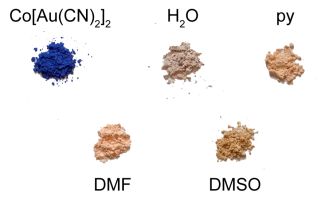
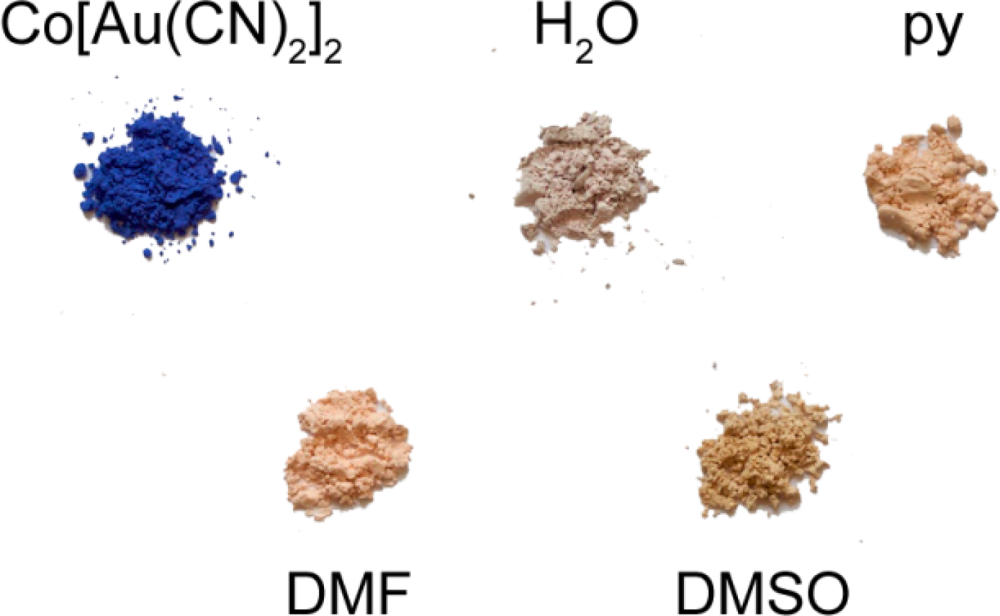
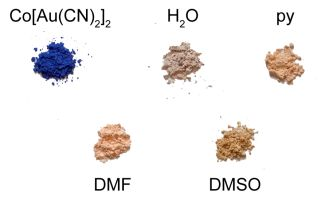
<p>The vapochromic behaviour of the M(<italic>μ</italic>-OH<sub>2</sub>)<sub>2</sub>[Au(CN)<sub>2</sub>]<sub>2</sub> (M = Co, Ni) coordination polymers was investigated by exposing them to vapours of DMSO, DMF and pyridine for several hours/days in a sealed container, after which the FT-IR and UV-vis-NIR spectra and the powder X-ray diffractogram of the product were collected. The ν<sub>CN</sub> bands for each product are reported in <xref ref-type="table" rid="t1-sensors-12-03669">Table 1</xref> and compared with those of the product made from solution (see below); visible colour changes were more noticeable for the Co(II) system (<xref ref-type="fig" rid="f1-sensors-12-03669">Figure 1</xref>) than for the Ni(II) analogue. Details for each metal/VOC vapour combination are outlined below.</p>
<sec>
<label>3.1.</label>
<title>DMSO-Containing Complexes</title>
<p>Upon exposure to DMSO, the pink Co(<italic>μ</italic>-OH<sub>2</sub>)<sub>2</sub>[Au(CN)<sub>2</sub>]<sub>2</sub> coordination polymer (λ<sub>max</sub> ≥ 1110, 525 nm) was converted over a three day period to a lighter, brighter pink coloured product (<xref ref-type="fig" rid="f1-sensors-12-03669">Figure 1</xref>; λ<sub>max</sub> = 1,040, 500, 470 nm) with a ν<sub>CN</sub> band at 2,176 cm<sup>−1</sup> (<xref ref-type="table" rid="t1-sensors-12-03669">Table 1</xref>). This material was stable for months after exposure to ambient atmospheric conditions, indicating that replacement of DMSO molecules for water molecules does not occur at room temperature, which contrasts with the two previously reported Cu[Au(CN)<sub>2</sub>]<sub>2</sub>(DMSO)<sub>2</sub> polymorphs that readily undergo conversion when exposed to ambient moisture [<xref ref-type="bibr" rid="b35-sensors-12-03669">35</xref>]. On the other hand, when Ni(<italic>μ</italic>-OH<sub>2</sub>)<sub>2</sub>[Au(CN)<sub>2</sub>]<sub>2</sub> was exposed to DMSO vapour for one week, ν<sub>CN</sub> bands attributable to the starting material were still present, as well as new bands at 2,181/2,164 cm<sup>−1</sup>. No visible colour change occurred.</p>
<p>Since VOC absorption by M(<italic>μ</italic>-OH<sub>2</sub>)<sub>2</sub>[Au(CN)<sub>2</sub>]<sub>2</sub> powders does not lead to single crystals suitable for structural analysis, in order to assist in deciphering the identity and structure of these M[Au(CN)<sub>2</sub>]<sub>2</sub>(DMSO)<sub>x</sub> products, the preparation of the analogous materials via solution methods was targeted. Thus, the reaction of Co(II), Ni(II) and Zn(II) salts with K[Au(CN)<sub>2</sub>] in DMSO was conducted; the Zn(II) analogue is included since it is the only one which forms single crystals from DMSO. The Ni and Zn reactions afforded the formation of a blue/turquoise precipitate (Ni) or colourless crystals (Zn) of M[Au(CN)<sub>2</sub>]<sub>2</sub>(DMSO)<sub>2</sub>, determined by elemental analysis. The FT-IR spectra show two strong bands in the cyanide stretching region (ν<sub>CN</sub> = 2,189/2,180 and 2,186/2,175 cm<sup>−1</sup> for the Ni and Zn systems, respectively) as well as bands attributable to the sulfoxide (S=O) moiety (1,032–956 cm<sup>−1</sup>) [<xref ref-type="bibr" rid="b52-sensors-12-03669">52</xref>]. The slight shift in ν<sub>CN</sub> between the Ni and Zn materials can be attributed to the different transition metal bound to the nitrogen atom of each cyanide group [<xref ref-type="bibr" rid="b53-sensors-12-03669">53</xref>].</p>
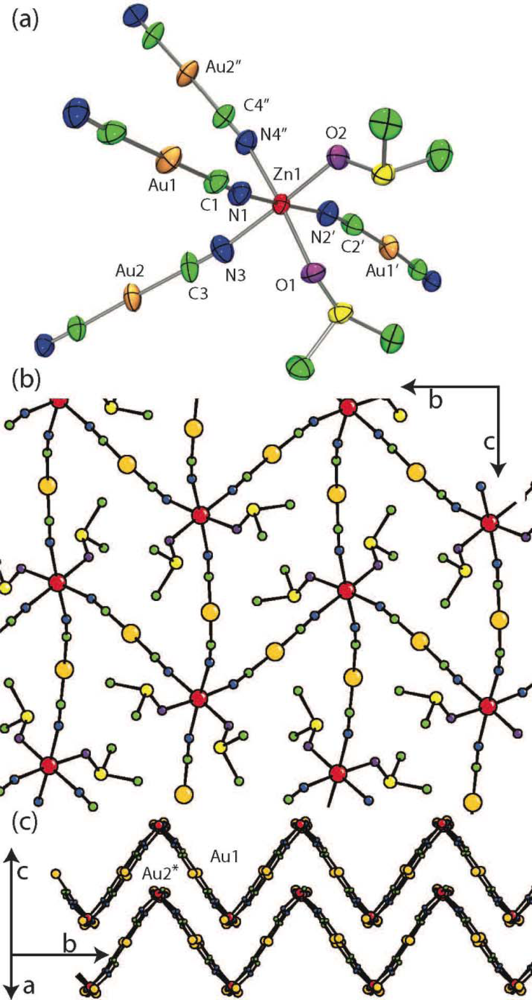
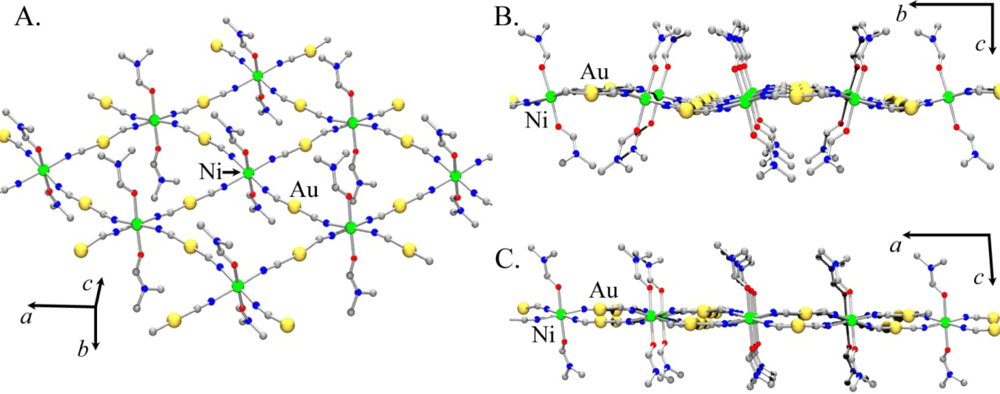
<p>The Zn[Au(CN)<sub>2</sub>]<sub>2</sub>(DMSO)<sub>2</sub> structure (<xref ref-type="fig" rid="f2-sensors-12-03669">Figure 2</xref>, <xref ref-type="table" rid="t2-sensors-12-03669">Tables 2</xref> and <xref ref-type="table" rid="t3-sensors-12-03669">3</xref>) contains a single octahedral Zn(II) centre, with two <italic>cis</italic>-coordinated oxygen-bound DMSO molecules (<xref ref-type="fig" rid="f2-sensors-12-03669">Figure 2(a)</xref>, Zn-O = 2.120(6) and 2.075(6) Å). The remaining four sites around the Zn(II) are coordinated with [Au(CN)<sub>2</sub>]<sup>−</sup> units with an average Zn-N bond length of 2.144(8) Å, longer than the &lt;2.0 Å Zn-N bond lengths in the tetrahedrally coordinated polymorphs of Zn[Au(CN)<sub>2</sub>]<sub>2</sub> [<xref ref-type="bibr" rid="b37-sensors-12-03669">37</xref>,<xref ref-type="bibr" rid="b38-sensors-12-03669">38</xref>]. A 2-D corrugated structure, with DMSO molecules protruding from the apex of the corrugation, is formed by the bridging [Au(CN)<sub>2</sub>]<sup>−</sup> units (<xref ref-type="fig" rid="f2-sensors-12-03669">Figure 2(c)</xref>). The closest contact between sheets is a Au-Au interaction of 3.4943(6) Å. A similar crystal structure was observed for the Cu(II) system [<xref ref-type="bibr" rid="b35-sensors-12-03669">35</xref>].</p>
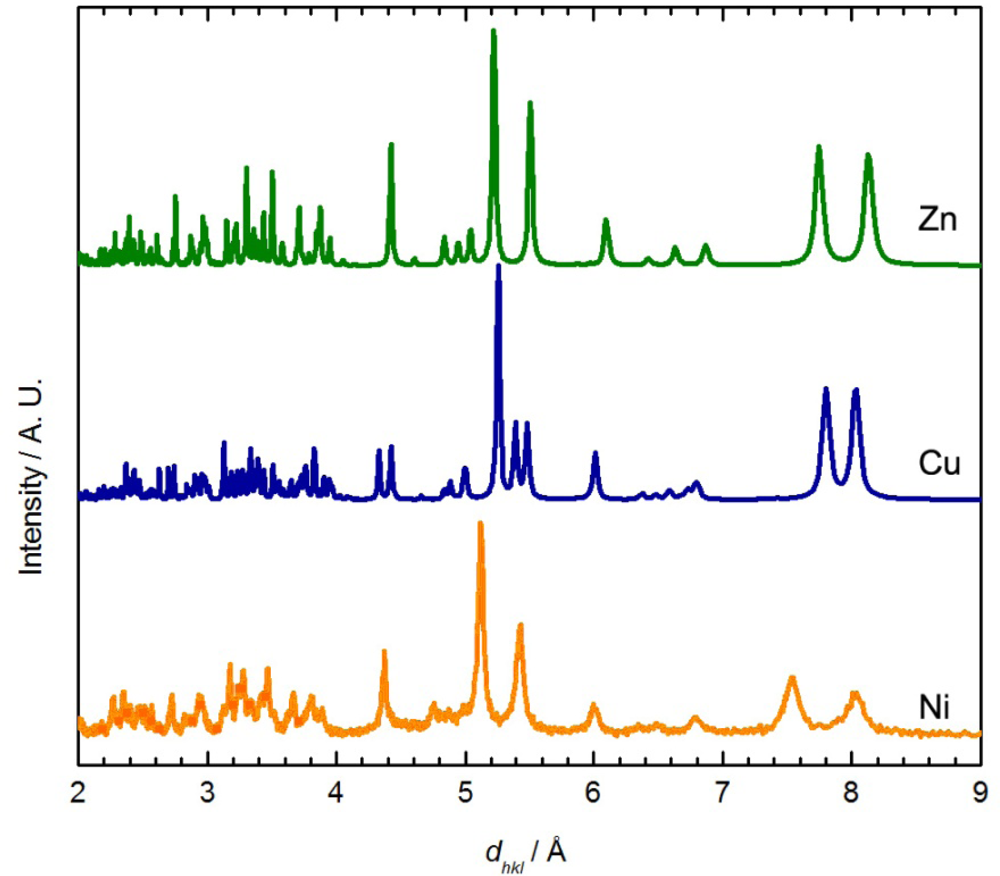
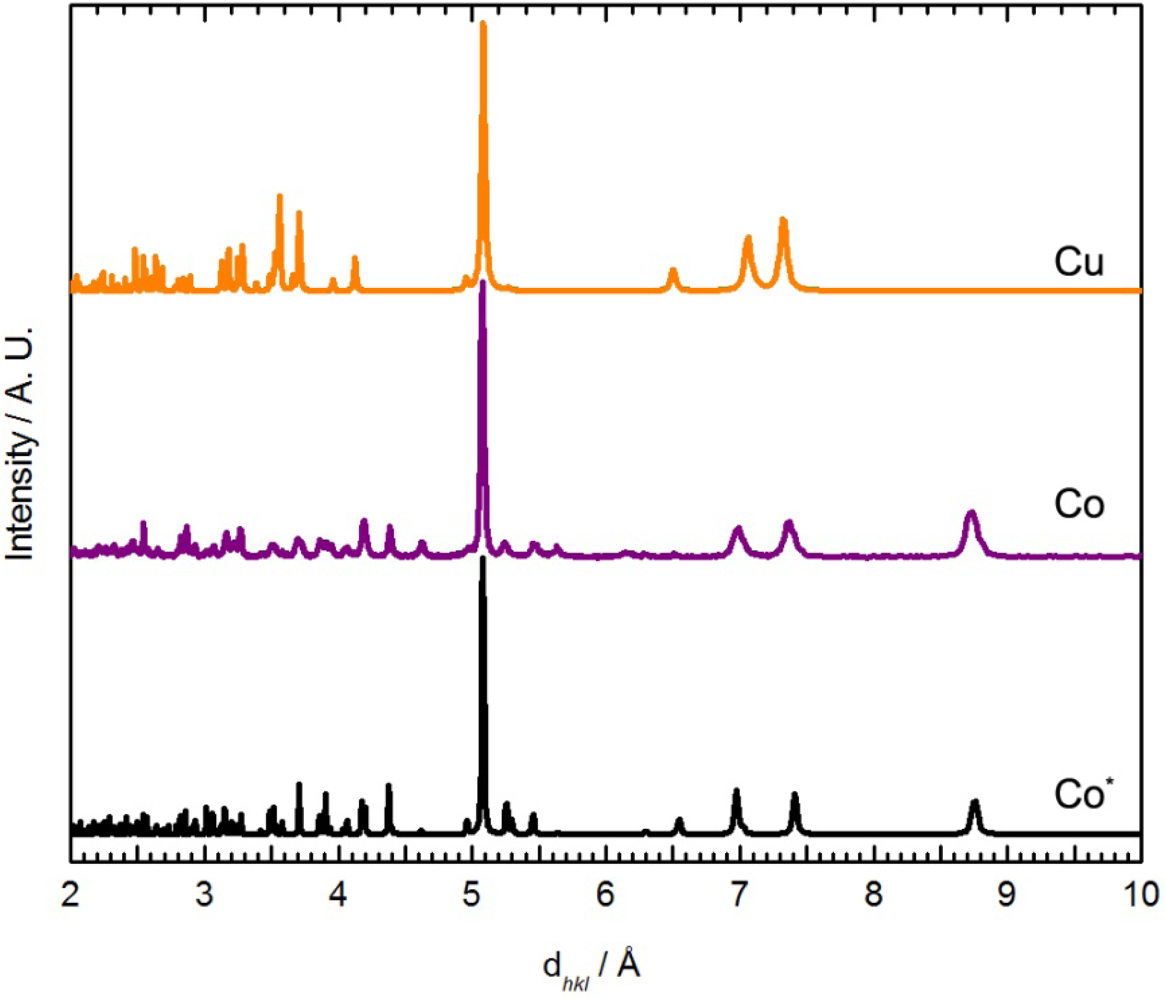
<p>Although no single crystal of Ni[Au(CN)<sub>2</sub>]<sub>2</sub>(DMSO)<sub>2</sub> suitable for X-ray crystallography could be obtained, its powder X-ray diffractogram showed similar features to the diffractograms of the Zn[Au(CN)<sub>2</sub>]<sub>2</sub>(DMSO)<sub>2</sub> and Cu[Au(CN)<sub>2</sub>]<sub>2</sub>(DMSO)<sub>2</sub> (blue polymorph) coordination polymers (<xref ref-type="fig" rid="f3-sensors-12-03669">Figure 3</xref>) [<xref ref-type="bibr" rid="b35-sensors-12-03669">35</xref>]. The diffractogram of Ni[Au(CN)<sub>2</sub>]<sub>2</sub>(DMSO)<sub>2</sub> could be indexed to a monoclinic unit cell, with parameters very similar to those of the Zn analogue (<xref ref-type="table" rid="t4-sensors-12-03669">Table 4</xref>). Thus, the structure of Ni[Au(CN)<sub>2</sub>]<sub>2</sub>(DMSO)<sub>2</sub> likely consists of octahedral Ni(II) ions coordinated by two DMSO molecules in a <italic>cis</italic> fashion and connected to four other Ni(II) centres via [Au(CN)<sub>2</sub>]<sup>−</sup> units, generating corrugated 2-D sheets; due to the poor quality of the diffractogram, no effort was made to structurally model the data any further. Note that the ν<sub>CN</sub> data and powder X-ray diffractograms for Ni[Au(CN)<sub>2</sub>]<sub>2</sub>(DMSO)<sub>2</sub> do not perfectly match those obtained via vapour absorption of DMSO by Ni(<italic>μ</italic>-OH<sub>2</sub>)<sub>2</sub>[Au(CN)<sub>2</sub>]<sub>2</sub>, indicating that a related, but different structure is likely accessed by vapour absorption.</p>
<p>Although the analogous reaction between a Co(II) salt and K[Au(CN)<sub>2</sub>] in neat DMSO yielded an inseparable mixture of products, when pink Co(<italic>μ</italic>-OH<sub>2</sub>)<sub>2</sub>[Au(CN)<sub>2</sub>]<sub>2</sub> was immersed in DMSO for three days, a slight colour change occurred. The resulting light pink powder was isolated and the chemical composition was determined to be Co[Au(CN)<sub>2</sub>]<sub>2</sub>(DMSO)<sub>2</sub>. The FT-IR spectrum of this product contains only one ν<sub>CN</sub> band (2,176 cm<sup>−1</sup>), analogous to that observed by vapour absorption (<xref ref-type="table" rid="t1-sensors-12-03669">Table 1</xref>).</p>
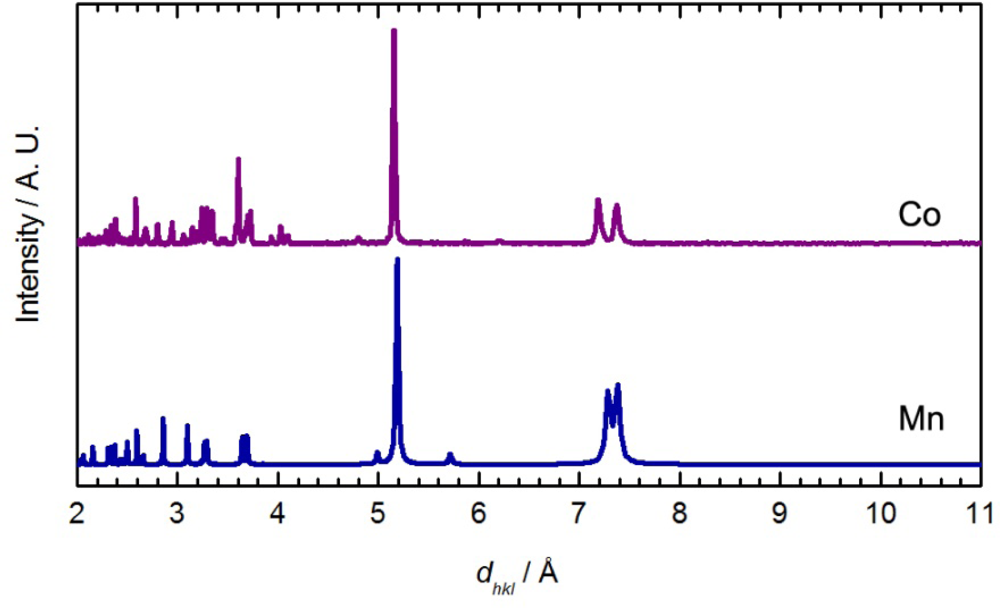
<p>This reaction did not yield single crystals suitable for X-ray analysis, only microcrystalline powder. The powder diffractogram (<xref ref-type="fig" rid="f4-sensors-12-03669">Figure 4</xref>) was indexed and the unit cell parameters obtained are reported in <xref ref-type="table" rid="t4-sensors-12-03669">Table 4</xref>. The diffractogram and the unit cell parameters do not match that of the Zn, Cu or Ni-containing M[Au(CN)<sub>2</sub>]<sub>2</sub>(DMSO)<sub>2</sub> polymers (<xref ref-type="fig" rid="f3-sensors-12-03669">Figure 3</xref> and <xref ref-type="table" rid="t4-sensors-12-03669">Table 4</xref>), which suggests that a different structural arrangement is adopted. Due to the poor quality of the diffractogram, no structure refinement could be performed, but a structural model is proposed based on comparisons with other known complexes.</p>
<p>The presence of only one ν<sub>CN</sub> band, shifted from free [Au(CN)<sub>2</sub>]<sup>−</sup>, suggests that all the cyanide groups are in a similar environment and N-bound to Co(II). This could be the case if the structure of Co[Au(CN)<sub>2</sub>]<sub>2</sub>(DMSO)<sub>2</sub> contained square-grid arrays of Co[Au(CN)<sub>2</sub>]<sub>2</sub> with DMSO molecules bound to Co(II) ions in a <italic>trans</italic> fashion, on each side of the grid. This type of structure has been observed for the previously reported Co[Au(CN)<sub>2</sub>]<sub>2</sub>(DMF)<sub>2</sub> [<xref ref-type="bibr" rid="b50-sensors-12-03669">50</xref>] and Mn[Au(CN)<sub>2</sub>]<sub>2</sub>(H<sub>2</sub>O)<sub>2</sub> [<xref ref-type="bibr" rid="b54-sensors-12-03669">54</xref>] coordination polymers. Although the ν<sub>CN</sub> band observed for Co[Au(CN)<sub>2</sub>]<sub>2</sub>(DMSO)<sub>2</sub> (2,176 cm<sup>−1</sup>) is similar to that for the DMF analogue (2,179 cm<sup>−1</sup>) [<xref ref-type="bibr" rid="b35-sensors-12-03669">35</xref>], the powder diffractograms are a poor match.</p>
<p>The main features in the diffractograms of Co[Au(CN)<sub>2</sub>]<sub>2</sub>(DMSO)<sub>2</sub> and Mn[Au(CN)<sub>2</sub>]<sub>2</sub>(H<sub>2</sub>O)<sub>2</sub> [<xref ref-type="bibr" rid="b54-sensors-12-03669">54</xref>] are similar (<xref ref-type="fig" rid="f4-sensors-12-03669">Figure 4</xref>). The packing in Co[Au(CN)<sub>2</sub>]<sub>2</sub>(DMF)<sub>2</sub> differs from Mn[Au(CN)<sub>2</sub>]<sub>2</sub>(H<sub>2</sub>O)<sub>2</sub> since the Co[Au(CN)<sub>2</sub>]<sub>2</sub> layers stack in discrete pairs whereas the Mn[Au(CN)<sub>2</sub>]<sub>2</sub> layers are equally spaced and do not form pairs of layers. It is hence suggested that, analogous to the Mn[Au(CN)<sub>2</sub>]<sub>2</sub>(H<sub>2</sub>O)<sub>2</sub> superstructure, the Co[Au(CN)<sub>2</sub>]<sub>2</sub>(DMSO)<sub>2</sub> polymer contains flat and equally spaced square-grid arrays, with DMSO molecules bound in a <italic>trans</italic> fashion.</p>
<p>With this information in hand, it is clear that vapour absorption of DMSO by Co(<italic>μ</italic>-OH<sub>2</sub>)<sub>2</sub>[Au(CN)<sub>2</sub>]<sub>2</sub> gives Co[Au(CN)<sub>2</sub>]<sub>2</sub>(DMSO)<sub>2</sub> cleanly; the solution method yields a product with comparable UV-vis, powder X-ray and IR data. However, the Ni(II) system does not run to completion, even after a week of vapour exposure, and the products from vapour and solution methods, although related, do not appear to be identical.</p></sec>
<sec>
<label>3.2.</label>
<title>DMF-Containing Complexes</title>
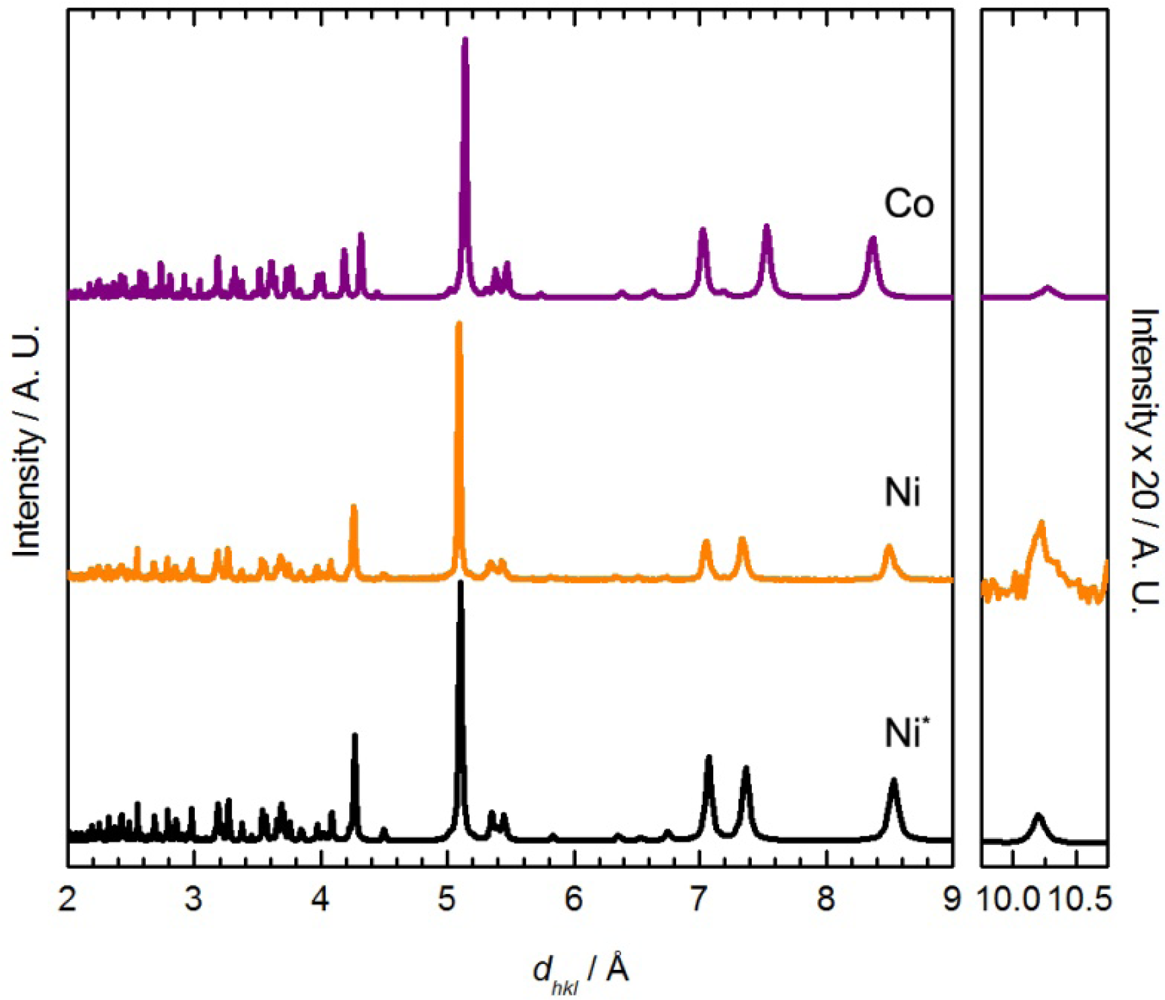
<p>When Co(<italic>μ</italic>-OH<sub>2</sub>)<sub>2</sub>[Au(CN)<sub>2</sub>]<sub>2</sub> was exposed to DMF vapour, faint colour changes to a light, bright pink (λ<sub>max</sub> = 1035, 490, 468 nm) were observed after several hours (<xref ref-type="fig" rid="f1-sensors-12-03669">Figure 1</xref>), and the IR spectrum indicated a clean conversion; a single ν<sub>CN</sub> peak at 2,182 cm<sup>−1</sup> was generated (<xref ref-type="table" rid="t1-sensors-12-03669">Table 1</xref>). The analogous solution-based synthetic product has a comparable FTIR spectrum and powder X-ray diffractogram to that obtained by vapour absorption, both of which are indistinguishable from that of the previously published Co[Au(CN)<sub>2</sub>]<sub>2</sub>(DMF)<sub>2</sub> system (<xref ref-type="fig" rid="f5-sensors-12-03669">Figure 5</xref>) [<xref ref-type="bibr" rid="b50-sensors-12-03669">50</xref>]; this is therefore the product that is obtained. For the Ni(II) analogue, after one week of being exposed to DMF vapour, the FT-IR spectrum of the product showed the presence of the starting Ni(<italic>μ</italic>-OH<sub>2</sub>)<sub>2</sub>[Au(CN)<sub>2</sub>]<sub>2</sub> compound as well as an additional band at 2,184 cm<sup>−1</sup>; no significant colour change was observed.</p>
<p>For comparison, when Ni(<italic>μ</italic>-OH<sub>2</sub>)<sub>2</sub>[Au(CN)<sub>2</sub>]<sub>2</sub> was immersed in DMF for one day, a colour change from light green to blue was observed, similar to Co[Au(CN)<sub>2</sub>]<sub>2</sub>(DMF)<sub>2</sub>. The FT-IR spectrum of the isolated product showed only one ν<sub>CN</sub> band at 2,189 cm<sup>−1</sup>. The chemical composition was determined to be Ni[Au(CN)<sub>2</sub>]<sub>2</sub>(DMF)<sub>2</sub> from elemental analysis, comparable to the previously reported Co[Au(CN)<sub>2</sub>]<sub>2</sub>(DMF)<sub>2</sub> coordination polymer [<xref ref-type="bibr" rid="b50-sensors-12-03669">50</xref>] but different from that of the Cu(II)-containing analogue, in which only one DMF molecule was incorporated. The unit cell obtained from indexing the powder X-ray diffractogram of Ni[Au(CN)<sub>2</sub>]<sub>2</sub>(DMF)<sub>2</sub> (<xref ref-type="fig" rid="f5-sensors-12-03669">Figure 5</xref>-Ni) is also similar to that of Co[Au(CN)<sub>2</sub>]<sub>2</sub>(DMF)<sub>2</sub> (<xref ref-type="table" rid="t5-sensors-12-03669">Table 5</xref>) [<xref ref-type="bibr" rid="b50-sensors-12-03669">50</xref>].</p>
<p>Using the atomic coordinates of the published Co(II) analogue as a starting point, the structure of Ni[Au(CN)<sub>2</sub>]<sub>2</sub>(DMF)<sub>2</sub> was determined from the observed powder X-ray diffractogram (the atomic coordinates are reported in <xref ref-type="supplementary-material" rid="SD1">Table S1</xref>). <xref ref-type="fig" rid="f6-sensors-12-03669">Figure 6</xref> shows the proposed model for Ni[Au(CN)<sub>2</sub>]<sub>2</sub>(DMF)<sub>2</sub>.</p>
<p>As with Co[Au(CN)<sub>2</sub>]<sub>2</sub>(DMF)<sub>2</sub>, the structure contains 2-D square grids of Ni[Au(CN)<sub>2</sub>]<sub>2</sub> (<xref ref-type="fig" rid="f6-sensors-12-03669">Figure 6(A)</xref>). The DMF molecules are O-bound to the Ni(II) centres on each side of the grids, which stack in an offset manner to accommodate the DMF molecules. The [Au(CN)<sub>2</sub>]<sup>−</sup> units are slightly bent and sit above and below the plane containing the Ni(II) centres (<xref ref-type="fig" rid="f6-sensors-12-03669">Figure 6(B,C)</xref>). As observed in the Co[Au(CN)<sub>2</sub>]<sub>2</sub>(DMF)<sub>2</sub> structure, the layers stack in discrete pairs with aurophilic interactions of <italic>ca.</italic> 3.3 Å forming the pair, whereas Au-Au distances of <italic>ca.</italic> 5.4 Å separate each pair of layers.</p>
<p>Thus, both Co(II) and Ni(II) analogues of M(<italic>μ</italic>-OH<sub>2</sub>)<sub>2</sub>[Au(CN)<sub>2</sub>]<sub>2</sub> sense DMF as an analyte, although the Co(II) system reacts more cleanly and quickly. Both form similar 2-D layer structures of M[Au(CN)<sub>2</sub>]<sub>2</sub>(DMF)<sub>2</sub>, with the same product being generated from solution or vapour absorption. However, the Ni(II) analogue only partially converts to product in the vapour absorption experiment, and as a result the expected visible vapochromism (green to blue by solution methods) was not observed; this putative vapochromic response was likely attenuated by the residual absorption bands of the unreacted starting material.</p></sec>
<sec>
<label>3.3.</label>
<title>Pyridine-Containing Complexes</title>
<p>When Co(<italic>μ</italic>-OH<sub>2</sub>)<sub>2</sub>[Au(CN)<sub>2</sub>]<sub>2</sub> was exposed to pyridine vapour, conversion to a light pink product (λ<sub>max</sub> = 1,000, 525, 485 nm, <xref ref-type="fig" rid="f1-sensors-12-03669">Figure 1</xref>) having ν<sub>CN</sub> bands at 2,168/2,144 cm<sup>−1</sup> occurred (<xref ref-type="table" rid="t1-sensors-12-03669">Table 1</xref>). Upon exposure to pyridine vapour, Ni(<italic>μ</italic>-OH<sub>2</sub>)<sub>2</sub>[Au(CN)<sub>2</sub>]<sub>2</sub> undergoes a colour change, from light green to blue over several days. The FT-IR spectrum shows ν<sub>CN</sub> bands of the starting material and additional bands at 2,170/2,162/2,141 cm<sup>−1</sup>; this complexity likely indicates the formation of a mixture of analyte-containing products.</p>
<p>On the solution synthesis side, when a powdered sample of Co(<italic>μ</italic>-OH<sub>2</sub>)<sub>2</sub>[Au(CN)<sub>2</sub>]<sub>2</sub> was immersed for one day in a mixture of water and pyridine (96:4), a slight colour change was observed. The FT-IR spectrum of the isolated powder showed only one strong ν<sub>CN</sub> band at 2,168 cm<sup>−1</sup> (<xref ref-type="table" rid="t1-sensors-12-03669">Table 1</xref>), reminiscent of that of the Co[Au(CN)<sub>2</sub>]<sub>2</sub>(DMF)<sub>2</sub> system. Thus, a different product is obtained in solution. Pyridine-based bands could also be observed.</p>
<p>The powder X-ray diffractogram of the solution-based product, which analyzes as Co[Au(CN)<sub>2</sub>]<sub>2</sub>(pyridine)<sub>2</sub>, is shown in <xref ref-type="fig" rid="f7-sensors-12-03669">Figure 7</xref> and is different than the material obtained by vapour diffusion; it also shows similar features to the diffractogram of Co[Au(CN)<sub>2</sub>]<sub>2</sub>(DMF)<sub>2</sub> (<xref ref-type="fig" rid="f5-sensors-12-03669">Figure 5</xref>) and Cu[Au(CN)<sub>2</sub>]<sub>2</sub>(pyridine)<sub>2</sub>. The diffractogram was indexed and the optimized unit cell parameters are reported in <xref ref-type="table" rid="t5-sensors-12-03669">Table 5</xref>. They are comparable with those of the Ni and Co-containing M[Au(CN)<sub>2</sub>]<sub>2</sub>(DMF)<sub>2</sub> complexes (<xref ref-type="fig" rid="f6-sensors-12-03669">Figure 6</xref>).</p>
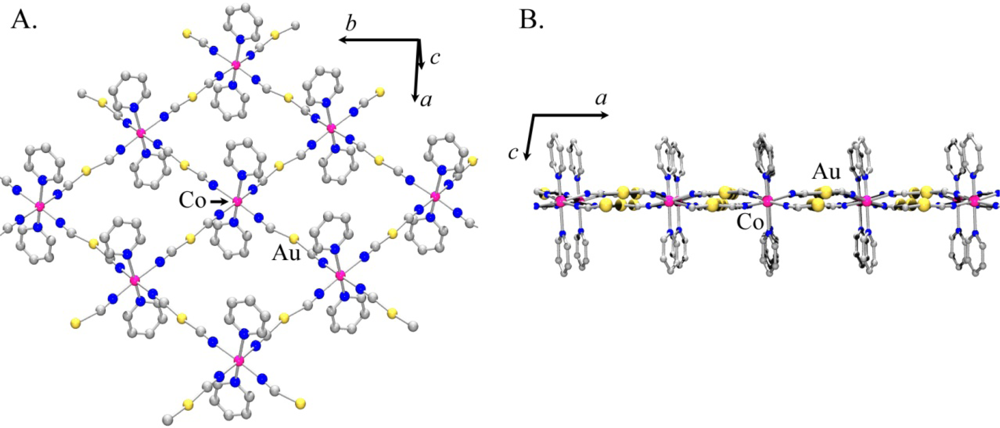
<p>Using a combination of the Cu[Au(CN)<sub>2</sub>]<sub>2</sub>(pyridine)<sub>2</sub> and Co[Au(CN)<sub>2</sub>]<sub>2</sub>(DMF)<sub>2</sub> structures as a starting point, a structural model is proposed for Co[Au(CN)<sub>2</sub>]<sub>2</sub>(pyridine)<sub>2</sub> (the corresponding atomic coordinates are reported in <xref ref-type="supplementary-material" rid="SD1">Table S2</xref>). The structure consists of 2-D square grids of Co[Au(CN)<sub>2</sub>]<sub>2</sub> with pyridine molecules N-bound to the Co(II) centres on both sides of the layer (<xref ref-type="fig" rid="f8-sensors-12-03669">Figure 8(A)</xref>). The structure differs from the Cu(II) analogue as all the cyanide groups are equidistant from the Co(II) centres and no Jahn-Teller distortion is observed. Also, the Co[Au(CN)<sub>2</sub>]<sub>2</sub> layers are not completely flat as in the Cu[Au(CN)<sub>2</sub>]<sub>2</sub> system, but the [Au(CN)<sub>2</sub>]<sup>−</sup> units are buckled in an alternate way on each side of the layer (<xref ref-type="fig" rid="f8-sensors-12-03669">Figure 8(B)</xref>), as is observed in the related Co[Au(CN)<sub>2</sub>]<sub>2</sub>(DMF)<sub>2</sub> polymer [<xref ref-type="bibr" rid="b50-sensors-12-03669">50</xref>]. This arrangement allows π–π interactions between the pyridine rings, but no aurophilic interactions are present as the closest contact between two Au atoms is approx. 3.7 Å. The powder diffractogram predicted by this model is compared to the experimental diffractogram of Co[Au(CN)<sub>2</sub>]<sub>2</sub>(pyridine)<sub>2</sub> in <xref ref-type="fig" rid="f7-sensors-12-03669">Figure 7</xref>.</p>
<p>The addition of Ni(NO<sub>3</sub>)<sub>2</sub>·6H<sub>2</sub>O to KAu(CN)<sub>2</sub> in a mixture of water and pyridine (96:4) generated purple Ni[Au(CN)<sub>2</sub>]<sub>2</sub>(pyridine)<sub>4</sub>, confirmed by elemental analysis. The FT-IR spectrum of this product shows two ν<sub>CN</sub> bands (2,171 and 2,143 cm<sup>−1</sup>), consistent with two of the three bands observed by vapour diffusion. Depending on the reaction conditions, variable amounts of an uncharacterized material could also be generated (as indicated by IR: 2182, 2153 cm<sup>−1</sup>) but a pure sample could not be isolated.</p>
<p>Clearly, pyridine as an analyte yields the most complex, least clean conversions for both Co(II) and Ni(II) analogues. Thus, for Co(II), a bis-pyridine adduct forms from aqueous pyridine solution, while vapour absorption methods generated a different product. A Ni[Au(CN)<sub>2</sub>]<sub>2</sub>(pyridine)<sub>4</sub> complex was isolated via solution methods, confirmed by elemental analysis. The powder X-ray diffractograms of Ni[Au(CN)<sub>2</sub>]<sub>2</sub>(pyridine)<sub>4</sub> and the Co vapochromic product are very similar, which suggests that the product of pyridine vapour with the Co(II) system is a tetrakis-pyridine adduct. Finally, pyridine vapour absorption by Ni(<italic>μ</italic>-OH<sub>2</sub>)<sub>2</sub>[Au(CN)<sub>2</sub>]<sub>2</sub> is the least clean of all the reactions studied herein, generating Ni[Au(CN)<sub>2</sub>]<sub>2</sub>(pyridine)<sub>4</sub>, another unidentified product (perhaps a bis-pyridine adduct) as well as leaving residual starting material.</p></sec>
<sec>
<label>3.4.</label>
<title>Analyte-Free M[Au(CN)<sub>2</sub>]<sub>2</sub> Systems</title>
<p>Analyte-free systems were investigated in order to see if the vapochromic response would be improved without the presence of an initial analyte molecule (H<sub>2</sub>O) in the structure. Co[Au(CN)<sub>2</sub>]<sub>2</sub> was synthesized by heating Co(μ-OH<sub>2</sub>)<sub>2</sub>[Au(CN)<sub>2</sub>]<sub>2</sub> to at least 110 °C for a minimum of one hour (ideally, 145 °C for two hours; heating at 180 °C for 10 minutes was very recently reported as an alternative synthesis [<xref ref-type="bibr" rid="b42-sensors-12-03669">42</xref>]). The compound changes from a light pink colour (octahedral Co(II)) to an intense cobalt-blue colour (tetrahedral Co(II)). Co[Au(CN)<sub>2</sub>]<sub>2</sub> is stable in ambient air for approximately two days, whereupon it rehydrates to a compound with a similar powder X-ray diffractogram and IR spectrum to Co(μ-OH<sub>2</sub>)<sub>2</sub>[Au(CN)<sub>2</sub>]<sub>2</sub>, but is a light purple colour; its identity is under investigation.</p>
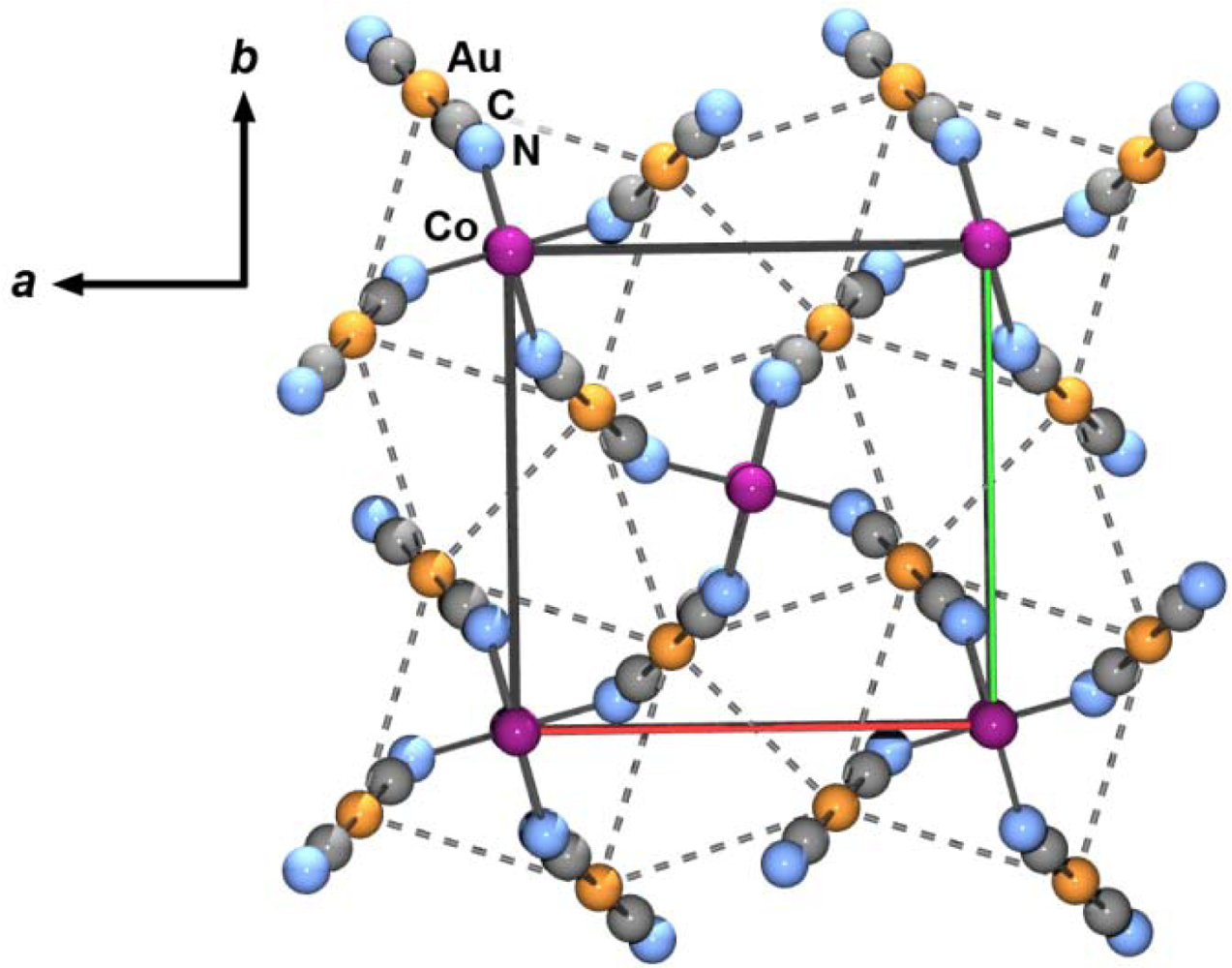
<p>The structure of Co[Au(CN)<sub>2</sub>]<sub>2</sub> was deduced by matching the powder X-ray diffractogram to that of the isostructural compound [<xref ref-type="bibr" rid="b37-sensors-12-03669">37</xref>], γ-Zn[Au(CN)<sub>2</sub>]<sub>2</sub> (<xref ref-type="supplementary-material" rid="SD1">Figure S1</xref>), indexing the data accordingly (spacegroup <italic>P</italic>-4<italic>b</italic>2<italic>, a</italic> = 6.7968(17) Å, <italic>c</italic> = 8.4651(3) Å) and refining atomic positions (<xref ref-type="supplementary-material" rid="SD1">Tables S3</xref> and <xref ref-type="supplementary-material" rid="SD1">S4</xref>). The cobalt(II) centres are tetrahedrally coordinated through the nitrogen end of four [Au(CN)<sub>2</sub>]<sup>−</sup> units, creating a tetragonal diamond-type lattice (<xref ref-type="fig" rid="f9-sensors-12-03669">Figure 9</xref>). There are four interpenetrated networks that are linked together via aurophilic interactions (3.33 and 3.56 Å). Note that a previously reported synthesis of Co[Au(CN)<sub>2</sub>]<sub>2</sub> (by a simple addition of salt [<xref ref-type="bibr" rid="b55-sensors-12-03669">55</xref>]) generated a different polymorph (equivalent to quartz-type α-Zn[Au(CN)<sub>2</sub>]<sub>2</sub>) [<xref ref-type="bibr" rid="b37-sensors-12-03669">37</xref>,<xref ref-type="bibr" rid="b38-sensors-12-03669">38</xref>], while using another route, via solvent-free grinding of Co(OH<sub>2</sub>)<sub>2</sub>[Au(CN)<sub>2</sub>]<sub>2</sub>, the structure was not determined [<xref ref-type="bibr" rid="b42-sensors-12-03669">42</xref>].</p>
<p>Vapochromic experiments were also performed on Co[Au(CN)<sub>2</sub>]<sub>2</sub> with DMF, DMSO, and pyridine as analytes. Uptake occurred in all cases, yielding Co[Au(CN)<sub>2</sub>]<sub>2</sub>(analyte)<sub>x</sub> materials in similar shades of light pink; with DMF as the analyte, the complex showed the fastest conversion (about 1 day), whereas pyridine showed the slowest conversion (several days). Based on IR and powder X-ray diffraction data, the complexes that form using DMF and DMSO are identical to those produced from vapour absorption by Co(μ-OH<sub>2</sub>)<sub>2</sub>[Au(CN)<sub>2</sub>]<sub>2</sub>. The complex with pyridine shows two ν<sub>CN</sub> bands at 2,170 and 2,142 cm<sup>−1</sup> and a powder X-ray diffractogram matching the Co[Au(CN)<sub>2</sub>]<sub>2</sub>(pyridine)<sub>4</sub> adduct identified via vapour absorption by Co(μ-OH<sub>2</sub>)<sub>2</sub>[Au(CN)<sub>2</sub>]<sub>2</sub>, rather than the bis-pyridine adduct obtained by solution methods. These IR spectroscopic results broadly match those very recently reported for the addition of a range of donor solvents (including pyridine, DMSO and DMF, as reported here) to Co[Au(CN)<sub>2</sub>]<sub>2</sub> [<xref ref-type="bibr" rid="b42-sensors-12-03669">42</xref>].</p>
<p>The synthesis of Ni[Au(CN)<sub>2</sub>]<sub>2</sub> was attempted by several methods but the desired product could not be obtained. Since the dehydration temperature for Ni(μ-OH<sub>2</sub>)<sub>2</sub>[Au(CN)<sub>2</sub>]<sub>2</sub> is between 215–260 °C, it is necessary to heat above 260 °C for extended periods of time to dehydrate it, but doing so resulted in decomposition. Attempts to effect chemical dehydration by stirring Ni(μ-OH<sub>2</sub>)<sub>2</sub>[Au(CN)<sub>2</sub>]<sub>2</sub> in glacial acetic acid or refluxing in trimethylsilylchloride resulted in no change. The addition of [<sup>n</sup>Bu<sub>4</sub>N][Au(CN)<sub>2</sub>] [<xref ref-type="bibr" rid="b56-sensors-12-03669">56</xref>] to anhydrous NiCl<sub>2</sub>·DME in dry organic solvents under an inert, dry atmosphere yielded other products which are under investigation [<xref ref-type="bibr" rid="b57-sensors-12-03669">57</xref>], but did not generate Ni[Au(CN)<sub>2</sub>]<sub>2</sub>. It therefore appears that Ni(μ-OH<sub>2</sub>)<sub>2</sub>[Au(CN)<sub>2</sub>]<sub>2</sub> is exceptionally stable, which is in agreement with the vapour absorption results, which indicate only partial conversion in every case.</p></sec>
<sec sec-type="materials">
<label>3.5.</label>
<title>Comparison of M[Au(CN)<sub>2</sub>]<sub>2</sub>-Based Vapochromic Materials (M = Co, Ni, Cu)</title>
<p>The M[Au(CN)<sub>2</sub>]<sub>2</sub>(analyte)<sub>x</sub> polymers show visible vapochromism since each analyte molecule that is incorporated binds to the M(II) centre and modifies differently its crystal field splitting. As a consequence, the colours of the vapochromic compounds change as the <italic>d–d</italic> absorbance bands shift [<xref ref-type="bibr" rid="b35-sensors-12-03669">35</xref>,<xref ref-type="bibr" rid="b36-sensors-12-03669">36</xref>]. <xref ref-type="table" rid="t6-sensors-12-03669">Table 6</xref> shows the solid-state UV-vis-NIR absorbance maxima for the analyte-containing compounds prepared from solution (<italic>vs.</italic> direct analyte absorption by the solid).</p>
<p>The data in <xref ref-type="table" rid="t6-sensors-12-03669">Table 6</xref> and <xref ref-type="fig" rid="f1-sensors-12-03669">Figure 1</xref> suggests that identification of the different M[Au(CN)<sub>2</sub>]<sub>2</sub>(analyte)<sub>2</sub> polymers (M = Co, Ni) purely on the basis of colour cannot be accomplished as easily as for the Cu(II)-based analogues [<xref ref-type="bibr" rid="b35-sensors-12-03669">35</xref>,<xref ref-type="bibr" rid="b36-sensors-12-03669">36</xref>]. The M(II) coordination sphere in the M[Au(CN)<sub>2</sub>]<sub>2</sub>(analyte)<sub>2</sub> polymers is very similar: an octahedral geometry with four cyanide groups occupying the same plane. The only difference lies in the two donor analytes that are <italic>trans</italic> to each other (M(NC)<sub>4</sub>(O-ligand)<sub>2</sub> <italic>vs.</italic> M(NC)<sub>4</sub>(N-ligand)<sub>2</sub>). As a result, the crystal field splitting of the M(II) centres in each M[Au(CN)<sub>2</sub>]<sub>2</sub>(analyte)<sub>2</sub> is very similar and, hence, so is their colour, particularly for DMSO and DMF analytes; some differentiation for pyridine is possible. The spectra of the M(<italic>μ</italic>-OH<sub>2</sub>)<sub>2</sub>[Au(CN)<sub>2</sub>]<sub>2</sub> polymers containing M(NC)<sub>2</sub>(O-ligand)<sub>4</sub> centres is, however, shifted to slightly lower energy. The analyte-free Co[Au(CN)<sub>2</sub>]<sub>2</sub> system is also markedly different from all Co(II)-analyte adducts, consistent with tetrahedral <italic>vs.</italic> octahedral Co(II) centres.</p>
<p>Upon comparing the reactivity of the M[Au(CN)<sub>2</sub>]<sub>2</sub>-based systems, analyte exchange is quickest for M = Cu(II) and Zn(II) [<xref ref-type="bibr" rid="b35-sensors-12-03669">35</xref>–<xref ref-type="bibr" rid="b38-sensors-12-03669">38</xref>], followed by the Co(II) system and least so in the Ni(II) system, for which analyte exchange was found to be only partial, with a mixture of products obtained; this is likely due to the relative kinetic inertness of Ni(II) complexes. Thus, the Ni(II)-systems are not likely to be very useful vapochromic materials for VOC sensing. Indeed, the most easily visible vapochromic system reported here is the analyte-free Co[Au(CN)<sub>2</sub>]<sub>2</sub>, for which drastic colour changes upon analyte-binding occurs, but differentiation of the products obtained with different analytes is more difficult. Note that other factors, such as particle size/surface area and analyte vapour pressure, also influence the overall kinetic response of the material.</p>
<p>From a structural perspective, it is known that a system does not need to be porous in order to undergo guest uptake [<xref ref-type="bibr" rid="b58-sensors-12-03669">58</xref>]. For example, a flexible metal-ligand superstructure can dynamically adapt in order to accommodate a variety of potential guests, as is the case here [<xref ref-type="bibr" rid="b58-sensors-12-03669">58</xref>–<xref ref-type="bibr" rid="b64-sensors-12-03669">64</xref>]. Despite the range of analyte molecules utilized, the basic structural motif of the M[Au(CN)<sub>2</sub>]<sub>2</sub>(analyte)<sub>x</sub> coordination polymers remained the same in most cases: a 2-D square-grid M[Au(CN)<sub>2</sub>]<sub>2</sub> network was the basic structural feature, which is flexible and can adapt to accommodate the requisite structural changes, depending on the metal ion and analyte type. <xref ref-type="fig" rid="f10-sensors-12-03669">Scheme 1</xref> summarizes the different types of structural distortions observed for the M[Au(CN)<sub>2</sub>]<sub>2</sub>-based systems (M = Co, Ni, Cu).</p>
<p>The major mode of flexibility [<xref ref-type="bibr" rid="b62-sensors-12-03669">62</xref>–<xref ref-type="bibr" rid="b64-sensors-12-03669">64</xref>] lies in the fact that the 2-D square-grid can be entirely flat, as in the M[Au(CN)<sub>2</sub>]<sub>2</sub>(DMF)<sub>2</sub> or M[Au(CN)<sub>2</sub>]<sub>2</sub>(pyridine)<sub>2</sub> complexes, or it can buckle to generate a corrugated 2-D array, as observed in several M[Au(CN)<sub>2</sub>]<sub>2</sub>(DMSO)<sub>2</sub> (M = Zn, Ni or Cu (blue polymorph)) polymers. In addition, in a flat square-grid, the [Au(CN)<sub>2</sub>]<sup>−</sup> units can lie completely co-planar with the M(II) centres as in Cu[Au(CN)<sub>2</sub>]<sub>2</sub>(pyridine)<sub>2</sub> or bent out of the M(II)-containing plane, as in M[Au(CN)<sub>2</sub>]<sub>2</sub>(DMF)<sub>2</sub>. For a given analyte, similar structures are usually observed despite the change in metal centre. DMSO is the only type of guest utilized that forces corrugation of the layers, whereas DMF and pyridine favour flat square-grid arrays to be obtained.</p>
<p>Due to Jahn-Teller distortions, the structures of the polymers containing Cu(II) ions are more axially elongated than that of the Ni(II) and Co(II)-containing polymers. This form of structural flexibility is particularly important since substantially different FT-IR signatures in the cyanide vibration region for the Cu(II)-analogues are generated depending on the axial/equatorial cyanide bonding arrangement in the system; this detection methodology is less striking for the Co/Ni analogues, which don’t have the same geometric flexibility as Cu(II) [<xref ref-type="bibr" rid="b35-sensors-12-03669">35</xref>]. In the Cu[Au(CN)<sub>2</sub>]<sub>2</sub>(analyte)<sub>2</sub> system, the differences in cyanide vibration frequency between certain analyte adducts vary by up to 70 cm<sup>−1</sup>. However, the differentiation between DMF, DMSO, and pyridine analytes in the Co(II) analogue is poorer due to similar colour and ν<sub>CN</sub> frequencies. The FT-IR signatures in the cyanide vibration region for the Ni[Au(CN)<sub>2</sub>]<sub>2</sub>(analyte)<sub>x</sub> polymers, on the other hand, are different from each other, allowing for analyte identification if analyte exchange actually occurs.</p></sec></sec>
<sec sec-type="conclusions">
<label>4.</label>
<title>Conclusions</title>
<p>In summary, the Co[Au(CN)<sub>2</sub>]<sub>2</sub>-based systems react when exposed to different analytes, but detection and identification of the analyte by FT-IR and UV-vis spectroscopies are more difficult than in the analogous Cu(II) system, except for the analyte-free Co[Au(CN)<sub>2</sub>]<sub>2</sub>, which undergoes large structural and visible colour changes upon analyte-binding, albeit slowly. The Ni(II)-based system is relatively inert and does not undergo analyte exchange easily, at least with the analytes tested in this study, although the identity of the analyte present is more easily discerned than for the analogous Co(II) system. Nevertheless, it is clear that a flexible non-porous M[Au(CN)<sub>2</sub>]<sub>2</sub>-superstructure can readily adapt to integrate selected analytes, the efficacy and spectroscopic signatures of which depend on the metal cation in question. An examination of new M[Au(CN)<sub>2</sub>]-based systems with respect to detecting potential VOC analytes with different donor characteristics is worthwhile and efforts are underway towards this end.</p></sec>
<sec sec-type="supplementary-material">
<title>Supplementary Information</title>
<p>Unit cell parameters and powder X-ray diffractogram for Co[Au(CN)<sub>2</sub>]<sub>2</sub>, atomic coordinates for the powder X-ray diffraction models for Ni[Au(CN)<sub>2</sub>]<sub>2</sub>(DMF)<sub>2</sub>, Co[Au(CN)<sub>2</sub>]<sub>2</sub>(pyridine)<sub>2</sub>, and Co[Au(CN)<sub>2</sub>]<sub>2</sub>, and X-ray crystallographic data in cif format (CCDC Deposition #745836) for Zn[Au(CN)<sub>2</sub>]<sub>2</sub>(DMSO)<sub>2</sub>.</p>
<supplementary-material id="SD1" content-type="local-data">
<media mimetype="image" mime-subtype="pdf" xlink:href="sensors-12-03669-s001.pdf"/></supplementary-material></sec></body>
<back>
<ack>
<p>We are grateful to NSERC of Canada, the World Gold Council GROW program and Simon Fraser University for financial support of this project. JL, JLK and MJK are grateful to NSERC for CGS-D, CGS-M and PGS-D Fellowships respectively.</p></ack>
<ref-list>
<title>References</title>
<ref id="b1-sensors-12-03669"><label>1.</label><citation citation-type="journal"><person-group person-group-type="author"><name><surname>White-Morris</surname><given-names>R.L.</given-names></name><name><surname>Olmstead</surname><given-names>M.M.</given-names></name><name><surname>Jiang</surname><given-names>F.</given-names></name><name><surname>Tinti</surname><given-names>D.S.</given-names></name><name><surname>Balch</surname><given-names>A.L.</given-names></name></person-group><article-title>Remarkable variations in the luminescence of frozen solutions of [Au{C(NHMe)<sub>2</sub>}<sub>2</sub>](PF<sub>6</sub>)•0.5(acetone). Structural and spectroscopic studies of the effects of anions and solvents on gold(I) carbene complexes</article-title><source>J. Am. Chem. Soc</source><year>2002</year><volume>124</volume><fpage>2327</fpage><lpage>2336</lpage><pub-id pub-id-type="doi">10.1021/ja012397s</pub-id><pub-id pub-id-type="pmid">11878988</pub-id></citation></ref>
<ref id="b2-sensors-12-03669"><label>2.</label><citation citation-type="journal"><person-group person-group-type="author"><name><surname>Strasser</surname><given-names>C.E.</given-names></name><name><surname>Catalano</surname><given-names>V.J.</given-names></name></person-group><article-title>“On Off” Au(I)•••Cu(I) interactions in a Au(NHC)<sub>2</sub> luminescent vapochromic sensor</article-title><source>J. Am. Chem. Soc</source><year>2010</year><volume>132</volume><fpage>10009</fpage><lpage>10011</lpage><pub-id pub-id-type="doi">10.1021/ja104585q</pub-id><pub-id pub-id-type="pmid">20593777</pub-id></citation></ref>
<ref id="b3-sensors-12-03669"><label>3.</label><citation citation-type="journal"><person-group person-group-type="author"><name><surname>Lim</surname><given-names>S.H.</given-names></name><name><surname>Olmstead</surname><given-names>M.M.</given-names></name><name><surname>Balch</surname><given-names>A.L.</given-names></name></person-group><article-title>Molecular accordion: Vapoluminescence and molecular flexibility in the orange and green luminescent crystals of the dimer, Au<sub>2</sub>(μ-bis-(diphenylphosphino)ethane)<sub>2</sub>Br<sub>2</sub></article-title><source>J. Am. Chem. Soc</source><year>2011</year><volume>133</volume><fpage>10229</fpage><lpage>10238</lpage><pub-id pub-id-type="doi">10.1021/ja2026807</pub-id><pub-id pub-id-type="pmid">21615173</pub-id></citation></ref>
<ref id="b4-sensors-12-03669"><label>4.</label><citation citation-type="journal"><person-group person-group-type="author"><name><surname>Laguna</surname><given-names>A.</given-names></name><name><surname>Lasanta</surname><given-names>T.</given-names></name><name><surname>Lopez-de-Luzuriaga</surname><given-names>J.M.</given-names></name><name><surname>Monge</surname><given-names>M.</given-names></name><name><surname>Naumov</surname><given-names>P.</given-names></name><name><surname>Olmos</surname><given-names>M.E.</given-names></name></person-group><article-title>Combining aurophilic interactions and halogen bonding to control the luminescence from bimetallic gold-silver clusters</article-title><source>J. Am. Chem. Soc</source><year>2010</year><volume>132</volume><fpage>456</fpage><lpage>457</lpage><pub-id pub-id-type="doi">10.1021/ja909241m</pub-id><pub-id pub-id-type="pmid">20030312</pub-id></citation></ref>
<ref id="b5-sensors-12-03669"><label>5.</label><citation citation-type="journal"><person-group person-group-type="author"><name><surname>Mansour</surname><given-names>M.A.</given-names></name><name><surname>Connick</surname><given-names>W.B.</given-names></name><name><surname>Lachicotte</surname><given-names>R.J.</given-names></name><name><surname>Gysling</surname><given-names>H.J.</given-names></name><name><surname>Eisenberg</surname><given-names>R.</given-names></name></person-group><article-title>Linear chain Au(I) dimer compounds as environmental sensors: A luminescent switch for the detection of volatile organic compounds</article-title><source>J. Am. Chem. Soc</source><year>1998</year><volume>120</volume><fpage>1329</fpage><lpage>1330</lpage><pub-id pub-id-type="doi">10.1021/ja973216i</pub-id></citation></ref>
<ref id="b6-sensors-12-03669"><label>6.</label><citation citation-type="journal"><person-group person-group-type="author"><name><surname>Osawa</surname><given-names>M.</given-names></name><name><surname>Kawata</surname><given-names>I.</given-names></name><name><surname>Igawa</surname><given-names>S.</given-names></name><name><surname>Hoshino</surname><given-names>M.</given-names></name><name><surname>Fukunaga</surname><given-names>T.</given-names></name><name><surname>Hashizume</surname><given-names>D.</given-names></name></person-group><article-title>Vapochromic and mechanochromic tetrahedral Gold(I) complexes based on the 1,2-bis(diphenylphosphino)benzene ligand</article-title><source>Chem. Eur. J</source><year>2010</year><volume>16</volume><fpage>12114</fpage><lpage>12126</lpage><pub-id pub-id-type="doi">10.1002/chem.201001908</pub-id><pub-id pub-id-type="pmid">20886476</pub-id></citation></ref>
<ref id="b7-sensors-12-03669"><label>7.</label><citation citation-type="journal"><person-group person-group-type="author"><name><surname>Rawashdeh-Omary</surname><given-names>M.A.</given-names></name><name><surname>Omary</surname><given-names>M.A.</given-names></name><name><surname>Fackler</surname><given-names>J.P.</given-names><suffix>Jr.</suffix></name><name><surname>Galassi</surname><given-names>R.</given-names></name><name><surname>Pietroni</surname><given-names>B.R.</given-names></name><name><surname>Burini</surname><given-names>A.</given-names></name></person-group><article-title>Chemistry and optoelectronic properties of stacked supramolecular entities of trinuclear gold(I) complexes sandwiching small organic acids</article-title><source>J. Am. Chem. Soc</source><year>2001</year><volume>123</volume><fpage>9689</fpage><lpage>9691</lpage><pub-id pub-id-type="doi">10.1021/ja016279g</pub-id><pub-id pub-id-type="pmid">11572697</pub-id></citation></ref>
<ref id="b8-sensors-12-03669"><label>8.</label><citation citation-type="journal"><person-group person-group-type="author"><name><surname>Fernández</surname><given-names>E.J.</given-names></name><name><surname>Lopez-de-Luzuriaga</surname><given-names>J.M.</given-names></name><name><surname>Monge</surname><given-names>M.</given-names></name><name><surname>Olmos</surname><given-names>M.E.</given-names></name><name><surname>Pérez</surname><given-names>J.</given-names></name><name><surname>Laguna</surname><given-names>A.</given-names></name><name><surname>Mohamed</surname><given-names>A.A.</given-names></name><name><surname>Fackler</surname><given-names>J.P.</given-names><suffix>Jr.</suffix></name></person-group><article-title>{Tl[Au(C<sub>6</sub>Cl<sub>5</sub>)<sub>2</sub>]}<sub>n</sub>: A vapochromic complex</article-title><source>J. Am. Chem. Soc</source><year>2003</year><volume>125</volume><fpage>2022</fpage><lpage>2023</lpage><pub-id pub-id-type="doi">10.1021/ja028734u</pub-id><pub-id pub-id-type="pmid">12590510</pub-id></citation></ref>
<ref id="b9-sensors-12-03669"><label>9.</label><citation citation-type="journal"><person-group person-group-type="author"><name><surname>Exstrom</surname><given-names>C.L.</given-names></name><name><surname>Sowa</surname><given-names>J.R.</given-names><suffix>Jr.</suffix></name><name><surname>Daws</surname><given-names>C.A.</given-names></name><name><surname>Janzen</surname><given-names>D.</given-names></name><name><surname>Mann</surname><given-names>K.R.</given-names></name><name><surname>Moore</surname><given-names>G.A.</given-names></name><name><surname>Stewart</surname><given-names>F.F.</given-names></name></person-group><article-title>Inclusion of organic vapors by crystalline, solvatochromic [Pt(arylisonitrile)<sub>4</sub>][Pd(CN)<sub>4</sub>] compounds—Vapochromic environmental sensors</article-title><source>Chem. Mater</source><year>1995</year><volume>7</volume><fpage>15</fpage><lpage>17</lpage><pub-id pub-id-type="doi">10.1021/cm00049a005</pub-id></citation></ref>
<ref id="b10-sensors-12-03669"><label>10.</label><citation citation-type="journal"><person-group person-group-type="author"><name><surname>Cich</surname><given-names>M.J.</given-names></name><name><surname>Hill</surname><given-names>I.M.</given-names></name><name><surname>Lackner</surname><given-names>A.D.</given-names></name><name><surname>Martinez</surname><given-names>R.J.</given-names></name><name><surname>Ruthenburg</surname><given-names>T.C.</given-names></name><name><surname>Takeshita</surname><given-names>Y.</given-names></name><name><surname>Young</surname><given-names>A.J.</given-names></name><name><surname>Drew</surname><given-names>S.M.</given-names></name><name><surname>Buss</surname><given-names>C.E.</given-names></name><name><surname>Mann</surname><given-names>K.R.</given-names></name></person-group><article-title>Enantiomerically selective vapochromic sensing</article-title><source>Sens. Actuators B</source><year>2010</year><volume>149</volume><fpage>199</fpage><lpage>204</lpage><pub-id pub-id-type="doi">10.1016/j.snb.2010.05.059</pub-id></citation></ref>
<ref id="b11-sensors-12-03669"><label>11.</label><citation citation-type="journal"><person-group person-group-type="author"><name><surname>Drew</surname><given-names>S.M.</given-names></name><name><surname>Janzen</surname><given-names>D.E.</given-names></name><name><surname>Buss</surname><given-names>C.E.</given-names></name><name><surname>MacEwan</surname><given-names>D.I.</given-names></name><name><surname>Dublin</surname><given-names>K.M.</given-names></name><name><surname>Mann</surname><given-names>K.R.</given-names></name></person-group><article-title>An electronic nose transducer array of vapoluminescent platinum(II) double salts</article-title><source>J. Am. Chem. Soc</source><year>2001</year><volume>123</volume><fpage>8414</fpage><lpage>8415</lpage><pub-id pub-id-type="doi">10.1021/ja016010x</pub-id><pub-id pub-id-type="pmid">11516298</pub-id></citation></ref>
<ref id="b12-sensors-12-03669"><label>12.</label><citation citation-type="journal"><person-group person-group-type="author"><name><surname>Beauvais</surname><given-names>L.G.</given-names></name><name><surname>Shores</surname><given-names>M.P.</given-names></name><name><surname>Long</surname><given-names>J.R.</given-names></name></person-group><article-title>Cyano-bridged Re<sub>6</sub>Q<sub>8</sub> (Q = S, Se) Cluster-Cobalt(II) framework materials: Versatile solid chemical sensors</article-title><source>J. Am. Chem. Soc</source><year>2000</year><volume>122</volume><fpage>2763</fpage><lpage>2772</lpage><pub-id pub-id-type="doi">10.1021/ja994186h</pub-id></citation></ref>
<ref id="b13-sensors-12-03669"><label>13.</label><citation citation-type="journal"><person-group person-group-type="author"><name><surname>Grove</surname><given-names>L.J.</given-names></name><name><surname>Rennekamp</surname><given-names>J.M.</given-names></name><name><surname>Jude</surname><given-names>H.</given-names></name><name><surname>Connick</surname><given-names>W.B.</given-names></name></person-group><article-title>A new class of platinum(II) vapochromic salts</article-title><source>J. Am Chem. Soc</source><year>2004</year><volume>126</volume><fpage>1594</fpage><lpage>1595</lpage><pub-id pub-id-type="doi">10.1021/ja037783j</pub-id><pub-id pub-id-type="pmid">14871065</pub-id></citation></ref>
<ref id="b14-sensors-12-03669"><label>14.</label><citation citation-type="journal"><person-group person-group-type="author"><name><surname>Ley</surname><given-names>A.N.</given-names></name><name><surname>Dunaway</surname><given-names>L.E.</given-names></name><name><surname>Brewster</surname><given-names>T.P.</given-names></name><name><surname>Dembo</surname><given-names>M.D.</given-names></name><name><surname>Harris</surname><given-names>T.D.</given-names></name><name><surname>Baril-Robert</surname><given-names>F.</given-names></name><name><surname>Li</surname><given-names>X.</given-names></name><name><surname>Patterson</surname><given-names>H.H.</given-names></name><name><surname>Pike</surname><given-names>R.D.</given-names></name></person-group><article-title>Reversible luminescent reaction of amines with copper(I) cyanide</article-title><source>Chem. Commun</source><year>2010</year><volume>46</volume><fpage>4565</fpage><lpage>4567</lpage><pub-id pub-id-type="doi">10.1039/c002351e</pub-id></citation></ref>
<ref id="b15-sensors-12-03669"><label>15.</label><citation citation-type="journal"><person-group person-group-type="author"><name><surname>Nassimbeni</surname><given-names>L.R.</given-names></name><name><surname>Kilkenny</surname><given-names>M.L.</given-names></name></person-group><article-title>Tetrakis(4-aminopyridine)diisothiocyanatonickel(II) and its clathrates with EtOH, Me<sub>2</sub>CO and DMSO: Structures, thermal stabilities and guest exchange</article-title><source>J. Chem. Soc. Dalton Trans</source><year>2001</year><fpage>1172</fpage><lpage>1175</lpage></citation></ref>
<ref id="b16-sensors-12-03669"><label>16.</label><citation citation-type="journal"><person-group person-group-type="author"><name><surname>Noveron</surname><given-names>J.C.</given-names></name><name><surname>Arif</surname><given-names>A.M.</given-names></name><name><surname>Stang</surname><given-names>P.J.</given-names></name></person-group><article-title>Optical sensing of small hydroxyl-containing molecules in new crystalline lamellar arrays of Co(II) and N-(4-pyridyl)benzamide</article-title><source>Chem. Mater</source><year>2003</year><volume>15</volume><fpage>372</fpage><lpage>374</lpage><pub-id pub-id-type="doi">10.1021/cm025643n</pub-id></citation></ref>
<ref id="b17-sensors-12-03669"><label>17.</label><citation citation-type="book"><person-group person-group-type="author"><name><surname>Gründler</surname><given-names>P.</given-names></name></person-group><source>Chemical Sensors: An Introduction for Scientists and Engineers</source><publisher-name>Springer</publisher-name><publisher-loc>Berlin, Germany</publisher-loc><year>2007</year></citation></ref>
<ref id="b18-sensors-12-03669"><label>18.</label><citation citation-type="journal"><person-group person-group-type="author"><name><surname>Buss</surname><given-names>C.E.</given-names></name><name><surname>Anderson</surname><given-names>C.E.</given-names></name><name><surname>Pomije</surname><given-names>M.K.</given-names></name><name><surname>Lutz</surname><given-names>C.M.</given-names></name><name><surname>Britton</surname><given-names>D.</given-names></name><name><surname>Mann</surname><given-names>K.R.</given-names></name></person-group><article-title>Structural investigations of vapochromic behavior. X-ray single-crystal and powder diffraction studies of [Pt(CN-iso-C<sub>3</sub>H<sub>7</sub>)<sub>4</sub>][M(CN)<sub>4</sub>] for M = Pt or Pd</article-title><source>J. Am. Chem. Soc</source><year>1998</year><volume>120</volume><fpage>7783</fpage><lpage>7790</lpage><pub-id pub-id-type="doi">10.1021/ja981218c</pub-id></citation></ref>
<ref id="b19-sensors-12-03669"><label>19.</label><citation citation-type="journal"><person-group person-group-type="author"><name><surname>White-Morris</surname><given-names>R.L.</given-names></name><name><surname>Olmstead</surname><given-names>M.M.</given-names></name><name><surname>Attar</surname><given-names>S.</given-names></name><name><surname>Balch</surname><given-names>A.L.</given-names></name></person-group><article-title>Intermolecular interactions in polymorphs of trinuclear gold(I) complexes: Insight into the solvoluminescence of Au<sub>3</sub>(MeN=COMe)<sub>3</sub></article-title><source>Inorg. Chem</source><year>2005</year><volume>44</volume><fpage>5021</fpage><lpage>5029</lpage><pub-id pub-id-type="doi">10.1021/ic050381n</pub-id><pub-id pub-id-type="pmid">15998030</pub-id></citation></ref>
<ref id="b20-sensors-12-03669"><label>20.</label><citation citation-type="journal"><person-group person-group-type="author"><name><surname>Vickery</surname><given-names>J.C.</given-names></name><name><surname>Olmstead</surname><given-names>M.M.</given-names></name><name><surname>Fung</surname><given-names>E.Y.</given-names></name><name><surname>Balch</surname><given-names>A.L.</given-names></name></person-group><article-title>Solvent-stimulated luminescence from the supramolecular aggregation of a trinuclear gold(I) complex that displays extensive intermolecular Au-Au interactions</article-title><source>Angew. Chem. Intl. Ed. Engl</source><year>1997</year><volume>36</volume><fpage>1179</fpage><lpage>1181</lpage><pub-id pub-id-type="doi">10.1002/anie.199711791</pub-id></citation></ref>
<ref id="b21-sensors-12-03669"><label>21.</label><citation citation-type="book"><person-group person-group-type="author"><name><surname>Lefebvre</surname><given-names>J.</given-names></name><name><surname>Leznoff</surname><given-names>D.B.</given-names></name></person-group><article-title>Structural Diversity, Physical Properties and Applications of Cyanometallate Coordination Polymers</article-title><source>Metal and Metalloid-Containing Polymers</source><person-group person-group-type="editor"><name><surname>Abd-El-Aziz</surname><given-names>A.S.</given-names></name><name><surname>Carraher</surname><given-names>C.E.</given-names><suffix>Jr.</suffix></name><name><surname>Pittman</surname><given-names>C.U.</given-names><suffix>Jr.</suffix></name><name><surname>Zeldin</surname><given-names>M.</given-names></name></person-group><publisher-name>Wiley</publisher-name><publisher-loc>New York, NY, USA</publisher-loc><year>2005</year><volume>5</volume><fpage>155</fpage><lpage>208</lpage></citation></ref>
<ref id="b22-sensors-12-03669"><label>22.</label><citation citation-type="journal"><person-group person-group-type="author"><name><surname>Cernák</surname><given-names>J.</given-names></name><name><surname>Orendác</surname><given-names>M.</given-names></name><name><surname>Potocnák</surname><given-names>I.</given-names></name><name><surname>Chomic</surname><given-names>J.</given-names></name><name><surname>Orendácová</surname><given-names>A.</given-names></name><name><surname>Skorsepa</surname><given-names>J.</given-names></name><name><surname>Feher</surname><given-names>A.</given-names></name></person-group><article-title>Cyanocomplexes with one-dimensional structures: Preparations, crystal structures and magnetic properties</article-title><source>Coord. Chem. Rev</source><year>2002</year><volume>224</volume><fpage>51</fpage><lpage>66</lpage><pub-id pub-id-type="doi">10.1016/S0010-8545(01)00375-7</pub-id></citation></ref>
<ref id="b23-sensors-12-03669"><label>23.</label><citation citation-type="journal"><person-group person-group-type="author"><name><surname>Shatruk</surname><given-names>M.</given-names></name><name><surname>Avendano</surname><given-names>C.</given-names></name><name><surname>Dunbar</surname><given-names>K.R.</given-names></name></person-group><article-title>Cyanide-bridged complexes of transition metals: A molecular magnetism perspective</article-title><source>Prog. Inorg. Chem</source><year>2009</year><volume>56</volume><fpage>155</fpage><lpage>334</lpage></citation></ref>
<ref id="b24-sensors-12-03669"><label>24.</label><citation citation-type="journal"><person-group person-group-type="author"><name><surname>Munoz</surname><given-names>M.C.</given-names></name><name><surname>Real</surname><given-names>J.A.</given-names></name></person-group><article-title>Thermo-, piezo-, photo- and chemo-switchable spin crossover iron(II)-metallocyanate based coordination polymers</article-title><source>Coord. Chem. Rev</source><year>2011</year><volume>255</volume><fpage>2068</fpage><lpage>2093</lpage><pub-id pub-id-type="doi">10.1016/j.ccr.2011.02.004</pub-id></citation></ref>
<ref id="b25-sensors-12-03669"><label>25.</label><citation citation-type="journal"><person-group person-group-type="author"><name><surname>Sieklucka</surname><given-names>B.</given-names></name><name><surname>Podgajny</surname><given-names>R.</given-names></name><name><surname>Korzeniak</surname><given-names>T.</given-names></name><name><surname>Nowicka</surname><given-names>B.</given-names></name><name><surname>Pinkowicz</surname><given-names>D.</given-names></name><name><surname>Koziel</surname><given-names>M.</given-names></name></person-group><article-title>A decade of octacyanides in polynuclear molecular materials</article-title><source>Eur. J. Inorg. Chem</source><year>2001</year><volume>2011</volume><fpage>305</fpage><lpage>326</lpage></citation></ref>
<ref id="b26-sensors-12-03669"><label>26.</label><citation citation-type="journal"><person-group person-group-type="author"><name><surname>Leznoff</surname><given-names>D.B.</given-names></name><name><surname>Xue</surname><given-names>B.-Y.</given-names></name><name><surname>Patrick</surname><given-names>B.O.</given-names></name><name><surname>Sanchez</surname><given-names>V.</given-names></name><name><surname>Thompson</surname><given-names>R.C.</given-names></name></person-group><article-title>An aurophilicity-determined 3-D bimetallic coordination polymer: Using [Au(CN)<sub>2</sub>]<sup>−</sup> to increase structural dimensionality through gold center dot center dot center dot gold bonds in (tmeda)Cu[Au(CN)<sub>2</sub>]<sub>2</sub></article-title><source>J. Chem. Soc. Chem. Commun</source><year>2001</year><fpage>259</fpage><lpage>260</lpage></citation></ref>
<ref id="b27-sensors-12-03669"><label>27.</label><citation citation-type="journal"><person-group person-group-type="author"><name><surname>Leznoff</surname><given-names>D.B.</given-names></name><name><surname>Xue</surname><given-names>B.-Y.</given-names></name><name><surname>Batchelor</surname><given-names>R.J.</given-names></name><name><surname>Einstein</surname><given-names>F.W.B.</given-names></name><name><surname>Patrick</surname><given-names>B.O.</given-names></name></person-group><article-title>Gold-gold interactions, as crystal engineering design elements in heterobimetallic coordination polymers</article-title><source>Inorg. Chem</source><year>2001</year><volume>40</volume><fpage>6026</fpage><lpage>6034</lpage><pub-id pub-id-type="doi">10.1021/ic010756e</pub-id><pub-id pub-id-type="pmid">11681921</pub-id></citation></ref>
<ref id="b28-sensors-12-03669"><label>28.</label><citation citation-type="journal"><person-group person-group-type="author"><name><surname>Leznoff</surname><given-names>D.B.</given-names></name><name><surname>Lefebvre</surname><given-names>J.</given-names></name></person-group><article-title>Coordination polymers with cyanoaurate building blocks: Potential new industrial applications for gold</article-title><source>Gold Bull</source><year>2005</year><volume>38</volume><fpage>47</fpage><lpage>54</lpage><pub-id pub-id-type="doi">10.1007/BF03215233</pub-id></citation></ref>
<ref id="b29-sensors-12-03669"><label>29.</label><citation citation-type="journal"><person-group person-group-type="author"><name><surname>Katz</surname><given-names>M.J.</given-names></name><name><surname>Sakai</surname><given-names>K.</given-names></name><name><surname>Leznoff</surname><given-names>D.B.</given-names></name></person-group><article-title>The use of aurophilic and other metal-metal interactions as crystal engineering design elements to increase structural dimensionality</article-title><source>Chem. Soc. Rev</source><year>2008</year><volume>37</volume><fpage>1884</fpage><lpage>1895</lpage><pub-id pub-id-type="doi">10.1039/b709061g</pub-id><pub-id pub-id-type="pmid">18762837</pub-id></citation></ref>
<ref id="b30-sensors-12-03669"><label>30.</label><citation citation-type="journal"><person-group person-group-type="author"><name><surname>Yam</surname><given-names>V.W.-W.</given-names></name><name><surname>Cheng</surname><given-names>E.C.-C.</given-names></name></person-group><article-title>Photochemistry and photophysics of coordination compounds: Gold</article-title><source>Top. Curr. Chem</source><year>2007</year><volume>281</volume><fpage>269</fpage><lpage>309</lpage></citation></ref>
<ref id="b31-sensors-12-03669"><label>31.</label><citation citation-type="journal"><person-group person-group-type="author"><name><surname>Balch</surname><given-names>A.L.</given-names></name></person-group><article-title>Remarkable luminescence behaviors and structural variations of two-coordinate gold(I) complexes</article-title><source>Struct. Bonding (Berlin)</source><year>2007</year><volume>123</volume><fpage>1</fpage><lpage>40</lpage></citation></ref>
<ref id="b32-sensors-12-03669"><label>32.</label><citation citation-type="journal"><person-group person-group-type="author"><name><surname>Schmidbaur</surname><given-names>H.</given-names></name><name><surname>Schier</surname><given-names>A.</given-names></name></person-group><article-title>Aurophilic interactions as a subject of current research: An up-date</article-title><source>Chem. Soc. Rev</source><year>2012</year><volume>41</volume><fpage>370</fpage><lpage>412</lpage><pub-id pub-id-type="doi">10.1039/c1cs15182g</pub-id><pub-id pub-id-type="pmid">21863191</pub-id></citation></ref>
<ref id="b33-sensors-12-03669"><label>33.</label><citation citation-type="journal"><person-group person-group-type="author"><name><surname>Rawashdeh-Omary</surname><given-names>M.A.</given-names></name><name><surname>Omary</surname><given-names>M.A.</given-names></name><name><surname>Patterson</surname><given-names>H.H.</given-names></name></person-group><article-title>Oligomerization of Au(CN)<sub>2</sub><sup>−</sup> and Ag(CN)<sub>2</sub><sup>−</sup> ions in solution via ground-state aurophilic and argentophilic bonding</article-title><source>J. Am. Chem. Soc</source><year>2000</year><volume>122</volume><fpage>10371</fpage><lpage>10380</lpage><pub-id pub-id-type="doi">10.1021/ja001545w</pub-id></citation></ref>
<ref id="b34-sensors-12-03669"><label>34.</label><citation citation-type="journal"><person-group person-group-type="author"><name><surname>Baril-Robert</surname><given-names>F.</given-names></name><name><surname>Li</surname><given-names>X.</given-names></name><name><surname>Geisheimer</surname><given-names>A.</given-names></name><name><surname>Katz.</surname><given-names>M.J.</given-names></name><name><surname>Leznoff</surname><given-names>D.B.</given-names></name><name><surname>Patterson</surname><given-names>H.H.</given-names></name></person-group><article-title>Changes in electronic properties of polymeric one-dimensional {[M(CN)<sub>2</sub>]<sup>−</sup>}<sub>n</sub> (M = Au, Ag) chains due to neighboring closed-shell Zn(II) or open-shell Cu(II) ions</article-title><source>Inorg. Chem</source><year>2011</year><volume>50</volume><fpage>231</fpage><lpage>237</lpage><pub-id pub-id-type="doi">10.1021/ic101841a</pub-id><pub-id pub-id-type="pmid">21141842</pub-id></citation></ref>
<ref id="b35-sensors-12-03669"><label>35.</label><citation citation-type="journal"><person-group person-group-type="author"><name><surname>Lefebvre</surname><given-names>J.</given-names></name><name><surname>Batchelor</surname><given-names>R.J.</given-names></name><name><surname>Leznoff</surname><given-names>D.B.</given-names></name></person-group><article-title>Cu[Au(CN)<sub>2</sub>]<sub>2</sub>(DMSO)<sub>2</sub>: Golden polymorphs that exhibit vapochromic behavior</article-title><source>J. Am. Chem. Soc</source><year>2004</year><volume>126</volume><fpage>16117</fpage><lpage>16125</lpage><pub-id pub-id-type="doi">10.1021/ja049069n</pub-id><pub-id pub-id-type="pmid">15584747</pub-id></citation></ref>
<ref id="b36-sensors-12-03669"><label>36.</label><citation citation-type="book"><person-group person-group-type="author"><name><surname>Leznoff</surname><given-names>D.B.</given-names></name><name><surname>Katz</surname><given-names>M.J.</given-names></name><name><surname>Lefebvre</surname><given-names>J.</given-names></name></person-group><article-title>Ammonia-Sensing Cyanoaurate Coordination Polymers</article-title><source>Experiments in Green and Sustainable Chemistry</source><person-group person-group-type="editor"><name><surname>Roesky</surname><given-names>H.</given-names></name><name><surname>Kennepohl</surname><given-names>D.</given-names></name></person-group><publisher-name>Wiley</publisher-name><publisher-loc>Hoboken, NJ, USA</publisher-loc><year>2009</year><comment>Chapter 15,</comment><fpage>85</fpage><lpage>91</lpage></citation></ref>
<ref id="b37-sensors-12-03669"><label>37.</label><citation citation-type="journal"><person-group person-group-type="author"><name><surname>Katz</surname><given-names>M.J.</given-names></name><name><surname>Ramnial</surname><given-names>T.</given-names></name><name><surname>Yu</surname><given-names>H.Z.</given-names></name><name><surname>Leznoff</surname><given-names>D.B.</given-names></name></person-group><article-title>Polymorphism of Zn[Au(CN)<sub>2</sub>]<sub>2</sub> and its luminescent sensory response to NH<sub>3</sub> vapor</article-title><source>J. Am. Chem. Soc</source><year>2008</year><volume>130</volume><fpage>10662</fpage><lpage>10673</lpage><pub-id pub-id-type="doi">10.1021/ja801773p</pub-id><pub-id pub-id-type="pmid">18642808</pub-id></citation></ref>
<ref id="b38-sensors-12-03669"><label>38.</label><citation citation-type="journal"><person-group person-group-type="author"><name><surname>Hoskins</surname><given-names>B.F.</given-names></name><name><surname>Robson</surname><given-names>R.</given-names></name><name><surname>Scarlett</surname><given-names>N.V.Y.</given-names></name></person-group><article-title>Six interpenetrating quartz-like nets in the structure of ZnAu<sub>2</sub>(CN)<sub>4</sub></article-title><source>Angew. Chem. Int. Ed. Engl</source><year>1995</year><volume>34</volume><fpage>1203</fpage><lpage>1204</lpage><pub-id pub-id-type="doi">10.1002/anie.199512031</pub-id></citation></ref>
<ref id="b39-sensors-12-03669"><label>39.</label><citation citation-type="journal"><person-group person-group-type="author"><name><surname>Rogers</surname><given-names>C.W.</given-names></name><name><surname>Wolf</surname><given-names>M.O.</given-names></name></person-group><article-title>Luminescent molecular sensors based on analyte coordination to transition-metal complexes</article-title><source>Coord. Chem. Rev</source><year>2002</year><volume>233–234</volume><fpage>341</fpage><lpage>350</lpage></citation></ref>
<ref id="b40-sensors-12-03669"><label>40.</label><citation citation-type="journal"><person-group person-group-type="author"><name><surname>Lefebvre</surname><given-names>J.</given-names></name><name><surname>Callaghan</surname><given-names>F.</given-names></name><name><surname>Katz</surname><given-names>M.J.</given-names></name><name><surname>Sonier</surname><given-names>J.E.</given-names></name><name><surname>Leznoff</surname><given-names>D.B.</given-names></name></person-group><article-title>A new basic motif in cyanometallate coordination polymers: Structure and magnetic behavior of M(μ-OH<sub>2</sub>)<sub>2</sub>[Au(CN)<sub>2</sub>]<sub>2</sub> (M = Cu, Ni)</article-title><source>Chem. Eur. J</source><year>2006</year><volume>12</volume><fpage>6748</fpage><lpage>6761</lpage><pub-id pub-id-type="doi">10.1002/chem.200600303</pub-id><pub-id pub-id-type="pmid">16888739</pub-id></citation></ref>
<ref id="b41-sensors-12-03669"><label>41.</label><citation citation-type="journal"><person-group person-group-type="author"><name><surname>Lefebvre</surname><given-names>J.</given-names></name><name><surname>Tyagi</surname><given-names>P.</given-names></name><name><surname>Trudel</surname><given-names>S.</given-names></name><name><surname>Pacradouni</surname><given-names>V.</given-names></name><name><surname>Kaiser</surname><given-names>C.</given-names></name><name><surname>Sonier</surname><given-names>J.E.</given-names></name><name><surname>Leznoff</surname><given-names>D.B.</given-names></name></person-group><article-title>Magnetic frustration and spin disorder in isostructural M(μ-OH<sub>2</sub>)<sub>2</sub>[Au(CN)<sub>2</sub>]<sub>2</sub> (M = Mn, Fe, Co) coordination polymers containing double aqua-bridged chains: SQUID and μSR studies</article-title><source>Inorg. Chem</source><year>2009</year><volume>48</volume><fpage>55</fpage><lpage>67</lpage><pub-id pub-id-type="doi">10.1021/ic801094m</pub-id><pub-id pub-id-type="pmid">19053335</pub-id></citation></ref>
<ref id="b42-sensors-12-03669"><label>42.</label><citation citation-type="journal"><person-group person-group-type="author"><name><surname>Jobbágy</surname><given-names>C.</given-names></name><name><surname>Tunyogi</surname><given-names>T.</given-names></name><name><surname>Pálinkás</surname><given-names>G.</given-names></name><name><surname>Deák</surname><given-names>A.</given-names></name></person-group><article-title>A versatile solvent-free mechanochemical route to the synthesis of heterometallic dicyanoaurate-based coordination polymers</article-title><source>Inorg. Chem</source><year>2011</year><volume>50</volume><fpage>7301</fpage><lpage>7308</lpage><pub-id pub-id-type="doi">10.1021/ic200893n</pub-id><pub-id pub-id-type="pmid">21732608</pub-id></citation></ref>
<ref id="b43-sensors-12-03669"><label>43.</label><citation citation-type="journal"><person-group person-group-type="author"><name><surname>Deák</surname><given-names>A.</given-names></name><name><surname>Tunyogi</surname><given-names>T.</given-names></name><name><surname>Pálinkás</surname><given-names>G.</given-names></name></person-group><article-title>Synthesis and structure of a cyanoaurate-based organotin polymer exhibiting unusual ion-exchange properties</article-title><source>J. Am. Chem. Soc</source><year>2009</year><volume>131</volume><fpage>2815</fpage><lpage>2816</lpage><pub-id pub-id-type="doi">10.1021/ja809067t</pub-id><pub-id pub-id-type="pmid">19199442</pub-id></citation></ref>
<ref id="b44-sensors-12-03669"><label>44.</label><citation citation-type="book"><person-group person-group-type="author"><name><surname>Gabe</surname><given-names>E.J.</given-names></name><name><surname>White</surname><given-names>P.S.</given-names></name><name><surname>Enright</surname><given-names>G.D.</given-names></name></person-group><source>DIFRAC: A Fortran 77 Control Routine for 4-Circle Diffractometers</source><publisher-name>N.R.C.</publisher-name><publisher-loc>Ottawa, Canada</publisher-loc><year>1995</year></citation></ref>
<ref id="b45-sensors-12-03669"><label>45.</label><citation citation-type="journal"><person-group person-group-type="author"><name><surname>Gabe</surname><given-names>E.J.</given-names></name><name><surname>Page</surname><given-names>Y. L.</given-names></name><name><surname>Charland</surname><given-names>J.P.</given-names></name><name><surname>Lee</surname><given-names>F.L.</given-names></name><name><surname>White</surname><given-names>P.S.</given-names></name></person-group><article-title>NRCVAX—An interactive program system for structure-analysis</article-title><source>J. Appl. Crystallogr</source><year>1989</year><volume>22</volume><fpage>384</fpage><lpage>387</lpage><pub-id pub-id-type="doi">10.1107/S0021889889003201</pub-id></citation></ref>
<ref id="b46-sensors-12-03669"><label>46.</label><citation citation-type="journal"><person-group person-group-type="author"><name><surname>Betteridge</surname><given-names>P.W.</given-names></name><name><surname>Carruthers</surname><given-names>J.R.</given-names></name><name><surname>Cooper</surname><given-names>R.I.</given-names></name><name><surname>Prout</surname><given-names>K.</given-names></name><name><surname>Watkin</surname><given-names>D.J.</given-names></name></person-group><article-title>CRYSTALS version 12: Software for guided crystal structure analysis</article-title><source>J. Appl. Crystallogr</source><year>2003</year><volume>36</volume><pub-id pub-id-type="doi">10.1107/S0021889803021800</pub-id></citation></ref>
<ref id="b47-sensors-12-03669"><label>47.</label><citation citation-type="journal"><person-group person-group-type="author"><name><surname>Farrugia</surname><given-names>L.J.</given-names></name></person-group><article-title>ORTEP-3 for Windows—A version of ORTEP-III with a Graphical User Interface (GUI)</article-title><source>J. Appl. Crystallogr</source><year>1997</year><volume>30</volume><pub-id pub-id-type="doi">10.1107/S0021889897003117</pub-id></citation></ref>
<ref id="b48-sensors-12-03669"><label>48.</label><citation citation-type="journal"><person-group person-group-type="author"><name><surname>Fenn</surname><given-names>T.D.</given-names></name><name><surname>Ringe</surname><given-names>D.</given-names></name><name><surname>Petsko</surname><given-names>G.A.</given-names></name></person-group><article-title>POVScript+: A program for model and data visualization using persistence of vision ray-tracing</article-title><source>J. Appl. Crystallogr</source><year>2003</year><volume>36</volume><fpage>944</fpage><lpage>947</lpage><pub-id pub-id-type="doi">10.1107/S0021889803006721</pub-id></citation></ref>
<ref id="b49-sensors-12-03669"><label>49.</label><citation citation-type="journal"><person-group person-group-type="author"><name><surname>David</surname><given-names>W.I.F.</given-names></name><name><surname>Shankland</surname><given-names>K.</given-names></name><name><surname>van de Streek</surname><given-names>J.</given-names></name><name><surname>Pidcock</surname><given-names>E.</given-names></name><name><surname>Motherwell</surname><given-names>W.D.S.</given-names></name><name><surname>Cole</surname><given-names>J.C.</given-names></name></person-group><article-title>DASH: A program for crystal structure determination from powder diffraction data</article-title><source>J. Appl. Crystallogr</source><year>2006</year><volume>39</volume><fpage>910</fpage><lpage>915</lpage><pub-id pub-id-type="doi">10.1107/S0021889806042117</pub-id></citation></ref>
<ref id="b50-sensors-12-03669"><label>50.</label><citation citation-type="journal"><person-group person-group-type="author"><name><surname>Colacio</surname><given-names>E.</given-names></name><name><surname>Lloret</surname><given-names>F.</given-names></name><name><surname>Kivekäs</surname><given-names>R.</given-names></name><name><surname>Ruiz</surname><given-names>R.</given-names></name><name><surname>Suárez-Varela</surname><given-names>J.</given-names></name><name><surname>Sundberg</surname><given-names>M.R.</given-names></name></person-group><article-title>Aurophilicity as a cofactor in crystal engineering. Dicyanoaurate(I) anion as a building block in a novel Co(II)-Au(I) bimetallic assembly</article-title><source>Chem. Commun</source><year>2002</year><fpage>592</fpage><lpage>593</lpage></citation></ref>
<ref id="b51-sensors-12-03669"><label>51.</label><citation citation-type="confproc"><person-group person-group-type="author"><name><surname>Roisnel</surname><given-names>T.</given-names></name><name><surname>Rodriguez-Carvajal</surname><given-names>J.</given-names></name></person-group><article-title>WinPLOTR: A Windows Tool for Powder Diffraction Pattern Analysis</article-title><conf-name>Proceedings of the Seventh European Powder Diffraction Conference (EPDIC 7)</conf-name><conf-loc>Barcelona, Spain</conf-loc><conf-date>20–23 May 2000</conf-date><fpage>118</fpage><lpage>123</lpage></citation></ref>
<ref id="b52-sensors-12-03669"><label>52.</label><citation citation-type="book"><person-group person-group-type="author"><name><surname>Nakamoto</surname><given-names>K.</given-names></name></person-group><source>Infrared and Raman Spectra of Inorganic and Coordination Compounds</source><edition>5th ed</edition><publisher-name>John Wiley &amp; Sons</publisher-name><publisher-loc>New York, NY, USA</publisher-loc><year>1997</year></citation></ref>
<ref id="b53-sensors-12-03669"><label>53.</label><citation citation-type="journal"><person-group person-group-type="author"><name><surname>Dunbar</surname><given-names>K.R.</given-names></name><name><surname>Heintz</surname><given-names>R.A.</given-names></name></person-group><article-title>Chemistry of transition metal cyanide compounds: Modern perspectives</article-title><source>Prog. Inorg. Chem</source><year>1997</year><volume>45</volume><fpage>283</fpage><lpage>391</lpage></citation></ref>
<ref id="b54-sensors-12-03669"><label>54.</label><citation citation-type="journal"><person-group person-group-type="author"><name><surname>Dong</surname><given-names>W.</given-names></name><name><surname>Zhu</surname><given-names>L.-N.</given-names></name><name><surname>Sun</surname><given-names>Y.-Q.</given-names></name><name><surname>Liang</surname><given-names>M.</given-names></name><name><surname>Liu</surname><given-names>Z.-Q.</given-names></name><name><surname>Liao</surname><given-names>D.-Z.</given-names></name><name><surname>Jiang</surname><given-names>Z.-H.</given-names></name><name><surname>Yan</surname><given-names>S.-P.</given-names></name><name><surname>Cheng</surname><given-names>P.</given-names></name></person-group><article-title>3D porous and 3D interpenetrating triple framework structures constructed by aurophilicity-coordination interplay in {Mn[Au(CN)<sub>2</sub>]<sub>2</sub>(H<sub>2</sub>O)<sub>2</sub>}<sub>n</sub> and {KFe[Au(CN)<sub>2</sub>]<sub>3</sub>}<sub>n</sub></article-title><source>Chem. Commun</source><year>2003</year><fpage>2544</fpage><lpage>2545</lpage></citation></ref>
<ref id="b55-sensors-12-03669"><label>55.</label><citation citation-type="journal"><person-group person-group-type="author"><name><surname>Abrahams</surname><given-names>S.C.</given-names></name><name><surname>Zyontz</surname><given-names>L.E.</given-names></name><name><surname>Bernstein</surname><given-names>J.L.</given-names></name></person-group><article-title>Cobalt Cyanoaurate—Crystal structure of a component from cobalt-hardened gold electroplating baths</article-title><source>J. Chem. Phys</source><year>1982</year><volume>76</volume><fpage>5458</fpage><lpage>5462</lpage><pub-id pub-id-type="doi">10.1063/1.442894</pub-id></citation></ref>
<ref id="b56-sensors-12-03669"><label>56.</label><citation citation-type="journal"><person-group person-group-type="author"><name><surname>Katz</surname><given-names>M.J.</given-names></name><name><surname>Aguiar</surname><given-names>P.M.</given-names></name><name><surname>Batchelor</surname><given-names>R.J.</given-names></name><name><surname>Bokov</surname><given-names>A.</given-names></name><name><surname>Ye</surname><given-names>Z.-G.</given-names></name><name><surname>Kroeker</surname><given-names>S.</given-names></name><name><surname>Leznoff</surname><given-names>D.B.</given-names></name></person-group><article-title>Structure and multinuclear solid-state NMR of a highly birefringent lead-gold cyanide coordination polymer</article-title><source>J. Am. Chem. Soc</source><year>2006</year><volume>128</volume><fpage>3669</fpage><lpage>3676</lpage><pub-id pub-id-type="doi">10.1021/ja0566634</pub-id><pub-id pub-id-type="pmid">16536539</pub-id></citation></ref>
<ref id="b57-sensors-12-03669"><label>57.</label><citation citation-type="journal"><person-group person-group-type="author"><name><surname>Lefebvre</surname><given-names>J.</given-names></name><name><surname>Chartrand</surname><given-names>D.</given-names></name><name><surname>Leznoff</surname><given-names>D.B.</given-names></name></person-group><article-title>Synthesis, structure and magnetic properties of 2-D and 3-D [cation]{M[Au(CN)<sub>2</sub>]<sub>3</sub>} (M = Ni, Co) coordination polymers</article-title><source>Polyhedron</source><year>2007</year><volume>26</volume><fpage>2189</fpage><lpage>2199</lpage><pub-id pub-id-type="doi">10.1016/j.poly.2006.10.045</pub-id></citation></ref>
<ref id="b58-sensors-12-03669"><label>58.</label><citation citation-type="journal"><person-group person-group-type="author"><name><surname>Atwood</surname><given-names>J.L.</given-names></name><name><surname>Barbour</surname><given-names>L.J.</given-names></name><name><surname>Jerga</surname><given-names>A.</given-names></name><name><surname>Schottel</surname><given-names>B.L.</given-names></name></person-group><article-title>Guest transport in a nonporous organic solid via dynamic van der Waals cooperativity</article-title><source>Science</source><year>2002</year><volume>298</volume><fpage>1000</fpage><lpage>1002</lpage><pub-id pub-id-type="doi">10.1126/science.1077591</pub-id><pub-id pub-id-type="pmid">12411698</pub-id></citation></ref>
<ref id="b59-sensors-12-03669"><label>59.</label><citation citation-type="journal"><person-group person-group-type="author"><name><surname>Batten</surname><given-names>S.R.</given-names></name><name><surname>Murray</surname><given-names>K.S.</given-names></name></person-group><article-title>Malleable coordination networks</article-title><source>Aust. J. Chem</source><year>2001</year><volume>54</volume><fpage>605</fpage><lpage>609</lpage><pub-id pub-id-type="doi">10.1071/CH01125</pub-id></citation></ref>
<ref id="b60-sensors-12-03669"><label>60.</label><citation citation-type="journal"><person-group person-group-type="author"><name><surname>Côté</surname><given-names>A.P.</given-names></name><name><surname>Shimizu</surname><given-names>G.K.H.</given-names></name></person-group><article-title>The first example of a functional pillared metal sulfonate network</article-title><source>Chem. Commun</source><year>2001</year><fpage>251</fpage><lpage>252</lpage></citation></ref>
<ref id="b61-sensors-12-03669"><label>61.</label><citation citation-type="journal"><person-group person-group-type="author"><name><surname>Côté</surname><given-names>A.P.</given-names></name><name><surname>Ferguson</surname><given-names>M.J.</given-names></name><name><surname>Khan</surname><given-names>K.A.</given-names></name><name><surname>Enright</surname><given-names>G.D.</given-names></name><name><surname>Kulynych</surname><given-names>A.D.</given-names></name><name><surname>Dalrymple</surname><given-names>S.A.</given-names></name><name><surname>Shimizu</surname><given-names>G.K.H.</given-names></name></person-group><article-title>Intercalation of alcohols in Ag sulfonates: Topotactic behavior despite flexible layers</article-title><source>Inorg. Chem</source><year>2002</year><volume>41</volume><fpage>287</fpage><lpage>292</lpage><pub-id pub-id-type="doi">10.1021/ic010800q</pub-id><pub-id pub-id-type="pmid">11800616</pub-id></citation></ref>
<ref id="b62-sensors-12-03669"><label>62.</label><citation citation-type="journal"><person-group person-group-type="author"><name><surname>Kitagawa</surname><given-names>S.</given-names></name><name><surname>Kitaura</surname><given-names>R.</given-names></name><name><surname>Noro</surname><given-names>S.-I.</given-names></name></person-group><article-title>Functional porous coordination polymers</article-title><source>Angew. Chem. Int. Ed</source><year>2004</year><volume>43</volume><fpage>2334</fpage><lpage>2375</lpage><pub-id pub-id-type="doi">10.1002/anie.200300610</pub-id></citation></ref>
<ref id="b63-sensors-12-03669"><label>63.</label><citation citation-type="journal"><person-group person-group-type="author"><name><surname>Horike</surname><given-names>S.</given-names></name><name><surname>Shimomura</surname><given-names>S.</given-names></name><name><surname>Kitagawa</surname><given-names>S.</given-names></name></person-group><article-title>Soft porous crystals</article-title><source>Nat. Chem</source><year>2009</year><volume>1</volume><fpage>695</fpage><lpage>704</lpage><pub-id pub-id-type="doi">10.1038/nchem.444</pub-id><pub-id pub-id-type="pmid">21124356</pub-id></citation></ref>
<ref id="b64-sensors-12-03669"><label>64.</label><citation citation-type="journal"><person-group person-group-type="author"><name><surname>Kajiro</surname><given-names>H.</given-names></name><name><surname>Kondo</surname><given-names>A.</given-names></name><name><surname>Kaneko</surname><given-names>K.</given-names></name><name><surname>Kanoh</surname><given-names>H.</given-names></name></person-group><article-title>Flexible two-dimensional square-grid coordination polymers: Structures and functions</article-title><source>Int. J. Mol. Sci</source><year>2010</year><volume>11</volume><fpage>3803</fpage><lpage>3845</lpage><pub-id pub-id-type="doi">10.3390/ijms11103803</pub-id><pub-id pub-id-type="pmid">21152303</pub-id></citation></ref></ref-list>
<sec sec-type="display-objects">
<title>Figures and Tables</title>
<fig id="f1-sensors-12-03669" position="float">
<label>Figure 1.</label>
<caption>
<p>Powders of Co[Au(CN)<sub>2</sub>]<sub>2</sub> (<bold>top left</bold>), Co(μ-OH<sub>2</sub>)<sub>2</sub>[Au(CN)<sub>2</sub>]<sub>2</sub> (<bold>top middle</bold>), Co[Au(CN)<sub>2</sub>]<sub>2</sub>(pyridine)<sub>4</sub> (<bold>top right</bold>), Co[Au(CN)<sub>2</sub>]<sub>2</sub>(DMF)<sub>2</sub> (<bold>bottom left</bold>) and Co[Au(CN)<sub>2</sub>]<sub>2</sub>(DMSO)<sub>2</sub> (<bold>bottom right</bold>). The latter three were synthesized by vapour absorption by solid Co[Au(CN)<sub>2</sub>]<sub>2</sub>.</p></caption>
<graphic xlink:href="sensors-12-03669f1.gif"/></fig>
<fig id="f2-sensors-12-03669" position="float">
<label>Figure 2.</label>
<caption>
<p>Extended 2-D structure of Zn[Au(CN)<sub>2</sub>]<sub>2</sub>(DMSO)<sub>2</sub>. (<bold>a</bold>) Local geometry of Zn, showing thermal ellipsoids; (<bold>b</bold>) A single 2-D sheet, viewed down the face of the sheet; (<bold>c</bold>) A pair of 2-D sheets, viewed perpendicular to the sheet face, long Au(1)-Au(2*) interactions 3.4943(6) Å represents the closest contact between sheets (DMSO molecules excluded for clarity).</p></caption>
<graphic xlink:href="sensors-12-03669f2.gif"/></fig>
<fig id="f3-sensors-12-03669" position="float">
<label>Figure 3.</label>
<caption>
<p>Comparison between the powder X-ray diffractograms predicted for Zn[Au(CN)<sub>2</sub>]<sub>2</sub>(DMSO)<sub>2</sub> (Zn, green) and the blue Cu[Au(CN)<sub>2</sub>]<sub>2</sub>(DMSO)<sub>2</sub> polymorph (Cu, blue), with the diffractogram obtained experimentally for Ni[Au(CN)<sub>2</sub>]<sub>2</sub>(DMSO)<sub>2</sub> (Ni, orange), prepared via solution methods.</p></caption>
<graphic xlink:href="sensors-12-03669f3.gif"/></fig>
<fig id="f4-sensors-12-03669" position="float">
<label>Figure 4.</label>
<caption>
<p>Comparison between the powder X-ray diffractogram determined experimentally for the Co[Au(CN)<sub>2</sub>]<sub>2</sub>(DMSO)<sub>2</sub> (Co, purple) and the diffractogram predicted for Mn[Au(CN)<sub>2</sub>]<sub>2</sub>(H<sub>2</sub>O)<sub>2</sub> from the single crystal structure (Mn, blue) [<xref ref-type="bibr" rid="b54-sensors-12-03669">54</xref>].</p></caption>
<graphic xlink:href="sensors-12-03669f4.gif"/></fig>
<fig id="f5-sensors-12-03669" position="float">
<label>Figure 5.</label>
<caption>
<p>Comparison between the powder X-ray diffractogram (generated from single-crystal data) for Co[Au(CN)<sub>2</sub>]<sub>2</sub>(DMF)<sub>2</sub> (Co, purple) [<xref ref-type="bibr" rid="b50-sensors-12-03669">50</xref>], the experimental diffractogram for Ni[Au(CN)<sub>2</sub>]<sub>2</sub>(DMF)<sub>2</sub> (Ni, orange) and the diffractogram predicted by the proposed structural model (Ni*, black).</p></caption>
<graphic xlink:href="sensors-12-03669f5.gif"/></fig>
<fig id="f6-sensors-12-03669" position="float">
<label>Figure 6.</label>
<caption>
<p>Structural model proposed for Ni[Au(CN)<sub>2</sub>]<sub>2</sub>(DMF)<sub>2</sub>: (<bold>A</bold>). A 2-D square grid array with DMF molecules coordinated on both sides of the Ni[Au(CN)<sub>2</sub>]<sub>2</sub> layer; (<bold>B</bold>) and (<bold>C</bold>). Side-view of a layer showing the relative position of the [Au(CN)<sub>2</sub>]<sup>−</sup> units with respect to the Ni(II) centres.</p></caption>
<graphic xlink:href="sensors-12-03669f6.gif"/></fig>
<fig id="f7-sensors-12-03669" position="float">
<label>Figure 7.</label>
<caption>
<p>Comparison between the powder X-ray diffractogram (generated from single-crystal data) for Cu[Au(CN)<sub>2</sub>]<sub>2</sub>(pyridine)<sub>2</sub> (Cu, orange) [<xref ref-type="bibr" rid="b35-sensors-12-03669">35</xref>], the experimental diffractogram of Co[Au(CN)<sub>2</sub>]<sub>2</sub>(pyridine)<sub>2</sub> (Co, purple), and the diffractogram predicted by its structural model (Co*, black).</p></caption>
<graphic xlink:href="sensors-12-03669f7.gif"/></fig>
<fig id="f8-sensors-12-03669" position="float">
<label>Figure 8.</label>
<caption>
<p>Structural model proposed for Co[Au(CN)<sub>2</sub>]<sub>2</sub>(pyridine)<sub>2</sub>: (<bold>A</bold>) 2-D square-grid array with pyridine molecules on both sides of the grid; (<bold>B</bold>) Side-view of a 2-D layer, showing the position of the [Au(CN)<sub>2</sub>]<sup>−</sup> units with respect to the Co(II) centres.</p></caption>
<graphic xlink:href="sensors-12-03669f8.gif"/></fig>
<fig id="f9-sensors-12-03669" position="float">
<label>Figure 9.</label>
<caption>
<p>Extended 3-D structure of Co[Au(CN)<sub>2</sub>]<sub>2</sub>, looking down the <italic>c</italic> axis. Dashed lines represent Au-Au interactions.</p></caption>
<graphic xlink:href="sensors-12-03669f9.gif"/></fig>
<fig id="f10-sensors-12-03669" position="float">
<label>Scheme 1.</label>
<caption>
<p>Different structural models observed for the M[Au(CN)<sub>2</sub>]<sub>2</sub>(analyte)<sub>x</sub> polymers, all resulting from the structural flexibility of the basic M[Au(CN)<sub>2</sub>]<sub>2</sub> square-grid array.</p></caption>
<graphic xlink:href="sensors-12-03669f10.gif"/></fig>
<table-wrap id="t1-sensors-12-03669" position="float">
<label>Table 1.</label>
<caption>
<p>Cyanide vibration frequencies (ν<sub>CN</sub>, cm<sup>−1</sup>) for different M[Au(CN)<sub>2</sub>]<sub>2</sub>(analyte)<sub>x</sub> (M = Co, Ni) complexes synthesized from solution and from vapour absorption.</p></caption>
<table frame="hsides" rules="groups">
<thead>
<tr>
<th colspan="2" align="center" valign="middle"><bold>From Solution</bold></th>
<th colspan="2" align="center" valign="middle"><bold>From Absorption <italic><xref ref-type="table-fn" rid="tfn1-sensors-12-03669"><sup>a</sup></xref></italic></bold></th></tr>
<tr>
<th colspan="4" align="center" valign="middle">
<hr/></th></tr>
<tr>
<th align="center" valign="middle"><bold>Complex</bold></th>
<th align="center" valign="middle"><bold>ν<sub>CN</sub> (cm<sup>−1</sup>)</bold></th>
<th align="center" valign="middle"><bold>Vapour</bold></th>
<th align="center" valign="middle"><bold>ν<sub>CN</sub> (cm<sup>−1</sup>)</bold></th></tr></thead>
<tbody>
<tr>
<td align="center" valign="middle">Co(μ-OH<sub>2</sub>)<sub>2</sub>[Au(CN)<sub>2</sub>]<sub>2</sub></td>
<td align="center" valign="middle">2,204(s), 2,168(s)</td>
<td align="center" valign="middle"/>
<td align="center" valign="middle"/></tr>
<tr>
<td align="center" valign="middle">Co[Au(CN)<sub>2</sub>]<sub>2</sub>(DMSO)<sub>2</sub></td>
<td align="center" valign="middle">2,177(s)</td>
<td align="center" valign="middle">DMSO</td>
<td align="center" valign="middle">2,176(s)</td></tr>
<tr>
<td align="center" valign="middle">Co[Au(CN)<sub>2</sub>]<sub>2</sub>(DMF)<sub>2</sub></td>
<td align="center" valign="middle">2,182(s)</td>
<td align="center" valign="middle">DMF</td>
<td align="center" valign="middle">2,182(s)</td></tr>
<tr>
<td align="center" valign="middle">Co[Au(CN)<sub>2</sub>]<sub>2</sub>(pyridine)<sub>x</sub> <italic><xref ref-type="table-fn" rid="tfn2-sensors-12-03669"><sup>b</sup></xref></italic></td>
<td align="center" valign="middle">2,168(s)</td>
<td align="center" valign="middle">pyridine</td>
<td align="center" valign="middle">2,168(s), 2,144(s)</td></tr>
<tr>
<td align="center" valign="middle">Ni(μ-OH<sub>2</sub>)<sub>2</sub>[Au(CN)<sub>2</sub>]<sub>2</sub></td>
<td align="center" valign="middle">2,214(s), 2,204(sh), 2,170(s)</td>
<td align="center" valign="middle"/>
<td align="center" valign="middle"/></tr>
<tr>
<td align="center" valign="middle">Ni[Au(CN)<sub>2</sub>]<sub>2</sub>(DMSO)<sub>2</sub></td>
<td align="center" valign="middle">2,189(s), 2,180(s)</td>
<td align="center" valign="middle">DMSO</td>
<td align="center" valign="middle">2,214(m), 2,203(w), 2,181(s), 2,170(s), 2,164(s)</td></tr>
<tr>
<td align="center" valign="middle">Ni[Au(CN)<sub>2</sub>]<sub>2</sub>(DMF)<sub>2</sub></td>
<td align="center" valign="middle">2,189(s)</td>
<td align="center" valign="middle">DMF</td>
<td align="center" valign="middle">2,215(m), 2,189(s), 2,171(m)</td></tr>
<tr>
<td align="center" valign="middle">Ni[Au(CN)<sub>2</sub>]<sub>2</sub>(pyridine)<sub>4</sub></td>
<td align="center" valign="middle">2,171(s), 2,143(s)</td>
<td align="center" valign="middle">Pyridine</td>
<td align="center" valign="middle">2,213(s), 2,202(m), 2,170(s), 2,162(s), 2,141(s)</td></tr></tbody></table>
<table-wrap-foot><fn id="tfn1-sensors-12-03669">
<label>a</label>
<p>Solvent adducts were prepared from Co(μ-OH<sub>2</sub>)<sub>2</sub>[Au(CN)<sub>2</sub>]<sub>2</sub> and from Ni(μ-OH<sub>2</sub>)<sub>2</sub>[Au(CN)<sub>2</sub>]<sub>2</sub>.</p></fn><fn id="tfn2-sensors-12-03669">
<label>b</label>
<p>x = 2 from solution and 4 from absorption methods.</p></fn></table-wrap-foot></table-wrap>
<table-wrap id="t2-sensors-12-03669" position="float">
<label>Table 2.</label>
<caption>
<p>Crystallographic data for Zn[Au(CN)<sub>2</sub>]<sub>2</sub>(DMSO)<sub>2</sub>.</p></caption>
<table frame="hsides" rules="groups">
<tbody>
<tr>
<td align="center" valign="middle">Formula</td>
<td align="center" valign="middle">C<sub>8</sub>H<sub>12</sub>N<sub>4</sub>Au<sub>2</sub>O<sub>2</sub>S<sub>2</sub>Zn</td></tr>
<tr>
<td align="center" valign="middle">Formula weight, <italic>M<sub>r</sub></italic></td>
<td align="center" valign="middle">719.66</td></tr>
<tr>
<td align="center" valign="middle">Colour</td>
<td align="center" valign="middle">colourless</td></tr>
<tr>
<td align="center" valign="middle">Shape</td>
<td align="center" valign="middle">chunk</td></tr>
<tr>
<td align="center" valign="middle">Dimensions, mm<sup>3</sup></td>
<td align="center" valign="middle">0.14 × 0.22 × 0.42</td></tr>
<tr>
<td align="center" valign="middle">Crystal system</td>
<td align="center" valign="middle">monoclinic</td></tr>
<tr>
<td align="center" valign="middle">Space group</td>
<td align="center" valign="middle"><italic>P</italic>2<sub>1</sub>/<italic>c</italic></td></tr>
<tr>
<td align="center" valign="middle"><italic>Z</italic></td>
<td align="center" valign="middle">4</td></tr>
<tr>
<td align="center" valign="middle"><italic>T</italic>, K</td>
<td align="center" valign="middle">293</td></tr>
<tr>
<td align="center" valign="middle"><italic>a</italic>, Å</td>
<td align="center" valign="middle">7.8403(11)</td></tr>
<tr>
<td align="center" valign="middle"><italic>b</italic>, Å</td>
<td align="center" valign="middle">12.8395(12)</td></tr>
<tr>
<td align="center" valign="middle"><italic>c</italic>, Å</td>
<td align="center" valign="middle">16.4572(17)</td></tr>
<tr>
<td align="center" valign="middle">β, deg</td>
<td align="center" valign="middle">98.891(10)</td></tr>
<tr>
<td align="center" valign="middle">Volume, Å<sup>3</sup></td>
<td align="center" valign="middle">1636.8(3)</td></tr>
<tr>
<td align="center" valign="middle"><italic>D<sub>calcd</sub></italic>, g/cm<sup>3</sup></td>
<td align="center" valign="middle">2.920</td></tr>
<tr>
<td align="center" valign="middle"><italic>λ</italic>, nm (Mo K<sub>α</sub>)</td>
<td align="center" valign="middle">0.71073</td></tr>
<tr>
<td align="center" valign="middle">2<italic>θ</italic> range, deg</td>
<td align="center" valign="middle">4–60</td></tr>
<tr>
<td align="center" valign="middle"><italic>μ</italic>, mm<sup>−1</sup></td>
<td align="center" valign="middle">19.592</td></tr>
<tr>
<td align="center" valign="middle">Reflns, total</td>
<td align="center" valign="middle">5010</td></tr>
<tr>
<td align="center" valign="middle">Reflns, unique</td>
<td align="center" valign="middle">4801</td></tr>
<tr>
<td align="center" valign="middle">Reflns, <italic>I<sub>o</sub></italic> ≥ 2.50 σ(<italic>I<sub>o</sub></italic>)</td>
<td align="center" valign="middle">2953</td></tr>
<tr>
<td align="center" valign="middle">Extinction coefficient</td>
<td align="center" valign="middle">16.0(15)</td></tr>
<tr>
<td align="center" valign="middle"><italic>R</italic> (<italic>F<sub>o</sub></italic>)</td>
<td align="center" valign="middle">0.0342</td></tr>
<tr>
<td align="center" valign="middle"><italic>wR</italic> (<italic>F<sub>o</sub></italic>)</td>
<td align="center" valign="middle">0.0396</td></tr></tbody></table></table-wrap>
<table-wrap id="t3-sensors-12-03669" position="float">
<label>Table 3.</label>
<caption>
<p>Selected bond lengths (Å) and angles (deg) for Zn[Au(CN)<sub>2</sub>]<sub>2</sub>(DMSO)<sub>2</sub> <xref ref-type="table-fn" rid="tfn3-sensors-12-03669"><italic><sup>a</sup></italic></xref>.</p></caption>
<table frame="hsides" rules="groups">
<tbody>
<tr>
<td align="left" valign="middle">Zn(1)–N(1)</td>
<td align="left" valign="middle">2.163(7)</td>
<td align="left" valign="middle">Zn(1)–N(2′)</td>
<td align="left" valign="middle">2.167(8)</td></tr>
<tr>
<td align="left" valign="middle">Zn(1)–N(3)</td>
<td align="left" valign="middle">2.140(8)</td>
<td align="left" valign="middle">Zn(1)–N(4″)</td>
<td align="left" valign="middle">2.104(8)</td></tr>
<tr>
<td align="left" valign="middle">Zn(1)–O(1)</td>
<td align="left" valign="middle">2.120(6)</td>
<td align="left" valign="middle">Zn(1)–O(2)</td>
<td align="left" valign="middle">2.075(6)</td></tr>
<tr>
<td align="left" valign="middle">Au(1)–Au(2<xref ref-type="table-fn" rid="tfn4-sensors-12-03669">*</xref>)</td>
<td align="left" valign="middle">3.4943(6)</td>
<td align="left" valign="middle"/>
<td align="left" valign="middle"/></tr>
<tr>
<td align="left" valign="middle">N(2′)–Zn(1)–N(4″)</td>
<td align="left" valign="middle">91.3(3)</td>
<td align="left" valign="middle">N(2′)–Zn(1)–O(1)</td>
<td align="left" valign="middle">88.8(3)</td></tr>
<tr>
<td align="left" valign="middle">N(4″)–Zn(1)–O(1)</td>
<td align="left" valign="middle">175.7(3)</td>
<td align="left" valign="middle">N(2′)–Zn(1)–O(2)</td>
<td align="left" valign="middle">88.3(3)</td></tr>
<tr>
<td align="left" valign="middle">N(4″)–Zn(1)–O(2)</td>
<td align="left" valign="middle">91.2(3)</td>
<td align="left" valign="middle">O(1)–Zn(1)–O(2)</td>
<td align="left" valign="middle">93.2(3)</td></tr>
<tr>
<td align="left" valign="middle">N(2′)–Zn(1)–N(1)</td>
<td align="left" valign="middle">172.5(3)</td>
<td align="left" valign="middle">N(4″)–Zn(1)–N(1)</td>
<td align="left" valign="middle">93.0(3)</td></tr>
<tr>
<td align="left" valign="middle">O(1)–Zn(1)–N(1)</td>
<td align="left" valign="middle">87.4(3)</td>
<td align="left" valign="middle">O(2)–Zn(1)–N(1)</td>
<td align="left" valign="middle">85.4(3)</td></tr>
<tr>
<td align="left" valign="middle">N(2′)–Zn(1)–N(3)</td>
<td align="left" valign="middle">94.1(3)</td>
<td align="left" valign="middle">N(4″)–Zn(1)–N(3)</td>
<td align="left" valign="middle">87.9(3)</td></tr>
<tr>
<td align="left" valign="middle">O(1)–Zn(1)–N(3)</td>
<td align="left" valign="middle">87.8(3)</td>
<td align="left" valign="middle">O(2)–Zn(1)–N(3)</td>
<td align="left" valign="middle">177.4(3)</td></tr>
<tr>
<td align="left" valign="middle">N(1)–Zn(1)–N(3)</td>
<td align="left" valign="middle">92.3(3)</td>
<td align="left" valign="middle">Zn(1)–O(1)–S(1)</td>
<td align="left" valign="middle">126.3(4)</td></tr>
<tr>
<td align="left" valign="middle">Zn(1)–O(2)–S(2)</td>
<td align="left" valign="middle">126.0(4)</td>
<td align="left" valign="middle">Zn(1)–N(1)–C(1)</td>
<td align="left" valign="middle">172.8(8)</td></tr>
<tr>
<td align="left" valign="middle">Zn(1′)–N(2′)–C(2′)</td>
<td align="left" valign="middle">169.4(8)</td>
<td align="left" valign="middle">Zn(1)–N(3)–C(3)</td>
<td align="left" valign="middle">172.8(10)</td></tr>
<tr>
<td align="left" valign="middle">Zn(1)–N(4″)–C(4″)</td>
<td align="left" valign="middle">167.3(8)</td>
<td align="left" valign="middle">Au(2<xref ref-type="table-fn" rid="tfn4-sensors-12-03669">*</xref>)–Au(1)–C(1)</td>
<td align="left" valign="middle">105.3(3)</td></tr></tbody></table>
<table-wrap-foot><fn id="tfn3-sensors-12-03669">
<label>a</label>
<p>Symmetry operations: ′ = x − 1, −y + 3/2, z − ½; ″ = −x + 4, y − 1/2, −z + 1/2;</p></fn><fn id="tfn4-sensors-12-03669">
<p>* = −x + 4, −y + 2, −z + 1.</p></fn></table-wrap-foot></table-wrap>
<table-wrap id="t4-sensors-12-03669" position="float">
<label>Table 4.</label>
<caption>
<p>Unit cell parameters determined for the M[Au(CN)<sub>2</sub>]<sub>2</sub>(DMSO)<sub>2</sub> coordination polymers (M = Zn, Cu (blue polymorph), Ni and Co), by either single crystal or powder X-ray diffraction.</p></caption>
<table frame="hsides" rules="groups">
<thead>
<tr>
<th align="center" valign="middle"/>
<th align="center" valign="middle"><bold>Zn</bold></th>
<th align="center" valign="middle"><bold>Cu (Blue)</bold></th>
<th align="center" valign="middle"><bold>Ni</bold></th>
<th align="center" valign="middle"><bold>Co</bold></th></tr>
<tr>
<th colspan="5" align="center" valign="middle">
<hr/></th></tr>
<tr>
<th align="center" valign="middle"><bold>Sample</bold></th>
<th align="center" valign="middle"><bold>Crystal</bold></th>
<th align="center" valign="middle"><bold>Powder</bold></th>
<th align="center" valign="middle"><bold>Powder</bold></th></tr></thead>
<tbody>
<tr>
<td align="center" valign="middle">crystal system</td>
<td align="center" valign="middle">monoclinic</td>
<td align="center" valign="middle">triclinic</td>
<td align="center" valign="middle">monoclinic</td>
<td align="center" valign="middle">monoclinic</td></tr>
<tr>
<td align="center" valign="middle">space group</td>
<td align="center" valign="middle">P21/c</td>
<td align="center" valign="middle">P-1</td>
<td align="center" valign="middle">P2<sub>1</sub>/c</td>
<td align="center" valign="middle">C2/m</td></tr>
<tr>
<td align="center" valign="middle"><italic>a</italic>, Å</td>
<td align="center" valign="middle">7.8403(11)</td>
<td align="center" valign="middle">7.874(7)</td>
<td align="center" valign="middle">7.63</td>
<td align="center" valign="middle">6.35</td></tr>
<tr>
<td align="center" valign="middle"><italic>b</italic>, Å</td>
<td align="center" valign="middle">12.8395(12)</td>
<td align="center" valign="middle">12.761(11)</td>
<td align="center" valign="middle">12.84</td>
<td align="center" valign="middle">14.80</td></tr>
<tr>
<td align="center" valign="middle"><italic>c</italic>, Å</td>
<td align="center" valign="middle">16.4572(17)</td>
<td align="center" valign="middle">16.207(13)</td>
<td align="center" valign="middle">16.30</td>
<td align="center" valign="middle">7.35</td></tr>
<tr>
<td align="center" valign="middle">α, deg</td>
<td align="center" valign="middle">90.0</td>
<td align="center" valign="middle">89.61(7)</td>
<td align="center" valign="middle">90.0</td>
<td align="center" valign="middle">90.0</td></tr>
<tr>
<td align="center" valign="middle">β, deg</td>
<td align="center" valign="middle">98.891(10)</td>
<td align="center" valign="middle">82.29(7)</td>
<td align="center" valign="middle">98.89</td>
<td align="center" valign="middle">100.77</td></tr>
<tr>
<td align="center" valign="middle">γ, deg</td>
<td align="center" valign="middle">90.0</td>
<td align="center" valign="middle">88.57(7)</td>
<td align="center" valign="middle">90.0</td>
<td align="center" valign="middle">90.0</td></tr>
<tr>
<td align="center" valign="middle">Volume, Å<sup>3</sup></td>
<td align="center" valign="middle">1,636.77</td>
<td align="center" valign="middle">1,613.2(24)</td>
<td align="center" valign="middle">1,577.65</td>
<td align="center" valign="middle">677.52</td></tr></tbody></table></table-wrap>
<table-wrap id="t5-sensors-12-03669" position="float">
<label>Table 5.</label>
<caption>
<p>Unit cell parameters determined for the M[Au(CN)<sub>2</sub>]<sub>2</sub>(DMF)<sub>2</sub> (M = Co, Ni) and Co[Au(CN)<sub>2</sub>]<sub>2</sub>(pyridine)<sub>2</sub> coordination polymers by either single crystal or powder X-ray diffraction.</p></caption>
<table frame="hsides" rules="groups">
<thead>
<tr>
<th align="center" valign="middle"/>
<th align="center" valign="middle"><bold>Co[Au(CN)<sub>2</sub>]<sub>2</sub>(DMF)<sub>2</sub></bold></th>
<th align="center" valign="middle"><bold>Ni[Au(CN)<sub>2</sub>]<sub>2</sub>(DMF)<sub>2</sub></bold></th>
<th align="center" valign="middle"><bold>Co[Au(CN)<sub>2</sub>]<sub>2</sub>(pyridine)<sub>2</sub></bold></th></tr>
<tr>
<th colspan="4" align="center" valign="middle">
<hr/></th></tr>
<tr>
<th align="center" valign="middle"><bold>Sample</bold></th>
<th align="center" valign="middle"><bold>Crystal<sup>32</sup></bold></th>
<th align="center" valign="middle"><bold>Powder</bold></th>
<th align="center" valign="middle"><bold>Powder</bold></th></tr></thead>
<tbody>
<tr>
<td align="center" valign="middle">crystal system</td>
<td align="center" valign="middle">monoclinic</td>
<td align="center" valign="middle">monoclinic</td></tr>
<tr>
<td align="center" valign="middle">space group</td>
<td align="center" valign="middle">P2<sub>1</sub>/c</td>
<td align="center" valign="middle">P21/c</td></tr>
<tr>
<td align="center" valign="middle"><italic>a</italic>, Å</td>
<td align="center" valign="middle">8.375(2)</td>
<td align="center" valign="middle">8.5659</td>
<td align="center" valign="middle">8.9334</td></tr>
<tr>
<td align="center" valign="middle"><italic>b</italic>, Å</td>
<td align="center" valign="middle">14.054(5)</td>
<td align="center" valign="middle">14.1445</td>
<td align="center" valign="middle">14.0712</td></tr>
<tr>
<td align="center" valign="middle"><italic>c</italic>, Å</td>
<td align="center" valign="middle">15.077(4)</td>
<td align="center" valign="middle">14.7907</td>
<td align="center" valign="middle">15.0425</td></tr>
<tr>
<td align="center" valign="middle">α, deg</td>
<td align="center" valign="middle">90.0</td>
<td align="center" valign="middle">90.0</td></tr>
<tr>
<td align="center" valign="middle">β, deg</td>
<td align="center" valign="middle">92.75(2)</td>
<td align="center" valign="middle">95.011</td>
<td align="center" valign="middle">99.2538</td></tr>
<tr>
<td align="center" valign="middle">γ, deg</td>
<td align="center" valign="middle">90.0</td>
<td align="center" valign="middle">90.0</td></tr>
<tr>
<td align="center" valign="middle">Volume, Å<sup>3</sup></td>
<td align="center" valign="middle">1,772.6(9)</td>
<td align="center" valign="middle">1785.2</td>
<td align="center" valign="middle">1,866.3</td></tr></tbody></table></table-wrap>
<table-wrap id="t6-sensors-12-03669" position="float">
<label>Table 6.</label>
<caption>
<p>Absorbance maxima (λ<sub>max abs</sub>, nm) observed in the solid-state UV-Vis-NIR absorbance spectra of the M[Au(CN)<sub>2</sub>]<sub>2</sub>(analyte)<sub>x</sub> (M = Co, Ni) coordination polymers prepared from solution.</p></caption>
<table frame="hsides" rules="groups">
<thead>
<tr>
<th align="center" valign="middle"><bold>Ni(II) complexes</bold></th>
<th colspan="3" align="center" valign="middle"><bold>λ<sub>max abs</sub> (nm)</bold></th></tr></thead>
<tbody>
<tr>
<td align="center" valign="middle">Ni(<italic>μ</italic>-OH<sub>2</sub>)<sub>2</sub>[Au(CN)<sub>2</sub>]<sub>2</sub></td>
<td align="center" valign="middle">930</td>
<td align="center" valign="middle">625</td>
<td align="center" valign="middle">390</td></tr>
<tr>
<td align="center" valign="middle">Ni[Au(CN)<sub>2</sub>]<sub>2</sub>(DMSO)<sub>2</sub></td>
<td align="center" valign="middle">925</td>
<td align="center" valign="middle">620</td>
<td align="center" valign="middle">385</td></tr>
<tr>
<td align="center" valign="middle">Ni[Au(CN)<sub>2</sub>]<sub>2</sub>(DMF)<sub>2</sub></td>
<td align="center" valign="middle">925</td>
<td align="center" valign="middle">610</td>
<td align="center" valign="middle">385</td></tr>
<tr>
<td align="center" valign="middle">Ni[Au(CN)<sub>2</sub>]<sub>2</sub>(pyridine)<sub>4</sub></td>
<td align="center" valign="middle">905</td>
<td align="center" valign="middle">575</td>
<td align="center" valign="middle">375</td></tr>
<tr>
<td colspan="4" align="center" valign="middle">
<hr/></td></tr>
<tr>
<td align="center" valign="middle"><bold>Co(II) complexes</bold></td>
<td align="center" valign="middle"/>
<td align="center" valign="middle"/></tr>
<tr>
<td colspan="4" align="center" valign="middle">
<hr/></td></tr>
<tr>
<td align="center" valign="middle">Co(<italic>μ</italic>-OH<sub>2</sub>)<sub>2</sub>[Au(CN)<sub>2</sub>]<sub>2</sub></td>
<td align="center" valign="middle">&gt;1,110</td>
<td align="center" valign="middle">525</td>
<td align="center" valign="middle"/></tr>
<tr>
<td align="center" valign="middle">Co[Au(CN)<sub>2</sub>]<sub>2</sub>(DMSO)<sub>2</sub></td>
<td align="center" valign="middle">1,040</td>
<td align="center" valign="middle">500</td>
<td align="center" valign="middle">470</td></tr>
<tr>
<td align="center" valign="middle">Co[Au(CN)<sub>2</sub>]<sub>2</sub>(DMF)<sub>2</sub></td>
<td align="center" valign="middle">1,035</td>
<td align="center" valign="middle">490</td>
<td align="center" valign="middle">468</td></tr>
<tr>
<td align="center" valign="middle">Co[Au(CN)<sub>2</sub>]<sub>2</sub>(pyridine)<sub>2</sub></td>
<td align="center" valign="middle">1,000</td>
<td align="center" valign="middle">525(sh)</td>
<td align="center" valign="middle">485</td></tr>
<tr>
<td align="center" valign="middle">Co[Au(CN)<sub>2</sub>]<sub>2</sub></td>
<td align="center" valign="middle">590</td>
<td align="center" valign="middle">550 (sh)</td>
<td align="center" valign="middle">365</td></tr></tbody></table></table-wrap></sec></back></article>