
<?xml version="1.0" encoding="UTF-8"?>
<!DOCTYPE article PUBLIC "-//NLM//DTD Journal Publishing DTD v2.3 20070202//EN" "journalpublishing.dtd">
<article xmlns:mml="http://www.w3.org/1998/Math/MathML" xmlns:xlink="http://www.w3.org/1999/xlink" xml:lang="en" article-type="research-article">
<front>
<journal-meta>
<journal-id journal-id-type="nlm-ta">Sensors</journal-id>
<journal-title>Sensors</journal-title>
<issn pub-type="epub">1424-8220</issn>
<publisher>
<publisher-name>Molecular Diversity Preservation International (MDPI)</publisher-name></publisher></journal-meta>
<article-meta>
<article-id pub-id-type="doi">10.3390/s110100472</article-id>
<article-id pub-id-type="publisher-id">sensors-11-00472</article-id>
<article-categories>
<subj-group>
<subject>Article</subject></subj-group></article-categories>
<title-group>
<article-title>Flame-Made Nb-Doped TiO<sub>2</sub> Ethanol and Acetone Sensors</article-title></title-group>
<contrib-group>
<contrib contrib-type="author">
<name><surname>Phanichphant</surname><given-names>Sukon</given-names></name><xref ref-type="aff" rid="af1-sensors-11-00472"><sup>1</sup></xref><xref ref-type="corresp" rid="c1-sensors-11-00472"><sup>*</sup></xref></contrib>
<contrib contrib-type="author">
<name><surname>Liewhiran</surname><given-names>Chaikarn</given-names></name><xref ref-type="aff" rid="af2-sensors-11-00472"><sup>2</sup></xref></contrib>
<contrib contrib-type="author">
<name><surname>Wetchakun</surname><given-names>Khatcharin</given-names></name><xref ref-type="aff" rid="af3-sensors-11-00472"><sup>3</sup></xref></contrib>
<contrib contrib-type="author">
<name><surname>Wisitsoraat</surname><given-names>Anurat</given-names></name><xref ref-type="aff" rid="af4-sensors-11-00472"><sup>4</sup></xref></contrib>
<contrib contrib-type="author">
<name><surname>Tuantranont</surname><given-names>Adisorn</given-names></name><xref ref-type="aff" rid="af4-sensors-11-00472"><sup>4</sup></xref></contrib></contrib-group>
<aff id="af1-sensors-11-00472">
<label>1</label> Materials Science Research Center, Faculty of Science, Chiang Mai University, Chiang Mai, 50200, Thailand</aff>
<aff id="af2-sensors-11-00472">
<label>2</label> Department of Physics and Materials Science, Faculty of Science, Chiang Mai University, Chiang Mai, 50200, Thailand; E-Mail: <email>chaikarn_l@yahoo.com</email> (C.L.)</aff>
<aff id="af3-sensors-11-00472">
<label>3</label> Nanoscience and Nanotechnology Program, Graduate School, Chiang Mai University, Chiang Mai, 50200, Thailand; E-Mail: <email>to_khatcharin@hotmail.com</email> (K.W.)</aff>
<aff id="af4-sensors-11-00472">
<label>4</label> National Electronics and Computer Technology Center, Pathumthani, 12120, Thailand; E-Mails: <email>anurat.wisitsoraat@nectec.or.th</email> (A.W.); <email>adisorn.tuantranont@nectec.or.th</email> (A.T.)</aff>
<author-notes>
<corresp id="c1-sensors-11-00472">
<label>*</label>Author to whom correspondence should be addressed; E-Mail: <email>sphanichphant@yahoo.com</email>; Fax: +66-53-892-277.</corresp></author-notes>
<pub-date pub-type="collection">
<year>2011</year></pub-date>
<pub-date pub-type="epub">
<day>5</day>
<month>1</month>
<year>2011</year></pub-date>
<volume>11</volume>
<issue>1</issue>
<fpage>472</fpage>
<lpage>484</lpage>
<history>
<date date-type="received">
<day>23</day>
<month>10</month>
<year>2010</year></date>
<date date-type="rev-recd">
<day>24</day>
<month>11</month>
<year>2010</year></date>
<date date-type="accepted">
<day>29</day>
<month>12</month>
<year>2010</year></date></history>
<permissions>
<copyright-statement>© 2011 by the authors; licensee MDPI, Basel, Switzerland.</copyright-statement>
<copyright-year>2011</copyright-year>
<license>
<p>This article is an open access article distributed under the terms and conditions of the Creative Commons Attribution license (http://creativecommons.org/licenses/by/3.0/).</p></license></permissions>
<abstract>
<p>Undoped TiO<sub>2</sub> and TiO<sub>2</sub> nanoparticles doped with 1–5 at.% Nb were successfully produced in a single step by flame spray pyrolysis (FSP). The phase and crystallite size were analyzed by XRD. The BET surface area (<italic>SSA</italic><sub>BET</sub>) of the nanoparticles was measured by nitrogen adsorption. The trend of <italic>SSA</italic><sub>BET</sub> on the doping samples increased and the BET equivalent particle diameter (<italic>d</italic><sub>BET</sub>) (rutile) increased with the higher Nb-doping concentrations while <italic>d</italic><sub>BET</sub> (anatase) remained the same. The morphology and accurate size of the primary particles were further investigated by high-resolution transmission electron microscopy (HRTEM). The crystallite sizes of undoped and Nb-doped TiO<sub>2</sub> spherical were in the range of 10–20 nm. The sensing films were prepared by spin coating technique. The mixing sample was spin-coated onto the Al<sub>2</sub>O<sub>3</sub> substrates interdigitated with Au electrodes. The gas sensing of acetone (25–400 ppm) was studied at operating temperatures ranging from 300–400 °C in dry air, while the gas sensing of ethanol (50–1,000 ppm) was studied at operating temperatures ranging from 250–400 °C in dry air.</p></abstract>
<kwd-group>
<kwd>TiO<sub>2</sub></kwd>
<kwd>niobium</kwd>
<kwd>flame spray pyrolysis</kwd>
<kwd>acetone and ethanol sensor</kwd></kwd-group></article-meta></front>
<body>
<sec sec-type="intro">
<label>1.</label>
<title>Introduction</title>
<p>TiO<sub>2</sub> is used extensively as a gas sensing material due to its change in electrical conductivity under analyte gas exposure. Sensing capability has been improved with the addition of foreign atoms such as Cr [<xref ref-type="bibr" rid="b1-sensors-11-00472">1</xref>], Mo and W [<xref ref-type="bibr" rid="b2-sensors-11-00472">2</xref>], Pt and Nb [<xref ref-type="bibr" rid="b3-sensors-11-00472">3</xref>], Fe [<xref ref-type="bibr" rid="b4-sensors-11-00472">4</xref>], and La and Cu [<xref ref-type="bibr" rid="b5-sensors-11-00472">5</xref>]. Nb doping of TiO<sub>2</sub> has been used for O<sub>2</sub>, CO, NO<sub>2</sub>, and ethanol sensing. Nb doping modifies the microstructure of TiO<sub>2</sub>, controls grain growth mechanisms, introduces electronic defects at the surface or in the bulk of grains and so modifies TiO<sub>2</sub> conductivity and gas sensing. TiO<sub>2</sub> presents three crystalline structures: brookite, anatase, and rutile.</p>
<p>The Nb<sub>2</sub>O<sub>5</sub>-TiO<sub>2</sub> system has been prepared by several methods such as the solid state reaction of Nb<sub>2</sub>O<sub>5</sub> and TiO<sub>2</sub> [<xref ref-type="bibr" rid="b6-sensors-11-00472">6</xref>–<xref ref-type="bibr" rid="b8-sensors-11-00472">8</xref>], sol-gel [<xref ref-type="bibr" rid="b9-sensors-11-00472">9</xref>,<xref ref-type="bibr" rid="b10-sensors-11-00472">10</xref>], RF-sputtering of thin films [<xref ref-type="bibr" rid="b11-sensors-11-00472">11</xref>–<xref ref-type="bibr" rid="b13-sensors-11-00472">13</xref>], laser induced pyrolysis [<xref ref-type="bibr" rid="b14-sensors-11-00472">14</xref>], pulsed laser deposition [<xref ref-type="bibr" rid="b15-sensors-11-00472">15</xref>] and thick film using powder screen printing [<xref ref-type="bibr" rid="b16-sensors-11-00472">16</xref>]. The Nb<sub>2</sub>O<sub>5</sub>-TiO<sub>2</sub> system can be used in applications such as varistors [<xref ref-type="bibr" rid="b17-sensors-11-00472">17</xref>], catalysts [<xref ref-type="bibr" rid="b18-sensors-11-00472">18</xref>], photocatalysts [<xref ref-type="bibr" rid="b19-sensors-11-00472">19</xref>,<xref ref-type="bibr" rid="b20-sensors-11-00472">20</xref>], and electrodes applicable to photoelectonic devices such as <italic>p-n</italic> type solar cells [<xref ref-type="bibr" rid="b21-sensors-11-00472">21</xref>] and hybrid solar cells [<xref ref-type="bibr" rid="b22-sensors-11-00472">22</xref>]. For gas sensing applications, it has been reported that the Nb<sub>2</sub>O<sub>5</sub>-TiO<sub>2</sub> system shows higher sensitivity and shorter response time as an oxygen gas sensor than undoped TiO<sub>2</sub> [<xref ref-type="bibr" rid="b11-sensors-11-00472">11</xref>]. The Nb<sub>2</sub>O<sub>5</sub>-TiO<sub>2</sub> system can be used for sensing other gases as well, such as CO [<xref ref-type="bibr" rid="b23-sensors-11-00472">23</xref>], CO, and ethanol [<xref ref-type="bibr" rid="b9-sensors-11-00472">9</xref>,<xref ref-type="bibr" rid="b16-sensors-11-00472">16</xref>,<xref ref-type="bibr" rid="b24-sensors-11-00472">24</xref>], CO and NO<sub>2</sub> [<xref ref-type="bibr" rid="b16-sensors-11-00472">16</xref>,<xref ref-type="bibr" rid="b24-sensors-11-00472">24</xref>], and ethanol [<xref ref-type="bibr" rid="b3-sensors-11-00472">3</xref>]. <xref ref-type="table" rid="t1-sensors-11-00472">Table 1</xref> lists literature examples of the use of Nb-TiO<sub>2</sub> for gas sensing applications, showing the authors, method of preparation, % Nb, sensing gas, range of detection, type of titania, size, and some remarks.</p>
<p>Comini <italic>et al</italic>. [<xref ref-type="bibr" rid="b3-sensors-11-00472">3</xref>] reported that Nb- and Pt-doped TiO<sub>2</sub> thin films could be used for ethanol and methanol sensors. The thin films were prepared using the sol-gel process by the spin coating technique on Al<sub>2</sub>O<sub>3</sub> substrate. The sensors were tested under exposure of ethanol and methanol gases at 300 °C with the concentration ranging from 500–1,250 ppm, making them feasible for development of breath analyzers (detection limit is 200 ppm). The thicknesses of the film were ranging from 60–100 nm. It was noticed that 1 at.% Nb and 0.5 at.% Pt/TiO<sub>2</sub> showed the best sensing performance. The TiO<sub>2</sub> sensors developed were sensitive at up to 500 ppm of ethanol. The response and recovery dynamics to ethanol were particularly promising for applications in food analysis, electronic noses, and breath analyzers.</p>
<p>In comparison to the same materials, Teleki <italic>et al</italic>. [<xref ref-type="bibr" rid="b16-sensors-11-00472">16</xref>] reported the preparation of a flame-made TiO<sub>2</sub> spherical particles film of about 30 μm thickness by drop-coating of a heptanol suspension of these powders, and sensing tests at 500 °C with ethanol at concentrations ranging from 10–75 ppm. The sensor showed the highest sensor signal at 75 ppm (<italic>S</italic> = 30) ethanol concentration. Secondly, Teleki <italic>et al</italic>. [<xref ref-type="bibr" rid="b23-sensors-11-00472">23</xref>] reported in 2008 the effect on ethanol and CO gas sensing of flame-made Nb- and Cu-doped TiO<sub>2</sub> thick film (5 μm) sensors fabricated by doctor-blading. All sensors were tested with gas concentrations ranging from 25–300 ppm during forward and backward cycles at 400 °C. Niobium stabilized the anatase phase and retarded grain growth up to 600 °C. The sensitivity increased by addition of either Cu and Nb to titania, and the best improvement was found for the 4 at.% Nb/TiO<sub>2</sub> sensor. Decreasing the Nb concentrations from 10 to 4 at.% increased the response. The response of 10 at.% Nb/TiO<sub>2</sub> sensor was high, but the baseline was not stable. The response time decreased with increased ethanol concentration, from 180 to 15 s for 25 and 300 ppm, respectively. The recovery time was very slow, within the 5–10 min range. This, however, decreased with increasing ethanol concentration. The anatase phase seems to be crucial as the Nb/TiO<sub>2</sub> sensor showed the highest response while Cu doping had no influence on the response relative to undoped TiO<sub>2</sub>.</p>
<p>Flame spray pyrolysis (FSP) is a very promising technique for synthesis of high purity nanosized materials with controlled size and high surface area in one step. FSP has been demonstrated to produce high surface area of tin dioxide nanoparticles for gas sensing [<xref ref-type="bibr" rid="b24-sensors-11-00472">24</xref>]. The aim of this research was to apply this technique to synthesize niobium-doped TiO<sub>2</sub> nanoparticles. Characterization of the nanoparticles and their acetone and ethanol sensing properties were performed.</p></sec>
<sec>
<label>2.</label>
<title>Experimental</title>
<sec>
<label>2.1.</label>
<title>Flame Synthesis of Nanopowders</title>
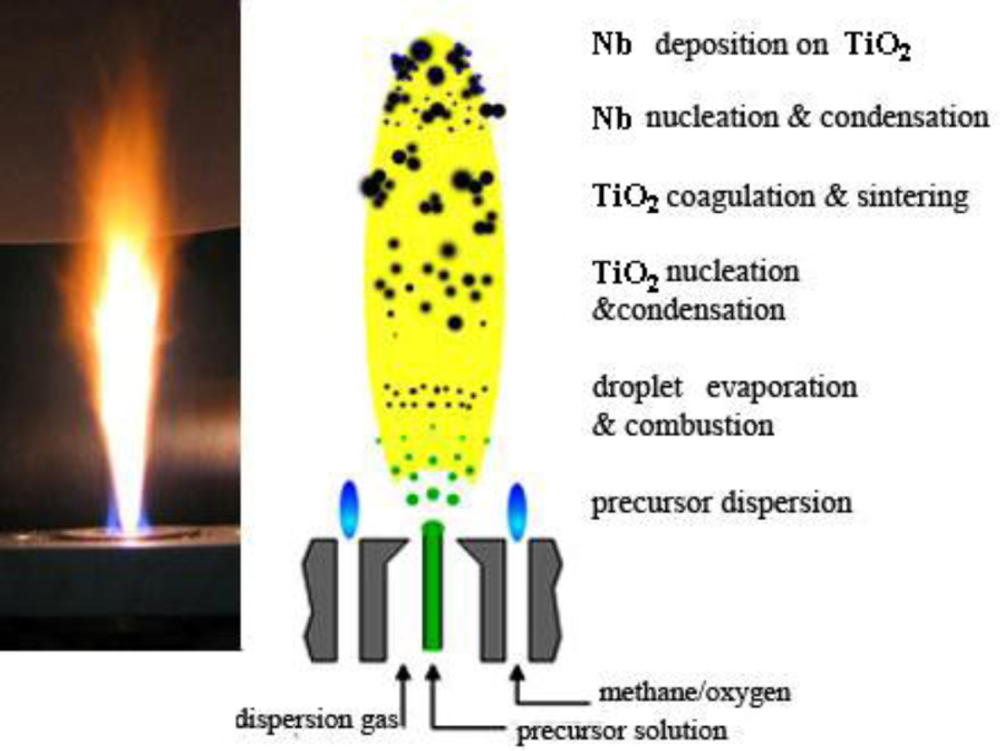
<p>Titanium isopropoxide (Aldrich, 97%) and niobium (IV) 2-ethlyhexanoate (Strem Chemicals) were used as titanium and niobium precursors, respectively. Both precursors were dissolved in xylene (Fluka, &gt;98.5%) and acetonitrile (Fluka, &gt;99.5%) in equal volume with the total metal atom concentration maintained at 0.5 mol/L. The niobium concentration was varied between 1 and 5 at.%. The precursor was fed into a flame spray pyrolysis reactor [<xref ref-type="bibr" rid="b24-sensors-11-00472">24</xref>] by a syringe pump (Inotech) with a rate of 5 mL/min and was dispersed into droplets by 5 L/min of oxygen (Pan Gas, purity &gt; 99%) using a gas assisted nozzle. The pressure drop at the nozzle tip was kept at 1.5 bar. The water-cooled system of the reactor avoided any evaporation of the precursor within the liquid feed lines or overheating of the nozzle. The spray flame was maintained by a concentric supporting flamelet ring of premixed methane/oxygen (CH<sub>4</sub> 1.5 L/min, O<sub>2</sub> 3.2 L/min). In order to assure the presence of enough oxidant for complete conversion of the reactants, an additional outer oxygen flow (5 L/min) was supplied. The powder was collected with the aid of a vacuum pump (Vaccubrand) on a glass fiber filter (GF/D Whatman, 25.7 cm in diameter). During the experiment, the filter was placed in a water-cooled holder, 40 cm above the nozzle, keeping the off-gas temperature below 200 °C. Scheme 1 shows the formation of Nb-doped TiO<sub>2</sub> by flame spray pyrolysis.</p></sec>
<sec>
<label>2.2.</label>
<title>Powder Characterization</title>
<p>X-ray diffraction (XRD) patterns were recorded with a Bruker AXS D8 Advance (40 kV, 40 mA) operating with Cu K<sub>α</sub>. The relative amounts of anatase and rutile and their respective crystallite sizes were calculated from the XRD data using the Rietveld method. BET powder-specific surface area (<italic>SSA</italic>), was measured by nitrogen adsorption at 77 K (Micromeritics Tristar) after degassing the sample for 1 h at 150 °C in nitrogen. The equivalent average primary particle diameter <italic>d</italic><sub>BET</sub> was calculated by <italic>d</italic><sub>BET</sub> = 6/(<italic>SSA</italic> ρ<sub>P</sub>). Here, ρ<sub>P</sub> is the average density of TiO<sub>2</sub> calculated from weight percent and density of anatase and rutile where <italic>d</italic><sub>anatase</sub> and <italic>d</italic><sub>rutile</sub> are 3.97 g/cm<sup>3</sup> and 4.17 g/cm<sup>3</sup> respectively. Morphologies of all the flame-made powders were investigated by Transmission Electron Microscopy (TEM, Hitachi H600, operated at 100 kV).</p></sec>
<sec>
<label>2.3.</label>
<title>Paste and Sensor Preparations</title>
<p>An appropriate quantity of homogeneous mixed solution (0.28 mL) was prepared by stirring and heating at 80 °C for 12 h ethyl cellulose (Fluka, 30–70 mPa·s) as the temporary binder and terpineol (Aldrich, 90%) as a solvent. The liquid mixture was combined with 60 mg of samples 1–5 at.% Nb/TiO<sub>2</sub> nanopowders and mixed for 30 min to form a paste prior to spin-coating. The resulting paste was firstly spin-coated (700 rpm) 1 time for 10 s, and then subsequently at 3,000 ppm, 2 times for 30 s on the Al<sub>2</sub>O<sub>3</sub> substrates interdigitated with Au electrodes (0.5 × 0.5 cm) to deposit sensing films. The resulting substrates were annealed in an oven at 150 °C for 1 h with an annealing rate of 1 °C/min and at 400 °C for 1 h with an annealing rate of 1 °C/min for binder removal prior to the sensing test.</p></sec>
<sec>
<label>2.4.</label>
<title>Sensor Measurement</title>
<p>The sensor characteristics of the sensing films were determined with acetone (25–400 ppm) and ethanol (50–1,000 ppm). The flow through technique was used to test the gas-sensing properties of sensing films. A constant flux of synthetic air of 2 L/min as gas carrier was flowed to mix with the desired concentration of pollutants dispersed in synthetic air. All measurements were conducted in a temperature-stabilized sealed chamber at 20 °C under controlled humidity. The gas flow rates were precisely manipulated using a computer controlled multi-channel mass flow controller. The external NiCr heater was heated by a regulated DC power supply to different operating temperatures. The operating temperature was varied from 250 °C to 400 °C. The resistances of various sensors were continuously monitored with a computer-controlled system by voltage-amperometric technique with 5 V DC bias and current measurement through a picoammeter. The sensor was exposed to the gas mixed sample for ∼5 min for each gas concentration testing and then the air flux was restored for 15 min. The response (<italic>S</italic>) is defined in the following as the resistance ratio <italic>R</italic><sub>a</sub>/<italic>R</italic><sub>g</sub> [<xref ref-type="bibr" rid="b25-sensors-11-00472">25</xref>], where <italic>R</italic><sub>a</sub> is the resistance in dry air, and <italic>R</italic><sub>g</sub> is the resistance in the test gas. The response time (<italic>T</italic><sub>res</sub>) is defined as the time required until 90% of the response signal is reached. The recovery time (<italic>T</italic><sub>rec</sub>) denotes the time needed until 90% of the original baseline signal is recovered [<xref ref-type="bibr" rid="b25-sensors-11-00472">25</xref>]. After the sensors fabricated using samples undoped TiO<sub>2</sub>, 1 at.% Nb/TiO<sub>2</sub>, 3 at.% Nb/TiO<sub>2</sub>, and 5 at.% Nb/TiO<sub>2</sub> had been tested with varied operating temperatures, they were designated as S0, S1, S3, and S5, respectively.</p></sec></sec>
<sec sec-type="results|discussion">
<label>3.</label>
<title>Results and Discussion</title>
<sec>
<label>3.1.</label>
<title>Nanopowder Properties</title>
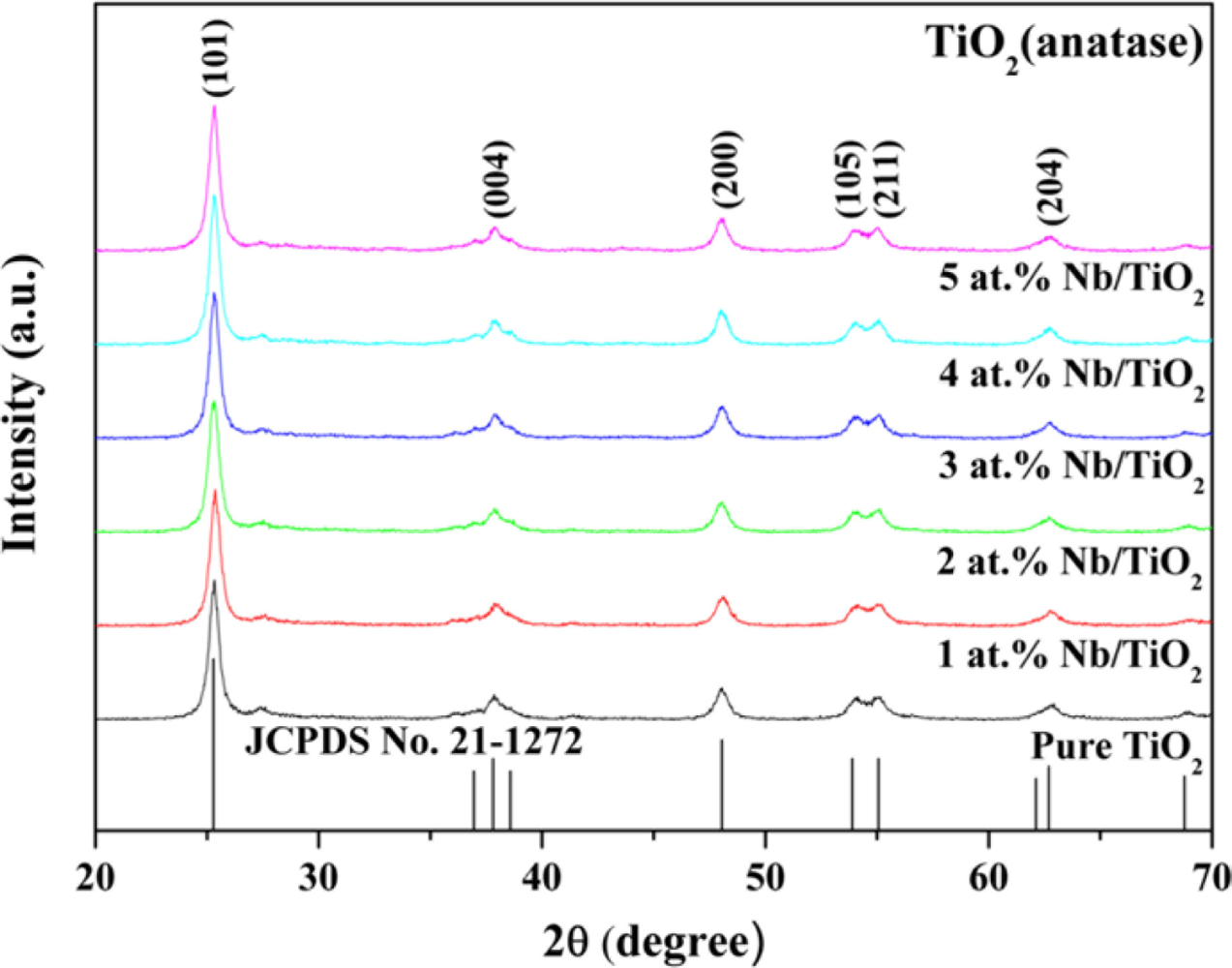
<p>The XRD technique was used to study the relative amounts of anatase and rutile phases and the evolution of crystallite sizes as a function of composition of the flame-made undoped TiO<sub>2</sub> and Nb-doped TiO<sub>2</sub>. <xref ref-type="fig" rid="f1-sensors-11-00472">Figure 1</xref> shows the XRD patterns of nano-sized undoped TiO<sub>2</sub> and 1–5 at.% Nb/TiO<sub>2</sub> samples. The nanopowders were highly crystalline, and all peaks can be confirmed to be the anatase phase (JCPDS file no. 21-1272). No amorphous phase and the characteristic peaks attributed to Nb or NbO<sub>2</sub> were found in the XRD patterns. It can be assumed that the amount of Nb doping particles was very low, which resulted in non-appearance of the Nb peaks. The relative amounts of anatase and rutile and their respective crystallite sizes were calculated from the XRD data using the fundamental parameter approach Rietveld method [<xref ref-type="bibr" rid="b26-sensors-11-00472">26</xref>]. The average crystal sizes (<italic>d</italic><sub>XRD</sub> ave.) were calculated based on the half-maximum widths in Scherrer equation [<xref ref-type="bibr" rid="b27-sensors-11-00472">27</xref>] using the TOPAS-3 software, which compared with the average BET-equivalent particle diameter (<italic>d</italic><sub>BET</sub>) as shown in <xref ref-type="table" rid="t2-sensors-11-00472">Table 2</xref>. The <italic>d</italic><sub>XRD</sub> (rutile) was slightly increased with increasing Nb-doped concentrations. On the other hand, the <italic>d</italic><sub>XRD</sub> (anatase) decreased with increasing Nb-doping concentrations. The rutile weight fraction percentage and <italic>d</italic><sub>BET</sub> remained almost the same with increasing Nb concentrations. It can be concluded from <xref ref-type="table" rid="t2-sensors-11-00472">Table 2</xref> that (1) <italic>d</italic><sub>XRD</sub> anatase were smaller than <italic>d</italic><sub>XRD</sub> rutile (2) <italic>d</italic><sub>BET</sub> and <italic>d</italic><sub>XRD</sub> anatase were not affected by the amount of dopant but <italic>d</italic><sub>XRD</sub> rutile were.</p>
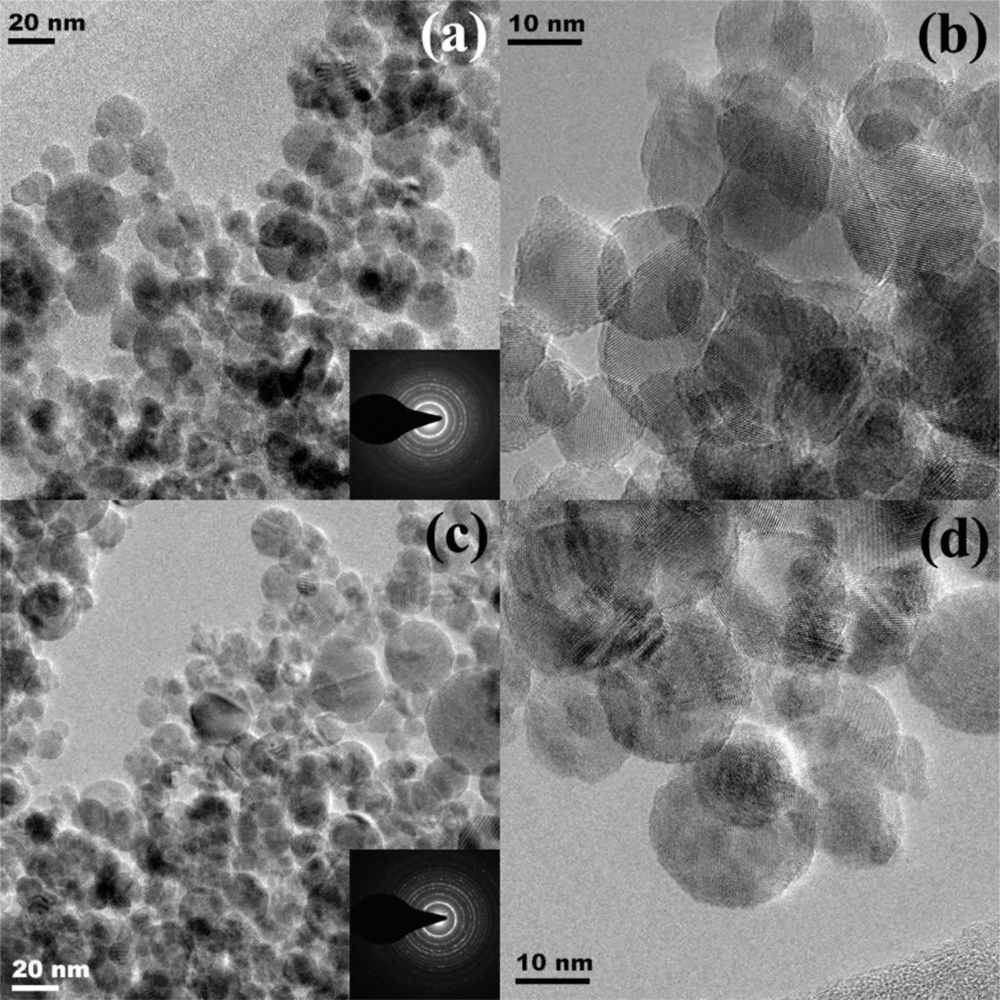
<p><xref ref-type="fig" rid="f2-sensors-11-00472">Figure 2</xref> shows HR-TEM bright-field images of (a,b) undoped TiO<sub>2</sub> and (c,d) 5 at.% Nb/TiO<sub>2</sub> nanoparticles with different magnifications. The corresponding diffraction patterns were shown in the insets. Both samples were highly crystalline as seen from the intense electron diffraction patterns (<xref ref-type="fig" rid="f2-sensors-11-00472">Figure 2(a,c)</xref>: insets), which were in good agreement with the XRD data. <xref ref-type="fig" rid="f2-sensors-11-00472">Figure 2(a–d)</xref> show the TEM bright-field images of the FSP-made (5/5) nanoparticles, which were aggregated of primary particles. Nb-doped TiO<sub>2</sub> nanopowder formed Ti<sub>1−x</sub>Nb<sub>x</sub>O<sub>2</sub> with a fully solid solution due to diffusion of Nb atom into the TiO<sub>2</sub> nanoparticles because Nb<sup>4+</sup> has a similar ionic radius (0.64 Å) to Ti<sup>4+</sup> (0.605 Å). Teleki <italic>et al</italic>. [<xref ref-type="bibr" rid="b23-sensors-11-00472">23</xref>] reported that niobium was partly incorporated in the titania lattice promoting anatase formation.</p>
<p><xref ref-type="fig" rid="f2-sensors-11-00472">Figures 2(a,b)</xref> show the morphologies of flame-made (5/5) undoped TiO<sub>2</sub> and 5 at.% Nb/TiO<sub>2</sub> nanoparticles containing spherical nanoparticles with average diameters of 13 and 11 nm, respectively. The primary particle diameters observed by TEM were consistent with both the <italic>d</italic><sub>BET</sub> and the <italic>d</italic><sub>XRD</sub>. Particularly, the lattice fringes of 5 at.% Nb/TiO<sub>2</sub> nanoparticles were also clearly visible in a HRTEM image at higher magnification (<xref ref-type="fig" rid="f2-sensors-11-00472">Figures 2(b,d)</xref>). TEM bright-field images can reveal internal structure and a more accurate measurement of particle size and morphology.</p></sec>
<sec>
<label>3.2.</label>
<title>Gas Sensing Properties</title>
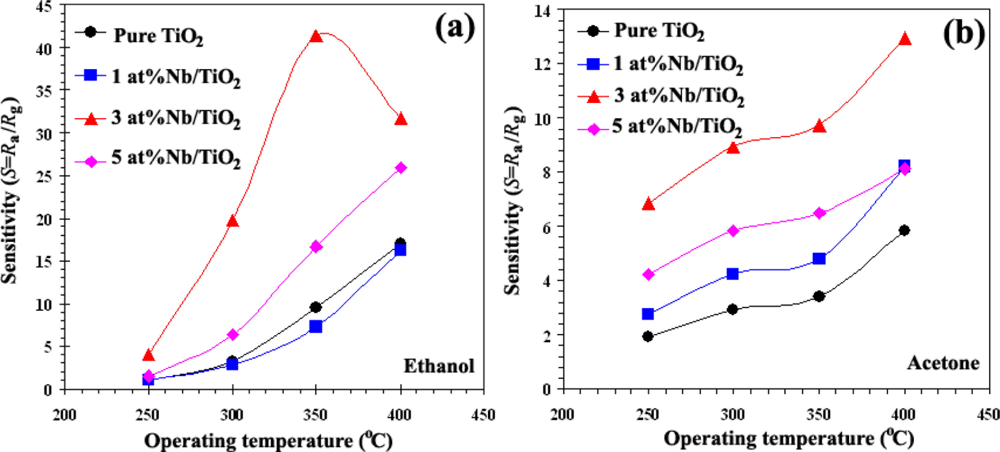
<p>The gas sensitivity is usually dependent on the sensor operating temperature and the dopant. <xref ref-type="fig" rid="f3-sensors-11-00472">Figure 3</xref> shows the response as a function of sensor operating temperature for undoped and doped with different Nb concentrations (1, 3, and 5 at.% Nb) for ethanol (<xref ref-type="fig" rid="f3-sensors-11-00472">Figure 3(a)</xref>) and acetone (<xref ref-type="fig" rid="f3-sensors-11-00472">Figure 3(b)</xref>) vapors in dry air atmosphere. The measurement of the resistance <italic>vs.</italic> temperature (R/T) profile of undoped TiO<sub>2</sub> sensor revealed a strong temperature dependence of their resistance and quite low response. It was evident from these results that the response of the undoped sensor (S0) was very poor compared to the doped sensors in different concentration concentrations. With 3 at.% Nb doped TiO<sub>2</sub> sensor (S3), the sensor showed maximum response to ethanol vapor at an operating temperature of 350 °C for sensor S3 and 400 °C for the other sensors, and for acetone vapor maximum sensitivity at an operating temperature of 400 °C for all sensors. The best sensitivities can be seen at the highest concentration of gases (to 1,000 ppm; <italic>S</italic><sub>eth</sub> = 41.4 (350 °C), <italic>S</italic><sub>eth</sub> = 31.7 (400 °C), to 400 ppm, <italic>S</italic><sub>acet</sub> = 13.0) and response time was extremely fast about 1 s (400 °C) and 9 s (350 °C) for ethanol vapor and of about 33 s for acetone vapor. On the other hand, the response decreased at higher Nb concentration (5 at.% Nb/TiO<sub>2</sub>; S5). Further increase of the dopant concentration decreased the ethanol and acetone sensitivity and deteriorated the response time. The optimum concentration of Nb doping on TiO<sub>2</sub> sensor was found to be 3 at.% Nb. Possibly a segregated Nb phase was formed on the surface at a higher Nb content (5 at.% Nb/TiO<sub>2</sub>). For low Nb content (3 at.%), Nb nanoparticles are very small compared to TiO<sub>2</sub> nanoparticles and they can be well dispersed on TiO<sub>2</sub> nanoparticles. Thus, Nb nanoparticles are very effective catalyst. In contrast, larger Nb nanoparticles, which are formed at higher Nb contents, cannot be well dispersed and cause possible separation among TiO<sub>2</sub> nanoparticles. Therefore, catalytic action of Nb becomes considerably less effective. This is the reason why the gas sensitivity decreases significantly at the higher Nb content of 5 at.%.</p>
<p>Traversa <italic>et al</italic>. [<xref ref-type="bibr" rid="b9-sensors-11-00472">9</xref>] reported a solubility of up to 5 at.% Nb in anatase TiO<sub>2</sub>. They attributed this to small segregated crystalline domains of niobia (Nb<sub>2</sub>O<sub>5</sub>), which were not visible in the TEM bright-field images (<xref ref-type="fig" rid="f2-sensors-11-00472">Figure 2</xref>). Our results agreed well with those of Comini <italic>et al</italic>. [<xref ref-type="bibr" rid="b28-sensors-11-00472">28</xref>] showing that Nb doping improved the response to ethanol with respect to undoped TiO<sub>2</sub>. Teleki <italic>et al.</italic> [<xref ref-type="bibr" rid="b23-sensors-11-00472">23</xref>] reported that 4 at.% Nb/TiO<sub>2</sub> showed higher response towards 25–300 ppm ethanol than 10 at.% Nb/TiO<sub>2</sub> at 400 °C.</p>
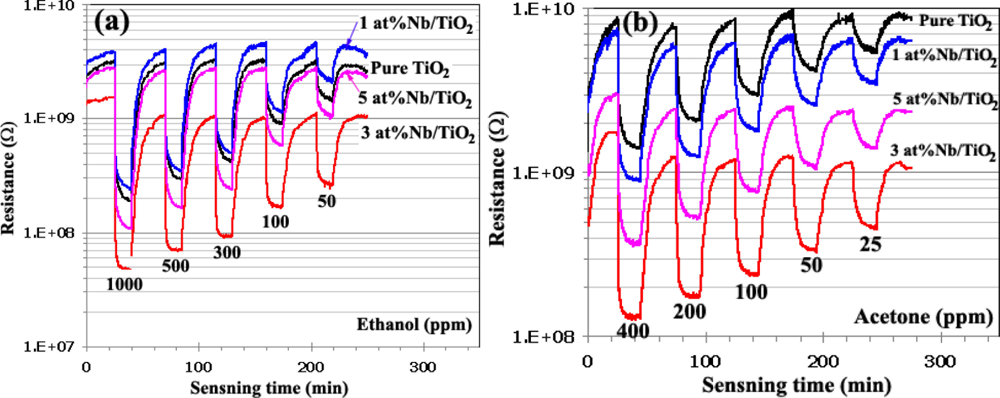
<p><xref ref-type="fig" rid="f4-sensors-11-00472">Figures 4(a,b)</xref> show the change in resistance of sensor S0 (Undoped TiO<sub>2</sub>), S1(1 at.% Nb/TiO<sub>2</sub>), S3 (3 at.% Nb/TiO<sub>2</sub>), and S5 (5 at.% Nb/TiO<sub>2</sub>) under exposure to reducing gas ethanol (<xref ref-type="fig" rid="f4-sensors-11-00472">Figure 4(a)</xref>) and acetone (<xref ref-type="fig" rid="f4-sensors-11-00472">Figure 4(b)</xref>) at the concentration ranging from 50–1,000 ppm and 25–400 ppm, respectively with the same operating temperature of 400 °C during the backward cycle. The original baseline (dry air) of ethanol sensing was stable during the sensing test. The resistance drastically decreased during the gas exposure with increasing VOC analyte gas concentration, typical for anatase TiO<sub>2</sub> as an n-type semiconductor. Nb-doped TiO<sub>2</sub> could exhibit a stronger <italic>n</italic>-type character and a higher electronic conductivity than undoped TiO<sub>2</sub> as the electron concentration in the titania lattice might increase and the Fermi level might be shifted closer to the conduction band level. The stabilized original baselines of sensors led to sensor response accuracy in terms of sensitivity and response time detection. The base-resistance of the sensor S3 (3 at.% Nb/TiO<sub>2</sub>) was the lowest compared to the other sensors. This is because the sensor S3 had the appropriate amount of concentration and also could perform the sensing properties on the surface and by bulk interaction. The gas sensing behavior of semiconducting oxide sensors could be attributed to both regions of surface and bulk interactions, depending on the small grain size and the appropriate thickness of sensing films. The effects of a high conductivity of the sensor are described clearly from the interactions between VOCs gases and the surface-absorbed oxygen species such as peroxide ion 
<inline-formula>
<mml:math>
<mml:mrow>
<mml:mrow>
<mml:mo stretchy="false">(</mml:mo>
<mml:mrow>
<mml:msubsup>
<mml:mi>O</mml:mi>
<mml:mn>2</mml:mn>
<mml:mrow>
<mml:mn>2</mml:mn>
<mml:mo>−</mml:mo></mml:mrow></mml:msubsup></mml:mrow>
<mml:mo stretchy="false">)</mml:mo></mml:mrow></mml:mrow></mml:math></inline-formula> and superoxide ion 
<inline-formula>
<mml:math>
<mml:mrow>
<mml:mrow>
<mml:mo stretchy="false">(</mml:mo>
<mml:mrow>
<mml:msubsup>
<mml:mi>O</mml:mi>
<mml:mn>2</mml:mn>
<mml:mo>−</mml:mo></mml:msubsup></mml:mrow>
<mml:mo stretchy="false">)</mml:mo></mml:mrow></mml:mrow></mml:math></inline-formula>. These reactions produce more electrons and thus increased the conductivity of TiO<sub>2</sub> upon exposure to ethanol and acetone vapor.</p>
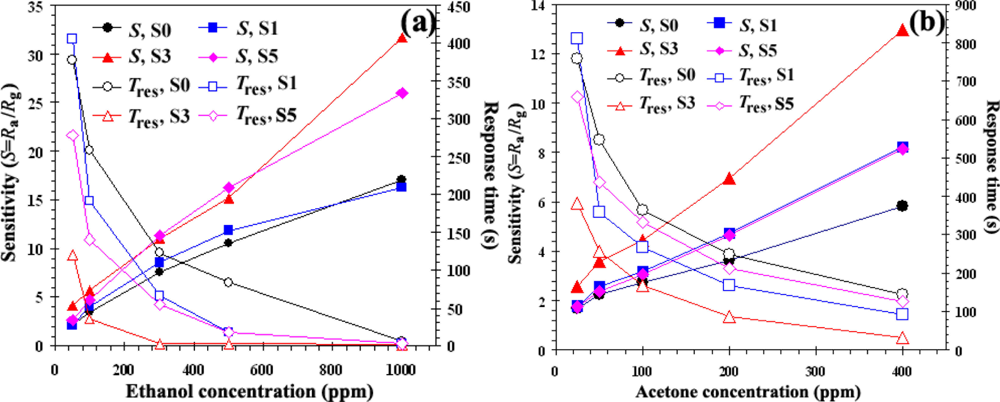
<p><xref ref-type="fig" rid="f5-sensors-11-00472">Figures 5(a,b)</xref> show the plots of response (<italic>S</italic>) and response times (<italic>T</italic><sub>res</sub>) <italic>versus</italic> the ethanol and acetone vapor concentrations ranging from 50–1,000 ppm and 25–400 ppm plot for the sensors S0, S1, S3, and S5 during the backward cycle at the operating temperature of 400 °C. Because the particle size of TiO<sub>2</sub> was in the nanometer range and Nb is known as an excellent catalyst for VOC gases, we paid close attention to the gas sensing activity of this material. From the data, the response of all Nb doping concentrations (S1, S3, and S5) appeared to be higher than that of an undoped TiO<sub>2</sub> sensor (S0). The response of both gases (filled symbols, left axis) increased linearly and the response time (open symbols, right axis) decreased drastically with increasing ethanol and acetone concentrations. Moreover, it was found that the 3 at.% Nb concentration (S3) sensor showed the best sensing performance in terms of response (<italic>S</italic> = 31.7) and response time. The response time of 3 at.% Nb/TiO<sub>2</sub> sensor (S3) for 1,000 ppm at 400 °C was very fast—within 1 s (open triangles, right axis)—which was better than that of undoped TiO<sub>2</sub> (6 s) (open circles, right axis) and other doping concentrations (1 at.% Nb/TiO<sub>2</sub> = 3 s (open rectangles, right axis), and 5 at.% Nb/TiO<sub>2</sub> = 2 s (open diamonds, right axis)). The fast response time suggests a surface controlled sensing mechanism, where a steady-state adsorption of ethanol and desorption of CO<sub>2</sub> [<xref ref-type="bibr" rid="b25-sensors-11-00472">25</xref>] on the sensing films was rapidly reached. This is the common interaction between the reducing gas ethanol and surface-adsorbed oxygen species of sensing layer including ethanol with those of its oxidation products (CO<sub>2</sub> and H<sub>2</sub>O) <italic>versus</italic> times in dry air. This is because CO<sub>2</sub> was the majority product oxidized with oxygen on the surface of semiconductor materials. This indicates a partial combustion of ethanol to CO<sub>2</sub> and H<sub>2</sub>O, as well as a release of ethoxides formed during the adsorption of ethanol on the sensing surface. Also, Nb possible increases the number of surface-adsorbed oxygen species, thus promoting reaction sizes for CO oxidations. Teleki <italic>et al</italic>. [<xref ref-type="bibr" rid="b23-sensors-11-00472">23</xref>] reported the response of 30 with response time of 375 seconds towards 75 ppm ethanol at 500 °C for undoped TiO<sub>2</sub> sensing film by the drop-coating technique.</p>
<p>With the acetone response, the sensing performances were lower than for ethanol vapor in terms of the sensor response, sensitivity, and response time. It was noticed that the Nb concentration (3 at.%; S3) sensor showed the best sensing performance at an operating temperature of 400 °C for the highest acetone concentration to 400 ppm in terms of response (<italic>S</italic> = 13.0) and response time. The response time of acetone sensors were with a few minutes. The best response time of 3 at.% Nb/TiO<sub>2</sub> sensor (S3) for 400 ppm at 33 s which was better than undoped TiO<sub>2</sub> (147 s) (open circles, right axis) and the other doping concentrations (1 at.% Nb/TiO<sub>2</sub> = 93 s (open rectangles, right axis), and 5 at.% Nb/TiO<sub>2</sub> = 126 s (open diamonds, right axis)). The response time of 3 at.% Nb/TiO<sub>2</sub> sensor (S3) for 400 ppm at 400 °C was slightly sluggish compared to 300 ppm of an ethanol (2 s) (<xref ref-type="fig" rid="f5-sensors-11-00472">Figure 5(a)</xref>, open triangles, right axis) sample. Doping the TiO<sub>2</sub> with 3 at.% Nb resulted in a much steeper calibration curve and the highest sensor signal compared to undoped TiO<sub>2</sub> (see <xref ref-type="fig" rid="f5-sensors-11-00472">Figures 5(a,b)</xref>). The higher sensor signal and especially the higher response (<italic>i.e.</italic>, the steeper response curve) increased sensor performance.</p></sec></sec>
<sec sec-type="conclusions">
<label>4.</label>
<title>Conclusions</title>
<p>FSP was successfully used for the preparation of undoped TiO<sub>2</sub> and 1–5 at.% Nb/TiO<sub>2</sub> nanopowders for application to acetone and ethanol gas sensing. The trend of <italic>SSA</italic><sub>BET</sub> on the doping samples increased and the <italic>d</italic><sub>XRD</sub> (rutile) increased with the higher Nb-doping concentrations while <italic>d</italic><sub>BET</sub> remained almost the same. Nb could form a solid solution in the crystal structure of TiO<sub>2</sub> due to the fact the size of Nb<sup>5+</sup> (0.64 Å) is similar to that of Ti<sup>+4</sup> (0.605 Å), thus the size of particles in the doping samples were not affected by Nb atoms as shown from the HRTEM. The crystallite sizes of undoped and Nb-doped TiO<sub>2</sub> spherical were in the 10–20 nm range. The gas sensing of acetone (25–400 ppm) was studied at operating temperatures ranging from 300–400 °C in dry air while the gas sensing of ethanol (50–1,000 ppm) was studied at operating temperatures ranging from 250–400 °C in dry air. The 3 at.% Nb-dispersed on TiO<sub>2</sub> sensing film showed a response of 31.7 and a very fast response time of 1 second towards 400 ppm ethanol, as compared to an undoped TiO<sub>2</sub> sensing film. The 3 at.% Nb-dispersed on TiO<sub>2</sub> sensing film also showed a response of 13 and a response time of 33 seconds towards 400 ppm acetone. The response times in our study were faster than the previously reported values [<xref ref-type="bibr" rid="b16-sensors-11-00472">16</xref>,<xref ref-type="bibr" rid="b23-sensors-11-00472">23</xref>]. The highest responses for acetone and ethanol occurred at 400 and 350 °C, respectively.</p></sec></body>
<back>
<ack>
<p>The authors would like to gratefully acknowledge the financial support from National Research University Project under the Office of the Higher Education Commission, Ministry of Education, Thailand; Particle Technology Laboratory, ETH, Zurich, Switzerland for the experimental facilities, and the NECTEC laboratory for the sensor experiments. One of the authors (S.P.) would like to thank Swiss Federal Institute of Technology, Zurich for providing an ETH Fellowship.</p></ack>
<ref-list>
<title>References</title>
<ref id="b1-sensors-11-00472"><label>1.</label><citation citation-type="journal"><person-group person-group-type="author"><name><surname>Dawson</surname><given-names>D.H.</given-names></name><name><surname>Henshaw</surname><given-names>G.S.</given-names></name><name><surname>Williams</surname><given-names>D.E.</given-names></name></person-group><article-title>Description and characterization of a hydrogen sulfide gas sensor based on Cr<sub>2-y</sub>Ti<sub>y</sub>O<sub>3+x</sub></article-title><source>Sens. Actuat. B-Chem</source><year>1995</year><volume>26–27</volume><fpage>76</fpage><lpage>80</lpage></citation></ref>
<ref id="b2-sensors-11-00472"><label>2.</label><citation citation-type="journal"><person-group person-group-type="author"><name><surname>Bregani</surname><given-names>F.</given-names></name><name><surname>Casale</surname><given-names>C.</given-names></name><name><surname>Depero</surname><given-names>L.E.</given-names></name><name><surname>Natali-Sora</surname><given-names>I.</given-names></name><name><surname>Roba</surname><given-names>D.</given-names></name><name><surname>Sangaletti</surname><given-names>L.</given-names></name><name><surname>Toledo</surname><given-names>G.P.</given-names></name></person-group><article-title>Temperature effects on the size of anatase crystalline in Mo-TiO<sub>2</sub> and W-TiO<sub>2</sub> powders</article-title><source>Sens. Actuat. B-Chem</source><year>1996</year><volume>31</volume><fpage>25</fpage><lpage>28</lpage><pub-id pub-id-type="doi">10.1016/0925-4005(96)80011-6</pub-id></citation></ref>
<ref id="b3-sensors-11-00472"><label>3.</label><citation citation-type="journal"><person-group person-group-type="author"><name><surname>Comini</surname><given-names>E.</given-names></name><name><surname>Faglia</surname><given-names>G.</given-names></name><name><surname>Sberveglieri</surname><given-names>G.</given-names></name><name><surname>Li</surname><given-names>Y.X.</given-names></name><name><surname>Wlodarski</surname><given-names>W.</given-names></name><name><surname>Ghantasala</surname><given-names>M.K.</given-names></name></person-group><article-title>Sensitivity enhancement towards ethanol and methanol of TiO<sub>2</sub> films doped with Pt and Nb</article-title><source>Sens. Actuat. B-Chem</source><year>2000</year><volume>64</volume><fpage>169</fpage><lpage>174</lpage><pub-id pub-id-type="doi">10.1016/S0925-4005(99)00502-X</pub-id></citation></ref>
<ref id="b4-sensors-11-00472"><label>4.</label><citation citation-type="journal"><person-group person-group-type="author"><name><surname>Comini</surname><given-names>E.</given-names></name><name><surname>Guidi</surname><given-names>V.</given-names></name><name><surname>Frigeri</surname><given-names>C.</given-names></name><name><surname>Ricco</surname><given-names>I.</given-names></name><name><surname>Sberveglieri</surname><given-names>G.</given-names></name></person-group><article-title>CO sensing properties of titanium and iron oxide nanosized thin films</article-title><source>Sens. Actuat. B-Chem</source><year>2001</year><volume>77</volume><fpage>16</fpage><lpage>21</lpage><pub-id pub-id-type="doi">10.1016/S0925-4005(01)00666-9</pub-id></citation></ref>
<ref id="b5-sensors-11-00472"><label>5.</label><citation citation-type="journal"><person-group person-group-type="author"><name><surname>Ruiz</surname><given-names>A.M.</given-names></name><name><surname>Cornet</surname><given-names>A.</given-names></name><name><surname>Monrante</surname><given-names>J.R.</given-names></name></person-group><article-title>Study of La and Cu influence on the growth inhibition and phase transformation of nano-TiO<sub>2</sub> used for gas sensors</article-title><source>Sens. Actuat. B-Chem</source><year>2004</year><volume>100</volume><fpage>256</fpage><lpage>260</lpage><pub-id pub-id-type="doi">10.1016/j.snb.2003.12.043</pub-id></citation></ref>
<ref id="b6-sensors-11-00472"><label>6.</label><citation citation-type="journal"><person-group person-group-type="author"><name><surname>Sharma</surname><given-names>R.K.</given-names></name><name><surname>Bhatnagar</surname><given-names>M.C.</given-names></name><name><surname>Sharma</surname><given-names>G.L.</given-names></name></person-group><article-title>Effect of Nb metal in TiO<sub>2</sub> oxygen gas sensor</article-title><source>Appl. Surf. Sci</source><year>1996</year><volume>92</volume><fpage>647</fpage><lpage>650</lpage><pub-id pub-id-type="doi">10.1016/0169-4332(95)00311-8</pub-id></citation></ref>
<ref id="b7-sensors-11-00472"><label>7.</label><citation citation-type="journal"><person-group person-group-type="author"><name><surname>Sharma</surname><given-names>R.K.</given-names></name><name><surname>Bhatnagar</surname><given-names>M.C.</given-names></name><name><surname>Sharma</surname><given-names>G.L.</given-names></name></person-group><article-title>Mechanism in Nb doped titania oxygen gas sensor</article-title><source>Sens. Actuat. B-Chem</source><year>1998</year><volume>46</volume><fpage>194</fpage><lpage>201</lpage><pub-id pub-id-type="doi">10.1016/S0925-4005(98)00111-7</pub-id></citation></ref>
<ref id="b8-sensors-11-00472"><label>8.</label><citation citation-type="journal"><person-group person-group-type="author"><name><surname>Ruiz</surname><given-names>A.</given-names></name><name><surname>Dezanneau</surname><given-names>G.</given-names></name><name><surname>Arbiol</surname><given-names>J.</given-names></name><name><surname>Cornet</surname><given-names>A.</given-names></name><name><surname>Monrante</surname><given-names>J.R.</given-names></name></person-group><article-title>Study of the influence of Nb content and sintering temperature on TiO<sub>2</sub> sensing films</article-title><source>Thin Solid Films</source><year>2003</year><volume>436</volume><fpage>90</fpage><lpage>94</lpage><pub-id pub-id-type="doi">10.1016/S0040-6090(03)00515-7</pub-id></citation></ref>
<ref id="b9-sensors-11-00472"><label>9.</label><citation citation-type="journal"><person-group person-group-type="author"><name><surname>Traversa</surname><given-names>E.</given-names></name><name><surname>Di Vona</surname><given-names>M.L.</given-names></name><name><surname>Licoccia</surname><given-names>S.</given-names></name><name><surname>Sacerdoti</surname><given-names>M.</given-names></name><name><surname>Carotta</surname><given-names>M.C.</given-names></name><name><surname>Crema</surname><given-names>L.</given-names></name><name><surname>Martinelli</surname><given-names>G.</given-names></name></person-group><article-title>Sol-gel processed TiO<sub>2</sub>-based nano-sized powders for use in thick film gas sensors for atmospheric pollutant monitoring</article-title><source>J. Sol-Gel Sci. Technol</source><year>2001</year><volume>22</volume><fpage>167</fpage><lpage>179</lpage><pub-id pub-id-type="doi">10.1023/A:1011236908751</pub-id></citation></ref>
<ref id="b10-sensors-11-00472"><label>10.</label><citation citation-type="journal"><person-group person-group-type="author"><name><surname>Elezović</surname><given-names>N.R.</given-names></name><name><surname>Babić</surname><given-names>B.M.</given-names></name><name><surname>Gajić-Krstajić</surname><given-names>L.</given-names></name><name><surname>Radmilović</surname><given-names>V.</given-names></name><name><surname>Krstajić</surname><given-names>N.V.</given-names></name><name><surname>Vraćar</surname><given-names>L.J.</given-names></name></person-group><article-title>Synthesis, characterization and electrocatalytical behavior of Nb-TiO<sub>2</sub>/Pt nanocatalyst for oxygen reduction reaction</article-title><source>J. Power Sources</source><year>2010</year><volume>195</volume><fpage>3961</fpage><lpage>3968</lpage><pub-id pub-id-type="doi">10.1016/j.jpowsour.2010.01.035</pub-id></citation></ref>
<ref id="b11-sensors-11-00472"><label>11.</label><citation citation-type="journal"><person-group person-group-type="author"><name><surname>Zakrzewska</surname><given-names>K.</given-names></name><name><surname>Radecka</surname><given-names>M.</given-names></name><name><surname>Rekas</surname><given-names>M.</given-names></name></person-group><article-title>Effect of Nb, Cr, Sn additions on gas sensing properties of TiO<sub>2</sub> thin films</article-title><source>Thin Solid Films</source><year>1997</year><volume>310</volume><fpage>161</fpage><lpage>166</lpage><pub-id pub-id-type="doi">10.1016/S0040-6090(97)00401-X</pub-id></citation></ref>
<ref id="b12-sensors-11-00472"><label>12.</label><citation citation-type="journal"><person-group person-group-type="author"><name><surname>Ishida</surname><given-names>T.</given-names></name><name><surname>Okada</surname><given-names>M.</given-names></name><name><surname>Tsuchiya</surname><given-names>T.</given-names></name><name><surname>Murakami</surname><given-names>T.</given-names></name><name><surname>Nakano</surname><given-names>M.</given-names></name></person-group><article-title>Structural and surface property study of sputter deposited transparent conductive Nb-doped titanium oxide films</article-title><source>Thin Solid Films</source><year>2010</year><comment>in press.</comment></citation></ref>
<ref id="b13-sensors-11-00472"><label>13.</label><citation citation-type="journal"><person-group person-group-type="author"><name><surname>Yamada</surname><given-names>N.</given-names></name><name><surname>Hitosugi</surname><given-names>T.</given-names></name><name><surname>Kasai</surname><given-names>J.</given-names></name><name><surname>Hoang</surname><given-names>N.L.H.</given-names></name><name><surname>Nakao</surname><given-names>S.</given-names></name><name><surname>Hirose</surname><given-names>Y.</given-names></name><name><surname>Shimada</surname><given-names>T.</given-names></name><name><surname>Hasegawa</surname><given-names>T.</given-names></name></person-group><article-title>Transparent conducting Nb-doped anatase TiO<sub>2</sub> (TNO) thin films sputtered from various oxide targets</article-title><source>Thin Solid Films</source><year>2010</year><volume>518</volume><fpage>3101</fpage><lpage>3104</lpage><pub-id pub-id-type="doi">10.1016/j.tsf.2009.07.205</pub-id></citation></ref>
<ref id="b14-sensors-11-00472"><label>14.</label><citation citation-type="journal"><person-group person-group-type="author"><name><surname>Bonini</surname><given-names>N.</given-names></name><name><surname>Carotta</surname><given-names>M.C.</given-names></name><name><surname>Chiorino</surname><given-names>A.</given-names></name><name><surname>Martinelli</surname><given-names>G.F.</given-names></name><name><surname>Ronconi</surname><given-names>M.</given-names></name><name><surname>Traversa</surname><given-names>E.S.</given-names></name></person-group><article-title>Doping of a nanostructured titania thick film: Structural and electrical investigations</article-title><source>Sens. Actuat. B-Chem</source><year>2000</year><volume>68</volume><fpage>274</fpage><lpage>280</lpage><pub-id pub-id-type="doi">10.1016/S0925-4005(00)00444-5</pub-id></citation></ref>
<ref id="b15-sensors-11-00472"><label>15.</label><citation citation-type="journal"><person-group person-group-type="author"><name><surname>Tonooka</surname><given-names>K.</given-names></name><name><surname>Chiu</surname><given-names>T.-W.</given-names></name><name><surname>Kikuchi</surname><given-names>N.</given-names></name></person-group><article-title>Preparation of transparent conductive TiO<sub>2</sub>: Nb thin films by pulsed laser deposition</article-title><source>Appl. Surf. Sci</source><year>2009</year><volume>255</volume><fpage>9695</fpage><lpage>9698</lpage><pub-id pub-id-type="doi">10.1016/j.apsusc.2009.04.056</pub-id></citation></ref>
<ref id="b16-sensors-11-00472"><label>16.</label><citation citation-type="journal"><person-group person-group-type="author"><name><surname>Teleki</surname><given-names>A.</given-names></name><name><surname>Pratsinis</surname><given-names>S.E.</given-names></name><name><surname>Kalyanasundaram</surname><given-names>K.</given-names></name><name><surname>Gouma</surname><given-names>P.I.</given-names></name></person-group><article-title>Sensing of organic vapors by flame-made TiO<sub>2</sub> nanoparticles</article-title><source>Sens. Actuat. B-Chem</source><year>2006</year><volume>119</volume><fpage>683</fpage><lpage>690</lpage><pub-id pub-id-type="doi">10.1016/j.snb.2006.01.027</pub-id></citation></ref>
<ref id="b17-sensors-11-00472"><label>17.</label><citation citation-type="journal"><person-group person-group-type="author"><name><surname>Li</surname><given-names>C.P.</given-names></name><name><surname>Wang</surname><given-names>J.F.</given-names></name><name><surname>Su</surname><given-names>W.B.</given-names></name><name><surname>Chen</surname><given-names>H.C.</given-names></name><name><surname>Wang</surname><given-names>Y.J.</given-names></name><name><surname>Zhuang</surname><given-names>D.X.</given-names></name></person-group><article-title>Effect of sinter temperature on the electrical properties of TiO<sub>2</sub>-based capacitor-varistors</article-title><source>Mater. Lett</source><year>2003</year><volume>57</volume><fpage>1400</fpage><lpage>1405</lpage><pub-id pub-id-type="doi">10.1016/S0167-577X(02)00996-5</pub-id></citation></ref>
<ref id="b18-sensors-11-00472"><label>18.</label><citation citation-type="journal"><person-group person-group-type="author"><name><surname>Papageorgiou</surname><given-names>D.</given-names></name><name><surname>Vamvouka</surname><given-names>D.</given-names></name><name><surname>Boudouvas</surname><given-names>D.</given-names></name><name><surname>Verykios</surname><given-names>X.E.</given-names></name></person-group><article-title>Oxidative coupling of methane to C<sub>2</sub> hydrocarbons over titania- based catalysts</article-title><source>Catal. Today</source><year>1992</year><volume>13</volume><fpage>391</fpage><lpage>400</lpage><pub-id pub-id-type="doi">10.1016/0920-5861(92)80164-I</pub-id></citation></ref>
<ref id="b19-sensors-11-00472"><label>19.</label><citation citation-type="journal"><person-group person-group-type="author"><name><surname>Karvinen</surname><given-names>S.</given-names></name></person-group><article-title>The effects of trace elements on the crystal properties of TiO<sub>2</sub></article-title><source>J. Sol-Gel Sci. Technol</source><year>2003</year><volume>19</volume><fpage>811</fpage><lpage>819</lpage></citation></ref>
<ref id="b20-sensors-11-00472"><label>20.</label><citation citation-type="journal"><person-group person-group-type="author"><name><surname>Castro</surname><given-names>A.L.</given-names></name><name><surname>Nunes</surname><given-names>M.R.</given-names></name><name><surname>Carvalho</surname><given-names>M.D.</given-names></name><name><surname>Ferreira</surname><given-names>L.P.</given-names></name><name><surname>Jumas</surname><given-names>J.-C.</given-names></name><name><surname>Costa</surname><given-names>F.M.</given-names></name><name><surname>Florêncio</surname><given-names>M.H.</given-names></name></person-group><article-title>Doped titanium dioxide nanocrystalline powders with high photocatalytic activity</article-title><source>J. Solid State Chem</source><year>2009</year><volume>182</volume><fpage>1838</fpage><lpage>1845</lpage><pub-id pub-id-type="doi">10.1016/j.jssc.2009.04.020</pub-id></citation></ref>
<ref id="b21-sensors-11-00472"><label>21.</label><citation citation-type="journal"><person-group person-group-type="author"><name><surname>Lin</surname><given-names>H.</given-names></name><name><surname>Kozuka</surname><given-names>H.</given-names></name><name><surname>Yoko</surname><given-names>T.</given-names></name></person-group><article-title>Electrical properties of transparent doped oxide films</article-title><source>J. Sol-Gel Sci. Technol</source><year>2000</year><volume>19</volume><fpage>529</fpage><lpage>532</lpage><pub-id pub-id-type="doi">10.1023/A:1008784505272</pub-id></citation></ref>
<ref id="b22-sensors-11-00472"><label>22.</label><citation citation-type="journal"><person-group person-group-type="author"><name><surname>Lira-Cantu</surname><given-names>M.</given-names></name><name><surname>Siddiki</surname><given-names>M.K.</given-names></name><name><surname>Muñoz-Rojas</surname><given-names>D.</given-names></name><name><surname>Amade</surname><given-names>R.</given-names></name><name><surname>González-Pech</surname><given-names>N.I.</given-names></name></person-group><article-title>Nb-TiO<sub>2</sub>/polymer hybrid solar cells with photovoltaic response under inert atmosphere conditions</article-title><source>Sol. Energ. Mater. Sol. Cell</source><year>2010</year><volume>94</volume><fpage>1227</fpage><lpage>1234</lpage><pub-id pub-id-type="doi">10.1016/j.solmat.2010.03.011</pub-id></citation></ref>
<ref id="b23-sensors-11-00472"><label>23.</label><citation citation-type="journal"><person-group person-group-type="author"><name><surname>Teleki</surname><given-names>A.</given-names></name><name><surname>Bjelobrk</surname><given-names>N.</given-names></name><name><surname>Pratsinis</surname><given-names>S.E.</given-names></name></person-group><article-title>Flame-made Nb- and Cu-doped TiO<sub>2</sub> sensors for CO and ethanol</article-title><source>Sens. Actuat. B-Chem</source><year>2008</year><volume>130</volume><fpage>449</fpage><lpage>457</lpage><pub-id pub-id-type="doi">10.1016/j.snb.2007.09.008</pub-id></citation></ref>
<ref id="b24-sensors-11-00472"><label>24.</label><citation citation-type="journal"><person-group person-group-type="author"><name><surname>Sahm</surname><given-names>T.</given-names></name><name><surname>Mädler</surname><given-names>L.</given-names></name><name><surname>Gurlo</surname><given-names>A.</given-names></name><name><surname>Barsan</surname><given-names>N.</given-names></name><name><surname>Pratsinis</surname><given-names>S.E.</given-names></name><name><surname>Weimar</surname><given-names>U.</given-names></name></person-group><article-title>Flame spray synthesis of tin oxide nanoparticles for gas sensing</article-title><source>Sens. Actuat. B-Chem</source><year>2004</year><volume>98</volume>,<fpage>148</fpage><lpage>153</lpage><pub-id pub-id-type="doi">10.1016/j.snb.2003.10.003</pub-id></citation></ref>
<ref id="b25-sensors-11-00472"><label>25.</label><citation citation-type="journal"><person-group person-group-type="author"><name><surname>Liewhiran</surname><given-names>C.</given-names></name><name><surname>Phanichphant</surname><given-names>S.</given-names></name></person-group><article-title>Improvement of flame-made nanoparticulate thick film morphology for ethanol sensing</article-title><source>Sensors</source><year>2007</year><volume>7</volume><fpage>650</fpage><lpage>675</lpage></citation></ref>
<ref id="b26-sensors-11-00472"><label>26.</label><citation citation-type="journal"><person-group person-group-type="author"><name><surname>Cheary</surname><given-names>R.W.</given-names></name><name><surname>Coelho</surname><given-names>A.A.</given-names></name></person-group><article-title>Axial divergence in a conventional X-ray powder diffractometer. I. Theoretical foundations</article-title><source>J. Appl. Crystallogr</source><year>1998</year><volume>31</volume><fpage>851</fpage><lpage>861</lpage><pub-id pub-id-type="doi">10.1107/S0021889898006876</pub-id></citation></ref>
<ref id="b27-sensors-11-00472"><label>27.</label><citation citation-type="book"><person-group person-group-type="author"><name><surname>Cullity</surname><given-names>B.D.</given-names></name></person-group><article-title>Structure of polycrystalline aggregates</article-title><source>Elements of X-ray Diffraction</source><publisher-name>Addison Wesley</publisher-name><publisher-loc>Boston, MA, USA</publisher-loc><year>1978</year><comment>Volume 2, Chapter 9,</comment><fpage>284</fpage></citation></ref>
<ref id="b28-sensors-11-00472"><label>28.</label><citation citation-type="journal"><person-group person-group-type="author"><name><surname>Comini</surname><given-names>E.</given-names></name><name><surname>Ferroni</surname><given-names>M.</given-names></name><name><surname>Guidi</surname><given-names>V.</given-names></name><name><surname>Vomiero</surname><given-names>A.</given-names></name><name><surname>Merli</surname><given-names>P.G.</given-names></name><name><surname>Morandi</surname><given-names>V.</given-names></name><name><surname>Sacerdoti</surname><given-names>M.</given-names></name><name><surname>Della Mea</surname><given-names>G.</given-names></name><name><surname>Sberveglieri</surname><given-names>G.</given-names></name></person-group><article-title>Effects of Ta/Nb-doping on titania-based thin films for gas sensing</article-title><source>Sens. Actuat. B-Chem</source><year>2005</year><volume>108</volume><fpage>21</fpage><lpage>28</lpage><pub-id pub-id-type="doi">10.1016/j.snb.2004.10.041</pub-id></citation></ref></ref-list>
<sec sec-type="display-objects">
<title>Figures and Tables</title>
<fig id="f1-sensors-11-00472" position="float">
<label>Figure 1.</label>
<caption>
<p>XRD patterns of undoped and Nb-doped TiO<sub>2</sub> flame-made samples.</p></caption>
<graphic xlink:href="sensors-11-00472f1.gif"/></fig>
<fig id="f2-sensors-11-00472" position="float">
<label>Figure 2.</label>
<caption>
<p><bold>(a,b)</bold> HR-TEM bright-fields images of highly crystalline flame-made (5/5) TiO<sub>2</sub> nanoparticles and <bold>(c,d)</bold> 5 at.% Nb/TiO<sub>2</sub> nanoparticles with different magnifications. Insets show the corresponding diffraction patterns of the particles and clearly the TiO<sub>2</sub> lattice planes.</p></caption>
<graphic xlink:href="sensors-11-00472f2.gif"/></fig>
<fig id="f3-sensors-11-00472" position="float">
<label>Figure 3.</label>
<caption>
<p>The sensitivity as a function of sensor operating temperature for undoped and doped with different Nb concentrations (1, 3, and 5 at.% Nb) for <bold>(a)</bold> ethanol and <bold>(b)</bold> acetone vapors in dry air atmosphere.</p></caption>
<graphic xlink:href="sensors-11-00472f3.gif"/></fig>
<fig id="f4-sensors-11-00472" position="float">
<label>Figure 4.</label>
<caption>
<p>Change in resistance of sensors under exposure to reducing <bold>(a)</bold> ethanol and <bold>(b)</bold> acetone gases during backward cycle with various concentration of ethanol (50–1,000 ppm) and acetone (25–400 ppm) in dry air at 400 °C.</p></caption>
<graphic xlink:href="sensors-11-00472f4.gif"/></fig>
<fig id="f5-sensors-11-00472" position="float">
<label>Figure 5.</label>
<caption>
<p>Sensitivity of S0, S1, S3, and S5 (filled symbols, left axis) and the corresponding response time (open symbols, right axis) of <bold>(a)</bold> ethanol and <bold>(b)</bold> acetone detections.</p></caption>
<graphic xlink:href="sensors-11-00472f5.gif"/></fig>
<fig id="f6-sensors-11-00472" position="float">
<label>Scheme 1.</label>
<caption>
<p>The formation of Nb-doped TiO<sub>2</sub> by flame spray pyrolysis.</p></caption>
<graphic xlink:href="sensors-11-00472f6.gif"/></fig>
<table-wrap id="t1-sensors-11-00472" position="float">
<label>Table 1.</label>
<caption>
<p>Literature review on Nb-TiO<sub>2</sub> for gas sensing applications showing the authors, method of preparation, % Nb, sensing gas, range of detection, type of titania, size and some remarks.</p></caption>
<table frame="hsides" rules="groups">
<thead>
<tr>
<th align="center" valign="bottom"><bold>Authors</bold></th>
<th align="center" valign="bottom"><bold>Method</bold></th>
<th align="center" valign="bottom"><bold>% Nb</bold></th>
<th align="center" valign="bottom"><bold>Gas</bold></th>
<th align="center" valign="bottom"><bold>Range</bold></th>
<th align="center" valign="bottom"><bold>Titania</bold></th>
<th align="center" valign="bottom"><bold>Size</bold></th>
<th align="center" valign="bottom"><bold>Remarks</bold></th></tr></thead>
<tbody>
<tr>
<td align="left" valign="top">Sharma <italic>et al</italic>. [<xref ref-type="bibr" rid="b7-sensors-11-00472">7</xref>]</td>
<td align="left" valign="top">Thick film using screen printing of powder at 1,300 °C for 5 h</td>
<td align="left" valign="top">0, 0.2, 0.4 wt.% Nb</td>
<td align="left" valign="top">O<sub>2</sub></td>
<td align="left" valign="top">1,200 ppm<break/>Nb-doped<break/>1,000 ppm<break/>Cr-doped</td>
<td align="left" valign="top">Rutile</td>
<td align="left" valign="top">0.7 mm<break/>Nb-doped, 1–5μm<break/>Cr-doped</td>
<td align="left" valign="top">Highest sensitivity of Nb-doped at 550 °C and Cr-doped at 700 °C</td></tr>
<tr>
<td colspan="8" align="left" valign="top">
<hr/></td></tr>
<tr>
<td align="left" valign="top">Bonini <italic>et al.</italic> [<xref ref-type="bibr" rid="b16-sensors-11-00472">16</xref>]</td>
<td align="left" valign="top">Laser induced Pyrolysis powders Screen printing at 650–1,050 °C</td>
<td align="left" valign="top">10 at.% Nb, Ta, Ga</td>
<td align="left" valign="top">CO<break/>NO<sub>2</sub></td>
<td align="left" valign="top">100 ppm</td>
<td align="left" valign="top">Anatase + rutile</td>
<td align="left" valign="top">50–150 nm</td>
<td align="left" valign="top">Addition of dopants inhibits grain growth and hinders conversion of anatase to rutile</td></tr>
<tr>
<td colspan="8" align="left" valign="top">
<hr/></td></tr>
<tr>
<td align="left" valign="top">Ruiz <italic>et al.</italic> [<xref ref-type="bibr" rid="b8-sensors-11-00472">8</xref>]</td>
<td align="left" valign="top">Sol-gel powders</td>
<td align="left" valign="top">0, 2, 4, 6, 8, 10 at.%</td>
<td align="left" valign="top">CO<break/>EtOH</td>
<td align="left" valign="top">CO 0–1,000 ppm<break/>EtOH 0–150 ppm</td>
<td align="left" valign="top">Rutile 100% (0 at.% Nb)<break/>Anatase 87% (10 at.% Nb)</td>
<td align="left" valign="top">8.5 nm (6 at.%Nb)<break/>10 nm (10 at.%·Nb)</td>
<td align="left" valign="top">CO sensitivity increases with addition of Nb, EtOH is slightly inhibited</td></tr>
<tr>
<td colspan="8" align="left" valign="top">
<hr/></td></tr>
<tr>
<td align="left" valign="top">Traversa <italic>et al</italic>. [<xref ref-type="bibr" rid="b9-sensors-11-00472">9</xref>]</td>
<td align="left" valign="top">Sol-gel powders, Screen printing</td>
<td align="left" valign="top">0, 5, 10 at.% Nb, Ta</td>
<td align="left" valign="top">CO</td>
<td align="left" valign="top">0.5 ppm</td>
<td align="left" valign="top">Anatase (400 °C)<break/>Rutile(850 °C)</td>
<td align="left" valign="top">200–600 nm</td>
<td align="left" valign="top">Ta and Nb inhibit anatase to rutile transformation</td></tr>
<tr>
<td colspan="8" align="left" valign="top">
<hr/></td></tr>
<tr>
<td align="left" valign="top">Teleki <italic>et al</italic>. [<xref ref-type="bibr" rid="b16-sensors-11-00472">16</xref>]</td>
<td align="left" valign="top">FSP</td>
<td align="left" valign="top">undoped</td>
<td align="left" valign="top">EtOH</td>
<td align="left" valign="top">1–75 ppm</td>
<td align="left" valign="top">Anatase + rutile</td>
<td align="left" valign="top">20–50 nm</td>
<td align="left" valign="top">Highest sensor signal at 75 ppm (<italic>S</italic> = 30)</td></tr>
<tr>
<td colspan="8" align="left" valign="top">
<hr/></td></tr>
<tr>
<td align="left" valign="top">Teleki <italic>et al.</italic> [<xref ref-type="bibr" rid="b23-sensors-11-00472">23</xref>]</td>
<td align="left" valign="top">FSP</td>
<td align="left" valign="top">4, 10 at.%</td>
<td align="left" valign="top">CO<break/>EtOH</td>
<td align="left" valign="top">25–300 ppm</td>
<td align="left" valign="top">Anatase + rutile</td>
<td align="left" valign="top"/>
<td align="left" valign="top">4 at.% Nb gave higher sensitivity towards EtOH at 400 °C</td></tr></tbody></table></table-wrap>
<table-wrap id="t2-sensors-11-00472" position="float">
<label>Table 2.</label>
<caption>
<p>The relative amounts of anatase, rutile and their crystallite sizes calculated from the XRD data using the Rietveld method and BET average primary particle size of undoped TiO<sub>2</sub> and Nb-doped TiO<sub>2</sub> FSP samples.</p></caption>
<table frame="hsides" rules="groups">
<thead>
<tr>
<th align="center" valign="middle"><bold>at.% Nb</bold></th>
<th align="center" valign="middle"><bold>Anatase (wt.%)</bold></th>
<th align="center" valign="middle"><bold>d<sub>XRD</sub>, Anatase (nm)</bold></th>
<th align="center" valign="middle"><bold>Rutile (wt.%)</bold></th>
<th align="center" valign="middle"><bold>d<sub>XRD</sub>, Rutile (nm)</bold></th>
<th align="center" valign="middle"><bold>d<sub>BET</sub> (nm)</bold></th></tr></thead>
<tbody>
<tr>
<td align="center" valign="top">0</td>
<td align="center" valign="top">86.3</td>
<td align="center" valign="top">17.9</td>
<td align="center" valign="top">13.7</td>
<td align="center" valign="top">12.5</td>
<td align="center" valign="top">15.0</td></tr>
<tr>
<td align="center" valign="top">1</td>
<td align="center" valign="top">86.7</td>
<td align="center" valign="top">17.5</td>
<td align="center" valign="top">13.3</td>
<td align="center" valign="top">10.9</td>
<td align="center" valign="top">14.1</td></tr>
<tr>
<td align="center" valign="top">2</td>
<td align="center" valign="top">88.1</td>
<td align="center" valign="top">17.7</td>
<td align="center" valign="top">11.9</td>
<td align="center" valign="top">11.3</td>
<td align="center" valign="top">14.0</td></tr>
<tr>
<td align="center" valign="top">3</td>
<td align="center" valign="top">90.5</td>
<td align="center" valign="top">18.1</td>
<td align="center" valign="top">9.5</td>
<td align="center" valign="top">13.6</td>
<td align="center" valign="top">14.3</td></tr>
<tr>
<td align="center" valign="top">4</td>
<td align="center" valign="top">90.9</td>
<td align="center" valign="top">18.8</td>
<td align="center" valign="top">9.1</td>
<td align="center" valign="top">14.3</td>
<td align="center" valign="top">14.8</td></tr>
<tr>
<td align="center" valign="top">5</td>
<td align="center" valign="top">93.4</td>
<td align="center" valign="top">17.3</td>
<td align="center" valign="top">6.6</td>
<td align="center" valign="top">15.2</td>
<td align="center" valign="top">14.4</td></tr></tbody></table></table-wrap></sec></back></article>