<?xml version="1.0" encoding="UTF-8"?>
<!DOCTYPE article PUBLIC "-//NLM//DTD Journal Publishing DTD v2.3 20070202//EN" "journalpublishing.dtd">
<article xmlns:mml="http://www.w3.org/1998/Math/MathML" xmlns:xlink="http://www.w3.org/1999/xlink" xml:lang="en" article-type="research-article">
<front>
<journal-meta>
<journal-id journal-id-type="nlm-ta">Sensors</journal-id>
<journal-title>Sensors</journal-title>
<issn pub-type="epub">1424-8220</issn>
<publisher>
<publisher-name>Molecular Diversity Preservation International (MDPI)</publisher-name></publisher></journal-meta>
<article-meta>
<article-id pub-id-type="doi">10.3390/s100807705</article-id>
<article-id pub-id-type="publisher-id">sensors-10-07705</article-id>
<article-categories>
<subj-group>
<subject>Article</subject></subj-group></article-categories>
<title-group>
<article-title>Multi-Walled Carbon Nanotube-Doped Tungsten Oxide Thin Films for Hydrogen Gas Sensing</article-title></title-group>
<contrib-group>
<contrib contrib-type="author">
<name><surname>Wongchoosuk</surname><given-names>Chatchawal</given-names></name><xref ref-type="aff" rid="af1-sensors-10-07705"><sup>1</sup></xref></contrib>
<contrib contrib-type="author">
<name><surname>Wisitsoraat</surname><given-names>Anurat</given-names></name><xref ref-type="aff" rid="af2-sensors-10-07705"><sup>2</sup></xref></contrib>
<contrib contrib-type="author">
<name><surname>Phokharatkul</surname><given-names>Ditsayut</given-names></name><xref ref-type="aff" rid="af2-sensors-10-07705"><sup>2</sup></xref></contrib>
<contrib contrib-type="author">
<name><surname>Tuantranont</surname><given-names>Adisorn</given-names></name><xref ref-type="aff" rid="af2-sensors-10-07705"><sup>2</sup></xref></contrib>
<contrib contrib-type="author">
<name><surname>Kerdcharoen</surname><given-names>Teerakiat</given-names></name><xref ref-type="aff" rid="af1-sensors-10-07705"><sup>1</sup></xref><xref ref-type="aff" rid="af3-sensors-10-07705"><sup>3</sup></xref><xref ref-type="corresp" rid="c1-sensors-10-07705"><sup>*</sup></xref></contrib></contrib-group>
<aff id="af1-sensors-10-07705">
<label>1</label> Department of Physics and Center of Nanoscience and Nanotechnology, Faculty of Science, Mahidol University, Ratchathewee, Bangkok 10400, Thailand; E-Mail: <email>g5037004@student.mahidol.ac.th</email></aff>
<aff id="af2-sensors-10-07705">
<label>2</label> Nanoelectronics and MEMS Laboratory, National Electronics and Computer Technology Center, Klong Luang, Pathumthani 12120, Thailand; E-Mails: <email>anurat.wisitsoraat@nectec.or.th</email> (A.W.); <email>ditsayut.phokharatkul@nectec.or.th</email> (D.P.); <email>adisorn.tuantranont@nectec.or.th</email> (A.T.)</aff>
<aff id="af3-sensors-10-07705">
<label>3</label> NANOTEC Center of Excellence at Mahidol University, National Nanotechnology Center, Thailand</aff>
<author-notes>
<corresp id="c1-sensors-10-07705">
<label>*</label>Author to whom correspondence should be addressed; E-Mail: <email>sctkc@mahidol.ac.th</email>; Tel.: +6-622-015-770; Fax: +6-622-015-843.</corresp></author-notes>
<pub-date pub-type="collection">
<year>2010</year></pub-date>
<pub-date pub-type="epub">
<day>17</day>
<month>8</month>
<year>2010</year></pub-date>
<volume>10</volume>
<issue>8</issue>
<fpage>7705</fpage>
<lpage>7715</lpage>
<history>
<date date-type="received">
<day>20</day>
<month>6</month>
<year>2010</year></date>
<date date-type="rev-recd">
<day>15</day>
<month>7</month>
<year>2010</year></date>
<date date-type="accepted">
<day>30</day>
<month>7</month>
<year>2010</year></date></history>
<permissions>
<copyright-statement>© 2010 by the authors; licensee MDPI, Basel, Switzerland.</copyright-statement>
<copyright-year>2010</copyright-year>
<license>
<p>This article is an open access article distributed under the terms and conditions of the Creative Commons Attribution license (http://creativecommons.org/licenses/by/3.0/).</p></license></permissions>
<abstract>
<p>In this work we have fabricated hydrogen gas sensors based on undoped and 1 wt% multi-walled carbon nanotube (MWCNT)-doped tungsten oxide (WO<sub>3</sub>) thin films by means of the powder mixing and electron beam (E-beam) evaporation technique. Hydrogen sensing properties of the thin films have been investigated at different operating temperatures and gas concentrations ranging from 100 ppm to 50,000 ppm. The results indicate that the MWCNT-doped WO<sub>3</sub> thin film exhibits high sensitivity and selectivity to hydrogen. Thus, MWCNT doping based on E-beam co-evaporation was shown to be an effective means of preparing hydrogen gas sensors with enhanced sensing and reduced operating temperatures. Creation of nanochannels and formation of p-n heterojunctions were proposed as the sensing mechanism underlying the enhanced hydrogen sensitivity of this hybridized gas sensor. To our best knowledge, this is the first report on a MWCNT-doped WO<sub>3</sub> hydrogen sensor prepared by the E-beam method.</p></abstract>
<kwd-group>
<kwd>WO<sub>3</sub></kwd>
<kwd>hydrogen sensor</kwd>
<kwd>nanochannels</kwd>
<kwd>E-beam evaporation</kwd>
<kwd>carbon nanotube</kwd></kwd-group></article-meta></front>
<body>
<sec sec-type="intro">
<label>1.</label>
<title>Introduction</title>
<p>Hydrogen (H<sub>2</sub>) is one of the most useful gases, being used in many chemical processes and various industries including aerospace, medical, petrochemical, transportation, and energy [<xref ref-type="bibr" rid="b1-sensors-10-07705">1</xref>–<xref ref-type="bibr" rid="b3-sensors-10-07705">3</xref>]. In recent years, H<sub>2</sub> has attracted a great deal of attention as a potential clean energy source for the next generation of automobiles and household appliances due to its perfectly clean combustion without any release of pollutants or greenhouse gases [<xref ref-type="bibr" rid="b4-sensors-10-07705">4</xref>]. However, this low molecular weighted gas can easily leak out and may cause fires or explosions when its concentration in air is between 4% and 75% by volume [<xref ref-type="bibr" rid="b5-sensors-10-07705">5</xref>]. Moreover, H<sub>2</sub> is a colorless, odorless and tasteless gas that cannot be detected by human senses. Therefore, it is very essential to develop the effective H<sub>2</sub> gas sensors for monitoring of H<sub>2</sub> leaks.</p>
<p>Tungsten Oxide (WO<sub>3</sub>) is one of the most widely studied gas-sensing materials due to its fast, high sensitivity response toward NO<sub>x</sub> [<xref ref-type="bibr" rid="b6-sensors-10-07705">6</xref>–<xref ref-type="bibr" rid="b9-sensors-10-07705">9</xref>], H<sub>2</sub>S [<xref ref-type="bibr" rid="b10-sensors-10-07705">10</xref>–<xref ref-type="bibr" rid="b13-sensors-10-07705">13</xref>], C<sub>2</sub>H<sub>5</sub>OH [<xref ref-type="bibr" rid="b13-sensors-10-07705">13</xref>,<xref ref-type="bibr" rid="b14-sensors-10-07705">14</xref>] CO [<xref ref-type="bibr" rid="b15-sensors-10-07705">15</xref>], NH<sub>3</sub> [<xref ref-type="bibr" rid="b15-sensors-10-07705">15</xref>–<xref ref-type="bibr" rid="b19-sensors-10-07705">19</xref>] and O<sub>3</sub> [<xref ref-type="bibr" rid="b20-sensors-10-07705">20</xref>]. In case of H<sub>2</sub> detection, it is well known that H<sub>2</sub> molecules are not activated on the smooth WO<sub>3</sub> surface of single crystals [<xref ref-type="bibr" rid="b21-sensors-10-07705">21</xref>]. Addition of some noble metals such as Pt, Pd, or Au [<xref ref-type="bibr" rid="b22-sensors-10-07705">22</xref>–<xref ref-type="bibr" rid="b26-sensors-10-07705">26</xref>] to WO<sub>3</sub> usually improves the sensitivity and selectivity to H<sub>2</sub> gas. These metal doped WO<sub>3</sub> films can be prepared by several methods, including screen printing [<xref ref-type="bibr" rid="b22-sensors-10-07705">22</xref>], sputtering [<xref ref-type="bibr" rid="b23-sensors-10-07705">23</xref>,<xref ref-type="bibr" rid="b24-sensors-10-07705">24</xref>] and sol-gel process [<xref ref-type="bibr" rid="b25-sensors-10-07705">25</xref>,<xref ref-type="bibr" rid="b26-sensors-10-07705">26</xref>].</p>
<p>In the present work, multi-walled carbon nanotube (MWCNT)-doped WO<sub>3</sub> thin films fabricated by an electron beam (E-beam) evaporation process and their application for H<sub>2</sub> gas sensing are reported for the first time. The E-beam process offers extensive possibilities for controlling film structure and morphology with desired properties such as dense coating, high thermal efficiency, low contamination, high reliability and high productivity. MWCNTs were selected for doping because of their larger effective surface area, with many sites available to adsorb gas molecules, and their hollow geometry that may be helpful to enhance the sensitivity and reduce the operating temperature. Furthermore, MWCNTs were reported to be sensitive to H<sub>2</sub>, with good recovery times [<xref ref-type="bibr" rid="b27-sensors-10-07705">27</xref>].</p></sec>
<sec>
<label>2.</label>
<title>Experimental</title>
<sec sec-type="materials">
<label>2.1.</label>
<title>Preparation of Materials</title>
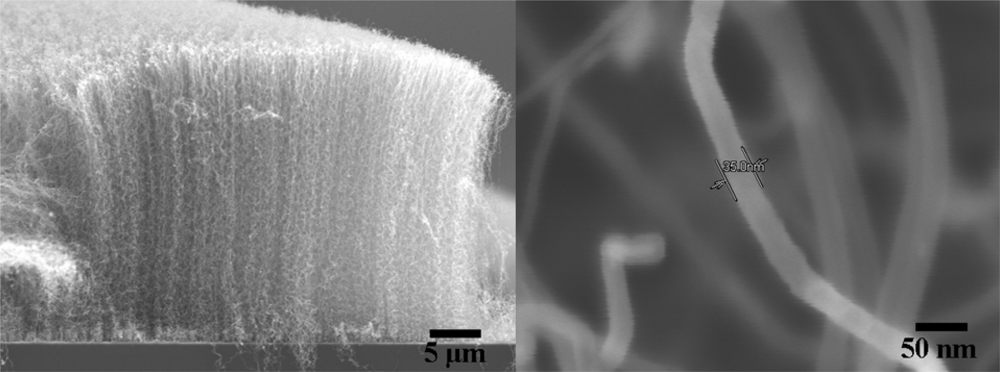
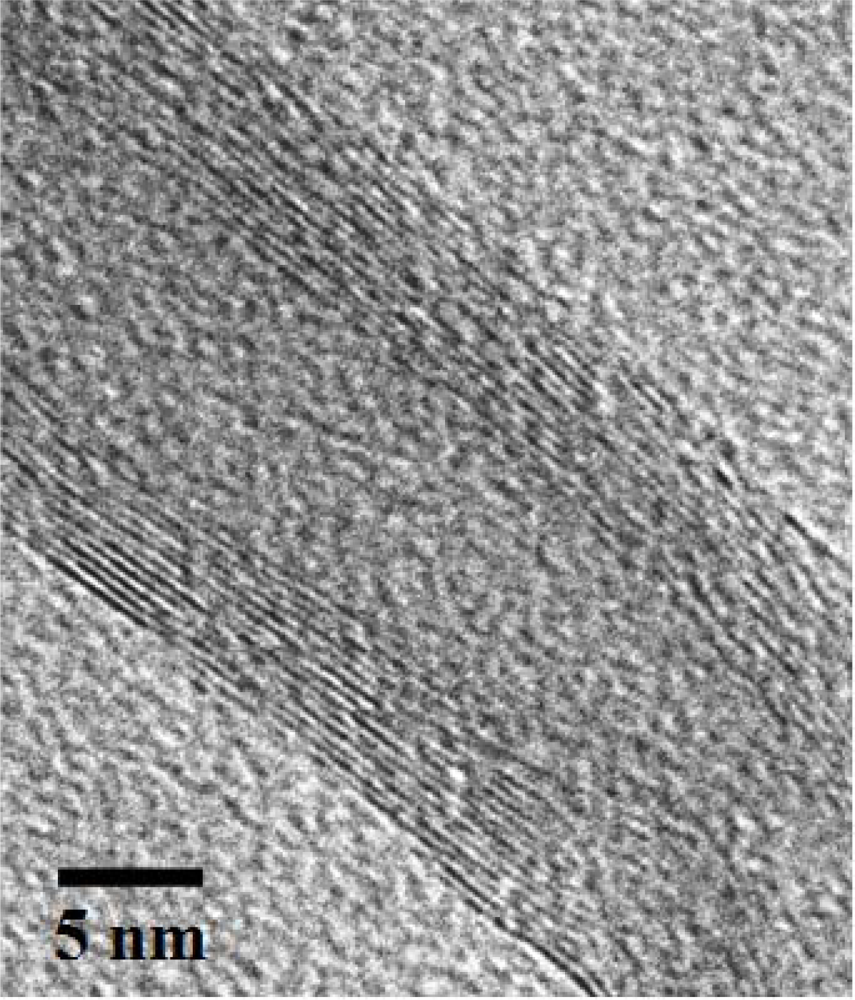
<p>Commercial WO<sub>3</sub> powder was obtained from Merck and used without further purification. MWCNTs were grown by the thermal chemical vapor deposition (CVD) process. The catalyst layer of aluminium oxide (10 nm) and stainless steel (5 nm) was deposited on the silicon (100) substrates (Semiconductor Wafer Inc.) using reactive sputtering apparatus. The synthesis of MWCNTs was performed under a flow of acetylene/hydrogen at a ratio of 3.6:1 at 700 °C for 3 min. To obtain high-purity MWCNTs, the water-assisted selective etching technique [<xref ref-type="bibr" rid="b28-sensors-10-07705">28</xref>] was applied after each CNT’s growth stage. Water vapor (300 ppm) was introduced into the system by bubbling argon gas through liquid water at room temperature for 3 min. The sequence of acetylene/hydrogen and water vapor flows was repeated for five cycles. Based on the scanning electron microscopic (SEM) image, as shown in <xref ref-type="fig" rid="f1-sensors-10-07705">Figure 1</xref>, the diameter and length of the MWCNTs are ∼35 nm and ∼26 μm, respectively. The electrical conductivity of MWCNTs was ∼75 S/cm, as measured by a four-point probe method at room temperature. In addition, high-resolution transmission electron microscopic (HR-TEM) imaging, as shown in <xref ref-type="fig" rid="f2-sensors-10-07705">Figure 2</xref>, confirms that CNTs are multi-walled, with the width and number of walls being ∼4.6 nm and 14, respectively. Thus, the spacing between two graphitic layers is ∼0.33 nm, which is in good agreement with theoretical and experimental values.</p></sec>
<sec>
<label>2.2.</label>
<title>Fabrication of MWCNTs-doped WO<sub>3</sub> Thin Film</title>
<p>MWCNT-doped WO<sub>3</sub> thin film was fabricated by the E-beam evaporation technique onto Cr/Au interdigitated electrodes on an alumina substrate [<xref ref-type="bibr" rid="b29-sensors-10-07705">29</xref>]. The target was prepared by mixing 99 wt% of WO<sub>3</sub> powder with 1 wt% of MWCNT powder using a grinder in a mortar for 30 min and then pelletizing with a hydraulic compressor. Deposition was performed at a pressure of 5 × 10<sup>−6</sup> Torr in the evaporation chamber. The substrate was rotated and kept at 130 °C during the deposition in order to obtain a homogeneous thin film. The deposition rate was 2 Å/sec and the final film thickness was 150 nm, as controlled by a quartz crystal monitor. After E-beam evaporation, the film was annealed at 500 °C for 3 h in air to stabilize the crystalline structure. In addition, an undoped WO<sub>3</sub> thin film was also fabricated using the same conditions for comparison.</p></sec>
<sec>
<label>2.3.</label>
<title>Measurement of Gas Sensing</title>
<p>To evaluate the gas sensing properties of the thus prepared thin films, MWCNT-doped WO<sub>3</sub> and undoped WO<sub>3</sub> gas sensors were placed inside a stainless steel chamber and the resistance measured using a 8846A Fluke multimeter with 6.5 digit resolution. The gas sensing measurements were made within a dynamic flow system with control of sensor operating temperatures (200–400 °C) under variable gas concentrations (100–50,000 ppm). Hydrogen (H<sub>2</sub>), ethanol (C<sub>2</sub>H<sub>5</sub>OH), methane (CH<sub>4</sub>), acetylene (C<sub>2</sub>H<sub>2</sub>), and ethylene (C<sub>2</sub>H<sub>4</sub>) were used to test the sensing properties and selectivity of the thin films. The sample gas flow time and the clean air reference flow time were fixed at 5 min and 15 min, respectively. It should be noted that these switching interval was selected so that the resistance change is at least 90% of the saturated value. The sensor resistances were sampled and recorded every second using LabVIEW with a USB DAQ device for subsequent analyses.</p></sec></sec>
<sec sec-type="results|discussion">
<label>3.</label>
<title>Results and Discussion</title>
<sec>
<label>3.1.</label>
<title>Characterization of Thin Films</title>
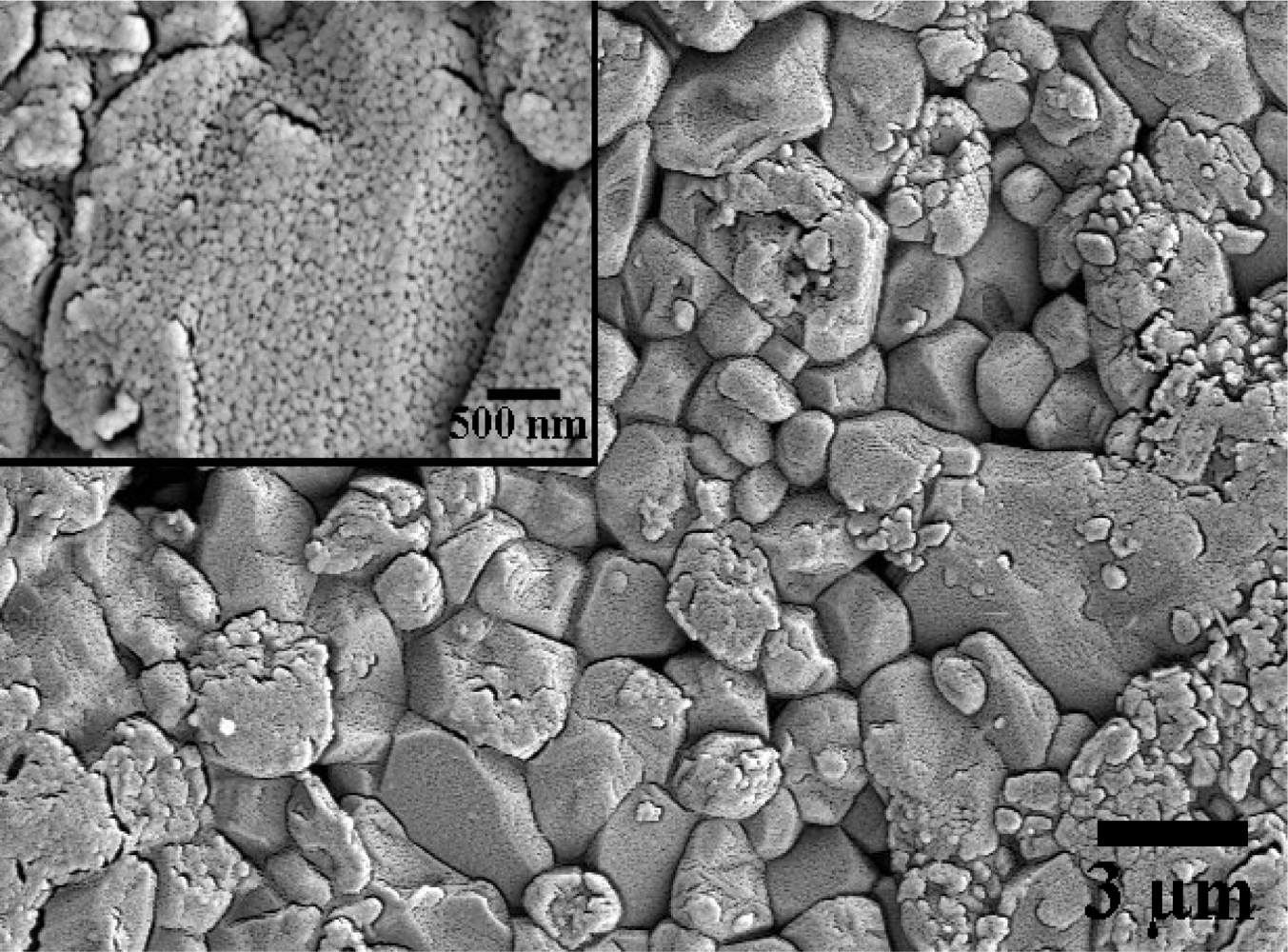
<p>Surface morphology, particle size and crystalline structure of the films were characterized by SEM and TEM. <xref ref-type="fig" rid="f3-sensors-10-07705">Figure 3</xref> shows the SEM surface morphology of MWCNT-doped WO<sub>3</sub> thin film deposited on an alumina substrate. It was seen that the film coated on the rough alumina substrate has approximate grain sizes ranging from 40 to 80 nm.</p>
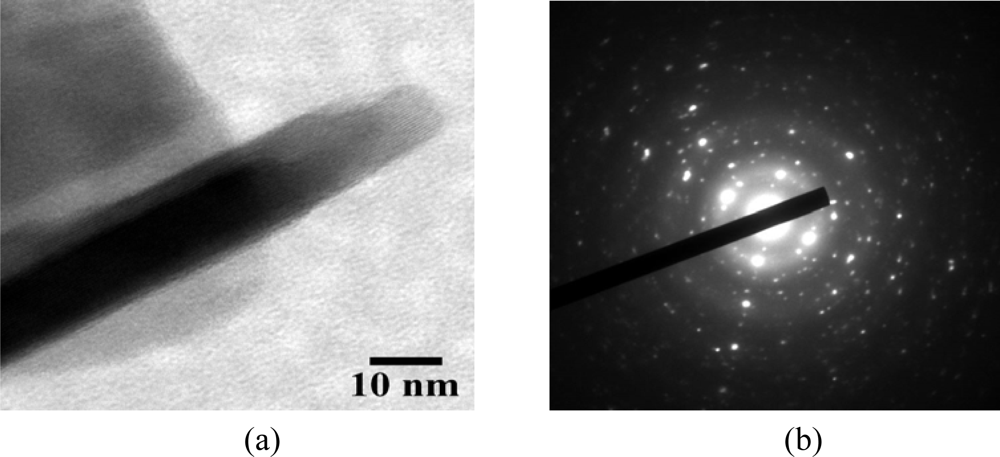
<p>The nanometer grain size together with the roughness of the alumina substrate can enhance the gas sensitivity of thin films [<xref ref-type="bibr" rid="b30-sensors-10-07705">30</xref>,<xref ref-type="bibr" rid="b31-sensors-10-07705">31</xref>] because more gas adsorption sites are available due to the increased surface area and porosity. With the SEM resolution, CNT structure cannot be observed on the thin film surface. Therefore, TEM characterization was used to confirm CNT inclusion into the WO<sub>3</sub> film. It should be noted that copper TEM grid samples were loaded inside the evaporation chamber for sample deposition at the same time as coating on the Cr/Au interdigitated electrodes. TEM observation clearly shows CNT inclusion into the nanocrystalline WO<sub>3</sub>, while the electron diffraction pattern exhibits polycrystalline phase in the film, as shown in <xref ref-type="fig" rid="f4-sensors-10-07705">Figure 4a,b</xref>, respectively.</p>
<p>The film morphology obtained in our study is in accordance with observations on nanocrystalline WO<sub>3</sub> films grown by other methods [<xref ref-type="bibr" rid="b32-sensors-10-07705">32</xref>,<xref ref-type="bibr" rid="b33-sensors-10-07705">33</xref>]. Doping of CNT does not change the phase or surface morphology of the film, but it may help form nanochannels in WO<sub>3</sub> films, leading to the enhancement of the sensitivity and reduction of the operating temperature.</p></sec>
<sec>
<label>3.2.</label>
<title>Sensing Properties of Thin Films</title>
<p>The sensor response (S) of the thin films is defined as the percentage of resistance change:
<disp-formula id="FD1">
<label>(1)</label>
<mml:math display="block">
<mml:mrow>
<mml:mi>S</mml:mi>
<mml:mo stretchy="false">(</mml:mo>
<mml:mi>%</mml:mi>
<mml:mo stretchy="false">)</mml:mo>
<mml:mo>=</mml:mo>
<mml:mrow>
<mml:mo>(</mml:mo>
<mml:mrow>
<mml:mfrac>
<mml:mrow>
<mml:msub>
<mml:mi>R</mml:mi>
<mml:mn>0</mml:mn></mml:msub>
<mml:mo>−</mml:mo>
<mml:mi>R</mml:mi></mml:mrow>
<mml:mrow>
<mml:msub>
<mml:mi>R</mml:mi>
<mml:mn>0</mml:mn></mml:msub></mml:mrow></mml:mfrac></mml:mrow>
<mml:mo>)</mml:mo></mml:mrow>
<mml:mo>×</mml:mo>
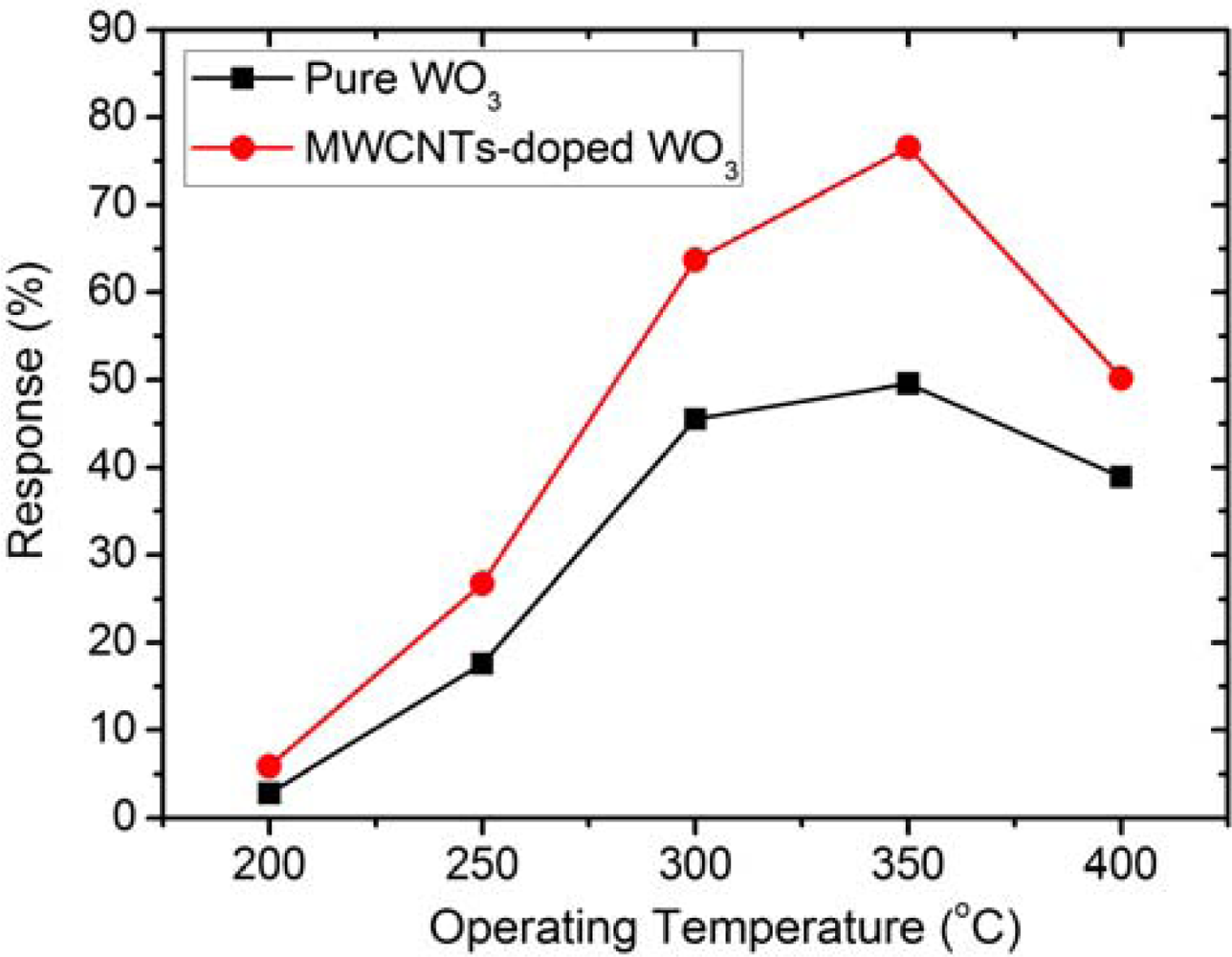
<mml:mn>100</mml:mn></mml:mrow></mml:math></disp-formula>where R<sub>0</sub> and R are the resistance of the thin films in pure air and test gas, respectively. <xref ref-type="fig" rid="f5-sensors-10-07705">Figure 5</xref> shows the response of the undoped WO<sub>3</sub> and MWCNT-doped WO<sub>3</sub> thin films to 1,000 ppm H<sub>2</sub> at varying operating temperatures. It can be seen that the response of the films increases as the operating temperature increases up to 350 °C, and then decreases. The gas-sensing response increases with temperature in the 200–350 °C range because thermal energy helps the reactions involved overcome their respective activation energy barriers [<xref ref-type="bibr" rid="b34-sensors-10-07705">34</xref>,<xref ref-type="bibr" rid="b35-sensors-10-07705">35</xref>]. However, if the operating temperature becomes too high (<italic>i.e.</italic>, &gt;350 °C), the adsorbed oxygen species at the sensing sites on the film surface will be diminished and less available to react with H<sub>2</sub> molecules [<xref ref-type="bibr" rid="b36-sensors-10-07705">36</xref>], thereby limiting the film’s response.</p>
<p>At any operating temperature, the sensor response of the MWCNT-doped WO<sub>3</sub> thin film is higher than that of the undoped WO<sub>3</sub> thin film. Specifically, at the optimum operating temperature (350 °C), MWCNT-doped WO<sub>3</sub> thin film yields a 26.9 % higher response than the undoped one. The doped sensor prepared in this work also shows higher response than the WO<sub>3</sub> films prepared by the sol–gel process [<xref ref-type="bibr" rid="b25-sensors-10-07705">25</xref>].</p>
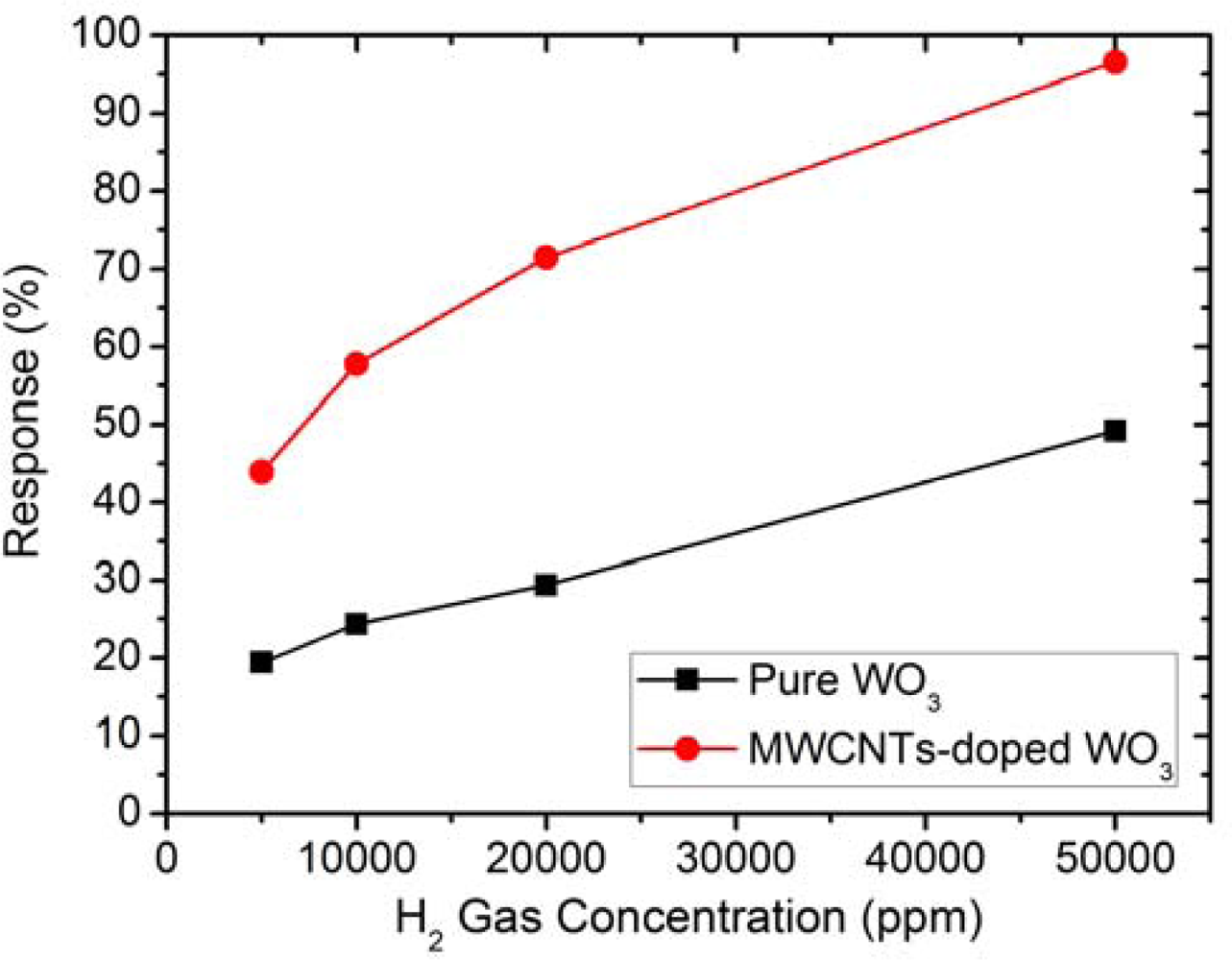
<p>One major advantage of MWCNT-doped WO<sub>3</sub> thin film is that the sensor can be operated at a lower operating temperature (250 °C), especially if this sensor is used to measure the H<sub>2</sub> gas at higher concentrations (5,000–50,000 ppm). As shown in <xref ref-type="fig" rid="f6-sensors-10-07705">Figure 6</xref>, at such a concentration range, there are sufficient numbers of H<sub>2</sub> molecules available to react with the surface oxygen adsorption sites. It is also well-known that MWCNTs contribute to the reduction of sensor resistance of metal oxides [<xref ref-type="bibr" rid="b37-sensors-10-07705">37</xref>] and the activation energy between the WO<sub>3</sub> surface and H<sub>2</sub> gas. The details of the sensing mechanisms of MWCNT-doped WO<sub>3</sub> thin films will be discussed in the next section.</p>
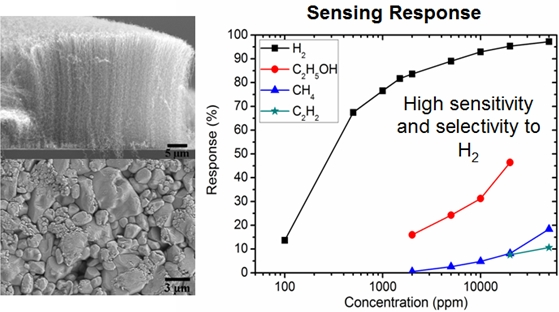
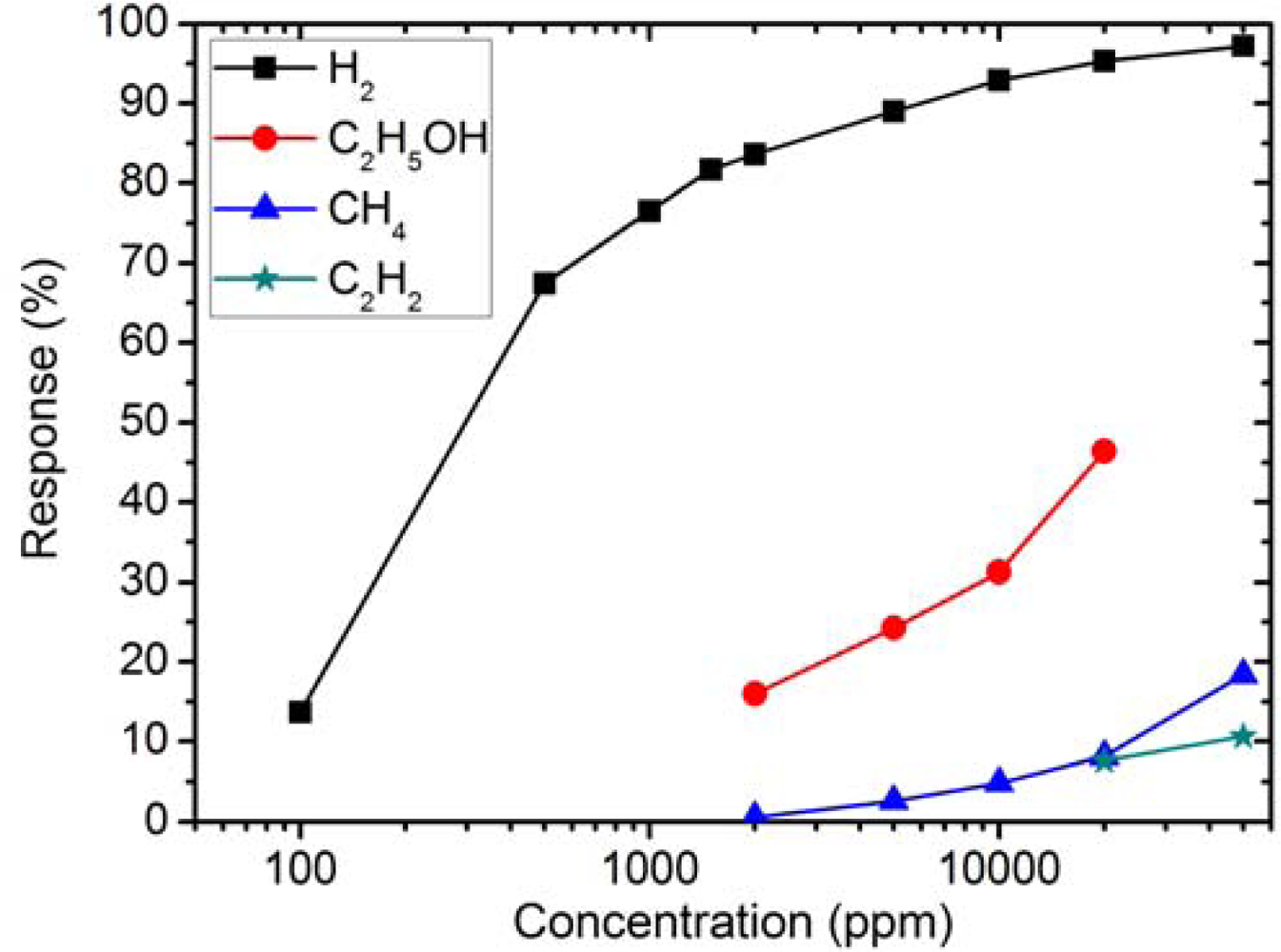
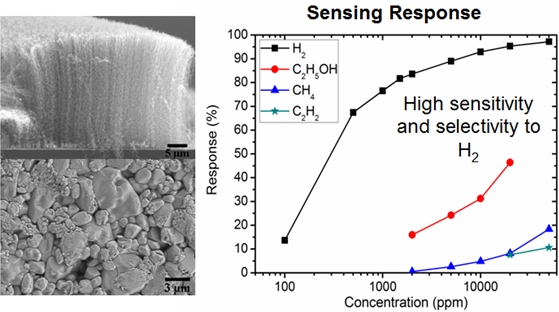
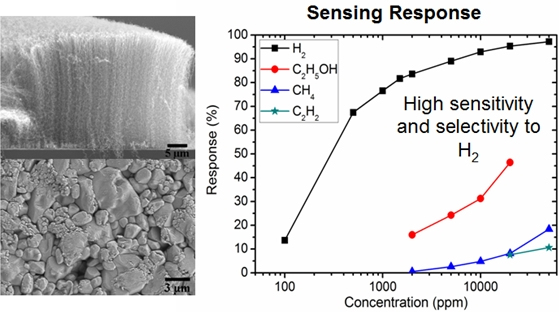
<p>To demonstrate the selectivity of the MWCNT-doped WO<sub>3</sub> thin film, its sensing response (at the operating temperature of 350 °C) to various gas vapors, namely H<sub>2</sub>, C<sub>2</sub>H<sub>5</sub>OH, CH<sub>4</sub>, and C<sub>2</sub>H<sub>2</sub>, was measured and plotted (<xref ref-type="fig" rid="f7-sensors-10-07705">Figure 7</xref>). It can be seen that MWCNT-doped WO<sub>3</sub> thin film exhibits a strong response to H<sub>2</sub>, and much weaker responses to C<sub>2</sub>H<sub>5</sub>OH, CH<sub>4</sub>, and C<sub>2</sub>H<sub>2</sub>. In particular, this thin film was found to be insensitive to C<sub>2</sub>H<sub>4</sub> at the optimum operating temperature of 350 °C. It is therefore concluded that the MWCNT-doped WO<sub>3</sub> thin film exhibits high selectivity to H<sub>2</sub>.</p></sec>
<sec>
<label>3.3.</label>
<title>Sensing Mechanism of MWCNTs-doped WO<sub>3</sub> Thin Film</title>
<p>It is well known that WO<sub>3</sub> is an n-type semiconductor while CNT is a p-type semiconductor. MWCNT-doped WO<sub>3</sub> thin film can be either p-type or n-type semiconductors depending on the quantity of MWCNTs and the operating temperature [<xref ref-type="bibr" rid="b38-sensors-10-07705">38</xref>]. In this work, the produced MWCNTs-doped WO<sub>3</sub> thin film behaves as an n-type semiconductor since the electrical conductivity of the film increases when reducing gases, <italic>i.e.</italic>, H<sub>2</sub>, are absorbed by its surface. Doping of MWCNTs into the WO<sub>3</sub> matrix can introduce nanochannels and form p-n heterojunctions in the thin film. These nanochannels play an important role for gas diffusion. The gas molecules can easily transport into the gas-sensing layers leading to increasing sensitivity [<xref ref-type="bibr" rid="b39-sensors-10-07705">39</xref>,<xref ref-type="bibr" rid="b40-sensors-10-07705">40</xref>]. In addition, MWCNT-doped WO<sub>3</sub> thin film p-n heterojunctions could be formed at the interface between WO<sub>3</sub> and the MWCNTs [<xref ref-type="bibr" rid="b38-sensors-10-07705">38</xref>,<xref ref-type="bibr" rid="b41-sensors-10-07705">41</xref>]. When H<sub>2</sub> gas is exposed to MWCNT-doped WO<sub>3</sub> thin film, the widths of the depletion layers at the p-n heterojunctions can be modulated. The potential barriers at the interfaces or inside the WO<sub>3</sub> may be changed. This change of the depletion layer in the p–n heterojunctions of MWCNT-doped WO<sub>3</sub> thin film may explain the enhanced response of the film at low operating temperatures. Various oxygen species chemisorbed at the thin film surface such as O<sup>2−</sup>, O<sub>2</sub><sup>−</sup>, and O<sup>−</sup> are available for catalytic reactions with H<sub>2</sub>, thus depending on the temperature at the metal oxide surface [<xref ref-type="bibr" rid="b42-sensors-10-07705">42</xref>]. At the operating temperature range of 200–400 °C, O<sup>−</sup> is commonly chemisorbed. Consequently, the chemical reaction underlying the H<sub>2</sub> gas sensing in this study is given by [<xref ref-type="bibr" rid="b43-sensors-10-07705">43</xref>]:
<disp-formula id="FD2">
<label>(2)</label>
<mml:math display="block">
<mml:mrow>
<mml:msub>
<mml:mi>H</mml:mi>
<mml:mn>2</mml:mn></mml:msub>
<mml:mo>+</mml:mo>
<mml:msubsup>
<mml:mi>O</mml:mi>
<mml:mrow>
<mml:mi mathvariant="italic">ads</mml:mi></mml:mrow>
<mml:mo>−</mml:mo></mml:msubsup>
<mml:mo>→</mml:mo>
<mml:msub>
<mml:mi>H</mml:mi>
<mml:mn>2</mml:mn></mml:msub>
<mml:mi>O</mml:mi>
<mml:mo>+</mml:mo>
<mml:msup>
<mml:mi>e</mml:mi>
<mml:mo>−</mml:mo></mml:msup></mml:mrow></mml:math></disp-formula></p>
<p>The adsorbed O<sup>−</sup> on the thin film surface reacts with the H<sub>2</sub> gas yielding H<sub>2</sub>O and releasing electrons which contribute to the current increase through the thin film that causes the electrical conductivity to increase.</p></sec></sec>
<sec sec-type="conclusions">
<label>4.</label>
<title>Conclusions</title>
<p>MWCNT-doped WO<sub>3</sub> thin film was successfully prepared by the E-beam evaporation technique. The 1 wt% MWCNT-doped WO<sub>3</sub> thin film exhibits n-type semiconductor behavior of the polycrystalline phase. Doping with MWCNTs does not significantly change any phase or surface morphology of the film, but it introduces nanochannels and form p-n heterojunctions in the WO<sub>3</sub> matrix. The MWCNT-doped WO<sub>3</sub> thin film exhibits high selectivity and sensitivity to H<sub>2</sub> over a relatively wide range of concentrations (100–50,000 ppm). Moreover, it can operate at a relatively low temperature. This should be useful for developing high performance H<sub>2</sub> gas sensors. To our best knowledge, this is the first report on MWCNT-doped WO<sub>3</sub> hydrogen sensors prepared by the E-beam method.</p></sec></body>
<back>
<ack>
<p>Mahidol University and the National Science and Technology Agency are gratefully acknowledged for supports of this research. C.W. acknowledges the Commission on Higher Education for a Ph.D. scholarship under the program “Strategic Scholarships for Frontier Research Network”. T.K. expresses his great gratitude to the Thailand Research Fund (BRG5180023) for a research career development grant.</p></ack>
<ref-list>
<title>References</title>
<ref id="b1-sensors-10-07705"><label>1.</label><citation citation-type="journal"><person-group person-group-type="author"><name><surname>Korotcenkov</surname><given-names>G</given-names></name><name><surname>Han</surname><given-names>SD</given-names></name><name><surname>Stetter</surname><given-names>JR</given-names></name></person-group><article-title>Review of electrochemical hydrogen sensors</article-title><source>Chem. Rev</source><year>2009</year><volume>109</volume><fpage>1402</fpage><lpage>1433</lpage><pub-id pub-id-type="doi">10.1021/cr800339k</pub-id><pub-id pub-id-type="pmid">19222198</pub-id></citation></ref>
<ref id="b2-sensors-10-07705"><label>2.</label><citation citation-type="journal"><person-group person-group-type="author"><name><surname>Moriarty</surname><given-names>P</given-names></name><name><surname>Honnery</surname><given-names>D</given-names></name></person-group><article-title>Hydrogen's role in an uncertain energy future</article-title><source>Int. J. Hydrogen. Energ</source><year>2009</year><volume>34</volume><fpage>31</fpage><lpage>39</lpage><pub-id pub-id-type="doi">10.1016/j.ijhydene.2008.10.060</pub-id></citation></ref>
<ref id="b3-sensors-10-07705"><label>3.</label><citation citation-type="journal"><person-group person-group-type="author"><name><surname>Momirlan</surname><given-names>M</given-names></name><name><surname>Veziroglu</surname><given-names>TN</given-names></name></person-group><article-title>The properties of hydrogen as fuel tomorrow in sustainable energy system for a cleaner planet</article-title><source>Int. J. Hydrogen. Energ</source><year>2005</year><volume>30</volume><fpage>795</fpage><lpage>802</lpage><pub-id pub-id-type="doi">10.1016/j.ijhydene.2004.10.011</pub-id></citation></ref>
<ref id="b4-sensors-10-07705"><label>4.</label><citation citation-type="journal"><person-group person-group-type="author"><name><surname>Árnason</surname><given-names>B</given-names></name><name><surname>Sigfússon</surname><given-names>TI</given-names></name></person-group><article-title>Iceland—A future hydrogen economy</article-title><source>Int. J. Hydrogen. Energ</source><year>2000</year><volume>25</volume><fpage>389</fpage><lpage>394</lpage><pub-id pub-id-type="doi">10.1016/S0360-3199(99)00077-4</pub-id></citation></ref>
<ref id="b5-sensors-10-07705"><label>5.</label><citation citation-type="journal"><person-group person-group-type="author"><name><surname>Carcassi</surname><given-names>MN</given-names></name><name><surname>Fineschi</surname><given-names>F</given-names></name></person-group><article-title>Deflagrations of H<sub>2</sub>-air and CH<sub>4</sub>-air lean mixtures in a vented multi-compartment environment</article-title><source>Energy</source><year>2005</year><volume>30</volume><fpage>1439</fpage><lpage>1451</lpage><pub-id pub-id-type="doi">10.1016/j.energy.2004.02.012</pub-id></citation></ref>
<ref id="b6-sensors-10-07705"><label>6.</label><citation citation-type="journal"><person-group person-group-type="author"><name><surname>Penza</surname><given-names>M</given-names></name><name><surname>Tagliente</surname><given-names>MA</given-names></name><name><surname>Mirenghi</surname><given-names>L</given-names></name><name><surname>Gerardi</surname><given-names>C</given-names></name><name><surname>Martucci</surname><given-names>C</given-names></name><name><surname>Cassano</surname><given-names>G</given-names></name></person-group><article-title>Tungsten trioxide (WO<sub>3</sub>) sputtered thin films for a NO<sub>x</sub> gas sensor</article-title><source>Sens. Actuat. B Chem</source><year>1998</year><volume>50</volume><fpage>9</fpage><lpage>18</lpage><pub-id pub-id-type="doi">10.1016/S0925-4005(98)00149-X</pub-id></citation></ref>
<ref id="b7-sensors-10-07705"><label>7.</label><citation citation-type="journal"><person-group person-group-type="author"><name><surname>Wang</surname><given-names>X</given-names></name><name><surname>Miura</surname><given-names>N</given-names></name><name><surname>Yamazoe</surname><given-names>N</given-names></name></person-group><article-title>Study of WO<sub>3</sub>-based sensing materials for NH<sub>3</sub> and NO detection</article-title><source>Sens. Actuat. B Chem</source><year>2000</year><volume>66</volume><fpage>74</fpage><lpage>76</lpage><pub-id pub-id-type="doi">10.1016/S0925-4005(99)00410-4</pub-id></citation></ref>
<ref id="b8-sensors-10-07705"><label>8.</label><citation citation-type="journal"><person-group person-group-type="author"><name><surname>Kim</surname><given-names>TS</given-names></name><name><surname>Kim</surname><given-names>TB</given-names></name><name><surname>Yoo</surname><given-names>KS</given-names></name><name><surname>Sung</surname><given-names>GS</given-names></name><name><surname>Jung</surname><given-names>HJ</given-names></name></person-group><article-title>Sensing characteristics of dc reactive sputtered WO<sub>3</sub> thin films as an NO<sub>x</sub> gas sensor</article-title><source>Sens. Actuat. B Chem</source><year>2000</year><volume>62</volume><fpage>102</fpage><lpage>108</lpage><pub-id pub-id-type="doi">10.1016/S0925-4005(99)00360-3</pub-id></citation></ref>
<ref id="b9-sensors-10-07705"><label>9.</label><citation citation-type="journal"><person-group person-group-type="author"><name><surname>Sawicka</surname><given-names>KM</given-names></name><name><surname>Prasad</surname><given-names>AK</given-names></name><name><surname>Gouma</surname><given-names>PI</given-names></name></person-group><article-title>Metal oxide nanowires for use in chemical sensing applications</article-title><source>Sens. Lett</source><year>2005</year><volume>3</volume><fpage>31</fpage><lpage>35</lpage><pub-id pub-id-type="doi">10.1166/sl.2005.010</pub-id></citation></ref>
<ref id="b10-sensors-10-07705"><label>10.</label><citation citation-type="journal"><person-group person-group-type="author"><name><surname>Tao</surname><given-names>WH</given-names></name><name><surname>Tsai</surname><given-names>CH</given-names></name></person-group><article-title>H<sub>2</sub>S sensing properties of noble metal doped WO<sub>3</sub> thin film sensor fabricated by micromachining</article-title><source>Sens. Actuat. B Chem</source><year>2002</year><volume>81</volume><fpage>237</fpage><lpage>247</lpage><pub-id pub-id-type="doi">10.1016/S0925-4005(01)00958-3</pub-id></citation></ref>
<ref id="b11-sensors-10-07705"><label>11.</label><citation citation-type="journal"><person-group person-group-type="author"><name><surname>Frühberger</surname><given-names>B</given-names></name><name><surname>Grunze</surname><given-names>M</given-names></name><name><surname>Dwyer</surname><given-names>DJ</given-names></name></person-group><article-title>Surface chemistry of H<sub>2</sub>S-sensitive tungsten oxide films</article-title><source>Sens. Actuat. B Chem</source><year>1996</year><volume>31</volume><fpage>167</fpage><lpage>174</lpage><pub-id pub-id-type="doi">10.1016/0925-4005(96)80062-1</pub-id></citation></ref>
<ref id="b12-sensors-10-07705"><label>12.</label><citation citation-type="journal"><person-group person-group-type="author"><name><surname>Hoel</surname><given-names>A</given-names></name><name><surname>Reyes</surname><given-names>LF</given-names></name><name><surname>Heszler</surname><given-names>P</given-names></name><name><surname>Lantto</surname><given-names>V</given-names></name><name><surname>Granqvist</surname><given-names>CG</given-names></name></person-group><article-title>Nanomaterials for environmental applications: Novel WO<sub>3</sub>-based gas sensors made by advanced gas deposition</article-title><source>Curr. Appl. Phys</source><year>2004</year><volume>4</volume><fpage>547</fpage><lpage>553</lpage><pub-id pub-id-type="doi">10.1016/j.cap.2004.01.016</pub-id></citation></ref>
<ref id="b13-sensors-10-07705"><label>13.</label><citation citation-type="journal"><person-group person-group-type="author"><name><surname>Ionescu</surname><given-names>R</given-names></name><name><surname>Hoel</surname><given-names>A</given-names></name><name><surname>Granqvist</surname><given-names>CG</given-names></name><name><surname>Llobet</surname><given-names>E</given-names></name><name><surname>Heszler</surname><given-names>P</given-names></name></person-group><article-title>Low-level detection of ethanol and H<sub>2</sub>S with temperature-modulated WO<sub>3</sub> nanoparticle gas sensors</article-title><source>Sens. Actuat. B Chem</source><year>2005</year><volume>104</volume><fpage>132</fpage><lpage>139</lpage><pub-id pub-id-type="doi">10.1016/j.snb.2004.05.015</pub-id></citation></ref>
<ref id="b14-sensors-10-07705"><label>14.</label><citation citation-type="journal"><person-group person-group-type="author"><name><surname>Li</surname><given-names>X</given-names></name><name><surname>Zhang</surname><given-names>G</given-names></name><name><surname>Cheng</surname><given-names>F</given-names></name><name><surname>Guo</surname><given-names>B</given-names></name><name><surname>Chen</surname><given-names>J</given-names></name></person-group><article-title>Synthesis, characterization, and gas-sensor application of WO<sub>3</sub> nanocuboids</article-title><source>J. Electrochem. Soc</source><year>2006</year><volume>153</volume><fpage>133</fpage><lpage>137</lpage></citation></ref>
<ref id="b15-sensors-10-07705"><label>15.</label><citation citation-type="journal"><person-group person-group-type="author"><name><surname>Xu</surname><given-names>Y</given-names></name><name><surname>Tang</surname><given-names>Z</given-names></name><name><surname>Zhang</surname><given-names>Z</given-names></name><name><surname>Ji</surname><given-names>Y</given-names></name><name><surname>Zhou</surname><given-names>Z</given-names></name></person-group><article-title>Large-scale hydrothermal synthesis of tungsten trioxide nanowires and their gas sensing properties</article-title><source>Sens. Lett</source><year>2008</year><volume>6</volume><fpage>938</fpage><lpage>941</lpage><pub-id pub-id-type="doi">10.1166/sl.2008.534</pub-id></citation></ref>
<ref id="b16-sensors-10-07705"><label>16.</label><citation citation-type="journal"><person-group person-group-type="author"><name><surname>Neri</surname><given-names>G</given-names></name><name><surname>Micali</surname><given-names>G</given-names></name><name><surname>Bonavita</surname><given-names>A</given-names></name><name><surname>Ipsale</surname><given-names>S</given-names></name><name><surname>Rizzo</surname><given-names>G</given-names></name><name><surname>Niederberger</surname><given-names>M</given-names></name><name><surname>Pinna</surname><given-names>N</given-names></name></person-group><article-title>Tungsten oxide nanowires-based ammonia gas sensors</article-title><source>Sens. Lett</source><year>2008</year><volume>6</volume><fpage>590</fpage><lpage>595</lpage><pub-id pub-id-type="doi">10.1166/sl.2008.437</pub-id></citation></ref>
<ref id="b17-sensors-10-07705"><label>17.</label><citation citation-type="journal"><person-group person-group-type="author"><name><surname>Llobet</surname><given-names>E</given-names></name><name><surname>Molas</surname><given-names>G</given-names></name><name><surname>Molinàs</surname><given-names>P</given-names></name><name><surname>Calderer</surname><given-names>J</given-names></name><name><surname>Vilanova</surname><given-names>X</given-names></name><name><surname>Brezmes</surname><given-names>J</given-names></name><name><surname>Sueiras</surname><given-names>JE</given-names></name><name><surname>Correig</surname><given-names>X</given-names></name></person-group><article-title>Fabrication of highly selective tungsten oxide ammonia sensors</article-title><source>J. Electrochem. Soc</source><year>2000</year><volume>147</volume><fpage>776</fpage><lpage>779</lpage><pub-id pub-id-type="doi">10.1149/1.1393270</pub-id></citation></ref>
<ref id="b18-sensors-10-07705"><label>18.</label><citation citation-type="journal"><person-group person-group-type="author"><name><surname>Balázsia</surname><given-names>C</given-names></name><name><surname>Wang</surname><given-names>L</given-names></name><name><surname>Zayim</surname><given-names>EO</given-names></name><name><surname>Szilágyid</surname><given-names>IM</given-names></name><name><surname>Sedlackováe</surname><given-names>K</given-names></name><name><surname>Pfeifera</surname><given-names>J</given-names></name><name><surname>Tótha</surname><given-names>AL</given-names></name><name><surname>Goumab</surname><given-names>PI</given-names></name></person-group><article-title>Nanosize hexagonal tungsten oxide for gas sensing applications</article-title><source>J. Eur. Ceram. Soc</source><year>2008</year><volume>28</volume><fpage>913</fpage><lpage>917</lpage><pub-id pub-id-type="doi">10.1016/j.jeurceramsoc.2007.09.001</pub-id></citation></ref>
<ref id="b19-sensors-10-07705"><label>19.</label><citation citation-type="journal"><person-group person-group-type="author"><name><surname>Wang</surname><given-names>U</given-names></name><name><surname>Pfeifer</surname><given-names>J</given-names></name><name><surname>Balazsi</surname><given-names>C</given-names></name><name><surname>Gouma</surname><given-names>PI</given-names></name></person-group><article-title>Synthesis and sensing properties to NH<sub>3</sub> of hexagonal WO<sub>3</sub> metastable nanopowders</article-title><source>Mater. Manuf. Process</source><year>2007</year><volume>22</volume><fpage>773</fpage><lpage>776</lpage><pub-id pub-id-type="doi">10.1080/10426910701385440</pub-id></citation></ref>
<ref id="b20-sensors-10-07705"><label>20.</label><citation citation-type="journal"><person-group person-group-type="author"><name><surname>Berger</surname><given-names>O</given-names></name><name><surname>Hoffmann</surname><given-names>T</given-names></name><name><surname>Fischer</surname><given-names>WJ</given-names></name><name><surname>Melev</surname><given-names>V</given-names></name></person-group><article-title>Tungsten-oxide thin films as novel materials with high sensitivity and selectivity to NO<sub>2</sub>, O<sub>3</sub>, and H<sub>2</sub>S. Part II: Application as gas sensors</article-title><source>J. Mater. Sci.: Mater. Electron</source><year>2004</year><volume>15</volume><fpage>483</fpage><lpage>493</lpage><pub-id pub-id-type="doi">10.1023/B:JMSE.0000031602.73321.fe</pub-id></citation></ref>
<ref id="b21-sensors-10-07705"><label>21.</label><citation citation-type="journal"><person-group person-group-type="author"><name><surname>Aroutiounian</surname><given-names>V</given-names></name></person-group><article-title>Metal oxide hydrogen, oxygen, and carbon monoxide sensors for hydrogen setups and cells</article-title><source>Int. J. Hydrogen. Energ</source><year>2007</year><volume>32</volume><fpage>1145</fpage><lpage>1158</lpage><pub-id pub-id-type="doi">10.1016/j.ijhydene.2007.01.004</pub-id></citation></ref>
<ref id="b22-sensors-10-07705"><label>22.</label><citation citation-type="journal"><person-group person-group-type="author"><name><surname>Ahmad</surname><given-names>A</given-names></name><name><surname>Walsh</surname><given-names>J</given-names></name></person-group><article-title>Development of WO<sub>3</sub>-based thick-film hydrogen sensors</article-title><source>ECS Trans</source><year>2006</year><volume>3</volume><fpage>141</fpage><lpage>152</lpage></citation></ref>
<ref id="b23-sensors-10-07705"><label>23.</label><citation citation-type="journal"><person-group person-group-type="author"><name><surname>Ippolito</surname><given-names>SJ</given-names></name><name><surname>Kandasamy</surname><given-names>S</given-names></name><name><surname>Kalantar-zadeh</surname><given-names>K</given-names></name><name><surname>Wlodarski</surname><given-names>W</given-names></name></person-group><article-title>Hydrogen sensing characteristics of WO<sub>3</sub> thin film conductometric sensors activated by Pt and Au catalysts</article-title><source>Sens. Actuat. B Chem</source><year>2005</year><volume>108</volume><fpage>154</fpage><lpage>158</lpage><pub-id pub-id-type="doi">10.1016/j.snb.2004.11.092</pub-id></citation></ref>
<ref id="b24-sensors-10-07705"><label>24.</label><citation citation-type="journal"><person-group person-group-type="author"><name><surname>Hsu</surname><given-names>WC</given-names></name><name><surname>Chan</surname><given-names>CC</given-names></name><name><surname>Peng</surname><given-names>CH</given-names></name><name><surname>Chang</surname><given-names>CC</given-names></name></person-group><article-title>Hydrogen sensing characteristics of an electrodeposited WO<sub>3</sub> thin film gasochromic sensor activated by Pt catalyst</article-title><source>Thin Solid Films</source><year>2007</year><volume>516</volume><fpage>407</fpage><lpage>411</lpage><pub-id pub-id-type="doi">10.1016/j.tsf.2007.07.055</pub-id></citation></ref>
<ref id="b25-sensors-10-07705"><label>25.</label><citation citation-type="journal"><person-group person-group-type="author"><name><surname>Fardindoost</surname><given-names>S</given-names></name><name><surname>Iraji-zad</surname><given-names>A</given-names></name><name><surname>Rahimi</surname><given-names>F</given-names></name><name><surname>Ghasempour</surname><given-names>R</given-names></name></person-group><article-title>Pd doped WO<sub>3</sub> films prepared by sol–gel process for hydrogen sensing</article-title><source>Int. J. Hydrogen. Energ</source><year>2010</year><volume>35</volume><fpage>854</fpage><lpage>860</lpage><pub-id pub-id-type="doi">10.1016/j.ijhydene.2009.11.033</pub-id></citation></ref>
<ref id="b26-sensors-10-07705"><label>26.</label><citation citation-type="journal"><person-group person-group-type="author"><name><surname>Nakagawa</surname><given-names>H</given-names></name><name><surname>Yamamoto</surname><given-names>N</given-names></name><name><surname>Okazaki</surname><given-names>S</given-names></name><name><surname>Chinzei</surname><given-names>T</given-names></name><name><surname>Asakura</surname><given-names>S</given-names></name></person-group><article-title>A room-temperature operated hydrogen leak sensor</article-title><source>Sens. Actuat. B Chem</source><year>2003</year><volume>93</volume><fpage>468</fpage><lpage>474</lpage><pub-id pub-id-type="doi">10.1016/S0925-4005(03)00201-6</pub-id></citation></ref>
<ref id="b27-sensors-10-07705"><label>27.</label><citation citation-type="journal"><person-group person-group-type="author"><name><surname>Samarasekara</surname><given-names>P</given-names></name></person-group><article-title>Hydrogen and methane gas sensors synthesis of multi-walled carbon nanotubes</article-title><source>Chin. J. Phys</source><year>2009</year><volume>47</volume><fpage>361</fpage><lpage>369</lpage></citation></ref>
<ref id="b28-sensors-10-07705"><label>28.</label><citation citation-type="journal"><person-group person-group-type="author"><name><surname>Zhu</surname><given-names>L</given-names></name><name><surname>Xiu</surname><given-names>Y</given-names></name><name><surname>Hess</surname><given-names>DW</given-names></name><name><surname>Wong</surname><given-names>CP</given-names></name></person-group><article-title>Aligned carbon nanotube stacks by water-assisted selective etching</article-title><source>Nano Lett</source><year>2005</year><volume>5</volume><fpage>2641</fpage><lpage>2645</lpage><pub-id pub-id-type="doi">10.1021/nl051906b</pub-id><pub-id pub-id-type="pmid">16351229</pub-id></citation></ref>
<ref id="b29-sensors-10-07705"><label>29.</label><citation citation-type="journal"><person-group person-group-type="author"><name><surname>Wongchoosuk</surname><given-names>C</given-names></name><name><surname>Wisitsoraat</surname><given-names>A</given-names></name><name><surname>Tuantranont</surname><given-names>A</given-names></name><name><surname>Kerdcharoen</surname><given-names>T</given-names></name></person-group><article-title>Portable electronic nose based on carbon nanotube-SnO<sub>2</sub> gas sensors and its application for detection of methanol contamination in whiskeys</article-title><source>Sens. Actuat. B Chem</source><year>2010</year><volume>147</volume><fpage>392</fpage><lpage>399</lpage><pub-id pub-id-type="doi">10.1016/j.snb.2010.03.072</pub-id></citation></ref>
<ref id="b30-sensors-10-07705"><label>30.</label><citation citation-type="journal"><person-group person-group-type="author"><name><surname>Ansari</surname><given-names>ZA</given-names></name><name><surname>Ansari</surname><given-names>SG</given-names></name><name><surname>Ko</surname><given-names>T</given-names></name><name><surname>Oh</surname><given-names>JH</given-names></name></person-group><article-title>Effect of MoO<sub>3</sub> doping and grain size on SnO<sub>2</sub>-enhancement of sensitivity and selectivity for CO and H<sub>2</sub> gas sensing</article-title><source>Sens. Actuat. B Chem</source><year>2002</year><volume>87</volume><fpage>105</fpage><lpage>114</lpage><pub-id pub-id-type="doi">10.1016/S0925-4005(02)00226-5</pub-id></citation></ref>
<ref id="b31-sensors-10-07705"><label>31.</label><citation citation-type="journal"><person-group person-group-type="author"><name><surname>Lee</surname><given-names>DS</given-names></name><name><surname>Nam</surname><given-names>KH</given-names></name><name><surname>Lee</surname><given-names>DD</given-names></name></person-group><article-title>Effect of substrate on NO<sub>2</sub>-sensing properties of WO<sub>3</sub> thin film gas sensors</article-title><source>Thin Solid Films</source><year>2000</year><volume>375</volume><fpage>142</fpage><lpage>146</lpage><pub-id pub-id-type="doi">10.1016/S0040-6090(00)01261-X</pub-id></citation></ref>
<ref id="b32-sensors-10-07705"><label>32.</label><citation citation-type="journal"><person-group person-group-type="author"><name><surname>Hussain</surname><given-names>OM</given-names></name><name><surname>Swapnasmitha</surname><given-names>AS</given-names></name><name><surname>John</surname><given-names>J</given-names></name><name><surname>Pinto</surname><given-names>R</given-names></name></person-group><article-title>Structure and morphology of laser-ablated WO<sub>3</sub> thin films</article-title><source>Appl. Phys. A: Mater. Sci. Process</source><year>2005</year><volume>81</volume><fpage>1291</fpage><lpage>1297</lpage><pub-id pub-id-type="doi">10.1007/s00339-004-3041-z</pub-id></citation></ref>
<ref id="b33-sensors-10-07705"><label>33.</label><citation citation-type="journal"><person-group person-group-type="author"><name><surname>Ashrit</surname><given-names>PV</given-names></name></person-group><article-title>Dry lithiation study of nanocrystalline, polycrystalline and amorphous tungsten trioxide thin-films</article-title><source>Thin Solid Films</source><year>2001</year><volume>385</volume><fpage>81</fpage><lpage>88</lpage><pub-id pub-id-type="doi">10.1016/S0040-6090(00)01895-2</pub-id></citation></ref>
<ref id="b34-sensors-10-07705"><label>34.</label><citation citation-type="journal"><person-group person-group-type="author"><name><surname>Shinde</surname><given-names>VR</given-names></name><name><surname>Gujar</surname><given-names>TP</given-names></name><name><surname>Lokhande</surname><given-names>CD</given-names></name></person-group><article-title>LPG sensing properties of ZnO films prepared by spray pyrolysis method: Effect of molarity of precursor solution</article-title><source>Sens. Actuat. B Chem</source><year>2007</year><volume>120</volume><fpage>551</fpage><lpage>559</lpage><pub-id pub-id-type="doi">10.1016/j.snb.2006.03.007</pub-id></citation></ref>
<ref id="b35-sensors-10-07705"><label>35.</label><citation citation-type="journal"><person-group person-group-type="author"><name><surname>Zeng</surname><given-names>Y</given-names></name><name><surname>Zhang</surname><given-names>T</given-names></name><name><surname>Wang</surname><given-names>L</given-names></name><name><surname>Kang</surname><given-names>M</given-names></name><name><surname>Fan</surname><given-names>H</given-names></name><name><surname>Wang</surname><given-names>R</given-names></name><name><surname>He</surname><given-names>Y</given-names></name></person-group><article-title>Enhanced toluene sensing characteristics of TiO<sub>2</sub>-doped flowerlike ZnO nanostructures</article-title><source>Sens. Actuat. B Chem</source><year>2009</year><volume>140</volume><fpage>73</fpage><lpage>78</lpage><pub-id pub-id-type="doi">10.1016/j.snb.2009.03.071</pub-id></citation></ref>
<ref id="b36-sensors-10-07705"><label>36.</label><citation citation-type="journal"><person-group person-group-type="author"><name><surname>Sahay</surname><given-names>PP</given-names></name><name><surname>Nath</surname><given-names>RK</given-names></name></person-group><article-title>Al-doped zinc oxide thin films for liquid petroleum gas (LPG) sensors</article-title><source>Sens. Actuat. B Chem</source><year>2008</year><volume>133</volume><fpage>222</fpage><lpage>227</lpage><pub-id pub-id-type="doi">10.1016/j.snb.2008.02.014</pub-id></citation></ref>
<ref id="b37-sensors-10-07705"><label>37.</label><citation citation-type="journal"><person-group person-group-type="author"><name><surname>Liang</surname><given-names>YX</given-names></name><name><surname>Chen</surname><given-names>YJ</given-names></name><name><surname>Wang</surname><given-names>TH</given-names></name></person-group><article-title>Low-resistance gas sensors fabricated from multiwalled carbon nanotubes coated with a thin tin oxide layer</article-title><source>Appl. Phy. Lett</source><year>2004</year><volume>85</volume><fpage>666</fpage><lpage>668</lpage><pub-id pub-id-type="doi">10.1063/1.1775879</pub-id></citation></ref>
<ref id="b38-sensors-10-07705"><label>38.</label><citation citation-type="journal"><person-group person-group-type="author"><name><surname>Bittencourt</surname><given-names>C</given-names></name><name><surname>Felten</surname><given-names>A</given-names></name><name><surname>Espinosa</surname><given-names>EH</given-names></name><name><surname>Ionescu</surname><given-names>R</given-names></name><name><surname>Llobet</surname><given-names>E</given-names></name><name><surname>Correig</surname><given-names>X</given-names></name><name><surname>Pireaux</surname><given-names>JJ</given-names></name></person-group><article-title>WO<sub>3</sub> films modified with functionalised multi-wall carbon nanotubes: Morphological, compositional and gas response studies</article-title><source>Sens. Actuat. B Chem</source><year>2006</year><volume>115</volume><fpage>33</fpage><lpage>41</lpage><pub-id pub-id-type="doi">10.1016/j.snb.2005.07.067</pub-id></citation></ref>
<ref id="b39-sensors-10-07705"><label>39.</label><citation citation-type="journal"><person-group person-group-type="author"><name><surname>Sakai</surname><given-names>G</given-names></name><name><surname>Matsunaga</surname><given-names>N</given-names></name><name><surname>Shimanoe</surname><given-names>K</given-names></name><name><surname>Yamazoe</surname><given-names>N</given-names></name></person-group><article-title>Theory of gas-diffusion controlled sensitivity for thin film semiconductor gas sensor</article-title><source>Sens. Actuat. B Chem</source><year>2001</year><volume>80</volume><fpage>125</fpage><lpage>131</lpage><pub-id pub-id-type="doi">10.1016/S0925-4005(01)00890-5</pub-id></citation></ref>
<ref id="b40-sensors-10-07705"><label>40.</label><citation citation-type="journal"><person-group person-group-type="author"><name><surname>Hieu</surname><given-names>NV</given-names></name><name><surname>Duc</surname><given-names>NAP</given-names></name><name><surname>Trung</surname><given-names>T</given-names></name><name><surname>Tuan</surname><given-names>MA</given-names></name><name><surname>Chien</surname><given-names>ND</given-names></name></person-group><article-title>Gas-sensing properties of tin oxide doped with metal oxides and carbon nanotubes: A competitive sensor for ethanol and liquid petroleum gas</article-title><source>Sens. Actuat. B Chem</source><year>2010</year><volume>144</volume><fpage>450</fpage><lpage>456</lpage><pub-id pub-id-type="doi">10.1016/j.snb.2009.03.043</pub-id></citation></ref>
<ref id="b41-sensors-10-07705"><label>41.</label><citation citation-type="journal"><person-group person-group-type="author"><name><surname>Wei</surname><given-names>BY</given-names></name><name><surname>Hsu</surname><given-names>MC</given-names></name><name><surname>Su</surname><given-names>PG</given-names></name><name><surname>Lin</surname><given-names>HM</given-names></name><name><surname>Wu</surname><given-names>RJ</given-names></name><name><surname>Lai</surname><given-names>HJ</given-names></name></person-group><article-title>A novel SnO<sub>2</sub> gas sensor doped with carbon nanotubes operating at room temperature</article-title><source>Sens. Actuat. B Chem</source><year>2004</year><volume>101</volume><fpage>81</fpage><lpage>89</lpage><pub-id pub-id-type="doi">10.1016/j.snb.2004.02.028</pub-id></citation></ref>
<ref id="b42-sensors-10-07705"><label>42.</label><citation citation-type="journal"><person-group person-group-type="author"><name><surname>Cheong</surname><given-names>HW</given-names></name><name><surname>Lee</surname><given-names>MJ</given-names></name></person-group><article-title>Sensing characteristics and surface reaction mechanism of alcohol sensors based on doped SnO<sub>2</sub></article-title><source>J. Ceram. Process. Res</source><year>2006</year><volume>7</volume><fpage>183</fpage><lpage>191</lpage></citation></ref>
<ref id="b43-sensors-10-07705"><label>43.</label><citation citation-type="journal"><person-group person-group-type="author"><name><surname>Lupan</surname><given-names>O</given-names></name><name><surname>Ursaki</surname><given-names>VV</given-names></name><name><surname>Chai</surname><given-names>G</given-names></name><name><surname>Chow</surname><given-names>L</given-names></name><name><surname>Emelchenko</surname><given-names>GA</given-names></name><name><surname>Tiginyanu</surname><given-names>IM</given-names></name><name><surname>Gruzintsev</surname><given-names>AN</given-names></name><name><surname>Redkin</surname><given-names>AN</given-names></name></person-group><article-title>Selective hydrogen gas nanosensor using individual ZnO nanowire with fast response at room temperature</article-title><source>Sens. Actuat. B Chem</source><year>2010</year><volume>144</volume><fpage>56</fpage><lpage>66</lpage><pub-id pub-id-type="doi">10.1016/j.snb.2009.10.038</pub-id></citation></ref></ref-list>
<sec sec-type="display-objects">
<title>Figures</title>
<fig id="f1-sensors-10-07705" position="float">
<label>Figure 1.</label>
<caption>
<p>SEM images of the produced MWCNTs grown by the CVD process.</p></caption>
<graphic xlink:href="sensors-10-07705f1.gif"/></fig>
<fig id="f2-sensors-10-07705" position="float">
<label>Figure 2.</label>
<caption>
<p>High resolution TEM image of the produced MWCNT grown by the CVD process.</p></caption>
<graphic xlink:href="sensors-10-07705f2.gif"/></fig>
<fig id="f3-sensors-10-07705" position="float">
<label>Figure 3.</label>
<caption>
<p>SEM image of MWCNT-doped WO<sub>3</sub> thin films on alumina substrate.</p></caption>
<graphic xlink:href="sensors-10-07705f3.gif"/></fig>
<fig id="f4-sensors-10-07705" position="float">
<label>Figure 4.</label>
<caption>
<p><bold>(a)</bold> High-resolution TEM image and <bold>(b)</bold> corresponding selected area diffraction pattern of MWCNT-doped WO<sub>3</sub> thin film.</p></caption>
<graphic xlink:href="sensors-10-07705f4.gif"/></fig>
<fig id="f5-sensors-10-07705" position="float">
<label>Figure 5.</label>
<caption>
<p>Sensing response to H<sub>2</sub> (1,000 ppm) at different operating temperatures.</p></caption>
<graphic xlink:href="sensors-10-07705f5.gif"/></fig>
<fig id="f6-sensors-10-07705" position="float">
<label>Figure 6.</label>
<caption>
<p>Sensing response of the undoped WO<sub>3</sub> and MWCNT-doped WO<sub>3</sub> thin films to high H<sub>2</sub> concentrations (5,000–50,000 ppm) at the operating temperature of 250 °C.</p></caption>
<graphic xlink:href="sensors-10-07705f6.gif"/></fig>
<fig id="f7-sensors-10-07705" position="float">
<label>Figure 7.</label>
<caption>
<p>Sensing response of MWCNT-doped WO<sub>3</sub> thin film at the operating temperature of 350 °C to various concentrations of different gas vapors.</p></caption>
<graphic xlink:href="sensors-10-07705f7.gif"/></fig></sec></back></article>