
<?xml version="1.0" encoding="UTF-8"?>
<!DOCTYPE article PUBLIC "-//NLM//DTD Journal Publishing DTD v2.3 20070202//EN" "journalpublishing.dtd">
<article xmlns:mml="http://www.w3.org/1998/Math/MathML" xmlns:xlink="http://www.w3.org/1999/xlink" xml:lang="en" article-type="research-article">
<front>
<journal-meta>
<journal-id journal-id-type="publisher-id">ijms</journal-id>
<journal-title>International Journal of Molecular Sciences</journal-title>
<abbrev-journal-title>Int. J. Mol. Sci.</abbrev-journal-title>
<issn pub-type="epub">1422-0067</issn>
<publisher>
<publisher-name>Molecular Diversity Preservation International (MDPI)</publisher-name></publisher></journal-meta>
<article-meta>
<article-id pub-id-type="doi">10.3390/ijms9091652</article-id>
<article-id pub-id-type="publisher-id">ijms-09-01652</article-id>
<article-categories>
<subj-group>
<subject>Article</subject></subj-group></article-categories>
<title-group>
<article-title>Exact and Effective Pair-Wise Potential for Protein-Ligand Interactions Obtained from a Semiempirical Energy Partition</article-title></title-group>
<contrib-group>
<contrib contrib-type="author">
<name><surname>Carvalho</surname><given-names>Alexandre R. F.</given-names></name><xref ref-type="aff" rid="af1-ijms-09-01652">1</xref></contrib>
<contrib contrib-type="author">
<name><surname>Puga</surname><given-names>André T.</given-names></name><xref ref-type="aff" rid="af2-ijms-09-01652">2</xref></contrib>
<contrib contrib-type="author">
<name><surname>Melo</surname><given-names>André</given-names></name><xref ref-type="aff" rid="af1-ijms-09-01652">1</xref><xref ref-type="corresp" rid="c1-ijms-09-01652">*</xref></contrib></contrib-group>
<aff id="af1-ijms-09-01652">
<label>1</label> REQUIMTE/Department of Chemistry, Faculty of Science, University of Porto, Rua do Campo Alegre, 687, 4169-007 Porto, Portugal. E-Mail:
<email>afcarval@fc.up.pt</email> (A. C.)</aff>
<aff id="af2-ijms-09-01652">
<label>2</label> DEMEGI, Faculty of Engineering, University of Porto, Rua Dr Roberto Frias, 4200-465 Porto, Portugal. E-Mail:
<email>apuga@fe.up.pt</email> (A. P.)</aff>
<author-notes>
<corresp id="c1-ijms-09-01652">
<label>*</label> Author to whom correspondence should be addressed; E-Mail:
<email>asmelo@fc.up.pt</email> (A. M.); Tel. + 351-223-401-400; Fax: +351-222-008-628; URL: <ext-link xlink:href="http://www.fc.up.pt/pessoas/asmelo" ext-link-type="uri">http://www.fc.up.pt/pessoas/asmelo</ext-link></corresp></author-notes>
<pub-date pub-type="epub">
<day>2</day>
<month>9</month>
<year>2008</year></pub-date>
<pub-date pub-type="collection">
<month>9</month>
<year>2008</year></pub-date>
<volume>9</volume>
<issue>9</issue>
<fpage>1652</fpage>
<lpage>1664</lpage>
<history>
<date date-type="received">
<day>14</day>
<month>2</month>
<year>2008</year></date>
<date date-type="rev-recd">
<day>28</day>
<month>7</month>
<year>2008</year></date>
<date date-type="accepted">
<day>28</day>
<month>8</month>
<year>2008</year></date></history>
<permissions>
<copyright-statement>© 2008 by MDPI</copyright-statement>
<copyright-year>2008</copyright-year>
<license license-type="open-access" xlink:href="http://creativecommons.org/licenses/by/3.0">
<p>This article is an open-access article distributed under the terms and conditions of the Creative Commons Attribution license (http://creativecommons.org/licenses/by/3.0/).</p></license></permissions>
<abstract>
<p>In this work, the partition method introduced by Carvalho and Melo was used to study the complex between <italic>Cucurbita maxima</italic> trypsin inhibitor (CMTI-I) and glycerol at the AM1 level. An effective potential, combining non-bonding and polarization plus charge transfer (PLCT) terms, was introduced to evaluate the magnitude of the interaction between each amino acid and the ligand. In this case study, the nonbonding–PLCT non-compensation characterizes the stabilization energy of the association process in study. The main residues (Gly29, Cys3 and Arg5) with net attractive effects and Arg1 (with a net repulsive effect), responsible by the stability of protein-ligand complex, are associated with large nonbonding energies non-compensated by PLCT effects. The results obtained enable us to conclude that the present decomposition scheme can be used for understanding the cohesive phenomena in proteins.</p></abstract>
<kwd-group>
<kwd>Protein-ligand interactions</kwd>
<kwd>energy partition scheme</kwd>
<kwd>association processes</kwd>
<kwd>stabilization energy</kwd>
<kwd>quantum partition of molecules</kwd>
<kwd>semiempirical methods</kwd></kwd-group></article-meta></front>
<body>
<sec sec-type="intro">
<title>1. Introduction</title>
<p>Computational methods are of great interest to evaluate binding affinities between proteins and ligands, with many applications in structure-based drug design (SBDD) [<xref ref-type="bibr" rid="b1-ijms-09-01652">1</xref>]. A complete description of the correspondent molecular interactions, including the short-range polarization plus charge transfer (PLCT) effects, can only be carried out at a quantum mechanics (QM) level. However, the more accurate QM methods require very large computational resources and this has limited high-level theoretical studies in this field [<xref ref-type="bibr" rid="b2-ijms-09-01652">2</xref>]. Current methods using classical potentials can only represent a good approximation for evaluating the nonbonding protein-ligand interactions, because they are usually designed to treat the QM effects in an average manner. For this purpose, QM methods have been currently used to parameterize force fields [<xref ref-type="bibr" rid="b3-ijms-09-01652">3</xref>–<xref ref-type="bibr" rid="b7-ijms-09-01652">7</xref>] and scoring functions [<xref ref-type="bibr" rid="b8-ijms-09-01652">8</xref>]. This has enabled computationally intensive SBDD studies at lower theoretical levels. The hybrid quantum mechanics/molecular mechanics (QM/MM) methods are an interesting alternative approach for this type of problems, because they conjugate an appropriate description of the molecular system with moderate computational resources [<xref ref-type="bibr" rid="b9-ijms-09-01652">9</xref>, <xref ref-type="bibr" rid="b10-ijms-09-01652">10</xref>]. Good QM/MM methods require a rigorous partition of the molecular systems into two regions: a strongly perturbed region that should be described at a quantum level and a bulk region whose interactions can be reproduced by classical potentials. In this context, the energy partition schemes [<xref ref-type="bibr" rid="b11-ijms-09-01652">11</xref>–<xref ref-type="bibr" rid="b13-ijms-09-01652">13</xref>] can provide rational criterions to define these regions. <italic>In vitro</italic> methods and mathematical models for enzymatic reactions [<xref ref-type="bibr" rid="b14-ijms-09-01652">14</xref>–<xref ref-type="bibr" rid="b16-ijms-09-01652">16</xref>] are the prototype for evaluate kinetics and binding affinities between proteins and ligands.</p>
<p>In this work, the application of the SemiEmpirical Energy Based (SEEB) partition method introduced by Carvalho and Melo [<xref ref-type="bibr" rid="b17-ijms-09-01652">17</xref>] to study protein-ligand association processes was analyzed. This method enables the stabilization energy decomposition both into physically meaningful and spatial components. As this formalism was developed at a semiempirical quantum level, it enables also the complete separability of these components. Here, the SEEB formalism was extended to describe protein-ligand interactions using a pair-wise potential. The SEEB method was then used to study the association between the Curcubita maxima trypsin inhibitor (CMTI-I) and glycerol. CMTI-I is well known by its biological importance [<xref ref-type="bibr" rid="b18-ijms-09-01652">18</xref>, <xref ref-type="bibr" rid="b19-ijms-09-01652">19</xref>]. Glycerol is a cryoprotectant [<xref ref-type="bibr" rid="b20-ijms-09-01652">20</xref>], which should be washed away with solvent in the crystallization process. However, it forms a stable complex with CMTI-I that is detected in the crystallized structure. In this context, glycerol should be considered to have a large affinity to CMTI-I and this study can provide a further insight for a rational modeling of high-specific ligands for this protein.</p></sec>
<sec sec-type="methods">
<title>2. Methods</title>
<p>A non-covalent (no) association between a protein (P) with n amino acid residues and a ligand (L) can be represented by <xref ref-type="disp-formula" rid="FD1">equation (1)</xref>:</p>
<disp-formula id="FD1">
<label>(1)</label>
<mml:math display="block">
<mml:mrow>
<mml:mi>P</mml:mi>
<mml:mo>+</mml:mo>
<mml:mi>L</mml:mi>
<mml:mo>⇌</mml:mo>
<mml:mi>P</mml:mi>
<mml:mo>:</mml:mo>
<mml:mi>L</mml:mi></mml:mrow></mml:math></disp-formula>
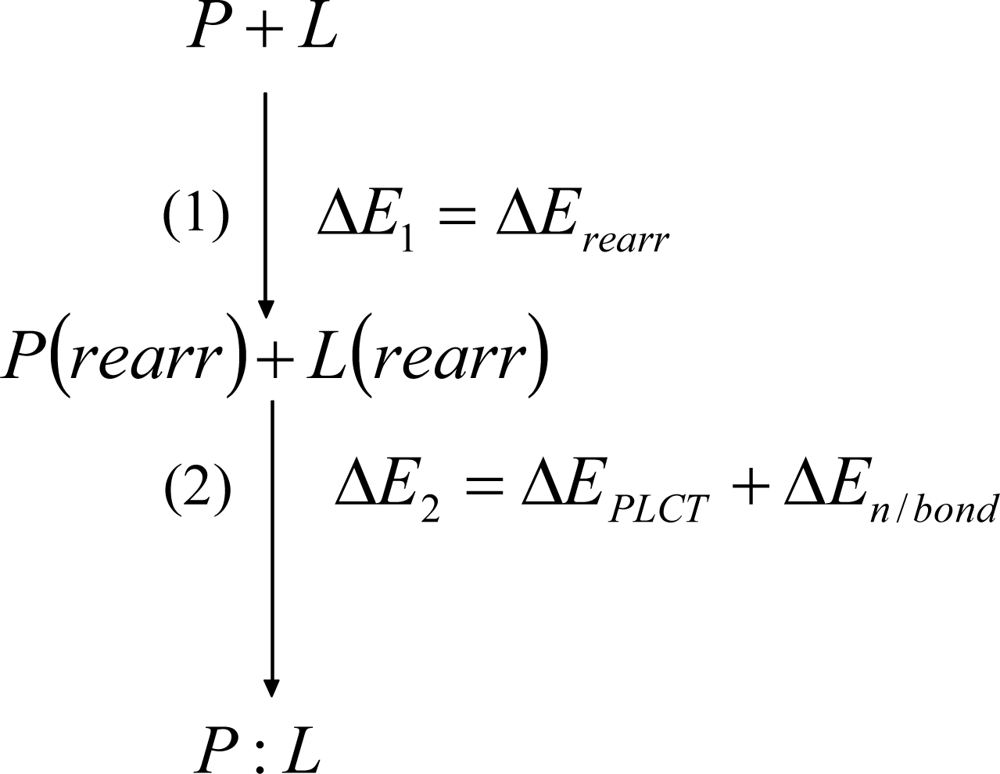
<p>A general association process can be described by a hypothetical mechanism involving two steps (see <xref ref-type="fig" rid="f1-ijms-09-01652">Figure 1</xref>). In the first step, the molecular monomers (P and L) are rearranged assuming the geometries adopted in the dimer.</p>
<p>In the second step, the rearranged species (P(rearr) and L(rearr)) associate each other preserving their geometries and originating the dimer (P:L). According to the SEEB formalism, the stabilization energy can be partitioned as:</p>
<disp-formula id="FD2">
<label>(2)</label>
<mml:math display="block">
<mml:mrow>
<mml:mo>Δ</mml:mo>
<mml:msup>
<mml:mi>E</mml:mi>
<mml:mrow>
<mml:mi>n</mml:mi>
<mml:mi>o</mml:mi></mml:mrow></mml:msup>
<mml:mo> </mml:mo>
<mml:mo>=</mml:mo>
<mml:mo> </mml:mo>
<mml:mo>Δ</mml:mo>
<mml:msubsup>
<mml:mi>E</mml:mi>
<mml:mn>1</mml:mn>
<mml:mrow>
<mml:mi>n</mml:mi>
<mml:mi>o</mml:mi></mml:mrow></mml:msubsup>
<mml:mo> </mml:mo>
<mml:mo>+</mml:mo>
<mml:mo> </mml:mo>
<mml:mo>Δ</mml:mo>
<mml:msubsup>
<mml:mi>E</mml:mi>
<mml:mn>2</mml:mn>
<mml:mrow>
<mml:mi>n</mml:mi>
<mml:mi>o</mml:mi></mml:mrow></mml:msubsup></mml:mrow></mml:math></disp-formula>
<p>In <xref ref-type="disp-formula" rid="FD2">equation (2)</xref>, the conformational rearrangement component (
<inline-formula>
<mml:math>
<mml:mrow>
<mml:mo>Δ</mml:mo>
<mml:msubsup>
<mml:mi>E</mml:mi>
<mml:mrow>
<mml:mi>r</mml:mi>
<mml:mi>e</mml:mi>
<mml:mi>a</mml:mi>
<mml:mi>r</mml:mi>
<mml:mi>r</mml:mi></mml:mrow>
<mml:mrow>
<mml:mi>n</mml:mi>
<mml:mi>o</mml:mi></mml:mrow></mml:msubsup></mml:mrow></mml:math></inline-formula>) is associated with step 1, while the polarization plus charge transfer (
<inline-formula>
<mml:math>
<mml:mo>Δ</mml:mo>
<mml:msubsup>
<mml:mi>E</mml:mi>
<mml:mrow>
<mml:mi>P</mml:mi>
<mml:mi>L</mml:mi>
<mml:mi>C</mml:mi>
<mml:mi>T</mml:mi></mml:mrow>
<mml:mrow>
<mml:mi>n</mml:mi>
<mml:mi>o</mml:mi></mml:mrow></mml:msubsup></mml:math></inline-formula>) and nonbonding (
<inline-formula>
<mml:math>
<mml:mo>Δ</mml:mo>
<mml:msubsup>
<mml:mi>E</mml:mi>
<mml:mrow>
<mml:mi>n</mml:mi>
<mml:mo>/</mml:mo>
<mml:mi>b</mml:mi>
<mml:mi>o</mml:mi>
<mml:mi>n</mml:mi>
<mml:mi>d</mml:mi></mml:mrow>
<mml:mrow>
<mml:mi>n</mml:mi>
<mml:mi>o</mml:mi></mml:mrow></mml:msubsup></mml:math></inline-formula>) components are associated with step 2:</p>
<disp-formula id="FD3">
<label>(3)</label>
<mml:math display="block">
<mml:mrow>
<mml:mo>Δ</mml:mo>
<mml:msubsup>
<mml:mi>E</mml:mi>
<mml:mn>1</mml:mn>
<mml:mrow>
<mml:mi>n</mml:mi>
<mml:mi>o</mml:mi></mml:mrow></mml:msubsup>
<mml:mo> </mml:mo>
<mml:mo>=</mml:mo>
<mml:mo> </mml:mo>
<mml:mo>Δ</mml:mo>
<mml:msubsup>
<mml:mi>E</mml:mi>
<mml:mrow>
<mml:mi>r</mml:mi>
<mml:mi>e</mml:mi>
<mml:mi>a</mml:mi>
<mml:mi>r</mml:mi>
<mml:mi>r</mml:mi></mml:mrow>
<mml:mrow>
<mml:mi>n</mml:mi>
<mml:mi>o</mml:mi></mml:mrow></mml:msubsup>
<mml:mo> </mml:mo>
<mml:mo>=</mml:mo>
<mml:mo> </mml:mo>
<mml:mo>Δ</mml:mo>
<mml:msubsup>
<mml:mi>E</mml:mi>
<mml:mrow>
<mml:mi>r</mml:mi>
<mml:mi>e</mml:mi>
<mml:mi>a</mml:mi>
<mml:mi>r</mml:mi>
<mml:mi>r</mml:mi></mml:mrow>
<mml:mrow>
<mml:mi>n</mml:mi>
<mml:mi>o</mml:mi></mml:mrow></mml:msubsup>
<mml:mo stretchy="false">(</mml:mo>
<mml:mi>P</mml:mi>
<mml:mo stretchy="false">)</mml:mo>
<mml:mo> </mml:mo>
<mml:mo>+</mml:mo>
<mml:mo> </mml:mo>
<mml:mo>Δ</mml:mo>
<mml:msubsup>
<mml:mi>E</mml:mi>
<mml:mrow>
<mml:mi>r</mml:mi>
<mml:mi>e</mml:mi>
<mml:mi>a</mml:mi>
<mml:mi>r</mml:mi>
<mml:mi>r</mml:mi></mml:mrow>
<mml:mrow>
<mml:mi>n</mml:mi>
<mml:mi>o</mml:mi></mml:mrow></mml:msubsup>
<mml:mo stretchy="false">(</mml:mo>
<mml:mi>L</mml:mi>
<mml:mo stretchy="false">)</mml:mo></mml:mrow></mml:math></disp-formula>
<disp-formula id="FD4">
<label>(4)</label>
<mml:math display="block">
<mml:mrow>
<mml:mo>Δ</mml:mo>
<mml:msubsup>
<mml:mi>E</mml:mi>
<mml:mn>2</mml:mn>
<mml:mrow>
<mml:mi>n</mml:mi>
<mml:mi>o</mml:mi></mml:mrow></mml:msubsup>
<mml:mo> </mml:mo>
<mml:mo>=</mml:mo>
<mml:mo> </mml:mo>
<mml:mo>Δ</mml:mo>
<mml:msubsup>
<mml:mi>E</mml:mi>
<mml:mrow>
<mml:mi>P</mml:mi>
<mml:mi>L</mml:mi>
<mml:mi>C</mml:mi>
<mml:mi>T</mml:mi></mml:mrow>
<mml:mrow>
<mml:mi>n</mml:mi>
<mml:mi>o</mml:mi></mml:mrow></mml:msubsup>
<mml:mo> </mml:mo>
<mml:mo>+</mml:mo>
<mml:mo> </mml:mo>
<mml:mo>Δ</mml:mo>
<mml:msubsup>
<mml:mi>E</mml:mi>
<mml:mrow>
<mml:mi>n</mml:mi>
<mml:mo> </mml:mo>
<mml:mo>/</mml:mo>
<mml:mo> </mml:mo>
<mml:mi>b</mml:mi>
<mml:mi>o</mml:mi>
<mml:mi>n</mml:mi>
<mml:mi>d</mml:mi></mml:mrow>
<mml:mrow>
<mml:mi>n</mml:mi>
<mml:mi>o</mml:mi></mml:mrow></mml:msubsup></mml:mrow></mml:math></disp-formula>
<p>In <xref ref-type="disp-formula" rid="FD2">equations (2)</xref> to <xref ref-type="disp-formula" rid="FD4">(4)</xref>, the superscript (no) indicates that the P:L association is of non covalent nature. The nomenclature used for binding states is presented elsewhere [<xref ref-type="bibr" rid="b17-ijms-09-01652">17</xref>]. The exact definition of the terms occurring in <xref ref-type="disp-formula" rid="FD3">equation (3)</xref> and <xref ref-type="disp-formula" rid="FD4">(4)</xref> is presented in <xref ref-type="app" rid="app1">appendix A</xref>.</p>
<p>An effective pair-wise potential, combining non-bonding and PLCT contributions, is proposed in this work:</p>
<disp-formula id="FD5">
<label>(5)</label>
<mml:math display="block">
<mml:mrow>
<mml:mo>Δ</mml:mo>
<mml:msubsup>
<mml:mi>E</mml:mi>
<mml:mrow>
<mml:mi>e</mml:mi>
<mml:mi>f</mml:mi>
<mml:mi>f</mml:mi></mml:mrow>
<mml:mrow>
<mml:mi>n</mml:mi>
<mml:mi>o</mml:mi></mml:mrow></mml:msubsup>
<mml:mo> </mml:mo>
<mml:mo>=</mml:mo>
<mml:mo> </mml:mo>
<mml:munderover>
<mml:mo>∑</mml:mo>
<mml:mrow>
<mml:mi>A</mml:mi>
<mml:mo>=</mml:mo>
<mml:mn>1</mml:mn></mml:mrow>
<mml:mi>n</mml:mi></mml:munderover>
<mml:mrow>
<mml:mo>Δ</mml:mo>
<mml:msubsup>
<mml:mi>E</mml:mi>
<mml:mrow>
<mml:mi>e</mml:mi>
<mml:mi>f</mml:mi>
<mml:mi>f</mml:mi></mml:mrow>
<mml:mrow>
<mml:mi>n</mml:mi>
<mml:mi>o</mml:mi></mml:mrow></mml:msubsup>
<mml:mo stretchy="false">(</mml:mo>
<mml:mi>A</mml:mi>
<mml:mi>L</mml:mi>
<mml:mo stretchy="false">)</mml:mo></mml:mrow></mml:mrow></mml:math></disp-formula>
<p>In this context, the <xref ref-type="disp-formula" rid="FD4">equation (4)</xref> can be rewritten as:</p>
<disp-formula id="FD6">
<label>(6)</label>
<mml:math display="block">
<mml:mrow>
<mml:mo>Δ</mml:mo>
<mml:msubsup>
<mml:mi>E</mml:mi>
<mml:mn>2</mml:mn>
<mml:mrow>
<mml:mi>n</mml:mi>
<mml:mi>o</mml:mi></mml:mrow></mml:msubsup>
<mml:mo>=</mml:mo>
<mml:mo>Δ</mml:mo>
<mml:msubsup>
<mml:mi>E</mml:mi>
<mml:mrow>
<mml:mi>e</mml:mi>
<mml:mi>f</mml:mi>
<mml:mi>f</mml:mi></mml:mrow>
<mml:mrow>
<mml:mi>n</mml:mi>
<mml:mi>o</mml:mi></mml:mrow></mml:msubsup></mml:mrow></mml:math></disp-formula>
<p>The transformation of the exact interaction energy decomposition (<xref ref-type="disp-formula" rid="FD2">equations (2)</xref> to <xref ref-type="disp-formula" rid="FD3">(3)</xref>) into the effective pair-additive expression (5) is developed and justified in <xref ref-type="app" rid="app2">Appendix B</xref>.</p>
<p>In consistency with the SEEB formalism, the stabilization energy associated with step 2 can be also partitioned into strongly perturbed (
<inline-formula>
<mml:math>
<mml:mo>Δ</mml:mo>
<mml:msubsup>
<mml:mi>E</mml:mi>
<mml:mrow>
<mml:mi>p</mml:mi>
<mml:mi>e</mml:mi>
<mml:mi>r</mml:mi>
<mml:mi>t</mml:mi></mml:mrow>
<mml:mrow>
<mml:mi>n</mml:mi>
<mml:mi>o</mml:mi></mml:mrow></mml:msubsup></mml:math></inline-formula>) and bulk (
<inline-formula>
<mml:math>
<mml:mo>Δ</mml:mo>
<mml:msubsup>
<mml:mi>E</mml:mi>
<mml:mrow>
<mml:mi>b</mml:mi>
<mml:mi>u</mml:mi>
<mml:mi>l</mml:mi>
<mml:mi>k</mml:mi></mml:mrow>
<mml:mrow>
<mml:mi>n</mml:mi>
<mml:mi>o</mml:mi></mml:mrow></mml:msubsup></mml:math></inline-formula>) components:</p>
<disp-formula id="FD7">
<label>(7)</label>
<mml:math display="block">
<mml:mo>Δ</mml:mo>
<mml:msubsup>
<mml:mi>E</mml:mi>
<mml:mn>2</mml:mn>
<mml:mrow>
<mml:mi>n</mml:mi>
<mml:mi>o</mml:mi></mml:mrow></mml:msubsup>
<mml:mo>=</mml:mo>
<mml:mo>Δ</mml:mo>
<mml:msubsup>
<mml:mi>E</mml:mi>
<mml:mrow>
<mml:mi>p</mml:mi>
<mml:mi>e</mml:mi>
<mml:mi>r</mml:mi>
<mml:mi>t</mml:mi></mml:mrow>
<mml:mrow>
<mml:mi>n</mml:mi>
<mml:mi>o</mml:mi></mml:mrow></mml:msubsup>
<mml:mo>+</mml:mo>
<mml:mo>Δ</mml:mo>
<mml:msubsup>
<mml:mi>E</mml:mi>
<mml:mrow>
<mml:mi>b</mml:mi>
<mml:mi>u</mml:mi>
<mml:mi>l</mml:mi>
<mml:mi>k</mml:mi></mml:mrow>
<mml:mrow>
<mml:mi>n</mml:mi>
<mml:mi>o</mml:mi></mml:mrow></mml:msubsup></mml:math></disp-formula>
<p>Both components can then be partitioned into long-range nonbonding and short-range PLCT terms:</p>
<disp-formula id="FD8">
<label>(8)</label>
<mml:math display="block">
<mml:mo>Δ</mml:mo>
<mml:msubsup>
<mml:mi>E</mml:mi>
<mml:mrow>
<mml:mi>p</mml:mi>
<mml:mi>e</mml:mi>
<mml:mi>r</mml:mi>
<mml:mi>t</mml:mi></mml:mrow>
<mml:mrow>
<mml:mi>n</mml:mi>
<mml:mi>o</mml:mi></mml:mrow></mml:msubsup>
<mml:mo>=</mml:mo>
<mml:mo>Δ</mml:mo>
<mml:msubsup>
<mml:mi>E</mml:mi>
<mml:mrow>
<mml:mi>p</mml:mi>
<mml:mi>e</mml:mi>
<mml:mi>r</mml:mi>
<mml:mi>t</mml:mi>
<mml:mo>,</mml:mo>
<mml:mi>n</mml:mi>
<mml:mo>/</mml:mo>
<mml:mi>b</mml:mi>
<mml:mi>o</mml:mi>
<mml:mi>n</mml:mi>
<mml:mi>d</mml:mi></mml:mrow>
<mml:mrow>
<mml:mi>n</mml:mi>
<mml:mi>o</mml:mi></mml:mrow></mml:msubsup>
<mml:mo>+</mml:mo>
<mml:mo>Δ</mml:mo>
<mml:msubsup>
<mml:mi>E</mml:mi>
<mml:mrow>
<mml:mi>p</mml:mi>
<mml:mi>e</mml:mi>
<mml:mi>r</mml:mi>
<mml:mi>t</mml:mi>
<mml:mo>,</mml:mo>
<mml:mi>P</mml:mi>
<mml:mi>L</mml:mi>
<mml:mi>C</mml:mi>
<mml:mi>T</mml:mi></mml:mrow>
<mml:mrow>
<mml:mi>n</mml:mi>
<mml:mi>o</mml:mi></mml:mrow></mml:msubsup></mml:math></disp-formula>
<disp-formula id="FD9">
<label>(9)</label>
<mml:math display="block">
<mml:mo>Δ</mml:mo>
<mml:msubsup>
<mml:mi>E</mml:mi>
<mml:mrow>
<mml:mi>b</mml:mi>
<mml:mi>u</mml:mi>
<mml:mi>l</mml:mi>
<mml:mi>k</mml:mi></mml:mrow>
<mml:mrow>
<mml:mi>n</mml:mi>
<mml:mi>o</mml:mi></mml:mrow></mml:msubsup>
<mml:mo>=</mml:mo>
<mml:mo>Δ</mml:mo>
<mml:msubsup>
<mml:mi>E</mml:mi>
<mml:mrow>
<mml:mi>b</mml:mi>
<mml:mi>u</mml:mi>
<mml:mi>l</mml:mi>
<mml:mi>k</mml:mi>
<mml:mo>,</mml:mo>
<mml:mi>n</mml:mi>
<mml:mo>/</mml:mo>
<mml:mi>b</mml:mi>
<mml:mi>o</mml:mi>
<mml:mi>n</mml:mi>
<mml:mi>d</mml:mi></mml:mrow>
<mml:mrow>
<mml:mi>n</mml:mi>
<mml:mi>o</mml:mi></mml:mrow></mml:msubsup>
<mml:mo>+</mml:mo>
<mml:mo>Δ</mml:mo>
<mml:msubsup>
<mml:mi>E</mml:mi>
<mml:mrow>
<mml:mi>b</mml:mi>
<mml:mi>u</mml:mi>
<mml:mi>l</mml:mi>
<mml:mi>k</mml:mi>
<mml:mo>,</mml:mo>
<mml:mi>P</mml:mi>
<mml:mi>L</mml:mi>
<mml:mi>C</mml:mi>
<mml:mi>T</mml:mi></mml:mrow>
<mml:mrow>
<mml:mi>n</mml:mi>
<mml:mi>o</mml:mi></mml:mrow></mml:msubsup></mml:math></disp-formula>
<disp-formula id="FD10">
<label>(10)</label>
<mml:math display="block">
<mml:mo>Δ</mml:mo>
<mml:msubsup>
<mml:mi>E</mml:mi>
<mml:mrow>
<mml:mi>p</mml:mi>
<mml:mi>e</mml:mi>
<mml:mi>r</mml:mi>
<mml:mi>t</mml:mi>
<mml:mo>,</mml:mo>
<mml:mi>n</mml:mi>
<mml:mo>/</mml:mo>
<mml:mi>b</mml:mi>
<mml:mi>o</mml:mi>
<mml:mi>n</mml:mi>
<mml:mi>d</mml:mi></mml:mrow>
<mml:mrow>
<mml:mi>n</mml:mi>
<mml:mi>o</mml:mi></mml:mrow></mml:msubsup>
<mml:mo>=</mml:mo>
<mml:munder>
<mml:mo>∑</mml:mo>
<mml:mrow>
<mml:mi>C</mml:mi>
<mml:mo>∈</mml:mo>
<mml:mi>p</mml:mi>
<mml:mi>e</mml:mi>
<mml:mi>r</mml:mi>
<mml:mi>t</mml:mi></mml:mrow></mml:munder>
<mml:mrow>
<mml:mo>Δ</mml:mo>
<mml:msup>
<mml:mi>E</mml:mi>
<mml:mrow>
<mml:mi>n</mml:mi>
<mml:mi>o</mml:mi></mml:mrow></mml:msup></mml:mrow>
<mml:mo stretchy="false">(</mml:mo>
<mml:mi>C</mml:mi>
<mml:mi>L</mml:mi>
<mml:mo stretchy="false">)</mml:mo></mml:math></disp-formula>
<disp-formula id="FD11">
<label>(11)</label>
<mml:math display="block">
<mml:mo>Δ</mml:mo>
<mml:msubsup>
<mml:mi>E</mml:mi>
<mml:mrow>
<mml:mi>b</mml:mi>
<mml:mi>u</mml:mi>
<mml:mi>l</mml:mi>
<mml:mi>k</mml:mi>
<mml:mo>,</mml:mo>
<mml:mi>n</mml:mi>
<mml:mo>/</mml:mo>
<mml:mi>b</mml:mi>
<mml:mi>o</mml:mi>
<mml:mi>n</mml:mi>
<mml:mi>d</mml:mi></mml:mrow>
<mml:mrow>
<mml:mi>n</mml:mi>
<mml:mi>o</mml:mi></mml:mrow></mml:msubsup>
<mml:mo>=</mml:mo>
<mml:munder>
<mml:mo>∑</mml:mo>
<mml:mrow>
<mml:mi>A</mml:mi>
<mml:mo>∈</mml:mo>
<mml:mi>b</mml:mi>
<mml:mi>u</mml:mi>
<mml:mi>l</mml:mi>
<mml:mi>k</mml:mi></mml:mrow></mml:munder>
<mml:mrow>
<mml:mo>Δ</mml:mo>
<mml:msup>
<mml:mi>E</mml:mi>
<mml:mrow>
<mml:mi>n</mml:mi>
<mml:mi>o</mml:mi></mml:mrow></mml:msup></mml:mrow>
<mml:mo stretchy="false">(</mml:mo>
<mml:mi>A</mml:mi>
<mml:mi>L</mml:mi>
<mml:mo stretchy="false">)</mml:mo></mml:math></disp-formula>
<disp-formula id="FD12">
<label>(12)</label>
<mml:math display="block">
<mml:mo>Δ</mml:mo>
<mml:msubsup>
<mml:mi>E</mml:mi>
<mml:mrow>
<mml:mi>p</mml:mi>
<mml:mi>e</mml:mi>
<mml:mi>r</mml:mi>
<mml:mi>t</mml:mi>
<mml:mo>,</mml:mo>
<mml:mi>P</mml:mi>
<mml:mi>L</mml:mi>
<mml:mi>C</mml:mi>
<mml:mi>T</mml:mi></mml:mrow>
<mml:mrow>
<mml:mi>n</mml:mi>
<mml:mi>o</mml:mi></mml:mrow></mml:msubsup>
<mml:mo>=</mml:mo>
<mml:munder>
<mml:mo>∑</mml:mo>
<mml:mrow>
<mml:mi>C</mml:mi>
<mml:mo>∈</mml:mo>
<mml:mi>p</mml:mi>
<mml:mi>e</mml:mi>
<mml:mi>r</mml:mi>
<mml:mi>t</mml:mi></mml:mrow></mml:munder>
<mml:mrow>
<mml:mo>Δ</mml:mo>
<mml:msubsup>
<mml:mi>E</mml:mi>
<mml:mrow>
<mml:mi>e</mml:mi>
<mml:mi>f</mml:mi>
<mml:mi>f</mml:mi></mml:mrow>
<mml:mrow>
<mml:mi>n</mml:mi>
<mml:mi>o</mml:mi></mml:mrow></mml:msubsup></mml:mrow>
<mml:mo stretchy="false">(</mml:mo>
<mml:mi>C</mml:mi>
<mml:mo stretchy="false">)</mml:mo>
<mml:mo>+</mml:mo>
<mml:mo>Δ</mml:mo>
<mml:msup>
<mml:mi>E</mml:mi>
<mml:mrow>
<mml:mi>n</mml:mi>
<mml:mi>o</mml:mi></mml:mrow></mml:msup>
<mml:mo stretchy="false">(</mml:mo>
<mml:mi>L</mml:mi>
<mml:mo stretchy="false">)</mml:mo></mml:math></disp-formula>
<disp-formula id="FD13">
<label>(13)</label>
<mml:math display="block">
<mml:mo>Δ</mml:mo>
<mml:msubsup>
<mml:mi>E</mml:mi>
<mml:mrow>
<mml:mi>b</mml:mi>
<mml:mi>u</mml:mi>
<mml:mi>l</mml:mi>
<mml:mi>k</mml:mi>
<mml:mo>,</mml:mo>
<mml:mi>P</mml:mi>
<mml:mi>L</mml:mi>
<mml:mi>C</mml:mi>
<mml:mi>T</mml:mi></mml:mrow>
<mml:mrow>
<mml:mi>n</mml:mi>
<mml:mi>o</mml:mi></mml:mrow></mml:msubsup>
<mml:mo>=</mml:mo>
<mml:munder>
<mml:mo>∑</mml:mo>
<mml:mrow>
<mml:mi>A</mml:mi>
<mml:mo>∈</mml:mo>
<mml:mi>b</mml:mi>
<mml:mi>u</mml:mi>
<mml:mi>l</mml:mi>
<mml:mi>k</mml:mi></mml:mrow></mml:munder>
<mml:mrow>
<mml:mo>Δ</mml:mo>
<mml:msubsup>
<mml:mi>E</mml:mi>
<mml:mrow>
<mml:mi>e</mml:mi>
<mml:mi>f</mml:mi>
<mml:mi>f</mml:mi></mml:mrow>
<mml:mrow>
<mml:mi>n</mml:mi>
<mml:mi>o</mml:mi></mml:mrow></mml:msubsup>
<mml:mo stretchy="false">(</mml:mo>
<mml:mi>A</mml:mi>
<mml:mo stretchy="false">)</mml:mo></mml:mrow></mml:math></disp-formula>
<p>For this purpose, the amino acid residues have to be divided between these two regions. The extension of the perturbed region should be appropriately selected to minimize the absolute value of the bulk component (
<inline-formula>
<mml:math>
<mml:mo>Δ</mml:mo>
<mml:msubsup>
<mml:mi>E</mml:mi>
<mml:mrow>
<mml:mi>b</mml:mi>
<mml:mi>u</mml:mi>
<mml:mi>l</mml:mi>
<mml:mi>k</mml:mi></mml:mrow>
<mml:mrow>
<mml:mi>n</mml:mi>
<mml:mi>o</mml:mi></mml:mrow></mml:msubsup></mml:math></inline-formula>) and of specially its short-range PLCT (
<inline-formula>
<mml:math>
<mml:mo>Δ</mml:mo>
<mml:msubsup>
<mml:mi>E</mml:mi>
<mml:mrow>
<mml:mi>b</mml:mi>
<mml:mi>u</mml:mi>
<mml:mi>l</mml:mi>
<mml:mi>k</mml:mi>
<mml:mo>,</mml:mo>
<mml:mi>P</mml:mi>
<mml:mi>L</mml:mi>
<mml:mi>C</mml:mi>
<mml:mi>T</mml:mi></mml:mrow>
<mml:mrow>
<mml:mi>n</mml:mi>
<mml:mi>o</mml:mi></mml:mrow></mml:msubsup></mml:math></inline-formula>). Within a hypothetical hybrid (QM/MM) model, it is also essential that the long-range nonbonding bulk energy (
<inline-formula>
<mml:math>
<mml:mo>Δ</mml:mo>
<mml:msubsup>
<mml:mi>E</mml:mi>
<mml:mrow>
<mml:mi>b</mml:mi>
<mml:mi>u</mml:mi>
<mml:mi>l</mml:mi>
<mml:mi>k</mml:mi>
<mml:mo>,</mml:mo>
<mml:mi>n</mml:mi>
<mml:mo>/</mml:mo>
<mml:mi>b</mml:mi>
<mml:mi>o</mml:mi>
<mml:mi>n</mml:mi>
<mml:mi>d</mml:mi></mml:mrow>
<mml:mrow>
<mml:mi>n</mml:mi>
<mml:mi>o</mml:mi></mml:mrow></mml:msubsup></mml:math></inline-formula>) can be reproduced by molecular mechanics,</p>
<disp-formula id="FD14">
<label>(14)</label>
<mml:math display="block">
<mml:mo>Δ</mml:mo>
<mml:msubsup>
<mml:mi>E</mml:mi>
<mml:mrow>
<mml:mi>b</mml:mi>
<mml:mi>u</mml:mi>
<mml:mi>l</mml:mi>
<mml:mi>k</mml:mi>
<mml:mo>,</mml:mo>
<mml:mi>n</mml:mi>
<mml:mo>/</mml:mo>
<mml:mi>b</mml:mi>
<mml:mi>o</mml:mi>
<mml:mi>n</mml:mi>
<mml:mi>d</mml:mi></mml:mrow>
<mml:mrow>
<mml:mi>n</mml:mi>
<mml:mi>o</mml:mi></mml:mrow></mml:msubsup>
<mml:mo>≈</mml:mo>
<mml:munder>
<mml:mo>∑</mml:mo>
<mml:mrow>
<mml:mi>A</mml:mi>
<mml:mo>∈</mml:mo>
<mml:mi>b</mml:mi>
<mml:mi>u</mml:mi>
<mml:mi>l</mml:mi>
<mml:mi>k</mml:mi></mml:mrow></mml:munder>
<mml:mrow>
<mml:munderover>
<mml:mo>∑</mml:mo>
<mml:mrow>
<mml:mi>X</mml:mi>
<mml:mo>=</mml:mo>
<mml:msub>
<mml:mi>N</mml:mi>
<mml:mi>A</mml:mi></mml:msub></mml:mrow>
<mml:mrow>
<mml:msub>
<mml:mi>M</mml:mi>
<mml:mi>A</mml:mi></mml:msub></mml:mrow></mml:munderover>
<mml:mrow>
<mml:munderover>
<mml:mo>∑</mml:mo>
<mml:mrow>
<mml:mi>Y</mml:mi>
<mml:mo>=</mml:mo>
<mml:msub>
<mml:mi>N</mml:mi>
<mml:mi>L</mml:mi></mml:msub></mml:mrow>
<mml:mrow>
<mml:msub>
<mml:mi>M</mml:mi>
<mml:mi>L</mml:mi></mml:msub></mml:mrow></mml:munderover>
<mml:mrow>
<mml:mfrac>
<mml:mrow>
<mml:msub>
<mml:mi>q</mml:mi>
<mml:mi>X</mml:mi></mml:msub>
<mml:msub>
<mml:mi>q</mml:mi>
<mml:mi>Y</mml:mi></mml:msub></mml:mrow>
<mml:mrow>
<mml:msub>
<mml:mi>r</mml:mi>
<mml:mrow>
<mml:mi>X</mml:mi>
<mml:mi>Y</mml:mi></mml:mrow></mml:msub></mml:mrow></mml:mfrac>
<mml:mo>+</mml:mo>
<mml:mfrac>
<mml:mrow>
<mml:msub>
<mml:mi>C</mml:mi>
<mml:mrow>
<mml:mi>X</mml:mi>
<mml:mo>,</mml:mo>
<mml:mi>Y</mml:mi></mml:mrow></mml:msub></mml:mrow>
<mml:mrow>
<mml:msubsup>
<mml:mi>r</mml:mi>
<mml:mrow>
<mml:mi>X</mml:mi>
<mml:mi>Y</mml:mi></mml:mrow>
<mml:mrow>
<mml:mn>12</mml:mn></mml:mrow></mml:msubsup></mml:mrow></mml:mfrac>
<mml:mo>−</mml:mo>
<mml:mfrac>
<mml:mrow>
<mml:msub>
<mml:mi>D</mml:mi>
<mml:mrow>
<mml:mi>X</mml:mi>
<mml:mo>,</mml:mo>
<mml:mi>Y</mml:mi></mml:mrow></mml:msub></mml:mrow>
<mml:mrow>
<mml:msubsup>
<mml:mi>r</mml:mi>
<mml:mrow>
<mml:mi>X</mml:mi>
<mml:mi>Y</mml:mi></mml:mrow>
<mml:mn>6</mml:mn></mml:msubsup></mml:mrow></mml:mfrac></mml:mrow></mml:mrow></mml:mrow></mml:math></disp-formula>
<p>where q<sub>X</sub> is the charge of atom X, q<sub>Y</sub> is the charge of atom Y, C<sub>X,Y</sub> and D<sub>X,Y</sub> are de van der Waals parameters associated with atoms X and Y, and r<sub>XY</sub> is the distance between the same atoms. In <xref ref-type="disp-formula" rid="FD14">equation (14)</xref>, N<sub>A</sub> and M<sub>A</sub> are respectively the first and the last atoms of amino acid A. In the same equation, N<sub>L</sub> and M<sub>L</sub> have the same meaning for the ligand. In this work, the AMBER99 force field [<xref ref-type="bibr" rid="b21-ijms-09-01652">21</xref>] was used to parameterize the bulk terms (14) and the atomic point charges (q<sub>X</sub> and q<sub>Y</sub>) were calculated using both Mulliken [<xref ref-type="bibr" rid="b22-ijms-09-01652">22</xref>] and Merz-Kollman [<xref ref-type="bibr" rid="b23-ijms-09-01652">23</xref>] schemes. On the other hand, the effective interaction energy between a residue (C) included in the strongly perturbed region and the ligand has to be calculated at a quantum level.</p>
<p>In this work, the association of CMTI-I and glycerol was studied at an semiempirical level [<xref ref-type="bibr" rid="b26-ijms-09-01652">26</xref>], AM1, using the SEEB modified formalism described above. The initial structure of CMTI-I-glycerol complex was obtained from X-ray crystallography with 1.03 Å resolution [<xref ref-type="bibr" rid="b24-ijms-09-01652">24</xref>] and can be found in the Protein Data Bank (PDB, 2004) with the reference 1LU0. The geometries of all species (both monomers and complex) were optimized using the MOPAC2002 package [<xref ref-type="bibr" rid="b25-ijms-09-01652">25</xref>] in a Pentium 4 computer.</p></sec>
<sec sec-type="discussion">
<title>3. Discussion</title>
<p>The physically meaningful components of the complex CMTI-I glycerol stabilization energy, obtained using the modified SEEB formalism, are presented in <xref ref-type="table" rid="t1-ijms-09-01652">Table 1</xref>. The nonbonding term is the dominant component for the stabilization energy. However, the PLCT and the conformational rearrangements components have an important corrective effect.</p>
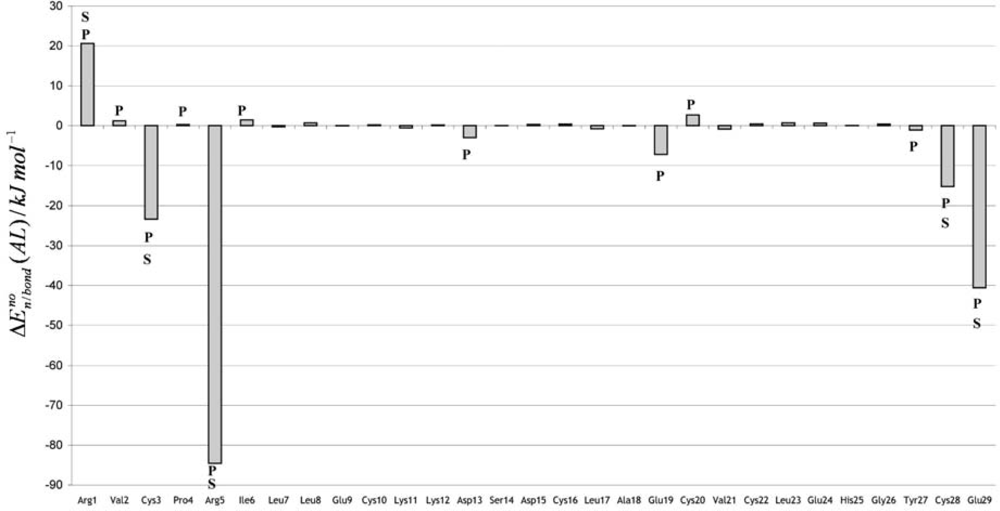
<p>The nonbonding interaction energies between the amino acids and the ligand are presented in <xref ref-type="fig" rid="f2-ijms-09-01652">Figure 2</xref>.</p>
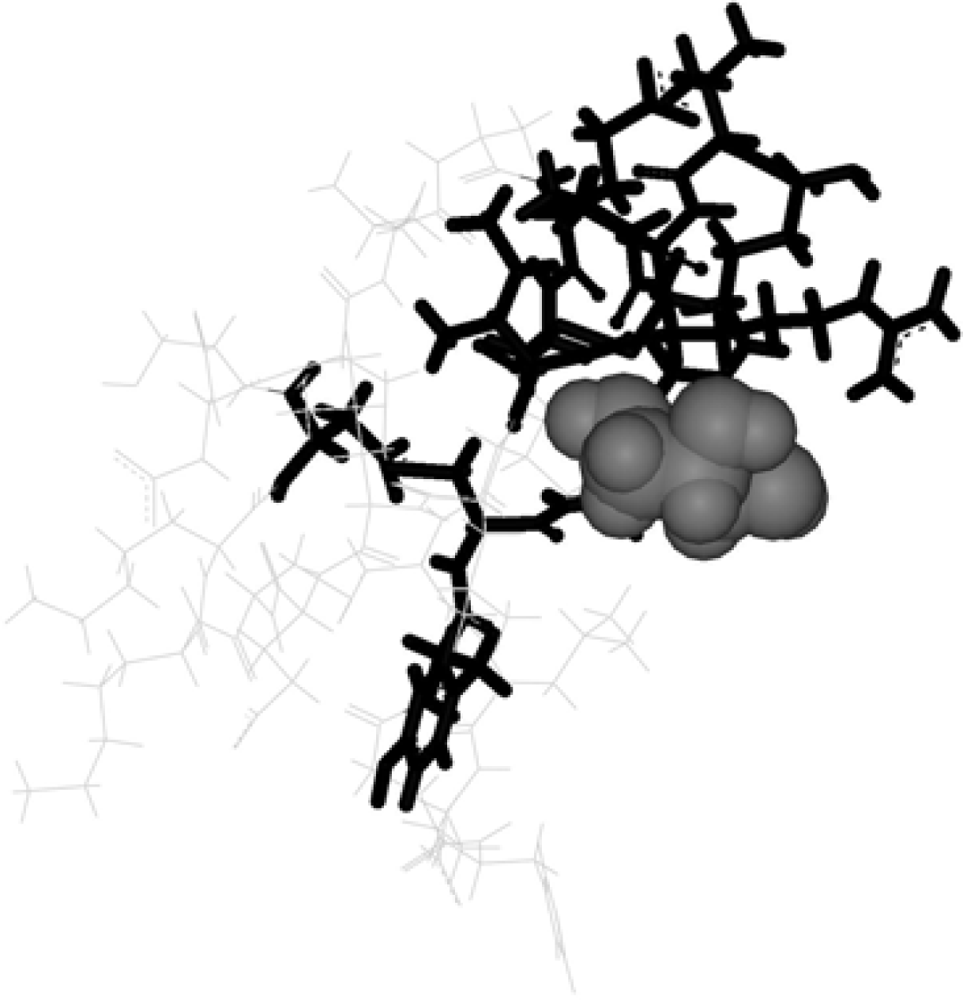
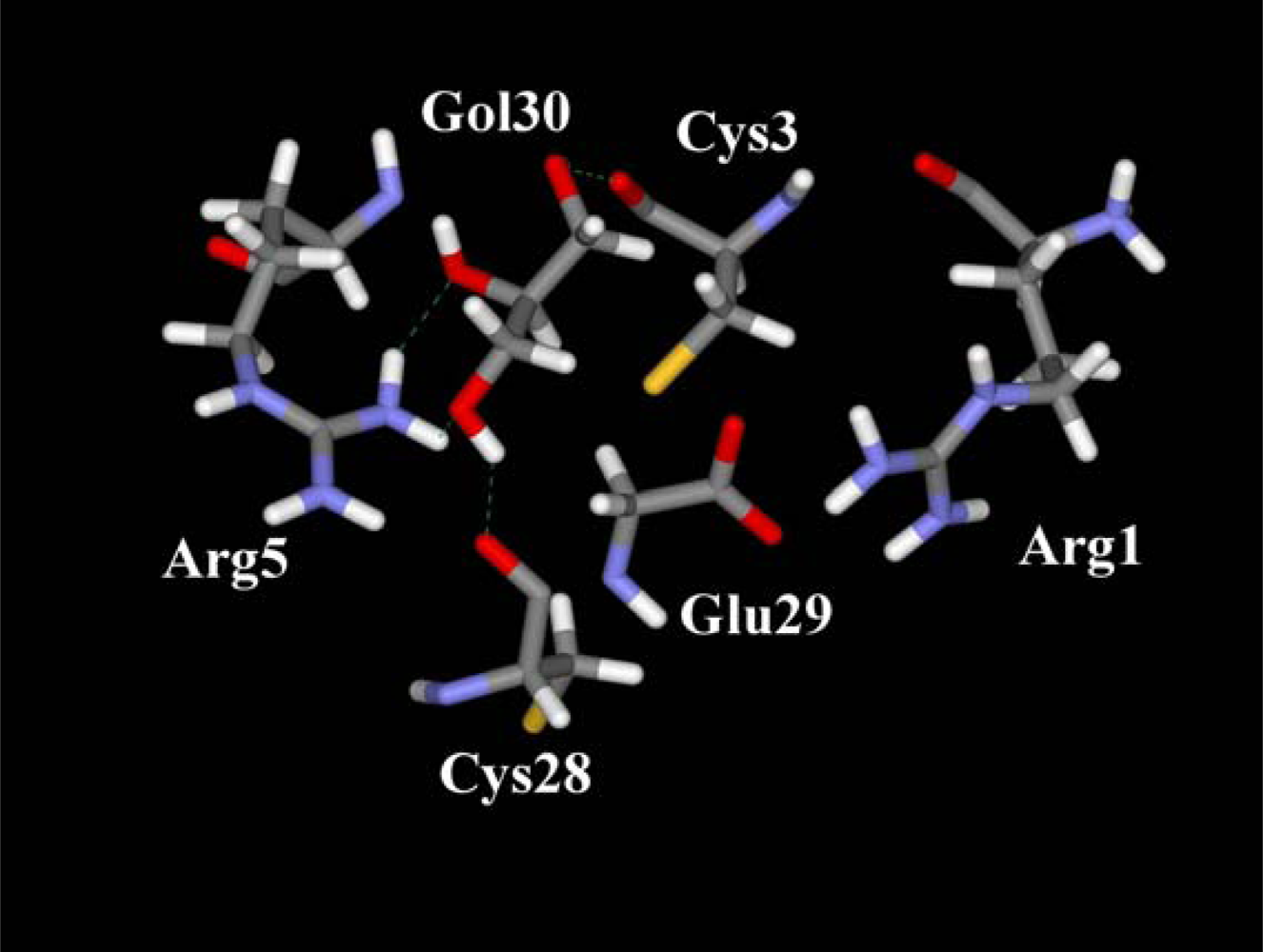
<p>Five residues (Arg1, Cys3, Arg5, Cys28 and Glu29) have the most relevant contributions, which correspond to absolute values larger than 10 kJ mol<sup>−1</sup>. Three residues (Cys3, Arg5 and Cys28) are involved in specific hydrogen bonds with the hydroxyl groups of glycerol (see <xref ref-type="fig" rid="f3-ijms-09-01652">Figure 3</xref>). Arg5 is of particular importance, because this residue establishes two hydrogen bonds of this type and is responsible for approximately 57 % of the nonbonding energy. The two terminal residues (Arg1 and Glu29) are connected by an internal hydrogen bond involving the guanidinium (Arg1) and carboxylate (Glu29) groups.</p>
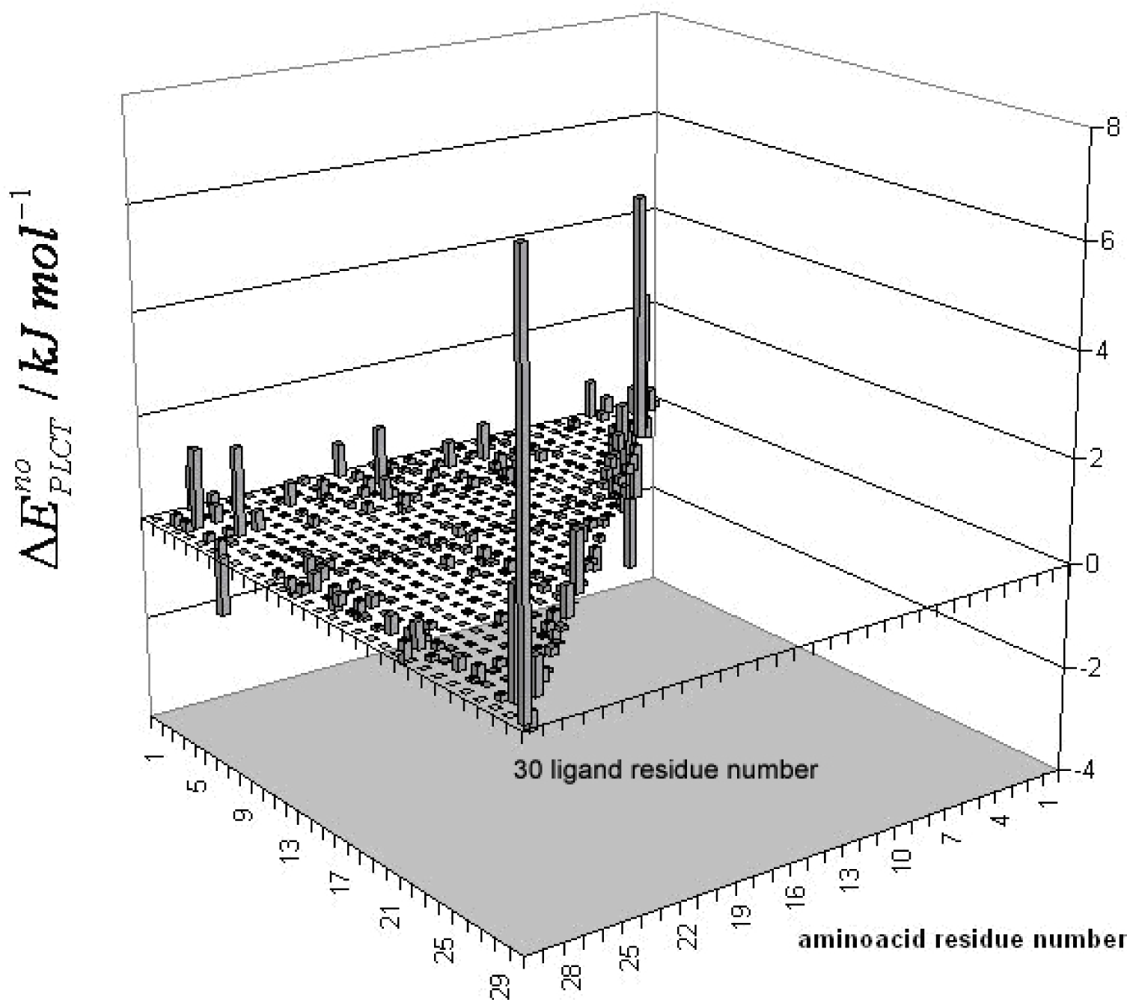
<p>In the complex in study, the most electropositive groups of glycerol are oriented in the opposite direction of this guanidinium-carboxylate salt-bridge (see <xref ref-type="fig" rid="f3-ijms-09-01652">Figures 3</xref> and <xref ref-type="fig" rid="f4-ijms-09-01652">4</xref>). Therefore, the attractive (Glu29) and repulsive (Arg1) contributions of these residues can be explained by non-specific electrostatic interactions with the ligand. The PLCT energy is represented in <xref ref-type="fig" rid="f5-ijms-09-01652">Figure 5</xref>, as a sum of intra and inter-fragment terms (see <xref ref-type="disp-formula" rid="FD23">equation A9</xref>).</p>
<p>Residue addictive effective PLCT terms, defined according to <xref ref-type="disp-formula" rid="FD25">equations (B1)</xref> and <xref ref-type="disp-formula" rid="FD26">(B2)</xref>, are presented in <xref ref-type="fig" rid="f6-ijms-09-01652">Figure 6</xref>. To obtain a bulk region in consistency with the requirements presented in the previous section, all the residues having effective PLCT contributions larger in absolute value than 1.0 kJ mol<sup>−1</sup> and/or a nonbonding interaction with ligand larger in absolute value larger than 3.0 kJ mol<sup>−1</sup> were included in the strongly perturbed region. Twelve residues (Arg1, Val2, Cys3, Pro4, Arg5, Ile6, Asp13, Glu19, Cys20, Tyr27, Cys28 and Glu29) satisfied this requirement.</p>
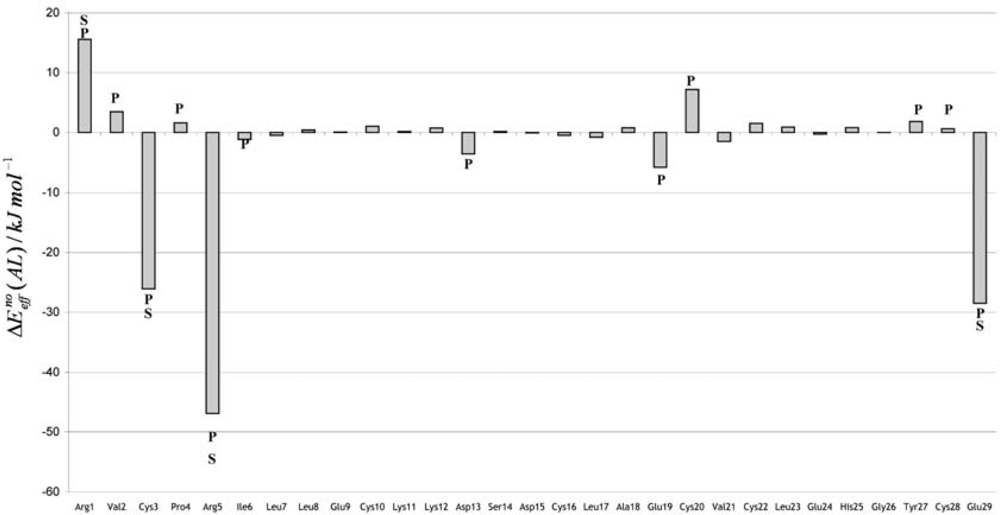
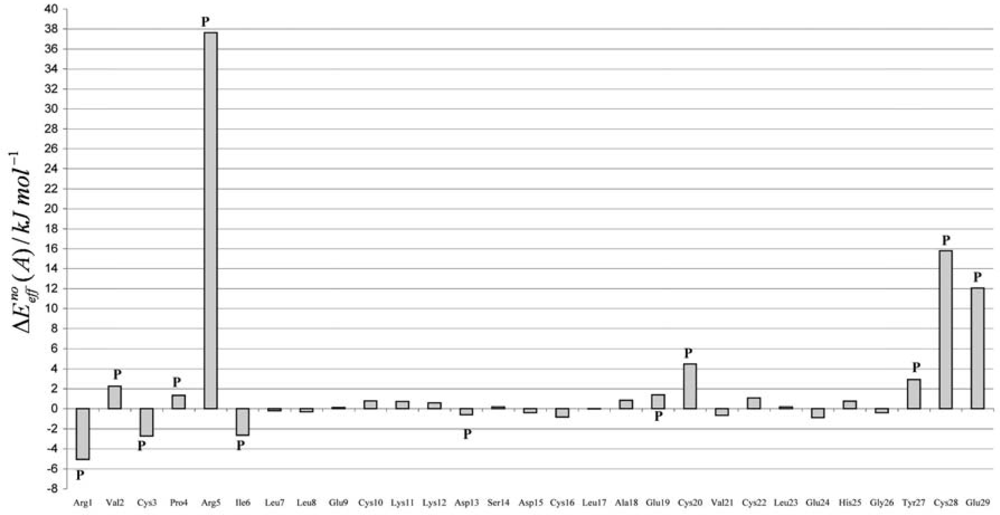
<p>The global contributions of the amino acid residues for the stability of the CMTI-I:glycerol complex was evaluated using the effective pair-wise potential introduced in the previous section. The results obtained are presented in <xref ref-type="fig" rid="f7-ijms-09-01652">Figure 7</xref>. Including these corrective effects, only four residues (Arg1, Cys3, Arg5 and Glu29) were verified to have significant effective contributions (larger than 10 kJ mol<sup>−1</sup>) for the stabilization energy. A fifth residue (Cys28) had been previously identified as relevant, because its nonbonding interaction energy with ligand is markedly negative (–15.2 kJ mol<sup>−1</sup>). However, this residue has an opposite effective PLCT energy of 15.8 kJ mol<sup>−1</sup> and its overall contribution is near null.</p>
<p>The partition into the strongly perturbed and bulk components is presented in <xref ref-type="table" rid="t2-ijms-09-01652">Table 2</xref>. These components were evaluated using quantum and classical formalisms. The results obtained enable us to conclude that the interaction energy of bulk region with ligand is well-reproduced by classical potentials, when Merz-Kollman charges are used.</p></sec>
<sec sec-type="conclusions">
<title>4. Conclusions</title>
<p>Using the SEEB formalism, the association of the CMTI-I with glycerol was analysed. The stability of the correspondent complex can be mostly associated with four residues (Arg1, Cys3, Arg5 and Glu29). The residues are also divided between a strongly perturbed and a bulk region. This spatial partition was carried out according to the appropriate requirements previously discussed. In fact, the correspondent short-range bulk component (
<inline-formula>
<mml:math>
<mml:mo>Δ</mml:mo>
<mml:msubsup>
<mml:mi>E</mml:mi>
<mml:mrow>
<mml:mi>b</mml:mi>
<mml:mi>u</mml:mi>
<mml:mi>l</mml:mi>
<mml:mi>k</mml:mi>
<mml:mo>,</mml:mo>
<mml:mi>P</mml:mi>
<mml:mi>L</mml:mi>
<mml:mi>C</mml:mi>
<mml:mi>T</mml:mi></mml:mrow>
<mml:mo>Γ</mml:mo></mml:msubsup></mml:math></inline-formula>) is 1.86 kJ mol<sup>−1</sup> representing only 6.3 % of the total stabilization energy (−29.05 kJ mol<sup>−1</sup>) and the long-range bulk component (
<inline-formula>
<mml:math>
<mml:mo>Δ</mml:mo>
<mml:msubsup>
<mml:mi>E</mml:mi>
<mml:mrow>
<mml:mi>b</mml:mi>
<mml:mi>u</mml:mi>
<mml:mi>l</mml:mi>
<mml:mi>k</mml:mi>
<mml:mo>,</mml:mo>
<mml:mi>n</mml:mi>
<mml:mo>/</mml:mo>
<mml:mi>b</mml:mi>
<mml:mi>o</mml:mi>
<mml:mi>n</mml:mi>
<mml:mi>d</mml:mi></mml:mrow>
<mml:mrow>
<mml:mi>n</mml:mi>
<mml:mi>o</mml:mi></mml:mrow></mml:msubsup></mml:math></inline-formula>) is well-reproduced by an AMBER-type potential. In a previous work, it was verified that the Mulliken charges are more appropriate to reproduce such type of potentials in small dimeric species [<xref ref-type="bibr" rid="b17-ijms-09-01652">17</xref>]. However, in the globular proteic environment studied in this work, the Merz-Kollman charges seem to be preferable.</p>
<p>The spatial decomposition used in this study constitutes a rational methodology to build QM/MM models. For this purpose, the short-range PLCT term (
<inline-formula>
<mml:math>
<mml:mo>Δ</mml:mo>
<mml:msubsup>
<mml:mi>E</mml:mi>
<mml:mrow>
<mml:mi>b</mml:mi>
<mml:mi>u</mml:mi>
<mml:mi>l</mml:mi>
<mml:mi>k</mml:mi>
<mml:mo>,</mml:mo>
<mml:mi>P</mml:mi>
<mml:mi>L</mml:mi>
<mml:mi>C</mml:mi>
<mml:mi>T</mml:mi></mml:mrow>
<mml:mrow>
<mml:mi>n</mml:mi>
<mml:mi>o</mml:mi></mml:mrow></mml:msubsup></mml:math></inline-formula>) can be neglected and the long-range nonbonding term (
<inline-formula>
<mml:math>
<mml:mo>Δ</mml:mo>
<mml:msubsup>
<mml:mi>E</mml:mi>
<mml:mrow>
<mml:mi>b</mml:mi>
<mml:mi>u</mml:mi>
<mml:mi>l</mml:mi>
<mml:mi>k</mml:mi>
<mml:mo>,</mml:mo>
<mml:mi>n</mml:mi>
<mml:mo>/</mml:mo>
<mml:mi>b</mml:mi>
<mml:mi>o</mml:mi>
<mml:mi>n</mml:mi>
<mml:mi>d</mml:mi></mml:mrow>
<mml:mrow>
<mml:mi>n</mml:mi>
<mml:mi>o</mml:mi></mml:mrow></mml:msubsup></mml:math></inline-formula>) can be calculated at a molecular mechanics level. On the other hand, the strongly perturbed region should be described at an appropriate quantum level.</p>
<p>The modified SEEB method, introduced in this work, enables the description of a protein-ligand association process in terms of a pair-wise interaction potential. This effective potential includes the nonbonding interaction between each pair and the correspondent PLCT correction associated with electronic rearrangement effects. The associated (amino acid-ligand) pair-wise energies can be assumed as physically meaningful components, which can provide an important contribution to better understanding of the protein-ligand association processes.</p></sec></body>
<back>
<ack>
<p>We thank the Fundação para a Ciência e a Tecnologia (FCT) for a doctoral scholarship (SFRH/BD/17900/2004) granted to Alexandre R. F. Carvalho. Financial support from Fundação para a Ciência e a Tecnologia (FCT), project POCI/QUI/55673/2004 is gratefully acknowledged.</p></ack>
<app-group>
<app id="app1">
<title>Appendix A</title>
<sec>
<title>Detailed Description of the Physically Meaningful Decomposition</title>
<p>The physically meaningful decomposition, presented in <xref ref-type="disp-formula" rid="FD3">equation (3)</xref> to <xref ref-type="disp-formula" rid="FD4">(4)</xref> of the second section, is here discussed in detail.</p>
<p>The conformational rearrangement components, 
<inline-formula>
<mml:math>
<mml:mo>Δ</mml:mo>
<mml:msubsup>
<mml:mi>E</mml:mi>
<mml:mrow>
<mml:mi>r</mml:mi>
<mml:mi>e</mml:mi>
<mml:mi>a</mml:mi>
<mml:mi>r</mml:mi>
<mml:mi>r</mml:mi></mml:mrow>
<mml:mrow>
<mml:mi>n</mml:mi>
<mml:mi>o</mml:mi></mml:mrow></mml:msubsup></mml:math></inline-formula> (<italic>P</italic>) and 
<inline-formula>
<mml:math>
<mml:mo>Δ</mml:mo>
<mml:msubsup>
<mml:mi>E</mml:mi>
<mml:mrow>
<mml:mi>r</mml:mi>
<mml:mi>e</mml:mi>
<mml:mi>a</mml:mi>
<mml:mi>r</mml:mi>
<mml:mi>r</mml:mi></mml:mrow>
<mml:mrow>
<mml:mi>n</mml:mi>
<mml:mi>o</mml:mi></mml:mrow></mml:msubsup></mml:math></inline-formula> (<italic>L</italic>) in <xref ref-type="disp-formula" rid="FD3">equation (3)</xref>, are defined as,</p>
<disp-formula id="FD15">
<label>(A1)</label>
<mml:math display="block">
<mml:mo>Δ</mml:mo>
<mml:msubsup>
<mml:mi>E</mml:mi>
<mml:mrow>
<mml:mi>r</mml:mi>
<mml:mi>e</mml:mi>
<mml:mi>a</mml:mi>
<mml:mi>r</mml:mi>
<mml:mi>r</mml:mi></mml:mrow>
<mml:mrow>
<mml:mi>n</mml:mi>
<mml:mi>o</mml:mi></mml:mrow></mml:msubsup>
<mml:mo stretchy="false">(</mml:mo>
<mml:mi>P</mml:mi>
<mml:mo stretchy="false">)</mml:mo>
<mml:mo>=</mml:mo>
<mml:msup>
<mml:mi>E</mml:mi>
<mml:mo>∞</mml:mo></mml:msup>
<mml:mo stretchy="false">(</mml:mo>
<mml:msub>
<mml:mi>P</mml:mi>
<mml:mrow>
<mml:mo stretchy="false">(</mml:mo>
<mml:mi>r</mml:mi>
<mml:mi>e</mml:mi>
<mml:mi>a</mml:mi>
<mml:mi>r</mml:mi>
<mml:mo stretchy="false">)</mml:mo></mml:mrow></mml:msub>
<mml:mo stretchy="false">)</mml:mo>
<mml:mo>−</mml:mo>
<mml:msup>
<mml:mi>E</mml:mi>
<mml:mo>∞</mml:mo></mml:msup>
<mml:mo stretchy="false">(</mml:mo>
<mml:mi>P</mml:mi>
<mml:mo stretchy="false">)</mml:mo></mml:math></disp-formula>
<disp-formula id="FD16">
<label>(A2)</label>
<mml:math display="block">
<mml:mo>Δ</mml:mo>
<mml:msubsup>
<mml:mi>E</mml:mi>
<mml:mrow>
<mml:mi>r</mml:mi>
<mml:mi>e</mml:mi>
<mml:mi>a</mml:mi>
<mml:mi>r</mml:mi>
<mml:mi>r</mml:mi></mml:mrow>
<mml:mrow>
<mml:mi>n</mml:mi>
<mml:mi>o</mml:mi></mml:mrow></mml:msubsup>
<mml:mo stretchy="false">(</mml:mo>
<mml:mi>L</mml:mi>
<mml:mo stretchy="false">)</mml:mo>
<mml:mo>=</mml:mo>
<mml:msup>
<mml:mi>E</mml:mi>
<mml:mo>∞</mml:mo></mml:msup>
<mml:mo stretchy="false">(</mml:mo>
<mml:msub>
<mml:mi>L</mml:mi>
<mml:mrow>
<mml:mo stretchy="false">(</mml:mo>
<mml:mi>r</mml:mi>
<mml:mi>e</mml:mi>
<mml:mi>a</mml:mi>
<mml:mi>r</mml:mi>
<mml:mi>r</mml:mi>
<mml:mo stretchy="false">)</mml:mo></mml:mrow></mml:msub>
<mml:mo stretchy="false">)</mml:mo>
<mml:mo>−</mml:mo>
<mml:msup>
<mml:mi>E</mml:mi>
<mml:mo>∞</mml:mo></mml:msup>
<mml:mo stretchy="false">(</mml:mo>
<mml:mi>L</mml:mi>
<mml:mo stretchy="false">)</mml:mo></mml:math></disp-formula>
<p>where the superscription (∞) represents a non-binding states where the fragments P and L are at infinite distance. These components are associated with the conformational energy rearrangements occurring in step 1 for the protein (Δ<italic>E<sup>no</sup></italic> (<italic>P</italic>)) and the ligand (Δ<italic>E<sup>no</sup></italic> (<italic>L</italic>)) respectively. From a physical point of view, each of these terms represents the energy cost for the correspondent specie (P or L) associated with the transition from the free optimized structure to the free rearranged structure which is the most appropriate for the P:L docking.</p>
<disp-formula id="FD17">
<label>(A3)</label>
<mml:math display="block">
<mml:mi>P</mml:mi>
<mml:mover>
<mml:mo stretchy="true">→</mml:mo>
<mml:mrow>
<mml:mo>Δ</mml:mo>
<mml:msubsup>
<mml:mi>E</mml:mi>
<mml:mrow>
<mml:mi>r</mml:mi>
<mml:mi>e</mml:mi>
<mml:mi>a</mml:mi>
<mml:mi>r</mml:mi>
<mml:mi>r</mml:mi></mml:mrow>
<mml:mrow>
<mml:mi>n</mml:mi>
<mml:mi>o</mml:mi></mml:mrow></mml:msubsup>
<mml:mo stretchy="false">(</mml:mo>
<mml:mi>P</mml:mi>
<mml:mo stretchy="false">)</mml:mo></mml:mrow></mml:mover>
<mml:msub>
<mml:mi>P</mml:mi>
<mml:mrow>
<mml:mo stretchy="false">(</mml:mo>
<mml:mi>r</mml:mi>
<mml:mi>e</mml:mi>
<mml:mi>a</mml:mi>
<mml:mi>r</mml:mi>
<mml:mi>r</mml:mi>
<mml:mo stretchy="false">)</mml:mo></mml:mrow></mml:msub></mml:math></disp-formula>
<disp-formula id="FD18">
<label>(A4)</label>
<mml:math display="block">
<mml:mi>L</mml:mi>
<mml:mover>
<mml:mo stretchy="true">→</mml:mo>
<mml:mrow>
<mml:mo>Δ</mml:mo>
<mml:msubsup>
<mml:mi>E</mml:mi>
<mml:mrow>
<mml:mi>r</mml:mi>
<mml:mi>e</mml:mi>
<mml:mi>a</mml:mi>
<mml:mi>r</mml:mi>
<mml:mi>r</mml:mi></mml:mrow>
<mml:mrow>
<mml:mi>n</mml:mi>
<mml:mi>o</mml:mi></mml:mrow></mml:msubsup>
<mml:mo stretchy="false">(</mml:mo>
<mml:mi>L</mml:mi>
<mml:mo stretchy="false">)</mml:mo></mml:mrow></mml:mover>
<mml:msub>
<mml:mi>L</mml:mi>
<mml:mrow>
<mml:mo stretchy="false">(</mml:mo>
<mml:mi>r</mml:mi>
<mml:mi>e</mml:mi>
<mml:mi>a</mml:mi>
<mml:mi>r</mml:mi>
<mml:mi>r</mml:mi>
<mml:mo stretchy="false">)</mml:mo></mml:mrow></mml:msub></mml:math></disp-formula>
<p>Consequently, the total conformational energy component (
<inline-formula>
<mml:math>
<mml:mo>Δ</mml:mo>
<mml:msubsup>
<mml:mi>E</mml:mi>
<mml:mrow>
<mml:mi>n</mml:mi>
<mml:mo>/</mml:mo>
<mml:mi>b</mml:mi>
<mml:mi>o</mml:mi>
<mml:mi>n</mml:mi>
<mml:mi>d</mml:mi></mml:mrow>
<mml:mrow>
<mml:mi>n</mml:mi>
<mml:mi>o</mml:mi></mml:mrow></mml:msubsup></mml:math></inline-formula>) is calculated as the sum of <xref ref-type="disp-formula" rid="FD15">(A1)</xref> and <xref ref-type="disp-formula" rid="FD16">(A2)</xref> terms:</p>
<disp-formula id="FD19">
<label>(A5)</label>
<mml:math display="block">
<mml:mo>Δ</mml:mo>
<mml:msubsup>
<mml:mi>E</mml:mi>
<mml:mrow>
<mml:mi>r</mml:mi>
<mml:mi>e</mml:mi>
<mml:mi>a</mml:mi>
<mml:mi>r</mml:mi>
<mml:mi>r</mml:mi></mml:mrow>
<mml:mrow>
<mml:mi>n</mml:mi>
<mml:mi>o</mml:mi></mml:mrow></mml:msubsup>
<mml:mo>=</mml:mo>
<mml:mo>Δ</mml:mo>
<mml:msubsup>
<mml:mi>E</mml:mi>
<mml:mrow>
<mml:mi>r</mml:mi>
<mml:mi>e</mml:mi>
<mml:mi>a</mml:mi>
<mml:mi>r</mml:mi>
<mml:mi>r</mml:mi></mml:mrow>
<mml:mrow>
<mml:mi>n</mml:mi>
<mml:mi>o</mml:mi></mml:mrow></mml:msubsup>
<mml:mo stretchy="false">(</mml:mo>
<mml:mi>P</mml:mi>
<mml:mo stretchy="false">)</mml:mo>
<mml:mo>+</mml:mo>
<mml:mo>Δ</mml:mo>
<mml:msubsup>
<mml:mi>E</mml:mi>
<mml:mrow>
<mml:mi>r</mml:mi>
<mml:mi>e</mml:mi>
<mml:mi>a</mml:mi>
<mml:mi>r</mml:mi>
<mml:mi>r</mml:mi></mml:mrow>
<mml:mrow>
<mml:mi>n</mml:mi>
<mml:mi>o</mml:mi></mml:mrow></mml:msubsup>
<mml:mo stretchy="false">(</mml:mo>
<mml:mi>L</mml:mi>
<mml:mo stretchy="false">)</mml:mo></mml:math></disp-formula>
<p>The PLCT and nonbonding components are associated with step 2, of the hypothetical mechanism presented in <xref ref-type="fig" rid="f1-ijms-09-01652">Figure 1</xref>. In this step, the rearranged fragments are docked, preserving these internal geometries P(rearr) and L (rearr), and originating the final optimized complex (P:L). In this sense, these components have a pure electronic nature, occurring without any modification of the intra-fragment nuclear positions.</p>
<p>The PLCT components are then defined as:</p>
<disp-formula id="FD20">
<label>(A6)</label>
<mml:math display="block">
<mml:mo>Δ</mml:mo>
<mml:msubsup>
<mml:mi>E</mml:mi>
<mml:mrow>
<mml:mi>P</mml:mi>
<mml:mi>L</mml:mi>
<mml:mi>C</mml:mi>
<mml:mi>T</mml:mi></mml:mrow>
<mml:mrow>
<mml:mi>n</mml:mi>
<mml:mi>o</mml:mi></mml:mrow></mml:msubsup>
<mml:mo stretchy="false">(</mml:mo>
<mml:mi>P</mml:mi>
<mml:mo stretchy="false">)</mml:mo>
<mml:mo>=</mml:mo>
<mml:msup>
<mml:mi>E</mml:mi>
<mml:mrow>
<mml:mi>n</mml:mi>
<mml:mi>o</mml:mi></mml:mrow></mml:msup>
<mml:mo stretchy="false">(</mml:mo>
<mml:msub>
<mml:mi>P</mml:mi>
<mml:mrow>
<mml:mo stretchy="false">(</mml:mo>
<mml:mi>r</mml:mi>
<mml:mi>e</mml:mi>
<mml:mi>a</mml:mi>
<mml:mi>r</mml:mi>
<mml:mi>r</mml:mi>
<mml:mo stretchy="false">)</mml:mo></mml:mrow></mml:msub>
<mml:mo stretchy="false">)</mml:mo>
<mml:mo>−</mml:mo>
<mml:msup>
<mml:mi>E</mml:mi>
<mml:mo>∞</mml:mo></mml:msup>
<mml:mo stretchy="false">(</mml:mo>
<mml:msub>
<mml:mi>P</mml:mi>
<mml:mrow>
<mml:mo stretchy="false">(</mml:mo>
<mml:mi>r</mml:mi>
<mml:mi>e</mml:mi>
<mml:mi>a</mml:mi>
<mml:mi>r</mml:mi>
<mml:mi>r</mml:mi>
<mml:mo stretchy="false">)</mml:mo></mml:mrow></mml:msub>
<mml:mo stretchy="false">)</mml:mo></mml:math></disp-formula>
<disp-formula id="FD21">
<label>(A7)</label>
<mml:math display="block">
<mml:mo>Δ</mml:mo>
<mml:msubsup>
<mml:mi>E</mml:mi>
<mml:mrow>
<mml:mi>P</mml:mi>
<mml:mi>L</mml:mi>
<mml:mi>C</mml:mi>
<mml:mi>T</mml:mi></mml:mrow>
<mml:mrow>
<mml:mi>n</mml:mi>
<mml:mi>o</mml:mi></mml:mrow></mml:msubsup>
<mml:mo stretchy="false">(</mml:mo>
<mml:mi>L</mml:mi>
<mml:mo stretchy="false">)</mml:mo>
<mml:mo>=</mml:mo>
<mml:msup>
<mml:mi>E</mml:mi>
<mml:mrow>
<mml:mi>n</mml:mi>
<mml:mi>o</mml:mi></mml:mrow></mml:msup>
<mml:mo stretchy="false">(</mml:mo>
<mml:msub>
<mml:mi>P</mml:mi>
<mml:mrow>
<mml:mo stretchy="false">(</mml:mo>
<mml:mi>r</mml:mi>
<mml:mi>e</mml:mi>
<mml:mi>a</mml:mi>
<mml:mi>r</mml:mi>
<mml:mi>r</mml:mi>
<mml:mo stretchy="false">)</mml:mo></mml:mrow></mml:msub>
<mml:mo stretchy="false">)</mml:mo>
<mml:mo>−</mml:mo>
<mml:msup>
<mml:mi>E</mml:mi>
<mml:mo>∞</mml:mo></mml:msup>
<mml:mo stretchy="false">(</mml:mo>
<mml:msub>
<mml:mi>L</mml:mi>
<mml:mrow>
<mml:mo stretchy="false">(</mml:mo>
<mml:mi>r</mml:mi>
<mml:mi>e</mml:mi>
<mml:mi>a</mml:mi>
<mml:mi>r</mml:mi>
<mml:mi>r</mml:mi>
<mml:mo stretchy="false">)</mml:mo></mml:mrow></mml:msub>
<mml:mo stretchy="false">)</mml:mo></mml:math></disp-formula>
<p>Each of these terms represents the electronic energy cost for the correspondent fragment, associated with transition of (P(rearr) or L(rearr)) species from the free rearranged state (∞) to the binding state (no) where the dimeric P:L specie is formed. These terms are originated by polarization plus charge transfer effects, associated with electronic density redistribution within each fragment (P(rear)) or L(rear)) and electronic charge transfer between these species. These components involve energy terms that exist both in free rearranged species (P(rearr)) or L(rearr)) and in the dimer (P:L). However, the associated values are not conserved between these two states due to the mentioned electronic effects. Each of these terms includes the intra-fragment kinetic electronic energy, the attraction energies between the electronic density of the fragment and its nuclei, and the repulsion energy associated with its electronic density.</p>
<p>Considering that the protein (P) is constituted by n amino acids residues, its PLCT component can be partitioned into intra and inter residues terms:</p>
<disp-formula id="FD22">
<label>(A8)</label>
<mml:math display="block">
<mml:mo>Δ</mml:mo>
<mml:msubsup>
<mml:mi>E</mml:mi>
<mml:mrow>
<mml:mi>P</mml:mi>
<mml:mi>L</mml:mi>
<mml:mi>C</mml:mi>
<mml:mi>T</mml:mi></mml:mrow>
<mml:mrow>
<mml:mi>n</mml:mi>
<mml:mi>o</mml:mi></mml:mrow></mml:msubsup>
<mml:mo stretchy="false">(</mml:mo>
<mml:mi>P</mml:mi>
<mml:mo stretchy="false">)</mml:mo>
<mml:mo>=</mml:mo>
<mml:munderover>
<mml:mo>∑</mml:mo>
<mml:mrow>
<mml:mi>A</mml:mi>
<mml:mo>=</mml:mo>
<mml:mn>1</mml:mn></mml:mrow>
<mml:mi>n</mml:mi></mml:munderover>
<mml:mrow>
<mml:mo>Δ</mml:mo>
<mml:msup>
<mml:mi>E</mml:mi>
<mml:mrow>
<mml:mi>n</mml:mi>
<mml:mi>o</mml:mi></mml:mrow></mml:msup>
<mml:mo stretchy="false">(</mml:mo>
<mml:mi>A</mml:mi>
<mml:mo stretchy="false">)</mml:mo>
<mml:mo>+</mml:mo>
<mml:munderover>
<mml:mo>∑</mml:mo>
<mml:mrow>
<mml:mi>A</mml:mi>
<mml:mo>=</mml:mo>
<mml:mn>1</mml:mn></mml:mrow>
<mml:mi>n</mml:mi></mml:munderover>
<mml:mrow>
<mml:munderover>
<mml:mo>∑</mml:mo>
<mml:mrow>
<mml:mi>B</mml:mi>
<mml:mo>=</mml:mo>
<mml:mn>1</mml:mn></mml:mrow>
<mml:mrow>
<mml:mi>A</mml:mi>
<mml:mo>−</mml:mo>
<mml:mn>1</mml:mn></mml:mrow></mml:munderover>
<mml:mrow>
<mml:mo>Δ</mml:mo>
<mml:msup>
<mml:mi>E</mml:mi>
<mml:mrow>
<mml:mi>n</mml:mi>
<mml:mi>o</mml:mi></mml:mrow></mml:msup>
<mml:mo stretchy="false">(</mml:mo>
<mml:mi>A</mml:mi>
<mml:mi>B</mml:mi>
<mml:mo stretchy="false">)</mml:mo></mml:mrow></mml:mrow></mml:mrow></mml:math></disp-formula>
<p>Finally, the total PLCT component can be calculated as:</p>
<disp-formula id="FD23">
<label>(A9)</label>
<mml:math display="block">
<mml:mo>Δ</mml:mo>
<mml:msubsup>
<mml:mi>E</mml:mi>
<mml:mrow>
<mml:mi>P</mml:mi>
<mml:mi>L</mml:mi>
<mml:mi>C</mml:mi>
<mml:mi>T</mml:mi></mml:mrow>
<mml:mrow>
<mml:mi>n</mml:mi>
<mml:mi>o</mml:mi></mml:mrow></mml:msubsup>
<mml:mo>=</mml:mo>
<mml:munderover>
<mml:mo>∑</mml:mo>
<mml:mrow>
<mml:mi>A</mml:mi>
<mml:mo>=</mml:mo>
<mml:mn>1</mml:mn></mml:mrow>
<mml:mi>n</mml:mi></mml:munderover>
<mml:mrow>
<mml:mo>Δ</mml:mo>
<mml:msup>
<mml:mi>E</mml:mi>
<mml:mrow>
<mml:mi>n</mml:mi>
<mml:mi>o</mml:mi></mml:mrow></mml:msup>
<mml:mo stretchy="false">(</mml:mo>
<mml:mi>A</mml:mi>
<mml:mo stretchy="false">)</mml:mo>
<mml:mo>+</mml:mo>
<mml:munderover>
<mml:mo>∑</mml:mo>
<mml:mrow>
<mml:mi>A</mml:mi>
<mml:mo>=</mml:mo>
<mml:mn>1</mml:mn></mml:mrow>
<mml:mi>n</mml:mi></mml:munderover>
<mml:mrow>
<mml:munderover>
<mml:mo>∑</mml:mo>
<mml:mrow>
<mml:mi>B</mml:mi>
<mml:mo>=</mml:mo>
<mml:mn>1</mml:mn></mml:mrow>
<mml:mrow>
<mml:mi>A</mml:mi>
<mml:mo>−</mml:mo>
<mml:mn>1</mml:mn></mml:mrow></mml:munderover>
<mml:mrow>
<mml:mo>Δ</mml:mo>
<mml:msup>
<mml:mi>E</mml:mi>
<mml:mrow>
<mml:mi>n</mml:mi>
<mml:mi>o</mml:mi></mml:mrow></mml:msup>
<mml:mo stretchy="false">(</mml:mo>
<mml:mi>A</mml:mi>
<mml:mi>B</mml:mi>
<mml:mo stretchy="false">)</mml:mo>
<mml:mo>+</mml:mo>
<mml:mo>Δ</mml:mo>
<mml:msup>
<mml:mi>E</mml:mi>
<mml:mrow>
<mml:mi>n</mml:mi>
<mml:mi>o</mml:mi></mml:mrow></mml:msup>
<mml:mo stretchy="false">(</mml:mo>
<mml:mi>L</mml:mi>
<mml:mo stretchy="false">)</mml:mo>
<mml:mo>=</mml:mo>
<mml:mo>Δ</mml:mo>
<mml:msubsup>
<mml:mi>E</mml:mi>
<mml:mrow>
<mml:mi>P</mml:mi>
<mml:mi>L</mml:mi>
<mml:mi>C</mml:mi>
<mml:mi>T</mml:mi></mml:mrow>
<mml:mrow>
<mml:mi>n</mml:mi>
<mml:mi>o</mml:mi></mml:mrow></mml:msubsup>
<mml:mo stretchy="false">(</mml:mo>
<mml:mi>P</mml:mi>
<mml:mo stretchy="false">)</mml:mo>
<mml:mo>+</mml:mo>
<mml:mo>Δ</mml:mo>
<mml:msubsup>
<mml:mi>E</mml:mi>
<mml:mrow>
<mml:mi>P</mml:mi>
<mml:mi>L</mml:mi>
<mml:mi>C</mml:mi>
<mml:mi>T</mml:mi></mml:mrow>
<mml:mrow>
<mml:mi>n</mml:mi>
<mml:mi>o</mml:mi></mml:mrow></mml:msubsup>
<mml:mo stretchy="false">(</mml:mo>
<mml:mi>L</mml:mi>
<mml:mo stretchy="false">)</mml:mo></mml:mrow></mml:mrow></mml:mrow></mml:math></disp-formula>
<p>In <xref ref-type="disp-formula" rid="FD23">equation (A9)</xref>, the terms Δ<italic>E<sup>no</sup></italic>(<italic>A</italic>) and Δ<italic>E<sup>no</sup></italic>(<italic>L</italic>) correspond to the energy variations during the mentioned step 2, associated with the amino acid A and the ligand respectively. In the same equation, Δ<italic>E<sup>no</sup></italic>(<italic>AB</italic>) is associated with the variation in interaction energy between the amino acids A and B during the same step.</p>
<p>The non bonding component 
<inline-formula>
<mml:math>
<mml:mo>Δ</mml:mo>
<mml:msubsup>
<mml:mi>E</mml:mi>
<mml:mrow>
<mml:mi>n</mml:mi>
<mml:mo>/</mml:mo>
<mml:mi>b</mml:mi>
<mml:mi>o</mml:mi>
<mml:mi>n</mml:mi>
<mml:mi>d</mml:mi></mml:mrow>
<mml:mrow>
<mml:mi>n</mml:mi>
<mml:mi>o</mml:mi></mml:mrow></mml:msubsup></mml:math></inline-formula> can be calculated as a sum of pair-additive terms,</p>
<disp-formula id="FD24">
<label>(A10)</label>
<mml:math display="block">
<mml:mo>Δ</mml:mo>
<mml:msubsup>
<mml:mi>E</mml:mi>
<mml:mrow>
<mml:mi>n</mml:mi>
<mml:mo>/</mml:mo>
<mml:mi>b</mml:mi>
<mml:mi>o</mml:mi>
<mml:mi>n</mml:mi>
<mml:mi>d</mml:mi></mml:mrow>
<mml:mrow>
<mml:mi>n</mml:mi>
<mml:mi>o</mml:mi></mml:mrow></mml:msubsup>
<mml:mo>=</mml:mo>
<mml:munderover>
<mml:mo>∑</mml:mo>
<mml:mrow>
<mml:mi>A</mml:mi>
<mml:mo>=</mml:mo>
<mml:mn>1</mml:mn></mml:mrow>
<mml:mi>n</mml:mi></mml:munderover>
<mml:mrow>
<mml:mo>Δ</mml:mo>
<mml:msup>
<mml:mi>E</mml:mi>
<mml:mrow>
<mml:mi>n</mml:mi>
<mml:mi>o</mml:mi></mml:mrow></mml:msup></mml:mrow>
<mml:mo stretchy="false">(</mml:mo>
<mml:mi>A</mml:mi>
<mml:mi>L</mml:mi>
<mml:mo stretchy="false">)</mml:mo></mml:math></disp-formula>
<p>where Δ<italic>E<sup>no</sup></italic> (<italic>AL</italic>)is the interaction energy between the amino acids A and the ligand (L) that only exists in the dimer. This term includes the attraction energies between the electronic density of A and the nuclei of L, the attraction energies between the electronic density of L and the nuclei of A, the repulsion energy between the electronic densities of A and L, and the repulsion energies between the nuclei of the two species.</p></sec></app>
<app id="app2">
<title>Appendix B</title>
<sec>
<title>Detailed description and justification of the pair-wise decomposition</title>
<p>The pair-wise decomposition, presented in <xref ref-type="disp-formula" rid="FD5">equation (5)</xref> of the second section, is here discussed and justified in detail. Analyzing the <xref ref-type="disp-formula" rid="FD23">equation (A9)</xref> in <xref ref-type="app" rid="app1">Appendix A</xref>, it is obvious that the PLCT component is not that residue-additive due the occurrence of the inter-residue terms (Δ<italic>E<sup>no</sup></italic>(<italic>AB</italic>)) . However, effective additive terms can be obtained dividing equally these interaction energies by the two partner residues (A and B) involved:</p>
<disp-formula id="FD25">
<label>(B1)</label>
<mml:math display="block">
<mml:mi>Δ</mml:mi>
<mml:msubsup>
<mml:mi>E</mml:mi>
<mml:mrow>
<mml:mi>P</mml:mi>
<mml:mi>L</mml:mi>
<mml:mi>C</mml:mi>
<mml:mi>T</mml:mi></mml:mrow>
<mml:mrow>
<mml:mi>n</mml:mi>
<mml:mi>o</mml:mi></mml:mrow></mml:msubsup>
<mml:mo>=</mml:mo>
<mml:munderover>
<mml:mo>∑</mml:mo>
<mml:mrow>
<mml:mi>A</mml:mi>
<mml:mo>=</mml:mo>
<mml:mn>1</mml:mn></mml:mrow>
<mml:mi>n</mml:mi></mml:munderover>
<mml:mrow>
<mml:mi>Δ</mml:mi>
<mml:msubsup>
<mml:mi>E</mml:mi>
<mml:mrow>
<mml:mi>e</mml:mi>
<mml:mi>f</mml:mi>
<mml:mi>f</mml:mi></mml:mrow>
<mml:mrow>
<mml:mi>n</mml:mi>
<mml:mi>o</mml:mi></mml:mrow></mml:msubsup>
<mml:mo stretchy="false">(</mml:mo>
<mml:mi>A</mml:mi>
<mml:mo stretchy="false">)</mml:mo>
<mml:mo>+</mml:mo>
<mml:mi>Δ</mml:mi>
<mml:msup>
<mml:mi>E</mml:mi>
<mml:mrow>
<mml:mi>n</mml:mi>
<mml:mi>o</mml:mi></mml:mrow></mml:msup>
<mml:mo stretchy="false">(</mml:mo>
<mml:mi>L</mml:mi>
<mml:mo stretchy="false">)</mml:mo></mml:mrow></mml:math></disp-formula>
<p>With</p>
<disp-formula id="FD26">
<label>(B2)</label>
<mml:math display="block">
<mml:mi>Δ</mml:mi>
<mml:msubsup>
<mml:mi>E</mml:mi>
<mml:mrow>
<mml:mi>e</mml:mi>
<mml:mi>f</mml:mi>
<mml:mi>f</mml:mi></mml:mrow>
<mml:mrow>
<mml:mi>n</mml:mi>
<mml:mi>o</mml:mi></mml:mrow></mml:msubsup>
<mml:mo stretchy="false">(</mml:mo>
<mml:mi>A</mml:mi>
<mml:mo stretchy="false">)</mml:mo>
<mml:mo>=</mml:mo>
<mml:mi>Δ</mml:mi>
<mml:msup>
<mml:mi>E</mml:mi>
<mml:mrow>
<mml:mi>n</mml:mi>
<mml:mi>o</mml:mi></mml:mrow></mml:msup>
<mml:mo stretchy="false">(</mml:mo>
<mml:mi>A</mml:mi>
<mml:mo stretchy="false">)</mml:mo>
<mml:mo>+</mml:mo>
<mml:munderover>
<mml:mo>∑</mml:mo>
<mml:mrow>
<mml:mi>B</mml:mi>
<mml:mo>≠</mml:mo>
<mml:mi>A</mml:mi>
<mml:mo>=</mml:mo>
<mml:mn>1</mml:mn></mml:mrow>
<mml:mi>n</mml:mi></mml:munderover>
<mml:mrow>
<mml:mi>Δ</mml:mi>
<mml:msup>
<mml:mi>E</mml:mi>
<mml:mrow>
<mml:mi>n</mml:mi>
<mml:mi>o</mml:mi></mml:mrow></mml:msup>
<mml:mo stretchy="false">(</mml:mo>
<mml:mi>A</mml:mi>
<mml:mi>B</mml:mi>
<mml:mo stretchy="false">)</mml:mo>
<mml:mo>/</mml:mo>
<mml:mn>2</mml:mn></mml:mrow></mml:math></disp-formula>
<p>For the non-covalent interactions, the simplification adopted in <xref ref-type="disp-formula" rid="FD25">equations (B1)</xref> and <xref ref-type="disp-formula" rid="FD26">(B2)</xref> is a natural criterion to divide the inter-residue interactions energies. For covalent interactions, this corresponds to a Mulliken-like approach that involves some degree of arbitrariness. However, in general, the methodology proposed here seems to be a reasonable approach to obtain effective PLCT terms.</p>
<p>An effective interaction potential between the ligand L and an amino acid (A) (
<inline-formula>
<mml:math>
<mml:mo>Δ</mml:mo>
<mml:msubsup>
<mml:mi>E</mml:mi>
<mml:mrow>
<mml:mi>e</mml:mi>
<mml:mi>f</mml:mi>
<mml:mi>f</mml:mi></mml:mrow>
<mml:mrow>
<mml:mi>n</mml:mi>
<mml:mi>o</mml:mi></mml:mrow></mml:msubsup></mml:math></inline-formula>(<italic>AL</italic>)), combining non-bonding and PLCT contributions, can now be obtained from <xref ref-type="disp-formula" rid="FD24">equations (A10)</xref>, <xref ref-type="disp-formula" rid="FD25">(B1)</xref> and <xref ref-type="disp-formula" rid="FD26">(B2)</xref>. This potential evaluates the nonbonding interaction between A and L, corrected by the PLCT reorganization associated with both species.</p>
<disp-formula id="FD27">
<label>(B3)</label>
<mml:math display="block">
<mml:mi>Δ</mml:mi>
<mml:msubsup>
<mml:mi>E</mml:mi>
<mml:mrow>
<mml:mi>e</mml:mi>
<mml:mi>f</mml:mi>
<mml:mi>f</mml:mi></mml:mrow>
<mml:mrow>
<mml:mi>n</mml:mi>
<mml:mi>o</mml:mi></mml:mrow></mml:msubsup>
<mml:mo stretchy="false">(</mml:mo>
<mml:mi>A</mml:mi>
<mml:mi>L</mml:mi>
<mml:mo stretchy="false">)</mml:mo>
<mml:mo>=</mml:mo>
<mml:mi>Δ</mml:mi>
<mml:msup>
<mml:mi>E</mml:mi>
<mml:mrow>
<mml:mi>n</mml:mi>
<mml:mi>o</mml:mi></mml:mrow></mml:msup>
<mml:mo stretchy="false">(</mml:mo>
<mml:mi>A</mml:mi>
<mml:mi>L</mml:mi>
<mml:mo stretchy="false">)</mml:mo>
<mml:mo>+</mml:mo>
<mml:mi>Δ</mml:mi>
<mml:msubsup>
<mml:mi>E</mml:mi>
<mml:mrow>
<mml:mi>e</mml:mi>
<mml:mi>f</mml:mi>
<mml:mi>f</mml:mi></mml:mrow>
<mml:mrow>
<mml:mi>n</mml:mi>
<mml:mi>o</mml:mi></mml:mrow></mml:msubsup>
<mml:mo stretchy="false">(</mml:mo>
<mml:mi>A</mml:mi>
<mml:mo stretchy="false">)</mml:mo>
<mml:mo>+</mml:mo>
<mml:msub>
<mml:mi>α</mml:mi>
<mml:mrow>
<mml:mi>A</mml:mi>
<mml:mi>L</mml:mi></mml:mrow></mml:msub>
<mml:mo>×</mml:mo>
<mml:mi>Δ</mml:mi>
<mml:msup>
<mml:mi>E</mml:mi>
<mml:mrow>
<mml:mi>n</mml:mi>
<mml:mi>o</mml:mi></mml:mrow></mml:msup>
<mml:mo stretchy="false">(</mml:mo>
<mml:mi>L</mml:mi>
<mml:mo stretchy="false">)</mml:mo></mml:math></disp-formula>
<p>In <xref ref-type="disp-formula" rid="FD27">equation (B3)</xref>, the coefficient (<italic>α<sub>AL</sub></italic> ) is defined as,</p>
<disp-formula id="FD28">
<label>(B4)</label>
<mml:math display="block">
<mml:msub>
<mml:mi>α</mml:mi>
<mml:mrow>
<mml:mi>A</mml:mi>
<mml:mi>L</mml:mi></mml:mrow></mml:msub>
<mml:mo>=</mml:mo>
<mml:mi>Δ</mml:mi>
<mml:msup>
<mml:mi>E</mml:mi>
<mml:mrow>
<mml:mi>n</mml:mi>
<mml:mi>o</mml:mi></mml:mrow></mml:msup>
<mml:mo stretchy="false">(</mml:mo>
<mml:mi>A</mml:mi>
<mml:mi>L</mml:mi>
<mml:mo stretchy="false">)</mml:mo>
<mml:mo>/</mml:mo>
<mml:mi>Δ</mml:mi>
<mml:msup>
<mml:mi>E</mml:mi>
<mml:mrow>
<mml:mi>n</mml:mi>
<mml:mi>o</mml:mi></mml:mrow></mml:msup></mml:math></disp-formula>
<p>The mutual PLCT energy cost of two residues (A and L) is clearly correlated with the magnitude of the correspondent interaction. In fact, if the A-L interaction is extremely weak their mutual polarization effects can be neglected. On the other hand, if the amino acid A strongly interacts with L these polarization effects should be very important. Almost all PLCT effect induced on amino acid A is originated, directly or indirectly, by the interaction with the ligand. On the other hand, the PLCT effects in the ligand are induced by its interactions with the amino acids of the protein (P). In this context, the coefficient (<italic>α<sub>AL</sub></italic> ) can be considered as a good weighting factor to evaluate the degree of contribution of the A-L interaction to the PLCT ligand energy cost.</p></sec></app></app-group>
<ref-list>
<title>References and Notes</title>
<ref id="b1-ijms-09-01652"><label>1</label><citation citation-type="journal"><person-group person-group-type="author"><name><surname>Kuntz</surname><given-names>ID</given-names></name></person-group><article-title>Structure-based strategies for drug design and discovery</article-title><source>Science</source><year>1992</year><volume>257</volume><fpage>1078</fpage><lpage>1082</lpage><pub-id pub-id-type="doi">10.1126/science.257.5073.1078</pub-id><pub-id pub-id-type="pmid">1509259</pub-id></citation></ref>
<ref id="b2-ijms-09-01652"><label>2</label><citation citation-type="journal"><person-group person-group-type="author"><name><surname>Netzeva</surname><given-names>TI</given-names></name><name><surname>Aptula</surname><given-names>AO</given-names></name><name><surname>Benfenati</surname><given-names>E</given-names></name><name><surname>Cronin</surname><given-names>MTD</given-names></name><name><surname>Gini</surname><given-names>G</given-names></name><name><surname>Lessigiarska</surname><given-names>I</given-names></name><name><surname>Maran</surname><given-names>U</given-names></name><name><surname>Vracko</surname><given-names>M</given-names></name><name><surname>Schüürmann</surname><given-names>G</given-names></name></person-group><article-title>Description of the Electronic Structure of Organic Chemicals Using Semiempirical and Ab Initio Methods for Development of Toxicological QSARs</article-title><source>J. Chem. Inf. Model</source><year>2005</year><volume>45</volume><fpage>106</fpage><lpage>114</lpage><pub-id pub-id-type="doi">10.1021/ci049747p</pub-id><pub-id pub-id-type="pmid">15667135</pub-id></citation></ref>
<ref id="b3-ijms-09-01652"><label>3</label><citation citation-type="journal"><person-group person-group-type="author"><name><surname>Weiner</surname><given-names>PK</given-names></name><name><surname>Kollman</surname><given-names>PA</given-names></name></person-group><article-title>AMBER: Assisted model building with energy refinement. A general program for modeling molecules and their interactions</article-title><source>J. Comp. Chem</source><year>1981</year><volume>2</volume><fpage>287</fpage><lpage>303</lpage><pub-id pub-id-type="doi">10.1002/jcc.540020311</pub-id></citation></ref>
<ref id="b4-ijms-09-01652"><label>4</label><citation citation-type="journal"><person-group person-group-type="author"><name><surname>Weiner</surname><given-names>SJ</given-names></name><name><surname>Kollman</surname><given-names>PA</given-names></name><name><surname>Case</surname><given-names>DA</given-names></name><name><surname>Singh</surname><given-names>UC</given-names></name><name><surname>Ghio</surname><given-names>C</given-names></name><name><surname>Alagona</surname><given-names>G</given-names></name><name><surname>Profeta</surname><given-names>S</given-names></name><name><surname>Weiner</surname><given-names>PK</given-names></name></person-group><article-title>A new force field for molecular mechanical simulation of nucleic acids and proteins</article-title><source>J. Am. Chem. Soc</source><year>1984</year><volume>106</volume><fpage>765</fpage><lpage>784</lpage><pub-id pub-id-type="doi">10.1021/ja00315a051</pub-id></citation></ref>
<ref id="b5-ijms-09-01652"><label>5</label><citation citation-type="journal"><person-group person-group-type="author"><name><surname>Cornell</surname><given-names>WD</given-names></name><name><surname>Cieplak</surname><given-names>P</given-names></name><name><surname>Bayly</surname><given-names>CI</given-names></name><name><surname>Gould</surname><given-names>IR</given-names></name><name><surname>Merz</surname><given-names>KM</given-names></name><name><surname>Ferguson</surname><given-names>DM</given-names></name><name><surname>Spellmeyer</surname><given-names>DC</given-names></name><name><surname>Fox</surname><given-names>T</given-names></name><name><surname>Caldwell</surname><given-names>JW</given-names></name><name><surname>Kollman</surname><given-names>PA</given-names></name></person-group><article-title>A Second Generation Force Field for the Simulation of Proteins</article-title><source>J. Am. Chem. Soc</source><year>1995</year><volume>117</volume><fpage>5179</fpage><lpage>5197</lpage><pub-id pub-id-type="doi">10.1021/ja00124a002</pub-id></citation></ref>
<ref id="b6-ijms-09-01652"><label>6</label><citation citation-type="journal"><person-group person-group-type="author"><name><surname>Brooks</surname><given-names>BR</given-names></name><name><surname>Bruccoleri</surname><given-names>RF</given-names></name><name><surname>Olafson</surname><given-names>BD</given-names></name><name><surname>States</surname><given-names>DJ</given-names></name><name><surname>Swaminathan</surname><given-names>S</given-names></name><name><surname>Karplus</surname><given-names>M</given-names></name></person-group><article-title>CHARMM: A program for macromolecular energy, minimization, and dynamics calculations</article-title><source>J. Comp. Chem</source><year>1983</year><volume>4</volume><fpage>187</fpage><lpage>217</lpage><pub-id pub-id-type="doi">10.1002/jcc.540040211</pub-id></citation></ref>
<ref id="b7-ijms-09-01652"><label>7</label><citation citation-type="journal"><person-group person-group-type="author"><name><surname>MacKerell</surname><given-names>AD</given-names><suffix>Jr</suffix></name><name><surname>Wiorkiwicz-Kuczera</surname><given-names>J</given-names></name><name><surname>Karplus</surname><given-names>M</given-names></name></person-group><article-title>An all-atom empirical energy function for the simulation of nucleic acids</article-title><source>J. Am. Chem Soc</source><year>1995</year><volume>117</volume><fpage>11946</fpage><lpage>11975</lpage><pub-id pub-id-type="doi">10.1021/ja00153a017</pub-id></citation></ref>
<ref id="b8-ijms-09-01652"><label>8</label><citation citation-type="journal"><person-group person-group-type="author"><name><surname>Raha</surname><given-names>K</given-names></name><name><surname>Merz</surname><given-names>KM</given-names><suffix>Jr</suffix></name></person-group><article-title>Large-Scale Validation of a Quantum Mechanics Based Scoring Function: Predicting the Binding Affinity and the Binding Mode of a Diverse Set of Protein-Ligand Complexes</article-title><source>J. Med. Chem</source><year>2005</year><volume>48</volume><fpage>4558</fpage><lpage>4575</lpage><pub-id pub-id-type="doi">10.1021/jm048973n</pub-id><pub-id pub-id-type="pmid">15999994</pub-id></citation></ref>
<ref id="b9-ijms-09-01652"><label>9</label><citation citation-type="journal"><person-group person-group-type="author"><name><surname>Lipkowitz</surname><given-names>KB</given-names></name><name><surname>Boyd</surname><given-names>DB</given-names></name></person-group><article-title>Methods and Applications of Combined Quantum Mechanical and Molecular Mechanical Potentials</article-title><source>Rev. Computat. Chem</source><year>1996</year><volume>7</volume><fpage>119</fpage><lpage>185</lpage></citation></ref>
<ref id="b10-ijms-09-01652"><label>10</label><citation citation-type="journal"><person-group person-group-type="author"><name><surname>Friesner</surname><given-names>RA</given-names></name><name><surname>Guallar</surname><given-names>V</given-names></name></person-group><article-title>Ab Initio Quantum Chemical and Mixed Quantum Mechanics/Molecular Mechanics (QM/MM) Methods for Studying Enzymatic Catalysis</article-title><source>Annu. Rev. Phys. Chem</source><year>2005</year><volume>56</volume><fpage>389</fpage><lpage>427</lpage><pub-id pub-id-type="doi">10.1146/annurev.physchem.55.091602.094410</pub-id><pub-id pub-id-type="pmid">15796706</pub-id></citation></ref>
<ref id="b11-ijms-09-01652"><label>11</label><citation citation-type="journal"><person-group person-group-type="author"><name><surname>Melo</surname><given-names>A</given-names></name><name><surname>Ramos</surname><given-names>M</given-names></name></person-group><article-title>A new partitioning scheme for molecular interacting systems within a multiconfigurational or monoconfigurational Hartree-Fock formalism</article-title><source>J. Int. J. Quantum Chem</source><year>1999</year><volume>72</volume><fpage>157</fpage><lpage>176</lpage><pub-id pub-id-type="doi">10.1002/(SICI)1097-461X(1999)72:3&lt;157::AID-QUA1&gt;3.0.CO;2-8</pub-id></citation></ref>
<ref id="b12-ijms-09-01652"><label>12</label><citation citation-type="journal"><person-group person-group-type="author"><name><surname>Dixon</surname><given-names>SL</given-names></name><name><surname>Merz</surname><given-names>KM</given-names><suffix>Jr</suffix></name></person-group><article-title>Combined quantum mechanical/molecular mechanical methodologies applied to biomolecular systems</article-title><source>J. Chem. Phys</source><year>1996</year><volume>104</volume><fpage>6643</fpage><lpage>6649</lpage><pub-id pub-id-type="doi">10.1063/1.471382</pub-id></citation></ref>
<ref id="b13-ijms-09-01652"><label>13</label><citation citation-type="journal"><person-group person-group-type="author"><name><surname>Mayer</surname><given-names>I</given-names></name><name><surname>Salvador</surname><given-names>P</given-names></name></person-group><article-title>Overlap populations, bond orders and valences for ‘fuzzy’ atoms</article-title><source>Chem. Phys. Lett</source><year>2004</year><volume>383</volume><fpage>368</fpage><lpage>375</lpage><pub-id pub-id-type="doi">10.1016/j.cplett.2003.11.048</pub-id></citation></ref>
<ref id="b14-ijms-09-01652"><label>14</label><citation citation-type="journal"><person-group person-group-type="author"><name><surname>Putz</surname><given-names>MV</given-names></name><name><surname>Lacrămă</surname><given-names>AM</given-names></name></person-group><article-title>Enzymatic control of the bio-inspired nanomaterials at the spectroscopic level</article-title><source>J. Optoel. Adv. Mat</source><year>2007</year><volume>9</volume><fpage>2529</fpage><lpage>2534</lpage></citation></ref>
<ref id="b15-ijms-09-01652"><label>15</label><citation citation-type="journal"><person-group person-group-type="author"><name><surname>Putz</surname><given-names>MV</given-names></name><name><surname>Lacrămă</surname><given-names>AM</given-names></name><name><surname>Ostafe</surname><given-names>V</given-names></name></person-group><article-title>Introducing logistic enzyme kinetics</article-title><source>J. Optoel. Adv. Mat</source><year>2007</year><volume>9</volume><fpage>2910</fpage><lpage>2916</lpage></citation></ref>
<ref id="b16-ijms-09-01652"><label>16</label><citation citation-type="journal"><person-group person-group-type="author"><name><surname>Putz</surname><given-names>MV</given-names></name><name><surname>Lacrămă</surname><given-names>AM</given-names></name><name><surname>Ostafe</surname><given-names>V</given-names></name></person-group><article-title>Full Analytic Progress Curves of the Enzymic Reactions <italic>in Vitro</italic></article-title><source>Int. J. Mol. Sci</source><year>2006</year><volume>7</volume><fpage>469</fpage><lpage>484</lpage><pub-id pub-id-type="doi">10.3390/i7110469</pub-id></citation></ref>
<ref id="b17-ijms-09-01652"><label>17</label><citation citation-type="journal"><person-group person-group-type="author"><name><surname>Carvalho</surname><given-names>ARF</given-names></name><name><surname>Melo</surname><given-names>A</given-names></name></person-group><article-title>Energy partitioning in association processes</article-title><source>Int J Quantum Chem</source><year>2005</year><volume>104</volume><fpage>240</fpage><lpage>248</lpage><pub-id pub-id-type="doi">10.1002/qua.20419</pub-id></citation></ref>
<ref id="b18-ijms-09-01652"><label>18</label><citation citation-type="journal"><person-group person-group-type="author"><name><surname>Carvalho</surname><given-names>ARF</given-names></name><name><surname>Melo</surname><given-names>A</given-names></name></person-group><article-title>Natural inhibitors of proteases – pharmacological target for destabilization/stabilization of the protease/inhibitor complex</article-title><source>Fund. Clin. Pharmacol.</source><year>2004</year><volume>18</volume><fpage>S1</fpage><fpage>79</fpage><pub-id pub-id-type="doi">10.1046/j.0767-3981.2003.00211.x</pub-id></citation></ref>
<ref id="b19-ijms-09-01652"><label>19</label><citation citation-type="journal"><person-group person-group-type="author"><name><surname>Wynn</surname><given-names>R</given-names></name><name><surname>Laskowski</surname><given-names>M</given-names><suffix>Jr</suffix></name></person-group><article-title>Inhibition of human β-factor XII<sub>A</sub> by squash family serine proteinase inhibitors</article-title><source>Biochem. Biophys. Res. Commun</source><year>1990</year><volume>166</volume><fpage>1406</fpage><lpage>1410</lpage><pub-id pub-id-type="doi">10.1016/0006-291X(90)91023-L</pub-id><pub-id pub-id-type="pmid">2306254</pub-id></citation></ref>
<ref id="b20-ijms-09-01652"><label>20</label><citation citation-type="journal"><person-group person-group-type="author"><name><surname>Mitchell</surname><given-names>EP</given-names></name><name><surname>Garman</surname><given-names>EF</given-names></name></person-group><article-title>Flash freezing of protein crystals: investigation of mosaic spread and diffraction limit with variation of cryoprotectant concentration</article-title><source>J. Appl. Cryst</source><year>1994</year><volume>27</volume><fpage>1070</fpage><lpage>1074</lpage></citation></ref>
<ref id="b21-ijms-09-01652"><label>21</label><citation citation-type="book"><person-group person-group-type="author"><name><surname>Case</surname><given-names>DA</given-names></name><etal/></person-group><source>AMBER 8</source><publisher-name>University of California</publisher-name><publisher-loc>San Francisco</publisher-loc><year>2004</year></citation></ref>
<ref id="b22-ijms-09-01652"><label>22</label><citation citation-type="journal"><person-group person-group-type="author"><name><surname>Mulliken</surname><given-names>RS</given-names></name><name><surname>Mulliken</surname><given-names>RS</given-names></name></person-group><article-title>Electronic Population Analysis on LCAO-MO Molecular Wave Functions. I</article-title><source>J. Chem. Phys</source><year>1955</year><volume>23</volume><fpage>1833</fpage><lpage>1840</lpage><pub-id pub-id-type="doi">10.1063/1.1740588</pub-id></citation></ref>
<ref id="b23-ijms-09-01652"><label>23</label><citation citation-type="journal"><person-group person-group-type="author"><name><surname>Besler</surname><given-names>HB</given-names></name><name><surname>Merz</surname><given-names>MK</given-names></name><name><surname>Kollman</surname><given-names>PA</given-names></name></person-group><article-title>Atomic Charges Derived from Semiempirical Methods</article-title><source>J. Comput. Chem</source><year>1990</year><volume>11</volume><fpage>431</fpage><lpage>439</lpage><pub-id pub-id-type="doi">10.1002/jcc.540110404</pub-id></citation></ref>
<ref id="b24-ijms-09-01652"><label>24</label><citation citation-type="journal"><person-group person-group-type="author"><name><surname>Thaimattam</surname><given-names>R</given-names></name><name><surname>Tykarska</surname><given-names>E</given-names></name><name><surname>Bierzynski</surname><given-names>A</given-names></name><name><surname>Sheldrick</surname><given-names>GM</given-names></name><name><surname>Jaskolski</surname><given-names>M</given-names></name></person-group><article-title>Atomic resolution structure of squash trypsin inhibitor: unexpected metal coordination</article-title><source>Acta Cryst. D</source><year>2002</year><volume>58</volume><fpage>1448</fpage><lpage>1461</lpage><pub-id pub-id-type="doi">10.1107/S0907444902011769</pub-id></citation></ref>
<ref id="b25-ijms-09-01652"><label>25</label><citation citation-type="journal"><person-group person-group-type="author"><name><surname>Stewart</surname><given-names>JJP</given-names></name></person-group><source>MOPAC</source><year>2002</year><publisher-name>Fujitsu Limited</publisher-name><publisher-loc>Tokyo, Japan</publisher-loc></citation></ref>
<ref id="b26-ijms-09-01652"><label>26</label><citation citation-type="journal"><person-group person-group-type="author"><name><surname>Bredow</surname><given-names>T</given-names></name><name><surname>Jug</surname><given-names>K</given-names></name></person-group><article-title>Theory and Range of Modern Semiempirical Molecular Orbital Methods</article-title><source>Theor. Chem. Acc</source><year>2005</year><volume>113</volume><fpage>1</fpage><lpage>14</lpage><pub-id pub-id-type="doi">10.1007/s00214-004-0610-3</pub-id></citation></ref></ref-list>
<sec sec-type="display-objects">
<title>Figures and Tables</title>
<fig id="f1-ijms-09-01652" position="float">
<label>Figure 1.</label>
<caption>
<p>Hypothetical mechanism for a non-covalent association between a protein (P) and a ligand (L), which enables the application of SEEB formalism to partition the associated stabilization energy into physically meaningful components.</p></caption>
<graphic xlink:href="ijms-09-01652f1.png"/></fig>
<fig id="f2-ijms-09-01652" position="float">
<label>Figure 2.</label>
<caption>
<p>Nonbonding amino acid residue (A)-ligand (L) interaction energies for CMTI-I:glycerol complex. The residues included in the strongly perturbed region are identified by the symbol (P). The residues that strongly interact with the ligand are identified by the symbol (S).</p></caption>
<graphic xlink:href="ijms-09-01652f2.png"/></fig>
<fig id="f3-ijms-09-01652" position="float">
<label>Figure 3.</label>
<caption>
<p>Schematic representation of the of the strongest amino acid residues-ligand interactions (nonbonding interaction energies with absolute values larger than 10 kJ mol<sup>−1</sup>) in the CMTI-I-glycerol complex.</p></caption>
<graphic xlink:href="ijms-09-01652f3.png"/></fig>
<fig id="f4-ijms-09-01652" position="float">
<label>Figure 4.</label>
<caption>
<p>Three dimensional structure of the CMTI-I-glycerol complex. Glycerol is represented in CPK, the strongly perturbed region is represented in black bold and the bulk region is represented in line gray.</p></caption>
<graphic xlink:href="ijms-09-01652f4.png"/></fig>
<fig id="f5-ijms-09-01652" position="float">
<label>Figure 5.</label>
<caption>
<p>Intra and inter-fragment terms of the polarization plus charge transfer (PLCT) energy. The amino acids are numbered sequentially. The residue 30 corresponds to the glycerol.</p></caption>
<graphic xlink:href="ijms-09-01652f5.png"/></fig>
<fig id="f6-ijms-09-01652" position="float">
<label>Figure 6.</label>
<caption>
<p>Residue (A) addictive effective PLCT energies. The residues included in the strongly perturbed region are identified by the symbol (P).</p></caption>
<graphic xlink:href="ijms-09-01652f6.png"/></fig>
<fig id="f7-ijms-09-01652" position="float">
<label>Figure 7.</label>
<caption>
<p>Effective amino acid residue (A)-ligand (L) interaction energies for CMTI-I:glycerol complex. The residues included in the strongly perturbed region are identified by the symbol (P). The residues that strongly interact with the ligand are identified by the symbol (S).</p></caption>
<graphic xlink:href="ijms-09-01652f7.png"/></fig>
<table-wrap id="t1-ijms-09-01652" position="float">
<label>Table 1.</label>
<caption>
<p>Physically meaningful components (kJ mol<sup>−1</sup>) of the stabilization energy for the association between CMTI-I and glycerol.</p></caption>
<table frame="hsides" rules="groups">
<thead>
<tr>
<th align="left"/>
<th align="left">
<inline-formula>
<mml:math>
<mml:mo>Δ</mml:mo>
<mml:msubsup>
<mml:mi>E</mml:mi>
<mml:mrow>
<mml:mi>n</mml:mi>
<mml:mo>/</mml:mo>
<mml:mi>b</mml:mi>
<mml:mi>o</mml:mi>
<mml:mi>n</mml:mi>
<mml:mi>d</mml:mi></mml:mrow>
<mml:mrow>
<mml:mi>n</mml:mi>
<mml:mi>o</mml:mi></mml:mrow></mml:msubsup></mml:math></inline-formula></th>
<th align="left">
<inline-formula>
<mml:math>
<mml:mo>Δ</mml:mo>
<mml:msubsup>
<mml:mi>E</mml:mi>
<mml:mrow>
<mml:mi>P</mml:mi>
<mml:mi>L</mml:mi>
<mml:mi>C</mml:mi>
<mml:mi>T</mml:mi></mml:mrow>
<mml:mrow>
<mml:mi>n</mml:mi>
<mml:mi>o</mml:mi></mml:mrow></mml:msubsup></mml:math></inline-formula></th>
<th align="left">
<inline-formula>
<mml:math>
<mml:mo>Δ</mml:mo>
<mml:msubsup>
<mml:mi>E</mml:mi>
<mml:mrow>
<mml:mi>r</mml:mi>
<mml:mi>e</mml:mi>
<mml:mi>a</mml:mi>
<mml:mi>r</mml:mi>
<mml:mi>r</mml:mi></mml:mrow>
<mml:mrow>
<mml:mi>n</mml:mi>
<mml:mi>o</mml:mi></mml:mrow></mml:msubsup></mml:math></inline-formula></th>
<th align="left">Δ<italic>E<sup>no</sup></italic></th></tr></thead>
<tbody>
<tr>
<td align="left"><bold>Protein</bold>
<hr/></td>
<td align="left">-
<hr/></td>
<td align="left">35.30
<hr/></td>
<td align="left">33.11
<hr/></td>
<td align="left">-
<hr/></td></tr>
<tr>
<td align="left"><bold>Ligand</bold>
<hr/></td>
<td align="left">-
<hr/></td>
<td align="left">33.14
<hr/></td>
<td align="left">16.89
<hr/></td>
<td align="left">-
<hr/></td></tr>
<tr>
<td align="left"><bold>Total</bold></td>
<td align="left">−147.50</td>
<td align="left">68.45</td>
<td align="left">50.00</td>
<td align="left">−29.05</td></tr></tbody></table></table-wrap>
<table-wrap id="t2-ijms-09-01652" position="float">
<label>Table 2.</label>
<caption>
<p>Spatial components (kJ mol<sup>−1</sup>) of the stabilization energy for the association between CMTI-I and glycerol.</p></caption>
<table frame="hsides" rules="groups">
<thead>
<tr>
<th align="left" rowspan="2" valign="middle">
<inline-formula>
<mml:math>
<mml:mo>Δ</mml:mo>
<mml:msubsup>
<mml:mi>E</mml:mi>
<mml:mrow>
<mml:mi>r</mml:mi>
<mml:mi>e</mml:mi>
<mml:mi>a</mml:mi>
<mml:mi>r</mml:mi>
<mml:mi>r</mml:mi></mml:mrow>
<mml:mrow>
<mml:mi>n</mml:mi>
<mml:mi>o</mml:mi></mml:mrow></mml:msubsup></mml:math></inline-formula></th>
<th align="left" rowspan="2" valign="middle">
<inline-formula>
<mml:math>
<mml:mo>Δ</mml:mo>
<mml:msubsup>
<mml:mi>E</mml:mi>
<mml:mrow>
<mml:mi>b</mml:mi>
<mml:mi>u</mml:mi>
<mml:mi>l</mml:mi>
<mml:mi>k</mml:mi>
<mml:mo>,</mml:mo>
<mml:mi>P</mml:mi>
<mml:mi>L</mml:mi>
<mml:mi>C</mml:mi>
<mml:mi>T</mml:mi></mml:mrow>
<mml:mrow>
<mml:mi>n</mml:mi>
<mml:mi>o</mml:mi></mml:mrow></mml:msubsup></mml:math></inline-formula></th>
<th align="center" colspan="3">
<inline-formula>
<mml:math>
<mml:mo>Δ</mml:mo>
<mml:msubsup>
<mml:mi>E</mml:mi>
<mml:mrow>
<mml:mi>b</mml:mi>
<mml:mi>u</mml:mi>
<mml:mi>l</mml:mi>
<mml:mi>k</mml:mi>
<mml:mo>,</mml:mo>
<mml:mi>n</mml:mi>
<mml:mo>/</mml:mo>
<mml:mi>b</mml:mi>
<mml:mi>o</mml:mi>
<mml:mi>n</mml:mi>
<mml:mi>d</mml:mi></mml:mrow>
<mml:mrow>
<mml:mi>n</mml:mi>
<mml:mi>o</mml:mi></mml:mrow></mml:msubsup></mml:math></inline-formula>
<hr/></th>
<th align="left" rowspan="2" valign="middle">
<inline-formula>
<mml:math>
<mml:mo>Δ</mml:mo>
<mml:msubsup>
<mml:mi>E</mml:mi>
<mml:mrow>
<mml:mi>b</mml:mi>
<mml:mi>u</mml:mi>
<mml:mi>l</mml:mi>
<mml:mi>k</mml:mi></mml:mrow>
<mml:mrow>
<mml:mi>n</mml:mi>
<mml:mi>o</mml:mi></mml:mrow></mml:msubsup></mml:math></inline-formula></th>
<th align="left" rowspan="2" valign="middle">
<inline-formula>
<mml:math>
<mml:mo>Δ</mml:mo>
<mml:msubsup>
<mml:mi>E</mml:mi>
<mml:mrow>
<mml:mi>p</mml:mi>
<mml:mi>e</mml:mi>
<mml:mi>r</mml:mi>
<mml:mi>t</mml:mi>
<mml:mo>,</mml:mo>
<mml:mi>P</mml:mi>
<mml:mi>L</mml:mi>
<mml:mi>C</mml:mi>
<mml:mi>T</mml:mi></mml:mrow>
<mml:mrow>
<mml:mi>n</mml:mi>
<mml:mi>o</mml:mi></mml:mrow></mml:msubsup></mml:math></inline-formula></th>
<th align="left" rowspan="2" valign="middle">
<inline-formula>
<mml:math>
<mml:mo>Δ</mml:mo>
<mml:msubsup>
<mml:mi>E</mml:mi>
<mml:mrow>
<mml:mi>p</mml:mi>
<mml:mi>e</mml:mi>
<mml:mi>r</mml:mi>
<mml:mi>t</mml:mi>
<mml:mo>,</mml:mo>
<mml:mi>n</mml:mi>
<mml:mo>/</mml:mo>
<mml:mi>b</mml:mi>
<mml:mi>o</mml:mi>
<mml:mi>n</mml:mi>
<mml:mi>d</mml:mi></mml:mrow>
<mml:mrow>
<mml:mi>n</mml:mi>
<mml:mi>o</mml:mi></mml:mrow></mml:msubsup></mml:math></inline-formula></th>
<th align="left" rowspan="2" valign="middle">
<inline-formula>
<mml:math>
<mml:mo>Δ</mml:mo>
<mml:msubsup>
<mml:mi>E</mml:mi>
<mml:mrow>
<mml:mi>p</mml:mi>
<mml:mi>e</mml:mi>
<mml:mi>r</mml:mi>
<mml:mi>t</mml:mi></mml:mrow>
<mml:mrow>
<mml:mi>n</mml:mi>
<mml:mi>o</mml:mi></mml:mrow></mml:msubsup></mml:math></inline-formula></th>
<th align="left" rowspan="2" valign="middle">Δ<italic>E<sup>no</sup></italic></th></tr>
<tr>
<th align="center">Q</th>
<th align="center">Ml</th>
<th align="center">MK</th></tr></thead>
<tbody>
<tr>
<td align="left">50.00</td>
<td align="left">1.86</td>
<td align="center">1.277</td>
<td align="center">0.300</td>
<td align="center">1.347</td>
<td align="left">3.13</td>
<td align="left">66.59</td>
<td align="left">−148.77</td>
<td align="left">-</td>
<td align="left">-</td></tr></tbody></table>
<table-wrap-foot><fn id="tfn1-ijms-09-01652">
<p>Q: Quantum; Ml-Molecular mechanics with Mulliken charges; Mk: Molecular mechanics with Merz-Kollman charges.</p></fn></table-wrap-foot></table-wrap></sec></back></article>