
<?xml version="1.0" encoding="UTF-8"?>
<!DOCTYPE article PUBLIC "-//NLM//DTD Journal Publishing DTD v2.3 20070202//EN" "journalpublishing.dtd">
<article xmlns:xlink="http://www.w3.org/1999/xlink" xml:lang="en" article-type="research-article">
<front>
<journal-meta>
<journal-id journal-id-type="publisher-id">ijms</journal-id>
<journal-title>International Journal of Molecular Sciences</journal-title>
<abbrev-journal-title>Int. J. Mol. Sci.</abbrev-journal-title>
<issn pub-type="epub">1422-0067</issn>
<publisher>
<publisher-name>Molecular Diversity Preservation International (MDPI)</publisher-name></publisher></journal-meta>
<article-meta>
<article-id pub-id-type="publisher-id">ijms-09-00615</article-id>
<article-categories>
<subj-group>
<subject>Full Research Paper</subject></subj-group></article-categories>
<title-group>
<article-title>Ruthenium Carbene Mediated Metathesis of Oleate-Type Fatty Compounds</article-title></title-group>
<contrib-group>
<contrib contrib-type="author">
<name><surname>Marvey</surname><given-names>Bassie B.</given-names></name><xref ref-type="aff" rid="af1-ijms-09-00615">1</xref><xref ref-type="corresp" rid="c1-ijms-09-00615">*</xref></contrib>
<contrib contrib-type="author">
<name><surname>Segakweng</surname><given-names>Constance K.</given-names></name><xref ref-type="aff" rid="af1-ijms-09-00615">1</xref></contrib>
<contrib contrib-type="author">
<name><surname>Vosloo</surname><given-names>Manie H. C.</given-names></name><xref ref-type="aff" rid="af2-ijms-09-00615">2</xref></contrib></contrib-group>
<aff id="af1-ijms-09-00615">
<label>1</label> Department of Chemistry, North-West University, P/Bag X2046, Mafikeng, 2735, South Africa</aff>
<aff id="af2-ijms-09-00615">
<label>2</label> School of Chemistry, North-West University, P/Bag X6001, Potchefstroom, South Africa</aff>
<author-notes>
<corresp id="c1-ijms-09-00615">
<label>*</label> Author to whom correspondence should be addressed; Tel. +27-18-389 2527; Fax: +27 18 389 2052; E-mails:
<email>bassie.marvey@nwu.ac.za</email>;
<email>cksegakweng@webmail.co.za</email>;
<email>manie.vosloo@nwu.ac.za</email></corresp></author-notes>
<pub-date pub-type="epub">
<day>18</day>
<month>4</month>
<year>2008</year></pub-date>
<pub-date pub-type="collection">
<month>4</month>
<year>2008</year></pub-date>
<volume>9</volume>
<issue>4</issue>
<fpage>615</fpage>
<lpage>625</lpage>
<history>
<date date-type="received">
<day>16</day>
<month>11</month>
<year>2007</year></date>
<date date-type="rev-recd">
<day>28</day>
<month>3</month>
<year>2008</year></date>
<date date-type="accepted">
<day>17</day>
<month>4</month>
<year>2008</year></date></history>
<copyright-statement>© 2008 by MDPI</copyright-statement>
<copyright-year>2008</copyright-year>
<abstract>
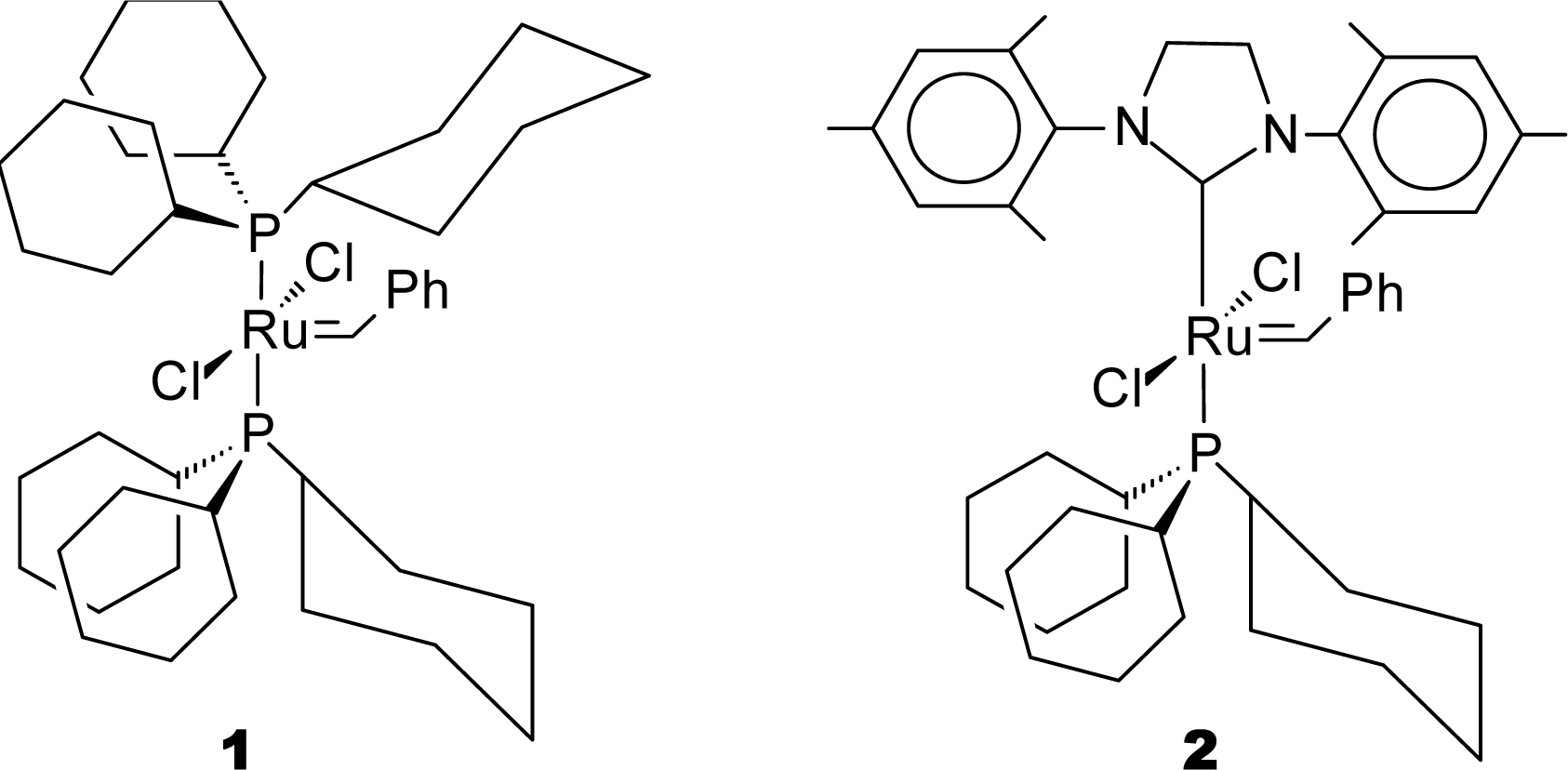
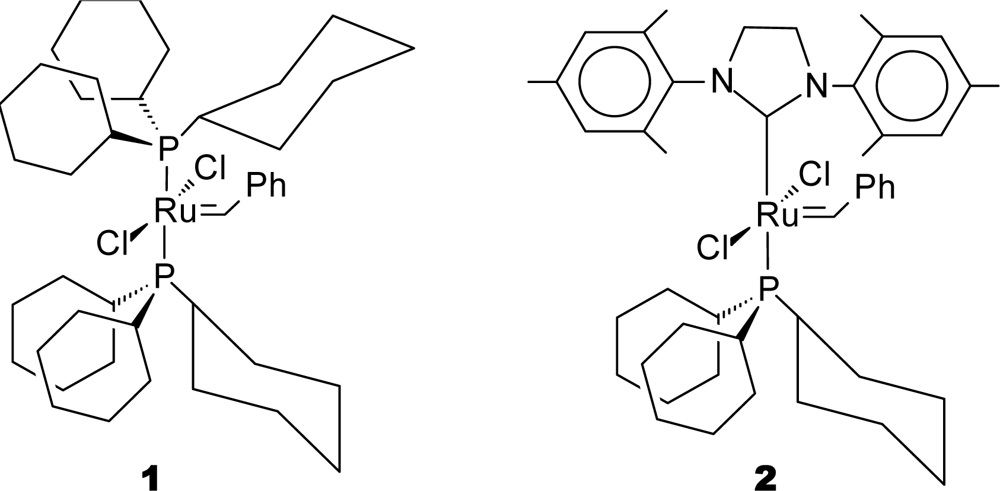
<p>The complexes RuCl<sub>2</sub>(PCy<sub>3</sub>)<sub>2</sub>(=CHPh), <bold>1</bold>, and RuCl<sub>2</sub>(PCy<sub>3</sub>)(H<sub>2</sub>IMes)(=CHPh), <bold>2</bold>, proved to be active catalysts for the self-metathesis of oleate-type fatty compounds containing the ester, hydroxyl, epoxy and carboxylic acid functional groups. At elevated reaction temperatures <bold>2</bold> showed a higher activity, stability and lower selectivity for primary metathesis products compared to <bold>1</bold>. A profound influence of organic functional groups on catalyst activity and selectivity was found and from relative activities and selectivities <bold>2</bold> has proved to be more resistant to deactivation by polar functional groups and more inclined to promote double bond isomerisation than <bold>1</bold>. The observed catalyst deactivation by oxygen-containing functional groups could be attributed to a phosphine displacement side reaction.</p></abstract>
<kwd-group>
<kwd>Olefin Metathesis</kwd>
<kwd>Grubbs catalysts</kwd>
<kwd>oleate-type fatty compounds</kwd></kwd-group></article-meta></front>
<body>
<sec sec-type="intro">
<title>1. Introduction</title>
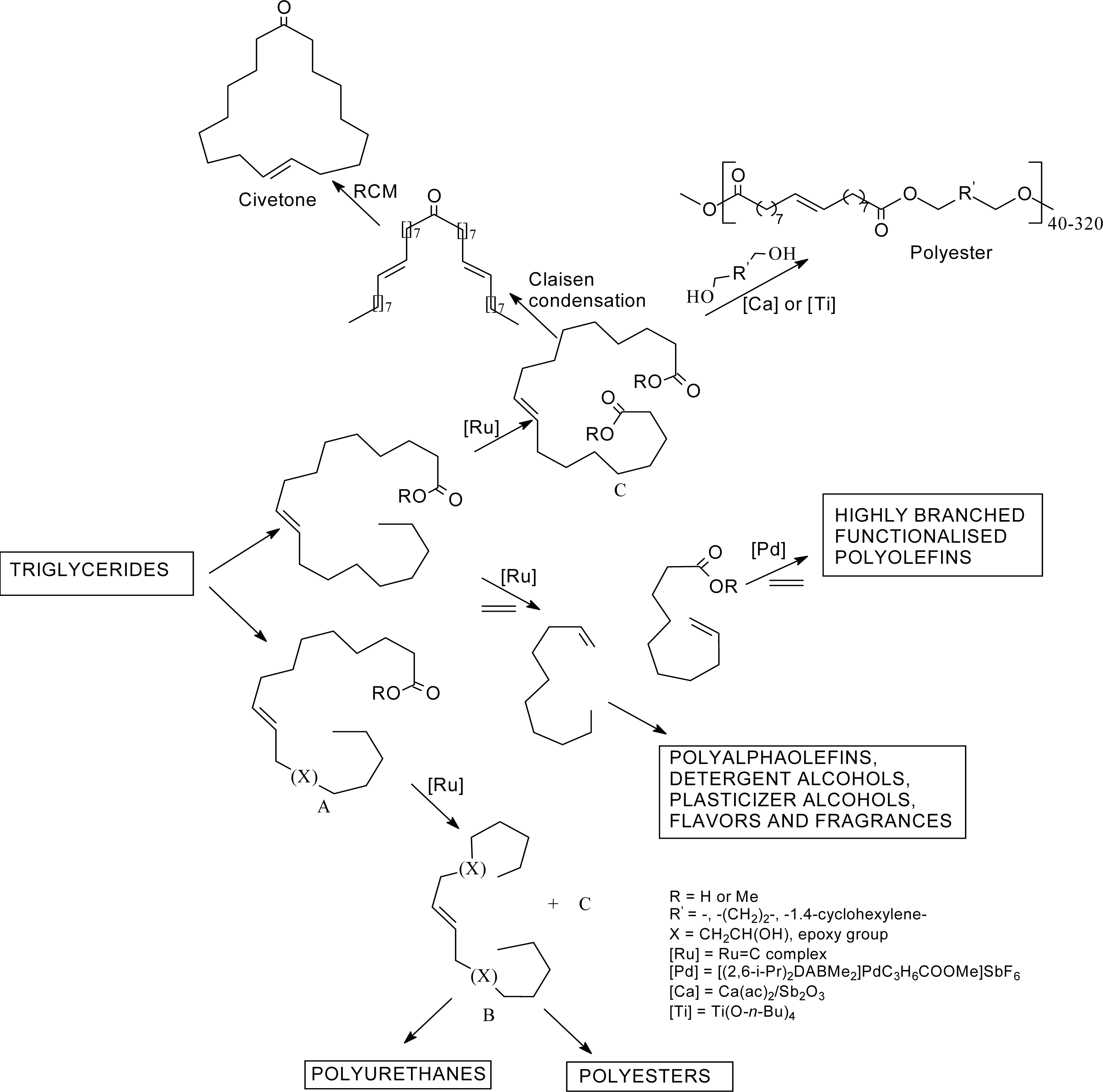
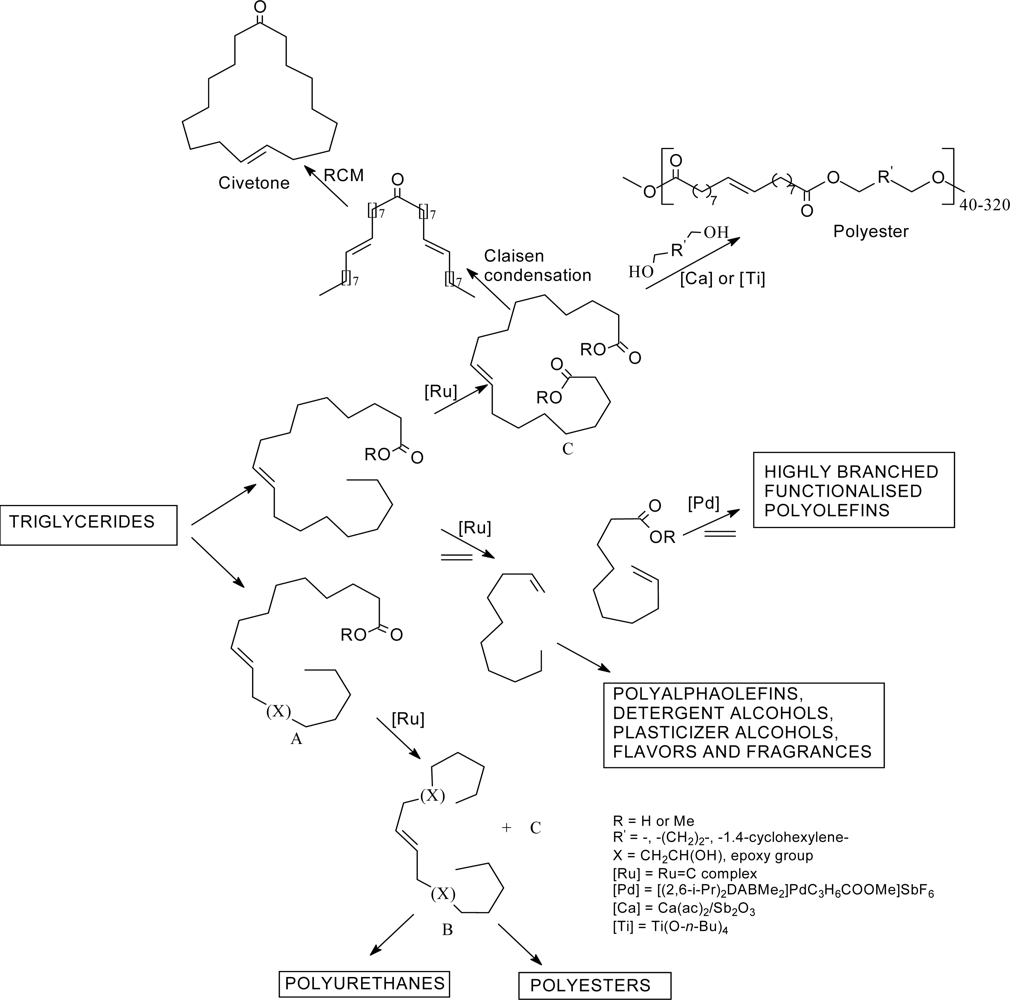
<p>The self- and cross-metathesis of olefinic fatty acids and esters is an elegant way for the production of high value intermediates with interesting applications in the polymer, pharmaceutical and petrochemical industries [<xref ref-type="bibr" rid="b1-ijms-09-00615">1</xref>–<xref ref-type="bibr" rid="b4-ijms-09-00615">4</xref>]. At Dow Chemical Company [<xref ref-type="bibr" rid="b5-ijms-09-00615">5</xref>] seed oils are being explored for a number of applications <italic>inter alia</italic> epoxy thermoplastics and thermosets, polyurethane foams, thermoplastic polyurethanes, polyolefin comonomers and surfactants. The utilization of plant oils and derivatives in end applications or as ingredients for product formulations has recently attracted much attention due to their renewable supply, low cost, versatility and their green chemistry. <xref ref-type="fig" rid="f4-ijms-09-00615">Scheme 1</xref> illustrates the various routes to industrial end-products from plant oils to high value intermediates and end-products using olefin metathesis reaction.</p>
<p>To carry out some of these transformations the well-defined Grubbs precatalysts are a logical choice due to their relatively high tolerance for polar organic functional groups compared to the classical ill-defined metathesis catalysts [<xref ref-type="bibr" rid="b6-ijms-09-00615">6</xref>–<xref ref-type="bibr" rid="b9-ijms-09-00615">9</xref>]. Buchowicz and Mol [<xref ref-type="bibr" rid="b10-ijms-09-00615">10</xref>] demonstrated that reaction rates for the self-metathesis of fatty acid esters with the Grubbs first generation catalyst RuCl<sub>2</sub>(PCy<sub>3</sub>)<sub>2</sub>(=CHPh) (<bold>1</bold>) were comparable to that of unsubstituted olefins. Warwel et al. [<xref ref-type="bibr" rid="b11-ijms-09-00615">11</xref>] used <bold>1</bold> for converting linear olefinic esters to α-olefins and α-unsaturated esters by ethenolysis. The ω unsaturated esters were subsequently converted to highly branched polyolefins and to difunctionalised fatty acid methyl esters for the synthesis of functionalised polyethers and unsaturated polyesters.</p>
<p>This study explores the self-metathesis of oleate-type fatty compounds, namely, methyl oleate (MO), methyl 12-hydroxyoleate (MHO), methyl 12,13-epoxyoleate (MEO) and oleic acid (OA), and compares the metathesis activities and selectivities of the well-defined first- and second generation Grubbs precatalysts <bold>1</bold> and <bold>2</bold>, respectively, on these substrates. Although these compounds have potential in the formulation of high value products, very little is reported in the literature on their applications based on the metathesis reaction. It is envisaged that the results obtained in this study would broaden our understanding of their metathetical chemistry and of the influence of different polar functional groups on the catalytic performance of Ru-based metathesis catalysts.</p>
<fig id="f7-ijms-09-00615" position="anchor">
<graphic xlink:href="ijms-09-00615f7.png"/></fig></sec>
<sec>
<title>2. Experimental</title>
<sec sec-type="materials">
<title>2.1. Materials and Apparatus</title>
<p>Chlorobenzene (PhCl) dichloromethane (DCM), 1,2-dichloroethane (DCE), benzene (PhH), <italic>n</italic>-hexane (Hex) were all reagent grade from Sigma-Aldrich. Ethyl vinyl ether was purchased from Fluka. Methyl oleate (≥ 99%), methyl 12-hydroxyoleate (99%), methyl 12,13-epoxyoleate (≥99%) and oleic acid (65–88%) were obtained from Sigma-Aldrich and were all treated with activated alumina and stored under N<sub>2</sub> at a subzero temperature. Grubbs precatalysts <bold>1</bold> and <bold>2</bold> were stored under N<sub>2</sub> and used as purchased from Sigma-Aldrich. Chromatograms were obtained using Varian Star 3400 <italic>CX</italic> GC equipped with a DB-624 capillary column (J&amp;W Scienctific, 30m × 0.53 mm) and a flame ionisation detector (FID). The oven temperature was held at 150 °C for 0.1 min and then increased to 260 °C at a rate of 15°C min<sup>−1</sup>. The injector temperature was set at 270 °C and the detector temperature at 300 °C with N<sub>2</sub> as carrier gas. The mass spectra were measured on a Varian Saturn 4D gas chromatograph-mass spectrometer (GC MS) with a Varian Star 3400 <italic>CX</italic> GC equipped with a WCOT fused silica J&amp;W DB-5 column (30 m × 25mm; film thickness 0.25μm).</p></sec>
<sec>
<title>2.2. Metathesis experiments</title>
<p>All manipulations were performed using standard Schlenk techniques under N<sub>2</sub> atmosphere. In a typical experiment 16.4 mg of <bold>1</bold> (0.02 mmol) or 6.3 mg of <bold>2</bold> (0.0074 mmol) was dissolved in 2.0 mL of the solvent followed by the addition of 2.0 mmol substrate for <bold>1</bold> or 0.74 mmol for <bold>2</bold> in a glass reactor fitted with a thermometer and a rubber septum. Samples were withdrawn by a syringe at regular time intervals, quenched by the addition of a few drops of ethyl vinyl ether [<xref ref-type="bibr" rid="b10-ijms-09-00615">10</xref>], and analysed by GC FID. Substrate conversions were calculated as (1–C<sub>s</sub>)/ΣC<sub>i</sub> from the corrected peak areas of the GC analyses [<xref ref-type="bibr" rid="b12-ijms-09-00615">12</xref>,<xref ref-type="bibr" rid="b13-ijms-09-00615">13</xref>]. Selectivity towards primary metathesis products (PMP) was calculated using the formula: %PMP/Σ(%PMP,%SMP)x100, where SMP = secondary metathesis products. Product characterisation was done using GC MS in the electron impact (EI) mode and by spiking with authentic samples.</p></sec></sec>
<sec sec-type="results|discussion">
<title>3. Results and Discussion</title>
<sec>
<title>3.1 Optimisation of reaction conditions</title>
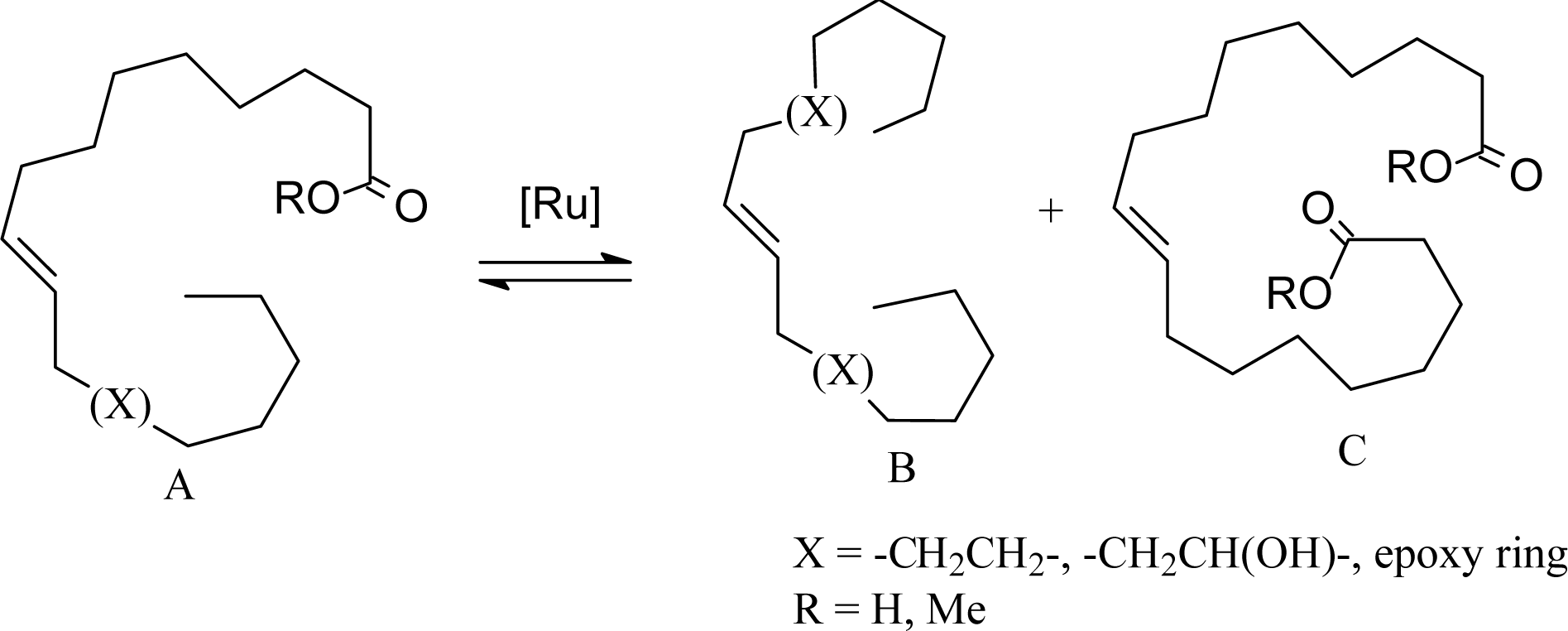
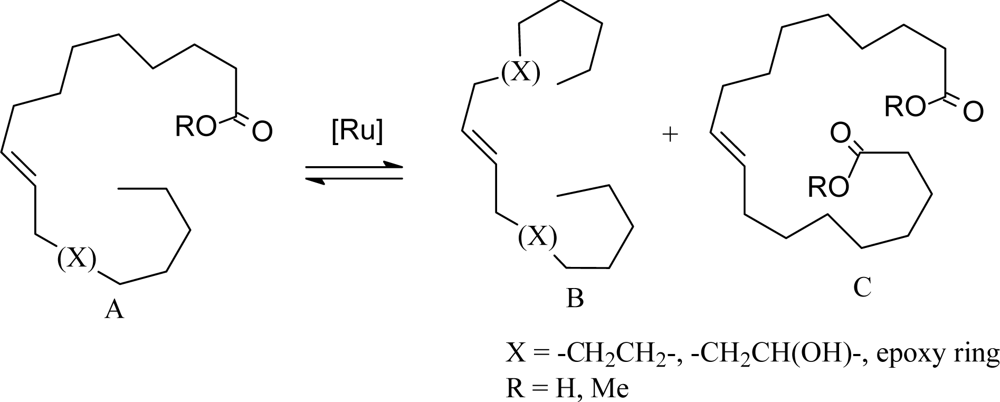
<p>The optimum reaction conditions for Grubbs precatalysts <bold>1</bold> and <bold>2</bold> were determined using methyl oleate as the model substrate and were subsequently applied on all substrates except where otherwise indicated. The parameters in the optimisation of the Grubbs pre-catalysts were (1) solvent polarity (2) reaction temperature (3) reaction atmosphere and (4) substrate:Ru molar ratio. <xref ref-type="fig" rid="f5-ijms-09-00615">Scheme 2</xref> illustrates the formation of the primary metathesis products (PMP), <bold>B</bold> and <bold>C</bold>, from the self-metathesis of the oleate-type fatty compounds.</p>
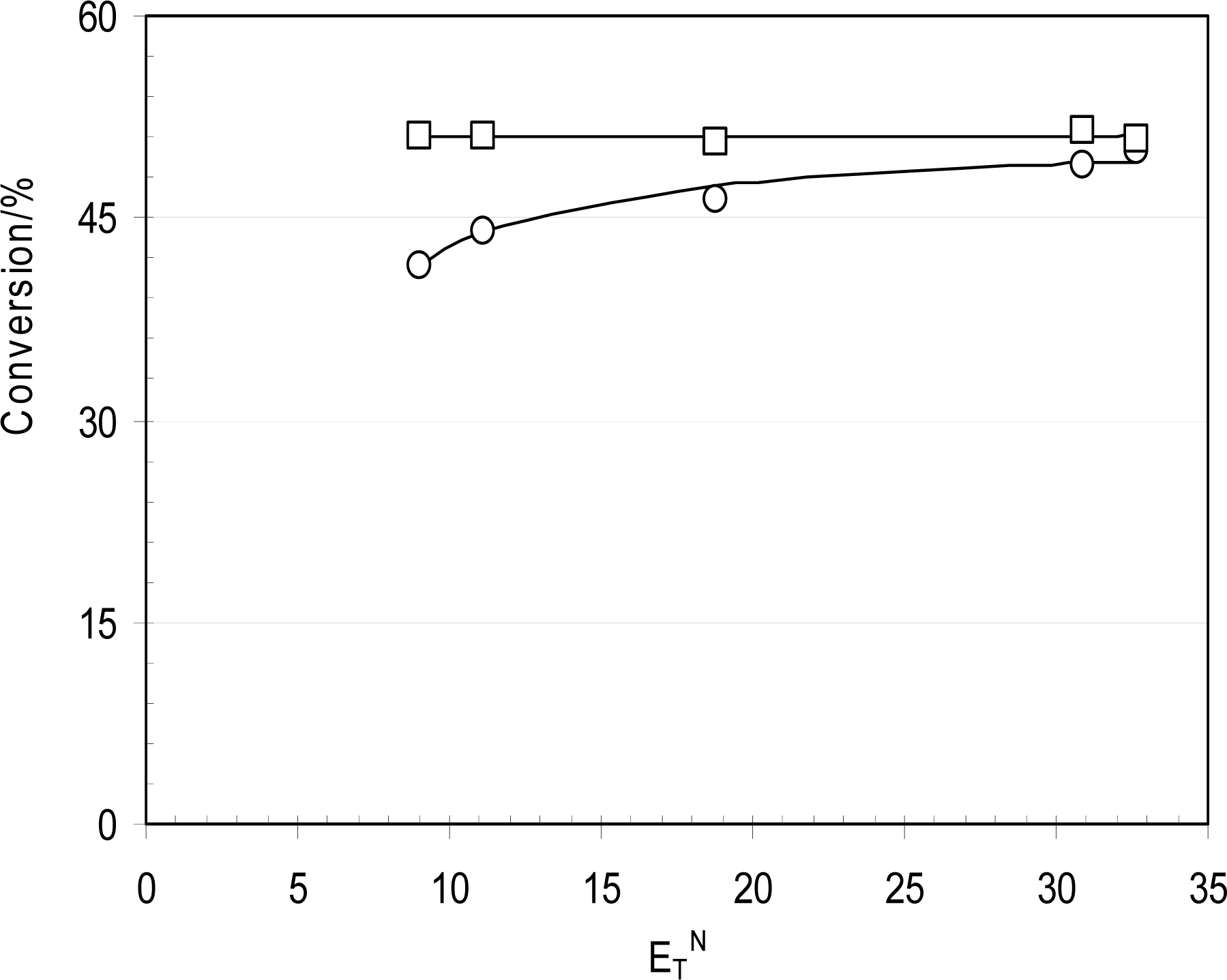
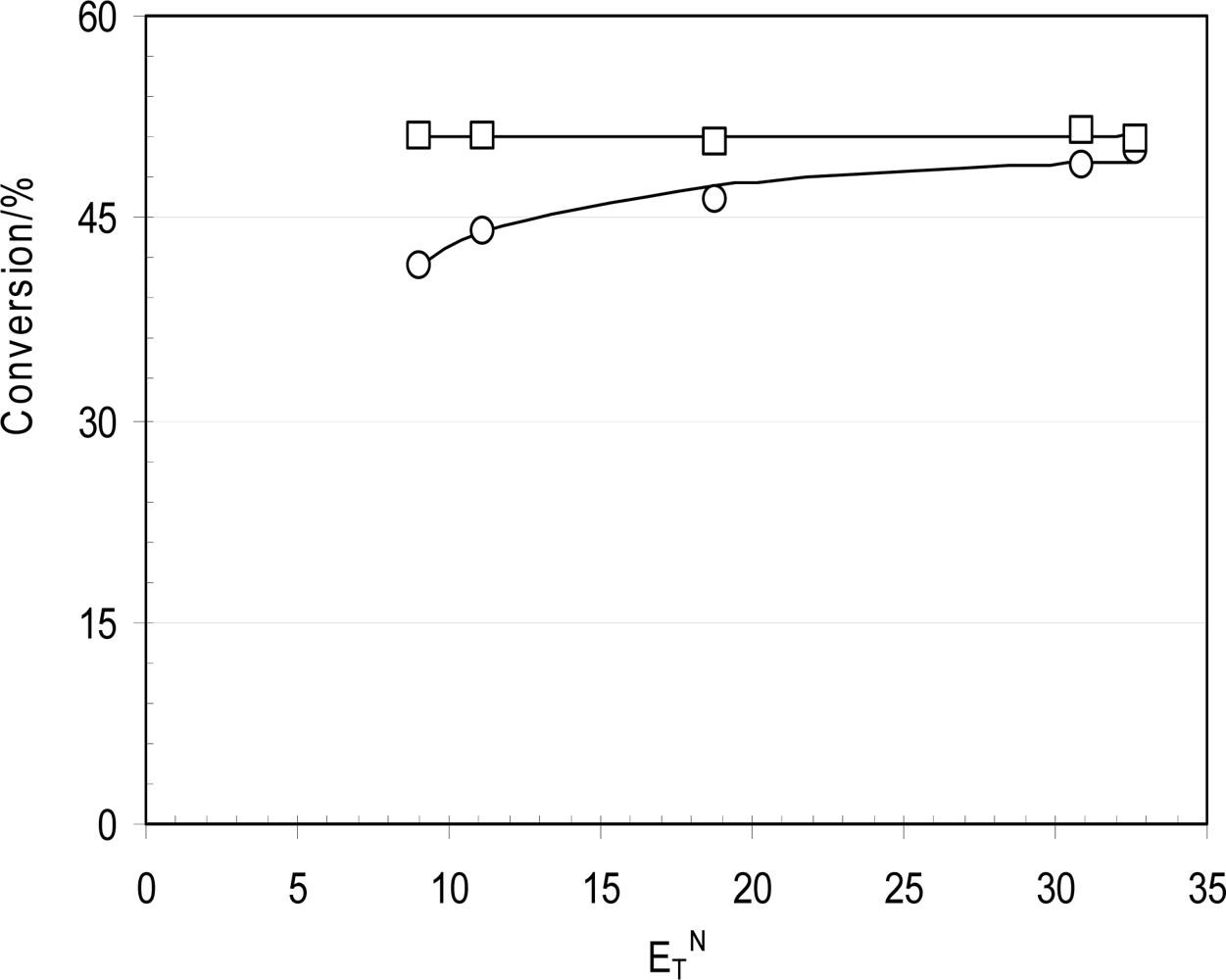
<p>To investigate the influence of solvent polarity on catalyst activity the solvents Hex, PhH, PhCl, DCM and DCE were used, having polarities of 9, 11.1, 18.8, 30.9 and 32.7, respectively, according to the Reichardt's normalised solvent polarity scale (<italic>E</italic><sub>T</sub><sup>N</sup>) [<xref ref-type="bibr" rid="b14-ijms-09-00615">14</xref>]. <xref ref-type="fig" rid="f1-ijms-09-00615">Figure 1</xref> shows the influence of solvent polarity on catalyst activity expressed as % conversion with MO/Ru molar ratio of 100. The highest activity was obtained in DCM or DCE both of which have moderate polarities relative to Hex, the solvent of lowest polarity. The poor solubility of precatalysts in acetone, ethanol, methanol and water, which have relatively higher polarities, was a limitation that led to the exclusion of these solvents in further experiments. The activity of <bold>1</bold> increased with increasing solvent polarity in the order Hex &lt; PhH &lt; PhCl &lt; DCM ~ DCE. The observed order of activity showed a positive correlation between solvent polarity and catalyst activity with halogenated solvents (DCM and DCE) providing the best reaction conditions.</p>
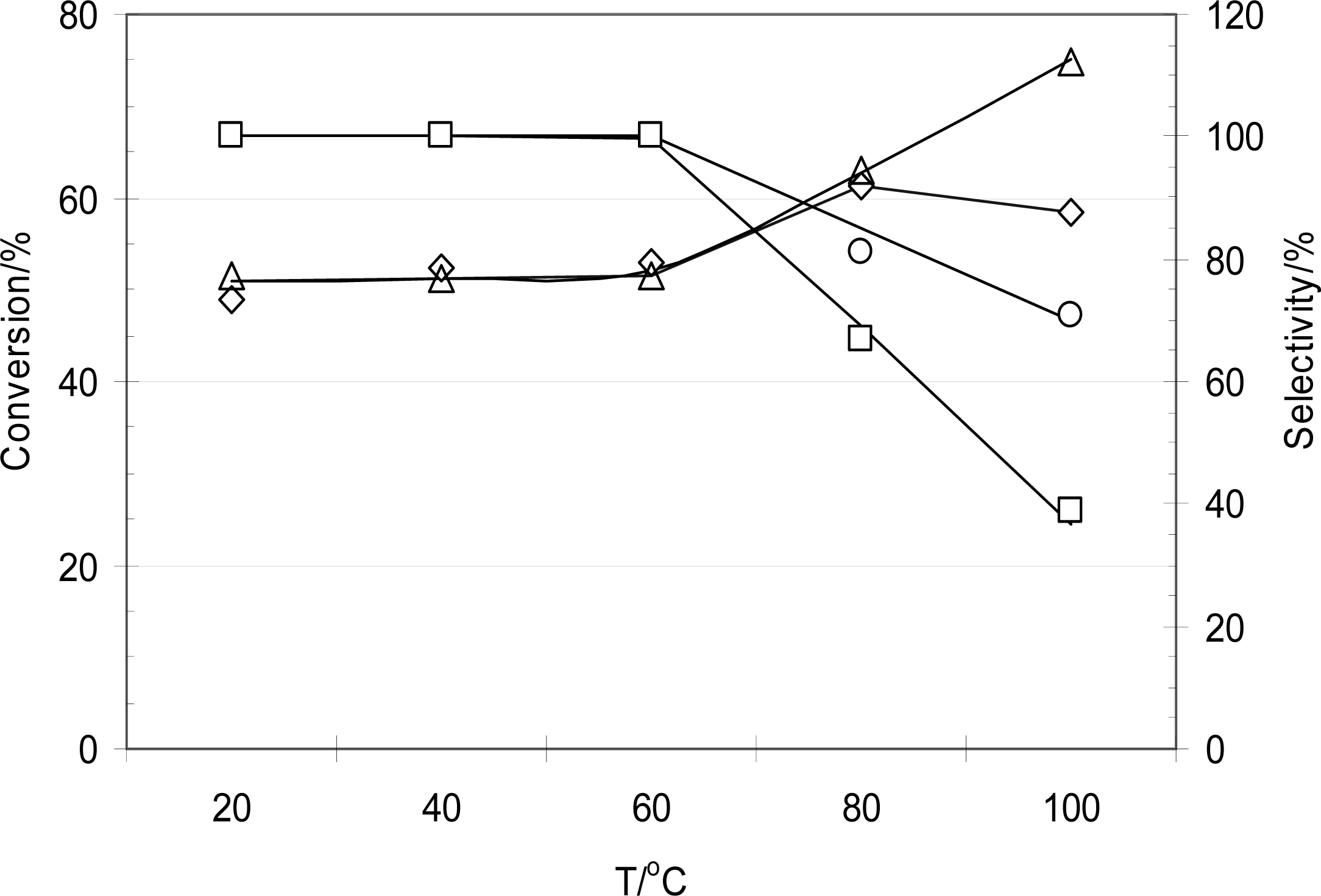
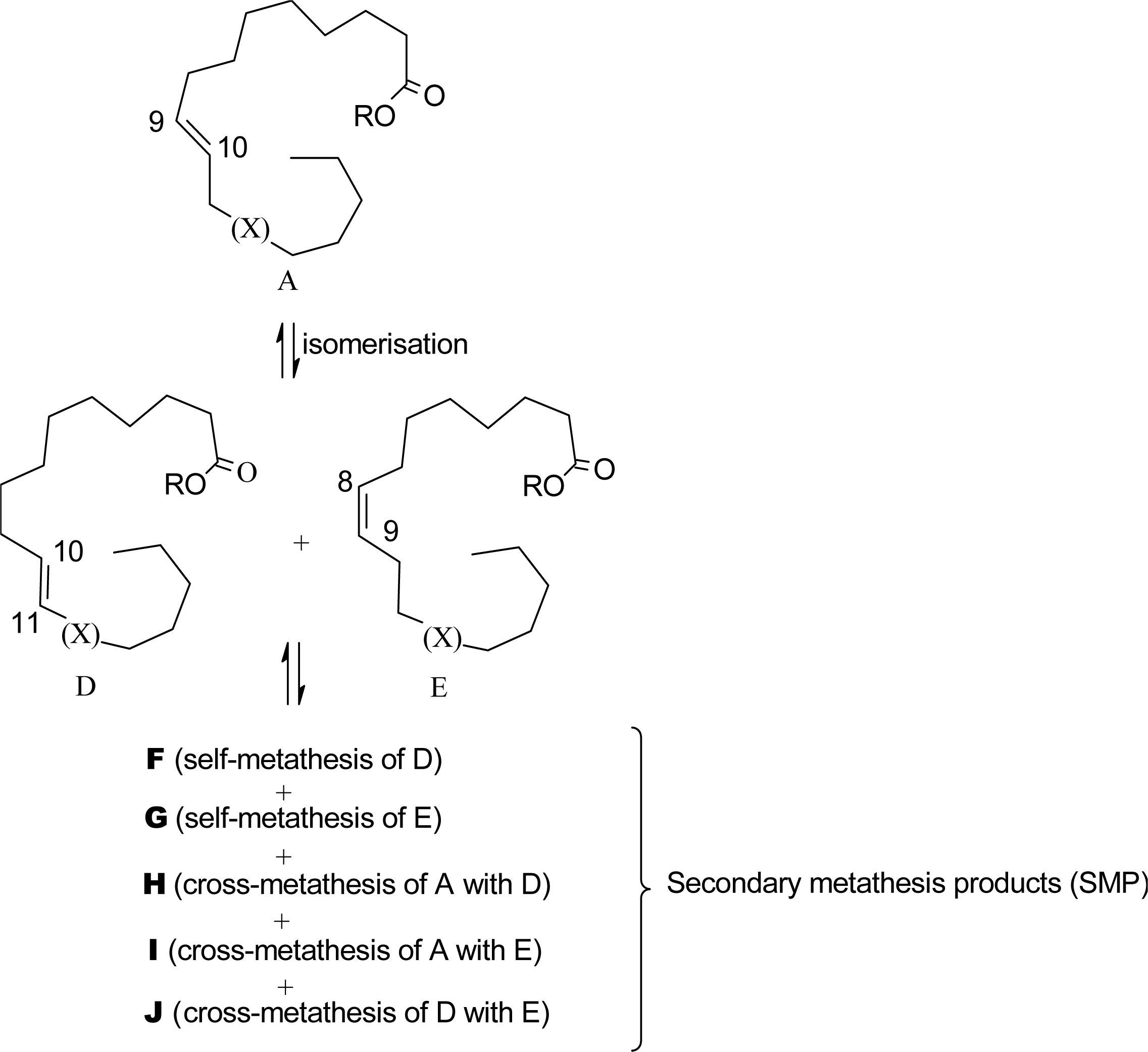
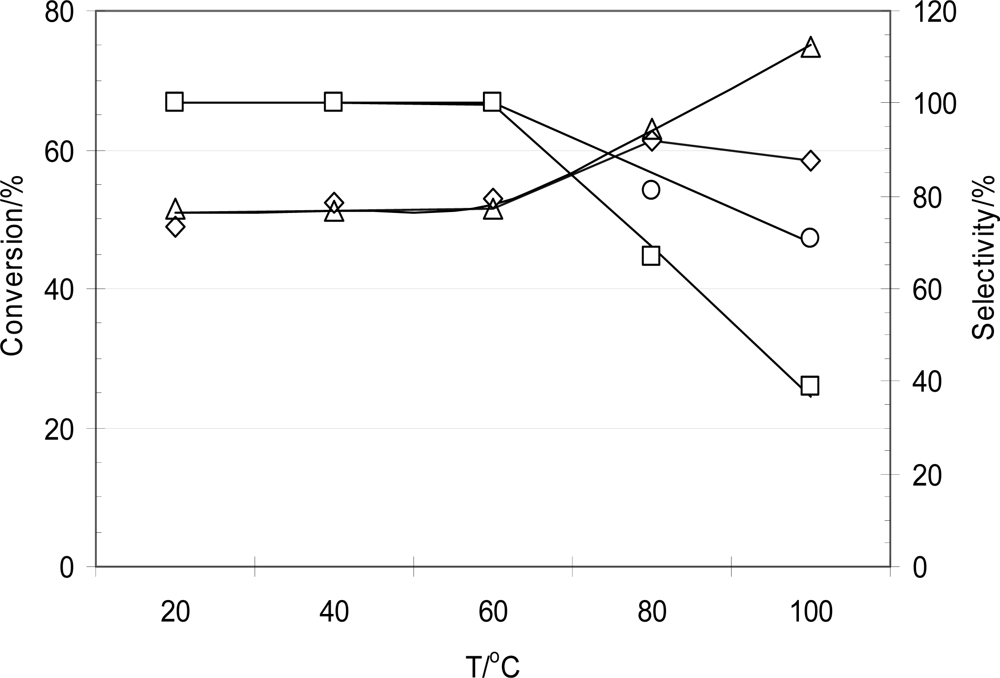
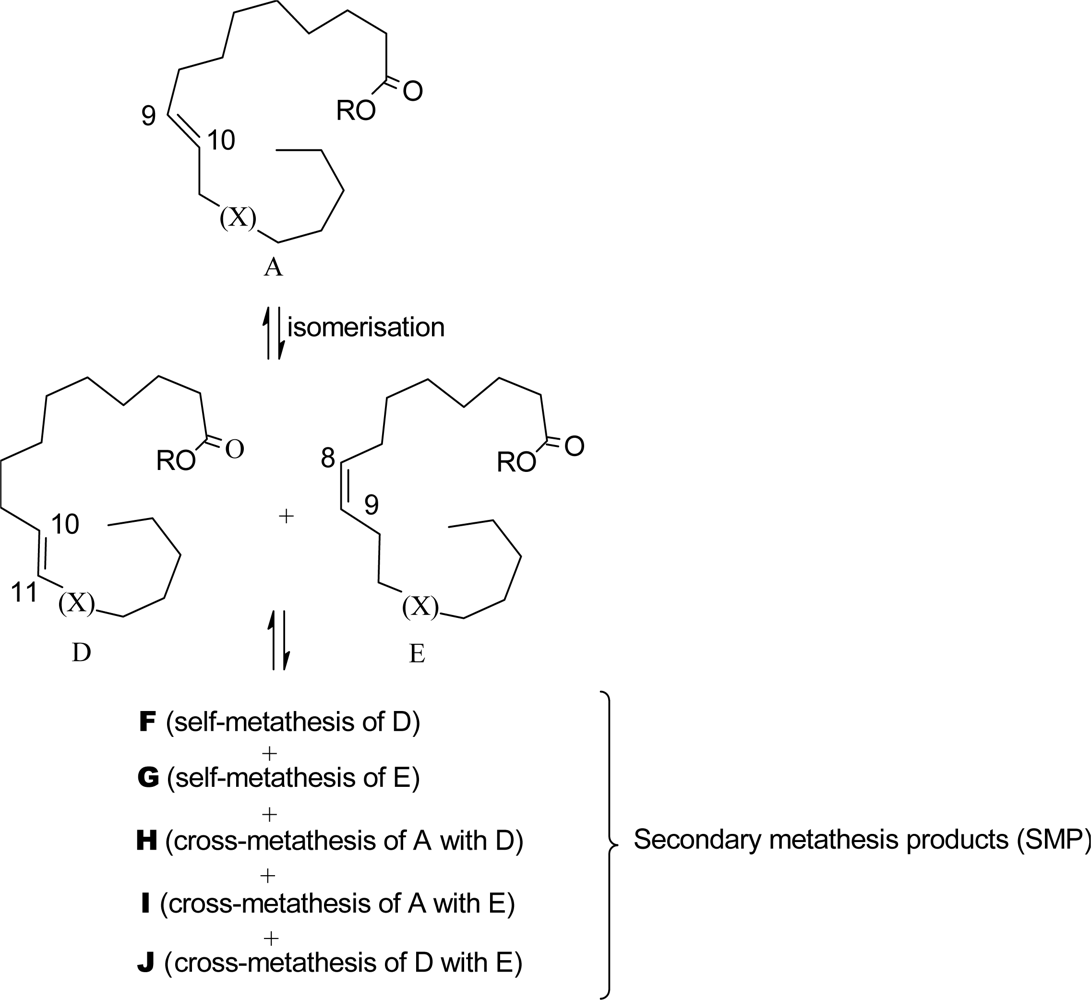
<p>From varying the reaction temperature, the activity of <bold>1</bold> showed no significant change over the temperature range 20–60°C. However, a sharp increase in activity was observed at 80 °C along with the formation of secondary metathesis products (SMP) resulting from double bond isomerisation. A further increase in reaction temperature led to a decrease in catalyst activity.<xref ref-type="fig" rid="f2-ijms-09-00615">Figure 2</xref> illustrates the influence of reaction temperature on the activity and selectivity of the precatalysts <bold>1</bold> and <bold>2</bold> and <xref ref-type="fig" rid="f6-ijms-09-00615">Scheme 3</xref> shows possible SMP (<bold>F–J</bold>) from the cross-metathesis of the substrate olefin <bold>A</bold> with isomerisation products <bold>D</bold> and <bold>E</bold>.</p>
<p>Under air atmosphere a slightly lower activity was observed with MO conversion of 46.7% compared to 49% under N<sub>2.</sub> The deactivation of <bold>1</bold> under air atmosphere was nevertheless insignificant compared with the extent to which the ill-defined metathesis catalysts deactivate under similar conditions [<xref ref-type="bibr" rid="b7-ijms-09-00615">7</xref>].</p>
<p>A steady increase in the turnover number (TON) was observed for MO/<bold>1</bold> molar ratios from 100 to 1000. Thereafter a sharp decrease in the TON occurred (<xref ref-type="table" rid="t1-ijms-09-00615">Table 1</xref>) after reaching a maximum of 525 at a MO/<bold>1</bold> molar ratio of 1000 with a selectivity of 100%. Generally the optimum conditions obtained for <bold>1</bold> using MO compared favourably with those previously obtained by Buchowicz and Mol [<xref ref-type="bibr" rid="b10-ijms-09-00615">10</xref>].</p>
<p>When MO underwent self-metathesis in the presence of <bold>2</bold>, solvent polarity had very little influence on catalyst activity, in contrast to the results obtained with <bold>1.</bold> From <xref ref-type="fig" rid="f1-ijms-09-00615">Figure 1</xref> we see no significant difference in catalyst activity with the change in solvent polarity.</p>
<p>From varying the reaction temperature, the activity of <bold>2</bold> showed no significant change within the temperature range 20–60 °C but then a sharp increase in activity occurred at 80 °C and beyond with the formation of SMP. Catalyst <bold>2</bold> showed stability even at 120 °C whereas <bold>1</bold> showed some deactivation at 100 °C already. However, a comparatively low selectivity for PMP at elevated reaction temperatures implied that the reaction conditions were strongly acting in favour of double bond isomerisation. <xref ref-type="fig" rid="f2-ijms-09-00615">Figure 2</xref> compares the activities and selectivities of <bold>1</bold> and <bold>2</bold> on MO self-metathesis. It can be seen from the results obtained that the activity and selectivity towards the PMP in both cases was only comparable within the temperature range 20–60 °C.</p>
<p>A slightly lower MO conversion (50.5%) was obtained in air compared to 51.5% under N<sub>2</sub> atmosphere. A steady increase in TON up to a maximum of 675 corresponding to MO/<bold>2</bold> molar ratio of 1500 was observed (<xref ref-type="table" rid="t1-ijms-09-00615">Table 1</xref>). The observed decrease in TON after reaching maximum MO loading for both <bold>1</bold> and <bold>2</bold> was consistent with the results obtained by Jordaan and Vosloo [<xref ref-type="bibr" rid="b15-ijms-09-00615">15</xref>] using a Ru catalyst with a chelating pyridinyl-alcoholato ligand.</p></sec>
<sec>
<title>3.2 Influence of oxygen containing functional groups on catalyst activity and selectivity</title>
<p>The metathesis activity and selectivity of <bold>1</bold> and <bold>2</bold> were examined using MO, MHO, MEO and OA as substrates with substrate/Ru molar ratio of 100 and DCM as solvent. The influence of the different organic functional groups on catalyst activity and selectivity is discussed in this section.</p>
<sec>
<title>3.2.1 Influence of oxygen containing functional groups on the activity and selectivity of <bold>1</bold></title>
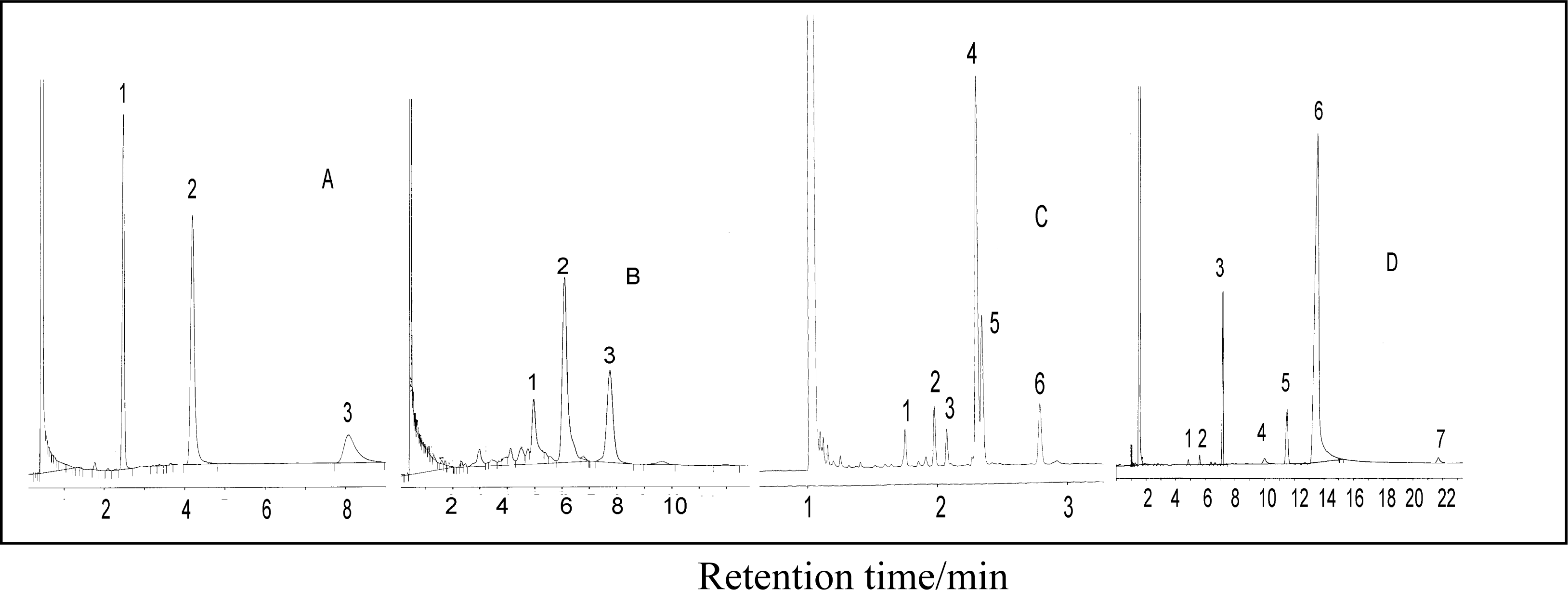
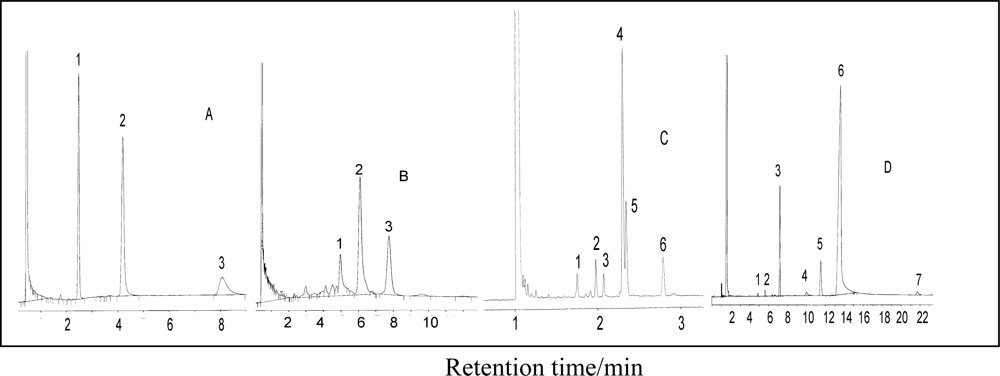
<p>The products and the yields obtained from the metathesis of MO, MHO, MEO and OA in the presence of <bold>1</bold> are given in <xref ref-type="table" rid="t2-ijms-09-00615">Table 2</xref>. The typical gas chromatograms of reaction mixtures under typical reaction conditions of these fatty compounds are given in <xref ref-type="fig" rid="f3-ijms-09-00615">Figure 3</xref>. For MO and MHO a close to 2:1:1 statistical product distribution was attained at steady state with conversions of 49 and 39.6% respectively and a selectivity of &gt; 99% towards PMP. The MO conversion was slightly higher than that reported in the literature [<xref ref-type="bibr" rid="b10-ijms-09-00615">10</xref>] under similar conditions. MHO conversion was, on the other hand, comparable to the reported conversions for MO and methyl erucate. In the case of MEO and OA, conversions of 23.5 and 24.5% were obtained with selectivities of 57 and 88% respectively. The presence of SMP in the MEO and OA product streams suggested the occurrence of double bond isomerisation in the presence of <bold>1</bold>. <xref ref-type="table" rid="t3-ijms-09-00615">Table 3</xref> compares substrate conversions, selectivities and the yields obtained for PMP and SMP. The decreasing order of substrate reactivity was MO &gt; MHO &gt; OA &gt; MEO, thus indicating that <bold>1</bold> is less tolerant towards the epoxy and the carboxylic acid groups compared to the hydroxyl and the ester groups. The lower reactivity of <bold>1</bold> in the presence of MHO<italic>,</italic> OA and MEO seems to suggest phosphine displacement by oxygen-bearing nucleophiles, a side reaction competing with dissociative substitution of a phosphine ligand with an olefinic substrate [<xref ref-type="bibr" rid="b9-ijms-09-00615">9</xref>], to form four coordinate Ru(OR)<sub>2</sub>L(=CHPh) complexes in accordance to the route proposed by Coalter et al. [<xref ref-type="bibr" rid="b16-ijms-09-00615">16</xref>]. In addition, a β-hydride elimination reaction occurs in which the metallocycle intermediate once formed gives the allyl hydride intermediate which finally forms a coordinated alkene [<xref ref-type="bibr" rid="b17-ijms-09-00615">17</xref>].</p></sec>
<sec>
<title>3.2.2 Influence of oxygen containing functional groups on the activity and selectivity of <bold>2</bold></title>
<p><xref ref-type="table" rid="t2-ijms-09-00615">Table 2</xref> shows the products and yields obtained from the self-metathesis of MO, MHO, MEO and OA in the presence of <bold>2</bold>. The selectivity towards the PMP was &gt; 99% for MO and MHO metathesis with conversions of 51.5 and 48.4% respectively. On the other hand MEO and OA metathesis gave conversions of 58 and 67%, respectively, accompanied by higher isomerisation activity judging from the high SMP yields obtained in this instance. <xref ref-type="table" rid="t4-ijms-09-00615">Table 4</xref> compares substrate conversions, selectivities and the yields obtained for PMP and SMP. The observed substrate reactivity in decreasing order was OA &gt; MEO &gt; MO &gt; MHO, thus indicating that the tolerance of complex <bold>2</bold> towards the epoxy and the carboxylic acid groups is much higher compared to that of complex <bold>1</bold>. These results further indicate that polar organic functional groups possess a significant influence on both substrate reactivity and catalyst selectivity. Indeed <bold>2</bold> showed an improved activity with double bond isomerisation more pronounced than was the case with <bold>1</bold>. The higher activity of <bold>2</bold> had been attributed to the stabilisation of the intermediate metallacycle by the more bulky and basic <italic>N</italic>-heterocyclic carbene ligand [<xref ref-type="bibr" rid="b6-ijms-09-00615">6</xref>,<xref ref-type="bibr" rid="b8-ijms-09-00615">8</xref>–<xref ref-type="bibr" rid="b9-ijms-09-00615">9</xref>,<xref ref-type="bibr" rid="b18-ijms-09-00615">18</xref>–<xref ref-type="bibr" rid="b19-ijms-09-00615">19</xref>]. Indeed the results obtained with and <bold>1</bold> and <bold>2</bold> served to further demonstrate that these catalysts are highly resistant to deactivation by olefins containing polar functional groups compared to the ill-defined metathesis catalysts [<xref ref-type="bibr" rid="b20-ijms-09-00615">20</xref>].</p></sec></sec></sec>
<sec sec-type="conclusions">
<title>4. Conclusions</title>
<p>The Ru complexes <bold>1</bold> and <bold>2</bold> proved to be active for the self-metathesis of oleate-type fatty compounds. At elevated reaction temperatures <bold>2</bold> shows a higher activity, stability and a lesser selectivity towards PMP compared to <bold>1.</bold> Furthermore a profound influence of different functional groups on catalyst activity and selectivity was found. In the presence of <bold>1</bold> the metathesis reactivity of olefinic fatty compounds decreases in the order methyl oleate &gt; methyl 12-hydroxyoleate &gt; oleic acid &gt; methyl 12,13-epoxyoleate whilst with <bold>2</bold> the reactivity decreases in the order oleic acid &gt; methyl 12,13-epoxyoleate &gt; methyl oleate &gt; methyl 12-hydroxyoleate; thus indicating from relative conversions that <bold>2</bold> is more resistant to deactivation by polar functional groups than <bold>1</bold>. Indeed <bold>2</bold> shows an improved activity, a remarkable tolerance for polar functional groups and a more pronounced double bond isomerisation activity. The relatively low reactivity of <bold>1</bold> in the presence of polar functional groups advocates for a phosphine displacement by oxygen-bearing nucleophiles; a side reaction competing with the initiation step and which occurs by dissociative substitution of a phosphine ligand with an olefinic substrate.</p></sec></body>
<back>
<ack>
<title>Acknowledgments</title>
<p>The authors wish to thank Dr Johan Jordaan for MS data acquisition and the National Research Foundation of South Africa (NRF) for financial assistance and bursary towards the studies of CKS.</p></ack>
<ref-list>
<title>References and Notes</title>
<ref id="b1-ijms-09-00615"><label>1</label><citation citation-type="journal"><person-group person-group-type="author"><name><surname>Mol</surname><given-names>JC</given-names></name></person-group><article-title>Applications of olefin metathesis in oleochemistry: an example of green chemistry</article-title><source>Green Chemistry</source><year>2002</year><volume>4</volume><fpage>5</fpage><lpage>13</lpage><pub-id pub-id-type="doi">10.1039/b109896a</pub-id></citation></ref>
<ref id="b2-ijms-09-00615"><label>2</label><citation citation-type="journal"><person-group person-group-type="author"><name><surname>Mol</surname><given-names>JC</given-names></name></person-group><article-title>Catalytic metathesis of unsaturated fatty acid esters and oils:catalytic conversion of renewables</article-title><source>Topics in Catalysis</source><year>2004</year><volume>27</volume><fpage>97</fpage><lpage>104</lpage><pub-id pub-id-type="doi">10.1023/B:TOCA.0000013544.89226.c4</pub-id></citation></ref>
<ref id="b3-ijms-09-00615"><label>3</label><citation citation-type="journal"><person-group person-group-type="author"><name><surname>Plugge</surname><given-names>MFC</given-names></name><name><surname>Mol</surname><given-names>JC</given-names></name></person-group><article-title>A new synthesis of civetone</article-title><source>Synlett</source><year>1991</year><fpage>507</fpage><lpage>508</lpage></citation></ref>
<ref id="b4-ijms-09-00615"><label>4</label><citation citation-type="journal"><person-group person-group-type="author"><name><surname>Ivin</surname><given-names>KJ</given-names></name></person-group><article-title>Some recent applications of the olefin metathesis in organic synthesis: A review</article-title><source>J Mol Catal A:Chem</source><year>1998</year><volume>133</volume><fpage>1</fpage><lpage>16</lpage><pub-id pub-id-type="doi">10.1016/S1381-1169(97)00249-5</pub-id></citation></ref>
<ref id="b5-ijms-09-00615"><label>5</label><citation citation-type="journal"><person-group person-group-type="author"><name><surname>Burdett</surname><given-names>KA</given-names></name><name><surname>Harris</surname><given-names>LD</given-names></name><name><surname>Margl</surname><given-names>P</given-names></name><name><surname>Maghon</surname><given-names>BR</given-names></name><name><surname>Mokhtar-Zadeh</surname><given-names>T</given-names></name><name><surname>Saucier</surname><given-names>PC</given-names></name><name><surname>Wasserman</surname><given-names>EP</given-names></name></person-group><article-title>Renewable monomer feedstocks via olefin metathesis: fundamental mechanistic studies of methyl oleate ethenolysis with the first generation Grubbs catalyst</article-title><source>Organometallics</source><year>2003</year><volume>23</volume><issue>9</issue><fpage>2027</fpage><lpage>2047</lpage></citation></ref>
<ref id="b6-ijms-09-00615"><label>6</label><citation citation-type="journal"><person-group person-group-type="author"><name><surname>Grubbs</surname><given-names>RH</given-names></name><name><surname>Chang</surname><given-names>S</given-names></name></person-group><article-title>Recent advances in olefin metathesis and its applications in organic synthesis</article-title><source>Tetrahedron</source><year>1998</year><volume>54</volume><fpage>4413</fpage><lpage>4450</lpage></citation></ref>
<ref id="b7-ijms-09-00615"><label>7</label><citation citation-type="journal"><person-group person-group-type="author"><name><surname>Grubbs</surname><given-names>RH</given-names></name></person-group><article-title>Olefin metathesis</article-title><source>Tetrahedron</source><year>2004</year><volume>60</volume><fpage>7117</fpage><lpage>7140</lpage></citation></ref>
<ref id="b8-ijms-09-00615"><label>8</label><citation citation-type="journal"><person-group person-group-type="author"><name><surname>Sanford</surname><given-names>MS</given-names></name><name><surname>Ulman</surname><given-names>M</given-names></name><name><surname>Grubbs</surname><given-names>RH</given-names></name></person-group><article-title>New insights into the mechanism of Ruthenium-catalyzed olefin metathesis reactions</article-title><source>J Am Chem Soc</source><year>2001</year><volume>123</volume><fpage>749</fpage><lpage>750</lpage><pub-id pub-id-type="pmid">11456595</pub-id></citation></ref>
<ref id="b9-ijms-09-00615"><label>9</label><citation citation-type="journal"><person-group person-group-type="author"><name><surname>Sanford</surname><given-names>MS</given-names></name><name><surname>Love</surname><given-names>JA</given-names></name><name><surname>Grubbs</surname><given-names>RH</given-names></name></person-group><article-title>Mechanism and acivity of the Ruthenium olefin metathesis catalysts</article-title><source>J Am Chem Soc</source><year>2001</year><volume>123</volume><fpage>65430</fpage><lpage>6554</lpage></citation></ref>
<ref id="b10-ijms-09-00615"><label>10</label><citation citation-type="journal"><person-group person-group-type="author"><name><surname>Buchowicz</surname><given-names>W</given-names></name><name><surname>Mol</surname><given-names>J</given-names></name></person-group><article-title>Catalytic activity and selectivity of Ru(=CHPh)Cl<sub>2</sub>(PCy<sub>3</sub>)<sub>2</sub> in the metathesis of linear olefins</article-title><source>J Mol Catal A: Chem</source><year>1999</year><volume>148</volume><fpage>97</fpage><lpage>103</lpage></citation></ref>
<ref id="b11-ijms-09-00615"><label>11</label><citation citation-type="journal"><person-group person-group-type="author"><name><surname>Warwel</surname><given-names>S</given-names></name><name><surname>Brüse</surname><given-names>F</given-names></name><name><surname>Demes</surname><given-names>C</given-names></name><name><surname>Kunz</surname><given-names>M</given-names></name><name><surname>Rüschgen Klaas</surname><given-names>M</given-names></name></person-group><article-title>Polymers and surfactants on the basis of renewable resources</article-title><source>Chemosphere</source><year>2001</year><volume>43</volume><fpage>39</fpage><lpage>48</lpage><pub-id pub-id-type="pmid">11235676</pub-id></citation></ref>
<ref id="b12-ijms-09-00615"><label>12</label><citation citation-type="other">Ackman, R.G. Fundamental groups in the response of flame ionization detectors to oxygenated aliphatic hydrocarbons. <italic>J. G. Chromatogr</italic>. <bold>1964</bold>, 173–179.</citation></ref>
<ref id="b13-ijms-09-00615"><label>13</label><citation citation-type="journal"><person-group person-group-type="author"><name><surname>Marvey</surname><given-names>BB</given-names></name><name><surname>Du Plessis</surname><given-names>JAK</given-names></name><name><surname>Vosloo</surname><given-names>HCM</given-names></name><name><surname>Mol</surname><given-names>JC</given-names></name></person-group><article-title>Metathesis of unsaturated fatty acid esters derived from South African sunflower oil in the presence of a 3 wt% Re<sub>2</sub>O<sub>7</sub>/SiO<sub>2</sub>–Al<sub>2</sub>O<sub>3</sub>/SnBu<sub>4</sub> catalyst</article-title><source>J Mol Catal A:Chem</source><year>2003</year><volume>201</volume><fpage>297</fpage><lpage>308</lpage></citation></ref>
<ref id="b14-ijms-09-00615"><label>14</label><citation citation-type="journal"><person-group person-group-type="author"><name><surname>Reichardt</surname><given-names>C</given-names></name></person-group><article-title>Solvatochromic dyes as solvent polarity indicators</article-title><source>Chem Rev</source><year>1994</year><volume>94</volume><fpage>2319</fpage><lpage>2358</lpage></citation></ref>
<ref id="b15-ijms-09-00615"><label>15</label><citation citation-type="journal"><person-group person-group-type="author"><name><surname>Jordaan</surname><given-names>M</given-names></name><name><surname>Vosloo</surname><given-names>HCM</given-names></name></person-group><article-title>Ruthenium catalysts with a chelating pyridinyl-alcoholato ligand for application in linear alkene metathesis</article-title><source>Adv Synth Catal</source><year>2007</year><volume>349</volume><fpage>184</fpage><lpage>192</lpage></citation></ref>
<ref id="b16-ijms-09-00615"><label>16</label><citation citation-type="journal"><person-group person-group-type="author"><name><surname>Coalter</surname><given-names>JN</given-names><suffix>III</suffix></name><name><surname>Bollinger</surname><given-names>JC</given-names></name><name><surname>Eisenstein</surname><given-names>O</given-names></name><name><surname>Caulton</surname><given-names>KG</given-names></name></person-group><article-title>R-groups reversal of isomer stability for RuH(X)L<sub>2</sub>(CCHR) υs. Ru(X)L<sub>2</sub>(CCH<sub>2</sub>R): access to four-coordinate ruthenium carbenes and carbines</article-title><source>New J Chem</source><year>2000</year><volume>24</volume><fpage>925</fpage><lpage>927</lpage></citation></ref>
<ref id="b17-ijms-09-00615"><label>17</label><citation citation-type="journal"><person-group person-group-type="author"><name><surname>Van Rensburg</surname><given-names>WJ</given-names></name><name><surname>Steynberg</surname><given-names>PJ</given-names></name><name><surname>Meyer</surname><given-names>WH</given-names></name><name><surname>Kirk</surname><given-names>MM</given-names></name><name><surname>Forman</surname><given-names>GS</given-names></name></person-group><article-title>DFT prediction and experimental observation of substrate-induced catalyst decomposition in Ruthenium-catalyzed olefin metathesis</article-title><source>J Am Chem Soc</source><year>2004</year><volume>126</volume><fpage>14332</fpage><lpage>14333</lpage><pub-id pub-id-type="pmid">15521734</pub-id></citation></ref>
<ref id="b18-ijms-09-00615"><label>18</label><citation citation-type="journal"><person-group person-group-type="author"><name><surname>Willock</surname><given-names>DJ</given-names></name></person-group><article-title>Catalysis: Experimental and computational</article-title><source>Annu Rep Prog Chem, Sect B</source><year>2005</year><volume>101</volume><fpage>333</fpage><lpage>351</lpage></citation></ref>
<ref id="b19-ijms-09-00615"><label>19</label><citation citation-type="journal"><person-group person-group-type="author"><name><surname>Adlhart</surname><given-names>C</given-names></name><name><surname>Chen</surname><given-names>P</given-names></name></person-group><article-title>Ligand rotation distinguishes first- and second-generation Ruthenium metathesis catalysts</article-title><source>Angew Chem Int Ed</source><year>2002</year><volume>41</volume><issue>23</issue><fpage>4484</fpage><lpage>4487</lpage><pub-id pub-id-type="doi">10.1002/1521-3773(20021202)41:23&lt;4484::AID-ANIE4484&gt;3.0.CO;2-Q</pub-id></citation></ref>
<ref id="b20-ijms-09-00615"><label>20</label><citation citation-type="journal"><person-group person-group-type="author"><name><surname>Mol</surname><given-names>JC</given-names></name></person-group><article-title>Metathesis of functionalized acyclic olefins</article-title><source>J Mol Catal</source><year>1991</year><volume>65</volume><fpage>145</fpage><lpage>162</lpage></citation></ref></ref-list>
<sec sec-type="display-objects">
<title>Figures and Table</title>
<fig id="f1-ijms-09-00615" position="float">
<label>Figure 1.</label>
<caption>
<p>Influence of solvent polarity on MO conversion with MO/Ru molar ratio of 100 at 20 °C after 4h. (○<bold>1</bold>, □<bold>2</bold>).</p></caption>
<graphic xlink:href="ijms-09-00615f1.png"/></fig>
<fig id="f2-ijms-09-00615" position="float">
<label>Figure 2.</label>
<caption>
<p>Influence of reaction temperature on MO conversion and PMP selectivity with MO/Ru molar ratio of 100 after 4h in DCM. (Conversion:⋄ <bold>1</bold>, ▵ <bold>2</bold>; Selectivity: ○ <bold>1</bold>, □<bold>2</bold>).</p></caption>
<graphic xlink:href="ijms-09-00615f2.png"/></fig>
<fig id="f3-ijms-09-00615" position="float">
<label>Figure 3.</label>
<caption>
<p>Typical GC's of the metathesis products of (A) MO (B) MHO (C) MEO and (D) OA in the presence of <bold>1</bold> or <bold>2</bold> at 20 °C. Peak numbers correspond to entries in <xref ref-type="table" rid="t2-ijms-09-00615">Table 2</xref>.</p></caption>
<graphic xlink:href="ijms-09-00615f3.png"/></fig>
<fig id="f4-ijms-09-00615" position="float">
<label>Scheme 1.</label>
<caption>
<p>Routes to industrial end-products <italic>via</italic> olefin metathesis reaction [<xref ref-type="bibr" rid="b1-ijms-09-00615">1</xref>,<xref ref-type="bibr" rid="b5-ijms-09-00615">5</xref>,<xref ref-type="bibr" rid="b11-ijms-09-00615">11</xref>].</p></caption>
<graphic xlink:href="ijms-09-00615f4.png"/></fig>
<fig id="f5-ijms-09-00615" position="float">
<label>Scheme 2.</label>
<caption>
<p>Formation of PMP (<bold>B</bold> and <bold>C</bold>) from self-metathesis of <bold>A.</bold></p></caption>
<graphic xlink:href="ijms-09-00615f5.png"/></fig>
<fig id="f6-ijms-09-00615" position="float">
<label>Scheme 3.</label>
<caption>
<p>SMP from cross metathesis of <bold>A</bold> with isomerisation products <bold>D</bold> and <bold>E</bold>.</p></caption>
<graphic xlink:href="ijms-09-00615f6.png"/></fig>
<table-wrap id="t1-ijms-09-00615" position="float">
<label>Table 1.</label>
<caption>
<p>Self-metathesis of MO in the presence of <bold>1</bold> and <bold>2</bold> in DCM at 20 °C after 4h.</p></caption>
<table frame="hsides" rules="groups">
<thead>
<tr>
<th align="center">Entry</th>
<th align="center">MO/Ru ratio</th>
<th align="center">Catalyst</th>
<th align="center">Conv <xref ref-type="table-fn" rid="tfn1-ijms-09-00615">[a]</xref> (%)</th>
<th align="center">Sel <xref ref-type="table-fn" rid="tfn2-ijms-09-00615">[b]</xref> (%)</th>
<th align="center">TON <xref ref-type="table-fn" rid="tfn3-ijms-09-00615">[c]</xref></th></tr></thead>
<tbody>
<tr>
<td align="center">1</td>
<td align="center">100</td>
<td align="center"><bold>1</bold></td>
<td align="center">49</td>
<td align="center">100</td>
<td align="center">49</td></tr>
<tr>
<td align="center"/>
<td align="center"><bold>2</bold></td>
<td align="center">51.5</td>
<td align="center">100</td>
<td align="center">51.5</td></tr>
<tr>
<td align="center">2</td>
<td align="center">500</td>
<td align="center"><bold>1</bold></td>
<td align="center">50.8</td>
<td align="center">100</td>
<td align="center">254</td></tr>
<tr>
<td align="center"/>
<td align="center"><bold>2</bold></td>
<td align="center">51.8</td>
<td align="center">100</td>
<td align="center">259</td></tr>
<tr>
<td align="center">3</td>
<td align="center">1000</td>
<td align="center"><bold>1</bold></td>
<td align="center">52.5</td>
<td align="center">100</td>
<td align="center">525</td></tr>
<tr>
<td align="center"/>
<td align="center"><bold>2</bold></td>
<td align="center">51.5</td>
<td align="center">100</td>
<td align="center">515</td></tr>
<tr>
<td align="center">4</td>
<td align="center">1500</td>
<td align="center"><bold>1</bold></td>
<td align="center">29</td>
<td align="center">100</td>
<td align="center">435</td></tr>
<tr>
<td align="center"/>
<td align="center"><bold>2</bold></td>
<td align="center">45</td>
<td align="center">100</td>
<td align="center">675</td></tr>
<tr>
<td align="center">5</td>
<td align="center">2000</td>
<td align="center"><bold>1</bold></td>
<td align="center">12.2</td>
<td align="center">100</td>
<td align="center">244</td></tr>
<tr>
<td align="center"/>
<td align="center"><bold>2</bold></td>
<td align="center">33</td>
<td align="center">100</td>
<td align="center">660</td></tr></tbody></table>
<table-wrap-foot><fn id="tfn1-ijms-09-00615">
<label>[a]</label>
<p>Molar % substrate converted</p></fn><fn id="tfn2-ijms-09-00615">
<label>[b]</label>
<p>Selectivity towards PMP</p></fn><fn id="tfn3-ijms-09-00615">
<label>[c]</label>
<p>(MO/Ru)(Conv)</p></fn></table-wrap-foot></table-wrap>
<table-wrap id="t2-ijms-09-00615" position="float">
<label>Table 2.</label>
<caption>
<p>Products and yields resulting from the metathesis of oleate-type fatty compounds in DCM at 20 °C after 4h.</p></caption>
<table frame="hsides" rules="groups">
<thead>
<tr>
<th align="left">Entry <xref ref-type="table-fn" rid="tfn4-ijms-09-00615">[a]</xref></th>
<th align="left">Product Name</th>
<th align="left">Formula<xref ref-type="table-fn" rid="tfn5-ijms-09-00615">[b]</xref></th>
<th align="left">m/e</th>
<th align="left" colspan="2">Yield(%)</th></tr></thead>
<tbody>
<tr>
<td align="left">A</td>
<td align="left"><underline>MO</underline></td>
<td align="left"/>
<td align="left"/>
<td align="left"><underline><bold>1</bold></underline></td>
<td align="left"><underline><bold>2</bold></underline></td></tr>
<tr>
<td align="left">1</td>
<td align="left">9-Octadecene<xref ref-type="table-fn" rid="tfn6-ijms-09-00615">[c]</xref></td>
<td align="left">C<sub>9</sub>=C<sub>9</sub></td>
<td align="left">252</td>
<td align="left">24.5</td>
<td align="left">26.3</td></tr>
<tr>
<td align="left">2</td>
<td align="left">Methyl oleate</td>
<td align="left">C<sub>9</sub>=C<sub>8</sub>COOC</td>
<td align="left">296</td>
<td align="left">51.0</td>
<td align="left">48.5</td></tr>
<tr>
<td align="left">3
<hr/></td>
<td align="left">Dimethyl 9-octadecenedioate<xref ref-type="table-fn" rid="tfn6-ijms-09-00615">[c]</xref>
<hr/></td>
<td align="left">COOCC<sub>8</sub>=C<sub>8</sub>COOC
<hr/></td>
<td align="left">340
<hr/></td>
<td align="left">24.5
<hr/></td>
<td align="left">25.2
<hr/></td></tr>
<tr>
<td align="left">B</td>
<td align="left"><underline>MHO</underline></td>
<td align="left"/>
<td align="left"/>
<td align="left"/>
<td align="left"/></tr>
<tr>
<td align="left">1</td>
<td align="left">9-Octadecene-7,12-diol<xref ref-type="table-fn" rid="tfn6-ijms-09-00615">[c]</xref></td>
<td align="left">C<sub>9</sub>(OH)=C<sub>9</sub>(OH)</td>
<td align="left">284</td>
<td align="left">6.6</td>
<td align="left">20.1</td></tr>
<tr>
<td align="left">2</td>
<td align="left">Methyl 12-hydroxyoleate</td>
<td align="left">C<sub>9</sub>(OH)=C<sub>8</sub>COOC</td>
<td align="left">312</td>
<td align="left">60.4</td>
<td align="left">51.6</td></tr>
<tr>
<td align="left">3
<hr/></td>
<td align="left">Dimethyl 9-octadecenedioate<xref ref-type="table-fn" rid="tfn6-ijms-09-00615">[c]</xref>
<hr/></td>
<td align="left">COOCC<sub>8</sub>=C<sub>8</sub>COOC
<hr/></td>
<td align="left">340
<hr/></td>
<td align="left">33.0
<hr/></td>
<td align="left">28.3
<hr/></td></tr>
<tr>
<td align="left">C</td>
<td align="left"><underline>MEO</underline></td>
<td align="left"/>
<td align="left"/>
<td align="left"/>
<td align="left"/></tr>
<tr>
<td align="left">1</td>
<td align="left">6,7,12,13-Diepoxy-9-octadecene<xref ref-type="table-fn" rid="tfn6-ijms-09-00615">[c]</xref></td>
<td align="left">C<sub>5</sub>(COC)C<sub>2</sub>=C<sub>2</sub>(COC)C<sub>5</sub></td>
<td align="left">280</td>
<td align="left">0.8</td>
<td align="left">8.1</td></tr>
<tr>
<td align="left">2</td>
<td align="left">Methyl 10,11-epoxy-7-hexadecenoate<xref ref-type="table-fn" rid="tfn7-ijms-09-00615">[d]</xref></td>
<td align="left">COOCC<sub>6</sub>=C<sub>2</sub>(COC)C<sub>5</sub></td>
<td align="left">282</td>
<td align="left">4.1</td>
<td align="left">24.4</td></tr>
<tr>
<td align="left">3
<hr/></td>
<td align="left">Dimethyl 7-hexadecenedioate<xref ref-type="table-fn" rid="tfn7-ijms-09-00615">[d]</xref>
<hr/></td>
<td align="left">COOCC<sub>6</sub>=C<sub>8</sub>COOC
<hr/></td>
<td align="left">312
<hr/></td>
<td align="left">5.9
<hr/></td>
<td align="left">0.1
<hr/></td></tr>
<tr>
<td align="left">4</td>
<td align="left">Methyl 12,13-epoxyoleate</td>
<td align="left">COOCC<sub>8</sub>=C<sub>2</sub>(COC)C<sub>5</sub></td>
<td align="left">310</td>
<td align="left">76.5</td>
<td align="left">42.0</td></tr>
<tr>
<td align="left">5
<hr/></td>
<td align="left">Dimethyl 9-octadecenedioate<xref ref-type="table-fn" rid="tfn6-ijms-09-00615">[c]</xref>
<hr/></td>
<td align="left">COOCC<sub>8</sub>=C<sub>8</sub>COOC
<hr/></td>
<td align="left">340
<hr/></td>
<td align="left">12.7
<hr/></td>
<td align="left">25.4
<hr/></td></tr>
<tr>
<td align="left">D</td>
<td align="left"><underline>OA</underline></td>
<td align="left"/>
<td align="left"/>
<td align="left"/>
<td align="left"/></tr>
<tr>
<td align="left">1</td>
<td align="left">7-Tetradecene<xref ref-type="table-fn" rid="tfn7-ijms-09-00615">[d]</xref></td>
<td align="left">C<sub>7</sub>=C<sub>7</sub></td>
<td align="left">196</td>
<td align="left">-</td>
<td align="left">10.9</td></tr>
<tr>
<td align="left">2</td>
<td align="left">7-Pentadecene<xref ref-type="table-fn" rid="tfn7-ijms-09-00615">[d]</xref></td>
<td align="left">C<sub>7</sub>=C<sub>8</sub></td>
<td align="left">210</td>
<td align="left">-</td>
<td align="left">11.1</td></tr>
<tr>
<td align="left">3</td>
<td align="left">8-Hexadecene<xref ref-type="table-fn" rid="tfn7-ijms-09-00615">[d]</xref></td>
<td align="left">C<sub>8</sub>=C<sub>8</sub></td>
<td align="left">224</td>
<td align="left">3</td>
<td align="left">30.6</td></tr>
<tr>
<td align="left">4</td>
<td align="left">8-Heptadecene<xref ref-type="table-fn" rid="tfn7-ijms-09-00615">[d]</xref></td>
<td align="left">C<sub>8</sub>=C<sub>9</sub></td>
<td align="left">238</td>
<td align="left">-</td>
<td align="left">4.3</td></tr>
<tr>
<td align="left">5</td>
<td align="left">9-Octadecene<xref ref-type="table-fn" rid="tfn6-ijms-09-00615">[c]</xref></td>
<td align="left">C<sub>9</sub>=C<sub>9</sub></td>
<td align="left">252</td>
<td align="left">21.1</td>
<td align="left">9.0</td></tr>
<tr>
<td align="left">6</td>
<td align="left">Oleic acid</td>
<td align="left">C<sub>9</sub>=C<sub>8</sub>COOH</td>
<td align="left">282</td>
<td align="left">75.5</td>
<td align="left">33.1</td></tr>
<tr>
<td align="left">7</td>
<td align="left">9-Octadecenedioic acid<xref ref-type="table-fn" rid="tfn6-ijms-09-00615">[c]</xref></td>
<td align="left">HOOCC<sub>8</sub>=C<sub>8</sub>COOH</td>
<td align="left">312</td>
<td align="left">0.4</td>
<td align="left">1.0</td></tr></tbody></table>
<table-wrap-foot><fn id="tfn4-ijms-09-00615">
<p><sup>[a]</sup> Numbers correspond to peak numbers in <xref ref-type="fig" rid="f3-ijms-09-00615">Figure 3A</xref>-D</p></fn><fn id="tfn5-ijms-09-00615">
<label>[b]</label>
<p>Hydrogens omitted for simplicity</p></fn><fn id="tfn6-ijms-09-00615">
<label>[c]</label>
<p>PMP resulting from the self-metathesis of substrate esters</p></fn><fn id="tfn7-ijms-09-00615">
<label>[d]</label>
<p>SMP resulting from the cross-metathesis of isomerisation products</p></fn></table-wrap-foot></table-wrap>
<table-wrap id="t3-ijms-09-00615" position="float">
<label>Table 3.</label>
<caption>
<p>Activity and selectivity of <bold>1</bold> on oleate-type fatty compounds with substrate/<bold>1</bold> molar ratio of 100 in DCM after 4h.</p></caption>
<table frame="hsides" rules="groups">
<thead>
<tr>
<th align="center">Substrate</th>
<th align="center">Temp(°C)</th>
<th align="center">PMP<xref ref-type="table-fn" rid="tfn8-ijms-09-00615">[a]</xref> (%)</th>
<th align="center">SMP<xref ref-type="table-fn" rid="tfn9-ijms-09-00615">[b]</xref> (%)</th>
<th align="center">Conv<xref ref-type="table-fn" rid="tfn10-ijms-09-00615">[c]</xref> (%)</th>
<th align="center">Sel<xref ref-type="table-fn" rid="tfn11-ijms-09-00615">[d]</xref> (%)</th></tr></thead>
<tbody>
<tr>
<td align="center">MO</td>
<td align="center">20</td>
<td align="center">49.0</td>
<td align="center">-</td>
<td align="center">49.0</td>
<td align="center">100</td></tr>
<tr>
<td align="center">MO</td>
<td align="center">100</td>
<td align="center">41.5</td>
<td align="center">17</td>
<td align="center">58.5</td>
<td align="center">71.0</td></tr>
<tr>
<td align="center">MHO</td>
<td align="center">20</td>
<td align="center">39.6</td>
<td align="center">-</td>
<td align="center">39.6</td>
<td align="center">100</td></tr>
<tr>
<td align="center">MEO</td>
<td align="center">20</td>
<td align="center">13.5</td>
<td align="center">10.0</td>
<td align="center">23.5</td>
<td align="center">57.4</td></tr>
<tr>
<td align="center">OA</td>
<td align="center">20</td>
<td align="center">21.5</td>
<td align="center">3.0</td>
<td align="center">24.5</td>
<td align="center">87.8</td></tr></tbody></table>
<table-wrap-foot><fn id="tfn8-ijms-09-00615">
<label>[a]</label>
<p>Primary metathesis products resulting from the self-metathesis of substrate esters</p></fn><fn id="tfn9-ijms-09-00615">
<label>[b]</label>
<p>Secondary metathesis products resulting from the cross-metathesis of isomerisation products</p></fn><fn id="tfn10-ijms-09-00615">
<label>[c]</label>
<p>Molar % substrate converted</p></fn><fn id="tfn11-ijms-09-00615">
<label>[d]</label>
<p>Selectivity towards PMP</p></fn></table-wrap-foot></table-wrap>
<table-wrap id="t4-ijms-09-00615" position="float">
<label>Table 4.</label>
<caption>
<p>Activity and selectivity of <bold>2</bold> on oleate-type fatty compounds with substrate/<bold>2</bold> molarratio of 100 in DCM after 4h.</p></caption>
<table frame="hsides" rules="groups">
<thead>
<tr>
<th align="left">Substrate</th>
<th align="left">Temp(°C)</th>
<th align="left">PMP<xref ref-type="table-fn" rid="tfn12-ijms-09-00615">[a]</xref> (%)</th>
<th align="left">SMP<xref ref-type="table-fn" rid="tfn13-ijms-09-00615">[b]</xref> (%)</th>
<th align="left">Conv<xref ref-type="table-fn" rid="tfn14-ijms-09-00615">[c]</xref> (%)</th>
<th align="left">Sel<xref ref-type="table-fn" rid="tfn15-ijms-09-00615">[d]</xref> (%)</th></tr></thead>
<tbody>
<tr>
<td align="center">MO</td>
<td align="center">20</td>
<td align="center">51.5</td>
<td align="center">-</td>
<td align="center">51.5</td>
<td align="center">100</td></tr>
<tr>
<td align="center">MO</td>
<td align="center">120</td>
<td align="center">22.0</td>
<td align="center">59.0</td>
<td align="center">81.0</td>
<td align="center">27.2</td></tr>
<tr>
<td align="center">MHO</td>
<td align="center">20</td>
<td align="center">48.4</td>
<td align="center">-</td>
<td align="center">48.4</td>
<td align="center">100</td></tr>
<tr>
<td align="center">MEO</td>
<td align="center">20</td>
<td align="center">33.5</td>
<td align="center">24.5</td>
<td align="center">58.0</td>
<td align="center">57.8</td></tr>
<tr>
<td align="center">OA</td>
<td align="center">20</td>
<td align="center">10.0</td>
<td align="center">56.9</td>
<td align="center">66.9</td>
<td align="center">14.9</td></tr></tbody></table>
<table-wrap-foot><fn id="tfn12-ijms-09-00615">
<label>[a]</label>
<p>Primary metathesis products resulting from self-metathesis of substrate esters</p></fn><fn id="tfn13-ijms-09-00615">
<label>[b]</label>
<p>Secondary metathesis products resulting from cross-metathesis of isomerisation products</p></fn><fn id="tfn14-ijms-09-00615">
<label>[c]</label>
<p>Molar % substrate converted</p></fn><fn id="tfn15-ijms-09-00615">
<label>[d]</label>
<p>Selectivity towards PMP</p></fn></table-wrap-foot></table-wrap></sec></back></article>