
<?xml version="1.0" encoding="UTF-8"?>
<!DOCTYPE article PUBLIC "-//NLM//DTD Journal Publishing DTD v2.3 20070202//EN" "journalpublishing.dtd">
<article xmlns:xlink="http://www.w3.org/1999/xlink" xml:lang="en" article-type="research-article">
<front>
<journal-meta>
<journal-id journal-id-type="publisher-id">ijms</journal-id>
<journal-title>International Journal of Molecular Sciences</journal-title>
<abbrev-journal-title>Int. J. Mol. Sci.</abbrev-journal-title>
<issn pub-type="epub">1422-0067</issn>
<publisher>
<publisher-name>Molecular Diversity Preservation International (MDPI)</publisher-name></publisher></journal-meta>
<article-meta>
<article-id pub-id-type="publisher-id">ijms-09-00401</article-id>
<article-categories>
<subj-group>
<subject>Review</subject></subj-group></article-categories>
<title-group>
<article-title>Synthetic Efforts for Stereo Structure Determination of Cytotoxic Marine Natural Product Pericosines as Metabolites of <italic>Periconia</italic> sp. from Sea Hare</article-title></title-group>
<contrib-group>
<contrib contrib-type="author">
<name><surname>Usami</surname><given-names>Yoshihide</given-names></name><xref ref-type="corresp" rid="c1-ijms-09-00401">*</xref></contrib>
<contrib contrib-type="author">
<name><surname>Ichikawa</surname><given-names>Hayato</given-names></name></contrib>
<contrib contrib-type="author">
<name><surname>Arimoto</surname><given-names>Masao</given-names></name></contrib>
<aff id="af1-ijms-09-00401">Osaka University of Pharmaceutical Sciences, 4-20-1 Nasahara, Takatsuki, Osaka 569–1094, Japan</aff></contrib-group>
<author-notes>
<corresp id="c1-ijms-09-00401">
<label>*</label>Author to whom correspondence should be addressed; E-mail:
<email>usami@gly.oups.ac.jp</email></corresp></author-notes>
<pub-date pub-type="epub">
<day>24</day>
<month>3</month>
<year>2008</year></pub-date>
<pub-date pub-type="collection">
<month>3</month>
<year>2008</year></pub-date>
<volume>9</volume>
<issue>3</issue>
<fpage>401</fpage>
<lpage>421</lpage>
<history>
<date date-type="received">
<day>10</day>
<month>1</month>
<year>2008</year></date>
<date date-type="rev-recd">
<day>18</day>
<month>3</month>
<year>2008</year></date>
<date date-type="accepted">
<day>19</day>
<month>3</month>
<year>2008</year></date></history>
<copyright-statement>© 2008 by MDPI</copyright-statement>
<copyright-year>2008</copyright-year>
<license license-type="open-access" xlink:href="http://creativecommons.org/licenses/by/3.0">
<p>This article is an open-access article distributed under the terms and conditions of the Creative Commons Attribution license (http://creativecommons.org/licenses/by/3.0/).</p></license>
<abstract>
<p>Pericosines are unique C<sub>7</sub> cyclohexenoid metabolites of <italic>Periconia byssoides</italic> OUPS-N133 fungus that was originally isolated from the sea hare, <italic>Aplysia kurodai</italic>. Pericosines show significant <italic>in vitro</italic> cytotoxicity against P388 lymphocytic leukemia cells. Pericosine A, in particular, shows the most potent activity and significant <italic>in vivo</italic> antitumor activity against P388 cells. Thus, pericosines are promising candidates for seed compounds of anticancer drugs. However, before the total syntheses of pericosines were accomplished, their stereo structures could not be determined by spectral analyses because they have multi-functionalized cyclohexenoid structures with torsional strain. In this review, synthetic efforts for pericosines in this decade are surveyed.</p></abstract>
<kwd-group>
<kwd>marine natural product</kwd>
<kwd>antitumor</kwd>
<kwd>pericosine</kwd>
<kwd>structure determination</kwd>
<kwd>total synthesis</kwd>
<kwd>carbasugar</kwd></kwd-group></article-meta></front>
<body>
<sec sec-type="intro">
<title>1. Introduction</title>
<p>Synthetic studies of carbasugars have been progressing on a worldwide scale [<xref ref-type="bibr" rid="b1-ijms-09-00401">1</xref>–<xref ref-type="bibr" rid="b3-ijms-09-00401">3</xref>]. Carbasugars are a class of carbocyclic analogues of monosaccharides in which oxygen atom in the ring is replaced with a carbon atom. Because of this, they are also called pseudo-sugars. Carbasugars exhibit gycosidase inhibitory, antitumor (including anticancer), antiviral, antifungal, antibacterial, and antimalarial activities. Therefore, the synthetic study of carbasugars is extremely important for the discovery of new drugs, including cancer preventive drugs. Mammals lack the shikimate pathway found in plants, fungi, microorganisms, and apicomplexan parasites. The chances of drug discovery are improved when shikimate analogues are focused on.</p>
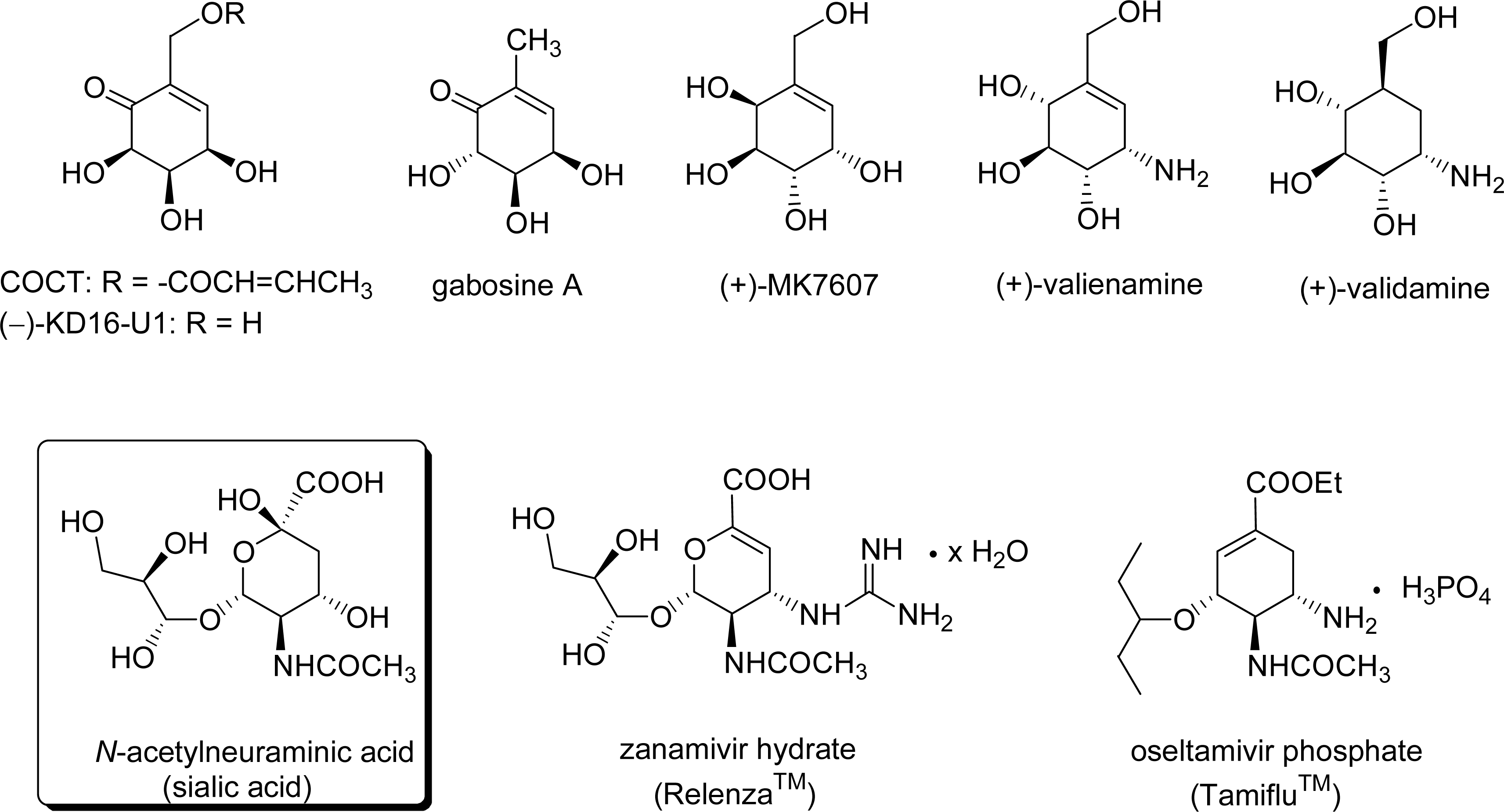
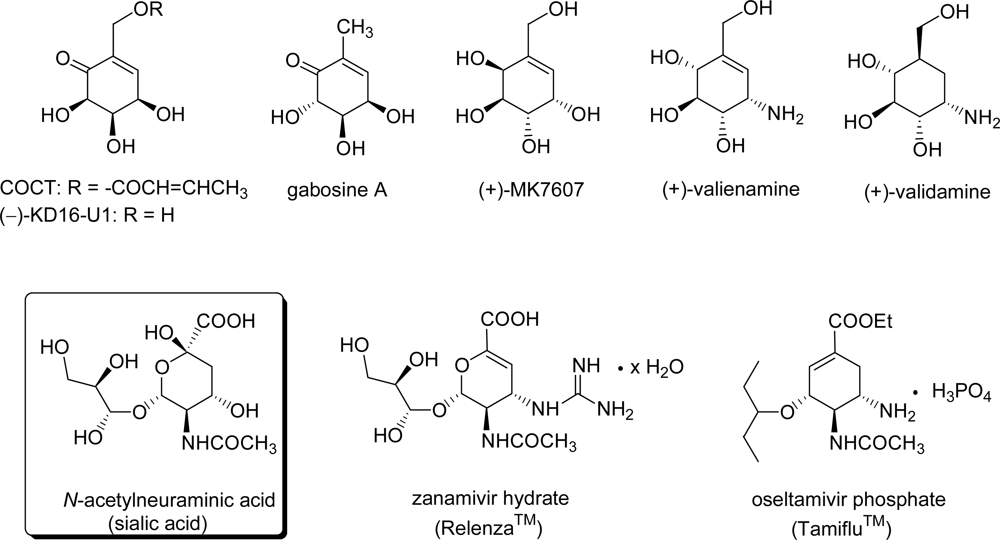
<p><xref ref-type="fig" rid="f1-ijms-09-00401">Figure 1</xref> illustrates the structures of representative carbasugars as synthetic targets, including 2-crotonyloxy-(4R,5R,6R)-4,5,6-trihydroxy-cyclohex-2-enone (COCT) [<xref ref-type="bibr" rid="b4-ijms-09-00401">4</xref>–<xref ref-type="bibr" rid="b15-ijms-09-00401">15</xref>], [(−)-KD16-U1 [gabosine A [<xref ref-type="bibr" rid="b16-ijms-09-00401">16</xref>–<xref ref-type="bibr" rid="b21-ijms-09-00401">21</xref>], (+)-MK7607 [<xref ref-type="bibr" rid="b22-ijms-09-00401">22</xref>, <xref ref-type="bibr" rid="b23-ijms-09-00401">23</xref>], (+)-valienamine [<xref ref-type="bibr" rid="b24-ijms-09-00401">24</xref>–<xref ref-type="bibr" rid="b29-ijms-09-00401">29</xref>], (+)-validamine [<xref ref-type="bibr" rid="b29-ijms-09-00401">29</xref>–<xref ref-type="bibr" rid="b31-ijms-09-00401">31</xref>], Relenza® [<xref ref-type="bibr" rid="b32-ijms-09-00401">32</xref>], and Tamiflu® [<xref ref-type="bibr" rid="b33-ijms-09-00401">33</xref>–<xref ref-type="bibr" rid="b40-ijms-09-00401">40</xref>], COCT [<xref ref-type="bibr" rid="b41-ijms-09-00401">41</xref>], (−)-KD16-U1 [<xref ref-type="bibr" rid="b42-ijms-09-00401">42</xref>], and gabosines [<xref ref-type="bibr" rid="b43-ijms-09-00401">43</xref>], which were isolated from cultures of <italic>Streptomyces spp</italic>., are potential glyoxalase inhibitors and therefore show promise as anticancer agents. (+)-MK7607, which was isolated from cultures of <italic>Curvularia eragrostidis</italic> D2452, showed herbicidal activity [<xref ref-type="bibr" rid="b44-ijms-09-00401">44</xref>]. (+)-Valienamine and (+)-validamine were obtained from the degradation of antifungal antibiotic validamycin A by <italic>Pseudomonas denitrificans</italic> [<xref ref-type="bibr" rid="b45-ijms-09-00401">45</xref>–<xref ref-type="bibr" rid="b47-ijms-09-00401">47</xref>]. Valienamine is also a component of ascarbose, a potent α-glucosidase inhibitor [<xref ref-type="bibr" rid="b48-ijms-09-00401">48</xref>].</p>
<p>Relenza and Tamiflu are the most popular anti-influenza drugs today and are therefore attractive target molecules for synthetic studies. Relenza is a potent anti-influenza drug designed from the transition structure of <italic>N</italic>-acetylneuramic acid-neuramidase complex based on X-ray analysis [<xref ref-type="bibr" rid="b32-ijms-09-00401">32</xref>]. The oral anti-influenza drug Tamiflu has received immense attention for its effect on avian flu. To this day, however, the synthesis of Tamiflu remains an enigma for synthetic organic chemists. The independent asymmetric total synthesis of Tamiflu by Corey [<xref ref-type="bibr" rid="b35-ijms-09-00401">35</xref>] and Shibasaki [<xref ref-type="bibr" rid="b36-ijms-09-00401">36</xref>, <xref ref-type="bibr" rid="b37-ijms-09-00401">37</xref>] from non-natural starting material, which was published in JACS, was a hot topic in 2006. In 2007, Fukuyama and co-workers reported the practical synthesis of Tamiflu [<xref ref-type="bibr" rid="b38-ijms-09-00401">38</xref>].</p>
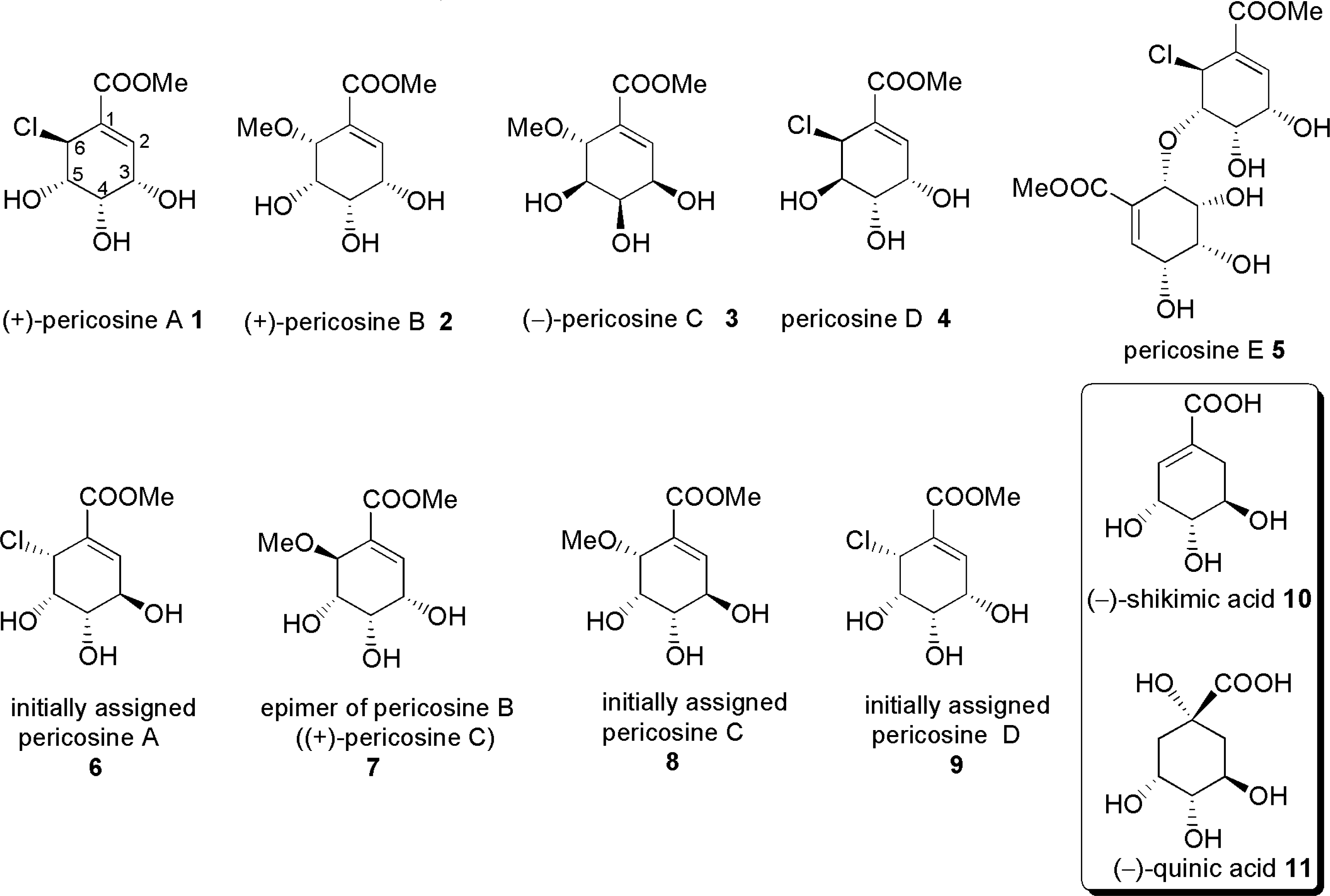
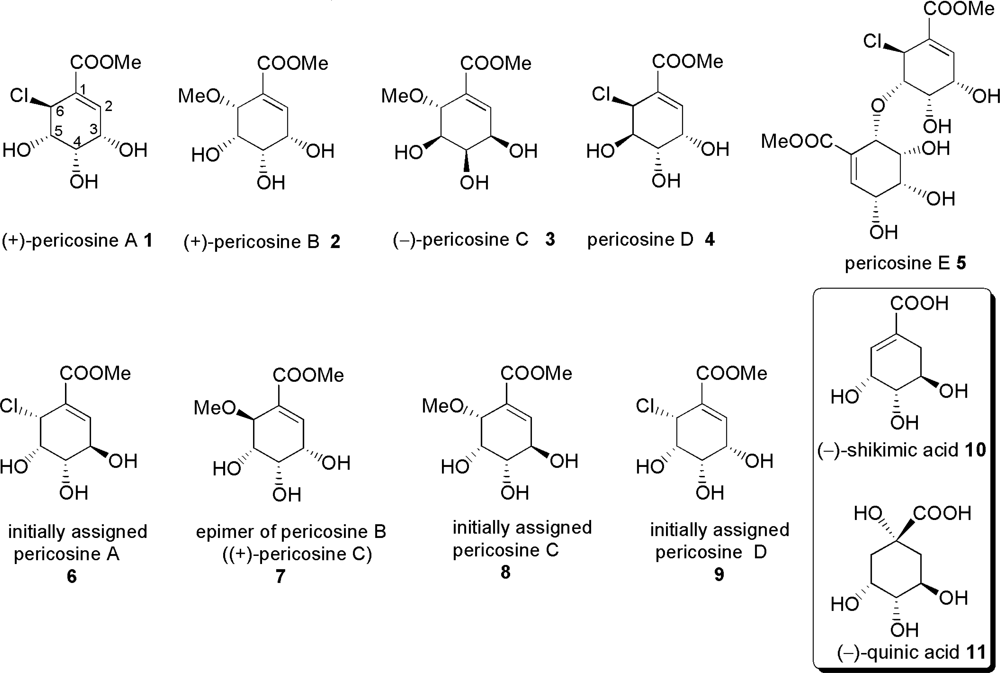
<p>In the past several decades, scientists working on new drug discovery have extended their research field to include the ocean because of its vast biological/chemical diversity and the fact that it composes almost 70% of Earth’s surface. Marine natural products chemistry has produced a number of promising candidates for anticancer drugs and several of them have undergone pre- or phases I-III clinical trials [<xref ref-type="bibr" rid="b49-ijms-09-00401">49</xref>, <xref ref-type="bibr" rid="b50-ijms-09-00401">50</xref>]. Recently, however, a new tide has emerged, which involves the study of metabolites of microorganisms from marine sources [<xref ref-type="bibr" rid="b51-ijms-09-00401">51</xref>–<xref ref-type="bibr" rid="b53-ijms-09-00401">53</xref>]. It must be emphasized that researchers involved in this endeavor have been attempting preservation of environmental habitat in the ocean. In 1997, Numata and co-workers isolated unique C<sub>7</sub> cyclohexenoid-type metabolites from <italic>Periconia byssoides</italic> OUPS-N133 fungus that was originally isolated from the sea hare, <italic>Aplysia kurodai</italic>, and designated them as pericosines A <bold>1</bold> and B <bold>2</bold> (<xref ref-type="fig" rid="f2-ijms-09-00401">Figure 2</xref>), together with some macrospherides [<xref ref-type="bibr" rid="b54-ijms-09-00401">54</xref>]. Full details of the isolation of pericosines A-E <bold>1–5</bold> were very recently reported by Numata and co-workers [<xref ref-type="bibr" rid="b55-ijms-09-00401">55</xref>]. Pericosines showed significant <italic>in vitro</italic> cytotoxicity against P388 lymphocytic leukemia cells. Particularly, <bold>1</bold> was reported to have inhibitory activity against protein kinase and topoisomerase II in addition to significant <italic>in vivo</italic> antitumor activity against P388 cells. Thus, pericosines are thought to be promising candidates for seed compounds of anticancer drugs. However, total syntheses were required to confirm the stereo structures of most pericosines because the multi-functionalized cyclohexenoid structures with severe torsional strain have made structure determination by spectral analyses difficult. In this review, synthetic efforts to produce pericosines and analogues <bold>1</bold>, <bold>2</bold>, <bold>4–7</bold>, and <bold>9</bold> from (−)-shikimic acid <bold>10</bold> or (−)-quinic acid <bold>11</bold> are surveyed comprehensively, together with the discovery of natural compounds.</p></sec>
<sec>
<title>2. Isolation of Pericosines from <italic>Periconia byssoides</italic> [<xref ref-type="bibr" rid="b54-ijms-09-00401">54</xref>, <xref ref-type="bibr" rid="b55-ijms-09-00401">55</xref>]</title>
<p>Numata and co-workers reported the isolation of C<sub>7</sub> cyclohexenoids designated as pericosines A-E <bold>1–5</bold> in 1997 and 2007, as summarized below. The fungal strain <italic>P. byssoides</italic> OUPS-N133 was isolated from a culture of <italic>A. kurodai</italic> by bioactivity-guided cytotoxicity assay using P388 cells. The fungal strain was cultured in artificial seawater medium containing 1% malt extract, 1% glucose, and 0.05% peptone adjusted to pH 7.5 at 27°C. After 4 weeks, mycelia obtained by filtration of the broth were extracted with AcOEt. The AcOEt extract was separated by gel filtration through Sephadex LH-20 using MeOH-CH<sub>2</sub>Cl<sub>2</sub> (1:1), followed by silica gel column chromatography with CH<sub>2</sub>Cl<sub>2</sub>-MeOH gradient solvent system. This separation was performed along with <italic>in vitro</italic> P388 cytotoxicity assay. The active fraction that was eluted with 10% MeOH-CH<sub>2</sub>Cl<sub>2</sub> was further urified by reverse phase preparative HPLC using the MeOH-H<sub>2</sub>O solvent system to afford <bold>1–5</bold>. Spectroscopic analyses including NMR, MS, and IR led to the elucidation of their structures. Early studies, however, indicated the structure of pericosine A as <bold>6</bold>, that of pericosine C as <bold>8</bold>, and that of pericosine D as <bold>9</bold> [<xref ref-type="bibr" rid="b56-ijms-09-00401">56</xref>, <xref ref-type="bibr" rid="b57-ijms-09-00401">57</xref>]. It is difficult to determine the relative configuration of such compounds as pericosines because they possess a multi-functionalized cyclohexenoid core with torsional strain. In their most recent report, the authors stated that they elucidated the structures of pericosines, except for pericosine A, by spectroscopic analyses. They determined the relative chemistry of pericosine B <bold>2</bold> on the basis of NOE between H-3 and H-5 observed in its acetonide <bold>2a</bold> and small coupling constants <italic>J</italic><sub>3–4</sub> = 5.7 Hz, <italic>J</italic><sub>4–5</sub> = 3.1 Hz, and <italic>J</italic><sub>5–6</sub> = 4.1 Hz. Long-range coupling between H-4/H-6, H-2/H-6, and H6/H-2 observed in <bold>2a</bold> also supported their proposed configuration. Similar NOE between H-3 and H-5 and long-range coupling between H-2/H-6 and H-4/H-6 were observed in the spectra of <bold>2</bold>, suggesting similar configuration. Pericosine C <bold>3</bold>, which has the same planar structure as pericosine B <bold>2</bold>, was transformed into acetonides <bold>3a</bold> and <bold>3b</bold>. Spectral analysis indicated that the 3,4,5-trihydroxyl groups on the cyclohexene ring had <italic>cis, cis</italic> configuration, and the stereochemistry at C-6 was determined to be different from that of <bold>2</bold>. Finally, its identity was confirmed by comparing with synthesized compound <bold>7</bold>. Interestingly, pericosine C exists as an enantiomeric mixture of <bold>3</bold> and <bold>7</bold>, based on comparison of specific rotation values between natural pericosine C ([α]<sub>D</sub><sup>25</sup>−4.8) and synthetic <bold>7</bold> ([α]<sub>D</sub><sup>25</sup>+35.1). The relative chemistry of pericosine D <bold>4</bold> was determined on the basis of NOE between one acetonide-methyl/H-3, H-4 and another acetonide-methyl/H-5 observed in the NOESY spectrum of its 3,4-acetonide. The relative chemistry of pericosine E <bold>5</bold> was confirmed by X-ray analysis. Pericosine E <bold>5</bold> also exists as an enantiomeric mixture.</p>
<p>Pericosines are responsible for the cytotoxicity of the extract of <italic>P. byssoides</italic>. The ED<sub>50</sub> values of pericosines are presented in <xref ref-type="table" rid="t1-ijms-09-00401">Table 1</xref>. Compounds <bold>1</bold>, <bold>2</bold>, and <bold>4</bold> exhibited significant <italic>in vitro</italic> cytotoxicity against P388 cells. Most potent <bold>1</bold> also showed <italic>in vivo</italic> antitumor activity against P388 cells. Furthermore, <bold>1</bold> inhibited protein kinase EGFR and human topoisomerase II and showed selective growth inhibition against human cancer cell lines HBC-5 and SNB-75. Thus, pericosines were proved to be promising candidates for seed compounds of cancer preventive drugs.</p></sec>
<sec>
<title>3. Synthetic Efforts for Pericosines</title>
<p>As described above, the syntheses of pericosines are required not only to determine absolute configuration but also to confirm relative stereochemistry. The following are synthetic efforts by several groups carried out so far.</p>
<sec>
<title>3.1. Total synthesis of pericosine B [<xref ref-type="bibr" rid="b58-ijms-09-00401">58</xref>]</title>
<sec>
<title>3.1.1. Donohoe’s approach</title>
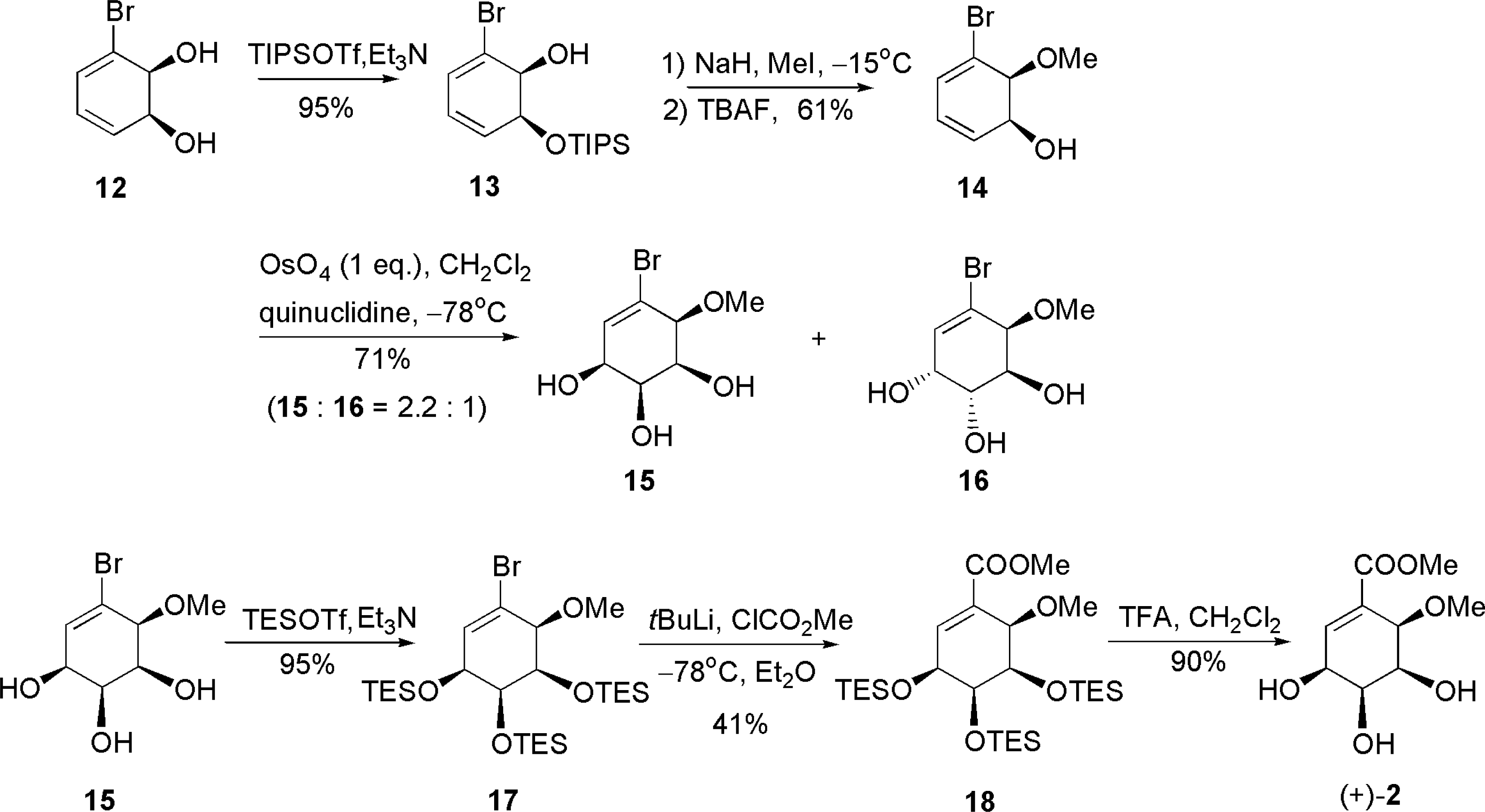
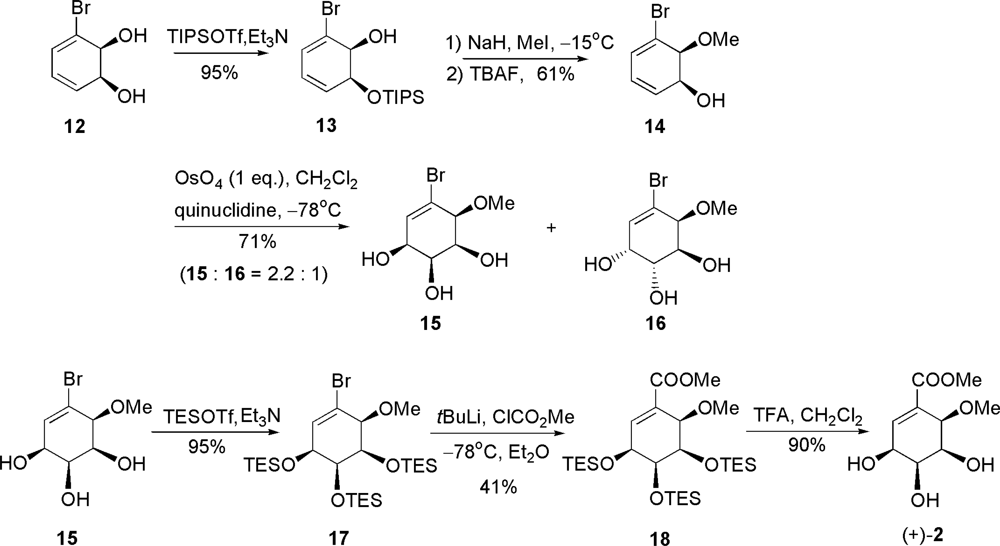
<p>Donohoe and co-workers were the first to report the total synthesis of pericosine B (+)-<bold>2</bold> in 1998. This is the only successful synthesis to date and has been achieved by using their original hydrogen-bond-directed dihydroxylation with osmium tetroxide to give <italic>cis, cis</italic>-triol. The synthesis is summarized in <xref ref-type="fig" rid="f5-ijms-09-00401">Scheme 1</xref>.</p>
<p>Commercially available (+)-dihydroxybromocyclohexadiene <bold>12</bold> was selectively protected to give silyl ether <bold>13</bold>, which was then <italic>O</italic>-methylated with NaH and MeI and deprotected with TBAF to give alcohol <bold>14</bold>. The subsequent hydrogen-bond-directed dihydroxylation of <bold>14</bold>, which was the key step of this total synthesis, was carried out with stoichiometric osmium tetroxide and one equivalent of quinuclidine to give syn, syn- and syn, anti-triols, <bold>15</bold> and <bold>16</bold>, in 2.2: 1 ratio. Separated <bold>15</bold> was protected with triethylsilyl (TES) groups to give <bold>17</bold>, and <bold>17</bold> was methoxycarbonylated to yield <bold>18</bold>. The synthesis was terminated by the addition of TFA to afford <bold>2</bold>, which had the same spectroscopic data including specific rotation as those of the natural product, leading to the conclusion that the absolute stereochemistry is methyl (3<italic>S</italic>,4<italic>S</italic>,5<italic>S</italic>,6<italic>R</italic>)-3,4,5-trihydroxy-6-methoxycyclohexene-1-carboxylate. The problems of this synthesis included poor stereoselectivity in the crucial step and use of a stoichiometric amount of highly toxic osmium tetroxide.</p></sec>
<sec>
<title>3.1.2. Okamura’s approach [<xref ref-type="bibr" rid="b59-ijms-09-00401">59</xref>]</title>
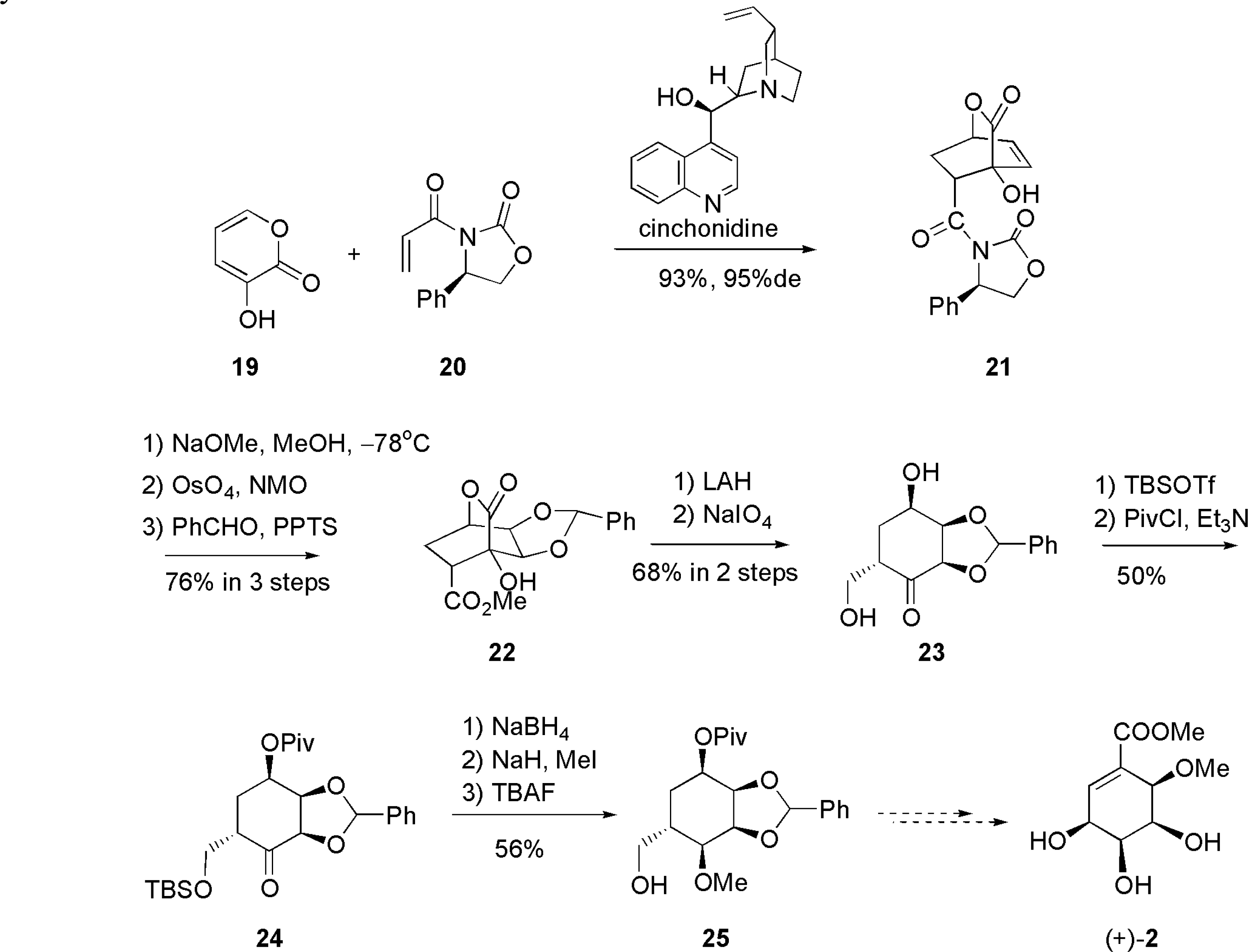
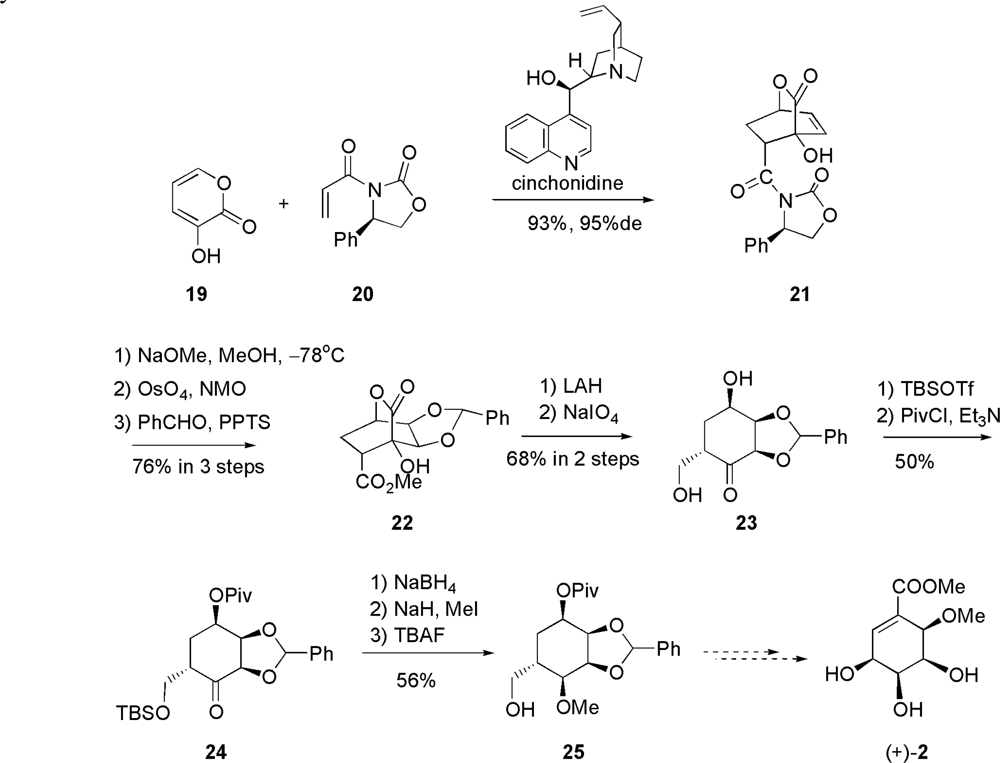
<p>Okamura and co-workers attempted the total synthesis of pericosine B also in 1998. The key reaction of their synthesis was the asymmetric Diels-Alder reaction of 3-hydroxy-2-pyrone <bold>19</bold> with a basic catalyst. Their synthetic approach is illustrated in <xref ref-type="fig" rid="f6-ijms-09-00401">Scheme 2</xref>.</p>
<p>The enantioselective Diels-Alder reaction between 3-hydroxy-2-pyrone <bold>19</bold> and acrylate with chiral auxiliary <bold>20</bold> was carried out in the presence of cinchonidine as basic catalyst to give endo-adduct <bold>21</bold> in 93% yield with 95% de. Adduct <bold>21</bold> was then treated with NaOMe to remove chiral auxiliary and the resultant methyl ester was dihydroxylated with catalytic osmium tetorxide and NMO to afford exo-diol, which was protected as benzylidene acetal <bold>22</bold>. Reduction with LiAlH<sub>4</sub> followed by treatment with NaIO4 gave diol <bold>23</bold>, which was successively protected with a primary hydroxyl group such as TBS-ether followed by a secondary hydroxyl group such as pivaloyl ether to give ketone <bold>24</bold>. Stereoselective reduction with NaBH<sub>4</sub> afforded β-hydroxyalcohol, which was then <italic>O</italic>-methylated and deprotected with TBAF to give hydroxymethylether <bold>25</bold>. Unfortunately, the completion of this synthesis from the intermediate has not been reported so far.</p></sec>
<sec>
<title>3.1.3. Usami’s approach [<xref ref-type="bibr" rid="b60-ijms-09-00401">60</xref>]</title>
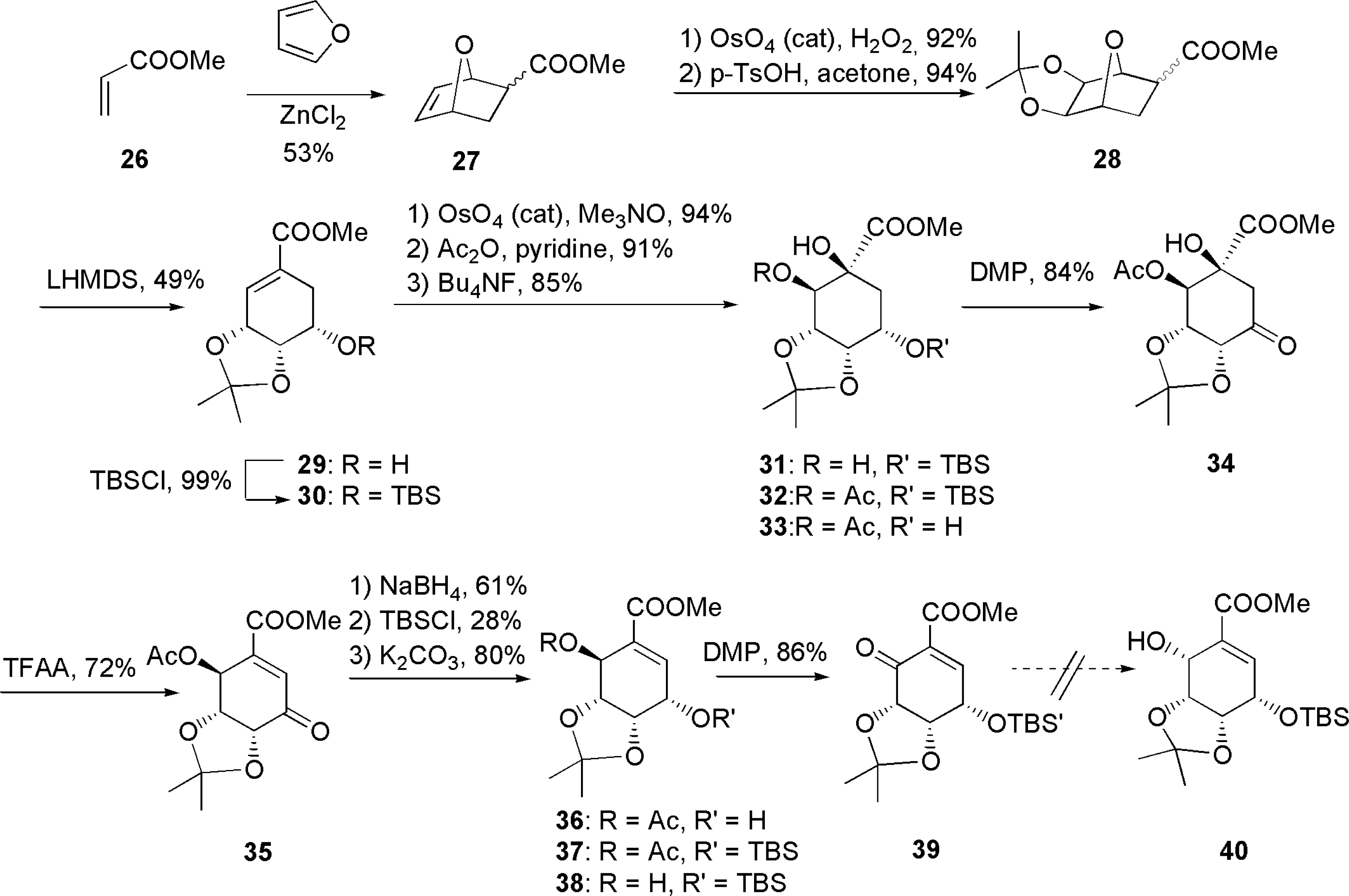
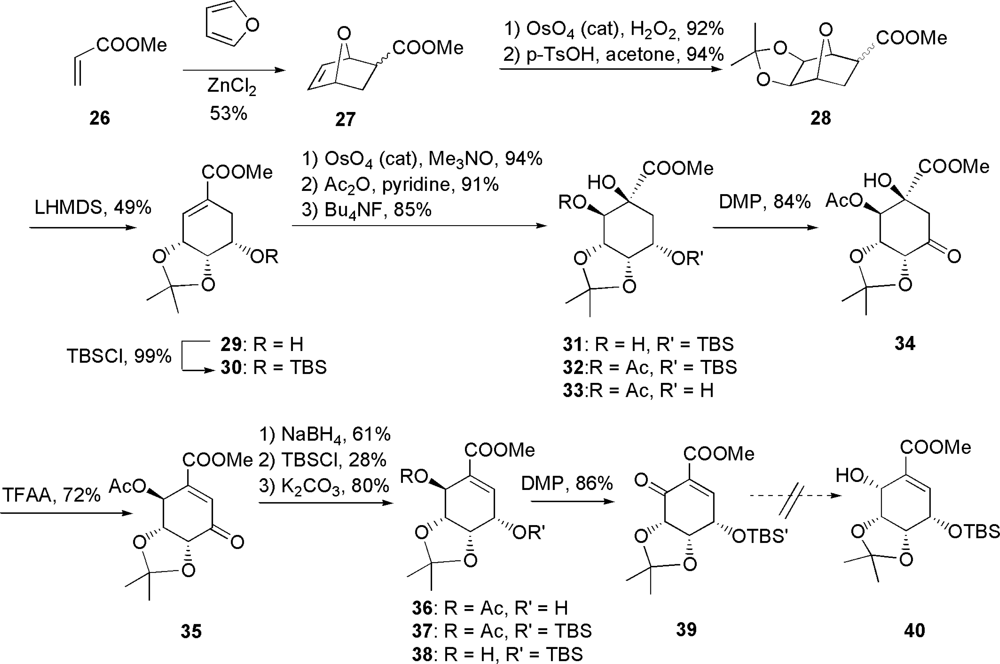
<p>An approach taken by our group toward pericosine B is shown in <xref ref-type="fig" rid="f7-ijms-09-00401">Scheme 3</xref>. Racemic Diels-Alder adduct <bold>27</bold>, which was formed by reacting methyl acrylate <bold>26</bold> with furan in the presence of ZnCl<sub>2</sub> as Lewis acid catalyst, was dihydroxylated with H<sub>2</sub>O<sub>2</sub> and catalytic osmium tetroxide with excellent <italic>exo</italic>-face selectivity. Acetonides <bold>28</bold> derived from the mixture of diastereoisomers <bold>27</bold> were treated with LHMDS in THF at −78°C to give methyl 5-epishikimate derivative <bold>29</bold> as a single product, whose hydroxyl group at C-5 was protected as silyl ether <bold>30</bold>. Compound <bold>30</bold> was dihydroxylated with osumium tetroxide to give sole product <bold>31</bold> with the desired stereochemistry. After many examinations of regioselective <italic>O</italic>-methylation and <italic>O</italic>-acylation of <bold>31</bold>, it was protected at C-2 by acetylation to give <bold>32</bold>, then deprotected with 5-TBS ether to give alcohol <bold>33</bold>, which in turn was oxidized with Dess-Martin periodinane to give β-hydroxyketone <bold>34</bold>. α,β-Unsaturated ketone <bold>35</bold> obtained by adding TFAA to <bold>34</bold> was reduced with NaBH<sub>4</sub> to give alcohol <bold>36</bold> with the desired stereochemistry of <bold>37</bold>, followed by protection and deprotection. Alcohol <bold>38</bold> was oxidized with Dess-Martin periodinane to give unstable α,β-unsaturated enone <bold>39</bold>, which could not be purified by silica gel chromatography. Crude <bold>39</bold> was reduced to generate hydroxyl group with the desired stereochemistry. However, not our objective reaction but an unexpected reaction occurred to yield <bold>40</bold>. This work was published in 2004.</p></sec>
<sec>
<title>3.1.4. Garcia Ruano’s approach [<xref ref-type="bibr" rid="b61-ijms-09-00401">61</xref>]</title>
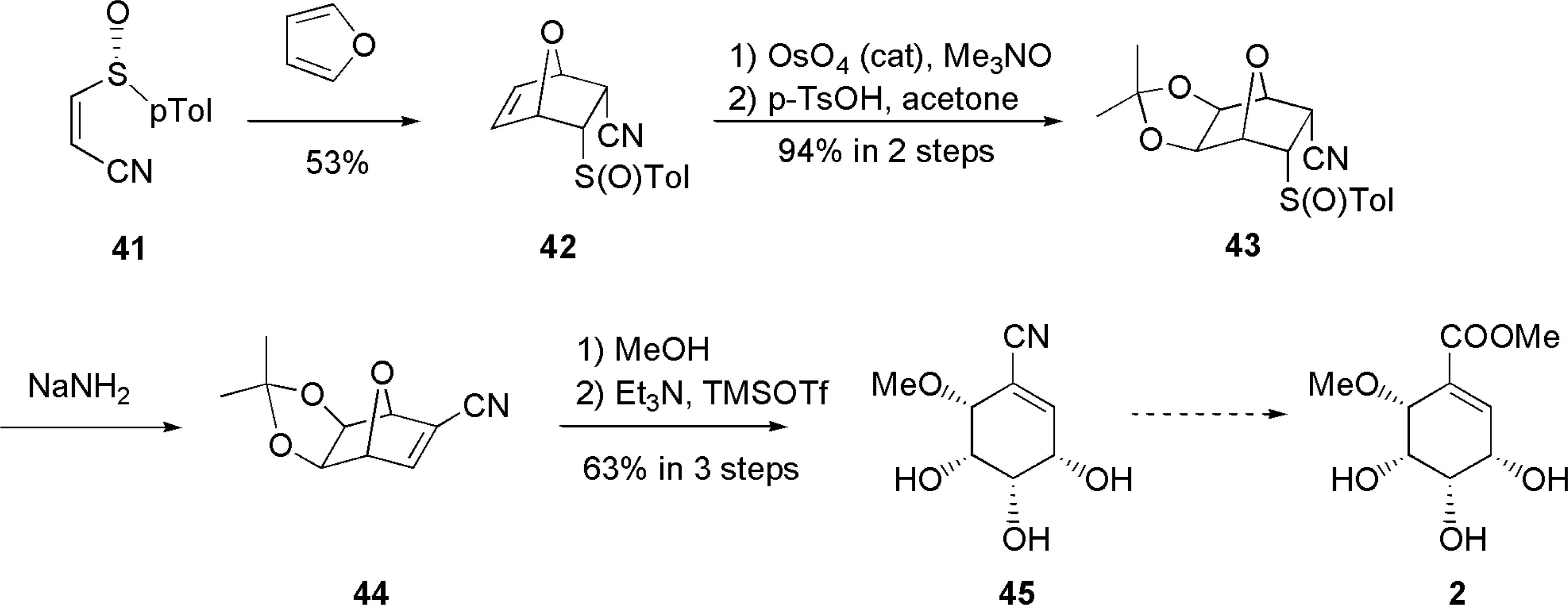
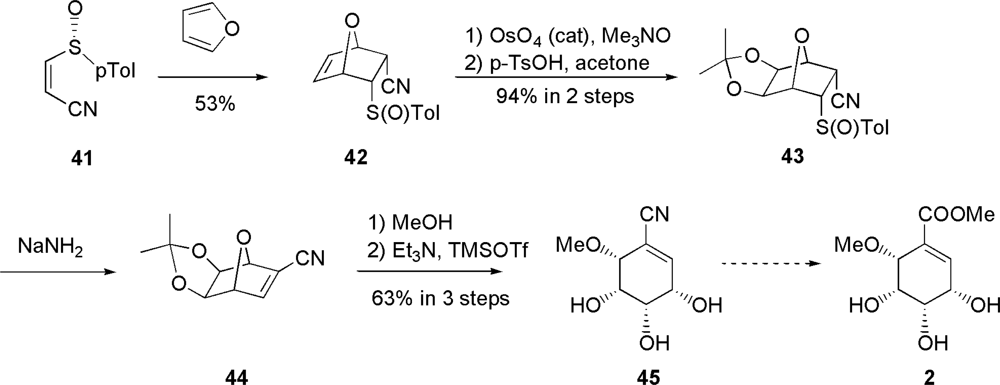
<p>Garcia Ruano and co-workers reported their attempt to synthesize pericosine B in 2005. As shown in <xref ref-type="fig" rid="f8-ijms-09-00401">Scheme 4</xref>, asymmetric Diels-Alder cycloaddition reaction between chiral 3-sulfinylacrylonitrile <bold>41</bold> and furan with Me<sub>2</sub>AlCl as Lewis acid catalyst gave <italic>endo</italic> adduct <bold>42</bold> in 53% yield together with <italic>exo</italic> adduct in 10% yield [<xref ref-type="bibr" rid="b62-ijms-09-00401">62</xref>]. The double bond in <bold>42</bold> was dihydroxylated <italic>exo</italic>-face selectively. The newly generated two hydroxyl groups were protected as acetonide <bold>43</bold>, and this was converted into α,β-unsaturated nitrile <bold>44</bold> by basic treatment with NaNH<sub>2</sub>. Treatment with MeOH, followed by triethylamine and TMSOTf, afforded ring-opened nitrile <bold>45</bold>, which seemed to be the last intermediate in the synthesis of <bold>2</bold>. However, the subsequent transformation of cyano group into methoxycarbonyl group by methanolysis has not been reported so far.</p></sec></sec>
<sec>
<title>3.2. Total synthesis of epimer of pericosine B: Synthesis of pericosine C [<xref ref-type="bibr" rid="b63-ijms-09-00401">63</xref>]</title>
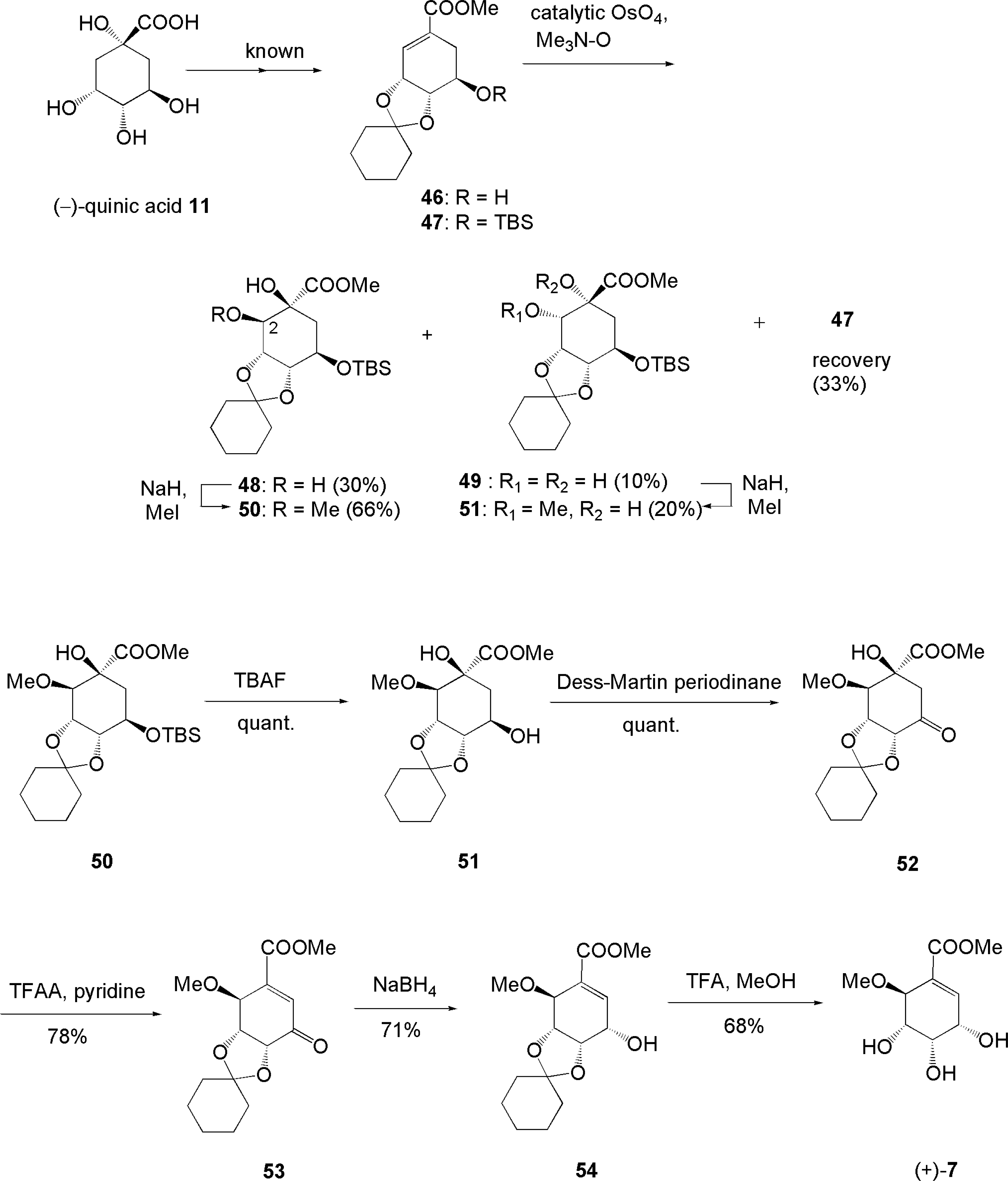
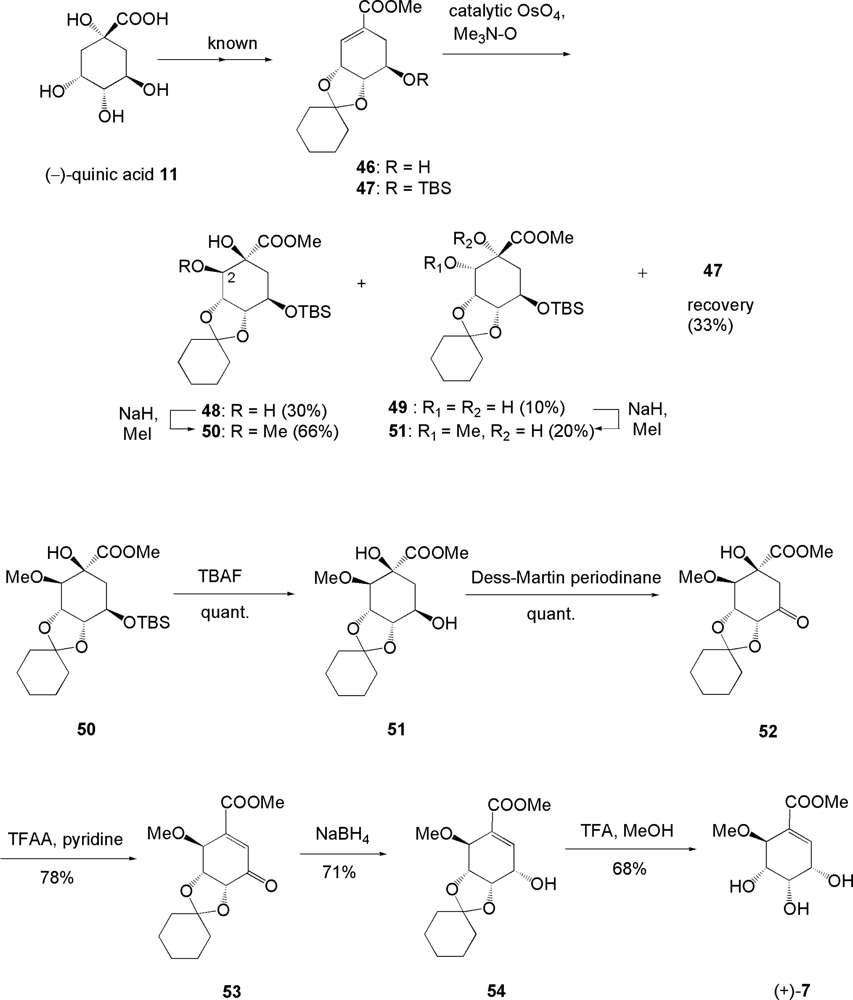
<p>As described above, our synthesis of pericosine B could not be completed. Thus, we attempted to synthesize the epimer of pericosine B <bold>7</bold>, as summarized in <xref ref-type="fig" rid="f9-ijms-09-00401">Scheme 5</xref>. Known methyl shikimate derivative <bold>46</bold> from (−)-quinic acid <bold>11</bold> was converted into TBS ether <bold>47</bold>, which was reacted with catalytic osmium tetroxide and one equivalent of trimethylamine-<italic>N</italic>-oxide under reflux with tBuOH-pyridine-H<sub>2</sub>O (20:5:1) to give a mixture of diols 48 and <bold>49</bold> in 3:1 ratio in 40% yield with recovery of <bold>47</bold> (33%). Major diol <bold>48</bold> was selectively <italic>O</italic>-methylated at C-6 to give <bold>50</bold> in 66% yield as a single product, whereas minor diol <bold>49</bold> was singly 6-<italic>O</italic>-methylated to give <bold>51</bold> in 16% yield with 20% of 1,6-bis-<italic>O</italic>-methylated product. 6-<italic>O</italic>-Methyl ether <bold>51</bold> was further examined for its potential use in the synthesis of pericosine B <bold>2</bold>, but all attempts were unsuccessful. Deprotection of methyl ether <bold>50</bold> with TBAF produced alcohol <bold>51</bold>, and oxidation of <bold>51</bold> with Dess-Martin periodinane gave ketone <bold>52</bold>, which in turn was dehydrated with TFAA to yield unsaturated ketone <bold>53</bold>. Enone <bold>53</bold> was reduced with NaBH<sub>4</sub> in excellent stereoselectivity to give alcohol <bold>54</bold>, and this was then converted into target molecule (+)-<bold>7</bold>. When tested for <italic>in vitro</italic> for cytotoxicity against P388 cells, obtained (+)-<bold>7</bold> gave an ED<sub>50</sub> value of 17.8 μg/mL, which indicated lower activity than natural pericosine B (ED<sub>50</sub>: 4 μg/mL). Thus, we concluded that the stereochemistry of C-6 had a significant influence on cytotoxicity. When this work was published in 2004, synthesized (+)-<bold>7</bold> was a non-natural product. However, it was elucidated later that (+)-<bold>7</bold> had the same relative chemistry as natural pericosine A <bold>1</bold> and was a component of natural pericosine C, which is an enantiomeric mixture of <bold>3</bold> and <bold>7</bold> [<xref ref-type="bibr" rid="b55-ijms-09-00401">55</xref>].</p></sec>
<sec>
<title>3.3. Total synthesis of initially assigned pericosines A and D [<xref ref-type="bibr" rid="b64-ijms-09-00401">64</xref>, <xref ref-type="bibr" rid="b65-ijms-09-00401">65</xref>]</title>
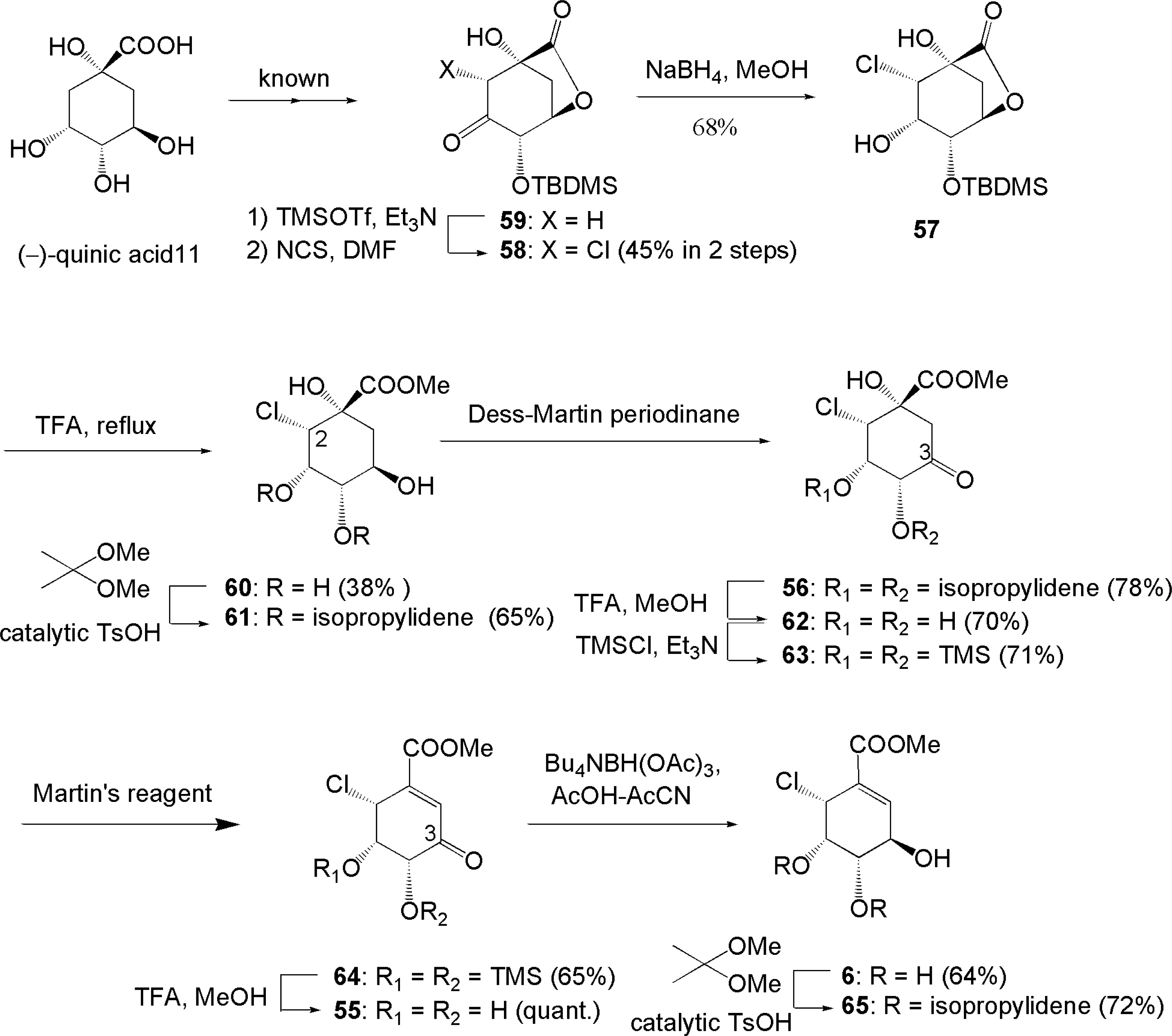
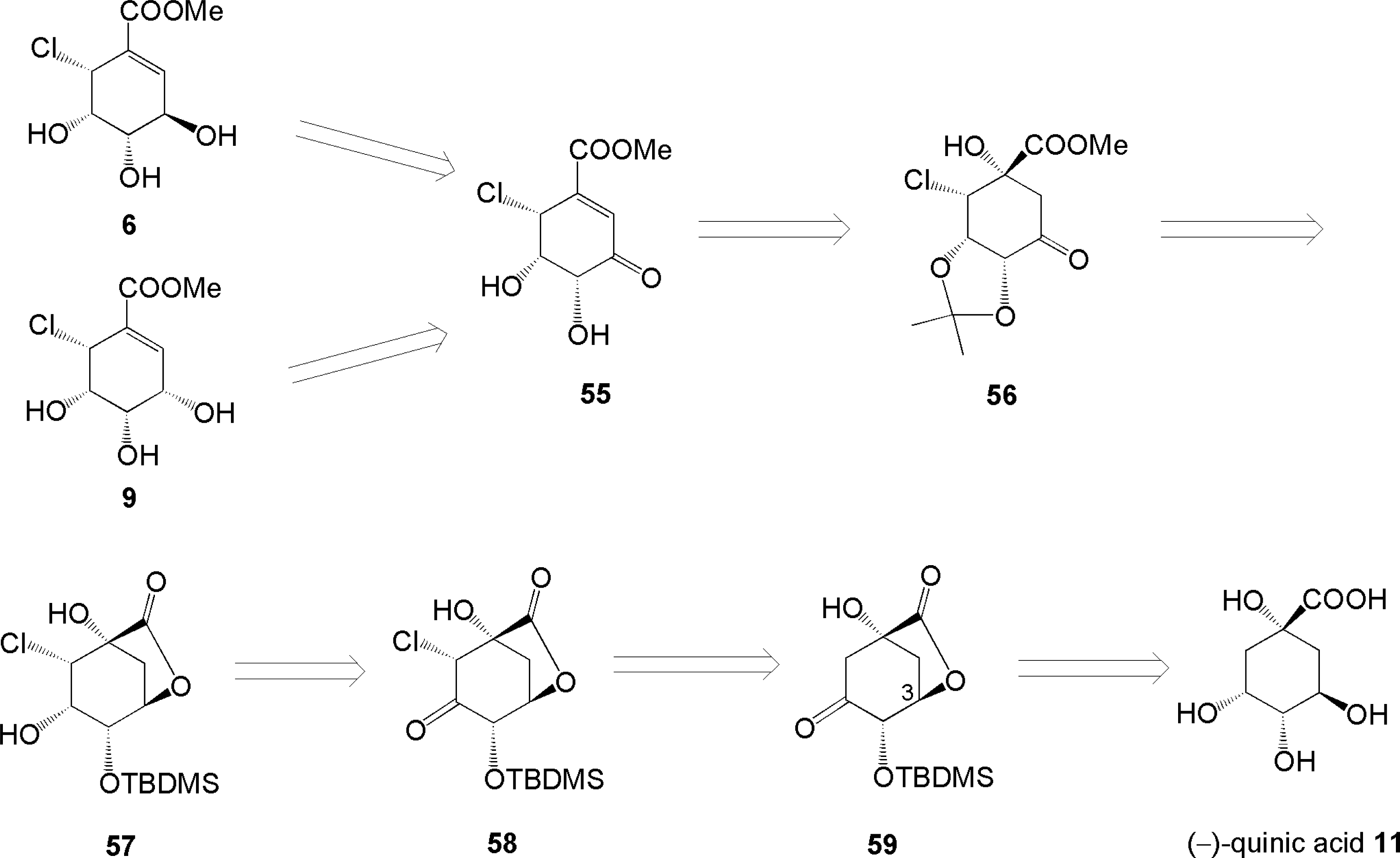
<p>After the publication of the total synthesis of pericosine B <bold>2</bold> by Donohoe, there had been no reports of pericosine A in spite of its antitumor activity. Then, the total synthesis of initially assigned pericosines A <bold>6</bold> and D <bold>9</bold> was attempted by our group because those two target compounds seemed to be synthesized <italic>via</italic> common intermediate enone <bold>55</bold> derived from (−)-quinic acid <bold>11</bold>. Our retro-synthetic strategy is shown in <xref ref-type="fig" rid="f10-ijms-09-00401">Scheme 6</xref>. Key reactions of this synthesis included α-face selective chlorination of silylenolether derived from known ketone <bold>59</bold> [<xref ref-type="bibr" rid="b66-ijms-09-00401">66</xref>, <xref ref-type="bibr" rid="b67-ijms-09-00401">67</xref>] and reagent-dependent stereoselective reduction of <bold>55</bold>.</p>
<p>The synthesis of <bold>6</bold> was carried out as illustrated in <xref ref-type="fig" rid="f11-ijms-09-00401">Scheme 7</xref>. Lactone <bold>59</bold> derived from (−)-quinic acid <bold>11</bold> according to literature [<xref ref-type="bibr" rid="b66-ijms-09-00401">66</xref>, <xref ref-type="bibr" rid="b67-ijms-09-00401">67</xref>] was chlorinated with NCS with excellent face selectivity to give α-chloroketone <bold>58</bold> <italic>via</italic> silylenolether in 45% yield in 2 steps. The following reduction of <bold>58</bold> with NaBH<sub>4</sub> gave alcohol <bold>57</bold> as the sole product. The chemical yield of <bold>57</bold> was improved by sequential reactions from 45% in 2 steps to an overall yield of 57% in 3 steps from ketone <bold>59</bold>. Treatment of <bold>57</bold> with TFA in MeOH under reflux afforded tetraol <bold>60</bold> in 38% yield. Then, <bold>60</bold> was converted into acetonide <bold>61</bold>, which was oxidized with Dess-Martin periodinane to give hydroxyketone <bold>56</bold>. The isopropylidene moiety of <bold>56</bold> was removed with TFA because <bold>56</bold> could not be dehydrated by any dehydrating agents. One plausible explanation was that <bold>56</bold>, conformationally fixed by an isopropylidene bridge, could not be transformed into a suitable transition state for dehydration. Resultant triol <bold>62</bold> was converted into reactive hydroxyketone <bold>63</bold> that was in turn dehydrated to enone <bold>64</bold> with Martin’s sulfrane dehydrating agent (bis[α,α-bis(trifluoromethyl) benzyloxy] diphenyl sulfur) [<xref ref-type="bibr" rid="b68-ijms-09-00401">68</xref>] in 65% yield.</p>
<p>Treatment of enone <bold>64</bold> with TFA in MeOH gave <bold>55</bold>, which was reduced stereoselectively with tetrabutylammonium triacetoxyborohydride [<xref ref-type="bibr" rid="b69-ijms-09-00401">69</xref>] to afford <bold>6</bold> with the desired configuration as a single product. However, disagreement of the NMR data of <bold>6</bold> and acetonide <bold>65</bold> with those of natural pericosine A and those of its acetonide described in the literature [<xref ref-type="bibr" rid="b54-ijms-09-00401">54</xref>] led us to conclude that the proposed stereochemistry of pericosine A was incorrect. Furthermore, the fact that “the isopropylidene bridge in <bold>65</bold> derived from <bold>6</bold> was located between C-4 and C-5, whereas that of the acetonide of pericosine A was between C-3 and C-4” [<xref ref-type="bibr" rid="b54-ijms-09-00401">54</xref>] supported our conclusion.</p>
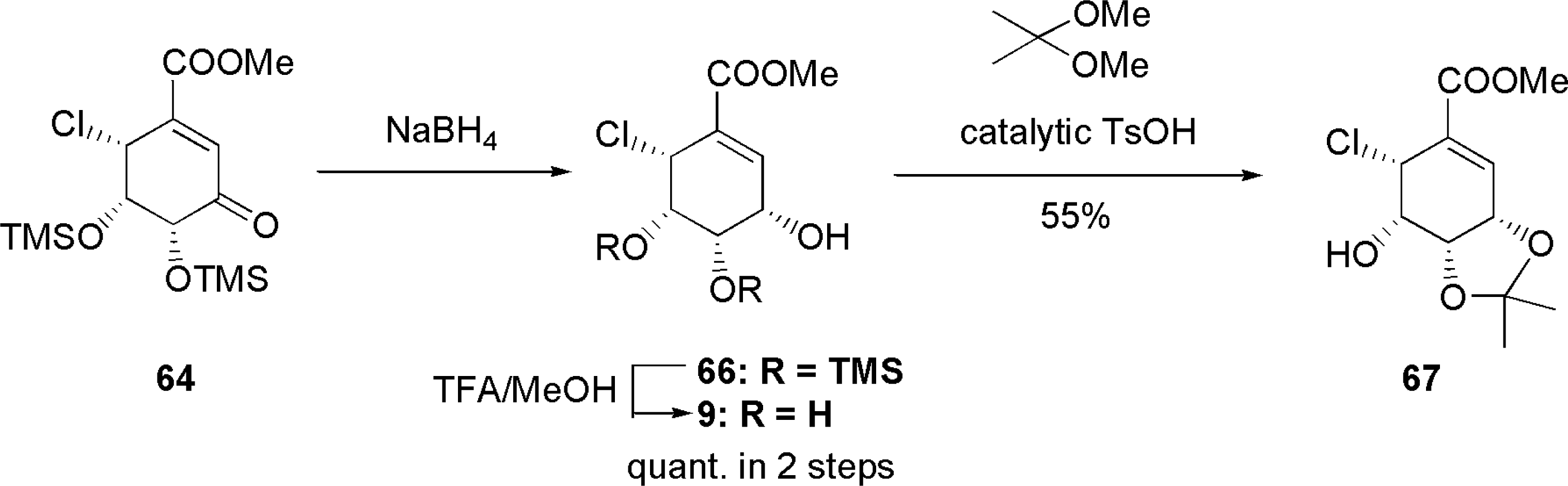
<p>Common intermediate <bold>64</bold> was reduced with NaBH<sub>4</sub> to afford allyl alcohol <bold>66</bold> as a single product with opposite stereoselectivity. Then, <bold>66</bold> was deprotected to afford <bold>9</bold> quantitatively in 2 steps, as shown in <xref ref-type="fig" rid="f12-ijms-09-00401">Scheme 8</xref>. However, <bold>9</bold> was different from pericosine D. Then, product <bold>9</bold> was transformed into acetonide <bold>67</bold> to confirm the stereochemistry of the synthesized molecule.</p>
<p>The stereochemistry of all intermediates in this study was carefully determined by analyzing various kinds of 2D NMR spectra.</p></sec>
<sec>
<title>3.4. Total synthesis for structure revision and determination of absolute configuration of pericosine A [<xref ref-type="bibr" rid="b70-ijms-09-00401">70</xref>, <xref ref-type="bibr" rid="b71-ijms-09-00401">71</xref>]</title>
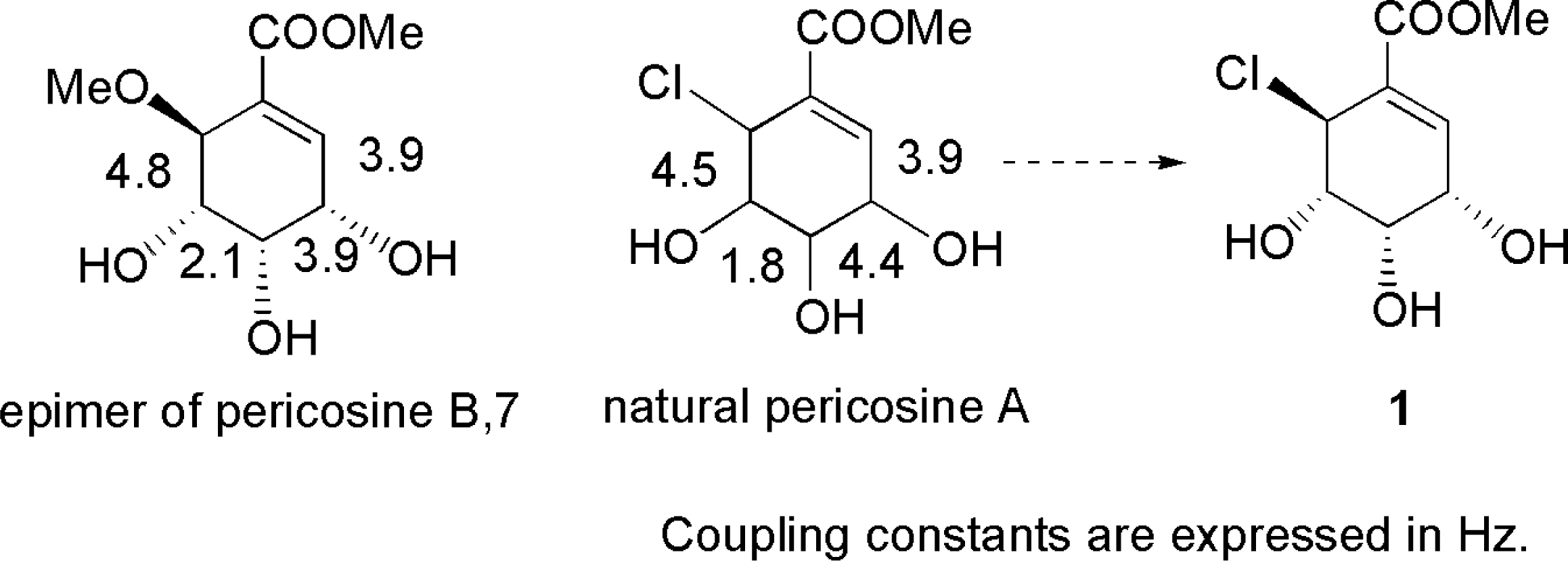
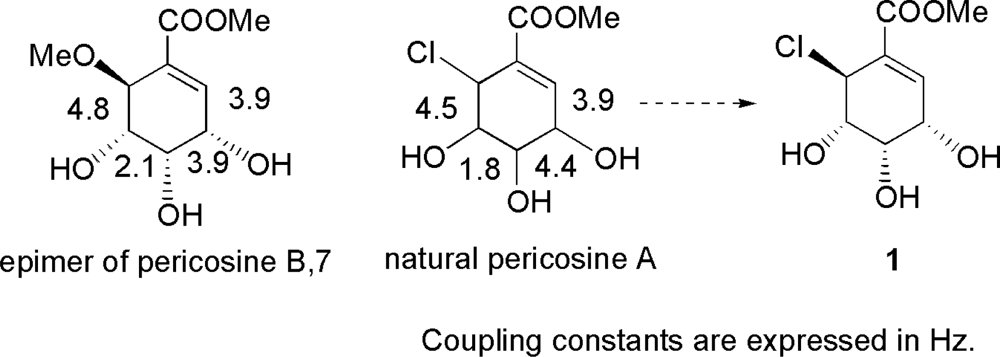
<p>From our conclusion in the previous study described in Section 3.3, determination of the true structure of pericosine A by total synthesis became our next task. In a comprehensive review of data related to pericosines [<xref ref-type="bibr" rid="b54-ijms-09-00401">54</xref>, <xref ref-type="bibr" rid="b63-ijms-09-00401">63</xref>, <xref ref-type="bibr" rid="b64-ijms-09-00401">64</xref>], close similarity between the <sup>1</sup>H-NMR coupling constants of natural pericosine A [<xref ref-type="bibr" rid="b54-ijms-09-00401">54</xref>] and those of <bold>7</bold> [<xref ref-type="bibr" rid="b63-ijms-09-00401">63</xref>] led us to deduce that the structure of natural pericosine A was <bold>1</bold>, as illustrated in <xref ref-type="fig" rid="f3-ijms-09-00401">Figure 3</xref>.</p>
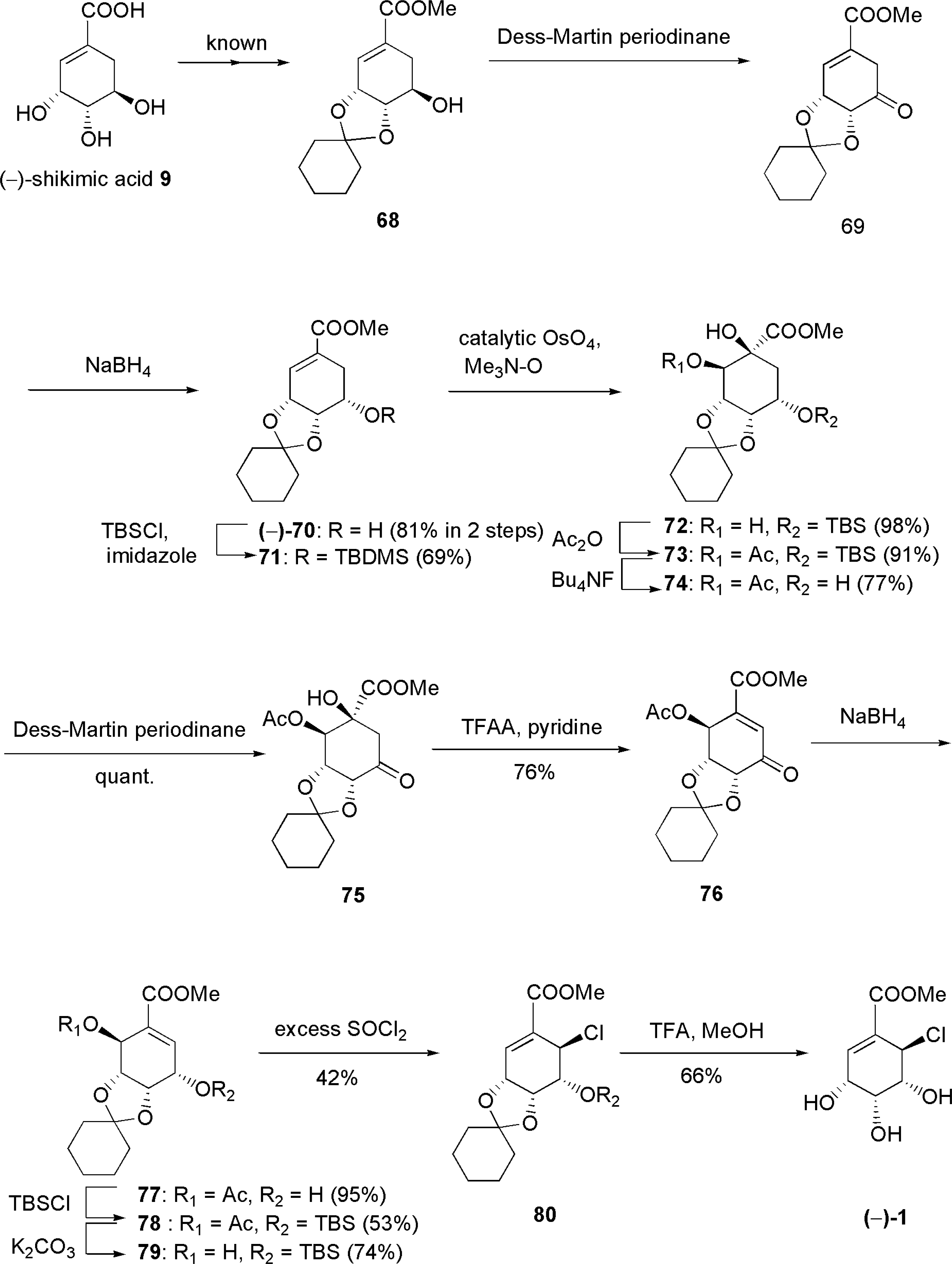
<p>Since <bold>1</bold> had the same relative chemistry as <bold>7</bold>, our basic synthetic strategy was almost the same as that for <bold>7</bold>. After a number of trials, the total synthesis of (−)-<bold>1</bold> was achieved, as shown in <xref ref-type="fig" rid="f13-ijms-09-00401">Scheme 9</xref>. Known methyl 5-epishikimate derivative <bold>68</bold> derived from (−)-shikimic acid <bold>9</bold> was subjected to Dess-Martin oxidation to afford β,γ-unsaturated ketone <bold>69</bold>. Without purification, <bold>69</bold> was reduced with NaBH<sub>4</sub> to give alcohol (−)-<bold>70</bold>, which in turn was protected with TBSCl to give silyl ether <bold>71</bold>. After dihydroxylation of <bold>71</bold>, resultant diol <bold>72</bold> was acetylated to yield <bold>73</bold>, and this was deprotected to give <bold>74</bold>. Subsequent Dess-Martin oxidation of <bold>74</bold> gave β-hydroxyketone <bold>75</bold>, which was dehydrated with TFAA to afford α,β-unsaturated ketone <bold>76</bold>. Subsequent reduction of <bold>76</bold> was carried out carefully with stoichiometric NaBH<sub>4</sub> at −78°C in dry THF to afford alcohol <bold>77</bold> possessing the desired stereochemistry in 95% yield.</p>
<p>Subsequent protection of <bold>77</bold> was carried out with careful addition of TBSCl and a stoichiometric amount of imidazole to give silyl ether <bold>78</bold> in 53% yield, followed by deacetylation with K<sub>2</sub>CO<sub>3</sub> to afford enol <bold>79</bold> in 74% yield. The key reaction of this total synthesis, which was aimed at introducing a Cl atom, was achieved by the addition of excess SOCl<sub>2</sub> to <bold>79</bold> in dry CH<sub>2</sub>Cl<sub>2</sub> to afford chlorinated product <bold>80</bold> in 42% yield [<xref ref-type="bibr" rid="b71-ijms-09-00401">71</xref>], whereas the yield of the reaction with stoichiometric SOCl<sub>2</sub> was 10% [<xref ref-type="bibr" rid="b70-ijms-09-00401">70</xref>]. To our surprise, <bold>80</bold> was formed with rearrangement of the double bond. The structure of key intermediate <bold>80</bold> was confirmed by detailed 1D and 2D NMR studies. In the NOESY spectra, cross peaks H-5/<italic>t</italic>-Bu, H-6/<italic>t</italic>-Bu, H-5/SiMe, H-6/SiMe, and H-3, H4/one of cyclohexyl methylenes, were observed. HMBC cross peak H-3, H-4/singlet carbon of <bold>80</bold>, which was observed at 110.8 ppm, confirmed that the Cl atom was introduced not <italic>via</italic> an S<sub>N</sub>i mechanism as we had aimed early on, but <italic>via</italic> an S<sub>N</sub>2’ mechanism with <italic>syn</italic> selectivity. Another plausible mechanism is the [3,3]-sigmatropic rearrangement of chlorosulfonate derived from <bold>79</bold>. In spite of detailed analysis of NMR spectra, the stereochemistry at C-6 in <bold>80</bold> could not be determined at this step. This total synthesis was completed with TFA to give final product (−)-<bold>1</bold> in 66% yield, which was not <bold>9</bold> as synthesized previously by us [<xref ref-type="bibr" rid="b64-ijms-09-00401">64</xref>, <xref ref-type="bibr" rid="b65-ijms-09-00401">65</xref>] but pericosine A. Thus, this result proved the stereochemistry at C-6 in <bold>80</bold>. Except for the sign of the specific rotation, (−)-<bold>1</bold> showed the same spectroscopic data, including HPLC retention time, as the natural product, and the absolute configuration of natural pericosine A was assigned as methyl (3<italic>S</italic>,4<italic>S</italic>,5<italic>S</italic>,6<italic>S</italic>)-6-chloro-3,4,5-trihydroxy-1-cyclohexene-1-carboxylate. The first total synthesis of the antipode of natural pericosine A was completed in this manner.</p>
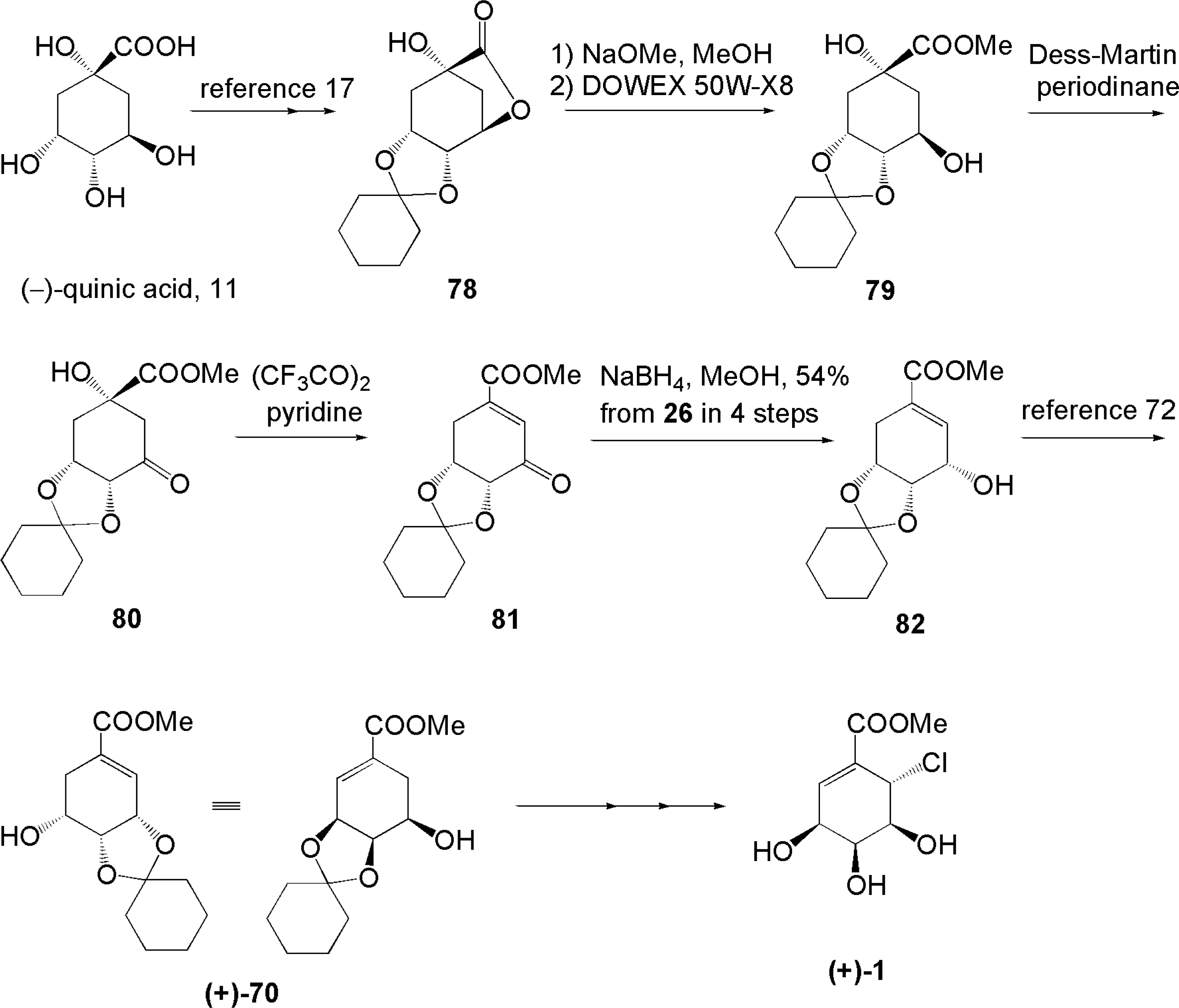
<p>Next, the total synthesis of natural pericosine A (+)-<bold>1</bold> was examined. As the preparation of (+)-<bold>70</bold>, which is an antipode in the preceding synthesis, from <bold>11</bold> has been reported, a similar strategy toward (−)-<bold>1</bold> could be applicable. The synthesis of (+)-<bold>1</bold> is summarized in <xref ref-type="fig" rid="f14-ijms-09-00401">Scheme 10</xref> [<xref ref-type="bibr" rid="b71-ijms-09-00401">71</xref>]. In our synthesis, the preparation of (+)-<bold>70</bold> was modified from the original method appearing in the literature. Treatment of hydroxylactone <bold>78</bold> derived from <bold>11</bold> with NaOMe in MeOH followed by neutralization with DOWEX® 50W-X8 gave crude diol <bold>79</bold>, which was obtained by only filtration and used in the next reaction without further extraction or purification. Diol <bold>79</bold> was oxidized to β-hydroxyketone <bold>80</bold>, which was then dehydrated with TFAA to produce enone <bold>81</bold>. Reduction with NaBH<sub>4</sub> afforded enol <bold>82</bold> in 54% overall yield from <bold>78</bold>. Enol <bold>82</bold> was converted into (+)-<bold>70</bold> according to literature [<xref ref-type="bibr" rid="b72-ijms-09-00401">72</xref>]. The following transformation of (+)-<bold>70</bold> into (+)-<bold>1</bold> was accomplished as above. Since all spectral data of synthesized (+)-<bold>1</bold>, including specific rotation and HPLC retention time, agreed with the data of natural pericosine A, the first synthesis of natural pericosine A was completed.</p></sec></sec>
<sec sec-type="discussion">
<title>4. Further Discussion</title>
<p>As described above, pericosines are interesting compounds because of their potent biological activities and unique structures. In particular, the role of pericosine A <bold>1</bold> in anti-tumor, protein kinase EGFR inhibition or topoisomerase II inhibition was demonstrated. In terms of chemical structure, the relative chemistry of pericosines A <bold>1</bold>, C <bold>3</bold>, and B <bold>2</bold> is so unique that it is difficult to find the same configurational carbasugar natural products, whereas pericosine D <bold>4</bold> has the same relative configuration as (+)-MK7607. We are extremely interested in the fact that pericosines C <bold>3</bold> and E <bold>5</bold> exist as an enantiomeric mixture. How are they biologically formed? Pericosine E <bold>5</bold> is thought to be a conjugate of pericosines A <bold>1</bold> and B <bold>2</bold> but with different chiral sense. This suggests the possibility of the presence of antipodes of <bold>1</bold> and <bold>2</bold> or unknown analogues with other combinations. We are currently directing our efforts toward designing a more effective synthetic route for pericosine A <bold>1</bold> because of the low total yield in our completed first synthesis. Nevertheless, the SN2’ type reaction, which is the key step for Cl introduction in our previous work [<xref ref-type="bibr" rid="b70-ijms-09-00401">70</xref>, <xref ref-type="bibr" rid="b71-ijms-09-00401">71</xref>], may help unravel the mystery surrounding the chirality of percosines. A reaction similar to this or the enantioselective dehydration from prochiral 3-epiquinate may occur in fungal metabolic systems to generate chirality. Indeed, it seems unbelievable that enantiomeric mixtures of <bold>3</bold> and <bold>5</bold>, particularly <bold>5</bold> that bears 8 chiral centers, could be formed biologically. In that sense, pericosines are truly exciting compounds.</p>
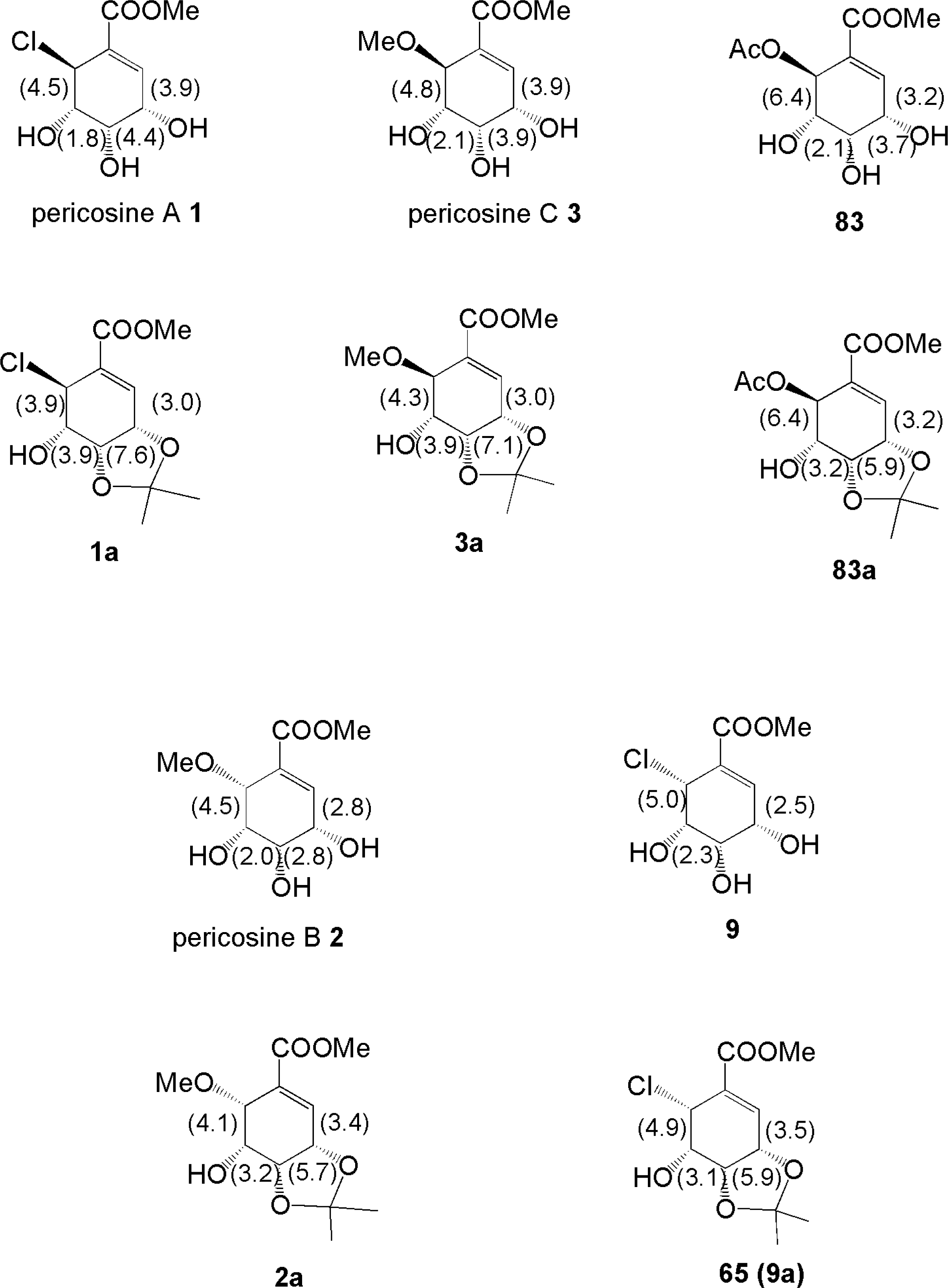
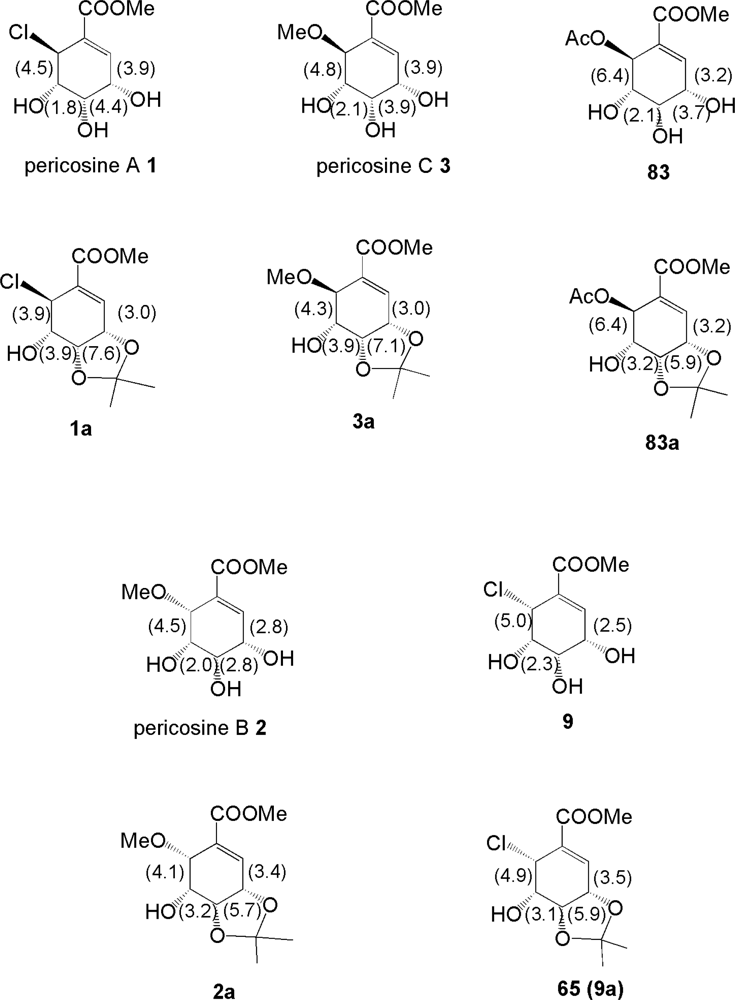
<p>On the other hand, we would like to point out the ambiguity of the conformation of pericosines. It is absolutely difficult to determine the configuration or conformation of pericosines only from spectral analysis. <sup>1</sup>H-NMR coupling constants of pericosines and acetonides are shown in <xref ref-type="fig" rid="f4-ijms-09-00401">Figure 4</xref>. The correct structure of <bold>1</bold> could not be concluded only from the synthesis of <bold>1</bold>. The stereochemistry of C-6 in intermediate <bold>80</bold> could be determined not from detailed spectral analysis but from the difference between deprotected <bold>1</bold> and <bold>9</bold>, the latter of which was synthesized in our previous study [<xref ref-type="bibr" rid="b64-ijms-09-00401">64</xref>, <xref ref-type="bibr" rid="b65-ijms-09-00401">65</xref>]. We hope to solve this problem by integrating our vast synthetic efforts with data from other researchers.</p>
<p>The synthetic study of pericosine D is ongoing in an effort to determine its absolute configuration [<xref ref-type="bibr" rid="b73-ijms-09-00401">73</xref>]. After elucidating all the structures of pericosines, we will examine the biological activity of synthesized pericosine analogues, develop more effective synthetic routes, and design more active molecules based on these seed compounds.</p></sec></body>
<back>
<ack>
<title>Acknowledgements</title>
<p>We are grateful to Dr. K. Minoura and Ms. M. Fujitake, and Dr. Takeshi Yamada of Osaka University of Pharmaceutical Sciences for NMR and MS measurements, and discussion concerning pericosines, respectively. This work was supported in part by a Grant-in-Aid for “High-Tech Research Center” Project for Private Universities: matching fund subsidy from MEXT (Ministry of Education, Culture, Sports, Science, and Technology), 2002–2006, Japan.</p></ack>
<ref-list>
<title>References and Notes</title>
<ref id="b1-ijms-09-00401"><label>1</label><citation citation-type="journal"><person-group person-group-type="author"><name><surname>Suami</surname><given-names>T</given-names></name></person-group><article-title>Synthetic ventures in pseudo-sugar chemistry</article-title><source>Pure Appl Chem</source><year>1987</year><volume>59</volume><fpage>1509</fpage><lpage>1520</lpage><comment>DOI 10.1351/pac198759111509</comment><pub-id pub-id-type="doi">10.1351/pac198759111509</pub-id></citation></ref>
<ref id="b2-ijms-09-00401"><label>2</label><citation citation-type="journal"><person-group person-group-type="author"><name><surname>Berecibar</surname><given-names>A</given-names></name><name><surname>Grandjean</surname><given-names>C</given-names></name><name><surname>Sinwardena</surname><given-names>A</given-names></name></person-group><article-title>Synthesis and Biological Activity of Natural Aminocyclopentitol Glycosidase Inhibitors: Mannostatins, Trehazolin, Allosamidins, and Their Analogs</article-title><source>Chem Rev</source><year>1999</year><volume>99</volume><fpage>779</fpage><lpage>844</lpage><comment>DOI 10.1021/cr980033l; PubMed 11749432</comment><pub-id pub-id-type="doi">10.1021/cr980033l</pub-id><pub-id pub-id-type="pmid">11749432</pub-id></citation></ref>
<ref id="b3-ijms-09-00401"><label>3</label><citation citation-type="journal"><person-group person-group-type="author"><name><surname>Arjona</surname><given-names>O</given-names></name><name><surname>Gomez</surname><given-names>AM</given-names></name><name><surname>Lopez</surname><given-names>JC</given-names></name><name><surname>Plumet</surname><given-names>J</given-names></name></person-group><article-title>Synthesis and conformational and biological aspects of carbasugars</article-title><source>Chem Rev</source><year>2007</year><volume>107</volume><fpage>1919</fpage><lpage>2036</lpage><comment>DOI 10.1021/cr0203701; PubMed 17488060</comment><pub-id pub-id-type="doi">10.1021/cr0203701</pub-id><pub-id pub-id-type="pmid">17488060</pub-id></citation></ref>
<ref id="b4-ijms-09-00401"><label>4</label><citation citation-type="journal"><person-group person-group-type="author"><name><surname>Mirza</surname><given-names>S</given-names></name><name><surname>Molleyres</surname><given-names>LP</given-names></name><name><surname>Vasella</surname><given-names>A</given-names></name></person-group><article-title>Synthesis of a glyoxalase I inhibitor from Streptomyces griseosporeus Niida et Ogasawara</article-title><source>Helvetica Chimica Acta</source><year>1985</year><volume>68</volume><fpage>988</fpage><lpage>996</lpage><comment>DOI 10.1002/hlca.19850680425</comment><pub-id pub-id-type="doi">10.1002/hlca.19850680425</pub-id></citation></ref>
<ref id="b5-ijms-09-00401"><label>5</label><citation citation-type="journal"><person-group person-group-type="author"><name><surname>Takayama</surname><given-names>H</given-names></name><name><surname>Hayashi</surname><given-names>K</given-names></name><name><surname>Koizumi</surname><given-names>T</given-names></name></person-group><article-title>Enantioselective total synthesis of glyoxalase I inhibitor using asymmetric Diels-Alder reaction of a new chiral dienophile, (S)S-3-(3-trifluoromethylpyrid-2-ylsulfinyl)acrylate</article-title><source>Tetrahedron Lett</source><year>1986</year><volume>27</volume><fpage>5509</fpage><lpage>5512</lpage><comment>DOI 10.1016/S0040-4039(00)85252-1</comment><pub-id pub-id-type="doi">10.1016/S0040-4039(00)85252-1</pub-id></citation></ref>
<ref id="b6-ijms-09-00401"><label>6</label><citation citation-type="journal"><person-group person-group-type="author"><name><surname>Yamakoshi</surname><given-names>Y</given-names></name><name><surname>Nakajima</surname><given-names>Y</given-names></name><name><surname>Ge</surname><given-names>W-Y</given-names></name><name><surname>Sugita</surname><given-names>J</given-names></name><name><surname>Okayama</surname><given-names>K</given-names></name><name><surname>Takahashi</surname><given-names>T</given-names></name><name><surname>Koizumi</surname><given-names>T</given-names></name></person-group><article-title>High pressure mediated asymmetric Diels-Alder reaction of chiral sulfinylacrylate derivatives with furan and 2-methoxyfuran</article-title><source>Heterocycles</source><year>1996</year><volume>42</volume><fpage>129</fpage><lpage>133</lpage><pub-id pub-id-type="doi">10.3987/COM-95-S43</pub-id></citation></ref>
<ref id="b7-ijms-09-00401"><label>7</label><citation citation-type="journal"><person-group person-group-type="author"><name><surname>Takahashi</surname><given-names>T</given-names></name><name><surname>Yamakoshi</surname><given-names>Y</given-names></name><name><surname>Okayama</surname><given-names>K</given-names></name><name><surname>Yamada</surname><given-names>J</given-names></name><name><surname>Ge</surname><given-names>W-Y</given-names></name><name><surname>Koizumi</surname><given-names>T</given-names></name></person-group><article-title>High-pressure mediated asymmetric Diels-Alder reaction of chiral sulfinylacrylate derivatives and its application to chiral synthesis of (−)-COTC and (−)-gabosine C</article-title><source>Heterocycles</source><year>2002</year><volume>56</volume><fpage>209</fpage><lpage>220</lpage><pub-id pub-id-type="doi">10.3987/COM-01-S(K)18</pub-id></citation></ref>
<ref id="b8-ijms-09-00401"><label>8</label><citation citation-type="journal"><person-group person-group-type="author"><name><surname>Arthurs</surname><given-names>CL</given-names></name><name><surname>Wind</surname><given-names>NS</given-names></name><name><surname>Whitehead</surname><given-names>RC</given-names></name><name><surname>Stratford</surname><given-names>IJ</given-names></name></person-group><article-title>Analogues of 2-crotonyloxymethyl-(4R,5R,6R)-4,5,6-trihydroxycyclohex-2-enone (COTC) with anti-tumor properties</article-title><source>Bioorg &amp; Med Chem Lett</source><year>2007</year><volume>17</volume><fpage>553</fpage><lpage>557</lpage><comment>DOI 10.1016/j.bmcl.2006.09.072</comment><pub-id pub-id-type="doi">10.1016/j.bmcl.2006.09.072</pub-id></citation></ref>
<ref id="b9-ijms-09-00401"><label>9</label><citation citation-type="journal"><person-group person-group-type="author"><name><surname>Arthurs</surname><given-names>CL</given-names></name><name><surname>Raftery</surname><given-names>J</given-names></name><name><surname>Whitby</surname><given-names>HL</given-names></name><name><surname>Whitehead</surname><given-names>RC</given-names></name><name><surname>Wind</surname><given-names>NS</given-names></name><name><surname>Stratford</surname><given-names>IJ</given-names></name></person-group><article-title>Arene cis-dihydrodiols: Useful precursors for the preparation of analogs of the antitumor agent, 2-crotonyloxymethyl-(4R,5R,6R)-4,5,6-trihydroxycyclohex-2-enone (COTC)</article-title><source>Bioorg &amp; Med Chem Lett</source><year>2007</year><volume>17</volume><fpage>5974</fpage><lpage>5977</lpage><comment>DOI 10.1016/j.bmcl.2007.07.070</comment><pub-id pub-id-type="doi">10.1016/j.bmcl.2007.07.070</pub-id></citation></ref>
<ref id="b10-ijms-09-00401"><label>10</label><citation citation-type="journal"><person-group person-group-type="author"><name><surname>Ramanaa</surname><given-names>GV</given-names></name><name><surname>Rao</surname><given-names>BV</given-names></name></person-group><article-title>Stereoselective synthesis of (−)-gabosine C using a Nozaki-Hiyama-Kishi reaction and RCM</article-title><source>Tetrahedron Lett</source><year>2005</year><volume>46</volume><fpage>3049</fpage><lpage>3051</lpage><comment>DOI: 10.1016/j.tetlet.2005.03.018</comment><pub-id pub-id-type="doi">10.1016/j.tetlet.2005.03.018</pub-id></citation></ref>
<ref id="b11-ijms-09-00401"><label>11</label><citation citation-type="journal"><person-group person-group-type="author"><name><surname>Huntley</surname><given-names>CFM</given-names></name><name><surname>Wood</surname><given-names>HB</given-names></name><name><surname>Ganem</surname><given-names>B</given-names></name></person-group><article-title>A new synthesis of the glyoxalase-I inhibitor COTC</article-title><source>Tetrahedron Lett</source><year>2000</year><volume>41</volume><fpage>2031</fpage><lpage>2034</lpage><comment>DOI 10.1016/S0040-4039(00)00103-9</comment><pub-id pub-id-type="doi">10.1016/S0040-4039(00)00103-9</pub-id></citation></ref>
<ref id="b12-ijms-09-00401"><label>12</label><citation citation-type="journal"><person-group person-group-type="author"><name><surname>Huntley</surname><given-names>CF</given-names></name><name><surname>Hamilton</surname><given-names>DS</given-names></name><name><surname>Creighton</surname><given-names>DJ</given-names></name><name><surname>Ganem</surname><given-names>B</given-names></name></person-group><article-title>Reaction of COTC with glutathione: structure of the putative glyoxalase I inhibitor</article-title><source>Org Lett</source><year>2000</year><volume>2</volume><fpage>3143</fpage><lpage>3144</lpage><comment>DOI 10.1021/ol006341z; PubMed 11009366</comment><pub-id pub-id-type="doi">10.1021/ol006341z</pub-id><pub-id pub-id-type="pmid">11009366</pub-id></citation></ref>
<ref id="b13-ijms-09-00401"><label>13</label><citation citation-type="journal"><person-group person-group-type="author"><name><surname>Shing</surname><given-names>T</given-names></name><name><surname>Tang</surname><given-names>Y</given-names></name></person-group><article-title>Enantiospecific synthesis of 2-crotonyloxy-(4R,5R,6R)-4,5,6-trihydroxycyclohex-2-enone (COTC) from quinic acid</article-title><source>J Chem Soc, Chem Commun</source><year>1990</year><fpage>312</fpage></citation></ref>
<ref id="b14-ijms-09-00401"><label>14</label><citation citation-type="journal"><person-group person-group-type="author"><name><surname>Shing</surname><given-names>T</given-names></name><name><surname>Tang</surname><given-names>Y</given-names></name></person-group><article-title>(−)-Quinic acid in organic synthesis. 1. A facile synthesis of 2-crotonyloxymethyl-(4R,5R,6R)-4,5,6-trihydroxycyclohex-2-enone</article-title><source>Tetrahedron</source><year>1990</year><volume>46</volume><fpage>6575</fpage><lpage>6584</lpage><pub-id pub-id-type="doi">10.1016/S0040-4020(01)96022-3</pub-id></citation></ref>
<ref id="b15-ijms-09-00401"><label>15</label><citation citation-type="journal"><person-group person-group-type="author"><name><surname>Tatsuta</surname><given-names>K</given-names></name><name><surname>Yasuda</surname><given-names>S</given-names></name><name><surname>Araki</surname><given-names>N</given-names></name><name><surname>Takahashi</surname><given-names>M</given-names></name><name><surname>Kamiya</surname><given-names>Y</given-names></name></person-group><article-title>Total synthesis of a glyoxalase I inhibitor and its precursor, (−)-KD16-U1</article-title><source>Tetrahedron Lett</source><year>1998</year><volume>39</volume><fpage>401</fpage><lpage>402</lpage><comment>DOI 10.1016/S0040-4039(97)10559-7</comment><pub-id pub-id-type="doi">10.1016/S0040-4039(97)10559-7</pub-id></citation></ref>
<ref id="b16-ijms-09-00401"><label>16</label><citation citation-type="journal"><person-group person-group-type="author"><name><surname>Shinada</surname><given-names>T</given-names></name><name><surname>Fuji</surname><given-names>T</given-names></name><name><surname>Ohtani</surname><given-names>Y</given-names></name><name><surname>Yoshida</surname><given-names>Y</given-names></name><name><surname>Ohfune</surname><given-names>Y</given-names></name></person-group><article-title>Syntheses of gabosine A, B, D, and E from allyl sulfide derived from (−)-quinic acid</article-title><source>Synlett</source><year>2002</year><fpage>1341</fpage><lpage>1343</lpage></citation></ref>
<ref id="b17-ijms-09-00401"><label>17</label><citation citation-type="journal"><person-group person-group-type="author"><name><surname>Lygo</surname><given-names>B</given-names></name><name><surname>Swiatyj</surname><given-names>M</given-names></name><name><surname>Trabsa</surname><given-names>H</given-names></name><name><surname>Voyle</surname><given-names>M</given-names></name></person-group><article-title>Synthesis of (+)-Gabosines C and E from D-ribose Tetrahedron Lett</article-title><year>1994</year><volume>35</volume><fpage>4197</fpage><lpage>4200</lpage><comment>DOI (Either ISSN and Title must be supplied)</comment></citation></ref>
<ref id="b18-ijms-09-00401"><label>18</label><citation citation-type="journal"><person-group person-group-type="author"><name><surname>Banwell</surname><given-names>MG</given-names></name><name><surname>Bray</surname><given-names>AM</given-names></name><name><surname>Wong</surname><given-names>D</given-names></name></person-group><article-title>A concise and chemo-enzymatic synthesis of (−)-gabosine A, a carba-sugar enone from Streptomycetes</article-title><source>J New J Chem</source><year>2001</year><volume>25</volume><fpage>1351</fpage><lpage>1354</lpage><pub-id pub-id-type="doi">10.1039/b106419c</pub-id></citation></ref>
<ref id="b19-ijms-09-00401"><label>19</label><citation citation-type="journal"><person-group person-group-type="author"><name><surname>Lubineau</surname><given-names>A</given-names></name><name><surname>Billault</surname><given-names>I</given-names></name></person-group><article-title>New Access to Unsaturated Keto Carba Sugars (Gabosines) Using an Intramolecular Nozaki-Kishi Reaction as the Key Step</article-title><source>J Org Chem</source><year>1998</year><volume>63</volume><fpage>5668</fpage><lpage>5671</lpage><pub-id pub-id-type="doi">10.1021/jo980309p</pub-id></citation></ref>
<ref id="b20-ijms-09-00401"><label>20</label><citation citation-type="journal"><person-group person-group-type="author"><name><surname>Alibes</surname><given-names>R</given-names></name><name><surname>Bayon</surname><given-names>P</given-names></name><name><surname>De March</surname><given-names>P</given-names></name><name><surname>Figueredo</surname><given-names>M</given-names></name><name><surname>Font</surname><given-names>J</given-names></name><name><surname>Marjanet</surname><given-names>G</given-names></name></person-group><article-title>Enantioselective synthesis and absolute configuration assignment of gabosine O. Synthesis of (+)- and (−)-gabosine N and (+)- and (−)-epigabosines N and O</article-title><source>Organic Lett</source><year>2006</year><volume>8</volume><fpage>1617</fpage><lpage>1620</lpage><pub-id pub-id-type="doi">10.1021/ol060173e</pub-id></citation></ref>
<ref id="b21-ijms-09-00401"><label>21</label><citation citation-type="journal"><person-group person-group-type="author"><name><surname>Shing</surname><given-names>TKM</given-names></name><name><surname>Cheng</surname><given-names>HM</given-names></name></person-group><article-title>Short Syntheses of Gabosine I and Gabosine G from δ-D-Gluconolactone</article-title><source>J Org Chem</source><year>2007</year><volume>72</volume><fpage>6610</fpage><lpage>6613</lpage><comment>DOI 10.1021/jo0709697; PubMed 17637067</comment><pub-id pub-id-type="doi">10.1021/jo0709697</pub-id><pub-id pub-id-type="pmid">17637067</pub-id></citation></ref>
<ref id="b22-ijms-09-00401"><label>22</label><citation citation-type="journal"><person-group person-group-type="author"><name><surname>Mehta</surname><given-names>G</given-names></name><name><surname>Lakshminath</surname><given-names>S</given-names></name></person-group><article-title>A norbornyl route to cyclohexitols: stereoselective synthesis of conduritol-E, allo-inositol, MK 7607 and gabosines</article-title><source>Tetrahedron Lett</source><year>2000</year><volume>41</volume><fpage>3509</fpage><lpage>3512</lpage><comment>DOI 10.1016/S0040-4039(00)00409-3</comment><pub-id pub-id-type="doi">10.1016/S0040-4039(00)00409-3</pub-id></citation></ref>
<ref id="b23-ijms-09-00401"><label>23</label><citation citation-type="journal"><person-group person-group-type="author"><name><surname>Song</surname><given-names>C</given-names></name><name><surname>Jiang</surname><given-names>S</given-names></name><name><surname>Singh</surname><given-names>G</given-names></name></person-group><article-title>Synthesis of (−)-MK7607 and Other Carbasugars from (−)-shikimic Acid</article-title><source>Synlett</source><year>2001</year><fpage>1983</fpage><lpage>1985</lpage></citation></ref>
<ref id="b24-ijms-09-00401"><label>24</label><citation citation-type="journal"><person-group person-group-type="author"><name><surname>Schmidt</surname><given-names>RR</given-names></name><name><surname>Koen</surname><given-names>A</given-names></name></person-group><article-title>α-Glucosidase inhibitors. Part 4. Synthesis of valienamine</article-title><source>Angew Chem</source><year>1987</year><volume>99</volume><fpage>490</fpage><lpage>491</lpage><pub-id pub-id-type="doi">10.1002/ange.19870990529</pub-id></citation></ref>
<ref id="b25-ijms-09-00401"><label>25</label><citation citation-type="journal"><person-group person-group-type="author"><name><surname>Park</surname><given-names>TK</given-names></name><name><surname>Danishefsky</surname><given-names>SJ</given-names></name></person-group><article-title>A synthetic route to valienamine: an interesting observation concerning stereoelectronic preferences in the SN2’ reaction</article-title><source>Tetrahedron Lett</source><year>1994</year><volume>35</volume><fpage>2667</fpage><lpage>2670</lpage><comment>DOI 10.1016/S0040-4039(00)77001-8</comment><pub-id pub-id-type="doi">10.1016/S0040-4039(00)77001-8</pub-id></citation></ref>
<ref id="b26-ijms-09-00401"><label>26</label><citation citation-type="journal"><person-group person-group-type="author"><name><surname>Fukase</surname><given-names>H</given-names></name><name><surname>Horii</surname><given-names>S</given-names></name></person-group><article-title>Synthesis of a branched-chain inosose derivative, a versatile synthon of N-substituted valiolamine derivatives from D-glucose</article-title><source>J Org Chem</source><year>1992</year><volume>57</volume><fpage>3651</fpage><lpage>3658</lpage><comment>DOI 10.1021/jo00039a026</comment><pub-id pub-id-type="doi">10.1021/jo00039a026</pub-id></citation></ref>
<ref id="b27-ijms-09-00401"><label>27</label><citation citation-type="journal"><person-group person-group-type="author"><name><surname>Trost</surname><given-names>BM</given-names></name><name><surname>Chupak</surname><given-names>S</given-names></name><name><surname>Luebbers</surname><given-names>T</given-names></name></person-group><article-title>Total Synthesis of (±)- and (+)-Valienamine via a Strategy Derived from New Palladium-Catalyzed Reactions</article-title><source>J Am Chem Soc</source><year>1998</year><volume>120</volume><fpage>1732</fpage><lpage>1740</lpage><comment>DOI 10.1021/ja973081g</comment><pub-id pub-id-type="doi">10.1021/ja973081g</pub-id></citation></ref>
<ref id="b28-ijms-09-00401"><label>28</label><citation citation-type="journal"><person-group person-group-type="author"><name><surname>Shing</surname><given-names>TKM</given-names></name><name><surname>Li</surname><given-names>TY</given-names></name><name><surname>Kok</surname><given-names>SH-L</given-names></name></person-group><article-title>Enantiospecific Syntheses of Valienamine and 2-epi-Valienamine</article-title><source>J Org Chem</source><year>1999</year><volume>64</volume><fpage>1941</fpage><lpage>1946</lpage><comment>DOI 10.1021/jo982024i; PubMed 11674286</comment><pub-id pub-id-type="doi">10.1021/jo982024i</pub-id><pub-id pub-id-type="pmid">11674286</pub-id></citation></ref>
<ref id="b29-ijms-09-00401"><label>29</label><citation citation-type="journal"><person-group person-group-type="author"><name><surname>Yoshikawa</surname><given-names>M</given-names></name><name><surname>Cha</surname><given-names>BC</given-names></name><name><surname>Okaichi</surname><given-names>Y</given-names></name><name><surname>Takinami</surname><given-names>Y</given-names></name><name><surname>Yokokawa</surname><given-names>Y</given-names></name><name><surname>Kitagawa</surname><given-names>I</given-names></name></person-group><article-title>Syntheses of validamine, epi-validamine, and valienamine, three optically active pseudo-amino-sugars, from D-glucose</article-title><source>Chem Pharm Bull</source><year>1988</year><volume>36</volume><fpage>4236</fpage><lpage>4239</lpage><pub-id pub-id-type="doi">10.1248/cpb.36.4236</pub-id></citation></ref>
<ref id="b30-ijms-09-00401"><label>30</label><citation citation-type="journal"><person-group person-group-type="author"><name><surname>Tatsuta</surname><given-names>K</given-names></name><name><surname>Mukai</surname><given-names>H</given-names></name><name><surname>Takahashi</surname><given-names>M</given-names></name></person-group><article-title>Novel synthesis of natural pseudo-aminosugars, (+)-valienamine and (+)-validamine</article-title><source>J Antibiot</source><year>2000</year><volume>53</volume><fpage>430</fpage><lpage>435</lpage><comment>PubMed 10866227</comment><pub-id pub-id-type="doi">10.7164/antibiotics.53.430</pub-id><pub-id pub-id-type="pmid">10866227</pub-id></citation></ref>
<ref id="b31-ijms-09-00401"><label>31</label><citation citation-type="journal"><person-group person-group-type="author"><name><surname>Chang</surname><given-names>Y-K</given-names></name><name><surname>Lee</surname><given-names>B-Y</given-names></name><name><surname>Lee</surname><given-names>GS</given-names></name><name><surname>Jeon</surname><given-names>HB</given-names></name><name><surname>Kim</surname><given-names>KS</given-names></name></person-group><article-title>An Efficient Synthesis of Valienamine via Ring-Closing Metathesis</article-title><source>J Org Chem</source><year>2005</year><volume>70</volume><fpage>3299</fpage><lpage>3302</lpage><comment>PubMed 15823000</comment><pub-id pub-id-type="doi">10.1021/jo047735x</pub-id><pub-id pub-id-type="pmid">15823000</pub-id></citation></ref>
<ref id="b32-ijms-09-00401"><label>32</label><citation citation-type="journal"><person-group person-group-type="author"><name><surname>von Itzstein</surname><given-names>M</given-names></name><name><surname>Wu</surname><given-names>WY</given-names></name><name><surname>Kok</surname><given-names>GB</given-names></name><name><surname>Pegg</surname><given-names>MS</given-names></name><name><surname>Dyason</surname><given-names>JC</given-names></name><name><surname>Jin</surname><given-names>B</given-names></name><name><surname>Van</surname><given-names>PT</given-names></name><name><surname>Smythe</surname><given-names>ML</given-names></name><name><surname>White</surname><given-names>HF</given-names></name><name><surname>Oliver</surname><given-names>SW</given-names></name><name><surname>Colman</surname><given-names>PM</given-names></name><name><surname>Varghese</surname><given-names>JN</given-names></name><name><surname>Ryan</surname><given-names>DM</given-names></name><name><surname>Woods</surname><given-names>JM</given-names></name><name><surname>Bethell</surname><given-names>RC</given-names></name><name><surname>Hotham</surname><given-names>VJ</given-names></name><name><surname>Cameron</surname><given-names>JM</given-names></name><name><surname>Penn</surname><given-names>C</given-names></name></person-group><article-title>R Rational design of potent silalidase-based inhibitors of influenza virus replication</article-title><source>Nature</source><year>1993</year><volume>363</volume><fpage>418</fpage><lpage>423</lpage><comment>PubMed 8502295</comment><pub-id pub-id-type="doi">10.1038/363418a0</pub-id><pub-id pub-id-type="pmid">8502295</pub-id></citation></ref>
<ref id="b33-ijms-09-00401"><label>33</label><citation citation-type="journal"><person-group person-group-type="author"><name><surname>Kim</surname><given-names>CU</given-names></name><name><surname>Lew</surname><given-names>W</given-names></name><name><surname>Williams</surname><given-names>MA</given-names></name><name><surname>Zhang</surname><given-names>L</given-names></name><name><surname>Liu</surname><given-names>H</given-names></name><name><surname>Swaminathan</surname><given-names>S</given-names></name><name><surname>Bischofberger</surname><given-names>N</given-names></name><name><surname>Chen</surname><given-names>MS</given-names></name><name><surname>Tai</surname><given-names>CY</given-names></name><name><surname>Mendel</surname><given-names>DB</given-names></name><name><surname>Laver</surname><given-names>WG</given-names></name><name><surname>Stevens</surname><given-names>RC</given-names></name></person-group><article-title>Influenza neuraminidase inhibitors possessing a novel hydrophobic interaction in the enzyme active site: design, synthesis, and structural analysis of carbocyclic sialic acid analogues with potent anti-influenza activity</article-title><source>J Am Chem Soc</source><year>1997</year><volume>119</volume><fpage>681</fpage><lpage>690</lpage><comment>DOI 10.1021/ja963036t; PubMed 16526129</comment><pub-id pub-id-type="doi">10.1021/ja963036t</pub-id><pub-id pub-id-type="pmid">16526129</pub-id></citation></ref>
<ref id="b34-ijms-09-00401"><label>34</label><citation citation-type="journal"><person-group person-group-type="author"><name><surname>Rohloff</surname><given-names>JC</given-names></name><name><surname>Kent</surname><given-names>KM</given-names></name><name><surname>Postich</surname><given-names>MJ</given-names></name><name><surname>Becker</surname><given-names>MW</given-names></name><name><surname>Chapman</surname><given-names>HH</given-names></name><name><surname>Kelly</surname><given-names>DE</given-names></name><name><surname>Lew</surname><given-names>W</given-names></name><name><surname>Louie</surname><given-names>MS</given-names></name><name><surname>McGee</surname><given-names>LR</given-names></name><name><surname>Prisbe</surname><given-names>EJ</given-names></name><name><surname>Schultze</surname><given-names>LM</given-names></name><name><surname>Yu</surname><given-names>RH</given-names></name><name><surname>Zhang</surname><given-names>L</given-names></name></person-group><article-title>Practical Total Synthesis of the Anti-Influenza Drug GS-4104</article-title><source>J Org Chem</source><year>1998</year><volume>63</volume><fpage>4545</fpage><lpage>4550</lpage><comment>DOI 10.1021/jo980330q</comment><pub-id pub-id-type="doi">10.1021/jo980330q</pub-id></citation></ref>
<ref id="b35-ijms-09-00401"><label>35</label><citation citation-type="journal"><person-group person-group-type="author"><name><surname>Yeung</surname><given-names>Y-Y</given-names></name><name><surname>Hong</surname><given-names>S</given-names></name><name><surname>Corey</surname><given-names>EJ</given-names></name></person-group><article-title>A Short Enantioselective Pathway for the Synthesis of the Anti-Influenza Neuramidase Inhibitor Oseltamivir from 1,3-Butadiene and Acrylic Acid</article-title><source>J Am Chem.Soc</source><year>2006</year><volume>128</volume><fpage>6310</fpage><lpage>6311</lpage><comment>DOI 10.1021/ja0616433; PubMed 16683783</comment><pub-id pub-id-type="doi">10.1021/ja0616433</pub-id><pub-id pub-id-type="pmid">16683783</pub-id></citation></ref>
<ref id="b36-ijms-09-00401"><label>36</label><citation citation-type="journal"><person-group person-group-type="author"><name><surname>Fukuta</surname><given-names>Y</given-names></name><name><surname>Mita</surname><given-names>T</given-names></name><name><surname>Fukuda</surname><given-names>N</given-names></name><name><surname>Kanai</surname><given-names>M</given-names></name><name><surname>Shibasaki</surname><given-names>M</given-names></name></person-group><article-title>Catalytic Asymmetric Total Synthesis of (+)-Lactacystin</article-title><source>J Am Chem Soc</source><year>2006</year><volume>128</volume><fpage>6312</fpage><lpage>6313</lpage><comment>PubMed 16683784</comment><pub-id pub-id-type="doi">10.1021/ja061696k</pub-id><pub-id pub-id-type="pmid">16683784</pub-id></citation></ref>
<ref id="b37-ijms-09-00401"><label>37</label><citation citation-type="journal"><person-group person-group-type="author"><name><surname>Mita</surname><given-names>T</given-names></name><name><surname>Fukuda</surname><given-names>N</given-names></name><name><surname>Roca</surname><given-names>FX</given-names></name><name><surname>Kanai</surname><given-names>M</given-names></name><name><surname>Shibasaki</surname><given-names>M</given-names></name></person-group><article-title>Second generation catalytic asymmetric synthesis of Tamiflu: allylic substitution route</article-title><source>Org Lett</source><year>2007</year><volume>9</volume><fpage>259</fpage><lpage>262</lpage><comment>DOI 10.1021/ol062663c; PubMed 17217279</comment><pub-id pub-id-type="doi">10.1021/ol062663c</pub-id><pub-id pub-id-type="pmid">17217279</pub-id></citation></ref>
<ref id="b38-ijms-09-00401"><label>38</label><citation citation-type="journal"><person-group person-group-type="author"><name><surname>Satoh</surname><given-names>N</given-names></name><name><surname>Akiba</surname><given-names>T</given-names></name><name><surname>Yokoshima</surname><given-names>S</given-names></name><name><surname>Fukuyama</surname><given-names>T</given-names></name></person-group><article-title>A practical synthesis of (−)-oseltamivir</article-title><source>Angewandte Chem, Int Ed</source><year>2007</year><volume>46</volume><fpage>5734</fpage><lpage>5736</lpage><comment>DOI 10.1002/anie.200701754</comment><pub-id pub-id-type="doi">10.1002/anie.200701754</pub-id></citation></ref>
<ref id="b39-ijms-09-00401"><label>39</label><citation citation-type="journal"><person-group person-group-type="author"><name><surname>Karchier</surname><given-names>M</given-names></name><name><surname>Michalak</surname><given-names>K</given-names></name><name><surname>Wicha</surname><given-names>J</given-names></name></person-group><article-title>Anti-influenza drugs Synthesis of Tamiflu, a drug kept in stock to prevent a bird flu epidemic</article-title><source>Wiadomosci Chemiczne</source><year>2007</year><volume>61</volume><fpage>7</fpage><lpage>42</lpage></citation></ref>
<ref id="b40-ijms-09-00401"><label>40</label><citation citation-type="journal"><person-group person-group-type="author"><name><surname>Shie</surname><given-names>J-J</given-names></name><name><surname>Fang</surname><given-names>J-M</given-names></name><name><surname>Wang</surname><given-names>S-Y</given-names></name><name><surname>Tsai</surname><given-names>K-C</given-names></name><name><surname>Cheng</surname><given-names>Y-SE</given-names></name><name><surname>Yang</surname><given-names>A-S</given-names></name><name><surname>Hsiao</surname><given-names>S-C</given-names></name><name><surname>Su</surname><given-names>C-Y</given-names></name><name><surname>Wong</surname><given-names>C-H</given-names></name></person-group><article-title>Synthesis of Tamiflu and its Phosphonate Congeners Possessing Potent Anti-Influenza Activity</article-title><source>J Am Chem Soc</source><year>2007</year><volume>129</volume><fpage>11892</fpage><lpage>11893</lpage><comment>DOI 10.1021/ja073992i; PubMed 17850083</comment><pub-id pub-id-type="doi">10.1021/ja073992i</pub-id><pub-id pub-id-type="pmid">17850083</pub-id></citation></ref>
<ref id="b41-ijms-09-00401"><label>41</label><citation citation-type="journal"><person-group person-group-type="author"><name><surname>Takeuchi</surname><given-names>T</given-names></name><name><surname>Chimura</surname><given-names>H</given-names></name><name><surname>Hamada</surname><given-names>M</given-names></name><name><surname>Umezawa</surname><given-names>H</given-names></name><name><surname>Yoshioka</surname><given-names>O</given-names></name><name><surname>Oguchi</surname><given-names>N</given-names></name><name><surname>Takahashi</surname><given-names>Y</given-names></name><name><surname>Matsuda</surname><given-names>A</given-names></name></person-group><article-title>Glyoxalase I inhibitor of a new structural type produced by Streptomyces</article-title><source>J Antibiot</source><year>1975</year><volume>28</volume><fpage>737</fpage><lpage>742</lpage><comment>PubMed 1102510</comment><pub-id pub-id-type="doi">10.7164/antibiotics.28.737</pub-id><pub-id pub-id-type="pmid">1102510</pub-id></citation></ref>
<ref id="b42-ijms-09-00401"><label>42</label><citation citation-type="journal"><person-group person-group-type="author"><name><surname>Tatsuta</surname><given-names>K</given-names></name><name><surname>Tsuchiya</surname><given-names>N</given-names></name><name><surname>Mikami</surname><given-names>N</given-names></name><name><surname>Umezawa</surname><given-names>S</given-names></name><name><surname>Umezawa</surname><given-names>H</given-names></name><name><surname>Naganawa</surname><given-names>H</given-names></name></person-group><article-title>KD16-U1, a new metabolite of Streptomyces. Isolation and structural studies</article-title><source>J Antibiot</source><year>1974</year><volume>27</volume><fpage>579</fpage><lpage>586</lpage><comment>PubMed 4436143</comment><pub-id pub-id-type="doi">10.7164/antibiotics.27.579</pub-id><pub-id pub-id-type="pmid">4436143</pub-id></citation></ref>
<ref id="b43-ijms-09-00401"><label>43</label><citation citation-type="journal"><person-group person-group-type="author"><name><surname>Bach</surname><given-names>G</given-names></name><name><surname>Breiding-Mack</surname><given-names>S</given-names></name><name><surname>Grabley</surname><given-names>S</given-names></name><name><surname>Hammann</surname><given-names>P</given-names></name><name><surname>Hutter</surname><given-names>K</given-names></name><name><surname>Thiericke</surname><given-names>R</given-names></name><name><surname>Uhr</surname><given-names>H</given-names></name><name><surname>Wink</surname><given-names>J</given-names></name><name><surname>Zeeck</surname><given-names>A</given-names></name></person-group><article-title>Secondary metabolites by chemical screening. 22. Gabosines, new carba-sugars from Streptomyces</article-title><source>Liebigs Ann Chem</source><year>1993</year><fpage>241</fpage><lpage>250</lpage></citation></ref>
<ref id="b44-ijms-09-00401"><label>44</label><citation citation-type="journal"><person-group person-group-type="author"><name><surname>Yoshikawa</surname><given-names>N</given-names></name><name><surname>Chiba</surname><given-names>N</given-names></name><name><surname>Mikawa</surname><given-names>T</given-names></name><name><surname>Ueno</surname><given-names>S</given-names></name><name><surname>Harimaya</surname><given-names>K</given-names></name><name><surname>Iwata</surname><given-names>M</given-names></name></person-group><article-title>Novel herbicidal MK7607 and its manufacture with Curvularia</article-title><source>Jpn Kokai Tokkyo Koho JP</source><year>1994</year><comment>06306000</comment></citation></ref>
<ref id="b45-ijms-09-00401"><label>45</label><citation citation-type="journal"><person-group person-group-type="author"><name><surname>Horii</surname><given-names>S</given-names></name><name><surname>Iwasa</surname><given-names>T</given-names></name><name><surname>Mizuta</surname><given-names>E</given-names></name><name><surname>Kameda</surname><given-names>Y</given-names></name></person-group><article-title>Validamycins, new antibiotics. VI. Validamine, hydroxyvalidamine, and validatol, new cyclitols</article-title><source>J Antibiot</source><year>1971</year><volume>24</volume><fpage>59</fpage><lpage>63</lpage><comment>PubMed 5541335</comment><pub-id pub-id-type="doi">10.7164/antibiotics.24.59</pub-id><pub-id pub-id-type="pmid">5541335</pub-id></citation></ref>
<ref id="b46-ijms-09-00401"><label>46</label><citation citation-type="journal"><person-group person-group-type="author"><name><surname>Kameda</surname><given-names>Y</given-names></name><name><surname>Horii</surname><given-names>S</given-names></name></person-group><article-title>Structure of the antibiotic validamycin A</article-title><source>J Chem Soc, Chem Commun</source><year>1972</year><fpage>746</fpage><lpage>747</lpage></citation></ref>
<ref id="b47-ijms-09-00401"><label>47</label><citation citation-type="journal"><person-group person-group-type="author"><name><surname>Suami</surname><given-names>T</given-names></name><name><surname>Ogawa</surname><given-names>S</given-names></name><name><surname>Chida</surname><given-names>N</given-names></name></person-group><article-title>The revised Structure of Validamycin A</article-title><source>J Antibiot</source><year>1980</year><volume>33</volume><fpage>98</fpage><lpage>99</lpage><comment>PubMed 7372560</comment><pub-id pub-id-type="doi">10.7164/antibiotics.33.98</pub-id><pub-id pub-id-type="pmid">7372560</pub-id></citation></ref>
<ref id="b48-ijms-09-00401"><label>48</label><citation citation-type="journal"><person-group person-group-type="author"><name><surname>Laube</surname><given-names>H</given-names></name><name><surname>Fouladfar</surname><given-names>M</given-names></name><name><surname>Aubell</surname><given-names>R</given-names></name><name><surname>Schmitz</surname><given-names>H</given-names></name></person-group><article-title>Effect of glucosidase inhibitor, Bay g 5421 (acarbose), on the blood glucose in obese diabetic patients type 2 (NIDDM)</article-title><source>Arzneimittel-Forschung</source><year>1980</year><volume>30</volume><fpage>1154</fpage><lpage>1157</lpage><comment>PubMed 7191299</comment><pub-id pub-id-type="pmid">7191299</pub-id></citation></ref>
<ref id="b49-ijms-09-00401"><label>49</label><citation citation-type="journal"><person-group person-group-type="author"><name><surname>Moore</surname><given-names>RE</given-names></name><name><surname>Corbett</surname><given-names>TH</given-names></name><name><surname>Patterson</surname><given-names>GML</given-names></name><name><surname>Valeriote</surname><given-names>FA</given-names></name></person-group><article-title>The search for new antitumor drugs from blue-green algae</article-title><source>Current Pharmaceutical Design</source><year>1996</year><volume>2</volume><fpage>317</fpage><lpage>330</lpage></citation></ref>
<ref id="b50-ijms-09-00401"><label>50</label><citation citation-type="journal"><person-group person-group-type="author"><name><surname>Newman</surname><given-names>DJ</given-names></name><name><surname>Cragg</surname><given-names>GM</given-names></name></person-group><article-title>Natural Products as Sources of New Drugs over the Last 25 Years</article-title><source>J Nat Prod</source><year>2007</year><volume>70</volume><fpage>461</fpage><lpage>477</lpage><comment>PubMed 17309302</comment><pub-id pub-id-type="doi">10.1021/np068054v</pub-id><pub-id pub-id-type="pmid">17309302</pub-id></citation></ref>
<ref id="b51-ijms-09-00401"><label>51</label><citation citation-type="journal"><person-group person-group-type="author"><name><surname>Fenical</surname><given-names>W</given-names></name><name><surname>Jensen</surname><given-names>PR</given-names></name></person-group><article-title>Developing a new resource for drug discovery: marine actinomycete bactereia</article-title><source>Nature Chemical Biology</source><year>2006</year><volume>2</volume><fpage>666</fpage><lpage>673</lpage><comment>DOI 10.1038/nchembio841; PubMed 17108984</comment><pub-id pub-id-type="doi">10.1038/nchembio841</pub-id><pub-id pub-id-type="pmid">17108984</pub-id></citation></ref>
<ref id="b52-ijms-09-00401"><label>52</label><citation citation-type="journal"><person-group person-group-type="author"><name><surname>Newman</surname><given-names>DJ</given-names></name><name><surname>Cragg</surname><given-names>GM</given-names></name></person-group><article-title>Natural products from marine invertebrates and microbes as modulators of antitumor targets</article-title><source>Current Drug Targets</source><year>2006</year><volume>7</volume><fpage>279</fpage><lpage>304</lpage><comment>DOI 10.2174/138945006776054960; PubMed 16515528</comment><pub-id pub-id-type="doi">10.2174/138945006776054960</pub-id><pub-id pub-id-type="pmid">16515528</pub-id></citation></ref>
<ref id="b53-ijms-09-00401"><label>53</label><citation citation-type="journal"><person-group person-group-type="author"><name><surname>Newman</surname><given-names>DJ</given-names></name><name><surname>Hill</surname><given-names>RT</given-names></name></person-group><article-title>New drugs from marine microbes: the tide is turning</article-title><source>J Ind Microbiol Biotechnol</source><year>2006</year><volume>33</volume><fpage>539</fpage><lpage>544</lpage><comment>DOI 10.1007/s10295-006-0115-2; PubMed 16598493</comment><pub-id pub-id-type="doi">10.1007/s10295-006-0115-2</pub-id><pub-id pub-id-type="pmid">16598493</pub-id></citation></ref>
<ref id="b54-ijms-09-00401"><label>54</label><citation citation-type="journal"><person-group person-group-type="author"><name><surname>Numata</surname><given-names>A</given-names></name><name><surname>Iritani</surname><given-names>M</given-names></name><name><surname>Yamada</surname><given-names>T</given-names></name><name><surname>Minoura</surname><given-names>K</given-names></name><name><surname>Matsumura</surname><given-names>E</given-names></name><name><surname>Yamori</surname><given-names>T</given-names></name><name><surname>Tsuruo</surname><given-names>T</given-names></name></person-group><article-title>Novel antitumor metabolites produced by a fungal strain from a sea hare</article-title><source>Tetrahedron Lett</source><year>1997</year><volume>38</volume><fpage>8215</fpage><lpage>8218</lpage><comment>DOI 10.1016/S0040-4039(97)10198-8</comment><pub-id pub-id-type="doi">10.1016/S0040-4039(97)10198-8</pub-id></citation></ref>
<ref id="b55-ijms-09-00401"><label>55</label><citation citation-type="journal"><person-group person-group-type="author"><name><surname>Yamada</surname><given-names>T</given-names></name><name><surname>Iritani</surname><given-names>M</given-names></name><name><surname>Ohishi</surname><given-names>H</given-names></name><name><surname>Tanaka</surname><given-names>K</given-names></name><name><surname>Doi</surname><given-names>M</given-names></name><name><surname>Minoura</surname><given-names>K</given-names></name><name><surname>Numata</surname><given-names>A</given-names></name></person-group><article-title>Pericosines, antitumor metabolites from the sea hare-derived fungus Periconia byssoides. Structures and biological activities</article-title><source>Org Bioorg Chem</source><year>2007</year><volume>5</volume><fpage>3979</fpage><lpage>3986</lpage><pub-id pub-id-type="doi">10.1039/b713060k</pub-id></citation></ref>
<ref id="b56-ijms-09-00401"><label>56</label><citation citation-type="confproc"><person-group person-group-type="author"><name><surname>Yamada</surname><given-names>T</given-names></name><name><surname>Minoura</surname><given-names>K</given-names></name><name><surname>Numata</surname><given-names>A</given-names></name></person-group><comment>In</comment><conf-name>Proc. of the 119th Annual Meeting of the Pharmaceutical Society of Japan</conf-name><conf-loc>Tokushima, Japan</conf-loc><conf-date>1999</conf-date><comment>Abstract 2</comment><fpage>159</fpage></citation></ref>
<ref id="b57-ijms-09-00401"><label>57</label><citation citation-type="book"><person-group person-group-type="author"><name><surname>Yamada</surname><given-names>T</given-names></name></person-group><comment>Ph. D. Thesis</comment><publisher-name>Osaka University of Pharmaceutical Sciences</publisher-name><publisher-loc>Japan</publisher-loc><year>2002</year></citation></ref>
<ref id="b58-ijms-09-00401"><label>58</label><citation citation-type="journal"><person-group person-group-type="author"><name><surname>Donohoe</surname><given-names>TJ</given-names></name><name><surname>Blades</surname><given-names>K</given-names></name><name><surname>Helliwell</surname><given-names>M</given-names></name><name><surname>Waring</surname><given-names>MJ</given-names></name><name><surname>Newcombe</surname><given-names>NJ</given-names></name></person-group><article-title>The Total Synthesis of (+)-Pericosine B</article-title><source>Tetrahedron Lett</source><year>1998</year><volume>39</volume><fpage>8755</fpage><lpage>8758</lpage><comment>DOI 10.1016/S0040-4039(98)01989-3</comment><pub-id pub-id-type="doi">10.1016/S0040-4039(98)01989-3</pub-id></citation></ref>
<ref id="b59-ijms-09-00401"><label>59</label><citation citation-type="book"><person-group person-group-type="author"><name><surname>Okamura</surname><given-names>H</given-names></name><name><surname>Nakamura</surname><given-names>Y</given-names></name><name><surname>Morishige</surname><given-names>K</given-names></name><name><surname>Ohura</surname><given-names>R</given-names></name><name><surname>Shimizu</surname><given-names>H</given-names></name><name><surname>Iwakawa</surname><given-names>T</given-names></name><name><surname>Nakatani</surname><given-names>M</given-names></name></person-group><article-title>Development of Base Catalized Diels-Alder Reaction of 3-Hydroxy-2-pyrone and its Application to Synthesis of Biologically Active Compounds</article-title><publisher-name>40th Tennen Yuki Kagobutsu Toronkai Koen Yoshisyu</publisher-name><publisher-loc>Fukuoka, Japan</publisher-loc><year>1988</year><fpage>187</fpage><lpage>192</lpage></citation></ref>
<ref id="b60-ijms-09-00401"><label>60</label><citation citation-type="journal"><person-group person-group-type="author"><name><surname>Usami</surname><given-names>Y</given-names></name><name><surname>Numata</surname><given-names>A</given-names></name></person-group><article-title>Examination of the reactivities of hydroxy groups in multioxygenated cyclohexanoids: Synthetic study toward cytotoxic pericosine B</article-title><source>Chem Pharm Bull</source><year>2004</year><volume>52</volume><fpage>1125</fpage><lpage>1129</lpage><comment>DOI 10.1248/cpb.52.1125; PubMed 15340203</comment><pub-id pub-id-type="doi">10.1248/cpb.52.1125</pub-id><pub-id pub-id-type="pmid">15340203</pub-id></citation></ref>
<ref id="b61-ijms-09-00401"><label>61</label><citation citation-type="journal"><person-group person-group-type="author"><name><surname>Garcia Ruano</surname><given-names>J</given-names></name><name><surname>Alemparte</surname><given-names>C</given-names></name><name><surname>Lopez-Cantarero</surname><given-names>J</given-names></name></person-group><article-title>(Z)-3-p-Tolylsulfinylacrylonitrile as a Chiral Dienophile: Diels-Alder Reactions with Furan and Acyclic Dienes</article-title><source>J Org Chem</source><year>2000</year><volume>65</volume><fpage>7938</fpage><lpage>7943</lpage><comment>DOI 10.1021/jo000963g; PubMed 11073601</comment><pub-id pub-id-type="doi">10.1021/jo000963g</pub-id><pub-id pub-id-type="pmid">11073601</pub-id></citation></ref>
<ref id="b62-ijms-09-00401"><label>62</label><citation citation-type="journal"><person-group person-group-type="author"><name><surname>Garcia Ruano</surname><given-names>J</given-names></name><name><surname>Lopez-Cantarero</surname><given-names>J</given-names></name><name><surname>Martin Castro</surname><given-names>AM</given-names></name><name><surname>Adams</surname><given-names>H</given-names></name><name><surname>Rogriguez Ramos</surname><given-names>JH</given-names></name></person-group><article-title>toward the Synthesis of (+)-Pericosine B</article-title><source>Phosphorus, Sulfur and Silicon and the Related Elements</source><year>2005</year><volume>180</volume><fpage>1493</fpage><lpage>1494</lpage><comment>DOI 10.1080/10426500590913339</comment><pub-id pub-id-type="doi">10.1080/10426500590913339</pub-id></citation></ref>
<ref id="b63-ijms-09-00401"><label>63</label><citation citation-type="journal"><person-group person-group-type="author"><name><surname>Usami</surname><given-names>Y</given-names></name><name><surname>Hatsuno</surname><given-names>C</given-names></name><name><surname>Yamamoto</surname><given-names>H</given-names></name><name><surname>Tanabe</surname><given-names>M</given-names></name><name><surname>Numata</surname><given-names>A</given-names></name></person-group><article-title>Synthesis of the epimer of pericosine B from (−)-quinic acid</article-title><source>Chem Pharm Bull</source><year>2004</year><volume>52</volume><fpage>1130</fpage><lpage>1133</lpage><comment>PubMed 15340204</comment><pub-id pub-id-type="doi">10.1248/cpb.52.1130</pub-id><pub-id pub-id-type="pmid">15340204</pub-id></citation></ref>
<ref id="b64-ijms-09-00401"><label>64</label><citation citation-type="journal"><person-group person-group-type="author"><name><surname>Usami</surname><given-names>Y</given-names></name><name><surname>Ueda</surname><given-names>Y</given-names></name></person-group><article-title>Synthetic Study toward Antitumour Natural Product Pericosine A</article-title><source>Chem Lett</source><year>2005</year><volume>34</volume><fpage>1062</fpage><lpage>1063</lpage><comment>DOI 10.1246/cl.2005.1062</comment><pub-id pub-id-type="doi">10.1246/cl.2005.1062</pub-id></citation></ref>
<ref id="b65-ijms-09-00401"><label>65</label><citation citation-type="journal"><person-group person-group-type="author"><name><surname>Usami</surname><given-names>Y</given-names></name><name><surname>Ueda</surname><given-names>Y</given-names></name></person-group><article-title>Stereoselective Syntheses of Diastereomers of Antitumor Natural Product Pericosine A from (−)-Quinic Anid</article-title><source>Synthesis</source><year>2007</year><fpage>3219</fpage><lpage>3225</lpage></citation></ref>
<ref id="b66-ijms-09-00401"><label>66</label><citation citation-type="journal"><person-group person-group-type="author"><name><surname>Manthey</surname><given-names>MK</given-names></name><name><surname>Gonzalez-Bello</surname><given-names>C</given-names></name><name><surname>Abell</surname><given-names>C</given-names></name></person-group><article-title>Synthesis of (2R)-2bromodehydroquinic acid and (2R)-2fluorodehydroquinic acid</article-title><source>J Chem Soc, Perkin Trans</source><year>1997</year><fpage>625</fpage><lpage>628</lpage></citation></ref>
<ref id="b67-ijms-09-00401"><label>67</label><citation citation-type="journal"><person-group person-group-type="author"><name><surname>Gonzalez-Bello</surname><given-names>C</given-names></name><name><surname>Manthey</surname><given-names>MK</given-names></name><name><surname>Harris</surname><given-names>JH</given-names></name><name><surname>Hawkins</surname><given-names>AR</given-names></name><name><surname>Coggins</surname><given-names>JR</given-names></name><name><surname>Abell</surname><given-names>C</given-names></name></person-group><article-title>Synthesis of 2-Bromo- and 2-Fluoro-3-dehydroshikimic Acids and 2-Bromo- and 2-Fluoroshikimic Acids Using Synthetic and Enzymic Approaches</article-title><source>J Org Chem</source><year>1998</year><volume>63</volume><fpage>1591</fpage><lpage>1597</lpage><pub-id pub-id-type="doi">10.1021/jo971858i</pub-id></citation></ref>
<ref id="b68-ijms-09-00401"><label>68</label><citation citation-type="journal"><person-group person-group-type="author"><name><surname>Alhalt</surname><given-names>RJ</given-names></name><name><surname>Martin</surname><given-names>JC</given-names></name></person-group><article-title>Sulfuranes. VI. Reactions involving the alkoxy ligands of dialkoxydiarylsulfuranes. Formation of olefins and ethers</article-title><source>J Am Chem Soc</source><year>1972</year><volume>94</volume><fpage>5003</fpage><lpage>5010</lpage><pub-id pub-id-type="doi">10.1021/ja00769a036</pub-id></citation></ref>
<ref id="b69-ijms-09-00401"><label>69</label><citation citation-type="journal"><person-group person-group-type="author"><name><surname>Evans</surname><given-names>DA</given-names></name><name><surname>Chapman</surname><given-names>KT</given-names></name></person-group><article-title>The directed reduction of β-hydroxy ketones employing Me<sub>4</sub>NHB(OAc)<sub>3</sub></article-title><source>Tetrahedron Lett</source><year>1986</year><volume>27</volume><fpage>5939</fpage><lpage>5942</lpage><comment>DOI 10.1016/S0040-4039(00)85367-8</comment><pub-id pub-id-type="doi">10.1016/S0040-4039(00)85367-8</pub-id></citation></ref>
<ref id="b70-ijms-09-00401"><label>70</label><citation citation-type="journal"><person-group person-group-type="author"><name><surname>Usami</surname><given-names>Y</given-names></name><name><surname>Horibe</surname><given-names>Y</given-names></name><name><surname>Takaoka</surname><given-names>I</given-names></name><name><surname>Ichikawa</surname><given-names>H</given-names></name><name><surname>Arimoto</surname><given-names>M</given-names></name></person-group><article-title>First Total Synthesis of (−)-Pericosine A from (−)-Shikimic Acid: Structure Revision and Determination of the Absolute Configuration of Antitumor Natural Product Pericosine A</article-title><source>Synlett</source><year>2006</year><fpage>1598</fpage><lpage>1600</lpage></citation></ref>
<ref id="b71-ijms-09-00401"><label>71</label><citation citation-type="journal"><person-group person-group-type="author"><name><surname>Usami</surname><given-names>Y</given-names></name><name><surname>Takaoka</surname><given-names>I</given-names></name><name><surname>Ichikawa</surname><given-names>H</given-names></name><name><surname>Horibe</surname><given-names>Y</given-names></name><name><surname>Tomiyama</surname><given-names>S</given-names></name><name><surname>Ohtsuka</surname><given-names>M</given-names></name><name><surname>Imanishi</surname><given-names>Y</given-names></name><name><surname>Arimoto</surname><given-names>M</given-names></name></person-group><article-title>First Total Synthesis of (+)- and (−)-Pericosine A: Determination of Absolute Stereo Structure</article-title><source>J Org Chem</source><year>2007</year><volume>72</volume><fpage>6127</fpage><lpage>6134</lpage><comment>PubMed 17628106</comment><pub-id pub-id-type="doi">10.1021/jo070715l</pub-id><pub-id pub-id-type="pmid">17628106</pub-id></citation></ref>
<ref id="b72-ijms-09-00401"><label>72</label><citation citation-type="journal"><person-group person-group-type="author"><name><surname>Ulibarri</surname><given-names>G</given-names></name><name><surname>Nadler</surname><given-names>W</given-names></name><name><surname>Skrydstrup</surname><given-names>T</given-names></name><name><surname>Audrain</surname><given-names>H</given-names></name><name><surname>Chianori</surname><given-names>A</given-names></name><name><surname>Riche</surname><given-names>C</given-names></name><name><surname>Grierson</surname><given-names>AA</given-names></name></person-group><article-title>Construction of the Bicyclic Core Structure of the Enediyne Antibiotic Esperamicin-A<sub>1</sub> in Either Enantiomeric Form from (−)-Quinic Acid</article-title><source>J Org Chem</source><year>1995</year><volume>60</volume><fpage>2753</fpage><lpage>2761</lpage><pub-id pub-id-type="doi">10.1021/jo00114a025</pub-id></citation></ref>
<ref id="b73-ijms-09-00401"><label>73</label><citation citation-type="confproc"><person-group person-group-type="author"><name><surname>Usami</surname><given-names>Y</given-names></name><name><surname>Mizuki</surname><given-names>K</given-names></name><name><surname>Ichikawa</surname><given-names>H</given-names></name><name><surname>Arimoto</surname><given-names>M</given-names></name></person-group><comment>In</comment><conf-name>Proc. of the 57th Annual Meeting of the Pharmaceutical Society of Japan Kinki-branch</conf-name><conf-loc>Osaka, Japan</conf-loc><conf-date>2007</conf-date><fpage>36</fpage></citation></ref></ref-list>
<sec sec-type="display-objects">
<title>Figures and Table</title>
<fig id="f1-ijms-09-00401" position="float">
<label>Figure 1.</label>
<caption>
<p>Structures of bioactive carbasugars as synthetic targets.</p></caption>
<graphic xlink:href="ijms-09-00401f1.png"/></fig>
<fig id="f2-ijms-09-00401" position="float">
<label>Figure 2.</label>
<caption>
<p>Structures of pericosines and analogues.</p></caption>
<graphic xlink:href="ijms-09-00401f2.png"/></fig>
<fig id="f3-ijms-09-00401" position="float">
<label>Figure 3.</label>
<caption>
<p>Comparison of coupling constants between epimer of pericosine B <bold>7</bold> and pericosine A <bold>1</bold>.</p></caption>
<graphic xlink:href="ijms-09-00401f3.png"/></fig>
<fig id="f4-ijms-09-00401" position="float">
<label>Figure 4.</label>
<caption>
<p>Coupling constants in Hz observed in <sup>1</sup>H-NMR spectra of pericosines and their analogues.</p></caption>
<graphic xlink:href="ijms-09-00401f4.png"/></fig>
<fig id="f5-ijms-09-00401" position="float">
<label>Scheme 1.</label>
<caption>
<p>Successful total synthesis of (+)-pericosine B by Donohoe and co-workers.</p></caption>
<graphic xlink:href="ijms-09-00401f5.png"/></fig>
<fig id="f6-ijms-09-00401" position="float">
<label>Scheme 2.</label>
<caption>
<p>Okamura’s approach.</p></caption>
<graphic xlink:href="ijms-09-00401f6.png"/></fig>
<fig id="f7-ijms-09-00401" position="float">
<label>Scheme 3.</label>
<caption>
<p>Usami’s approach.</p></caption>
<graphic xlink:href="ijms-09-00401f7.png"/></fig>
<fig id="f8-ijms-09-00401" position="float">
<label>Scheme 4.</label>
<caption>
<p>Garcia Ruano’s approach involving asymmetric Diels-Alder cycloaddition.</p></caption>
<graphic xlink:href="ijms-09-00401f8.png"/></fig>
<fig id="f9-ijms-09-00401" position="float">
<label>Scheme 5.</label>
<caption>
<p>Synthesis of epimer of pericosine B from (−)-quinic acid.</p></caption>
<graphic xlink:href="ijms-09-00401f9.png"/></fig>
<fig id="f10-ijms-09-00401" position="float">
<label>Scheme 6.</label>
<caption>
<p>Retro-synthetic strategy of <bold>6</bold> and <bold>9</bold>.</p></caption>
<graphic xlink:href="ijms-09-00401f10.png"/></fig>
<fig id="f11-ijms-09-00401" position="float">
<label>Scheme 7.</label>
<caption>
<p>Total synthesis of initially assigned pericosine A <bold>6</bold>.</p></caption>
<graphic xlink:href="ijms-09-00401f11.png"/></fig>
<fig id="f12-ijms-09-00401" position="float">
<label>Scheme 8.</label>
<caption>
<p>Synthesis of initially assigned pericosine D <bold>9</bold>.</p></caption>
<graphic xlink:href="ijms-09-00401f12.png"/></fig>
<fig id="f13-ijms-09-00401" position="float">
<label>Scheme 9.</label>
<caption>
<p>First total synthesis of (−)-pericosine A <bold>1</bold> from (−)-shikimic acid.</p></caption>
<graphic xlink:href="ijms-09-00401f13.png"/></fig>
<fig id="f14-ijms-09-00401" position="float">
<label>Scheme 10.</label>
<caption>
<p>Total synthesis of (+)-pericosine A from (−)-quinic acid.</p></caption>
<graphic xlink:href="ijms-09-00401f14.png"/></fig>
<table-wrap id="t1-ijms-09-00401" position="float">
<label>Table 1.</label>
<caption>
<p>Cytotoxicity of pericosines against murine P388 cell line.</p></caption>
<table frame="hsides" rules="groups">
<thead>
<tr>
<th align="left"/>
<th align="center">Pericosine A</th>
<th align="center">Pericosine B</th>
<th align="center">Pericosine C</th>
<th align="center">Pericosine D</th>
<th align="center">Pericosine E</th></tr></thead>
<tbody>
<tr>
<td align="left">ED<sub>50</sub> (μg/mL)</td>
<td align="center">0.1</td>
<td align="center">4.0</td>
<td align="center">10.5</td>
<td align="center">3.0</td>
<td align="center">15.5</td></tr></tbody></table></table-wrap></sec></back></article>