<?xml version="1.0" encoding="UTF-8"?>
<!DOCTYPE article PUBLIC "-//NLM//DTD Journal Publishing DTD v2.3 20070202//EN" "journalpublishing.dtd">
<article xmlns:xlink="http://www.w3.org/1999/xlink" xml:lang="en" article-type="research-article">
	<front>
		<journal-meta>
			<journal-id journal-id-type="publisher-id">ijms</journal-id>
			<journal-title>International Journal of Molecular Sciences</journal-title>
			<abbrev-journal-title>Int. J. Mol. Sci.</abbrev-journal-title>
			<issn pub-type="epub">1422-0067</issn>
			<publisher>
				<publisher-name>Molecular Diversity Preservation International (MDPI)</publisher-name>
			</publisher>
		</journal-meta>
		<article-meta>
			<article-id pub-id-type="publisher-id">ijms-09-00107</article-id>
			<article-categories>
				<subj-group>
					<subject>Full Research Paper</subject>
				</subj-group>
			</article-categories>
			<title-group>
				<article-title>Determination of Thermal Properties and Morphology of Eucalyptus Wood Residue Filled High Density Polyethylene Composites</article-title>
			</title-group>
			<contrib-group>
				<contrib contrib-type="author">
					<name>
						<surname>Mengeloglu</surname>
						<given-names>Fatih</given-names>
					</name>
					<xref ref-type="corresp" rid="c1-ijms-09-00107">*</xref>
				</contrib>
				<contrib contrib-type="author">
					<name>
						<surname>Kabakci</surname>
						<given-names>Ayse</given-names>
					</name>
				</contrib>
				<aff id="af1-ijms-09-00107">Department of Forest Industry Engineering, Kahramanmaras Sutcuimam University, Kahramanmaras, Turkey; E-mail:
					<email>fmengelo@ksu.edu.tr</email>,
					<email>ayse_kabakci@hotmail.com</email>
				</aff>
			</contrib-group>
			<author-notes>
				<corresp id="c1-ijms-09-00107">
					<label>*</label>Author to whom correspondence should be addressed. Email:
					<email>fmengelo@ksu.edu.tr</email>
				</corresp>
			</author-notes>
			<pub-date pub-type="epub">
				<day>4</day>
				<month>2</month>
				<year>2008</year>
			</pub-date>
			<pub-date pub-type="collection">
				<month>2</month>
				<year>2008</year>
			</pub-date>
			<volume>9</volume>
			<issue>2</issue>
			<fpage>107</fpage>
			<lpage>119</lpage>
			<history>
				<date date-type="received">
					<day>16</day>
					<month>1</month>
					<year>2008</year>
				</date>
				<date date-type="accepted">
					<day>25</day>
					<month>1</month>
					<year>2008</year>
				</date>
			</history>
			<copyright-statement>© 2008 by MDPI</copyright-statement>
			<copyright-year>2008</copyright-year>
			<abstract>
				<p>Thermal behaviors of eucalyptus wood residue (EWR) filled recycled high density polyethylene (HDPE) composites have been measured applying the thermogravimetric analysis (TGA) and differential scanning calorimetry (DSC). Morphology of the materials was also studied using scanning electron microscope (SEM). Addition of the EWR into the recycled HDPE matrix reduced the starting of degradation temperature. EWR filled recycled HDPE had two main decomposition peaks, one for EWR around 350 °C and one for recycled HDPE around 460 °C. Addition of EWR did not affect the melting temperature of the recycled HDPE. Morphological study showed that addition of coupling agent improved the compatibility between wood residue and recycled HDPE.</p>
			</abstract>
			<kwd-group>
				<kwd>Thermogravimetric analysis</kwd>
				<kwd>differential scanning calorimetry</kwd>
				<kwd>scanning electron microscope</kwd>
				<kwd>high density polyethylene</kwd>
				<kwd>coupling agent</kwd>
			</kwd-group>
		</article-meta>
	</front>
	<body>
		<sec sec-type="intro">
			<title>1. Introduction</title>
			<p>In the last twenty years, the use of lignocellulosic fibers as filler in the plastic industry has increased progressively [<xref ref-type="bibr" rid="b1-ijms-09-00107">1</xref>]. Thermoplastics are combined with lignocellulosic (wood) fillers to produce wood-plastic composites (WPC). They provide several advantages such as low densities, low cost, nonabrasive nature [<xref ref-type="bibr" rid="b1-ijms-09-00107">1</xref>–<xref ref-type="bibr" rid="b4-ijms-09-00107">4</xref>], possibility of high filling levels, low energy consumption, high specific properties, biodegradability, availability of a wide variety of fibers throughout the world, and generation of a rural/agricultural-based economy [<xref ref-type="bibr" rid="b5-ijms-09-00107">5</xref>–<xref ref-type="bibr" rid="b6-ijms-09-00107">6</xref>]. In addition, the utilization of recycled plastic and waste wood in the manufacturing of such composites may help the environment by reducing the land filling and/or promoting the recycling.</p>
			<p>First patented application of WPC was to manufacture of automotive interior substrates using extruded polypropylene and wood flour [<xref ref-type="bibr" rid="b1-ijms-09-00107">1</xref>,<xref ref-type="bibr" rid="b7-ijms-09-00107">7</xref>–<xref ref-type="bibr" rid="b8-ijms-09-00107">8</xref>]. After this Italian patent, other companies started to produce various shapes of automotive parts by extruding polypropylene and wood flour mixtures. In recent times, WPCs have found other application areas including siding, fencing, window frames and decking [<xref ref-type="bibr" rid="b1-ijms-09-00107">1</xref>,<xref ref-type="bibr" rid="b7-ijms-09-00107">7</xref>–<xref ref-type="bibr" rid="b12-ijms-09-00107">12</xref>] by using polypropylene as well as high density polyethylene (HDPE) and polyvinyl chloride (PVC) as matrix resins.</p>
			<p>Several studies were conducted to evaluate the performance of WPCs. Most of them has focused on to improve the compatibility between hydrophobic (non-polar) thermoplastics and hydrophilic (polar) wood flours [<xref ref-type="bibr" rid="b1-ijms-09-00107">1</xref>,<xref ref-type="bibr" rid="b11-ijms-09-00107">11</xref>–<xref ref-type="bibr" rid="b14-ijms-09-00107">14</xref>]. In order to enhance similarity and adhesion between wood-flours and thermoplastic matrices, several chemicals have been employed [<xref ref-type="bibr" rid="b15-ijms-09-00107">15</xref>–<xref ref-type="bibr" rid="b24-ijms-09-00107">24</xref>]. Lu et al. [<xref ref-type="bibr" rid="b25-ijms-09-00107">25</xref>] classified the maleic anhydride grafted polyolefin as the most suitable chemicals for polyolefins. The effects of coupling agents on the mechanical properties of HDPE and PP based wood composites were investigated extensively [<xref ref-type="bibr" rid="b26-ijms-09-00107">26</xref>–<xref ref-type="bibr" rid="b33-ijms-09-00107">33</xref>]. A few researches were conducted to investigate the thermal and morphological behavior of WPCs. It is the purpose of this study to understand the behavior of the thermoplastic matrices with lignocellulosic filler such as eucalyptus wood residues. Study also investigated the effect of maleic anhydride grafted polyethylene as a coupling agent on the mechanical properties and the morphology of the composites.</p>
		</sec>
		<sec sec-type="results|discussion">
			<title>2. Results and Discussion</title>
			<sec sec-type="methods|results">
				<title>2.1. Thermogravimetric analysis (TGA) and Differential scanning calorimetry (DSC) results</title>
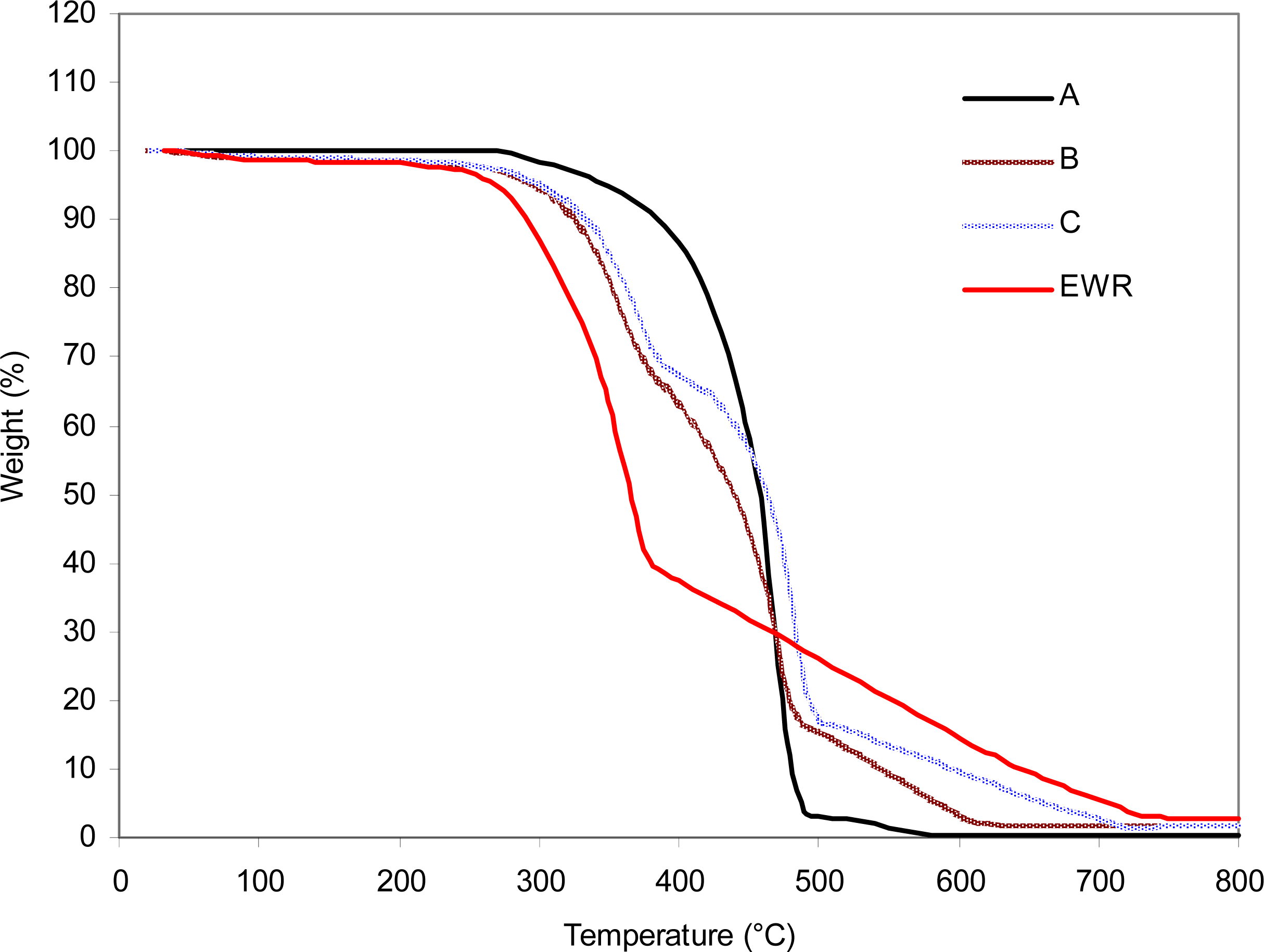
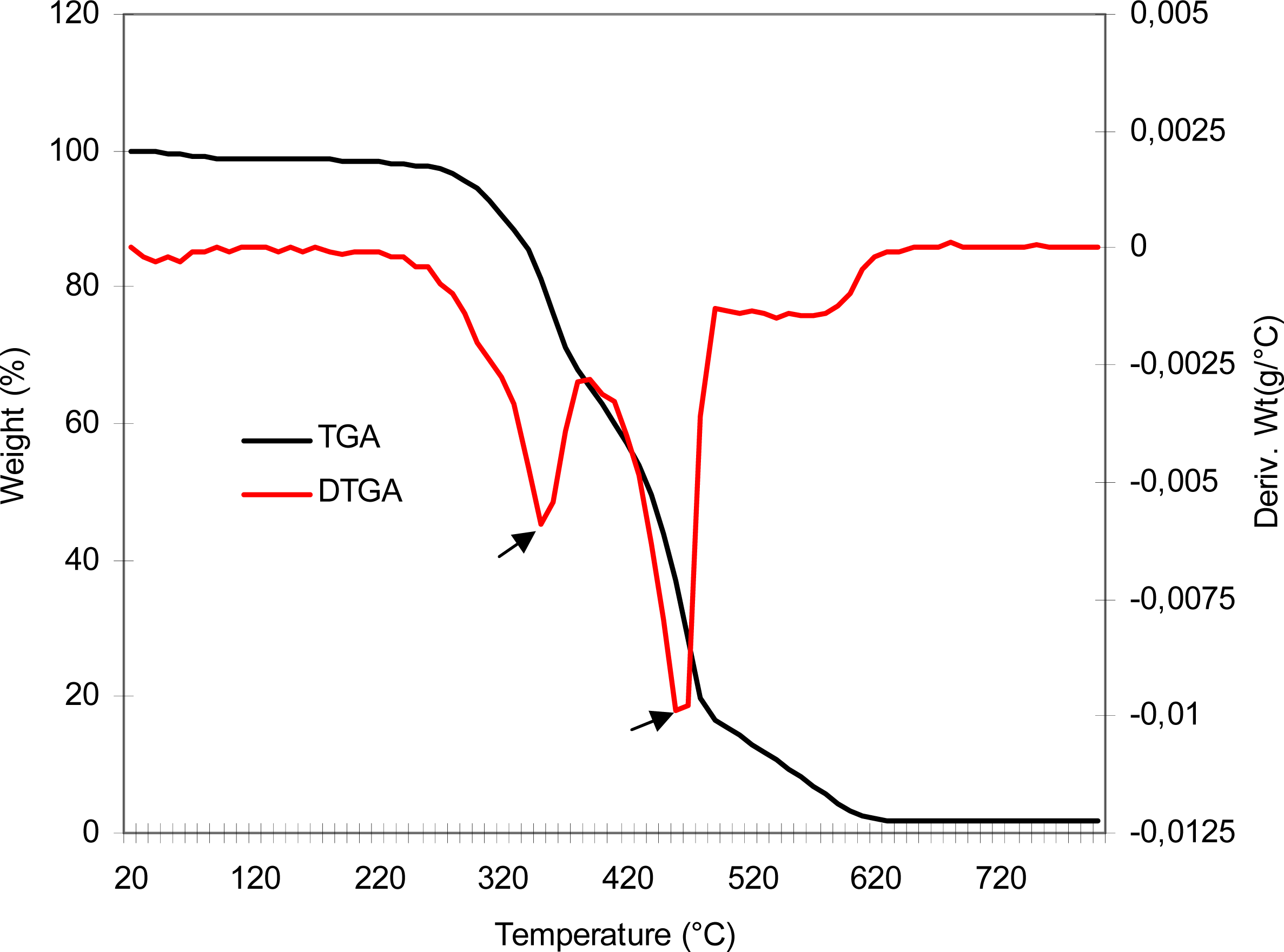
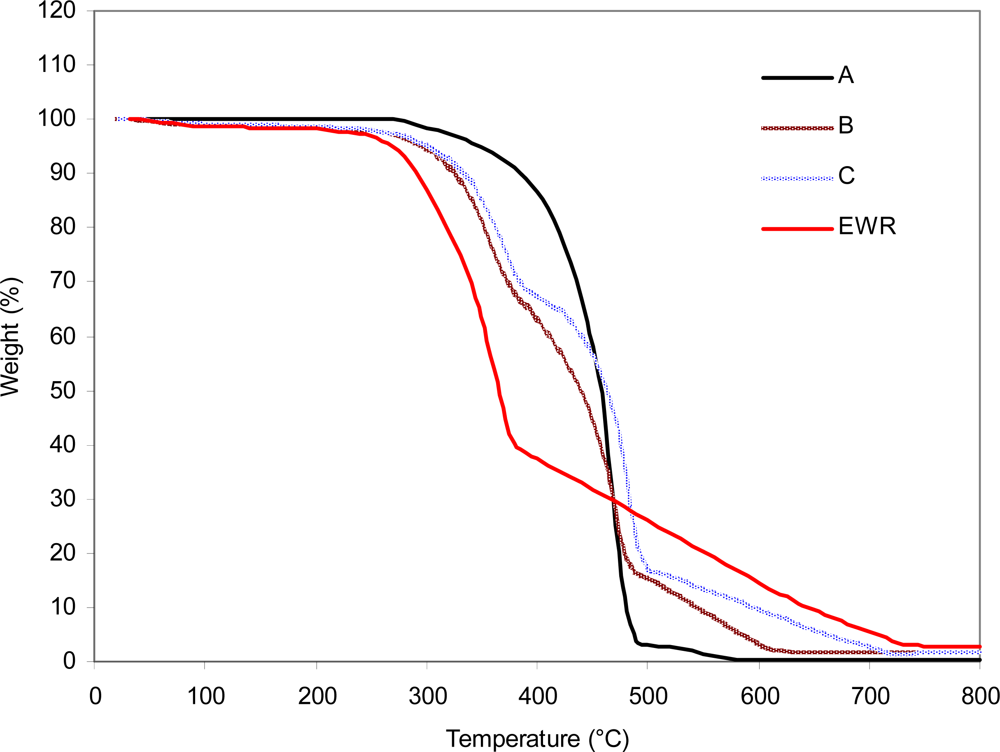
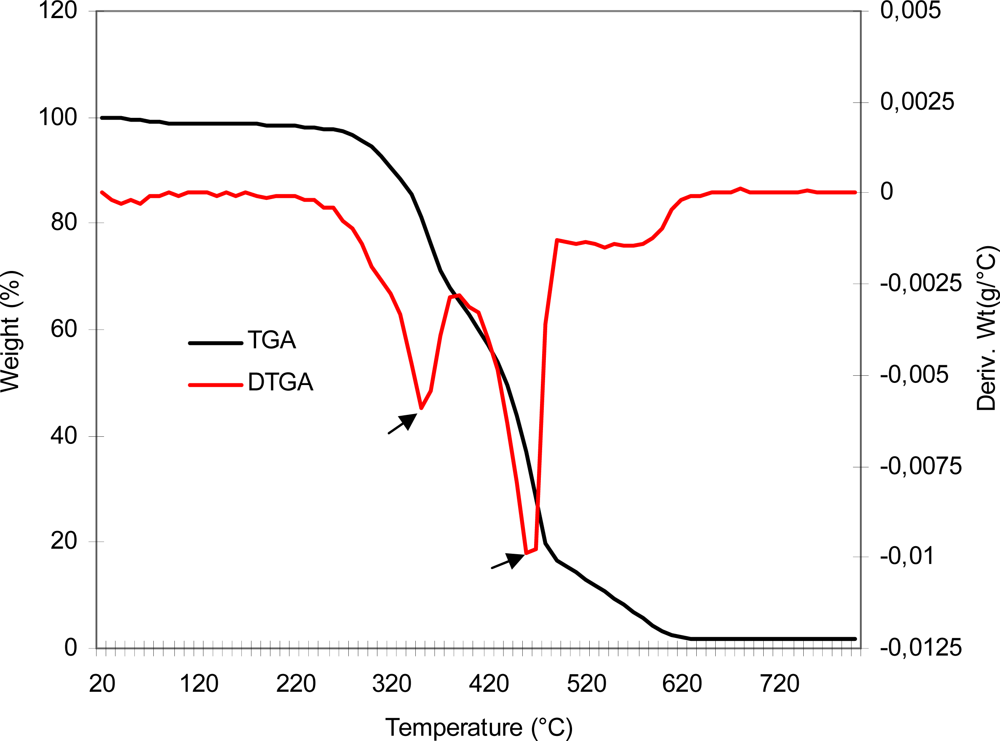
				<p>TGA analysis was performed on eucalyptus wood residue (EWR), unfilled recycled HDPE (A), EWR filled recycled HDPE composites (B), and EWR filled recycled HDPE composites modified with MAPE coupling agent (C). <xref ref-type="fig" rid="f1-ijms-09-00107">Figure 1</xref> shows the TGA thermographs of the samples. Initial degradation of EWR was started around 220 °C while recycled HDPE started around 300 °C. Composite materials started degrading 250 °C and 260 °C for sample B and C, respectively. Addition of EWR into the thermoplastic matrix induced recycled HDPE to degrade thermally at low temperatures [<xref ref-type="bibr" rid="b34-ijms-09-00107">34</xref>]. It is reported that thermal degradation of wood produces free radicals which accelerate the reaction of thermal degradation of polyethylene at high temperatures [<xref ref-type="bibr" rid="b34-ijms-09-00107">34</xref>–<xref ref-type="bibr" rid="b35-ijms-09-00107">35</xref>]. <xref ref-type="fig" rid="f2-ijms-09-00107">Figure 2</xref> shows the TGA and DTGA thermographs of the sample B. The two main decomposition peaks was shown with arrows on DTGA thermograph. The first peak was around 350 °C while the second peak was around 450°C. It is believed that first peak of 350 °C in composite B was mainly coming from the degradation of EWR. The main decomposition temperature of EWR was 360°C (<xref ref-type="table" rid="t1-ijms-09-00107">Table 1</xref>). Second decomposition temperature peak for HDPE based composites was close to the decomposition temperature of recycled HDPE (470 °C). Similar results were also observed for sample C.</p>
				<p>Summary of onset degradation, peak temperature and residual weight after 500 °C of the materials are also given in <xref ref-type="table" rid="t1-ijms-09-00107">Table 1</xref>. When the residues of the samples at 500 °C were compared, EWR and recycled HDPE had 26-percent and 3-percent residues, respectively. In composite B and C, residues were around 16-percent and 17-percent, respectively. Addition of EWR into the recycled HDPE increased the remaining residues due to the charring of EWR.</p>
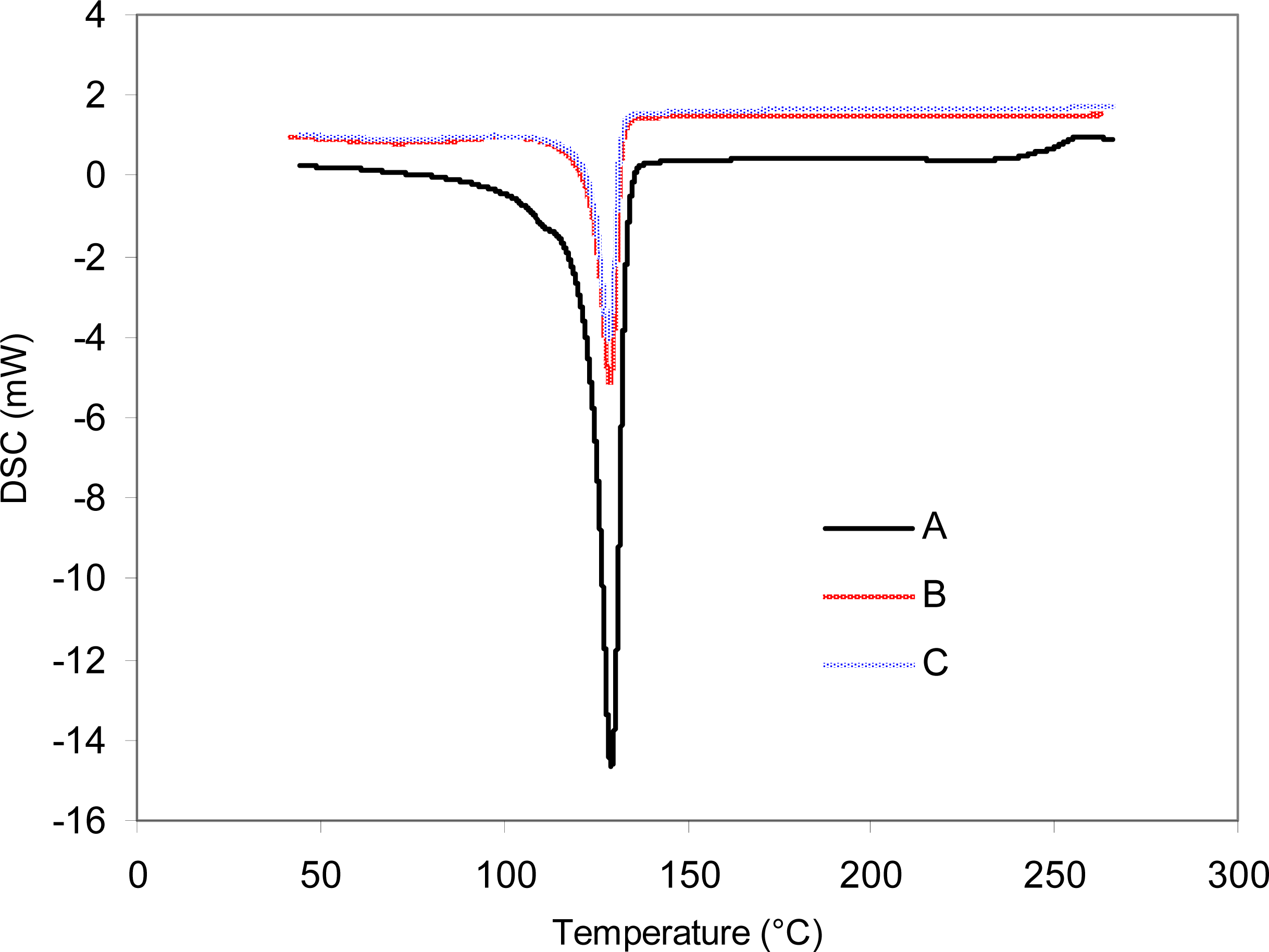
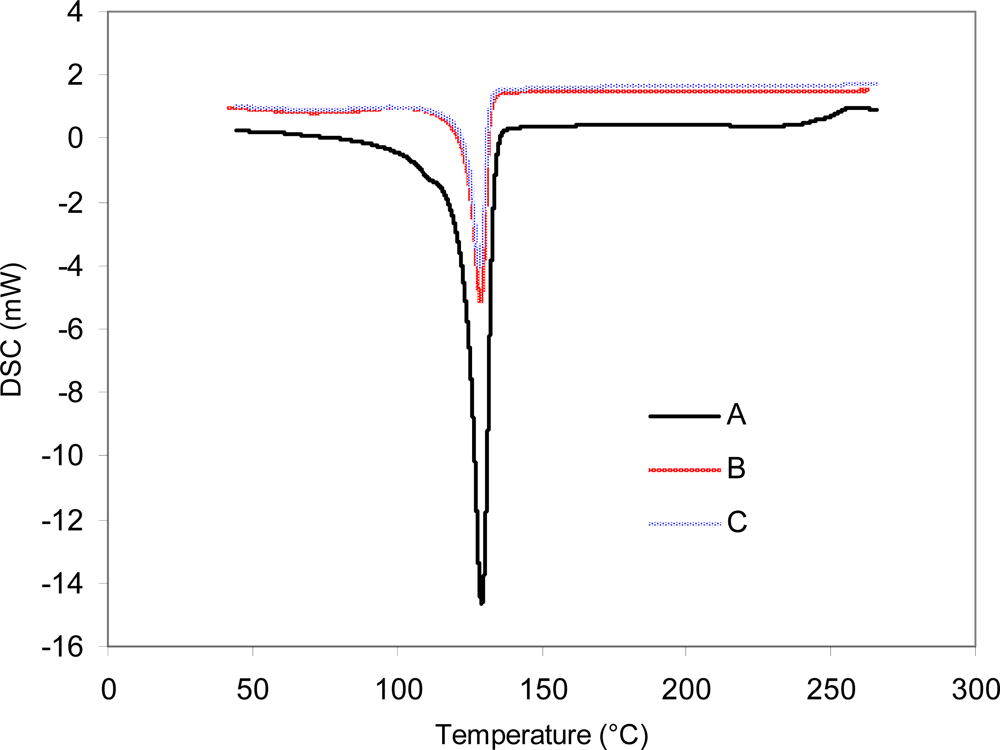
				<p>Thermal properties of the materials based on DSC results were presented in <xref ref-type="table" rid="t2-ijms-09-00107">Table 2</xref>. DSC thermographs of the samples were shown in <xref ref-type="fig" rid="f3-ijms-09-00107">Figure 3</xref>. Melting temperature of the recycled HDPE and their composites was around 128–130°C.</p>
				<p>Based on the TGA and DSC analysis during the manufacturing of the composites, extruder temperatures should be over 129 °C for HDPE to facilitate the melting of the matrix and should be less than 220 °C to prevent the lignocellulosic material from degrading. It should also be noted that residence time of the material in the extruder is also important [<xref ref-type="bibr" rid="b36-ijms-09-00107">36</xref>]. Higher processing temperature can be set if the component passes through the extruder in a short time.</p>
			</sec>
			<sec>
				<title>2.2. Effect of MAPE Coupling Agent on Mechanical Properties</title>
				<p>
					<xref ref-type="table" rid="t3-ijms-09-00107">Table 3</xref> summarizes the mechanical properties of eucalyptus wood residue (EWR) filled recycled thermoplastic composites. Mechanical properties were discussed under three headings; tensile properties, flexural properties and impact properties.</p>
				<p>Tensile properties include tensile strength, tensile modulus and elongation at break. <xref ref-type="table" rid="t4-ijms-09-00107">Table 4</xref> summarizes the analysis of variance for tensile properties of EWR filled recycled HDPE composites. The ANOVA showed that addition of coupling agent significantly improved the tensile strength (P&lt;0.0001). Similar results were also reported by others [<xref ref-type="bibr" rid="b37-ijms-09-00107">37</xref>–<xref ref-type="bibr" rid="b40-ijms-09-00107">40</xref>]. It is believed that better wetting of the PE based maleic anhydride to the HDPE matrix polymer is responsible for improved results. Addition of MAPE coupling agent significantly advanced the tensile modulus of the composites (P=0.0007) due to the improved adhesion between plastic and EWRs. Similar results for other wood flours filled polymer composites were also reported [<xref ref-type="bibr" rid="b19-ijms-09-00107">19</xref>, <xref ref-type="bibr" rid="b41-ijms-09-00107">41</xref>]. In the case of elongation at break, coupling agent had no significant effect (P=0.4087) on composites.</p>
				<p>Flexural properties include flexural strength and flexural modulus (<xref ref-type="table" rid="t3-ijms-09-00107">Table 3</xref>). <xref ref-type="table" rid="t5-ijms-09-00107">Table 5</xref> summarizes the analysis of variance for flexural properties of EWR filled recycled HDPE composites. Addition of coupling agent significantly improved the flexural strength (P=0.0001). Similar results were also reported in the flexural strength of other wood flour filled thermoplastic composites [<xref ref-type="bibr" rid="b37-ijms-09-00107">37</xref>–<xref ref-type="bibr" rid="b39-ijms-09-00107">39</xref>]. For polyolefin-based plastic lumber decking boards, ASTM D 6662 (2001) standard requires the minimum flexural strength of 6.9 MPa (1,000 psi). All composites produced in this study provided flexural strength values (14–17 MPa) that are well over the requirement by the standard. In the case of flexural modulus, addition of coupling agent improved the flexural strength but this increase was not statistically significant (P=0.1378). ASTM D 6662 (2001) standard requires the minimum flexural modulus of 340 MPa (50,000 psi) for polyolefin-based plastic lumber decking boards. All composites produced in this study provided flexural modulus values (1250–1300 MPa) well over required standards.</p>
				<p>
					<xref ref-type="table" rid="t6-ijms-09-00107">Table 6</xref> summarizes the analysis of variance for impact strength of EWR filled recycled HDPE composites. Addition of coupling agent reduced the Izod impact strength significantly (P=0.0037). In composite materials, improved adhesion usually changes the mode of failure from “fiber pull out” to fiber breakage, which usually requires less energy. Similar findings were reported in other studies for different wood flours or fibers [<xref ref-type="bibr" rid="b2-ijms-09-00107">2</xref>].</p>
			</sec>
			<sec>
				<title>2.3. Morphology</title>
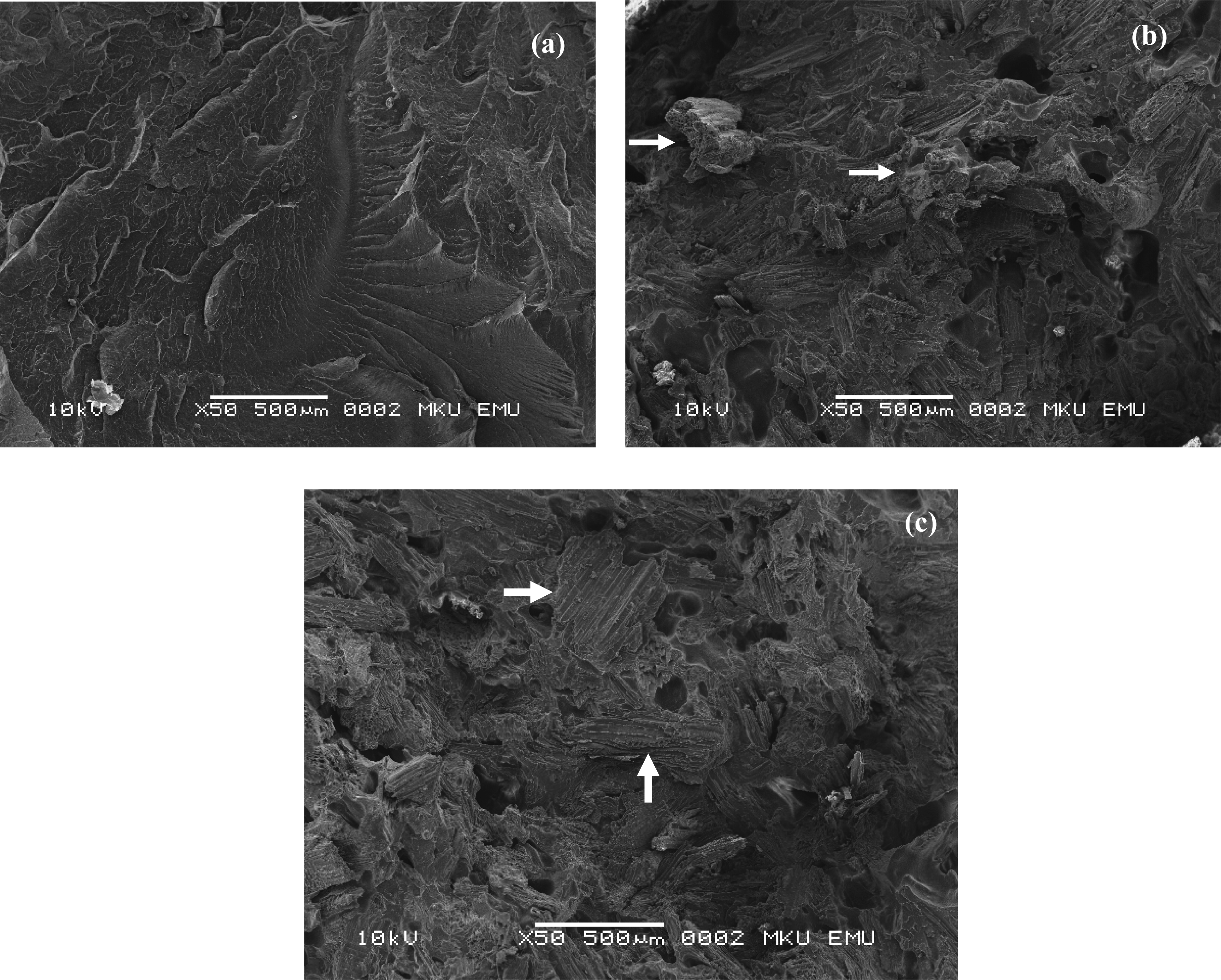
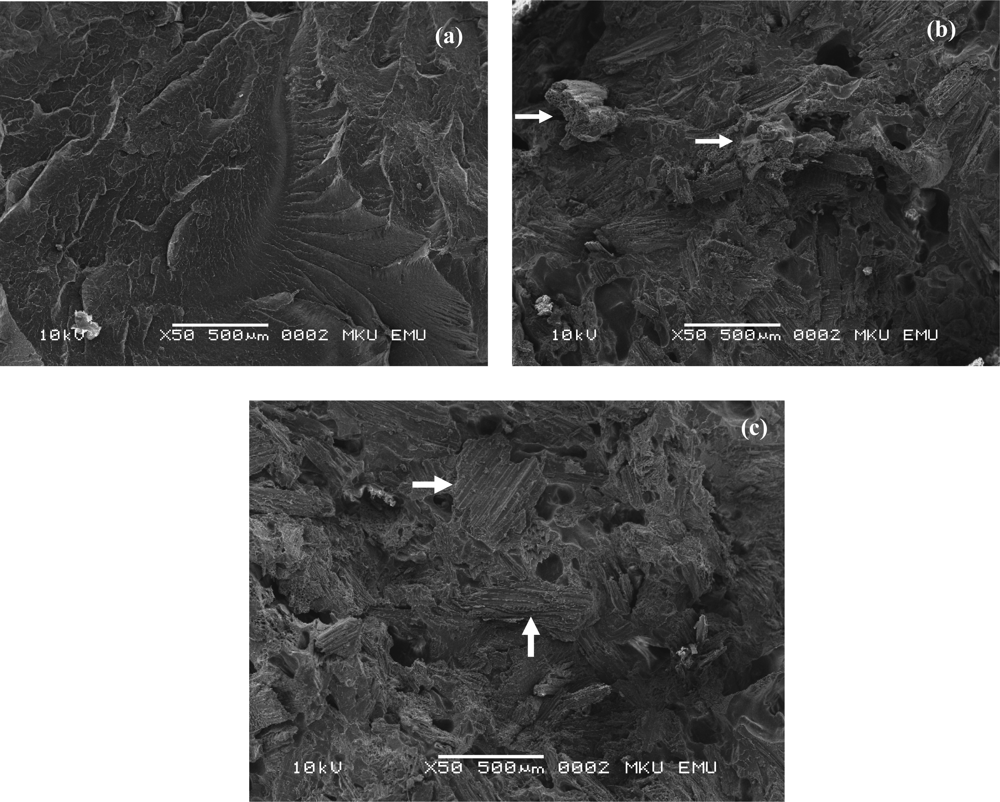
				<p>Morphology of the eucalyptus wood residue (EWR) filled recycled HDPE composites were studied using SEM micrographs. <xref ref-type="fig" rid="f4-ijms-09-00107">Figure 4</xref> shows the fractured surface of unfilled recycled HDPE, EWR filled recycled HDPE composites and MAPE modified EWR filled recycled HDPE composites. When <xref ref-type="fig" rid="f4-ijms-09-00107">Figure 4a</xref> and b was compared, it could be seen that matrix with eucalyptus wood residue was stiffer than other. In <xref ref-type="fig" rid="f4-ijms-09-00107">Figure 4</xref> b, the arrows show the individual eucalyptus wood residues in the matrix. This result was due to the poor adhesion between the not compatible EWRs (hydrophilic) and recycled HDPE matrix (hydrophobic). <xref ref-type="fig" rid="f4-ijms-09-00107">Figure 4c</xref> presents the EWR filled recycled HDPE composites with 4-percent MAPE coupling agents. Some wood residues were embedded into the recycled HDPE matrix indicating improved adhesion. However, there were still individual wood residues on the interface of eucalyptus wood residue and recycled HDPE matrix.</p>
			</sec>
		</sec>
		<sec>
			<title>3. Experimental Section</title>
			<sec sec-type="materials">
				<title>3.1. Materials</title>
				<p>Recycled high density polyethylene (HDPE) and eucalyptus wood residues were used as thermoplastic matrix and organic filler, respectively. Recycled HDPE pellets were produced from waste water pipes while eucalyptus residues were collected from lumber mills in the city of Tarsus, Turkey. They were granulated into 40-mesh size flours using Wiley mill. Maleic anhydrite grafted polyethylene (Licocene PEMA 4351 by Clarient) was utilized as coupling agent. Descriptions of coupling agents are provided in <xref ref-type="table" rid="t7-ijms-09-00107">Table 7</xref>.</p>
			</sec>
			<sec>
				<title>3.2. Compounding of the composites</title>
				<p>Compounding of the composites was implemented using a single screw extruder. Three different panels in <xref ref-type="table" rid="t8-ijms-09-00107">Table 8</xref> were manufactured. Depending on the groups, granulated HDPE, eucalyptus wood residue (EWR) and MAPE coupling agent were mixed in a high intensity mixer for 5 minutes to produce homogeneous blend. Then this homogenous mixture was compounded in a laboratory scale single-screw extruder at 40 rpm screw speed. Extruder temperatures were set as 170 175 180 185 185 °C. The extrudates were collected, cooled and granulated into pellets. Finally, pellets were compression molded in the hot press for 5 minutes at 175 °C and cooled for 20 minutes. Panels with the size of 5x150x200 mm were produced.</p>
			</sec>
			<sec>
				<title>3.3. Thermogravimetry and Differential Scanning Calorimetry</title>
				<p>Thermogravimetric analysis (TGA) of the samples was done in a Shimadzu TGA-50 thermal analyzer using a scanning rate of 10 °C/min heating rate under nitrogen with 20 mL/min flow rate, from room temperature to 800°C. Differential scanning calorimeter (DSC) analysis was performed in Shimadzu DSC-60 using 10 °C/min heating rate under nitrogen with 30 mL/min flow rate, from room temperature to 500 °C.</p>
			</sec>
			<sec>
				<title>3.4. Mechanical Property Testing</title>
				<p>To evaluate the effect of MAPE coupling agent on the mechanical properties of eucalyptus wood residue filled recycled HDPE composites, testing of the flexural, tensile and impact properties were determined in a climate-controlled testing laboratory. The flexural tests were conducted in accordance with ASTM D 790. Ten samples were tested on Zwick 10KN for each group with a crosshead motion rate of 2.0 mm/min. ASTM D 683 standards were used for tensile tests with a 5.0 mm/min test speed. The impact tests were performed according to ASTM D 256. Ten samples for each group were cut from the manufactured composites. The notches were added using a Polytest notching cutter by RayRan™ and notched samples were tested on a HIT5.5P impact testing machine, manufactured by Zwick™. At least seven samples were tested for each property.</p>
			</sec>
			<sec>
				<title>3.5. Scanning Electron Microscope</title>
				<p>The fractured surface of the samples was also studied by using JEOL scanning electron microscope (Model JSM 6400). The samples were first dipped into liquid nitrogen and snapped to half to prepare the fractured surfaces. Then samples were mounted on the sample stub and were sputtered with gold.</p>
			</sec>
			<sec sec-type="methods">
				<title>3.6. Statistical Analysis</title>
				<p>Design-Expert® Version 7.0.3 statistical software program was used for statistical analysis. In this study, the general factorial design for one factor was chosen to determine effect of addition of 4-percent MAPE coupling agent on the mechanical properties of eucalyptus wood residue filled recycled HDPE composites.</p>
			</sec>
		</sec>
	</body>
	<back>
		<ack>
			<title>Acknowledgments</title>
			<p>This research was supported by The Scientific &amp; Technological Research Council of Turkey (Project # TOVAG 106O548). Authors would also like to thank Mr. Kadir Karakus and Mr. Murat Ertas for the help during composite manufacturing and instrumental analysis.</p>
		</ack>
		<ref-list>
			<title>References and Notes</title>
			<ref id="b1-ijms-09-00107">
				<label>1</label>
				<citation citation-type="journal">
					<person-group person-group-type="author">
						<name>
							<surname>Clemons</surname>
							<given-names>C</given-names>
						</name>
					</person-group>
					<article-title>Wood-plastic composites in the United States. The interfacing of two industries</article-title>
					<source>Forest Prod J</source>
					<year>2002</year>
					<volume>52</volume>
					<fpage>10</fpage>
					<lpage>18</lpage>
				</citation>
			</ref>
			<ref id="b2-ijms-09-00107">
				<label>2</label>
				<citation citation-type="journal">
					<person-group person-group-type="author">
						<name>
							<surname>Mengeloglu</surname>
							<given-names>F</given-names>
						</name>
						<name>
							<surname>Matuana</surname>
							<given-names>LM</given-names>
						</name>
						<name>
							<surname>King</surname>
							<given-names>J</given-names>
						</name>
					</person-group>
					<article-title>Effects of impact modifiers on the properties of rigid PVC/wood-fiber composites</article-title>
					<source>J Vinyl Addit Techn</source>
					<year>2000</year>
					<volume>6</volume>
					<issue>3</issue>
					<fpage>153</fpage>
					<lpage>157</lpage>
					<comment>DOI 10.1002/vnl.10244</comment>
				<pub-id pub-id-type="doi">10.1002/vnl.10244</pub-id></citation>
			</ref>
			<ref id="b3-ijms-09-00107">
				<label>3</label>
				<citation citation-type="journal">
					<person-group person-group-type="author">
						<name>
							<surname>Mengeloglu</surname>
							<given-names>F</given-names>
						</name>
						<name>
							<surname>Matuana</surname>
							<given-names>LM</given-names>
						</name>
					</person-group>
					<article-title>Mechanical properties of extrusion foamed rigid PVC/Wood-flour composites</article-title>
					<source>J Vinyl Addit Techn</source>
					<year>2003</year>
					<volume>9</volume>
					<issue>1</issue>
					<fpage>26</fpage>
					<lpage>31</lpage>
					<comment>DOI 10.1002/vnl.10058</comment>
				<pub-id pub-id-type="doi">10.1002/vnl.10058</pub-id></citation>
			</ref>
			<ref id="b4-ijms-09-00107">
				<label>4</label>
				<citation citation-type="journal">
					<person-group person-group-type="author">
						<name>
							<surname>Matuana</surname>
							<given-names>LM</given-names>
						</name>
						<name>
							<surname>Park</surname>
							<given-names>CP</given-names>
						</name>
						<name>
							<surname>Balatinecz</surname>
							<given-names>JJ</given-names>
						</name>
					</person-group>
					<article-title>Cell morphology and property relationships of microcellular foamed PVC/Wood-fiber composites</article-title>
					<source>Polym Eng Sci</source>
					<year>1998</year>
					<volume>38</volume>
					<fpage>1862</fpage>
					<lpage>1872</lpage>
					<comment>DOI 10.1002/pen.10356</comment>
				<pub-id pub-id-type="doi">10.1002/pen.10356</pub-id></citation>
			</ref>
			<ref id="b5-ijms-09-00107">
				<label>5</label>
				<citation citation-type="journal">
					<person-group person-group-type="author">
						<name>
							<surname>Abu-Sharkh</surname>
							<given-names>BF</given-names>
						</name>
						<name>
							<surname>Kahraman</surname>
							<given-names>R</given-names>
						</name>
						<name>
							<surname>Abbasi</surname>
							<given-names>SH</given-names>
						</name>
						<name>
							<surname>Hussein</surname>
							<given-names>IA</given-names>
						</name>
					</person-group>
					<article-title>Effect of epolene E-43 as a compatibilizer on the mechanical properties of palm fiber-poly(propylene) composites</article-title>
					<source>J Appl Polym Sci</source>
					<year>2004</year>
					<volume>92</volume>
					<fpage>2581</fpage>
					<lpage>2592</lpage>
					<comment>DOI 10.1002/app.20230</comment>
				</citation>
			</ref>
			<ref id="b6-ijms-09-00107">
				<label>6</label>
				<citation citation-type="journal">
					<person-group person-group-type="author">
						<name>
							<surname>Sanadi</surname>
							<given-names>AR</given-names>
						</name>
						<name>
							<surname>Caulfield</surname>
							<given-names>DF</given-names>
						</name>
						<name>
							<surname>Rowell</surname>
							<given-names>RM</given-names>
						</name>
					</person-group>
					<article-title>Reinforcing polypropylene with natural fibers</article-title>
					<source>Plast Eng</source>
					<year>1994</year>
					<volume>4</volume>
					<fpage>27</fpage>
					<lpage>30</lpage>
				</citation>
			</ref>
			<ref id="b7-ijms-09-00107">
				<label>7</label>
				<citation citation-type="journal">
					<person-group person-group-type="author">
						<name>
							<surname>Geng</surname>
							<given-names>Y</given-names>
						</name>
						<name>
							<surname>Li</surname>
							<given-names>K</given-names>
						</name>
						<name>
							<surname>Simonsen</surname>
							<given-names>J</given-names>
						</name>
					</person-group>
					<article-title>Effect of a new compatibilizer system on the flexural properties of wood-polyethylene composites</article-title>
					<source>J Appl Polym Sci</source>
					<year>2004</year>
					<volume>91</volume>
					<fpage>3667</fpage>
					<lpage>3672</lpage>
					<comment>DOI 10.1002/app.13618</comment>
				</citation>
			</ref>
			<ref id="b8-ijms-09-00107">
				<label>8</label>
				<citation citation-type="journal">
					<person-group person-group-type="author">
						<name>
							<surname>Schut</surname>
							<given-names>J</given-names>
						</name>
					</person-group>
					<article-title>For compounding, sheet &amp; profile: Wood is good</article-title>
					<source>Plast Technol</source>
					<year>1999</year>
					<volume>1999</volume>(March)<fpage>46</fpage>
					<lpage>52</lpage>
				</citation>
			</ref>
			<ref id="b9-ijms-09-00107">
				<label>9</label>
				<citation citation-type="confproc">
					<person-group person-group-type="author">
						<name>
							<surname>Winandy</surname>
							<given-names>JE</given-names>
						</name>
						<name>
							<surname>Stark</surname>
							<given-names>NM</given-names>
						</name>
						<name>
							<surname>Clemons</surname>
							<given-names>C</given-names>
						</name>
					</person-group>
					<article-title>Considerations in recycling of wood-plastic composites</article-title>
					<conf-name>Proc. 5th Global Wood and Natural Fibre Composites Symposium</conf-name>
					<conf-loc>Kassel, Germany</conf-loc>
					<conf-date>2004</conf-date>
					<comment>No. A6-1</comment>
				</citation>
			</ref>
			<ref id="b10-ijms-09-00107">
				<label>10</label>
				<citation citation-type="journal">
					<person-group person-group-type="author">
						<name>
							<surname>La Mantia</surname>
							<given-names>FP</given-names>
						</name>
						<name>
							<surname>Morreale</surname>
							<given-names>M</given-names>
						</name>
						<name>
							<surname>Ishak</surname>
							<given-names>ZA</given-names>
						</name>
					</person-group>
					<article-title>Processing and mechanical properties of organic filler-polypropylene composites</article-title>
					<source>J Appl Polym Sci</source>
					<year>2005</year>
					<volume>96</volume>
					<fpage>1906</fpage>
					<lpage>1913</lpage>
					<comment>DOI 10.1002/app.21623</comment>
				</citation>
			</ref>
			<ref id="b11-ijms-09-00107">
				<label>11</label>
				<citation citation-type="journal">
					<person-group person-group-type="author">
						<name>
							<surname>Mengeloglu</surname>
							<given-names>F</given-names>
						</name>
						<name>
							<surname>Matuana</surname>
							<given-names>LM</given-names>
						</name>
						<name>
							<surname>King</surname>
							<given-names>J</given-names>
						</name>
					</person-group>
					<article-title>Effects of impact modifiers on the properties of rigid PVC/wood-fiber composites</article-title>
					<source>J Vinyl Addit Techn</source>
					<year>2000</year>
					<volume>6</volume>
					<issue>3</issue>
					<fpage>153</fpage>
					<lpage>157</lpage>
					<comment>DOI 10.1002/vnl.10244</comment>
				<pub-id pub-id-type="doi">10.1002/vnl.10244</pub-id></citation>
			</ref>
			<ref id="b12-ijms-09-00107">
				<label>12</label>
				<citation citation-type="journal">
					<person-group person-group-type="author">
						<name>
							<surname>Mengeloglu</surname>
							<given-names>F</given-names>
						</name>
						<name>
							<surname>Matuana</surname>
							<given-names>LM</given-names>
						</name>
					</person-group>
					<article-title>Mechanical properties of extrusion foamed rigid PVC/Wood-flour composites</article-title>
					<source>J Vinyl Addit Techn</source>
					<year>2003</year>
					<volume>9</volume>
					<issue>1</issue>
					<fpage>26</fpage>
					<lpage>31</lpage>
					<comment>DOI 10.1002/vnl.10058</comment>
				<pub-id pub-id-type="doi">10.1002/vnl.10058</pub-id></citation>
			</ref>
			<ref id="b13-ijms-09-00107">
				<label>13</label>
				<citation citation-type="journal">
					<person-group person-group-type="author">
						<name>
							<surname>Sanadi</surname>
							<given-names>AR</given-names>
						</name>
						<name>
							<surname>Young</surname>
							<given-names>RA</given-names>
						</name>
						<name>
							<surname>Clemons</surname>
							<given-names>C</given-names>
						</name>
						<name>
							<surname>Rowel</surname>
							<given-names>RM</given-names>
						</name>
					</person-group>
					<article-title>Recycled newspaper fibers as reinforcing fillers in thermoplastics: Part I - Analysis of tensile and impact properties of polypropylene</article-title>
					<source>J Reinf Plast Comp</source>
					<year>1994</year>
					<volume>13</volume>
					<fpage>54</fpage>
					<lpage>58</lpage>
					<comment>DOI 10.1177/073168449401300104</comment>
				<pub-id pub-id-type="doi">10.1177/073168449401300104</pub-id></citation>
			</ref>
			<ref id="b14-ijms-09-00107">
				<label>14</label>
				<citation citation-type="journal">
					<person-group person-group-type="author">
						<name>
							<surname>Sanadi</surname>
							<given-names>AR</given-names>
						</name>
						<name>
							<surname>Caulfield</surname>
							<given-names>DF</given-names>
						</name>
						<name>
							<surname>Rowell</surname>
							<given-names>RM</given-names>
						</name>
					</person-group>
					<article-title>Reinforcing polypropylene with natural fibers</article-title>
					<source>Plast Eng</source>
					<year>1994</year>
					<volume>4</volume>
					<fpage>27</fpage>
					<lpage>30</lpage>
				</citation>
			</ref>
			<ref id="b15-ijms-09-00107">
				<label>15</label>
				<citation citation-type="journal">
					<person-group person-group-type="author">
						<name>
							<surname>Woodhams</surname>
							<given-names>RT</given-names>
						</name>
						<name>
							<surname>Thomas</surname>
							<given-names>G</given-names>
						</name>
						<name>
							<surname>Rodgers</surname>
							<given-names>DK</given-names>
						</name>
					</person-group>
					<article-title>Wood fibers as reinforcing fillers for polyolefins</article-title>
					<source>Polym Eng Sci</source>
					<year>1994</year>
					<volume>24</volume>
					<fpage>1166</fpage>
					<lpage>1171</lpage>
					<comment>DOI 10.1002/pen.760241504</comment>
				</citation>
			</ref>
			<ref id="b16-ijms-09-00107">
				<label>16</label>
				<citation citation-type="journal">
					<person-group person-group-type="author">
						<name>
							<surname>Matuana</surname>
							<given-names>LM</given-names>
						</name>
						<name>
							<surname>Balatinecz</surname>
							<given-names>JJ</given-names>
						</name>
					</person-group>
					<article-title>Effect of surface properties on the adhesion between PVC and wood veneer laminates</article-title>
					<source>Polym Eng Sci</source>
					<year>1998</year>
					<volume>38</volume>
					<issue>5</issue>
					<fpage>765</fpage>
					<lpage>773</lpage>
					<comment>DOI 10.1002/pen.10242</comment>
				<pub-id pub-id-type="doi">10.1002/pen.10242</pub-id></citation>
			</ref>
			<ref id="b17-ijms-09-00107">
				<label>17</label>
				<citation citation-type="journal">
					<person-group person-group-type="author">
						<name>
							<surname>Matuana</surname>
							<given-names>LM</given-names>
						</name>
						<name>
							<surname>Balatinecz</surname>
							<given-names>JJ</given-names>
						</name>
						<name>
							<surname>Park</surname>
							<given-names>CB</given-names>
						</name>
						<name>
							<surname>Sodhi</surname>
							<given-names>RNS</given-names>
						</name>
					</person-group>
					<article-title>X-ray photoelectron spectroscopy study of silane-treated newsprint-fibers</article-title>
					<source>Wood Sci Technol</source>
					<year>1999</year>
					<volume>33</volume>
					<issue>4</issue>
					<fpage>259</fpage>
					<lpage>270</lpage>
					<comment>DOI 10.1007/s002260050114</comment>
				<pub-id pub-id-type="doi">10.1007/s002260050114</pub-id></citation>
			</ref>
			<ref id="b18-ijms-09-00107">
				<label>18</label>
				<citation citation-type="journal">
					<person-group person-group-type="author">
						<name>
							<surname>Qiu</surname>
							<given-names>W</given-names>
						</name>
						<name>
							<surname>Endo</surname>
							<given-names>T</given-names>
						</name>
						<name>
							<surname>Hirotsu</surname>
							<given-names>T</given-names>
						</name>
					</person-group>
					<article-title>Interfacial interactions of a novel mechanochemical composite of cellulose with maleated polypropylene</article-title>
					<source>J Appl Polym Sci</source>
					<year>2004</year>
					<volume>94</volume>
					<fpage>1326</fpage>
					<lpage>1335</lpage>
					<comment>DOI 10.1002/app.21123</comment>
				</citation>
			</ref>
			<ref id="b19-ijms-09-00107">
				<label>19</label>
				<citation citation-type="journal">
					<person-group person-group-type="author">
						<name>
							<surname>Coutinho</surname>
							<given-names>FMB</given-names>
						</name>
						<name>
							<surname>Costa</surname>
							<given-names>THS</given-names>
						</name>
						<name>
							<surname>Carvalho</surname>
							<given-names>CDL</given-names>
						</name>
					</person-group>
					<article-title>Polypropylene-wood fiber composites: Effect of treatment and mixing conditions on mechanical properties</article-title>
					<source>J Appl Polym Sci</source>
					<year>1998</year>
					<volume>65</volume>
					<fpage>1227</fpage>
					<lpage>1235</lpage>
					<comment>DOI 10.1002/(SICI)1097–4628(19970808)65:6&lt;1227::AID-APP18&gt;3.0.CO;2-Q</comment>
				</citation>
			</ref>
			<ref id="b20-ijms-09-00107">
				<label>20</label>
				<citation citation-type="journal">
					<person-group person-group-type="author">
						<name>
							<surname>Qiu</surname>
							<given-names>W</given-names>
						</name>
						<name>
							<surname>Zhang</surname>
							<given-names>FT</given-names>
						</name>
						<name>
							<surname>Endo</surname>
							<given-names>T</given-names>
						</name>
						<name>
							<surname>Hirotsu</surname>
							<given-names>T</given-names>
						</name>
					</person-group>
					<article-title>Milling-induced etherification between cellulose and maleated polypropylene</article-title>
					<source>J Appl Polym Sci</source>
					<year>2003</year>
					<volume>91</volume>
					<fpage>1703</fpage>
					<lpage>1709</lpage>
					<comment>DOI 10.1002/app.13368</comment>
				</citation>
			</ref>
			<ref id="b21-ijms-09-00107">
				<label>21</label>
				<citation citation-type="journal">
					<person-group person-group-type="author">
						<name>
							<surname>Qiu</surname>
							<given-names>W</given-names>
						</name>
						<name>
							<surname>Zhang</surname>
							<given-names>FT</given-names>
						</name>
						<name>
							<surname>Hirotsu</surname>
							<given-names>T</given-names>
						</name>
					</person-group>
					<article-title>Isocyanate as a compatibilizing agent on the properties of highly Crystalline cellulose/polypropylene composites</article-title>
					<source>J Mater Sci</source>
					<year>2005</year>
					<volume>40</volume>
					<fpage>3607</fpage>
					<lpage>3614</lpage>
				<pub-id pub-id-type="doi">10.1007/s10853-005-0790-9</pub-id></citation>
			</ref>
			<ref id="b22-ijms-09-00107">
				<label>22</label>
				<citation citation-type="journal">
					<person-group person-group-type="author">
						<name>
							<surname>Qiu</surname>
							<given-names>W</given-names>
						</name>
						<name>
							<surname>Zhang</surname>
							<given-names>FT</given-names>
						</name>
						<name>
							<surname>Endo</surname>
							<given-names>T</given-names>
						</name>
						<name>
							<surname>Hirotsu</surname>
							<given-names>T</given-names>
						</name>
					</person-group>
					<article-title>Effect of maleated polypropylene on the performance of polypropylene/cellulose composite</article-title>
					<source>Polym Comp</source>
					<year>2005</year>
					<volume>26</volume>
					<fpage>448</fpage>
					<lpage>453</lpage>
					<comment>DOI 10.1002/pc.20119</comment>
				<pub-id pub-id-type="doi">10.1002/pc.20119</pub-id></citation>
			</ref>
			<ref id="b23-ijms-09-00107">
				<label>23</label>
				<citation citation-type="journal">
					<person-group person-group-type="author">
						<name>
							<surname>Lu</surname>
							<given-names>JZ</given-names>
						</name>
						<name>
							<surname>Wu</surname>
							<given-names>Q</given-names>
						</name>
						<name>
							<surname>Negulescu</surname>
							<given-names>II</given-names>
						</name>
					</person-group>
					<article-title>Wood-fiber/high-density-polyethylene composites: Coupling agent Performance</article-title>
					<source>J Appl Polym Sci</source>
					<year>2005</year>
					<volume>96</volume>
					<fpage>93</fpage>
					<lpage>102</lpage>
					<comment>DOI 10.1002/app.21410</comment>
				</citation>
			</ref>
			<ref id="b24-ijms-09-00107">
				<label>24</label>
				<citation citation-type="journal">
					<person-group person-group-type="author">
						<name>
							<surname>Jana</surname>
							<given-names>CJ</given-names>
						</name>
						<name>
							<surname>Prieto</surname>
							<given-names>A</given-names>
						</name>
					</person-group>
					<article-title>Natural fiber composites of high-temperature thermoplastics polymers: Effect of coupling agents</article-title>
					<source>J Appl Polym Sci</source>
					<year>2002</year>
					<volume>86</volume>
					<fpage>2168</fpage>
					<lpage>2173</lpage>
					<comment>DOI 10.1002/app.11072</comment>
				</citation>
			</ref>
			<ref id="b25-ijms-09-00107">
				<label>25</label>
				<citation citation-type="journal">
					<person-group person-group-type="author">
						<name>
							<surname>Lu</surname>
							<given-names>JZ</given-names>
						</name>
						<name>
							<surname>Wu</surname>
							<given-names>Q</given-names>
						</name>
						<name>
							<surname>McNabb</surname>
							<given-names>HS</given-names>
						</name>
					</person-group>
					<article-title>Chemical coupling in wood fiber and polymer composites: A review of coupling and treatments</article-title>
					<source>Wood Fiber Sci</source>
					<year>2000</year>
					<volume>32</volume>
					<fpage>88</fpage>
					<lpage>104</lpage>
				</citation>
			</ref>
			<ref id="b26-ijms-09-00107">
				<label>26</label>
				<citation citation-type="journal">
					<person-group person-group-type="author">
						<name>
							<surname>Mengeloglu</surname>
							<given-names>F</given-names>
						</name>
						<name>
							<surname>Kurt</surname>
							<given-names>R</given-names>
						</name>
						<name>
							<surname>Gardner</surname>
							<given-names>DJ</given-names>
						</name>
						<name>
							<surname>O'Neill</surname>
							<given-names>S</given-names>
						</name>
					</person-group>
					<article-title>Mechanical properties of extruded high density polyethylene (HDPE)- and polypropylene (PP)- wood flour decking boards</article-title>
					<source>Iran Polym J</source>
					<year>2007</year>
					<volume>16</volume>
					<issue>7</issue>
					<fpage>477</fpage>
					<lpage>487</lpage>
				</citation>
			</ref>
			<ref id="b27-ijms-09-00107">
				<label>27</label>
				<citation citation-type="journal">
					<person-group person-group-type="author">
						<name>
							<surname>Yang</surname>
							<given-names>HS</given-names>
						</name>
						<name>
							<surname>Wolcott</surname>
							<given-names>MP</given-names>
						</name>
						<name>
							<surname>Kim</surname>
							<given-names>HS</given-names>
						</name>
						<name>
							<surname>Kim</surname>
							<given-names>S</given-names>
						</name>
						<name>
							<surname>Kim</surname>
							<given-names>HJ</given-names>
						</name>
					</person-group>
					<article-title>Effect of different compatibilizing agents on the mechanical properties of lignocellulosic material filled polyethylene bio-composites</article-title>
					<source>Compos Struct</source>
					<year>2007</year>
					<volume>79</volume>
					<fpage>369</fpage>
					<lpage>375</lpage>
					<comment>DOI 10.1016/j.compstruct.2006.02.016</comment>
				</citation>
			</ref>
			<ref id="b28-ijms-09-00107">
				<label>28</label>
				<citation citation-type="journal">
					<person-group person-group-type="author">
						<name>
							<surname>Li</surname>
							<given-names>Q</given-names>
						</name>
						<name>
							<surname>Matuana</surname>
							<given-names>LM</given-names>
						</name>
					</person-group>
					<article-title>Effectiveness of maleated and acryclic acid-functionalized polyolefin coupling agents for HDPE-wood-flour composites</article-title>
					<source>J Thermoplast Compos</source>
					<year>2003</year>
					<volume>16</volume>
					<fpage>551</fpage>
					<lpage>564</lpage>
					<comment>DOI 10.1177/089270503033340</comment>
				</citation>
			</ref>
			<ref id="b29-ijms-09-00107">
				<label>29</label>
				<citation citation-type="journal">
					<person-group person-group-type="author">
						<name>
							<surname>Lai</surname>
							<given-names>SM</given-names>
						</name>
						<name>
							<surname>Yeh</surname>
							<given-names>FC</given-names>
						</name>
						<name>
							<surname>Wang</surname>
							<given-names>Y</given-names>
						</name>
						<name>
							<surname>Chan</surname>
							<given-names>HC</given-names>
						</name>
						<name>
							<surname>Shen</surname>
							<given-names>HF</given-names>
						</name>
					</person-group>
					<article-title>Comparative study of maleated polyolefins as compatibilizers for polyethylene/wood flour composites</article-title>
					<source>J Appl Polym Sci</source>
					<year>2003</year>
					<volume>87</volume>
					<fpage>487</fpage>
					<lpage>496</lpage>
					<comment>DOI 10.1002/app.11419</comment>
				</citation>
			</ref>
			<ref id="b30-ijms-09-00107">
				<label>30</label>
				<citation citation-type="journal">
					<person-group person-group-type="author">
						<name>
							<surname>Wang</surname>
							<given-names>Y</given-names>
						</name>
						<name>
							<surname>Yeh</surname>
							<given-names>FC</given-names>
						</name>
						<name>
							<surname>Lai</surname>
							<given-names>SM</given-names>
						</name>
						<name>
							<surname>Chan</surname>
							<given-names>HC</given-names>
						</name>
						<name>
							<surname>Shen</surname>
							<given-names>HF</given-names>
						</name>
					</person-group>
					<article-title>Effectiveness of functionalized polyolefins as compatibilizers for polyethylene/wood flour composites</article-title>
					<source>Polym Eng Sci</source>
					<year>2003</year>
					<volume>43</volume>
					<issue>4</issue>
					<fpage>933</fpage>
					<lpage>945</lpage>
					<comment>DOI 10.1002/pen.10077</comment>
				<pub-id pub-id-type="doi">10.1002/pen.10077</pub-id></citation>
			</ref>
			<ref id="b31-ijms-09-00107">
				<label>31</label>
				<citation citation-type="journal">
					<person-group person-group-type="author">
						<name>
							<surname>Yamaguchi</surname>
							<given-names>Y</given-names>
						</name>
						<name>
							<surname>Miyata</surname>
							<given-names>H</given-names>
						</name>
					</person-group>
					<article-title>Influence of stereoregularity of polypropylene on miscibility with ethylene-1-hexene copolymer</article-title>
					<source>Macromolecules</source>
					<year>1999</year>
					<volume>32</volume>
					<issue>18</issue>
					<fpage>5911</fpage>
					<lpage>5916</lpage>
					<comment>DOI 10.1021/ma990004s</comment>
				<pub-id pub-id-type="doi">10.1021/ma990004s</pub-id></citation>
			</ref>
			<ref id="b32-ijms-09-00107">
				<label>32</label>
				<citation citation-type="confproc">
					<person-group person-group-type="author">
						<name>
							<surname>Selke</surname>
							<given-names>SE</given-names>
						</name>
						<name>
							<surname>Childress</surname>
							<given-names>J</given-names>
						</name>
					</person-group>
					<article-title>Wood fiber /high-density polyethylene composites: ability of additive to enhance mechanical properties</article-title>
					<conf-name>Proc. Wood-fiber/Polymer Composites: Fundamental Concepts, Processes, and Material Options</conf-name>
					<publisher-name>Forest Products Society</publisher-name>
					<publisher-loc>Madison, Wisconsin, USA</publisher-loc>
					<year>1993</year>
					<page-range>109</page-range>
				</citation>
			</ref>
			<ref id="b33-ijms-09-00107">
				<label>33</label>
				<citation citation-type="journal">
					<person-group person-group-type="author">
						<name>
							<surname>Sombatsompop</surname>
							<given-names>N</given-names>
						</name>
						<name>
							<surname>Yotinwattanakumtorn</surname>
							<given-names>C</given-names>
						</name>
						<name>
							<surname>Thongpin</surname>
							<given-names>C</given-names>
						</name>
					</person-group>
					<article-title>Influence of type and concentration of maleic anhydride grafted polypropylene and impact modifiers on mechanical properties of PP/Wood sawdust composites</article-title>
					<source>J Appl Polym Sci</source>
					<year>2005</year>
					<volume>97</volume>
					<fpage>475</fpage>
					<lpage>484</lpage>
					<comment>DOI 10.1002/app.21765</comment>
				</citation>
			</ref>
			<ref id="b34-ijms-09-00107">
				<label>34</label>
				<citation citation-type="journal">
					<person-group person-group-type="author">
						<name>
							<surname>Li</surname>
							<given-names>B</given-names>
						</name>
						<name>
							<surname>He</surname>
							<given-names>J</given-names>
						</name>
					</person-group>
					<article-title>Investigation of mechanical property, flame retardancy and thermal degradation of LLDPE-wood-fibre composites</article-title>
					<source>Polym Degrad Stabil</source>
					<year>2004</year>
					<volume>83</volume>
					<fpage>241</fpage>
					<lpage>246</lpage>
					<comment>DOI 10.1016/S0141-3910(03)00268-4</comment>
				</citation>
			</ref>
			<ref id="b35-ijms-09-00107">
				<label>35</label>
				<citation citation-type="journal">
					<person-group person-group-type="author">
						<name>
							<surname>Amen-Chen</surname>
							<given-names>C</given-names>
						</name>
					</person-group>
					<article-title>Production of monomeric phenols by thermochemical conversion of biomass: a review</article-title>
					<source>Bioresour Technol</source>
					<year>2001</year>
					<volume>79</volume>
					<fpage>277</fpage>
					<lpage>299</lpage>
					<comment>DOI 10.1016/S0960-8524(00)00180-2; PubMed 11499582</comment>
				<pub-id pub-id-type="pmid">11499582</pub-id></citation>
			</ref>
			<ref id="b36-ijms-09-00107">
				<label>36</label>
				<citation citation-type="journal">
					<person-group person-group-type="author">
						<name>
							<surname>Chan</surname>
							<given-names>JH</given-names>
						</name>
						<name>
							<surname>Balke</surname>
							<given-names>ST</given-names>
						</name>
					</person-group>
					<article-title>The thermal degradation kinetics of polypropylene: Part II Time-temperature superposition</article-title>
					<source>Polym Degrad Stabil</source>
					<year>1997</year>
					<volume>57</volume>
					<fpage>127</fpage>
					<lpage>134</lpage>
					<comment>DOI 10.1016/S0141-3910(96)00159-0</comment>
				</citation>
			</ref>
			<ref id="b37-ijms-09-00107">
				<label>37</label>
				<citation citation-type="journal">
					<person-group person-group-type="author">
						<name>
							<surname>Yang</surname>
							<given-names>HS</given-names>
						</name>
						<name>
							<surname>Wolcott</surname>
							<given-names>MP</given-names>
						</name>
						<name>
							<surname>Kim</surname>
							<given-names>HS</given-names>
						</name>
						<name>
							<surname>Kim</surname>
							<given-names>S</given-names>
						</name>
						<name>
							<surname>Kim</surname>
							<given-names>HJ</given-names>
						</name>
					</person-group>
					<article-title>Effect of different compatibilizing agents on the mechanical properties of lignocellulosic material filled polyethylene bio-composites</article-title>
					<source>Compos Struct</source>
					<year>2007</year>
					<volume>79</volume>
					<fpage>369</fpage>
					<lpage>375</lpage>
					<comment>DOI 10.1016/j.compstruct.2006.02.016</comment>
				</citation>
			</ref>
			<ref id="b38-ijms-09-00107">
				<label>38</label>
				<citation citation-type="journal">
					<person-group person-group-type="author">
						<name>
							<surname>Li</surname>
							<given-names>Q</given-names>
						</name>
						<name>
							<surname>Matuana</surname>
							<given-names>LM</given-names>
						</name>
					</person-group>
					<article-title>Effectiveness of maleated and acryclic acid-functionalized polyolefin coupling agents for HDPE-wood-flour composites</article-title>
					<source>J Thermoplast Compos</source>
					<year>2003</year>
					<volume>16</volume>
					<fpage>551</fpage>
					<lpage>564</lpage>
					<comment>DOI 10.1177/089270503033340</comment>
				</citation>
			</ref>
			<ref id="b39-ijms-09-00107">
				<label>39</label>
				<citation citation-type="journal">
					<person-group person-group-type="author">
						<name>
							<surname>Lai</surname>
							<given-names>S</given-names>
						</name>
					</person-group>
					<article-title>Comparative study of maleated polyolefins as compatibilizers for polyethylene/wood flour composites</article-title>
					<source>J Appl Polym Sci</source>
					<year>2003</year>
					<volume>87</volume>
					<fpage>487</fpage>
					<lpage>496</lpage>
					<comment>DOI 10.1002/app.11419</comment>
				</citation>
			</ref>
			<ref id="b40-ijms-09-00107">
				<label>40</label>
				<citation citation-type="journal">
					<person-group person-group-type="author">
						<name>
							<surname>Wang</surname>
							<given-names>Y</given-names>
						</name>
						<name>
							<surname>Yeh</surname>
							<given-names>FC</given-names>
						</name>
						<name>
							<surname>Lai</surname>
							<given-names>SM</given-names>
						</name>
						<name>
							<surname>Chan</surname>
							<given-names>HC</given-names>
						</name>
						<name>
							<surname>Shen</surname>
							<given-names>HF</given-names>
						</name>
					</person-group>
					<article-title>Effectiveness of functionalized polyolefins as compatibilizers for polyethylene/wood flour composites</article-title>
					<source>Polym Eng Sci</source>
					<year>2003</year>
					<volume>43</volume>
					<issue>4</issue>
					<fpage>933</fpage>
					<lpage>945</lpage>
					<comment>DOI 10.1002/pen.10077</comment>
				<pub-id pub-id-type="doi">10.1002/pen.10077</pub-id></citation>
			</ref>
			<ref id="b41-ijms-09-00107">
				<label>41</label>
				<citation citation-type="journal">
					<person-group person-group-type="author">
						<name>
							<surname>Sombatsompop</surname>
							<given-names>N</given-names>
						</name>
						<name>
							<surname>Yotinwattanakumtorn</surname>
							<given-names>C</given-names>
						</name>
						<name>
							<surname>Thongpin</surname>
							<given-names>C</given-names>
						</name>
					</person-group>
					<article-title>Influence of type and concentration of maleic anhydride grafted polypropylene and impact modifiers on mechanical properties of PP/Wood sawdust composites</article-title>
					<source>J Appl Polym Sci</source>
					<year>2005</year>
					<volume>97</volume>
					<fpage>475</fpage>
					<lpage>484</lpage>
					<comment>DOI 10.1002/app.21765</comment>
				</citation>
			</ref>
		</ref-list>
		<sec sec-type="display-objects">
			<title>Figures and Tables</title>
			<fig id="f1-ijms-09-00107" position="float">
				<label>Figure 1.</label>
				<caption>
					<p>TGA thermographs of unfilled recycled HDPE (A), EWR filled recycled HDPE composites (B), EWR filled recycled HDPE composites modified with MAPE coupling agent (C) and eucalyptus wood residue (EWR).</p>
				</caption>
				<graphic xlink:href="ijms-09-00107f1.png"/>
			</fig>
			<fig id="f2-ijms-09-00107" position="float">
				<label>Figure 2.</label>
				<caption>
					<p>TGA and DTGA thermographs of the eucalyptus wood residue filled recycled HDPE composites.</p>
				</caption>
				<graphic xlink:href="ijms-09-00107f2.png"/>
			</fig>
			<fig id="f3-ijms-09-00107" position="float">
				<label>Figure 3.</label>
				<caption>
					<p>DSC thermographs of the recycled HDPE (A), eucalyptus residue filled recycled HDPE composites (B) and eucalyptus wood residue filled recycled HDPE modified with MAPE coupling agent (C).</p>
				</caption>
				<graphic xlink:href="ijms-09-00107f3.png"/>
			</fig>
			<fig id="f4-ijms-09-00107" position="float">
				<label>Figure 4.</label>
				<caption>
					<p>SEM micrographs of the a) unfilled recycled HDPE, b) eucalyptus wood residue filled recycled HDPE composites and c) MAPE modified eucalyptus wood residue filled recycled HDPE composites</p>
				</caption>
				<graphic xlink:href="ijms-09-00107f4.png"/>
			</fig>
			<table-wrap id="t1-ijms-09-00107" position="float">
				<label>Table 1.</label>
				<caption>
					<p>Thermogravimetric data for eucalyptus wood residue (EWR), recycled HDPE (A), EWR filled recycled HDPE composites (B), EWR filled recycled HDPE composites modified with MAPE coupling agent (C).</p>
				</caption>
				<table frame="hsides" rules="groups">
					<thead>
						<tr>
							<th align="left">ID</th>
							<th align="center">Onset Temperature (°C)</th>
							<th align="center" colspan="2">Peak Temperature (°C)</th>
							<th align="center" colspan="2">Weight Loss (%)</th>
							<th align="center">Residue after 500 °C (%)</th>
						</tr>
					</thead>
					<tbody>
						<tr>
							<td align="left">EWR</td>
							<td align="center">315 (2.4) <xref ref-type="table-fn" rid="tfn1-ijms-09-00107">1</xref>
							</td>
							<td align="center" colspan="2">360 (7.0)</td>
							<td align="center" colspan="2">46 (1.5)</td>
							<td align="center">26 (3.0)</td>
						</tr>
						<tr>
							<td align="left">A</td>
							<td align="center">434 (1.2)</td>
							<td align="center" colspan="2">470 (0.8)</td>
							<td align="center" colspan="2">71 (2.0)</td>
							<td align="center">3 (2.9)</td>
						</tr>
						<tr>
							<td align="left"/>
							<td align="center"/>
							<td align="center">
								<italic>1</italic>
								<italic>
									<sup>st</sup>
								</italic>
								<italic>peak</italic>
							</td>
							<td align="center">
								<italic>2</italic>
								<italic>
									<sup>nd</sup>
								</italic>
								<italic>peak</italic>
							</td>
							<td align="center">
								<italic>1</italic>
								<italic>
									<sup>st</sup>
								</italic>
								<italic>peak</italic>
							</td>
							<td align="center">
								<italic>2</italic>
								<italic>
									<sup>nd</sup>
								</italic>
								<italic>peak</italic>
							</td>
							<td align="center"/>
						</tr>
						<tr>
							<td align="left">B</td>
							<td align="center">404 (1.0)</td>
							<td align="center">350 (0.2)</td>
							<td align="center">450 (0.15)</td>
							<td align="center">19 (0.41)</td>
							<td align="center">56 (1.53)</td>
							<td align="center">16 (1.0)</td>
						</tr>
						<tr>
							<td align="left">C</td>
							<td align="center">429 (0.52)</td>
							<td align="center">360 (0.07)</td>
							<td align="center">480 (0.2)</td>
							<td align="center">19 (0.44)</td>
							<td align="center">66 (1.32)</td>
							<td align="center">17 (0.1)</td>
						</tr>
					</tbody>
				</table>
				<table-wrap-foot>
					<fn id="tfn1-ijms-09-00107">
						<label>1</label>
						<p>The value in parenthesis is the standard deviation.</p>
					</fn>
				</table-wrap-foot>
			</table-wrap>
			<table-wrap id="t2-ijms-09-00107" position="float">
				<label>Table 2.</label>
				<caption>
					<p>Thermal properties of DSC for the recycled HDPE (A), eucalyptus residue filled recycled HDPE composites (B) and eucalyptus wood residue filled recycled HDPE modified with MAPE coupling agent (C).</p>
				</caption>
				<table frame="hsides" rules="groups">
					<thead>
						<tr>
							<th align="center">ID</th>
							<th align="center">Wood Content (%)</th>
							<th align="center">HDPE Content (%)</th>
							<th align="center">Melt Temperature (°C)</th>
							<th align="center">Melt Enthalpy ΔHm (J/g)</th>
						</tr>
					</thead>
					<tbody>
						<tr>
							<td align="center">A</td>
							<td align="center">-</td>
							<td align="center">100</td>
							<td align="center">130</td>
							<td align="center">152</td>
						</tr>
						<tr>
							<td align="center">B</td>
							<td align="center">50</td>
							<td align="center">50</td>
							<td align="center">129</td>
							<td align="center">88</td>
						</tr>
						<tr>
							<td align="center">C</td>
							<td align="center">50</td>
							<td align="center">46+4</td>
							<td align="center">129</td>
							<td align="center">72</td>
						</tr>
					</tbody>
				</table>
			</table-wrap>
			<table-wrap id="t3-ijms-09-00107" position="float">
				<label>Table 3.</label>
				<caption>
					<p>Mechanical properties of EWR filled recycled HDPE (B) and EWR filled recycled HDPE composites modified with MAPE coupling agent (C).</p>
				</caption>
				<table frame="hsides" rules="groups">
					<thead>
						<tr>
							<th align="center">Specimen ID</th>
							<th align="center">Tensile Strength (MPa)<xref ref-type="table-fn" rid="tfn2-ijms-09-00107">1</xref>
							</th>
							<th align="center">Tensile Modulus (MPa)</th>
							<th align="center">Elongation at Break (%)</th>
							<th align="center">Flexural Strength (MPa)</th>
							<th align="center">Flexural Modulus (MPa)</th>
							<th align="center">Impact Strength (J/m)</th>
						</tr>
					</thead>
					<tbody>
						<tr>
							<td align="left">B</td>
							<td align="center">6.44<xref ref-type="table-fn" rid="tfn2-ijms-09-00107">1</xref>
							</td>
							<td align="center">253.6</td>
							<td align="center">3.23</td>
							<td align="center">14.72</td>
							<td align="center">1246.5</td>
							<td align="center">30.04</td>
						</tr>
						<tr>
							<td align="left">(no coupling agent)</td>
							<td align="center">(0.34)<xref ref-type="table-fn" rid="tfn3-ijms-09-00107">2</xref>
							</td>
							<td align="center">(30.2)</td>
							<td align="center">(0.36)</td>
							<td align="center">(0.70)</td>
							<td align="center">(68.0)</td>
							<td align="center">(0.68)</td>
						</tr>
						<tr>
							<td align="left">C</td>
							<td align="center">9.58</td>
							<td align="center">329.3</td>
							<td align="center">3.37</td>
							<td align="center">17.16</td>
							<td align="center">1304.3</td>
							<td align="center">28.17</td>
						</tr>
						<tr>
							<td align="left">(4% coupling agent)</td>
							<td align="center">(0.41)</td>
							<td align="center">(32.3)</td>
							<td align="center">(0.21)</td>
							<td align="center">(0.90)</td>
							<td align="center">(68.0)</td>
							<td align="center">(1.20)</td>
						</tr>
					</tbody>
				</table>
				<table-wrap-foot>
					<fn id="tfn2-ijms-09-00107">
						<label>1</label>
						<p>Each value is the average of 7 samples tested.</p>
					</fn>
					<fn id="tfn3-ijms-09-00107">
						<label>2</label>
						<p>The value in parenthesis is the standard deviation.</p>
					</fn>
				</table-wrap-foot>
			</table-wrap>
			<table-wrap id="t4-ijms-09-00107" position="float">
				<label>Table 4.</label>
				<caption>
					<p>Analysis of variance for tensile properties of eucalyptus residue filled recycled HDPE composites.</p>
				</caption>
				<table frame="hsides" rules="groups">
					<thead>
						<tr>
							<th align="left">Dependent Variable</th>
							<th align="left">Source of variation</th>
							<th align="center">SS</th>
							<th align="center">DF</th>
							<th align="center">MS</th>
							<th align="center">F</th>
							<th align="center">P</th>
						</tr>
					</thead>
					<tbody>
						<tr>
							<td align="left" rowspan="4">Tensile Strength</td>
							<td align="left">Effect of Coupling</td>
							<td align="center">34.54</td>
							<td align="center">1</td>
							<td align="center">34.54</td>
							<td align="center">241.27</td>
							<td align="center">&lt;0,0001</td>
						</tr>
						<tr>
							<td align="left">Agent (CA)</td>
							<td align="center"/>
							<td align="center"/>
							<td align="center"/>
							<td align="center"/>
							<td align="center"/>
						</tr>
						<tr>
							<td align="left">Pure Error</td>
							<td align="center">1.72</td>
							<td align="center">12</td>
							<td align="center">0.14</td>
							<td align="center"/>
							<td align="center"/>
						</tr>
						<tr>
							<td align="left">Total
								<hr/>
							</td>
							<td align="center">36.26
								<hr/>
							</td>
							<td align="center">13
								<hr/>
							</td>
							<td align="center">
								<hr/>
							</td>
							<td align="center">
								<hr/>
							</td>
							<td align="center">
								<hr/>
							</td>
						</tr>
						<tr>
							<td align="left" rowspan="3">Tensile Modulus</td>
							<td align="left">Effect of CA</td>
							<td align="center">20068</td>
							<td align="center">1</td>
							<td align="center">20068</td>
							<td align="center">20.48</td>
							<td align="center">0.0007</td>
						</tr>
						<tr>
							<td align="left">Pure Error</td>
							<td align="center">11760</td>
							<td align="center">12</td>
							<td align="center">979.97</td>
							<td align="center"/>
							<td align="center"/>
						</tr>
						<tr>
							<td align="left">Total
								<hr/>
							</td>
							<td align="center">31828
								<hr/>
							</td>
							<td align="center">13
								<hr/>
							</td>
							<td align="center">
								<hr/>
							</td>
							<td align="center">
								<hr/>
							</td>
							<td align="center">
								<hr/>
							</td>
						</tr>
						<tr>
							<td align="left">Elongation at</td>
							<td align="left">Effect of CA</td>
							<td align="center">0.64</td>
							<td align="center">1</td>
							<td align="center">0.64</td>
							<td align="center">0.73</td>
							<td align="center">0.4087</td>
						</tr>
						<tr>
							<td align="left" rowspan="2">Break</td>
							<td align="left">Pure Error</td>
							<td align="center">1.06</td>
							<td align="center">12</td>
							<td align="center">0.88</td>
							<td align="center"/>
							<td align="center"/>
						</tr>
						<tr>
							<td align="left">Total</td>
							<td align="center">1.12</td>
							<td align="center">13</td>
							<td align="center"/>
							<td align="center"/>
							<td align="center"/>
						</tr>
					</tbody>
				</table>
			</table-wrap>
			<table-wrap id="t5-ijms-09-00107" position="float">
				<label>Table 5.</label>
				<caption>
					<p>Analysis of variance for flexural properties of eucalyptus residue filled recycled HDPE composites.</p>
				</caption>
				<table frame="hsides" rules="groups">
					<thead>
						<tr>
							<th align="left">Dependent Variable</th>
							<th align="left">Source of variation</th>
							<th align="center">SS</th>
							<th align="center">DF</th>
							<th align="center">MS</th>
							<th align="center">F</th>
							<th align="center">P</th>
						</tr>
					</thead>
					<tbody>
						<tr>
							<td align="left" rowspan="3">Flexural Strength</td>
							<td align="left">Effect of CA</td>
							<td align="center">20.86</td>
							<td align="center">1</td>
							<td align="center">20.86</td>
							<td align="center">32.02</td>
							<td align="center">0.0001</td>
						</tr>
						<tr>
							<td align="left">Pure Error</td>
							<td align="center">7.82</td>
							<td align="center">12</td>
							<td align="center">0.65</td>
							<td align="center"/>
							<td align="center"/>
						</tr>
						<tr>
							<td align="left">Total
								<hr/>
							</td>
							<td align="center">28.68
								<hr/>
							</td>
							<td align="center">13
								<hr/>
							</td>
							<td align="center">
								<hr/>
							</td>
							<td align="center">
								<hr/>
							</td>
							<td align="center">
								<hr/>
							</td>
						</tr>
						<tr>
							<td align="left" rowspan="3">Flexural Modulus</td>
							<td align="left">Effect of CA</td>
							<td align="center">11678</td>
							<td align="center">1</td>
							<td align="center">11678</td>
							<td align="center">2.53</td>
							<td align="center">0.1378</td>
						</tr>
						<tr>
							<td align="left">Pure Error</td>
							<td align="center">55440</td>
							<td align="center">12</td>
							<td align="center">4620</td>
							<td align="center"/>
							<td align="center"/>
						</tr>
						<tr>
							<td align="left">Total</td>
							<td align="center">67118</td>
							<td align="center">13</td>
							<td align="center"/>
							<td align="center"/>
							<td align="center"/>
						</tr>
					</tbody>
				</table>
			</table-wrap>
			<table-wrap id="t6-ijms-09-00107" position="float">
				<label>Table 6.</label>
				<caption>
					<p>Analysis of variance for impact properties of eucalyptus residue filled recycled HDPE composites.</p>
				</caption>
				<table frame="hsides" rules="groups">
					<thead>
						<tr>
							<th align="left">Dependent Variable</th>
							<th align="left">Source of variation</th>
							<th align="center">SS</th>
							<th align="center">DF</th>
							<th align="center">MS</th>
							<th align="center">F</th>
							<th align="center">P</th>
						</tr>
					</thead>
					<tbody>
						<tr>
							<td align="left" rowspan="3">Impact Strength</td>
							<td align="left">Effect of CA</td>
							<td align="center">12.22</td>
							<td align="center">1</td>
							<td align="center">12.22</td>
							<td align="center">12.93</td>
							<td align="center">0.0037</td>
						</tr>
						<tr>
							<td align="left">Pure Error</td>
							<td align="center">11.34</td>
							<td align="center">12</td>
							<td align="center">0.95</td>
							<td align="center"/>
							<td align="center"/>
						</tr>
						<tr>
							<td align="left">Total</td>
							<td align="center">23.56</td>
							<td align="center">13</td>
							<td align="center"/>
							<td align="center"/>
							<td align="center"/>
						</tr>
					</tbody>
				</table>
			</table-wrap>
			<table-wrap id="t7-ijms-09-00107" position="float">
				<label>Table 7.</label>
				<caption>
					<p>Descriptions of the coupling agents used in this study.</p>
				</caption>
				<table frame="hsides" rules="groups">
					<thead>
						<tr>
							<th align="left">
								<bold>Descriptions</bold>
							</th>
							<th align="left">
								<bold>Licocene PE MA 4351 (MAPE)</bold>
							</th>
						</tr>
					</thead>
					<tbody>
						<tr>
							<td align="left">Appearance</td>
							<td align="left">White fine grain</td>
						</tr>
						<tr>
							<td align="left">Softening point</td>
							<td align="left">123°C</td>
						</tr>
						<tr>
							<td align="left">Acid Value</td>
							<td align="left">43 mg KOH/g</td>
						</tr>
						<tr>
							<td align="left">Density at 23°C</td>
							<td align="left">0.99 g/cm<sup>3</sup>
							</td>
						</tr>
						<tr>
							<td align="left">Viscosity at 140 °C</td>
							<td align="left">300 mPa.s</td>
						</tr>
					</tbody>
				</table>
			</table-wrap>
			<table-wrap id="t8-ijms-09-00107" position="float">
				<label>Table 8.</label>
				<caption>
					<p>Description of the manufactured samples.</p>
				</caption>
				<table frame="hsides" rules="groups">
					<thead>
						<tr>
							<th align="left">ID</th>
							<th align="left">Recycled HDPE (%)</th>
							<th align="left">Eucalyptus wood residue (%)</th>
							<th align="left">MAPE (%)</th>
						</tr>
					</thead>
					<tbody>
						<tr>
							<td align="left">A</td>
							<td align="center">100</td>
							<td align="center">-</td>
							<td align="center">-</td>
						</tr>
						<tr>
							<td align="left">B</td>
							<td align="center">50</td>
							<td align="center">50</td>
							<td align="center">-</td>
						</tr>
						<tr>
							<td align="left">C</td>
							<td align="center">46</td>
							<td align="center">50</td>
							<td align="center">4</td>
						</tr>
					</tbody>
				</table>
			</table-wrap>
		</sec>
	</back>
</article>