
<?xml version="1.0" encoding="UTF-8"?>
<!DOCTYPE article PUBLIC "-//NLM//DTD Journal Publishing DTD v2.3 20070202//EN" "journalpublishing.dtd">
<article xmlns:xlink="http://www.w3.org/1999/xlink" xml:lang="en" article-type="research-article">
<front>
<journal-meta>
<journal-id journal-id-type="publisher-id">ijms</journal-id>
<journal-title>International Journal of Molecular Sciences</journal-title>
<abbrev-journal-title>Int. J. Mol. Sci.</abbrev-journal-title>
<issn pub-type="epub">1422-0067</issn>
<publisher>
<publisher-name>Molecular Diversity Preservation International (MDPI)</publisher-name></publisher></journal-meta>
<article-meta>
<article-id pub-id-type="doi">10.3390/ijms9112184</article-id>
<article-id pub-id-type="publisher-id">ijms-09-02184</article-id>
<article-categories>
<subj-group>
<subject>Communication</subject></subj-group></article-categories>
<title-group>
<article-title>Effect of Ammonia on the Gas-Phase Hydration of the Common Atmospheric Ion HSO<sub>4</sub><sup>−</sup></article-title></title-group>
<contrib-group>
<contrib contrib-type="author">
<name><surname>Nadykto</surname><given-names>Alexey B.</given-names></name><xref ref-type="corresp" rid="c1">*</xref></contrib>
<contrib contrib-type="author">
<name><surname>Yu</surname><given-names>Fangqun</given-names></name></contrib>
<contrib contrib-type="author">
<name><surname>Herb</surname><given-names>Jason</given-names></name></contrib>
<aff id="af1-ijms-09-02184">Atmospheric Sciences Research Center, State University of New York at Albany, 251 Fuller Rd., Albany 12203, NY, USA</aff></contrib-group>
<author-notes>
<corresp id="c1">* Author to whom correspondence should be addressed; E-Mail:
<email>alexn@asrc.cestm.albany.edu</email></corresp></author-notes>
<pub-date pub-type="collection">
<month>11</month>
<year>2008</year></pub-date>
<pub-date pub-type="epub">
<day>7</day>
<month>11</month>
<year>2008</year></pub-date>
<volume>9</volume>
<issue>11</issue>
<fpage>2184</fpage>
<lpage>2193</lpage>
<history>
<date date-type="received">
<day>23</day>
<month>5</month>
<year>2008</year></date>
<date date-type="rev-recd">
<day>20</day>
<month>10</month>
<year>2008</year></date>
<date date-type="accepted">
<day>23</day>
<month>10</month>
<year>2008</year></date></history>
<permissions>
<copyright-statement>© 2008 by MDPI</copyright-statement>
<copyright-year>2008</copyright-year>
<license license-type="open-access" xlink:href="http://creativecommons.org/licenses/by/3.0">
<p>This article is an open-access article distributed under the terms and conditions of the Creative Commons Attribution license (http://creativecommons.org/licenses/by/3.0/).</p></license></permissions>
<abstract>
<p>Hydration directly affects the mobility, thermodynamic properties, lifetime and nucleation rates of atmospheric ions. In the present study, the role of ammonia on the formation of hydrogen bonded complexes of the common atmospheric hydrogensulfate (HSO<sub>4</sub><sup>−</sup>) ion with water has been investigated using the Density Functional Theory (DFT). Our findings rule out the stabilizing effect of ammonia on the formation of negatively charged cluster hydrates and show clearly that the conventional (classical) treatment of ionic clusters as presumably more stable compared to neutrals may not be applicable to pre-nucleation clusters. These considerations lead us to conclude that not only quantitative but also qualitative assessment of the relative thermodynamic stability of atmospheric clusters requires a quantum-chemical treatment.</p></abstract>
<kwd-group>
<kwd>Nucleation precursors</kwd>
<kwd>sulfuric acid</kwd>
<kwd>ammonia</kwd>
<kwd>hydration thermochemistry</kwd>
<kwd>ion-mediated nucleation</kwd></kwd-group></article-meta></front>
<body>
<sec sec-type="intro">
<title>1. Introduction</title>
<p>The nucleation of condensable vapours in the Earth atmosphere is critically important for the atmospheric aerosol formation associated with the aerosol radiate forcing and global climate changes [<xref ref-type="bibr" rid="b1-ijms-09-02184">1</xref>–<xref ref-type="bibr" rid="b3-ijms-09-02184">3</xref>]. The dominant constituent of condensable vapours in the atmosphere is water, which is incapable of self-nucleation due to very low supersaturations under typical atmospheric conditions. The atmospheric nucleation is multicomponent process, in which sulfuric acid plays a role the key atmospheric nucleation precursor. The presence of sulfuric acid allows the formation of binary H<sub>2</sub>SO<sub>4</sub><sup>−</sup>H<sub>2</sub>O clusters, which are more stable compared to unary water clusters, and can grow into critical embryos under favorable ambient conditions. The critical role of sulfuric acid in atmospheric nucleation is commonly accepted; however, the binary homogeneous nucleation of sulfuric acid and water (BHN) [<xref ref-type="bibr" rid="b4-ijms-09-02184">4</xref>–<xref ref-type="bibr" rid="b5-ijms-09-02184">5</xref>] is incapable of explaining observed nucleation events in the lower troposphere. Other proposed nucleation mechanisms (a) ternary homogeneous nucleation (THN) of H<sub>2</sub>SO<sub>4</sub><sup>−</sup>H<sub>2</sub>O- NH<sub>3</sub> [<xref ref-type="bibr" rid="b6-ijms-09-02184">6</xref>–<xref ref-type="bibr" rid="b7-ijms-09-02184">7</xref>]; (b) ion-mediated nucleation (IMN) of H<sub>2</sub>SO<sub>4</sub><sup>−</sup>H<sub>2</sub>O-Ion [<xref ref-type="bibr" rid="b8-ijms-09-02184">8</xref>]; and (c) organics-enhanced nucleation H<sub>2</sub>SO<sub>4</sub><sup>−</sup>H<sub>2</sub>O-organics [<xref ref-type="bibr" rid="b9-ijms-09-02184">9</xref>,<xref ref-type="bibr" rid="b10-ijms-09-02184">10</xref>]; also involve sulfuric acid and water. The role of ammonia, which was suggested as a principle stabilizer of H<sub>2</sub>SO<sub>4</sub><sup>−</sup>H<sub>2</sub>O clusters in the atmosphere in the 1990s, remains controversial. Although ammonia is capable of neutralizing aqueous solutions of sulfuric acid, its efficiency in stabilizing binary sulfuric acid-water clusters remains unclear. THN [<xref ref-type="bibr" rid="b6-ijms-09-02184">6</xref>], which is based on the classical liquid droplet formalism, predict NH<sub>3</sub> at ppt level to enhance nucleation rates by ∼30 orders of magnitude. However, predictions of classical THN contradict to both the existing laboratory studies [<xref ref-type="bibr" rid="b11-ijms-09-02184">11</xref>–<xref ref-type="bibr" rid="b14-ijms-09-02184">14</xref>], and the kinetically-consistent THN model constrained by experimental data [<xref ref-type="bibr" rid="b7-ijms-09-02184">7</xref>]. Both experimental data and kinetically consistent THN indicate that the presence of NH<sub>3</sub> at ppb - ppm levels enhances the H<sub>2</sub>SO<sub>4</sub><sup>−</sup>H<sub>2</sub>O nucleation by up 10<sup>2</sup> only. Quantum-chemical studies have indicated that the presence of ammonia leads to a modest enhancement in the stability of H<sub>2</sub>SO<sub>4</sub><sup>−</sup> H<sub>2</sub>O clusters; however, they are likely to rule out the exclusive role of ammonia in the atmosphere because more abundant low molecular organic acids (formic acid, acetic acid) were found to enhance the stability of H<sub>2</sub>SO<sub>4</sub><sup>−</sup> H<sub>2</sub>O nearly as well as NH<sub>3</sub> [<xref ref-type="bibr" rid="b10-ijms-09-02184">10</xref>].</p>
<p>Atmospheric ions appear to be involved in most of the nucleation events observed in boreal forests [<xref ref-type="bibr" rid="b15-ijms-09-02184">15</xref>–<xref ref-type="bibr" rid="b18-ijms-09-02184">18</xref>]; however, the relative importance of IMN and other nucleation mechanisms is still a subject of on-going debates [<xref ref-type="bibr" rid="b18-ijms-09-02184">18</xref>]. The hydration is a fundamental phenomena that directly affects the ion mobility, stability, lifetime and nucleation rates. The reduction of uncertainties in nucleation calculations requires a clear understanding of the hydration thermodynamics and role of ammonia in the hydrate formation. While structure and properties of neutral (H<sub>2</sub>SO<sub>4</sub>) (NH<sub>3</sub>) (H<sub>2</sub>O)<sub>n</sub> clusters have been studied [e.g. 10, 20, 21] ; the information concerning the role of ammonia in the formation of ionic clusters containing sulfuric acid, ammonia and water is limited. No data for positives are available at the present time. and the only available data for negatives [<xref ref-type="bibr" rid="b22-ijms-09-02184">22</xref>, <xref ref-type="bibr" rid="b23-ijms-09-02184">23</xref>] are limited to (HSO<sub>4</sub><sup>−</sup>) (NH<sub>3</sub>) and (HSO<sub>4</sub><sup>−</sup>) (NH<sub>3</sub>) (H<sub>2</sub>O).</p>
<p>In the present Communication, the effect of ammonia on the thermochemical stability of common atmospheric hydrogensulphate (HSO<sub>4</sub>)<sup>−</sup> ion has been investigated. The structure, properties and thermochemical stability of the gas-phase hydrate clusters (HSO<sub>4</sub><sup>−</sup>)(NH<sub>3</sub>)(H<sub>2</sub>O)<sub>n</sub> (n = 1–5) have been studied using the Density Functional Theory. The thermochemical analysis of the relative cluster stability has been carried out, and the involvement of ammonia in the formation of negatively charged sulfuric acid-water clusters under the atmospheric conditions has been discussed. The new thermochemical data that can be utilized directly for the kinetic IMN calculations have been reported, and the atmospheric implications of the obtained results have been discussed.</p></sec>
<sec sec-type="results|discussion">
<title>2. Results and Discussion</title>
<sec>
<title>2.1. Structure and geometric properties</title>
<p>Initial generated structures were treated initially by a semi-empirical PM3 [<xref ref-type="bibr" rid="b24-ijms-09-02184">24</xref>] method and then by PW91PW91/6–31+G*. Finally, the most stable (within ∼4 kcal/mol from the lowest energy isomer) structures obtained at PW91PW91/6–31+G* level have been optimized at PW91PW91/6–311++G(3df.3pd) level. PW91PW91/6–311++G(3df,3pd) has been used to obtain both equilibrium geometries and thermochemical properties from computed vibrational spectrums. The previous applications of the PW91PW91 method [<xref ref-type="bibr" rid="b25-ijms-09-02184">25</xref>] for studying clusters composed of atmospheric species have shown that the aforementioned density functional is capable of providing good geometries, excellent vibrational frequencies in harmonic approximation and quite accurate free energies [<xref ref-type="bibr" rid="b10-ijms-09-02184">10</xref>, <xref ref-type="bibr" rid="b19-ijms-09-02184">19</xref>–<xref ref-type="bibr" rid="b21-ijms-09-02184">21</xref>, <xref ref-type="bibr" rid="b27-ijms-09-02184">27</xref>–<xref ref-type="bibr" rid="b31-ijms-09-02184">31</xref>]. An interested reader can find the discussion about anharmonic effects for atmospheric clusters in the recent review [<xref ref-type="bibr" rid="b21-ijms-09-02184">21</xref>]. The PW91PW91 density functional has been used in combination with the largest Pople basis set 6–311++G(3df,3pd) [<xref ref-type="bibr" rid="b26-ijms-09-02184">26</xref>] that provides quite small basis set superposition error (BSSE) (e.g. [<xref ref-type="bibr" rid="b22-ijms-09-02184">22</xref>, <xref ref-type="bibr" rid="b32-ijms-09-02184">32</xref>]).</p>
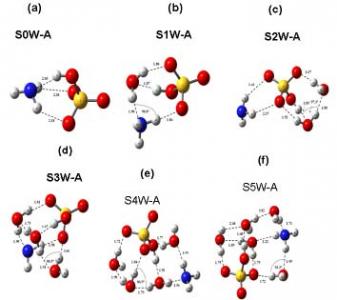
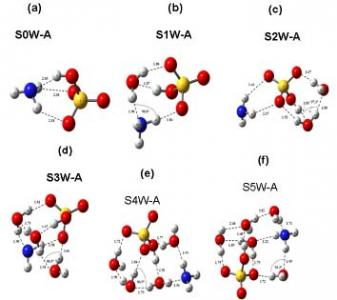
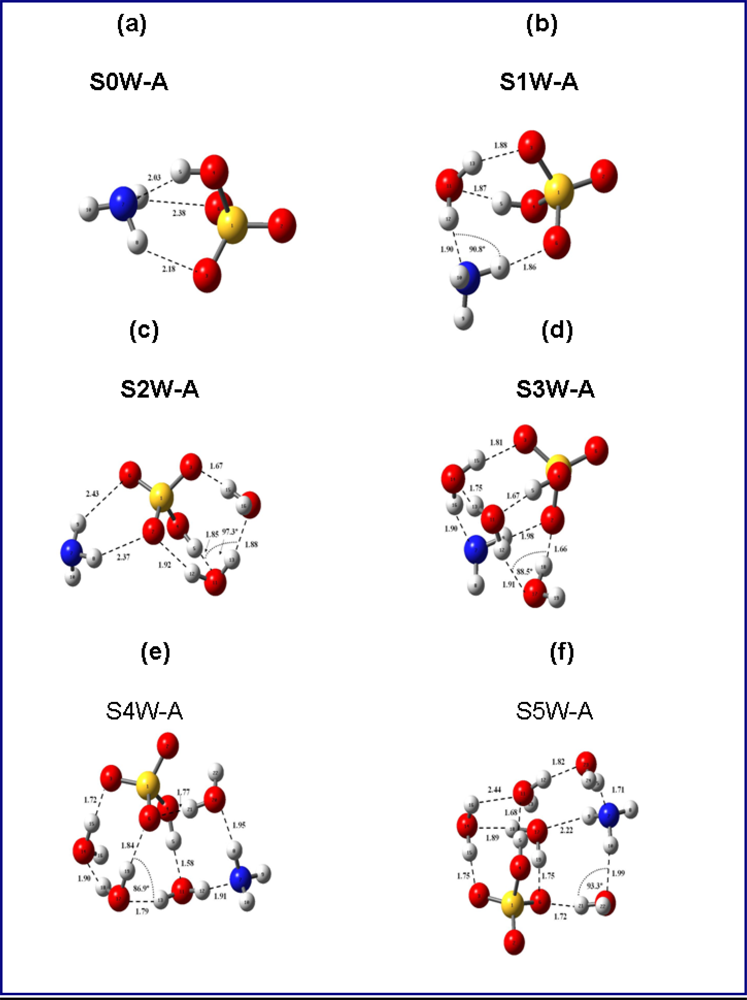
<p><xref ref-type="fig" rid="f1-ijms-09-02184">Figure 1</xref> presents the equilibrium geometries of the most stable isomers of (HSO<sub>4</sub><sup>−</sup>)(NH<sub>3</sub>)(H<sub>2</sub>O)<sub>n</sub>.</p>
<p>As seen from <xref ref-type="fig" rid="f1-ijms-09-02184">Figure 1</xref>(a) and <xref ref-type="table" rid="t1-ijms-09-02184">Table 1</xref>, the structures of (HSO<sub>4</sub><sup>−</sup>)(NH<sub>3</sub>) obtained at PW91PW91/6–311++G(3df,3pd) (PW91) and MP2/aug-cc-pv(D+d)z with MP2/aug-cc-pV(T+d)Z and MP4/aug-cc-pV(D+d)Z energy corrections to the MP2/aug-cc-pV(D+d)Z geometry levels of theory are similar. Bonding lengths and angles agree within ∼ 2–4% and 0.7–5%, respectively.</p></sec>
<sec>
<title>3.2. Thermochemical Properties</title>
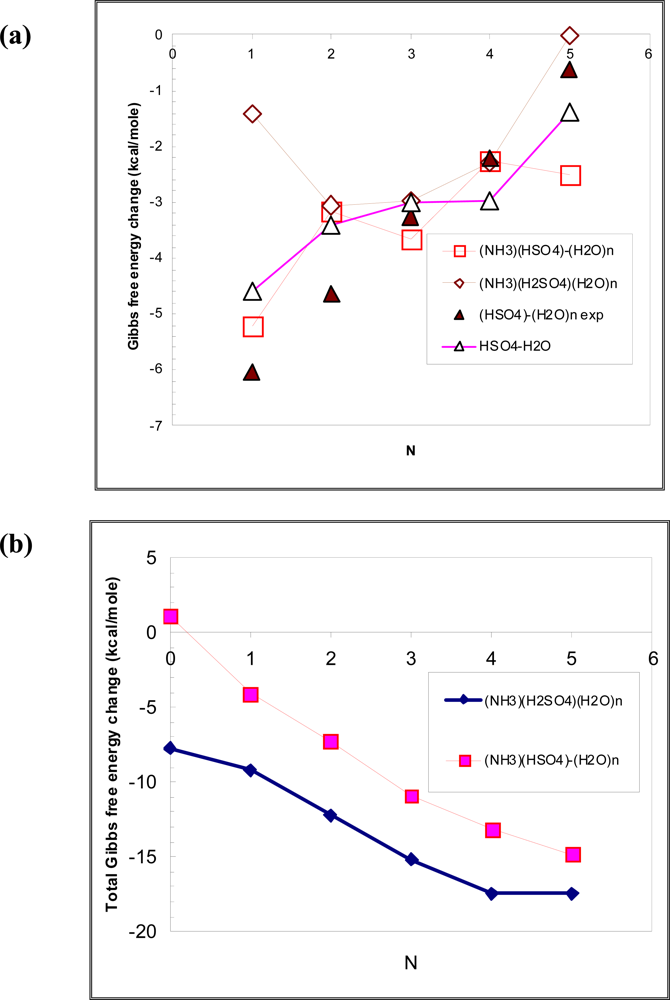
<p>The growing interest to the thermochemistry of atmospheric clusters is related to the very high sensitivity of nucleation rates to the thermochemistry of first few steps of the cluster formation. All the data are given at standard conditions. The value for other conditions can be obtained using the mass action law. <xref ref-type="table" rid="t2-ijms-09-02184">Tables 2</xref> and <xref ref-type="table" rid="t3-ijms-09-02184">3</xref> present calculated hydration enthalpies, entropies and Gibbs free energies associated with the formation of (HSO<sub>4</sub><sup>−</sup>)(NH<sub>3</sub>)(H<sub>2</sub>O)<sub>n</sub> by addition of water and ammonia, respectively. <xref ref-type="fig" rid="f2-ijms-09-02184">Figure 2</xref> presents the comparison of formation and stepwise hydration free energies for (HSO<sub>4</sub><sup>−</sup>)(H<sub>2</sub>O)<sub>n,</sub> (HSO<sub>4</sub><sup>−</sup>)(NH<sub>3</sub>)(H<sub>2</sub>O)<sub>n</sub> and (H<sub>2</sub>SO<sub>4</sub>)(NH<sub>3</sub>)(H<sub>2</sub>O)<sub>n</sub>.</p>
<p>As seen from <xref ref-type="table" rid="t2-ijms-09-02184">Table 2</xref> and <xref ref-type="fig" rid="f2-ijms-09-02184">Figure 2</xref>(a), the presence of ammonia does not lead to a noticeable enhancement in the hydration strength. As may be seen from <xref ref-type="fig" rid="f2-ijms-09-02184">Figure 2</xref>(a), the hydration free energies of (HSO<sub>4</sub><sup>−</sup>)(H<sub>2</sub>O)<sub>n</sub> and (HSO<sub>4</sub><sup>−</sup>)(NH<sub>3</sub>)(H<sub>2</sub>O)<sub>n</sub> are close, although the hydration of (HSO<sub>4</sub><sup>−</sup>) (H<sub>2</sub>O)<sub>n</sub> is somewhat systematically stronger (∼ 0.5 kcal.mol) than that of (HSO<sub>4</sub><sup>−</sup>)(NH<sub>3</sub>)(H<sub>2</sub>O)<sub>n.</sub> The Gibbs free energies of the initial (n = 1, 2) steps of hydration of (HSO<sub>4</sub><sup>−</sup>)(NH<sub>3</sub>) is more negative than those of (H<sub>2</sub>SO<sub>4</sub>)(NH<sub>3</sub>); however, the hydration free energies of latter steps are nearly identical. PW91PW91/6–311++G(3df,3pd) and MP2/aug-cc-pv(D+d)z with MP2/aug-cc-pV(T+d)Z and MP4/aug-cc-pV(D+d)Z energy corrections to the MP2/aug-cc-pV(D+d)Z geometry hydration free energies for (HSO<sub>4</sub><sup>−</sup>)(NH<sub>3</sub>) + H<sub>2</sub>O ↔ (HSO<sub>4</sub><sup>−</sup>)(NH<sub>3</sub>)(H<sub>2</sub>O) reaction agree within ∼1 kcal mol<sup>−1</sup>.</p>
<p>As seen from <xref ref-type="table" rid="t3-ijms-09-02184">Table 3</xref>, the affinity of ammonia to (HSO<sub>4</sub>) <sup>−</sup> is extremely low (0.7–2.5 kcal mol<sup>−1</sup>) that is 9 kcal mol<sup>−1</sup> smaller than the affinity of ammonia to neutral H<sub>2</sub>SO<sub>4</sub>. This somewhat surprising finding correlates well with the difference in the structure of (HSO<sub>4</sub><sup>−</sup>)(NH<sub>3</sub>) and (H<sub>2</sub>SO<sub>4</sub>)(NH<sub>3</sub>), particularly in the intermolecular bonding distances, which are shorter in (H<sub>2</sub>SO<sub>4</sub>)(NH<sub>3</sub>) [<xref ref-type="bibr" rid="b21-ijms-09-02184">21</xref>]. The free energies of (HSO<sub>4</sub> <sup>−</sup>) + (NH<sub>3</sub>) ⇔ (HSO<sub>4</sub><sup>−</sup>)(NH<sub>3</sub>) reaction obtained at PW91PW91/6–311++G(3df,3pd) and MP2/aug-cc-pv(D+d)z with MP2/aug-cc-pV(T+d)Z and MP4/aug-cc-pV(D+d)Z energy corrections to the MP2/aug-cc-pV(D+d)Z geometry [<xref ref-type="bibr" rid="b22-ijms-09-02184">22</xref>] levels of theory agree within 0.4 kcal mol<sup>−1</sup>.</p>
<p>As may be seen from <xref ref-type="fig" rid="f2-ijms-09-02184">Figure 2</xref>(b), the total change in the Gibbs free energy associated with the formation of (H<sub>2</sub>SO<sub>4</sub>) (NH<sub>3</sub>) (H<sub>2</sub>O)<sub>n</sub> is larger than that of (HSO<sub>4</sub><sup>−</sup>)(NH<sub>3</sub>) (H<sub>2</sub>O)<sub>n</sub> and, thus, the formation of (H<sub>2</sub>SO<sub>4</sub>) (NH<sub>3</sub>) (H<sub>2</sub>O) in the atmosphere is more favorable thermodynamically than the formation of (HSO<sub>4</sub><sup>−</sup>) (NH<sub>3</sub>) (H<sub>2</sub>O)<sub>n</sub>. Although the hydration of (HSO<sub>4</sub><sup>−</sup>)(NH<sub>3</sub>) and (HSO<sub>4</sub><sup>−</sup>)(NH<sub>3</sub>)(H<sub>2</sub>O) is stronger than that of (H<sub>2</sub>SO<sub>4</sub>) (NH<sub>3</sub>) and (H<sub>2</sub>SO<sub>4</sub>) (NH<sub>3</sub>) (H<sub>2</sub>O), the difference of ∼2–3 kcal mol-1 per step is not high enough to compensate a very large ( &gt; 9 kcal mol<sup>−1</sup>) difference in free energy changes between (HSO<sub>4</sub>) <sup>−</sup> + (NH<sub>3</sub>) ⇔ (HSO<sub>4</sub>) <sup>−</sup> (NH<sub>3</sub>) and (H<sub>2</sub>SO<sub>4</sub>) + (NH<sub>3</sub>) ⇔ (H<sub>2</sub>SO<sub>4</sub>)(NH<sub>3</sub>) reactions.</p>
<p>As seen from <xref ref-type="table" rid="t4-ijms-09-02184">Table 4</xref>, the presence of additional sulfuric acid does not enhance the affinity of ammonia to negatively charged binary clusters, which remains very low. The presence of ammonia does not lead to any substantial enhancement in the hydration of binary cluster ions or affinity of sulfuric acid to negatively charged binary clusters. These considerations rule out the stabilizing role of ammonia in the formation of negatively charged clusters (HSO<sub>4</sub><sup>−</sup>)(H<sub>2</sub>O)<sub>n</sub> and indicate that the assessment of charged clusters as presumably more stable compared to neutrals may be inapplicable to atmospheric pre-nucleation clusters.</p></sec></sec>
<sec sec-type="conclusions">
<title>4. Conclusions</title>
<p>In this paper, the role of ammonia, a commonly accepted principle stabilizer of binary sulfuric acid-water clusters in the atmosphere, in the formation of hydrogen bonded complexes of common atmospheric hydrogensulfate ion (HSO<sub>4</sub><sup>−</sup>) with water has been investigated. New thermochemical data for the hydration entropies, enthalpies and Gibbs free energies have been reported and the thermodynamic analysis of the hydrate stability has been performed. The results of the present study lead us to the following conclusions:
<list list-type="alpha-lower">
<list-item>
<p>The presence of NH<sub>3</sub> does not enhance the thermochemical stability of HSO<sub>4</sub><sup>−</sup> (H<sub>2</sub>O)<sub>n</sub> and ammonia is unlikely involved in the gas-phase hydration of hydrogensulfate ion under the atmospheric conditions.</p></list-item>
<list-item>
<p>The total free energy change associated with the formation of charged (HSO<sub>4</sub><sup>−</sup>) (NH<sub>3</sub>) (H<sub>2</sub>O)<sub>n</sub> is less negative than that associated with the formation of neutral (H<sub>2</sub>SO<sub>4</sub>) (NH<sub>3</sub>) (H<sub>2</sub>O)<sub>n</sub> due to the very low affinity of NH<sub>3</sub> towards (HSO<sub>4</sub><sup>−</sup>). This leads us to conclude that the assessment of charged clusters in the classical nucleation theory as presumably more stable thermodynamically compared to neutrals is not applicable to pre-nucleation ternary clusters, or generally multicomponent molecular clusters. This is a clear indication that not only quantitative, but also qualitative assessment of the relative thermodynamical stability of atmospheric clusters is impossible without the quantum-chemical treatment.</p></list-item></list></p>
<p>The obtained results can be applied to a wide range of problems related to chemical physics of the atmospheric aerosol formation, chemical technology and air quality research and they can be utilized directly in computations of the hydrate distributions in the atmospheric conditions and kinetic simulations of nucleation rates.</p></sec></body>
<back>
<ack>
<p>Support of this work by the U.S. National Science Foundation under Grant 0618124 is gratefully acknowledged.</p></ack>
<ref-list>
<title>References</title>
<ref id="b1-ijms-09-02184"><label>1</label><citation citation-type="journal"><person-group person-group-type="author"><name><surname>Charlson</surname><given-names>RJ</given-names></name><name><surname>Schwartz</surname><given-names>SE</given-names></name><name><surname>Hales</surname><given-names>JM</given-names></name><name><surname>Cess</surname><given-names>RD</given-names></name><name><surname>Coakley</surname><given-names>JA</given-names><suffix>Jr</suffix></name><name><surname>Hansen</surname><given-names>JE</given-names></name><name><surname>Hofmann</surname><given-names>DJ</given-names></name></person-group><article-title>Climate forcing by anthropogenic aerosols</article-title><source>Science</source><year>1992</year><volume>255</volume><fpage>423</fpage><lpage>430</lpage><pub-id pub-id-type="doi">10.1126/science.255.5043.423</pub-id><pub-id pub-id-type="pmid">17842894</pub-id></citation></ref>
<ref id="b2-ijms-09-02184"><label>2</label><citation citation-type="journal"><person-group person-group-type="author"><name><surname>Kulmala</surname><given-names>M</given-names></name></person-group><article-title>How Particles Nucleate and Grow</article-title><source>Science</source><year>2003</year><volume>302</volume><fpage>1000</fpage><lpage>1001</lpage><pub-id pub-id-type="doi">10.1126/science.1090848</pub-id><pub-id pub-id-type="pmid">14605359</pub-id></citation></ref>
<ref id="b3-ijms-09-02184"><label>3</label><citation citation-type="journal"><person-group person-group-type="author"><name><surname>Berndt</surname><given-names>T</given-names></name><name><surname>Boge</surname><given-names>O</given-names></name><name><surname>Stratmann</surname><given-names>F</given-names></name><name><surname>Heintzenberg</surname><given-names>J</given-names></name><name><surname>Kulmala</surname><given-names>M</given-names></name></person-group><article-title>Rapid formation of sulfuric acid particles at near-atmospheric conditions</article-title><source>Science</source><year>2005</year><volume>307</volume><fpage>698</fpage><lpage>700</lpage><pub-id pub-id-type="doi">10.1126/science.1104054</pub-id><pub-id pub-id-type="pmid">15692045</pub-id></citation></ref>
<ref id="b4-ijms-09-02184"><label>4</label><citation citation-type="journal"><person-group person-group-type="author"><name><surname>Hamill</surname><given-names>P</given-names></name><name><surname>Turco</surname><given-names>RP</given-names></name><name><surname>Kiang</surname><given-names>CS</given-names></name><name><surname>Toon</surname><given-names>OB</given-names></name><name><surname>Whitten</surname><given-names>RC</given-names></name></person-group><article-title>An analysis of various nucleation mechanisms for sulfate particles in the stratosphere</article-title><source>J. Aerosol Sci</source><year>1982</year><volume>13</volume><fpage>561</fpage><lpage>585</lpage><pub-id pub-id-type="doi">10.1016/0021-8502(82)90021-0</pub-id></citation></ref>
<ref id="b5-ijms-09-02184"><label>5</label><citation citation-type="journal"><person-group person-group-type="author"><name><surname>Noppel</surname><given-names>M</given-names></name><name><surname>Vehkamaki</surname><given-names>H</given-names></name><name><surname>Kulmala</surname><given-names>M</given-names></name></person-group><article-title>An improved model for hydrate formation in sulfuric acid-water nucleation</article-title><source>J. Chem. Phys</source><year>2002</year><volume>116</volume><fpage>218</fpage><lpage>228</lpage><pub-id pub-id-type="doi">10.1063/1.1423333</pub-id></citation></ref>
<ref id="b6-ijms-09-02184"><label>6</label><citation citation-type="journal"><person-group person-group-type="author"><name><surname>Merikanto</surname><given-names>J</given-names></name><name><surname>Napari</surname><given-names>I</given-names></name><name><surname>Vehkamäki</surname><given-names>H</given-names></name><name><surname>Anttila</surname><given-names>T</given-names></name><name><surname>Kulmala</surname><given-names>M</given-names></name></person-group><article-title>New parameterization of sulfuric acid-ammonia-water ternary nucleation rates at tropospheric conditions</article-title><source>J. Geophys. Res</source><year>2007</year><volume>112</volume>, art. No. D1520.</citation></ref>
<ref id="b7-ijms-09-02184"><label>7</label><citation citation-type="journal"><person-group person-group-type="author"><name><surname>Yu</surname><given-names>F</given-names></name></person-group><article-title>Effect of ammonia on new particle formation: A kinetic H2SO4-H2O-NH3 nucleation model constrained by laboratory measurements</article-title><source>J. Geophys. Res</source><year>2006</year><volume>111</volume>, D01204, DOI:10.1029/2005JD005968.</citation></ref>
<ref id="b8-ijms-09-02184"><label>8</label><citation citation-type="journal"><person-group person-group-type="author"><name><surname>Yu</surname><given-names>F</given-names></name><name><surname>Turco</surname><given-names>RP</given-names></name></person-group><article-title>From molecular clusters to nanoparticles: The role of ambient ionization in tropospheric aerosol formation</article-title><source>Geophys. Res. Lett</source><year>2000</year><volume>27</volume><fpage>883</fpage><lpage>887</lpage><pub-id pub-id-type="doi">10.1029/1999GL011151</pub-id></citation></ref>
<ref id="b9-ijms-09-02184"><label>9</label><citation citation-type="journal"><person-group person-group-type="author"><name><surname>Zhang</surname><given-names>R</given-names></name><name><surname>Suh</surname><given-names>I</given-names></name><name><surname>Zhao</surname><given-names>J</given-names></name><name><surname>Zhang</surname><given-names>D</given-names></name><name><surname>Fortner</surname><given-names>EC</given-names></name><name><surname>Tie</surname><given-names>X</given-names></name><name><surname>Molina</surname><given-names>LT</given-names></name><name><surname>Molina</surname><given-names>MJ</given-names></name></person-group><article-title>Atmospheric new particle formation enhanced by organic acids</article-title><source>Science</source><year>2004</year><volume>304</volume><fpage>1487</fpage><lpage>1490</lpage><pub-id pub-id-type="doi">10.1126/science.1095139</pub-id><pub-id pub-id-type="pmid">15178797</pub-id></citation></ref>
<ref id="b10-ijms-09-02184"><label>10</label><citation citation-type="journal"><person-group person-group-type="author"><name><surname>Nadykto</surname><given-names>AB</given-names></name><name><surname>Yu</surname><given-names>F</given-names></name></person-group><article-title>Strong hydrogen bonding between atmospheric nucleation precursors and common organics</article-title><source>Chem. Phys. Lett</source><year>2007</year><volume>435</volume><fpage>14</fpage><lpage>18</lpage><pub-id pub-id-type="doi">10.1016/j.cplett.2006.12.050</pub-id></citation></ref>
<ref id="b11-ijms-09-02184"><label>11</label><citation citation-type="journal"><person-group person-group-type="author"><name><surname>Ball</surname><given-names>SM</given-names></name><name><surname>Hanson</surname><given-names>DR</given-names></name><name><surname>Eisele</surname><given-names>FL</given-names></name><name><surname>McMurry</surname><given-names>PH</given-names></name></person-group><article-title>Laboratory studies of particle nucleation: Initial results for H<sub>2</sub>SO<sub>4</sub>, H<sub>2</sub>O, and NH<sub>3</sub> vapors</article-title><source>J. Geophys. Res</source><year>1999</year><volume>104</volume><fpage>23709</fpage><lpage>23718</lpage>DOI: 10.1029/1999JD900411.<pub-id pub-id-type="doi">10.1029/1999JD900411</pub-id></citation></ref>
<ref id="b12-ijms-09-02184"><label>12</label><citation citation-type="journal"><person-group person-group-type="author"><name><surname>Diamond</surname><given-names>GL</given-names></name><name><surname>Iribarne</surname><given-names>JV</given-names></name><name><surname>Corr</surname><given-names>DJ</given-names></name></person-group><article-title>Ion-induced nucleation from sulfur dioxide</article-title><source>J. Aerosol. Sci</source><year>1985</year><volume>16</volume><fpage>43</fpage><lpage>55</lpage><pub-id pub-id-type="doi">10.1016/0021-8502(85)90019-9</pub-id></citation></ref>
<ref id="b13-ijms-09-02184"><label>13</label><citation citation-type="journal"><person-group person-group-type="author"><name><surname>Kim</surname><given-names>TO</given-names></name><name><surname>Ishida</surname><given-names>T</given-names></name><name><surname>Adachi</surname><given-names>M</given-names></name><name><surname>Okuyama</surname><given-names>K</given-names></name><name><surname>Seinfeld</surname><given-names>JH</given-names></name></person-group><article-title>Nanometer-sized particle formation from NH<sub>3</sub>/SO<sub>2</sub>/H<sub>2</sub>O/Air mixtures by ionizing irradiation</article-title><source>Aerosol. Sci. Tech</source><year>1999</year><volume>29</volume><fpage>112</fpage><lpage>125</lpage></citation></ref>
<ref id="b14-ijms-09-02184"><label>14</label><citation citation-type="journal"><person-group person-group-type="author"><name><surname>Christensen</surname><given-names>PS</given-names></name><name><surname>Wedel</surname><given-names>S</given-names></name><name><surname>Livbjerg</surname><given-names>H</given-names></name></person-group><article-title>The kinetics of the photolytic production of aerosols from SO<sub>2</sub> and NH<sub>3</sub> in humid air</article-title><source>Chem. Eng. Sci</source><year>1994</year><volume>49</volume><fpage>4605</fpage><lpage>4614</lpage><pub-id pub-id-type="doi">10.1016/S0009-2509(05)80044-2</pub-id></citation></ref>
<ref id="b15-ijms-09-02184"><label>15</label><citation citation-type="journal"><person-group person-group-type="author"><name><surname>Laakso</surname><given-names>L</given-names></name><name><surname>Gagné</surname><given-names>S</given-names></name><name><surname>Petäjä</surname><given-names>T</given-names></name><name><surname>Hirsikko</surname><given-names>A</given-names></name><name><surname>Aalto</surname><given-names>PP</given-names></name><name><surname>Kulmala</surname><given-names>M</given-names></name><name><surname>Kerminen</surname><given-names>V-M</given-names></name></person-group><article-title>Detecting charging state of ultra-fine particles: instrumental development and ambient measurements</article-title><source>Atmos. Chem. Phys</source><year>2007</year><volume>7</volume><fpage>1333</fpage><lpage>1345</lpage><pub-id pub-id-type="doi">10.5194/acp-7-1333-2007</pub-id></citation></ref>
<ref id="b16-ijms-09-02184"><label>16</label><citation citation-type="journal"><person-group person-group-type="author"><name><surname>Hirsikko</surname><given-names>A</given-names></name><name><surname>Bergman</surname><given-names>T</given-names></name><name><surname>Laakso</surname><given-names>L</given-names></name><name><surname>Dal Maso</surname><given-names>M</given-names></name><name><surname>Riipinen</surname><given-names>I</given-names></name><name><surname>Hõrrak</surname><given-names>U</given-names></name><name><surname>Kulmala</surname><given-names>M</given-names></name></person-group><article-title>Identification and classification of the formation of intermediate ions measured in boreal forest</article-title><source>Atmos. Chem. Phys</source><year>2007</year><volume>7</volume><fpage>201</fpage><lpage>210</lpage><pub-id pub-id-type="doi">10.5194/acp-7-201-2007</pub-id></citation></ref>
<ref id="b17-ijms-09-02184"><label>17</label><citation citation-type="journal"><person-group person-group-type="author"><name><surname>Yu</surname><given-names>F</given-names></name><name><surname>Wang</surname><given-names>Z</given-names></name><name><surname>Luo</surname><given-names>G</given-names></name><name><surname>Turco</surname><given-names>RP</given-names></name></person-group><article-title>Ion-mediated nucleation as an important source of tropospheric aerosols</article-title><source>Atmos. Chem. Phys</source><year>2008</year><volume>8</volume><fpage>2537</fpage><lpage>2554</lpage><pub-id pub-id-type="doi">10.5194/acp-8-2537-2008</pub-id></citation></ref>
<ref id="b18-ijms-09-02184"><label>18</label><citation citation-type="journal"><person-group person-group-type="author"><name><surname>Yu</surname><given-names>F</given-names></name><name><surname>Turco</surname><given-names>RP</given-names></name></person-group><article-title>Case studies of particle formation events observed in boreal forests: Implications for nucleation mechanisms</article-title><source>Atmos. Chem. Phys. Discuss</source><year>2008</year><volume>8</volume><fpage>5683</fpage><lpage>5723</lpage></citation></ref>
<ref id="b19-ijms-09-02184"><label>19</label><citation citation-type="journal"><person-group person-group-type="author"><name><surname>Nadykto</surname><given-names>AB</given-names></name><name><surname>Al Natsheh</surname><given-names>A</given-names></name><name><surname>Yu</surname><given-names>F</given-names></name><name><surname>Mikkelsen</surname><given-names>KV</given-names></name><name><surname>Russkanen</surname><given-names>J</given-names></name></person-group><article-title>Quantum nature of the sign preference in ion-induced nucleation</article-title><source>Phys. Rev. Lett</source><year>2006</year><volume>98</volume><fpage>125701</fpage><lpage>125704</lpage></citation></ref>
<ref id="b20-ijms-09-02184"><label>20</label><citation citation-type="journal"><person-group person-group-type="author"><name><surname>Kurtén</surname><given-names>T</given-names></name><name><surname>Torpo</surname><given-names>L</given-names></name><name><surname>Ding</surname><given-names>C-G</given-names></name><name><surname>Vehkamaki</surname><given-names>H</given-names></name><name><surname>Sundberg</surname><given-names>MR</given-names></name><name><surname>Laasonen</surname><given-names>K</given-names></name><name><surname>Kulmala</surname><given-names>M</given-names></name></person-group><article-title>A density functional study on water-sulfuric acid-ammonia clusters and implications for atmospheric cluster formation</article-title><source>J. Geophys. Res.</source><year>2007</year><volume>112</volume><fpage>D4</fpage>D04210, DOI: 10.1029/2006JD007391.</citation></ref>
<ref id="b21-ijms-09-02184"><label>21</label><citation citation-type="journal"><person-group person-group-type="author"><name><surname>Nadykto</surname><given-names>AB</given-names></name><name><surname>Al Natsheh</surname><given-names>A</given-names></name><name><surname>Yu</surname><given-names>F</given-names></name><name><surname>Mikkelsen</surname><given-names>KV</given-names></name><name><surname>Herb</surname><given-names>J</given-names></name></person-group><article-title>Computational quantum chemistry – A new approach to atmospheric nucleation</article-title><source>Adv. Quantum. Chem</source><year>2008</year><volume>55</volume><fpage>449</fpage><lpage>478</lpage></citation></ref>
<ref id="b22-ijms-09-02184"><label>22</label><citation citation-type="journal"><person-group person-group-type="author"><name><surname>Kurtén</surname><given-names>T</given-names></name><name><surname>Noppel</surname><given-names>M</given-names></name><name><surname>Vehkamaki</surname><given-names>H</given-names></name><name><surname>Salonen</surname><given-names>M</given-names></name><name><surname>Kulmala</surname><given-names>M</given-names></name></person-group><article-title>Quantum chemical studies of hydrate formation of H<sub>2</sub>SO<sub>4</sub> and HSO<sub>4</sub></article-title><source>Boreal Env. Res</source><year>2007</year><volume>12</volume><fpage>431</fpage><lpage>453</lpage></citation></ref>
<ref id="b23-ijms-09-02184"><label>23</label><citation citation-type="journal"><person-group person-group-type="author"><name><surname>Ortega</surname><given-names>IK</given-names></name><name><surname>Kurtén</surname><given-names>T</given-names></name><name><surname>Vehkamäki</surname><given-names>H</given-names></name><name><surname>Kulmala</surname><given-names>M</given-names></name></person-group><article-title>The role of ammonia in sulfuric acid ion-induced nucleation</article-title><source>Atmos. Chem. Phys</source><year>2008</year><volume>8</volume><fpage>2859</fpage><lpage>2867</lpage><pub-id pub-id-type="doi">10.5194/acp-8-2859-2008</pub-id></citation></ref>
<ref id="b24-ijms-09-02184"><label>24</label><citation citation-type="journal"><person-group person-group-type="author"><name><surname>Stewart</surname><given-names>JJP</given-names></name></person-group><article-title>Optimization of parameters for semiempirical methods. III Extension of PM3 to Be, Mg, Zn, Ga, Ge, As, Se, Cd, In, Sn, Sb, Te, Hg, Tl, Pb, and Bi.</article-title><source>J. Comput. Chem.</source><year>1991</year><volume>12</volume><fpage>320</fpage><lpage>341</lpage> DOI:10.1002/jcc.540120306.<pub-id pub-id-type="doi">10.1002/jcc.540120306</pub-id></citation></ref>
<ref id="b25-ijms-09-02184"><label>25</label><citation citation-type="journal"><person-group person-group-type="author"><name><surname>Perdew</surname><given-names>JP</given-names></name><name><surname>Wang</surname><given-names>Y</given-names></name></person-group><article-title>Accurate and simple analytic representation of the electron-gas correlation energy</article-title><source>Phys. Rev. B</source><year>1992</year><volume>45</volume><fpage>13244</fpage><lpage>13249</lpage><pub-id pub-id-type="doi">10.1103/PhysRevB.45.13244</pub-id></citation></ref>
<ref id="b26-ijms-09-02184"><label>26</label><citation citation-type="journal"><person-group person-group-type="author"><name><surname>Francl</surname><given-names>MM</given-names></name><name><surname>Pietro</surname><given-names>WJ</given-names></name><name><surname>Hehre</surname><given-names>WJ</given-names></name><name><surname>Binkley</surname><given-names>JS</given-names></name><name><surname>Gordon</surname><given-names>MS</given-names></name><name><surname>DeFrees</surname><given-names>DJ</given-names></name><name><surname>Pople</surname><given-names>JA</given-names></name></person-group><article-title>Self-consistent molecular orbital methods. XXIII. A polarization-type basis set for second-row elements</article-title><source>J. Chem. Phys.</source><year>1982</year><volume>77</volume><fpage>3654</fpage>DOI:10.1063/1.444267.<pub-id pub-id-type="doi">10.1063/1.444267</pub-id></citation></ref>
<ref id="b27-ijms-09-02184"><label>27</label><citation citation-type="journal"><person-group person-group-type="author"><name><surname>Natsheh</surname><given-names>AA</given-names></name><name><surname>Nadykto</surname><given-names>AB</given-names></name><name><surname>Mikkelsen</surname><given-names>KV</given-names></name><name><surname>Yu</surname><given-names>F</given-names></name><name><surname>Ruuskanen</surname><given-names>J</given-names></name></person-group><article-title>Sulfuric acid and sulfuric acid hydrates in the gas phase: A DFT investigation</article-title><source>J. Phys. Chem. A</source><year>2004</year><volume>108</volume><fpage>8914</fpage><lpage>8929</lpage><pub-id pub-id-type="doi">10.1021/jp048858o</pub-id></citation></ref>
<ref id="b28-ijms-09-02184"><label>28</label><citation citation-type="journal"><person-group person-group-type="author"><name><surname>Kurtén</surname><given-names>T</given-names></name><name><surname>Sundberg</surname><given-names>MR</given-names></name><name><surname>Vehkamäki</surname><given-names>H</given-names></name><name><surname>Noppel</surname><given-names>M</given-names></name><name><surname>Blomqvist</surname><given-names>J</given-names></name><name><surname>Kulmala</surname><given-names>M</given-names></name></person-group><article-title>Ab initio and density functional theory reinvestigation of gas-phase sulfuric acid monohydrate and ammonium hydrogen sulfate</article-title><source>J. Phys. Chem. A</source><year>2007</year><volume>110</volume><fpage>7178</fpage><lpage>7188</lpage></citation></ref>
<ref id="b29-ijms-09-02184"><label>29</label><citation citation-type="journal"><person-group person-group-type="author"><name><surname>Tsuzuki</surname><given-names>S</given-names></name><name><surname>Lűthi</surname><given-names>HP</given-names></name></person-group><article-title>Interaction energies of van der Waals and hydrogen bonded systems calculated using density functional theory: Assessing the PW91 model</article-title><source>J. Chem. Phys</source><year>2001</year><volume>114</volume><fpage>394</fpage><lpage>408</lpage></citation></ref>
<ref id="b30-ijms-09-02184"><label>30</label><citation citation-type="journal"><person-group person-group-type="author"><name><surname>Nadykto</surname><given-names>AB</given-names></name><name><surname>Du</surname><given-names>H</given-names></name><name><surname>Yu</surname><given-names>F</given-names></name></person-group><article-title>Quantum DFT and DF-DFT study of vibrational spectra of sulfuric acid, sulfuric acid monohydrate, formic acid and its cyclic dimer</article-title><source>Vibr. Spectr</source><year>2007</year><volume>44</volume><fpage>286</fpage><lpage>296</lpage><pub-id pub-id-type="doi">10.1016/j.vibspec.2007.01.002</pub-id></citation></ref>
<ref id="b31-ijms-09-02184"><label>31</label><citation citation-type="journal"><person-group person-group-type="author"><name><surname>Lewandowski</surname><given-names>H</given-names></name><name><surname>Koglin</surname><given-names>E</given-names></name><name><surname>Meier</surname><given-names>RJ</given-names></name></person-group><article-title>Computational study of the infrared spectrum of acetic acid, its cyclic dimer, and its methyl ester</article-title><source>Vibr. Spec</source><year>2005</year><volume>39</volume><fpage>15</fpage><lpage>22</lpage><pub-id pub-id-type="doi">10.1016/j.vibspec.2004.10.003</pub-id></citation></ref>
<ref id="b32-ijms-09-02184"><label>32</label><citation citation-type="journal"><person-group person-group-type="author"><name><surname>Muller</surname><given-names>A</given-names></name><name><surname>Losada</surname><given-names>M</given-names></name><name><surname>Leutwyler</surname><given-names>S</given-names></name></person-group><article-title>Ab initio benchmark study of (2-pyridone)<sub>2</sub>, a strongly bound doubly hydrogen-bonded dimer</article-title><source>J. Phys. Chem. A</source><year>2004</year><volume>108</volume><fpage>157</fpage><lpage>165</lpage><pub-id pub-id-type="doi">10.1021/jp0361024</pub-id></citation></ref>
<ref id="b33-ijms-09-02184"><label>33</label><citation citation-type="journal"><person-group person-group-type="author"><name><surname>Hanson</surname><given-names>D</given-names></name><name><surname>Eisele</surname><given-names>F</given-names></name></person-group><article-title>Measurement of prenucleation molecular clusters in the NH<sub>3</sub>, H<sub>2</sub>SO<sub>4</sub>, H<sub>2</sub>O system</article-title><source>J. Geophys. Res.</source><year>2002</year><volume>107</volume><fpage>AAC-10</fpage><lpage>AAC-18</lpage></citation></ref>
<ref id="b34-ijms-09-02184"><label>34</label><citation citation-type="journal"><person-group person-group-type="author"><name><surname>Froyd</surname><given-names>KD</given-names></name><name><surname>Lovejoy</surname><given-names>ER</given-names></name></person-group><article-title>Experimental thermodynamics of cluster ions composed of H<sub>2</sub>SO<sub>4</sub> and H<sub>2</sub>O. 2. Measurements and ab initio structures of negative ions</article-title><source>J. Phys. Chem A</source><year>2003</year><volume>107</volume><fpage>9812</fpage><lpage>9824</lpage><pub-id pub-id-type="doi">10.1021/jp0278059</pub-id></citation></ref>
<ref id="b35-ijms-09-02184"><label>35</label><citation citation-type="journal"><person-group person-group-type="author"><name><surname>Nadykto</surname><given-names>AB</given-names></name><name><surname>Yu</surname><given-names>F</given-names></name><name><surname>Herb</surname><given-names>J</given-names></name></person-group><article-title>Theoretical analysis of the gas-phase hydration of common atmospheric pre-nucleation (HSO<sub>4</sub><sup>−</sup>)(H<sub>2</sub>O)<sub>n</sub> and (H<sub>3</sub>O+)(H<sub>2</sub>SO<sub>4</sub>)(H<sub>2</sub>O)<sub>n</sub> cluster ions</article-title><source>Chem. Phys.</source> Submitted for publication, <year>2008</year>.</citation></ref>
<ref id="b36-ijms-09-02184"><label>36</label><citation citation-type="journal"><person-group person-group-type="author"><name><surname>Nadykto</surname><given-names>AB</given-names></name><name><surname>Yu</surname><given-names>F</given-names></name><name><surname>Herb</surname><given-names>J</given-names></name></person-group><article-title>Towards understanding the sign preference in binary atmospheric nucleation</article-title><source>Phys. Chem. Chem. Phys.</source><year>2008</year>DOI:10.1039/B807415A.</citation></ref></ref-list>
<sec sec-type="display-objects">
<title>Figures and Tables</title>
<fig id="f1-ijms-09-02184" position="float">
<label>Figure 1.</label>
<caption>
<p>Most stable isomers of (a) (HSO<sub>4</sub><sup>−</sup>)(NH<sub>3</sub>); (b) (HSO<sub>4</sub><sup>−</sup>)(NH<sub>3</sub>) (H<sub>2</sub>O); (c) (HSO<sub>4</sub><sup>−</sup>)(NH<sub>3</sub>)(H<sub>2</sub>O)<sub>2</sub>; (d) (HSO<sub>4</sub><sup>−</sup>)(NH<sub>3</sub>)(H<sub>2</sub>O)<sub>3</sub>; (e) (HSO<sub>4</sub><sup>−</sup>)(NH<sub>3</sub>)(H<sub>2</sub>O)<sub>4</sub>; (f) (HSO<sub>4</sub><sup>−</sup>)(NH<sub>3</sub>)(H<sub>2</sub>O)<sub>5</sub> obtained at PW91PW91/6–311++G(3df,3pd) level of theory.</p></caption>
<graphic xlink:href="ijms-09-02184f1.png"/></fig>
<fig id="f2-ijms-09-02184" position="float">
<label>Figure 2.</label>
<caption>
<p>The comparison of: (a) the stepwise Gibbs free energy changes associated with the hydration of (HSO<sub>4</sub><sup>−</sup>)(H<sub>2</sub>O)<sub>n.</sub> [<xref ref-type="bibr" rid="b35-ijms-09-02184">35</xref>], (H<sub>2</sub>SO<sub>4</sub>)(NH<sub>3</sub>)(H<sub>2</sub>O)<sub>n</sub> [<xref ref-type="bibr" rid="b21-ijms-09-02184">21</xref>] and (HSO<sub>4</sub><sup>−</sup>)(NH<sub>3</sub>)(H<sub>2</sub>O)<sub>n</sub> (present study) and (b) total free energies associated with the formation of (H<sub>2</sub>SO<sub>4</sub>)(NH<sub>3</sub>)(H<sub>2</sub>O)<sub>n</sub> [<xref ref-type="bibr" rid="b21-ijms-09-02184">21</xref>] and (HSO<sub>4</sub><sup>−</sup>)(NH<sub>3</sub>)(H<sub>2</sub>O)<sub>n</sub> from (H<sub>2</sub>SO<sub>4</sub>), (NH<sub>3</sub>) and water molecules and (H<sub>2</sub>O)<sub>n</sub> and (HSO<sub>4</sub><sup>−</sup>), (NH<sub>3</sub>) and water molecules, respectively. T = 298.15 K and P = 101.3 KPa. Subscript “exp.” refers to [<xref ref-type="bibr" rid="b34-ijms-09-02184">34</xref>].</p></caption>
<graphic xlink:href="ijms-09-02184f2.png"/></fig>
<table-wrap id="t1-ijms-09-02184" position="float">
<label>Table 1.</label>
<caption>
<p>Geometrical properties (intermolecular distances R(a,b) and angles A(a,b,c)) of (HSO<sub>4</sub><sup>−</sup>)(NH<sub>3</sub>) obtained at PW91PW91/6–311++G(3df,3pd) (PW91) and MP2/aug-cc-pv(D+d)z [<xref ref-type="bibr" rid="b22-ijms-09-02184">22</xref>] levels of theory.</p></caption>
<table frame="hsides" rules="groups">
<thead>
<tr>
<th align="center"/>
<th align="center">R(1,2)</th>
<th align="center">R(1,3)</th>
<th align="center">R(1,4)</th>
<th align="center">R(1,6)</th>
<th align="center">R(3,8)</th>
<th align="center">R(4,5)</th>
<th align="center">R(5,7)</th>
<th align="center">R(6,9)</th>
<th align="center">R(7,8)</th>
<th align="center">R(7,9)</th>
<th align="center">R(7,10)</th></tr></thead>
<tbody>
<tr>
<td align="center"><bold>PW91</bold></td>
<td align="center">1.46</td>
<td align="center">1.48</td>
<td align="center">1.67</td>
<td align="center">1.48</td>
<td align="center">2.18</td>
<td align="center">0.99</td>
<td align="center">2.03</td>
<td align="center">2.39</td>
<td align="center">1.03</td>
<td align="center">1.02</td>
<td align="center">1.02</td></tr>
<tr>
<td align="center" rowspan="3"><bold>MP2</bold></td>
<td align="center"/>
<td align="center">2.28</td>
<td align="center"/>
<td align="center">2.08</td>
<td align="center">2.28</td>
<td align="center"/>
<td align="center"/></tr>
<tr>
<td align="center">A</td>
<td align="center">A</td></tr>
<tr>
<td align="center">(2,1,3)</td>
<td align="center">(2,1,4)</td>
<td align="center">(3,1,4)</td>
<td align="center">(3,1,6)</td>
<td align="center">(1,3,8)</td>
<td align="center">(4,5,7)</td>
<td align="center">(5,7,9)</td>
<td align="center">(8,7,9)</td>
<td align="center">(9,7,10)</td>
<td align="center">(3,8,7)</td>
<td align="center">(6,9,7)</td></tr>
<tr>
<td align="center"><bold>PW91</bold></td>
<td align="center">115.17</td>
<td align="center">102.57</td>
<td align="center">104.56</td>
<td align="center">112.56</td>
<td align="center">97.81</td>
<td align="center">149.58</td>
<td align="center">88.95</td>
<td align="center">103.15</td>
<td align="center">108.55</td>
<td align="center">135.63</td>
<td align="center">123.15</td></tr>
<tr>
<td align="center"><bold>MP2</bold></td>
<td align="center"/>
<td align="center">148.90</td>
<td align="center"/>
<td align="center">129.30</td>
<td align="center">129.20</td></tr></tbody></table></table-wrap>
<table-wrap id="t2-ijms-09-02184" position="float">
<label>Table 2.</label>
<caption>
<p>Enthalpies (kcal mol<sup>−1</sup>), entropies (cal mol<sup>−1</sup> K<sup>−1</sup>), and Gibbs free energy changes (kcal mol<sup>−1</sup>) of (HSO<sub>4</sub><sup>−</sup>)(NH<sub>3</sub>)(H<sub>2</sub>O)<sub>n</sub> hydration calculated at T = 298.15K and P = 101.3 KPa. Superscripts <italic>a</italic> refers to MP2/aug-cc-pv(D+d)Z study [<xref ref-type="bibr" rid="b22-ijms-09-02184">22</xref>].</p></caption>
<table frame="hsides" rules="groups">
<thead>
<tr>
<th align="center"/>
<th align="center">ΔH</th>
<th align="center">ΔS</th>
<th align="center">ΔG</th></tr></thead>
<tbody>
<tr>
<td align="center" rowspan="2">(H SO<sub>4</sub> <sup>−</sup> ) (NH<sub>3</sub>)+H<sub>2</sub>O ⇔ (HSO<sub>4</sub><sup>−</sup>)( NH<sub>3</sub>) (H<sub>2</sub>O)</td>
<td align="center">−15.79</td>
<td align="center">−35.53</td>
<td align="center">−5.20</td></tr>
<tr>
<td align="center">−13.07<sup>a</sup></td>
<td align="center">−30.00<sup>a</sup></td>
<td align="center">−4.23<sup>a</sup></td></tr>
<tr>
<td align="center">(H SO<sub>4</sub><sup>−</sup>)(NH<sub>3</sub>) (H<sub>2</sub>O) +H<sub>2</sub>O ⇔ (H SO<sub>4</sub><sup>−</sup>)(NH<sub>3</sub>) (H<sub>2</sub>O)<sub>2</sub></td>
<td align="center">−12.39</td>
<td align="center">−30.97</td>
<td align="center">−3.16</td></tr>
<tr>
<td align="center">(H SO<sub>4</sub><sup>−</sup>) (NH<sub>3</sub>) (H<sub>2</sub>O)<sub>2</sub> +H<sub>2</sub>O ⇔ (H SO<sub>4</sub><sup>−</sup>)(NH<sub>3</sub>) (H<sub>2</sub>O)<sub>3</sub></td>
<td align="center">−14.42</td>
<td align="center">−36.07</td>
<td align="center">−3.67</td></tr>
<tr>
<td align="center">(H SO<sub>4</sub><sup>−</sup>)(NH<sub>3</sub>) (H<sub>2</sub>O)<sub>3</sub> +H<sub>2</sub>O ⇔ (HSO<sub>4</sub><sup>−</sup>)(NH<sub>3</sub>) (H<sub>2</sub>O)<sub>4</sub></td>
<td align="center">−10.91</td>
<td align="center">−29.01</td>
<td align="center">−2.25</td></tr>
<tr>
<td align="center">(H SO<sub>4</sub><sup>−</sup>)(NH<sub>3</sub>) (H<sub>2</sub>O)<sub>4</sub> +H<sub>2</sub>O ⇔ (HSO<sub>4</sub><sup>−</sup>)(NH<sub>3</sub>) (H<sub>2</sub>O)<sub>5</sub></td>
<td align="center">−12.70</td>
<td align="center">−34.17</td>
<td align="center">−2.51</td></tr></tbody></table></table-wrap>
<table-wrap id="t3-ijms-09-02184" position="float">
<label>Table 3.</label>
<caption>
<p>Enthalpies (kcal mol<sup>−1</sup>), entropies (cal mol<sup>−1</sup> K<sup>−1</sup>), and Gibbs free energy changes (kcal mol<sup>−1</sup>) of (HSO<sub>4</sub><sup>−</sup>)(NH<sub>3</sub>)(H<sub>2</sub>O)<sub>n</sub> formation by addition of ammonia. T=298.15K and P=101.3 KPa. Superscript <italic>a</italic> refers to MP2/aug-cc-pv(D+d)Z study [<xref ref-type="bibr" rid="b22-ijms-09-02184">22</xref>].</p></caption>
<table frame="hsides" rules="groups">
<thead>
<tr>
<th align="center"/>
<th align="center">ΔH</th>
<th align="center">ΔS</th>
<th align="center">ΔG</th></tr></thead>
<tbody>
<tr>
<td align="center">(H SO<sub>4</sub><sup>−</sup>) +(NH<sub>3</sub>) ⇔ (HSO<sub>4</sub><sup>−</sup>) (NH<sub>3</sub>)</td>
<td align="center">−7.22</td>
<td align="center">−27.90</td>
<td align="center">1.10</td></tr>
<tr>
<td align="center"/>
<td align="center">−9.24<sup>a</sup></td>
<td align="center">−32.37<sup>a</sup></td>
<td align="center">0.69<sup>a</sup></td></tr>
<tr>
<td align="center">(H SO<sub>4</sub><sup>−</sup>) (H<sub>2</sub>O)+(NH<sub>3</sub>) ⇔ (H SO<sub>4</sub><sup>−</sup>) (NH<sub>3</sub>) (H<sub>2</sub>O)</td>
<td align="center">−9.44</td>
<td align="center">−32.41</td>
<td align="center">1.12</td></tr>
<tr>
<td align="center">(H SO<sub>4</sub><sup>−</sup>) (H<sub>2</sub>O)<sub>2</sub>+(NH<sub>3</sub>) ⇔ (H SO<sub>4</sub><sup>−</sup>) (NH<sub>3</sub>) (H<sub>2</sub>O)<sub>2</sub></td>
<td align="center">−7.24</td>
<td align="center">−28.94</td>
<td align="center">1.39</td></tr>
<tr>
<td align="center">(H SO<sub>4</sub><sup>−</sup>) (H<sub>2</sub>O)<sub>3</sub>+(NH<sub>3</sub>) ⇔ (H SO<sub>4</sub><sup>−</sup>) (NH<sub>3</sub>) (H<sub>2</sub>O)<sub>3</sub></td>
<td align="center">−9.46</td>
<td align="center">−33.86</td>
<td align="center">0.64</td></tr>
<tr>
<td align="center">(H SO<sub>4</sub><sup>−</sup>) (H<sub>2</sub>O)<sub>4</sub>+(NH<sub>3</sub>) ⇔ (H SO<sub>4</sub><sup>−</sup>) (NH<sub>3</sub>) (H<sub>2</sub>O)<sub>4</sub></td>
<td align="center">−9.44</td>
<td align="center">−36.47</td>
<td align="center">1.43</td></tr>
<tr>
<td align="center">(H SO<sub>4</sub><sup>−</sup>) (H<sub>2</sub>O)<sub>5</sub>+(NH<sub>3</sub>) ⇔ (H SO<sub>4</sub><sup>−</sup>) (NH<sub>3</sub>) (H<sub>2</sub>O)<sub>5</sub></td>
<td align="center">−9.07</td>
<td align="center">−31.42</td>
<td align="center">0.30</td></tr></tbody></table></table-wrap>
<table-wrap id="t4-ijms-09-02184" position="float">
<label>Table 4.</label>
<caption>
<p>Enthalpies (kcal mol<sup>−1</sup>), entropies (cal mol<sup>−1</sup> K<sup>−1</sup>), and Gibbs free energy changes (kcal mol<sup>−1</sup>) of (HSO<sub>4</sub><sup>−</sup>) (H<sub>2</sub>SO<sub>4</sub>) (NH<sub>3</sub>)(H<sub>2</sub>O)<sub>n</sub> and (HSO<sub>4</sub><sup>−</sup>)(H<sub>2</sub>SO<sub>4</sub>)(H<sub>2</sub>O)<sub>n</sub> formation. T=298.15K and P=101.3 KPa. Superscript “<italic>a”</italic> refers to [<xref ref-type="bibr" rid="b36-ijms-09-02184">36</xref>].</p></caption>
<table frame="hsides" rules="groups">
<thead>
<tr>
<th align="center">Reaction</th>
<th align="center">ΔH</th>
<th align="center">ΔS</th>
<th align="center">ΔG</th></tr></thead>
<tbody>
<tr>
<td align="center">(HSO<sub>4</sub><sup>−</sup>)(H<sub>2</sub>SO<sub>4</sub>) (NH<sub>3</sub>) +H<sub>2</sub>O ⇔ (HSO<sub>4</sub><sup>−</sup>)(H<sub>2</sub>SO<sub>4</sub>) (NH<sub>3</sub>) (H<sub>2</sub>O)<sub>1</sub></td>
<td align="center">−8.83</td>
<td align="center">−23.9</td>
<td align="center">−1.7</td></tr>
<tr>
<td align="center">(HSO<sub>4</sub><sup>−</sup>)(H<sub>2</sub>SO<sub>4</sub>) +H<sub>2</sub>O ⇔ (HSO<sub>4</sub><sup>−</sup>)(H<sub>2</sub>SO<sub>4</sub>)(H<sub>2</sub>O)<sub>1</sub></td>
<td align="center">−8.2<sup>a</sup></td>
<td align="center"/>
<td align="center">−0.6<sup>a</sup></td></tr>
<tr>
<td align="center">(HSO<sub>4</sub><sup>−</sup>) (NH<sub>3</sub>) +(H<sub>2</sub>SO<sub>4</sub>) ⇔ (HSO<sub>4</sub><sup>−</sup>)(H<sub>2</sub>SO<sub>4</sub>) (NH<sub>3</sub>)</td>
<td align="center">−46.58</td>
<td align="center">−42.65</td>
<td align="center">−33.86</td></tr>
<tr>
<td align="center">(HSO<sub>4</sub><sup>−</sup>) +(H<sub>2</sub>SO<sub>4</sub>) ⇔ (HSO<sub>4</sub><sup>−</sup>)(H<sub>2</sub>SO<sub>4</sub>)</td>
<td align="center">−45.70<sup>a</sup></td>
<td align="center"/>
<td align="center">−32.70<sup>a</sup></td></tr>
<tr>
<td align="center">(HSO<sub>4</sub><sup>−</sup>) (NH<sub>3</sub>) (H<sub>2</sub>O)<sub>1</sub> +(H<sub>2</sub>SO<sub>4</sub>) ⇔ (HSO<sub>4</sub><sup>−</sup>)(H<sub>2</sub>SO<sub>4</sub>) (NH<sub>3</sub>) (H<sub>2</sub>O)<sub>1</sub></td>
<td align="center">−39.61</td>
<td align="center">−31.02</td>
<td align="center">−30.37</td></tr>
<tr>
<td align="center">(HSO<sub>4</sub><sup>−</sup>) (H<sub>2</sub>O)<sub>1</sub> +(H<sub>2</sub>SO<sub>4</sub>) ⇔ (HSO<sub>4</sub><sup>−</sup>)(H<sub>2</sub>SO<sub>4</sub>) (H<sub>2</sub>O)<sub>1</sub></td>
<td align="center">−40.30<sup>a</sup></td>
<td align="center"/>
<td align="center">−28.1<sup>a</sup></td></tr>
<tr>
<td align="center">(HSO<sub>4</sub><sup>−</sup>)(H<sub>2</sub>SO<sub>4</sub>) (H<sub>2</sub>O)<sub>0</sub> +NH<sub>3</sub> ⇔ (HSO<sub>4</sub><sup>−</sup>)(H<sub>2</sub>SO<sub>4</sub>) (H<sub>2</sub>O)<sub>0</sub>(NH<sub>3</sub>)</td>
<td align="center">−8.08</td>
<td align="center">−27.01</td>
<td align="center">−0.02</td></tr>
<tr>
<td align="center">(HSO<sub>4</sub><sup>−</sup>)(H<sub>2</sub>SO<sub>4</sub>) (H<sub>2</sub>O)<sub>1</sub> +NH<sub>3</sub> ⇔ (HSO<sub>4</sub><sup>−</sup>)(H<sub>2</sub>SO<sub>4</sub>) (H<sub>2</sub>O)<sub>1</sub>(NH<sub>3</sub>)</td>
<td align="center">−8.75</td>
<td align="center">−25.59</td>
<td align="center">−1.12</td></tr></tbody></table></table-wrap></sec></back></article>