
<?xml version="1.0" encoding="UTF-8"?>
<!DOCTYPE article PUBLIC "-//NLM//DTD Journal Publishing DTD v2.3 20070202//EN" "journalpublishing.dtd">
<article xmlns:mml="http://www.w3.org/1998/Math/MathML" xmlns:xlink="http://www.w3.org/1999/xlink" xml:lang="en" article-type="research-article">
	<front>
		<journal-meta>
			<journal-id journal-id-type="publisher-id">ijms</journal-id>
			<journal-title>International Journal of Molecular Sciences</journal-title>
			<abbrev-journal-title>Int. J. Mol. Sci.</abbrev-journal-title>
			<issn pub-type="epub">1422-0067</issn>
			<publisher>
				<publisher-name>Molecular Diversity Preservation International (MDPI)</publisher-name>
			</publisher>
		</journal-meta>
		<article-meta>
			<article-id pub-id-type="publisher-id">ijms-9-1-012</article-id>
			<article-categories>
				<subj-group>
					<subject>Full Research Paper</subject>
				</subj-group>
			</article-categories>
			<title-group>
				<article-title>Preparation, GIAO NMR Calculations and Acidic Properties of Some Novel 4,5-dihydro-1<italic>H</italic>-1,2,4-triazol-5-one Derivatives with Their Antioxidant Activities</article-title>
			</title-group>
			<contrib-group>
				<contrib contrib-type="author">
					<name>
						<surname>Yüksek</surname>
						<given-names>Haydar</given-names>
					</name>
					<xref ref-type="aff" rid="af1-ijms-09-00012">1</xref>
					<xref ref-type="corresp" rid="c1-ijms-09-00012">*</xref>
				</contrib>
				<contrib contrib-type="author">
					<name>
						<surname>Alkan</surname>
						<given-names>Muzaffer</given-names>
					</name>
					<xref ref-type="aff" rid="af2-ijms-09-00012">2</xref>
				</contrib>
				<contrib contrib-type="author">
					<name>
						<surname>Cakmak</surname>
						<given-names>Ismail</given-names>
					</name>
					<xref ref-type="aff" rid="af1-ijms-09-00012">1</xref>
				</contrib>
				<contrib contrib-type="author">
					<name>
						<surname>Ocak</surname>
						<given-names>Zafer</given-names>
					</name>
					<xref ref-type="aff" rid="af2-ijms-09-00012">2</xref>
				</contrib>
				<contrib contrib-type="author">
					<name>
						<surname>Bahçeci</surname>
						<given-names>Şule</given-names>
					</name>
					<xref ref-type="aff" rid="af3-ijms-09-00012">3</xref>
				</contrib>
				<contrib contrib-type="author">
					<name>
						<surname>Calapoğlu</surname>
						<given-names>Mustafa</given-names>
					</name>
					<xref ref-type="aff" rid="af2-ijms-09-00012">2</xref>
				</contrib>
				<contrib contrib-type="author">
					<name>
						<surname>Elmastaş</surname>
						<given-names>Mahfuz</given-names>
					</name>
					<xref ref-type="aff" rid="af4-ijms-09-00012">4</xref>
				</contrib>
				<contrib contrib-type="author">
					<name>
						<surname>Kolomuç</surname>
						<given-names>Ali</given-names>
					</name>
					<xref ref-type="aff" rid="af3-ijms-09-00012">3</xref>
				</contrib>
				<contrib contrib-type="author">
					<name>
						<surname>Aksu</surname>
						<given-names>Havva</given-names>
					</name>
					<xref ref-type="aff" rid="af1-ijms-09-00012">1</xref>
				</contrib>
			</contrib-group>
			<aff id="af1-ijms-09-00012">
				<label>1</label>Department of Chemistry, Kafkas University, 36100 Kars, Turkey; Fax (+90)-474-2121185</aff>
			<aff id="af2-ijms-09-00012">
				<label>2</label>Education Faculty, Kafkas University, 36100 Kars, Turkey</aff>
			<aff id="af3-ijms-09-00012">
				<label>3</label>Fatih Education Faculty, Karadeniz Technical University, 61080 Trabzon, Turkey</aff>
			<aff id="af4-ijms-09-00012">
				<label>4</label>Department of Chemistry, Gaziosmanpaşa University, Tokat, Turkey</aff>
			<author-notes>
				<corresp id="c1-ijms-09-00012">
					<label>*</label> Author to whom correspondence should be addressed. E-Mail:
					<email>hyuksek98@yahoo.com</email>
				</corresp>
			</author-notes>
			<pub-date pub-type="epub">
				<day>8</day>
				<month>1</month>
				<year>2008</year>
			</pub-date>
			<pub-date pub-type="collection">
				<month>1</month>
				<year>2008</year>
			</pub-date>
			<volume>9</volume>
			<issue>1</issue>
			<fpage>12</fpage>
			<lpage>32</lpage>
			<history>
				<date date-type="received">
					<day>12</day>
					<month>11</month>
					<year>2007</year>
				</date>
				<date date-type="rev-recd">
					<day>14</day>
					<month>12</month>
					<year>2007</year>
				</date>
				<date date-type="accepted">
					<day>14</day>
					<month>12</month>
					<year>2007</year>
				</date>
			</history>
			<copyright-statement>© 2008 by MDPI</copyright-statement>
			<copyright-year>2008</copyright-year>
			<abstract>
				<p>Six novel 3-alkyl(aryl)-4-(<italic>p</italic>-nitrobenzoylamino)-4,5-dihydro-1<italic>H</italic>-1,2,4-triazol-5- ones (<bold>2a-f</bold>) were synthesized by the reactions of 3-alkyl(aryl)-4-amino-4,5-dihydro-1<italic>H</italic>- 1,2,4-triazol-5-ones (<bold>1a-f</bold>) with <italic>p</italic>-nitrobenzoyl chloride and characterized by elemental analyses and IR, <sup>1</sup>H-NMR, <sup>13</sup>C-NMR and UV spectral data. The newly synthesized compounds <bold>2</bold> were titrated potentiometrically with tetrabutylammonium hydroxide in four non-aqueous solvents such as acetone, isopropyl alcohol, <italic>tert</italic>-butyl alcohol and <italic>N,N</italic>-dimethylformamide, and the half-neutralization potential values and the corresponding p<italic>K</italic>
					<sub>a</sub> values were determined for all cases. Thus, the effects of solvents and molecular structure upon acidity were investigated. In addition, isotropic <sup>1</sup>H and <sup>13</sup>C nuclear magnetic shielding constants of compounds <bold>2</bold> were obtained by the gauge-including-atomic-orbital (GIAO) method at the B3LYP density functional level. The geometry of each compound has been optimized using the 6-311G basis set. Theoretical values were compared to the experimental data. Furthermore, these new compounds and five recently reported 3-alkyl-4-(2-furoylamino)-4,5-dihydro-1<italic>H</italic>-1,2,4-triazol-5-ones (<bold>3a–c,e,f</bold>) were screened for their antioxidant activities.</p>
			</abstract>
			<kwd-group>
				<kwd>4,5-Dihydro-1<italic>H</italic>-1,2,4-triazol-5-ones</kwd>
				<kwd>Acylation</kwd>
				<kwd>Density functional calculations</kwd>
				<kwd>GIAO</kwd>
				<kwd>Antioxidant activity</kwd>
				<kwd>p<italic>K</italic>
					<sub>a</sub>
				</kwd>
				<kwd>Potentiometric titrations</kwd>
			</kwd-group>
		</article-meta>
	</front>
	<body>
		<sec sec-type="intro">
			<title>Introduction</title>
			<p>1,2,4-Triazole and 4,5-dihydro-1<italic>H</italic>-1,2,4-triazol-5-one derivatives are reported to show a broad spectrum of biological activities [<xref ref-type="bibr" rid="b1-ijms-09-00012">1</xref>–<xref ref-type="bibr" rid="b6-ijms-09-00012">6</xref>], and several papers have devoted with the synthesis of acyl derivatives of 4,5-dihydro-1<italic>H</italic>-1,2,4-triazol-5-one derivatives [<xref ref-type="bibr" rid="b2-ijms-09-00012">2</xref>,<xref ref-type="bibr" rid="b4-ijms-09-00012">4</xref>,<xref ref-type="bibr" rid="b7-ijms-09-00012">7</xref>–<xref ref-type="bibr" rid="b12-ijms-09-00012">12</xref>]. In addition, it is known that 1,2,4-triazole and 4,5-dihydro-1<italic>H</italic>-1,2,4-triazol-5-one rings have weak acidic properties, so that some 1,2,4-triazole and 4,5-dihydro-1<italic>H</italic>-1,2,4-triazol-5-one derivatives were titrated potentiometrically with tetrabutylammonium hydroxide in non-aqueous solvents, and the p<italic>K</italic>
				<sub>a</sub> values of the compounds were determined [<xref ref-type="bibr" rid="b2-ijms-09-00012">2</xref>,<xref ref-type="bibr" rid="b13-ijms-09-00012">13</xref>,<xref ref-type="bibr" rid="b14-ijms-09-00012">14</xref>]. We have previously described the synthesis and potentiometric titrations of some new 4,5-dihydro-1<italic>H</italic>-1,2,4-triazol-5-one derivatives in different non-aqueous medium [<xref ref-type="bibr" rid="b9-ijms-09-00012">9</xref>–<xref ref-type="bibr" rid="b12-ijms-09-00012">12</xref>,<xref ref-type="bibr" rid="b15-ijms-09-00012">15</xref>–<xref ref-type="bibr" rid="b18-ijms-09-00012">18</xref>], where we determined the p<italic>K</italic>
				<sub>a</sub> values of these compounds for each non-aqueous solvent.</p>
			<p>NMR spectroscopy has proved to be an exceptional tool to elucidate structure and molecular conformation. Ab initio and DFT (density functional theory) calculations of NMR shielding constants at very accurate levels of theory are available at literature [<xref ref-type="bibr" rid="b19-ijms-09-00012">19</xref>]. The widely used methods to calculate chemical shifts are as follows: IGLO (individual gauge localized orbital), LORG (localized or loacaorbital origin) and GIAO (gauge independent or invariant or including atomic orbital). The GIAO approach [<xref ref-type="bibr" rid="b20-ijms-09-00012">20</xref>] is known to give satisfactory chemical shifts for different nuclei [<xref ref-type="bibr" rid="b20-ijms-09-00012">20</xref>–<xref ref-type="bibr" rid="b22-ijms-09-00012">22</xref>] of larger molecules, yet these quantum chemical calculations often have to be limited to isolated (gas-phase) molecules and in some preferred (optimized) structures, while experimental NMR spectra are commonly statically averages affected by dynamic process such as conformational equilibria as well as intra and/or intermolecular interactions. We have previously described the synthesis and GIAO NMR calculations for some new 4,5-dihydro-1<italic>H</italic>-1,2,4-triazol-5-one derivatives [<xref ref-type="bibr" rid="b23-ijms-09-00012">23</xref>,<xref ref-type="bibr" rid="b24-ijms-09-00012">24</xref>].</p>
			<p>Antioxidants are extensively studied for their capacity to protect organisms and cells from damage that is induced by oxidative stress. Scientists in various disciplines have become more interested in new compounds, either synthesized or obtained from natural sources that could provide active components to prevent or reduce the impact of oxidative stress on cells [<xref ref-type="bibr" rid="b25-ijms-09-00012">25</xref>]. Exogenous chemicals and endogenous metabolic processes in human body or in food system might produce highly reactive free radicals, especially oxygen derived radicals, which are capable of oxidizing biomolecules, resulting in cell death and tissue damage. Oxidative damages play a significantly pathological role in human diseases. For example, cancer, emphysema, cirrhosis, atherosclerosis and arthritis have all been correlated with oxidative damage. Also, excessive generation of ROS (reactive oxygen species) induced by various stimuli and which exceeds the antioxidant capacity of the organism leads to variety of pathophysiological processes such as inflammation, diabetes, genotoxicity and cancer [<xref ref-type="bibr" rid="b26-ijms-09-00012">26</xref>]. In the present study, due to a wide range applications and to find their possible radical scavenging and antioxidant activity, the newly synthesized compounds were investigated using several antioxidant methodologies: 1,1-diphenyl-2-picryl-hydrazyl (DPPH) free radical scavenging, reducing power and metal chelating activities.</p>
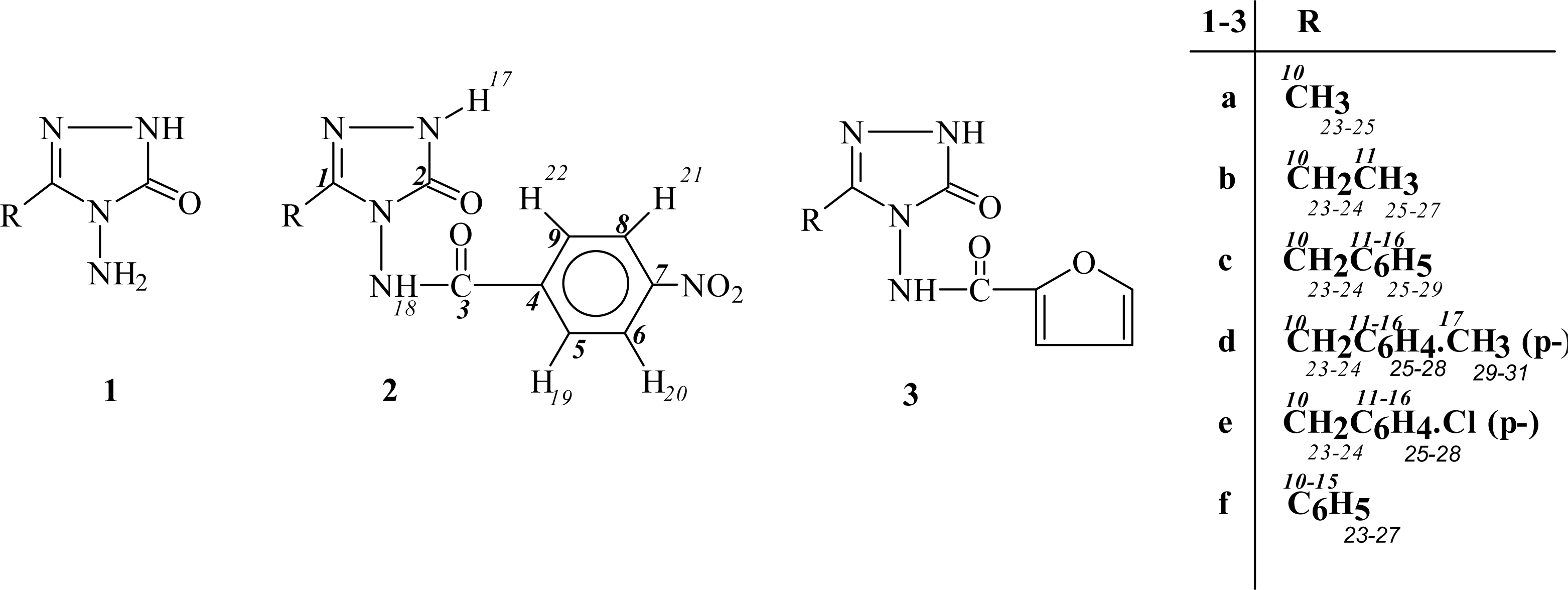
			<p>The antioxidant activity of six new 3-alkyl-4-(<italic>p</italic>-nitrobenzoylamino)-4,5-dihydro-1<italic>H</italic>-1,2,4-triazol-5- ones (<bold>2a–f</bold>) (<xref ref-type="fig" rid="f7-ijms-09-00012">Scheme <bold>1</bold>
				</xref>), which were synthesized by the reactions of 3-alkyl-4-amino-4,5-dihydro-1<italic>H</italic>-1,2,4-triazol-5-ones (<bold>1a-f</bold>) with <italic>p</italic>-nitrobenzoyl chloride and five 3-alkyl-4-(2-furoylamino)-4,5-dihydro-1<italic>H</italic>-1,2,4-triazol-5-ones (<bold>3a–c,e,f</bold>), which was synthesized according to literature [<xref ref-type="bibr" rid="b10-ijms-09-00012">10</xref>] were determined. In addition, a DFT method was used to calculate theoretical <sup>1</sup>H and <sup>13</sup>C data of six new <bold>2</bold> type compounds. Moreover, we also examined the potentiometric titrations of the synthesized type <bold>2</bold> compounds with tetrabutylammonium hydroxide (TBAH) in four non-aqueous solvents (acetone, isopropyl alcohol, <italic>tert</italic>-butyl alcohol and <italic>N,N</italic>-dimethylformamide) to determine the corresponding half-neutralization potentials (HNP) and the corresponding p<italic>K</italic>
				<sub>a</sub> values. The data obtained from the potentiometric titrations was interpreted, and the effect of the C-3 substituent in 4,5-dihydro-1<italic>H</italic>-1,2,4-triazol-5-one ring as well as solvent effects were determined similarly to previous studies [<xref ref-type="bibr" rid="b9-ijms-09-00012">9</xref>–<xref ref-type="bibr" rid="b18-ijms-09-00012">18</xref>].</p>
		</sec>
		<sec>
			<title>Experimental</title>
			<sec>
				<title>Synthesis</title>
				<p>IR spectra were registered using potassium bromide disks on a Shimadzu 408 spectrometer. <sup>1</sup>HNMR and <sup>13</sup>C-NMR spectra were recorded in deuterated dimethyl sulfoxide with TMS as internal standard on a Varian-Mercury spectrometer at 200 MHz and 50 MHz, respectively. UV-Vis absorption spectra were measured for ethanol solutions in 10 mm quartz cells between 200 and 400 nm using a Shimadzu-1201 spectrophotometer. Melting points were taken on an Electrothermal 9100 digital melting point apparatus. Combustion analyses were performed on a Carlo Erba 1106 Elemental Analyzer. Chemicals were supplied from Fluka and Merck. The starting compounds <bold>1a–f</bold> were prepared according to literature [<xref ref-type="bibr" rid="b8-ijms-09-00012">8</xref>,<xref ref-type="bibr" rid="b27-ijms-09-00012">27</xref>]. Compounds 3 were obtained throught recently reported methods [<xref ref-type="bibr" rid="b10-ijms-09-00012">10</xref>].</p>
			</sec>
			<sec>
				<title>General Method for the Preparation of 3-Alkyl(aryl)-4-(p-nitrobenzoylamino)-4,5-dihydro-1H-1,2,4- triazol-5-ones (2)</title>
				<p>3-Alkyl(aryl)-4-amino-4,5-dihydro-1<italic>H</italic>-1,2,4-triazol-5-one (<bold>1</bold>) (0.01 mol) was heated with 1.86 g (0.01 mol) of <italic>p</italic>-nitrobenzoyl chloride at 150–160 <sup>º</sup>C for 1.5 h and cooled. Recrystallization of the crude product from an appropriate solvent gave pure compound <bold>2</bold>.</p>
				<p>
					<italic>3-Methyl-4-(p-nitrobenzoylamino)-4,5-dihydro-1H-1,2,4-triazol-5-one</italic> (<bold>2a</bold>). White crystals, yield 84 %; m.p. 259–60 °C (EtOH/water, 1:2); Calculated for C<sub>10</sub>H<sub>9</sub>N<sub>5</sub>O<sub>4</sub>: 45.6% C, 3.4 % H, 26.6% N; found: 45.0% C, 3.3% H, 26.6% N; <sup>1</sup>H-NMR (200 MHz, DMSO-<italic>d</italic>
					<sub>6</sub>): δ; 2.48 (s, 3H, CH<sub>3</sub>), 8.54 (d, 2H, Ar-H; <italic>J</italic>=8.6 Hz), 8.72 (d, 2H, Ar-H; <italic>J</italic>=8.2 Hz), 12.18 (s, 2H, 2NH). <sup>13</sup>C-NMR (50 MHz, DMSO-<italic>d</italic>
					<sub>6</sub>): δ 10.79 (CH<sub>3</sub>), 124.24 (2C), 129.70 (2C), 136.69, 145.45 (aromatic carbons), 150.20 (triazole C<sub>3</sub>), 153.45 (triazole C<sub>5</sub>), 164.97 (C=O); IR (KBr): 3395 (NH), 1745, 1687 (C=O), 1610 (C=N), 820 (1,4-disubstituted benzenoid ring) cm<sup>−1</sup>; UV (ethanol) λ<sub>max</sub> (ε, L mol<sup>−1</sup> cm<sup>−1</sup>): 254 (10020), 214 (7920) nm.</p>
				<p>
					<italic>3-Ethyl-4-(p-nitrobenzoylamino)-4,5-dihydro-1H-1,2,4-triazol-5-one</italic>
					<bold>(2b).</bold> White crystals, yield 84 %; m.p. 238–240 <sup>°</sup>C (EtOH-water, 1:2); Calculated for C<sub>11</sub>H<sub>11</sub>N<sub>5</sub>O<sub>4</sub>: 47.7% C, 4.0% H, 25.3% N; found: 48.2% C, 4.0% H, 25.5% N; <sup>13</sup>C-NMR (50 MHz, DMSO-<italic>d</italic>
					<sub>6</sub>): δ 10.07 (CH<sub>3</sub>), 18.22 (CH<sub>2</sub>), 124.15 (2C), 129.64 (2C), 136.85, 149.60 (aromatic carbons), 150.30 (triazole C<sub>3</sub>), 153.80 (triazole C<sub>5</sub>), 165.10 (C=O); IR (KBr): 3300, 3100 (NH), 1720, 1685 (C=O), 1610 (C=N), 800 (1,4-disubstituted benzenoid ring) cm<sup>−1</sup>; UV (ethanol) λ<sub>max</sub> (ε, L mol<sup>−1</sup> cm<sup>−1</sup>): 251 (10550), 213 (8590) nm.</p>
				<p>
					<italic>3-Benzyl-4-(p-nitrobenzoylamino)-4,5-dihydro-1H-1,2,4-triazol-5-one</italic>
					<bold>(2c).</bold> White crystals, yield 84 %; m.p. 255–257 °C (EtOH-toluene, 1:3); Calculated for C<sub>16</sub>H<sub>13</sub>N<sub>5</sub>O<sub>4</sub>: 56.6% C, 3.9% H, 20.6% N; found: 56.4% C, 3.9% H, 20.1% N; <sup>1</sup>H-NMR (200 MHz, DMSO-<italic>d</italic>
					<sub>6</sub>): δ 3.89 (s, 2H, CH<sub>2</sub>), 7.29 (s, 5H, Ar-H), 8.14 (d, 2H, Ar-H; <italic>J</italic>= 7.9 Hz), 8.40 (d, 2H, Ar-H; <italic>J</italic>= 7.9 Hz), 11.80 (s, 1H, NH), 12.01 (s, 1H, NH); <sup>13</sup>C-NMR (50 MHz, DMSO-<italic>d</italic>
					<sub>6</sub>): δ 31.40 (CH<sub>2</sub>), 124.06 (2C), 127.17, 128.77 (2C), 129.08 (2C), 129.59 (2C), 135.03, 136.69, 147.19 (aromatic carbons), 150.05 (triazole C<sub>3</sub>), 153.10 (triazole C<sub>5</sub>), 164.73 (C=O); IR (KBr): 3275, 3150 (NH), 1730, 1680 (C=O), 1610 (C=N), 810 (1,4-disubstituted benzenoid ring), 770, 710 (monosubstituted benzenoid ring) cm<sup>−1</sup>; UV (ethanol) λ<sub>max</sub> (ε, L mol<sup>−1</sup> cm<sup>−1</sup>): 258 (11010), 214 (11010) nm.</p>
				<p>
					<italic>3-p-Methylbenzyl-4-(p-nitrobenzoylamino)-4,5-dihydro-1H-1,2,4-triazol-5-one</italic>
					<bold>(2d).</bold> White crystals, yield 89 %; m.p. 238–239 <sup>°</sup>C (EtOH-water, 1:2); Calculated for C<sub>17</sub>H<sub>15</sub>N<sub>5</sub>O<sub>4</sub>: 57.8% C, 4.3% H, 19.8% N; found: 58.3% C, 4.1% H, 19.7% N; <sup>1</sup>H-NMR (200 MHz, DMSO-<italic>d</italic>
					<sub>6</sub>): δ 2.27 (s, 3H, CH<sub>3</sub>), 3.80 (s, 2H, CH<sub>2</sub>), 7.13 (s, 4H, Ar-H), 8.14 (s, 2H, Ar-H), 8.41 (s, 2H, Ar-H), 11.74 (s, 1H, NH), 11.94 (s, 1H, NH); <sup>13</sup>C-NMR (50 MHz, DMSO-<italic>d</italic>
					<sub>6</sub>): δ 20.39 (CH<sub>3</sub>), 30.40 (CH<sub>2</sub>), 123.64 (2C), 128.46 (2C), 128.84 (2C), 129.10 (2C), 131.60, 135.90, 136.20, 146.85 (aromatic carbons), 149.70 (triazole C<sub>3</sub>), 152.75 (triazole C<sub>5</sub>), 164.30 (C=O); IR (KBr): 3300, 3150 (NH), 1730, 1680 (C=O), 1610 (C=N), 815 (1,4-disubstituted benzenoid ring) cm<sup>−1</sup>; UV (ethanol) λ<sub>max</sub> (ε, L mol<sup>−1</sup> cm<sup>−1</sup>): 258 (13860), 214 (13860) nm.</p>
				<p>
					<italic>3-p-Chlorobenzyl-4-(p-nitrobenzoylamino)-4,5-dihydro-1H-1,2,4-triazol-5-one</italic>
					<bold>(2e).</bold> White crystals, yield 88 %; m.p. 246–247 °C (EtOH-water, 1:2); Calculated for C<sub>16</sub>H<sub>12</sub>N<sub>5</sub>O<sub>4</sub>Cl: 51.4% C, 3.2% H, 18.7% N; found: 52.2% C, 3.2% H, 18.7% N; <sup>1</sup>H-NMR (200 MHz, DMSO-<italic>d</italic>
					<sub>6</sub>): δ 4.07 (s, 2H, CH<sub>2</sub>), 7.45–7.54 (m, 4H, Ar-H), 8.31 (d, 2H, Ar-H; <italic>J</italic>= 8.6 Hz), 8.58 (d, 2H, Ar-H; <italic>J</italic>= 8.2 Hz), 11.94 (s, 1H, NH), 12.19 (s, 1H, NH); <sup>13</sup>C-NMR (50 MHz, DMSO-<italic>d</italic>
					<sub>6</sub>): δ 30.60 (CH<sub>2</sub>), 124.12 (2C), 128.73 (2C), 129.64 (2C), 131.01 (2C), 132.10, 134.20, 136.60, 146.80 (aromatic carbons), 150.20 (triazole C<sub>3</sub>), 153.10 (triazole C<sub>5</sub>), 164.80 (C=O); IR (KBr): 3275, 3150 (NH), 1725, 1680 (C=O), 1610 (C=N), 820 (1,4-disubstituted benzenoid ring) cm<sup>−1</sup>; UV (ethanol) λ<sub>max</sub> (ε, L mol<sup>−1</sup> cm<sup>−1</sup>): 252 (11590), 213 (9380) nm.</p>
				<p>
					<italic>3-Phenyl-4-(p-nitrobenzoylamino)-4,5-dihydro-1H-1,2,4-triazol-5-one</italic>
					<bold>(2f).</bold> White crystals, yield 82 %; m.p. 247–248 °C (EtOH-water, 1:2); Calculated for C<sub>15</sub>H<sub>11</sub>N<sub>5</sub>O<sub>4</sub>: 55.4% C, 3.4% H, 21.5% N; found: 55.2% C, 3.5% H, 21.3% N; <sup>1</sup>H-NMR (200 MHz, DMSO-<italic>d</italic>
					<sub>6</sub>): λ 7.53–7.62 (m, 3H, Ar-H), 7.80–7.88 (m, 2H, Ar-H), 8.21 (d, 2H, Ar-H; <italic>J</italic>= 7.3 Hz), 8.44 (d, 2H, Ar-H; <italic>J</italic>= 7.9 Hz), 12.19 (s, 1H, NH), 12.48 (s, 1H, NH); <sup>13</sup>C-NMR (50 MHz, DMSO-<italic>d</italic>
					<sub>6</sub>): λ 124.30 (2C), 126.91 (2C), 129.24 (2C), 129.46 (2C), 131.10, 131.90, 136.40, 146.10 (aromatic carbons), 150.25 (triazole C<sub>3</sub>), 153.40 (triazole C<sub>5</sub>), 164.80 (C=O); IR (KBr): 3275, 3225 (NH), 1745, 1695 (C=O), 1610 (C=N), 820 (1,4-disubstituted benzenoid ring), 775, 700 (monosubstituted benzenoid ring) cm<sup>−1</sup>; UV (ethanol) λ<sub>max</sub> (ε, L mol<sup>−1</sup> cm<sup>−1</sup>): 263 (17500), 222 (8160) nm.</p>
			</sec>
			<sec>
				<title>Antioxidant Activity</title>
				<sec>
					<title>Chemicals</title>
					<p>Butylated hydroxyl toluene (BHT) was purchased from E. Merck. Ferrous chloride, α-tocopherol, 1,1-diphenyl-2-picryl-hydrazyl (DPPH.), 3-(2-pyridyl)-5,6-bis(phenyl-sulfonic acid)-1,2,4-triazine (ferrozine), butylated hydroxyanisole (BHA) and trichloracetic acid (TCA) were purchased from Sigma (Sigma −Aldrich GmbH, Sternheim, Germany).</p>
				</sec>
				<sec>
					<title>Reducing power</title>
					<p>The reducing power of the synthesized compounds was determined according to the method of Oyaizu [<xref ref-type="bibr" rid="b28-ijms-09-00012">28</xref>]. Different concentrations of the samples (50–150 mg/L) in DMSO (1 mL) were mixed with phosphate buffer (2.5 mL, 0.2 M, pH = 6.6) and potassium ferricyanide (2.5 mL, 1%). The mixture was incubated at 50°C for 20 min. after incubation period; a portion of trichloroacetic acid (2.5 mL, 10%) was added to the mixture, which was then centrifuged for 10 min at 1000 x g. The upper layer of solution (2.5 mL) was mixed with distilled water (2.5 mL) and FeCl<sub>3</sub> (0.5 mL, 0.1%), and then, the absorbance was measured at 700 nm in a spectrophometer. Higher absorbance of the reaction mixture indicated greater reducing power.</p>
				</sec>
			</sec>
			<sec>
				<title>Free radical scavenging activity</title>
				<p>Free radical scavenging activity of compounds was measured by DPPH. using the method of Blois [<xref ref-type="bibr" rid="b29-ijms-09-00012">29</xref>]. Briefly, a 0.1 mM solution of DPPH. in ethanol was prepared, and this solution (1 mL) was added to the solutions in DMSO (3 mL) at different concentrations (50–150 mg/L). The mixture was shaken vigorously and allowed to stand at room temperature for 30 min. Then the absorbance was measured at 517 nm in a spectrophometer. Lower absorbance of the reaction mixture indicated higher free radical scavenging activity. The DPPH. concentration (mM) in the reaction medium was calculated from the following calibration curve and determined by linear regression (R: 0.997):</p>
				<disp-formula id="FD1">
					<label>(1)</label>
					<mml:math id="M1" display="block">
						<mml:mtext>Absorbance</mml:mtext>
						<mml:mo>=</mml:mo>
						<mml:mn>0.0003</mml:mn>
						<mml:mtext> </mml:mtext>
						<mml:mo>× </mml:mo>
						<mml:msup>
							<mml:mtext>DPPH</mml:mtext>
							<mml:mtext>.</mml:mtext>
						</mml:msup>
						<mml:mo>−</mml:mo>
						<mml:mn>0.0174</mml:mn>
					</mml:math>
				</disp-formula>
				<p>The capability to scavenge the DPPH radical was calculated using the following equation:</p>
				<disp-formula id="FD2">
					<label>(2)</label>
					<mml:math id="M2" display="block">
						<mml:mrow>
							<mml:msup>
								<mml:mtext>DPPH</mml:mtext>
								<mml:mtext>.</mml:mtext>
							</mml:msup>
						</mml:mrow>
						<mml:mtext>scavenging effect </mml:mtext>
						<mml:mo stretchy="false">(</mml:mo>
						<mml:mo>%</mml:mo>
						<mml:mo stretchy="false">)</mml:mo> 
						<mml:mo>=</mml:mo> 
						<mml:mo stretchy="false">(</mml:mo>
						<mml:msub>
							<mml:mtext>A</mml:mtext>
							<mml:mtext>0</mml:mtext>
						</mml:msub>
						<mml:mo>−</mml:mo>
						<mml:msub>
							<mml:mtext>A</mml:mtext>
							<mml:mtext>1</mml:mtext>
						</mml:msub>
						<mml:msub>
							<mml:mo>/</mml:mo>
							<mml:mtext>A</mml:mtext>
							<mml:mtext>0</mml:mtext>
						</mml:msub>
						<mml:mo stretchy="false">)</mml:mo>
						<mml:mo>×</mml:mo>
						<mml:mtext> 100</mml:mtext>
					</mml:math>
				</disp-formula>
				<p>Where A<sub>0</sub> is the absorbance of the control reaction and A<sub>1</sub> is the absorbance in the presence of the samples or standards.</p>
			</sec>
			<sec>
				<title>Metal chelating activity</title>
				<p>The chelating ferrous ions by the synthesized compounds and standards were estimated by the method of Dinis <italic>et al.</italic> [<xref ref-type="bibr" rid="b30-ijms-09-00012">30</xref>]. Briefly, the synthesized compounds (12.5–37.5 mg/L) were added to a solution of 2 mM FeCl<sub>2</sub> (0.05 mL). The reaction was initiated by the addition of 5 mM ferrozine (0.2 mL) and the mixture was shaken vigorously and left standing at room temperature for 10 min. after the mixture had reached equilibrium, the absorbance of the solution was then measured spectrophotometrically at 562 nm in a spectrophotometer. All test and analyses were run in triplicate and averaged. The percentage of inhibition of ferrozine-Fe<sup>2+</sup> complex formation was given by the formula:</p>
				<disp-formula id="FD3">
					<label>(3)</label>
					<mml:math id="M3" display="block">
						<mml:mtext>% Inhibition</mml:mtext>
						<mml:mo>=</mml:mo>
						<mml:mo stretchy="false">(</mml:mo>
						<mml:msub>
							<mml:mtext>A</mml:mtext>
							<mml:mtext>0</mml:mtext>
						</mml:msub>
						<mml:mo>−</mml:mo>
						<mml:msub>
							<mml:mtext>A</mml:mtext>
							<mml:mtext>1</mml:mtext>
						</mml:msub>
						<mml:msub>
							<mml:mo>/</mml:mo>
							<mml:mtext>A</mml:mtext>
							<mml:mtext>0</mml:mtext>
						</mml:msub>
						<mml:mo stretchy="false">)</mml:mo>
						<mml:mo>×</mml:mo>
						<mml:mtext>100</mml:mtext>
					</mml:math>
				</disp-formula>
				<p>Where A<sub>0</sub> is the absorbance of the control, and A<sub>1</sub> is the absorbance in the presence of the samples or standards. The control did not contain compound or standard.</p>
			</sec>
			<sec>
				<title>HNP and pKa value determination</title>
				<p>A Jenway 3040-model ion analyzer was used for potentiometric titrations. An Ingold pH electrode was used. For each compound that would be titrated, the 0.001 M solution was separately prepared in each non-aqueous solvent. The 0.05 M solution of TBAH in isopropyl alcohol, which is widely used in the titration of acids, was used as titrant. The mV values, that were obtained in pH-meter, were recorded. Finally, the HNP values were determined by drawing the mL (TBAH)-mV graphic.</p>
			</sec>
			<sec sec-type="methods">
				<title>Computational Methods</title>
				<p>The compounds, for which calculations were carried out, are indicated in <xref ref-type="table" rid="t2-ijms-09-00012">Tables 2</xref>–<xref ref-type="table" rid="t7-ijms-09-00012">7</xref>. The numbering system is shown in <xref ref-type="fig" rid="f7-ijms-09-00012">Scheme <bold>1</bold>
					</xref>. All the structures were fully optimized with the Gaussian 03 program at the B3LYP/6-311G theoretical level [<xref ref-type="bibr" rid="b31-ijms-09-00012">31</xref>]. After the optimization, <sup>1</sup>H and <sup>13</sup>C chemical shifts were calculated with GIAO method [<xref ref-type="bibr" rid="b20-ijms-09-00012">20</xref>,<xref ref-type="bibr" rid="b32-ijms-09-00012">32</xref>–<xref ref-type="bibr" rid="b34-ijms-09-00012">34</xref>], using corresponding TMS shielding calculated at the same theoretical level as the reference. All the computations were done using an IBM X-225 e-server computer. Linear correlation analyses were carried out using SigmaPlot program. The quality of each correlation was judged examining R, the Pearson correlation coefficient [<xref ref-type="bibr" rid="b35-ijms-09-00012">35</xref>].</p>
			</sec>
		</sec>
		<sec sec-type="results|discussion">
			<title>Results and Discussion</title>
			<p>In this study, the compounds <bold>2</bold> and <bold>3</bold> were screened for their <italic>in-vitro</italic> antioxidant activities. Several methods are used to determine antioxidant activities. The methods used in this study are given below.</p>
			<sec>
				<title>Total reductive capability using the potassium ferricyanide reduction method</title>
				<p>The reductive capabilities of compounds are assessed by the extent of conversion of the Fe<sup>3+</sup> / ferricyanide complex to the Fe<sup>2+</sup>/ ferrous form. The reducing powers of the compounds were observed at different concentrations, and results were compared with BHA, BHT and α-tocopherol. The reducing capacity of a compound may serve as a significant indicator of its potential antioxidant activity [<xref ref-type="bibr" rid="b36-ijms-09-00012">36</xref>]. The antioxidant activity of putative antioxidant has been attributed to various mechanisms, among which are prevention chain initiation, binding of transition metal ion catalyst, decomposition of peroxides, prevention of continued hydrogen abstraction, reductive capacity and radical scavenging [<xref ref-type="bibr" rid="b37-ijms-09-00012">37</xref>]. In this study, all of the amounts of the compounds showed lower absorbance then blank. Hence, no activities were observed to reduce metal ions complexes to their lower oxidation state or to take part in any electron transfer reaction. In order words, compounds <bold>2a–f</bold> and <bold>3a–c,e,f</bold> did not show the ability of electron donor to scavenge free radicals.</p>
			</sec>
			<sec>
				<title>DPPH• radical scavenging activity</title>
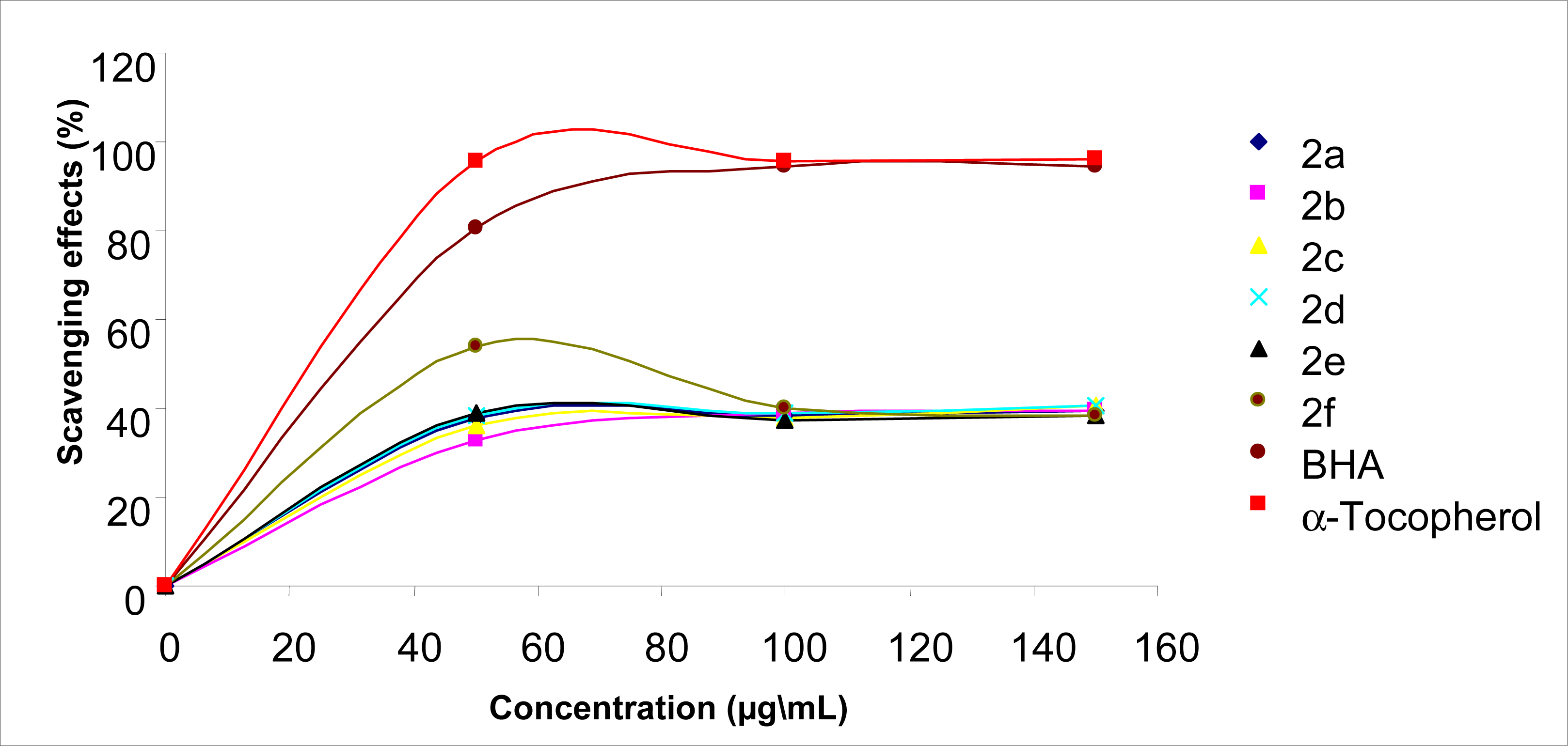
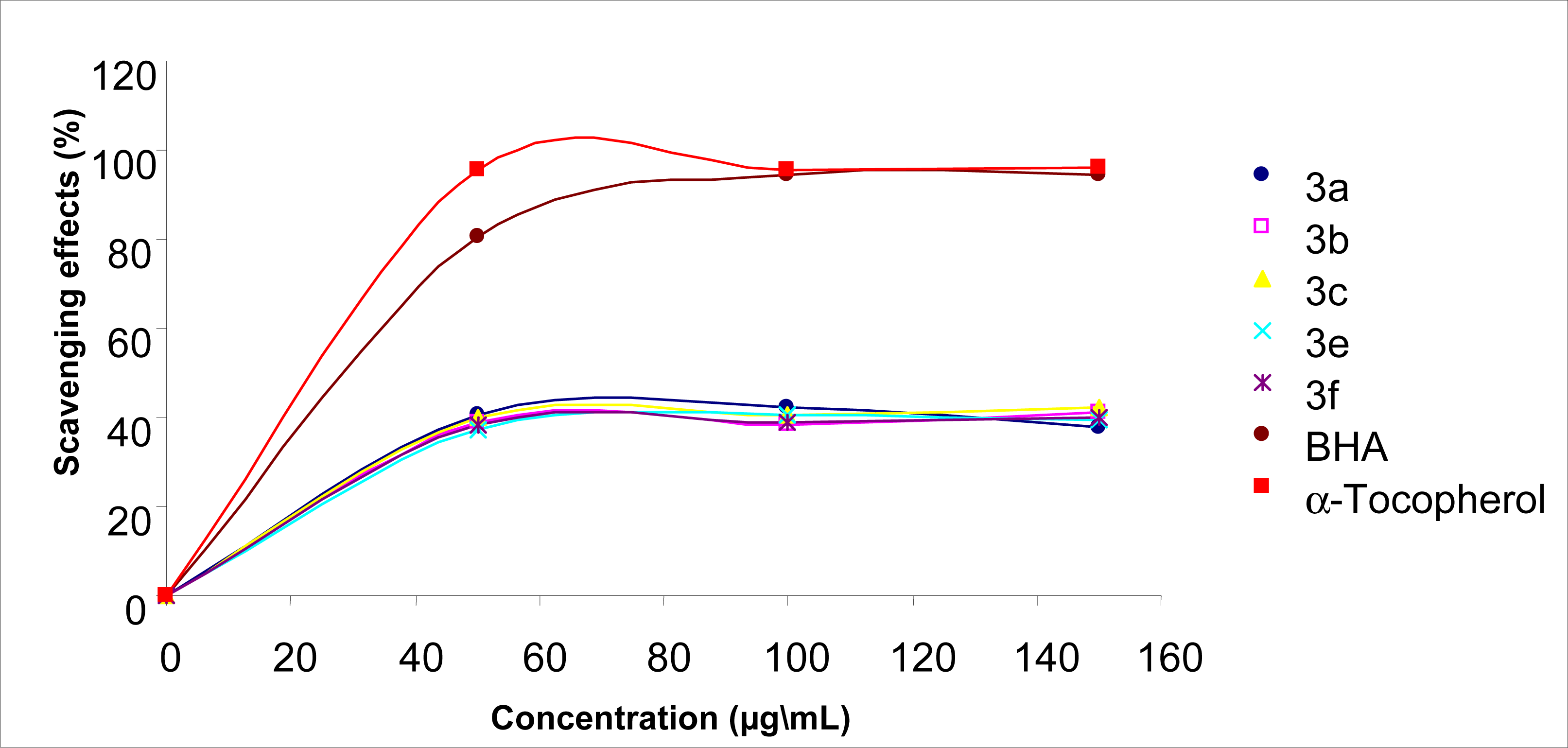
				<p>The scavenging the stable DPPH radical model is a widely used method to evaluate antioxidant activities in a relatively short time compared with other methods. The effect of antioxidants on DPPH radical scavenging was thought to be due to their hydrogen donating ability [<xref ref-type="bibr" rid="b38-ijms-09-00012">38</xref>]. DPPH is a stable free radical and accepts an electron or hydrogen radical to become a stable diamagnetic molecule [<xref ref-type="bibr" rid="b39-ijms-09-00012">39</xref>]. The reduction capability of DPPH radicals was determined by decrease in its absorbance at 517 nm induced by antioxidants. The absorption maximum of a stable DPPH radical in ethanol was at 517 nm. The decrease in absorbance of DPPH radical caused by antioxidants, because of reaction between antioxidant molecules and radical, progresses, which result in the scavenging of the radical by hydrogen donation. It is visually noticeable as a discoloration from purple to yellow. Hence, DPPH. is usually used as a substrate to evaluate antioxidative activity of antioxidants [<xref ref-type="bibr" rid="b40-ijms-09-00012">40</xref>]. In this study, antiradical activities of compounds and standard antioxidants such as BHA and α-tocopherol were determined by using DPPH. method. All the compounds tested with this method showed lower absorbance than absorbance of the control reaction and higher absorbance than that of the standard antioxidant reactions. The data obtained in this study indicate that the newly synthesized compounds showed mild activities as a radical scavenger, indicating that it has moderate activities as hydrogen donors. <xref ref-type="fig" rid="f1-ijms-09-00012">Figure 1</xref> and <xref ref-type="fig" rid="f2-ijms-09-00012">Figure 2</xref> illustrate a dose-dependent DPPH· radical scavenging activity of compounds tested and standards.</p>
			</sec>
			<sec>
				<title>Ferrous ions chelating activity</title>
				<p>The chelating effect towards ferrous ions by the compounds and standards was determined according to the method of Dinis [<xref ref-type="bibr" rid="b30-ijms-09-00012">30</xref>]. Ferrozine can quantitatively form complexes with Fe<sup>2+</sup>. In the presence of chelating agents, the complex formation is disrupted with the result that the red colour of the complex is decreased. Measurement of colour reduction therefore allows estimation of the chelating activity of the coexisting chelator [<xref ref-type="bibr" rid="b41-ijms-09-00012">41</xref>]. Transition metals have pivotal role in the generation oxygen free radicals in living organism. The ferric iron (Fe<sup>3+</sup>) is the relatively biologically inactive form of iron. However, it can be reduced to the active Fe<sup>2+</sup>, depending on condition, particularly pH [<xref ref-type="bibr" rid="b42-ijms-09-00012">42</xref>] and oxidized back through Fenton type reactions with the production of hydroxyl radical or Haber-Weiss reactions with superoxide anions. The production of these radicals may lead to lipid peroxidation, protein modification and DNA damage. Chelating agents may not activate metal ions and potentially inhibit the metal-dependent processes [<xref ref-type="bibr" rid="b43-ijms-09-00012">43</xref>]. Also, the production of highly active ROS such as O<sub>2</sub>
					<bold>
						<sup>.–</sup>
					</bold>, H<sub>2</sub>O<sub>2</sub> and OH<sup>.</sup> is also catalyzed by free iron though Haber-Weiss reactions:</p>
				<disp-formula id="FD4">
					<label>(4)</label>
					<mml:math id="M4" display="block">
						<mml:mrow>
							<mml:msup>
								<mml:mtext>O</mml:mtext>
								<mml:mtext>.</mml:mtext>
							</mml:msup>
						</mml:mrow>
						<mml:mo>+</mml:mo>
						<mml:msub>
							<mml:mtext>H</mml:mtext>
							<mml:mtext>2</mml:mtext>
						</mml:msub>
						<mml:msub>
							<mml:mtext>O</mml:mtext>
							<mml:mtext>2</mml:mtext>
						</mml:msub>
						<mml:mo>→</mml:mo>
						<mml:msub>
							<mml:mtext>O</mml:mtext>
							<mml:mtext>2</mml:mtext>
						</mml:msub>
						<mml:mo>+</mml:mo>
						<mml:msup>
							<mml:mtext>OH</mml:mtext>
							<mml:mo>-</mml:mo>
						</mml:msup>
						<mml:mo>+</mml:mo>
						<mml:msup>
							<mml:mtext>OH</mml:mtext>
							<mml:mtext>.</mml:mtext>
						</mml:msup>
					</mml:math>
				</disp-formula>
				<p>Among the transition metals, iron is known as the most important lipid oxidation pro-oxidant, due to its high reactivity. The ferrous state of iron accelerates lipid oxidation by breaking down the hydrogen and lipid peroxides to reactive free radicals via the Fenton reactions:</p>
				<disp-formula id="FD5">
					<label>(5)</label>
					<mml:math id="M5" display="block">
						<mml:msup>
							<mml:mtext>Fe</mml:mtext>
							<mml:mrow>
								<mml:mtext>2</mml:mtext>
								<mml:mo>+</mml:mo>
							</mml:mrow>
						</mml:msup>
						<mml:mo>+</mml:mo>
						<mml:msub>
							<mml:mtext>H</mml:mtext>
							<mml:mtext>2</mml:mtext>
						</mml:msub>
						<mml:msub>
							<mml:mtext>O</mml:mtext>
							<mml:mtext>2</mml:mtext>
						</mml:msub>
						<mml:mo>→</mml:mo>
						<mml:msup>
							<mml:mtext>Fe</mml:mtext>
							<mml:mrow>
								<mml:mtext>3</mml:mtext>
								<mml:mo>+</mml:mo>
							</mml:mrow>
						</mml:msup>
						<mml:mo>+</mml:mo>
						<mml:msup>
							<mml:mtext>OH</mml:mtext>
							<mml:mo>-</mml:mo>
						</mml:msup>
						<mml:mo>+</mml:mo>
						<mml:msup>
							<mml:mtext>OH</mml:mtext>
							<mml:mtext>.</mml:mtext>
						</mml:msup>
					</mml:math>
				</disp-formula>
				<p>Also Fe<sup>3+</sup> ion produces radicals from peroxides, although the rate is tenfold less than of Fe<sup>2+</sup> ion, which is the most powerful pro-oxidant among various sort of metal ions [<xref ref-type="bibr" rid="b44-ijms-09-00012">44</xref>].</p>
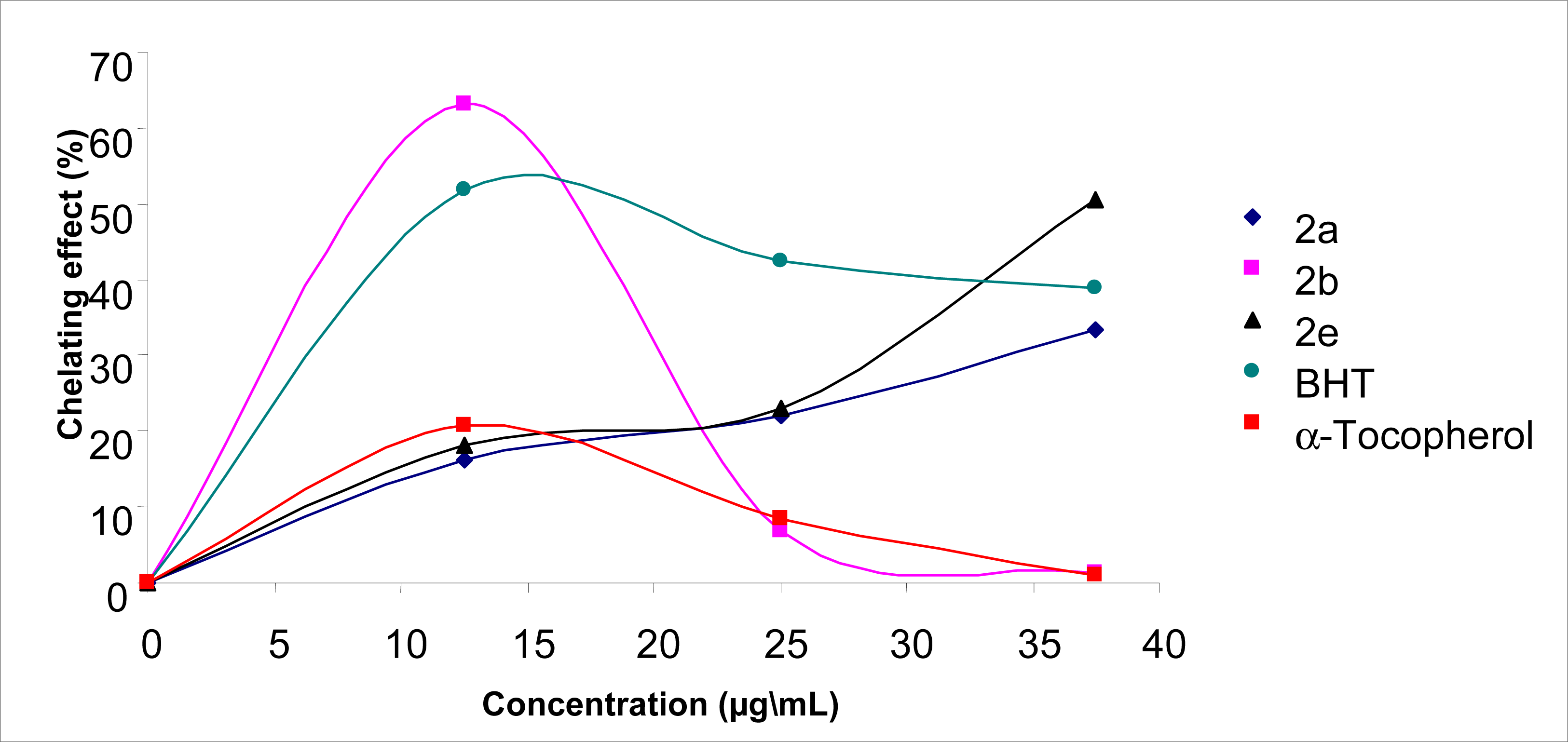
				<p>Ferrous ion chelating activities of <bold>2a</bold>, <bold>2b</bold> and <bold>2e</bold>, BHT and α-tocopherol are shown in <xref ref-type="fig" rid="f3-ijms-09-00012">Figure <bold>3</bold>
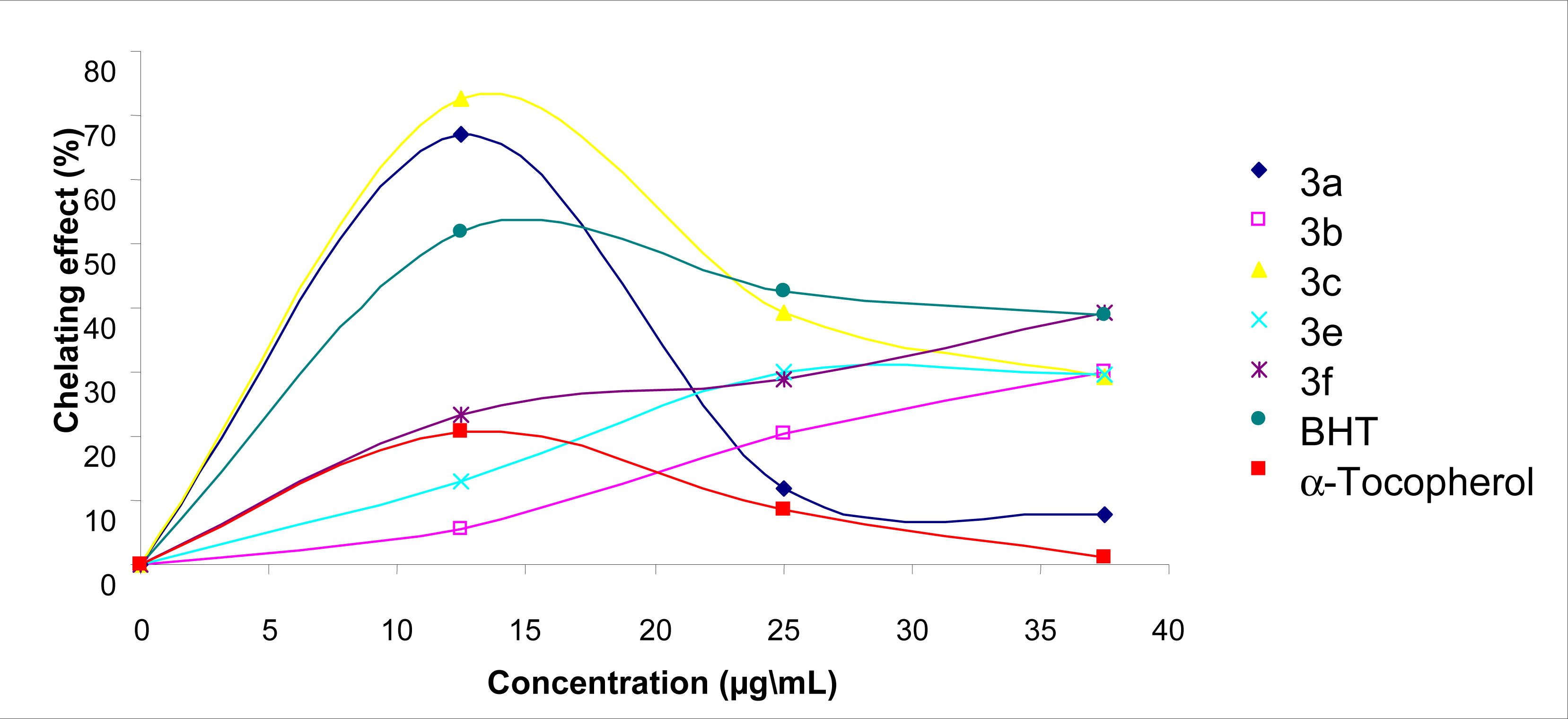
					</xref>. <bold>2a</bold> showed better ferrous chelating activity compared to standards at a concentration of 12,5 mg/L. Compounds <bold>2a</bold> and <bold>2e</bold> revealed good chelating activities at a concentration of 37,5 mg/L. Compounds <bold>2c</bold>, <bold>2d</bold> and <bold>2f</bold> did not show any chelating effect. The <bold>3a</bold>, <bold>3b</bold>, <bold>3c</bold>, <bold>3e</bold> and <bold>3f</bold> compounds tested with this method exhibited 66.9, 5.4, 72.4, 12.9 and 23.5 % chelation of ferrous ion at the concentration of 12.5 mg/L, respectively (<xref ref-type="fig" rid="f4-ijms-09-00012">Figure <bold>4</bold>
					</xref>). Otherwise, the percentages of metal chelating capacity of same concentration of BHT and α-tocopherol were found 51,8 and 12,5 %, respectively (<xref ref-type="fig" rid="f3-ijms-09-00012">Figure <bold>3</bold>
					</xref> and <xref ref-type="fig" rid="f4-ijms-09-00012">Figure <bold>4</bold>
					</xref>). Metal chelating capacity was significant since it reduced the concentrations of the catalyzing transition metal. It was reported that chelating agents, which form σ-bonds with a metal, are effective as secondary antioxidants because they reduce the redox potential thereby stabilizing the oxidized form of metal ion [<xref ref-type="bibr" rid="b45-ijms-09-00012">45</xref>]. The data obtained from <xref ref-type="fig" rid="f3-ijms-09-00012">Figure <bold>3</bold>
					</xref> and <xref ref-type="fig" rid="f4-ijms-09-00012">Figure <bold>4</bold>
					</xref> reveal that the compounds, except for <bold>2c</bold>, <bold>2d</bold> and <bold>2f</bold>, demonstrate a marked capacity for iron binding at the concentration-dependent manner, suggesting that their action as peroxidation protector may be related to its iron binding capacity. Moreover, free iron is known to have low solubility and a chelated iron complex has greater solubility in solution, which can be contributed solely from the ligand. Furthermore, the compound-iron complex may also be active, since it can participate to iron-catalyzed reactions.</p>
				<p>In this study, the antioxidant activities of compounds varied with the tree test models. Our results revealed that all of the tested compounds showed mild antiradical activity and the compounds, except for <bold>2c</bold>, <bold>2d</bold> and <bold>2f</bold>, revealed good chelating activities. In conclusion the data here reported could be of the possible interest because of their activities of radical scavenging and metal chelating could prevent redox cycling.</p>
			</sec>
			<sec>
				<title>Potentiometric titrations</title>
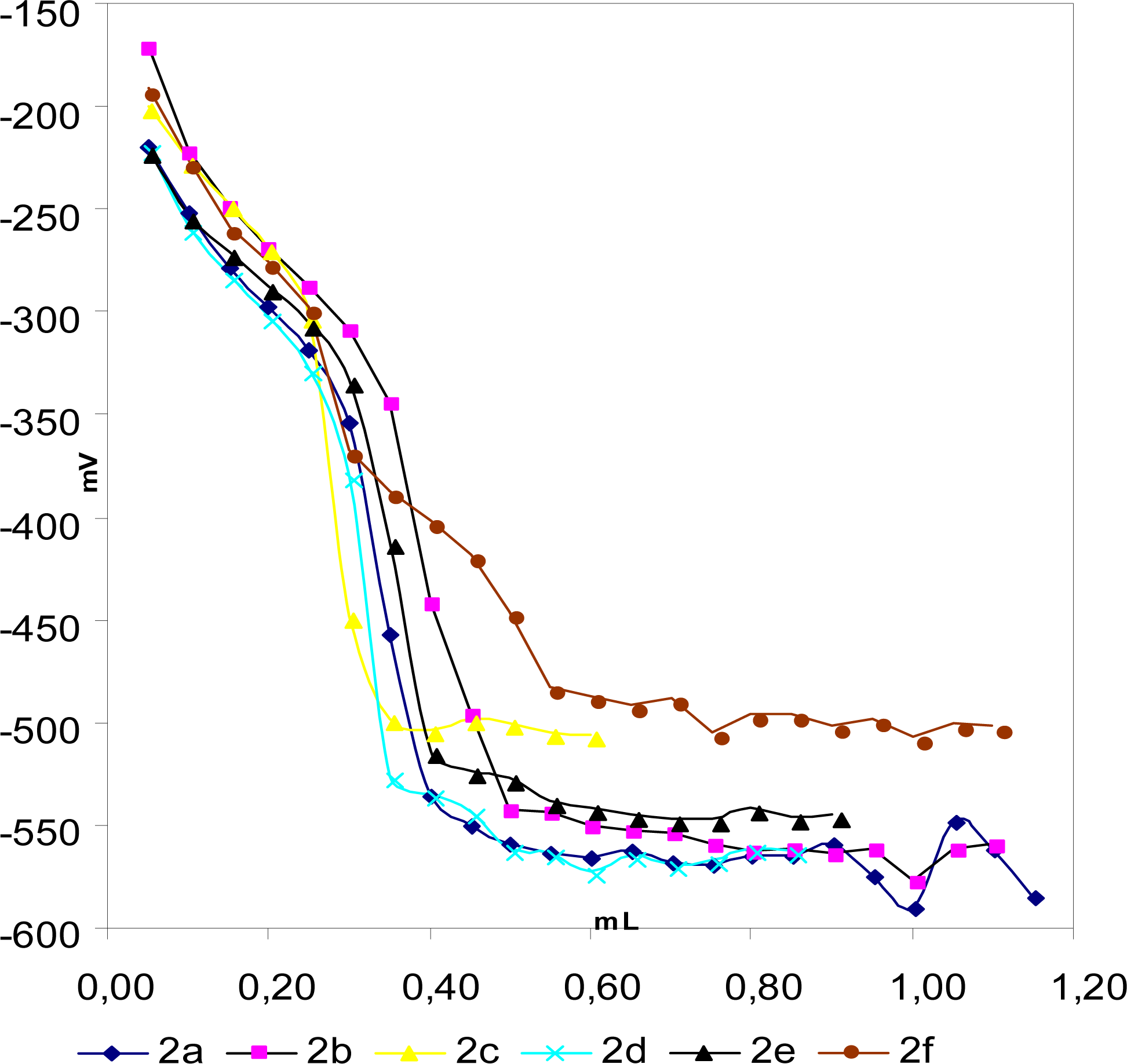
				<p>As a separate study, newly synthesized <bold>2a–f</bold> type compounds were titrated potentiometrically with tetrabutylammonium hydroxide (TBAH) in four non-aqueous solvents such as acetone (ε=20.6), isopropyl alcohol (ε=19.4), <italic>tert</italic>-butyl alcohol (ε=12.0) and <italic>N,N</italic>-dimethylformamide (ε=36.7). The mV values read in each titration were drawn against 0.05 M TBAH volumes (mL) added, and thus potentiometric titration curves were formed for all the cases. From these curves, the HNP values were measured, and the corresponding p<italic>K</italic>
					<sub>a</sub> values were calculated.</p>
				<p>As an example, the potentiometric titration curves for 0.001 M compounds <bold>2a–f</bold> solutions titrated with 0.05 M TBAH in acetone are shown <xref ref-type="fig" rid="f5-ijms-09-00012">Figure <bold>5</bold>
					</xref>.</p>
				<p>The HNP values and the corresponding p<italic>K</italic>
					<sub>a</sub> values for new compounds <bold>2a–f</bold>, obtained from the potentiometric titrations with 0.05 M TBAH in acetone, isopropyl alcohol, <italic>tert</italic>-butyl alcohol and <italic>N,N</italic>dimethylformamide, are presented in <xref ref-type="table" rid="t1-ijms-09-00012">Table 1</xref>.</p>
				<p>When the dielectric permittivity of solvents is taken into consideration, the acidic arrangement can be expected as follows: <italic>N,N</italic>-dimethylformamide (ε=36.7) &gt; acetone (ε=20.6) &gt; isopropyl alcohol (ε=19.4) &gt; <italic>tert</italic>-butyl alcohol (ε=12.0). As seen in <xref ref-type="table" rid="t1-ijms-09-00012">Table <bold>1</bold>
					</xref>, the acidic arrangement for compounds <bold>2a</bold>, <bold>2e</bold> and <bold>2f</bold> is: isopropyl alcohol &gt; <italic>tert</italic>-butyl alcohol &gt; <italic>N,N</italic>-dimethylformamide &gt; acetone, and for compounds <bold>2b</bold> and <bold>2d</bold>, it is : isopropyl alcohol &gt; <italic>N,N</italic>-dimethylformamide &gt; <italic>tert</italic>-butyl alcohol &gt; acetone while the arrangement for compound <bold>2c</bold> is : isopropyl alcohol &gt; acetone &gt; <italic>N,N</italic>-dimethylformamide &gt; <italic>tert</italic>-butyl alcohol. In isopropyl alcohol, all these compounds show the strongest acidic properties, but they show the weakest acidic properties in acetone (for compound <bold>2c</bold> in <italic>tert</italic>-butyl alcohol). This situation may be attributed to the hydrogen bonding between the negative ions formed and the solvent molecules in the amphiprotic neutral solvents.</p>
				<p>The degree to which a pure solvent ionizes was represented by its <italic>autoprotolysis constant,</italic> K<sub>HS</sub>.</p>
				<disp-formula id="FD6">
					<label>(6)</label>
					<mml:math id="M6" display="block">
						<mml:mtext>2HS</mml:mtext>
						<mml:mo>=</mml:mo>
						<mml:msub>
							<mml:mtext>H</mml:mtext>
							<mml:mtext>2</mml:mtext>
						</mml:msub>
						<mml:msup>
							<mml:mtext>S</mml:mtext>
							<mml:mo>+</mml:mo>
						</mml:msup>
						<mml:mo>+</mml:mo>
						<mml:msup>
							<mml:mtext>S</mml:mtext>
							<mml:mo>-</mml:mo>
						</mml:msup>
					</mml:math>
				</disp-formula>
				<p>For the above reaction the constant is defined by</p>
				<disp-formula id="FD7">
					<label>(7)</label>
					<mml:math id="M7" display="block">
						<mml:msub>
							<mml:mtext>K</mml:mtext>
							<mml:mrow>
								<mml:mtext>HS</mml:mtext>
							</mml:mrow>
						</mml:msub>
						<mml:mo>=</mml:mo>
						<mml:mo stretchy="false">[</mml:mo>
						<mml:msub>
							<mml:mtext>H</mml:mtext>
							<mml:mo>2</mml:mo>
						</mml:msub>
						<mml:msup>
							<mml:mtext>S</mml:mtext>
							<mml:mo>+</mml:mo>
						</mml:msup>
						<mml:mo stretchy="false">]</mml:mo>
						<mml:mo stretchy="false">[</mml:mo>
						<mml:msup>
							<mml:mi>S</mml:mi>
							<mml:mo>-</mml:mo>
						</mml:msup>
						<mml:mo stretchy="false">]</mml:mo>
					</mml:math>
				</disp-formula>
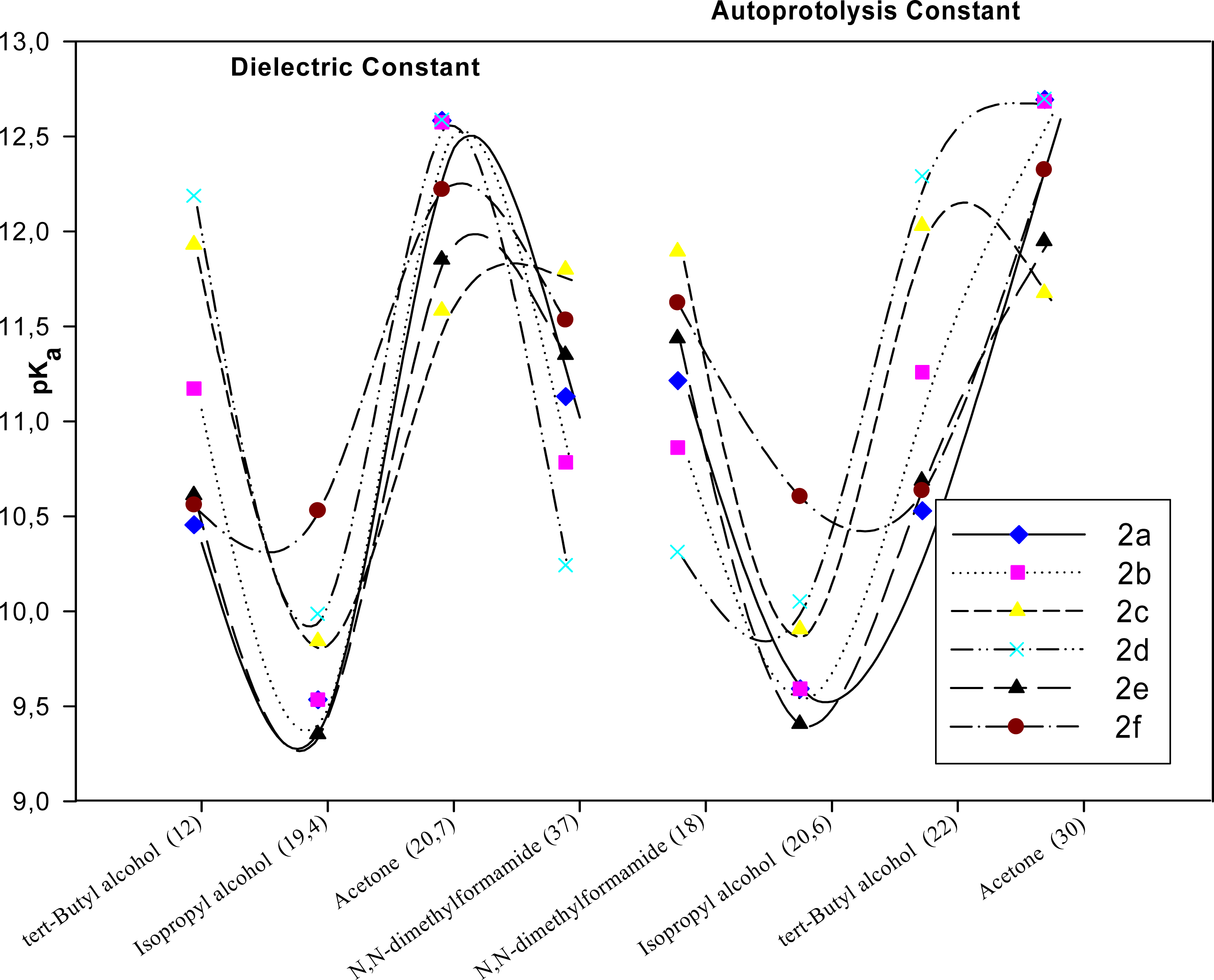
				<p>Autoprotolysis is an acid-base reaction between identical solvent molecules is which some act as an acid and others as a base. Consequently, the extent of an autoprotolysis reaction depends both on the intrinsic acidity and the instrinsic basicity of the solvent. The importance of the autoprotolysis constant in titrations lies in its effect on the completeness of a titration reaction [<xref ref-type="bibr" rid="b46-ijms-09-00012">46</xref>]. The exchange of the p<italic>K</italic>
					<sub>a</sub> values with autoprotolysis constant and dielectric constant are given in <xref ref-type="fig" rid="f6-ijms-09-00012">Figure <bold>6</bold>
					</xref>.</p>
				<p>As it is well known, the acidity of a compound depends on some factors. The two most important factors are the solvent effect and molecular structure [<xref ref-type="bibr" rid="b9-ijms-09-00012">9</xref>–<xref ref-type="bibr" rid="b18-ijms-09-00012">18</xref>]. <xref ref-type="table" rid="t1-ijms-09-00012">Table <bold>1</bold>
					</xref> shows that the HNP values and corresponding p<italic>K</italic>
					<sub>a</sub> values obtained from the potentiometric titrations depend on the non-aqueous solvents used and the substituents at C-3, in 4,5-dihydro-1<italic>H</italic>-1,2,4-triazol-5-one ring.</p>
			</sec>
			<sec sec-type="results">
				<title>Theoretical calculations</title>
				<p>The experimental and theoretical <sup>1</sup>H and <sup>13</sup>C chemical shifts, along with the error for each compound, are presented in <xref ref-type="table" rid="t2-ijms-09-00012">Tables 2</xref>–<xref ref-type="table" rid="t7-ijms-09-00012">7</xref>. A least-squares fit (theoretical calculation values/experimental calculation values) of all data shows a strong linear relationship with a R value of 0.999. This relationship is also reflected in the results for the individual compound, in which R values are 0.999, 0.976 (<bold>2a</bold>); 0.999 (<bold>2b</bold>); 0.999, 0.987 (<bold>2c</bold>); 0.999, 0.979 (<bold>2d</bold>); 0.999, 0.986 (<bold>2e</bold>); 0.999, 0.998 (<bold>2f</bold>). The overall standard error of estimate is 3.17 with the 6-311G basis set. The following correlations δ<sub>calc</sub> = aδ<sub>exp</sub>+ b were obtained: <bold>2a</bold> (<sup>13</sup>C), SE (standard error) = 3.27, a = 1.04, b = 1.58; <bold>2a</bold> (<sup>1</sup>H), SE = 1.63, a = 0.60, b = 1.59; <bold>2b</bold> (<sup>13</sup>C), SE = 2.94, a = 1.04, b = 1.65; <bold>2c</bold> (<sup>13</sup>C), SE = 3.70, a = 1.03, b = 2.89; <bold>2c</bold> (<sup>1</sup>H), SE = 1.25, a = 0.41, b = 3.83; <bold>2d</bold> (<sup>13</sup>C), SE = 4.23, a = 1.04, b = 2.96; <bold>2d</bold> (<sup>1</sup>H), SE = 1.40, a = 0.62, b = 1.99; <bold>2e</bold> (<sup>13</sup>C), SE = 4.97, a = 1.04, b = 2.72; <bold>2e</bold> (<sup>1</sup>H), SE = 1.28, a = 0.40, b = 3.78; <bold>2f</bold> (<sup>13</sup>C), SE = 2.83, a = 1.18, b = −1.68; <bold>2f</bold> (<sup>1</sup>H), SE = 0.49, a = −0.16, b = 9.20.</p>
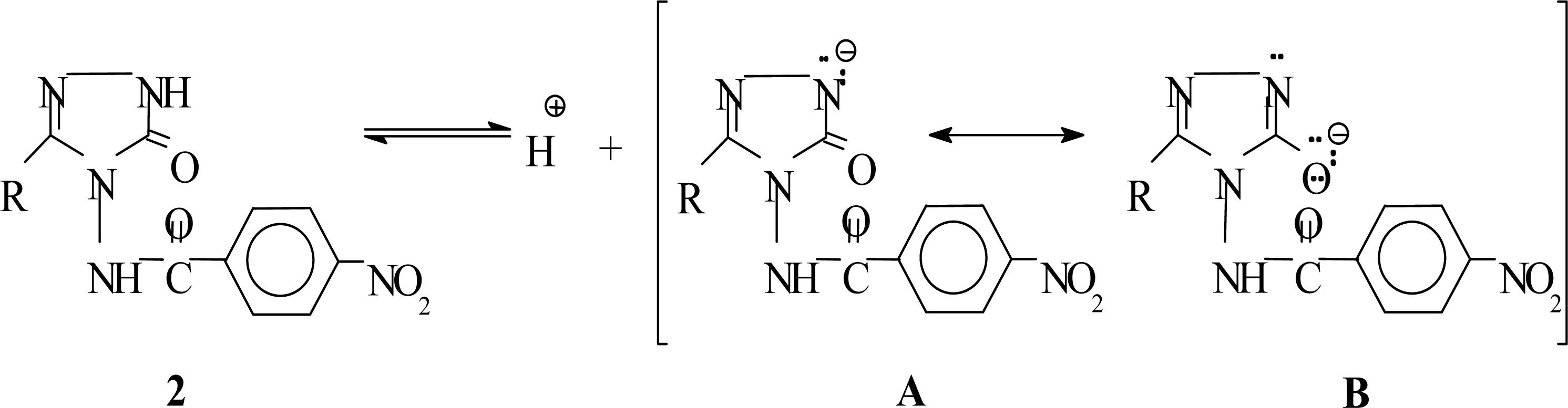
				<p>A linear correlation between theoretical and experimental carbon and proton chemical shifts was observed according to a, b and R values. A good quantitative agreement within 3.40–8.00 ppm in <xref ref-type="table" rid="t2-ijms-09-00012">Tables 2</xref>–<xref ref-type="table" rid="t7-ijms-09-00012">7</xref> are observed for the aromatic carbons of these compounds. As can be seen at <xref ref-type="table" rid="t2-ijms-09-00012">Tables 2</xref>–<xref ref-type="table" rid="t7-ijms-09-00012">7</xref>, the errors range from 12.816 to 13.937 ppm for C-9 and C-14 for compound <bold>2a</bold> due to attached nitrogen atoms. With the exception of the N-H protons, DFT method is in good agreement with the <sup>1</sup>H spectrum of compounds <bold>2a–f</bold>. There has occurred an important difference between experimental and theoretical results more than it is expected. The reason why such a result has come into being is that the N-H hydrogen in 4,5-dihydro-1<italic>H</italic>-1,2,4-triazol-5-one ring has acidic properties, so that some 4,5-dihydro-1<italic>H</italic>-1,2,4-triazol-5-one derivatives were titrated potentiometrically with TBAH in different non-aqueous solvents, and the p<italic>K</italic>
					<sub>a</sub> values were found between 8.69 and 16.75 [<xref ref-type="bibr" rid="b4-ijms-09-00012">4</xref>,<xref ref-type="bibr" rid="b9-ijms-09-00012">9</xref>–<xref ref-type="bibr" rid="b18-ijms-09-00012">18</xref>]. Thus, in the <sup>1</sup>H-NMR spectra of the 1,2,4-triazole and 4,5-dihydro-1<italic>H</italic>-1,2,4-triazol-5-one derivatives, the signals of N-H protons were observed approximately δ 11 and 12 ppm [<xref ref-type="bibr" rid="b8-ijms-09-00012">8</xref>–<xref ref-type="bibr" rid="b13-ijms-09-00012">13</xref>,<xref ref-type="bibr" rid="b15-ijms-09-00012">15</xref>–<xref ref-type="bibr" rid="b18-ijms-09-00012">18</xref>,<xref ref-type="bibr" rid="b23-ijms-09-00012">23</xref>,<xref ref-type="bibr" rid="b24-ijms-09-00012">24</xref>,<xref ref-type="bibr" rid="b47-ijms-09-00012">47</xref>,<xref ref-type="bibr" rid="b48-ijms-09-00012">48</xref>]. This situation can be attributed to the resonance of the negatively formed ions (<xref ref-type="fig" rid="f8-ijms-09-00012">Scheme 2</xref>). Because of amide N-H proton, the errors range from 4.57 to 5.41 ppm for H-18 in compounds <bold>2a</bold>, <bold>2c–f</bold> were determined.</p>
			</sec>
		</sec>
		<sec sec-type="conclusions">
			<title>Conclusions</title>
			<p>In this study, the structures of six new 3-alkyl(aryl)-4-(<italic>p</italic>-nitrobenzoylamino)-4,5-dihydro-1<italic>H</italic>-1,2,4- triazol-5-ones (<bold>2a–f</bold>) synthesized from the reactions of compounds <bold>1a–f</bold> with <italic>p</italic>-nitrobenzoyl chloride were identified by using elemental analyses and IR, <sup>1</sup>H-NMR, <sup>13</sup>C-NMR and UV spectral data, and these obtained spectral values were seen as compatible with literature [<xref ref-type="bibr" rid="b2-ijms-09-00012">2</xref>,<xref ref-type="bibr" rid="b4-ijms-09-00012">4</xref>,<xref ref-type="bibr" rid="b7-ijms-09-00012">7</xref>–<xref ref-type="bibr" rid="b14-ijms-09-00012">14</xref>]. The newly synthesized compounds <bold>2a–f</bold> were titrated potentiometrically with TBAH in four non-aqueous solvents such as acetone, isopropyl alcohol, <italic>tert</italic>-butyl alcohol and <italic>N,N</italic>-dimethylformamide of relative dielectric permittivity 20.6, 19.4, 12.0 and 36.7, respectively. From the titration curves, the HNP values and the corresponding p<italic>K</italic>
				<sub>a</sub> values were determined for all cases. These new compounds and five recently reported 3-alkyl-4-(2-furoylamino)-4,5-dihydro-1<italic>H</italic>-1,2,4-triazol-5-ones (<bold>3a–c,e,f</bold>) were also screened for their antioxidant activities. In addition, correlations between experimental chemical shifts and GIAO-calculated isotropic shielding constants of protons and carbons as obtained from six new 3- alkyl(aryl)-4-(<italic>p</italic>-nitrobenzoylamino)-4,5-dihydro-1<italic>H</italic>-1,2,4-triazol-5-ones (<bold>2a–f</bold>) were established in order to assess the performance of NMR spectral calculations. DFT-B3LYP level of the theory 6-311G basis set was considered for geometry optimization and spectral calculations. Linear regressions, σ<sub>calc</sub>= a + bδ<sub>exp</sub>, yield standard deviations of 1.40–4.18 ppm for hydrogen and carbon atoms.</p>
		</sec>
	</body>
	<back>
		<ack>
			<title>Acknowledgements</title>
			<p>The authors thank Asistants Özlem Gürsoy-Kol and Haci Baykara, Chemistry Department of the Faculty of Arts and Sciences at Kafkas University, for their help.</p>
		</ack>
		<ref-list>
			<title>References</title>
			<ref id="b1-ijms-09-00012">
				<label>1</label>
				<citation citation-type="journal">
					<person-group person-group-type="author">
						<name>
							<surname>Ikizler</surname>
							<given-names>AA</given-names>
						</name>
						<name>
							<surname>Uçar</surname>
							<given-names>F</given-names>
						</name>
						<name>
							<surname>Yüksek</surname>
							<given-names>H</given-names>
						</name>
						<name>
							<surname>Aytin</surname>
							<given-names>A</given-names>
						</name>
						<name>
							<surname>Yasa</surname>
							<given-names>I</given-names>
						</name>
						<name>
							<surname>Gezer</surname>
							<given-names>T</given-names>
						</name>
					</person-group>
					<article-title>Synthesis and antifungal activity of some new arylidenamino compounds</article-title>
					<source>Acta Pol Pharm-Drug Res</source>
					<year>1997</year>
					<volume>54</volume>
					<fpage>135</fpage>
					<lpage>140</lpage>
				</citation>
			</ref>
			<ref id="b2-ijms-09-00012">
				<label>2</label>
				<citation citation-type="journal">
					<person-group person-group-type="author">
						<name>
							<surname>Yüksek</surname>
							<given-names>H</given-names>
						</name>
						<name>
							<surname>Demibaş</surname>
							<given-names>A</given-names>
						</name>
						<name>
							<surname>Ikizler</surname>
							<given-names>A</given-names>
						</name>
						<name>
							<surname>Johansson</surname>
							<given-names>CB</given-names>
						</name>
						<name>
							<surname>Çelik</surname>
							<given-names>C</given-names>
						</name>
						<name>
							<surname>Ikizler</surname>
							<given-names>AA</given-names>
						</name>
					</person-group>
					<article-title>Synthesis and antibacterial activities of some 4,5-dihydro-1H-1,2,4-triazol-5-ones</article-title>
					<source>Arzneim-Forsch/Drug Res</source>
					<year>1997</year>
					<volume>47</volume>
					<fpage>405</fpage>
					<lpage>409</lpage>
				</citation>
			</ref>
			<ref id="b3-ijms-09-00012">
				<label>3</label>
				<citation citation-type="journal">
					<person-group person-group-type="author">
						<name>
							<surname>Demirbaş</surname>
							<given-names>N</given-names>
						</name>
						<name>
							<surname>Uğurluoğlu</surname>
							<given-names>R</given-names>
						</name>
					</person-group>
					<article-title>Synthesis and antitumor activities of some 4-(1- naphthylidenamino)- and 4-(1-naphthylmethylamino)-1,2,4-triazol-5-one derivatives</article-title>
					<source>Turk J Chem</source>
					<year>2004</year>
					<volume>28</volume>
					<fpage>679</fpage>
					<lpage>690</lpage>
				</citation>
			</ref>
			<ref id="b4-ijms-09-00012">
				<label>4</label>
				<citation citation-type="journal">
					<person-group person-group-type="author">
						<name>
							<surname>Alkan</surname>
							<given-names>M</given-names>
						</name>
						<name>
							<surname>Yüksek</surname>
							<given-names>H</given-names>
						</name>
						<name>
							<surname>İslamoğlu</surname>
							<given-names>F</given-names>
						</name>
						<name>
							<surname>Bahçeci</surname>
							<given-names>Ş</given-names>
						</name>
						<name>
							<surname>Calapoğlu</surname>
							<given-names>M</given-names>
						</name>
						<name>
							<surname>Elmastaş</surname>
							<given-names>M</given-names>
						</name>
						<name>
							<surname>Akşit</surname>
							<given-names>H</given-names>
						</name>
						<name>
							<surname>Özdemir</surname>
							<given-names>M</given-names>
						</name>
					</person-group>
					<article-title>A study on 4-acylamino-4,5-dihydro-1H-1,2,4-triazol-5-ones</article-title>
					<source>Molecules</source>
					<year>2007</year>
					<volume>12</volume>
					<fpage>1805</fpage>
					<lpage>1816</lpage>
				<pub-id pub-id-type="doi">10.3390/12081805</pub-id><pub-id pub-id-type="pmid">17960089</pub-id></citation>
			</ref>
			<ref id="b5-ijms-09-00012">
				<label>5</label>
				<citation citation-type="journal">
					<person-group person-group-type="author">
						<name>
							<surname>Yüksek</surname>
							<given-names>H</given-names>
						</name>
						<name>
							<surname>Kolaylı</surname>
							<given-names>S</given-names>
						</name>
						<name>
							<surname>Küçük</surname>
							<given-names>M</given-names>
						</name>
						<name>
							<surname>Yüksek</surname>
							<given-names>MO</given-names>
						</name>
						<name>
							<surname>Ocak</surname>
							<given-names>U</given-names>
						</name>
						<name>
							<surname>Şahinbaş</surname>
							<given-names>E</given-names>
						</name>
						<name>
							<surname>Sivrikaya</surname>
							<given-names>E</given-names>
						</name>
						<name>
							<surname>Ocak</surname>
							<given-names>M</given-names>
						</name>
					</person-group>
					<article-title>Synthesis and andioxidant activities of some 4-benzylidenamino-4,5-dihydro-1H- 1,2,4-triazol-5-one derivatives</article-title>
					<source>Indian J Chem</source>
					<year>2006</year>
					<volume>45B</volume>
					<fpage>715</fpage>
					<lpage>718</lpage>
				</citation>
			</ref>
			<ref id="b6-ijms-09-00012">
				<label>6</label>
				<citation citation-type="journal">
					<person-group person-group-type="author">
						<name>
							<surname>Bhat</surname>
							<given-names>AR</given-names>
						</name>
						<name>
							<surname>Bhat</surname>
							<given-names>GV</given-names>
						</name>
						<name>
							<surname>Shenoy</surname>
							<given-names>GG</given-names>
						</name>
					</person-group>
					<article-title>Synthesis and in-vitro antimicrobial activity of new 1,2,4- triazoles</article-title>
					<source>J Pharm Pharmacol</source>
					<year>2001</year>
					<volume>53</volume>
					<fpage>267</fpage>
					<lpage>272</lpage>
				<pub-id pub-id-type="doi">10.1211/0022357011775307</pub-id><pub-id pub-id-type="pmid">11273026</pub-id></citation>
			</ref>
			<ref id="b7-ijms-09-00012">
				<label>7</label>
				<citation citation-type="journal">
					<person-group person-group-type="author">
						<name>
							<surname>Ikizler</surname>
							<given-names>A</given-names>
						</name>
						<name>
							<surname>Doğan</surname>
							<given-names>N</given-names>
						</name>
						<name>
							<surname>Ikizler</surname>
							<given-names>AA</given-names>
						</name>
					</person-group>
					<article-title>The acylation of 4-amino-4,5-dihydro-1H-1,2,4-triazol-5- ones</article-title>
					<source>Rev Roum Chim</source>
					<year>1998</year>
					<volume>43</volume>
					<fpage>741</fpage>
					<lpage>746</lpage>
				</citation>
			</ref>
			<ref id="b8-ijms-09-00012">
				<label>8</label>
				<citation citation-type="journal">
					<person-group person-group-type="author">
						<name>
							<surname>Ikizler</surname>
							<given-names>AA</given-names>
						</name>
						<name>
							<surname>Yüksek</surname>
							<given-names>H</given-names>
						</name>
					</person-group>
					<article-title>Acetylation of 4-amino-4,5-dihydro-1H-1,2,4-triazol-5-ones</article-title>
					<source>Org Prep Proced Int</source>
					<year>1993</year>
					<volume>25</volume>
					<fpage>99</fpage>
					<lpage>105</lpage>
				<pub-id pub-id-type="doi">10.1080/00304949309457935</pub-id></citation>
			</ref>
			<ref id="b9-ijms-09-00012">
				<label>9</label>
				<citation citation-type="journal">
					<person-group person-group-type="author">
						<name>
							<surname>Yüksek</surname>
							<given-names>H</given-names>
						</name>
						<name>
							<surname>Alkan</surname>
							<given-names>M</given-names>
						</name>
						<name>
							<surname>Ocak</surname>
							<given-names>Z</given-names>
						</name>
						<name>
							<surname>Bahçeci</surname>
							<given-names>Ş</given-names>
						</name>
						<name>
							<surname>Ocak</surname>
							<given-names>M</given-names>
						</name>
						<name>
							<surname>Özdemir</surname>
							<given-names>M</given-names>
						</name>
					</person-group>
					<article-title>Synthesis and acidic properties of some new potential biologically active 4-acylamino-4,5-dihydro-1H-1,2,4-triazol- 5-one derivatives</article-title>
					<source>Indian J Chem</source>
					<year>2004</year>
					<volume>43B</volume>
					<fpage>1527</fpage>
					<lpage>1531</lpage>
				</citation>
			</ref>
			<ref id="b10-ijms-09-00012">
				<label>10</label>
				<citation citation-type="journal">
					<person-group person-group-type="author">
						<name>
							<surname>Yüksek</surname>
							<given-names>H</given-names>
						</name>
						<name>
							<surname>Ocak</surname>
							<given-names>Z</given-names>
						</name>
						<name>
							<surname>Alkan</surname>
							<given-names>M</given-names>
						</name>
						<name>
							<surname>Bahçeci</surname>
							<given-names>Ş</given-names>
						</name>
						<name>
							<surname>Özdemir</surname>
							<given-names>M</given-names>
						</name>
					</person-group>
					<article-title>Synthesis and determination of p<italic>K</italic>
						<sub>a</sub> values of some new 3,4-disubstituted-4,5-dihydro-1H-1,2,4-triazol-5-one derivatives in nonaqueous solvents</article-title>
					<source>Molecules</source>
					<year>2004</year>
					<volume>9</volume>
					<fpage>232</fpage>
					<lpage>240</lpage>
				<pub-id pub-id-type="doi">10.3390/90400232</pub-id><pub-id pub-id-type="pmid">18007427</pub-id></citation>
			</ref>
			<ref id="b11-ijms-09-00012">
				<label>11</label>
				<citation citation-type="journal">
					<person-group person-group-type="author">
						<name>
							<surname>Bahçeci</surname>
							<given-names>Ş</given-names>
						</name>
						<name>
							<surname>Yüksek</surname>
							<given-names>H</given-names>
						</name>
						<name>
							<surname>Ocak</surname>
							<given-names>Z</given-names>
						</name>
						<name>
							<surname>Azaklı</surname>
							<given-names>A</given-names>
						</name>
						<name>
							<surname>Alkan</surname>
							<given-names>M</given-names>
						</name>
						<name>
							<surname>Ozdemir</surname>
							<given-names>M</given-names>
						</name>
					</person-group>
					<article-title>Synthesis and potentiometric titrations of some new 4-(benzylideneamino)-4,5-dihydro-1H-1,2,4-triazol-5-one derivatives in non-aqueous media</article-title>
					<source>Collect Czech Chem Commun</source>
					<year>2002</year>
					<volume>67</volume>
					<fpage>1215</fpage>
					<lpage>1222</lpage>
				<pub-id pub-id-type="doi">10.1135/cccc20021215</pub-id></citation>
			</ref>
			<ref id="b12-ijms-09-00012">
				<label>12</label>
				<citation citation-type="journal">
					<person-group person-group-type="author">
						<name>
							<surname>Bahçeci</surname>
							<given-names>Ş</given-names>
						</name>
						<name>
							<surname>Yüksek</surname>
							<given-names>H</given-names>
						</name>
						<name>
							<surname>Ocak</surname>
							<given-names>Z</given-names>
						</name>
						<name>
							<surname>KÖksal</surname>
							<given-names>C</given-names>
						</name>
						<name>
							<surname>Ozdemir</surname>
							<given-names>M</given-names>
						</name>
					</person-group>
					<article-title>Synthesis and non-aqueous medium titrations of some new 4,5-dihydro-1H-1,2,4-triazol-5-one derivatives</article-title>
					<source>Acta Chim Slov</source>
					<year>2002</year>
					<volume>49</volume>
					<fpage>783</fpage>
					<lpage>794</lpage>
				</citation>
			</ref>
			<ref id="b13-ijms-09-00012">
				<label>13</label>
				<citation citation-type="journal">
					<person-group person-group-type="author">
						<name>
							<surname>Ikizler</surname>
							<given-names>AA</given-names>
						</name>
						<name>
							<surname>Ikizler</surname>
							<given-names>A</given-names>
						</name>
						<name>
							<surname>Şentürk</surname>
							<given-names>HB</given-names>
						</name>
						<name>
							<surname>Serdar</surname>
							<given-names>M</given-names>
						</name>
					</person-group>
					<article-title>The pKa values of some 1,2,4-triazole and 1,2,4-triazolin-5-one derivatives in nonaqueous media</article-title>
					<source>Doğa-Tr Kimya D</source>
					<year>1988</year>
					<volume>12</volume>
					<fpage>57</fpage>
					<lpage>66</lpage>
					<comment>[<italic>Chem. Abstr.</italic>
						<bold>1988</bold>, <italic>109</italic>, 238277q]</comment>
				</citation>
			</ref>
			<ref id="b14-ijms-09-00012">
				<label>14</label>
				<citation citation-type="journal">
					<person-group person-group-type="author">
						<name>
							<surname>Ikizler</surname>
							<given-names>AA</given-names>
						</name>
						<name>
							<surname>Şentürk</surname>
							<given-names>HB</given-names>
						</name>
						<name>
							<surname>Ikizler</surname>
							<given-names>A</given-names>
						</name>
					</person-group>
					<article-title>pK′<sub>a</sub> values of some 1,2,4-triazole derivatives in nonaqueous media</article-title>
					<source>Doğa-Tr J of Chem</source>
					<year>1991</year>
					<volume>15</volume>
					<fpage>345</fpage>
					<lpage>354</lpage>
					<comment>[<italic>Chem. Abstr.</italic>
						<bold>1992</bold>, <italic>116</italic>, 173458x]</comment>
				</citation>
			</ref>
			<ref id="b15-ijms-09-00012">
				<label>15</label>
				<citation citation-type="journal">
					<person-group person-group-type="author">
						<name>
							<surname>Yüksek</surname>
							<given-names>H</given-names>
						</name>
						<name>
							<surname>Ocak</surname>
							<given-names>Z</given-names>
						</name>
						<name>
							<surname>Özdemir</surname>
							<given-names>M</given-names>
						</name>
						<name>
							<surname>Ocak</surname>
							<given-names>M</given-names>
						</name>
						<name>
							<surname>Bekar</surname>
							<given-names>M</given-names>
						</name>
						<name>
							<surname>Aksoy</surname>
							<given-names>M</given-names>
						</name>
					</person-group>
					<article-title>A study on novel 4- heteroarylidenamino-4,5-dihydro-1H-1,2,4-triazol-5-ones</article-title>
					<source>Indian J Heterocy Ch</source>
					<year>2003</year>
					<volume>13</volume>
					<fpage>49</fpage>
					<lpage>52</lpage>
				</citation>
			</ref>
			<ref id="b16-ijms-09-00012">
				<label>16</label>
				<citation citation-type="journal">
					<person-group person-group-type="author">
						<name>
							<surname>Yüksek</surname>
							<given-names>H</given-names>
						</name>
						<name>
							<surname>Bahçeci</surname>
							<given-names>Ş</given-names>
						</name>
						<name>
							<surname>Ocak</surname>
							<given-names>Z</given-names>
						</name>
						<name>
							<surname>Alkan</surname>
							<given-names>M</given-names>
						</name>
						<name>
							<surname>Ermiş</surname>
							<given-names>B</given-names>
						</name>
						<name>
							<surname>Mutlu</surname>
							<given-names>T</given-names>
						</name>
						<name>
							<surname>Ocak</surname>
							<given-names>M</given-names>
						</name>
						<name>
							<surname>Özdemir</surname>
							<given-names>M</given-names>
						</name>
					</person-group>
					<article-title>Synthesis of some 4,5-dihydro-1H-1,2,4-triazol-5-ones</article-title>
					<source>Indian J Heterocy Ch</source>
					<year>2004</year>
					<volume>13</volume>
					<fpage>369</fpage>
					<lpage>372</lpage>
				</citation>
			</ref>
			<ref id="b17-ijms-09-00012">
				<label>17</label>
				<citation citation-type="journal">
					<person-group person-group-type="author">
						<name>
							<surname>Yüksek</surname>
							<given-names>H</given-names>
						</name>
						<name>
							<surname>Üçüncü</surname>
							<given-names>O</given-names>
						</name>
						<name>
							<surname>Alkan</surname>
							<given-names>M</given-names>
						</name>
						<name>
							<surname>Ocak</surname>
							<given-names>Z</given-names>
						</name>
						<name>
							<surname>Bahçeci</surname>
							<given-names>Ş</given-names>
						</name>
						<name>
							<surname>Özdemir</surname>
							<given-names>M</given-names>
						</name>
					</person-group>
					<article-title>Synthesis and nonaqueous medium titrations of some new 4-benzylidenamino-4,5-dihydro-1H-1,2,4-triazol-5-one derivatives</article-title>
					<source>Molecules</source>
					<year>2005</year>
					<volume>10</volume>
					<fpage>961</fpage>
					<lpage>970</lpage>
				<pub-id pub-id-type="doi">10.3390/10080961</pub-id><pub-id pub-id-type="pmid">18007364</pub-id></citation>
			</ref>
			<ref id="b18-ijms-09-00012">
				<label>18</label>
				<citation citation-type="journal">
					<person-group person-group-type="author">
						<name>
							<surname>Yüksek</surname>
							<given-names>H</given-names>
						</name>
						<name>
							<surname>Bahçeci</surname>
							<given-names>Ş</given-names>
						</name>
						<name>
							<surname>Ocak</surname>
							<given-names>Z</given-names>
						</name>
						<name>
							<surname>Özdemir</surname>
							<given-names>M</given-names>
						</name>
						<name>
							<surname>Ocak</surname>
							<given-names>M</given-names>
						</name>
						<name>
							<surname>Ermiş</surname>
							<given-names>B</given-names>
						</name>
						<name>
							<surname>Mutlu</surname>
							<given-names>T</given-names>
						</name>
					</person-group>
					<article-title>Synthesis and determination of acid dissociation constants of some new 4,5-dihydro-1H-1,2,4-triazol-5-one derivatives</article-title>
					<source>Asian J Chem</source>
					<year>2005</year>
					<volume>17</volume>
					<fpage>195</fpage>
					<lpage>201</lpage>
				</citation>
			</ref>
			<ref id="b19-ijms-09-00012">
				<label>19</label>
				<citation citation-type="journal">
					<person-group person-group-type="author">
						<name>
							<surname>Schleyer</surname>
							<given-names>PVR</given-names>
						</name>
						<name>
							<surname>Allinger</surname>
							<given-names>NL</given-names>
						</name>
						<name>
							<surname>Clark</surname>
							<given-names>T</given-names>
						</name>
						<name>
							<surname>Gasteiger</surname>
							<given-names>J</given-names>
						</name>
						<name>
							<surname>Kolmann</surname>
							<given-names>PA</given-names>
						</name>
						<name>
							<surname>Schaefer</surname>
							<given-names>HF</given-names>
						</name>
						<name>
							<surname>Schreiner</surname>
							<given-names>PR</given-names>
						</name>
					</person-group>
					<source>The encyclopedia of computational chemistry</source>
					<publisher-name>John Wiley &amp; Sons</publisher-name>
					<publisher-loc>Chichester</publisher-loc>
					<year>1998</year>
				</citation>
			</ref>
			<ref id="b20-ijms-09-00012">
				<label>20</label>
				<citation citation-type="journal">
					<person-group person-group-type="author">
						<name>
							<surname>Ditchfield</surname>
							<given-names>R</given-names>
						</name>
					</person-group>
					<article-title>Self-consistent perturbation theory of diamagnetism. I A gauge-invariant LCAO method for N.M.R. chemical shifts</article-title>
					<source>Mol Phys</source>
					<year>1974</year>
					<volume>27</volume>
					<fpage>789</fpage>
					<lpage>807</lpage>
				<pub-id pub-id-type="doi">10.1080/00268977400100711</pub-id></citation>
			</ref>
			<ref id="b21-ijms-09-00012">
				<label>21</label>
				<citation citation-type="journal">
					<person-group person-group-type="author">
						<name>
							<surname>Barfiled</surname>
							<given-names>M</given-names>
						</name>
						<name>
							<surname>Fagerness</surname>
							<given-names>PJ</given-names>
						</name>
					</person-group>
					<article-title>Density Functional Theory/GIAO Studies of the <sup>13</sup>C, <sup>15</sup>N, and 1H NMR chemical shifts in aminopyrimidines and aminobenzenes: relationships to electron densities and amine group orientations</article-title>
					<source>J Am Chem Soc</source>
					<year>1977</year>
					<volume>119</volume>
					<fpage>8699</fpage>
					<lpage>8711</lpage>
				</citation>
			</ref>
			<ref id="b22-ijms-09-00012">
				<label>22</label>
				<citation citation-type="journal">
					<person-group person-group-type="author">
						<name>
							<surname>Manaj</surname>
							<given-names>JM</given-names>
						</name>
						<name>
							<surname>Maciewska</surname>
							<given-names>D</given-names>
						</name>
						<name>
							<surname>Waver</surname>
							<given-names>I</given-names>
						</name>
					</person-group>
					<article-title>
						<sup>1</sup>H, <sup>13</sup>C and <sup>15</sup>N NMR and GIAO CPHF calculations on two quinoacridinium salts</article-title>
					<source>Magn Reson Chem</source>
					<year>2000</year>
					<volume>38</volume>
					<fpage>482</fpage>
					<lpage>485</lpage>
				<pub-id pub-id-type="doi">10.1002/1097-458X(200006)38:6&lt;482::AID-MRC677&gt;3.0.CO;2-P</pub-id></citation>
			</ref>
			<ref id="b23-ijms-09-00012">
				<label>23</label>
				<citation citation-type="journal">
					<person-group person-group-type="author">
						<name>
							<surname>Yüksek</surname>
							<given-names>H</given-names>
						</name>
						<name>
							<surname>Gürsoy</surname>
							<given-names>Ö</given-names>
						</name>
						<name>
							<surname>Çakmak</surname>
							<given-names>İ</given-names>
						</name>
						<name>
							<surname>Alkan</surname>
							<given-names>M</given-names>
						</name>
					</person-group>
					<article-title>Synthesis and GIAO NMR calculation for some new 4,5-dihydro-1<italic>H</italic>-1,2,4-triazol-5-one derivatives: comparison of theoretical and experimental 1H and 13C chemical shifts</article-title>
					<source>Magn Reson Chem</source>
					<year>2005</year>
					<volume>43</volume>
					<fpage>585</fpage>
					<lpage>587</lpage>
				<pub-id pub-id-type="doi">10.1002/mrc.1591</pub-id><pub-id pub-id-type="pmid">15880480</pub-id></citation>
			</ref>
			<ref id="b24-ijms-09-00012">
				<label>24</label>
				<citation citation-type="journal">
					<person-group person-group-type="author">
						<name>
							<surname>Yüksek</surname>
							<given-names>H</given-names>
						</name>
						<name>
							<surname>Çakmak</surname>
							<given-names>İ</given-names>
						</name>
						<name>
							<surname>Sadi</surname>
							<given-names>S</given-names>
						</name>
						<name>
							<surname>Alkan</surname>
							<given-names>M</given-names>
						</name>
					</person-group>
					<article-title>Synthesis and GIAO NMR calculations for some novel 4-heteroarylidenamino-4,5-dihydro-1<italic>H</italic>-1,2,4-triazol-5-one derivatives: comparison of theoretical and experimental <sup>1</sup>H and <sup>13</sup>C chemical shifts</article-title>
					<source>Int J Mol Sci</source>
					<year>2005</year>
					<volume>6</volume>
					<fpage>219</fpage>
					<lpage>229</lpage>
				<pub-id pub-id-type="doi">10.3390/i6060219</pub-id></citation>
			</ref>
			<ref id="b25-ijms-09-00012">
				<label>25</label>
				<citation citation-type="journal">
					<person-group person-group-type="author">
						<name>
							<surname>Hussain</surname>
							<given-names>HH</given-names>
						</name>
						<name>
							<surname>Babic</surname>
							<given-names>G</given-names>
						</name>
						<name>
							<surname>Durst</surname>
							<given-names>T</given-names>
						</name>
						<name>
							<surname>Wright</surname>
							<given-names>J</given-names>
						</name>
						<name>
							<surname>Flueraru</surname>
							<given-names>M</given-names>
						</name>
						<name>
							<surname>Chichirau</surname>
							<given-names>A</given-names>
						</name>
						<name>
							<surname>Chepelev</surname>
							<given-names>LL</given-names>
						</name>
					</person-group>
					<article-title>Development of novel antioxidants: design, synthesis, and reactivity</article-title>
					<source>J Org Chem</source>
					<year>2003</year>
					<volume>68</volume>
					<fpage>7023</fpage>
					<lpage>7032</lpage>
				<pub-id pub-id-type="doi">10.1021/jo0301090</pub-id><pub-id pub-id-type="pmid">12946144</pub-id></citation>
			</ref>
			<ref id="b26-ijms-09-00012">
				<label>26</label>
				<citation citation-type="journal">
					<person-group person-group-type="author">
						<name>
							<surname>McClements</surname>
							<given-names>J</given-names>
						</name>
						<name>
							<surname>Decker</surname>
							<given-names>EA</given-names>
						</name>
					</person-group>
					<article-title>Lipid oxidation in oil water emulsions: Impact of molecular environment on chemical reactions in heterogeneous food system</article-title>
					<source>J Food Sci</source>
					<year>2000</year>
					<volume>65</volume>
					<fpage>1270</fpage>
					<lpage>1282</lpage>
				<pub-id pub-id-type="doi">10.1111/j.1365-2621.2000.tb10596.x</pub-id></citation>
			</ref>
			<ref id="b27-ijms-09-00012">
				<label>27</label>
				<citation citation-type="journal">
					<person-group person-group-type="author">
						<name>
							<surname>Ikizler</surname>
							<given-names>AA</given-names>
						</name>
						<name>
							<surname>Un</surname>
							<given-names>R</given-names>
						</name>
					</person-group>
					<article-title>Reactions of ester ethoxycarbonylhydrazones with some amine type compounds</article-title>
					<source>Chim Acta Turc</source>
					<year>1979</year>
					<volume>7</volume>
					<fpage>269</fpage>
					<lpage>290</lpage>
					<comment>[<italic>Chem. Abstr.</italic>
						<bold>1991</bold>, <italic>94</italic>, 15645d]</comment>
				</citation>
			</ref>
			<ref id="b28-ijms-09-00012">
				<label>28</label>
				<citation citation-type="journal">
					<person-group person-group-type="author">
						<name>
							<surname>Oyaizu</surname>
							<given-names>M</given-names>
						</name>
					</person-group>
					<article-title>Studies on products of browning reaction prepared from glucosamine</article-title>
					<source>Japan Nutri</source>
					<year>1986</year>
					<volume>44</volume>
					<fpage>307</fpage>
					<lpage>316</lpage>
				<pub-id pub-id-type="doi">10.5264/eiyogakuzashi.44.307</pub-id></citation>
			</ref>
			<ref id="b29-ijms-09-00012">
				<label>29</label>
				<citation citation-type="journal">
					<person-group person-group-type="author">
						<name>
							<surname>Blois</surname>
							<given-names>MS</given-names>
						</name>
					</person-group>
					<article-title>Antioxidant determinations by the use of a stable free radical</article-title>
					<source>Nature</source>
					<year>1958</year>
					<volume>26</volume>
					<fpage>1199</fpage>
					<lpage>1200</lpage>
				</citation>
			</ref>
			<ref id="b30-ijms-09-00012">
				<label>30</label>
				<citation citation-type="journal">
					<person-group person-group-type="author">
						<name>
							<surname>Dinis</surname>
							<given-names>TCP</given-names>
						</name>
						<name>
							<surname>Madeira</surname>
							<given-names>VMC</given-names>
						</name>
						<name>
							<surname>Almeida</surname>
							<given-names>LM</given-names>
						</name>
					</person-group>
					<article-title>Action of phenolic derivatives (acetaminophen, salicylate, and 5-aminosalicylate) as inhibitors of membrane lipid peroxidation and as peroxyl radical scavengers</article-title>
					<source>Arch Biochem Biophys</source>
					<year>1994</year>
					<volume>315</volume>
					<fpage>161</fpage>
					<lpage>169</lpage>
				<pub-id pub-id-type="doi">10.1006/abbi.1994.1485</pub-id><pub-id pub-id-type="pmid">7979394</pub-id></citation>
			</ref>
			<ref id="b31-ijms-09-00012">
				<label>31</label>
				<citation citation-type="book">
					<person-group person-group-type="author">
						<name>
							<surname>Frisch</surname>
							<given-names>MJ</given-names>
						</name>
						<etal/>
					</person-group>
					<source>Gaussian 03, Revision C 02</source>
					<publisher-name>Gaussian, Inc.</publisher-name>
					<publisher-loc>Pittsburgh PA</publisher-loc>
					<year>2003</year>
				</citation>
			</ref>
			<ref id="b32-ijms-09-00012">
				<label>32</label>
				<citation citation-type="journal">
					<person-group person-group-type="author">
						<name>
							<surname>London</surname>
							<given-names>F</given-names>
						</name>
					</person-group>
					<source>J Phys Radium</source>
					<year>1937</year>
					<volume>8</volume>
					<fpage>3974</fpage>
				</citation>
			</ref>
			<ref id="b33-ijms-09-00012">
				<label>33</label>
				<citation citation-type="journal">
					<person-group person-group-type="author">
						<name>
							<surname>Hameka</surname>
							<given-names>HF</given-names>
						</name>
					</person-group>
					<article-title>On the magnetic shielding in the hydrogen molecule</article-title>
					<source>Mol Phys</source>
					<year>1958</year>
					<volume>1</volume>
					<fpage>203</fpage>
					<lpage>215</lpage>
				<pub-id pub-id-type="doi">10.1080/00268975800100261</pub-id></citation>
			</ref>
			<ref id="b34-ijms-09-00012">
				<label>34</label>
				<citation citation-type="journal">
					<person-group person-group-type="author">
						<name>
							<surname>Wolinski</surname>
							<given-names>K</given-names>
						</name>
						<name>
							<surname>Hilton</surname>
							<given-names>KJF</given-names>
						</name>
						<name>
							<surname>Pulay</surname>
							<given-names>P</given-names>
						</name>
					</person-group>
					<article-title>Efficient implementation of the Gauge-Independent Atomic Orbital Method for NMR chemical shift calculations</article-title>
					<source>J Am Chem Soc</source>
					<year>1990</year>
					<volume>112</volume>
					<fpage>8251</fpage>
					<lpage>8260</lpage>
				<pub-id pub-id-type="doi">10.1021/ja00179a005</pub-id></citation>
			</ref>
			<ref id="b35-ijms-09-00012">
				<label>35</label>
				<citation citation-type="book">
					<person-group person-group-type="author">
						<name>
							<surname>Womacott</surname>
							<given-names>TM</given-names>
						</name>
						<name>
							<surname>Womacott</surname>
							<given-names>RJ</given-names>
						</name>
					</person-group>
					<source>Introductory Statistics</source>
					<edition>5th Edition</edition>
					<publisher-name>John Wiley &amp; Sons</publisher-name>
					<publisher-loc>New York</publisher-loc>
					<year>1990</year>
				</citation>
			</ref>
			<ref id="b36-ijms-09-00012">
				<label>36</label>
				<citation citation-type="journal">
					<person-group person-group-type="author">
						<name>
							<surname>Meir</surname>
							<given-names>S</given-names>
						</name>
						<name>
							<surname>Kanner</surname>
							<given-names>J</given-names>
						</name>
						<name>
							<surname>Akiri</surname>
							<given-names>B</given-names>
						</name>
						<name>
							<surname>Hadas</surname>
							<given-names>SP</given-names>
						</name>
					</person-group>
					<article-title>Determination and involvement of aqueous reducing compounds in oxidative defense systems of various senescing leaves</article-title>
					<source>J Agri Food Chem</source>
					<year>1995</year>
					<volume>43</volume>
					<fpage>1813</fpage>
					<lpage>1819</lpage>
				<pub-id pub-id-type="doi">10.1021/jf00055a012</pub-id></citation>
			</ref>
			<ref id="b37-ijms-09-00012">
				<label>37</label>
				<citation citation-type="journal">
					<person-group person-group-type="author">
						<name>
							<surname>Yildirim</surname>
							<given-names>A</given-names>
						</name>
						<name>
							<surname>Mavi</surname>
							<given-names>A</given-names>
						</name>
						<name>
							<surname>Kara</surname>
							<given-names>AA</given-names>
						</name>
					</person-group>
					<article-title>Determination of antioxidant and antimicrobial activities of Rumex crispus L. extracts</article-title>
					<source>J Agri Food Chem</source>
					<year>2001</year>
					<fpage>4083</fpage>
					<lpage>4089</lpage>
				</citation>
			</ref>
			<ref id="b38-ijms-09-00012">
				<label>38</label>
				<citation citation-type="journal">
					<person-group person-group-type="author">
						<name>
							<surname>Baumann</surname>
							<given-names>J</given-names>
						</name>
						<name>
							<surname>Wurn</surname>
							<given-names>G</given-names>
						</name>
						<name>
							<surname>Bruchlausen</surname>
							<given-names>V</given-names>
						</name>
					</person-group>
					<article-title>Prostaglandin synthetase inhibiting O<sub>2</sub>
						<sup>-</sup> radical scavenging properties of some flavonoids and related phenolic compounds</article-title>
					<source>Naunyn- Schmiedebergs Arch Pharmacol</source>
					<year>1979</year>
					<volume>308</volume>
					<fpage>R27</fpage>
				</citation>
			</ref>
			<ref id="b39-ijms-09-00012">
				<label>39</label>
				<citation citation-type="journal">
					<person-group person-group-type="author">
						<name>
							<surname>Soares</surname>
							<given-names>JR</given-names>
						</name>
						<name>
							<surname>Dinis</surname>
							<given-names>TCP</given-names>
						</name>
						<name>
							<surname>Cunha</surname>
							<given-names>AP</given-names>
						</name>
						<name>
							<surname>Ameida</surname>
							<given-names>LM</given-names>
						</name>
					</person-group>
					<article-title>Antioxidant activities of some extracts of Thymus zygis</article-title>
					<source>Free Raical Res</source>
					<year>1997</year>
					<volume>26</volume>
					<fpage>469</fpage>
					<lpage>478</lpage>
				<pub-id pub-id-type="doi">10.3109/10715769709084484</pub-id></citation>
			</ref>
			<ref id="b40-ijms-09-00012">
				<label>40</label>
				<citation citation-type="journal">
					<person-group person-group-type="author">
						<name>
							<surname>Duh</surname>
							<given-names>PD</given-names>
						</name>
						<name>
							<surname>Tu</surname>
							<given-names>YY</given-names>
						</name>
						<name>
							<surname>Yen</surname>
							<given-names>GC</given-names>
						</name>
					</person-group>
					<article-title>Antioxidant activity of water extract of Harng Jyur (<italic>Chyrsanthemum morifolium</italic> Ramat)</article-title>
					<source>Lebn Wissen Techno</source>
					<year>1999</year>
					<volume>32</volume>
					<fpage>269</fpage>
				</citation>
			</ref>
			<ref id="b41-ijms-09-00012">
				<label>41</label>
				<citation citation-type="journal">
					<person-group person-group-type="author">
						<name>
							<surname>Yamaguchi</surname>
							<given-names>F</given-names>
						</name>
						<name>
							<surname>Ariga</surname>
							<given-names>T</given-names>
						</name>
						<name>
							<surname>Yoshimira</surname>
							<given-names>Y</given-names>
						</name>
						<name>
							<surname>Nakazawa</surname>
							<given-names>H</given-names>
						</name>
					</person-group>
					<article-title>Antioxidative and anti-glycation activity of garcinol from Garcinia indica fruit rind</article-title>
					<source>J Agri Food Chem</source>
					<year>2000</year>
					<volume>48</volume>
					<fpage>180</fpage>
					<lpage>185</lpage>
				<pub-id pub-id-type="doi">10.1021/jf990845y</pub-id></citation>
			</ref>
			<ref id="b42-ijms-09-00012">
				<label>42</label>
				<citation citation-type="journal">
					<person-group person-group-type="author">
						<name>
							<surname>Strlic</surname>
							<given-names>M</given-names>
						</name>
						<name>
							<surname>Radovic</surname>
							<given-names>T</given-names>
						</name>
						<name>
							<surname>Kolar</surname>
							<given-names>J</given-names>
						</name>
						<name>
							<surname>Pihlar</surname>
							<given-names>B</given-names>
						</name>
					</person-group>
					<article-title>Anti- and prooxidative properties of gallic acid in fenton-type systems</article-title>
					<source>J Agri Food Chem</source>
					<year>2002</year>
					<volume>50</volume>
					<fpage>6313</fpage>
					<lpage>6317</lpage>
				<pub-id pub-id-type="doi">10.1021/jf025636j</pub-id></citation>
			</ref>
			<ref id="b43-ijms-09-00012">
				<label>43</label>
				<citation citation-type="journal">
					<person-group person-group-type="author">
						<name>
							<surname>Finefrock</surname>
							<given-names>AE</given-names>
						</name>
						<name>
							<surname>Bush</surname>
							<given-names>AI</given-names>
						</name>
						<name>
							<surname>Doraiswamy</surname>
							<given-names>PM</given-names>
						</name>
					</person-group>
					<article-title>Current status of metals as therapeutic targets in Alzheimer's disease</article-title>
					<source>J Am Geriatr Soc</source>
					<year>2003</year>
					<volume>51</volume>
					<fpage>1143</fpage>
					<lpage>1148</lpage>
				<pub-id pub-id-type="doi">10.1046/j.1532-5415.2003.51368.x</pub-id><pub-id pub-id-type="pmid">12890080</pub-id></citation>
			</ref>
			<ref id="b44-ijms-09-00012">
				<label>44</label>
				<citation citation-type="journal">
					<person-group person-group-type="author">
						<name>
							<surname>Çaliş</surname>
							<given-names>I</given-names>
						</name>
						<name>
							<surname>Hosny</surname>
							<given-names>M</given-names>
						</name>
						<name>
							<surname>Khalifa</surname>
							<given-names>T</given-names>
						</name>
						<name>
							<surname>Nishibe</surname>
							<given-names>S</given-names>
						</name>
					</person-group>
					<article-title>Secoiridoids from Fraxinus angustifolia</article-title>
					<source>Phytochemistry</source>
					<year>1993</year>
					<volume>33</volume>
					<fpage>1453</fpage>
					<lpage>1456</lpage>
				<pub-id pub-id-type="doi">10.1016/0031-9422(93)85109-5</pub-id></citation>
			</ref>
			<ref id="b45-ijms-09-00012">
				<label>45</label>
				<citation citation-type="book">
					<person-group person-group-type="author">
						<name>
							<surname>Gordon</surname>
							<given-names>MH</given-names>
						</name>
					</person-group>
					<source>Food Antioxidants</source>
					<publisher-name>Elsevier</publisher-name>
					<publisher-loc>London-New York</publisher-loc>
					<year>1990</year>
					<fpage>1</fpage>
					<lpage>18</lpage>
				</citation>
			</ref>
			<ref id="b46-ijms-09-00012">
				<label>46</label>
				<citation citation-type="book">
					<person-group person-group-type="author">
						<name>
							<surname>Hargis</surname>
							<given-names>LG</given-names>
						</name>
					</person-group>
					<source>Analytical Chemistry Principles and Techniques</source>
					<publisher-name>Prentice-Hall Inc.</publisher-name>
					<publisher-loc>New Jersey</publisher-loc>
					<year>1988</year>
				</citation>
			</ref>
			<ref id="b47-ijms-09-00012">
				<label>47</label>
				<citation citation-type="journal">
					<person-group person-group-type="author">
						<name>
							<surname>Ikizler</surname>
							<given-names>AA</given-names>
						</name>
						<name>
							<surname>İkizler</surname>
							<given-names>A</given-names>
						</name>
						<name>
							<surname>Yüksek</surname>
							<given-names>H</given-names>
						</name>
					</person-group>
					<article-title>1H-NMR spectra of some 4,5-dihydro-1,2,4-triazol-5-ones</article-title>
					<source>Magn Reson Chem</source>
					<year>1993</year>
					<volume>31</volume>
					<fpage>1088</fpage>
					<lpage>1094</lpage>
				<pub-id pub-id-type="doi">10.1002/mrc.1260311211</pub-id></citation>
			</ref>
			<ref id="b48-ijms-09-00012">
				<label>48</label>
				<citation citation-type="journal">
					<person-group person-group-type="author">
						<name>
							<surname>Ikizler</surname>
							<given-names>AA</given-names>
						</name>
						<name>
							<surname>Yüksek</surname>
							<given-names>H</given-names>
						</name>
						<name>
							<surname>Bahçeci</surname>
							<given-names>Ş</given-names>
						</name>
					</person-group>
					<article-title>1H-NMR spectra of some ditriazolyls and ditriazolylalkanes</article-title>
					<source>Monatsh Chem</source>
					<year>1992</year>
					<volume>123</volume>
					<fpage>191</fpage>
					<lpage>198</lpage>
				<pub-id pub-id-type="doi">10.1007/BF01045310</pub-id></citation>
			</ref>
		</ref-list>
		<sec sec-type="display-objects">
			<title>Figures and Table</title>
			<fig id="f1-ijms-09-00012" position="float">
				<label>Figure 1.</label>
				<caption>
					<p>Free radical scavenging activity of compounds <bold>2a–f</bold>, BHA and α-tocopherol measured using DPPH at different concentrations (50–100–150 mg/L).</p>
				</caption>
				<graphic xlink:href="ijms-9-00012f1.png"/>
			</fig>
			<fig id="f2-ijms-09-00012" position="float">
				<label>Figure 2.</label>
				<caption>
					<p>Free radical scavenging activity of compounds <bold>3a–c,e,f</bold>, BHA and α-tocopherol measured using DPPH at different concentrations (50–100–150 mg/L).</p>
				</caption>
				<graphic xlink:href="ijms-09-00012f2.gif"/>
			</fig>
			<fig id="f3-ijms-09-00012" position="float">
				<label>Figure 3.</label>
				<caption>
					<p>Metal chelating effect of different amount of the <bold>2a</bold>, <bold>2b</bold>, <bold>2e</bold>, BHT and α-tocopherol on ferrous ions.</p>
				</caption>
				<graphic xlink:href="ijms-09-00012f3.gif"/>
			</fig>
			<fig id="f4-ijms-09-00012" position="float">
				<label>Figure 4.</label>
				<caption>
					<p>Metal chelating effect of different amount of the <bold>3a</bold>, <bold>3b</bold>, <bold>3c</bold>, <bold>3e</bold>, <bold>3f</bold>, BHT and α-tocopherol on ferrous ions.</p>
				</caption>
				<graphic xlink:href="ijms-09-00012f4.gif"/>
			</fig>
			<fig id="f5-ijms-09-00012" position="float">
				<label>Figure 5.</label>
				<caption>
					<p>Potentiometric titration curves of 0.001 <italic>M</italic> solutions of compound <bold>2a–2f</bold> titrated with 0.05 <italic>M</italic> TBAH in acetone at 25°C.</p>
				</caption>
				<graphic xlink:href="ijms-09-00012f5.gif"/>
			</fig>
			<fig id="f6-ijms-09-00012" position="float">
				<label>Figure 6.</label>
				<caption>
					<p>The variation of the p<italic>K</italic>
						<sub>a</sub> values for synthesized componds <bold>2a–f</bold> with autoprotolysis constant and dielectric constant of the solvent.</p>
				</caption>
				<graphic xlink:href="ijms-09-00012f6.gif"/>
			</fig>
			<fig id="f7-ijms-09-00012" position="float">
				<label>Scheme 1</label>
				<graphic xlink:href="ijms-09-00012f7.gif"/>
			</fig>
			<fig id="f8-ijms-09-00012" position="float">
				<label>Scheme 2</label>
				<graphic xlink:href="ijms-09-0012f8.gif"/>
			</fig>
			<table-wrap id="t1-ijms-09-00012" position="float">
				<label>Table 1.</label>
				<caption>
					<p>The HNP and the corresponding <italic>pK</italic>
						<sub>a</sub> values of compounds <bold>2a–f</bold> in isopropyl alcohol, <italic>tert</italic>-butyl alcohol, acetone and <italic>N</italic>,<italic>N</italic>- dimethylformamide.</p>
				</caption>
				<table frame="hsides" rules="groups">
					<thead>
						<tr>
							<th align="left" rowspan="2" valign="middle">Compd.</th>
							<th align="center" colspan="2">
								<italic>N</italic>,<italic>N</italic>-Dimethyl formamide</th>
							<th align="center" colspan="2">Acetone</th>
							<th align="center" colspan="2">Isopropyl alcohol</th>
							<th align="center" colspan="2">
								<italic>tert</italic>-butyl alcohol</th>
						</tr>
						<tr>
							<th align="left">HNP (mV)</th>
							<th align="left">
								<italic>pK</italic>
								<sub>a</sub>
							</th>
							<th align="left">HNP (mV)</th>
							<th align="left">
								<italic>pK</italic>
								<sub>a</sub>
							</th>
							<th align="left">HNP (mV)</th>
							<th align="left">
								<italic>pK</italic>
								<sub>a</sub>
							</th>
							<th align="left">HNP (mV)</th>
							<th align="left">
								<italic>pK</italic>
								<sub>a</sub>
							</th>
						</tr>
					</thead>
					<tbody>
						<tr>
							<td align="center">
								<bold>2a</bold>
							</td>
							<td align="center">−218</td>
							<td align="center">11.02</td>
							<td align="center">−279</td>
							<td align="center">12.44</td>
							<td align="center">−119</td>
							<td align="center">9.46</td>
							<td align="center">−168</td>
							<td align="center">10.36</td>
						</tr>
						<tr>
							<td align="center">
								<bold>2b</bold>
							</td>
							<td align="center">−200</td>
							<td align="center">10.68</td>
							<td align="center">−282</td>
							<td align="center">12.43</td>
							<td align="center">−119</td>
							<td align="center">9.46</td>
							<td align="center">−212</td>
							<td align="center">11.06</td>
						</tr>
						<tr>
							<td align="center">
								<bold>2c</bold>
							</td>
							<td align="center">−241</td>
							<td align="center">11.67</td>
							<td align="center">−237</td>
							<td align="center">11.46</td>
							<td align="center">−163</td>
							<td align="center">9.76</td>
							<td align="center">−253</td>
							<td align="center">11.80</td>
						</tr>
						<tr>
							<td align="center">
								<bold>2d</bold>
							</td>
							<td align="center">−152</td>
							<td align="center">10.15</td>
							<td align="center">−279</td>
							<td align="center">12.44</td>
							<td align="center">−156</td>
							<td align="center">9.90</td>
							<td align="center">−267</td>
							<td align="center">12.05</td>
						</tr>
						<tr>
							<td align="center">
								<bold>2e</bold>
							</td>
							<td align="center">−218</td>
							<td align="center">11.23</td>
							<td align="center">−242</td>
							<td align="center">11.72</td>
							<td align="center">−133</td>
							<td align="center">9.28</td>
							<td align="center">−183</td>
							<td align="center">10.51</td>
						</tr>
						<tr>
							<td align="center">
								<bold>2f</bold>
							</td>
							<td align="center">−237</td>
							<td align="center">11.41</td>
							<td align="center">−259</td>
							<td align="center">12.08</td>
							<td align="center">−191</td>
							<td align="center">10.43</td>
							<td align="center">−172</td>
							<td align="center">10.46</td>
						</tr>
					</tbody>
				</table>
			</table-wrap>
			<table-wrap id="t2-ijms-09-00012" position="float">
				<label>Table 2.</label>
				<caption>
					<p>Comparision between experimental and calculated chemical shifts (ppm) of <bold>2a</bold>.</p>
				</caption>
				<table frame="hsides" rules="groups">
					<thead>
						<tr>
							<th align="left">Nuclei</th>
							<th align="left">Experimental</th>
							<th align="left">B3LYP/6-311G</th>
							<th align="left">Diff</th>
						</tr>
					</thead>
					<tbody>
						<tr>
							<td align="center">C-1</td>
							<td align="center">150,20</td>
							<td align="center">156,96</td>
							<td align="center">−6,76</td>
						</tr>
						<tr>
							<td align="center">C-2</td>
							<td align="center">153,45</td>
							<td align="center">158,05</td>
							<td align="center">−4,60</td>
						</tr>
						<tr>
							<td align="center">C-3</td>
							<td align="center">164,97</td>
							<td align="center">177,79</td>
							<td align="center">−12,82</td>
						</tr>
						<tr>
							<td align="center">C-4</td>
							<td align="center">136,69</td>
							<td align="center">144,73</td>
							<td align="center">−8,04</td>
						</tr>
						<tr>
							<td align="center">C-5</td>
							<td align="center">129,70</td>
							<td align="center">138,10</td>
							<td align="center">−8,40</td>
						</tr>
						<tr>
							<td align="center">C-6</td>
							<td align="center">124,24</td>
							<td align="center">130,54</td>
							<td align="center">−6,30</td>
						</tr>
						<tr>
							<td align="center">C-7</td>
							<td align="center">145,45</td>
							<td align="center">159,39</td>
							<td align="center">−13,94</td>
						</tr>
						<tr>
							<td align="center">C-8</td>
							<td align="center">124,24</td>
							<td align="center">130,36</td>
							<td align="center">−6,12</td>
						</tr>
						<tr>
							<td align="center">C-9</td>
							<td align="center">129,70</td>
							<td align="center">133,10</td>
							<td align="center">−3,40</td>
						</tr>
						<tr>
							<td align="center">C-10</td>
							<td align="center">10,79</td>
							<td align="center">13,78</td>
							<td align="center">−2,99</td>
						</tr>
						<tr>
							<td align="center">H-17</td>
							<td align="center">12,18</td>
							<td align="center">6,94</td>
							<td align="center">5,24</td>
						</tr>
						<tr>
							<td align="center">H-18</td>
							<td align="center">12,18</td>
							<td align="center">7,02</td>
							<td align="center">5,16</td>
						</tr>
						<tr>
							<td align="center">H-19</td>
							<td align="center">8,54</td>
							<td align="center">8,21</td>
							<td align="center">0,33</td>
						</tr>
						<tr>
							<td align="center">H-20</td>
							<td align="center">8,72</td>
							<td align="center">8,53</td>
							<td align="center">0,19</td>
						</tr>
						<tr>
							<td align="center">H-21</td>
							<td align="center">8,72</td>
							<td align="center">8,52</td>
							<td align="center">0,20</td>
						</tr>
						<tr>
							<td align="center">H-22</td>
							<td align="center">8,54</td>
							<td align="center">7,89</td>
							<td align="center">0,65</td>
						</tr>
						<tr>
							<td align="center">H-23</td>
							<td align="center">2,48</td>
							<td align="center">2,29</td>
							<td align="center">0,19</td>
						</tr>
						<tr>
							<td align="center">H-24</td>
							<td align="center">2,48</td>
							<td align="center">2,05</td>
							<td align="center">0,43</td>
						</tr>
						<tr>
							<td align="center">H-25</td>
							<td align="center">2,48</td>
							<td align="center">2,70</td>
							<td align="center">−0,22</td>
						</tr>
					</tbody>
				</table>
			</table-wrap>
			<table-wrap id="t3-ijms-09-00012" position="float">
				<label>Table 3.</label>
				<caption>
					<p>Comparision between experimental and calculated chemical shifts (ppm) of <bold>2b</bold>.</p>
				</caption>
				<table frame="hsides" rules="groups">
					<thead>
						<tr>
							<th align="left">Nuclei</th>
							<th align="left">Experimental</th>
							<th align="left">B3LYP/6-311G</th>
							<th align="left">Diff</th>
						</tr>
					</thead>
					<tbody>
						<tr>
							<td align="center">C-1</td>
							<td align="center">150,30</td>
							<td align="center">160,94</td>
							<td align="center">−10,64</td>
						</tr>
						<tr>
							<td align="center">C-2</td>
							<td align="center">153,80</td>
							<td align="center">158,17</td>
							<td align="center">−4,37</td>
						</tr>
						<tr>
							<td align="center">C-3</td>
							<td align="center">165,10</td>
							<td align="center">177,91</td>
							<td align="center">−12,81</td>
						</tr>
						<tr>
							<td align="center">C-4</td>
							<td align="center">136,85</td>
							<td align="center">144,87</td>
							<td align="center">−8,02</td>
						</tr>
						<tr>
							<td align="center">C-5</td>
							<td align="center">129,64</td>
							<td align="center">138,00</td>
							<td align="center">−8,36</td>
						</tr>
						<tr>
							<td align="center">C-6</td>
							<td align="center">124,15</td>
							<td align="center">130,47</td>
							<td align="center">−6,32</td>
						</tr>
						<tr>
							<td align="center">C-7</td>
							<td align="center">149,60</td>
							<td align="center">159,36</td>
							<td align="center">−9,76</td>
						</tr>
						<tr>
							<td align="center">C-8</td>
							<td align="center">124,15</td>
							<td align="center">130,34</td>
							<td align="center">−6,19</td>
						</tr>
						<tr>
							<td align="center">C-9</td>
							<td align="center">129,64</td>
							<td align="center">133,11</td>
							<td align="center">−3,47</td>
						</tr>
						<tr>
							<td align="center">C-10</td>
							<td align="center">18,22</td>
							<td align="center">24,45</td>
							<td align="center">−6,23</td>
						</tr>
						<tr>
							<td align="center">C-11</td>
							<td align="center">10,07</td>
							<td align="center">9,68</td>
							<td align="center">0,39</td>
						</tr>
					</tbody>
				</table>
			</table-wrap>
			<table-wrap id="t4-ijms-09-00012" position="float">
				<label>Table 4.</label>
				<caption>
					<p>Comparision between experimental and calculated chemical shifts (ppm) of <bold>2c</bold>.</p>
				</caption>
				<table frame="hsides" rules="groups">
					<thead>
						<tr>
							<th align="left">Nuclei</th>
							<th align="left">Experimental</th>
							<th align="left">B3LYP/6-311G</th>
							<th align="left">Diff</th>
						</tr>
					</thead>
					<tbody>
						<tr>
							<td align="center">C-1</td>
							<td align="center">150,05</td>
							<td align="center">159,38</td>
							<td align="center">−9,33</td>
						</tr>
						<tr>
							<td align="center">C-2</td>
							<td align="center">153,10</td>
							<td align="center">157,97</td>
							<td align="center">−4,87</td>
						</tr>
						<tr>
							<td align="center">C-3</td>
							<td align="center">164,73</td>
							<td align="center">177,25</td>
							<td align="center">−12,52</td>
						</tr>
						<tr>
							<td align="center">C-4</td>
							<td align="center">136,69</td>
							<td align="center">143,60</td>
							<td align="center">−6,91</td>
						</tr>
						<tr>
							<td align="center">C-5</td>
							<td align="center">129,59</td>
							<td align="center">138,49</td>
							<td align="center">−8,90</td>
						</tr>
						<tr>
							<td align="center">C-6</td>
							<td align="center">128,77</td>
							<td align="center">130,81</td>
							<td align="center">−2,04</td>
						</tr>
						<tr>
							<td align="center">C-7</td>
							<td align="center">147,19</td>
							<td align="center">159,28</td>
							<td align="center">−12,09</td>
						</tr>
						<tr>
							<td align="center">C-8</td>
							<td align="center">128,77</td>
							<td align="center">129,87</td>
							<td align="center">−1,10</td>
						</tr>
						<tr>
							<td align="center">C-9</td>
							<td align="center">129,59</td>
							<td align="center">130,45</td>
							<td align="center">−0,86</td>
						</tr>
						<tr>
							<td align="center">C-10</td>
							<td align="center">31,40</td>
							<td align="center">36,74</td>
							<td align="center">−5,30</td>
						</tr>
						<tr>
							<td align="center">C-11</td>
							<td align="center">135,03</td>
							<td align="center">140,48</td>
							<td align="center">−5,45</td>
						</tr>
						<tr>
							<td align="center">C-12</td>
							<td align="center">129,08</td>
							<td align="center">136,18</td>
							<td align="center">−7,10</td>
						</tr>
						<tr>
							<td align="center">C-13</td>
							<td align="center">124,00</td>
							<td align="center">134,79</td>
							<td align="center">−10,79</td>
						</tr>
						<tr>
							<td align="center">C-14</td>
							<td align="center">127,17</td>
							<td align="center">133,93</td>
							<td align="center">−6,76</td>
						</tr>
						<tr>
							<td align="center">C-15</td>
							<td align="center">124,06</td>
							<td align="center">134,86</td>
							<td align="center">−10,80</td>
						</tr>
						<tr>
							<td align="center">C-16</td>
							<td align="center">129,08</td>
							<td align="center">137,99</td>
							<td align="center">−8,91</td>
						</tr>
						<tr>
							<td align="center">H-17</td>
							<td align="center">12,01</td>
							<td align="center">6,88</td>
							<td align="center">5,13</td>
						</tr>
						<tr>
							<td align="center">H-18</td>
							<td align="center">11,80</td>
							<td align="center">7,23</td>
							<td align="center">4,57</td>
						</tr>
						<tr>
							<td align="center">H-19</td>
							<td align="center">8,14</td>
							<td align="center">8,44</td>
							<td align="center">−0,30</td>
						</tr>
						<tr>
							<td align="center">H-20</td>
							<td align="center">8,40</td>
							<td align="center">8,56</td>
							<td align="center">−0,16</td>
						</tr>
						<tr>
							<td align="center">H-21</td>
							<td align="center">8,40</td>
							<td align="center">8,48</td>
							<td align="center">−0,08</td>
						</tr>
						<tr>
							<td align="center">H-22</td>
							<td align="center">8,14</td>
							<td align="center">7,52</td>
							<td align="center">0,62</td>
						</tr>
						<tr>
							<td align="center">H-23</td>
							<td align="center">3,89</td>
							<td align="center">3,93</td>
							<td align="center">−0,04</td>
						</tr>
						<tr>
							<td align="center">H-24</td>
							<td align="center">3,89</td>
							<td align="center">3,63</td>
							<td align="center">0,26</td>
						</tr>
						<tr>
							<td align="center">H-25</td>
							<td align="center">7,29</td>
							<td align="center">7,13</td>
							<td align="center">0,16</td>
						</tr>
						<tr>
							<td align="center">H-26</td>
							<td align="center">7,29</td>
							<td align="center">7,33</td>
							<td align="center">−0,04</td>
						</tr>
						<tr>
							<td align="center">H-27</td>
							<td align="center">7,29</td>
							<td align="center">7,30</td>
							<td align="center">−0,01</td>
						</tr>
						<tr>
							<td align="center">H-28</td>
							<td align="center">7,29</td>
							<td align="center">7,40</td>
							<td align="center">−0,11</td>
						</tr>
						<tr>
							<td align="center">H-29</td>
							<td align="center">7,29</td>
							<td align="center">7,42</td>
							<td align="center">−0,13</td>
						</tr>
					</tbody>
				</table>
			</table-wrap>
			<table-wrap id="t5-ijms-09-00012" position="float">
				<label>Table 5.</label>
				<caption>
					<p>Comparision between experimental and calculated chemical shifts (ppm) of <bold>2d</bold>.</p>
				</caption>
				<table frame="hsides" rules="groups">
					<thead>
						<tr>
							<th align="left">Nuclei</th>
							<th align="left">Experimental</th>
							<th align="left">B3LYP/6-311G</th>
							<th align="left">Diff</th>
						</tr>
					</thead>
					<tbody>
						<tr>
							<td align="center">C-1</td>
							<td align="center">149,70</td>
							<td align="center">160,77</td>
							<td align="center">−11,07</td>
						</tr>
						<tr>
							<td align="center">C-2</td>
							<td align="center">152,75</td>
							<td align="center">158,19</td>
							<td align="center">−5,44</td>
						</tr>
						<tr>
							<td align="center">C-3</td>
							<td align="center">164,30</td>
							<td align="center">178,19</td>
							<td align="center">−13,89</td>
						</tr>
						<tr>
							<td align="center">C-4</td>
							<td align="center">136,20</td>
							<td align="center">144,91</td>
							<td align="center">−8,71</td>
						</tr>
						<tr>
							<td align="center">C-5</td>
							<td align="center">128,46</td>
							<td align="center">138,02</td>
							<td align="center">−9,56</td>
						</tr>
						<tr>
							<td align="center">C-6</td>
							<td align="center">129,10</td>
							<td align="center">130,60</td>
							<td align="center">−1,50</td>
						</tr>
						<tr>
							<td align="center">C-7</td>
							<td align="center">146,85</td>
							<td align="center">159,37</td>
							<td align="center">−12,52</td>
						</tr>
						<tr>
							<td align="center">C-8</td>
							<td align="center">129,10</td>
							<td align="center">130,27</td>
							<td align="center">−1,17</td>
						</tr>
						<tr>
							<td align="center">C-9</td>
							<td align="center">128,46</td>
							<td align="center">133,30</td>
							<td align="center">−4,87</td>
						</tr>
						<tr>
							<td align="center">C-10</td>
							<td align="center">30,40</td>
							<td align="center">36,57</td>
							<td align="center">−6,17</td>
						</tr>
						<tr>
							<td align="center">C-11</td>
							<td align="center">135,90</td>
							<td align="center">137,45</td>
							<td align="center">−1,55</td>
						</tr>
						<tr>
							<td align="center">C-12</td>
							<td align="center">128,84</td>
							<td align="center">136,15</td>
							<td align="center">−7,31</td>
						</tr>
						<tr>
							<td align="center">C-13</td>
							<td align="center">123,64</td>
							<td align="center">135,25</td>
							<td align="center">−11,61</td>
						</tr>
						<tr>
							<td align="center">C-14</td>
							<td align="center">131,60</td>
							<td align="center">145,33</td>
							<td align="center">−13,73</td>
						</tr>
						<tr>
							<td align="center">C-15</td>
							<td align="center">123,64</td>
							<td align="center">135,47</td>
							<td align="center">−11,83</td>
						</tr>
						<tr>
							<td align="center">C-16</td>
							<td align="center">128,84</td>
							<td align="center">137,99</td>
							<td align="center">−9,15</td>
						</tr>
						<tr>
							<td align="center">C-17</td>
							<td align="center">20,39</td>
							<td align="center">23,36</td>
							<td align="center">−2,97</td>
						</tr>
						<tr>
							<td align="center">H-17</td>
							<td align="center">11,94</td>
							<td align="center">6,86</td>
							<td align="center">5,08</td>
						</tr>
						<tr>
							<td align="center">H-18</td>
							<td align="center">11,74</td>
							<td align="center">7,06</td>
							<td align="center">4,68</td>
						</tr>
						<tr>
							<td align="center">H-19</td>
							<td align="center">8,14</td>
							<td align="center">8,23</td>
							<td align="center">−0,09</td>
						</tr>
						<tr>
							<td align="center">H-20</td>
							<td align="center">7,41</td>
							<td align="center">8,52</td>
							<td align="center">−1,11</td>
						</tr>
						<tr>
							<td align="center">H-21</td>
							<td align="center">8,41</td>
							<td align="center">8,54</td>
							<td align="center">−0,13</td>
						</tr>
						<tr>
							<td align="center">H-22</td>
							<td align="center">8,14</td>
							<td align="center">7,96</td>
							<td align="center">0,18</td>
						</tr>
						<tr>
							<td align="center">H-23</td>
							<td align="center">3,80</td>
							<td align="center">4,23</td>
							<td align="center">−0,43</td>
						</tr>
						<tr>
							<td align="center">H-24</td>
							<td align="center">3,80</td>
							<td align="center">3,55</td>
							<td align="center">0,25</td>
						</tr>
						<tr>
							<td align="center">H-25</td>
							<td align="center">7,13</td>
							<td align="center">7,01</td>
							<td align="center">0,12</td>
						</tr>
						<tr>
							<td align="center">H-26</td>
							<td align="center">7,13</td>
							<td align="center">7,05</td>
							<td align="center">0,08</td>
						</tr>
						<tr>
							<td align="center">H-27</td>
							<td align="center">7,13</td>
							<td align="center">7,30</td>
							<td align="center">−0,17</td>
						</tr>
						<tr>
							<td align="center">H-28</td>
							<td align="center">7,13</td>
							<td align="center">7,42</td>
							<td align="center">−0,29</td>
						</tr>
						<tr>
							<td align="center">H-29</td>
							<td align="center">2,27</td>
							<td align="center">2,02</td>
							<td align="center">0,25</td>
						</tr>
						<tr>
							<td align="center">H-30</td>
							<td align="center">2,27</td>
							<td align="center">2,73</td>
							<td align="center">−0,46</td>
						</tr>
						<tr>
							<td align="center">H-31</td>
							<td align="center">2,27</td>
							<td align="center">2,42</td>
							<td align="center">−0,15</td>
						</tr>
					</tbody>
				</table>
			</table-wrap>
			<table-wrap id="t6-ijms-09-00012" position="float">
				<label>Table 6.</label>
				<caption>
					<p>Comparision between experimental and calculated chemical shifts (ppm) of <bold>2e</bold>.</p>
				</caption>
				<table frame="hsides" rules="groups">
					<thead>
						<tr>
							<th align="left">Nuclei</th>
							<th align="left">Experimental</th>
							<th align="left">B3LYP/6-311G</th>
							<th align="left">Diff</th>
						</tr>
					</thead>
					<tbody>
						<tr>
							<td align="center">C-1</td>
							<td align="center">150,20</td>
							<td align="center">160,03</td>
							<td align="center">−9,83</td>
						</tr>
						<tr>
							<td align="center">C-2</td>
							<td align="center">153,10</td>
							<td align="center">158,01</td>
							<td align="center">−4,91</td>
						</tr>
						<tr>
							<td align="center">C-3</td>
							<td align="center">164,80</td>
							<td align="center">178,36</td>
							<td align="center">−13,56</td>
						</tr>
						<tr>
							<td align="center">C-4</td>
							<td align="center">136,60</td>
							<td align="center">144,43</td>
							<td align="center">−7,83</td>
						</tr>
						<tr>
							<td align="center">C-5</td>
							<td align="center">129,64</td>
							<td align="center">138,03</td>
							<td align="center">−8,39</td>
						</tr>
						<tr>
							<td align="center">C-6</td>
							<td align="center">124,12</td>
							<td align="center">130,65</td>
							<td align="center">−6,53</td>
						</tr>
						<tr>
							<td align="center">C-7</td>
							<td align="center">146,80</td>
							<td align="center">159,52</td>
							<td align="center">−12,72</td>
						</tr>
						<tr>
							<td align="center">C-8</td>
							<td align="center">124,12</td>
							<td align="center">130,31</td>
							<td align="center">−6,19</td>
						</tr>
						<tr>
							<td align="center">C-9</td>
							<td align="center">129,64</td>
							<td align="center">133,24</td>
							<td align="center">−3,60</td>
						</tr>
						<tr>
							<td align="center">C-10</td>
							<td align="center">30,60</td>
							<td align="center">36,10</td>
							<td align="center">−5,50</td>
						</tr>
						<tr>
							<td align="center">C-11</td>
							<td align="center">132,10</td>
							<td align="center">139,97</td>
							<td align="center">−7,87</td>
						</tr>
						<tr>
							<td align="center">C-12</td>
							<td align="center">128,73</td>
							<td align="center">137,42</td>
							<td align="center">−8,69</td>
						</tr>
						<tr>
							<td align="center">C-13</td>
							<td align="center">131,01</td>
							<td align="center">134,39</td>
							<td align="center">−3,38</td>
						</tr>
						<tr>
							<td align="center">C-14</td>
							<td align="center">134,20</td>
							<td align="center">157,38</td>
							<td align="center">−23,18</td>
						</tr>
						<tr>
							<td align="center">C-15</td>
							<td align="center">131,01</td>
							<td align="center">134,71</td>
							<td align="center">−3,70</td>
						</tr>
						<tr>
							<td align="center">C-16</td>
							<td align="center">128,73</td>
							<td align="center">139,36</td>
							<td align="center">−10,63</td>
						</tr>
						<tr>
							<td align="center">H-17</td>
							<td align="center">12,19</td>
							<td align="center">6,88</td>
							<td align="center">5,31</td>
						</tr>
						<tr>
							<td align="center">H-18</td>
							<td align="center">11,94</td>
							<td align="center">7,07</td>
							<td align="center">4,87</td>
						</tr>
						<tr>
							<td align="center">H-19</td>
							<td align="center">8,31</td>
							<td align="center">8,23</td>
							<td align="center">0,08</td>
						</tr>
						<tr>
							<td align="center">H-20</td>
							<td align="center">8,58</td>
							<td align="center">8,52</td>
							<td align="center">0,06</td>
						</tr>
						<tr>
							<td align="center">H-21</td>
							<td align="center">8,58</td>
							<td align="center">8,54</td>
							<td align="center">0,04</td>
						</tr>
						<tr>
							<td align="center">H-22</td>
							<td align="center">8,31</td>
							<td align="center">7,94</td>
							<td align="center">0,37</td>
						</tr>
						<tr>
							<td align="center">H-23</td>
							<td align="center">4,07</td>
							<td align="center">4,27</td>
							<td align="center">−0,20</td>
						</tr>
						<tr>
							<td align="center">H-24</td>
							<td align="center">4,07</td>
							<td align="center">3,51</td>
							<td align="center">0,56</td>
						</tr>
						<tr>
							<td align="center">H-25</td>
							<td align="center">7,45</td>
							<td align="center">7,03</td>
							<td align="center">0,42</td>
						</tr>
						<tr>
							<td align="center">H-26</td>
							<td align="center">7,54</td>
							<td align="center">7,13</td>
							<td align="center">0,41</td>
						</tr>
						<tr>
							<td align="center">H-27</td>
							<td align="center">7,54</td>
							<td align="center">7,23</td>
							<td align="center">0,31</td>
						</tr>
						<tr>
							<td align="center">H-28</td>
							<td align="center">7,45</td>
							<td align="center">7,40</td>
							<td align="center">0,05</td>
						</tr>
					</tbody>
				</table>
			</table-wrap>
			<table-wrap id="t7-ijms-09-00012" position="float">
				<label>Table 7.</label>
				<caption>
					<p>Comparision between experimental and calculated chemical shifts (ppm) of <bold>2f</bold>.</p>
				</caption>
				<table frame="hsides" rules="groups">
					<thead>
						<tr>
							<th align="left">Nuclei</th>
							<th align="left">Experimental</th>
							<th align="left">B3LYP/6-311G</th>
							<th align="left">Diff</th>
						</tr>
					</thead>
					<tbody>
						<tr>
							<td align="center">C-1</td>
							<td align="center">150,25</td>
							<td align="center">160,11</td>
							<td align="center">−9,86</td>
						</tr>
						<tr>
							<td align="center">C-2</td>
							<td align="center">153,40</td>
							<td align="center">158,42</td>
							<td align="center">−5,02</td>
						</tr>
						<tr>
							<td align="center">C-3</td>
							<td align="center">164,80</td>
							<td align="center">180,64</td>
							<td align="center">−15,84</td>
						</tr>
						<tr>
							<td align="center">C-4</td>
							<td align="center">136,40</td>
							<td align="center">145,42</td>
							<td align="center">−9,02</td>
						</tr>
						<tr>
							<td align="center">C-5</td>
							<td align="center">129,46</td>
							<td align="center">137,88</td>
							<td align="center">−8,42</td>
						</tr>
						<tr>
							<td align="center">C-6</td>
							<td align="center">124,30</td>
							<td align="center">130,48</td>
							<td align="center">−6,18</td>
						</tr>
						<tr>
							<td align="center">C-7</td>
							<td align="center">146,10</td>
							<td align="center">159,42</td>
							<td align="center">−13,32</td>
						</tr>
						<tr>
							<td align="center">C-8</td>
							<td align="center">124,30</td>
							<td align="center">130,13</td>
							<td align="center">−5,83</td>
						</tr>
						<tr>
							<td align="center">C-9</td>
							<td align="center">129,46</td>
							<td align="center">133,65</td>
							<td align="center">−4,19</td>
						</tr>
						<tr>
							<td align="center">C-10</td>
							<td align="center">131,90</td>
							<td align="center">133,46</td>
							<td align="center">−1,56</td>
						</tr>
						<tr>
							<td align="center">C-11</td>
							<td align="center">129,24</td>
							<td align="center">135,55</td>
							<td align="center">−6,31</td>
						</tr>
						<tr>
							<td align="center">C-12</td>
							<td align="center">126,91</td>
							<td align="center">134,59</td>
							<td align="center">−7,68</td>
						</tr>
						<tr>
							<td align="center">C-13</td>
							<td align="center">131,10</td>
							<td align="center">137,45</td>
							<td align="center">−6,35</td>
						</tr>
						<tr>
							<td align="center">C-14</td>
							<td align="center">126,91</td>
							<td align="center">134,92</td>
							<td align="center">−8,01</td>
						</tr>
						<tr>
							<td align="center">C-15</td>
							<td align="center">129,24</td>
							<td align="center">136,19</td>
							<td align="center">−6,95</td>
						</tr>
						<tr>
							<td align="center">H-17</td>
							<td align="center">12,48</td>
							<td align="center">7,28</td>
							<td align="center">5,20</td>
						</tr>
						<tr>
							<td align="center">H-18</td>
							<td align="center">12,19</td>
							<td align="center">6,78</td>
							<td align="center">5,41</td>
						</tr>
						<tr>
							<td align="center">H-19</td>
							<td align="center">8,21</td>
							<td align="center">8,27</td>
							<td align="center">−0,06</td>
						</tr>
						<tr>
							<td align="center">H-20</td>
							<td align="center">8,44</td>
							<td align="center">8,53</td>
							<td align="center">−0,09</td>
						</tr>
						<tr>
							<td align="center">H-21</td>
							<td align="center">8,44</td>
							<td align="center">8,51</td>
							<td align="center">−0,07</td>
						</tr>
						<tr>
							<td align="center">H-22</td>
							<td align="center">8,21</td>
							<td align="center">8,01</td>
							<td align="center">0,20</td>
						</tr>
						<tr>
							<td align="center">H-23</td>
							<td align="center">7,88</td>
							<td align="center">8,04</td>
							<td align="center">−0,16</td>
						</tr>
						<tr>
							<td align="center">H-24</td>
							<td align="center">7,53</td>
							<td align="center">7,44</td>
							<td align="center">0,09</td>
						</tr>
						<tr>
							<td align="center">H-25</td>
							<td align="center">7,62</td>
							<td align="center">7,50</td>
							<td align="center">0,12</td>
						</tr>
						<tr>
							<td align="center">H-26</td>
							<td align="center">7,57</td>
							<td align="center">7,46</td>
							<td align="center">0,11</td>
						</tr>
						<tr>
							<td align="center">H-27</td>
							<td align="center">7,80</td>
							<td align="center">7,76</td>
							<td align="center">0,04</td>
						</tr>
					</tbody>
				</table>
			</table-wrap>
		</sec>
	</back>
</article>