<?xml version="1.0" encoding="UTF-8"?>
<!DOCTYPE article PUBLIC "-//NLM//DTD Journal Publishing DTD v2.3 20070202//EN" "journalpublishing.dtd">
<article xmlns:mml="http://www.w3.org/1998/Math/MathML" xmlns:xlink="http://www.w3.org/1999/xlink" xml:lang="en" article-type="research-article">
<front>
<journal-meta>
<journal-id journal-id-type="publisher-id">ijms</journal-id>
<journal-title>International Journal of Molecular Sciences</journal-title>
<abbrev-journal-title>Int. J. Mol. Sci.</abbrev-journal-title>
<issn pub-type="epub">1422-0067</issn>
<publisher>
<publisher-name>Molecular Diversity Preservation International (MDPI)</publisher-name></publisher></journal-meta>
<article-meta>
<article-id pub-id-type="doi">10.3390/ijms14012203</article-id>
<article-id pub-id-type="publisher-id">ijms-14-02203</article-id>
<article-categories>
<subj-group>
<subject>Articles</subject></subj-group></article-categories>
<title-group>
<article-title>Adhesion-Induced Phase Behavior of Two-Component Membranes and Vesicles</article-title></title-group>
<contrib-group>
<contrib contrib-type="author">
<name><surname>Rouhiparkouhi</surname><given-names>Tahereh</given-names></name><xref ref-type="aff" rid="af1-ijms-14-02203">1</xref></contrib>
<contrib contrib-type="author">
<name><surname>Weikl</surname><given-names>Thomas R.</given-names></name><xref ref-type="aff" rid="af1-ijms-14-02203">1</xref></contrib>
<contrib contrib-type="author">
<name><surname>Discher</surname><given-names>Dennis E.</given-names></name><xref ref-type="aff" rid="af2-ijms-14-02203">2</xref></contrib>
<contrib contrib-type="author">
<name><surname>Lipowsky</surname><given-names>Reinhard</given-names></name><xref ref-type="aff" rid="af1-ijms-14-02203">1</xref><xref ref-type="corresp" rid="c1-ijms-14-02203">*</xref></contrib></contrib-group>
<aff id="af1-ijms-14-02203">
<label>1</label>Theory &amp; Bio-Systems, Max Planck Insitute of Colloids and Interfaces, Potsdam 14424, Germany; E-Mails: <email>tahereh.rouhiparkouhi@mpikg.mpg.de</email> (T.R.); <email>thomas.weikl@mpikg.mpg.de</email> (T.R.W.)</aff>
<aff id="af2-ijms-14-02203">
<label>2</label>Biophysical Engineering, University of Pennsylvania, Philadelphia, PA 19104, USA; E-Mail: <email>discher@seas.upenn.edu</email></aff>
<author-notes>
<corresp id="c1-ijms-14-02203">
<label>*</label>Author to whom correspondence should be addressed; E-Mail: <email>lipowsky@mpikg.mpg.de</email>.</corresp></author-notes>
<pub-date pub-type="collection">
<year>2013</year></pub-date>
<pub-date pub-type="epub">
<day>22</day>
<month>01</month>
<year>2013</year></pub-date>
<volume>14</volume>
<issue>1</issue>
<fpage>2203</fpage>
<lpage>2229</lpage>
<history>
<date date-type="received">
<day>20</day>
<month>12</month>
<year>2012</year></date>
<date date-type="rev-recd">
<day>17</day>
<month>01</month>
<year>2013</year></date>
<date date-type="accepted">
<day>18</day>
<month>01</month>
<year>2013</year></date></history>
<permissions>
<copyright-statement>© 2013 by the authors; licensee Molecular Diversity Preservation International, Basel, Switzerland.</copyright-statement>
<copyright-year>2013</copyright-year>
<license license-type="open-access" xlink:href="http://creativecommons.org/licenses/by/3.0">
<p>This article is an open-access article distributed under the terms and conditions of the Creative Commons Attribution license (http://creativecommons.org/licenses/by/3.0/).</p></license></permissions>
<abstract>
<p>The interplay of adhesion and phase separation is studied theoretically for two-component membranes that can phase separate into two fluid phases such as liquid-ordered and liquid-disordered phases. Many adhesion geometries provide two different environments for these membranes and then partition the membranes into two segments that differ in their composition. Examples are provided by adhering vesicles, by hole- or pore-spanning membranes, and by membranes supported by chemically patterned surfaces. Generalizing a lattice model for binary mixtures to these adhesion geometries, we show that the phase behavior of the adhering membranes depends, apart from composition and temperature, on two additional parameters, the area fraction of one membrane segment and the affinity contrast between the two segments. For the generic case of non-vanishing affinity contrast, the adhering membranes undergo two distinct phase transitions and the phase diagrams in the composition/temperature plane have a generic topology that consists of two two-phase coexistence regions separated by an intermediate one-phase region. As a consequence, phase separation and domain formation is predicted to occur separately in each of the two membrane segments but not in both segments simultaneously. Furthermore, adhesion is also predicted to suppress the phase separation process for certain regions of the phase diagrams. These generic features of the adhesion-induced phase behavior are accessible to experiment.</p></abstract>
<kwd-group>
<kwd>lipid membranes</kwd>
<kwd>phase separation</kwd>
<kwd>fluid-fluid coexistence</kwd>
<kwd>intramemembrane domains</kwd>
<kwd>membrane adhesion</kwd>
<kwd>phase diagrams</kwd></kwd-group></article-meta></front>
<body>
<sec sec-type="intro">
<title>1. Introduction</title>
<p>Multi-component membranes consisting of a small number of lipids provide simple model systems for biological membranes, which contain a huge number of different lipid and protein components. Since membranes are essentially 2-dimensional systems, they can attain different thermodynamic phases and undergo phase transitions between these phases. From a biological perspective, the most interesting phase transitions are provided by transitions between two distinct <italic>liquid</italic> phases, in which the membrane molecules can undergo fast lateral diffusion within all membrane domains [<xref ref-type="bibr" rid="b1-ijms-14-02203">1</xref>]. The corresponding two-phase coexistence regions lead to critical points that belong to the universality class of the 2-dimensional Ising model [<xref ref-type="bibr" rid="b2-ijms-14-02203">2</xref>].</p>
<p>The simplest examples for fluid-fluid coexistence in membranes are presumably found in binary mixtures of cholesterol and a single phospholipid. Indeed, a variety of spectroscopic methods such as deuterium nuclear magnetic resonance [<xref ref-type="bibr" rid="b3-ijms-14-02203">3</xref>–<xref ref-type="bibr" rid="b5-ijms-14-02203">5</xref>] were applied to such binary mixtures and provided evidence for the formation of intramembrane domains. The underlying mechanism for this domain formation has been a matter of some debate as reviewed in [<xref ref-type="bibr" rid="b6-ijms-14-02203">6</xref>]. In this theoretical study, we will not address this controversy but take the fluid-fluid coexistence of cholesterol/phospholipid mixtures proposed in [<xref ref-type="bibr" rid="b4-ijms-14-02203">4</xref>,<xref ref-type="bibr" rid="b5-ijms-14-02203">5</xref>,<xref ref-type="bibr" rid="b7-ijms-14-02203">7</xref>] and recently reviewed in [<xref ref-type="bibr" rid="b8-ijms-14-02203">8</xref>] as a motivation to study a generic model for this kind of two-phase coexistence.</p>
<p>For ternary mixtures consisting of an unsaturated phospholipid, sphingomyelin, and cholesterol, as originally studied in the context of sphingolipid-cholesterol rafts [<xref ref-type="bibr" rid="b9-ijms-14-02203">9</xref>], the formation of liquid-ordered and liquid-disordered domains can be directly observed by fluorescence microscopy. In this way, phase separation in ternary mixtures has been studied for a variety of membrane systems including giant vesicles [<xref ref-type="bibr" rid="b10-ijms-14-02203">10</xref>–<xref ref-type="bibr" rid="b15-ijms-14-02203">15</xref>], solid-supported membranes [<xref ref-type="bibr" rid="b16-ijms-14-02203">16</xref>–<xref ref-type="bibr" rid="b18-ijms-14-02203">18</xref>], hole-spanning (or black lipid) membranes [<xref ref-type="bibr" rid="b19-ijms-14-02203">19</xref>], as well as pore-spanning membranes [<xref ref-type="bibr" rid="b20-ijms-14-02203">20</xref>]. The phase diagrams of such three-component membranes have been determined using spectroscopic methods [<xref ref-type="bibr" rid="b5-ijms-14-02203">5</xref>] as well as by fluorescence microscopy of giant vesicles and X-ray diffraction of membrane stacks [<xref ref-type="bibr" rid="b21-ijms-14-02203">21</xref>–<xref ref-type="bibr" rid="b24-ijms-14-02203">24</xref>]. Furthermore, fluid-fluid coexistence has also been found in giant plasma membrane vesicles that contain a wide assortment of lipids and proteins [<xref ref-type="bibr" rid="b25-ijms-14-02203">25</xref>,<xref ref-type="bibr" rid="b26-ijms-14-02203">26</xref>].</p>
<p>In this paper, we consider the effect of adhesion onto the phase behavior of multi-component membranes. We first emphasize that many adhesion geometries lead to a segmentation of the membranes. Examples are provided by the adhesion of vesicles, by hole- or pore-spanning membranes, and by membranes supported by chemically patterned surfaces. In all of these cases, the adhesion leads to two distinct membrane segments that experience different environments. These environments attract the different molecular components of the membrane with different affinities, <italic>i.e.</italic>, each environment acts to recruit certain components and to expel others. As a consequence, the compositions of the two membrane segments are different as well.</p>
<p>We will focus on the simplest example for fluid-fluid coexistence as provided by two-component membranes and study the adhesion effects by generalizing a generic lattice model for binary mixtures. This lattice model corresponds to a semi-grand canonical description and depends on the relative chemical potential for the two molecular species. Using this model, it is relatively easy to see that the adhesion-induced segmentation of the membranes leads, in general, to two distinct phase transitions in the two membrane segments. In order to obtain theoretical predictions that are accessible to experiments, we then consider the mole fractions in the two membrane segments and show how one can obtain the phase behavior in terms of these mole fractions. One important parameter turns out to be the affinity contrast, which describes the different molecular interactions between the two membrane segments and their environments.</p>
<p>We show that the fluid-fluid coexistence region as found for the two-component membrane in a uniform environment is replaced, for any nonvanishing affinity contrast, by two distinct coexistence regions, which are separated by an intermediate one-phase region. The relative sizes and positions of these different regions are shown to depend only on a relatively small number of parameters, namely temperature, mole fraction of one molecular species, area fraction of one of the membrane segments, and affinity contrast. For the generic case of a nonzero affinity contrast, our theory predicts that phase separation can only occur separately in each of the two membrane segments but not in both segments simultaneously. Furthermore, adhesion is also found to suppress the phase separation process within certain regions of the phase diagrams.</p>
<p>Our paper is organized as follows. First, Section 2 contains a brief review of fluid-fluid coexistence in two-component membranes and Section 3 describes the lattice binary mixture as a generic model for phase separation in two dimensions. In Section 4, we discuss several adhesion geometries such as vesicle adhesion and pore-spanning membranes, and describe how these geometries lead to a segmentation of the membranes into two different membrane segments. These segments experience distinct environments, which can be characterized by relative affinities. In Section 5, we introduce the lattice model for the adhering membranes and show that the relative affinities of the two membrane segments lead to shifts of the relative chemical potential. It is then relatively easy to conclude that the adhering membranes undergo two phase transitions. In order to obtain theoretical predictions that are accessible to experiments, we then replace in Section 6 the relative chemical potential by the mole fraction <italic>X</italic><italic><sub>a</sub></italic> of the <italic>a</italic>-molecules and explain how one can obtain the phase diagrams as a function of <italic>X</italic><italic><sub>a</sub></italic> and temperature. The results for these phase diagrams are then described in Section 7. At the end, we give a brief summary and outlook.</p></sec>
<sec>
<title>2. Liquid-Liquid Coexistence in Two-Component Membranes</title>
<p>At constant pressure, the phase diagrams of multi-component membranes depend on the ambient temperature <italic>T</italic> and on the composition of the membranes. For membranes consisting of two molecular species, say <italic>a</italic> and <italic>b</italic>, and containing <italic>N</italic><italic><sub>a</sub></italic><italic>a</italic>-molecules and <italic>N</italic><italic><sub>b</sub></italic><italic>b</italic>-molecules, the composition is described by the mole fractions</p>
<disp-formula id="FD1">
<label>(1)</label>
<mml:math id="mm1" display="block">
<mml:semantics id="sm1">
<mml:mrow>
<mml:msub>
<mml:mrow>
<mml:mi>X</mml:mi></mml:mrow>
<mml:mi>a</mml:mi></mml:msub>
<mml:mo>≡</mml:mo>
<mml:msub>
<mml:mrow>
<mml:mi>N</mml:mi></mml:mrow>
<mml:mi>a</mml:mi></mml:msub>
<mml:mo>/</mml:mo>
<mml:mo stretchy="false">(</mml:mo>
<mml:msub>
<mml:mrow>
<mml:mi>N</mml:mi></mml:mrow>
<mml:mi>a</mml:mi></mml:msub>
<mml:mo>+</mml:mo>
<mml:msub>
<mml:mrow>
<mml:mi>N</mml:mi></mml:mrow>
<mml:mi>b</mml:mi></mml:msub>
<mml:mo stretchy="false">)</mml:mo>
<mml:mi>   </mml:mi>
<mml:mtext>and   </mml:mtext>
<mml:mi>   </mml:mi>
<mml:msub>
<mml:mrow>
<mml:mi>X</mml:mi></mml:mrow>
<mml:mi>b</mml:mi></mml:msub>
<mml:mo>≡</mml:mo>
<mml:msub>
<mml:mrow>
<mml:mi>N</mml:mi></mml:mrow>
<mml:mi>b</mml:mi></mml:msub>
<mml:mo>/</mml:mo>
<mml:mo stretchy="false">(</mml:mo>
<mml:msub>
<mml:mrow>
<mml:mi>N</mml:mi></mml:mrow>
<mml:mi>a</mml:mi></mml:msub>
<mml:mo>+</mml:mo>
<mml:msub>
<mml:mrow>
<mml:mi>N</mml:mi></mml:mrow>
<mml:mi>b</mml:mi></mml:msub>
<mml:mo stretchy="false">)</mml:mo>
<mml:mo>=</mml:mo>
<mml:mn>1</mml:mn>
<mml:mo>-</mml:mo>
<mml:msub>
<mml:mrow>
<mml:mi>X</mml:mi></mml:mrow>
<mml:mi>a</mml:mi></mml:msub>
<mml:mo>,</mml:mo></mml:mrow></mml:semantics></mml:math></disp-formula>
<p>one of which can be varied independently.</p>
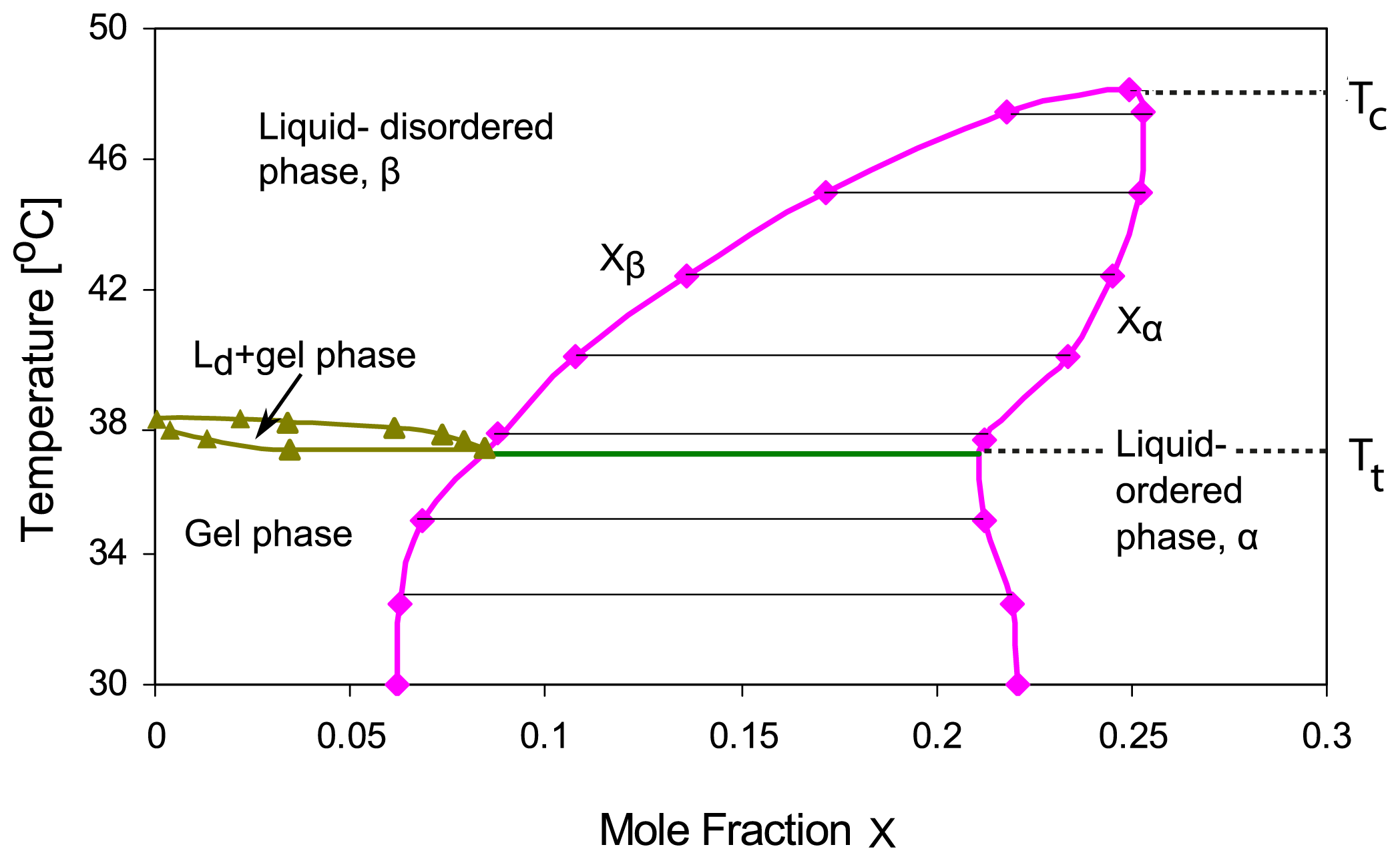
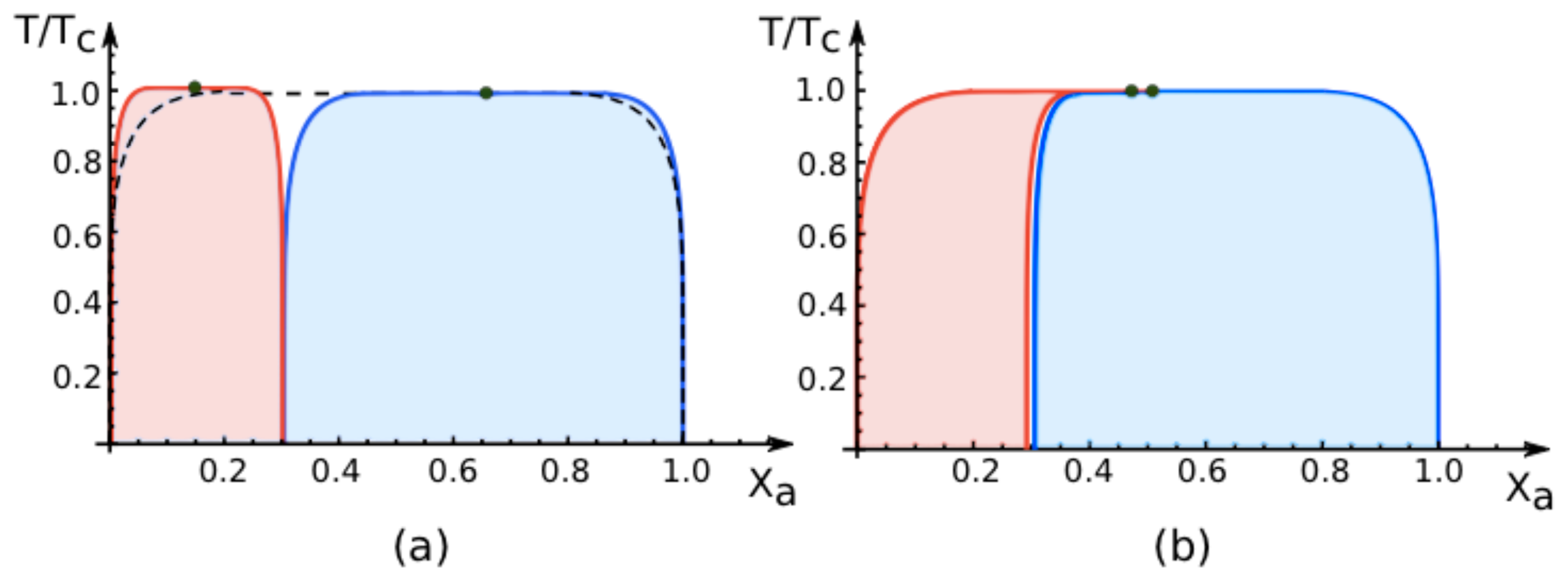
<p>Thus, phase diagrams of two-component membranes are conveniently described in the (<italic>X</italic><italic><sub>a</sub></italic><italic>, T</italic>)-plane. For binary mixtures of phospholipid and cholesterol, the phase diagrams deduced from deuterium nuclear magnetic resonance spectroscopy exhibit a coexistence region for the liquid-ordered phase, say <italic>α</italic>, which is rich in cholesterol, and the liquid-disordered phase, say <italic>β</italic>, which is poor in cholesterol [<xref ref-type="bibr" rid="b3-ijms-14-02203">3</xref>–<xref ref-type="bibr" rid="b5-ijms-14-02203">5</xref>,<xref ref-type="bibr" rid="b7-ijms-14-02203">7</xref>,<xref ref-type="bibr" rid="b8-ijms-14-02203">8</xref>], see <xref ref-type="fig" rid="f1-ijms-14-02203">Figure 1</xref>.</p>
<p>The membrane undergoes phase separation into the <italic>α</italic> and <italic>β</italic> phases within the temperature range <italic>T</italic><italic><sub>t</sub></italic><italic>&lt; T &lt; T</italic><italic><sub>c</sub></italic>, <italic>i.e.</italic>, above the triple point temperature <italic>T</italic> = <italic>T</italic><italic><sub>t</sub></italic> and below the critical temperature <italic>T</italic> = <italic>T</italic><italic><sub>c</sub></italic>. The <italic>αβ</italic> coexistence region can then be described by</p>
<disp-formula id="FD2">
<label>(2)</label>
<mml:math id="mm2" display="block">
<mml:semantics id="sm2">
<mml:mrow>
<mml:msub>
<mml:mrow>
<mml:mi>X</mml:mi></mml:mrow>
<mml:mrow>
<mml:mi>a</mml:mi>
<mml:mo>,</mml:mo>
<mml:mi>β</mml:mi></mml:mrow></mml:msub>
<mml:mo stretchy="false">(</mml:mo>
<mml:mi>T</mml:mi>
<mml:mo stretchy="false">)</mml:mo>
<mml:mo>&lt;</mml:mo>
<mml:msub>
<mml:mrow>
<mml:mi>X</mml:mi></mml:mrow>
<mml:mi>a</mml:mi></mml:msub>
<mml:mo>&lt;</mml:mo>
<mml:msub>
<mml:mrow>
<mml:mi>X</mml:mi></mml:mrow>
<mml:mrow>
<mml:mi>a</mml:mi>
<mml:mo>,</mml:mo>
<mml:mi>α</mml:mi></mml:mrow></mml:msub>
<mml:mo stretchy="false">(</mml:mo>
<mml:mi>T</mml:mi>
<mml:mo stretchy="false">)</mml:mo></mml:mrow></mml:semantics></mml:math></disp-formula>
<p>with the two binodal lines</p>
<disp-formula id="FD3">
<label>(3)</label>
<mml:math id="mm3" display="block">
<mml:semantics id="sm3">
<mml:mrow>
<mml:msub>
<mml:mrow>
<mml:mi>X</mml:mi></mml:mrow>
<mml:mi>a</mml:mi></mml:msub>
<mml:mo>=</mml:mo>
<mml:msub>
<mml:mrow>
<mml:mi>X</mml:mi></mml:mrow>
<mml:mrow>
<mml:mi>a</mml:mi>
<mml:mo>,</mml:mo>
<mml:mi>β</mml:mi></mml:mrow></mml:msub>
<mml:mo stretchy="false">(</mml:mo>
<mml:mi>T</mml:mi>
<mml:mo stretchy="false">)</mml:mo>
<mml:mi>   </mml:mi>
<mml:mtext>and   </mml:mtext>
<mml:mi>   </mml:mi>
<mml:msub>
<mml:mrow>
<mml:mi>X</mml:mi></mml:mrow>
<mml:mi>a</mml:mi></mml:msub>
<mml:mo>=</mml:mo>
<mml:msub>
<mml:mrow>
<mml:mi>X</mml:mi></mml:mrow>
<mml:mrow>
<mml:mi>a</mml:mi>
<mml:mo>,</mml:mo>
<mml:mi>β</mml:mi></mml:mrow></mml:msub>
<mml:mo stretchy="false">(</mml:mo>
<mml:mi>T</mml:mi>
<mml:mo stretchy="false">)</mml:mo>
<mml:mi>   </mml:mi>
<mml:mtext>for   </mml:mtext>
<mml:mi>   </mml:mi>
<mml:msub>
<mml:mrow>
<mml:mi>T</mml:mi></mml:mrow>
<mml:mi>t</mml:mi></mml:msub>
<mml:mo>&lt;</mml:mo>
<mml:mi>T</mml:mi>
<mml:mo>&lt;</mml:mo>
<mml:msub>
<mml:mrow>
<mml:mi>T</mml:mi></mml:mrow>
<mml:mi>c</mml:mi></mml:msub>
<mml:mo>.</mml:mo></mml:mrow></mml:semantics></mml:math></disp-formula></sec>
<sec>
<title>3. Lattice Model for Two-Component Membranes</title>
<p>A relatively simple but instructive model for two-component membranes is provided by lattice binary mixtures, in which the configurations of the two molecular components are described by occupation numbers [<xref ref-type="bibr" rid="b27-ijms-14-02203">27</xref>–<xref ref-type="bibr" rid="b31-ijms-14-02203">31</xref>]. The two-dimensional lattice binary mixture is equivalent to the two-dimensional Ising model. Therefore, both exact results from the Ising model as well as approximation schemes such as the mean field approximation can be used to determine the phase diagrams of this lattice model.</p>
<sec>
<title>3.1. Lattice Description of Large Membrane Segments</title>
<p>To proceed, let us first consider a large membrane segment with total area 
<inline-formula>
<mml:math id="mm4" display="inline">
<mml:semantics id="sm4">
<mml:mi mathvariant="script">A</mml:mi></mml:semantics></mml:math></inline-formula>, which is disretized into a square lattice Ω with lattice sites <italic>i</italic> and lattice constant 
<inline-formula>
<mml:math id="mm5" display="inline">
<mml:semantics id="sm5">
<mml:mrow>
<mml:msqrt>
<mml:mi>A</mml:mi></mml:msqrt></mml:mrow></mml:semantics></mml:math></inline-formula>. The total number of lattice sites will be denoted by</p>
<disp-formula id="FD4">
<label>(4)</label>
<mml:math id="mm6" display="block">
<mml:semantics id="sm6">
<mml:mrow>
<mml:mo>∣</mml:mo>
<mml:mi mathvariant="normal">Ω</mml:mi>
<mml:mo>∣</mml:mo>
<mml:mo>≡</mml:mo>
<mml:mi mathvariant="script">A</mml:mi>
<mml:mo>/</mml:mo>
<mml:mi>A</mml:mi>
<mml:mo>.</mml:mo></mml:mrow></mml:semantics></mml:math></disp-formula>
<p>Since the discretization lattice is characterized by a single lattice constant 
<inline-formula>
<mml:math id="mm7" display="inline">
<mml:semantics id="sm7">
<mml:mrow>
<mml:msqrt>
<mml:mi>A</mml:mi></mml:msqrt></mml:mrow></mml:semantics></mml:math></inline-formula>, both the <italic>a</italic>- and the <italic>b</italic>-molecules are described here by the same molecular area <italic>A</italic>.</p>
<p>Within the framework of the lattice binary mixture, the molecular configurations of the two-component membrane are now described in terms of occupation numbers</p>
<disp-formula id="FD5">
<label>(5)</label>
<mml:math id="mm8" display="block">
<mml:semantics id="sm8">
<mml:mrow>
<mml:mtable columnalign="left">
<mml:mtr columnalign="left">
<mml:mtd columnalign="left">
<mml:mrow>
<mml:msub>
<mml:mrow>
<mml:mi>n</mml:mi></mml:mrow>
<mml:mi>i</mml:mi></mml:msub></mml:mrow></mml:mtd>
<mml:mtd columnalign="left">
<mml:mo>≡</mml:mo></mml:mtd>
<mml:mtd columnalign="left">
<mml:mn>1</mml:mn></mml:mtd>
<mml:mtd columnalign="left">
<mml:mrow>
<mml:mtext>for an </mml:mtext>
<mml:mi>a</mml:mi>
<mml:mrow>
<mml:mo>-</mml:mo>
<mml:mtext>molecule on site </mml:mtext></mml:mrow>
<mml:mi>i</mml:mi></mml:mrow></mml:mtd></mml:mtr>
<mml:mtr columnalign="left">
<mml:mtd columnalign="left">
<mml:mrow>
<mml:mi> </mml:mi></mml:mrow></mml:mtd>
<mml:mtd columnalign="left">
<mml:mo>≡</mml:mo></mml:mtd>
<mml:mtd columnalign="left">
<mml:mn>0</mml:mn></mml:mtd>
<mml:mtd columnalign="left">
<mml:mrow>
<mml:mtext>for a </mml:mtext>
<mml:mi>b</mml:mi>
<mml:mrow>
<mml:mo>-</mml:mo>
<mml:mtext>molecule on site </mml:mtext></mml:mrow>
<mml:mi>i</mml:mi>
<mml:mo>.</mml:mo></mml:mrow></mml:mtd></mml:mtr></mml:mtable></mml:mrow></mml:semantics></mml:math></disp-formula>
<p>The mole fraction <italic>X</italic><italic><sub>a</sub></italic> of the <italic>a</italic>-molecules is now given by the expectation value of the occupation number <italic>n</italic><italic><sub>i</sub></italic>, <italic>i.e.</italic>,</p>
<disp-formula id="FD6">
<label>(6)</label>
<mml:math id="mm9" display="block">
<mml:semantics id="sm9">
<mml:mrow>
<mml:msub>
<mml:mrow>
<mml:mi>X</mml:mi></mml:mrow>
<mml:mi>a</mml:mi></mml:msub>
<mml:mo>=</mml:mo>
<mml:mo>〈</mml:mo>
<mml:msub>
<mml:mrow>
<mml:mi>n</mml:mi></mml:mrow>
<mml:mi>i</mml:mi></mml:msub>
<mml:mo>〉</mml:mo>
<mml:mo>.</mml:mo></mml:mrow></mml:semantics></mml:math></disp-formula>
<p>The total number <italic>N</italic><italic><sub>a</sub></italic> of <italic>a</italic>-molecules is given by <italic>N</italic><italic><sub>a</sub></italic> = ∑<italic><sub>i</sub></italic><italic>n</italic><italic><sub>i</sub></italic> and the total number <italic>N</italic><italic><sub>b</sub></italic> of <italic>b</italic>-molecules by</p>
<disp-formula id="FD7">
<label>(7)</label>
<mml:math id="mm10" display="block">
<mml:semantics id="sm10">
<mml:mrow>
<mml:msub>
<mml:mrow>
<mml:mi>N</mml:mi></mml:mrow>
<mml:mi>b</mml:mi></mml:msub>
<mml:mo>=</mml:mo>
<mml:mo>∣</mml:mo>
<mml:mi mathvariant="normal">Ω</mml:mi>
<mml:mo>∣</mml:mo>
<mml:mo>-</mml:mo>
<mml:msub>
<mml:mrow>
<mml:mi>N</mml:mi></mml:mrow>
<mml:mi>a</mml:mi></mml:msub>
<mml:mo>=</mml:mo>
<mml:mo>∣</mml:mo>
<mml:mi mathvariant="normal">Ω</mml:mi>
<mml:mo>∣</mml:mo>
<mml:mo>-</mml:mo>
<mml:munder>
<mml:mo>∑</mml:mo>
<mml:mi>i</mml:mi></mml:munder>
<mml:mrow>
<mml:msub>
<mml:mrow>
<mml:mi>n</mml:mi></mml:mrow>
<mml:mi>i</mml:mi></mml:msub></mml:mrow>
<mml:mo>.</mml:mo></mml:mrow></mml:semantics></mml:math></disp-formula>
<p>Thus, for the lattice binary mixture, the total number of <italic>a</italic>- and <italic>b</italic>-molecules is fixed and given by <italic>N</italic><italic><sub>a</sub></italic> + <italic>N</italic><italic><sub>b</sub></italic> = |Ω|. This constraint on the two molecular numbers implies that the lattice binary mixture describes a semi-grand canonical ensemble, see further below.</p></sec>
<sec>
<title>3.2. Configurational Energy of Binary Mixture</title>
<p>If two neighboring sites <italic>i</italic> and <italic>j</italic> of the lattice are both occupied by <italic>a</italic> molecules, these molecules have the interaction energy <italic>U</italic><italic><sub>aa</sub></italic>. Likewise, two neighboring <italic>b</italic> molecules interact via the interaction energy <italic>U</italic><italic><sub>bb</sub></italic> and two neighboring sites occupied by one <italic>a</italic>- and one <italic>b</italic>-molecule contribute the interaction energy <italic>U</italic><italic><sub>ab</sub></italic>. For the unbound membrane segment, the configuration-dependent interaction energy is then given by</p>
<disp-formula id="FD8">
<label>(8)</label>
<mml:math id="mm11" display="block">
<mml:semantics id="sm11">
<mml:mrow>
<mml:msub>
<mml:mrow>
<mml:mi mathvariant="script">E</mml:mi></mml:mrow>
<mml:mrow>
<mml:mtext>int</mml:mtext></mml:mrow></mml:msub>
<mml:mo stretchy="false">{</mml:mo>
<mml:mi>n</mml:mi>
<mml:mo stretchy="false">}</mml:mo>
<mml:mo>≡</mml:mo>
<mml:munder>
<mml:mo>∑</mml:mo>
<mml:mrow>
<mml:mo>〈</mml:mo>
<mml:mi>i</mml:mi>
<mml:mi>j</mml:mi>
<mml:mo>〉</mml:mo></mml:mrow></mml:munder>
<mml:mrow>
<mml:mo stretchy="false">[</mml:mo>
<mml:msub>
<mml:mrow>
<mml:mi>U</mml:mi></mml:mrow>
<mml:mrow>
<mml:mi>a</mml:mi>
<mml:mi>a</mml:mi></mml:mrow></mml:msub>
<mml:msub>
<mml:mrow>
<mml:mi>n</mml:mi></mml:mrow>
<mml:mi>i</mml:mi></mml:msub>
<mml:msub>
<mml:mrow>
<mml:mi>n</mml:mi></mml:mrow>
<mml:mi>j</mml:mi></mml:msub>
<mml:mo>+</mml:mo>
<mml:msub>
<mml:mrow>
<mml:mi>U</mml:mi></mml:mrow>
<mml:mrow>
<mml:mi>a</mml:mi>
<mml:mi>b</mml:mi></mml:mrow></mml:msub>
<mml:msub>
<mml:mrow>
<mml:mi>n</mml:mi></mml:mrow>
<mml:mi>i</mml:mi></mml:msub>
<mml:mo stretchy="false">(</mml:mo>
<mml:mn>1</mml:mn>
<mml:mo>-</mml:mo>
<mml:msub>
<mml:mrow>
<mml:mi>n</mml:mi></mml:mrow>
<mml:mi>j</mml:mi></mml:msub>
<mml:mo stretchy="false">)</mml:mo>
<mml:mo>+</mml:mo>
<mml:msub>
<mml:mrow>
<mml:mi>U</mml:mi></mml:mrow>
<mml:mrow>
<mml:mi>a</mml:mi>
<mml:mi>b</mml:mi></mml:mrow></mml:msub>
<mml:mo stretchy="false">(</mml:mo>
<mml:mn>1</mml:mn>
<mml:mo>-</mml:mo>
<mml:msub>
<mml:mrow>
<mml:mi>n</mml:mi></mml:mrow>
<mml:mi>i</mml:mi></mml:msub>
<mml:mo stretchy="false">)</mml:mo>
<mml:msub>
<mml:mrow>
<mml:mi>n</mml:mi></mml:mrow>
<mml:mi>j</mml:mi></mml:msub>
<mml:mo>+</mml:mo>
<mml:msub>
<mml:mrow>
<mml:mi>U</mml:mi></mml:mrow>
<mml:mrow>
<mml:mi>b</mml:mi>
<mml:mi>b</mml:mi></mml:mrow></mml:msub>
<mml:mo stretchy="false">(</mml:mo>
<mml:mn>1</mml:mn>
<mml:mo>-</mml:mo>
<mml:msub>
<mml:mrow>
<mml:mi>n</mml:mi></mml:mrow>
<mml:mi>i</mml:mi></mml:msub>
<mml:mo stretchy="false">)</mml:mo>
<mml:mo stretchy="false">(</mml:mo>
<mml:mn>1</mml:mn>
<mml:mo>-</mml:mo>
<mml:msub>
<mml:mrow>
<mml:mi>n</mml:mi></mml:mrow>
<mml:mi>j</mml:mi></mml:msub>
<mml:mo stretchy="false">)</mml:mo>
<mml:mo stretchy="false">]</mml:mo></mml:mrow></mml:mrow></mml:semantics></mml:math></disp-formula>
<p>and the total configurational energy ℰ{<italic>n</italic>} has the form</p>
<disp-formula id="FD9">
<label>(9)</label>
<mml:math id="mm12" display="block">
<mml:semantics id="sm12">
<mml:mrow>
<mml:mi mathvariant="script">E</mml:mi>
<mml:mo stretchy="false">{</mml:mo>
<mml:mi>n</mml:mi>
<mml:mo stretchy="false">}</mml:mo>
<mml:mo>=</mml:mo>
<mml:msub>
<mml:mrow>
<mml:mi mathvariant="script">E</mml:mi></mml:mrow>
<mml:mrow>
<mml:mtext>int</mml:mtext></mml:mrow></mml:msub>
<mml:mo stretchy="false">{</mml:mo>
<mml:mi>n</mml:mi>
<mml:mo stretchy="false">}</mml:mo>
<mml:mo>-</mml:mo>
<mml:msub>
<mml:mrow>
<mml:mi>μ</mml:mi></mml:mrow>
<mml:mi>a</mml:mi></mml:msub>
<mml:munder>
<mml:mo>∑</mml:mo>
<mml:mi>i</mml:mi></mml:munder>
<mml:mrow>
<mml:msub>
<mml:mrow>
<mml:mi>n</mml:mi></mml:mrow>
<mml:mi>i</mml:mi></mml:msub>
<mml:mo>-</mml:mo>
<mml:msub>
<mml:mrow>
<mml:mi>μ</mml:mi></mml:mrow>
<mml:mi>b</mml:mi></mml:msub></mml:mrow>
<mml:munder>
<mml:mo>∑</mml:mo>
<mml:mi>i</mml:mi></mml:munder>
<mml:mrow>
<mml:mo stretchy="false">(</mml:mo>
<mml:mn>1</mml:mn>
<mml:mo>-</mml:mo>
<mml:msub>
<mml:mrow>
<mml:mi>n</mml:mi></mml:mrow>
<mml:mi>i</mml:mi></mml:msub>
<mml:mo stretchy="false">)</mml:mo>
<mml:mo>=</mml:mo>
<mml:msub>
<mml:mrow>
<mml:mi mathvariant="script">E</mml:mi></mml:mrow>
<mml:mrow>
<mml:mtext>int</mml:mtext></mml:mrow></mml:msub>
<mml:mo stretchy="false">{</mml:mo>
<mml:mi>n</mml:mi>
<mml:mo stretchy="false">}</mml:mo>
<mml:mo>-</mml:mo>
<mml:msub>
<mml:mrow>
<mml:mi>μ</mml:mi></mml:mrow>
<mml:mi>a</mml:mi></mml:msub>
<mml:msub>
<mml:mrow>
<mml:mi>N</mml:mi></mml:mrow>
<mml:mi>a</mml:mi></mml:msub>
<mml:mo>-</mml:mo>
<mml:msub>
<mml:mrow>
<mml:mi>μ</mml:mi></mml:mrow>
<mml:mi>b</mml:mi></mml:msub>
<mml:msub>
<mml:mrow>
<mml:mi>N</mml:mi></mml:mrow>
<mml:mi>b</mml:mi></mml:msub></mml:mrow></mml:mrow></mml:semantics></mml:math></disp-formula>
<p>where we have introduced two chemical potentials <italic>μ</italic><italic><sub>a</sub></italic> and <italic>μ</italic><italic><sub>b</sub></italic> for the <italic>a</italic>- and <italic>b</italic>-molecules. Since the molecular numbers <italic>N</italic><italic><sub>a</sub></italic> and <italic>N</italic><italic><sub>b</sub></italic> satisfy the constraint (<xref rid="FD7" ref-type="disp-formula">7</xref>), this configurational energy is equivalent to</p>
<disp-formula id="FD10">
<label>(10)</label>
<mml:math id="mm13" display="block">
<mml:semantics id="sm13">
<mml:mrow>
<mml:mi mathvariant="script">E</mml:mi>
<mml:mo stretchy="false">{</mml:mo>
<mml:mi>n</mml:mi>
<mml:mo stretchy="false">}</mml:mo>
<mml:mo>=</mml:mo>
<mml:msub>
<mml:mrow>
<mml:mi mathvariant="script">E</mml:mi></mml:mrow>
<mml:mrow>
<mml:mtext>int</mml:mtext></mml:mrow></mml:msub>
<mml:mo stretchy="false">{</mml:mo>
<mml:mi>n</mml:mi>
<mml:mo stretchy="false">}</mml:mo>
<mml:mo>-</mml:mo>
<mml:mi mathvariant="normal">Δ</mml:mi>
<mml:mi>μ</mml:mi>
<mml:munder>
<mml:mo>∑</mml:mo>
<mml:mi>i</mml:mi></mml:munder>
<mml:mrow>
<mml:msub>
<mml:mrow>
<mml:mi>n</mml:mi></mml:mrow>
<mml:mi>i</mml:mi></mml:msub>
<mml:mo>+</mml:mo>
<mml:msub>
<mml:mrow>
<mml:mi>μ</mml:mi></mml:mrow>
<mml:mi>b</mml:mi></mml:msub>
<mml:mo>∣</mml:mo>
<mml:mi mathvariant="normal">Ω</mml:mi>
<mml:mo>∣</mml:mo></mml:mrow></mml:mrow></mml:semantics></mml:math></disp-formula>
<p>with the relative chemical potential</p>
<disp-formula id="FD11">
<label>(11)</label>
<mml:math id="mm14" display="block">
<mml:semantics id="sm14">
<mml:mrow>
<mml:mi mathvariant="normal">Δ</mml:mi>
<mml:mi>μ</mml:mi>
<mml:mo>≡</mml:mo>
<mml:msub>
<mml:mrow>
<mml:mi>μ</mml:mi></mml:mrow>
<mml:mi>a</mml:mi></mml:msub>
<mml:mo>-</mml:mo>
<mml:msub>
<mml:mrow>
<mml:mi>μ</mml:mi></mml:mrow>
<mml:mi>b</mml:mi></mml:msub>
<mml:mo>.</mml:mo></mml:mrow></mml:semantics></mml:math></disp-formula>
<p>The term <italic>μ</italic><italic><sub>b</sub></italic>|Ω| on the right hand side of (<xref rid="FD10" ref-type="disp-formula">10</xref>) can be omitted because it does not depend on the occupation numbers {<italic>n</italic>} and, thus, cancels out from all expectation values calculated with the statistical weight exp(−ℰ{<italic>n</italic>}<italic>/k</italic><sub>B</sub><italic>T</italic>).</p>
<p>The form (<xref rid="FD10" ref-type="disp-formula">10</xref>) of the configurational energy shows explicitly that the lattice binary mixture represents a semi-grand canonical ensemble [<xref ref-type="bibr" rid="b32-ijms-14-02203">32</xref>,<xref ref-type="bibr" rid="b33-ijms-14-02203">33</xref>], which depends on the total number |Ω|<italic>A</italic> of membrane molecules and on the relative chemical potential Δ<italic>μ</italic>. This ensemble is appropriate here because membranes have a fixed surface area and we use the simplifying assumption that both molecular species have the same molecular area. Therefore, when the system exchanges <italic>a</italic>- and <italic>b</italic>-molecules with the corresponding chemical reservoirs, we have to remove <italic>b</italic>-molecules when we want to insert <italic>a</italic>-molecules and <italic>vice versa</italic>.</p></sec>
<sec>
<title>3.3. Phase Behavior of Binary Mixture</title>
<p>The lattice binary mixture just described is equivalent to the two-dimensional Ising model if one expresses the molecular configurations {<italic>n</italic>} in terms of the spin variables <italic>σ</italic><italic><sub>i</sub></italic> ≡ 2<italic>n</italic><italic><sub>i</sub></italic> − 1. This equivalent Ising model depends only on two parameters, the dimensionless temperature</p>
<disp-formula id="FD12">
<label>(12)</label>
<mml:math id="mm15" display="block">
<mml:semantics id="sm15">
<mml:mrow>
<mml:mover accent="true">
<mml:mi>T</mml:mi>
<mml:mo>¯</mml:mo></mml:mover>
<mml:mo>≡</mml:mo>
<mml:mfrac>
<mml:mrow>
<mml:msub>
<mml:mrow>
<mml:mi>k</mml:mi></mml:mrow>
<mml:mtext>B</mml:mtext></mml:msub>
<mml:mi>T</mml:mi></mml:mrow>
<mml:mi>J</mml:mi></mml:mfrac>
<mml:mo>=</mml:mo>
<mml:mfrac>
<mml:mrow>
<mml:mn>4</mml:mn>
<mml:msub>
<mml:mrow>
<mml:mi>k</mml:mi></mml:mrow>
<mml:mtext>B</mml:mtext></mml:msub>
<mml:mi>T</mml:mi></mml:mrow>
<mml:mrow>
<mml:mn>2</mml:mn>
<mml:msub>
<mml:mrow>
<mml:mi>U</mml:mi></mml:mrow>
<mml:mrow>
<mml:mi>a</mml:mi>
<mml:mi>b</mml:mi></mml:mrow></mml:msub>
<mml:mo>-</mml:mo>
<mml:msub>
<mml:mrow>
<mml:mi>U</mml:mi></mml:mrow>
<mml:mrow>
<mml:mi>a</mml:mi>
<mml:mi>a</mml:mi></mml:mrow></mml:msub>
<mml:mo>-</mml:mo>
<mml:msub>
<mml:mrow>
<mml:mi>U</mml:mi></mml:mrow>
<mml:mrow>
<mml:mi>b</mml:mi>
<mml:mi>b</mml:mi></mml:mrow></mml:msub></mml:mrow></mml:mfrac></mml:mrow></mml:semantics></mml:math></disp-formula>
<p>and the dimensionless ordering field</p>
<disp-formula id="FD13">
<label>(13)</label>
<mml:math id="mm16" display="block">
<mml:semantics id="sm16">
<mml:mrow>
<mml:mover accent="true">
<mml:mi>H</mml:mi>
<mml:mo>¯</mml:mo></mml:mover>
<mml:mo>≡</mml:mo>
<mml:mfrac>
<mml:mi>H</mml:mi>
<mml:mrow>
<mml:msub>
<mml:mrow>
<mml:mi>k</mml:mi></mml:mrow>
<mml:mtext>B</mml:mtext></mml:msub>
<mml:mi>T</mml:mi></mml:mrow></mml:mfrac>
<mml:mo>=</mml:mo>
<mml:mfrac>
<mml:mrow>
<mml:mstyle scriptlevel="1">
<mml:mfrac>
<mml:mn>1</mml:mn>
<mml:mn>2</mml:mn></mml:mfrac></mml:mstyle>
<mml:mi mathvariant="normal">Δ</mml:mi>
<mml:mi>μ</mml:mi>
<mml:mo>-</mml:mo>
<mml:mo stretchy="false">(</mml:mo>
<mml:msub>
<mml:mrow>
<mml:mi>U</mml:mi></mml:mrow>
<mml:mrow>
<mml:mi>a</mml:mi>
<mml:mi>a</mml:mi></mml:mrow></mml:msub>
<mml:mo>-</mml:mo>
<mml:msub>
<mml:mrow>
<mml:mi>U</mml:mi></mml:mrow>
<mml:mrow>
<mml:mi>b</mml:mi>
<mml:mi>b</mml:mi></mml:mrow></mml:msub>
<mml:mo stretchy="false">)</mml:mo></mml:mrow>
<mml:mrow>
<mml:msub>
<mml:mrow>
<mml:mi>k</mml:mi></mml:mrow>
<mml:mtext>B</mml:mtext></mml:msub>
<mml:mi>T</mml:mi></mml:mrow></mml:mfrac>
<mml:mo>.</mml:mo></mml:mrow></mml:semantics></mml:math></disp-formula>
<p>The Ising system undergoes phase separation for <italic>H̄</italic> = 0 and 0 ≤ <italic>T̄ &lt; T̄</italic><italic><sub>c</sub></italic>, where <italic>T̄</italic><italic><sub>c</sub></italic> denotes the critical temperature. The exact value of the critical temperature is given by [<xref ref-type="bibr" rid="b34-ijms-14-02203">34</xref>]</p>
<disp-formula id="FD14">
<label>(14)</label>
<mml:math id="mm17" display="block">
<mml:semantics id="sm17">
<mml:mrow>
<mml:msub>
<mml:mrow>
<mml:mover accent="true">
<mml:mi>T</mml:mi>
<mml:mo>¯</mml:mo></mml:mover></mml:mrow>
<mml:mi>c</mml:mi></mml:msub>
<mml:mo>=</mml:mo>
<mml:mfrac>
<mml:mn>2</mml:mn>
<mml:mrow>
<mml:mtext>ln</mml:mtext>
<mml:mo stretchy="false">(</mml:mo>
<mml:mn>1</mml:mn>
<mml:mo>+</mml:mo>
<mml:msqrt>
<mml:mn>2</mml:mn></mml:msqrt>
<mml:mo stretchy="false">)</mml:mo></mml:mrow></mml:mfrac>
<mml:mo>≃</mml:mo>
<mml:mn>2.27</mml:mn></mml:mrow></mml:semantics></mml:math></disp-formula>
<p>for the Ising model on a square lattice. As we approach the line <italic>H̄</italic> = 0 from positive and negative values of <italic>H̄</italic>, the order paramter 〈<italic>σ</italic><italic><sub>i</sub></italic>〉 attains the values 〈<italic>σ</italic><italic><sub>i</sub></italic>〉 = + ϒ (<italic>T̄</italic>) and 〈<italic>σ</italic><italic><sub>i</sub></italic>〉 = −ϒ (<italic>T̄</italic>), respectively, with the spontaneous order parameter [<xref ref-type="bibr" rid="b34-ijms-14-02203">34</xref>]</p>
<disp-formula id="FD15">
<label>(15)</label>
<mml:math id="mm18" display="block">
<mml:semantics id="sm18">
<mml:mrow>
<mml:mtable columnalign="left">
<mml:mtr columnalign="left">
<mml:mtd columnalign="left">
<mml:mrow>
<mml:mi mathvariant="normal">ϒ</mml:mi>
<mml:mo stretchy="false">(</mml:mo>
<mml:mover accent="true">
<mml:mi>T</mml:mi>
<mml:mo>¯</mml:mo></mml:mover>
<mml:mo stretchy="false">)</mml:mo></mml:mrow></mml:mtd>
<mml:mtd columnalign="left">
<mml:mo>=</mml:mo></mml:mtd>
<mml:mtd columnalign="left">
<mml:mrow>
<mml:msup>
<mml:mrow>
<mml:mrow>
<mml:mo stretchy="false">[</mml:mo>
<mml:mn>1</mml:mn>
<mml:mo>-</mml:mo>
<mml:mtext>sinh</mml:mtext>
<mml:msup>
<mml:mrow>
<mml:mrow>
<mml:mo stretchy="false">(</mml:mo>
<mml:mn>2</mml:mn>
<mml:mo>/</mml:mo>
<mml:mover accent="true">
<mml:mi>T</mml:mi>
<mml:mo>¯</mml:mo></mml:mover>
<mml:mo stretchy="false">)</mml:mo></mml:mrow></mml:mrow>
<mml:mrow>
<mml:mo>-</mml:mo>
<mml:mn>4</mml:mn></mml:mrow></mml:msup>
<mml:mo stretchy="false">]</mml:mo></mml:mrow></mml:mrow>
<mml:mrow>
<mml:mn>1</mml:mn>
<mml:mo>/</mml:mo>
<mml:mn>8</mml:mn></mml:mrow></mml:msup></mml:mrow></mml:mtd>
<mml:mtd columnalign="left">
<mml:mrow>
<mml:mtext>for </mml:mtext>
<mml:mover accent="true">
<mml:mi>T</mml:mi>
<mml:mo>¯</mml:mo></mml:mover>
<mml:mo>≤</mml:mo>
<mml:msub>
<mml:mrow>
<mml:mover accent="true">
<mml:mi>T</mml:mi>
<mml:mo>¯</mml:mo></mml:mover></mml:mrow>
<mml:mi>c</mml:mi></mml:msub></mml:mrow></mml:mtd></mml:mtr>
<mml:mtr columnalign="left">
<mml:mtd columnalign="left">
<mml:mrow>
<mml:mi> </mml:mi></mml:mrow></mml:mtd>
<mml:mtd columnalign="left">
<mml:mo>=</mml:mo></mml:mtd>
<mml:mtd columnalign="left">
<mml:mn>0</mml:mn></mml:mtd>
<mml:mtd columnalign="left">
<mml:mrow>
<mml:mtext>for </mml:mtext>
<mml:mover accent="true">
<mml:mi>T</mml:mi>
<mml:mo>¯</mml:mo></mml:mover>
<mml:mo>≥</mml:mo>
<mml:msub>
<mml:mrow>
<mml:mover accent="true">
<mml:mi>T</mml:mi>
<mml:mo>¯</mml:mo></mml:mover></mml:mrow>
<mml:mi>c</mml:mi></mml:msub>
<mml:mo>.</mml:mo></mml:mrow></mml:mtd></mml:mtr></mml:mtable></mml:mrow></mml:semantics></mml:math></disp-formula>
<p>The corresponding phase transition in the lattice binary mixture occurs at the relative chemical potential</p>
<disp-formula id="FD16">
<label>(16)</label>
<mml:math id="mm19" display="block">
<mml:semantics id="sm19">
<mml:mrow>
<mml:mi mathvariant="normal">Δ</mml:mi>
<mml:mi>μ</mml:mi>
<mml:mo>=</mml:mo>
<mml:mn>2</mml:mn>
<mml:mo stretchy="false">(</mml:mo>
<mml:msub>
<mml:mrow>
<mml:mi>U</mml:mi></mml:mrow>
<mml:mrow>
<mml:mi>a</mml:mi>
<mml:mi>a</mml:mi></mml:mrow></mml:msub>
<mml:mo>-</mml:mo>
<mml:msub>
<mml:mrow>
<mml:mi>U</mml:mi></mml:mrow>
<mml:mrow>
<mml:mi>b</mml:mi>
<mml:mi>b</mml:mi></mml:mrow></mml:msub>
<mml:mo stretchy="false">)</mml:mo>
<mml:mo>≡</mml:mo>
<mml:msub>
<mml:mrow>
<mml:mi>μ</mml:mi></mml:mrow>
<mml:mrow>
<mml:mi>α</mml:mi>
<mml:mi>β</mml:mi></mml:mrow></mml:msub>
<mml:mi>   </mml:mi>
<mml:mtext>for   </mml:mtext>
<mml:mi>   </mml:mi>
<mml:mn>0</mml:mn>
<mml:mo>≤</mml:mo>
<mml:mover accent="true">
<mml:mi>T</mml:mi>
<mml:mo>¯</mml:mo></mml:mover>
<mml:mo>&lt;</mml:mo>
<mml:msub>
<mml:mrow>
<mml:mover accent="true">
<mml:mi>T</mml:mi>
<mml:mo>¯</mml:mo></mml:mover></mml:mrow>
<mml:mi>c</mml:mi></mml:msub>
<mml:mo>.</mml:mo></mml:mrow></mml:semantics></mml:math></disp-formula>
<p>As we approach the transition value Δ<italic>μ</italic> = <italic>μ</italic><italic><sub>αβ</sub></italic> of the relative chemical potential from below or from above, the mole fraction <italic>X</italic><italic><sub>a</sub></italic> = 〈<italic>n</italic><italic><sub>i</sub></italic>〉 approaches the values</p>
<disp-formula id="FD17">
<label>(17)</label>
<mml:math id="mm20" display="block">
<mml:semantics id="sm20">
<mml:mrow>
<mml:msub>
<mml:mrow>
<mml:mi>X</mml:mi></mml:mrow>
<mml:mrow>
<mml:mi>a</mml:mi>
<mml:mo>,</mml:mo>
<mml:mi>β</mml:mi></mml:mrow></mml:msub>
<mml:mo stretchy="false">(</mml:mo>
<mml:mover accent="true">
<mml:mi>T</mml:mi>
<mml:mo>¯</mml:mo></mml:mover>
<mml:mo stretchy="false">)</mml:mo>
<mml:mo>=</mml:mo>
<mml:mstyle scriptlevel="1">
<mml:mfrac>
<mml:mn>1</mml:mn>
<mml:mn>2</mml:mn></mml:mfrac></mml:mstyle>
<mml:mo>-</mml:mo>
<mml:mstyle scriptlevel="1">
<mml:mfrac>
<mml:mn>1</mml:mn>
<mml:mn>2</mml:mn></mml:mfrac></mml:mstyle>
<mml:mi mathvariant="normal">ϒ</mml:mi>
<mml:mo stretchy="false">(</mml:mo>
<mml:mover accent="true">
<mml:mi>T</mml:mi>
<mml:mo>¯</mml:mo></mml:mover>
<mml:mo stretchy="false">)</mml:mo>
<mml:mi>   </mml:mi>
<mml:mtext>and   </mml:mtext>
<mml:mi>   </mml:mi>
<mml:msub>
<mml:mrow>
<mml:mi>X</mml:mi></mml:mrow>
<mml:mrow>
<mml:mi>a</mml:mi>
<mml:mo>,</mml:mo>
<mml:mi>β</mml:mi></mml:mrow></mml:msub>
<mml:mo stretchy="false">(</mml:mo>
<mml:mover accent="true">
<mml:mi>T</mml:mi>
<mml:mo>¯</mml:mo></mml:mover>
<mml:mo stretchy="false">)</mml:mo>
<mml:mo>=</mml:mo>
<mml:mstyle scriptlevel="1">
<mml:mfrac>
<mml:mn>1</mml:mn>
<mml:mn>2</mml:mn></mml:mfrac></mml:mstyle>
<mml:mo>+</mml:mo>
<mml:mstyle scriptlevel="1">
<mml:mfrac>
<mml:mn>1</mml:mn>
<mml:mn>2</mml:mn></mml:mfrac></mml:mstyle>
<mml:mi mathvariant="normal">ϒ</mml:mi>
<mml:mo stretchy="false">(</mml:mo>
<mml:mover accent="true">
<mml:mi>T</mml:mi>
<mml:mo>¯</mml:mo></mml:mover>
<mml:mo stretchy="false">)</mml:mo>
<mml:mo>,</mml:mo></mml:mrow></mml:semantics></mml:math></disp-formula>
<p>respectively, with the function ϒ (<italic>T̄</italic>) as given by (<xref rid="FD15" ref-type="disp-formula">15</xref>). These two mole fractions define the binodal lines <italic>X</italic><italic><sub>a</sub></italic> = <italic>X</italic><italic><sub>a</sub></italic><sub>,</sub><italic><sub>β</sub></italic>(<italic>T̄</italic>) and <italic>X</italic><italic><sub>a</sub></italic> = <italic>X</italic><italic><sub>a</sub></italic><sub>,</sub><italic><sub>α</sub></italic> in the (<italic>X</italic><italic><sub>a</sub></italic><italic>, T̄</italic>) phase diagram of the lattice binary mixture. This phase diagram is symmetric with respect to the transformation 
<inline-formula>
<mml:math id="mm21" display="inline">
<mml:semantics id="sm21">
<mml:mrow>
<mml:msub>
<mml:mrow>
<mml:mi>X</mml:mi></mml:mrow>
<mml:mi>a</mml:mi></mml:msub>
<mml:mo>→</mml:mo>
<mml:msubsup>
<mml:mrow>
<mml:mi>X</mml:mi></mml:mrow>
<mml:mi>a</mml:mi>
<mml:mo>′</mml:mo></mml:msubsup>
<mml:mo>=</mml:mo>
<mml:mstyle scriptlevel="1">
<mml:mfrac>
<mml:mn>1</mml:mn>
<mml:mn>2</mml:mn></mml:mfrac></mml:mstyle>
<mml:mo>-</mml:mo>
<mml:msub>
<mml:mrow>
<mml:mi>X</mml:mi></mml:mrow>
<mml:mi>a</mml:mi></mml:msub></mml:mrow></mml:semantics></mml:math></inline-formula>, which reflects the particle-hole symmetry of the lattice binary mixture.</p></sec>
<sec>
<title>3.4. Relative Chemical Potential as a Function of Mole Fraction</title>
<p>The semi-grand canonical ensemble of the lattice binary mixture is not particularly convenient from an experimental point of view since the relative chemical potential Δ<italic>μ</italic> does not represent an experimental control parameter. Instead of Δ<italic>μ</italic>, one typically controls the mole fraction <italic>X</italic><italic><sub>a</sub></italic>. If we consider <italic>X</italic><italic><sub>a</sub></italic> as an independent thermodynamic variable, the relative chemical potential becomes a dependent variable that will be described by the functional relationship</p>
<disp-formula id="FD18">
<label>(18)</label>
<mml:math id="mm22" display="block">
<mml:semantics id="sm22">
<mml:mrow>
<mml:mi mathvariant="normal">Δ</mml:mi>
<mml:mi>μ</mml:mi>
<mml:mo>=</mml:mo>
<mml:mi>G</mml:mi>
<mml:mo stretchy="false">(</mml:mo>
<mml:msub>
<mml:mrow>
<mml:mi>X</mml:mi></mml:mrow>
<mml:mi>a</mml:mi></mml:msub>
<mml:mo stretchy="false">)</mml:mo>
<mml:mo>.</mml:mo></mml:mrow></mml:semantics></mml:math></disp-formula>
<p>The change from Δ<italic>μ</italic> to <italic>X</italic><italic><sub>a</sub></italic> corresponds to a Legendre transformation from the semi-grand canonical ensemble to the canonical ensemble. Even though the form of the function <italic>G</italic> is not known explicitly (because we have no exact solution for the 2-dimensional Ising model in a finite ordering field, <italic>H̄</italic> ≠= 0), thermodynamics implies some useful properties of <italic>G</italic>(<italic>X</italic><italic><sub>a</sub></italic>).</p>
<p>First, it follows from thermodynamic stability that the chemical potential <italic>μ</italic><italic><sub>a</sub></italic> of the <italic>a</italic>-molecules must be a non-decreasing function of <italic>X</italic><italic><sub>a</sub></italic>, see, e.g., [<xref ref-type="bibr" rid="b35-ijms-14-02203">35</xref>]. Likewise, the chemical potential <italic>μ</italic><italic><sub>b</sub></italic> of the <italic>b</italic>-molecules must be a non-decreasing function of <italic>X</italic><italic><sub>b</sub></italic> = 1 − <italic>X</italic><italic><sub>a</sub></italic>, which implies that it must be a non-increasing function of <italic>X</italic><italic><sub>a</sub></italic>. It then follows that the relative chemical potential Δ<italic>μ</italic> = <italic>μ</italic><italic><sub>a</sub></italic> − <italic>μ</italic><italic><sub>b</sub></italic> as a function of <italic>X</italic><italic><sub>a</sub></italic> must satisfy</p>
<disp-formula id="FD19">
<label>(19)</label>
<mml:math id="mm23" display="block">
<mml:semantics id="sm23">
<mml:mrow>
<mml:mi mathvariant="normal">Δ</mml:mi>
<mml:mi>μ</mml:mi>
<mml:mo>=</mml:mo>
<mml:mi>G</mml:mi>
<mml:mo stretchy="false">(</mml:mo>
<mml:msub>
<mml:mrow>
<mml:mi>X</mml:mi></mml:mrow>
<mml:mi>a</mml:mi></mml:msub>
<mml:mo stretchy="false">)</mml:mo>
<mml:mi>   </mml:mi>
<mml:mtext>with   </mml:mtext>
<mml:mi>   </mml:mi>
<mml:mo>∂</mml:mo>
<mml:mi>G</mml:mi>
<mml:mo>/</mml:mo>
<mml:mo>∂</mml:mo>
<mml:msub>
<mml:mrow>
<mml:mi>X</mml:mi></mml:mrow>
<mml:mi>a</mml:mi></mml:msub>
<mml:mo>≥</mml:mo>
<mml:mn>0.</mml:mn></mml:mrow></mml:semantics></mml:math></disp-formula>
<p>More precisely, the function Δ<italic>μ</italic> = <italic>G</italic>(<italic>X</italic><italic><sub>a</sub></italic>) has a strictly positive derivative,</p>
<disp-formula id="FD20">
<label>(20)</label>
<mml:math id="mm24" display="block">
<mml:semantics id="sm24">
<mml:mrow>
<mml:mo>∂</mml:mo>
<mml:mi>G</mml:mi>
<mml:mo>/</mml:mo>
<mml:mo>∂</mml:mo>
<mml:msub>
<mml:mrow>
<mml:mi>X</mml:mi></mml:mrow>
<mml:mi>a</mml:mi></mml:msub>
<mml:mo>&gt;</mml:mo>
<mml:mn>0</mml:mn>
<mml:mi> </mml:mi>
<mml:mrow>
<mml:mtext>within a one</mml:mtext>
<mml:mo>-</mml:mo>
<mml:mtext>phase region</mml:mtext></mml:mrow></mml:mrow></mml:semantics></mml:math></disp-formula>
<p>and stays constant with</p>
<disp-formula id="FD21">
<label>(21)</label>
<mml:math id="mm25" display="block">
<mml:semantics id="sm25">
<mml:mrow>
<mml:mi>G</mml:mi>
<mml:mo stretchy="false">(</mml:mo>
<mml:msub>
<mml:mrow>
<mml:mi>X</mml:mi></mml:mrow>
<mml:mi>a</mml:mi></mml:msub>
<mml:mo stretchy="false">)</mml:mo>
<mml:mo>=</mml:mo>
<mml:msub>
<mml:mrow>
<mml:mi>μ</mml:mi></mml:mrow>
<mml:mrow>
<mml:mi>α</mml:mi>
<mml:mi>β</mml:mi></mml:mrow></mml:msub>
<mml:mi>   </mml:mi>
<mml:mtext>and   </mml:mtext>
<mml:mi>   </mml:mi>
<mml:mo>∂</mml:mo>
<mml:mi>G</mml:mi>
<mml:mo>/</mml:mo>
<mml:mo>∂</mml:mo>
<mml:msub>
<mml:mrow>
<mml:mi>X</mml:mi></mml:mrow>
<mml:mi>a</mml:mi></mml:msub>
<mml:mo>=</mml:mo>
<mml:mn>0</mml:mn>
<mml:mi>   </mml:mi>
<mml:mrow>
<mml:mtext>within a two</mml:mtext>
<mml:mo>-</mml:mo>
<mml:mtext>phase coexistence region</mml:mtext></mml:mrow>
<mml:mo>.</mml:mo></mml:mrow></mml:semantics></mml:math></disp-formula>
<p>It then follows that <italic>G</italic>(<italic>X</italic>) is a monotonically increasing function of <italic>X</italic> for 0 <italic>&lt; X &lt; X</italic><italic><sub>a</sub></italic><sub>,</sub><italic><sub>β</sub></italic>( <italic>T̄</italic>), stays constant for <italic>X</italic><italic><sub>a</sub></italic><sub>,</sub><italic><sub>β</sub></italic>(<italic>T̄</italic>) ≤ <italic>X</italic> ≤ <italic>X</italic><italic><sub>a</sub></italic><sub>,</sub><italic><sub>β</sub></italic>(<italic>T̄</italic>), and continues to increase monotonically for <italic>X</italic><italic><sub>a</sub></italic><sub>,</sub><italic><sub>β</sub></italic>(<italic>T̄</italic>) <italic>&lt; X &lt;</italic> 1, where the two binodals are explicitly given by (<xref rid="FD17" ref-type="disp-formula">17</xref>).</p></sec></sec>
<sec>
<title>4. Membrane Adhesion and Segmentation</title>
<p>The adhesion of membranes and vesicles often leads to different membrane segments, in which the molecules experience distinct environments. Such a segmentation is found both for adhering vesicles and for solid-supported membranes. As explained in the following subsections, these adhering membranes often consist of two segments that are exposed to two different environments.</p>
<sec>
<title>4.1. Adhesion of Vesicles</title>
<p>The adhesion of vesicles has been studied for a long time, see, e.g., [<xref ref-type="bibr" rid="b36-ijms-14-02203">36</xref>,<xref ref-type="bibr" rid="b37-ijms-14-02203">37</xref>] for one-component membranes and [<xref ref-type="bibr" rid="b1-ijms-14-02203">1</xref>,<xref ref-type="bibr" rid="b38-ijms-14-02203">38</xref>] for multi-component membranes. Here, we will focus on the strong adhesion regime, in which the vesicle attains the shape of a spherical cap. The same shape has also been observed for the strong adhesion of red blood cells [<xref ref-type="bibr" rid="b39-ijms-14-02203">39</xref>,<xref ref-type="bibr" rid="b40-ijms-14-02203">40</xref>].</p>
<sec>
<title>4.1.1. Strong Adhesion Regime</title>
<p>In general, a vesicle that sticks to a planar substrate surface exhibits two membrane segments: an unbound segment 
<inline-formula>
<mml:math id="mm26" display="inline">
<mml:semantics id="sm26">
<mml:mrow>
<mml:msup>
<mml:mrow>
<mml:mi mathvariant="script">S</mml:mi></mml:mrow>
<mml:mrow>
<mml:mo stretchy="false">[</mml:mo>
<mml:mn>1</mml:mn>
<mml:mo stretchy="false">]</mml:mo></mml:mrow></mml:msup></mml:mrow></mml:semantics></mml:math></inline-formula> that is not in contact with the substrate surface and a bound segment 
<inline-formula>
<mml:math id="mm27" display="inline">
<mml:semantics id="sm27">
<mml:mrow>
<mml:msup>
<mml:mrow>
<mml:mi mathvariant="script">S</mml:mi></mml:mrow>
<mml:mrow>
<mml:mo stretchy="false">[</mml:mo>
<mml:mn>2</mml:mn>
<mml:mo stretchy="false">]</mml:mo></mml:mrow></mml:msup></mml:mrow></mml:semantics></mml:math></inline-formula> that forms the vesicle’s contact area. The surface areas of the unbound and bound membrane segments will be denoted by 
<inline-formula>
<mml:math id="mm28" display="inline">
<mml:semantics id="sm28">
<mml:mrow>
<mml:msup>
<mml:mrow>
<mml:mi mathvariant="script">A</mml:mi></mml:mrow>
<mml:mrow>
<mml:mo stretchy="false">[</mml:mo>
<mml:mn>1</mml:mn>
<mml:mo stretchy="false">]</mml:mo></mml:mrow></mml:msup></mml:mrow></mml:semantics></mml:math></inline-formula> and 
<inline-formula>
<mml:math id="mm29" display="inline">
<mml:semantics id="sm29">
<mml:mrow>
<mml:msup>
<mml:mrow>
<mml:mi mathvariant="script">A</mml:mi></mml:mrow>
<mml:mrow>
<mml:mo stretchy="false">[</mml:mo>
<mml:mn>2</mml:mn>
<mml:mo stretchy="false">]</mml:mo></mml:mrow></mml:msup></mml:mrow></mml:semantics></mml:math></inline-formula>, respectively. The overall area 
<inline-formula>
<mml:math id="mm30" display="inline">
<mml:semantics id="sm30">
<mml:mi mathvariant="script">A</mml:mi></mml:semantics></mml:math></inline-formula> of the membrane is then given by</p>
<disp-formula id="FD22">
<label>(22)</label>
<mml:math id="mm31" display="block">
<mml:semantics id="sm31">
<mml:mrow>
<mml:mi mathvariant="script">A</mml:mi>
<mml:mo>=</mml:mo>
<mml:msup>
<mml:mrow>
<mml:mi mathvariant="script">A</mml:mi></mml:mrow>
<mml:mrow>
<mml:mo stretchy="false">[</mml:mo>
<mml:mn>1</mml:mn>
<mml:mo stretchy="false">]</mml:mo></mml:mrow></mml:msup>
<mml:mo>+</mml:mo>
<mml:msup>
<mml:mrow>
<mml:mi mathvariant="script">A</mml:mi></mml:mrow>
<mml:mrow>
<mml:mo stretchy="false">[</mml:mo>
<mml:mn>2</mml:mn>
<mml:mo stretchy="false">]</mml:mo></mml:mrow></mml:msup>
<mml:mo>.</mml:mo></mml:mrow></mml:semantics></mml:math></disp-formula>
<p>The two membrane segments meet at the contact line of the vesicle. Along this line, the unbound membrane segment has the contact curvature radius [<xref ref-type="bibr" rid="b36-ijms-14-02203">36</xref>]</p>
<disp-formula id="FD23">
<label>(23)</label>
<mml:math id="mm32" display="block">
<mml:semantics id="sm32">
<mml:mrow>
<mml:msub>
<mml:mrow>
<mml:mi>R</mml:mi></mml:mrow>
<mml:mrow>
<mml:mtext>co</mml:mtext></mml:mrow></mml:msub>
<mml:mo>=</mml:mo>
<mml:msup>
<mml:mrow>
<mml:mrow>
<mml:mo stretchy="false">(</mml:mo>
<mml:mi>κ</mml:mi>
<mml:mo>/</mml:mo>
<mml:mn>2</mml:mn>
<mml:mo>∣</mml:mo>
<mml:mi>W</mml:mi>
<mml:mo>∣</mml:mo>
<mml:mo stretchy="false">)</mml:mo></mml:mrow></mml:mrow>
<mml:mrow>
<mml:mn>1</mml:mn>
<mml:mo>/</mml:mo>
<mml:mn>2</mml:mn></mml:mrow></mml:msup>
<mml:mo>,</mml:mo></mml:mrow></mml:semantics></mml:math></disp-formula>
<p>which depends on the membrane’s bending rigidity <italic>κ</italic> and the adhesion free energy <italic>W</italic> per unit area. We use the convention that the free energy density <italic>W</italic> is <italic>negative</italic> for an attractive substrate surface.</p>
<p>The strong adhesion regime considered here corresponds to the situation, in which</p>
<disp-formula id="FD24">
<label>(24)</label>
<mml:math id="mm33" display="block">
<mml:semantics id="sm33">
<mml:mrow>
<mml:msub>
<mml:mrow>
<mml:mi>R</mml:mi></mml:mrow>
<mml:mrow>
<mml:mtext>co</mml:mtext></mml:mrow></mml:msub>
<mml:mo>≪</mml:mo>
<mml:msub>
<mml:mrow>
<mml:mi>R</mml:mi></mml:mrow>
<mml:mrow>
<mml:mtext>ve</mml:mtext></mml:mrow></mml:msub>
<mml:mo>≡</mml:mo>
<mml:msup>
<mml:mrow>
<mml:mrow>
<mml:mo stretchy="false">(</mml:mo>
<mml:mi mathvariant="script">A</mml:mi>
<mml:mo>/</mml:mo>
<mml:mn>4</mml:mn>
<mml:mi>π</mml:mi>
<mml:mo stretchy="false">)</mml:mo></mml:mrow></mml:mrow>
<mml:mrow>
<mml:mn>1</mml:mn>
<mml:mo>/</mml:mo>
<mml:mn>2</mml:mn></mml:mrow></mml:msup>
<mml:mo>,</mml:mo></mml:mrow></mml:semantics></mml:math></disp-formula>
<p><italic>i.e.</italic>, in which the contact curvature radius <italic>R</italic><sub>co</sub> is much smaller than the vesicle size <italic>R</italic><sub>ve</sub>. This inequality is equivalent to</p>
<disp-formula id="FD25">
<label>(25)</label>
<mml:math id="mm34" display="block">
<mml:semantics id="sm34">
<mml:mrow>
<mml:mo>∣</mml:mo>
<mml:mi>W</mml:mi>
<mml:msup>
<mml:mrow>
<mml:mo>∣</mml:mo></mml:mrow>
<mml:mrow>
<mml:mn>1</mml:mn>
<mml:mo>/</mml:mo>
<mml:mn>2</mml:mn></mml:mrow></mml:msup>
<mml:mo>≫</mml:mo>
<mml:msup>
<mml:mrow>
<mml:mrow>
<mml:mo stretchy="false">(</mml:mo>
<mml:mn>2</mml:mn>
<mml:mi>π</mml:mi>
<mml:mi>κ</mml:mi>
<mml:mo>/</mml:mo>
<mml:mi mathvariant="script">A</mml:mi>
<mml:mo stretchy="false">)</mml:mo></mml:mrow></mml:mrow>
<mml:mrow>
<mml:mn>1</mml:mn>
<mml:mo>/</mml:mo>
<mml:mn>2</mml:mn></mml:mrow></mml:msup></mml:mrow></mml:semantics></mml:math></disp-formula>
<p>where the quantity 
<inline-formula>
<mml:math id="mm35" display="inline">
<mml:semantics id="sm35">
<mml:mrow>
<mml:mi>κ</mml:mi>
<mml:mo>/</mml:mo>
<mml:mi mathvariant="script">A</mml:mi></mml:mrow></mml:semantics></mml:math></inline-formula> may be regarded as the membrane tension arising from the closure of the vesicle membrane.</p>
<p>Let us now focus on giant vesicles that are conveniently studied by optical microscopy. The size <italic>R</italic><sub>ve</sub> of such vesicles usually exceeds 20 <italic>μ</italic>m. Therefore, these vesicles are in the strong adhesion regime as soon as the contact curvature radius is below optical resolution, <italic>i.e.</italic>, <italic>R</italic><sub>co</sub><italic>&lt; L</italic><sub>*</sub>≃ 0.5 <italic>μ</italic>m or</p>
<disp-formula id="FD26">
<label>(26)</label>
<mml:math id="mm36" display="block">
<mml:semantics id="sm36">
<mml:mrow>
<mml:mo>∣</mml:mo>
<mml:mi>W</mml:mi>
<mml:mo>∣</mml:mo>
<mml:mo>&gt;</mml:mo>
<mml:mo>∣</mml:mo>
<mml:mi>W</mml:mi>
<mml:msub>
<mml:mrow>
<mml:mo>∣</mml:mo></mml:mrow>
<mml:mo>*</mml:mo></mml:msub>
<mml:mo>≡</mml:mo>
<mml:mfrac>
<mml:mi>κ</mml:mi>
<mml:mrow>
<mml:mn>2</mml:mn>
<mml:msubsup>
<mml:mrow>
<mml:mi>L</mml:mi></mml:mrow>
<mml:mo>*</mml:mo>
<mml:mn>2</mml:mn></mml:msubsup></mml:mrow></mml:mfrac>
<mml:mo>≃</mml:mo>
<mml:mfrac>
<mml:mi>κ</mml:mi>
<mml:mrow>
<mml:mn>0.5</mml:mn>
<mml:mi> </mml:mi>
<mml:mi>μ</mml:mi>
<mml:msup>
<mml:mrow>
<mml:mtext>m</mml:mtext></mml:mrow>
<mml:mn>2</mml:mn></mml:msup></mml:mrow></mml:mfrac>
<mml:mo>.</mml:mo></mml:mrow></mml:semantics></mml:math></disp-formula>
<p>For a lipid bilayer, the bending rigidity <italic>κ</italic> is of the order of 10<sup>−19</sup> J or 24 <italic>k</italic><italic><sub>B</sub></italic><italic>T</italic><italic><sub>o</sub></italic> at room temperature <italic>T</italic><italic><sub>o</sub></italic> = 25 °C, which implies |<italic>W</italic>|<sub>*</sub> ≃ 2 × 10<sup>−4</sup> mJ/m<sup>2</sup> or |<italic>W</italic>|<sub>*</sub> ≃ 0.5 <italic>k</italic><italic><sub>B</sub></italic><italic>T/</italic>(100 nm)<sup>2</sup>. Thus, the strong adhesion regime should typically apply as long as the adhesion is mediated by a large number of molecular interactions. In this regime, the vesicle spreads onto the surface as much as possible. For fixed vesicle volume 
<inline-formula>
<mml:math id="mm37" display="inline">
<mml:semantics id="sm37">
<mml:mi mathvariant="script">V</mml:mi></mml:semantics></mml:math></inline-formula> and fixed membrane area 
<inline-formula>
<mml:math id="mm38" display="inline">
<mml:semantics id="sm38">
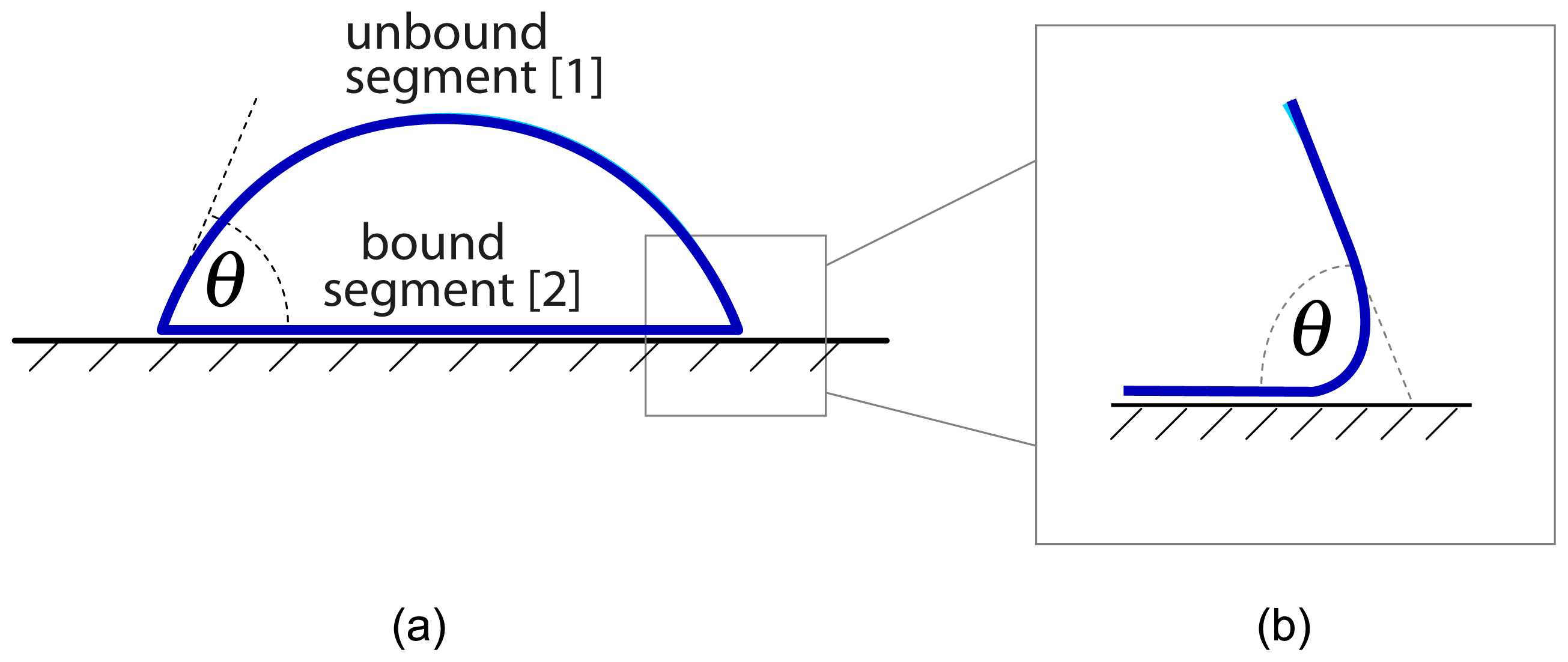
<mml:mi mathvariant="script">A</mml:mi></mml:semantics></mml:math></inline-formula>, the shape with the largest contact area is provided by a spherical cap, which can be characterized by an effective contact angle <italic>θ</italic><sub>eff</sub> as shown in <xref ref-type="fig" rid="f2-ijms-14-02203">Figure 2</xref>.</p></sec>
<sec>
<title>4.1.2. Area Fractions</title>
<p>The total surface area 
<inline-formula>
<mml:math id="mm39" display="inline">
<mml:semantics id="sm39">
<mml:mi mathvariant="script">A</mml:mi></mml:semantics></mml:math></inline-formula> plays the role of the basic area scale. The spherical cap shape is then determined by 
<inline-formula>
<mml:math id="mm40" display="inline">
<mml:semantics id="sm40">
<mml:mi mathvariant="script">A</mml:mi></mml:semantics></mml:math></inline-formula> and one other geometric parameter such as the effective contact angle <italic>θ</italic><sub>eff</sub>, see <xref ref-type="fig" rid="f2-ijms-14-02203">Figure 2</xref>, or the reduced volume</p>
<disp-formula id="FD27">
<label>(27)</label>
<mml:math id="mm41" display="block">
<mml:semantics id="sm41">
<mml:mrow>
<mml:mi>v</mml:mi>
<mml:mo>≡</mml:mo>
<mml:mfrac>
<mml:mrow>
<mml:mn>3</mml:mn>
<mml:mi mathvariant="script">V</mml:mi>
<mml:mo>/</mml:mo>
<mml:mn>4</mml:mn>
<mml:mi>π</mml:mi></mml:mrow>
<mml:mrow>
<mml:msup>
<mml:mrow>
<mml:mrow>
<mml:mo stretchy="false">(</mml:mo>
<mml:mi mathvariant="script">A</mml:mi>
<mml:mo>/</mml:mo>
<mml:mn>4</mml:mn>
<mml:mi>π</mml:mi>
<mml:mo stretchy="false">)</mml:mo></mml:mrow></mml:mrow>
<mml:mrow>
<mml:mn>3</mml:mn>
<mml:mo>/</mml:mo>
<mml:mn>2</mml:mn></mml:mrow></mml:msup></mml:mrow></mml:mfrac>
<mml:mo>,</mml:mo></mml:mrow></mml:semantics></mml:math></disp-formula>
<p>which can be controlled by osmotic deflation and inflation. Because we focus here on the adhesion-induced segmentation of the membrane, it will be convenient to choose the area fraction</p>
<disp-formula id="FD28">
<label>(28)</label>
<mml:math id="mm42" display="block">
<mml:semantics id="sm42">
<mml:mrow>
<mml:msup>
<mml:mrow>
<mml:mi>q</mml:mi></mml:mrow>
<mml:mrow>
<mml:mo stretchy="false">[</mml:mo>
<mml:mn>1</mml:mn>
<mml:mo stretchy="false">]</mml:mo></mml:mrow></mml:msup>
<mml:mo>≡</mml:mo>
<mml:mfrac>
<mml:mrow>
<mml:msup>
<mml:mrow>
<mml:mi mathvariant="script">A</mml:mi></mml:mrow>
<mml:mrow>
<mml:mo stretchy="false">[</mml:mo>
<mml:mn>1</mml:mn>
<mml:mo stretchy="false">]</mml:mo></mml:mrow></mml:msup></mml:mrow>
<mml:mi mathvariant="script">A</mml:mi></mml:mfrac>
<mml:mo>=</mml:mo>
<mml:mfrac>
<mml:mrow>
<mml:msup>
<mml:mrow>
<mml:mi mathvariant="script">A</mml:mi></mml:mrow>
<mml:mrow>
<mml:mo stretchy="false">[</mml:mo>
<mml:mn>1</mml:mn>
<mml:mo stretchy="false">]</mml:mo></mml:mrow></mml:msup></mml:mrow>
<mml:mrow>
<mml:msup>
<mml:mrow>
<mml:mi mathvariant="script">A</mml:mi></mml:mrow>
<mml:mrow>
<mml:mo stretchy="false">[</mml:mo>
<mml:mn>1</mml:mn>
<mml:mo stretchy="false">]</mml:mo></mml:mrow></mml:msup>
<mml:mo>+</mml:mo>
<mml:msup>
<mml:mrow>
<mml:mi mathvariant="script">A</mml:mi></mml:mrow>
<mml:mrow>
<mml:mo stretchy="false">[</mml:mo>
<mml:mn>2</mml:mn>
<mml:mo stretchy="false">]</mml:mo></mml:mrow></mml:msup></mml:mrow></mml:mfrac></mml:mrow></mml:semantics></mml:math></disp-formula>
<p>of the unbound membrane segment 
<inline-formula>
<mml:math id="mm43" display="inline">
<mml:semantics id="sm43">
<mml:mrow>
<mml:msup>
<mml:mrow>
<mml:mi mathvariant="script">S</mml:mi></mml:mrow>
<mml:mrow>
<mml:mo stretchy="false">[</mml:mo>
<mml:mn>1</mml:mn>
<mml:mo stretchy="false">]</mml:mo></mml:mrow></mml:msup></mml:mrow></mml:semantics></mml:math></inline-formula> as the second geometric parameter. The area fraction <italic>q</italic><sup>[2]</sup> of the bound segment 
<inline-formula>
<mml:math id="mm44" display="inline">
<mml:semantics id="sm44">
<mml:mrow>
<mml:msup>
<mml:mrow>
<mml:mi mathvariant="script">S</mml:mi></mml:mrow>
<mml:mrow>
<mml:mo stretchy="false">[</mml:mo>
<mml:mn>2</mml:mn>
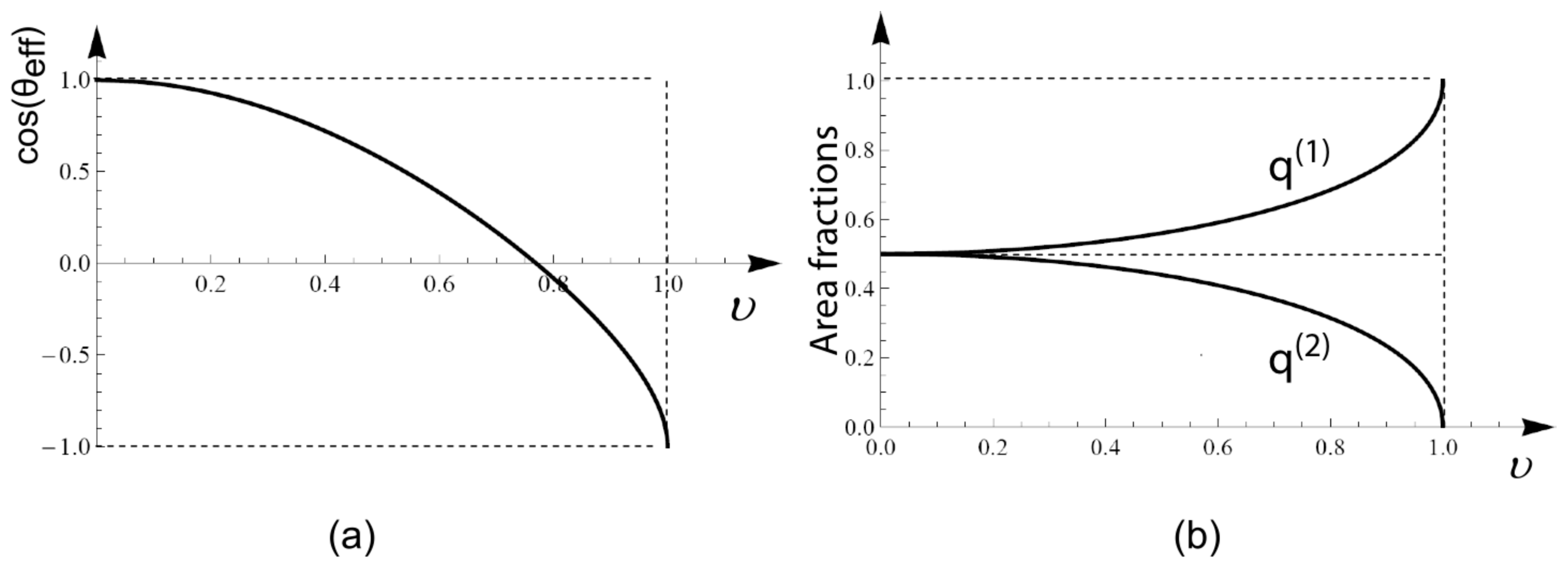
<mml:mo stretchy="false">]</mml:mo></mml:mrow></mml:msup></mml:mrow></mml:semantics></mml:math></inline-formula> is then given by <italic>q</italic><sup>[2]</sup> = 1 − <italic>q</italic><sup>[1]</sup>. The relations between <italic>q</italic><sup>[1]</sup> and the other geometric parameters such as the reduced volume <italic>v</italic> are discussed in <xref ref-type="app" rid="app1-ijms-14-02203">Appendix A</xref> at the end of this paper.</p>
<p>The area fraction <italic>q</italic><sup>[1]</sup> turns out to be an important parameter in order to describe the phase diagram of multi-component membranes. This parameter can vary within the range</p>
<disp-formula id="FD29">
<label>(29)</label>
<mml:math id="mm45" display="block">
<mml:semantics id="sm45">
<mml:mrow>
<mml:mstyle scriptlevel="1">
<mml:mfrac>
<mml:mn>1</mml:mn>
<mml:mn>2</mml:mn></mml:mfrac></mml:mstyle>
<mml:mo>≤</mml:mo>
<mml:msup>
<mml:mrow>
<mml:mi>q</mml:mi></mml:mrow>
<mml:mrow>
<mml:mo stretchy="false">[</mml:mo>
<mml:mn>1</mml:mn>
<mml:mo stretchy="false">]</mml:mo></mml:mrow></mml:msup>
<mml:mo>&lt;</mml:mo>
<mml:mn>1</mml:mn>
<mml:mi>   </mml:mi>
<mml:mo stretchy="false">(</mml:mo>
<mml:mtext>adhering vesicle</mml:mtext>
<mml:mo stretchy="false">)</mml:mo>
<mml:mo>.</mml:mo></mml:mrow></mml:semantics></mml:math></disp-formula>
<p>The limiting cases correspond to a flat pancake with 
<inline-formula>
<mml:math id="mm46" display="inline">
<mml:semantics id="sm46">
<mml:mrow>
<mml:msup>
<mml:mrow>
<mml:mi>q</mml:mi></mml:mrow>
<mml:mrow>
<mml:mo stretchy="false">[</mml:mo>
<mml:mn>1</mml:mn>
<mml:mo stretchy="false">]</mml:mo></mml:mrow></mml:msup>
<mml:mo>=</mml:mo>
<mml:mstyle scriptlevel="1">
<mml:mfrac>
<mml:mn>1</mml:mn>
<mml:mn>2</mml:mn></mml:mfrac></mml:mstyle></mml:mrow></mml:semantics></mml:math></inline-formula> and to a sphere touching the surface in a single point, which implies <italic>q</italic><sup>[1]</sup> = 1. For a hemi-sphere, the area fraction <italic>q</italic><sup>[1]</sup> = 2<italic>/</italic>3. Because the area fraction <italic>q</italic><sup>[1]</sup> is uniquely determined by the reduced volume <italic>v</italic>, see <xref ref-type="app" rid="app1-ijms-14-02203">Appendix A</xref>, it can be varied experimentally by changing the osmotic conditions leading to osmotic deflation or inflation of the vesicle.</p></sec></sec>
<sec>
<title>4.2. Supported Membranes</title>
<p>A variety of methods has been developed in order to immobilize membranes on solid or rigid substrate surfaces. Here, we will discuss several support geometries that lead to two membrane segments and, thus, can again be characterized by the area fraction <italic>q</italic><sup>[1]</sup> of the segments 
<inline-formula>
<mml:math id="mm47" display="inline">
<mml:semantics id="sm47">
<mml:mrow>
<mml:msup>
<mml:mrow>
<mml:mi mathvariant="script">S</mml:mi></mml:mrow>
<mml:mrow>
<mml:mo stretchy="false">[</mml:mo>
<mml:mn>1</mml:mn>
<mml:mo stretchy="false">]</mml:mo></mml:mrow></mml:msup></mml:mrow></mml:semantics></mml:math></inline-formula>. Membranes supported by uniform substrate surfaces then correspond to the limiting cases <italic>q</italic><sup>[1]</sup> = 0 and <italic>q</italic><sup>[1]</sup> = 1.</p>
<sec>
<title>4.2.1. Partially Supported Membranes</title>
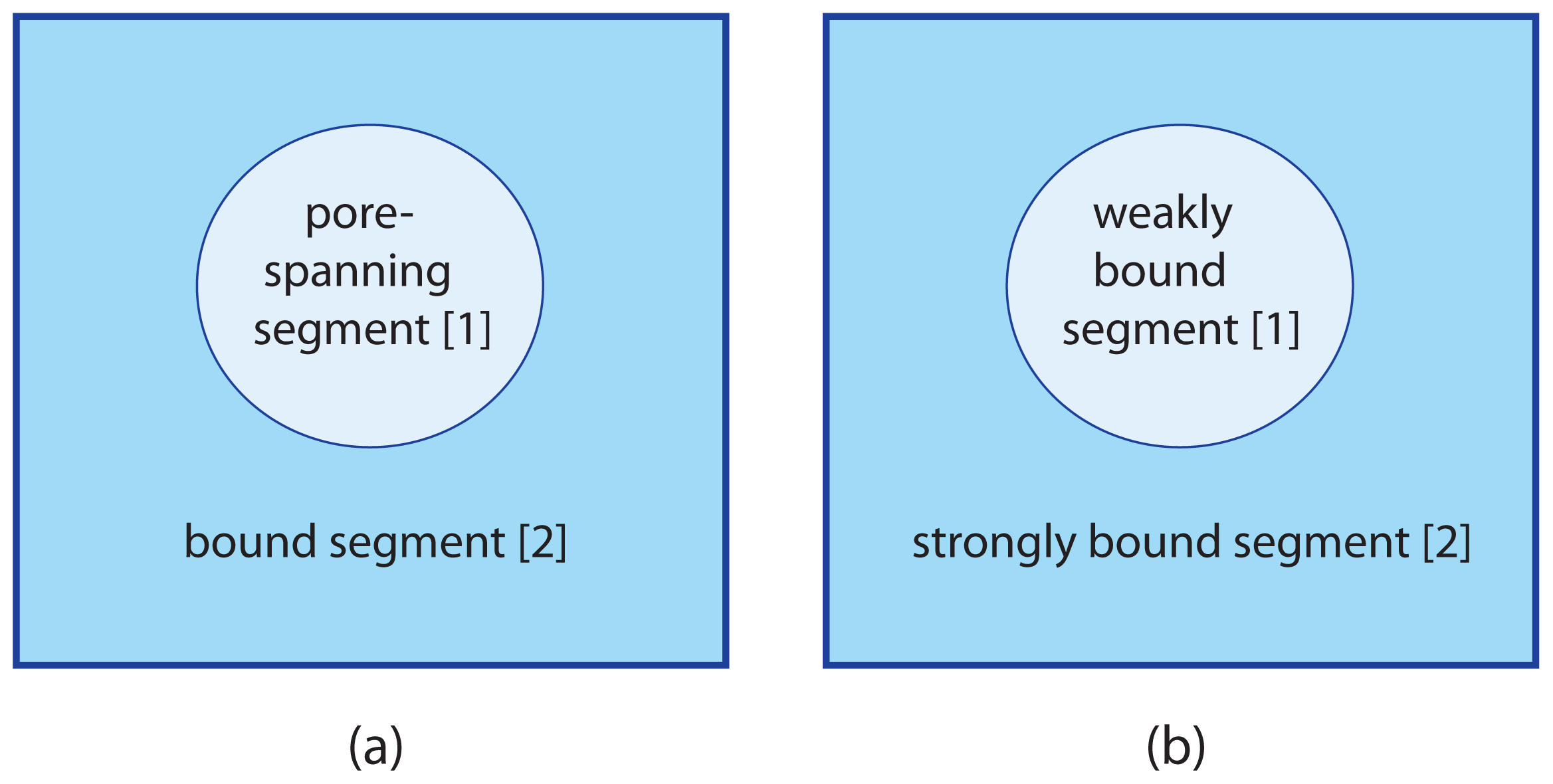
<p>Two examples for partially supported membranes are provided by hole-spanning membranes, also known as black lipid membranes, see, e.g., [<xref ref-type="bibr" rid="b19-ijms-14-02203">19</xref>], as well as by pore-spanning membranes as in [<xref ref-type="bibr" rid="b20-ijms-14-02203">20</xref>]. Here, a “hole” corresponds to a channel through a relatively thin rigid plate whereas a “pore” refers to a groove in a relatively thick substrate. If the hole and the pore have the same cross-section, both systems lead to essentially the same adhesion geometry as shown in <xref ref-type="fig" rid="f3-ijms-14-02203">Figure 3a</xref> for a circular cross-section.</p>
<p>For these adhesion geometries, the membrane is again divided up into an unbound segment 
<inline-formula>
<mml:math id="mm48" display="inline">
<mml:semantics id="sm48">
<mml:mrow>
<mml:msup>
<mml:mrow>
<mml:mi mathvariant="script">S</mml:mi></mml:mrow>
<mml:mrow>
<mml:mo stretchy="false">[</mml:mo>
<mml:mn>1</mml:mn>
<mml:mo stretchy="false">]</mml:mo></mml:mrow></mml:msup></mml:mrow></mml:semantics></mml:math></inline-formula> spanning the hole or pore and a bound segment 
<inline-formula>
<mml:math id="mm49" display="inline">
<mml:semantics id="sm49">
<mml:mrow>
<mml:msup>
<mml:mrow>
<mml:mi mathvariant="script">S</mml:mi></mml:mrow>
<mml:mrow>
<mml:mo stretchy="false">[</mml:mo>
<mml:mn>2</mml:mn>
<mml:mo stretchy="false">]</mml:mo></mml:mrow></mml:msup></mml:mrow></mml:semantics></mml:math></inline-formula> in close contact with the supporting surface. In general, the area fraction <italic>q</italic><sup>[1]</sup> of the hole- or pore-spanning segment can now vary in the range</p>
<disp-formula id="FD30">
<label>(30)</label>
<mml:math id="mm50" display="block">
<mml:semantics id="sm50">
<mml:mrow>
<mml:mn>0</mml:mn>
<mml:mo>≤</mml:mo>
<mml:msup>
<mml:mrow>
<mml:mi>q</mml:mi></mml:mrow>
<mml:mrow>
<mml:mo stretchy="false">[</mml:mo>
<mml:mn>1</mml:mn>
<mml:mo stretchy="false">]</mml:mo></mml:mrow></mml:msup>
<mml:mo>&lt;</mml:mo>
<mml:mn>1</mml:mn>
<mml:mi>   </mml:mi>
<mml:mo stretchy="false">(</mml:mo>
<mml:mrow>
<mml:mtext>pore</mml:mtext>
<mml:mo>-</mml:mo>
<mml:mtext>spanning segments</mml:mtext></mml:mrow>
<mml:mo stretchy="false">)</mml:mo></mml:mrow></mml:semantics></mml:math></disp-formula>
<p>where the limiting case <italic>q</italic><sup>[1]</sup> = 0 corresponds to a membrane supported by an adhesive surface without a hole or pore. For the present geometry, the area fraction <italic>q</italic><sup>[1]</sup> must always be smaller than one in order to firmly attach the membrane to the substrate surface. If the membrane spans several holes or pores, it contains several unbound segments, and the area 
<inline-formula>
<mml:math id="mm51" display="inline">
<mml:semantics id="sm51">
<mml:mrow>
<mml:msup>
<mml:mrow>
<mml:mi mathvariant="script">A</mml:mi></mml:mrow>
<mml:mrow>
<mml:mo stretchy="false">[</mml:mo>
<mml:mn>1</mml:mn>
<mml:mo stretchy="false">]</mml:mo></mml:mrow></mml:msup></mml:mrow></mml:semantics></mml:math></inline-formula> is now equal to the total area of all of these unbound membrane segments.</p></sec>
<sec>
<title>4.2.2. Membranes Supported by Chemically Patterned Surfaces</title>
<p>Another adhesion geometry of interest are membranes adhering to a chemically patterned surface as depicted in <xref ref-type="fig" rid="f3-ijms-14-02203">Figure 3b</xref>. A variety of patterning techniques have been used to produce such systems [<xref ref-type="bibr" rid="b41-ijms-14-02203">41</xref>,<xref ref-type="bibr" rid="b42-ijms-14-02203">42</xref>]. Here, we consider substrate surfaces that contain two types of surface domains: a substrate surface “matrix” that attracts the membrane relatively strongly and embedded surface domains that attract the membrane only weakly. If the latter attraction vanishes or the domain/membrane interactions becomes repulsive, the adhesion geometry shown in <xref ref-type="fig" rid="f3-ijms-14-02203">Figure 3b</xref> becomes thermodynamically equivalent to the one in <xref ref-type="fig" rid="f3-ijms-14-02203">Figure 3a</xref>. The example for a patterned surface as shown in <xref ref-type="fig" rid="f3-ijms-14-02203">Figure 3b</xref> displays a surface with a single, circular domain. In general, the surface may contain several domains and these domains may have noncircular shapes.</p>
<p>The area fraction <italic>q</italic><sup>[1]</sup> of the segments 
<inline-formula>
<mml:math id="mm52" display="inline">
<mml:semantics id="sm52">
<mml:mrow>
<mml:msup>
<mml:mrow>
<mml:mi mathvariant="script">S</mml:mi></mml:mrow>
<mml:mrow>
<mml:mo stretchy="false">[</mml:mo>
<mml:mn>1</mml:mn>
<mml:mo stretchy="false">]</mml:mo></mml:mrow></mml:msup></mml:mrow></mml:semantics></mml:math></inline-formula>, which represent here the more weakly bound segments, now satisfies</p>
<disp-formula id="FD31">
<label>(31)</label>
<mml:math id="mm53" display="block">
<mml:semantics id="sm53">
<mml:mrow>
<mml:mn>0</mml:mn>
<mml:mo>≤</mml:mo>
<mml:msup>
<mml:mrow>
<mml:mi>q</mml:mi></mml:mrow>
<mml:mrow>
<mml:mo stretchy="false">[</mml:mo>
<mml:mn>1</mml:mn>
<mml:mo stretchy="false">]</mml:mo></mml:mrow></mml:msup>
<mml:mo>≤</mml:mo>
<mml:mn>1</mml:mn>
<mml:mi>   </mml:mi>
<mml:mo stretchy="false">(</mml:mo>
<mml:mtext>weakly bound</mml:mtext>
<mml:mi> </mml:mi>
<mml:mtext>segments</mml:mtext>
<mml:mo stretchy="false">)</mml:mo>
<mml:mo>.</mml:mo></mml:mrow></mml:semantics></mml:math></disp-formula>
<p>The two limiting cases <italic>q</italic><sup>[1]</sup> = 0 and <italic>q</italic><sup>[1]</sup> = 1 correspond to uniform substrate surfaces with strong and weak adhesion, respectively.</p></sec></sec>
<sec>
<title>4.3. Membrane Segments Characterized by Relative Affinities</title>
<p>The different adhesion geometries depicted in <xref ref-type="fig" rid="f2-ijms-14-02203">Figures 2</xref> and <xref ref-type="fig" rid="f3-ijms-14-02203">3</xref> all lead to a partitioning of the membranes into two segments 
<inline-formula>
<mml:math id="mm54" display="inline">
<mml:semantics id="sm54">
<mml:mrow>
<mml:msup>
<mml:mrow>
<mml:mi mathvariant="script">S</mml:mi></mml:mrow>
<mml:mrow>
<mml:mo stretchy="false">[</mml:mo>
<mml:mi>m</mml:mi>
<mml:mo stretchy="false">]</mml:mo></mml:mrow></mml:msup></mml:mrow></mml:semantics></mml:math></inline-formula> with <italic>m</italic> = 1<italic>,</italic> 2. Because these segments are exposed to different environments, the two molecular components <italic>a</italic> and <italic>b</italic> experience different interactions potentials, <italic>U</italic><italic><sub>a</sub></italic><sup>[</sup><italic><sup>m</sup></italic><sup>]</sup> and <italic>U</italic><italic><sub>b</sub></italic><sup>[</sup><italic><sup>m</sup></italic><sup>]</sup>. We use the sign convention that</p>
<disp-formula id="FD32">
<label>(32)</label>
<mml:math id="mm55" display="block">
<mml:semantics id="sm55">
<mml:mrow>
<mml:msubsup>
<mml:mrow>
<mml:mi>U</mml:mi></mml:mrow>
<mml:mi>a</mml:mi>
<mml:mrow>
<mml:mo stretchy="false">[</mml:mo>
<mml:mi>m</mml:mi>
<mml:mo stretchy="false">]</mml:mo></mml:mrow></mml:msubsup>
<mml:mo>&lt;</mml:mo>
<mml:mn>0</mml:mn>
<mml:mi>   </mml:mi>
<mml:mtext>and   </mml:mtext>
<mml:mi>   </mml:mi>
<mml:msubsup>
<mml:mrow>
<mml:mi>U</mml:mi></mml:mrow>
<mml:mi>b</mml:mi>
<mml:mrow>
<mml:mo stretchy="false">[</mml:mo>
<mml:mi>m</mml:mi>
<mml:mo stretchy="false">]</mml:mo></mml:mrow></mml:msubsup>
<mml:mo>&lt;</mml:mo>
<mml:mn>0</mml:mn>
<mml:mi>   </mml:mi>
<mml:mtext>for attractive interaction potentials</mml:mtext></mml:mrow></mml:semantics></mml:math></disp-formula>
<p>acting on the <italic>a</italic>- and <italic>b</italic>-molecules, respectively, within the segment 
<inline-formula>
<mml:math id="mm56" display="inline">
<mml:semantics id="sm56">
<mml:mrow>
<mml:msup>
<mml:mrow>
<mml:mi mathvariant="script">S</mml:mi></mml:mrow>
<mml:mrow>
<mml:mo stretchy="false">[</mml:mo>
<mml:mi>m</mml:mi>
<mml:mo stretchy="false">]</mml:mo></mml:mrow></mml:msup></mml:mrow></mml:semantics></mml:math></inline-formula>.</p>
<p>We will now characterize each membrane segment by its relative affinity</p>
<disp-formula id="FD33">
<label>(33)</label>
<mml:math id="mm57" display="block">
<mml:semantics id="sm57">
<mml:mrow>
<mml:mi mathvariant="normal">Δ</mml:mi>
<mml:msup>
<mml:mrow>
<mml:mi>U</mml:mi></mml:mrow>
<mml:mrow>
<mml:mo stretchy="false">[</mml:mo>
<mml:mi>m</mml:mi>
<mml:mo stretchy="false">]</mml:mo></mml:mrow></mml:msup>
<mml:mo>≡</mml:mo>
<mml:msubsup>
<mml:mrow>
<mml:mi>U</mml:mi></mml:mrow>
<mml:mi>a</mml:mi>
<mml:mrow>
<mml:mo stretchy="false">[</mml:mo>
<mml:mi>m</mml:mi>
<mml:mo stretchy="false">]</mml:mo></mml:mrow></mml:msubsup>
<mml:mo>-</mml:mo>
<mml:msubsup>
<mml:mrow>
<mml:mi>U</mml:mi></mml:mrow>
<mml:mi>b</mml:mi>
<mml:mrow>
<mml:mo stretchy="false">[</mml:mo>
<mml:mi>m</mml:mi>
<mml:mo stretchy="false">]</mml:mo></mml:mrow></mml:msubsup>
<mml:mo>.</mml:mo></mml:mrow></mml:semantics></mml:math></disp-formula>
<p>If membrane segment 
<inline-formula>
<mml:math id="mm58" display="inline">
<mml:semantics id="sm58">
<mml:mrow>
<mml:msup>
<mml:mrow>
<mml:mi mathvariant="script">S</mml:mi></mml:mrow>
<mml:mrow>
<mml:mo stretchy="false">[</mml:mo>
<mml:mi>m</mml:mi>
<mml:mo stretchy="false">]</mml:mo></mml:mrow></mml:msup></mml:mrow></mml:semantics></mml:math></inline-formula> represents an unbound segment not in contact with any adhesive surface, see segment 
<inline-formula>
<mml:math id="mm59" display="inline">
<mml:semantics id="sm59">
<mml:mrow>
<mml:msup>
<mml:mrow>
<mml:mi mathvariant="script">S</mml:mi></mml:mrow>
<mml:mrow>
<mml:mo stretchy="false">[</mml:mo>
<mml:mn>1</mml:mn>
<mml:mo stretchy="false">]</mml:mo></mml:mrow></mml:msup></mml:mrow></mml:semantics></mml:math></inline-formula> in <xref ref-type="fig" rid="f2-ijms-14-02203">Figure 2</xref> and <xref ref-type="fig" rid="f3-ijms-14-02203">Figure 3a</xref>, we put <italic>U</italic><italic><sub>a</sub></italic><sup>[</sup><italic><sup>m</sup></italic><sup>]</sup> = <italic>U</italic><italic><sub>b</sub></italic><sup>[</sup><italic><sup>m</sup></italic><sup>]</sup> ≡ 0 which implies Δ<italic>U</italic><sup>[</sup><italic><sup>m</sup></italic><sup>]</sup> = 0 as well.</p>
<p>Because of the sign convention (<xref rid="FD32" ref-type="disp-formula">32</xref>), the sign of the relative affinity Δ<italic>U</italic><sup>[</sup><italic><sup>m</sup></italic><sup>]</sup> depends on the relative size of the interactions between <italic>a</italic>- and <italic>b</italic>-molecules in segment 
<inline-formula>
<mml:math id="mm60" display="inline">
<mml:semantics id="sm60">
<mml:mrow>
<mml:msup>
<mml:mrow>
<mml:mi mathvariant="script">S</mml:mi></mml:mrow>
<mml:mrow>
<mml:mo stretchy="false">[</mml:mo>
<mml:mi>m</mml:mi>
<mml:mo stretchy="false">]</mml:mo></mml:mrow></mml:msup></mml:mrow></mml:semantics></mml:math></inline-formula> and the environment of this segment. Thus, we have</p>
<disp-formula id="FD34">
<label>(34)</label>
<mml:math id="mm61" display="block">
<mml:semantics id="sm61">
<mml:mrow>
<mml:mtable columnalign="left">
<mml:mtr columnalign="left">
<mml:mtd columnalign="left">
<mml:mrow>
<mml:mi mathvariant="normal">Δ</mml:mi>
<mml:msup>
<mml:mrow>
<mml:mi>U</mml:mi></mml:mrow>
<mml:mrow>
<mml:mo stretchy="false">[</mml:mo>
<mml:mi>m</mml:mi>
<mml:mo stretchy="false">]</mml:mo></mml:mrow></mml:msup></mml:mrow></mml:mtd>
<mml:mtd columnalign="left">
<mml:mo>&lt;</mml:mo></mml:mtd>
<mml:mtd columnalign="left">
<mml:mn>0</mml:mn></mml:mtd>
<mml:mtd columnalign="left">
<mml:mrow>
<mml:mtext>for more sticky </mml:mtext>
<mml:mi>a</mml:mi>
<mml:mrow>
<mml:mo>-</mml:mo>
<mml:mtext>molecules</mml:mtext></mml:mrow></mml:mrow></mml:mtd></mml:mtr>
<mml:mtr columnalign="left">
<mml:mtd columnalign="left">
<mml:mrow>
<mml:mi> </mml:mi></mml:mrow></mml:mtd>
<mml:mtd columnalign="left">
<mml:mo>&gt;</mml:mo></mml:mtd>
<mml:mtd columnalign="left">
<mml:mn>0</mml:mn></mml:mtd>
<mml:mtd columnalign="left">
<mml:mrow>
<mml:mtext>for more sticky </mml:mtext>
<mml:mi>b</mml:mi>
<mml:mrow>
<mml:mo>-</mml:mo>
<mml:mtext>molecules</mml:mtext></mml:mrow>
<mml:mo>,</mml:mo></mml:mrow></mml:mtd></mml:mtr></mml:mtable></mml:mrow></mml:semantics></mml:math></disp-formula>
<p><italic>i.e.</italic>, if the <italic>a</italic>- or the <italic>b</italic>-molecules within segment 
<inline-formula>
<mml:math id="mm62" display="inline">
<mml:semantics id="sm62">
<mml:mrow>
<mml:msup>
<mml:mrow>
<mml:mi mathvariant="script">S</mml:mi></mml:mrow>
<mml:mrow>
<mml:mo stretchy="false">[</mml:mo>
<mml:mi>m</mml:mi>
<mml:mo stretchy="false">]</mml:mo></mml:mrow></mml:msup></mml:mrow></mml:semantics></mml:math></inline-formula> are more strongly attracted by its environment.</p></sec></sec>
<sec>
<title>5. Lattice Model for Adhering Membranes</title>
<p>We will now extend the lattice binary mixture as described in Section 3 to adhering membranes with two membrane segments as in <xref ref-type="fig" rid="f2-ijms-14-02203">Figures 2</xref> and <xref ref-type="fig" rid="f3-ijms-14-02203">3</xref>. We are then led to consider two sublattices that experience different interactions as described by the relative affinities of the two membrane segments.</p>
<sec>
<title>5.1. Two Sublattices for Two Membrane Segments</title>
<p>Consider an adhering membrane partitioned into two segments, 
<inline-formula>
<mml:math id="mm63" display="inline">
<mml:semantics id="sm63">
<mml:mrow>
<mml:msup>
<mml:mrow>
<mml:mi mathvariant="script">S</mml:mi></mml:mrow>
<mml:mrow>
<mml:mo stretchy="false">[</mml:mo>
<mml:mn>1</mml:mn>
<mml:mo stretchy="false">]</mml:mo></mml:mrow></mml:msup></mml:mrow></mml:semantics></mml:math></inline-formula> and 
<inline-formula>
<mml:math id="mm64" display="inline">
<mml:semantics id="sm64">
<mml:mrow>
<mml:msup>
<mml:mrow>
<mml:mi mathvariant="script">S</mml:mi></mml:mrow>
<mml:mrow>
<mml:mo stretchy="false">[</mml:mo>
<mml:mn>2</mml:mn>
<mml:mo stretchy="false">]</mml:mo></mml:mrow></mml:msup></mml:mrow></mml:semantics></mml:math></inline-formula>. The discretization of such a membrane leads to two sublattices, Ω<sup>[1]</sup> and Ω<sup>[2]</sup>. Sublattice Ω<sup>[1]</sup> for segment 
<inline-formula>
<mml:math id="mm65" display="inline">
<mml:semantics id="sm65">
<mml:mrow>
<mml:msup>
<mml:mrow>
<mml:mi mathvariant="script">S</mml:mi></mml:mrow>
<mml:mrow>
<mml:mo stretchy="false">[</mml:mo>
<mml:mn>1</mml:mn>
<mml:mo stretchy="false">]</mml:mo></mml:mrow></mml:msup></mml:mrow></mml:semantics></mml:math></inline-formula> consists of</p>
<disp-formula id="FD35">
<label>(35)</label>
<mml:math id="mm66" display="block">
<mml:semantics id="sm66">
<mml:mrow>
<mml:mo>∣</mml:mo>
<mml:msup>
<mml:mrow>
<mml:mi mathvariant="normal">Ω</mml:mi></mml:mrow>
<mml:mrow>
<mml:mo stretchy="false">[</mml:mo>
<mml:mn>1</mml:mn>
<mml:mo stretchy="false">]</mml:mo></mml:mrow></mml:msup>
<mml:mo>∣</mml:mo>
<mml:mo>=</mml:mo>
<mml:msup>
<mml:mrow>
<mml:mi mathvariant="script">A</mml:mi></mml:mrow>
<mml:mrow>
<mml:mo stretchy="false">[</mml:mo>
<mml:mn>1</mml:mn>
<mml:mo stretchy="false">]</mml:mo></mml:mrow></mml:msup>
<mml:mo>/</mml:mo>
<mml:mi>A</mml:mi></mml:mrow></mml:semantics></mml:math></disp-formula>
<p>lattice sites whereas sublattice Ω<sup>[2]</sup> for segment 
<inline-formula>
<mml:math id="mm67" display="inline">
<mml:semantics id="sm67">
<mml:mrow>
<mml:msup>
<mml:mrow>
<mml:mi mathvariant="script">S</mml:mi></mml:mrow>
<mml:mrow>
<mml:mo stretchy="false">[</mml:mo>
<mml:mn>2</mml:mn>
<mml:mo stretchy="false">]</mml:mo></mml:mrow></mml:msup></mml:mrow></mml:semantics></mml:math></inline-formula> has</p>
<disp-formula id="FD36">
<label>(36)</label>
<mml:math id="mm68" display="block">
<mml:semantics id="sm68">
<mml:mrow>
<mml:mo>∣</mml:mo>
<mml:msup>
<mml:mrow>
<mml:mi mathvariant="normal">Ω</mml:mi></mml:mrow>
<mml:mrow>
<mml:mo stretchy="false">[</mml:mo>
<mml:mn>2</mml:mn>
<mml:mo stretchy="false">]</mml:mo></mml:mrow></mml:msup>
<mml:mo>∣</mml:mo>
<mml:mo>=</mml:mo>
<mml:msup>
<mml:mrow>
<mml:mi mathvariant="script">A</mml:mi></mml:mrow>
<mml:mrow>
<mml:mo stretchy="false">[</mml:mo>
<mml:mn>2</mml:mn>
<mml:mo stretchy="false">]</mml:mo></mml:mrow></mml:msup>
<mml:mo>/</mml:mo>
<mml:mi>A</mml:mi></mml:mrow></mml:semantics></mml:math></disp-formula>
<p>such sites. As before, the symbol <italic>A</italic> denotes the area per lattice site and corresponds to the molecular area of the <italic>a</italic>- and <italic>b</italic>-molecules. The area fraction <italic>q</italic><sup>[1]</sup> of segment 
<inline-formula>
<mml:math id="mm69" display="inline">
<mml:semantics id="sm69">
<mml:mrow>
<mml:msup>
<mml:mrow>
<mml:mi mathvariant="script">S</mml:mi></mml:mrow>
<mml:mrow>
<mml:mo stretchy="false">[</mml:mo>
<mml:mn>1</mml:mn>
<mml:mo stretchy="false">]</mml:mo></mml:mrow></mml:msup></mml:mrow></mml:semantics></mml:math></inline-formula> is now equal to</p>
<disp-formula id="FD37">
<label>(37)</label>
<mml:math id="mm70" display="block">
<mml:semantics id="sm70">
<mml:mrow>
<mml:msup>
<mml:mrow>
<mml:mi>q</mml:mi></mml:mrow>
<mml:mrow>
<mml:mo stretchy="false">[</mml:mo>
<mml:mn>1</mml:mn>
<mml:mo stretchy="false">]</mml:mo></mml:mrow></mml:msup>
<mml:mo>=</mml:mo>
<mml:mfrac>
<mml:mrow>
<mml:mo>∣</mml:mo>
<mml:msup>
<mml:mrow>
<mml:mi mathvariant="normal">Ω</mml:mi></mml:mrow>
<mml:mrow>
<mml:mo stretchy="false">[</mml:mo>
<mml:mn>1</mml:mn>
<mml:mo stretchy="false">]</mml:mo></mml:mrow></mml:msup>
<mml:mo>∣</mml:mo></mml:mrow>
<mml:mrow>
<mml:mo>∣</mml:mo>
<mml:msup>
<mml:mrow>
<mml:mi mathvariant="normal">Ω</mml:mi></mml:mrow>
<mml:mrow>
<mml:mo stretchy="false">[</mml:mo>
<mml:mn>1</mml:mn>
<mml:mo stretchy="false">]</mml:mo></mml:mrow></mml:msup>
<mml:mo>∣</mml:mo>
<mml:mo>+</mml:mo>
<mml:mo>∣</mml:mo>
<mml:msup>
<mml:mrow>
<mml:mi mathvariant="normal">Ω</mml:mi></mml:mrow>
<mml:mrow>
<mml:mo stretchy="false">[</mml:mo>
<mml:mn>2</mml:mn>
<mml:mo stretchy="false">]</mml:mo></mml:mrow></mml:msup>
<mml:mo>∣</mml:mo></mml:mrow></mml:mfrac>
<mml:mo>.</mml:mo></mml:mrow></mml:semantics></mml:math></disp-formula></sec>
<sec>
<title>5.2. Configurational Energy of Adhering Membranes</title>
<p>The configurations of <italic>a</italic>- and <italic>b</italic>-molecules within an adhering membrane are again described in terms of the occupation numbers {<italic>n</italic><italic><sub>i</sub></italic>}, where <italic>n</italic><italic><sub>i</sub></italic> = 1 represents an <italic>a</italic>-molecule as before. The configurational energy of this membrane now contains additional terms arising from the interaction potentials <italic>U</italic><italic><sub>a</sub></italic><sup>[</sup><italic><sup>m</sup></italic><sup>]</sup> and <italic>U</italic><italic><sub>b</sub></italic><sup>[</sup><italic><sup>m</sup></italic><sup>]</sup> for the <italic>a</italic>- and <italic>b</italic>-molecules with the corresponding environments. More precisely, membrane segment 
<inline-formula>
<mml:math id="mm71" display="inline">
<mml:semantics id="sm71">
<mml:mrow>
<mml:msup>
<mml:mrow>
<mml:mi mathvariant="script">S</mml:mi></mml:mrow>
<mml:mrow>
<mml:mo stretchy="false">[</mml:mo>
<mml:mi>m</mml:mi>
<mml:mo stretchy="false">]</mml:mo></mml:mrow></mml:msup></mml:mrow></mml:semantics></mml:math></inline-formula> contributes the additional energy term</p>
<disp-formula id="FD38">
<label>(38)</label>
<mml:math id="mm72" display="block">
<mml:semantics id="sm72">
<mml:mrow>
<mml:msubsup>
<mml:mrow>
<mml:mi mathvariant="script">E</mml:mi></mml:mrow>
<mml:mi>U</mml:mi>
<mml:mrow>
<mml:mo stretchy="false">[</mml:mo>
<mml:mi>m</mml:mi>
<mml:mo stretchy="false">]</mml:mo></mml:mrow></mml:msubsup>
<mml:mo stretchy="false">{</mml:mo>
<mml:mi>n</mml:mi>
<mml:mo stretchy="false">}</mml:mo>
<mml:mo>=</mml:mo>
<mml:munder>
<mml:mo>∑</mml:mo>
<mml:mrow>
<mml:mi>i</mml:mi>
<mml:mo>∈</mml:mo>
<mml:msup>
<mml:mrow>
<mml:mi mathvariant="normal">Ω</mml:mi></mml:mrow>
<mml:mrow>
<mml:mo stretchy="false">[</mml:mo>
<mml:mi>m</mml:mi>
<mml:mo stretchy="false">]</mml:mo></mml:mrow></mml:msup></mml:mrow></mml:munder>
<mml:mrow>
<mml:mrow>
<mml:mo>[</mml:mo>
<mml:mrow>
<mml:msubsup>
<mml:mrow>
<mml:mi>U</mml:mi></mml:mrow>
<mml:mi>a</mml:mi>
<mml:mrow>
<mml:mo stretchy="false">[</mml:mo>
<mml:mi>m</mml:mi>
<mml:mo stretchy="false">]</mml:mo></mml:mrow></mml:msubsup>
<mml:mi> </mml:mi>
<mml:msub>
<mml:mrow>
<mml:mi>n</mml:mi></mml:mrow>
<mml:mi>i</mml:mi></mml:msub>
<mml:mo>+</mml:mo>
<mml:msubsup>
<mml:mrow>
<mml:mi>U</mml:mi></mml:mrow>
<mml:mi>b</mml:mi>
<mml:mrow>
<mml:mo stretchy="false">[</mml:mo>
<mml:mi>m</mml:mi>
<mml:mo stretchy="false">]</mml:mo></mml:mrow></mml:msubsup>
<mml:mi> </mml:mi>
<mml:mo stretchy="false">(</mml:mo>
<mml:mn>1</mml:mn>
<mml:mo>-</mml:mo>
<mml:msub>
<mml:mrow>
<mml:mi>n</mml:mi></mml:mrow>
<mml:mi>i</mml:mi></mml:msub>
<mml:mo stretchy="false">)</mml:mo></mml:mrow>
<mml:mo>]</mml:mo></mml:mrow></mml:mrow>
<mml:mo>=</mml:mo>
<mml:munder>
<mml:mo>∑</mml:mo>
<mml:mrow>
<mml:mi>i</mml:mi>
<mml:mo>∈</mml:mo>
<mml:msup>
<mml:mrow>
<mml:mi mathvariant="normal">Ω</mml:mi></mml:mrow>
<mml:mrow>
<mml:mo stretchy="false">[</mml:mo>
<mml:mi>m</mml:mi>
<mml:mo stretchy="false">]</mml:mo></mml:mrow></mml:msup></mml:mrow></mml:munder>
<mml:mrow>
<mml:mi mathvariant="normal">Δ</mml:mi>
<mml:msup>
<mml:mrow>
<mml:mi>U</mml:mi></mml:mrow>
<mml:mrow>
<mml:mo stretchy="false">[</mml:mo>
<mml:mi>m</mml:mi>
<mml:mo stretchy="false">]</mml:mo></mml:mrow></mml:msup>
<mml:msub>
<mml:mrow>
<mml:mi>n</mml:mi></mml:mrow>
<mml:mi>i</mml:mi></mml:msub>
<mml:mo>+</mml:mo>
<mml:msub>
<mml:mrow>
<mml:mi>U</mml:mi></mml:mrow>
<mml:mi>b</mml:mi></mml:msub>
<mml:mo>∣</mml:mo>
<mml:msup>
<mml:mrow>
<mml:mi mathvariant="normal">Ω</mml:mi></mml:mrow>
<mml:mrow>
<mml:mo stretchy="false">[</mml:mo>
<mml:mi>m</mml:mi>
<mml:mo stretchy="false">]</mml:mo></mml:mrow></mml:msup>
<mml:mo>∣</mml:mo></mml:mrow></mml:mrow></mml:semantics></mml:math></disp-formula>
<p>with the relative affinity Δ<italic>U</italic><sup>[</sup><italic><sup>m</sup></italic><sup>]</sup> as in (<xref rid="FD33" ref-type="disp-formula">33</xref>) where the last <italic>n</italic>-independent term on the right hand side can again be omitted because it does not affect the statistical properties of the system. Adding the <italic>U</italic>-dependent energy term ℰ<italic><sub>U</sub></italic><sup>[</sup><italic><sup>m</sup></italic><sup>]</sup> in (<xref rid="FD38" ref-type="disp-formula">38</xref>) to the standard form (<xref rid="FD10" ref-type="disp-formula">10</xref>) for the configurational energy of the lattice binary mixture, the configurational energy of segment 
<inline-formula>
<mml:math id="mm73" display="inline">
<mml:semantics id="sm73">
<mml:mrow>
<mml:msup>
<mml:mrow>
<mml:mi mathvariant="script">S</mml:mi></mml:mrow>
<mml:mrow>
<mml:mo stretchy="false">[</mml:mo>
<mml:mi>m</mml:mi>
<mml:mo stretchy="false">]</mml:mo></mml:mrow></mml:msup></mml:mrow></mml:semantics></mml:math></inline-formula> becomes</p>
<disp-formula id="FD39">
<label>(39)</label>
<mml:math id="mm74" display="block">
<mml:semantics id="sm74">
<mml:mrow>
<mml:msup>
<mml:mrow>
<mml:mi mathvariant="script">E</mml:mi></mml:mrow>
<mml:mrow>
<mml:mo stretchy="false">[</mml:mo>
<mml:mi>m</mml:mi>
<mml:mo stretchy="false">]</mml:mo></mml:mrow></mml:msup>
<mml:mo stretchy="false">{</mml:mo>
<mml:mi>n</mml:mi>
<mml:mo stretchy="false">}</mml:mo>
<mml:mo>=</mml:mo>
<mml:msubsup>
<mml:mrow>
<mml:mi mathvariant="script">E</mml:mi></mml:mrow>
<mml:mrow>
<mml:mtext>int</mml:mtext></mml:mrow>
<mml:mrow>
<mml:mo stretchy="false">[</mml:mo>
<mml:mi>m</mml:mi>
<mml:mo stretchy="false">]</mml:mo></mml:mrow></mml:msubsup>
<mml:mo stretchy="false">{</mml:mo>
<mml:mi>n</mml:mi>
<mml:mo stretchy="false">}</mml:mo>
<mml:mo>+</mml:mo>
<mml:mo stretchy="false">[</mml:mo>
<mml:mi mathvariant="normal">Δ</mml:mi>
<mml:msup>
<mml:mrow>
<mml:mi>U</mml:mi></mml:mrow>
<mml:mrow>
<mml:mo stretchy="false">[</mml:mo>
<mml:mi>m</mml:mi>
<mml:mo stretchy="false">]</mml:mo></mml:mrow></mml:msup>
<mml:mo>-</mml:mo>
<mml:mi mathvariant="normal">Δ</mml:mi>
<mml:mi>μ</mml:mi>
<mml:mo stretchy="false">]</mml:mo>
<mml:munder>
<mml:mo>∑</mml:mo>
<mml:mrow>
<mml:mi>i</mml:mi>
<mml:mo>∈</mml:mo>
<mml:msup>
<mml:mrow>
<mml:mi mathvariant="normal">Ω</mml:mi></mml:mrow>
<mml:mrow>
<mml:mo stretchy="false">[</mml:mo>
<mml:mi>m</mml:mi>
<mml:mo stretchy="false">]</mml:mo></mml:mrow></mml:msup></mml:mrow></mml:munder>
<mml:mrow>
<mml:msub>
<mml:mrow>
<mml:mi>n</mml:mi></mml:mrow>
<mml:mi>i</mml:mi></mml:msub></mml:mrow></mml:mrow></mml:semantics></mml:math></disp-formula>
<p>where the interaction energy ℰ<sub>int</sub><sup>[</sup><italic><sup>m</sup></italic><sup>]</sup> describes the molecular interactions between the <italic>a</italic>- and <italic>b</italic>-molecules within segment 
<inline-formula>
<mml:math id="mm75" display="inline">
<mml:semantics id="sm75">
<mml:mrow>
<mml:msup>
<mml:mrow>
<mml:mi mathvariant="script">S</mml:mi></mml:mrow>
<mml:mrow>
<mml:mo stretchy="false">[</mml:mo>
<mml:mi>m</mml:mi>
<mml:mo stretchy="false">]</mml:mo></mml:mrow></mml:msup></mml:mrow></mml:semantics></mml:math></inline-formula>. This interaction energy now has the form</p>
<disp-formula id="FD40">
<label>(40)</label>
<mml:math id="mm76" display="block">
<mml:semantics id="sm76">
<mml:mrow>
<mml:msubsup>
<mml:mrow>
<mml:mi mathvariant="script">E</mml:mi></mml:mrow>
<mml:mrow>
<mml:mtext>int</mml:mtext></mml:mrow>
<mml:mrow>
<mml:mo stretchy="false">[</mml:mo>
<mml:mi>m</mml:mi>
<mml:mo stretchy="false">]</mml:mo></mml:mrow></mml:msubsup>
<mml:mo stretchy="false">{</mml:mo>
<mml:mi>n</mml:mi>
<mml:mo stretchy="false">}</mml:mo>
<mml:mo>=</mml:mo>
<mml:munder>
<mml:mo>∑</mml:mo>
<mml:mrow>
<mml:mo stretchy="false">〈</mml:mo>
<mml:mi>i</mml:mi>
<mml:mi>j</mml:mi>
<mml:mo stretchy="false">〉</mml:mo>
<mml:mo>∈</mml:mo>
<mml:msup>
<mml:mrow>
<mml:mi mathvariant="normal">Ω</mml:mi></mml:mrow>
<mml:mrow>
<mml:mo stretchy="false">[</mml:mo>
<mml:mi>m</mml:mi>
<mml:mo stretchy="false">]</mml:mo></mml:mrow></mml:msup></mml:mrow></mml:munder>
<mml:mrow>
<mml:mo stretchy="false">[</mml:mo>
<mml:msub>
<mml:mrow>
<mml:mi>U</mml:mi></mml:mrow>
<mml:mrow>
<mml:mi>a</mml:mi>
<mml:mi>a</mml:mi></mml:mrow></mml:msub>
<mml:mi> </mml:mi>
<mml:msub>
<mml:mrow>
<mml:mi>n</mml:mi></mml:mrow>
<mml:mi>i</mml:mi></mml:msub>
<mml:msub>
<mml:mrow>
<mml:mi>n</mml:mi></mml:mrow>
<mml:mi>j</mml:mi></mml:msub>
<mml:mo>+</mml:mo>
<mml:msub>
<mml:mrow>
<mml:mi>U</mml:mi></mml:mrow>
<mml:mrow>
<mml:mi>a</mml:mi>
<mml:mi>b</mml:mi></mml:mrow></mml:msub>
<mml:mi> </mml:mi>
<mml:msub>
<mml:mrow>
<mml:mi>n</mml:mi></mml:mrow>
<mml:mi>i</mml:mi></mml:msub>
<mml:mo stretchy="false">(</mml:mo>
<mml:mn>1</mml:mn>
<mml:mo>-</mml:mo>
<mml:msub>
<mml:mrow>
<mml:mi>n</mml:mi></mml:mrow>
<mml:mi>j</mml:mi></mml:msub>
<mml:mo stretchy="false">)</mml:mo>
<mml:mo>+</mml:mo>
<mml:msub>
<mml:mrow>
<mml:mi>U</mml:mi></mml:mrow>
<mml:mrow>
<mml:mi>a</mml:mi>
<mml:mi>b</mml:mi></mml:mrow></mml:msub>
<mml:mo stretchy="false">(</mml:mo>
<mml:mn>1</mml:mn>
<mml:mo>-</mml:mo>
<mml:msub>
<mml:mrow>
<mml:mi>n</mml:mi></mml:mrow>
<mml:mi>i</mml:mi></mml:msub>
<mml:mo stretchy="false">)</mml:mo>
<mml:msub>
<mml:mrow>
<mml:mi>n</mml:mi></mml:mrow>
<mml:mi>j</mml:mi></mml:msub>
<mml:mo>+</mml:mo>
<mml:msub>
<mml:mrow>
<mml:mi>U</mml:mi></mml:mrow>
<mml:mrow>
<mml:mi>b</mml:mi>
<mml:mi>b</mml:mi></mml:mrow></mml:msub>
<mml:mo stretchy="false">(</mml:mo>
<mml:mn>1</mml:mn>
<mml:mo>-</mml:mo>
<mml:msub>
<mml:mrow>
<mml:mi>n</mml:mi></mml:mrow>
<mml:mi>i</mml:mi></mml:msub>
<mml:mo stretchy="false">)</mml:mo>
<mml:mo stretchy="false">(</mml:mo>
<mml:mn>1</mml:mn>
<mml:mo>-</mml:mo>
<mml:msub>
<mml:mrow>
<mml:mi>n</mml:mi></mml:mrow>
<mml:mi>j</mml:mi></mml:msub>
<mml:mo stretchy="false">)</mml:mo>
<mml:mo stretchy="false">]</mml:mo></mml:mrow></mml:mrow></mml:semantics></mml:math></disp-formula>
<p>which is identical with the expression (<xref rid="FD8" ref-type="disp-formula">8</xref>) apart from the summation that now includes only nearest neighbors 〈<italic>ij</italic>〉 within the sublattice Ω<sup>[</sup><italic><sup>m</sup></italic><sup>]</sup> corresponding to segment 
<inline-formula>
<mml:math id="mm77" display="inline">
<mml:semantics id="sm77">
<mml:mrow>
<mml:msup>
<mml:mrow>
<mml:mi mathvariant="script">S</mml:mi></mml:mrow>
<mml:mrow>
<mml:mo stretchy="false">[</mml:mo>
<mml:mi>m</mml:mi>
<mml:mo stretchy="false">]</mml:mo></mml:mrow></mml:msup></mml:mrow></mml:semantics></mml:math></inline-formula>.</p>
<p>The configurational energy of an adhering membrane consisting of two membrane segments is then given by</p>
<disp-formula id="FD41">
<label>(41)</label>
<mml:math id="mm78" display="block">
<mml:semantics id="sm78">
<mml:mrow>
<mml:mi mathvariant="script">E</mml:mi>
<mml:mo stretchy="false">{</mml:mo>
<mml:mi>n</mml:mi>
<mml:mo stretchy="false">}</mml:mo>
<mml:mo>=</mml:mo>
<mml:msup>
<mml:mrow>
<mml:mi mathvariant="script">E</mml:mi></mml:mrow>
<mml:mrow>
<mml:mo stretchy="false">[</mml:mo>
<mml:mn>1</mml:mn>
<mml:mo stretchy="false">]</mml:mo></mml:mrow></mml:msup>
<mml:mo stretchy="false">{</mml:mo>
<mml:mi>n</mml:mi>
<mml:mo stretchy="false">}</mml:mo>
<mml:mo>+</mml:mo>
<mml:msup>
<mml:mrow>
<mml:mi mathvariant="script">E</mml:mi></mml:mrow>
<mml:mrow>
<mml:mo stretchy="false">[</mml:mo>
<mml:mn>2</mml:mn>
<mml:mo stretchy="false">]</mml:mo></mml:mrow></mml:msup>
<mml:mo stretchy="false">{</mml:mo>
<mml:mi>n</mml:mi>
<mml:mo stretchy="false">}</mml:mo>
<mml:mo>+</mml:mo>
<mml:msup>
<mml:mrow>
<mml:mi mathvariant="script">E</mml:mi></mml:mrow>
<mml:mrow>
<mml:mtext>db</mml:mtext></mml:mrow></mml:msup>
<mml:mo stretchy="false">{</mml:mo>
<mml:mi>n</mml:mi>
<mml:mo stretchy="false">}</mml:mo></mml:mrow></mml:semantics></mml:math></disp-formula>
<p>where the additional energy term ℰ<sup>db</sup>{<italic>n</italic>} arises from the domain boundaries between the two membrane segments. The latter term can be ignored compared to the first two terms in (<xref rid="FD41" ref-type="disp-formula">41</xref>) when we consider the limit of large membrane segments. Indeed, in this limit, the free energies obtained from the first two terms ℰ<sup>[1]</sup>{<italic>n</italic>} and ℰ<sup>[2]</sup>{<italic>n</italic>} increase as the segment areas 
<inline-formula>
<mml:math id="mm79" display="inline">
<mml:semantics id="sm79">
<mml:mrow>
<mml:msup>
<mml:mrow>
<mml:mi mathvariant="script">A</mml:mi></mml:mrow>
<mml:mrow>
<mml:mo stretchy="false">[</mml:mo>
<mml:mn>1</mml:mn>
<mml:mo stretchy="false">]</mml:mo></mml:mrow></mml:msup>
<mml:mo>~</mml:mo>
<mml:mo>∣</mml:mo>
<mml:msup>
<mml:mrow>
<mml:mi mathvariant="normal">Ω</mml:mi></mml:mrow>
<mml:mrow>
<mml:mo stretchy="false">[</mml:mo>
<mml:mn>1</mml:mn>
<mml:mo stretchy="false">]</mml:mo></mml:mrow></mml:msup>
<mml:mo>∣</mml:mo></mml:mrow></mml:semantics></mml:math></inline-formula> and 
<inline-formula>
<mml:math id="mm80" display="inline">
<mml:semantics id="sm80">
<mml:mrow>
<mml:msup>
<mml:mrow>
<mml:mi mathvariant="script">A</mml:mi></mml:mrow>
<mml:mrow>
<mml:mo stretchy="false">[</mml:mo>
<mml:mn>2</mml:mn>
<mml:mo stretchy="false">]</mml:mo></mml:mrow></mml:msup>
<mml:mo>~</mml:mo>
<mml:mo>∣</mml:mo>
<mml:msup>
<mml:mrow>
<mml:mi mathvariant="normal">Ω</mml:mi></mml:mrow>
<mml:mrow>
<mml:mo stretchy="false">[</mml:mo>
<mml:mn>2</mml:mn>
<mml:mo stretchy="false">]</mml:mo></mml:mrow></mml:msup>
<mml:mo>∣</mml:mo></mml:mrow></mml:semantics></mml:math></inline-formula> whereas the free energy arising from the domain boundary term ℰ<sup>db</sup>{<italic>n</italic>} increases only as the length of the domain boundary, which is of the order of 
<inline-formula>
<mml:math id="mm81" display="inline">
<mml:semantics id="sm81">
<mml:mrow>
<mml:msqrt>
<mml:mrow>
<mml:mtext>min</mml:mtext>
<mml:mo stretchy="false">(</mml:mo>
<mml:mo>∣</mml:mo>
<mml:msup>
<mml:mrow>
<mml:mi mathvariant="normal">Ω</mml:mi></mml:mrow>
<mml:mrow>
<mml:mo stretchy="false">[</mml:mo>
<mml:mn>1</mml:mn>
<mml:mo stretchy="false">]</mml:mo></mml:mrow></mml:msup>
<mml:mo>∣</mml:mo>
<mml:mo>,</mml:mo>
<mml:mo>∣</mml:mo>
<mml:msup>
<mml:mrow>
<mml:mi mathvariant="normal">Ω</mml:mi></mml:mrow>
<mml:mrow>
<mml:mo stretchy="false">[</mml:mo>
<mml:mn>2</mml:mn>
<mml:mo stretchy="false">]</mml:mo></mml:mrow></mml:msup>
<mml:mo>∣</mml:mo>
<mml:mo stretchy="false">)</mml:mo></mml:mrow></mml:msqrt></mml:mrow></mml:semantics></mml:math></inline-formula>.</p>
<p>Therefore, in this large membrane limit, we are left with two membrane segments, 
<inline-formula>
<mml:math id="mm82" display="inline">
<mml:semantics id="sm82">
<mml:mrow>
<mml:msup>
<mml:mrow>
<mml:mi mathvariant="script">S</mml:mi></mml:mrow>
<mml:mrow>
<mml:mo stretchy="false">[</mml:mo>
<mml:mn>1</mml:mn>
<mml:mo stretchy="false">]</mml:mo></mml:mrow></mml:msup></mml:mrow></mml:semantics></mml:math></inline-formula> and 
<inline-formula>
<mml:math id="mm83" display="inline">
<mml:semantics id="sm83">
<mml:mrow>
<mml:msup>
<mml:mrow>
<mml:mi mathvariant="script">S</mml:mi></mml:mrow>
<mml:mrow>
<mml:mo stretchy="false">[</mml:mo>
<mml:mn>2</mml:mn>
<mml:mo stretchy="false">]</mml:mo></mml:mrow></mml:msup></mml:mrow></mml:semantics></mml:math></inline-formula>, each of which is governed by a configurational energy of the form (<xref rid="FD39" ref-type="disp-formula">39</xref>). In the semi-grand canonical ensemble of the lattice binary mixture, these large segments are only coupled via the relative chemical potential Δ<italic>μ</italic>, <italic>i.e.</italic>, via the particle reservoirs for <italic>a</italic>- and <italic>b</italic>-molecules.</p></sec>
<sec>
<title>5.3. Phase Transitions in Membrane Segments</title>
<p>The configurational energy (<xref rid="FD10" ref-type="disp-formula">10</xref>) for the standard lattice binary mixture leads to a phase transition at the relative chemical potential Δ<italic>μ</italic> = <italic>μ</italic><italic><sub>αβ</sub></italic> = 2(<italic>U</italic><italic><sub>aa</sub></italic> − <italic>U</italic><italic><sub>bb</sub></italic>) for 0 ≤ <italic>T̄ &lt; T̄</italic><italic><sub>c</sub></italic> as described by (<xref rid="FD16" ref-type="disp-formula">16</xref>). Comparison of the configurational energy (<xref rid="FD39" ref-type="disp-formula">39</xref>) for the membrane segment 
<inline-formula>
<mml:math id="mm84" display="inline">
<mml:semantics id="sm84">
<mml:mrow>
<mml:msup>
<mml:mrow>
<mml:mi mathvariant="script">S</mml:mi></mml:mrow>
<mml:mrow>
<mml:mo stretchy="false">[</mml:mo>
<mml:mi>m</mml:mi>
<mml:mo stretchy="false">]</mml:mo></mml:mrow></mml:msup></mml:mrow></mml:semantics></mml:math></inline-formula> with the configurational energy (<xref rid="FD10" ref-type="disp-formula">10</xref>) for the standard model then shows that this segment undergoes a phase transition at the relative chemical potential</p>
<disp-formula id="FD42">
<label>(42)</label>
<mml:math id="mm85" display="block">
<mml:semantics id="sm85">
<mml:mrow>
<mml:mi mathvariant="normal">Δ</mml:mi>
<mml:mi>μ</mml:mi>
<mml:mo>=</mml:mo>
<mml:msub>
<mml:mrow>
<mml:mi>μ</mml:mi></mml:mrow>
<mml:mrow>
<mml:mi>α</mml:mi>
<mml:mi>β</mml:mi></mml:mrow></mml:msub>
<mml:mo>+</mml:mo>
<mml:mi mathvariant="normal">Δ</mml:mi>
<mml:msup>
<mml:mrow>
<mml:mi>U</mml:mi></mml:mrow>
<mml:mrow>
<mml:mo stretchy="false">[</mml:mo>
<mml:mi>m</mml:mi>
<mml:mo stretchy="false">]</mml:mo></mml:mrow></mml:msup>
<mml:mo>≡</mml:mo>
<mml:msubsup>
<mml:mrow>
<mml:mi>μ</mml:mi></mml:mrow>
<mml:mrow>
<mml:mi>α</mml:mi>
<mml:mi>β</mml:mi></mml:mrow>
<mml:mrow>
<mml:mo stretchy="false">[</mml:mo>
<mml:mi>m</mml:mi>
<mml:mo stretchy="false">]</mml:mo></mml:mrow></mml:msubsup>
<mml:mi>   </mml:mi>
<mml:mtext>for   </mml:mtext>
<mml:mi>   </mml:mi>
<mml:mn>0</mml:mn>
<mml:mo>≤</mml:mo>
<mml:mover accent="true">
<mml:mi>T</mml:mi>
<mml:mo>¯</mml:mo></mml:mover>
<mml:mo>&lt;</mml:mo>
<mml:msub>
<mml:mrow>
<mml:mover accent="true">
<mml:mi>T</mml:mi>
<mml:mo>¯</mml:mo></mml:mover></mml:mrow>
<mml:mi>c</mml:mi></mml:msub>
<mml:mo>.</mml:mo></mml:mrow></mml:semantics></mml:math></disp-formula>
<p>As long as the relative affinities Δ<italic>U</italic><sup>[</sup><italic><sup>m</sup></italic><sup>]</sup> of the two membrane segments are different, <italic>i.e.</italic>, as long as Δ<italic>U</italic><sup>[2]</sup> ≠= Δ<italic>U</italic><sup>[1]</sup>, the two critical values <italic>μ</italic><italic><sub>αβ</sub></italic><sup>[2]</sup> and <italic>μ</italic><italic><sub>αβ</sub></italic><sup>[1]</sup> are different as well and the two segments undergo two distinct phase transitions. Therefore, the adhesion-induced partitioning into two membrane segments leads to two distinct phase transitions for Δ<italic>U</italic><sup>[2]</sup> ≠= Δ<italic>U</italic><sup>[1]</sup>.</p></sec></sec>
<sec>
<title>6. Phase Behavior in Terms of Mole Fractions</title>
<p>In order to make theoretical predictions that are accessible to experiment, we will now describe the phase behavior of the two membrane segments in terms of their mole fractions. Since the two membrane segments experience different environments and, thus, different relative affinities, they will, in general, differ in their compositions. Therefore, we have to distinguish the mole fraction <italic>X</italic><italic><sub>a</sub></italic><sup>[1]</sup> in segment 
<inline-formula>
<mml:math id="mm86" display="inline">
<mml:semantics id="sm86">
<mml:mrow>
<mml:msup>
<mml:mrow>
<mml:mi mathvariant="script">S</mml:mi></mml:mrow>
<mml:mrow>
<mml:mo stretchy="false">[</mml:mo>
<mml:mn>1</mml:mn>
<mml:mo stretchy="false">]</mml:mo></mml:mrow></mml:msup></mml:mrow></mml:semantics></mml:math></inline-formula> from the mole fraction <italic>X</italic><italic><sub>a</sub></italic><sup>[2]</sup> in segment 
<inline-formula>
<mml:math id="mm87" display="inline">
<mml:semantics id="sm87">
<mml:mrow>
<mml:msup>
<mml:mrow>
<mml:mi mathvariant="script">S</mml:mi></mml:mrow>
<mml:mrow>
<mml:mo stretchy="false">[</mml:mo>
<mml:mn>2</mml:mn>
<mml:mo stretchy="false">]</mml:mo></mml:mrow></mml:msup></mml:mrow></mml:semantics></mml:math></inline-formula>. To determine the two mole fractions <italic>X</italic><italic><sub>a</sub></italic><sup>[1]</sup> and <italic>X</italic><italic><sub>a</sub></italic><sup>[2]</sup>, we need two independent relations between these two variables. As shown in the following section, one relation is obtained from the partitioning of the total number of <italic>a</italic>- and <italic>b</italic>-molecules between the two membrane segments, the other from the chemical equilibrium between these segments.</p>
<sec>
<title>6.1. Partitioning of Membrane Molecules</title>
<p>One relation between the two mole fractions <italic>X</italic><italic><sub>a</sub></italic><sup>[1]</sup> and <italic>X</italic><italic><sub>a</sub></italic><sup>[2]</sup> is provided by the partitioning of the molecules between the two membrane segments. Because the total number |Ω| = |Ω<sup>[1]</sup>| + |Ω<sup>[2]</sup>| of molecules is fixed within the adhering membrane, the mole fractions <italic>X</italic><italic><sub>a</sub></italic><sup>[1]</sup> and <italic>X</italic><italic><sub>a</sub></italic><sup>[2]</sup> satisfy the relation</p>
<disp-formula id="FD43">
<label>(43)</label>
<mml:math id="mm88" display="block">
<mml:semantics id="sm88">
<mml:mrow>
<mml:mfrac>
<mml:mrow>
<mml:mo>∣</mml:mo>
<mml:msup>
<mml:mrow>
<mml:mi mathvariant="normal">Ω</mml:mi></mml:mrow>
<mml:mrow>
<mml:mo stretchy="false">[</mml:mo>
<mml:mn>1</mml:mn>
<mml:mo stretchy="false">]</mml:mo></mml:mrow></mml:msup>
<mml:mo>∣</mml:mo></mml:mrow>
<mml:mrow>
<mml:mo>∣</mml:mo>
<mml:msup>
<mml:mrow>
<mml:mi mathvariant="normal">Ω</mml:mi></mml:mrow>
<mml:mrow>
<mml:mo stretchy="false">[</mml:mo>
<mml:mn>1</mml:mn>
<mml:mo stretchy="false">]</mml:mo></mml:mrow></mml:msup>
<mml:mo>∣</mml:mo>
<mml:mo>+</mml:mo>
<mml:mo>∣</mml:mo>
<mml:msup>
<mml:mrow>
<mml:mi mathvariant="normal">Ω</mml:mi></mml:mrow>
<mml:mrow>
<mml:mo stretchy="false">[</mml:mo>
<mml:mn>2</mml:mn>
<mml:mo stretchy="false">]</mml:mo></mml:mrow></mml:msup>
<mml:mo>∣</mml:mo></mml:mrow></mml:mfrac>
<mml:msubsup>
<mml:mrow>
<mml:mi>X</mml:mi></mml:mrow>
<mml:mi>a</mml:mi>
<mml:mrow>
<mml:mo stretchy="false">[</mml:mo>
<mml:mn>1</mml:mn>
<mml:mo stretchy="false">]</mml:mo></mml:mrow></mml:msubsup>
<mml:mo>+</mml:mo>
<mml:mfrac>
<mml:mrow>
<mml:mo>∣</mml:mo>
<mml:msup>
<mml:mrow>
<mml:mi mathvariant="normal">Ω</mml:mi></mml:mrow>
<mml:mrow>
<mml:mo stretchy="false">[</mml:mo>
<mml:mn>2</mml:mn>
<mml:mo stretchy="false">]</mml:mo></mml:mrow></mml:msup>
<mml:mo>∣</mml:mo></mml:mrow>
<mml:mrow>
<mml:mo>∣</mml:mo>
<mml:msup>
<mml:mrow>
<mml:mi mathvariant="normal">Ω</mml:mi></mml:mrow>
<mml:mrow>
<mml:mo stretchy="false">[</mml:mo>
<mml:mn>1</mml:mn>
<mml:mo stretchy="false">]</mml:mo></mml:mrow></mml:msup>
<mml:mo>∣</mml:mo>
<mml:mo>+</mml:mo>
<mml:mo>∣</mml:mo>
<mml:msup>
<mml:mrow>
<mml:mi mathvariant="normal">Ω</mml:mi></mml:mrow>
<mml:mrow>
<mml:mo stretchy="false">[</mml:mo>
<mml:mn>2</mml:mn>
<mml:mo stretchy="false">]</mml:mo></mml:mrow></mml:msup>
<mml:mo>∣</mml:mo></mml:mrow></mml:mfrac>
<mml:msubsup>
<mml:mrow>
<mml:mi>X</mml:mi></mml:mrow>
<mml:mi>a</mml:mi>
<mml:mrow>
<mml:mo stretchy="false">[</mml:mo>
<mml:mn>2</mml:mn>
<mml:mo stretchy="false">]</mml:mo></mml:mrow></mml:msubsup>
<mml:mo>=</mml:mo>
<mml:msub>
<mml:mrow>
<mml:mi>X</mml:mi></mml:mrow>
<mml:mi>a</mml:mi></mml:msub></mml:mrow></mml:semantics></mml:math></disp-formula>
<p>where <italic>X</italic><italic><sub>a</sub></italic> is the overall mole fraction of the <italic>a</italic>-molecules as before. Using the expression (<xref rid="FD37" ref-type="disp-formula">37</xref>) for the area fraction <italic>q</italic><sup>[1]</sup> and <italic>q</italic><sup>[2]</sup> = 1 − <italic>q</italic><sup>[1]</sup>, the relation (<xref rid="FD43" ref-type="disp-formula">43</xref>) becomes</p>
<disp-formula id="FD44">
<label>(44)</label>
<mml:math id="mm89" display="block">
<mml:semantics id="sm89">
<mml:mrow>
<mml:msup>
<mml:mrow>
<mml:mi>q</mml:mi></mml:mrow>
<mml:mrow>
<mml:mo stretchy="false">[</mml:mo>
<mml:mn>1</mml:mn>
<mml:mo stretchy="false">]</mml:mo></mml:mrow></mml:msup>
<mml:msubsup>
<mml:mrow>
<mml:mi>X</mml:mi></mml:mrow>
<mml:mi>a</mml:mi>
<mml:mrow>
<mml:mo stretchy="false">[</mml:mo>
<mml:mn>1</mml:mn>
<mml:mo stretchy="false">]</mml:mo></mml:mrow></mml:msubsup>
<mml:mo>+</mml:mo>
<mml:mo stretchy="false">(</mml:mo>
<mml:mn>1</mml:mn>
<mml:mo>-</mml:mo>
<mml:msup>
<mml:mrow>
<mml:mi>q</mml:mi></mml:mrow>
<mml:mrow>
<mml:mo stretchy="false">[</mml:mo>
<mml:mn>1</mml:mn>
<mml:mo stretchy="false">]</mml:mo></mml:mrow></mml:msup>
<mml:mo stretchy="false">)</mml:mo>
<mml:msubsup>
<mml:mrow>
<mml:mi>X</mml:mi></mml:mrow>
<mml:mi>a</mml:mi>
<mml:mrow>
<mml:mo stretchy="false">[</mml:mo>
<mml:mn>2</mml:mn>
<mml:mo stretchy="false">]</mml:mo></mml:mrow></mml:msubsup>
<mml:mo>=</mml:mo>
<mml:msub>
<mml:mrow>
<mml:mi>X</mml:mi></mml:mrow>
<mml:mi>a</mml:mi></mml:msub>
<mml:mo>.</mml:mo></mml:mrow></mml:semantics></mml:math></disp-formula>
<p>Note that this partitioning relation depends only on two parameters, the area fraction <italic>q</italic><sup>[1]</sup> of segment 
<inline-formula>
<mml:math id="mm90" display="inline">
<mml:semantics id="sm90">
<mml:mrow>
<mml:msup>
<mml:mrow>
<mml:mi mathvariant="script">S</mml:mi></mml:mrow>
<mml:mrow>
<mml:mo stretchy="false">[</mml:mo>
<mml:mn>1</mml:mn>
<mml:mo stretchy="false">]</mml:mo></mml:mrow></mml:msup></mml:mrow></mml:semantics></mml:math></inline-formula> and the overall mole fraction <italic>X</italic><italic><sub>a</sub></italic>.</p></sec>
<sec>
<title>6.2. Relative Chemical Potentials of Membrane Segments</title>
<p>Comparison of the configurational energy (<xref rid="FD39" ref-type="disp-formula">39</xref>) of membrane segment 
<inline-formula>
<mml:math id="mm91" display="inline">
<mml:semantics id="sm91">
<mml:mrow>
<mml:msup>
<mml:mrow>
<mml:mi mathvariant="script">S</mml:mi></mml:mrow>
<mml:mrow>
<mml:mo stretchy="false">[</mml:mo>
<mml:mi>m</mml:mi>
<mml:mo stretchy="false">]</mml:mo></mml:mrow></mml:msup></mml:mrow></mml:semantics></mml:math></inline-formula> with the configurational energy (<xref rid="FD10" ref-type="disp-formula">10</xref>) of the standard lattice binary mixture shows that the relative chemical potential Δ<italic>μ</italic> of the standard model is replaced byΔ<italic>μ</italic>−Δ<italic>U</italic><sup>[</sup><italic><sup>m</sup></italic><sup>]</sup> for segment 
<inline-formula>
<mml:math id="mm92" display="inline">
<mml:semantics id="sm92">
<mml:mrow>
<mml:msup>
<mml:mrow>
<mml:mi mathvariant="script">S</mml:mi></mml:mrow>
<mml:mrow>
<mml:mo stretchy="false">[</mml:mo>
<mml:mi>m</mml:mi>
<mml:mo stretchy="false">]</mml:mo></mml:mrow></mml:msup></mml:mrow></mml:semantics></mml:math></inline-formula>. It then follows from (<xref rid="FD19" ref-type="disp-formula">19</xref>) thatΔ<italic>μ</italic>−Δ<italic>U</italic><sup>[</sup><italic><sup>m</sup></italic><sup>]</sup> = <italic>G</italic>(<italic>X</italic><italic><sub>a</sub></italic><sup>[</sup><italic><sup>m</sup></italic><sup>]</sup>), <italic>i.e.</italic>, membrane segment 
<inline-formula>
<mml:math id="mm93" display="inline">
<mml:semantics id="sm93">
<mml:mrow>
<mml:msup>
<mml:mrow>
<mml:mi mathvariant="script">S</mml:mi></mml:mrow>
<mml:mrow>
<mml:mo stretchy="false">[</mml:mo>
<mml:mi>m</mml:mi>
<mml:mo stretchy="false">]</mml:mo></mml:mrow></mml:msup></mml:mrow></mml:semantics></mml:math></inline-formula> is governed by the relative chemical potential</p>
<disp-formula id="FD45">
<label>(45)</label>
<mml:math id="mm94" display="block">
<mml:semantics id="sm94">
<mml:mrow>
<mml:mi mathvariant="normal">Δ</mml:mi>
<mml:mi>μ</mml:mi>
<mml:mo>=</mml:mo>
<mml:mi>G</mml:mi>
<mml:mo stretchy="false">(</mml:mo>
<mml:msubsup>
<mml:mrow>
<mml:mi>X</mml:mi></mml:mrow>
<mml:mi>a</mml:mi>
<mml:mrow>
<mml:mo stretchy="false">[</mml:mo>
<mml:mi>m</mml:mi>
<mml:mo stretchy="false">]</mml:mo></mml:mrow></mml:msubsup>
<mml:mo stretchy="false">)</mml:mo>
<mml:mo>+</mml:mo>
<mml:mi mathvariant="normal">Δ</mml:mi>
<mml:msup>
<mml:mrow>
<mml:mi>U</mml:mi></mml:mrow>
<mml:mrow>
<mml:mo stretchy="false">[</mml:mo>
<mml:mi>m</mml:mi>
<mml:mo stretchy="false">]</mml:mo></mml:mrow></mml:msup>
<mml:mo>≡</mml:mo>
<mml:mi mathvariant="normal">Δ</mml:mi>
<mml:msup>
<mml:mrow>
<mml:mi>μ</mml:mi></mml:mrow>
<mml:mrow>
<mml:mo stretchy="false">[</mml:mo>
<mml:mi>m</mml:mi>
<mml:mo stretchy="false">]</mml:mo></mml:mrow></mml:msup>
<mml:mo stretchy="false">(</mml:mo>
<mml:msubsup>
<mml:mrow>
<mml:mi>X</mml:mi></mml:mrow>
<mml:mi>a</mml:mi>
<mml:mrow>
<mml:mo stretchy="false">[</mml:mo>
<mml:mi>m</mml:mi>
<mml:mo stretchy="false">]</mml:mo></mml:mrow></mml:msubsup>
<mml:mo stretchy="false">)</mml:mo>
<mml:mo>.</mml:mo></mml:mrow></mml:semantics></mml:math></disp-formula>
<p>As explained in Section 3.4, thermodynamic stability implies that the function <italic>G</italic>(<italic>X</italic><italic><sub>a</sub></italic><sup>[</sup><italic><sup>m</sup></italic><sup>]</sup>) is monotonically increasing for 0 <italic>&lt; X</italic><italic><sub>a</sub></italic><sup>[</sup><italic><sup>m</sup></italic><sup>]</sup><italic>&lt; X</italic><italic><sub>a</sub></italic><sub>,</sub><italic><sub>β</sub></italic>(<italic>T̄</italic>), attains the constant value</p>
<disp-formula id="FD46">
<label>(46)</label>
<mml:math id="mm95" display="block">
<mml:semantics id="sm95">
<mml:mrow>
<mml:mi>G</mml:mi>
<mml:mo stretchy="false">(</mml:mo>
<mml:msubsup>
<mml:mrow>
<mml:mi>X</mml:mi></mml:mrow>
<mml:mi>a</mml:mi>
<mml:mrow>
<mml:mo stretchy="false">[</mml:mo>
<mml:mi>m</mml:mi>
<mml:mo stretchy="false">]</mml:mo></mml:mrow></mml:msubsup>
<mml:mo stretchy="false">)</mml:mo>
<mml:mo>=</mml:mo>
<mml:msub>
<mml:mrow>
<mml:mi>μ</mml:mi></mml:mrow>
<mml:mrow>
<mml:mi>α</mml:mi>
<mml:mi>β</mml:mi></mml:mrow></mml:msub>
<mml:mi>   </mml:mi>
<mml:mtext>for   </mml:mtext>
<mml:mi>   </mml:mi>
<mml:msub>
<mml:mrow>
<mml:mi>X</mml:mi></mml:mrow>
<mml:mrow>
<mml:mi>a</mml:mi>
<mml:mo>,</mml:mo>
<mml:mi>β</mml:mi></mml:mrow></mml:msub>
<mml:mo stretchy="false">(</mml:mo>
<mml:mover accent="true">
<mml:mi>T</mml:mi>
<mml:mo>¯</mml:mo></mml:mover>
<mml:mo stretchy="false">)</mml:mo>
<mml:mo>≤</mml:mo>
<mml:msubsup>
<mml:mrow>
<mml:mi>X</mml:mi></mml:mrow>
<mml:mi>a</mml:mi>
<mml:mrow>
<mml:mo stretchy="false">[</mml:mo>
<mml:mi>m</mml:mi>
<mml:mo stretchy="false">]</mml:mo></mml:mrow></mml:msubsup>
<mml:mo>≤</mml:mo>
<mml:msub>
<mml:mrow>
<mml:mi>X</mml:mi></mml:mrow>
<mml:mrow>
<mml:mi>a</mml:mi>
<mml:mo>,</mml:mo>
<mml:mi>β</mml:mi></mml:mrow></mml:msub>
<mml:mo stretchy="false">(</mml:mo>
<mml:mover accent="true">
<mml:mi>T</mml:mi>
<mml:mo>¯</mml:mo></mml:mover>
<mml:mo stretchy="false">)</mml:mo></mml:mrow></mml:semantics></mml:math></disp-formula>
<p>and continues to increase monotonically for <italic>X</italic><italic><sub>a</sub></italic><sub>,</sub><italic><sub>α</sub></italic>(<italic>T̄</italic>) <italic>&lt; X</italic><italic><sub>a</sub></italic><sup>[</sup><italic><sup>m</sup></italic><sup>]</sup><italic>&lt;</italic> 1, where the two binodals <italic>X</italic><italic><sub>a</sub></italic><sub>,</sub><italic><sub>β</sub></italic>( <italic>T̄</italic>) and <italic>X</italic><italic><sub>a</sub></italic><sub>,</sub><italic><sub>α</sub></italic>( <italic>T̄</italic>) are explicitly given by (<xref rid="FD17" ref-type="disp-formula">17</xref>).</p></sec>
<sec>
<title>6.3. Chemical Equilibrium Between Membrane Segments and Affinity Contrast</title>
<p>Since the two membrane segments can exchange <italic>a</italic>- and <italic>b</italic>-molecules by lateral diffusion, they will reach a state of chemical equilibrium with</p>
<disp-formula id="FD47">
<label>(47)</label>
<mml:math id="mm96" display="block">
<mml:semantics id="sm96">
<mml:mrow>
<mml:mi mathvariant="normal">Δ</mml:mi>
<mml:msup>
<mml:mrow>
<mml:mi>μ</mml:mi></mml:mrow>
<mml:mrow>
<mml:mo stretchy="false">[</mml:mo>
<mml:mn>1</mml:mn>
<mml:mo stretchy="false">]</mml:mo></mml:mrow></mml:msup>
<mml:mo stretchy="false">(</mml:mo>
<mml:msubsup>
<mml:mrow>
<mml:mi>X</mml:mi></mml:mrow>
<mml:mi>a</mml:mi>
<mml:mrow>
<mml:mo stretchy="false">[</mml:mo>
<mml:mn>1</mml:mn>
<mml:mo stretchy="false">]</mml:mo></mml:mrow></mml:msubsup>
<mml:mo stretchy="false">)</mml:mo>
<mml:mo>=</mml:mo>
<mml:mi>G</mml:mi>
<mml:mo stretchy="false">(</mml:mo>
<mml:msubsup>
<mml:mrow>
<mml:mi>X</mml:mi></mml:mrow>
<mml:mi>a</mml:mi>
<mml:mrow>
<mml:mo stretchy="false">[</mml:mo>
<mml:mn>1</mml:mn>
<mml:mo stretchy="false">]</mml:mo></mml:mrow></mml:msubsup>
<mml:mo stretchy="false">)</mml:mo>
<mml:mo>+</mml:mo>
<mml:mi mathvariant="normal">Δ</mml:mi>
<mml:msup>
<mml:mrow>
<mml:mi>U</mml:mi></mml:mrow>
<mml:mrow>
<mml:mo stretchy="false">[</mml:mo>
<mml:mn>1</mml:mn>
<mml:mo stretchy="false">]</mml:mo></mml:mrow></mml:msup>
<mml:mo>=</mml:mo>
<mml:mi mathvariant="normal">Δ</mml:mi>
<mml:msup>
<mml:mrow>
<mml:mi>μ</mml:mi></mml:mrow>
<mml:mrow>
<mml:mo stretchy="false">[</mml:mo>
<mml:mn>2</mml:mn>
<mml:mo stretchy="false">]</mml:mo></mml:mrow></mml:msup>
<mml:mo stretchy="false">(</mml:mo>
<mml:msubsup>
<mml:mrow>
<mml:mi>X</mml:mi></mml:mrow>
<mml:mi>a</mml:mi>
<mml:mrow>
<mml:mo stretchy="false">[</mml:mo>
<mml:mn>2</mml:mn>
<mml:mo stretchy="false">]</mml:mo></mml:mrow></mml:msubsup>
<mml:mo stretchy="false">)</mml:mo>
<mml:mo>=</mml:mo>
<mml:mi>G</mml:mi>
<mml:mo stretchy="false">(</mml:mo>
<mml:msubsup>
<mml:mrow>
<mml:mi>X</mml:mi></mml:mrow>
<mml:mi>a</mml:mi>
<mml:mrow>
<mml:mo stretchy="false">[</mml:mo>
<mml:mn>2</mml:mn>
<mml:mo stretchy="false">]</mml:mo></mml:mrow></mml:msubsup>
<mml:mo stretchy="false">)</mml:mo>
<mml:mo>+</mml:mo>
<mml:mi mathvariant="normal">Δ</mml:mi>
<mml:msup>
<mml:mrow>
<mml:mi>U</mml:mi></mml:mrow>
<mml:mrow>
<mml:mo stretchy="false">[</mml:mo>
<mml:mn>2</mml:mn>
<mml:mo stretchy="false">]</mml:mo></mml:mrow></mml:msup></mml:mrow></mml:semantics></mml:math></disp-formula>
<p>or</p>
<disp-formula id="FD48">
<label>(48)</label>
<mml:math id="mm97" display="block">
<mml:semantics id="sm97">
<mml:mrow>
<mml:mi>G</mml:mi>
<mml:mo stretchy="false">(</mml:mo>
<mml:msubsup>
<mml:mrow>
<mml:mi>X</mml:mi></mml:mrow>
<mml:mi>a</mml:mi>
<mml:mrow>
<mml:mo stretchy="false">[</mml:mo>
<mml:mn>1</mml:mn>
<mml:mo stretchy="false">]</mml:mo></mml:mrow></mml:msubsup>
<mml:mo stretchy="false">)</mml:mo>
<mml:mo>=</mml:mo>
<mml:mi>G</mml:mi>
<mml:mo stretchy="false">(</mml:mo>
<mml:msubsup>
<mml:mrow>
<mml:mi>X</mml:mi></mml:mrow>
<mml:mi>a</mml:mi>
<mml:mrow>
<mml:mo stretchy="false">[</mml:mo>
<mml:mn>2</mml:mn>
<mml:mo stretchy="false">]</mml:mo></mml:mrow></mml:msubsup>
<mml:mo stretchy="false">)</mml:mo>
<mml:mo>+</mml:mo>
<mml:mi mathvariant="normal">Δ</mml:mi>
<mml:msup>
<mml:mrow>
<mml:mi>U</mml:mi></mml:mrow>
<mml:mrow>
<mml:mn>2</mml:mn>
<mml:mo>,</mml:mo>
<mml:mn>1</mml:mn></mml:mrow></mml:msup></mml:mrow></mml:semantics></mml:math></disp-formula>
<p>where we introduced the <italic>affinity contrast</italic></p>
<disp-formula id="FD49">
<label>(49)</label>
<mml:math id="mm98" display="block">
<mml:semantics id="sm98">
<mml:mrow>
<mml:mi mathvariant="normal">Δ</mml:mi>
<mml:msup>
<mml:mrow>
<mml:mi>U</mml:mi></mml:mrow>
<mml:mrow>
<mml:mn>2</mml:mn>
<mml:mo>,</mml:mo>
<mml:mn>1</mml:mn></mml:mrow></mml:msup>
<mml:mo>≡</mml:mo>
<mml:mi mathvariant="normal">Δ</mml:mi>
<mml:msup>
<mml:mrow>
<mml:mi>U</mml:mi></mml:mrow>
<mml:mrow>
<mml:mo stretchy="false">[</mml:mo>
<mml:mn>2</mml:mn>
<mml:mo stretchy="false">]</mml:mo></mml:mrow></mml:msup>
<mml:mo>-</mml:mo>
<mml:mi mathvariant="normal">Δ</mml:mi>
<mml:msup>
<mml:mrow>
<mml:mi>U</mml:mi></mml:mrow>
<mml:mrow>
<mml:mo stretchy="false">[</mml:mo>
<mml:mn>1</mml:mn>
<mml:mo stretchy="false">]</mml:mo></mml:mrow></mml:msup>
<mml:mo>=</mml:mo>
<mml:msubsup>
<mml:mrow>
<mml:mi>U</mml:mi></mml:mrow>
<mml:mi>a</mml:mi>
<mml:mrow>
<mml:mo stretchy="false">[</mml:mo>
<mml:mn>2</mml:mn>
<mml:mo stretchy="false">]</mml:mo></mml:mrow></mml:msubsup>
<mml:mo>-</mml:mo>
<mml:msubsup>
<mml:mrow>
<mml:mi>U</mml:mi></mml:mrow>
<mml:mi>b</mml:mi>
<mml:mrow>
<mml:mo stretchy="false">[</mml:mo>
<mml:mn>2</mml:mn>
<mml:mo stretchy="false">]</mml:mo></mml:mrow></mml:msubsup>
<mml:mo>-</mml:mo>
<mml:mrow>
<mml:mo>(</mml:mo>
<mml:mrow>
<mml:msubsup>
<mml:mrow>
<mml:mi>U</mml:mi></mml:mrow>
<mml:mi>a</mml:mi>
<mml:mrow>
<mml:mo stretchy="false">[</mml:mo>
<mml:mn>1</mml:mn>
<mml:mo stretchy="false">]</mml:mo></mml:mrow></mml:msubsup>
<mml:mo>-</mml:mo>
<mml:msubsup>
<mml:mrow>
<mml:mi>U</mml:mi></mml:mrow>
<mml:mi>b</mml:mi>
<mml:mrow>
<mml:mo stretchy="false">[</mml:mo>
<mml:mn>1</mml:mn>
<mml:mo stretchy="false">]</mml:mo></mml:mrow></mml:msubsup></mml:mrow>
<mml:mo>)</mml:mo></mml:mrow></mml:mrow></mml:semantics></mml:math></disp-formula>
<p>between the two membrane segments with Δ<italic>U</italic><sup>1,2</sup> = −Δ<italic>U</italic><sup>2,1</sup>. Thus, chemical equilibrium as described by (<xref rid="FD48" ref-type="disp-formula">48</xref>) provides a second relation between the two mole fractions <italic>X</italic><italic><sub>a</sub></italic><sup>[1]</sup> and <italic>X</italic><italic><sub>a</sub></italic><sup>[2]</sup>. This relation becomes particularly useful if one of the two segments undergoes phase separation because we can then replace one of the <italic>G</italic>-terms by the constant value <italic>μ</italic><italic><sub>αβ</sub></italic>. Furthermore, it is convenient to define the shifted function</p>
<disp-formula id="FD50">
<label>(50)</label>
<mml:math id="mm99" display="block">
<mml:semantics id="sm99">
<mml:mrow>
<mml:mi mathvariant="normal">Δ</mml:mi>
<mml:mi>G</mml:mi>
<mml:mo stretchy="false">(</mml:mo>
<mml:mi>x</mml:mi>
<mml:mo stretchy="false">)</mml:mo>
<mml:mo>≡</mml:mo>
<mml:mi>G</mml:mi>
<mml:mo stretchy="false">(</mml:mo>
<mml:mi>x</mml:mi>
<mml:mo stretchy="false">)</mml:mo>
<mml:mo>-</mml:mo>
<mml:msub>
<mml:mrow>
<mml:mi>μ</mml:mi></mml:mrow>
<mml:mrow>
<mml:mi>α</mml:mi>
<mml:mi>β</mml:mi></mml:mrow></mml:msub>
<mml:mo>,</mml:mo></mml:mrow></mml:semantics></mml:math></disp-formula>
<p>which attains the value</p>
<disp-formula id="FD51">
<label>(51)</label>
<mml:math id="mm100" display="block">
<mml:semantics id="sm100">
<mml:mrow>
<mml:mi mathvariant="normal">Δ</mml:mi>
<mml:mi>G</mml:mi>
<mml:mo stretchy="false">(</mml:mo>
<mml:mi>X</mml:mi>
<mml:mo stretchy="false">)</mml:mo>
<mml:mo>=</mml:mo>
<mml:mn>0</mml:mn>
<mml:mi>   </mml:mi>
<mml:mtext>for   </mml:mtext>
<mml:mi>   </mml:mi>
<mml:msub>
<mml:mrow>
<mml:mi>X</mml:mi></mml:mrow>
<mml:mi>β</mml:mi></mml:msub>
<mml:mo stretchy="false">(</mml:mo>
<mml:mover accent="true">
<mml:mi>T</mml:mi>
<mml:mo>¯</mml:mo></mml:mover>
<mml:mo stretchy="false">)</mml:mo>
<mml:mo>≤</mml:mo>
<mml:mi>X</mml:mi>
<mml:mo>≤</mml:mo>
<mml:msub>
<mml:mrow>
<mml:mi>X</mml:mi></mml:mrow>
<mml:mi>α</mml:mi></mml:msub>
<mml:mo stretchy="false">(</mml:mo>
<mml:mover accent="true">
<mml:mi>T</mml:mi>
<mml:mo>¯</mml:mo></mml:mover>
<mml:mo stretchy="false">)</mml:mo></mml:mrow></mml:semantics></mml:math></disp-formula>
<p>and increases monotonically with <italic>X</italic> outside of this interval. In terms of the shifted function Δ<italic>G</italic>, the chemical equilibrium relation (<xref rid="FD48" ref-type="disp-formula">48</xref>) becomes</p>
<disp-formula id="FD52">
<label>(52)</label>
<mml:math id="mm101" display="block">
<mml:semantics id="sm101">
<mml:mrow>
<mml:mi mathvariant="normal">Δ</mml:mi>
<mml:mi>G</mml:mi>
<mml:mo stretchy="false">(</mml:mo>
<mml:msubsup>
<mml:mrow>
<mml:mi>X</mml:mi></mml:mrow>
<mml:mi>a</mml:mi>
<mml:mrow>
<mml:mo stretchy="false">[</mml:mo>
<mml:mn>1</mml:mn>
<mml:mo stretchy="false">]</mml:mo></mml:mrow></mml:msubsup>
<mml:mo stretchy="false">)</mml:mo>
<mml:mo>=</mml:mo>
<mml:mi mathvariant="normal">Δ</mml:mi>
<mml:mi>G</mml:mi>
<mml:mo stretchy="false">(</mml:mo>
<mml:msubsup>
<mml:mrow>
<mml:mi>X</mml:mi></mml:mrow>
<mml:mi>a</mml:mi>
<mml:mrow>
<mml:mo stretchy="false">[</mml:mo>
<mml:mn>2</mml:mn>
<mml:mo stretchy="false">]</mml:mo></mml:mrow></mml:msubsup>
<mml:mo stretchy="false">)</mml:mo>
<mml:mo>+</mml:mo>
<mml:mi mathvariant="normal">Δ</mml:mi>
<mml:msup>
<mml:mrow>
<mml:mi>U</mml:mi></mml:mrow>
<mml:mrow>
<mml:mn>2</mml:mn>
<mml:mo>,</mml:mo>
<mml:mn>1</mml:mn></mml:mrow></mml:msup>
<mml:mo>.</mml:mo></mml:mrow></mml:semantics></mml:math></disp-formula>
<p>It is not difficult to see that any two mole fractions <italic>X</italic><italic><sub>a</sub></italic><sup>[1]</sup> and <italic>X</italic><italic><sub>a</sub></italic><sup>[2]</sup> that satify this equation and, thus, represent a solution of it do not depend on the shift <italic>μ</italic><italic><sub>αβ</sub></italic> but only on the affinity contrast Δ<italic>U</italic><sup>2,1</sup>. Indeed, we can add any constant to the functions Δ<italic>G</italic>(<italic>X</italic>) or <italic>G</italic>(<italic>X</italic>) without changing the solution to (<xref rid="FD52" ref-type="disp-formula">52</xref>) or (<xref rid="FD48" ref-type="disp-formula">48</xref>).</p></sec>
<sec>
<title>6.4. Phase Separation in Segment 
<inline-formula>
<mml:math id="mm102" display="inline">
<mml:semantics id="sm102">
<mml:mrow>
<mml:msup>
<mml:mrow>
<mml:mi mathvariant="script">S</mml:mi></mml:mrow>
<mml:mrow>
<mml:mo stretchy="false">[</mml:mo>
<mml:mn>1</mml:mn>
<mml:mo stretchy="false">]</mml:mo></mml:mrow></mml:msup></mml:mrow></mml:semantics></mml:math></inline-formula></title>
<p>If segment 
<inline-formula>
<mml:math id="mm103" display="inline">
<mml:semantics id="sm103">
<mml:mrow>
<mml:msup>
<mml:mrow>
<mml:mi mathvariant="script">S</mml:mi></mml:mrow>
<mml:mrow>
<mml:mo stretchy="false">[</mml:mo>
<mml:mn>1</mml:mn>
<mml:mo stretchy="false">]</mml:mo></mml:mrow></mml:msup></mml:mrow></mml:semantics></mml:math></inline-formula> undergoes phase separation, the mole fraction <italic>X</italic><italic><sub>a</sub></italic><sup>[1]</sup> must have a value within the range</p>
<disp-formula id="FD53">
<label>(53)</label>
<mml:math id="mm104" display="block">
<mml:semantics id="sm104">
<mml:mrow>
<mml:msub>
<mml:mrow>
<mml:mi>X</mml:mi></mml:mrow>
<mml:mrow>
<mml:mi>a</mml:mi>
<mml:mo>,</mml:mo>
<mml:mi>β</mml:mi></mml:mrow></mml:msub>
<mml:mo stretchy="false">(</mml:mo>
<mml:mover accent="true">
<mml:mi>T</mml:mi>
<mml:mo>¯</mml:mo></mml:mover>
<mml:mo stretchy="false">)</mml:mo>
<mml:mo>≤</mml:mo>
<mml:msubsup>
<mml:mrow>
<mml:mi>X</mml:mi></mml:mrow>
<mml:mi>a</mml:mi>
<mml:mrow>
<mml:mo stretchy="false">[</mml:mo>
<mml:mn>1</mml:mn>
<mml:mo stretchy="false">]</mml:mo></mml:mrow></mml:msubsup>
<mml:mo>≤</mml:mo>
<mml:msub>
<mml:mrow>
<mml:mi>X</mml:mi></mml:mrow>
<mml:mrow>
<mml:mi>a</mml:mi>
<mml:mo>,</mml:mo>
<mml:mi>α</mml:mi></mml:mrow></mml:msub>
<mml:mo stretchy="false">(</mml:mo>
<mml:mover accent="true">
<mml:mi>T</mml:mi>
<mml:mo>¯</mml:mo></mml:mover>
<mml:mo stretchy="false">)</mml:mo></mml:mrow></mml:semantics></mml:math></disp-formula>
<p>and Δ<italic>G</italic>(<italic>X</italic><italic><sub>a</sub></italic><sup>[1]</sup>) = 0 as in (<xref rid="FD51" ref-type="disp-formula">51</xref>). The chemical equilibrium relation (<xref rid="FD52" ref-type="disp-formula">52</xref>) then simplifies and becomes</p>
<disp-formula id="FD54">
<label>(54)</label>
<mml:math id="mm105" display="block">
<mml:semantics id="sm105">
<mml:mrow>
<mml:mi mathvariant="normal">Δ</mml:mi>
<mml:mi>G</mml:mi>
<mml:mo stretchy="false">(</mml:mo>
<mml:msubsup>
<mml:mrow>
<mml:mi>X</mml:mi></mml:mrow>
<mml:mi>a</mml:mi>
<mml:mrow>
<mml:mo stretchy="false">[</mml:mo>
<mml:mn>2</mml:mn>
<mml:mo stretchy="false">]</mml:mo></mml:mrow></mml:msubsup>
<mml:mo stretchy="false">)</mml:mo>
<mml:mo>=</mml:mo>
<mml:mo>-</mml:mo>
<mml:mi mathvariant="normal">Δ</mml:mi>
<mml:msup>
<mml:mrow>
<mml:mi>U</mml:mi></mml:mrow>
<mml:mrow>
<mml:mn>2</mml:mn>
<mml:mo>,</mml:mo>
<mml:mn>1</mml:mn></mml:mrow></mml:msup>
<mml:mo>.</mml:mo></mml:mrow></mml:semantics></mml:math></disp-formula>
<p>We now have to distinguish two cases corresponding to zero and nonzero affinity contrast Δ<italic>U</italic><sup>2,1</sup>. If Δ<italic>U</italic><sup>2,1</sup> = 0, the molecules experience the same relative affinities in both membrane segments and thus have no preference for either segment. We then conclude that the whole membrane undergoes phase separation and that <italic>X</italic><italic><sub>a</sub></italic><sup>[2]</sup> = <italic>X</italic><italic><sub>a</sub></italic><sup>[1]</sup> = <italic>X</italic><italic><sub>a</sub></italic>, where the second equality follows from the partitioning relation (<xref rid="FD44" ref-type="disp-formula">44</xref>).</p>
<p>On the other hand, if Δ<italic>U</italic><sup>2,1</sup> ≠ 0, the chemical equilibrium relation (<xref rid="FD54" ref-type="disp-formula">54</xref>) implies that Δ<italic>G</italic>(<italic>X</italic><italic><sub>a</sub></italic><sup>[2]</sup>) ≠ 0, <italic>i.e.</italic>, that segment 
<inline-formula>
<mml:math id="mm106" display="inline">
<mml:semantics id="sm106">
<mml:mrow>
<mml:msup>
<mml:mrow>
<mml:mi mathvariant="script">S</mml:mi></mml:mrow>
<mml:mrow>
<mml:mo stretchy="false">[</mml:mo>
<mml:mn>2</mml:mn>
<mml:mo stretchy="false">]</mml:mo></mml:mrow></mml:msup></mml:mrow></mml:semantics></mml:math></inline-formula> does not undergo phase separation but represents a <italic>spectator phase with uniform composition</italic>. The corresponding mole fraction <italic>X</italic><italic><sub>a</sub></italic><sup>[2]</sup> = <italic>X</italic><italic><sub>a</sub></italic><sub>,*</sub><sup>[2]</sup> satisfies the implicit equation</p>
<disp-formula id="FD55">
<label>(55)</label>
<mml:math id="mm107" display="block">
<mml:semantics id="sm107">
<mml:mrow>
<mml:mi mathvariant="normal">Δ</mml:mi>
<mml:mi>G</mml:mi>
<mml:mo stretchy="false">(</mml:mo>
<mml:msubsup>
<mml:mrow>
<mml:mi>X</mml:mi></mml:mrow>
<mml:mrow>
<mml:mi>a</mml:mi>
<mml:mo>,</mml:mo>
<mml:mo>*</mml:mo></mml:mrow>
<mml:mrow>
<mml:mo stretchy="false">[</mml:mo>
<mml:mn>2</mml:mn>
<mml:mo stretchy="false">]</mml:mo></mml:mrow></mml:msubsup>
<mml:mo stretchy="false">)</mml:mo>
<mml:mo>=</mml:mo>
<mml:mo>-</mml:mo>
<mml:mi mathvariant="normal">Δ</mml:mi>
<mml:msup>
<mml:mrow>
<mml:mi>U</mml:mi></mml:mrow>
<mml:mrow>
<mml:mn>2</mml:mn>
<mml:mo>,</mml:mo>
<mml:mn>1</mml:mn></mml:mrow></mml:msup>
<mml:mo>=</mml:mo>
<mml:mi mathvariant="normal">Δ</mml:mi>
<mml:msup>
<mml:mrow>
<mml:mi>U</mml:mi></mml:mrow>
<mml:mrow>
<mml:mn>1</mml:mn>
<mml:mo>,</mml:mo>
<mml:mn>2</mml:mn></mml:mrow></mml:msup></mml:mrow></mml:semantics></mml:math></disp-formula>
<p>and stays constant as long as the mole fraction <italic>X</italic><italic><sub>a</sub></italic><sup>[1]</sup> lies within the coexistence region (<xref rid="FD53" ref-type="disp-formula">53</xref>) of segment 
<inline-formula>
<mml:math id="mm108" display="inline">
<mml:semantics id="sm108">
<mml:mrow>
<mml:msup>
<mml:mrow>
<mml:mi mathvariant="script">S</mml:mi></mml:mrow>
<mml:mrow>
<mml:mo stretchy="false">[</mml:mo>
<mml:mn>1</mml:mn>
<mml:mo stretchy="false">]</mml:mo></mml:mrow></mml:msup></mml:mrow></mml:semantics></mml:math></inline-formula>. Note the subscript * that is used, here and below, to indicate the mole fractions of a spectator phase.</p>
<p>Because Δ<italic>G</italic>(<italic>x</italic>) increases monotonically with <italic>x</italic> both for 0 <italic>&lt; x &lt; X</italic><italic><sub>β</sub></italic> and for <italic>X</italic><italic><sub>α</sub></italic><italic>&lt; x &lt;</italic> 1, the implicit <xref rid="FD55" ref-type="disp-formula">equation (55)</xref> implies that the mole fraction <italic>X</italic><italic><sub>a</sub></italic><sub>,*</sub><sup>[2]</sup> of the uniform spectator phase in segment 
<inline-formula>
<mml:math id="mm109" display="inline">
<mml:semantics id="sm109">
<mml:mrow>
<mml:msup>
<mml:mrow>
<mml:mi mathvariant="script">S</mml:mi></mml:mrow>
<mml:mrow>
<mml:mo stretchy="false">[</mml:mo>
<mml:mn>2</mml:mn>
<mml:mo stretchy="false">]</mml:mo></mml:mrow></mml:msup></mml:mrow></mml:semantics></mml:math></inline-formula> <italic>decreases monotonically</italic> with increasing affinity contrast Δ<italic>U</italic><sup>2,1</sup> and satisfies</p>
<disp-formula id="FD56">
<label>(56)</label>
<mml:math id="mm110" display="block">
<mml:semantics id="sm110">
<mml:mrow>
<mml:mn>0</mml:mn>
<mml:mo>&lt;</mml:mo>
<mml:msubsup>
<mml:mrow>
<mml:mi>X</mml:mi></mml:mrow>
<mml:mrow>
<mml:mi>a</mml:mi>
<mml:mo>,</mml:mo>
<mml:mo>*</mml:mo></mml:mrow>
<mml:mrow>
<mml:mo stretchy="false">[</mml:mo>
<mml:mn>2</mml:mn>
<mml:mo stretchy="false">]</mml:mo></mml:mrow></mml:msubsup>
<mml:mo>&lt;</mml:mo>
<mml:msub>
<mml:mrow>
<mml:mi>X</mml:mi></mml:mrow>
<mml:mrow>
<mml:mi>a</mml:mi>
<mml:mo>,</mml:mo>
<mml:mi>β</mml:mi></mml:mrow></mml:msub>
<mml:mo stretchy="false">(</mml:mo>
<mml:mover accent="true">
<mml:mi>T</mml:mi>
<mml:mo>¯</mml:mo></mml:mover>
<mml:mo stretchy="false">)</mml:mo>
<mml:mi>   </mml:mi>
<mml:mtext>for   </mml:mtext>
<mml:mi>   </mml:mi>
<mml:mi mathvariant="normal">Δ</mml:mi>
<mml:msup>
<mml:mrow>
<mml:mi>U</mml:mi></mml:mrow>
<mml:mrow>
<mml:mn>2</mml:mn>
<mml:mo>,</mml:mo>
<mml:mn>1</mml:mn></mml:mrow></mml:msup>
<mml:mo>&gt;</mml:mo>
<mml:mn>0</mml:mn></mml:mrow></mml:semantics></mml:math></disp-formula>
<p>as well as</p>
<disp-formula id="FD57">
<label>(57)</label>
<mml:math id="mm111" display="block">
<mml:semantics id="sm111">
<mml:mrow>
<mml:msub>
<mml:mrow>
<mml:mi>X</mml:mi></mml:mrow>
<mml:mrow>
<mml:mi>a</mml:mi>
<mml:mo>,</mml:mo>
<mml:mi>α</mml:mi></mml:mrow></mml:msub>
<mml:mo stretchy="false">(</mml:mo>
<mml:mover accent="true">
<mml:mi>T</mml:mi>
<mml:mo>¯</mml:mo></mml:mover>
<mml:mo stretchy="false">)</mml:mo>
<mml:mo>&lt;</mml:mo>
<mml:msubsup>
<mml:mrow>
<mml:mi>X</mml:mi></mml:mrow>
<mml:mrow>
<mml:mi>a</mml:mi>
<mml:mo>,</mml:mo>
<mml:mo>*</mml:mo></mml:mrow>
<mml:mrow>
<mml:mo stretchy="false">[</mml:mo>
<mml:mn>2</mml:mn>
<mml:mo stretchy="false">]</mml:mo></mml:mrow></mml:msubsup>
<mml:mo>&lt;</mml:mo>
<mml:mn>1</mml:mn>
<mml:mi>   </mml:mi>
<mml:mtext>for   </mml:mtext>
<mml:mi>   </mml:mi>
<mml:mi mathvariant="normal">Δ</mml:mi>
<mml:msup>
<mml:mrow>
<mml:mi>U</mml:mi></mml:mrow>
<mml:mrow>
<mml:mn>2</mml:mn>
<mml:mo>,</mml:mo>
<mml:mn>1</mml:mn></mml:mrow></mml:msup>
<mml:mo>&lt;</mml:mo>
<mml:mn>0.</mml:mn></mml:mrow></mml:semantics></mml:math></disp-formula>
<p>Furthermore, this mole fraction exhibits the limiting behavior</p>
<disp-formula id="FD58">
<label>(58)</label>
<mml:math id="mm112" display="block">
<mml:semantics id="sm112">
<mml:mrow>
<mml:mtable columnalign="left">
<mml:mtr columnalign="left">
<mml:mtd columnalign="left">
<mml:mrow>
<mml:msubsup>
<mml:mrow>
<mml:mi>X</mml:mi></mml:mrow>
<mml:mrow>
<mml:mi>a</mml:mi>
<mml:mo>,</mml:mo>
<mml:mo>*</mml:mo></mml:mrow>
<mml:mrow>
<mml:mo stretchy="false">[</mml:mo>
<mml:mn>2</mml:mn>
<mml:mo stretchy="false">]</mml:mo></mml:mrow></mml:msubsup></mml:mrow></mml:mtd>
<mml:mtd columnalign="left">
<mml:mo>≈</mml:mo></mml:mtd>
<mml:mtd columnalign="left">
<mml:mn>1</mml:mn></mml:mtd>
<mml:mtd columnalign="left">
<mml:mrow>
<mml:mtext>for large negative </mml:mtext>
<mml:mi mathvariant="normal">Δ</mml:mi>
<mml:msup>
<mml:mrow>
<mml:mi>U</mml:mi></mml:mrow>
<mml:mrow>
<mml:mn>2</mml:mn>
<mml:mo>,</mml:mo>
<mml:mn>1</mml:mn></mml:mrow></mml:msup></mml:mrow></mml:mtd></mml:mtr>
<mml:mtr columnalign="left">
<mml:mtd columnalign="left">
<mml:mrow>
<mml:mi> </mml:mi></mml:mrow></mml:mtd>
<mml:mtd columnalign="left">
<mml:mo>≈</mml:mo></mml:mtd>
<mml:mtd columnalign="left">
<mml:mrow>
<mml:msub>
<mml:mrow>
<mml:mi>X</mml:mi></mml:mrow>
<mml:mrow>
<mml:mi>a</mml:mi>
<mml:mo>,</mml:mo>
<mml:mi>α</mml:mi></mml:mrow></mml:msub>
<mml:mo stretchy="false">(</mml:mo>
<mml:mover accent="true">
<mml:mi>T</mml:mi>
<mml:mo>¯</mml:mo></mml:mover>
<mml:mo stretchy="false">)</mml:mo></mml:mrow></mml:mtd>
<mml:mtd columnalign="left">
<mml:mrow>
<mml:mtext>for small negative </mml:mtext>
<mml:mi mathvariant="normal">Δ</mml:mi>
<mml:msup>
<mml:mrow>
<mml:mi>U</mml:mi></mml:mrow>
<mml:mrow>
<mml:mn>2</mml:mn>
<mml:mo>,</mml:mo>
<mml:mn>1</mml:mn></mml:mrow></mml:msup></mml:mrow></mml:mtd></mml:mtr></mml:mtable></mml:mrow></mml:semantics></mml:math></disp-formula>
<p>as well as</p>
<disp-formula id="FD59">
<label>(59)</label>
<mml:math id="mm113" display="block">
<mml:semantics id="sm113">
<mml:mrow>
<mml:mtable columnalign="left">
<mml:mtr columnalign="left">
<mml:mtd columnalign="left">
<mml:mrow>
<mml:msubsup>
<mml:mrow>
<mml:mi>X</mml:mi></mml:mrow>
<mml:mrow>
<mml:mi>a</mml:mi>
<mml:mo>,</mml:mo>
<mml:mo>*</mml:mo></mml:mrow>
<mml:mrow>
<mml:mo stretchy="false">[</mml:mo>
<mml:mn>2</mml:mn>
<mml:mo stretchy="false">]</mml:mo></mml:mrow></mml:msubsup></mml:mrow></mml:mtd>
<mml:mtd columnalign="left">
<mml:mo>≈</mml:mo></mml:mtd>
<mml:mtd columnalign="left">
<mml:mrow>
<mml:msub>
<mml:mrow>
<mml:mi>X</mml:mi></mml:mrow>
<mml:mrow>
<mml:mi>a</mml:mi>
<mml:mo>,</mml:mo>
<mml:mi>β</mml:mi></mml:mrow></mml:msub>
<mml:mo stretchy="false">(</mml:mo>
<mml:mover accent="true">
<mml:mi>T</mml:mi>
<mml:mo>¯</mml:mo></mml:mover>
<mml:mo stretchy="false">)</mml:mo></mml:mrow></mml:mtd>
<mml:mtd columnalign="left">
<mml:mrow>
<mml:mtext>for small positive </mml:mtext>
<mml:mi mathvariant="normal">Δ</mml:mi>
<mml:msup>
<mml:mrow>
<mml:mi>U</mml:mi></mml:mrow>
<mml:mrow>
<mml:mn>2</mml:mn>
<mml:mo>,</mml:mo>
<mml:mn>1</mml:mn></mml:mrow></mml:msup></mml:mrow></mml:mtd></mml:mtr>
<mml:mtr columnalign="left">
<mml:mtd columnalign="left">
<mml:mrow>
<mml:mi> </mml:mi></mml:mrow></mml:mtd>
<mml:mtd columnalign="left">
<mml:mo>≈</mml:mo></mml:mtd>
<mml:mtd columnalign="left">
<mml:mn>0</mml:mn></mml:mtd>
<mml:mtd columnalign="left">
<mml:mrow>
<mml:mtext>for large positive </mml:mtext>
<mml:mi mathvariant="normal">Δ</mml:mi>
<mml:msup>
<mml:mrow>
<mml:mi>U</mml:mi></mml:mrow>
<mml:mrow>
<mml:mn>2</mml:mn>
<mml:mo>,</mml:mo>
<mml:mn>1</mml:mn></mml:mrow></mml:msup>
<mml:mo>.</mml:mo></mml:mrow></mml:mtd></mml:mtr></mml:mtable></mml:mrow></mml:semantics></mml:math></disp-formula>
<p>Therefore, as one increases the affinity contrast Δ<italic>U</italic><sup>2,1</sup> from large negative to small negative values, the mole fraction <italic>X</italic><italic><sub>a</sub></italic><sub>,*</sub><sup>[2]</sup> of the spectator phase in segment 
<inline-formula>
<mml:math id="mm114" display="inline">
<mml:semantics id="sm114">
<mml:mrow>
<mml:msup>
<mml:mrow>
<mml:mi mathvariant="script">S</mml:mi></mml:mrow>
<mml:mrow>
<mml:mo stretchy="false">[</mml:mo>
<mml:mn>2</mml:mn>
<mml:mo stretchy="false">]</mml:mo></mml:mrow></mml:msup></mml:mrow></mml:semantics></mml:math></inline-formula> decreases monotonically as a function of Δ<italic>U</italic><sup>2,1</sup>, from <italic>X</italic><italic><sub>a</sub></italic><sub>,*</sub><sup>[2]</sup> = 1 to <italic>X</italic><italic><sub>a</sub></italic><sub>,</sub><italic><sub>α</sub></italic>(<italic>T̄</italic>) corresponding to the upper binodal. At Δ<italic>U</italic><sup>2,1</sup> = 0, this mole fraction jumps from the value <italic>X</italic><italic><sub>a</sub></italic><sub>,</sub><italic><sub>α</sub></italic>(<italic>T̄</italic>) for the upper binodal to the value <italic>X</italic><italic><sub>a</sub></italic><sub>,</sub><italic><sub>β</sub></italic>(<italic>T̄</italic>) for the lower binodal. Finally, as one increases the affinity contrast Δ<italic>U</italic><sup>2,1</sup> from small positive to large positive values, the mole fraction <italic>X</italic><italic><sub>a</sub></italic><sub>,*</sub><sup>[2]</sup> decreases monotonically from the value <italic>X</italic><italic><sub>a</sub></italic><sub>,</sub><italic><sub>β</sub></italic>(<italic>T̄</italic>) to <italic>X</italic><italic><sub>a</sub></italic><sub>,*</sub><sup>[2]</sup> = 0.</p></sec>
<sec>
<title>6.5. Phase Separation in Segment 
<inline-formula>
<mml:math id="mm115" display="inline">
<mml:semantics id="sm115">
<mml:mrow>
<mml:msup>
<mml:mrow>
<mml:mi mathvariant="script">S</mml:mi></mml:mrow>
<mml:mrow>
<mml:mo stretchy="false">[</mml:mo>
<mml:mn>2</mml:mn>
<mml:mo stretchy="false">]</mml:mo></mml:mrow></mml:msup></mml:mrow></mml:semantics></mml:math></inline-formula></title>
<p>Now, consider the situation, in which segment 
<inline-formula>
<mml:math id="mm116" display="inline">
<mml:semantics id="sm116">
<mml:mrow>
<mml:msup>
<mml:mrow>
<mml:mi mathvariant="script">S</mml:mi></mml:mrow>
<mml:mrow>
<mml:mo stretchy="false">[</mml:mo>
<mml:mn>2</mml:mn>
<mml:mo stretchy="false">]</mml:mo></mml:mrow></mml:msup></mml:mrow></mml:semantics></mml:math></inline-formula> of the adhering membrane undergoes phase separation. Repeating the arguments of the previous subsection, it then follows that the mole fraction <italic>X</italic><italic><sub>a</sub></italic><sub>,*</sub><sup>[2]</sup> of segment 
<inline-formula>
<mml:math id="mm117" display="inline">
<mml:semantics id="sm117">
<mml:mrow>
<mml:msup>
<mml:mrow>
<mml:mi mathvariant="script">S</mml:mi></mml:mrow>
<mml:mrow>
<mml:mo stretchy="false">[</mml:mo>
<mml:mn>2</mml:mn>
<mml:mo stretchy="false">]</mml:mo></mml:mrow></mml:msup></mml:mrow></mml:semantics></mml:math></inline-formula> satisfies</p>
<disp-formula id="FD60">
<label>(60)</label>
<mml:math id="mm118" display="block">
<mml:semantics id="sm118">
<mml:mrow>
<mml:msub>
<mml:mrow>
<mml:mi>X</mml:mi></mml:mrow>
<mml:mrow>
<mml:mi>a</mml:mi>
<mml:mo>,</mml:mo>
<mml:mi>β</mml:mi></mml:mrow></mml:msub>
<mml:mo stretchy="false">(</mml:mo>
<mml:mover accent="true">
<mml:mi>T</mml:mi>
<mml:mo>¯</mml:mo></mml:mover>
<mml:mo stretchy="false">)</mml:mo>
<mml:mo>≤</mml:mo>
<mml:msubsup>
<mml:mrow>
<mml:mi>X</mml:mi></mml:mrow>
<mml:mi>a</mml:mi>
<mml:mrow>
<mml:mo stretchy="false">[</mml:mo>
<mml:mn>2</mml:mn>
<mml:mo stretchy="false">]</mml:mo></mml:mrow></mml:msubsup>
<mml:mo>≤</mml:mo>
<mml:msub>
<mml:mrow>
<mml:mi>X</mml:mi></mml:mrow>
<mml:mrow>
<mml:mi>a</mml:mi>
<mml:mo>,</mml:mo>
<mml:mi>α</mml:mi></mml:mrow></mml:msub>
<mml:mo stretchy="false">(</mml:mo>
<mml:mover accent="true">
<mml:mi>T</mml:mi>
<mml:mo>¯</mml:mo></mml:mover>
<mml:mo stretchy="false">)</mml:mo></mml:mrow></mml:semantics></mml:math></disp-formula>
<p>and that Δ<italic>G</italic>(<italic>X</italic><italic><sub>a</sub></italic><sup>[2]</sup>) = 0 as in (<xref rid="FD51" ref-type="disp-formula">51</xref>). The mole fraction <italic>X</italic><italic><sub>a</sub></italic><sup>[1]</sup> in segment 
<inline-formula>
<mml:math id="mm119" display="inline">
<mml:semantics id="sm119">
<mml:mrow>
<mml:msup>
<mml:mrow>
<mml:mi mathvariant="script">S</mml:mi></mml:mrow>
<mml:mrow>
<mml:mo stretchy="false">[</mml:mo>
<mml:mn>1</mml:mn>
<mml:mo stretchy="false">]</mml:mo></mml:mrow></mml:msup></mml:mrow></mml:semantics></mml:math></inline-formula> then satisfies the implicit equation</p>
<disp-formula id="FD61">
<label>(61)</label>
<mml:math id="mm120" display="block">
<mml:semantics id="sm120">
<mml:mrow>
<mml:mi mathvariant="normal">Δ</mml:mi>
<mml:mi>G</mml:mi>
<mml:mo stretchy="false">(</mml:mo>
<mml:msubsup>
<mml:mrow>
<mml:mi>X</mml:mi></mml:mrow>
<mml:mi>a</mml:mi>
<mml:mrow>
<mml:mo stretchy="false">[</mml:mo>
<mml:mn>1</mml:mn>
<mml:mo stretchy="false">]</mml:mo></mml:mrow></mml:msubsup>
<mml:mo stretchy="false">)</mml:mo>
<mml:mo>=</mml:mo>
<mml:mo>+</mml:mo>
<mml:mi mathvariant="normal">Δ</mml:mi>
<mml:msup>
<mml:mrow>
<mml:mi>U</mml:mi></mml:mrow>
<mml:mrow>
<mml:mn>2</mml:mn>
<mml:mo>,</mml:mo>
<mml:mn>1</mml:mn></mml:mrow></mml:msup>
<mml:mo>=</mml:mo>
<mml:mo>-</mml:mo>
<mml:mi mathvariant="normal">Δ</mml:mi>
<mml:msup>
<mml:mrow>
<mml:mi>U</mml:mi></mml:mrow>
<mml:mrow>
<mml:mn>1</mml:mn>
<mml:mo>,</mml:mo>
<mml:mn>2</mml:mn></mml:mrow></mml:msup></mml:mrow></mml:semantics></mml:math></disp-formula>
<p>which implies</p>
<disp-formula id="FD62">
<label>(62)</label>
<mml:math id="mm121" display="block">
<mml:semantics id="sm121">
<mml:mrow>
<mml:mtable columnalign="left">
<mml:mtr columnalign="left">
<mml:mtd columnalign="left">
<mml:mrow>
<mml:msubsup>
<mml:mrow>
<mml:mi>X</mml:mi></mml:mrow>
<mml:mi>a</mml:mi>
<mml:mrow>
<mml:mo stretchy="false">[</mml:mo>
<mml:mn>1</mml:mn>
<mml:mo stretchy="false">]</mml:mo></mml:mrow></mml:msubsup></mml:mrow></mml:mtd>
<mml:mtd columnalign="left">
<mml:mo>=</mml:mo></mml:mtd>
<mml:mtd columnalign="left">
<mml:mrow>
<mml:msubsup>
<mml:mrow>
<mml:mi>X</mml:mi></mml:mrow>
<mml:mi>a</mml:mi>
<mml:mrow>
<mml:mo stretchy="false">[</mml:mo>
<mml:mn>2</mml:mn>
<mml:mo stretchy="false">]</mml:mo></mml:mrow></mml:msubsup></mml:mrow></mml:mtd>
<mml:mtd columnalign="left">
<mml:mrow>
<mml:mo>=</mml:mo>
<mml:mi> </mml:mi>
<mml:msub>
<mml:mrow>
<mml:mi>X</mml:mi></mml:mrow>
<mml:mi>a</mml:mi></mml:msub></mml:mrow></mml:mtd>
<mml:mtd columnalign="left">
<mml:mrow>
<mml:mtext>for </mml:mtext>
<mml:mi mathvariant="normal">Δ</mml:mi>
<mml:msup>
<mml:mrow>
<mml:mi>U</mml:mi></mml:mrow>
<mml:mrow>
<mml:mn>2</mml:mn>
<mml:mo>,</mml:mo>
<mml:mn>1</mml:mn></mml:mrow></mml:msup>
<mml:mo>=</mml:mo>
<mml:mn>0</mml:mn></mml:mrow></mml:mtd></mml:mtr>
<mml:mtr columnalign="left">
<mml:mtd columnalign="left">
<mml:mrow>
<mml:mi> </mml:mi></mml:mrow></mml:mtd>
<mml:mtd columnalign="left">
<mml:mo>=</mml:mo></mml:mtd>
<mml:mtd columnalign="left">
<mml:mrow>
<mml:msubsup>
<mml:mrow>
<mml:mi>X</mml:mi></mml:mrow>
<mml:mrow>
<mml:mi>a</mml:mi>
<mml:mo>,</mml:mo>
<mml:mo>*</mml:mo></mml:mrow>
<mml:mrow>
<mml:mo stretchy="false">[</mml:mo>
<mml:mn>1</mml:mn>
<mml:mo stretchy="false">]</mml:mo></mml:mrow></mml:msubsup></mml:mrow></mml:mtd>
<mml:mtd columnalign="left">
<mml:mrow>
<mml:mo>≠</mml:mo>
<mml:msubsup>
<mml:mrow>
<mml:mi>X</mml:mi></mml:mrow>
<mml:mi>a</mml:mi>
<mml:mrow>
<mml:mo stretchy="false">[</mml:mo>
<mml:mn>2</mml:mn>
<mml:mo stretchy="false">]</mml:mo></mml:mrow></mml:msubsup></mml:mrow></mml:mtd>
<mml:mtd columnalign="left">
<mml:mrow>
<mml:mtext>for </mml:mtext>
<mml:mi mathvariant="normal">Δ</mml:mi>
<mml:msup>
<mml:mrow>
<mml:mi>U</mml:mi></mml:mrow>
<mml:mrow>
<mml:mn>2</mml:mn>
<mml:mo>,</mml:mo>
<mml:mn>1</mml:mn></mml:mrow></mml:msup>
<mml:mo>≠</mml:mo>
<mml:mn>0</mml:mn></mml:mrow></mml:mtd></mml:mtr></mml:mtable></mml:mrow></mml:semantics></mml:math></disp-formula>
<p>where <italic>X</italic><italic><sub>a</sub></italic><sub>,*</sub><sup>[1]</sup> denotes the mole fraction of the uniform spectator phase in segment 
<inline-formula>
<mml:math id="mm122" display="inline">
<mml:semantics id="sm122">
<mml:mrow>
<mml:msup>
<mml:mrow>
<mml:mi mathvariant="script">S</mml:mi></mml:mrow>
<mml:mrow>
<mml:mo stretchy="false">[</mml:mo>
<mml:mn>1</mml:mn>
<mml:mo stretchy="false">]</mml:mo></mml:mrow></mml:msup></mml:mrow></mml:semantics></mml:math></inline-formula>.</p>
<p>Using again the general properties of the function Δ<italic>G</italic>(<italic>x</italic>), we find from (<xref rid="FD61" ref-type="disp-formula">61</xref>) that the mole fraction <italic>X</italic><italic><sub>a</sub></italic><sup>[1]</sup> = <italic>X</italic><italic><sub>a</sub></italic><sub>,*</sub><sup>[1]</sup><italic>increases monotonically</italic> with increasing affinity contrast <italic>U</italic><sup>2,1</sup>. More precisely, as one increases Δ<italic>U</italic><sup>2,1</sup> from large to small negative values, the mole fraction <italic>X</italic><italic><sub>a</sub></italic><sub>,*</sub><sup>[1]</sup> increases from <italic>X</italic><italic><sub>a</sub></italic><sub>,*</sub><sup>[1]</sup> = 0 to <italic>X</italic><italic><sub>a</sub></italic><sub>,</sub><italic><sub>β</sub></italic>(<italic>T̄</italic>), jumps at Δ<italic>U</italic><sup>2,1</sup> = 0 from <italic>X</italic><italic><sub>a</sub></italic><sub>,</sub><italic><sub>β</sub></italic>(<italic>T̄</italic>) to <italic>X</italic><italic><sub>a</sub></italic><sub>,</sub><italic><sub>α</sub></italic>(<italic>T̄</italic>), and finally increases monotonically from <italic>X</italic><italic><sub>a</sub></italic><sub>,</sub><italic><sub>α</sub></italic>(<italic>T̄</italic>) to <italic>X</italic><italic><sub>a</sub></italic><sub>,*</sub><sup>[1]</sup> = 1 as the affinity contrast Δ<italic>U</italic><sup>2,1</sup> is increased from small to large positive values. Thus, the mole fraction <italic>X</italic><italic><sub>a</sub></italic><sub>,*</sub><sup>[1]</sup> satisfies</p>
<disp-formula id="FD63">
<label>(63)</label>
<mml:math id="mm123" display="block">
<mml:semantics id="sm123">
<mml:mrow>
<mml:mn>0</mml:mn>
<mml:mo>&lt;</mml:mo>
<mml:msubsup>
<mml:mrow>
<mml:mi>X</mml:mi></mml:mrow>
<mml:mrow>
<mml:mi>a</mml:mi>
<mml:mo>,</mml:mo>
<mml:mo>*</mml:mo></mml:mrow>
<mml:mrow>
<mml:mo stretchy="false">[</mml:mo>
<mml:mn>1</mml:mn>
<mml:mo stretchy="false">]</mml:mo></mml:mrow></mml:msubsup>
<mml:mo>&lt;</mml:mo>
<mml:msub>
<mml:mrow>
<mml:mi>X</mml:mi></mml:mrow>
<mml:mrow>
<mml:mi>a</mml:mi>
<mml:mo>,</mml:mo>
<mml:mi>β</mml:mi></mml:mrow></mml:msub>
<mml:mo stretchy="false">(</mml:mo>
<mml:mover accent="true">
<mml:mi>T</mml:mi>
<mml:mo>¯</mml:mo></mml:mover>
<mml:mo stretchy="false">)</mml:mo>
<mml:mi>   </mml:mi>
<mml:mtext>for   </mml:mtext>
<mml:mi>   </mml:mi>
<mml:mi mathvariant="normal">Δ</mml:mi>
<mml:msup>
<mml:mrow>
<mml:mi>U</mml:mi></mml:mrow>
<mml:mrow>
<mml:mn>2</mml:mn>
<mml:mo>,</mml:mo>
<mml:mn>1</mml:mn></mml:mrow></mml:msup>
<mml:mo>&lt;</mml:mo>
<mml:mn>0</mml:mn></mml:mrow></mml:semantics></mml:math></disp-formula>
<p>and</p>
<disp-formula id="FD64">
<label>(64)</label>
<mml:math id="mm124" display="block">
<mml:semantics id="sm124">
<mml:mrow>
<mml:msub>
<mml:mrow>
<mml:mi>X</mml:mi></mml:mrow>
<mml:mrow>
<mml:mi>a</mml:mi>
<mml:mo>,</mml:mo>
<mml:mi>α</mml:mi></mml:mrow></mml:msub>
<mml:mo stretchy="false">(</mml:mo>
<mml:mover accent="true">
<mml:mi>T</mml:mi>
<mml:mo>¯</mml:mo></mml:mover>
<mml:mo stretchy="false">)</mml:mo>
<mml:mo>&lt;</mml:mo>
<mml:msubsup>
<mml:mrow>
<mml:mi>X</mml:mi></mml:mrow>
<mml:mrow>
<mml:mi>a</mml:mi>
<mml:mo>,</mml:mo>
<mml:mo>*</mml:mo></mml:mrow>
<mml:mrow>
<mml:mo stretchy="false">[</mml:mo>
<mml:mn>1</mml:mn>
<mml:mo stretchy="false">]</mml:mo></mml:mrow></mml:msubsup>
<mml:mo>&lt;</mml:mo>
<mml:mn>1</mml:mn>
<mml:mi>   </mml:mi>
<mml:mtext>for   </mml:mtext>
<mml:mi>   </mml:mi>
<mml:mi mathvariant="normal">Δ</mml:mi>
<mml:msup>
<mml:mrow>
<mml:mi>U</mml:mi></mml:mrow>
<mml:mrow>
<mml:mn>2</mml:mn>
<mml:mo>,</mml:mo>
<mml:mn>1</mml:mn></mml:mrow></mml:msup>
<mml:mo>&gt;</mml:mo>
<mml:mn>0.</mml:mn></mml:mrow></mml:semantics></mml:math></disp-formula>
<p>Furthermore, this mole fraction exhibits the limiting behavior</p>
<disp-formula id="FD65">
<label>(65)</label>
<mml:math id="mm125" display="block">
<mml:semantics id="sm125">
<mml:mrow>
<mml:mtable columnalign="left">
<mml:mtr columnalign="left">
<mml:mtd columnalign="left">
<mml:mrow>
<mml:msubsup>
<mml:mrow>
<mml:mi>X</mml:mi></mml:mrow>
<mml:mrow>
<mml:mi>a</mml:mi>
<mml:mo>,</mml:mo>
<mml:mo>*</mml:mo></mml:mrow>
<mml:mrow>
<mml:mo stretchy="false">[</mml:mo>
<mml:mn>1</mml:mn>
<mml:mo stretchy="false">]</mml:mo></mml:mrow></mml:msubsup></mml:mrow></mml:mtd>
<mml:mtd columnalign="left">
<mml:mo>≈</mml:mo></mml:mtd>
<mml:mtd columnalign="left">
<mml:mn>0</mml:mn></mml:mtd>
<mml:mtd columnalign="left">
<mml:mrow>
<mml:mtext>for large negative </mml:mtext>
<mml:mi mathvariant="normal">Δ</mml:mi>
<mml:msup>
<mml:mrow>
<mml:mi>U</mml:mi></mml:mrow>
<mml:mrow>
<mml:mn>2</mml:mn>
<mml:mo>,</mml:mo>
<mml:mn>1</mml:mn></mml:mrow></mml:msup></mml:mrow></mml:mtd></mml:mtr>
<mml:mtr columnalign="left">
<mml:mtd columnalign="left">
<mml:mrow>
<mml:mi> </mml:mi></mml:mrow></mml:mtd>
<mml:mtd columnalign="left">
<mml:mo>≈</mml:mo></mml:mtd>
<mml:mtd columnalign="left">
<mml:mrow>
<mml:msub>
<mml:mrow>
<mml:mi>X</mml:mi></mml:mrow>
<mml:mrow>
<mml:mi>a</mml:mi>
<mml:mo>,</mml:mo>
<mml:mi>β</mml:mi></mml:mrow></mml:msub>
<mml:mo stretchy="false">(</mml:mo>
<mml:mover accent="true">
<mml:mi>T</mml:mi>
<mml:mo>¯</mml:mo></mml:mover>
<mml:mo stretchy="false">)</mml:mo></mml:mrow></mml:mtd>
<mml:mtd columnalign="left">
<mml:mrow>
<mml:mtext>for small negative </mml:mtext>
<mml:mi mathvariant="normal">Δ</mml:mi>
<mml:msup>
<mml:mrow>
<mml:mi>U</mml:mi></mml:mrow>
<mml:mrow>
<mml:mn>2</mml:mn>
<mml:mo>,</mml:mo>
<mml:mn>1</mml:mn></mml:mrow></mml:msup></mml:mrow></mml:mtd></mml:mtr></mml:mtable></mml:mrow></mml:semantics></mml:math></disp-formula>
<p>as well as</p>
<disp-formula id="FD66">
<label>(66)</label>
<mml:math id="mm126" display="block">
<mml:semantics id="sm126">
<mml:mrow>
<mml:mtable columnalign="left">
<mml:mtr columnalign="left">
<mml:mtd columnalign="left">
<mml:mrow>
<mml:msubsup>
<mml:mrow>
<mml:mi>X</mml:mi></mml:mrow>
<mml:mrow>
<mml:mi>a</mml:mi>
<mml:mo>,</mml:mo>
<mml:mo>*</mml:mo></mml:mrow>
<mml:mrow>
<mml:mo stretchy="false">[</mml:mo>
<mml:mn>1</mml:mn>
<mml:mo stretchy="false">]</mml:mo></mml:mrow></mml:msubsup></mml:mrow></mml:mtd>
<mml:mtd columnalign="left">
<mml:mo>≈</mml:mo></mml:mtd>
<mml:mtd columnalign="left">
<mml:mrow>
<mml:msub>
<mml:mrow>
<mml:mi>X</mml:mi></mml:mrow>
<mml:mrow>
<mml:mi>a</mml:mi>
<mml:mo>,</mml:mo>
<mml:mi>α</mml:mi></mml:mrow></mml:msub>
<mml:mo stretchy="false">(</mml:mo>
<mml:mover accent="true">
<mml:mi>T</mml:mi>
<mml:mo>¯</mml:mo></mml:mover>
<mml:mo stretchy="false">)</mml:mo></mml:mrow></mml:mtd>
<mml:mtd columnalign="left">
<mml:mrow>
<mml:mtext>for small positive </mml:mtext>
<mml:mi mathvariant="normal">Δ</mml:mi>
<mml:msup>
<mml:mrow>
<mml:mi>U</mml:mi></mml:mrow>
<mml:mrow>
<mml:mn>2</mml:mn>
<mml:mo>,</mml:mo>
<mml:mn>1</mml:mn></mml:mrow></mml:msup></mml:mrow></mml:mtd></mml:mtr>
<mml:mtr columnalign="left">
<mml:mtd columnalign="left">
<mml:mrow>
<mml:mi> </mml:mi></mml:mrow></mml:mtd>
<mml:mtd columnalign="left">
<mml:mo>≈</mml:mo></mml:mtd>
<mml:mtd columnalign="left">
<mml:mn>1</mml:mn></mml:mtd>
<mml:mtd columnalign="left">
<mml:mrow>
<mml:mtext>for large positive </mml:mtext>
<mml:mi mathvariant="normal">Δ</mml:mi>
<mml:msup>
<mml:mrow>
<mml:mi>U</mml:mi></mml:mrow>
<mml:mrow>
<mml:mn>2</mml:mn>
<mml:mo>,</mml:mo>
<mml:mn>1</mml:mn></mml:mrow></mml:msup>
<mml:mo>.</mml:mo></mml:mrow></mml:mtd></mml:mtr></mml:mtable></mml:mrow></mml:semantics></mml:math></disp-formula></sec></sec>
<sec>
<title>7. Phase Diagrams for Adhering Membranes</title>
<p>From an experimental point of view, it is most useful to describe the phase behavior in terms of overall composition and temperature. The corresponding phase diagrams can be derived by combining the partitioning relation (<xref rid="FD44" ref-type="disp-formula">44</xref>) with the chemical equilibrium relations as discussed in the previous subsections. Thus, inserting (i) the inequalities (<xref rid="FD53" ref-type="disp-formula">53</xref>) for the mole fraction <italic>X</italic><italic><sub>a</sub></italic><sup>[1]</sup> and (ii) the equalities (<xref rid="FD56" ref-type="disp-formula">56</xref>)–(<xref rid="FD59" ref-type="disp-formula">59</xref>) for the mole fraction <italic>X</italic><italic><sub>a</sub></italic><sup>[2]</sup> = <italic>X</italic><italic><sub>a</sub></italic><sub>,*</sub><sup>[2]</sup> of the uniform spectator phase into the partitioning relation (<xref rid="FD44" ref-type="disp-formula">44</xref>), we obtain the binodals for the two-phase coexistence region of segment 
<inline-formula>
<mml:math id="mm127" display="inline">
<mml:semantics id="sm127">
<mml:mrow>
<mml:msup>
<mml:mrow>
<mml:mi mathvariant="script">S</mml:mi></mml:mrow>
<mml:mrow>
<mml:mo stretchy="false">[</mml:mo>
<mml:mn>1</mml:mn>
<mml:mo stretchy="false">]</mml:mo></mml:mrow></mml:msup></mml:mrow></mml:semantics></mml:math></inline-formula> in the (<italic>X</italic><italic><sub>a</sub></italic><italic>, T̄</italic>)-plane. Likewise, the binodals for the coexistence region of segment 
<inline-formula>
<mml:math id="mm128" display="inline">
<mml:semantics id="sm128">
<mml:mrow>
<mml:msup>
<mml:mrow>
<mml:mi mathvariant="script">S</mml:mi></mml:mrow>
<mml:mrow>
<mml:mo stretchy="false">[</mml:mo>
<mml:mn>2</mml:mn>
<mml:mo stretchy="false">]</mml:mo></mml:mrow></mml:msup></mml:mrow></mml:semantics></mml:math></inline-formula> in the (<italic>X</italic><italic><sub>a</sub></italic><italic>, T̄</italic>)-plane is obtained by inserting the inequalities (<xref rid="FD60" ref-type="disp-formula">60</xref>) for the mole fraction <italic>X</italic><italic><sub>a</sub></italic><sup>[2]</sup> and the equalities (<xref rid="FD63" ref-type="disp-formula">63</xref>)–(<xref rid="FD66" ref-type="disp-formula">66</xref>) for the spectator phase mole fraction <italic>X</italic><italic><sub>a</sub></italic><sup>[1]</sup> = <italic>X</italic><italic><sub>a</sub></italic><sup>[1],*</sup> into the partitioning relation (<xref rid="FD44" ref-type="disp-formula">44</xref>).</p>
<p>The two coexistence regions for the two membrane segments are separated by an intermediate one-phase region as long as the affinity contrast Δ<italic>U</italic><sup>2,1</sup> does not vanish, <italic>i.e.</italic>, as long as the two membrane segments are characterized by different relative affinities Δ<italic>U</italic><sup>[</sup><italic><sup>m</sup></italic><sup>]</sup> = <italic>U</italic><italic><sub>a</sub></italic><sup>[</sup><italic><sup>m</sup></italic><sup>]</sup> − <italic>U</italic><italic><sub>b</sub></italic><sup>[</sup><italic><sup>m</sup></italic><sup>]</sup>. Thus, for Δ<italic>U</italic><sup>2,1</sup> ≠ 0 or relative affinities Δ<italic>U</italic><sup>[2]</sup> ≠ Δ<italic>U</italic><sup>[1]</sup>, the adhesion-induced partitioning into two segments leads to two distinct two-phase coexistence regions within the (<italic>X</italic><italic><sub>a</sub></italic><italic>, T̄</italic>)-plane.</p>
<sec>
<title>7.1. Parameter Dependence of Phase Diagrams</title>
<p>The phase diagrams of the adhering membranes in the (<italic>X</italic><italic><sub>a</sub></italic><italic>, T̄</italic>)-plane depend on the parameters that enter the partitioning relation (<xref rid="FD44" ref-type="disp-formula">44</xref>) and the chemical equilibrium relations. The partitioning relation (<xref rid="FD44" ref-type="disp-formula">44</xref>) contains only one parameter, the area fraction <italic>q</italic><sup>[1]</sup> of segment 
<inline-formula>
<mml:math id="mm129" display="inline">
<mml:semantics id="sm129">
<mml:mrow>
<mml:msup>
<mml:mrow>
<mml:mi mathvariant="script">S</mml:mi></mml:mrow>
<mml:mrow>
<mml:mo stretchy="false">[</mml:mo>
<mml:mn>1</mml:mn>
<mml:mo stretchy="false">]</mml:mo></mml:mrow></mml:msup></mml:mrow></mml:semantics></mml:math></inline-formula>, in addition to the overall mole fraction <italic>X</italic><italic><sub>a</sub></italic> of the <italic>a</italic>-molecules. The chemical equilibrium relations, on the other hand, involves the function Δ<italic>G</italic>(<italic>X</italic>) and the affinity contrast Δ<italic>U</italic><sup>2,1</sup>. The function Δ<italic>G</italic>(<italic>X</italic>) depends on the interaction parameters <italic>U</italic><italic><sub>aa</sub></italic><italic>, U</italic><italic><sub>ab</sub></italic>, and <italic>U</italic><italic><sub>bb</sub></italic> in the configurational energy (<xref rid="FD40" ref-type="disp-formula">40</xref>) via the dimensionless temperature <italic>T̄</italic> ≡ 4<italic>k</italic><sub>B</sub><italic>T=</italic>(2<italic>U</italic><italic><sub>ab</sub></italic> − <italic>U</italic><italic><sub>aa</sub></italic> − <italic>U</italic><italic><sub>bb</sub></italic>) as introduced in (<xref rid="FD12" ref-type="disp-formula">12</xref>).</p>
<p>Therefore, for the lattice model considered here, the phase diagrams of the adhering membranes depend only on four parameters: (i) overall mole fraction <italic>X</italic><italic><sub>a</sub></italic>, (ii) dimensionless temperature <italic>T̄</italic>, (iii) area fraction <italic>q</italic><sup>[1]</sup>, a purely geometric parameter, and (iv) affinity contrat Δ<italic>U</italic><sup>2,1</sup>.</p>
<p>The four-dimensional parameter space is most easily explored via two-dimensional slices. In the following, we will display two-dimensional phase diagrams that depend on the overall mole fraction <italic>X</italic><italic><sub>a</sub></italic> and on the rescaled temperature <italic>T̄ = T̄</italic><italic><sub>c</sub></italic> = <italic>T/T</italic><italic><sub>c</sub></italic> for fixed values of the area fraction <italic>q</italic><sup>[1]</sup> and of the affinity contrast Δ<italic>U</italic><sup>2,1</sup>, see <xref ref-type="fig" rid="f4-ijms-14-02203">Figures 4</xref>–<xref ref-type="fig" rid="f7-ijms-14-02203">7</xref> below. This choice is convenient because it allows a direct comparison with the phase diagram of the two-component membrane in a uniform environment. The latter phase diagram, which depends only on mole fraction <italic>X</italic><italic><sub>a</sub></italic> and on temperature, is recovered for the limiting values <italic>q</italic><sup>[1]</sup> = 0 and <italic>q</italic><sup>[1]</sup> = 1 of the area fraction as well as for vanishing affinity contrast Δ<italic>U</italic><sup>2,1</sup> = 0. In the following, we will use the term “uni-env membrane” as an abbreviation for “membrane in a uniform environment”.</p>
<p>The phase diagrams in <xref ref-type="fig" rid="f4-ijms-14-02203">Figures 4</xref>–<xref ref-type="fig" rid="f6-ijms-14-02203">6</xref> below are based on the exact binodals of the lattice binary model as described by (<xref rid="FD17" ref-type="disp-formula">17</xref>) and on the exact values of the spectator phase mole fractions <italic>X</italic><italic><sub>a</sub></italic><sub>,*</sub><sup>[1]</sup> and <italic>X</italic><italic><sub>a</sub></italic><sub>,*</sub><sup>[2]</sup> as given by (<xref rid="FD63" ref-type="disp-formula">63</xref>)–(<xref rid="FD66" ref-type="disp-formula">66</xref>) and (<xref rid="FD56" ref-type="disp-formula">56</xref>)–(<xref rid="FD59" ref-type="disp-formula">59</xref>) for small and large values of the affinity contrast. Therefore, the phase diagrams in <xref ref-type="fig" rid="f4-ijms-14-02203">Figures 4</xref>–<xref ref-type="fig" rid="f6-ijms-14-02203">6</xref> are exact as well. In contrast, the phase diagrams in <xref ref-type="fig" rid="f7-ijms-14-02203">Figure 7</xref> are based on the mean-field approximation.</p>
<p>In all phase diagrams displayed in <xref ref-type="fig" rid="f4-ijms-14-02203">Figures 4</xref>–<xref ref-type="fig" rid="f7-ijms-14-02203">7</xref> below, the two coexistence regions for the membrane segments are distinguished by their color: the coexistence regions of segment 
<inline-formula>
<mml:math id="mm130" display="inline">
<mml:semantics id="sm130">
<mml:mrow>
<mml:msup>
<mml:mrow>
<mml:mi mathvariant="script">S</mml:mi></mml:mrow>
<mml:mrow>
<mml:mo stretchy="false">[</mml:mo>
<mml:mn>1</mml:mn>
<mml:mo stretchy="false">]</mml:mo></mml:mrow></mml:msup></mml:mrow></mml:semantics></mml:math></inline-formula> are blue whereas the coexistence regions of segment 
<inline-formula>
<mml:math id="mm131" display="inline">
<mml:semantics id="sm131">
<mml:mrow>
<mml:msup>
<mml:mrow>
<mml:mi mathvariant="script">S</mml:mi></mml:mrow>
<mml:mrow>
<mml:mo stretchy="false">[</mml:mo>
<mml:mn>2</mml:mn>
<mml:mo stretchy="false">]</mml:mo></mml:mrow></mml:msup></mml:mrow></mml:semantics></mml:math></inline-formula> are red. Furthermore, the remaining white regions in the phase diagrams represent one-phase regions, in which the membranes attain uniform compositions without domains.</p></sec>
<sec>
<title>7.2. Phase Diagrams for Positive Affinity Contrasts</title>
<p>In <xref ref-type="fig" rid="f4-ijms-14-02203">Figure 4</xref>, we display the phase diagrams of adhering membranes in the (<italic>X</italic><italic><sub>a</sub></italic><italic>, T/T</italic><italic><sub>c</sub></italic>)-plane as obtained from the lattice binary mixture for small and large <italic>positive</italic> values of the affinity contrast Δ<italic>U</italic><sup>2,1</sup> = Δ<italic>U</italic><sup>[2]</sup> − Δ<italic>U</italic><sup>[1]</sup> keeping the area fraction <italic>q</italic><sup>[1]</sup> of segment 
<inline-formula>
<mml:math id="mm132" display="inline">
<mml:semantics id="sm132">
<mml:mrow>
<mml:msup>
<mml:mrow>
<mml:mi mathvariant="script">S</mml:mi></mml:mrow>
<mml:mrow>
<mml:mo stretchy="false">[</mml:mo>
<mml:mn>1</mml:mn>
<mml:mo stretchy="false">]</mml:mo></mml:mrow></mml:msup></mml:mrow></mml:semantics></mml:math></inline-formula> constant. The relative affinities Δ<italic>U</italic><sup>[</sup><italic><sup>m</sup></italic><sup>]</sup> are related to the molecular interaction potentials <italic>U</italic><italic><sub>a</sub></italic><sup>[</sup><italic><sup>m</sup></italic><sup>]</sup> and <italic>U</italic><italic><sub>b</sub></italic><sup>[</sup><italic><sup>m</sup></italic><sup>]</sup> via Δ<italic>U</italic><sup>[</sup><italic><sup>m</sup></italic><sup>]</sup> = <italic>U</italic><italic><sub>a</sub></italic><sup>[</sup><italic><sup>m</sup></italic><sup>]</sup> − <italic>U</italic><italic><sub>b</sub></italic><sup>[</sup><italic><sup>m</sup></italic><sup>]</sup> which implies that</p>
<disp-formula id="FD67">
<label>(67)</label>
<mml:math id="mm133" display="block">
<mml:semantics id="sm133">
<mml:mrow>
<mml:msup>
<mml:mrow>
<mml:mi>U</mml:mi></mml:mrow>
<mml:mrow>
<mml:mn>2</mml:mn>
<mml:mo>,</mml:mo>
<mml:mn>1</mml:mn></mml:mrow></mml:msup>
<mml:mo>&gt;</mml:mo>
<mml:mn>0</mml:mn>
<mml:mi>   </mml:mi>
<mml:mtext>iff   </mml:mtext>
<mml:mi>   </mml:mi>
<mml:msubsup>
<mml:mrow>
<mml:mi>U</mml:mi></mml:mrow>
<mml:mi>b</mml:mi>
<mml:mrow>
<mml:mo stretchy="false">[</mml:mo>
<mml:mn>2</mml:mn>
<mml:mo stretchy="false">]</mml:mo></mml:mrow></mml:msubsup>
<mml:mo>-</mml:mo>
<mml:msubsup>
<mml:mrow>
<mml:mi>U</mml:mi></mml:mrow>
<mml:mi>b</mml:mi>
<mml:mrow>
<mml:mo stretchy="false">[</mml:mo>
<mml:mn>1</mml:mn>
<mml:mo stretchy="false">]</mml:mo></mml:mrow></mml:msubsup>
<mml:mo>&lt;</mml:mo>
<mml:msubsup>
<mml:mrow>
<mml:mi>U</mml:mi></mml:mrow>
<mml:mi>a</mml:mi>
<mml:mrow>
<mml:mo stretchy="false">[</mml:mo>
<mml:mn>2</mml:mn>
<mml:mo stretchy="false">]</mml:mo></mml:mrow></mml:msubsup>
<mml:mo>-</mml:mo>
<mml:msubsup>
<mml:mrow>
<mml:mi>U</mml:mi></mml:mrow>
<mml:mi>a</mml:mi>
<mml:mrow>
<mml:mo stretchy="false">[</mml:mo>
<mml:mn>1</mml:mn>
<mml:mo stretchy="false">]</mml:mo></mml:mrow></mml:msubsup>
<mml:mo>.</mml:mo></mml:mrow></mml:semantics></mml:math></disp-formula>
<p>Because we use the sign convention that attractive interaction potentials are negative, see (<xref rid="FD32" ref-type="disp-formula">32</xref>), the second inequality in (<xref rid="FD67" ref-type="disp-formula">67</xref>) applies to systems, in which the <italic>b</italic>-molecules prefer to stay in segment 
<inline-formula>
<mml:math id="mm134" display="inline">
<mml:semantics id="sm134">
<mml:mrow>
<mml:msup>
<mml:mrow>
<mml:mi mathvariant="script">S</mml:mi></mml:mrow>
<mml:mrow>
<mml:mo stretchy="false">[</mml:mo>
<mml:mn>2</mml:mn>
<mml:mo stretchy="false">]</mml:mo></mml:mrow></mml:msup></mml:mrow></mml:semantics></mml:math></inline-formula> while the <italic>a</italic>-molecules prefer to stay in segment 
<inline-formula>
<mml:math id="mm135" display="inline">
<mml:semantics id="sm135">
<mml:mrow>
<mml:msup>
<mml:mrow>
<mml:mi mathvariant="script">S</mml:mi></mml:mrow>
<mml:mrow>
<mml:mo stretchy="false">[</mml:mo>
<mml:mn>1</mml:mn>
<mml:mo stretchy="false">]</mml:mo></mml:mrow></mml:msup></mml:mrow></mml:semantics></mml:math></inline-formula>. Therefore, as one increases the mole fraction <italic>X</italic><italic><sub>a</sub></italic> starting from <italic>X</italic><italic><sub>a</sub></italic> = 0, the <italic>a</italic>-molecules are first enriched in segment 
<inline-formula>
<mml:math id="mm136" display="inline">
<mml:semantics id="sm136">
<mml:mrow>
<mml:msup>
<mml:mrow>
<mml:mi mathvariant="script">S</mml:mi></mml:mrow>
<mml:mrow>
<mml:mo stretchy="false">[</mml:mo>
<mml:mn>1</mml:mn>
<mml:mo stretchy="false">]</mml:mo></mml:mrow></mml:msup></mml:mrow></mml:semantics></mml:math></inline-formula>, which then undergoes phase separation leading to the blue coexistence regions in <xref ref-type="fig" rid="f4-ijms-14-02203">Figure 4</xref>.</p>
<p>For <italic>large</italic> positive values of the affinity contrast Δ<italic>U</italic><sup>2,1</sup> as shown in <xref ref-type="fig" rid="f4-ijms-14-02203">Figure 4a</xref>, the two coexistence regions differ only in their width but have the same shape. For <italic>small</italic> positive values of <italic>U</italic><sup>2,1</sup> as shown in <xref ref-type="fig" rid="f4-ijms-14-02203">Figure 4b</xref>, the two coexistence regions provide a decomposition of the coexistence region of the uni-env membrane, the latter being depicted by the broken line in <xref ref-type="fig" rid="f4-ijms-14-02203">Figure 4a</xref>.</p>
<p>The phase diagrams in <xref ref-type="fig" rid="f4-ijms-14-02203">Figure 4</xref> correspond to fixed area fraction 
<inline-formula>
<mml:math id="mm137" display="inline">
<mml:semantics id="sm137">
<mml:mrow>
<mml:msup>
<mml:mrow>
<mml:mi>q</mml:mi></mml:mrow>
<mml:mrow>
<mml:mo stretchy="false">[</mml:mo>
<mml:mn>1</mml:mn>
<mml:mo stretchy="false">]</mml:mo></mml:mrow></mml:msup>
<mml:mo>=</mml:mo>
<mml:msup>
<mml:mrow>
<mml:mi mathvariant="script">A</mml:mi></mml:mrow>
<mml:mrow>
<mml:mo stretchy="false">[</mml:mo>
<mml:mn>1</mml:mn>
<mml:mo stretchy="false">]</mml:mo></mml:mrow></mml:msup>
<mml:mo>/</mml:mo>
<mml:mi mathvariant="script">A</mml:mi>
<mml:mo>=</mml:mo>
<mml:mn>0.7</mml:mn></mml:mrow></mml:semantics></mml:math></inline-formula>. In general, this area fraction can vary in the range 0 ≤ <italic>q</italic><sup>[1]</sup> ≤ 1. In <xref ref-type="fig" rid="f5-ijms-14-02203">Figure 5</xref>, we show how the phase diagram evolves with increasing values of <italic>q</italic><sup>[1]</sup> for large, positive values of the affinity contrast Δ<italic>U</italic><sup>2,1</sup>. For <italic>q</italic><sup>[1]</sup> = 0, the adhering membrane consists of segment 
<inline-formula>
<mml:math id="mm138" display="inline">
<mml:semantics id="sm138">
<mml:mrow>
<mml:msup>
<mml:mrow>
<mml:mi mathvariant="script">S</mml:mi></mml:mrow>
<mml:mrow>
<mml:mo stretchy="false">[</mml:mo>
<mml:mn>2</mml:mn>
<mml:mo stretchy="false">]</mml:mo></mml:mrow></mml:msup></mml:mrow></mml:semantics></mml:math></inline-formula> only and we are left with the red coexistence region only. For small nonzero values of <italic>q</italic><sup>[1]</sup>, a narrow blue region appears at small values of <italic>X</italic><italic><sub>a</sub></italic>, see <xref ref-type="fig" rid="f5-ijms-14-02203">Figure 5a</xref>. As we further increase the area fraction <italic>q</italic><sup>[1]</sup> and, thus, the relative size of segment 
<inline-formula>
<mml:math id="mm139" display="inline">
<mml:semantics id="sm139">
<mml:mrow>
<mml:msup>
<mml:mrow>
<mml:mi mathvariant="script">S</mml:mi></mml:mrow>
<mml:mrow>
<mml:mo stretchy="false">[</mml:mo>
<mml:mn>1</mml:mn>
<mml:mo stretchy="false">]</mml:mo></mml:mrow></mml:msup></mml:mrow></mml:semantics></mml:math></inline-formula>, the blue region grows at the expense of the red region, see <xref ref-type="fig" rid="f5-ijms-14-02203">Figure 5b–d</xref>. Finally, as we reach the limiting value <italic>q</italic><sup>[1]</sup> = 1, the adhering membrane consists only of segment 
<inline-formula>
<mml:math id="mm140" display="inline">
<mml:semantics id="sm140">
<mml:mrow>
<mml:msup>
<mml:mrow>
<mml:mi mathvariant="script">S</mml:mi></mml:mrow>
<mml:mrow>
<mml:mo stretchy="false">[</mml:mo>
<mml:mn>1</mml:mn>
<mml:mo stretchy="false">]</mml:mo></mml:mrow></mml:msup></mml:mrow></mml:semantics></mml:math></inline-formula> and we are left with the blue coexistence region only. Thus, as we change the area fraction <italic>q</italic><sup>[1]</sup> for fixed affinity contrast Δ<italic>U</italic><sup>2,1</sup>, the phase diagram in the (<italic>X</italic><italic><sub>a</sub></italic><italic>, T/T</italic><italic><sub>c</sub></italic>)-plane evolves smoothly for all values of <italic>q</italic><sup>[1]</sup> including the limiting values <italic>q</italic><sup>[1]</sup> = 0 and <italic>q</italic><sup>[1]</sup> = 1. In the latter cases, we recover the coexistence region for the uni-env membrane as depicted by the broken line in <xref ref-type="fig" rid="f5-ijms-14-02203">Figure 5</xref>.</p>
<p>All phase diagrams shown in <xref ref-type="fig" rid="f4-ijms-14-02203">Figures 4</xref> and <xref ref-type="fig" rid="f5-ijms-14-02203">5</xref> have the same topology: the single coexistence region for the uni-env membrane, <italic>i.e.</italic>, the membrane in a uniform environment, is replaced, for nonzero affinity contrast Δ<italic>U</italic><sup>2,1</sup>, by two coexistence regions, a blue one for segment 
<inline-formula>
<mml:math id="mm141" display="inline">
<mml:semantics id="sm141">
<mml:mrow>
<mml:msup>
<mml:mrow>
<mml:mi mathvariant="script">S</mml:mi></mml:mrow>
<mml:mrow>
<mml:mo stretchy="false">[</mml:mo>
<mml:mn>1</mml:mn>
<mml:mo stretchy="false">]</mml:mo></mml:mrow></mml:msup></mml:mrow></mml:semantics></mml:math></inline-formula> and a red one for segment 
<inline-formula>
<mml:math id="mm142" display="inline">
<mml:semantics id="sm142">
<mml:mrow>
<mml:msup>
<mml:mrow>
<mml:mi mathvariant="script">S</mml:mi></mml:mrow>
<mml:mrow>
<mml:mo stretchy="false">[</mml:mo>
<mml:mn>2</mml:mn>
<mml:mo stretchy="false">]</mml:mo></mml:mrow></mml:msup></mml:mrow></mml:semantics></mml:math></inline-formula>. For <italic>T &gt;</italic> 0, these two coexistence regions are separated by an intermediate one-phase region that lies within the coexistence region of the uni-env membrane. This generic topology of the phase diagrams has interesting consequences for experimental observations. Thus, consider a two-component membrane that is phase separated when exposed to a uniform environment. After this membrane is segmented by adhesion, the phase separation is restricted to one of the two membrane segments, <italic>i.e.</italic>, phase separation can be observed either in segment 
<inline-formula>
<mml:math id="mm143" display="inline">
<mml:semantics id="sm143">
<mml:mrow>
<mml:msup>
<mml:mrow>
<mml:mi mathvariant="script">S</mml:mi></mml:mrow>
<mml:mrow>
<mml:mo stretchy="false">[</mml:mo>
<mml:mn>1</mml:mn>
<mml:mo stretchy="false">]</mml:mo></mml:mrow></mml:msup></mml:mrow></mml:semantics></mml:math></inline-formula> or in segment 
<inline-formula>
<mml:math id="mm144" display="inline">
<mml:semantics id="sm144">
<mml:mrow>
<mml:msup>
<mml:mrow>
<mml:mi mathvariant="script">S</mml:mi></mml:mrow>
<mml:mrow>
<mml:mo stretchy="false">[</mml:mo>
<mml:mn>2</mml:mn>
<mml:mo stretchy="false">]</mml:mo></mml:mrow></mml:msup></mml:mrow></mml:semantics></mml:math></inline-formula> but not in both segments simultaneously. Furthermore, for mole fractions and temperatures that correspond to the intermediate one-phase regions between the two coexistence regions of the membrane segments, the phase separation in the uni-env membrane is suppressed by the adhesion-induced segmentation.</p></sec>
<sec>
<title>7.3. Phase Diagrams for Negative Affinity Contrasts</title>
<p>In <xref ref-type="fig" rid="f6-ijms-14-02203">Figure 6</xref>, we display the phase diagrams of adhering membranes in the (<italic>X</italic><italic><sub>a</sub></italic><italic>, T/T</italic><italic><sub>c</sub></italic>)-plane as obtained from the lattice model for small and large <italic>negative</italic> values of the affinity contrast Δ<italic>U</italic><sup>2,1</sup> = Δ<italic>U</italic><sup>[2]</sup> − Δ<italic>U</italic><sup>[1]</sup> keeping the area fraction <italic>q</italic><sup>[1]</sup> of segment 
<inline-formula>
<mml:math id="mm145" display="inline">
<mml:semantics id="sm145">
<mml:mrow>
<mml:msup>
<mml:mrow>
<mml:mi mathvariant="script">S</mml:mi></mml:mrow>
<mml:mrow>
<mml:mo stretchy="false">[</mml:mo>
<mml:mn>1</mml:mn>
<mml:mo stretchy="false">]</mml:mo></mml:mrow></mml:msup></mml:mrow></mml:semantics></mml:math></inline-formula> constant. When the relative affinities Δ<italic>U</italic><sup>[</sup><italic><sup>m</sup></italic><sup>]</sup> are expressed in terms of the molecular interaction energies <italic>U</italic><italic><sub>a</sub></italic><sup>[</sup><italic><sup>m</sup></italic><sup>]</sup> and <italic>U</italic><italic><sub>b</sub></italic><sup>[</sup><italic><sup>m</sup></italic><sup>]</sup>, we now find that</p>
<disp-formula id="FD68">
<label>(68)</label>
<mml:math id="mm146" display="block">
<mml:semantics id="sm146">
<mml:mrow>
<mml:mi mathvariant="normal">Δ</mml:mi>
<mml:msup>
<mml:mrow>
<mml:mi>U</mml:mi></mml:mrow>
<mml:mrow>
<mml:mn>2</mml:mn>
<mml:mo>,</mml:mo>
<mml:mn>1</mml:mn></mml:mrow></mml:msup>
<mml:mo>&lt;</mml:mo>
<mml:mn>0</mml:mn>
<mml:mi>   </mml:mi>
<mml:mtext>iff   </mml:mtext>
<mml:mi>   </mml:mi>
<mml:msubsup>
<mml:mrow>
<mml:mi>U</mml:mi></mml:mrow>
<mml:mi>a</mml:mi>
<mml:mrow>
<mml:mo stretchy="false">[</mml:mo>
<mml:mn>2</mml:mn>
<mml:mo stretchy="false">]</mml:mo></mml:mrow></mml:msubsup>
<mml:mo>-</mml:mo>
<mml:msubsup>
<mml:mrow>
<mml:mi>U</mml:mi></mml:mrow>
<mml:mi>a</mml:mi>
<mml:mrow>
<mml:mo stretchy="false">[</mml:mo>
<mml:mn>1</mml:mn>
<mml:mo stretchy="false">]</mml:mo></mml:mrow></mml:msubsup>
<mml:mo>&lt;</mml:mo>
<mml:msubsup>
<mml:mrow>
<mml:mi>U</mml:mi></mml:mrow>
<mml:mi>b</mml:mi>
<mml:mrow>
<mml:mo stretchy="false">[</mml:mo>
<mml:mn>2</mml:mn>
<mml:mo stretchy="false">]</mml:mo></mml:mrow></mml:msubsup>
<mml:mo>-</mml:mo>
<mml:msubsup>
<mml:mrow>
<mml:mi>U</mml:mi></mml:mrow>
<mml:mi>b</mml:mi>
<mml:mrow>
<mml:mo stretchy="false">[</mml:mo>
<mml:mn>1</mml:mn>
<mml:mo stretchy="false">]</mml:mo></mml:mrow></mml:msubsup></mml:mrow></mml:semantics></mml:math></disp-formula>
<p>Because we use the sign convention that attractive interaction energies are negative, see (<xref rid="FD32" ref-type="disp-formula">32</xref>), the second inequality in (<xref rid="FD68" ref-type="disp-formula">68</xref>) applies to systems, in which the <italic>a</italic>-molecules prefer to stay in segment 
<inline-formula>
<mml:math id="mm147" display="inline">
<mml:semantics id="sm147">
<mml:mrow>
<mml:msup>
<mml:mrow>
<mml:mi mathvariant="script">S</mml:mi></mml:mrow>
<mml:mrow>
<mml:mo stretchy="false">[</mml:mo>
<mml:mn>2</mml:mn>
<mml:mo stretchy="false">]</mml:mo></mml:mrow></mml:msup></mml:mrow></mml:semantics></mml:math></inline-formula> while the <italic>b</italic>-molecules prefer to stay in segment 
<inline-formula>
<mml:math id="mm148" display="inline">
<mml:semantics id="sm148">
<mml:mrow>
<mml:msup>
<mml:mrow>
<mml:mi mathvariant="script">S</mml:mi></mml:mrow>
<mml:mrow>
<mml:mo stretchy="false">[</mml:mo>
<mml:mn>1</mml:mn>
<mml:mo stretchy="false">]</mml:mo></mml:mrow></mml:msup></mml:mrow></mml:semantics></mml:math></inline-formula>. Therefore, as one increases the mole fraction <italic>X</italic><italic><sub>a</sub></italic> starting from <italic>X</italic><italic><sub>a</sub></italic> = 0, the <italic>a</italic>-molecules are first enriched in segment 
<inline-formula>
<mml:math id="mm149" display="inline">
<mml:semantics id="sm149">
<mml:mrow>
<mml:msup>
<mml:mrow>
<mml:mi mathvariant="script">S</mml:mi></mml:mrow>
<mml:mrow>
<mml:mo stretchy="false">[</mml:mo>
<mml:mn>2</mml:mn>
<mml:mo stretchy="false">]</mml:mo></mml:mrow></mml:msup></mml:mrow></mml:semantics></mml:math></inline-formula>, which then undergoes phase separation leading to the red coexistence regions in <xref ref-type="fig" rid="f6-ijms-14-02203">Figure 6</xref>.</p>
<p>The phase diagrams for negative values of the affinity contrast are intimately related to those for positive values. This relation can be understood as follows. Instead of changing the sign of the affinity contrast Δ<italic>U</italic><sup>2,1</sup>, we could also interchange the names of the <italic>a</italic>- and the <italic>b</italic>-molecules. We would then obtain the same phase diagrams as in <xref ref-type="fig" rid="f4-ijms-14-02203">Figures 4</xref> and <xref ref-type="fig" rid="f5-ijms-14-02203">5</xref> but with <italic>X</italic><italic><sub>a</sub></italic> replaced by <italic>X</italic><italic><sub>b</sub></italic>. If we now redraw these diagrams in terms of <italic>X</italic><italic><sub>a</sub></italic> = 1 − <italic>X</italic><italic><sub>b</sub></italic>, we swap the relative positions of the blue and red coexistence regions and recover the phase diagrams for negative values of the affinity contrast as shown in <xref ref-type="fig" rid="f6-ijms-14-02203">Figure 6</xref>.</p></sec>
<sec>
<title>7.4. Phase Behavior for Variable Affinity Contrasts</title>
<p>The variation of the area fraction <italic>q</italic><sup>[1]</sup> for fixed affinity contrast <italic>U</italic><sup>2,1</sup> leads to a smooth evolution of the coexistence regions in the (<italic>X</italic><italic><sub>a</sub></italic><italic>, T/T</italic><italic><sub>c</sub></italic>)-plane as shown in <xref ref-type="fig" rid="f5-ijms-14-02203">Figure 5</xref>. In contrast, the coexistence regions undergo abrupt changes as we vary the affinity contrast Δ<italic>U</italic><sup>2,1</sup> from small positive to small negative values, or <italic>vice versa</italic>, for fixed values of the area fraction <italic>q</italic><sup>[1]</sup>.</p>
<p>As an example, consider the phase diagram for <italic>small negative</italic> affinity contrasts Δ<italic>U</italic><sup>2,1</sup> and <italic>q</italic><sup>[1]</sup> = 0.7 as shown in <xref ref-type="fig" rid="f6-ijms-14-02203">Figure 6b</xref>. This phase diagram exhibits a relatively narrow red coexistence region for mole fractions <italic>X</italic><italic><sub>a</sub></italic> in the range 0 ≲ <italic>X</italic><italic><sub>a</sub></italic> ≲ 0.3 and a relatively broad blue coexistence region for mole fractions within 0.3≲ <italic>X</italic><italic><sub>a</sub></italic> ≲ 1, separated by a very narrow one-phase region. For <italic>vanishing</italic> affinity contrast Δ<italic>U</italic><sup>2,1</sup> = 0, this one-phase region has disappeared and the red and blue regions have merged into the single coexistence region for the uni-env membrane, see broken lines in <xref ref-type="fig" rid="f4-ijms-14-02203">Figures 4</xref> and <xref ref-type="fig" rid="f6-ijms-14-02203">6</xref>. Finally, for <italic>small positive</italic> affinity contrasts Δ<italic>U</italic><sup>2,1</sup>, the blue and the red coexistence regions swap their relative positions: the relatively broad blue coexistence region is now located at 0 ≲ <italic>X</italic><italic><sub>a</sub></italic> ≲ 0.7 and the relatively narrow red coexistence region at 0.7 ≲ <italic>X</italic><italic><sub>a</sub></italic> ≲ 1. Thus, as we change the sign of the affinity contrast, the phase diagrams change in an abrupt and discontinuous manner.</p>
<p>The abrupt changes of the (<italic>X</italic><italic><sub>a</sub></italic><italic>, T/T</italic><italic><sub>c</sub></italic>) phase diagrams arising from variations of the affinity contrast are limited to the vicinity of Δ<italic>U</italic><sup>2,1</sup> = 0. Indeed, as long as we do not cross Δ<italic>U</italic><sup>2,1</sup> = 0, a continuous change of the affinity contrastΔ<italic>U</italic><sup>2,1</sup> leads to a smooth variation of the two coexistence regions within the (<italic>X</italic><italic><sub>a</sub></italic><italic>, T/T</italic><italic><sub>c</sub></italic>)-plane. This latter property is illustrated in <xref ref-type="fig" rid="f7-ijms-14-02203">Figure 7</xref>, which displays such a smooth variation for negative values of <italic>U</italic><sup>2,1</sup> as obtained from the mean-field approximation to the lattice model defined in Section 5.2.</p></sec></sec>
<sec sec-type="conclusions">
<title>8. Summary and Outlook</title>
<p>In this paper, we first emphasized that the adhesion of membranes often leads to two membrane segments, denoted by 
<inline-formula>
<mml:math id="mm150" display="inline">
<mml:semantics id="sm150">
<mml:mrow>
<mml:msup>
<mml:mrow>
<mml:mi mathvariant="script">S</mml:mi></mml:mrow>
<mml:mrow>
<mml:mo stretchy="false">[</mml:mo>
<mml:mn>1</mml:mn>
<mml:mo stretchy="false">]</mml:mo></mml:mrow></mml:msup></mml:mrow></mml:semantics></mml:math></inline-formula> and 
<inline-formula>
<mml:math id="mm151" display="inline">
<mml:semantics id="sm151">
<mml:mrow>
<mml:msup>
<mml:mrow>
<mml:mi mathvariant="script">S</mml:mi></mml:mrow>
<mml:mrow>
<mml:mo stretchy="false">[</mml:mo>
<mml:mn>2</mml:mn>
<mml:mo stretchy="false">]</mml:mo></mml:mrow></mml:msup></mml:mrow></mml:semantics></mml:math></inline-formula>, that are in contact with two different environments. Examples are provided by the adhesion of vesicles, see <xref ref-type="fig" rid="f2-ijms-14-02203">Figure 2</xref>, by hole- or pore-spanning membranes, see <xref ref-type="fig" rid="f3-ijms-14-02203">Figure 3a</xref>, and by membranes supported by chemically patterned surfaces, see <xref ref-type="fig" rid="f3-ijms-14-02203">Figure 3b</xref>. We then studied how these adhesion geometries affect the phase behavior of two-component membranes and vesicles.</p>
<p>Our theoretical analysis was based on the configurational energies ℰ<sup>[1]</sup> and ℰ<sup>[2]</sup> for the two membrane segments as described by the expression (<xref rid="FD39" ref-type="disp-formula">39</xref>), which generalizes the standard lattice model for binary mixtures to the different adhesion geometries considered here. In the configurational energies ℰ<sup>[1]</sup> and ℰ<sup>[2]</sup>, the interactions of the <italic>a</italic>- and <italic>b</italic>-molecules with the different environments are taken into account by the relative affinities Δ<italic>U</italic><sup>[1]</sup> and Δ<italic>U</italic><sup>[2]</sup> as defined in (<xref rid="FD33" ref-type="disp-formula">33</xref>). These relative affinities shift the relative chemical potential Δ<italic>μ</italic> = <italic>μ</italic><italic><sub>a</sub></italic> − <italic>μ</italic><italic><sub>b</sub></italic> for the <italic>a</italic>- and <italic>b</italic>-molecules within the two membrane segments. From these shifts alone, we can conclude that the two membrane segments undergo two distinct phase transitions for Δ<italic>U</italic><sup>[1]</sup> ≠ Δ<italic>U</italic><sup>[2]</sup> as follows from the relations in (<xref rid="FD42" ref-type="disp-formula">42</xref>).</p>
<p>In order to obtain theoretical predictions that are accessible to experiments, we then considered the mole fractions <italic>X</italic><italic><sub>a</sub></italic><sup>[1]</sup> and <italic>X</italic><italic><sub>a</sub></italic><sup>[2]</sup> in the two membrane segments and showed how these mole fractions determine the phase diagrams as a function of the overall mole fraction <italic>X</italic><italic><sub>a</sub></italic> and the dimenionsless temperature <italic>T̄</italic> via the partitioning relation (<xref rid="FD44" ref-type="disp-formula">44</xref>) and the chemical equilibrium between the two membrane segments. As a result, we found that the phase behavior of the adhering membranes depends, in general, on four parameters: overall mole fraction <italic>X</italic><italic><sub>a</sub></italic>, temperature <italic>T̄</italic>, area fraction <italic>q</italic><sup>[1]</sup>, and affinity contrast Δ<italic>U</italic><sup>2,1</sup> = Δ<italic>U</italic><sup>[2]</sup> − Δ<italic>U</italic><sup>[1]</sup> as defined in (<xref rid="FD49" ref-type="disp-formula">49</xref>).</p>
<p>For the generic case of nonzero affinity contrast, the phase diagrams for the adhering membranes contain two distinct coexistence regions in the (<italic>X</italic><italic><sub>a</sub></italic><italic>, T̄</italic>)-plane separated by an intermediate one-phase region as shown in <xref ref-type="fig" rid="f4-ijms-14-02203">Figures 4</xref>–<xref ref-type="fig" rid="f7-ijms-14-02203">7</xref>. These different regions evolve smoothly as one changes one of the four parameters except for variations of the affinity contrast Δ<italic>U</italic><sup>2,1</sup> across the hyperplane defined by Δ<italic>U</italic><sup>2,1</sup> = 0. The latter behavior is illustrated by the phase diagrams in <xref ref-type="fig" rid="f4-ijms-14-02203">Figures 4b</xref> and <xref ref-type="fig" rid="f6-ijms-14-02203">6b</xref>, which correspond to small positive and small negative values of the affinity contrast, respectively.</p>
<p>All phase diagrams shown in <xref ref-type="fig" rid="f4-ijms-14-02203">Figures 4</xref>–<xref ref-type="fig" rid="f7-ijms-14-02203">7</xref> have the same topology. This universality has interesting consequences for experimental observations. Thus, consider a two-component membrane or vesicle that is phase separated when exposed to a uniform environment. When this membrane or vesicle is brought into contact with two different environments that lead to a nonzero affinity contrast, see the examples in <xref ref-type="fig" rid="f2-ijms-14-02203">Figure 2</xref> or <xref ref-type="fig" rid="f3-ijms-14-02203">Figure 3</xref>, the phase separation is confined to one of the two membrane segments, <italic>i.e.</italic>, phase separation may be observed either in segment 
<inline-formula>
<mml:math id="mm152" display="inline">
<mml:semantics id="sm152">
<mml:mrow>
<mml:msup>
<mml:mrow>
<mml:mi mathvariant="script">S</mml:mi></mml:mrow>
<mml:mrow>
<mml:mo stretchy="false">[</mml:mo>
<mml:mn>1</mml:mn>
<mml:mo stretchy="false">]</mml:mo></mml:mrow></mml:msup></mml:mrow></mml:semantics></mml:math></inline-formula> or in segment 
<inline-formula>
<mml:math id="mm153" display="inline">
<mml:semantics id="sm153">
<mml:mrow>
<mml:msup>
<mml:mrow>
<mml:mi mathvariant="script">S</mml:mi></mml:mrow>
<mml:mrow>
<mml:mo stretchy="false">[</mml:mo>
<mml:mn>2</mml:mn>
<mml:mo stretchy="false">]</mml:mo></mml:mrow></mml:msup></mml:mrow></mml:semantics></mml:math></inline-formula> but not in both segments simultaneously. Furthermore, if the mole fraction and temperature of the adhering membrane belong to the intermediate one-phase region between the two two-phase coexistence regions in the (<italic>X</italic><italic><sub>a</sub></italic><italic>, T̄</italic>)-plane, phase separation and domain formation are suppressed by the adhesion-induced segmentation. In this way, we predict generic features of the adhesion-induced phase behavior that can be scrutinized by experiment.</p>
<p>The theory described here can be extended and generalized in several ways. First, it is possible to study the dynamics of the phase separation processes, which proceed via the formation and coarsening of intramembrane domains within the two membrane segments, by simulations of the lattice model. We have already performed preliminary Monte Carlo simulations that support the phase diagrams described in this paper. Second, one can apply the theoretical approach used here for the lattice binary mixture to any two-component membrane. One exampe is provided by binary cholesterol/DPPC mixtures, for which the phase diagram in <xref ref-type="fig" rid="f1-ijms-14-02203">Figure 1</xref> has been deduced [<xref ref-type="bibr" rid="b5-ijms-14-02203">5</xref>,<xref ref-type="bibr" rid="b8-ijms-14-02203">8</xref>]. This phase diagram is primarily based on nuclear magnetic resonance measurements, which reveal intramembrane domains. In the study presented here, we adopted the view that these domains arise from phase separation into liquid-ordered and liquid-disordered phases in agreement with the latest data analysis [<xref ref-type="bibr" rid="b5-ijms-14-02203">5</xref>] and the recent review in [<xref ref-type="bibr" rid="b8-ijms-14-02203">8</xref>]. It has also been suggested that the domains may arise via different mechanisms such as enhanced composition fluctuations or the formation of molecular complexes as reviewed in [<xref ref-type="bibr" rid="b6-ijms-14-02203">6</xref>]. The experimental confirmation of the adhesion-induced phase behavior described here would provide rather strong evidence for domain formation via phase separation. Third, our theory can be extended to membranes in contact with an arbitrary number of environments as well as to membranes containing three or more molecular components as will be shown elsewhere.</p>
<p>For two-component membranes exposed to two different environments as considered here, the phase diagrams depend on four parameters, three of which are easy to determine experimentally. Indeed, the mole fraction <italic>X</italic><italic><sub>a</sub></italic> the temperature <italic>T</italic> are standard thermodynamic control parameters while the area fraction <italic>q</italic><sup>[1]</sup> can be controlled by the design of the adhesion system. The remaining parameter provided by the affinity contrast Δ<italic>U</italic><sup>2,1</sup> could also be determined experimentally. For adhering vesicles, for instance, one can measure the adhesion energy of the bound membrane segment for different membrane compositions, from which the relative affinities of the bound membrane segment and, thus, the affinity contrast can be deduced. Alternatively, one may also obtain these relative affinities from molecular dynamics simulations of atomistically resolved membranes.</p></sec></body>
<back>
<app-group>
<app id="app1-ijms-14-02203">
<title>Appendix</title>
<sec>
<title>A. Spherical Cap Shape of Adhering Vesicles</title>
<p>In this appendix, we consider the spherical cap shape of an adhering vesicle in the strong adhesion regime as shown in <xref ref-type="fig" rid="f2-ijms-14-02203">Figure 2</xref> and collect a few simple geometric relations.</p>
<p>First, the area fractions 
<inline-formula>
<mml:math id="mm154" display="inline">
<mml:semantics id="sm154">
<mml:mrow>
<mml:msup>
<mml:mrow>
<mml:mi mathvariant="script">A</mml:mi></mml:mrow>
<mml:mrow>
<mml:mo stretchy="false">[</mml:mo>
<mml:mn>1</mml:mn>
<mml:mo stretchy="false">]</mml:mo></mml:mrow></mml:msup>
<mml:mo>/</mml:mo>
<mml:mi mathvariant="script">A</mml:mi></mml:mrow></mml:semantics></mml:math></inline-formula> and 
<inline-formula>
<mml:math id="mm155" display="inline">
<mml:semantics id="sm155">
<mml:mrow>
<mml:msup>
<mml:mrow>
<mml:mi mathvariant="script">A</mml:mi></mml:mrow>
<mml:mrow>
<mml:mo stretchy="false">[</mml:mo>
<mml:mn>2</mml:mn>
<mml:mo stretchy="false">]</mml:mo></mml:mrow></mml:msup>
<mml:mo>/</mml:mo>
<mml:mi mathvariant="script">A</mml:mi></mml:mrow></mml:semantics></mml:math></inline-formula> can be expressed in terms of the effective contact angle <italic>θ</italic><sub>eff</sub> via</p>
<disp-formula id="FD69">
<label>(69)</label>
<mml:math id="mm156" display="block">
<mml:semantics id="sm156">
<mml:mrow>
<mml:msup>
<mml:mrow>
<mml:mi>q</mml:mi></mml:mrow>
<mml:mrow>
<mml:mo stretchy="false">[</mml:mo>
<mml:mn>1</mml:mn>
<mml:mo stretchy="false">]</mml:mo></mml:mrow></mml:msup>
<mml:mo>=</mml:mo>
<mml:mfrac>
<mml:mrow>
<mml:msup>
<mml:mrow>
<mml:mi mathvariant="script">A</mml:mi></mml:mrow>
<mml:mrow>
<mml:mo stretchy="false">[</mml:mo>
<mml:mn>1</mml:mn>
<mml:mo stretchy="false">]</mml:mo></mml:mrow></mml:msup></mml:mrow>
<mml:mi mathvariant="script">A</mml:mi></mml:mfrac>
<mml:mo>=</mml:mo>
<mml:mfrac>
<mml:mn>2</mml:mn>
<mml:mrow>
<mml:mn>3</mml:mn>
<mml:mo>+</mml:mo>
<mml:mtext>cos</mml:mtext>
<mml:mo stretchy="false">(</mml:mo>
<mml:msub>
<mml:mrow>
<mml:mi>θ</mml:mi></mml:mrow>
<mml:mrow>
<mml:mtext>eff</mml:mtext></mml:mrow></mml:msub>
<mml:mo stretchy="false">)</mml:mo></mml:mrow></mml:mfrac></mml:mrow></mml:semantics></mml:math></disp-formula>
<p>and</p>
<disp-formula id="FD70">
<label>(70)</label>
<mml:math id="mm157" display="block">
<mml:semantics id="sm157">
<mml:mrow>
<mml:msup>
<mml:mrow>
<mml:mi>q</mml:mi></mml:mrow>
<mml:mrow>
<mml:mo stretchy="false">[</mml:mo>
<mml:mn>2</mml:mn>
<mml:mo stretchy="false">]</mml:mo></mml:mrow></mml:msup>
<mml:mo>=</mml:mo>
<mml:mfrac>
<mml:mrow>
<mml:msup>
<mml:mrow>
<mml:mi mathvariant="script">A</mml:mi></mml:mrow>
<mml:mrow>
<mml:mo stretchy="false">[</mml:mo>
<mml:mn>2</mml:mn>
<mml:mo stretchy="false">]</mml:mo></mml:mrow></mml:msup></mml:mrow>
<mml:mi mathvariant="script">A</mml:mi></mml:mfrac>
<mml:mo>=</mml:mo>
<mml:mfrac>
<mml:mrow>
<mml:mn>1</mml:mn>
<mml:mo>+</mml:mo>
<mml:mtext>cos</mml:mtext>
<mml:mo stretchy="false">(</mml:mo>
<mml:msub>
<mml:mrow>
<mml:mi>θ</mml:mi></mml:mrow>
<mml:mrow>
<mml:mtext>eff</mml:mtext></mml:mrow></mml:msub>
<mml:mo stretchy="false">)</mml:mo></mml:mrow>
<mml:mrow>
<mml:mn>3</mml:mn>
<mml:mo>+</mml:mo>
<mml:mtext>cos</mml:mtext>
<mml:mo stretchy="false">(</mml:mo>
<mml:msub>
<mml:mrow>
<mml:mi>θ</mml:mi></mml:mrow>
<mml:mrow>
<mml:mtext>eff</mml:mtext></mml:mrow></mml:msub>
<mml:mo stretchy="false">)</mml:mo></mml:mrow></mml:mfrac></mml:mrow></mml:semantics></mml:math></disp-formula>
<p>Likewise, the reduced volume <italic>v</italic> of the vesicle satisfies the relation</p>
<disp-formula id="FD71">
<label>(71)</label>
<mml:math id="mm158" display="block">
<mml:semantics id="sm158">
<mml:mrow>
<mml:mi>v</mml:mi>
<mml:mo>=</mml:mo>
<mml:mn>2</mml:mn>
<mml:mfrac>
<mml:mrow>
<mml:msup>
<mml:mrow>
<mml:mrow>
<mml:mo stretchy="false">[</mml:mo>
<mml:mn>1</mml:mn>
<mml:mo>-</mml:mo>
<mml:mtext>cos</mml:mtext>
<mml:mo stretchy="false">(</mml:mo>
<mml:msub>
<mml:mrow>
<mml:mi>θ</mml:mi></mml:mrow>
<mml:mrow>
<mml:mtext>eff</mml:mtext></mml:mrow></mml:msub>
<mml:mo stretchy="false">)</mml:mo>
<mml:mo stretchy="false">]</mml:mo></mml:mrow></mml:mrow>
<mml:mrow>
<mml:mn>1</mml:mn>
<mml:mo>/</mml:mo>
<mml:mn>2</mml:mn></mml:mrow></mml:msup>
<mml:mo stretchy="false">[</mml:mo>
<mml:mn>2</mml:mn>
<mml:mo>+</mml:mo>
<mml:mtext>cos</mml:mtext>
<mml:mo stretchy="false">(</mml:mo>
<mml:msub>
<mml:mrow>
<mml:mi>θ</mml:mi></mml:mrow>
<mml:mrow>
<mml:mtext>eff</mml:mtext></mml:mrow></mml:msub>
<mml:mo stretchy="false">)</mml:mo>
<mml:mo stretchy="false">]</mml:mo></mml:mrow>
<mml:mrow>
<mml:msup>
<mml:mrow>
<mml:mrow>
<mml:mo stretchy="false">[</mml:mo>
<mml:mn>3</mml:mn>
<mml:mo>+</mml:mo>
<mml:mtext>cos</mml:mtext>
<mml:mo stretchy="false">(</mml:mo>
<mml:msub>
<mml:mrow>
<mml:mi>θ</mml:mi></mml:mrow>
<mml:mrow>
<mml:mtext>eff</mml:mtext></mml:mrow></mml:msub>
<mml:mo stretchy="false">)</mml:mo>
<mml:mo stretchy="false">]</mml:mo></mml:mrow></mml:mrow>
<mml:mrow>
<mml:mn>3</mml:mn>
<mml:mo>/</mml:mo>
<mml:mn>2</mml:mn></mml:mrow></mml:msup></mml:mrow></mml:mfrac></mml:mrow></mml:semantics></mml:math></disp-formula>
<p>Inverting this latter relation numerically, one obtains</p>
<disp-formula id="FD72">
<label>(72)</label>
<mml:math id="mm159" display="block">
<mml:semantics id="sm159">
<mml:mrow>
<mml:mtext>cos</mml:mtext>
<mml:mo stretchy="false">(</mml:mo>
<mml:msub>
<mml:mrow>
<mml:mi>θ</mml:mi></mml:mrow>
<mml:mrow>
<mml:mtext>eff</mml:mtext></mml:mrow></mml:msub>
<mml:mo stretchy="false">)</mml:mo>
<mml:mo>=</mml:mo>
<mml:mi>f</mml:mi>
<mml:mo stretchy="false">(</mml:mo>
<mml:mi>v</mml:mi>
<mml:mo stretchy="false">)</mml:mo></mml:mrow></mml:semantics></mml:math></disp-formula>
<p>as shown in <xref ref-type="fig" rid="f8-ijms-14-02203">Figure A1a</xref>. When (<xref rid="FD72" ref-type="disp-formula">72</xref>) is inserted into (<xref rid="FD28" ref-type="disp-formula">28</xref>), the area ratio <italic>q</italic><sup>[1]</sup> assumes the form</p>
<disp-formula id="FD73">
<label>(73)</label>
<mml:math id="mm160" display="block">
<mml:semantics id="sm160">
<mml:mrow>
<mml:msup>
<mml:mrow>
<mml:mi>q</mml:mi></mml:mrow>
<mml:mrow>
<mml:mo stretchy="false">[</mml:mo>
<mml:mn>1</mml:mn>
<mml:mo stretchy="false">]</mml:mo></mml:mrow></mml:msup>
<mml:mo>=</mml:mo>
<mml:mfrac>
<mml:mrow>
<mml:msup>
<mml:mrow>
<mml:mi mathvariant="script">A</mml:mi></mml:mrow>
<mml:mrow>
<mml:mo stretchy="false">[</mml:mo>
<mml:mn>1</mml:mn>
<mml:mo stretchy="false">]</mml:mo></mml:mrow></mml:msup></mml:mrow>
<mml:mi mathvariant="script">A</mml:mi></mml:mfrac>
<mml:mo>=</mml:mo>
<mml:mfrac>
<mml:mn>2</mml:mn>
<mml:mrow>
<mml:mn>3</mml:mn>
<mml:mo>+</mml:mo>
<mml:mi>f</mml:mi>
<mml:mo stretchy="false">(</mml:mo>
<mml:mi>v</mml:mi>
<mml:mo stretchy="false">)</mml:mo></mml:mrow></mml:mfrac>
<mml:mo>=</mml:mo>
<mml:mfrac>
<mml:mn>2</mml:mn>
<mml:mrow>
<mml:mn>3</mml:mn>
<mml:mo>+</mml:mo>
<mml:mtext>cos</mml:mtext>
<mml:mo stretchy="false">(</mml:mo>
<mml:msub>
<mml:mrow>
<mml:mi>θ</mml:mi></mml:mrow>
<mml:mrow>
<mml:mtext>eff</mml:mtext></mml:mrow></mml:msub>
<mml:mo stretchy="false">)</mml:mo></mml:mrow></mml:mfrac></mml:mrow></mml:semantics></mml:math></disp-formula>
<p>for 0 ≤ <italic>v</italic> ≤ 1 as displayed in <xref ref-type="fig" rid="f8-ijms-14-02203">Figure A1b</xref>. For <italic>v</italic> = 0, the vesicle has a pancake shape with contact angle <italic>θ</italic><sub>eff</sub> = 0 and area fraction 
<inline-formula>
<mml:math id="mm161" display="inline">
<mml:semantics id="sm161">
<mml:mrow>
<mml:msup>
<mml:mrow>
<mml:mi>q</mml:mi></mml:mrow>
<mml:mrow>
<mml:mo stretchy="false">[</mml:mo>
<mml:mn>1</mml:mn>
<mml:mo stretchy="false">]</mml:mo></mml:mrow></mml:msup>
<mml:mo>=</mml:mo>
<mml:mstyle scriptlevel="1">
<mml:mfrac>
<mml:mn>1</mml:mn>
<mml:mn>2</mml:mn></mml:mfrac></mml:mstyle></mml:mrow></mml:semantics></mml:math></inline-formula>, for <italic>v</italic> = 1, it has a spherical shape with <italic>θ</italic><sub>eff</sub> = <italic>π</italic> and <italic>q</italic><sup>[1]</sup> = 1. The relation (<xref rid="FD73" ref-type="disp-formula">73</xref>) shows that the area fractions can be directly determined by measuring the effective contact angle <italic>θ</italic><sub>eff</sub>.</p>
<p>For constant area 
<inline-formula>
<mml:math id="mm162" display="inline">
<mml:semantics id="sm162">
<mml:mi mathvariant="script">A</mml:mi></mml:semantics></mml:math></inline-formula> and volume 
<inline-formula>
<mml:math id="mm163" display="inline">
<mml:semantics id="sm163">
<mml:mi mathvariant="script">V</mml:mi></mml:semantics></mml:math></inline-formula>, the areas 
<inline-formula>
<mml:math id="mm164" display="inline">
<mml:semantics id="sm164">
<mml:mrow>
<mml:msup>
<mml:mrow>
<mml:mi mathvariant="script">A</mml:mi></mml:mrow>
<mml:mrow>
<mml:mo stretchy="false">[</mml:mo>
<mml:mn>1</mml:mn>
<mml:mo stretchy="false">]</mml:mo></mml:mrow></mml:msup></mml:mrow></mml:semantics></mml:math></inline-formula> and 
<inline-formula>
<mml:math id="mm165" display="inline">
<mml:semantics id="sm165">
<mml:mrow>
<mml:msup>
<mml:mrow>
<mml:mi mathvariant="script">A</mml:mi></mml:mrow>
<mml:mrow>
<mml:mo stretchy="false">[</mml:mo>
<mml:mn>2</mml:mn>
<mml:mo stretchy="false">]</mml:mo></mml:mrow></mml:msup></mml:mrow></mml:semantics></mml:math></inline-formula> of the  two membrane areas are fixed. On the other hand, if the volume of the adhering vesicle is changed by osmotic inflation or deflation, its contact area will decrease and increase, respectively, as described by relation (<xref rid="FD73" ref-type="disp-formula">73</xref>) and shown in <xref ref-type="fig" rid="f8-ijms-14-02203">Figure A1b</xref>. Therefore, the vesicle volume provides an experimentally accessible control parameter that can be used to change the area fraction <italic>q</italic><sup>[1]</sup>.</p></sec></app></app-group>
<ack>
<title>Acknowledgements</title>
<p>This study was supported by the Deutsche Forschungsgemeinschaft (DFG) via IGRTG 1524 on “Self-Assembled Soft Matter Nano-Structures at Interfaces”.</p></ack>
<ref-list>
<title>References</title>
<ref id="b1-ijms-14-02203"><label>1</label><citation citation-type="journal"><person-group person-group-type="author"><name><surname>Lipowsky</surname><given-names>R.</given-names></name><name><surname>Dimova</surname><given-names>R.</given-names></name></person-group><article-title>Domains in membranes and vesicles</article-title><source>J. Phys. Condens. Matter</source><year>2003</year><volume>15</volume><fpage>S31</fpage><lpage>S45</lpage><pub-id pub-id-type="doi">10.1088/0953-8984/15/1/304</pub-id></citation></ref>
<ref id="b2-ijms-14-02203"><label>2</label><citation citation-type="journal"><person-group person-group-type="author"><name><surname>Lipowsky</surname><given-names>R.</given-names></name></person-group><article-title>Budding of membranes induced by intramembrane domains</article-title><source>J. Phys. II France</source><year>1992</year><volume>2</volume><fpage>1825</fpage><lpage>1840</lpage><pub-id pub-id-type="doi">10.1051/jp2:1992238</pub-id></citation></ref>
<ref id="b3-ijms-14-02203"><label>3</label><citation citation-type="thesis"><person-group person-group-type="author"><name><surname>Vist</surname><given-names>M.R.</given-names></name></person-group><article-title>Partial Phase Behaviour of Perdeuterated Dipalmitoyl Phosphatidyl Choline-Cholesterol Model Membranes</article-title><source>Master’s thesis</source><publisher-name>University of Guelph</publisher-name><publisher-loc>Guelph, Ontario, Canada</publisher-loc><year>1984</year></citation></ref>
<ref id="b4-ijms-14-02203"><label>4</label><citation citation-type="journal"><person-group person-group-type="author"><name><surname>Vist</surname><given-names>M.R.</given-names></name><name><surname>Davis</surname><given-names>J.H.</given-names></name></person-group><article-title>Phase Equilibria of Cholesterol/Dipalmitoylphosphatidylcholine Mixtures: 2H Nuclear Magnetic Resonance and Differential Scanning Calorimetry</article-title><source>Biochemistry</source><year>1990</year><volume>29</volume><fpage>451</fpage><lpage>464</lpage><pub-id pub-id-type="doi">10.1021/bi00454a021</pub-id><pub-id pub-id-type="pmid">2302384</pub-id></citation></ref>
<ref id="b5-ijms-14-02203"><label>5</label><citation citation-type="journal"><person-group person-group-type="author"><name><surname>Davis</surname><given-names>J.H.</given-names></name><name><surname>Clair</surname><given-names>J.J.</given-names></name><name><surname>Juhasz</surname><given-names>J.</given-names></name></person-group><article-title>Phase Equilibria in DOPC/DPPC-d62/Cholesterol Mixtures</article-title><source>Biophys. J</source><year>2009</year><volume>96</volume><fpage>521</fpage><lpage>539</lpage><pub-id pub-id-type="doi">10.1016/j.bpj.2008.09.042</pub-id><pub-id pub-id-type="pmid">19167302</pub-id></citation></ref>
<ref id="b6-ijms-14-02203"><label>6</label><citation citation-type="journal"><person-group person-group-type="author"><name><surname>Veatch</surname><given-names>S.L.</given-names></name><name><surname>Keller</surname><given-names>S.L.</given-names></name></person-group><article-title>Seeing spots: Complex phase behavior in simple membranes</article-title><source>Biochim. Biophys. Acta</source><year>2005</year><volume>1746</volume><fpage>172</fpage><lpage>185</lpage><pub-id pub-id-type="doi">10.1016/j.bbamcr.2005.06.010</pub-id><pub-id pub-id-type="pmid">16043244</pub-id></citation></ref>
<ref id="b7-ijms-14-02203"><label>7</label><citation citation-type="journal"><person-group person-group-type="author"><name><surname>Ipsen</surname><given-names>J.H.</given-names></name><name><surname>Karlström</surname><given-names>G.</given-names></name><name><surname>Wennerström</surname><given-names>O.G.M.H.</given-names></name><name><surname>Zuckermann</surname><given-names>M.J.</given-names></name></person-group><article-title>Phase equilibria in the phosphatidylcholine-cholesterol system</article-title><source>Biochimica et Biophysica Acta</source><year>1987</year><volume>905</volume><fpage>162</fpage><lpage>172</lpage><pub-id pub-id-type="doi">10.1016/0005-2736(87)90020-4</pub-id><pub-id pub-id-type="pmid">3676307</pub-id></citation></ref>
<ref id="b8-ijms-14-02203"><label>8</label><citation citation-type="journal"><person-group person-group-type="author"><name><surname>Marsh</surname><given-names>D.</given-names></name></person-group><article-title>Liquid-ordered phases induced by cholesterol: A compendium of binary phase diagrams</article-title><source>Biochim. Biophys. Acta</source><year>2010</year><volume>1798</volume><fpage>688</fpage><lpage>699</lpage><pub-id pub-id-type="doi">10.1016/j.bbamem.2009.12.027</pub-id><pub-id pub-id-type="pmid">20060378</pub-id></citation></ref>
<ref id="b9-ijms-14-02203"><label>9</label><citation citation-type="journal"><person-group person-group-type="author"><name><surname>Simons</surname><given-names>K.</given-names></name><name><surname>Ikonen</surname><given-names>E.</given-names></name></person-group><article-title>Functional rafts in cell membranes</article-title><source>Nature</source><year>1997</year><volume>387</volume><fpage>569</fpage><lpage>572</lpage><pub-id pub-id-type="doi">10.1038/42408</pub-id><pub-id pub-id-type="pmid">9177342</pub-id></citation></ref>
<ref id="b10-ijms-14-02203"><label>10</label><citation citation-type="journal"><person-group person-group-type="author"><name><surname>Dietrich</surname><given-names>C.</given-names></name><name><surname>Bagatolli</surname><given-names>L.</given-names></name><name><surname>Volovyk</surname><given-names>Z.</given-names></name><name><surname>Thompson</surname><given-names>N.</given-names></name><name><surname>Levi</surname><given-names>M.</given-names></name><name><surname>Jacobson</surname><given-names>K.</given-names></name><name><surname>Gratton</surname><given-names>E.</given-names></name></person-group><article-title>Lipid Rafts Reconstituted in Model Membranes</article-title><source>Biophys. J</source><year>2001</year><volume>80</volume><fpage>1417</fpage><lpage>1428</lpage><pub-id pub-id-type="doi">10.1016/S0006-3495(01)76114-0</pub-id><pub-id pub-id-type="pmid">11222302</pub-id></citation></ref>
<ref id="b11-ijms-14-02203"><label>11</label><citation citation-type="journal"><person-group person-group-type="author"><name><surname>Veatch</surname><given-names>S.</given-names></name><name><surname>Keller</surname><given-names>S.</given-names></name></person-group><article-title>Separation of liquid phases in giant vesicles of ternary mixtures of phospholipids and cholesterol</article-title><source>Biophys. J</source><year>2003</year><volume>85</volume><fpage>3074</fpage><lpage>3083</lpage><pub-id pub-id-type="doi">10.1016/S0006-3495(03)74726-2</pub-id><pub-id pub-id-type="pmid">14581208</pub-id></citation></ref>
<ref id="b12-ijms-14-02203"><label>12</label><citation citation-type="journal"><person-group person-group-type="author"><name><surname>Baumgart</surname><given-names>T.</given-names></name><name><surname>Hess</surname><given-names>S.T.</given-names></name><name><surname>Webb</surname><given-names>W.W.</given-names></name></person-group><article-title>Imaging coexisting fluid domains in biomembrane models coupling curvature and line tension</article-title><source>Nature</source><year>2003</year><volume>425</volume><fpage>821</fpage><lpage>824</lpage><pub-id pub-id-type="doi">10.1038/nature02013</pub-id><pub-id pub-id-type="pmid">14574408</pub-id></citation></ref>
<ref id="b13-ijms-14-02203"><label>13</label><citation citation-type="journal"><person-group person-group-type="author"><name><surname>Bacia</surname><given-names>K.</given-names></name><name><surname>Schwille</surname><given-names>P.</given-names></name><name><surname>Kurzchalia</surname><given-names>T.</given-names></name></person-group><article-title>Sterol structure determines the separation of phases and the curvature of the liquid–ordered phase in model membranes</article-title><source>PNAS</source><year>2005</year><volume>102</volume><fpage>3272</fpage><lpage>3277</lpage><pub-id pub-id-type="doi">10.1073/pnas.0408215102</pub-id><pub-id pub-id-type="pmid">15722414</pub-id></citation></ref>
<ref id="b14-ijms-14-02203"><label>14</label><citation citation-type="journal"><person-group person-group-type="author"><name><surname>Dimova</surname><given-names>R.</given-names></name><name><surname>Riske</surname><given-names>K.A.</given-names></name><name><surname>Aranda</surname><given-names>S.</given-names></name><name><surname>Bezlyepkina</surname><given-names>N.</given-names></name><name><surname>Knorr</surname><given-names>R.L.</given-names></name><name><surname>Lipowsky</surname><given-names>R.</given-names></name></person-group><article-title>Giant vesicles in electric fields</article-title><source>Soft Matter</source><year>2007</year><volume>3</volume><fpage>817</fpage><lpage>827</lpage><pub-id pub-id-type="doi">10.1039/b703580b</pub-id></citation></ref>
<ref id="b15-ijms-14-02203"><label>15</label><citation citation-type="journal"><person-group person-group-type="author"><name><surname>Semrau</surname><given-names>S.</given-names></name><name><surname>Idema</surname><given-names>T.</given-names></name><name><surname>Holtzer</surname><given-names>L.</given-names></name><name><surname>Schmidt</surname><given-names>T.</given-names></name><name><surname>Storm</surname><given-names>C.</given-names></name></person-group><article-title>Accurate determination of elastic parameters for multi-component membranes</article-title><source>Phys. Rev. Lett.</source><year>2008</year><volume>100</volume><pub-id pub-id-type="doi">10.1103/PhysRevLett.100.088101</pub-id></citation></ref>
<ref id="b16-ijms-14-02203"><label>16</label><citation citation-type="journal"><person-group person-group-type="author"><name><surname>Jensen</surname><given-names>M.H.</given-names></name><name><surname>Morris</surname><given-names>E.J.</given-names></name><name><surname>Simonsen</surname><given-names>A.C.</given-names></name></person-group><article-title>Domain Shapes, Coarsening, and Random Patterns in Ternary Membranes</article-title><source>Langmuir</source><year>2007</year><volume>23</volume><fpage>8135</fpage><lpage>8141</lpage><pub-id pub-id-type="doi">10.1021/la700647v</pub-id><pub-id pub-id-type="pmid">17590026</pub-id></citation></ref>
<ref id="b17-ijms-14-02203"><label>17</label><citation citation-type="journal"><person-group person-group-type="author"><name><surname>Garg</surname><given-names>S.</given-names></name><name><surname>Rühe</surname><given-names>J.</given-names></name><name><surname>Lüdtke</surname><given-names>K.</given-names></name><name><surname>Jordan</surname><given-names>R.</given-names></name><name><surname>Naumann</surname><given-names>C.A.</given-names></name></person-group><article-title>Domain Registration in Raft-Mimicking Lipid Mixtures Studied Using Polymer-Tethered Lipid Bilayers</article-title><source>Biophys. J</source><year>2007</year><volume>92</volume><fpage>1263</fpage><lpage>1270</lpage><pub-id pub-id-type="doi">10.1529/biophysj.106.091082</pub-id><pub-id pub-id-type="pmid">17114215</pub-id></citation></ref>
<ref id="b18-ijms-14-02203"><label>18</label><citation citation-type="journal"><person-group person-group-type="author"><name><surname>Kiessling</surname><given-names>V.</given-names></name><name><surname>Wan</surname><given-names>C.</given-names></name><name><surname>Tamm</surname><given-names>L.K.</given-names></name></person-group><article-title>Domain coupling in asymmetric lipid bilayers</article-title><source>Biochimica et Biophysica Acta</source><year>2009</year><volume>1788</volume><fpage>67</fpage><lpage>71</lpage></citation></ref>
<ref id="b19-ijms-14-02203"><label>19</label><citation citation-type="journal"><person-group person-group-type="author"><name><surname>Collins</surname><given-names>M.D.</given-names></name><name><surname>Keller</surname><given-names>S.L.</given-names></name></person-group><article-title>Tuning lipid mixtures to induce or suppress domain formation across leaflets of unsupported asymmetric bilayers</article-title><source>PNAS</source><year>2008</year><volume>105</volume><fpage>124</fpage><lpage>128</lpage><pub-id pub-id-type="doi">10.1073/pnas.0702970105</pub-id><pub-id pub-id-type="pmid">18172219</pub-id></citation></ref>
<ref id="b20-ijms-14-02203"><label>20</label><citation citation-type="journal"><person-group person-group-type="author"><name><surname>Orth</surname><given-names>A.</given-names></name><name><surname>Johannes</surname><given-names>L.</given-names></name><name><surname>Römer</surname><given-names>W.</given-names></name><name><surname>Steinem</surname><given-names>C.</given-names></name></person-group><article-title>Creating and Modulating Microdomains in Pore-Spanning Membranes</article-title><source>ChemPhysChem</source><year>2012</year><volume>13</volume><fpage>108</fpage><lpage>114</lpage><pub-id pub-id-type="doi">10.1002/cphc.201100644</pub-id><pub-id pub-id-type="pmid">22135099</pub-id></citation></ref>
<ref id="b21-ijms-14-02203"><label>21</label><citation citation-type="journal"><person-group person-group-type="author"><name><surname>Veatch</surname><given-names>S.L.</given-names></name><name><surname>Gawrisch</surname><given-names>K.</given-names></name><name><surname>Keller</surname><given-names>S.L.</given-names></name></person-group><article-title>Closed-Loop Miscibility Gap and Quantative Tie-Lines in Ternary Membranes Containing Diphytanoyl PC</article-title><source>Biophys. J</source><year>2006</year><volume>90</volume><fpage>4428</fpage><lpage>4436</lpage><pub-id pub-id-type="doi">10.1529/biophysj.105.080283</pub-id><pub-id pub-id-type="pmid">16565062</pub-id></citation></ref>
<ref id="b22-ijms-14-02203"><label>22</label><citation citation-type="journal"><person-group person-group-type="author"><name><surname>Vequi-Suplicy</surname><given-names>C.</given-names></name><name><surname>Riske</surname><given-names>K.</given-names></name><name><surname>Knorr</surname><given-names>R.</given-names></name><name><surname>Dimova</surname><given-names>R.</given-names></name></person-group><article-title>Vesicles with charged domains</article-title><source>Biochim. Biophys. Acta</source><year>2010</year><volume>1798</volume><fpage>1338</fpage><lpage>1347</lpage><pub-id pub-id-type="doi">10.1016/j.bbamem.2009.12.023</pub-id><pub-id pub-id-type="pmid">20044978</pub-id></citation></ref>
<ref id="b23-ijms-14-02203"><label>23</label><citation citation-type="journal"><person-group person-group-type="author"><name><surname>Uppamoochikkal</surname><given-names>P.</given-names></name><name><surname>Tristram-Nagle</surname><given-names>S.</given-names></name><name><surname>Nagle</surname><given-names>J.F.</given-names></name></person-group><article-title>Orientation of Tie-Lines in the Phase Diagram of DOPC/DPPC/Cholesterol Model Biomembranes</article-title><source>Langmuir</source><year>2010</year><volume>26</volume><fpage>17363</fpage><lpage>17368</lpage><pub-id pub-id-type="doi">10.1021/la103024f</pub-id><pub-id pub-id-type="pmid">20968281</pub-id></citation></ref>
<ref id="b24-ijms-14-02203"><label>24</label><citation citation-type="journal"><person-group person-group-type="author"><name><surname>Bezlyepkina</surname><given-names>N.</given-names></name><name><surname>Gracià</surname><given-names>R.S.</given-names></name><name><surname>Shchelokovskyy</surname><given-names>P.</given-names></name><name><surname>Lipowsky</surname><given-names>R.</given-names></name><name><surname>Dimova</surname><given-names>R.</given-names></name></person-group><article-title>Phase diagram and tie-line determination for the ternary mixture DOPC/eggSM/Cholesterol</article-title><source>Biophys. J.</source><year>2013</year><comment>submitted</comment></citation></ref>
<ref id="b25-ijms-14-02203"><label>25</label><citation citation-type="journal"><person-group person-group-type="author"><name><surname>Baumgart</surname><given-names>T.</given-names></name><name><surname>Hammond</surname><given-names>A.T.</given-names></name><name><surname>Sengupta</surname><given-names>P.</given-names></name><name><surname>Hess</surname><given-names>S.T.</given-names></name><name><surname>Holowka</surname><given-names>D.A.</given-names></name><name><surname>Baird</surname><given-names>B.A.</given-names></name><name><surname>Webb</surname><given-names>W.W.</given-names></name></person-group><article-title>Large-scale fluid/fluid phase separation of proteins and lipids in giant plasma membrane vesicles</article-title><source>PNAS</source><year>2007</year><volume>104</volume><fpage>3165</fpage><lpage>3170</lpage><pub-id pub-id-type="doi">10.1073/pnas.0611357104</pub-id><pub-id pub-id-type="pmid">17360623</pub-id></citation></ref>
<ref id="b26-ijms-14-02203"><label>26</label><citation citation-type="journal"><person-group person-group-type="author"><name><surname>Veatch</surname><given-names>S.L.</given-names></name><name><surname>Cicuta</surname><given-names>P.</given-names></name><name><surname>Sengupta</surname><given-names>P.</given-names></name><name><surname>Honerkamp-Smith</surname><given-names>A.</given-names></name><name><surname>Holowka</surname><given-names>D.</given-names></name><name><surname>Baird</surname><given-names>B.</given-names></name></person-group><article-title>Critical Fluctuations in Plasma Membrane Vesicles</article-title><source>ACS Chem. Biol</source><year>2008</year><volume>3</volume><fpage>287</fpage><lpage>293</lpage><pub-id pub-id-type="doi">10.1021/cb800012x</pub-id><pub-id pub-id-type="pmid">18484709</pub-id></citation></ref>
<ref id="b27-ijms-14-02203"><label>27</label><citation citation-type="journal"><person-group person-group-type="author"><name><surname>Lipowsky</surname><given-names>R.</given-names></name></person-group><article-title>Adhesion of membranes via anchored stickers</article-title><source>Phys. Rev. Lett</source><year>1996</year><volume>77</volume><fpage>1652</fpage><lpage>1655</lpage><pub-id pub-id-type="doi">10.1103/PhysRevLett.77.1652</pub-id><pub-id pub-id-type="pmid">10063132</pub-id></citation></ref>
<ref id="b28-ijms-14-02203"><label>28</label><citation citation-type="journal"><person-group person-group-type="author"><name><surname>Weikl</surname><given-names>T.</given-names></name><name><surname>Netz</surname><given-names>R.</given-names></name><name><surname>Lipowsky</surname><given-names>R.</given-names></name></person-group><article-title>Unbinding transitions and phase separation of multi-component membranes</article-title><source>Phys. Rev. E</source><year>2000</year><volume>62</volume><fpage>R45</fpage><lpage>R48</lpage><pub-id pub-id-type="doi">10.1103/PhysRevE.62.R45</pub-id></citation></ref>
<ref id="b29-ijms-14-02203"><label>29</label><citation citation-type="journal"><person-group person-group-type="author"><name><surname>Kumar</surname><given-names>S.</given-names></name><name><surname>Gompper</surname><given-names>G.</given-names></name><name><surname>Lipowsky</surname><given-names>R.</given-names></name></person-group><article-title>Budding dynamics of multicomponent membranes</article-title><source>Phys. Rev. Lett</source><year>2001</year><volume>86</volume><fpage>3911</fpage><lpage>3914</lpage><pub-id pub-id-type="doi">10.1103/PhysRevLett.86.3911</pub-id><pub-id pub-id-type="pmid">11329355</pub-id></citation></ref>
<ref id="b30-ijms-14-02203"><label>30</label><citation citation-type="journal"><person-group person-group-type="author"><name><surname>Rózycki</surname><given-names>B.</given-names></name><name><surname>Weikl</surname><given-names>T.R.</given-names></name><name><surname>Lipowsky</surname><given-names>R.</given-names></name></person-group><article-title>Stable patterns of membrane domains at corrugated substrates</article-title><source>Phys. Rev. Lett</source><year>2008</year><volume>100</volume><fpage>098103</fpage><pub-id pub-id-type="doi">10.1103/PhysRevLett.100.098103</pub-id><pub-id pub-id-type="pmid">18352753</pub-id></citation></ref>
<ref id="b31-ijms-14-02203"><label>31</label><citation citation-type="journal"><person-group person-group-type="author"><name><surname>Hu</surname><given-names>J.</given-names></name><name><surname>Weikl</surname><given-names>T.</given-names></name><name><surname>Lipowsky</surname><given-names>R.</given-names></name></person-group><article-title>Vesicles with Multiple Membrane Domains</article-title><source>Soft Matter</source><year>2011</year><volume>7</volume><fpage>6092</fpage><lpage>6102</lpage><pub-id pub-id-type="doi">10.1039/c0sm01500h</pub-id></citation></ref>
<ref id="b32-ijms-14-02203"><label>32</label><citation citation-type="journal"><person-group person-group-type="author"><name><surname>Kofke</surname><given-names>D.A.</given-names></name><name><surname>Glandt</surname><given-names>E.D.</given-names></name></person-group><article-title>Monte Carlo simulation of multicomponent equilibria in a semigrand canonical ensemble</article-title><source>Mol. Phys</source><year>1988</year><volume>64</volume><fpage>1105</fpage><lpage>1131</lpage><pub-id pub-id-type="doi">10.1080/00268978800100743</pub-id></citation></ref>
<ref id="b33-ijms-14-02203"><label>33</label><citation citation-type="journal"><person-group person-group-type="author"><name><surname>de Miguel</surname><given-names>E.</given-names></name><name><surname>del Rio</surname><given-names>E.M.</given-names></name><name><surname>da Gama</surname><given-names>M.M.T.</given-names></name></person-group><article-title>Liquid-liquid phase equilibria of symmetrical mixtures by simulation in the semigrand canonical ensemble</article-title><source>J. Chem. Phys</source><year>1995</year><volume>103</volume><fpage>6188</fpage><lpage>6196</lpage><pub-id pub-id-type="doi">10.1063/1.470446</pub-id></citation></ref>
<ref id="b34-ijms-14-02203"><label>34</label><citation citation-type="book"><person-group person-group-type="author"><name><surname>McCoy</surname><given-names>B.M.</given-names></name><name><surname>Wu</surname><given-names>T.T.</given-names></name></person-group><source>The Two–Dimensional Ising Model</source><publisher-name>Harward University Press</publisher-name><publisher-loc>Cambridge, MA, USA</publisher-loc><year>1973</year></citation></ref>
<ref id="b35-ijms-14-02203"><label>35</label><citation citation-type="book"><person-group person-group-type="author"><name><surname>Chandler</surname><given-names>D.</given-names></name></person-group><source>Intoduction to Modern Statistical Mechanics</source><publisher-name>Oxford University Press</publisher-name><publisher-loc>New York, NY, USA</publisher-loc><year>1987</year></citation></ref>
<ref id="b36-ijms-14-02203"><label>36</label><citation citation-type="journal"><person-group person-group-type="author"><name><surname>Seifert</surname><given-names>U.</given-names></name><name><surname>Lipowsky</surname><given-names>R.</given-names></name></person-group><article-title>Adhesion of vesicles</article-title><source>Phys. Rev. A</source><year>1990</year><volume>42</volume><fpage>4768</fpage><lpage>4771</lpage><pub-id pub-id-type="doi">10.1103/PhysRevA.42.4768</pub-id><pub-id pub-id-type="pmid">9904586</pub-id></citation></ref>
<ref id="b37-ijms-14-02203"><label>37</label><citation citation-type="journal"><person-group person-group-type="author"><name><surname>Gruhn</surname><given-names>T.</given-names></name><name><surname>Franke</surname><given-names>T.</given-names></name><name><surname>Dimova</surname><given-names>R.</given-names></name><name><surname>Lipowsky</surname><given-names>R.</given-names></name></person-group><article-title>Novel Method for Measuring the Adhesion Energy of Vesicles</article-title><source>Langmuir</source><year>2007</year><volume>23</volume><fpage>5423</fpage><lpage>5429</lpage><pub-id pub-id-type="doi">10.1021/la063123r</pub-id><pub-id pub-id-type="pmid">17419652</pub-id></citation></ref>
<ref id="b38-ijms-14-02203"><label>38</label><citation citation-type="journal"><person-group person-group-type="author"><name><surname>Gordon</surname><given-names>V.D.</given-names></name><name><surname>Deserno</surname><given-names>M.</given-names></name><name><surname>Andrews</surname><given-names>C.M.J.</given-names></name><name><surname>Egelhaaf</surname><given-names>S.U.</given-names></name><name><surname>Poon</surname><given-names>W.C.K.</given-names></name></person-group><article-title>Adhesion promotes separation in mixed-lipid membranes</article-title><source>EPL</source><year>2008</year><volume>84</volume><fpage>48003</fpage><pub-id pub-id-type="doi">10.1209/0295-5075/84/48003</pub-id></citation></ref>
<ref id="b39-ijms-14-02203"><label>39</label><citation citation-type="journal"><person-group person-group-type="author"><name><surname>Hategan</surname><given-names>A.</given-names></name><name><surname>Law</surname><given-names>R.</given-names></name><name><surname>Kahn</surname><given-names>S.</given-names></name><name><surname>Discher</surname><given-names>D.E.</given-names></name></person-group><article-title>Adhesively-Tensed Cell Membranes: Lysis Kinetics and Atomic Force Microscopy Probing</article-title><source>Biophys. J</source><year>2003</year><volume>85</volume><fpage>2746</fpage><lpage>2759</lpage><pub-id pub-id-type="doi">10.1016/S0006-3495(03)74697-9</pub-id><pub-id pub-id-type="pmid">14507737</pub-id></citation></ref>
<ref id="b40-ijms-14-02203"><label>40</label><citation citation-type="journal"><person-group person-group-type="author"><name><surname>Hategan</surname><given-names>A.</given-names></name><name><surname>Sengupta</surname><given-names>K.</given-names></name><name><surname>Kahn</surname><given-names>S.</given-names></name><name><surname>Sackmann</surname><given-names>E.</given-names></name><name><surname>Discher</surname><given-names>D.E.</given-names></name></person-group><article-title>Topographical Pattern Dynamics in Passive Adhesion of Cell Membranes</article-title><source>Biophys. J</source><year>2004</year><volume>87</volume><fpage>3547</fpage><lpage>3560</lpage><pub-id pub-id-type="doi">10.1529/biophysj.104.041475</pub-id><pub-id pub-id-type="pmid">15339814</pub-id></citation></ref>
<ref id="b41-ijms-14-02203"><label>41</label><citation citation-type="journal"><person-group person-group-type="author"><name><surname>Parikh</surname><given-names>A.N.</given-names></name></person-group><article-title>Membrane-substrate interface: Phospholipid bilayers at chemically and topographically structured surfaces</article-title><source>Biointerphases</source><year>2008</year><volume>3</volume><fpage>FA22</fpage><lpage>32</lpage><pub-id pub-id-type="doi">10.1116/1.2889055</pub-id><pub-id pub-id-type="pmid">20408665</pub-id></citation></ref>
<ref id="b42-ijms-14-02203"><label>42</label><citation citation-type="journal"><person-group person-group-type="author"><name><surname>Tawa</surname><given-names>K.</given-names></name><name><surname>Morigaki</surname><given-names>K.</given-names></name></person-group><article-title>In situ imaging of micropatterned phospholipid membranes by surface plasmon fluorescence microscopy</article-title><source>Colloid. Surface. B</source><year>2010</year><volume>81</volume><fpage>447</fpage><lpage>451</lpage><pub-id pub-id-type="doi">10.1016/j.colsurfb.2010.07.038</pub-id></citation></ref></ref-list>
<sec sec-type="display-objects">
<title>Figures</title>
<fig id="f1-ijms-14-02203" position="float">
<label>Figure 1</label>
<caption>
<p>Generic phase diagram for mixed membranes consisting of cholesterol and a single phospholipid. The variable <italic>X</italic><italic><sub>a</sub></italic> represents the mole fraction of cholesterol; the phase boundaries have been deduced from experiments on the phospholipid DPPC [<xref ref-type="bibr" rid="b8-ijms-14-02203">8</xref>]. The fluid-fluid coexistence region between the liquid-ordered phase <italic>α</italic> on the right and the liquid-disordered phase <italic>β</italic> on the left is bounded by the two binodal lines <italic>X</italic><italic><sub>a</sub></italic> = <italic>X</italic><italic><sub>a</sub></italic><sub>,</sub><italic><sub>β</sub></italic>(<italic>T</italic>) and <italic>X</italic><italic><sub>a</sub></italic> = <italic>X</italic><italic><sub>a</sub></italic><sub>,</sub><italic><sub>α</sub></italic>(<italic>T</italic>), which meet at the critical point with <italic>T</italic> = <italic>T</italic><italic><sub>c</sub></italic>. The horizontal broken lines represent tie lines within the two-phase coexistence region. The triple point temperature is denoted by <italic>T</italic><italic><sub>t</sub></italic>.</p></caption>
<graphic xlink:href="ijms-14-02203f1.gif"/></fig>
<fig id="f2-ijms-14-02203" position="float">
<label>Figure 2</label>
<caption>
<p>(<bold>a</bold>) Side view of a vesicle that strongly adheres to a planar substrate surface. The vesicle membrane (blue) consists of two segments: the unbound segment 
<inline-formula>
<mml:math id="mm166" display="inline">
<mml:semantics id="sm166">
<mml:mrow>
<mml:msup>
<mml:mrow>
<mml:mi mathvariant="script">S</mml:mi></mml:mrow>
<mml:mrow>
<mml:mo stretchy="false">[</mml:mo>
<mml:mn>1</mml:mn>
<mml:mo stretchy="false">]</mml:mo></mml:mrow></mml:msup></mml:mrow></mml:semantics></mml:math></inline-formula> that forms a spherical cap with surface area 
<inline-formula>
<mml:math id="mm167" display="inline">
<mml:semantics id="sm167">
<mml:mrow>
<mml:msup>
<mml:mrow>
<mml:mi mathvariant="script">A</mml:mi></mml:mrow>
<mml:mrow>
<mml:mo stretchy="false">[</mml:mo>
<mml:mn>1</mml:mn>
<mml:mo stretchy="false">]</mml:mo></mml:mrow></mml:msup></mml:mrow></mml:semantics></mml:math></inline-formula> and the bound segment 
<inline-formula>
<mml:math id="mm168" display="inline">
<mml:semantics id="sm168">
<mml:mrow>
<mml:msup>
<mml:mrow>
<mml:mi mathvariant="script">S</mml:mi></mml:mrow>
<mml:mrow>
<mml:mo stretchy="false">[</mml:mo>
<mml:mn>2</mml:mn>
<mml:mo stretchy="false">]</mml:mo></mml:mrow></mml:msup></mml:mrow></mml:semantics></mml:math></inline-formula> with surface area 
<inline-formula>
<mml:math id="mm169" display="inline">
<mml:semantics id="sm169">
<mml:mrow>
<mml:msup>
<mml:mrow>
<mml:mi mathvariant="script">A</mml:mi></mml:mrow>
<mml:mrow>
<mml:mo stretchy="false">[</mml:mo>
<mml:mn>2</mml:mn>
<mml:mo stretchy="false">]</mml:mo></mml:mrow></mml:msup></mml:mrow></mml:semantics></mml:math></inline-formula>. The two segments meet along the contact line with effective contact angle <italic>θ</italic> = <italic>θ</italic><sub>eff</sub>; and (<bold>b</bold>) When viewed with increased resolution, the unbound membrane segment close to the contact line is smoothly curved [<xref ref-type="bibr" rid="b36-ijms-14-02203">36</xref>].</p></caption>
<graphic xlink:href="ijms-14-02203f2.gif"/></fig>
<fig id="f3-ijms-14-02203" position="float">
<label>Figure 3</label>
<caption>
<p>(<bold>a</bold>) Top view of a partially supported membrane spanning a single circular hole or pore within the rigid support. The membrane consists of a pore-spanning or unbound segment 
<inline-formula>
<mml:math id="mm170" display="inline">
<mml:semantics id="sm170">
<mml:mrow>
<mml:msup>
<mml:mrow>
<mml:mi mathvariant="script">S</mml:mi></mml:mrow>
<mml:mrow>
<mml:mo stretchy="false">[</mml:mo>
<mml:mn>1</mml:mn>
<mml:mo stretchy="false">]</mml:mo></mml:mrow></mml:msup></mml:mrow></mml:semantics></mml:math></inline-formula> with area 
<inline-formula>
<mml:math id="mm171" display="inline">
<mml:semantics id="sm171">
<mml:mrow>
<mml:msup>
<mml:mrow>
<mml:mi mathvariant="script">A</mml:mi></mml:mrow>
<mml:mrow>
<mml:mo stretchy="false">[</mml:mo>
<mml:mn>1</mml:mn>
<mml:mo stretchy="false">]</mml:mo></mml:mrow></mml:msup></mml:mrow></mml:semantics></mml:math></inline-formula> and a bound segment 
<inline-formula>
<mml:math id="mm172" display="inline">
<mml:semantics id="sm172">
<mml:mrow>
<mml:msup>
<mml:mrow>
<mml:mi mathvariant="script">S</mml:mi></mml:mrow>
<mml:mrow>
<mml:mo stretchy="false">[</mml:mo>
<mml:mn>2</mml:mn>
<mml:mo stretchy="false">]</mml:mo></mml:mrow></mml:msup></mml:mrow></mml:semantics></mml:math></inline-formula> with area 
<inline-formula>
<mml:math id="mm173" display="inline">
<mml:semantics id="sm173">
<mml:mrow>
<mml:msup>
<mml:mrow>
<mml:mi mathvariant="script">A</mml:mi></mml:mrow>
<mml:mrow>
<mml:mo stretchy="false">[</mml:mo>
<mml:mn>2</mml:mn>
<mml:mo stretchy="false">]</mml:mo></mml:mrow></mml:msup></mml:mrow></mml:semantics></mml:math></inline-formula>; and (<bold>b</bold>) Membrane supported by a chemically patterned surface with a single, circular surface domain that attracts the membrane less strongly than the surrounding substrate. The membrane is then divided up into a weakly bound segment 
<inline-formula>
<mml:math id="mm174" display="inline">
<mml:semantics id="sm174">
<mml:mrow>
<mml:msup>
<mml:mrow>
<mml:mi mathvariant="script">S</mml:mi></mml:mrow>
<mml:mrow>
<mml:mo stretchy="false">[</mml:mo>
<mml:mn>1</mml:mn>
<mml:mo stretchy="false">]</mml:mo></mml:mrow></mml:msup></mml:mrow></mml:semantics></mml:math></inline-formula> with area 
<inline-formula>
<mml:math id="mm175" display="inline">
<mml:semantics id="sm175">
<mml:mrow>
<mml:msup>
<mml:mrow>
<mml:mi mathvariant="script">A</mml:mi></mml:mrow>
<mml:mrow>
<mml:mo stretchy="false">[</mml:mo>
<mml:mn>1</mml:mn>
<mml:mo stretchy="false">]</mml:mo></mml:mrow></mml:msup></mml:mrow></mml:semantics></mml:math></inline-formula> and a strongly bound segment 
<inline-formula>
<mml:math id="mm176" display="inline">
<mml:semantics id="sm176">
<mml:mrow>
<mml:msup>
<mml:mrow>
<mml:mi mathvariant="script">S</mml:mi></mml:mrow>
<mml:mrow>
<mml:mo stretchy="false">[</mml:mo>
<mml:mn>2</mml:mn>
<mml:mo stretchy="false">]</mml:mo></mml:mrow></mml:msup></mml:mrow></mml:semantics></mml:math></inline-formula> with area 
<inline-formula>
<mml:math id="mm177" display="inline">
<mml:semantics id="sm177">
<mml:mrow>
<mml:msup>
<mml:mrow>
<mml:mi mathvariant="script">A</mml:mi></mml:mrow>
<mml:mrow>
<mml:mo stretchy="false">[</mml:mo>
<mml:mn>2</mml:mn>
<mml:mo stretchy="false">]</mml:mo></mml:mrow></mml:msup></mml:mrow></mml:semantics></mml:math></inline-formula>. If the circular surface domain does not attract or repel the membrane, the adhesion geometry in (<bold>b</bold>) is thermodynamically equivalent to the one in (<bold>a</bold>).</p></caption>
<graphic xlink:href="ijms-14-02203f3.gif"/></fig>
<fig id="f4-ijms-14-02203" position="float">
<label>Figure 4</label>
<caption>
<p>Exact phase diagrams of the lattice model for adhering membranes as a function of mole fraction <italic>X</italic><italic><sub>a</sub></italic> and reduced temperature <italic>T/T</italic><italic><sub>c</sub></italic> for (<bold>a</bold>) large and (<bold>b</bold>) small <italic>positive</italic> values of the affinity contrast Δ<italic>U</italic><sup>2,1</sup> = Δ<italic>U</italic><sup>[2]</sup> − Δ<italic>U</italic><sup>[1]</sup> and fixed area fraction <italic>q</italic><sup>[1]</sup> = 0.7 of membrane segment 
<inline-formula>
<mml:math id="mm178" display="inline">
<mml:semantics id="sm178">
<mml:mrow>
<mml:msup>
<mml:mrow>
<mml:mi mathvariant="script">S</mml:mi></mml:mrow>
<mml:mrow>
<mml:mo stretchy="false">[</mml:mo>
<mml:mn>1</mml:mn>
<mml:mo stretchy="false">]</mml:mo></mml:mrow></mml:msup></mml:mrow></mml:semantics></mml:math></inline-formula>. The blue and red regions represent the two-phase coexistence regions of segment 
<inline-formula>
<mml:math id="mm179" display="inline">
<mml:semantics id="sm179">
<mml:mrow>
<mml:msup>
<mml:mrow>
<mml:mi mathvariant="script">S</mml:mi></mml:mrow>
<mml:mrow>
<mml:mo stretchy="false">[</mml:mo>
<mml:mn>1</mml:mn>
<mml:mo stretchy="false">]</mml:mo></mml:mrow></mml:msup></mml:mrow></mml:semantics></mml:math></inline-formula> and 
<inline-formula>
<mml:math id="mm180" display="inline">
<mml:semantics id="sm180">
<mml:mrow>
<mml:msup>
<mml:mrow>
<mml:mi mathvariant="script">S</mml:mi></mml:mrow>
<mml:mrow>
<mml:mo stretchy="false">[</mml:mo>
<mml:mn>2</mml:mn>
<mml:mo stretchy="false">]</mml:mo></mml:mrow></mml:msup></mml:mrow></mml:semantics></mml:math></inline-formula>, respectively. Likewise, the blue and red curves correspond to the binodal lines for these two segments. Positive values of Δ<italic>U</italic><sup>2,1</sup> imply that the <italic>a</italic>-molecules prefer to stay in segment 
<inline-formula>
<mml:math id="mm181" display="inline">
<mml:semantics id="sm181">
<mml:mrow>
<mml:msup>
<mml:mrow>
<mml:mi mathvariant="script">S</mml:mi></mml:mrow>
<mml:mrow>
<mml:mo stretchy="false">[</mml:mo>
<mml:mn>1</mml:mn>
<mml:mo stretchy="false">]</mml:mo></mml:mrow></mml:msup></mml:mrow></mml:semantics></mml:math></inline-formula> corresponding to the unbound segments in <xref ref-type="fig" rid="f2-ijms-14-02203">Figure 2</xref> and <xref ref-type="fig" rid="f3-ijms-14-02203">Figure 3a</xref> as well as to the weakly bound segment in <xref ref-type="fig" rid="f3-ijms-14-02203">Figure 3b</xref>. Therefore, as one increases the mole fraction <italic>X</italic><italic><sub>a</sub></italic> starting from <italic>X</italic><italic><sub>a</sub></italic> = 0, one first enters the blue coexistence region for segment 
<inline-formula>
<mml:math id="mm182" display="inline">
<mml:semantics id="sm182">
<mml:mrow>
<mml:msup>
<mml:mrow>
<mml:mi mathvariant="script">S</mml:mi></mml:mrow>
<mml:mrow>
<mml:mo stretchy="false">[</mml:mo>
<mml:mn>1</mml:mn>
<mml:mo stretchy="false">]</mml:mo></mml:mrow></mml:msup></mml:mrow></mml:semantics></mml:math></inline-formula> and subsequently the red coexistence region for segment 
<inline-formula>
<mml:math id="mm183" display="inline">
<mml:semantics id="sm183">
<mml:mrow>
<mml:msup>
<mml:mrow>
<mml:mi mathvariant="script">S</mml:mi></mml:mrow>
<mml:mrow>
<mml:mo stretchy="false">[</mml:mo>
<mml:mn>2</mml:mn>
<mml:mo stretchy="false">]</mml:mo></mml:mrow></mml:msup></mml:mrow></mml:semantics></mml:math></inline-formula>. The two critical points depicted in (<bold>b</bold>) merge in the limit of vanishing affinity contrast, Δ<italic>U</italic><sup>2,1</sup> = 0. The broken line in (<bold>a</bold>) represents the binodals for the coexistence region of the uni-env membrane, <italic>i.e.</italic>, for the same two-component membrane in a uniform environment; in (<bold>b</bold>), the broken line is masked by the blue and red binodals. For <italic>T &gt;</italic> 0, the blue and red coexistence regions in (<bold>a</bold>) and (<bold>b</bold>) are separated by an intermediate one-phase region, in which the adhering membrane does not undergo phase separation even though the uni-env membrane does.</p></caption>
<graphic xlink:href="ijms-14-02203f4.gif"/></fig>
<fig id="f5-ijms-14-02203" position="float">
<label>Figure 5</label>
<caption>
<p>Exact phase diagrams of the lattice model for adhering membranes as a function of mole fraction <italic>X</italic><italic><sub>a</sub></italic> and reduced temperature <italic>T/T</italic><italic><sub>c</sub></italic> for different area fractions <italic>q</italic><sup>[1]</sup> = 0.1<italic>,</italic> 0.3<italic>,</italic> 0.5, and 0.9 in (<bold>a</bold>), (<bold>b</bold>), (<bold>c</bold>), and (<bold>d</bold>), respectively. The affinity contrast Δ<italic>U</italic><sup>2,1</sup> is kept fixed at a large positive value as in <xref ref-type="fig" rid="f4-ijms-14-02203">Figure 4(a)</xref>. As one varies the parameter <italic>q</italic><sup>[1]</sup> from <italic>q</italic><sup>[1]</sup> = 0 up to <italic>q</italic><sup>[1]</sup> = 1, the coexistence regions smoothly evolve from a single red region for segment 
<inline-formula>
<mml:math id="mm184" display="inline">
<mml:semantics id="sm184">
<mml:mrow>
<mml:msup>
<mml:mrow>
<mml:mi mathvariant="script">S</mml:mi></mml:mrow>
<mml:mrow>
<mml:mo stretchy="false">[</mml:mo>
<mml:mn>2</mml:mn>
<mml:mo stretchy="false">]</mml:mo></mml:mrow></mml:msup></mml:mrow></mml:semantics></mml:math></inline-formula> to a single blue region for segment 
<inline-formula>
<mml:math id="mm185" display="inline">
<mml:semantics id="sm185">
<mml:mrow>
<mml:msup>
<mml:mrow>
<mml:mi mathvariant="script">S</mml:mi></mml:mrow>
<mml:mrow>
<mml:mo stretchy="false">[</mml:mo>
<mml:mn>1</mml:mn>
<mml:mo stretchy="false">]</mml:mo></mml:mrow></mml:msup></mml:mrow></mml:semantics></mml:math></inline-formula>. As in <xref ref-type="fig" rid="f4-ijms-14-02203">Figure 4</xref>, the broken line represents the binodals of the coexistence region for the uni-env membrane, <italic>i.e.</italic>, for the same two-component membrane in a uniform environment.</p></caption>
<graphic xlink:href="ijms-14-02203f5.gif"/></fig>
<fig id="f6-ijms-14-02203" position="float">
<label>Figure 6</label>
<caption>
<p>Exact phase diagrams of the lattice model for adhering membranes as a function of area fraction <italic>X</italic><italic><sub>a</sub></italic> and reduced temperature <italic>T/T</italic><italic><sub>c</sub></italic> for (<bold>a</bold>) large and (<bold>b</bold>) small <italic>negative</italic> values of the affinity contrast Δ<italic>U</italic><sup>2,1</sup> and fixed area fraction <italic>q</italic><sup>[1]</sup> = 0.7. Negative values of Δ<italic>U</italic><sup>2,1</sup> imply that the <italic>a</italic>-molecules prefer to stay in membrane segment 
<inline-formula>
<mml:math id="mm186" display="inline">
<mml:semantics id="sm186">
<mml:mrow>
<mml:msup>
<mml:mrow>
<mml:mi mathvariant="script">S</mml:mi></mml:mrow>
<mml:mrow>
<mml:mo stretchy="false">[</mml:mo>
<mml:mn>2</mml:mn>
<mml:mo stretchy="false">]</mml:mo></mml:mrow></mml:msup></mml:mrow></mml:semantics></mml:math></inline-formula>, corresponding to the bound segments in <xref ref-type="fig" rid="f2-ijms-14-02203">Figure 2</xref> and <xref ref-type="fig" rid="f3-ijms-14-02203">Figure 3a</xref> as well as to the strongly bound segment in <xref ref-type="fig" rid="f3-ijms-14-02203">Figure 3b</xref>. The blue and red regions again represent the two-phase coexistence regions of the segments 
<inline-formula>
<mml:math id="mm187" display="inline">
<mml:semantics id="sm187">
<mml:mrow>
<mml:msup>
<mml:mrow>
<mml:mi mathvariant="script">S</mml:mi></mml:mrow>
<mml:mrow>
<mml:mo stretchy="false">[</mml:mo>
<mml:mn>1</mml:mn>
<mml:mo stretchy="false">]</mml:mo></mml:mrow></mml:msup></mml:mrow></mml:semantics></mml:math></inline-formula> and 
<inline-formula>
<mml:math id="mm188" display="inline">
<mml:semantics id="sm188">
<mml:mrow>
<mml:msup>
<mml:mrow>
<mml:mi mathvariant="script">S</mml:mi></mml:mrow>
<mml:mrow>
<mml:mo stretchy="false">[</mml:mo>
<mml:mn>2</mml:mn>
<mml:mo stretchy="false">]</mml:mo></mml:mrow></mml:msup></mml:mrow></mml:semantics></mml:math></inline-formula>, respectively, but, compared to <xref ref-type="fig" rid="f4-ijms-14-02203">Figures 4</xref> and <xref ref-type="fig" rid="f5-ijms-14-02203">5</xref>, these two coexistence regions have now swapped their relative positions.</p></caption>
<graphic xlink:href="ijms-14-02203f6.gif"/></fig>
<fig id="f7-ijms-14-02203" position="float">
<label>Figure 7</label>
<caption>
<p>Mean-field phase diagrams of the lattice model for adhering membranes as a function of mole fraction <italic>X</italic><italic><sub>a</sub></italic> and reduced temperature <italic>T/T</italic><italic><sub>c</sub></italic> for fixed area fraction <italic>q</italic> = 0.25. The different subfigures correspond to different <italic>negative</italic> values of the reduced affinity contrast <italic>Ū</italic><sup>2,1</sup> ≡ <italic>Ū</italic><sup>2,1</sup><italic>=</italic>(<italic>k</italic><italic><sub>B</sub></italic><italic>T</italic><italic><sub>c</sub></italic>): (<bold>a</bold>) <italic>Ū</italic><sup>2,1</sup> = −5, (<bold>b</bold>) <italic>Ū</italic><sup>2,1</sup> = −0.5, (<bold>c</bold>) <italic>Ū</italic><sup>2,1</sup> = −0.05, and (d) <italic>Ū</italic><sup>2,1</sup> = 0. Inspection of these subfigures shows that the blue and red coexistence regions for the two membrane segments change smoothly as the affinity contrast is increased from large negative to small negative values. Furthermore, in the limit of vanishing affinity contrast, the two coexistence regions merge into the single region for the uni-env membrane as described by the broken black lines in (<bold>a</bold>–<bold>d</bold>).</p></caption>
<graphic xlink:href="ijms-14-02203f7.gif"/></fig>
<fig id="f8-ijms-14-02203" position="float">
<label>Figure A1</label>
<caption>
<p>Spherical cap geometry: (<bold>a</bold>) Cosine of the effective contact angle <italic>θ</italic><sub>eff</sub> and (<bold>b</bold>) Area fractions 
<inline-formula>
<mml:math id="mm189" display="inline">
<mml:semantics id="sm189">
<mml:mrow>
<mml:msup>
<mml:mrow>
<mml:mi>q</mml:mi></mml:mrow>
<mml:mrow>
<mml:mo stretchy="false">[</mml:mo>
<mml:mn>1</mml:mn>
<mml:mo stretchy="false">]</mml:mo></mml:mrow></mml:msup>
<mml:mo>=</mml:mo>
<mml:msup>
<mml:mrow>
<mml:mi mathvariant="script">A</mml:mi></mml:mrow>
<mml:mrow>
<mml:mo stretchy="false">[</mml:mo>
<mml:mn>1</mml:mn>
<mml:mo stretchy="false">]</mml:mo></mml:mrow></mml:msup>
<mml:mo>/</mml:mo>
<mml:mi mathvariant="script">A</mml:mi></mml:mrow></mml:semantics></mml:math></inline-formula> and 
<inline-formula>
<mml:math id="mm190" display="inline">
<mml:semantics id="sm190">
<mml:mrow>
<mml:msup>
<mml:mrow>
<mml:mi>q</mml:mi></mml:mrow>
<mml:mrow>
<mml:mo stretchy="false">[</mml:mo>
<mml:mn>2</mml:mn>
<mml:mo stretchy="false">]</mml:mo></mml:mrow></mml:msup>
<mml:mo>=</mml:mo>
<mml:msup>
<mml:mrow>
<mml:mi mathvariant="script">A</mml:mi></mml:mrow>
<mml:mrow>
<mml:mo stretchy="false">[</mml:mo>
<mml:mn>2</mml:mn>
<mml:mo stretchy="false">]</mml:mo></mml:mrow></mml:msup>
<mml:mo>/</mml:mo>
<mml:mi mathvariant="script">A</mml:mi></mml:mrow></mml:semantics></mml:math></inline-formula> of the unbound [<xref ref-type="bibr" rid="b1-ijms-14-02203">1</xref>]-segment and the bound [<xref ref-type="bibr" rid="b2-ijms-14-02203">2</xref>]-segment as a function of reduced vesicle volume <italic>v</italic>.</p></caption>
<graphic xlink:href="ijms-14-02203f8.gif"/></fig></sec></back></article>