
<?xml version="1.0" encoding="UTF-8"?>
<!DOCTYPE article PUBLIC "-//NLM//DTD Journal Publishing DTD v2.3 20070202//EN" "journalpublishing.dtd">
<article xmlns:xlink="http://www.w3.org/1999/xlink" xml:lang="en" article-type="research-article">
<front>
<journal-meta>
<journal-id journal-id-type="publisher-id">ijms</journal-id>
<journal-title>International Journal of Molecular Sciences</journal-title>
<abbrev-journal-title>Int. J. Mol. Sci.</abbrev-journal-title>
<issn pub-type="epub">1422-0067</issn>
<publisher>
<publisher-name>Molecular Diversity Preservation International (MDPI)</publisher-name></publisher></journal-meta>
<article-meta>
<article-id pub-id-type="doi">10.3390/ijms130912113</article-id>
<article-id pub-id-type="publisher-id">ijms-13-12113</article-id>
<article-categories>
<subj-group>
<subject>Article</subject></subj-group></article-categories>
<title-group>
<article-title>Gelam Honey Scavenges Peroxynitrite During the Immune Response</article-title></title-group>
<contrib-group>
<contrib contrib-type="author">
<name><surname>Kassim</surname><given-names>Mustafa</given-names></name><xref ref-type="aff" rid="af1-ijms-13-12113">1</xref><xref ref-type="corresp" rid="c1-ijms-13-12113">*</xref></contrib>
<contrib contrib-type="author">
<name><surname>Mansor</surname><given-names>Marzida</given-names></name><xref ref-type="aff" rid="af1-ijms-13-12113">1</xref></contrib>
<contrib contrib-type="author">
<name><surname>Suhaimi</surname><given-names>Anwar</given-names></name><xref ref-type="aff" rid="af2-ijms-13-12113">2</xref></contrib>
<contrib contrib-type="author">
<name><surname>Ong</surname><given-names>Gracie</given-names></name><xref ref-type="aff" rid="af1-ijms-13-12113">1</xref></contrib>
<contrib contrib-type="author">
<name><surname>Yusoff</surname><given-names>Kamaruddin Mohd</given-names></name><xref ref-type="aff" rid="af3-ijms-13-12113">3</xref></contrib></contrib-group>
<aff id="af1-ijms-13-12113">
<label>1</label>Department of Anesthesiology, Faculty of Medicine, University of Malaya, Kuala Lumpur 50603, Malaysia; E-Mails: <email>marzida@gmail.com</email> (M.M.); <email>gracieo@um.edu.my</email> (G.O.)</aff>
<aff id="af2-ijms-13-12113">
<label>2</label>Department of Rehabilitation Medicine, Faculty of Medicine, University of Malaya, Kuala Lumpur 50603, Malaysia; E-Mail: <email>anwars@um.edu.my</email></aff>
<aff id="af3-ijms-13-12113">
<label>3</label>Department of Molecular Biology and Genetics, Faculty of Arts and Science, Canik Basari University, Samsun 34083, Turkey; E-Mail: <email>mykamar77@gmail.com</email></aff>
<author-notes>
<corresp id="c1-ijms-13-12113">
<label>*</label>Author to whom correspondence should be addressed; E-Mail: <email>zoobeadi@yahoo.com</email>; Tel.: +603-7949-2052; Fax: +603-7955-3705.</corresp></author-notes>
<pub-date pub-type="collection">
<year>2012</year></pub-date>
<pub-date pub-type="epub">
<day>24</day>
<month>09</month>
<year>2012</year></pub-date>
<volume>13</volume>
<issue>9</issue>
<fpage>12113</fpage>
<lpage>12129</lpage>
<history>
<date date-type="received">
<day>23</day>
<month>07</month>
<year>2012</year></date>
<date date-type="rev-recd">
<day>06</day>
<month>09</month>
<year>2012</year></date>
<date date-type="accepted">
<day>09</day>
<month>09</month>
<year>2012</year></date></history>
<permissions>
<copyright-statement>© 2012 by the authors; licensee Molecular Diversity Preservation International, Basel, Switzerland.</copyright-statement>
<copyright-year>2012</copyright-year>
<license license-type="open-access" xlink:href="http://creativecommons.org/licenses/by/3.0">
<p>This article is an open-access article distributed under the terms and conditions of the Creative Commons Attribution license (http://creativecommons.org/licenses/by/3.0/).</p></license></permissions>
<abstract>
<p>Monocytes and macrophages are part of the first-line defense against bacterial, fungal, and viral infections during host immune responses; they express high levels of proinflammatory cytokines and cytotoxic molecules, including nitric oxide, reactive oxygen species, and their reaction product peroxynitrite. Peroxynitrite is a short-lived oxidant and a potent inducer of cell death. Honey, in addition to its well-known sweetening properties, is a natural antioxidant that has been used since ancient times in traditional medicine. We examined the ability of Gelam honey, derived from the Gelam tree (<italic>Melaleuca</italic> spp.), to scavenge peroxynitrite during immune responses mounted in the murine macrophage cell line RAW 264.7 when stimulated with lipopolysaccharide/interferon-γ (LPS/IFN-γ) and in LPS-treated rats. Gelam honey significantly improved the viability of LPS/IFN-γ-treated RAW 264.7 cells and inhibited nitric oxide production—similar to the effects observed with an inhibitor of inducible nitric oxide synthase (1400W). Furthermore, honey, but not 1400W, inhibited peroxynitrite production from the synthetic substrate 3-morpholinosydnonimine (SIN-1) and prevented the peroxynitrite-mediated conversion of dihydrorhodamine 123 to its fluorescent oxidation product rhodamine 123. Honey inhibited peroxynitrite synthesis in LPS-treated rats. Thus, honey may attenuate inflammatory responses that lead to cell damage and death, suggesting its therapeutic uses for several inflammatory disorders.</p></abstract>
<kwd-group>
<kwd>inflammation</kwd>
<kwd>honey</kwd>
<kwd>nitric oxide</kwd>
<kwd>peroxynitrite</kwd>
<kwd>macrophage</kwd></kwd-group></article-meta></front>
<body>
<sec sec-type="intro">
<title>1. Introduction</title>
<p>Monocytes and macrophages play critical roles in innate immunity. Specifically, these cells act as a part of the first-line defense against bacterial, fungal, and viral infections during host immune responses [<xref ref-type="bibr" rid="b1-ijms-13-12113">1</xref>] by expressing high levels of proinflammatory cytokines such as tumor necrosis factor (TNF)-α, interferon (IFN)-γ, and interleukin (IL)-1β, and cytotoxic molecules such as nitric oxide (NO) and reactive oxygen species (ROS) [<xref ref-type="bibr" rid="b2-ijms-13-12113">2</xref>,<xref ref-type="bibr" rid="b3-ijms-13-12113">3</xref>]. The inflammatory response is accompanied by the upregulation of a lipopolysaccharide (LPS)-inducible isoform of NO synthase (iNOS) [<xref ref-type="bibr" rid="b4-ijms-13-12113">4</xref>], the expression of which is correlated with the degree of inflammation [<xref ref-type="bibr" rid="b5-ijms-13-12113">5</xref>] as well as the presence of NO. However, in addition to their defensive roles, proinflammatory responses can damage DNA and other cellular structures, activating necrosis, apoptosis, and potentially, tumorigenesis [<xref ref-type="bibr" rid="b6-ijms-13-12113">6</xref>,<xref ref-type="bibr" rid="b7-ijms-13-12113">7</xref>].</p>
<p>Of the inflammatory modulators produced in response to LPS, NO is implicated in both acute and chronic models of inflammation, including septic shock [<xref ref-type="bibr" rid="b8-ijms-13-12113">8</xref>], where there is extensive damage to host tissues. The damage is, in part, due to the reaction of NO with superoxide radicals, resulting in the formation of peroxynitrite (ONOO<sup>−</sup>). This short-lived oxidant species profoundly influences the inflammatory response at multiple cellular levels and is a potent inducer of cell death [<xref ref-type="bibr" rid="b9-ijms-13-12113">9</xref>]. The biological targets of peroxynitrite include membrane, cytosolic, and nuclear receptors [<xref ref-type="bibr" rid="b9-ijms-13-12113">9</xref>]. During inflammation, peroxynitrite also reacts with inflammatory mediators such as interleukins, and with iNOS, either triggering or enhancing proinflammatory pathways mediated by nuclear factor (NF)-κB [<xref ref-type="bibr" rid="b10-ijms-13-12113">10</xref>]. Furthermore, the reaction products of peroxynitrite are detected in several pathological conditions, including vascular diseases, ischemia-reperfusion injury, circulatory shock, inflammation, pain, and neurodegeneration. Conversely, studies in animal models of inflammation and reperfusion injury have shown a protective effect for compounds that either inhibit peroxynitrite formation or accelerate its decomposition [<xref ref-type="bibr" rid="b9-ijms-13-12113">9</xref>,<xref ref-type="bibr" rid="b11-ijms-13-12113">11</xref>–<xref ref-type="bibr" rid="b16-ijms-13-12113">16</xref>].</p>
<p>Honey is a well-known natural sweetener; this property is conferred by its complex mixture of carbohydrates, which are the main constituents of honey and are produced by honeybees from nectar sucrose. Monosaccharides, including fructose and glucose, are the major carbohydrates in honey; disaccharides (such as maltose and sucrose), trisaccharides (such as maltotriose and panose), and oligosaccharides are also present in honey [<xref ref-type="bibr" rid="b17-ijms-13-12113">17</xref>–<xref ref-type="bibr" rid="b22-ijms-13-12113">22</xref>]. In addition, honey also contains minerals, vitamins, enzymes, flavonoids, and phenolic compounds, making it a natural antioxidant [<xref ref-type="bibr" rid="b23-ijms-13-12113">23</xref>]. Indeed, honey has been used in traditional medicine since ancient times [<xref ref-type="bibr" rid="b24-ijms-13-12113">24</xref>]. It has potential effects in high oxidative stress conditions, and its ability to modulate antioxidant enzymes as well as its antioxidative properties provide protective effects against oxidative stress [<xref ref-type="bibr" rid="b25-ijms-13-12113">25</xref>,<xref ref-type="bibr" rid="b26-ijms-13-12113">26</xref>]. Recent studies demonstrated a strong correlation between the content of phenolic compounds in honeys from various floral sources and their antioxidant capacity and beneficial effects in human health [<xref ref-type="bibr" rid="b27-ijms-13-12113">27</xref>–<xref ref-type="bibr" rid="b31-ijms-13-12113">31</xref>]. One of the potential benefits of phenolic compounds is that they stabilize cell membranes by reducing lipid peroxidation and scavenging free radicals, [<xref ref-type="bibr" rid="b32-ijms-13-12113">32</xref>] and they simultaneously enhance membrane integrity against several chemical and physical stress conditions [<xref ref-type="bibr" rid="b33-ijms-13-12113">33</xref>]. Various studies investigated the potential protective effects of phenolic compounds against oxidative damage to red blood cells [<xref ref-type="bibr" rid="b34-ijms-13-12113">34</xref>,<xref ref-type="bibr" rid="b35-ijms-13-12113">35</xref>]. Honey demonstrated strong reducing activity against free radicals, with significant suppression/prevention of cell damage, complete inhibition of cell membrane oxidation and intracellular ROS production, and recovery of intracellular glutathione in cultured endothelial cells. This protective effect is mainly attributed to phenolic acids and flavonoids [<xref ref-type="bibr" rid="b36-ijms-13-12113">36</xref>]. The phenolic compounds in honey were found to scavenge free radicals and prevent the production of malondialdehyde, a biomarker of oxidative damage, in a concentration-dependent manner [<xref ref-type="bibr" rid="b36-ijms-13-12113">36</xref>,<xref ref-type="bibr" rid="b37-ijms-13-12113">37</xref>].</p>
<p>Gelam honey is derived from the nectar of the Gelam tree (<italic>Melaleuca</italic> spp.), which grows in the forests of Malaysia. [<xref ref-type="bibr" rid="b38-ijms-13-12113">38</xref>,<xref ref-type="bibr" rid="b39-ijms-13-12113">39</xref>]. Gelam honey is reported to have a high phenolic content, with many phenolic compounds isolated from it, such as gallic acid, chlorogenic acid, caffeic acid, <italic>p</italic>-coumaric acid, ferulic acid, ellagic acid, quercetin, hesperetin, luteolin, kaempferol, and chrysin [<xref ref-type="bibr" rid="b40-ijms-13-12113">40</xref>]. A previous study showed that Gelam honey exhibited antibacterial activity and free radical scavenging activity because of its phenolic compounds; furthermore, Gelam honey inhibited inflammation <italic>in vitro</italic> and <italic>in vivo</italic> [<xref ref-type="bibr" rid="b38-ijms-13-12113">38</xref>–<xref ref-type="bibr" rid="b42-ijms-13-12113">42</xref>]. It is also a potent inducer of heme oxygenase-1 (HO-1) and significantly reduces DNA damage and plasma malondialdehyde levels [<xref ref-type="bibr" rid="b41-ijms-13-12113">41</xref>,<xref ref-type="bibr" rid="b43-ijms-13-12113">43</xref>]. In this study, we tested the ability of Gelam honey to scavenge peroxynitrites in LPS/IFN-γ-stimulated murine macrophages (RAW 264.7) <italic>in vitro</italic>, and in a rat model of inflammation <italic>in vivo</italic>. Therefore, in this study, we carefully examined the cytoprotective effects of Gelam honey under the cellular damage conditions induced by two doses of LPS. In parallel, the effect of NO on murine macrophage (RAW 264.7) cell viability was also examined.</p></sec>
<sec sec-type="results">
<title>2. Results</title>
<sec>
<title>2.1. Effect of Gelam Honey on Untreated and LPS/IFN-γ-Stimulated Cells</title>
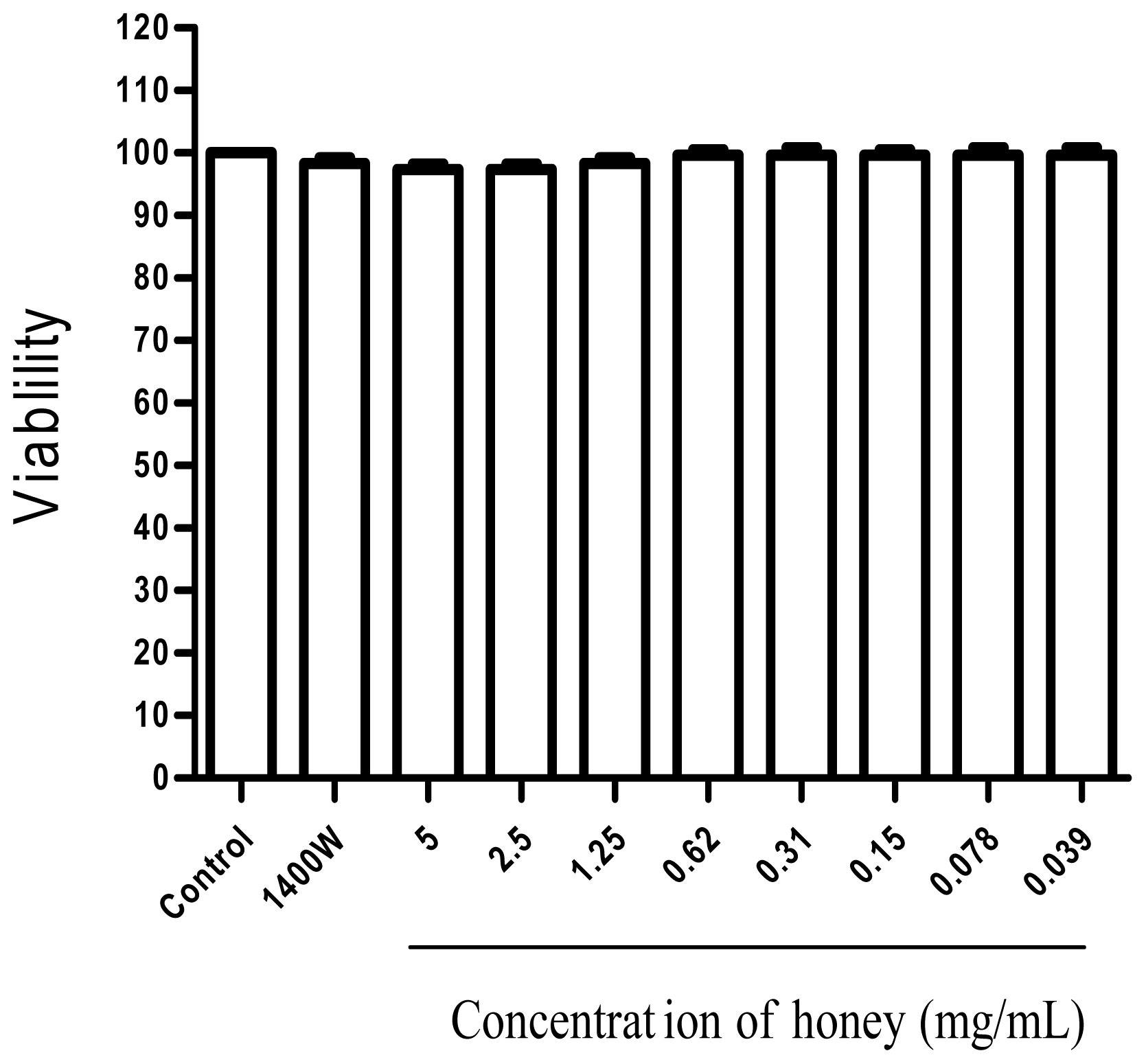
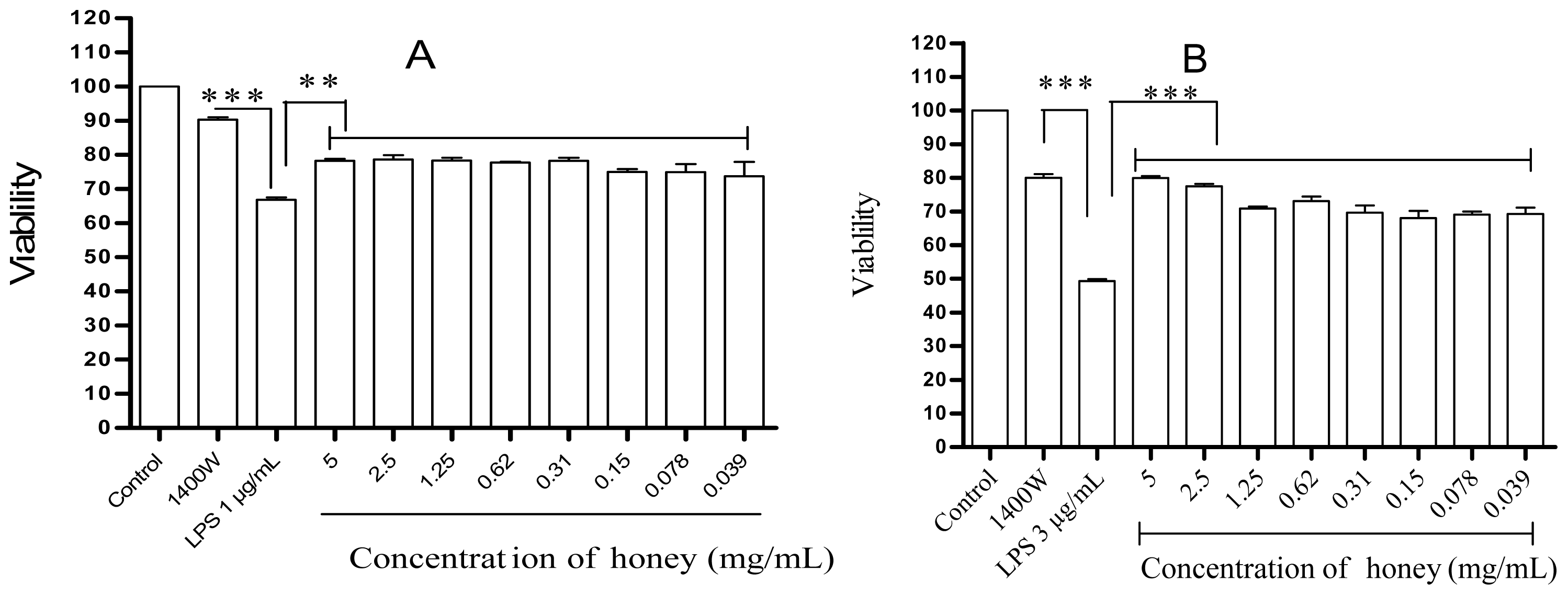
<p>In RAW 264.7 cells, none of the doses of honey resulted in cytotoxicity, and the concentrations of honey did not affect cell viability (<xref ref-type="fig" rid="f1-ijms-13-12113">Figure 1</xref>). However, the viability of cells stimulated with 1 μg/mL LPS and 35 ng/mL IFN-γ was &lt;68% of the control (untreated) value.</p>
<p>In contrast, as shown in <xref ref-type="fig" rid="f2-ijms-13-12113">Figure 2A</xref>, pretreatment with honey had a protective effect on LPS/IFN-γ-stimulated cells, significantly increasing their viability to &gt;76% (<italic>p</italic> &lt; 0.03), whereas the viability of cells pretreated with 1400W was &gt;90% (<italic>p</italic> &lt; 0.001). Increasing the LPS concentration to 3 μg/mL significantly reduced the viability of the untreated cells to &lt;50% of the control value, whereas the addition of honey increased viability to &gt;69% (<italic>p</italic> &lt; 0.001), and the addition of 1400W resulted in &gt;79% viability (<italic>p</italic> &lt; 0.001) (<xref ref-type="fig" rid="f2-ijms-13-12113">Figure 2B</xref>).</p>
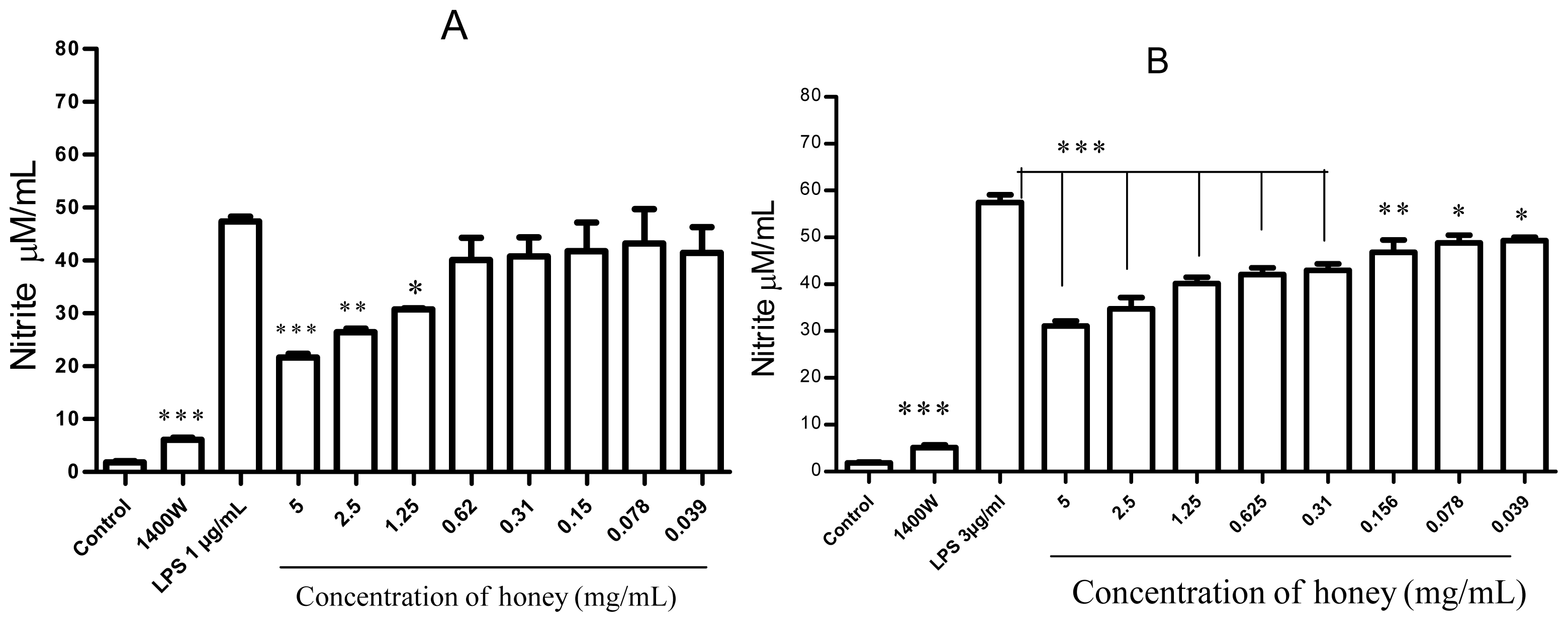
<p>Honey also significantly inhibited NO formation in cells that were stimulated with the indicated concentration of LPS (1 μg/mL or 3 μg/mL). A dose-dependent effect was observed at higher concentrations of honey (<xref ref-type="fig" rid="f3-ijms-13-12113">Figure 3</xref>).</p></sec>
<sec>
<title>2.2. Effect of Gelam Honey on Peroxynitrite in vitro and in vivo</title>
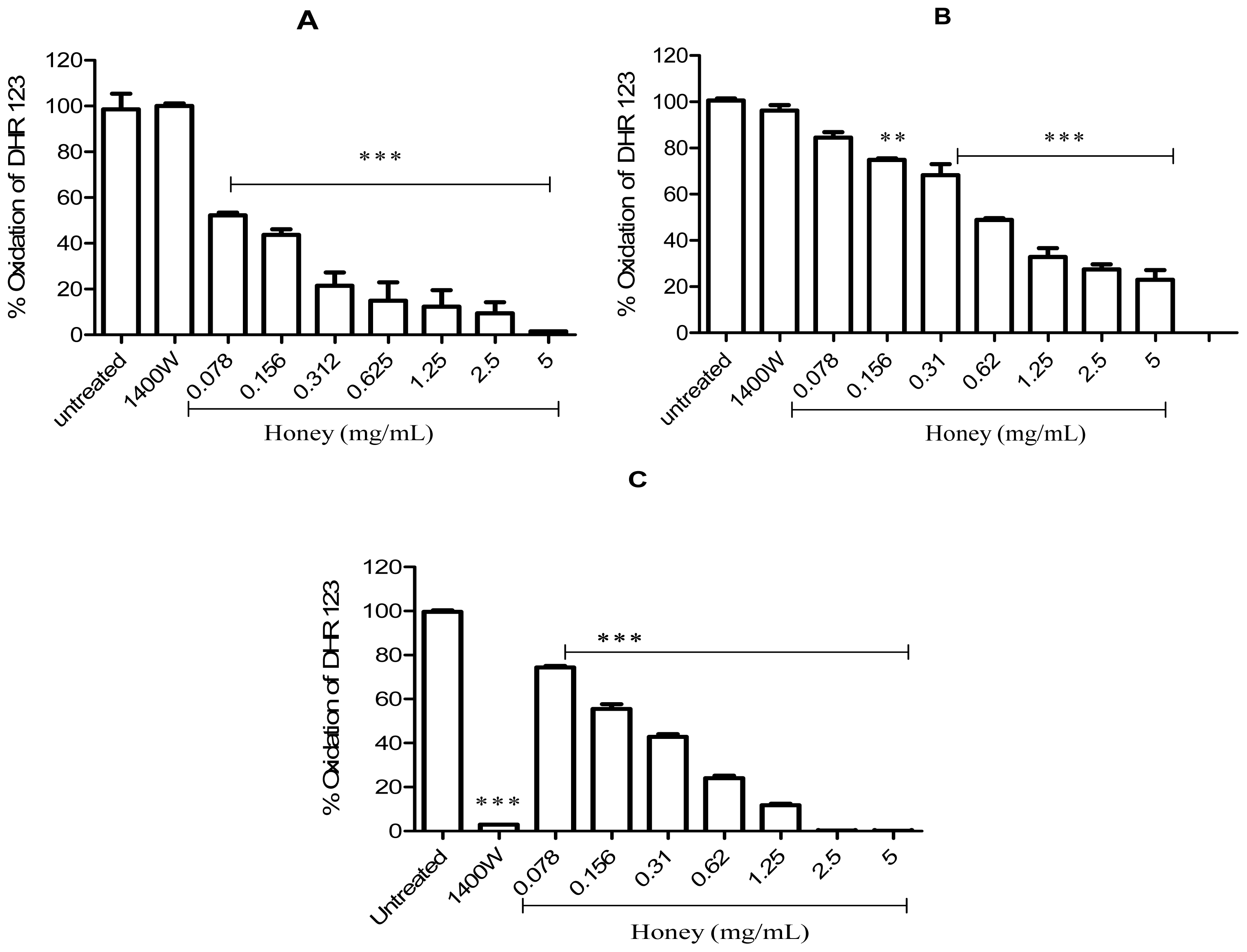
<p>An increase in the oxidation of dihydrorhodamine 123 (DHR-123) is indicative of the presence of peroxynitrite. In the 3-morpholinosydnonimine (SIN-1) model, honey was found to be a potent scavenger of peroxynitrite, inhibiting the SIN-1–induced oxidation of DHR-123 to rhodamine 123 with a half-maximal inhibitory concentration (IC<sub>50</sub>) of 0.148 mg/mL. Highly significant levels of oxidation were recorded in the presence of the iNOS inhibitor 1400W and in the (untreated) positive control (<xref ref-type="fig" rid="f4-ijms-13-12113">Figure 4A</xref>). To directly confirm the peroxynitrite scavenging activity of honey, peroxynitrite was incubated with or without different concentrations of honey (<xref ref-type="fig" rid="f4-ijms-13-12113">Figure 4B</xref>). In these experiments, honey also inhibited DHR-123 oxidation, presumably by scavenging peroxynitrite, with an IC<sub>50</sub> of 0.68 mg/mL. However, oxidation was not inhibited by 1400W because the level of rhodamine 123 fluorescence was the same as that in the untreated control (<xref ref-type="fig" rid="f4-ijms-13-12113">Figure 4B</xref>). The addition of Gelam honey to RAW 264.7 cells that were induced with LPS/IFN-γ for 24 h also completely attenuated peroxynitrite activity and had an IC<sub>50</sub> of 0.254 mg/mL (<xref ref-type="fig" rid="f4-ijms-13-12113">Figure 4C</xref>). In this experiment (unlike the previous 2 experiments), peroxynitrite synthesis was inhibited, and DHR-123 was not converted to its fluorescent product because cellular iNOS was blocked by 1400W (100 μM) (<xref ref-type="fig" rid="f4-ijms-13-12113">Figure 4C</xref>).</p>
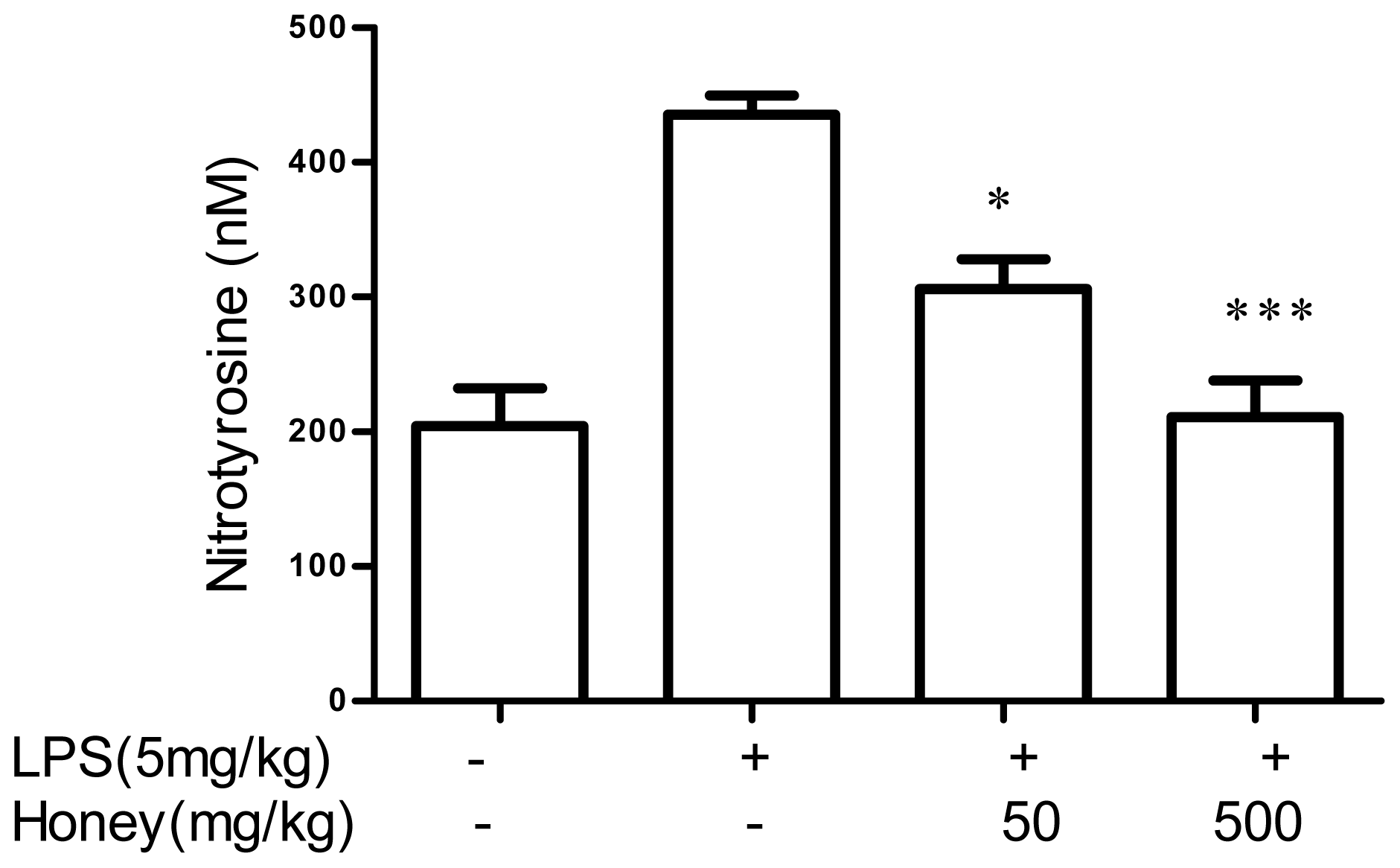
<p>Pretreatment with 50 mg/kg or 500 mg/kg of honey also significantly inhibited peroxynitrite formation in rats, albeit not in a dose-dependent manner. Inhibition was determined by a reduction in 3-nitrotyrosine, which is an <italic>in vitro</italic> marker of peroxynitrite (<xref ref-type="fig" rid="f5-ijms-13-12113">Figure 5</xref>).</p></sec></sec>
<sec sec-type="discussion">
<title>3. Discussion</title>
<p>This study investigated the ability of honey to modulate peroxynitrite-induced cell damage in LPS/IFN-γ-stimulated cultured macrophages and in a rat model of LPS-induced inflammation. The data presented here suggest that honey, through its antioxidant properties, is able to protect host immune cells from the inflammation-mediated cytotoxicity that develops in response to LPS stimulation. Gelam honey prevented the LPS-mediated decrease in RAW 264.7 cell viability caused by the high production of cytotoxic molecules such as cytokines, ROS, NO, and peroxynitrite [<xref ref-type="bibr" rid="b1-ijms-13-12113">1</xref>]. Honey apparently scavenged peroxynitrite in RAW 264.7 cells induced with LPS/IFN-γ <italic>in vitro</italic>. Inhibitory effects were also observed upon incubation with the substrate SIN-1, a peroxynitrite donor, and with peroxynitrite itself. The ability of honey to scavenge peroxynitrite in tissues <italic>in vivo</italic> was demonstrated by the absence of 3-nitrotyrosine, a peroxynitrite marker, from rat serum.</p>
<p>Excess NO production is cytotoxic and has a broad spectrum of cellular effects. In RAW 264.7 macrophages, there was a pronounced increase in NO production and a significant decrease in cell viability after stimulation with LPS/IFN-γ, which is known to induce iNOS and thus increase cellular NO concentrations. This decrease in viability was much less pronounced in the presence of 1400W, suggesting that cytotoxicity was induced by iNOS and NO. In fact, NO production, measured as nitrite in the Griess reaction, was almost completely inhibited by iNOS inhibition.</p>
<p>The mechanism by which NO mediates toxicity includes the generation of reactive nitrogen derivatives such as peroxynitrite, which acts upon multiple cellular targets, including DNA and various proteins [<xref ref-type="bibr" rid="b44-ijms-13-12113">44</xref>]. Thus, cellular exposure to high concentrations of peroxynitrite often leads to rapid, necrotic-type cell death due to acute and severe cellular energetic derangements [<xref ref-type="bibr" rid="b11-ijms-13-12113">11</xref>,<xref ref-type="bibr" rid="b45-ijms-13-12113">45</xref>,<xref ref-type="bibr" rid="b46-ijms-13-12113">46</xref>]. In contrast, lower concentrations of peroxynitrite trigger delayed apoptosis that is mainly dependent on the activation of caspases 3, 2, 8, and 9, similar to other forms of oxidant/free radical-mediated apoptosis [<xref ref-type="bibr" rid="b47-ijms-13-12113">47</xref>–<xref ref-type="bibr" rid="b50-ijms-13-12113">50</xref>].</p>
<p>The effects of NO on cell viability are proportional to the cellular non-heme iron content. Thus, NO induces apoptosis in cells with a low non-heme iron level, such as RAW 264.7 macrophages, whereas it induces necrosis in cells with a high non-heme iron level, such as hepatocytes [<xref ref-type="bibr" rid="b51-ijms-13-12113">51</xref>]. For example, NO induces both caspase-3 activation and cytochrome <italic>c</italic> release in apoptotic RAW 264.7 cells, and a caspase-3 inhibitor prevents NO-mediated RAW 264.7 apoptotic cell death [<xref ref-type="bibr" rid="b51-ijms-13-12113">51</xref>]. NO readily reacts with non-heme iron to form iron-nitrosyl complexes [<xref ref-type="bibr" rid="b52-ijms-13-12113">52</xref>,<xref ref-type="bibr" rid="b53-ijms-13-12113">53</xref>], which are thought to protect cells from NO-induced toxicity by a scavenging mechanism [<xref ref-type="bibr" rid="b53-ijms-13-12113">53</xref>]. Alternatively, NO may be converted to <italic>S</italic>-nitrosylating species, which act as potent regulatory molecules in a variety of cell types and cellular functions [<xref ref-type="bibr" rid="b54-ijms-13-12113">54</xref>,<xref ref-type="bibr" rid="b55-ijms-13-12113">55</xref>].</p>
<p>Recent studies show that peroxynitrite stimulates the release of the mitochondrial apoptosis-inducing factor, which subsequently triggers DNA fragmentation [<xref ref-type="bibr" rid="b56-ijms-13-12113">56</xref>], release of mitochondrial pro-apoptotic factors, and cytochrome <italic>c</italic>-dependent apoptosis in the cytosol, through peroxynitrite-dependent oxidation of the mitochondrial permeability transition pore. The key role of peroxynitrite in promoting mitochondrial dysfunction is clearly exemplified in experimental sepsis, in which peroxynitrite production results in the inhibition of mitochondrial respiration in the diaphragm in a process associated with mitochondrial protein nitration. The latter is prevented by NO synthase inhibitors and Mn-porphyrin therapy [<xref ref-type="bibr" rid="b57-ijms-13-12113">57</xref>]. Peroxynitrite-induced activation of the MLK/p38/JNK pathway also plays a crucial role in apoptosis [<xref ref-type="bibr" rid="b58-ijms-13-12113">58</xref>–<xref ref-type="bibr" rid="b60-ijms-13-12113">60</xref>]. This study shows that honey can inhibit NO production, and thus peroxynitrite formation, thereby reducing the effects of these cytotoxic compounds both <italic>in vitro</italic> and <italic>in vivo</italic>. Moreover, scavengers of peroxynitrite are known to be protective against tissue damage [<xref ref-type="bibr" rid="b9-ijms-13-12113">9</xref>]. Some scavengers of peroxynitrite, such as uric acid, ebselen, mercaptoalkylguanidines, <italic>N</italic>-acetylcysteine, and dihydrolipoic acid, and some chemicals that work as decomposition catalysts of peroxynitrite, such as metalloporphyrins of iron and manganese, can attenuate the toxic effects of peroxynitrite <italic>in vitro</italic> and <italic>in vivo</italic> [<xref ref-type="bibr" rid="b11-ijms-13-12113">11</xref>,<xref ref-type="bibr" rid="b16-ijms-13-12113">16</xref>,<xref ref-type="bibr" rid="b61-ijms-13-12113">61</xref>–<xref ref-type="bibr" rid="b68-ijms-13-12113">68</xref>]. These compounds can reduce 3-nitrotyrosine immunoreactivity in various pathophysiological conditions and have beneficial effects in animal models of inflammation, sepsis, and reperfusion injury [<xref ref-type="bibr" rid="b57-ijms-13-12113">57</xref>,<xref ref-type="bibr" rid="b68-ijms-13-12113">68</xref>–<xref ref-type="bibr" rid="b77-ijms-13-12113">77</xref>]. Many phenolic compounds, such as gallic acid, caffeic acid, kaempferol, ferulic acid, <italic>p</italic>-coumaric, and quercetin have been shown to inhibit peroxynitrite. Monohydroxylated phenolic compounds, such as ferulic acid and <italic>p</italic>-coumaric acid, act as peroxynitrite scavengers by nitration. On the other hand, compounds with a catechol moiety, such as caffeic acid and chlorogenic acid, reduce peroxynitrite by electron donation [<xref ref-type="bibr" rid="b66-ijms-13-12113">66</xref>,<xref ref-type="bibr" rid="b78-ijms-13-12113">78</xref>]. Interestingly, all of the above phenolic compounds were identified in Gelam honey [<xref ref-type="bibr" rid="b40-ijms-13-12113">40</xref>]. Data from this study was in agreement with that of previous studies as described earlier. Moreover, a direct interaction through nitration and electron donation between honey and peroxynitrite is suggested by the results of the experiments involving SIN-1 and the direct incubation of honey and peroxynitrite. In addition, the presence of phenolic compounds in Gelam honey that act as potent scavengers of peroxynitrite, as described above, supports this hypothesis. In our previous studies, we demonstrated the anti-inflammatory activity of Gelam honey and its methanol and ethyl acetate extracts, on the basis of their abilities to suppress NO production in macrophages and rat inflammation models, inhibit the release of NO-induced cytokines (such as TNF-α, IL-1β, and IL-10) and high mobility group protein 1 (HMGB1), induces HO<italic>-</italic>1 in animal models, and protects organs from lethal doses of LPS that induce sepsis [<xref ref-type="bibr" rid="b39-ijms-13-12113">39</xref>–<xref ref-type="bibr" rid="b41-ijms-13-12113">41</xref>,<xref ref-type="bibr" rid="b79-ijms-13-12113">79</xref>]. Gelam honey also inhibited iNOS protein expression in an animal model [<xref ref-type="bibr" rid="b80-ijms-13-12113">80</xref>]. The results of this study support these previous findings, confirming the protective effects of honey mediated through the inhibition of NO and its derivatives (ONOO<sup>−</sup>) and, thus, its ability to prevent inflammatory-type cytotoxicity both in cultured macrophages and in animals.</p>
<p>The antioxidant and radical-scavenging abilities of Gelam honey are attributable to its phenolic compounds, which were also identified and quantified in previous studies [<xref ref-type="bibr" rid="b38-ijms-13-12113">38</xref>]. The potential of Gelam honey to reduce LPS-induced inflammation is also mediated by its ability to reduce the release of proinflammatory cytokines and prostaglandin (PG) E<sub>2</sub>, both of which play a central role in inflammation [<xref ref-type="bibr" rid="b39-ijms-13-12113">39</xref>,<xref ref-type="bibr" rid="b79-ijms-13-12113">79</xref>]. In these studies, the reduced release of cytokines such as TNF-α, IL-1β, and IL-10 was quite dramatic in an endotoxemia model. This finding is particularly relevant to macrophages, where these mediators play a fundamental role in cell activation because they are released during the early stages of the inflammatory cascade [<xref ref-type="bibr" rid="b81-ijms-13-12113">81</xref>]. In addition, honey may suppress NF-κB activation through other biologically active components, and consequently, inhibit iNOS induction [<xref ref-type="bibr" rid="b82-ijms-13-12113">82</xref>,<xref ref-type="bibr" rid="b83-ijms-13-12113">83</xref>]. Taken together, our work supports further investigations into the use of honey as a natural antioxidant, based on its ability to protect cells by inhibiting NO production, scavenging peroxynitrite, and modulating other inflammatory mediators such as PGE<sub>2</sub>, HMGB1, HO-1, and cytokines. The involvement of mechanisms other than iNOS inhibition, NO production, and peroxynitrite scavenging in these processes is suggested because low doses of honey had no effect on NO synthesis but did increase the viability of cells treated with LPS.</p></sec>
<sec>
<title>4. Experimental Section</title>
<sec>
<title>4.1. Preparation of Gelam Honey</title>
<p>Fresh Malaysian honey, <italic>Apis mellifera</italic> (Gelam), was obtained from the National Apiary (Department of Agriculture, Parit Botak, Johor, Malaysia) and sent to the Malaysian Nuclear Agency for sterilization using a cobalt-60 source (model JS10000). Before its use in the <italic>in vitro</italic> and <italic>in vivo</italic> experiments described below, the sterilized honey was passed through a 0.20-μm filter syringe. The following concentrations were tested: 0.039, 0.078, 0.15, 0.31, 0.62, 1.25, 2.5, and 5 mg/mL.</p></sec>
<sec>
<title>4.2. Animals</title>
<p>Male Sprague–Dawley rats weighing 300–350 g were housed in individual cages under standard conditions (12 h light and 12 h dark). The animals were fed a diet of Purina lab chow and given water <italic>ad libitum.</italic> The study was carried out in accordance with the guidelines for animal experimentation of the University of Malaya Animal Ethics Committee and the protocols were approved under the terms set out: project license ANES/14/07/2010/MKAK (R).</p></sec>
<sec>
<title>4.3. Cell Culture and Reagents</title>
<p>The murine macrophage cell line RAW 264.7 was maintained in Dulbecco’s Modified Eagle Medium (DMEM), supplemented with 10% (<italic>v</italic>/<italic>v</italic>) heat-inactivated fetal bovine serum (FBS), 100 U/mL penicillin, and 100 U/mL streptomycin in a humidified 37 °C, 5% CO<sub>2</sub> incubator. DMEM without phenol red, FBS, and antibiotics (penicillin, streptomycin) were purchased from Nacalai Tesque (Kyoto, Japan). LPS (<italic>Escherichia coli</italic> 0111 B4), iNOS inhibitor (1400W), and IFN-γ were purchased from Sigma-Aldrich (St. Louis, MO, USA).</p></sec>
<sec>
<title>4.4. LPS/IFN-γ Stimulation of RAW 264.7 Cells</title>
<p>RAW 264.7 cells were grown in 10% FBS-DMEM and seeded at a density of 2 × 10<sup>6</sup> in a 24-well plate, followed by incubation for 24 h at 37 °C. The cells were then washed with PBS and resuspended in fresh medium containing different concentrations of Gelam honey (0.039–5 mg/mL) or 100 μM of 1400W. Untreated cells were included as positive or negative controls in each experiment. One hour later, 1 or 3 μg/mL of LPS and 35 ng/mL of IFN-γ were added to the cultures, followed by incubation for 24 h at 37 °C and 5% CO<sub>2</sub> [<xref ref-type="bibr" rid="b84-ijms-13-12113">84</xref>]. The cells were then processed for viability or NO or peroxynitrite detection as described below.</p></sec>
<sec>
<title>4.5. Measurement of Mitochondrial Respiration</title>
<p>The viability of RAW 264.7 macrophages was determined in cultures treated or not treated with LPS/IFN-γ and different concentrations of Gelam honey or 1400W. The viability was measured in terms of cellular respiration as assessed by the mitochondrial-dependent reduction of MTT to formazan. Cells were cultured, stimulated with LPS, and treated with honey or 1400W as described above, after which 100 μL of MTT (5 mg/mL) was added to each well, followed by 1 h incubation under the same conditions. The MTT solution was then removed and the cells were solubilized in 200 μL DMSO with shaking for 5 min. The absorbance was measured at 550 nm using a microplate reader (GloMax<sup>®</sup>-Multi Microplate detection; Promega, Madison, WI, USA) [<xref ref-type="bibr" rid="b85-ijms-13-12113">85</xref>]. All experiments were repeated 5 times in triplicate.</p></sec>
<sec>
<title>4.6. Nitric Oxide Assay</title>
<p>Nitric oxide has a half-life of only a few seconds before it is quickly converted to nitrate and nitrite. These products can be measured using the colorimetric Griess reaction to indirectly determine the NO concentration. Therefore, RAW 264.7 cells were cultured and treated as described in Subsection 4.4 (LPS/IFN-γ stimulation of RAW 264.7 cells), after which 100 μL of the culture was placed in a 96-well plate, together with an equal amount of Griess reagent (50 μL of 1% sulfanilamide in 5% concentrated H<sub>3</sub>PO<sub>4</sub> and 50 μL of 0.1% naphthylethylenediamine dihydrochloride in distilled water). The reaction between the Griess reagent and the nitrite present in the supernatant yields a pink derivative that can be spectrophotometrically quantified from a concentration curve prepared from a nitrite standard [<xref ref-type="bibr" rid="b40-ijms-13-12113">40</xref>].</p></sec>
<sec>
<title>4.7. DHR-123 Oxidation Assay</title>
<sec>
<title>4.7.1. DHR-123 Oxidation Using SIN-1</title>
<p>SIN-1 spontaneously releases NO and superoxide under physiological conditions. At pH 7.4, SIN-1 is converted to SIN-1A via base-catalyzed ring opening. During ring opening, the oxygen undergoes univalent reduction to O<sub>2</sub><sup>−</sup>. SIN-1A then releases NO and is converted to the stable metabolite SIN-1C, whereas the O<sub>2</sub><sup>−</sup> radical reacts with NO to form peroxynitrite (ONOO<sup>−</sup>). The oxidation of DHR-123 by ONOO<sup>−</sup> results in the formation of fluorescent rhodamine 123, the amount of which can be measured by fluorometric analysis (GloMax<sup>®</sup>-Multi Microplate) at an excitation wavelength of 460–530 nm and an emission wavelength of 530–590 nm. In experiments examining the effects of honey on peroxynitrite scavenging, 100 μM of SIN-1 was used and the reactions were carried out in PBS, with the incubation of the samples for 2 h at 37 °C [<xref ref-type="bibr" rid="b84-ijms-13-12113">84</xref>].</p></sec>
<sec>
<title>4.7.2. DHR-123 Oxidation Using Peroxynitrite</title>
<p>The ability of peroxynitrite to oxidize DHR-123, thus converting it to rhodamine 123, was also measured directly as previously described [<xref ref-type="bibr" rid="b9-ijms-13-12113">9</xref>]. Briefly, 10 μM peroxynitrite was mixed in PBS containing 20 μM DHR-123, in the absence or presence of either honey (0–5 mg/mL) or 100 μM of 1400W. After a 15-min incubation period at room temperature, the fluorescence of the rhodamine 123 reaction product was measured (GloMax<sup>®</sup>-Multi Microplate) at an excitation wavelength of 460–530 nm and an emission wavelength of 530–590 nm.</p></sec>
<sec>
<title>4.7.3. DHR-123 Oxidation by LPS/IFN-γ-Treated RAW 264.7 Cells</title>
<p>Cells were cultured, stimulated with LPS, and treated with honey or 1400W as described in subsection 4.4 (LPS/IFN-γ stimulation of RAW 264.7 cells) in the presence of 10 μM DHR-123. After 24 h, 100 μL of the culture suspension was removed, and the amount of rhodamine 123 was determined fluorometrically.</p></sec></sec>
<sec>
<title>4.8. Induction of an Immune Response in LPS-Stimulated Rats and the Effects of Honey</title>
<p>Rats were divided into four groups of six animals each. An immune response was induced in the animals in three of the four groups by intravenous injection of 5 mg/kg LPS (0111B4; Sigma) diluted in saline. One of these groups served as the positive control (LPS only), whereas the other two groups were intravenously injected with 50 or 500 mg/kg honey diluted in saline. The fourth (negative control) group was given saline only. All doses of LPS and honey were prepared immediately before injection, and 0.5 mL of the preparations were injected. The blood was collected (by cardiac puncture) from rats 4 h after the immune response was induced. The levels of 3-nitrotyrosine in the sera were measured using an ELISA kit according to the manufacturer’s protocol (Cell Biolabs Inc., San Diego, CA, USA).</p></sec>
<sec sec-type="methods">
<title>4.9. Statistical Analysis</title>
<p>Student’s <italic>t</italic>-test and a non-parametric one-way ANOVA were used to determine the statistical significance of differences between the experimental and control groups, with <italic>p</italic> ≤ 0.05 considered to be statistically significant.</p></sec></sec>
<sec>
<title>5. Conclusion</title>
<p>In conclusion, our data showed that honey is a potent peroxynitrite scavenger <italic>in vitro</italic> and <italic>in vivo</italic> that has cytoprotective effects against peroxynitrite-mediated cellular injury and death. Moreover, the preservation of cellular viability from peroxynitrite-mediated damage is critical to any consideration of the potential therapeutic value of peroxynitrite scavengers in many diseases, including inflammation and sepsis. This finding suggests that honey has therapeutic applications for a wide range of inflammatory disorders.</p></sec></body>
<back>
<ack>
<title>Acknowledgments</title>
<p>This work was supported in part by grants (No. PV009/2011B, RG031/09HTM, FP036/2010B, and RG225/10HTM) from the University of Malaya.</p></ack>
<fn-group><fn id="fn1-ijms-13-12113">
<p><bold>Conflict of Interest</bold></p>
<p>The authors declare no conflict of interest.</p></fn></fn-group>
<ref-list>
<title>References</title>
<ref id="b1-ijms-13-12113"><label>1</label><citation citation-type="journal"><person-group person-group-type="author"><name><surname>Sampath</surname><given-names>V.</given-names></name><name><surname>Radish</surname><given-names>A.C.</given-names></name><name><surname>Eis</surname><given-names>A.L.</given-names></name><name><surname>Broniowska</surname><given-names>K.</given-names></name><name><surname>Hogg</surname><given-names>N.</given-names></name><name><surname>Konduri</surname><given-names>G.G.</given-names></name></person-group><article-title>Attenuation of lipopolysaccharide-induced oxidative stress and apoptosis in fetal pulmonary artery endothelial cells by hypoxia</article-title><source>Free Radical Biol. Med</source><year>2009</year><volume>46</volume><fpage>663</fpage><lpage>671</lpage><pub-id pub-id-type="doi">10.1016/j.freeradbiomed.2008.12.008</pub-id></citation></ref>
<ref id="b2-ijms-13-12113"><label>2</label><citation citation-type="journal"><person-group person-group-type="author"><name><surname>Kedzierska</surname><given-names>K.</given-names></name><name><surname>Crowe</surname><given-names>S.M.</given-names></name></person-group><article-title>Cytokines and hiv-1: Interactions and clinical implications</article-title><source>Antiviral Chem. Chemother</source><year>2001</year><volume>12</volume><fpage>133</fpage><lpage>150</lpage></citation></ref>
<ref id="b3-ijms-13-12113"><label>3</label><citation citation-type="journal"><person-group person-group-type="author"><name><surname>Hanna</surname><given-names>M.G.</given-names><suffix>Jr</suffix></name></person-group><article-title>Immunologic aspects of bcg-mediated regression of established tumors and metastases in guinea pigs</article-title><source>Semin. Oncol.</source><year>1974</year><volume>1</volume><fpage>319</fpage><lpage>335</lpage><pub-id pub-id-type="pmid">4377938</pub-id></citation></ref>
<ref id="b4-ijms-13-12113"><label>4</label><citation citation-type="journal"><person-group person-group-type="author"><name><surname>Sawa</surname><given-names>T.</given-names></name><name><surname>Ohshima</surname><given-names>H.</given-names></name></person-group><article-title>Nitrative DNA damage in inflammation and its possible role in carcinogenesis</article-title><source>Nitric Oxide</source><year>2006</year><volume>14</volume><fpage>91</fpage><lpage>100</lpage><pub-id pub-id-type="doi">10.1016/j.niox.2005.06.005</pub-id><pub-id pub-id-type="pmid">16099698</pub-id></citation></ref>
<ref id="b5-ijms-13-12113"><label>5</label><citation citation-type="journal"><person-group person-group-type="author"><name><surname>Kimura</surname><given-names>H.</given-names></name><name><surname>Hokari</surname><given-names>R.</given-names></name><name><surname>Miura</surname><given-names>S.</given-names></name><name><surname>Shigematsu</surname><given-names>T.</given-names></name><name><surname>Hirokawa</surname><given-names>M.</given-names></name><name><surname>Akiba</surname><given-names>Y.</given-names></name><name><surname>Kurose</surname><given-names>I.</given-names></name><name><surname>Higuchi</surname><given-names>H.</given-names></name><name><surname>Fujimori</surname><given-names>H.</given-names></name><name><surname>Tsuzuki</surname><given-names>Y.</given-names></name><etal/></person-group><article-title>Increased expression of an inducible isoform of nitric oxide synthase and the formation of peroxynitrite in colonic mucosa of patients with active ulcerative colitis</article-title><source>Gut</source><year>1998</year><volume>42</volume><fpage>180</fpage><lpage>187</lpage><pub-id pub-id-type="doi">10.1136/gut.42.2.180</pub-id><pub-id pub-id-type="pmid">9536941</pub-id></citation></ref>
<ref id="b6-ijms-13-12113"><label>6</label><citation citation-type="journal"><person-group person-group-type="author"><name><surname>Han</surname><given-names>K.Y.</given-names></name><name><surname>Kwon</surname><given-names>T.H.</given-names></name><name><surname>Lee</surname><given-names>T.H.</given-names></name><name><surname>Lee</surname><given-names>S.J.</given-names></name><name><surname>Kim</surname><given-names>S.H.</given-names></name><name><surname>Kim</surname><given-names>J.</given-names></name></person-group><article-title>Suppressive effects of lithospermum erythrorhizon extracts on lipopolysaccharide-induced activation of ap-1 and nf-kappab via mitogen-activated protein kinase pathways in mouse macrophage cells</article-title><source>BMB Rep</source><year>2008</year><volume>41</volume><fpage>328</fpage><lpage>333</lpage><pub-id pub-id-type="doi">10.5483/BMBRep.2008.41.4.328</pub-id><pub-id pub-id-type="pmid">18452655</pub-id></citation></ref>
<ref id="b7-ijms-13-12113"><label>7</label><citation citation-type="journal"><person-group person-group-type="author"><name><surname>Dannenberg</surname><given-names>A.J.</given-names></name><name><surname>Altorki</surname><given-names>N.K.</given-names></name><name><surname>Boyle</surname><given-names>J.O.</given-names></name><name><surname>Dang</surname><given-names>C.</given-names></name><name><surname>Howe</surname><given-names>L.R.</given-names></name><name><surname>Weksler</surname><given-names>B.B.</given-names></name><name><surname>Subbaramaiah</surname><given-names>K.</given-names></name></person-group><article-title>Cyclo-oxygenase 2: A pharmacological target for the prevention of cancer</article-title><source>Lancet Oncol</source><year>2001</year><volume>2</volume><fpage>544</fpage><lpage>551</lpage><pub-id pub-id-type="doi">10.1016/S1470-2045(01)00488-0</pub-id><pub-id pub-id-type="pmid">11905709</pub-id></citation></ref>
<ref id="b8-ijms-13-12113"><label>8</label><citation citation-type="journal"><person-group person-group-type="author"><name><surname>Petros</surname><given-names>A.</given-names></name><name><surname>Bennett</surname><given-names>D.</given-names></name><name><surname>Vallance</surname><given-names>P.</given-names></name></person-group><article-title>Effect of nitric oxide synthase inhibitors on hypotension in patients with septic shock</article-title><source>Lancet</source><year>1991</year><volume>338</volume><fpage>1557</fpage><lpage>1558</lpage><pub-id pub-id-type="doi">10.1016/0140-6736(91)92376-D</pub-id><pub-id pub-id-type="pmid">1720856</pub-id></citation></ref>
<ref id="b9-ijms-13-12113"><label>9</label><citation citation-type="journal"><person-group person-group-type="author"><name><surname>Szabo</surname><given-names>C.</given-names></name><name><surname>Ischiropoulos</surname><given-names>H.</given-names></name><name><surname>Radi</surname><given-names>R.</given-names></name></person-group><article-title>Peroxynitrite: Biochemistry, pathophysiology and development of therapeutics</article-title><source>Nat. Rev. Drug Discov</source><year>2007</year><volume>6</volume><fpage>662</fpage><lpage>680</lpage><pub-id pub-id-type="doi">10.1038/nrd2222</pub-id><pub-id pub-id-type="pmid">17667957</pub-id></citation></ref>
<ref id="b10-ijms-13-12113"><label>10</label><citation citation-type="journal"><person-group person-group-type="author"><name><surname>Zouki</surname><given-names>C.</given-names></name><name><surname>Jozsef</surname><given-names>L.</given-names></name><name><surname>Ouellet</surname><given-names>S.</given-names></name><name><surname>Paquette</surname><given-names>Y.</given-names></name><name><surname>Filep</surname><given-names>J.G.</given-names></name></person-group><article-title>Peroxynitrite mediates cytokine-induced il-8 gene expression and production by human leukocytes</article-title><source>J. Leukoc. Biol</source><year>2001</year><volume>69</volume><fpage>815</fpage><lpage>824</lpage><pub-id pub-id-type="pmid">11358991</pub-id></citation></ref>
<ref id="b11-ijms-13-12113"><label>11</label><citation citation-type="journal"><person-group person-group-type="author"><name><surname>Szabo</surname><given-names>C</given-names></name></person-group><article-title>Multiple pathways of peroxynitrite cytotoxicity</article-title><source>Toxicol. Lett</source><year>2003</year><volume>140–141</volume><fpage>105</fpage><lpage>112</lpage><pub-id pub-id-type="pmid">12676456</pub-id></citation></ref>
<ref id="b12-ijms-13-12113"><label>12</label><citation citation-type="journal"><person-group person-group-type="author"><name><surname>Lanone</surname><given-names>S.</given-names></name><name><surname>Manivet</surname><given-names>P.</given-names></name><name><surname>Callebert</surname><given-names>J.</given-names></name><name><surname>Launay</surname><given-names>J.M.</given-names></name><name><surname>Payen</surname><given-names>D.</given-names></name><name><surname>Aubier</surname><given-names>M.</given-names></name><name><surname>Boczkowski</surname><given-names>J.</given-names></name><name><surname>Mebazaa</surname><given-names>A.</given-names></name></person-group><article-title>Inducible nitric oxide synthase (nos2) expressed in septic patients is nitrated on selected tyrosine residues: Implications for enzymic activity</article-title><source>Biochem. J</source><year>2002</year><volume>366</volume><fpage>399</fpage><lpage>404</lpage><pub-id pub-id-type="doi">10.1042/BJ20020339</pub-id><pub-id pub-id-type="pmid">12097137</pub-id></citation></ref>
<ref id="b13-ijms-13-12113"><label>13</label><citation citation-type="journal"><person-group person-group-type="author"><name><surname>Whiteman</surname><given-names>M.</given-names></name><name><surname>Ketsawatsakul</surname><given-names>U.</given-names></name><name><surname>Halliwell</surname><given-names>B.</given-names></name></person-group><article-title>A reassessment of the peroxynitrite scavenging activity of uric acid</article-title><source>Ann. N. Y. Acad. Sci</source><year>2002</year><volume>962</volume><fpage>242</fpage><lpage>259</lpage><pub-id pub-id-type="doi">10.1111/j.1749-6632.2002.tb04072.x</pub-id><pub-id pub-id-type="pmid">12076979</pub-id></citation></ref>
<ref id="b14-ijms-13-12113"><label>14</label><citation citation-type="journal"><person-group person-group-type="author"><name><surname>Scott</surname><given-names>G.S.</given-names></name><name><surname>Spitsin</surname><given-names>S.V.</given-names></name><name><surname>Kean</surname><given-names>R.B.</given-names></name><name><surname>Mikheeva</surname><given-names>T.</given-names></name><name><surname>Koprowski</surname><given-names>H.</given-names></name><name><surname>Hooper</surname><given-names>D.C.</given-names></name></person-group><article-title>Therapeutic intervention in experimental allergic encephalomyelitis by administration of uric acid precursors</article-title><source>Proc. Natl. Acad. Sci. USA</source><year>2002</year><volume>99</volume><fpage>16303</fpage><lpage>16308</lpage><pub-id pub-id-type="doi">10.1073/pnas.212645999</pub-id><pub-id pub-id-type="pmid">12451183</pub-id></citation></ref>
<ref id="b15-ijms-13-12113"><label>15</label><citation citation-type="journal"><person-group person-group-type="author"><name><surname>Robinson</surname><given-names>K.M.</given-names></name><name><surname>Morre</surname><given-names>J.T.</given-names></name><name><surname>Beckman</surname><given-names>J.S.</given-names></name></person-group><article-title>Triuret: A novel product of peroxynitrite-mediated oxidation of urate</article-title><source>Arch. Biochem. Biophys</source><year>2004</year><volume>423</volume><fpage>213</fpage><lpage>217</lpage><pub-id pub-id-type="doi">10.1016/j.abb.2003.10.011</pub-id><pub-id pub-id-type="pmid">14871483</pub-id></citation></ref>
<ref id="b16-ijms-13-12113"><label>16</label><citation citation-type="journal"><person-group person-group-type="author"><name><surname>Scott</surname><given-names>G.S.</given-names></name><name><surname>Cuzzocrea</surname><given-names>S.</given-names></name><name><surname>Genovese</surname><given-names>T.</given-names></name><name><surname>Koprowski</surname><given-names>H.</given-names></name><name><surname>Hooper</surname><given-names>D.C.</given-names></name></person-group><article-title>Uric acid protects against secondary damage after spinal cord injury</article-title><source>Proc. Natl. Acad. Sci. USA</source><year>2005</year><volume>102</volume><fpage>3483</fpage><lpage>3488</lpage><pub-id pub-id-type="doi">10.1073/pnas.0500307102</pub-id><pub-id pub-id-type="pmid">15728348</pub-id></citation></ref>
<ref id="b17-ijms-13-12113"><label>17</label><citation citation-type="journal"><person-group person-group-type="author"><name><surname>Sanz</surname><given-names>M.L.</given-names></name><name><surname>Sanz</surname><given-names>J.</given-names></name><name><surname>Martinez-Castro</surname><given-names>I.</given-names></name></person-group><article-title>Gas chromatographic-mass spectrometric method for the qualitative and quantitative determination of disaccharides and trisaccharides in honey</article-title><source>J. Chromatogr. A</source><year>2004</year><volume>1059</volume><fpage>143</fpage><lpage>148</lpage><pub-id pub-id-type="doi">10.1016/j.chroma.2004.09.095</pub-id><pub-id pub-id-type="pmid">15628134</pub-id></citation></ref>
<ref id="b18-ijms-13-12113"><label>18</label><citation citation-type="journal"><person-group person-group-type="author"><name><surname>Erejuwa</surname><given-names>O.O.</given-names></name><name><surname>Sulaiman</surname><given-names>S.A.</given-names></name><name><surname>Wahab</surname><given-names>M.S.</given-names></name></person-group><article-title>Honey—A novel antidiabetic agent</article-title><source>Int. J. Biol. Sci</source><year>2012</year><volume>8</volume><fpage>913</fpage><lpage>934</lpage><pub-id pub-id-type="doi">10.7150/ijbs.3697</pub-id><pub-id pub-id-type="pmid">22811614</pub-id></citation></ref>
<ref id="b19-ijms-13-12113"><label>19</label><citation citation-type="journal"><person-group person-group-type="author"><name><surname>Munstedt</surname><given-names>K.</given-names></name><name><surname>Bohme</surname><given-names>M.</given-names></name><name><surname>Hauenschild</surname><given-names>A.</given-names></name><name><surname>Hrgovic</surname><given-names>I.</given-names></name></person-group><article-title>Consumption of rapeseed honey leads to higher serum fructose levels compared with analogue glucose/fructose solutions</article-title><source>Eur. J. Clin. Nutr</source><year>2011</year><volume>65</volume><fpage>77</fpage><lpage>80</lpage><pub-id pub-id-type="doi">10.1038/ejcn.2010.186</pub-id><pub-id pub-id-type="pmid">20823899</pub-id></citation></ref>
<ref id="b20-ijms-13-12113"><label>20</label><citation citation-type="journal"><person-group person-group-type="author"><name><surname>Erejuwa</surname><given-names>O.O.</given-names></name><name><surname>Sulaiman</surname><given-names>S.A.</given-names></name><name><surname>Wahab</surname><given-names>M.S.</given-names></name></person-group><article-title>Fructose might contribute to the hypoglycemic effect of honey</article-title><source>Molecules</source><year>2012</year><volume>17</volume><fpage>1900</fpage><lpage>1915</lpage><pub-id pub-id-type="doi">10.3390/molecules17021900</pub-id><pub-id pub-id-type="pmid">22337138</pub-id></citation></ref>
<ref id="b21-ijms-13-12113"><label>21</label><citation citation-type="journal"><person-group person-group-type="author"><name><surname>Munstedt</surname><given-names>K.</given-names></name><name><surname>Sheybani</surname><given-names>B.</given-names></name><name><surname>Hauenschild</surname><given-names>A.</given-names></name><name><surname>Bruggmann</surname><given-names>D.</given-names></name><name><surname>Bretzel</surname><given-names>R.G.</given-names></name><name><surname>Winter</surname><given-names>D.</given-names></name></person-group><article-title>Effects of basswood honey, honey-comparable glucose-fructose solution, and oral glucose tolerance test solution on serum insulin, glucose, and c-peptide concentrations in healthy subjects</article-title><source>J. Med. Food</source><year>2008</year><volume>11</volume><fpage>424</fpage><lpage>428</lpage><pub-id pub-id-type="doi">10.1089/jmf.2007.0608</pub-id><pub-id pub-id-type="pmid">18800887</pub-id></citation></ref>
<ref id="b22-ijms-13-12113"><label>22</label><citation citation-type="journal"><person-group person-group-type="author"><name><surname>Gomes</surname><given-names>T.</given-names></name><name><surname>Feas</surname><given-names>X.</given-names></name><name><surname>Iglesias</surname><given-names>A.</given-names></name><name><surname>Estevinho</surname><given-names>L.M.</given-names></name></person-group><article-title>Study of organic honey from the northeast portugal</article-title><source>Molecules</source><year>2011</year><volume>16</volume><fpage>5374</fpage><lpage>5386</lpage><pub-id pub-id-type="doi">10.3390/molecules16075374</pub-id><pub-id pub-id-type="pmid">21709620</pub-id></citation></ref>
<ref id="b23-ijms-13-12113"><label>23</label><citation citation-type="journal"><person-group person-group-type="author"><name><surname>Martos</surname><given-names>I.</given-names></name><name><surname>Ferreres</surname><given-names>F.</given-names></name><name><surname>Yao</surname><given-names>L.</given-names></name><name><surname>D’Arcy</surname><given-names>B.</given-names></name><name><surname>Caffin</surname><given-names>N.</given-names></name><name><surname>Tomas-Barberan</surname><given-names>F.A.</given-names></name></person-group><article-title>Flavonoids in monospecific eucalyptus honeys from australia</article-title><source>J. Agric. Food Chem</source><year>2000</year><volume>48</volume><fpage>4744</fpage><lpage>4748</lpage><pub-id pub-id-type="doi">10.1021/jf000277i</pub-id><pub-id pub-id-type="pmid">11052728</pub-id></citation></ref>
<ref id="b24-ijms-13-12113"><label>24</label><citation citation-type="journal"><person-group person-group-type="author"><name><surname>Bertoncelj</surname><given-names>J.</given-names></name><name><surname>Dobersek</surname><given-names>U.</given-names></name><name><surname>Jamnik</surname><given-names>M.</given-names></name><name><surname>Golob</surname><given-names>T.</given-names></name></person-group><article-title>Evaluation of the phenolic content, antioxidant activity and colour of slovenian honey</article-title><source>Food Chem</source><year>2007</year><volume>105</volume><fpage>822</fpage><lpage>828</lpage><pub-id pub-id-type="doi">10.1016/j.foodchem.2007.01.060</pub-id></citation></ref>
<ref id="b25-ijms-13-12113"><label>25</label><citation citation-type="journal"><person-group person-group-type="author"><name><surname>Mohamed</surname><given-names>M.</given-names></name><name><surname>Sulaiman</surname><given-names>S.A.</given-names></name><name><surname>Jaafar</surname><given-names>H.</given-names></name><name><surname>Sirajudeen</surname><given-names>K.N.</given-names></name></person-group><article-title>Antioxidant protective effect of honey in cigarette smoke-induced testicular damage in rats</article-title><source>Int. J. Mol. Sci</source><year>2011</year><volume>12</volume><fpage>5508</fpage><lpage>5521</lpage><pub-id pub-id-type="doi">10.3390/ijms12095508</pub-id><pub-id pub-id-type="pmid">22016605</pub-id></citation></ref>
<ref id="b26-ijms-13-12113"><label>26</label><citation citation-type="journal"><person-group person-group-type="author"><name><surname>Moskaug</surname><given-names>J.O.</given-names></name><name><surname>Carlsen</surname><given-names>H.</given-names></name><name><surname>Myhrstad</surname><given-names>M.C.</given-names></name><name><surname>Blomhoff</surname><given-names>R.</given-names></name></person-group><article-title>Polyphenols and glutathione synthesis regulation</article-title><source>Am. J. Clin. Nutr</source><year>2005</year><volume>81</volume><fpage>277S</fpage><lpage>283S</lpage><pub-id pub-id-type="pmid">15640491</pub-id></citation></ref>
<ref id="b27-ijms-13-12113"><label>27</label><citation citation-type="journal"><person-group person-group-type="author"><name><surname>Morais</surname><given-names>M.</given-names></name><name><surname>Moreira</surname><given-names>L.</given-names></name><name><surname>Feas</surname><given-names>X.</given-names></name><name><surname>Estevinho</surname><given-names>L.M.</given-names></name></person-group><article-title>Honeybee-collected pollen from five portuguese natural parks: Palynological origin, phenolic content, antioxidant properties and antimicrobial activity</article-title><source>Food Chem. Toxicol</source><year>2011</year><volume>49</volume><fpage>1096</fpage><lpage>1101</lpage><pub-id pub-id-type="doi">10.1016/j.fct.2011.01.020</pub-id><pub-id pub-id-type="pmid">21291944</pub-id></citation></ref>
<ref id="b28-ijms-13-12113"><label>28</label><citation citation-type="journal"><person-group person-group-type="author"><name><surname>Hung</surname><given-names>H.C.</given-names></name><name><surname>Joshipura</surname><given-names>K.J.</given-names></name><name><surname>Jiang</surname><given-names>R.</given-names></name><name><surname>Hu</surname><given-names>F.B.</given-names></name><name><surname>Hunter</surname><given-names>D.</given-names></name><name><surname>Smith-Warner</surname><given-names>S.A.</given-names></name><name><surname>Colditz</surname><given-names>G.A.</given-names></name><name><surname>Rosner</surname><given-names>B.</given-names></name><name><surname>Spiegelman</surname><given-names>D.</given-names></name><name><surname>Willett</surname><given-names>W.C.</given-names></name></person-group><article-title>Fruit and vegetable intake and risk of major chronic disease</article-title><source>J. Natl. Cancer Inst</source><year>2004</year><volume>96</volume><fpage>1577</fpage><lpage>1584</lpage><pub-id pub-id-type="doi">10.1093/jnci/djh296</pub-id><pub-id pub-id-type="pmid">15523086</pub-id></citation></ref>
<ref id="b29-ijms-13-12113"><label>29</label><citation citation-type="journal"><person-group person-group-type="author"><name><surname>Schramm</surname><given-names>D.D.</given-names></name><name><surname>Karim</surname><given-names>M.</given-names></name><name><surname>Schrader</surname><given-names>H.R.</given-names></name><name><surname>Holt</surname><given-names>R.R.</given-names></name><name><surname>Cardetti</surname><given-names>M.</given-names></name><name><surname>Keen</surname><given-names>C.L.</given-names></name></person-group><article-title>Honey with high levels of antioxidants can provide protection to healthy human subjects</article-title><source>J. Agric. Food Chem</source><year>2003</year><volume>51</volume><fpage>1732</fpage><lpage>1735</lpage><pub-id pub-id-type="doi">10.1021/jf025928k</pub-id><pub-id pub-id-type="pmid">12617614</pub-id></citation></ref>
<ref id="b30-ijms-13-12113"><label>30</label><citation citation-type="journal"><person-group person-group-type="author"><name><surname>Tartibian</surname><given-names>B.</given-names></name><name><surname>Maleki</surname><given-names>B.H.</given-names></name></person-group><article-title>The effects of honey supplementation on seminal plasma cytokines, oxidative stress biomarkers, and antioxidants during 8 weeks of intensive cycling training</article-title><source>J. Androl</source><year>2012</year><volume>33</volume><fpage>449</fpage><lpage>461</lpage><pub-id pub-id-type="doi">10.2164/jandrol.110.012815</pub-id><pub-id pub-id-type="pmid">21636735</pub-id></citation></ref>
<ref id="b31-ijms-13-12113"><label>31</label><citation citation-type="journal"><person-group person-group-type="author"><name><surname>Estevinho</surname><given-names>L.</given-names></name><name><surname>Pereira</surname><given-names>A.P.</given-names></name><name><surname>Moreira</surname><given-names>L.</given-names></name><name><surname>Dias</surname><given-names>L.G.</given-names></name><name><surname>Pereira</surname><given-names>E.</given-names></name></person-group><article-title>Antioxidant and antimicrobial effects of phenolic compounds extracts of northeast portugal honey</article-title><source>Food Chem. Toxicol</source><year>2008</year><volume>46</volume><fpage>3774</fpage><lpage>3779</lpage><pub-id pub-id-type="doi">10.1016/j.fct.2008.09.062</pub-id><pub-id pub-id-type="pmid">18940227</pub-id></citation></ref>
<ref id="b32-ijms-13-12113"><label>32</label><citation citation-type="journal"><person-group person-group-type="author"><name><surname>Chaudhuri</surname><given-names>S.</given-names></name><name><surname>Banerjee</surname><given-names>A.</given-names></name><name><surname>Basu</surname><given-names>K.</given-names></name><name><surname>Sengupta</surname><given-names>B.</given-names></name><name><surname>Sengupta</surname><given-names>P.K.</given-names></name></person-group><article-title>Interaction of flavonoids with red blood cell membrane lipids and proteins: Antioxidant and antihemolytic effects</article-title><source>Int. J. Biol. Macromol</source><year>2007</year><volume>41</volume><fpage>42</fpage><lpage>48</lpage><pub-id pub-id-type="doi">10.1016/j.ijbiomac.2006.12.003</pub-id><pub-id pub-id-type="pmid">17239435</pub-id></citation></ref>
<ref id="b33-ijms-13-12113"><label>33</label><citation citation-type="journal"><person-group person-group-type="author"><name><surname>Pawlikowska-Pawlega</surname><given-names>B.</given-names></name><name><surname>Gruszecki</surname><given-names>W.I.</given-names></name><name><surname>Misiak</surname><given-names>L.E.</given-names></name><name><surname>Gawron</surname><given-names>A.</given-names></name></person-group><article-title>The study of the quercetin action on human erythrocyte membranes</article-title><source>Biochem. Pharmacol</source><year>2003</year><volume>66</volume><fpage>605</fpage><lpage>612</lpage><pub-id pub-id-type="doi">10.1016/S0006-2952(03)00344-7</pub-id><pub-id pub-id-type="pmid">12906925</pub-id></citation></ref>
<ref id="b34-ijms-13-12113"><label>34</label><citation citation-type="journal"><person-group person-group-type="author"><name><surname>Mendes</surname><given-names>L.</given-names></name><name><surname>de Freitas</surname><given-names>V.</given-names></name><name><surname>Baptista</surname><given-names>P.</given-names></name><name><surname>Carvalho</surname><given-names>M.</given-names></name></person-group><article-title>Comparative antihemolytic and radical scavenging activities of strawberry tree (arbutus unedo l.) leaf and fruit</article-title><source>Food Chem. Toxicol</source><year>2011</year><volume>49</volume><fpage>2285</fpage><lpage>2291</lpage><pub-id pub-id-type="doi">10.1016/j.fct.2011.06.028</pub-id><pub-id pub-id-type="pmid">21703325</pub-id></citation></ref>
<ref id="b35-ijms-13-12113"><label>35</label><citation citation-type="journal"><person-group person-group-type="author"><name><surname>Valente</surname><given-names>M.J.</given-names></name><name><surname>Baltazar</surname><given-names>A.F.</given-names></name><name><surname>Henrique</surname><given-names>R.</given-names></name><name><surname>Estevinho</surname><given-names>L.</given-names></name><name><surname>Carvalho</surname><given-names>M.</given-names></name></person-group><article-title>Biological activities of portuguese propolis: Protection against free radical-induced erythrocyte damage and inhibition of human renal cancer cell growth <italic>in vitro</italic></article-title><source>Food Chem. Toxicol</source><year>2011</year><volume>49</volume><fpage>86</fpage><lpage>92</lpage><pub-id pub-id-type="doi">10.1016/j.fct.2010.10.001</pub-id><pub-id pub-id-type="pmid">20934479</pub-id></citation></ref>
<ref id="b36-ijms-13-12113"><label>36</label><citation citation-type="journal"><person-group person-group-type="author"><name><surname>Beretta</surname><given-names>G.</given-names></name><name><surname>Orioli</surname><given-names>M.</given-names></name><name><surname>Facino</surname><given-names>R.M.</given-names></name></person-group><article-title>Antioxidant and radical scavenging activity of honey in endothelial cell cultures (ea.Hy926)</article-title><source>Planta Med</source><year>2007</year><volume>73</volume><fpage>1182</fpage><lpage>1189</lpage><pub-id pub-id-type="doi">10.1055/s-2007-981598</pub-id><pub-id pub-id-type="pmid">17823875</pub-id></citation></ref>
<ref id="b37-ijms-13-12113"><label>37</label><citation citation-type="journal"><person-group person-group-type="author"><name><surname>Blasa</surname><given-names>M.</given-names></name><name><surname>Candiracci</surname><given-names>M.</given-names></name><name><surname>Accorsi</surname><given-names>A.</given-names></name><name><surname>Piacentini</surname><given-names>M.P.</given-names></name><name><surname>Albertini</surname><given-names>M.C.</given-names></name><name><surname>Piatti</surname><given-names>E.</given-names></name></person-group><article-title>Raw millefiori honey is packed full of antioxidants</article-title><source>Food Chem</source><year>2006</year><volume>97</volume><fpage>217</fpage><lpage>222</lpage><pub-id pub-id-type="doi">10.1016/j.foodchem.2005.03.039</pub-id></citation></ref>
<ref id="b38-ijms-13-12113"><label>38</label><citation citation-type="journal"><person-group person-group-type="author"><name><surname>Aljadi</surname><given-names>A.M.</given-names></name><name><surname>Kamaruddin</surname><given-names>M.Y.</given-names></name></person-group><article-title>Evaluation of the phenolic contents and antioxidant capacities of two malaysian floral honeys</article-title><source>Food Chem</source><year>2004</year><volume>85</volume><fpage>513</fpage><lpage>518</lpage><pub-id pub-id-type="doi">10.1016/S0308-8146(02)00596-4</pub-id></citation></ref>
<ref id="b39-ijms-13-12113"><label>39</label><citation citation-type="journal"><person-group person-group-type="author"><name><surname>Kassim</surname><given-names>M.</given-names></name><name><surname>Achoui</surname><given-names>M.</given-names></name><name><surname>Mansor</surname><given-names>M.</given-names></name><name><surname>Yusoff</surname><given-names>K.M.</given-names></name></person-group><article-title>The inhibitory effects of gelam honey and its extracts on nitric oxide and prostaglandin e(2) in inflammatory tissues</article-title><source>Fitoterapia</source><year>2010</year><volume>81</volume><fpage>1196</fpage><lpage>1201</lpage><pub-id pub-id-type="doi">10.1016/j.fitote.2010.07.024</pub-id><pub-id pub-id-type="pmid">20708657</pub-id></citation></ref>
<ref id="b40-ijms-13-12113"><label>40</label><citation citation-type="journal"><person-group person-group-type="author"><name><surname>Kassim</surname><given-names>M.</given-names></name><name><surname>Achoui</surname><given-names>M.</given-names></name><name><surname>Mustafa</surname><given-names>M.R.</given-names></name><name><surname>Mohd</surname><given-names>M.A.</given-names></name><name><surname>Yusoff</surname><given-names>K.M.</given-names></name></person-group><article-title>Ellagic acid, phenolic acids, and flavonoids in malaysian honey extracts demonstrate <italic>in vitro</italic> anti-inflammatory activity</article-title><source>Nutr. Res</source><year>2010</year><volume>30</volume><fpage>650</fpage><lpage>659</lpage><pub-id pub-id-type="doi">10.1016/j.nutres.2010.08.008</pub-id><pub-id pub-id-type="pmid">20934607</pub-id></citation></ref>
<ref id="b41-ijms-13-12113"><label>41</label><citation citation-type="journal"><person-group person-group-type="author"><name><surname>Kassim</surname><given-names>M.</given-names></name><name><surname>Yusoff</surname><given-names>K.M.</given-names></name><name><surname>Ong</surname><given-names>G.</given-names></name><name><surname>Sekaran</surname><given-names>S.</given-names></name><name><surname>Yusof</surname><given-names>M.Y.</given-names></name><name><surname>Mansor</surname><given-names>M.</given-names></name></person-group><article-title>Gelam honey inhibits lipopolysaccharide-induced endotoxemia in rats through the induction of heme oxygenase-1 and the inhibition of cytokines, nitric oxide, and high-mobility group protein b1</article-title><source>Fitoterapia</source><year>2012</year><volume>83</volume><fpage>1054</fpage><lpage>1059</lpage><pub-id pub-id-type="doi">10.1016/j.fitote.2012.05.008</pub-id><pub-id pub-id-type="pmid">22626749</pub-id></citation></ref>
<ref id="b42-ijms-13-12113"><label>42</label><citation citation-type="journal"><person-group person-group-type="author"><name><surname>Kassim</surname><given-names>M.</given-names></name><name><surname>Mansor</surname><given-names>M.</given-names></name><name><surname>Al-Abd</surname><given-names>N.</given-names></name><name><surname>Yusoff</surname><given-names>K.M.</given-names></name></person-group><article-title>Gelam honey has a protective effect against lipopolysaccharide (lps)-induced organ failure</article-title><source>Int. J. Mol. Sci</source><year>2012</year><volume>13</volume><fpage>6370</fpage><lpage>6381</lpage><pub-id pub-id-type="doi">10.3390/ijms13056370</pub-id><pub-id pub-id-type="pmid">22754370</pub-id></citation></ref>
<ref id="b43-ijms-13-12113"><label>43</label><citation citation-type="journal"><person-group person-group-type="author"><name><surname>Yao</surname><given-names>L.K.</given-names></name><name><surname>Abdul Razak</surname><given-names>S.L.</given-names></name><name><surname>Nazhirah</surname><given-names>I.</given-names></name><name><surname>Ng</surname><given-names>C.F.</given-names></name><name><surname>Asyraf</surname><given-names>M.H.</given-names></name><name><surname>Asgar</surname><given-names>M.</given-names></name><name><surname>Nursyahirah</surname><given-names>M.S.</given-names></name><name><surname>Aan</surname><given-names>G.J.</given-names></name><name><surname>Jubri</surname><given-names>Z.</given-names></name></person-group><article-title>Malaysian gelam honey reduces oxidative damage and modulates antioxidant enzyme activities in young and middle aged rats</article-title><source>J. Med. Plant Res</source><year>2011</year><volume>5</volume><fpage>5618</fpage><lpage>5625</lpage></citation></ref>
<ref id="b44-ijms-13-12113"><label>44</label><citation citation-type="journal"><person-group person-group-type="author"><name><surname>Fang</surname><given-names>F.C.</given-names></name></person-group><article-title>Perspectives series: Host/pathogen interactions. Mechanisms of nitric oxide-related antimicrobial activity</article-title><source>J. Clin. Investig</source><year>1997</year><volume>99</volume><fpage>2818</fpage><lpage>2825</lpage><pub-id pub-id-type="doi">10.1172/JCI119473</pub-id><pub-id pub-id-type="pmid">9185502</pub-id></citation></ref>
<ref id="b45-ijms-13-12113"><label>45</label><citation citation-type="journal"><person-group person-group-type="author"><name><surname>Jagtap</surname><given-names>P.</given-names></name><name><surname>Szabo</surname><given-names>C.</given-names></name></person-group><article-title>Poly(adp-ribose) polymerase and the therapeutic effects of its inhibitors</article-title><source>Nat. Rev. Drug Discov</source><year>2005</year><volume>4</volume><fpage>421</fpage><lpage>440</lpage><pub-id pub-id-type="doi">10.1038/nrd1718</pub-id><pub-id pub-id-type="pmid">15864271</pub-id></citation></ref>
<ref id="b46-ijms-13-12113"><label>46</label><citation citation-type="journal"><person-group person-group-type="author"><name><surname>Virag</surname><given-names>L.</given-names></name><name><surname>Szabo</surname><given-names>E.</given-names></name><name><surname>Gergely</surname><given-names>P.</given-names></name><name><surname>Szabo</surname><given-names>C</given-names></name></person-group><article-title>Peroxynitrite-induced cytotoxicity: Mechanism and opportunities for intervention</article-title><source>Toxicol. Lett</source><year>2003</year><volume>140–141</volume><fpage>113</fpage><lpage>124</lpage><pub-id pub-id-type="pmid">12676457</pub-id></citation></ref>
<ref id="b47-ijms-13-12113"><label>47</label><citation citation-type="journal"><person-group person-group-type="author"><name><surname>Shacka</surname><given-names>J.J.</given-names></name><name><surname>Sahawneh</surname><given-names>M.A.</given-names></name><name><surname>Gonzalez</surname><given-names>J.D.</given-names></name><name><surname>Ye</surname><given-names>Y.Z.</given-names></name><name><surname>D’Alessandro</surname><given-names>T.L.</given-names></name><name><surname>Estevez</surname><given-names>A.G.</given-names></name></person-group><article-title>Two distinct signaling pathways regulate peroxynitrite-induced apoptosis in pc12 cells</article-title><source>Cell Death Differ</source><year>2006</year><volume>13</volume><fpage>1506</fpage><lpage>1514</lpage><pub-id pub-id-type="doi">10.1038/sj.cdd.4401831</pub-id><pub-id pub-id-type="pmid">16410804</pub-id></citation></ref>
<ref id="b48-ijms-13-12113"><label>48</label><citation citation-type="journal"><person-group person-group-type="author"><name><surname>Virag</surname><given-names>L.</given-names></name><name><surname>Marmer</surname><given-names>D.J.</given-names></name><name><surname>Szabo</surname><given-names>C.</given-names></name></person-group><article-title>Crucial role of apopain in the peroxynitrite-induced apoptotic DNA fragmentation</article-title><source>Free Radic Biol. Med</source><year>1998</year><volume>25</volume><fpage>1075</fpage><lpage>1082</lpage><pub-id pub-id-type="doi">10.1016/S0891-5849(98)00139-7</pub-id><pub-id pub-id-type="pmid">9870561</pub-id></citation></ref>
<ref id="b49-ijms-13-12113"><label>49</label><citation citation-type="journal"><person-group person-group-type="author"><name><surname>Zhuang</surname><given-names>S.</given-names></name><name><surname>Simon</surname><given-names>G.</given-names></name></person-group><article-title>Peroxynitrite-induced apoptosis involves activation of multiple caspases in hl-60 cells</article-title><source>Am. J. Physiol. Cell Physiol</source><year>2000</year><volume>279</volume><fpage>C341</fpage><lpage>C351</lpage><pub-id pub-id-type="pmid">10913000</pub-id></citation></ref>
<ref id="b50-ijms-13-12113"><label>50</label><citation citation-type="journal"><person-group person-group-type="author"><name><surname>Vicente</surname><given-names>S.</given-names></name><name><surname>Perez-Rodriguez</surname><given-names>R.</given-names></name><name><surname>Olivan</surname><given-names>A.M.</given-names></name><name><surname>Martinez Palacian</surname><given-names>A.</given-names></name><name><surname>Gonzalez</surname><given-names>M.P.</given-names></name><name><surname>Oset-Gasque</surname><given-names>M.J.</given-names></name></person-group><article-title>Nitric oxide and peroxynitrite induce cellular death in bovine chromaffin cells: Evidence for a mixed necrotic and apoptotic mechanism with caspases activation</article-title><source>J. Neurosci. Res</source><year>2006</year><volume>84</volume><fpage>78</fpage><lpage>96</lpage><pub-id pub-id-type="doi">10.1002/jnr.20853</pub-id><pub-id pub-id-type="pmid">16625660</pub-id></citation></ref>
<ref id="b51-ijms-13-12113"><label>51</label><citation citation-type="journal"><person-group person-group-type="author"><name><surname>Kim</surname><given-names>Y.M.</given-names></name><name><surname>Chung</surname><given-names>H.T.</given-names></name><name><surname>Simmons</surname><given-names>R.L.</given-names></name><name><surname>Billiar</surname><given-names>T.R.</given-names></name></person-group><article-title>Cellular non-heme iron content is a determinant of nitric oxide-mediated apoptosis, necrosis, and caspase inhibition</article-title><source>J. Biol. Chem</source><year>2000</year><volume>275</volume><fpage>10954</fpage><lpage>10961</lpage><pub-id pub-id-type="doi">10.1074/jbc.275.15.10954</pub-id><pub-id pub-id-type="pmid">10753895</pub-id></citation></ref>
<ref id="b52-ijms-13-12113"><label>52</label><citation citation-type="journal"><person-group person-group-type="author"><name><surname>Stadler</surname><given-names>J.</given-names></name><name><surname>Bergonia</surname><given-names>H.A.</given-names></name><name><surname>Di Silvio</surname><given-names>M.</given-names></name><name><surname>Sweetland</surname><given-names>M.A.</given-names></name><name><surname>Billiar</surname><given-names>T.R.</given-names></name><name><surname>Simmons</surname><given-names>R.L.</given-names></name><name><surname>Lancaster</surname><given-names>J.R.</given-names><suffix>Jr</suffix></name></person-group><article-title>Nonheme iron-nitrosyl complex formation in rat hepatocytes: Detection by electron paramagnetic resonance spectroscopy</article-title><source>Arch. Biochem. Biophys.</source><year>1993</year><volume>302</volume><fpage>4</fpage><lpage>11</lpage><pub-id pub-id-type="doi">10.1006/abbi.1993.1173</pub-id><pub-id pub-id-type="pmid">8385904</pub-id></citation></ref>
<ref id="b53-ijms-13-12113"><label>53</label><citation citation-type="journal"><person-group person-group-type="author"><name><surname>Kazmierski</surname><given-names>W.M.</given-names></name><name><surname>Wolberg</surname><given-names>G.</given-names></name><name><surname>Wilson</surname><given-names>J.G.</given-names></name><name><surname>Smith</surname><given-names>S.R.</given-names></name><name><surname>Williams</surname><given-names>D.S.</given-names></name><name><surname>Thorp</surname><given-names>H.H.</given-names></name><name><surname>Molina</surname><given-names>L.</given-names></name></person-group><article-title>Iron chelates bind nitric oxide and decrease mortality in an experimental model of septic shock</article-title><source>Proc. Natl. Acad. Sci. USA</source><year>1996</year><volume>93</volume><fpage>9138</fpage><lpage>9141</lpage><pub-id pub-id-type="doi">10.1073/pnas.93.17.9138</pub-id><pub-id pub-id-type="pmid">8799167</pub-id></citation></ref>
<ref id="b54-ijms-13-12113"><label>54</label><citation citation-type="journal"><person-group person-group-type="author"><name><surname>Kim</surname><given-names>Y.M.</given-names></name><name><surname>Chung</surname><given-names>H.T.</given-names></name><name><surname>Kim</surname><given-names>S.S.</given-names></name><name><surname>Han</surname><given-names>J.A.</given-names></name><name><surname>Yoo</surname><given-names>Y.M.</given-names></name><name><surname>Kim</surname><given-names>K.M.</given-names></name><name><surname>Lee</surname><given-names>G.H.</given-names></name><name><surname>Yun</surname><given-names>H.Y.</given-names></name><name><surname>Green</surname><given-names>A.</given-names></name><name><surname>Li</surname><given-names>J.</given-names></name><etal/></person-group><article-title>Nitric oxide protects pc12 cells from serum deprivation-induced apoptosis by cgmp-dependent inhibition of caspase signaling</article-title><source>J. Neurosci</source><year>1999</year><volume>19</volume><fpage>6740</fpage><lpage>6747</lpage><pub-id pub-id-type="pmid">10436031</pub-id></citation></ref>
<ref id="b55-ijms-13-12113"><label>55</label><citation citation-type="journal"><person-group person-group-type="author"><name><surname>Boese</surname><given-names>M.</given-names></name><name><surname>Mordvintcev</surname><given-names>P.I.</given-names></name><name><surname>Vanin</surname><given-names>A.F.</given-names></name><name><surname>Busse</surname><given-names>R.</given-names></name><name><surname>Mulsch</surname><given-names>A.</given-names></name></person-group><article-title><italic>S</italic>-nitrosation of serum albumin by dinitrosyl-iron complex</article-title><source>J. Biol. Chem</source><year>1995</year><volume>270</volume><fpage>29244</fpage><lpage>29249</lpage><pub-id pub-id-type="doi">10.1074/jbc.270.49.29244</pub-id><pub-id pub-id-type="pmid">7493954</pub-id></citation></ref>
<ref id="b56-ijms-13-12113"><label>56</label><citation citation-type="journal"><person-group person-group-type="author"><name><surname>Zhang</surname><given-names>X.</given-names></name><name><surname>Chen</surname><given-names>J.</given-names></name><name><surname>Graham</surname><given-names>S.H.</given-names></name><name><surname>Du</surname><given-names>L.</given-names></name><name><surname>Kochanek</surname><given-names>P.M.</given-names></name><name><surname>Draviam</surname><given-names>R.</given-names></name><name><surname>Guo</surname><given-names>F.</given-names></name><name><surname>Nathaniel</surname><given-names>P.D.</given-names></name><name><surname>Szabo</surname><given-names>C.</given-names></name><name><surname>Watkins</surname><given-names>S.C.</given-names></name><etal/></person-group><article-title>Intranuclear localization of apoptosis-inducing factor (aif) and large scale DNA fragmentation after traumatic brain injury in rats and in neuronal cultures exposed to peroxynitrite</article-title><source>J. Neurochem</source><year>2002</year><volume>82</volume><fpage>181</fpage><lpage>191</lpage><pub-id pub-id-type="doi">10.1046/j.1471-4159.2002.00975.x</pub-id><pub-id pub-id-type="pmid">12091479</pub-id></citation></ref>
<ref id="b57-ijms-13-12113"><label>57</label><citation citation-type="journal"><person-group person-group-type="author"><name><surname>Nin</surname><given-names>N.</given-names></name><name><surname>Cassina</surname><given-names>A.</given-names></name><name><surname>Boggia</surname><given-names>J.</given-names></name><name><surname>Alfonso</surname><given-names>E.</given-names></name><name><surname>Botti</surname><given-names>H.</given-names></name><name><surname>Peluffo</surname><given-names>G.</given-names></name><name><surname>Trostchansky</surname><given-names>A.</given-names></name><name><surname>Batthyany</surname><given-names>C.</given-names></name><name><surname>Radi</surname><given-names>R.</given-names></name><name><surname>Rubbo</surname><given-names>H.</given-names></name><etal/></person-group><article-title>Septic diaphragmatic dysfunction is prevented by mn(iii)porphyrin therapy and inducible nitric oxide synthase inhibition</article-title><source>Intensive Care Med</source><year>2004</year><volume>30</volume><fpage>2271</fpage><lpage>2278</lpage><pub-id pub-id-type="doi">10.1007/s00134-004-2427-x</pub-id><pub-id pub-id-type="pmid">15349724</pub-id></citation></ref>
<ref id="b58-ijms-13-12113"><label>58</label><citation citation-type="journal"><person-group person-group-type="author"><name><surname>Trujillo</surname><given-names>M.</given-names></name><name><surname>Budde</surname><given-names>H.</given-names></name><name><surname>Pineyro</surname><given-names>M.D.</given-names></name><name><surname>Stehr</surname><given-names>M.</given-names></name><name><surname>Robello</surname><given-names>C.</given-names></name><name><surname>Flohe</surname><given-names>L.</given-names></name><name><surname>Radi</surname><given-names>R.</given-names></name></person-group><article-title>Trypanosoma brucei and trypanosoma cruzi tryparedoxin peroxidases catalytically detoxify peroxynitrite via oxidation of fast reacting thiols</article-title><source>J. Biol. Chem</source><year>2004</year><volume>279</volume><fpage>34175</fpage><lpage>34182</lpage><pub-id pub-id-type="doi">10.1074/jbc.M404317200</pub-id><pub-id pub-id-type="pmid">15155760</pub-id></citation></ref>
<ref id="b59-ijms-13-12113"><label>59</label><citation citation-type="journal"><person-group person-group-type="author"><name><surname>Dubuisson</surname><given-names>M.</given-names></name><name><surname>Vander Stricht</surname><given-names>D.</given-names></name><name><surname>Clippe</surname><given-names>A.</given-names></name><name><surname>Etienne</surname><given-names>F.</given-names></name><name><surname>Nauser</surname><given-names>T.</given-names></name><name><surname>Kissner</surname><given-names>R.</given-names></name><name><surname>Koppenol</surname><given-names>W.H.</given-names></name><name><surname>Rees</surname><given-names>J.F.</given-names></name><name><surname>Knoops</surname><given-names>B.</given-names></name></person-group><article-title>Human peroxiredoxin 5 is a peroxynitrite reductase</article-title><source>FEBS Lett</source><year>2004</year><volume>571</volume><fpage>161</fpage><lpage>165</lpage><pub-id pub-id-type="doi">10.1016/j.febslet.2004.06.080</pub-id><pub-id pub-id-type="pmid">15280035</pub-id></citation></ref>
<ref id="b60-ijms-13-12113"><label>60</label><citation citation-type="journal"><person-group person-group-type="author"><name><surname>Rhee</surname><given-names>S.G.</given-names></name><name><surname>Chae</surname><given-names>H.Z.</given-names></name><name><surname>Kim</surname><given-names>K.</given-names></name></person-group><article-title>Peroxiredoxins: A historical overview and speculative preview of novel mechanisms and emerging concepts in cell signaling</article-title><source>Free Radic Biol. Med</source><year>2005</year><volume>38</volume><fpage>1543</fpage><lpage>1552</lpage><pub-id pub-id-type="doi">10.1016/j.freeradbiomed.2005.02.026</pub-id><pub-id pub-id-type="pmid">15917183</pub-id></citation></ref>
<ref id="b61-ijms-13-12113"><label>61</label><citation citation-type="journal"><person-group person-group-type="author"><name><surname>Spitsin</surname><given-names>S.V.</given-names></name><name><surname>Scott</surname><given-names>G.S.</given-names></name><name><surname>Kean</surname><given-names>R.B.</given-names></name><name><surname>Mikheeva</surname><given-names>T.</given-names></name><name><surname>Hooper</surname><given-names>D.C.</given-names></name></person-group><article-title>Protection of myelin basic protein immunized mice from free-radical mediated inflammatory cell invasion of the central nervous system by the natural peroxynitrite scavenger uric acid</article-title><source>Neurosci. Lett</source><year>2000</year><volume>292</volume><fpage>137</fpage><lpage>141</lpage><pub-id pub-id-type="doi">10.1016/S0304-3940(00)01446-4</pub-id><pub-id pub-id-type="pmid">10998568</pub-id></citation></ref>
<ref id="b62-ijms-13-12113"><label>62</label><citation citation-type="journal"><person-group person-group-type="author"><name><surname>Hooper</surname><given-names>D.C.</given-names></name><name><surname>Spitsin</surname><given-names>S.</given-names></name><name><surname>Kean</surname><given-names>R.B.</given-names></name><name><surname>Champion</surname><given-names>J.M.</given-names></name><name><surname>Dickson</surname><given-names>G.M.</given-names></name><name><surname>Chaudhry</surname><given-names>I.</given-names></name><name><surname>Koprowski</surname><given-names>H.</given-names></name></person-group><article-title>Uric acid, a natural scavenger of peroxynitrite, in experimental allergic encephalomyelitis and multiple sclerosis</article-title><source>Proc. Natl. Acad. Sci. USA</source><year>1998</year><volume>95</volume><fpage>675</fpage><lpage>680</lpage><pub-id pub-id-type="doi">10.1073/pnas.95.2.675</pub-id><pub-id pub-id-type="pmid">9435251</pub-id></citation></ref>
<ref id="b63-ijms-13-12113"><label>63</label><citation citation-type="journal"><person-group person-group-type="author"><name><surname>Szabo</surname><given-names>C.</given-names></name><name><surname>Ferrer-Sueta</surname><given-names>G.</given-names></name><name><surname>Zingarelli</surname><given-names>B.</given-names></name><name><surname>Southan</surname><given-names>G.J.</given-names></name><name><surname>Salzman</surname><given-names>A.L.</given-names></name><name><surname>Radi</surname><given-names>R.</given-names></name></person-group><article-title>Mercaptoethylguanidine and guanidine inhibitors of nitric-oxide synthase react with peroxynitrite and protect against peroxynitrite-induced oxidative damage</article-title><source>J. Biol. Chem</source><year>1997</year><volume>272</volume><fpage>9030</fpage><lpage>9036</lpage><pub-id pub-id-type="doi">10.1074/jbc.272.14.9030</pub-id><pub-id pub-id-type="pmid">9083027</pub-id></citation></ref>
<ref id="b64-ijms-13-12113"><label>64</label><citation citation-type="journal"><person-group person-group-type="author"><name><surname>Ploner</surname><given-names>F.</given-names></name><name><surname>Radermacher</surname><given-names>P.</given-names></name><name><surname>Theisen</surname><given-names>M.</given-names></name><name><surname>Tugtekin</surname><given-names>I.F.</given-names></name><name><surname>Matejovic</surname><given-names>M.</given-names></name><name><surname>Stehr</surname><given-names>A.</given-names></name><name><surname>Szabo</surname><given-names>C.</given-names></name><name><surname>Southan</surname><given-names>G.J.</given-names></name><name><surname>Georgieff</surname><given-names>M.</given-names></name><name><surname>Bruckner</surname><given-names>U.B.</given-names></name><etal/></person-group><article-title>Effects of combined selective inos inhibition and peroxynitrite blockade during endotoxemia in pigs</article-title><source>Shock</source><year>2001</year><volume>16</volume><fpage>130</fpage><lpage>136</lpage><pub-id pub-id-type="doi">10.1097/00024382-200116020-00008</pub-id><pub-id pub-id-type="pmid">11508865</pub-id></citation></ref>
<ref id="b65-ijms-13-12113"><label>65</label><citation citation-type="journal"><person-group person-group-type="author"><name><surname>Lancel</surname><given-names>S.</given-names></name><name><surname>Tissier</surname><given-names>S.</given-names></name><name><surname>Mordon</surname><given-names>S.</given-names></name><name><surname>Marechal</surname><given-names>X.</given-names></name><name><surname>Depontieu</surname><given-names>F.</given-names></name><name><surname>Scherpereel</surname><given-names>A.</given-names></name><name><surname>Chopin</surname><given-names>C.</given-names></name><name><surname>Neviere</surname><given-names>R.</given-names></name></person-group><article-title>Peroxynitrite decomposition catalysts prevent myocardial dysfunction and inflammation in endotoxemic rats</article-title><source>J. Am. Coll. Cardiol</source><year>2004</year><volume>43</volume><fpage>2348</fpage><lpage>2358</lpage><pub-id pub-id-type="doi">10.1016/j.jacc.2004.01.047</pub-id><pub-id pub-id-type="pmid">15193704</pub-id></citation></ref>
<ref id="b66-ijms-13-12113"><label>66</label><citation citation-type="journal"><person-group person-group-type="author"><name><surname>Klotz</surname><given-names>L.O.</given-names></name><name><surname>Sies</surname><given-names>H</given-names></name></person-group><article-title>Defenses against peroxynitrite: Selenocompounds and flavonoids</article-title><source>Toxicol. Lett</source><year>2003</year><volume>140–141</volume><fpage>125</fpage><lpage>132</lpage><pub-id pub-id-type="pmid">12676458</pub-id></citation></ref>
<ref id="b67-ijms-13-12113"><label>67</label><citation citation-type="journal"><person-group person-group-type="author"><name><surname>Daiber</surname><given-names>A.</given-names></name><name><surname>Zou</surname><given-names>M.H.</given-names></name><name><surname>Bachschmid</surname><given-names>M.</given-names></name><name><surname>Ullrich</surname><given-names>V.</given-names></name></person-group><article-title>Ebselen as a peroxynitrite scavenger <italic>in vitro</italic> and <italic>ex vivo</italic></article-title><source>Biochem. Pharmacol</source><year>2000</year><volume>59</volume><fpage>153</fpage><lpage>160</lpage><pub-id pub-id-type="doi">10.1016/S0006-2952(99)00309-3</pub-id><pub-id pub-id-type="pmid">10810449</pub-id></citation></ref>
<ref id="b68-ijms-13-12113"><label>68</label><citation citation-type="journal"><person-group person-group-type="author"><name><surname>Noiri</surname><given-names>E.</given-names></name><name><surname>Nakao</surname><given-names>A.</given-names></name><name><surname>Uchida</surname><given-names>K.</given-names></name><name><surname>Tsukahara</surname><given-names>H.</given-names></name><name><surname>Ohno</surname><given-names>M.</given-names></name><name><surname>Fujita</surname><given-names>T.</given-names></name><name><surname>Brodsky</surname><given-names>S.</given-names></name><name><surname>Goligorsky</surname><given-names>M.S.</given-names></name></person-group><article-title>Oxidative and nitrosative stress in acute renal ischemia</article-title><source>Am. J. Physiol. Renal Physiol</source><year>2001</year><volume>281</volume><fpage>F948</fpage><lpage>F957</lpage><pub-id pub-id-type="pmid">11592952</pub-id></citation></ref>
<ref id="b69-ijms-13-12113"><label>69</label><citation citation-type="journal"><person-group person-group-type="author"><name><surname>Crow</surname><given-names>J.P.</given-names></name></person-group><article-title>Peroxynitrite scavenging by metalloporphyrins and thiolates</article-title><source>Free Radic Biol. Med</source><year>2000</year><volume>28</volume><fpage>1487</fpage><lpage>1494</lpage><pub-id pub-id-type="doi">10.1016/S0891-5849(00)00249-5</pub-id><pub-id pub-id-type="pmid">10927173</pub-id></citation></ref>
<ref id="b70-ijms-13-12113"><label>70</label><citation citation-type="journal"><person-group person-group-type="author"><name><surname>Briviba</surname><given-names>K.</given-names></name><name><surname>Roussyn</surname><given-names>I.</given-names></name><name><surname>Sharov</surname><given-names>V.S.</given-names></name><name><surname>Sies</surname><given-names>H.</given-names></name></person-group><article-title>Attenuation of oxidation and nitration reactions of peroxynitrite by selenomethionine, selenocystine and ebselen</article-title><source>Biochem. J</source><year>1996</year><volume>319</volume><fpage>13</fpage><lpage>15</lpage><pub-id pub-id-type="pmid">8870642</pub-id></citation></ref>
<ref id="b71-ijms-13-12113"><label>71</label><citation citation-type="journal"><person-group person-group-type="author"><name><surname>Tabuchi</surname><given-names>Y.</given-names></name><name><surname>Sugiyama</surname><given-names>N.</given-names></name><name><surname>Horiuchi</surname><given-names>T.</given-names></name><name><surname>Furusawa</surname><given-names>M.</given-names></name><name><surname>Furuhama</surname><given-names>K.</given-names></name></person-group><article-title>Ebselen, a seleno-organic compound, protects against ethanol-induced murine gastric mucosal injury in both <italic>in vivo</italic> and <italic>in vitro</italic> systems</article-title><source>Eur. J. Pharmacol</source><year>1995</year><volume>272</volume><fpage>195</fpage><lpage>201</lpage><pub-id pub-id-type="doi">10.1016/0014-2999(95)90819-U</pub-id><pub-id pub-id-type="pmid">7713163</pub-id></citation></ref>
<ref id="b72-ijms-13-12113"><label>72</label><citation citation-type="journal"><person-group person-group-type="author"><name><surname>Batinic-Haberle</surname><given-names>I.</given-names></name><name><surname>Spasojevic</surname><given-names>I.</given-names></name><name><surname>Stevens</surname><given-names>R.D.</given-names></name><name><surname>Hambright</surname><given-names>P.</given-names></name><name><surname>Neta</surname><given-names>P.</given-names></name><name><surname>Okado-Matsumoto</surname><given-names>A.</given-names></name><name><surname>Fridovich</surname><given-names>I</given-names></name></person-group><article-title>New class of potent catalysts of O2.-dismutation. Mn(iii) ortho-methoxyethylpyridyland di-ortho-methoxyethylimidazolylporphyrins</article-title><source>Dalton Trans</source><year>2004</year><fpage>1696</fpage><lpage>1702</lpage></citation></ref>
<ref id="b73-ijms-13-12113"><label>73</label><citation citation-type="journal"><person-group person-group-type="author"><name><surname>Wang</surname><given-names>W.</given-names></name><name><surname>Jittikanont</surname><given-names>S.</given-names></name><name><surname>Falk</surname><given-names>S.A.</given-names></name><name><surname>Li</surname><given-names>P.</given-names></name><name><surname>Feng</surname><given-names>L.</given-names></name><name><surname>Gengaro</surname><given-names>P.E.</given-names></name><name><surname>Poole</surname><given-names>B.D.</given-names></name><name><surname>Bowler</surname><given-names>R.P.</given-names></name><name><surname>Day</surname><given-names>B.J.</given-names></name><name><surname>Crapo</surname><given-names>J.D.</given-names></name><etal/></person-group><article-title>Interaction among nitric oxide, reactive oxygen species, and antioxidants during endotoxemia-related acute renal failure</article-title><source>Am. J. Physiol. Renal Physiol</source><year>2003</year><volume>284</volume><fpage>F532</fpage><lpage>F537</lpage><pub-id pub-id-type="pmid">12556364</pub-id></citation></ref>
<ref id="b74-ijms-13-12113"><label>74</label><citation citation-type="journal"><person-group person-group-type="author"><name><surname>Brodsky</surname><given-names>S.V.</given-names></name><name><surname>Gealekman</surname><given-names>O.</given-names></name><name><surname>Chen</surname><given-names>J.</given-names></name><name><surname>Zhang</surname><given-names>F.</given-names></name><name><surname>Togashi</surname><given-names>N.</given-names></name><name><surname>Crabtree</surname><given-names>M.</given-names></name><name><surname>Gross</surname><given-names>S.S.</given-names></name><name><surname>Nasjletti</surname><given-names>A.</given-names></name><name><surname>Goligorsky</surname><given-names>M.S.</given-names></name></person-group><article-title>Prevention and reversal of premature endothelial cell senescence and vasculopathy in obesity-induced diabetes by ebselen</article-title><source>Circ. Res</source><year>2004</year><volume>94</volume><fpage>377</fpage><lpage>384</lpage><pub-id pub-id-type="doi">10.1161/01.RES.0000111802.09964.EF</pub-id><pub-id pub-id-type="pmid">14670841</pub-id></citation></ref>
<ref id="b75-ijms-13-12113"><label>75</label><citation citation-type="journal"><person-group person-group-type="author"><name><surname>Gealekman</surname><given-names>O.</given-names></name><name><surname>Brodsky</surname><given-names>S.V.</given-names></name><name><surname>Zhang</surname><given-names>F.</given-names></name><name><surname>Chander</surname><given-names>P.N.</given-names></name><name><surname>Friedli</surname><given-names>C.</given-names></name><name><surname>Nasjletti</surname><given-names>A.</given-names></name><name><surname>Goligorsky</surname><given-names>M.S.</given-names></name></person-group><article-title>Endothelial dysfunction as a modifier of angiogenic response in zucker diabetic fat rat: Amelioration with ebselen</article-title><source>Kidney Int</source><year>2004</year><volume>66</volume><fpage>2337</fpage><lpage>2347</lpage><pub-id pub-id-type="doi">10.1111/j.1523-1755.2004.66035.x</pub-id><pub-id pub-id-type="pmid">15569324</pub-id></citation></ref>
<ref id="b76-ijms-13-12113"><label>76</label><citation citation-type="journal"><person-group person-group-type="author"><name><surname>Crow</surname><given-names>J.P.</given-names></name></person-group><article-title>Catalytic antioxidants to treat amyotropic lateral sclerosis</article-title><source>Expert Opin. Investig. Drugs</source><year>2006</year><volume>15</volume><fpage>1383</fpage><lpage>1393</lpage><pub-id pub-id-type="doi">10.1517/13543784.15.11.1383</pub-id><pub-id pub-id-type="pmid">17040198</pub-id></citation></ref>
<ref id="b77-ijms-13-12113"><label>77</label><citation citation-type="journal"><person-group person-group-type="author"><name><surname>Beckman</surname><given-names>J.S.</given-names></name></person-group><article-title>Oxidative damage and tyrosine nitration from peroxynitrite</article-title><source>Chem. Res. Toxicol</source><year>1996</year><volume>9</volume><fpage>836</fpage><lpage>844</lpage><pub-id pub-id-type="doi">10.1021/tx9501445</pub-id><pub-id pub-id-type="pmid">8828918</pub-id></citation></ref>
<ref id="b78-ijms-13-12113"><label>78</label><citation citation-type="journal"><person-group person-group-type="author"><name><surname>Pannala</surname><given-names>A.S.</given-names></name><name><surname>Razaq</surname><given-names>R.</given-names></name><name><surname>Halliwell</surname><given-names>B.</given-names></name><name><surname>Singh</surname><given-names>S.</given-names></name><name><surname>Rice-Evans</surname><given-names>C.A.</given-names></name></person-group><article-title>Inhibition of peroxynitrite dependent tyrosine nitration by hydroxycinnamates: Nitration or electron donation?</article-title><source>Free Radic Biol. Med</source><year>1998</year><volume>24</volume><fpage>594</fpage><lpage>606</lpage><pub-id pub-id-type="doi">10.1016/S0891-5849(97)00321-3</pub-id><pub-id pub-id-type="pmid">9559872</pub-id></citation></ref>
<ref id="b79-ijms-13-12113"><label>79</label><citation citation-type="journal"><person-group person-group-type="author"><name><surname>Kassim</surname><given-names>M.</given-names></name><name><surname>Mansor</surname><given-names>M.</given-names></name><name><surname>Achoui</surname><given-names>M.</given-names></name><name><surname>Ong</surname><given-names>G.S.Y.</given-names></name><name><surname>Sekaran</surname><given-names>S.D.</given-names></name><name><surname>Yusoff</surname><given-names>K.M.</given-names></name></person-group><article-title>Honey as an immunomodulator during sepsis in animal models</article-title><source>Crit. Care J</source><year>2009</year><volume>13</volume><fpage>P40</fpage></citation></ref>
<ref id="b80-ijms-13-12113"><label>80</label><citation citation-type="journal"><person-group person-group-type="author"><name><surname>Hussein</surname><given-names>S.Z.</given-names></name><name><surname>Mohd Yusoff</surname><given-names>K.</given-names></name><name><surname>Makpol</surname><given-names>S.</given-names></name><name><surname>Mohd Yusof</surname><given-names>Y.A.</given-names></name></person-group><article-title>Gelam honey inhibits the production of proinflammatory, mediators no, pge2, tnf-α, and il-6 in carrageenan-induced acute paw edema in rats</article-title><source>Evid.-Based Complement. Altern. Med</source><year>2012</year><volume>2012</volume><fpage>13</fpage></citation></ref>
<ref id="b81-ijms-13-12113"><label>81</label><citation citation-type="journal"><person-group person-group-type="author"><name><surname>Laskin</surname><given-names>D.L.</given-names></name><name><surname>Pendino</surname><given-names>K.J.</given-names></name></person-group><article-title>Macrophages and inflammatory mediators in tissue injury</article-title><source>Annu. Rev. Pharmacol. Toxicol</source><year>1995</year><volume>35</volume><fpage>655</fpage><lpage>677</lpage><pub-id pub-id-type="doi">10.1146/annurev.pa.35.040195.003255</pub-id><pub-id pub-id-type="pmid">7598511</pub-id></citation></ref>
<ref id="b82-ijms-13-12113"><label>82</label><citation citation-type="journal"><person-group person-group-type="author"><name><surname>Cheng</surname><given-names>Y.W.</given-names></name><name><surname>Chang</surname><given-names>C.Y.</given-names></name><name><surname>Lin</surname><given-names>K.L.</given-names></name><name><surname>Hu</surname><given-names>C.M.</given-names></name><name><surname>Lin</surname><given-names>C.H.</given-names></name><name><surname>Kang</surname><given-names>J.J.</given-names></name></person-group><article-title>Shikonin derivatives inhibited lps-induced nos in raw 264.7 cells via downregulation of mapk/nf-kappab signaling</article-title><source>J. Ethnopharmacol</source><year>2008</year><volume>120</volume><fpage>264</fpage><lpage>271</lpage><pub-id pub-id-type="doi">10.1016/j.jep.2008.09.002</pub-id><pub-id pub-id-type="pmid">18835347</pub-id></citation></ref>
<ref id="b83-ijms-13-12113"><label>83</label><citation citation-type="journal"><person-group person-group-type="author"><name><surname>Sandur</surname><given-names>S.K.</given-names></name><name><surname>Ichikawa</surname><given-names>H.</given-names></name><name><surname>Sethi</surname><given-names>G.</given-names></name><name><surname>Ahn</surname><given-names>K.S.</given-names></name><name><surname>Aggarwal</surname><given-names>B.B.</given-names></name></person-group><article-title>Plumbagin (5-hydroxy-2-methyl-1,4-naphthoquinone) suppresses nf-kappab activation and nf-kappab-regulated gene products through modulation of p65 and ikappabalpha kinase activation, leading to potentiation of apoptosis induced by cytokine and chemotherapeutic agents</article-title><source>J. Biol. Chem</source><year>2006</year><volume>281</volume><fpage>17023</fpage><lpage>17033</lpage><pub-id pub-id-type="doi">10.1074/jbc.M601595200</pub-id><pub-id pub-id-type="pmid">16624823</pub-id></citation></ref>
<ref id="b84-ijms-13-12113"><label>84</label><citation citation-type="journal"><person-group person-group-type="author"><name><surname>Muijsers</surname><given-names>R.B.</given-names></name><name><surname>van Den Worm</surname><given-names>E.</given-names></name><name><surname>Folkerts</surname><given-names>G.</given-names></name><name><surname>Beukelman</surname><given-names>C.J.</given-names></name><name><surname>Koster</surname><given-names>A.S.</given-names></name><name><surname>Postma</surname><given-names>D.S.</given-names></name><name><surname>Nijkamp</surname><given-names>F.P.</given-names></name></person-group><article-title>Apocynin inhibits peroxynitrite formation by murine macrophages</article-title><source>Br. J. Pharmacol</source><year>2000</year><volume>130</volume><fpage>932</fpage><lpage>936</lpage><pub-id pub-id-type="doi">10.1038/sj.bjp.0703401</pub-id><pub-id pub-id-type="pmid">10864902</pub-id></citation></ref>
<ref id="b85-ijms-13-12113"><label>85</label><citation citation-type="journal"><person-group person-group-type="author"><name><surname>Achoui</surname><given-names>M.</given-names></name><name><surname>Appleton</surname><given-names>D.</given-names></name><name><surname>Abdulla</surname><given-names>M.A.</given-names></name><name><surname>Awang</surname><given-names>K.</given-names></name><name><surname>Mohd</surname><given-names>M.A.</given-names></name><name><surname>Mustafa</surname><given-names>M.R.</given-names></name></person-group><article-title><italic>In vitro</italic> and <italic>in vivo</italic> anti-inflammatory activity of 17-<italic>O</italic>-acetylacuminolide through the inhibition of cytokines, nf-kappab translocation and ikkbeta activity</article-title><source>PLoS One</source><year>2010</year><volume>5</volume><fpage>e15105</fpage><pub-id pub-id-type="doi">10.1371/journal.pone.0015105</pub-id><pub-id pub-id-type="pmid">21152019</pub-id></citation></ref></ref-list>
<sec sec-type="display-objects">
<title>Figures</title>
<fig id="f1-ijms-13-12113" position="float">
<label>Figure 1</label>
<caption>
<p>Effect of honey and the iNOS inhibitor 1400W on the viability of RAW 264.7 macrophages. Cells were treated or not treated (control) with the indicated concentrations of honey or 100 μM 1400W. Cell viability was determined by the mitochondrial reduction of 3-(4,5-dimethylthiazol-2-yl)-2,5-diphenyltetrazolium bromide (MTT). Data are expressed as the mean ± SEM of five independent experiments performed in triplicate. The viability of untreated cells was defined as 100%.</p></caption>
<graphic xlink:href="ijms-13-12113f1.gif"/></fig>
<fig id="f2-ijms-13-12113" position="float">
<label>Figure 2</label>
<caption>
<p>Cytoprotective effect of honey against LPS/IFN-γ-induced cytotoxicity. RAW 264.7 cells were incubated with either 1 μg/mL LPS and 35 ng/mL IFN-γ (<bold>A</bold>) or 3 μg/mL LPS and 35 ng/mL IFN-γ (<bold>B</bold>), and with various concentrations of honey or 100 μM of the iNOS inhibitor 1400W. The negative control was completely untreated (control), and the positive control was treated only with LPS/IFN-γ (LPS). After 24 h incubation, cell viability was determined using an MTT assay. *** <italic>p</italic> &lt; 0.001 and ** <italic>p</italic> &lt; 0.003 indicate significant differences compared with the LPS/IFN-γ group.</p></caption>
<graphic xlink:href="ijms-13-12113f2.gif"/></fig>
<fig id="f3-ijms-13-12113" position="float">
<label>Figure 3</label>
<caption>
<p>Effect of honey on NO production. NO production was estimated in RAW 264.7 macrophages pretreated for 1 h with the indicated concentrations of honey or the iNOS inhibitor 1400W (100 μM) and then exposed to 1 μg/mL LPS and 35 ng/mL IFN-γ (<bold>A</bold>) or 3 μg/mL LPS and 35 ng/mL IFN-γ (<bold>B</bold>) for 24 h. Nitrite accumulation in the supernatant was measured by the Griess reaction. All results are expressed as a percentage of the LPS/IFN-γ control (mean ± SEM of 5 independent experiments performed in duplicate). *** <italic>p</italic> &lt; 0.001, <italic>** p</italic> &lt; 0.003, and * <italic>p</italic> &lt; 0.05 indicate significant differences compared with the LPS/IFN-γ group.</p></caption>
<graphic xlink:href="ijms-13-12113f3.gif"/></fig>
<fig id="f4-ijms-13-12113" position="float">
<label>Figure 4</label>
<caption>
<p>Effect of honey on the peroxynitrite-induced oxidation of DHR-123. (<bold>A</bold>) SIN-1, a peroxynitrite donor, was incubated for 2 h with different dilutions of honey (in PBS), 1400W (100 μM), and DHR-123, and the formation of rhodamine 123 was measured; (<bold>B</bold>) Honey (different dilutions in PBS) or 1400W (100 μM) were incubated for 15 min with DHR-123 and peroxynitrite, and the formation of rhodamine 123 was measured; (<bold>C</bold>) RAW 264.7 cells were incubated with honey (different dilutions in PBS), 1400W (100 μM), and DHR-123 for 60 min. Then, LPS/IFN-γ was added, and the cultures were incubated for an additional 24 h, after which the formation of rhodamine 123 was measured. Results are expressed as a percentage of the control (mean ± SEM of 3 independent experiments performed in triplicate). *** <italic>p</italic> &lt; 0.001 and ** <italic>p</italic> &lt; 0.003. Rhodamine 123 formation in the untreated control was defined as 100%.</p></caption>
<graphic xlink:href="ijms-13-12113f4.gif"/></fig>
<fig id="f5-ijms-13-12113" position="float">
<label>Figure 5</label>
<caption>
<p>Effect of honey on the concentration of 3-nitrotyrosine in rat serum. Treated groups of animals were intravenously injected with either honey (50 or 500 mg/kg diluted in saline) or saline alone. One hour later, the treated animals were injected with LPS (5 mg/kg), and 4 h later, the treated and untreated rats were killed. The sera were collected and assayed for the presence of 3-nitrotyrosine. Data are expressed as the mean ± SEM. *** <italic>p</italic> &lt; 0.001 and * <italic>p</italic> &lt; 0.05 compared with the positive (LPS alone) control.</p></caption>
<graphic xlink:href="ijms-13-12113f5.gif"/></fig></sec></back></article>