
<?xml version="1.0" encoding="UTF-8"?>
<!DOCTYPE article PUBLIC "-//NLM//DTD Journal Publishing DTD v2.3 20070202//EN" "journalpublishing.dtd">
<article xmlns:xlink="http://www.w3.org/1999/xlink" xml:lang="en" article-type="review-article">
<front>
<journal-meta>
<journal-id journal-id-type="publisher-id">ijms</journal-id>
<journal-title>International Journal of Molecular Sciences</journal-title>
<abbrev-journal-title>Int. J. Mol. Sci.</abbrev-journal-title>
<issn pub-type="epub">1422-0067</issn>
<publisher>
<publisher-name>Molecular Diversity Preservation International (MDPI)</publisher-name></publisher></journal-meta>
<article-meta>
<article-id pub-id-type="doi">10.3390/ijms130911954</article-id>
<article-id pub-id-type="publisher-id">ijms-13-11954</article-id>
<article-categories>
<subj-group>
<subject>Review</subject></subj-group></article-categories>
<title-group>
<article-title>The Emerging Roles of ATP-Dependent Chromatin Remodeling Enzymes in Nucleotide Excision Repair</article-title></title-group>
<contrib-group>
<contrib contrib-type="author">
<name><surname>Czaja</surname><given-names>Wioletta</given-names></name></contrib>
<contrib contrib-type="author">
<name><surname>Mao</surname><given-names>Peng</given-names></name></contrib>
<contrib contrib-type="author">
<name><surname>Smerdon</surname><given-names>Michael J.</given-names></name><xref ref-type="corresp" rid="c1-ijms-13-11954">*</xref></contrib>
<aff id="af1-ijms-13-11954">Biochemistry and Biophysics, School of Molecular Biosciences, Washington State University, Pullman, WA, USA; E-Mails: <email>wiolettapyrzak@vetmed.wsu.edu</email> (W.C.); <email>pengmao@vetmed.wsu.edu</email> (P.M.)</aff></contrib-group>
<author-notes>
<corresp id="c1-ijms-13-11954">
<label>*</label>Author to whom correspondence should be addressed; E-Mail: <email>smerdon@wsu.edu</email>; Tel.: +1-509-335-6853; Fax: +1-509-335-9688.</corresp></author-notes>
<pub-date pub-type="collection">
<year>2012</year></pub-date>
<pub-date pub-type="epub">
<day>20</day>
<month>09</month>
<year>2012</year></pub-date>
<volume>13</volume>
<issue>9</issue>
<fpage>11954</fpage>
<lpage>11973</lpage>
<history>
<date date-type="received">
<day>02</day>
<month>08</month>
<year>2012</year></date>
<date date-type="rev-recd">
<day>30</day>
<month>08</month>
<year>2012</year></date>
<date date-type="accepted">
<day>31</day>
<month>08</month>
<year>2012</year></date></history>
<permissions>
<copyright-statement>© 2012 by the authors; licensee Molecular Diversity Preservation International, Basel, Switzerland.</copyright-statement>
<copyright-year>2012</copyright-year>
<license license-type="open-access" xlink:href="http://creativecommons.org/licenses/by/3.0">
<p>This article is an open-access article distributed under the terms and conditions of the Creative Commons Attribution license (http://creativecommons.org/licenses/by/3.0/).</p></license></permissions>
<abstract>
<p>DNA repair in eukaryotic cells takes place in the context of chromatin, where DNA, including damaged DNA, is tightly packed into nucleosomes and higher order chromatin structures. Chromatin intrinsically restricts accessibility of DNA repair proteins to the damaged DNA and impacts upon the overall rate of DNA repair. Chromatin is highly responsive to DNA damage and undergoes specific remodeling to facilitate DNA repair. How damaged DNA is accessed, repaired and restored to the original chromatin state, and how chromatin remodeling coordinates these processes <italic>in vivo</italic>, remains largely unknown. ATP-dependent chromatin remodelers (ACRs) are the master regulators of chromatin structure and dynamics. Conserved from yeast to humans, ACRs utilize the energy of ATP to reorganize packing of chromatin and control DNA accessibility by sliding, ejecting or restructuring nucleosomes. Several studies have demonstrated that ATP-dependent remodeling activity of ACRs plays important roles in coordination of spatio-temporal steps of different DNA repair pathways in chromatin. This review focuses on the role of ACRs in regulation of various aspects of nucleotide excision repair (NER) in the context of chromatin. We discuss current understanding of ATP-dependent chromatin remodeling by various subfamilies of remodelers and regulation of the NER pathway <italic>in vivo</italic>.</p></abstract>
<kwd-group>
<kwd>DNA repair</kwd>
<kwd>DNA damage accessibility</kwd>
<kwd>nucleosome</kwd></kwd-group></article-meta></front>
<body>
<sec>
<title>1. Chromatin Structure and DNA Accessibility</title>
<p>The majority of eukaryotic DNA is packaged in nucleosomes, the basic structural unit of chromatin [<xref ref-type="bibr" rid="b1-ijms-13-11954">1</xref>]. The nucleosome consists of a core particle (~147 bp of DNA tightly wrapped around the histone octamer, composed of two H2A-H2B dimers and a H3-H4 tetramer) and the less compact DNA between nucleosome cores, called linker DNA. Nucleosomes are further assembled with linker histones and other architectural proteins, and packaged into higher order chromatin structures [<xref ref-type="bibr" rid="b2-ijms-13-11954">2</xref>,<xref ref-type="bibr" rid="b3-ijms-13-11954">3</xref>]. Genome-wide nucleosome organization is not random, but rather assembled into distinct arrays representing different structural and functional chromatin states. Transcriptional activity of chromatin creates specific patterns of nucleosome occupancy. It has been found that the promoter regions of actively transcribed genes are typically depleted of nucleosomes, with nucleosome occupancy progressively increasing into the coding regions [<xref ref-type="bibr" rid="b4-ijms-13-11954">4</xref>,<xref ref-type="bibr" rid="b5-ijms-13-11954">5</xref>].</p>
<p>Chromatin is an assembly that is inhibitory to cellular processes requiring direct interactions with DNA. The DNA within a nucleosome has more than 140 atomic interactions with the histone octamer, making the nucleosome core particle a stable complex, in which DNA is highly inaccessible to other DNA binding proteins [<xref ref-type="bibr" rid="b1-ijms-13-11954">1</xref>,<xref ref-type="bibr" rid="b6-ijms-13-11954">6</xref>]. The sterically occluding nature of nucleosomes presents a barrier to all DNA-templated processes, such as replication, transcription and repair, which all rely on the access and binding of specific proteins to their target DNA sequences. Chromatin in most eukaryotic cells is found in two distinct structural and functional forms, euchromatin and heterochromatin. Heterochromatin represents a higher level of compaction, with limited DNA accessibility and is usually associated with transcriptionally silent genes or domains. Euchromatin is decondensed, more accessible and generally associated with active transcription [<xref ref-type="bibr" rid="b7-ijms-13-11954">7</xref>]. <italic>In vivo</italic>, chromatin structure undergoes dynamic remodeling, and DNA accessibility is tightly regulated by various cellular processes, including dynamic interplay between ATP-dependent complexes, covalent histone modifications, utilization of histone variants and DNA methylation.</p>
<p>ACRs are multi-subunit complexes containing a central DNA-dependent ATPase subunit similar to the SNF2-like family of ATPases, along with several accessory subunits [<xref ref-type="bibr" rid="b8-ijms-13-11954">8</xref>]. The ATPase domain is related to known DNA translocases, belonging to the DEAD/H helicase family. However, unlike typical helicases, most ACRs do not have the ability to separate two annealed DNA strands [<xref ref-type="bibr" rid="b9-ijms-13-11954">9</xref>,<xref ref-type="bibr" rid="b10-ijms-13-11954">10</xref>]. In eukaryotes there are four distinct subfamilies of ACR enzymes, classified based on the homology between their central ATPase subunits; SWI/SNF (switching defective/sucrose nonfermenting, ISWI (imitation switch), CHD (Chromodomain, helicase, DNA binding) and INO80 (inositol requiring protein 80) [<xref ref-type="bibr" rid="b8-ijms-13-11954">8</xref>]. ACRs are functionally diverse and play distinct roles in chromatin remodeling. The ATPase activity of remodeling complexes is stimulated by binding to their substrates, which include nucleosomes or naked DNA. A variety of studies indicate that ACRs use the energy of ATP hydrolysis to move along the minor groove of dsDNA [<xref ref-type="bibr" rid="b9-ijms-13-11954">9</xref>]. Remodeling complexes utilize this energy to alter, break and/or re-establish DNA-histone interactions and to translocate nucleosomal DNA. This results in the ability to slide, eject and reorganize nucleosome structure and composition. Usually, the central ATPase subunit alone is sufficient to perform specific chromatin remodeling. ACRs have the ability to create and refine specific chromatin structures by ordering and phasing nucleosomes in a particular region, acting as master regulators of nucleosome positioning and occupancy in chromatin. Recent studies in yeast have reported the presence of a strongly positioned regulatory nucleosome complex, RSC/nucleosome at the <italic>GAL</italic>1/10 promoter upstream activating sequence (UAS), which arranges adjacent nucleosomes in specific patterns [<xref ref-type="bibr" rid="b11-ijms-13-11954">11</xref>,<xref ref-type="bibr" rid="b12-ijms-13-11954">12</xref>]. Indeed, other studies suggest that ACR enzymes are involved in directing the positioning of the majority of nucleosomes within the <italic>Saccharomyces cerevisiae</italic> genome [<xref ref-type="bibr" rid="b4-ijms-13-11954">4</xref>].</p>
<p>ATP-dependent chromatin remodeling complexes regulate a wide variety of cellular processes including transcription, replication, cellular differentiation, DNA damage response and DNA repair. Given the master role of ACRs in chromatin and genome stability, there is also increasing evidence connecting ACRs to cancer. Mutations in SWI/SNF subunits (SNF5, BRG1, BRM) have been detected in several types of human cancers [<xref ref-type="bibr" rid="b13-ijms-13-11954">13</xref>,<xref ref-type="bibr" rid="b14-ijms-13-11954">14</xref>]. However, it remains unclear whether the tumor suppressor functions of ACRs require ACR-mediated chromatin remodeling [<xref ref-type="bibr" rid="b13-ijms-13-11954">13</xref>]. Several recent reviews discuss various aspects of chromatin remodeling and NER [<xref ref-type="bibr" rid="b15-ijms-13-11954">15</xref>–<xref ref-type="bibr" rid="b20-ijms-13-11954">20</xref>]. This review will specifically focus on the role of ACRs enzymes in regulation of NER in chromatin.</p>
<p>Chromatin structure, even though highly compacted, does not protect DNA against the multitude of genotoxic agents to which it is exposed [<xref ref-type="bibr" rid="b21-ijms-13-11954">21</xref>]. Damaged DNA, if left unrepaired, alters genome and epigenome stability and is a driving force in cancer development and aging. DNA repair pathways must operate in the context of chromatin, which generally restricts accessibility of DNA repair proteins to damaged DNA. Over three decades ago, Smerdon and Lieberman demonstrated that chromatin undergoes significant structural rearrangements during NER [<xref ref-type="bibr" rid="b22-ijms-13-11954">22</xref>]. Despite significant advances in the field of chromatin biology since that time, the molecular mechanisms of the chromatin rearrangements during DNA repair remains largely unknown [<xref ref-type="bibr" rid="b20-ijms-13-11954">20</xref>]. However, emerging evidence suggests that ATP-dependent chromatin-remodeling enzymes play important roles in the regulation of nucleosome structures at the site of damage, recruitment and assembly of the DNA repair machinery, checkpoint signaling and restoration of the chromatin structure after repair [<xref ref-type="bibr" rid="b16-ijms-13-11954">16</xref>,<xref ref-type="bibr" rid="b23-ijms-13-11954">23</xref>]. Nonetheless, the mechanistic details revealing how ACR enzymes modulate chromatin to coordinate DNA repair steps remain elusive.</p></sec>
<sec>
<title>2. Nucleotide Excision Repair (NER) in Chromatin</title>
<p>DNA in all organisms is constantly under assault by DNA-damaging agents from both endogenous and exogenous sources [<xref ref-type="bibr" rid="b24-ijms-13-11954">24</xref>]. Endogenous agents, including reactive oxygen species (ROS) derived from cellular metabolism, can damage DNA bases (e.g., via oxidation). Exogenous agents, such as ultraviolet (UV) light, environmental chemicals, and ionizing radiation (IR), can modify DNA bases or cause DNA strand breaks. These “DNA lesions”, if left unrepaired, can block DNA replication or RNA transcription, thus leading to cell death [<xref ref-type="bibr" rid="b25-ijms-13-11954">25</xref>]. Some DNA lesions are converted to mutations during DNA replication, which may significantly enhance genome instability and increase cancer risk [<xref ref-type="bibr" rid="b25-ijms-13-11954">25</xref>]. Ultraviolet (UV) light is one the most ubiquitous environmental DNA damaging agents known. UV light primarily induces cyclobutane pyrimidine dimers (CPDs) and 6,4-photoproducts (6,4-PPs) [<xref ref-type="bibr" rid="b26-ijms-13-11954">26</xref>] and both lesion types can significantly bend and distort the helical structure of DNA [<xref ref-type="bibr" rid="b27-ijms-13-11954">27</xref>]. UV photoproducts, as well as a wide variety of other DNA lesions, are mainly repaired by the nucleotide excision repair (NER) system [<xref ref-type="bibr" rid="b28-ijms-13-11954">28</xref>]. The extreme importance of NER in humans has been highlighted by the tight association between NER deficiency and three well-characterized genetic diseases, xeroderma pigmentosum (XP), Cockayne syndrome (CS) and trichothiodystrophy [<xref ref-type="bibr" rid="b25-ijms-13-11954">25</xref>,<xref ref-type="bibr" rid="b29-ijms-13-11954">29</xref>]. These diseases show symptoms such as markedly increased skin cancer risk, premature aging, developmental abnormalities, and neuro-degeneration.</p>
<p>There are two subpathways in NER, differing only in the damage recognition step [<xref ref-type="bibr" rid="b30-ijms-13-11954">30</xref>]. Transcription-coupled nucleotide excision repair (TC-NER) is initiated by a lesion-stalled RNA polymerase and focuses on repair in the transcribed strand of actively transcribed genes (for review, see reference [<xref ref-type="bibr" rid="b31-ijms-13-11954">31</xref>]). The human Cockayne syndrome (CS) protein CSB is essential for the initiation of TC-NER. CSB interacts tightly with stalled RNA Pol II and helps recruitment of factors such as transcription factor II H to the transcription bubble [<xref ref-type="bibr" rid="b32-ijms-13-11954">32</xref>]. Another protein, UV-sensitivity scaffold protein A (UVSSA), has also been implicated in TC-NER by recruiting USP7, a ubiquitin-specific protease, to stabilize the CSB-RNA Pol II complex [<xref ref-type="bibr" rid="b33-ijms-13-11954">33</xref>–<xref ref-type="bibr" rid="b35-ijms-13-11954">35</xref>] The other subpathway of NER is global genome repair (GG-NER) and is responsible for repairing lesions throughout the genome. Unlike TC-NER, GG-NER employs several factors to monitor helix-distorting damage in DNA, including the UV-damaged DNA binding protein (DDB) [<xref ref-type="bibr" rid="b36-ijms-13-11954">36</xref>] and XPC-HR23B complexes [<xref ref-type="bibr" rid="b37-ijms-13-11954">37</xref>]. After recognition of DNA damage, both subpathways recruit transcription factor IIH (TFIIH) to damaged sites to unwind the DNA [<xref ref-type="bibr" rid="b38-ijms-13-11954">38</xref>]. Two DNA endonucleases, ERCC1/XPF and XPG then make incisions 5′ and 3′ to the damaged site, respectively. This dual incision results in the removal of a DNA fragment, 24–32 nt long in human cells, containing the damage [<xref ref-type="bibr" rid="b39-ijms-13-11954">39</xref>]. Subsequently, a DNA polymerase is recruited to synthesize DNA using the undamaged strand as template to fill the gap. Finally, DNA ligase functions in sealing the nick [<xref ref-type="bibr" rid="b28-ijms-13-11954">28</xref>]. Although NER factors have been identified and characterized extensively by combined genetic and biochemical analyses, their function in the context of chromatin is still elusive. Numerous studies have demonstrated that nucleosome structure serves as a barrier to NER machinery and UV lesions in nucleosomal DNA are repaired at a significantly slower rate than in naked DNA [<xref ref-type="bibr" rid="b21-ijms-13-11954">21</xref>,<xref ref-type="bibr" rid="b40-ijms-13-11954">40</xref>]. For example, recognition of CPDs by XPC-HR23B is largely inhibited by the presence of a nucleosome <italic>in vitro</italic> [<xref ref-type="bibr" rid="b41-ijms-13-11954">41</xref>]. The strong inhibition of NER by nucleosome structure suggests that chromatin remodeling mechanisms are necessary for the access of NER machinery to chromatin-associated DNA [<xref ref-type="bibr" rid="b40-ijms-13-11954">40</xref>,<xref ref-type="bibr" rid="b42-ijms-13-11954">42</xref>]. In addition to DNA repair, NER factors are involved in other cellular processes, including histone modification and transcriptional activation (for a review, see reference [<xref ref-type="bibr" rid="b43-ijms-13-11954">43</xref>].) For instance, the mammalian UV-DDB complex has been shown to play important roles in ubiquitinating histones. Wang <italic>et al.</italic> demonstrated that DDB forms a ubiquitin ligase complex with CUL4 and ROC1 and ubiquitinates histone H3 and H4 [<xref ref-type="bibr" rid="b44-ijms-13-11954">44</xref>], and this ubiquitination can facilitate the binding of XPC to UV- damaged nucleosomes. Similarly, UV-DDB also ubiquitinates histone H2A in response to UV radiation in human cells [<xref ref-type="bibr" rid="b45-ijms-13-11954">45</xref>]. The direct role of NER factors in transcription in the absence of exogenous DNA damaging agents has also drawn much attention recently. Le May <italic>et al.</italic> reported the recruitment of NER factors to actively transcribed promoters, and their recruitments are necessary for the occurrence of DNA demethylation and histone modifications in the promoter region [<xref ref-type="bibr" rid="b46-ijms-13-11954">46</xref>].</p></sec>
<sec>
<title>3. Modulation of NER by ATP-Dependent Chromatin Remodelers</title>
<p>It is well established that TC-NER in the transcribed strand of genes, during which nucleosomes are unstable or absent, is uniform and rapid [<xref ref-type="bibr" rid="b47-ijms-13-11954">47</xref>]. Conversely, GG-NER repairing the non-transcribed strand of genes is heterogenous, slower and modulated by nucleosome positioning [<xref ref-type="bibr" rid="b40-ijms-13-11954">40</xref>]. In addition it has been determined <italic>in vitro</italic>, that human NER complexes need a nucleosome-free DNA space of ~80 bp–100 bp to access and efficiently excise UV photoproducts, highlighting a requirement for transient disruption of one or more nucleosomes [<xref ref-type="bibr" rid="b48-ijms-13-11954">48</xref>]. As nucleosome structures inhibit NER, chromatin remodeling activities might be required for efficient repair <italic>in vivo</italic> [<xref ref-type="bibr" rid="b49-ijms-13-11954">49</xref>–<xref ref-type="bibr" rid="b51-ijms-13-11954">51</xref>].</p>
<p>The possibility of a direct link between chromatin remodeling and the early steps of NER has been investigated for over a decade [<xref ref-type="bibr" rid="b49-ijms-13-11954">49</xref>–<xref ref-type="bibr" rid="b51-ijms-13-11954">51</xref>]. Initially, it was shown that purified ISWI-like complexes stimulate NER in dinucleosomes <italic>in vitro</italic> [<xref ref-type="bibr" rid="b51-ijms-13-11954">51</xref>]. Since these reports appeared, a variety of chromatin remodeling complexes have been shown to play a role in promoting various DNA repair pathways. For example, at least five distinct ATP-dependent chromatin remodeling complexes (Ino80, Swr1, RSC, Swi/Snf, Chd1; representing all four ACRs subfamilies) are recruited and directly involved in distinct steps of double-strand break (DSB) repair and/or regulate DSB-damage responses in chromatin [<xref ref-type="bibr" rid="b52-ijms-13-11954">52</xref>–<xref ref-type="bibr" rid="b58-ijms-13-11954">58</xref>].</p>
<p>There are four conserved subfamilies of ACRs (SWI/SNF, ISW1, CHD1 and INO80) and their potential involvement in NER specifically is unclear. We have analyzed yeast mutants with deficiencies in the catalytic ATPase subunit in each of the four ACRs for their sensitivity to UV light, and mutants in all four ACR subfamilies exhibit only moderate UV sensitivity (W. Czaja and M. Smerdon, unpublished results). Furthermore, the UV sensitivity in two ACR double mutants is only moderately increased, suggesting that different ACRs might have partially overlapping, but also specialized, functions in NER. Studies by Gong <italic>et al.</italic> and Sarkar <italic>et al.</italic> demonstrated the requirement of SWI/SNF and INO80 complexes, respectively, for removal of CPDs from the transcriptionally silent <italic>HML</italic> locus in yeast [<xref ref-type="bibr" rid="b59-ijms-13-11954">59</xref>,<xref ref-type="bibr" rid="b60-ijms-13-11954">60</xref>].</p></sec>
<sec>
<title>4. SWI/SNF Subfamily</title>
<p>The SWI/SNF complex was originally purified from <italic>Saccharomyces cerevisiae</italic> [<xref ref-type="bibr" rid="b61-ijms-13-11954">61</xref>]. Homologous complexes have also been identified in <italic>Drosophila</italic> and mammals [<xref ref-type="bibr" rid="b62-ijms-13-11954">62</xref>,<xref ref-type="bibr" rid="b63-ijms-13-11954">63</xref>]. SWI/SNF complexes are composed of 9 to 13 subunits. The central ATPase subunit is composed of an ATPase domain and additional flanking domains including the bromodomain, HAS (helicase-SANT) and post-HAS [<xref ref-type="bibr" rid="b14-ijms-13-11954">14</xref>,<xref ref-type="bibr" rid="b64-ijms-13-11954">64</xref>]. The bromodomain in particular has been shown to interact with acetylated lysine residues in the <italic>N</italic>-terminal tails of H3 and H4 <italic>in vitro</italic> [<xref ref-type="bibr" rid="b65-ijms-13-11954">65</xref>]. In human cells there are two distinct SWI/SNF-like ATPase subunits, named hBRM (human Brahma) and BRG1 (Brahma-Related Gene 1) [<xref ref-type="bibr" rid="b66-ijms-13-11954">66</xref>]. Biochemical studies with the SWI/SNF subfamily of remodelers demonstrated that the particular ATPase subunit specifies the remodeling outcome and is necessary for assembly of the remodeling complex [<xref ref-type="bibr" rid="b67-ijms-13-11954">67</xref>]. Therefore, loss of the central ATPase subunit may preclude assembly of the remodeling complex and eliminate remodeling activity. In yeast cells, the SWI/SNF complex is present at relatively low abundance; ~200 molecules per cell [<xref ref-type="bibr" rid="b68-ijms-13-11954">68</xref>]. SWI/SNF complexes play a major role in gene transcriptional regulation, chromosome stability and nuclear organization. Moreover, mutations in human SWI/SNF subunits have been linked to several types of cancer [<xref ref-type="bibr" rid="b14-ijms-13-11954">14</xref>,<xref ref-type="bibr" rid="b69-ijms-13-11954">69</xref>].</p>
<p>SWI/SNF remodelers are able to slide and eject nucleosomes and their function is often correlated with nucleosome disorganization, though the details of the remodeling mechanism are not well understood [<xref ref-type="bibr" rid="b70-ijms-13-11954">70</xref>]. It has been proposed that the ATPase subunit of SWI/SNF complexes binds to a specific location on the nucleosome and utilizes its translocase activity to draw DNA from one side of the nucleosome and “pump” it toward the other side in the form of a directional wave [<xref ref-type="bibr" rid="b71-ijms-13-11954">71</xref>].</p>
<p>A series of <italic>in vitro</italic> studies revealed links between the SWI/SNF remodeler and NER. Studies by Hara <italic>et al.</italic> provided the first indication that SWI/SNF complexes are able to stimulate NER <italic>in vitro</italic> [<xref ref-type="bibr" rid="b49-ijms-13-11954">49</xref>]. In this study, mononucleosomes were reconstituted with 200 bp duplex DNA containing an acetylaminofluorene-guanine (AAF-G) adduct within the nucleosome core particle. It was shown that the yeast SWI/SNF complex increases the accessibility of DNA in the nucleosome core and stimulates incision at the AAF-G adduct by purified human excision nuclease [<xref ref-type="bibr" rid="b49-ijms-13-11954">49</xref>]. In another report, these authors showed that the yeast SWI/SNF complex specifically enhanced incision at both the AAF-G adduct and a 6-4 photoproduct, located at (or near) the dyad axis of symmetry of the nucleosome core by human excision nuclease [<xref ref-type="bibr" rid="b50-ijms-13-11954">50</xref>]. Surprisingly, these authors also found that the yeast SWI/SNF complex does not enhance incision at a CPD photoproduct located at the same position in the nucleosome core.</p>
<p>Further studies established closer connections between SWI/SNF and NER. Gaillard <italic>et al.</italic> showed that incubation of purified SWI/SNF complex with a UV-damaged nucleosome, altered the conformation of nucleosomal DNA and promoted repair by UV photolyase [<xref ref-type="bibr" rid="b72-ijms-13-11954">72</xref>]. This observation suggests that chromatin remodeling complexes act on the structure and conformation of nucleosomes to stimulate repair.</p>
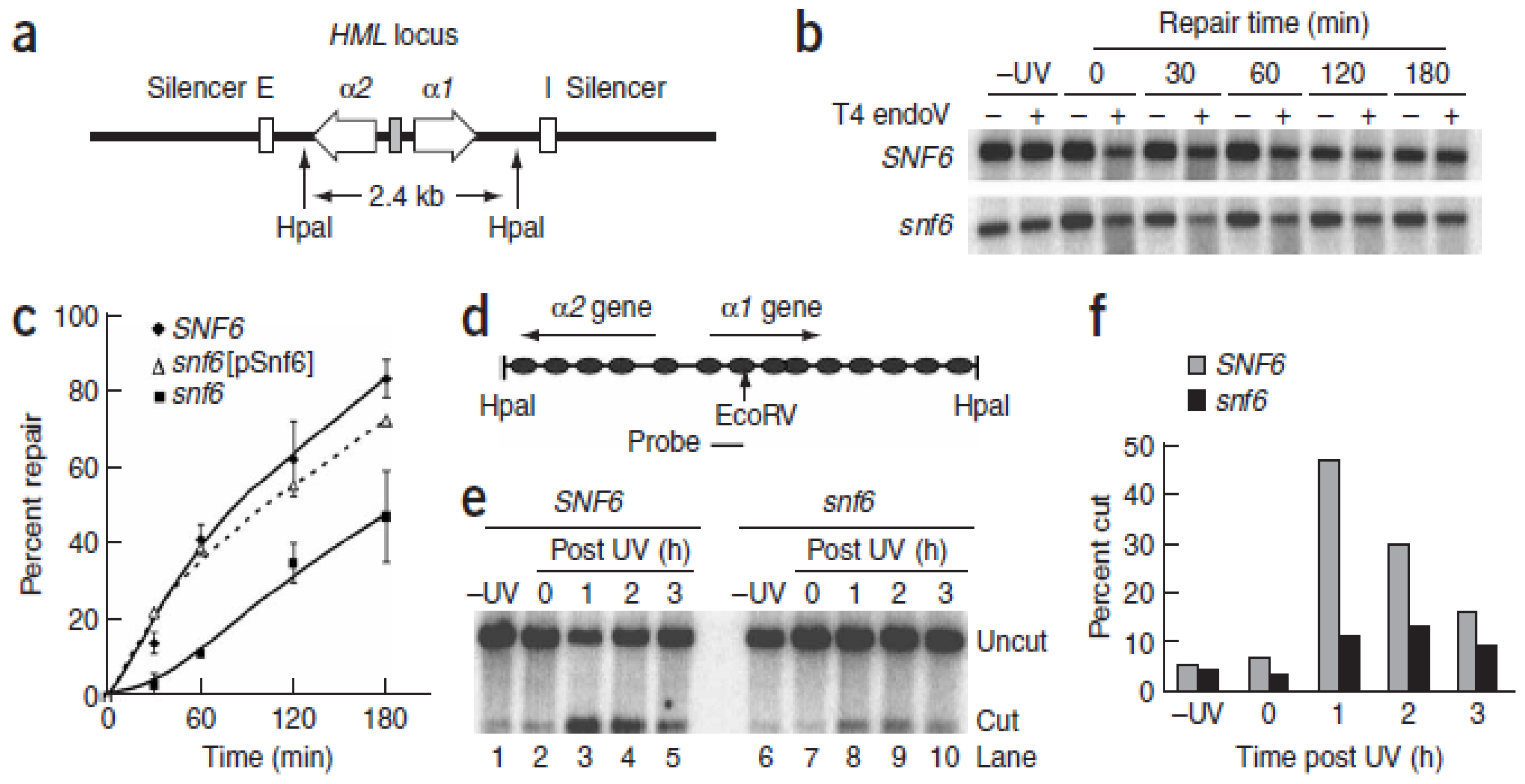
<p>Gong <italic>et al.</italic> provided direct evidence <italic>in vivo</italic> linking the SWI/SNF complex with NER in intact yeast cells [<xref ref-type="bibr" rid="b59-ijms-13-11954">59</xref>]. A major finding of this report was demonstration of direct interactions between the subunit of SWI/SNF, SNF6, and the lesion recognition heterodimer Rad23-Rad4 (the ortholog of human XPC-hHR23B). The SWI/SNF interaction with RAD23-Rad4 was enhanced in a UV-dependent manner, suggesting that the remodeler might be specifically recruited to sites of damage by NER lesion recognition proteins. Furthermore, this study demonstrated a specific role of SWI/SNF during GG-NER. That is, the SWI/SNF complex is required for efficient removal of CPDs by GG-NER at the silent (nucleosome-loaded) <italic>HML</italic> locus (<xref ref-type="fig" rid="f1-ijms-13-11954">Figure 1a–c</xref>). Additionally, it was found that chromatin accessibility at <italic>HML</italic> was significantly decreased in SWI/SNF deficient yeast cells (<xref ref-type="fig" rid="f1-ijms-13-11954">Figure 1d–f</xref>). Collectively, these data suggest that SWI/SNF contributes to UV-induced chromatin remodeling, in at least certain regions of chromatin, facilitating DNA accessibility and enhancing NER <italic>in vivo</italic>.</p>
<p>A direct role of SWI/SNF in NER has also been established in mammalian cells. Two studies by the Wani lab analyzed the function of SWI/SNF in regulation of NER in mammalian cell chromatin [<xref ref-type="bibr" rid="b73-ijms-13-11954">73</xref>,<xref ref-type="bibr" rid="b74-ijms-13-11954">74</xref>]. Ray <italic>et al.</italic> demonstrated that hSNF5, a component of human SWI/SNF complex, interacts with the UV damage recognition factor XPC-hHR23B, and accumulates at sites of damage after UV irradiation. These data are consistent with the studies in yeast cells [<xref ref-type="bibr" rid="b59-ijms-13-11954">59</xref>] and suggest a conserved mechanism of recruitment of SWI/SNF to UV lesions. Inactivation of hSNF5 did not affect recruitment of NER factors to UV damaged sites, but affected recruitment and activation of the ATM checkpoint kinase, resulting in defective H2AX and BRCA1 phosphorylation [<xref ref-type="bibr" rid="b74-ijms-13-11954">74</xref>]. Defects in recruitment of ATM and MDC1-53BP1-BRCA1 disrupt the assembly of downstream repair factors and significantly impair NER in mammalian cells [<xref ref-type="bibr" rid="b74-ijms-13-11954">74</xref>]. However, the recruitment and binding of SWI/SNF to damaged chromatin are not well understood. The absence of hSNF5 does not affect XPC recruitment and suggests that the remodeler is recruited to the site of damage by NER factors [<xref ref-type="bibr" rid="b73-ijms-13-11954">73</xref>].</p>
<p>Gong <italic>et al.</italic> first reported that a human carcinoma cell line (SW13), which is deficient in the ATPase subunit of SWI/SNF (Brg1), is very sensitive to UV radiation [<xref ref-type="bibr" rid="b75-ijms-13-11954">75</xref>]. These cells become significantly more UV resistant when Swi/Snf activity is restored by ectopic expression of Brg1. This UV sensitivity correlates well with inefficient removal of CPDs (but not 6-4PPs) and dramatic UV induced apoptosis, which is not observed in SW13 cells expressing Brg1 [<xref ref-type="bibr" rid="b75-ijms-13-11954">75</xref>]. Similarly, Zhao <italic>et al.</italic> found that Brg1 is required for efficient removal of CPDs and not 6-4PPs in normal human fibroblasts with Brg1 levels knocked down with siRNA [<xref ref-type="bibr" rid="b74-ijms-13-11954">74</xref>]. Furthermore, these authors found that Brg1 interacts with XPC and is recruited to UV-induced CPDs in a DDB2- and XPC-dependent manner. In addition, they report that bulk chromatin from human cells depleted of Brg1 exhibits decreased UV-induced chromatin relaxation, as well as impaired recruitment of downstream NER factors XPG and PCNA to UV lesions; the assembly of upstream factors DDB2 and XPC, however, remains unaffected [<xref ref-type="bibr" rid="b74-ijms-13-11954">74</xref>]. The authors also observed that Brg1-deficient cells contribute to faster degradation of XPC, which further compromised XPG recruitment and NER efficiency. They speculate that Brg1 may protect XPC from degradation by promoting modification to XPC [<xref ref-type="bibr" rid="b74-ijms-13-11954">74</xref>]. Collectively, the early studies in yeast and mammalian cells suggest that the chromatin remodeling function of SWI/SNF contributes to UV-induced chromatin remodeling, DNA damage accessibility, and assembly of repair and checkpoint proteins at damaged DNA sites associated with at least certain regions of chromatin.</p>
<p>Several studies indicate that the SWI/SNF complex might have special functions within regions of silent heterochromatin, where DNA access is significantly restricted by positioned nucleosomes and silencing proteins. Above, we discussed the requirement of SWI/SNF at the silent <italic>HML</italic> locus in yeast cells [<xref ref-type="bibr" rid="b59-ijms-13-11954">59</xref>]. Sinha <italic>et al.</italic> reported that the SWI/SNF complex disrupts yeast silent heterochromatin by ATP-dependent eviction of Sir3p from the nucleosomal substrates <italic>in vitro</italic> [<xref ref-type="bibr" rid="b57-ijms-13-11954">57</xref>]. Unexpectedly, none of the other ATP-dependent remodelers tested, (including RSC, INO80, SWR1 and Rad54) were able to displace Sir3p, suggesting that SWI/SNF might have specialized functions in regulating DNA accessibility at silent heterochromatin regions [<xref ref-type="bibr" rid="b57-ijms-13-11954">57</xref>].</p></sec>
<sec>
<title>5. ISWI Subfamily</title>
<p>The ISWI group of enzymes was originally discovered in <italic>Drosophila</italic> [<xref ref-type="bibr" rid="b76-ijms-13-11954">76</xref>]. Homologs of ISWI have been identified in plants, yeast, mice and humans. ISWI remodelers are characterized by the presence of a SANT domain in the catalytic subunit. The SANT domain has a central role in chromatin remodeling by functioning as a unique histone-tail-binding module [<xref ref-type="bibr" rid="b77-ijms-13-11954">77</xref>]. The ISWI ATPase domain interacts with nucleosomal DNA, that is ~20 bp away from the dyad [<xref ref-type="bibr" rid="b78-ijms-13-11954">78</xref>]. The <italic>C</italic>-terminal domains, including HAND, SANT and SLIDE, make contacts with the H4 histone tail and linker DNA, and mediate interactions with nucleosomal DNA and the histone core [<xref ref-type="bibr" rid="b79-ijms-13-11954">79</xref>,<xref ref-type="bibr" rid="b80-ijms-13-11954">80</xref>]. The ATPase and <italic>C</italic>-terminal domains of the enzymatic subunit are essential for ISWI chromatin remodeling. <italic>In vitro</italic> studies have demonstrated that the ISWI subfamily of remodelers uses ATP hydrolysis to promote chromatin assembly, deposit, slide and organize nucleosomes, and regulate nuclosome spacing [<xref ref-type="bibr" rid="b81-ijms-13-11954">81</xref>]. In yeast cells, the ISWI complex is abundant (~1500 molecules per cell), but not essential for cell survival [<xref ref-type="bibr" rid="b68-ijms-13-11954">68</xref>]. In higher eukaryotes, ISWI is an abundant and ubiquitously expressed protein that is essential for cell viability [<xref ref-type="bibr" rid="b82-ijms-13-11954">82</xref>,<xref ref-type="bibr" rid="b83-ijms-13-11954">83</xref>]. Furthermore, in yeast ISW1a complex is able to position nucleosomes at set distance from each other to create nucleosomal arrays with a uniform spacing of ~175 bp [<xref ref-type="bibr" rid="b84-ijms-13-11954">84</xref>]. Nucleosome directional sliding by yeast ISWI has also been demonstrated in intact cells [<xref ref-type="bibr" rid="b85-ijms-13-11954">85</xref>]. ISWI complexes play a central role in chromatin compaction by promoting the association of linker histone H1 [<xref ref-type="bibr" rid="b86-ijms-13-11954">86</xref>], and are able to both activate and repress transcription [<xref ref-type="bibr" rid="b83-ijms-13-11954">83</xref>]. Recent studies by Erdel <italic>et al.</italic> provide new insights into the target location and translocation mechanisms for ISWI remodelers [<xref ref-type="bibr" rid="b79-ijms-13-11954">79</xref>]. ISWI chromatin remodelers are very mobile in the nucleus and these authors propose that these ACRs sample nucleosomes along the DNA in transient binding reactions. These authors also demonstrated that mammalian ISWI proteins accumulate at UV-induced DNA damage sites within seconds after irradiation, suggesting that this subfamily of remodelers play a role in NER [<xref ref-type="bibr" rid="b79-ijms-13-11954">79</xref>].</p>
<p>The role of ISWI remodelers in NER has not been well established. Two independent <italic>in vitro</italic> studies linked theISW1 class of remodelers with NER in the context of chromatin [<xref ref-type="bibr" rid="b51-ijms-13-11954">51</xref>,<xref ref-type="bibr" rid="b72-ijms-13-11954">72</xref>]. The first of these studies demonstrated that the <italic>Drosophila</italic> ISWI-like complex, ACF facilitates excision of 6-4PPs from linker regions in reconstituted dinucleosomes, by purified human NER factors [<xref ref-type="bibr" rid="b51-ijms-13-11954">51</xref>]. The second study showed that yeast ISW2 was able to move a UV-damaged nucleosome to amore central position, and this repositioning affected the repair pattern [<xref ref-type="bibr" rid="b72-ijms-13-11954">72</xref>]. <italic>In vivo</italic>, the ISW1 class of remodelers have been implicated in UV induced DNA damage response of <italic>Caenorhabditis elegans</italic>. Knockdown of four proteins of ISWI complex in <italic>C. elegans</italic> larvae resulted in increased UV sensitivity, whereas mutants in other remodelers such as INO80 or CHD were similar to wild type, suggesting specific involvement of ISWI remodelers in the DNA damage response of nematodes [<xref ref-type="bibr" rid="b87-ijms-13-11954">87</xref>].</p></sec>
<sec>
<title>6. INO80 Subfamily</title>
<p>Like SWI/SNF, the INO80 chromatin remodeling complex was originally purified and characterized in yeast cells [<xref ref-type="bibr" rid="b88-ijms-13-11954">88</xref>]. The INO80 complex contains a central ATPase subunit (Ino80) and 13–16 accessory subunits (varying among different species) [<xref ref-type="bibr" rid="b64-ijms-13-11954">64</xref>]. In yeast cells, the INO80 complex is present at relatively high abundance; ~6200 molecules per cell [<xref ref-type="bibr" rid="b68-ijms-13-11954">68</xref>]. INO80 complexes regulate the genome-wide distribution of histone variant H2A.Z, as it has the ability to replace nucleosomal H2A.Z/H2B with free H2A/H2B dimers [<xref ref-type="bibr" rid="b89-ijms-13-11954">89</xref>]. <italic>In vitro</italic> studies with mononucleosomes revealed that the human INO80 complex catalyzes nucleosome sliding [<xref ref-type="bibr" rid="b90-ijms-13-11954">90</xref>]. Another study with fission yeast demonstrated that the INO80 complex mediates nucleosome eviction <italic>in vivo</italic> [<xref ref-type="bibr" rid="b91-ijms-13-11954">91</xref>]. The INO80 complex appears to have quite diverse cellular functions in the cell, as it regulates transcription, DBS repair, DNA damage checkpoint response and DNA replication [<xref ref-type="bibr" rid="b53-ijms-13-11954">53</xref>,<xref ref-type="bibr" rid="b92-ijms-13-11954">92</xref>–<xref ref-type="bibr" rid="b94-ijms-13-11954">94</xref>].</p>
<p>The functional connection between INO80-dependent chromatin remodeling and NER has been demonstrated in yeast and mammalian cells [<xref ref-type="bibr" rid="b60-ijms-13-11954">60</xref>,<xref ref-type="bibr" rid="b95-ijms-13-11954">95</xref>]. In yeast, it was shown that the Ino80 ATPase has direct UV- inducible interactions with the Rad4-Rad23 heterodimer, and is recruited to damaged DNA in a Rad4-dependent manner [<xref ref-type="bibr" rid="b60-ijms-13-11954">60</xref>]. However, loss of INO80 did not affect the genome-wide removal of CPDs or 6-4PPs [<xref ref-type="bibr" rid="b60-ijms-13-11954">60</xref>,<xref ref-type="bibr" rid="b96-ijms-13-11954">96</xref>].</p>
<p>INO80 has been shown to facilitate repair of CPDs at the nucleosome loaded, transcriptionally silent <italic>HML</italic> locus [<xref ref-type="bibr" rid="b60-ijms-13-11954">60</xref>]. Though NER is associated with significant changes in chromatin structure, it is not well understood if these changes are the result of nucleosome sliding, eviction or other nucleosome rearrangements. Immediately after UV irradiation histone H3 loss is observed at the <italic>HML</italic> locus, and after DNA repair the histone occupancy is gradually restored [<xref ref-type="bibr" rid="b60-ijms-13-11954">60</xref>]. Intriguingly, INO80 has been observed to contribute to restoration of nucleosome occupancy at <italic>HML</italic>, which provides a direct mechanistic link between remodeling action and chromatin rearrangements during/after NER [<xref ref-type="bibr" rid="b60-ijms-13-11954">60</xref>]. Studies in mammalian cells have demonstrated that INO80 is important for damage binding and subsequent assembly of NER factors [<xref ref-type="bibr" rid="b95-ijms-13-11954">95</xref>]. The INO80 complex forms UV-dependent interactions with DDB1/DDB2, but not with XPC, XPA or XPD, and mammalian INO80 facilitates removal of both CPDs and 6-4PP genome-wide. Importantly, loss of INO80 in mammalian cells has no significant impact on the transcriptional expression of the NER factors [<xref ref-type="bibr" rid="b95-ijms-13-11954">95</xref>]. Collectively, these studies reveal that the INO80 complex is involved in various aspects of NER in chromatin.</p></sec>
<sec>
<title>7. CSB (Cockayne Syndrome Group B)</title>
<p>Human CSB protein (yeast ortholog, Rad26) belongs to the ERCC6 subfamily of SNF2ATP-dependent chromatin remodelers and displays a DNA-stimulated ATPase activity [<xref ref-type="bibr" rid="b97-ijms-13-11954">97</xref>,<xref ref-type="bibr" rid="b98-ijms-13-11954">98</xref>]. Unlike other SNF2 remodelers, CSB does not assemble into multisubunit complexes. Mutations in CSB lead to Cockayne syndrome, a disorder associated with sun hypersensitivity, neurodevelopmental abnormalities, premature aging and death [<xref ref-type="bibr" rid="b99-ijms-13-11954">99</xref>]. Human CSB and yeast Rad26p are essential proteins for transcription-coupled repair at actively transcribed genes, however very little is known how these ATPases contribute to efficient TC-NER [<xref ref-type="bibr" rid="b47-ijms-13-11954">47</xref>,<xref ref-type="bibr" rid="b100-ijms-13-11954">100</xref>]. In TC-NER, the transcription elongation complex stalls at the site of a DNA lesion and RNAP II is displaced to facilitate assembly of NER repair factors [<xref ref-type="bibr" rid="b47-ijms-13-11954">47</xref>]. Several studies demonstrated that CSB interacts with RNAP II [<xref ref-type="bibr" rid="b98-ijms-13-11954">98</xref>,<xref ref-type="bibr" rid="b101-ijms-13-11954">101</xref>]. <italic>In vitro</italic> studies by Citterio <italic>et al.</italic> demonstrated that purified CSB is able to bind naked DNA and change the DNA topology by inducing negative supercoiling [<xref ref-type="bibr" rid="b102-ijms-13-11954">102</xref>]. This study also revealed that CSB protein is able to remodel nucleosome core particles making them more accessible to nucleases and reposition nucleosomes on plasmid DNA in a similar fashion to hSWI/SNF [<xref ref-type="bibr" rid="b102-ijms-13-11954">102</xref>]. Interestingly, unlike human or yeast SWI/SNF complexes, interactions of CSB with histone tails are important for the remodeling activity [<xref ref-type="bibr" rid="b102-ijms-13-11954">102</xref>]. The chromatin remodeling activity of CSB suggest potential involvement of CSB in chromatin rearrangements at repair sites to facilitate displacement of the stalled RNAPII complex to facilitate accessibility of NER enzymes to DNA damage [<xref ref-type="bibr" rid="b102-ijms-13-11954">102</xref>]. Moreover, ATP hydrolysis by CSB is required for stable CSB-chromatin association following UV irradiation [<xref ref-type="bibr" rid="b103-ijms-13-11954">103</xref>]. Collectively, ATP-dependent remodeling activity of CSB protein is important for multiple aspects of TC-NER, including lesion recognition and assembly of the repair complex.</p></sec>
<sec>
<title>8. Crosstalk between ACR and Histone Modifications</title>
<p>In addition to ATP-dependent chromatin remodeling, posttranslational modifications of histones are another important mechanism that can modulate the chromatin landscape. Histones have been found to be acetylated, methylated, phosphorylated, ubiquitinated, sumoylated, and ribosylated, with different modifications playing different roles in cellular processes [<xref ref-type="bibr" rid="b104-ijms-13-11954">104</xref>]. Recent studies have demonstrated that some histone modifications may directly alter nucleosome, or chromatin, stability and assembly. For example, attachment of the relatively bulky ubiquitin moiety to H2B lysine123 has been shown to stabilize chromatin via preventing the constant eviction of H2A-H2B dimer from nucleosomes in yeast [<xref ref-type="bibr" rid="b105-ijms-13-11954">105</xref>]. The stabilizing effect of H2B ubiquitination is also important for nucleosome (re)assembly across the genome [<xref ref-type="bibr" rid="b106-ijms-13-11954">106</xref>]. Another modification, H4K16 acetylation, which occurs on the <italic>N</italic>-terminal tail of histone H4, has been shown to directly inhibit the compaction of nucleosome arrays [<xref ref-type="bibr" rid="b107-ijms-13-11954">107</xref>]. Some histone modifications may not alter chromatin structure directly, but rather act as marks to recruit effector proteins. Indeed, many protein domains can recognize modified histone residues [<xref ref-type="bibr" rid="b108-ijms-13-11954">108</xref>]. These domains include the bromodomains that specifically recognize acetylated lysine residues [<xref ref-type="bibr" rid="b109-ijms-13-11954">109</xref>], chromodomains and plant homeodomain (PHD) fingers that recognize methylated lysine residues [<xref ref-type="bibr" rid="b108-ijms-13-11954">108</xref>]. When such domains are present in chromatin remodeling complexes, crosstalk between histone modifications and chromatin remodeling can occur. Previous studies have shown that the crosstalk between histone modifications and chromatin remodeling plays important roles during transcription regulation. For instance, Hassan <italic>et al.</italic> used a purified system to demonstrate that SWI/SNF binding to an unmodified promoter nucleosome array is unstable and its retention requires the presence of a transcription activator [<xref ref-type="bibr" rid="b110-ijms-13-11954">110</xref>]. However, when nucleosomes are acetylated by the SAGA or NuA4 histone acetyltransferase (HAT) complexes, the stability of SWI/SNF binding is increased and the binding is maintained after disassociation of the transcription activator. In addition, these authors found that the bromodomain in the Snf2 subunit of SWI/SNF is responsible for recognizing histone acetylation, and SWI/SNF lacking this domain cannot be retained on acetylated nucleosome arrays when the transcription activator is removed [<xref ref-type="bibr" rid="b111-ijms-13-11954">111</xref>].</p>
<p>Nag <italic>et al.</italic> found that the highly modified <italic>N</italic>-terminal tail of H2B might be involved in binding of the SWI/SNF complex during NER, implicating a role for histone posttranslational modification on H2B in potential recruitment and binding of the ACR enzyme [<xref ref-type="bibr" rid="b112-ijms-13-11954">112</xref>]. Moreover, the Rsc4 subunit of the RSC remodeler contains tandem bromodomains which specifically recognize acetylated H3 at lysine 14 <italic>in vitro</italic> [<xref ref-type="bibr" rid="b113-ijms-13-11954">113</xref>]. Mutation of <italic>Rsc4</italic> together with <italic>Gcn5</italic>, which encodes the HAT for H3K14, leads to cell lethality [<xref ref-type="bibr" rid="b113-ijms-13-11954">113</xref>]. Interestingly, H3K9 and K14 are hyperacetylated following UV irradiation, and Gcn5 is important for UV-induced H3 acetylation at K9 and K14 and NER in the <italic>MFA2</italic> gene locus [<xref ref-type="bibr" rid="b114-ijms-13-11954">114</xref>]. H3 acetylation stimulated by UV does not directly affect chromatin accessibility [<xref ref-type="bibr" rid="b114-ijms-13-11954">114</xref>], but more likely acts as a signal to recruit chromatin remodeler(s) such as RSC or SWI/SNF. On the other hand, UV-induced H3 acetylation is dependent on Rad16 [<xref ref-type="bibr" rid="b115-ijms-13-11954">115</xref>], a GG-NER factor. Intriguingly, Rad16 is very homologous to Snf2 [<xref ref-type="bibr" rid="b116-ijms-13-11954">116</xref>], the ATPase catalytic subunit of SWI/SNF. Furthermore, biochemical studies have shown that Rad16 can generate superhelical torsion in DNA [<xref ref-type="bibr" rid="b117-ijms-13-11954">117</xref>], a common function among SWI/SNF-like proteins. The Rad16-mediated H3 acetylation suggests that chromatin remodeling may play important roles in establishing histone acetylation following UV irradiation.</p>
<p>In addition to NER, several recent studies have highlighted the crosstalk between histone modifications and chromatin remodelers in the repair of double strand breaks (DSBs). For instance, mammalian SWI/SNF has been shown to bind to nucleosomes containing phosphorylated H2AX (γ-H2AX) in response to ionizing irradiation (IR), and the binding is dependent on the phosphorylation site [<xref ref-type="bibr" rid="b118-ijms-13-11954">118</xref>]. Surprisingly, SWI/SNF does not contain protein domains that recognize phosphorylated amino acid residues. It turns out that γ-H2AX is essential for the IR-induced H3 acetylation in nucleosomes bearing γ-H2AX and acetylated histones act as a signal to recruit BRG1 of SWI/SNF via its bromodomain [<xref ref-type="bibr" rid="b118-ijms-13-11954">118</xref>]. Furthermore, the binding of the INO80 complex to DSB sites is dependent on its recognition of the damage-induced γ-H2AX, and mutation of either the kinases that phosphorylate H2AX or the phosphorylation residue on H2AX significantly reduces the recruitment of INO80 to DSBs [<xref ref-type="bibr" rid="b58-ijms-13-11954">58</xref>,<xref ref-type="bibr" rid="b119-ijms-13-11954">119</xref>]. These studies have clearly shown the essential roles of γ-H2AX in recruiting chromatin remodeling complexes to facilitate repair of DSBs.</p></sec>
<sec>
<title>9. Concluding Remarks and Perspectives</title>
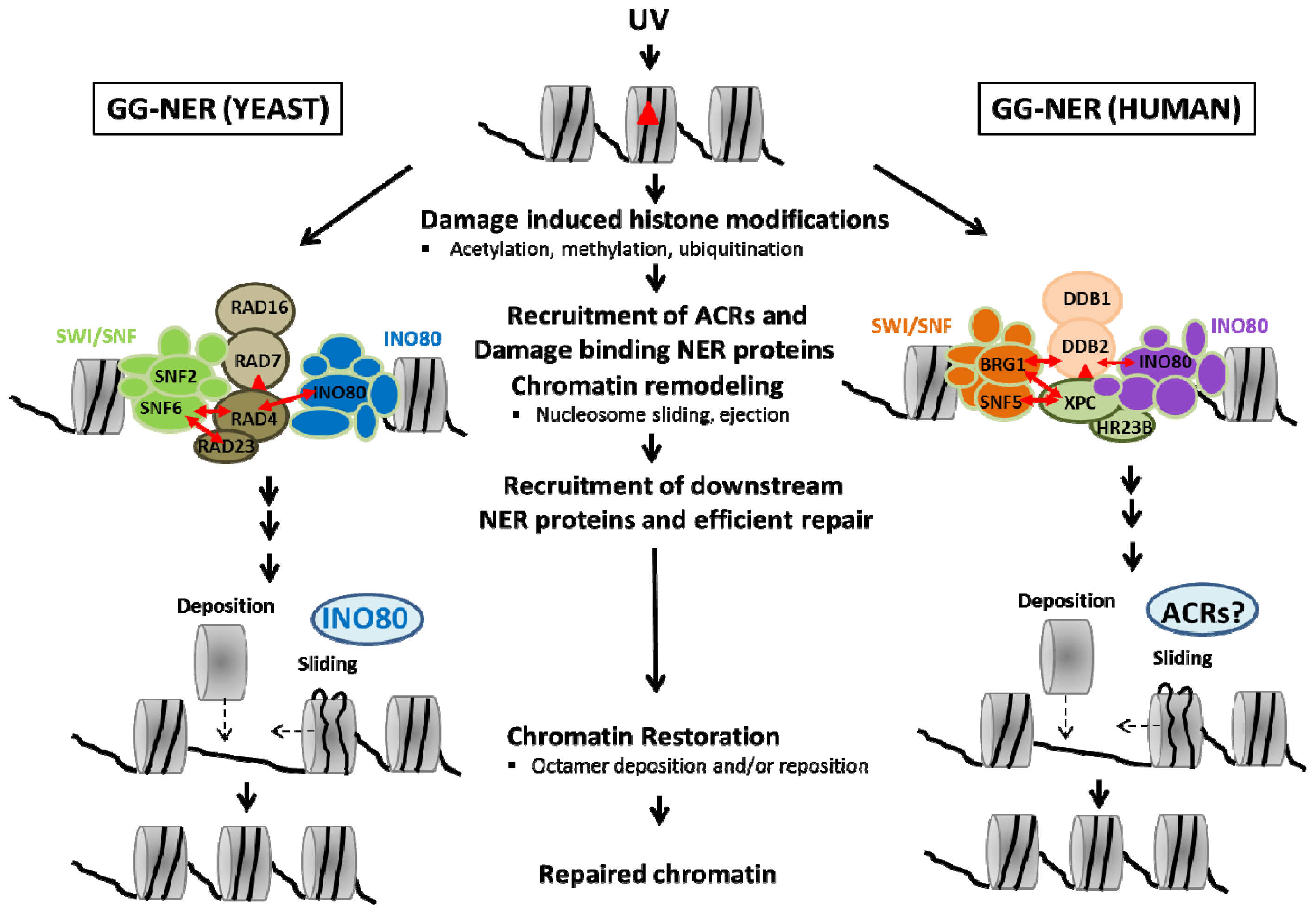
<p>Evolutionarily conserved ATP-dependent chromatin remodeling complexes have emerged as master regulators of DNA repair pathways in chromatin. ACRs facilitate GG-NER in chromatin in both yeast and human systems. ACRs remodel damaged chromatin, facilitate accessibility of damaged DNA, help recruitment and sequential assembly of NER proteins and contribute to restoration of chromatin structure. Recent studies have provided significant results directly linking ACRs with chromatin remodeling during NER (<xref ref-type="fig" rid="f2-ijms-13-11954">Figure 2</xref>, <xref ref-type="table" rid="t1-ijms-13-11954">Table 1</xref>). Further studies are necessary to delineate more of the mechanistic details that integrate changes in chromatin structure and dynamics with efficient DNA repair.</p></sec></body>
<back>
<ack>
<title>Acknowledgments</title>
<p>We thank John Hinz and Rithy Meas for critically evaluating this manuscript. This work was made possible by NIH grants ES002614 and ES004106 from the National Institute of Environmental Health Sciences (NIEHS). The contents are solely the responsibility of the authors and do not necessarily represent the official views of the NIEHS, NIH.</p></ack>
<glossary>
<title>Abbreviations</title>
<def-list>
<def-item>
<term id="G1">ACR</term>
<def>
<p>ATP-dependent chromatin remodeler</p></def></def-item>
<def-item>
<term id="G2">ATP</term>
<def>
<p>Adenosine-5′-triphosphate</p></def></def-item>
<def-item>
<term id="G3">BRG1</term>
<def>
<p>Brm-related gene 1</p></def></def-item>
<def-item>
<term id="G4">BRM</term>
<def>
<p>Brahma protein</p></def></def-item>
<def-item>
<term id="G5">CHD</term>
<def>
<p>Chromodomain, Helicase, DNA binding</p></def></def-item>
<def-item>
<term id="G6">CPD</term>
<def>
<p>Cyclobutane pyrimidine dimer</p></def></def-item>
<def-item>
<term id="G7">DEAD/H</term>
<def>
<p>Asp-Glu-Ala-Asp/His helicases</p></def></def-item>
<def-item>
<term id="G8">ERCC1</term>
<def>
<p>Excision Repair Cross Complementing</p></def></def-item>
<def-item>
<term id="G9">GG-NER</term>
<def>
<p>Global Genome Nucleotide Excision Repair</p></def></def-item>
<def-item>
<term id="G10">HML</term>
<def>
<p>Hidden Mat Left</p></def></def-item>
<def-item>
<term id="G11">ISWI</term>
<def>
<p>Imitation Switch</p></def></def-item>
<def-item>
<term id="G12">INO80</term>
<def>
<p>Inositol Requiring 80</p></def></def-item>
<def-item>
<term id="G13">NER</term>
<def>
<p>Nucleotide Excision Repair</p></def></def-item>
<def-item>
<term id="G14">PHD</term>
<def>
<p>Plant Homeo Domain</p></def></def-item>
<def-item>
<term id="G15">RSC</term>
<def>
<p>Remodel the Structure of Chromatin</p></def></def-item>
<def-item>
<term id="G16">SANT</term>
<def>
<p>DNA binding domain in SWI3, ADA2, N-CoR and TFIIIB</p></def></def-item>
<def-item>
<term id="G17">SLIDE</term>
<def>
<p>SANT like ISWI</p></def></def-item>
<def-item>
<term id="G18">SNF2</term>
<def>
<p>Sucrose Non-Fermenting</p></def></def-item>
<def-item>
<term id="G19">SWI/SNF</term>
<def>
<p>Switching defective/Sucrose nonfermenting</p></def></def-item>
<def-item>
<term id="G20">TC-NER</term>
<def>
<p>Transcription Coupled Nucleotide Excision Repair</p></def></def-item>
<def-item>
<term id="G21">XPC</term>
<def>
<p>Xeroderma Pigmentosum Group C</p></def></def-item>
<def-item>
<term id="G22">XPF</term>
<def>
<p>Xeroderma Pigmentosum Group F</p></def></def-item>
<def-item>
<term id="G23">XPG</term>
<def>
<p>Xeroderma Pigmentosum Group G</p></def></def-item></def-list></glossary>
<ref-list>
<title>References</title>
<ref id="b1-ijms-13-11954"><label>1</label><citation citation-type="journal"><person-group person-group-type="author"><name><surname>Tan</surname><given-names>S.</given-names></name><name><surname>Davey</surname><given-names>C.A.</given-names></name></person-group><article-title>Nucleosome structural studies</article-title><source>Curr. Opin. Struct. Biol</source><year>2011</year><volume>21</volume><fpage>128</fpage><lpage>136</lpage><pub-id pub-id-type="doi">10.1016/j.sbi.2010.11.006</pub-id><pub-id pub-id-type="pmid">21176878</pub-id></citation></ref>
<ref id="b2-ijms-13-11954"><label>2</label><citation citation-type="journal"><person-group person-group-type="author"><name><surname>Fudenberg</surname><given-names>G.</given-names></name><name><surname>Mirny</surname><given-names>L.A.</given-names></name></person-group><article-title>Higher-order chromatin structure: Bridging physics and biology</article-title><source>Curr. Opin. Genet. Dev</source><year>2012</year><volume>22</volume><fpage>115</fpage><lpage>124</lpage><pub-id pub-id-type="doi">10.1016/j.gde.2012.01.006</pub-id><pub-id pub-id-type="pmid">22360992</pub-id></citation></ref>
<ref id="b3-ijms-13-11954"><label>3</label><citation citation-type="journal"><person-group person-group-type="author"><name><surname>Schlick</surname><given-names>T.</given-names></name><name><surname>Hayes</surname><given-names>J.</given-names></name><name><surname>Grigoryev</surname><given-names>S.</given-names></name></person-group><article-title>Toward convergence of experimental studies and theoretical modeling of the chromatin fiber</article-title><source>J. Biol. Chem</source><year>2012</year><volume>287</volume><fpage>5183</fpage><lpage>5191</lpage><pub-id pub-id-type="doi">10.1074/jbc.R111.305763</pub-id><pub-id pub-id-type="pmid">22157002</pub-id></citation></ref>
<ref id="b4-ijms-13-11954"><label>4</label><citation citation-type="journal"><person-group person-group-type="author"><name><surname>Gkikopoulos</surname><given-names>T.</given-names></name><name><surname>Schofield</surname><given-names>P.</given-names></name><name><surname>Singh</surname><given-names>V.</given-names></name><name><surname>Pinskaya</surname><given-names>M.</given-names></name><name><surname>Mellor</surname><given-names>J.</given-names></name><name><surname>Smolle</surname><given-names>M.</given-names></name><name><surname>Workman</surname><given-names>J.L.</given-names></name><name><surname>Barton</surname><given-names>G.J.</given-names></name><name><surname>Owen-Hughes</surname><given-names>T.</given-names></name></person-group><article-title>A role for Snf2-related nucleosome-spacing enzymes in genome-wide nucleosome organization</article-title><source>Science</source><year>2011</year><volume>333</volume><fpage>1758</fpage><lpage>1760</lpage><pub-id pub-id-type="doi">10.1126/science.1206097</pub-id><pub-id pub-id-type="pmid">21940898</pub-id></citation></ref>
<ref id="b5-ijms-13-11954"><label>5</label><citation citation-type="journal"><person-group person-group-type="author"><name><surname>Lee</surname><given-names>W.</given-names></name><name><surname>Tillo</surname><given-names>D.</given-names></name><name><surname>Bray</surname><given-names>N.</given-names></name><name><surname>Morse</surname><given-names>R.H.</given-names></name><name><surname>Davis</surname><given-names>R.W.</given-names></name><name><surname>Hughes</surname><given-names>T.R.</given-names></name><name><surname>Nislow</surname><given-names>C.</given-names></name></person-group><article-title>A high-resolution atlas of nucleosome occupancy in yeast</article-title><source>Nat. Genet</source><year>2007</year><volume>39</volume><fpage>1235</fpage><lpage>1244</lpage><pub-id pub-id-type="doi">10.1038/ng2117</pub-id><pub-id pub-id-type="pmid">17873876</pub-id></citation></ref>
<ref id="b6-ijms-13-11954"><label>6</label><citation citation-type="journal"><person-group person-group-type="author"><name><surname>Richmond</surname><given-names>T.J.</given-names></name><name><surname>Davey</surname><given-names>C.A.</given-names></name></person-group><article-title>The structure of DNA in the nucleosome core</article-title><source>Nature</source><year>2003</year><volume>423</volume><fpage>145</fpage><lpage>150</lpage><pub-id pub-id-type="doi">10.1038/nature01595</pub-id><pub-id pub-id-type="pmid">12736678</pub-id></citation></ref>
<ref id="b7-ijms-13-11954"><label>7</label><citation citation-type="journal"><person-group person-group-type="author"><name><surname>Tamaru</surname><given-names>H.</given-names></name></person-group><article-title>Confining euchromatin/heterochromatin territory: Jumonji crosses the line</article-title><source>Genes Dev</source><year>2010</year><volume>24</volume><fpage>1465</fpage><lpage>1478</lpage><pub-id pub-id-type="doi">10.1101/gad.1941010</pub-id><pub-id pub-id-type="pmid">20634313</pub-id></citation></ref>
<ref id="b8-ijms-13-11954"><label>8</label><citation citation-type="journal"><person-group person-group-type="author"><name><surname>Lusser</surname><given-names>A.</given-names></name><name><surname>Kadonaga</surname><given-names>J.T.</given-names></name></person-group><article-title>Chromatin remodeling by ATP-dependent molecular machines</article-title><source>Bioessays</source><year>2003</year><volume>25</volume><fpage>1192</fpage><lpage>1200</lpage><pub-id pub-id-type="doi">10.1002/bies.10359</pub-id><pub-id pub-id-type="pmid">14635254</pub-id></citation></ref>
<ref id="b9-ijms-13-11954"><label>9</label><citation citation-type="journal"><person-group person-group-type="author"><name><surname>Hopfner</surname><given-names>K.P.</given-names></name><name><surname>Gerhold</surname><given-names>C.B.</given-names></name><name><surname>Lakomek</surname><given-names>K.</given-names></name><name><surname>Wollmann</surname><given-names>P.</given-names></name></person-group><article-title>Swi2/Snf2 remodelers: Hybrid views on hybrid molecular machines</article-title><source>Curr. Opin. Struct. Biol</source><year>2012</year><volume>22</volume><fpage>225</fpage><lpage>233</lpage><pub-id pub-id-type="doi">10.1016/j.sbi.2012.02.007</pub-id><pub-id pub-id-type="pmid">22445226</pub-id></citation></ref>
<ref id="b10-ijms-13-11954"><label>10</label><citation citation-type="journal"><person-group person-group-type="author"><name><surname>Racki</surname><given-names>L.R.</given-names></name><name><surname>Narlikar</surname><given-names>G.J.</given-names></name></person-group><article-title>ATP-dependent chromatin remodeling enzymes: Two heads are not better, just different</article-title><source>Curr. Opin. Genet. Dev</source><year>2008</year><volume>18</volume><fpage>137</fpage><lpage>144</lpage><pub-id pub-id-type="doi">10.1016/j.gde.2008.01.007</pub-id><pub-id pub-id-type="pmid">18339542</pub-id></citation></ref>
<ref id="b11-ijms-13-11954"><label>11</label><citation citation-type="journal"><person-group person-group-type="author"><name><surname>Buchler</surname><given-names>N.E.</given-names></name><name><surname>Bai</surname><given-names>L.</given-names></name></person-group><article-title>Chromatin: Bind at your own RSC</article-title><source>Curr. Biol</source><year>2011</year><volume>21</volume><fpage>R223</fpage><lpage>R225</lpage><pub-id pub-id-type="doi">10.1016/j.cub.2011.01.060</pub-id><pub-id pub-id-type="pmid">21419988</pub-id></citation></ref>
<ref id="b12-ijms-13-11954"><label>12</label><citation citation-type="journal"><person-group person-group-type="author"><name><surname>Wang</surname><given-names>X.</given-names></name><name><surname>Bai</surname><given-names>L.</given-names></name><name><surname>Bryant</surname><given-names>G.O.</given-names></name><name><surname>Ptashne</surname><given-names>M.</given-names></name></person-group><article-title>Nucleosomes and the accessibility problem</article-title><source>Trends Genet</source><year>2011</year><volume>27</volume><fpage>487</fpage><lpage>492</lpage><pub-id pub-id-type="doi">10.1016/j.tig.2011.09.001</pub-id><pub-id pub-id-type="pmid">22019336</pub-id></citation></ref>
<ref id="b13-ijms-13-11954"><label>13</label><citation citation-type="journal"><person-group person-group-type="author"><name><surname>Wang</surname><given-names>G.G.</given-names></name><name><surname>Allis</surname><given-names>C.D.</given-names></name><name><surname>Chi</surname><given-names>P.</given-names></name></person-group><article-title>Chromatin remodeling and cancer, Part II: ATP-dependent chromatin remodeling</article-title><source>Trends Mol. Med</source><year>2007</year><volume>13</volume><fpage>373</fpage><lpage>380</lpage><pub-id pub-id-type="doi">10.1016/j.molmed.2007.07.004</pub-id><pub-id pub-id-type="pmid">17822959</pub-id></citation></ref>
<ref id="b14-ijms-13-11954"><label>14</label><citation citation-type="journal"><person-group person-group-type="author"><name><surname>Wilson</surname><given-names>B.G.</given-names></name><name><surname>Roberts</surname><given-names>C.W.</given-names></name></person-group><article-title>SWI/SNF nucleosome remodellers and cancer</article-title><source>Nat. Rev. Cancer</source><year>2011</year><volume>11</volume><fpage>481</fpage><lpage>492</lpage><pub-id pub-id-type="doi">10.1038/nrc3068</pub-id><pub-id pub-id-type="pmid">21654818</pub-id></citation></ref>
<ref id="b15-ijms-13-11954"><label>15</label><citation citation-type="journal"><person-group person-group-type="author"><name><surname>Jones</surname><given-names>K.L.</given-names></name><name><surname>Zhang</surname><given-names>L.</given-names></name><name><surname>Seldeen</surname><given-names>K.L.</given-names></name><name><surname>Gong</surname><given-names>F.</given-names></name></person-group><article-title>Detection of bulky DNA lesions: DDB2 at the interface of chromatin and DNA repair in eukaryotes</article-title><source>IUBMB Life</source><year>2010</year><volume>62</volume><fpage>803</fpage><lpage>811</lpage><pub-id pub-id-type="doi">10.1002/iub.391</pub-id><pub-id pub-id-type="pmid">21117171</pub-id></citation></ref>
<ref id="b16-ijms-13-11954"><label>16</label><citation citation-type="journal"><person-group person-group-type="author"><name><surname>Lans</surname><given-names>H.</given-names></name><name><surname>Marteijn</surname><given-names>J.A.</given-names></name><name><surname>Vermeulen</surname><given-names>W.</given-names></name></person-group><article-title>ATP-dependent chromatin remodeling in the DNA-damage response</article-title><source>Epigenet. Chromatin</source><year>2012</year><volume>5</volume><fpage>4</fpage><pub-id pub-id-type="doi">10.1186/1756-8935-5-4</pub-id></citation></ref>
<ref id="b17-ijms-13-11954"><label>17</label><citation citation-type="journal"><person-group person-group-type="author"><name><surname>Palomera-Sanchez</surname><given-names>Z.</given-names></name><name><surname>Zurita</surname><given-names>M.</given-names></name></person-group><article-title>Open, repair and close again: Chromatin dynamics and the response to UV-induced DNA damage</article-title><source>DNA Repair</source><year>2011</year><volume>10</volume><fpage>119</fpage><lpage>125</lpage><pub-id pub-id-type="doi">10.1016/j.dnarep.2010.10.010</pub-id><pub-id pub-id-type="pmid">21130713</pub-id></citation></ref>
<ref id="b18-ijms-13-11954"><label>18</label><citation citation-type="journal"><person-group person-group-type="author"><name><surname>Waters</surname><given-names>R.</given-names></name><name><surname>Teng</surname><given-names>Y.</given-names></name><name><surname>Yu</surname><given-names>Y.</given-names></name><name><surname>Yu</surname><given-names>S.</given-names></name><name><surname>Reed</surname><given-names>S.H.</given-names></name></person-group><article-title>Tilting at windmills? The nucleotide excision repair of chromosomal DNA</article-title><source>DNA Repair</source><year>2009</year><volume>8</volume><fpage>146</fpage><lpage>152</lpage><pub-id pub-id-type="doi">10.1016/j.dnarep.2008.11.001</pub-id><pub-id pub-id-type="pmid">19041427</pub-id></citation></ref>
<ref id="b19-ijms-13-11954"><label>19</label><citation citation-type="journal"><person-group person-group-type="author"><name><surname>Yu</surname><given-names>S.</given-names></name><name><surname>Teng</surname><given-names>Y.</given-names></name><name><surname>Waters</surname><given-names>R.</given-names></name><name><surname>Reed</surname><given-names>S.H.</given-names></name></person-group><article-title>How chromatin is remodelled during DNA repair of UV-induced DNA damage in <italic>Saccharomyces cerevisiae</italic></article-title><source>PLoS Genet</source><year>2011</year><volume>7</volume><fpage>e1002124</fpage><pub-id pub-id-type="doi">10.1371/journal.pgen.1002124</pub-id><pub-id pub-id-type="pmid">21698136</pub-id></citation></ref>
<ref id="b20-ijms-13-11954"><label>20</label><citation citation-type="journal"><person-group person-group-type="author"><name><surname>Zhang</surname><given-names>L.</given-names></name><name><surname>Jones</surname><given-names>K.</given-names></name><name><surname>Gong</surname><given-names>F.</given-names></name></person-group><article-title>The molecular basis of chromatin dynamics during nucleotide excision repair</article-title><source>Biochem. Cell Biol</source><year>2009</year><volume>87</volume><fpage>265</fpage><lpage>272</lpage><pub-id pub-id-type="doi">10.1139/O08-101</pub-id><pub-id pub-id-type="pmid">19234540</pub-id></citation></ref>
<ref id="b21-ijms-13-11954"><label>21</label><citation citation-type="journal"><person-group person-group-type="author"><name><surname>Smerdon</surname><given-names>M.J.</given-names></name><name><surname>Conconi</surname><given-names>A.</given-names></name></person-group><article-title>Modulation of DNA damage and DNA repair in chromatin</article-title><source>Prog. Nucleic Acid Res. Mol. Biol</source><year>1999</year><volume>62</volume><fpage>227</fpage><lpage>255</lpage><pub-id pub-id-type="pmid">9932456</pub-id></citation></ref>
<ref id="b22-ijms-13-11954"><label>22</label><citation citation-type="journal"><person-group person-group-type="author"><name><surname>Smerdon</surname><given-names>M.J.</given-names></name><name><surname>Lieberman</surname><given-names>M.W.</given-names></name></person-group><article-title>Nucleosome rearrangement in human chromatin during UV-induced DNA- reapir synthesis</article-title><source>Proc. Natl. Acad. Sci. USA</source><year>1978</year><volume>75</volume><fpage>4238</fpage><lpage>4241</lpage><pub-id pub-id-type="doi">10.1073/pnas.75.9.4238</pub-id><pub-id pub-id-type="pmid">279912</pub-id></citation></ref>
<ref id="b23-ijms-13-11954"><label>23</label><citation citation-type="journal"><person-group person-group-type="author"><name><surname>Misteli</surname><given-names>T.</given-names></name><name><surname>Soutoglou</surname><given-names>E.</given-names></name></person-group><article-title>The emerging role of nuclear architecture in DNA repair and genome maintenance</article-title><source>Nat. Rev. Mol. Cell Biol</source><year>2009</year><volume>10</volume><fpage>243</fpage><lpage>254</lpage><pub-id pub-id-type="doi">10.1038/nrm2651</pub-id><pub-id pub-id-type="pmid">19277046</pub-id></citation></ref>
<ref id="b24-ijms-13-11954"><label>24</label><citation citation-type="journal"><person-group person-group-type="author"><name><surname>Hanawalt</surname><given-names>P.C.</given-names></name></person-group><article-title>Genomic instability: Environmental invasion and the enemies within</article-title><source>Mutat. Res</source><year>1998</year><volume>400</volume><fpage>117</fpage><lpage>125</lpage><pub-id pub-id-type="doi">10.1016/S0027-5107(98)00084-0</pub-id><pub-id pub-id-type="pmid">9685605</pub-id></citation></ref>
<ref id="b25-ijms-13-11954"><label>25</label><citation citation-type="journal"><person-group person-group-type="author"><name><surname>Hoeijmakers</surname><given-names>J.H.</given-names></name></person-group><article-title>Genome maintenance mechanisms for preventing cancer</article-title><source>Nature</source><year>2001</year><volume>411</volume><fpage>366</fpage><lpage>374</lpage><pub-id pub-id-type="doi">10.1038/35077232</pub-id><pub-id pub-id-type="pmid">11357144</pub-id></citation></ref>
<ref id="b26-ijms-13-11954"><label>26</label><citation citation-type="journal"><person-group person-group-type="author"><name><surname>Cadet</surname><given-names>J.</given-names></name><name><surname>Sage</surname><given-names>E.</given-names></name><name><surname>Douki</surname><given-names>T.</given-names></name></person-group><article-title>Ultraviolet radiation-mediated damage to cellular DNA</article-title><source>Mutat. Res</source><year>2005</year><volume>571</volume><fpage>3</fpage><lpage>17</lpage><pub-id pub-id-type="doi">10.1016/j.mrfmmm.2004.09.012</pub-id><pub-id pub-id-type="pmid">15748634</pub-id></citation></ref>
<ref id="b27-ijms-13-11954"><label>27</label><citation citation-type="journal"><person-group person-group-type="author"><name><surname>Park</surname><given-names>H.</given-names></name><name><surname>Zhang</surname><given-names>K.</given-names></name><name><surname>Ren</surname><given-names>Y.</given-names></name><name><surname>Nadji</surname><given-names>S.</given-names></name><name><surname>Sinha</surname><given-names>N.</given-names></name><name><surname>Taylor</surname><given-names>J.S.</given-names></name><name><surname>Kang</surname><given-names>C.</given-names></name></person-group><article-title>Crystal structure of a DNA decamer containing a <italic>cis</italic>-syn thymine dimer</article-title><source>Proc. Natl. Acad. Sci. USA</source><year>2002</year><volume>99</volume><fpage>15965</fpage><lpage>15970</lpage><pub-id pub-id-type="doi">10.1073/pnas.242422699</pub-id><pub-id pub-id-type="pmid">12456887</pub-id></citation></ref>
<ref id="b28-ijms-13-11954"><label>28</label><citation citation-type="journal"><person-group person-group-type="author"><name><surname>Friedberg</surname><given-names>E.C.</given-names></name></person-group><article-title>How nucleotide excision repair protects against cancer</article-title><source>Nat. Rev. Cancer</source><year>2001</year><volume>1</volume><fpage>22</fpage><lpage>33</lpage><pub-id pub-id-type="doi">10.1038/35094000</pub-id><pub-id pub-id-type="pmid">11900249</pub-id></citation></ref>
<ref id="b29-ijms-13-11954"><label>29</label><citation citation-type="journal"><person-group person-group-type="author"><name><surname>Leibeling</surname><given-names>D.</given-names></name><name><surname>Laspe</surname><given-names>P.</given-names></name><name><surname>Emmert</surname><given-names>S.</given-names></name></person-group><article-title>Nucleotide excision repair and cancer</article-title><source>J. Mol. Histol</source><year>2006</year><volume>37</volume><fpage>225</fpage><lpage>238</lpage><pub-id pub-id-type="doi">10.1007/s10735-006-9041-x</pub-id><pub-id pub-id-type="pmid">16855787</pub-id></citation></ref>
<ref id="b30-ijms-13-11954"><label>30</label><citation citation-type="journal"><person-group person-group-type="author"><name><surname>Hanawalt</surname><given-names>P.C.</given-names></name></person-group><article-title>Subpathways of nucleotide excision repair and their regulation</article-title><source>Oncogene</source><year>2002</year><volume>21</volume><fpage>8949</fpage><lpage>8956</lpage><pub-id pub-id-type="doi">10.1038/sj.onc.1206096</pub-id><pub-id pub-id-type="pmid">12483511</pub-id></citation></ref>
<ref id="b31-ijms-13-11954"><label>31</label><citation citation-type="journal"><person-group person-group-type="author"><name><surname>Hanawalt</surname><given-names>P.C.</given-names></name><name><surname>Spivak</surname><given-names>G.</given-names></name></person-group><article-title>Transcription-coupled DNA repair: Two decades of progress and surprises</article-title><source>Nat. Rev. Mol. Cell Biol</source><year>2008</year><volume>9</volume><fpage>958</fpage><lpage>970</lpage><pub-id pub-id-type="doi">10.1038/nrm2549</pub-id><pub-id pub-id-type="pmid">19023283</pub-id></citation></ref>
<ref id="b32-ijms-13-11954"><label>32</label><citation citation-type="journal"><person-group person-group-type="author"><name><surname>Sarker</surname><given-names>A.H.</given-names></name><name><surname>Tsutakawa</surname><given-names>S.E.</given-names></name><name><surname>Kostek</surname><given-names>S.</given-names></name><name><surname>Ng</surname><given-names>C.</given-names></name><name><surname>Shin</surname><given-names>D.S.</given-names></name><name><surname>Peris</surname><given-names>M.</given-names></name><name><surname>Campeau</surname><given-names>E.</given-names></name><name><surname>Tainer</surname><given-names>J.A.</given-names></name><name><surname>Nogales</surname><given-names>E.</given-names></name><name><surname>Cooper</surname><given-names>P.K.</given-names></name></person-group><article-title>Recognition of RNA polymerase II and transcription bubbles by XPG, CSB, and TFIIH: Insights for transcription-coupled repair and Cockayne Syndrome</article-title><source>Mol. Cell</source><year>2005</year><volume>20</volume><fpage>187</fpage><lpage>198</lpage><pub-id pub-id-type="doi">10.1016/j.molcel.2005.09.022</pub-id><pub-id pub-id-type="pmid">16246722</pub-id></citation></ref>
<ref id="b33-ijms-13-11954"><label>33</label><citation citation-type="journal"><person-group person-group-type="author"><name><surname>Nakazawa</surname><given-names>Y.</given-names></name><name><surname>Sasaki</surname><given-names>K.</given-names></name><name><surname>Mitsutake</surname><given-names>N.</given-names></name><name><surname>Matsuse</surname><given-names>M.</given-names></name><name><surname>Shimada</surname><given-names>M.</given-names></name><name><surname>Nardo</surname><given-names>T.</given-names></name><name><surname>Takahashi</surname><given-names>Y.</given-names></name><name><surname>Ohyama</surname><given-names>K.</given-names></name><name><surname>Ito</surname><given-names>K.</given-names></name><name><surname>Mishima</surname><given-names>H.</given-names></name><etal/></person-group><article-title>Mutations in UVSSA cause UV-sensitive syndrome and impair RNA polymerase IIo processing in transcription-coupled nucleotide-excision repair</article-title><source>Nat. Genet</source><year>2012</year><volume>44</volume><fpage>586</fpage><lpage>592</lpage><pub-id pub-id-type="doi">10.1038/ng.2229</pub-id><pub-id pub-id-type="pmid">22466610</pub-id></citation></ref>
<ref id="b34-ijms-13-11954"><label>34</label><citation citation-type="journal"><person-group person-group-type="author"><name><surname>Schwertman</surname><given-names>P.</given-names></name><name><surname>Lagarou</surname><given-names>A.</given-names></name><name><surname>Dekkers</surname><given-names>D.H.</given-names></name><name><surname>Raams</surname><given-names>A.</given-names></name><name><surname>van der Hoek</surname><given-names>A.C.</given-names></name><name><surname>Laffeber</surname><given-names>C.</given-names></name><name><surname>Hoeijmakers</surname><given-names>J.H.</given-names></name><name><surname>Demmers</surname><given-names>J.A.</given-names></name><name><surname>Fousteri</surname><given-names>M.</given-names></name><name><surname>Vermeulen</surname><given-names>W.</given-names></name><etal/></person-group><article-title>UV-sensitive syndrome protein UVSSA recruits USP7 to regulate transcription-coupled repair</article-title><source>Nat. Genet</source><year>2012</year><volume>44</volume><fpage>598</fpage><lpage>602</lpage><pub-id pub-id-type="doi">10.1038/ng.2230</pub-id><pub-id pub-id-type="pmid">22466611</pub-id></citation></ref>
<ref id="b35-ijms-13-11954"><label>35</label><citation citation-type="journal"><person-group person-group-type="author"><name><surname>Zhang</surname><given-names>X.</given-names></name><name><surname>Horibata</surname><given-names>K.</given-names></name><name><surname>Saijo</surname><given-names>M.</given-names></name><name><surname>Ishigami</surname><given-names>C.</given-names></name><name><surname>Ukai</surname><given-names>A.</given-names></name><name><surname>Kanno</surname><given-names>S.</given-names></name><name><surname>Tahara</surname><given-names>H.</given-names></name><name><surname>Neilan</surname><given-names>E.G.</given-names></name><name><surname>Honma</surname><given-names>M.</given-names></name><name><surname>Nohmi</surname><given-names>T.</given-names></name><etal/></person-group><article-title>Mutations in UVSSA cause UV-sensitive syndrome and destabilize ERCC6 in transcription-coupled DNA repair</article-title><source>Nat. Genet</source><year>2012</year><volume>44</volume><fpage>593</fpage><lpage>597</lpage><pub-id pub-id-type="doi">10.1038/ng.2228</pub-id><pub-id pub-id-type="pmid">22466612</pub-id></citation></ref>
<ref id="b36-ijms-13-11954"><label>36</label><citation citation-type="journal"><person-group person-group-type="author"><name><surname>Sugasawa</surname><given-names>K.</given-names></name><name><surname>Okuda</surname><given-names>Y.</given-names></name><name><surname>Saijo</surname><given-names>M.</given-names></name><name><surname>Nishi</surname><given-names>R.</given-names></name><name><surname>Matsuda</surname><given-names>N.</given-names></name><name><surname>Chu</surname><given-names>G.</given-names></name><name><surname>Mori</surname><given-names>T.</given-names></name><name><surname>Iwai</surname><given-names>S.</given-names></name><name><surname>Tanaka</surname><given-names>K.</given-names></name><name><surname>Tanaka</surname><given-names>K.</given-names></name><name><surname>Hanaoka</surname><given-names>F.</given-names></name></person-group><article-title>UV-induced ubiquitylation of XPC protein mediated by UV-DDB-ubiquitin ligase complex</article-title><source>Cell</source><year>2005</year><volume>121</volume><fpage>387</fpage><lpage>400</lpage><pub-id pub-id-type="doi">10.1016/j.cell.2005.02.035</pub-id><pub-id pub-id-type="pmid">15882621</pub-id></citation></ref>
<ref id="b37-ijms-13-11954"><label>37</label><citation citation-type="journal"><person-group person-group-type="author"><name><surname>Min</surname><given-names>J.H.</given-names></name><name><surname>Pavletich</surname><given-names>N.P.</given-names></name></person-group><article-title>Recognition of DNA damage by the Rad4 nucleotide excision repair protein</article-title><source>Nature</source><year>2007</year><volume>449</volume><fpage>570</fpage><lpage>575</lpage><pub-id pub-id-type="doi">10.1038/nature06155</pub-id><pub-id pub-id-type="pmid">17882165</pub-id></citation></ref>
<ref id="b38-ijms-13-11954"><label>38</label><citation citation-type="journal"><person-group person-group-type="author"><name><surname>Oksenych</surname><given-names>V.</given-names></name><name><surname>Coin</surname><given-names>F.</given-names></name></person-group><article-title>The long unwinding road: XPB and XPD helicases in damaged DNA opening</article-title><source>Cell Cycle</source><year>2010</year><volume>9</volume><fpage>90</fpage><lpage>96</lpage><pub-id pub-id-type="doi">10.4161/cc.9.1.10267</pub-id><pub-id pub-id-type="pmid">20016270</pub-id></citation></ref>
<ref id="b39-ijms-13-11954"><label>39</label><citation citation-type="journal"><person-group person-group-type="author"><name><surname>Wood</surname><given-names>R.D.</given-names></name></person-group><article-title>Nucleotide excision repair in mammalian cells</article-title><source>J. Biol. Chem</source><year>1997</year><volume>272</volume><fpage>23465</fpage><lpage>23468</lpage><pub-id pub-id-type="doi">10.1074/jbc.272.38.23465</pub-id><pub-id pub-id-type="pmid">9295277</pub-id></citation></ref>
<ref id="b40-ijms-13-11954"><label>40</label><citation citation-type="journal"><person-group person-group-type="author"><name><surname>Gong</surname><given-names>F.</given-names></name><name><surname>Kwon</surname><given-names>Y.</given-names></name><name><surname>Smerdon</surname><given-names>M.J.</given-names></name></person-group><article-title>Nucleotide excision repair in chromatin and the right of entry</article-title><source>DNA Repair</source><year>2005</year><volume>4</volume><fpage>884</fpage><lpage>896</lpage><pub-id pub-id-type="doi">10.1016/j.dnarep.2005.04.007</pub-id><pub-id pub-id-type="pmid">15961354</pub-id></citation></ref>
<ref id="b41-ijms-13-11954"><label>41</label><citation citation-type="journal"><person-group person-group-type="author"><name><surname>Hara</surname><given-names>R.</given-names></name><name><surname>Mo</surname><given-names>J.</given-names></name><name><surname>Sancar</surname><given-names>A.</given-names></name></person-group><article-title>DNA damage in the nucleosome core is refractory to repair by human excision nuclease</article-title><source>Mol. Cell Biol</source><year>2000</year><volume>20</volume><fpage>9173</fpage><lpage>9181</lpage><pub-id pub-id-type="doi">10.1128/MCB.20.24.9173-9181.2000</pub-id><pub-id pub-id-type="pmid">11094069</pub-id></citation></ref>
<ref id="b42-ijms-13-11954"><label>42</label><citation citation-type="journal"><person-group person-group-type="author"><name><surname>Green</surname><given-names>C.M.</given-names></name><name><surname>Almouzni</surname><given-names>G.</given-names></name></person-group><article-title>When repair meets chromatin</article-title><source>EMBO Rep</source><year>2002</year><volume>3</volume><fpage>28</fpage><lpage>33</lpage><pub-id pub-id-type="doi">10.1093/embo-reports/kvf005</pub-id><pub-id pub-id-type="pmid">11799057</pub-id></citation></ref>
<ref id="b43-ijms-13-11954"><label>43</label><citation citation-type="journal"><person-group person-group-type="author"><name><surname>Kamileri</surname><given-names>I.</given-names></name><name><surname>Karakasilioti</surname><given-names>I.</given-names></name><name><surname>Garinis</surname><given-names>G.A.</given-names></name></person-group><article-title>Nucleotide excision repair: New tricks with old bricks</article-title><source>Trends Genet</source><year>2012</year><comment>in press</comment></citation></ref>
<ref id="b44-ijms-13-11954"><label>44</label><citation citation-type="journal"><person-group person-group-type="author"><name><surname>Wang</surname><given-names>H.</given-names></name><name><surname>Zhai</surname><given-names>L.</given-names></name><name><surname>Xu</surname><given-names>J.</given-names></name><name><surname>Joo</surname><given-names>H.Y.</given-names></name><name><surname>Jackson</surname><given-names>S.</given-names></name><name><surname>Erdjument-Bromage</surname><given-names>H.</given-names></name><name><surname>Tempst</surname><given-names>P.</given-names></name><name><surname>Xiong</surname><given-names>Y.</given-names></name><name><surname>Zhang</surname><given-names>Y.</given-names></name></person-group><article-title>Histone H3 and H4 ubiquitylation by the CUL4-DDB-ROC1 ubiquitin ligase facilitates cellular response to DNA damage</article-title><source>Mol. Cell</source><year>2006</year><volume>22</volume><fpage>383</fpage><lpage>394</lpage><pub-id pub-id-type="doi">10.1016/j.molcel.2006.03.035</pub-id><pub-id pub-id-type="pmid">16678110</pub-id></citation></ref>
<ref id="b45-ijms-13-11954"><label>45</label><citation citation-type="journal"><person-group person-group-type="author"><name><surname>Kapetanaki</surname><given-names>M.G.</given-names></name><name><surname>Guerrero-Santoro</surname><given-names>J.</given-names></name><name><surname>Bisi</surname><given-names>D.C.</given-names></name><name><surname>Hsieh</surname><given-names>C.L.</given-names></name><name><surname>Rapic-Otrin</surname><given-names>V.</given-names></name><name><surname>Levine</surname><given-names>A.S.</given-names></name></person-group><article-title>The DDB1-CUL4ADDB2 ubiquitin ligase is deficient in xeroderma pigmentosum group E and targets histone H2A at UV-damaged DNA sites</article-title><source>Proc. Natl. Acad. Sci. USA</source><year>2006</year><volume>103</volume><fpage>2588</fpage><lpage>2593</lpage><pub-id pub-id-type="doi">10.1073/pnas.0511160103</pub-id><pub-id pub-id-type="pmid">16473935</pub-id></citation></ref>
<ref id="b46-ijms-13-11954"><label>46</label><citation citation-type="journal"><person-group person-group-type="author"><name><surname>Le</surname><given-names>M.N.</given-names></name><name><surname>Mota-Fernandes</surname><given-names>D.</given-names></name><name><surname>Velez-Cruz</surname><given-names>R.</given-names></name><name><surname>Iltis</surname><given-names>I.</given-names></name><name><surname>Biard</surname><given-names>D.</given-names></name><name><surname>Egly</surname><given-names>J.M.</given-names></name></person-group><article-title>NER factors are recruited to active promoters and facilitate chromatin modification for transcription in the absence of exogenous genotoxic attack</article-title><source>Mol. Cell</source><year>2010</year><volume>38</volume><fpage>54</fpage><lpage>66</lpage><pub-id pub-id-type="doi">10.1016/j.molcel.2010.03.004</pub-id><pub-id pub-id-type="pmid">20385089</pub-id></citation></ref>
<ref id="b47-ijms-13-11954"><label>47</label><citation citation-type="journal"><person-group person-group-type="author"><name><surname>Fousteri</surname><given-names>M.</given-names></name><name><surname>Mullenders</surname><given-names>L.H.</given-names></name></person-group><article-title>Transcription-coupled nucleotide excision repair in mammalian cells: Molecular mechanisms and biological effects</article-title><source>Cell Res</source><year>2008</year><volume>18</volume><fpage>73</fpage><lpage>84</lpage><pub-id pub-id-type="doi">10.1038/cr.2008.6</pub-id><pub-id pub-id-type="pmid">18166977</pub-id></citation></ref>
<ref id="b48-ijms-13-11954"><label>48</label><citation citation-type="journal"><person-group person-group-type="author"><name><surname>Huang</surname><given-names>J.C.</given-names></name><name><surname>Sancar</surname><given-names>A.</given-names></name></person-group><article-title>Determination of minimum substrate size for human excinuclease</article-title><source>J. Biol. Chem</source><year>1994</year><volume>269</volume><fpage>19034</fpage><lpage>19040</lpage><pub-id pub-id-type="pmid">8034661</pub-id></citation></ref>
<ref id="b49-ijms-13-11954"><label>49</label><citation citation-type="journal"><person-group person-group-type="author"><name><surname>Hara</surname><given-names>R.</given-names></name><name><surname>Sancar</surname><given-names>A.</given-names></name></person-group><article-title>The SWI/SNF chromatin-remodeling factor stimulates repair by human excision nuclease in the mononucleosome core particle</article-title><source>Mol. Cell Biol</source><year>2002</year><volume>22</volume><fpage>6779</fpage><lpage>6787</lpage><pub-id pub-id-type="doi">10.1128/MCB.22.19.6779-6787.2002</pub-id><pub-id pub-id-type="pmid">12215535</pub-id></citation></ref>
<ref id="b50-ijms-13-11954"><label>50</label><citation citation-type="journal"><person-group person-group-type="author"><name><surname>Hara</surname><given-names>R.</given-names></name><name><surname>Sancar</surname><given-names>A.</given-names></name></person-group><article-title>Effect of damage type on stimulation of human excision nuclease by SWI/SNF chromatin remodeling factor</article-title><source>Mol. Cell Biol</source><year>2003</year><volume>23</volume><fpage>4121</fpage><lpage>4125</lpage><pub-id pub-id-type="doi">10.1128/MCB.23.12.4121-4125.2003</pub-id><pub-id pub-id-type="pmid">12773556</pub-id></citation></ref>
<ref id="b51-ijms-13-11954"><label>51</label><citation citation-type="journal"><person-group person-group-type="author"><name><surname>Ura</surname><given-names>K.</given-names></name><name><surname>Araki</surname><given-names>M.</given-names></name><name><surname>Saeki</surname><given-names>H.</given-names></name><name><surname>Masutani</surname><given-names>C.</given-names></name><name><surname>Ito</surname><given-names>T.</given-names></name><name><surname>Iwai</surname><given-names>S.</given-names></name><name><surname>Mizukoshi</surname><given-names>T.</given-names></name><name><surname>Kaneda</surname><given-names>Y.</given-names></name><name><surname>Hanaoka</surname><given-names>F.</given-names></name></person-group><article-title>ATP-dependent chromatin remodeling facilitates nucleotide excision repair of UV-induced DNA lesions in synthetic dinucleosomes</article-title><source>EMBO J</source><year>2001</year><volume>20</volume><fpage>2004</fpage><lpage>2014</lpage><pub-id pub-id-type="doi">10.1093/emboj/20.8.2004</pub-id><pub-id pub-id-type="pmid">11296233</pub-id></citation></ref>
<ref id="b52-ijms-13-11954"><label>52</label><citation citation-type="journal"><person-group person-group-type="author"><name><surname>Chai</surname><given-names>B.</given-names></name><name><surname>Huang</surname><given-names>J.</given-names></name><name><surname>Cairns</surname><given-names>B.R.</given-names></name><name><surname>Laurent</surname><given-names>B.C.</given-names></name></person-group><article-title>Distinct roles for the RSC and Swi/Snf ATP-dependent chromatin remodelers in DNA double-strand break repair</article-title><source>Genes Dev</source><year>2005</year><volume>19</volume><fpage>1656</fpage><lpage>1661</lpage><pub-id pub-id-type="doi">10.1101/gad.1273105</pub-id><pub-id pub-id-type="pmid">16024655</pub-id></citation></ref>
<ref id="b53-ijms-13-11954"><label>53</label><citation citation-type="journal"><person-group person-group-type="author"><name><surname>Gospodinov</surname><given-names>A.</given-names></name><name><surname>Vaissiere</surname><given-names>T.</given-names></name><name><surname>Krastev</surname><given-names>D.B.</given-names></name><name><surname>Legube</surname><given-names>G.</given-names></name><name><surname>Anachkova</surname><given-names>B.</given-names></name><name><surname>Herceg</surname><given-names>Z.</given-names></name></person-group><article-title>Mammalian Ino80 mediates double-strand break repair through its role in DNA end strand resection</article-title><source>Mol. Cell Biol</source><year>2011</year><volume>31</volume><fpage>4735</fpage><lpage>4745</lpage><pub-id pub-id-type="doi">10.1128/MCB.06182-11</pub-id><pub-id pub-id-type="pmid">21947284</pub-id></citation></ref>
<ref id="b54-ijms-13-11954"><label>54</label><citation citation-type="journal"><person-group person-group-type="author"><name><surname>Lukas</surname><given-names>J.</given-names></name><name><surname>Lukas</surname><given-names>C.</given-names></name><name><surname>Bartek</surname><given-names>J.</given-names></name></person-group><article-title>More than just a focus: The chromatin response to DNA damage and its role in genome integrity maintenance</article-title><source>Nat. Cell Biol</source><year>2011</year><volume>13</volume><fpage>1161</fpage><lpage>1169</lpage><pub-id pub-id-type="doi">10.1038/ncb2344</pub-id><pub-id pub-id-type="pmid">21968989</pub-id></citation></ref>
<ref id="b55-ijms-13-11954"><label>55</label><citation citation-type="journal"><person-group person-group-type="author"><name><surname>Papamichos-Chronakis</surname><given-names>M.</given-names></name><name><surname>Krebs</surname><given-names>J.E.</given-names></name><name><surname>Peterson</surname><given-names>C.L.</given-names></name></person-group><article-title>Interplay between Ino80 and Swr1 chromatin remodeling enzymes regulates cell cycle checkpoint adaptation in response to DNA damage</article-title><source>Genes Dev</source><year>2006</year><volume>20</volume><fpage>2437</fpage><lpage>2449</lpage><pub-id pub-id-type="doi">10.1101/gad.1440206</pub-id><pub-id pub-id-type="pmid">16951256</pub-id></citation></ref>
<ref id="b56-ijms-13-11954"><label>56</label><citation citation-type="journal"><person-group person-group-type="author"><name><surname>Polo</surname><given-names>S.E.</given-names></name><name><surname>Kaidi</surname><given-names>A.</given-names></name><name><surname>Baskcomb</surname><given-names>L.</given-names></name><name><surname>Galanty</surname><given-names>Y.</given-names></name><name><surname>Jackson</surname><given-names>S.P.</given-names></name></person-group><article-title>Regulation of DNA-damage responses and cell-cycle progression by the chromatin remodelling factor CHD4</article-title><source>EMBO J</source><year>2010</year><volume>29</volume><fpage>3130</fpage><lpage>3139</lpage><pub-id pub-id-type="doi">10.1038/emboj.2010.188</pub-id><pub-id pub-id-type="pmid">20693977</pub-id></citation></ref>
<ref id="b57-ijms-13-11954"><label>57</label><citation citation-type="journal"><person-group person-group-type="author"><name><surname>Sinha</surname><given-names>M.</given-names></name><name><surname>Watanabe</surname><given-names>S.</given-names></name><name><surname>Johnson</surname><given-names>A.</given-names></name><name><surname>Moazed</surname><given-names>D.</given-names></name><name><surname>Peterson</surname><given-names>C.L.</given-names></name></person-group><article-title>Recombinational repair within heterochromatin requires ATP-dependent chromatin remodeling</article-title><source>Cell</source><year>2009</year><volume>138</volume><fpage>1109</fpage><lpage>1121</lpage><pub-id pub-id-type="doi">10.1016/j.cell.2009.07.013</pub-id><pub-id pub-id-type="pmid">19766565</pub-id></citation></ref>
<ref id="b58-ijms-13-11954"><label>58</label><citation citation-type="journal"><person-group person-group-type="author"><name><surname>Van Attikum</surname><given-names>H.</given-names></name><name><surname>Fritsch</surname><given-names>O.</given-names></name><name><surname>Hohn</surname><given-names>B.</given-names></name><name><surname>Gasser</surname><given-names>S.M.</given-names></name></person-group><article-title>Recruitment of the INO80 complex by H2A phosphorylation links ATP-dependent chromatin remodeling with DNA double-strand break repair</article-title><source>Cell</source><year>2004</year><volume>119</volume><fpage>777</fpage><lpage>788</lpage><pub-id pub-id-type="doi">10.1016/j.cell.2004.11.033</pub-id><pub-id pub-id-type="pmid">15607975</pub-id></citation></ref>
<ref id="b59-ijms-13-11954"><label>59</label><citation citation-type="journal"><person-group person-group-type="author"><name><surname>Gong</surname><given-names>F.</given-names></name><name><surname>Fahy</surname><given-names>D.</given-names></name><name><surname>Smerdon</surname><given-names>M.J.</given-names></name></person-group><article-title>Rad4-Rad23 interaction with SWI/SNF links ATP-dependent chromatin remodeling with nucleotide excision repair</article-title><source>Nat. Struct. Mol. Biol</source><year>2006</year><volume>13</volume><fpage>902</fpage><lpage>907</lpage><pub-id pub-id-type="doi">10.1038/nsmb1152</pub-id><pub-id pub-id-type="pmid">17013386</pub-id></citation></ref>
<ref id="b60-ijms-13-11954"><label>60</label><citation citation-type="journal"><person-group person-group-type="author"><name><surname>Sarkar</surname><given-names>S.</given-names></name><name><surname>Kiely</surname><given-names>R.</given-names></name><name><surname>McHugh</surname><given-names>P.J.</given-names></name></person-group><article-title>The Ino80 chromatin-remodeling complex restores chromatin structure during UV DNA damage repair</article-title><source>J. Cell Biol</source><year>2010</year><volume>191</volume><fpage>1061</fpage><lpage>1068</lpage><pub-id pub-id-type="doi">10.1083/jcb.201006178</pub-id><pub-id pub-id-type="pmid">21135142</pub-id></citation></ref>
<ref id="b61-ijms-13-11954"><label>61</label><citation citation-type="journal"><person-group person-group-type="author"><name><surname>Winston</surname><given-names>F.</given-names></name><name><surname>Carlson</surname><given-names>M.</given-names></name></person-group><article-title>Yeast SNF/SWI transcriptional activators and the SPT/SIN chromatin connection</article-title><source>Trends Genet</source><year>1992</year><volume>8</volume><fpage>387</fpage><lpage>391</lpage><pub-id pub-id-type="pmid">1332230</pub-id></citation></ref>
<ref id="b62-ijms-13-11954"><label>62</label><citation citation-type="journal"><person-group person-group-type="author"><name><surname>Chiba</surname><given-names>H.</given-names></name><name><surname>Muramatsu</surname><given-names>M.</given-names></name><name><surname>Nomoto</surname><given-names>A.</given-names></name><name><surname>Kato</surname><given-names>H.</given-names></name></person-group><article-title>Two human homologues of <italic>Saccharomyces cerevisiae</italic> SWI2/SNF2 and <italic>Drosophila brahma</italic> are transcriptional coactivators cooperating with the estrogen receptor and the retinoic acid receptor</article-title><source>Nucleic Acids Res</source><year>1994</year><volume>22</volume><fpage>1815</fpage><lpage>1820</lpage><pub-id pub-id-type="doi">10.1093/nar/22.10.1815</pub-id><pub-id pub-id-type="pmid">8208605</pub-id></citation></ref>
<ref id="b63-ijms-13-11954"><label>63</label><citation citation-type="journal"><person-group person-group-type="author"><name><surname>Dingwall</surname><given-names>A.K.</given-names></name><name><surname>Beek</surname><given-names>S.J.</given-names></name><name><surname>McCallum</surname><given-names>C.M.</given-names></name><name><surname>Tamkun</surname><given-names>J.W.</given-names></name><name><surname>Kalpana</surname><given-names>G.V.</given-names></name><name><surname>Goff</surname><given-names>S.P.</given-names></name><name><surname>Scott</surname><given-names>M.P.</given-names></name></person-group><article-title>The <italic>Drosophila</italic> snr1 and brm proteins are related to yeast SWI/SNF proteins and are components of a large protein complex</article-title><source>Mol. Biol. Cell</source><year>1995</year><volume>6</volume><fpage>777</fpage><lpage>791</lpage><pub-id pub-id-type="pmid">7579694</pub-id></citation></ref>
<ref id="b64-ijms-13-11954"><label>64</label><citation citation-type="journal"><person-group person-group-type="author"><name><surname>Clapier</surname><given-names>C.R.</given-names></name><name><surname>Cairns</surname><given-names>B.R.</given-names></name></person-group><article-title>The biology of chromatin remodeling complexes</article-title><source>Annu. Rev. Biochem</source><year>2009</year><volume>78</volume><fpage>273</fpage><lpage>304</lpage><pub-id pub-id-type="doi">10.1146/annurev.biochem.77.062706.153223</pub-id><pub-id pub-id-type="pmid">19355820</pub-id></citation></ref>
<ref id="b65-ijms-13-11954"><label>65</label><citation citation-type="journal"><person-group person-group-type="author"><name><surname>Awad</surname><given-names>S.</given-names></name><name><surname>Hassan</surname><given-names>A.H.</given-names></name></person-group><article-title>The Swi2/Snf2 bromodomain is important for the full binding and remodeling activity of the SWI/SNF complex on H3- and H4-acetylated nucleosomes</article-title><source>Ann. N. Y. Acad. Sci</source><year>2008</year><volume>1138</volume><fpage>366</fpage><lpage>375</lpage><pub-id pub-id-type="doi">10.1196/annals.1414.038</pub-id><pub-id pub-id-type="pmid">18837912</pub-id></citation></ref>
<ref id="b66-ijms-13-11954"><label>66</label><citation citation-type="journal"><person-group person-group-type="author"><name><surname>Mohrmann</surname><given-names>L.</given-names></name><name><surname>Verrijzer</surname><given-names>C.P.</given-names></name></person-group><article-title>Composition and functional specificity of SWI2/SNF2 class chromatin remodeling complexes</article-title><source>Biochim. Biophys. Acta</source><year>2005</year><volume>1681</volume><fpage>59</fpage><lpage>73</lpage><pub-id pub-id-type="doi">10.1016/j.bbaexp.2004.10.005</pub-id><pub-id pub-id-type="pmid">15627498</pub-id></citation></ref>
<ref id="b67-ijms-13-11954"><label>67</label><citation citation-type="journal"><person-group person-group-type="author"><name><surname>Fan</surname><given-names>H.Y.</given-names></name><name><surname>Trotter</surname><given-names>K.W.</given-names></name><name><surname>Archer</surname><given-names>T.K.</given-names></name><name><surname>Kingston</surname><given-names>R.E.</given-names></name></person-group><article-title>Swapping function of two chromatin remodeling complexes</article-title><source>Mol. Cell</source><year>2005</year><volume>17</volume><fpage>805</fpage><lpage>815</lpage><pub-id pub-id-type="doi">10.1016/j.molcel.2005.02.024</pub-id><pub-id pub-id-type="pmid">15780937</pub-id></citation></ref>
<ref id="b68-ijms-13-11954"><label>68</label><citation citation-type="journal"><person-group person-group-type="author"><name><surname>Ghaemmaghami</surname><given-names>S.</given-names></name><name><surname>Huh</surname><given-names>W.K.</given-names></name><name><surname>Bower</surname><given-names>K.</given-names></name><name><surname>Howson</surname><given-names>R.W.</given-names></name><name><surname>Belle</surname><given-names>A.</given-names></name><name><surname>Dephoure</surname><given-names>N.</given-names></name><name><surname>O’Shea</surname><given-names>E.K.</given-names></name><name><surname>Weissman</surname><given-names>J.S.</given-names></name></person-group><article-title>Global analysis of protein expression in yeast</article-title><source>Nature</source><year>2003</year><volume>425</volume><fpage>737</fpage><lpage>741</lpage><pub-id pub-id-type="doi">10.1038/nature02046</pub-id><pub-id pub-id-type="pmid">14562106</pub-id></citation></ref>
<ref id="b69-ijms-13-11954"><label>69</label><citation citation-type="journal"><person-group person-group-type="author"><name><surname>Euskirchen</surname><given-names>G.M.</given-names></name><name><surname>Auerbach</surname><given-names>R.K.</given-names></name><name><surname>Davidov</surname><given-names>E.</given-names></name><name><surname>Gianoulis</surname><given-names>T.A.</given-names></name><name><surname>Zhong</surname><given-names>G.</given-names></name><name><surname>Rozowsky</surname><given-names>J.</given-names></name><name><surname>Bhardwaj</surname><given-names>N.</given-names></name><name><surname>Gerstein</surname><given-names>M.B.</given-names></name><name><surname>Snyder</surname><given-names>M.</given-names></name></person-group><article-title>Diverse roles and interactions of the SWI/SNF chromatin remodeling complex revealed using global approaches</article-title><source>PLoS Genet</source><year>2011</year><volume>7</volume><fpage>e1002008</fpage><pub-id pub-id-type="doi">10.1371/journal.pgen.1002008</pub-id><pub-id pub-id-type="pmid">21408204</pub-id></citation></ref>
<ref id="b70-ijms-13-11954"><label>70</label><citation citation-type="journal"><person-group person-group-type="author"><name><surname>Whitehouse</surname><given-names>I.</given-names></name><name><surname>Flaus</surname><given-names>A.</given-names></name><name><surname>Cairns</surname><given-names>B.R.</given-names></name><name><surname>White</surname><given-names>M.F.</given-names></name><name><surname>Workman</surname><given-names>J.L.</given-names></name><name><surname>Owen-Hughes</surname><given-names>T.</given-names></name></person-group><article-title>Nucleosome mobilization catalysed by the yeast SWI/SNF complex</article-title><source>Nature</source><year>1999</year><volume>400</volume><fpage>784</fpage><lpage>787</lpage><pub-id pub-id-type="doi">10.1038/23506</pub-id><pub-id pub-id-type="pmid">10466730</pub-id></citation></ref>
<ref id="b71-ijms-13-11954"><label>71</label><citation citation-type="journal"><person-group person-group-type="author"><name><surname>Saha</surname><given-names>A.</given-names></name><name><surname>Wittmeyer</surname><given-names>J.</given-names></name><name><surname>Cairns</surname><given-names>B.R.</given-names></name></person-group><article-title>Chromatin remodeling through directional DNA translocation from an internal nucleosomal site</article-title><source>Nat. Struct. Mol. Biol</source><year>2005</year><volume>12</volume><fpage>747</fpage><lpage>755</lpage><pub-id pub-id-type="doi">10.1038/nsmb973</pub-id><pub-id pub-id-type="pmid">16086025</pub-id></citation></ref>
<ref id="b72-ijms-13-11954"><label>72</label><citation citation-type="journal"><person-group person-group-type="author"><name><surname>Gaillard</surname><given-names>H.</given-names></name><name><surname>Fitzgerald</surname><given-names>D.J.</given-names></name><name><surname>Smith</surname><given-names>C.L.</given-names></name><name><surname>Peterson</surname><given-names>C.L.</given-names></name><name><surname>Richmond</surname><given-names>T.J.</given-names></name><name><surname>Thoma</surname><given-names>F.</given-names></name></person-group><article-title>Chromatin remodeling activities act on UV-damaged nucleosomes and modulate DNA damage accessibility to photolyase</article-title><source>J. Biol. Chem</source><year>2003</year><volume>278</volume><fpage>17655</fpage><lpage>17663</lpage><pub-id pub-id-type="doi">10.1074/jbc.M300770200</pub-id><pub-id pub-id-type="pmid">12637512</pub-id></citation></ref>
<ref id="b73-ijms-13-11954"><label>73</label><citation citation-type="journal"><person-group person-group-type="author"><name><surname>Ray</surname><given-names>A.</given-names></name><name><surname>Mir</surname><given-names>S.N.</given-names></name><name><surname>Wani</surname><given-names>G.</given-names></name><name><surname>Zhao</surname><given-names>Q.</given-names></name><name><surname>Battu</surname><given-names>A.</given-names></name><name><surname>Zhu</surname><given-names>Q.</given-names></name><name><surname>Wang</surname><given-names>Q.E.</given-names></name><name><surname>Wani</surname><given-names>A.A.</given-names></name></person-group><article-title>Human SNF5/INI1, a component of the human SWI/SNF chromatin remodeling complex, promotes nucleotide excision repair by influencing ATM recruitment and downstream H2AX phosphorylation</article-title><source>Mol. Cell Biol</source><year>2009</year><volume>29</volume><fpage>6206</fpage><lpage>6219</lpage><pub-id pub-id-type="doi">10.1128/MCB.00503-09</pub-id><pub-id pub-id-type="pmid">19805520</pub-id></citation></ref>
<ref id="b74-ijms-13-11954"><label>74</label><citation citation-type="journal"><person-group person-group-type="author"><name><surname>Zhao</surname><given-names>Q.</given-names></name><name><surname>Wang</surname><given-names>Q.E.</given-names></name><name><surname>Ray</surname><given-names>A.</given-names></name><name><surname>Wani</surname><given-names>G.</given-names></name><name><surname>Han</surname><given-names>C.</given-names></name><name><surname>Milum</surname><given-names>K.</given-names></name><name><surname>Wani</surname><given-names>A.A.</given-names></name></person-group><article-title>Modulation of nucleotide excision repair by mammalian SWI/SNF chromatin-remodeling complex</article-title><source>J. Biol. Chem</source><year>2009</year><volume>284</volume><fpage>30424</fpage><lpage>30432</lpage><pub-id pub-id-type="doi">10.1074/jbc.M109.044982</pub-id><pub-id pub-id-type="pmid">19740755</pub-id></citation></ref>
<ref id="b75-ijms-13-11954"><label>75</label><citation citation-type="journal"><person-group person-group-type="author"><name><surname>Gong</surname><given-names>F.</given-names></name><name><surname>Fahy</surname><given-names>D.</given-names></name><name><surname>Liu</surname><given-names>H.</given-names></name><name><surname>Wang</surname><given-names>W.</given-names></name><name><surname>Smerdon</surname><given-names>M.J.</given-names></name></person-group><article-title>Role of the mammalian SWI/SNF chromatin remodeling complex in the cellular response to UV damage</article-title><source>Cell Cycle</source><year>2008</year><volume>7</volume><fpage>1067</fpage><lpage>1074</lpage><pub-id pub-id-type="doi">10.4161/cc.7.8.5647</pub-id><pub-id pub-id-type="pmid">18414052</pub-id></citation></ref>
<ref id="b76-ijms-13-11954"><label>76</label><citation citation-type="journal"><person-group person-group-type="author"><name><surname>Tsukiyama</surname><given-names>T.</given-names></name><name><surname>Wu</surname><given-names>C.</given-names></name></person-group><article-title>Purification and properties of an ATP-dependent nucleosome remodeling factor</article-title><source>Cell</source><year>1995</year><volume>83</volume><fpage>1011</fpage><lpage>1020</lpage><pub-id pub-id-type="doi">10.1016/0092-8674(95)90216-3</pub-id><pub-id pub-id-type="pmid">8521501</pub-id></citation></ref>
<ref id="b77-ijms-13-11954"><label>77</label><citation citation-type="journal"><person-group person-group-type="author"><name><surname>Boyer</surname><given-names>L.A.</given-names></name><name><surname>Latek</surname><given-names>R.R.</given-names></name><name><surname>Peterson</surname><given-names>C.L.</given-names></name></person-group><article-title>The SANT domain: A unique histone-tail-binding module?</article-title><source>Nat. Rev. Mol. Cell Biol</source><year>2004</year><volume>5</volume><fpage>158</fpage><lpage>163</lpage><pub-id pub-id-type="doi">10.1038/nrm1314</pub-id><pub-id pub-id-type="pmid">15040448</pub-id></citation></ref>
<ref id="b78-ijms-13-11954"><label>78</label><citation citation-type="journal"><person-group person-group-type="author"><name><surname>Dang</surname><given-names>W.</given-names></name><name><surname>Bartholomew</surname><given-names>B.</given-names></name></person-group><article-title>Domain architecture of the catalytic subunit in the ISW2-nucleosome complex</article-title><source>Mol. Cell Biol</source><year>2007</year><volume>27</volume><fpage>8306</fpage><lpage>8317</lpage><pub-id pub-id-type="doi">10.1128/MCB.01351-07</pub-id><pub-id pub-id-type="pmid">17908792</pub-id></citation></ref>
<ref id="b79-ijms-13-11954"><label>79</label><citation citation-type="journal"><person-group person-group-type="author"><name><surname>Erdel</surname><given-names>F.</given-names></name><name><surname>Rippe</surname><given-names>K.</given-names></name></person-group><article-title>Binding kinetics of human ISWI chromatin-remodelers to DNA repair sites elucidate their target location mechanism</article-title><source>Nucleus</source><year>2011</year><volume>2</volume><fpage>105</fpage><lpage>112</lpage><pub-id pub-id-type="doi">10.4161/nucl.2.2.15209</pub-id><pub-id pub-id-type="pmid">21738833</pub-id></citation></ref>
<ref id="b80-ijms-13-11954"><label>80</label><citation citation-type="journal"><person-group person-group-type="author"><name><surname>Grune</surname><given-names>T.</given-names></name><name><surname>Brzeski</surname><given-names>J.</given-names></name><name><surname>Eberharter</surname><given-names>A.</given-names></name><name><surname>Clapier</surname><given-names>C.R.</given-names></name><name><surname>Corona</surname><given-names>D.F.</given-names></name><name><surname>Becker</surname><given-names>P.B.</given-names></name><name><surname>Muller</surname><given-names>C.W.</given-names></name></person-group><article-title>Crystal structure and functional analysis of a nucleosome recognition module of the remodeling factor ISWI</article-title><source>Mol. Cell</source><year>2003</year><volume>12</volume><fpage>449</fpage><lpage>460</lpage><pub-id pub-id-type="doi">10.1016/S1097-2765(03)00273-9</pub-id><pub-id pub-id-type="pmid">14536084</pub-id></citation></ref>
<ref id="b81-ijms-13-11954"><label>81</label><citation citation-type="journal"><person-group person-group-type="author"><name><surname>Corona</surname><given-names>D.F.</given-names></name><name><surname>Langst</surname><given-names>G.</given-names></name><name><surname>Clapier</surname><given-names>C.R.</given-names></name><name><surname>Bonte</surname><given-names>E.J.</given-names></name><name><surname>Ferrari</surname><given-names>S.</given-names></name><name><surname>Tamkun</surname><given-names>J.W.</given-names></name><name><surname>Becker</surname><given-names>P.B.</given-names></name></person-group><article-title>ISWI is an ATP-dependent nucleosome remodeling factor</article-title><source>Mol. Cell</source><year>1999</year><volume>3</volume><fpage>239</fpage><lpage>245</lpage><pub-id pub-id-type="doi">10.1016/S1097-2765(00)80314-7</pub-id><pub-id pub-id-type="pmid">10078206</pub-id></citation></ref>
<ref id="b82-ijms-13-11954"><label>82</label><citation citation-type="journal"><person-group person-group-type="author"><name><surname>Arancio</surname><given-names>W.</given-names></name><name><surname>Onorati</surname><given-names>M.C.</given-names></name><name><surname>Burgio</surname><given-names>G.</given-names></name><name><surname>Collesano</surname><given-names>M.</given-names></name><name><surname>Ingrassia</surname><given-names>A.M.</given-names></name><name><surname>Genovese</surname><given-names>S.I.</given-names></name><name><surname>Fanto</surname><given-names>M.</given-names></name><name><surname>Corona</surname><given-names>D.F.</given-names></name></person-group><article-title>The nucleosome remodeling factor ISWI functionally interacts with an evolutionarily conserved network of cellular factors</article-title><source>Genetics</source><year>2010</year><volume>185</volume><fpage>129</fpage><lpage>140</lpage><pub-id pub-id-type="doi">10.1534/genetics.110.114256</pub-id><pub-id pub-id-type="pmid">20194965</pub-id></citation></ref>
<ref id="b83-ijms-13-11954"><label>83</label><citation citation-type="journal"><person-group person-group-type="author"><name><surname>Sala</surname><given-names>A.</given-names></name><name><surname>Toto</surname><given-names>M.</given-names></name><name><surname>Pinello</surname><given-names>L.</given-names></name><name><surname>Gabriele</surname><given-names>A.</given-names></name><name><surname>di Benedetto</surname><given-names>V.</given-names></name><name><surname>Ingrassia</surname><given-names>A.M.</given-names></name><name><surname>Lo Bosco</surname><given-names>G.</given-names></name><name><surname>di Gesù</surname><given-names>V.</given-names></name><name><surname>Giancarlo</surname><given-names>R.</given-names></name><name><surname>Corona</surname><given-names>D.F.</given-names></name></person-group><article-title>Genome-wide characterization of chromatin binding and nucleosome spacing activity of the nucleosome remodelling ATPase ISWI</article-title><source>EMBO J</source><year>2011</year><volume>30</volume><fpage>1766</fpage><lpage>1777</lpage><pub-id pub-id-type="doi">10.1038/emboj.2011.98</pub-id><pub-id pub-id-type="pmid">21448136</pub-id></citation></ref>
<ref id="b84-ijms-13-11954"><label>84</label><citation citation-type="journal"><person-group person-group-type="author"><name><surname>Gangaraju</surname><given-names>V.K.</given-names></name><name><surname>Bartholomew</surname><given-names>B.</given-names></name></person-group><article-title>Mechanisms of ATP dependent chromatin remodeling</article-title><source>Mutat. Res</source><year>2007</year><volume>618</volume><fpage>3</fpage><lpage>17</lpage><pub-id pub-id-type="doi">10.1016/j.mrfmmm.2006.08.015</pub-id><pub-id pub-id-type="pmid">17306844</pub-id></citation></ref>
<ref id="b85-ijms-13-11954"><label>85</label><citation citation-type="journal"><person-group person-group-type="author"><name><surname>Fazzio</surname><given-names>T.G.</given-names></name><name><surname>Tsukiyama</surname><given-names>T.</given-names></name></person-group><article-title>Chromatin remodeling <italic>in vivo</italic>: Evidence for a nucleosome sliding mechanism</article-title><source>Mol. Cell</source><year>2003</year><volume>12</volume><fpage>1333</fpage><lpage>1340</lpage><pub-id pub-id-type="doi">10.1016/S1097-2765(03)00436-2</pub-id><pub-id pub-id-type="pmid">14636590</pub-id></citation></ref>
<ref id="b86-ijms-13-11954"><label>86</label><citation citation-type="journal"><person-group person-group-type="author"><name><surname>Corona</surname><given-names>D.F.</given-names></name><name><surname>Siriaco</surname><given-names>G.</given-names></name><name><surname>Armstrong</surname><given-names>J.A.</given-names></name><name><surname>Snarskaya</surname><given-names>N.</given-names></name><name><surname>McClymont</surname><given-names>S.A.</given-names></name><name><surname>Scott</surname><given-names>M.P.</given-names></name><name><surname>Tamkun</surname><given-names>J.W.</given-names></name></person-group><article-title>ISWI regulates higher-order chromatin structure and histone H1 assembly <italic>in vivo</italic></article-title><source>PLoS Biol</source><year>2007</year><volume>5</volume><fpage>e232</fpage><pub-id pub-id-type="doi">10.1371/journal.pbio.0050232</pub-id><pub-id pub-id-type="pmid">17760505</pub-id></citation></ref>
<ref id="b87-ijms-13-11954"><label>87</label><citation citation-type="journal"><person-group person-group-type="author"><name><surname>Lans</surname><given-names>H.</given-names></name><name><surname>Marteijn</surname><given-names>J.A.</given-names></name><name><surname>Schumacher</surname><given-names>B.</given-names></name><name><surname>Hoeijmakers</surname><given-names>J.H.</given-names></name><name><surname>Jansen</surname><given-names>G.</given-names></name><name><surname>Vermeulen</surname><given-names>W.</given-names></name></person-group><article-title>Involvement of global genome repair, transcription coupled repair, and chromatin remodeling in UV DNA damage response changes during development</article-title><source>PLoS Genet</source><year>2010</year><volume>6</volume><fpage>e1000941</fpage><pub-id pub-id-type="doi">10.1371/journal.pgen.1000941</pub-id><pub-id pub-id-type="pmid">20463888</pub-id></citation></ref>
<ref id="b88-ijms-13-11954"><label>88</label><citation citation-type="journal"><person-group person-group-type="author"><name><surname>Shen</surname><given-names>X.</given-names></name><name><surname>Mizuguchi</surname><given-names>G.</given-names></name><name><surname>Hamiche</surname><given-names>A.</given-names></name><name><surname>Wu</surname><given-names>C.</given-names></name></person-group><article-title>A chromatin remodelling complex involved in transcription and DNA processing</article-title><source>Nature</source><year>2000</year><volume>406</volume><fpage>541</fpage><lpage>544</lpage><pub-id pub-id-type="doi">10.1038/35020123</pub-id><pub-id pub-id-type="pmid">10952318</pub-id></citation></ref>
<ref id="b89-ijms-13-11954"><label>89</label><citation citation-type="journal"><person-group person-group-type="author"><name><surname>Papamichos-Chronakis</surname><given-names>M.</given-names></name><name><surname>Watanabe</surname><given-names>S.</given-names></name><name><surname>Rando</surname><given-names>O.J.</given-names></name><name><surname>Peterson</surname><given-names>C.L.</given-names></name></person-group><article-title>Global regulation of H2A.Z localization by the INO80 chromatin-remodeling enzyme is essential for genome integrity</article-title><source>Cell</source><year>2011</year><volume>144</volume><fpage>200</fpage><lpage>213</lpage><pub-id pub-id-type="doi">10.1016/j.cell.2010.12.021</pub-id><pub-id pub-id-type="pmid">21241891</pub-id></citation></ref>
<ref id="b90-ijms-13-11954"><label>90</label><citation citation-type="journal"><person-group person-group-type="author"><name><surname>Cai</surname><given-names>Y.</given-names></name><name><surname>Jin</surname><given-names>J.</given-names></name><name><surname>Gottschalk</surname><given-names>A.J.</given-names></name><name><surname>Yao</surname><given-names>T.</given-names></name><name><surname>Conaway</surname><given-names>J.W.</given-names></name><name><surname>Conaway</surname><given-names>R.C.</given-names></name></person-group><article-title>Purification and assay of the human INO80 and SRCAP chromatin remodeling complexes</article-title><source>Methods</source><year>2006</year><volume>40</volume><fpage>312</fpage><lpage>317</lpage><pub-id pub-id-type="doi">10.1016/j.ymeth.2006.06.023</pub-id><pub-id pub-id-type="pmid">17101442</pub-id></citation></ref>
<ref id="b91-ijms-13-11954"><label>91</label><citation citation-type="journal"><person-group person-group-type="author"><name><surname>Hogan</surname><given-names>C.J.</given-names></name><name><surname>Aligianni</surname><given-names>S.</given-names></name><name><surname>Durand-Dubief</surname><given-names>M.</given-names></name><name><surname>Persson</surname><given-names>J.</given-names></name><name><surname>Will</surname><given-names>W.R.</given-names></name><name><surname>Webster</surname><given-names>J.</given-names></name><name><surname>Wheeler</surname><given-names>L.</given-names></name><name><surname>Mathews</surname><given-names>C.K.</given-names></name><name><surname>Elderkin</surname><given-names>S.</given-names></name><name><surname>Oxley</surname><given-names>D.</given-names></name><etal/></person-group><article-title>Fission yeast Iec1-ino80-mediated nucleosome eviction regulates nucleotide and phosphate metabolism</article-title><source>Mol. Cell Biol</source><year>2010</year><volume>30</volume><fpage>657</fpage><lpage>674</lpage><pub-id pub-id-type="doi">10.1128/MCB.01117-09</pub-id><pub-id pub-id-type="pmid">19933844</pub-id></citation></ref>
<ref id="b92-ijms-13-11954"><label>92</label><citation citation-type="journal"><person-group person-group-type="author"><name><surname>Ebbert</surname><given-names>R.</given-names></name><name><surname>Birkmann</surname><given-names>A.</given-names></name><name><surname>Schuller</surname><given-names>H.J.</given-names></name></person-group><article-title>The product of the SNF2/SWI2 paralogue INO80 of <italic>Saccharomyces cerevisiae</italic> required for efficient expression of various yeast structural genes is part of a high-molecular-weight protein complex</article-title><source>Mol. Microbiol</source><year>1999</year><volume>32</volume><fpage>741</fpage><lpage>751</lpage><pub-id pub-id-type="doi">10.1046/j.1365-2958.1999.01390.x</pub-id><pub-id pub-id-type="pmid">10361278</pub-id></citation></ref>
<ref id="b93-ijms-13-11954"><label>93</label><citation citation-type="journal"><person-group person-group-type="author"><name><surname>Morrison</surname><given-names>A.J.</given-names></name><name><surname>Kim</surname><given-names>J.A.</given-names></name><name><surname>Person</surname><given-names>M.D.</given-names></name><name><surname>Highland</surname><given-names>J.</given-names></name><name><surname>Xiao</surname><given-names>J.</given-names></name><name><surname>Wehr</surname><given-names>T.S.</given-names></name><name><surname>Hensley</surname><given-names>S.</given-names></name><name><surname>Bao</surname><given-names>Y.</given-names></name><name><surname>Shen</surname><given-names>J.</given-names></name><name><surname>Collins</surname><given-names>S.R.</given-names></name><etal/></person-group><article-title>Mec1/Tel1 phosphorylation of the INO80 chromatin remodeling complex influences DNA damage checkpoint responses</article-title><source>Cell</source><year>2007</year><volume>130</volume><fpage>499</fpage><lpage>511</lpage><pub-id pub-id-type="doi">10.1016/j.cell.2007.06.010</pub-id><pub-id pub-id-type="pmid">17693258</pub-id></citation></ref>
<ref id="b94-ijms-13-11954"><label>94</label><citation citation-type="journal"><person-group person-group-type="author"><name><surname>Papamichos-Chronakis</surname><given-names>M.</given-names></name><name><surname>Peterson</surname><given-names>C.L.</given-names></name></person-group><article-title>The Ino80 chromatin-remodeling enzyme regulates replisome function and stability</article-title><source>Nat. Struct. Mol. Biol</source><year>2008</year><volume>15</volume><fpage>338</fpage><lpage>345</lpage><pub-id pub-id-type="doi">10.1038/nsmb.1413</pub-id><pub-id pub-id-type="pmid">18376411</pub-id></citation></ref>
<ref id="b95-ijms-13-11954"><label>95</label><citation citation-type="journal"><person-group person-group-type="author"><name><surname>Jiang</surname><given-names>Y.</given-names></name><name><surname>Wang</surname><given-names>X.</given-names></name><name><surname>Bao</surname><given-names>S.</given-names></name><name><surname>Guo</surname><given-names>R.</given-names></name><name><surname>Johnson</surname><given-names>D.G.</given-names></name><name><surname>Shen</surname><given-names>X.</given-names></name><name><surname>Li</surname><given-names>L.</given-names></name></person-group><article-title>INO80 chromatin remodeling complex promotes the removal of UV lesions by the nucleotide excision repair pathway</article-title><source>Proc. Natl. Acad. Sci. USA</source><year>2010</year><volume>107</volume><fpage>17274</fpage><lpage>17279</lpage><pub-id pub-id-type="doi">10.1073/pnas.1008388107</pub-id><pub-id pub-id-type="pmid">20855601</pub-id></citation></ref>
<ref id="b96-ijms-13-11954"><label>96</label><citation citation-type="journal"><person-group person-group-type="author"><name><surname>Czaja</surname><given-names>W.</given-names></name><name><surname>Bespalov</surname><given-names>V.A.</given-names></name><name><surname>Hinz</surname><given-names>J.M.</given-names></name><name><surname>Smerdon</surname><given-names>M.J.</given-names></name></person-group><article-title>Proficient repair in chromatin remodeling defective ino80 mutants of <italic>Saccharomyces cerevisiae</italic> highlights replication defects as the main contributor to DNA damage sensitivity</article-title><source>DNA Repair</source><year>2010</year><volume>9</volume><fpage>976</fpage><lpage>984</lpage><pub-id pub-id-type="doi">10.1016/j.dnarep.2010.06.010</pub-id><pub-id pub-id-type="pmid">20674516</pub-id></citation></ref>
<ref id="b97-ijms-13-11954"><label>97</label><citation citation-type="journal"><person-group person-group-type="author"><name><surname>Eisen</surname><given-names>J.A.</given-names></name><name><surname>Sweder</surname><given-names>K.S.</given-names></name><name><surname>Hanawalt</surname><given-names>P.C.</given-names></name></person-group><article-title>Evolution of the SNF2 family of proteins: Subfamilies with distinct sequences and functions</article-title><source>Nucleic Acids Res</source><year>1995</year><volume>23</volume><fpage>2715</fpage><lpage>2723</lpage><pub-id pub-id-type="doi">10.1093/nar/23.14.2715</pub-id><pub-id pub-id-type="pmid">7651832</pub-id></citation></ref>
<ref id="b98-ijms-13-11954"><label>98</label><citation citation-type="journal"><person-group person-group-type="author"><name><surname>Selby</surname><given-names>C.P.</given-names></name><name><surname>Sancar</surname><given-names>A.</given-names></name></person-group><article-title>Cockayne syndrome group B protein enhances elongation by RNA polymerase II</article-title><source>Proc. Natl. Acad. Sci. USA</source><year>1997</year><volume>94</volume><fpage>11205</fpage><lpage>11209</lpage><pub-id pub-id-type="doi">10.1073/pnas.94.21.11205</pub-id><pub-id pub-id-type="pmid">9326587</pub-id></citation></ref>
<ref id="b99-ijms-13-11954"><label>99</label><citation citation-type="journal"><person-group person-group-type="author"><name><surname>Weidenheim</surname><given-names>K.M.</given-names></name><name><surname>Dickson</surname><given-names>D.W.</given-names></name><name><surname>Rapin</surname><given-names>I.</given-names></name></person-group><article-title>Neuropathology of Cockayne syndrome: Evidence for impaired development, premature aging, and neurodegeneration</article-title><source>Mech. Ageing Dev</source><year>2009</year><volume>130</volume><fpage>619</fpage><lpage>636</lpage><pub-id pub-id-type="doi">10.1016/j.mad.2009.07.006</pub-id><pub-id pub-id-type="pmid">19647012</pub-id></citation></ref>
<ref id="b100-ijms-13-11954"><label>100</label><citation citation-type="journal"><person-group person-group-type="author"><name><surname>Malik</surname><given-names>S.</given-names></name><name><surname>Chaurasia</surname><given-names>P.</given-names></name><name><surname>Lahudkar</surname><given-names>S.</given-names></name><name><surname>Durairaj</surname><given-names>G.</given-names></name><name><surname>Shukla</surname><given-names>A.</given-names></name><name><surname>Bhaumik</surname><given-names>S.R.</given-names></name></person-group><article-title>Rad26p, a transcription-coupled repair factor, is recruited to the site of DNA lesion in an elongating RNA polymerase II-dependent manner <italic>in vivo</italic></article-title><source>Nucleic Acids Res</source><year>2010</year><volume>38</volume><fpage>1461</fpage><lpage>1477</lpage><pub-id pub-id-type="doi">10.1093/nar/gkp1147</pub-id><pub-id pub-id-type="pmid">20007604</pub-id></citation></ref>
<ref id="b101-ijms-13-11954"><label>101</label><citation citation-type="journal"><person-group person-group-type="author"><name><surname>Tantin</surname><given-names>D.</given-names></name><name><surname>Kansal</surname><given-names>A.</given-names></name><name><surname>Carey</surname><given-names>M.</given-names></name></person-group><article-title>Recruitment of the putative transcription-repair coupling factor CSB/ERCC6 to RNA polymerase II elongation complexes</article-title><source>Mol. Cell Biol</source><year>1997</year><volume>17</volume><fpage>6803</fpage><lpage>6814</lpage><pub-id pub-id-type="pmid">9372911</pub-id></citation></ref>
<ref id="b102-ijms-13-11954"><label>102</label><citation citation-type="journal"><person-group person-group-type="author"><name><surname>Citterio</surname><given-names>E.</given-names></name><name><surname>van den Boom</surname><given-names>V.</given-names></name><name><surname>Schnitzler</surname><given-names>G.</given-names></name><name><surname>Kanaar</surname><given-names>R.</given-names></name><name><surname>Bonte</surname><given-names>E.</given-names></name><name><surname>Kingston</surname><given-names>R.E.</given-names></name><name><surname>Hoeijmakers</surname><given-names>J.H.</given-names></name><name><surname>Vermeulen</surname><given-names>W.</given-names></name></person-group><article-title>ATP-dependent chromatin remodeling by the Cockayne syndrome B DNA repair-transcription-coupling factor</article-title><source>Mol. Cell Biol</source><year>2000</year><volume>20</volume><fpage>7643</fpage><lpage>7653</lpage><pub-id pub-id-type="doi">10.1128/MCB.20.20.7643-7653.2000</pub-id><pub-id pub-id-type="pmid">11003660</pub-id></citation></ref>
<ref id="b103-ijms-13-11954"><label>103</label><citation citation-type="journal"><person-group person-group-type="author"><name><surname>Lake</surname><given-names>R.J.</given-names></name><name><surname>Geyko</surname><given-names>A.</given-names></name><name><surname>Hemashettar</surname><given-names>G.</given-names></name><name><surname>Zhao</surname><given-names>Y.</given-names></name><name><surname>Fan</surname><given-names>H.Y.</given-names></name></person-group><article-title>UV-induced association of the CSB remodeling protein with chromatin requires ATP-dependent relief of N-terminal autorepression</article-title><source>Mol. Cell</source><year>2010</year><volume>37</volume><fpage>235</fpage><lpage>246</lpage><pub-id pub-id-type="doi">10.1016/j.molcel.2009.10.027</pub-id><pub-id pub-id-type="pmid">20122405</pub-id></citation></ref>
<ref id="b104-ijms-13-11954"><label>104</label><citation citation-type="journal"><person-group person-group-type="author"><name><surname>Suganuma</surname><given-names>T.</given-names></name><name><surname>Workman</surname><given-names>J.L.</given-names></name></person-group><article-title>Signals and combinatorial functions of histone modifications</article-title><source>Annu. Rev. Biochem</source><year>2011</year><volume>80</volume><fpage>473</fpage><lpage>499</lpage><pub-id pub-id-type="doi">10.1146/annurev-biochem-061809-175347</pub-id><pub-id pub-id-type="pmid">21529160</pub-id></citation></ref>
<ref id="b105-ijms-13-11954"><label>105</label><citation citation-type="journal"><person-group person-group-type="author"><name><surname>Chandrasekharan</surname><given-names>M.B.</given-names></name><name><surname>Huang</surname><given-names>F.</given-names></name><name><surname>Sun</surname><given-names>Z.W.</given-names></name></person-group><article-title>Ubiquitination of histone H2B regulates chromatin dynamics by enhancing nucleosome stability</article-title><source>Proc. Natl. Acad. Sci. USA</source><year>2009</year><volume>106</volume><fpage>16686</fpage><lpage>16691</lpage><pub-id pub-id-type="doi">10.1073/pnas.0907862106</pub-id><pub-id pub-id-type="pmid">19805358</pub-id></citation></ref>
<ref id="b106-ijms-13-11954"><label>106</label><citation citation-type="journal"><person-group person-group-type="author"><name><surname>Batta</surname><given-names>K.</given-names></name><name><surname>Zhang</surname><given-names>Z.</given-names></name><name><surname>Yen</surname><given-names>K.</given-names></name><name><surname>Goffman</surname><given-names>D.B.</given-names></name><name><surname>Pugh</surname><given-names>B.F.</given-names></name></person-group><article-title>Genome-wide function of H2B ubiquitylation in promoter and genic regions</article-title><source>Genes Dev</source><year>2011</year><volume>25</volume><fpage>2254</fpage><lpage>2265</lpage><pub-id pub-id-type="doi">10.1101/gad.177238.111</pub-id><pub-id pub-id-type="pmid">22056671</pub-id></citation></ref>
<ref id="b107-ijms-13-11954"><label>107</label><citation citation-type="journal"><person-group person-group-type="author"><name><surname>Shogren-Knaak</surname><given-names>M.</given-names></name><name><surname>Ishii</surname><given-names>H.</given-names></name><name><surname>Sun</surname><given-names>J.M.</given-names></name><name><surname>Pazin</surname><given-names>M.J.</given-names></name><name><surname>Davie</surname><given-names>J.R.</given-names></name><name><surname>Peterson</surname><given-names>C.L.</given-names></name></person-group><article-title>Histone H4-K16 acetylation controls chromatin structure and protein interactions</article-title><source>Science</source><year>2006</year><volume>311</volume><fpage>844</fpage><lpage>847</lpage><pub-id pub-id-type="doi">10.1126/science.1124000</pub-id><pub-id pub-id-type="pmid">16469925</pub-id></citation></ref>
<ref id="b108-ijms-13-11954"><label>108</label><citation citation-type="journal"><person-group person-group-type="author"><name><surname>Yun</surname><given-names>M.</given-names></name><name><surname>Wu</surname><given-names>J.</given-names></name><name><surname>Workman</surname><given-names>J.L.</given-names></name><name><surname>Li</surname><given-names>B.</given-names></name></person-group><article-title>Readers of histone modifications</article-title><source>Cell Res</source><year>2011</year><volume>21</volume><fpage>564</fpage><lpage>578</lpage><pub-id pub-id-type="doi">10.1038/cr.2011.42</pub-id><pub-id pub-id-type="pmid">21423274</pub-id></citation></ref>
<ref id="b109-ijms-13-11954"><label>109</label><citation citation-type="journal"><person-group person-group-type="author"><name><surname>Dhalluin</surname><given-names>C.</given-names></name><name><surname>Carlson</surname><given-names>J.E.</given-names></name><name><surname>Zeng</surname><given-names>L.</given-names></name><name><surname>He</surname><given-names>C.</given-names></name><name><surname>Aggarwal</surname><given-names>A.K.</given-names></name><name><surname>Zhou</surname><given-names>M.M.</given-names></name></person-group><article-title>Structure and ligand of a histone acetyltransferase bromodomain</article-title><source>Nature</source><year>1999</year><volume>399</volume><fpage>491</fpage><lpage>496</lpage><pub-id pub-id-type="doi">10.1038/20974</pub-id><pub-id pub-id-type="pmid">10365964</pub-id></citation></ref>
<ref id="b110-ijms-13-11954"><label>110</label><citation citation-type="journal"><person-group person-group-type="author"><name><surname>Hassan</surname><given-names>A.H.</given-names></name><name><surname>Neely</surname><given-names>K.E.</given-names></name><name><surname>Workman</surname><given-names>J.L.</given-names></name></person-group><article-title>Histone acetyltransferase complexes stabilize swi/snf binding to promoter nucleosomes</article-title><source>Cell</source><year>2001</year><volume>104</volume><fpage>817</fpage><lpage>827</lpage><pub-id pub-id-type="doi">10.1016/S0092-8674(01)00279-3</pub-id><pub-id pub-id-type="pmid">11290320</pub-id></citation></ref>
<ref id="b111-ijms-13-11954"><label>111</label><citation citation-type="journal"><person-group person-group-type="author"><name><surname>Hassan</surname><given-names>A.H.</given-names></name><name><surname>Prochasson</surname><given-names>P.</given-names></name><name><surname>Neely</surname><given-names>K.E.</given-names></name><name><surname>Galasinski</surname><given-names>S.C.</given-names></name><name><surname>Chandy</surname><given-names>M.</given-names></name><name><surname>Carrozza</surname><given-names>M.J.</given-names></name><name><surname>Workman</surname><given-names>J.L.</given-names></name></person-group><article-title>Function and selectivity of bromodomains in anchoring chromatin-modifying complexes to promoter nucleosomes</article-title><source>Cell</source><year>2002</year><volume>111</volume><fpage>369</fpage><lpage>379</lpage><pub-id pub-id-type="doi">10.1016/S0092-8674(02)01005-X</pub-id><pub-id pub-id-type="pmid">12419247</pub-id></citation></ref>
<ref id="b112-ijms-13-11954"><label>112</label><citation citation-type="journal"><person-group person-group-type="author"><name><surname>Nag</surname><given-names>R.</given-names></name><name><surname>Kyriss</surname><given-names>M.</given-names></name><name><surname>Smerdon</surname><given-names>J.W.</given-names></name><name><surname>Wyrick</surname><given-names>J.J.</given-names></name><name><surname>Smerdon</surname><given-names>M.J.</given-names></name></person-group><article-title>A cassette of <italic>N</italic>-terminal amino acids of histone H2B are required for efficient cell survival, DNA repair and Swi/Snf binding in UV irradiated yeast</article-title><source>Nucleic Acids Res</source><year>2010</year><volume>38</volume><fpage>1450</fpage><lpage>1460</lpage><pub-id pub-id-type="doi">10.1093/nar/gkp1074</pub-id><pub-id pub-id-type="pmid">20007597</pub-id></citation></ref>
<ref id="b113-ijms-13-11954"><label>113</label><citation citation-type="journal"><person-group person-group-type="author"><name><surname>Kasten</surname><given-names>M.</given-names></name><name><surname>Szerlong</surname><given-names>H.</given-names></name><name><surname>Erdjument-Bromage</surname><given-names>H.</given-names></name><name><surname>Tempst</surname><given-names>P.</given-names></name><name><surname>Werner</surname><given-names>M.</given-names></name><name><surname>Cairns</surname><given-names>B.R.</given-names></name></person-group><article-title>Tandem bromodomains in the chromatin remodeler RSC recognize acetylated histone H3 Lys14</article-title><source>EMBO J</source><year>2004</year><volume>23</volume><fpage>1348</fpage><lpage>1359</lpage><pub-id pub-id-type="doi">10.1038/sj.emboj.7600143</pub-id><pub-id pub-id-type="pmid">15014446</pub-id></citation></ref>
<ref id="b114-ijms-13-11954"><label>114</label><citation citation-type="journal"><person-group person-group-type="author"><name><surname>Yu</surname><given-names>Y.</given-names></name><name><surname>Teng</surname><given-names>Y.</given-names></name><name><surname>Liu</surname><given-names>H.</given-names></name><name><surname>Reed</surname><given-names>S.H.</given-names></name><name><surname>Waters</surname><given-names>R.</given-names></name></person-group><article-title>UV irradiation stimulates histone acetylation and chromatin remodeling at a repressed yeast locus</article-title><source>Proc. Natl. Acad. Sci. USA</source><year>2005</year><volume>102</volume><fpage>8650</fpage><lpage>8655</lpage><pub-id pub-id-type="doi">10.1073/pnas.0501458102</pub-id><pub-id pub-id-type="pmid">15939881</pub-id></citation></ref>
<ref id="b115-ijms-13-11954"><label>115</label><citation citation-type="journal"><person-group person-group-type="author"><name><surname>Teng</surname><given-names>Y.</given-names></name><name><surname>Liu</surname><given-names>H.</given-names></name><name><surname>Gill</surname><given-names>H.W.</given-names></name><name><surname>Yu</surname><given-names>Y.</given-names></name><name><surname>Waters</surname><given-names>R.</given-names></name><name><surname>Reed</surname><given-names>S.H.</given-names></name></person-group><article-title><italic>Saccharomyces cerevisiae</italic> Rad16 mediates ultraviolet-dependent histone H3 acetylation required for efficient global genome nucleotide-excision repair</article-title><source>EMBO Rep</source><year>2008</year><volume>9</volume><fpage>97</fpage><lpage>102</lpage><pub-id pub-id-type="doi">10.1038/sj.embor.7401112</pub-id><pub-id pub-id-type="pmid">18007656</pub-id></citation></ref>
<ref id="b116-ijms-13-11954"><label>116</label><citation citation-type="journal"><person-group person-group-type="author"><name><surname>Bang</surname><given-names>D.D.</given-names></name><name><surname>Verhage</surname><given-names>R.</given-names></name><name><surname>Goosen</surname><given-names>N.</given-names></name><name><surname>Brouwer</surname><given-names>J.</given-names></name><name><surname>van de Putte</surname><given-names>P.</given-names></name></person-group><article-title>Molecular cloning of RAD16, a gene involved in differential repair in <italic>Saccharomyces cerevisiae</italic></article-title><source>Nucleic Acids Res</source><year>1992</year><volume>20</volume><fpage>3925</fpage><lpage>3931</lpage><pub-id pub-id-type="doi">10.1093/nar/20.15.3925</pub-id><pub-id pub-id-type="pmid">1508678</pub-id></citation></ref>
<ref id="b117-ijms-13-11954"><label>117</label><citation citation-type="journal"><person-group person-group-type="author"><name><surname>Yu</surname><given-names>S.</given-names></name><name><surname>Owen-Hughes</surname><given-names>T.</given-names></name><name><surname>Friedberg</surname><given-names>E.C.</given-names></name><name><surname>Waters</surname><given-names>R.</given-names></name><name><surname>Reed</surname><given-names>S.H.</given-names></name></person-group><article-title>The yeast Rad7/Rad16/Abf1 complex generates superhelical torsion in DNA that is required for nucleotide excision repair</article-title><source>DNA Repair</source><year>2004</year><volume>3</volume><fpage>277</fpage><lpage>287</lpage><pub-id pub-id-type="doi">10.1016/j.dnarep.2003.11.004</pub-id><pub-id pub-id-type="pmid">15177043</pub-id></citation></ref>
<ref id="b118-ijms-13-11954"><label>118</label><citation citation-type="journal"><person-group person-group-type="author"><name><surname>Lee</surname><given-names>H.S.</given-names></name><name><surname>Park</surname><given-names>J.H.</given-names></name><name><surname>Kim</surname><given-names>S.J.</given-names></name><name><surname>Kwon</surname><given-names>S.J.</given-names></name><name><surname>Kwon</surname><given-names>J.</given-names></name></person-group><article-title>A cooperative activation loop among SWI/SNF, gamma-H2AX and H3 acetylation for DNA double-strand break repair</article-title><source>EMBO J</source><year>2010</year><volume>29</volume><fpage>1434</fpage><lpage>1445</lpage><pub-id pub-id-type="doi">10.1038/emboj.2010.27</pub-id><pub-id pub-id-type="pmid">20224553</pub-id></citation></ref>
<ref id="b119-ijms-13-11954"><label>119</label><citation citation-type="journal"><person-group person-group-type="author"><name><surname>Morrison</surname><given-names>A.J.</given-names></name><name><surname>Highland</surname><given-names>J.</given-names></name><name><surname>Krogan</surname><given-names>N.J.</given-names></name><name><surname>Rbel-Eden</surname><given-names>A.</given-names></name><name><surname>Greenblatt</surname><given-names>J.F.</given-names></name><name><surname>Haber</surname><given-names>J.E.</given-names></name><name><surname>Shen</surname><given-names>X.</given-names></name></person-group><article-title>INO80 and gamma-H2AX interaction links ATP-dependent chromatin remodeling to DNA damage repair</article-title><source>Cell</source><year>2004</year><volume>119</volume><fpage>767</fpage><lpage>775</lpage><pub-id pub-id-type="doi">10.1016/j.cell.2004.11.037</pub-id><pub-id pub-id-type="pmid">15607974</pub-id></citation></ref></ref-list>
<sec sec-type="display-objects">
<title>Figures and Table</title>
<fig id="f1-ijms-13-11954" position="float">
<label>Figure 1</label>
<caption>
<p>Inactivation of switching defective/Sucrose nonfermenting (SWI/SNF) affects the rate of global genome repair (GGR) at the silent <italic>HML</italic> locus in yeast cells. (<bold>a</bold>) Schematic diagram of the <italic>HML</italic> locus, including <italic>a1</italic> and <italic>a2</italic> mating-type genes and essential (E) and important (I) <italic>cis</italic>-acting silencer sequences that maintain transcription silencing; (<bold>b</bold>) Representative gel showing CPD removal. Yeast cells were UV-irradiated and incubated for times indicated. DNA purified from cells was assayed using the CPD-specific T4 endonuclease V (T4 endo V); (<bold>c</bold>) Time course for CPD removal. Data represent means ± SD from three independent experiments. <italic>snf6</italic> (pSnf6) strain expresses Snf6 from a plasmid; (<bold>d</bold>) Schematic diagram of the nucleosome-loaded <italic>HML</italic> locus. Ovals represent nucleosomes whose positions have been mapped at nucleotide resolution20; (<bold>e</bold>) Accessibility of the <italic>Eco</italic>RV site at the <italic>HML</italic> locus in chromatin of isolated nuclei after UV irradiation; (<bold>f</bold>) Quantitative data showing the percentage of DNA accessible to <italic>Eco</italic>RV.</p></caption>
<graphic xlink:href="ijms-13-11954f1.gif"/></fig>
<fig id="f2-ijms-13-11954" position="float">
<label>Figure 2</label>
<caption>
<p>Model demonstrating involvement of ATP-dependent chromatin remodelers (ACRs) in Global Genome Nucleotide Excision Repair (GG-NER). UV DNA lesions (red triangle) induce variety of histone modifications such as acetylation, methylation, ubiquitination. These modifications serve as signals for recruitment of ACRs and damage binding NER proteins to the damage site. The early Nucleotide Excision Repair (NER) proteins (Rad7/Rad16 and Rad4-23, DDB2/DDB1 and XPC, HR23B) arrive at the damage site, recognize and specifically bind UV lesions. Chromatin remodelers, SWI/SNF and INO80 are recruited by histone modifications and/or interactions with damage binding proteins (red double head arrows). Yeast and human ACRs are distinguished by color coding. Yeast SWI/SNF (light green), human SWI/SNF (orange), yeast INO80 (dark blue), human INO80 (purple). Remodelers catalyze chromatin remodeling (nucleosome sliding, ejection), facilitate accessibility of damaged DNA and help recruitment and assembly of the downstream NER repair proteins. The UV lesions are efficiently removed. Chromatin structure is restored to the original state potentially by nucleosome rearrangements such as octamer sliding or deposition which involves action of ACR.</p></caption>
<graphic xlink:href="ijms-13-11954f2.gif"/></fig>
<table-wrap id="t1-ijms-13-11954" position="float">
<label>Table 1</label>
<caption>
<p>ATP-dependent chromatin remodeling enzymes involved in NER.</p></caption>
<table frame="hsides" rules="groups">
<thead>
<tr>
<th align="center" valign="middle">ACR complex (Number of subunits)</th>
<th align="center" valign="middle">ACR abundance (Molecules per cell)</th>
<th colspan="2" align="center" valign="middle">DNA-dependent ATPase subunit in Yeast and human ACR complexes</th>
<th align="center" valign="middle">Chromatin remodeling activity of ACR complex</th>
<th align="center" valign="middle">Role of ACR in NER</th></tr>
<tr>
<th align="center" valign="middle"/>
<th colspan="2" align="left" valign="middle">
<hr/></th>
<th align="center" valign="middle"/>
<th align="center" valign="middle"/></tr>
<tr>
<th align="center" valign="middle"/>
<th align="center" valign="middle">Yeast</th>
<th align="center" valign="middle">Human</th>
<th align="center" valign="middle"/>
<th align="center" valign="middle"/></tr></thead>
<tbody>
<tr>
<td align="left" valign="middle">SWI/SNF (9–13) [<xref ref-type="bibr" rid="b14-ijms-13-11954">14</xref>,<xref ref-type="bibr" rid="b64-ijms-13-11954">64</xref>]</td>
<td align="left" valign="middle">SWI/SNF (~200) [<xref ref-type="bibr" rid="b68-ijms-13-11954">68</xref>]</td>
<td align="left" valign="middle">Swi2/Snf2</td>
<td align="left" valign="middle">BRG1, hBRM</td>
<td align="left" valign="middle">Nucleosome sliding, displacement <italic>in trans</italic> [<xref ref-type="bibr" rid="b70-ijms-13-11954">70</xref>]</td>
<td align="left" valign="middle">Enhances NER in yeast and mammalian cells [<xref ref-type="bibr" rid="b59-ijms-13-11954">59</xref>,<xref ref-type="bibr" rid="b73-ijms-13-11954">73</xref>,<xref ref-type="bibr" rid="b74-ijms-13-11954">74</xref>]</td></tr>
<tr>
<td align="left" valign="middle">ISWI (2–5) [<xref ref-type="bibr" rid="b64-ijms-13-11954">64</xref>]</td>
<td align="left" valign="middle">ISWI (~1500) [<xref ref-type="bibr" rid="b68-ijms-13-11954">68</xref>]</td>
<td align="left" valign="middle">Isw1</td>
<td align="left" valign="middle">hSNF2L</td>
<td align="left" valign="middle">Nucleosome sliding, spacing and assembly [<xref ref-type="bibr" rid="b79-ijms-13-11954">79</xref>,<xref ref-type="bibr" rid="b84-ijms-13-11954">84</xref>]. Promotes chromatin compaction and H1 association with linker [<xref ref-type="bibr" rid="b86-ijms-13-11954">86</xref>]</td>
<td align="left" valign="middle">Facilitates NER in nucleosomes <italic>in vitro</italic> [<xref ref-type="bibr" rid="b51-ijms-13-11954">51</xref>] Implicated in UV DNA damage response [<xref ref-type="bibr" rid="b87-ijms-13-11954">87</xref>]</td></tr>
<tr>
<td align="left" valign="middle">INO80 (13–16) [<xref ref-type="bibr" rid="b64-ijms-13-11954">64</xref>]</td>
<td align="left" valign="middle">INO80 (~6000) [<xref ref-type="bibr" rid="b68-ijms-13-11954">68</xref>]</td>
<td align="left" valign="middle">Ino80</td>
<td align="left" valign="middle">hIno80</td>
<td align="left" valign="middle">Nucleosome sliding [<xref ref-type="bibr" rid="b90-ijms-13-11954">90</xref>] and eviction [<xref ref-type="bibr" rid="b91-ijms-13-11954">91</xref>]</td>
<td align="left" valign="middle">Enhances NER in yeast cells [<xref ref-type="bibr" rid="b60-ijms-13-11954">60</xref>] Promotes NER in mammalian cells [<xref ref-type="bibr" rid="b95-ijms-13-11954">95</xref>]</td></tr>
<tr>
<td align="left" valign="middle">CSB (1) [<xref ref-type="bibr" rid="b103-ijms-13-11954">103</xref>]</td>
<td align="left" valign="middle">-</td>
<td align="left" valign="middle">CSB</td>
<td align="left" valign="middle">Nucleosome core remodeling, nucleosome repositioning [<xref ref-type="bibr" rid="b102-ijms-13-11954">102</xref>]</td>
<td align="left" valign="middle">Enhances TC-NER in mammalian cells [<xref ref-type="bibr" rid="b47-ijms-13-11954">47</xref>,<xref ref-type="bibr" rid="b103-ijms-13-11954">103</xref>]</td></tr>
<tr>
<td align="left" valign="middle">Rad26 (1) [<xref ref-type="bibr" rid="b100-ijms-13-11954">100</xref>]</td>
<td align="left" valign="middle">Rad26 (&lt;50) [<xref ref-type="bibr" rid="b68-ijms-13-11954">68</xref>]</td>
<td align="left" valign="middle">Rad26</td>
<td align="left" valign="middle">-</td>
<td align="left" valign="middle">Stimulates TC-NER in yeast cells [<xref ref-type="bibr" rid="b100-ijms-13-11954">100</xref>]</td></tr></tbody></table></table-wrap></sec></back></article>