
<?xml version="1.0" encoding="UTF-8"?>
<!DOCTYPE article PUBLIC "-//NLM//DTD Journal Publishing DTD v2.3 20070202//EN" "journalpublishing.dtd">
<article xmlns:mml="http://www.w3.org/1998/Math/MathML" xmlns:xlink="http://www.w3.org/1999/xlink" xml:lang="en" article-type="research-article">
<front>
<journal-meta>
<journal-id journal-id-type="publisher-id">ijms</journal-id>
<journal-title>International Journal of Molecular Sciences</journal-title>
<abbrev-journal-title>Int. J. Mol. Sci.</abbrev-journal-title>
<issn pub-type="epub">1422-0067</issn>
<publisher>
<publisher-name>Molecular Diversity Preservation International (MDPI)</publisher-name></publisher></journal-meta>
<article-meta>
<article-id pub-id-type="doi">10.3390/ijms130911832</article-id>
<article-id pub-id-type="publisher-id">ijms-13-11832</article-id>
<article-categories>
<subj-group>
<subject>Article</subject></subj-group></article-categories>
<title-group>
<article-title>Studies on the Interactions of Copper and Zinc Ions with β-Amyloid Peptides by a Surface Plasmon Resonance Biosensor</article-title></title-group>
<contrib-group>
<contrib contrib-type="author">
<name><surname>Yao</surname><given-names>Fujun</given-names></name><xref ref-type="aff" rid="af1-ijms-13-11832">1</xref></contrib>
<contrib contrib-type="author">
<name><surname>Zhang</surname><given-names>Ruiping</given-names></name><xref ref-type="aff" rid="af2-ijms-13-11832">2</xref><xref ref-type="corresp" rid="c1-ijms-13-11832">*</xref></contrib>
<contrib contrib-type="author">
<name><surname>Tian</surname><given-names>He</given-names></name><xref ref-type="aff" rid="af2-ijms-13-11832">2</xref></contrib>
<contrib contrib-type="author">
<name><surname>Li</surname><given-names>Xiangjun</given-names></name><xref ref-type="aff" rid="af1-ijms-13-11832">1</xref><xref ref-type="corresp" rid="c1-ijms-13-11832">*</xref></contrib></contrib-group>
<aff id="af1-ijms-13-11832">
<label>1</label>College of Chemistry and Chemical Engineering, Graduate University, Chinese Academy of Sciences, Beijing, 100049, China; E-Mail: <email>yaofuj09b@mails.gucas.ac.cn</email></aff>
<aff id="af2-ijms-13-11832">
<label>2</label>Institute of Materia Medica, Chinese Academy of Medical Sciences and Peking Union Medical College, Beijing 100050, China; E-Mail: <email>tianhe@imm.ac.cn</email></aff>
<author-notes>
<corresp id="c1-ijms-13-11832">
<label>*</label>Authors to whom correspondence should be addressed; E-Mails: <email>rpzhang@imm.ac.cn</email> (R.Z.); <email>lixiangj@gucas.ac.cn</email> (X.L.); Tel.: +86-10-6316-5218 (R.Z.); +86-10-8825-6336 (X.L.); Fax: +86-10-6316-5218 (R.Z.); +86-10-8825-6093 (X.L.).</corresp></author-notes>
<pub-date pub-type="collection">
<year>2012</year></pub-date>
<pub-date pub-type="epub">
<day>19</day>
<month>09</month>
<year>2012</year></pub-date>
<volume>13</volume>
<issue>9</issue>
<fpage>11832</fpage>
<lpage>11843</lpage>
<history>
<date date-type="received">
<day>18</day>
<month>07</month>
<year>2012</year></date>
<date date-type="rev-recd">
<day>07</day>
<month>09</month>
<year>2012</year></date>
<date date-type="accepted">
<day>07</day>
<month>09</month>
<year>2012</year></date></history>
<permissions>
<copyright-statement>© 2012 by the authors; licensee Molecular Diversity Preservation International, Basel, Switzerland.</copyright-statement>
<copyright-year>2012</copyright-year>
<license license-type="open-access" xlink:href="http://creativecommons.org/licenses/by/3.0">
<p>This article is an open-access article distributed under the terms and conditions of the Creative Commons Attribution license (http://creativecommons.org/licenses/by/3.0/).</p></license></permissions>
<abstract>
<p>The aggregation of β-amyloid peptide (Aβ) into fibrils plays an important role in the pathogenesis of Alzheimer’s disease (AD). Metal ions including copper and zinc are closely connected to the precipitation and toxicity of Aβ. In this study, a surface plasmon resonance (SPR) biosensor was constructed to investigate the interactions between Aβ and metal ions. Aβ peptide was immobilized on the SPR chip surface through a preformed alkanethiol self-assembled monolayer (SAM). Our observations indicate that the immobilized Aβ undergoes a conformational change upon exposure to the metal ions. A difference in metal binding affinity between Aβ<sub>1–28</sub> and Aβ<sub>1–42</sub> was also detected. The results suggest that SPR is an effective method to characterize the interactions between Aβ and metal ions.</p></abstract>
<kwd-group>
<kwd>Alzheimer’s disease</kwd>
<kwd>β-amyloid peptide</kwd>
<kwd>surface plasmon resonance</kwd>
<kwd>metal ions</kwd></kwd-group></article-meta></front>
<body>
<sec sec-type="intro">
<title>1. Introduction</title>
<p>Alzheimer’s disease (AD), which is characterized by irreversible and progressive neurodegeneration, is the dominant cause of dementia. The morphological hallmarks of AD are extracellular senile plaques and intracellular neurofibrillary tangles. The aggregated β-amyloid peptide (Aβ) containing 39–43 amino acid residues, which is generated from the amyloid precursor protein (APP) through the sequential cleavage by two enzymes, β-secretase and γ-secretase, is the principal component of the senile plaques. According to the amyloid cascade hypothesis, the aggregation of Aβ in AD leads to the formation of neurotoxic oligomers that are purportedly responsible for neuronal dysfunction and cell death [<xref ref-type="bibr" rid="b1-ijms-13-11832">1</xref>]. Therefore, conditions that influence aggregation and the formation of oligomers are of great interest.</p>
<p>The aggregation of Aβ peptide is primarily affected by pH [<xref ref-type="bibr" rid="b2-ijms-13-11832">2</xref>,<xref ref-type="bibr" rid="b3-ijms-13-11832">3</xref>], peptide concentration [<xref ref-type="bibr" rid="b2-ijms-13-11832">2</xref>], incubation time, membrane lipids [<xref ref-type="bibr" rid="b4-ijms-13-11832">4</xref>] and temperature [<xref ref-type="bibr" rid="b5-ijms-13-11832">5</xref>]. Moreover, a large body of evidence suggests that metal ions such as copper, zinc and iron may induce the aggregation of Aβ peptides, and these ligands may act as seeding factors in the formation of amyloid plaques [<xref ref-type="bibr" rid="b6-ijms-13-11832">6</xref>–<xref ref-type="bibr" rid="b10-ijms-13-11832">10</xref>]. In fact, elevated levels of zinc and copper have been found in amyloid plaques at concentrations reaching 1 mM and 400 μM, respectively [<xref ref-type="bibr" rid="b11-ijms-13-11832">11</xref>]. These metal ions bind at the N-terminus (amino acids 1–16) and influence aggregation behavior. However, experimental evidence has shown that these metal ions in complex with Aβ peptides may have opposite functions with Zn accelerating aggregation, while Cu can reduce or accelerate aggregation [<xref ref-type="bibr" rid="b12-ijms-13-11832">12</xref>–<xref ref-type="bibr" rid="b14-ijms-13-11832">14</xref>]. Furthermore, it has been proposed that copper and iron mediate the production of reactive oxygen species (ROS) and oxidative stress [<xref ref-type="bibr" rid="b15-ijms-13-11832">15</xref>,<xref ref-type="bibr" rid="b16-ijms-13-11832">16</xref>]. It has been reported that reactive oxygen species (ROS) such as H<sub>2</sub>O<sub>2</sub> are produced during the association of Aβ with Cu<sup>2+</sup> through the reduction of Cu<sup>2+</sup> to Cu<sup>+</sup>, which mediates cell toxicity [<xref ref-type="bibr" rid="b17-ijms-13-11832">17</xref>]. Therefore, intensive efforts have been made to study the primary interaction of Aβ peptide with metal ions.</p>
<p>Surface Plasmon resonance (SPR) spectroscopy is capable of detecting a mass or conformational change above a metal surface. At a specific angle, the absorption of incident light by a thin metal film causes a collective oscillation of electrons in the film that launches an evanescent wave into the dielectric layer adjacent to the metal film. The propagation of the evanescent wave decays exponentially away from the metal film and is thus significantly perturbed by the adsorption of a species on the metal film or changes in the adlayer structure. Due to the advantages of real-time, label-free and direct detection of molecules in various media, SPR has become a popular and powerful technique to study molecular interactions. In recent years, SPR has been successfully employed to study biomolecular interactions related to AD [<xref ref-type="bibr" rid="b18-ijms-13-11832">18</xref>,<xref ref-type="bibr" rid="b19-ijms-13-11832">19</xref>]. Various aspects of Aβ oligomerization, fibril formation and extension and Aβ interactions with biomolecules have been investigated by SPR [<xref ref-type="bibr" rid="b20-ijms-13-11832">20</xref>,<xref ref-type="bibr" rid="b21-ijms-13-11832">21</xref>]. A custom-built flow-injection (FI) SPR instrument equipped with a bicell detector was constructed in our lab and used to investigate the interactions between Aβ<sub>1–16</sub> and metal ions [<xref ref-type="bibr" rid="b22-ijms-13-11832">22</xref>]. Immobilization of monomeric Aβ was performed using a self-assembled monolayer (SAM) of 11-mercaptoundecanoic acid (MUA) and amino coupling chemistry. To further test the feasibility of this biosensor, the interactions between metal ions and Aβ<sub>1–28</sub> or the actual senile plaque component, Aβ<sub>1–42</sub>, were investigated.</p></sec>
<sec sec-type="results|discussion">
<title>2. Results and Discussion</title>
<sec>
<title>2.1. Aβ Immobilization</title>
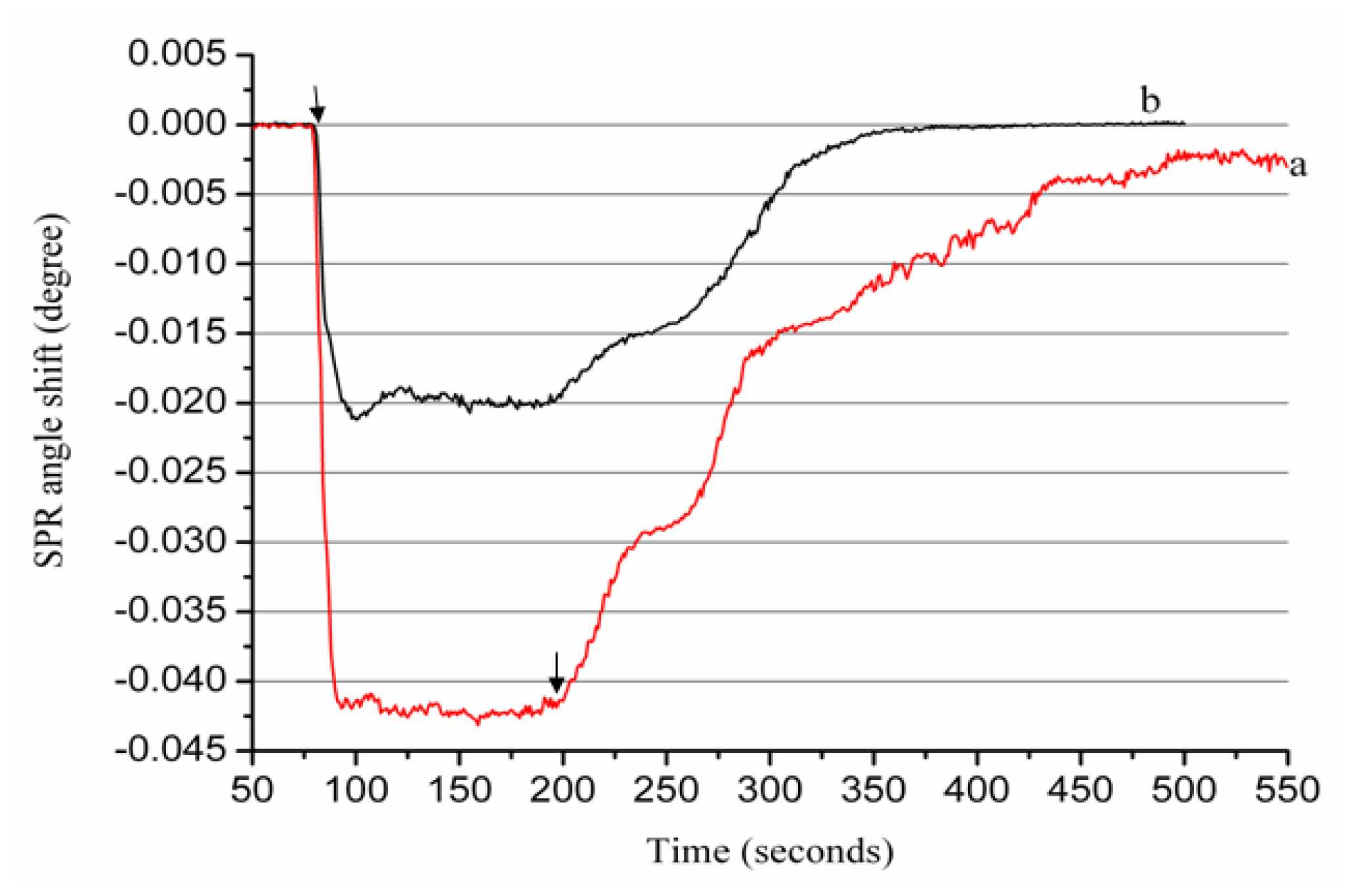
<p>The successful immobilization of the Aβ peptide on the sensor chip surface was tested by injecting a Zn<sup>2+</sup> ion solution into the flow chamber and pumping it across the Aβ-immobilized sensing surface. In our experiment, the sample loop volume is 20 μL, the flowing rate is 10 μL/min, so that the Zn<sup>2+</sup> ions start to flow onto the immobilized Aβ<sub>1–28</sub> at about 80 s, the flowing of metal ions ends at about 200 s; the difference in the baseline SPR angles before and after the Zn<sup>2+</sup> ion solution injection (termed as the SPR dip shift Δ<italic>θ</italic>) is approximately 0.00246° (<xref ref-type="fig" rid="f1-ijms-13-11832">Figure 1a</xref>), considering the sophisticated interaction between Aβ peptide and metal ions, the detection of the SPR dip shift Δ<italic>θ</italic> is selected at 550 s.</p>
<p>To confirm that the net change is induced by the metal ions, we conducted a control experiment in which Zn<sup>2+</sup> ions flowed over an ethanolamine-blocked surface without the immobilization of Aβ peptide. <xref ref-type="fig" rid="f1-ijms-13-11832">Figure 1b</xref> shows that the SPR signal returned to its baseline within a short time. Additionally, the recovery of the original baseline in curve b suggests that the blocking process is efficient because it has been reported that alkanethiol SAM containing carboxylic acid can be used for SPR measurements of heavy metal ions [<xref ref-type="bibr" rid="b23-ijms-13-11832">23</xref>]. Furthermore, the conversion of the negatively charged carboxyl groups on the MUA SAM to neutral amide groups during the peptide immobilization and blocking process could reduce the undesirable electrostatic attraction to metal ions in solution.</p></sec>
<sec>
<title>2.2. Real-Time Determination of Aβ<sub>1–28</sub> Binding Zn<sup>2+</sup> and Cu<sup>2+</sup> by SPR</title>
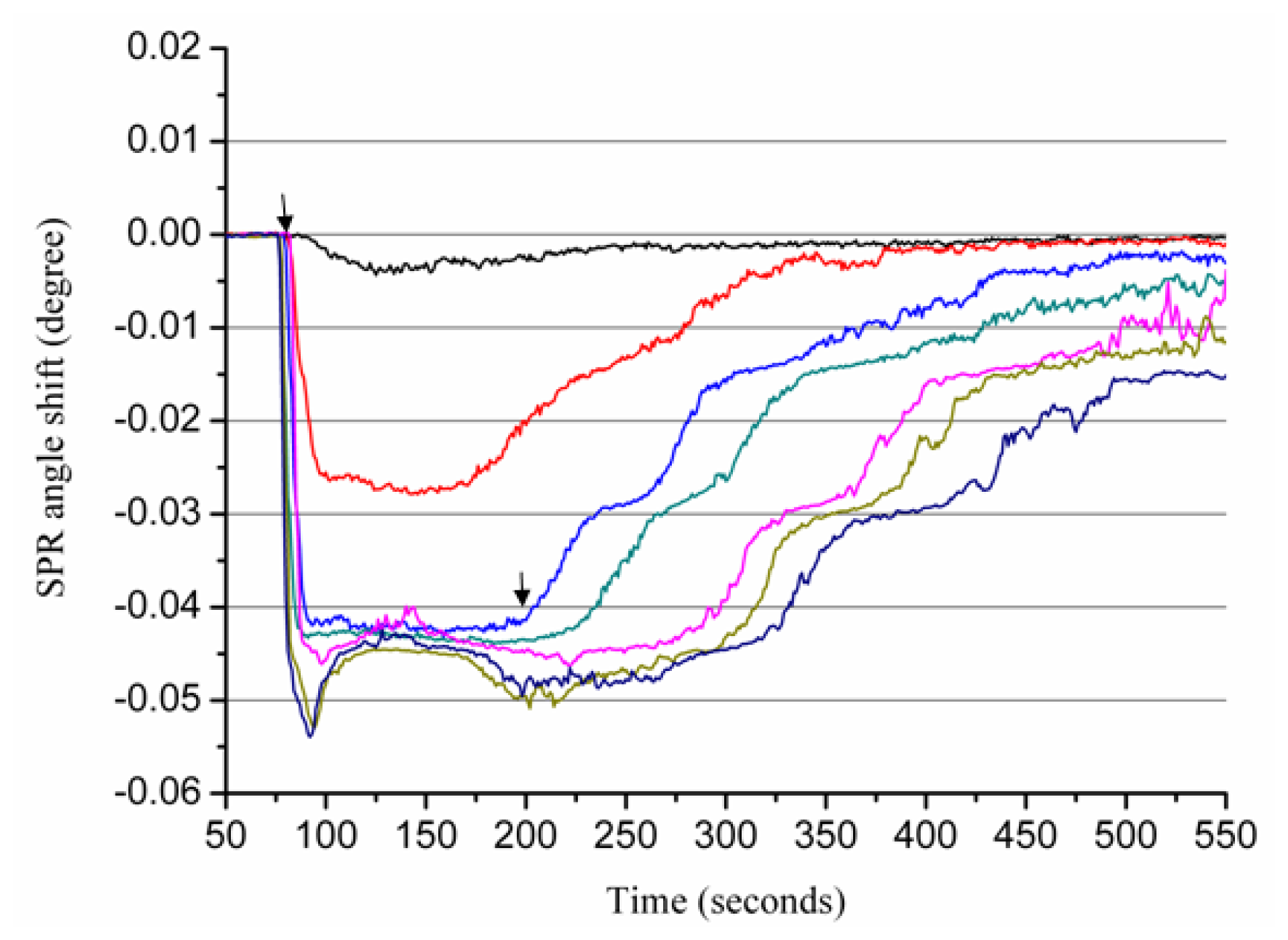
<p><xref ref-type="fig" rid="f2-ijms-13-11832">Figure 2</xref> shows the sensorgrams of various Zn<sup>2+</sup> concentrations flowing over the Aβ<sub>1–28</sub> sensor chip. In these experiments, EDTA (10 mM) was used to regenerate the surface. Therefore, a single chip can be used repeatedly for multiple samples. As shown in <xref ref-type="fig" rid="f2-ijms-13-11832">Figure 2</xref>, increasing Zn<sup>2+</sup> concentrations results in a greater SPR dip shift. When 600 μM Zn<sup>2+</sup> flowed over the Aβ<sub>1–28</sub>-covered SPR sensor, the metal ions caused a net change of 0.0075°, which can be attributed to the binding of Zn<sup>2+</sup> ions to Aβ<sub>1–28</sub> resulting in conformational changes of the peptide molecules.</p>
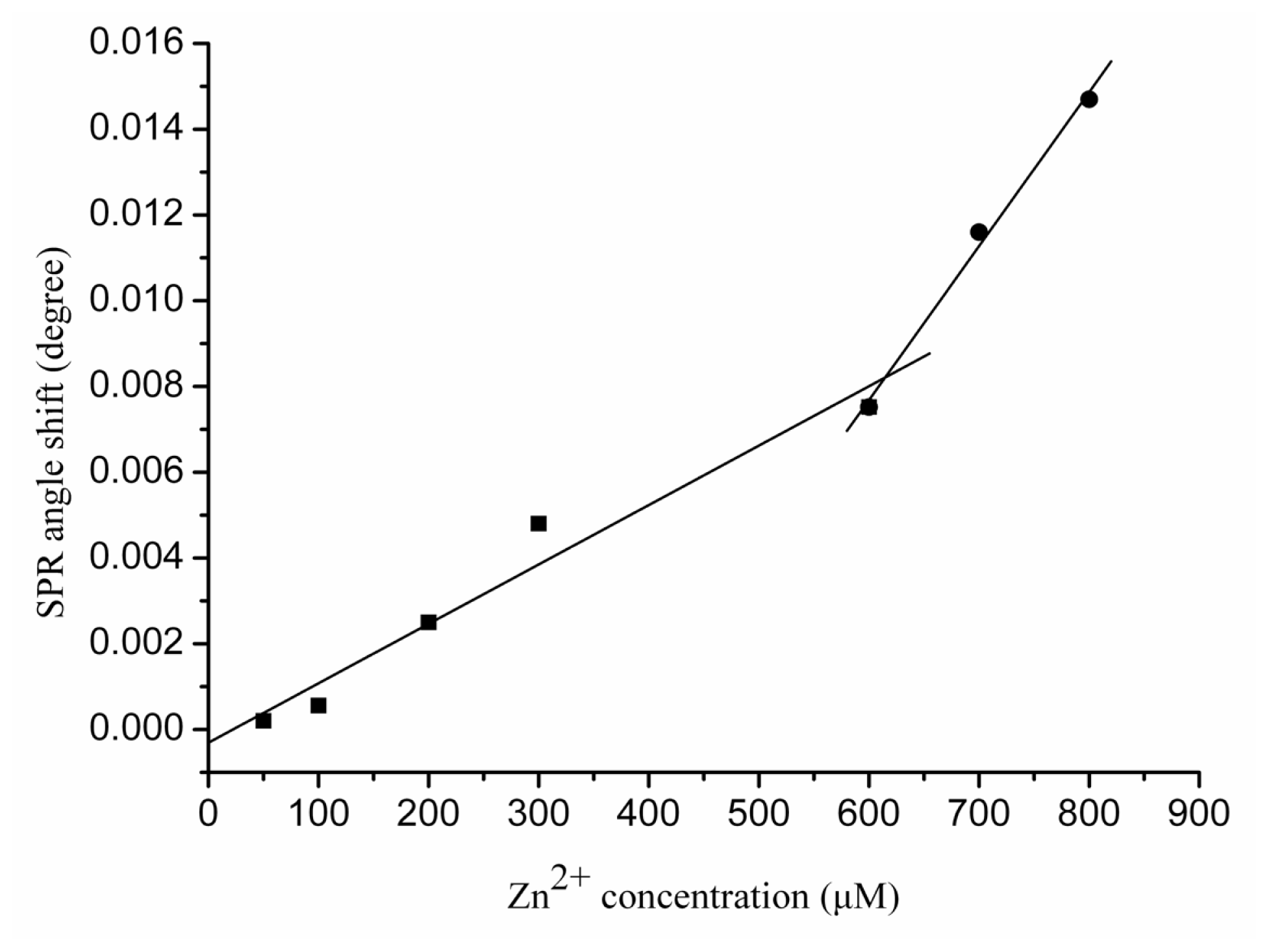
<p>The SPR angle shift is directly correlated with the Zn<sup>2+</sup> concentration ([Zn<sup>2+</sup>]). In <xref ref-type="fig" rid="f3-ijms-13-11832">Figure 3</xref>, the calibration curve generated from the sensor response to a series of different Zn<sup>2+</sup> concentrations is shown. The calibration curve contains two regions; the first is from 50 to 300 μM, and the second from 600 to 800 μM. Linear regression analysis of both regions yielded the following equations:</p>
<disp-formula id="FD1">
<label>(1)</label>
<mml:math id="mm1" display="block">
<mml:semantics id="sm1">
<mml:mrow>
<mml:mi mathvariant="normal">Δ</mml:mi>
<mml:mi>θ</mml:mi>
<mml:mo>=</mml:mo>
<mml:mo>-</mml:mo>
<mml:mn>3.07</mml:mn>
<mml:mo>×</mml:mo>
<mml:msup>
<mml:mrow>
<mml:mrow>
<mml:mn>10</mml:mn></mml:mrow></mml:mrow>
<mml:mrow>
<mml:mo>-</mml:mo>
<mml:mn>4</mml:mn></mml:mrow></mml:msup>
<mml:mo>+</mml:mo>
<mml:mn>1.39</mml:mn>
<mml:mo>×</mml:mo>
<mml:msup>
<mml:mrow>
<mml:mrow>
<mml:mn>10</mml:mn></mml:mrow></mml:mrow>
<mml:mrow>
<mml:mo>-</mml:mo>
<mml:mn>5</mml:mn></mml:mrow></mml:msup>
<mml:mi> </mml:mi>
<mml:mo stretchy="false">[</mml:mo>
<mml:msup>
<mml:mrow>
<mml:mrow>
<mml:mtext>Zn</mml:mtext></mml:mrow></mml:mrow>
<mml:mrow>
<mml:mn>2</mml:mn>
<mml:mo>+</mml:mo></mml:mrow></mml:msup>
<mml:mo stretchy="false">]</mml:mo>
<mml:mi> </mml:mi>
<mml:msup>
<mml:mrow>
<mml:mi>R</mml:mi></mml:mrow>
<mml:mn>2</mml:mn></mml:msup>
<mml:mo>=</mml:mo>
<mml:mn>0.95</mml:mn>
<mml:mi> </mml:mi>
<mml:mo stretchy="false">(</mml:mo>
<mml:mtext>region </mml:mtext>
<mml:mn>1</mml:mn>
<mml:mo stretchy="false">)</mml:mo></mml:mrow></mml:semantics></mml:math></disp-formula>
<disp-formula id="FD2">
<label>(2)</label>
<mml:math id="mm2" display="block">
<mml:semantics id="sm2">
<mml:mrow>
<mml:mi mathvariant="normal">Δ</mml:mi>
<mml:mi>θ</mml:mi>
<mml:mo>=</mml:mo>
<mml:mo>-</mml:mo>
<mml:mn>1.39</mml:mn>
<mml:mo>×</mml:mo>
<mml:msup>
<mml:mrow>
<mml:mrow>
<mml:mn>10</mml:mn></mml:mrow></mml:mrow>
<mml:mrow>
<mml:mo>-</mml:mo>
<mml:mn>2</mml:mn></mml:mrow></mml:msup>
<mml:mo>+</mml:mo>
<mml:mn>3.59</mml:mn>
<mml:mo>×</mml:mo>
<mml:msup>
<mml:mrow>
<mml:mrow>
<mml:mn>10</mml:mn></mml:mrow></mml:mrow>
<mml:mrow>
<mml:mo>-</mml:mo>
<mml:mn>5</mml:mn></mml:mrow></mml:msup>
<mml:mi> </mml:mi>
<mml:mo stretchy="false">[</mml:mo>
<mml:msup>
<mml:mrow>
<mml:mrow>
<mml:mtext>Zn</mml:mtext></mml:mrow></mml:mrow>
<mml:mrow>
<mml:mn>2</mml:mn>
<mml:mo>+</mml:mo></mml:mrow></mml:msup>
<mml:mo stretchy="false">]</mml:mo>
<mml:mi> </mml:mi>
<mml:msup>
<mml:mrow>
<mml:mi>R</mml:mi></mml:mrow>
<mml:mn>2</mml:mn></mml:msup>
<mml:mo>=</mml:mo>
<mml:mn>0.99</mml:mn>
<mml:mi> </mml:mi>
<mml:mo stretchy="false">(</mml:mo>
<mml:mtext>region </mml:mtext>
<mml:mn>2</mml:mn>
<mml:mo stretchy="false">)</mml:mo></mml:mrow></mml:semantics></mml:math></disp-formula>
<p>The slope of the linear regression in the second region is higher than that in the first region, which reveals that the SPR angle shift elicited by Zn<sup>2+</sup> ions is greater with increasing Zn<sup>2+</sup> ion concentration. These results suggest that the Zn<sup>2+</sup>-induced Aβ<sub>1-28</sub> conformation change is concentration dependent. This finding is in agreement with a previous report indicating that Aβ undergoes a conformational change from a random coil to a regular secondary structure in the presence of Zn<sup>2+</sup> ions and forms stable 1:1 and 1:2 (peptide/zinc) complexes [<xref ref-type="bibr" rid="b8-ijms-13-11832">8</xref>]. A possible explanation for this phenomenon is that the Aβ<sub>1–28</sub> binds Zn<sup>2+</sup> intramolecularly at low concentrations. When the Zn<sup>2+</sup> ion concentration is sufficiently high, the excess Zn<sup>2+</sup> ions may begin to bind with Aβ<sub>1–28</sub> intermolecularly, and the Zn<sup>2+</sup> ions behave like a bridge connecting two adjacent Aβ<sub>1–28</sub> molecules. Our finding is supported by previous studies that have shown that Zn<sup>2+</sup> can coordinate to Aβ in an intra- and inter-peptide mode [<xref ref-type="bibr" rid="b24-ijms-13-11832">24</xref>–<xref ref-type="bibr" rid="b26-ijms-13-11832">26</xref>].</p>
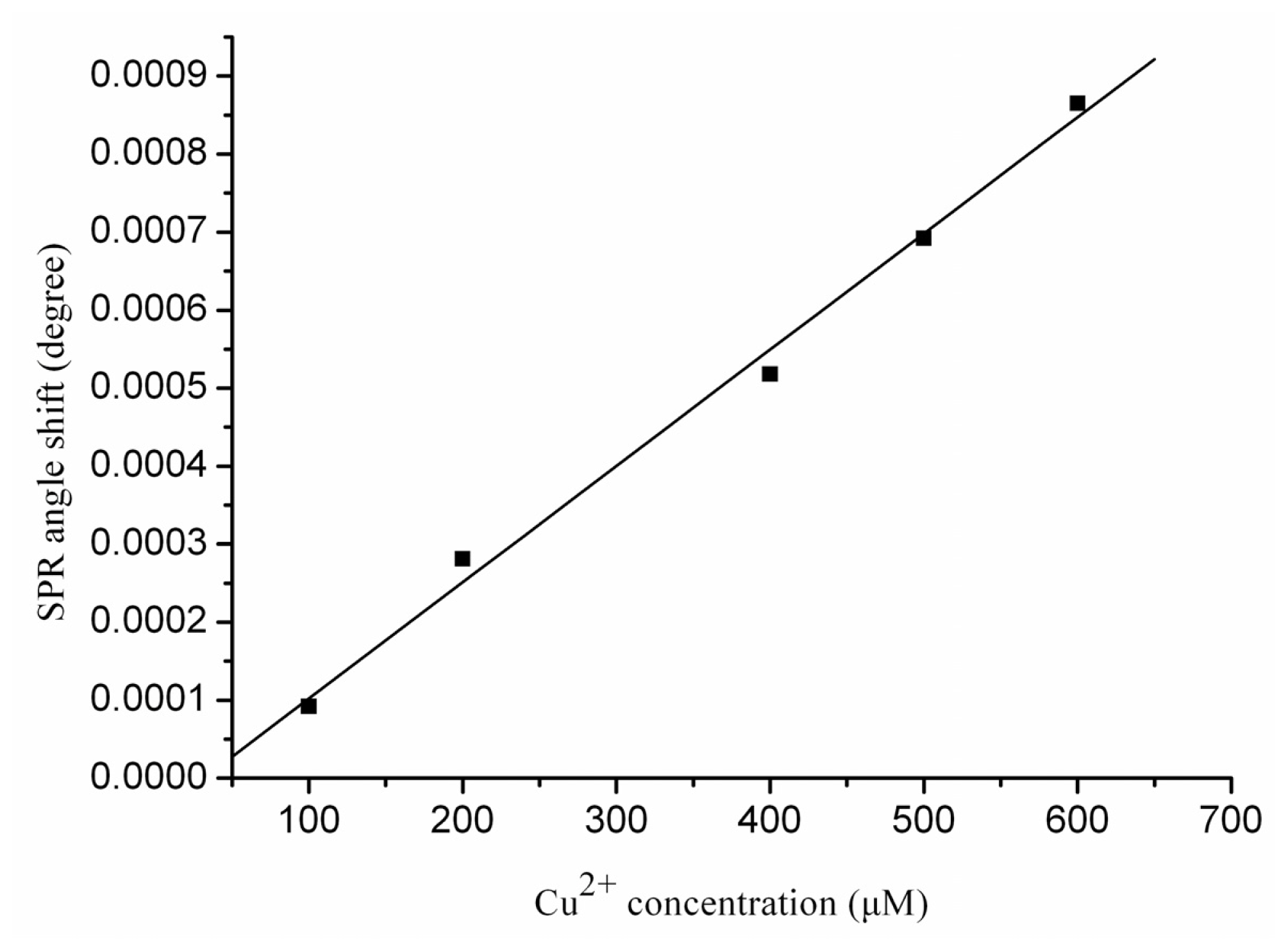
<p>A similar trend was not found for the interactions between Cu<sup>2+</sup> and Aβ<sub>1–28</sub>. The calibration curve depicted in <xref ref-type="fig" rid="f4-ijms-13-11832">Figure 4</xref> only contains one linear region ranging from 100 to 600 μM. The linear regression equation with a correlation coefficient of <italic>R</italic><sup>2</sup> = 0.99 suggests a linear relationship between the SPR angle shift and the Cu<sup>2+</sup> concentration.</p>
<disp-formula id="FD3">
<label>(3)</label>
<mml:math id="mm3" display="block">
<mml:semantics id="sm3">
<mml:mrow>
<mml:mi mathvariant="normal">Δ</mml:mi>
<mml:mi>θ</mml:mi>
<mml:mo>=</mml:mo>
<mml:mo>-</mml:mo>
<mml:mn>4.67</mml:mn>
<mml:mo>×</mml:mo>
<mml:msup>
<mml:mrow>
<mml:mrow>
<mml:mn>10</mml:mn></mml:mrow></mml:mrow>
<mml:mrow>
<mml:mo>-</mml:mo>
<mml:mn>5</mml:mn></mml:mrow></mml:msup>
<mml:mo>+</mml:mo>
<mml:mn>1.49</mml:mn>
<mml:mo>×</mml:mo>
<mml:msup>
<mml:mrow>
<mml:mrow>
<mml:mn>10</mml:mn></mml:mrow></mml:mrow>
<mml:mrow>
<mml:mo>-</mml:mo>
<mml:mn>6</mml:mn></mml:mrow></mml:msup>
<mml:mi> </mml:mi>
<mml:mo stretchy="false">[</mml:mo>
<mml:msup>
<mml:mrow>
<mml:mrow>
<mml:mtext>Cu</mml:mtext></mml:mrow></mml:mrow>
<mml:mrow>
<mml:mn>2</mml:mn>
<mml:mo>+</mml:mo></mml:mrow></mml:msup>
<mml:mo stretchy="false">]</mml:mo>
<mml:mi> </mml:mi>
<mml:msup>
<mml:mrow>
<mml:mi>R</mml:mi></mml:mrow>
<mml:mn>2</mml:mn></mml:msup>
<mml:mo>=</mml:mo>
<mml:mn>0.99</mml:mn></mml:mrow></mml:semantics></mml:math></disp-formula>
<p>Compared with Zn<sup>2+</sup>-Aβ complexes having stoichiometry ranging from 1:1 to 3:1 [<xref ref-type="bibr" rid="b27-ijms-13-11832">27</xref>–<xref ref-type="bibr" rid="b29-ijms-13-11832">29</xref>], most studies have demonstrated that the Aβ-peptide forms a 1:1 complex with Cu<sup>2+</sup> [<xref ref-type="bibr" rid="b25-ijms-13-11832">25</xref>,<xref ref-type="bibr" rid="b30-ijms-13-11832">30</xref>,<xref ref-type="bibr" rid="b31-ijms-13-11832">31</xref>]. NMR studies have demonstrated that Aβ<sub>1–28</sub> forms a 1:1 complex with the Cu<sup>2+</sup> ion via histidine residues [<xref ref-type="bibr" rid="b30-ijms-13-11832">30</xref>]. We interpret these results to different coordination modes. Unlike Zn<sup>2+</sup>, which can bind to Aβ in an intra- and inter-peptide coordination mode, Cu<sup>2+</sup> is primarily involved in intra-peptide binding in a fairly closed structure that protects the metal from further interactions. In addition, it has been reported that under physiological conditions, the coordination of the Cu<sup>2+</sup> equivalent to the Aβ peptides leads to a mononuclear complex Cu<sub>1</sub>(Aβ)<sub>1</sub> and is unlikely to form a Cu<sub>2</sub>(Aβ)<sub>1</sub> complex [<xref ref-type="bibr" rid="b32-ijms-13-11832">32</xref>].</p></sec>
<sec>
<title>2.3. Real-Time Determination of Aβ<sub>1–42</sub> Binding to Zn<sup>2+</sup> and Cu<sup>2+</sup> by SPR</title>
<p>Aβ<sub>1–40</sub> and Aβ<sub>1–42</sub> are the most prevalent <italic>in vivo</italic> Aβ forms. In particular, Aβ<sub>1–42</sub> has a high propensity to self-assemble and deposit in senile plaques and is highly toxic to neurons [<xref ref-type="bibr" rid="b33-ijms-13-11832">33</xref>]. While great progress has been achieved on the coordination chemistry of Zn<sup>2+</sup> and Cu<sup>2+</sup> with truncated Aβ<sub>1–16</sub> and Aβ<sub>1–28</sub>, it is important to understand whether these peptides, which are missing a large part of the hydrophobic <italic>C</italic>-terminal residues, coordinate metal ions differently than the full-length peptides. Therefore, to better understand the mechanisms of AD, we continued to study the interactions of Zn<sup>2+</sup> and Cu<sup>2+</sup> with Aβ<sub>1–42</sub> using the FI-SPR biosensor.</p>
<p><xref ref-type="fig" rid="f5-ijms-13-11832">Figure 5</xref> depicts SPR sensorgrams obtained from the sensor response to various Zn<sup>2+</sup> concentrations. In contrast to the calibration curve of the Zn<sup>2+</sup> interactions with Aβ<sub>1–28</sub> that contains two regions, the calibration plot of the Zn interactions with Aβ<sub>1–42</sub> only contains one region; the linear regression equation is as follows:</p>
<disp-formula id="FD4">
<label>(4)</label>
<mml:math id="mm4" display="block">
<mml:semantics id="sm4">
<mml:mrow>
<mml:mi mathvariant="normal">Δ</mml:mi>
<mml:mi>θ</mml:mi>
<mml:mo>=</mml:mo>
<mml:mo>-</mml:mo>
<mml:mn>1.86</mml:mn>
<mml:mo>×</mml:mo>
<mml:msup>
<mml:mrow>
<mml:mrow>
<mml:mn>10</mml:mn></mml:mrow></mml:mrow>
<mml:mrow>
<mml:mo>-</mml:mo>
<mml:mn>3</mml:mn></mml:mrow></mml:msup>
<mml:mo>+</mml:mo>
<mml:mn>2.27</mml:mn>
<mml:mo>×</mml:mo>
<mml:msup>
<mml:mrow>
<mml:mrow>
<mml:mn>10</mml:mn></mml:mrow></mml:mrow>
<mml:mrow>
<mml:mo>-</mml:mo>
<mml:mn>5</mml:mn></mml:mrow></mml:msup>
<mml:mi> </mml:mi>
<mml:mo stretchy="false">[</mml:mo>
<mml:msup>
<mml:mrow>
<mml:mrow>
<mml:mtext>Zn</mml:mtext></mml:mrow></mml:mrow>
<mml:mrow>
<mml:mn>2</mml:mn>
<mml:mo>+</mml:mo></mml:mrow></mml:msup>
<mml:mo stretchy="false">]</mml:mo>
<mml:mi> </mml:mi>
<mml:msup>
<mml:mrow>
<mml:mi>R</mml:mi></mml:mrow>
<mml:mn>2</mml:mn></mml:msup>
<mml:mo>=</mml:mo>
<mml:mn>0.96</mml:mn></mml:mrow></mml:semantics></mml:math></disp-formula>
<p>Aβ<sub>1–42</sub> peptides have 14 additional residues in the hydrophobic tail compared to Aβ<sub>1–28</sub>, which makes Aβ<sub>1–42</sub> more prone to aggregation than the truncated Aβ<sub>1–28</sub>. A possible explanation for the decreased stoichiometric binding of Aβ<sub>1–42</sub> compared to Aβ<sub>1–28</sub> may be the interference of the hydrophobic tail in Aβ<sub>1–42</sub> with the Zn<sup>2+</sup> binding site. Our data are in agreement with a previous report indicating that Zn and Cu form a monomeric complex with Aβ<sub>1–42</sub> [<xref ref-type="bibr" rid="b34-ijms-13-11832">34</xref>].</p>
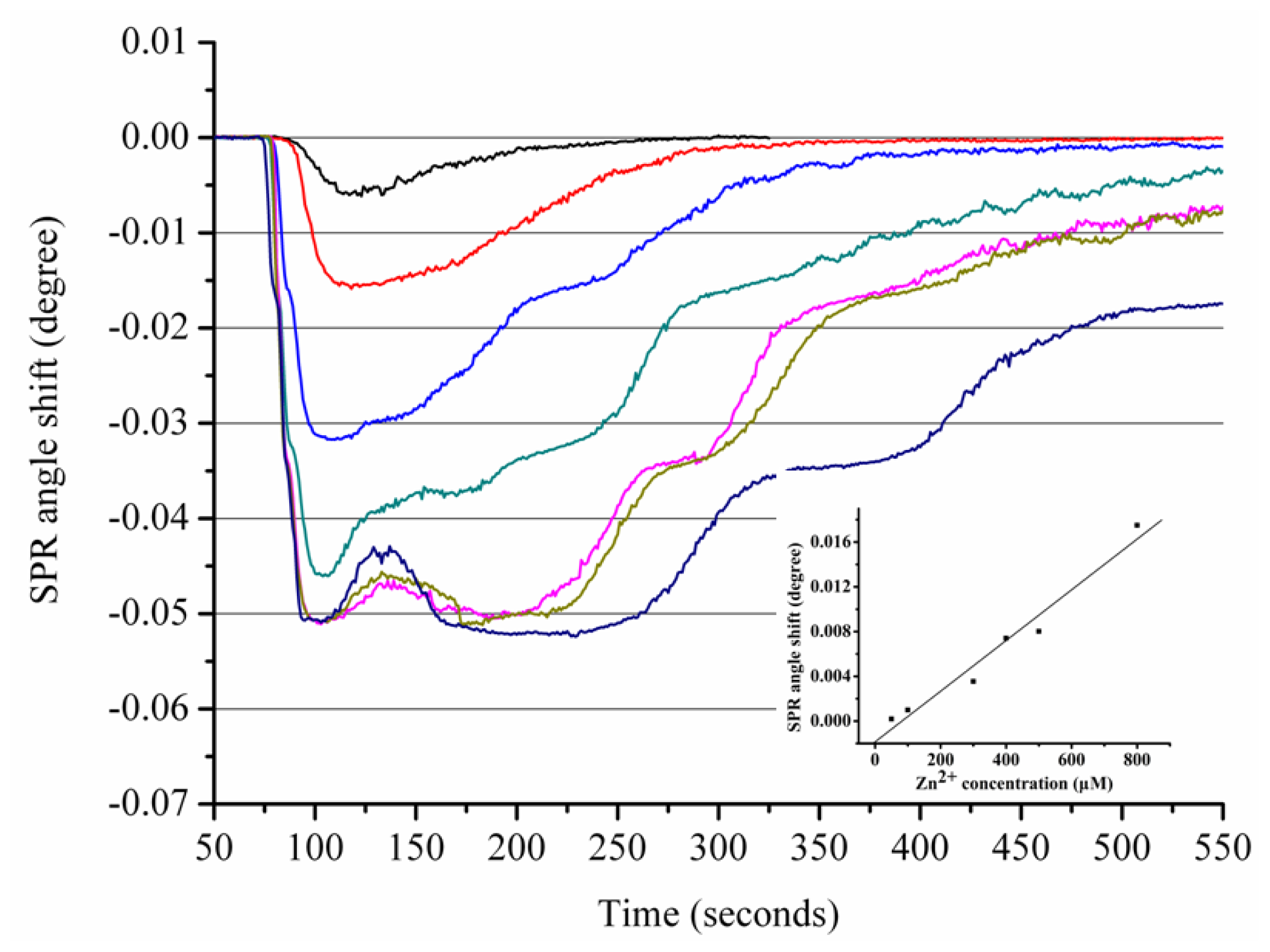
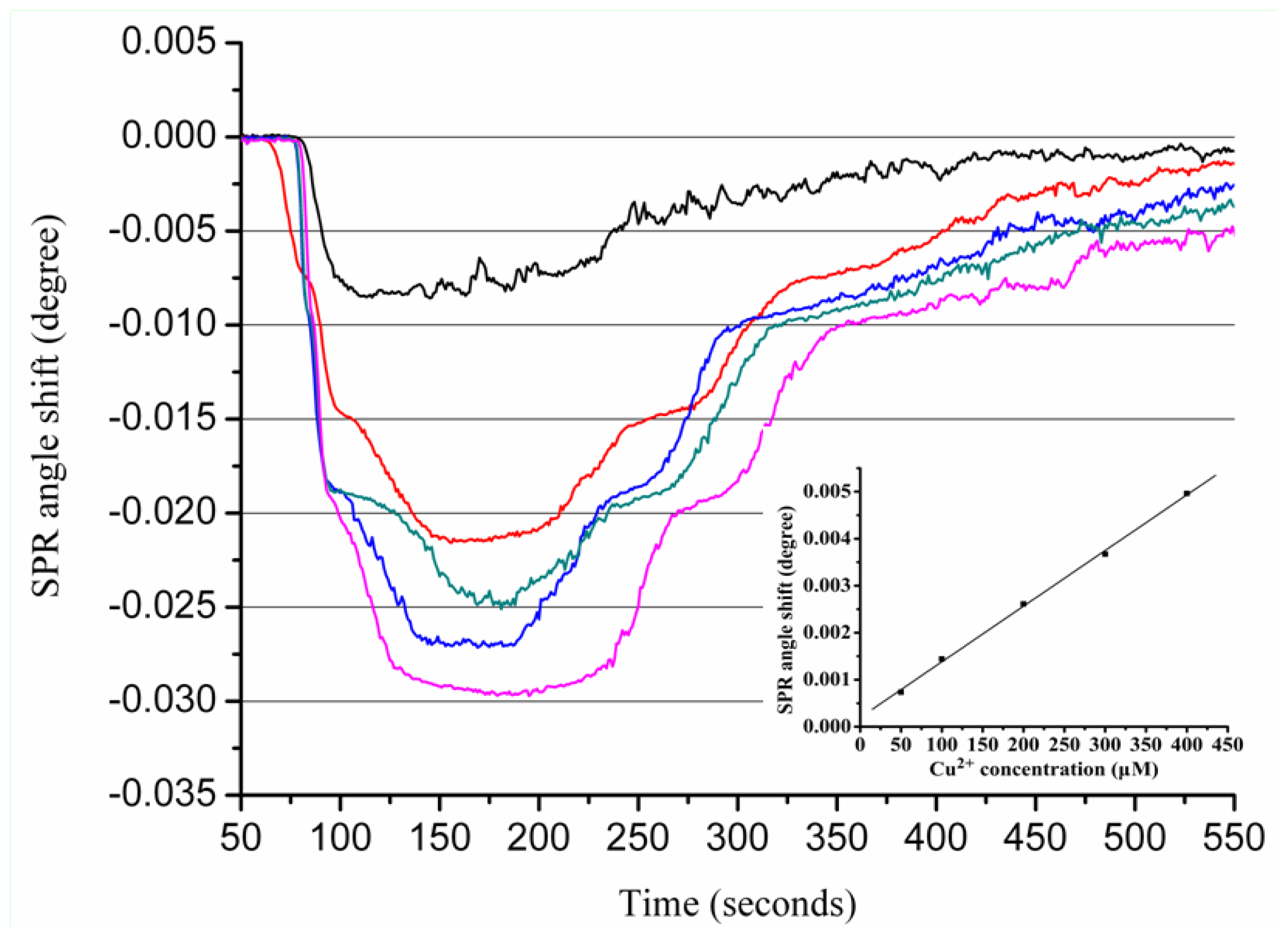
<p>Similar results were obtained for the Cu-Aβ<sub>1–42</sub> interaction. As shown in <xref ref-type="fig" rid="f6-ijms-13-11832">Figure 6</xref>, the SPR angle shift increased with an increase of Cu<sup>2+</sup> bound to the Aβ<sub>1–42</sub>-immobilized sensor chip. The calibration curve generated from the sensor exposed to different concentrations of Cu<sup>2+</sup> is shown in the <xref ref-type="fig" rid="f6-ijms-13-11832">Figure 6</xref> inset. A strong correlation coefficient (<italic>R</italic><sup>2</sup> = 0.99) was obtained for the linear regression equation calculated using Cu<sup>2+</sup> concentrations ranging from 50 to 400 μM.</p></sec></sec>
<sec>
<title>3. Experimental Section</title>
<sec>
<title>3.1. Chemicals</title>
<p>Human amyloid-β peptide (1–28) (Aβ<sub>1–28</sub>) and human amyloid-β peptide (1–42) (Aβ<sub>1–42</sub>) were obtained from GL Biochem Ltd. (Shanghai, China). 1-(3-Dimethylaminopropyl)-3-ethylcarbodiimide hydrochloride (EDC), <italic>N</italic>-hydroxysulfosuccinimide (NHS), 11-mercaptoundecanoic acid (MUA), ARC-grade dimethyl sulfoxide (DMSO, 99%) and ethanolamine were purchased from J &amp; K Chemical Ltd. K<sub>2</sub>HPO<sub>4</sub>·3H<sub>2</sub>O, KH<sub>2</sub>PO<sub>4</sub>, NaCl, ZnCl<sub>2</sub> and CuCl<sub>2</sub> were all of AR grade and purchased from Beijing Chemical Reagent Co. (Beijing, China). Water with a resistivity of 18.25 MΩ·cm<sup>−1</sup> was collected from a Millipore Simplicity 185 system. EDC (0.4 M) and NHS (0.1 M) were prepared in a pH 7.4 PBS buffer (10.0 mM K<sub>2</sub>HPO<sub>4</sub>·3H<sub>2</sub>O and KH<sub>2</sub>PO<sub>4</sub> prepared in 1 mM NaCl). MUA (4 mM) was prepared in pure ethanol. Stock solutions of 2.0 mM ZnCl<sub>2</sub> and CuCl<sub>2</sub> were prepared in water and then diluted to the desired concentrations.</p></sec>
<sec>
<title>3.2. Preparation of Fresh Aβ Solution</title>
<p>Uniform and nonaggregated monomeric Aβ<sub>1–28</sub> and Aβ<sub>1–42</sub> peptides were prepared as previously described [<xref ref-type="bibr" rid="b35-ijms-13-11832">35</xref>]. Briefly, 0.1 mM of the peptide was dissolved in DMSO, which disrupts the β-sheet structure and renders Aβ monomeric [<xref ref-type="bibr" rid="b36-ijms-13-11832">36</xref>]. The freshly dissolved monomeric Aβ was diluted with PBS buffer (pH 7.4) to a concentration of 10 μM.</p></sec>
<sec>
<title>3.3. Gold Film Preparation</title>
<p>BK7 glass cover slides (Fisher) were cleaned with a piranha solution of 70% concentrated H<sub>2</sub>SO<sub>4</sub> and 30% H<sub>2</sub>O<sub>2</sub> (7:3, <italic>v</italic>/<italic>v</italic>) at 80 °C for 30 min. Upon cooling to room temperature, the glass slides were rinsed thoroughly with deionized water. After drying with N<sub>2</sub>, each glass slide was coated with a 2 nm chromium layer and then covered with 50 nm of gold film using a sputter coater (Model 108, Kert J. Lester Inc., Clariton, PA, USA).</p></sec>
<sec>
<title>3.4. Aβ Peptide Immobilization</title>
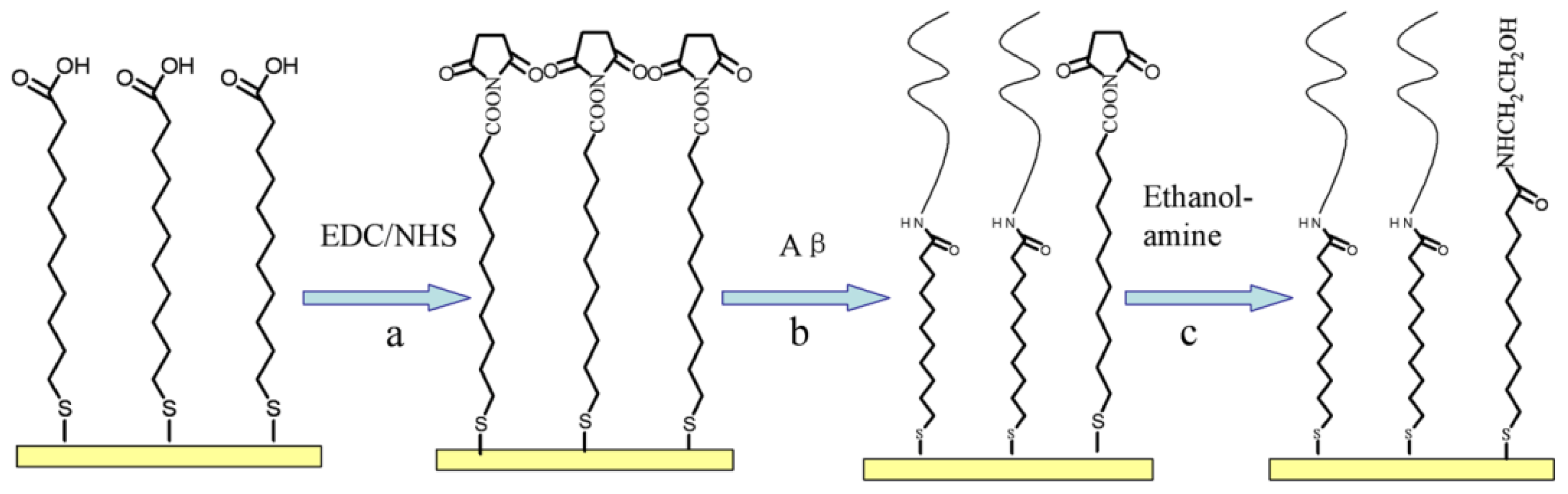
<p>Aβ peptide immobilization was achieved using covalent bonding mediated by a chemical reaction. The <italic>N</italic>-terminus of the Aβ peptide was reacted with the functional group of the SAM of MUA on the surface of the Au film (as depicted in <xref ref-type="fig" rid="f7-ijms-13-11832">Figure 7</xref>). Briefly, the MUA gold chip was treated with a mixture of 0.4 M EDC and 0.1 M NHS (1:1) for 3 h to ensure that the carboxyl group of the SAM reacted fully with the EDC and NHS. Then, a freshly prepared 10 μM Aβ solution in PBS (pH 7.4) was reacted with the NHS-activated surface for 2 h. Finally, ethanolamine (1 M, pH 8.5) was used to block the remaining activated surface groups. The resulting film was either used immediately or stored at 4 °C for future use.</p></sec>
<sec>
<title>3.5. SPR Apparatus</title>
<p>SPR measurements were conducted with a custom-built flow injection-SPR equipped with a bicell detector as previously described [<xref ref-type="bibr" rid="b22-ijms-13-11832">22</xref>]. The SPR instrument recorded the reflected light on two photodetectors (A and B). The differential (A − B) and sum (A + B) signals were then detected by a PCI-1371 interface card (Advantech, Taiwan) controlled by the Labview program. The resonance angles from the biosensor were measured by the division of the differential and sum signals, (A − B)/(A + B). The inlet of the flow cell was connected to a six-port valve. For each measurement, the sample solution was injected into a 20-μL loop with a microsyringe (Hamilton) and subsequently delivered to the flow cell at a flow rate of 10 μL/min, using a syringe pump (KDS100, KD Scientific Inc., Holliston, MA, USA).</p></sec></sec>
<sec sec-type="conclusions">
<title>4. Conclusions</title>
<p>In the present study, a SPR-based analytical method was used to investigate the interactions between Aβ peptides and metal ions. The coordination of metal ions with the truncated Aβ<sub>1–28</sub> and the full-length Aβ<sub>1–42</sub> were compared. The conformational transition of Aβ induced by metal ion binding can be readily detected by this highly sensitive FI-SPR sensor equipped with a bicell detector. At physiological pH, Zn<sup>2+</sup> demonstrates different binding affinity for Aβ<sub>1–28</sub> and Aβ<sub>1–42</sub>, while Cu<sup>2+</sup> exhibits similar interactions with both Aβ peptides. The interactions between Zn<sup>2+</sup> and the Aβ-peptides in an intra- and inter-molecular mode have been previously validated. These studies complement other analytical methods and should help elucidate the role of metal ions during Aβ aggregation.</p></sec></body>
<back>
<ack>
<title>Acknowledgments</title>
<p>This work was supported by the National Natural Science Foundation of China (21145006), Scientific Research Foundation for the Returned Overseas Chinese Scholars, State Education Ministry and Beijing Municipal Natural Science Foundation (2113046).</p></ack>
<ref-list>
<title>References</title>
<ref id="b1-ijms-13-11832"><label>1</label><citation citation-type="journal"><person-group person-group-type="author"><name><surname>Roychaudhuri</surname><given-names>R.</given-names></name><name><surname>Yang</surname><given-names>M.</given-names></name><name><surname>Hoshi</surname><given-names>M.M.</given-names></name><name><surname>Teplow</surname><given-names>D.B.</given-names></name></person-group><article-title>Amyloid β-protein assembly and Alzheimer disease</article-title><source>J. Biol. Chem</source><year>2009</year><volume>284</volume><fpage>4749</fpage><lpage>4753</lpage><pub-id pub-id-type="pmid">18845536</pub-id></citation></ref>
<ref id="b2-ijms-13-11832"><label>2</label><citation citation-type="journal"><person-group person-group-type="author"><name><surname>Burdick</surname><given-names>D.</given-names></name><name><surname>Soreghan</surname><given-names>B.</given-names></name><name><surname>Kwon</surname><given-names>M.</given-names></name><name><surname>Kosmoski</surname><given-names>J.</given-names></name><name><surname>Knauer</surname><given-names>M.</given-names></name><name><surname>Henschen</surname><given-names>A.</given-names></name><name><surname>Yates</surname><given-names>J.</given-names></name><name><surname>Cotman</surname><given-names>C.</given-names></name><name><surname>Glabe</surname><given-names>C.</given-names></name></person-group><article-title>Assembly and aggregation properties of synthetic Alzheimer’s A4/β amyloid peptide analogs</article-title><source>J. Biol. Chem</source><year>1992</year><volume>267</volume><fpage>546</fpage><lpage>554</lpage><pub-id pub-id-type="pmid">1730616</pub-id></citation></ref>
<ref id="b3-ijms-13-11832"><label>3</label><citation citation-type="journal"><person-group person-group-type="author"><name><surname>Fraser</surname><given-names>P.E.</given-names></name><name><surname>Nguyen</surname><given-names>J.T.</given-names></name><name><surname>Surewicz</surname><given-names>W.K.</given-names></name><name><surname>Kirschner</surname><given-names>D.A.</given-names></name></person-group><article-title>pH-dependent structural transitions of Alzheimer amyloid peptides</article-title><source>Biophys. J</source><year>1991</year><volume>60</volume><fpage>1190</fpage><lpage>1201</lpage><pub-id pub-id-type="doi">10.1016/S0006-3495(91)82154-3</pub-id><pub-id pub-id-type="pmid">1760507</pub-id></citation></ref>
<ref id="b4-ijms-13-11832"><label>4</label><citation citation-type="journal"><person-group person-group-type="author"><name><surname>McLaurin</surname><given-names>J.</given-names></name><name><surname>Franklin</surname><given-names>T.</given-names></name><name><surname>Chakrabartty</surname><given-names>A.</given-names></name><name><surname>Fraser</surname><given-names>P.E.</given-names></name></person-group><article-title>Phosphatidylinositol and inositol involvement in Alzheimer amyloid-β fibril growth and arrest</article-title><source>J. Mol. Biol</source><year>1998</year><volume>278</volume><fpage>183</fpage><lpage>194</lpage><pub-id pub-id-type="doi">10.1006/jmbi.1998.1677</pub-id><pub-id pub-id-type="pmid">9571042</pub-id></citation></ref>
<ref id="b5-ijms-13-11832"><label>5</label><citation citation-type="journal"><person-group person-group-type="author"><name><surname>Yamaguchi</surname><given-names>T.</given-names></name><name><surname>Matsuzaki</surname><given-names>K.</given-names></name><name><surname>Hoshino</surname><given-names>M.</given-names></name></person-group><article-title>Transient formation of intermediate conformational states of amyloid-β peptide revealed by heteronuclear magnetic resonance spectroscopy</article-title><source>FEBS Lett</source><year>2011</year><volume>585</volume><fpage>1097</fpage><lpage>1102</lpage><pub-id pub-id-type="doi">10.1016/j.febslet.2011.03.014</pub-id><pub-id pub-id-type="pmid">21402073</pub-id></citation></ref>
<ref id="b6-ijms-13-11832"><label>6</label><citation citation-type="journal"><person-group person-group-type="author"><name><surname>Bush</surname><given-names>A.I.</given-names></name><name><surname>Pettingell</surname><given-names>W.H.</given-names></name><name><surname>Multhaup</surname><given-names>G.</given-names></name><name><surname>d Paradis</surname><given-names>M.</given-names></name><name><surname>Vonsattel</surname><given-names>J.P.</given-names></name><name><surname>Gusella</surname><given-names>J.F.</given-names></name><name><surname>Beyreuther</surname><given-names>K.</given-names></name><name><surname>Masters</surname><given-names>C.L.</given-names></name><name><surname>Tanzi</surname><given-names>R.E.</given-names></name></person-group><article-title>Rapid induction of Alzheimer Aβ amyloid formation by zinc</article-title><source>Science</source><year>1994</year><volume>265</volume><fpage>1464</fpage><lpage>1467</lpage><pub-id pub-id-type="doi">10.1126/science.8073293</pub-id><pub-id pub-id-type="pmid">8073293</pub-id></citation></ref>
<ref id="b7-ijms-13-11832"><label>7</label><citation citation-type="journal"><person-group person-group-type="author"><name><surname>Miura</surname><given-names>T.</given-names></name><name><surname>Suzuki</surname><given-names>K.</given-names></name><name><surname>Kohata</surname><given-names>N.</given-names></name><name><surname>Takeuchi</surname><given-names>H.</given-names></name></person-group><article-title>Metal binding modes of Alzheimer’s amyloid β-peptide in insoluble aggregates and soluble complexes</article-title><source>Biochemistry</source><year>2000</year><volume>39</volume><fpage>7024</fpage><lpage>7031</lpage><pub-id pub-id-type="doi">10.1021/bi0002479</pub-id><pub-id pub-id-type="pmid">10841784</pub-id></citation></ref>
<ref id="b8-ijms-13-11832"><label>8</label><citation citation-type="journal"><person-group person-group-type="author"><name><surname>Kozin</surname><given-names>S.A.</given-names></name><name><surname>Zirah</surname><given-names>S.</given-names></name><name><surname>Rebuffat</surname><given-names>S.</given-names></name><name><surname>Hoa</surname><given-names>G.H.</given-names></name><name><surname>Debey</surname><given-names>P.</given-names></name></person-group><article-title>Zinc binding to Alzheimer’s Aβ(1–16) peptide results in stable soluble complex</article-title><source>Biochem. Biophys. Res. Commun</source><year>2001</year><volume>285</volume><fpage>959</fpage><lpage>964</lpage><pub-id pub-id-type="doi">10.1006/bbrc.2001.5284</pub-id><pub-id pub-id-type="pmid">11467845</pub-id></citation></ref>
<ref id="b9-ijms-13-11832"><label>9</label><citation citation-type="journal"><person-group person-group-type="author"><name><surname>Chen</surname><given-names>T.</given-names></name><name><surname>Wang</surname><given-names>X.</given-names></name><name><surname>He</surname><given-names>Y.</given-names></name><name><surname>Zhang</surname><given-names>C.</given-names></name><name><surname>Wu</surname><given-names>Z.</given-names></name><name><surname>Liao</surname><given-names>K.</given-names></name><name><surname>Wang</surname><given-names>J.</given-names></name><name><surname>Guo</surname><given-names>Z.</given-names></name></person-group><article-title>Effects of cyclen and cyclam on zinc(II)- and copper(II)-induced amyloid β-peptide aggregation and neurotoxicity</article-title><source>Inorg. Chem</source><year>2009</year><volume>48</volume><fpage>5801</fpage><lpage>5809</lpage><pub-id pub-id-type="doi">10.1021/ic900025x</pub-id><pub-id pub-id-type="pmid">19496588</pub-id></citation></ref>
<ref id="b10-ijms-13-11832"><label>10</label><citation citation-type="journal"><person-group person-group-type="author"><name><surname>Sarell</surname><given-names>C.J.</given-names></name><name><surname>Syme</surname><given-names>C.D.</given-names></name><name><surname>Rigby</surname><given-names>S.E.</given-names></name><name><surname>Viles</surname><given-names>J.H.</given-names></name></person-group><article-title>Copper(II) binding to amyloid-beta fibrils of Alzheimer’s disease reveals a picomolar affinity: Stoichiometry and coordination geometry are independent of Aβ oligomeric form</article-title><source>Biochemistry</source><year>2009</year><volume>48</volume><fpage>4388</fpage><lpage>4402</lpage><pub-id pub-id-type="doi">10.1021/bi900254n</pub-id><pub-id pub-id-type="pmid">19338344</pub-id></citation></ref>
<ref id="b11-ijms-13-11832"><label>11</label><citation citation-type="journal"><person-group person-group-type="author"><name><surname>Lovell</surname><given-names>M.A.</given-names></name><name><surname>Robertson</surname><given-names>J.D.</given-names></name><name><surname>Teesdale</surname><given-names>W.J.</given-names></name><name><surname>Campbell</surname><given-names>J.L.</given-names></name><name><surname>Markesbery</surname><given-names>W.R.</given-names></name></person-group><article-title>Copper, iron and zinc in Alzheimer’s disease senile plaques</article-title><source>J. Neurol. Sci</source><year>1998</year><volume>158</volume><fpage>47</fpage><lpage>52</lpage><pub-id pub-id-type="doi">10.1016/S0022-510X(98)00092-6</pub-id><pub-id pub-id-type="pmid">9667777</pub-id></citation></ref>
<ref id="b12-ijms-13-11832"><label>12</label><citation citation-type="journal"><person-group person-group-type="author"><name><surname>Atwood</surname><given-names>C.S.</given-names></name><name><surname>Moir</surname><given-names>R.D.</given-names></name><name><surname>Huang</surname><given-names>X.</given-names></name><name><surname>Scarpa</surname><given-names>R.C.</given-names></name><name><surname>Bacarra</surname><given-names>N.M.</given-names></name><name><surname>Romano</surname><given-names>D.M.</given-names></name><name><surname>Hartshorn</surname><given-names>M.A.</given-names></name><name><surname>Tanzi</surname><given-names>R.E.</given-names></name><name><surname>Bush</surname><given-names>A.I.</given-names></name></person-group><article-title>Dramatic aggregation of Alzheimer Aβ by Cu(II) is induced by conditions representing physiological acidosis</article-title><source>J. Biol. Chem</source><year>1998</year><volume>273</volume><fpage>12817</fpage><lpage>12826</lpage><pub-id pub-id-type="doi">10.1074/jbc.273.21.12817</pub-id><pub-id pub-id-type="pmid">9582309</pub-id></citation></ref>
<ref id="b13-ijms-13-11832"><label>13</label><citation citation-type="journal"><person-group person-group-type="author"><name><surname>Zou</surname><given-names>J.</given-names></name><name><surname>Kajita</surname><given-names>K.</given-names></name><name><surname>Sugimoto</surname><given-names>N.</given-names></name></person-group><article-title>Cu<sup>2+</sup> inhibits the aggregation of amyloid β-peptide(1–42) <italic>in vitro</italic></article-title><source>Angew. Chem. Int. Ed</source><year>2001</year><volume>40</volume><fpage>2274</fpage><lpage>2277</lpage><pub-id pub-id-type="doi">10.1002/1521-3773(20010618)40:12&lt;2274::AID-ANIE2274&gt;3.0.CO;2-5</pub-id></citation></ref>
<ref id="b14-ijms-13-11832"><label>14</label><citation citation-type="journal"><person-group person-group-type="author"><name><surname>Raman</surname><given-names>B.</given-names></name><name><surname>Ban</surname><given-names>T.</given-names></name><name><surname>Yamaguchi</surname><given-names>K.</given-names></name><name><surname>Sakai</surname><given-names>M.</given-names></name><name><surname>Kawai</surname><given-names>T.</given-names></name><name><surname>Naiki</surname><given-names>H.</given-names></name><name><surname>Goto</surname><given-names>Y.</given-names></name></person-group><article-title>Metal ion-dependent effects of clioquinol on the fibril growth of an amyloid β peptide</article-title><source>J. Biol. Chem</source><year>2005</year><volume>280</volume><fpage>16157</fpage><lpage>16162</lpage><pub-id pub-id-type="doi">10.1074/jbc.M500309200</pub-id><pub-id pub-id-type="pmid">15718230</pub-id></citation></ref>
<ref id="b15-ijms-13-11832"><label>15</label><citation citation-type="journal"><person-group person-group-type="author"><name><surname>Huang</surname><given-names>X.</given-names></name><name><surname>Atwood</surname><given-names>C.S.</given-names></name><name><surname>Hartshorn</surname><given-names>M.A.</given-names></name><name><surname>Multhaup</surname><given-names>G.</given-names></name><name><surname>Goldstein</surname><given-names>L.E.</given-names></name><name><surname>Scarpa</surname><given-names>R.C.</given-names></name><name><surname>Cuajungco</surname><given-names>M.P.</given-names></name><name><surname>Gray</surname><given-names>D.N.</given-names></name><name><surname>Lim</surname><given-names>J.</given-names></name><name><surname>Moir</surname><given-names>R.D.</given-names></name><etal/></person-group><article-title>The Aβ peptide of Alzheimer’s disease directly produces hydrogen peroxide through metal ion reduction</article-title><source>Biochemistry</source><year>1999</year><volume>38</volume><fpage>7609</fpage><lpage>7616</lpage><pub-id pub-id-type="doi">10.1021/bi990438f</pub-id><pub-id pub-id-type="pmid">10386999</pub-id></citation></ref>
<ref id="b16-ijms-13-11832"><label>16</label><citation citation-type="journal"><person-group person-group-type="author"><name><surname>Kowalik-Jankowska</surname><given-names>T.</given-names></name><name><surname>Ruta</surname><given-names>M.</given-names></name><name><surname>Wisniewska</surname><given-names>K.</given-names></name><name><surname>Lankiewicz</surname><given-names>L.</given-names></name><name><surname>Dyba</surname><given-names>M.</given-names></name></person-group><article-title>Products of Cu(II)-catalyzed oxidation in the presence of hydrogen peroxide of the 1–10, 1–16 fragments of human and mouse β-amyloid peptide</article-title><source>J. Inorg. Biochem</source><year>2004</year><volume>98</volume><fpage>940</fpage><lpage>950</lpage><pub-id pub-id-type="doi">10.1016/j.jinorgbio.2004.03.001</pub-id><pub-id pub-id-type="pmid">15149800</pub-id></citation></ref>
<ref id="b17-ijms-13-11832"><label>17</label><citation citation-type="journal"><person-group person-group-type="author"><name><surname>Ali</surname><given-names>F.E.</given-names></name><name><surname>Separovic</surname><given-names>F.</given-names></name><name><surname>Barrow</surname><given-names>C.J.</given-names></name><name><surname>Cherny</surname><given-names>R.A.</given-names></name><name><surname>Fraser</surname><given-names>F.</given-names></name><name><surname>Bush</surname><given-names>A.I.</given-names></name><name><surname>Masters</surname><given-names>C.L.</given-names></name><name><surname>Barnham</surname><given-names>K.J.</given-names></name></person-group><article-title>Methionine regulates copper/hydrogen peroxide oxidation products of Aβ</article-title><source>J. Pept. Sci</source><year>2005</year><volume>11</volume><fpage>353</fpage><lpage>360</lpage><pub-id pub-id-type="doi">10.1002/psc.626</pub-id><pub-id pub-id-type="pmid">15635660</pub-id></citation></ref>
<ref id="b18-ijms-13-11832"><label>18</label><citation citation-type="journal"><person-group person-group-type="author"><name><surname>Ryu</surname><given-names>J.</given-names></name><name><surname>Joung</surname><given-names>H.A.</given-names></name><name><surname>Kim</surname><given-names>M.G.</given-names></name><name><surname>Park</surname><given-names>C.B.</given-names></name></person-group><article-title>Surface plasmon resonance analysis of Alzheimer’s β-amyloid aggregation on a solid surface: from monomers to fully-grown fibrils</article-title><source>Anal. Chem</source><year>2008</year><volume>80</volume><fpage>2400</fpage><lpage>2407</lpage><pub-id pub-id-type="doi">10.1021/ac7019514</pub-id><pub-id pub-id-type="pmid">18303863</pub-id></citation></ref>
<ref id="b19-ijms-13-11832"><label>19</label><citation citation-type="journal"><person-group person-group-type="author"><name><surname>Xia</surname><given-names>N.</given-names></name><name><surname>Liu</surname><given-names>L.</given-names></name><name><surname>Harrington</surname><given-names>M.G.</given-names></name><name><surname>Wang</surname><given-names>J.</given-names></name><name><surname>Zhou</surname><given-names>F.</given-names></name></person-group><article-title>Regenerable and simultaneous surface plasmon resonance detection of Aβ(1–40) and Aβ(1–42) peptides in cerebrospinal fluids with signal amplification by streptavidin conjugated to an <italic>N</italic>-terminus-specific antibody</article-title><source>Anal. Chem</source><year>2010</year><volume>82</volume><fpage>10151</fpage><lpage>10157</lpage><pub-id pub-id-type="doi">10.1021/ac102257m</pub-id><pub-id pub-id-type="pmid">21073166</pub-id></citation></ref>
<ref id="b20-ijms-13-11832"><label>20</label><citation citation-type="journal"><person-group person-group-type="author"><name><surname>Aguilar</surname><given-names>M.I.</given-names></name><name><surname>Small</surname><given-names>D.H.</given-names></name></person-group><article-title>Surface plasmon resonance for the analysis of β-amyloid interactions and fibril formation in Alzheimer’s disease research</article-title><source>Neurotox. Res</source><year>2005</year><volume>7</volume><fpage>17</fpage><lpage>27</lpage><pub-id pub-id-type="doi">10.1007/BF03033773</pub-id><pub-id pub-id-type="pmid">15639795</pub-id></citation></ref>
<ref id="b21-ijms-13-11832"><label>21</label><citation citation-type="journal"><person-group person-group-type="author"><name><surname>Krazinski</surname><given-names>B.E.</given-names></name><name><surname>Radecki</surname><given-names>J.</given-names></name><name><surname>Radecka</surname><given-names>H.</given-names></name></person-group><article-title>Surface plasmon resonance based biosensors for exploring the influence of alkaloids on aggregation of amyloid-β peptide</article-title><source>Sensors</source><year>2011</year><volume>11</volume><fpage>4030</fpage><lpage>4042</lpage><pub-id pub-id-type="doi">10.3390/s110404030</pub-id><pub-id pub-id-type="pmid">22163834</pub-id></citation></ref>
<ref id="b22-ijms-13-11832"><label>22</label><citation citation-type="journal"><person-group person-group-type="author"><name><surname>Yao</surname><given-names>F.</given-names></name><name><surname>He</surname><given-names>J.</given-names></name><name><surname>Li</surname><given-names>X.</given-names></name><name><surname>Zou</surname><given-names>H.</given-names></name><name><surname>Yuan</surname><given-names>Z.</given-names></name></person-group><article-title>Studies of interaction of copper and zinc ions with Alzheimer’s Aβ(1–16) using surface plasmon resonance spectrometer</article-title><source>Sens. Actuators B</source><year>2012</year><volume>161</volume><fpage>886</fpage><lpage>891</lpage><pub-id pub-id-type="doi">10.1016/j.snb.2011.11.057</pub-id></citation></ref>
<ref id="b23-ijms-13-11832"><label>23</label><citation citation-type="journal"><person-group person-group-type="author"><name><surname>Saber</surname><given-names>R.</given-names></name><name><surname>Piskin</surname><given-names>E.</given-names></name></person-group><article-title>Investigation of complexation of immobilized metallothionein with Zn(II) and Cd(II) ions using piezoelectric crystals</article-title><source>Biosens. Bioelectron</source><year>2003</year><volume>18</volume><fpage>1039</fpage><lpage>1046</lpage><pub-id pub-id-type="doi">10.1016/S0956-5663(02)00217-8</pub-id><pub-id pub-id-type="pmid">12782467</pub-id></citation></ref>
<ref id="b24-ijms-13-11832"><label>24</label><citation citation-type="journal"><person-group person-group-type="author"><name><surname>Stellato</surname><given-names>F.</given-names></name><name><surname>Menestrina</surname><given-names>G.</given-names></name><name><surname>Serra</surname><given-names>M.D.</given-names></name><name><surname>Potrich</surname><given-names>C.</given-names></name><name><surname>Tomazzolli</surname><given-names>R.</given-names></name><name><surname>Meyer-Klaucke</surname><given-names>W.</given-names></name><name><surname>Morante</surname><given-names>S.</given-names></name></person-group><article-title>Metal binding in amyloid β-peptides shows intra- and inter-peptide coordination modes</article-title><source>Eur. Biophys. J</source><year>2006</year><volume>35</volume><fpage>340</fpage><lpage>351</lpage><pub-id pub-id-type="doi">10.1007/s00249-005-0041-7</pub-id><pub-id pub-id-type="pmid">16404590</pub-id></citation></ref>
<ref id="b25-ijms-13-11832"><label>25</label><citation citation-type="journal"><person-group person-group-type="author"><name><surname>Syme</surname><given-names>C.D.</given-names></name><name><surname>Viles</surname><given-names>J.H.</given-names></name></person-group><article-title>Solution <sup>1</sup> H NMR investigation of Zn<sup>2+</sup> and Cd<sup>2+</sup> binding to amyloid-β peptide (Aβ) of Alzheimer’s disease</article-title><source>Biochim. Biophys. Acta</source><year>2006</year><volume>1764</volume><fpage>246</fpage><lpage>256</lpage><pub-id pub-id-type="doi">10.1016/j.bbapap.2005.09.012</pub-id><pub-id pub-id-type="pmid">16266835</pub-id></citation></ref>
<ref id="b26-ijms-13-11832"><label>26</label><citation citation-type="journal"><person-group person-group-type="author"><name><surname>Miller</surname><given-names>Y.</given-names></name><name><surname>Ma</surname><given-names>B.</given-names></name><name><surname>Nussinov</surname><given-names>R.</given-names></name></person-group><article-title>Zinc ions promote Alzheimer Aβ aggregation via population shift of polymorphic states</article-title><source>Proc. Natl. Acad. Sci. USA</source><year>2010</year><volume>107</volume><fpage>9490</fpage><lpage>9495</lpage><pub-id pub-id-type="doi">10.1073/pnas.0913114107</pub-id><pub-id pub-id-type="pmid">20448202</pub-id></citation></ref>
<ref id="b27-ijms-13-11832"><label>27</label><citation citation-type="journal"><person-group person-group-type="author"><name><surname>Clements</surname><given-names>A.</given-names></name><name><surname>Allsop</surname><given-names>D.</given-names></name><name><surname>Walsh</surname><given-names>D.M.</given-names></name><name><surname>Williams</surname><given-names>C.H.</given-names></name></person-group><article-title>Aggregation and metal-binding properties of mutant forms of the amyloid Aβ peptide of Alzheimer’s disease</article-title><source>J. Neurochem</source><year>1996</year><volume>66</volume><fpage>740</fpage><lpage>747</lpage><pub-id pub-id-type="pmid">8592147</pub-id></citation></ref>
<ref id="b28-ijms-13-11832"><label>28</label><citation citation-type="journal"><person-group person-group-type="author"><name><surname>Atwood</surname><given-names>C.S.</given-names></name><name><surname>Scarpa</surname><given-names>R.C.</given-names></name><name><surname>Huang</surname><given-names>X.</given-names></name><name><surname>Moir</surname><given-names>R.D.</given-names></name><name><surname>Jones</surname><given-names>W.D.</given-names></name><name><surname>Fairlie</surname><given-names>D.P.</given-names></name><name><surname>Tanzi</surname><given-names>R.E.</given-names></name><name><surname>Bush</surname><given-names>A.I.</given-names></name></person-group><article-title>Characterization of copper interactions with alzheimer amyloid β peptides: Identification of an attomolar-affinity copper binding site on amyloid β1-42</article-title><source>J. Neurochem</source><year>2000</year><volume>75</volume><fpage>1219</fpage><lpage>1233</lpage><pub-id pub-id-type="pmid">10936205</pub-id></citation></ref>
<ref id="b29-ijms-13-11832"><label>29</label><citation citation-type="journal"><person-group person-group-type="author"><name><surname>Damante</surname><given-names>C.A.</given-names></name><name><surname>Osz</surname><given-names>K.</given-names></name><name><surname>Nagy</surname><given-names>Z.</given-names></name><name><surname>Pappalardo</surname><given-names>G.</given-names></name><name><surname>Grasso</surname><given-names>G.</given-names></name><name><surname>Impellizzeri</surname><given-names>G.</given-names></name><name><surname>Rizzarelli</surname><given-names>E.</given-names></name><name><surname>Sovago</surname><given-names>I.</given-names></name></person-group><article-title>Metal loading capacity of Aβ <italic>N</italic>-terminus: A combined potentiometric and spectroscopic study of zinc(II) complexes with Aβ(1–16), its short or mutated peptide fragments and its polyethylene glycol-ylated analogue</article-title><source>Inorg. Chem</source><year>2009</year><volume>48</volume><fpage>10405</fpage><lpage>10415</lpage><pub-id pub-id-type="doi">10.1021/ic9012334</pub-id><pub-id pub-id-type="pmid">19780525</pub-id></citation></ref>
<ref id="b30-ijms-13-11832"><label>30</label><citation citation-type="journal"><person-group person-group-type="author"><name><surname>Karr</surname><given-names>J.W.</given-names></name><name><surname>Akintoye</surname><given-names>H.</given-names></name><name><surname>Kaupp</surname><given-names>L.J.</given-names></name><name><surname>Szalai</surname><given-names>V.A.</given-names></name></person-group><article-title><italic>N</italic>-Terminal deletions modify the Cu<sup>2+</sup> binding site in amyloid-β</article-title><source>Biochemistry</source><year>2005</year><volume>44</volume><fpage>5478</fpage><lpage>5487</lpage><pub-id pub-id-type="doi">10.1021/bi047611e</pub-id><pub-id pub-id-type="pmid">15807541</pub-id></citation></ref>
<ref id="b31-ijms-13-11832"><label>31</label><citation citation-type="journal"><person-group person-group-type="author"><name><surname>Tõugu</surname><given-names>V.</given-names></name><name><surname>Karafin</surname><given-names>A.</given-names></name><name><surname>Palumaa</surname><given-names>P.</given-names></name></person-group><article-title>Binding of zinc(II) and copper(II) to the full-length Alzheimer’s amyloid-β peptide</article-title><source>J. Neurochem</source><year>2008</year><volume>104</volume><fpage>1249</fpage><lpage>1259</lpage><pub-id pub-id-type="doi">10.1111/j.1471-4159.2007.05061.x</pub-id><pub-id pub-id-type="pmid">18289347</pub-id></citation></ref>
<ref id="b32-ijms-13-11832"><label>32</label><citation citation-type="journal"><person-group person-group-type="author"><name><surname>Faller</surname><given-names>P.</given-names></name><name><surname>Hureau</surname><given-names>C.</given-names></name></person-group><article-title>Bioinorganic chemistry of copper and zinc ions coordinated to amyloid-β peptide</article-title><source>Dalton Trans</source><year>2009</year><volume>7</volume><fpage>1080</fpage><lpage>1094</lpage><pub-id pub-id-type="pmid">19322475</pub-id></citation></ref>
<ref id="b33-ijms-13-11832"><label>33</label><citation citation-type="journal"><person-group person-group-type="author"><name><surname>Findeis</surname><given-names>M.A.</given-names></name></person-group><article-title>The role of amyloid β peptide 42 in Alzheimer’s disease</article-title><source>Pharmacol. Ther</source><year>2007</year><volume>116</volume><fpage>266</fpage><lpage>286</lpage><pub-id pub-id-type="doi">10.1016/j.pharmthera.2007.06.006</pub-id><pub-id pub-id-type="pmid">17716740</pub-id></citation></ref>
<ref id="b34-ijms-13-11832"><label>34</label><citation citation-type="journal"><person-group person-group-type="author"><name><surname>Walsh</surname><given-names>D.M.</given-names></name><name><surname>Lomakin</surname><given-names>A.</given-names></name><name><surname>Benedek</surname><given-names>G.B.</given-names></name><name><surname>Condron</surname><given-names>M.M.</given-names></name><name><surname>Teplow</surname><given-names>D.B.</given-names></name></person-group><article-title>Amyloid β-protein fibrillogenesis. Detection of a protofibrillar intermediate</article-title><source>J. Biol. Chem</source><year>1997</year><volume>272</volume><fpage>22364</fpage><lpage>22372</lpage><pub-id pub-id-type="doi">10.1074/jbc.272.35.22364</pub-id><pub-id pub-id-type="pmid">9268388</pub-id></citation></ref>
<ref id="b35-ijms-13-11832"><label>35</label><citation citation-type="journal"><person-group person-group-type="author"><name><surname>Hu</surname><given-names>W.P.</given-names></name><name><surname>Chang</surname><given-names>G.L.</given-names></name><name><surname>Chen</surname><given-names>S.J.</given-names></name><name><surname>Kuo</surname><given-names>Y.M.</given-names></name></person-group><article-title>Kinetic analysis of β-amyloid peptide aggregation induced by metal ions based on surface plasmon resonance biosensing</article-title><source>J. Neurosci. Meth</source><year>2006</year><volume>154</volume><fpage>190</fpage><lpage>197</lpage><pub-id pub-id-type="doi">10.1016/j.jneumeth.2005.12.016</pub-id></citation></ref>
<ref id="b36-ijms-13-11832"><label>36</label><citation citation-type="journal"><person-group person-group-type="author"><name><surname>Kremer</surname><given-names>J.J.</given-names></name><name><surname>Pallitto</surname><given-names>M.M.</given-names></name><name><surname>Sklansky</surname><given-names>D.J.</given-names></name><name><surname>Murphy</surname><given-names>R.M.</given-names></name></person-group><article-title>Correlation of β-amyloid aggregate size and hydrophobicity with decreased bilayer fluidity of model membranes</article-title><source>Biochemistry</source><year>2000</year><volume>39</volume><fpage>10309</fpage><lpage>10318</lpage><pub-id pub-id-type="doi">10.1021/bi0001980</pub-id><pub-id pub-id-type="pmid">10956020</pub-id></citation></ref></ref-list>
<sec sec-type="display-objects">
<title>Figures</title>
<fig id="f1-ijms-13-11832" position="float">
<label>Figure 1</label>
<caption>
<p>The sensorgram of a 200 μM Zn<sup>2+</sup> ion solution flowing over the surface plasmon resonance (SPR) sensor chip with (<bold>a</bold>) and without (<bold>b</bold>) immobilized β-amyloid peptides (Aβ<sub>1–28</sub>) peptides. Arrows indicate Zn<sup>2+</sup> ions starting to flow onto immobilized Aβ<sub>1-28</sub> and when the flowing of metal ions ends, respectively.</p></caption>
<graphic xlink:href="ijms-13-11832f1.gif"/></fig>
<fig id="f2-ijms-13-11832" position="float">
<label>Figure 2</label>
<caption>
<p>The sensorgrams for the interactions between Zn<sup>2+</sup> ions and the Aβ<sub>1–28</sub> peptides. Various concentrations (50, 100, 200, 300, 600, 700 and 800 μM, from top to bottom) of Zn<sup>2+</sup> ions were injected onto the Aβ<sub>1–28</sub> sensorchip. Arrows indicate Zn<sup>2+</sup> ions starting to flow onto immobilized Aβ<sub>1–28</sub> and when the flowing of metal ions ends, respectively.</p></caption>
<graphic xlink:href="ijms-13-11832f2.gif"/></fig>
<fig id="f3-ijms-13-11832" position="float">
<label>Figure 3</label>
<caption>
<p>Calibration curves for the interactions between various Zn<sup>2+</sup> concentrations with Aβ<sub>1–28</sub>. Each value represents the mean ± standard deviation of three separate injections.</p></caption>
<graphic xlink:href="ijms-13-11832f3.gif"/></fig>
<fig id="f4-ijms-13-11832" position="float">
<label>Figure 4</label>
<caption>
<p>The calibration curve for the interactions between various Cu<sup>2+</sup> concentrations with Aβ<sub>1–28</sub>. Each value represents the mean ± standard deviation of three separate injections.</p></caption>
<graphic xlink:href="ijms-13-11832f4.gif"/></fig>
<fig id="f5-ijms-13-11832" position="float">
<label>Figure 5</label>
<caption>
<p>The sensorgram for the interactions between Zn<sup>2+</sup> ions and Aβ<sub>1–42</sub>. Various concentrations (50, 100, 300, 400, 500 and 800 μM, from top to bottom) of Zn<sup>2+</sup> ions were injected onto the Aβ<sub>1–42</sub> sensorchip. The inset shows the calibration curve for the interactions between various concentrations of Zn<sup>2+</sup> with Aβ<sub>1–42</sub>. Each value represents the mean ± standard deviation of three separate injections. Arrows indicate Zn<sup>2+</sup> ions starting to flow onto immobilized Aβ<sub>1–42</sub> and when the flow of metal ions ends, respectively.</p></caption>
<graphic xlink:href="ijms-13-11832f5.gif"/></fig>
<fig id="f6-ijms-13-11832" position="float">
<label>Figure 6</label>
<caption>
<p>The sensorgram for the interactions between Cu<sup>2+</sup> ions and Aβ<sub>1–42</sub>. Various concentrations (50, 100, 200, 300, and 400 μM, from top to bottom) of Cu<sup>2+</sup> ions were injected onto the Aβ<sub>1–42</sub> sensorchip. The inset shows the calibration curve for the interactions between various concentrations of Cu<sup>2+</sup> with Aβ<sub>1–42</sub>. Each value represents the mean ± standard deviation of three separate injections. Arrows indicate Cu<sup>2+</sup> ions starting to flow onto immobilized Aβ<sub>1–28</sub> and when the flow of metal ions ends, respectively.</p></caption>
<graphic xlink:href="ijms-13-11832f6.gif"/></fig>
<fig id="f7-ijms-13-11832" position="float">
<label>Figure 7</label>
<caption>
<p>The procedure for the immobilization of Aβ. (<bold>a</bold>) The self-assembled monolayer (SAM) of MUA surface was activated with standard amine coupling chemistry using EDC/NHS; (<bold>b</bold>) The activated surface was covered with a fresh Aβ solution to form a bond between the amine group on the peptide and the carboxylic group on the MUA surface; (<bold>c</bold>) The remaining activated surface groups were blocked using ethanolamine.</p></caption>
<graphic xlink:href="ijms-13-11832f7.gif"/></fig></sec></back></article>